
PhysicsQ1–18 of 18 questions
Page 1 of 1 · English
1
PhysicsEasyMCQGUJCET · 2009
Find the time required for a $50 \text{ Hz}$ alternating current to reach its $rms$ value from zero. (in $\text{ ms}$)
A
$2.5$
B
$5.0$
C
$10.0$
D
$15.0$
Solution
(A) The instantaneous current is given by $i = i_{m} \sin(\omega t)$.
At the $rms$ value, $i = i_{rms} = \frac{i_{m}}{\sqrt{2}}$.
Substituting this into the equation: $\frac{i_{m}}{\sqrt{2}} = i_{m} \sin(\omega t)$.
$\sin(\omega t) = \frac{1}{\sqrt{2}}$, which implies $\omega t = \frac{\pi}{4}$.
Since $\omega = 2 \pi f$, we have $2 \pi f t = \frac{\pi}{4}$.
$t = \frac{1}{8f}$.
Given $f = 50 \text{ Hz}$, $t = \frac{1}{8 \times 50} = \frac{1}{400} \text{ s}$.
$t = 0.0025 \text{ s} = 2.5 \text{ ms}$.
At the $rms$ value, $i = i_{rms} = \frac{i_{m}}{\sqrt{2}}$.
Substituting this into the equation: $\frac{i_{m}}{\sqrt{2}} = i_{m} \sin(\omega t)$.
$\sin(\omega t) = \frac{1}{\sqrt{2}}$, which implies $\omega t = \frac{\pi}{4}$.
Since $\omega = 2 \pi f$, we have $2 \pi f t = \frac{\pi}{4}$.
$t = \frac{1}{8f}$.
Given $f = 50 \text{ Hz}$, $t = \frac{1}{8 \times 50} = \frac{1}{400} \text{ s}$.
$t = 0.0025 \text{ s} = 2.5 \text{ ms}$.
0 likesView Solution
2
PhysicsEasyMCQGUJCET · 2009
$A$ coil has self-inductance $L = 0.04 \ H$ and resistance $R = 12 \ \Omega$. When it is connected to a $220 \ V, 50 \ Hz$ supply,what will be the current flowing through the coil (in $A$)?
A
$12.7$
B
$14.7$
C
$11.7$
D
$10.7$
Solution
(A) Given: Self-inductance $L = 0.04 \ H$,Resistance $R = 12 \ \Omega$,Voltage $V = 220 \ V$,Frequency $f = 50 \ Hz$.
First,calculate the inductive reactance $X_L$:
$X_L = \omega L = 2 \pi f L$
$X_L = 2 \times 3.14 \times 50 \times 0.04 = 12.56 \ \Omega$.
Next,calculate the impedance $Z$ of the $RL$ circuit:
$Z = \sqrt{R^2 + X_L^2}$
$Z = \sqrt{12^2 + 12.56^2} = \sqrt{144 + 157.75} = \sqrt{301.75} \approx 17.37 \ \Omega$.
Finally,calculate the current $I$ using Ohm's law for $AC$ circuits:
$I = \frac{V}{Z} = \frac{220}{17.37} \approx 12.66 \ A \approx 12.7 \ A$.
First,calculate the inductive reactance $X_L$:
$X_L = \omega L = 2 \pi f L$
$X_L = 2 \times 3.14 \times 50 \times 0.04 = 12.56 \ \Omega$.
Next,calculate the impedance $Z$ of the $RL$ circuit:
$Z = \sqrt{R^2 + X_L^2}$
$Z = \sqrt{12^2 + 12.56^2} = \sqrt{144 + 157.75} = \sqrt{301.75} \approx 17.37 \ \Omega$.
Finally,calculate the current $I$ using Ohm's law for $AC$ circuits:
$I = \frac{V}{Z} = \frac{220}{17.37} \approx 12.66 \ A \approx 12.7 \ A$.
0 likesView Solution
3
PhysicsEasyMCQGUJCET · 2009
What is the average power dissipation in an ideal capacitor in an $AC$ circuit?
A
$\frac{1}{2} CV^{2}$
B
$CV^{2}$
C
$2 CV^{2}$
D
Zero
Solution
(D) The average power dissipation $P$ in an $AC$ circuit is given by the formula $P = V_{rms} I_{rms} \cos \phi$,where $\phi$ is the phase difference between voltage and current.
For an ideal capacitor,the current leads the voltage by a phase angle of $\phi = \frac{\pi}{2}$ rad.
Substituting this into the power formula:
$P = V_{rms} I_{rms} \cos(\frac{\pi}{2})$
Since $\cos(\frac{\pi}{2}) = 0$,the average power dissipation is $P = 0$.
For an ideal capacitor,the current leads the voltage by a phase angle of $\phi = \frac{\pi}{2}$ rad.
Substituting this into the power formula:
$P = V_{rms} I_{rms} \cos(\frac{\pi}{2})$
Since $\cos(\frac{\pi}{2}) = 0$,the average power dissipation is $P = 0$.
0 likesView Solution
4
PhysicsEasyMCQGUJCET · 2009
In a series resonant circuit, the $AC$ voltages across resistance $R$, inductor $L$, and capacitor $C$ are $5 \,V$, $10 \,V$, and $10 \,V$ respectively. The $AC$ voltage applied to the circuit will be . . . . . . . (in $V$)
A
$25$
B
$20$
C
$10$
D
$5$
Solution
(D) In a series $LCR$ circuit, the total applied voltage $V$ is given by the phasor sum of the individual voltages across the components:
$V = \sqrt{V_R^2 + (V_L - V_C)^2}$
Given values are $V_R = 5 \,V$, $V_L = 10 \,V$, and $V_C = 10 \,V$.
Substituting these values into the formula:
$V = \sqrt{5^2 + (10 - 10)^2}$
$V = \sqrt{25 + 0^2}$
$V = \sqrt{25}$
$V = 5 \,V$
Therefore, the applied $AC$ voltage is $5 \,V$.
$V = \sqrt{V_R^2 + (V_L - V_C)^2}$
Given values are $V_R = 5 \,V$, $V_L = 10 \,V$, and $V_C = 10 \,V$.
Substituting these values into the formula:
$V = \sqrt{5^2 + (10 - 10)^2}$
$V = \sqrt{25 + 0^2}$
$V = \sqrt{25}$
$V = 5 \,V$
Therefore, the applied $AC$ voltage is $5 \,V$.
0 likesView Solution
5
PhysicsEasyMCQGUJCET · 2009
Two bulbs of $250 \ V$ and $100 \ W$ are first connected in series and then in parallel with a supply of $250 \ V$. Total power in each of the cases will be . . . . . . respectively.
A
$50 \ W, 100 \ W$
B
$50 \ W, 200 \ W$
C
$100 \ W, 50 \ W$
D
$200 \ W, 150 \ W$
Solution
(B) For series connection:
The equivalent resistance of each bulb is $R = \frac{V^2}{P} = \frac{250^2}{100} = 625 \ \Omega$.
When two identical bulbs are connected in series,the total resistance $R_s = R + R = 2R = 1250 \ \Omega$.
The total power consumed in series is $P_s = \frac{V^2}{R_s} = \frac{250^2}{1250} = \frac{62500}{1250} = 50 \ W$.
Alternatively,$P_s = \frac{P_1 P_2}{P_1 + P_2} = \frac{100 \times 100}{100 + 100} = 50 \ W$.
For parallel connection:
When two identical bulbs are connected in parallel,the total resistance $R_p = \frac{R}{2} = \frac{625}{2} = 312.5 \ \Omega$.
The total power consumed in parallel is $P_p = \frac{V^2}{R_p} = \frac{250^2}{312.5} = \frac{62500}{312.5} = 200 \ W$.
Alternatively,$P_p = P_1 + P_2 = 100 + 100 = 200 \ W$.
Thus,the total power in series and parallel cases is $50 \ W$ and $200 \ W$ respectively.
The equivalent resistance of each bulb is $R = \frac{V^2}{P} = \frac{250^2}{100} = 625 \ \Omega$.
When two identical bulbs are connected in series,the total resistance $R_s = R + R = 2R = 1250 \ \Omega$.
The total power consumed in series is $P_s = \frac{V^2}{R_s} = \frac{250^2}{1250} = \frac{62500}{1250} = 50 \ W$.
Alternatively,$P_s = \frac{P_1 P_2}{P_1 + P_2} = \frac{100 \times 100}{100 + 100} = 50 \ W$.
For parallel connection:
When two identical bulbs are connected in parallel,the total resistance $R_p = \frac{R}{2} = \frac{625}{2} = 312.5 \ \Omega$.
The total power consumed in parallel is $P_p = \frac{V^2}{R_p} = \frac{250^2}{312.5} = \frac{62500}{312.5} = 200 \ W$.
Alternatively,$P_p = P_1 + P_2 = 100 + 100 = 200 \ W$.
Thus,the total power in series and parallel cases is $50 \ W$ and $200 \ W$ respectively.
0 likesView Solution
6
PhysicsEasyMCQGUJCET · 2009
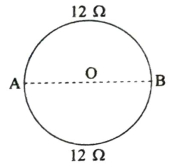
$A$ uniform wire has a resistance of $24 \Omega$. It is bent in the form of a circle. The effective resistance between the two points on any diameter of the circle is . . . . . . . (in $Omega$)
A
$12$
B
$24$
C
$6$
D
$3$
Solution
(C) The total resistance of the wire is $R = 24 \Omega$.
When the wire is bent into a circle,the diameter divides the wire into two equal semicircular parts.
The resistance of each semicircular part is $R' = \frac{R}{2} = \frac{24 \Omega}{2} = 12 \Omega$.
These two semicircular parts are connected in parallel between the two points on the diameter.
The equivalent resistance $R_{eq}$ is given by the formula for parallel resistors:
$\frac{1}{R_{eq}} = \frac{1}{R'} + \frac{1}{R'} = \frac{1}{12} + \frac{1}{12} = \frac{2}{12} = \frac{1}{6} \Omega^{-1}$.
Therefore,$R_{eq} = 6 \Omega$.
When the wire is bent into a circle,the diameter divides the wire into two equal semicircular parts.
The resistance of each semicircular part is $R' = \frac{R}{2} = \frac{24 \Omega}{2} = 12 \Omega$.
These two semicircular parts are connected in parallel between the two points on the diameter.
The equivalent resistance $R_{eq}$ is given by the formula for parallel resistors:
$\frac{1}{R_{eq}} = \frac{1}{R'} + \frac{1}{R'} = \frac{1}{12} + \frac{1}{12} = \frac{2}{12} = \frac{1}{6} \Omega^{-1}$.
Therefore,$R_{eq} = 6 \Omega$.
0 likesView Solution
7
PhysicsEasyMCQGUJCET · 2009
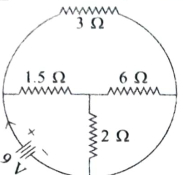
The total current supplied to the given circuit by the battery is . . . . . . . (in $A$)
A
$6$
B
$4$
C
$9$
D
$2$
Solution
(A) Step $1$: Analyze the circuit structure. The $6 \Omega$ and $2 \Omega$ resistors are connected in series with each other in the lower branch. Let their equivalent resistance be $R_1 = 6 \Omega + 2 \Omega = 8 \Omega$. However,looking at the circuit diagram,the $6 \Omega$ and $2 \Omega$ resistors are in series,and this combination is in parallel with the $1.5 \Omega$ resistor. Let's re-evaluate: The $6 \Omega$ and $2 \Omega$ are in series,$R_s = 6 + 2 = 8 \Omega$. This $8 \Omega$ is in parallel with $1.5 \Omega$. $R_p = (8 \times 1.5) / (8 + 1.5) = 12 / 9.5 \approx 1.26 \Omega$. This does not match the options. Let's re-examine the diagram: The $6 \Omega$ and $2 \Omega$ are in series,and the $1.5 \Omega$ is in parallel with the $6 \Omega$ resistor? No,the diagram shows $1.5 \Omega$ and $6 \Omega$ in series,and $2 \Omega$ in parallel to that branch. Let $R_s = 1.5 + 6 = 7.5 \Omega$. Then $R_p = (7.5 \times 2) / (7.5 + 2) = 15 / 9.5 \approx 1.57 \Omega$. Finally,this is in parallel with $3 \Omega$. $R_{eq} = (1.57 \times 3) / (1.57 + 3) \approx 1.04 \Omega$. Still not matching. Let's assume the standard interpretation: $6 \Omega$ and $2 \Omega$ are in parallel,$R' = (6 \times 2) / (6 + 2) = 1.5 \Omega$. This $1.5 \Omega$ is in series with the $1.5 \Omega$ resistor,$R'' = 1.5 + 1.5 = 3 \Omega$. This $3 \Omega$ is in parallel with the top $3 \Omega$ resistor,$R_{eq} = (3 \times 3) / (3 + 3) = 1.5 \Omega$.
Step $2$: Calculate the total current $I$ using Ohm's Law: $I = V / R_{eq} = 9 \text{ V} / 1.5 \Omega = 6 \text{ A}$.
Step $2$: Calculate the total current $I$ using Ohm's Law: $I = V / R_{eq} = 9 \text{ V} / 1.5 \Omega = 6 \text{ A}$.
0 likesView Solution
8
PhysicsEasyMCQGUJCET · 2009
If the Coulombian force acting between two protons separated by a distance $r$ is $F$, what would be the force acting between two alpha particles separated by a distance $2r$?
A
$F$
B
$3F$
C
$\frac{F}{2}$
D
$2F$
Solution
(A) The Coulombian force between two protons with charge $q = e$ separated by distance $r$ is given by:
$F = \frac{k e^2}{r^2}$
An alpha particle ($\alpha$-particle) consists of $2$ protons and $2$ neutrons, so its charge is $q_{\alpha} = 2e$.
For two alpha particles separated by a distance $2r$, the force $F^{\prime}$ is:
$F^{\prime} = \frac{k (2e)(2e)}{(2r)^2}$
$F^{\prime} = \frac{4 k e^2}{4 r^2}$
$F^{\prime} = \frac{k e^2}{r^2}$
Comparing this with the original force, we get $F^{\prime} = F$.
$F = \frac{k e^2}{r^2}$
An alpha particle ($\alpha$-particle) consists of $2$ protons and $2$ neutrons, so its charge is $q_{\alpha} = 2e$.
For two alpha particles separated by a distance $2r$, the force $F^{\prime}$ is:
$F^{\prime} = \frac{k (2e)(2e)}{(2r)^2}$
$F^{\prime} = \frac{4 k e^2}{4 r^2}$
$F^{\prime} = \frac{k e^2}{r^2}$
Comparing this with the original force, we get $F^{\prime} = F$.
0 likesView Solution
9
PhysicsEasyMCQGUJCET · 2009
Torque acting on an electric dipole in a uniform electric field is maximum when the angle between $\vec{p}$ and $\vec{E}$ is . . . . . . . (in $^{\circ}$)
A
$0$
B
$45$
C
$180$
D
$90$
Solution
(D) The torque $\tau$ acting on an electric dipole placed in a uniform electric field $\vec{E}$ is given by the formula: $\tau = p E \sin \theta$,where $p$ is the dipole moment and $\theta$ is the angle between $\vec{p}$ and $\vec{E}$.
For the torque to be maximum,the value of $\sin \theta$ must be maximum.
The maximum value of $\sin \theta$ is $1$,which occurs when $\theta = 90^{\circ}$.
Therefore,the torque is maximum when the angle between $\vec{p}$ and $\vec{E}$ is $90^{\circ}$.
For the torque to be maximum,the value of $\sin \theta$ must be maximum.
The maximum value of $\sin \theta$ is $1$,which occurs when $\theta = 90^{\circ}$.
Therefore,the torque is maximum when the angle between $\vec{p}$ and $\vec{E}$ is $90^{\circ}$.
0 likesView Solution
10
PhysicsEasyMCQGUJCET · 2009
Magnetic flux linked with a coil is $\phi = 5t^2 + 2t + 3$,where $t$ is in seconds and $\phi$ is in webers. At time $t = 1 \ s$,the value of the induced emf is . . . . . . $V$.
A
$1.2$
B
$6$
C
$14$
D
$12$
Solution
(D) According to Faraday's law of electromagnetic induction,the induced emf $\varepsilon$ is given by the negative rate of change of magnetic flux: $\varepsilon = -\frac{d\phi}{dt}$.
Given $\phi = 5t^2 + 2t + 3$.
Differentiating $\phi$ with respect to $t$: $\frac{d\phi}{dt} = \frac{d}{dt}(5t^2 + 2t + 3) = 10t + 2$.
Therefore,$\varepsilon = -(10t + 2)$.
At $t = 1 \ s$,the magnitude of the induced emf is $|\varepsilon| = |-(10(1) + 2)| = |-(12)| = 12 \ V$.
Given $\phi = 5t^2 + 2t + 3$.
Differentiating $\phi$ with respect to $t$: $\frac{d\phi}{dt} = \frac{d}{dt}(5t^2 + 2t + 3) = 10t + 2$.
Therefore,$\varepsilon = -(10t + 2)$.
At $t = 1 \ s$,the magnitude of the induced emf is $|\varepsilon| = |-(10(1) + 2)| = |-(12)| = 12 \ V$.
0 likesView Solution
11
PhysicsEasyMCQGUJCET · 2009
The sun delivers $10^{3} \,W m^{-2}$ of electromagnetic flux on the Earth's surface. The total power that is incident on a roof of dimensions $6 \,m \times 30 \,m$ is . . . . . . .
A
$7.2 \times 10^{5} \,W$
B
$4.5 \times 10^{5} \,W$
C
$1.8 \times 10^{5} \,W$
D
$0.9 \times 10^{5} \,W$
Solution
(C) The intensity of radiation $I$ is defined as the power incident per unit area,given by $I = \frac{P}{A}$.
Given:
Intensity $I = 10^{3} \,W m^{-2}$
Area $A = 6 \,m \times 30 \,m = 180 \,m^{2}$
To find the total power $P$ incident on the roof:
$P = I \times A$
$P = 10^{3} \,W m^{-2} \times 180 \,m^{2}$
$P = 180 \times 10^{3} \,W$
$P = 1.8 \times 10^{5} \,W$
Thus,the correct option is $C$.
Given:
Intensity $I = 10^{3} \,W m^{-2}$
Area $A = 6 \,m \times 30 \,m = 180 \,m^{2}$
To find the total power $P$ incident on the roof:
$P = I \times A$
$P = 10^{3} \,W m^{-2} \times 180 \,m^{2}$
$P = 180 \times 10^{3} \,W$
$P = 1.8 \times 10^{5} \,W$
Thus,the correct option is $C$.
0 likesView Solution
12
PhysicsEasyMCQGUJCET · 2009
Two capacitors of capacitance $2 \mu F$ and $4 \mu F$ respectively are connected in series. The combination is connected across a potential difference of $10 \ V$. The ratio of energies stored by the capacitors will be . . . . . . .
A
$2: 1$
B
$4: 1$
C
$1: \sqrt{2}$
D
$1: 4$
Solution
(A) In a series connection,the charge $Q$ stored on each capacitor is the same.
The energy $U$ stored in a capacitor is given by the formula $U = \frac{Q^2}{2C}$.
For the two capacitors with capacitances $C_1 = 2 \mu F$ and $C_2 = 4 \mu F$,the energies stored are $U_1 = \frac{Q^2}{2C_1}$ and $U_2 = \frac{Q^2}{2C_2}$ respectively.
The ratio of the energies is $\frac{U_1}{U_2} = \frac{Q^2 / 2C_1}{Q^2 / 2C_2} = \frac{C_2}{C_1}$.
Substituting the values,we get $\frac{U_1}{U_2} = \frac{4 \mu F}{2 \mu F} = \frac{2}{1}$.
Thus,the ratio of energies stored is $2: 1$.
The energy $U$ stored in a capacitor is given by the formula $U = \frac{Q^2}{2C}$.
For the two capacitors with capacitances $C_1 = 2 \mu F$ and $C_2 = 4 \mu F$,the energies stored are $U_1 = \frac{Q^2}{2C_1}$ and $U_2 = \frac{Q^2}{2C_2}$ respectively.
The ratio of the energies is $\frac{U_1}{U_2} = \frac{Q^2 / 2C_1}{Q^2 / 2C_2} = \frac{C_2}{C_1}$.
Substituting the values,we get $\frac{U_1}{U_2} = \frac{4 \mu F}{2 \mu F} = \frac{2}{1}$.
Thus,the ratio of energies stored is $2: 1$.
0 likesView Solution
13
PhysicsEasyMCQGUJCET · 2009
$A$ parallel plate capacitor having air as the dielectric medium is charged by a potential difference of $V$ volt. After disconnecting the battery,the distance between the plates of the capacitor is increased using an insulated handle. As a result,the potential difference between the plates . . . . . . .
A
does not change.
B
decreases.
C
increases.
D
becomes zero.
Solution
(C) The correct option is $C$.
When the battery is disconnected,the charge $Q$ on the plates remains constant because there is no path for the charge to flow.
The capacitance of a parallel plate capacitor is given by $C = \frac{A \varepsilon_0}{d}$,where $A$ is the area of the plates,$\varepsilon_0$ is the permittivity of free space,and $d$ is the distance between the plates.
When the distance $d$ between the plates is increased,the capacitance $C$ decreases.
Since the charge $Q$ remains constant and $Q = CV$,the potential difference $V = \frac{Q}{C}$ must increase as $C$ decreases.
When the battery is disconnected,the charge $Q$ on the plates remains constant because there is no path for the charge to flow.
The capacitance of a parallel plate capacitor is given by $C = \frac{A \varepsilon_0}{d}$,where $A$ is the area of the plates,$\varepsilon_0$ is the permittivity of free space,and $d$ is the distance between the plates.
When the distance $d$ between the plates is increased,the capacitance $C$ decreases.
Since the charge $Q$ remains constant and $Q = CV$,the potential difference $V = \frac{Q}{C}$ must increase as $C$ decreases.
0 likesView Solution
14
PhysicsEasyMCQGUJCET · 2009
The potential energy of a system of two equal negative point charges of $2 \mu C$ each,held $1 \ m$ apart in air,is . . . . . . . $\left( k = 9 \times 10^9 \text{ SI units} \right)$
A
$3.6 \times 10^{-3} \text{ J}$
B
$3.6 \times 10^{-2} \text{ J}$
C
$36 \text{ J}$
D
$3.6 \text{ J}$
Solution
(B) The potential energy $U$ of a system of two point charges $q_1$ and $q_2$ separated by a distance $r$ is given by the formula: $U = \frac{k q_1 q_2}{r}$.
Given:
$q_1 = q_2 = -2 \mu C = -2 \times 10^{-6} \text{ C}$
$r = 1 \text{ m}$
$k = 9 \times 10^9 \text{ N m}^2/\text{C}^2$
Substituting the values into the formula:
$U = \frac{(9 \times 10^9) \times (-2 \times 10^{-6}) \times (-2 \times 10^{-6})}{1}$
$U = 9 \times 10^9 \times 4 \times 10^{-12}$
$U = 36 \times 10^{-3} \text{ J}$
$U = 3.6 \times 10^{-2} \text{ J}$.
Given:
$q_1 = q_2 = -2 \mu C = -2 \times 10^{-6} \text{ C}$
$r = 1 \text{ m}$
$k = 9 \times 10^9 \text{ N m}^2/\text{C}^2$
Substituting the values into the formula:
$U = \frac{(9 \times 10^9) \times (-2 \times 10^{-6}) \times (-2 \times 10^{-6})}{1}$
$U = 9 \times 10^9 \times 4 \times 10^{-12}$
$U = 36 \times 10^{-3} \text{ J}$
$U = 3.6 \times 10^{-2} \text{ J}$.
0 likesView Solution
15
PhysicsEasyMCQGUJCET · 2009
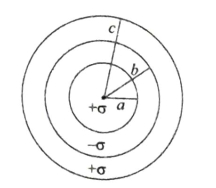
Consider three concentric metal shells $A$,$B$,and $C$ with radii $a$,$b$,and $c$ respectively,as shown in the figure $(a < b < c)$. Their surface charge densities are $\sigma$,$-\sigma$,and $\sigma$ respectively. Calculate the electric potential on the surface of shell $A$.
A
$\frac{\sigma}{\varepsilon_0}(a-b-c)$
B
$\frac{\sigma}{\varepsilon_0}(a+b-c)$
C
$\frac{\sigma}{\varepsilon_0}(a-b+c)$
D
$\frac{\sigma}{\varepsilon_0}(a^2+b^2+c^2)$
Solution
(C) The electric potential at the surface of shell $A$ is the sum of the potentials due to all three shells $A$,$B$,and $C$.
$V_A = V_a + V_b + V_c$
Since the point on the surface of shell $A$ is inside shells $B$ and $C$,the potential due to shells $B$ and $C$ at this point is equal to the potential at their respective surfaces.
$V_A = \frac{1}{4 \pi \varepsilon_0} \left[ \frac{q_a}{a} + \frac{q_b}{b} + \frac{q_c}{c} \right]$
Given surface charge densities: $\sigma_a = \sigma$,$\sigma_b = -\sigma$,$\sigma_c = \sigma$.
The charges are $q_a = 4 \pi a^2 \sigma$,$q_b = 4 \pi b^2(-\sigma)$,and $q_c = 4 \pi c^2 \sigma$.
Substituting these into the potential formula:
$V_A = \frac{1}{4 \pi \varepsilon_0} \left[ \frac{4 \pi a^2 \sigma}{a} + \frac{4 \pi b^2(-\sigma)}{b} + \frac{4 \pi c^2 \sigma}{c} \right]$
$V_A = \frac{1}{4 \pi \varepsilon_0} [4 \pi a \sigma - 4 \pi b \sigma + 4 \pi c \sigma]$
$V_A = \frac{\sigma}{\varepsilon_0} (a - b + c)$
$V_A = V_a + V_b + V_c$
Since the point on the surface of shell $A$ is inside shells $B$ and $C$,the potential due to shells $B$ and $C$ at this point is equal to the potential at their respective surfaces.
$V_A = \frac{1}{4 \pi \varepsilon_0} \left[ \frac{q_a}{a} + \frac{q_b}{b} + \frac{q_c}{c} \right]$
Given surface charge densities: $\sigma_a = \sigma$,$\sigma_b = -\sigma$,$\sigma_c = \sigma$.
The charges are $q_a = 4 \pi a^2 \sigma$,$q_b = 4 \pi b^2(-\sigma)$,and $q_c = 4 \pi c^2 \sigma$.
Substituting these into the potential formula:
$V_A = \frac{1}{4 \pi \varepsilon_0} \left[ \frac{4 \pi a^2 \sigma}{a} + \frac{4 \pi b^2(-\sigma)}{b} + \frac{4 \pi c^2 \sigma}{c} \right]$
$V_A = \frac{1}{4 \pi \varepsilon_0} [4 \pi a \sigma - 4 \pi b \sigma + 4 \pi c \sigma]$
$V_A = \frac{\sigma}{\varepsilon_0} (a - b + c)$
0 likesView Solution
16
PhysicsEasyMCQGUJCET · 2009
In which direction would the magnetic field on the axis at a distance $Z$ from the centre of the bar magnet be?
A
In the direction of the magnetic dipole moment ( $\overrightarrow{M}$ ) of the magnet.
B
In the opposite direction of the magnetic dipole moment ( $\overrightarrow{M}$ ) of the magnet.
C
In the perpendicular direction of the magnetic moment ( $\overrightarrow{M}$ ) of the magnet.
D
Its direction depends on the magnitude of the magnetic moment ( $\overrightarrow{M}$ ) of the magnet.
Solution
(A) The correct answer is $A$.
For a bar magnet,the magnetic field $\overrightarrow{B}$ at a point on its axial line at a distance $Z$ from the center is given by the formula:
$\overrightarrow{B} = \frac{\mu_0}{4\pi} \frac{2\overrightarrow{M}}{Z^3}$
where $\overrightarrow{M}$ is the magnetic dipole moment of the magnet.
Since the expression for the magnetic field is directly proportional to the magnetic dipole moment vector $\overrightarrow{M}$,the direction of the magnetic field $\overrightarrow{B}$ is the same as the direction of the magnetic dipole moment $\overrightarrow{M}$.
For a bar magnet,the magnetic field $\overrightarrow{B}$ at a point on its axial line at a distance $Z$ from the center is given by the formula:
$\overrightarrow{B} = \frac{\mu_0}{4\pi} \frac{2\overrightarrow{M}}{Z^3}$
where $\overrightarrow{M}$ is the magnetic dipole moment of the magnet.
Since the expression for the magnetic field is directly proportional to the magnetic dipole moment vector $\overrightarrow{M}$,the direction of the magnetic field $\overrightarrow{B}$ is the same as the direction of the magnetic dipole moment $\overrightarrow{M}$.
0 likesView Solution
17
PhysicsEasyMCQGUJCET · 2009
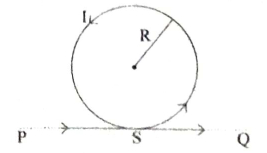
An infinite straight current-carrying conductor is bent in such a way that a circular loop is formed on it as shown in the figure. If the radius of the loop is $R$,the magnetic field at the centre of the loop is . . . . . . .
A
Infinite
B
Zero
C
$\frac{\mu_0}{4 \pi} \frac{2 I }{ R } \pi$
D
$\frac{\mu_0}{4 \pi} \frac{2 I}{R}(\pi+1)$
Solution
(D) The magnetic field at the center of the loop is the sum of the magnetic field due to the straight wire and the magnetic field due to the circular loop.
Magnetic field at the center due to the straight wire at a distance $R$ is given by:
$B_{\text{wire}} = \frac{\mu_0 I}{2 \pi R} = \frac{2 \mu_0 I}{4 \pi R}$ (directed inwards).
Magnetic field at the center due to the circular loop of radius $R$ is given by:
$B_{\text{loop}} = \frac{\mu_0 I}{2 R} = \frac{\mu_0 I}{2 R} \times \frac{2 \pi}{2 \pi} = \frac{\mu_0}{4 \pi} \cdot \frac{2 \pi I}{R}$ (directed inwards).
Since both magnetic fields are in the same direction,the net magnetic field $B$ is:
$B = B_{\text{wire}} + B_{\text{loop}}$
$B = \frac{2 \mu_0 I}{4 \pi R} + \frac{2 \mu_0 I \pi}{4 \pi R}$
$B = \frac{\mu_0}{4 \pi} \frac{2 I}{R} (\pi + 1)$ (directed inwards).
Thus,the correct option is $D$.
Magnetic field at the center due to the straight wire at a distance $R$ is given by:
$B_{\text{wire}} = \frac{\mu_0 I}{2 \pi R} = \frac{2 \mu_0 I}{4 \pi R}$ (directed inwards).
Magnetic field at the center due to the circular loop of radius $R$ is given by:
$B_{\text{loop}} = \frac{\mu_0 I}{2 R} = \frac{\mu_0 I}{2 R} \times \frac{2 \pi}{2 \pi} = \frac{\mu_0}{4 \pi} \cdot \frac{2 \pi I}{R}$ (directed inwards).
Since both magnetic fields are in the same direction,the net magnetic field $B$ is:
$B = B_{\text{wire}} + B_{\text{loop}}$
$B = \frac{2 \mu_0 I}{4 \pi R} + \frac{2 \mu_0 I \pi}{4 \pi R}$
$B = \frac{\mu_0}{4 \pi} \frac{2 I}{R} (\pi + 1)$ (directed inwards).
Thus,the correct option is $D$.
0 likesView Solution
18
PhysicsEasyMCQGUJCET · 2009
An electron and a proton of equal linear momentum enter in a direction perpendicular to a uniform magnetic field. If the radii of their circular paths are $r_e$ and $r_p$ respectively,then $\frac{r_e}{r_p}$ is equal to - (mass of electron $= m_e$,mass of proton $= m_p$)
A
$\left[\frac{m_p}{m_e}\right]^{\frac{1}{2}}$
B
$\frac{m_e}{m_p}$
C
$\left|\frac{m_e}{m_p}\right|^{\frac{1}{2}}$
D
$1$
Solution
(D) The radius $r$ of a charged particle moving in a uniform magnetic field $B$ perpendicular to its velocity $v$ is given by the formula:
$\frac{mv^2}{r} = qvB$
$r = \frac{mv}{qB} = \frac{p}{qB}$
where $p = mv$ is the linear momentum of the particle and $q$ is its charge.
Given that the electron and proton have equal linear momentum $(p_e = p_p = p)$ and enter the same magnetic field $B$,the radius becomes inversely proportional to the charge $q$:
$r \propto \frac{1}{q}$
Therefore,the ratio of the radii is:
$\frac{r_e}{r_p} = \frac{q_p}{q_e}$
Since the magnitude of the charge of an electron and a proton is equal $(|q_e| = |q_p| = e)$,
$\frac{r_e}{r_p} = \frac{e}{e} = 1$
$\frac{mv^2}{r} = qvB$
$r = \frac{mv}{qB} = \frac{p}{qB}$
where $p = mv$ is the linear momentum of the particle and $q$ is its charge.
Given that the electron and proton have equal linear momentum $(p_e = p_p = p)$ and enter the same magnetic field $B$,the radius becomes inversely proportional to the charge $q$:
$r \propto \frac{1}{q}$
Therefore,the ratio of the radii is:
$\frac{r_e}{r_p} = \frac{q_p}{q_e}$
Since the magnitude of the charge of an electron and a proton is equal $(|q_e| = |q_p| = e)$,
$\frac{r_e}{r_p} = \frac{e}{e} = 1$
0 likesView Solution
Vedclass Products
For Students
Vedclass Test Series
Mock tests in real GUJCET style covering Physics with performance analysis. 5-day free trial.
Start Free TrialFor Teachers
Exam Paper Generator
Generate Set A/B/C/D Physics papers from 7.5L+ questions in 2 minutes. 3 chapters free.
Try FreeFor Institutes
Online Exam Module
Run live GUJCET mock exams with unlimited students, 360° analytics & white-label branding.
See DemoFrequently Asked Questions
How many Physics questions are in GUJCET 2009?
There are 18 Physics questions from the GUJCET 2009 paper on Vedclass, each with a detailed step-by-step solution in English.
Are GUJCET 2009 Physics solutions available in English?
Yes. All solutions on this page are in English. You can also switch to English or Hindi using the language buttons above the questions.
Can I practice GUJCET 2009 Physics as a timed test?
Yes. Use the Vedclass Test Series to attempt a full GUJCET mock test covering Physics with time limits and instant score analysis.
Can teachers create Physics papers from GUJCET previous year questions?
Yes. The Vedclass Exam Paper Generator lets teachers mix GUJCET Physics questions and generate Set A/B/C/D papers in minutes.
For Teachers & Institutes
Build a Custom Physics Paper
Pick GUJCET 2009 Physics questions, set difficulty, and generate Set A/B/C/D in 2 minutes.