
PhysicsQ1–19 of 19 questions
Page 1 of 1 · English
1
PhysicsEasyMCQGUJCET · 2008
At time $t=0 \text{ s}$, the voltage of an $AC$ generator starts from $0 \text{ V}$ and becomes $2 \text{ V}$ at time $t=\frac{1}{100 \pi} \text{ s}$. The voltage increases up to $100 \text{ V}$, after which it starts to decrease. Find the frequency of the generator. (in $\text{ Hz}$)
A
$100$
B
$1$
C
$2$
D
$5$
Solution
(B) The instantaneous voltage of an $AC$ generator is given by $V = V_m \sin(\omega t)$, where $V_m$ is the peak voltage and $\omega = 2 \pi \nu$ is the angular frequency.
Given: $V_m = 100 \text{ V}$, $V = 2 \text{ V}$ at $t = \frac{1}{100 \pi} \text{ s}$.
Substituting these values into the equation:
$2 = 100 \sin\left(2 \pi \nu \times \frac{1}{100 \pi}\right)$
$2 = 100 \sin\left(\frac{\nu}{50}\right)$
$\frac{2}{100} = \sin\left(\frac{\nu}{50}\right)$
Since the angle $\frac{\nu}{50}$ is very small, we can use the approximation $\sin(\theta) \approx \theta$:
$\frac{1}{50} = \frac{\nu}{50}$
$\nu = 1 \text{ Hz}$.
Given: $V_m = 100 \text{ V}$, $V = 2 \text{ V}$ at $t = \frac{1}{100 \pi} \text{ s}$.
Substituting these values into the equation:
$2 = 100 \sin\left(2 \pi \nu \times \frac{1}{100 \pi}\right)$
$2 = 100 \sin\left(\frac{\nu}{50}\right)$
$\frac{2}{100} = \sin\left(\frac{\nu}{50}\right)$
Since the angle $\frac{\nu}{50}$ is very small, we can use the approximation $\sin(\theta) \approx \theta$:
$\frac{1}{50} = \frac{\nu}{50}$
$\nu = 1 \text{ Hz}$.
0 likesView Solution
2
PhysicsEasyMCQGUJCET · 2008
In an $AC$ circuit,a resistance of $R$ $\Omega$ is connected in series with an inductor of self-inductance $L$. If the phase angle between voltage and current is $45^{\circ}$,the value of inductive reactance $(X_{L})$ will be equal to . . . . . . .
A
$R/4$
B
$R/2$
C
$R$
D
$R/8$
Solution
(C) In an $RL$ series circuit,the phase angle $\phi$ between the voltage and the current is given by the formula: $\tan \phi = \frac{X_L}{R}$,where $X_L = \omega L$ is the inductive reactance.
Given that the phase angle $\phi = 45^{\circ}$.
Substituting the value into the formula: $\tan 45^{\circ} = \frac{X_L}{R}$.
Since $\tan 45^{\circ} = 1$,we have $1 = \frac{X_L}{R}$.
Therefore,$X_L = R$.
Given that the phase angle $\phi = 45^{\circ}$.
Substituting the value into the formula: $\tan 45^{\circ} = \frac{X_L}{R}$.
Since $\tan 45^{\circ} = 1$,we have $1 = \frac{X_L}{R}$.
Therefore,$X_L = R$.
0 likesView Solution
3
PhysicsEasyMCQGUJCET · 2008
Two electric bulbs are connected one by one across a potential difference $V$. At that time,the power consumed in them is $P_1$ and $P_2$ respectively. Now,if the potential difference $V$ is applied across the series combination of these bulbs,what will be the total power consumed?
A
$P_1+P_2$
B
$\sqrt{P_1 P_2}$
C
$\frac{P_1 P_2}{P_1+P_2}$
D
$P_1 P_2$
Solution
(C) The power consumed by a bulb with resistance $R$ connected to a potential difference $V$ is given by $P = \frac{V^2}{R}$.
For the first bulb,$P_1 = \frac{V^2}{R_1}$,which implies $R_1 = \frac{V^2}{P_1}$.
For the second bulb,$P_2 = \frac{V^2}{R_2}$,which implies $R_2 = \frac{V^2}{P_2}$.
When the bulbs are connected in series,the total resistance is $R_{eq} = R_1 + R_2$.
The total power consumed in series is $P_{series} = \frac{V^2}{R_{eq}} = \frac{V^2}{R_1 + R_2}$.
Substituting the values of $R_1$ and $R_2$,we get $P_{series} = \frac{V^2}{\frac{V^2}{P_1} + \frac{V^2}{P_2}} = \frac{1}{\frac{1}{P_1} + \frac{1}{P_2}}$.
Simplifying this,we get $P_{series} = \frac{P_1 P_2}{P_1 + P_2}$.
For the first bulb,$P_1 = \frac{V^2}{R_1}$,which implies $R_1 = \frac{V^2}{P_1}$.
For the second bulb,$P_2 = \frac{V^2}{R_2}$,which implies $R_2 = \frac{V^2}{P_2}$.
When the bulbs are connected in series,the total resistance is $R_{eq} = R_1 + R_2$.
The total power consumed in series is $P_{series} = \frac{V^2}{R_{eq}} = \frac{V^2}{R_1 + R_2}$.
Substituting the values of $R_1$ and $R_2$,we get $P_{series} = \frac{V^2}{\frac{V^2}{P_1} + \frac{V^2}{P_2}} = \frac{1}{\frac{1}{P_1} + \frac{1}{P_2}}$.
Simplifying this,we get $P_{series} = \frac{P_1 P_2}{P_1 + P_2}$.
0 likesView Solution
4
PhysicsEasyMCQGUJCET · 2008
The ratio of cross-sectional areas of two conducting wires made up of the same material and having the same length is $1 : 2$. What will be the ratio of heat produced per second in the wires,when the same current is flowing in them?
A
$1 : \sqrt{2}$
B
$1 : 1$
C
$1 : 4$
D
$2 : 1$
Solution
(D) The heat produced per second in a conductor is equal to the power dissipated,given by $P = I^2 R$.
Since the wires are made of the same material and have the same length,the resistance $R$ is given by $R = \rho \frac{l}{A}$.
Substituting this into the power formula,we get $P = I^2 \left( \frac{\rho l}{A} \right)$.
Since $I$,$\rho$,and $l$ are constant for both wires,we have $P \propto \frac{1}{A}$.
Therefore,the ratio of heat produced is $\frac{P_1}{P_2} = \frac{A_2}{A_1}$.
Given the ratio of areas $\frac{A_1}{A_2} = \frac{1}{2}$,we have $\frac{A_2}{A_1} = \frac{2}{1}$.
Thus,the ratio of heat produced per second is $2 : 1$.
Since the wires are made of the same material and have the same length,the resistance $R$ is given by $R = \rho \frac{l}{A}$.
Substituting this into the power formula,we get $P = I^2 \left( \frac{\rho l}{A} \right)$.
Since $I$,$\rho$,and $l$ are constant for both wires,we have $P \propto \frac{1}{A}$.
Therefore,the ratio of heat produced is $\frac{P_1}{P_2} = \frac{A_2}{A_1}$.
Given the ratio of areas $\frac{A_1}{A_2} = \frac{1}{2}$,we have $\frac{A_2}{A_1} = \frac{2}{1}$.
Thus,the ratio of heat produced per second is $2 : 1$.
0 likesView Solution
5
PhysicsEasyMCQGUJCET · 2008
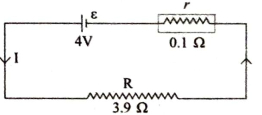
The internal resistance of a cell of emf $4 \text{ V}$ is $0.1 \ \Omega$. It is connected to an external resistance of $3.9 \ \Omega$. The terminal voltage across the cell will be . . . . . . . (in $\text{ V}$)
A
$3.8$
B
$0.1$
C
$2$
D
$3.9$
Solution
(D) Given: Electromotive force $\varepsilon = 4 \text{ V}$, internal resistance $r = 0.1 \ \Omega$, and external resistance $R = 3.9 \ \Omega$.
First, calculate the current $I$ flowing through the circuit using Ohm's law:
$I = \frac{\varepsilon}{R + r} = \frac{4}{3.9 + 0.1} = \frac{4}{4} = 1 \text{ A}$.
The terminal voltage $V$ across the cell is given by the potential difference across the external resistor $R$:
$V = I \times R$
$V = 1 \text{ A} \times 3.9 \ \Omega = 3.9 \text{ V}$.
Alternatively, using the formula $V = \varepsilon - Ir$:
$V = 4 - (1 \times 0.1) = 4 - 0.1 = 3.9 \text{ V}$.
Therefore, the correct option is $D$.
First, calculate the current $I$ flowing through the circuit using Ohm's law:
$I = \frac{\varepsilon}{R + r} = \frac{4}{3.9 + 0.1} = \frac{4}{4} = 1 \text{ A}$.
The terminal voltage $V$ across the cell is given by the potential difference across the external resistor $R$:
$V = I \times R$
$V = 1 \text{ A} \times 3.9 \ \Omega = 3.9 \text{ V}$.
Alternatively, using the formula $V = \varepsilon - Ir$:
$V = 4 - (1 \times 0.1) = 4 - 0.1 = 3.9 \text{ V}$.
Therefore, the correct option is $D$.
0 likesView Solution
6
PhysicsEasyMCQGUJCET · 2008
Cross-sectional area of a copper wire is equal to the area of a square of length $2 \ mm$. If this copper wire draws $8 \ A$ electric current,then find the drift velocity of free electrons. The number density of electrons in the copper wire is $8 \times 10^{28} \ m^{-3}$.
A
$1.56 \times 10^{-4} \ ms^{-1}$
B
$1.56 \times 10^{-2} \ ms^{-1}$
C
$3.12 \times 10^{-3} \ ms^{-1}$
D
$3.12 \times 10^{-2} \ ms^{-1}$
Solution
(A) Given: Area $A = (2 \ mm)^2 = (2 \times 10^{-3} \ m)^2 = 4 \times 10^{-6} \ m^2$. Current $I = 8 \ A$. Number density $n = 8 \times 10^{28} \ m^{-3}$. Charge of electron $e = 1.6 \times 10^{-19} \ C$.
Using the formula for drift velocity: $I = n A v_d e$.
Rearranging for $v_d$: $v_d = \frac{I}{n A e}$.
Substituting the values: $v_d = \frac{8}{8 \times 10^{28} \times 4 \times 10^{-6} \times 1.6 \times 10^{-19}}$.
$v_d = \frac{8}{51.2 \times 10^3} = \frac{8}{51200} \approx 1.56 \times 10^{-4} \ ms^{-1}$.
Using the formula for drift velocity: $I = n A v_d e$.
Rearranging for $v_d$: $v_d = \frac{I}{n A e}$.
Substituting the values: $v_d = \frac{8}{8 \times 10^{28} \times 4 \times 10^{-6} \times 1.6 \times 10^{-19}}$.
$v_d = \frac{8}{51.2 \times 10^3} = \frac{8}{51200} \approx 1.56 \times 10^{-4} \ ms^{-1}$.
0 likesView Solution
7
PhysicsEasyMCQGUJCET · 2008
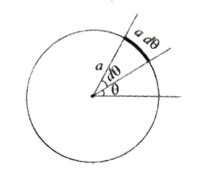
$A$ circle of radius $a$ has a linear charge density given by $\lambda = \lambda_0 \cos^2 \theta$ on its circumference. What will be the total charge on the circle?
A
$\pi a \lambda_0$
B
zero
C
$2 \pi a$
D
None of these.
Solution
(A) As shown in the figure,let us consider an element of angular width $d \theta$ at an angle $\theta$.
The length of this element is $dl = a d \theta$.
The charge on this element is $dq = \lambda dl = (\lambda_0 \cos^2 \theta) (a d \theta)$.
The total charge $Q$ on the circle is obtained by integrating $dq$ over the entire circumference from $0$ to $2 \pi$:
$Q = \int_{0}^{2 \pi} \lambda_0 \cos^2 \theta a d \theta$
$Q = a \lambda_0 \int_{0}^{2 \pi} \cos^2 \theta d \theta$
Using the identity $\cos^2 \theta = \frac{1 + \cos 2 \theta}{2}$:
$Q = a \lambda_0 \int_{0}^{2 \pi} \frac{1 + \cos 2 \theta}{2} d \theta$
$Q = \frac{a \lambda_0}{2} [\theta + \frac{\sin 2 \theta}{2}]_{0}^{2 \pi}$
$Q = \frac{a \lambda_0}{2} [(2 \pi + 0) - (0 + 0)]$
$Q = \frac{a \lambda_0}{2} (2 \pi) = \pi a \lambda_0$
Thus,the total charge is $\pi a \lambda_0$.
The length of this element is $dl = a d \theta$.
The charge on this element is $dq = \lambda dl = (\lambda_0 \cos^2 \theta) (a d \theta)$.
The total charge $Q$ on the circle is obtained by integrating $dq$ over the entire circumference from $0$ to $2 \pi$:
$Q = \int_{0}^{2 \pi} \lambda_0 \cos^2 \theta a d \theta$
$Q = a \lambda_0 \int_{0}^{2 \pi} \cos^2 \theta d \theta$
Using the identity $\cos^2 \theta = \frac{1 + \cos 2 \theta}{2}$:
$Q = a \lambda_0 \int_{0}^{2 \pi} \frac{1 + \cos 2 \theta}{2} d \theta$
$Q = \frac{a \lambda_0}{2} [\theta + \frac{\sin 2 \theta}{2}]_{0}^{2 \pi}$
$Q = \frac{a \lambda_0}{2} [(2 \pi + 0) - (0 + 0)]$
$Q = \frac{a \lambda_0}{2} (2 \pi) = \pi a \lambda_0$
Thus,the total charge is $\pi a \lambda_0$.
0 likesView Solution
8
PhysicsEasyMCQGUJCET · 2008
The electrical force between two point charges is $200 \ N$. If we increase $10 \ \%$ charge on one of the charges and decrease $10 \ \%$ charge on the other,then the electrical force between them for the same distance becomes . . . . . . . . . . (in $N$)
A
$200$
B
$100$
C
$198$
D
$99$
Solution
(C) Let the two point charges be $q_1$ and $q_2$,separated by a distance $r$. The initial force is given by Coulomb's Law: $F = \frac{k q_1 q_2}{r^2} = 200 \ N$.
When the charge $q_1$ increases by $10 \ \%$,the new charge is $q_1' = q_1 + 0.1 q_1 = 1.1 q_1$.
When the charge $q_2$ decreases by $10 \ \%$,the new charge is $q_2' = q_2 - 0.1 q_2 = 0.9 q_2$.
The new electrical force $F'$ at the same distance $r$ is: $F' = \frac{k q_1' q_2'}{r^2} = \frac{k (1.1 q_1) (0.9 q_2)}{r^2}$.
Substituting the initial force value: $F' = (1.1 \times 0.9) \times \frac{k q_1 q_2}{r^2} = 0.99 \times F$.
Therefore,$F' = 0.99 \times 200 \ N = 198 \ N$.
When the charge $q_1$ increases by $10 \ \%$,the new charge is $q_1' = q_1 + 0.1 q_1 = 1.1 q_1$.
When the charge $q_2$ decreases by $10 \ \%$,the new charge is $q_2' = q_2 - 0.1 q_2 = 0.9 q_2$.
The new electrical force $F'$ at the same distance $r$ is: $F' = \frac{k q_1' q_2'}{r^2} = \frac{k (1.1 q_1) (0.9 q_2)}{r^2}$.
Substituting the initial force value: $F' = (1.1 \times 0.9) \times \frac{k q_1 q_2}{r^2} = 0.99 \times F$.
Therefore,$F' = 0.99 \times 200 \ N = 198 \ N$.
0 likesView Solution
9
PhysicsEasyMCQGUJCET · 2008
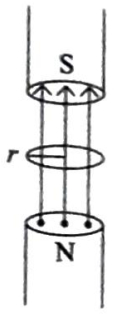
$A$ conducting ring of radius $r$ is placed perpendicularly inside a time-varying magnetic field given by $B = B_0 + \alpha t$ as shown in the figure. $B_0$ and $\alpha$ are positive constants. Find the $emf$ produced in the ring.
A
$-\pi \alpha^2 r^2$
B
$-\pi \alpha^2 r$
C
$-\pi \alpha r^2$
D
$-\pi \alpha r$
Solution
(C) According to Faraday's law of electromagnetic induction,the induced $emf$ $(\varepsilon)$ is given by the negative rate of change of magnetic flux $(\phi)$ through the loop:
$\varepsilon = -\frac{d\phi}{dt}$
The magnetic flux $\phi$ through the ring of area $A = \pi r^2$ is given by $\phi = B \cdot A = (B_0 + \alpha t) \cdot \pi r^2$.
Substituting this into the $emf$ formula:
$\varepsilon = -\frac{d}{dt} [\pi r^2 (B_0 + \alpha t)]$
Since $\pi$ and $r$ are constants:
$\varepsilon = -\pi r^2 \frac{d}{dt} (B_0 + \alpha t)$
Calculating the derivative with respect to time $t$:
$\frac{d}{dt} (B_0 + \alpha t) = 0 + \alpha = \alpha$
Therefore,the induced $emf$ is:
$\varepsilon = -\pi r^2 \alpha$
$\varepsilon = -\frac{d\phi}{dt}$
The magnetic flux $\phi$ through the ring of area $A = \pi r^2$ is given by $\phi = B \cdot A = (B_0 + \alpha t) \cdot \pi r^2$.
Substituting this into the $emf$ formula:
$\varepsilon = -\frac{d}{dt} [\pi r^2 (B_0 + \alpha t)]$
Since $\pi$ and $r$ are constants:
$\varepsilon = -\pi r^2 \frac{d}{dt} (B_0 + \alpha t)$
Calculating the derivative with respect to time $t$:
$\frac{d}{dt} (B_0 + \alpha t) = 0 + \alpha = \alpha$
Therefore,the induced $emf$ is:
$\varepsilon = -\pi r^2 \alpha$
0 likesView Solution
10
PhysicsEasyMCQGUJCET · 2008
$X$ and $Y$ are two metallic coils arranged in such a way that when the steady change in current flowing in coil $X$ is $4 \ A$,the change in magnetic flux associated with coil $Y$ is $0.4 \ Wb$. The mutual inductance of the system of these coils is . . . . . . $H$.
A
$0.8$
B
$0.1$
C
$0.2$
D
$5$
Solution
(B) The mutual inductance $M$ between two coils is defined by the relationship between the change in magnetic flux $\Delta \phi$ linked with one coil and the change in current $\Delta I$ in the other coil.
The formula is given by:
$M = \frac{\Delta \phi}{\Delta I}$
Given values:
Change in current in coil $X$,$\Delta I = 4 \ A$
Change in magnetic flux in coil $Y$,$\Delta \phi = 0.4 \ Wb$
Substituting these values into the formula:
$M = \frac{0.4 \ Wb}{4 \ A}$
$M = 0.1 \ H$
Therefore,the mutual inductance of the system is $0.1 \ H$.
The formula is given by:
$M = \frac{\Delta \phi}{\Delta I}$
Given values:
Change in current in coil $X$,$\Delta I = 4 \ A$
Change in magnetic flux in coil $Y$,$\Delta \phi = 0.4 \ Wb$
Substituting these values into the formula:
$M = \frac{0.4 \ Wb}{4 \ A}$
$M = 0.1 \ H$
Therefore,the mutual inductance of the system is $0.1 \ H$.
0 likesView Solution
11
PhysicsEasyMCQGUJCET · 2008
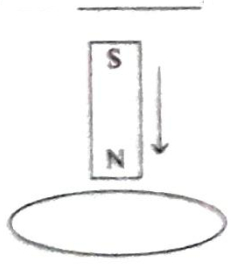
The north pole of a magnet is falling towards a metallic ring as shown in the figure. If looked at from above the ring,the direction of the induced current will be:
A
Anticlockwise
B
Clockwise
C
Clockwise or anticlockwise depending on the metal of the ring.
D
No induced current
Solution
(A) According to Lenz's law,the direction of the induced current is such that it opposes the cause that produces it.
As the north pole $(N)$ of the magnet moves towards the metallic ring,the magnetic flux linked with the ring increases.
To oppose this increase in magnetic flux,the upper face of the ring must behave like a north pole $(N)$ to repel the approaching magnet.
$A$ face of a current-carrying loop behaves as a north pole when the current flows in an anticlockwise direction as viewed from that side.
Therefore,when looked at from above,the induced current in the ring will be anticlockwise.
As the north pole $(N)$ of the magnet moves towards the metallic ring,the magnetic flux linked with the ring increases.
To oppose this increase in magnetic flux,the upper face of the ring must behave like a north pole $(N)$ to repel the approaching magnet.
$A$ face of a current-carrying loop behaves as a north pole when the current flows in an anticlockwise direction as viewed from that side.
Therefore,when looked at from above,the induced current in the ring will be anticlockwise.
0 likesView Solution
12
PhysicsEasyMCQGUJCET · 2008
If $20 \ J$ of work has to be done to move an electric charge of $4 \ C$ from a point where potential is $10 \ V$ to another point,where potential is $V \ V$,find the value of $V$. (in $V$)
A
$5$
B
$15$
C
$2$
D
$70$
Solution
(B) The work done $W$ in moving a charge $q$ between two points with potential difference $\Delta V$ is given by the formula: $W = q \Delta V$.
Here,$W = 20 \ J$,$q = 4 \ C$,initial potential $V_i = 10 \ V$,and final potential $V_f = V$.
The potential difference is $\Delta V = V_f - V_i = V - 10$.
Substituting the values into the formula:
$20 = 4(V - 10)$
Divide both sides by $4$:
$5 = V - 10$
Adding $10$ to both sides:
$V = 15 \ V$.
Here,$W = 20 \ J$,$q = 4 \ C$,initial potential $V_i = 10 \ V$,and final potential $V_f = V$.
The potential difference is $\Delta V = V_f - V_i = V - 10$.
Substituting the values into the formula:
$20 = 4(V - 10)$
Divide both sides by $4$:
$5 = V - 10$
Adding $10$ to both sides:
$V = 15 \ V$.
0 likesView Solution
13
PhysicsEasyMCQGUJCET · 2008
$64$ small drops of water having same charge and same radius are combined to form one big drop. The ratio of capacitance of the big drop to the small drop is . . . . . . .
A
$4: 1$
B
$1: 4$
C
$2: 1$
D
$1: 2$
Solution
(A) Let the radius of each small drop be $r$ and the radius of the big drop be $R$.
Since the volume remains constant,the volume of $64$ small drops equals the volume of the big drop:
$64 \times (\frac{4}{3} \pi r^3) = \frac{4}{3} \pi R^3$
$R^3 = 64 r^3$
$R = 4r$
The capacitance of a spherical drop is given by $C = 4 \pi \epsilon_0 r$.
Therefore,the capacitance of the small drop is $C_{\text{small}} = 4 \pi \epsilon_0 r$ and the capacitance of the big drop is $C_{\text{big}} = 4 \pi \epsilon_0 R$.
The ratio of the capacitance of the big drop to the small drop is:
$\frac{C_{\text{big}}}{C_{\text{small}}} = \frac{4 \pi \epsilon_0 R}{4 \pi \epsilon_0 r} = \frac{R}{r} = \frac{4r}{r} = 4$.
Thus,the ratio is $4: 1$.
Since the volume remains constant,the volume of $64$ small drops equals the volume of the big drop:
$64 \times (\frac{4}{3} \pi r^3) = \frac{4}{3} \pi R^3$
$R^3 = 64 r^3$
$R = 4r$
The capacitance of a spherical drop is given by $C = 4 \pi \epsilon_0 r$.
Therefore,the capacitance of the small drop is $C_{\text{small}} = 4 \pi \epsilon_0 r$ and the capacitance of the big drop is $C_{\text{big}} = 4 \pi \epsilon_0 R$.
The ratio of the capacitance of the big drop to the small drop is:
$\frac{C_{\text{big}}}{C_{\text{small}}} = \frac{4 \pi \epsilon_0 R}{4 \pi \epsilon_0 r} = \frac{R}{r} = \frac{4r}{r} = 4$.
Thus,the ratio is $4: 1$.
0 likesView Solution
14
PhysicsEasyMCQGUJCET · 2008
The equivalent capacitance between points $X$ and $Y$ in the given figure is . . . . . . . (in $\mu F$)
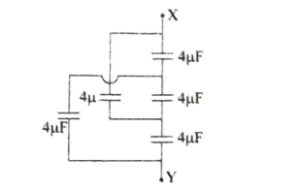
A
$3$
B
$1$
C
$2$
D
$4$
Solution
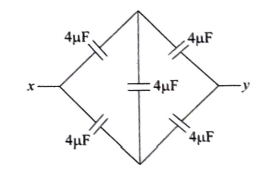
(D) The given circuit can be redrawn as a balanced Wheatstone bridge.
In a balanced Wheatstone bridge,the potential difference across the central capacitor is zero,so it can be removed from the circuit.
After removing the central capacitor,the two upper capacitors ($4 \mu F$ and $4 \mu F$) are in series,and the two lower capacitors ($4 \mu F$ and $4 \mu F$) are in series.
The equivalent capacitance of the upper branch is $C_1 = \frac{4 \times 4}{4 + 4} = 2 \mu F$.
The equivalent capacitance of the lower branch is $C_2 = \frac{4 \times 4}{4 + 4} = 2 \mu F$.
These two branches are in parallel,so the total equivalent capacitance is $C_{eq} = C_1 + C_2 = 2 \mu F + 2 \mu F = 4 \mu F$.
In a balanced Wheatstone bridge,the potential difference across the central capacitor is zero,so it can be removed from the circuit.
After removing the central capacitor,the two upper capacitors ($4 \mu F$ and $4 \mu F$) are in series,and the two lower capacitors ($4 \mu F$ and $4 \mu F$) are in series.
The equivalent capacitance of the upper branch is $C_1 = \frac{4 \times 4}{4 + 4} = 2 \mu F$.
The equivalent capacitance of the lower branch is $C_2 = \frac{4 \times 4}{4 + 4} = 2 \mu F$.
These two branches are in parallel,so the total equivalent capacitance is $C_{eq} = C_1 + C_2 = 2 \mu F + 2 \mu F = 4 \mu F$.
0 likesView Solution
15
PhysicsEasyMCQGUJCET · 2008
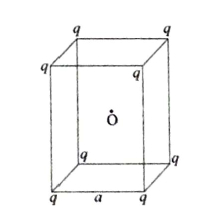
Eight charges,each of magnitude $q$,are placed at the vertices of a cube placed in a vacuum. The electric potential at the centre of the cube due to this system of charges is . . . . . . . ($\varepsilon_0 = $ permittivity of vacuum,$a = $ length of each side of the cube.)
A
zero
B
$\frac{\sqrt{3} q}{\pi \varepsilon_0 a}$
C
$\frac{2 q}{\pi \varepsilon_0 a}$
D
$\frac{4 q}{\sqrt{3} \pi \varepsilon_0 a}$
Solution
(D) The length of the body diagonal of a cube with side $a$ is $\sqrt{3} a$. The distance $r$ of each vertex from the centre $O$ of the cube is half of the body diagonal: $r = \frac{\sqrt{3} a}{2}$.
Since there are $8$ identical charges $q$ at the vertices,the total electric potential $V$ at the centre $O$ is the sum of the potentials due to each individual charge:
$V = 8 \times \frac{1}{4 \pi \varepsilon_0} \times \frac{q}{r}$
Substituting the value of $r$:
$V = 8 \times \frac{1}{4 \pi \varepsilon_0} \times \frac{q}{\frac{\sqrt{3} a}{2}}$
$V = 8 \times \frac{1}{4 \pi \varepsilon_0} \times \frac{2q}{\sqrt{3} a}$
$V = \frac{4 q}{\sqrt{3} \pi \varepsilon_0 a}$
Since there are $8$ identical charges $q$ at the vertices,the total electric potential $V$ at the centre $O$ is the sum of the potentials due to each individual charge:
$V = 8 \times \frac{1}{4 \pi \varepsilon_0} \times \frac{q}{r}$
Substituting the value of $r$:
$V = 8 \times \frac{1}{4 \pi \varepsilon_0} \times \frac{q}{\frac{\sqrt{3} a}{2}}$
$V = 8 \times \frac{1}{4 \pi \varepsilon_0} \times \frac{2q}{\sqrt{3} a}$
$V = \frac{4 q}{\sqrt{3} \pi \varepsilon_0 a}$
0 likesView Solution
16
PhysicsEasyMCQGUJCET · 2008
There are $2.0 \times 10^{24}$ molecular dipoles in a paramagnetic salt. Each has a dipole moment of $1.5 \times 10^{-23} \text{ A m}^2$. Find the maximum (saturation) magnetization in the specimen. (in $\text{ A m}^2$)
A
$20$
B
$30$
C
$200$
D
$50$
Solution
(B) The maximum magnetization $(M_{\max})$ occurs when all molecular dipoles are aligned in the direction of the external magnetic field.
It is calculated by the product of the total number of dipoles $(n)$ and the magnetic dipole moment of each molecule $(m)$.
Given:
$n = 2.0 \times 10^{24}$
$m = 1.5 \times 10^{-23} \text{ A m}^2$
Formula:
$M_{\max} = n \times m$
Calculation:
$M_{\max} = (2.0 \times 10^{24}) \times (1.5 \times 10^{-23})$
$M_{\max} = 3.0 \times 10^{1} = 30 \text{ A m}^2$
Therefore,the correct option is $B$.
It is calculated by the product of the total number of dipoles $(n)$ and the magnetic dipole moment of each molecule $(m)$.
Given:
$n = 2.0 \times 10^{24}$
$m = 1.5 \times 10^{-23} \text{ A m}^2$
Formula:
$M_{\max} = n \times m$
Calculation:
$M_{\max} = (2.0 \times 10^{24}) \times (1.5 \times 10^{-23})$
$M_{\max} = 3.0 \times 10^{1} = 30 \text{ A m}^2$
Therefore,the correct option is $B$.
0 likesView Solution
17
PhysicsEasyMCQGUJCET · 2008
At a given place on the Earth,the angle between the Magnetic Meridian and the Geographic Meridian is called . . . . . . .
A
Magnetic latitude
B
Magnetic dip
C
Magnetic longitude
D
Magnetic declination
Solution
(D) The angle between the Geographic Meridian and the Magnetic Meridian at any point on the Earth's surface is known as the Magnetic Declination or simply Declination.
It represents the deviation of the magnetic compass needle from the true geographic north.
It represents the deviation of the magnetic compass needle from the true geographic north.
0 likesView Solution
18
PhysicsEasyMCQGUJCET · 2008
The deflection in a moving coil galvanometer falls from $50$ divisions to $10$ divisions,when a shunt of $12 \Omega$ is connected with it. The resistance of the galvanometer coil is . . . . . . . (in $Omega$)
A
$6$
B
$48$
C
$24$
D
$12$
Solution
(B) The deflection $\theta$ in a galvanometer is proportional to the current $I$ flowing through it,so $\theta \propto I$.
Initially,the current is $I$ and the deflection is $\theta_1 = 50$ divisions.
When a shunt resistance $S$ is connected in parallel,the current $I$ divides such that the galvanometer current $I_g$ corresponds to the new deflection $\theta_2 = 10$ divisions.
The ratio of the deflections is $n = \frac{\theta_1}{\theta_2} = \frac{50}{10} = 5$.
The formula relating the shunt resistance $S$,galvanometer resistance $G$,and the ratio $n$ is $S = \frac{G}{n-1}$.
Rearranging for $G$,we get $G = S(n-1)$.
Substituting the given values $S = 12 \Omega$ and $n = 5$:
$G = 12 \times (5 - 1) = 12 \times 4 = 48 \Omega$.
Thus,the resistance of the galvanometer coil is $48 \Omega$.
Initially,the current is $I$ and the deflection is $\theta_1 = 50$ divisions.
When a shunt resistance $S$ is connected in parallel,the current $I$ divides such that the galvanometer current $I_g$ corresponds to the new deflection $\theta_2 = 10$ divisions.
The ratio of the deflections is $n = \frac{\theta_1}{\theta_2} = \frac{50}{10} = 5$.
The formula relating the shunt resistance $S$,galvanometer resistance $G$,and the ratio $n$ is $S = \frac{G}{n-1}$.
Rearranging for $G$,we get $G = S(n-1)$.
Substituting the given values $S = 12 \Omega$ and $n = 5$:
$G = 12 \times (5 - 1) = 12 \times 4 = 48 \Omega$.
Thus,the resistance of the galvanometer coil is $48 \Omega$.
0 likesView Solution
19
PhysicsEasyMCQGUJCET · 2008
In the given nuclear reaction
${ }_{4}^{9} Be+{ }_{2}^{4} He \rightarrow{ }_{6}^{12} C+X$
$X$ represents $\qquad$
${ }_{4}^{9} Be+{ }_{2}^{4} He \rightarrow{ }_{6}^{12} C+X$
$X$ represents $\qquad$
A
$e$ (electron)
B
$p$ (proton)
C
$n$ (neutron)
D
$v$ (neutrino)
Solution
(C) To find $X$,we apply the law of conservation of mass number and atomic number.
For mass number (top indices): $9 + 4 = 12 + A \implies 13 = 12 + A \implies A = 1$.
For atomic number (bottom indices): $4 + 2 = 6 + Z \implies 6 = 6 + Z \implies Z = 0$.
$A$ particle with mass number $1$ and atomic number $0$ is a neutron,denoted as ${ }_{0}^{1} n$.
Therefore,$X$ represents a neutron $(n)$.
For mass number (top indices): $9 + 4 = 12 + A \implies 13 = 12 + A \implies A = 1$.
For atomic number (bottom indices): $4 + 2 = 6 + Z \implies 6 = 6 + Z \implies Z = 0$.
$A$ particle with mass number $1$ and atomic number $0$ is a neutron,denoted as ${ }_{0}^{1} n$.
Therefore,$X$ represents a neutron $(n)$.
0 likesView Solution
Vedclass Products
For Students
Vedclass Test Series
Mock tests in real GUJCET style covering Physics with performance analysis. 5-day free trial.
Start Free TrialFor Teachers
Exam Paper Generator
Generate Set A/B/C/D Physics papers from 7.5L+ questions in 2 minutes. 3 chapters free.
Try FreeFor Institutes
Online Exam Module
Run live GUJCET mock exams with unlimited students, 360° analytics & white-label branding.
See DemoFrequently Asked Questions
How many Physics questions are in GUJCET 2008?
There are 19 Physics questions from the GUJCET 2008 paper on Vedclass, each with a detailed step-by-step solution in English.
Are GUJCET 2008 Physics solutions available in English?
Yes. All solutions on this page are in English. You can also switch to English or Hindi using the language buttons above the questions.
Can I practice GUJCET 2008 Physics as a timed test?
Yes. Use the Vedclass Test Series to attempt a full GUJCET mock test covering Physics with time limits and instant score analysis.
Can teachers create Physics papers from GUJCET previous year questions?
Yes. The Vedclass Exam Paper Generator lets teachers mix GUJCET Physics questions and generate Set A/B/C/D papers in minutes.
For Teachers & Institutes
Build a Custom Physics Paper
Pick GUJCET 2008 Physics questions, set difficulty, and generate Set A/B/C/D in 2 minutes.