
MathematicsQ201–265 of 497 questions
Page 5 of 6 · English
201
MathematicsEasyMCQAP EAMCET · 2018
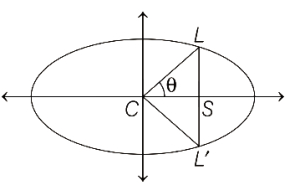
If the latus rectum of an ellipse subtends a right angle at the centre of that ellipse,then the eccentricity of that ellipse is
A
$\frac{\sqrt{5}+1}{4}$
B
$\frac{\sqrt{5}-1}{2}$
C
$\frac{\sqrt{10-2 \sqrt{5}}}{5}$
D
$\frac{\sqrt{10+2 \sqrt{5}}}{5}$
Solution
(B) Let the equation of the ellipse be $\frac{x^2}{a^2} + \frac{y^2}{b^2} = 1$.
Let $LL^{\prime}$ be the latus rectum,then the coordinates of $L$ are $(ae, \frac{b^2}{a})$.
Since $LL^{\prime}$ subtends a right angle $(\pi/2)$ at the centre $C(0,0)$,the angle $\angle LCS = \pi/4$.
In the right-angled triangle $\triangle LCS$,we have $\tan(\angle LCS) = \frac{LS}{CS}$.
$\tan(\frac{\pi}{4}) = \frac{b^2/a}{ae}$
$1 = \frac{b^2}{a^2e}$
$a^2e = b^2$
Since $b^2 = a^2(1 - e^2)$,we have $a^2e = a^2(1 - e^2)$.
$e = 1 - e^2$
$e^2 + e - 1 = 0$
Using the quadratic formula $e = \frac{-b \pm \sqrt{b^2 - 4ac}}{2a}$,we get $e = \frac{-1 \pm \sqrt{1 - 4(1)(-1)}}{2} = \frac{-1 \pm \sqrt{5}}{2}$.
Since eccentricity $e > 0$,we have $e = \frac{\sqrt{5}-1}{2}$.
Let $LL^{\prime}$ be the latus rectum,then the coordinates of $L$ are $(ae, \frac{b^2}{a})$.
Since $LL^{\prime}$ subtends a right angle $(\pi/2)$ at the centre $C(0,0)$,the angle $\angle LCS = \pi/4$.
In the right-angled triangle $\triangle LCS$,we have $\tan(\angle LCS) = \frac{LS}{CS}$.
$\tan(\frac{\pi}{4}) = \frac{b^2/a}{ae}$
$1 = \frac{b^2}{a^2e}$
$a^2e = b^2$
Since $b^2 = a^2(1 - e^2)$,we have $a^2e = a^2(1 - e^2)$.
$e = 1 - e^2$
$e^2 + e - 1 = 0$
Using the quadratic formula $e = \frac{-b \pm \sqrt{b^2 - 4ac}}{2a}$,we get $e = \frac{-1 \pm \sqrt{1 - 4(1)(-1)}}{2} = \frac{-1 \pm \sqrt{5}}{2}$.
Since eccentricity $e > 0$,we have $e = \frac{\sqrt{5}-1}{2}$.
0 likesView Solution
202
MathematicsEasyMCQAP EAMCET · 2018
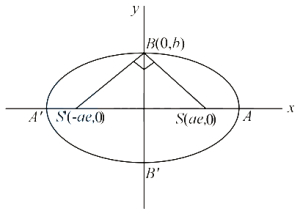
If $S$ and $S^{\prime}$ are the foci of an ellipse,$B$ is one end of the minor axis and $\angle SBS^{\prime} = 90^{\circ}$,then the eccentricity of that ellipse is
A
$\frac{\sqrt{3}}{2}$
B
$\frac{\sqrt{7}}{4}$
C
$\frac{1}{\sqrt{2}}$
D
$\frac{1}{2}$
Solution
(C) Let the coordinates of the foci of the ellipse be $S(ae, 0)$ and $S^{\prime}(-ae, 0)$. The coordinates of the end of the minor axis $B$ are $(0, b)$.
Since $\triangle SBS^{\prime}$ is a right-angled triangle at $B$,we have $SB^2 + S^{\prime}B^2 = (SS^{\prime})^2$.
The distance $SB = \sqrt{(ae-0)^2 + (0-b)^2} = \sqrt{a^2e^2 + b^2}$.
Similarly,$S^{\prime}B = \sqrt{(-ae-0)^2 + (0-b)^2} = \sqrt{a^2e^2 + b^2}$.
Also,$SS^{\prime} = 2ae$.
Substituting these into the Pythagorean theorem:
$(a^2e^2 + b^2) + (a^2e^2 + b^2) = (2ae)^2$
$2(a^2e^2 + b^2) = 4a^2e^2$
$a^2e^2 + b^2 = 2a^2e^2$
$b^2 = a^2e^2$
$\frac{b^2}{a^2} = e^2$
We know that for an ellipse,$b^2 = a^2(1 - e^2)$,so $\frac{b^2}{a^2} = 1 - e^2$.
Equating the two expressions for $\frac{b^2}{a^2}$:
$e^2 = 1 - e^2$
$2e^2 = 1$
$e^2 = \frac{1}{2}$
$e = \frac{1}{\sqrt{2}}$
Since $\triangle SBS^{\prime}$ is a right-angled triangle at $B$,we have $SB^2 + S^{\prime}B^2 = (SS^{\prime})^2$.
The distance $SB = \sqrt{(ae-0)^2 + (0-b)^2} = \sqrt{a^2e^2 + b^2}$.
Similarly,$S^{\prime}B = \sqrt{(-ae-0)^2 + (0-b)^2} = \sqrt{a^2e^2 + b^2}$.
Also,$SS^{\prime} = 2ae$.
Substituting these into the Pythagorean theorem:
$(a^2e^2 + b^2) + (a^2e^2 + b^2) = (2ae)^2$
$2(a^2e^2 + b^2) = 4a^2e^2$
$a^2e^2 + b^2 = 2a^2e^2$
$b^2 = a^2e^2$
$\frac{b^2}{a^2} = e^2$
We know that for an ellipse,$b^2 = a^2(1 - e^2)$,so $\frac{b^2}{a^2} = 1 - e^2$.
Equating the two expressions for $\frac{b^2}{a^2}$:
$e^2 = 1 - e^2$
$2e^2 = 1$
$e^2 = \frac{1}{2}$
$e = \frac{1}{\sqrt{2}}$
0 likesView Solution
203
MathematicsDifficultMCQAP EAMCET · 2018
An ellipse having the coordinate axes as its axes and its major axis along the $Y$-axis,passes through the point $(-3, 1)$ and has eccentricity $e = \sqrt{\frac{2}{5}}$. Then its equation is:
A
$3x^2 + 5y^2 - 15 = 0$
B
$5x^2 + 3y^2 - 32 = 0$
C
$3x^2 + 5y^2 - 32 = 0$
D
$5x^2 + 3y^2 - 48 = 0$
Solution
(D) Since the major axis is along the $Y$-axis,the equation of the ellipse is $\frac{x^2}{a^2} + \frac{y^2}{b^2} = 1$,where $b > a$.
Given eccentricity $e = \sqrt{\frac{2}{5}}$,we have $e^2 = 1 - \frac{a^2}{b^2} = \frac{2}{5}$.
$\frac{a^2}{b^2} = 1 - \frac{2}{5} = \frac{3}{5} \implies b^2 = \frac{5a^2}{3}$.
The ellipse passes through $(-3, 1)$,so $\frac{(-3)^2}{a^2} + \frac{1^2}{b^2} = 1$.
$\frac{9}{a^2} + \frac{1}{b^2} = 1$.
Substituting $b^2 = \frac{5a^2}{3}$,we get $\frac{9}{a^2} + \frac{3}{5a^2} = 1$.
$\frac{45 + 3}{5a^2} = 1 \implies 5a^2 = 48 \implies a^2 = \frac{48}{5}$.
Then $b^2 = \frac{5}{3} \times \frac{48}{5} = 16$.
The equation is $\frac{x^2}{48/5} + \frac{y^2}{16} = 1$.
$\frac{5x^2}{48} + \frac{y^2}{16} = 1 \implies 5x^2 + 3y^2 = 48$.
Given eccentricity $e = \sqrt{\frac{2}{5}}$,we have $e^2 = 1 - \frac{a^2}{b^2} = \frac{2}{5}$.
$\frac{a^2}{b^2} = 1 - \frac{2}{5} = \frac{3}{5} \implies b^2 = \frac{5a^2}{3}$.
The ellipse passes through $(-3, 1)$,so $\frac{(-3)^2}{a^2} + \frac{1^2}{b^2} = 1$.
$\frac{9}{a^2} + \frac{1}{b^2} = 1$.
Substituting $b^2 = \frac{5a^2}{3}$,we get $\frac{9}{a^2} + \frac{3}{5a^2} = 1$.
$\frac{45 + 3}{5a^2} = 1 \implies 5a^2 = 48 \implies a^2 = \frac{48}{5}$.
Then $b^2 = \frac{5}{3} \times \frac{48}{5} = 16$.
The equation is $\frac{x^2}{48/5} + \frac{y^2}{16} = 1$.
$\frac{5x^2}{48} + \frac{y^2}{16} = 1 \implies 5x^2 + 3y^2 = 48$.
0 likesView Solution
204
MathematicsEasyMCQAP EAMCET · 2018
The product of the perpendicular distances drawn from the points $(3,0)$ and $(-3,0)$ to the tangent of the ellipse $\frac{x^2}{36}+\frac{y^2}{27}=1$ at the point $\left(3, \frac{9}{2}\right)$ is:
A
$36$
B
$27$
C
$9$
D
$63$
Solution
(B) For the ellipse $\frac{x^2}{36}+\frac{y^2}{27}=1$,we have $a^2=36$ and $b^2=27$. The foci are $(\pm ae, 0)$.
Since $e^2 = 1 - \frac{b^2}{a^2} = 1 - \frac{27}{36} = 1 - \frac{3}{4} = \frac{1}{4}$,we have $e = \frac{1}{2}$.
The foci are $(\pm 6 \times \frac{1}{2}, 0) = (\pm 3, 0)$.
$A$ well-known property of an ellipse is that the product of the perpendicular distances from the foci to any tangent is equal to the square of the semi-minor axis,$b^2$.
Here,$b^2 = 27$.
Thus,the product of the perpendicular distances from the foci $(3,0)$ and $(-3,0)$ to the tangent at any point is $27$.
Since $e^2 = 1 - \frac{b^2}{a^2} = 1 - \frac{27}{36} = 1 - \frac{3}{4} = \frac{1}{4}$,we have $e = \frac{1}{2}$.
The foci are $(\pm 6 \times \frac{1}{2}, 0) = (\pm 3, 0)$.
$A$ well-known property of an ellipse is that the product of the perpendicular distances from the foci to any tangent is equal to the square of the semi-minor axis,$b^2$.
Here,$b^2 = 27$.
Thus,the product of the perpendicular distances from the foci $(3,0)$ and $(-3,0)$ to the tangent at any point is $27$.
0 likesView Solution
205
MathematicsDifficultMCQAP EAMCET · 2018
If $\alpha, \beta$ are the eccentric angles of the extremities of a focal chord (other than the major axis) of the ellipse $x^2+4y^2=4$,then $\sqrt{3} \cos \frac{\alpha+\beta}{2} =$
A
$2 \cos \frac{\alpha-\beta}{2}$
B
$2 \sin \frac{\alpha-\beta}{2}$
C
$2 \sec \frac{\alpha+\beta}{2}$
D
$2 \sin \frac{\alpha+\beta}{2}$
Solution
(A) The equation of the ellipse is $x^2 + 4y^2 = 4$,which can be written as $\frac{x^2}{4} + \frac{y^2}{1} = 1$.
Here,$a^2 = 4$ and $b^2 = 1$,so $a = 2$ and $b = 1$.
The eccentricity $e$ is given by $e = \sqrt{1 - \frac{b^2}{a^2}} = \sqrt{1 - \frac{1}{4}} = \frac{\sqrt{3}}{2}$.
The coordinates of the extremities of a focal chord with eccentric angles $\alpha$ and $\beta$ are $(a \cos \alpha, b \sin \alpha)$ and $(a \cos \beta, b \sin \beta)$.
The condition for a chord joining $\alpha$ and $\beta$ to be a focal chord is $\cos \frac{\alpha-\beta}{2} = e \cos \frac{\alpha+\beta}{2}$.
Substituting $e = \frac{\sqrt{3}}{2}$,we get $\cos \frac{\alpha-\beta}{2} = \frac{\sqrt{3}}{2} \cos \frac{\alpha+\beta}{2}$.
Multiplying both sides by $2$,we get $2 \cos \frac{\alpha-\beta}{2} = \sqrt{3} \cos \frac{\alpha+\beta}{2}$.
Thus,$\sqrt{3} \cos \frac{\alpha+\beta}{2} = 2 \cos \frac{\alpha-\beta}{2}$.
Here,$a^2 = 4$ and $b^2 = 1$,so $a = 2$ and $b = 1$.
The eccentricity $e$ is given by $e = \sqrt{1 - \frac{b^2}{a^2}} = \sqrt{1 - \frac{1}{4}} = \frac{\sqrt{3}}{2}$.
The coordinates of the extremities of a focal chord with eccentric angles $\alpha$ and $\beta$ are $(a \cos \alpha, b \sin \alpha)$ and $(a \cos \beta, b \sin \beta)$.
The condition for a chord joining $\alpha$ and $\beta$ to be a focal chord is $\cos \frac{\alpha-\beta}{2} = e \cos \frac{\alpha+\beta}{2}$.
Substituting $e = \frac{\sqrt{3}}{2}$,we get $\cos \frac{\alpha-\beta}{2} = \frac{\sqrt{3}}{2} \cos \frac{\alpha+\beta}{2}$.
Multiplying both sides by $2$,we get $2 \cos \frac{\alpha-\beta}{2} = \sqrt{3} \cos \frac{\alpha+\beta}{2}$.
Thus,$\sqrt{3} \cos \frac{\alpha+\beta}{2} = 2 \cos \frac{\alpha-\beta}{2}$.
0 likesView Solution
206
MathematicsMediumMCQAP EAMCET · 2018
The equations of the tangents to the ellipse $9x^2 + 16y^2 = 144$ which pass through the point $(2, 3)$ are
A
$x + y = 5, y = 3$
B
$x + y + 5 = 0, y = 3$
C
$x + y = 5, y + 3 = 0$
D
$x + y + 5 = 0, y + 3 = 0$
Solution
(A) The given equation of the ellipse is $9x^2 + 16y^2 = 144$,which can be written as $\frac{x^2}{16} + \frac{y^2}{9} = 1$.
Here,$a^2 = 16$ and $b^2 = 9$.
The equation of a tangent to the ellipse with slope $m$ is $y = mx \pm \sqrt{a^2m^2 + b^2}$,which is $y = mx \pm \sqrt{16m^2 + 9}$.
Since the tangent passes through $(2, 3)$,we have $3 = 2m \pm \sqrt{16m^2 + 9}$.
Rearranging gives $3 - 2m = \pm \sqrt{16m^2 + 9}$.
Squaring both sides: $(3 - 2m)^2 = 16m^2 + 9$.
$9 - 12m + 4m^2 = 16m^2 + 9$.
$12m^2 + 12m = 0$,so $12m(m + 1) = 0$.
Thus,$m = 0$ or $m = -1$.
For $m = 0$,the tangent is $y - 3 = 0(x - 2)$,which simplifies to $y = 3$.
For $m = -1$,the tangent is $y - 3 = -1(x - 2)$,which simplifies to $y - 3 = -x + 2$,or $x + y = 5$.
Here,$a^2 = 16$ and $b^2 = 9$.
The equation of a tangent to the ellipse with slope $m$ is $y = mx \pm \sqrt{a^2m^2 + b^2}$,which is $y = mx \pm \sqrt{16m^2 + 9}$.
Since the tangent passes through $(2, 3)$,we have $3 = 2m \pm \sqrt{16m^2 + 9}$.
Rearranging gives $3 - 2m = \pm \sqrt{16m^2 + 9}$.
Squaring both sides: $(3 - 2m)^2 = 16m^2 + 9$.
$9 - 12m + 4m^2 = 16m^2 + 9$.
$12m^2 + 12m = 0$,so $12m(m + 1) = 0$.
Thus,$m = 0$ or $m = -1$.
For $m = 0$,the tangent is $y - 3 = 0(x - 2)$,which simplifies to $y = 3$.
For $m = -1$,the tangent is $y - 3 = -1(x - 2)$,which simplifies to $y - 3 = -x + 2$,or $x + y = 5$.
0 likesView Solution
207
MathematicsMediumMCQAP EAMCET · 2018
The equation of the tangent of the ellipse $4x^2 + 9y^2 = 36$ at the end of the latus rectum lying in the second quadrant is:
A
$\sqrt{5}x - 3y + 1 = 0$
B
$x - 3y + \sqrt{5} = 0$
C
$\sqrt{5}x - 3y + 3 = 0$
D
$\sqrt{5}x - 3y + 9 = 0$
Solution
(D) The given equation of the ellipse is $4x^2 + 9y^2 = 36$. Dividing by $36$,we get $\frac{x^2}{9} + \frac{y^2}{4} = 1$.
Here,$a^2 = 9$ and $b^2 = 4$,so $a = 3$ and $b = 2$.
The eccentricity $e$ is given by $e = \sqrt{1 - \frac{b^2}{a^2}} = \sqrt{1 - \frac{4}{9}} = \sqrt{\frac{5}{9}} = \frac{\sqrt{5}}{3}$.
The coordinates of the latus rectum endpoints are $(\pm ae, \pm \frac{b^2}{a})$.
For the second quadrant,$x = -ae = -3 \times \frac{\sqrt{5}}{3} = -\sqrt{5}$ and $y = \frac{b^2}{a} = \frac{4}{3}$.
The point is $P(-\sqrt{5}, \frac{4}{3})$.
The equation of the tangent at $(x_1, y_1)$ to the ellipse $\frac{x^2}{a^2} + \frac{y^2}{b^2} = 1$ is $\frac{xx_1}{a^2} + \frac{yy_1}{b^2} = 1$.
Substituting the values: $\frac{x(-\sqrt{5})}{9} + \frac{y(4/3)}{4} = 1$.
$\Rightarrow -\frac{\sqrt{5}x}{9} + \frac{y}{3} = 1$.
Multiplying by $-9$: $\sqrt{5}x - 3y = -9$,which simplifies to $\sqrt{5}x - 3y + 9 = 0$.
Here,$a^2 = 9$ and $b^2 = 4$,so $a = 3$ and $b = 2$.
The eccentricity $e$ is given by $e = \sqrt{1 - \frac{b^2}{a^2}} = \sqrt{1 - \frac{4}{9}} = \sqrt{\frac{5}{9}} = \frac{\sqrt{5}}{3}$.
The coordinates of the latus rectum endpoints are $(\pm ae, \pm \frac{b^2}{a})$.
For the second quadrant,$x = -ae = -3 \times \frac{\sqrt{5}}{3} = -\sqrt{5}$ and $y = \frac{b^2}{a} = \frac{4}{3}$.
The point is $P(-\sqrt{5}, \frac{4}{3})$.
The equation of the tangent at $(x_1, y_1)$ to the ellipse $\frac{x^2}{a^2} + \frac{y^2}{b^2} = 1$ is $\frac{xx_1}{a^2} + \frac{yy_1}{b^2} = 1$.
Substituting the values: $\frac{x(-\sqrt{5})}{9} + \frac{y(4/3)}{4} = 1$.
$\Rightarrow -\frac{\sqrt{5}x}{9} + \frac{y}{3} = 1$.
Multiplying by $-9$: $\sqrt{5}x - 3y = -9$,which simplifies to $\sqrt{5}x - 3y + 9 = 0$.
0 likesView Solution
208
MathematicsEasyMCQAP EAMCET · 2018
If the tangent at the point $\left(4 \cos 2 \theta, \frac{16}{\sqrt{11}} \sin 2 \theta\right)$ on the ellipse $16 x^2+11 y^2=256$ touches the circle $x^2+y^2-2 x=15$,then $\theta=$
A
$\pm \frac{\pi}{3}$
B
$\pm \frac{\pi}{6}$
C
$\pm \frac{\pi}{4}$
D
$\pm \frac{\pi}{8}$
Solution
(B) The equation of the ellipse is $16 x^2 + 11 y^2 = 256$,which can be written as $\frac{x^2}{16} + \frac{y^2}{256/11} = 1$. The tangent at point $(x_1, y_1)$ is $\frac{x x_1}{16} + \frac{y y_1}{256/11} = 1$. Substituting $(x_1, y_1) = \left(4 \cos 2 \theta, \frac{16}{\sqrt{11}} \sin 2 \theta\right)$,we get $\frac{x(4 \cos 2 \theta)}{16} + \frac{y(16 \sin 2 \theta)}{\sqrt{11}(256/11)} = 1$,which simplifies to $x \cos 2 \theta + \frac{\sqrt{11}}{16} y \sin 2 \theta = 4$,or $4 x \cos 2 \theta + y \sqrt{11} \sin 2 \theta = 16$. The circle is $x^2 + y^2 - 2 x - 15 = 0$,with center $(1, 0)$ and radius $r = \sqrt{1^2 + 0^2 - (-15)} = 4$. The perpendicular distance from the center $(1, 0)$ to the tangent line must equal the radius $4$: $\frac{|4(1) \cos 2 \theta + 0 - 16|}{\sqrt{16 \cos^2 2 \theta + 11 \sin^2 2 \theta}} = 4$. Squaring both sides: $\frac{(4 \cos 2 \theta - 16)^2}{16 \cos^2 2 \theta + 11 \sin^2 2 \theta} = 16$. Dividing by $16$: $\frac{(\cos 2 \theta - 4)^2}{16 \cos^2 2 \theta + 11 \sin^2 2 \theta} = 1$. $\cos^2 2 \theta - 8 \cos 2 \theta + 16 = 16 \cos^2 2 \theta + 11(1 - \cos^2 2 \theta) = 5 \cos^2 2 \theta + 11$. Rearranging gives $4 \cos^2 2 \theta + 8 \cos 2 \theta - 5 = 0$. Solving for $\cos 2 \theta$ using the quadratic formula: $\cos 2 \theta = \frac{-8 \pm \sqrt{64 - 4(4)(-5)}}{8} = \frac{-8 \pm \sqrt{144}}{8} = \frac{-8 \pm 12}{8}$. Thus,$\cos 2 \theta = \frac{4}{8} = \frac{1}{2}$ or $\cos 2 \theta = -\frac{20}{8} = -2.5$ (rejected). So,$2 \theta = \pm \frac{\pi}{3}$,which gives $\theta = \pm \frac{\pi}{6}$.
0 likesView Solution
209
MathematicsEasyMCQAP EAMCET · 2018
If the tangent at the point $(1,2)$ on the ellipse $3x^2+4y^2=19$ is also a tangent to the parabola $y^2-kx=0$,then $k=$
A
$\frac{57}{16}$
B
$\frac{-57}{64}$
C
$\frac{57}{64}$
D
$\frac{-57}{16}$
Solution
(D) The equation of the tangent to the ellipse $3x^2+4y^2=19$ at the point $(x_1, y_1) = (1, 2)$ is given by $3x(1) + 4y(2) = 19$,which simplifies to $3x + 8y = 19$.
This can be rewritten as $x = \frac{19-8y}{3}$.
Since this line is also a tangent to the parabola $y^2 = kx$,we substitute the expression for $x$ into the parabola equation:
$y^2 = k \left( \frac{19-8y}{3} \right)$
$3y^2 = 19k - 8ky$
$3y^2 + 8ky - 19k = 0$.
Since the line is a tangent,the quadratic equation in $y$ must have equal roots,meaning its discriminant $D = 0$.
$D = (8k)^2 - 4(3)(-19k) = 0$
$64k^2 + 228k = 0$
$4k(16k + 57) = 0$.
Since $k \neq 0$ (as $k=0$ would imply the tangent is $y^2=0$,which is not a line),we have $16k + 57 = 0$,so $k = \frac{-57}{16}$.
This can be rewritten as $x = \frac{19-8y}{3}$.
Since this line is also a tangent to the parabola $y^2 = kx$,we substitute the expression for $x$ into the parabola equation:
$y^2 = k \left( \frac{19-8y}{3} \right)$
$3y^2 = 19k - 8ky$
$3y^2 + 8ky - 19k = 0$.
Since the line is a tangent,the quadratic equation in $y$ must have equal roots,meaning its discriminant $D = 0$.
$D = (8k)^2 - 4(3)(-19k) = 0$
$64k^2 + 228k = 0$
$4k(16k + 57) = 0$.
Since $k \neq 0$ (as $k=0$ would imply the tangent is $y^2=0$,which is not a line),we have $16k + 57 = 0$,so $k = \frac{-57}{16}$.
0 likesView Solution
210
MathematicsMediumMCQAP EAMCET · 2018
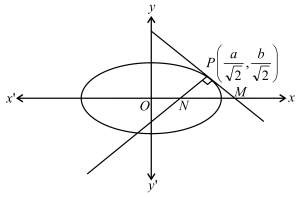
The area (in sq. units) of the triangle formed by the tangent and normal at a point $\left(\frac{a}{\sqrt{2}}, \frac{b}{\sqrt{2}}\right)$ to the curve $\frac{x^2}{a^2}+\frac{y^2}{b^2}=1$ and the $X$-axis is
A
$\frac{a}{b}\left(a^2+b^2\right)$
B
$4 a b$
C
$\frac{b}{4 a}\left(a^2+b^2\right)$
D
$2 a b$
Solution
(C) Let the point be $P = \left(\frac{a}{\sqrt{2}}, \frac{b}{\sqrt{2}}\right)$. The equation of the tangent at $P$ to the ellipse $\frac{x^2}{a^2}+\frac{y^2}{b^2}=1$ is $\frac{x}{a\sqrt{2}} + \frac{y}{b\sqrt{2}} = 1$. The $X$-intercept $M$ is found by setting $y=0$,giving $x = a\sqrt{2}$,so $M = (a\sqrt{2}, 0)$.
The slope of the tangent is $m_t = -\frac{b}{a}$. The slope of the normal is $m_n = \frac{a}{b}$. The equation of the normal at $P$ is $y - \frac{b}{\sqrt{2}} = \frac{a}{b} \left(x - \frac{a}{\sqrt{2}}\right)$. The $X$-intercept $N$ is found by setting $y=0$,giving $-\frac{b}{\sqrt{2}} = \frac{a}{b} \left(x - \frac{a}{\sqrt{2}}\right)$,which simplifies to $x = \frac{a^2-b^2}{a\sqrt{2}}$.
The base of the triangle $MN$ is $|x_M - x_N| = |a\sqrt{2} - \frac{a^2-b^2}{a\sqrt{2}}| = |\frac{2a^2 - a^2 + b^2}{a\sqrt{2}}| = \frac{a^2+b^2}{a\sqrt{2}}$.
The height of the triangle is the $y$-coordinate of $P$,which is $\frac{b}{\sqrt{2}}$.
Area $= \frac{1}{2} \times \text{base} \times \text{height} = \frac{1}{2} \times \frac{a^2+b^2}{a\sqrt{2}} \times \frac{b}{\sqrt{2}} = \frac{b(a^2+b^2)}{4a}$.
The slope of the tangent is $m_t = -\frac{b}{a}$. The slope of the normal is $m_n = \frac{a}{b}$. The equation of the normal at $P$ is $y - \frac{b}{\sqrt{2}} = \frac{a}{b} \left(x - \frac{a}{\sqrt{2}}\right)$. The $X$-intercept $N$ is found by setting $y=0$,giving $-\frac{b}{\sqrt{2}} = \frac{a}{b} \left(x - \frac{a}{\sqrt{2}}\right)$,which simplifies to $x = \frac{a^2-b^2}{a\sqrt{2}}$.
The base of the triangle $MN$ is $|x_M - x_N| = |a\sqrt{2} - \frac{a^2-b^2}{a\sqrt{2}}| = |\frac{2a^2 - a^2 + b^2}{a\sqrt{2}}| = \frac{a^2+b^2}{a\sqrt{2}}$.
The height of the triangle is the $y$-coordinate of $P$,which is $\frac{b}{\sqrt{2}}$.
Area $= \frac{1}{2} \times \text{base} \times \text{height} = \frac{1}{2} \times \frac{a^2+b^2}{a\sqrt{2}} \times \frac{b}{\sqrt{2}} = \frac{b(a^2+b^2)}{4a}$.
0 likesView Solution
211
MathematicsEasyMCQAP EAMCET · 2018
The points of intersection of the perpendicular tangents drawn to the ellipse $4x^2 + 9y^2 = 36$ lie on the curve
A
$x^2 + y^2 = 13$
B
$x^2 - y^2 = 5$
C
$x + y = 5$
D
$\frac{x^2}{9} + \frac{y^2}{4} = 1$
Solution
(A) Given equation of the ellipse is $4x^2 + 9y^2 = 36$.
Dividing by $36$,we get $\frac{x^2}{9} + \frac{y^2}{4} = 1$.
Comparing this with the standard form $\frac{x^2}{a^2} + \frac{y^2}{b^2} = 1$,we have $a^2 = 9$ and $b^2 = 4$.
The locus of the point of intersection of perpendicular tangents to an ellipse is known as its director circle.
The equation of the director circle for the ellipse $\frac{x^2}{a^2} + \frac{y^2}{b^2} = 1$ is $x^2 + y^2 = a^2 + b^2$.
Substituting the values of $a^2$ and $b^2$,we get $x^2 + y^2 = 9 + 4$.
Therefore,the required curve is $x^2 + y^2 = 13$.
Dividing by $36$,we get $\frac{x^2}{9} + \frac{y^2}{4} = 1$.
Comparing this with the standard form $\frac{x^2}{a^2} + \frac{y^2}{b^2} = 1$,we have $a^2 = 9$ and $b^2 = 4$.
The locus of the point of intersection of perpendicular tangents to an ellipse is known as its director circle.
The equation of the director circle for the ellipse $\frac{x^2}{a^2} + \frac{y^2}{b^2} = 1$ is $x^2 + y^2 = a^2 + b^2$.
Substituting the values of $a^2$ and $b^2$,we get $x^2 + y^2 = 9 + 4$.
Therefore,the required curve is $x^2 + y^2 = 13$.
0 likesView Solution
212
MathematicsEasyMCQAP EAMCET · 2018
If the eccentricity of a hyperbola is $\frac{5}{3}$,then the eccentricity of its conjugate hyperbola is
A
$\frac{5}{3}$
B
$\frac{5}{4}$
C
$\frac{5}{2}$
D
$\frac{8}{5}$
Solution
(B) Let the eccentricity of the hyperbola be $e_1$ and the eccentricity of its conjugate hyperbola be $e_2$.
Then,the relation between them is given by $\frac{1}{e_1^2} + \frac{1}{e_2^2} = 1$.
Given $e_1 = \frac{5}{3}$,we substitute this value into the equation:
$\frac{1}{(\frac{5}{3})^2} + \frac{1}{e_2^2} = 1$
$\Rightarrow \frac{9}{25} + \frac{1}{e_2^2} = 1$
$\Rightarrow \frac{1}{e_2^2} = 1 - \frac{9}{25}$
$\Rightarrow \frac{1}{e_2^2} = \frac{16}{25}$
$\Rightarrow e_2^2 = \frac{25}{16}$
Since the eccentricity must be greater than $1$,we take the positive root:
$e_2 = \frac{5}{4}$.
Then,the relation between them is given by $\frac{1}{e_1^2} + \frac{1}{e_2^2} = 1$.
Given $e_1 = \frac{5}{3}$,we substitute this value into the equation:
$\frac{1}{(\frac{5}{3})^2} + \frac{1}{e_2^2} = 1$
$\Rightarrow \frac{9}{25} + \frac{1}{e_2^2} = 1$
$\Rightarrow \frac{1}{e_2^2} = 1 - \frac{9}{25}$
$\Rightarrow \frac{1}{e_2^2} = \frac{16}{25}$
$\Rightarrow e_2^2 = \frac{25}{16}$
Since the eccentricity must be greater than $1$,we take the positive root:
$e_2 = \frac{5}{4}$.
0 likesView Solution
213
MathematicsMediumMCQAP EAMCET · 2018
$A$ tangent to the curve $9 b^2 x^2 - 4 a^2 y^2 = 36 a^2 b^2$ makes intercepts of unit length on each of the coordinate axes. Then the point $(a, b)$ lies on:
A
$x^2 - y^2 = 1$
B
$x^2 + y^2 = 1$
C
$4 x^2 - 9 y^2 = 1$
D
$4 x^2 + 9 y^2 = 1$
Solution
(C) The given equation of the hyperbola is $9 b^2 x^2 - 4 a^2 y^2 = 36 a^2 b^2$,which can be rewritten as $\frac{x^2}{4 a^2} - \frac{y^2}{9 b^2} = 1$.
Let the point of tangency be $(x_0, y_0) = (2 a \sec \theta, 3 b \tan \theta)$.
The equation of the tangent at $(x_0, y_0)$ is $\frac{x x_0}{4 a^2} - \frac{y y_0}{9 b^2} = 1$.
Substituting the point,we get $\frac{x (2 a \sec \theta)}{4 a^2} - \frac{y (3 b \tan \theta)}{9 b^2} = 1$,which simplifies to $\frac{x \sec \theta}{2 a} - \frac{y \tan \theta}{3 b} = 1$.
The intercepts on the axes are $x = 2 a \cos \theta$ and $y = -3 b \cot \theta$.
Given that the intercepts are of unit length,we have $|2 a \cos \theta| = 1$ and $|-3 b \cot \theta| = 1$.
Thus,$\cos \theta = \frac{1}{2 a}$ and $\cot \theta = -\frac{1}{3 b}$.
Using the identity $\csc^2 \theta - \cot^2 \theta = 1$,we have $\sec^2 \theta = 1 + \tan^2 \theta$,or $\frac{1}{\cos^2 \theta} - \frac{1}{\cot^2 \theta} = 1$.
Substituting the values,$(2 a)^2 - (-3 b)^2 = 1$,which gives $4 a^2 - 9 b^2 = 1$.
Therefore,the locus of the point $(a, b)$ is $4 x^2 - 9 y^2 = 1$.
Let the point of tangency be $(x_0, y_0) = (2 a \sec \theta, 3 b \tan \theta)$.
The equation of the tangent at $(x_0, y_0)$ is $\frac{x x_0}{4 a^2} - \frac{y y_0}{9 b^2} = 1$.
Substituting the point,we get $\frac{x (2 a \sec \theta)}{4 a^2} - \frac{y (3 b \tan \theta)}{9 b^2} = 1$,which simplifies to $\frac{x \sec \theta}{2 a} - \frac{y \tan \theta}{3 b} = 1$.
The intercepts on the axes are $x = 2 a \cos \theta$ and $y = -3 b \cot \theta$.
Given that the intercepts are of unit length,we have $|2 a \cos \theta| = 1$ and $|-3 b \cot \theta| = 1$.
Thus,$\cos \theta = \frac{1}{2 a}$ and $\cot \theta = -\frac{1}{3 b}$.
Using the identity $\csc^2 \theta - \cot^2 \theta = 1$,we have $\sec^2 \theta = 1 + \tan^2 \theta$,or $\frac{1}{\cos^2 \theta} - \frac{1}{\cot^2 \theta} = 1$.
Substituting the values,$(2 a)^2 - (-3 b)^2 = 1$,which gives $4 a^2 - 9 b^2 = 1$.
Therefore,the locus of the point $(a, b)$ is $4 x^2 - 9 y^2 = 1$.
0 likesView Solution
214
MathematicsDifficultMCQAP EAMCET · 2018
The locus of the point of intersection of the tangents drawn at the extremities of a normal chord of the hyperbola $\frac{x^2}{a^2} - \frac{y^2}{b^2} = 1$ is
A
$\frac{a^2}{x^2} - \frac{b^2}{y^2} = (a^2 + b^2)^2$
B
$\frac{a^4}{x^2} - \frac{b^4}{y^2} = (a^2 + b^2)^2$
C
$\frac{a^6}{x^2} - \frac{b^6}{y^2} = (a^2 + b^2)^2$
D
$\frac{a^4}{x^2} + \frac{b^4}{y^2} = (a^2 + b^2)^2$
Solution
(B) Let the extremities of the normal chord be $P(a \sec \theta_1, b \tan \theta_1)$ and $Q(a \sec \theta_2, b \tan \theta_2)$.
The equation of the tangent at $P$ is $\frac{x \sec \theta_1}{a} - \frac{y \tan \theta_1}{b} = 1$.
The intersection point $(h, k)$ of the tangents at $P$ and $Q$ is given by $h = a \frac{\cos(\frac{\theta_1 - \theta_2}{2})}{\cos(\frac{\theta_1 + \theta_2}{2})}$ and $k = b \frac{\sin(\frac{\theta_1 - \theta_2}{2})}{\cos(\frac{\theta_1 + \theta_2}{2})}$.
Since $PQ$ is a normal chord,the condition for the normal at $\theta_1$ to pass through $\theta_2$ is $a \sec \theta_1 \tan \theta_2 + b \tan \theta_1 \sec \theta_2 = 0$ (simplified form).
By eliminating the parameters $\theta_1$ and $\theta_2$,the locus of the intersection point $(h, k)$ is found to be $\frac{a^4}{x^2} - \frac{b^4}{y^2} = (a^2 + b^2)^2$.
The equation of the tangent at $P$ is $\frac{x \sec \theta_1}{a} - \frac{y \tan \theta_1}{b} = 1$.
The intersection point $(h, k)$ of the tangents at $P$ and $Q$ is given by $h = a \frac{\cos(\frac{\theta_1 - \theta_2}{2})}{\cos(\frac{\theta_1 + \theta_2}{2})}$ and $k = b \frac{\sin(\frac{\theta_1 - \theta_2}{2})}{\cos(\frac{\theta_1 + \theta_2}{2})}$.
Since $PQ$ is a normal chord,the condition for the normal at $\theta_1$ to pass through $\theta_2$ is $a \sec \theta_1 \tan \theta_2 + b \tan \theta_1 \sec \theta_2 = 0$ (simplified form).
By eliminating the parameters $\theta_1$ and $\theta_2$,the locus of the intersection point $(h, k)$ is found to be $\frac{a^4}{x^2} - \frac{b^4}{y^2} = (a^2 + b^2)^2$.
0 likesView Solution
215
MathematicsMediumMCQAP EAMCET · 2018
The equation of the hyperbola whose asymptotes are the lines $3x+4y-2=0$ and $2x+y+1=0$ and which passes through the point $(1,1)$ is
A
$6x^2+11xy+4y^2-30x+2y+7=0$
B
$6x^2+11xy+4y^2-x+2y-22=0$
C
$6x^2+11xy+4y^2-x+2y+22=0$
D
$6x^2+11xy+4y^2-3x-7y-11=0$
Solution
(B) The equation of the pair of asymptotes is given by the product of the lines: $(3x+4y-2)(2x+y+1)=0$.
Since the equation of the hyperbola differs from the equation of its asymptotes only by a constant $\lambda$,we can write: $(3x+4y-2)(2x+y+1)=\lambda$.
Given that the hyperbola passes through the point $(1,1)$,we substitute $x=1$ and $y=1$ into the equation: $(3(1)+4(1)-2)(2(1)+1+1)=\lambda$.
$(5)(4)=\lambda$,which gives $\lambda=20$.
Substituting $\lambda=20$ back into the equation: $(3x+4y-2)(2x+y+1)=20$.
Expanding the left side: $6x^2+3xy+3x+8xy+4y^2+4y-4x-2y-2=20$.
Simplifying: $6x^2+11xy+4y^2-x+2y-2=20$.
Thus,the equation is $6x^2+11xy+4y^2-x+2y-22=0$.
Since the equation of the hyperbola differs from the equation of its asymptotes only by a constant $\lambda$,we can write: $(3x+4y-2)(2x+y+1)=\lambda$.
Given that the hyperbola passes through the point $(1,1)$,we substitute $x=1$ and $y=1$ into the equation: $(3(1)+4(1)-2)(2(1)+1+1)=\lambda$.
$(5)(4)=\lambda$,which gives $\lambda=20$.
Substituting $\lambda=20$ back into the equation: $(3x+4y-2)(2x+y+1)=20$.
Expanding the left side: $6x^2+3xy+3x+8xy+4y^2+4y-4x-2y-2=20$.
Simplifying: $6x^2+11xy+4y^2-x+2y-2=20$.
Thus,the equation is $6x^2+11xy+4y^2-x+2y-22=0$.
0 likesView Solution
216
MathematicsMediumMCQAP EAMCET · 2018
If the product of the lengths of the perpendiculars from any point on the hyperbola $16x^2 - 25y^2 = 400$ to its asymptotes is $p$ and the angle between the two asymptotes is $\theta$,then $p \tan \frac{\theta}{2} =$
A
$\frac{400}{41}$
B
$\frac{320}{41}$
C
$\frac{4}{5}$
D
$\frac{25}{16}$
Solution
(B) The given hyperbola is $16x^2 - 25y^2 = 400$,which can be written as $\frac{x^2}{25} - \frac{y^2}{16} = 1$.
Here,$a^2 = 25$ and $b^2 = 16$,so $a = 5$ and $b = 4$.
The equations of the asymptotes are $y = \pm \frac{b}{a}x$,i.e.,$4x - 5y = 0$ and $4x + 5y = 0$.
Let $P(x_1, y_1)$ be any point on the hyperbola,so $16x_1^2 - 25y_1^2 = 400$.
The lengths of the perpendiculars from $P$ to the asymptotes are $d_1 = \frac{|4x_1 - 5y_1|}{\sqrt{4^2 + 5^2}} = \frac{|4x_1 - 5y_1|}{\sqrt{41}}$ and $d_2 = \frac{|4x_1 + 5y_1|}{\sqrt{4^2 + 5^2}} = \frac{|4x_1 + 5y_1|}{\sqrt{41}}$.
The product $p = d_1 d_2 = \frac{|16x_1^2 - 25y_1^2|}{41} = \frac{400}{41}$.
The angle $\theta$ between the asymptotes is given by $\tan \frac{\theta}{2} = \frac{b}{a} = \frac{4}{5}$.
Therefore,$p \tan \frac{\theta}{2} = \frac{400}{41} \times \frac{4}{5} = \frac{80 \times 4}{41} = \frac{320}{41}$.
Here,$a^2 = 25$ and $b^2 = 16$,so $a = 5$ and $b = 4$.
The equations of the asymptotes are $y = \pm \frac{b}{a}x$,i.e.,$4x - 5y = 0$ and $4x + 5y = 0$.
Let $P(x_1, y_1)$ be any point on the hyperbola,so $16x_1^2 - 25y_1^2 = 400$.
The lengths of the perpendiculars from $P$ to the asymptotes are $d_1 = \frac{|4x_1 - 5y_1|}{\sqrt{4^2 + 5^2}} = \frac{|4x_1 - 5y_1|}{\sqrt{41}}$ and $d_2 = \frac{|4x_1 + 5y_1|}{\sqrt{4^2 + 5^2}} = \frac{|4x_1 + 5y_1|}{\sqrt{41}}$.
The product $p = d_1 d_2 = \frac{|16x_1^2 - 25y_1^2|}{41} = \frac{400}{41}$.
The angle $\theta$ between the asymptotes is given by $\tan \frac{\theta}{2} = \frac{b}{a} = \frac{4}{5}$.
Therefore,$p \tan \frac{\theta}{2} = \frac{400}{41} \times \frac{4}{5} = \frac{80 \times 4}{41} = \frac{320}{41}$.
0 likesView Solution
217
MathematicsEasyMCQAP EAMCET · 2018
If the equation of one asymptote of the hyperbola $14 x^2+38 x y+20 y^2+x-7 y-91=0$ is $7 x+5 y-3=0$,then the other asymptote is
A
$2 x-4 y+1=0$
B
$2 x+4 y+1=0$
C
$2 x-4 y-1=0$
D
$2 x+4 y-1=0$
Solution
(B) The equation of the hyperbola is $14 x^2+38 x y+20 y^2+x-7 y-91=0$.
Asymptotes of a hyperbola differ from the hyperbola equation by a constant.
Let the asymptotes be $(7 x+5 y+c_1)(2 x+4 y+c_2) = 14 x^2+38 x y+20 y^2+x-7 y+k = 0$.
Expanding the product: $14 x^2+28 x y+7 x c_2+10 x y+20 y^2+5 y c_2+2 x c_1+4 y c_1+c_1 c_2 = 14 x^2+38 x y+20 y^2+x(7 c_2+2 c_1)+y(5 c_2+4 c_1)+c_1 c_2$.
Comparing the coefficients with the given hyperbola equation:
$7 c_2+2 c_1 = 1$
$5 c_2+4 c_1 = -7$
Given one asymptote is $7 x+5 y-3=0$,so $c_1 = -3$.
Substituting $c_1 = -3$ in the first equation: $7 c_2 + 2(-3) = 1$ $\Rightarrow 7 c_2 - 6 = 1$ $\Rightarrow 7 c_2 = 7$ $\Rightarrow c_2 = 1$.
Thus,the other asymptote is $2 x+4 y+1=0$.
Asymptotes of a hyperbola differ from the hyperbola equation by a constant.
Let the asymptotes be $(7 x+5 y+c_1)(2 x+4 y+c_2) = 14 x^2+38 x y+20 y^2+x-7 y+k = 0$.
Expanding the product: $14 x^2+28 x y+7 x c_2+10 x y+20 y^2+5 y c_2+2 x c_1+4 y c_1+c_1 c_2 = 14 x^2+38 x y+20 y^2+x(7 c_2+2 c_1)+y(5 c_2+4 c_1)+c_1 c_2$.
Comparing the coefficients with the given hyperbola equation:
$7 c_2+2 c_1 = 1$
$5 c_2+4 c_1 = -7$
Given one asymptote is $7 x+5 y-3=0$,so $c_1 = -3$.
Substituting $c_1 = -3$ in the first equation: $7 c_2 + 2(-3) = 1$ $\Rightarrow 7 c_2 - 6 = 1$ $\Rightarrow 7 c_2 = 7$ $\Rightarrow c_2 = 1$.
Thus,the other asymptote is $2 x+4 y+1=0$.
0 likesView Solution
218
MathematicsMediumMCQAP EAMCET · 2018
$\lim _{x \rightarrow \frac{\pi}{2}} \frac{1+\cos 2 x}{\cot 3 x\left(3^{\sin 2 x}-1\right)}=$
A
$\frac{1}{3 \log 9}$
B
$\frac{2}{3 \log 3}$
C
$\frac{1}{3 \log 3}$
D
$\frac{3}{\log 3}$
Solution
(C) Given limit: $L = \lim _{x \rightarrow \frac{\pi}{2}} \frac{1+\cos 2 x}{\cot 3 x\left(3^{\sin 2 x}-1\right)}$
Using $1+\cos 2x = 2\cos^2 x$ and $\cot 3x = \frac{\cos 3x}{\sin 3x}$,we get:
$L = \lim _{x \rightarrow \frac{\pi}{2}} \frac{2 \cos ^2 x \sin 3x}{\cos 3 x \left(3^{\sin 2 x}-1\right)}$
Let $x = \frac{\pi}{2} + h$,as $x \rightarrow \frac{\pi}{2}$,$h \rightarrow 0$. Then $\cos x = -\sin h$,$\cos 3x = \sin 3h$,$\sin 3x = -\cos 3h$,and $\sin 2x = -\sin 2h$.
Substituting these:
$L = \lim _{h \rightarrow 0} \frac{2 \sin ^2 h (-\cos 3h)}{\sin 3h (3^{-\sin 2h} - 1)} = \lim _{h \rightarrow 0} \frac{2 \sin ^2 h (-\cos 3h)}{\sin 3h (1 - 3^{-\sin 2h})}$
Using $\lim_{u \rightarrow 0} \frac{a^u - 1}{u} = \ln a$ and $\lim_{h \rightarrow 0} \frac{\sin h}{h} = 1$:
$L = \lim _{h \rightarrow 0} \left( \frac{2 \sin^2 h}{h^2} \cdot \frac{h}{\sin 3h} \cdot \frac{-\sin 2h}{1 - 3^{-\sin 2h}} \cdot \frac{h}{-\sin 2h} \cdot (-\cos 3h) \right)$
$L = 2 \cdot \frac{1}{3} \cdot \frac{1}{\ln 3} \cdot \frac{1}{2} \cdot (-1) = -\frac{1}{3 \ln 3}$.
Wait,re-evaluating the limit: $\frac{-\sin 2h}{1 - 3^{-\sin 2h}} = \frac{1}{\ln 3}$.
$L = 2 \cdot \frac{1}{3} \cdot \frac{1}{\ln 3} \cdot \frac{1}{2} = \frac{1}{3 \ln 3}$.
Using $1+\cos 2x = 2\cos^2 x$ and $\cot 3x = \frac{\cos 3x}{\sin 3x}$,we get:
$L = \lim _{x \rightarrow \frac{\pi}{2}} \frac{2 \cos ^2 x \sin 3x}{\cos 3 x \left(3^{\sin 2 x}-1\right)}$
Let $x = \frac{\pi}{2} + h$,as $x \rightarrow \frac{\pi}{2}$,$h \rightarrow 0$. Then $\cos x = -\sin h$,$\cos 3x = \sin 3h$,$\sin 3x = -\cos 3h$,and $\sin 2x = -\sin 2h$.
Substituting these:
$L = \lim _{h \rightarrow 0} \frac{2 \sin ^2 h (-\cos 3h)}{\sin 3h (3^{-\sin 2h} - 1)} = \lim _{h \rightarrow 0} \frac{2 \sin ^2 h (-\cos 3h)}{\sin 3h (1 - 3^{-\sin 2h})}$
Using $\lim_{u \rightarrow 0} \frac{a^u - 1}{u} = \ln a$ and $\lim_{h \rightarrow 0} \frac{\sin h}{h} = 1$:
$L = \lim _{h \rightarrow 0} \left( \frac{2 \sin^2 h}{h^2} \cdot \frac{h}{\sin 3h} \cdot \frac{-\sin 2h}{1 - 3^{-\sin 2h}} \cdot \frac{h}{-\sin 2h} \cdot (-\cos 3h) \right)$
$L = 2 \cdot \frac{1}{3} \cdot \frac{1}{\ln 3} \cdot \frac{1}{2} \cdot (-1) = -\frac{1}{3 \ln 3}$.
Wait,re-evaluating the limit: $\frac{-\sin 2h}{1 - 3^{-\sin 2h}} = \frac{1}{\ln 3}$.
$L = 2 \cdot \frac{1}{3} \cdot \frac{1}{\ln 3} \cdot \frac{1}{2} = \frac{1}{3 \ln 3}$.
0 likesView Solution
219
MathematicsMediumMCQAP EAMCET · 2018
$\lim _{n \rightarrow \infty} \frac{\left[6^2+12^2+18^2+\ldots+(6 n)^2\right]^2}{[5+10+15+\ldots+5 n]\left[2^3+4^3+6^3+\ldots+(2 n)^3\right]} =$
A
$\frac{4}{5}$
B
$\frac{144}{5}$
C
$\frac{4}{25}$
D
$\frac{144}{25}$
Solution
(B) Let the expression be $L = \lim _{n \rightarrow \infty} \frac{\left[6^2(1^2+2^2+\ldots+n^2)\right]^2}{[5(1+2+\ldots+n)]\left[2^3(1^3+2^3+\ldots+n^3)\right]}$.
Using the summation formulas $\sum_{k=1}^n k = \frac{n(n+1)}{2}$,$\sum_{k=1}^n k^2 = \frac{n(n+1)(2n+1)}{6}$,and $\sum_{k=1}^n k^3 = \frac{n^2(n+1)^2}{4}$:
Numerator $= 36^2 \left[\frac{n(n+1)(2n+1)}{6}\right]^2 = 1296 \frac{n^2(n+1)^2(2n+1)^2}{36} = 36 n^2(n+1)^2(2n+1)^2$.
Denominator $= 5 \left[\frac{n(n+1)}{2}\right] \times 8 \left[\frac{n^2(n+1)^2}{4}\right] = 5 \times \frac{n(n+1)}{2} \times 2n^2(n+1)^2 = 5 n^3(n+1)^3$.
$L = \lim _{n \rightarrow \infty} \frac{36 n^2(n+1)^2(2n+1)^2}{5 n^3(n+1)^3} = \lim _{n \rightarrow \infty} \frac{36 n^2(n+1)^2(4n^2)}{5 n^3(n+1)^3} = \lim _{n \rightarrow \infty} \frac{144 n^6}{5 n^6} = \frac{144}{5}$.
Using the summation formulas $\sum_{k=1}^n k = \frac{n(n+1)}{2}$,$\sum_{k=1}^n k^2 = \frac{n(n+1)(2n+1)}{6}$,and $\sum_{k=1}^n k^3 = \frac{n^2(n+1)^2}{4}$:
Numerator $= 36^2 \left[\frac{n(n+1)(2n+1)}{6}\right]^2 = 1296 \frac{n^2(n+1)^2(2n+1)^2}{36} = 36 n^2(n+1)^2(2n+1)^2$.
Denominator $= 5 \left[\frac{n(n+1)}{2}\right] \times 8 \left[\frac{n^2(n+1)^2}{4}\right] = 5 \times \frac{n(n+1)}{2} \times 2n^2(n+1)^2 = 5 n^3(n+1)^3$.
$L = \lim _{n \rightarrow \infty} \frac{36 n^2(n+1)^2(2n+1)^2}{5 n^3(n+1)^3} = \lim _{n \rightarrow \infty} \frac{36 n^2(n+1)^2(4n^2)}{5 n^3(n+1)^3} = \lim _{n \rightarrow \infty} \frac{144 n^6}{5 n^6} = \frac{144}{5}$.
0 likesView Solution
220
MathematicsMediumMCQAP EAMCET · 2018
Evaluate the limit: $\lim_{x \rightarrow 0} \left( \frac{4^x - 1}{2^x - 1} - \frac{\sqrt{4 + 3x} - 2}{x} \right)$
A
$0$
B
$\frac{5}{4}$
C
$\log 2 - 3$
D
$\frac{\log 4}{\log 2} - 3$
Solution
(B) We need to evaluate the limit: $L = \lim_{x \rightarrow 0} \left( \frac{4^x - 1}{2^x - 1} - \frac{\sqrt{4 + 3x} - 2}{x} \right)$.
First,consider the first term: $\lim_{x \rightarrow 0} \frac{4^x - 1}{2^x - 1} = \lim_{x \rightarrow 0} \frac{(2^x - 1)(2^x + 1)}{2^x - 1} = \lim_{x \rightarrow 0} (2^x + 1) = 2^0 + 1 = 1 + 1 = 2$.
Next,consider the second term: $\lim_{x \rightarrow 0} \frac{\sqrt{4 + 3x} - 2}{x}$.
Rationalizing the numerator: $\lim_{x \rightarrow 0} \frac{(\sqrt{4 + 3x} - 2)(\sqrt{4 + 3x} + 2)}{x(\sqrt{4 + 3x} + 2)} = \lim_{x \rightarrow 0} \frac{4 + 3x - 4}{x(\sqrt{4 + 3x} + 2)} = \lim_{x \rightarrow 0} \frac{3x}{x(\sqrt{4 + 3x} + 2)} = \lim_{x \rightarrow 0} \frac{3}{\sqrt{4 + 3x} + 2} = \frac{3}{\sqrt{4} + 2} = \frac{3}{2 + 2} = \frac{3}{4}$.
Subtracting the two results: $2 - \frac{3}{4} = \frac{8 - 3}{4} = \frac{5}{4}$.
First,consider the first term: $\lim_{x \rightarrow 0} \frac{4^x - 1}{2^x - 1} = \lim_{x \rightarrow 0} \frac{(2^x - 1)(2^x + 1)}{2^x - 1} = \lim_{x \rightarrow 0} (2^x + 1) = 2^0 + 1 = 1 + 1 = 2$.
Next,consider the second term: $\lim_{x \rightarrow 0} \frac{\sqrt{4 + 3x} - 2}{x}$.
Rationalizing the numerator: $\lim_{x \rightarrow 0} \frac{(\sqrt{4 + 3x} - 2)(\sqrt{4 + 3x} + 2)}{x(\sqrt{4 + 3x} + 2)} = \lim_{x \rightarrow 0} \frac{4 + 3x - 4}{x(\sqrt{4 + 3x} + 2)} = \lim_{x \rightarrow 0} \frac{3x}{x(\sqrt{4 + 3x} + 2)} = \lim_{x \rightarrow 0} \frac{3}{\sqrt{4 + 3x} + 2} = \frac{3}{\sqrt{4} + 2} = \frac{3}{2 + 2} = \frac{3}{4}$.
Subtracting the two results: $2 - \frac{3}{4} = \frac{8 - 3}{4} = \frac{5}{4}$.
0 likesView Solution
221
MathematicsEasyMCQAP EAMCET · 2018
If $[x]$ denotes the greatest integer $\leq x$,then $\lim_{n \rightarrow \infty} \frac{1}{n^3} \{[1^2 x] + [2^2 x] + [3^2 x] + \ldots + [n^2 x] \} = $
A
$\frac{x}{2}$
B
$\frac{x}{3}$
C
$\frac{x}{6}$
D
$0$
Solution
(B) We know that $[r^2 x] = r^2 x - \{r^2 x\}$,where $\{r^2 x\}$ is the fractional part of $r^2 x$.
Substituting this into the limit,we get:
$\lim_{n \rightarrow \infty} \frac{1}{n^3} \sum_{r=1}^n [r^2 x] = \lim_{n \rightarrow \infty} \frac{1}{n^3} \sum_{r=1}^n (r^2 x - \{r^2 x\})$
$= \lim_{n \rightarrow \infty} \left( \frac{x}{n^3} \sum_{r=1}^n r^2 - \frac{1}{n^3} \sum_{r=1}^n \{r^2 x\} \right)$
Using the formula $\sum_{r=1}^n r^2 = \frac{n(n+1)(2n+1)}{6}$,we have:
$= \lim_{n \rightarrow \infty} \left( \frac{x \cdot n(n+1)(2n+1)}{6n^3} - \frac{1}{n^3} \sum_{r=1}^n \{r^2 x\} \right)$
Since $0 \leq \{r^2 x\} < 1$,the second term $\frac{1}{n^3} \sum_{r=1}^n \{r^2 x\}$ is bounded by $\frac{n}{n^3} = \frac{1}{n^2}$,which approaches $0$ as $n \rightarrow \infty$.
Thus,the limit is $\lim_{n \rightarrow \infty} \frac{x(2n^3 + 3n^2 + n)}{6n^3} = \frac{2x}{6} = \frac{x}{3}$.
Substituting this into the limit,we get:
$\lim_{n \rightarrow \infty} \frac{1}{n^3} \sum_{r=1}^n [r^2 x] = \lim_{n \rightarrow \infty} \frac{1}{n^3} \sum_{r=1}^n (r^2 x - \{r^2 x\})$
$= \lim_{n \rightarrow \infty} \left( \frac{x}{n^3} \sum_{r=1}^n r^2 - \frac{1}{n^3} \sum_{r=1}^n \{r^2 x\} \right)$
Using the formula $\sum_{r=1}^n r^2 = \frac{n(n+1)(2n+1)}{6}$,we have:
$= \lim_{n \rightarrow \infty} \left( \frac{x \cdot n(n+1)(2n+1)}{6n^3} - \frac{1}{n^3} \sum_{r=1}^n \{r^2 x\} \right)$
Since $0 \leq \{r^2 x\} < 1$,the second term $\frac{1}{n^3} \sum_{r=1}^n \{r^2 x\}$ is bounded by $\frac{n}{n^3} = \frac{1}{n^2}$,which approaches $0$ as $n \rightarrow \infty$.
Thus,the limit is $\lim_{n \rightarrow \infty} \frac{x(2n^3 + 3n^2 + n)}{6n^3} = \frac{2x}{6} = \frac{x}{3}$.
0 likesView Solution
222
MathematicsMediumMCQAP EAMCET · 2018
Evaluate: $\cos \left[ \lim_{x \rightarrow \infty} \frac{2 \pi |x| + \pi x}{|x| - 3x} + \lim_{x \rightarrow 0} \frac{\cos \left( \frac{\pi}{2} \cos^2 x \right)}{x^2} \right]$
A
$1$
B
$-1$
C
$0$
D
$\frac{1}{\sqrt{2}}$
Solution
(B) Let $L = \cos \left[ \lim_{x \rightarrow \infty} \frac{2 \pi |x| + \pi x}{|x| - 3x} + \lim_{x \rightarrow 0} \frac{\cos \left( \frac{\pi}{2} \cos^2 x \right)}{x^2} \right]$.
For the first limit,as $x \rightarrow \infty$,$|x| = x$. Thus,$\lim_{x \rightarrow \infty} \frac{2 \pi x + \pi x}{x - 3x} = \lim_{x \rightarrow \infty} \frac{3 \pi x}{-2x} = -\frac{3 \pi}{2}$.
For the second limit,$\lim_{x \rightarrow 0} \frac{\cos \left( \frac{\pi}{2} \cos^2 x \right)}{x^2} = \lim_{x \rightarrow 0} \frac{\cos \left( \frac{\pi}{2} (1 - \sin^2 x) \right)}{x^2} = \lim_{x \rightarrow 0} \frac{\cos \left( \frac{\pi}{2} - \frac{\pi}{2} \sin^2 x \right)}{x^2}$.
Using $\cos \left( \frac{\pi}{2} - \theta \right) = \sin \theta$,we get $\lim_{x \rightarrow 0} \frac{\sin \left( \frac{\pi}{2} \sin^2 x \right)}{x^2}$.
Since $\sin \theta \approx \theta$ for small $\theta$,this becomes $\lim_{x \rightarrow 0} \frac{\frac{\pi}{2} \sin^2 x}{x^2} = \frac{\pi}{2} \times (1)^2 = \frac{\pi}{2}$.
Substituting these values back into the expression: $L = \cos \left( -\frac{3 \pi}{2} + \frac{\pi}{2} \right) = \cos(-\pi) = -1$.
For the first limit,as $x \rightarrow \infty$,$|x| = x$. Thus,$\lim_{x \rightarrow \infty} \frac{2 \pi x + \pi x}{x - 3x} = \lim_{x \rightarrow \infty} \frac{3 \pi x}{-2x} = -\frac{3 \pi}{2}$.
For the second limit,$\lim_{x \rightarrow 0} \frac{\cos \left( \frac{\pi}{2} \cos^2 x \right)}{x^2} = \lim_{x \rightarrow 0} \frac{\cos \left( \frac{\pi}{2} (1 - \sin^2 x) \right)}{x^2} = \lim_{x \rightarrow 0} \frac{\cos \left( \frac{\pi}{2} - \frac{\pi}{2} \sin^2 x \right)}{x^2}$.
Using $\cos \left( \frac{\pi}{2} - \theta \right) = \sin \theta$,we get $\lim_{x \rightarrow 0} \frac{\sin \left( \frac{\pi}{2} \sin^2 x \right)}{x^2}$.
Since $\sin \theta \approx \theta$ for small $\theta$,this becomes $\lim_{x \rightarrow 0} \frac{\frac{\pi}{2} \sin^2 x}{x^2} = \frac{\pi}{2} \times (1)^2 = \frac{\pi}{2}$.
Substituting these values back into the expression: $L = \cos \left( -\frac{3 \pi}{2} + \frac{\pi}{2} \right) = \cos(-\pi) = -1$.
0 likesView Solution
223
MathematicsMediumMCQAP EAMCET · 2018
$\lim _{x \rightarrow 0} \frac{\sqrt{1+x \sin x}-\sqrt{\cos x}}{\tan ^2 2 x}=$
A
$3$
B
$\frac{3}{2}$
C
$\frac{3}{4}$
D
$\frac{3}{16}$
Solution
(D) The given limit is $\lim _{x \rightarrow 0} \frac{\sqrt{1+x \sin x}-\sqrt{\cos x}}{\tan ^2 2 x}$,which is of the $\frac{0}{0}$ form.
Rationalizing the numerator:
$= \lim _{x}$ ${\rightarrow 0} \frac{(\sqrt{1+x \sin x}-\sqrt{\cos x})(\sqrt{1+x \sin x}+\sqrt{\cos x})}{\tan ^2 2 x (\sqrt{1+x \sin x}+\sqrt{\cos x})}$
$= \lim _{x \rightarrow 0} \frac{1+x \sin x-\cos x}{\tan ^2 2 x} \cdot \frac{1}{\sqrt{1+x \sin x}+\sqrt{\cos x}} $
$= \lim _{x \rightarrow 0} \frac{(1-\cos x)+x \sin x}{\tan ^2 2 x} \cdot \frac{1}{2} $
Using the identities $1-\cos x = 2 \sin ^2 \frac{x}{2}$ and $\sin x = 2 \sin \frac{x}{2} \cos \frac{x}{2}$:
$= \lim _{x}$ ${\rightarrow 0} \frac{2 \sin ^2 \frac{x}{2} + 2x \sin \frac{x}{2} \cos \frac{x}{2}}{\tan ^2 2 x} \cdot \frac{1}{2}$
$= \lim _{x}$ ${\rightarrow 0} \frac{2 \sin ^2 \frac{x}{2} [1 + \frac{x \cos \frac{x}{2}}{\sin \frac{x}{2}}]}{\tan ^2 2 x} \cdot \frac{1}{2}$
$= \lim _{x \rightarrow 0} \frac{2 \sin ^2 \frac{x}{2} [1 + \frac{x}{\tan \frac{x}{2}}]}{\tan ^2 2 x} \cdot \frac{1}{2} $
$= \lim _{x \rightarrow 0} \frac{2 (\frac{x}{2})^2 [1 + 2 \cdot \frac{x/2}{\tan (x/2)}]}{(2x)^2} \cdot \frac{1}{2} $
$= \lim _{x}$ ${\rightarrow 0} \frac{2 \cdot \frac{x^2}{4} [1+2]}{4x^2} \cdot \frac{1}{2} = \frac{1/2 \cdot 3}{4} \cdot \frac{1}{2} = \frac{3}{16}$.
Rationalizing the numerator:
$= \lim _{x}$ ${\rightarrow 0} \frac{(\sqrt{1+x \sin x}-\sqrt{\cos x})(\sqrt{1+x \sin x}+\sqrt{\cos x})}{\tan ^2 2 x (\sqrt{1+x \sin x}+\sqrt{\cos x})}$
$= \lim _{x \rightarrow 0} \frac{1+x \sin x-\cos x}{\tan ^2 2 x} \cdot \frac{1}{\sqrt{1+x \sin x}+\sqrt{\cos x}} $
$= \lim _{x \rightarrow 0} \frac{(1-\cos x)+x \sin x}{\tan ^2 2 x} \cdot \frac{1}{2} $
Using the identities $1-\cos x = 2 \sin ^2 \frac{x}{2}$ and $\sin x = 2 \sin \frac{x}{2} \cos \frac{x}{2}$:
$= \lim _{x}$ ${\rightarrow 0} \frac{2 \sin ^2 \frac{x}{2} + 2x \sin \frac{x}{2} \cos \frac{x}{2}}{\tan ^2 2 x} \cdot \frac{1}{2}$
$= \lim _{x}$ ${\rightarrow 0} \frac{2 \sin ^2 \frac{x}{2} [1 + \frac{x \cos \frac{x}{2}}{\sin \frac{x}{2}}]}{\tan ^2 2 x} \cdot \frac{1}{2}$
$= \lim _{x \rightarrow 0} \frac{2 \sin ^2 \frac{x}{2} [1 + \frac{x}{\tan \frac{x}{2}}]}{\tan ^2 2 x} \cdot \frac{1}{2} $
$= \lim _{x \rightarrow 0} \frac{2 (\frac{x}{2})^2 [1 + 2 \cdot \frac{x/2}{\tan (x/2)}]}{(2x)^2} \cdot \frac{1}{2} $
$= \lim _{x}$ ${\rightarrow 0} \frac{2 \cdot \frac{x^2}{4} [1+2]}{4x^2} \cdot \frac{1}{2} = \frac{1/2 \cdot 3}{4} \cdot \frac{1}{2} = \frac{3}{16}$.
0 likesView Solution
224
MathematicsEasyMCQAP EAMCET · 2018
If $\alpha$ and $\beta$ are the roots of the equation $ax^2+bx+c=0$,then $\lim_{x \rightarrow \alpha} \frac{1-\cos(ax^2+bx+c)}{(x-\alpha)^2} = $
A
$\frac{a^2(\alpha-\beta)^2}{4}$
B
$1$
C
$\frac{a(\alpha-\beta)}{2}$
D
$\frac{a^2(\alpha-\beta)^2}{2}$
Solution
(D) Given the quadratic equation $ax^2+bx+c=0$ with roots $\alpha$ and $\beta$,we can write $ax^2+bx+c = a(x-\alpha)(x-\beta)$.
We need to evaluate the limit $L = \lim_{x \rightarrow \alpha} \frac{1-\cos(a(x-\alpha)(x-\beta))}{(x-\alpha)^2}$.
Using the identity $1-\cos(\theta) = 2\sin^2(\frac{\theta}{2})$,we get:
$L = \lim_{x \rightarrow \alpha} \frac{2\sin^2(\frac{a(x-\alpha)(x-\beta)}{2})}{(x-\alpha)^2}$.
Multiply and divide by $(\frac{a(x-\beta)}{2})^2$:
$L = \lim_{x}$ ${\rightarrow \alpha} 2 \left[ \frac{\sin(\frac{a(x-\alpha)(x-\beta)}{2})}{\frac{a(x-\alpha)(x-\beta)}{2}} \right]^2 \cdot \frac{a^2(x-\alpha)^2(x-\beta)^2}{4(x-\alpha)^2}$.
Since $\lim_{\theta \rightarrow 0} \frac{\sin(\theta)}{\theta} = 1$,the expression simplifies to:
$L = 2 \cdot 1^2 \cdot \frac{a^2(\alpha-\beta)^2}{4} = \frac{a^2(\alpha-\beta)^2}{2}$.
We need to evaluate the limit $L = \lim_{x \rightarrow \alpha} \frac{1-\cos(a(x-\alpha)(x-\beta))}{(x-\alpha)^2}$.
Using the identity $1-\cos(\theta) = 2\sin^2(\frac{\theta}{2})$,we get:
$L = \lim_{x \rightarrow \alpha} \frac{2\sin^2(\frac{a(x-\alpha)(x-\beta)}{2})}{(x-\alpha)^2}$.
Multiply and divide by $(\frac{a(x-\beta)}{2})^2$:
$L = \lim_{x}$ ${\rightarrow \alpha} 2 \left[ \frac{\sin(\frac{a(x-\alpha)(x-\beta)}{2})}{\frac{a(x-\alpha)(x-\beta)}{2}} \right]^2 \cdot \frac{a^2(x-\alpha)^2(x-\beta)^2}{4(x-\alpha)^2}$.
Since $\lim_{\theta \rightarrow 0} \frac{\sin(\theta)}{\theta} = 1$,the expression simplifies to:
$L = 2 \cdot 1^2 \cdot \frac{a^2(\alpha-\beta)^2}{4} = \frac{a^2(\alpha-\beta)^2}{2}$.
0 likesView Solution
225
MathematicsMediumMCQAP EAMCET · 2018
$\lim _{n}$ ${\rightarrow \infty} n^{-n k} \left\{(n+1)\left(n+\frac{1}{2}\right)\left(n+\frac{1}{2^2}\right) \ldots\left(n+\frac{1}{2^{k-1}}\right)\right\}^n=$
A
$2$
B
$e^{2\left(1-\frac{1}{2^k}\right)}$
C
$2\left(1-\frac{1}{2^k}\right)$
D
$e^2$
Solution
(B) Let $P = \lim _{n}$ ${\rightarrow \infty} n^{-n k} \left\{(n+1)\left(n+\frac{1}{2}\right)\left(n+\frac{1}{2^2}\right) \ldots\left(n+\frac{1}{2^{k-1}}\right)\right\}^n$.
Taking the natural logarithm on both sides:
$\log P = \lim _{n \rightarrow \infty} n \left[ \sum_{j=0}^{k-1} \log \left(1 + \frac{1}{2^j n}\right) \right]$.
Using the standard limit $\lim _{x \rightarrow 0} \frac{\log(1+ax)}{x} = a$,we have:
$\log P = \sum_{j=0}^{k-1} \lim _{n}$ ${\rightarrow \infty} \frac{\log \left(1 + \frac{1}{2^j n}\right)}{1/n} = \sum_{j=0}^{k-1} \frac{1}{2^j}$.
This is a geometric series with $k$ terms,first term $a=1$ and common ratio $r=1/2$:
$\sum_{j=0}^{k-1} \left(\frac{1}{2}\right)^j = \frac{1(1-(1/2)^k)}{1-1/2} = 2 \left(1 - \frac{1}{2^k}\right)$.
Therefore,$P = e^{2 \left(1 - \frac{1}{2^k}\right)}$.
Taking the natural logarithm on both sides:
$\log P = \lim _{n \rightarrow \infty} n \left[ \sum_{j=0}^{k-1} \log \left(1 + \frac{1}{2^j n}\right) \right]$.
Using the standard limit $\lim _{x \rightarrow 0} \frac{\log(1+ax)}{x} = a$,we have:
$\log P = \sum_{j=0}^{k-1} \lim _{n}$ ${\rightarrow \infty} \frac{\log \left(1 + \frac{1}{2^j n}\right)}{1/n} = \sum_{j=0}^{k-1} \frac{1}{2^j}$.
This is a geometric series with $k$ terms,first term $a=1$ and common ratio $r=1/2$:
$\sum_{j=0}^{k-1} \left(\frac{1}{2}\right)^j = \frac{1(1-(1/2)^k)}{1-1/2} = 2 \left(1 - \frac{1}{2^k}\right)$.
Therefore,$P = e^{2 \left(1 - \frac{1}{2^k}\right)}$.
0 likesView Solution
226
MathematicsMediumMCQAP EAMCET · 2018
The mean and the standard deviation of a data set of $8$ items are $25$ and $5$ respectively. If two items $15$ and $25$ are added to this data,then the variance of the new data is:
A
$29$
B
$24$
C
$26$
D
$\sqrt{29}$
Solution
(A) Given: $n_1 = 8$,$\bar{x}_1 = 25$,$\sigma_1 = 5$.
Sum of items: $\Sigma x_i = n_1 \times \bar{x}_1 = 8 \times 25 = 200$.
Variance: $\sigma_1^2 = \frac{\Sigma x_i^2}{n_1} - (\bar{x}_1)^2 = 25$.
$\frac{\Sigma x_i^2}{8} - 625 = 25 \Rightarrow \Sigma x_i^2 = 8 \times 650 = 5200$.
New data set: $n_2 = 8 + 2 = 10$.
New sum: $\Sigma x_{new} = 200 + 15 + 25 = 240$.
New mean: $\bar{x}_2 = \frac{240}{10} = 24$.
New sum of squares: $\Sigma x_{new}^2 = 5200 + 15^2 + 25^2 = 5200 + 225 + 625 = 6050$.
New variance: $\sigma_2^2 = \frac{\Sigma x_{new}^2}{n_2} - (\bar{x}_2)^2 = \frac{6050}{10} - (24)^2 = 605 - 576 = 29$.
Sum of items: $\Sigma x_i = n_1 \times \bar{x}_1 = 8 \times 25 = 200$.
Variance: $\sigma_1^2 = \frac{\Sigma x_i^2}{n_1} - (\bar{x}_1)^2 = 25$.
$\frac{\Sigma x_i^2}{8} - 625 = 25 \Rightarrow \Sigma x_i^2 = 8 \times 650 = 5200$.
New data set: $n_2 = 8 + 2 = 10$.
New sum: $\Sigma x_{new} = 200 + 15 + 25 = 240$.
New mean: $\bar{x}_2 = \frac{240}{10} = 24$.
New sum of squares: $\Sigma x_{new}^2 = 5200 + 15^2 + 25^2 = 5200 + 225 + 625 = 6050$.
New variance: $\sigma_2^2 = \frac{\Sigma x_{new}^2}{n_2} - (\bar{x}_2)^2 = \frac{6050}{10} - (24)^2 = 605 - 576 = 29$.
0 likesView Solution
227
MathematicsEasyMCQAP EAMCET · 2018
The mean deviation from the median for the following distribution (corrected to $2$ decimals) is
| $x_i$ | $3$ | $6$ | $9$ | $12$ | $13$ | $15$ | $21$ | $22$ |
| $f_i$ | $3$ | $4$ | $5$ | $2$ | $4$ | $5$ | $4$ | $3$ |
A
$13.42$
B
$5.37$
C
$4.97$
D
$11.25$
Solution
(C) First,arrange the data in ascending order of $x_i$ and calculate the cumulative frequency:
Here,$N = \Sigma f_i = 30$.
The median is the value corresponding to the cumulative frequency just greater than $\frac{N}{2} = 15$.
The cumulative frequency $18$ corresponds to $x_i = 13$. Thus,Median $(M) = 13$.
The sum $\Sigma f_i |x_i - 13| = 30 + 28 + 20 + 2 + 0 + 10 + 32 + 27 = 149$.
Mean deviation from median $= \frac{\Sigma f_i |x_i - M|}{N} = \frac{149}{30} \approx 4.97$.
| $x_i$ | $f_i$ | Cumulative Frequency | $|x_i - M|$ | $f_i |x_i - M|$ |
| $3$ | $3$ | $3$ | $10$ | $30$ |
| $6$ | $4$ | $7$ | $7$ | $28$ |
| $9$ | $5$ | $12$ | $4$ | $20$ |
| $12$ | $2$ | $14$ | $1$ | $2$ |
| $13$ | $4$ | $18$ | $0$ | $0$ |
| $15$ | $5$ | $23$ | $2$ | $10$ |
| $21$ | $4$ | $27$ | $8$ | $32$ |
| $22$ | $3$ | $30$ | $9$ | $27$ |
Here,$N = \Sigma f_i = 30$.
The median is the value corresponding to the cumulative frequency just greater than $\frac{N}{2} = 15$.
The cumulative frequency $18$ corresponds to $x_i = 13$. Thus,Median $(M) = 13$.
The sum $\Sigma f_i |x_i - 13| = 30 + 28 + 20 + 2 + 0 + 10 + 32 + 27 = 149$.
Mean deviation from median $= \frac{\Sigma f_i |x_i - M|}{N} = \frac{149}{30} \approx 4.97$.
0 likesView Solution
228
MathematicsEasyMCQAP EAMCET · 2018
If the variance of $6, 7, 8, 9, 10, 11$ is $\sigma^2$,then the variance of $12, 14, 16, 18, 20, 22$ is
A
$2 \sigma^2$
B
$4 \sigma^2$
C
$100 + 2 \sigma^2$
D
$100 + 4 \sigma^2$
Solution
(B) Let the original data be $x_i = \{6, 7, 8, 9, 10, 11\}$ with variance $\sigma^2$.
The new data set is $y_i = \{12, 14, 16, 18, 20, 22\}$,which can be written as $y_i = 2x_i$.
Using the property of variance,if each observation is multiplied by a constant $k$,the new variance becomes $k^2 \times \text{original variance}$.
Here,$k = 2$,so the new variance is $2^2 \times \sigma^2 = 4 \sigma^2$.
The new data set is $y_i = \{12, 14, 16, 18, 20, 22\}$,which can be written as $y_i = 2x_i$.
Using the property of variance,if each observation is multiplied by a constant $k$,the new variance becomes $k^2 \times \text{original variance}$.
Here,$k = 2$,so the new variance is $2^2 \times \sigma^2 = 4 \sigma^2$.
0 likesView Solution
229
MathematicsMediumMCQAP EAMCET · 2018
The arithmetic mean and standard deviation of a data set of nine numbers are $13$ and $5$ respectively. If $3$ is included as the $10^{th}$ item of the data,then the variance of the data set of ten numbers is:
A
$23.5$
B
$21.5$
C
$31.5$
D
$27$
Solution
(C) Given,for $n=9$,$\bar{x} = 13$ and $\sigma = 5$.
$\sum_{i=1}^9 x_i = 9 \times 13 = 117$.
Variance $\sigma^2 = \frac{\sum x_i^2}{n} - (\bar{x})^2 \Rightarrow 25 = \frac{\sum x_i^2}{9} - 169$.
$\sum x_i^2 = 9(25 + 169) = 9(194) = 1746$.
Now,a new item $x_{10} = 3$ is added.
New sum $\sum_{i=1}^{10} x_i = 117 + 3 = 120$.
New mean $\bar{x}' = \frac{120}{10} = 12$.
New sum of squares $\sum_{i=1}^{10} x_i^2 = 1746 + (3)^2 = 1746 + 9 = 1755$.
New variance $\sigma'^2 = \frac{\sum x_i^2}{10} - (\bar{x}')^2 = \frac{1755}{10} - (12)^2 = 175.5 - 144 = 31.5$.
$\sum_{i=1}^9 x_i = 9 \times 13 = 117$.
Variance $\sigma^2 = \frac{\sum x_i^2}{n} - (\bar{x})^2 \Rightarrow 25 = \frac{\sum x_i^2}{9} - 169$.
$\sum x_i^2 = 9(25 + 169) = 9(194) = 1746$.
Now,a new item $x_{10} = 3$ is added.
New sum $\sum_{i=1}^{10} x_i = 117 + 3 = 120$.
New mean $\bar{x}' = \frac{120}{10} = 12$.
New sum of squares $\sum_{i=1}^{10} x_i^2 = 1746 + (3)^2 = 1746 + 9 = 1755$.
New variance $\sigma'^2 = \frac{\sum x_i^2}{10} - (\bar{x}')^2 = \frac{1755}{10} - (12)^2 = 175.5 - 144 = 31.5$.
0 likesView Solution
230
MathematicsEasyMCQAP EAMCET · 2018
The variance of the following distribution is:
| Marks | $1-3$ | $3-5$ | $5-7$ | $7-9$ |
| Number of students | $40$ | $30$ | $20$ | $10$ |
A
$2$
B
$4$
C
$6$
D
$8$
Solution
(B) To find the variance,we first calculate the mid-interval values $(x)$ and the frequency $(f)$:
The mean $\bar{x} = \frac{\sum f \cdot x}{\sum f} = \frac{400}{100} = 4$.
The variance $\sigma^2 = \frac{\sum f \cdot x^2}{\sum f} - (\bar{x})^2$.
$\sigma^2 = \frac{2000}{100} - (4)^2 = 20 - 16 = 4$.
| Marks | $x$ | $f$ | $f \cdot x$ | $f \cdot x^2$ |
| $1-3$ | $2$ | $40$ | $80$ | $160$ |
| $3-5$ | $4$ | $30$ | $120$ | $480$ |
| $5-7$ | $6$ | $20$ | $120$ | $720$ |
| $7-9$ | $8$ | $10$ | $80$ | $640$ |
| Total | $100$ | $400$ | $2000$ |
The mean $\bar{x} = \frac{\sum f \cdot x}{\sum f} = \frac{400}{100} = 4$.
The variance $\sigma^2 = \frac{\sum f \cdot x^2}{\sum f} - (\bar{x})^2$.
$\sigma^2 = \frac{2000}{100} - (4)^2 = 20 - 16 = 4$.
0 likesView Solution
231
MathematicsDifficultMCQAP EAMCET · 2018
The marks obtained by students $A$ and $B$ in $3$ examinations are given below:
| | Exam $1$ | Exam $2$ | Exam $3$ |
|---|---|---|---|
| Marks of $A$ | $30$ | $20$ | $40$ |
| Marks of $B$ | $70$ | $0$ | $5$ |
The ratio of the coefficient of variation of marks of $A$ and the coefficient of variation of marks of $B$ is:
| | Exam $1$ | Exam $2$ | Exam $3$ |
|---|---|---|---|
| Marks of $A$ | $30$ | $20$ | $40$ |
| Marks of $B$ | $70$ | $0$ | $5$ |
The ratio of the coefficient of variation of marks of $A$ and the coefficient of variation of marks of $B$ is:
A
$3 : 1$
B
$5 : 8 \sqrt{3}$
C
$1 : 3$
D
$5 : 3 \sqrt{61}$
Solution
(D) For student $A$: Marks are $30, 20, 40$.
Mean $\bar{x}_A = \frac{30+20+40}{3} = \frac{90}{3} = 30$.
Standard deviation $\sigma_A = \sqrt{\frac{(30-30)^2 + (20-30)^2 + (40-30)^2}{3}} = \sqrt{\frac{0 + 100 + 100}{3}} = \sqrt{\frac{200}{3}} = 10 \sqrt{\frac{2}{3}}$.
Coefficient of variation $(CV)_A = \frac{\sigma_A}{\bar{x}_A} \times 100 = \frac{10 \sqrt{2}}{\sqrt{3} \times 30} \times 100 = \frac{\sqrt{2}}{3 \sqrt{3}} \times 100$.
For student $B$: Marks are $70, 0, 5$.
Mean $\bar{x}_B = \frac{70+0+5}{3} = \frac{75}{3} = 25$.
Standard deviation $\sigma_B = \sqrt{\frac{(70-25)^2 + (0-25)^2 + (5-25)^2}{3}} = \sqrt{\frac{45^2 + (-25)^2 + (-20)^2}{3}} = \sqrt{\frac{2025 + 625 + 400}{3}} = \sqrt{\frac{3050}{3}} = \sqrt{\frac{25 \times 122}{3}} = 5 \sqrt{\frac{122}{3}}$.
Coefficient of variation $(CV)_B = \frac{\sigma_B}{\bar{x}_B} \times 100 = \frac{5 \sqrt{122}}{\sqrt{3} \times 25} \times 100 = \frac{\sqrt{122}}{5 \sqrt{3}} \times 100$.
Ratio $\frac{(CV)_A}{(CV)_B} = \frac{\sqrt{2}}{3 \sqrt{3}} \div \frac{\sqrt{122}}{5 \sqrt{3}} = \frac{\sqrt{2}}{3 \sqrt{3}} \times \frac{5 \sqrt{3}}{\sqrt{122}} = \frac{5 \sqrt{2}}{3 \sqrt{2} \sqrt{61}} = \frac{5}{3 \sqrt{61}}$.
Thus,the ratio is $5 : 3 \sqrt{61}$.
Mean $\bar{x}_A = \frac{30+20+40}{3} = \frac{90}{3} = 30$.
Standard deviation $\sigma_A = \sqrt{\frac{(30-30)^2 + (20-30)^2 + (40-30)^2}{3}} = \sqrt{\frac{0 + 100 + 100}{3}} = \sqrt{\frac{200}{3}} = 10 \sqrt{\frac{2}{3}}$.
Coefficient of variation $(CV)_A = \frac{\sigma_A}{\bar{x}_A} \times 100 = \frac{10 \sqrt{2}}{\sqrt{3} \times 30} \times 100 = \frac{\sqrt{2}}{3 \sqrt{3}} \times 100$.
For student $B$: Marks are $70, 0, 5$.
Mean $\bar{x}_B = \frac{70+0+5}{3} = \frac{75}{3} = 25$.
Standard deviation $\sigma_B = \sqrt{\frac{(70-25)^2 + (0-25)^2 + (5-25)^2}{3}} = \sqrt{\frac{45^2 + (-25)^2 + (-20)^2}{3}} = \sqrt{\frac{2025 + 625 + 400}{3}} = \sqrt{\frac{3050}{3}} = \sqrt{\frac{25 \times 122}{3}} = 5 \sqrt{\frac{122}{3}}$.
Coefficient of variation $(CV)_B = \frac{\sigma_B}{\bar{x}_B} \times 100 = \frac{5 \sqrt{122}}{\sqrt{3} \times 25} \times 100 = \frac{\sqrt{122}}{5 \sqrt{3}} \times 100$.
Ratio $\frac{(CV)_A}{(CV)_B} = \frac{\sqrt{2}}{3 \sqrt{3}} \div \frac{\sqrt{122}}{5 \sqrt{3}} = \frac{\sqrt{2}}{3 \sqrt{3}} \times \frac{5 \sqrt{3}}{\sqrt{122}} = \frac{5 \sqrt{2}}{3 \sqrt{2} \sqrt{61}} = \frac{5}{3 \sqrt{61}}$.
Thus,the ratio is $5 : 3 \sqrt{61}$.
0 likesView Solution
232
MathematicsEasyMCQAP EAMCET · 2018
The standard deviation of the scores $505, 510, 515, 520, \ldots, 595$ is
A
$500+5 \sqrt{30}$
B
$505+\sqrt{30}$
C
$5 \sqrt{30}$
D
$5+\sqrt{30}$
Solution
(C) The given scores are $505, 510, 515, \ldots, 595$. This is an arithmetic progression with $a = 505$,$d = 5$,and $n = 19$ terms.
The mean $\bar{X} = \frac{505 + 595}{2} = 550$.
The standard deviation $\sigma$ is given by $\sqrt{\frac{1}{n} \sum_{i=1}^{n} (x_i - \bar{X})^2}$.
Let $x_i = 550 + 5k$,where $k$ ranges from $-9$ to $9$.
Then $(x_i - \bar{X})^2 = (5k)^2 = 25k^2$.
$\sum (x_i - \bar{X})^2 = 25 \sum_{k=-9}^{9} k^2 = 25 \times 2 \times \sum_{k=1}^{9} k^2$.
Using the formula $\sum_{k=1}^{n} k^2 = \frac{n(n+1)(2n+1)}{6}$,we get $\sum_{k=1}^{9} k^2 = \frac{9(10)(19)}{6} = 285$.
So,$\sum (x_i - \bar{X})^2 = 50 \times 285 = 14250$.
$\sigma = \sqrt{\frac{14250}{19}} = \sqrt{750} = \sqrt{25 \times 30} = 5 \sqrt{30}$.
The mean $\bar{X} = \frac{505 + 595}{2} = 550$.
The standard deviation $\sigma$ is given by $\sqrt{\frac{1}{n} \sum_{i=1}^{n} (x_i - \bar{X})^2}$.
Let $x_i = 550 + 5k$,where $k$ ranges from $-9$ to $9$.
Then $(x_i - \bar{X})^2 = (5k)^2 = 25k^2$.
$\sum (x_i - \bar{X})^2 = 25 \sum_{k=-9}^{9} k^2 = 25 \times 2 \times \sum_{k=1}^{9} k^2$.
Using the formula $\sum_{k=1}^{n} k^2 = \frac{n(n+1)(2n+1)}{6}$,we get $\sum_{k=1}^{9} k^2 = \frac{9(10)(19)}{6} = 285$.
So,$\sum (x_i - \bar{X})^2 = 50 \times 285 = 14250$.
$\sigma = \sqrt{\frac{14250}{19}} = \sqrt{750} = \sqrt{25 \times 30} = 5 \sqrt{30}$.
0 likesView Solution
233
MathematicsMediumMCQAP EAMCET · 2018
If the variance of the distribution is $45.8$,then find the variance of the distribution given below:
| $x_i$ | $4$ | $8$ | $11$ | $17$ | $20$ | $24$ | $32$ |
|---|---|---|---|---|---|---|---|
| $f_i$ | $3$ | $5$ | $9$ | $5$ | $4$ | $3$ | $1$ |
| $y_i$ | $10$ | $18$ | $24$ | $36$ | $42$ | $50$ | $66$ |
|---|---|---|---|---|---|---|---|
| $f_i$ | $3$ | $5$ | $9$ | $5$ | $4$ | $3$ | $1$ |
A
$93.6$
B
$\sqrt{93.9}$
C
$183.2$
D
$\sqrt{183.2}$
Solution
(C) Let the first distribution be $X$ with values $x_i$ and frequencies $f_i$. The variance is given by $\sigma_X^2 = 45.8$.
The second distribution $Y$ has values $y_i$ where $y_i = 2x_i + 2$.
We know that if $Y = aX + b$,then the variance $\sigma_Y^2 = a^2 \sigma_X^2$.
In this case,$y_i = 2x_i + 2$,so $a = 2$.
Therefore,$\sigma_Y^2 = 2^2 \times \sigma_X^2 = 4 \times 45.8$.
$\sigma_Y^2 = 183.2$.
The second distribution $Y$ has values $y_i$ where $y_i = 2x_i + 2$.
We know that if $Y = aX + b$,then the variance $\sigma_Y^2 = a^2 \sigma_X^2$.
In this case,$y_i = 2x_i + 2$,so $a = 2$.
Therefore,$\sigma_Y^2 = 2^2 \times \sigma_X^2 = 4 \times 45.8$.
$\sigma_Y^2 = 183.2$.
0 likesView Solution
234
MathematicsEasyMCQAP EAMCET · 2018
The mean of five observations is $4$ and their variance is also $4$. If three of the five observations are $1, 3, 4$,then the product of the other two is:
A
$32$
B
$36$
C
$35$
D
$27$
Solution
(C) Let the five observations be $x_1, x_2, x_3, x_4, x_5$. Given $x_1=1, x_2=3, x_3=4$. Let the other two be $a$ and $b$.
Mean $\bar{x} = \frac{1+3+4+a+b}{5} = 4 \implies 8+a+b = 20 \implies a+b = 12$.
Variance $\sigma^2 = \frac{\sum x_i^2}{n} - (\bar{x})^2 = 4$.
$\frac{1^2+3^2+4^2+a^2+b^2}{5} - 4^2 = 4$.
$\frac{1+9+16+a^2+b^2}{5} - 16 = 4 \implies \frac{26+a^2+b^2}{5} = 20$.
$26+a^2+b^2 = 100 \implies a^2+b^2 = 74$.
We know $(a+b)^2 = a^2+b^2+2ab$.
$12^2 = 74+2ab \implies 144 = 74+2ab$.
$2ab = 70 \implies ab = 35$.
Mean $\bar{x} = \frac{1+3+4+a+b}{5} = 4 \implies 8+a+b = 20 \implies a+b = 12$.
Variance $\sigma^2 = \frac{\sum x_i^2}{n} - (\bar{x})^2 = 4$.
$\frac{1^2+3^2+4^2+a^2+b^2}{5} - 4^2 = 4$.
$\frac{1+9+16+a^2+b^2}{5} - 16 = 4 \implies \frac{26+a^2+b^2}{5} = 20$.
$26+a^2+b^2 = 100 \implies a^2+b^2 = 74$.
We know $(a+b)^2 = a^2+b^2+2ab$.
$12^2 = 74+2ab \implies 144 = 74+2ab$.
$2ab = 70 \implies ab = 35$.
0 likesView Solution
235
MathematicsMediumMCQAP EAMCET · 2018
The mean deviation of the following data about its mean is
| $x_i$ | $5, 15, 25, 35, 45$ |
| $f_i$ | $8, 48, 56, 32, 16$ |
A
$25$
B
$12$
C
$8$
D
$16$
Solution
(C) First,calculate the mean $(\bar{x})$:
$\sum f_i = 8 + 48 + 56 + 32 + 16 = 160$
$\sum f_i x_i = (5 \times 8) + (15 \times 48) + (25 \times 56) + (35 \times 32) + (45 \times 16) = 40 + 720 + 1400 + 1120 + 720 = 4000$
$\bar{x} = \frac{\sum f_i x_i}{\sum f_i} = \frac{4000}{160} = 25$
Now,calculate the mean deviation about the mean ($M$.$D$.$(\bar{x})$):
$M$.$D$.$(\bar{x})$ = $\frac{\sum f_i |x_i - \bar{x}|}{\sum f_i}$
Values of $|x_i - 25|$ are: $|5-25|=20, |15-25|=10, |25-25|=0, |35-25|=10, |45-25|=20$
$\sum f_i |x_i - \bar{x}| = (8 \times 20) + (48 \times 10) + (56 \times 0) + (32 \times 10) + (16 \times 20) = 160 + 480 + 0 + 320 + 320 = 1280$
$M$.$D$.$(\bar{x})$ = $\frac{1280}{160} = 8$
$\sum f_i = 8 + 48 + 56 + 32 + 16 = 160$
$\sum f_i x_i = (5 \times 8) + (15 \times 48) + (25 \times 56) + (35 \times 32) + (45 \times 16) = 40 + 720 + 1400 + 1120 + 720 = 4000$
$\bar{x} = \frac{\sum f_i x_i}{\sum f_i} = \frac{4000}{160} = 25$
Now,calculate the mean deviation about the mean ($M$.$D$.$(\bar{x})$):
$M$.$D$.$(\bar{x})$ = $\frac{\sum f_i |x_i - \bar{x}|}{\sum f_i}$
Values of $|x_i - 25|$ are: $|5-25|=20, |15-25|=10, |25-25|=0, |35-25|=10, |45-25|=20$
$\sum f_i |x_i - \bar{x}| = (8 \times 20) + (48 \times 10) + (56 \times 0) + (32 \times 10) + (16 \times 20) = 160 + 480 + 0 + 320 + 320 = 1280$
$M$.$D$.$(\bar{x})$ = $\frac{1280}{160} = 8$
0 likesView Solution
236
MathematicsEasyMCQAP EAMCET · 2018
The standard deviation of the numbers $22, 26, 28, 20, 24, 30$ is
A
$2$
B
$2.4$
C
$3.24$
D
$3.42$
Solution
(D) We know that the formula for standard deviation $(S.D.)$ is:
$S.D. = \sqrt{\frac{\sum(x_i - \mu)^2}{N}}$
where $\mu$ is the mean and $N$ is the number of terms.
First,calculate the mean $(\mu)$:
$\mu = \frac{22 + 26 + 28 + 20 + 24 + 30}{6} = \frac{150}{6} = 25$
Now,calculate the squared deviations:
Sum of squared deviations: $\sum(x_i - \mu)^2 = 9 + 1 + 9 + 25 + 1 + 25 = 70$
Standard Deviation: $S.D. = \sqrt{\frac{70}{6}} = \sqrt{11.666...} \approx 3.4156 \approx 3.42$
$S.D. = \sqrt{\frac{\sum(x_i - \mu)^2}{N}}$
where $\mu$ is the mean and $N$ is the number of terms.
First,calculate the mean $(\mu)$:
$\mu = \frac{22 + 26 + 28 + 20 + 24 + 30}{6} = \frac{150}{6} = 25$
Now,calculate the squared deviations:
| $x_i$ | $(x_i - \mu)^2$ |
| $22$ | $(22 - 25)^2 = 9$ |
| $26$ | $(26 - 25)^2 = 1$ |
| $28$ | $(28 - 25)^2 = 9$ |
| $20$ | $(20 - 25)^2 = 25$ |
| $24$ | $(24 - 25)^2 = 1$ |
| $30$ | $(30 - 25)^2 = 25$ |
Sum of squared deviations: $\sum(x_i - \mu)^2 = 9 + 1 + 9 + 25 + 1 + 25 = 70$
Standard Deviation: $S.D. = \sqrt{\frac{70}{6}} = \sqrt{11.666...} \approx 3.4156 \approx 3.42$
0 likesView Solution
237
MathematicsEasyMCQAP EAMCET · 2018
The marks obtained by students $A$ and $B$ in $3$ examinations are given below:
The ratio of the coefficient of variation of marks of $A$ and the coefficient of variation of marks of $B$ is:
| Marks of $A$ | $30, 20, 40$ |
| Marks of $B$ | $70, 0, 5$ |
The ratio of the coefficient of variation of marks of $A$ and the coefficient of variation of marks of $B$ is:
A
$3: 1$
B
$5: 8 \sqrt{3}$
C
$1: 3$
D
$5: 3 \sqrt{61}$
Solution
(D) For student $A$: Marks are $30, 20, 40$.
Mean $\bar{x}_A = \frac{30+20+40}{3} = \frac{90}{3} = 30$.
Variance $\sigma_A^2 = \frac{1}{3} \{(30-30)^2 + (20-30)^2 + (40-30)^2\} = \frac{1}{3} \{0 + 100 + 100\} = \frac{200}{3}$.
Standard Deviation $\sigma_A = \sqrt{\frac{200}{3}} = 10 \sqrt{\frac{2}{3}}$.
Coefficient of Variation $CV_A = \frac{\sigma_A}{\bar{x}_A} \times 100 = \frac{\sqrt{200/3}}{30} \times 100$.
For student $B$: Marks are $70, 0, 5$.
Mean $\bar{x}_B = \frac{70+0+5}{3} = \frac{75}{3} = 25$.
Variance $\sigma_B^2 = \frac{1}{3} \{(70-25)^2 + (0-25)^2 + (5-25)^2\} = \frac{1}{3} \{45^2 + (-25)^2 + (-20)^2\} = \frac{1}{3} \{2025 + 625 + 400\} = \frac{3050}{3}$.
Standard Deviation $\sigma_B = \sqrt{\frac{3050}{3}} = \sqrt{\frac{25 \times 122}{3}} = 5 \sqrt{\frac{122}{3}}$.
Coefficient of Variation $CV_B = \frac{\sigma_B}{\bar{x}_B} \times 100 = \frac{\sqrt{3050/3}}{25} \times 100$.
Ratio $\frac{CV_A}{CV_B} = \frac{\sigma_A / \bar{x}_A}{\sigma_B / \bar{x}_B} = \frac{\sigma_A}{\sigma_B} \times \frac{\bar{x}_B}{\bar{x}_A} = \frac{\sqrt{200/3}}{\sqrt{3050/3}} \times \frac{25}{30} = \sqrt{\frac{200}{3050}} \times \frac{5}{6} = \sqrt{\frac{4}{61}} \times \frac{5}{6} = \frac{2}{\sqrt{61}} \times \frac{5}{6} = \frac{5}{3 \sqrt{61}}$.
Mean $\bar{x}_A = \frac{30+20+40}{3} = \frac{90}{3} = 30$.
Variance $\sigma_A^2 = \frac{1}{3} \{(30-30)^2 + (20-30)^2 + (40-30)^2\} = \frac{1}{3} \{0 + 100 + 100\} = \frac{200}{3}$.
Standard Deviation $\sigma_A = \sqrt{\frac{200}{3}} = 10 \sqrt{\frac{2}{3}}$.
Coefficient of Variation $CV_A = \frac{\sigma_A}{\bar{x}_A} \times 100 = \frac{\sqrt{200/3}}{30} \times 100$.
For student $B$: Marks are $70, 0, 5$.
Mean $\bar{x}_B = \frac{70+0+5}{3} = \frac{75}{3} = 25$.
Variance $\sigma_B^2 = \frac{1}{3} \{(70-25)^2 + (0-25)^2 + (5-25)^2\} = \frac{1}{3} \{45^2 + (-25)^2 + (-20)^2\} = \frac{1}{3} \{2025 + 625 + 400\} = \frac{3050}{3}$.
Standard Deviation $\sigma_B = \sqrt{\frac{3050}{3}} = \sqrt{\frac{25 \times 122}{3}} = 5 \sqrt{\frac{122}{3}}$.
Coefficient of Variation $CV_B = \frac{\sigma_B}{\bar{x}_B} \times 100 = \frac{\sqrt{3050/3}}{25} \times 100$.
Ratio $\frac{CV_A}{CV_B} = \frac{\sigma_A / \bar{x}_A}{\sigma_B / \bar{x}_B} = \frac{\sigma_A}{\sigma_B} \times \frac{\bar{x}_B}{\bar{x}_A} = \frac{\sqrt{200/3}}{\sqrt{3050/3}} \times \frac{25}{30} = \sqrt{\frac{200}{3050}} \times \frac{5}{6} = \sqrt{\frac{4}{61}} \times \frac{5}{6} = \frac{2}{\sqrt{61}} \times \frac{5}{6} = \frac{5}{3 \sqrt{61}}$.
0 likesView Solution
238
MathematicsEasyMCQAP EAMCET · 2018
Consider the following frequency distribution:
If the variance of this distribution is $60000$,then the coefficient of variation of the distribution is:
| $C$.$I$. | $75$-$175$ | $175$-$275$ | $275$-$375$ | $375$-$475$ | $475$-$575$ | $575$-$675$ | $675$-$775$ |
| $f_i$ | $3$ | $2$ | $1$ | $0$ | $1$ | $2$ | $3$ |
A
$60$
B
$\frac{400 \sqrt{6}}{17}$
C
$\frac{400 \sqrt{6}}{9}$
D
$595.75$
Solution
(B) First,we calculate the mean $(\bar{X})$ of the distribution:
The mean is $\bar{X} = \frac{\sum f_i x_i}{\sum f_i} = \frac{5100}{12} = 425$.
Given the variance $\sigma^2 = 60000$,the standard deviation is $\sigma = \sqrt{60000} = 100 \sqrt{6}$.
The coefficient of variation $(CV)$ is given by the formula: $CV = \frac{\sigma}{\bar{X}} \times 100$.
$CV = \frac{100 \sqrt{6}}{425} \times 100 = \frac{400 \sqrt{6}}{17}$.
| $C$.$I$. | $f_i$ | Mid value $(x_i)$ | $f_i x_i$ |
| $75$-$175$ | $3$ | $125$ | $375$ |
| $175$-$275$ | $2$ | $225$ | $450$ |
| $275$-$375$ | $1$ | $325$ | $325$ |
| $375$-$475$ | $0$ | $425$ | $0$ |
| $475$-$575$ | $1$ | $525$ | $525$ |
| $575$-$675$ | $2$ | $625$ | $1250$ |
| $675$-$775$ | $3$ | $725$ | $2175$ |
| Total | $\sum f_i = 12$ | - | $\sum f_i x_i = 5100$ |
Given the variance $\sigma^2 = 60000$,the standard deviation is $\sigma = \sqrt{60000} = 100 \sqrt{6}$.
The coefficient of variation $(CV)$ is given by the formula: $CV = \frac{\sigma}{\bar{X}} \times 100$.
$CV = \frac{100 \sqrt{6}}{425} \times 100 = \frac{400 \sqrt{6}}{17}$.
0 likesView Solution
239
MathematicsEasyMCQAP EAMCET · 2018
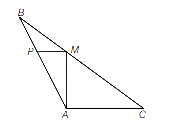
If the median of a $\triangle ABC$ through $A$ is perpendicular to $AC$,then $\frac{\tan A}{\tan C}=$
A
$1+\sqrt{2}$
B
$-\frac{1}{\sqrt{3}}+1$
C
$-2$
D
$1+\frac{2}{\sqrt{3}}$
Solution
(C) Let $AM$ be the median of $\triangle ABC$ through vertex $A$. Given that $AM \perp AC$,we have $\angle MAC = 90^{\circ}$.
Since $AM$ is the median,$M$ is the midpoint of $BC$,so $BM = MC$.
In $\triangle AMC$,$\angle MAC = 90^{\circ}$,so $\tan C = \frac{AM}{AC}$,which implies $AM = AC \tan C$.
Let $\angle MAC = 90^{\circ}$. In $\triangle ABC$,using the sine rule,$\frac{BM}{\sin(\angle BAM)} = \frac{AB}{\sin(\angle AMB)}$ and $\frac{MC}{\sin(\angle MAC)} = \frac{AC}{\sin(\angle B)}$.
Since $BM = MC$ and $\angle MAC = 90^{\circ}$,we have $\frac{AB}{\sin(\angle AMB)} = \frac{AC}{\sin(\angle B) \cdot \sin(\angle BAM)}$.
Using the property of the median and perpendicularity,it can be shown that $\tan A = -2 \tan C$.
Therefore,$\frac{\tan A}{\tan C} = -2$.
Since $AM$ is the median,$M$ is the midpoint of $BC$,so $BM = MC$.
In $\triangle AMC$,$\angle MAC = 90^{\circ}$,so $\tan C = \frac{AM}{AC}$,which implies $AM = AC \tan C$.
Let $\angle MAC = 90^{\circ}$. In $\triangle ABC$,using the sine rule,$\frac{BM}{\sin(\angle BAM)} = \frac{AB}{\sin(\angle AMB)}$ and $\frac{MC}{\sin(\angle MAC)} = \frac{AC}{\sin(\angle B)}$.
Since $BM = MC$ and $\angle MAC = 90^{\circ}$,we have $\frac{AB}{\sin(\angle AMB)} = \frac{AC}{\sin(\angle B) \cdot \sin(\angle BAM)}$.
Using the property of the median and perpendicularity,it can be shown that $\tan A = -2 \tan C$.
Therefore,$\frac{\tan A}{\tan C} = -2$.
0 likesView Solution
240
MathematicsEasyMCQAP EAMCET · 2018
In $\triangle ABC$,$\tan \frac{A}{2} + \tan \frac{B}{2} =$
A
$\frac{\cot \frac{C}{2}}{4s}$
B
$\frac{2c \cot \frac{C}{2}}{a+b+c}$
C
$\frac{2c \tan \frac{C}{2}}{s}$
D
$\frac{c \tan \frac{C}{2}}{a+b+c}$
Solution
(B) We know that $\tan \frac{A}{2} = \sqrt{\frac{(s-b)(s-c)}{s(s-a)}} = \frac{\Delta}{s(s-a)}$ and $\tan \frac{B}{2} = \frac{\Delta}{s(s-b)}$.
Adding these,we get $\tan \frac{A}{2} + \tan \frac{B}{2} = \frac{\Delta}{s} \left( \frac{1}{s-a} + \frac{1}{s-b} \right)$.
$= \frac{\Delta}{s} \left( \frac{s-b+s-a}{(s-a)(s-b)} \right) = \frac{\Delta}{s} \left( \frac{2s-a-b}{(s-a)(s-b)} \right)$.
Since $2s = a+b+c$,we have $2s-a-b = c$.
So,$\tan \frac{A}{2} + \tan \frac{B}{2} = \frac{c \Delta}{s(s-a)(s-b)}$.
Using $\Delta = \sqrt{s(s-a)(s-b)(s-c)}$,we have $\frac{\Delta}{(s-a)(s-b)} = \sqrt{\frac{s(s-c)}{(s-a)(s-b)}} = \cot \frac{C}{2}$.
Thus,$\tan \frac{A}{2} + \tan \frac{B}{2} = \frac{c}{s} \cot \frac{C}{2} = \frac{2c}{2s} \cot \frac{C}{2} = \frac{2c \cot \frac{C}{2}}{a+b+c}$.
Adding these,we get $\tan \frac{A}{2} + \tan \frac{B}{2} = \frac{\Delta}{s} \left( \frac{1}{s-a} + \frac{1}{s-b} \right)$.
$= \frac{\Delta}{s} \left( \frac{s-b+s-a}{(s-a)(s-b)} \right) = \frac{\Delta}{s} \left( \frac{2s-a-b}{(s-a)(s-b)} \right)$.
Since $2s = a+b+c$,we have $2s-a-b = c$.
So,$\tan \frac{A}{2} + \tan \frac{B}{2} = \frac{c \Delta}{s(s-a)(s-b)}$.
Using $\Delta = \sqrt{s(s-a)(s-b)(s-c)}$,we have $\frac{\Delta}{(s-a)(s-b)} = \sqrt{\frac{s(s-c)}{(s-a)(s-b)}} = \cot \frac{C}{2}$.
Thus,$\tan \frac{A}{2} + \tan \frac{B}{2} = \frac{c}{s} \cot \frac{C}{2} = \frac{2c}{2s} \cot \frac{C}{2} = \frac{2c \cot \frac{C}{2}}{a+b+c}$.
0 likesView Solution
241
MathematicsEasyMCQAP EAMCET · 2018
In a $\triangle ABC$,$D, E$,and $F$ are the points of contact of the incircle with the sides $AB, BC$,and $CA$ respectively,such that $AD=\alpha, BE=\beta$,and $CF=\gamma$. Then $\frac{\alpha \beta \gamma}{\alpha+\beta+\gamma} = $
A
$R^2$
B
$2R$
C
$2r$
D
$r^2$
Solution
(D) Let $s$ be the semi-perimeter of $\triangle ABC$. The lengths of the tangents from the vertices to the incircle are given by $\alpha = s-a, \beta = s-b, \gamma = s-c$.
Summing these,we get $\alpha+\beta+\gamma = 3s - (a+b+c) = 3s - 2s = s$.
The area of the triangle $S$ is given by Heron's formula: $S = \sqrt{s(s-a)(s-b)(s-c)} = \sqrt{s \alpha \beta \gamma}$.
We also know that $S = rs$,where $r$ is the inradius.
Thus,$r^2 s^2 = s \alpha \beta \gamma$,which simplifies to $r^2 s = \alpha \beta \gamma$.
Substituting $s = \alpha+\beta+\gamma$,we get $r^2 = \frac{\alpha \beta \gamma}{\alpha+\beta+\gamma}$.
Summing these,we get $\alpha+\beta+\gamma = 3s - (a+b+c) = 3s - 2s = s$.
The area of the triangle $S$ is given by Heron's formula: $S = \sqrt{s(s-a)(s-b)(s-c)} = \sqrt{s \alpha \beta \gamma}$.
We also know that $S = rs$,where $r$ is the inradius.
Thus,$r^2 s^2 = s \alpha \beta \gamma$,which simplifies to $r^2 s = \alpha \beta \gamma$.
Substituting $s = \alpha+\beta+\gamma$,we get $r^2 = \frac{\alpha \beta \gamma}{\alpha+\beta+\gamma}$.
0 likesView Solution
242
MathematicsMediumMCQAP EAMCET · 2018
With the usual notations,in a $\triangle ABC$,if $a=2, b=\sqrt{6}$ and $c=\sqrt{3}+1$,then $\sin^2 C - \sin^2 A =$
A
$\frac{1+\sqrt{3}}{4}$
B
$\frac{\sqrt{3}}{2}$
C
$\frac{\sqrt{3}}{4}$
D
$\frac{3}{4}$
Solution
(C) Given $a=2, b=\sqrt{6}, c=\sqrt{3}+1$.
Using the cosine rule for $\cos C$:
$\cos C = \frac{a^2+b^2-c^2}{2ab} = \frac{2^2 + (\sqrt{6})^2 - (\sqrt{3}+1)^2}{2(2)(\sqrt{6})} = \frac{4+6-(3+1+2\sqrt{3})}{4\sqrt{6}} = \frac{6-2\sqrt{3}}{4\sqrt{6}} = \frac{2(3-\sqrt{3})}{4\sqrt{6}} = \frac{\sqrt{3}(\sqrt{3}-1)}{2\sqrt{2}\sqrt{3}} = \frac{\sqrt{3}-1}{2\sqrt{2}}$.
Using the cosine rule for $\cos A$:
$\cos A = \frac{b^2+c^2-a^2}{2bc} = \frac{6 + (\sqrt{3}+1)^2 - 2^2}{2(\sqrt{6})(\sqrt{3}+1)} = \frac{6+4+2\sqrt{3}-4}{2\sqrt{6}(\sqrt{3}+1)} = \frac{6+2\sqrt{3}}{2\sqrt{6}(\sqrt{3}+1)} = \frac{2\sqrt{3}(\sqrt{3}+1)}{2\sqrt{6}(\sqrt{3}+1)} = \frac{\sqrt{3}}{\sqrt{6}} = \frac{1}{\sqrt{2}}$.
Now,$\sin^2 C - \sin^2 A = (1-\cos^2 C) - (1-\cos^2 A) = \cos^2 A - \cos^2 C$.
$= (\frac{1}{\sqrt{2}})^2 - (\frac{\sqrt{3}-1}{2\sqrt{2}})^2 = \frac{1}{2} - \frac{3+1-2\sqrt{3}}{8} = \frac{1}{2} - \frac{4-2\sqrt{3}}{8} = \frac{4 - (4-2\sqrt{3})}{8} = \frac{2\sqrt{3}}{8} = \frac{\sqrt{3}}{4}$.
Using the cosine rule for $\cos C$:
$\cos C = \frac{a^2+b^2-c^2}{2ab} = \frac{2^2 + (\sqrt{6})^2 - (\sqrt{3}+1)^2}{2(2)(\sqrt{6})} = \frac{4+6-(3+1+2\sqrt{3})}{4\sqrt{6}} = \frac{6-2\sqrt{3}}{4\sqrt{6}} = \frac{2(3-\sqrt{3})}{4\sqrt{6}} = \frac{\sqrt{3}(\sqrt{3}-1)}{2\sqrt{2}\sqrt{3}} = \frac{\sqrt{3}-1}{2\sqrt{2}}$.
Using the cosine rule for $\cos A$:
$\cos A = \frac{b^2+c^2-a^2}{2bc} = \frac{6 + (\sqrt{3}+1)^2 - 2^2}{2(\sqrt{6})(\sqrt{3}+1)} = \frac{6+4+2\sqrt{3}-4}{2\sqrt{6}(\sqrt{3}+1)} = \frac{6+2\sqrt{3}}{2\sqrt{6}(\sqrt{3}+1)} = \frac{2\sqrt{3}(\sqrt{3}+1)}{2\sqrt{6}(\sqrt{3}+1)} = \frac{\sqrt{3}}{\sqrt{6}} = \frac{1}{\sqrt{2}}$.
Now,$\sin^2 C - \sin^2 A = (1-\cos^2 C) - (1-\cos^2 A) = \cos^2 A - \cos^2 C$.
$= (\frac{1}{\sqrt{2}})^2 - (\frac{\sqrt{3}-1}{2\sqrt{2}})^2 = \frac{1}{2} - \frac{3+1-2\sqrt{3}}{8} = \frac{1}{2} - \frac{4-2\sqrt{3}}{8} = \frac{4 - (4-2\sqrt{3})}{8} = \frac{2\sqrt{3}}{8} = \frac{\sqrt{3}}{4}$.
0 likesView Solution
243
MathematicsDifficultMCQAP EAMCET · 2018
In $\triangle ABC$,if $a=2, b=\sqrt{6}$,and $c=\sqrt{3}+1$,then $\sin^2 C - \sin^2 A =$
A
$\frac{1+\sqrt{3}}{4}$
B
$\frac{\sqrt{3}}{2}$
C
$\frac{\sqrt{3}}{4}$
D
$\frac{3}{4}$
Solution
(C) Given $a=2, b=\sqrt{6}, c=\sqrt{3}+1$.
Using the Law of Cosines:
$\cos C = \frac{a^2+b^2-c^2}{2ab} = \frac{2^2 + (\sqrt{6})^2 - (\sqrt{3}+1)^2}{2(2)(\sqrt{6})} = \frac{4+6-(3+1+2\sqrt{3})}{4\sqrt{6}} = \frac{6-2\sqrt{3}}{4\sqrt{6}} = \frac{2\sqrt{3}(\sqrt{3}-1)}{4\sqrt{6}} = \frac{\sqrt{3}-1}{2\sqrt{2}}$.
Then $\sin^2 C = 1 - \cos^2 C = 1 - \left(\frac{\sqrt{3}-1}{2\sqrt{2}}\right)^2 = 1 - \frac{3+1-2\sqrt{3}}{8} = 1 - \frac{4-2\sqrt{3}}{8} = 1 - \frac{2-\sqrt{3}}{4} = \frac{4-2+\sqrt{3}}{4} = \frac{2+\sqrt{3}}{4}$.
Using the Law of Cosines for $A$:
$\cos A = \frac{b^2+c^2-a^2}{2bc} = \frac{6 + (\sqrt{3}+1)^2 - 2^2}{2(\sqrt{6})(\sqrt{3}+1)} = \frac{6 + 4 + 2\sqrt{3} - 4}{2\sqrt{6}(\sqrt{3}+1)} = \frac{6+2\sqrt{3}}{2\sqrt{6}(\sqrt{3}+1)} = \frac{2\sqrt{3}(\sqrt{3}+1)}{2\sqrt{6}(\sqrt{3}+1)} = \frac{\sqrt{3}}{\sqrt{6}} = \frac{1}{\sqrt{2}}$.
Then $\sin^2 A = 1 - \cos^2 A = 1 - \left(\frac{1}{\sqrt{2}}\right)^2 = 1 - \frac{1}{2} = \frac{1}{2}$.
Therefore,$\sin^2 C - \sin^2 A = \frac{2+\sqrt{3}}{4} - \frac{1}{2} = \frac{2+\sqrt{3}-2}{4} = \frac{\sqrt{3}}{4}$.
Using the Law of Cosines:
$\cos C = \frac{a^2+b^2-c^2}{2ab} = \frac{2^2 + (\sqrt{6})^2 - (\sqrt{3}+1)^2}{2(2)(\sqrt{6})} = \frac{4+6-(3+1+2\sqrt{3})}{4\sqrt{6}} = \frac{6-2\sqrt{3}}{4\sqrt{6}} = \frac{2\sqrt{3}(\sqrt{3}-1)}{4\sqrt{6}} = \frac{\sqrt{3}-1}{2\sqrt{2}}$.
Then $\sin^2 C = 1 - \cos^2 C = 1 - \left(\frac{\sqrt{3}-1}{2\sqrt{2}}\right)^2 = 1 - \frac{3+1-2\sqrt{3}}{8} = 1 - \frac{4-2\sqrt{3}}{8} = 1 - \frac{2-\sqrt{3}}{4} = \frac{4-2+\sqrt{3}}{4} = \frac{2+\sqrt{3}}{4}$.
Using the Law of Cosines for $A$:
$\cos A = \frac{b^2+c^2-a^2}{2bc} = \frac{6 + (\sqrt{3}+1)^2 - 2^2}{2(\sqrt{6})(\sqrt{3}+1)} = \frac{6 + 4 + 2\sqrt{3} - 4}{2\sqrt{6}(\sqrt{3}+1)} = \frac{6+2\sqrt{3}}{2\sqrt{6}(\sqrt{3}+1)} = \frac{2\sqrt{3}(\sqrt{3}+1)}{2\sqrt{6}(\sqrt{3}+1)} = \frac{\sqrt{3}}{\sqrt{6}} = \frac{1}{\sqrt{2}}$.
Then $\sin^2 A = 1 - \cos^2 A = 1 - \left(\frac{1}{\sqrt{2}}\right)^2 = 1 - \frac{1}{2} = \frac{1}{2}$.
Therefore,$\sin^2 C - \sin^2 A = \frac{2+\sqrt{3}}{4} - \frac{1}{2} = \frac{2+\sqrt{3}-2}{4} = \frac{\sqrt{3}}{4}$.
0 likesView Solution
244
MathematicsMediumMCQAP EAMCET · 2018
In $\triangle ABC$,find the value of $a^3 \cos(B-C) + b^3 \cos(C-A) + c^3 \cos(A-B)$.
A
$abc$
B
$a + b + c$
C
$2abc$
D
$3abc$
Solution
(D) Using the projection formula,we know that $a = b \cos C + c \cos B$,$b = c \cos A + a \cos C$,and $c = a \cos B + b \cos A$.
We can write $a^3 \cos(B-C) = a^2 \cdot a \cos(B-C)$.
Since $a = 2R \sin A = 2R \sin(180^\circ - (B+C)) = 2R \sin(B+C)$,we have:
$a^3 \cos(B-C) = a^2 \cdot 2R \sin(B+C) \cos(B-C) = a^2 R [\sin(2B) + \sin(2C)] = a^2 R [2 \sin B \cos B + 2 \sin C \cos C]$.
Using $b = 2R \sin B$ and $c = 2R \sin C$,this becomes:
$a^3 \cos(B-C) = a^2 (b \cos B + c \cos C) = a^2 b \cos B + a^2 c \cos C \quad \dots (i)$.
Similarly,
$b^3 \cos(C-A) = b^2 c \cos C + b^2 a \cos A \quad \dots (ii)$
$c^3 \cos(A-B) = c^2 a \cos A + c^2 b \cos B \quad \dots (iii)$
Adding $(i), (ii),$ and $(iii)$:
Sum $= (a^2 b \cos B + b^2 a \cos A) + (b^2 c \cos C + c^2 b \cos B) + (c^2 a \cos A + a^2 c \cos C)$
$= ab(a \cos B + b \cos A) + bc(b \cos C + c \cos B) + ca(c \cos A + a \cos C)$
$= ab(c) + bc(a) + ca(b) = abc + abc + abc = 3abc$.
We can write $a^3 \cos(B-C) = a^2 \cdot a \cos(B-C)$.
Since $a = 2R \sin A = 2R \sin(180^\circ - (B+C)) = 2R \sin(B+C)$,we have:
$a^3 \cos(B-C) = a^2 \cdot 2R \sin(B+C) \cos(B-C) = a^2 R [\sin(2B) + \sin(2C)] = a^2 R [2 \sin B \cos B + 2 \sin C \cos C]$.
Using $b = 2R \sin B$ and $c = 2R \sin C$,this becomes:
$a^3 \cos(B-C) = a^2 (b \cos B + c \cos C) = a^2 b \cos B + a^2 c \cos C \quad \dots (i)$.
Similarly,
$b^3 \cos(C-A) = b^2 c \cos C + b^2 a \cos A \quad \dots (ii)$
$c^3 \cos(A-B) = c^2 a \cos A + c^2 b \cos B \quad \dots (iii)$
Adding $(i), (ii),$ and $(iii)$:
Sum $= (a^2 b \cos B + b^2 a \cos A) + (b^2 c \cos C + c^2 b \cos B) + (c^2 a \cos A + a^2 c \cos C)$
$= ab(a \cos B + b \cos A) + bc(b \cos C + c \cos B) + ca(c \cos A + a \cos C)$
$= ab(c) + bc(a) + ca(b) = abc + abc + abc = 3abc$.
0 likesView Solution
245
MathematicsMediumMCQAP EAMCET · 2018
In $\triangle ABC$,the value of $a^3 \cos (B-C) + b^3 \cos (C-A) + c^3 \cos (A-B)$ is:
A
$abc$
B
$a+b+c$
C
$2abc$
D
$3abc$
Solution
(D) Using the projection formula,we know $a = b \cos C + c \cos B$,$b = c \cos A + a \cos C$,and $c = a \cos B + b \cos A$. \\
Also,by the sine rule,$\frac{a}{\sin A} = \frac{b}{\sin B} = \frac{c}{\sin C} = 2R$. \\
Consider the term $a^3 \cos (B-C)$. Using $\cos (B-C) = \frac{\sin 2B + \sin 2C}{2 \sin (B+C)} = \frac{\sin 2B + \sin 2C}{2 \sin A}$. \\
Substituting $a = 2R \sin A$,we get $a^3 \cos (B-C) = (2R \sin A)^2 \cdot a \cdot \frac{\sin 2B + \sin 2C}{2 \sin A} = 2R^2 \sin A (2 \sin B \cos B + 2 \sin C \cos C) \cdot a$. \\
This simplifies to $a^2 (b \cos B + c \cos C)$. \\
Similarly,$b^3 \cos (C-A) = b^2 (c \cos C + a \cos A)$ and $c^3 \cos (A-B) = c^2 (a \cos A + b \cos B)$. \\
Summing these,we get $a^2(b \cos B + c \cos C) + b^2(c \cos C + a \cos A) + c^2(a \cos A + b \cos B)$. \\
Rearranging terms: $ab(a \cos B + b \cos A) + bc(b \cos C + c \cos B) + ca(c \cos A + a \cos C)$. \\
Using the projection formula $a \cos B + b \cos A = c$,$b \cos C + c \cos B = a$,and $c \cos A + a \cos C = b$,we get: \\
$ab(c) + bc(a) + ca(b) = abc + abc + abc = 3abc$.
Also,by the sine rule,$\frac{a}{\sin A} = \frac{b}{\sin B} = \frac{c}{\sin C} = 2R$. \\
Consider the term $a^3 \cos (B-C)$. Using $\cos (B-C) = \frac{\sin 2B + \sin 2C}{2 \sin (B+C)} = \frac{\sin 2B + \sin 2C}{2 \sin A}$. \\
Substituting $a = 2R \sin A$,we get $a^3 \cos (B-C) = (2R \sin A)^2 \cdot a \cdot \frac{\sin 2B + \sin 2C}{2 \sin A} = 2R^2 \sin A (2 \sin B \cos B + 2 \sin C \cos C) \cdot a$. \\
This simplifies to $a^2 (b \cos B + c \cos C)$. \\
Similarly,$b^3 \cos (C-A) = b^2 (c \cos C + a \cos A)$ and $c^3 \cos (A-B) = c^2 (a \cos A + b \cos B)$. \\
Summing these,we get $a^2(b \cos B + c \cos C) + b^2(c \cos C + a \cos A) + c^2(a \cos A + b \cos B)$. \\
Rearranging terms: $ab(a \cos B + b \cos A) + bc(b \cos C + c \cos B) + ca(c \cos A + a \cos C)$. \\
Using the projection formula $a \cos B + b \cos A = c$,$b \cos C + c \cos B = a$,and $c \cos A + a \cos C = b$,we get: \\
$ab(c) + bc(a) + ca(b) = abc + abc + abc = 3abc$.
0 likesView Solution
246
MathematicsDifficultMCQAP EAMCET · 2018
In $\triangle ABC$,if $a=3, b=4, c=6$,then $\frac{\cot \frac{A}{2}+\cot \frac{B}{2}+\cot \frac{C}{2}}{\cot A+\cot B+\cot C}=$
A
$\frac{13}{61}$
B
$\frac{169}{61}$
C
$\frac{61}{169}$
D
$\frac{61}{13}$
Solution
(B) We know that $\cot \frac{A}{2} = \frac{s(s-a)}{\Delta}$,where $s = \frac{a+b+c}{2}$ and $\Delta$ is the area of the triangle.
Thus,$\cot \frac{A}{2} + \cot \frac{B}{2} + \cot \frac{C}{2} = \frac{s(s-a) + s(s-b) + s(s-c)}{\Delta} = \frac{s(3s - (a+b+c))}{\Delta} = \frac{s(3s - 2s)}{\Delta} = \frac{s^2}{\Delta} = \frac{(a+b+c)^2}{4\Delta}$.
Also,$\cot A + \cot B + \cot C = \frac{a^2+b^2+c^2}{4\Delta}$.
Therefore,the ratio is $\frac{(a+b+c)^2}{a^2+b^2+c^2}$.
Substituting $a=3, b=4, c=6$:
Ratio $= \frac{(3+4+6)^2}{3^2+4^2+6^2} = \frac{13^2}{9+16+36} = \frac{169}{61}$.
Thus,$\cot \frac{A}{2} + \cot \frac{B}{2} + \cot \frac{C}{2} = \frac{s(s-a) + s(s-b) + s(s-c)}{\Delta} = \frac{s(3s - (a+b+c))}{\Delta} = \frac{s(3s - 2s)}{\Delta} = \frac{s^2}{\Delta} = \frac{(a+b+c)^2}{4\Delta}$.
Also,$\cot A + \cot B + \cot C = \frac{a^2+b^2+c^2}{4\Delta}$.
Therefore,the ratio is $\frac{(a+b+c)^2}{a^2+b^2+c^2}$.
Substituting $a=3, b=4, c=6$:
Ratio $= \frac{(3+4+6)^2}{3^2+4^2+6^2} = \frac{13^2}{9+16+36} = \frac{169}{61}$.
0 likesView Solution
247
MathematicsMediumMCQAP EAMCET · 2018
In $\triangle ABC$,if $a \cos^2 \frac{C}{2} + c \cos^2 \frac{A}{2} = \frac{3b}{2}$,then
A
$2b = a + c$
B
$b^2 = ac$
C
$\frac{1}{b} = \frac{1}{a} + \frac{1}{c}$
D
$a = c$
Solution
(A) Given the equation: $a \cos^2 \frac{C}{2} + c \cos^2 \frac{A}{2} = \frac{3b}{2}$
Using the half-angle formulas $\cos^2 \frac{C}{2} = \frac{s(s-c)}{ab}$ and $\cos^2 \frac{A}{2} = \frac{s(s-a)}{bc}$:
$a \left( \frac{s(s-c)}{ab} \right) + c \left( \frac{s(s-a)}{bc} \right) = \frac{3b}{2}$
$\frac{s(s-c)}{b} + \frac{s(s-a)}{b} = \frac{3b}{2}$
$\frac{s}{b} (s - c + s - a) = \frac{3b}{2}$
Since $2s = a + b + c$,we have $2s - a - c = b$:
$\frac{s}{b} (b) = \frac{3b}{2} \Rightarrow s = \frac{3b}{2}$
$\frac{a + b + c}{2} = \frac{3b}{2} \Rightarrow a + b + c = 3b$
$a + c = 2b$
Using the half-angle formulas $\cos^2 \frac{C}{2} = \frac{s(s-c)}{ab}$ and $\cos^2 \frac{A}{2} = \frac{s(s-a)}{bc}$:
$a \left( \frac{s(s-c)}{ab} \right) + c \left( \frac{s(s-a)}{bc} \right) = \frac{3b}{2}$
$\frac{s(s-c)}{b} + \frac{s(s-a)}{b} = \frac{3b}{2}$
$\frac{s}{b} (s - c + s - a) = \frac{3b}{2}$
Since $2s = a + b + c$,we have $2s - a - c = b$:
$\frac{s}{b} (b) = \frac{3b}{2} \Rightarrow s = \frac{3b}{2}$
$\frac{a + b + c}{2} = \frac{3b}{2} \Rightarrow a + b + c = 3b$
$a + c = 2b$
0 likesView Solution
248
MathematicsMediumMCQAP EAMCET · 2018
If $s$ is the semi-perimeter of $\triangle ABC$ and if $\frac{s-a}{4}=\frac{s-b}{5}=\frac{s-c}{6}$,then $\sum \sin^2\left(\frac{A}{2}\right) = $
A
$\frac{74}{25}$
B
$\frac{25}{74}$
C
$\frac{74}{33}$
D
$\frac{25}{33}$
Solution
(D) Let $\frac{s-a}{4} = \frac{s-b}{5} = \frac{s-c}{6} = k$.
Then $s-a = 4k$,$s-b = 5k$,and $s-c = 6k$.
Adding these gives $3s - (a+b+c) = 15k$. Since $a+b+c = 2s$,we have $3s - 2s = 15k$,so $s = 15k$.
Then $a = s - 4k = 11k$,$b = s - 5k = 10k$,and $c = s - 6k = 9k$.
We know $\sin^2\left(\frac{A}{2}\right) = \frac{(s-b)(s-c)}{bc}$.
Thus,$\sum \sin^2\left(\frac{A}{2}\right) = \frac{(s-b)(s-c)}{bc} + \frac{(s-c)(s-a)}{ca} + \frac{(s-a)(s-b)}{ab}$.
Substituting the values:
$= \frac{(5k)(6k)}{(10k)(9k)} + \frac{(6k)(4k)}{(9k)(11k)} + \frac{(4k)(5k)}{(11k)(10k)} = \frac{30}{90} + \frac{24}{99} + \frac{20}{110} = \frac{1}{3} + \frac{8}{33} + \frac{2}{11}$.
$= \frac{11 + 8 + 6}{33} = \frac{25}{33}$.
Then $s-a = 4k$,$s-b = 5k$,and $s-c = 6k$.
Adding these gives $3s - (a+b+c) = 15k$. Since $a+b+c = 2s$,we have $3s - 2s = 15k$,so $s = 15k$.
Then $a = s - 4k = 11k$,$b = s - 5k = 10k$,and $c = s - 6k = 9k$.
We know $\sin^2\left(\frac{A}{2}\right) = \frac{(s-b)(s-c)}{bc}$.
Thus,$\sum \sin^2\left(\frac{A}{2}\right) = \frac{(s-b)(s-c)}{bc} + \frac{(s-c)(s-a)}{ca} + \frac{(s-a)(s-b)}{ab}$.
Substituting the values:
$= \frac{(5k)(6k)}{(10k)(9k)} + \frac{(6k)(4k)}{(9k)(11k)} + \frac{(4k)(5k)}{(11k)(10k)} = \frac{30}{90} + \frac{24}{99} + \frac{20}{110} = \frac{1}{3} + \frac{8}{33} + \frac{2}{11}$.
$= \frac{11 + 8 + 6}{33} = \frac{25}{33}$.
0 likesView Solution
249
MathematicsEasyMCQAP EAMCET · 2018
In $\triangle ABC$,if $\frac{s-a}{11}=\frac{s-b}{12}=\frac{s-c}{13}$,then $\tan^2\left(\frac{A}{2}\right)+\tan^2\left(\frac{C}{2}\right) = $
A
$\frac{290}{429}$
B
$\frac{290}{143}$
C
$\frac{143}{33}$
D
$\frac{113}{33}$
Solution
(A) Given that,$\frac{s-a}{11}=\frac{s-b}{12}=\frac{s-c}{13}=k$.
$s-a=11k$,$s-b=12k$,$s-c=13k$.
Adding these,we get $3s-(a+b+c) = 36k$.
Since $a+b+c=2s$,we have $3s-2s=36k$,so $s=36k$.
Using the formula $\tan^2\left(\frac{A}{2}\right) = \frac{(s-b)(s-c)}{s(s-a)}$ and $\tan^2\left(\frac{C}{2}\right) = \frac{(s-a)(s-b)}{s(s-c)}$,
$\tan^2\left(\frac{A}{2}\right)+\tan^2\left(\frac{C}{2}\right) = \frac{(12k)(13k)}{(36k)(11k)} + \frac{(11k)(12k)}{(36k)(13k)}$.
$= \frac{12 \times 13}{36 \times 11} + \frac{11 \times 12}{36 \times 13} = \frac{1}{3} \left( \frac{13}{11} + \frac{11}{13} \right)$.
$= \frac{1}{3} \left( \frac{169+121}{143} \right) = \frac{1}{3} \times \frac{290}{143} = \frac{290}{429}$.
$s-a=11k$,$s-b=12k$,$s-c=13k$.
Adding these,we get $3s-(a+b+c) = 36k$.
Since $a+b+c=2s$,we have $3s-2s=36k$,so $s=36k$.
Using the formula $\tan^2\left(\frac{A}{2}\right) = \frac{(s-b)(s-c)}{s(s-a)}$ and $\tan^2\left(\frac{C}{2}\right) = \frac{(s-a)(s-b)}{s(s-c)}$,
$\tan^2\left(\frac{A}{2}\right)+\tan^2\left(\frac{C}{2}\right) = \frac{(12k)(13k)}{(36k)(11k)} + \frac{(11k)(12k)}{(36k)(13k)}$.
$= \frac{12 \times 13}{36 \times 11} + \frac{11 \times 12}{36 \times 13} = \frac{1}{3} \left( \frac{13}{11} + \frac{11}{13} \right)$.
$= \frac{1}{3} \left( \frac{169+121}{143} \right) = \frac{1}{3} \times \frac{290}{143} = \frac{290}{429}$.
0 likesView Solution
250
MathematicsMediumMCQAP EAMCET · 2018
In $\triangle ABC$,$(a-b)^2 \sin^2\left(\frac{A+B}{2}\right) + (a+b)^2 \sin^2\left(\frac{C}{2}\right) = $
A
$b^2$
B
$a^2$
C
$c^2$
D
$a^2+b^2-c^2$
Solution
(C) In $\triangle ABC$,$A+B+C = \pi$,so $\frac{A+B}{2} = \frac{\pi-C}{2}$.
Substituting this into the expression:
$(a-b)^2 \sin^2\left(\frac{\pi-C}{2}\right) + (a+b)^2 \sin^2\left(\frac{C}{2}\right)$
$= (a-b)^2 \cos^2\left(\frac{C}{2}\right) + (a+b)^2 \sin^2\left(\frac{C}{2}\right)$
$= (a^2+b^2-2ab) \cos^2\left(\frac{C}{2}\right) + (a^2+b^2+2ab) \sin^2\left(\frac{C}{2}\right)$
$= (a^2+b^2) \left(\cos^2\frac{C}{2} + \sin^2\frac{C}{2}\right) - 2ab \left(\cos^2\frac{C}{2} - \sin^2\frac{C}{2}\right)$
$= (a^2+b^2)(1) - 2ab \cos C$
Using the Law of Cosines,$\cos C = \frac{a^2+b^2-c^2}{2ab}$:
$= a^2+b^2 - 2ab \left(\frac{a^2+b^2-c^2}{2ab}\right)$
$= a^2+b^2 - (a^2+b^2-c^2) = c^2$.
Substituting this into the expression:
$(a-b)^2 \sin^2\left(\frac{\pi-C}{2}\right) + (a+b)^2 \sin^2\left(\frac{C}{2}\right)$
$= (a-b)^2 \cos^2\left(\frac{C}{2}\right) + (a+b)^2 \sin^2\left(\frac{C}{2}\right)$
$= (a^2+b^2-2ab) \cos^2\left(\frac{C}{2}\right) + (a^2+b^2+2ab) \sin^2\left(\frac{C}{2}\right)$
$= (a^2+b^2) \left(\cos^2\frac{C}{2} + \sin^2\frac{C}{2}\right) - 2ab \left(\cos^2\frac{C}{2} - \sin^2\frac{C}{2}\right)$
$= (a^2+b^2)(1) - 2ab \cos C$
Using the Law of Cosines,$\cos C = \frac{a^2+b^2-c^2}{2ab}$:
$= a^2+b^2 - 2ab \left(\frac{a^2+b^2-c^2}{2ab}\right)$
$= a^2+b^2 - (a^2+b^2-c^2) = c^2$.
0 likesView Solution
251
MathematicsEasyMCQAP EAMCET · 2018
In a manufacturing company,three machines $A$,$B$ and $C$ respectively produce $20 \%$,$30 \%$ and $50 \%$ of the total product. The defective products from $A$,$B$ and $C$ are respectively $5 \%$,$3 \%$ and $2 \%$. If an article produced by the company is selected at random and is found to be defective,then the probability that it is produced by machine $B$ is
A
$\frac{10}{29}$
B
$\frac{8}{29}$
C
$\frac{9}{29}$
D
$\frac{11}{29}$
Solution
(C) Let events be defined as follows:
$E_1$: Production by machine $A$
$E_2$: Production by machine $B$
$E_3$: Production by machine $C$
$E$: The selected article is defective.
The probabilities of production by each machine are:
$P(E_1) = \frac{20}{100} = 0.2$
$P(E_2) = \frac{30}{100} = 0.3$
$P(E_3) = \frac{50}{100} = 0.5$
The conditional probabilities of defective products are:
$P(E|E_1) = \frac{5}{100} = 0.05$
$P(E|E_2) = \frac{3}{100} = 0.03$
$P(E|E_3) = \frac{2}{100} = 0.02$
Using Bayes' Theorem,the probability that the defective article was produced by machine $B$ is:
$P(E_2|E) = \frac{P(E_2) \cdot P(E|E_2)}{P(E_1) \cdot P(E|E_1) + P(E_2) \cdot P(E|E_2) + P(E_3) \cdot P(E|E_3)}$
$P(E_2|E) = \frac{0.3 \times 0.03}{(0.2 \times 0.05) + (0.3 \times 0.03) + (0.5 \times 0.02)}$
$P(E_2|E) = \frac{0.009}{0.010 + 0.009 + 0.010} = \frac{0.009}{0.029} = \frac{9}{29}$
$E_1$: Production by machine $A$
$E_2$: Production by machine $B$
$E_3$: Production by machine $C$
$E$: The selected article is defective.
The probabilities of production by each machine are:
$P(E_1) = \frac{20}{100} = 0.2$
$P(E_2) = \frac{30}{100} = 0.3$
$P(E_3) = \frac{50}{100} = 0.5$
The conditional probabilities of defective products are:
$P(E|E_1) = \frac{5}{100} = 0.05$
$P(E|E_2) = \frac{3}{100} = 0.03$
$P(E|E_3) = \frac{2}{100} = 0.02$
Using Bayes' Theorem,the probability that the defective article was produced by machine $B$ is:
$P(E_2|E) = \frac{P(E_2) \cdot P(E|E_2)}{P(E_1) \cdot P(E|E_1) + P(E_2) \cdot P(E|E_2) + P(E_3) \cdot P(E|E_3)}$
$P(E_2|E) = \frac{0.3 \times 0.03}{(0.2 \times 0.05) + (0.3 \times 0.03) + (0.5 \times 0.02)}$
$P(E_2|E) = \frac{0.009}{0.010 + 0.009 + 0.010} = \frac{0.009}{0.029} = \frac{9}{29}$
0 likesView Solution
252
MathematicsEasyMCQAP EAMCET · 2018
Let $A$ and $B$ be two independent events such that $P(B) > P(A)$. If the probability that both $A$ and $B$ happen is $\frac{1}{12}$ and the probability that neither $A$ nor $B$ happens is $\frac{1}{2}$,then:
A
$P(A) = \frac{1}{6}, P(B) = \frac{1}{2}$
B
$P(A) = \frac{1}{4}, P(B) = \frac{1}{3}$
C
$P(A) = \frac{1}{6}, P(B) = \frac{1}{5}$
D
$P(A) = \frac{1}{6}, P(B) = \frac{1}{3}$
Solution
(B) Given that $A$ and $B$ are independent events,we have $P(A \cap B) = P(A)P(B) = \frac{1}{12}$.
Also,the probability that neither $A$ nor $B$ happens is $P(A^c \cap B^c) = P(A^c)P(B^c) = (1 - P(A))(1 - P(B)) = \frac{1}{2}$.
Expanding the second equation: $1 - P(A) - P(B) + P(A)P(B) = \frac{1}{2}$.
Substituting $P(A)P(B) = \frac{1}{12}$: $1 - (P(A) + P(B)) + \frac{1}{12} = \frac{1}{2}$.
$P(A) + P(B) = 1 + \frac{1}{12} - \frac{1}{2} = \frac{12 + 1 - 6}{12} = \frac{7}{12}$.
Let $x = P(A)$ and $y = P(B)$. We have $x + y = \frac{7}{12}$ and $xy = \frac{1}{12}$.
The quadratic equation with roots $x$ and $y$ is $t^2 - (x+y)t + xy = 0$,which is $t^2 - \frac{7}{12}t + \frac{1}{12} = 0$.
Multiplying by $12$: $12t^2 - 7t + 1 = 0$.
$12t^2 - 4t - 3t + 1 = 0 \implies 4t(3t - 1) - 1(3t - 1) = 0$.
$(4t - 1)(3t - 1) = 0$,so $t = \frac{1}{4}$ or $t = \frac{1}{3}$.
Since $P(B) > P(A)$,we have $P(A) = \frac{1}{4}$ and $P(B) = \frac{1}{3}$.
Also,the probability that neither $A$ nor $B$ happens is $P(A^c \cap B^c) = P(A^c)P(B^c) = (1 - P(A))(1 - P(B)) = \frac{1}{2}$.
Expanding the second equation: $1 - P(A) - P(B) + P(A)P(B) = \frac{1}{2}$.
Substituting $P(A)P(B) = \frac{1}{12}$: $1 - (P(A) + P(B)) + \frac{1}{12} = \frac{1}{2}$.
$P(A) + P(B) = 1 + \frac{1}{12} - \frac{1}{2} = \frac{12 + 1 - 6}{12} = \frac{7}{12}$.
Let $x = P(A)$ and $y = P(B)$. We have $x + y = \frac{7}{12}$ and $xy = \frac{1}{12}$.
The quadratic equation with roots $x$ and $y$ is $t^2 - (x+y)t + xy = 0$,which is $t^2 - \frac{7}{12}t + \frac{1}{12} = 0$.
Multiplying by $12$: $12t^2 - 7t + 1 = 0$.
$12t^2 - 4t - 3t + 1 = 0 \implies 4t(3t - 1) - 1(3t - 1) = 0$.
$(4t - 1)(3t - 1) = 0$,so $t = \frac{1}{4}$ or $t = \frac{1}{3}$.
Since $P(B) > P(A)$,we have $P(A) = \frac{1}{4}$ and $P(B) = \frac{1}{3}$.
0 likesView Solution
253
MathematicsEasyMCQAP EAMCET · 2018
Given that the probability of a man hitting a target with a gun is $\frac{1}{3}$. If he fires $8$ times,then the probability of his hitting the target at least twice is
A
$5\left(\frac{2}{3}\right)^8$
B
$1-5\left(\frac{2}{3}\right)^8$
C
$\left(\frac{2}{3}\right)^8$
D
$\left(\frac{3}{8}\right)^4$
Solution
(B) Let $X$ be the number of times the man hits the target. This follows a binomial distribution $B(n, p)$ with $n=8$ and $p=\frac{1}{3}$.
Probability of success $p = \frac{1}{3}$,probability of failure $q = 1 - \frac{1}{3} = \frac{2}{3}$.
We need to find the probability of hitting the target at least twice,which is $P(X \ge 2)$.
$P(X \ge 2) = 1 - [P(X=0) + P(X=1)]$.
Using the binomial formula $P(X=k) = \binom{n}{k} p^k q^{n-k}$:
$P(X=0) = \binom{8}{0} (\frac{1}{3})^0 (\frac{2}{3})^8 = (\frac{2}{3})^8$.
$P(X=1) = \binom{8}{1} (\frac{1}{3})^1 (\frac{2}{3})^7 = 8 \cdot \frac{1}{3} \cdot (\frac{2}{3})^7$.
$P(X \ge 2) = 1 - [(\frac{2}{3})^8 + 8 \cdot \frac{1}{3} \cdot (\frac{2}{3})^7]$.
$P(X \ge 2) = 1 - [(\frac{2}{3})^7 \cdot (\frac{2}{3} + \frac{8}{3})] = 1 - [(\frac{2}{3})^7 \cdot \frac{10}{3}] = 1 - 5 \cdot (\frac{2}{3})^8$.
Probability of success $p = \frac{1}{3}$,probability of failure $q = 1 - \frac{1}{3} = \frac{2}{3}$.
We need to find the probability of hitting the target at least twice,which is $P(X \ge 2)$.
$P(X \ge 2) = 1 - [P(X=0) + P(X=1)]$.
Using the binomial formula $P(X=k) = \binom{n}{k} p^k q^{n-k}$:
$P(X=0) = \binom{8}{0} (\frac{1}{3})^0 (\frac{2}{3})^8 = (\frac{2}{3})^8$.
$P(X=1) = \binom{8}{1} (\frac{1}{3})^1 (\frac{2}{3})^7 = 8 \cdot \frac{1}{3} \cdot (\frac{2}{3})^7$.
$P(X \ge 2) = 1 - [(\frac{2}{3})^8 + 8 \cdot \frac{1}{3} \cdot (\frac{2}{3})^7]$.
$P(X \ge 2) = 1 - [(\frac{2}{3})^7 \cdot (\frac{2}{3} + \frac{8}{3})] = 1 - [(\frac{2}{3})^7 \cdot \frac{10}{3}] = 1 - 5 \cdot (\frac{2}{3})^8$.
0 likesView Solution
254
MathematicsMediumMCQAP EAMCET · 2018
$A$ person is known to speak truth in $3$ out of $5$ times. If he throws a die and reports that it is six,then the probability that it is actually six,is
A
$\frac{3}{30}$
B
$\frac{13}{30}$
C
$\frac{10}{13}$
D
$\frac{3}{13}$
Solution
(D) Let $E$ be the event that the person reports that the die shows $6$.
Let $S$ be the event that the die actually shows $6$,and $S^c$ be the event that the die does not show $6$.
$P(S) = \frac{1}{6}$ and $P(S^c) = \frac{5}{6}$.
Let $T$ be the event that the person speaks the truth. $P(T) = \frac{3}{5}$ and $P(T^c) = \frac{2}{5}$.
$P(E|S)$ is the probability that he reports $6$ given that it is $6$,which is $P(T) = \frac{3}{5}$.
$P(E|S^c)$ is the probability that he reports $6$ given that it is not $6$,which is $P(T^c) = \frac{2}{5}$.
By Bayes' Theorem,$P(S|E) = \frac{P(S)P(E|S)}{P(S)P(E|S) + P(S^c)P(E|S^c)}$.
$P(S|E) = \frac{(\frac{1}{6} \times \frac{3}{5})}{(\frac{1}{6} \times \frac{3}{5}) + (\frac{5}{6} \times \frac{2}{5})} = \frac{\frac{3}{30}}{\frac{3}{30} + \frac{10}{30}} = \frac{3}{13}$.
Let $S$ be the event that the die actually shows $6$,and $S^c$ be the event that the die does not show $6$.
$P(S) = \frac{1}{6}$ and $P(S^c) = \frac{5}{6}$.
Let $T$ be the event that the person speaks the truth. $P(T) = \frac{3}{5}$ and $P(T^c) = \frac{2}{5}$.
$P(E|S)$ is the probability that he reports $6$ given that it is $6$,which is $P(T) = \frac{3}{5}$.
$P(E|S^c)$ is the probability that he reports $6$ given that it is not $6$,which is $P(T^c) = \frac{2}{5}$.
By Bayes' Theorem,$P(S|E) = \frac{P(S)P(E|S)}{P(S)P(E|S) + P(S^c)P(E|S^c)}$.
$P(S|E) = \frac{(\frac{1}{6} \times \frac{3}{5})}{(\frac{1}{6} \times \frac{3}{5}) + (\frac{5}{6} \times \frac{2}{5})} = \frac{\frac{3}{30}}{\frac{3}{30} + \frac{10}{30}} = \frac{3}{13}$.
0 likesView Solution
255
MathematicsMediumMCQAP EAMCET · 2018
$A$ bag contains $6$ balls. If $4$ balls are drawn at a time and all of them are found to be red,then the probability that exactly $5$ of the balls in the bag are red is
A
$\frac{10}{19}$
B
$\frac{5}{21}$
C
$\frac{1}{21}$
D
$\frac{5}{7}$
Solution
(B) Let $E$ be the event that the $4$ drawn balls are red. Let $A_k$ be the event that there are $k$ red balls in the bag,where $k \in \{4, 5, 6\}$. Assuming each case is equally likely,$P(A_4) = P(A_5) = P(A_6) = \frac{1}{3}$.
The conditional probabilities are:
$P(E|A_4) = \frac{{}^4C_4}{{}^6C_4} = \frac{1}{15}$
$P(E|A_5) = \frac{{}^5C_4}{{}^6C_4} = \frac{5}{15}$
$P(E|A_6) = \frac{{}^6C_4}{{}^6C_4} = \frac{15}{15} = 1$
By Bayes' theorem,the probability that there are exactly $5$ red balls given that the $4$ drawn balls are red is:
$P(A_5|E) = \frac{P(A_5)P(E|A_5)}{P(A_4)P(E|A_4) + P(A_5)P(E|A_5) + P(A_6)P(E|A_6)}$
$P(A_5|E) = \frac{\frac{1}{3} \times \frac{5}{15}}{\frac{1}{3} \times \frac{1}{15} + \frac{1}{3} \times \frac{5}{15} + \frac{1}{3} \times \frac{15}{15}}$
$P(A_5|E) = \frac{5}{1 + 5 + 15} = \frac{5}{21}$
The conditional probabilities are:
$P(E|A_4) = \frac{{}^4C_4}{{}^6C_4} = \frac{1}{15}$
$P(E|A_5) = \frac{{}^5C_4}{{}^6C_4} = \frac{5}{15}$
$P(E|A_6) = \frac{{}^6C_4}{{}^6C_4} = \frac{15}{15} = 1$
By Bayes' theorem,the probability that there are exactly $5$ red balls given that the $4$ drawn balls are red is:
$P(A_5|E) = \frac{P(A_5)P(E|A_5)}{P(A_4)P(E|A_4) + P(A_5)P(E|A_5) + P(A_6)P(E|A_6)}$
$P(A_5|E) = \frac{\frac{1}{3} \times \frac{5}{15}}{\frac{1}{3} \times \frac{1}{15} + \frac{1}{3} \times \frac{5}{15} + \frac{1}{3} \times \frac{15}{15}}$
$P(A_5|E) = \frac{5}{1 + 5 + 15} = \frac{5}{21}$
0 likesView Solution
256
MathematicsDifficultMCQAP EAMCET · 2018
In a certain recruitment test with multiple choice questions,there are four options to answer each question,out of which only one is correct. An intelligent student knows $90 \%$ of the correct answers,while a weak student knows only $20 \%$ of the correct answers. If an intelligent student gets the correct answer for a question,what is the probability that he was guessing it?
A
$\frac{1}{37}$
B
$\frac{1}{10}$
C
$\frac{9}{37}$
D
$\frac{1}{2}$
Solution
(A) Let $E_1$ be the event that the student guesses the answer and $E_2$ be the event that the student knows the answer. Let $A$ be the event that the student answers correctly.
Given that the student knows $90 \%$ of the answers,$P(E_2) = \frac{9}{10}$.
Consequently,the probability that the student guesses is $P(E_1) = 1 - P(E_2) = 1 - \frac{9}{10} = \frac{1}{10}$.
If the student knows the answer,the probability of answering correctly is $P(A \mid E_2) = 1$.
If the student guesses,since there are $4$ options and only one is correct,the probability of answering correctly is $P(A \mid E_1) = \frac{1}{4}$.
We need to find the probability that the student was guessing given that they answered correctly,which is $P(E_1 \mid A)$.
Using Bayes' Theorem:
$P(E_1 \mid A) = \frac{P(E_1) \cdot P(A \mid E_1)}{P(E_1) \cdot P(A \mid E_1) + P(E_2) \cdot P(A \mid E_2)}$
$P(E_1 \mid A) = \frac{\frac{1}{10} \cdot \frac{1}{4}}{(\frac{1}{10} \cdot \frac{1}{4}) + (\frac{9}{10} \cdot 1)}$
$P(E_1 \mid A) = \frac{\frac{1}{40}}{\frac{1}{40} + \frac{9}{10}} = \frac{\frac{1}{40}}{\frac{1+36}{40}} = \frac{1}{37}$.
Given that the student knows $90 \%$ of the answers,$P(E_2) = \frac{9}{10}$.
Consequently,the probability that the student guesses is $P(E_1) = 1 - P(E_2) = 1 - \frac{9}{10} = \frac{1}{10}$.
If the student knows the answer,the probability of answering correctly is $P(A \mid E_2) = 1$.
If the student guesses,since there are $4$ options and only one is correct,the probability of answering correctly is $P(A \mid E_1) = \frac{1}{4}$.
We need to find the probability that the student was guessing given that they answered correctly,which is $P(E_1 \mid A)$.
Using Bayes' Theorem:
$P(E_1 \mid A) = \frac{P(E_1) \cdot P(A \mid E_1)}{P(E_1) \cdot P(A \mid E_1) + P(E_2) \cdot P(A \mid E_2)}$
$P(E_1 \mid A) = \frac{\frac{1}{10} \cdot \frac{1}{4}}{(\frac{1}{10} \cdot \frac{1}{4}) + (\frac{9}{10} \cdot 1)}$
$P(E_1 \mid A) = \frac{\frac{1}{40}}{\frac{1}{40} + \frac{9}{10}} = \frac{\frac{1}{40}}{\frac{1+36}{40}} = \frac{1}{37}$.
0 likesView Solution
257
MathematicsEasyMCQAP EAMCET · 2018
If the sum and product of the mean and variance of a binomial distribution are $15$ and $54$ respectively,then the number of trials in it is
A
$27$
B
$54$
C
$28$
D
$81$
Solution
(A) For a binomial distribution with $n$ trials and probability of success $p$,let $q = 1 - p$.
Mean $\mu = np$ and Variance $\sigma^2 = npq$.
Given:
$np + npq = 15$
$np(npq) = 54$
Let $X = np$ and $Y = npq$.
Then $X + Y = 15$ and $XY = 54$.
These are roots of the quadratic equation $t^2 - 15t + 54 = 0$.
$(t - 9)(t - 6) = 0$,so the roots are $9$ and $6$.
Since $np > npq$ (because $q < 1$),we have $np = 9$ and $npq = 6$.
Dividing the two equations: $\frac{npq}{np} = \frac{6}{9} \implies q = \frac{2}{3}$.
Then $p = 1 - q = 1 - \frac{2}{3} = \frac{1}{3}$.
Substituting $p$ into $np = 9$: $n(\frac{1}{3}) = 9 \implies n = 27$.
Thus,the number of trials is $27$.
Mean $\mu = np$ and Variance $\sigma^2 = npq$.
Given:
$np + npq = 15$
$np(npq) = 54$
Let $X = np$ and $Y = npq$.
Then $X + Y = 15$ and $XY = 54$.
These are roots of the quadratic equation $t^2 - 15t + 54 = 0$.
$(t - 9)(t - 6) = 0$,so the roots are $9$ and $6$.
Since $np > npq$ (because $q < 1$),we have $np = 9$ and $npq = 6$.
Dividing the two equations: $\frac{npq}{np} = \frac{6}{9} \implies q = \frac{2}{3}$.
Then $p = 1 - q = 1 - \frac{2}{3} = \frac{1}{3}$.
Substituting $p$ into $np = 9$: $n(\frac{1}{3}) = 9 \implies n = 27$.
Thus,the number of trials is $27$.
0 likesView Solution
258
MathematicsEasyMCQAP EAMCET · 2018
For a binomial variate $X$ with parameters $n=5$ and $p=\frac{3}{4}$. If $\alpha=\frac{1}{9} P(X \geq 3)$ and $\beta=P(X \leq 2)$,then $256(\beta-\alpha)=$
A
$-1$
B
$0$
C
$1$
D
$2$
Solution
(C) We know that the binomial distribution is given by $P(X=r) = { }^n C_r p^r q^{n-r}$ where $p+q=1$.
Given $n=5, p=\frac{3}{4}, q=\frac{1}{4}$.
First,calculate $P(X \geq 3) = P(X=3) + P(X=4) + P(X=5)$.
$P(X=3) = { }^5 C_3 (\frac{3}{4})^3 (\frac{1}{4})^2 = 10 \times \frac{27}{64} \times \frac{1}{16} = \frac{270}{1024}$.
$P(X=4) = { }^5 C_4 (\frac{3}{4})^4 (\frac{1}{4})^1 = 5 \times \frac{81}{256} \times \frac{1}{4} = \frac{405}{1024}$.
$P(X=5) = { }^5 C_5 (\frac{3}{4})^5 (\frac{1}{4})^0 = 1 \times \frac{243}{1024} \times 1 = \frac{243}{1024}$.
$P(X \geq 3) = \frac{270+405+243}{1024} = \frac{918}{1024}$.
Then $\alpha = \frac{1}{9} \times \frac{918}{1024} = \frac{102}{1024}$.
Next,calculate $\beta = P(X \leq 2) = 1 - P(X \geq 3) = 1 - \frac{918}{1024} = \frac{106}{1024}$.
Finally,$256(\beta - \alpha) = 256(\frac{106}{1024} - \frac{102}{1024}) = 256(\frac{4}{1024}) = 256(\frac{1}{256}) = 1$.
Given $n=5, p=\frac{3}{4}, q=\frac{1}{4}$.
First,calculate $P(X \geq 3) = P(X=3) + P(X=4) + P(X=5)$.
$P(X=3) = { }^5 C_3 (\frac{3}{4})^3 (\frac{1}{4})^2 = 10 \times \frac{27}{64} \times \frac{1}{16} = \frac{270}{1024}$.
$P(X=4) = { }^5 C_4 (\frac{3}{4})^4 (\frac{1}{4})^1 = 5 \times \frac{81}{256} \times \frac{1}{4} = \frac{405}{1024}$.
$P(X=5) = { }^5 C_5 (\frac{3}{4})^5 (\frac{1}{4})^0 = 1 \times \frac{243}{1024} \times 1 = \frac{243}{1024}$.
$P(X \geq 3) = \frac{270+405+243}{1024} = \frac{918}{1024}$.
Then $\alpha = \frac{1}{9} \times \frac{918}{1024} = \frac{102}{1024}$.
Next,calculate $\beta = P(X \leq 2) = 1 - P(X \geq 3) = 1 - \frac{918}{1024} = \frac{106}{1024}$.
Finally,$256(\beta - \alpha) = 256(\frac{106}{1024} - \frac{102}{1024}) = 256(\frac{4}{1024}) = 256(\frac{1}{256}) = 1$.
0 likesView Solution
259
MathematicsMediumMCQAP EAMCET · 2018
If $X$ is a binomial variate with mean $6$ and variance $2$,then the value of $P(5 \leq X \leq 7)$ is
A
$\frac{4762}{6561}$
B
$\frac{4672}{6561}$
C
$\frac{5264}{6561}$
D
$\frac{5462}{6651}$
Solution
(B) Given that $X$ is a binomial variate with mean $np = 6$ and variance $npq = 2$.
From these,we have $6q = 2$,which implies $q = \frac{1}{3}$.
Thus,$p = 1 - q = 1 - \frac{1}{3} = \frac{2}{3}$.
Substituting $p$ in $np = 6$,we get $n \times \frac{2}{3} = 6$,so $n = 9$.
We need to calculate $P(5 \leq X \leq 7) = P(X=5) + P(X=6) + P(X=7)$.
Using the formula $P(X=k) = {}^nC_k p^k q^{n-k}$:
$P(X=5) = {}^9C_5 (\frac{2}{3})^5 (\frac{1}{3})^4 = 126 \times \frac{32}{3^9} = \frac{4032}{19683}$.
$P(X=6) = {}^9C_6 (\frac{2}{3})^6 (\frac{1}{3})^3 = 84 \times \frac{64}{3^9} = \frac{5376}{19683}$.
$P(X=7) = {}^9C_7 (\frac{2}{3})^7 (\frac{1}{3})^2 = 36 \times \frac{128}{3^9} = \frac{4608}{19683}$.
Summing these values: $P(5 \leq X \leq 7) = \frac{4032 + 5376 + 4608}{19683} = \frac{14016}{19683}$.
Dividing numerator and denominator by $3$: $\frac{4672}{6561}$.
From these,we have $6q = 2$,which implies $q = \frac{1}{3}$.
Thus,$p = 1 - q = 1 - \frac{1}{3} = \frac{2}{3}$.
Substituting $p$ in $np = 6$,we get $n \times \frac{2}{3} = 6$,so $n = 9$.
We need to calculate $P(5 \leq X \leq 7) = P(X=5) + P(X=6) + P(X=7)$.
Using the formula $P(X=k) = {}^nC_k p^k q^{n-k}$:
$P(X=5) = {}^9C_5 (\frac{2}{3})^5 (\frac{1}{3})^4 = 126 \times \frac{32}{3^9} = \frac{4032}{19683}$.
$P(X=6) = {}^9C_6 (\frac{2}{3})^6 (\frac{1}{3})^3 = 84 \times \frac{64}{3^9} = \frac{5376}{19683}$.
$P(X=7) = {}^9C_7 (\frac{2}{3})^7 (\frac{1}{3})^2 = 36 \times \frac{128}{3^9} = \frac{4608}{19683}$.
Summing these values: $P(5 \leq X \leq 7) = \frac{4032 + 5376 + 4608}{19683} = \frac{14016}{19683}$.
Dividing numerator and denominator by $3$: $\frac{4672}{6561}$.
0 likesView Solution
260
MathematicsMediumMCQAP EAMCET · 2018
If the probability distribution of a random variable $X$ is given by:
Find the variance of $X$.
| $X = x_i$ | $0$ | $1$ | $2$ | $3$ |
|---|---|---|---|---|
| $P(X = x_i)$ | $\frac{1}{8}$ | $\frac{3}{8}$ | $3K$ | $K$ |
Find the variance of $X$.
A
$3$
B
$\frac{9}{4}$
C
$\frac{3}{2}$
D
$\frac{3}{4}$
Solution
(D) The variance of a random variable $X$ is given by $\text{Var}(X) = E(X^2) - (E(X))^2$.
Since the sum of probabilities in a probability distribution is $1$,we have:
$\frac{1}{8} + \frac{3}{8} + 3K + K = 1$
$\frac{4}{8} + 4K = 1$
$\frac{1}{2} + 4K = 1 \Rightarrow 4K = \frac{1}{2} \Rightarrow K = \frac{1}{8}$.
Now,we calculate $E(X)$ and $E(X^2)$:
$E(X) = \sum x_i P(x_i) = (0 \times \frac{1}{8}) + (1 \times \frac{3}{8}) + (2 \times \frac{3}{8}) + (3 \times \frac{1}{8}) = 0 + \frac{3}{8} + \frac{6}{8} + \frac{3}{8} = \frac{12}{8} = \frac{3}{2}$.
$E(X^2) = \sum x_i^2 P(x_i) = (0^2 \times \frac{1}{8}) + (1^2 \times \frac{3}{8}) + (2^2 \times \frac{3}{8}) + (3^2 \times \frac{1}{8}) = 0 + \frac{3}{8} + \frac{12}{8} + \frac{9}{8} = \frac{24}{8} = 3$.
Therefore,$\text{Var}(X) = E(X^2) - (E(X))^2 = 3 - (\frac{3}{2})^2 = 3 - \frac{9}{4} = \frac{12 - 9}{4} = \frac{3}{4}$.
Since the sum of probabilities in a probability distribution is $1$,we have:
$\frac{1}{8} + \frac{3}{8} + 3K + K = 1$
$\frac{4}{8} + 4K = 1$
$\frac{1}{2} + 4K = 1 \Rightarrow 4K = \frac{1}{2} \Rightarrow K = \frac{1}{8}$.
Now,we calculate $E(X)$ and $E(X^2)$:
$E(X) = \sum x_i P(x_i) = (0 \times \frac{1}{8}) + (1 \times \frac{3}{8}) + (2 \times \frac{3}{8}) + (3 \times \frac{1}{8}) = 0 + \frac{3}{8} + \frac{6}{8} + \frac{3}{8} = \frac{12}{8} = \frac{3}{2}$.
$E(X^2) = \sum x_i^2 P(x_i) = (0^2 \times \frac{1}{8}) + (1^2 \times \frac{3}{8}) + (2^2 \times \frac{3}{8}) + (3^2 \times \frac{1}{8}) = 0 + \frac{3}{8} + \frac{12}{8} + \frac{9}{8} = \frac{24}{8} = 3$.
Therefore,$\text{Var}(X) = E(X^2) - (E(X))^2 = 3 - (\frac{3}{2})^2 = 3 - \frac{9}{4} = \frac{12 - 9}{4} = \frac{3}{4}$.
0 likesView Solution
261
MathematicsMediumMCQAP EAMCET · 2018
$A$ manufacturer of locks knows that $2 \%$ of his product is defective. If he sells the locks in boxes each with $100$ locks and guarantees that not more than $2$ locks will be defective in a box,then the probability that a box will fail to meet the guaranteed quality is
A
$1-5 e^{-2}$
B
$\sum_{k=2}^{100} {}^{100}C_k (\frac{1}{50})^k (\frac{49}{50})^{100-k}$
C
$0.02$
D
$1-3 e^{-2}$
Solution
(A) Let $X$ be the number of defective locks in a box. Since the number of locks $n=100$ is large and the probability of a defect $p=0.02$ is small,we use the Poisson distribution with mean $\lambda = np = 100 \times 0.02 = 2$.
The probability of having $r$ defective locks is given by $P(X=r) = \frac{e^{-\lambda} \lambda^r}{r!} = \frac{e^{-2} 2^r}{r!}$.
The manufacturer guarantees that there are not more than $2$ defective locks,meaning the box meets the quality if $X \le 2$.
The box fails to meet the guarantee if $X > 2$.
The probability of failure is $P(X > 2) = 1 - [P(X=0) + P(X=1) + P(X=2)]$.
Substituting the values:
$P(X > 2) = 1 - [\frac{e^{-2} 2^0}{0!} + \frac{e^{-2} 2^1}{1!} + \frac{e^{-2} 2^2}{2!}] = 1 - [e^{-2} + 2e^{-2} + 2e^{-2}] = 1 - 5e^{-2}$.
The probability of having $r$ defective locks is given by $P(X=r) = \frac{e^{-\lambda} \lambda^r}{r!} = \frac{e^{-2} 2^r}{r!}$.
The manufacturer guarantees that there are not more than $2$ defective locks,meaning the box meets the quality if $X \le 2$.
The box fails to meet the guarantee if $X > 2$.
The probability of failure is $P(X > 2) = 1 - [P(X=0) + P(X=1) + P(X=2)]$.
Substituting the values:
$P(X > 2) = 1 - [\frac{e^{-2} 2^0}{0!} + \frac{e^{-2} 2^1}{1!} + \frac{e^{-2} 2^2}{2!}] = 1 - [e^{-2} + 2e^{-2} + 2e^{-2}] = 1 - 5e^{-2}$.
0 likesView Solution
262
MathematicsMediumMCQAP EAMCET · 2018
The variance of the random variable $X$ having the following distribution is:
| $X = k$ | $-2$ | $-1$ | $0$ | $1$ | $2$ |
|---|---|---|---|---|---|
| $P(X = k)$ | $\frac{1}{6}$ | $\frac{1}{6}$ | $\frac{1}{3}$ | $\frac{1}{6}$ | $\frac{1}{6}$ |
A
$\frac{1}{3}$
B
$\frac{2}{3}$
C
$\frac{4}{3}$
D
$\frac{5}{3}$
Solution
(D) The variance of a random variable $X$ is given by the formula:
$\operatorname{Var}(X) = E(X^2) - [E(X)]^2$
First,we calculate the expected value $E(X) = \sum P_i x_i$:
$E(X) = (-2) \times \frac{1}{6} + (-1) \times \frac{1}{6} + 0 \times \frac{1}{3} + 1 \times \frac{1}{6} + 2 \times \frac{1}{6}$
$E(X) = -\frac{2}{6} - \frac{1}{6} + 0 + \frac{1}{6} + \frac{2}{6} = 0$
Next,we calculate $E(X^2) = \sum P_i x_i^2$:
$E(X^2) = (-2)^2 \times \frac{1}{6} + (-1)^2 \times \frac{1}{6} + 0^2 \times \frac{1}{3} + 1^2 \times \frac{1}{6} + 2^2 \times \frac{1}{6}$
$E(X^2) = 4 \times \frac{1}{6} + 1 \times \frac{1}{6} + 0 + 1 \times \frac{1}{6} + 4 \times \frac{1}{6}$
$E(X^2) = \frac{4+1+0+1+4}{6} = \frac{10}{6} = \frac{5}{3}$
Finally,the variance is:
$\operatorname{Var}(X) = \frac{5}{3} - (0)^2 = \frac{5}{3}$
$\operatorname{Var}(X) = E(X^2) - [E(X)]^2$
First,we calculate the expected value $E(X) = \sum P_i x_i$:
$E(X) = (-2) \times \frac{1}{6} + (-1) \times \frac{1}{6} + 0 \times \frac{1}{3} + 1 \times \frac{1}{6} + 2 \times \frac{1}{6}$
$E(X) = -\frac{2}{6} - \frac{1}{6} + 0 + \frac{1}{6} + \frac{2}{6} = 0$
Next,we calculate $E(X^2) = \sum P_i x_i^2$:
$E(X^2) = (-2)^2 \times \frac{1}{6} + (-1)^2 \times \frac{1}{6} + 0^2 \times \frac{1}{3} + 1^2 \times \frac{1}{6} + 2^2 \times \frac{1}{6}$
$E(X^2) = 4 \times \frac{1}{6} + 1 \times \frac{1}{6} + 0 + 1 \times \frac{1}{6} + 4 \times \frac{1}{6}$
$E(X^2) = \frac{4+1+0+1+4}{6} = \frac{10}{6} = \frac{5}{3}$
Finally,the variance is:
$\operatorname{Var}(X) = \frac{5}{3} - (0)^2 = \frac{5}{3}$
0 likesView Solution
263
MathematicsMediumMCQAP EAMCET · 2018
If the probability function of a random variable $X$ is given by $P(X=j) = \frac{1}{2^j}$ for $j = 1, 2, 3, \ldots, \infty$,then the variance of $X$ is:
A
$2$
B
$3$
C
$4$
D
$5$
Solution
(A) The probability distribution is given by $P(X=j) = (\frac{1}{2})^j$ for $j = 1, 2, 3, \ldots$.
This is a geometric distribution with $p = \frac{1}{2}$ and $q = 1 - p = \frac{1}{2}$.
The mean $E[X]$ of a geometric distribution starting from $j=1$ is given by $\frac{1}{p} = \frac{1}{1/2} = 2$.
The variance $Var(X)$ of a geometric distribution is given by $\frac{q}{p^2}$.
Substituting the values,$Var(X) = \frac{1/2}{(1/2)^2} = \frac{1/2}{1/4} = 2$.
Thus,the variance of $X$ is $2$.
This is a geometric distribution with $p = \frac{1}{2}$ and $q = 1 - p = \frac{1}{2}$.
The mean $E[X]$ of a geometric distribution starting from $j=1$ is given by $\frac{1}{p} = \frac{1}{1/2} = 2$.
The variance $Var(X)$ of a geometric distribution is given by $\frac{q}{p^2}$.
Substituting the values,$Var(X) = \frac{1/2}{(1/2)^2} = \frac{1/2}{1/4} = 2$.
Thus,the variance of $X$ is $2$.
0 likesView Solution
264
MathematicsEasyMCQAP EAMCET · 2018
$A$ random variable $X$ has the following probability distribution:
The variance of this random variable is
| $X=x_i$ | $-2$ | $-1$ | $0$ | $1$ | $2$ |
| $P(X=x_i)$ | $1/6$ | $k$ | $1/4$ | $k$ | $1/6$ |
The variance of this random variable is
A
$0$
B
$\frac{5}{24}$
C
$\frac{3}{24}$
D
$\frac{7}{4}$
Solution
(D) Since the sum of probabilities is $1$:
$\frac{1}{6} + k + \frac{1}{4} + k + \frac{1}{6} = 1$
$2k + \frac{7}{12} = 1 \implies 2k = \frac{5}{12} \implies k = \frac{5}{24}$
Calculation for Variance:
$\begin{array}{|c|c|c|c|} \hline x_i & P(X=x_i) & x_i P(x_i) & x_i^2 P(x_i) \\ \hline -2 & 1/6 & -1/3 & 2/3 \\ \hline -1 & 5/24 & -5/24 & 5/24 \\ \hline 0 & 1/4 & 0 & 0 \\ \hline 1 & 5/24 & 5/24 & 5/24 \\ \hline 2 & 1/6 & 1/3 & 2/3 \\ \hline \text{Total} & 1 & 0 & 21/12 \\ \hline \end{array}$
$\text{Variance} = E(X^2) - [E(X)]^2$
$= \frac{21}{12} - (0)^2 = \frac{7}{4}$
$\frac{1}{6} + k + \frac{1}{4} + k + \frac{1}{6} = 1$
$2k + \frac{7}{12} = 1 \implies 2k = \frac{5}{12} \implies k = \frac{5}{24}$
Calculation for Variance:
$\begin{array}{|c|c|c|c|} \hline x_i & P(X=x_i) & x_i P(x_i) & x_i^2 P(x_i) \\ \hline -2 & 1/6 & -1/3 & 2/3 \\ \hline -1 & 5/24 & -5/24 & 5/24 \\ \hline 0 & 1/4 & 0 & 0 \\ \hline 1 & 5/24 & 5/24 & 5/24 \\ \hline 2 & 1/6 & 1/3 & 2/3 \\ \hline \text{Total} & 1 & 0 & 21/12 \\ \hline \end{array}$
$\text{Variance} = E(X^2) - [E(X)]^2$
$= \frac{21}{12} - (0)^2 = \frac{7}{4}$
0 likesView Solution
265
MathematicsDifficultMCQAP EAMCET · 2018
If $m$ and $n$ are the order and degree of the differential equation of the family of parabolas with focus at the origin and $X$-axis as its axis,then $m n-m+n=$
A
$1$
B
$2$
C
$3$
D
$4$
Solution
(C) The equation of the family of parabolas with focus at the origin $(0,0)$ and the $X$-axis as its axis is given by $(y-0)^2 = -4a(x-a)$,where $a$ is the parameter.
$y^2 = -4ax + 4a^2$ $(i)$
Differentiating with respect to $x$:
$2y y' = -4a$
$a = -\frac{y y'}{2}$
Substituting the value of $a$ into equation $(i)$:
$y^2 = -4\left(-\frac{y y'}{2}\right)x + 4\left(-\frac{y y'}{2}\right)^2$
$y^2 = 2x y y' + 4\left(\frac{y^2 y'^2}{4}\right)$
$y^2 = 2x y y' + y^2 y'^2$
Dividing by $y$ (assuming $y \neq 0$):
$y = 2x y' + y y'^2$
$y\left(\frac{dy}{dx}\right)^2 + 2x\left(\frac{dy}{dx}\right) - y = 0$
The order $m$ of this differential equation is $1$ and the degree $n$ is $2$.
Therefore,$mn - m + n = (1)(2) - 1 + 2 = 2 - 1 + 2 = 3$.
$y^2 = -4ax + 4a^2$ $(i)$
Differentiating with respect to $x$:
$2y y' = -4a$
$a = -\frac{y y'}{2}$
Substituting the value of $a$ into equation $(i)$:
$y^2 = -4\left(-\frac{y y'}{2}\right)x + 4\left(-\frac{y y'}{2}\right)^2$
$y^2 = 2x y y' + 4\left(\frac{y^2 y'^2}{4}\right)$
$y^2 = 2x y y' + y^2 y'^2$
Dividing by $y$ (assuming $y \neq 0$):
$y = 2x y' + y y'^2$
$y\left(\frac{dy}{dx}\right)^2 + 2x\left(\frac{dy}{dx}\right) - y = 0$
The order $m$ of this differential equation is $1$ and the degree $n$ is $2$.
Therefore,$mn - m + n = (1)(2) - 1 + 2 = 2 - 1 + 2 = 3$.
0 likesView Solution
Vedclass Products
For Students
Vedclass Test Series
Mock tests in real AP EAMCET style covering Mathematics with performance analysis. 5-day free trial.
Start Free TrialFor Teachers
Exam Paper Generator
Generate Set A/B/C/D Mathematics papers from 7.5L+ questions in 2 minutes. 3 chapters free.
Try FreeFor Institutes
Online Exam Module
Run live AP EAMCET mock exams with unlimited students, 360° analytics & white-label branding.
See DemoFrequently Asked Questions
How many Mathematics questions are in AP EAMCET 2018?
There are 497 Mathematics questions from the AP EAMCET 2018 paper on Vedclass, each with a detailed step-by-step solution in English.
Are AP EAMCET 2018 Mathematics solutions available in English?
Yes. All solutions on this page are in English. You can also switch to English or Hindi using the language buttons above the questions.
Can I practice AP EAMCET 2018 Mathematics as a timed test?
Yes. Use the Vedclass Test Series to attempt a full AP EAMCET mock test covering Mathematics with time limits and instant score analysis.
Can teachers create Mathematics papers from AP EAMCET previous year questions?
Yes. The Vedclass Exam Paper Generator lets teachers mix AP EAMCET Mathematics questions and generate Set A/B/C/D papers in minutes.
For Teachers & Institutes
Build a Custom Mathematics Paper
Pick AP EAMCET 2018 Mathematics questions, set difficulty, and generate Set A/B/C/D in 2 minutes.