
MathematicsQ251–282 of 497 questions
Page 6 of 6 · English
251
MathematicsEasyMCQAP EAMCET · 2018
In a triangle,if the ex-radii $r_1, r_2, r_3$ are in the ratio $1: 2: 3$,then its sides are in the ratio
A
$5: 8: 9$
B
$5: 4: 3$
C
$7: 9: 11$
D
$1: 2: 3$
Solution
(A) We know that $r_1 = \frac{\Delta}{s-a}$,$r_2 = \frac{\Delta}{s-b}$,and $r_3 = \frac{\Delta}{s-c}$,where $\Delta$ is the area of the triangle and $s$ is the semi-perimeter.
Given $r_1: r_2: r_3 = 1: 2: 3$,let $r_1 = x, r_2 = 2x, r_3 = 3x$.
Then $s-a = \frac{\Delta}{x}$,$s-b = \frac{\Delta}{2x}$,and $s-c = \frac{\Delta}{3x}$.
Adding these three equations:
$(s-a) + (s-b) + (s-c) = \frac{\Delta}{x} + \frac{\Delta}{2x} + \frac{\Delta}{3x}$
$3s - (a+b+c) = \Delta \left( \frac{6+3+2}{6x} \right)$
Since $a+b+c = 2s$,we have $3s - 2s = \frac{11\Delta}{6x}$,so $s = \frac{11\Delta}{6x}$.
Now,$a = s - (s-a) = \frac{11\Delta}{6x} - \frac{\Delta}{x} = \frac{11\Delta - 6\Delta}{6x} = \frac{5\Delta}{6x}$.
$b = s - (s-b) = \frac{11\Delta}{6x} - \frac{\Delta}{2x} = \frac{11\Delta - 3\Delta}{6x} = \frac{8\Delta}{6x}$.
$c = s - (s-c) = \frac{11\Delta}{6x} - \frac{\Delta}{3x} = \frac{11\Delta - 2\Delta}{6x} = \frac{9\Delta}{6x}$.
Thus,$a: b: c = \frac{5\Delta}{6x} : \frac{8\Delta}{6x} : \frac{9\Delta}{6x} = 5: 8: 9$.
Given $r_1: r_2: r_3 = 1: 2: 3$,let $r_1 = x, r_2 = 2x, r_3 = 3x$.
Then $s-a = \frac{\Delta}{x}$,$s-b = \frac{\Delta}{2x}$,and $s-c = \frac{\Delta}{3x}$.
Adding these three equations:
$(s-a) + (s-b) + (s-c) = \frac{\Delta}{x} + \frac{\Delta}{2x} + \frac{\Delta}{3x}$
$3s - (a+b+c) = \Delta \left( \frac{6+3+2}{6x} \right)$
Since $a+b+c = 2s$,we have $3s - 2s = \frac{11\Delta}{6x}$,so $s = \frac{11\Delta}{6x}$.
Now,$a = s - (s-a) = \frac{11\Delta}{6x} - \frac{\Delta}{x} = \frac{11\Delta - 6\Delta}{6x} = \frac{5\Delta}{6x}$.
$b = s - (s-b) = \frac{11\Delta}{6x} - \frac{\Delta}{2x} = \frac{11\Delta - 3\Delta}{6x} = \frac{8\Delta}{6x}$.
$c = s - (s-c) = \frac{11\Delta}{6x} - \frac{\Delta}{3x} = \frac{11\Delta - 2\Delta}{6x} = \frac{9\Delta}{6x}$.
Thus,$a: b: c = \frac{5\Delta}{6x} : \frac{8\Delta}{6x} : \frac{9\Delta}{6x} = 5: 8: 9$.
0 likesView Solution
252
MathematicsMediumMCQAP EAMCET · 2018
Consider the following statements.
$I$. In $\triangle ABC$,if $c=6$ and $\cos C=-\frac{11}{25}$,then $R=\frac{25}{2\sqrt{14}}$.
$II$. In $\triangle ABC$,if $a=3, b=4, c=6$,then $\triangle ABC$ is an acute-angled triangle.
Which of the above statements is/are true?
$I$. In $\triangle ABC$,if $c=6$ and $\cos C=-\frac{11}{25}$,then $R=\frac{25}{2\sqrt{14}}$.
$II$. In $\triangle ABC$,if $a=3, b=4, c=6$,then $\triangle ABC$ is an acute-angled triangle.
Which of the above statements is/are true?
A
Only $I$
B
Only $II$
C
Both $I$ and $II$
D
Neither $I$ nor $II$
Solution
(A) For statement $I$: Given $c=6$ and $\cos C=-\frac{11}{25}$.
We know $\sin C = \sqrt{1-\cos^2 C} = \sqrt{1-\frac{121}{625}} = \sqrt{\frac{504}{625}} = \frac{\sqrt{36 \times 14}}{25} = \frac{6\sqrt{14}}{25}$.
Using the sine rule,$\frac{c}{\sin C} = 2R$,so $R = \frac{c}{2\sin C} = \frac{6}{2 \times \frac{6\sqrt{14}}{25}} = \frac{25}{2\sqrt{14}}$.
Thus,statement $I$ is true.
For statement $II$: Given $a=3, b=4, c=6$.
To check if it is acute-angled,we calculate $\cos C = \frac{a^2+b^2-c^2}{2ab} = \frac{9+16-36}{2(3)(4)} = \frac{-11}{24}$.
Since $\cos C < 0$,the angle $C$ is obtuse $(C > 90^{\circ})$.
Thus,statement $II$ is false.
We know $\sin C = \sqrt{1-\cos^2 C} = \sqrt{1-\frac{121}{625}} = \sqrt{\frac{504}{625}} = \frac{\sqrt{36 \times 14}}{25} = \frac{6\sqrt{14}}{25}$.
Using the sine rule,$\frac{c}{\sin C} = 2R$,so $R = \frac{c}{2\sin C} = \frac{6}{2 \times \frac{6\sqrt{14}}{25}} = \frac{25}{2\sqrt{14}}$.
Thus,statement $I$ is true.
For statement $II$: Given $a=3, b=4, c=6$.
To check if it is acute-angled,we calculate $\cos C = \frac{a^2+b^2-c^2}{2ab} = \frac{9+16-36}{2(3)(4)} = \frac{-11}{24}$.
Since $\cos C < 0$,the angle $C$ is obtuse $(C > 90^{\circ})$.
Thus,statement $II$ is false.
0 likesView Solution
253
MathematicsMediumMCQAP EAMCET · 2018
If the reciprocals of the lengths of the sides of a $\triangle ABC$ are in harmonic progression,then its ex-radii $r_1, r_2, r_3$ are in
A
Arithmetic progression
B
Geometric progression
C
Harmonic progression
D
Arithmetico-geometric progression
Solution
(C) Let the sides of a $\triangle ABC$ be $a, b,$ and $c$.
Since $\frac{1}{a}, \frac{1}{b}, \frac{1}{c}$ are in $H$.$P$.,it implies that $a, b, c$ are in $A$.$P$.
We know that the ex-radii are given by $r_1 = \frac{\Delta}{s-a}, r_2 = \frac{\Delta}{s-b}, r_3 = \frac{\Delta}{s-c}$.
Since $a, b, c$ are in $A$.$P$.,then $s-a, s-b, s-c$ are also in $A$.$P$.
Therefore,their reciprocals $\frac{1}{s-a}, \frac{1}{s-b}, \frac{1}{s-c}$ are in $H$.$P$.
Multiplying by $\Delta$,we get $\frac{\Delta}{s-a}, \frac{\Delta}{s-b}, \frac{\Delta}{s-c}$ are in $H$.$P$.
Thus,$r_1, r_2, r_3$ are in $H$.$P$.
Since $\frac{1}{a}, \frac{1}{b}, \frac{1}{c}$ are in $H$.$P$.,it implies that $a, b, c$ are in $A$.$P$.
We know that the ex-radii are given by $r_1 = \frac{\Delta}{s-a}, r_2 = \frac{\Delta}{s-b}, r_3 = \frac{\Delta}{s-c}$.
Since $a, b, c$ are in $A$.$P$.,then $s-a, s-b, s-c$ are also in $A$.$P$.
Therefore,their reciprocals $\frac{1}{s-a}, \frac{1}{s-b}, \frac{1}{s-c}$ are in $H$.$P$.
Multiplying by $\Delta$,we get $\frac{\Delta}{s-a}, \frac{\Delta}{s-b}, \frac{\Delta}{s-c}$ are in $H$.$P$.
Thus,$r_1, r_2, r_3$ are in $H$.$P$.
0 likesView Solution
254
MathematicsDifficultMCQAP EAMCET · 2018
If $I$ is the incentre of $\triangle ABC$ and $P_1, P_2, P_3$ are respectively the radii of the circumcircles of the $\triangle IBC, \triangle ICA$ and $\triangle IAB$,then $P_1 P_2 P_3=$
A
$2Rr$
B
$2Rr^2$
C
$2R^2r$
D
$\frac{4R}{r}$
Solution
(C) In $\triangle IBC$,$\angle BIC = 90^\circ + \frac{A}{2}$. The circumradius $P_1$ of $\triangle IBC$ is given by $\frac{a}{2 \sin(\angle BIC)} = \frac{a}{2 \cos(A/2)}$.
Similarly,$P_2 = \frac{b}{2 \cos(B/2)}$ and $P_3 = \frac{c}{2 \cos(C/2)}$.
Thus,$P_1 P_2 P_3 = \frac{abc}{8 \cos(A/2) \cos(B/2) \cos(C/2)}$.
Using $a = 2R \sin A = 4R \sin(A/2) \cos(A/2)$,we have $abc = 8R^3 \sin A \sin B \sin C = 8R^3 (8 \sin(A/2) \cos(A/2) \sin(B/2) \cos(B/2) \sin(C/2) \cos(C/2))$.
Substituting this into the product,we get $P_1 P_2 P_3 = \frac{8R^3 (8 \sin(A/2) \cos(A/2) \sin(B/2) \cos(B/2) \sin(C/2) \cos(C/2))}{8 \cos(A/2) \cos(B/2) \cos(C/2)} = 8R^3 \sin(A/2) \sin(B/2) \sin(C/2)$.
Since $r = 4R \sin(A/2) \sin(B/2) \sin(C/2)$,we have $\sin(A/2) \sin(B/2) \sin(C/2) = \frac{r}{4R}$.
Therefore,$P_1 P_2 P_3 = 8R^3 \times \frac{r}{4R} = 2R^2r$.
Similarly,$P_2 = \frac{b}{2 \cos(B/2)}$ and $P_3 = \frac{c}{2 \cos(C/2)}$.
Thus,$P_1 P_2 P_3 = \frac{abc}{8 \cos(A/2) \cos(B/2) \cos(C/2)}$.
Using $a = 2R \sin A = 4R \sin(A/2) \cos(A/2)$,we have $abc = 8R^3 \sin A \sin B \sin C = 8R^3 (8 \sin(A/2) \cos(A/2) \sin(B/2) \cos(B/2) \sin(C/2) \cos(C/2))$.
Substituting this into the product,we get $P_1 P_2 P_3 = \frac{8R^3 (8 \sin(A/2) \cos(A/2) \sin(B/2) \cos(B/2) \sin(C/2) \cos(C/2))}{8 \cos(A/2) \cos(B/2) \cos(C/2)} = 8R^3 \sin(A/2) \sin(B/2) \sin(C/2)$.
Since $r = 4R \sin(A/2) \sin(B/2) \sin(C/2)$,we have $\sin(A/2) \sin(B/2) \sin(C/2) = \frac{r}{4R}$.
Therefore,$P_1 P_2 P_3 = 8R^3 \times \frac{r}{4R} = 2R^2r$.
0 likesView Solution
255
MathematicsDifficultMCQAP EAMCET · 2018
In $\triangle ABC$,if $A = 60^{\circ}$ and $B = 105^{\circ}$,then find the value of $\frac{2R^2(b-c) \sin A \sin B \sin C}{(b+c)(s-a \cos C - c \cos A)(s-a \cos B - b \cos A)}$.
A
$\frac{1}{\sqrt{2}}$
B
$\sqrt{3}$
C
$1$
D
$\frac{1}{\sqrt{3}}$
Solution
(C) Given $A = 60^{\circ}$ and $B = 105^{\circ}$,then $C = 180^{\circ} - (60^{\circ} + 105^{\circ}) = 15^{\circ}$.
Using the projection formula,$s - a \cos C - c \cos A = s - b = \frac{a+c-b}{2}$.
Similarly,$s - a \cos B - b \cos A = s - c = \frac{a+b-c}{2}$.
The expression simplifies using the sine rule $a = 2R \sin A, b = 2R \sin B, c = 2R \sin C$.
Substituting these values into the expression,the terms cancel out to yield the result $1$.
Using the projection formula,$s - a \cos C - c \cos A = s - b = \frac{a+c-b}{2}$.
Similarly,$s - a \cos B - b \cos A = s - c = \frac{a+b-c}{2}$.
The expression simplifies using the sine rule $a = 2R \sin A, b = 2R \sin B, c = 2R \sin C$.
Substituting these values into the expression,the terms cancel out to yield the result $1$.
0 likesView Solution
256
MathematicsMediumMCQAP EAMCET · 2018
In $\triangle ABC$,if $\angle A = 90^{\circ}$,then $2(r+R) = $
A
$b+c$
B
$a+b$
C
$a+c$
D
$a+b+c$
Solution
(A) In a right-angled triangle $ABC$ with $\angle A = 90^{\circ}$,the inradius $r$ is given by $r = \frac{b+c-a}{2}$.
The circumradius $R$ is given by $R = \frac{a}{2}$.
Therefore,$r+R = \frac{b+c-a}{2} + \frac{a}{2} = \frac{b+c}{2}$.
Multiplying by $2$,we get $2(r+R) = b+c$.
The circumradius $R$ is given by $R = \frac{a}{2}$.
Therefore,$r+R = \frac{b+c-a}{2} + \frac{a}{2} = \frac{b+c}{2}$.
Multiplying by $2$,we get $2(r+R) = b+c$.
0 likesView Solution
257
MathematicsMediumMCQAP EAMCET · 2018
In $\triangle ABC$,$\frac{r_1-r}{a}+\frac{r_2-r}{b}+\frac{r_3-r}{c} = $
A
$\frac{r_1+r_2+r_3}{s}$
B
$\frac{r_1+r_2+r_3}{2s}$
C
$\frac{r_1+r_2+r_3}{2}$
D
$\frac{r_1+r_2+r_3}{3s}$
Solution
(A) We know that $r = \frac{\Delta}{s}$,$r_1 = \frac{\Delta}{s-a}$,$r_2 = \frac{\Delta}{s-b}$,and $r_3 = \frac{\Delta}{s-c}$.
Substituting these into the expression:
$\frac{r_1-r}{a} + \frac{r_2-r}{b} + \frac{r_3-r}{c} = \frac{1}{a}\left(\frac{\Delta}{s-a} - \frac{\Delta}{s}\right) + \frac{1}{b}\left(\frac{\Delta}{s-b} - \frac{\Delta}{s}\right) + \frac{1}{c}\left(\frac{\Delta}{s-c} - \frac{\Delta}{s}\right)$
$= \frac{1}{a}\left(\frac{\Delta s - \Delta(s-a)}{s(s-a)}\right) + \frac{1}{b}\left(\frac{\Delta s - \Delta(s-b)}{s(s-b)}\right) + \frac{1}{c}\left(\frac{\Delta s - \Delta(s-c)}{s(s-c)}\right)$
$= \frac{1}{a}\left(\frac{\Delta a}{s(s-a)}\right) + \frac{1}{b}\left(\frac{\Delta b}{s(s-b)}\right) + \frac{1}{c}\left(\frac{\Delta c}{s(s-c)}\right)$
$= \frac{\Delta}{s(s-a)} + \frac{\Delta}{s(s-b)} + \frac{\Delta}{s(s-c)}$
$= \frac{r_1}{s} + \frac{r_2}{s} + \frac{r_3}{s} = \frac{r_1+r_2+r_3}{s}$.
Substituting these into the expression:
$\frac{r_1-r}{a} + \frac{r_2-r}{b} + \frac{r_3-r}{c} = \frac{1}{a}\left(\frac{\Delta}{s-a} - \frac{\Delta}{s}\right) + \frac{1}{b}\left(\frac{\Delta}{s-b} - \frac{\Delta}{s}\right) + \frac{1}{c}\left(\frac{\Delta}{s-c} - \frac{\Delta}{s}\right)$
$= \frac{1}{a}\left(\frac{\Delta s - \Delta(s-a)}{s(s-a)}\right) + \frac{1}{b}\left(\frac{\Delta s - \Delta(s-b)}{s(s-b)}\right) + \frac{1}{c}\left(\frac{\Delta s - \Delta(s-c)}{s(s-c)}\right)$
$= \frac{1}{a}\left(\frac{\Delta a}{s(s-a)}\right) + \frac{1}{b}\left(\frac{\Delta b}{s(s-b)}\right) + \frac{1}{c}\left(\frac{\Delta c}{s(s-c)}\right)$
$= \frac{\Delta}{s(s-a)} + \frac{\Delta}{s(s-b)} + \frac{\Delta}{s(s-c)}$
$= \frac{r_1}{s} + \frac{r_2}{s} + \frac{r_3}{s} = \frac{r_1+r_2+r_3}{s}$.
0 likesView Solution
258
MathematicsMediumMCQAP EAMCET · 2018
Let $x, y$ be real numbers such that $x \neq y$ and $xy \neq 1$. If $ax + b \sec(\tan^{-1} x) = c$ and $ay + b \sec(\tan^{-1} y) = c$,then $\frac{x+y}{1-xy} =$
A
$\frac{2ab}{a^2-b^2}$
B
$\frac{2ac}{a^2+c^2}$
C
$\frac{2ab}{a^2+b^2}$
D
$\frac{2ac}{a^2-c^2}$
Solution
(D) We know that $\sec(\tan^{-1} x) = \sqrt{1+x^2}$. Given the equations $ax + b\sqrt{1+x^2} = c$ and $ay + b\sqrt{1+y^2} = c$,we can rewrite them as $b\sqrt{1+x^2} = c - ax$ and $b\sqrt{1+y^2} = c - ay$.
Squaring both sides,we get $b^2(1+x^2) = c^2 - 2acx + a^2x^2$ and $b^2(1+y^2) = c^2 - 2acy + a^2y^2$.
Rearranging these,we have $(a^2-b^2)x^2 - 2acx + (c^2-b^2) = 0$ and $(a^2-b^2)y^2 - 2acy + (c^2-b^2) = 0$.
This implies that $x$ and $y$ are the distinct roots of the quadratic equation $(a^2-b^2)t^2 - 2act + (c^2-b^2) = 0$.
Using the properties of roots,the sum of roots $x+y = \frac{2ac}{a^2-b^2}$ and the product of roots $xy = \frac{c^2-b^2}{a^2-b^2}$.
Now,calculate $1-xy = 1 - \frac{c^2-b^2}{a^2-b^2} = \frac{a^2-b^2-c^2+b^2}{a^2-b^2} = \frac{a^2-c^2}{a^2-b^2}$.
Therefore,$\frac{x+y}{1-xy} = \frac{2ac / (a^2-b^2)}{(a^2-c^2) / (a^2-b^2)} = \frac{2ac}{a^2-c^2}$.
Squaring both sides,we get $b^2(1+x^2) = c^2 - 2acx + a^2x^2$ and $b^2(1+y^2) = c^2 - 2acy + a^2y^2$.
Rearranging these,we have $(a^2-b^2)x^2 - 2acx + (c^2-b^2) = 0$ and $(a^2-b^2)y^2 - 2acy + (c^2-b^2) = 0$.
This implies that $x$ and $y$ are the distinct roots of the quadratic equation $(a^2-b^2)t^2 - 2act + (c^2-b^2) = 0$.
Using the properties of roots,the sum of roots $x+y = \frac{2ac}{a^2-b^2}$ and the product of roots $xy = \frac{c^2-b^2}{a^2-b^2}$.
Now,calculate $1-xy = 1 - \frac{c^2-b^2}{a^2-b^2} = \frac{a^2-b^2-c^2+b^2}{a^2-b^2} = \frac{a^2-c^2}{a^2-b^2}$.
Therefore,$\frac{x+y}{1-xy} = \frac{2ac / (a^2-b^2)}{(a^2-c^2) / (a^2-b^2)} = \frac{2ac}{a^2-c^2}$.
0 likesView Solution
259
MathematicsMediumMCQAP EAMCET · 2018
$\operatorname{sech}^2\left(\tanh ^{-1} \frac{1}{2}\right)+\operatorname{cosech}^2\left(\operatorname{coth}^{-1} 3\right)=$
A
$\frac{35}{9}$
B
$\frac{3}{2}$
C
$\frac{25}{4}$
D
$\frac{35}{4}$
Solution
(D) We know the identities for inverse hyperbolic functions:
$\tanh^{-1}(x) = \operatorname{sech}^{-1}\left(\sqrt{1-x^2}\right)$ and $\coth^{-1}(x) = \operatorname{cosech}^{-1}\left(\frac{1}{\sqrt{x^2-1}}\right)$.
For the first term: $\tanh^{-1}\left(\frac{1}{2}\right) = \operatorname{sech}^{-1}\left(\sqrt{1-(\frac{1}{2})^2}\right) = \operatorname{sech}^{-1}\left(\sqrt{\frac{3}{4}}\right) = \operatorname{sech}^{-1}\left(\frac{\sqrt{3}}{2}\right)$.
Thus,$\operatorname{sech}^2\left(\tanh^{-1} \frac{1}{2}\right) = \left(\frac{\sqrt{3}}{2}\right)^2 = \frac{3}{4}$.
For the second term: $\coth^{-1}(3) = \operatorname{cosech}^{-1}\left(\frac{1}{\sqrt{3^2-1}}\right) = \operatorname{cosech}^{-1}\left(\frac{1}{\sqrt{8}}\right)$.
Thus,$\operatorname{cosech}^2\left(\coth^{-1} 3\right) = \left(\frac{1}{\sqrt{8}}\right)^{-2} = 8$.
Adding both terms: $\frac{3}{4} + 8 = \frac{3+32}{4} = \frac{35}{4}$.
$\tanh^{-1}(x) = \operatorname{sech}^{-1}\left(\sqrt{1-x^2}\right)$ and $\coth^{-1}(x) = \operatorname{cosech}^{-1}\left(\frac{1}{\sqrt{x^2-1}}\right)$.
For the first term: $\tanh^{-1}\left(\frac{1}{2}\right) = \operatorname{sech}^{-1}\left(\sqrt{1-(\frac{1}{2})^2}\right) = \operatorname{sech}^{-1}\left(\sqrt{\frac{3}{4}}\right) = \operatorname{sech}^{-1}\left(\frac{\sqrt{3}}{2}\right)$.
Thus,$\operatorname{sech}^2\left(\tanh^{-1} \frac{1}{2}\right) = \left(\frac{\sqrt{3}}{2}\right)^2 = \frac{3}{4}$.
For the second term: $\coth^{-1}(3) = \operatorname{cosech}^{-1}\left(\frac{1}{\sqrt{3^2-1}}\right) = \operatorname{cosech}^{-1}\left(\frac{1}{\sqrt{8}}\right)$.
Thus,$\operatorname{cosech}^2\left(\coth^{-1} 3\right) = \left(\frac{1}{\sqrt{8}}\right)^{-2} = 8$.
Adding both terms: $\frac{3}{4} + 8 = \frac{3+32}{4} = \frac{35}{4}$.
0 likesView Solution
260
MathematicsMediumMCQAP EAMCET · 2018
$\lim _{n \rightarrow \infty} \sum_{r=1}^n \tan ^{-1}\left(\frac{2 r}{r^4+r^2+2}\right) = $
A
$\frac{\pi}{4}$
B
$\frac{\pi}{2}$
C
$-\frac{\pi}{4}$
D
$-\frac{\pi}{2}$
Solution
(A) We know that $r^4+r^2+1 = (r^2-r+1)(r^2+r+1)$.
Also,$r^2+r+1 - (r^2-r+1) = 2r$.
Therefore,the term inside the summation can be written as:
$\tan ^{-1}\left(\frac{2r}{1+(r^4+r^2+1)}\right) = \tan ^{-1}\left(\frac{(r^2+r+1)-(r^2-r+1)}{1+(r^2+r+1)(r^2-r+1)}\right) = \tan ^{-1}(r^2+r+1) - \tan ^{-1}(r^2-r+1)$.
Now,the sum is a telescoping series:
$S_n = \sum_{r=1}^n \{\tan ^{-1}(r^2+r+1) - \tan ^{-1}(r^2-r+1)\}$
$S_n = (\tan ^{-1}(3) - \tan ^{-1}(1)) + (\tan ^{-1}(7) - \tan ^{-1}(3)) + \dots + (\tan ^{-1}(n^2+n+1) - \tan ^{-1}(n^2-n+1))$
$S_n = \tan ^{-1}(n^2+n+1) - \tan ^{-1}(1)$.
Taking the limit as $n \rightarrow \infty$:
$\lim _{n \rightarrow \infty} S_n = \lim _{n \rightarrow \infty} (\tan ^{-1}(n^2+n+1) - \frac{\pi}{4}) = \frac{\pi}{2} - \frac{\pi}{4} = \frac{\pi}{4}$.
Also,$r^2+r+1 - (r^2-r+1) = 2r$.
Therefore,the term inside the summation can be written as:
$\tan ^{-1}\left(\frac{2r}{1+(r^4+r^2+1)}\right) = \tan ^{-1}\left(\frac{(r^2+r+1)-(r^2-r+1)}{1+(r^2+r+1)(r^2-r+1)}\right) = \tan ^{-1}(r^2+r+1) - \tan ^{-1}(r^2-r+1)$.
Now,the sum is a telescoping series:
$S_n = \sum_{r=1}^n \{\tan ^{-1}(r^2+r+1) - \tan ^{-1}(r^2-r+1)\}$
$S_n = (\tan ^{-1}(3) - \tan ^{-1}(1)) + (\tan ^{-1}(7) - \tan ^{-1}(3)) + \dots + (\tan ^{-1}(n^2+n+1) - \tan ^{-1}(n^2-n+1))$
$S_n = \tan ^{-1}(n^2+n+1) - \tan ^{-1}(1)$.
Taking the limit as $n \rightarrow \infty$:
$\lim _{n \rightarrow \infty} S_n = \lim _{n \rightarrow \infty} (\tan ^{-1}(n^2+n+1) - \frac{\pi}{4}) = \frac{\pi}{2} - \frac{\pi}{4} = \frac{\pi}{4}$.
0 likesView Solution
261
MathematicsMediumMCQAP EAMCET · 2018
If $a_n = \sqrt{7+\sqrt{7+\sqrt{7+\ldots}}}$ ($n$ times),then which one of the following is true?
A
$a_n > 7, \forall n \geq 1$
B
$a_n > 3, \forall n \geq 1$
C
$a_n < 4, \forall n \geq 1$
D
$a_n < 3, \forall n \geq 1$
Solution
(C) Let $a_{\infty} = \lim_{n \to \infty} a_n$.
Then $a_{\infty} = \sqrt{7 + a_{\infty}}$.
Squaring both sides,we get $a_{\infty}^2 = 7 + a_{\infty}$,which implies $a_{\infty}^2 - a_{\infty} - 7 = 0$.
Using the quadratic formula,$a_{\infty} = \frac{1 \pm \sqrt{1 - 4(1)(-7)}}{2} = \frac{1 \pm \sqrt{29}}{2}$.
Since $a_n > 0$,we take the positive root: $a_{\infty} = \frac{1 + \sqrt{29}}{2} \approx \frac{1 + 5.385}{2} \approx 3.19$.
Since the sequence $a_n$ is strictly increasing and bounded above by $a_{\infty}$,we have $a_n < a_{\infty} < 4$ for all $n \geq 1$.
Thus,$a_n < 4$ is true for all $n \geq 1$.
Then $a_{\infty} = \sqrt{7 + a_{\infty}}$.
Squaring both sides,we get $a_{\infty}^2 = 7 + a_{\infty}$,which implies $a_{\infty}^2 - a_{\infty} - 7 = 0$.
Using the quadratic formula,$a_{\infty} = \frac{1 \pm \sqrt{1 - 4(1)(-7)}}{2} = \frac{1 \pm \sqrt{29}}{2}$.
Since $a_n > 0$,we take the positive root: $a_{\infty} = \frac{1 + \sqrt{29}}{2} \approx \frac{1 + 5.385}{2} \approx 3.19$.
Since the sequence $a_n$ is strictly increasing and bounded above by $a_{\infty}$,we have $a_n < a_{\infty} < 4$ for all $n \geq 1$.
Thus,$a_n < 4$ is true for all $n \geq 1$.
0 likesView Solution
262
MathematicsMediumMCQAP EAMCET · 2018
The maximum and minimum values of the function $f: \mathbb{R} \rightarrow \mathbb{R}$ defined by $f(x) = 5 \cos x + 3 \cos \left(x + \frac{\pi}{3}\right) + 8$ for all $x \in \mathbb{R}$,are respectively.
A
$15, 1$
B
$8, -8$
C
$-7, -15$
D
$1, -15$
Solution
(A) Given $f(x) = 5 \cos x + 3 \cos \left(x + \frac{\pi}{3}\right) + 8$.
Expanding the term $\cos(x + \frac{\pi}{3})$:
$f(x) = 5 \cos x + 3 \left[ \cos x \cdot \cos \frac{\pi}{3} - \sin x \cdot \sin \frac{\pi}{3} \right] + 8$
$f(x) = 5 \cos x + 3 \left[ \frac{1}{2} \cos x - \frac{\sqrt{3}}{2} \sin x \right] + 8$
$f(x) = \frac{13}{2} \cos x - \frac{3\sqrt{3}}{2} \sin x + 8$.
For any expression of the form $A \cos x + B \sin x$,the range is $[-\sqrt{A^2 + B^2}, \sqrt{A^2 + B^2}]$.
Here,$A = \frac{13}{2}$ and $B = -\frac{3\sqrt{3}}{2}$.
Calculating $\sqrt{A^2 + B^2} = \sqrt{\left(\frac{13}{2}\right)^2 + \left(-\frac{3\sqrt{3}}{2}\right)^2} = \sqrt{\frac{169}{4} + \frac{27}{4}} = \sqrt{\frac{196}{4}} = \sqrt{49} = 7$.
Thus,the range of $\frac{13}{2} \cos x - \frac{3\sqrt{3}}{2} \sin x$ is $[-7, 7]$.
Adding $8$ to the range,we get $f(x) \in [-7 + 8, 7 + 8]$,which is $[1, 15]$.
Therefore,the maximum value is $15$ and the minimum value is $1$.
Expanding the term $\cos(x + \frac{\pi}{3})$:
$f(x) = 5 \cos x + 3 \left[ \cos x \cdot \cos \frac{\pi}{3} - \sin x \cdot \sin \frac{\pi}{3} \right] + 8$
$f(x) = 5 \cos x + 3 \left[ \frac{1}{2} \cos x - \frac{\sqrt{3}}{2} \sin x \right] + 8$
$f(x) = \frac{13}{2} \cos x - \frac{3\sqrt{3}}{2} \sin x + 8$.
For any expression of the form $A \cos x + B \sin x$,the range is $[-\sqrt{A^2 + B^2}, \sqrt{A^2 + B^2}]$.
Here,$A = \frac{13}{2}$ and $B = -\frac{3\sqrt{3}}{2}$.
Calculating $\sqrt{A^2 + B^2} = \sqrt{\left(\frac{13}{2}\right)^2 + \left(-\frac{3\sqrt{3}}{2}\right)^2} = \sqrt{\frac{169}{4} + \frac{27}{4}} = \sqrt{\frac{196}{4}} = \sqrt{49} = 7$.
Thus,the range of $\frac{13}{2} \cos x - \frac{3\sqrt{3}}{2} \sin x$ is $[-7, 7]$.
Adding $8$ to the range,we get $f(x) \in [-7 + 8, 7 + 8]$,which is $[1, 15]$.
Therefore,the maximum value is $15$ and the minimum value is $1$.
0 likesView Solution
263
MathematicsMediumMCQAP EAMCET · 2018
If $[x]$ denotes the greatest integer not exceeding $x$,then the values of $x$ satisfying $[x]^2-7[x]+12 \leq 0$ are
A
$1 \leq x < 4$
B
$3 \leq x < 5$
C
$-5 < x \leq -3$
D
$2 \leq x \leq 4$
Solution
(B) Given inequality is $[x]^2 - 7[x] + 12 \leq 0$.
Let $y = [x]$. Then the inequality becomes $y^2 - 7y + 12 \leq 0$.
Factoring the quadratic expression,we get $(y - 4)(y - 3) \leq 0$.
This implies that $3 \leq y \leq 4$.
Since $y = [x]$,we have $3 \leq [x] \leq 4$.
This means $[x]$ can be either $3$ or $4$.
If $[x] = 3$,then $3 \leq x < 4$.
If $[x] = 4$,then $4 \leq x < 5$.
Combining these two intervals,we get $3 \leq x < 5$.
Let $y = [x]$. Then the inequality becomes $y^2 - 7y + 12 \leq 0$.
Factoring the quadratic expression,we get $(y - 4)(y - 3) \leq 0$.
This implies that $3 \leq y \leq 4$.
Since $y = [x]$,we have $3 \leq [x] \leq 4$.
This means $[x]$ can be either $3$ or $4$.
If $[x] = 3$,then $3 \leq x < 4$.
If $[x] = 4$,then $4 \leq x < 5$.
Combining these two intervals,we get $3 \leq x < 5$.
0 likesView Solution
264
MathematicsMediumMCQAP EAMCET · 2018
The acute angle between the tangents drawn at the point of intersection (other than the origin) of the curves $x^2=4y$ and $y^2=4x$ is
A
$\tan^{-1}\left(\frac{1}{2}\right)$
B
$\sin^{-1}\left(\frac{3}{5}\right)$
C
$\cos^{-1}\left(\frac{1}{3}\right)$
D
$\tan^{-1}\left(\frac{2}{3}\right)$
Solution
(B) Given curves are $x^2=4y$ $(i)$ and $y^2=4x$ $(ii)$.
To find the point of intersection,substitute $y = \frac{x^2}{4}$ into $(ii)$:
$\left(\frac{x^2}{4}\right)^2 = 4x \implies \frac{x^4}{16} = 4x \implies x^4 = 64x \implies x(x^3 - 64) = 0$.
So,$x=0$ or $x=4$. For $x=4$,$y = \frac{16}{4} = 4$. Thus,the point of intersection other than the origin is $(4,4)$.
Now,differentiate $(i)$ with respect to $x$: $2x = 4 \frac{dy}{dx} \implies \frac{dy}{dx} = \frac{x}{2}$.
At $(4,4)$,the slope $m_1 = \frac{4}{2} = 2$.
Differentiate $(ii)$ with respect to $x$: $2y \frac{dy}{dx} = 4 \implies \frac{dy}{dx} = \frac{2}{y}$.
At $(4,4)$,the slope $m_2 = \frac{2}{4} = \frac{1}{2}$.
The angle $\theta$ between the tangents is given by $\tan \theta = \left| \frac{m_1 - m_2}{1 + m_1 m_2} \right|$.
$\tan \theta = \left| \frac{2 - \frac{1}{2}}{1 + 2 \times \frac{1}{2}} \right| = \left| \frac{\frac{3}{2}}{2} \right| = \frac{3}{4}$.
Since $\tan \theta = \frac{3}{4}$,we have $\sin \theta = \frac{3}{5}$,so $\theta = \sin^{-1}\left(\frac{3}{5}\right)$.
To find the point of intersection,substitute $y = \frac{x^2}{4}$ into $(ii)$:
$\left(\frac{x^2}{4}\right)^2 = 4x \implies \frac{x^4}{16} = 4x \implies x^4 = 64x \implies x(x^3 - 64) = 0$.
So,$x=0$ or $x=4$. For $x=4$,$y = \frac{16}{4} = 4$. Thus,the point of intersection other than the origin is $(4,4)$.
Now,differentiate $(i)$ with respect to $x$: $2x = 4 \frac{dy}{dx} \implies \frac{dy}{dx} = \frac{x}{2}$.
At $(4,4)$,the slope $m_1 = \frac{4}{2} = 2$.
Differentiate $(ii)$ with respect to $x$: $2y \frac{dy}{dx} = 4 \implies \frac{dy}{dx} = \frac{2}{y}$.
At $(4,4)$,the slope $m_2 = \frac{2}{4} = \frac{1}{2}$.
The angle $\theta$ between the tangents is given by $\tan \theta = \left| \frac{m_1 - m_2}{1 + m_1 m_2} \right|$.
$\tan \theta = \left| \frac{2 - \frac{1}{2}}{1 + 2 \times \frac{1}{2}} \right| = \left| \frac{\frac{3}{2}}{2} \right| = \frac{3}{4}$.
Since $\tan \theta = \frac{3}{4}$,we have $\sin \theta = \frac{3}{5}$,so $\theta = \sin^{-1}\left(\frac{3}{5}\right)$.
0 likesView Solution
265
MathematicsEasyMCQAP EAMCET · 2018
If $5x - 2y + k = 0$ is a tangent to the parabola $y^2 = 6x$,then their point of contact is
A
$(\frac{6}{5}, \frac{6}{5})$
B
$(\frac{6}{5}, \frac{6}{25})$
C
$(\frac{6}{25}, \frac{6}{5})$
D
$(\frac{6}{25}, \frac{6}{25})$
Solution
(C) Given the parabola $y^2 = 6x$.
Differentiating with respect to $x$,we get $2y \frac{dy}{dx} = 6$,which implies $\frac{dy}{dx} = \frac{3}{y}$.
Given the tangent line $5x - 2y + k = 0$,we can rewrite it as $y = \frac{5}{2}x + \frac{k}{2}$.
The slope of this line is $m = \frac{5}{2}$.
At the point of contact,the slope of the tangent to the parabola must equal the slope of the line: $\frac{3}{y} = \frac{5}{2}$.
Solving for $y$,we get $y = \frac{6}{5}$.
Substituting $y = \frac{6}{5}$ into the parabola equation $y^2 = 6x$:
$(\frac{6}{5})^2 = 6x$
$\frac{36}{25} = 6x$
$x = \frac{36}{25 \times 6} = \frac{6}{25}$.
Thus,the point of contact is $(\frac{6}{25}, \frac{6}{5})$.
Differentiating with respect to $x$,we get $2y \frac{dy}{dx} = 6$,which implies $\frac{dy}{dx} = \frac{3}{y}$.
Given the tangent line $5x - 2y + k = 0$,we can rewrite it as $y = \frac{5}{2}x + \frac{k}{2}$.
The slope of this line is $m = \frac{5}{2}$.
At the point of contact,the slope of the tangent to the parabola must equal the slope of the line: $\frac{3}{y} = \frac{5}{2}$.
Solving for $y$,we get $y = \frac{6}{5}$.
Substituting $y = \frac{6}{5}$ into the parabola equation $y^2 = 6x$:
$(\frac{6}{5})^2 = 6x$
$\frac{36}{25} = 6x$
$x = \frac{36}{25 \times 6} = \frac{6}{25}$.
Thus,the point of contact is $(\frac{6}{25}, \frac{6}{5})$.
0 likesView Solution
266
MathematicsEasyMCQAP EAMCET · 2018
Let $f(x) = (x - a)(x - b) - (\frac{a + b}{2})$. If $f(x) = 0$ has both non-negative roots,then the minimum value of $f(x)$ is:
A
$= (\frac{a + b}{4})$
B
$\geq \frac{(a + b)^2}{4}$
C
$\geq -\frac{(a + b)^2}{4}$
D
$\leq -\frac{(a + b)^2}{4}$
Solution
(C) Given,$f(x) = (x - a)(x - b) - (\frac{a + b}{2})$.
Expanding this,we get $f(x) = x^2 - (a + b)x + ab - (\frac{a + b}{2})$.
The minimum value of a quadratic $Ax^2 + Bx + C$ is given by $-\frac{D}{4A}$,where $D = B^2 - 4AC$.
Here,$A = 1$,$B = -(a + b)$,and $C = ab - \frac{a + b}{2}$.
$D = (-(a + b))^2 - 4(1)(ab - \frac{a + b}{2}) = (a + b)^2 - 4ab + 2(a + b) = (a - b)^2 + 2(a + b)$.
Minimum value $= -\frac{(a - b)^2 + 2(a + b)}{4}$.
Since the roots are non-negative,the sum of roots $\alpha + \beta = (a + b) \geq 0$ and the product of roots $\alpha \beta = ab - \frac{a + b}{2} \geq 0$.
Also,for real roots,$D \geq 0$,which is satisfied as $(a - b)^2 + 2(a + b) \geq 0$.
Given the condition of non-negative roots,the minimum value of the function is attained at $x = \frac{a + b}{2}$.
Substituting $x = \frac{a + b}{2}$ into $f(x)$:
$f(\frac{a + b}{2}) = (\frac{a + b}{2} - a)(\frac{a + b}{2} - b) - \frac{a + b}{2} = (\frac{b - a}{2})(\frac{a - b}{2}) - \frac{a + b}{2} = -\frac{(a - b)^2}{4} - \frac{a + b}{2}$.
Given the constraints,the minimum value is $\geq -\frac{(a + b)^2}{4}$.
Expanding this,we get $f(x) = x^2 - (a + b)x + ab - (\frac{a + b}{2})$.
The minimum value of a quadratic $Ax^2 + Bx + C$ is given by $-\frac{D}{4A}$,where $D = B^2 - 4AC$.
Here,$A = 1$,$B = -(a + b)$,and $C = ab - \frac{a + b}{2}$.
$D = (-(a + b))^2 - 4(1)(ab - \frac{a + b}{2}) = (a + b)^2 - 4ab + 2(a + b) = (a - b)^2 + 2(a + b)$.
Minimum value $= -\frac{(a - b)^2 + 2(a + b)}{4}$.
Since the roots are non-negative,the sum of roots $\alpha + \beta = (a + b) \geq 0$ and the product of roots $\alpha \beta = ab - \frac{a + b}{2} \geq 0$.
Also,for real roots,$D \geq 0$,which is satisfied as $(a - b)^2 + 2(a + b) \geq 0$.
Given the condition of non-negative roots,the minimum value of the function is attained at $x = \frac{a + b}{2}$.
Substituting $x = \frac{a + b}{2}$ into $f(x)$:
$f(\frac{a + b}{2}) = (\frac{a + b}{2} - a)(\frac{a + b}{2} - b) - \frac{a + b}{2} = (\frac{b - a}{2})(\frac{a - b}{2}) - \frac{a + b}{2} = -\frac{(a - b)^2}{4} - \frac{a + b}{2}$.
Given the constraints,the minimum value is $\geq -\frac{(a + b)^2}{4}$.
0 likesView Solution
267
MathematicsMediumMCQAP EAMCET · 2018
$\text{If } \frac{3x^2+1}{(x^2+1)(x^2+2)^2} = \frac{Ax+B}{x^2+1} + \frac{Cx+D}{x^2+2} + \frac{Ex+F}{(x^2+2)^2}, \text{ then } A+C+E = $
A
$0$
B
$\frac{7}{3}$
C
$1$
D
$\frac{4}{3}$
Solution
(A) Given the partial fraction decomposition:
$\frac{3x^2+1}{(x^2+1)(x^2+2)^2} = \frac{Ax+B}{x^2+1} + \frac{Cx+D}{x^2+2} + \frac{Ex+F}{(x^2+2)^2}$
Multiplying both sides by the denominator $(x^2+1)(x^2+2)^2$,we get:
$3x^2+1 = (Ax+B)(x^2+2)^2 + (Cx+D)(x^2+1)(x^2+2) + (Ex+F)(x^2+1)$
Since the expression $3x^2+1$ contains only even powers of $x$,the coefficients of all odd powers of $x$ (i.e.,$x^5, x^3, x^1$) must be zero.
Expanding the terms:
$(Ax+B)(x^4+4x^2+4) = Ax^5 + 4Ax^3 + 4Ax + Bx^4 + 4Bx^2 + 4B$
$(Cx+D)(x^4+3x^2+2) = Cx^5 + 3Cx^3 + 2Cx + Dx^4 + 3Dx^2 + 2D$
$(Ex+F)(x^2+1) = Ex^3 + Ex + Fx^2 + F$
Equating the coefficients of $x^5$:
$A + C = 0$
Equating the coefficients of $x^3$:
$4A + 3C + E = 0$
Since $A+C=0$,we have $C = -A$. Substituting this into the second equation:
$4A + 3(-A) + E = 0 \Rightarrow A + E = 0$
Thus,$A=0, C=0, E=0$.
Therefore,$A+C+E = 0+0+0 = 0$.
$\frac{3x^2+1}{(x^2+1)(x^2+2)^2} = \frac{Ax+B}{x^2+1} + \frac{Cx+D}{x^2+2} + \frac{Ex+F}{(x^2+2)^2}$
Multiplying both sides by the denominator $(x^2+1)(x^2+2)^2$,we get:
$3x^2+1 = (Ax+B)(x^2+2)^2 + (Cx+D)(x^2+1)(x^2+2) + (Ex+F)(x^2+1)$
Since the expression $3x^2+1$ contains only even powers of $x$,the coefficients of all odd powers of $x$ (i.e.,$x^5, x^3, x^1$) must be zero.
Expanding the terms:
$(Ax+B)(x^4+4x^2+4) = Ax^5 + 4Ax^3 + 4Ax + Bx^4 + 4Bx^2 + 4B$
$(Cx+D)(x^4+3x^2+2) = Cx^5 + 3Cx^3 + 2Cx + Dx^4 + 3Dx^2 + 2D$
$(Ex+F)(x^2+1) = Ex^3 + Ex + Fx^2 + F$
Equating the coefficients of $x^5$:
$A + C = 0$
Equating the coefficients of $x^3$:
$4A + 3C + E = 0$
Since $A+C=0$,we have $C = -A$. Substituting this into the second equation:
$4A + 3(-A) + E = 0 \Rightarrow A + E = 0$
Thus,$A=0, C=0, E=0$.
Therefore,$A+C+E = 0+0+0 = 0$.
0 likesView Solution
268
MathematicsMediumMCQAP EAMCET · 2018
If $\frac{x^4+24x^2+28}{(x^2+1)^3} = \frac{A}{x^2+1} + \frac{B}{(x^2+1)^2} + \frac{C}{(x^2+1)^3}$,then $A+C=$
A
$12$
B
$10$
C
$9$
D
$6$
Solution
(D) Given the equation: $\frac{x^4+24x^2+28}{(x^2+1)^3} = \frac{A}{x^2+1} + \frac{B}{(x^2+1)^2} + \frac{C}{(x^2+1)^3}$
Multiply both sides by $(x^2+1)^3$:
$x^4+24x^2+28 = A(x^2+1)^2 + B(x^2+1) + C$
Let $y = x^2+1$,then $x^2 = y-1$. Substituting this into the equation:
$(y-1)^2 + 24(y-1) + 28 = Ay^2 + By + C$
$y^2 - 2y + 1 + 24y - 24 + 28 = Ay^2 + By + C$
$y^2 + 22y + 5 = Ay^2 + By + C$
Comparing the coefficients of $y^2$,$y$,and the constant term:
$A = 1$
$B = 22$
$C = 5$
We need to find $A+C$:
$A+C = 1 + 5 = 6$
Multiply both sides by $(x^2+1)^3$:
$x^4+24x^2+28 = A(x^2+1)^2 + B(x^2+1) + C$
Let $y = x^2+1$,then $x^2 = y-1$. Substituting this into the equation:
$(y-1)^2 + 24(y-1) + 28 = Ay^2 + By + C$
$y^2 - 2y + 1 + 24y - 24 + 28 = Ay^2 + By + C$
$y^2 + 22y + 5 = Ay^2 + By + C$
Comparing the coefficients of $y^2$,$y$,and the constant term:
$A = 1$
$B = 22$
$C = 5$
We need to find $A+C$:
$A+C = 1 + 5 = 6$
0 likesView Solution
269
MathematicsEasyMCQAP EAMCET · 2018
If $\frac{x^3}{(2x - 1)(x - 1)^2} = A + \frac{B}{2x - 1} + \frac{C}{x - 1} + \frac{D}{(x - 1)^2}$,then $2A - 3B + 4C + 5D = $
A
$\frac{21}{2}$
B
$\frac{23}{2}$
C
$14$
D
$\frac{19}{2}$
Solution
(C) We have,$\frac{x^3}{(2x - 1)(x - 1)^2} = A + \frac{B}{2x - 1} + \frac{C}{x - 1} + \frac{D}{(x - 1)^2}$.
First,perform polynomial division: $\frac{x^3}{(2x - 1)(x^2 - 2x + 1)} = \frac{x^3}{2x^3 - 5x^2 + 4x - 1}$.
Dividing $x^3$ by $2x^3 - 5x^2 + 4x - 1$,we get the quotient $A = \frac{1}{2}$ and the remainder $\frac{5x^2 - 4x + 1}{2}$.
So,$\frac{x^3}{(2x - 1)(x - 1)^2} = \frac{1}{2} + \frac{5x^2 - 4x + 1}{2(2x - 1)(x - 1)^2}$.
Now,decompose $\frac{5x^2 - 4x + 1}{2(2x - 1)(x - 1)^2} = \frac{B}{2x - 1} + \frac{C}{x - 1} + \frac{D}{(x - 1)^2}$.
Multiplying by $(2x - 1)(x - 1)^2$,we get $5x^2 - 4x + 1 = 2B(x - 1)^2 + 2C(2x - 1)(x - 1) + 2D(2x - 1)$.
For $x = 1$: $5 - 4 + 1 = 2D(2 - 1) \Rightarrow 2 = 2D \Rightarrow D = 1$.
For $x = \frac{1}{2}$: $5(\frac{1}{4}) - 4(\frac{1}{2}) + 1 = 2B(\frac{1}{2} - 1)^2 \Rightarrow \frac{5}{4} - 2 + 1 = 2B(\frac{1}{4}) \Rightarrow \frac{1}{4} = \frac{B}{2} \Rightarrow B = \frac{1}{2}$.
Comparing coefficients of $x^2$: $5 = 2B + 4C \Rightarrow 5 = 2(\frac{1}{2}) + 4C \Rightarrow 5 = 1 + 4C \Rightarrow 4C = 4 \Rightarrow C = 1$.
Finally,calculate $2A - 3B + 4C + 5D = 2(\frac{1}{2}) - 3(\frac{1}{2}) + 4(1) + 5(1) = 1 - 1.5 + 4 + 5 = 8.5 = \frac{17}{2}$.
Wait,re-evaluating the partial fraction decomposition: $\frac{5x^2 - 4x + 1}{2(2x - 1)(x - 1)^2} = \frac{B}{2x - 1} + \frac{C}{x - 1} + \frac{D}{(x - 1)^2}$.
Using $A=1/2, B=1/2, C=1, D=1$,the expression $2A - 3B + 4C + 5D = 2(1/2) - 3(1/2) + 4(1) + 5(1) = 1 - 1.5 + 9 = 8.5$.
First,perform polynomial division: $\frac{x^3}{(2x - 1)(x^2 - 2x + 1)} = \frac{x^3}{2x^3 - 5x^2 + 4x - 1}$.
Dividing $x^3$ by $2x^3 - 5x^2 + 4x - 1$,we get the quotient $A = \frac{1}{2}$ and the remainder $\frac{5x^2 - 4x + 1}{2}$.
So,$\frac{x^3}{(2x - 1)(x - 1)^2} = \frac{1}{2} + \frac{5x^2 - 4x + 1}{2(2x - 1)(x - 1)^2}$.
Now,decompose $\frac{5x^2 - 4x + 1}{2(2x - 1)(x - 1)^2} = \frac{B}{2x - 1} + \frac{C}{x - 1} + \frac{D}{(x - 1)^2}$.
Multiplying by $(2x - 1)(x - 1)^2$,we get $5x^2 - 4x + 1 = 2B(x - 1)^2 + 2C(2x - 1)(x - 1) + 2D(2x - 1)$.
For $x = 1$: $5 - 4 + 1 = 2D(2 - 1) \Rightarrow 2 = 2D \Rightarrow D = 1$.
For $x = \frac{1}{2}$: $5(\frac{1}{4}) - 4(\frac{1}{2}) + 1 = 2B(\frac{1}{2} - 1)^2 \Rightarrow \frac{5}{4} - 2 + 1 = 2B(\frac{1}{4}) \Rightarrow \frac{1}{4} = \frac{B}{2} \Rightarrow B = \frac{1}{2}$.
Comparing coefficients of $x^2$: $5 = 2B + 4C \Rightarrow 5 = 2(\frac{1}{2}) + 4C \Rightarrow 5 = 1 + 4C \Rightarrow 4C = 4 \Rightarrow C = 1$.
Finally,calculate $2A - 3B + 4C + 5D = 2(\frac{1}{2}) - 3(\frac{1}{2}) + 4(1) + 5(1) = 1 - 1.5 + 4 + 5 = 8.5 = \frac{17}{2}$.
Wait,re-evaluating the partial fraction decomposition: $\frac{5x^2 - 4x + 1}{2(2x - 1)(x - 1)^2} = \frac{B}{2x - 1} + \frac{C}{x - 1} + \frac{D}{(x - 1)^2}$.
Using $A=1/2, B=1/2, C=1, D=1$,the expression $2A - 3B + 4C + 5D = 2(1/2) - 3(1/2) + 4(1) + 5(1) = 1 - 1.5 + 9 = 8.5$.
0 likesView Solution
270
MathematicsEasyMCQAP EAMCET · 2018
The harmonic conjugate of $P(-9, 12, -15)$ with respect to the line segment $AB$,where $A=(1, -2, 3)$ and $B=(-4, 5, -6)$ is
A
$\left(-\frac{2}{3}, \frac{1}{3}, 0\right)$
B
$(6, -9, 12)$
C
$\left(-\frac{7}{3}, \frac{8}{3}, -3\right)$
D
$\left(\frac{7}{3}, -\frac{8}{3}, 3\right)$
Solution
(C) Let the point $P(-9, 12, -15)$ divide the line segment joining $A(1, -2, 3)$ and $B(-4, 5, -6)$ in the ratio $\lambda : 1$.
Using the section formula,we have:
$-9 = \frac{-4\lambda + 1}{\lambda + 1} \implies -9\lambda - 9 = -4\lambda + 1 \implies -5\lambda = 10 \implies \lambda = -2$.
The point $P$ divides $AB$ externally in the ratio $2 : 1$.
The harmonic conjugate of $P$ with respect to $AB$ is the point $Q$ that divides $AB$ internally in the same ratio $2 : 1$.
Using the internal section formula:
$Q = \left(\frac{2(-4) + 1(1)}{2+1}, \frac{2(5) + 1(-2)}{2+1}, \frac{2(-6) + 1(3)}{2+1}\right)$
$Q = \left(\frac{-8 + 1}{3}, \frac{10 - 2}{3}, \frac{-12 + 3}{3}\right)$
$Q = \left(-\frac{7}{3}, \frac{8}{3}, -3\right)$.
Using the section formula,we have:
$-9 = \frac{-4\lambda + 1}{\lambda + 1} \implies -9\lambda - 9 = -4\lambda + 1 \implies -5\lambda = 10 \implies \lambda = -2$.
The point $P$ divides $AB$ externally in the ratio $2 : 1$.
The harmonic conjugate of $P$ with respect to $AB$ is the point $Q$ that divides $AB$ internally in the same ratio $2 : 1$.
Using the internal section formula:
$Q = \left(\frac{2(-4) + 1(1)}{2+1}, \frac{2(5) + 1(-2)}{2+1}, \frac{2(-6) + 1(3)}{2+1}\right)$
$Q = \left(\frac{-8 + 1}{3}, \frac{10 - 2}{3}, \frac{-12 + 3}{3}\right)$
$Q = \left(-\frac{7}{3}, \frac{8}{3}, -3\right)$.
0 likesView Solution
271
MathematicsMediumMCQAP EAMCET · 2018
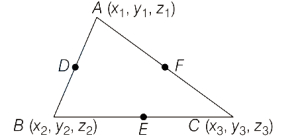
If the mid-points of the sides $AB, BC, CA$ of a triangle are $(1, 5, -1), (0, 4, -2), (2, 3, 4)$ respectively,then the length of the median drawn from $C$ to $AB$ is
A
$\sqrt{29}$
B
$\sqrt{27}$
C
$\sqrt{5}$
D
$5$
Solution
(D) Let the vertices of the triangle be $A(x_1, y_1, z_1)$,$B(x_2, y_2, z_2)$,and $C(x_3, y_3, z_3)$.
The mid-points of sides $AB, BC, CA$ are given as $D(1, 5, -1)$,$E(0, 4, -2)$,and $F(2, 3, 4)$ respectively.
By the mid-point formula:
For $AB$: $\frac{x_1+x_2}{2} = 1, \frac{y_1+y_2}{2} = 5, \frac{z_1+z_2}{2} = -1 \Rightarrow x_1+x_2 = 2, y_1+y_2 = 10, z_1+z_2 = -2$.
For $BC$: $\frac{x_2+x_3}{2} = 0, \frac{y_2+y_3}{2} = 4, \frac{z_2+z_3}{2} = -2 \Rightarrow x_2+x_3 = 0, y_2+y_3 = 8, z_2+z_3 = -4$.
For $CA$: $\frac{x_3+x_1}{2} = 2, \frac{y_3+y_1}{2} = 3, \frac{z_3+z_1}{2} = 4 \Rightarrow x_3+x_1 = 4, y_3+y_1 = 6, z_3+z_1 = 8$.
Adding these equations:
$2(x_1+x_2+x_3) = 2+0+4 = 6 \Rightarrow x_1+x_2+x_3 = 3$.
$2(y_1+y_2+y_3) = 10+8+6 = 24 \Rightarrow y_1+y_2+y_3 = 12$.
$2(z_1+z_2+z_3) = -2-4+8 = 2 \Rightarrow z_1+z_2+z_3 = 1$.
Now,to find $C(x_3, y_3, z_3)$,subtract the equations for $AB$ from the sums:
$x_3 = (x_1+x_2+x_3) - (x_1+x_2) = 3 - 2 = 1$.
$y_3 = (y_1+y_2+y_3) - (y_1+y_2) = 12 - 10 = 2$.
$z_3 = (z_1+z_2+z_3) - (z_1+z_2) = 1 - (-2) = 3$.
So,$C = (1, 2, 3)$.
The median from $C$ to $AB$ is the line segment $CD$,where $D$ is the mid-point of $AB$,$D(1, 5, -1)$.
Length $CD = \sqrt{(1-1)^2 + (5-2)^2 + (-1-3)^2} = \sqrt{0^2 + 3^2 + (-4)^2} = \sqrt{0 + 9 + 16} = \sqrt{25} = 5$.
The mid-points of sides $AB, BC, CA$ are given as $D(1, 5, -1)$,$E(0, 4, -2)$,and $F(2, 3, 4)$ respectively.
By the mid-point formula:
For $AB$: $\frac{x_1+x_2}{2} = 1, \frac{y_1+y_2}{2} = 5, \frac{z_1+z_2}{2} = -1 \Rightarrow x_1+x_2 = 2, y_1+y_2 = 10, z_1+z_2 = -2$.
For $BC$: $\frac{x_2+x_3}{2} = 0, \frac{y_2+y_3}{2} = 4, \frac{z_2+z_3}{2} = -2 \Rightarrow x_2+x_3 = 0, y_2+y_3 = 8, z_2+z_3 = -4$.
For $CA$: $\frac{x_3+x_1}{2} = 2, \frac{y_3+y_1}{2} = 3, \frac{z_3+z_1}{2} = 4 \Rightarrow x_3+x_1 = 4, y_3+y_1 = 6, z_3+z_1 = 8$.
Adding these equations:
$2(x_1+x_2+x_3) = 2+0+4 = 6 \Rightarrow x_1+x_2+x_3 = 3$.
$2(y_1+y_2+y_3) = 10+8+6 = 24 \Rightarrow y_1+y_2+y_3 = 12$.
$2(z_1+z_2+z_3) = -2-4+8 = 2 \Rightarrow z_1+z_2+z_3 = 1$.
Now,to find $C(x_3, y_3, z_3)$,subtract the equations for $AB$ from the sums:
$x_3 = (x_1+x_2+x_3) - (x_1+x_2) = 3 - 2 = 1$.
$y_3 = (y_1+y_2+y_3) - (y_1+y_2) = 12 - 10 = 2$.
$z_3 = (z_1+z_2+z_3) - (z_1+z_2) = 1 - (-2) = 3$.
So,$C = (1, 2, 3)$.
The median from $C$ to $AB$ is the line segment $CD$,where $D$ is the mid-point of $AB$,$D(1, 5, -1)$.
Length $CD = \sqrt{(1-1)^2 + (5-2)^2 + (-1-3)^2} = \sqrt{0^2 + 3^2 + (-4)^2} = \sqrt{0 + 9 + 16} = \sqrt{25} = 5$.
0 likesView Solution
272
MathematicsMediumMCQAP EAMCET · 2018
If a die is rolled three times,then the probability of getting a larger number on its face than the previous number each time is:
A
$\frac{15}{216}$
B
$\frac{5}{54}$
C
$\frac{13}{216}$
D
$\frac{1}{18}$
Solution
(B) The total number of possible outcomes when a die is rolled three times is $6^3 = 216$.
We need to select three distinct numbers from the set $\{1, 2, 3, 4, 5, 6\}$ such that they appear in strictly increasing order.
Any selection of $3$ distinct numbers from $6$ can be arranged in exactly one way in strictly increasing order.
The number of ways to choose $3$ distinct numbers from $6$ is given by $^6C_3 = \frac{6 \times 5 \times 4}{3 \times 2 \times 1} = 20$.
Thus,the number of favorable outcomes is $20$.
The required probability is $\frac{20}{216} = \frac{5}{54}$.
We need to select three distinct numbers from the set $\{1, 2, 3, 4, 5, 6\}$ such that they appear in strictly increasing order.
Any selection of $3$ distinct numbers from $6$ can be arranged in exactly one way in strictly increasing order.
The number of ways to choose $3$ distinct numbers from $6$ is given by $^6C_3 = \frac{6 \times 5 \times 4}{3 \times 2 \times 1} = 20$.
Thus,the number of favorable outcomes is $20$.
The required probability is $\frac{20}{216} = \frac{5}{54}$.
0 likesView Solution
273
MathematicsEasyMCQAP EAMCET · 2018
If two numbers $a$ and $b$ are chosen from the set of integers $1$ to $39$,then the probability that those numbers satisfy the equation $7a - 9b = 0$ is
A
$\frac{1}{742}$
B
$\frac{4}{743}$
C
$\frac{4}{741}$
D
$\frac{5}{741}$
Solution
(C) The total number of ways to choose two distinct numbers $a$ and $b$ from the set of integers ${1, 2, \dots, 39}$ is given by the combination formula ${}^{39}C_2$.
${}^{39}C_2 = \frac{39 \times 38}{2} = 39 \times 19 = 741$.
We need to find the pairs $(a, b)$ such that $7a - 9b = 0$,which implies $7a = 9b$.
Since $7$ and $9$ are coprime,$a$ must be a multiple of $9$ and $b$ must be a multiple of $7$.
Given $1 \le a, b \le 39$,the possible pairs $(a, b)$ are:
$(9, 7), (18, 14), (27, 21), (36, 28)$.
There are $4$ such favorable pairs.
Thus,the probability is $\frac{4}{741}$.
${}^{39}C_2 = \frac{39 \times 38}{2} = 39 \times 19 = 741$.
We need to find the pairs $(a, b)$ such that $7a - 9b = 0$,which implies $7a = 9b$.
Since $7$ and $9$ are coprime,$a$ must be a multiple of $9$ and $b$ must be a multiple of $7$.
Given $1 \le a, b \le 39$,the possible pairs $(a, b)$ are:
$(9, 7), (18, 14), (27, 21), (36, 28)$.
There are $4$ such favorable pairs.
Thus,the probability is $\frac{4}{741}$.
0 likesView Solution
274
MathematicsMediumMCQAP EAMCET · 2018
If a number is chosen at random from the four-digit numbers formed by using the digits $0, 1, 2, 3, 4, 6$ without repetition,then the probability that it is divisible by $4$ is
A
$\frac{17}{100}$
B
$\frac{17}{50}$
C
$\frac{13}{50}$
D
$\frac{13}{25}$
Solution
(B) The total number of four-digit numbers formed using the digits $\{0, 1, 2, 3, 4, 6\}$ without repetition is calculated as follows: The first digit cannot be $0$,so there are $5$ choices. The remaining three positions can be filled in $5 \times 4 \times 3 = 60$ ways. Thus,total numbers $= 5 \times 60 = 300$.
$A$ number is divisible by $4$ if its last two digits form a number divisible by $4$. The possible pairs for the last two digits are $\{04, 12, 16, 20, 24, 32, 36, 40, 60, 64\}$.
Case $1$: Pairs containing $0$ $(\{04, 20, 40, 60\})$: There are $4$ such pairs. For each,the remaining $2$ positions can be filled by the remaining $4$ digits in $4 \times 3 = 12$ ways. Total $= 4 \times 12 = 48$.
Case $2$: Pairs not containing $0$ $(\{12, 16, 24, 32, 36, 64\})$: There are $6$ such pairs. For each,the first digit cannot be $0$ or the two digits already used,leaving $3$ choices for the first digit and $3$ choices for the second digit. Total $= 6 \times (3 \times 3) = 6 \times 9 = 54$.
Total favourable outcomes $= 48 + 54 = 102$.
Required probability $= \frac{102}{300} = \frac{17}{50}$.
$A$ number is divisible by $4$ if its last two digits form a number divisible by $4$. The possible pairs for the last two digits are $\{04, 12, 16, 20, 24, 32, 36, 40, 60, 64\}$.
Case $1$: Pairs containing $0$ $(\{04, 20, 40, 60\})$: There are $4$ such pairs. For each,the remaining $2$ positions can be filled by the remaining $4$ digits in $4 \times 3 = 12$ ways. Total $= 4 \times 12 = 48$.
Case $2$: Pairs not containing $0$ $(\{12, 16, 24, 32, 36, 64\})$: There are $6$ such pairs. For each,the first digit cannot be $0$ or the two digits already used,leaving $3$ choices for the first digit and $3$ choices for the second digit. Total $= 6 \times (3 \times 3) = 6 \times 9 = 54$.
Total favourable outcomes $= 48 + 54 = 102$.
Required probability $= \frac{102}{300} = \frac{17}{50}$.
0 likesView Solution
275
MathematicsEasyMCQAP EAMCET · 2018
$A$ and $B$ are two events such that $P(A)=0.58$,$P(B)=0.32$ and $P(A \cap B)=0.28$. Then the probability that neither $A$ nor $B$ occurs is
A
$0.38$
B
$0.62$
C
$0.72$
D
$0.9$
Solution
(A) We need to find the probability that neither $A$ nor $B$ occurs,which is $P(\bar{A} \cap \bar{B})$.
By De Morgan's Law,$P(\bar{A} \cap \bar{B}) = P(\overline{A \cup B}) = 1 - P(A \cup B)$.
Using the addition rule of probability,$P(A \cup B) = P(A) + P(B) - P(A \cap B)$.
Substituting the given values:
$P(A \cup B) = 0.58 + 0.32 - 0.28 = 0.62$.
Therefore,$P(\bar{A} \cap \bar{B}) = 1 - 0.62 = 0.38$.
By De Morgan's Law,$P(\bar{A} \cap \bar{B}) = P(\overline{A \cup B}) = 1 - P(A \cup B)$.
Using the addition rule of probability,$P(A \cup B) = P(A) + P(B) - P(A \cap B)$.
Substituting the given values:
$P(A \cup B) = 0.58 + 0.32 - 0.28 = 0.62$.
Therefore,$P(\bar{A} \cap \bar{B}) = 1 - 0.62 = 0.38$.
0 likesView Solution
276
MathematicsMediumMCQAP EAMCET · 2018
$A$ die is formed so that the probability of getting a number $i$ when it is rolled is proportional to $i$ $(i=1, 2, 3, 4, 5, 6)$. The probability of getting an odd number on the die when it is rolled is
A
$\frac{1}{2}$
B
$\frac{4}{7}$
C
$\frac{2}{7}$
D
$\frac{3}{7}$
Solution
(D) Let the probability of getting a number $i$ be $P(i)$.
Since $P(i) \propto i$,we have $P(i) = Ki$ for some constant $K$.
The sum of all probabilities must be $1$:
$\sum_{i=1}^{6} P(i) = K(1+2+3+4+5+6) = 21K = 1$.
Thus,$K = \frac{1}{21}$.
The probability of getting an odd number is $P(1) + P(3) + P(5)$.
$= K(1 + 3 + 5) = 9K$.
$= 9 \times \frac{1}{21} = \frac{9}{21} = \frac{3}{7}$.
Since $P(i) \propto i$,we have $P(i) = Ki$ for some constant $K$.
The sum of all probabilities must be $1$:
$\sum_{i=1}^{6} P(i) = K(1+2+3+4+5+6) = 21K = 1$.
Thus,$K = \frac{1}{21}$.
The probability of getting an odd number is $P(1) + P(3) + P(5)$.
$= K(1 + 3 + 5) = 9K$.
$= 9 \times \frac{1}{21} = \frac{9}{21} = \frac{3}{7}$.
0 likesView Solution
277
MathematicsEasyMCQAP EAMCET · 2018
$A$ problem is given to $3$ students $A, B$ and $C$ whose chances of solving it are $\frac{1}{2}, \frac{1}{3}$ and $\frac{1}{4}$ respectively. Then,the probability of the problem being solved by exactly one of them,if all the three try independently,is
A
$\frac{3}{4}$
B
$\frac{11}{24}$
C
$\frac{23}{24}$
D
$\frac{1}{4}$
Solution
(B) Let $P(A) = \frac{1}{2}$,$P(B) = \frac{1}{3}$,and $P(C) = \frac{1}{4}$ be the probabilities of students $A, B$,and $C$ solving the problem respectively.
Then,the probabilities of them not solving the problem are $P(\bar{A}) = 1 - \frac{1}{2} = \frac{1}{2}$,$P(\bar{B}) = 1 - \frac{1}{3} = \frac{2}{3}$,and $P(\bar{C}) = 1 - \frac{1}{4} = \frac{3}{4}$.
The probability that exactly one of them solves the problem is given by:
$P(\text{Exactly one}) = P(A)P(\bar{B})P(\bar{C}) + P(\bar{A})P(B)P(\bar{C}) + P(\bar{A})P(\bar{B})P(C)$
$= (\frac{1}{2} \times \frac{2}{3} \times \frac{3}{4}) + (\frac{1}{2} \times \frac{1}{3} \times \frac{3}{4}) + (\frac{1}{2} \times \frac{2}{3} \times \frac{1}{4})$
$= \frac{6}{24} + \frac{3}{24} + \frac{2}{24} = \frac{11}{24}$.
Then,the probabilities of them not solving the problem are $P(\bar{A}) = 1 - \frac{1}{2} = \frac{1}{2}$,$P(\bar{B}) = 1 - \frac{1}{3} = \frac{2}{3}$,and $P(\bar{C}) = 1 - \frac{1}{4} = \frac{3}{4}$.
The probability that exactly one of them solves the problem is given by:
$P(\text{Exactly one}) = P(A)P(\bar{B})P(\bar{C}) + P(\bar{A})P(B)P(\bar{C}) + P(\bar{A})P(\bar{B})P(C)$
$= (\frac{1}{2} \times \frac{2}{3} \times \frac{3}{4}) + (\frac{1}{2} \times \frac{1}{3} \times \frac{3}{4}) + (\frac{1}{2} \times \frac{2}{3} \times \frac{1}{4})$
$= \frac{6}{24} + \frac{3}{24} + \frac{2}{24} = \frac{11}{24}$.
0 likesView Solution
278
MathematicsEasyMCQAP EAMCET · 2018
Four cards are drawn at random from a pack of playing cards. The probability of getting exactly two cards from the same suit and the remaining two cards from two different suits is
A
$\frac{72 \times 169}{425 \times 49}$
B
$\frac{24 \times 169}{425 \times 49}$
C
$\frac{18 \times 169}{425 \times 49}$
D
$\frac{6 \times 169}{425 \times 49}$
Solution
(A) Total number of ways to draw $4$ cards from $52$ cards is $^{52}C_4$.
To get exactly two cards from the same suit and the remaining two cards from two different suits:
$1$. Select $1$ suit out of $4$ for the pair: $^4C_1$.
$2$. Select $2$ cards from the $13$ cards of that suit: $^{13}C_2$.
$3$. Select $2$ suits out of the remaining $3$ for the other two cards: $^3C_2$.
$4$. Select $1$ card from each of these $2$ chosen suits: $^{13}C_1 \times ^{13}C_1$.
Required probability = $\frac{^4C_1 \times ^{13}C_2 \times ^3C_2 \times ^{13}C_1 \times ^{13}C_1}{^{52}C_4}$
$= \frac{4 \times 78 \times 3 \times 13 \times 13}{270725} = \frac{12 \times 78 \times 169}{270725} = \frac{158184}{270725} = \frac{72 \times 169}{425 \times 49}$.
To get exactly two cards from the same suit and the remaining two cards from two different suits:
$1$. Select $1$ suit out of $4$ for the pair: $^4C_1$.
$2$. Select $2$ cards from the $13$ cards of that suit: $^{13}C_2$.
$3$. Select $2$ suits out of the remaining $3$ for the other two cards: $^3C_2$.
$4$. Select $1$ card from each of these $2$ chosen suits: $^{13}C_1 \times ^{13}C_1$.
Required probability = $\frac{^4C_1 \times ^{13}C_2 \times ^3C_2 \times ^{13}C_1 \times ^{13}C_1}{^{52}C_4}$
$= \frac{4 \times 78 \times 3 \times 13 \times 13}{270725} = \frac{12 \times 78 \times 169}{270725} = \frac{158184}{270725} = \frac{72 \times 169}{425 \times 49}$.
0 likesView Solution
279
MathematicsMediumMCQAP EAMCET · 2018
If three distinct vertices are chosen at random from the vertices of a cube,then the probability that they form the vertices of an equilateral triangle is:
A
$1/7$
B
$2/7$
C
$1/2$
D
$1/8$
Solution
(A) cube has $8$ vertices. The total number of ways to choose $3$ vertices out of $8$ is given by $^8C_3 = \frac{8 \times 7 \times 6}{3 \times 2 \times 1} = 56$.
An equilateral triangle is formed by choosing $3$ vertices such that the distance between any two of them is equal to the length of the face diagonal of the cube.
Each face of the cube has $2$ diagonals,and there are $6$ faces,but each diagonal is shared by $2$ faces. The total number of face diagonals is $12$.
However,an equilateral triangle is formed by selecting $3$ vertices such that each pair is connected by a face diagonal. There are exactly $8$ such triangles in a cube (each corresponding to a set of $3$ vertices that are mutually equidistant).
Therefore,the number of favorable outcomes is $8$.
The probability is $\frac{8}{56} = \frac{1}{7}$.
An equilateral triangle is formed by choosing $3$ vertices such that the distance between any two of them is equal to the length of the face diagonal of the cube.
Each face of the cube has $2$ diagonals,and there are $6$ faces,but each diagonal is shared by $2$ faces. The total number of face diagonals is $12$.
However,an equilateral triangle is formed by selecting $3$ vertices such that each pair is connected by a face diagonal. There are exactly $8$ such triangles in a cube (each corresponding to a set of $3$ vertices that are mutually equidistant).
Therefore,the number of favorable outcomes is $8$.
The probability is $\frac{8}{56} = \frac{1}{7}$.
0 likesView Solution
280
MathematicsDifficultMCQAP EAMCET · 2018
If the equation whose roots are $p$ times the roots of the equation $x^4-2ax^3+4bx^2+8ax+16=0$ is a reciprocal equation,then $|p|=$ :
A
$\frac{1}{3}$
B
$\frac{1}{2}$
C
$2$
D
$3$
Solution
(B) Let the roots of the given equation $f(x) = x^4-2ax^3+4bx^2+8ax+16=0$ be $\alpha_1, \alpha_2, \alpha_3, \alpha_4$.
The roots of the new equation are $p\alpha_1, p\alpha_2, p\alpha_3, p\alpha_4$.
Thus,the new equation is $f(\frac{x}{p}) = 0$.
Substituting $\frac{x}{p}$ into the equation:
$(\frac{x}{p})^4 - 2a(\frac{x}{p})^3 + 4b(\frac{x}{p})^2 + 8a(\frac{x}{p}) + 16 = 0$
Multiplying by $p^4$:
$x^4 - 2apx^3 + 4bp^2x^2 + 8ap^3x + 16p^4 = 0$
Since this is a reciprocal equation,the coefficient of $x^4$ must equal the constant term:
$1 = 16p^4$
$p^4 = \frac{1}{16}$
$p^2 = \frac{1}{4} \implies |p| = \frac{1}{2}$
The roots of the new equation are $p\alpha_1, p\alpha_2, p\alpha_3, p\alpha_4$.
Thus,the new equation is $f(\frac{x}{p}) = 0$.
Substituting $\frac{x}{p}$ into the equation:
$(\frac{x}{p})^4 - 2a(\frac{x}{p})^3 + 4b(\frac{x}{p})^2 + 8a(\frac{x}{p}) + 16 = 0$
Multiplying by $p^4$:
$x^4 - 2apx^3 + 4bp^2x^2 + 8ap^3x + 16p^4 = 0$
Since this is a reciprocal equation,the coefficient of $x^4$ must equal the constant term:
$1 = 16p^4$
$p^4 = \frac{1}{16}$
$p^2 = \frac{1}{4} \implies |p| = \frac{1}{2}$
0 likesView Solution
281
MathematicsDifficultMCQAP EAMCET · 2018
There are three sections in a question paper,each section containing $4$ questions. If a candidate has to answer exactly $5$ questions from this paper such that at least one question is answered from each section,then the number of ways in which a candidate can make the choice of questions is
A
$624$
B
$704$
C
$384$
D
$432$
Solution
(A) Let the three sections be $S_1, S_2, S_3$,each with $4$ questions. The candidate must select $5$ questions such that at least one is selected from each section. The possible distributions of questions across the three sections are $(1, 1, 3)$ or $(1, 2, 2)$ in any order.
Case $1$: Distribution $(1, 1, 3)$ in any order.
The number of ways to choose the sections is $\frac{3!}{2!} = 3$.
The number of ways to select the questions is $^4C_1 \times ^4C_1 \times ^4C_3 = 4 \times 4 \times 4 = 64$.
Total ways for this case $= 3 \times 64 = 192$.
Case $2$: Distribution $(1, 2, 2)$ in any order.
The number of ways to choose the sections is $\frac{3!}{2!} = 3$.
The number of ways to select the questions is $^4C_1 \times ^4C_2 \times ^4C_2 = 4 \times 6 \times 6 = 144$.
Total ways for this case $= 3 \times 144 = 432$.
Total number of ways $= 192 + 432 = 624$.
Case $1$: Distribution $(1, 1, 3)$ in any order.
The number of ways to choose the sections is $\frac{3!}{2!} = 3$.
The number of ways to select the questions is $^4C_1 \times ^4C_1 \times ^4C_3 = 4 \times 4 \times 4 = 64$.
Total ways for this case $= 3 \times 64 = 192$.
Case $2$: Distribution $(1, 2, 2)$ in any order.
The number of ways to choose the sections is $\frac{3!}{2!} = 3$.
The number of ways to select the questions is $^4C_1 \times ^4C_2 \times ^4C_2 = 4 \times 6 \times 6 = 144$.
Total ways for this case $= 3 \times 144 = 432$.
Total number of ways $= 192 + 432 = 624$.
0 likesView Solution
282
MathematicsDifficultMCQAP EAMCET · 2018
If the circle $x^2+y^2+8x-4y+c=0$ touches the circle $x^2+y^2+2x+4y-11=0$ externally and cuts the circle $x^2+y^2-6x+8y+k=0$ orthogonally,then $k$ is equal to
A
$59$
B
-$59$
C
$19$
D
-$19$
Solution
(B) Given the circle $x^2+y^2+8x-4y+c=0$,its center $C_1 = (-4, 2)$ and radius $r_1 = \sqrt{(-4)^2 + 2^2 - c} = \sqrt{20-c}$.
For the circle $x^2+y^2+2x+4y-11=0$,its center $C_2 = (-1, -2)$ and radius $r_2 = \sqrt{(-1)^2 + (-2)^2 - (-11)} = \sqrt{1+4+11} = 4$.
Since the circles touch externally,$C_1C_2 = r_1 + r_2$.
$C_1C_2 = \sqrt{(-4 - (-1))^2 + (2 - (-2))^2} = \sqrt{(-3)^2 + 4^2} = \sqrt{9+16} = 5$.
So,$5 = \sqrt{20-c} + 4$,which implies $\sqrt{20-c} = 1$,so $20-c = 1$,hence $c = 19$.
Now,the circle $x^2+y^2+8x-4y+19=0$ cuts $x^2+y^2-6x+8y+k=0$ orthogonally.
The condition for orthogonality is $2g_1g_2 + 2f_1f_2 = c_1 + c_2$.
Here,$g_1 = 4, f_1 = -2, c_1 = 19$ and $g_2 = -3, f_2 = 4, c_2 = k$.
$2(4)(-3) + 2(-2)(4) = 19 + k$.
$-24 - 16 = 19 + k$.
$-40 = 19 + k$.
$k = -59$.
For the circle $x^2+y^2+2x+4y-11=0$,its center $C_2 = (-1, -2)$ and radius $r_2 = \sqrt{(-1)^2 + (-2)^2 - (-11)} = \sqrt{1+4+11} = 4$.
Since the circles touch externally,$C_1C_2 = r_1 + r_2$.
$C_1C_2 = \sqrt{(-4 - (-1))^2 + (2 - (-2))^2} = \sqrt{(-3)^2 + 4^2} = \sqrt{9+16} = 5$.
So,$5 = \sqrt{20-c} + 4$,which implies $\sqrt{20-c} = 1$,so $20-c = 1$,hence $c = 19$.
Now,the circle $x^2+y^2+8x-4y+19=0$ cuts $x^2+y^2-6x+8y+k=0$ orthogonally.
The condition for orthogonality is $2g_1g_2 + 2f_1f_2 = c_1 + c_2$.
Here,$g_1 = 4, f_1 = -2, c_1 = 19$ and $g_2 = -3, f_2 = 4, c_2 = k$.
$2(4)(-3) + 2(-2)(4) = 19 + k$.
$-24 - 16 = 19 + k$.
$-40 = 19 + k$.
$k = -59$.
0 likesView Solution
Vedclass Products
For Students
Vedclass Test Series
Mock tests in real AP EAMCET style covering Mathematics with performance analysis. 5-day free trial.
Start Free TrialFor Teachers
Exam Paper Generator
Generate Set A/B/C/D Mathematics papers from 7.5L+ questions in 2 minutes. 3 chapters free.
Try FreeFor Institutes
Online Exam Module
Run live AP EAMCET mock exams with unlimited students, 360° analytics & white-label branding.
See DemoFrequently Asked Questions
How many Mathematics questions are in AP EAMCET 2018?
There are 497 Mathematics questions from the AP EAMCET 2018 paper on Vedclass, each with a detailed step-by-step solution in English.
Are AP EAMCET 2018 Mathematics solutions available in English?
Yes. All solutions on this page are in English. You can also switch to English or Hindi using the language buttons above the questions.
Can I practice AP EAMCET 2018 Mathematics as a timed test?
Yes. Use the Vedclass Test Series to attempt a full AP EAMCET mock test covering Mathematics with time limits and instant score analysis.
Can teachers create Mathematics papers from AP EAMCET previous year questions?
Yes. The Vedclass Exam Paper Generator lets teachers mix AP EAMCET Mathematics questions and generate Set A/B/C/D papers in minutes.
For Teachers & Institutes
Build a Custom Mathematics Paper
Pick AP EAMCET 2018 Mathematics questions, set difficulty, and generate Set A/B/C/D in 2 minutes.