
ChemistryQ151–161 of 199 questions
Page 4 of 4 · English
151
ChemistryMCQAP EAMCET · 2013
$A$ capillary tube of radius '$r$' is immersed in water and water rises to a height of '$h$'. The mass of water in the capillary tube is $5 \times 10^{-3} \ kg$. The same capillary tube is now immersed in a liquid whose surface tension is $\sqrt{2}$ times the surface tension of water. The angle of contact between the capillary tube and this liquid is $45^{\circ}$. The mass of liquid which rises into the capillary tube now is (in $kg$):
A
$5 \times 10^{-3}$
B
$2.5 \times 10^{-3}$
C
$5 \sqrt{2} \times 10^{-3}$
D
$3.5 \times 10^{-3}$
Solution
(A) The height of a liquid column in a capillary tube is given by the formula: $h = \frac{2T \cos \theta}{rdg}$.
For water: $h_1 = \frac{2T_1 \cos \theta_1}{r d_1 g}$. Since $\theta_1 = 0^{\circ}$,$\cos 0^{\circ} = 1$,so $h_1 = \frac{2T_1}{r d_1 g}$.
The mass of the liquid is $m = \pi r^2 h d$. Substituting $h$,we get $m = \pi r^2 d \left( \frac{2T \cos \theta}{rdg} \right) = \frac{2 \pi r T \cos \theta}{g}$.
For the first case (water): $m_1 = \frac{2 \pi r T_1}{g} = 5 \times 10^{-3} \ kg$.
For the second liquid: $T_2 = \sqrt{2} T_1$ and $\theta_2 = 45^{\circ}$.
$m_2 = \frac{2 \pi r T_2 \cos \theta_2}{g} = \frac{2 \pi r (\sqrt{2} T_1) \cos 45^{\circ}}{g}$.
Since $\cos 45^{\circ} = \frac{1}{\sqrt{2}}$,we have $m_2 = \frac{2 \pi r (\sqrt{2} T_1) \times \frac{1}{\sqrt{2}}}{g} = \frac{2 \pi r T_1}{g}$.
Comparing $m_1$ and $m_2$,we see that $m_2 = m_1 = 5 \times 10^{-3} \ kg$.
For water: $h_1 = \frac{2T_1 \cos \theta_1}{r d_1 g}$. Since $\theta_1 = 0^{\circ}$,$\cos 0^{\circ} = 1$,so $h_1 = \frac{2T_1}{r d_1 g}$.
The mass of the liquid is $m = \pi r^2 h d$. Substituting $h$,we get $m = \pi r^2 d \left( \frac{2T \cos \theta}{rdg} \right) = \frac{2 \pi r T \cos \theta}{g}$.
For the first case (water): $m_1 = \frac{2 \pi r T_1}{g} = 5 \times 10^{-3} \ kg$.
For the second liquid: $T_2 = \sqrt{2} T_1$ and $\theta_2 = 45^{\circ}$.
$m_2 = \frac{2 \pi r T_2 \cos \theta_2}{g} = \frac{2 \pi r (\sqrt{2} T_1) \cos 45^{\circ}}{g}$.
Since $\cos 45^{\circ} = \frac{1}{\sqrt{2}}$,we have $m_2 = \frac{2 \pi r (\sqrt{2} T_1) \times \frac{1}{\sqrt{2}}}{g} = \frac{2 \pi r T_1}{g}$.
Comparing $m_1$ and $m_2$,we see that $m_2 = m_1 = 5 \times 10^{-3} \ kg$.
0 likesView Solution
152
ChemistryMCQAP EAMCET · 2013
The terminal velocity of a liquid drop of radius $r$ falling through air is $v$. If two such drops are combined to form a bigger drop,the terminal velocity with which the bigger drop falls through air is (ignore any buoyant force due to air).
A
$\sqrt{2} v$
B
$2 v$
C
$\sqrt[3]{4} v$
D
$\sqrt[3]{2} v$
Solution
(C) The terminal velocity $v$ of a spherical drop is given by $v = \frac{2}{9} \frac{r^2(\rho-\sigma) g}{\eta}$.
Since the buoyant force is ignored,$\sigma \approx 0$,so $v \propto r^2$.
When two drops of radius $r$ combine to form a bigger drop of radius $R$,the volume is conserved:
$\frac{4}{3} \pi R^3 = 2 \times \frac{4}{3} \pi r^3$
$R^3 = 2r^3 \Rightarrow R = 2^{1/3} r$.
Let $v'$ be the terminal velocity of the bigger drop.
$\frac{v'}{v} = \frac{R^2}{r^2} = \frac{(2^{1/3} r)^2}{r^2} = 2^{2/3} = \sqrt[3]{4}$.
Therefore,$v' = \sqrt[3]{4} v$.
Since the buoyant force is ignored,$\sigma \approx 0$,so $v \propto r^2$.
When two drops of radius $r$ combine to form a bigger drop of radius $R$,the volume is conserved:
$\frac{4}{3} \pi R^3 = 2 \times \frac{4}{3} \pi r^3$
$R^3 = 2r^3 \Rightarrow R = 2^{1/3} r$.
Let $v'$ be the terminal velocity of the bigger drop.
$\frac{v'}{v} = \frac{R^2}{r^2} = \frac{(2^{1/3} r)^2}{r^2} = 2^{2/3} = \sqrt[3]{4}$.
Therefore,$v' = \sqrt[3]{4} v$.
0 likesView Solution
153
ChemistryDifficultMCQAP EAMCET · 2013
Diborane reacts with $HCl$ in the presence of $AlCl_3$ and liberates:
A
$H_2$
B
$Cl_2$
C
$BCl_3$
D
$Cl_2$ and $BCl_3$
Solution
(A) Diborane $(B_2H_6)$ reacts with $HCl$ in the presence of $AlCl_3$ as a catalyst to undergo hydrochlorination,which results in the liberation of hydrogen gas $(H_2)$.
The chemical reaction is as follows:
$B_2H_6 + HCl \xrightarrow{AlCl_3} B_2H_5Cl + H_2 \uparrow$
The chemical reaction is as follows:
$B_2H_6 + HCl \xrightarrow{AlCl_3} B_2H_5Cl + H_2 \uparrow$
0 likesView Solution
154
ChemistryMediumMCQAP EAMCET · 2013
How many corners of $SiO_4$ units are shared in the formation of three dimensional silicates?
A
$3$
B
$2$
C
$4$
D
$1$
Solution
(C) In three-dimensional silicates,all four oxygen atoms (corners) of each $SiO_4^{4-}$ tetrahedron are shared with other tetrahedra.
This results in a three-dimensional network structure.
Examples of such structures include various forms of silica like quartz,tridymite,and cristobalite.
This results in a three-dimensional network structure.
Examples of such structures include various forms of silica like quartz,tridymite,and cristobalite.
0 likesView Solution
155
ChemistryMediumMCQAP EAMCET · 2013
$Na_2S_2O_3$ reacts with moist $Cl_2$ to form $Na_2SO_4$,$HCl$,and $X$. Which one of the following is $X$?
A
$H_2S$
B
$SO_2$
C
$SO_3$
D
$S$
Solution
(D) The reaction of sodium thiosulphate $(Na_2S_2O_3)$ with moist chlorine $(Cl_2)$ is an oxidation reaction.
In the presence of water,$Na_2S_2O_3$ is oxidized to sodium sulphate $(Na_2SO_4)$ and hydrochloric acid $(HCl)$,while sulphur $(S)$ is precipitated as a byproduct.
The balanced chemical equation is:
$Na_2S_2O_3 + Cl_2 + H_2O \longrightarrow Na_2SO_4 + 2HCl + S$
Here,$X$ corresponds to sulphur $(S)$.
In the presence of water,$Na_2S_2O_3$ is oxidized to sodium sulphate $(Na_2SO_4)$ and hydrochloric acid $(HCl)$,while sulphur $(S)$ is precipitated as a byproduct.
The balanced chemical equation is:
$Na_2S_2O_3 + Cl_2 + H_2O \longrightarrow Na_2SO_4 + 2HCl + S$
Here,$X$ corresponds to sulphur $(S)$.
0 likesView Solution
156
ChemistryEasyMCQAP EAMCET · 2013
Which one of the following is an example of a disproportionation reaction?
A
$3Cl_{2\text{(g)}} + 6OH^-{_{\text{(aq)}}} \rightarrow ClO_3^-{_{\text{(aq)}}} + 5Cl^-{_{\text{(aq)}}} + 3H_2O_{\text{(l)}}$
B
$Ag^{2+}_{(aq)} + Ag_{(s)} \longrightarrow 2 Ag^+_{(aq)}$
C
$Zn_{(s)} + CuSO_{4(aq)} \longrightarrow Cu_{(s)} + ZnSO_{4(aq)}$
D
$2 KClO_{3(s)} \longrightarrow 2 KCl_{(s)} + 3 O_{2(g)}$
Solution
(A) disproportionation reaction is a special type of redox reaction in which the same element in a given oxidation state is simultaneously oxidized and reduced.
In the reaction $3Cl_{2\text{(g)}} + 6OH^-{_{\text{(aq)}}} \rightarrow ClO_3^-{_{\text{(aq)}}} + 5Cl^-{_{\text{(aq)}}} + 3H_2O_{\text{(l)}}$,the oxidation state of chlorine changes from $0$ in $Cl_2$ to $-1$ in $Cl^-$ (reduction) and to $+5$ in $ClO_3^-$ (oxidation).
Thus,it is a disproportionation reaction.
In the reaction $3Cl_{2\text{(g)}} + 6OH^-{_{\text{(aq)}}} \rightarrow ClO_3^-{_{\text{(aq)}}} + 5Cl^-{_{\text{(aq)}}} + 3H_2O_{\text{(l)}}$,the oxidation state of chlorine changes from $0$ in $Cl_2$ to $-1$ in $Cl^-$ (reduction) and to $+5$ in $ClO_3^-$ (oxidation).
Thus,it is a disproportionation reaction.
0 likesView Solution
157
ChemistryMediumMCQAP EAMCET · 2013
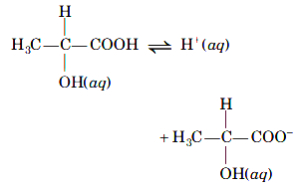
The degree of ionization of $0.10 \ M$ lactic acid is $4.0 \%$. The value of $K_a$ is:
A
$1.66 \times 10^{-5}$
B
$1.66 \times 10^{-4}$
C
$1.66 \times 10^{-3}$
D
$1.66 \times 10^{-2}$
Solution
(B) Given: Concentration $C = 0.10 \ M$,degree of ionization $\alpha = 4.0 \% = 0.04$.
For the dissociation of lactic acid $(CH_3CH(OH)COOH)$:
$CH_3CH(OH)COOH \rightleftharpoons CH_3CH(OH)COO^- + H^+$
At equilibrium,the concentrations are:
$[CH_3CH(OH)COOH] = C(1 - \alpha)$
$[CH_3CH(OH)COO^-] = C\alpha$
$[H^+] = C\alpha$
The dissociation constant $K_a$ is given by:
$K_a = \frac{[CH_3CH(OH)COO^-][H^+]}{[CH_3CH(OH)COOH]} = \frac{C\alpha \cdot C\alpha}{C(1 - \alpha)} = \frac{C\alpha^2}{1 - \alpha}$
Substituting the values:
$K_a = \frac{0.1 \times (0.04)^2}{1 - 0.04} = \frac{0.1 \times 0.0016}{0.96} = \frac{0.00016}{0.96} = \frac{1.6 \times 10^{-4}}{0.96} \approx 1.66 \times 10^{-4}$
For the dissociation of lactic acid $(CH_3CH(OH)COOH)$:
$CH_3CH(OH)COOH \rightleftharpoons CH_3CH(OH)COO^- + H^+$
At equilibrium,the concentrations are:
$[CH_3CH(OH)COOH] = C(1 - \alpha)$
$[CH_3CH(OH)COO^-] = C\alpha$
$[H^+] = C\alpha$
The dissociation constant $K_a$ is given by:
$K_a = \frac{[CH_3CH(OH)COO^-][H^+]}{[CH_3CH(OH)COOH]} = \frac{C\alpha \cdot C\alpha}{C(1 - \alpha)} = \frac{C\alpha^2}{1 - \alpha}$
Substituting the values:
$K_a = \frac{0.1 \times (0.04)^2}{1 - 0.04} = \frac{0.1 \times 0.0016}{0.96} = \frac{0.00016}{0.96} = \frac{1.6 \times 10^{-4}}{0.96} \approx 1.66 \times 10^{-4}$
0 likesView Solution
158
ChemistryEasyMCQAP EAMCET · 2013
At $T$ $K$,the ratio of kinetic energies of $4$ $g$ of $H_{2(g)}$ and $8$ $g$ of $O_{2(g)}$ is
A
$1: 4$
B
$4: 1$
C
$2: 1$
D
$8: 1$
Solution
(D) The kinetic energy $(KE)$ of $n$ moles of an ideal gas is given by $KE = n \times \frac{3}{2} RT$.
For $4$ $g$ of $H_2$,the number of moles $n_{H_2} = \frac{4 \ g}{2 \ g/mol} = 2$ $mol$.
So,$KE_{H_2} = 2 \times \frac{3}{2} RT = 3RT$.
For $8$ $g$ of $O_2$,the number of moles $n_{O_2} = \frac{8 \ g}{32 \ g/mol} = 0.25$ $mol$ or $\frac{1}{4}$ $mol$.
So,$KE_{O_2} = \frac{1}{4} \times \frac{3}{2} RT = \frac{3}{8} RT$.
The ratio $KE_{H_2} : KE_{O_2} = 3RT : \frac{3}{8} RT = 1 : \frac{1}{8} = 8 : 1$.
For $4$ $g$ of $H_2$,the number of moles $n_{H_2} = \frac{4 \ g}{2 \ g/mol} = 2$ $mol$.
So,$KE_{H_2} = 2 \times \frac{3}{2} RT = 3RT$.
For $8$ $g$ of $O_2$,the number of moles $n_{O_2} = \frac{8 \ g}{32 \ g/mol} = 0.25$ $mol$ or $\frac{1}{4}$ $mol$.
So,$KE_{O_2} = \frac{1}{4} \times \frac{3}{2} RT = \frac{3}{8} RT$.
The ratio $KE_{H_2} : KE_{O_2} = 3RT : \frac{3}{8} RT = 1 : \frac{1}{8} = 8 : 1$.
0 likesView Solution
159
ChemistryMediumMCQAP EAMCET · 2013
The basis of the quantum mechanical model of an atom is:
A
angular momentum of electron
B
quantum numbers
C
dual nature of electron
D
black body radiation
Solution
(C) The quantum mechanical model of an atom is based on the dual nature of matter (wave-particle duality) proposed by $de \text{ } Broglie$.
This model considers the electron as both a particle and a wave,which is mathematically described by the $Schrodinger$ wave equation.
This model considers the electron as both a particle and a wave,which is mathematically described by the $Schrodinger$ wave equation.
0 likesView Solution
160
ChemistryMCQAP EAMCET · 2013
The number of radial nodes of $3s$ and $2p$ orbitals respectively are
A
$0, 2$
B
$2, 0$
C
$1, 2$
D
$2, 1$
Solution
(B) The number of radial nodes in an orbital is given by the formula: $n - l - 1$.
For $3s$ orbital: $n = 3$ and $l = 0$. Therefore,the number of radial nodes $= 3 - 0 - 1 = 2$.
For $2p$ orbital: $n = 2$ and $l = 1$. Therefore,the number of radial nodes $= 2 - 1 - 1 = 0$.
Thus,the number of radial nodes for $3s$ and $2p$ orbitals are $2$ and $0$ respectively.
For $3s$ orbital: $n = 3$ and $l = 0$. Therefore,the number of radial nodes $= 3 - 0 - 1 = 2$.
For $2p$ orbital: $n = 2$ and $l = 1$. Therefore,the number of radial nodes $= 2 - 1 - 1 = 0$.
Thus,the number of radial nodes for $3s$ and $2p$ orbitals are $2$ and $0$ respectively.
0 likesView Solution
161
ChemistryEasyMCQAP EAMCET · 2013
For which one of the following reactions,the entropy change is positive?
A
$H_{2(g)} + \frac{1}{2} O_{2(g)} \longrightarrow H_2O_{(l)}$
B
$Na^{+}_{(g)} + Cl^{-}_{(g)} \longrightarrow NaCl_{(s)}$
C
$NaCl_{(l)} \longrightarrow NaCl_{(s)}$
D
$H_2O_{(l)} \longrightarrow H_2O_{(g)}$
Solution
(D) Entropy $(S)$ is a measure of the randomness or disorder of a system. $A$ positive entropy change $(\Delta S > 0)$ occurs when the system becomes more disordered,such as during a phase transition from a more ordered state (liquid) to a less ordered state (gas).
In the reaction $H_2O_{(l)} \longrightarrow H_2O_{(g)}$,liquid water is converted into water vapor. Since gas molecules have much higher randomness compared to liquid molecules,the entropy of the system increases,making $\Delta S$ positive.
In other options,the reactions involve a decrease in the number of moles of gas or a transition from a disordered state to a more ordered state (like liquid to solid or gas to solid),which results in a negative entropy change.
In the reaction $H_2O_{(l)} \longrightarrow H_2O_{(g)}$,liquid water is converted into water vapor. Since gas molecules have much higher randomness compared to liquid molecules,the entropy of the system increases,making $\Delta S$ positive.
In other options,the reactions involve a decrease in the number of moles of gas or a transition from a disordered state to a more ordered state (like liquid to solid or gas to solid),which results in a negative entropy change.
0 likesView Solution
Vedclass Products
For Students
Vedclass Test Series
Mock tests in real AP EAMCET style covering Chemistry with performance analysis. 5-day free trial.
Start Free TrialFor Teachers
Exam Paper Generator
Generate Set A/B/C/D Chemistry papers from 7.5L+ questions in 2 minutes. 3 chapters free.
Try FreeFor Institutes
Online Exam Module
Run live AP EAMCET mock exams with unlimited students, 360° analytics & white-label branding.
See DemoFrequently Asked Questions
How many Chemistry questions are in AP EAMCET 2013?
There are 199 Chemistry questions from the AP EAMCET 2013 paper on Vedclass, each with a detailed step-by-step solution in English.
Are AP EAMCET 2013 Chemistry solutions available in English?
Yes. All solutions on this page are in English. You can also switch to English or Hindi using the language buttons above the questions.
Can I practice AP EAMCET 2013 Chemistry as a timed test?
Yes. Use the Vedclass Test Series to attempt a full AP EAMCET mock test covering Chemistry with time limits and instant score analysis.
Can teachers create Chemistry papers from AP EAMCET previous year questions?
Yes. The Vedclass Exam Paper Generator lets teachers mix AP EAMCET Chemistry questions and generate Set A/B/C/D papers in minutes.
For Teachers & Institutes
Build a Custom Chemistry Paper
Pick AP EAMCET 2013 Chemistry questions, set difficulty, and generate Set A/B/C/D in 2 minutes.