
MathematicsQ1–89 of 89 questions
Page 1 of 1 · English
1
MathematicsEasyMCQAP EAMCET · 2013
$\frac{1}{2 \cdot 3} + \frac{1}{4 \cdot 5} + \frac{1}{6 \cdot 7} + \frac{1}{8 \cdot 9} + \dots$ is equal to
A
$\log \left(\frac{2}{e}\right)$
B
$\log \left(\frac{e}{2}\right)$
C
$\log (2e)$
D
$e - 1$
Solution
(B) The given series is $S = \sum_{n=1}^{\infty} \frac{1}{(2n)(2n+1)}$.
Using partial fractions,$\frac{1}{(2n)(2n+1)} = \frac{1}{2n} - \frac{1}{2n+1}$.
Thus,$S = (\frac{1}{2} - \frac{1}{3}) + (\frac{1}{4} - \frac{1}{5}) + (\frac{1}{6} - \frac{1}{7}) + \dots$
This can be rewritten as $S = 1 - (1 - \frac{1}{2} + \frac{1}{3} - \frac{1}{4} + \frac{1}{5} - \dots)$.
We know the Taylor series expansion for $\log_e(1+x) = x - \frac{x^2}{2} + \frac{x^3}{3} - \dots$,so for $x=1$,$\log_e 2 = 1 - \frac{1}{2} + \frac{1}{3} - \frac{1}{4} + \dots$.
Therefore,$S = 1 - \log_e 2$.
Since $1 = \log_e e$,we have $S = \log_e e - \log_e 2 = \log_e \left(\frac{e}{2}\right)$.
Using partial fractions,$\frac{1}{(2n)(2n+1)} = \frac{1}{2n} - \frac{1}{2n+1}$.
Thus,$S = (\frac{1}{2} - \frac{1}{3}) + (\frac{1}{4} - \frac{1}{5}) + (\frac{1}{6} - \frac{1}{7}) + \dots$
This can be rewritten as $S = 1 - (1 - \frac{1}{2} + \frac{1}{3} - \frac{1}{4} + \frac{1}{5} - \dots)$.
We know the Taylor series expansion for $\log_e(1+x) = x - \frac{x^2}{2} + \frac{x^3}{3} - \dots$,so for $x=1$,$\log_e 2 = 1 - \frac{1}{2} + \frac{1}{3} - \frac{1}{4} + \dots$.
Therefore,$S = 1 - \log_e 2$.
Since $1 = \log_e e$,we have $S = \log_e e - \log_e 2 = \log_e \left(\frac{e}{2}\right)$.
0 likesView Solution
2
MathematicsMediumMCQAP EAMCET · 2013
If $\frac{1}{x^4+x^2+1}=\frac{A x+B}{x^2+x+1}+\frac{C x+D}{x^2-x+1}$,then $C+D$ is equal to
A
$-1$
B
$1$
C
$2$
D
$0$
Solution
(D) Given,$\frac{1}{x^4+x^2+1} = \frac{Ax+B}{x^2+x+1} + \frac{Cx+D}{x^2-x+1}$.
Since $x^4+x^2+1 = (x^2+x+1)(x^2-x+1)$,we have:
$1 = (Ax+B)(x^2-x+1) + (Cx+D)(x^2+x+1)$.
Expanding the right side:
$1 = Ax^3 - Ax^2 + Ax + Bx^2 - Bx + B + Cx^3 + Cx^2 + Cx + Dx^2 + Dx + D$.
Grouping terms by powers of $x$:
$1 = (A+C)x^3 + (-A+B+C+D)x^2 + (A-B+C+D)x + (B+D)$.
Comparing coefficients on both sides:
$A+C = 0$ $(i)$
$-A+B+C+D = 0$ (ii)
$A-B+C+D = 0$ (iii)
$B+D = 1$ (iv)
Adding equations (ii) and (iii):
$(-A+B+C+D) + (A-B+C+D) = 0 + 0$
$2(C+D) = 0$
$C+D = 0$.
Since $x^4+x^2+1 = (x^2+x+1)(x^2-x+1)$,we have:
$1 = (Ax+B)(x^2-x+1) + (Cx+D)(x^2+x+1)$.
Expanding the right side:
$1 = Ax^3 - Ax^2 + Ax + Bx^2 - Bx + B + Cx^3 + Cx^2 + Cx + Dx^2 + Dx + D$.
Grouping terms by powers of $x$:
$1 = (A+C)x^3 + (-A+B+C+D)x^2 + (A-B+C+D)x + (B+D)$.
Comparing coefficients on both sides:
$A+C = 0$ $(i)$
$-A+B+C+D = 0$ (ii)
$A-B+C+D = 0$ (iii)
$B+D = 1$ (iv)
Adding equations (ii) and (iii):
$(-A+B+C+D) + (A-B+C+D) = 0 + 0$
$2(C+D) = 0$
$C+D = 0$.
0 likesView Solution
3
MathematicsDifficultMCQAP EAMCET · 2013
If the harmonic mean between the roots of $(5+\sqrt{2}) x^2-b x+(8+2 \sqrt{5})=0$ is $4$,then the value of $b$ is
A
$2$
B
$3$
C
$4-\sqrt{5}$
D
$4+\sqrt{5}$
Solution
(D) Given equation is $(5+\sqrt{2}) x^2-b x+(8+2 \sqrt{5})=0$.
Let $\alpha$ and $\beta$ be the roots of this equation.
From the relation between roots and coefficients:
$\alpha+\beta = \frac{b}{5+\sqrt{2}}$
$\alpha \beta = \frac{8+2 \sqrt{5}}{5+\sqrt{2}}$
The harmonic mean $(HM)$ between the roots is given by $HM = \frac{2 \alpha \beta}{\alpha+\beta}$.
Given $HM = 4$,we have:
$\frac{2 \alpha \beta}{\alpha+\beta} = 4$
Substituting the values of $\alpha+\beta$ and $\alpha \beta$:
$\frac{2 \times \frac{8+2 \sqrt{5}}{5+\sqrt{2}}}{\frac{b}{5+\sqrt{2}}} = 4$
$\frac{2(8+2 \sqrt{5})}{b} = 4$
$\frac{8+2 \sqrt{5}}{b} = 2$
$b = \frac{8+2 \sqrt{5}}{2} = 4+\sqrt{5}$.
Let $\alpha$ and $\beta$ be the roots of this equation.
From the relation between roots and coefficients:
$\alpha+\beta = \frac{b}{5+\sqrt{2}}$
$\alpha \beta = \frac{8+2 \sqrt{5}}{5+\sqrt{2}}$
The harmonic mean $(HM)$ between the roots is given by $HM = \frac{2 \alpha \beta}{\alpha+\beta}$.
Given $HM = 4$,we have:
$\frac{2 \alpha \beta}{\alpha+\beta} = 4$
Substituting the values of $\alpha+\beta$ and $\alpha \beta$:
$\frac{2 \times \frac{8+2 \sqrt{5}}{5+\sqrt{2}}}{\frac{b}{5+\sqrt{2}}} = 4$
$\frac{2(8+2 \sqrt{5})}{b} = 4$
$\frac{8+2 \sqrt{5}}{b} = 2$
$b = \frac{8+2 \sqrt{5}}{2} = 4+\sqrt{5}$.
0 likesView Solution
4
MathematicsDifficultMCQAP EAMCET · 2013
If $\alpha$ and $\beta$ are the roots of the equation $x^2-2x+4=0$,then $\alpha^9+\beta^9$ is equal to
A
$-2^8$
B
$2^9$
C
$-2^{10}$
D
$2^{10}$
Solution
(C) The given quadratic equation is $x^2-2x+4=0$.
Since $\alpha$ and $\beta$ are the roots,we have $\alpha+\beta=2$ and $\alpha\beta=4$.
The roots of the equation are given by $x = \frac{2 \pm \sqrt{4-16}}{2} = 1 \pm i\sqrt{3}$.
In polar form,$1+i\sqrt{3} = 2(\cos \frac{\pi}{3} + i\sin \frac{\pi}{3}) = 2e^{i\pi/3}$ and $1-i\sqrt{3} = 2e^{-i\pi/3}$.
Thus,$\alpha = 2e^{i\pi/3}$ and $\beta = 2e^{-i\pi/3}$.
Then $\alpha^9 = (2e^{i\pi/3})^9 = 2^9 e^{i3\pi} = 2^9(\cos 3\pi + i\sin 3\pi) = 2^9(-1) = -2^9$.
Similarly,$\beta^9 = (2e^{-i\pi/3})^9 = 2^9 e^{-i3\pi} = 2^9(\cos(-3\pi) + i\sin(-3\pi)) = 2^9(-1) = -2^9$.
Therefore,$\alpha^9+\beta^9 = -2^9 - 2^9 = -2 \times 2^9 = -2^{10}$.
Since $\alpha$ and $\beta$ are the roots,we have $\alpha+\beta=2$ and $\alpha\beta=4$.
The roots of the equation are given by $x = \frac{2 \pm \sqrt{4-16}}{2} = 1 \pm i\sqrt{3}$.
In polar form,$1+i\sqrt{3} = 2(\cos \frac{\pi}{3} + i\sin \frac{\pi}{3}) = 2e^{i\pi/3}$ and $1-i\sqrt{3} = 2e^{-i\pi/3}$.
Thus,$\alpha = 2e^{i\pi/3}$ and $\beta = 2e^{-i\pi/3}$.
Then $\alpha^9 = (2e^{i\pi/3})^9 = 2^9 e^{i3\pi} = 2^9(\cos 3\pi + i\sin 3\pi) = 2^9(-1) = -2^9$.
Similarly,$\beta^9 = (2e^{-i\pi/3})^9 = 2^9 e^{-i3\pi} = 2^9(\cos(-3\pi) + i\sin(-3\pi)) = 2^9(-1) = -2^9$.
Therefore,$\alpha^9+\beta^9 = -2^9 - 2^9 = -2 \times 2^9 = -2^{10}$.
0 likesView Solution
5
MathematicsDifficultMCQAP EAMCET · 2013
The set of solutions satisfying both $x^2+5x+6 \geq 0$ and $x^2+3x-4 < 0$ is
A
$(-4, 1)$
B
$(-4, -3] \cup [-2, 1)$
C
$(-4, -3) \cup (-2, 1)$
D
$[-4, -3] \cup [-2, 1]$
Solution
(B) For the first inequality: $x^2+5x+6 \geq 0 \Rightarrow (x+2)(x+3) \geq 0$. This holds for $x \in (-\infty, -3] \cup [-2, \infty)$.
For the second inequality: $x^2+3x-4 < 0 \Rightarrow (x+4)(x-1) < 0$. This holds for $x \in (-4, 1)$.
The intersection of these two sets is the set of $x$ values satisfying both conditions.
Intersection: $(-\infty, -3] \cup [-2, \infty) \cap (-4, 1) = (-4, -3] \cup [-2, 1)$.
For the second inequality: $x^2+3x-4 < 0 \Rightarrow (x+4)(x-1) < 0$. This holds for $x \in (-4, 1)$.
The intersection of these two sets is the set of $x$ values satisfying both conditions.
Intersection: $(-\infty, -3] \cup [-2, \infty) \cap (-4, 1) = (-4, -3] \cup [-2, 1)$.
0 likesView Solution
6
MathematicsDifficultMCQAP EAMCET · 2013
If the roots of $x^3-42x^2+336x-512=0$ are in increasing geometric progression,then its common ratio is: (in $:1$)
A
$2$
B
$3$
C
$4$
D
$6$
Solution
(C) Given the cubic equation is $x^3-42x^2+336x-512=0$.
We can test for roots. Let $x=2$: $2^3 - 42(2^2) + 336(2) - 512 = 8 - 168 + 672 - 512 = 0$. Thus,$(x-2)$ is a factor.
Dividing the polynomial by $(x-2)$,we get $(x-2)(x^2-40x+256)=0$.
Solving the quadratic part $x^2-40x+256=0$ using the quadratic formula or factorization:
$x = \frac{40 \pm \sqrt{1600 - 1024}}{2} = \frac{40 \pm \sqrt{576}}{2} = \frac{40 \pm 24}{2}$.
The roots are $x_1 = \frac{16}{2} = 8$ and $x_2 = \frac{64}{2} = 32$.
The roots are $2, 8, 32$.
These are in increasing geometric progression with common ratio $r = \frac{8}{2} = 4$ or $4:1$.
We can test for roots. Let $x=2$: $2^3 - 42(2^2) + 336(2) - 512 = 8 - 168 + 672 - 512 = 0$. Thus,$(x-2)$ is a factor.
Dividing the polynomial by $(x-2)$,we get $(x-2)(x^2-40x+256)=0$.
Solving the quadratic part $x^2-40x+256=0$ using the quadratic formula or factorization:
$x = \frac{40 \pm \sqrt{1600 - 1024}}{2} = \frac{40 \pm \sqrt{576}}{2} = \frac{40 \pm 24}{2}$.
The roots are $x_1 = \frac{16}{2} = 8$ and $x_2 = \frac{64}{2} = 32$.
The roots are $2, 8, 32$.
These are in increasing geometric progression with common ratio $r = \frac{8}{2} = 4$ or $4:1$.
0 likesView Solution
7
MathematicsDifficultMCQAP EAMCET · 2013
If the harmonic mean of the roots of the equation $\sqrt{2} x^2 - bx + (8 - 2\sqrt{5}) = 0$ is $4$,then the value of $b$ is
A
$3$
B
$2$
C
$4 - \sqrt{5}$
D
$4 + \sqrt{5}$
Solution
(C) Let the roots of the quadratic equation $\sqrt{2}x^2 - bx + (8 - 2\sqrt{5}) = 0$ be $\alpha$ and $\beta$.
From the properties of quadratic equations,the sum of roots $\alpha + \beta = \frac{b}{\sqrt{2}}$ and the product of roots $\alpha\beta = \frac{8 - 2\sqrt{5}}{\sqrt{2}} = 4\sqrt{2} - \sqrt{10}$.
The harmonic mean $(HM)$ of two roots is given by $HM = \frac{2\alpha\beta}{\alpha + \beta}$.
Given $HM = 4$,we have $4 = \frac{2(4\sqrt{2} - \sqrt{10})}{\frac{b}{\sqrt{2}}}$.
$4 = \frac{2(4\sqrt{2} - \sqrt{10}) \cdot \sqrt{2}}{b}$.
$4 = \frac{2(8 - \sqrt{20})}{b} = \frac{2(8 - 2\sqrt{5})}{b} = \frac{16 - 4\sqrt{5}}{b}$.
$4b = 16 - 4\sqrt{5}$.
Dividing by $4$,we get $b = 4 - \sqrt{5}$.
From the properties of quadratic equations,the sum of roots $\alpha + \beta = \frac{b}{\sqrt{2}}$ and the product of roots $\alpha\beta = \frac{8 - 2\sqrt{5}}{\sqrt{2}} = 4\sqrt{2} - \sqrt{10}$.
The harmonic mean $(HM)$ of two roots is given by $HM = \frac{2\alpha\beta}{\alpha + \beta}$.
Given $HM = 4$,we have $4 = \frac{2(4\sqrt{2} - \sqrt{10})}{\frac{b}{\sqrt{2}}}$.
$4 = \frac{2(4\sqrt{2} - \sqrt{10}) \cdot \sqrt{2}}{b}$.
$4 = \frac{2(8 - \sqrt{20})}{b} = \frac{2(8 - 2\sqrt{5})}{b} = \frac{16 - 4\sqrt{5}}{b}$.
$4b = 16 - 4\sqrt{5}$.
Dividing by $4$,we get $b = 4 - \sqrt{5}$.
0 likesView Solution
8
MathematicsDifficultMCQAP EAMCET · 2013
$\left(\frac{1+i}{1-i}\right)^4+\left(\frac{1-i}{1+i}\right)^4$ is equal to
A
$0$
B
$1$
C
$2$
D
$4$
Solution
(C) First,simplify the term $\frac{1+i}{1-i}$ by multiplying the numerator and denominator by the conjugate $(1+i)$:
$\frac{1+i}{1-i} = \frac{(1+i)(1+i)}{(1-i)(1+i)} = \frac{1+i^2+2i}{1-i^2} = \frac{1-1+2i}{1+1} = \frac{2i}{2} = i$
Similarly,for the second term:
$\frac{1-i}{1+i} = \frac{(1-i)(1-i)}{(1+i)(1-i)} = \frac{1+i^2-2i}{1-i^2} = \frac{1-1-2i}{1+1} = \frac{-2i}{2} = -i$
Now,substitute these values into the original expression:
$(i)^4 + (-i)^4 = i^4 + i^4 = 1 + 1 = 2$
$\frac{1+i}{1-i} = \frac{(1+i)(1+i)}{(1-i)(1+i)} = \frac{1+i^2+2i}{1-i^2} = \frac{1-1+2i}{1+1} = \frac{2i}{2} = i$
Similarly,for the second term:
$\frac{1-i}{1+i} = \frac{(1-i)(1-i)}{(1+i)(1-i)} = \frac{1+i^2-2i}{1-i^2} = \frac{1-1-2i}{1+1} = \frac{-2i}{2} = -i$
Now,substitute these values into the original expression:
$(i)^4 + (-i)^4 = i^4 + i^4 = 1 + 1 = 2$
0 likesView Solution
9
MathematicsDifficultMCQAP EAMCET · 2013
If a complex number $z$ satisfies $|z^2-1|=|z|^2+1$,then $z$ lies on
A
the real axis
B
the imaginary axis
C
$y=x$
D
a circle
Solution
(B) Given,$|z^2-1|=|z|^2+1$. \\ Let $z=x+iy$. \\ Then,$|(x+iy)^2-1| = |x+iy|^2+1$. \\ $|x^2-y^2+2ixy-1| = x^2+y^2+1$. \\ $|(x^2-y^2-1)+i(2xy)| = x^2+y^2+1$. \\ Squaring both sides,we get: \\ $(x^2-y^2-1)^2 + (2xy)^2 = (x^2+y^2+1)^2$. \\ $(x^2-y^2)^2 + 1 - 2(x^2-y^2) + 4x^2y^2 = (x^2+y^2)^2 + 1 + 2(x^2+y^2)$. \\ $x^4+y^4-2x^2y^2 + 1 - 2x^2+2y^2 + 4x^2y^2 = x^4+y^4+2x^2y^2 + 1 + 2x^2+2y^2$. \\ $x^4+y^4+2x^2y^2 + 1 - 2x^2+2y^2 = x^4+y^4+2x^2y^2 + 1 + 2x^2+2y^2$. \\ Simplifying the equation: \\ $-2x^2 = 2x^2$. \\ $4x^2 = 0 \implies x=0$. \\ Since $x=0$,the real part of $z$ is $0$,which means $z$ lies on the imaginary axis.
0 likesView Solution
10
MathematicsDifficultMCQAP EAMCET · 2013
If $\frac{(1+i) x-i}{2+i}+\frac{(1+2 i) y+i}{2-i}=1$,then $(x, y)$ is equal to
A
$\left(\frac{7}{3}, \frac{-7}{15}\right)$
B
$\left(\frac{7}{3}, \frac{7}{15}\right)$
C
$\left(\frac{7}{5}, \frac{-7}{15}\right)$
D
$\left(\frac{7}{5}, \frac{7}{15}\right)$
Solution
(A) Given the equation: $\frac{(1+i) x-i}{2+i}+\frac{(1+2 i) y+i}{2-i}=1$
Multiply the first term by $\frac{2-i}{2-i}$ and the second term by $\frac{2+i}{2+i}$:
$\frac{[(1+i)x-i](2-i)}{5} + \frac{[(1+2i)y+i](2+i)}{5} = 1$
Expanding the numerators:
$\frac{(2-i+2i-i^2)x - 2i + i^2}{5} + \frac{(2+i+4i+2i^2)y + 2i + i^2}{5} = 1$
Since $i^2 = -1$:
$\frac{(3+i)x - 2i - 1}{5} + \frac{(5i)y + 2i - 1}{5} = 1$
$(3+i)x + (5i)y - 2 = 5$
$(3x-7) + i(x+5y) = 0$
Comparing real and imaginary parts:
$3x-7 = 0 \Rightarrow x = \frac{7}{3}$
$x+5y = 0 \Rightarrow y = -\frac{x}{5} = -\frac{7}{15}$
Thus,$(x, y) = \left(\frac{7}{3}, -\frac{7}{15}\right)$.
Multiply the first term by $\frac{2-i}{2-i}$ and the second term by $\frac{2+i}{2+i}$:
$\frac{[(1+i)x-i](2-i)}{5} + \frac{[(1+2i)y+i](2+i)}{5} = 1$
Expanding the numerators:
$\frac{(2-i+2i-i^2)x - 2i + i^2}{5} + \frac{(2+i+4i+2i^2)y + 2i + i^2}{5} = 1$
Since $i^2 = -1$:
$\frac{(3+i)x - 2i - 1}{5} + \frac{(5i)y + 2i - 1}{5} = 1$
$(3+i)x + (5i)y - 2 = 5$
$(3x-7) + i(x+5y) = 0$
Comparing real and imaginary parts:
$3x-7 = 0 \Rightarrow x = \frac{7}{3}$
$x+5y = 0 \Rightarrow y = -\frac{x}{5} = -\frac{7}{15}$
Thus,$(x, y) = \left(\frac{7}{3}, -\frac{7}{15}\right)$.
0 likesView Solution
11
MathematicsDifficultMCQAP EAMCET · 2013
If ${}^nC_{r-1}=330$,${}^nC_r=462$,and ${}^nC_{r+1}=462$,then $r$ is equal to
A
$3$
B
$4$
C
$5$
D
$6$
Solution
(C) Given,${}^nC_{r-1}=330$,${}^nC_r=462$,and ${}^nC_{r+1}=462$.
We know that $\frac{{}^nC_{r+1}}{{}^nC_r} = \frac{n-r}{r+1}$.
Since ${}^nC_{r+1} = {}^nC_r = 462$,we have $\frac{462}{462} = 1$.
Therefore,$\frac{n-r}{r+1} = 1 \implies n-r = r+1 \implies n = 2r+1$.
Now,consider the ratio $\frac{{}^nC_r}{{}^nC_{r-1}} = \frac{462}{330}$.
Using the formula $\frac{{}^nC_r}{{}^nC_{r-1}} = \frac{n-r+1}{r}$,we get $\frac{n-r+1}{r} = \frac{462}{330} = \frac{7}{5}$.
Substituting $n = 2r+1$ into the equation:
$\frac{(2r+1)-r+1}{r} = \frac{7}{5} \implies \frac{r+2}{r} = \frac{7}{5}$.
$5(r+2) = 7r \implies 5r + 10 = 7r \implies 2r = 10 \implies r = 5$.
We know that $\frac{{}^nC_{r+1}}{{}^nC_r} = \frac{n-r}{r+1}$.
Since ${}^nC_{r+1} = {}^nC_r = 462$,we have $\frac{462}{462} = 1$.
Therefore,$\frac{n-r}{r+1} = 1 \implies n-r = r+1 \implies n = 2r+1$.
Now,consider the ratio $\frac{{}^nC_r}{{}^nC_{r-1}} = \frac{462}{330}$.
Using the formula $\frac{{}^nC_r}{{}^nC_{r-1}} = \frac{n-r+1}{r}$,we get $\frac{n-r+1}{r} = \frac{462}{330} = \frac{7}{5}$.
Substituting $n = 2r+1$ into the equation:
$\frac{(2r+1)-r+1}{r} = \frac{7}{5} \implies \frac{r+2}{r} = \frac{7}{5}$.
$5(r+2) = 7r \implies 5r + 10 = 7r \implies 2r = 10 \implies r = 5$.
0 likesView Solution
12
MathematicsDifficultMCQAP EAMCET · 2013
If $t_n$ denotes the number of triangles formed with $n$ points in a plane,no three of which are collinear,and if $t_{n+1}-t_n=36$,then $n$ is equal to
A
$7$
B
$8$
C
$9$
D
$10$
Solution
(C) $t_n$ is the number of triangles formed with $n$ points in a plane,where no three points are collinear.
Thus,$t_n = {}^{n}C_3$.
Given $t_{n+1} - t_n = 36$.
Substituting the formula: ${}^{n+1}C_3 - {}^{n}C_3 = 36$.
Using the property ${}^{n+1}C_r = {}^{n}C_r + {}^{n}C_{r-1}$,we have ${}^{n+1}C_3 - {}^{n}C_3 = {}^{n}C_2$.
Therefore,${}^{n}C_2 = 36$.
$\frac{n(n-1)}{2} = 36$.
$n(n-1) = 72$.
$n^2 - n - 72 = 0$.
$(n-9)(n+8) = 0$.
Since $n$ must be positive,$n = 9$.
Thus,$t_n = {}^{n}C_3$.
Given $t_{n+1} - t_n = 36$.
Substituting the formula: ${}^{n+1}C_3 - {}^{n}C_3 = 36$.
Using the property ${}^{n+1}C_r = {}^{n}C_r + {}^{n}C_{r-1}$,we have ${}^{n+1}C_3 - {}^{n}C_3 = {}^{n}C_2$.
Therefore,${}^{n}C_2 = 36$.
$\frac{n(n-1)}{2} = 36$.
$n(n-1) = 72$.
$n^2 - n - 72 = 0$.
$(n-9)(n+8) = 0$.
Since $n$ must be positive,$n = 9$.
0 likesView Solution
13
MathematicsDifficultMCQAP EAMCET · 2013
$10$ men and $6$ women are to be seated in a row so that no two women sit together. The number of ways they can be seated is:
A
$11! 10!$
B
$\frac{11!}{6! 5!}$
C
$\frac{10! 9!}{5!}$
D
$\frac{11! 10!}{5!}$
Solution
(D) First,we arrange $10$ men in a row. The number of ways to arrange $10$ men is $10!$.
There are $11$ gaps created by $10$ men (including the ends) where $6$ women can be seated so that no two women sit together.
The number of ways to choose $6$ gaps out of $11$ and arrange $6$ women is given by $^{11}P_6$.
Total number of ways $= 10! \times ^{11}P_6 = 10! \times \frac{11!}{(11-6)!} = \frac{10! 11!}{5!}$.
There are $11$ gaps created by $10$ men (including the ends) where $6$ women can be seated so that no two women sit together.
The number of ways to choose $6$ gaps out of $11$ and arrange $6$ women is given by $^{11}P_6$.
Total number of ways $= 10! \times ^{11}P_6 = 10! \times \frac{11!}{(11-6)!} = \frac{10! 11!}{5!}$.
0 likesView Solution
14
MathematicsDifficultMCQAP EAMCET · 2013
The set of solutions of the system of equations $x+y = \frac{2 \pi}{3}$ and $\cos x + \cos y = \frac{3}{2}$,where $x, y$ are real,is
A
$\left\{(x, y): \cos \left(\frac{x-y}{2}\right)=\frac{1}{2}\right\}$
B
$\left\{(x, y): \sin \left(\frac{x-y}{2}\right)=\frac{1}{2}\right\}$
C
$\left\{(x, y): \cos (x-y)=\frac{1}{2}\right\}$
D
Empty set
Solution
(D) Given the system of equations:
$x+y = \frac{2 \pi}{3}$ $(i)$
$\cos x + \cos y = \frac{3}{2}$ (ii)
Using the sum-to-product formula,$\cos x + \cos y = 2 \cos \left(\frac{x+y}{2}\right) \cos \left(\frac{x-y}{2}\right)$.
Substituting $(i)$ into the formula:
$2 \cos \left(\frac{1}{2} \cdot \frac{2 \pi}{3}\right) \cos \left(\frac{x-y}{2}\right) = \frac{3}{2}$
$2 \cos \left(\frac{\pi}{3}\right) \cos \left(\frac{x-y}{2}\right) = \frac{3}{2}$
Since $\cos \left(\frac{\pi}{3}\right) = \frac{1}{2}$,we have:
$2 \left(\frac{1}{2}\right) \cos \left(\frac{x-y}{2}\right) = \frac{3}{2}$
$\cos \left(\frac{x-y}{2}\right) = \frac{3}{2}$
Since the range of the cosine function is $[-1, 1]$,the equation $\cos \left(\frac{x-y}{2}\right) = \frac{3}{2}$ has no real solution.
Therefore,the system of equations has an empty set of solutions.
$x+y = \frac{2 \pi}{3}$ $(i)$
$\cos x + \cos y = \frac{3}{2}$ (ii)
Using the sum-to-product formula,$\cos x + \cos y = 2 \cos \left(\frac{x+y}{2}\right) \cos \left(\frac{x-y}{2}\right)$.
Substituting $(i)$ into the formula:
$2 \cos \left(\frac{1}{2} \cdot \frac{2 \pi}{3}\right) \cos \left(\frac{x-y}{2}\right) = \frac{3}{2}$
$2 \cos \left(\frac{\pi}{3}\right) \cos \left(\frac{x-y}{2}\right) = \frac{3}{2}$
Since $\cos \left(\frac{\pi}{3}\right) = \frac{1}{2}$,we have:
$2 \left(\frac{1}{2}\right) \cos \left(\frac{x-y}{2}\right) = \frac{3}{2}$
$\cos \left(\frac{x-y}{2}\right) = \frac{3}{2}$
Since the range of the cosine function is $[-1, 1]$,the equation $\cos \left(\frac{x-y}{2}\right) = \frac{3}{2}$ has no real solution.
Therefore,the system of equations has an empty set of solutions.
0 likesView Solution
15
MathematicsDifficultMCQAP EAMCET · 2013
The origin is translated to $(1,2)$. The point $(7,5)$ in the old system undergoes the following transformations successively.
$I$. Moves to the new point under the given translation of origin.
$II$. Translated through $2$ units along the negative direction of the new $X$-axis.
$III$. Rotated through an angle $\frac{\pi}{4}$ about the origin of the new system in the clockwise direction. The final position of the point $(7,5)$ is
$I$. Moves to the new point under the given translation of origin.
$II$. Translated through $2$ units along the negative direction of the new $X$-axis.
$III$. Rotated through an angle $\frac{\pi}{4}$ about the origin of the new system in the clockwise direction. The final position of the point $(7,5)$ is
A
$\left(\frac{9}{\sqrt{2}}, \frac{-1}{\sqrt{2}}\right)$
B
$\left(\frac{7}{\sqrt{2}}, \frac{1}{\sqrt{2}}\right)$
C
$\left(\frac{7}{\sqrt{2}}, \frac{-1}{\sqrt{2}}\right)$
D
$\left(\frac{5}{\sqrt{2}}, \frac{-1}{\sqrt{2}}\right)$
Solution
(C) Step $1$: Under the translation of the origin to $(1,2)$,the point $(7,5)$ in the old system becomes $(7-1, 5-2) = (6,3)$ in the new system.
Step $2$: Translating the point $(6,3)$ by $2$ units along the negative direction of the new $X$-axis results in $(6-2, 3) = (4,3)$.
Step $3$: Rotating the point $(4,3)$ through an angle $\theta = \frac{\pi}{4}$ clockwise about the origin of the new system. The clockwise rotation formula is $(x', y') = (x \cos \theta + y \sin \theta, -x \sin \theta + y \cos \theta)$.
Substituting $x=4, y=3, \theta = \frac{\pi}{4}$:
$x' = 4 \cos \frac{\pi}{4} + 3 \sin \frac{\pi}{4} = \frac{4}{\sqrt{2}} + \frac{3}{\sqrt{2}} = \frac{7}{\sqrt{2}}$
$y' = -4 \sin \frac{\pi}{4} + 3 \cos \frac{\pi}{4} = -\frac{4}{\sqrt{2}} + \frac{3}{\sqrt{2}} = -\frac{1}{\sqrt{2}}$
Thus,the final position is $\left(\frac{7}{\sqrt{2}}, -\frac{1}{\sqrt{2}}\right)$.
Step $2$: Translating the point $(6,3)$ by $2$ units along the negative direction of the new $X$-axis results in $(6-2, 3) = (4,3)$.
Step $3$: Rotating the point $(4,3)$ through an angle $\theta = \frac{\pi}{4}$ clockwise about the origin of the new system. The clockwise rotation formula is $(x', y') = (x \cos \theta + y \sin \theta, -x \sin \theta + y \cos \theta)$.
Substituting $x=4, y=3, \theta = \frac{\pi}{4}$:
$x' = 4 \cos \frac{\pi}{4} + 3 \sin \frac{\pi}{4} = \frac{4}{\sqrt{2}} + \frac{3}{\sqrt{2}} = \frac{7}{\sqrt{2}}$
$y' = -4 \sin \frac{\pi}{4} + 3 \cos \frac{\pi}{4} = -\frac{4}{\sqrt{2}} + \frac{3}{\sqrt{2}} = -\frac{1}{\sqrt{2}}$
Thus,the final position is $\left(\frac{7}{\sqrt{2}}, -\frac{1}{\sqrt{2}}\right)$.
0 likesView Solution
16
MathematicsDifficultMCQAP EAMCET · 2013
If $2x + 3y = 5$ is the perpendicular bisector of the line segment joining the points $A\left(1, \frac{1}{3}\right)$ and $B$,then $B$ is equal to
A
$\left(\frac{21}{13}, \frac{49}{39}\right)$
B
$\left(\frac{17}{13}, \frac{31}{39}\right)$
C
$\left(\frac{7}{13}, \frac{49}{39}\right)$
D
$\left(\frac{21}{13}, \frac{31}{39}\right)$
Solution
(A) Let $l_1 \equiv 2x + 3y = 5$.
Since the line $AB$ is perpendicular to $l_1$,the slope of $l_1$ is $m_1 = -\frac{2}{3}$.
Therefore,the slope of $AB$ is $m_{AB} = -\frac{1}{m_1} = \frac{3}{2}$.
The equation of line $AB$ passing through $A\left(1, \frac{1}{3}\right)$ with slope $\frac{3}{2}$ is:
$\left(y - \frac{1}{3}\right) = \frac{3}{2}(x - 1)$
$\Rightarrow 2y - \frac{2}{3} = 3x - 3$
$\Rightarrow 3x - 2y = 3 - \frac{2}{3} = \frac{7}{3}$
$\Rightarrow 9x - 6y = 7$ $(i)$
The equation of line $l_1$ is $2x + 3y = 5$. Multiplying by $2$,we get $4x + 6y = 10$ (ii).
Adding $(i)$ and (ii): $13x = 17 \Rightarrow x = \frac{17}{13}$.
Substituting $x$ in $2x + 3y = 5$: $2\left(\frac{17}{13}\right) + 3y = 5$ $\Rightarrow 3y = 5 - \frac{34}{13} = \frac{31}{13}$ $\Rightarrow y = \frac{31}{39}$.
The intersection point $P$ (mid-point of $AB$) is $\left(\frac{17}{13}, \frac{31}{39}\right)$.
Let $B = (x_2, y_2)$. Since $P$ is the mid-point of $AB$:
$\frac{1 + x_2}{2} = \frac{17}{13}$ $\Rightarrow 1 + x_2 = \frac{34}{13}$ $\Rightarrow x_2 = \frac{21}{13}$
$\frac{1/3 + y_2}{2} = \frac{31}{39}$ $\Rightarrow \frac{1}{3} + y_2 = \frac{62}{39}$ $\Rightarrow y_2 = \frac{62}{39} - \frac{13}{39} = \frac{49}{39}$
Thus,$B = \left(\frac{21}{13}, \frac{49}{39}\right)$.
Since the line $AB$ is perpendicular to $l_1$,the slope of $l_1$ is $m_1 = -\frac{2}{3}$.
Therefore,the slope of $AB$ is $m_{AB} = -\frac{1}{m_1} = \frac{3}{2}$.
The equation of line $AB$ passing through $A\left(1, \frac{1}{3}\right)$ with slope $\frac{3}{2}$ is:
$\left(y - \frac{1}{3}\right) = \frac{3}{2}(x - 1)$
$\Rightarrow 2y - \frac{2}{3} = 3x - 3$
$\Rightarrow 3x - 2y = 3 - \frac{2}{3} = \frac{7}{3}$
$\Rightarrow 9x - 6y = 7$ $(i)$
The equation of line $l_1$ is $2x + 3y = 5$. Multiplying by $2$,we get $4x + 6y = 10$ (ii).
Adding $(i)$ and (ii): $13x = 17 \Rightarrow x = \frac{17}{13}$.
Substituting $x$ in $2x + 3y = 5$: $2\left(\frac{17}{13}\right) + 3y = 5$ $\Rightarrow 3y = 5 - \frac{34}{13} = \frac{31}{13}$ $\Rightarrow y = \frac{31}{39}$.
The intersection point $P$ (mid-point of $AB$) is $\left(\frac{17}{13}, \frac{31}{39}\right)$.
Let $B = (x_2, y_2)$. Since $P$ is the mid-point of $AB$:
$\frac{1 + x_2}{2} = \frac{17}{13}$ $\Rightarrow 1 + x_2 = \frac{34}{13}$ $\Rightarrow x_2 = \frac{21}{13}$
$\frac{1/3 + y_2}{2} = \frac{31}{39}$ $\Rightarrow \frac{1}{3} + y_2 = \frac{62}{39}$ $\Rightarrow y_2 = \frac{62}{39} - \frac{13}{39} = \frac{49}{39}$
Thus,$B = \left(\frac{21}{13}, \frac{49}{39}\right)$.
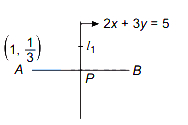
0 likesView Solution
17
MathematicsDifficultMCQAP EAMCET · 2013
If the points $(1, 2)$ and $(3, 4)$ lie on the same side of the straight line $3x - 5y + a = 0$,then $a$ lies in the set
A
$[7, 11]$
B
$R - (7, 11)$
C
$[7, \infty)$
D
$(-\infty, 11]$
Solution
(B) Let $f(x, y) = 3x - 5y + a$. For the points $(1, 2)$ and $(3, 4)$ to lie on the same side of the line,$f(1, 2)$ and $f(3, 4)$ must have the same sign.
$f(1, 2) = 3(1) - 5(2) + a = a - 7$
$f(3, 4) = 3(3) - 5(4) + a = a - 11$
Thus,$(a - 7)(a - 11) > 0$.
Solving this inequality,we get $a < 7$ or $a > 11$.
Therefore,$a \in (-\infty, 7) \cup (11, \infty)$,which is $R - [7, 11]$.
$f(1, 2) = 3(1) - 5(2) + a = a - 7$
$f(3, 4) = 3(3) - 5(4) + a = a - 11$
Thus,$(a - 7)(a - 11) > 0$.
Solving this inequality,we get $a < 7$ or $a > 11$.
Therefore,$a \in (-\infty, 7) \cup (11, \infty)$,which is $R - [7, 11]$.
0 likesView Solution
18
MathematicsDifficultMCQAP EAMCET · 2013
If $p$ and $q$ are the perpendicular distances from the origin to the straight lines $x \sec \theta - y \operatorname{cosec} \theta = a$ and $x \cos \theta + y \sin \theta = a \cos 2 \theta$,then
A
$4 p^2 + q^2 = a^2$
B
$p^2 + q^2 = a^2$
C
$p^2 + 2 q^2 = a^2$
D
$4 p^2 + q^2 = 2 a^2$
Solution
(A) The given equations of the lines are:
$x \sec \theta - y \operatorname{cosec} \theta = a$ $(i)$
$x \cos \theta + y \sin \theta = a \cos 2 \theta$ $(ii)$
The perpendicular distance $d$ from the origin $(0, 0)$ to a line $Ax + By + C = 0$ is given by $d = \frac{|C|}{\sqrt{A^2 + B^2}}$.
For line $(i)$:
$p = \frac{|-a|}{\sqrt{\sec^2 \theta + \operatorname{cosec}^2 \theta}} = \frac{a}{\sqrt{\frac{1}{\cos^2 \theta} + \frac{1}{\sin^2 \theta}}} = \frac{a}{\sqrt{\frac{\sin^2 \theta + \cos^2 \theta}{\sin^2 \theta \cos^2 \theta}}} = a \sin \theta \cos \theta = \frac{a}{2} \sin 2 \theta$.
Thus,$2p = a \sin 2 \theta$.
For line $(ii)$:
$q = \frac{|-a \cos 2 \theta|}{\sqrt{\cos^2 \theta + \sin^2 \theta}} = \frac{a \cos 2 \theta}{1} = a \cos 2 \theta$.
Now,calculating $4p^2 + q^2$:
$4p^2 + q^2 = (a \sin 2 \theta)^2 + (a \cos 2 \theta)^2$
$= a^2 (\sin^2 2 \theta + \cos^2 2 \theta)$
$= a^2 (1) = a^2$.
$x \sec \theta - y \operatorname{cosec} \theta = a$ $(i)$
$x \cos \theta + y \sin \theta = a \cos 2 \theta$ $(ii)$
The perpendicular distance $d$ from the origin $(0, 0)$ to a line $Ax + By + C = 0$ is given by $d = \frac{|C|}{\sqrt{A^2 + B^2}}$.
For line $(i)$:
$p = \frac{|-a|}{\sqrt{\sec^2 \theta + \operatorname{cosec}^2 \theta}} = \frac{a}{\sqrt{\frac{1}{\cos^2 \theta} + \frac{1}{\sin^2 \theta}}} = \frac{a}{\sqrt{\frac{\sin^2 \theta + \cos^2 \theta}{\sin^2 \theta \cos^2 \theta}}} = a \sin \theta \cos \theta = \frac{a}{2} \sin 2 \theta$.
Thus,$2p = a \sin 2 \theta$.
For line $(ii)$:
$q = \frac{|-a \cos 2 \theta|}{\sqrt{\cos^2 \theta + \sin^2 \theta}} = \frac{a \cos 2 \theta}{1} = a \cos 2 \theta$.
Now,calculating $4p^2 + q^2$:
$4p^2 + q^2 = (a \sin 2 \theta)^2 + (a \cos 2 \theta)^2$
$= a^2 (\sin^2 2 \theta + \cos^2 2 \theta)$
$= a^2 (1) = a^2$.
0 likesView Solution
19
MathematicsDifficultMCQAP EAMCET · 2013
The perpendicular distance from the point $(1, \pi)$ to the line joining $(1, 0^{\circ})$ and $(1, \frac{\pi}{2})$ (in polar coordinates) is
A
$2$
B
$\sqrt{3}$
C
$1$
D
$\sqrt{2}$
Solution
(D) Given points $(1, \pi)$,$(1, 0^{\circ})$ and $(1, \frac{\pi}{2})$ are in polar form.
Converting these to Cartesian coordinates $(x, y) = (r \cos \theta, r \sin \theta)$:
$(1, \pi) \rightarrow (1 \cdot \cos \pi, 1 \cdot \sin \pi) = (-1, 0)$
$(1, 0^{\circ}) \rightarrow (1 \cdot \cos 0^{\circ}, 1 \cdot \sin 0^{\circ}) = (1, 0)$
$(1, \frac{\pi}{2}) \rightarrow (1 \cdot \cos \frac{\pi}{2}, 1 \cdot \sin \frac{\pi}{2}) = (0, 1)$
Now,the equation of the line passing through $(1, 0)$ and $(0, 1)$ is given by the intercept form $\frac{x}{a} + \frac{y}{b} = 1$ or slope-point form:
$y - 0 = \frac{1 - 0}{0 - 1}(x - 1)$ $\Rightarrow y = -x + 1$ $\Rightarrow x + y - 1 = 0$.
The perpendicular distance $d$ from the point $(-1, 0)$ to the line $x + y - 1 = 0$ is calculated using the formula $d = \frac{|ax_0 + by_0 + c|}{\sqrt{a^2 + b^2}}$:
$d = \frac{|1(-1) + 1(0) - 1|}{\sqrt{1^2 + 1^2}} = \frac{|-2|}{\sqrt{2}} = \frac{2}{\sqrt{2}} = \sqrt{2}$.
Converting these to Cartesian coordinates $(x, y) = (r \cos \theta, r \sin \theta)$:
$(1, \pi) \rightarrow (1 \cdot \cos \pi, 1 \cdot \sin \pi) = (-1, 0)$
$(1, 0^{\circ}) \rightarrow (1 \cdot \cos 0^{\circ}, 1 \cdot \sin 0^{\circ}) = (1, 0)$
$(1, \frac{\pi}{2}) \rightarrow (1 \cdot \cos \frac{\pi}{2}, 1 \cdot \sin \frac{\pi}{2}) = (0, 1)$
Now,the equation of the line passing through $(1, 0)$ and $(0, 1)$ is given by the intercept form $\frac{x}{a} + \frac{y}{b} = 1$ or slope-point form:
$y - 0 = \frac{1 - 0}{0 - 1}(x - 1)$ $\Rightarrow y = -x + 1$ $\Rightarrow x + y - 1 = 0$.
The perpendicular distance $d$ from the point $(-1, 0)$ to the line $x + y - 1 = 0$ is calculated using the formula $d = \frac{|ax_0 + by_0 + c|}{\sqrt{a^2 + b^2}}$:
$d = \frac{|1(-1) + 1(0) - 1|}{\sqrt{1^2 + 1^2}} = \frac{|-2|}{\sqrt{2}} = \frac{2}{\sqrt{2}} = \sqrt{2}$.
0 likesView Solution
20
MathematicsEasyMCQAP EAMCET · 2013
$(a, 0)$ and $(b, 0)$ are centers of two circles belonging to a coaxial system of which the $y$-axis is the radical axis. If the radius of one of the circles is $r$,then the radius of the other circle is:
A
$(r^2+b^2+a^2)^{1/2}$
B
$(r^2+b^2-a^2)^{1/2}$
C
$(r^2+b^2-a^2)^{1/3}$
D
$(r^2+b^2+a^2)^{1/3}$
Solution
(B) Let the equation of the circle with center $(a, 0)$ and radius $r$ be $(x-a)^2 + y^2 = r^2$,which simplifies to $S_1 \equiv x^2 + y^2 - 2ax + a^2 - r^2 = 0$.
Let the equation of the circle with center $(b, 0)$ and radius $R$ be $(x-b)^2 + y^2 = R^2$,which simplifies to $S_2 \equiv x^2 + y^2 - 2bx + b^2 - R^2 = 0$.
The radical axis of the two circles is given by $S_1 - S_2 = 0$.
Substituting the equations,we get $(x^2 + y^2 - 2ax + a^2 - r^2) - (x^2 + y^2 - 2bx + b^2 - R^2) = 0$.
This simplifies to $2(b-a)x + a^2 - b^2 - r^2 + R^2 = 0$.
Since the radical axis is the $y$-axis,its equation must be $x = 0$.
For the equation $2(b-a)x + (a^2 - b^2 - r^2 + R^2) = 0$ to represent $x = 0$,the constant term must be zero.
Therefore,$a^2 - b^2 - r^2 + R^2 = 0$.
Solving for $R$,we get $R^2 = r^2 + b^2 - a^2$,which implies $R = (r^2 + b^2 - a^2)^{1/2}$.
Let the equation of the circle with center $(b, 0)$ and radius $R$ be $(x-b)^2 + y^2 = R^2$,which simplifies to $S_2 \equiv x^2 + y^2 - 2bx + b^2 - R^2 = 0$.
The radical axis of the two circles is given by $S_1 - S_2 = 0$.
Substituting the equations,we get $(x^2 + y^2 - 2ax + a^2 - r^2) - (x^2 + y^2 - 2bx + b^2 - R^2) = 0$.
This simplifies to $2(b-a)x + a^2 - b^2 - r^2 + R^2 = 0$.
Since the radical axis is the $y$-axis,its equation must be $x = 0$.
For the equation $2(b-a)x + (a^2 - b^2 - r^2 + R^2) = 0$ to represent $x = 0$,the constant term must be zero.
Therefore,$a^2 - b^2 - r^2 + R^2 = 0$.
Solving for $R$,we get $R^2 = r^2 + b^2 - a^2$,which implies $R = (r^2 + b^2 - a^2)^{1/2}$.
0 likesView Solution
21
MathematicsDifficultMCQAP EAMCET · 2013
Find the term independent of $x$ $(x > 0, x \neq 1)$ in the expansion of $\left[\frac{(x+1)}{\left(x^{2/3}-x^{1/3}+1\right)}-\frac{(x-1)}{(x-\sqrt{x})}\right]^{10}$.
A
$105$
B
$210$
C
$315$
D
$420$
Solution
(B) Simplify the expression inside the bracket: $\left[\frac{(x^{1/3})^3+1^3}{x^{2/3}-x^{1/3}+1} - \frac{(\sqrt{x}-1)(\sqrt{x}+1)}{\sqrt{x}(\sqrt{x}-1)}\right]^{10}$
$= \left[(x^{1/3}+1) - \frac{\sqrt{x}+1}{\sqrt{x}}\right]^{10} = \left[x^{1/3}+1 - (1+x^{-1/2})\right]^{10} = (x^{1/3}-x^{-1/2})^{10}$.
The general term $T_{r+1}$ is given by: ${}^{10}C_r (x^{1/3})^{10-r} (-x^{-1/2})^r = {}^{10}C_r (-1)^r x^{\frac{10-r}{3} - \frac{r}{2}}$.
For the term independent of $x$,the exponent of $x$ must be $0$: $\frac{10-r}{3} - \frac{r}{2} = 0$.
$20 - 2r - 3r = 0$ $\Rightarrow 5r = 20$ $\Rightarrow r = 4$.
The term is ${}^{10}C_4 (-1)^4 = \frac{10 \times 9 \times 8 \times 7}{4 \times 3 \times 2 \times 1} = 210$.
$= \left[(x^{1/3}+1) - \frac{\sqrt{x}+1}{\sqrt{x}}\right]^{10} = \left[x^{1/3}+1 - (1+x^{-1/2})\right]^{10} = (x^{1/3}-x^{-1/2})^{10}$.
The general term $T_{r+1}$ is given by: ${}^{10}C_r (x^{1/3})^{10-r} (-x^{-1/2})^r = {}^{10}C_r (-1)^r x^{\frac{10-r}{3} - \frac{r}{2}}$.
For the term independent of $x$,the exponent of $x$ must be $0$: $\frac{10-r}{3} - \frac{r}{2} = 0$.
$20 - 2r - 3r = 0$ $\Rightarrow 5r = 20$ $\Rightarrow r = 4$.
The term is ${}^{10}C_4 (-1)^4 = \frac{10 \times 9 \times 8 \times 7}{4 \times 3 \times 2 \times 1} = 210$.
0 likesView Solution
22
MathematicsDifficultMCQAP EAMCET · 2013
If $D(2, 1, 0)$,$E(2, 0, 0)$,and $F(0, 1, 0)$ are mid-points of the sides $BC$,$CA$,and $AB$ of $\triangle ABC$,respectively,then the centroid of $\triangle ABC$ is
A
$\left(\frac{1}{3}, \frac{1}{3}, \frac{1}{3}\right)$
B
$\left(\frac{4}{3}, \frac{2}{3}, 0\right)$
C
$\left(-\frac{1}{3}, \frac{1}{3}, \frac{1}{3}\right)$
D
$\left(\frac{2}{3}, \frac{1}{3}, \frac{1}{3}\right)$
Solution
(B) Let $A \equiv (x_1, y_1, z_1)$,$B \equiv (x_2, y_2, z_2)$,and $C \equiv (x_3, y_3, z_3)$.
Since $F(0, 1, 0)$ is the mid-point of $AB$,we have:
$x_1 + x_2 = 0, y_1 + y_2 = 2, z_1 + z_2 = 0$ $(1)$
Since $D(2, 1, 0)$ is the mid-point of $BC$,we have:
$x_2 + x_3 = 4, y_2 + y_3 = 2, z_2 + z_3 = 0$ $(2)$
Since $E(2, 0, 0)$ is the mid-point of $AC$,we have:
$x_3 + x_1 = 4, y_3 + y_1 = 0, z_3 + z_1 = 0$ $(3)$
Adding $(1)$,$(2)$,and $(3)$,we get:
$2(x_1 + x_2 + x_3) = 8 \implies x_1 + x_2 + x_3 = 4$
$2(y_1 + y_2 + y_3) = 4 \implies y_1 + y_2 + y_3 = 2$
$2(z_1 + z_2 + z_3) = 0 \implies z_1 + z_2 + z_3 = 0$
The centroid of $\triangle ABC$ is given by $\left(\frac{x_1+x_2+x_3}{3}, \frac{y_1+y_2+y_3}{3}, \frac{z_1+z_2+z_3}{3}\right)$.
Substituting the sums,the centroid is $\left(\frac{4}{3}, \frac{2}{3}, 0\right)$.
Since $F(0, 1, 0)$ is the mid-point of $AB$,we have:
$x_1 + x_2 = 0, y_1 + y_2 = 2, z_1 + z_2 = 0$ $(1)$
Since $D(2, 1, 0)$ is the mid-point of $BC$,we have:
$x_2 + x_3 = 4, y_2 + y_3 = 2, z_2 + z_3 = 0$ $(2)$
Since $E(2, 0, 0)$ is the mid-point of $AC$,we have:
$x_3 + x_1 = 4, y_3 + y_1 = 0, z_3 + z_1 = 0$ $(3)$
Adding $(1)$,$(2)$,and $(3)$,we get:
$2(x_1 + x_2 + x_3) = 8 \implies x_1 + x_2 + x_3 = 4$
$2(y_1 + y_2 + y_3) = 4 \implies y_1 + y_2 + y_3 = 2$
$2(z_1 + z_2 + z_3) = 0 \implies z_1 + z_2 + z_3 = 0$
The centroid of $\triangle ABC$ is given by $\left(\frac{x_1+x_2+x_3}{3}, \frac{y_1+y_2+y_3}{3}, \frac{z_1+z_2+z_3}{3}\right)$.
Substituting the sums,the centroid is $\left(\frac{4}{3}, \frac{2}{3}, 0\right)$.
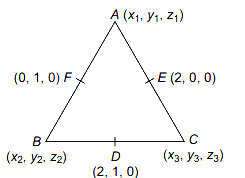
0 likesView Solution
23
MathematicsEasyMCQAP EAMCET · 2013
Ten men and $6$ women are to be seated in a row so that no two women sit together. The number of ways they can be seated is:
A
$11! \times 10!$
B
$\frac{11!}{6! 5!}$
C
$\frac{10! 11!}{5!}$
D
$\frac{11! 10!}{6!}$
Solution
(C) First,we arrange $10$ men in a row. The number of ways to arrange $10$ men is $10!$.
This creates $11$ possible gaps (including the ends) where the $6$ women can be seated to ensure no two women sit together.
The number of ways to choose $6$ gaps out of $11$ and arrange the $6$ women is given by the permutation formula $^{11}P_6$.
$^{11}P_6 = \frac{11!}{(11-6)!} = \frac{11!}{5!}$.
Therefore,the total number of ways is $10! \times \frac{11!}{5!} = \frac{10! 11!}{5!}$.
This creates $11$ possible gaps (including the ends) where the $6$ women can be seated to ensure no two women sit together.
The number of ways to choose $6$ gaps out of $11$ and arrange the $6$ women is given by the permutation formula $^{11}P_6$.
$^{11}P_6 = \frac{11!}{(11-6)!} = \frac{11!}{5!}$.
Therefore,the total number of ways is $10! \times \frac{11!}{5!} = \frac{10! 11!}{5!}$.
0 likesView Solution
24
MathematicsMediumMCQAP EAMCET · 2013
The term independent of $x(x>0, x \neq 1)$ in the expansion of $\left[\frac{(x+1)}{\left(x^{2 / 3}-x^{1 / 3}+1\right)}-\frac{(x-1)}{(x-\sqrt{x})}\right]^{10}$ is:
A
$105$
B
$210$
C
$315$
D
$420$
Solution
(B) Given expression: $\left[\frac{(x+1)}{\left(x^{2 / 3}-x^{1 / 3}+1\right)}-\frac{(x-1)}{(x-\sqrt{x})}\right]^{10}$
Simplify the terms inside the bracket:
$\frac{(x+1)}{\left(x^{2 / 3}-x^{1 / 3}+1\right)} = \frac{(x^{1/3})^3 + 1^3}{x^{2/3} - x^{1/3} + 1} = \frac{(x^{1/3}+1)(x^{2/3}-x^{1/3}+1)}{x^{2/3}-x^{1/3}+1} = x^{1/3} + 1$
$\frac{(x-1)}{(x-\sqrt{x})} = \frac{(\sqrt{x})^2 - 1}{\sqrt{x}(\sqrt{x}-1)} = \frac{(\sqrt{x}-1)(\sqrt{x}+1)}{\sqrt{x}(\sqrt{x}-1)} = \frac{\sqrt{x}+1}{\sqrt{x}} = 1 + x^{-1/2}$
Substituting these back: $\left[(x^{1/3} + 1) - (1 + x^{-1/2})\right]^{10} = (x^{1/3} - x^{-1/2})^{10}$
The general term $T_{r+1}$ is given by:
$T_{r+1} = {}^{10}C_r (x^{1/3})^{10-r} (-x^{-1/2})^r = {}^{10}C_r (-1)^r x^{\frac{10-r}{3} - \frac{r}{2}}$
For the term independent of $x$,the exponent of $x$ must be $0$:
$\frac{10-r}{3} - \frac{r}{2} = 0$ $\Rightarrow 20 - 2r - 3r = 0$ $\Rightarrow 5r = 20$ $\Rightarrow r = 4$
The term is $T_{4+1} = {}^{10}C_4 (-1)^4 = {}^{10}C_4 = \frac{10 \times 9 \times 8 \times 7}{4 \times 3 \times 2 \times 1} = 210$
Simplify the terms inside the bracket:
$\frac{(x+1)}{\left(x^{2 / 3}-x^{1 / 3}+1\right)} = \frac{(x^{1/3})^3 + 1^3}{x^{2/3} - x^{1/3} + 1} = \frac{(x^{1/3}+1)(x^{2/3}-x^{1/3}+1)}{x^{2/3}-x^{1/3}+1} = x^{1/3} + 1$
$\frac{(x-1)}{(x-\sqrt{x})} = \frac{(\sqrt{x})^2 - 1}{\sqrt{x}(\sqrt{x}-1)} = \frac{(\sqrt{x}-1)(\sqrt{x}+1)}{\sqrt{x}(\sqrt{x}-1)} = \frac{\sqrt{x}+1}{\sqrt{x}} = 1 + x^{-1/2}$
Substituting these back: $\left[(x^{1/3} + 1) - (1 + x^{-1/2})\right]^{10} = (x^{1/3} - x^{-1/2})^{10}$
The general term $T_{r+1}$ is given by:
$T_{r+1} = {}^{10}C_r (x^{1/3})^{10-r} (-x^{-1/2})^r = {}^{10}C_r (-1)^r x^{\frac{10-r}{3} - \frac{r}{2}}$
For the term independent of $x$,the exponent of $x$ must be $0$:
$\frac{10-r}{3} - \frac{r}{2} = 0$ $\Rightarrow 20 - 2r - 3r = 0$ $\Rightarrow 5r = 20$ $\Rightarrow r = 4$
The term is $T_{4+1} = {}^{10}C_4 (-1)^4 = {}^{10}C_4 = \frac{10 \times 9 \times 8 \times 7}{4 \times 3 \times 2 \times 1} = 210$
0 likesView Solution
25
MathematicsEasyMCQAP EAMCET · 2013
If $x$ is small,so that $x^2$ and higher powers can be neglected,then the approximate value for $\frac{(1-2 x)^{-1}(1-3 x)^{-2}}{(1-4 x)^{-3}}$ is
A
$1-2 x$
B
$1-3 x$
C
$1-4 x$
D
$1-5 x$
Solution
(C) Given expression is $E = \frac{(1-2 x)^{-1}(1-3 x)^{-2}}{(1-4 x)^{-3}}$.
Using the binomial expansion $(1+ax)^n \approx 1+nax$ for small $x$:
$(1-2 x)^{-1} \approx 1 + (-1)(-2x) = 1 + 2x$.
$(1-3 x)^{-2} \approx 1 + (-2)(-3x) = 1 + 6x$.
$(1-4 x)^{-3} \approx 1 + (-3)(-4x) = 1 + 12x$.
Substituting these into the expression:
$E \approx \frac{(1+2x)(1+6x)}{(1+12x)} = \frac{1 + 6x + 2x + 12x^2}{1+12x}$.
Neglecting $x^2$ and higher powers:
$E \approx \frac{1+8x}{1+12x} = (1+8x)(1+12x)^{-1}$.
Using the binomial expansion again:
$E \approx (1+8x)(1-12x) = 1 - 12x + 8x - 96x^2$.
Neglecting $x^2$:
$E \approx 1 - 4x$.
Using the binomial expansion $(1+ax)^n \approx 1+nax$ for small $x$:
$(1-2 x)^{-1} \approx 1 + (-1)(-2x) = 1 + 2x$.
$(1-3 x)^{-2} \approx 1 + (-2)(-3x) = 1 + 6x$.
$(1-4 x)^{-3} \approx 1 + (-3)(-4x) = 1 + 12x$.
Substituting these into the expression:
$E \approx \frac{(1+2x)(1+6x)}{(1+12x)} = \frac{1 + 6x + 2x + 12x^2}{1+12x}$.
Neglecting $x^2$ and higher powers:
$E \approx \frac{1+8x}{1+12x} = (1+8x)(1+12x)^{-1}$.
Using the binomial expansion again:
$E \approx (1+8x)(1-12x) = 1 - 12x + 8x - 96x^2$.
Neglecting $x^2$:
$E \approx 1 - 4x$.
0 likesView Solution
26
MathematicsMediumMCQAP EAMCET · 2013
If $\sin \theta + \cos \theta = p$ and $\sin^3 \theta + \cos^3 \theta = q$,then $p(p^2 - 3)$ is equal to
A
$q$
B
$2q$
C
$-q$
D
$-2q$
Solution
(D) Given,$\sin \theta + \cos \theta = p$ $(i)$ and $\sin^3 \theta + \cos^3 \theta = q$ (ii).
Using the identity $a^3 + b^3 = (a + b)(a^2 - ab + b^2)$,we have:
$(\sin \theta + \cos \theta)(\sin^2 \theta - \sin \theta \cos \theta + \cos^2 \theta) = q$.
Since $\sin^2 \theta + \cos^2 \theta = 1$,this becomes $p(1 - \sin \theta \cos \theta) = q$.
Thus,$1 - \sin \theta \cos \theta = \frac{q}{p}$,which implies $\sin \theta \cos \theta = 1 - \frac{q}{p}$ (iii).
Squaring equation $(i)$: $(\sin \theta + \cos \theta)^2 = p^2$.
$\sin^2 \theta + \cos^2 \theta + 2 \sin \theta \cos \theta = p^2$.
$1 + 2 \sin \theta \cos \theta = p^2$.
Substituting (iii) into this: $1 + 2(1 - \frac{q}{p}) = p^2$.
$1 + 2 - \frac{2q}{p} = p^2$.
$3 - \frac{2q}{p} = p^2$.
Multiply by $p$: $3p - 2q = p^3$.
Rearranging gives $p^3 - 3p = -2q$,or $p(p^2 - 3) = -2q$.
Using the identity $a^3 + b^3 = (a + b)(a^2 - ab + b^2)$,we have:
$(\sin \theta + \cos \theta)(\sin^2 \theta - \sin \theta \cos \theta + \cos^2 \theta) = q$.
Since $\sin^2 \theta + \cos^2 \theta = 1$,this becomes $p(1 - \sin \theta \cos \theta) = q$.
Thus,$1 - \sin \theta \cos \theta = \frac{q}{p}$,which implies $\sin \theta \cos \theta = 1 - \frac{q}{p}$ (iii).
Squaring equation $(i)$: $(\sin \theta + \cos \theta)^2 = p^2$.
$\sin^2 \theta + \cos^2 \theta + 2 \sin \theta \cos \theta = p^2$.
$1 + 2 \sin \theta \cos \theta = p^2$.
Substituting (iii) into this: $1 + 2(1 - \frac{q}{p}) = p^2$.
$1 + 2 - \frac{2q}{p} = p^2$.
$3 - \frac{2q}{p} = p^2$.
Multiply by $p$: $3p - 2q = p^3$.
Rearranging gives $p^3 - 3p = -2q$,or $p(p^2 - 3) = -2q$.
0 likesView Solution
27
MathematicsMediumMCQAP EAMCET · 2013
If $\tan (\pi \cos \theta)=\cot (\pi \sin \theta)$,then a value of $\cos \left(\theta-\frac{\pi}{4}\right)$ among the following is
A
$\frac{1}{2 \sqrt{2}}$
B
$\frac{1}{\sqrt{2}}$
C
$\frac{1}{2}$
D
$\frac{1}{4}$
Solution
(A) Given,$\tan (\pi \cos \theta)=\cot (\pi \sin \theta)$
$\Rightarrow \tan (\pi \cos \theta)=\tan \left(\frac{\pi}{2}-\pi \sin \theta\right)$
$\Rightarrow \pi \cos \theta=\frac{\pi}{2}-\pi \sin \theta$
$\Rightarrow \cos \theta+\sin \theta=\frac{1}{2}$
Dividing both sides by $\sqrt{2}$:
$\Rightarrow \frac{1}{\sqrt{2}} \cos \theta+\frac{1}{\sqrt{2}} \sin \theta=\frac{1}{2 \sqrt{2}}$
$\Rightarrow \cos \theta \cos \frac{\pi}{4}+\sin \theta \sin \frac{\pi}{4}=\frac{1}{2 \sqrt{2}}$
$\Rightarrow \cos \left(\theta-\frac{\pi}{4}\right)=\frac{1}{2 \sqrt{2}}$
$\Rightarrow \tan (\pi \cos \theta)=\tan \left(\frac{\pi}{2}-\pi \sin \theta\right)$
$\Rightarrow \pi \cos \theta=\frac{\pi}{2}-\pi \sin \theta$
$\Rightarrow \cos \theta+\sin \theta=\frac{1}{2}$
Dividing both sides by $\sqrt{2}$:
$\Rightarrow \frac{1}{\sqrt{2}} \cos \theta+\frac{1}{\sqrt{2}} \sin \theta=\frac{1}{2 \sqrt{2}}$
$\Rightarrow \cos \theta \cos \frac{\pi}{4}+\sin \theta \sin \frac{\pi}{4}=\frac{1}{2 \sqrt{2}}$
$\Rightarrow \cos \left(\theta-\frac{\pi}{4}\right)=\frac{1}{2 \sqrt{2}}$
0 likesView Solution
28
MathematicsMediumMCQAP EAMCET · 2013
The equation of the pair of lines passing through the origin whose sum and product of slopes are respectively the arithmetic mean and geometric mean of $4$ and $9$ is
A
$12 x^2-13 x y+2 y^2=0$
B
$12 x^2+13 x y+2 y^2=0$
C
$12 x^2-15 x y+2 y^2=0$
D
$12 x^2+15 x y-2 y^2=0$
Solution
(A) Let $m_1$ and $m_2$ be the slopes of the lines.
Then,$m_1+m_2 = \text{arithmetic mean} = \frac{4+9}{2} = \frac{13}{2}$ and $m_1 m_2 = \text{geometric mean} = \sqrt{4 \times 9} = \sqrt{36} = 6$.
Now,the equation of the pair of lines passing through the origin is given by $(y-m_1 x)(y-m_2 x) = 0$.
This simplifies to $y^2 - (m_1+m_2)xy + m_1 m_2 x^2 = 0$.
Substituting the values of $m_1+m_2$ and $m_1 m_2$,we get $y^2 - \frac{13}{2}xy + 6x^2 = 0$.
Multiplying by $2$,we get $2y^2 - 13xy + 12x^2 = 0$,which is $12x^2 - 13xy + 2y^2 = 0$.
Then,$m_1+m_2 = \text{arithmetic mean} = \frac{4+9}{2} = \frac{13}{2}$ and $m_1 m_2 = \text{geometric mean} = \sqrt{4 \times 9} = \sqrt{36} = 6$.
Now,the equation of the pair of lines passing through the origin is given by $(y-m_1 x)(y-m_2 x) = 0$.
This simplifies to $y^2 - (m_1+m_2)xy + m_1 m_2 x^2 = 0$.
Substituting the values of $m_1+m_2$ and $m_1 m_2$,we get $y^2 - \frac{13}{2}xy + 6x^2 = 0$.
Multiplying by $2$,we get $2y^2 - 13xy + 12x^2 = 0$,which is $12x^2 - 13xy + 2y^2 = 0$.
0 likesView Solution
29
MathematicsEasyMCQAP EAMCET · 2013
The equation $x^2-5xy+py^2+3x-8y+2=0$ represents a pair of straight lines. If $\theta$ is the angle between them,then $\sin \theta$ is equal to
A
$\frac{1}{\sqrt{50}}$
B
$\frac{1}{7}$
C
$\frac{1}{5}$
D
$\frac{1}{\sqrt{10}}$
Solution
(A) Comparing the given equation $x^2-5xy+py^2+3x-8y+2=0$ with the general second-degree equation $ax^2+2hxy+by^2+2gx+2fy+c=0$,we get $a=1, h=-\frac{5}{2}, b=p, g=\frac{3}{2}, f=-4, c=2$.
The equation represents a pair of straight lines if $abc+2fgh-af^2-bg^2-ch^2=0$.
Substituting the values: $1(p)(2) + 2(-4)(\frac{3}{2})(-\frac{5}{2}) - 1(-4)^2 - p(\frac{3}{2})^2 - 2(-\frac{5}{2})^2 = 0$.
$2p + 30 - 16 - \frac{9p}{4} - \frac{25}{2} = 0$.
Multiplying by $4$: $8p + 120 - 64 - 9p - 50 = 0$ $\Rightarrow -p + 6 = 0$ $\Rightarrow p=6$.
The angle $\theta$ between the lines is given by $\tan \theta = \left| \frac{2\sqrt{h^2-ab}}{a+b} \right|$.
$\tan \theta = \left| \frac{2\sqrt{(-\frac{5}{2})^2 - 1(6)}}{1+6} \right| = \left| \frac{2\sqrt{\frac{25}{4}-6}}{7} \right| = \left| \frac{2\sqrt{\frac{1}{4}}}{7} \right| = \frac{2(\frac{1}{2})}{7} = \frac{1}{7}$.
Since $\tan \theta = \frac{1}{7}$,we have a right triangle with opposite side $1$ and adjacent side $7$. The hypotenuse is $\sqrt{1^2+7^2} = \sqrt{50}$.
Therefore,$\sin \theta = \frac{\text{opposite}}{\text{hypotenuse}} = \frac{1}{\sqrt{50}}$.
The equation represents a pair of straight lines if $abc+2fgh-af^2-bg^2-ch^2=0$.
Substituting the values: $1(p)(2) + 2(-4)(\frac{3}{2})(-\frac{5}{2}) - 1(-4)^2 - p(\frac{3}{2})^2 - 2(-\frac{5}{2})^2 = 0$.
$2p + 30 - 16 - \frac{9p}{4} - \frac{25}{2} = 0$.
Multiplying by $4$: $8p + 120 - 64 - 9p - 50 = 0$ $\Rightarrow -p + 6 = 0$ $\Rightarrow p=6$.
The angle $\theta$ between the lines is given by $\tan \theta = \left| \frac{2\sqrt{h^2-ab}}{a+b} \right|$.
$\tan \theta = \left| \frac{2\sqrt{(-\frac{5}{2})^2 - 1(6)}}{1+6} \right| = \left| \frac{2\sqrt{\frac{25}{4}-6}}{7} \right| = \left| \frac{2\sqrt{\frac{1}{4}}}{7} \right| = \frac{2(\frac{1}{2})}{7} = \frac{1}{7}$.
Since $\tan \theta = \frac{1}{7}$,we have a right triangle with opposite side $1$ and adjacent side $7$. The hypotenuse is $\sqrt{1^2+7^2} = \sqrt{50}$.
Therefore,$\sin \theta = \frac{\text{opposite}}{\text{hypotenuse}} = \frac{1}{\sqrt{50}}$.
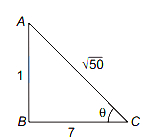
0 likesView Solution
30
MathematicsDifficultMCQAP EAMCET · 2013
If the equation $ax^2+2hxy+by^2+2gx+2fy+c=0$ represents a pair of straight lines,then the square of the distance of their point of intersection from the origin is
A
$\frac{c(a+b)-af^2-bg^2}{ab-h^2}$
B
$\frac{c(a+b)+f^2+g^2}{ab-h^2}$
C
$\frac{c(a+b)-f^2-g^2}{ab-h^2}$
D
$\frac{c(a+b)-f^2-g^2}{(ab-h^2)^2}$
Solution
(C) The point of intersection $(x_0, y_0)$ of the pair of straight lines $ax^2+2hxy+by^2+2gx+2fy+c=0$ is given by the solution of the partial derivatives $\frac{\partial}{\partial x} = 0$ and $\frac{\partial}{\partial y} = 0$.
$2ax+2hy+2g=0 \implies ax+hy+g=0$
$2hx+2by+2f=0 \implies hx+by+f=0$
Solving these equations using Cramer's rule:
$x_0 = \frac{hf-bg}{ab-h^2}$ and $y_0 = \frac{gh-af}{ab-h^2}$.
The square of the distance from the origin $(0,0)$ is $D^2 = x_0^2 + y_0^2$.
Using the condition for a pair of lines $abc+2fgh-af^2-bg^2-ch^2=0$,we can simplify the expression for $x_0^2+y_0^2$.
Substituting the values,we get $D^2 = \frac{(hf-bg)^2+(gh-af)^2}{(ab-h^2)^2} = \frac{h^2f^2+b^2g^2-2hfbg+g^2h^2+a^2f^2-2ghaf}{(ab-h^2)^2}$.
Using $abc+2fgh=af^2+bg^2+ch^2$,this simplifies to $\frac{c(a+b)-f^2-g^2}{ab-h^2}$.
$2ax+2hy+2g=0 \implies ax+hy+g=0$
$2hx+2by+2f=0 \implies hx+by+f=0$
Solving these equations using Cramer's rule:
$x_0 = \frac{hf-bg}{ab-h^2}$ and $y_0 = \frac{gh-af}{ab-h^2}$.
The square of the distance from the origin $(0,0)$ is $D^2 = x_0^2 + y_0^2$.
Using the condition for a pair of lines $abc+2fgh-af^2-bg^2-ch^2=0$,we can simplify the expression for $x_0^2+y_0^2$.
Substituting the values,we get $D^2 = \frac{(hf-bg)^2+(gh-af)^2}{(ab-h^2)^2} = \frac{h^2f^2+b^2g^2-2hfbg+g^2h^2+a^2f^2-2ghaf}{(ab-h^2)^2}$.
Using $abc+2fgh=af^2+bg^2+ch^2$,this simplifies to $\frac{c(a+b)-f^2-g^2}{ab-h^2}$.
0 likesView Solution
31
MathematicsMediumMCQAP EAMCET · 2013
The circle $4x^2+4y^2-12x-12y+9=0$
A
touches both the axes
B
touches the $x$-axis only
C
touches the $y$-axis only
D
does not touch the axes
Solution
(A) The given equation of the circle is $4x^2+4y^2-12x-12y+9=0$.
Dividing by $4$,we get $x^2+y^2-3x-3y+\frac{9}{4}=0$.
Rearranging the terms,we have $(x^2-3x)+(y^2-3y)=-\frac{9}{4}$.
Completing the square,we get $(x-\frac{3}{2})^2-\frac{9}{4}+(y-\frac{3}{2})^2-\frac{9}{4}=-\frac{9}{4}$.
This simplifies to $(x-\frac{3}{2})^2+(y-\frac{3}{2})^2=\frac{9}{4}$,which is $(x-\frac{3}{2})^2+(y-\frac{3}{2})^2=(\frac{3}{2})^2$.
Comparing this with the standard form $(x-h)^2+(y-k)^2=r^2$,the centre is $(\frac{3}{2}, \frac{3}{2})$ and the radius is $r=\frac{3}{2}$.
Since the distance of the centre from both axes is equal to the radius (i.e.,$|h|=|k|=r=\frac{3}{2}$),the circle touches both the axes.
Dividing by $4$,we get $x^2+y^2-3x-3y+\frac{9}{4}=0$.
Rearranging the terms,we have $(x^2-3x)+(y^2-3y)=-\frac{9}{4}$.
Completing the square,we get $(x-\frac{3}{2})^2-\frac{9}{4}+(y-\frac{3}{2})^2-\frac{9}{4}=-\frac{9}{4}$.
This simplifies to $(x-\frac{3}{2})^2+(y-\frac{3}{2})^2=\frac{9}{4}$,which is $(x-\frac{3}{2})^2+(y-\frac{3}{2})^2=(\frac{3}{2})^2$.
Comparing this with the standard form $(x-h)^2+(y-k)^2=r^2$,the centre is $(\frac{3}{2}, \frac{3}{2})$ and the radius is $r=\frac{3}{2}$.
Since the distance of the centre from both axes is equal to the radius (i.e.,$|h|=|k|=r=\frac{3}{2}$),the circle touches both the axes.
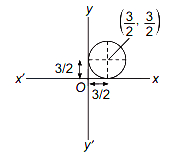
0 likesView Solution
32
MathematicsDifficultMCQAP EAMCET · 2013
If the length of the tangent from $(h, k)$ to the circle $x^2+y^2=16$ is twice the length of the tangent from the same point to the circle $x^2+y^2+2x+2y=0$,then:
A
$h^2+k^2+4h+4k+16=0$
B
$h^2+k^2+3h+3k=0$
C
$3h^2+3k^2+8h+8k+16=0$
D
$3h^2+3k^2+4h+4k+16=0$
Solution
(C) The length of the tangent from a point $(h, k)$ to a circle $x^2+y^2+2gx+2fy+c=0$ is given by $\sqrt{h^2+k^2+2gh+2fk+c}$.
For the circle $x^2+y^2-16=0$,the length of the tangent is $L_1 = \sqrt{h^2+k^2-16}$.
For the circle $x^2+y^2+2x+2y=0$,the length of the tangent is $L_2 = \sqrt{h^2+k^2+2h+2k}$.
Given that $L_1 = 2L_2$,we have $\sqrt{h^2+k^2-16} = 2\sqrt{h^2+k^2+2h+2k}$.
Squaring both sides,we get $h^2+k^2-16 = 4(h^2+k^2+2h+2k)$.
$h^2+k^2-16 = 4h^2+4k^2+8h+8k$.
Rearranging the terms,we get $3h^2+3k^2+8h+8k+16=0$.
For the circle $x^2+y^2-16=0$,the length of the tangent is $L_1 = \sqrt{h^2+k^2-16}$.
For the circle $x^2+y^2+2x+2y=0$,the length of the tangent is $L_2 = \sqrt{h^2+k^2+2h+2k}$.
Given that $L_1 = 2L_2$,we have $\sqrt{h^2+k^2-16} = 2\sqrt{h^2+k^2+2h+2k}$.
Squaring both sides,we get $h^2+k^2-16 = 4(h^2+k^2+2h+2k)$.
$h^2+k^2-16 = 4h^2+4k^2+8h+8k$.
Rearranging the terms,we get $3h^2+3k^2+8h+8k+16=0$.
0 likesView Solution
33
MathematicsDifficultMCQAP EAMCET · 2013
If the circle $x^2+y^2+4x-6y+c=0$ bisects the circumference of the circle $x^2+y^2-6x+4y-12=0$,then $c$ is equal to
A
$16$
B
$24$
C
$-42$
D
$-62$
Solution
(D) The common chord of the two circles $S_1 = x^2+y^2+4x-6y+c=0$ and $S_2 = x^2+y^2-6x+4y-12=0$ is given by $S_1 - S_2 = 0$.
$(x^2+y^2+4x-6y+c) - (x^2+y^2-6x+4y-12) = 0$
$10x - 10y + c + 12 = 0$ $(i)$
If a circle bisects the circumference of another circle,the common chord must pass through the center of the circle being bisected.
The center of the second circle $x^2+y^2-6x+4y-12=0$ is $(3, -2)$.
Substituting $(3, -2)$ into equation $(i)$:
$10(3) - 10(-2) + c + 12 = 0$
$30 + 20 + c + 12 = 0$
$62 + c = 0$
$c = -62$
$(x^2+y^2+4x-6y+c) - (x^2+y^2-6x+4y-12) = 0$
$10x - 10y + c + 12 = 0$ $(i)$
If a circle bisects the circumference of another circle,the common chord must pass through the center of the circle being bisected.
The center of the second circle $x^2+y^2-6x+4y-12=0$ is $(3, -2)$.
Substituting $(3, -2)$ into equation $(i)$:
$10(3) - 10(-2) + c + 12 = 0$
$30 + 20 + c + 12 = 0$
$62 + c = 0$
$c = -62$
0 likesView Solution
34
MathematicsMediumMCQAP EAMCET · 2013
For the circle $C$ with the equation $x^2+y^2-16x-12y+64=0$,match the List-$I$ with the List-$II$ given below.
The correct match is:
| List-$I$ | List-$II$ |
| $(i)$ The equation of the polar of $(-5, 1)$ with respect to $C$ | $(A)$ $y = 0$ |
| $(ii)$ The equation of the tangent at $(8, 0)$ to $C$ | $(B)$ $y = 6$ |
| $(iii)$ The equation of the normal at $(2, 6)$ to $C$ | $(C)$ $x + y = 7$ |
| $(iv)$ The equation of the diameter of $C$ through $(8, 12)$ | $(D)$ $13x + 5y = 98$ |
| $(E)$ $x = 8$ |
The correct match is:
A
$(D), (A), (B), (E)$
B
$(D), (A), (B), (E)$
C
$(C), (D), (A), (B)$
D
$(C), (E), (B), (A)$
Solution
(A) The given equation of the circle is $C: x^2 + y^2 - 16x - 12y + 64 = 0$.
$(i)$ The equation of the polar of a point $(x_1, y_1)$ with respect to the circle $x^2 + y^2 + 2gx + 2fy + c = 0$ is $xx_1 + yy_1 + g(x + x_1) + f(y + y_1) + c = 0$.
For point $(-5, 1)$,$g = -8, f = -6, c = 64$:
$x(-5) + y(1) - 8(x - 5) - 6(y + 1) + 64 = 0$
$-5x + y - 8x + 40 - 6y - 6 + 64 = 0$
$-13x - 5y + 98 = 0 \Rightarrow 13x + 5y = 98$. This matches $(D)$.
$(ii)$ The equation of the tangent at $(x_1, y_1)$ is $xx_1 + yy_1 - 8(x + x_1) - 6(y + y_1) + 64 = 0$.
For $(8, 0)$:
$8x + 0y - 8(x + 8) - 6(y + 0) + 64 = 0$
$8x - 8x - 64 - 6y + 64 = 0$
$-6y = 0 \Rightarrow y = 0$. This matches $(A)$.
$(iii)$ The center of the circle is $(-g, -f) = (8, 6)$. The normal at any point on the circle passes through the center.
The normal at $(2, 6)$ passes through $(2, 6)$ and $(8, 6)$.
Since the $y$-coordinates are the same,the equation of the line is $y = 6$. This matches $(B)$.
$(iv)$ The diameter passes through the center $(8, 6)$ and the given point $(8, 12)$.
Since both points have the same $x$-coordinate,the equation of the line is $x = 8$. This matches $(E)$.
Thus,the correct match is $(i)-(D), (ii)-(A), (iii)-(B), (iv)-(E)$.
$(i)$ The equation of the polar of a point $(x_1, y_1)$ with respect to the circle $x^2 + y^2 + 2gx + 2fy + c = 0$ is $xx_1 + yy_1 + g(x + x_1) + f(y + y_1) + c = 0$.
For point $(-5, 1)$,$g = -8, f = -6, c = 64$:
$x(-5) + y(1) - 8(x - 5) - 6(y + 1) + 64 = 0$
$-5x + y - 8x + 40 - 6y - 6 + 64 = 0$
$-13x - 5y + 98 = 0 \Rightarrow 13x + 5y = 98$. This matches $(D)$.
$(ii)$ The equation of the tangent at $(x_1, y_1)$ is $xx_1 + yy_1 - 8(x + x_1) - 6(y + y_1) + 64 = 0$.
For $(8, 0)$:
$8x + 0y - 8(x + 8) - 6(y + 0) + 64 = 0$
$8x - 8x - 64 - 6y + 64 = 0$
$-6y = 0 \Rightarrow y = 0$. This matches $(A)$.
$(iii)$ The center of the circle is $(-g, -f) = (8, 6)$. The normal at any point on the circle passes through the center.
The normal at $(2, 6)$ passes through $(2, 6)$ and $(8, 6)$.
Since the $y$-coordinates are the same,the equation of the line is $y = 6$. This matches $(B)$.
$(iv)$ The diameter passes through the center $(8, 6)$ and the given point $(8, 12)$.
Since both points have the same $x$-coordinate,the equation of the line is $x = 8$. This matches $(E)$.
Thus,the correct match is $(i)-(D), (ii)-(A), (iii)-(B), (iv)-(E)$.
0 likesView Solution
35
MathematicsDifficultMCQAP EAMCET · 2013
$(a, 0)$ and $(b, 0)$ are the centres of two circles belonging to a coaxial system of which the $y$-axis is the radical axis. If the radius of one of the circles is $r$,then the radius of the other circle is
A
$(r^2+b^2+a^2)^{1/2}$
B
$(r^2+b^2-a^2)^{1/2}$
C
$(r^2+b^2-a^2)^{1/3}$
D
$(r^2+b^2+a^2)^{1/3}$
Solution
(B) Let the equation of the circle with centre $(a, 0)$ and radius $r$ be $(x-a)^2 + y^2 = r^2$,which simplifies to $S_1 \equiv x^2 + y^2 - 2ax + a^2 - r^2 = 0$.
Let the equation of the circle with centre $(b, 0)$ and radius $R$ be $(x-b)^2 + y^2 = R^2$,which simplifies to $S_2 \equiv x^2 + y^2 - 2bx + b^2 - R^2 = 0$.
The radical axis of the two circles is given by $S_1 - S_2 = 0$.
$(x^2 + y^2 - 2ax + a^2 - r^2) - (x^2 + y^2 - 2bx + b^2 - R^2) = 0$.
$-2ax + 2bx + a^2 - b^2 - r^2 + R^2 = 0$.
$2x(b-a) + (a^2 - b^2 - r^2 + R^2) = 0$.
Since the radical axis is the $y$-axis,its equation is $x = 0$.
Comparing $2x(b-a) + (a^2 - b^2 - r^2 + R^2) = 0$ with $x = 0$,the constant term must be zero:
$a^2 - b^2 - r^2 + R^2 = 0$.
$R^2 = r^2 + b^2 - a^2$.
$R = (r^2 + b^2 - a^2)^{1/2}$.
Let the equation of the circle with centre $(b, 0)$ and radius $R$ be $(x-b)^2 + y^2 = R^2$,which simplifies to $S_2 \equiv x^2 + y^2 - 2bx + b^2 - R^2 = 0$.
The radical axis of the two circles is given by $S_1 - S_2 = 0$.
$(x^2 + y^2 - 2ax + a^2 - r^2) - (x^2 + y^2 - 2bx + b^2 - R^2) = 0$.
$-2ax + 2bx + a^2 - b^2 - r^2 + R^2 = 0$.
$2x(b-a) + (a^2 - b^2 - r^2 + R^2) = 0$.
Since the radical axis is the $y$-axis,its equation is $x = 0$.
Comparing $2x(b-a) + (a^2 - b^2 - r^2 + R^2) = 0$ with $x = 0$,the constant term must be zero:
$a^2 - b^2 - r^2 + R^2 = 0$.
$R^2 = r^2 + b^2 - a^2$.
$R = (r^2 + b^2 - a^2)^{1/2}$.
0 likesView Solution
36
MathematicsDifficultMCQAP EAMCET · 2013
$A$ circle of radius $4$,drawn on a chord of the parabola $y^2 = 8x$ as diameter,touches the axis of the parabola. Then,the slope of the chord is
A
$1/2$
B
$3/4$
C
$1$
D
$2$
Solution
(C) The equation of the parabola is $y^2 = 8x$,where $4a = 8$,so $a = 2$.
Let the chord be $y = mx + c$. The points of intersection of the line $y = mx + c$ and the parabola $y^2 = 8x$ are given by $(mx + c)^2 = 8x$,which simplifies to $m^2x^2 + (2mc - 8)x + c^2 = 0$.
Let the roots be $x_1$ and $x_2$. Then $x_1 + x_2 = -\frac{2mc - 8}{m^2}$ and $x_1x_2 = \frac{c^2}{m^2}$.
The mid-point of the chord is $(h, k) = (\frac{x_1 + x_2}{2}, m(\frac{x_1 + x_2}{2}) + c)$.
Since the circle has radius $4$ and touches the axis of the parabola $(y = 0)$,the $y$-coordinate of the center must be $4$ or $-4$. Thus,$k = 4$ (assuming positive).
The length of the chord is $L = \sqrt{(x_1 - x_2)^2 + (y_1 - y_2)^2} = \sqrt{(x_1 - x_2)^2 + m^2(x_1 - x_2)^2} = |x_1 - x_2| \sqrt{1 + m^2}$.
Since the circle has diameter $L$,the radius is $R = \frac{L}{2} = 4$,so $L = 8$.
Using the property of the chord of a parabola,the slope $m = \frac{2}{t_1 + t_2}$ and the mid-point $y$-coordinate $k = 2(t_1 + t_2) = 4$,which gives $t_1 + t_2 = 2$.
Thus,$m = \frac{2}{2} = 1$.
Let the chord be $y = mx + c$. The points of intersection of the line $y = mx + c$ and the parabola $y^2 = 8x$ are given by $(mx + c)^2 = 8x$,which simplifies to $m^2x^2 + (2mc - 8)x + c^2 = 0$.
Let the roots be $x_1$ and $x_2$. Then $x_1 + x_2 = -\frac{2mc - 8}{m^2}$ and $x_1x_2 = \frac{c^2}{m^2}$.
The mid-point of the chord is $(h, k) = (\frac{x_1 + x_2}{2}, m(\frac{x_1 + x_2}{2}) + c)$.
Since the circle has radius $4$ and touches the axis of the parabola $(y = 0)$,the $y$-coordinate of the center must be $4$ or $-4$. Thus,$k = 4$ (assuming positive).
The length of the chord is $L = \sqrt{(x_1 - x_2)^2 + (y_1 - y_2)^2} = \sqrt{(x_1 - x_2)^2 + m^2(x_1 - x_2)^2} = |x_1 - x_2| \sqrt{1 + m^2}$.
Since the circle has diameter $L$,the radius is $R = \frac{L}{2} = 4$,so $L = 8$.
Using the property of the chord of a parabola,the slope $m = \frac{2}{t_1 + t_2}$ and the mid-point $y$-coordinate $k = 2(t_1 + t_2) = 4$,which gives $t_1 + t_2 = 2$.
Thus,$m = \frac{2}{2} = 1$.
0 likesView Solution
37
MathematicsMediumMCQAP EAMCET · 2013
The mid-point of a chord of the ellipse $x^2+4y^2-2x+20y=0$ is $(2,-4)$. The equation of the chord is
A
$x-6y=26$
B
$x+6y=26$
C
$6x-y=26$
D
$6x+y=26$
Solution
(A) The equation of a chord of a conic $S=0$ with mid-point $(x_1, y_1)$ is given by $T=S_1$.
Given equation of ellipse: $S = x^2+4y^2-2x+20y = 0$.
Mid-point $(x_1, y_1) = (2, -4)$.
$T = x(x_1) + 4y(y_1) - (x+x_1) + 10(y+y_1) = 0$.
Substituting $(x_1, y_1) = (2, -4)$:
$T = 2x + 4y(-4) - (x+2) + 10(y-4) = 2x - 16y - x - 2 + 10y - 40 = x - 6y - 42$.
$S_1 = (2)^2 + 4(-4)^2 - 2(2) + 20(-4) = 4 + 64 - 4 - 80 = -16$.
Equating $T = S_1$:
$x - 6y - 42 = -16$.
$x - 6y = 42 - 16$.
$x - 6y = 26$.
Given equation of ellipse: $S = x^2+4y^2-2x+20y = 0$.
Mid-point $(x_1, y_1) = (2, -4)$.
$T = x(x_1) + 4y(y_1) - (x+x_1) + 10(y+y_1) = 0$.
Substituting $(x_1, y_1) = (2, -4)$:
$T = 2x + 4y(-4) - (x+2) + 10(y-4) = 2x - 16y - x - 2 + 10y - 40 = x - 6y - 42$.
$S_1 = (2)^2 + 4(-4)^2 - 2(2) + 20(-4) = 4 + 64 - 4 - 80 = -16$.
Equating $T = S_1$:
$x - 6y - 42 = -16$.
$x - 6y = 42 - 16$.
$x - 6y = 26$.
0 likesView Solution
38
MathematicsMediumMCQAP EAMCET · 2013
If the foci of the ellipse $\frac{x^2}{25}+\frac{y^2}{16}=1$ and the hyperbola $\frac{x^2}{4}-\frac{y^2}{b^2}=1$ coincide,then $b^2$ is equal to
A
$4$
B
$5$
C
$8$
D
$9$
Solution
(B) The equation of the ellipse is $\frac{x^2}{25}+\frac{y^2}{16}=1$. Here $a^2=25$ and $b^2=16$.
The eccentricity $e$ of the ellipse is given by $b^2=a^2(1-e^2)$,so $16=25(1-e^2)$,which gives $e^2=1-\frac{16}{25}=\frac{9}{25}$,so $e=\frac{3}{5}$.
The foci of the ellipse are $(\pm ae, 0) = (\pm 5 \times \frac{3}{5}, 0) = (\pm 3, 0)$.
The equation of the hyperbola is $\frac{x^2}{4}-\frac{y^2}{b^2}=1$. Here $a^2=4$.
Let $e_1$ be the eccentricity of the hyperbola. The foci are $(\pm ae_1, 0) = (\pm 2e_1, 0)$.
Since the foci coincide,$2e_1=3$,so $e_1=\frac{3}{2}$.
For a hyperbola,$b^2=a^2(e_1^2-1)$.
Substituting the values,$b^2=4((\frac{3}{2})^2-1) = 4(\frac{9}{4}-1) = 4(\frac{5}{4}) = 5$.
The eccentricity $e$ of the ellipse is given by $b^2=a^2(1-e^2)$,so $16=25(1-e^2)$,which gives $e^2=1-\frac{16}{25}=\frac{9}{25}$,so $e=\frac{3}{5}$.
The foci of the ellipse are $(\pm ae, 0) = (\pm 5 \times \frac{3}{5}, 0) = (\pm 3, 0)$.
The equation of the hyperbola is $\frac{x^2}{4}-\frac{y^2}{b^2}=1$. Here $a^2=4$.
Let $e_1$ be the eccentricity of the hyperbola. The foci are $(\pm ae_1, 0) = (\pm 2e_1, 0)$.
Since the foci coincide,$2e_1=3$,so $e_1=\frac{3}{2}$.
For a hyperbola,$b^2=a^2(e_1^2-1)$.
Substituting the values,$b^2=4((\frac{3}{2})^2-1) = 4(\frac{9}{4}-1) = 4(\frac{5}{4}) = 5$.
0 likesView Solution
39
MathematicsMediumMCQAP EAMCET · 2013
If $x=9$ is a chord of contact of the hyperbola $x^2-y^2=9$,then the equation of the tangent at one of the points of contact is
A
$x+\sqrt{3} y+2=0$
B
$3 x+2 \sqrt{2} y-3=0$
C
$3 x-\sqrt{2} y+6=0$
D
$x-\sqrt{3} y+2=0$
Solution
(B) Given the hyperbola $x^2-y^2=9$ and the chord of contact $x=9$.
Substituting $x=9$ into the hyperbola equation:
$81-y^2=9$ $\Rightarrow y^2=72$ $\Rightarrow y = \pm 6\sqrt{2}$.
Thus,the points of contact are $P_1(9, 6\sqrt{2})$ and $P_2(9, -6\sqrt{2})$.
Differentiating $x^2-y^2=9$ with respect to $x$:
$2x - 2y \frac{dy}{dx} = 0 \Rightarrow \frac{dy}{dx} = \frac{x}{y}$.
At $P_1(9, 6\sqrt{2})$,the slope $m_1 = \frac{9}{6\sqrt{2}} = \frac{3}{2\sqrt{2}}$.
The equation of the tangent at $P_1$ is $y - 6\sqrt{2} = \frac{3}{2\sqrt{2}}(x-9)$,which simplifies to $2\sqrt{2}y - 24 = 3x - 27$,or $3x - 2\sqrt{2}y - 3 = 0$.
At $P_2(9, -6\sqrt{2})$,the slope $m_2 = \frac{9}{-6\sqrt{2}} = -\frac{3}{2\sqrt{2}}$.
The equation of the tangent at $P_2$ is $y + 6\sqrt{2} = -\frac{3}{2\sqrt{2}}(x-9)$,which simplifies to $2\sqrt{2}y + 24 = -3x + 27$,or $3x + 2\sqrt{2}y - 3 = 0$.
Comparing with the options,$3x + 2\sqrt{2}y - 3 = 0$ is option $B$.
Substituting $x=9$ into the hyperbola equation:
$81-y^2=9$ $\Rightarrow y^2=72$ $\Rightarrow y = \pm 6\sqrt{2}$.
Thus,the points of contact are $P_1(9, 6\sqrt{2})$ and $P_2(9, -6\sqrt{2})$.
Differentiating $x^2-y^2=9$ with respect to $x$:
$2x - 2y \frac{dy}{dx} = 0 \Rightarrow \frac{dy}{dx} = \frac{x}{y}$.
At $P_1(9, 6\sqrt{2})$,the slope $m_1 = \frac{9}{6\sqrt{2}} = \frac{3}{2\sqrt{2}}$.
The equation of the tangent at $P_1$ is $y - 6\sqrt{2} = \frac{3}{2\sqrt{2}}(x-9)$,which simplifies to $2\sqrt{2}y - 24 = 3x - 27$,or $3x - 2\sqrt{2}y - 3 = 0$.
At $P_2(9, -6\sqrt{2})$,the slope $m_2 = \frac{9}{-6\sqrt{2}} = -\frac{3}{2\sqrt{2}}$.
The equation of the tangent at $P_2$ is $y + 6\sqrt{2} = -\frac{3}{2\sqrt{2}}(x-9)$,which simplifies to $2\sqrt{2}y + 24 = -3x + 27$,or $3x + 2\sqrt{2}y - 3 = 0$.
Comparing with the options,$3x + 2\sqrt{2}y - 3 = 0$ is option $B$.
0 likesView Solution
40
MathematicsDifficultMCQAP EAMCET · 2013
$\lim _{x \rightarrow 0} \frac{\tan ^3 x - \sin ^3 x}{x^5}$ is equal to
A
$\frac{5}{2}$
B
$\frac{3}{2}$
C
$\frac{3}{5}$
D
$\frac{2}{5}$
Solution
(B) We use the Taylor series expansions for $\tan x$ and $\sin x$ near $x = 0$:
$\tan x = x + \frac{x^3}{3} + \frac{2x^5}{15} + O(x^7)$
$\sin x = x - \frac{x^3}{6} + \frac{x^5}{120} + O(x^7)$
Now,expand $\tan^3 x$:
$\tan^3 x = (x + \frac{x^3}{3} + O(x^5))^3 = x^3 + 3x^2(\frac{x^3}{3}) + O(x^7) = x^3 + x^5 + O(x^7)$
Next,expand $\sin^3 x$:
$\sin^3 x = (x - \frac{x^3}{6} + O(x^5))^3 = x^3 + 3x^2(-\frac{x^3}{6}) + O(x^7) = x^3 - \frac{x^5}{2} + O(x^7)$
Subtracting these two expansions:
$\tan^3 x - \sin^3 x = (x^3 + x^5) - (x^3 - \frac{x^5}{2}) + O(x^7) = \frac{3}{2}x^5 + O(x^7)$
Finally,evaluate the limit:
$\lim _{x \rightarrow 0} \frac{\frac{3}{2}x^5}{x^5} = \frac{3}{2}$.
$\tan x = x + \frac{x^3}{3} + \frac{2x^5}{15} + O(x^7)$
$\sin x = x - \frac{x^3}{6} + \frac{x^5}{120} + O(x^7)$
Now,expand $\tan^3 x$:
$\tan^3 x = (x + \frac{x^3}{3} + O(x^5))^3 = x^3 + 3x^2(\frac{x^3}{3}) + O(x^7) = x^3 + x^5 + O(x^7)$
Next,expand $\sin^3 x$:
$\sin^3 x = (x - \frac{x^3}{6} + O(x^5))^3 = x^3 + 3x^2(-\frac{x^3}{6}) + O(x^7) = x^3 - \frac{x^5}{2} + O(x^7)$
Subtracting these two expansions:
$\tan^3 x - \sin^3 x = (x^3 + x^5) - (x^3 - \frac{x^5}{2}) + O(x^7) = \frac{3}{2}x^5 + O(x^7)$
Finally,evaluate the limit:
$\lim _{x \rightarrow 0} \frac{\frac{3}{2}x^5}{x^5} = \frac{3}{2}$.
0 likesView Solution
41
MathematicsDifficultMCQAP EAMCET · 2013
If in a $\triangle ABC$,$\frac{1}{a+c} + \frac{1}{b+c} = \frac{3}{a+b+c}$,then $\angle C$ is equal to (in $^{\circ}$)
A
$30$
B
$45$
C
$60$
D
$90$
Solution
(C) Given the equation: $\frac{1}{a+c} + \frac{1}{b+c} = \frac{3}{a+b+c}$
Taking $LCM$ on the left side: $\frac{(b+c) + (a+c)}{(a+c)(b+c)} = \frac{3}{a+b+c}$
$\Rightarrow \frac{a+b+2c}{ab + ac + bc + c^2} = \frac{3}{a+b+c}$
Cross-multiplying: $(a+b+2c)(a+b+c) = 3(ab + ac + bc + c^2)$
$(a+b)^2 + c(a+b) + 2c(a+b) + 2c^2 = 3ab + 3ac + 3bc + 3c^2$
$a^2 + b^2 + 2ab + 3ac + 3bc + 2c^2 = 3ab + 3ac + 3bc + 3c^2$
$a^2 + b^2 - ab = c^2$
Using the Law of Cosines: $c^2 = a^2 + b^2 - 2ab \cos C$
Comparing $a^2 + b^2 - ab = c^2$ with $a^2 + b^2 - 2ab \cos C = c^2$,we get:
$ab = 2ab \cos C$
$\cos C = \frac{1}{2}$
Therefore,$\angle C = 60^{\circ}$.
Taking $LCM$ on the left side: $\frac{(b+c) + (a+c)}{(a+c)(b+c)} = \frac{3}{a+b+c}$
$\Rightarrow \frac{a+b+2c}{ab + ac + bc + c^2} = \frac{3}{a+b+c}$
Cross-multiplying: $(a+b+2c)(a+b+c) = 3(ab + ac + bc + c^2)$
$(a+b)^2 + c(a+b) + 2c(a+b) + 2c^2 = 3ab + 3ac + 3bc + 3c^2$
$a^2 + b^2 + 2ab + 3ac + 3bc + 2c^2 = 3ab + 3ac + 3bc + 3c^2$
$a^2 + b^2 - ab = c^2$
Using the Law of Cosines: $c^2 = a^2 + b^2 - 2ab \cos C$
Comparing $a^2 + b^2 - ab = c^2$ with $a^2 + b^2 - 2ab \cos C = c^2$,we get:
$ab = 2ab \cos C$
$\cos C = \frac{1}{2}$
Therefore,$\angle C = 60^{\circ}$.
0 likesView Solution
42
MathematicsDifficultMCQAP EAMCET · 2013
In $\triangle ABC$,if $\frac{1}{b+c} + \frac{1}{c+a} = \frac{3}{a+b+c}$,then $\angle C$ is equal to: (in $^{\circ}$)
A
$90$
B
$60$
C
$45$
D
$30$
Solution
(B) Given the equation: $\frac{1}{b+c} + \frac{1}{c+a} = \frac{3}{a+b+c}$
Taking the common denominator on the left side: $\frac{(c+a) + (b+c)}{(b+c)(c+a)} = \frac{3}{a+b+c}$
$\frac{a+b+2c}{bc + ab + c^2 + ac} = \frac{3}{a+b+c}$
Cross-multiplying: $(a+b+2c)(a+b+c) = 3(bc + ab + c^2 + ac)$
$(a+b)^2 + c(a+b) + 2c(a+b) + 2c^2 = 3bc + 3ab + 3c^2 + 3ac$
$a^2 + b^2 + 2ab + 3ac + 3bc + 2c^2 = 3bc + 3ab + 3c^2 + 3ac$
Simplifying by subtracting common terms from both sides: $a^2 + b^2 - c^2 = ab$
Using the Cosine Rule: $\cos C = \frac{a^2 + b^2 - c^2}{2ab}$
Substituting $a^2 + b^2 - c^2 = ab$: $\cos C = \frac{ab}{2ab} = \frac{1}{2}$
Since $\cos C = \frac{1}{2}$,we have $\angle C = 60^{\circ}$.
Taking the common denominator on the left side: $\frac{(c+a) + (b+c)}{(b+c)(c+a)} = \frac{3}{a+b+c}$
$\frac{a+b+2c}{bc + ab + c^2 + ac} = \frac{3}{a+b+c}$
Cross-multiplying: $(a+b+2c)(a+b+c) = 3(bc + ab + c^2 + ac)$
$(a+b)^2 + c(a+b) + 2c(a+b) + 2c^2 = 3bc + 3ab + 3c^2 + 3ac$
$a^2 + b^2 + 2ab + 3ac + 3bc + 2c^2 = 3bc + 3ab + 3c^2 + 3ac$
Simplifying by subtracting common terms from both sides: $a^2 + b^2 - c^2 = ab$
Using the Cosine Rule: $\cos C = \frac{a^2 + b^2 - c^2}{2ab}$
Substituting $a^2 + b^2 - c^2 = ab$: $\cos C = \frac{ab}{2ab} = \frac{1}{2}$
Since $\cos C = \frac{1}{2}$,we have $\angle C = 60^{\circ}$.
0 likesView Solution
43
MathematicsDifficultMCQAP EAMCET · 2013
In any $\triangle ABC$,$r_1 r_2 + r_2 r_3 + r_3 r_1$ is equal to
A
$\frac{\Delta^2}{r^2}$
B
$\frac{\Delta}{r}$
C
$\frac{2 \Delta}{r}$
D
$\Delta^2$
Solution
(A) We know that $r_1 = \frac{\Delta}{s-a}$,$r_2 = \frac{\Delta}{s-b}$,and $r_3 = \frac{\Delta}{s-c}$.
Then,$r_1 r_2 + r_2 r_3 + r_3 r_1 = \frac{\Delta^2}{(s-a)(s-b)} + \frac{\Delta^2}{(s-b)(s-c)} + \frac{\Delta^2}{(s-c)(s-a)}$.
Taking $\frac{\Delta^2}{(s-a)(s-b)(s-c)}$ as a common factor,we get:
$\frac{\Delta^2}{(s-a)(s-b)(s-c)} [(s-c) + (s-a) + (s-b)]$.
Since $(s-a)(s-b)(s-c) = \frac{\Delta^2}{s}$,the expression becomes:
$\frac{\Delta^2}{\Delta^2/s} [3s - (a+b+c)]$.
Using $a+b+c = 2s$,we have:
$s [3s - 2s] = s^2$.
Since $r = \frac{\Delta}{s}$,we have $s = \frac{\Delta}{r}$,so $s^2 = \frac{\Delta^2}{r^2}$.
Then,$r_1 r_2 + r_2 r_3 + r_3 r_1 = \frac{\Delta^2}{(s-a)(s-b)} + \frac{\Delta^2}{(s-b)(s-c)} + \frac{\Delta^2}{(s-c)(s-a)}$.
Taking $\frac{\Delta^2}{(s-a)(s-b)(s-c)}$ as a common factor,we get:
$\frac{\Delta^2}{(s-a)(s-b)(s-c)} [(s-c) + (s-a) + (s-b)]$.
Since $(s-a)(s-b)(s-c) = \frac{\Delta^2}{s}$,the expression becomes:
$\frac{\Delta^2}{\Delta^2/s} [3s - (a+b+c)]$.
Using $a+b+c = 2s$,we have:
$s [3s - 2s] = s^2$.
Since $r = \frac{\Delta}{s}$,we have $s = \frac{\Delta}{r}$,so $s^2 = \frac{\Delta^2}{r^2}$.
0 likesView Solution
44
MathematicsDifficultMCQAP EAMCET · 2013
The value of $\{x \in R \mid \log_{10} ((1.6)^{1-x^2} - (0.625)^{6(1+x)}) \in R\}$ is
A
$(-1, 7)$
B
$(-\infty, -1) \cup (7, \infty)$
C
$(-1, 5)$
D
$(1, 7)$
Solution
(A) For the logarithm $\log_{10}(A)$ to be defined in $R$,the argument $A$ must be strictly greater than $0$.
Thus,$(1.6)^{1-x^2} - (0.625)^{6(1+x)} > 0$.
Note that $1.6 = \frac{8}{5}$ and $0.625 = \frac{5}{8} = (\frac{8}{5})^{-1}$.
So,$(\frac{8}{5})^{1-x^2} > (\frac{8}{5})^{-6(1+x)}$.
Since the base $\frac{8}{5} > 1$,the inequality holds for the exponents:
$1 - x^2 > -6(1 + x)$
$1 - x^2 > -6 - 6x$
$x^2 - 6x - 7 < 0$
Factoring the quadratic: $(x - 7)(x + 1) < 0$.
The solution to this inequality is $x \in (-1, 7)$.
Thus,$(1.6)^{1-x^2} - (0.625)^{6(1+x)} > 0$.
Note that $1.6 = \frac{8}{5}$ and $0.625 = \frac{5}{8} = (\frac{8}{5})^{-1}$.
So,$(\frac{8}{5})^{1-x^2} > (\frac{8}{5})^{-6(1+x)}$.
Since the base $\frac{8}{5} > 1$,the inequality holds for the exponents:
$1 - x^2 > -6(1 + x)$
$1 - x^2 > -6 - 6x$
$x^2 - 6x - 7 < 0$
Factoring the quadratic: $(x - 7)(x + 1) < 0$.
The solution to this inequality is $x \in (-1, 7)$.
0 likesView Solution
45
MathematicsEasyMCQAP EAMCET · 2013
The period of $f(x) = \cos \left(\frac{x}{3}\right) + \sin \left(\frac{x}{2}\right)$ is (in $\pi$)
A
$2$
B
$4$
C
$8$
D
$12$
Solution
(D) Given function is $f(x) = \cos \left(\frac{x}{3}\right) + \sin \left(\frac{x}{2}\right)$.
We know that the period of $\cos(ax)$ is $\frac{2 \pi}{|a|}$ and the period of $\sin(bx)$ is $\frac{2 \pi}{|b|}$.
For the first term $\cos \left(\frac{x}{3}\right)$, the period $T_1 = \frac{2 \pi}{1/3} = 6 \pi$.
For the second term $\sin \left(\frac{x}{2}\right)$, the period $T_2 = \frac{2 \pi}{1/2} = 4 \pi$.
The period of the sum of two periodic functions is the Least Common Multiple $(LCM)$ of their individual periods.
Therefore, the period of $f(x) = \text{LCM}(6 \pi, 4 \pi)$.
Since $6 \pi = 2 \times 3 \pi$ and $4 \pi = 2 \times 2 \pi$, the $\text{LCM}(6 \pi, 4 \pi) = 12 \pi$.
Thus, the period of $f(x)$ is $12 \pi$.
We know that the period of $\cos(ax)$ is $\frac{2 \pi}{|a|}$ and the period of $\sin(bx)$ is $\frac{2 \pi}{|b|}$.
For the first term $\cos \left(\frac{x}{3}\right)$, the period $T_1 = \frac{2 \pi}{1/3} = 6 \pi$.
For the second term $\sin \left(\frac{x}{2}\right)$, the period $T_2 = \frac{2 \pi}{1/2} = 4 \pi$.
The period of the sum of two periodic functions is the Least Common Multiple $(LCM)$ of their individual periods.
Therefore, the period of $f(x) = \text{LCM}(6 \pi, 4 \pi)$.
Since $6 \pi = 2 \times 3 \pi$ and $4 \pi = 2 \times 2 \pi$, the $\text{LCM}(6 \pi, 4 \pi) = 12 \pi$.
Thus, the period of $f(x)$ is $12 \pi$.
0 likesView Solution
46
MathematicsDifficultMCQAP EAMCET · 2013
$A$ person observes the top of a tower from a point $A$ on the ground. The angle of elevation of the tower from this point is $60^{\circ}$. He moves $60 \ m$ in the direction perpendicular to the line joining $A$ and the base of the tower to reach point $C$. The angle of elevation of the tower from point $C$ is $45^{\circ}$. Then,the height of the tower (in metres) is
A
$60 \sqrt{\frac{3}{2}}$
B
$60 \sqrt{2}$
C
$60 \sqrt{3}$
D
$30 \sqrt{6}$
Solution
(D) Let the height of the tower be $h$ and the distance of point $A$ from the base of the tower $(B)$ be $x$.
In $\triangle ABD$,$\tan 60^{\circ} = \frac{h}{x}$ $\Rightarrow \sqrt{3} = \frac{h}{x}$ $\Rightarrow x = \frac{h}{\sqrt{3}}$.
Now,the person moves $60 \ m$ perpendicular to $AB$ to point $C$. Thus,$AC = 60 \ m$ and $\triangle ABC$ is a right-angled triangle at $A$.
The distance from point $C$ to the base $B$ is $BC = \sqrt{AC^2 + AB^2} = \sqrt{60^2 + x^2} = \sqrt{3600 + x^2}$.
In $\triangle CBD$,the angle of elevation is $45^{\circ}$,so $\tan 45^{\circ} = \frac{h}{BC} \Rightarrow 1 = \frac{h}{\sqrt{3600 + x^2}}$.
Therefore,$h^2 = 3600 + x^2$.
Substituting $x^2 = \frac{h^2}{3}$ into the equation: $h^2 = 3600 + \frac{h^2}{3}$.
$h^2 - \frac{h^2}{3} = 3600 \Rightarrow \frac{2h^2}{3} = 3600$.
$h^2 = 1800 \times 3 = 5400$.
$h = \sqrt{5400} = \sqrt{900 \times 6} = 30 \sqrt{6} \ m$.
In $\triangle ABD$,$\tan 60^{\circ} = \frac{h}{x}$ $\Rightarrow \sqrt{3} = \frac{h}{x}$ $\Rightarrow x = \frac{h}{\sqrt{3}}$.
Now,the person moves $60 \ m$ perpendicular to $AB$ to point $C$. Thus,$AC = 60 \ m$ and $\triangle ABC$ is a right-angled triangle at $A$.
The distance from point $C$ to the base $B$ is $BC = \sqrt{AC^2 + AB^2} = \sqrt{60^2 + x^2} = \sqrt{3600 + x^2}$.
In $\triangle CBD$,the angle of elevation is $45^{\circ}$,so $\tan 45^{\circ} = \frac{h}{BC} \Rightarrow 1 = \frac{h}{\sqrt{3600 + x^2}}$.
Therefore,$h^2 = 3600 + x^2$.
Substituting $x^2 = \frac{h^2}{3}$ into the equation: $h^2 = 3600 + \frac{h^2}{3}$.
$h^2 - \frac{h^2}{3} = 3600 \Rightarrow \frac{2h^2}{3} = 3600$.
$h^2 = 1800 \times 3 = 5400$.
$h = \sqrt{5400} = \sqrt{900 \times 6} = 30 \sqrt{6} \ m$.
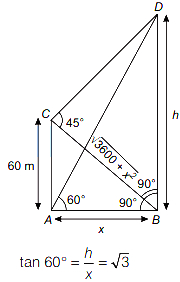
0 likesView Solution
47
MathematicsMediumMCQAP EAMCET · 2013
If $D(2, 1, 0)$,$E(2, 0, 0)$,and $F(0, 1, 0)$ are the mid-points of the sides $BC$,$CA$,and $AB$ of $\triangle ABC$,respectively,then the centroid of $\triangle ABC$ is:
A
$\left(\frac{1}{3}, \frac{1}{3}, \frac{1}{3}\right)$
B
$\left(\frac{4}{3}, \frac{2}{3}, 0\right)$
C
$\left(-\frac{1}{3}, \frac{1}{3}, \frac{1}{3}\right)$
D
$\left(\frac{2}{3}, \frac{1}{3}, \frac{1}{3}\right)$
Solution
(B) Let the vertices of $\triangle ABC$ be $A(x_1, y_1, z_1)$,$B(x_2, y_2, z_2)$,and $C(x_3, y_3, z_3)$.
Since $D(2, 1, 0)$ is the mid-point of $BC$,we have:
$\frac{x_2+x_3}{2} = 2 \implies x_2+x_3 = 4$
$\frac{y_2+y_3}{2} = 1 \implies y_2+y_3 = 2$
$\frac{z_2+z_3}{2} = 0 \implies z_2+z_3 = 0$
Since $E(2, 0, 0)$ is the mid-point of $AC$,we have:
$\frac{x_1+x_3}{2} = 2 \implies x_1+x_3 = 4$
$\frac{y_1+y_3}{2} = 0 \implies y_1+y_3 = 0$
$\frac{z_1+z_3}{2} = 0 \implies z_1+z_3 = 0$
Since $F(0, 1, 0)$ is the mid-point of $AB$,we have:
$\frac{x_1+x_2}{2} = 0 \implies x_1+x_2 = 0$
$\frac{y_1+y_2}{2} = 1 \implies y_1+y_2 = 2$
$\frac{z_1+z_2}{2} = 0 \implies z_1+z_2 = 0$
Adding these equations:
$2(x_1+x_2+x_3) = 4+4+0 = 8 \implies x_1+x_2+x_3 = 4$
$2(y_1+y_2+y_3) = 2+0+2 = 4 \implies y_1+y_2+y_3 = 2$
$2(z_1+z_2+z_3) = 0+0+0 = 0 \implies z_1+z_2+z_3 = 0$
The centroid of $\triangle ABC$ is given by $\left(\frac{x_1+x_2+x_3}{3}, \frac{y_1+y_2+y_3}{3}, \frac{z_1+z_2+z_3}{3}\right)$.
Substituting the sums,the centroid is $\left(\frac{4}{3}, \frac{2}{3}, 0\right)$.
Since $D(2, 1, 0)$ is the mid-point of $BC$,we have:
$\frac{x_2+x_3}{2} = 2 \implies x_2+x_3 = 4$
$\frac{y_2+y_3}{2} = 1 \implies y_2+y_3 = 2$
$\frac{z_2+z_3}{2} = 0 \implies z_2+z_3 = 0$
Since $E(2, 0, 0)$ is the mid-point of $AC$,we have:
$\frac{x_1+x_3}{2} = 2 \implies x_1+x_3 = 4$
$\frac{y_1+y_3}{2} = 0 \implies y_1+y_3 = 0$
$\frac{z_1+z_3}{2} = 0 \implies z_1+z_3 = 0$
Since $F(0, 1, 0)$ is the mid-point of $AB$,we have:
$\frac{x_1+x_2}{2} = 0 \implies x_1+x_2 = 0$
$\frac{y_1+y_2}{2} = 1 \implies y_1+y_2 = 2$
$\frac{z_1+z_2}{2} = 0 \implies z_1+z_2 = 0$
Adding these equations:
$2(x_1+x_2+x_3) = 4+4+0 = 8 \implies x_1+x_2+x_3 = 4$
$2(y_1+y_2+y_3) = 2+0+2 = 4 \implies y_1+y_2+y_3 = 2$
$2(z_1+z_2+z_3) = 0+0+0 = 0 \implies z_1+z_2+z_3 = 0$
The centroid of $\triangle ABC$ is given by $\left(\frac{x_1+x_2+x_3}{3}, \frac{y_1+y_2+y_3}{3}, \frac{z_1+z_2+z_3}{3}\right)$.
Substituting the sums,the centroid is $\left(\frac{4}{3}, \frac{2}{3}, 0\right)$.
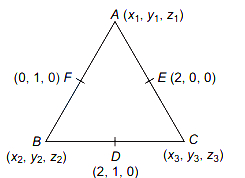
0 likesView Solution
48
MathematicsMediumMCQAP EAMCET · 2013
Two fair dice are rolled. The probability of the sum of digits on their faces being greater than or equal to $10$ is
A
$\frac{1}{5}$
B
$\frac{1}{4}$
C
$\frac{1}{8}$
D
$\frac{1}{6}$
Solution
(D) Total sample points,$n(S) = 6 \times 6 = 36$.
Favourable outcomes for the sum to be $\ge 10$ are:
$E = \{(4, 6), (5, 5), (5, 6), (6, 4), (6, 5), (6, 6)\}$.
Total number of favourable outcomes,$n(E) = 6$.
Required probability $P(E) = \frac{n(E)}{n(S)} = \frac{6}{36} = \frac{1}{6}$.
Favourable outcomes for the sum to be $\ge 10$ are:
$E = \{(4, 6), (5, 5), (5, 6), (6, 4), (6, 5), (6, 6)\}$.
Total number of favourable outcomes,$n(E) = 6$.
Required probability $P(E) = \frac{n(E)}{n(S)} = \frac{6}{36} = \frac{1}{6}$.
0 likesView Solution
49
MathematicsDifficultMCQAP EAMCET · 2013
Two numbers are chosen at random from $\{1, 2, 3, 4, 5, 6, 7, 8\}$ at a time. The probability that the smaller of the two numbers is less than $4$ is
A
$\frac{7}{14}$
B
$\frac{8}{14}$
C
$\frac{9}{14}$
D
$\frac{10}{14}$
Solution
(C) The total number of ways to choose $2$ numbers from $8$ is given by ${}^8C_2 = \frac{8 \times 7}{2} = 28$.
Let the two chosen numbers be $x$ and $y$ such that $x < y$. We want the probability that $x < 4$.
Case $I$: If $x = 1$,then $y$ can be any of the remaining $7$ numbers $(\{2, 3, 4, 5, 6, 7, 8\})$. Number of ways $= 7$.
Case $II$: If $x = 2$,then $y$ can be any of the remaining $6$ numbers $(\{3, 4, 5, 6, 7, 8\})$. Number of ways $= 6$.
Case $III$: If $x = 3$,then $y$ can be any of the remaining $5$ numbers $(\{4, 5, 6, 7, 8\})$. Number of ways $= 5$.
Total favourable cases $= 7 + 6 + 5 = 18$.
Therefore,the required probability $= \frac{18}{28} = \frac{9}{14}$.
Let the two chosen numbers be $x$ and $y$ such that $x < y$. We want the probability that $x < 4$.
Case $I$: If $x = 1$,then $y$ can be any of the remaining $7$ numbers $(\{2, 3, 4, 5, 6, 7, 8\})$. Number of ways $= 7$.
Case $II$: If $x = 2$,then $y$ can be any of the remaining $6$ numbers $(\{3, 4, 5, 6, 7, 8\})$. Number of ways $= 6$.
Case $III$: If $x = 3$,then $y$ can be any of the remaining $5$ numbers $(\{4, 5, 6, 7, 8\})$. Number of ways $= 5$.
Total favourable cases $= 7 + 6 + 5 = 18$.
Therefore,the required probability $= \frac{18}{28} = \frac{9}{14}$.
0 likesView Solution
50
MathematicsDifficultMCQAP EAMCET · 2013
The number of real values of $t$ such that the system of homogeneous equations
$\begin{aligned}
t x+(t+1) y+(t-1) z &=0 \\
(t+1) x+t y+(t+2) z &=0 \\
(t-1) x+(t+2) y+t z &=0
\end{aligned}$
has non-trivial solutions is
$\begin{aligned}
t x+(t+1) y+(t-1) z &=0 \\
(t+1) x+t y+(t+2) z &=0 \\
(t-1) x+(t+2) y+t z &=0
\end{aligned}$
has non-trivial solutions is
A
$3$
B
$2$
C
$1$
D
None of these
Solution
(C) For a system of homogeneous linear equations to have non-trivial solutions,the determinant of the coefficient matrix $A$ must be zero,i.e.,$|A| = 0$.
Given the matrix $A = \begin{bmatrix} t & t+1 & t-1 \\ t+1 & t & t+2 \\ t-1 & t+2 & t \end{bmatrix}$,we set $|A| = 0$.
$|A| = \begin{vmatrix} t & t+1 & t-1 \\ t+1 & t & t+2 \\ t-1 & t+2 & t \end{vmatrix} = 0$.
Applying row operations $R_2 \rightarrow R_2 - R_1$ and $R_3 \rightarrow R_3 - R_1$:
$|A| = \begin{vmatrix} t & t+1 & t-1 \\ 1 & -1 & 3 \\ -1 & 1 & 1 \end{vmatrix} = 0$.
Adding $R_2$ to $R_3$ $(R_3 \rightarrow R_3 + R_2)$:
$|A| = \begin{vmatrix} t & t+1 & t-1 \\ 1 & -1 & 3 \\ 0 & 0 & 4 \end{vmatrix} = 0$.
Expanding along the third row:
$4 \times \begin{vmatrix} t & t+1 \\ 1 & -1 \end{vmatrix} = 0$.
$4 \times (-t - (t+1)) = 0$.
$4 \times (-2t - 1) = 0$.
$-8t - 4 = 0 \implies t = -\frac{1}{2}$.
Since there is only one real value of $t$ $(t = -\frac{1}{2})$,the number of real values is $1$.
Given the matrix $A = \begin{bmatrix} t & t+1 & t-1 \\ t+1 & t & t+2 \\ t-1 & t+2 & t \end{bmatrix}$,we set $|A| = 0$.
$|A| = \begin{vmatrix} t & t+1 & t-1 \\ t+1 & t & t+2 \\ t-1 & t+2 & t \end{vmatrix} = 0$.
Applying row operations $R_2 \rightarrow R_2 - R_1$ and $R_3 \rightarrow R_3 - R_1$:
$|A| = \begin{vmatrix} t & t+1 & t-1 \\ 1 & -1 & 3 \\ -1 & 1 & 1 \end{vmatrix} = 0$.
Adding $R_2$ to $R_3$ $(R_3 \rightarrow R_3 + R_2)$:
$|A| = \begin{vmatrix} t & t+1 & t-1 \\ 1 & -1 & 3 \\ 0 & 0 & 4 \end{vmatrix} = 0$.
Expanding along the third row:
$4 \times \begin{vmatrix} t & t+1 \\ 1 & -1 \end{vmatrix} = 0$.
$4 \times (-t - (t+1)) = 0$.
$4 \times (-2t - 1) = 0$.
$-8t - 4 = 0 \implies t = -\frac{1}{2}$.
Since there is only one real value of $t$ $(t = -\frac{1}{2})$,the number of real values is $1$.
0 likesView Solution
51
MathematicsDifficultMCQAP EAMCET · 2013
If $u=\log \left(x^3+y^3+z^3-3 x y z\right)$,then $(x+y+z)(u_x+u_y+u_z)$ is equal to
A
$0$
B
$x-y+z$
C
$2$
D
$3$
Solution
(D) Given,$u=\log \left(x^3+y^3+z^3-3 x y z\right)$.
We know that $x^3+y^3+z^3-3 x y z = (x+y+z)(x^2+y^2+z^2-x y-y z-z x)$.
So,$u = \log(x+y+z) + \log(x^2+y^2+z^2-x y-y z-z x)$.
Now,calculate the partial derivatives:
$u_x = \frac{\partial u}{\partial x} = \frac{3x^2-3yz}{x^3+y^3+z^3-3xyz}$
$u_y = \frac{\partial u}{\partial y} = \frac{3y^2-3xz}{x^3+y^3+z^3-3xyz}$
$u_z = \frac{\partial u}{\partial z} = \frac{3z^2-3xy}{x^3+y^3+z^3-3xyz}$
Adding these,we get:
$u_x+u_y+u_z = \frac{3(x^2+y^2+z^2-xy-yz-zx)}{(x+y+z)(x^2+y^2+z^2-xy-yz-zx)}$
$u_x+u_y+u_z = \frac{3}{x+y+z}$
Therefore,$(x+y+z)(u_x+u_y+u_z) = 3$.
We know that $x^3+y^3+z^3-3 x y z = (x+y+z)(x^2+y^2+z^2-x y-y z-z x)$.
So,$u = \log(x+y+z) + \log(x^2+y^2+z^2-x y-y z-z x)$.
Now,calculate the partial derivatives:
$u_x = \frac{\partial u}{\partial x} = \frac{3x^2-3yz}{x^3+y^3+z^3-3xyz}$
$u_y = \frac{\partial u}{\partial y} = \frac{3y^2-3xz}{x^3+y^3+z^3-3xyz}$
$u_z = \frac{\partial u}{\partial z} = \frac{3z^2-3xy}{x^3+y^3+z^3-3xyz}$
Adding these,we get:
$u_x+u_y+u_z = \frac{3(x^2+y^2+z^2-xy-yz-zx)}{(x+y+z)(x^2+y^2+z^2-xy-yz-zx)}$
$u_x+u_y+u_z = \frac{3}{x+y+z}$
Therefore,$(x+y+z)(u_x+u_y+u_z) = 3$.
0 likesView Solution
52
MathematicsDifficultMCQAP EAMCET · 2013
If $\cos ^{-1}\left(\frac{y}{b}\right)=2 \log \left(\frac{x}{2}\right)$,where $x>0$,then $x^2 \frac{d^2 y}{d x^2}+x \frac{d y}{d x}$ is equal to
A
$4 y$
B
$-4 y$
C
$0$
D
$-8 y$
Solution
(B) Given: $\cos ^{-1}\left(\frac{y}{b}\right)=2 \log \left(\frac{x}{2}\right)$ for $x>0$.
Differentiating both sides with respect to $x$:
$-\frac{1}{\sqrt{1-\frac{y^2}{b^2}}} \cdot \frac{1}{b} \frac{d y}{d x} = 2 \cdot \frac{1}{\left(\frac{x}{2}\right)} \cdot \frac{1}{2}$
$-\frac{1}{\sqrt{b^2-y^2}} \cdot \frac{d y}{d x} = \frac{2}{x}$
$x \frac{d y}{d x} = -2 \sqrt{b^2-y^2} \quad \dots (i)$
Differentiating again with respect to $x$:
$x \frac{d^2 y}{d x^2} + \frac{d y}{d x} = -2 \cdot \frac{1}{2} (b^2-y^2)^{-1/2} (-2y) \frac{d y}{d x}$
$x \frac{d^2 y}{d x^2} + \frac{d y}{d x} = \frac{2y}{\sqrt{b^2-y^2}} \cdot \frac{d y}{d x}$
From equation $(i)$,we have $\sqrt{b^2-y^2} = -\frac{x}{2} \frac{d y}{d x}$. Substituting this:
$x \frac{d^2 y}{d x^2} + \frac{d y}{d x} = \frac{2y}{-\frac{x}{2} \frac{d y}{d x}} \cdot \frac{d y}{d x} = -\frac{4y}{x}$
Multiplying by $x$:
$x^2 \frac{d^2 y}{d x^2} + x \frac{d y}{d x} = -4y$.
Differentiating both sides with respect to $x$:
$-\frac{1}{\sqrt{1-\frac{y^2}{b^2}}} \cdot \frac{1}{b} \frac{d y}{d x} = 2 \cdot \frac{1}{\left(\frac{x}{2}\right)} \cdot \frac{1}{2}$
$-\frac{1}{\sqrt{b^2-y^2}} \cdot \frac{d y}{d x} = \frac{2}{x}$
$x \frac{d y}{d x} = -2 \sqrt{b^2-y^2} \quad \dots (i)$
Differentiating again with respect to $x$:
$x \frac{d^2 y}{d x^2} + \frac{d y}{d x} = -2 \cdot \frac{1}{2} (b^2-y^2)^{-1/2} (-2y) \frac{d y}{d x}$
$x \frac{d^2 y}{d x^2} + \frac{d y}{d x} = \frac{2y}{\sqrt{b^2-y^2}} \cdot \frac{d y}{d x}$
From equation $(i)$,we have $\sqrt{b^2-y^2} = -\frac{x}{2} \frac{d y}{d x}$. Substituting this:
$x \frac{d^2 y}{d x^2} + \frac{d y}{d x} = \frac{2y}{-\frac{x}{2} \frac{d y}{d x}} \cdot \frac{d y}{d x} = -\frac{4y}{x}$
Multiplying by $x$:
$x^2 \frac{d^2 y}{d x^2} + x \frac{d y}{d x} = -4y$.
0 likesView Solution
53
MathematicsDifficultMCQAP EAMCET · 2013
If the curves $x^2+p y^2=1$ and $q x^2+y^2=1$ are orthogonal to each other,then
A
$p-q=2$
B
$\frac{1}{p}-\frac{1}{q}=2$
C
$\frac{1}{p}+\frac{1}{q}=-2$
D
$\frac{1}{p}+\frac{1}{q}=2$
Solution
(D) Given curves are:
$x^2+p y^2=1$ $(i)$
$q x^2+y^2=1$ (ii)
Differentiating $(i)$ with respect to $x$:
$2x + 2py \frac{dy}{dx} = 0 \implies \frac{dy}{dx} = m_1 = -\frac{x}{py}$
Differentiating (ii) with respect to $x$:
$2qx + 2y \frac{dy}{dx} = 0 \implies \frac{dy}{dx} = m_2 = -\frac{qx}{y}$
Since the curves are orthogonal,$m_1 \cdot m_2 = -1$:
$(-\frac{x}{py}) \cdot (-\frac{qx}{y}) = -1$
$\frac{qx^2}{py^2} = -1 \implies qx^2 = -py^2$
From $(i)$,$x^2 = 1 - py^2$. Substituting this into the condition:
$q(1 - py^2) = -py^2$
$q - qpy^2 = -py^2$
$q = y^2(qp - p) \implies y^2 = \frac{q}{p(q-1)}$
Similarly,$x^2 = \frac{p(1-q)}{q-p}$. Substituting $x^2$ and $y^2$ into $q x^2 + y^2 = 1$:
$q(\frac{p(1-q)}{q-p}) + \frac{q}{p(q-1)} = 1$
After simplifying,we get $p+q = 2pq$,which implies $\frac{1}{p} + \frac{1}{q} = 2$.
$x^2+p y^2=1$ $(i)$
$q x^2+y^2=1$ (ii)
Differentiating $(i)$ with respect to $x$:
$2x + 2py \frac{dy}{dx} = 0 \implies \frac{dy}{dx} = m_1 = -\frac{x}{py}$
Differentiating (ii) with respect to $x$:
$2qx + 2y \frac{dy}{dx} = 0 \implies \frac{dy}{dx} = m_2 = -\frac{qx}{y}$
Since the curves are orthogonal,$m_1 \cdot m_2 = -1$:
$(-\frac{x}{py}) \cdot (-\frac{qx}{y}) = -1$
$\frac{qx^2}{py^2} = -1 \implies qx^2 = -py^2$
From $(i)$,$x^2 = 1 - py^2$. Substituting this into the condition:
$q(1 - py^2) = -py^2$
$q - qpy^2 = -py^2$
$q = y^2(qp - p) \implies y^2 = \frac{q}{p(q-1)}$
Similarly,$x^2 = \frac{p(1-q)}{q-p}$. Substituting $x^2$ and $y^2$ into $q x^2 + y^2 = 1$:
$q(\frac{p(1-q)}{q-p}) + \frac{q}{p(q-1)} = 1$
After simplifying,we get $p+q = 2pq$,which implies $\frac{1}{p} + \frac{1}{q} = 2$.
0 likesView Solution
54
MathematicsDifficultMCQAP EAMCET · 2013
If $\int \frac{x-\sin x}{1+\cos x} dx = x \tan \left(\frac{x}{2}\right) + p \log \left|\sec \left(\frac{x}{2}\right)\right| + C$,then $p$ is equal to
A
$-4$
B
$4$
C
$2$
D
$-2$
Solution
(A) Let $I = \int \frac{x-\sin x}{1+\cos x} dx$.
Using the identities $1+\cos x = 2\cos^2(\frac{x}{2})$ and $\sin x = 2\sin(\frac{x}{2})\cos(\frac{x}{2})$,we have:
$I = \int \frac{x}{2\cos^2(\frac{x}{2})} dx - \int \frac{2\sin(\frac{x}{2})\cos(\frac{x}{2})}{2\cos^2(\frac{x}{2})} dx$
$I = \frac{1}{2} \int x \sec^2(\frac{x}{2}) dx - \int \tan(\frac{x}{2}) dx$.
Applying integration by parts to the first term:
$\int x \sec^2(\frac{x}{2}) dx = x(2\tan(\frac{x}{2})) - \int 1 \cdot 2\tan(\frac{x}{2}) dx = 2x\tan(\frac{x}{2}) - 2 \int \tan(\frac{x}{2}) dx$.
Substituting this back into $I$:
$I = \frac{1}{2} [2x\tan(\frac{x}{2}) - 2 \int \tan(\frac{x}{2}) dx] - \int \tan(\frac{x}{2}) dx$
$I = x\tan(\frac{x}{2}) - \int \tan(\frac{x}{2}) dx - \int \tan(\frac{x}{2}) dx = x\tan(\frac{x}{2}) - 2 \int \tan(\frac{x}{2}) dx$.
Since $\int \tan(\frac{x}{2}) dx = 2 \log |\sec(\frac{x}{2})|$,we get:
$I = x\tan(\frac{x}{2}) - 2(2 \log |\sec(\frac{x}{2})|) + C = x\tan(\frac{x}{2}) - 4 \log |\sec(\frac{x}{2})| + C$.
Comparing this with the given expression $x \tan(\frac{x}{2}) + p \log |\sec(\frac{x}{2})| + C$,we find $p = -4$.
Using the identities $1+\cos x = 2\cos^2(\frac{x}{2})$ and $\sin x = 2\sin(\frac{x}{2})\cos(\frac{x}{2})$,we have:
$I = \int \frac{x}{2\cos^2(\frac{x}{2})} dx - \int \frac{2\sin(\frac{x}{2})\cos(\frac{x}{2})}{2\cos^2(\frac{x}{2})} dx$
$I = \frac{1}{2} \int x \sec^2(\frac{x}{2}) dx - \int \tan(\frac{x}{2}) dx$.
Applying integration by parts to the first term:
$\int x \sec^2(\frac{x}{2}) dx = x(2\tan(\frac{x}{2})) - \int 1 \cdot 2\tan(\frac{x}{2}) dx = 2x\tan(\frac{x}{2}) - 2 \int \tan(\frac{x}{2}) dx$.
Substituting this back into $I$:
$I = \frac{1}{2} [2x\tan(\frac{x}{2}) - 2 \int \tan(\frac{x}{2}) dx] - \int \tan(\frac{x}{2}) dx$
$I = x\tan(\frac{x}{2}) - \int \tan(\frac{x}{2}) dx - \int \tan(\frac{x}{2}) dx = x\tan(\frac{x}{2}) - 2 \int \tan(\frac{x}{2}) dx$.
Since $\int \tan(\frac{x}{2}) dx = 2 \log |\sec(\frac{x}{2})|$,we get:
$I = x\tan(\frac{x}{2}) - 2(2 \log |\sec(\frac{x}{2})|) + C = x\tan(\frac{x}{2}) - 4 \log |\sec(\frac{x}{2})| + C$.
Comparing this with the given expression $x \tan(\frac{x}{2}) + p \log |\sec(\frac{x}{2})| + C$,we find $p = -4$.
0 likesView Solution
55
MathematicsMediumMCQAP EAMCET · 2013
If $\int_0^b \frac{dx}{1+x^2} = \int_b^{\infty} \frac{dx}{1+x^2}$,then $b$ is equal to
A
$1/3$
B
$\frac{\sqrt{3}}{2}$
C
$\sqrt{2}$
D
$1$
Solution
(D) We have,$\int_0^b \frac{dx}{1+x^2} = \int_b^{\infty} \frac{dx}{1+x^2}$.
Integrating both sides,we get $[\tan^{-1} x]_0^b = [\tan^{-1} x]_b^{\infty}$.
Substituting the limits,$\tan^{-1}(b) - \tan^{-1}(0) = \tan^{-1}(\infty) - \tan^{-1}(b)$.
Since $\tan^{-1}(0) = 0$ and $\tan^{-1}(\infty) = \frac{\pi}{2}$,we have $\tan^{-1}(b) = \frac{\pi}{2} - \tan^{-1}(b)$.
Adding $\tan^{-1}(b)$ to both sides,we get $2 \tan^{-1}(b) = \frac{\pi}{2}$.
Therefore,$\tan^{-1}(b) = \frac{\pi}{4}$.
Taking tangent on both sides,$b = \tan(\frac{\pi}{4}) = 1$.
Integrating both sides,we get $[\tan^{-1} x]_0^b = [\tan^{-1} x]_b^{\infty}$.
Substituting the limits,$\tan^{-1}(b) - \tan^{-1}(0) = \tan^{-1}(\infty) - \tan^{-1}(b)$.
Since $\tan^{-1}(0) = 0$ and $\tan^{-1}(\infty) = \frac{\pi}{2}$,we have $\tan^{-1}(b) = \frac{\pi}{2} - \tan^{-1}(b)$.
Adding $\tan^{-1}(b)$ to both sides,we get $2 \tan^{-1}(b) = \frac{\pi}{2}$.
Therefore,$\tan^{-1}(b) = \frac{\pi}{4}$.
Taking tangent on both sides,$b = \tan(\frac{\pi}{4}) = 1$.
0 likesView Solution
56
MathematicsDifficultMCQAP EAMCET · 2013
The area (in square units) bounded by the curves $x = -2y^2$ and $x = 1 - 3y^2$ is
A
$2/3$
B
$1$
C
$4/3$
D
$5/3$
Solution
(C) Given curves are $x = -2y^2$ and $x = 1 - 3y^2$.
To find the intersection points,set the equations equal to each other:
$-2y^2 = 1 - 3y^2$
$y^2 = 1$
$y = \pm 1$
When $y = 1$,$x = -2(1)^2 = -2$. When $y = -1$,$x = -2(-1)^2 = -2$.
The intersection points are $(-2, 1)$ and $(-2, -1)$.
The area $A$ is given by the integral with respect to $y$ from $-1$ to $1$ of the right curve minus the left curve:
$A = \int_{-1}^{1} ((1 - 3y^2) - (-2y^2)) \, dy$
$A = \int_{-1}^{1} (1 - y^2) \, dy$
Since the function is even,$A = 2 \int_{0}^{1} (1 - y^2) \, dy$
$A = 2 [y - \frac{y^3}{3}]_{0}^{1}$
$A = 2 (1 - \frac{1}{3}) = 2 (\frac{2}{3}) = \frac{4}{3}$ square units.
To find the intersection points,set the equations equal to each other:
$-2y^2 = 1 - 3y^2$
$y^2 = 1$
$y = \pm 1$
When $y = 1$,$x = -2(1)^2 = -2$. When $y = -1$,$x = -2(-1)^2 = -2$.
The intersection points are $(-2, 1)$ and $(-2, -1)$.
The area $A$ is given by the integral with respect to $y$ from $-1$ to $1$ of the right curve minus the left curve:
$A = \int_{-1}^{1} ((1 - 3y^2) - (-2y^2)) \, dy$
$A = \int_{-1}^{1} (1 - y^2) \, dy$
Since the function is even,$A = 2 \int_{0}^{1} (1 - y^2) \, dy$
$A = 2 [y - \frac{y^3}{3}]_{0}^{1}$
$A = 2 (1 - \frac{1}{3}) = 2 (\frac{2}{3}) = \frac{4}{3}$ square units.
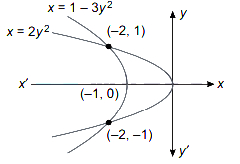
0 likesView Solution
57
MathematicsDifficultMCQAP EAMCET · 2013
An integrating factor of the equation $(1+y+x^2 y) dx+(x+x^3) dy=0$ is
A
$e^x$
B
$x^2$
C
$\frac{1}{x}$
D
$x$
Solution
(D) Given differential equation is: $(1+y+x^2 y) dx + (x+x^3) dy = 0$.
Rearranging the terms,we get: $(x+x^3) dy = -(1+y+x^2 y) dx$.
Dividing by $dx(x+x^3)$,we get: $\frac{dy}{dx} = -\frac{1+y(1+x^2)}{x(1+x^2)}$.
This simplifies to: $\frac{dy}{dx} = -\frac{1}{x(1+x^2)} - \frac{y(1+x^2)}{x(1+x^2)}$.
Thus,$\frac{dy}{dx} + \frac{y}{x} = -\frac{1}{x(1+x^2)}$.
This is a linear differential equation of the form $\frac{dy}{dx} + Py = Q$,where $P = \frac{1}{x}$ and $Q = -\frac{1}{x(1+x^2)}$.
The integrating factor $(IF)$ is given by $e^{\int P dx} = e^{\int \frac{1}{x} dx} = e^{\log x} = x$.
Wait,let us re-evaluate the rearrangement: $(1+y+x^2 y) dx + x(1+x^2) dy = 0$.
Dividing by $dx(1+x^2)$,we get $\frac{1+y(1+x^2)}{1+x^2} dx + x dy = 0$.
This is not standard. Let us rewrite as $\frac{dy}{dx} + \frac{y}{x} = -\frac{1}{x(1+x^2)}$.
Actually,the integrating factor is $e^{\int \frac{1}{x} dx} = e^{\ln x} = x$.
Re-checking the options,the correct integrating factor is $x$.
Rearranging the terms,we get: $(x+x^3) dy = -(1+y+x^2 y) dx$.
Dividing by $dx(x+x^3)$,we get: $\frac{dy}{dx} = -\frac{1+y(1+x^2)}{x(1+x^2)}$.
This simplifies to: $\frac{dy}{dx} = -\frac{1}{x(1+x^2)} - \frac{y(1+x^2)}{x(1+x^2)}$.
Thus,$\frac{dy}{dx} + \frac{y}{x} = -\frac{1}{x(1+x^2)}$.
This is a linear differential equation of the form $\frac{dy}{dx} + Py = Q$,where $P = \frac{1}{x}$ and $Q = -\frac{1}{x(1+x^2)}$.
The integrating factor $(IF)$ is given by $e^{\int P dx} = e^{\int \frac{1}{x} dx} = e^{\log x} = x$.
Wait,let us re-evaluate the rearrangement: $(1+y+x^2 y) dx + x(1+x^2) dy = 0$.
Dividing by $dx(1+x^2)$,we get $\frac{1+y(1+x^2)}{1+x^2} dx + x dy = 0$.
This is not standard. Let us rewrite as $\frac{dy}{dx} + \frac{y}{x} = -\frac{1}{x(1+x^2)}$.
Actually,the integrating factor is $e^{\int \frac{1}{x} dx} = e^{\ln x} = x$.
Re-checking the options,the correct integrating factor is $x$.
0 likesView Solution
58
MathematicsDifficultMCQAP EAMCET · 2013
The solution of the differential equation $\frac{dy}{dx} - 2y \tan 2x = e^x \sec 2x$ is
A
$y \sin 2x = e^x + C$
B
$y \cos 2x = e^x + C$
C
$y = e^x \cos 2x + C$
D
$y \cos 2x + e^x = C$
Solution
(B) The given differential equation is $\frac{dy}{dx} - 2y \tan 2x = e^x \sec 2x$.
This is a linear differential equation of the form $\frac{dy}{dx} + Py = Q$,where $P = -2 \tan 2x$ and $Q = e^x \sec 2x$.
First,we find the integrating factor $(IF)$:
$IF = e^{\int P dx} = e^{\int -2 \tan 2x dx} = e^{-\ln(\sec 2x)} = e^{\ln(\cos 2x)} = \cos 2x$.
The general solution is given by $y \cdot IF = \int (Q \cdot IF) dx + C$.
Substituting the values:
$y \cos 2x = \int (e^x \sec 2x \cdot \cos 2x) dx + C$.
Since $\sec 2x \cdot \cos 2x = 1$,we have:
$y \cos 2x = \int e^x dx + C$.
$y \cos 2x = e^x + C$,where $C$ is the constant of integration.
This is a linear differential equation of the form $\frac{dy}{dx} + Py = Q$,where $P = -2 \tan 2x$ and $Q = e^x \sec 2x$.
First,we find the integrating factor $(IF)$:
$IF = e^{\int P dx} = e^{\int -2 \tan 2x dx} = e^{-\ln(\sec 2x)} = e^{\ln(\cos 2x)} = \cos 2x$.
The general solution is given by $y \cdot IF = \int (Q \cdot IF) dx + C$.
Substituting the values:
$y \cos 2x = \int (e^x \sec 2x \cdot \cos 2x) dx + C$.
Since $\sec 2x \cdot \cos 2x = 1$,we have:
$y \cos 2x = \int e^x dx + C$.
$y \cos 2x = e^x + C$,where $C$ is the constant of integration.
0 likesView Solution
59
MathematicsMediumMCQAP EAMCET · 2013
If $a \neq 0, b \neq 0, c \neq 0, a \times b = 0$ and $b \times c = 0$,then $a \times c$ is equal to
A
$b$
B
$a$
C
$0$
D
$i + j + k$
Solution
(C) Given that $a \neq 0, b \neq 0, c \neq 0$ and $a \times b = 0, b \times c = 0$.
Since $a \times b = 0$,the vectors $a$ and $b$ are parallel to each other.
Since $b \times c = 0$,the vectors $b$ and $c$ are parallel to each other.
By the transitive property of parallel vectors,if $a$ is parallel to $b$ and $b$ is parallel to $c$,then $a$ must be parallel to $c$.
Therefore,the cross product of two parallel vectors is zero,so $a \times c = 0$.
Since $a \times b = 0$,the vectors $a$ and $b$ are parallel to each other.
Since $b \times c = 0$,the vectors $b$ and $c$ are parallel to each other.
By the transitive property of parallel vectors,if $a$ is parallel to $b$ and $b$ is parallel to $c$,then $a$ must be parallel to $c$.
Therefore,the cross product of two parallel vectors is zero,so $a \times c = 0$.
0 likesView Solution
60
MathematicsDifficultMCQAP EAMCET · 2013
If $a$ and $b$ are two non-zero perpendicular vectors,then a vector $y$ satisfying the equations $a \cdot y = c$ (where $c$ is a scalar) and $a \times y = b$ is
A
$|a|^2[c a - (a \times b)]$
B
$|a|^2[c a + (a \times b)]$
C
$\frac{1}{|a|^2}[c a - (a \times b)]$
D
$\frac{1}{|a|^2}[c a + (a \times b)]$
Solution
(C) Given $a \cdot y = c$ and $a \times y = b$. Since $a$ and $b$ are perpendicular,$a \cdot b = 0$.
Taking the cross product of $a$ with the second equation:
$a \times (a \times y) = a \times b$
Using the vector triple product identity $a \times (b \times c) = (a \cdot c)b - (a \cdot b)c$:
$(a \cdot y)a - (a \cdot a)y = a \times b$
Substitute $a \cdot y = c$ and $a \cdot a = |a|^2$:
$c a - |a|^2 y = a \times b$
Rearranging for $y$:
$|a|^2 y = c a - (a \times b)$
$y = \frac{1}{|a|^2} [c a - (a \times b)]$
Taking the cross product of $a$ with the second equation:
$a \times (a \times y) = a \times b$
Using the vector triple product identity $a \times (b \times c) = (a \cdot c)b - (a \cdot b)c$:
$(a \cdot y)a - (a \cdot a)y = a \times b$
Substitute $a \cdot y = c$ and $a \cdot a = |a|^2$:
$c a - |a|^2 y = a \times b$
Rearranging for $y$:
$|a|^2 y = c a - (a \times b)$
$y = \frac{1}{|a|^2} [c a - (a \times b)]$
0 likesView Solution
61
MathematicsDifficultMCQAP EAMCET · 2013
$P, Q, R$ and $S$ are four points with the position vectors $3i-4j+5k, 0i+0j+4k, -4i+5j+1k$ and $-3i+4j+3k$,respectively. Then,the line $PQ$ meets the line $RS$ at the point
A
$3i+4j+3k$
B
$-3i+4j+3k$
C
$-i+4j+k$
D
$i+j+k$
Solution
(B) Let the coordinates of the four points $P, Q, R$ and $S$ be $(3, -4, 5), (0, 0, 4), (-4, 5, 1)$ and $(-3, 4, 3)$ respectively.
The equation of line $PQ$ passing through $(3, -4, 5)$ and $(0, 0, 4)$ is given by:
$\frac{x-3}{0-3} = \frac{y+4}{0+4} = \frac{z-5}{4-5} = r_1$
$\Rightarrow \frac{x-3}{-3} = \frac{y+4}{4} = \frac{z-5}{-1} = r_1$
The equation of line $RS$ passing through $(-4, 5, 1)$ and $(-3, 4, 3)$ is given by:
$\frac{x+4}{-3+4} = \frac{y-5}{4-5} = \frac{z-1}{3-1} = r_2$
$\Rightarrow \frac{x+4}{1} = \frac{y-5}{-1} = \frac{z-1}{2} = r_2$
Let a general point on line $PQ$ be $(-3r_1+3, 4r_1-4, -r_1+5)$ and on line $RS$ be $(r_2-4, -r_2+5, 2r_2+1)$.
Since the lines intersect,we equate the coordinates:
$-3r_1+3 = r_2-4 \Rightarrow 3r_1+r_2 = 7$ (Eq. $i$)
$4r_1-4 = -r_2+5 \Rightarrow 4r_1+r_2 = 9$ (Eq. $ii$)
Subtracting Eq. $i$ from Eq. $ii$:
$(4r_1+r_2) - (3r_1+r_2) = 9 - 7 \Rightarrow r_1 = 2$
Substituting $r_1 = 2$ in Eq. $i$:
$3(2) + r_2 = 7 \Rightarrow r_2 = 1$
Substituting $r_2 = 1$ into the coordinates of line $RS$:
$x = 1-4 = -3, y = -1+5 = 4, z = 2(1)+1 = 3$
Thus,the point of intersection is $(-3, 4, 3)$,which corresponds to $-3i+4j+3k$.
The equation of line $PQ$ passing through $(3, -4, 5)$ and $(0, 0, 4)$ is given by:
$\frac{x-3}{0-3} = \frac{y+4}{0+4} = \frac{z-5}{4-5} = r_1$
$\Rightarrow \frac{x-3}{-3} = \frac{y+4}{4} = \frac{z-5}{-1} = r_1$
The equation of line $RS$ passing through $(-4, 5, 1)$ and $(-3, 4, 3)$ is given by:
$\frac{x+4}{-3+4} = \frac{y-5}{4-5} = \frac{z-1}{3-1} = r_2$
$\Rightarrow \frac{x+4}{1} = \frac{y-5}{-1} = \frac{z-1}{2} = r_2$
Let a general point on line $PQ$ be $(-3r_1+3, 4r_1-4, -r_1+5)$ and on line $RS$ be $(r_2-4, -r_2+5, 2r_2+1)$.
Since the lines intersect,we equate the coordinates:
$-3r_1+3 = r_2-4 \Rightarrow 3r_1+r_2 = 7$ (Eq. $i$)
$4r_1-4 = -r_2+5 \Rightarrow 4r_1+r_2 = 9$ (Eq. $ii$)
Subtracting Eq. $i$ from Eq. $ii$:
$(4r_1+r_2) - (3r_1+r_2) = 9 - 7 \Rightarrow r_1 = 2$
Substituting $r_1 = 2$ in Eq. $i$:
$3(2) + r_2 = 7 \Rightarrow r_2 = 1$
Substituting $r_2 = 1$ into the coordinates of line $RS$:
$x = 1-4 = -3, y = -1+5 = 4, z = 2(1)+1 = 3$
Thus,the point of intersection is $(-3, 4, 3)$,which corresponds to $-3i+4j+3k$.
0 likesView Solution
62
MathematicsEasyMCQAP EAMCET · 2013
The equation of a plane passing through $(-1, 2, 3)$ and whose normal makes equal angles with the coordinate axes is
A
$x+y+z+4=0$
B
$x-y+z+4=0$
C
$x+y+z-4=0$
D
$x+y+z=0$
Solution
(C) Let the normal vector to the plane be $\vec{n} = (a, b, c)$. Since the normal makes equal angles with the coordinate axes,the direction cosines are equal,i.e.,$\cos \alpha = \cos \beta = \cos \gamma$. This implies $a = b = c$.
Thus,the equation of the plane is of the form $x + y + z = d$.
Since the plane passes through the point $(-1, 2, 3)$,we substitute these coordinates into the equation:
$-1 + 2 + 3 = d
\Rightarrow d = 4$.
Substituting the value of $d$ back into the equation,we get:
$x + y + z = 4$
$x + y + z - 4 = 0$.
Thus,the equation of the plane is of the form $x + y + z = d$.
Since the plane passes through the point $(-1, 2, 3)$,we substitute these coordinates into the equation:
$-1 + 2 + 3 = d
\Rightarrow d = 4$.
Substituting the value of $d$ back into the equation,we get:
$x + y + z = 4$
$x + y + z - 4 = 0$.
0 likesView Solution
63
MathematicsDifficultMCQAP EAMCET · 2013
The shortest distance between the lines $r = 3i + 5j + 7k + \lambda(i + 2j + k)$ and $r = -i - j - k + \mu(7i - 6j + k)$ is
A
$\frac{16}{5 \sqrt{5}}$
B
$\frac{26}{5 \sqrt{5}}$
C
$\frac{36}{5 \sqrt{5}}$
D
$\frac{46}{5 \sqrt{5}}$
Solution
(D) The given lines are $r = a_1 + \lambda b_1$ and $r = a_2 + \mu b_2$,where $a_1 = 3i + 5j + 7k$,$b_1 = i + 2j + k$,$a_2 = -i - j - k$,and $b_2 = 7i - 6j + k$.
First,we calculate the cross product $b_1 \times b_2$:
$b_1 \times b_2 = \begin{vmatrix} i & j & k \\ 1 & 2 & 1 \\ 7 & -6 & 1 \end{vmatrix} = i(2 + 6) - j(1 - 7) + k(-6 - 14) = 8i + 6j - 20k$.
The magnitude is $|b_1 \times b_2| = \sqrt{8^2 + 6^2 + (-20)^2} = \sqrt{64 + 36 + 400} = \sqrt{500} = 10\sqrt{5}$.
Next,we find $a_2 - a_1 = (-i - j - k) - (3i + 5j + 7k) = -4i - 6j - 8k$.
The scalar triple product is $(a_2 - a_1) \cdot (b_1 \times b_2) = (-4i - 6j - 8k) \cdot (8i + 6j - 20k) = (-4)(8) + (-6)(6) + (-8)(-20) = -32 - 36 + 160 = 92$.
The shortest distance is given by $d = \frac{|(a_2 - a_1) \cdot (b_1 \times b_2)|}{|b_1 \times b_2|} = \frac{92}{10\sqrt{5}} = \frac{46}{5\sqrt{5}}$.
First,we calculate the cross product $b_1 \times b_2$:
$b_1 \times b_2 = \begin{vmatrix} i & j & k \\ 1 & 2 & 1 \\ 7 & -6 & 1 \end{vmatrix} = i(2 + 6) - j(1 - 7) + k(-6 - 14) = 8i + 6j - 20k$.
The magnitude is $|b_1 \times b_2| = \sqrt{8^2 + 6^2 + (-20)^2} = \sqrt{64 + 36 + 400} = \sqrt{500} = 10\sqrt{5}$.
Next,we find $a_2 - a_1 = (-i - j - k) - (3i + 5j + 7k) = -4i - 6j - 8k$.
The scalar triple product is $(a_2 - a_1) \cdot (b_1 \times b_2) = (-4i - 6j - 8k) \cdot (8i + 6j - 20k) = (-4)(8) + (-6)(6) + (-8)(-20) = -32 - 36 + 160 = 92$.
The shortest distance is given by $d = \frac{|(a_2 - a_1) \cdot (b_1 \times b_2)|}{|b_1 \times b_2|} = \frac{92}{10\sqrt{5}} = \frac{46}{5\sqrt{5}}$.
0 likesView Solution
64
MathematicsDifficultMCQAP EAMCET · 2013
If $X$ is a Poisson variate such that $P(X=1) = 2P(X=2)$,then $P(X=3)$ is equal to:
A
$\frac{e^{-1}}{6}$
B
$\frac{e^{-2}}{2}$
C
$\frac{e^{-1}}{2}$
D
$\frac{e^{-1}}{3}$
Solution
(A) For a Poisson distribution with parameter $\lambda$,the probability mass function is given by $P(X=x) = \frac{\lambda^x e^{-\lambda}}{x!}$.
Given $P(X=1) = 2P(X=2)$.
Substituting the formula:
$\frac{\lambda^1 e^{-\lambda}}{1!} = 2 \times \frac{\lambda^2 e^{-\lambda}}{2!}$
$\lambda e^{-\lambda} = 2 \times \frac{\lambda^2 e^{-\lambda}}{2}$
$\lambda e^{-\lambda} = \lambda^2 e^{-\lambda}$
Since $e^{-\lambda} \neq 0$,we divide both sides by $e^{-\lambda}$:
$\lambda = \lambda^2$
$\lambda^2 - \lambda = 0 \Rightarrow \lambda(\lambda - 1) = 0$.
Since $\lambda > 0$ for a Poisson distribution,we have $\lambda = 1$.
Now,we calculate $P(X=3)$:
$P(X=3) = \frac{\lambda^3 e^{-\lambda}}{3!} = \frac{1^3 e^{-1}}{3 \times 2 \times 1} = \frac{e^{-1}}{6}$.
Given $P(X=1) = 2P(X=2)$.
Substituting the formula:
$\frac{\lambda^1 e^{-\lambda}}{1!} = 2 \times \frac{\lambda^2 e^{-\lambda}}{2!}$
$\lambda e^{-\lambda} = 2 \times \frac{\lambda^2 e^{-\lambda}}{2}$
$\lambda e^{-\lambda} = \lambda^2 e^{-\lambda}$
Since $e^{-\lambda} \neq 0$,we divide both sides by $e^{-\lambda}$:
$\lambda = \lambda^2$
$\lambda^2 - \lambda = 0 \Rightarrow \lambda(\lambda - 1) = 0$.
Since $\lambda > 0$ for a Poisson distribution,we have $\lambda = 1$.
Now,we calculate $P(X=3)$:
$P(X=3) = \frac{\lambda^3 e^{-\lambda}}{3!} = \frac{1^3 e^{-1}}{3 \times 2 \times 1} = \frac{e^{-1}}{6}$.
0 likesView Solution
65
MathematicsDifficultMCQAP EAMCET · 2013
The random variable $X$ takes the values $1, 2, 3, \ldots, m$. If $P(X=n) = \frac{1}{m}$ for each $n$,then the variance of $X$ is
A
$\frac{(m+1)(2m+1)}{6}$
B
$\frac{m^2-1}{12}$
C
$\frac{m+1}{2}$
D
$\frac{m^2+1}{12}$
Solution
(B) The mean of $X$ is given by $\bar{X} = E(X) = \sum_{n=1}^{m} n \cdot P(X=n) = \sum_{n=1}^{m} n \cdot \frac{1}{m} = \frac{1}{m} \cdot \frac{m(m+1)}{2} = \frac{m+1}{2}$.
The variance of $X$ is given by $\text{Var}(X) = E(X^2) - [E(X)]^2$.
First,calculate $E(X^2) = \sum_{n=1}^{m} n^2 \cdot P(X=n) = \frac{1}{m} \sum_{n=1}^{m} n^2 = \frac{1}{m} \cdot \frac{m(m+1)(2m+1)}{6} = \frac{(m+1)(2m+1)}{6}$.
Now,$\text{Var}(X) = \frac{(m+1)(2m+1)}{6} - \left( \frac{m+1}{2} \right)^2 = \frac{(m+1)(2m+1)}{6} - \frac{(m+1)^2}{4}$.
Taking $\frac{m+1}{2}$ as a common factor: $\text{Var}(X) = \frac{m+1}{2} \left[ \frac{2m+1}{3} - \frac{m+1}{2} \right] = \frac{m+1}{2} \left[ \frac{4m+2 - 3m - 3}{6} \right] = \frac{m+1}{2} \cdot \frac{m-1}{6} = \frac{m^2-1}{12}$.
The variance of $X$ is given by $\text{Var}(X) = E(X^2) - [E(X)]^2$.
First,calculate $E(X^2) = \sum_{n=1}^{m} n^2 \cdot P(X=n) = \frac{1}{m} \sum_{n=1}^{m} n^2 = \frac{1}{m} \cdot \frac{m(m+1)(2m+1)}{6} = \frac{(m+1)(2m+1)}{6}$.
Now,$\text{Var}(X) = \frac{(m+1)(2m+1)}{6} - \left( \frac{m+1}{2} \right)^2 = \frac{(m+1)(2m+1)}{6} - \frac{(m+1)^2}{4}$.
Taking $\frac{m+1}{2}$ as a common factor: $\text{Var}(X) = \frac{m+1}{2} \left[ \frac{2m+1}{3} - \frac{m+1}{2} \right] = \frac{m+1}{2} \left[ \frac{4m+2 - 3m - 3}{6} \right] = \frac{m+1}{2} \cdot \frac{m-1}{6} = \frac{m^2-1}{12}$.
0 likesView Solution
66
MathematicsMediumMCQAP EAMCET · 2013
The area (in sq units) bounded by the curves $x = -2y^2$ and $x = 1 - 3y^2$ is
A
$2/3$
B
$1$
C
$4/3$
D
$5/3$
Solution
(C) Given curves are $x = -2y^2$ and $x = 1 - 3y^2$.
To find the intersection points,set the equations equal to each other:
$-2y^2 = 1 - 3y^2$
$y^2 = 1$
$y = \pm 1$
When $y = 1$,$x = -2(1)^2 = -2$. When $y = -1$,$x = -2(-1)^2 = -2$.
So,the intersection points are $(-2, 1)$ and $(-2, -1)$.
The required area is given by the integral with respect to $y$ from $-1$ to $1$:
$Area = \int_{-1}^{1} |(1 - 3y^2) - (-2y^2)| dy$
$Area = \int_{-1}^{1} |1 - y^2| dy$
Since the function is symmetric about the $x$-axis,we can write:
$Area = 2 \int_{0}^{1} (1 - y^2) dy$
$Area = 2 [y - \frac{y^3}{3}]_{0}^{1}$
$Area = 2 (1 - \frac{1}{3}) = 2 (\frac{2}{3}) = \frac{4}{3}$ sq units.
To find the intersection points,set the equations equal to each other:
$-2y^2 = 1 - 3y^2$
$y^2 = 1$
$y = \pm 1$
When $y = 1$,$x = -2(1)^2 = -2$. When $y = -1$,$x = -2(-1)^2 = -2$.
So,the intersection points are $(-2, 1)$ and $(-2, -1)$.
The required area is given by the integral with respect to $y$ from $-1$ to $1$:
$Area = \int_{-1}^{1} |(1 - 3y^2) - (-2y^2)| dy$
$Area = \int_{-1}^{1} |1 - y^2| dy$
Since the function is symmetric about the $x$-axis,we can write:
$Area = 2 \int_{0}^{1} (1 - y^2) dy$
$Area = 2 [y - \frac{y^3}{3}]_{0}^{1}$
$Area = 2 (1 - \frac{1}{3}) = 2 (\frac{2}{3}) = \frac{4}{3}$ sq units.
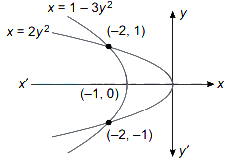
0 likesView Solution
67
MathematicsMediumMCQAP EAMCET · 2013
If $A = \begin{bmatrix} -8 & 5 \\ 2 & 4 \end{bmatrix}$ satisfies the equation $x^2 + 4x - p = 0$,then $p$ is equal to
A
$64$
B
$42$
C
$36$
D
$24$
Solution
(B) Given the matrix $A = \begin{bmatrix} -8 & 5 \\ 2 & 4 \end{bmatrix}$.
Since $A$ satisfies the equation $x^2 + 4x - p = 0$,we have $A^2 + 4A - pI = 0$,where $I$ is the identity matrix $\begin{bmatrix} 1 & 0 \\ 0 & 1 \end{bmatrix}$.
First,calculate $A^2$:
$A^2 = \begin{bmatrix} -8 & 5 \\ 2 & 4 \end{bmatrix} \begin{bmatrix} -8 & 5 \\ 2 & 4 \end{bmatrix} = \begin{bmatrix} (-8)(-8) + (5)(2) & (-8)(5) + (5)(4) \\ (2)(-8) + (4)(2) & (2)(5) + (4)(4) \end{bmatrix} = \begin{bmatrix} 64 + 10 & -40 + 20 \\ -16 + 8 & 10 + 16 \end{bmatrix} = \begin{bmatrix} 74 & -20 \\ -8 & 26 \end{bmatrix}$.
Next,calculate $4A$:
$4A = 4 \begin{bmatrix} -8 & 5 \\ 2 & 4 \end{bmatrix} = \begin{bmatrix} -32 & 20 \\ 8 & 16 \end{bmatrix}$.
Now,substitute these into the equation $A^2 + 4A - pI = 0$:
$\begin{bmatrix} 74 & -20 \\ -8 & 26 \end{bmatrix} + \begin{bmatrix} -32 & 20 \\ 8 & 16 \end{bmatrix} - \begin{bmatrix} p & 0 \\ 0 & p \end{bmatrix} = \begin{bmatrix} 0 & 0 \\ 0 & 0 \end{bmatrix}$.
Summing the matrices:
$\begin{bmatrix} 74 - 32 - p & -20 + 20 - 0 \\ -8 + 8 - 0 & 26 + 16 - p \end{bmatrix} = \begin{bmatrix} 0 & 0 \\ 0 & 0 \end{bmatrix}$.
$\begin{bmatrix} 42 - p & 0 \\ 0 & 42 - p \end{bmatrix} = \begin{bmatrix} 0 & 0 \\ 0 & 0 \end{bmatrix}$.
Comparing the elements,we get $42 - p = 0$,which implies $p = 42$.
Since $A$ satisfies the equation $x^2 + 4x - p = 0$,we have $A^2 + 4A - pI = 0$,where $I$ is the identity matrix $\begin{bmatrix} 1 & 0 \\ 0 & 1 \end{bmatrix}$.
First,calculate $A^2$:
$A^2 = \begin{bmatrix} -8 & 5 \\ 2 & 4 \end{bmatrix} \begin{bmatrix} -8 & 5 \\ 2 & 4 \end{bmatrix} = \begin{bmatrix} (-8)(-8) + (5)(2) & (-8)(5) + (5)(4) \\ (2)(-8) + (4)(2) & (2)(5) + (4)(4) \end{bmatrix} = \begin{bmatrix} 64 + 10 & -40 + 20 \\ -16 + 8 & 10 + 16 \end{bmatrix} = \begin{bmatrix} 74 & -20 \\ -8 & 26 \end{bmatrix}$.
Next,calculate $4A$:
$4A = 4 \begin{bmatrix} -8 & 5 \\ 2 & 4 \end{bmatrix} = \begin{bmatrix} -32 & 20 \\ 8 & 16 \end{bmatrix}$.
Now,substitute these into the equation $A^2 + 4A - pI = 0$:
$\begin{bmatrix} 74 & -20 \\ -8 & 26 \end{bmatrix} + \begin{bmatrix} -32 & 20 \\ 8 & 16 \end{bmatrix} - \begin{bmatrix} p & 0 \\ 0 & p \end{bmatrix} = \begin{bmatrix} 0 & 0 \\ 0 & 0 \end{bmatrix}$.
Summing the matrices:
$\begin{bmatrix} 74 - 32 - p & -20 + 20 - 0 \\ -8 + 8 - 0 & 26 + 16 - p \end{bmatrix} = \begin{bmatrix} 0 & 0 \\ 0 & 0 \end{bmatrix}$.
$\begin{bmatrix} 42 - p & 0 \\ 0 & 42 - p \end{bmatrix} = \begin{bmatrix} 0 & 0 \\ 0 & 0 \end{bmatrix}$.
Comparing the elements,we get $42 - p = 0$,which implies $p = 42$.
0 likesView Solution
68
MathematicsMediumMCQAP EAMCET · 2013
If $I$ is the identity matrix of order $2$ and $A = \begin{bmatrix} 1 & 1 \\ 0 & 1 \end{bmatrix}$,then for $n \geq 1$,mathematical induction gives:
A
$A^n = nA - (n-1)I$
B
$A^n = nA + (n-1)I$
C
$A^n = 2^n A - (n+1)I$
D
$A^n = 2^{n-1} A - (n-1)I$
Solution
(A) Given $A = \begin{bmatrix} 1 & 1 \\ 0 & 1 \end{bmatrix}$.
We calculate the powers of $A$:
$A^2 = \begin{bmatrix} 1 & 1 \\ 0 & 1 \end{bmatrix} \begin{bmatrix} 1 & 1 \\ 0 & 1 \end{bmatrix} = \begin{bmatrix} 1 & 2 \\ 0 & 1 \end{bmatrix}$
$A^3 = A^2 \cdot A = \begin{bmatrix} 1 & 2 \\ 0 & 1 \end{bmatrix} \begin{bmatrix} 1 & 1 \\ 0 & 1 \end{bmatrix} = \begin{bmatrix} 1 & 3 \\ 0 & 1 \end{bmatrix}$
By observation,we hypothesize that $A^n = \begin{bmatrix} 1 & n \\ 0 & 1 \end{bmatrix}$.
Now,evaluate the expression $nA - (n-1)I$:
$nA - (n-1)I = n \begin{bmatrix} 1 & 1 \\ 0 & 1 \end{bmatrix} - (n-1) \begin{bmatrix} 1 & 0 \\ 0 & 1 \end{bmatrix}$
$= \begin{bmatrix} n & n \\ 0 & n \end{bmatrix} - \begin{bmatrix} n-1 & 0 \\ 0 & n-1 \end{bmatrix}$
$= \begin{bmatrix} n - (n-1) & n - 0 \\ 0 - 0 & n - (n-1) \end{bmatrix} = \begin{bmatrix} 1 & n \\ 0 & 1 \end{bmatrix} = A^n$.
Thus,$A^n = nA - (n-1)I$ is correct.
We calculate the powers of $A$:
$A^2 = \begin{bmatrix} 1 & 1 \\ 0 & 1 \end{bmatrix} \begin{bmatrix} 1 & 1 \\ 0 & 1 \end{bmatrix} = \begin{bmatrix} 1 & 2 \\ 0 & 1 \end{bmatrix}$
$A^3 = A^2 \cdot A = \begin{bmatrix} 1 & 2 \\ 0 & 1 \end{bmatrix} \begin{bmatrix} 1 & 1 \\ 0 & 1 \end{bmatrix} = \begin{bmatrix} 1 & 3 \\ 0 & 1 \end{bmatrix}$
By observation,we hypothesize that $A^n = \begin{bmatrix} 1 & n \\ 0 & 1 \end{bmatrix}$.
Now,evaluate the expression $nA - (n-1)I$:
$nA - (n-1)I = n \begin{bmatrix} 1 & 1 \\ 0 & 1 \end{bmatrix} - (n-1) \begin{bmatrix} 1 & 0 \\ 0 & 1 \end{bmatrix}$
$= \begin{bmatrix} n & n \\ 0 & n \end{bmatrix} - \begin{bmatrix} n-1 & 0 \\ 0 & n-1 \end{bmatrix}$
$= \begin{bmatrix} n - (n-1) & n - 0 \\ 0 - 0 & n - (n-1) \end{bmatrix} = \begin{bmatrix} 1 & n \\ 0 & 1 \end{bmatrix} = A^n$.
Thus,$A^n = nA - (n-1)I$ is correct.
0 likesView Solution
69
MathematicsMediumMCQAP EAMCET · 2013
$\left|\begin{array}{ccc}x+2 & x+3 & x+5 \\ x+4 & x+6 & x+9 \\ x+8 & x+11 & x+15\end{array}\right|$ is equal to
A
$3x^2+4x+5$
B
$x^3+8x+2$
C
$0$
D
$-2$
Solution
(D) Let $\Delta = \left|\begin{array}{ccc}x+2 & x+3 & x+5 \\ x+4 & x+6 & x+9 \\ x+8 & x+11 & x+15\end{array}\right|$.
Apply operations $R_2 \rightarrow R_2 - R_1$ and $R_3 \rightarrow R_3 - R_1$,we get:
$\Delta = \left|\begin{array}{ccc}x+2 & x+3 & x+5 \\ 2 & 3 & 4 \\ 6 & 8 & 10\end{array}\right|$.
Apply operation $C_2 \rightarrow C_2 - C_1$ and $C_3 \rightarrow C_3 - C_1$,we get:
$\Delta = \left|\begin{array}{ccc}x+2 & 1 & 3 \\ 2 & 1 & 2 \\ 6 & 2 & 4\end{array}\right|$.
Expand along $R_1$:
$\Delta = (x+2)(4-4) - 1(8-12) + 3(4-6)$
$\Delta = (x+2)(0) - 1(-4) + 3(-2)$
$\Delta = 0 + 4 - 6 = -2$.
Apply operations $R_2 \rightarrow R_2 - R_1$ and $R_3 \rightarrow R_3 - R_1$,we get:
$\Delta = \left|\begin{array}{ccc}x+2 & x+3 & x+5 \\ 2 & 3 & 4 \\ 6 & 8 & 10\end{array}\right|$.
Apply operation $C_2 \rightarrow C_2 - C_1$ and $C_3 \rightarrow C_3 - C_1$,we get:
$\Delta = \left|\begin{array}{ccc}x+2 & 1 & 3 \\ 2 & 1 & 2 \\ 6 & 2 & 4\end{array}\right|$.
Expand along $R_1$:
$\Delta = (x+2)(4-4) - 1(8-12) + 3(4-6)$
$\Delta = (x+2)(0) - 1(-4) + 3(-2)$
$\Delta = 0 + 4 - 6 = -2$.
0 likesView Solution
70
MathematicsDifficultMCQAP EAMCET · 2013
The system of equations $3x + 2y + z = 6$,$3x + 4y + 3z = 14$ and $6x + 10y + 8z = a$ has an infinite number of solutions if $a$ is equal to
A
$8$
B
$12$
C
$24$
D
$36$
Solution
(D) The given system of equations is:
$3x + 2y + z = 6$
$3x + 4y + 3z = 14$
$6x + 10y + 8z = a$
Let $A = \begin{bmatrix} 3 & 2 & 1 \\ 3 & 4 & 3 \\ 6 & 10 & 8 \end{bmatrix}$ and $B = \begin{bmatrix} 6 \\ 14 \\ a \end{bmatrix}$.
First,we calculate the determinant of $A$:
$|A| = 3(32 - 30) - 2(24 - 18) + 1(30 - 24) = 3(2) - 2(6) + 6 = 6 - 12 + 6 = 0$.
Since $|A| = 0$,the system has either no solution or infinitely many solutions. For infinitely many solutions,we must have $(\text{adj } A) \cdot B = 0$.
The adjoint of $A$ is calculated as:
$\text{adj } A = \begin{bmatrix} 2 & -6 & 2 \\ -6 & 18 & -6 \\ 6 & -18 & 6 \end{bmatrix}$.
Now,compute $(\text{adj } A) \cdot B = 0$:
$\begin{bmatrix} 2 & -6 & 2 \\ -6 & 18 & -6 \\ 6 & -18 & 6 \end{bmatrix} \begin{bmatrix} 6 \\ 14 \\ a \end{bmatrix} = \begin{bmatrix} 12 - 84 + 2a \\ -36 + 252 - 6a \\ 36 - 252 + 6a \end{bmatrix} = \begin{bmatrix} 2a - 72 \\ 216 - 6a \\ 6a - 216 \end{bmatrix} = \begin{bmatrix} 0 \\ 0 \\ 0 \end{bmatrix}$.
From the first row,$2a - 72 = 0 \implies a = 36$.
Checking with other rows,$216 - 6(36) = 216 - 216 = 0$.
Thus,for $a = 36$,the system has infinitely many solutions.
$3x + 2y + z = 6$
$3x + 4y + 3z = 14$
$6x + 10y + 8z = a$
Let $A = \begin{bmatrix} 3 & 2 & 1 \\ 3 & 4 & 3 \\ 6 & 10 & 8 \end{bmatrix}$ and $B = \begin{bmatrix} 6 \\ 14 \\ a \end{bmatrix}$.
First,we calculate the determinant of $A$:
$|A| = 3(32 - 30) - 2(24 - 18) + 1(30 - 24) = 3(2) - 2(6) + 6 = 6 - 12 + 6 = 0$.
Since $|A| = 0$,the system has either no solution or infinitely many solutions. For infinitely many solutions,we must have $(\text{adj } A) \cdot B = 0$.
The adjoint of $A$ is calculated as:
$\text{adj } A = \begin{bmatrix} 2 & -6 & 2 \\ -6 & 18 & -6 \\ 6 & -18 & 6 \end{bmatrix}$.
Now,compute $(\text{adj } A) \cdot B = 0$:
$\begin{bmatrix} 2 & -6 & 2 \\ -6 & 18 & -6 \\ 6 & -18 & 6 \end{bmatrix} \begin{bmatrix} 6 \\ 14 \\ a \end{bmatrix} = \begin{bmatrix} 12 - 84 + 2a \\ -36 + 252 - 6a \\ 36 - 252 + 6a \end{bmatrix} = \begin{bmatrix} 2a - 72 \\ 216 - 6a \\ 6a - 216 \end{bmatrix} = \begin{bmatrix} 0 \\ 0 \\ 0 \end{bmatrix}$.
From the first row,$2a - 72 = 0 \implies a = 36$.
Checking with other rows,$216 - 6(36) = 216 - 216 = 0$.
Thus,for $a = 36$,the system has infinitely many solutions.
0 likesView Solution
71
MathematicsMediumMCQAP EAMCET · 2013
The number of real values of $t$ such that the system of homogeneous equations
$\begin{aligned}
t x+(t+1) y+(t-1) z &=0 \\
(t+1) x+t y+(t+2) z &=0 \\
(t-1) x+(t+2) y+t z &=0
\end{aligned}$
has non-trivial solutions is
$\begin{aligned}
t x+(t+1) y+(t-1) z &=0 \\
(t+1) x+t y+(t+2) z &=0 \\
(t-1) x+(t+2) y+t z &=0
\end{aligned}$
has non-trivial solutions is
A
$3$
B
$2$
C
$1$
D
$0$
Solution
(C) For a system of homogeneous linear equations to have non-trivial solutions,the determinant of the coefficient matrix $A$ must be zero,i.e.,$|A| = 0$.
Given the matrix $A = \begin{bmatrix} t & t+1 & t-1 \\ t+1 & t & t+2 \\ t-1 & t+2 & t \end{bmatrix}$.
We set the determinant $|A| = 0$:
$|A| = \begin{vmatrix} t & t+1 & t-1 \\ t+1 & t & t+2 \\ t-1 & t+2 & t \end{vmatrix} = 0$.
Applying row operations $R_2 \rightarrow R_2 - R_1$ and $R_3 \rightarrow R_3 - R_1$:
$|A| = \begin{vmatrix} t & t+1 & t-1 \\ 1 & -1 & 3 \\ -1 & 1 & 1 \end{vmatrix} = 0$.
Adding $R_2$ to $R_3$ $(R_3 \rightarrow R_3 + R_2)$:
$|A| = \begin{vmatrix} t & t+1 & t-1 \\ 1 & -1 & 3 \\ 0 & 0 & 4 \end{vmatrix} = 0$.
Expanding along the third row:
$4 \times \begin{vmatrix} t & t+1 \\ 1 & -1 \end{vmatrix} = 0$.
$4 \times (-t - (t+1)) = 0$.
$4 \times (-2t - 1) = 0$.
$-8t - 4 = 0 \Rightarrow t = -\frac{1}{2}$.
Since there is only one real value of $t$ $(t = -\frac{1}{2})$,the number of real values is $1$.
Given the matrix $A = \begin{bmatrix} t & t+1 & t-1 \\ t+1 & t & t+2 \\ t-1 & t+2 & t \end{bmatrix}$.
We set the determinant $|A| = 0$:
$|A| = \begin{vmatrix} t & t+1 & t-1 \\ t+1 & t & t+2 \\ t-1 & t+2 & t \end{vmatrix} = 0$.
Applying row operations $R_2 \rightarrow R_2 - R_1$ and $R_3 \rightarrow R_3 - R_1$:
$|A| = \begin{vmatrix} t & t+1 & t-1 \\ 1 & -1 & 3 \\ -1 & 1 & 1 \end{vmatrix} = 0$.
Adding $R_2$ to $R_3$ $(R_3 \rightarrow R_3 + R_2)$:
$|A| = \begin{vmatrix} t & t+1 & t-1 \\ 1 & -1 & 3 \\ 0 & 0 & 4 \end{vmatrix} = 0$.
Expanding along the third row:
$4 \times \begin{vmatrix} t & t+1 \\ 1 & -1 \end{vmatrix} = 0$.
$4 \times (-t - (t+1)) = 0$.
$4 \times (-2t - 1) = 0$.
$-8t - 4 = 0 \Rightarrow t = -\frac{1}{2}$.
Since there is only one real value of $t$ $(t = -\frac{1}{2})$,the number of real values is $1$.
0 likesView Solution
72
MathematicsEasyMCQAP EAMCET · 2013
If $\cos ^{-1}\left(\frac{5}{13}\right)+\cos ^{-1}\left(\frac{3}{5}\right)=\cos ^{-1} x$,then $x$ is equal to
A
$\frac{3}{65}$
B
$\frac{-36}{65}$
C
$\frac{-33}{65}$
D
$-1$
Solution
(C) We use the formula $\cos ^{-1} A + \cos ^{-1} B = \cos ^{-1} \left( AB - \sqrt{1-A^2} \sqrt{1-B^2} \right)$.
Given $\cos ^{-1}\left(\frac{5}{13}\right)+\cos ^{-1}\left(\frac{3}{5}\right)=\cos ^{-1} x$.
Here $A = \frac{5}{13}$ and $B = \frac{3}{5}$.
Then $\sqrt{1-A^2} = \sqrt{1-\left(\frac{5}{13}\right)^2} = \sqrt{1-\frac{25}{169}} = \sqrt{\frac{144}{169}} = \frac{12}{13}$.
And $\sqrt{1-B^2} = \sqrt{1-\left(\frac{3}{5}\right)^2} = \sqrt{1-\frac{9}{25}} = \sqrt{\frac{16}{25}} = \frac{4}{5}$.
Substituting these values into the formula:
$\cos ^{-1} x = \cos ^{-1} \left( \frac{5}{13} \cdot \frac{3}{5} - \frac{12}{13} \cdot \frac{4}{5} \right)$.
$\cos ^{-1} x = \cos ^{-1} \left( \frac{15}{65} - \frac{48}{65} \right)$.
$\cos ^{-1} x = \cos ^{-1} \left( \frac{15-48}{65} \right)$.
$\cos ^{-1} x = \cos ^{-1} \left( \frac{-33}{65} \right)$.
Therefore,$x = \frac{-33}{65}$.
Given $\cos ^{-1}\left(\frac{5}{13}\right)+\cos ^{-1}\left(\frac{3}{5}\right)=\cos ^{-1} x$.
Here $A = \frac{5}{13}$ and $B = \frac{3}{5}$.
Then $\sqrt{1-A^2} = \sqrt{1-\left(\frac{5}{13}\right)^2} = \sqrt{1-\frac{25}{169}} = \sqrt{\frac{144}{169}} = \frac{12}{13}$.
And $\sqrt{1-B^2} = \sqrt{1-\left(\frac{3}{5}\right)^2} = \sqrt{1-\frac{9}{25}} = \sqrt{\frac{16}{25}} = \frac{4}{5}$.
Substituting these values into the formula:
$\cos ^{-1} x = \cos ^{-1} \left( \frac{5}{13} \cdot \frac{3}{5} - \frac{12}{13} \cdot \frac{4}{5} \right)$.
$\cos ^{-1} x = \cos ^{-1} \left( \frac{15}{65} - \frac{48}{65} \right)$.
$\cos ^{-1} x = \cos ^{-1} \left( \frac{15-48}{65} \right)$.
$\cos ^{-1} x = \cos ^{-1} \left( \frac{-33}{65} \right)$.
Therefore,$x = \frac{-33}{65}$.
0 likesView Solution
73
MathematicsMediumMCQAP EAMCET · 2013
$\tanh ^{-1}\left(\frac{1}{2}\right)+\operatorname{coth}^{-1}(2)$ is equal to
A
$\frac{1}{2} \log 3$
B
$\frac{1}{2} \log 6$
C
$\frac{1}{2} \log 12$
D
$\log 3$
Solution
(D) We know that $\operatorname{coth}^{-1}(x) = \tanh^{-1}\left(\frac{1}{x}\right)$ for $|x| > 1$.
Therefore,$\operatorname{coth}^{-1}(2) = \tanh^{-1}\left(\frac{1}{2}\right)$.
Substituting this into the expression,we get:
$\tanh ^{-1}\left(\frac{1}{2}\right)+\operatorname{coth}^{-1}(2) = \tanh ^{-1}\left(\frac{1}{2}\right)+\tanh ^{-1}\left(\frac{1}{2}\right) = 2 \tanh ^{-1}\left(\frac{1}{2}\right)$.
Using the logarithmic form $\tanh^{-1}(x) = \frac{1}{2} \log \left(\frac{1+x}{1-x}\right)$,we have:
$2 \tanh^{-1}\left(\frac{1}{2}\right) = 2 \cdot \frac{1}{2} \log \left(\frac{1+\frac{1}{2}}{1-\frac{1}{2}}\right) = \log \left(\frac{\frac{3}{2}}{\frac{1}{2}}\right) = \log 3$.
Therefore,$\operatorname{coth}^{-1}(2) = \tanh^{-1}\left(\frac{1}{2}\right)$.
Substituting this into the expression,we get:
$\tanh ^{-1}\left(\frac{1}{2}\right)+\operatorname{coth}^{-1}(2) = \tanh ^{-1}\left(\frac{1}{2}\right)+\tanh ^{-1}\left(\frac{1}{2}\right) = 2 \tanh ^{-1}\left(\frac{1}{2}\right)$.
Using the logarithmic form $\tanh^{-1}(x) = \frac{1}{2} \log \left(\frac{1+x}{1-x}\right)$,we have:
$2 \tanh^{-1}\left(\frac{1}{2}\right) = 2 \cdot \frac{1}{2} \log \left(\frac{1+\frac{1}{2}}{1-\frac{1}{2}}\right) = \log \left(\frac{\frac{3}{2}}{\frac{1}{2}}\right) = \log 3$.
0 likesView Solution
74
MathematicsMediumMCQAP EAMCET · 2013
If $f(x) = (p - x^n)^{1/n}$,$p > 0$ and $n$ is a positive integer,then $f[f(x)]$ is equal to
A
$x$
B
$x^n$
C
$p^{1/n}$
D
$p - x^n$
Solution
(A) Given,$f(x) = (p - x^n)^{1/n}$,where $p > 0$.
To find $f[f(x)]$,we substitute $f(x)$ into the function $f$:
$f[f(x)] = f((p - x^n)^{1/n})$
$= (p - ((p - x^n)^{1/n})^n)^{1/n}$
$= (p - (p - x^n))^{1/n}$
$= (p - p + x^n)^{1/n}$
$= (x^n)^{1/n}$
$= x$.
To find $f[f(x)]$,we substitute $f(x)$ into the function $f$:
$f[f(x)] = f((p - x^n)^{1/n})$
$= (p - ((p - x^n)^{1/n})^n)^{1/n}$
$= (p - (p - x^n))^{1/n}$
$= (p - p + x^n)^{1/n}$
$= (x^n)^{1/n}$
$= x$.
0 likesView Solution
75
MathematicsMediumMCQAP EAMCET · 2013
Let $f$ be a non-zero real-valued continuous function satisfying $f(x+y) = f(x) \cdot f(y)$ for all $x, y \in R$. If $f(2) = 9$,then $f(6)$ is equal to
A
$3^2$
B
$3^6$
C
$3^4$
D
$3^3$
Solution
(B) Given $f(x+y) = f(x) \cdot f(y)$ for all $x, y \in R$.
This is a functional equation of the form $f(x) = a^x$.
Given $f(2) = 9$,we have $a^2 = 9$,which implies $a = 3$ (since $f$ is non-zero).
Thus,$f(x) = 3^x$.
Therefore,$f(6) = 3^6$.
This is a functional equation of the form $f(x) = a^x$.
Given $f(2) = 9$,we have $a^2 = 9$,which implies $a = 3$ (since $f$ is non-zero).
Thus,$f(x) = 3^x$.
Therefore,$f(6) = 3^6$.
0 likesView Solution
76
MathematicsEasyMCQAP EAMCET · 2013
If $f(x) = \frac{1}{1 + \frac{1}{x}}$ and $g(x) = \frac{1}{1 + \frac{1}{f(x)}}$,then $g^{\prime}(2)$ is equal to
A
$\frac{1}{5}$
B
$\frac{1}{25}$
C
$5$
D
$\frac{1}{16}$
Solution
(B) Given $f(x) = \frac{1}{1 + \frac{1}{x}} = \frac{x}{x + 1}$.
Now,$g(x) = \frac{1}{1 + \frac{1}{f(x)}} = \frac{1}{1 + \frac{x + 1}{x}} = \frac{1}{\frac{x + x + 1}{x}} = \frac{x}{2x + 1}$.
To find $g^{\prime}(x)$,we use the quotient rule $\left( \frac{u}{v} \right)^{\prime} = \frac{u^{\prime}v - uv^{\prime}}{v^2}$:
$g^{\prime}(x) = \frac{(1)(2x + 1) - (x)(2)}{(2x + 1)^2} = \frac{2x + 1 - 2x}{(2x + 1)^2} = \frac{1}{(2x + 1)^2}$.
Substituting $x = 2$:
$g^{\prime}(2) = \frac{1}{(2(2) + 1)^2} = \frac{1}{(5)^2} = \frac{1}{25}$.
Now,$g(x) = \frac{1}{1 + \frac{1}{f(x)}} = \frac{1}{1 + \frac{x + 1}{x}} = \frac{1}{\frac{x + x + 1}{x}} = \frac{x}{2x + 1}$.
To find $g^{\prime}(x)$,we use the quotient rule $\left( \frac{u}{v} \right)^{\prime} = \frac{u^{\prime}v - uv^{\prime}}{v^2}$:
$g^{\prime}(x) = \frac{(1)(2x + 1) - (x)(2)}{(2x + 1)^2} = \frac{2x + 1 - 2x}{(2x + 1)^2} = \frac{1}{(2x + 1)^2}$.
Substituting $x = 2$:
$g^{\prime}(2) = \frac{1}{(2(2) + 1)^2} = \frac{1}{(5)^2} = \frac{1}{25}$.
0 likesView Solution
77
MathematicsEasyMCQAP EAMCET · 2013
If $\sqrt{\frac{y}{x}}+\sqrt{\frac{x}{y}}=2$,then $\frac{dy}{dx}$ is equal to
A
$\frac{x^2+y^2}{x+y}$
B
$\frac{x^2-y^2}{x+y}$
C
$1$
D
$2$
Solution
(C) Given the equation: $\sqrt{\frac{y}{x}}+\sqrt{\frac{x}{y}}=2$
Multiplying both sides by $\sqrt{xy}$,we get: $y+x=2\sqrt{xy}$
Squaring both sides: $(x+y)^2 = (2\sqrt{xy})^2$
$x^2+y^2+2xy = 4xy$
$x^2+y^2-2xy = 0$
$(x-y)^2 = 0$
This implies $x-y=0$,or $y=x$
Differentiating both sides with respect to $x$: $\frac{dy}{dx} = \frac{d}{dx}(x) = 1$
Multiplying both sides by $\sqrt{xy}$,we get: $y+x=2\sqrt{xy}$
Squaring both sides: $(x+y)^2 = (2\sqrt{xy})^2$
$x^2+y^2+2xy = 4xy$
$x^2+y^2-2xy = 0$
$(x-y)^2 = 0$
This implies $x-y=0$,or $y=x$
Differentiating both sides with respect to $x$: $\frac{dy}{dx} = \frac{d}{dx}(x) = 1$
0 likesView Solution
78
MathematicsEasyMCQAP EAMCET · 2013
If $\frac{d}{d x}\left[(x+1)\left(x^2+1\right)\left(x^4+1\right)\left(x^8+1\right)\right] = \left(15 x^p-16 x^q+1\right)(x-1)^{-2}$,then $(p, q)$ is equal to
A
$(12, 11)$
B
$(15, 14)$
C
$(16, 14)$
D
$(16, 15)$
Solution
(D) Let $f(x) = (x+1)(x^2+1)(x^4+1)(x^8+1)$.
Multiply and divide by $(x-1)$:
$f(x) = \frac{(x-1)(x+1)(x^2+1)(x^4+1)(x^8+1)}{(x-1)} = \frac{(x^2-1)(x^2+1)(x^4+1)(x^8+1)}{(x-1)} = \frac{(x^4-1)(x^4+1)(x^8+1)}{(x-1)} = \frac{(x^8-1)(x^8+1)}{(x-1)} = \frac{x^{16}-1}{x-1}$.
Now,differentiate $f(x)$ with respect to $x$ using the quotient rule $\frac{d}{dx}\left(\frac{u}{v}\right) = \frac{u'v - uv'}{v^2}$:
$\frac{d}{dx}\left(\frac{x^{16}-1}{x-1}\right) = \frac{(16x^{15})(x-1) - (x^{16}-1)(1)}{(x-1)^2} = \frac{16x^{16} - 16x^{15} - x^{16} + 1}{(x-1)^2} = \frac{15x^{16} - 16x^{15} + 1}{(x-1)^2}$.
Comparing this with the given expression $\frac{15x^p - 16x^q + 1}{(x-1)^2}$,we get $p = 16$ and $q = 15$.
Thus,$(p, q) = (16, 15)$.
Multiply and divide by $(x-1)$:
$f(x) = \frac{(x-1)(x+1)(x^2+1)(x^4+1)(x^8+1)}{(x-1)} = \frac{(x^2-1)(x^2+1)(x^4+1)(x^8+1)}{(x-1)} = \frac{(x^4-1)(x^4+1)(x^8+1)}{(x-1)} = \frac{(x^8-1)(x^8+1)}{(x-1)} = \frac{x^{16}-1}{x-1}$.
Now,differentiate $f(x)$ with respect to $x$ using the quotient rule $\frac{d}{dx}\left(\frac{u}{v}\right) = \frac{u'v - uv'}{v^2}$:
$\frac{d}{dx}\left(\frac{x^{16}-1}{x-1}\right) = \frac{(16x^{15})(x-1) - (x^{16}-1)(1)}{(x-1)^2} = \frac{16x^{16} - 16x^{15} - x^{16} + 1}{(x-1)^2} = \frac{15x^{16} - 16x^{15} + 1}{(x-1)^2}$.
Comparing this with the given expression $\frac{15x^p - 16x^q + 1}{(x-1)^2}$,we get $p = 16$ and $q = 15$.
Thus,$(p, q) = (16, 15)$.
0 likesView Solution
79
MathematicsDifficultMCQAP EAMCET · 2013
The focal length of a mirror is given by $\frac{2}{f} = \frac{1}{v} - \frac{1}{u}$. In finding the values of $u$ and $v$,the errors are equal to $p$. Then,the relative error in $f$ is
A
$\frac{p}{2}\left(\frac{1}{u} + \frac{1}{v}\right)$
B
$p\left(\frac{1}{u} + \frac{1}{v}\right)$
C
$\frac{p}{2}\left(\frac{1}{u} - \frac{1}{v}\right)$
D
$p\left(\frac{1}{u} - \frac{1}{v}\right)$
Solution
(B) Given the equation: $\frac{2}{f} = \frac{1}{v} - \frac{1}{u}$ $(i)$
Taking the differential of both sides:
$-\frac{2}{f^2} df = -\frac{1}{v^2} dv + \frac{1}{u^2} du$
Given that the absolute errors in $u$ and $v$ are $p$,we have $du = p$ and $dv = p$.
Substituting these into the differential equation:
$-\frac{2}{f^2} df = -\frac{1}{v^2} p + \frac{1}{u^2} p$
$-\frac{2}{f^2} df = -p \left( \frac{1}{v^2} - \frac{1}{u^2} \right)$
Using the identity $a^2 - b^2 = (a - b)(a + b)$:
$-\frac{2}{f^2} df = -p \left( \frac{1}{v} - \frac{1}{u} \right) \left( \frac{1}{v} + \frac{1}{u} \right)$
Since $\frac{1}{v} - \frac{1}{u} = \frac{2}{f}$ from equation $(i)$:
$-\frac{2}{f^2} df = -p \left( \frac{2}{f} \right) \left( \frac{1}{v} + \frac{1}{u} \right)$
Dividing both sides by $-\frac{2}{f}$:
$\frac{df}{f} = p \left( \frac{1}{v} + \frac{1}{u} \right)$
Thus,the relative error in $f$ is $p \left( \frac{1}{u} + \frac{1}{v} \right)$.
Taking the differential of both sides:
$-\frac{2}{f^2} df = -\frac{1}{v^2} dv + \frac{1}{u^2} du$
Given that the absolute errors in $u$ and $v$ are $p$,we have $du = p$ and $dv = p$.
Substituting these into the differential equation:
$-\frac{2}{f^2} df = -\frac{1}{v^2} p + \frac{1}{u^2} p$
$-\frac{2}{f^2} df = -p \left( \frac{1}{v^2} - \frac{1}{u^2} \right)$
Using the identity $a^2 - b^2 = (a - b)(a + b)$:
$-\frac{2}{f^2} df = -p \left( \frac{1}{v} - \frac{1}{u} \right) \left( \frac{1}{v} + \frac{1}{u} \right)$
Since $\frac{1}{v} - \frac{1}{u} = \frac{2}{f}$ from equation $(i)$:
$-\frac{2}{f^2} df = -p \left( \frac{2}{f} \right) \left( \frac{1}{v} + \frac{1}{u} \right)$
Dividing both sides by $-\frac{2}{f}$:
$\frac{df}{f} = p \left( \frac{1}{v} + \frac{1}{u} \right)$
Thus,the relative error in $f$ is $p \left( \frac{1}{u} + \frac{1}{v} \right)$.
0 likesView Solution
80
MathematicsDifficultMCQAP EAMCET · 2013
The relation between pressure $p$ and volume $V$ is given by $p V^{1/4} = \text{constant}$. If the percentage decrease in volume is $\frac{1}{2} \%$,then the percentage increase in pressure is:
A
$\frac{1}{8} \%$
B
$\frac{1}{16} \%$
C
$\frac{1}{4} \%$
D
$\frac{1}{2} \%$
Solution
(A) Given the relation $p V^{1/4} = C$,where $C$ is a constant.
Taking the natural logarithm on both sides: $\ln p + \frac{1}{4} \ln V = \ln C$.
Differentiating both sides with respect to $V$: $\frac{dp}{p} + \frac{1}{4} \frac{dV}{V} = 0$.
This implies $\frac{dp}{p} = -\frac{1}{4} \frac{dV}{V}$.
Given that the percentage decrease in volume is $\frac{dV}{V} = -\frac{1}{2} \% = -0.5 \%$.
Substituting this into the equation: $\frac{dp}{p} = -\frac{1}{4} (-0.5 \%) = 0.125 \% = \frac{1}{8} \%$.
Thus,the percentage increase in pressure is $\frac{1}{8} \%$.
Taking the natural logarithm on both sides: $\ln p + \frac{1}{4} \ln V = \ln C$.
Differentiating both sides with respect to $V$: $\frac{dp}{p} + \frac{1}{4} \frac{dV}{V} = 0$.
This implies $\frac{dp}{p} = -\frac{1}{4} \frac{dV}{V}$.
Given that the percentage decrease in volume is $\frac{dV}{V} = -\frac{1}{2} \% = -0.5 \%$.
Substituting this into the equation: $\frac{dp}{p} = -\frac{1}{4} (-0.5 \%) = 0.125 \% = \frac{1}{8} \%$.
Thus,the percentage increase in pressure is $\frac{1}{8} \%$.
0 likesView Solution
81
MathematicsDifficultMCQAP EAMCET · 2013
If $\int \frac{dx}{x(\log x-2)(\log x-3)}=I+C$,then $I$ is equal to
A
$\frac{1}{x} \log \left|\frac{\log x-3}{\log x-2}\right|$
B
$\log \left|\frac{\log x-3}{\log x-2}\right|$
C
$\log \left|\frac{\log x-2}{\log x-3}\right|$
D
$\log |(\log x-3)(\log x-2)|$
Solution
(B) Let $I = \int \frac{dx}{x(\log x-2)(\log x-3)}$.
Substitute $t = \log x$,so $dt = \frac{dx}{x}$.
Then the integral becomes $I = \int \frac{dt}{(t-2)(t-3)}$.
Using partial fractions: $\frac{1}{(t-2)(t-3)} = \frac{A}{t-2} + \frac{B}{t-3}$.
$1 = A(t-3) + B(t-2)$.
For $t=2$,$A = -1$. For $t=3$,$B = 1$.
So,$I = \int \left( \frac{1}{t-3} - \frac{1}{t-2} \right) dt$.
$I = \log |t-3| - \log |t-2| + C$.
$I = \log \left| \frac{t-3}{t-2} \right| + C$.
Substituting $t = \log x$ back,we get $I = \log \left| \frac{\log x - 3}{\log x - 2} \right| + C$.
Substitute $t = \log x$,so $dt = \frac{dx}{x}$.
Then the integral becomes $I = \int \frac{dt}{(t-2)(t-3)}$.
Using partial fractions: $\frac{1}{(t-2)(t-3)} = \frac{A}{t-2} + \frac{B}{t-3}$.
$1 = A(t-3) + B(t-2)$.
For $t=2$,$A = -1$. For $t=3$,$B = 1$.
So,$I = \int \left( \frac{1}{t-3} - \frac{1}{t-2} \right) dt$.
$I = \log |t-3| - \log |t-2| + C$.
$I = \log \left| \frac{t-3}{t-2} \right| + C$.
Substituting $t = \log x$ back,we get $I = \log \left| \frac{\log x - 3}{\log x - 2} \right| + C$.
0 likesView Solution
82
MathematicsDifficultMCQAP EAMCET · 2013
$\int e^x \left( \frac{2+\sin 2x}{1+\cos 2x} \right) dx$ is equal to
A
$e^x \cot x + C$
B
$2 e^x \sec^2 x + C$
C
$e^x \cos 2x + C$
D
$e^x \tan x + C$
Solution
(D) Let $I = \int e^x \left( \frac{2+\sin 2x}{1+\cos 2x} \right) dx$.
Using the trigonometric identities $1+\cos 2x = 2\cos^2 x$ and $\sin 2x = 2\sin x \cos x$,we get:
$I = \int e^x \left( \frac{2 + 2\sin x \cos x}{2\cos^2 x} \right) dx$
$I = \int e^x \left( \frac{2}{2\cos^2 x} + \frac{2\sin x \cos x}{2\cos^2 x} \right) dx$
$I = \int e^x (\sec^2 x + \tan x) dx$.
We know that $\int e^x (f(x) + f'(x)) dx = e^x f(x) + C$.
Here,$f(x) = \tan x$ and $f'(x) = \sec^2 x$.
Therefore,$I = e^x \tan x + C$.
Using the trigonometric identities $1+\cos 2x = 2\cos^2 x$ and $\sin 2x = 2\sin x \cos x$,we get:
$I = \int e^x \left( \frac{2 + 2\sin x \cos x}{2\cos^2 x} \right) dx$
$I = \int e^x \left( \frac{2}{2\cos^2 x} + \frac{2\sin x \cos x}{2\cos^2 x} \right) dx$
$I = \int e^x (\sec^2 x + \tan x) dx$.
We know that $\int e^x (f(x) + f'(x)) dx = e^x f(x) + C$.
Here,$f(x) = \tan x$ and $f'(x) = \sec^2 x$.
Therefore,$I = e^x \tan x + C$.
0 likesView Solution
83
MathematicsEasyMCQAP EAMCET · 2013
If $\int_0^b \frac{dx}{1+x^2} = \int_b^{\infty} \frac{dx}{1+x^2}$,then $b$ is equal to
A
$\tan^{-1}\left(\frac{1}{3}\right)$
B
$\frac{\sqrt{3}}{2}$
C
$\sqrt{2}$
D
$1$
Solution
(D) Given that $\int_0^b \frac{dx}{1+x^2} = \int_b^{\infty} \frac{dx}{1+x^2}$.
We know that $\int \frac{dx}{1+x^2} = \tan^{-1}(x) + C$.
Applying the limits:
$[\tan^{-1}(x)]_0^b = [\tan^{-1}(x)]_b^{\infty}$
$\tan^{-1}(b) - \tan^{-1}(0) = \lim_{x \to \infty} \tan^{-1}(x) - \tan^{-1}(b)$
Since $\tan^{-1}(0) = 0$ and $\lim_{x \to \infty} \tan^{-1}(x) = \frac{\pi}{2}$,we have:
$\tan^{-1}(b) - 0 = \frac{\pi}{2} - \tan^{-1}(b)$
$2 \tan^{-1}(b) = \frac{\pi}{2}$
$\tan^{-1}(b) = \frac{\pi}{4}$
$b = \tan\left(\frac{\pi}{4}\right)$
$b = 1$.
We know that $\int \frac{dx}{1+x^2} = \tan^{-1}(x) + C$.
Applying the limits:
$[\tan^{-1}(x)]_0^b = [\tan^{-1}(x)]_b^{\infty}$
$\tan^{-1}(b) - \tan^{-1}(0) = \lim_{x \to \infty} \tan^{-1}(x) - \tan^{-1}(b)$
Since $\tan^{-1}(0) = 0$ and $\lim_{x \to \infty} \tan^{-1}(x) = \frac{\pi}{2}$,we have:
$\tan^{-1}(b) - 0 = \frac{\pi}{2} - \tan^{-1}(b)$
$2 \tan^{-1}(b) = \frac{\pi}{2}$
$\tan^{-1}(b) = \frac{\pi}{4}$
$b = \tan\left(\frac{\pi}{4}\right)$
$b = 1$.
0 likesView Solution
84
MathematicsDifficultMCQAP EAMCET · 2013
The approximate value of $\int_1^3 \frac{dx}{2+3x}$ using Simpson's rule and dividing the interval $[1,3]$ into two equal parts is
A
$\frac{1}{3} \log \left(\frac{11}{5}\right)$
B
$\frac{107}{110}$
C
$\frac{29}{110}$
D
$\frac{119}{440}$
Solution
(C) Let $f(x) = \frac{1}{2+3x}$. We divide the interval $[1,3]$ into $n=2$ equal parts.
$h = \frac{3-1}{2} = 1$.
The points are $x_0 = 1, x_1 = 2, x_2 = 3$.
$f(x_0) = f(1) = \frac{1}{2+3(1)} = \frac{1}{5} = 0.2$.
$f(x_1) = f(2) = \frac{1}{2+3(2)} = \frac{1}{8} = 0.125$.
$f(x_2) = f(3) = \frac{1}{2+3(3)} = \frac{1}{11} \approx 0.0909$.
Using Simpson's rule: $\int_a^b f(x) dx \approx \frac{h}{3} [f(x_0) + 4f(x_1) + f(x_2)]$.
$\int_1^3 f(x) dx \approx \frac{1}{3} [0.2 + 4(0.125) + 0.0909] = \frac{1}{3} [0.2 + 0.5 + 0.0909] = \frac{0.7909}{3} \approx 0.2636$.
Comparing with the options,$\frac{29}{110} \approx 0.2636$.
$h = \frac{3-1}{2} = 1$.
The points are $x_0 = 1, x_1 = 2, x_2 = 3$.
$f(x_0) = f(1) = \frac{1}{2+3(1)} = \frac{1}{5} = 0.2$.
$f(x_1) = f(2) = \frac{1}{2+3(2)} = \frac{1}{8} = 0.125$.
$f(x_2) = f(3) = \frac{1}{2+3(3)} = \frac{1}{11} \approx 0.0909$.
Using Simpson's rule: $\int_a^b f(x) dx \approx \frac{h}{3} [f(x_0) + 4f(x_1) + f(x_2)]$.
$\int_1^3 f(x) dx \approx \frac{1}{3} [0.2 + 4(0.125) + 0.0909] = \frac{1}{3} [0.2 + 0.5 + 0.0909] = \frac{0.7909}{3} \approx 0.2636$.
Comparing with the options,$\frac{29}{110} \approx 0.2636$.
0 likesView Solution
85
MathematicsEasyMCQAP EAMCET · 2013
The points whose position vectors are $2\hat{i}+3\hat{j}+4\hat{k}$,$3\hat{i}+4\hat{j}+2\hat{k}$,and $4\hat{i}+2\hat{j}+3\hat{k}$ are the vertices of
A
an isosceles triangle
B
a right-angled triangle
C
an equilateral triangle
D
a right-angled isosceles triangle
Solution
(C) Let the position vectors of the vertices be $\vec{a} = 2\hat{i}+3\hat{j}+4\hat{k}$,$\vec{b} = 3\hat{i}+4\hat{j}+2\hat{k}$,and $\vec{c} = 4\hat{i}+2\hat{j}+3\hat{k}$.
The side vectors are:
$\vec{AB} = \vec{b} - \vec{a} = (3-2)\hat{i} + (4-3)\hat{j} + (2-4)\hat{k} = \hat{i} + \hat{j} - 2\hat{k}$.
$\vec{BC} = \vec{c} - \vec{b} = (4-3)\hat{i} + (2-4)\hat{j} + (3-2)\hat{k} = \hat{i} - 2\hat{j} + \hat{k}$.
$\vec{CA} = \vec{a} - \vec{c} = (2-4)\hat{i} + (3-2)\hat{j} + (4-3)\hat{k} = -2\hat{i} + \hat{j} + \hat{k}$.
Calculating the lengths of the sides:
$|\vec{AB}| = \sqrt{1^2 + 1^2 + (-2)^2} = \sqrt{1+1+4} = \sqrt{6}$.
$|\vec{BC}| = \sqrt{1^2 + (-2)^2 + 1^2} = \sqrt{1+4+1} = \sqrt{6}$.
$|\vec{CA}| = \sqrt{(-2)^2 + 1^2 + 1^2} = \sqrt{4+1+1} = \sqrt{6}$.
Since $|\vec{AB}| = |\vec{BC}| = |\vec{CA}| = \sqrt{6}$,all three sides are equal in length.
Therefore,the triangle is an equilateral triangle.
The side vectors are:
$\vec{AB} = \vec{b} - \vec{a} = (3-2)\hat{i} + (4-3)\hat{j} + (2-4)\hat{k} = \hat{i} + \hat{j} - 2\hat{k}$.
$\vec{BC} = \vec{c} - \vec{b} = (4-3)\hat{i} + (2-4)\hat{j} + (3-2)\hat{k} = \hat{i} - 2\hat{j} + \hat{k}$.
$\vec{CA} = \vec{a} - \vec{c} = (2-4)\hat{i} + (3-2)\hat{j} + (4-3)\hat{k} = -2\hat{i} + \hat{j} + \hat{k}$.
Calculating the lengths of the sides:
$|\vec{AB}| = \sqrt{1^2 + 1^2 + (-2)^2} = \sqrt{1+1+4} = \sqrt{6}$.
$|\vec{BC}| = \sqrt{1^2 + (-2)^2 + 1^2} = \sqrt{1+4+1} = \sqrt{6}$.
$|\vec{CA}| = \sqrt{(-2)^2 + 1^2 + 1^2} = \sqrt{4+1+1} = \sqrt{6}$.
Since $|\vec{AB}| = |\vec{BC}| = |\vec{CA}| = \sqrt{6}$,all three sides are equal in length.
Therefore,the triangle is an equilateral triangle.
0 likesView Solution
86
MathematicsDifficultMCQAP EAMCET · 2013
The direction ratios of the two lines $AB$ and $AC$ are $1, -1, -1$ and $2, -1, 1$. The direction ratios of the normal to the plane $ABC$ are
A
$2, 3, -1$
B
$2, 2, 1$
C
$3, 2, -1$
D
$-1, 2, 3$
Solution
(A) Let the direction ratios of the lines $AB$ and $AC$ be $\vec{u} = \langle 1, -1, -1 \rangle$ and $\vec{v} = \langle 2, -1, 1 \rangle$ respectively.
Since the lines $AB$ and $AC$ lie in the plane $ABC$,their cross product $\vec{n} = \vec{u} \times \vec{v}$ will give the direction ratios of the normal to the plane.
$\vec{n} = \begin{vmatrix} \hat{i} & \hat{j} & \hat{k} \\ 1 & -1 & -1 \\ 2 & -1 & 1 \end{vmatrix}$
$= \hat{i}(-1 - 1) - \hat{j}(1 - (-2)) + \hat{k}(-1 - (-2))$
$= \hat{i}(-2) - \hat{j}(3) + \hat{k}(1)$
$= -2\hat{i} - 3\hat{j} + \hat{k}$
Thus,the direction ratios are $\langle -2, -3, 1 \rangle$.
Multiplying by $-1$,we get the equivalent direction ratios $\langle 2, 3, -1 \rangle$.
Therefore,the correct option is $A$.
Since the lines $AB$ and $AC$ lie in the plane $ABC$,their cross product $\vec{n} = \vec{u} \times \vec{v}$ will give the direction ratios of the normal to the plane.
$\vec{n} = \begin{vmatrix} \hat{i} & \hat{j} & \hat{k} \\ 1 & -1 & -1 \\ 2 & -1 & 1 \end{vmatrix}$
$= \hat{i}(-1 - 1) - \hat{j}(1 - (-2)) + \hat{k}(-1 - (-2))$
$= \hat{i}(-2) - \hat{j}(3) + \hat{k}(1)$
$= -2\hat{i} - 3\hat{j} + \hat{k}$
Thus,the direction ratios are $\langle -2, -3, 1 \rangle$.
Multiplying by $-1$,we get the equivalent direction ratios $\langle 2, 3, -1 \rangle$.
Therefore,the correct option is $A$.
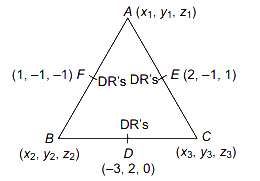
0 likesView Solution
87
MathematicsEasyMCQAP EAMCET · 2013
$A$ variable plane passes through a fixed point $P(1, 2, 3)$. The foot of the perpendicular from the origin $O(0, 0, 0)$ to the plane lies on:
A
a circle
B
a sphere
C
an ellipse
D
a parabola
Solution
(B) Let the equation of the variable plane be $a(x - 1) + b(y - 2) + c(z - 3) = 0$,where $a, b, c$ are the direction ratios of the normal to the plane.
Let $Q(x_1, y_1, z_1)$ be the foot of the perpendicular from the origin $O(0, 0, 0)$ to the plane.
Since $OQ$ is perpendicular to the plane,the direction ratios of $OQ$ are $(x_1, y_1, z_1)$,which must be proportional to $(a, b, c)$.
Thus,$a = kx_1, b = ky_1, c = kz_1$ for some constant $k$.
Substituting these into the plane equation: $x_1(x_1 - 1) + y_1(y_1 - 2) + z_1(z_1 - 3) = 0$.
This simplifies to $x_1^2 + y_1^2 + z_1^2 - x_1 - 2y_1 - 3z_1 = 0$.
This is the equation of a sphere with diameter $OP$,where $O$ is the origin and $P$ is the fixed point $(1, 2, 3)$.
Let $Q(x_1, y_1, z_1)$ be the foot of the perpendicular from the origin $O(0, 0, 0)$ to the plane.
Since $OQ$ is perpendicular to the plane,the direction ratios of $OQ$ are $(x_1, y_1, z_1)$,which must be proportional to $(a, b, c)$.
Thus,$a = kx_1, b = ky_1, c = kz_1$ for some constant $k$.
Substituting these into the plane equation: $x_1(x_1 - 1) + y_1(y_1 - 2) + z_1(z_1 - 3) = 0$.
This simplifies to $x_1^2 + y_1^2 + z_1^2 - x_1 - 2y_1 - 3z_1 = 0$.
This is the equation of a sphere with diameter $OP$,where $O$ is the origin and $P$ is the fixed point $(1, 2, 3)$.
0 likesView Solution
88
MathematicsMediumMCQAP EAMCET · 2013
$A$ plane passing through $(-1, 2, 3)$ and whose normal makes equal angles with the coordinate axes is
A
$x+y+z+4=0$
B
$x-y+z+4=0$
C
$x+y+z-4=0$
D
$x+y+z=0$
Solution
(C) The equation of a plane passing through the point $(x_0, y_0, z_0) = (-1, 2, 3)$ is given by $a(x - x_0) + b(y - y_0) + c(z - z_0) = 0$,where $\langle a, b, c \rangle$ are the direction ratios of the normal to the plane.
Substituting the point,we get $a(x + 1) + b(y - 2) + c(z - 3) = 0$.
Since the normal makes equal angles $\alpha$ with the coordinate axes,the direction cosines are $\cos \alpha, \cos \alpha, \cos \alpha$.
Thus,the direction ratios $a, b, c$ can be taken as $1, 1, 1$.
Substituting these into the equation of the plane:
$1(x + 1) + 1(y - 2) + 1(z - 3) = 0$
$x + 1 + y - 2 + z - 3 = 0$
$x + y + z - 4 = 0$.
Substituting the point,we get $a(x + 1) + b(y - 2) + c(z - 3) = 0$.
Since the normal makes equal angles $\alpha$ with the coordinate axes,the direction cosines are $\cos \alpha, \cos \alpha, \cos \alpha$.
Thus,the direction ratios $a, b, c$ can be taken as $1, 1, 1$.
Substituting these into the equation of the plane:
$1(x + 1) + 1(y - 2) + 1(z - 3) = 0$
$x + 1 + y - 2 + z - 3 = 0$
$x + y + z - 4 = 0$.
0 likesView Solution
89
MathematicsEasyMCQAP EAMCET · 2013
$A$ bag contains $2n+1$ coins. It is known that $n$ of these coins have a head on both sides,whereas the remaining $n+1$ coins are fair. $A$ coin is picked up at random from the bag and tossed. If the probability that the toss results in a head is $\frac{31}{42}$,then $n$ is equal to
A
$10$
B
$11$
C
$12$
D
$13$
Solution
(A) Total number of coins $= 2n+1$.
Number of two-headed coins $= n$.
Number of fair coins $= n+1$.
Let $H$ be the event that the toss results in a head.
The probability of picking a two-headed coin is $\frac{n}{2n+1}$,and for such a coin,$P(H) = 1$.
The probability of picking a fair coin is $\frac{n+1}{2n+1}$,and for such a coin,$P(H) = \frac{1}{2}$.
Using the law of total probability:
$P(H) = \left(\frac{n}{2n+1}\right) \times 1 + \left(\frac{n+1}{2n+1}\right) \times \frac{1}{2} = \frac{31}{42}$
$\frac{2n + n + 1}{2(2n+1)} = \frac{31}{42}$
$\frac{3n+1}{4n+2} = \frac{31}{42}$
$42(3n+1) = 31(4n+2)$
$126n + 42 = 124n + 62$
$2n = 20$
$n = 10$
Number of two-headed coins $= n$.
Number of fair coins $= n+1$.
Let $H$ be the event that the toss results in a head.
The probability of picking a two-headed coin is $\frac{n}{2n+1}$,and for such a coin,$P(H) = 1$.
The probability of picking a fair coin is $\frac{n+1}{2n+1}$,and for such a coin,$P(H) = \frac{1}{2}$.
Using the law of total probability:
$P(H) = \left(\frac{n}{2n+1}\right) \times 1 + \left(\frac{n+1}{2n+1}\right) \times \frac{1}{2} = \frac{31}{42}$
$\frac{2n + n + 1}{2(2n+1)} = \frac{31}{42}$
$\frac{3n+1}{4n+2} = \frac{31}{42}$
$42(3n+1) = 31(4n+2)$
$126n + 42 = 124n + 62$
$2n = 20$
$n = 10$
0 likesView Solution
Vedclass Products
For Students
Vedclass Test Series
Mock tests in real AP EAMCET style covering Mathematics with performance analysis. 5-day free trial.
Start Free TrialFor Teachers
Exam Paper Generator
Generate Set A/B/C/D Mathematics papers from 7.5L+ questions in 2 minutes. 3 chapters free.
Try FreeFor Institutes
Online Exam Module
Run live AP EAMCET mock exams with unlimited students, 360° analytics & white-label branding.
See DemoFrequently Asked Questions
How many Mathematics questions are in AP EAMCET 2013?
There are 89 Mathematics questions from the AP EAMCET 2013 paper on Vedclass, each with a detailed step-by-step solution in English.
Are AP EAMCET 2013 Mathematics solutions available in English?
Yes. All solutions on this page are in English. You can also switch to English or Hindi using the language buttons above the questions.
Can I practice AP EAMCET 2013 Mathematics as a timed test?
Yes. Use the Vedclass Test Series to attempt a full AP EAMCET mock test covering Mathematics with time limits and instant score analysis.
Can teachers create Mathematics papers from AP EAMCET previous year questions?
Yes. The Vedclass Exam Paper Generator lets teachers mix AP EAMCET Mathematics questions and generate Set A/B/C/D papers in minutes.
For Teachers & Institutes
Build a Custom Mathematics Paper
Pick AP EAMCET 2013 Mathematics questions, set difficulty, and generate Set A/B/C/D in 2 minutes.