
ChemistryQ101–150 of 204 questions
Page 3 of 4 · English
101
ChemistryMCQAP EAMCET · 2008
For a crystal,the angle of diffraction $(2 \theta)$ is $90^{\circ}$ and the second order line has a $d$ value of $2.28 \ \mathring{A}$. The wavelength (in $\mathring{A}$) of $X$-rays used for Bragg's diffraction is
A
$1.612$
B
$2.00$
C
$2.28$
D
$4.00$
Solution
(A) Given: Angle of diffraction $(2 \theta) = 90^{\circ}$,so $\theta = 45^{\circ}$.
Distance between two planes,$d = 2.28 \ \mathring{A}$.
Order of diffraction,$n = 2$.
Bragg's equation is given by $n \lambda = 2 d \sin \theta$.
Substituting the values: $2 \times \lambda = 2 \times 2.28 \times \sin 45^{\circ}$.
Since $\sin 45^{\circ} = \frac{1}{\sqrt{2}} \approx 0.707$,we have $2 \lambda = 2 \times 2.28 \times 0.707$.
$\lambda = 2.28 \times 0.707 = 1.612 \ \mathring{A}$.
Distance between two planes,$d = 2.28 \ \mathring{A}$.
Order of diffraction,$n = 2$.
Bragg's equation is given by $n \lambda = 2 d \sin \theta$.
Substituting the values: $2 \times \lambda = 2 \times 2.28 \times \sin 45^{\circ}$.
Since $\sin 45^{\circ} = \frac{1}{\sqrt{2}} \approx 0.707$,we have $2 \lambda = 2 \times 2.28 \times 0.707$.
$\lambda = 2.28 \times 0.707 = 1.612 \ \mathring{A}$.
0 likesView Solution
102
ChemistryMCQAP EAMCET · 2008
When $25 \ g$ of a non-volatile solute is dissolved in $100 \ g$ of water,the vapour pressure is lowered by $0.225 \ mm$. If the vapour pressure of water at $20^{\circ}C$ is $17.5 \ mm$,what is the molecular weight of the solute?
A
$206$
B
$302$
C
$350$
D
$276$
Solution
(C) Given:
Weight of non-volatile solute,$w = 25 \ g$
Weight of solvent,$W = 100 \ g$
Lowering of vapour pressure,$p^{\circ} - p_s = 0.225 \ mm$
Vapour pressure of pure solvent,$p^{\circ} = 17.5 \ mm$
Molar mass of solvent $(H_2O)$,$M = 18 \ g/mol$
Molar mass of solute,$m = ?$
According to Raoult's law for lowering of vapour pressure:
$\frac{p^{\circ} - p_s}{p^{\circ}} = \frac{w \times M}{m \times W}$
Substituting the values:
$\frac{0.225}{17.5} = \frac{25 \times 18}{m \times 100}$
$m = \frac{25 \times 18 \times 17.5}{0.225 \times 100}$
$m = \frac{25 \times 18 \times 17.5}{22.5}$
$m = 350 \ g/mol$
Weight of non-volatile solute,$w = 25 \ g$
Weight of solvent,$W = 100 \ g$
Lowering of vapour pressure,$p^{\circ} - p_s = 0.225 \ mm$
Vapour pressure of pure solvent,$p^{\circ} = 17.5 \ mm$
Molar mass of solvent $(H_2O)$,$M = 18 \ g/mol$
Molar mass of solute,$m = ?$
According to Raoult's law for lowering of vapour pressure:
$\frac{p^{\circ} - p_s}{p^{\circ}} = \frac{w \times M}{m \times W}$
Substituting the values:
$\frac{0.225}{17.5} = \frac{25 \times 18}{m \times 100}$
$m = \frac{25 \times 18 \times 17.5}{0.225 \times 100}$
$m = \frac{25 \times 18 \times 17.5}{22.5}$
$m = 350 \ g/mol$
0 likesView Solution
103
ChemistryMCQAP EAMCET · 2008
If $\bar{M}_w$ is the weight average molecular weight and $\bar{M}_n$ is the number average molecular weight of a polymer,the poly dispersity index $(PDI)$ of the polymer is given by
A
$\frac{\bar{M}_n}{\bar{M}_w}$
B
$\frac{\bar{M}_w}{\bar{M}_n}$
C
$\bar{M}_w \times \bar{M}_n$
D
$\frac{1}{\bar{M}_w \times \bar{M}_n}$
Solution
(B) The ratio of weight average molecular weight to the number average molecular weight is defined as the poly dispersity index $(PDI)$.
$PDI = \frac{\bar{M}_w}{\bar{M}_n}$
where,
$\bar{M}_w = \text{weight average molecular weight}$
$\bar{M}_n = \text{number average molecular weight}$
$PDI$ is unity $(1)$ for natural monodispersed polymers,whereas for synthetic polymers,it is always greater than unity.
$PDI = \frac{\bar{M}_w}{\bar{M}_n}$
where,
$\bar{M}_w = \text{weight average molecular weight}$
$\bar{M}_n = \text{number average molecular weight}$
$PDI$ is unity $(1)$ for natural monodispersed polymers,whereas for synthetic polymers,it is always greater than unity.
0 likesView Solution
104
ChemistryMediumMCQAP EAMCET · 2008
Match the following and select the correct option:
| List-$I$ | List-$II$ (At $STP$) |
| $(A)$ $10 \ g \ CaCO_3 \xrightarrow{\Delta} \text{decomposition}$ | $(i)$ $0.224 \ L \ CO_2$ |
| $(B)$ $1.06 \ g \ Na_2CO_3 \xrightarrow{\text{Excess } HCl}$ | $(ii)$ $4.48 \ L \ CO_2$ |
| $(C)$ $2.4 \ g \ C \xrightarrow{\text{Excess } O_2} \text{combustion}$ | $(iii)$ $0.448 \ L \ CO_2$ |
| $(D)$ $0.56 \ g \ CO \xrightarrow{\text{Excess } O_2} \text{combustion}$ | $(iv)$ $2.24 \ L \ CO_2$ |
| $(v)$ $22.4 \ L \ CO_2$ |
A
$A-iv, B-i, C-ii, D-iii$
B
$A-v, B-i, C-ii, D-iii$
C
$A-iv, B-i, C-iii, D-ii$
D
$A-i, B-iv, C-ii, D-iii$
Solution
(A) $CaCO_3 \xrightarrow{\Delta} CaO + CO_2$. $100 \ g \ CaCO_3$ gives $22.4 \ L \ CO_2$ at $STP$. So,$10 \ g \ CaCO_3$ gives $\frac{22.4 \times 10}{100} = 2.24 \ L \ CO_2$ $(iv)$.
$(B)$ $Na_2CO_3 + 2HCl \rightarrow 2NaCl + H_2O + CO_2$. $106 \ g \ Na_2CO_3$ gives $22.4 \ L \ CO_2$. So,$1.06 \ g \ Na_2CO_3$ gives $\frac{22.4 \times 1.06}{106} = 0.224 \ L \ CO_2$ $(i)$.
$(C)$ $C + O_2 \rightarrow CO_2$. $12 \ g \ C$ gives $22.4 \ L \ CO_2$. So,$2.4 \ g \ C$ gives $\frac{22.4 \times 2.4}{12} = 4.48 \ L \ CO_2$ $(ii)$.
$(D)$ $2CO + O_2 \rightarrow 2CO_2$. $56 \ g \ CO$ gives $2 \times 22.4 \ L \ CO_2 = 44.8 \ L \ CO_2$. So,$0.56 \ g \ CO$ gives $\frac{44.8 \times 0.56}{56} = 0.448 \ L \ CO_2$ $(iii)$.
Thus,the correct match is $A-iv, B-i, C-ii, D-iii$.
$(B)$ $Na_2CO_3 + 2HCl \rightarrow 2NaCl + H_2O + CO_2$. $106 \ g \ Na_2CO_3$ gives $22.4 \ L \ CO_2$. So,$1.06 \ g \ Na_2CO_3$ gives $\frac{22.4 \times 1.06}{106} = 0.224 \ L \ CO_2$ $(i)$.
$(C)$ $C + O_2 \rightarrow CO_2$. $12 \ g \ C$ gives $22.4 \ L \ CO_2$. So,$2.4 \ g \ C$ gives $\frac{22.4 \times 2.4}{12} = 4.48 \ L \ CO_2$ $(ii)$.
$(D)$ $2CO + O_2 \rightarrow 2CO_2$. $56 \ g \ CO$ gives $2 \times 22.4 \ L \ CO_2 = 44.8 \ L \ CO_2$. So,$0.56 \ g \ CO$ gives $\frac{44.8 \times 0.56}{56} = 0.448 \ L \ CO_2$ $(iii)$.
Thus,the correct match is $A-iv, B-i, C-ii, D-iii$.
0 likesView Solution
105
ChemistryEasyMCQAP EAMCET · 2008
What is the temperature at which the kinetic energy of $0.3 \ mol$ of helium is equal to the kinetic energy of $0.4 \ mol$ of argon at $400 \ K$ (in $K$)?
A
$400$
B
$873$
C
$533$
D
$300$
Solution
(C) The kinetic energy $(KE)$ of an ideal gas is given by the formula $KE = nRT$,where $n$ is the number of moles,$R$ is the universal gas constant,and $T$ is the temperature in Kelvin.
For helium: $n_1 = 0.3 \ mol$,$T_1 = T$.
$KE_{He} = 0.3 \times R \times T$.
For argon: $n_2 = 0.4 \ mol$,$T_2 = 400 \ K$.
$KE_{Ar} = 0.4 \times R \times 400$.
According to the problem,$KE_{He} = KE_{Ar}$.
$0.3 \times R \times T = 0.4 \times R \times 400$.
Dividing both sides by $R$:
$0.3 \times T = 160$.
$T = \frac{160}{0.3} = 533.33 \ K \approx 533 \ K$.
For helium: $n_1 = 0.3 \ mol$,$T_1 = T$.
$KE_{He} = 0.3 \times R \times T$.
For argon: $n_2 = 0.4 \ mol$,$T_2 = 400 \ K$.
$KE_{Ar} = 0.4 \times R \times 400$.
According to the problem,$KE_{He} = KE_{Ar}$.
$0.3 \times R \times T = 0.4 \times R \times 400$.
Dividing both sides by $R$:
$0.3 \times T = 160$.
$T = \frac{160}{0.3} = 533.33 \ K \approx 533 \ K$.
0 likesView Solution
106
ChemistryMCQAP EAMCET · 2008
An electronic transition in a hydrogen atom results in the formation of the $H_\alpha$ line of the hydrogen spectrum in the Lyman series. The energies associated with the electron in each of the orbits involved in the transition (in $kcal \ mol^{-1}$) are:
A
$-313.6, -34.84$
B
$-313.6, -78.4$
C
$-78.4, -34.84$
D
$-78.4, -19.6$
Solution
(B) The energy of an electron in the $n^{\text{th}}$ orbit is given by $E_n = -\frac{313.6 Z^2}{n^2} \ kcal \ mol^{-1}$.
For a hydrogen atom,$Z = 1$,so $E_n = -\frac{313.6}{n^2} \ kcal \ mol^{-1}$.
The Lyman series corresponds to transitions ending at $n_1 = 1$. The $H_\alpha$ line in the Lyman series corresponds to the transition from $n_2 = 2$ to $n_1 = 1$.
For $n_1 = 1$,$E_1 = -\frac{313.6 \times 1^2}{1^2} = -313.6 \ kcal \ mol^{-1}$.
For $n_2 = 2$,$E_2 = -\frac{313.6 \times 1^2}{2^2} = -\frac{313.6}{4} = -78.4 \ kcal \ mol^{-1}$.
Thus,the energies are $-313.6 \ kcal \ mol^{-1}$ and $-78.4 \ kcal \ mol^{-1}$.
For a hydrogen atom,$Z = 1$,so $E_n = -\frac{313.6}{n^2} \ kcal \ mol^{-1}$.
The Lyman series corresponds to transitions ending at $n_1 = 1$. The $H_\alpha$ line in the Lyman series corresponds to the transition from $n_2 = 2$ to $n_1 = 1$.
For $n_1 = 1$,$E_1 = -\frac{313.6 \times 1^2}{1^2} = -313.6 \ kcal \ mol^{-1}$.
For $n_2 = 2$,$E_2 = -\frac{313.6 \times 1^2}{2^2} = -\frac{313.6}{4} = -78.4 \ kcal \ mol^{-1}$.
Thus,the energies are $-313.6 \ kcal \ mol^{-1}$ and $-78.4 \ kcal \ mol^{-1}$.
0 likesView Solution
107
ChemistryMCQAP EAMCET · 2008
The velocities of two particles $A$ and $B$ are $0.05 \ ms^{-1}$ and $0.02 \ ms^{-1}$ respectively. The mass of $B$ is five times the mass of $A$. The ratio of their de-Broglie's wavelength is
A
$2: 1$
B
$1: 4$
C
$1: 1$
D
$4: 1$
Solution
(A) Given: Velocity of particle $A$ $(v_A)$ = $0.05 \ ms^{-1}$ and velocity of particle $B$ $(v_B)$ = $0.02 \ ms^{-1}$.
Let the mass of particle $A$ $(m_A)$ = $m$.
Then,the mass of particle $B$ $(m_B)$ = $5m$.
According to the de-Broglie equation,$\lambda = \frac{h}{mv}$.
For particle $A$: $\lambda_A = \frac{h}{m_A v_A} = \frac{h}{m \times 0.05}$.
For particle $B$: $\lambda_B = \frac{h}{m_B v_B} = \frac{h}{5m \times 0.02}$.
Taking the ratio $\frac{\lambda_A}{\lambda_B} = \frac{h}{m \times 0.05} \times \frac{5m \times 0.02}{h}$.
$\frac{\lambda_A}{\lambda_B} = \frac{5 \times 0.02}{0.05} = \frac{0.1}{0.05} = \frac{2}{1}$.
Thus,the ratio is $2: 1$.
Let the mass of particle $A$ $(m_A)$ = $m$.
Then,the mass of particle $B$ $(m_B)$ = $5m$.
According to the de-Broglie equation,$\lambda = \frac{h}{mv}$.
For particle $A$: $\lambda_A = \frac{h}{m_A v_A} = \frac{h}{m \times 0.05}$.
For particle $B$: $\lambda_B = \frac{h}{m_B v_B} = \frac{h}{5m \times 0.02}$.
Taking the ratio $\frac{\lambda_A}{\lambda_B} = \frac{h}{m \times 0.05} \times \frac{5m \times 0.02}{h}$.
$\frac{\lambda_A}{\lambda_B} = \frac{5 \times 0.02}{0.05} = \frac{0.1}{0.05} = \frac{2}{1}$.
Thus,the ratio is $2: 1$.
0 likesView Solution
108
ChemistryMCQAP EAMCET · 2008
Which one of the following graphs represents the Freundlich adsorption isotherm?
A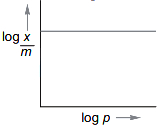
B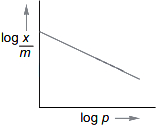
C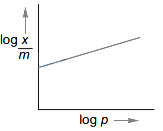
D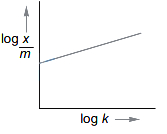
Solution
(C) The Freundlich adsorption isotherm is given by the equation: $\frac{x}{m} = k p^{1/n}$.
Taking the logarithm on both sides,we get: $\log \left( \frac{x}{m} \right) = \log k + \frac{1}{n} \log p$.
This equation is of the form $y = mx + c$,where $y = \log (x/m)$,$x = \log p$,slope $m = 1/n$,and intercept $c = \log k$.
Therefore,a plot of $\log (x/m)$ versus $\log p$ yields a straight line with a positive slope of $1/n$ and an intercept of $\log k$ on the $y$-axis.
Taking the logarithm on both sides,we get: $\log \left( \frac{x}{m} \right) = \log k + \frac{1}{n} \log p$.
This equation is of the form $y = mx + c$,where $y = \log (x/m)$,$x = \log p$,slope $m = 1/n$,and intercept $c = \log k$.
Therefore,a plot of $\log (x/m)$ versus $\log p$ yields a straight line with a positive slope of $1/n$ and an intercept of $\log k$ on the $y$-axis.
0 likesView Solution
109
ChemistryMCQAP EAMCET · 2008
One junction of a certain thermoelectric couple is at a fixed temperature $T_r$ and the other junction is at temperature $T$. The thermo-electromotive force for this is expressed by $E=k(T-T_r)[T_0-\frac{1}{2}(T+T_r)]$. At temperature $T=\frac{1}{2} T_0$,the thermoelectric power is
A
$\frac{1}{2} k T_0$
B
$k T_0$
C
$\frac{1}{2} k T_0^2$
D
$\frac{1}{2} k(T_0-T_r)^2$
Solution
(A) Thermoelectric power $S$ is defined as the rate of change of thermo-electromotive force $E$ with respect to temperature $T$,i.e.,$S = \frac{dE}{dT}$.
Given the expression for $E$ is $E = k(T - T_r)[T_0 - \frac{1}{2}(T + T_r)]$.
Expanding the expression: $E = k[T_0 T - T_0 T_r - \frac{1}{2}T^2 - \frac{1}{2}T T_r + \frac{1}{2}T T_r + \frac{1}{2}T_r^2] = k[T_0 T - T_0 T_r - \frac{1}{2}T^2 + \frac{1}{2}T_r^2]$.
Differentiating $E$ with respect to $T$: $\frac{dE}{dT} = k[T_0 - T]$.
Substituting the given temperature $T = \frac{1}{2} T_0$ into the expression for $S$:
$S = k[T_0 - \frac{1}{2} T_0] = k[\frac{1}{2} T_0] = \frac{1}{2} k T_0$.
Given the expression for $E$ is $E = k(T - T_r)[T_0 - \frac{1}{2}(T + T_r)]$.
Expanding the expression: $E = k[T_0 T - T_0 T_r - \frac{1}{2}T^2 - \frac{1}{2}T T_r + \frac{1}{2}T T_r + \frac{1}{2}T_r^2] = k[T_0 T - T_0 T_r - \frac{1}{2}T^2 + \frac{1}{2}T_r^2]$.
Differentiating $E$ with respect to $T$: $\frac{dE}{dT} = k[T_0 - T]$.
Substituting the given temperature $T = \frac{1}{2} T_0$ into the expression for $S$:
$S = k[T_0 - \frac{1}{2} T_0] = k[\frac{1}{2} T_0] = \frac{1}{2} k T_0$.
0 likesView Solution
110
ChemistryMCQAP EAMCET · 2008
Two slabs $A$ and $B$ of equal surface area are placed one over the other such that their surfaces are completely in contact. The thickness of slab $A$ is twice that of $B$. The coefficient of thermal conductivity of slab $A$ is twice that of $B$. The first surface of slab $A$ is maintained at $100^{\circ} C$,while the second surface of slab $B$ is maintained at $25^{\circ} C$. The temperature at the contact of their surfaces is (in $^{\circ} C$)
A
$62.5$
B
$45$
C
$55$
D
$85$
Solution
(A) Let the thickness of slab $B$ be $d$ and its thermal conductivity be $K$. Then,for slab $A$,the thickness is $2d$ and thermal conductivity is $2K$.
Let the temperature at the contact surface be $T$.
Since the slabs are in series,the rate of heat flow $H$ through both slabs must be equal:
$H = \frac{K_A A (T_1 - T)}{d_A} = \frac{K_B A (T - T_2)}{d_B}$
Substituting the given values:
$\frac{2K \cdot A (100 - T)}{2d} = \frac{K \cdot A (T - 25)}{d}$
$100 - T = T - 25$
$2T = 125$
$T = 62.5^{\circ} C$
Let the temperature at the contact surface be $T$.
Since the slabs are in series,the rate of heat flow $H$ through both slabs must be equal:
$H = \frac{K_A A (T_1 - T)}{d_A} = \frac{K_B A (T - T_2)}{d_B}$
Substituting the given values:
$\frac{2K \cdot A (100 - T)}{2d} = \frac{K \cdot A (T - 25)}{d}$
$100 - T = T - 25$
$2T = 125$
$T = 62.5^{\circ} C$
0 likesView Solution
111
ChemistryMCQAP EAMCET · 2008
Which of the following is true in the case of an adiabatic process,where $\gamma = C_p / C_V$?
A
$p^{1-\gamma} T^\gamma = \text{constant}$
B
$p^\gamma T^{1-\gamma} = \text{constant}$
C
$p T^\gamma = \text{constant}$
D
$p^\gamma T = \text{constant}$
Solution
(A) For an adiabatic process,the equation of state is given by $p V^\gamma = \text{constant}$.
Using the ideal gas law $pV = nRT$,we can substitute $V = nRT/p$ into the adiabatic equation:
$p(nRT/p)^\gamma = \text{constant}$
$p \cdot p^{-\gamma} \cdot T^\gamma = \text{constant}$
$p^{1-\gamma} T^\gamma = \text{constant}$.
Thus,option $A$ is correct.
Using the ideal gas law $pV = nRT$,we can substitute $V = nRT/p$ into the adiabatic equation:
$p(nRT/p)^\gamma = \text{constant}$
$p \cdot p^{-\gamma} \cdot T^\gamma = \text{constant}$
$p^{1-\gamma} T^\gamma = \text{constant}$.
Thus,option $A$ is correct.
0 likesView Solution
112
ChemistryMCQAP EAMCET · 2008
In adiabatic compression,the decrease in volume is associated with
A
increase in temperature and decrease in pressure
B
decrease in temperature and increase in pressure
C
decrease in temperature and decrease in pressure
D
increase in temperature and increase in pressure
Solution
(D) For an adiabatic process,the relation between pressure and volume is given by $PV^{\gamma} = \text{constant}$.
When the volume $V$ decreases during compression,the pressure $P$ must increase to keep the product constant.
According to the first law of thermodynamics for an adiabatic process,$dQ = dU + dW = 0$,which implies $dU = -dW$.
In compression,work is done on the gas,so $dW < 0$,which means $dU > 0$.
Since the internal energy $U$ is directly proportional to the temperature $T$ for an ideal gas,an increase in internal energy results in an increase in temperature.
Therefore,adiabatic compression leads to an increase in both temperature and pressure.
When the volume $V$ decreases during compression,the pressure $P$ must increase to keep the product constant.
According to the first law of thermodynamics for an adiabatic process,$dQ = dU + dW = 0$,which implies $dU = -dW$.
In compression,work is done on the gas,so $dW < 0$,which means $dU > 0$.
Since the internal energy $U$ is directly proportional to the temperature $T$ for an ideal gas,an increase in internal energy results in an increase in temperature.
Therefore,adiabatic compression leads to an increase in both temperature and pressure.
0 likesView Solution
113
ChemistryMCQAP EAMCET · 2008
One litre of oxygen at a pressure of $1 ~atm$ and two litres of nitrogen at a pressure of $0.5 ~atm$ are introduced into a vessel of volume $1 ~L$. If there is no change in temperature,the final pressure of the mixture of gas (in $atm$) is
A
$1.5$
B
$2.5$
C
$2$
D
$4$
Solution
(C) The ideal gas equation is given by $pV = nRT$.
For oxygen: $p_1 = 1 ~atm$,$V_1 = 1 ~L$. Thus,$n_{O_2} = \frac{p_1 V_1}{RT} = \frac{1 \times 1}{RT} = \frac{1}{RT}$.
For nitrogen: $p_2 = 0.5 ~atm$,$V_2 = 2 ~L$. Thus,$n_{N_2} = \frac{p_2 V_2}{RT} = \frac{0.5 \times 2}{RT} = \frac{1}{RT}$.
When these gases are introduced into a vessel of volume $V_{mix} = 1 ~L$ at the same temperature $T$,the total number of moles is $n_{mix} = n_{O_2} + n_{N_2} = \frac{1}{RT} + \frac{1}{RT} = \frac{2}{RT}$.
Using the ideal gas equation for the mixture: $p_{mix} V_{mix} = n_{mix} RT$.
Substituting the values: $p_{mix} \times 1 = \left( \frac{2}{RT} \right) RT$.
Therefore,$p_{mix} = 2 ~atm$.
For oxygen: $p_1 = 1 ~atm$,$V_1 = 1 ~L$. Thus,$n_{O_2} = \frac{p_1 V_1}{RT} = \frac{1 \times 1}{RT} = \frac{1}{RT}$.
For nitrogen: $p_2 = 0.5 ~atm$,$V_2 = 2 ~L$. Thus,$n_{N_2} = \frac{p_2 V_2}{RT} = \frac{0.5 \times 2}{RT} = \frac{1}{RT}$.
When these gases are introduced into a vessel of volume $V_{mix} = 1 ~L$ at the same temperature $T$,the total number of moles is $n_{mix} = n_{O_2} + n_{N_2} = \frac{1}{RT} + \frac{1}{RT} = \frac{2}{RT}$.
Using the ideal gas equation for the mixture: $p_{mix} V_{mix} = n_{mix} RT$.
Substituting the values: $p_{mix} \times 1 = \left( \frac{2}{RT} \right) RT$.
Therefore,$p_{mix} = 2 ~atm$.
0 likesView Solution
114
ChemistryMCQAP EAMCET · 2008
Calculate $\Delta H$ in $kJ$ for the following reaction:
$C_{(g)} + O_{2(g)} \longrightarrow CO_{2(g)}$
Given that:
$H_2O_{(g)} + C_{(g)} \longrightarrow CO_{(g)} + H_{2(g)} ; \Delta H = +131 \ kJ$
$CO_{(g)} + \frac{1}{2} O_{2(g)} \longrightarrow CO_{2(g)} ; \Delta H = -282 \ kJ$
$H_{2(g)} + \frac{1}{2} O_{2(g)} \longrightarrow H_2O_{(g)} ; \Delta H = -242 \ kJ$
$C_{(g)} + O_{2(g)} \longrightarrow CO_{2(g)}$
Given that:
$H_2O_{(g)} + C_{(g)} \longrightarrow CO_{(g)} + H_{2(g)} ; \Delta H = +131 \ kJ$
$CO_{(g)} + \frac{1}{2} O_{2(g)} \longrightarrow CO_{2(g)} ; \Delta H = -282 \ kJ$
$H_{2(g)} + \frac{1}{2} O_{2(g)} \longrightarrow H_2O_{(g)} ; \Delta H = -242 \ kJ$
A
$-393$
B
$+393$
C
$+655$
D
$-655$
Solution
(A) Given equations:
$(i) \ H_2O_{(g)} + C_{(g)} \longrightarrow CO_{(g)} + H_{2(g)} ; \Delta H = +131 \ kJ$
$(ii) \ CO_{(g)} + \frac{1}{2} O_{2(g)} \longrightarrow CO_{2(g)} ; \Delta H = -282 \ kJ$
$(iii) \ H_{2(g)} + \frac{1}{2} O_{2(g)} \longrightarrow H_2O_{(g)} ; \Delta H = -242 \ kJ$
To find $\Delta H$ for $C_{(g)} + O_{2(g)} \longrightarrow CO_{2(g)}$,add equations $(i)$,$(ii)$,and $(iii)$:
$(H_2O_{(g)} + C_{(g)} + CO_{(g)} + \frac{1}{2} O_{2(g)} + H_{2(g)} + \frac{1}{2} O_{2(g)})$ $\longrightarrow (CO_{(g)} + H_{2(g)} + CO_{2(g)} + H_2O_{(g)})$
Canceling common species on both sides gives:
$C_{(g)} + O_{2(g)} \longrightarrow CO_{2(g)}$
The enthalpy change is the sum of the individual enthalpy changes:
$\Delta H = (+131) + (-282) + (-242) \ kJ$
$\Delta H = 131 - 524 \ kJ = -393 \ kJ$
$(i) \ H_2O_{(g)} + C_{(g)} \longrightarrow CO_{(g)} + H_{2(g)} ; \Delta H = +131 \ kJ$
$(ii) \ CO_{(g)} + \frac{1}{2} O_{2(g)} \longrightarrow CO_{2(g)} ; \Delta H = -282 \ kJ$
$(iii) \ H_{2(g)} + \frac{1}{2} O_{2(g)} \longrightarrow H_2O_{(g)} ; \Delta H = -242 \ kJ$
To find $\Delta H$ for $C_{(g)} + O_{2(g)} \longrightarrow CO_{2(g)}$,add equations $(i)$,$(ii)$,and $(iii)$:
$(H_2O_{(g)} + C_{(g)} + CO_{(g)} + \frac{1}{2} O_{2(g)} + H_{2(g)} + \frac{1}{2} O_{2(g)})$ $\longrightarrow (CO_{(g)} + H_{2(g)} + CO_{2(g)} + H_2O_{(g)})$
Canceling common species on both sides gives:
$C_{(g)} + O_{2(g)} \longrightarrow CO_{2(g)}$
The enthalpy change is the sum of the individual enthalpy changes:
$\Delta H = (+131) + (-282) + (-242) \ kJ$
$\Delta H = 131 - 524 \ kJ = -393 \ kJ$
0 likesView Solution
115
ChemistryMCQAP EAMCET · 2008
The energy $(E)$,angular momentum $(L)$,and universal gravitational constant $(G)$ are chosen as fundamental quantities. The dimensions of the universal gravitational constant in the dimensional formula of Planck's constant $(h)$ is
A
Zero
B
$-1$
C
$\frac{5}{3}$
D
$1$
Solution
(A) Let the dimensional formula of Planck's constant $(h)$ be expressed in terms of $G, L,$ and $E$ as $h = k G^x L^y E^z$.
Substituting the dimensions:
$[M^1 L^2 T^{-1}] = [M^{-1} L^3 T^{-2}]^x [M^1 L^2 T^{-1}]^y [M^1 L^2 T^{-2}]^z$
Equating the powers of $M, L,$ and $T$ on both sides:
For $M$: $-x + y + z = 1$ $(i)$
For $L$: $3x + 2y + 2z = 2$ (ii)
For $T$: $-2x - y - 2z = -1$ (iii)
Adding $(i)$ and (iii):
$(-x + y + z) + (-2x - y - 2z) = 1 - 1$
$-3x - z = 0 \implies z = -3x$
Substitute $z = -3x$ into $(i)$:
$-x + y - 3x = 1 \implies y - 4x = 1 \implies y = 1 + 4x$
Substitute $y$ and $z$ into (ii):
$3x + 2(1 + 4x) + 2(-3x) = 2$
$3x + 2 + 8x - 6x = 2$
$5x + 2 = 2 \implies 5x = 0 \implies x = 0$.
Thus,the dimension of $G$ in the formula for $h$ is $0$.
Substituting the dimensions:
$[M^1 L^2 T^{-1}] = [M^{-1} L^3 T^{-2}]^x [M^1 L^2 T^{-1}]^y [M^1 L^2 T^{-2}]^z$
Equating the powers of $M, L,$ and $T$ on both sides:
For $M$: $-x + y + z = 1$ $(i)$
For $L$: $3x + 2y + 2z = 2$ (ii)
For $T$: $-2x - y - 2z = -1$ (iii)
Adding $(i)$ and (iii):
$(-x + y + z) + (-2x - y - 2z) = 1 - 1$
$-3x - z = 0 \implies z = -3x$
Substitute $z = -3x$ into $(i)$:
$-x + y - 3x = 1 \implies y - 4x = 1 \implies y = 1 + 4x$
Substitute $y$ and $z$ into (ii):
$3x + 2(1 + 4x) + 2(-3x) = 2$
$3x + 2 + 8x - 6x = 2$
$5x + 2 = 2 \implies 5x = 0 \implies x = 0$.
Thus,the dimension of $G$ in the formula for $h$ is $0$.
0 likesView Solution
116
ChemistryMCQAP EAMCET · 2008
In the Fraunhofer diffraction experiment,$L$ is the distance between the screen and the obstacle,$b$ is the size of the obstacle,and $\lambda$ is the wavelength of the incident light. The general condition for the applicability of Fraunhofer diffraction is:
A
$\frac{b^2}{L \lambda} \gg 1$
B
$\frac{b^2}{L \lambda} = 1$
C
$\frac{b^2}{L \lambda} \ll 1$
D
$\frac{b^2}{L \lambda} \neq 1$
Solution
(C) Fraunhofer diffraction occurs when the source of light and the screen are effectively at an infinite distance from the obstacle or aperture.
In practical terms,this is achieved when the Fresnel distance $Z_F = \frac{b^2}{\lambda}$ is much smaller than the distance $L$ between the obstacle and the screen.
Mathematically,this condition is expressed as $L \gg \frac{b^2}{\lambda}$,which can be rearranged as $\frac{b^2}{L \lambda} \ll 1$.
In practical terms,this is achieved when the Fresnel distance $Z_F = \frac{b^2}{\lambda}$ is much smaller than the distance $L$ between the obstacle and the screen.
Mathematically,this condition is expressed as $L \gg \frac{b^2}{\lambda}$,which can be rearranged as $\frac{b^2}{L \lambda} \ll 1$.
0 likesView Solution
117
ChemistryMCQAP EAMCET · 2008
$A$ car is moving with a speed of $72 ~km/h$ towards a hill. The car blows its horn at a distance of $1800 ~m$ from the hill. If the echo is heard after $10 ~s$,what is the speed of sound in $m/s$?
A
$300$
B
$320$
C
$340$
D
$360$
Solution
(C) The speed of the car is $v_c = 72 ~km/h = 72 \times \frac{5}{18} = 20 ~m/s$.
In $t = 10 ~s$,the distance traveled by the car is $d_c = v_c \times t = 20 \times 10 = 200 ~m$.
The initial distance of the car from the hill is $D = 1800 ~m$.
When the echo is heard,the car has moved $200 ~m$ closer to the hill,so its new distance from the hill is $1800 - 200 = 1600 ~m$.
The sound travels from the car to the hill $(1800 ~m)$ and then reflects back to the car at its new position $(1600 ~m)$.
Total distance traveled by sound $d_s = 1800 + 1600 = 3400 ~m$.
Speed of sound $v_s = \frac{d_s}{t} = \frac{3400}{10} = 340 ~m/s$.
In $t = 10 ~s$,the distance traveled by the car is $d_c = v_c \times t = 20 \times 10 = 200 ~m$.
The initial distance of the car from the hill is $D = 1800 ~m$.
When the echo is heard,the car has moved $200 ~m$ closer to the hill,so its new distance from the hill is $1800 - 200 = 1600 ~m$.
The sound travels from the car to the hill $(1800 ~m)$ and then reflects back to the car at its new position $(1600 ~m)$.
Total distance traveled by sound $d_s = 1800 + 1600 = 3400 ~m$.
Speed of sound $v_s = \frac{d_s}{t} = \frac{3400}{10} = 340 ~m/s$.
0 likesView Solution
118
ChemistryMCQAP EAMCET · 2008
When a sound wave of wavelength $\lambda$ is propagating in a medium,the maximum velocity of the particle is equal to the wave velocity. The amplitude of the wave is:
A
$\lambda$
B
$\frac{\lambda}{2}$
C
$\frac{\lambda}{2 \pi}$
D
$\frac{\lambda}{4 \pi}$
Solution
(C) The maximum particle velocity $v_{\max}$ for a wave is given by $v_{\max} = A \omega$,where $A$ is the amplitude and $\omega$ is the angular frequency.
Given that the maximum particle velocity is equal to the wave velocity $v$,we have $v_{\max} = v$.
Substituting the expressions,we get $A \omega = v$.
Since $\omega = 2 \pi f$ and $v = f \lambda$,we can write $\omega = \frac{2 \pi v}{\lambda}$.
Substituting this into the equation: $A \left( \frac{2 \pi v}{\lambda} \right) = v$.
Solving for $A$: $A = \frac{v \lambda}{2 \pi v} = \frac{\lambda}{2 \pi}$.
Given that the maximum particle velocity is equal to the wave velocity $v$,we have $v_{\max} = v$.
Substituting the expressions,we get $A \omega = v$.
Since $\omega = 2 \pi f$ and $v = f \lambda$,we can write $\omega = \frac{2 \pi v}{\lambda}$.
Substituting this into the equation: $A \left( \frac{2 \pi v}{\lambda} \right) = v$.
Solving for $A$: $A = \frac{v \lambda}{2 \pi v} = \frac{\lambda}{2 \pi}$.
0 likesView Solution
119
ChemistryMCQAP EAMCET · 2008
$A$ river of salty water is flowing with a velocity $2 ~m/s$. If the density of the water is $1.2 ~g/cc$,then the kinetic energy of each cubic metre of water is
A
$2.4 ~J$
B
$24 ~J$
C
$2.4 ~kJ$
D
$4.8 ~kJ$
Solution
(C) Given,velocity of river $(v) = 2 ~m/s$.
Density of water $(\rho) = 1.2 ~g/cc = 1.2 \times 10^3 ~kg/m^3$.
Mass $(m)$ of each cubic metre of water is equal to its density multiplied by volume $(V = 1 ~m^3)$.
$m = \rho \times V = 1.2 \times 10^3 ~kg/m^3 \times 1 ~m^3 = 1.2 \times 10^3 ~kg$.
Kinetic energy $(K.E.)$ is given by the formula $K.E. = \frac{1}{2}mv^2$.
Substituting the values:
$K.E. = \frac{1}{2} \times (1.2 \times 10^3) \times (2)^2$.
$K.E. = \frac{1}{2} \times 1.2 \times 10^3 \times 4$.
$K.E. = 2.4 \times 10^3 ~J = 2.4 ~kJ$.
Density of water $(\rho) = 1.2 ~g/cc = 1.2 \times 10^3 ~kg/m^3$.
Mass $(m)$ of each cubic metre of water is equal to its density multiplied by volume $(V = 1 ~m^3)$.
$m = \rho \times V = 1.2 \times 10^3 ~kg/m^3 \times 1 ~m^3 = 1.2 \times 10^3 ~kg$.
Kinetic energy $(K.E.)$ is given by the formula $K.E. = \frac{1}{2}mv^2$.
Substituting the values:
$K.E. = \frac{1}{2} \times (1.2 \times 10^3) \times (2)^2$.
$K.E. = \frac{1}{2} \times 1.2 \times 10^3 \times 4$.
$K.E. = 2.4 \times 10^3 ~J = 2.4 ~kJ$.
0 likesView Solution
120
ChemistryMCQAP EAMCET · 2008
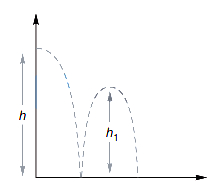
$A$ ball is dropped from a height $h$ on a floor of coefficient of restitution $e$. The total distance covered by the ball just before the second hit is
A
$h(1-2e^2)$
B
$h(1+2e^2)$
C
$h(1+e^2)$
D
$h e^2$
Solution
(B) When the ball is dropped from height $h$,it hits the floor for the first time after falling a distance $h$.
After the first collision,the ball rebounds to a height $h_1 = e^2 h$.
The ball then travels upwards to height $h_1$ and then falls back down to the floor to hit it for the second time.
Therefore,the total distance covered by the ball just before the second hit is the sum of the initial fall distance,the rebound height,and the distance fallen from the rebound height.
Total distance $D = h + h_1 + h_1 = h + 2h_1$.
Substituting $h_1 = e^2 h$ into the equation,we get $D = h + 2(e^2 h) = h(1 + 2e^2)$.
After the first collision,the ball rebounds to a height $h_1 = e^2 h$.
The ball then travels upwards to height $h_1$ and then falls back down to the floor to hit it for the second time.
Therefore,the total distance covered by the ball just before the second hit is the sum of the initial fall distance,the rebound height,and the distance fallen from the rebound height.
Total distance $D = h + h_1 + h_1 = h + 2h_1$.
Substituting $h_1 = e^2 h$ into the equation,we get $D = h + 2(e^2 h) = h(1 + 2e^2)$.
0 likesView Solution
121
ChemistryMCQAP EAMCET · 2008
Two particles $A$ and $B$,initially at rest,move towards each other under a mutual force of attraction. At an instance when the speed of $A$ is $v$ and the speed of $B$ is $2v$,the speed of the centre of mass $(CM)$ is:
A
Zero
B
$v$
C
$2.5v$
D
$4v$
Solution
(A) The velocity of the centre of mass $(V_{CM})$ is given by the formula $V_{CM} = \frac{m_A v_A + m_B v_B}{m_A + m_B}$.
Since the particles are initially at rest,the initial momentum of the system is zero.
According to the law of conservation of linear momentum,if the net external force on a system is zero,the velocity of the centre of mass remains constant.
In this case,the only forces acting are mutual forces of attraction (internal forces),so the net external force is zero.
Since the initial velocity of the centre of mass was zero,it must remain zero at all times.
Since the particles are initially at rest,the initial momentum of the system is zero.
According to the law of conservation of linear momentum,if the net external force on a system is zero,the velocity of the centre of mass remains constant.
In this case,the only forces acting are mutual forces of attraction (internal forces),so the net external force is zero.
Since the initial velocity of the centre of mass was zero,it must remain zero at all times.
0 likesView Solution
122
ChemistryMediumMCQAP EAMCET · 2008
The compound in which the number of $d\pi - p\pi$ bonds are equal to those present in $ClO_4^{-}$ is:
A
$XeF_4$
B
$XeO_3$
C
$XeO_4$
D
$XeF_6$
Solution
(B) In the perchlorate ion $(ClO_4^{-})$,the central chlorine atom is $sp^3$ hybridized. It forms four $Cl-O$ bonds,out of which three are double bonds involving $d\pi - p\pi$ back bonding between the filled $2p$ orbitals of oxygen and empty $3d$ orbitals of chlorine. Thus,$ClO_4^{-}$ contains $3$ $d\pi - p\pi$ bonds.
Now,let us analyze the given options:
$1$. $XeF_4$: It has no $d\pi - p\pi$ bonds.
$2$. $XeO_3$: The xenon atom is $sp^3$ hybridized with one lone pair. It forms three $Xe=O$ double bonds,each involving $d\pi - p\pi$ bonding. Thus,it contains $3$ $d\pi - p\pi$ bonds.
$3$. $XeO_4$: The xenon atom is $sp^3$ hybridized. It forms four $Xe=O$ double bonds,each involving $d\pi - p\pi$ bonding. Thus,it contains $4$ $d\pi - p\pi$ bonds.
$4$. $XeF_6$: It has no $d\pi - p\pi$ bonds.
Therefore,the compound with the same number of $d\pi - p\pi$ bonds as $ClO_4^{-}$ is $XeO_3$.
Now,let us analyze the given options:
$1$. $XeF_4$: It has no $d\pi - p\pi$ bonds.
$2$. $XeO_3$: The xenon atom is $sp^3$ hybridized with one lone pair. It forms three $Xe=O$ double bonds,each involving $d\pi - p\pi$ bonding. Thus,it contains $3$ $d\pi - p\pi$ bonds.
$3$. $XeO_4$: The xenon atom is $sp^3$ hybridized. It forms four $Xe=O$ double bonds,each involving $d\pi - p\pi$ bonding. Thus,it contains $4$ $d\pi - p\pi$ bonds.
$4$. $XeF_6$: It has no $d\pi - p\pi$ bonds.
Therefore,the compound with the same number of $d\pi - p\pi$ bonds as $ClO_4^{-}$ is $XeO_3$.
0 likesView Solution
123
ChemistryEasyMCQAP EAMCET · 2008
Which one of the following is a correct set?
A
$H_2O, sp^3$,angular
B
$BCl_3, sp^3$,angular
C
$NH_4^{+}, dsp^2$,square planar
D
$CH_4, dsp^2$,tetrahedral
Solution
(A) To determine the correct set,we analyze the hybridization and geometry of each molecule:
Comparing the options with the table:
$A$. $H_2O$ has $sp^3$ hybridization and an angular shape. This is correct.
$B$. $BCl_3$ has $sp^2$ hybridization and trigonal planar shape.
$C$. $NH_4^{+}$ has $sp^3$ hybridization and tetrahedral shape.
$D$. $CH_4$ has $sp^3$ hybridization and tetrahedral shape.
Therefore,the correct set is $A$.
| Molecule | $bp + lp$ | Hybridisation | Shape |
| $H_2O$ | $2 + 2$ | $sp^3$ | angular |
| $BCl_3$ | $3 + 0$ | $sp^2$ | trigonal planar |
| $NH_4^{+}$ | $4 + 0$ | $sp^3$ | tetrahedral |
| $CH_4$ | $4 + 0$ | $sp^3$ | tetrahedral |
Comparing the options with the table:
$A$. $H_2O$ has $sp^3$ hybridization and an angular shape. This is correct.
$B$. $BCl_3$ has $sp^2$ hybridization and trigonal planar shape.
$C$. $NH_4^{+}$ has $sp^3$ hybridization and tetrahedral shape.
$D$. $CH_4$ has $sp^3$ hybridization and tetrahedral shape.
Therefore,the correct set is $A$.
0 likesView Solution
124
ChemistryDifficultMCQAP EAMCET · 2008
The bond length of $HCl$ molecule is $1.275 \ \text{Å}$ and its dipole moment is $1.03 \ \text{D}$. The ionic character of the molecule (in percent) (charge of the electron $= 4.8 \times 10^{-10} \ \text{esu}$) is
A
$100$
B
$67.3$
C
$33.6$
D
$16.83$
Solution
(D) Given: Observed dipole moment $= 1.03 \ \text{D}$.
Bond length of $HCl$ molecule,$d = 1.275 \ \text{Å} = 1.275 \times 10^{-8} \ \text{cm}$.
Charge of electron,$e = 4.8 \times 10^{-10} \ \text{esu}$.
Theoretical dipole moment $= e \times d = (4.8 \times 10^{-10} \ \text{esu}) \times (1.275 \times 10^{-8} \ \text{cm}) = 6.12 \times 10^{-18} \ \text{esu} \cdot \text{cm} = 6.12 \ \text{D}$.
Percentage ionic character $= (\text{Observed dipole moment} / \text{Theoretical dipole moment}) \times 100$.
Percentage ionic character $= (1.03 / 6.12) \times 100 = 16.83 \%$.
Bond length of $HCl$ molecule,$d = 1.275 \ \text{Å} = 1.275 \times 10^{-8} \ \text{cm}$.
Charge of electron,$e = 4.8 \times 10^{-10} \ \text{esu}$.
Theoretical dipole moment $= e \times d = (4.8 \times 10^{-10} \ \text{esu}) \times (1.275 \times 10^{-8} \ \text{cm}) = 6.12 \times 10^{-18} \ \text{esu} \cdot \text{cm} = 6.12 \ \text{D}$.
Percentage ionic character $= (\text{Observed dipole moment} / \text{Theoretical dipole moment}) \times 100$.
Percentage ionic character $= (1.03 / 6.12) \times 100 = 16.83 \%$.
0 likesView Solution
125
ChemistryDifficultMCQAP EAMCET · 2008
In a $500 \,mL$ flask,the degree of dissociation of $PCl_5$ at equilibrium is $40 \%$ and the initial amount is $5 \,moles$. The value of equilibrium constant in $mol \,L^{-1}$ for the decomposition of $PCl_5$ is
A
$2.33$
B
$2.66$
C
$5.32$
D
$4.66$
Solution
(B) The chemical equation for the dissociation is: $PCl_5 \rightleftharpoons PCl_3 + Cl_2$
Initial moles: $PCl_5 = 5$,$PCl_3 = 0$,$Cl_2 = 0$
Degree of dissociation $\alpha = 0.4$
Moles at equilibrium: $PCl_5 = 5(1 - 0.4) = 3$,$PCl_3 = 5 \times 0.4 = 2$,$Cl_2 = 5 \times 0.4 = 2$
Volume of flask $V = 500 \,mL = 0.5 \,L$
Concentrations at equilibrium: $[PCl_5] = 3 / 0.5 = 6 \,mol/L$,$[PCl_3] = 2 / 0.5 = 4 \,mol/L$,$[Cl_2] = 2 / 0.5 = 4 \,mol/L$
Equilibrium constant $K_c = \frac{[PCl_3][Cl_2]}{[PCl_5]} = \frac{4 \times 4}{6} = \frac{16}{6} = 2.66 \,mol/L$
Initial moles: $PCl_5 = 5$,$PCl_3 = 0$,$Cl_2 = 0$
Degree of dissociation $\alpha = 0.4$
Moles at equilibrium: $PCl_5 = 5(1 - 0.4) = 3$,$PCl_3 = 5 \times 0.4 = 2$,$Cl_2 = 5 \times 0.4 = 2$
Volume of flask $V = 500 \,mL = 0.5 \,L$
Concentrations at equilibrium: $[PCl_5] = 3 / 0.5 = 6 \,mol/L$,$[PCl_3] = 2 / 0.5 = 4 \,mol/L$,$[Cl_2] = 2 / 0.5 = 4 \,mol/L$
Equilibrium constant $K_c = \frac{[PCl_3][Cl_2]}{[PCl_5]} = \frac{4 \times 4}{6} = \frac{16}{6} = 2.66 \,mol/L$
0 likesView Solution
126
ChemistryMediumMCQAP EAMCET · 2008
The atomic numbers of elements $A, B, C$ and $D$ are $Z-1, Z, Z+1$ and $Z+2$,respectively. If $B$ is a noble gas,choose the correct statements from the following:
$(1)$ $A$ has high electron affinity
$(2)$ $C$ exists in $+2$ oxidation state
$(3)$ $D$ is an alkaline earth metal
$(1)$ $A$ has high electron affinity
$(2)$ $C$ exists in $+2$ oxidation state
$(3)$ $D$ is an alkaline earth metal
A
$(1)$ and $(2)$
B
$(2)$ and $(3)$
C
$(1)$ and $(3)$
D
$(1)$,$(2)$ and $(3)$
Solution
(C) Given that the atomic number of $B$ is $Z$. Since $B$ is a noble gas,it belongs to group $18$.
Therefore,the element $A$ with atomic number $Z-1$ is a halogen (group $17$),which has a very high electron affinity.
The element $C$ with atomic number $Z+1$ is an alkali metal (group $1$),which exists in a $+1$ oxidation state.
The element $D$ with atomic number $Z+2$ is an alkaline earth metal (group $2$),which exists in a $+2$ oxidation state.
Thus,statement $(1)$ is correct ($A$ is a halogen) and statement $(3)$ is correct ($D$ is an alkaline earth metal). Statement $(2)$ is incorrect because $C$ exists in a $+1$ oxidation state.
Therefore,the element $A$ with atomic number $Z-1$ is a halogen (group $17$),which has a very high electron affinity.
The element $C$ with atomic number $Z+1$ is an alkali metal (group $1$),which exists in a $+1$ oxidation state.
The element $D$ with atomic number $Z+2$ is an alkaline earth metal (group $2$),which exists in a $+2$ oxidation state.
Thus,statement $(1)$ is correct ($A$ is a halogen) and statement $(3)$ is correct ($D$ is an alkaline earth metal). Statement $(2)$ is incorrect because $C$ exists in a $+1$ oxidation state.
0 likesView Solution
127
ChemistryMCQAP EAMCET · 2008
In a galvanometer,$5 \%$ of the total current in the circuit passes through it. If the resistance of the galvanometer is $G$,the shunt resistance $S$ connected to the galvanometer is
A
$19 G$
B
$\frac{G}{19}$
C
$20 G$
D
$\frac{G}{20}$
Solution
(B) Let the total current in the circuit be $I$.
Given that the current through the galvanometer is $I_g = 5 \% \text{ of } I = 0.05 I$.
The current through the shunt resistance $S$ is $I_s = I - I_g = I - 0.05 I = 0.95 I$.
Since the galvanometer and shunt are in parallel,the potential difference across them is equal:
$I_g G = I_s S$
$0.05 I \times G = 0.95 I \times S$
$S = \frac{0.05 I \times G}{0.95 I} = \frac{5}{95} G = \frac{G}{19}$.
Given that the current through the galvanometer is $I_g = 5 \% \text{ of } I = 0.05 I$.
The current through the shunt resistance $S$ is $I_s = I - I_g = I - 0.05 I = 0.95 I$.
Since the galvanometer and shunt are in parallel,the potential difference across them is equal:
$I_g G = I_s S$
$0.05 I \times G = 0.95 I \times S$
$S = \frac{0.05 I \times G}{0.95 I} = \frac{5}{95} G = \frac{G}{19}$.
0 likesView Solution
128
ChemistryMCQAP EAMCET · 2008
If $\frac{x^2+x+1}{x^2+2x+1} = A + \frac{B}{x+1} + \frac{C}{(x+1)^2}$,then $A-B$ is equal to
A
$4C$
B
$4C+1$
C
$3C$
D
$2C$
Solution
(D) We have $\frac{x^2+x+1}{x^2+2x+1} = \frac{(x^2+2x+1) - x}{x^2+2x+1} = 1 - \frac{x}{(x+1)^2}$.
Now,express $\frac{x}{(x+1)^2}$ as partial fractions:
$\frac{x}{(x+1)^2} = \frac{P}{x+1} + \frac{Q}{(x+1)^2}$.
$x = P(x+1) + Q = Px + (P+Q)$.
Comparing coefficients,$P=1$ and $P+Q=0$,so $Q=-1$.
Thus,$\frac{x^2+x+1}{x^2+2x+1} = 1 - (\frac{1}{x+1} - \frac{1}{(x+1)^2}) = 1 - \frac{1}{x+1} + \frac{1}{(x+1)^2}$.
Comparing with $A + \frac{B}{x+1} + \frac{C}{(x+1)^2}$,we get $A=1$,$B=-1$,and $C=1$.
Therefore,$A-B = 1 - (-1) = 2$.
Since $C=1$,$2 = 2C$.
Hence,$A-B = 2C$.
Now,express $\frac{x}{(x+1)^2}$ as partial fractions:
$\frac{x}{(x+1)^2} = \frac{P}{x+1} + \frac{Q}{(x+1)^2}$.
$x = P(x+1) + Q = Px + (P+Q)$.
Comparing coefficients,$P=1$ and $P+Q=0$,so $Q=-1$.
Thus,$\frac{x^2+x+1}{x^2+2x+1} = 1 - (\frac{1}{x+1} - \frac{1}{(x+1)^2}) = 1 - \frac{1}{x+1} + \frac{1}{(x+1)^2}$.
Comparing with $A + \frac{B}{x+1} + \frac{C}{(x+1)^2}$,we get $A=1$,$B=-1$,and $C=1$.
Therefore,$A-B = 1 - (-1) = 2$.
Since $C=1$,$2 = 2C$.
Hence,$A-B = 2C$.
0 likesView Solution
129
ChemistryMCQAP EAMCET · 2008
The sum of the fourth powers of the roots of the equation $x^3+x+1=0$ is
A
$-2$
B
$-1$
C
$1$
D
$2$
Solution
(D) Let the roots of the equation $x^3+x+1=0$ be $\alpha, \beta, \gamma$. Let $S_n = \alpha^n + \beta^n + \gamma^n$.
By Newton's Sums for the equation $x^3+p_1 x^2+p_2 x+p_3=0$,where $p_1=0, p_2=1, p_3=1$,we have the relation $S_n + p_1 S_{n-1} + p_2 S_{n-2} + p_3 S_{n-3} = 0$.
For $n=1$: $S_1 + 0 = 0 \Rightarrow S_1 = 0$.
For $n=2$: $S_2 + 0 \cdot S_1 + 1 \cdot S_0 + 2 \cdot 1 = 0$ (where $S_0 = 3$ for a cubic equation). Thus,$S_2 + 3 = 0 \Rightarrow S_2 = -3$ is incorrect; let's use the recurrence $S_n + S_{n-2} + S_{n-3} = 0$.
$S_1 = 0$.
$S_2 = -S_0 - S_{-1} = -3 - 0 = -3$ (using $S_0=3, S_{-1}=0$).
$S_3 = -S_1 - S_0 = 0 - 3 = -3$.
$S_4 = -S_2 - S_1 = -(-3) - 0 = 3$ is incorrect. Let's re-evaluate: $x^3 = -x-1$. Multiplying by $x$,$x^4 = -x^2-x$. Summing over roots: $S_4 = -S_2 - S_1$.
Since $S_1 = 0$ and $S_2 = \alpha^2+\beta^2+\gamma^2 = (\alpha+\beta+\gamma)^2 - 2(\alpha\beta+\beta\gamma+\gamma\alpha) = 0^2 - 2(1) = -2$.
Thus,$S_4 = -(-2) - 0 = 2$.
By Newton's Sums for the equation $x^3+p_1 x^2+p_2 x+p_3=0$,where $p_1=0, p_2=1, p_3=1$,we have the relation $S_n + p_1 S_{n-1} + p_2 S_{n-2} + p_3 S_{n-3} = 0$.
For $n=1$: $S_1 + 0 = 0 \Rightarrow S_1 = 0$.
For $n=2$: $S_2 + 0 \cdot S_1 + 1 \cdot S_0 + 2 \cdot 1 = 0$ (where $S_0 = 3$ for a cubic equation). Thus,$S_2 + 3 = 0 \Rightarrow S_2 = -3$ is incorrect; let's use the recurrence $S_n + S_{n-2} + S_{n-3} = 0$.
$S_1 = 0$.
$S_2 = -S_0 - S_{-1} = -3 - 0 = -3$ (using $S_0=3, S_{-1}=0$).
$S_3 = -S_1 - S_0 = 0 - 3 = -3$.
$S_4 = -S_2 - S_1 = -(-3) - 0 = 3$ is incorrect. Let's re-evaluate: $x^3 = -x-1$. Multiplying by $x$,$x^4 = -x^2-x$. Summing over roots: $S_4 = -S_2 - S_1$.
Since $S_1 = 0$ and $S_2 = \alpha^2+\beta^2+\gamma^2 = (\alpha+\beta+\gamma)^2 - 2(\alpha\beta+\beta\gamma+\gamma\alpha) = 0^2 - 2(1) = -2$.
Thus,$S_4 = -(-2) - 0 = 2$.
0 likesView Solution
130
ChemistryMCQAP EAMCET · 2008
The cubic equation whose roots are thrice to each of the roots of $x^3+2 x^2-4 x+1=0$ is
A
$x^3-6 x^2+36 x+27=0$
B
$x^3+6 x^2+36 x+27=0$
C
$x^3-6 x^2-36 x+27=0$
D
$x^3+6 x^2-36 x+27=0$
Solution
(D) Let the roots of the given equation $x^3+2 x^2-4 x+1=0$ be $\alpha, \beta, \gamma$.
We want to find the equation whose roots are $3\alpha, 3\beta, 3\gamma$.
Let $y = 3x$,which implies $x = \frac{y}{3}$.
Substituting $x = \frac{y}{3}$ into the original equation:
$(\frac{y}{3})^3 + 2(\frac{y}{3})^2 - 4(\frac{y}{3}) + 1 = 0$
$\frac{y^3}{27} + \frac{2y^2}{9} - \frac{4y}{3} + 1 = 0$
Multiplying the entire equation by $27$:
$y^3 + 6y^2 - 36y + 27 = 0$
Replacing $y$ with $x$,the required equation is $x^3 + 6x^2 - 36x + 27 = 0$.
We want to find the equation whose roots are $3\alpha, 3\beta, 3\gamma$.
Let $y = 3x$,which implies $x = \frac{y}{3}$.
Substituting $x = \frac{y}{3}$ into the original equation:
$(\frac{y}{3})^3 + 2(\frac{y}{3})^2 - 4(\frac{y}{3}) + 1 = 0$
$\frac{y^3}{27} + \frac{2y^2}{9} - \frac{4y}{3} + 1 = 0$
Multiplying the entire equation by $27$:
$y^3 + 6y^2 - 36y + 27 = 0$
Replacing $y$ with $x$,the required equation is $x^3 + 6x^2 - 36x + 27 = 0$.
0 likesView Solution
131
ChemistryMCQAP EAMCET · 2008
The points in the set $\{z \in \mathbb{C} : \arg \left(\frac{z-2}{z-6i}\right) = \frac{\pi}{2}\}$ (where $\mathbb{C}$ denotes the set of all complex numbers) lie on the curve which is a
A
circle
B
pair of lines
C
parabola
D
hyperbola
Solution
(A) Given,$\arg \left(\frac{z-2}{z-6i}\right) = \frac{\pi}{2}$.
Let $z = x + iy$. The expression represents the locus of a point $z$ such that the angle subtended by the segment joining $A(2, 0)$ and $B(0, 6)$ at $z$ is $\frac{\pi}{2}$.
Using the property $\arg(z_1) - \arg(z_2) = \arg(\frac{z_1}{z_2})$,we have $\arg(z-2) - \arg(z-6i) = \frac{\pi}{2}$.
Substituting $z = x + iy$:
$\tan^{-1}\left(\frac{y}{x-2}\right) - \tan^{-1}\left(\frac{y-6}{x}\right) = \frac{\pi}{2}$.
Using the identity $\tan^{-1} A - \tan^{-1} B = \tan^{-1}\left(\frac{A-B}{1+AB}\right) = \frac{\pi}{2}$,the denominator $1+AB$ must be $0$.
$1 + \left(\frac{y}{x-2}\right)\left(\frac{y-6}{x}\right) = 0$.
$x(x-2) + y(y-6) = 0$.
$x^2 - 2x + y^2 - 6y = 0$.
This is the equation of a circle with center $(1, 3)$ and radius $\sqrt{1^2 + 3^2} = \sqrt{10}$.
Let $z = x + iy$. The expression represents the locus of a point $z$ such that the angle subtended by the segment joining $A(2, 0)$ and $B(0, 6)$ at $z$ is $\frac{\pi}{2}$.
Using the property $\arg(z_1) - \arg(z_2) = \arg(\frac{z_1}{z_2})$,we have $\arg(z-2) - \arg(z-6i) = \frac{\pi}{2}$.
Substituting $z = x + iy$:
$\tan^{-1}\left(\frac{y}{x-2}\right) - \tan^{-1}\left(\frac{y-6}{x}\right) = \frac{\pi}{2}$.
Using the identity $\tan^{-1} A - \tan^{-1} B = \tan^{-1}\left(\frac{A-B}{1+AB}\right) = \frac{\pi}{2}$,the denominator $1+AB$ must be $0$.
$1 + \left(\frac{y}{x-2}\right)\left(\frac{y-6}{x}\right) = 0$.
$x(x-2) + y(y-6) = 0$.
$x^2 - 2x + y^2 - 6y = 0$.
This is the equation of a circle with center $(1, 3)$ and radius $\sqrt{1^2 + 3^2} = \sqrt{10}$.
0 likesView Solution
132
ChemistryMCQAP EAMCET · 2008
If $\omega$ is a complex cube root of unity,then $\sin \left\{\left(\omega^{10}+\omega^{23}\right) \pi-\frac{\pi}{4}\right\}$ is equal to
A
$\frac{1}{\sqrt{2}}$
B
$\frac{1}{2}$
C
$1$
D
$\frac{\sqrt{3}}{2}$
Solution
(A) Given that $\omega$ is a complex cube root of unity,we have $\omega^3 = 1$ and $1+\omega+\omega^2 = 0$.
First,simplify the powers of $\omega$:
$\omega^{10} = (\omega^3)^3 \cdot \omega = 1^3 \cdot \omega = \omega$
$\omega^{23} = (\omega^3)^7 \cdot \omega^2 = 1^7 \cdot \omega^2 = \omega^2$
Substituting these into the expression:
$\sin \left\{(\omega + \omega^2) \pi - \frac{\pi}{4}\right\}$
Since $1 + \omega + \omega^2 = 0$,we have $\omega + \omega^2 = -1$.
Thus,the expression becomes:
$\sin \left\{(-1) \pi - \frac{\pi}{4}\right\} = \sin \left(-\pi - \frac{\pi}{4}\right)$
$= \sin \left(-\left(\pi + \frac{\pi}{4}\right)\right) = -\sin \left(\pi + \frac{\pi}{4}\right)$
Using the identity $\sin(\pi + \theta) = -\sin \theta$:
$-(-\sin \frac{\pi}{4}) = \sin \frac{\pi}{4} = \frac{1}{\sqrt{2}}$
First,simplify the powers of $\omega$:
$\omega^{10} = (\omega^3)^3 \cdot \omega = 1^3 \cdot \omega = \omega$
$\omega^{23} = (\omega^3)^7 \cdot \omega^2 = 1^7 \cdot \omega^2 = \omega^2$
Substituting these into the expression:
$\sin \left\{(\omega + \omega^2) \pi - \frac{\pi}{4}\right\}$
Since $1 + \omega + \omega^2 = 0$,we have $\omega + \omega^2 = -1$.
Thus,the expression becomes:
$\sin \left\{(-1) \pi - \frac{\pi}{4}\right\} = \sin \left(-\pi - \frac{\pi}{4}\right)$
$= \sin \left(-\left(\pi + \frac{\pi}{4}\right)\right) = -\sin \left(\pi + \frac{\pi}{4}\right)$
Using the identity $\sin(\pi + \theta) = -\sin \theta$:
$-(-\sin \frac{\pi}{4}) = \sin \frac{\pi}{4} = \frac{1}{\sqrt{2}}$
0 likesView Solution
133
ChemistryMCQAP EAMCET · 2008
$\frac{1}{1 \cdot 3} + \frac{1}{2 \cdot 5} + \frac{1}{3 \cdot 7} + \frac{1}{4 \cdot 9} + \ldots$ is equal to
A
$2 \log _e 2 - 2$
B
$2 - \log _e 2$
C
$2 \log _e 4$
D
$\log _e 4$
Solution
(B) Let $S = \sum_{n=1}^{\infty} \frac{1}{n(2n+1)}$.
Using partial fractions,$\frac{1}{n(2n+1)} = \frac{1}{n} - \frac{2}{2n+1}$.
Thus,$S = \sum_{n=1}^{\infty} \left( \frac{1}{n} - \frac{2}{2n+1} \right) = \left( 1 - \frac{2}{3} \right) + \left( \frac{1}{2} - \frac{2}{5} \right) + \left( \frac{1}{3} - \frac{2}{7} \right) + \ldots$
$S = 1 + \frac{1}{2} - \frac{2}{3} + \frac{1}{3} - \frac{2}{5} + \frac{1}{4} - \frac{2}{7} + \ldots$
$S = 1 + \frac{1}{2} - \frac{1}{3} + \frac{1}{4} - \frac{1}{5} + \ldots$
Recall the expansion $\log_e(1+x) = x - \frac{x^2}{2} + \frac{x^3}{3} - \frac{x^4}{4} + \ldots$. For $x=1$,$\log_e 2 = 1 - \frac{1}{2} + \frac{1}{3} - \frac{1}{4} + \ldots$.
Rearranging the series,$S = 1 - (\frac{1}{2} - \frac{1}{3} + \frac{1}{4} - \frac{1}{5} + \ldots) = 1 - (1 - \log_e 2) = 2 - \log_e 2$.
Using partial fractions,$\frac{1}{n(2n+1)} = \frac{1}{n} - \frac{2}{2n+1}$.
Thus,$S = \sum_{n=1}^{\infty} \left( \frac{1}{n} - \frac{2}{2n+1} \right) = \left( 1 - \frac{2}{3} \right) + \left( \frac{1}{2} - \frac{2}{5} \right) + \left( \frac{1}{3} - \frac{2}{7} \right) + \ldots$
$S = 1 + \frac{1}{2} - \frac{2}{3} + \frac{1}{3} - \frac{2}{5} + \frac{1}{4} - \frac{2}{7} + \ldots$
$S = 1 + \frac{1}{2} - \frac{1}{3} + \frac{1}{4} - \frac{1}{5} + \ldots$
Recall the expansion $\log_e(1+x) = x - \frac{x^2}{2} + \frac{x^3}{3} - \frac{x^4}{4} + \ldots$. For $x=1$,$\log_e 2 = 1 - \frac{1}{2} + \frac{1}{3} - \frac{1}{4} + \ldots$.
Rearranging the series,$S = 1 - (\frac{1}{2} - \frac{1}{3} + \frac{1}{4} - \frac{1}{5} + \ldots) = 1 - (1 - \log_e 2) = 2 - \log_e 2$.
0 likesView Solution
134
ChemistryMCQAP EAMCET · 2008
$\sum_{k=1}^{\infty} \frac{1}{k!}\left(\sum_{n=1}^k 2^{n-1}\right)$ is equal to
A
$e$
B
$e^2+e$
C
$e^2$
D
$e^2-e$
Solution
(D) The inner sum is a geometric series: $\sum_{n=1}^k 2^{n-1} = \frac{1(2^k - 1)}{2 - 1} = 2^k - 1$.
Substituting this into the main expression:
$\sum_{k=1}^{\infty} \frac{2^k - 1}{k!} = \sum_{k=1}^{\infty} \frac{2^k}{k!} - \sum_{k=1}^{\infty} \frac{1}{k!}$.
We know the Taylor series expansion $e^x = \sum_{k=0}^{\infty} \frac{x^k}{k!} = 1 + \sum_{k=1}^{\infty} \frac{x^k}{k!}$,so $\sum_{k=1}^{\infty} \frac{x^k}{k!} = e^x - 1$.
For the first part,$x = 2$: $\sum_{k=1}^{\infty} \frac{2^k}{k!} = e^2 - 1$.
For the second part,$x = 1$: $\sum_{k=1}^{\infty} \frac{1^k}{k!} = e^1 - 1 = e - 1$.
Subtracting these: $(e^2 - 1) - (e - 1) = e^2 - 1 - e + 1 = e^2 - e$.
Substituting this into the main expression:
$\sum_{k=1}^{\infty} \frac{2^k - 1}{k!} = \sum_{k=1}^{\infty} \frac{2^k}{k!} - \sum_{k=1}^{\infty} \frac{1}{k!}$.
We know the Taylor series expansion $e^x = \sum_{k=0}^{\infty} \frac{x^k}{k!} = 1 + \sum_{k=1}^{\infty} \frac{x^k}{k!}$,so $\sum_{k=1}^{\infty} \frac{x^k}{k!} = e^x - 1$.
For the first part,$x = 2$: $\sum_{k=1}^{\infty} \frac{2^k}{k!} = e^2 - 1$.
For the second part,$x = 1$: $\sum_{k=1}^{\infty} \frac{1^k}{k!} = e^1 - 1 = e - 1$.
Subtracting these: $(e^2 - 1) - (e - 1) = e^2 - 1 - e + 1 = e^2 - e$.
0 likesView Solution
135
ChemistryMCQAP EAMCET · 2008
For any integer $n \geq 1$,the sum $\sum_{k=1}^n k(k+2)$ is equal to
A
$\frac{n(n+1)(n+2)}{6}$
B
$\frac{n(n+1)(2n+1)}{6}$
C
$\frac{n(n+1)(2n+7)}{6}$
D
$\frac{n(n+1)(2n+9)}{6}$
Solution
(C) We need to evaluate the sum $S = \sum_{k=1}^n k(k+2)$.
Expanding the term inside the summation,we get $k^2 + 2k$.
Thus,$S = \sum_{k=1}^n k^2 + 2 \sum_{k=1}^n k$.
Using the standard summation formulas $\sum_{k=1}^n k^2 = \frac{n(n+1)(2n+1)}{6}$ and $\sum_{k=1}^n k = \frac{n(n+1)}{2}$,we have:
$S = \frac{n(n+1)(2n+1)}{6} + 2 \cdot \frac{n(n+1)}{2}$.
$S = \frac{n(n+1)(2n+1)}{6} + n(n+1)$.
Factoring out $\frac{n(n+1)}{6}$,we get:
$S = \frac{n(n+1)}{6} [ (2n+1) + 6 ]$.
$S = \frac{n(n+1)(2n+7)}{6}$.
Expanding the term inside the summation,we get $k^2 + 2k$.
Thus,$S = \sum_{k=1}^n k^2 + 2 \sum_{k=1}^n k$.
Using the standard summation formulas $\sum_{k=1}^n k^2 = \frac{n(n+1)(2n+1)}{6}$ and $\sum_{k=1}^n k = \frac{n(n+1)}{2}$,we have:
$S = \frac{n(n+1)(2n+1)}{6} + 2 \cdot \frac{n(n+1)}{2}$.
$S = \frac{n(n+1)(2n+1)}{6} + n(n+1)$.
Factoring out $\frac{n(n+1)}{6}$,we get:
$S = \frac{n(n+1)}{6} [ (2n+1) + 6 ]$.
$S = \frac{n(n+1)(2n+7)}{6}$.
0 likesView Solution
136
ChemistryMCQAP EAMCET · 2008
Among the following compounds,which one is not responsible for the depletion of the ozone layer?
A
$CH_4$
B
$CFCl_3$
C
$NO$
D
$Cl_2$
Solution
(A) In the stratosphere,the following reactions take place which are responsible for the depletion of the ozone layer:
$NO + O_3 \longrightarrow NO_2 + O_2$
$CF_2Cl_2 \xrightarrow{hv} \dot{C}F_2Cl + \dot{Cl}$
$CFCl_3 \xrightarrow{hv} \dot{C}FCl_2 + \dot{Cl}$
$\dot{Cl} + O_3 \longrightarrow Cl\dot{O} + O_2$
$Cl\dot{O} + O \longrightarrow \dot{Cl} + O_2$
Hence,methane $(CH_4)$ is not responsible for ozone layer depletion.
$NO + O_3 \longrightarrow NO_2 + O_2$
$CF_2Cl_2 \xrightarrow{hv} \dot{C}F_2Cl + \dot{Cl}$
$CFCl_3 \xrightarrow{hv} \dot{C}FCl_2 + \dot{Cl}$
$\dot{Cl} + O_3 \longrightarrow Cl\dot{O} + O_2$
$Cl\dot{O} + O \longrightarrow \dot{Cl} + O_2$
Hence,methane $(CH_4)$ is not responsible for ozone layer depletion.
0 likesView Solution
137
ChemistryMCQAP EAMCET · 2008
If $\alpha = \frac{5}{2! 3} + \frac{5 \cdot 7}{3! 3^2} + \frac{5 \cdot 7 \cdot 9}{4! 3^3} + \ldots$,then $\alpha^2 + 4\alpha$ is equal to
A
$21$
B
$23$
C
$25$
D
$27$
Solution
(B) Given $\alpha = \frac{5}{2! 3} + \frac{5 \cdot 7}{3! 3^2} + \frac{5 \cdot 7 \cdot 9}{4! 3^3} + \ldots$
The general term of the series $(1-x)^{-n} = 1 + nx + \frac{n(n+1)}{2!} x^2 + \frac{n(n+1)(n+2)}{3!} x^3 + \ldots$
Comparing the given series with the expansion of $(1-x)^{-n} - 1 - nx$,we identify $n = \frac{5}{2}$ and $x = \frac{1}{3}$.
Thus,$(1 - \frac{1}{3})^{-5/2} = 1 + \frac{5}{2}(\frac{1}{3}) + \frac{\frac{5}{2} \cdot \frac{7}{2}}{2!} (\frac{1}{3})^2 + \ldots$
$(2/3)^{-5/2} = 1 + \frac{5}{2 \cdot 3} + \frac{5 \cdot 7}{2! \cdot 2^2 \cdot 3^2} + \ldots$
Adjusting the terms to match $\alpha$,we find $\alpha = (2/3)^{-5/2} - 1 - \frac{5}{6} = (3/2)^{5/2} - \frac{11}{6}$.
Alternatively,using the expansion $(1-x)^{-n} = 1 + nx + \frac{n(n+1)}{2!}x^2 + \dots$,for $n=5/2$ and $x=1/3$:
$(1-1/3)^{-5/2} = 1 + (5/2)(1/3) + \frac{(5/2)(7/2)}{2!}(1/3)^2 + \dots = 1 + 5/6 + \frac{35}{8 \cdot 9} + \dots$
The given series is $\alpha = \frac{5}{2! 3} + \frac{5 \cdot 7}{3! 3^2} + \dots = \frac{1}{2} [ \frac{5}{3} + \frac{5 \cdot 7}{3 \cdot 3^2} + \dots ]$.
Evaluating the sum,we get $\alpha = 3^{3/2} - 2$.
Then $\alpha^2 + 4\alpha = (\alpha + 2)^2 - 4 = (3^{3/2})^2 - 4 = 27 - 4 = 23$.
The general term of the series $(1-x)^{-n} = 1 + nx + \frac{n(n+1)}{2!} x^2 + \frac{n(n+1)(n+2)}{3!} x^3 + \ldots$
Comparing the given series with the expansion of $(1-x)^{-n} - 1 - nx$,we identify $n = \frac{5}{2}$ and $x = \frac{1}{3}$.
Thus,$(1 - \frac{1}{3})^{-5/2} = 1 + \frac{5}{2}(\frac{1}{3}) + \frac{\frac{5}{2} \cdot \frac{7}{2}}{2!} (\frac{1}{3})^2 + \ldots$
$(2/3)^{-5/2} = 1 + \frac{5}{2 \cdot 3} + \frac{5 \cdot 7}{2! \cdot 2^2 \cdot 3^2} + \ldots$
Adjusting the terms to match $\alpha$,we find $\alpha = (2/3)^{-5/2} - 1 - \frac{5}{6} = (3/2)^{5/2} - \frac{11}{6}$.
Alternatively,using the expansion $(1-x)^{-n} = 1 + nx + \frac{n(n+1)}{2!}x^2 + \dots$,for $n=5/2$ and $x=1/3$:
$(1-1/3)^{-5/2} = 1 + (5/2)(1/3) + \frac{(5/2)(7/2)}{2!}(1/3)^2 + \dots = 1 + 5/6 + \frac{35}{8 \cdot 9} + \dots$
The given series is $\alpha = \frac{5}{2! 3} + \frac{5 \cdot 7}{3! 3^2} + \dots = \frac{1}{2} [ \frac{5}{3} + \frac{5 \cdot 7}{3 \cdot 3^2} + \dots ]$.
Evaluating the sum,we get $\alpha = 3^{3/2} - 2$.
Then $\alpha^2 + 4\alpha = (\alpha + 2)^2 - 4 = (3^{3/2})^2 - 4 = 27 - 4 = 23$.
0 likesView Solution
138
ChemistryMCQAP EAMCET · 2008
If $\tan \theta + \tan \left(\theta + \frac{\pi}{3}\right) + \tan \left(\theta + \frac{2\pi}{3}\right) = 3$,then which of the following is equal to $1$?
A
$\tan 2\theta$
B
$\tan 3\theta$
C
$\tan^2 \theta$
D
$\tan^3 \theta$
Solution
(B) Given,$\tan \theta + \tan \left(\theta + \frac{\pi}{3}\right) + \tan \left(\theta + \frac{2\pi}{3}\right) = 3$.
Using the identity $\tan(A+B) = \frac{\tan A + \tan B}{1 - \tan A \tan B}$,we have:
$\tan \theta + \frac{\tan \theta + \sqrt{3}}{1 - \sqrt{3} \tan \theta} + \frac{\tan \theta - \sqrt{3}}{1 + \sqrt{3} \tan \theta} = 3$.
Combining the fractions:
$\tan \theta + \frac{(\tan \theta + \sqrt{3})(1 + \sqrt{3} \tan \theta) + (\tan \theta - \sqrt{3})(1 - \sqrt{3} \tan \theta)}{1 - 3 \tan^2 \theta} = 3$.
$\tan \theta + \frac{(\tan \theta + \sqrt{3} \tan^2 \theta + \sqrt{3} + 3 \tan \theta) + (\tan \theta - \sqrt{3} \tan^2 \theta - \sqrt{3} + 3 \tan \theta)}{1 - 3 \tan^2 \theta} = 3$.
$\tan \theta + \frac{8 \tan \theta}{1 - 3 \tan^2 \theta} = 3$.
$\frac{\tan \theta - 3 \tan^3 \theta + 8 \tan \theta}{1 - 3 \tan^2 \theta} = 3$.
$\frac{9 \tan \theta - 3 \tan^3 \theta}{1 - 3 \tan^2 \theta} = 3$.
$3 \left( \frac{3 \tan \theta - \tan^3 \theta}{1 - 3 \tan^2 \theta} \right) = 3$.
Since $\tan 3\theta = \frac{3 \tan \theta - \tan^3 \theta}{1 - 3 \tan^2 \theta}$,we get $3 \tan 3\theta = 3$,which implies $\tan 3\theta = 1$.
Thus,option $B$ is correct.
Using the identity $\tan(A+B) = \frac{\tan A + \tan B}{1 - \tan A \tan B}$,we have:
$\tan \theta + \frac{\tan \theta + \sqrt{3}}{1 - \sqrt{3} \tan \theta} + \frac{\tan \theta - \sqrt{3}}{1 + \sqrt{3} \tan \theta} = 3$.
Combining the fractions:
$\tan \theta + \frac{(\tan \theta + \sqrt{3})(1 + \sqrt{3} \tan \theta) + (\tan \theta - \sqrt{3})(1 - \sqrt{3} \tan \theta)}{1 - 3 \tan^2 \theta} = 3$.
$\tan \theta + \frac{(\tan \theta + \sqrt{3} \tan^2 \theta + \sqrt{3} + 3 \tan \theta) + (\tan \theta - \sqrt{3} \tan^2 \theta - \sqrt{3} + 3 \tan \theta)}{1 - 3 \tan^2 \theta} = 3$.
$\tan \theta + \frac{8 \tan \theta}{1 - 3 \tan^2 \theta} = 3$.
$\frac{\tan \theta - 3 \tan^3 \theta + 8 \tan \theta}{1 - 3 \tan^2 \theta} = 3$.
$\frac{9 \tan \theta - 3 \tan^3 \theta}{1 - 3 \tan^2 \theta} = 3$.
$3 \left( \frac{3 \tan \theta - \tan^3 \theta}{1 - 3 \tan^2 \theta} \right) = 3$.
Since $\tan 3\theta = \frac{3 \tan \theta - \tan^3 \theta}{1 - 3 \tan^2 \theta}$,we get $3 \tan 3\theta = 3$,which implies $\tan 3\theta = 1$.
Thus,option $B$ is correct.
0 likesView Solution
139
ChemistryMCQAP EAMCET · 2008
If $l, m, n$ are in arithmetic progression,then the straight line $lx + my + n = 0$ will always pass through the point:
A
$(-1, 2)$
B
$(1, -2)$
C
$(1, 2)$
D
$(2, 1)$
Solution
(B) Given that $l, m, n$ are in arithmetic progression $(AP)$.
Therefore,$2m = l + n$.
The equation of the line is $lx + my + n = 0$.
We can rewrite the equation as $lx + my + n = 0$.
Substituting $n = 2m - l$ into the equation:
$lx + my + (2m - l) = 0$
$l(x - 1) + m(y + 2) = 0$
For this equation to be independent of $l$ and $m$,the coefficients must be zero:
$x - 1 = 0 \implies x = 1$
$y + 2 = 0 \implies y = -2$
Thus,the line always passes through the point $(1, -2)$.
Therefore,$2m = l + n$.
The equation of the line is $lx + my + n = 0$.
We can rewrite the equation as $lx + my + n = 0$.
Substituting $n = 2m - l$ into the equation:
$lx + my + (2m - l) = 0$
$l(x - 1) + m(y + 2) = 0$
For this equation to be independent of $l$ and $m$,the coefficients must be zero:
$x - 1 = 0 \implies x = 1$
$y + 2 = 0 \implies y = -2$
Thus,the line always passes through the point $(1, -2)$.
0 likesView Solution
140
ChemistryMCQAP EAMCET · 2008
If the sum of the distances of a point $P$ from two perpendicular lines in a plane is $1$,then the locus of $P$ is a
A
rhombus
B
circle
C
straight line
D
pair of straight lines
Solution
(A) Let the two perpendicular lines be the coordinate axes $x = 0$ and $y = 0$.
Let the point $P$ be $(x, y)$.
The distance of $P$ from $x = 0$ is $|x|$ and from $y = 0$ is $|y|$.
Given that the sum of the distances is $1$,we have $|x| + |y| = 1$.
This equation represents a square with vertices at $(1, 0), (0, 1), (-1, 0),$ and $(0, -1)$.
$A$ square is a special type of rhombus.
Therefore,the locus of $P$ is a rhombus.
Let the point $P$ be $(x, y)$.
The distance of $P$ from $x = 0$ is $|x|$ and from $y = 0$ is $|y|$.
Given that the sum of the distances is $1$,we have $|x| + |y| = 1$.
This equation represents a square with vertices at $(1, 0), (0, 1), (-1, 0),$ and $(0, -1)$.
$A$ square is a special type of rhombus.
Therefore,the locus of $P$ is a rhombus.
0 likesView Solution
141
ChemistryMCQAP EAMCET · 2008
$A$ pair of perpendicular straight lines passes through the origin and also through the point of intersection of the curve $x^2+y^2=4$ with $x+y=a$. The set containing the value of $a$ is
A
$\{-2, 2\}$
B
$\{-3, 3\}$
C
$\{-4, 4\}$
D
$\{-5, 5\}$
Solution
(A) To make the given curves $x^2+y^2=4$ and $x+y=a$ homogeneous,we write the equation of the pair of lines passing through the origin and the intersection points as follows:
$x^2+y^2-4\left(\frac{x+y}{a}\right)^2=0$
$a^2(x^2+y^2)-4(x^2+y^2+2xy)=0$
$x^2(a^2-4) - 8xy + y^2(a^2-4)=0$
Since this represents a pair of perpendicular straight lines,the sum of the coefficients of $x^2$ and $y^2$ must be zero:
$(a^2-4) + (a^2-4) = 0$
$2(a^2-4) = 0$
$a^2 = 4$
$a = \pm 2$
Hence,the required set of $a$ is $\{-2, 2\}$.
$x^2+y^2-4\left(\frac{x+y}{a}\right)^2=0$
$a^2(x^2+y^2)-4(x^2+y^2+2xy)=0$
$x^2(a^2-4) - 8xy + y^2(a^2-4)=0$
Since this represents a pair of perpendicular straight lines,the sum of the coefficients of $x^2$ and $y^2$ must be zero:
$(a^2-4) + (a^2-4) = 0$
$2(a^2-4) = 0$
$a^2 = 4$
$a = \pm 2$
Hence,the required set of $a$ is $\{-2, 2\}$.
0 likesView Solution
142
ChemistryMCQAP EAMCET · 2008
The value of $\lambda$ such that $\lambda x^2-10 x y+12 y^2+5 x-16 y-3=0$ represents a pair of straight lines is:
A
$1$
B
$-1$
C
$2$
D
$-2$
Solution
(C) The given equation is $\lambda x^2-10 x y+12 y^2+5 x-16 y-3=0$.
Comparing this with the general second-degree equation $a x^2+2 h x y+b y^2+2 g x+2 f y+c=0$,we get:
$a=\lambda, h=-5, b=12, g=\frac{5}{2}, f=-8, c=-3$.
The condition for the equation to represent a pair of straight lines is $abc+2fgh-af^2-bg^2-ch^2=0$.
Substituting the values:
$\lambda(12)(-3) + 2(-8)(\frac{5}{2})(-5) - \lambda(-8)^2 - 12(\frac{5}{2})^2 - (-3)(-5)^2 = 0$.
$-36\lambda + 200 - 64\lambda - 75 + 75 = 0$.
$-100\lambda + 200 = 0$.
$100\lambda = 200$.
$\lambda = 2$.
Comparing this with the general second-degree equation $a x^2+2 h x y+b y^2+2 g x+2 f y+c=0$,we get:
$a=\lambda, h=-5, b=12, g=\frac{5}{2}, f=-8, c=-3$.
The condition for the equation to represent a pair of straight lines is $abc+2fgh-af^2-bg^2-ch^2=0$.
Substituting the values:
$\lambda(12)(-3) + 2(-8)(\frac{5}{2})(-5) - \lambda(-8)^2 - 12(\frac{5}{2})^2 - (-3)(-5)^2 = 0$.
$-36\lambda + 200 - 64\lambda - 75 + 75 = 0$.
$-100\lambda + 200 = 0$.
$100\lambda = 200$.
$\lambda = 2$.
0 likesView Solution
143
ChemistryMediumMCQAP EAMCET · 2008
The $IUPAC$ name of $C_2H_5-O-CH(CH_3)_2$ is:
A
ethoxy propane
B
$1,1-$dimethyl ether
C
$2-$ethoxy isopropane
D
$2-$ethoxy propane
Solution
(D) The given compound is an ether with the structure $C_2H_5-O-CH(CH_3)_2$.
According to $IUPAC$ nomenclature for ethers,they are named as alkoxyalkanes.
The larger alkyl group is considered the parent alkane,and the smaller alkyl group along with the oxygen atom is named as an alkoxy group.
Here,the ethyl group $(C_2H_5-)$ is smaller than the isopropyl group $(-CH(CH_3)_2)$,so it is named as an ethoxy group.
The parent chain is propane,and the ethoxy group is attached to the second carbon atom.
Therefore,the $IUPAC$ name is $2-\text{ethoxypropane}$.
According to $IUPAC$ nomenclature for ethers,they are named as alkoxyalkanes.
The larger alkyl group is considered the parent alkane,and the smaller alkyl group along with the oxygen atom is named as an alkoxy group.
Here,the ethyl group $(C_2H_5-)$ is smaller than the isopropyl group $(-CH(CH_3)_2)$,so it is named as an ethoxy group.
The parent chain is propane,and the ethoxy group is attached to the second carbon atom.
Therefore,the $IUPAC$ name is $2-\text{ethoxypropane}$.
0 likesView Solution
144
ChemistryMediumMCQAP EAMCET · 2008
According to Cahn-Ingold-Prelog sequence rules,the correct order of priority for the given groups is
A
$-OH > -COOH > -CHO > -CH_2OH$
B
$-COOH > -CHO > -CH_2OH > -OH$
C
$-CHO > -COOH > -OH > -CH_2OH$
D
$-CH_2OH > -OH > -COOH > -CHO$
Solution
(A) According to the Cahn-Ingold-Prelog $(CIP)$ sequence rules,priority is assigned based on the atomic number of the atom directly attached to the chiral center.
$1$. The atom with the higher atomic number gets higher priority.
$2$. Comparing the atoms attached to the chiral center: $O$ (atomic number $8$) in $-OH$ has the highest priority.
$3$. For the remaining groups ($-COOH$,$-CHO$,$-CH_2OH$),the atom attached is $C$ (atomic number $6$).
$4$. We look at the next atoms:
- In $-COOH$ ($C$ is bonded to $O, O, O$ via double bond equivalent),
- In $-CHO$ ($C$ is bonded to $O, O, H$ via double bond equivalent),
- In $-CH_2OH$ ($C$ is bonded to $O, H, H$).
Comparing these,the order is $-COOH > -CHO > -CH_2OH$.
Thus,the overall priority order is $-OH > -COOH > -CHO > -CH_2OH$.
$1$. The atom with the higher atomic number gets higher priority.
$2$. Comparing the atoms attached to the chiral center: $O$ (atomic number $8$) in $-OH$ has the highest priority.
$3$. For the remaining groups ($-COOH$,$-CHO$,$-CH_2OH$),the atom attached is $C$ (atomic number $6$).
$4$. We look at the next atoms:
- In $-COOH$ ($C$ is bonded to $O, O, O$ via double bond equivalent),
- In $-CHO$ ($C$ is bonded to $O, O, H$ via double bond equivalent),
- In $-CH_2OH$ ($C$ is bonded to $O, H, H$).
Comparing these,the order is $-COOH > -CHO > -CH_2OH$.
Thus,the overall priority order is $-OH > -COOH > -CHO > -CH_2OH$.
0 likesView Solution
145
ChemistryMediumMCQAP EAMCET · 2008
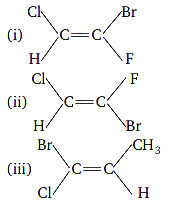
Which of the following compound$(s)$ has '$Z$' configuration?
A
$(i)$ only
B
$(ii)$ only
C
$(iii)$ only
D
$(i)$ and $(iii)$
Solution
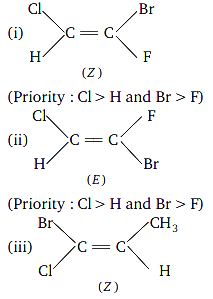
(D) According to the Cahn-Ingold-Prelog $(CIP)$ priority rules,the configuration is '$Z$' (zusammen) if the groups with higher priority are on the same side of the double bond,and '$E$' (entgegen) if they are on opposite sides.
For compound $(i)$:
Left carbon: $Cl > H$ (priority).
Right carbon: $Br > F$ (priority).
Since the higher priority groups ($Cl$ and $Br$) are on the same side,it has '$Z$' configuration.
For compound $(ii)$:
Left carbon: $Cl > H$ (priority).
Right carbon: $Br > F$ (priority).
Since the higher priority groups ($Cl$ and $Br$) are on opposite sides,it has '$E$' configuration.
For compound $(iii)$:
Left carbon: $Br > Cl$ (priority).
Right carbon: $CH_3 > H$ (priority).
Since the higher priority groups ($Br$ and $CH_3$) are on the same side,it has '$Z$' configuration.
Thus,compounds $(i)$ and $(iii)$ have '$Z$' configuration.
For compound $(i)$:
Left carbon: $Cl > H$ (priority).
Right carbon: $Br > F$ (priority).
Since the higher priority groups ($Cl$ and $Br$) are on the same side,it has '$Z$' configuration.
For compound $(ii)$:
Left carbon: $Cl > H$ (priority).
Right carbon: $Br > F$ (priority).
Since the higher priority groups ($Cl$ and $Br$) are on opposite sides,it has '$E$' configuration.
For compound $(iii)$:
Left carbon: $Br > Cl$ (priority).
Right carbon: $CH_3 > H$ (priority).
Since the higher priority groups ($Br$ and $CH_3$) are on the same side,it has '$Z$' configuration.
Thus,compounds $(i)$ and $(iii)$ have '$Z$' configuration.
0 likesView Solution
146
ChemistryMCQAP EAMCET · 2008
The orbit of a geo-stationary satellite is circular. The time period of the satellite depends on:
$(i)$ mass of the satellite
(ii) mass of the earth
(iii) radius of the orbit
(iv) height of the satellite from the surface of the earth
Which of the following is correct?
$(i)$ mass of the satellite
(ii) mass of the earth
(iii) radius of the orbit
(iv) height of the satellite from the surface of the earth
Which of the following is correct?
A
$(i)$ only
B
$(i)$ and (ii)
C
$(i)$,(ii) and (iii)
D
(ii),(iii) and (iv)
Solution
(D) The time period $T$ of a satellite in a circular orbit is given by the formula $T = 2\pi \sqrt{\frac{r^3}{GM}}$,where $r$ is the radius of the orbit,$G$ is the gravitational constant,and $M$ is the mass of the earth.
$1$. The radius of the orbit $r$ is equal to $R_e + h$,where $R_e$ is the radius of the earth and $h$ is the height of the satellite from the surface of the earth.
$2$. From the formula,it is clear that $T$ depends on the mass of the earth $(M)$,the radius of the orbit $(r)$,and the height $(h)$ because $r = R_e + h$.
$3$. The time period $T$ is independent of the mass of the satellite $(m)$.
Therefore,the time period depends on (ii),(iii),and (iv).
$1$. The radius of the orbit $r$ is equal to $R_e + h$,where $R_e$ is the radius of the earth and $h$ is the height of the satellite from the surface of the earth.
$2$. From the formula,it is clear that $T$ depends on the mass of the earth $(M)$,the radius of the orbit $(r)$,and the height $(h)$ because $r = R_e + h$.
$3$. The time period $T$ is independent of the mass of the satellite $(m)$.
Therefore,the time period depends on (ii),(iii),and (iv).
0 likesView Solution
147
ChemistryMediumMCQAP EAMCET · 2008
What are $X$ and $Y$ respectively in the following reaction?
$Z$-product $\stackrel{Y}{\longleftarrow} 2$-butyne $\stackrel{X}{\longrightarrow} E$-product
$Z$-product $\stackrel{Y}{\longleftarrow} 2$-butyne $\stackrel{X}{\longrightarrow} E$-product
A
$Na / NH_3$ (liq.) and $Pd / BaSO_4 + H_2$
B
$Ni / 140^{\circ} C$ and $Pd / BaSO_4 + H_2$
C
$Ni / 140^{\circ} C$ and $Na / NH_3$ (liq.)
D
$Pd / BaSO_4 + H_2$ and $Na / NH_3$ (liq.)
Solution
(A) The reduction of $2$-butyne with $Na / NH_3$ (liq.) (Birch reduction) yields the $E$-product (trans$-2-$butene) due to anti-addition of hydrogen.
Conversely,the catalytic hydrogenation of $2$-butyne using Lindlar's catalyst $(Pd / BaSO_4 + H_2)$ yields the $Z$-product (cis$-2-$butene) due to syn-addition of hydrogen.
Given the reaction scheme:
$Z$-product $\stackrel{Y}{\longleftarrow} 2$-butyne $\stackrel{X}{\longrightarrow} E$-product
$X$ must be $Na / NH_3$ (liq.) and $Y$ must be $Pd / BaSO_4 + H_2$.
Conversely,the catalytic hydrogenation of $2$-butyne using Lindlar's catalyst $(Pd / BaSO_4 + H_2)$ yields the $Z$-product (cis$-2-$butene) due to syn-addition of hydrogen.
Given the reaction scheme:
$Z$-product $\stackrel{Y}{\longleftarrow} 2$-butyne $\stackrel{X}{\longrightarrow} E$-product
$X$ must be $Na / NH_3$ (liq.) and $Y$ must be $Pd / BaSO_4 + H_2$.
0 likesView Solution
148
ChemistryMediumMCQAP EAMCET · 2008
Which one of the following reactions represents the oxidising property of $H_2O_2$?
A
$2KMnO_4 + 3H_2SO_4 + 5H_2O_2 \longrightarrow K_2SO_4 + 2MnSO_4 + 8H_2O + 5O_2$
B
$2K_3[Fe(CN)_6] + 2KOH + H_2O_2 \longrightarrow 2K_4[Fe(CN)_6] + 2H_2O + O_2$
C
$PbO_2 + H_2O_2 \longrightarrow PbO + H_2O + O_2$
D
$2KI + H_2SO_4 + H_2O_2 \longrightarrow K_2SO_4 + I_2 + 2H_2O$
Solution
(D) The oxidising property of $H_2O_2$ is shown when it acts as an oxidising agent,meaning $H_2O_2$ itself gets reduced to $H_2O$ (oxidation state of $O$ changes from $-1$ to $-2$).
In option $D$,$2KI + H_2SO_4 + H_2O_2 \longrightarrow K_2SO_4 + I_2 + 2H_2O$,the oxidation state of $I$ in $KI$ increases from $-1$ to $0$ (oxidation),and the oxidation state of $O$ in $H_2O_2$ decreases from $-1$ to $-2$ (reduction).
Thus,$H_2O_2$ acts as an oxidising agent.
In option $D$,$2KI + H_2SO_4 + H_2O_2 \longrightarrow K_2SO_4 + I_2 + 2H_2O$,the oxidation state of $I$ in $KI$ increases from $-1$ to $0$ (oxidation),and the oxidation state of $O$ in $H_2O_2$ decreases from $-1$ to $-2$ (reduction).
Thus,$H_2O_2$ acts as an oxidising agent.
0 likesView Solution
149
ChemistryMCQAP EAMCET · 2008
For an ellipse with eccentricity $e = \frac{1}{2}$,the centre is at the origin. If one directrix is $x = 4$,then the equation of the ellipse is:
A
$3x^2 + 4y^2 = 1$
B
$3x^2 + 4y^2 = 12$
C
$4x^2 + 3y^2 = 1$
D
$4x^2 + 3y^2 = 12$
Solution
(B) Given that,eccentricity $e = \frac{1}{2}$ and the equation of the directrix is $x = \frac{a}{e} = 4$.
From $\frac{a}{e} = 4$,we get $a = 4 \times e = 4 \times \frac{1}{2} = 2$.
Thus,$a^2 = 4$.
Using the relation $b^2 = a^2(1 - e^2)$,we have:
$b^2 = 4(1 - (\frac{1}{2})^2) = 4(1 - \frac{1}{4}) = 4(\frac{3}{4}) = 3$.
Therefore,the equation of the ellipse is $\frac{x^2}{a^2} + \frac{y^2}{b^2} = 1$.
Substituting the values,we get $\frac{x^2}{4} + \frac{y^2}{3} = 1$.
Multiplying by $12$,we get $3x^2 + 4y^2 = 12$.
From $\frac{a}{e} = 4$,we get $a = 4 \times e = 4 \times \frac{1}{2} = 2$.
Thus,$a^2 = 4$.
Using the relation $b^2 = a^2(1 - e^2)$,we have:
$b^2 = 4(1 - (\frac{1}{2})^2) = 4(1 - \frac{1}{4}) = 4(\frac{3}{4}) = 3$.
Therefore,the equation of the ellipse is $\frac{x^2}{a^2} + \frac{y^2}{b^2} = 1$.
Substituting the values,we get $\frac{x^2}{4} + \frac{y^2}{3} = 1$.
Multiplying by $12$,we get $3x^2 + 4y^2 = 12$.
0 likesView Solution
150
ChemistryMCQAP EAMCET · 2008
If $f: R \rightarrow C$ is defined by $f(x)=e^{2 i x}$ for $x \in R$,then $f$ is (where $C$ denotes the set of all complex numbers)
A
one-one
B
onto
C
one-one and onto
D
neither one-one nor onto
Solution
(D) Given the function $f: R \rightarrow C$ defined by $f(x) = e^{2 i x} = \cos(2x) + i \sin(2x)$.
For $f$ to be one-one,$f(x_1) = f(x_2)$ must imply $x_1 = x_2$. However,$f(x + \pi) = e^{2 i (x + \pi)} = e^{2 i x + 2 i \pi} = e^{2 i x} \cdot e^{2 i \pi} = e^{2 i x} \cdot 1 = f(x)$. Since $f(x) = f(x + \pi)$ for all $x \in R$,the function is many-one.
For $f$ to be onto,the range of $f$ must be equal to the codomain $C$. The range of $f(x) = \cos(2x) + i \sin(2x)$ is the set of all complex numbers $z$ such that $|z| = 1$ (the unit circle in the complex plane). Since the codomain is the set of all complex numbers $C$,and the range is only a subset of $C$ (the unit circle),the function is not onto.
Therefore,$f$ is neither one-one nor onto.
For $f$ to be one-one,$f(x_1) = f(x_2)$ must imply $x_1 = x_2$. However,$f(x + \pi) = e^{2 i (x + \pi)} = e^{2 i x + 2 i \pi} = e^{2 i x} \cdot e^{2 i \pi} = e^{2 i x} \cdot 1 = f(x)$. Since $f(x) = f(x + \pi)$ for all $x \in R$,the function is many-one.
For $f$ to be onto,the range of $f$ must be equal to the codomain $C$. The range of $f(x) = \cos(2x) + i \sin(2x)$ is the set of all complex numbers $z$ such that $|z| = 1$ (the unit circle in the complex plane). Since the codomain is the set of all complex numbers $C$,and the range is only a subset of $C$ (the unit circle),the function is not onto.
Therefore,$f$ is neither one-one nor onto.
0 likesView Solution
Vedclass Products
For Students
Vedclass Test Series
Mock tests in real AP EAMCET style covering Chemistry with performance analysis. 5-day free trial.
Start Free TrialFor Teachers
Exam Paper Generator
Generate Set A/B/C/D Chemistry papers from 7.5L+ questions in 2 minutes. 3 chapters free.
Try FreeFor Institutes
Online Exam Module
Run live AP EAMCET mock exams with unlimited students, 360° analytics & white-label branding.
See DemoFrequently Asked Questions
How many Chemistry questions are in AP EAMCET 2008?
There are 204 Chemistry questions from the AP EAMCET 2008 paper on Vedclass, each with a detailed step-by-step solution in English.
Are AP EAMCET 2008 Chemistry solutions available in English?
Yes. All solutions on this page are in English. You can also switch to English or Hindi using the language buttons above the questions.
Can I practice AP EAMCET 2008 Chemistry as a timed test?
Yes. Use the Vedclass Test Series to attempt a full AP EAMCET mock test covering Chemistry with time limits and instant score analysis.
Can teachers create Chemistry papers from AP EAMCET previous year questions?
Yes. The Vedclass Exam Paper Generator lets teachers mix AP EAMCET Chemistry questions and generate Set A/B/C/D papers in minutes.
For Teachers & Institutes
Build a Custom Chemistry Paper
Pick AP EAMCET 2008 Chemistry questions, set difficulty, and generate Set A/B/C/D in 2 minutes.