
ChemistryQ151–161 of 187 questions
Page 4 of 4 · English
151
ChemistryMCQAP EAMCET · 2004
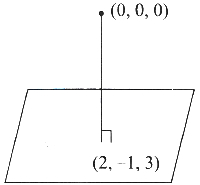
If $(2, -1, 3)$ is the foot of the perpendicular drawn from the origin to a plane,then the equation of that plane is
A
$2x + y - 3z + 6 = 0$
B
$2x - y + 3z - 14 = 0$
C
$2x - y + 3z - 13 = 0$
D
$2x + y + 3z - 10 = 0$
Solution
(B) Let the equation of the plane be $ax + by + cz + d = 0$.
Since the line segment joining the origin $(0, 0, 0)$ and the point $(2, -1, 3)$ is perpendicular to the plane,the direction ratios of the normal to the plane are given by the coordinates of the foot of the perpendicular:
$a = 2 - 0 = 2$
$b = -1 - 0 = -1$
$c = 3 - 0 = 3$
Thus,the equation of the plane is $2x - y + 3z + d = 0$.
Since the plane passes through the point $(2, -1, 3)$,we substitute these coordinates into the equation:
$2(2) - (-1) + 3(3) + d = 0$
$4 + 1 + 9 + d = 0$
$14 + d = 0$
$d = -14$
Therefore,the equation of the plane is $2x - y + 3z - 14 = 0$.
Since the line segment joining the origin $(0, 0, 0)$ and the point $(2, -1, 3)$ is perpendicular to the plane,the direction ratios of the normal to the plane are given by the coordinates of the foot of the perpendicular:
$a = 2 - 0 = 2$
$b = -1 - 0 = -1$
$c = 3 - 0 = 3$
Thus,the equation of the plane is $2x - y + 3z + d = 0$.
Since the plane passes through the point $(2, -1, 3)$,we substitute these coordinates into the equation:
$2(2) - (-1) + 3(3) + d = 0$
$4 + 1 + 9 + d = 0$
$14 + d = 0$
$d = -14$
Therefore,the equation of the plane is $2x - y + 3z - 14 = 0$.
0 likesView Solution
152
ChemistryEasyMCQAP EAMCET · 2004
In the extraction of sodium by Down's process,cathode and anode respectively are
A
copper and nickel
B
copper and chromium
C
nickel and chromium
D
iron and graphite
Solution
(D) In the extraction of sodium by Down's process,the electrolytic cell consists of an iron cathode and a graphite anode. The molten $NaCl$ is electrolyzed to produce sodium metal at the cathode and chlorine gas at the anode.
0 likesView Solution
153
ChemistryMediumMCQAP EAMCET · 2004
In the hardening stage of Plaster of Paris,the compound formed is:
A
$CaSO_4$
B
$Orthorhombic \ CaSO_4 \cdot 2H_2O$
C
$CaSO_4 \cdot H_2O$
D
$Monoclinic \ CaSO_4 \cdot 2H_2O$
Solution
(D) Plaster of Paris is $CaSO_4 \cdot \frac{1}{2}H_2O$.
When mixed with water,it sets into a hard mass of gypsum,which is $CaSO_4 \cdot 2H_2O$.
The crystalline form of gypsum formed during this hardening process is monoclinic.
When mixed with water,it sets into a hard mass of gypsum,which is $CaSO_4 \cdot 2H_2O$.
The crystalline form of gypsum formed during this hardening process is monoclinic.
0 likesView Solution
154
ChemistryMCQAP EAMCET · 2004
A
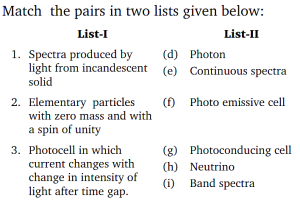
$1-$e,$2$-h,$3$-g
B
$1-$i,$2$-h,$3$-f
C
$1-$e,$2$-h,$3$-f
D
$1-$i,$2$-d,$3$-g
Solution
(A) No Solution Available
0 likesView Solution
155
ChemistryEasyMCQAP EAMCET · 2004
An organic compound containing $C$ and $H$ has $92.3 \%$ of carbon. Its empirical formula is:
A
$CH$
B
$CH_3$
C
$CH_2$
D
$CH_4$
Solution
(A) The percentage of $C$ is $92.3 \%$,so the percentage of $H$ is $100 - 92.3 = 7.7 \%$.
Thus,the empirical formula is $CH$.
| Element | Atomic Ratio (Percentage / Atomic Mass) | Simple Molar Ratio |
| $C$ | $92.3 / 12 = 7.69$ | $7.69 / 7.69 = 1$ |
| $H$ | $7.7 / 1 = 7.70$ | $7.70 / 7.69 \approx 1$ |
Thus,the empirical formula is $CH$.
0 likesView Solution
156
ChemistryDifficultMCQAP EAMCET · 2004
At $27^{\circ} C$,$500 \ mL$ of helium diffuses in $30 \ minutes$. What is the time (in hours) taken for $1000 \ mL$ of $SO_2$ to diffuse under the same experimental conditions?
A
$240$
B
$3$
C
$2$
D
$4$
Solution
(D) According to Graham's Law of diffusion,the rate of diffusion $r$ is inversely proportional to the square root of the molar mass $M$ and directly proportional to the volume $V$ diffused per unit time $t$: $r = \frac{V}{t} \propto \frac{1}{\sqrt{M}}$.
Given for Helium $(He)$: $V_1 = 500 \ mL$,$t_1 = 30 \ min$,$M_1 = 4 \ g/mol$.
Given for Sulfur dioxide $(SO_2)$: $V_2 = 1000 \ mL$,$t_2 = t$,$M_2 = 64 \ g/mol$.
The ratio is given by: $\frac{r_1}{r_2} = \frac{V_1/t_1}{V_2/t_2} = \sqrt{\frac{M_2}{M_1}}$.
Substituting the values: $\frac{500/30}{1000/t} = \sqrt{\frac{64}{4}}$.
$\frac{500}{30} \times \frac{t}{1000} = \sqrt{16} = 4$.
$\frac{t}{60} = 4$.
$t = 240 \ minutes$.
Converting to hours: $t = \frac{240}{60} = 4 \ hours$.
Given for Helium $(He)$: $V_1 = 500 \ mL$,$t_1 = 30 \ min$,$M_1 = 4 \ g/mol$.
Given for Sulfur dioxide $(SO_2)$: $V_2 = 1000 \ mL$,$t_2 = t$,$M_2 = 64 \ g/mol$.
The ratio is given by: $\frac{r_1}{r_2} = \frac{V_1/t_1}{V_2/t_2} = \sqrt{\frac{M_2}{M_1}}$.
Substituting the values: $\frac{500/30}{1000/t} = \sqrt{\frac{64}{4}}$.
$\frac{500}{30} \times \frac{t}{1000} = \sqrt{16} = 4$.
$\frac{t}{60} = 4$.
$t = 240 \ minutes$.
Converting to hours: $t = \frac{240}{60} = 4 \ hours$.
0 likesView Solution
157
ChemistryEasyMCQAP EAMCET · 2004
Assertion $(A)$ At $300 \ K$,kinetic energy of $16 \ g$ of methane is equal to the kinetic energy of $32 \ g$ of oxygen.
Reason $(R)$ At constant temperature,kinetic energy of one mole of all gases is equal.
Reason $(R)$ At constant temperature,kinetic energy of one mole of all gases is equal.
A
Both $(A)$ and $(R)$ are true and $(R)$ is the correct explanation of $(A)$
B
Both $(A)$ and $(R)$ are true but $(R)$ is not the correct explanation of $(A)$
C
$(A)$ is true but $(R)$ is not true
D
$(A)$ is not true but $(R)$ is true
Solution
(A) The kinetic energy $(KE)$ of $n$ moles of an ideal gas is given by $KE = \frac{3}{2} nRT$.
For $16 \ g$ of methane ($CH_4$,molar mass = $16 \ g/mol$),$n = \frac{16}{16} = 1 \ mol$.
For $32 \ g$ of oxygen ($O_2$,molar mass = $32 \ g/mol$),$n = \frac{32}{32} = 1 \ mol$.
Since both samples contain $1 \ mol$ of gas at the same temperature $(300 \ K)$,their kinetic energies are equal. Thus,$(A)$ is true.
The kinetic energy of $1 \ mol$ of any ideal gas is $\frac{3}{2} RT$,which depends only on temperature. Thus,$(R)$ is true and correctly explains $(A)$.
For $16 \ g$ of methane ($CH_4$,molar mass = $16 \ g/mol$),$n = \frac{16}{16} = 1 \ mol$.
For $32 \ g$ of oxygen ($O_2$,molar mass = $32 \ g/mol$),$n = \frac{32}{32} = 1 \ mol$.
Since both samples contain $1 \ mol$ of gas at the same temperature $(300 \ K)$,their kinetic energies are equal. Thus,$(A)$ is true.
The kinetic energy of $1 \ mol$ of any ideal gas is $\frac{3}{2} RT$,which depends only on temperature. Thus,$(R)$ is true and correctly explains $(A)$.
0 likesView Solution
158
ChemistryEasyMCQAP EAMCET · 2004
Which of the following is correct?
A
$^1_1 H$ and $^3_2 He$ are isotopes
B
$^{14}_6 C$ and $^{14}_7 N$ are isotopes
C
$^{39}_{19} K$ and $^{40}_{20} Ca$ are isotones
D
$^{19}_9 F$ and $^{24}_{11} Na$ are isotopes
Solution
(C) Isotones are species that have an equal number of neutrons.
Number of neutrons = Mass number $(A)$ - Atomic number $(Z)$.
For $^{39}_{19} K$: Neutrons = $39 - 19 = 20$.
For $^{40}_{20} Ca$: Neutrons = $40 - 20 = 20$.
Since both have $20$ neutrons,they are isotones.
Number of neutrons = Mass number $(A)$ - Atomic number $(Z)$.
For $^{39}_{19} K$: Neutrons = $39 - 19 = 20$.
For $^{40}_{20} Ca$: Neutrons = $40 - 20 = 20$.
Since both have $20$ neutrons,they are isotones.
0 likesView Solution
159
ChemistryMediumMCQAP EAMCET · 2004
Which of the following elements has the least number of electrons in its $M$ shell?
A
$K$
B
$Mn$
C
$Ni$
D
$Sc$
Solution
(A) The electronic configurations of the given elements are as follows:
$K (Z=19): 1s^2, 2s^2 2p^6, 3s^2 3p^6, 4s^1$. The $M$ shell $(n=3)$ has $2+6 = 8$ electrons.
$Mn (Z=25): 1s^2, 2s^2 2p^6, 3s^2 3p^6 3d^5, 4s^2$. The $M$ shell $(n=3)$ has $2+6+5 = 13$ electrons.
$Ni (Z=28): 1s^2, 2s^2 2p^6, 3s^2 3p^6 3d^8, 4s^2$. The $M$ shell $(n=3)$ has $2+6+8 = 16$ electrons.
$Sc (Z=21): 1s^2, 2s^2 2p^6, 3s^2 3p^6 3d^1, 4s^2$. The $M$ shell $(n=3)$ has $2+6+1 = 9$ electrons.
Comparing the number of electrons in the $M$ shell: $K (8) < Sc (9) < Mn (13) < Ni (16)$.
Thus,$K$ has the least number of electrons in its $M$ shell.
$K (Z=19): 1s^2, 2s^2 2p^6, 3s^2 3p^6, 4s^1$. The $M$ shell $(n=3)$ has $2+6 = 8$ electrons.
$Mn (Z=25): 1s^2, 2s^2 2p^6, 3s^2 3p^6 3d^5, 4s^2$. The $M$ shell $(n=3)$ has $2+6+5 = 13$ electrons.
$Ni (Z=28): 1s^2, 2s^2 2p^6, 3s^2 3p^6 3d^8, 4s^2$. The $M$ shell $(n=3)$ has $2+6+8 = 16$ electrons.
$Sc (Z=21): 1s^2, 2s^2 2p^6, 3s^2 3p^6 3d^1, 4s^2$. The $M$ shell $(n=3)$ has $2+6+1 = 9$ electrons.
Comparing the number of electrons in the $M$ shell: $K (8) < Sc (9) < Mn (13) < Ni (16)$.
Thus,$K$ has the least number of electrons in its $M$ shell.
0 likesView Solution
160
ChemistryEasyMCQAP EAMCET · 2004
Which of the following is an endothermic reaction?
A
$N_{2(g)} + 3 H_{2(g)} \longrightarrow 2 NH_{3(g)} + 92 \ kJ$
B
$N_{2(g)} + O_{2(g)} + 180.8 \ kJ \longrightarrow 2 NO_{(g)}$
C
$H_{2(g)} + Cl_{2(g)} \longrightarrow 2 HCl_{(g)} + 184.6 \ kJ$
D
$C_{(graphite)} + 2 H_{2(g)} \longrightarrow CH_{4(g)} + 74.8 \ kJ$
Solution
(B) An endothermic reaction is a process in which heat energy is absorbed from the surroundings.
In the reaction $N_{2(g)} + O_{2(g)} + 180.8 \ kJ \longrightarrow 2 NO_{(g)}$,heat is added as a reactant,indicating that energy is absorbed.
Therefore,this is an endothermic reaction.
In the reaction $N_{2(g)} + O_{2(g)} + 180.8 \ kJ \longrightarrow 2 NO_{(g)}$,heat is added as a reactant,indicating that energy is absorbed.
Therefore,this is an endothermic reaction.
0 likesView Solution
161
ChemistryMediumMCQAP EAMCET · 2004
Average $C-H$ bond energy is $416 \ kJ \ mol^{-1}$. Which of the following is correct?
A
$CH_{4(g)} + 416 \ kJ \longrightarrow C_{(g)} + 4H_{(g)}$
B
$CH_{4(g)} \longrightarrow C_{(g)} + 4H_{(g)} + 416 \ kJ$
C
$CH_{4(g)} + 1664 \ kJ \longrightarrow C_{(g)} + 4H_{(g)}$
D
$CH_{4(g)} \longrightarrow C_{(g)} + 4H_{(g)} + 1664 \ kJ$
Solution
(C) The molecule $CH_4$ contains four $C-H$ bonds.
To break one mole of $CH_4$ into gaseous carbon and hydrogen atoms,all four $C-H$ bonds must be broken.
The total energy required is $4 \times 416 \ kJ \ mol^{-1} = 1664 \ kJ \ mol^{-1}$.
Therefore,the thermochemical equation is $CH_{4(g)} + 1664 \ kJ \longrightarrow C_{(g)} + 4H_{(g)}$.
To break one mole of $CH_4$ into gaseous carbon and hydrogen atoms,all four $C-H$ bonds must be broken.
The total energy required is $4 \times 416 \ kJ \ mol^{-1} = 1664 \ kJ \ mol^{-1}$.
Therefore,the thermochemical equation is $CH_{4(g)} + 1664 \ kJ \longrightarrow C_{(g)} + 4H_{(g)}$.
0 likesView Solution
Vedclass Products
For Students
Vedclass Test Series
Mock tests in real AP EAMCET style covering Chemistry with performance analysis. 5-day free trial.
Start Free TrialFor Teachers
Exam Paper Generator
Generate Set A/B/C/D Chemistry papers from 7.5L+ questions in 2 minutes. 3 chapters free.
Try FreeFor Institutes
Online Exam Module
Run live AP EAMCET mock exams with unlimited students, 360° analytics & white-label branding.
See DemoFrequently Asked Questions
How many Chemistry questions are in AP EAMCET 2004?
There are 187 Chemistry questions from the AP EAMCET 2004 paper on Vedclass, each with a detailed step-by-step solution in English.
Are AP EAMCET 2004 Chemistry solutions available in English?
Yes. All solutions on this page are in English. You can also switch to English or Hindi using the language buttons above the questions.
Can I practice AP EAMCET 2004 Chemistry as a timed test?
Yes. Use the Vedclass Test Series to attempt a full AP EAMCET mock test covering Chemistry with time limits and instant score analysis.
Can teachers create Chemistry papers from AP EAMCET previous year questions?
Yes. The Vedclass Exam Paper Generator lets teachers mix AP EAMCET Chemistry questions and generate Set A/B/C/D papers in minutes.
For Teachers & Institutes
Build a Custom Chemistry Paper
Pick AP EAMCET 2004 Chemistry questions, set difficulty, and generate Set A/B/C/D in 2 minutes.