
BiologyQ51–110 of 160 questions
Page 2 of 2 · English
51
BiologyMediumMCQAIPMT · 2010
Phototropic curvature is the result of uneven distribution of
A
gibberellin
B
phytochrome
C
cytokinins
D
auxin
Solution
(D) : Phototropic curvature is the result of uneven distribution of $auxin$.
$Charles \ Darwin$ and his son $Francis \ Darwin$ observed that the coleoptiles of canary grass responded to unilateral illumination by growing towards the light source $(phototropism)$.
After a series of experiments, it was concluded that the tip of the coleoptile contains $auxin$, which causes the bending of the entire coleoptile in relation to the direction of light.
$Charles \ Darwin$ and his son $Francis \ Darwin$ observed that the coleoptiles of canary grass responded to unilateral illumination by growing towards the light source $(phototropism)$.
After a series of experiments, it was concluded that the tip of the coleoptile contains $auxin$, which causes the bending of the entire coleoptile in relation to the direction of light.
0 likesView Solution
52
BiologyEasyMCQAIPMT · 2010
Photoperiodism was first characterised in
A
tobacco
B
potato
C
tomato
D
cotton
Solution
(A) : Photoperiodism is the physiological response of plants to the relative lengths of light and dark periods.
It was first characterized by $W.W. Garner$ and $H.A. Allard$ $(1920)$ in tobacco plants.
They observed that the $Maryland$ $Mammoth$ variety of tobacco could be induced to flower during the summer season by artificially reducing the duration of light exposure.
It was first characterized by $W.W. Garner$ and $H.A. Allard$ $(1920)$ in tobacco plants.
They observed that the $Maryland$ $Mammoth$ variety of tobacco could be induced to flower during the summer season by artificially reducing the duration of light exposure.
0 likesView Solution
53
BiologyMediumMCQAIPMT · 2010
Coiling of garden pea tendrils around any support is an example of
A
thigmotaxis
B
thigmonasty
C
thigmotropism
D
thermotaxis
Solution
(C) : The growth movement in response to touch,or contact of a foreign body,in plants is called thigmotropism or thigmotropic movement.
The stems and tendrils of the climbers are positively thigmotropic in their response.
The coiling of garden pea tendrils around any support is an example of thigmotropism.
Thigmonastic (haptonastic) movements are induced by some external stimuli,but they are non-directional. For example,tentacles of $Drosera$ leaf curve and the lamina lobes of $Dionaea$ fold on coming in contact with an insect.
The stems and tendrils of the climbers are positively thigmotropic in their response.
The coiling of garden pea tendrils around any support is an example of thigmotropism.
Thigmonastic (haptonastic) movements are induced by some external stimuli,but they are non-directional. For example,tentacles of $Drosera$ leaf curve and the lamina lobes of $Dionaea$ fold on coming in contact with an insect.
0 likesView Solution
54
BiologyMediumMCQAIPMT · 2010
One of the commonly used plant growth hormones in tea plantations is
A
ethylene
B
abscisic acid
C
zeatin
D
indole-$3$-acetic acid
Solution
(D) : Indole-$3$-acetic acid (also called auxin) is a phytohormone which is generally produced by the growing apices of the stems and roots,from where it migrates to the regions of its action.
It is observed that the growing apical bud inhibits the growth of the lateral (axillary) bud,a phenomenon known as apical dominance.
Since the apical meristem is the site of auxin synthesis,it is the physiological effect of the auxin that results in apical dominance.
When shoot tips are removed,it usually results in the growth of lateral buds.
This phenomenon is widely applied in tea plantations and hedge-making because,in tea plantations,the apical bud is plucked for tea processing,which stimulates the growth of more lateral buds,thus enhancing the yield for industrial purposes.
It is observed that the growing apical bud inhibits the growth of the lateral (axillary) bud,a phenomenon known as apical dominance.
Since the apical meristem is the site of auxin synthesis,it is the physiological effect of the auxin that results in apical dominance.
When shoot tips are removed,it usually results in the growth of lateral buds.
This phenomenon is widely applied in tea plantations and hedge-making because,in tea plantations,the apical bud is plucked for tea processing,which stimulates the growth of more lateral buds,thus enhancing the yield for industrial purposes.
0 likesView Solution
55
BiologyMediumMCQAIPMT · 2010
Root development is promoted by
A
abscisic acid
B
auxin
C
gibberellin
D
ethylene
Solution
(D) The correct answer is $D$.
Ethylene is a gaseous plant hormone that plays a crucial role in root development.
It promotes root growth and the formation of root hairs,which increases the surface area for water and mineral absorption.
In low concentrations,ethylene is specifically used for the initiation of roots and the development of lateral roots.
Ethylene is a gaseous plant hormone that plays a crucial role in root development.
It promotes root growth and the formation of root hairs,which increases the surface area for water and mineral absorption.
In low concentrations,ethylene is specifically used for the initiation of roots and the development of lateral roots.
0 likesView Solution
56
BiologyMediumMCQAIPMT · 2010
Carrier ions like $Na^+$ facilitate the absorption of substances like
A
amino acids and glucose
B
glucose and fatty acids
C
fatty acids and glycerol
D
fructose and some amino acids
Solution
(A) The absorption of glucose and amino acids is mediated by carrier ions like $Na^+$.
The concentration of $Na^+$ is higher in the intestinal lumen compared to the mucosal cells.
$Na^+$ moves into the cells along its concentration gradient,and simultaneously,glucose or amino acids are transported into the intestinal cells via symport.
Thus,$Na^+$ diffuses into the cell and drags glucose or amino acids along with it.
The intestinal $Na^+$ gradient serves as the immediate energy source for this secondary active transport.
Fructose absorption occurs via facilitated diffusion,which does not require energy and is independent of $Na^+$ transport.
The concentration of $Na^+$ is higher in the intestinal lumen compared to the mucosal cells.
$Na^+$ moves into the cells along its concentration gradient,and simultaneously,glucose or amino acids are transported into the intestinal cells via symport.
Thus,$Na^+$ diffuses into the cell and drags glucose or amino acids along with it.
The intestinal $Na^+$ gradient serves as the immediate energy source for this secondary active transport.
Fructose absorption occurs via facilitated diffusion,which does not require energy and is independent of $Na^+$ transport.
0 likesView Solution
57
BiologyMediumMCQAIPMT · 2010
If for some reason our goblet cells are non-functional,this will adversely affect
A
production of somatostatin
B
secretion of sebum from the sebaceous glands
C
maturation of sperms
D
smooth movement of food down the intestine.
Solution
(D) : The intestinal mucosal epithelium contains goblet cells which secrete mucus.
This mucus lubricates the food to facilitate its easy passage through the alimentary canal.
Therefore,if goblet cells become non-functional,it will adversely affect the smooth movement of food down the intestine.
Additionally,the mucus,along with bicarbonates from the pancreas,protects the intestinal mucosa from gastric acid and provides an alkaline medium necessary for enzymatic activities.
This mucus lubricates the food to facilitate its easy passage through the alimentary canal.
Therefore,if goblet cells become non-functional,it will adversely affect the smooth movement of food down the intestine.
Additionally,the mucus,along with bicarbonates from the pancreas,protects the intestinal mucosa from gastric acid and provides an alkaline medium necessary for enzymatic activities.
0 likesView Solution
58
BiologyEasyMCQAIPMT · 2010
Jaundice is a disorder of
A
excretory system
B
skin and eyes
C
digestive system
D
circulatory system
Solution
(C) : Jaundice is a disorder of the digestive system. In this condition,the skin and eyes turn yellow due to the deposition of bile pigments. This occurs when bile produced in the liver fails to reach the intestine due to an obstruction in the bile duct. As a result,the bile is absorbed into the blood instead of passing into the duodenum,leading to the yellowing of the skin and eyes.
0 likesView Solution
59
BiologyMediumMCQAIPMT · 2010
Listed below are four respiratory capacities $(i-iv)$ and four jumbled respiratory volumes of a normal human adult. Which one of the following is the correct matching of two capacities and volumes?
| Respiratory capacities | Respiratory volumes |
|---|---|
| $(i)$ Residual volume | $2500 \; mL$ |
| $(ii)$ Vital capacity | $3500 \; mL$ |
| $(iii)$ Inspiratory reserve volume | $1200 \; mL$ |
| $(iv)$ Inspiratory capacity | $4500 \; mL$ |
A
$(ii) 2500 \; mL, (iii) 4500 \; mL$
B
$(iii) 1200 \; mL, (iv) 2500 \; mL$
C
$(iv) 3500 \; mL, (i) 1200 \; mL$
D
$(i) 4500 \; mL, (ii) 3500 \; mL$
Solution
(C) The correct matching is $(iv) 3500 \; mL$ and $(i) 1200 \; mL$.
$1$. Residual Volume $(RV)$: The volume of air remaining in the lungs even after a forcible expiration. It is approximately $1100 \; mL$ to $1200 \; mL$.
$2$. Vital Capacity $(VC)$: The maximum volume of air a person can breathe in after a forced expiration. It is approximately $3500 \; mL$ to $4600 \; mL$.
$3$. Inspiratory Reserve Volume $(IRV)$: Additional volume of air,a person can inspire by a forcible inspiration. It is approximately $2500 \; mL$ to $3000 \; mL$.
$4$. Inspiratory Capacity $(IC)$: Total volume of air a person can inspire after a normal expiration. It is $TV + IRV$ (approx $500 \; mL + 3000 \; mL = 3500 \; mL$).
Comparing these with the given options,$(iv)$ Inspiratory capacity matches $3500 \; mL$ and $(i)$ Residual volume matches $1200 \; mL$.
$1$. Residual Volume $(RV)$: The volume of air remaining in the lungs even after a forcible expiration. It is approximately $1100 \; mL$ to $1200 \; mL$.
$2$. Vital Capacity $(VC)$: The maximum volume of air a person can breathe in after a forced expiration. It is approximately $3500 \; mL$ to $4600 \; mL$.
$3$. Inspiratory Reserve Volume $(IRV)$: Additional volume of air,a person can inspire by a forcible inspiration. It is approximately $2500 \; mL$ to $3000 \; mL$.
$4$. Inspiratory Capacity $(IC)$: Total volume of air a person can inspire after a normal expiration. It is $TV + IRV$ (approx $500 \; mL + 3000 \; mL = 3500 \; mL$).
Comparing these with the given options,$(iv)$ Inspiratory capacity matches $3500 \; mL$ and $(i)$ Residual volume matches $1200 \; mL$.
0 likesView Solution
60
BiologyMediumMCQAIPMT · 2010
What is true about $RBCs$ in humans?
A
They carry about $20-25$ percent of $CO_2$.
B
They transport $99.5$ percent of $O_2$.
C
They transport about $80$ percent oxygen only and the rest $20$ percent of it is transported in dissolved state in blood plasma.
D
They do not carry $CO_2$ at all.
Solution
(A) $RBCs$ (Red Blood Cells) play a crucial role in the transport of respiratory gases.
$1$. Oxygen Transport: About $97$ percent of $O_2$ is transported by $RBCs$ in the blood,bound to hemoglobin. The remaining $3$ percent of $O_2$ is carried in a dissolved state through the blood plasma.
$2$. Carbon Dioxide Transport: Nearly $20-25$ percent of $CO_2$ is transported by $RBCs$ (as carbaminohemoglobin). About $70$ percent of $CO_2$ is carried as bicarbonate ions $(HCO_3^-)$,and approximately $7$ percent of $CO_2$ is carried in a dissolved state through the plasma.
Therefore,the statement that $RBCs$ carry about $20-25$ percent of $CO_2$ is correct.
$1$. Oxygen Transport: About $97$ percent of $O_2$ is transported by $RBCs$ in the blood,bound to hemoglobin. The remaining $3$ percent of $O_2$ is carried in a dissolved state through the blood plasma.
$2$. Carbon Dioxide Transport: Nearly $20-25$ percent of $CO_2$ is transported by $RBCs$ (as carbaminohemoglobin). About $70$ percent of $CO_2$ is carried as bicarbonate ions $(HCO_3^-)$,and approximately $7$ percent of $CO_2$ is carried in a dissolved state through the plasma.
Therefore,the statement that $RBCs$ carry about $20-25$ percent of $CO_2$ is correct.
0 likesView Solution
61
BiologyMediumMCQAIPMT · 2010
If due to some injury the chordae tendinae of the tricuspid valve of the human heart is partially non-functional,what will be the immediate effect?
A
The flow of blood into the aorta will be slowed down
B
The 'pacemaker' will stop working
C
The blood will tend to flow back into the left atrium
D
The flow of blood into the pulmonary artery will be reduced
Solution
(D) : The tricuspid valve is located between the right atrium and the right ventricle of the human heart. It consists of three cusps that regulate the flow of blood from the atrium to the ventricle.
When the right ventricle contracts to pump blood into the pulmonary artery,the tricuspid valve closes to prevent the backflow of blood into the right atrium.
The chordae tendinae are fibrous cords that anchor the valve cusps to the papillary muscles,ensuring the valve remains closed during ventricular systole.
If the chordae tendinae are partially non-functional,the valve may not close properly,leading to regurgitation of blood into the right atrium.
Consequently,the volume of blood effectively pumped into the pulmonary artery will be reduced.
When the right ventricle contracts to pump blood into the pulmonary artery,the tricuspid valve closes to prevent the backflow of blood into the right atrium.
The chordae tendinae are fibrous cords that anchor the valve cusps to the papillary muscles,ensuring the valve remains closed during ventricular systole.
If the chordae tendinae are partially non-functional,the valve may not close properly,leading to regurgitation of blood into the right atrium.
Consequently,the volume of blood effectively pumped into the pulmonary artery will be reduced.
0 likesView Solution
62
BiologyMediumMCQAIPMT · 2010
Which two of the following changes $(i-iv)$ usually tend to occur in plain dwellers when they move to high altitudes ($3,500 \ m$ or more)?
$(i)$ Increase in red blood cell size
$(ii)$ Increase in red blood cell production
$(iii)$ Increased breathing rate
$(iv)$ Increase in thrombocyte count
Changes occurring are
$(i)$ Increase in red blood cell size
$(ii)$ Increase in red blood cell production
$(iii)$ Increased breathing rate
$(iv)$ Increase in thrombocyte count
Changes occurring are
A
$(ii)$ and $(iii)$
B
$(iii)$ and $(iv)$
C
$(i)$ and $(iv)$
D
$(i)$ and $(ii)$
Solution
(A) When individuals from plain areas move to high altitudes ($3,500 \ m$ or more),they experience hypoxia due to low atmospheric pressure and reduced oxygen availability.
To compensate for this,the body initiates several physiological adjustments:
$1$. Increased breathing rate: This helps in taking in more air to compensate for the lower partial pressure of oxygen.
$2$. Increased red blood cell production (erythropoiesis): The kidneys release the hormone erythropoietin,which stimulates the bone marrow to produce more red blood cells,thereby increasing the oxygen-carrying capacity of the blood.
Therefore,the correct changes are $(ii)$ and $(iii)$.
To compensate for this,the body initiates several physiological adjustments:
$1$. Increased breathing rate: This helps in taking in more air to compensate for the lower partial pressure of oxygen.
$2$. Increased red blood cell production (erythropoiesis): The kidneys release the hormone erythropoietin,which stimulates the bone marrow to produce more red blood cells,thereby increasing the oxygen-carrying capacity of the blood.
Therefore,the correct changes are $(ii)$ and $(iii)$.
0 likesView Solution
63
BiologyMediumMCQAIPMT · 2010
Fastest distribution of some injectable material/medicine and with no risk of any kind can be achieved by injecting it into the
A
muscles
B
arteries
C
veins
D
lymph vessels
Solution
(C) The correct answer is $C$. Intravenous injection is the most effective method for the rapid distribution of drugs or substances throughout the body because veins carry blood directly to the heart,which then pumps it to all tissues. Intramuscular injections are typically used for slower absorption or localized effects.
0 likesView Solution
64
BiologyMediumMCQAIPMT · 2010
Given below are four statements $(i-iv)$ regarding the human blood circulatory system.
$(i)$ Arteries are thick-walled and have a narrow lumen as compared to veins.
$(ii)$ Angina is acute chest pain when the blood circulation to the heart muscle is reduced.
$(iii)$ Persons with blood group $AB$ can donate blood to any person with any blood group under the $ABO$ system.
$(iv)$ Calcium ions play a very important role in blood clotting.
Which two of the above statements are correct?
$(i)$ Arteries are thick-walled and have a narrow lumen as compared to veins.
$(ii)$ Angina is acute chest pain when the blood circulation to the heart muscle is reduced.
$(iii)$ Persons with blood group $AB$ can donate blood to any person with any blood group under the $ABO$ system.
$(iv)$ Calcium ions play a very important role in blood clotting.
Which two of the above statements are correct?
A
$(i)$ and $(iv)$
B
$(i)$ and $(ii)$
C
$(ii)$ and $(iii)$
D
$(iii)$ and $(iv)$
Solution
(A) Statement $(i)$ is correct: Arteries have thick muscular walls and a narrow lumen to withstand high blood pressure,whereas veins have thin walls and a wider lumen.
Statement $(ii)$ is incorrect: Angina pectoris is acute chest pain that occurs when not enough oxygen reaches the heart muscle,not the brain.
Statement $(iii)$ is incorrect: Persons with blood group $AB$ are universal recipients,not universal donors,because they lack anti-$A$ and anti-$B$ antibodies in their plasma.
Statement $(iv)$ is correct: Calcium ions $(Ca^{2+})$ are essential cofactors in the blood clotting cascade,facilitating the conversion of prothrombin to thrombin.
Therefore,statements $(i)$ and $(iv)$ are correct.
Statement $(ii)$ is incorrect: Angina pectoris is acute chest pain that occurs when not enough oxygen reaches the heart muscle,not the brain.
Statement $(iii)$ is incorrect: Persons with blood group $AB$ are universal recipients,not universal donors,because they lack anti-$A$ and anti-$B$ antibodies in their plasma.
Statement $(iv)$ is correct: Calcium ions $(Ca^{2+})$ are essential cofactors in the blood clotting cascade,facilitating the conversion of prothrombin to thrombin.
Therefore,statements $(i)$ and $(iv)$ are correct.
0 likesView Solution
65
BiologyMediumMCQAIPMT · 2010
The haemoglobin content per $100 \ ml$ of blood of a normal healthy human adult is
A
$5 - 11 \ g$
B
$25 - 30 \ g$
C
$17 - 20 \ g$
D
$12 - 16 \ g$
Solution
(D) In a normal healthy human adult,the average haemoglobin concentration in the blood ranges from $12$ to $16 \ g$ per $100 \ ml$ of blood. Haemoglobin is a red pigment present in red blood cells $(RBCs)$ that plays a crucial role in the transport of respiratory gases,specifically oxygen,throughout the body. Therefore,the correct option is $D$.
0 likesView Solution
66
BiologyMediumMCQAIPMT · 2010
Which one of the following statements in regard to the excretion by the human kidneys is correct?
A
Descending limb of loop of Henle is impermeable to water.
B
Distal convoluted tubule is incapable of reabsorbing $HCO_3^-$.
C
Nearly $99$ percent of the glomerular filtrate is reabsorbed by the renal tubules.
D
Ascending limb of loop of Henle is impermeable to electrolytes.
Solution
(C) : Urine formation involves three main processes namely,glomerular filtration,reabsorption,and secretion,which take place in different parts of the nephron.
$A$ comparison of the volume of the filtrate formed per day ($180$ litres per day) with that of the urine released ($1.5$ litres) suggests that nearly $99$ percent of the filtrate is reabsorbed by the renal tubules.
The descending limb of the loop of Henle is permeable to water but almost impermeable to electrolytes.
The ascending limb is impermeable to water but allows the transport of electrolytes actively or passively.
Conditional reabsorption of $Na^+$ and water takes place in the distal convoluted tubule $(DCT)$. It is also capable of reabsorption of $HCO_3^-$.
$A$ comparison of the volume of the filtrate formed per day ($180$ litres per day) with that of the urine released ($1.5$ litres) suggests that nearly $99$ percent of the filtrate is reabsorbed by the renal tubules.
The descending limb of the loop of Henle is permeable to water but almost impermeable to electrolytes.
The ascending limb is impermeable to water but allows the transport of electrolytes actively or passively.
Conditional reabsorption of $Na^+$ and water takes place in the distal convoluted tubule $(DCT)$. It is also capable of reabsorption of $HCO_3^-$.
0 likesView Solution
67
BiologyMediumMCQAIPMT · 2010
The principal nitrogenous excretory compound in humans is synthesised:
A
in kidneys but eliminated mostly through liver
B
in kidneys as well as eliminated by kidneys
C
in liver and also eliminated by the same through bile
D
in the liver,but eliminated mostly through kidneys.
Solution
(D) : The principal nitrogenous excretory compound in humans is $Urea$.
$Urea$ is produced in a series of reactions known as the $Urea$ cycle,which takes place in the mitochondrial matrix and cytosol of liver cells.
The $Urea$ cycle (or $Ornithine$ cycle) is a series of biochemical reactions that converts ammonia,which is highly toxic,and carbon dioxide into the much less toxic $Urea$ during the excretion of metabolic nitrogen derived from the deamination of excess amino acids.
The $Urea$ produced in the liver is released into the blood and is ultimately filtered and excreted in solution through the kidneys in the form of urine.
$Urea$ is produced in a series of reactions known as the $Urea$ cycle,which takes place in the mitochondrial matrix and cytosol of liver cells.
The $Urea$ cycle (or $Ornithine$ cycle) is a series of biochemical reactions that converts ammonia,which is highly toxic,and carbon dioxide into the much less toxic $Urea$ during the excretion of metabolic nitrogen derived from the deamination of excess amino acids.
The $Urea$ produced in the liver is released into the blood and is ultimately filtered and excreted in solution through the kidneys in the form of urine.
0 likesView Solution
68
BiologyMediumMCQAIPMT · 2010
Which one of the following is the correct description of a certain part of a normal human skeleton?
A
Parietal bone and the temporal bone of the skull are joined by a fibrous joint.
B
First vertebra is axis which articulates with the occipital condyles.
C
The $9^{th}$ and $10^{th}$ pairs of ribs are called the floating ribs.
D
Glenoid cavity is a depression to which the thigh bone articulates.
Solution
(A) : The bones of the skull are joined by white fibrous tissue which allows no movement between the skull bones. This kind of joint is classified as a fibrous or immovable joint. Thus,the parietal and temporal bones of the skull are joined by fibrous joints.
$B$: The first cervical vertebra is the atlas,not the axis. The atlas articulates with the occipital condyles.
$C$: The last two pairs ($11^{th}$ and $12^{th}$) of ribs are called floating ribs because their anterior ends are not attached to either the sternum or the cartilage of the anterior rib.
$D$: The glenoid cavity is a depression to which the humerus (arm bone) articulates,not the thigh bone (femur).
$B$: The first cervical vertebra is the atlas,not the axis. The atlas articulates with the occipital condyles.
$C$: The last two pairs ($11^{th}$ and $12^{th}$) of ribs are called floating ribs because their anterior ends are not attached to either the sternum or the cartilage of the anterior rib.
$D$: The glenoid cavity is a depression to which the humerus (arm bone) articulates,not the thigh bone (femur).
0 likesView Solution
69
BiologyMediumMCQAIPMT · 2010
The nerve centres which control the body temperature and the urge for eating are contained in
A
hypothalamus
B
pons
C
cerebellum
D
thalamus
Solution
(A) : The hypothalamus is a region of the forebrain located at the base of the third ventricle,connected to the thalamus above and the pituitary gland below.
It contains several vital centres that regulate body temperature,thirst,hunger,eating,water balance,and sexual function.
It is also closely associated with emotional activity and sleep,acting as a central hub for integrating hormonal and autonomic nervous system activities by controlling pituitary gland secretions.
It contains several vital centres that regulate body temperature,thirst,hunger,eating,water balance,and sexual function.
It is also closely associated with emotional activity and sleep,acting as a central hub for integrating hormonal and autonomic nervous system activities by controlling pituitary gland secretions.
0 likesView Solution
70
BiologyMediumMCQAIPMT · 2010
Select the answer with correct matching of the structure,its location,and its function.
A
Eustachian tube $\Rightarrow$ Anterior part of internal ear $\Rightarrow$ Equalizes air pressure on either sides of tympanic membrane
B
Cerebellum $\Rightarrow$ Midbrain $\Rightarrow$ Controls respiration and gastric secretions
C
Hypothalamus $\Rightarrow$ Forebrain $\Rightarrow$ Controls body temperature,urge for eating and drinking
D
Blind spot $\Rightarrow$ Near the place where optic nerve leaves the eye $\Rightarrow$ Rods and cones are present but inactive here
Solution
(C) is the correct answer.
$1$. The Hypothalamus is a part of the forebrain located at the base of the thalamus. It plays a crucial role in maintaining homeostasis.
$2$. It contains centers that regulate body temperature,the urge for eating and drinking (hunger and thirst),and emotional behavior.
$3$. It also regulates the secretion of hormones from the pituitary gland.
$4$. Option $A$ is incorrect because the Eustachian tube connects the middle ear to the pharynx,not the internal ear.
$5$. Option $B$ is incorrect because the cerebellum is part of the hindbrain,not the midbrain.
$6$. Option $D$ is incorrect because the blind spot contains neither rods nor cones,which is why no image is formed there.
$1$. The Hypothalamus is a part of the forebrain located at the base of the thalamus. It plays a crucial role in maintaining homeostasis.
$2$. It contains centers that regulate body temperature,the urge for eating and drinking (hunger and thirst),and emotional behavior.
$3$. It also regulates the secretion of hormones from the pituitary gland.
$4$. Option $A$ is incorrect because the Eustachian tube connects the middle ear to the pharynx,not the internal ear.
$5$. Option $B$ is incorrect because the cerebellum is part of the hindbrain,not the midbrain.
$6$. Option $D$ is incorrect because the blind spot contains neither rods nor cones,which is why no image is formed there.
0 likesView Solution
71
BiologyMediumMCQAIPMT · 2010
Injury to the adrenal cortex is not likely to affect the secretion of which one of the following?
A
Aldosterone
B
Both androstenedione and dehydroepiandrosterone
C
Adrenaline
D
Cortisol
Solution
(C) The adrenal glands (suprarenal glands) are two triangular endocrine glands,each situated on the superior surface of a kidney. Each gland consists of two distinct parts: the medulla and the cortex.
$1$. The medulla forms the inner core of the gland. It consists mainly of chromaffin tissue and is stimulated by the sympathetic nervous system to produce catecholamines,specifically adrenaline (epinephrine) and noradrenaline (norepinephrine).
$2$. The cortex is the outer yellowish tissue surrounding the medulla. It is stimulated by pituitary hormones (principally $ACTH$) to produce three types of corticosteroid hormones: glucocorticoids (e.g.,cortisol),mineralocorticoids (e.g.,aldosterone),and sex corticoids (androgens and oestrogens).
Since adrenaline is secreted by the adrenal medulla and not the adrenal cortex,an injury to the adrenal cortex will not affect the secretion of adrenaline.
$1$. The medulla forms the inner core of the gland. It consists mainly of chromaffin tissue and is stimulated by the sympathetic nervous system to produce catecholamines,specifically adrenaline (epinephrine) and noradrenaline (norepinephrine).
$2$. The cortex is the outer yellowish tissue surrounding the medulla. It is stimulated by pituitary hormones (principally $ACTH$) to produce three types of corticosteroid hormones: glucocorticoids (e.g.,cortisol),mineralocorticoids (e.g.,aldosterone),and sex corticoids (androgens and oestrogens).
Since adrenaline is secreted by the adrenal medulla and not the adrenal cortex,an injury to the adrenal cortex will not affect the secretion of adrenaline.
0 likesView Solution
72
BiologyEasyMCQAIPMT · 2010
Low $Ca^{++}$ in the body fluid may be the cause of
A
tetany
B
anaemia
C
angina pectoris
D
gout
Solution
(A) Tetany is a condition characterized by involuntary muscle spasms and twitching,particularly in the face,hands,and feet.
This condition is primarily caused by a significant reduction in the blood calcium $(Ca^{++})$ level.
$A$ decrease in $Ca^{++}$ levels can result from underactive parathyroid glands (hypoparathyroidism),rickets,or alkalosis.
Therefore,the correct option is $A$.
This condition is primarily caused by a significant reduction in the blood calcium $(Ca^{++})$ level.
$A$ decrease in $Ca^{++}$ levels can result from underactive parathyroid glands (hypoparathyroidism),rickets,or alkalosis.
Therefore,the correct option is $A$.
0 likesView Solution
73
BiologyMediumMCQAIPMT · 2010
Which one of the following pairs is incorrectly matched?
A
Glucagon - Beta cells (source)
B
Somatostatin - Delta cells (source)
C
Corpus luteum - Relaxin (secretion)
D
Insulin - Diabetes mellitus (disease)
Solution
(A) The correct answer is $A$.
Glucagon is secreted by the $\alpha$ $(A)$ cells of the Islets of Langerhans in the pancreas, not by the $\beta$ $(B)$ cells.
$\beta$ cells are responsible for the secretion of insulin.
Therefore, the pair 'Glucagon - Beta cells' is incorrectly matched.
Somatostatin is secreted by $\delta$ $(D)$ cells, the corpus luteum secretes relaxin during pregnancy, and insulin deficiency leads to diabetes mellitus.
Glucagon is secreted by the $\alpha$ $(A)$ cells of the Islets of Langerhans in the pancreas, not by the $\beta$ $(B)$ cells.
$\beta$ cells are responsible for the secretion of insulin.
Therefore, the pair 'Glucagon - Beta cells' is incorrectly matched.
Somatostatin is secreted by $\delta$ $(D)$ cells, the corpus luteum secretes relaxin during pregnancy, and insulin deficiency leads to diabetes mellitus.
0 likesView Solution
74
BiologyMediumMCQAIPMT · 2010
Toxic agents present in food which interfere with thyroxine synthesis lead to the development of
A
toxic goitre
B
cretinism
C
simple goitre
D
thyrotoxicosis
Solution
(C) Iodine is essential for the synthesis of the hormone thyroxine. When toxic agents in food interfere with the uptake of iodine or the synthesis of thyroxine,the thyroid gland is unable to produce sufficient amounts of the hormone. This leads to a decrease in thyroxine levels in the blood. In response to this deficiency,the anterior pituitary gland secretes more thyroid-stimulating hormone $(TSH)$,which causes the thyroid gland to enlarge in an attempt to compensate for the lack of hormone production. This enlargement of the thyroid gland is known as simple goitre or endemic goitre. Therefore,the correct option is $C$.
0 likesView Solution
75
BiologyMediumMCQAIPMT · 2010
Select the correct matching of a hormone,its source,and its function.
A
Vasopressin $\Rightarrow$ Posterior pituitary $\Rightarrow$ Increases loss of water through urine
B
Norepinephrine $\Rightarrow$ Adrenal medulla $\Rightarrow$ Increases heart beat,rate of respiration,and alertness
C
Glucagon $\Rightarrow$ Beta-cells of Islets of Langerhans $\Rightarrow$ Stimulates glycogenolysis
D
Prolactin $\Rightarrow$ Posterior pituitary $\Rightarrow$ Regulates growth of mammary glands and milk formation in females
Solution
(B) is the correct answer.
$1$. Vasopressin (Antidiuretic hormone) is released from the posterior pituitary and it decreases water loss through urine by stimulating water reabsorption in the distal tubules of the kidney.
$2$. Norepinephrine is secreted by the adrenal medulla and it increases heart rate,respiration rate,and alertness during stress.
$3$. Glucagon is secreted by the $\alpha$-cells of the Islets of Langerhans,not the $\beta$-cells.
$4$. Prolactin is produced by the anterior pituitary,not the posterior pituitary.
$1$. Vasopressin (Antidiuretic hormone) is released from the posterior pituitary and it decreases water loss through urine by stimulating water reabsorption in the distal tubules of the kidney.
$2$. Norepinephrine is secreted by the adrenal medulla and it increases heart rate,respiration rate,and alertness during stress.
$3$. Glucagon is secreted by the $\alpha$-cells of the Islets of Langerhans,not the $\beta$-cells.
$4$. Prolactin is produced by the anterior pituitary,not the posterior pituitary.
0 likesView Solution
76
BiologyEasyMCQAIPMT · 2010
Infectious proteins are present in
A
gemini viruses
B
prions
C
viroids
D
satellite viruses
Solution
(B) : Prions were named by Stanley Prusiner (who received the Nobel Prize in $1997$).
Prions are infectious agents composed entirely of proteins,lacking any nucleic acid.
Prions are the causative agents of diseases such as scrapie in sheep and bovine spongiform encephalopathy (mad cow disease) in cattle.
Prions are infectious agents composed entirely of proteins,lacking any nucleic acid.
Prions are the causative agents of diseases such as scrapie in sheep and bovine spongiform encephalopathy (mad cow disease) in cattle.
0 likesView Solution
77
BiologyMediumMCQAIPMT · 2010
The greatest nutritional diversity is found in the group ..........
A
Fungi
B
Animalia
C
Monera
D
Plantae
Solution
(C) The kingdom $Monera$ exhibits the most extensive nutritional diversity among all biological kingdoms.
Members of this kingdom can be autotrophic (photosynthetic or chemosynthetic) or heterotrophic (saprophytic,parasitic,or symbiotic).
This metabolic versatility allows them to survive in diverse and extreme environments,which is not observed to the same extent in other groups like $Plantae$ (mostly autotrophic) or $Animalia$ (mostly heterotrophic).
Members of this kingdom can be autotrophic (photosynthetic or chemosynthetic) or heterotrophic (saprophytic,parasitic,or symbiotic).
This metabolic versatility allows them to survive in diverse and extreme environments,which is not observed to the same extent in other groups like $Plantae$ (mostly autotrophic) or $Animalia$ (mostly heterotrophic).
0 likesView Solution
78
BiologyMediumMCQAIPMT · 2010
In a monocarpellary ovary with a single ovule, the placentation is . . . . . . .
A
Marginal
B
Basal
C
Free central
D
Axile
Solution
(A) In marginal placentation, the placenta forms a ridge along the ventral suture of the ovary, and the ovules are borne on this ridge, forming two rows. This is characteristic of the family Fabaceae, which typically has a monocarpellary ovary with one or more ovules. Therefore, the correct answer is $Marginal$ placentation.
0 likesView Solution
79
BiologyMediumMCQAIPMT · 2010
Injury to the adrenal cortex does not affect the secretion of which of the following?
A
Aldosterone
B
Androstenedione and Dehydroepiandrosterone
C
Adrenaline
D
Cortisol
Solution
(C) The adrenal gland is divided into two parts: the adrenal cortex and the adrenal medulla.
$1$. The adrenal cortex is the outer part and secretes steroid hormones such as glucocorticoids (e.g.,$Cortisol$),mineralocorticoids (e.g.,$Aldosterone$),and sex corticoids (e.g.,$Androstenedione$ and $Dehydroepiandrosterone$).
$2$. The adrenal medulla is the inner part and secretes catecholamines,which include $Adrenaline$ (epinephrine) and $Noradrenaline$ (norepinephrine).
$3$. Since $Adrenaline$ is secreted by the adrenal medulla,an injury to the adrenal cortex will not affect its secretion.
$1$. The adrenal cortex is the outer part and secretes steroid hormones such as glucocorticoids (e.g.,$Cortisol$),mineralocorticoids (e.g.,$Aldosterone$),and sex corticoids (e.g.,$Androstenedione$ and $Dehydroepiandrosterone$).
$2$. The adrenal medulla is the inner part and secretes catecholamines,which include $Adrenaline$ (epinephrine) and $Noradrenaline$ (norepinephrine).
$3$. Since $Adrenaline$ is secreted by the adrenal medulla,an injury to the adrenal cortex will not affect its secretion.
0 likesView Solution
80
BiologyMediumMCQAIPMT · 2010
Goitrogenic substances present in food,which interfere with the secretion of thyroxine,induce the development of:
A
Toxic goiter
B
Cretinism
C
Simple goiter
D
Thyrotoxicosis
Solution
(C) Goitrogens are substances that disrupt the production of thyroid hormones by interfering with iodine uptake in the thyroid gland.
When the synthesis of thyroxine $(T_4)$ is inhibited,the pituitary gland increases the secretion of Thyroid Stimulating Hormone $(TSH)$.
This constant stimulation of the thyroid gland leads to its enlargement,a condition known as simple goiter (or colloid goiter).
Therefore,the consumption of goitrogenic substances leads to the development of simple goiter.
When the synthesis of thyroxine $(T_4)$ is inhibited,the pituitary gland increases the secretion of Thyroid Stimulating Hormone $(TSH)$.
This constant stimulation of the thyroid gland leads to its enlargement,a condition known as simple goiter (or colloid goiter).
Therefore,the consumption of goitrogenic substances leads to the development of simple goiter.
0 likesView Solution
81
BiologyMediumMCQAIPMT · 2010
Which two of the following changes $((i)$ to $(iv))$ usually occur in plain dwellers when they move to high altitudes ($3500 \ m$ or more)?
$(i)$ Increase in red blood cell size
$(ii)$ Increase in red blood cell production
$(iii)$ Increased breathing rate
$(iv)$ Increase in thrombocyte count
$(i)$ Increase in red blood cell size
$(ii)$ Increase in red blood cell production
$(iii)$ Increased breathing rate
$(iv)$ Increase in thrombocyte count
A
$(ii)$ and $(iii)$
B
$(iii)$ and $(iv)$
C
$(i)$ and $(iv)$
D
$(i)$ and $(ii)$
Solution
(A) When people from low-altitude regions (plain dwellers) move to high altitudes ($3500 \ m$ or more),they experience altitude sickness due to low atmospheric pressure and low oxygen availability.
To compensate for the low oxygen levels (hypoxia),the body undergoes physiological acclimatization:
$1$. The breathing rate increases to intake more oxygen from the thin air.
$2$. The production of red blood cells (erythropoiesis) increases to enhance the oxygen-carrying capacity of the blood.
Therefore,the correct changes are $(ii)$ and $(iii)$.
To compensate for the low oxygen levels (hypoxia),the body undergoes physiological acclimatization:
$1$. The breathing rate increases to intake more oxygen from the thin air.
$2$. The production of red blood cells (erythropoiesis) increases to enhance the oxygen-carrying capacity of the blood.
Therefore,the correct changes are $(ii)$ and $(iii)$.
0 likesView Solution
82
BiologyMediumMCQAIPMT · 2010
If for some reason the parietal cells of the gut epithelium become partially non-functional,what is likely to happen?
A
The pancreatic enzymes and specially the trypsin and lipase will not work efficiently.
B
The $pH$ of stomach will fall abruptly.
C
Steapsin will be more effective.
D
Proteins will not be adequately hydrolysed by pepsin into proteoses and peptones.
Solution
(D) Parietal cells (also known as oxyntic cells) in the stomach lining are responsible for secreting hydrochloric acid $(HCl)$ and intrinsic factor.
$HCl$ is essential for converting the inactive enzyme pepsinogen into its active form,pepsin.
Pepsin is the primary enzyme responsible for the digestion of proteins into proteoses and peptones in the acidic environment of the stomach.
If parietal cells become non-functional,$HCl$ secretion decreases,leading to a higher (less acidic) $pH$ in the stomach.
Consequently,pepsinogen cannot be activated efficiently,and proteins will not be adequately hydrolyzed by pepsin.
$HCl$ is essential for converting the inactive enzyme pepsinogen into its active form,pepsin.
Pepsin is the primary enzyme responsible for the digestion of proteins into proteoses and peptones in the acidic environment of the stomach.
If parietal cells become non-functional,$HCl$ secretion decreases,leading to a higher (less acidic) $pH$ in the stomach.
Consequently,pepsinogen cannot be activated efficiently,and proteins will not be adequately hydrolyzed by pepsin.
0 likesView Solution
83
BiologyMediumMCQAIPMT · 2010
Which one of the following is not used in organic farming?
A
Glomus
B
Earthworm
C
Oscillatoria
D
Snail
Solution
(D) : Organic farming is a system of agriculture that primarily aims to maintain soil health and fertility by using organic wastes and biological materials,along with beneficial microbes (biofertilizers),to release nutrients to crops for sustainable production in an eco-friendly,pollution-free environment.
Basic components of organic farming include green manures,farmyard manure,vermicompost,crop rotation,biopesticides,and biofertilizers.
$Glomus$ acts as a mycorrhizal fungus,earthworms are used in vermicomposting,and $Oscillatoria$ is a nitrogen-fixing blue-green alga; all of these are beneficial in organic farming.
Snails are not used as a component of organic farming.
Basic components of organic farming include green manures,farmyard manure,vermicompost,crop rotation,biopesticides,and biofertilizers.
$Glomus$ acts as a mycorrhizal fungus,earthworms are used in vermicomposting,and $Oscillatoria$ is a nitrogen-fixing blue-green alga; all of these are beneficial in organic farming.
Snails are not used as a component of organic farming.
0 likesView Solution
84
BiologyMediumMCQAIPMT · 2010
An example of endomycorrhiza is
A
Nostoc
B
Glomus
C
Agaricus
D
Rhizobium
Solution
(B) : The genus $Glomus$ forms endomycorrhiza,which are symbiotic associations with plants.
The fungal symbiont in these associations absorbs phosphorus from the soil and passes it to the plant.
Plants having such associations show other benefits also,such as resistance to root-borne pathogens,tolerance to salinity and drought,and an overall increase in plant growth and development.
$Nostoc$ is a blue-green alga,$Agaricus$ is a basidiomycete,and $Rhizobium$ is a eubacterium.
The fungal symbiont in these associations absorbs phosphorus from the soil and passes it to the plant.
Plants having such associations show other benefits also,such as resistance to root-borne pathogens,tolerance to salinity and drought,and an overall increase in plant growth and development.
$Nostoc$ is a blue-green alga,$Agaricus$ is a basidiomycete,and $Rhizobium$ is a eubacterium.
0 likesView Solution
85
BiologyMediumMCQAIPMT · 2010
The genetically modified $(GM)$ brinjal in India has been developed for
A
insect resistance
B
enhancing shelf life
C
enhancing mineral content
D
drought resistance
Solution
(A) : The genetically modified $(GM)$ $Bt$ brinjal in India has been developed mainly for insect resistance.
Through genetic engineering,$Bt$ toxin genes were isolated from the bacterium $Bacillus$ $thuringiensis$ and incorporated into several crop plants such as cotton and brinjal to provide protection against specific pests.
Through genetic engineering,$Bt$ toxin genes were isolated from the bacterium $Bacillus$ $thuringiensis$ and incorporated into several crop plants such as cotton and brinjal to provide protection against specific pests.
0 likesView Solution
86
BiologyMediumMCQAIPMT · 2010
Genetic engineering has been successfully used for producing
A
transgenic mice for testing safety of polio vaccine before use in humans
B
transgenic models for studying new treatments for certain cardiac diseases
C
transgenic cow Rosie which produces human protein-enriched milk
D
animals like bulls for farm work as they have super power
Solution
(A) The correct answer is $A$. Genetic engineering allows for the creation of transgenic animals that serve as models for human diseases.
$1$. Transgenic mice are specifically developed to test the safety of vaccines,such as the polio vaccine,before they are administered to humans.
$2$. While transgenic models exist for various diseases,the specific application mentioned in the context of vaccine safety testing is the use of transgenic mice.
$3$. Rosie,the transgenic cow,produced human alpha-lactalbumin-enriched milk,not high-fat milk for ghee.
$4$. Therefore,the most accurate application listed is the use of transgenic mice for vaccine safety testing.
$1$. Transgenic mice are specifically developed to test the safety of vaccines,such as the polio vaccine,before they are administered to humans.
$2$. While transgenic models exist for various diseases,the specific application mentioned in the context of vaccine safety testing is the use of transgenic mice.
$3$. Rosie,the transgenic cow,produced human alpha-lactalbumin-enriched milk,not high-fat milk for ghee.
$4$. Therefore,the most accurate application listed is the use of transgenic mice for vaccine safety testing.
0 likesView Solution
87
BiologyMediumMCQAIPMT · 2010
Some of the characteristics of $Bt$ cotton are
A
long fibre and resistance to aphids
B
medium yield,long fibre and resistance to beetle pests
C
high yield and production of toxic protein crystals which kill dipteran pests
D
high yield and resistance to bollworms.
Solution
(D) $Bt$ toxin genes were isolated from $Bacillus$ $thuringiensis$ and incorporated into cotton plants. The genetically modified crop is called $Bt$ cotton.
$Bt$ cotton has the following useful characteristics: pest resistance,herbicide tolerance,high yield,and resistance to bollworm infestation.
Specifically,the $Bt$ toxin protein produced by the plant kills lepidopteran pests like bollworms.
$Bt$ cotton has the following useful characteristics: pest resistance,herbicide tolerance,high yield,and resistance to bollworm infestation.
Specifically,the $Bt$ toxin protein produced by the plant kills lepidopteran pests like bollworms.
0 likesView Solution
88
BiologyMediumMCQAIPMT · 2010
An improved variety of transgenic basmati rice:
A
does not require chemical fertilizers and growth hormones.
B
gives high yield and is rich in vitamin $A$.
C
is completely resistant to all insect pests and diseases of paddy.
D
gives high yield but has no characteristic aroma.
Solution
(B) The correct answer is $B$. Transgenic varieties of crops are developed using genetic engineering to introduce desirable traits. In the case of improved transgenic basmati rice,the primary goal is to enhance nutritional value and productivity. Specifically,research has focused on creating varieties that provide a higher yield and are biofortified,such as being enriched with vitamin $A$ (often referred to as Golden Rice technology applied to specific cultivars) to address nutritional deficiencies.
0 likesView Solution
89
BiologyMediumMCQAIPMT · 2010
Which one of the following is now being commercially produced by biotechnological procedures?
A
Nicotine
B
Morphine
C
Quinine
D
Insulin
Solution
(D) : Insulin is now being commercially produced by genetic engineering. Insulin consists of two short polypeptide chains: chain $A$ and chain $B$,that are linked together by disulphide bonds.
Insulin,in mammals,is synthesized as a prohormone which contains an extra stretch called the $C$-peptide. During maturation,this $C$-peptide is removed.
The production of insulin could only have been commercially possible if the maturation process of $C$-peptide was bypassed.
This problem was solved in $1983$ by Eli Lilly,an American company,which prepared functional insulin from two $DNA$ sequences corresponding to $A$ and $B$ chains of human insulin and introduced them into plasmids of $E. coli$ to produce insulin chains.
In this way,chains $A$ and $B$ were produced separately,extracted,and combined by creating disulfide bonds to obtain human insulin.
Insulin,in mammals,is synthesized as a prohormone which contains an extra stretch called the $C$-peptide. During maturation,this $C$-peptide is removed.
The production of insulin could only have been commercially possible if the maturation process of $C$-peptide was bypassed.
This problem was solved in $1983$ by Eli Lilly,an American company,which prepared functional insulin from two $DNA$ sequences corresponding to $A$ and $B$ chains of human insulin and introduced them into plasmids of $E. coli$ to produce insulin chains.
In this way,chains $A$ and $B$ were produced separately,extracted,and combined by creating disulfide bonds to obtain human insulin.
0 likesView Solution
90
BiologyEasyMCQAIPMT · 2010
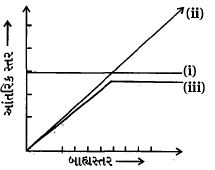
The figure given below is a diagrammatic representation of the response of organisms to abiotic factors. What do $(i)$,$(ii)$ and $(iii)$ represent respectively?
A
$(i)$-regulator,$(ii)$-conformer,$(iii)$-partial regulator
B
$(i)$-regulator,$(ii)$-partial regulator,$(iii)$-conformer
C
$(i)$-partial regulator,$(ii)$-regulator,$(iii)$-conformer
D
$(i)$-conformer,$(ii)$-regulator,$(iii)$-partial regulator
Solution
(A) The correct answer is $(A)$.
$(i)$ Represents a regulator: These organisms maintain a constant internal environment (homeostasis) despite changes in the external environment.
$(ii)$ Represents a conformer: These organisms cannot maintain a constant internal environment; their internal body conditions change in direct proportion to the external environmental conditions.
$(iii)$ Represents a partial regulator: These organisms can regulate their internal environment only over a limited range of environmental conditions,beyond which they act as conformers.
$(i)$ Represents a regulator: These organisms maintain a constant internal environment (homeostasis) despite changes in the external environment.
$(ii)$ Represents a conformer: These organisms cannot maintain a constant internal environment; their internal body conditions change in direct proportion to the external environmental conditions.
$(iii)$ Represents a partial regulator: These organisms can regulate their internal environment only over a limited range of environmental conditions,beyond which they act as conformers.
0 likesView Solution
91
BiologyMediumMCQAIPMT · 2010
Which one of the following is one of the characteristics of a biological community?
A
Stratification
B
Natality
C
Mortality
D
Sex ratio
Solution
(A) : The characteristics of a biological community include dominance,species diversity,trophic organization,stratification,dynamism,and stability.
Organisms are not uniformly distributed throughout a community; they usually occur in definite zones.
This spatial arrangement of populations is called stratification.
Structurally,a community may be divided horizontally into sub-communities,which constitutes zonation.
In contrast,natality,mortality,age structure,and sex ratio are the fundamental characteristics of a population,not a community.
Organisms are not uniformly distributed throughout a community; they usually occur in definite zones.
This spatial arrangement of populations is called stratification.
Structurally,a community may be divided horizontally into sub-communities,which constitutes zonation.
In contrast,natality,mortality,age structure,and sex ratio are the fundamental characteristics of a population,not a community.
0 likesView Solution
92
BiologyMediumMCQAIPMT · 2010
Which one of the following is most appropriately defined?
A
Host is an organism which provides food to another organism.
B
Amensalism is a relationship in which one species is benefitted whereas the other is unaffected.
C
Predator is an organism that catches and kills other organism for food.
D
Parasite is an organism which always lives inside the body of other organism and may kill it.
Solution
(C) : Predation is an interaction between members of two species in which members of one species capture,kill,and eat up members of other species.
Host is a term specifically related to parasitism,where the host provides nourishment and shelter to the parasite.
Amensalism is an interspecies interaction in which one species is harmed,whereas the other one is unaffected.
Parasitic organisms can live either on the surface of their host (ectoparasites) or inside their body (endoparasites).
Host is a term specifically related to parasitism,where the host provides nourishment and shelter to the parasite.
Amensalism is an interspecies interaction in which one species is harmed,whereas the other one is unaffected.
Parasitic organisms can live either on the surface of their host (ectoparasites) or inside their body (endoparasites).
0 likesView Solution
93
BiologyMediumMCQAIPMT · 2010
The biomass available for consumption by the herbivores and the decomposers is called:
A
Net primary productivity
B
Secondary productivity
C
Standing crop
D
Gross primary productivity
Solution
(A) The total organic matter synthesized by producers through photosynthesis per unit time and area is known as $Gross \ Primary \ Productivity$ $(GPP)$.
$Net \ Primary \ Productivity$ $(NPP)$ is defined as the rate of organic matter production by photosynthesis minus the rate of respiration $(R)$ and other losses by producers.
Mathematically,$NPP = GPP - R$.
$NPP$ represents the actual biomass available for consumption by heterotrophs,which include herbivores and decomposers.
$Net \ Primary \ Productivity$ $(NPP)$ is defined as the rate of organic matter production by photosynthesis minus the rate of respiration $(R)$ and other losses by producers.
Mathematically,$NPP = GPP - R$.
$NPP$ represents the actual biomass available for consumption by heterotrophs,which include herbivores and decomposers.
0 likesView Solution
94
BiologyMediumMCQAIPMT · 2010
Which of the following representations shows the pyramid of numbers in a forest ecosystem?
A
$D$
B
$A$
C
$B$
D
$C$
Solution
(C) The correct representation for a forest ecosystem is an upright pyramid of numbers.
In a forest ecosystem,the number of producers (large trees) is relatively small,but they support a large number of herbivores (birds,insects),which in turn support a smaller number of carnivores (secondary and tertiary consumers).
Therefore,the pyramid is upright,where the base (producers) is narrower than the middle tier (herbivores),but the overall structure remains upright as the number of individuals decreases at higher trophic levels.
Note: If the question refers to a single tree as a producer,the pyramid of numbers would be inverted,but for a typical forest ecosystem,it is considered upright.
In a forest ecosystem,the number of producers (large trees) is relatively small,but they support a large number of herbivores (birds,insects),which in turn support a smaller number of carnivores (secondary and tertiary consumers).
Therefore,the pyramid is upright,where the base (producers) is narrower than the middle tier (herbivores),but the overall structure remains upright as the number of individuals decreases at higher trophic levels.
Note: If the question refers to a single tree as a producer,the pyramid of numbers would be inverted,but for a typical forest ecosystem,it is considered upright.
0 likesView Solution
95
BiologyMediumMCQAIPMT · 2010
Study the four statements $(i-iv)$ given below and select the two correct ones out of them.
$(i)$ $A$ lion eating a deer and a sparrow feeding on grains are ecologically similar in being consumers.
$(ii)$ Predator star fish $Pisaster$ helps in maintaining species diversity of some invertebrates.
$(iii)$ Predators ultimately lead to the extinction of prey species.
$(iv)$ Production of chemicals such as nicotine,strychnine by the plants are metabolic disorders.
The two correct statements are
$(i)$ $A$ lion eating a deer and a sparrow feeding on grains are ecologically similar in being consumers.
$(ii)$ Predator star fish $Pisaster$ helps in maintaining species diversity of some invertebrates.
$(iii)$ Predators ultimately lead to the extinction of prey species.
$(iv)$ Production of chemicals such as nicotine,strychnine by the plants are metabolic disorders.
The two correct statements are
A
$(ii)$ and $(iii)$
B
$(iii)$ and $(iv)$
C
$(i)$ and $(iv)$
D
$(i)$ and $(ii)$
Solution
(D) Statement $(i)$ is correct because both lions and sparrows are consumers; lions are carnivores and sparrows are primary consumers (herbivores).
Statement $(ii)$ is correct because the predator starfish $Pisaster$ is a classic example of a keystone species that maintains species diversity in intertidal communities by preventing any one species from monopolizing resources.
Statement $(iii)$ is incorrect because predators do not typically lead to the extinction of prey; instead,they maintain prey populations at stable levels and promote species diversity.
Statement $(iv)$ is incorrect because chemicals like nicotine and strychnine are secondary metabolites produced by plants as defense mechanisms against herbivores,not metabolic disorders.
Statement $(ii)$ is correct because the predator starfish $Pisaster$ is a classic example of a keystone species that maintains species diversity in intertidal communities by preventing any one species from monopolizing resources.
Statement $(iii)$ is incorrect because predators do not typically lead to the extinction of prey; instead,they maintain prey populations at stable levels and promote species diversity.
Statement $(iv)$ is incorrect because chemicals like nicotine and strychnine are secondary metabolites produced by plants as defense mechanisms against herbivores,not metabolic disorders.
0 likesView Solution
96
BiologyEasyMCQAIPMT · 2010
Which one of the following is an example of $ex \, situ$ conservation?
A
Wildlife sanctuary
B
Seed bank
C
Sacred groves
D
National park
Solution
(B) $ex \, situ$ conservation refers to the conservation of selected rare plants or animals in locations outside their natural habitats.
This approach includes botanical gardens, zoological parks, seed banks, cryopreservation, field gene banks, and tissue culture.
Many wild and domesticated species are managed and collected in these facilities to prevent extinction.
Seed banks are specific institutes that maintain stocks of viable seeds to preserve genetic diversity.
In contrast, wildlife sanctuaries, sacred groves, and national parks are examples of $in \, situ$ conservation, where species are protected within their natural ecosystems.
This approach includes botanical gardens, zoological parks, seed banks, cryopreservation, field gene banks, and tissue culture.
Many wild and domesticated species are managed and collected in these facilities to prevent extinction.
Seed banks are specific institutes that maintain stocks of viable seeds to preserve genetic diversity.
In contrast, wildlife sanctuaries, sacred groves, and national parks are examples of $in \, situ$ conservation, where species are protected within their natural ecosystems.
0 likesView Solution
97
BiologyEasyMCQAIPMT · 2010
The Indian rhinoceros is a natural inhabitant of which one of the Indian states?
A
Uttarakhand
B
Uttar Pradesh
C
Himachal Pradesh
D
Assam
Solution
(D) : The Indian rhinoceros $(Rhinoceros \text{ unicornis})$ is primarily found in the north-eastern region of India.
Kaziranga National Park, located in the state of Assam, is globally famous for hosting the largest population of the Indian rhinoceros.
Kaziranga National Park, located in the state of Assam, is globally famous for hosting the largest population of the Indian rhinoceros.
0 likesView Solution
98
BiologyMediumMCQAIPMT · 2010
$A$ renewable exhaustible natural resource is
A
coal
B
petroleum
C
minerals
D
forest
Solution
(D) : Exhaustible resources are those natural resources which are likely to be exhausted or diminished as a result of their continuous use.
These are further of two types: renewable and non-renewable.
Forest is a renewable exhaustible resource which can be again generated or produced artificially or naturally.
Coal,petroleum,and minerals are non-renewable exhaustible natural resources which cannot be again produced or generated.
These are further of two types: renewable and non-renewable.
Forest is a renewable exhaustible resource which can be again generated or produced artificially or naturally.
Coal,petroleum,and minerals are non-renewable exhaustible natural resources which cannot be again produced or generated.
0 likesView Solution
99
BiologyEasyMCQAIPMT · 2010
$dB$ is a standard abbreviation used for the quantitative expression of
A
the density of bacteria in a medium
B
a particular pollutant
C
the dominant Bacillus in a culture
D
a certain pesticide
Solution
(B) $dB$ stands for decibel,which is a unit used to measure the intensity of sound.
In the context of environmental issues,noise is considered a form of pollution.
Unwanted or excessive sound is referred to as noise pollution and is measured in decibels $(dB)$.
Generally,sound levels above $80\ dB$ are considered to be noise pollution.
In the context of environmental issues,noise is considered a form of pollution.
Unwanted or excessive sound is referred to as noise pollution and is measured in decibels $(dB)$.
Generally,sound levels above $80\ dB$ are considered to be noise pollution.
0 likesView Solution
100
BiologyMediumMCQAIPMT · 2010
The two gases making the highest relative contribution to the greenhouse effect are:
A
$CO_2$ and $CH_4$
B
$CH_4$ and $N_2O$
C
$CFCs$ and $N_2O$
D
$CO_2$ and $N_2O$
Solution
(A) The relative contribution of various greenhouse gases to global warming is as follows: $CO_2$ $(50\%)$,$CFCs$ $(20\%)$,$CH_4$ $(16\%)$,$O_3$ $(8\%)$,and nitrous oxide ($N_2O$,$6\%$).
Based on these values,$CO_2$ $(50\%)$ and $CFCs$ $(20\%)$ are the two highest contributors. However,in many standard contexts,$CO_2$ and $CH_4$ are often cited as the primary contributors due to their widespread presence and impact. Given the options provided,$CO_2$ and $CH_4$ represent the most significant contributors among the choices listed.
Based on these values,$CO_2$ $(50\%)$ and $CFCs$ $(20\%)$ are the two highest contributors. However,in many standard contexts,$CO_2$ and $CH_4$ are often cited as the primary contributors due to their widespread presence and impact. Given the options provided,$CO_2$ and $CH_4$ represent the most significant contributors among the choices listed.
0 likesView Solution
101
BiologyMediumMCQAIPMT · 2010
When domestic sewage mixes with river water,
A
small animals like rats will die after drinking river water.
B
the increased microbial activity releases micronutrients such as iron.
C
the increased microbial activity uses up dissolved oxygen.
D
the river water is still suitable for drinking as impurities are only about $0.1\%$.
Solution
(C) : When domestic sewage mixes with a water body,the microorganisms present in the sewage biodegrade the organic matter using the dissolved oxygen in the water.
This process leads to a sharp decline in the concentration of dissolved oxygen,which can cause the death of aquatic organisms like fish.
As the biodegradation of the organic sewage matter is completed,the concentration of dissolved oxygen in the water gradually increases again.
This process leads to a sharp decline in the concentration of dissolved oxygen,which can cause the death of aquatic organisms like fish.
As the biodegradation of the organic sewage matter is completed,the concentration of dissolved oxygen in the water gradually increases again.
0 likesView Solution
102
BiologyEasyMCQAIPMT · 2010
In water hyacinth, vegetative propagation occurs by ...........
A
Rhizome
B
Offset
C
Stolon
D
Runner
Solution
(B) Water hyacinth $(Eichhornia \text{ } crassipes)$ is an aquatic plant that reproduces vegetatively through a specialized structure known as an $Offset$.
An $Offset$ is a short, thick, horizontal branch that grows from the axil of a leaf and produces a new plant at its tip.
This rapid vegetative propagation allows water hyacinth to spread quickly across water bodies, often becoming an invasive species.
An $Offset$ is a short, thick, horizontal branch that grows from the axil of a leaf and produces a new plant at its tip.
This rapid vegetative propagation allows water hyacinth to spread quickly across water bodies, often becoming an invasive species.
0 likesView Solution
103
BiologyMediumMCQAIPMT · 2010
Geitonogamy involves:
A
Fertilization of a flower of the same plant by pollen grains.
B
Fertilization of the same flower by pollen grains.
C
Fertilization of a flower by pollen grains from another flower of the same species.
D
Fertilization of a flower by pollen grains from a flower of a different species.
Solution
(A) Geitonogamy is a type of pollination where pollen grains from the anther of one flower are transferred to the stigma of another flower borne on the same plant.
Although it is functionally cross-pollination involving a pollinating agent,genetically it is similar to self-pollination because the pollen grains come from the same plant.
Although it is functionally cross-pollination involving a pollinating agent,genetically it is similar to self-pollination because the pollen grains come from the same plant.
0 likesView Solution
104
BiologyMediumMCQAIPMT · 2010
In humans, the testes are located outside the abdominal cavity within the scrotum. What is the purpose of this arrangement?
A
To reduce the pressure exerted by internal organs.
B
To provide sufficient space for the growth of the epididymis.
C
To facilitate the expression of secondary sexual characteristics in males.
D
To maintain the temperature of the scrotum lower than the body temperature.
Solution
(D) The testes are situated outside the abdominal cavity in a pouch called the scrotum.
This is essential because spermatogenesis, the process of sperm production, requires a temperature approximately $2-2.5^{\circ}C$ lower than the normal internal body temperature.
The scrotum acts as a thermoregulator to provide this cooler environment, which is necessary for the viability and proper development of sperm.
This is essential because spermatogenesis, the process of sperm production, requires a temperature approximately $2-2.5^{\circ}C$ lower than the normal internal body temperature.
The scrotum acts as a thermoregulator to provide this cooler environment, which is necessary for the viability and proper development of sperm.
0 likesView Solution
105
BiologyMediumMCQAIPMT · 2010
The signals for parturition (childbirth) originate from which of the following?
A
Fully developed fetus and placenta
B
Oxytocin released from the maternal pituitary
C
Placenta only
D
Fully developed fetus only
Solution
(A) The process of childbirth,known as parturition,is induced by a complex neuroendocrine mechanism.
$1$. The signals for parturition originate from the fully developed fetus and the placenta,which induce mild uterine contractions called the fetal ejection reflex.
$2$. This reflex triggers the release of oxytocin from the maternal pituitary gland.
$3$. Oxytocin acts on the uterine muscle and causes stronger uterine contractions,which in turn stimulate further secretion of oxytocin.
$4$. This stimulatory reflex between the uterine contraction and oxytocin secretion continues,resulting in stronger and stronger contractions,eventually leading to the expulsion of the baby out of the uterus through the birth canal.
$1$. The signals for parturition originate from the fully developed fetus and the placenta,which induce mild uterine contractions called the fetal ejection reflex.
$2$. This reflex triggers the release of oxytocin from the maternal pituitary gland.
$3$. Oxytocin acts on the uterine muscle and causes stronger uterine contractions,which in turn stimulate further secretion of oxytocin.
$4$. This stimulatory reflex between the uterine contraction and oxytocin secretion continues,resulting in stronger and stronger contractions,eventually leading to the expulsion of the baby out of the uterus through the birth canal.
0 likesView Solution
106
BiologyMediumMCQAIPMT · 2010
Consider the following four statements $(i-iv)$ regarding kidney transplantation and select the two correct ones.
$(i)$ Even if a kidney transplant is successful,the recipient needs to take immunosuppressants for a long time.
$(ii)$ Cell-mediated immune response is responsible for the rejection of the graft.
$(iii)$ $B$-lymphocytes are responsible for the rejection of the graft.
$(iv)$ The acceptance or rejection of a transplanted kidney depends on specific interferons.
$(i)$ Even if a kidney transplant is successful,the recipient needs to take immunosuppressants for a long time.
$(ii)$ Cell-mediated immune response is responsible for the rejection of the graft.
$(iii)$ $B$-lymphocytes are responsible for the rejection of the graft.
$(iv)$ The acceptance or rejection of a transplanted kidney depends on specific interferons.
A
$(i)$ and $(ii)$
B
$(ii)$ and $(iii)$
C
$(iii)$ and $(iv)$
D
$(i)$ and $(iii)$
Solution
(A) Statement $(i)$ is correct: The body's immune system recognizes the transplanted organ as 'non-self' or foreign,so the recipient must take immunosuppressants for life to prevent rejection.
Statement $(ii)$ is correct: The cell-mediated immune response,primarily driven by $T$-lymphocytes,is the main mechanism responsible for the rejection of transplanted organs (graft rejection).
Statement $(iii)$ is incorrect: $T$-lymphocytes,not $B$-lymphocytes,are responsible for graft rejection.
Statement $(iv)$ is incorrect: Graft rejection is based on the recognition of self vs. non-self antigens ($MHC$ molecules),not on interferons.
Therefore,statements $(i)$ and $(ii)$ are correct.
Statement $(ii)$ is correct: The cell-mediated immune response,primarily driven by $T$-lymphocytes,is the main mechanism responsible for the rejection of transplanted organs (graft rejection).
Statement $(iii)$ is incorrect: $T$-lymphocytes,not $B$-lymphocytes,are responsible for graft rejection.
Statement $(iv)$ is incorrect: Graft rejection is based on the recognition of self vs. non-self antigens ($MHC$ molecules),not on interferons.
Therefore,statements $(i)$ and $(ii)$ are correct.
0 likesView Solution
107
BiologyEasyMCQAIPMT · 2010
Breeding crops with higher levels of vitamins,minerals,and proteins is known as . . . . . . .
A
Somatic hybridization
B
Biofortification
C
Biomagnification
D
Micropropagation
Solution
(B) Biofortification is the process of breeding crops to increase their nutritional value. This can be achieved through selective breeding or genetic engineering to improve the content of vitamins,minerals,proteins,and healthy fats in staple crops to combat hidden hunger.
0 likesView Solution
108
BiologyMediumMCQAIPMT · 2010
The common nitrogen fixer in paddy fields is . . . . . . .
A
Rhizobium
B
Azospirillum
C
Oscillatoria
D
Frankia
Solution
(C) Paddy fields (rice fields) are waterlogged environments where cyanobacteria like $Anabaena$ and $Oscillatoria$ act as biofertilizers by fixing atmospheric nitrogen.
$Oscillatoria$ is a genus of filamentous cyanobacteria that is commonly found in paddy fields and contributes to nitrogen fixation,thereby increasing soil fertility.
$Oscillatoria$ is a genus of filamentous cyanobacteria that is commonly found in paddy fields and contributes to nitrogen fixation,thereby increasing soil fertility.
0 likesView Solution
109
BiologyMediumMCQAIPMT · 2010
Stirred-tank bioreactors have been designed for:
A
Adding preservatives to the product
B
Purification of the product
C
Ensuring anaerobic conditions in the culture vessel
D
Availability of oxygen throughout the process
Solution
(D) Stirred-tank bioreactors are designed to provide optimal conditions for achieving the desired product by providing growth parameters like temperature,pH,substrate,salts,vitamins,and oxygen. The primary function of the stirring mechanism is to ensure proper mixing and oxygen availability throughout the bioreactor for the growing microbes.
0 likesView Solution
110
BiologyMediumMCQAIPMT · 2010
Which of the following is used as a vector for cloning genes in higher organisms?
A
Baculovirus
B
Salmonella typhimurium
C
Rhizopus nigricans
D
Retrovirus
Solution
(D) In biotechnology,vectors are used to deliver foreign genes into host cells.
For higher organisms,including animals,retroviruses have been disarmed and are used as vectors to deliver desirable genes into animal cells.
These retroviruses transform normal cells into cancerous cells or simply act as vehicles to introduce recombinant $DNA$ into the host genome.
Therefore,retroviruses are the standard choice for gene cloning in higher organisms.
For higher organisms,including animals,retroviruses have been disarmed and are used as vectors to deliver desirable genes into animal cells.
These retroviruses transform normal cells into cancerous cells or simply act as vehicles to introduce recombinant $DNA$ into the host genome.
Therefore,retroviruses are the standard choice for gene cloning in higher organisms.
0 likesView Solution
Vedclass Products
For Students
Vedclass Test Series
Mock tests in real AIPMT style covering Biology with performance analysis. 5-day free trial.
Start Free TrialFor Teachers
Exam Paper Generator
Generate Set A/B/C/D Biology papers from 7.5L+ questions in 2 minutes. 3 chapters free.
Try FreeFor Institutes
Online Exam Module
Run live AIPMT mock exams with unlimited students, 360° analytics & white-label branding.
See DemoFrequently Asked Questions
How many Biology questions are in AIPMT 2010?
There are 160 Biology questions from the AIPMT 2010 paper on Vedclass, each with a detailed step-by-step solution in English.
Are AIPMT 2010 Biology solutions available in English?
Yes. All solutions on this page are in English. You can also switch to English or Hindi using the language buttons above the questions.
Can I practice AIPMT 2010 Biology as a timed test?
Yes. Use the Vedclass Test Series to attempt a full AIPMT mock test covering Biology with time limits and instant score analysis.
Can teachers create Biology papers from AIPMT previous year questions?
Yes. The Vedclass Exam Paper Generator lets teachers mix AIPMT Biology questions and generate Set A/B/C/D papers in minutes.
For Teachers & Institutes
Build a Custom Biology Paper
Pick AIPMT 2010 Biology questions, set difficulty, and generate Set A/B/C/D in 2 minutes.