
PhysicsQ1–59 of 59 questions
Page 1 of 1 · English
1
PhysicsEasyMCQAIIMS · 1998
$A$ particle has a displacement of $12 \, m$ towards east,$5 \, m$ towards north,and $6 \, m$ vertically upward. The magnitude of the resultant displacement is ......... $m$.
A
$12$
B
$10.04$
C
$14.31$
D
None of these
Solution
(C) The displacement vector can be represented as $\vec{r} = 12\hat{i} + 5\hat{j} + 6\hat{k}$.
The magnitude of the resultant displacement $R$ is given by the formula $R = \sqrt{x^2 + y^2 + z^2}$.
Substituting the values: $R = \sqrt{12^2 + 5^2 + 6^2}$.
$R = \sqrt{144 + 25 + 36}$.
$R = \sqrt{205}$.
$R \approx 14.31 \, m$.
The magnitude of the resultant displacement $R$ is given by the formula $R = \sqrt{x^2 + y^2 + z^2}$.
Substituting the values: $R = \sqrt{12^2 + 5^2 + 6^2}$.
$R = \sqrt{144 + 25 + 36}$.
$R = \sqrt{205}$.
$R \approx 14.31 \, m$.
0 likesView Solution
2
PhysicsMediumMCQAIIMS · 1998
The dimensional formula of angular velocity is
A
${M^0}{L^0}{T^{-1}}$
B
$ML{T^{-1}}$
C
${M^0}{L^0}{T^1}$
D
$M{L^0}{T^{-2}}$
Solution
(A) Angular velocity $(\omega)$ is defined as the rate of change of angular displacement $( \theta)$ with respect to time $(t)$.
Mathematically,$\omega = \frac{\theta}{t}$.
The dimensional formula for angular displacement $(\theta)$ is dimensionless,represented as $[M^0L^0T^0]$.
The dimensional formula for time $(t)$ is $[T]$.
Therefore,the dimensional formula for angular velocity is $[\omega] = \frac{[M^0L^0T^0]}{[T]} = [M^0L^0T^{-1}]$.
Mathematically,$\omega = \frac{\theta}{t}$.
The dimensional formula for angular displacement $(\theta)$ is dimensionless,represented as $[M^0L^0T^0]$.
The dimensional formula for time $(t)$ is $[T]$.
Therefore,the dimensional formula for angular velocity is $[\omega] = \frac{[M^0L^0T^0]}{[T]} = [M^0L^0T^{-1}]$.
0 likesView Solution
3
PhysicsEasyMCQAIIMS · 1998
$A$ body of mass $5\, kg$ is moving in a circle of radius $1\, m$ with an angular velocity of $2\, rad/s$. The centripetal force is ......... $N$.
A
$10$
B
$20$
C
$30$
D
$40$
Solution
(B) The formula for centripetal force is given by $F_c = m r \omega^2$.
Given:
Mass $m = 5\, kg$
Radius $r = 1\, m$
Angular velocity $\omega = 2\, rad/s$
Substituting these values into the formula:
$F_c = 5 \times 1 \times (2)^2$
$F_c = 5 \times 1 \times 4$
$F_c = 20\, N$.
Therefore,the centripetal force is $20\, N$.
Given:
Mass $m = 5\, kg$
Radius $r = 1\, m$
Angular velocity $\omega = 2\, rad/s$
Substituting these values into the formula:
$F_c = 5 \times 1 \times (2)^2$
$F_c = 5 \times 1 \times 4$
$F_c = 20\, N$.
Therefore,the centripetal force is $20\, N$.
0 likesView Solution
4
PhysicsMediumMCQAIIMS · 1998
$A$ body is projected at such an angle that the horizontal range is three times the greatest height. The angle of projection is
A
$25^\circ 8'$
B
$33^\circ 7'$
C
$42^\circ 8'$
D
$53^\circ 8'$
Solution
(D) The horizontal range $R$ of a projectile is given by $R = \frac{u^2 \sin(2\theta)}{g} = \frac{2u^2 \sin \theta \cos \theta}{g}$.
The maximum height $H$ is given by $H = \frac{u^2 \sin^2 \theta}{2g}$.
According to the problem,the horizontal range is three times the maximum height,so $R = 3H$.
Substituting the formulas:
$\frac{2u^2 \sin \theta \cos \theta}{g} = 3 \left( \frac{u^2 \sin^2 \theta}{2g} \right)$.
Simplifying the equation:
$2 \cos \theta = \frac{3}{2} \sin \theta$.
Rearranging to find $\tan \theta$:
$\tan \theta = \frac{4}{3}$.
Therefore,$\theta = \tan^{-1}(1.333) \approx 53^\circ 8'$.
The maximum height $H$ is given by $H = \frac{u^2 \sin^2 \theta}{2g}$.
According to the problem,the horizontal range is three times the maximum height,so $R = 3H$.
Substituting the formulas:
$\frac{2u^2 \sin \theta \cos \theta}{g} = 3 \left( \frac{u^2 \sin^2 \theta}{2g} \right)$.
Simplifying the equation:
$2 \cos \theta = \frac{3}{2} \sin \theta$.
Rearranging to find $\tan \theta$:
$\tan \theta = \frac{4}{3}$.
Therefore,$\theta = \tan^{-1}(1.333) \approx 53^\circ 8'$.
0 likesView Solution
5
PhysicsEasyMCQAIIMS · 1998
If a person with a spring balance and a body hanging from it goes up and up in an aeroplane,then the reading of the weight of the body as indicated by the spring balance will
A
Go on increasing
B
Go on decreasing
C
First increase and then decrease
D
Remain the same
Solution
(C) The apparent weight of a body in an accelerating frame is given by $W_{app} = m(g + a)$,where $a$ is the upward acceleration.
Initially,as the aeroplane takes off and gains altitude,it experiences upward acceleration,causing the reading of the spring balance to increase.
As the aeroplane reaches a high altitude,the acceleration becomes zero (or negligible) and the value of the acceleration due to gravity $g$ decreases with height $(g' = g(1 - 2h/R))$.
Therefore,the reading of the spring balance will first increase due to the upward acceleration and then decrease due to the reduction in the gravitational force at higher altitudes.
Initially,as the aeroplane takes off and gains altitude,it experiences upward acceleration,causing the reading of the spring balance to increase.
As the aeroplane reaches a high altitude,the acceleration becomes zero (or negligible) and the value of the acceleration due to gravity $g$ decreases with height $(g' = g(1 - 2h/R))$.
Therefore,the reading of the spring balance will first increase due to the upward acceleration and then decrease due to the reduction in the gravitational force at higher altitudes.
0 likesView Solution
6
PhysicsEasyMCQAIIMS · 1998
Rocket engines lift a rocket from the earth's surface because hot gas with high velocity
A
Push against the earth
B
Push against the air
C
React against the rocket and push it up
D
Heat up the air which lifts the rocket
Solution
(C) The motion of a rocket is based on the principle of conservation of linear momentum.
As the fuel burns,hot gases are ejected from the nozzle of the rocket at a very high velocity in the downward direction.
According to Newton's third law of motion,these gases exert an equal and opposite reaction force on the rocket in the upward direction.
This upward force provides the necessary thrust to lift the rocket against gravity.
As the fuel burns,hot gases are ejected from the nozzle of the rocket at a very high velocity in the downward direction.
According to Newton's third law of motion,these gases exert an equal and opposite reaction force on the rocket in the upward direction.
This upward force provides the necessary thrust to lift the rocket against gravity.
0 likesView Solution
7
PhysicsMediumMCQAIIMS · 1998
$A$ spring $40 \, mm$ long is stretched by the application of a force. If $10 \, N$ force is required to stretch the spring by $1 \, mm$,then the work done in stretching the spring by $40 \, mm$ is ............. $J$.
A
$84$
B
$68$
C
$23$
D
$8$
Solution
(D) The spring constant $k$ is given by Hooke's Law: $k = \frac{F}{x}$.
Given $F = 10 \, N$ and $x = 1 \, mm = 1 \times 10^{-3} \, m$.
So,$k = \frac{10}{1 \times 10^{-3}} = 10^4 \, N/m$.
The work done $W$ in stretching the spring by a displacement $x = 40 \, mm = 40 \times 10^{-3} \, m$ is given by $W = \frac{1}{2} k x^2$.
Substituting the values: $W = \frac{1}{2} \times 10^4 \times (40 \times 10^{-3})^2$.
$W = \frac{1}{2} \times 10^4 \times (1600 \times 10^{-6}) = \frac{1}{2} \times 10^4 \times 1.6 \times 10^{-3} = 0.5 \times 16 = 8 \, J$.
Given $F = 10 \, N$ and $x = 1 \, mm = 1 \times 10^{-3} \, m$.
So,$k = \frac{10}{1 \times 10^{-3}} = 10^4 \, N/m$.
The work done $W$ in stretching the spring by a displacement $x = 40 \, mm = 40 \times 10^{-3} \, m$ is given by $W = \frac{1}{2} k x^2$.
Substituting the values: $W = \frac{1}{2} \times 10^4 \times (40 \times 10^{-3})^2$.
$W = \frac{1}{2} \times 10^4 \times (1600 \times 10^{-6}) = \frac{1}{2} \times 10^4 \times 1.6 \times 10^{-3} = 0.5 \times 16 = 8 \, J$.
0 likesView Solution
8
PhysicsEasyMCQAIIMS · 1998
If the kinetic energy of a body becomes four times its initial value,then the new momentum will
A
Become twice its initial value
B
Become three times its initial value
C
Become four times its initial value
D
Remain constant
Solution
(A) The relationship between kinetic energy $E$ and momentum $P$ is given by the formula $P = \sqrt{2mE}$.
Since $m$ is constant,we have $P \propto \sqrt{E}$.
Let the initial kinetic energy be $E_1$ and initial momentum be $P_1$. Then $P_1 = \sqrt{2mE_1}$.
Let the new kinetic energy be $E_2 = 4E_1$ and the new momentum be $P_2$.
Then $P_2 = \sqrt{2mE_2} = \sqrt{2m(4E_1)} = 2\sqrt{2mE_1} = 2P_1$.
Therefore,the new momentum becomes twice its initial value.
Since $m$ is constant,we have $P \propto \sqrt{E}$.
Let the initial kinetic energy be $E_1$ and initial momentum be $P_1$. Then $P_1 = \sqrt{2mE_1}$.
Let the new kinetic energy be $E_2 = 4E_1$ and the new momentum be $P_2$.
Then $P_2 = \sqrt{2mE_2} = \sqrt{2m(4E_1)} = 2\sqrt{2mE_1} = 2P_1$.
Therefore,the new momentum becomes twice its initial value.
0 likesView Solution
9
PhysicsMediumMCQAIIMS · 1998
$A$ bullet is fired from a rifle. If the rifle recoils freely,then the kinetic energy of the rifle is
A
Less than that of the bullet
B
More than that of the bullet
C
Same as that of the bullet
D
Equal or less than that of the bullet
Solution
(A) The kinetic energy $E$ of a body is given by the formula $E = \frac{P^2}{2m}$,where $P$ is the momentum and $m$ is the mass of the body.
According to the law of conservation of linear momentum,when a bullet is fired from a rifle,the magnitude of the momentum of the rifle is equal to the magnitude of the momentum of the bullet $(P_{rifle} = P_{bullet} = P)$.
Since $P$ is constant for both,the kinetic energy is inversely proportional to the mass $(E \propto \frac{1}{m})$.
Because the mass of the rifle $(M)$ is much greater than the mass of the bullet $(m)$,the kinetic energy of the rifle will be significantly less than the kinetic energy of the bullet.
According to the law of conservation of linear momentum,when a bullet is fired from a rifle,the magnitude of the momentum of the rifle is equal to the magnitude of the momentum of the bullet $(P_{rifle} = P_{bullet} = P)$.
Since $P$ is constant for both,the kinetic energy is inversely proportional to the mass $(E \propto \frac{1}{m})$.
Because the mass of the rifle $(M)$ is much greater than the mass of the bullet $(m)$,the kinetic energy of the rifle will be significantly less than the kinetic energy of the bullet.
0 likesView Solution
10
PhysicsEasyMCQAIIMS · 1998
Gravitational mass is proportional to gravitational
A
Field
B
Force
C
Intensity
D
All of these
Solution
(D) The gravitational force $F$ acting on a mass $m$ in a gravitational field $g$ is given by $F = mg$. Here,the gravitational force is directly proportional to the gravitational mass $m$. The gravitational field intensity $g$ is defined as the force per unit mass,$g = F/m$,which implies $F = mg$. Since the gravitational field $g$ is a property of the space around a mass,and the force $F$ is the interaction,the gravitational mass is fundamentally related to all these quantities. Thus,the correct option is $D$.
0 likesView Solution
11
PhysicsEasyMCQAIIMS · 1998
The spherical shape of a rain-drop is due to
A
Density of the liquid
B
Surface tension
C
Atmospheric pressure
D
Gravity
Solution
(B) The correct option is $(B)$.
Due to surface tension,the surface of a liquid tends to minimize its surface area for a given volume.
Among all geometric shapes,a sphere has the minimum surface area for a fixed volume.
Therefore,to minimize the potential energy associated with the surface area,rain drops naturally acquire a spherical shape.
Due to surface tension,the surface of a liquid tends to minimize its surface area for a given volume.
Among all geometric shapes,a sphere has the minimum surface area for a fixed volume.
Therefore,to minimize the potential energy associated with the surface area,rain drops naturally acquire a spherical shape.
0 likesView Solution
12
PhysicsMediumMCQAIIMS · 1998
Work done in splitting a drop of water of $1 \, mm$ radius into $10^6$ droplets is (Surface tension of water $= 72 \times 10^{-3} \, J/m^2$).
A
$9.58 \times 10^{-5} \, J$
B
$8.95 \times 10^{-5} \, J$
C
$5.89 \times 10^{-5} \, J$
D
$5.98 \times 10^{-6} \, J$
Solution
(B) The work done $W$ in splitting a large drop of radius $R$ into $n$ smaller droplets of radius $r$ is given by the change in surface area multiplied by surface tension $T$.
$W = T \times \Delta A = T \times (n \times 4\pi r^2 - 4\pi R^2)$.
Since the volume remains constant,$\frac{4}{3}\pi R^3 = n \times \frac{4}{3}\pi r^3$,which gives $r = R / n^{1/3}$.
Substituting $r$,we get $W = 4\pi R^2 T (n^{1/3} - 1)$.
Given $R = 10^{-3} \, m$,$n = 10^6$,and $T = 72 \times 10^{-3} \, J/m^2$.
$W = 4 \times 3.1416 \times (10^{-3})^2 \times 72 \times 10^{-3} \times ( (10^6)^{1/3} - 1)$.
$W = 4 \times 3.1416 \times 10^{-6} \times 72 \times 10^{-3} \times (100 - 1)$.
$W = 4 \times 3.1416 \times 72 \times 99 \times 10^{-9} \approx 8.95 \times 10^{-5} \, J$.
$W = T \times \Delta A = T \times (n \times 4\pi r^2 - 4\pi R^2)$.
Since the volume remains constant,$\frac{4}{3}\pi R^3 = n \times \frac{4}{3}\pi r^3$,which gives $r = R / n^{1/3}$.
Substituting $r$,we get $W = 4\pi R^2 T (n^{1/3} - 1)$.
Given $R = 10^{-3} \, m$,$n = 10^6$,and $T = 72 \times 10^{-3} \, J/m^2$.
$W = 4 \times 3.1416 \times (10^{-3})^2 \times 72 \times 10^{-3} \times ( (10^6)^{1/3} - 1)$.
$W = 4 \times 3.1416 \times 10^{-6} \times 72 \times 10^{-3} \times (100 - 1)$.
$W = 4 \times 3.1416 \times 72 \times 99 \times 10^{-9} \approx 8.95 \times 10^{-5} \, J$.
0 likesView Solution
13
PhysicsMediumMCQAIIMS · 1998
'Stem correction' in platinum resistance thermometers is eliminated by the use of
A
Cells
B
Electrodes
C
Compensating leads
D
None of the above
Solution
(C) The 'stem correction' in a platinum resistance thermometer arises due to the resistance of the connecting wires (leads) that connect the platinum coil to the measuring instrument.
As the temperature of the leads changes,their resistance changes,which introduces an error in the temperature measurement.
To eliminate this error,'compensating leads' are used. These leads are identical to the main leads and are placed in the same environment,ensuring that the change in resistance of the main leads is balanced out by the change in resistance of the compensating leads.
As the temperature of the leads changes,their resistance changes,which introduces an error in the temperature measurement.
To eliminate this error,'compensating leads' are used. These leads are identical to the main leads and are placed in the same environment,ensuring that the change in resistance of the main leads is balanced out by the change in resistance of the compensating leads.
0 likesView Solution
14
PhysicsEasyMCQAIIMS · 1998
The absolute zero is the temperature at which
A
Water freezes
B
All substances exist in solid state
C
Molecular motion ceases
D
None of the above
Solution
(C) Absolute zero is defined as $0 \,K$ or $-273.15 \,^\circ C$.
According to the kinetic theory of gases, the root mean square velocity $(v_{rms})$ of gas molecules is given by $v_{rms} = \sqrt{\frac{3RT}{M}}$.
At $T = 0 \,K$, the velocity $v_{rms}$ becomes zero.
This implies that the random thermal motion of molecules ceases at absolute zero.
Therefore, option $(C)$ is correct.
According to the kinetic theory of gases, the root mean square velocity $(v_{rms})$ of gas molecules is given by $v_{rms} = \sqrt{\frac{3RT}{M}}$.
At $T = 0 \,K$, the velocity $v_{rms}$ becomes zero.
This implies that the random thermal motion of molecules ceases at absolute zero.
Therefore, option $(C)$ is correct.
1 likesView Solution
15
PhysicsEasyMCQAIIMS · 1998
$A$ quantity of heat required to change the unit mass of a solid substance,from solid state to liquid state,while the temperature remains constant,is known as
A
Latent heat
B
Sublimation
C
Hoar frost
D
Latent heat of fusion
Solution
(D) The quantity of heat required to change the unit mass of a solid substance from the solid state to the liquid state at its melting point,while the temperature remains constant,is defined as the latent heat of fusion. Therefore,the correct option is $D$.
0 likesView Solution
16
PhysicsMediumMCQAIIMS · 1998
The relative humidity on a day,when the partial pressure of water vapour is $0.012 \times 10^5 \, Pa$ at $12^{\circ}C$,is ......... $\%$. (Take the vapour pressure of water at this temperature as $0.016 \times 10^5 \, Pa$.)
A
$70$
B
$40$
C
$75$
D
$25$
Solution
(C) The relative humidity is defined as the ratio of the partial pressure of water vapour to the saturated vapour pressure of water at the same temperature.
Given:
Partial pressure of water vapour $(P_W)$ = $0.012 \times 10^5 \, Pa$
Saturated vapour pressure of water $(P_V)$ = $0.016 \times 10^5 \, Pa$
Relative Humidity = $\frac{P_W}{P_V} \times 100\%$
Relative Humidity = $\frac{0.012 \times 10^5}{0.016 \times 10^5} \times 100\%$
Relative Humidity = $\frac{0.012}{0.016} \times 100\% = \frac{12}{16} \times 100\% = 0.75 \times 100\% = 75\%$.
Given:
Partial pressure of water vapour $(P_W)$ = $0.012 \times 10^5 \, Pa$
Saturated vapour pressure of water $(P_V)$ = $0.016 \times 10^5 \, Pa$
Relative Humidity = $\frac{P_W}{P_V} \times 100\%$
Relative Humidity = $\frac{0.012 \times 10^5}{0.016 \times 10^5} \times 100\%$
Relative Humidity = $\frac{0.012}{0.016} \times 100\% = \frac{12}{16} \times 100\% = 0.75 \times 100\% = 75\%$.
0 likesView Solution
17
PhysicsEasyMCQAIIMS · 1998
The rate of diffusion is
A
Faster in solids than in liquids and gases
B
Faster in liquids than in solids and gases
C
Equal to solids,liquids and gases
D
Faster in gases than in liquids and solids
Solution
(D) Diffusion is the process of movement of particles from a region of higher concentration to a region of lower concentration.
In gases,the intermolecular forces are very weak and the particles have high kinetic energy,allowing them to move freely and rapidly.
In liquids,particles are more closely packed than in gases,and in solids,they are tightly packed with very little space to move.
Therefore,the rate of diffusion is highest in gases,followed by liquids,and lowest in solids due to the differences in intermolecular space and kinetic energy.
In gases,the intermolecular forces are very weak and the particles have high kinetic energy,allowing them to move freely and rapidly.
In liquids,particles are more closely packed than in gases,and in solids,they are tightly packed with very little space to move.
Therefore,the rate of diffusion is highest in gases,followed by liquids,and lowest in solids due to the differences in intermolecular space and kinetic energy.
0 likesView Solution
18
PhysicsEasyMCQAIIMS · 1998
According to the kinetic theory of gases,at absolute temperature
A
Water freezes
B
Liquid helium freezes
C
Molecular motion stops
D
Liquid hydrogen freezes
Solution
(C) According to the kinetic theory of gases,the root mean square velocity of gas molecules is given by the formula $v_{rms} = \sqrt{\frac{3RT}{M}}$.
At absolute temperature,$T = 0 \ K$.
Substituting this value into the formula,we get $v_{rms} = \sqrt{\frac{3R(0)}{M}} = 0$.
Since the root mean square velocity represents the average motion of the molecules,a velocity of $0$ implies that all molecular motion ceases at absolute zero.
At absolute temperature,$T = 0 \ K$.
Substituting this value into the formula,we get $v_{rms} = \sqrt{\frac{3R(0)}{M}} = 0$.
Since the root mean square velocity represents the average motion of the molecules,a velocity of $0$ implies that all molecular motion ceases at absolute zero.
0 likesView Solution
19
PhysicsMediumMCQAIIMS · 1998
$A$ sample of gas expands from volume ${V_1}$ to ${V_2}$. The amount of work done by the gas is greatest when the expansion is
A
Isothermal
B
Isobaric
C
Adiabatic
D
Equal in all cases
Solution
(B) In a thermodynamic process,the work done by a gas is equal to the area under the $PV$ curve with respect to the volume axis.
For a given expansion from volume ${V_1}$ to ${V_2}$,the pressure $P$ remains constant in an isobaric process,whereas it decreases in both isothermal and adiabatic processes.
Since the isobaric process maintains the highest pressure throughout the expansion,the area under the $PV$ curve is the largest.
Therefore,the work done follows the order: ${W_{adiabatic}} < {W_{isothermal}} < {W_{isobaric}}$.
Thus,the work done is greatest for an isobaric expansion.
For a given expansion from volume ${V_1}$ to ${V_2}$,the pressure $P$ remains constant in an isobaric process,whereas it decreases in both isothermal and adiabatic processes.
Since the isobaric process maintains the highest pressure throughout the expansion,the area under the $PV$ curve is the largest.
Therefore,the work done follows the order: ${W_{adiabatic}} < {W_{isothermal}} < {W_{isobaric}}$.
Thus,the work done is greatest for an isobaric expansion.
0 likesView Solution
20
PhysicsEasyMCQAIIMS · 1998
On a cold morning,a metal surface will feel colder to touch than a wooden surface because
A
Metal has high specific heat
B
Metal has high thermal conductivity
C
Metal has low specific heat
D
Metal has low thermal conductivity
Solution
(B) When you touch a surface,heat flows from your body to the surface if the surface is colder than your body.
Metals are good conductors of heat,meaning they have high thermal conductivity.
Because of this high thermal conductivity,heat is transferred away from your skin into the metal very rapidly.
In contrast,wood is a poor conductor of heat (an insulator),so it transfers heat away from your skin much more slowly.
Therefore,the metal feels colder because it extracts heat from your body at a much faster rate.
Metals are good conductors of heat,meaning they have high thermal conductivity.
Because of this high thermal conductivity,heat is transferred away from your skin into the metal very rapidly.
In contrast,wood is a poor conductor of heat (an insulator),so it transfers heat away from your skin much more slowly.
Therefore,the metal feels colder because it extracts heat from your body at a much faster rate.
0 likesView Solution
21
PhysicsEasyMCQAIIMS · 1998
Woollen clothes are used in winter season because woolen clothes
A
Are good sources for producing heat
B
Absorb heat from surroundings
C
Are bad conductors of heat
D
Provide heat to body continuously
Solution
(C) The correct option is $C$.
In winter,the ambient temperature is significantly lower than the human body temperature (approximately $37.4 ^\circ C$).
Woolen clothes contain a large amount of trapped air between their fibers.
Since air is a very poor conductor of heat and wool itself is a bad conductor,these clothes act as an insulator.
This prevents the heat generated by the human body from escaping into the colder surroundings,thereby keeping the body warm.
In winter,the ambient temperature is significantly lower than the human body temperature (approximately $37.4 ^\circ C$).
Woolen clothes contain a large amount of trapped air between their fibers.
Since air is a very poor conductor of heat and wool itself is a bad conductor,these clothes act as an insulator.
This prevents the heat generated by the human body from escaping into the colder surroundings,thereby keeping the body warm.
0 likesView Solution
22
PhysicsEasyMCQAIIMS · 1998
Heat travels through vacuum by
A
Conduction
B
Convection
C
Radiation
D
Both $(A)$ and $(B)$
Solution
(C) Heat transfer occurs through three main processes: conduction,convection,and radiation.
Conduction requires a material medium and involves the transfer of energy through molecular collisions.
Convection also requires a material medium (liquid or gas) and involves the actual movement of matter.
Radiation is the process of heat transfer in the form of electromagnetic waves,which do not require any material medium to propagate.
Therefore,heat can travel through a vacuum only by radiation.
Conduction requires a material medium and involves the transfer of energy through molecular collisions.
Convection also requires a material medium (liquid or gas) and involves the actual movement of matter.
Radiation is the process of heat transfer in the form of electromagnetic waves,which do not require any material medium to propagate.
Therefore,heat can travel through a vacuum only by radiation.
0 likesView Solution
23
PhysicsEasyMCQAIIMS · 1998
If a simple pendulum oscillates with an amplitude of $50\, mm$ and time period of $2\, s$,then its maximum velocity is .... $m/s$.
A
$0.10$
B
$0.16$
C
$0.8$
D
$0.26$
Solution
(B) The maximum velocity $(v_{\max})$ of a simple harmonic oscillator is given by the formula: $v_{\max} = A\omega$,where $A$ is the amplitude and $\omega$ is the angular frequency.
Given: Amplitude $A = 50\, mm = 50 \times 10^{-3}\, m = 0.05\, m$.
Time period $T = 2\, s$.
The angular frequency is $\omega = \frac{2\pi}{T} = \frac{2\pi}{2} = \pi\, rad/s$.
Substituting the values: $v_{\max} = 0.05 \times \pi$.
Using $\pi \approx 3.14159$,we get $v_{\max} = 0.05 \times 3.14159 \approx 0.157\, m/s$.
Rounding to two decimal places,we get $0.16\, m/s$.
Thus,the correct option is $B$.
Given: Amplitude $A = 50\, mm = 50 \times 10^{-3}\, m = 0.05\, m$.
Time period $T = 2\, s$.
The angular frequency is $\omega = \frac{2\pi}{T} = \frac{2\pi}{2} = \pi\, rad/s$.
Substituting the values: $v_{\max} = 0.05 \times \pi$.
Using $\pi \approx 3.14159$,we get $v_{\max} = 0.05 \times 3.14159 \approx 0.157\, m/s$.
Rounding to two decimal places,we get $0.16\, m/s$.
Thus,the correct option is $B$.
0 likesView Solution
24
PhysicsEasyMCQAIIMS · 1998
If the metal bob of a simple pendulum is replaced by a wooden bob, then its time period will
A
Increase
B
Decrease
C
Remain the same
D
First increase then decrease
Solution
(C) The time period $T$ of a simple pendulum is given by the formula $T = 2\pi \sqrt{\frac{L}{g}}$, where $L$ is the length of the pendulum and $g$ is the acceleration due to gravity.
As seen from the formula, the time period $T$ depends only on the length of the pendulum and the acceleration due to gravity.
It is independent of the mass, material, or density of the bob.
Therefore, replacing the metal bob with a wooden bob will not change the time period of the pendulum.
As seen from the formula, the time period $T$ depends only on the length of the pendulum and the acceleration due to gravity.
It is independent of the mass, material, or density of the bob.
Therefore, replacing the metal bob with a wooden bob will not change the time period of the pendulum.
0 likesView Solution
25
PhysicsMediumMCQAIIMS · 1998
If the period of oscillation of mass $m$ suspended from a spring is $2 \, s$,then the period of mass $4m$ will be .... $s$.
A
$1$
B
$2$
C
$3$
D
$4$
Solution
(D) The time period $T$ of a mass $m$ suspended from a spring with spring constant $k$ is given by the formula: $T = 2\pi \sqrt{\frac{m}{k}}$.
Given that for mass $m$,the period $T_1 = 2 \, s$.
For mass $m_2 = 4m$,the new period $T_2$ is given by: $T_2 = 2\pi \sqrt{\frac{4m}{k}}$.
Dividing $T_2$ by $T_1$,we get: $\frac{T_2}{T_1} = \sqrt{\frac{4m}{m}} = \sqrt{4} = 2$.
Therefore,$T_2 = 2 \times T_1 = 2 \times 2 \, s = 4 \, s$.
Given that for mass $m$,the period $T_1 = 2 \, s$.
For mass $m_2 = 4m$,the new period $T_2$ is given by: $T_2 = 2\pi \sqrt{\frac{4m}{k}}$.
Dividing $T_2$ by $T_1$,we get: $\frac{T_2}{T_1} = \sqrt{\frac{4m}{m}} = \sqrt{4} = 2$.
Therefore,$T_2 = 2 \times T_1 = 2 \times 2 \, s = 4 \, s$.
0 likesView Solution
26
PhysicsEasyMCQAIIMS · 1998
The number of waves contained in unit length of the medium is called
A
Elastic wave
B
Wave number
C
Wave pulse
D
Electromagnetic wave
Solution
(B) The number of waves per unit length is defined as the wave number.
It is the reciprocal of the wavelength $(\lambda)$.
Mathematically,it is expressed as $\overline{n} = \frac{1}{\lambda}$.
Therefore,the correct option is $B$.
It is the reciprocal of the wavelength $(\lambda)$.
Mathematically,it is expressed as $\overline{n} = \frac{1}{\lambda}$.
Therefore,the correct option is $B$.
0 likesView Solution
27
PhysicsEasyMCQAIIMS · 1998
Speed of sound at constant temperature depends on
A
Pressure
B
Density of gas
C
Both of the above
D
None of the above
Solution
(D) The speed of sound in an ideal gas is given by the formula $v = \sqrt{\frac{\gamma RT}{M}}$.
Here,$\gamma$ is the adiabatic index,$R$ is the universal gas constant,$T$ is the absolute temperature,and $M$ is the molar mass of the gas.
Since $v$ depends only on the temperature $T$ and the nature of the gas (represented by $\gamma$ and $M$),it is independent of the pressure $P$ and density $\rho$ of the gas at a constant temperature.
Therefore,the correct option is $D$.
Here,$\gamma$ is the adiabatic index,$R$ is the universal gas constant,$T$ is the absolute temperature,and $M$ is the molar mass of the gas.
Since $v$ depends only on the temperature $T$ and the nature of the gas (represented by $\gamma$ and $M$),it is independent of the pressure $P$ and density $\rho$ of the gas at a constant temperature.
Therefore,the correct option is $D$.
0 likesView Solution
28
PhysicsEasyMCQAIIMS · 1998
The waves in which the particles of the medium vibrate in a direction perpendicular to the direction of wave motion are known as:
A
Transverse waves
B
Longitudinal waves
C
Propagated waves
D
None of these
Solution
(A) In transverse waves,the particles of the medium vibrate in a direction perpendicular to the direction of wave propagation.
Since the question describes this specific motion,the correct answer is $A$.
Since the question describes this specific motion,the correct answer is $A$.
1 likesView Solution
29
PhysicsMediumMCQAIIMS · 1998
$A$ wave represented by the equation $y = a \cos (kx - \omega t)$ is superposed with another wave to form a stationary wave such that the point $x = 0$ is a node. The equation for the other wave is:
A
$y = a \sin (kx + \omega t)$
B
$y = -a \cos (kx + \omega t)$
C
$y = -a \cos (kx - \omega t)$
D
$y = -a \sin (kx - \omega t)$
Solution
(B) stationary wave is formed by the superposition of two waves of the same frequency and amplitude traveling in opposite directions.
Given the incident wave is $y_1 = a \cos (kx - \omega t)$.
For a point $x = 0$ to be a node,the resultant displacement at $x = 0$ must be zero for all time $t$.
Let the second wave be $y_2 = a \cos (kx + \omega t + \phi)$.
The resultant wave is $y = y_1 + y_2 = a [\cos (kx - \omega t) + \cos (kx + \omega t + \phi)]$.
Using the identity $\cos A + \cos B = 2 \cos \frac{A+B}{2} \cos \frac{A-B}{2}$,we get:
$y = 2a \cos (kx + \phi/2) \cos (\omega t + \phi/2)$.
At $x = 0$,$y = 2a \cos (\phi/2) \cos (\omega t + \phi/2)$.
For this to be a node (zero displacement) for all $t$,we must have $\cos (\phi/2) = 0$,which implies $\phi/2 = \pi/2$,or $\phi = \pi$.
Substituting $\phi = \pi$ into the equation for the second wave:
$y_2 = a \cos (kx + \omega t + \pi) = -a \cos (kx + \omega t)$.
Given the incident wave is $y_1 = a \cos (kx - \omega t)$.
For a point $x = 0$ to be a node,the resultant displacement at $x = 0$ must be zero for all time $t$.
Let the second wave be $y_2 = a \cos (kx + \omega t + \phi)$.
The resultant wave is $y = y_1 + y_2 = a [\cos (kx - \omega t) + \cos (kx + \omega t + \phi)]$.
Using the identity $\cos A + \cos B = 2 \cos \frac{A+B}{2} \cos \frac{A-B}{2}$,we get:
$y = 2a \cos (kx + \phi/2) \cos (\omega t + \phi/2)$.
At $x = 0$,$y = 2a \cos (\phi/2) \cos (\omega t + \phi/2)$.
For this to be a node (zero displacement) for all $t$,we must have $\cos (\phi/2) = 0$,which implies $\phi/2 = \pi/2$,or $\phi = \pi$.
Substituting $\phi = \pi$ into the equation for the second wave:
$y_2 = a \cos (kx + \omega t + \pi) = -a \cos (kx + \omega t)$.
1 likesView Solution
30
PhysicsEasyMCQAIIMS · 1998
Energy is not carried by which of the following waves?
A
Stationary
B
Progressive
C
Transverse
D
Electromagnetic
Solution
(A) stationary wave (also known as a standing wave) is formed by the superposition of two identical waves traveling in opposite directions.
In a stationary wave,the energy is trapped between the nodes and does not propagate through the medium.
While the energy oscillates between kinetic and potential forms at different points,there is no net transport of energy across the medium.
In contrast,progressive waves,transverse waves,and electromagnetic waves are all characterized by the transport of energy from one point to another.
Therefore,the correct answer is $A$.
In a stationary wave,the energy is trapped between the nodes and does not propagate through the medium.
While the energy oscillates between kinetic and potential forms at different points,there is no net transport of energy across the medium.
In contrast,progressive waves,transverse waves,and electromagnetic waves are all characterized by the transport of energy from one point to another.
Therefore,the correct answer is $A$.
0 likesView Solution
31
PhysicsMediumMCQAIIMS · 1998
Standing waves are produced in a $10 \; m$ long stretched string. If the string vibrates in $5$ segments and the wave velocity is $20 \; m/s$,the frequency is ... $Hz$.
A
$2$
B
$4$
C
$5$
D
$10$
Solution
(C) The length of the string is $l = 10 \; m$. The number of segments is $p = 5$. The wave velocity is $v = 20 \; m/s$.
For a string vibrating in $p$ segments,the length $l$ is related to the wavelength $\lambda$ by the formula $l = p \cdot \frac{\lambda}{2}$.
Substituting the values,we get $10 = 5 \cdot \frac{\lambda}{2}$,which simplifies to $\lambda = \frac{10 \cdot 2}{5} = 4 \; m$.
The frequency $f$ is given by the relation $f = \frac{v}{\lambda}$.
Substituting the values,$f = \frac{20 \; m/s}{4 \; m} = 5 \; Hz$.
For a string vibrating in $p$ segments,the length $l$ is related to the wavelength $\lambda$ by the formula $l = p \cdot \frac{\lambda}{2}$.
Substituting the values,we get $10 = 5 \cdot \frac{\lambda}{2}$,which simplifies to $\lambda = \frac{10 \cdot 2}{5} = 4 \; m$.
The frequency $f$ is given by the relation $f = \frac{v}{\lambda}$.
Substituting the values,$f = \frac{20 \; m/s}{4 \; m} = 5 \; Hz$.
0 likesView Solution
32
PhysicsMediumMCQAIIMS · 1998
The excess pressure inside a soap bubble is three times that of another soap bubble. The ratio of their volumes is:
A
$1:3$
B
$1:9$
C
$1:27$
D
$1:81$
Solution
(C) The excess pressure inside a soap bubble of radius $r$ is given by $\Delta P = \frac{4T}{r}$,where $T$ is the surface tension.
This implies that $\Delta P \propto \frac{1}{r}$.
Given the ratio of excess pressures is $\frac{\Delta P_1}{\Delta P_2} = 3$,we have $\frac{r_2}{r_1} = 3$,which means $\frac{r_1}{r_2} = \frac{1}{3}$.
The volume of a spherical bubble is $V = \frac{4}{3}\pi r^3$,so the ratio of their volumes is $\frac{V_1}{V_2} = \left( \frac{r_1}{r_2} \right)^3$.
Substituting the ratio of radii: $\frac{V_1}{V_2} = \left( \frac{1}{3} \right)^3 = \frac{1}{27}$.
This implies that $\Delta P \propto \frac{1}{r}$.
Given the ratio of excess pressures is $\frac{\Delta P_1}{\Delta P_2} = 3$,we have $\frac{r_2}{r_1} = 3$,which means $\frac{r_1}{r_2} = \frac{1}{3}$.
The volume of a spherical bubble is $V = \frac{4}{3}\pi r^3$,so the ratio of their volumes is $\frac{V_1}{V_2} = \left( \frac{r_1}{r_2} \right)^3$.
Substituting the ratio of radii: $\frac{V_1}{V_2} = \left( \frac{1}{3} \right)^3 = \frac{1}{27}$.
0 likesView Solution
33
PhysicsDifficultMCQAIIMS · 1998
If the equation for the angular displacement of a particle moving on a circular path is given by $\theta = 2t^3 + 0.5$,where $\theta$ is in radians and $t$ is in seconds,then the angular velocity of the particle after $2 \ s$ from its start is ......... $rad/s$.
A
$8$
B
$12$
C
$24$
D
$36$
Solution
(C) The angular displacement is given by $\theta(t) = 2t^3 + 0.5$.
Angular velocity $\omega$ is defined as the rate of change of angular displacement with respect to time: $\omega = \frac{d\theta}{dt}$.
Differentiating $\theta$ with respect to $t$: $\omega = \frac{d}{dt}(2t^3 + 0.5) = 6t^2$.
To find the angular velocity at $t = 2 \ s$,substitute $t = 2$ into the expression for $\omega$:
$\omega = 6(2)^2 = 6 \times 4 = 24 \ rad/s$.
Angular velocity $\omega$ is defined as the rate of change of angular displacement with respect to time: $\omega = \frac{d\theta}{dt}$.
Differentiating $\theta$ with respect to $t$: $\omega = \frac{d}{dt}(2t^3 + 0.5) = 6t^2$.
To find the angular velocity at $t = 2 \ s$,substitute $t = 2$ into the expression for $\omega$:
$\omega = 6(2)^2 = 6 \times 4 = 24 \ rad/s$.
0 likesView Solution
34
PhysicsMediumMCQAIIMS · 1998
$A$ Centigrade and a Fahrenheit thermometer are dipped in boiling water. The water temperature is lowered until the Fahrenheit thermometer registers $140\,^{\circ}F$. What is the fall in temperature as registered by the centigrade thermometer?
A
$30$
B
$40$
C
$60$
D
$80$
Solution
(B) The initial temperature of boiling water is $100\,^{\circ}C$ or $212\,^{\circ}F$.
The final temperature in Fahrenheit is $F = 140\,^{\circ}F$.
Using the conversion formula $\frac{C}{100} = \frac{F-32}{180}$,we find the final temperature in Celsius:
$\frac{C}{100} = \frac{140-32}{180} = \frac{108}{180} = 0.6$
$C = 60\,^{\circ}C$.
The fall in temperature on the Centigrade scale is $\Delta C = 100\,^{\circ}C - 60\,^{\circ}C = 40\,^{\circ}C$.
The final temperature in Fahrenheit is $F = 140\,^{\circ}F$.
Using the conversion formula $\frac{C}{100} = \frac{F-32}{180}$,we find the final temperature in Celsius:
$\frac{C}{100} = \frac{140-32}{180} = \frac{108}{180} = 0.6$
$C = 60\,^{\circ}C$.
The fall in temperature on the Centigrade scale is $\Delta C = 100\,^{\circ}C - 60\,^{\circ}C = 40\,^{\circ}C$.
0 likesView Solution
35
PhysicsEasyMCQAIIMS · 1998
$Assertion$ : $A$ body can have acceleration even if its velocity is zero at a given instant of time.
$Reason$ : $A$ body is momentarily at rest when it reverses its direction.
$Reason$ : $A$ body is momentarily at rest when it reverses its direction.
A
If both $Assertion$ and $Reason$ are correct and the $Reason$ is a correct explanation of the $Assertion$.
B
If both $Assertion$ and $Reason$ are correct but $Reason$ is not a correct explanation of the $Assertion$.
C
If the $Assertion$ is correct but $Reason$ is incorrect.
D
If both the $Assertion$ and $Reason$ are incorrect.
Solution
(A) When a body is thrown vertically upwards,at the highest point,its velocity becomes $0 \ m/s$.
However,the gravitational force continues to act on it,resulting in a constant downward acceleration of $g \approx 9.8 \ m/s^2$.
Thus,a body can have acceleration even when its velocity is zero at a specific instant.
Therefore,the $Assertion$ is correct.
When a body reverses its direction of motion,it must momentarily come to rest (velocity becomes zero) before moving in the opposite direction.
This change in velocity is caused by the acceleration acting on the body.
Thus,the $Reason$ is correct and it provides a valid explanation for why the velocity can be zero while acceleration is non-zero.
However,the gravitational force continues to act on it,resulting in a constant downward acceleration of $g \approx 9.8 \ m/s^2$.
Thus,a body can have acceleration even when its velocity is zero at a specific instant.
Therefore,the $Assertion$ is correct.
When a body reverses its direction of motion,it must momentarily come to rest (velocity becomes zero) before moving in the opposite direction.
This change in velocity is caused by the acceleration acting on the body.
Thus,the $Reason$ is correct and it provides a valid explanation for why the velocity can be zero while acceleration is non-zero.
0 likesView Solution
36
PhysicsEasyMCQAIIMS · 1998
$Assertion$: $A$ body with constant acceleration always moves along a straight line.
$Reason$: $A$ body with constant acceleration may not speed up.
$Reason$: $A$ body with constant acceleration may not speed up.
A
If both $Assertion$ and $Reason$ are correct and the $Reason$ is a correct explanation of the $Assertion$.
B
If both $Assertion$ and $Reason$ are correct but $Reason$ is not a correct explanation of the $Assertion$.
C
If the $Assertion$ is correct but $Reason$ is incorrect.
D
If the $Assertion$ is incorrect but the $Reason$ is correct.
Solution
(D) The $Assertion$ is incorrect because a body with constant acceleration does not necessarily move in a straight line. For example,in projectile motion,the acceleration due to gravity is constant,but the path is a parabola.
The $Reason$ is correct because a body with constant acceleration may not speed up. For example,in uniform circular motion,the centripetal acceleration is constant in magnitude,but the speed of the body remains constant.
Therefore,the correct option is $D$.
The $Reason$ is correct because a body with constant acceleration may not speed up. For example,in uniform circular motion,the centripetal acceleration is constant in magnitude,but the speed of the body remains constant.
Therefore,the correct option is $D$.
0 likesView Solution
37
PhysicsEasyMCQAIIMS · 1998
If the water falls from a dam into a turbine wheel $19.6 \ m$ below,then the velocity of water at the turbines is .................. $m/s$ (take $g = 9.8 \ m/s^2$).
A
$9.8$
B
$19.6$
C
$39.2$
D
$98$
Solution
(B) Using the third equation of motion: $v^2 - u^2 = 2as$.
Here,initial velocity $u = 0 \ m/s$ (as water falls from rest),acceleration $a = g = 9.8 \ m/s^2$,and displacement $s = 19.6 \ m$.
Substituting the values:
$v^2 - 0^2 = 2 \times 9.8 \times 19.6$
$v^2 = 2 \times 9.8 \times (2 \times 9.8)$
$v^2 = (2 \times 9.8)^2$
$v = 2 \times 9.8 = 19.6 \ m/s$.
Therefore,the velocity of water at the turbines is $19.6 \ m/s$.
Here,initial velocity $u = 0 \ m/s$ (as water falls from rest),acceleration $a = g = 9.8 \ m/s^2$,and displacement $s = 19.6 \ m$.
Substituting the values:
$v^2 - 0^2 = 2 \times 9.8 \times 19.6$
$v^2 = 2 \times 9.8 \times (2 \times 9.8)$
$v^2 = (2 \times 9.8)^2$
$v = 2 \times 9.8 = 19.6 \ m/s$.
Therefore,the velocity of water at the turbines is $19.6 \ m/s$.
0 likesView Solution
38
PhysicsEasyMCQAIIMS · 1998
$Assertion :$ Melting of a solid causes no change in internal energy.
$Reason :$ Latent heat is the heat required to melt a unit mass of a solid.
$Reason :$ Latent heat is the heat required to melt a unit mass of a solid.
A
If both Assertion and Reason are correct and the Reason is a correct explanation of the Assertion.
B
If both Assertion and Reason are correct but Reason is not a correct explanation of the Assertion.
C
If the Assertion is correct but Reason is incorrect.
D
If the Assertion is incorrect but the Reason is correct.
Solution
(D) During the melting process,the temperature of the substance remains constant,but the heat supplied (latent heat) is used to overcome the intermolecular forces of attraction between the particles of the solid.
This process increases the potential energy of the molecules,which in turn increases the total internal energy of the system.
Therefore,the Assertion is incorrect.
Latent heat is defined as the amount of heat energy required to change the state of a unit mass of a substance without changing its temperature,which makes the Reason correct.
Thus,the correct option is $D$.
This process increases the potential energy of the molecules,which in turn increases the total internal energy of the system.
Therefore,the Assertion is incorrect.
Latent heat is defined as the amount of heat energy required to change the state of a unit mass of a substance without changing its temperature,which makes the Reason correct.
Thus,the correct option is $D$.
0 likesView Solution
39
PhysicsEasyMCQAIIMS · 1998
$A$ body can be negatively charged by
A
Giving excess of electrons to it
B
Removing some electrons from it
C
Giving some protons to it
D
Removing some neutrons from it
Solution
(A) The fundamental unit of charge is the electron,which carries a negative charge.
When a neutral body gains excess electrons,the total number of electrons becomes greater than the number of protons.
Since protons are positively charged and electrons are negatively charged,an excess of electrons results in a net negative charge on the body.
Therefore,giving excess electrons to a body makes it negatively charged.
When a neutral body gains excess electrons,the total number of electrons becomes greater than the number of protons.
Since protons are positively charged and electrons are negatively charged,an excess of electrons results in a net negative charge on the body.
Therefore,giving excess electrons to a body makes it negatively charged.
2 likesView Solution
40
PhysicsEasyMCQAIIMS · 1998
The electric potential of the Earth is taken to be zero because the Earth is a good:
A
Insulator
B
Conductor
C
Semiconductor
D
Dielectric
Solution
(B) The Earth is considered a good conductor. Due to its massive size,it can accept or provide an almost unlimited amount of charge without a significant change in its potential. By convention,the electric potential of the Earth is taken to be $0 \ V$.
0 likesView Solution
41
PhysicsEasyMCQAIIMS · 1998
What is the area of the plates of a $3\,F$ parallel plate capacitor,if the separation between the plates is $5\,mm$?
A
$1.694 \times 10^9\,m^2$
B
$4.529 \times 10^9\,m^2$
C
$9.281 \times 10^9\,m^2$
D
$12.981 \times 10^9\,m^2$
Solution
(A) The capacitance of a parallel plate capacitor is given by the formula $C = \frac{\varepsilon_0 A}{d}$.
Rearranging the formula to solve for the area $A$,we get $A = \frac{Cd}{\varepsilon_0}$.
Given values are $C = 3\,F$,$d = 5\,mm = 5 \times 10^{-3}\,m$,and $\varepsilon_0 = 8.854 \times 10^{-12}\,F/m$.
Substituting these values into the formula:
$A = \frac{3 \times 5 \times 10^{-3}}{8.854 \times 10^{-12}}$
$A = \frac{15 \times 10^{-3}}{8.854 \times 10^{-12}}$
$A \approx 1.694 \times 10^9\,m^2$.
Rearranging the formula to solve for the area $A$,we get $A = \frac{Cd}{\varepsilon_0}$.
Given values are $C = 3\,F$,$d = 5\,mm = 5 \times 10^{-3}\,m$,and $\varepsilon_0 = 8.854 \times 10^{-12}\,F/m$.
Substituting these values into the formula:
$A = \frac{3 \times 5 \times 10^{-3}}{8.854 \times 10^{-12}}$
$A = \frac{15 \times 10^{-3}}{8.854 \times 10^{-12}}$
$A \approx 1.694 \times 10^9\,m^2$.
0 likesView Solution
42
PhysicsMediumMCQAIIMS · 1998
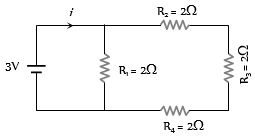
What is the current $i$ in the circuit as shown in the figure (in $A$)?
A
$2$
B
$1.2$
C
$1$
D
$0.5$
Solution
(A) The circuit consists of a $3 \ V$ battery connected in parallel with a resistor $R_1 = 2 \ \Omega$ and a series combination of resistors $R_2, R_3, R_4$.
First,calculate the equivalent resistance of the series branch containing $R_2, R_3, R_4$:
$R_s = R_2 + R_3 + R_4 = 2 \ \Omega + 2 \ \Omega + 2 \ \Omega = 6 \ \Omega$.
Now,this $R_s$ is in parallel with $R_1 = 2 \ \Omega$. The equivalent resistance $R_{eq}$ of the circuit is:
$\frac{1}{R_{eq}} = \frac{1}{R_1} + \frac{1}{R_s} = \frac{1}{2} + \frac{1}{6} = \frac{3+1}{6} = \frac{4}{6} = \frac{2}{3} \ \Omega^{-1}$.
Therefore,$R_{eq} = 1.5 \ \Omega$ or $\frac{3}{2} \ \Omega$.
The total current $i$ drawn from the battery is given by Ohm's law:
$i = \frac{V}{R_{eq}} = \frac{3 \ V}{1.5 \ \Omega} = 2 \ A$.
First,calculate the equivalent resistance of the series branch containing $R_2, R_3, R_4$:
$R_s = R_2 + R_3 + R_4 = 2 \ \Omega + 2 \ \Omega + 2 \ \Omega = 6 \ \Omega$.
Now,this $R_s$ is in parallel with $R_1 = 2 \ \Omega$. The equivalent resistance $R_{eq}$ of the circuit is:
$\frac{1}{R_{eq}} = \frac{1}{R_1} + \frac{1}{R_s} = \frac{1}{2} + \frac{1}{6} = \frac{3+1}{6} = \frac{4}{6} = \frac{2}{3} \ \Omega^{-1}$.
Therefore,$R_{eq} = 1.5 \ \Omega$ or $\frac{3}{2} \ \Omega$.
The total current $i$ drawn from the battery is given by Ohm's law:
$i = \frac{V}{R_{eq}} = \frac{3 \ V}{1.5 \ \Omega} = 2 \ A$.
0 likesView Solution
43
PhysicsEasyMCQAIIMS · 1998
The lines of force due to the Earth's horizontal component of the magnetic field are:
A
Parallel straight lines
B
Concentric circles
C
Elliptical
D
Parabolic
Solution
(A) The Earth's magnetic field is approximately uniform over a small region on its surface. The horizontal component of the Earth's magnetic field $(B_H)$ represents the magnetic field lines running parallel to the Earth's surface in a specific direction. In a localized region,these magnetic field lines are represented as parallel straight lines.
0 likesView Solution
44
PhysicsEasyMCQAIIMS · 1998
$A$ transformer is based on the principle of
A
Mutual inductance
B
Self inductance
C
Ampere's law
D
Lenz's law
Solution
(A) transformer consists of two coils,the primary and the secondary,wound on a common core. When an alternating current flows through the primary coil,it produces a changing magnetic flux. This changing magnetic flux is linked with the secondary coil,which induces an electromotive force (emf) in it. This phenomenon,where a change in current in one coil induces an emf in a nearby coil,is known as mutual induction. Therefore,a transformer is based on the principle of mutual inductance.
0 likesView Solution
45
PhysicsEasyMCQAIIMS · 1998
In a transformer,the core is made of soft iron to reduce:
A
Hysteresis losses
B
Eddy current losses
C
Force opposing electric current
D
None of the above
Solution
(A) In a transformer,energy losses occur due to various factors,including hysteresis loss.
Soft magnetic materials,such as soft iron,possess a narrow hysteresis loop,which results in low hysteresis loss.
Therefore,to minimize these losses and increase the efficiency of the transformer,a soft iron core is used.
Soft magnetic materials,such as soft iron,possess a narrow hysteresis loop,which results in low hysteresis loss.
Therefore,to minimize these losses and increase the efficiency of the transformer,a soft iron core is used.
0 likesView Solution
46
PhysicsEasyMCQAIIMS · 1998
The kinetic energy of an electron which is accelerated through a potential of $100 \, V$ is:
A
$1.602 \times 10^{-17} \, J$
B
$418.6 \, \text{calories}$
C
$1.16 \times 10^{4} \, J$
D
$6.626 \times 10^{-34} \, W \cdot s$
Solution
(A) The kinetic energy $(K)$ gained by an electron accelerated through a potential difference $(V)$ is given by the formula $K = e \cdot V$.
Here,the charge of an electron $e = 1.602 \times 10^{-19} \, C$ and the potential difference $V = 100 \, V$.
Substituting these values into the formula:
$K = (1.602 \times 10^{-19} \, C) \times (100 \, V)$
$K = 1.602 \times 10^{-17} \, J$.
Therefore,the correct option is $A$.
Here,the charge of an electron $e = 1.602 \times 10^{-19} \, C$ and the potential difference $V = 100 \, V$.
Substituting these values into the formula:
$K = (1.602 \times 10^{-19} \, C) \times (100 \, V)$
$K = 1.602 \times 10^{-17} \, J$.
Therefore,the correct option is $A$.
0 likesView Solution
47
PhysicsEasyMCQAIIMS · 1998
Which of the following is dependent on the intensity of incident radiation in a photoelectric experiment?
A
Work function of the surface
B
Amount of photoelectric current
C
Stopping potential
D
Maximum kinetic energy of photoelectrons
Solution
(B) In a photoelectric experiment,the photoelectric current is directly proportional to the intensity of the incident radiation,provided the frequency is above the threshold frequency.
- The work function depends only on the nature of the metal surface.
- The stopping potential and the maximum kinetic energy of the emitted photoelectrons depend only on the frequency of the incident radiation and the work function of the metal,not on the intensity.
Therefore,the correct option is $B$.
- The work function depends only on the nature of the metal surface.
- The stopping potential and the maximum kinetic energy of the emitted photoelectrons depend only on the frequency of the incident radiation and the work function of the metal,not on the intensity.
Therefore,the correct option is $B$.
0 likesView Solution
48
PhysicsEasyMCQAIIMS · 1998
If the radioactive decay constant of radium is $1.07 \times 10^{-4}$ per year,then its half-life period is approximately equal to ......... $years$.
A
$8900$
B
$7000$
C
$6476$
D
$2520$
Solution
(C) The half-life period $T_{1/2}$ of a radioactive substance is related to the decay constant $\lambda$ by the formula: $T_{1/2} = \frac{0.693}{\lambda}$.
Given the decay constant $\lambda = 1.07 \times 10^{-4} \text{ year}^{-1}$.
Substituting the value into the formula:
$T_{1/2} = \frac{0.693}{1.07 \times 10^{-4}}$
$T_{1/2} = \frac{0.693}{1.07} \times 10^4$
$T_{1/2} \approx 0.6476 \times 10^4 = 6476 \text{ years}$.
Thus,the half-life period is $6476 \text{ years}$.
Given the decay constant $\lambda = 1.07 \times 10^{-4} \text{ year}^{-1}$.
Substituting the value into the formula:
$T_{1/2} = \frac{0.693}{1.07 \times 10^{-4}}$
$T_{1/2} = \frac{0.693}{1.07} \times 10^4$
$T_{1/2} \approx 0.6476 \times 10^4 = 6476 \text{ years}$.
Thus,the half-life period is $6476 \text{ years}$.
0 likesView Solution
49
PhysicsEasyMCQAIIMS · 1998
'Mirage' is a phenomenon due to
A
Reflection of light
B
Refraction of light
C
Total internal reflection of light
D
Diffraction of light
Solution
(C) Mirage is an optical illusion observed in hot deserts or on hot roads.
It occurs due to the total internal reflection of light.
As light travels from a denser medium (cooler air near the ground) to a rarer medium (hotter air above),the refractive index of the air changes continuously.
When the angle of incidence exceeds the critical angle for the interface between the layers of air,the light undergoes total internal reflection,creating an inverted image of distant objects.
It occurs due to the total internal reflection of light.
As light travels from a denser medium (cooler air near the ground) to a rarer medium (hotter air above),the refractive index of the air changes continuously.
When the angle of incidence exceeds the critical angle for the interface between the layers of air,the light undergoes total internal reflection,creating an inverted image of distant objects.
0 likesView Solution
50
PhysicsEasyMCQAIIMS · 1998
$A$ person using a lens as a simple microscope sees an:
A
Inverted virtual image
B
Inverted real magnified image
C
Upright virtual image
D
Upright real magnified image
Solution
(C) simple microscope consists of a convex lens of short focal length.
When an object is placed between the optical centre and the principal focus of the convex lens,a virtual,erect,and magnified image is formed on the same side as the object.
Therefore,the person sees an upright virtual image.
When an object is placed between the optical centre and the principal focus of the convex lens,a virtual,erect,and magnified image is formed on the same side as the object.
Therefore,the person sees an upright virtual image.
0 likesView Solution
51
PhysicsEasyMCQAIIMS · 1998
The astronomical telescope consists of an objective lens and an eye-piece. The focal length of the objective is:
A
Equal to that of the eye-piece
B
Greater than that of the eye-piece
C
Shorter than that of the eye-piece
D
Five times shorter than that of the eye-piece
Solution
(B) In an astronomical telescope,the objective lens is used to collect light from distant objects,so it requires a large aperture and a long focal length $(f_0)$.
The eye-piece acts as a simple magnifier and requires a short focal length $(f_e)$.
Therefore,the condition for an astronomical telescope is $f_0 > f_e$.
The eye-piece acts as a simple magnifier and requires a short focal length $(f_e)$.
Therefore,the condition for an astronomical telescope is $f_0 > f_e$.
0 likesView Solution
52
PhysicsEasyMCQAIIMS · 1998
If the luminous intensity of a $100 \, W$ unidirectional bulb is $100 \, \text{candela}$, then the total luminous flux emitted from the bulb is ....... $lumen$.
A
$861$
B
$986$
C
$1256$
D
$1561$
Solution
(C) The luminous intensity $I$ is defined as the luminous flux per unit solid angle, given by $I = \frac{d\phi}{d\Omega}$.
For a point source emitting light uniformly in all directions, the total solid angle is $4\pi \, \text{steradians}$.
However, for a unidirectional bulb, the flux is emitted into a specific solid angle. Assuming the standard interpretation for such problems where the source is treated as isotropic over a full sphere unless specified otherwise, the total luminous flux $\phi$ is given by $\phi = I \times \Omega$.
Given $I = 100 \, \text{candela}$ and $\Omega = 4\pi \, \text{steradians}$:
$\phi = 100 \times 4 \times 3.14159$
$\phi = 1256.6 \, \text{lumen}$.
Rounding to the nearest provided option, the correct value is $1256 \, \text{lumen}$.
For a point source emitting light uniformly in all directions, the total solid angle is $4\pi \, \text{steradians}$.
However, for a unidirectional bulb, the flux is emitted into a specific solid angle. Assuming the standard interpretation for such problems where the source is treated as isotropic over a full sphere unless specified otherwise, the total luminous flux $\phi$ is given by $\phi = I \times \Omega$.
Given $I = 100 \, \text{candela}$ and $\Omega = 4\pi \, \text{steradians}$:
$\phi = 100 \times 4 \times 3.14159$
$\phi = 1256.6 \, \text{lumen}$.
Rounding to the nearest provided option, the correct value is $1256 \, \text{lumen}$.
0 likesView Solution
53
PhysicsEasyMCQAIIMS · 1998
Light appears to travel in straight lines since
A
It is not absorbed by the atmosphere
B
It is reflected by the atmosphere
C
Its wavelength is very small
D
Its velocity is very large
Solution
(C) The phenomenon of light bending around obstacles is known as diffraction. Diffraction is significant only when the size of the obstacle or aperture is comparable to the wavelength of the light. Since the wavelength of visible light is extremely small ($400 \, nm$ to $700 \, nm$), it does not show noticeable diffraction around common objects in our daily life. Consequently, light appears to travel in straight lines, a principle known as rectilinear propagation of light. Therefore, the correct option is $C$.
0 likesView Solution
54
PhysicsEasyMCQAIIMS · 1998
According to Maxwell's hypothesis,a changing electric field gives rise to
A
An e.m.f.
B
Electric current
C
Magnetic field
D
Pressure radiant
Solution
(C) According to Maxwell's $EM$ theory,a time-varying electric field produces a displacement current,which in turn acts as a source of a magnetic field.
This is represented by the Maxwell-Ampere law: $\oint B \cdot dl = \mu_0 (I_c + I_d)$,where $I_d = \epsilon_0 \frac{d\Phi_E}{dt}$ is the displacement current.
Therefore,a changing electric field gives rise to a magnetic field.
This is represented by the Maxwell-Ampere law: $\oint B \cdot dl = \mu_0 (I_c + I_d)$,where $I_d = \epsilon_0 \frac{d\Phi_E}{dt}$ is the displacement current.
Therefore,a changing electric field gives rise to a magnetic field.
0 likesView Solution
55
PhysicsEasyMCQAIIMS · 1998
Assertion: In a series $LCR$ circuit,resonance can take place.
Reason: Resonance takes place if inductive and capacitive reactances are equal and opposite.
Reason: Resonance takes place if inductive and capacitive reactances are equal and opposite.
A
If both Assertion and Reason are correct and the Reason is a correct explanation of the Assertion.
B
If both Assertion and Reason are correct but Reason is not a correct explanation of the Assertion.
C
If the Assertion is correct but Reason is incorrect.
D
If both the Assertion and Reason are incorrect.
Solution
(A) In a series $LCR$ circuit,the impedance $Z$ is given by $Z = \sqrt{R^2 + (X_L - X_C)^2}$.
Resonance occurs when the inductive reactance $X_L = \omega L$ and capacitive reactance $X_C = \frac{1}{\omega C}$ are equal and opposite,such that $X_L - X_C = 0$.
At this condition,the impedance $Z$ becomes minimum $(Z = R)$,and the current $I = \frac{V}{Z}$ becomes maximum.
Since the condition for resonance is indeed $X_L = X_C$,the Reason correctly explains the Assertion.
Resonance occurs when the inductive reactance $X_L = \omega L$ and capacitive reactance $X_C = \frac{1}{\omega C}$ are equal and opposite,such that $X_L - X_C = 0$.
At this condition,the impedance $Z$ becomes minimum $(Z = R)$,and the current $I = \frac{V}{Z}$ becomes maximum.
Since the condition for resonance is indeed $X_L = X_C$,the Reason correctly explains the Assertion.
0 likesView Solution
56
PhysicsEasyMCQAIIMS · 1998
Assertion: Newton's rings are formed in the reflected system when the space between the lens and the glass plate is filled with a liquid of refractive index greater than that of glass; the central spot of the pattern is bright.
Reason: This is because the reflection in these cases will be from a denser to rarer medium and the two interfering rays are reflected under similar conditions.
Reason: This is because the reflection in these cases will be from a denser to rarer medium and the two interfering rays are reflected under similar conditions.
A
If both Assertion and Reason are correct and the Reason is a correct explanation of the Assertion.
B
If both Assertion and Reason are correct but Reason is not a correct explanation of the Assertion.
C
If the Assertion is correct but Reason is incorrect.
D
If both the Assertion and Reason are incorrect.
Solution
(A) In the standard Newton's rings experiment,the air film is between the lens $(n_l)$ and the glass plate $(n_g)$,where $n_l > n_{air}$ and $n_g > n_{air}$. The reflection at the bottom surface of the air film occurs at the glass-air interface (denser to rarer),while the top surface reflection occurs at the air-glass interface (rarer to denser). This introduces a phase change of $\pi$ for one ray,resulting in a dark central spot.
When the space is filled with a liquid of refractive index $n_{liq} > n_g$,the reflection at the bottom surface occurs at the glass-liquid interface (rarer to denser),and the reflection at the top surface occurs at the liquid-glass interface (denser to rarer).
Since both reflections now occur under similar conditions (either both undergo phase change or neither does),the path difference at the center is effectively zero,leading to constructive interference. Thus,the central spot becomes bright. Both the Assertion and the Reason are correct,and the Reason explains why the phase change conditions lead to a bright center.
When the space is filled with a liquid of refractive index $n_{liq} > n_g$,the reflection at the bottom surface occurs at the glass-liquid interface (rarer to denser),and the reflection at the top surface occurs at the liquid-glass interface (denser to rarer).
Since both reflections now occur under similar conditions (either both undergo phase change or neither does),the path difference at the center is effectively zero,leading to constructive interference. Thus,the central spot becomes bright. Both the Assertion and the Reason are correct,and the Reason explains why the phase change conditions lead to a bright center.
0 likesView Solution
57
PhysicsMediumMCQAIIMS · 1998
Assertion : Corpuscular theory fails in explaining the velocities of light in air and water.
Reason : According to corpuscular theory,light should travel faster in denser medium than in rarer medium.
Reason : According to corpuscular theory,light should travel faster in denser medium than in rarer medium.
A
If both Assertion and Reason are correct and the Reason is a correct explanation of the Assertion.
B
If both Assertion and Reason are correct but Reason is not a correct explanation of the Assertion.
C
If the Assertion is correct but Reason is incorrect.
D
If both the Assertion and Reason are incorrect.
Solution
(A) Newton's corpuscular theory suggests that light consists of tiny particles called corpuscles.
According to this theory,the velocity of light increases as it enters a denser medium because the particles are attracted by the medium.
However,experimental evidence shows that the velocity of light is lower in a denser medium compared to a rarer medium.
Therefore,the corpuscular theory fails to explain the observed velocities of light in different media.
Since the reason correctly explains why the theory fails,both statements are correct and the reason is the correct explanation of the assertion.
Thus,option $(A)$ is correct.
According to this theory,the velocity of light increases as it enters a denser medium because the particles are attracted by the medium.
However,experimental evidence shows that the velocity of light is lower in a denser medium compared to a rarer medium.
Therefore,the corpuscular theory fails to explain the observed velocities of light in different media.
Since the reason correctly explains why the theory fails,both statements are correct and the reason is the correct explanation of the assertion.
Thus,option $(A)$ is correct.
0 likesView Solution
58
PhysicsEasyMCQAIIMS · 1998
Assertion : Different colours travel with different speed in vacuum.
Reason : Wavelength of light depends on refractive index of medium.
Reason : Wavelength of light depends on refractive index of medium.
A
If both Assertion and Reason are correct and the Reason is a correct explanation of the Assertion.
B
If both Assertion and Reason are correct but Reason is not a correct explanation of the Assertion.
C
If the Assertion is correct but Reason is incorrect.
D
If the Assertion is incorrect but the Reason is correct.
Solution
(D) In vacuum,all electromagnetic waves (including different colours of light) travel with the same speed,$c \approx 3 \times 10^8 \ m/s$. Thus,the Assertion is incorrect.
The speed of light in a medium is given by $v = c/n$,where $n$ is the refractive index. Since $n$ depends on the wavelength of light $(\lambda)$ in the medium,the speed $v$ also depends on the wavelength. Therefore,the Reason is correct.
The speed of light in a medium is given by $v = c/n$,where $n$ is the refractive index. Since $n$ depends on the wavelength of light $(\lambda)$ in the medium,the speed $v$ also depends on the wavelength. Therefore,the Reason is correct.
0 likesView Solution
59
PhysicsMediumMCQAIIMS · 1998
Assertion : If the half-life of a radioactive substance is $40 \ days$,then $25\%$ of the substance decays in $20 \ days$.
Reason : $N = N_0 \left( \frac{1}{2} \right)^n$,where $n = \frac{\text{time elapsed}}{\text{half-life period}}$.
Reason : $N = N_0 \left( \frac{1}{2} \right)^n$,where $n = \frac{\text{time elapsed}}{\text{half-life period}}$.
A
If both Assertion and Reason are correct and the Reason is a correct explanation of the Assertion.
B
If both Assertion and Reason are correct but Reason is not a correct explanation of the Assertion.
C
If the Assertion is correct but Reason is incorrect.
D
If the Assertion is incorrect but the Reason is correct.
Solution
(D) The half-life $(T_{1/2})$ of the radioactive substance is $40 \ days$. The amount of substance remaining after time $t$ is given by $N = N_0 \left( \frac{1}{2} \right)^{t/T_{1/2}}$.
For $t = 20 \ days$,the number of half-lives is $n = \frac{20}{40} = 0.5$.
The amount remaining is $N = N_0 \left( \frac{1}{2} \right)^{0.5} = N_0 \left( \frac{1}{\sqrt{2}} \right) \approx 0.707 N_0$.
The amount decayed is $N_0 - N = N_0 - 0.707 N_0 = 0.293 N_0$,which is $29.3\%$.
Since $29.3\% \neq 25\%$,the Assertion is incorrect.
The formula provided in the Reason is the standard law of radioactive decay,which is correct.
Therefore,the Assertion is incorrect but the Reason is correct.
For $t = 20 \ days$,the number of half-lives is $n = \frac{20}{40} = 0.5$.
The amount remaining is $N = N_0 \left( \frac{1}{2} \right)^{0.5} = N_0 \left( \frac{1}{\sqrt{2}} \right) \approx 0.707 N_0$.
The amount decayed is $N_0 - N = N_0 - 0.707 N_0 = 0.293 N_0$,which is $29.3\%$.
Since $29.3\% \neq 25\%$,the Assertion is incorrect.
The formula provided in the Reason is the standard law of radioactive decay,which is correct.
Therefore,the Assertion is incorrect but the Reason is correct.
0 likesView Solution
Vedclass Products
For Students
Vedclass Test Series
Mock tests in real AIIMS style covering Physics with performance analysis. 5-day free trial.
Start Free TrialFor Teachers
Exam Paper Generator
Generate Set A/B/C/D Physics papers from 7.5L+ questions in 2 minutes. 3 chapters free.
Try FreeFor Institutes
Online Exam Module
Run live AIIMS mock exams with unlimited students, 360° analytics & white-label branding.
See DemoFrequently Asked Questions
How many Physics questions are in AIIMS 1998?
There are 59 Physics questions from the AIIMS 1998 paper on Vedclass, each with a detailed step-by-step solution in English.
Are AIIMS 1998 Physics solutions available in English?
Yes. All solutions on this page are in English. You can also switch to English or Hindi using the language buttons above the questions.
Can I practice AIIMS 1998 Physics as a timed test?
Yes. Use the Vedclass Test Series to attempt a full AIIMS mock test covering Physics with time limits and instant score analysis.
Can teachers create Physics papers from AIIMS previous year questions?
Yes. The Vedclass Exam Paper Generator lets teachers mix AIIMS Physics questions and generate Set A/B/C/D papers in minutes.
For Teachers & Institutes
Build a Custom Physics Paper
Pick AIIMS 1998 Physics questions, set difficulty, and generate Set A/B/C/D in 2 minutes.