
PhysicsQ1–12 of 12 questions
Page 1 of 1 · English
1
PhysicsEasyMCQAIIMS · 1980
$A$ train is moving towards north. At one place it turns towards north-east,here we observe that
A
The radius of curvature of outer rail will be greater than that of the inner rail
B
The radius of the inner rail will be greater than that of the outer rail
C
The radius of curvature of one of the rails will be greater
D
The radius of curvature of the outer and inner rails will be the same
Solution
(A) When a train moves along a curved track,it follows a circular path.
For any circular path,the outer rail is at a larger distance from the center of curvature compared to the inner rail.
Let $R_o$ be the radius of the outer rail and $R_i$ be the radius of the inner rail.
Since the outer rail is further from the center of the turn,$R_o > R_i$.
Therefore,the radius of curvature of the outer rail is greater than that of the inner rail.
For any circular path,the outer rail is at a larger distance from the center of curvature compared to the inner rail.
Let $R_o$ be the radius of the outer rail and $R_i$ be the radius of the inner rail.
Since the outer rail is further from the center of the turn,$R_o > R_i$.
Therefore,the radius of curvature of the outer rail is greater than that of the inner rail.
0 likesView Solution
2
PhysicsEasyMCQAIIMS · 1980
Which of the following is the evidence to show that there must be a force acting on the Earth and directed towards the Sun?
A
Deviation of the falling bodies towards the east
B
Revolution of the Earth around the Sun
C
Phenomenon of day and night
D
Apparent motion of the Sun around the Earth
Solution
(B) The Earth revolves around the Sun due to the gravitational pull of the Sun.
Due to this gravitational attraction between these celestial bodies,a centripetal force is generated,which keeps the Earth in its orbit.
According to Newton's laws of motion,a body moving in a circular path must be acted upon by a centripetal force directed towards the center of the circle.
Therefore,the revolution of the Earth around the Sun is the evidence that there must be a force acting on the Earth and directed towards the Sun.
Due to this gravitational attraction between these celestial bodies,a centripetal force is generated,which keeps the Earth in its orbit.
According to Newton's laws of motion,a body moving in a circular path must be acted upon by a centripetal force directed towards the center of the circle.
Therefore,the revolution of the Earth around the Sun is the evidence that there must be a force acting on the Earth and directed towards the Sun.
0 likesView Solution
3
PhysicsMediumMCQAIIMS · 1980
$A$ wire of length $L$ and radius $r$ is rigidly fixed at one end. On stretching the other end of the wire with a force $F$,the increase in its length is $l$. If another wire of same material but of length $2L$ and radius $2r$ is stretched with a force of $2F$,the increase in its length will be
A
$l$
B
$2l$
C
$\frac{l}{2}$
D
$\frac{l}{4}$
Solution
(A) The formula for the extension $l$ in a wire is given by $l = \frac{FL}{AY}$,where $A = \pi r^2$ is the cross-sectional area and $Y$ is the Young's modulus.
Thus,$l = \frac{FL}{\pi r^2 Y}$.
Since the material is the same,$Y$ is constant. Therefore,$l \propto \frac{FL}{r^2}$.
For the first wire: $l_1 = l$,$F_1 = F$,$L_1 = L$,$r_1 = r$.
For the second wire: $F_2 = 2F$,$L_2 = 2L$,$r_2 = 2r$.
Taking the ratio: $\frac{l_2}{l_1} = \left( \frac{F_2}{F_1} \right) \times \left( \frac{L_2}{L_1} \right) \times \left( \frac{r_1}{r_2} \right)^2$.
Substituting the values: $\frac{l_2}{l} = \left( \frac{2F}{F} \right) \times \left( \frac{2L}{L} \right) \times \left( \frac{r}{2r} \right)^2 = 2 \times 2 \times \left( \frac{1}{4} \right) = 1$.
Therefore,$l_2 = l$.
Thus,$l = \frac{FL}{\pi r^2 Y}$.
Since the material is the same,$Y$ is constant. Therefore,$l \propto \frac{FL}{r^2}$.
For the first wire: $l_1 = l$,$F_1 = F$,$L_1 = L$,$r_1 = r$.
For the second wire: $F_2 = 2F$,$L_2 = 2L$,$r_2 = 2r$.
Taking the ratio: $\frac{l_2}{l_1} = \left( \frac{F_2}{F_1} \right) \times \left( \frac{L_2}{L_1} \right) \times \left( \frac{r_1}{r_2} \right)^2$.
Substituting the values: $\frac{l_2}{l} = \left( \frac{2F}{F} \right) \times \left( \frac{2L}{L} \right) \times \left( \frac{r}{2r} \right)^2 = 2 \times 2 \times \left( \frac{1}{4} \right) = 1$.
Therefore,$l_2 = l$.
0 likesView Solution
4
PhysicsDifficultMCQAIIMS · 1980
Two wires $A$ and $B$ of the same length and of the same material have the respective radii $r_1$ and $r_2$. Their one end is fixed to a rigid support,and at the other end,an equal twisting couple is applied. The ratio of the angle of twist at the end of $A$ to the angle of twist at the end of $B$ will be:
A
$r_1^2 / r_2^2$
B
$r_2^2 / r_1^2$
C
$r_2^4 / r_1^4$
D
$r_1^4 / r_2^4$
Solution
(C) The twisting couple $C$ required to produce an angle of twist $\theta$ in a wire of length $l$,radius $r$,and modulus of rigidity $\eta$ is given by the formula:
$C = \frac{\pi \eta r^4 \theta}{2l}$
From this expression,we can see that for a constant twisting couple $C$,length $l$,and material property $\eta$:
$\theta = \frac{2lC}{\pi \eta r^4}$
This implies that $\theta \propto \frac{1}{r^4}$.
Therefore,for wires $A$ and $B$ with radii $r_1$ and $r_2$ respectively,the ratio of the angles of twist $\theta_1$ and $\theta_2$ is:
$\frac{\theta_1}{\theta_2} = \frac{r_2^4}{r_1^4}$
Thus,the correct option is $C$.
$C = \frac{\pi \eta r^4 \theta}{2l}$
From this expression,we can see that for a constant twisting couple $C$,length $l$,and material property $\eta$:
$\theta = \frac{2lC}{\pi \eta r^4}$
This implies that $\theta \propto \frac{1}{r^4}$.
Therefore,for wires $A$ and $B$ with radii $r_1$ and $r_2$ respectively,the ratio of the angles of twist $\theta_1$ and $\theta_2$ is:
$\frac{\theta_1}{\theta_2} = \frac{r_2^4}{r_1^4}$
Thus,the correct option is $C$.
0 likesView Solution
5
PhysicsEasyMCQAIIMS · 1980
The value of surface tension of a liquid at critical temperature is
A
Zero
B
Infinite
C
Between $0$ and $\infty$
D
Cannot be determined
Solution
(A) Surface tension is a property arising from the cohesive forces between molecules at the surface of a liquid.
As the temperature of a liquid increases,the kinetic energy of the molecules increases,which weakens the cohesive forces.
At the critical temperature,the distinction between the liquid phase and the vapor phase disappears,and the density of the liquid becomes equal to the density of the vapor.
Consequently,the cohesive forces become negligible,and the surface tension of the liquid drops to $0$.
As the temperature of a liquid increases,the kinetic energy of the molecules increases,which weakens the cohesive forces.
At the critical temperature,the distinction between the liquid phase and the vapor phase disappears,and the density of the liquid becomes equal to the density of the vapor.
Consequently,the cohesive forces become negligible,and the surface tension of the liquid drops to $0$.
0 likesView Solution
6
PhysicsEasyMCQAIIMS · 1980
When the temperature is increased,the angle of contact of a liquid:
A
Increases
B
Decreases
C
Remains the same
D
First increases and then decreases
Solution
(B) The angle of contact $\theta$ is determined by the balance of surface tension forces at the interface of liquid,solid,and gas.
As the temperature increases,the cohesive forces between the liquid molecules decrease more rapidly than the adhesive forces between the liquid and the solid surface.
Since the angle of contact is inversely related to the strength of the adhesive forces relative to the cohesive forces,a reduction in cohesive force leads to a decrease in the angle of contact.
Therefore,the correct option is $(b)$.
As the temperature increases,the cohesive forces between the liquid molecules decrease more rapidly than the adhesive forces between the liquid and the solid surface.
Since the angle of contact is inversely related to the strength of the adhesive forces relative to the cohesive forces,a reduction in cohesive force leads to a decrease in the angle of contact.
Therefore,the correct option is $(b)$.
0 likesView Solution
7
PhysicsEasyMCQAIIMS · 1980
$A$ body is just floating on the surface of a liquid. The density of the body is the same as that of the liquid. The body is slightly pushed down. What will happen to the body?
A
It will slowly come back to its earlier position.
B
It will remain submerged,where it is left.
C
It will sink.
D
It will come out violently.
Solution
(B) When a body is floating in a liquid such that its density is equal to the density of the liquid,it is in a state of neutral equilibrium.
If the body is pushed down slightly,the buoyant force and the weight of the body remain equal because the density of the liquid is uniform.
Since the net force on the body remains zero at any depth,the body will remain submerged at the position where it is left.
If the body is pushed down slightly,the buoyant force and the weight of the body remain equal because the density of the liquid is uniform.
Since the net force on the body remains zero at any depth,the body will remain submerged at the position where it is left.
0 likesView Solution
8
PhysicsEasyMCQAIIMS · 1980
$A$ transverse wave of amplitude $0.5\, m$,wavelength $1\, m$,and frequency $2\, Hz$ is propagating in a string in the negative $x$-direction. The expression for this wave is:
A
$y(x, t) = 0.5\sin(2\pi x - 4\pi t)$
B
$y(x, t) = 0.5\cos(2\pi x + 4\pi t)$
C
$y(x, t) = 0.5\sin(\pi x - 2\pi t)$
D
$y(x, t) = 0.5\cos(2\pi x + 2\pi t)$
Solution
(B) The general equation for a wave traveling in the negative $x$-direction is given by $y(x, t) = A \sin(kx + \omega t + \phi)$ or $A \cos(kx + \omega t + \phi)$.
Given: Amplitude $A = 0.5\, m$,Wavelength $\lambda = 1\, m$,Frequency $f = 2\, Hz$.
Calculate the angular wave number $k = \frac{2\pi}{\lambda} = \frac{2\pi}{1} = 2\pi\, rad/m$.
Calculate the angular frequency $\omega = 2\pi f = 2\pi(2) = 4\pi\, rad/s$.
Substituting these values into the wave equation: $y(x, t) = 0.5 \cos(2\pi x + 4\pi t)$.
Thus,option $B$ is correct.
Given: Amplitude $A = 0.5\, m$,Wavelength $\lambda = 1\, m$,Frequency $f = 2\, Hz$.
Calculate the angular wave number $k = \frac{2\pi}{\lambda} = \frac{2\pi}{1} = 2\pi\, rad/m$.
Calculate the angular frequency $\omega = 2\pi f = 2\pi(2) = 4\pi\, rad/s$.
Substituting these values into the wave equation: $y(x, t) = 0.5 \cos(2\pi x + 4\pi t)$.
Thus,option $B$ is correct.
0 likesView Solution
9
PhysicsEasyMCQAIIMS · 1980
The capacity of a capacitor is $4 \times 10^{-6} \, F$ and its potential is $100 \, V$. The energy released on discharging it fully will be ....... $J$.
A
$0.02$
B
$0.04$
C
$0.025$
D
$0.05$
Solution
(A) The energy stored in a capacitor is given by the formula $U = \frac{1}{2} C V^2$.
Given:
Capacitance $C = 4 \times 10^{-6} \, F$
Potential $V = 100 \, V$
Substituting the values into the formula:
$U = \frac{1}{2} \times (4 \times 10^{-6}) \times (100)^2$
$U = \frac{1}{2} \times 4 \times 10^{-6} \times 10000$
$U = 2 \times 10^{-6} \times 10^4$
$U = 2 \times 10^{-2} \, J$
$U = 0.02 \, J$
Therefore,the energy released is $0.02 \, J$.
Given:
Capacitance $C = 4 \times 10^{-6} \, F$
Potential $V = 100 \, V$
Substituting the values into the formula:
$U = \frac{1}{2} \times (4 \times 10^{-6}) \times (100)^2$
$U = \frac{1}{2} \times 4 \times 10^{-6} \times 10000$
$U = 2 \times 10^{-6} \times 10^4$
$U = 2 \times 10^{-2} \, J$
$U = 0.02 \, J$
Therefore,the energy released is $0.02 \, J$.
0 likesView Solution
10
PhysicsMediumMCQAIIMS · 1980
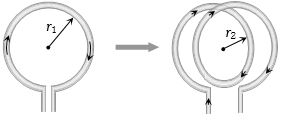
$A$ length $L$ of wire carries a steady current $I$. It is bent first to form a circular plane coil of one turn. The same length is now bent more sharply to give a double loop of smaller radius. The magnetic field at the centre caused by the same current is
A
$A$ quarter of its first value
B
Unaltered
C
Four times of its first value
D
$A$ half of its first value
Solution
(C) The magnetic field $B$ at the centre of a circular coil of $N$ turns and radius $r$ carrying current $I$ is given by $B = \frac{\mu_0 N I}{2r}$.
Since the length of the wire $L$ is constant,$L = 2\pi r_1 N_1 = 2\pi r_2 N_2$.
For the first case,$N_1 = 1$,so $L = 2\pi r_1$,which implies $r_1 = \frac{L}{2\pi}$.
For the second case,$N_2 = 2$,so $L = 2\pi r_2 \times 2$,which implies $r_2 = \frac{L}{4\pi} = \frac{r_1}{2}$.
The magnetic field in the first case is $B_1 = \frac{\mu_0 (1) I}{2r_1}$.
The magnetic field in the second case is $B_2 = \frac{\mu_0 (2) I}{2r_2} = \frac{\mu_0 (2) I}{2(r_1/2)} = \frac{4 \mu_0 I}{2r_1} = 4 B_1$.
Thus,the magnetic field becomes four times its first value.
Since the length of the wire $L$ is constant,$L = 2\pi r_1 N_1 = 2\pi r_2 N_2$.
For the first case,$N_1 = 1$,so $L = 2\pi r_1$,which implies $r_1 = \frac{L}{2\pi}$.
For the second case,$N_2 = 2$,so $L = 2\pi r_2 \times 2$,which implies $r_2 = \frac{L}{4\pi} = \frac{r_1}{2}$.
The magnetic field in the first case is $B_1 = \frac{\mu_0 (1) I}{2r_1}$.
The magnetic field in the second case is $B_2 = \frac{\mu_0 (2) I}{2r_2} = \frac{\mu_0 (2) I}{2(r_1/2)} = \frac{4 \mu_0 I}{2r_1} = 4 B_1$.
Thus,the magnetic field becomes four times its first value.
0 likesView Solution
11
PhysicsEasyMCQAIIMS · 1980
Which of the following is most suitable for the core of electromagnets?
A
Soft iron
B
Steel
C
Copper-nickel alloy
D
Air
Solution
(A) Soft iron is highly ferromagnetic and has high magnetic permeability and low retentivity.
This means it can be easily magnetized and demagnetized,which is an essential property for the core of an electromagnet.
Therefore,soft iron is the most suitable material for the core of electromagnets.
This means it can be easily magnetized and demagnetized,which is an essential property for the core of an electromagnet.
Therefore,soft iron is the most suitable material for the core of electromagnets.
0 likesView Solution
12
PhysicsMediumMCQAIIMS · 1980
$A$ coil is wound as a transformer of rectangular cross-section. If all the linear dimensions of the transformer are increased by a factor of $2$ and the number of turns per unit length of the coil remains the same,the self-inductance increases by a factor of:
A
$16$
B
$12$
C
$8$
D
$4$
Solution
(C) The self-inductance $L$ of a solenoid is given by the formula $L = \mu_0 N^2 A / l$.
Since the number of turns per unit length $n = N / l$ is constant,we can write $N = nl$.
Substituting this into the formula,we get $L = \mu_0 (nl)^2 A / l = \mu_0 n^2 l A$.
Here,$l$ represents the length of the coil and $A$ represents the cross-sectional area.
When all linear dimensions are increased by a factor of $2$,the length $l$ becomes $2l$ and the area $A$ (which is proportional to the square of linear dimensions) becomes $2^2 A = 4A$.
Substituting these new values into the expression for $L$,the new inductance $L'$ is $L' = \mu_0 n^2 (2l) (4A) = 8 (\mu_0 n^2 l A) = 8L$.
Therefore,the self-inductance increases by a factor of $8$.
Since the number of turns per unit length $n = N / l$ is constant,we can write $N = nl$.
Substituting this into the formula,we get $L = \mu_0 (nl)^2 A / l = \mu_0 n^2 l A$.
Here,$l$ represents the length of the coil and $A$ represents the cross-sectional area.
When all linear dimensions are increased by a factor of $2$,the length $l$ becomes $2l$ and the area $A$ (which is proportional to the square of linear dimensions) becomes $2^2 A = 4A$.
Substituting these new values into the expression for $L$,the new inductance $L'$ is $L' = \mu_0 n^2 (2l) (4A) = 8 (\mu_0 n^2 l A) = 8L$.
Therefore,the self-inductance increases by a factor of $8$.
0 likesView Solution
Vedclass Products
For Students
Vedclass Test Series
Mock tests in real AIIMS style covering Physics with performance analysis. 5-day free trial.
Start Free TrialFor Teachers
Exam Paper Generator
Generate Set A/B/C/D Physics papers from 7.5L+ questions in 2 minutes. 3 chapters free.
Try FreeFor Institutes
Online Exam Module
Run live AIIMS mock exams with unlimited students, 360° analytics & white-label branding.
See DemoFrequently Asked Questions
How many Physics questions are in AIIMS 1980?
There are 12 Physics questions from the AIIMS 1980 paper on Vedclass, each with a detailed step-by-step solution in English.
Are AIIMS 1980 Physics solutions available in English?
Yes. All solutions on this page are in English. You can also switch to English or Hindi using the language buttons above the questions.
Can I practice AIIMS 1980 Physics as a timed test?
Yes. Use the Vedclass Test Series to attempt a full AIIMS mock test covering Physics with time limits and instant score analysis.
Can teachers create Physics papers from AIIMS previous year questions?
Yes. The Vedclass Exam Paper Generator lets teachers mix AIIMS Physics questions and generate Set A/B/C/D papers in minutes.
For Teachers & Institutes
Build a Custom Physics Paper
Pick AIIMS 1980 Physics questions, set difficulty, and generate Set A/B/C/D in 2 minutes.