
A English
Profit and Loss Questions in English
Competitive Exam Quantitative Aptitude · Profit and Loss · Profit and Loss
452+
Questions
English
Language
100%
With Solutions
Showing 50 of 452 questions in English
151
MediumMCQ
$A$ shopkeeper mixes $20 \, kg$ of rice which cost him $Rs. \, 5$ per $kg$ with $35 \, kg$ of rice which cost him $Rs. \, 7$ per $kg$. Then he sells the mixture at $Rs. \, 6.5$ per $kg$. Find his total profit and percent profit.
A
$17.5, 41 \frac{41}{69} \%$
B
$15.4, 47 \frac{47}{69} \%$
C
$12.5, 3 \frac{43}{69} \%$
D
$10, 2 \frac{37}{69} \%$
Solution
(C) Step $1$: Calculate the total cost price $(C.P.)$ of the mixture.
$C.P. = (20 \times 5) + (35 \times 7) = 100 + 245 = Rs. \, 345$.
Step $2$: Calculate the total selling price $(S.P.)$ of the mixture.
Total weight of the mixture $= 20 + 35 = 55 \, kg$.
$S.P. = 55 \times 6.5 = Rs. \, 357.5$.
Step $3$: Calculate the total profit.
Profit $= S.P. - C.P. = 357.5 - 345 = Rs. \, 12.5$.
Step $4$: Calculate the profit percentage.
Profit percentage $= (\frac{\text{Profit}}{C.P.}) \times 100 = (\frac{12.5}{345}) \times 100 = \frac{1250}{345} = \frac{250}{69} = 3 \frac{43}{69} \%$.
$C.P. = (20 \times 5) + (35 \times 7) = 100 + 245 = Rs. \, 345$.
Step $2$: Calculate the total selling price $(S.P.)$ of the mixture.
Total weight of the mixture $= 20 + 35 = 55 \, kg$.
$S.P. = 55 \times 6.5 = Rs. \, 357.5$.
Step $3$: Calculate the total profit.
Profit $= S.P. - C.P. = 357.5 - 345 = Rs. \, 12.5$.
Step $4$: Calculate the profit percentage.
Profit percentage $= (\frac{\text{Profit}}{C.P.}) \times 100 = (\frac{12.5}{345}) \times 100 = \frac{1250}{345} = \frac{250}{69} = 3 \frac{43}{69} \%$.
0 likes
View Solution152
DifficultMCQ
$A$ shopkeeper sold an article offering a discount of $5 \%$ and earned a profit of $23.5 \% .$ What would have been the percentage of profit earned if no discount was offered?
A
$24.5 \%$
B
$28.5 \%$
C
$30 \%$
D
Data inadequate
Solution
(C) Let the cost price $(CP)$ of the article be $₹ 100.$
Since the profit earned is $23.5 \%,$ the selling price $(SP)$ is $₹ 123.50.$
Let the marked price $(MP)$ of the article be $x.$
Given that a discount of $5 \%$ is offered on the marked price,the selling price is $95 \%$ of $x.$
So,$0.95x = 123.50.$
$x = \frac{123.50}{0.95} = 130.$
Thus,the marked price is $₹ 130.$
If no discount is offered,the selling price would be equal to the marked price,i.e.,$SP = ₹ 130.$
Profit percentage $= \frac{SP - CP}{CP} \times 100 = \frac{130 - 100}{100} \times 100 = 30 \%.$
Since the profit earned is $23.5 \%,$ the selling price $(SP)$ is $₹ 123.50.$
Let the marked price $(MP)$ of the article be $x.$
Given that a discount of $5 \%$ is offered on the marked price,the selling price is $95 \%$ of $x.$
So,$0.95x = 123.50.$
$x = \frac{123.50}{0.95} = 130.$
Thus,the marked price is $₹ 130.$
If no discount is offered,the selling price would be equal to the marked price,i.e.,$SP = ₹ 130.$
Profit percentage $= \frac{SP - CP}{CP} \times 100 = \frac{130 - 100}{100} \times 100 = 30 \%.$
0 likes
View Solution153
DifficultMCQ
The labelled price of a cupboard is $Rs. 6500$. The shopkeeper sold it by giving $5\%$ discount on the labelled price and earned a profit of $15\%$. What approximately is the cost price of the cupboard? (in $Rs.$)
A
$5000$
B
$5350$
C
$5600$
D
$5800$
Solution
(B) Labelled price of the cupboard $= Rs. 6500$.
Selling price $(S.P.)$ after $5\%$ discount $= 6500 \times (1 - 0.05) = 6500 \times 0.95 = Rs. 6175$.
Let the cost price $(C.P.)$ be $x$.
Given that the profit percentage is $15\%$,the relationship between $S.P.$ and $C.P.$ is $S.P. = C.P. \times (1 + \text{Profit}\%)$.
$6175 = x \times (1 + 0.15)$.
$6175 = 1.15x$.
$x = \frac{6175}{1.15} \approx 5369.56$.
Rounding to the nearest given option,the cost price is approximately $Rs. 5350$.
Selling price $(S.P.)$ after $5\%$ discount $= 6500 \times (1 - 0.05) = 6500 \times 0.95 = Rs. 6175$.
Let the cost price $(C.P.)$ be $x$.
Given that the profit percentage is $15\%$,the relationship between $S.P.$ and $C.P.$ is $S.P. = C.P. \times (1 + \text{Profit}\%)$.
$6175 = x \times (1 + 0.15)$.
$6175 = 1.15x$.
$x = \frac{6175}{1.15} \approx 5369.56$.
Rounding to the nearest given option,the cost price is approximately $Rs. 5350$.
0 likes
View Solution154
DifficultMCQ
$A$ trader marked the selling price of an article at $10 \%$ above the cost price. At the time of selling,he allows a certain discount and suffers a loss of $1 \%$. He allowed a discount of $\%$:
A
$9$
B
$10$
C
$10.5$
D
$11$
Solution
(B) Let the cost price ($C$.$P$.) of the article be $Rs. 100$.
Since the marked price ($M$.$P$.) is $10 \%$ above the cost price,$M$.$P$. $= 100 + 10 = Rs. 110$.
Given that the trader suffers a loss of $1 \%$,the selling price ($S$.$P$.) $= 100 - 1 = Rs. 99$.
Let the discount percentage be $x \%$.
The formula for $S$.$P$. in terms of discount is: $S.P. = M.P. \times (1 - \frac{x}{100})$.
Substituting the values: $99 = 110 \times (1 - \frac{x}{100})$.
Dividing both sides by $110$: $\frac{99}{110} = 1 - \frac{x}{100}$.
Simplifying the fraction: $0.9 = 1 - \frac{x}{100}$.
Rearranging the terms: $\frac{x}{100} = 1 - 0.9 = 0.1$.
Therefore,$x = 0.1 \times 100 = 10 \%$.
Thus,the trader allowed a discount of $10 \%$.
Since the marked price ($M$.$P$.) is $10 \%$ above the cost price,$M$.$P$. $= 100 + 10 = Rs. 110$.
Given that the trader suffers a loss of $1 \%$,the selling price ($S$.$P$.) $= 100 - 1 = Rs. 99$.
Let the discount percentage be $x \%$.
The formula for $S$.$P$. in terms of discount is: $S.P. = M.P. \times (1 - \frac{x}{100})$.
Substituting the values: $99 = 110 \times (1 - \frac{x}{100})$.
Dividing both sides by $110$: $\frac{99}{110} = 1 - \frac{x}{100}$.
Simplifying the fraction: $0.9 = 1 - \frac{x}{100}$.
Rearranging the terms: $\frac{x}{100} = 1 - 0.9 = 0.1$.
Therefore,$x = 0.1 \times 100 = 10 \%$.
Thus,the trader allowed a discount of $10 \%$.
0 likes
View Solution155
DifficultMCQ
At what price should a shopkeeper mark a radio that costs him $Rs. 1200$ in order that he may offer a discount of $20 \%$ on the marked price and still make a profit of $25 \% ?$
A
$1675$
B
$1875$
C
$1900$
D
$2025$
Solution
(B) Let the marked price of the radio be $x$.
Given,Cost Price $(C.P.)$ $= Rs. 1200$.
Discount $= 20 \%$ of $x$,so Selling Price $(S.P.)$ $= x - 0.20x = 0.8x$.
Profit required $= 25 \%$.
We know that $S.P. = C.P. \times (1 + \frac{\text{Profit } \%}{100})$.
$0.8x = 1200 \times (1 + \frac{25}{100})$.
$0.8x = 1200 \times 1.25$.
$0.8x = 1500$.
$x = \frac{1500}{0.8} = 1875$.
Therefore,the marked price should be $Rs. 1875$.
Given,Cost Price $(C.P.)$ $= Rs. 1200$.
Discount $= 20 \%$ of $x$,so Selling Price $(S.P.)$ $= x - 0.20x = 0.8x$.
Profit required $= 25 \%$.
We know that $S.P. = C.P. \times (1 + \frac{\text{Profit } \%}{100})$.
$0.8x = 1200 \times (1 + \frac{25}{100})$.
$0.8x = 1200 \times 1.25$.
$0.8x = 1500$.
$x = \frac{1500}{0.8} = 1875$.
Therefore,the marked price should be $Rs. 1875$.
0 likes
View Solution156
DifficultMCQ
By selling an umbrella for $Rs. 300$,a shopkeeper gains $20 \%$. During a clearance sale,the shopkeeper allows a discount of $10 \%$ on the marked price. His gain per cent during the sale is
A
$7$
B
$7.5$
C
$8$
D
$9$
Solution
(C) The selling price $(S.P.)$ is given by $S.P. = C.P. \times (1 + \frac{\text{profit } \%}{100})$.
Given $S.P. = 300$ and profit $\% = 20$,we have $300 = C.P. \times (1 + 0.20)$.
Therefore,$C.P. = \frac{300}{1.2} = Rs. 250$.
The marked price is $Rs. 300$. During the sale,a discount of $10 \%$ is allowed.
New $S.P. = 300 \times (1 - \frac{10}{100}) = 300 \times 0.9 = Rs. 270$.
Gain $\% = \frac{S.P. - C.P.}{C.P.} \times 100 = \frac{270 - 250}{250} \times 100 = \frac{20}{250} \times 100 = 8 \%$.
Given $S.P. = 300$ and profit $\% = 20$,we have $300 = C.P. \times (1 + 0.20)$.
Therefore,$C.P. = \frac{300}{1.2} = Rs. 250$.
The marked price is $Rs. 300$. During the sale,a discount of $10 \%$ is allowed.
New $S.P. = 300 \times (1 - \frac{10}{100}) = 300 \times 0.9 = Rs. 270$.
Gain $\% = \frac{S.P. - C.P.}{C.P.} \times 100 = \frac{270 - 250}{250} \times 100 = \frac{20}{250} \times 100 = 8 \%$.
0 likes
View Solution157
DifficultMCQ
The price of an article is raised by $30 \%$ and then two successive discounts of $10 \%$ each are allowed. Ultimately,the price of the article is
A
decreased by $5.3 \%$
B
increased by $3 \%$
C
increased by $5.3 \%$
D
increased by $10 \%$
Solution
(C) Let the initial price of the article be $100$.
After the $1st$ rise of $30 \%$,the price becomes $100 \times 1.30 = 130$.
After the $1st$ discount of $10 \%$,the price becomes $130 \times (1 - 0.10) = 130 \times 0.9 = 117$.
After the $2nd$ discount of $10 \%$,the price becomes $117 \times (1 - 0.10) = 117 \times 0.9 = 105.3$.
The final price is $105.3$.
Percentage increase $= \frac{105.3 - 100}{100} \times 100 = 5.3 \%$.
Therefore,the price is increased by $5.3 \%$.
After the $1st$ rise of $30 \%$,the price becomes $100 \times 1.30 = 130$.
After the $1st$ discount of $10 \%$,the price becomes $130 \times (1 - 0.10) = 130 \times 0.9 = 117$.
After the $2nd$ discount of $10 \%$,the price becomes $117 \times (1 - 0.10) = 117 \times 0.9 = 105.3$.
The final price is $105.3$.
Percentage increase $= \frac{105.3 - 100}{100} \times 100 = 5.3 \%$.
Therefore,the price is increased by $5.3 \%$.
0 likes
View Solution158
MediumMCQ
The difference between a discount of $35 \%$ and two successive discounts of $20 \%$ on a certain bill was $Rs$ $22$. Find the amount of the bill in $Rs$.
A
$200$
B
$1100$
C
$2200$
D
Data inadequate
Solution
(C) Let the amount of the bill be $Rs$ $x$.
First discount $= 35 \%$.
Two successive discounts of $20 \%$ each.
The equivalent discount for two successive discounts of $a \%$ and $b \%$ is given by $\left(a + b - \frac{ab}{100}\right) \%$.
Equivalent discount $= 20 + 20 - \frac{20 \times 20}{100} = 40 - 4 = 36 \%$.
The difference between the two discount schemes is $36 \% - 35 \% = 1 \%$.
According to the problem,$1 \%$ of $x = 22$.
$\frac{1}{100} \times x = 22$.
$x = 22 \times 100 = 2200$.
Therefore,the amount of the bill is $Rs$ $2200$.
First discount $= 35 \%$.
Two successive discounts of $20 \%$ each.
The equivalent discount for two successive discounts of $a \%$ and $b \%$ is given by $\left(a + b - \frac{ab}{100}\right) \%$.
Equivalent discount $= 20 + 20 - \frac{20 \times 20}{100} = 40 - 4 = 36 \%$.
The difference between the two discount schemes is $36 \% - 35 \% = 1 \%$.
According to the problem,$1 \%$ of $x = 22$.
$\frac{1}{100} \times x = 22$.
$x = 22 \times 100 = 2200$.
Therefore,the amount of the bill is $Rs$ $2200$.
0 likes
View Solution159
MediumMCQ
Successive discounts of $10 \%$,$12 \%$ and $15 \%$ are equivalent to a single discount of:
A
$32.68 \%$
B
$35.28 \%$
C
$36.68 \%$
D
None of these
Solution
(A) Let the marked price be $Rs. 100$.
After a discount of $10 \%$,the price becomes $100 \times (1 - 0.10) = Rs. 90$.
After a further discount of $12 \%$,the price becomes $90 \times (1 - 0.12) = 90 \times 0.88 = Rs. 79.2$.
After a final discount of $15 \%$,the price becomes $79.2 \times (1 - 0.15) = 79.2 \times 0.85 = Rs. 67.32$.
The total single discount is $100 - 67.32 = 32.68 \%$.
After a discount of $10 \%$,the price becomes $100 \times (1 - 0.10) = Rs. 90$.
After a further discount of $12 \%$,the price becomes $90 \times (1 - 0.12) = 90 \times 0.88 = Rs. 79.2$.
After a final discount of $15 \%$,the price becomes $79.2 \times (1 - 0.15) = 79.2 \times 0.85 = Rs. 67.32$.
The total single discount is $100 - 67.32 = 32.68 \%$.
0 likes
View Solution160
DifficultMCQ
$A$ fan is listed at $Rs. 1500$ and a discount of $20 \%$ is offered on the list price. What additional discount must be offered to the customer to bring the net price to $Rs. 1104$? (in $\%$)
A
$8$
B
$10$
C
$12$
D
$15$
Solution
(A) Listed price $= Rs. 1500$.
First discount $= 20 \%$.
Price after first discount $= 1500 \times (1 - 0.20) = 1500 \times 0.80 = Rs. 1200$.
Let the additional discount be $x \%$.
According to the problem,the final net price is $Rs. 1104$.
So,$1200 \times (1 - \frac{x}{100}) = 1104$.
$1 - \frac{x}{100} = \frac{1104}{1200}$.
$1 - \frac{x}{100} = 0.92$.
$\frac{x}{100} = 1 - 0.92 = 0.08$.
$x = 8 \%$.
Therefore,the additional discount required is $8 \%$.
First discount $= 20 \%$.
Price after first discount $= 1500 \times (1 - 0.20) = 1500 \times 0.80 = Rs. 1200$.
Let the additional discount be $x \%$.
According to the problem,the final net price is $Rs. 1104$.
So,$1200 \times (1 - \frac{x}{100}) = 1104$.
$1 - \frac{x}{100} = \frac{1104}{1200}$.
$1 - \frac{x}{100} = 0.92$.
$\frac{x}{100} = 1 - 0.92 = 0.08$.
$x = 8 \%$.
Therefore,the additional discount required is $8 \%$.
0 likes
View Solution161
MediumMCQ
$A$ pair of articles was bought for $Rs. 37.40$ at a discount of $15 \%$. What must be the marked price of each of the articles?
A
$11$
B
$22$
C
$33$
D
$44$
Solution
(B) Let the marked price of each article be $Rs. x$.
Since there are two articles,the total marked price is $2x$.
The discount given is $15 \%$,so the selling price of the pair is $85 \%$ of the total marked price.
Given that the total selling price is $Rs. 37.40$,we have:
$2x \times \frac{85}{100} = 37.40$
$2x \times 0.85 = 37.40$
$1.70x = 37.40$
$x = \frac{37.40}{1.70}$
$x = 22$
Therefore,the marked price of each article is $Rs. 22$.
Since there are two articles,the total marked price is $2x$.
The discount given is $15 \%$,so the selling price of the pair is $85 \%$ of the total marked price.
Given that the total selling price is $Rs. 37.40$,we have:
$2x \times \frac{85}{100} = 37.40$
$2x \times 0.85 = 37.40$
$1.70x = 37.40$
$x = \frac{37.40}{1.70}$
$x = 22$
Therefore,the marked price of each article is $Rs. 22$.
0 likes
View Solution162
MediumMCQ
Albert buys $4$ horses and $9$ cows for $Rs. 13400$. If he sells the horses at $10 \%$ profit and the cows at $20 \%$ profit,then he earns a total profit of $Rs. 1880$. The cost price of a horse is (in $Rs.$)
A
$1000$
B
$2000$
C
$2500$
D
$3000$
Solution
(B) Let the cost price $(C.P.)$ of each horse be $Rs. x$ and that of each cow be $Rs. y$.
According to the problem,the total cost for $4$ horses and $9$ cows is $Rs. 13400$:
$4x + 9y = 13400$ $...(1)$
Profit earned on $4$ horses at $10 \%$ and $9$ cows at $20 \%$ is $Rs. 1880$:
$\frac{10}{100} \times 4x + \frac{20}{100} \times 9y = 1880$
$0.4x + 1.8y = 1880$
Multiply by $10$ to simplify:
$4x + 18y = 18800$ $...(2)$
Subtract equation $(1)$ from equation $(2)$:
$(4x + 18y) - (4x + 9y) = 18800 - 13400$
$9y = 5400$
$y = 600$
Substitute $y = 600$ into equation $(1)$:
$4x + 9(600) = 13400$
$4x + 5400 = 13400$
$4x = 8000$
$x = 2000$
Therefore,the cost price of a horse is $Rs. 2000$.
According to the problem,the total cost for $4$ horses and $9$ cows is $Rs. 13400$:
$4x + 9y = 13400$ $...(1)$
Profit earned on $4$ horses at $10 \%$ and $9$ cows at $20 \%$ is $Rs. 1880$:
$\frac{10}{100} \times 4x + \frac{20}{100} \times 9y = 1880$
$0.4x + 1.8y = 1880$
Multiply by $10$ to simplify:
$4x + 18y = 18800$ $...(2)$
Subtract equation $(1)$ from equation $(2)$:
$(4x + 18y) - (4x + 9y) = 18800 - 13400$
$9y = 5400$
$y = 600$
Substitute $y = 600$ into equation $(1)$:
$4x + 9(600) = 13400$
$4x + 5400 = 13400$
$4x = 8000$
$x = 2000$
Therefore,the cost price of a horse is $Rs. 2000$.
0 likes
View Solution163
DifficultMCQ
The cash difference between the selling prices of an article at a profit of $4 \%$ and $6 \%$ is $Rs. 3$. The ratio of the two selling prices is:
A
$51: 52$
B
$52: 53$
C
$51: 53$
D
$52: 55$
Solution
(B) Let the cost price of the article be $Rs. x$.
The selling price at $4 \%$ profit is $SP_1 = x \times (1 + \frac{4}{100}) = 1.04x$.
The selling price at $6 \%$ profit is $SP_2 = x \times (1 + \frac{6}{100}) = 1.06x$.
Given that the difference between the selling prices is $Rs. 3$:
$1.06x - 1.04x = 3$
$0.02x = 3$
$x = \frac{3}{0.02} = 150$.
The ratio of the two selling prices is:
$\frac{SP_1}{SP_2} = \frac{1.04x}{1.06x} = \frac{1.04}{1.06} = \frac{104}{106} = \frac{52}{53}$.
Thus,the required ratio is $52: 53$.
The selling price at $4 \%$ profit is $SP_1 = x \times (1 + \frac{4}{100}) = 1.04x$.
The selling price at $6 \%$ profit is $SP_2 = x \times (1 + \frac{6}{100}) = 1.06x$.
Given that the difference between the selling prices is $Rs. 3$:
$1.06x - 1.04x = 3$
$0.02x = 3$
$x = \frac{3}{0.02} = 150$.
The ratio of the two selling prices is:
$\frac{SP_1}{SP_2} = \frac{1.04x}{1.06x} = \frac{1.04}{1.06} = \frac{104}{106} = \frac{52}{53}$.
Thus,the required ratio is $52: 53$.
0 likes
View Solution164
MediumMCQ
If a man reduces the selling price of a fan from $Rs. 400$ to $Rs. 380$,his loss increases by $2 \%$. The cost price of the fan is (in $Rs.$)
A
$480$
B
$500$
C
$600$
D
$1000$
Solution
(D) Let the cost price of the fan be $Rs. x$.
The reduction in selling price is $Rs. 400 - Rs. 380 = Rs. 20$.
According to the problem,this reduction in selling price causes the loss to increase by $2 \%$ of the cost price.
Therefore,$2 \%$ of $x = 20$.
$\frac{2}{100} \times x = 20$.
$x = \frac{20 \times 100}{2}$.
$x = 1000$.
Thus,the cost price of the fan is $Rs. 1000$.
The reduction in selling price is $Rs. 400 - Rs. 380 = Rs. 20$.
According to the problem,this reduction in selling price causes the loss to increase by $2 \%$ of the cost price.
Therefore,$2 \%$ of $x = 20$.
$\frac{2}{100} \times x = 20$.
$x = \frac{20 \times 100}{2}$.
$x = 1000$.
Thus,the cost price of the fan is $Rs. 1000$.
0 likes
View Solution165
EasyMCQ
$A$ sells a bicycle to $B$ at a profit of $20 \%.$ $B$ sells it to $C$ at a profit of $25 \%.$ If $C$ pays $Rs. 225$ for it,the cost price of the bicycle for $A$ is (in $Rs.$)
A
$110$
B
$120$
C
$125$
D
$150$
Solution
(D) Let the cost price of the bicycle for $A$ be $Rs. x$.
$A$ sells it to $B$ at a profit of $20 \%$,so the selling price for $A$ (which is the cost price for $B$) is $x \times (1 + \frac{20}{100}) = x \times \frac{120}{100}$.
$B$ sells it to $C$ at a profit of $25 \%$,so the selling price for $B$ (which is the cost price for $C$) is $(x \times \frac{120}{100}) \times (1 + \frac{25}{100}) = x \times \frac{120}{100} \times \frac{125}{100}$.
Given that $C$ pays $Rs. 225$,we have:
$x \times \frac{120}{100} \times \frac{125}{100} = 225$
$x \times \frac{6}{5} \times \frac{5}{4} = 225$
$x \times \frac{30}{20} = 225$
$x \times 1.5 = 225$
$x = \frac{225}{1.5} = 150$
Therefore,the cost price for $A$ is $Rs. 150$.
$A$ sells it to $B$ at a profit of $20 \%$,so the selling price for $A$ (which is the cost price for $B$) is $x \times (1 + \frac{20}{100}) = x \times \frac{120}{100}$.
$B$ sells it to $C$ at a profit of $25 \%$,so the selling price for $B$ (which is the cost price for $C$) is $(x \times \frac{120}{100}) \times (1 + \frac{25}{100}) = x \times \frac{120}{100} \times \frac{125}{100}$.
Given that $C$ pays $Rs. 225$,we have:
$x \times \frac{120}{100} \times \frac{125}{100} = 225$
$x \times \frac{6}{5} \times \frac{5}{4} = 225$
$x \times \frac{30}{20} = 225$
$x \times 1.5 = 225$
$x = \frac{225}{1.5} = 150$
Therefore,the cost price for $A$ is $Rs. 150$.
0 likes
View Solution166
MediumMCQ
$A$ shopkeeper cheats to the extent of $10 \%$ while buying as well as selling by using false weights. His total gain percentage is:
A
$10$
B
$11$
C
$20$
D
$21$
Solution
(D) Let the true weight be $1000 \text{ g}$.
When buying,the shopkeeper cheats by $10 \%$,meaning he receives $1100 \text{ g}$ while paying for $1000 \text{ g}$.
When selling,the shopkeeper cheats by $10 \%$,meaning he gives $900 \text{ g}$ while charging for $1000 \text{ g}$.
Let the cost price of $1 \text{ g}$ be $1$.
Cost Price $(CP)$ for $900 \text{ g}$ is $900$.
Selling Price $(SP)$ for $900 \text{ g}$ is $1100$ (since he sells $1100 \text{ g}$ worth of goods for the price of $1000 \text{ g}$).
Alternatively,using the formula for successive percentage gain: $\text{Total Gain } \% = \left( x + y + \frac{xy}{100} \right) \%$,where $x = 10$ and $y = 10$.
$\text{Total Gain } \% = 10 + 10 + \frac{10 \times 10}{100} = 20 + 1 = 21 \%$.
Thus,his total gain is $21 \%$.
When buying,the shopkeeper cheats by $10 \%$,meaning he receives $1100 \text{ g}$ while paying for $1000 \text{ g}$.
When selling,the shopkeeper cheats by $10 \%$,meaning he gives $900 \text{ g}$ while charging for $1000 \text{ g}$.
Let the cost price of $1 \text{ g}$ be $1$.
Cost Price $(CP)$ for $900 \text{ g}$ is $900$.
Selling Price $(SP)$ for $900 \text{ g}$ is $1100$ (since he sells $1100 \text{ g}$ worth of goods for the price of $1000 \text{ g}$).
Alternatively,using the formula for successive percentage gain: $\text{Total Gain } \% = \left( x + y + \frac{xy}{100} \right) \%$,where $x = 10$ and $y = 10$.
$\text{Total Gain } \% = 10 + 10 + \frac{10 \times 10}{100} = 20 + 1 = 21 \%$.
Thus,his total gain is $21 \%$.
0 likes
View Solution167
DifficultMCQ
$A$ dishonest dealer uses a scale of $90 \, cm$ instead of a metre scale and claims to sell at cost price. His profit percentage is:
A
$9 \%$
B
$10 \%$
C
$12 \%$
D
$11 \frac{1}{9} \%$
Solution
(D) The dealer uses a scale of $90 \, cm$ instead of $100 \, cm$ (a metre scale).
This means for every $100 \, cm$ he should sell,he only gives $90 \, cm$.
His gain in length is $100 \, cm - 90 \, cm = 10 \, cm$.
Since he sells at cost price,his profit percentage is calculated on the actual amount given (the cost to him).
Profit $\% = \left( \frac{\text{Gain}}{\text{Actual quantity given}} \times 100 \right) \%$.
Profit $\% = \left( \frac{10}{90} \times 100 \right) \% = \frac{100}{9} \% = 11 \frac{1}{9} \%$.
This means for every $100 \, cm$ he should sell,he only gives $90 \, cm$.
His gain in length is $100 \, cm - 90 \, cm = 10 \, cm$.
Since he sells at cost price,his profit percentage is calculated on the actual amount given (the cost to him).
Profit $\% = \left( \frac{\text{Gain}}{\text{Actual quantity given}} \times 100 \right) \%$.
Profit $\% = \left( \frac{10}{90} \times 100 \right) \% = \frac{100}{9} \% = 11 \frac{1}{9} \%$.
0 likes
View Solution168
MediumMCQ
$A$ dairyman pays $Rs. 6.40$ per litre of milk. He adds water and sells the mixture at $Rs. 8$ per litre,thereby making $37.5\%$ profit. The proportion of water to milk received by the customers is
A
$1: 10$
B
$1: 12$
C
$1: 15$
D
$1: 20$
Solution
(A) Let the cost price of milk be $Rs. 6.40$ per litre and the cost price of water be $Rs. 0$ per litre.
Profit percentage $= 37.5\%$.
Selling price of the mixture $= Rs. 8$ per litre.
We know that,$\text{Selling Price} = \text{Cost Price} \times (1 + \frac{\text{Profit}\%}{100})$.
$8 = \text{Cost Price} \times (1 + \frac{37.5}{100}) = \text{Cost Price} \times (1 + 0.375) = \text{Cost Price} \times 1.375$.
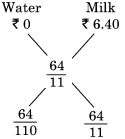
Mean cost price $= \frac{8}{1.375} = \frac{8000}{1375} = \frac{64}{11} \approx Rs. 5.82$ per litre.
Using the method of alligation:
Cost of Water $(Rs. 0)$ : Cost of Milk $(Rs. 6.40)$ = Mean Price $(Rs. 64/11)$.
Ratio of Water to Milk $= (6.40 - 64/11) : (64/11 - 0)$.
$= (70.4/11 - 64/11) : 64/11 = (6.4/11) : (64/11) = 6.4 : 64 = 1 : 10$.
Profit percentage $= 37.5\%$.
Selling price of the mixture $= Rs. 8$ per litre.
We know that,$\text{Selling Price} = \text{Cost Price} \times (1 + \frac{\text{Profit}\%}{100})$.
$8 = \text{Cost Price} \times (1 + \frac{37.5}{100}) = \text{Cost Price} \times (1 + 0.375) = \text{Cost Price} \times 1.375$.
Mean cost price $= \frac{8}{1.375} = \frac{8000}{1375} = \frac{64}{11} \approx Rs. 5.82$ per litre.
Using the method of alligation:
Cost of Water $(Rs. 0)$ : Cost of Milk $(Rs. 6.40)$ = Mean Price $(Rs. 64/11)$.
Ratio of Water to Milk $= (6.40 - 64/11) : (64/11 - 0)$.
$= (70.4/11 - 64/11) : 64/11 = (6.4/11) : (64/11) = 6.4 : 64 = 1 : 10$.
0 likes
View Solution169
MediumMCQ
Arun purchased $30 \, kg$ of wheat at the rate of $Rs. \, 11.50$ per $kg$ and $20 \, kg$ of wheat at the rate of $Rs. \, 14.25$ per $kg$. He mixed the two and sold the mixture. Approximately at what price per $kg$ should he sell the mixture to make $30 \%$ profit? (in $Rs.$)
A
$14.80$
B
$15.40$
C
$15.60$
D
$16.30$
Solution
(D) Step $1$: Calculate the total cost price $(C.P.)$ of the mixture.
Total $C.P. = (30 \times 11.50) + (20 \times 14.25) = 345 + 285 = Rs. \, 630$.
Step $2$: Calculate the cost price per $kg$ of the mixture.
Total weight $= 30 \, kg + 20 \, kg = 50 \, kg$.
$C.P.$ per $kg = 630 / 50 = Rs. \, 12.60$.
Step $3$: Calculate the selling price $(S.P.)$ per $kg$ for a $30 \%$ profit.
$S.P. = C.P. \times (1 + \text{Profit} \% / 100) = 12.60 \times 1.30 = Rs. \, 16.38$.
Rounding to the nearest given option,the price is approximately $Rs. \, 16.30$ per $kg$.
Total $C.P. = (30 \times 11.50) + (20 \times 14.25) = 345 + 285 = Rs. \, 630$.
Step $2$: Calculate the cost price per $kg$ of the mixture.
Total weight $= 30 \, kg + 20 \, kg = 50 \, kg$.
$C.P.$ per $kg = 630 / 50 = Rs. \, 12.60$.
Step $3$: Calculate the selling price $(S.P.)$ per $kg$ for a $30 \%$ profit.
$S.P. = C.P. \times (1 + \text{Profit} \% / 100) = 12.60 \times 1.30 = Rs. \, 16.38$.
Rounding to the nearest given option,the price is approximately $Rs. \, 16.30$ per $kg$.
0 likes
View Solution170
DifficultMCQ
$A$ man bought apples at the rate of $8$ for $Rs. 34$ and sold them at the rate of $12$ for $Rs. 57$. How many apples should be sold to earn a net profit of $Rs. 45$?
A
$90$
B
$100$
C
$135$
D
$150$
Solution
(A) Cost Price $(C.P.)$ of $1$ apple = $Rs. \frac{34}{8} = Rs. 4.25$.
Selling Price $(S.P.)$ of $1$ apple = $Rs. \frac{57}{12} = Rs. 4.75$.
Profit per apple = $S.P. - C.P. = 4.75 - 4.25 = Rs. 0.50$.
Let $x$ be the number of apples sold to earn a total profit of $Rs. 45$.
Total Profit = (Profit per apple) $\times$ $x$.
$45 = 0.50 \times x$.
$x = \frac{45}{0.50} = 90$.
Therefore,$90$ apples must be sold to earn a net profit of $Rs. 45$.
Selling Price $(S.P.)$ of $1$ apple = $Rs. \frac{57}{12} = Rs. 4.75$.
Profit per apple = $S.P. - C.P. = 4.75 - 4.25 = Rs. 0.50$.
Let $x$ be the number of apples sold to earn a total profit of $Rs. 45$.
Total Profit = (Profit per apple) $\times$ $x$.
$45 = 0.50 \times x$.
$x = \frac{45}{0.50} = 90$.
Therefore,$90$ apples must be sold to earn a net profit of $Rs. 45$.
0 likes
View Solution171
EasyMCQ
If on selling $12$ notebooks,a seller makes a profit equal to the selling price of $4$ notebooks,what is his percent profit?
A
$16 \frac{2}{3} \%$
B
$25 \%$
C
$50 \%$
D
Data inadequate
Solution
(C) Let the selling price of $1$ notebook be $SP$ and the cost price be $CP$.
Given that the profit on selling $12$ notebooks is equal to the selling price of $4$ notebooks.
Profit $= SP_{12} - CP_{12} = SP_4$.
Rearranging the terms: $SP_{12} - SP_4 = CP_{12}$.
This implies $SP_8 = CP_{12}$.
Profit percentage is calculated on the cost price: $\text{Profit } \% = \frac{\text{Profit}}{CP} \times 100$.
Since Profit $= SP_4$ and $CP_{12} = SP_8$,we have:
$\text{Profit } \% = \frac{SP_4}{CP_{12}} \times 100 = \frac{SP_4}{SP_8} \times 100 = \frac{4}{8} \times 100 = 50 \%$.
Given that the profit on selling $12$ notebooks is equal to the selling price of $4$ notebooks.
Profit $= SP_{12} - CP_{12} = SP_4$.
Rearranging the terms: $SP_{12} - SP_4 = CP_{12}$.
This implies $SP_8 = CP_{12}$.
Profit percentage is calculated on the cost price: $\text{Profit } \% = \frac{\text{Profit}}{CP} \times 100$.
Since Profit $= SP_4$ and $CP_{12} = SP_8$,we have:
$\text{Profit } \% = \frac{SP_4}{CP_{12}} \times 100 = \frac{SP_4}{SP_8} \times 100 = \frac{4}{8} \times 100 = 50 \%$.
0 likes
View Solution172
MediumMCQ
The cost price of $20$ articles is the same as the selling price of $x$ articles. If the profit is $25 \%$,then the value of $x$ is:
A
$15$
B
$16$
C
$18$
D
$25$
Solution
(B) Let the cost price $(C.P.)$ of $1$ article be $1$ unit.
Then,the $C.P.$ of $20$ articles $= 20$ units.
According to the problem,the selling price $(S.P.)$ of $x$ articles $= 20$ units.
Therefore,the $S.P.$ of $1$ article $= \frac{20}{x}$ units.
Profit percentage is given as $25 \%$.
Profit $= S.P. - C.P. = \frac{20}{x} - 1 = \frac{20-x}{x}$.
Profit percentage $= \left( \frac{\text{Profit}}{C.P.} \right) \times 100 = 25 \%$.
$\frac{(20-x)/x}{1} \times 100 = 25$.
$\frac{20-x}{x} = \frac{25}{100} = \frac{1}{4}$.
$4(20-x) = x$.
$80 - 4x = x$.
$5x = 80$.
$x = 16$.
Then,the $C.P.$ of $20$ articles $= 20$ units.
According to the problem,the selling price $(S.P.)$ of $x$ articles $= 20$ units.
Therefore,the $S.P.$ of $1$ article $= \frac{20}{x}$ units.
Profit percentage is given as $25 \%$.
Profit $= S.P. - C.P. = \frac{20}{x} - 1 = \frac{20-x}{x}$.
Profit percentage $= \left( \frac{\text{Profit}}{C.P.} \right) \times 100 = 25 \%$.
$\frac{(20-x)/x}{1} \times 100 = 25$.
$\frac{20-x}{x} = \frac{25}{100} = \frac{1}{4}$.
$4(20-x) = x$.
$80 - 4x = x$.
$5x = 80$.
$x = 16$.
0 likes
View Solution173
MediumMCQ
The percentage profit earned by selling an article for $Rs. 1920$ is equal to the percentage loss incurred by selling the same article for $Rs. 1280$. At what price should the article be sold to make $25 \%$ profit? (in $Rs.$)
A
$2000$
B
$2200$
C
$2400$
D
Data inadequate
Solution
(A) Let $x$ be the cost price $(C.P.)$ of the article in $Rs.$
According to the problem,the percentage profit at $Rs. 1920$ equals the percentage loss at $Rs. 1280$.
Profit percentage = $\frac{1920 - x}{x} \times 100$
Loss percentage = $\frac{x - 1280}{x} \times 100$
Equating the two: $\frac{1920 - x}{x} = \frac{x - 1280}{x}$
Since the denominators are the same,$1920 - x = x - 1280$.
$2x = 1920 + 1280 = 3200$
$x = 1600$
The cost price of the article is $Rs. 1600$.
To earn a $25 \%$ profit,the selling price $(S.P.)$ should be:
$S.P. = C.P. \times (1 + \frac{25}{100}) = 1600 \times 1.25 = Rs. 2000$.
According to the problem,the percentage profit at $Rs. 1920$ equals the percentage loss at $Rs. 1280$.
Profit percentage = $\frac{1920 - x}{x} \times 100$
Loss percentage = $\frac{x - 1280}{x} \times 100$
Equating the two: $\frac{1920 - x}{x} = \frac{x - 1280}{x}$
Since the denominators are the same,$1920 - x = x - 1280$.
$2x = 1920 + 1280 = 3200$
$x = 1600$
The cost price of the article is $Rs. 1600$.
To earn a $25 \%$ profit,the selling price $(S.P.)$ should be:
$S.P. = C.P. \times (1 + \frac{25}{100}) = 1600 \times 1.25 = Rs. 2000$.
0 likes
View Solution174
DifficultMCQ
In a certain store, the profit is $320 \%$ of the cost. If the cost increases by $25 \%$ but the selling price remains constant, approximately what percentage of the selling price is the profit?
A
$30$
B
$70$
C
$100$
D
$250$
Solution
(B) Let the initial cost price $(C.P.)$ be $x$.
Since the profit is $320 \%$ of the cost, the profit $= 3.2x$.
Therefore, the initial selling price $(S.P.)$ $= C.P. + \text{Profit} = x + 3.2x = 4.2x$.
If the cost increases by $25 \%$, the new $C.P. = x + 0.25x = 1.25x$.
The selling price remains constant, so the new $S.P. = 4.2x$.
The new profit $= \text{New } S.P. - \text{New } C.P. = 4.2x - 1.25x = 2.95x$.
The required percentage of the profit with respect to the selling price is given by $\left( \frac{\text{New Profit}}{\text{New } S.P.} \times 100 \right) \%$.
Required percentage $= \left( \frac{2.95x}{4.2x} \times 100 \right) \% = \frac{295}{4.2} \% \approx 70.23 \%$.
Rounding to the nearest integer, the percentage is approximately $70 \%$.
Since the profit is $320 \%$ of the cost, the profit $= 3.2x$.
Therefore, the initial selling price $(S.P.)$ $= C.P. + \text{Profit} = x + 3.2x = 4.2x$.
If the cost increases by $25 \%$, the new $C.P. = x + 0.25x = 1.25x$.
The selling price remains constant, so the new $S.P. = 4.2x$.
The new profit $= \text{New } S.P. - \text{New } C.P. = 4.2x - 1.25x = 2.95x$.
The required percentage of the profit with respect to the selling price is given by $\left( \frac{\text{New Profit}}{\text{New } S.P.} \times 100 \right) \%$.
Required percentage $= \left( \frac{2.95x}{4.2x} \times 100 \right) \% = \frac{295}{4.2} \% \approx 70.23 \%$.
Rounding to the nearest integer, the percentage is approximately $70 \%$.
0 likes
View Solution175
MediumMCQ
If the selling price is doubled,the profit triples. Find the profit percent.
A
$66 \frac{2}{3} \%$
B
$100 \%$
C
$105 \frac{1}{3} \%$
D
$120 \%$
Solution
(B) Let the cost price be $C.P.$ and the initial selling price be $S.P.$
Initial profit $= S.P. - C.P.$
According to the problem,if the selling price is doubled $(2 S.P.)$,the profit becomes three times the original profit.
So,$2 S.P. - C.P. = 3(S.P. - C.P.)$
$2 S.P. - C.P. = 3 S.P. - 3 C.P.$
Rearranging the terms,we get $3 C.P. - C.P. = 3 S.P. - 2 S.P.$
$2 C.P. = S.P.$
Now,the profit percent is calculated as $\frac{S.P. - C.P.}{C.P.} \times 100$.
Substituting $S.P. = 2 C.P.$,we get $\frac{2 C.P. - C.P.}{C.P.} \times 100 = \frac{C.P.}{C.P.} \times 100 = 100 \%$.
Initial profit $= S.P. - C.P.$
According to the problem,if the selling price is doubled $(2 S.P.)$,the profit becomes three times the original profit.
So,$2 S.P. - C.P. = 3(S.P. - C.P.)$
$2 S.P. - C.P. = 3 S.P. - 3 C.P.$
Rearranging the terms,we get $3 C.P. - C.P. = 3 S.P. - 2 S.P.$
$2 C.P. = S.P.$
Now,the profit percent is calculated as $\frac{S.P. - C.P.}{C.P.} \times 100$.
Substituting $S.P. = 2 C.P.$,we get $\frac{2 C.P. - C.P.}{C.P.} \times 100 = \frac{C.P.}{C.P.} \times 100 = 100 \%$.
0 likes
View Solution176
MediumMCQ
The ratio between the selling price and the cost price of an article is $7:5$. What is the ratio between the profit and the cost price of that article?
A
$2:7$
B
$5:2$
C
$7:2$
D
$2:5$
Solution
(D) Given that the ratio of the selling price $(S.P.)$ to the cost price $(C.P.)$ is $\frac{S.P.}{C.P.} = \frac{7}{5}$.
Profit is calculated as $Profit = S.P. - C.P.$
Therefore,the ratio of profit to the cost price is $\frac{Profit}{C.P.} = \frac{S.P. - C.P.}{C.P.}$.
Substituting the given values: $\frac{7 - 5}{5} = \frac{2}{5}$.
Thus,the ratio between the profit and the cost price is $2:5$.
Profit is calculated as $Profit = S.P. - C.P.$
Therefore,the ratio of profit to the cost price is $\frac{Profit}{C.P.} = \frac{S.P. - C.P.}{C.P.}$.
Substituting the given values: $\frac{7 - 5}{5} = \frac{2}{5}$.
Thus,the ratio between the profit and the cost price is $2:5$.
0 likes
View Solution177
MediumMCQ
When a plot was sold for $Rs. 18700$,the owner lost $15 \%$. At what price must the plot be sold in order to gain $15 \%$?
A
$21000$
B
$22500$
C
$25300$
D
$25800$
Solution
(C) Given,Selling Price $(S.P.)$ $= Rs. 18700$ and Loss percentage $= 15 \%$.
Since the loss is $15 \%$,the $S.P.$ is $85 \%$ of the Cost Price $(C.P.)$.
$0.85 \times C.P. = 18700$
$C.P. = \frac{18700}{0.85} = Rs. 22000$.
To gain $15 \%$,the new $S.P.$ should be $115 \%$ of the $C.P.$
New $S.P. = 1.15 \times 22000 = Rs. 25300$.
Therefore,the plot must be sold at $Rs. 25300$ to gain $15 \%$.
Since the loss is $15 \%$,the $S.P.$ is $85 \%$ of the Cost Price $(C.P.)$.
$0.85 \times C.P. = 18700$
$C.P. = \frac{18700}{0.85} = Rs. 22000$.
To gain $15 \%$,the new $S.P.$ should be $115 \%$ of the $C.P.$
New $S.P. = 1.15 \times 22000 = Rs. 25300$.
Therefore,the plot must be sold at $Rs. 25300$ to gain $15 \%$.
0 likes
View Solution178
MediumMCQ
$A$ manufacturer undertakes to supply $2000$ pieces of a particular component at $Rs. 25$ per piece. According to his estimates,even if $5\%$ fail to pass the quality tests,he will make a profit of $25\%$. However,as it turned out,$50\%$ of the components were rejected. What is the loss to the manufacturer? (in $Rs.$)
A
$12000$
B
$13000$
C
$14000$
D
$15000$
Solution
(B) Selling Price $(S.P.)$ of one piece $= Rs. 25$.
Total pieces $= 2000$.
If $5\%$ fail,the number of accepted pieces $= 2000 \times (1 - 0.05) = 1900$.
Revenue from $1900$ pieces $= 1900 \times 25 = Rs. 47500$.
Since the manufacturer expects a $25\%$ profit on the Cost Price $(C.P.)$,we have $S.P. = C.P. \times (1 + 0.25)$.
$47500 = C.P. \times 1.25 \implies C.P. = 47500 / 1.25 = Rs. 38000$.
Now,if $50\%$ of components are rejected,the number of accepted pieces $= 2000 \times 0.50 = 1000$.
Actual Revenue $= 1000 \times 25 = Rs. 25000$.
Loss $= C.P. - \text{Actual Revenue} = 38000 - 25000 = Rs. 13000$.
Total pieces $= 2000$.
If $5\%$ fail,the number of accepted pieces $= 2000 \times (1 - 0.05) = 1900$.
Revenue from $1900$ pieces $= 1900 \times 25 = Rs. 47500$.
Since the manufacturer expects a $25\%$ profit on the Cost Price $(C.P.)$,we have $S.P. = C.P. \times (1 + 0.25)$.
$47500 = C.P. \times 1.25 \implies C.P. = 47500 / 1.25 = Rs. 38000$.
Now,if $50\%$ of components are rejected,the number of accepted pieces $= 2000 \times 0.50 = 1000$.
Actual Revenue $= 1000 \times 25 = Rs. 25000$.
Loss $= C.P. - \text{Actual Revenue} = 38000 - 25000 = Rs. 13000$.
0 likes
View Solution179
EasyMCQ
$A$ fruit seller sells mangoes at the rate of $Rs. 9$ per $kg$ and thereby loses $20\%$. At what price per $kg$ should he have sold them to make a profit of $5\%$? (in $Rs.$)
A
$11.81$
B
$12$
C
$12.25$
D
$12.31$
Solution
(A) Step $1$: Calculate the Cost Price $(CP)$ of the mangoes.
Given that the Selling Price $(SP_1)$ is $Rs. 9/kg$ and the loss is $20\%$.
$SP = CP \times (1 - \text{Loss}\% / 100)$
$9 = CP \times (1 - 20/100)$
$9 = CP \times 0.8$
$CP = 9 / 0.8 = 11.25 \text{ per } kg$.
Step $2$: Calculate the required Selling Price $(SP_2)$ for a $5\%$ profit.
$SP_2 = CP \times (1 + \text{Profit}\% / 100)$
$SP_2 = 11.25 \times (1 + 5/100)$
$SP_2 = 11.25 \times 1.05 = 11.8125$.
Rounding to two decimal places,the required price is $Rs. 11.81/kg$.
Given that the Selling Price $(SP_1)$ is $Rs. 9/kg$ and the loss is $20\%$.
$SP = CP \times (1 - \text{Loss}\% / 100)$
$9 = CP \times (1 - 20/100)$
$9 = CP \times 0.8$
$CP = 9 / 0.8 = 11.25 \text{ per } kg$.
Step $2$: Calculate the required Selling Price $(SP_2)$ for a $5\%$ profit.
$SP_2 = CP \times (1 + \text{Profit}\% / 100)$
$SP_2 = 11.25 \times (1 + 5/100)$
$SP_2 = 11.25 \times 1.05 = 11.8125$.
Rounding to two decimal places,the required price is $Rs. 11.81/kg$.
0 likes
View Solution180
MediumMCQ
Peter purchased a machine for $Rs. 80000$ and spent $Rs. 5000$ on repairs and $Rs. 1000$ on transport,then sold it with a $25\%$ profit. At what price did he sell the machine? (in $Rs$)
A
$105100$
B
$106250$
C
$107500$
D
$117500$
Solution
(C) The total cost price of the machine includes the purchase price,repair costs,and transport costs.
Total Cost Price $= 80000 + 5000 + 1000 = Rs. 86000$.
To find the selling price at a $25\%$ profit,we use the formula: $\text{Selling Price} = \text{Cost Price} \times (1 + \frac{\text{Profit}\%}{100})$.
Selling Price $= 86000 \times (1 + \frac{25}{100}) = 86000 \times 1.25$.
Selling Price $= 86000 \times \frac{125}{100} = 860 \times 125 = Rs. 107500$.
Total Cost Price $= 80000 + 5000 + 1000 = Rs. 86000$.
To find the selling price at a $25\%$ profit,we use the formula: $\text{Selling Price} = \text{Cost Price} \times (1 + \frac{\text{Profit}\%}{100})$.
Selling Price $= 86000 \times (1 + \frac{25}{100}) = 86000 \times 1.25$.
Selling Price $= 86000 \times \frac{125}{100} = 860 \times 125 = Rs. 107500$.
0 likes
View Solution181
MediumMCQ
Hundred oranges are bought at the rate of $Rs. 350$ and sold at the rate of $Rs. 48$ per dozen. The percentage of profit or loss is:
A
$14 \frac{2}{7} \% \text{ gain}$
B
$15 \% \text{ gain}$
C
$14 \frac{2}{7} \% \text{ loss}$
D
$15 \% \text{ loss}$
Solution
(A) Cost Price $(C.P.)$ of $100$ oranges = $Rs. 350$.
$C.P.$ of $1$ orange = $\frac{350}{100} = Rs. 3.5$.
Selling Price $(S.P.)$ of $1$ dozen $(12)$ oranges = $Rs. 48$.
$S.P.$ of $1$ orange = $\frac{48}{12} = Rs. 4$.
Since $S.P. > C.P.$,there is a profit.
Profit = $S.P. - C.P. = 4 - 3.5 = Rs. 0.5$.
Profit percentage = $\left( \frac{\text{Profit}}{C.P.} \times 100 \right) \% = \left( \frac{0.5}{3.5} \times 100 \right) \% = \left( \frac{1}{7} \times 100 \right) \% = 14 \frac{2}{7} \% \text{ gain}$.
$C.P.$ of $1$ orange = $\frac{350}{100} = Rs. 3.5$.
Selling Price $(S.P.)$ of $1$ dozen $(12)$ oranges = $Rs. 48$.
$S.P.$ of $1$ orange = $\frac{48}{12} = Rs. 4$.
Since $S.P. > C.P.$,there is a profit.
Profit = $S.P. - C.P. = 4 - 3.5 = Rs. 0.5$.
Profit percentage = $\left( \frac{\text{Profit}}{C.P.} \times 100 \right) \% = \left( \frac{0.5}{3.5} \times 100 \right) \% = \left( \frac{1}{7} \times 100 \right) \% = 14 \frac{2}{7} \% \text{ gain}$.
0 likes
View Solution182
MediumMCQ
$A$ shopkeeper purchased $70$ $kg$ of potatoes for $Rs. 420$ and sold the whole lot at the rate of $Rs. 6.5$ per $kg$. What will be his gain percent?
A
$4 \frac{1}{6} \%$
B
$6 \frac{1}{4} \%$
C
$8 \frac{1}{3} \%$
D
$20 \%$
Solution
(C) Cost price $(CP)$ of $70$ $kg$ of potatoes $= Rs. 420$.
Cost price per $kg = 420 / 70 = Rs. 6$ per $kg$.
Selling price $(SP)$ per $kg = Rs. 6.5$ per $kg$.
Gain $= SP - CP = 6.5 - 6 = Rs. 0.5$ per $kg$.
Gain percent $= (\text{Gain} / CP) \times 100 = (0.5 / 6) \times 100 = (1 / 12) \times 100 = 100 / 12 = 25 / 3 = 8 \frac{1}{3} \%$.
Cost price per $kg = 420 / 70 = Rs. 6$ per $kg$.
Selling price $(SP)$ per $kg = Rs. 6.5$ per $kg$.
Gain $= SP - CP = 6.5 - 6 = Rs. 0.5$ per $kg$.
Gain percent $= (\text{Gain} / CP) \times 100 = (0.5 / 6) \times 100 = (1 / 12) \times 100 = 100 / 12 = 25 / 3 = 8 \frac{1}{3} \%$.
0 likes
View Solution183
EasyMCQ
The ratio of the cost price and the selling price is $4: 5$. The profit percent is
A
$10$
B
$20$
C
$25$
D
$30$
Solution
(C) Given that the ratio of the cost price $(CP)$ to the selling price $(SP)$ is $4:5$.
Let $CP = 4x$ and $SP = 5x$.
Profit $= SP - CP = 5x - 4x = x$.
Profit percent $= (\text{Profit} / CP) \times 100$.
Profit percent $= (x / 4x) \times 100 = (1/4) \times 100 = 25\%$.
Let $CP = 4x$ and $SP = 5x$.
Profit $= SP - CP = 5x - 4x = x$.
Profit percent $= (\text{Profit} / CP) \times 100$.
Profit percent $= (x / 4x) \times 100 = (1/4) \times 100 = 25\%$.
0 likes
View Solution184
MediumMCQ
The profit earned by selling an article for $Rs. 832$ is equal to the loss incurred when the same article is sold for $Rs. 448$. What should be the selling price for making $50\%$ profit? (in $Rs.$)
A
$920$
B
$960$
C
$1060$
D
$1200$
Solution
(B) Let $x$ be the cost price $(C.P.)$ of the article.
According to the problem,the profit at $Rs. 832$ is equal to the loss at $Rs. 448$.
Profit $= S.P. - C.P. = 832 - x$
Loss $= C.P. - S.P. = x - 448$
Equating the two: $832 - x = x - 448$
$2x = 832 + 448$
$2x = 1280$
$x = 640$
So,the cost price is $Rs. 640$.
To make a $50\%$ profit,the new selling price $(S.P.)$ should be:
$S.P. = C.P. \times (1 + \text{Profit } \% / 100)$
$S.P. = 640 \times (1 + 50 / 100) = 640 \times 1.5 = Rs. 960$.
According to the problem,the profit at $Rs. 832$ is equal to the loss at $Rs. 448$.
Profit $= S.P. - C.P. = 832 - x$
Loss $= C.P. - S.P. = x - 448$
Equating the two: $832 - x = x - 448$
$2x = 832 + 448$
$2x = 1280$
$x = 640$
So,the cost price is $Rs. 640$.
To make a $50\%$ profit,the new selling price $(S.P.)$ should be:
$S.P. = C.P. \times (1 + \text{Profit } \% / 100)$
$S.P. = 640 \times (1 + 50 / 100) = 640 \times 1.5 = Rs. 960$.
0 likes
View Solution185
MediumMCQ
If the selling price of $50$ articles is equal to the cost price of $40$ articles,then the loss or gain percent is:
A
$20 \%$ loss
B
$20 \%$ gain
C
$25 \%$ loss
D
$25 \%$ gain
Solution
(A) Let the cost price $(C.P.)$ of $1$ article be $x$.
Then,the $C.P.$ of $40$ articles $= 40x$.
According to the problem,the selling price $(S.P.)$ of $50$ articles $= 40x$.
Therefore,the $S.P.$ of $1$ article $= \frac{40x}{50} = 0.8x$.
Since $S.P. < C.P.$,there is a loss.
Loss $= C.P. - S.P. = x - 0.8x = 0.2x$.
Loss percentage $= \left( \frac{\text{Loss}}{C.P.} \right) \times 100 = \left( \frac{0.2x}{x} \right) \times 100 = 20 \%$.
Thus,there is a $20 \%$ loss.
Then,the $C.P.$ of $40$ articles $= 40x$.
According to the problem,the selling price $(S.P.)$ of $50$ articles $= 40x$.
Therefore,the $S.P.$ of $1$ article $= \frac{40x}{50} = 0.8x$.
Since $S.P. < C.P.$,there is a loss.
Loss $= C.P. - S.P. = x - 0.8x = 0.2x$.
Loss percentage $= \left( \frac{\text{Loss}}{C.P.} \right) \times 100 = \left( \frac{0.2x}{x} \right) \times 100 = 20 \%$.
Thus,there is a $20 \%$ loss.
0 likes
View Solution186
EasyMCQ
On an order of $5$ dozen boxes of a consumer product,a retailer receives an extra dozen free. This is equivalent to allowing him a discount of........$\%$
A
$15$
B
$16 \frac{1}{6}$
C
$16 \frac{2}{3}$
D
$20$
Solution
(C) The retailer pays for $5$ dozen boxes but receives $5 + 1 = 6$ dozen boxes in total.
The free quantity is $1$ dozen.
The discount percentage is calculated as the ratio of free items to the total items received.
Discount percentage $= \left( \frac{\text{Free items}}{\text{Total items}} \right) \times 100$
Discount percentage $= \left( \frac{1}{5 + 1} \right) \times 100 = \frac{1}{6} \times 100 = 16 \frac{2}{3} \%$.
The free quantity is $1$ dozen.
The discount percentage is calculated as the ratio of free items to the total items received.
Discount percentage $= \left( \frac{\text{Free items}}{\text{Total items}} \right) \times 100$
Discount percentage $= \left( \frac{1}{5 + 1} \right) \times 100 = \frac{1}{6} \times 100 = 16 \frac{2}{3} \%$.
0 likes
View Solution187
MediumMCQ
On selling $17$ balls at $Rs. 720$,there is a loss equal to the cost price of $5$ balls. The cost price of a ball is (in $Rs.$)
A
$45$
B
$50$
C
$55$
D
$60$
Solution
(D) Let the cost price $(C.P.)$ of one ball be $x$.
Then,the $C.P.$ of $17$ balls $= 17x$.
The loss is equal to the $C.P.$ of $5$ balls,which is $5x$.
We know that $Loss = C.P. - S.P.$
Given that $S.P.$ of $17$ balls $= 720$.
So,$17x - 720 = 5x$.
$17x - 5x = 720$.
$12x = 720$.
$x = \frac{720}{12} = 60$.
Therefore,the cost price of a ball is $Rs. 60$.
Then,the $C.P.$ of $17$ balls $= 17x$.
The loss is equal to the $C.P.$ of $5$ balls,which is $5x$.
We know that $Loss = C.P. - S.P.$
Given that $S.P.$ of $17$ balls $= 720$.
So,$17x - 720 = 5x$.
$17x - 5x = 720$.
$12x = 720$.
$x = \frac{720}{12} = 60$.
Therefore,the cost price of a ball is $Rs. 60$.
0 likes
View Solution188
DifficultMCQ
Some articles were bought at $6$ for $Rs. 5$ and sold at $5$ for $Rs. 6$. The gain percent is:
A
$30\%$
B
$33 \frac{1}{3}\%$
C
$35\%$
D
$44\%$
Solution
(D) Cost Price $(C.P.)$ of $1$ article $= Rs. \frac{5}{6}$.
Selling Price $(S.P.)$ of $1$ article $= Rs. \frac{6}{5}$.
Gain $= S.P. - C.P. = \frac{6}{5} - \frac{5}{6} = \frac{36 - 25}{30} = Rs. \frac{11}{30}$.
Gain $\% = \left( \frac{\text{Gain}}{C.P.} \times 100 \right) = \left( \frac{11/30}{5/6} \times 100 \right)$.
$= \left( \frac{11}{30} \times \frac{6}{5} \times 100 \right) = \left( \frac{11}{25} \times 100 \right) = 44\%.$
Selling Price $(S.P.)$ of $1$ article $= Rs. \frac{6}{5}$.
Gain $= S.P. - C.P. = \frac{6}{5} - \frac{5}{6} = \frac{36 - 25}{30} = Rs. \frac{11}{30}$.
Gain $\% = \left( \frac{\text{Gain}}{C.P.} \times 100 \right) = \left( \frac{11/30}{5/6} \times 100 \right)$.
$= \left( \frac{11}{30} \times \frac{6}{5} \times 100 \right) = \left( \frac{11}{25} \times 100 \right) = 44\%.$
0 likes
View Solution189
DifficultMCQ
$A$ man bought some fruits at the rate of $16$ for $Rs. 24$ and sold them at the rate of $8$ for $Rs. 18$. What is the profit percent (in $\%$)?
A
$25$
B
$40$
C
$50$
D
$60$
Solution
(C) Cost Price $(C.P.)$ of $1$ fruit $= \frac{24}{16} = Rs. 1.50$.
Selling Price $(S.P.)$ of $1$ fruit $= \frac{18}{8} = Rs. 2.25$.
Profit $= S.P. - C.P. = 2.25 - 1.50 = Rs. 0.75$.
Profit $\% = \left( \frac{\text{Profit}}{C.P.} \right) \times 100$.
Profit $\% = \left( \frac{0.75}{1.50} \right) \times 100 = \frac{1}{2} \times 100 = 50\%$.
Selling Price $(S.P.)$ of $1$ fruit $= \frac{18}{8} = Rs. 2.25$.
Profit $= S.P. - C.P. = 2.25 - 1.50 = Rs. 0.75$.
Profit $\% = \left( \frac{\text{Profit}}{C.P.} \right) \times 100$.
Profit $\% = \left( \frac{0.75}{1.50} \right) \times 100 = \frac{1}{2} \times 100 = 50\%$.
0 likes
View Solution190
MediumMCQ
$A$ trader mixes three varieties of groundnuts costing $Rs. 50$,$Rs. 20$,and $Rs. 30$ per $kg$ in the ratio $2:4:3$ by weight and sells the mixture at $Rs. 33$ per $kg$. What is the percentage of profit he makes?
A
$8\%$
B
$9\%$
C
$10\%$
D
None of these
Solution
(C) Let the weights of the three varieties be $2x$,$4x$,and $3x$ kg respectively.
Total weight of the mixture $= 2x + 4x + 3x = 9x$ kg.
Total Cost Price $(CP) = (50 \times 2x) + (20 \times 4x) + (30 \times 3x) = 100x + 80x + 90x = 270x$.
Total Selling Price $(SP) = 33 \times 9x = 297x$.
Profit $= SP - CP = 297x - 270x = 27x$.
Profit $\% = (\text{Profit} / CP) \times 100 = (27x / 270x) \times 100 = 10\%$.
Total weight of the mixture $= 2x + 4x + 3x = 9x$ kg.
Total Cost Price $(CP) = (50 \times 2x) + (20 \times 4x) + (30 \times 3x) = 100x + 80x + 90x = 270x$.
Total Selling Price $(SP) = 33 \times 9x = 297x$.
Profit $= SP - CP = 297x - 270x = 27x$.
Profit $\% = (\text{Profit} / CP) \times 100 = (27x / 270x) \times 100 = 10\%$.
0 likes
View Solution191
MediumMCQ
$A$ trader mixes $26 \text{ kg}$ of rice at $Rs. 20$ per $\text{kg}$ with $30 \text{ kg}$ of rice of another variety at $Rs. 36$ per $\text{kg}$ and sells the mixture at $Rs. 30$ per $\text{kg}$. His profit percent is:
A
No profit,no loss
B
$5\%$
C
$8\%$
D
$10\%$
Solution
(B) Total quantity of rice $= 26 \text{ kg} + 30 \text{ kg} = 56 \text{ kg}$.
Cost Price $(C.P.)$ of $26 \text{ kg}$ rice $= 26 \times 20 = Rs. 520$.
Cost Price $(C.P.)$ of $30 \text{ kg}$ rice $= 30 \times 36 = Rs. 1080$.
Total $C.P. = 520 + 1080 = Rs. 1600$.
Selling Price $(S.P.)$ of $56 \text{ kg}$ rice at $Rs. 30$ per $\text{kg} = 56 \times 30 = Rs. 1680$.
Profit $= S.P. - C.P. = 1680 - 1600 = Rs. 80$.
Profit $\% = \left( \frac{\text{Profit}}{C.P.} \right) \times 100 = \left( \frac{80}{1600} \right) \times 100 = 5\%$.
Cost Price $(C.P.)$ of $26 \text{ kg}$ rice $= 26 \times 20 = Rs. 520$.
Cost Price $(C.P.)$ of $30 \text{ kg}$ rice $= 30 \times 36 = Rs. 1080$.
Total $C.P. = 520 + 1080 = Rs. 1600$.
Selling Price $(S.P.)$ of $56 \text{ kg}$ rice at $Rs. 30$ per $\text{kg} = 56 \times 30 = Rs. 1680$.
Profit $= S.P. - C.P. = 1680 - 1600 = Rs. 80$.
Profit $\% = \left( \frac{\text{Profit}}{C.P.} \right) \times 100 = \left( \frac{80}{1600} \right) \times 100 = 5\%$.
0 likes
View Solution192
EasyMCQ
$A$ vendor bought toffees at $6$ for a rupee. How many for a rupee must he sell to gain $20 \%$?
A
$3$
B
$4$
C
$5$
D
$6$
Solution
(C) Cost Price $(C.P.)$ of $1$ toffee $= Rs. \frac{1}{6}$.
To gain $20 \%$,the Selling Price $(S.P.)$ of $1$ toffee should be $120 \%$ of the $C.P.$
$S.P. = \frac{120}{100} \times \frac{1}{6} = \frac{1.2}{6} = Rs. \frac{1}{5}$.
This means the vendor must sell $5$ toffees for $Rs. 1$ to gain $20 \%$.
To gain $20 \%$,the Selling Price $(S.P.)$ of $1$ toffee should be $120 \%$ of the $C.P.$
$S.P. = \frac{120}{100} \times \frac{1}{6} = \frac{1.2}{6} = Rs. \frac{1}{5}$.
This means the vendor must sell $5$ toffees for $Rs. 1$ to gain $20 \%$.
0 likes
View Solution193
EasyMCQ
$A$ shopkeeper professes to sell his goods at cost price but uses a weight of $800 \text{ g}$ instead of a $1 \text{ kg}$ weight. His profit percentage is:
A
$20 \%$
B
$16 \frac{2}{3} \%$
C
$25 \%$
D
None of these
Solution
(C) The shopkeeper uses $800 \text{ g}$ instead of $1000 \text{ g}$ $(1 \text{ kg})$.
Here,the cost price $(CP)$ is the cost of $800 \text{ g}$ and the selling price $(SP)$ is the cost of $1000 \text{ g}$ (since he sells at cost price).
Let the cost of $1 \text{ g}$ be $1$.
Then,$CP = 800$ and $SP = 1000$.
Profit $= SP - CP = 1000 - 800 = 200$.
Profit $\% = \left( \frac{\text{Profit}}{CP} \right) \times 100 = \left( \frac{200}{800} \right) \times 100 = \frac{1}{4} \times 100 = 25 \%$.
Here,the cost price $(CP)$ is the cost of $800 \text{ g}$ and the selling price $(SP)$ is the cost of $1000 \text{ g}$ (since he sells at cost price).
Let the cost of $1 \text{ g}$ be $1$.
Then,$CP = 800$ and $SP = 1000$.
Profit $= SP - CP = 1000 - 800 = 200$.
Profit $\% = \left( \frac{\text{Profit}}{CP} \right) \times 100 = \left( \frac{200}{800} \right) \times 100 = \frac{1}{4} \times 100 = 25 \%$.
0 likes
View Solution194
MediumMCQ
$A$ fair price shopkeeper makes $10 \%$ profit on his goods. He lost $20 \%$ of his goods during theft. His loss percent is: (in $\%$)
A
$8$
B
$10$
C
$11$
D
$12$
Solution
(D) Let the total quantity of goods be $100$ units and the cost price $(C.P.)$ per unit be $Rs. 1$.
Total $C.P. = 100 \times 1 = Rs. 100$.
Since he makes a $10 \%$ profit on his goods,the total selling price $(S.P.)$ for the entire stock would have been $Rs. 110$.
He lost $20 \%$ of his goods due to theft,meaning he only has $80$ units left to sell.
Since the profit margin is $10 \%$,the $S.P.$ per unit is $1.10$.
Total $S.P. = 80 \times 1.10 = Rs. 88$.
Loss $= C.P. - S.P. = 100 - 88 = Rs. 12$.
Loss percentage $= (\text{Loss} / C.P.) \times 100 = (12 / 100) \times 100 = 12 \%$.
Total $C.P. = 100 \times 1 = Rs. 100$.
Since he makes a $10 \%$ profit on his goods,the total selling price $(S.P.)$ for the entire stock would have been $Rs. 110$.
He lost $20 \%$ of his goods due to theft,meaning he only has $80$ units left to sell.
Since the profit margin is $10 \%$,the $S.P.$ per unit is $1.10$.
Total $S.P. = 80 \times 1.10 = Rs. 88$.
Loss $= C.P. - S.P. = 100 - 88 = Rs. 12$.
Loss percentage $= (\text{Loss} / C.P.) \times 100 = (12 / 100) \times 100 = 12 \%$.
0 likes
View Solution195
MediumMCQ
$A$ man buys an article for $10 \%$ less than its value and sells it for $10 \%$ more than its value. His gain or loss percent is
A
No profit,no loss
B
$20 \%$ profit
C
Less than $20 \%$ profit
D
More than $20 \%$ profit
Solution
(D) Let the original value of the article be $V = 100$.
The cost price $(CP)$ is $10 \%$ less than its value: $CP = 100 - 10 = 90$.
The selling price $(SP)$ is $10 \%$ more than its value: $SP = 100 + 10 = 110$.
Profit = $SP - CP = 110 - 90 = 20$.
Profit percentage = $\frac{\text{Profit}}{CP} \times 100 = \frac{20}{90} \times 100 = \frac{200}{9} \% = 22 \frac{2}{9} \%$.
Since $22 \frac{2}{9} \% > 20 \%$,the man makes more than $20 \%$ profit.
The cost price $(CP)$ is $10 \%$ less than its value: $CP = 100 - 10 = 90$.
The selling price $(SP)$ is $10 \%$ more than its value: $SP = 100 + 10 = 110$.
Profit = $SP - CP = 110 - 90 = 20$.
Profit percentage = $\frac{\text{Profit}}{CP} \times 100 = \frac{20}{90} \times 100 = \frac{200}{9} \% = 22 \frac{2}{9} \%$.
Since $22 \frac{2}{9} \% > 20 \%$,the man makes more than $20 \%$ profit.
0 likes
View Solution196
EasyMCQ
If $5 \%$ more is gained by selling an article for $Rs. 350$ than by selling it for $Rs. 340$,the cost price of the article is:
A
$50$
B
$160$
C
$200$
D
$225$
Solution
(C) Let the cost price of the article be $C.P.$
The gain when selling at $Rs. 350$ is $(350 - C.P.)$.
The gain when selling at $Rs. 340$ is $(340 - C.P.)$.
According to the problem,the gain at $Rs. 350$ is $5 \%$ more than the gain at $Rs. 340$ of the cost price.
So,$0.05 \times C.P. = 350 - 340$.
$0.05 \times C.P. = 10$.
$C.P. = \frac{10}{0.05} = \frac{1000}{5} = 200$.
Therefore,the cost price of the article is $Rs. 200$.
The gain when selling at $Rs. 350$ is $(350 - C.P.)$.
The gain when selling at $Rs. 340$ is $(340 - C.P.)$.
According to the problem,the gain at $Rs. 350$ is $5 \%$ more than the gain at $Rs. 340$ of the cost price.
So,$0.05 \times C.P. = 350 - 340$.
$0.05 \times C.P. = 10$.
$C.P. = \frac{10}{0.05} = \frac{1000}{5} = 200$.
Therefore,the cost price of the article is $Rs. 200$.
0 likes
View Solution197
EasyMCQ
$A$ shopkeeper sells two watches for $Rs. 308$ each. On one he gets $12 \%$ profit and on the other $12 \%$ loss. His profit or loss in the entire transaction was
A
Neither profit,nor loss
B
$1 \frac{11}{25} \% \text{ loss}$
C
$1 \frac{11}{25} \% \text{ profit}$
D
$3 \frac{2}{25} \% \text{ loss}$
Solution
(B) When two items are sold at the same selling price,one at a profit of $x \%$ and the other at a loss of $x \%$,there is always a net loss in the transaction.
The formula for the net loss percentage is given by: $\text{Loss } \% = \left( \frac{x}{10} \right)^2$.
Here,$x = 12$.
Therefore,$\text{Loss } \% = \left( \frac{12}{10} \right)^2 = (1.2)^2 = 1.44 \%$.
Converting $1.44$ into a fraction: $1.44 = \frac{144}{100} = \frac{36}{25} = 1 \frac{11}{25} \%$.
Thus,the shopkeeper incurs a loss of $1 \frac{11}{25} \%$.
The formula for the net loss percentage is given by: $\text{Loss } \% = \left( \frac{x}{10} \right)^2$.
Here,$x = 12$.
Therefore,$\text{Loss } \% = \left( \frac{12}{10} \right)^2 = (1.2)^2 = 1.44 \%$.
Converting $1.44$ into a fraction: $1.44 = \frac{144}{100} = \frac{36}{25} = 1 \frac{11}{25} \%$.
Thus,the shopkeeper incurs a loss of $1 \frac{11}{25} \%$.
0 likes
View Solution198
MediumMCQ
$A$ cloth merchant sold half of his cloth at $20 \%$ profit,half of the remaining at $20 \%$ loss,and the rest was sold at the cost price. In the total transaction,his gain or loss will be
A
Neither loss nor gain
B
$5 \%$ loss
C
$5 \%$ gain
D
$10 \%$ gain
Solution
(C) Let the total cost price $(C.P.)$ of the cloth be $100$ units.
$1$. Half of the cloth ($50$ units) is sold at $20 \%$ profit:
$S.P._1 = 50 \times 1.20 = 60$ units.
$2$. Half of the remaining cloth ($25$ units) is sold at $20 \%$ loss:
$S.P._2 = 25 \times 0.80 = 20$ units.
$3$. The rest of the cloth ($25$ units) is sold at cost price:
$S.P._3 = 25 \times 1.00 = 25$ units.
Total Selling Price $(S.P.)$ $= 60 + 20 + 25 = 105$ units.
Since the total $S.P.$ $(105)$ is greater than the total $C.P.$ $(100)$,there is a profit.
Profit $\% = \frac{S.P. - C.P.}{C.P.} \times 100 = \frac{105 - 100}{100} \times 100 = 5 \%$ gain.
$1$. Half of the cloth ($50$ units) is sold at $20 \%$ profit:
$S.P._1 = 50 \times 1.20 = 60$ units.
$2$. Half of the remaining cloth ($25$ units) is sold at $20 \%$ loss:
$S.P._2 = 25 \times 0.80 = 20$ units.
$3$. The rest of the cloth ($25$ units) is sold at cost price:
$S.P._3 = 25 \times 1.00 = 25$ units.
Total Selling Price $(S.P.)$ $= 60 + 20 + 25 = 105$ units.
Since the total $S.P.$ $(105)$ is greater than the total $C.P.$ $(100)$,there is a profit.
Profit $\% = \frac{S.P. - C.P.}{C.P.} \times 100 = \frac{105 - 100}{100} \times 100 = 5 \%$ gain.
0 likes
View Solution199
MediumMCQ
If a company sells a car with a marked price of $Rs. 272000$ and gives a discount of $4\%$ on $Rs. 200000$ and $2.5\%$ on the remaining amount of $Rs. 72000$,then the actual price charged by the company for the car is (in $Rs.$)
A
$250000$
B
$255000$
C
$260100$
D
$262200$
Solution
(D) The total discount is calculated in two parts.
First part: $4\%$ of $Rs. 200000 = \frac{4}{100} \times 200000 = Rs. 8000$.
Second part: $2.5\%$ of $Rs. 72000 = \frac{2.5}{100} \times 72000 = Rs. 1800$.
Total discount $= 8000 + 1800 = Rs. 9800$.
The actual price charged by the company $= \text{Marked Price} - \text{Total Discount}$.
Actual price $= 272000 - 9800 = Rs. 262200$.
First part: $4\%$ of $Rs. 200000 = \frac{4}{100} \times 200000 = Rs. 8000$.
Second part: $2.5\%$ of $Rs. 72000 = \frac{2.5}{100} \times 72000 = Rs. 1800$.
Total discount $= 8000 + 1800 = Rs. 9800$.
The actual price charged by the company $= \text{Marked Price} - \text{Total Discount}$.
Actual price $= 272000 - 9800 = Rs. 262200$.
0 likes
View Solution200
DifficultMCQ
$A$ shopkeeper gives $12 \%$ additional discount on the discounted price,after giving an initial discount of $20 \%$ on the labelled price of a radio. If the final selling price of the radio is $Rs \, 704$,then what is its labelled price? (in $Rs$)
A
$844.80$
B
$929.28$
C
$1000$
D
$1044.80$
Solution
(C) Let the labelled price be $x$.
First discount $= 20 \%$.
Price after first discount $= x \times (1 - 0.20) = 0.80x$.
Second discount $= 12 \%$ on the discounted price.
Final selling price $= 0.80x \times (1 - 0.12) = 0.80x \times 0.88 = 0.704x$.
Given that the final selling price is $Rs \, 704$.
So,$0.704x = 704$.
$x = \frac{704}{0.704} = 1000$.
Therefore,the labelled price is $Rs \, 1000$.
First discount $= 20 \%$.
Price after first discount $= x \times (1 - 0.20) = 0.80x$.
Second discount $= 12 \%$ on the discounted price.
Final selling price $= 0.80x \times (1 - 0.12) = 0.80x \times 0.88 = 0.704x$.
Given that the final selling price is $Rs \, 704$.
So,$0.704x = 704$.
$x = \frac{704}{0.704} = 1000$.
Therefore,the labelled price is $Rs \, 1000$.
0 likes
View SolutionProfit and Loss — Profit and Loss · Frequently Asked Questions
1Are these Profit and Loss questions useful for JEE and NEET?
Yes. All questions in this section are mapped to JEE Main and NEET exam patterns. Previous year questions from JEE Main, NEET, GUJCET and state-level exams are included with full solutions.
2Can I switch to Hindi or Gujarati for these questions?
Yes. Use the language tabs in the hero section or the sidebar to view the same questions and solutions in English, Hindi or Gujarati.
3How do I generate a question paper from this subtopic?
Use the Vedclass Exam Paper Generator — select the chapter and subtopic, set difficulty, and generate Sets A, B, C, D automatically. First 3 chapters of every subject are free.
Vedclass Products
For Students
Vedclass Test Series
Mock tests in real JEE/NEET style with performance analysis. 5-day free trial.
Start Free TrialFor Teachers
Exam Paper Generator
Generate Set A/B/C/D papers from this chapter in 2 minutes. 3 chapters free.
Try FreeFor Institutes
Online Exam Module
Live online exams with unlimited students, 360° analytics & white-label branding.
See DemoFor Teachers & Institutes
Generate a Profit and Loss Exam Paper in 2 Minutes
Select subtopic & difficulty — Sets A, B, C, D auto-generated with No Repeat logic.
First 3 chapters of every subject are free — no payment required.