
A English
Profit and Loss Questions in English
Competitive Exam Quantitative Aptitude · Profit and Loss · Profit and Loss
452+
Questions
English
Language
100%
With Solutions
Showing 50 of 452 questions in English
201
MediumMCQ
$A$ discount of $15 \%$ on one article is the same as a discount of $20 \%$ on another article. The costs of the two articles can be (in $Rs.$)
A
$40, 20$
B
$60, 40$
C
$80, 60$
D
$50, 30$
Solution
(C) Let the costs of the two articles be $x$ and $y$ respectively.
According to the problem,the discount on the first article is equal to the discount on the second article.
Therefore,$15 \% \text{ of } x = 20 \% \text{ of } y$.
$\frac{15}{100} \times x = \frac{20}{100} \times y$
$\frac{x}{y} = \frac{20}{15} = \frac{4}{3}$.
This means the ratio of the costs of the two articles must be $4:3$.
Checking the options:
For option $C$,$80:60 = 4:3$.
Thus,the costs can be $Rs. 80$ and $Rs. 60$.
According to the problem,the discount on the first article is equal to the discount on the second article.
Therefore,$15 \% \text{ of } x = 20 \% \text{ of } y$.
$\frac{15}{100} \times x = \frac{20}{100} \times y$
$\frac{x}{y} = \frac{20}{15} = \frac{4}{3}$.
This means the ratio of the costs of the two articles must be $4:3$.
Checking the options:
For option $C$,$80:60 = 4:3$.
Thus,the costs can be $Rs. 80$ and $Rs. 60$.
0 likes
View Solution202
MediumMCQ
The list price of an article at a showroom is $Rs. 2000$ and it is being sold at successive discounts of $20 \%$ and $10 \%$. Its net selling price will be (in $Rs.$)
A
$1400$
B
$1440$
C
$1520$
D
$1700$
Solution
(B) The list price of the article is $Rs. 2000$.
The first discount is $20 \%$. After the first discount,the price becomes $2000 - (20 \% \text{ of } 2000) = 2000 - 400 = Rs. 1600$.
The second discount is $10 \%$ on the remaining price. So,the second discount is $10 \% \text{ of } 1600 = Rs. 160$.
The net selling price is $1600 - 160 = Rs. 1440$.
Alternatively,using the successive discount formula: $\text{Net Selling Price} = 2000 \times (1 - 0.20) \times (1 - 0.10) = 2000 \times 0.80 \times 0.90 = 2000 \times 0.72 = Rs. 1440$.
The first discount is $20 \%$. After the first discount,the price becomes $2000 - (20 \% \text{ of } 2000) = 2000 - 400 = Rs. 1600$.
The second discount is $10 \%$ on the remaining price. So,the second discount is $10 \% \text{ of } 1600 = Rs. 160$.
The net selling price is $1600 - 160 = Rs. 1440$.
Alternatively,using the successive discount formula: $\text{Net Selling Price} = 2000 \times (1 - 0.20) \times (1 - 0.10) = 2000 \times 0.80 \times 0.90 = 2000 \times 0.72 = Rs. 1440$.
0 likes
View Solution203
DifficultMCQ
The marked price of a watch was $Rs. 720$. $A$ man bought the same for $Rs. 550.80$ after getting two successive discounts,the first being $10\%$. What was the second discount rate? (in $\%$)
A
$12$
B
$14$
C
$15$
D
$18$
Solution
(C) Marked Price $(MP) = Rs. 720$
Selling Price $(SP) = Rs. 550.80$
First discount $= 10\%$
Price after first discount $= 720 \times (1 - 0.10) = 720 \times 0.90 = Rs. 648$
Let the second discount be $x\%$.
Price after second discount $= 648 \times (1 - \frac{x}{100}) = 550.80$
$1 - \frac{x}{100} = \frac{550.80}{648}$
$1 - \frac{x}{100} = 0.85$
$\frac{x}{100} = 1 - 0.85 = 0.15$
$x = 15\%$
Therefore,the second discount rate is $15\%$.
Selling Price $(SP) = Rs. 550.80$
First discount $= 10\%$
Price after first discount $= 720 \times (1 - 0.10) = 720 \times 0.90 = Rs. 648$
Let the second discount be $x\%$.
Price after second discount $= 648 \times (1 - \frac{x}{100}) = 550.80$
$1 - \frac{x}{100} = \frac{550.80}{648}$
$1 - \frac{x}{100} = 0.85$
$\frac{x}{100} = 1 - 0.85 = 0.15$
$x = 15\%$
Therefore,the second discount rate is $15\%$.
0 likes
View Solution204
MediumMCQ
By selling an article at $\frac{2}{5}$ of the marked price,there is a loss of $25 \%$. The ratio of the marked price and the cost price of the article is
A
$2:5$
B
$5:2$
C
$8:15$
D
$15:8$
Solution
(D) Let the marked price be $M$ and the cost price be $C$.
Given that the selling price $S = \frac{2}{5} M$.
Since there is a loss of $25 \%$,the selling price is $75 \%$ of the cost price,i.e.,$S = 0.75 C = \frac{3}{4} C$.
Equating the two expressions for $S$: $\frac{2}{5} M = \frac{3}{4} C$.
Therefore,the ratio of the marked price to the cost price is $\frac{M}{C} = \frac{3}{4} \times \frac{5}{2} = \frac{15}{8}$.
Thus,the ratio is $15:8$.
Given that the selling price $S = \frac{2}{5} M$.
Since there is a loss of $25 \%$,the selling price is $75 \%$ of the cost price,i.e.,$S = 0.75 C = \frac{3}{4} C$.
Equating the two expressions for $S$: $\frac{2}{5} M = \frac{3}{4} C$.
Therefore,the ratio of the marked price to the cost price is $\frac{M}{C} = \frac{3}{4} \times \frac{5}{2} = \frac{15}{8}$.
Thus,the ratio is $15:8$.
0 likes
View Solution205
DifficultMCQ
The cost price of an article is $64 \%$ of the marked price. Calculate the gain percent after allowing a discount of $12 \%$.
A
$37.5$
B
$48$
C
$50.5$
D
$52$
Solution
$(A)$ Let the marked price $(M.P.)$ of the article be $100$.
Given that the cost price $(C.P.)$ is $64 \%$ of the marked price, so $C.P. = 64$.
$A$ discount of $12 \%$ is allowed on the marked price.
Therefore, the selling price $(S.P.)$ $= M.P. - (12 \% \text{ of } M.P.) = 100 - 12 = 88$.
Gain $= S.P. - C.P. = 88 - 64 = 24$.
Gain percent $= \left( \frac{\text{Gain}}{C.P.} \right) \times 100 = \left( \frac{24}{64} \right) \times 100$.
Gain percent $= \frac{3}{8} \times 100 = 37.5 \%$.
Given that the cost price $(C.P.)$ is $64 \%$ of the marked price, so $C.P. = 64$.
$A$ discount of $12 \%$ is allowed on the marked price.
Therefore, the selling price $(S.P.)$ $= M.P. - (12 \% \text{ of } M.P.) = 100 - 12 = 88$.
Gain $= S.P. - C.P. = 88 - 64 = 24$.
Gain percent $= \left( \frac{\text{Gain}}{C.P.} \right) \times 100 = \left( \frac{24}{64} \right) \times 100$.
Gain percent $= \frac{3}{8} \times 100 = 37.5 \%$.
0 likes
View Solution206
DifficultMCQ
$A$ trader marked the price of his commodity so as to include a profit of $25 \%$. He allowed a discount of $16 \%$ on the marked price. His actual profit was (in $\%$):
A
$5$
B
$9$
C
$16$
D
$25$
Solution
(A) Let the cost price $(CP)$ of the commodity be $100$.
Since the trader marks the price to include a $25 \%$ profit,the marked price $(MP)$ is $100 + 25 = 125$.
He allows a discount of $16 \%$ on the marked price.
Selling price $(SP) = MP - (16 \% \text{ of } MP) = 125 - (0.16 \times 125) = 125 - 20 = 105$.
Actual profit $= SP - CP = 105 - 100 = 5$.
Profit percentage $= (\text{Profit} / CP) \times 100 = (5 / 100) \times 100 = 5 \%$.
Since the trader marks the price to include a $25 \%$ profit,the marked price $(MP)$ is $100 + 25 = 125$.
He allows a discount of $16 \%$ on the marked price.
Selling price $(SP) = MP - (16 \% \text{ of } MP) = 125 - (0.16 \times 125) = 125 - 20 = 105$.
Actual profit $= SP - CP = 105 - 100 = 5$.
Profit percentage $= (\text{Profit} / CP) \times 100 = (5 / 100) \times 100 = 5 \%$.
0 likes
View Solution207
MediumMCQ
$A$ shopkeeper sold sarees at $Rs. 266$ each after giving a $5\%$ discount on the labelled price. Had he not given the discount,he would have earned a profit of $12\%$ on the cost price. What was the cost price of each saree? (in $Rs.$)
A
$240$
B
$260$
C
$250$
D
Data inadequate
Solution
(C) Let the cost price of the saree be $Rs. x$.
Given that the selling price after a $5\%$ discount is $Rs. 266$.
Let the labelled price be $L$. Then,$L \times (1 - 0.05) = 266$.
$L \times 0.95 = 266 \implies L = \frac{266}{0.95} = Rs. 280$.
If no discount were given,the selling price would be equal to the labelled price,which is $Rs. 280$.
In this case,the profit earned is $12\%$ on the cost price $x$.
Selling Price = Cost Price + Profit = $x + 0.12x = 1.12x$.
Equating the selling price to the labelled price: $1.12x = 280$.
$x = \frac{280}{1.12} = \frac{28000}{112} = Rs. 250$.
Therefore,the cost price of each saree is $Rs. 250$.
Given that the selling price after a $5\%$ discount is $Rs. 266$.
Let the labelled price be $L$. Then,$L \times (1 - 0.05) = 266$.
$L \times 0.95 = 266 \implies L = \frac{266}{0.95} = Rs. 280$.
If no discount were given,the selling price would be equal to the labelled price,which is $Rs. 280$.
In this case,the profit earned is $12\%$ on the cost price $x$.
Selling Price = Cost Price + Profit = $x + 0.12x = 1.12x$.
Equating the selling price to the labelled price: $1.12x = 280$.
$x = \frac{280}{1.12} = \frac{28000}{112} = Rs. 250$.
Therefore,the cost price of each saree is $Rs. 250$.
0 likes
View Solution208
DifficultMCQ
$A$ shopkeeper sells $25$ articles at $Rs. 45$ per article after giving a $10 \%$ discount and earns a $50 \%$ profit. If no discount is given,the profit percentage gained is......$\%$
A
$60$
B
$60 \frac{2}{3}$
C
$66$
D
$66 \frac{2}{3}$
Solution
(D) Given,selling price $(S.P.)$ after $10 \%$ discount $= Rs. 45$.
Let the marked price be $M.P.$. Since $10 \%$ discount is given,$S.P. = M.P. \times (1 - 0.10) = 0.9 \times M.P.$
$45 = 0.9 \times M.P. \implies M.P. = \frac{45}{0.9} = Rs. 50$.
If no discount is given,the new selling price $(S.P._{new})$ will be equal to the marked price,so $S.P._{new} = Rs. 50$.
Now,the shopkeeper earns a $50 \%$ profit on the original $S.P.$ of $Rs. 45$.
Cost price $(C.P.)$ $= \frac{S.P.}{1 + \text{profit } \%} = \frac{45}{1 + 0.50} = \frac{45}{1.5} = Rs. 30$.
If no discount is given,the profit percentage is calculated as:
$\text{Profit } \% = \frac{S.P._{new} - C.P.}{C.P.} \times 100$
$\text{Profit } \% = \frac{50 - 30}{30} \times 100 = \frac{20}{30} \times 100 = \frac{2}{3} \times 100 = 66 \frac{2}{3} \%$.
Let the marked price be $M.P.$. Since $10 \%$ discount is given,$S.P. = M.P. \times (1 - 0.10) = 0.9 \times M.P.$
$45 = 0.9 \times M.P. \implies M.P. = \frac{45}{0.9} = Rs. 50$.
If no discount is given,the new selling price $(S.P._{new})$ will be equal to the marked price,so $S.P._{new} = Rs. 50$.
Now,the shopkeeper earns a $50 \%$ profit on the original $S.P.$ of $Rs. 45$.
Cost price $(C.P.)$ $= \frac{S.P.}{1 + \text{profit } \%} = \frac{45}{1 + 0.50} = \frac{45}{1.5} = Rs. 30$.
If no discount is given,the profit percentage is calculated as:
$\text{Profit } \% = \frac{S.P._{new} - C.P.}{C.P.} \times 100$
$\text{Profit } \% = \frac{50 - 30}{30} \times 100 = \frac{20}{30} \times 100 = \frac{2}{3} \times 100 = 66 \frac{2}{3} \%$.
0 likes
View Solution209
MediumMCQ
$A$ shopkeeper sold a $TV$ set for $Rs. 17940$ with a discount of $8 \%$ and earned a profit of $19.6 \%$. What would have been the percentage of profit earned if no discount was offered (in $\%$)?
A
$24.8$
B
$25$
C
$26.4$
D
$30$
Solution
(D) Given: Selling Price $(S.P.)$ = $Rs. 17940$,Profit $\% = 19.6 \%$,Discount $\% = 8 \%$.
Step $1$: Calculate the Cost Price $(C.P.)$.
$C.P. = \frac{S.P.}{1 + \frac{\text{Profit } \%}{100}} = \frac{17940}{1.196} = Rs. 15000$.
Step $2$: Calculate the Marked Price $(M.P.)$.
Since $S.P. = M.P. \times (1 - \frac{\text{Discount } \%}{100})$,we have $17940 = M.P. \times 0.92$.
$M.P. = \frac{17940}{0.92} = Rs. 19500$.
Step $3$: Calculate profit percentage if no discount is offered.
If no discount is offered,$S.P. = M.P. = Rs. 19500$.
Profit = $S.P. - C.P. = 19500 - 15000 = Rs. 4500$.
Profit $\% = (\frac{\text{Profit}}{C.P.}) \times 100 = (\frac{4500}{15000}) \times 100 = 30 \%$.
Step $1$: Calculate the Cost Price $(C.P.)$.
$C.P. = \frac{S.P.}{1 + \frac{\text{Profit } \%}{100}} = \frac{17940}{1.196} = Rs. 15000$.
Step $2$: Calculate the Marked Price $(M.P.)$.
Since $S.P. = M.P. \times (1 - \frac{\text{Discount } \%}{100})$,we have $17940 = M.P. \times 0.92$.
$M.P. = \frac{17940}{0.92} = Rs. 19500$.
Step $3$: Calculate profit percentage if no discount is offered.
If no discount is offered,$S.P. = M.P. = Rs. 19500$.
Profit = $S.P. - C.P. = 19500 - 15000 = Rs. 4500$.
Profit $\% = (\frac{\text{Profit}}{C.P.}) \times 100 = (\frac{4500}{15000}) \times 100 = 30 \%$.
0 likes
View Solution210
EasyMCQ
$A$ product when sold with $10 \%$ rebate on the listed price gave a profit of $Rs$ $70$. What was its cost price? (in $Rs$)
A
$200$
B
$350$
C
$700$
D
Cannot be determined
Solution
(D) Let the listed price be $L$ and the cost price be $C$.
Selling price $S = L - 0.10L = 0.9L$.
Profit is given as $S - C = 70$,which implies $0.9L - C = 70$.
We have one equation with two variables ($L$ and $C$).
Since the listed price $L$ is not provided,we cannot find the unique value of the cost price $C$.
Therefore,the data provided is inadequate.
Selling price $S = L - 0.10L = 0.9L$.
Profit is given as $S - C = 70$,which implies $0.9L - C = 70$.
We have one equation with two variables ($L$ and $C$).
Since the listed price $L$ is not provided,we cannot find the unique value of the cost price $C$.
Therefore,the data provided is inadequate.
0 likes
View Solution211
MediumMCQ
$A$ shopkeeper fixes the marked price of an item $35 \%$ above its cost price. The percentage of discount allowed to gain $8 \%$ is......$\%$
A
$20$
B
$27$
C
$31$
D
$43$
Solution
(A) Let the cost price $(C.P.)$ of the item be $100$.
Since the marked price $(M.P.)$ is $35 \%$ above the cost price,$M.P. = 100 + 35 = 135$.
To gain $8 \%$,the selling price $(S.P.)$ must be $100 + 8 = 108$.
The discount is the difference between the marked price and the selling price: $Discount = M.P. - S.P. = 135 - 108 = 27$.
The discount percentage is calculated on the marked price: $\text{Discount } \% = (\frac{Discount}{M.P.}) \times 100$.
$\text{Discount } \% = (\frac{27}{135}) \times 100 = \frac{1}{5} \times 100 = 20 \%$.
Since the marked price $(M.P.)$ is $35 \%$ above the cost price,$M.P. = 100 + 35 = 135$.
To gain $8 \%$,the selling price $(S.P.)$ must be $100 + 8 = 108$.
The discount is the difference between the marked price and the selling price: $Discount = M.P. - S.P. = 135 - 108 = 27$.
The discount percentage is calculated on the marked price: $\text{Discount } \% = (\frac{Discount}{M.P.}) \times 100$.
$\text{Discount } \% = (\frac{27}{135}) \times 100 = \frac{1}{5} \times 100 = 20 \%$.
0 likes
View Solution212
MediumMCQ
Kunal bought a suitcase with $15 \%$ discount on the labelled price. He sold the suitcase for $Rs. 2880$ with $20 \%$ profit on the labelled price. At what price did he buy the suitcase? (in $Rs.$)
A
$2040$
B
$2400$
C
$2604$
D
$2640$
Solution
(A) Let the labelled price be $L$.
Kunal bought the suitcase at a $15 \%$ discount,so the cost price $(C.P.)$ is $C.P. = L - 0.15L = 0.85L$.
He sold the suitcase for $Rs. 2880$ with a $20 \%$ profit on the labelled price. This means the selling price $(S.P.)$ is $S.P. = L + 0.20L = 1.20L$.
Given $S.P. = 2880$,we have $1.20L = 2880$.
$L = \frac{2880}{1.20} = 2400$.
The labelled price is $Rs. 2400$.
Now,calculate the cost price: $C.P. = 0.85 \times 2400 = 2040$.
Therefore,Kunal bought the suitcase for $Rs. 2040$.
Kunal bought the suitcase at a $15 \%$ discount,so the cost price $(C.P.)$ is $C.P. = L - 0.15L = 0.85L$.
He sold the suitcase for $Rs. 2880$ with a $20 \%$ profit on the labelled price. This means the selling price $(S.P.)$ is $S.P. = L + 0.20L = 1.20L$.
Given $S.P. = 2880$,we have $1.20L = 2880$.
$L = \frac{2880}{1.20} = 2400$.
The labelled price is $Rs. 2400$.
Now,calculate the cost price: $C.P. = 0.85 \times 2400 = 2040$.
Therefore,Kunal bought the suitcase for $Rs. 2040$.
0 likes
View Solution213
EasyMCQ
$A$ trader marked his goods at $20 \%$ above the cost price. He sold half the stock at the marked price,one quarter at a discount of $20 \%$ on the marked price,and the rest at a discount of $40 \%$ on the marked price. His total gain is.......$\%$
A
$2$
B
$4.5$
C
$13.5$
D
$15$
Solution
(A) Let the cost price $(C.P.)$ of the total stock be $100$ units.
Marked price $(M.P.)$ $= 100 + 20\% \text{ of } 100 = 120$ units.
He sold half the stock ($50$ units) at the marked price:
$S.P._1 = 50 \times 1.2 = 60$ units.
He sold one quarter ($25$ units) at a discount of $20\%$ on the marked price:
$S.P._2 = 25 \times (1.2 \times 0.8) = 25 \times 0.96 = 24$ units.
He sold the rest ($25$ units) at a discount of $40\%$ on the marked price:
$S.P._3 = 25 \times (1.2 \times 0.6) = 25 \times 0.72 = 18$ units.
Total Selling Price $(S.P.)$ $= 60 + 24 + 18 = 102$ units.
Total gain $= S.P. - C.P. = 102 - 100 = 2$ units.
Therefore,the total gain percentage is $2\%$.
Marked price $(M.P.)$ $= 100 + 20\% \text{ of } 100 = 120$ units.
He sold half the stock ($50$ units) at the marked price:
$S.P._1 = 50 \times 1.2 = 60$ units.
He sold one quarter ($25$ units) at a discount of $20\%$ on the marked price:
$S.P._2 = 25 \times (1.2 \times 0.8) = 25 \times 0.96 = 24$ units.
He sold the rest ($25$ units) at a discount of $40\%$ on the marked price:
$S.P._3 = 25 \times (1.2 \times 0.6) = 25 \times 0.72 = 18$ units.
Total Selling Price $(S.P.)$ $= 60 + 24 + 18 = 102$ units.
Total gain $= S.P. - C.P. = 102 - 100 = 2$ units.
Therefore,the total gain percentage is $2\%$.
0 likes
View Solution214
MediumMCQ
$A$ shopkeeper sells a badminton racket,whose marked price is $Rs. 30$,at a discount of $15\%$ and gives a shuttlecock costing $Rs. 1.50$ free with each racket. Even then,he makes a profit of $20\%$. His cost price per racket is (in $Rs$):
A
$19.75$
B
$20$
C
$21$
D
$21.25$
Solution
(A) Marked price $= Rs. 30$.
Discount $= 15\%$ of $Rs. 30 = 0.15 \times 30 = Rs. 4.50$.
Selling price of the racket $= 30 - 4.50 = Rs. 25.50$.
The shopkeeper gives a shuttlecock worth $Rs. 1.50$ free,which is an additional cost to the shopkeeper,but the net revenue received from the customer is $Rs. 25.50$.
Let the cost price of the racket be $C.P$.
Total cost incurred by the shopkeeper $= C.P. + 1.50$.
Profit is $20\%$,so Selling Price $= 1.20 \times (C.P. + 1.50)$.
$25.50 = 1.20 \times (C.P. + 1.50)$.
$C.P. + 1.50 = 25.50 / 1.20 = 21.25$.
$C.P. = 21.25 - 1.50 = Rs. 19.75$.
Discount $= 15\%$ of $Rs. 30 = 0.15 \times 30 = Rs. 4.50$.
Selling price of the racket $= 30 - 4.50 = Rs. 25.50$.
The shopkeeper gives a shuttlecock worth $Rs. 1.50$ free,which is an additional cost to the shopkeeper,but the net revenue received from the customer is $Rs. 25.50$.
Let the cost price of the racket be $C.P$.
Total cost incurred by the shopkeeper $= C.P. + 1.50$.
Profit is $20\%$,so Selling Price $= 1.20 \times (C.P. + 1.50)$.
$25.50 = 1.20 \times (C.P. + 1.50)$.
$C.P. + 1.50 = 25.50 / 1.20 = 21.25$.
$C.P. = 21.25 - 1.50 = Rs. 19.75$.
0 likes
View Solution215
MediumMCQ
$A$ shopkeeper expects a gain of $22 \frac{1}{2} \%$ on his cost price. If in a week,his sale was of $Rs. \,392$,what was his profit? (in $Rs$)
A
$18.20$
B
$70$
C
$72$
D
$88.25$
Solution
(C) Let the cost price be $CP$ and the selling price be $SP = Rs. \,392$.
The profit percentage is $22 \frac{1}{2} \% = 22.5 \% = 0.225$.
We know that $SP = CP \times (1 + \text{Profit percentage})$.
$392 = CP \times (1 + 0.225) = CP \times 1.225$.
$CP = \frac{392}{1.225} = \frac{392000}{1225} = Rs. \,320$.
Profit $= SP - CP = 392 - 320 = Rs. \,72$.
The profit percentage is $22 \frac{1}{2} \% = 22.5 \% = 0.225$.
We know that $SP = CP \times (1 + \text{Profit percentage})$.
$392 = CP \times (1 + 0.225) = CP \times 1.225$.
$CP = \frac{392}{1.225} = \frac{392000}{1225} = Rs. \,320$.
Profit $= SP - CP = 392 - 320 = Rs. \,72$.
0 likes
View Solution216
MediumMCQ
$A$ man buys a cycle for $Rs. 1400$ and sells it at a loss of $15 \%$. What is the selling price of the cycle? (in $Rs.$)
A
$1090$
B
$1160$
C
$1190$
D
$1202$
Solution
(C) Cost Price $(C.P.)$ of the cycle $= Rs. 1400$
Loss percentage $= 15\%$
Selling Price $(S.P.)$ $= C.P. \times (1 - \frac{\text{Loss}\%}{100})$
$S.P. = 1400 \times (1 - \frac{15}{100})$
$S.P. = 1400 \times \frac{85}{100}$
$S.P. = 14 \times 85 = Rs. 1190$
Loss percentage $= 15\%$
Selling Price $(S.P.)$ $= C.P. \times (1 - \frac{\text{Loss}\%}{100})$
$S.P. = 1400 \times (1 - \frac{15}{100})$
$S.P. = 1400 \times \frac{85}{100}$
$S.P. = 14 \times 85 = Rs. 1190$
0 likes
View Solution217
MediumMCQ
$A$ man gains $20 \%$ by selling an article for a certain price. If he sells it at double the price,what will be the percentage of profit (in $\%$)?
A
$10$
B
$30$
C
$15$
D
$140$
Solution
(D) Let the Cost Price $(C.P.)$ of the article be $100$.
Since the gain is $20 \%$,the Selling Price $(S.P._1)$ is $100 + 20 = 120$.
If the article is sold at double the price,the new Selling Price $(S.P._2)$ will be $120 \times 2 = 240$.
The profit is calculated as $S.P._2 - C.P. = 240 - 100 = 140$.
The percentage of profit is $\frac{\text{Profit}}{C.P.} \times 100 = \frac{140}{100} \times 100 = 140 \%$.
Since the gain is $20 \%$,the Selling Price $(S.P._1)$ is $100 + 20 = 120$.
If the article is sold at double the price,the new Selling Price $(S.P._2)$ will be $120 \times 2 = 240$.
The profit is calculated as $S.P._2 - C.P. = 240 - 100 = 140$.
The percentage of profit is $\frac{\text{Profit}}{C.P.} \times 100 = \frac{140}{100} \times 100 = 140 \%$.
0 likes
View Solution218
DifficultMCQ
If the cost price of $12$ pens is equal to the selling price of $8$ pens,find the gain percent.
A
$25\%$
B
$33\%$
C
$50\%$
D
$66 \frac{2}{3}\%$
Solution
(C) Let the cost price $(C.P.)$ of $1$ pen be $Rs. x$.
The $C.P.$ of $12$ pens is $12x$.
According to the problem,the $S.P.$ of $8$ pens is equal to the $C.P.$ of $12$ pens,so $S.P.$ of $8$ pens $= 12x$.
The $C.P.$ of $8$ pens is $8x$.
Profit $= S.P. - C.P. = 12x - 8x = 4x$.
Gain $\% = (\text{Profit} / C.P. \text{ of } 8 \text{ pens}) \times 100$.
Gain $\% = (4x / 8x) \times 100 = (1/2) \times 100 = 50\%$.
The $C.P.$ of $12$ pens is $12x$.
According to the problem,the $S.P.$ of $8$ pens is equal to the $C.P.$ of $12$ pens,so $S.P.$ of $8$ pens $= 12x$.
The $C.P.$ of $8$ pens is $8x$.
Profit $= S.P. - C.P. = 12x - 8x = 4x$.
Gain $\% = (\text{Profit} / C.P. \text{ of } 8 \text{ pens}) \times 100$.
Gain $\% = (4x / 8x) \times 100 = (1/2) \times 100 = 50\%$.
0 likes
View Solution219
MediumMCQ
Mohan buys a watch for $Rs. 350$ and sells it for $Rs. 392$. Find out his percentage of profit.
A
$9\%$
B
$12\%$
C
$14\%$
D
None of these
Solution
(B) Given:
Cost Price $(C.P.) = Rs. 350$
Selling Price $(S.P.) = Rs. 392$
Profit $= S.P. - C.P. = 392 - 350 = 42$
Profit Percentage $= \frac{\text{Profit} \times 100}{C.P.}$
Profit Percentage $= \frac{42 \times 100}{350} = \frac{4200}{350} = 12\%$
Therefore,the profit percentage is $12\%$.
Cost Price $(C.P.) = Rs. 350$
Selling Price $(S.P.) = Rs. 392$
Profit $= S.P. - C.P. = 392 - 350 = 42$
Profit Percentage $= \frac{\text{Profit} \times 100}{C.P.}$
Profit Percentage $= \frac{42 \times 100}{350} = \frac{4200}{350} = 12\%$
Therefore,the profit percentage is $12\%$.
0 likes
View Solution220
DifficultMCQ
Ramesh purchased a bicycle for $Rs. 5200$ and spent $Rs. 800$ on its repairs. He had to sell it for $Rs. 5500$. Find out his profit or loss percent.
A
$8 \frac{1}{3} \% \text{ loss}$
B
$7 \frac{1}{2} \% \text{ gain}$
C
$9 \%$
D
None of these
Solution
(A) Total Cost Price $(C.P.)$ of the bicycle = Purchase Price + Repair Charges
$C.P. = 5200 + 800 = Rs. 6000$
Selling Price $(S.P.)$ = $Rs. 5500$
Since $S.P. < C.P.$,Ramesh incurred a loss.
Loss = $C.P. - S.P. = 6000 - 5500 = Rs. 500$
Loss percentage = $\frac{\text{Loss} \times 100}{C.P.}$
Loss percentage = $\frac{500 \times 100}{6000} = \frac{50000}{6000} = \frac{50}{6} = \frac{25}{3} \%$
Loss percentage = $8 \frac{1}{3} \%$
$C.P. = 5200 + 800 = Rs. 6000$
Selling Price $(S.P.)$ = $Rs. 5500$
Since $S.P. < C.P.$,Ramesh incurred a loss.
Loss = $C.P. - S.P. = 6000 - 5500 = Rs. 500$
Loss percentage = $\frac{\text{Loss} \times 100}{C.P.}$
Loss percentage = $\frac{500 \times 100}{6000} = \frac{50000}{6000} = \frac{50}{6} = \frac{25}{3} \%$
Loss percentage = $8 \frac{1}{3} \%$
0 likes
View Solution221
MediumMCQ
$A$ man buys $10$ articles for $Rs. 8$ and sells them at $Rs. 1.25$ per article. His gain percent is
A
$55\%$
B
$56 \frac{1}{4}\%$
C
$40\%$
D
None of these
Solution
(B) Cost price of $10$ articles $(C.P.) = Rs. 8$.
Selling price of $1$ article $= Rs. 1.25$.
Selling price of $10$ articles $(S.P.) = 1.25 \times 10 = Rs. 12.50$.
Profit $= S.P. - C.P. = 12.50 - 8 = Rs. 4.50$.
Gain $\% = \frac{\text{Gain} \times 100}{C.P.} = \frac{4.50 \times 100}{8} = \frac{450}{8} = 56.25\% = 56 \frac{1}{4}\%$.
Therefore,the gain percent is $56 \frac{1}{4}\%$.
Selling price of $1$ article $= Rs. 1.25$.
Selling price of $10$ articles $(S.P.) = 1.25 \times 10 = Rs. 12.50$.
Profit $= S.P. - C.P. = 12.50 - 8 = Rs. 4.50$.
Gain $\% = \frac{\text{Gain} \times 100}{C.P.} = \frac{4.50 \times 100}{8} = \frac{450}{8} = 56.25\% = 56 \frac{1}{4}\%$.
Therefore,the gain percent is $56 \frac{1}{4}\%$.
0 likes
View Solution222
EasyMCQ
$A$ toothpaste labeled at $Rs. 80$ is sold for $Rs. 68$. The rate of discount is.......$\%$
A
$12$
B
$14$
C
$15$
D
None of these
Solution
(C) Marked Price $(M.P.) = ₹ 80$.
Selling Price $(S.P.) = ₹ 68$.
Discount $= M.P. - S.P. = 80 - 68 = ₹ 12$.
Rate of discount $= (\text{Discount} / M.P.) \times 100$.
Rate of discount $= (12 / 80) \times 100 = 15\%$.
Selling Price $(S.P.) = ₹ 68$.
Discount $= M.P. - S.P. = 80 - 68 = ₹ 12$.
Rate of discount $= (\text{Discount} / M.P.) \times 100$.
Rate of discount $= (12 / 80) \times 100 = 15\%$.
0 likes
View Solution223
EasyMCQ
Sardar Singh bought $200$ dozen oranges at $Rs. 10$ a dozen. He spent $₹500$ on transportation. He sold them at $Rs. 1$ each. What was his profit or loss percent?
A
$4\%$
B
$6\%$
C
$5\%$
D
None of these
Solution
(A) Cost price of $200$ dozen oranges $= 200 \times 10 = ₹2000$.
Transportation cost $= ₹500$.
Total Cost Price $(C.P.) = 2000 + 500 = ₹2500$.
Total number of oranges $= 200 \times 12 = 2400$.
Selling Price $(S.P.) = 2400 \times 1 = ₹2400$.
Since $C.P. > S.P.$,there is a loss.
Loss $= C.P. - S.P. = 2500 - 2400 = ₹100$.
Loss $\% = \frac{\text{Loss} \times 100}{C.P.} = \frac{100 \times 100}{2500} = 4\%$.
Transportation cost $= ₹500$.
Total Cost Price $(C.P.) = 2000 + 500 = ₹2500$.
Total number of oranges $= 200 \times 12 = 2400$.
Selling Price $(S.P.) = 2400 \times 1 = ₹2400$.
Since $C.P. > S.P.$,there is a loss.
Loss $= C.P. - S.P. = 2500 - 2400 = ₹100$.
Loss $\% = \frac{\text{Loss} \times 100}{C.P.} = \frac{100 \times 100}{2500} = 4\%$.
0 likes
View Solution224
MediumMCQ
Mr. Verma sold his scooter for $Rs. 10500$ at a gain of $5 \%$. Find out the cost price of the scooter (in $Rs.$).
A
$10300$
B
$10700$
C
$10000$
D
None of these
Solution
(C) Given: Selling Price $(S.P.)$ $= Rs. 10500$,Gain percentage $= 5 \%$.
The formula for Cost Price $(C.P.)$ when gain percentage is given is:
$C.P. = \left( \frac{100}{100 + \text{Gain} \%} \right) \times S.P.$
Substituting the values:
$C.P. = \left( \frac{100}{100 + 5} \right) \times 10500$
$C.P. = \left( \frac{100}{105} \right) \times 10500$
$C.P. = 100 \times 100 = Rs. 10000$.
Thus,the cost price of the scooter is $Rs. 10000$.
The formula for Cost Price $(C.P.)$ when gain percentage is given is:
$C.P. = \left( \frac{100}{100 + \text{Gain} \%} \right) \times S.P.$
Substituting the values:
$C.P. = \left( \frac{100}{100 + 5} \right) \times 10500$
$C.P. = \left( \frac{100}{105} \right) \times 10500$
$C.P. = 100 \times 100 = Rs. 10000$.
Thus,the cost price of the scooter is $Rs. 10000$.
0 likes
View Solution225
MediumMCQ
Suresh buys a camera for $Rs. 1800$ and sells it at $10 \%$ loss. Find out its selling price (in $Rs.$).
A
$1620$
B
$1730$
C
$1650$
D
None of these
Solution
(A) Given: Cost Price $(C.P.)$ = $Rs. 1800$,Loss percentage = $10 \%$.
The formula for Selling Price $(S.P.)$ when there is a loss is:
$S.P. = C.P. \times \left( \frac{100 - \text{Loss} \%}{100} \right)$
Substituting the values:
$S.P. = 1800 \times \left( \frac{100 - 10}{100} \right)$
$S.P. = 1800 \times \left( \frac{90}{100} \right)$
$S.P. = 18 \times 90 = Rs. 1620$.
Therefore,the selling price of the camera is $Rs. 1620$.
The formula for Selling Price $(S.P.)$ when there is a loss is:
$S.P. = C.P. \times \left( \frac{100 - \text{Loss} \%}{100} \right)$
Substituting the values:
$S.P. = 1800 \times \left( \frac{100 - 10}{100} \right)$
$S.P. = 1800 \times \left( \frac{90}{100} \right)$
$S.P. = 18 \times 90 = Rs. 1620$.
Therefore,the selling price of the camera is $Rs. 1620$.
0 likes
View Solution226
DifficultMCQ
Hemant purchased $120$ rims of paper at $Rs. 80$ per rim. He spent $Rs. 280$ on transportation,paid octroi at the rate of $40$ paise per rim,and paid $Rs. 72$ to the coolie. If he wants to have a gain of $8 \%$,the selling price per rim must be (in $Rs.$)
A
$89$
B
$90$
C
$95$
D
None of these
Solution
(B) Total cost price $(C.P.)$ is calculated as follows:
Cost of $120$ rims $= 120 \times 80 = Rs. 9600$
Transportation charges $= Rs. 280$
Octroi charges $= 120 \times 0.40 = Rs. 48$
Coolie charges $= Rs. 72$
Total $C.P. = 9600 + 280 + 48 + 72 = Rs. 10000$
Desired gain $= 8 \%$
Total Selling Price $(S.P.) = C.P. \times (1 + \frac{Gain \%}{100}) = 10000 \times (1 + 0.08) = Rs. 10800$
Selling price per rim $= \frac{10800}{120} = Rs. 90$
Cost of $120$ rims $= 120 \times 80 = Rs. 9600$
Transportation charges $= Rs. 280$
Octroi charges $= 120 \times 0.40 = Rs. 48$
Coolie charges $= Rs. 72$
Total $C.P. = 9600 + 280 + 48 + 72 = Rs. 10000$
Desired gain $= 8 \%$
Total Selling Price $(S.P.) = C.P. \times (1 + \frac{Gain \%}{100}) = 10000 \times (1 + 0.08) = Rs. 10800$
Selling price per rim $= \frac{10800}{120} = Rs. 90$
0 likes
View Solution227
DifficultMCQ
$A$ shopkeeper loses $7 \%$ by selling a cricket ball for $Rs. 31$. For how much should he sell the ball so as to gain $5 \%$? (in $Rs.$)
A
$50$
B
$65$
C
$35$
D
None of these
Solution
(C) In the first case,$S.P. = Rs. 31$ and $\text{loss} \% = 7 \%$.
$\therefore \text{C.P.} = \left( \frac{100}{100 - \text{Loss} \%} \right) \times S.P. = \left( \frac{100}{100 - 7} \right) \times 31$.
$= \frac{100}{93} \times 31 = \frac{100}{3} = Rs. 33.33$.
In the second case,$\text{C.P.} = Rs. \frac{100}{3}$ and $\text{gain} \% = 5 \%$.
$\therefore S.P. = \left( \frac{100 + \text{Gain} \%}{100} \right) \times \text{C.P.}$.
$= \left( \frac{105}{100} \right) \times \frac{100}{3} = \frac{105}{3} = Rs. 35$.
$\therefore \text{C.P.} = \left( \frac{100}{100 - \text{Loss} \%} \right) \times S.P. = \left( \frac{100}{100 - 7} \right) \times 31$.
$= \frac{100}{93} \times 31 = \frac{100}{3} = Rs. 33.33$.
In the second case,$\text{C.P.} = Rs. \frac{100}{3}$ and $\text{gain} \% = 5 \%$.
$\therefore S.P. = \left( \frac{100 + \text{Gain} \%}{100} \right) \times \text{C.P.}$.
$= \left( \frac{105}{100} \right) \times \frac{100}{3} = \frac{105}{3} = Rs. 35$.
0 likes
View Solution228
DifficultMCQ
$A$ shopkeeper sold some articles at $Rs. 35$ per piece and gained $40 \%$. What would be the selling price of each article to earn $60 \%$ profit? (in $Rs.$)
A
$40$
B
$45$
C
$50$
D
None of these
Solution
(A) In the first case,we have,$S.P. = Rs. 35$ and $\text{gain} \% = 40 \%$.
$\therefore \text{Cost Price } (C.P.) = \left( \frac{100}{100 + \text{Gain} \%} \right) \times S.P.$
$C.P. = \left( \frac{100}{100 + 40} \right) \times 35 = \frac{100}{140} \times 35 = Rs. 25$.
In the second case,$C.P. = Rs. 25$ and we want a $\text{gain} \% = 60 \%$.
$\therefore \text{New } S.P. = \left( \frac{100 + \text{Gain} \%}{100} \right) \times C.P.$
$S.P. = \left( \frac{100 + 60}{100} \right) \times 25 = \frac{160}{100} \times 25 = Rs. 40$.
$\therefore \text{Cost Price } (C.P.) = \left( \frac{100}{100 + \text{Gain} \%} \right) \times S.P.$
$C.P. = \left( \frac{100}{100 + 40} \right) \times 35 = \frac{100}{140} \times 35 = Rs. 25$.
In the second case,$C.P. = Rs. 25$ and we want a $\text{gain} \% = 60 \%$.
$\therefore \text{New } S.P. = \left( \frac{100 + \text{Gain} \%}{100} \right) \times C.P.$
$S.P. = \left( \frac{100 + 60}{100} \right) \times 25 = \frac{160}{100} \times 25 = Rs. 40$.
0 likes
View Solution229
MediumMCQ
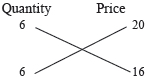
$A$ man bought apples at the rate of $6$ for $Rs. 20$ and sold them at $4$ for $Rs. 16$. His estimated profit $\%$ is
A
$23$
B
$18$
C
$20$
D
None of these
Solution
(C) Cost Price $(CP)$ of $6$ apples = $Rs. 20$.
Cost Price of $1$ apple = $Rs. \frac{20}{6} = Rs. \frac{10}{3}$.
Selling Price $(SP)$ of $4$ apples = $Rs. 16$.
Selling Price of $1$ apple = $Rs. \frac{16}{4} = Rs. 4$.
Profit = $SP - CP = 4 - \frac{10}{3} = \frac{12 - 10}{3} = Rs. \frac{2}{3}$.
Profit $\%$ = $\left( \frac{\text{Profit}}{CP} \right) \times 100 = \left( \frac{2/3}{10/3} \right) \times 100 = \left( \frac{2}{10} \right) \times 100 = 20 \%$.
Cost Price of $1$ apple = $Rs. \frac{20}{6} = Rs. \frac{10}{3}$.
Selling Price $(SP)$ of $4$ apples = $Rs. 16$.
Selling Price of $1$ apple = $Rs. \frac{16}{4} = Rs. 4$.
Profit = $SP - CP = 4 - \frac{10}{3} = \frac{12 - 10}{3} = Rs. \frac{2}{3}$.
Profit $\%$ = $\left( \frac{\text{Profit}}{CP} \right) \times 100 = \left( \frac{2/3}{10/3} \right) \times 100 = \left( \frac{2}{10} \right) \times 100 = 20 \%$.
0 likes
View Solution230
DifficultMCQ
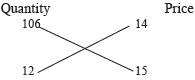
$A$ fruit vendor buys $10$ bananas for $Rs. 14$ and sells them at $12$ for $Rs. 15$. Find his percentage gain or loss.
A
$10 \frac{5}{7} \%$ loss
B
$10 \frac{5}{9} \%$ gain
C
$9 \%$ gain
D
None of these
Solution
(A) Cost Price $(CP)$ of $10$ bananas = $Rs. 14$.
Cost Price of $1$ banana = $Rs. \frac{14}{10} = Rs. 1.4$.
Selling Price $(SP)$ of $12$ bananas = $Rs. 15$.
Selling Price of $1$ banana = $Rs. \frac{15}{12} = Rs. 1.25$.
Since $CP > SP$,there is a loss.
Loss = $CP - SP = 1.4 - 1.25 = Rs. 0.15$.
Loss percentage = $\left( \frac{\text{Loss}}{CP} \times 100 \right) \% = \left( \frac{0.15}{1.4} \times 100 \right) \% = \left( \frac{15}{140} \times 100 \right) \% = \left( \frac{150}{14} \right) \% = \left( \frac{75}{7} \right) \% = 10 \frac{5}{7} \%$ loss.
Cost Price of $1$ banana = $Rs. \frac{14}{10} = Rs. 1.4$.
Selling Price $(SP)$ of $12$ bananas = $Rs. 15$.
Selling Price of $1$ banana = $Rs. \frac{15}{12} = Rs. 1.25$.
Since $CP > SP$,there is a loss.
Loss = $CP - SP = 1.4 - 1.25 = Rs. 0.15$.
Loss percentage = $\left( \frac{\text{Loss}}{CP} \times 100 \right) \% = \left( \frac{0.15}{1.4} \times 100 \right) \% = \left( \frac{15}{140} \times 100 \right) \% = \left( \frac{150}{14} \right) \% = \left( \frac{75}{7} \right) \% = 10 \frac{5}{7} \%$ loss.
0 likes
View Solution231
DifficultMCQ
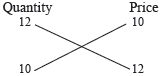
If eggs are bought $12$ for $Rs. 10$ and sold at $10$ for $Rs. 12$,what is the gain or loss $\%$?
A
$40 \%$ loss
B
$44 \%$ gain
C
$44 \%$ loss
D
None of these
Solution
(B) Cost Price $(CP)$ of $12$ eggs = $Rs. 10$.
Selling Price $(SP)$ of $10$ eggs = $Rs. 12$.
To find the profit or loss percentage,we make the number of eggs equal.
$CP$ of $60$ eggs ($LCM$ of $12$ and $10$) = $\frac{10}{12} \times 60 = Rs. 50$.
$SP$ of $60$ eggs = $\frac{12}{10} \times 60 = Rs. 72$.
Since $SP > CP$,there is a profit.
Profit = $SP - CP = 72 - 50 = Rs. 22$.
Profit $\% = \left(\frac{\text{Profit}}{CP}\right) \times 100 = \left(\frac{22}{50}\right) \times 100 = 44 \%$.
Thus,there is a $44 \%$ gain.
Selling Price $(SP)$ of $10$ eggs = $Rs. 12$.
To find the profit or loss percentage,we make the number of eggs equal.
$CP$ of $60$ eggs ($LCM$ of $12$ and $10$) = $\frac{10}{12} \times 60 = Rs. 50$.
$SP$ of $60$ eggs = $\frac{12}{10} \times 60 = Rs. 72$.
Since $SP > CP$,there is a profit.
Profit = $SP - CP = 72 - 50 = Rs. 22$.
Profit $\% = \left(\frac{\text{Profit}}{CP}\right) \times 100 = \left(\frac{22}{50}\right) \times 100 = 44 \%$.
Thus,there is a $44 \%$ gain.
0 likes
View Solution232
MediumMCQ
If the cost price of $21$ watches is equal to the selling price of $18$ watches,then what would be the gain percent in this transaction?
A
$6 \frac{1}{2} \%$
B
$7 \%$
C
$16 \frac{2}{3} \%$
D
None of these
Solution
(C) Let the cost price of $1$ watch be $CP$ and the selling price of $1$ watch be $SP$.
Given that the cost price of $21$ watches is equal to the selling price of $18$ watches.
$21 \times CP = 18 \times SP$
$\frac{SP}{CP} = \frac{21}{18} = \frac{7}{6}$
Since $SP > CP$,there is a gain.
Gain $\% = \left( \frac{SP - CP}{CP} \right) \times 100$
Gain $\% = \left( \frac{7 - 6}{6} \right) \times 100 = \frac{1}{6} \times 100 = 16 \frac{2}{3} \%$
Given that the cost price of $21$ watches is equal to the selling price of $18$ watches.
$21 \times CP = 18 \times SP$
$\frac{SP}{CP} = \frac{21}{18} = \frac{7}{6}$
Since $SP > CP$,there is a gain.
Gain $\% = \left( \frac{SP - CP}{CP} \right) \times 100$
Gain $\% = \left( \frac{7 - 6}{6} \right) \times 100 = \frac{1}{6} \times 100 = 16 \frac{2}{3} \%$
0 likes
View Solution233
MediumMCQ
$A$ shopkeeper gains the cost of $8$ metres of thread by selling $40$ metres of thread. Find his gain percent.
A
$19\%$
B
$20\%$
C
$22\%$
D
None of these
Solution
(B) Let the cost price of $1$ metre of thread be $CP = \$1$.
Then, the cost price of $40$ metres of thread is $CP_{40} = \$40$.
The selling price of $40$ metres of thread is $SP_{40}$.
The gain is equal to the cost price of $8$ metres of thread, which is $\$8$.
We know that $\text{Gain} = SP - CP$.
So, $8 = SP_{40} - 40$, which implies $SP_{40} = \$48$.
Gain percent is calculated as $\left( \frac{\text{Gain}}{CP} \right) \times 100$.
$\text{Gain } \% = \left( \frac{8}{40} \right) \times 100 = 20\%$.
Then, the cost price of $40$ metres of thread is $CP_{40} = \$40$.
The selling price of $40$ metres of thread is $SP_{40}$.
The gain is equal to the cost price of $8$ metres of thread, which is $\$8$.
We know that $\text{Gain} = SP - CP$.
So, $8 = SP_{40} - 40$, which implies $SP_{40} = \$48$.
Gain percent is calculated as $\left( \frac{\text{Gain}}{CP} \right) \times 100$.
$\text{Gain } \% = \left( \frac{8}{40} \right) \times 100 = 20\%$.
0 likes
View Solution234
MediumMCQ
If the selling price of $\frac{2}{3}$ of a certain quantity of milk is equal to the cost price of the whole quantity of milk,then what will be the gain percent in this transaction?
A
$50\%$
B
$48\%$
C
$53\%$
D
None of these
Solution
(A) Let the total quantity of milk be $x$ units and the cost price of $1$ unit of milk be $C$.
Total cost price of $x$ units of milk = $x \times C = xC$.
According to the problem,the selling price of $\frac{2}{3}x$ units of milk is equal to the cost price of $x$ units of milk.
Selling price of $\frac{2}{3}x$ units = $xC$.
Therefore,the selling price of $1$ unit of milk = $\frac{xC}{\frac{2}{3}x} = \frac{3}{2}C = 1.5C$.
Gain = Selling Price - Cost Price = $1.5C - C = 0.5C$.
Gain percent = $\left( \frac{\text{Gain}}{\text{Cost Price}} \right) \times 100 = \left( \frac{0.5C}{C} \right) \times 100 = 50\%$.
Total cost price of $x$ units of milk = $x \times C = xC$.
According to the problem,the selling price of $\frac{2}{3}x$ units of milk is equal to the cost price of $x$ units of milk.
Selling price of $\frac{2}{3}x$ units = $xC$.
Therefore,the selling price of $1$ unit of milk = $\frac{xC}{\frac{2}{3}x} = \frac{3}{2}C = 1.5C$.
Gain = Selling Price - Cost Price = $1.5C - C = 0.5C$.
Gain percent = $\left( \frac{\text{Gain}}{\text{Cost Price}} \right) \times 100 = \left( \frac{0.5C}{C} \right) \times 100 = 50\%$.
0 likes
View Solution235
MediumMCQ
$A$ shopkeeper sells $20$ pencils for the same amount of money as he paid for $25$ pencils. What is his gain percent?
A
$20\%$
B
$25\%$
C
$24\%$
D
None of these
Solution
(B) Let the cost price $(CP)$ of $1$ pencil be $x$.
Then,the $CP$ of $25$ pencils $= 25x$.
The selling price $(SP)$ of $20$ pencils is equal to the $CP$ of $25$ pencils,so $SP$ of $20$ pencils $= 25x$.
$CP$ of $20$ pencils $= 20x$.
Gain $= SP - CP = 25x - 20x = 5x$.
Gain percent $= (\text{Gain} / CP) \times 100 = (5x / 20x) \times 100 = (1/4) \times 100 = 25\%$.
Then,the $CP$ of $25$ pencils $= 25x$.
The selling price $(SP)$ of $20$ pencils is equal to the $CP$ of $25$ pencils,so $SP$ of $20$ pencils $= 25x$.
$CP$ of $20$ pencils $= 20x$.
Gain $= SP - CP = 25x - 20x = 5x$.
Gain percent $= (\text{Gain} / CP) \times 100 = (5x / 20x) \times 100 = (1/4) \times 100 = 25\%$.
0 likes
View Solution236
DifficultMCQ
Mohit lost $18 \%$ by selling a bicycle for $Rs. 1230$. What percent shall he gain or loss by selling it for $Rs. 1600$?
A
$6 \frac{2}{3} \% \text{ loss}$
B
$4 \% \text{ gain}$
C
$6 \frac{2}{3} \% \text{ gain}$
D
None of these
Solution
(C) Given,Selling Price $(S.P._1)$ = $Rs. 1230$ and loss percentage $(x)$ = $-18 \%$.
Let the required gain or loss percentage be $y \%$.
Using the relation between Selling Price and profit/loss percentage:
$\frac{S.P._1}{100 + x} = \frac{S.P._2}{100 + y}$
Substituting the values:
$\frac{1230}{100 - 18} = \frac{1600}{100 + y}$
$\frac{1230}{82} = \frac{1600}{100 + y}$
$15 = \frac{1600}{100 + y}$
$100 + y = \frac{1600}{15} = \frac{320}{3} = 106 \frac{2}{3}$
$y = 106 \frac{2}{3} - 100 = 6 \frac{2}{3} \%$
Since the value of $y$ is positive,Mohit gains $6 \frac{2}{3} \%$ by selling it for $Rs. 1600$.
Let the required gain or loss percentage be $y \%$.
Using the relation between Selling Price and profit/loss percentage:
$\frac{S.P._1}{100 + x} = \frac{S.P._2}{100 + y}$
Substituting the values:
$\frac{1230}{100 - 18} = \frac{1600}{100 + y}$
$\frac{1230}{82} = \frac{1600}{100 + y}$
$15 = \frac{1600}{100 + y}$
$100 + y = \frac{1600}{15} = \frac{320}{3} = 106 \frac{2}{3}$
$y = 106 \frac{2}{3} - 100 = 6 \frac{2}{3} \%$
Since the value of $y$ is positive,Mohit gains $6 \frac{2}{3} \%$ by selling it for $Rs. 1600$.
0 likes
View Solution237
MediumMCQ
$A$ shopkeeper sells an article at a gain of $10 \%$. Had he sold it at a loss of $20 \%$,its selling price would have been $Rs. 180$ less. What is the cost price of the article? (in $Rs.$)
A
$630$
B
$600$
C
$580$
D
None of these
Solution
(B) Let the cost price $(C.P.)$ of the article be $x$.
Case $1$: The article is sold at a gain of $10 \%$.
$S.P._1 = C.P. + 10 \% \text{ of } C.P. = 1.10x$.
Case $2$: The article is sold at a loss of $20 \%$.
$S.P._2 = C.P. - 20 \% \text{ of } C.P. = 0.80x$.
According to the problem,the difference between the two selling prices is $Rs. 180$:
$S.P._1 - S.P._2 = 180$
$1.10x - 0.80x = 180$
$0.30x = 180$
$x = \frac{180}{0.30} = 600$.
Therefore,the cost price of the article is $Rs. 600$.
Case $1$: The article is sold at a gain of $10 \%$.
$S.P._1 = C.P. + 10 \% \text{ of } C.P. = 1.10x$.
Case $2$: The article is sold at a loss of $20 \%$.
$S.P._2 = C.P. - 20 \% \text{ of } C.P. = 0.80x$.
According to the problem,the difference between the two selling prices is $Rs. 180$:
$S.P._1 - S.P._2 = 180$
$1.10x - 0.80x = 180$
$0.30x = 180$
$x = \frac{180}{0.30} = 600$.
Therefore,the cost price of the article is $Rs. 600$.
0 likes
View Solution238
DifficultMCQ
$A$ person sells $36$ oranges for $₹ 1$ and makes a loss of $4 \%$. Find how many oranges per $₹ 1$ should be sold to have a gain of $8 \%$.
A
$32$
B
$5$
C
$16$
D
None of these
Solution
(A) Let the cost price of $36$ oranges be $C.P.$
Given,Selling Price $(S.P._1)$ of $36$ oranges $= ₹ 1$.
Loss $= 4 \%$,so $S.P._1 = C.P. \times (100 - 4) / 100 = 0.96 \times C.P.$
Therefore,$C.P. = 1 / 0.96 = 100 / 96 = ₹ 25 / 24$.
To gain $8 \%$,the new Selling Price $(S.P._2)$ for $36$ oranges should be:
$S.P._2 = C.P. \times (100 + 8) / 100 = (25 / 24) \times (108 / 100) = 108 / 96 = ₹ 9 / 8$.
So,for $₹ 9 / 8$,the person sells $36$ oranges.
For $₹ 1$,the number of oranges to be sold $= 36 / (9 / 8) = 36 \times (8 / 9) = 4 \times 8 = 32$ oranges.
Given,Selling Price $(S.P._1)$ of $36$ oranges $= ₹ 1$.
Loss $= 4 \%$,so $S.P._1 = C.P. \times (100 - 4) / 100 = 0.96 \times C.P.$
Therefore,$C.P. = 1 / 0.96 = 100 / 96 = ₹ 25 / 24$.
To gain $8 \%$,the new Selling Price $(S.P._2)$ for $36$ oranges should be:
$S.P._2 = C.P. \times (100 + 8) / 100 = (25 / 24) \times (108 / 100) = 108 / 96 = ₹ 9 / 8$.
So,for $₹ 9 / 8$,the person sells $36$ oranges.
For $₹ 1$,the number of oranges to be sold $= 36 / (9 / 8) = 36 \times (8 / 9) = 4 \times 8 = 32$ oranges.
0 likes
View Solution239
MediumMCQ
$A$ person sells a colour $TV$ at $10\%$ below the cost price. Had he received $Rs. 1494$ more,he would have made a profit of $12 \frac{1}{2}\%$. What was the cost price of the colour $TV$ (in $Rs.$)?
A
$6400$
B
$7200$
C
$6640$
D
None of these
Solution
(C) Let the cost price $(CP)$ of the colour $TV$ be $x$.
The initial selling price $(SP_1)$ at a loss of $10\%$ is:
$SP_1 = x - 0.10x = 0.90x$.
The desired selling price $(SP_2)$ at a profit of $12 \frac{1}{2}\%$ $(12.5\%)$ is:
$SP_2 = x + 0.125x = 1.125x$.
According to the problem,the difference between the two selling prices is $Rs. 1494$:
$SP_2 - SP_1 = 1494$
$1.125x - 0.90x = 1494$
$0.225x = 1494$
Solving for $x$:
$x = \frac{1494}{0.225} = \frac{1494000}{225} = 6640$.
Therefore,the cost price of the colour $TV$ is $Rs. 6640$.
The initial selling price $(SP_1)$ at a loss of $10\%$ is:
$SP_1 = x - 0.10x = 0.90x$.
The desired selling price $(SP_2)$ at a profit of $12 \frac{1}{2}\%$ $(12.5\%)$ is:
$SP_2 = x + 0.125x = 1.125x$.
According to the problem,the difference between the two selling prices is $Rs. 1494$:
$SP_2 - SP_1 = 1494$
$1.125x - 0.90x = 1494$
$0.225x = 1494$
Solving for $x$:
$x = \frac{1494}{0.225} = \frac{1494000}{225} = 6640$.
Therefore,the cost price of the colour $TV$ is $Rs. 6640$.
0 likes
View Solution240
DifficultMCQ
Vijay sold a watch at a gain of $5 \%$. Had he sold it for $Rs. 72$ more,he would have gained $13 \%$. Find out the cost price of the watch (in $Rs.$).
A
$900$
B
$910$
C
$870$
D
None of these
Solution
(A) Let the cost price $(C.P.)$ of the watch be $x$.
Initially,the watch is sold at a gain of $5 \%$,so the selling price $(S.P._1)$ is $x + 0.05x = 1.05x$.
If the watch is sold for $Rs. 72$ more,the new selling price $(S.P._2)$ is $1.05x + 72$.
According to the problem,the new gain is $13 \%$,so $S.P._2 = x + 0.13x = 1.13x$.
Equating the two expressions for $S.P._2$:
$1.13x = 1.05x + 72$
$1.13x - 1.05x = 72$
$0.08x = 72$
$x = \frac{72}{0.08} = \frac{7200}{8} = 900$.
Therefore,the cost price of the watch is $Rs. 900$.
Initially,the watch is sold at a gain of $5 \%$,so the selling price $(S.P._1)$ is $x + 0.05x = 1.05x$.
If the watch is sold for $Rs. 72$ more,the new selling price $(S.P._2)$ is $1.05x + 72$.
According to the problem,the new gain is $13 \%$,so $S.P._2 = x + 0.13x = 1.13x$.
Equating the two expressions for $S.P._2$:
$1.13x = 1.05x + 72$
$1.13x - 1.05x = 72$
$0.08x = 72$
$x = \frac{72}{0.08} = \frac{7200}{8} = 900$.
Therefore,the cost price of the watch is $Rs. 900$.
0 likes
View Solution241
MediumMCQ
Sita sells a calculator to Gita at a gain of $17 \%$ and Gita sells it to Anu at a loss of $25 \%$. If Anu pays $Rs. 1842.75$ for it,then what did Sita pay for it? (in $Rs.$)
A
$2080$
B
$2100$
C
$2110$
D
None of these
Solution
(B) Let the cost price for Sita be $x$.
Sita sells it to Gita at a gain of $17 \%$,so the selling price for Sita (which is the cost price for Gita) is $x \times (1 + 0.17) = 1.17x$.
Gita sells it to Anu at a loss of $25 \%$,so the selling price for Gita (which is the cost price for Anu) is $1.17x \times (1 - 0.25) = 1.17x \times 0.75$.
Given that Anu pays $Rs. 1842.75$,we have the equation: $1.17x \times 0.75 = 1842.75$.
$0.8775x = 1842.75$.
$x = \frac{1842.75}{0.8775} = 2100$.
Thus,Sita paid $Rs. 2100$ for the calculator.
Sita sells it to Gita at a gain of $17 \%$,so the selling price for Sita (which is the cost price for Gita) is $x \times (1 + 0.17) = 1.17x$.
Gita sells it to Anu at a loss of $25 \%$,so the selling price for Gita (which is the cost price for Anu) is $1.17x \times (1 - 0.25) = 1.17x \times 0.75$.
Given that Anu pays $Rs. 1842.75$,we have the equation: $1.17x \times 0.75 = 1842.75$.
$0.8775x = 1842.75$.
$x = \frac{1842.75}{0.8775} = 2100$.
Thus,Sita paid $Rs. 2100$ for the calculator.
0 likes
View Solution242
DifficultMCQ
$A$ buys an article and sells it to $B$ at a profit of $10 \%$. $B$ sells it to $C$ gaining $20 \%$. If $C$ pays $₹ 924$,what amount did $A$ pay? (in $₹$)
A
$700$
B
$724$
C
$780$
D
None of these
Solution
(A) Let the cost price for $A$ be $x$.
$A$ sells the article to $B$ at a profit of $10 \%$,so the selling price for $A$ (which is the cost price for $B$) is $x \times (1 + 0.10) = 1.1x$.
$B$ sells the article to $C$ at a profit of $20 \%$,so the selling price for $B$ (which is the cost price for $C$) is $1.1x \times (1 + 0.20) = 1.1x \times 1.2 = 1.32x$.
Given that $C$ pays $₹ 924$,we have the equation: $1.32x = 924$.
Solving for $x$: $x = \frac{924}{1.32} = \frac{92400}{132} = 700$.
Thus,the amount $A$ paid is $₹ 700$.
$A$ sells the article to $B$ at a profit of $10 \%$,so the selling price for $A$ (which is the cost price for $B$) is $x \times (1 + 0.10) = 1.1x$.
$B$ sells the article to $C$ at a profit of $20 \%$,so the selling price for $B$ (which is the cost price for $C$) is $1.1x \times (1 + 0.20) = 1.1x \times 1.2 = 1.32x$.
Given that $C$ pays $₹ 924$,we have the equation: $1.32x = 924$.
Solving for $x$: $x = \frac{924}{1.32} = \frac{92400}{132} = 700$.
Thus,the amount $A$ paid is $₹ 700$.
0 likes
View Solution243
DifficultMCQ
$A$ sells an article to $B$ at a gain of $20 \%$,$B$ sells it to $C$ at a gain of $10 \%$,and $C$ sells it to $D$ at a gain of $12 \frac{1}{2} \%$. If $D$ pays $Rs. 29.70$,what was the cost price for $A$? (in $Rs.$)
A
$20$
B
$24$
C
$18$
D
None of these
Solution
(A) Let the cost price for $A$ be $x$.
$A$ sells to $B$ at $20 \%$ gain,so $B$ buys it for $x \times (1 + \frac{20}{100}) = x \times \frac{120}{100} = 1.2x$.
$B$ sells to $C$ at $10 \%$ gain,so $C$ buys it for $1.2x \times (1 + \frac{10}{100}) = 1.2x \times 1.1 = 1.32x$.
$C$ sells to $D$ at $12 \frac{1}{2} \%$ gain,which is $12.5 \%$. So $D$ buys it for $1.32x \times (1 + \frac{12.5}{100}) = 1.32x \times 1.125 = 1.485x$.
Given that $D$ pays $Rs. 29.70$,we have $1.485x = 29.70$.
$x = \frac{29.70}{1.485} = 20$.
Therefore,the cost price for $A$ is $Rs. 20$.
$A$ sells to $B$ at $20 \%$ gain,so $B$ buys it for $x \times (1 + \frac{20}{100}) = x \times \frac{120}{100} = 1.2x$.
$B$ sells to $C$ at $10 \%$ gain,so $C$ buys it for $1.2x \times (1 + \frac{10}{100}) = 1.2x \times 1.1 = 1.32x$.
$C$ sells to $D$ at $12 \frac{1}{2} \%$ gain,which is $12.5 \%$. So $D$ buys it for $1.32x \times (1 + \frac{12.5}{100}) = 1.32x \times 1.125 = 1.485x$.
Given that $D$ pays $Rs. 29.70$,we have $1.485x = 29.70$.
$x = \frac{29.70}{1.485} = 20$.
Therefore,the cost price for $A$ is $Rs. 20$.
0 likes
View Solution244
MediumMCQ
Rajesh sells a tape recorder to Mihir at a loss of $10 \%$,and Mihir sells it to Shiv at a loss of $20 \%$. If Shiv pays $Rs. 1440$ for it,at what price did Rajesh buy it? (in $Rs.$)
A
$1920$
B
$2000$
C
$1800$
D
None of these
Solution
(B) Let the cost price for Rajesh be $x$.
Rajesh sells it to Mihir at a loss of $10 \%$,so the selling price for Rajesh (which is the cost price for Mihir) is $x \times (1 - 0.10) = 0.9x$.
Mihir sells it to Shiv at a loss of $20 \%$,so the selling price for Mihir (which is the cost price for Shiv) is $0.9x \times (1 - 0.20) = 0.9x \times 0.8 = 0.72x$.
Given that Shiv pays $Rs. 1440$,we have the equation: $0.72x = 1440$.
Solving for $x$: $x = \frac{1440}{0.72} = \frac{144000}{72} = 2000$.
Therefore,Rajesh bought the tape recorder for $Rs. 2000$.
Rajesh sells it to Mihir at a loss of $10 \%$,so the selling price for Rajesh (which is the cost price for Mihir) is $x \times (1 - 0.10) = 0.9x$.
Mihir sells it to Shiv at a loss of $20 \%$,so the selling price for Mihir (which is the cost price for Shiv) is $0.9x \times (1 - 0.20) = 0.9x \times 0.8 = 0.72x$.
Given that Shiv pays $Rs. 1440$,we have the equation: $0.72x = 1440$.
Solving for $x$: $x = \frac{1440}{0.72} = \frac{144000}{72} = 2000$.
Therefore,Rajesh bought the tape recorder for $Rs. 2000$.
0 likes
View Solution245
DifficultMCQ
$A$ man sells a scooter to his friend at $10\%$ loss. If the friend sells it for $₹ 54000$ and gains $20\%$,find out the original cost price of the scooter. (in $₹$)
A
$50000$
B
$45000$
C
$40000$
D
None of these
Solution
(A) Let the original cost price of the scooter be $CP_1$.
The man sells it at a $10\%$ loss,so the selling price for the man (which is the cost price for the friend,$CP_2$) is:
$CP_2 = CP_1 \times (1 - 0.10) = 0.90 \times CP_1$.
The friend sells the scooter for $₹ 54000$ and gains $20\%$. Therefore:
$SP_2 = CP_2 \times (1 + 0.20) = 1.20 \times CP_2$.
Substituting $CP_2$ in the equation:
$54000 = 1.20 \times (0.90 \times CP_1)$.
$54000 = 1.08 \times CP_1$.
Solving for $CP_1$:
$CP_1 = \frac{54000}{1.08} = 50000$.
Thus,the original cost price of the scooter is $₹ 50000$.
The man sells it at a $10\%$ loss,so the selling price for the man (which is the cost price for the friend,$CP_2$) is:
$CP_2 = CP_1 \times (1 - 0.10) = 0.90 \times CP_1$.
The friend sells the scooter for $₹ 54000$ and gains $20\%$. Therefore:
$SP_2 = CP_2 \times (1 + 0.20) = 1.20 \times CP_2$.
Substituting $CP_2$ in the equation:
$54000 = 1.20 \times (0.90 \times CP_1)$.
$54000 = 1.08 \times CP_1$.
Solving for $CP_1$:
$CP_1 = \frac{54000}{1.08} = 50000$.
Thus,the original cost price of the scooter is $₹ 50000$.
0 likes
View Solution246
MediumMCQ
$A$ sells a good to $B$ at a profit of $10 \%$ and $B$ sells it to $C$ at a profit of $20 \%$. Find out the resultant profit percentage.
A
$35 \%$
B
$20 \%$
C
$32 \%$
D
None of these
Solution
(C) Let the cost price for $A$ be $100$.
$A$ sells it to $B$ at a profit of $10 \%$,so the cost price for $B$ is $100 + 10 = 110$.
$B$ sells it to $C$ at a profit of $20 \%$. The profit for $B$ is $20 \%$ of $110$,which is $\frac{20}{100} \times 110 = 22$.
Thus,the selling price for $C$ is $110 + 22 = 132$.
The total profit is $132 - 100 = 32$.
Alternatively,using the formula for successive percentage change: $\text{Resultant profit } \% = \left(m + n + \frac{mn}{100}\right) \%$.
Here,$m = 10$ and $n = 20$.
Resultant profit $\% = \left(10 + 20 + \frac{10 \times 20}{100}\right) \% = (30 + 2) \% = 32 \%$.
$A$ sells it to $B$ at a profit of $10 \%$,so the cost price for $B$ is $100 + 10 = 110$.
$B$ sells it to $C$ at a profit of $20 \%$. The profit for $B$ is $20 \%$ of $110$,which is $\frac{20}{100} \times 110 = 22$.
Thus,the selling price for $C$ is $110 + 22 = 132$.
The total profit is $132 - 100 = 32$.
Alternatively,using the formula for successive percentage change: $\text{Resultant profit } \% = \left(m + n + \frac{mn}{100}\right) \%$.
Here,$m = 10$ and $n = 20$.
Resultant profit $\% = \left(10 + 20 + \frac{10 \times 20}{100}\right) \% = (30 + 2) \% = 32 \%$.
0 likes
View Solution247
MediumMCQ
$A$ manufacturer sells an article to a wholesale dealer at a profit of $20 \%$. The wholesale dealer sells it to a retail merchant at a loss of $5 \%$. Find out the resultant profit or loss.
A
$14 \%$ loss
B
$14 \%$ gain
C
$12 \%$ gain
D
None of these
Solution
(B) Let the initial cost price be $100$.
After a profit of $20 \%$,the wholesale dealer buys it for $100 + 20 = 120$.
The wholesale dealer sells it to a retail merchant at a loss of $5 \%$.
Loss $= 5 \% \text{ of } 120 = \frac{5}{100} \times 120 = 6$.
Selling price $= 120 - 6 = 114$.
Resultant profit $= 114 - 100 = 14$.
Since the value is positive,it is a $14 \%$ gain.
Alternatively,using the formula: $\text{Resultant } \% = \left(m + n + \frac{m \times n}{100}\right) \%$,where $m = 20$ and $n = -5$.
Resultant $\% = \left(20 - 5 + \frac{20 \times -5}{100}\right) = 15 - 1 = 14 \% \text{ gain}$.
After a profit of $20 \%$,the wholesale dealer buys it for $100 + 20 = 120$.
The wholesale dealer sells it to a retail merchant at a loss of $5 \%$.
Loss $= 5 \% \text{ of } 120 = \frac{5}{100} \times 120 = 6$.
Selling price $= 120 - 6 = 114$.
Resultant profit $= 114 - 100 = 14$.
Since the value is positive,it is a $14 \%$ gain.
Alternatively,using the formula: $\text{Resultant } \% = \left(m + n + \frac{m \times n}{100}\right) \%$,where $m = 20$ and $n = -5$.
Resultant $\% = \left(20 - 5 + \frac{20 \times -5}{100}\right) = 15 - 1 = 14 \% \text{ gain}$.
0 likes
View Solution248
EasyMCQ
$A$ man sold two watches for $Rs. 3750$ each. On one he gained $5 \%$,and on the other,he lost $5 \%$. What was his total gain or loss percentage?
A
$1 \frac{1}{4} \%$
B
$\frac{1}{2} \%$
C
$\frac{1}{4} \%$
D
None of these
Solution
(C) When two items are sold at the same selling price,one at a gain of $x \%$ and the other at a loss of $x \%$,there is always an overall loss.
The formula for the overall loss percentage is given by $\text{Loss} \% = \left( \frac{x}{10} \right)^2 \%$.
Given $x = 5$,the overall loss percentage is $\left( \frac{5}{10} \right)^2 \% = \left( \frac{1}{2} \right)^2 \% = \frac{1}{4} \%$.
Therefore,the man incurred a total loss of $\frac{1}{4} \%$.
The formula for the overall loss percentage is given by $\text{Loss} \% = \left( \frac{x}{10} \right)^2 \%$.
Given $x = 5$,the overall loss percentage is $\left( \frac{5}{10} \right)^2 \% = \left( \frac{1}{2} \right)^2 \% = \frac{1}{4} \%$.
Therefore,the man incurred a total loss of $\frac{1}{4} \%$.
0 likes
View Solution249
EasyMCQ
$A$ man sells two houses at the rate of $Rs. 1.995$ Lakhs each. On one house he gains $20 \%$ and on the other he loses $20 \%$. His gain or loss per cent in the whole transaction is
A
$5 \%$ loss
B
$4 \%$ gain
C
$4 \%$ loss
D
None of these
Solution
(C) Let the selling price of each house be $SP = Rs. 1.995$ Lakhs.
For the first house,gain is $20 \%$. So,Cost Price $CP_1 = \frac{SP}{1 + 20/100} = \frac{1.995}{1.2} = Rs. 1.6625$ Lakhs.
For the second house,loss is $20 \%$. So,Cost Price $CP_2 = \frac{SP}{1 - 20/100} = \frac{1.995}{0.8} = Rs. 2.49375$ Lakhs.
Total Cost Price $CP = CP_1 + CP_2 = 1.6625 + 2.49375 = Rs. 4.15625$ Lakhs.
Total Selling Price $SP_{total} = 1.995 + 1.995 = Rs. 3.99$ Lakhs.
Since $CP > SP_{total}$,there is a loss.
Loss $= CP - SP_{total} = 4.15625 - 3.99 = 0.16625$ Lakhs.
Loss $\% = \left( \frac{\text{Loss}}{CP} \right) \times 100 = \left( \frac{0.16625}{4.15625} \right) \times 100 = 4 \%$.
Alternatively,when two items are sold at the same price with $x \%$ gain and $x \%$ loss,the overall result is always a loss of $\left( \frac{x}{10} \right)^2 \% = \left( \frac{20}{10} \right)^2 \% = 4 \%$ loss.
For the first house,gain is $20 \%$. So,Cost Price $CP_1 = \frac{SP}{1 + 20/100} = \frac{1.995}{1.2} = Rs. 1.6625$ Lakhs.
For the second house,loss is $20 \%$. So,Cost Price $CP_2 = \frac{SP}{1 - 20/100} = \frac{1.995}{0.8} = Rs. 2.49375$ Lakhs.
Total Cost Price $CP = CP_1 + CP_2 = 1.6625 + 2.49375 = Rs. 4.15625$ Lakhs.
Total Selling Price $SP_{total} = 1.995 + 1.995 = Rs. 3.99$ Lakhs.
Since $CP > SP_{total}$,there is a loss.
Loss $= CP - SP_{total} = 4.15625 - 3.99 = 0.16625$ Lakhs.
Loss $\% = \left( \frac{\text{Loss}}{CP} \right) \times 100 = \left( \frac{0.16625}{4.15625} \right) \times 100 = 4 \%$.
Alternatively,when two items are sold at the same price with $x \%$ gain and $x \%$ loss,the overall result is always a loss of $\left( \frac{x}{10} \right)^2 \% = \left( \frac{20}{10} \right)^2 \% = 4 \%$ loss.
0 likes
View Solution250
DifficultMCQ
$A$ shopkeeper sold two bicycles for $Rs. 1500$ each. On one,he gains $25\%$ and on the other he loses $20\%$. His gain or loss per cent in the whole transaction is
A
$2 \frac{18}{41} \% \text{ loss}$
B
$2 \frac{18}{41} \% \text{ gain}$
C
$2 \% \text{ gain}$
D
None of these
Solution
(A) Selling price of each bicycle = $Rs. 1500$.
Total selling price = $1500 + 1500 = Rs. 3000$.
Cost price of the first bicycle (gain of $25\%$) = $1500 \times \frac{100}{125} = Rs. 1200$.
Cost price of the second bicycle (loss of $20\%$) = $1500 \times \frac{100}{80} = Rs. 1875$.
Total cost price = $1200 + 1875 = Rs. 3075$.
Since total cost price $(Rs. 3075)$ > total selling price $(Rs. 3000)$,there is a loss.
Loss = $3075 - 3000 = Rs. 75$.
Loss percentage = $\frac{\text{Loss}}{\text{Total Cost Price}} \times 100 = \frac{75}{3075} \times 100 = \frac{1}{41} \times 100 = \frac{100}{41} \% = 2 \frac{18}{41} \% \text{ loss}$.
Total selling price = $1500 + 1500 = Rs. 3000$.
Cost price of the first bicycle (gain of $25\%$) = $1500 \times \frac{100}{125} = Rs. 1200$.
Cost price of the second bicycle (loss of $20\%$) = $1500 \times \frac{100}{80} = Rs. 1875$.
Total cost price = $1200 + 1875 = Rs. 3075$.
Since total cost price $(Rs. 3075)$ > total selling price $(Rs. 3000)$,there is a loss.
Loss = $3075 - 3000 = Rs. 75$.
Loss percentage = $\frac{\text{Loss}}{\text{Total Cost Price}} \times 100 = \frac{75}{3075} \times 100 = \frac{1}{41} \times 100 = \frac{100}{41} \% = 2 \frac{18}{41} \% \text{ loss}$.
0 likes
View SolutionProfit and Loss — Profit and Loss · Frequently Asked Questions
1Are these Profit and Loss questions useful for JEE and NEET?
Yes. All questions in this section are mapped to JEE Main and NEET exam patterns. Previous year questions from JEE Main, NEET, GUJCET and state-level exams are included with full solutions.
2Can I switch to Hindi or Gujarati for these questions?
Yes. Use the language tabs in the hero section or the sidebar to view the same questions and solutions in English, Hindi or Gujarati.
3How do I generate a question paper from this subtopic?
Use the Vedclass Exam Paper Generator — select the chapter and subtopic, set difficulty, and generate Sets A, B, C, D automatically. First 3 chapters of every subject are free.
Vedclass Products
For Students
Vedclass Test Series
Mock tests in real JEE/NEET style with performance analysis. 5-day free trial.
Start Free TrialFor Teachers
Exam Paper Generator
Generate Set A/B/C/D papers from this chapter in 2 minutes. 3 chapters free.
Try FreeFor Institutes
Online Exam Module
Live online exams with unlimited students, 360° analytics & white-label branding.
See DemoFor Teachers & Institutes
Generate a Profit and Loss Exam Paper in 2 Minutes
Select subtopic & difficulty — Sets A, B, C, D auto-generated with No Repeat logic.
First 3 chapters of every subject are free — no payment required.