
A English
Profit and Loss Questions in English
Competitive Exam Quantitative Aptitude · Profit and Loss · Profit and Loss
452+
Questions
English
Language
100%
With Solutions
Showing 50 of 452 questions in English
251
DifficultMCQ
$A$ man sells two articles,each for $Rs. 640$. He earns $20\%$ profit on the first and $40\%$ profit on the second. Find his overall percent profit.
A
$29 \frac{1}{2}\%$
B
$28 \frac{1}{2}\%$
C
$29 \frac{3}{13}\%$
D
None of these
Solution
(C) Let the selling price of each article be $SP = Rs. 640$.
For the first article,profit is $20\%$. Cost price $CP_1 = \frac{100}{100+20} \times 640 = \frac{100}{120} \times 640 = Rs. \frac{1600}{3}$.
For the second article,profit is $40\%$. Cost price $CP_2 = \frac{100}{100+40} \times 640 = \frac{100}{140} \times 640 = Rs. \frac{3200}{7}$.
Total Cost Price $CP = \frac{1600}{3} + \frac{3200}{7} = \frac{11200 + 9600}{21} = Rs. \frac{20800}{21}$.
Total Selling Price $SP = 640 + 640 = Rs. 1280$.
Total Profit $= 1280 - \frac{20800}{21} = \frac{26880 - 20800}{21} = Rs. \frac{6080}{21}$.
Overall Profit $\% = \left( \frac{\text{Total Profit}}{\text{Total CP}} \right) \times 100 = \left( \frac{6080/21}{20800/21} \right) \times 100 = \frac{6080}{20800} \times 100 = \frac{608}{208} \times 10 = \frac{380}{13} = 29 \frac{3}{13}\%$.
For the first article,profit is $20\%$. Cost price $CP_1 = \frac{100}{100+20} \times 640 = \frac{100}{120} \times 640 = Rs. \frac{1600}{3}$.
For the second article,profit is $40\%$. Cost price $CP_2 = \frac{100}{100+40} \times 640 = \frac{100}{140} \times 640 = Rs. \frac{3200}{7}$.
Total Cost Price $CP = \frac{1600}{3} + \frac{3200}{7} = \frac{11200 + 9600}{21} = Rs. \frac{20800}{21}$.
Total Selling Price $SP = 640 + 640 = Rs. 1280$.
Total Profit $= 1280 - \frac{20800}{21} = \frac{26880 - 20800}{21} = Rs. \frac{6080}{21}$.
Overall Profit $\% = \left( \frac{\text{Total Profit}}{\text{Total CP}} \right) \times 100 = \left( \frac{6080/21}{20800/21} \right) \times 100 = \frac{6080}{20800} \times 100 = \frac{608}{208} \times 10 = \frac{380}{13} = 29 \frac{3}{13}\%$.
0 likes
View Solution252
DifficultMCQ
$A$ person sells two articles,each for $Rs. 1040$. He incurs $20 \%$ loss on the first and $10 \%$ loss on the second. Find out the overall percent loss.
A
$12 \frac{5}{17} \%$
B
$15 \frac{5}{17} \%$
C
$13 \frac{3}{4} \%$
D
None of these
Solution
(B) Selling price of each article $(SP)$ = $Rs. 1040$.
Cost price of the first article $(CP_1)$ = $\frac{1040}{1 - 0.20} = \frac{1040}{0.80} = Rs. 1300$.
Cost price of the second article $(CP_2)$ = $\frac{1040}{1 - 0.10} = \frac{1040}{0.90} = Rs. 1155.56$ (approx) or $\frac{10400}{9}$.
Total $CP = 1300 + \frac{10400}{9} = \frac{11700 + 10400}{9} = \frac{22100}{9} \approx Rs. 2455.56$.
Total $SP = 1040 + 1040 = Rs. 2080$.
Total Loss = Total $CP - $ Total $SP = \frac{22100}{9} - 2080 = \frac{22100 - 18720}{9} = \frac{3380}{9}$.
Loss percentage = $\left( \frac{\text{Total Loss}}{\text{Total } CP} \right) \times 100 = \left( \frac{3380/9}{22100/9} \right) \times 100 = \frac{3380}{22100} \times 100 = \frac{3380}{221} = 15 \frac{5}{17} \%$.
Cost price of the first article $(CP_1)$ = $\frac{1040}{1 - 0.20} = \frac{1040}{0.80} = Rs. 1300$.
Cost price of the second article $(CP_2)$ = $\frac{1040}{1 - 0.10} = \frac{1040}{0.90} = Rs. 1155.56$ (approx) or $\frac{10400}{9}$.
Total $CP = 1300 + \frac{10400}{9} = \frac{11700 + 10400}{9} = \frac{22100}{9} \approx Rs. 2455.56$.
Total $SP = 1040 + 1040 = Rs. 2080$.
Total Loss = Total $CP - $ Total $SP = \frac{22100}{9} - 2080 = \frac{22100 - 18720}{9} = \frac{3380}{9}$.
Loss percentage = $\left( \frac{\text{Total Loss}}{\text{Total } CP} \right) \times 100 = \left( \frac{3380/9}{22100/9} \right) \times 100 = \frac{3380}{22100} \times 100 = \frac{3380}{221} = 15 \frac{5}{17} \%$.
0 likes
View Solution253
MediumMCQ
$A$ person sells two articles,each for $Rs. 1040$. He incurs a $20\%$ loss on the first and a $10\%$ loss on the second. Find the overall percentage loss. (in $\%$)
A
$15$
B
$14.5$
C
$16$
D
$15.5$
Solution
(D) Selling price of each article = $Rs. 1040$.
Cost price of the first article $(CP_1)$ = $\frac{1040}{1 - 0.20} = \frac{1040}{0.8} = Rs. 1300$.
Cost price of the second article $(CP_2)$ = $\frac{1040}{1 - 0.10} = \frac{1040}{0.9} = Rs. 1155.56$.
Total Cost Price = $1300 + 1155.56 = Rs. 2455.56$.
Total Selling Price = $1040 + 1040 = Rs. 2080$.
Total Loss = $2455.56 - 2080 = Rs. 375.56$.
Overall percentage loss = $\left(\frac{375.56}{2455.56}\right) \times 100 \approx 15.29\%$. Since this is not among the options,the correct answer is $D$ (None of these).
Cost price of the first article $(CP_1)$ = $\frac{1040}{1 - 0.20} = \frac{1040}{0.8} = Rs. 1300$.
Cost price of the second article $(CP_2)$ = $\frac{1040}{1 - 0.10} = \frac{1040}{0.9} = Rs. 1155.56$.
Total Cost Price = $1300 + 1155.56 = Rs. 2455.56$.
Total Selling Price = $1040 + 1040 = Rs. 2080$.
Total Loss = $2455.56 - 2080 = Rs. 375.56$.
Overall percentage loss = $\left(\frac{375.56}{2455.56}\right) \times 100 \approx 15.29\%$. Since this is not among the options,the correct answer is $D$ (None of these).
0 likes
View Solution254
MediumMCQ
$A$ shopkeeper sells goods at $10 \%$ loss on cost price,but uses $20 \%$ less weight. What is his profit or loss percentage?
A
$2 \%$ gain
B
$2 \frac{1}{2} \%$ loss
C
$12 \frac{1}{2} \%$ gain
D
None of these
Solution
(C) Let the cost price of $1000 \text{ g}$ of goods be $1000$ units.
Since the shopkeeper sells at a $10 \%$ loss,the selling price of $1000 \text{ g}$ is $1000 - 100 = 900$ units.
The shopkeeper uses $20 \%$ less weight,meaning he actually sells $1000 - 200 = 800 \text{ g}$ of goods.
The cost price of $800 \text{ g}$ of goods is $800$ units.
Now,the shopkeeper sells $800 \text{ g}$ for $900$ units.
Profit $= 900 - 800 = 100$ units.
Profit percentage $= (\text{Profit} / \text{Cost Price}) \times 100 = (100 / 800) \times 100 = 12.5 \% = 12 \frac{1}{2} \% \text{ gain}$.
Since the shopkeeper sells at a $10 \%$ loss,the selling price of $1000 \text{ g}$ is $1000 - 100 = 900$ units.
The shopkeeper uses $20 \%$ less weight,meaning he actually sells $1000 - 200 = 800 \text{ g}$ of goods.
The cost price of $800 \text{ g}$ of goods is $800$ units.
Now,the shopkeeper sells $800 \text{ g}$ for $900$ units.
Profit $= 900 - 800 = 100$ units.
Profit percentage $= (\text{Profit} / \text{Cost Price}) \times 100 = (100 / 800) \times 100 = 12.5 \% = 12 \frac{1}{2} \% \text{ gain}$.
0 likes
View Solution255
DifficultMCQ
$A$ cloth merchant says that due to a slump in the market,he sells cloth at a $10 \%$ loss,but he uses an inaccurate metre scale and actually gains $15 \%$. Find out the actual length of the scale (in $cm$).
A
$72.4$
B
$71.34$
C
$78.25$
D
None of these
Solution
(C) Let the true length of the scale be $100 \, cm$ and the cost price of $100 \, cm$ of cloth be $100$ units.
Since the merchant sells at a $10 \%$ loss,the selling price of $100 \, cm$ of cloth is $90$ units.
Let the actual length of the inaccurate scale be $y \, cm$.
Since the merchant uses a scale of length $y \, cm$ to sell the cloth,he is effectively selling $y \, cm$ of cloth for the price of $100 \, cm$ of cloth (which is $90$ units).
The cost price of $y \, cm$ of cloth is $y$ units.
Given that he gains $15 \%$,the selling price is $1.15 \times y$ units.
Equating the selling prices: $1.15 \times y = 90$.
$y = \frac{90}{1.15} \approx 78.26 \, cm$.
Using the standard formula $\frac{100+g}{100-l} = \frac{\text{True length}}{\text{False length}}$:
$\frac{100+15}{100-10} = \frac{100}{y} \Rightarrow \frac{115}{90} = \frac{100}{y}$.
$y = \frac{100 \times 90}{115} = \frac{9000}{115} \approx 78.26 \, cm$.
Since the merchant sells at a $10 \%$ loss,the selling price of $100 \, cm$ of cloth is $90$ units.
Let the actual length of the inaccurate scale be $y \, cm$.
Since the merchant uses a scale of length $y \, cm$ to sell the cloth,he is effectively selling $y \, cm$ of cloth for the price of $100 \, cm$ of cloth (which is $90$ units).
The cost price of $y \, cm$ of cloth is $y$ units.
Given that he gains $15 \%$,the selling price is $1.15 \times y$ units.
Equating the selling prices: $1.15 \times y = 90$.
$y = \frac{90}{1.15} \approx 78.26 \, cm$.
Using the standard formula $\frac{100+g}{100-l} = \frac{\text{True length}}{\text{False length}}$:
$\frac{100+15}{100-10} = \frac{100}{y} \Rightarrow \frac{115}{90} = \frac{100}{y}$.
$y = \frac{100 \times 90}{115} = \frac{9000}{115} \approx 78.26 \, cm$.
0 likes
View Solution256
DifficultMCQ
$A$ cloth dealer professes to sell cotton at cost price, but uses a meter scale having a length of $80 \, cm$ only and charges for a full meter. Find his gain percent.
A
$25 \%$
B
$30 \%$
C
$40 \%$
D
None of these
Solution
(A) Let the cost price of $1 \, cm$ of cloth be $1$ unit.
The dealer charges for $100 \, cm$ but actually gives only $80 \, cm$.
Cost price $(CP)$ for the dealer $= 80 \, \text{units}$.
Selling price $(SP)$ for the dealer $= 100 \, \text{units}$.
Profit $= SP - CP = 100 - 80 = 20 \, \text{units}$.
Gain percent $= \left( \frac{\text{Profit}}{CP} \right) \times 100 = \left( \frac{20}{80} \right) \times 100 = \frac{1}{4} \times 100 = 25 \%.$
The dealer charges for $100 \, cm$ but actually gives only $80 \, cm$.
Cost price $(CP)$ for the dealer $= 80 \, \text{units}$.
Selling price $(SP)$ for the dealer $= 100 \, \text{units}$.
Profit $= SP - CP = 100 - 80 = 20 \, \text{units}$.
Gain percent $= \left( \frac{\text{Profit}}{CP} \right) \times 100 = \left( \frac{20}{80} \right) \times 100 = \frac{1}{4} \times 100 = 25 \%.$
0 likes
View Solution257
DifficultMCQ
Sudeep buys two $CDs$ for $Rs. 380$ and sells one at a loss of $22 \%$ and the other at a gain of $12 \%$. If both the $CDs$ are sold at the same price,then the cost price of the two $CDs$ is (in $Rs.$)
A
$196, 225$
B
$230, 140$
C
$224, 156$
D
None of these
Solution
(C) Let the cost prices of the two $CDs$ be $C_1$ and $C_2$ respectively.
Given $C_1 + C_2 = 380$.
Since both are sold at the same price,we have:
$C_1(1 - 0.22) = C_2(1 + 0.12)$
$0.78 C_1 = 1.12 C_2$
$C_1 / C_2 = 112 / 78 = 56 / 39$.
Now,$C_1 = (56 / (56 + 39)) \times 380 = (56 / 95) \times 380 = 56 \times 4 = 224$.
$C_2 = 380 - 224 = 156$.
Thus,the cost prices are $Rs. 224$ and $Rs. 156$.
Given $C_1 + C_2 = 380$.
Since both are sold at the same price,we have:
$C_1(1 - 0.22) = C_2(1 + 0.12)$
$0.78 C_1 = 1.12 C_2$
$C_1 / C_2 = 112 / 78 = 56 / 39$.
Now,$C_1 = (56 / (56 + 39)) \times 380 = (56 / 95) \times 380 = 56 \times 4 = 224$.
$C_2 = 380 - 224 = 156$.
Thus,the cost prices are $Rs. 224$ and $Rs. 156$.
0 likes
View Solution258
DifficultMCQ
An article is listed at $Rs. 65$. $A$ customer bought this article for $Rs. 56.16$ and received two successive discounts,of which one is $10 \%$. Find the other discount in this discount scheme offered by the shopkeeper (in $\%$).
A
$4 \%$
B
$3 \%$
C
$6 \%$
D
None of these
Solution
(A) Marked price of the article $= Rs. 65$.
Selling price of the article $= Rs. 56.16$.
Total discount amount $= 65 - 56.16 = Rs. 8.84$.
Total discount percentage $= (8.84 / 65) \times 100 = 13.6 \%$.
Let the two successive discounts be $10 \%$ and $m \%$.
The formula for the equivalent single discount is $D_{eq} = (d_1 + d_2 - (d_1 \times d_2) / 100) \%$.
Substituting the values: $13.6 = 10 + m - (10 \times m) / 100$.
$13.6 = 10 + m - 0.1m$.
$3.6 = 0.9m$.
$m = 3.6 / 0.9 = 4$.
Therefore,the second discount is $4 \%$.
Selling price of the article $= Rs. 56.16$.
Total discount amount $= 65 - 56.16 = Rs. 8.84$.
Total discount percentage $= (8.84 / 65) \times 100 = 13.6 \%$.
Let the two successive discounts be $10 \%$ and $m \%$.
The formula for the equivalent single discount is $D_{eq} = (d_1 + d_2 - (d_1 \times d_2) / 100) \%$.
Substituting the values: $13.6 = 10 + m - (10 \times m) / 100$.
$13.6 = 10 + m - 0.1m$.
$3.6 = 0.9m$.
$m = 3.6 / 0.9 = 4$.
Therefore,the second discount is $4 \%$.
0 likes
View Solution259
DifficultMCQ
$A$ cash payment that will settle a bill for $250$ chairs at $Rs. 50$ per chair less $20 \%$,$15 \%$,and a further discount of $5 \%$ on cash payment is (in $Rs.$):
A
$7025$
B
$8075$
C
$8500$
D
None of these
Solution
(B) Total marked price of $250$ chairs $= 250 \times 50 = Rs. 12500$.
Successive discounts are $20 \%$,$15 \%$,and $5 \%$.
The effective price after discounts is calculated as:
Price $= 12500 \times (1 - 0.20) \times (1 - 0.15) \times (1 - 0.05)$
Price $= 12500 \times 0.80 \times 0.85 \times 0.95$
Price $= 12500 \times 0.646 = Rs. 8075$.
Successive discounts are $20 \%$,$15 \%$,and $5 \%$.
The effective price after discounts is calculated as:
Price $= 12500 \times (1 - 0.20) \times (1 - 0.15) \times (1 - 0.05)$
Price $= 12500 \times 0.80 \times 0.85 \times 0.95$
Price $= 12500 \times 0.646 = Rs. 8075$.
0 likes
View Solution260
MediumMCQ
$A$ person sells taperecorders at $Rs. 1134$ each after giving a discount of $19 \%$ on the marked price. Had he not given the discount,he would have earned a profit of $40 \%$ on the cost price. The cost price of each taperecorder is (in $Rs.$)
A
$1000$
B
$1200$
C
$1400$
D
None of these
Solution
(A) Let the marked price be $MP$ and the cost price be $CP$.
Given that the selling price $SP = Rs. 1134$ after a discount of $19 \%$.
$SP = MP \times (1 - 0.19) = 0.81 \times MP = 1134$.
$MP = \frac{1134}{0.81} = 1400$.
If no discount were given,the selling price would be equal to the marked price,i.e.,$SP' = MP = 1400$.
In this case,the profit is $40 \%$ on the cost price.
$SP' = CP \times (1 + 0.40) = 1.40 \times CP$.
$1400 = 1.40 \times CP$.
$CP = \frac{1400}{1.40} = 1000$.
Thus,the cost price of each taperecorder is $Rs. 1000$.
Given that the selling price $SP = Rs. 1134$ after a discount of $19 \%$.
$SP = MP \times (1 - 0.19) = 0.81 \times MP = 1134$.
$MP = \frac{1134}{0.81} = 1400$.
If no discount were given,the selling price would be equal to the marked price,i.e.,$SP' = MP = 1400$.
In this case,the profit is $40 \%$ on the cost price.
$SP' = CP \times (1 + 0.40) = 1.40 \times CP$.
$1400 = 1.40 \times CP$.
$CP = \frac{1400}{1.40} = 1000$.
Thus,the cost price of each taperecorder is $Rs. 1000$.
0 likes
View Solution261
DifficultMCQ
Arun buys one kilogram of apples for $Rs. 120$ and sells it to Swati gaining $25\%$. Swati sells it to Divya who again sells it for $Rs. 198$,making a profit of $10\%$. What is the profit percentage made by Swati (in $\%$)?
A
$25$
B
$20$
C
$16.67$
D
$15$
Solution
(B) Arun's Cost Price $(C.P)$ = $Rs. 120$.
Arun sells it to Swati at a profit of $25\%$.
Swati's $C.P$ = $120 + (25\% \text{ of } 120) = 120 + 30 = Rs. 150$.
Divya sells the apples for $Rs. 198$ at a profit of $10\%$.
Divya's $C.P$ = $\frac{198}{1 + 0.10} = \frac{198}{1.1} = Rs. 180$.
Since Divya bought the apples from Swati,Swati's Selling Price $(S.P)$ = Divya's $C.P$ = $Rs. 180$.
Swati's profit = $S.P - C.P = 180 - 150 = Rs. 30$.
Swati's profit percentage = $(\frac{\text{Profit}}{C.P}) \times 100 = (\frac{30}{150}) \times 100 = 20\%$.
Arun sells it to Swati at a profit of $25\%$.
Swati's $C.P$ = $120 + (25\% \text{ of } 120) = 120 + 30 = Rs. 150$.
Divya sells the apples for $Rs. 198$ at a profit of $10\%$.
Divya's $C.P$ = $\frac{198}{1 + 0.10} = \frac{198}{1.1} = Rs. 180$.
Since Divya bought the apples from Swati,Swati's Selling Price $(S.P)$ = Divya's $C.P$ = $Rs. 180$.
Swati's profit = $S.P - C.P = 180 - 150 = Rs. 30$.
Swati's profit percentage = $(\frac{\text{Profit}}{C.P}) \times 100 = (\frac{30}{150}) \times 100 = 20\%$.
0 likes
View Solution262
MediumMCQ
$A$ vendor buys bananas at $9$ for $Rs. 8$ and sells at $8$ for $Rs. 9$. What will be the profit or loss (in $\%$)?
A
$13.28 \%$ profit
B
$26.56 \%$ loss
C
$26.56 \%$ profit
D
$13.28 \%$ loss
Solution
(C) Cost Price $(C.P)$ of $9$ bananas $= ₹ 8$.
Selling Price $(S.P)$ of $8$ bananas $= ₹ 9$.
To compare,we find the $C.P$ and $S.P$ for an equal number of bananas. Let the number of bananas be the Least Common Multiple $(LCM)$ of $9$ and $8$,which is $72$.
$C.P$ of $72$ bananas $= (8/9) \times 72 = ₹ 64$.
$S.P$ of $72$ bananas $= (9/8) \times 72 = ₹ 81$.
Since $S.P > C.P$,there is a profit.
Profit $= S.P - C.P = 81 - 64 = ₹ 17$.
Profit $\%$ $= (\text{Profit} / C.P) \times 100 = (17 / 64) \times 100 = 26.56 \%$.
Selling Price $(S.P)$ of $8$ bananas $= ₹ 9$.
To compare,we find the $C.P$ and $S.P$ for an equal number of bananas. Let the number of bananas be the Least Common Multiple $(LCM)$ of $9$ and $8$,which is $72$.
$C.P$ of $72$ bananas $= (8/9) \times 72 = ₹ 64$.
$S.P$ of $72$ bananas $= (9/8) \times 72 = ₹ 81$.
Since $S.P > C.P$,there is a profit.
Profit $= S.P - C.P = 81 - 64 = ₹ 17$.
Profit $\%$ $= (\text{Profit} / C.P) \times 100 = (17 / 64) \times 100 = 26.56 \%$.
0 likes
View Solution263
MediumMCQ
If a stall sells a pizza at $Rs. 200$,he makes a $20 \%$ loss. If he wants to make a $10 \%$ profit,then at what price (in $Rs.$) should he sell it?
A
$250$
B
$300$
C
$275$
D
$325$
Solution
(C) Let the Cost Price $(CP)$ of the pizza be $x$.
Given that selling at $Rs. 200$ results in a $20 \%$ loss,we have:
$CP - 20 \% \text{ of } CP = 200$
$0.80 \times CP = 200$
$CP = \frac{200}{0.80} = Rs. 250$.
To make a $10 \%$ profit,the new Selling Price $(SP)$ should be:
$SP = CP + 10 \% \text{ of } CP$
$SP = 250 + (0.10 \times 250)$
$SP = 250 + 25 = Rs. 275$.
Alternatively,using the ratio method:
$80 \% \text{ of } CP = 200$
$110 \% \text{ of } CP = \frac{200}{80} \times 110 = 2.5 \times 110 = Rs. 275$.
Given that selling at $Rs. 200$ results in a $20 \%$ loss,we have:
$CP - 20 \% \text{ of } CP = 200$
$0.80 \times CP = 200$
$CP = \frac{200}{0.80} = Rs. 250$.
To make a $10 \%$ profit,the new Selling Price $(SP)$ should be:
$SP = CP + 10 \% \text{ of } CP$
$SP = 250 + (0.10 \times 250)$
$SP = 250 + 25 = Rs. 275$.
Alternatively,using the ratio method:
$80 \% \text{ of } CP = 200$
$110 \% \text{ of } CP = \frac{200}{80} \times 110 = 2.5 \times 110 = Rs. 275$.
0 likes
View Solution264
EasyMCQ
If the selling price is tripled and the cost price is doubled,the profit would become $65 \%$. What is the present profit (in $\%$)?
A
$20$
B
$25$
C
$30$
D
$10$
Solution
(D) Let the cost price be $CP$ and the selling price be $SP$.
The present profit percentage is given by $P = \frac{SP - CP}{CP} \times 100$.
According to the problem,if the selling price is tripled $(3SP)$ and the cost price is doubled $(2CP)$,the new profit is $65 \%$.
So,$\frac{3SP - 2CP}{2CP} = \frac{65}{100} = 0.65$.
$3SP - 2CP = 0.65 \times 2CP$.
$3SP - 2CP = 1.3CP$.
$3SP = 3.3CP$.
$SP = 1.1CP$.
Now,substitute $SP = 1.1CP$ into the profit formula:
$P = \frac{1.1CP - CP}{CP} \times 100 = \frac{0.1CP}{CP} \times 100 = 10 \%$.
Therefore,the present profit is $10 \%$.
The present profit percentage is given by $P = \frac{SP - CP}{CP} \times 100$.
According to the problem,if the selling price is tripled $(3SP)$ and the cost price is doubled $(2CP)$,the new profit is $65 \%$.
So,$\frac{3SP - 2CP}{2CP} = \frac{65}{100} = 0.65$.
$3SP - 2CP = 0.65 \times 2CP$.
$3SP - 2CP = 1.3CP$.
$3SP = 3.3CP$.
$SP = 1.1CP$.
Now,substitute $SP = 1.1CP$ into the profit formula:
$P = \frac{1.1CP - CP}{CP} \times 100 = \frac{0.1CP}{CP} \times 100 = 10 \%$.
Therefore,the present profit is $10 \%$.
0 likes
View Solution265
MediumMCQ
If a vendor sells a coconut at $Rs. 14.4$,he makes a $10 \%$ loss. If he wants to make a $25 \%$ profit,at what price (in $Rs.$) should he sell it?
A
$18$
B
$20$
C
$16$
D
$22$
Solution
(B) Let the Cost Price $(CP)$ of the coconut be $x$.
Given that the vendor makes a $10 \%$ loss,the Selling Price $(SP_1)$ is $90 \%$ of $CP$.
$0.90 \times x = 14.4$
$x = \frac{14.4}{0.90} = 16$.
So,the $CP$ of the coconut is $Rs. 16$.
To make a $25 \%$ profit,the new Selling Price $(SP_2)$ should be $125 \%$ of $CP$.
$SP_2 = 1.25 \times 16 = 20$.
Therefore,the vendor should sell the coconut at $Rs. 20$ to earn a $25 \%$ profit.
Given that the vendor makes a $10 \%$ loss,the Selling Price $(SP_1)$ is $90 \%$ of $CP$.
$0.90 \times x = 14.4$
$x = \frac{14.4}{0.90} = 16$.
So,the $CP$ of the coconut is $Rs. 16$.
To make a $25 \%$ profit,the new Selling Price $(SP_2)$ should be $125 \%$ of $CP$.
$SP_2 = 1.25 \times 16 = 20$.
Therefore,the vendor should sell the coconut at $Rs. 20$ to earn a $25 \%$ profit.
0 likes
View Solution266
MediumMCQ
The selling price of a chair is $Rs. 1386$. If the loss percentage is $23\%$,what is the cost price (in $Rs.$) of the chair?
A
$1600$
B
$1800$
C
$1900$
D
$1067$
Solution
(B) Given that the selling price $(S.P.)$ of the chair is $Rs. 1386$ and the loss percentage is $23\%$.
We know that the relationship between cost price $(C.P.)$ and selling price in case of loss is: $S.P. = C.P. \times (1 - \text{Loss}\% / 100)$.
Substituting the values: $1386 = C.P. \times (1 - 23/100)$.
$1386 = C.P. \times (77/100)$.
$C.P. = (1386 \times 100) / 77$.
$C.P. = 18 \times 100 = 1800$.
Therefore,the cost price of the chair is $Rs. 1800$.
We know that the relationship between cost price $(C.P.)$ and selling price in case of loss is: $S.P. = C.P. \times (1 - \text{Loss}\% / 100)$.
Substituting the values: $1386 = C.P. \times (1 - 23/100)$.
$1386 = C.P. \times (77/100)$.
$C.P. = (1386 \times 100) / 77$.
$C.P. = 18 \times 100 = 1800$.
Therefore,the cost price of the chair is $Rs. 1800$.
0 likes
View Solution267
MediumMCQ
The selling price of a glass is $Rs. 1965$ and the loss percentage is $25 \%$. If the selling price is $Rs. 3013$,then what will be the profit percentage (in $\%$)?
A
$13$
B
$10.4$
C
$15$
D
$20$
Solution
(C) Given: Selling Price $(SP_1)$ = $Rs. 1965$,Loss% = $25 \%$.
Since Loss% = $25 \%$,the Selling Price is $75 \%$ of the Cost Price $(CP)$.
$0.75 \times CP = 1965$
$CP = \frac{1965}{0.75} = Rs. 2620$.
Now,the new Selling Price $(SP_2)$ = $Rs. 3013$.
Profit = $SP_2 - CP = 3013 - 2620 = Rs. 393$.
Profit% = $(\frac{\text{Profit}}{CP}) \times 100 = (\frac{393}{2620}) \times 100 = 15 \%$.
Therefore,the profit percentage is $15 \%$.
Since Loss% = $25 \%$,the Selling Price is $75 \%$ of the Cost Price $(CP)$.
$0.75 \times CP = 1965$
$CP = \frac{1965}{0.75} = Rs. 2620$.
Now,the new Selling Price $(SP_2)$ = $Rs. 3013$.
Profit = $SP_2 - CP = 3013 - 2620 = Rs. 393$.
Profit% = $(\frac{\text{Profit}}{CP}) \times 100 = (\frac{393}{2620}) \times 100 = 15 \%$.
Therefore,the profit percentage is $15 \%$.
0 likes
View Solution268
MediumMCQ
On a certain item,the profit is $150 \%$. If the cost price increases by $25 \%$,what will be the new profit margin (in $\%$)?
A
$25$
B
$50$
C
$100$
D
$75$
Solution
(C) Let the original cost price $(CP)$ be $100$.
Since the profit is $150 \%$,the selling price $(SP)$ is $100 + 150 = 250$.
If the cost price increases by $25 \%$,the new cost price $(CP')$ becomes $100 + 25 = 125$.
The selling price remains $250$.
New profit = $SP - CP' = 250 - 125 = 125$.
New profit percentage = $\frac{\text{New Profit}}{\text{New } CP} \times 100 = \frac{125}{125} \times 100 = 100 \%$.
Since the profit is $150 \%$,the selling price $(SP)$ is $100 + 150 = 250$.
If the cost price increases by $25 \%$,the new cost price $(CP')$ becomes $100 + 25 = 125$.
The selling price remains $250$.
New profit = $SP - CP' = 250 - 125 = 125$.
New profit percentage = $\frac{\text{New Profit}}{\text{New } CP} \times 100 = \frac{125}{125} \times 100 = 100 \%$.
0 likes
View Solution269
MediumMCQ
$A$ wholesaler had $200$ dozens of mangoes. He sold some of these mangoes at $20 \%$ profit and the rest at $10 \%$ profit,so that he made $13 \%$ profit on selling all the mangoes. How many mangoes (in dozens) did he sell at $20 \%$ profit?
A
$140$
B
$60$
C
$80$
D
$120$
Solution
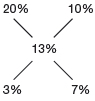
(B) Using the method of alligation:
Profit $1 = 20 \%$
Profit $2 = 10 \%$
Mean Profit $= 13 \%$
Difference $1 = |13 - 10| = 3$
Difference $2 = |20 - 13| = 7$
The ratio of mangoes sold at $20 \%$ profit to those sold at $10 \%$ profit is $3:7$.
Total parts $= 3 + 7 = 10$.
Mangoes sold at $20 \%$ profit $= \frac{3}{10} \times 200 = 60$ dozens.
Profit $1 = 20 \%$
Profit $2 = 10 \%$
Mean Profit $= 13 \%$
Difference $1 = |13 - 10| = 3$
Difference $2 = |20 - 13| = 7$
The ratio of mangoes sold at $20 \%$ profit to those sold at $10 \%$ profit is $3:7$.
Total parts $= 3 + 7 = 10$.
Mangoes sold at $20 \%$ profit $= \frac{3}{10} \times 200 = 60$ dozens.
0 likes
View Solution270
DifficultMCQ
At a village trade fair,a man buys a horse and a camel together for $Rs. 51,250$. He sold the horse at a profit of $25\%$ and the camel at a loss of $20\%$. If he sold both the animals at the same price,then the cost price of the cheaper animal was $Rs.$ .........
A
$6600$
B
$7500$
C
$25000$
D
$20000$
Solution
(D) Let the cost price of the horse be $x$ and the cost price of the camel be $(51250 - x)$.
According to the problem,the selling price of both animals is the same.
Selling price of horse = $x + 25\% \text{ of } x = 1.25x$.
Selling price of camel = $(51250 - x) - 20\% \text{ of } (51250 - x) = 0.8(51250 - x)$.
Equating the two selling prices:
$1.25x = 0.8(51250 - x)$
$1.25x = 41000 - 0.8x$
$1.25x + 0.8x = 41000$
$2.05x = 41000$
$x = \frac{41000}{2.05} = 20000$.
Cost price of the horse = $Rs. 20,000$.
Cost price of the camel = $51250 - 20000 = Rs. 31,250$.
The cheaper animal is the horse,with a cost price of $Rs. 20,000$.
According to the problem,the selling price of both animals is the same.
Selling price of horse = $x + 25\% \text{ of } x = 1.25x$.
Selling price of camel = $(51250 - x) - 20\% \text{ of } (51250 - x) = 0.8(51250 - x)$.
Equating the two selling prices:
$1.25x = 0.8(51250 - x)$
$1.25x = 41000 - 0.8x$
$1.25x + 0.8x = 41000$
$2.05x = 41000$
$x = \frac{41000}{2.05} = 20000$.
Cost price of the horse = $Rs. 20,000$.
Cost price of the camel = $51250 - 20000 = Rs. 31,250$.
The cheaper animal is the horse,with a cost price of $Rs. 20,000$.
0 likes
View Solution271
DifficultMCQ
Oil equal to $20 \%$ of the weight of groundnut is extracted in a mill. The matter left after extraction is sold as cattle feed at the rate of $Rs. 12.5$ per $kg$. The groundnuts are bought at $Rs. 20$ per $kg$ and the processing cost is $Rs. 5$ per $kg$. At what price ($Rs.$ per $kg$) should the oil be sold to earn $20 \%$ profit on total costs (Total cost $=$ cost of groundnuts and processing costs)?
A
$250$
B
$150$
C
$200$
D
$100$
Solution
(D) Let the total weight of the groundnut be $100 \ kg$.
Total cost $= 100 \times (20 + 5) = Rs. 2500$.
Amount to be received after $20 \%$ profit $= 2500 \times 1.2 = Rs. 3000$.
Since $80 \%$ of the weight of groundnut is left and sold as cattle feed at $Rs. 12.5/kg$,the amount received from the waste $= 100 \times 0.8 \times 12.5 = Rs. 1000$.
Remaining amount to be received by selling the oil $= 3000 - 1000 = Rs. 2000$.
Since the weight of the oil extracted is $20 \%$ of $100 \ kg = 20 \ kg$,the selling price of the oil $= 2000 / 20 = Rs. 100$ per $kg$.
Total cost $= 100 \times (20 + 5) = Rs. 2500$.
Amount to be received after $20 \%$ profit $= 2500 \times 1.2 = Rs. 3000$.
Since $80 \%$ of the weight of groundnut is left and sold as cattle feed at $Rs. 12.5/kg$,the amount received from the waste $= 100 \times 0.8 \times 12.5 = Rs. 1000$.
Remaining amount to be received by selling the oil $= 3000 - 1000 = Rs. 2000$.
Since the weight of the oil extracted is $20 \%$ of $100 \ kg = 20 \ kg$,the selling price of the oil $= 2000 / 20 = Rs. 100$ per $kg$.
0 likes
View Solution272
DifficultMCQ
$A$ man buys $10$ oranges for a rupee and sells $8$ oranges for a rupee. What is the profit percent?
A
$10$
B
$12.5$
C
$20$
D
$25$
Solution
(D) Cost Price $(C.P.)$ of $10$ oranges $= 1$ rupee.
So,$C.P.$ of $1$ orange $= 1/10$ rupee.
Selling Price $(S.P.)$ of $8$ oranges $= 1$ rupee.
So,$S.P.$ of $1$ orange $= 1/8$ rupee.
Profit $= S.P. - C.P. = 1/8 - 1/10 = (5-4)/40 = 1/40$ rupee.
Profit $\% = (\text{Profit} / C.P.) \times 100 = (1/40) / (1/10) \times 100 = (1/40) \times 10 \times 100 = 100/4 = 25 \%$.
So,$C.P.$ of $1$ orange $= 1/10$ rupee.
Selling Price $(S.P.)$ of $8$ oranges $= 1$ rupee.
So,$S.P.$ of $1$ orange $= 1/8$ rupee.
Profit $= S.P. - C.P. = 1/8 - 1/10 = (5-4)/40 = 1/40$ rupee.
Profit $\% = (\text{Profit} / C.P.) \times 100 = (1/40) / (1/10) \times 100 = (1/40) \times 10 \times 100 = 100/4 = 25 \%$.
0 likes
View Solution273
MediumMCQ
$A$ dishonest dealer defrauds to the extent of $x \%$ in buying as well as selling his goods by using faulty weight. What will be the gain per cent on his outlay?
A
$2 x \%$
B
$\left(\frac{10}{x} + x^2\right) \%$
C
$\left(2 x + \frac{x^2}{100}\right) \%$
D
$\left(x + \frac{x^2}{100}\right) \%$
Solution
(C) Let the actual cost price of the goods be $100$ units.
When buying,the dealer cheats by $x \%$,meaning he gets $(100 + x)$ units for the price of $100$ units. Thus,the effective cost price per unit decreases.
When selling,the dealer cheats by $x \%$,meaning he sells $(100 - x)$ units for the price of $100$ units. Thus,the effective selling price per unit increases.
Alternatively,using the concept of successive percentage change for a gain of $x \%$ in both transactions:
Total Gain $\% = x + x + \frac{x \times x}{100} = \left(2 x + \frac{x^2}{100}\right) \%$.
When buying,the dealer cheats by $x \%$,meaning he gets $(100 + x)$ units for the price of $100$ units. Thus,the effective cost price per unit decreases.
When selling,the dealer cheats by $x \%$,meaning he sells $(100 - x)$ units for the price of $100$ units. Thus,the effective selling price per unit increases.
Alternatively,using the concept of successive percentage change for a gain of $x \%$ in both transactions:
Total Gain $\% = x + x + \frac{x \times x}{100} = \left(2 x + \frac{x^2}{100}\right) \%$.
0 likes
View Solution274
EasyMCQ
$A$ fan costing $Rs. 1200$ is being sold for $Rs. 1500$. What is the profit percent?
A
$10$
B
$12.5$
C
$25$
D
$20$
Solution
(C) Cost Price $(CP)$ = $Rs. 1200$
Selling Price $(SP)$ = $Rs. 1500$
Profit = $SP - CP = 1500 - 1200 = Rs. 300$
Profit $\% = (\text{Profit} / CP) \times 100$
Profit $\% = (300 / 1200) \times 100 = (1 / 4) \times 100 = 25 \%$
Selling Price $(SP)$ = $Rs. 1500$
Profit = $SP - CP = 1500 - 1200 = Rs. 300$
Profit $\% = (\text{Profit} / CP) \times 100$
Profit $\% = (300 / 1200) \times 100 = (1 / 4) \times 100 = 25 \%$
0 likes
View Solution275
DifficultMCQ
Raman sells a machine for $Rs. 39$ lakh at a loss. Had he sold it for $Rs. 49$ lakh,his gain would have been three times the loss. What is the cost price of the machine? (in $Rs. \text{ lakh}$)
A
$46.5$
B
$62$
C
$36.5$
D
$41.5$
Solution
(D) Let the cost price $(C.P.)$ of the machine be $Rs. x$ lakh.
When the machine is sold for $Rs. 39$ lakh,the loss is given by:
$\text{Loss} = C.P. - S.P. = (x - 39)$ lakh.
When the machine is sold for $Rs. 49$ lakh,the gain (profit) is given by:
$\text{Gain} = S.P. - C.P. = (49 - x)$ lakh.
According to the problem,the gain is three times the loss:
$(49 - x) = 3(x - 39)$
Expanding the equation:
$49 - x = 3x - 117$
Rearranging the terms to solve for $x$:
$49 + 117 = 3x + x$
$166 = 4x$
$x = \frac{166}{4} = 41.5$
Therefore,the cost price of the machine is $Rs. 41.5$ lakh.
When the machine is sold for $Rs. 39$ lakh,the loss is given by:
$\text{Loss} = C.P. - S.P. = (x - 39)$ lakh.
When the machine is sold for $Rs. 49$ lakh,the gain (profit) is given by:
$\text{Gain} = S.P. - C.P. = (49 - x)$ lakh.
According to the problem,the gain is three times the loss:
$(49 - x) = 3(x - 39)$
Expanding the equation:
$49 - x = 3x - 117$
Rearranging the terms to solve for $x$:
$49 + 117 = 3x + x$
$166 = 4x$
$x = \frac{166}{4} = 41.5$
Therefore,the cost price of the machine is $Rs. 41.5$ lakh.
0 likes
View Solution276
MediumMCQ
$A$ rice trader buys $8$ quintals of rice for $Rs. 3,600$. $10\%$ of the rice is lost in transportation. At what rate should he sell the remaining rice to earn a $15\%$ profit in $Rs.$ per quintal?
A
$352.1$
B
$517.5$
C
$575$
D
$582.3$
Solution
(C) Total quantity of rice bought $= 8$ quintals.
Total cost price $(CP) = Rs. 3,600$.
Loss in transportation $= 10\%$ of $8$ quintals $= 0.8$ quintals.
Remaining quantity of rice $= 8 - 0.8 = 7.2$ quintals.
To earn a $15\%$ profit on the total investment,the total selling price $(SP)$ must be:
$SP = CP + (15\% \text{ of } CP) = 3600 + (0.15 \times 3600) = 3600 + 540 = Rs. 4,140$.
Now,to find the selling rate per quintal for the remaining $7.2$ quintals:
Selling rate $= \frac{\text{Total } SP}{\text{Remaining quantity}} = \frac{4140}{7.2} = Rs. 575$ per quintal.
Total cost price $(CP) = Rs. 3,600$.
Loss in transportation $= 10\%$ of $8$ quintals $= 0.8$ quintals.
Remaining quantity of rice $= 8 - 0.8 = 7.2$ quintals.
To earn a $15\%$ profit on the total investment,the total selling price $(SP)$ must be:
$SP = CP + (15\% \text{ of } CP) = 3600 + (0.15 \times 3600) = 3600 + 540 = Rs. 4,140$.
Now,to find the selling rate per quintal for the remaining $7.2$ quintals:
Selling rate $= \frac{\text{Total } SP}{\text{Remaining quantity}} = \frac{4140}{7.2} = Rs. 575$ per quintal.
0 likes
View Solution277
MediumMCQ
$A$ rice trader buys $16$ quintals of rice for $Rs. 5632$. $20 \%$ of the rice is lost in transportation. At what rate should he sell the remaining rice to earn a $25 \%$ profit in $Rs.$ per quintal?
A
$225.2$
B
$550$
C
$440$
D
$563.2$
Solution
(B) Total cost price of $16$ quintals of rice $= Rs. 5632$.
Quantity of rice lost $= 20 \% \text{ of } 16 = 0.20 \times 16 = 3.2 \text{ quintals}$.
Remaining quantity of rice $= 16 - 3.2 = 12.8 \text{ quintals}$.
To earn a $25 \%$ profit,the total selling price should be $125 \%$ of the cost price.
Total Selling Price $= 1.25 \times 5632 = Rs. 7040$.
Selling price per quintal $= \frac{\text{Total Selling Price}}{\text{Remaining Quantity}} = \frac{7040}{12.8} = Rs. 550$.
Quantity of rice lost $= 20 \% \text{ of } 16 = 0.20 \times 16 = 3.2 \text{ quintals}$.
Remaining quantity of rice $= 16 - 3.2 = 12.8 \text{ quintals}$.
To earn a $25 \%$ profit,the total selling price should be $125 \%$ of the cost price.
Total Selling Price $= 1.25 \times 5632 = Rs. 7040$.
Selling price per quintal $= \frac{\text{Total Selling Price}}{\text{Remaining Quantity}} = \frac{7040}{12.8} = Rs. 550$.
0 likes
View Solution278
DifficultMCQ
Raheem sells a machine for $RS. 48$ lakh at a loss. Had he sold it for $RS. 60$ lakh,his gain would have been $5$ times the former loss. Find the cost price of the machine in lakh $Rs.$?
A
$58$
B
$69.9$
C
$42$
D
$50$
Solution
(D) Let the cost price $(C.P.)$ of the machine be $₹ x$ lakhs.
When the selling price $(S.P.)$ is $₹ 48$ lakhs,the loss is given by:
Loss $= C.P. - S.P. = (x - 48)$ lakhs.
When the selling price $(S.P.)$ is $₹ 60$ lakhs,the gain is given by:
Gain $= S.P. - C.P. = (60 - x)$ lakhs.
According to the problem,the gain is $5$ times the former loss:
$(60 - x) = 5 \times (x - 48)$
Expanding the equation:
$60 - x = 5x - 240$
Rearranging the terms to solve for $x$:
$60 + 240 = 5x + x$
$300 = 6x$
$x = 300 / 6$
$x = 50$
Therefore,the cost price of the machine is $₹ 50$ lakhs.
When the selling price $(S.P.)$ is $₹ 48$ lakhs,the loss is given by:
Loss $= C.P. - S.P. = (x - 48)$ lakhs.
When the selling price $(S.P.)$ is $₹ 60$ lakhs,the gain is given by:
Gain $= S.P. - C.P. = (60 - x)$ lakhs.
According to the problem,the gain is $5$ times the former loss:
$(60 - x) = 5 \times (x - 48)$
Expanding the equation:
$60 - x = 5x - 240$
Rearranging the terms to solve for $x$:
$60 + 240 = 5x + x$
$300 = 6x$
$x = 300 / 6$
$x = 50$
Therefore,the cost price of the machine is $₹ 50$ lakhs.
0 likes
View Solution279
MediumMCQ
$A$ man purchased $120$ reams of paper at $Rs. 80$ per ream. He spent $Rs. 280$ on transportation,paid octroi at the rate of $40$ paise per ream,and paid $Rs. 72$ to a porter. In order to gain $8\%$ profit,he must sell each ream of paper for (in $Rs.$):
A
$90$
B
$87.5$
C
$89$
D
$85$
Solution
(A) Total Cost Price $(C.P.)$ = (Cost of paper) + (Transportation) + (Octroi) + (Porter charges)
$C.P. = (120 \times 80) + 280 + (120 \times 0.40) + 72$
$C.P. = 9600 + 280 + 48 + 72 = 10000$
Total $C.P. = Rs. 10,000$
To gain $8\%$ profit,the Total Selling Price $(S.P.)$ should be:
$S.P. = C.P. \times (1 + \frac{8}{100}) = 10000 \times 1.08 = Rs. 10,800$
Selling Price per ream = $\frac{10800}{120} = Rs. 90$
$C.P. = (120 \times 80) + 280 + (120 \times 0.40) + 72$
$C.P. = 9600 + 280 + 48 + 72 = 10000$
Total $C.P. = Rs. 10,000$
To gain $8\%$ profit,the Total Selling Price $(S.P.)$ should be:
$S.P. = C.P. \times (1 + \frac{8}{100}) = 10000 \times 1.08 = Rs. 10,800$
Selling Price per ream = $\frac{10800}{120} = Rs. 90$
0 likes
View Solution280
EasyMCQ
$A$ man bought $15$ mangoes for a rupee. How many mangoes were sold for a rupee so that there is a loss of $25 \% ?$
A
$10$
B
$12$
C
$18$
D
$20$
Solution
(D) The cost price $(CP)$ of $15$ mangoes is $1$ rupee.
Therefore,the $CP$ of $1$ mango is $\frac{1}{15}$ rupee.
We want a loss of $25 \%$,so the selling price $(SP)$ of $1$ mango should be $75 \%$ of the $CP$.
$SP = \frac{75}{100} \times \frac{1}{15} = \frac{3}{4} \times \frac{1}{15} = \frac{1}{20}$ rupee.
This means $1$ mango is sold for $\frac{1}{20}$ rupee.
Therefore,for $1$ rupee,the number of mangoes sold is $20$.
Therefore,the $CP$ of $1$ mango is $\frac{1}{15}$ rupee.
We want a loss of $25 \%$,so the selling price $(SP)$ of $1$ mango should be $75 \%$ of the $CP$.
$SP = \frac{75}{100} \times \frac{1}{15} = \frac{3}{4} \times \frac{1}{15} = \frac{1}{20}$ rupee.
This means $1$ mango is sold for $\frac{1}{20}$ rupee.
Therefore,for $1$ rupee,the number of mangoes sold is $20$.
0 likes
View Solution281
EasyMCQ
By selling a fan for $Rs. 1900$,a man has a loss of $5 \%$. At what price (in $Rs.$) should he sell the fan to gain $20 \% ?$
A
$2000$
B
$2400$
C
$2600$
D
$2800$
Solution
(B) Let the cost price $(C.P.)$ of the fan be $x$.
Given that the loss is $5 \%$,the selling price $(S.P.)$ is $95 \%$ of $C.P.$
$0.95 \times x = 1900$
$x = \frac{1900}{0.95} = 2000$
So,the cost price of the fan is $Rs. 2000$.
To gain $20 \%$,the new selling price should be $120 \%$ of $C.P.$
New $S.P. = 1.20 \times 2000 = 2400$.
Therefore,he should sell the fan for $Rs. 2400$ to gain $20 \%$.
Given that the loss is $5 \%$,the selling price $(S.P.)$ is $95 \%$ of $C.P.$
$0.95 \times x = 1900$
$x = \frac{1900}{0.95} = 2000$
So,the cost price of the fan is $Rs. 2000$.
To gain $20 \%$,the new selling price should be $120 \%$ of $C.P.$
New $S.P. = 1.20 \times 2000 = 2400$.
Therefore,he should sell the fan for $Rs. 2400$ to gain $20 \%$.
0 likes
View Solution282
MediumMCQ
Profit obtained on selling an article for $Rs. 310$ is equal to the loss incurred on selling that article for $Rs. 230$. What will be the loss percentage when selling price is $Rs. 180$?
A
$16 \frac{1}{3} \%$
B
$16 \frac{2}{3} \%$
C
$33 \frac{1}{3} \%$
D
$33 \frac{2}{3} \%$
Solution
(C) Let the Cost Price be $C.P.$ and the profit/loss amount be $x$.
When sold at $Rs. 310$,Profit $= 310 - C.P. = x$.
When sold at $Rs. 230$,Loss $= C.P. - 230 = x$.
Equating the two: $310 - C.P. = C.P. - 230$.
$2 \times C.P. = 310 + 230 = 540$.
$C.P. = 270$.
Now,if the selling price is $Rs. 180$,the loss is $270 - 180 = 90$.
Loss percentage $= (\text{Loss} / C.P.) \times 100 = (90 / 270) \times 100 = (1 / 3) \times 100 = 33 \frac{1}{3} \%$.
When sold at $Rs. 310$,Profit $= 310 - C.P. = x$.
When sold at $Rs. 230$,Loss $= C.P. - 230 = x$.
Equating the two: $310 - C.P. = C.P. - 230$.
$2 \times C.P. = 310 + 230 = 540$.
$C.P. = 270$.
Now,if the selling price is $Rs. 180$,the loss is $270 - 180 = 90$.
Loss percentage $= (\text{Loss} / C.P.) \times 100 = (90 / 270) \times 100 = (1 / 3) \times 100 = 33 \frac{1}{3} \%$.
0 likes
View Solution283
MediumMCQ
$A$ man bought nine pens for a rupee. How many pens should he sell for a rupee to gain $50 \%$?
A
$3$
B
$6$
C
$7$
D
$8$
Solution
(B) Cost Price $(C.P.)$ of $9$ pens $= ₹ 1$.
Therefore,$C.P.$ of $1$ pen $= ₹ \frac{1}{9}$.
To gain $50 \%$,the Selling Price $(S.P.)$ of $1$ pen should be $C.P. \times (1 + \text{Profit} \%)$.
$S.P. = \frac{1}{9} \times (1 + 0.50) = \frac{1}{9} \times 1.5 = \frac{1.5}{9} = ₹ \frac{1}{6}$.
Since the $S.P.$ of $1$ pen is $₹ \frac{1}{6}$,it means $6$ pens are sold for $₹ 1$ to gain $50 \%$ profit.
Therefore,$C.P.$ of $1$ pen $= ₹ \frac{1}{9}$.
To gain $50 \%$,the Selling Price $(S.P.)$ of $1$ pen should be $C.P. \times (1 + \text{Profit} \%)$.
$S.P. = \frac{1}{9} \times (1 + 0.50) = \frac{1}{9} \times 1.5 = \frac{1.5}{9} = ₹ \frac{1}{6}$.
Since the $S.P.$ of $1$ pen is $₹ \frac{1}{6}$,it means $6$ pens are sold for $₹ 1$ to gain $50 \%$ profit.
0 likes
View Solution284
DifficultMCQ
$A$ shopkeeper professes to sell his goods at cost price but uses a $930 \text{ g}$ weight instead of $1 \text{ kg}$ weight. What will be the profit percentage of the shopkeeper (in $\%$)?
A
$3.76$
B
$7.52$
C
$9.85$
D
$10.36$
Solution
(B) Let the cost price $(C.P.)$ of $1 \text{ g}$ be $₹ 1$.
Therefore,the $C.P.$ of $930 \text{ g}$ is $₹ 930$.
The shopkeeper sells $930 \text{ g}$ of goods but charges for $1000 \text{ g}$ $(1 \text{ kg})$.
Selling Price $(S.P.)$ of $930 \text{ g}$ is $₹ 1000$.
Profit = $S.P. - C.P. = 1000 - 930 = ₹ 70$.
Profit percentage = $\left( \frac{\text{Profit}}{C.P.} \right) \times 100 = \left( \frac{70}{930} \right) \times 100$.
Profit percentage = $\frac{700}{93} \approx 7.526 \% \approx 7.53 \%$.
Rounding to the nearest option,the profit percentage is $7.52 \%$.
Therefore,the $C.P.$ of $930 \text{ g}$ is $₹ 930$.
The shopkeeper sells $930 \text{ g}$ of goods but charges for $1000 \text{ g}$ $(1 \text{ kg})$.
Selling Price $(S.P.)$ of $930 \text{ g}$ is $₹ 1000$.
Profit = $S.P. - C.P. = 1000 - 930 = ₹ 70$.
Profit percentage = $\left( \frac{\text{Profit}}{C.P.} \right) \times 100 = \left( \frac{70}{930} \right) \times 100$.
Profit percentage = $\frac{700}{93} \approx 7.526 \% \approx 7.53 \%$.
Rounding to the nearest option,the profit percentage is $7.52 \%$.
0 likes
View Solution285
MediumMCQ
While selling an article for $Rs. 18450$,a person suffered a loss of $50 \%$. At what price he should have sold the article (in $Rs.$) to earn a profit of $50 \%$?
A
$13837$
B
$52000$
C
$55350$
D
$56775$
Solution
(C) Let the Cost Price $(C.P.)$ of the article be $x$.
Given that the selling price $(S.P._1)$ is $Rs. 18450$ with a loss of $50 \%$.
$S.P._1 = C.P. - (50 \% \text{ of } C.P.) = 0.50 \times C.P.$
$18450 = 0.50 \times C.P.$
$C.P. = \frac{18450}{0.50} = Rs. 36900$.
Now,to earn a profit of $50 \%$,the new selling price $(S.P._2)$ should be:
$S.P._2 = C.P. + (50 \% \text{ of } C.P.) = 1.50 \times C.P.$
$S.P._2 = 1.50 \times 36900 = Rs. 55350$.
Given that the selling price $(S.P._1)$ is $Rs. 18450$ with a loss of $50 \%$.
$S.P._1 = C.P. - (50 \% \text{ of } C.P.) = 0.50 \times C.P.$
$18450 = 0.50 \times C.P.$
$C.P. = \frac{18450}{0.50} = Rs. 36900$.
Now,to earn a profit of $50 \%$,the new selling price $(S.P._2)$ should be:
$S.P._2 = C.P. + (50 \% \text{ of } C.P.) = 1.50 \times C.P.$
$S.P._2 = 1.50 \times 36900 = Rs. 55350$.
0 likes
View Solution286
DifficultMCQ
$A$ man gains $15 \%$ by selling a calculator for a certain price. If he sells it at triple the price,then what will be the profit percentage (in $\%$)?
A
$125$
B
$175$
C
$225$
D
$245$
Solution
(D) Let the Cost Price $(C.P)$ be $₹ 100$.
Since the man gains $15 \%$,the initial Selling Price $(S.P_1)$ is $₹ 100 + ₹ 15 = ₹ 115$.
If he sells the calculator at triple the price,the new Selling Price $(S.P_2)$ will be $3 \times ₹ 115 = ₹ 345$.
The profit is calculated as $S.P_2 - C.P = ₹ 345 - ₹ 100 = ₹ 245$.
The profit percentage is calculated as $\frac{\text{Profit}}{C.P} \times 100 = \frac{245}{100} \times 100 = 245 \%$.
Since the man gains $15 \%$,the initial Selling Price $(S.P_1)$ is $₹ 100 + ₹ 15 = ₹ 115$.
If he sells the calculator at triple the price,the new Selling Price $(S.P_2)$ will be $3 \times ₹ 115 = ₹ 345$.
The profit is calculated as $S.P_2 - C.P = ₹ 345 - ₹ 100 = ₹ 245$.
The profit percentage is calculated as $\frac{\text{Profit}}{C.P} \times 100 = \frac{245}{100} \times 100 = 245 \%$.
0 likes
View Solution287
EasyMCQ
By selling $90$ pens for $Rs. 80$,a man loses $20\%$. What should be the selling price (in $Rs.$) of $90$ pens for $20\%$ profit?
A
$90$
B
$100$
C
$110$
D
$120$
Solution
(D) Let the cost price $(C.P.)$ of $90$ pens be $x$.
Given that selling $90$ pens for $Rs. 80$ results in a loss of $20\%$.
Therefore,$80\%$ of $C.P. = 80$.
$0.80 \times x = 80 \implies x = 100$.
So,the cost price of $90$ pens is $Rs. 100$.
To gain a profit of $20\%$,the selling price $(S.P.)$ should be $120\%$ of the $C.P.$
$S.P. = 1.20 \times 100 = 120$.
Thus,the selling price of $90$ pens for $20\%$ profit is $Rs. 120$.
Given that selling $90$ pens for $Rs. 80$ results in a loss of $20\%$.
Therefore,$80\%$ of $C.P. = 80$.
$0.80 \times x = 80 \implies x = 100$.
So,the cost price of $90$ pens is $Rs. 100$.
To gain a profit of $20\%$,the selling price $(S.P.)$ should be $120\%$ of the $C.P.$
$S.P. = 1.20 \times 100 = 120$.
Thus,the selling price of $90$ pens for $20\%$ profit is $Rs. 120$.
0 likes
View Solution288
EasyMCQ
$A$ trader buys $500 \, kg$ of cotton for $Rs. 9,000$. $10 \%$ of this cotton is spoiled due to rain. At what rate $(Rs./ kg)$ should he sell the rest to earn $10 \%$ profit?
A
$25$
B
$30$
C
$22$
D
$20$
Solution
(C) Total quantity of cotton $= 500 \, kg$.
Total cost price $(C.P.) = Rs. 9,000$.
$10 \%$ of the cotton is spoiled,so the quantity of spoiled cotton $= 500 \times 0.10 = 50 \, kg$.
Remaining quantity of cotton $= 500 - 50 = 450 \, kg$.
To earn a $10 \%$ profit,the total selling price $(S.P.)$ must be $110 \%$ of the cost price.
Total $S.P. = 9,000 \times 1.10 = Rs. 9,900$.
Rate at which he should sell the remaining cotton $= \frac{\text{Total } S.P.}{\text{Remaining quantity}} = \frac{9,900}{450} = Rs. 22 \, \text{per } kg$.
Total cost price $(C.P.) = Rs. 9,000$.
$10 \%$ of the cotton is spoiled,so the quantity of spoiled cotton $= 500 \times 0.10 = 50 \, kg$.
Remaining quantity of cotton $= 500 - 50 = 450 \, kg$.
To earn a $10 \%$ profit,the total selling price $(S.P.)$ must be $110 \%$ of the cost price.
Total $S.P. = 9,000 \times 1.10 = Rs. 9,900$.
Rate at which he should sell the remaining cotton $= \frac{\text{Total } S.P.}{\text{Remaining quantity}} = \frac{9,900}{450} = Rs. 22 \, \text{per } kg$.
0 likes
View Solution289
MediumMCQ
$A$ trader had $1200 \ kg$ of rice. He sold a part of it at $5 \%$ profit and the rest at $11 \%$ profit,so that he made a total profit of $7 \%$. How much (in $kg$) rice did he sell at $5 \%$ profit?
A
$900$
B
$600$
C
$400$
D
$800$
Solution
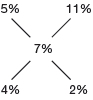
(D) Using the method of alligation:
Let the quantity sold at $5 \%$ profit be $x$ and at $11 \%$ profit be $y$.
The mean profit is $7 \%$.
By alligation rule:
Ratio of quantities $= (11 - 7) : (7 - 5) = 4 : 2 = 2 : 1$.
Total quantity $= 1200 \ kg$.
Quantity sold at $5 \%$ profit $= \frac{2}{2+1} \times 1200 = \frac{2}{3} \times 1200 = 800 \ kg$.
Let the quantity sold at $5 \%$ profit be $x$ and at $11 \%$ profit be $y$.
The mean profit is $7 \%$.
By alligation rule:
Ratio of quantities $= (11 - 7) : (7 - 5) = 4 : 2 = 2 : 1$.
Total quantity $= 1200 \ kg$.
Quantity sold at $5 \%$ profit $= \frac{2}{2+1} \times 1200 = \frac{2}{3} \times 1200 = 800 \ kg$.
0 likes
View Solution290
MediumMCQ
If cost price is $Rs. 150$ less than the selling price and profit is $20 \%$,then what is the selling price (in $Rs.$)?
A
$750$
B
$800$
C
$850$
D
$900$
Solution
(D) Given that the profit percentage is $20 \%$ and the difference between selling price $(SP)$ and cost price $(CP)$ is $Rs. 150$.
Profit $\% = \frac{SP - CP}{CP} \times 100$
Since $SP - CP = 150$,we substitute this into the formula:
$20 = \frac{150}{CP} \times 100$
$CP = \frac{150 \times 100}{20} = 150 \times 5 = Rs. 750$
Now,calculate the selling price:
$SP = CP + 150 = 750 + 150 = Rs. 900$
Profit $\% = \frac{SP - CP}{CP} \times 100$
Since $SP - CP = 150$,we substitute this into the formula:
$20 = \frac{150}{CP} \times 100$
$CP = \frac{150 \times 100}{20} = 150 \times 5 = Rs. 750$
Now,calculate the selling price:
$SP = CP + 150 = 750 + 150 = Rs. 900$
0 likes
View Solution291
MediumMCQ
If profit is $\left(\frac{1}{11}\right)$ of the selling price,what is the profit percent?
A
$9 \frac{1}{11} \%$
B
$10 \%$
C
$8 \frac{1}{3} \%$
D
$11 \frac{1}{9} \%$
Solution
(B) Let the selling price be $S.P$.
Given that profit $P = \frac{1}{11} \times S.P$.
We know that $P = S.P - C.P$,where $C.P$ is the cost price.
Substituting the value of $P$:
$S.P - C.P = \frac{1}{11} S.P$
$S.P - \frac{1}{11} S.P = C.P$
$\frac{10}{11} S.P = C.P$
$S.P = \frac{11}{10} C.P$
Now,profit percent is calculated on the cost price:
$P \% = \left( \frac{P}{C.P} \right) \times 100$
$P = S.P - C.P = \frac{11}{10} C.P - C.P = \frac{1}{10} C.P$
$P \% = \left( \frac{\frac{1}{10} C.P}{C.P} \right) \times 100 = \frac{1}{10} \times 100 = 10 \%$.
Given that profit $P = \frac{1}{11} \times S.P$.
We know that $P = S.P - C.P$,where $C.P$ is the cost price.
Substituting the value of $P$:
$S.P - C.P = \frac{1}{11} S.P$
$S.P - \frac{1}{11} S.P = C.P$
$\frac{10}{11} S.P = C.P$
$S.P = \frac{11}{10} C.P$
Now,profit percent is calculated on the cost price:
$P \% = \left( \frac{P}{C.P} \right) \times 100$
$P = S.P - C.P = \frac{11}{10} C.P - C.P = \frac{1}{10} C.P$
$P \% = \left( \frac{\frac{1}{10} C.P}{C.P} \right) \times 100 = \frac{1}{10} \times 100 = 10 \%$.
0 likes
View Solution292
EasyMCQ
The ratio of cost price and selling price of an article is $25:26$. The percent of profit will be
A
$26$
B
$25$
C
$1$
D
$4$
Solution
(D) Given the ratio of cost price $(C.P.)$ to selling price $(S.P.)$ is $25:26$.
Let $C.P. = 25x$ and $S.P. = 26x$.
Profit = $S.P. - C.P. = 26x - 25x = x$.
Profit percentage is calculated as $\text{Profit} \% = \left( \frac{\text{Profit}}{C.P.} \right) \times 100$.
$\text{Profit} \% = \left( \frac{x}{25x} \right) \times 100 = \frac{1}{25} \times 100 = 4\%$.
Let $C.P. = 25x$ and $S.P. = 26x$.
Profit = $S.P. - C.P. = 26x - 25x = x$.
Profit percentage is calculated as $\text{Profit} \% = \left( \frac{\text{Profit}}{C.P.} \right) \times 100$.
$\text{Profit} \% = \left( \frac{x}{25x} \right) \times 100 = \frac{1}{25} \times 100 = 4\%$.
0 likes
View Solution293
EasyMCQ
Profit of $Rs. 144000$ has to be divided among three partners Akram,Bipin,and Chintan in the ratio $3 : 2 : 7$. How much $Rs.$ does Chintan get?
A
$84000$
B
$24000$
C
$36000$
D
$42000$
Solution
(A) The total profit is $Rs. 144000$.
The ratio of division among Akram,Bipin,and Chintan is $3 : 2 : 7$.
The sum of the ratio parts is $3 + 2 + 7 = 12$.
Chintan's share is $\frac{7}{12}$ of the total profit.
Chintan's share $= \frac{7}{12} \times 144000 = 7 \times 12000 = Rs. 84000$.
The ratio of division among Akram,Bipin,and Chintan is $3 : 2 : 7$.
The sum of the ratio parts is $3 + 2 + 7 = 12$.
Chintan's share is $\frac{7}{12}$ of the total profit.
Chintan's share $= \frac{7}{12} \times 144000 = 7 \times 12000 = Rs. 84000$.
0 likes
View Solution294
MediumMCQ
$P$ invests $Rs. 9100$ for $3$ months. $Q$ invests $Rs. 6825$ for $2$ months and $R$ invests $Rs. 8190$ for $5$ months in a business. If the total profit amounts to $Rs. 4158$,how much profit should $Q$ get? (in $Rs.$)
A
$682.50$
B
$693$
C
$1386$
D
$346.50$
Solution
(B) The ratio of the profit distribution is equal to the ratio of the product of investment and time period for each partner.
Ratio of investments $(P : Q : R) = (9100 \times 3) : (6825 \times 2) : (8190 \times 5)$
$= 27300 : 13650 : 40950$
Dividing by $13650$:
$= 2 : 1 : 3$
Total ratio sum $= 2 + 1 + 3 = 6$
Total profit $= Rs. 4158$
Profit share of $Q = (1 / 6) \times 4158 = Rs. 693$
Ratio of investments $(P : Q : R) = (9100 \times 3) : (6825 \times 2) : (8190 \times 5)$
$= 27300 : 13650 : 40950$
Dividing by $13650$:
$= 2 : 1 : 3$
Total ratio sum $= 2 + 1 + 3 = 6$
Total profit $= Rs. 4158$
Profit share of $Q = (1 / 6) \times 4158 = Rs. 693$
1 likes
View Solution295
EasyMCQ
Raman,Manan,and Kamal are partners and invest in a business such that Raman invests $\frac{2}{5}$ of the total and Manan invests $\frac{3}{8}$ of the total. What is the ratio of profits of Raman,Manan,and Kamal respectively?
A
$16: 15: 9$
B
$16: 15: 31$
C
$2: 3: 5$
D
$15: 16: 9$
Solution
(A) Let the total investment be $1$.
Raman's share = $\frac{2}{5}$.
Manan's share = $\frac{3}{8}$.
Kamal's share = $1 - (\frac{2}{5} + \frac{3}{8}) = 1 - (\frac{16+15}{40}) = 1 - \frac{31}{40} = \frac{9}{40}$.
The ratio of profits is equal to the ratio of investments.
Ratio = $\frac{2}{5} : \frac{3}{8} : \frac{9}{40}$.
To simplify,multiply each term by the least common multiple $(LCM)$ of $5, 8,$ and $40$,which is $40$.
Ratio = $(\frac{2}{5} \times 40) : (\frac{3}{8} \times 40) : (\frac{9}{40} \times 40) = 16 : 15 : 9$.
Raman's share = $\frac{2}{5}$.
Manan's share = $\frac{3}{8}$.
Kamal's share = $1 - (\frac{2}{5} + \frac{3}{8}) = 1 - (\frac{16+15}{40}) = 1 - \frac{31}{40} = \frac{9}{40}$.
The ratio of profits is equal to the ratio of investments.
Ratio = $\frac{2}{5} : \frac{3}{8} : \frac{9}{40}$.
To simplify,multiply each term by the least common multiple $(LCM)$ of $5, 8,$ and $40$,which is $40$.
Ratio = $(\frac{2}{5} \times 40) : (\frac{3}{8} \times 40) : (\frac{9}{40} \times 40) = 16 : 15 : 9$.
0 likes
View Solution296
EasyMCQ
If the ratio of the cost price and selling price of an article is $20: 21$,then what will be the profit percent (in $\%$)?
A
$5$
B
$4.5$
C
$6$
D
$7.5$
Solution
(A) Given the ratio of cost price $(CP)$ to selling price $(SP)$ is $CP : SP = 20 : 21$.
Let $CP = 20x$ and $SP = 21x$.
Profit = $SP - CP = 21x - 20x = x$.
Profit percent is calculated as: $P \% = (\text{Profit} / CP) \times 100$.
$P \% = (x / 20x) \times 100 = (1 / 20) \times 100 = 5 \%$.
Let $CP = 20x$ and $SP = 21x$.
Profit = $SP - CP = 21x - 20x = x$.
Profit percent is calculated as: $P \% = (\text{Profit} / CP) \times 100$.
$P \% = (x / 20x) \times 100 = (1 / 20) \times 100 = 5 \%$.
0 likes
View Solution297
MediumMCQ
On an article,the profit is $210 \%$ of the cost price. If the cost price increases by $40 \%$ but the selling price remains constant,approximately what percent of the selling price will be the profit?
A
$55$
B
$62$
C
$74$
D
$85$
Solution
(A) Let the initial cost price $(C.P)$ be $₹ 100$.
The initial selling price $(S.P)$ is $100 + 210 \% \text{ of } 100 = ₹ 310$.
If the cost price increases by $40 \%$,the new cost price $(C.P')$ becomes $100 + 40 \% \text{ of } 100 = ₹ 140$.
The selling price remains constant at $₹ 310$.
The new profit is $S.P - C.P' = 310 - 140 = ₹ 170$.
The profit as a percentage of the selling price is $\frac{170}{310} \times 100 \approx 54.83 \%$.
Rounding to the nearest whole number,we get approximately $55 \%$.
The initial selling price $(S.P)$ is $100 + 210 \% \text{ of } 100 = ₹ 310$.
If the cost price increases by $40 \%$,the new cost price $(C.P')$ becomes $100 + 40 \% \text{ of } 100 = ₹ 140$.
The selling price remains constant at $₹ 310$.
The new profit is $S.P - C.P' = 310 - 140 = ₹ 170$.
The profit as a percentage of the selling price is $\frac{170}{310} \times 100 \approx 54.83 \%$.
Rounding to the nearest whole number,we get approximately $55 \%$.
0 likes
View Solution298
MediumMCQ
The profit earned by a shopkeeper by selling a bucket at a gain of $8 \%$ is $Rs. 28$ more than when he sells it at a loss of $8 \%$. The cost price (in Rupees) of the bucket is
A
$170$
B
$190$
C
$175$
D
$165$
Solution
(C) Let the cost price $(CP)$ of the bucket be $x$.
Selling price at $8 \%$ gain $= x + 0.08x = 1.08x$.
Selling price at $8 \%$ loss $= x - 0.08x = 0.92x$.
The difference between the two selling prices is given as $Rs. 28$.
Therefore,$1.08x - 0.92x = 28$.
$0.16x = 28$.
$x = \frac{28}{0.16} = \frac{2800}{16} = 175$.
Thus,the cost price of the bucket is $Rs. 175$.
Selling price at $8 \%$ gain $= x + 0.08x = 1.08x$.
Selling price at $8 \%$ loss $= x - 0.08x = 0.92x$.
The difference between the two selling prices is given as $Rs. 28$.
Therefore,$1.08x - 0.92x = 28$.
$0.16x = 28$.
$x = \frac{28}{0.16} = \frac{2800}{16} = 175$.
Thus,the cost price of the bucket is $Rs. 175$.
0 likes
View Solution299
MediumMCQ
$A$ trader sold an article at a gain of $20 \%$. Had he purchased it for $40 \%$ more and sold for $Rs. 24$ less,he would have incurred a loss of $20 \%$. What is the cost price (in $Rs.$) of the article?
A
$150$
B
$300$
C
$450$
D
$600$
Solution
(B) Let the initial cost price of the article be $CP = x$.
Given that the trader sold it at a gain of $20 \%$,the initial selling price is $SP_1 = x + 0.20x = 1.2x$.
If the trader had purchased it for $40 \%$ more,the new cost price would be $CP_2 = x + 0.40x = 1.4x$.
If he sold it for $Rs. 24$ less,the new selling price would be $SP_2 = 1.2x - 24$.
According to the problem,the new transaction results in a loss of $20 \%$. Therefore,$SP_2 = CP_2 \times (1 - 0.20) = 1.4x \times 0.8 = 1.12x$.
Equating the two expressions for $SP_2$: $1.2x - 24 = 1.12x$.
Subtracting $1.12x$ from both sides: $1.2x - 1.12x = 24$.
$0.08x = 24$.
$x = 24 / 0.08 = 2400 / 8 = 300$.
Thus,the cost price of the article is $Rs. 300$.
Given that the trader sold it at a gain of $20 \%$,the initial selling price is $SP_1 = x + 0.20x = 1.2x$.
If the trader had purchased it for $40 \%$ more,the new cost price would be $CP_2 = x + 0.40x = 1.4x$.
If he sold it for $Rs. 24$ less,the new selling price would be $SP_2 = 1.2x - 24$.
According to the problem,the new transaction results in a loss of $20 \%$. Therefore,$SP_2 = CP_2 \times (1 - 0.20) = 1.4x \times 0.8 = 1.12x$.
Equating the two expressions for $SP_2$: $1.2x - 24 = 1.12x$.
Subtracting $1.12x$ from both sides: $1.2x - 1.12x = 24$.
$0.08x = 24$.
$x = 24 / 0.08 = 2400 / 8 = 300$.
Thus,the cost price of the article is $Rs. 300$.
0 likes
View Solution300
MediumMCQ
Mr. Kapur purchased two toy cycles for $Rs. 750$ each. He sold these cycles,gaining $6 \%$ on one and losing $4 \%$ on the other. The gain or loss percent in the whole transaction is
A
$1 \%$ loss
B
$1 \%$ gain
C
$1.5 \%$ loss
D
$1.5 \%$ gain
Solution
(B) Cost Price $(C.P.)$ of each cycle $= ₹ 750$.
Total $C.P.$ of two cycles $= 750 + 750 = ₹ 1500$.
Selling Price $(S.P.)$ of the first cycle with $6 \%$ gain $= 750 \times (1 + 0.06) = 750 \times 1.06 = ₹ 795$.
Selling Price $(S.P.)$ of the second cycle with $4 \%$ loss $= 750 \times (1 - 0.04) = 750 \times 0.96 = ₹ 720$.
Total $S.P. = 795 + 720 = ₹ 1515$.
Since $S.P. > C.P.$,there is a profit.
Profit $= 1515 - 1500 = ₹ 15$.
Profit $\% = (\text{Profit} / \text{Total } C.P.) \times 100 = (15 / 1500) \times 100 = 1 \%$ gain.
Total $C.P.$ of two cycles $= 750 + 750 = ₹ 1500$.
Selling Price $(S.P.)$ of the first cycle with $6 \%$ gain $= 750 \times (1 + 0.06) = 750 \times 1.06 = ₹ 795$.
Selling Price $(S.P.)$ of the second cycle with $4 \%$ loss $= 750 \times (1 - 0.04) = 750 \times 0.96 = ₹ 720$.
Total $S.P. = 795 + 720 = ₹ 1515$.
Since $S.P. > C.P.$,there is a profit.
Profit $= 1515 - 1500 = ₹ 15$.
Profit $\% = (\text{Profit} / \text{Total } C.P.) \times 100 = (15 / 1500) \times 100 = 1 \%$ gain.
0 likes
View SolutionProfit and Loss — Profit and Loss · Frequently Asked Questions
1Are these Profit and Loss questions useful for JEE and NEET?
Yes. All questions in this section are mapped to JEE Main and NEET exam patterns. Previous year questions from JEE Main, NEET, GUJCET and state-level exams are included with full solutions.
2Can I switch to Hindi or Gujarati for these questions?
Yes. Use the language tabs in the hero section or the sidebar to view the same questions and solutions in English, Hindi or Gujarati.
3How do I generate a question paper from this subtopic?
Use the Vedclass Exam Paper Generator — select the chapter and subtopic, set difficulty, and generate Sets A, B, C, D automatically. First 3 chapters of every subject are free.
Vedclass Products
For Students
Vedclass Test Series
Mock tests in real JEE/NEET style with performance analysis. 5-day free trial.
Start Free TrialFor Teachers
Exam Paper Generator
Generate Set A/B/C/D papers from this chapter in 2 minutes. 3 chapters free.
Try FreeFor Institutes
Online Exam Module
Live online exams with unlimited students, 360° analytics & white-label branding.
See DemoFor Teachers & Institutes
Generate a Profit and Loss Exam Paper in 2 Minutes
Select subtopic & difficulty — Sets A, B, C, D auto-generated with No Repeat logic.
First 3 chapters of every subject are free — no payment required.