
A English
Measurement of Volume and Surface Area Questions in English
Competitive Exam Quantitative Aptitude · Mensuration · Measurement of Volume and Surface Area
265+
Questions
English
Language
100%
With Solutions
Showing 50 of 265 questions in English
151
MediumMCQ
The diameter of a sphere is $6 \, cm$. It is melted and drawn into a wire of diameter $0.2 \, cm$. Find the length of the wire in meters $(m)$.
A
$24$
B
$28$
C
$36$
D
$32$
Solution
(C) The radius of the sphere $(r_s)$ is $6/2 = 3 \, cm$.
The volume of the sphere is given by $V = \frac{4}{3} \pi r_s^3 = \frac{4}{3} \pi (3)^3 = 36 \pi \, cm^3$.
The wire is in the shape of a cylinder. The radius of the wire $(r_w)$ is $0.2/2 = 0.1 \, cm$.
Let the length of the wire be $l$. The volume of the wire is $V = \pi r_w^2 l = \pi (0.1)^2 l = 0.01 \pi l \, cm^3$.
Since the sphere is melted to form the wire,their volumes are equal:
$36 \pi = 0.01 \pi l$
$l = \frac{36}{0.01} = 3600 \, cm$.
Converting the length to meters: $3600 \, cm = 36 \, m$.
The volume of the sphere is given by $V = \frac{4}{3} \pi r_s^3 = \frac{4}{3} \pi (3)^3 = 36 \pi \, cm^3$.
The wire is in the shape of a cylinder. The radius of the wire $(r_w)$ is $0.2/2 = 0.1 \, cm$.
Let the length of the wire be $l$. The volume of the wire is $V = \pi r_w^2 l = \pi (0.1)^2 l = 0.01 \pi l \, cm^3$.
Since the sphere is melted to form the wire,their volumes are equal:
$36 \pi = 0.01 \pi l$
$l = \frac{36}{0.01} = 3600 \, cm$.
Converting the length to meters: $3600 \, cm = 36 \, m$.
0 likes
View Solution152
MediumMCQ
$A$ cone-shaped circular tent is $9 \, m$ high and the circumference of its circular base is $44 \, m$. How much air is contained in the tent? (in $m^3$) (Use $\pi = \frac{22}{7}$)
A
$362$
B
$462$
C
$562$
D
$662$
Solution
(B) Let $r$ be the radius of the base of the cone.
Given,circumference of the base $= 2 \pi r = 44 \, m$.
$\therefore r = \frac{44 \times 7}{2 \times 22} = 7 \, m$.
The height of the cone is $h = 9 \, m$.
The volume of air contained in the tent is equal to the volume of the cone.
Volume $= \frac{1}{3} \pi r^2 h$.
Volume $= \frac{1}{3} \times \frac{22}{7} \times 7 \times 7 \times 9$.
Volume $= 22 \times 7 \times 3 = 462 \, m^3$.
Given,circumference of the base $= 2 \pi r = 44 \, m$.
$\therefore r = \frac{44 \times 7}{2 \times 22} = 7 \, m$.
The height of the cone is $h = 9 \, m$.
The volume of air contained in the tent is equal to the volume of the cone.
Volume $= \frac{1}{3} \pi r^2 h$.
Volume $= \frac{1}{3} \times \frac{22}{7} \times 7 \times 7 \times 9$.
Volume $= 22 \times 7 \times 3 = 462 \, m^3$.
0 likes
View Solution153
EasyMCQ
If the radius of a sphere is doubled,then its surface area is increased by (in $\%$)
A
$100$
B
$200$
C
$300$
D
$50$
Solution
(C) Let the original radius of the sphere be $r$.
Original surface area $A_1 = 4 \pi r^2$.
If the radius is doubled,the new radius $r' = 2r$.
New surface area $A_2 = 4 \pi (2r)^2 = 4 \pi (4r^2) = 16 \pi r^2$.
The increase in surface area is $A_2 - A_1 = 16 \pi r^2 - 4 \pi r^2 = 12 \pi r^2$.
The percentage increase is given by $\frac{\text{Increase}}{\text{Original Area}} \times 100 = \frac{12 \pi r^2}{4 \pi r^2} \times 100 = 3 \times 100 = 300 \%$.
Original surface area $A_1 = 4 \pi r^2$.
If the radius is doubled,the new radius $r' = 2r$.
New surface area $A_2 = 4 \pi (2r)^2 = 4 \pi (4r^2) = 16 \pi r^2$.
The increase in surface area is $A_2 - A_1 = 16 \pi r^2 - 4 \pi r^2 = 12 \pi r^2$.
The percentage increase is given by $\frac{\text{Increase}}{\text{Original Area}} \times 100 = \frac{12 \pi r^2}{4 \pi r^2} \times 100 = 3 \times 100 = 300 \%$.
0 likes
View Solution154
EasyMCQ
The height of a cylinder is decreased by $8 \%$,keeping its radius unchanged. What is the percentage change in its volume?
A
$8 \%$ increase
B
$12 \%$ decrease
C
$8 \%$ decrease
D
None of these
Solution
(C) The volume $V$ of a cylinder is given by the formula $V = \pi r^2 h$,where $r$ is the radius and $h$ is the height.
Since the radius $r$ remains unchanged,the volume $V$ is directly proportional to the height $h$ $(V \propto h)$.
If the height $h$ is decreased by $8 \%$,the new height $h'$ becomes $h' = h - 0.08h = 0.92h$.
The new volume $V'$ will be $V' = \pi r^2 (0.92h) = 0.92 V$.
The percentage change in volume is given by $\frac{V' - V}{V} \times 100 \%$.
$= \frac{0.92V - V}{V} \times 100 \% = -0.08 \times 100 \% = -8 \%$.
The negative sign indicates a decrease.
Therefore,the volume of the cylinder decreases by $8 \%$.
Since the radius $r$ remains unchanged,the volume $V$ is directly proportional to the height $h$ $(V \propto h)$.
If the height $h$ is decreased by $8 \%$,the new height $h'$ becomes $h' = h - 0.08h = 0.92h$.
The new volume $V'$ will be $V' = \pi r^2 (0.92h) = 0.92 V$.
The percentage change in volume is given by $\frac{V' - V}{V} \times 100 \%$.
$= \frac{0.92V - V}{V} \times 100 \% = -0.08 \times 100 \% = -8 \%$.
The negative sign indicates a decrease.
Therefore,the volume of the cylinder decreases by $8 \%$.
0 likes
View Solution155
MediumMCQ
The radius of a cylinder is increased by $20 \%$,keeping its height unchanged. What is the percentage increase in its volume?
A
$33 \%$
B
$44 \%$
C
$22 \%$
D
None of these
Solution
(B) Let the original radius be $r$ and the original height be $h$. The original volume $V_1 = \pi r^2 h$.
The new radius $r' = r + 0.20r = 1.2r$. The height remains $h$.
The new volume $V_2 = \pi (1.2r)^2 h = \pi (1.44r^2) h = 1.44 \pi r^2 h$.
The increase in volume = $V_2 - V_1 = 1.44 \pi r^2 h - \pi r^2 h = 0.44 \pi r^2 h$.
Percentage increase = $\left( \frac{\text{Increase}}{\text{Original Volume}} \right) \times 100 = \left( \frac{0.44 \pi r^2 h}{\pi r^2 h} \right) \times 100 = 44 \%$.
The new radius $r' = r + 0.20r = 1.2r$. The height remains $h$.
The new volume $V_2 = \pi (1.2r)^2 h = \pi (1.44r^2) h = 1.44 \pi r^2 h$.
The increase in volume = $V_2 - V_1 = 1.44 \pi r^2 h - \pi r^2 h = 0.44 \pi r^2 h$.
Percentage increase = $\left( \frac{\text{Increase}}{\text{Original Volume}} \right) \times 100 = \left( \frac{0.44 \pi r^2 h}{\pi r^2 h} \right) \times 100 = 44 \%$.
0 likes
View Solution156
MediumMCQ
The radius of the base of a solid cone is $9\, cm$ and its height is $21\, cm$. It is cut into $3$ parts by two cuts which are parallel to its base. The cuts are at heights of $7\, cm$ and $14\, cm$ from the base respectively. What is the ratio of the curved surface areas of the top,middle,and bottom parts respectively?
A
$1: 4: 8$
B
$1: 3: 5$
C
$1: 3: 9$
D
$1: 6: 12$
Solution
(B) Let the total height of the cone be $H = 21\, cm$ and base radius be $R = 9\, cm$. The slant height $L = \sqrt{R^2 + H^2} = \sqrt{9^2 + 21^2} = \sqrt{81 + 441} = \sqrt{522} = 3\sqrt{58}\, cm$.
By similar triangles,the radius $r$ at height $h$ from the apex is given by $r/h = R/H$. The slant height $l$ at height $h$ from the apex is $l = h \cdot (L/H)$.
The curved surface area of a cone is $S = \pi r l = \pi (R/H) h \cdot (L/H) h = \pi (R L / H^2) h^2$.
Let the heights from the apex be $h_1, h_2, h_3$. The cuts are at $7\, cm$ and $14\, cm$ from the base,so heights from the apex are $h_1 = 21 - 14 = 7\, cm$,$h_2 = 21 - 7 = 14\, cm$,and $h_3 = 21\, cm$.
The curved surface area of the top part (small cone) is $S_1 = k h_1^2 = k(7^2) = 49k$,where $k = \pi R L / H^2$.
The curved surface area of the top two parts combined is $S_2 = k h_2^2 = k(14^2) = 196k$.
The curved surface area of the whole cone is $S_3 = k h_3^2 = k(21^2) = 441k$.
The curved surface area of the top part is $A_1 = S_1 = 49k$.
The curved surface area of the middle part is $A_2 = S_2 - S_1 = 196k - 49k = 147k$.
The curved surface area of the bottom part is $A_3 = S_3 - S_2 = 441k - 196k = 245k$.
The ratio $A_1 : A_2 : A_3 = 49 : 147 : 245$. Dividing by $49$,we get $1 : 3 : 5$.
By similar triangles,the radius $r$ at height $h$ from the apex is given by $r/h = R/H$. The slant height $l$ at height $h$ from the apex is $l = h \cdot (L/H)$.
The curved surface area of a cone is $S = \pi r l = \pi (R/H) h \cdot (L/H) h = \pi (R L / H^2) h^2$.
Let the heights from the apex be $h_1, h_2, h_3$. The cuts are at $7\, cm$ and $14\, cm$ from the base,so heights from the apex are $h_1 = 21 - 14 = 7\, cm$,$h_2 = 21 - 7 = 14\, cm$,and $h_3 = 21\, cm$.
The curved surface area of the top part (small cone) is $S_1 = k h_1^2 = k(7^2) = 49k$,where $k = \pi R L / H^2$.
The curved surface area of the top two parts combined is $S_2 = k h_2^2 = k(14^2) = 196k$.
The curved surface area of the whole cone is $S_3 = k h_3^2 = k(21^2) = 441k$.
The curved surface area of the top part is $A_1 = S_1 = 49k$.
The curved surface area of the middle part is $A_2 = S_2 - S_1 = 196k - 49k = 147k$.
The curved surface area of the bottom part is $A_3 = S_3 - S_2 = 441k - 196k = 245k$.
The ratio $A_1 : A_2 : A_3 = 49 : 147 : 245$. Dividing by $49$,we get $1 : 3 : 5$.
0 likes
View Solution157
MediumMCQ
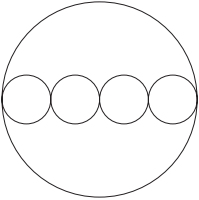
$A$ solid cylinder has a base radius of $14\, cm$ and a height of $15\, cm$. Identical small cylinders are cut from each base as shown in the figure. The height of each small cylinder is $5\, cm$ and the radius is $7\, cm$. What is the total surface area (in $cm^2$) of the remaining part?
A
$3740$
B
$3432$
C
$3124$
D
$42818$
Solution
(B) The total surface area of the remaining part consists of:
$1$. The curved surface area of the original cylinder: $2\pi Rh = 2 \times \frac{22}{7} \times 14 \times 15 = 1320\, cm^2$.
$2$. The area of the two bases of the original cylinder minus the area of the two circular cuts: $2 \times (\pi R^2 - \pi r^2) = 2 \times \pi \times (14^2 - 7^2) = 2 \times \frac{22}{7} \times (196 - 49) = 2 \times \frac{22}{7} \times 147 = 924\, cm^2$.
$3$. The curved surface area of the two small cylinders cut out: $2 \times (2\pi rh) = 2 \times (2 \times \frac{22}{7} \times 7 \times 5) = 880\, cm^2$.
$4$. The area of the inner circular base of the two small cylinders: $2 \times (\pi r^2) = 2 \times \frac{22}{7} \times 7^2 = 308\, cm^2$.
Total surface area = $1320 + 924 + 880 + 308 = 3432\, cm^2$.
$1$. The curved surface area of the original cylinder: $2\pi Rh = 2 \times \frac{22}{7} \times 14 \times 15 = 1320\, cm^2$.
$2$. The area of the two bases of the original cylinder minus the area of the two circular cuts: $2 \times (\pi R^2 - \pi r^2) = 2 \times \pi \times (14^2 - 7^2) = 2 \times \frac{22}{7} \times (196 - 49) = 2 \times \frac{22}{7} \times 147 = 924\, cm^2$.
$3$. The curved surface area of the two small cylinders cut out: $2 \times (2\pi rh) = 2 \times (2 \times \frac{22}{7} \times 7 \times 5) = 880\, cm^2$.
$4$. The area of the inner circular base of the two small cylinders: $2 \times (\pi r^2) = 2 \times \frac{22}{7} \times 7^2 = 308\, cm^2$.
Total surface area = $1320 + 924 + 880 + 308 = 3432\, cm^2$.
0 likes
View Solution158
EasyMCQ
Find the curved surface area (in $cm^{2}$) of a hemisphere of diameter $28\, cm$.
A
$1152$
B
$1024$
C
$956$
D
$1232$
Solution
(D) The diameter of the hemisphere is $d = 28\, cm$.
Therefore,the radius $r = d / 2 = 28 / 2 = 14\, cm$.
The curved surface area $(CSA)$ of a hemisphere is given by the formula $CSA = 2 \pi r^{2}$.
Substituting the values,we get $CSA = 2 \times (22 / 7) \times 14 \times 14$.
$CSA = 2 \times 22 \times 2 \times 14$.
$CSA = 44 \times 28 = 1232\, cm^{2}$.
Therefore,the radius $r = d / 2 = 28 / 2 = 14\, cm$.
The curved surface area $(CSA)$ of a hemisphere is given by the formula $CSA = 2 \pi r^{2}$.
Substituting the values,we get $CSA = 2 \times (22 / 7) \times 14 \times 14$.
$CSA = 2 \times 22 \times 2 \times 14$.
$CSA = 44 \times 28 = 1232\, cm^{2}$.
0 likes
View Solution159
DifficultMCQ
The ratio of the curved surface area and volume of a cylinder is $1:7$. The ratio of the total surface area and volume is $187:770$. What is the ratio of its base radius to its height?
A
$5:8$
B
$4:9$
C
$3:7$
D
$7:10$
Solution
(D) Let the radius be $r$ and the height be $h$.
Curved Surface Area $(CSA)$ $= 2\pi rh$,Volume $(V) = \pi r^2h$.
Given $\frac{2\pi rh}{\pi r^2h} = \frac{1}{7} \Rightarrow \frac{2}{r} = \frac{1}{7} \Rightarrow r = 14$.
Total Surface Area $(TSA)$ $= 2\pi rh + 2\pi r^2 = 2\pi r(h+r)$.
Given $\frac{2\pi r(h+r)}{\pi r^2h} = \frac{187}{770}$.
Substitute $r = 14$:
$\frac{2(h+14)}{14h} = \frac{187}{770} \Rightarrow \frac{h+14}{7h} = \frac{187}{770}$.
$\frac{h+14}{7h} = \frac{17}{70} \Rightarrow 10(h+14) = 17h$.
$10h + 140 = 17h \Rightarrow 7h = 140 \Rightarrow h = 20$.
The ratio of radius to height is $r:h = 14:20 = 7:10$.
Curved Surface Area $(CSA)$ $= 2\pi rh$,Volume $(V) = \pi r^2h$.
Given $\frac{2\pi rh}{\pi r^2h} = \frac{1}{7} \Rightarrow \frac{2}{r} = \frac{1}{7} \Rightarrow r = 14$.
Total Surface Area $(TSA)$ $= 2\pi rh + 2\pi r^2 = 2\pi r(h+r)$.
Given $\frac{2\pi r(h+r)}{\pi r^2h} = \frac{187}{770}$.
Substitute $r = 14$:
$\frac{2(h+14)}{14h} = \frac{187}{770} \Rightarrow \frac{h+14}{7h} = \frac{187}{770}$.
$\frac{h+14}{7h} = \frac{17}{70} \Rightarrow 10(h+14) = 17h$.
$10h + 140 = 17h \Rightarrow 7h = 140 \Rightarrow h = 20$.
The ratio of radius to height is $r:h = 14:20 = 7:10$.
0 likes
View Solution160
MediumMCQ
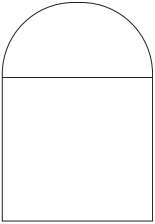
$A$ hemisphere is placed on top of a cube. Its front view is shown in the given figure. The total height of the figure is $221 \ cm$. The ratio of the curved surface area of the hemisphere to the total surface area of the cube is $11:42$. What is the total volume (in $cm^3$) of the figure?
A
$3318.33$
B
$3462.67$
C
$3154.67$
D
$3248.33$
Solution
(B) Let the side of the cube be $a$ and the radius of the hemisphere be $r$. Since the hemisphere is placed on the cube,the diameter of the hemisphere equals the side of the cube,so $2r = a$,or $r = a/2$.
The total height of the figure is $a + r = 221 \ cm$.
Substituting $r = a/2$,we get $a + a/2 = 221$,which implies $3a/2 = 221$,so $a = 442/3 \ cm$ and $r = 221/3 \ cm$.
The curved surface area of the hemisphere is $2\pi r^2$ and the total surface area of the cube is $6a^2$.
The ratio is given as $\frac{2\pi r^2}{6a^2} = \frac{11}{42}$.
Substituting $r = a/2$,we get $\frac{2\pi (a/2)^2}{6a^2} = \frac{2\pi (a^2/4)}{6a^2} = \frac{\pi}{12} = \frac{11}{42}$.
Using $\pi \approx 22/7$,we have $\frac{22/7}{12} = \frac{22}{84} = \frac{11}{42}$,which matches the given ratio.
The total volume $V$ is the sum of the volume of the cube and the hemisphere:
$V = a^3 + \frac{2}{3}\pi r^3 = a^3 + \frac{2}{3}\pi (a/2)^3 = a^3 + \frac{\pi a^3}{12} = a^3(1 + \frac{\pi}{12})$.
Substituting $a = 442/3 \approx 147.33$:
$V = (147.33)^3 \times (1 + \frac{22/7}{12}) = 3198545.6 \times (1 + 0.2619) \approx 4035955 \ cm^3$.
Wait,re-evaluating the height: If $a=14$,$r=7$,height $= 21$. Here height is $221$. If $a=147.33$,the volume is very large. Checking options,it seems the height was meant to be $21 \ cm$. If $a+r=21$,$1.5a=21 \implies a=14, r=7$.
$V = 14^3 + \frac{2}{3} \times \frac{22}{7} \times 7^3 = 2744 + 718.67 = 3462.67 \ cm^3$.
The total height of the figure is $a + r = 221 \ cm$.
Substituting $r = a/2$,we get $a + a/2 = 221$,which implies $3a/2 = 221$,so $a = 442/3 \ cm$ and $r = 221/3 \ cm$.
The curved surface area of the hemisphere is $2\pi r^2$ and the total surface area of the cube is $6a^2$.
The ratio is given as $\frac{2\pi r^2}{6a^2} = \frac{11}{42}$.
Substituting $r = a/2$,we get $\frac{2\pi (a/2)^2}{6a^2} = \frac{2\pi (a^2/4)}{6a^2} = \frac{\pi}{12} = \frac{11}{42}$.
Using $\pi \approx 22/7$,we have $\frac{22/7}{12} = \frac{22}{84} = \frac{11}{42}$,which matches the given ratio.
The total volume $V$ is the sum of the volume of the cube and the hemisphere:
$V = a^3 + \frac{2}{3}\pi r^3 = a^3 + \frac{2}{3}\pi (a/2)^3 = a^3 + \frac{\pi a^3}{12} = a^3(1 + \frac{\pi}{12})$.
Substituting $a = 442/3 \approx 147.33$:
$V = (147.33)^3 \times (1 + \frac{22/7}{12}) = 3198545.6 \times (1 + 0.2619) \approx 4035955 \ cm^3$.
Wait,re-evaluating the height: If $a=14$,$r=7$,height $= 21$. Here height is $221$. If $a=147.33$,the volume is very large. Checking options,it seems the height was meant to be $21 \ cm$. If $a+r=21$,$1.5a=21 \implies a=14, r=7$.
$V = 14^3 + \frac{2}{3} \times \frac{22}{7} \times 7^3 = 2744 + 718.67 = 3462.67 \ cm^3$.
0 likes
View Solution161
MediumMCQ
$10$ identical solid spherical balls of radius $3 \text{ cm}$ are melted to form a single sphere. In this process,$20 \%$ of the solid is wasted. What is the radius (in $\text{cm}$) of the resulting sphere?
A
$24$
B
$12$
C
$8$
D
$6$
Solution
(D) The volume of one spherical ball is $V = \frac{4}{3} \pi r^3$,where $r = 3 \text{ cm}$.
Total volume of $10$ balls $= 10 \times \frac{4}{3} \pi (3)^3 = 10 \times \frac{4}{3} \pi (27) = 360 \pi \text{ cm}^3$.
Since $20 \%$ of the material is wasted,the volume of the new sphere $V_{new}$ is $80 \%$ of the total initial volume.
$V_{new} = 0.80 \times 360 \pi = 288 \pi \text{ cm}^3$.
Let the radius of the new sphere be $R$. Then,$\frac{4}{3} \pi R^3 = 288 \pi$.
Dividing both sides by $\pi$ and multiplying by $\frac{3}{4}$:
$R^3 = 288 \times \frac{3}{4} = 72 \times 3 = 216$.
Taking the cube root of both sides,$R = \sqrt[3]{216} = 6 \text{ cm}$.
Total volume of $10$ balls $= 10 \times \frac{4}{3} \pi (3)^3 = 10 \times \frac{4}{3} \pi (27) = 360 \pi \text{ cm}^3$.
Since $20 \%$ of the material is wasted,the volume of the new sphere $V_{new}$ is $80 \%$ of the total initial volume.
$V_{new} = 0.80 \times 360 \pi = 288 \pi \text{ cm}^3$.
Let the radius of the new sphere be $R$. Then,$\frac{4}{3} \pi R^3 = 288 \pi$.
Dividing both sides by $\pi$ and multiplying by $\frac{3}{4}$:
$R^3 = 288 \times \frac{3}{4} = 72 \times 3 = 216$.
Taking the cube root of both sides,$R = \sqrt[3]{216} = 6 \text{ cm}$.
0 likes
View Solution162
MediumMCQ
$A$ right circular cylinder has a height of $18 \, cm$ and a radius of $7 \, cm$. The cylinder is cut into three equal parts by $2$ cuts parallel to the base. What is the percentage increase in the total surface area (in $\%$)?
A
$62$
B
$56$
C
$48$
D
$52$
Solution
(B) The total surface area $(TSA)$ of the original cylinder is given by $2 \pi r(r + h)$.
Substituting the values: $TSA_{original} = 2 \times \frac{22}{7} \times 7 \times (7 + 18) = 44 \times 25 = 1100 \, cm^2$.
When the cylinder is cut into $3$ equal parts by $2$ cuts parallel to the base,each new cylinder has a height of $h' = \frac{18}{3} = 6 \, cm$ and the same radius $r = 7 \, cm$.
The $TSA$ of one smaller cylinder is $2 \pi r(r + h') = 2 \times \frac{22}{7} \times 7 \times (7 + 6) = 44 \times 13 = 572 \, cm^2$.
The total surface area of the $3$ smaller cylinders is $3 \times 572 = 1716 \, cm^2$.
The increase in surface area is $1716 - 1100 = 616 \, cm^2$.
The percentage increase is $\frac{616}{1100} \times 100 = 56 \%$.
Substituting the values: $TSA_{original} = 2 \times \frac{22}{7} \times 7 \times (7 + 18) = 44 \times 25 = 1100 \, cm^2$.
When the cylinder is cut into $3$ equal parts by $2$ cuts parallel to the base,each new cylinder has a height of $h' = \frac{18}{3} = 6 \, cm$ and the same radius $r = 7 \, cm$.
The $TSA$ of one smaller cylinder is $2 \pi r(r + h') = 2 \times \frac{22}{7} \times 7 \times (7 + 6) = 44 \times 13 = 572 \, cm^2$.
The total surface area of the $3$ smaller cylinders is $3 \times 572 = 1716 \, cm^2$.
The increase in surface area is $1716 - 1100 = 616 \, cm^2$.
The percentage increase is $\frac{616}{1100} \times 100 = 56 \%$.
0 likes
View Solution163
MediumMCQ
The radius of the base of a hollow cone is $8\, cm$ and its height is $15\, cm$. $A$ sphere of the largest possible radius is placed inside the cone. What is the ratio of the radius of the base of the cone to the radius of the sphere?
A
$5:3$
B
$4:1$
C
$2:1$
D
$7:3$
Solution
(A) Let the radius of the base of the cone be $R = 8\, cm$ and the height be $H = 15\, cm$.
The slant height $L$ of the cone is given by $L = \sqrt{R^2 + H^2} = \sqrt{8^2 + 15^2} = \sqrt{64 + 225} = \sqrt{289} = 17\, cm$.
Let $r$ be the radius of the largest sphere that can be inscribed in the cone.
The formula for the radius of the inscribed sphere in a cone is $r = \frac{R \cdot H}{R + L}$.
Substituting the values: $r = \frac{8 \cdot 15}{8 + 17} = \frac{120}{25} = 4.8\, cm$.
We need to find the ratio of the radius of the base of the cone $(R)$ to the radius of the sphere $(r)$:
Ratio $= R : r = 8 : 4.8$.
To simplify,multiply both sides by $10$: $80 : 48$.
Divide by $16$: $80/16 : 48/16 = 5 : 3$.
Thus,the ratio is $5:3$.
The slant height $L$ of the cone is given by $L = \sqrt{R^2 + H^2} = \sqrt{8^2 + 15^2} = \sqrt{64 + 225} = \sqrt{289} = 17\, cm$.
Let $r$ be the radius of the largest sphere that can be inscribed in the cone.
The formula for the radius of the inscribed sphere in a cone is $r = \frac{R \cdot H}{R + L}$.
Substituting the values: $r = \frac{8 \cdot 15}{8 + 17} = \frac{120}{25} = 4.8\, cm$.
We need to find the ratio of the radius of the base of the cone $(R)$ to the radius of the sphere $(r)$:
Ratio $= R : r = 8 : 4.8$.
To simplify,multiply both sides by $10$: $80 : 48$.
Divide by $16$: $80/16 : 48/16 = 5 : 3$.
Thus,the ratio is $5:3$.
0 likes
View Solution164
EasyMCQ
The total surface area of a hemisphere is $41.58 \text{ cm}^2$. Find its curved surface area (in $\text{cm}^2$).
A
$27.72$
B
$55.44$
C
$9.24$
D
$13.86$
Solution
(A) The total surface area $(TSA)$ of a hemisphere is given by the formula $TSA = 3\pi r^2$.
Given $TSA = 41.58 \text{ cm}^2$,we have $3\pi r^2 = 41.58$.
Dividing both sides by $3$,we get $\pi r^2 = \frac{41.58}{3} = 13.86 \text{ cm}^2$.
The curved surface area $(CSA)$ of a hemisphere is given by the formula $CSA = 2\pi r^2$.
Substituting the value of $\pi r^2$,we get $CSA = 2 \times 13.86 = 27.72 \text{ cm}^2$.
Given $TSA = 41.58 \text{ cm}^2$,we have $3\pi r^2 = 41.58$.
Dividing both sides by $3$,we get $\pi r^2 = \frac{41.58}{3} = 13.86 \text{ cm}^2$.
The curved surface area $(CSA)$ of a hemisphere is given by the formula $CSA = 2\pi r^2$.
Substituting the value of $\pi r^2$,we get $CSA = 2 \times 13.86 = 27.72 \text{ cm}^2$.
0 likes
View Solution165
EasyMCQ
What is the curved surface area (in $cm^2$) of a cylinder having radius of base as $14 \, cm$ and height as $10 \, cm$?
A
$440$
B
$880$
C
$220$
D
$1320$
Solution
(B) The formula for the curved surface area $(CSA)$ of a cylinder is given by $CSA = 2 \pi rh$.
Given radius $r = 14 \, cm$ and height $h = 10 \, cm$.
Using $\pi = \frac{22}{7}$,we substitute the values:
$CSA = 2 \times \frac{22}{7} \times 14 \times 10$
$CSA = 2 \times 22 \times 2 \times 10$
$CSA = 880 \, cm^2$.
Given radius $r = 14 \, cm$ and height $h = 10 \, cm$.
Using $\pi = \frac{22}{7}$,we substitute the values:
$CSA = 2 \times \frac{22}{7} \times 14 \times 10$
$CSA = 2 \times 22 \times 2 \times 10$
$CSA = 880 \, cm^2$.
0 likes
View Solution166
MediumMCQ
The perimeter of the base of a right circular cone is $132 \, cm$. If the height of the cone is $72 \, cm$,then what is the total surface area (in $cm^2$) of the cone?
A
$6600$
B
$6336$
C
$4224$
D
$5784$
Solution
(B) The perimeter of the base of a right circular cone is given by $2 \pi r = 132 \, cm$.
Using $\pi = \frac{22}{7}$,we have $2 \times \frac{22}{7} \times r = 132$.
$r = \frac{132 \times 7}{44} = 21 \, cm$.
The slant height $l$ is given by $l = \sqrt{h^2 + r^2} = \sqrt{72^2 + 21^2} = \sqrt{5184 + 441} = \sqrt{5625} = 75 \, cm$.
The total surface area $(TSA)$ of the cone is $\pi r(l + r)$.
$TSA = \frac{22}{7} \times 21 \times (75 + 21) = 22 \times 3 \times 96 = 66 \times 96 = 6336 \, cm^2$.
Using $\pi = \frac{22}{7}$,we have $2 \times \frac{22}{7} \times r = 132$.
$r = \frac{132 \times 7}{44} = 21 \, cm$.
The slant height $l$ is given by $l = \sqrt{h^2 + r^2} = \sqrt{72^2 + 21^2} = \sqrt{5184 + 441} = \sqrt{5625} = 75 \, cm$.
The total surface area $(TSA)$ of the cone is $\pi r(l + r)$.
$TSA = \frac{22}{7} \times 21 \times (75 + 21) = 22 \times 3 \times 96 = 66 \times 96 = 6336 \, cm^2$.
0 likes
View Solution167
MediumMCQ
$A$ solid right circular cone of radius $4\, cm$ and height $7\, cm$ is placed inside a cylindrical vessel of radius $5\, cm$ and height $8\, cm$. How much water (in $cm^3$) will be required to fill the cylindrical vessel completely?
A
$1022.48$
B
$1533.72$
C
$511.24$
D
$255.62$
Solution
(C) Volume of the cylindrical vessel $V_{cyl} = \pi r_1^2 h_1 = \pi \times 5^2 \times 8 = 200\pi\, cm^3$.
Volume of the solid cone $V_{cone} = \frac{1}{3} \pi r_2^2 h_2 = \frac{1}{3} \times \pi \times 4^2 \times 7 = \frac{112}{3}\pi\, cm^3$.
Volume of water required = $V_{cyl} - V_{cone} = 200\pi - \frac{112}{3}\pi = \frac{600\pi - 112\pi}{3} = \frac{488}{3}\pi\, cm^3$.
Using $\pi \approx 3.14159$,Volume $\approx \frac{488}{3} \times 3.14159 \approx 162.666 \times 3.14159 \approx 511.03\, cm^3$.
Given the options provided,the closest value is $511.24\, cm^3$.
Volume of the solid cone $V_{cone} = \frac{1}{3} \pi r_2^2 h_2 = \frac{1}{3} \times \pi \times 4^2 \times 7 = \frac{112}{3}\pi\, cm^3$.
Volume of water required = $V_{cyl} - V_{cone} = 200\pi - \frac{112}{3}\pi = \frac{600\pi - 112\pi}{3} = \frac{488}{3}\pi\, cm^3$.
Using $\pi \approx 3.14159$,Volume $\approx \frac{488}{3} \times 3.14159 \approx 162.666 \times 3.14159 \approx 511.03\, cm^3$.
Given the options provided,the closest value is $511.24\, cm^3$.
0 likes
View Solution168
MediumMCQ
The cross section of a canal is in the shape of an isosceles trapezium which is $4 \ m$ wide at the bottom and $5 \ m$ wide at the top. If the depth of the canal is $2 \ m$ and it is $120 \ m$ long,what is the maximum capacity of this canal? (in $m^3$)
A
$2160$
B
$3240$
C
$4320$
D
$1080$
Solution
(D) The maximum capacity of the canal is equal to the volume of the canal,which is the product of the area of the cross-section and the length of the canal.
The cross-section is an isosceles trapezium with parallel sides $a = 4 \ m$ and $b = 5 \ m$,and height (depth) $h = 2 \ m$.
Area of trapezium $= \frac{1}{2} \times (a + b) \times h$
Area $= \frac{1}{2} \times (4 + 5) \times 2 = 9 \ m^2$
Volume (Capacity) $= \text{Area} \times \text{Length} = 9 \times 120 = 1080 \ m^3$.
The cross-section is an isosceles trapezium with parallel sides $a = 4 \ m$ and $b = 5 \ m$,and height (depth) $h = 2 \ m$.
Area of trapezium $= \frac{1}{2} \times (a + b) \times h$
Area $= \frac{1}{2} \times (4 + 5) \times 2 = 9 \ m^2$
Volume (Capacity) $= \text{Area} \times \text{Length} = 9 \times 120 = 1080 \ m^3$.
0 likes
View Solution169
MediumMCQ
The curved surface area of a hemisphere is $27.72 \text{ cm}^2$ and its volume is $19.404 \text{ cm}^3$. Find its radius in $\text{cm}$.
A
$4.2$
B
$2.1$
C
$0.7$
D
$1.05$
Solution
(B) The formula for the curved surface area $(CSA)$ of a hemisphere is $2 \pi r^2$.
Given $CSA = 27.72 \text{ cm}^2$.
$2 \times \frac{22}{7} \times r^2 = 27.72$
$r^2 = \frac{27.72 \times 7}{44} = 0.63 \times 7 = 4.41$
$r = \sqrt{4.41} = 2.1 \text{ cm}$.
To verify with volume: The formula for the volume $(V)$ of a hemisphere is $\frac{2}{3} \pi r^3$.
$V = \frac{2}{3} \times \frac{22}{7} \times (2.1)^3 = \frac{2}{3} \times \frac{22}{7} \times 9.261 = 44 \times 0.441 = 19.404 \text{ cm}^3$.
Since both conditions are satisfied,the radius is $2.1 \text{ cm}$.
Given $CSA = 27.72 \text{ cm}^2$.
$2 \times \frac{22}{7} \times r^2 = 27.72$
$r^2 = \frac{27.72 \times 7}{44} = 0.63 \times 7 = 4.41$
$r = \sqrt{4.41} = 2.1 \text{ cm}$.
To verify with volume: The formula for the volume $(V)$ of a hemisphere is $\frac{2}{3} \pi r^3$.
$V = \frac{2}{3} \times \frac{22}{7} \times (2.1)^3 = \frac{2}{3} \times \frac{22}{7} \times 9.261 = 44 \times 0.441 = 19.404 \text{ cm}^3$.
Since both conditions are satisfied,the radius is $2.1 \text{ cm}$.
0 likes
View Solution170
DifficultMCQ
What is the volume (in $cm^{3}$) of a right pyramid of height $12\, cm$ and having a square base whose diagonal is $6\sqrt{2}\, cm$?
A
$864$
B
$432$
C
$144$
D
$288$
Solution
(C) The diagonal of the square base is given as $d = 6\sqrt{2}\, cm$.
Since the diagonal of a square with side $a$ is $d = a\sqrt{2}$,we have $a\sqrt{2} = 6\sqrt{2}$,which gives $a = 6\, cm$.
The area of the square base is $A = a^{2} = 6^{2} = 36\, cm^{2}$.
The volume $V$ of a pyramid is given by the formula $V = \frac{1}{3} \times \text{Area of base} \times \text{height}$.
Substituting the given values,$V = \frac{1}{3} \times 36 \times 12$.
$V = 12 \times 12 = 144\, cm^{3}$.
Since the diagonal of a square with side $a$ is $d = a\sqrt{2}$,we have $a\sqrt{2} = 6\sqrt{2}$,which gives $a = 6\, cm$.
The area of the square base is $A = a^{2} = 6^{2} = 36\, cm^{2}$.
The volume $V$ of a pyramid is given by the formula $V = \frac{1}{3} \times \text{Area of base} \times \text{height}$.
Substituting the given values,$V = \frac{1}{3} \times 36 \times 12$.
$V = 12 \times 12 = 144\, cm^{3}$.
0 likes
View Solution171
MediumMCQ
$A$ solid cone of height $24 \, cm$ and base radius $8 \, cm$ is melted to form a solid cylinder of radius $6 \, cm$ and height $6 \, cm$. In the whole process,what percent of material is wasted (in $\%$)?
A
$48.5$
B
$37.5$
C
$57.8$
D
$64$
Solution
(C) The volume of the solid cone is given by $V_{cone} = \frac{1}{3} \pi r_1^2 h_1 = \frac{1}{3} \times \pi \times 8^2 \times 24 = 512 \pi \, cm^3$.
The volume of the solid cylinder formed is $V_{cylinder} = \pi r_2^2 h_2 = \pi \times 6^2 \times 6 = 216 \pi \, cm^3$.
The volume of material wasted is $V_{wasted} = V_{cone} - V_{cylinder} = 512 \pi - 216 \pi = 296 \pi \, cm^3$.
The percentage of material wasted is $\frac{V_{wasted}}{V_{cone}} \times 100 = \frac{296 \pi}{512 \pi} \times 100 = \frac{296}{512} \times 100 = 57.8125 \% \approx 57.8 \%$.
The volume of the solid cylinder formed is $V_{cylinder} = \pi r_2^2 h_2 = \pi \times 6^2 \times 6 = 216 \pi \, cm^3$.
The volume of material wasted is $V_{wasted} = V_{cone} - V_{cylinder} = 512 \pi - 216 \pi = 296 \pi \, cm^3$.
The percentage of material wasted is $\frac{V_{wasted}}{V_{cone}} \times 100 = \frac{296 \pi}{512 \pi} \times 100 = \frac{296}{512} \times 100 = 57.8125 \% \approx 57.8 \%$.
0 likes
View Solution172
MediumMCQ
$A$ solid cylinder having a radius of base as $7 \, cm$ and length as $20 \, cm$ is bisected along its height to get two identical cylinders. What will be the percentage increase in the total surface area?
A
$29.28$
B
$25.93$
C
$27.62$
D
$32.83$
Solution
(B) The total surface area $(TSA)$ of the original solid cylinder is given by the formula: $TSA = 2 \pi r(r + h)$.
Substituting the values $r = 7 \, cm$ and $h = 20 \, cm$:
$TSA_{original} = 2 \times \frac{22}{7} \times 7 \times (7 + 20) = 44 \times 27 = 1188 \, cm^2$.
When the cylinder is bisected along its height,we get two identical cylinders,each with height $h' = \frac{20}{2} = 10 \, cm$.
Each new cylinder has a $TSA$ of: $TSA_{new} = 2 \pi r(r + h') = 2 \times \frac{22}{7} \times 7 \times (7 + 10) = 44 \times 17 = 748 \, cm^2$.
The total surface area of the two new cylinders combined is: $2 \times 748 = 1496 \, cm^2$.
The increase in surface area is: $1496 - 1188 = 308 \, cm^2$.
The percentage increase is: $\frac{308}{1188} \times 100 \approx 25.93 \%$.
Substituting the values $r = 7 \, cm$ and $h = 20 \, cm$:
$TSA_{original} = 2 \times \frac{22}{7} \times 7 \times (7 + 20) = 44 \times 27 = 1188 \, cm^2$.
When the cylinder is bisected along its height,we get two identical cylinders,each with height $h' = \frac{20}{2} = 10 \, cm$.
Each new cylinder has a $TSA$ of: $TSA_{new} = 2 \pi r(r + h') = 2 \times \frac{22}{7} \times 7 \times (7 + 10) = 44 \times 17 = 748 \, cm^2$.
The total surface area of the two new cylinders combined is: $2 \times 748 = 1496 \, cm^2$.
The increase in surface area is: $1496 - 1188 = 308 \, cm^2$.
The percentage increase is: $\frac{308}{1188} \times 100 \approx 25.93 \%$.
0 likes
View Solution173
DifficultMCQ
Three spherical balls of radius $2 \, cm$,$4 \, cm$,and $6 \, cm$ are melted to form a new spherical ball. In this process,there is a loss of $25 \%$ of the material. What is the radius (in $cm$) of the new ball?
A
$6$
B
$8$
C
$12$
D
$16$
Solution
(A) The volume of a sphere is given by $V = \frac{4}{3} \pi r^3$.
Total volume of the three spheres $= \frac{4}{3} \pi (2^3 + 4^3 + 6^3) = \frac{4}{3} \pi (8 + 64 + 216) = \frac{4}{3} \pi (288) = 384 \pi \, cm^3$.
Since $25 \%$ of the material is lost,the volume of the new sphere is $75 \%$ of the total initial volume.
Volume of the new sphere $= 0.75 \times 384 \pi = 288 \pi \, cm^3$.
Let the radius of the new sphere be $R$. Then,$\frac{4}{3} \pi R^3 = 288 \pi$.
$R^3 = 288 \times \frac{3}{4} = 72 \times 3 = 216$.
$R = \sqrt[3]{216} = 6 \, cm$.
Total volume of the three spheres $= \frac{4}{3} \pi (2^3 + 4^3 + 6^3) = \frac{4}{3} \pi (8 + 64 + 216) = \frac{4}{3} \pi (288) = 384 \pi \, cm^3$.
Since $25 \%$ of the material is lost,the volume of the new sphere is $75 \%$ of the total initial volume.
Volume of the new sphere $= 0.75 \times 384 \pi = 288 \pi \, cm^3$.
Let the radius of the new sphere be $R$. Then,$\frac{4}{3} \pi R^3 = 288 \pi$.
$R^3 = 288 \times \frac{3}{4} = 72 \times 3 = 216$.
$R = \sqrt[3]{216} = 6 \, cm$.
0 likes
View Solution174
MediumMCQ
$A$ solid cone of height $36 \, cm$ and radius of base $9 \, cm$ is melted to form a solid cylinder of radius $9 \, cm$ and height $9 \, cm$. What percent of material is wasted in this process (in $\%$)?
A
$25$
B
$0$
C
$5$
D
$10$
Solution
(A) Volume of the cone $V_1 = \frac{1}{3} \pi r_1^2 h_1 = \frac{1}{3} \pi (9)^2 (36) = \frac{1}{3} \pi (81) (36) = 972 \pi \, cm^3$.
Volume of the cylinder $V_2 = \pi r_2^2 h_2 = \pi (9)^2 (9) = 729 \pi \, cm^3$.
Volume of material wasted $= V_1 - V_2 = 972 \pi - 729 \pi = 243 \pi \, cm^3$.
Percentage of material wasted $= \left( \frac{\text{Volume wasted}}{\text{Original volume}} \right) \times 100 = \left( \frac{243 \pi}{972 \pi} \right) \times 100$.
$= \frac{1}{4} \times 100 = 25 \%$.
Volume of the cylinder $V_2 = \pi r_2^2 h_2 = \pi (9)^2 (9) = 729 \pi \, cm^3$.
Volume of material wasted $= V_1 - V_2 = 972 \pi - 729 \pi = 243 \pi \, cm^3$.
Percentage of material wasted $= \left( \frac{\text{Volume wasted}}{\text{Original volume}} \right) \times 100 = \left( \frac{243 \pi}{972 \pi} \right) \times 100$.
$= \frac{1}{4} \times 100 = 25 \%$.
0 likes
View Solution175
EasyMCQ
The radius of a wheel is $3.5 \, cm$. What is the distance (in $cm$) travelled by the wheel in $20$ revolutions?
A
$220$
B
$440$
C
$880$
D
$1320$
Solution
(B) The circumference of a wheel is the distance it covers in one complete revolution,given by the formula $C = 2 \pi r$.
Given the radius $r = 3.5 \, cm$,the circumference is:
$C = 2 \times \frac{22}{7} \times 3.5 = 2 \times 22 \times 0.5 = 22 \, cm$.
To find the total distance covered in $20$ revolutions,we multiply the circumference by the number of revolutions:
$\text{Total Distance} = \text{Circumference} \times \text{Number of revolutions} = 22 \, cm \times 20 = 440 \, cm$.
Given the radius $r = 3.5 \, cm$,the circumference is:
$C = 2 \times \frac{22}{7} \times 3.5 = 2 \times 22 \times 0.5 = 22 \, cm$.
To find the total distance covered in $20$ revolutions,we multiply the circumference by the number of revolutions:
$\text{Total Distance} = \text{Circumference} \times \text{Number of revolutions} = 22 \, cm \times 20 = 440 \, cm$.
0 likes
View Solution176
EasyMCQ
What is the length (in metre) of the longest rod that can be placed in a room which is $2$ $metre$ long,$2$ $metre$ broad,and $6$ $metre$ high?
A
$8$
B
$2 \sqrt{11}$
C
$3 \sqrt{11}$
D
$10$
Solution
(B) The longest rod that can be placed in a room is equal to the length of the space diagonal of the cuboid.
The formula for the space diagonal of a cuboid is $\sqrt{l^2 + b^2 + h^2}$,where $l$ is length,$b$ is breadth,and $h$ is height.
Given: $l = 2 \text{ m}$,$b = 2 \text{ m}$,$h = 6 \text{ m}$.
Longest Rod $= \sqrt{2^2 + 2^2 + 6^2}$
$= \sqrt{4 + 4 + 36}$
$= \sqrt{44}$
$= \sqrt{4 \times 11}$
$= 2 \sqrt{11} \text{ m}$.
The formula for the space diagonal of a cuboid is $\sqrt{l^2 + b^2 + h^2}$,where $l$ is length,$b$ is breadth,and $h$ is height.
Given: $l = 2 \text{ m}$,$b = 2 \text{ m}$,$h = 6 \text{ m}$.
Longest Rod $= \sqrt{2^2 + 2^2 + 6^2}$
$= \sqrt{4 + 4 + 36}$
$= \sqrt{44}$
$= \sqrt{4 \times 11}$
$= 2 \sqrt{11} \text{ m}$.
0 likes
View Solution177
EasyMCQ
The radius of a wheel is $21 \, cm$. What is the distance (in $cm$) travelled by the wheel in $10$ revolutions?
A
$660$
B
$1320$
C
$1980$
D
$2640$
Solution
(B) The distance covered by a wheel in one revolution is equal to its circumference.
Circumference of the wheel $= 2 \pi r$
Given,radius $r = 21 \, cm$.
Circumference $= 2 \times \frac{22}{7} \times 21 = 2 \times 22 \times 3 = 132 \, cm$.
Distance travelled in $10$ revolutions $= 10 \times (\text{Circumference})$
$= 10 \times 132 = 1320 \, cm$.
Circumference of the wheel $= 2 \pi r$
Given,radius $r = 21 \, cm$.
Circumference $= 2 \times \frac{22}{7} \times 21 = 2 \times 22 \times 3 = 132 \, cm$.
Distance travelled in $10$ revolutions $= 10 \times (\text{Circumference})$
$= 10 \times 132 = 1320 \, cm$.
0 likes
View Solution178
EasyMCQ
$A$ right circular cylindrical tunnel of diameter $5\, m$ and length $10\, m$ is to be constructed from a sheet of iron. The area of iron sheet required will be..........$\pi\, m^2$.
A
$52$
B
$50$
C
$51$
D
$49$
Solution
(B) The tunnel is a right circular cylinder. The area of the iron sheet required is equal to the curved surface area of the cylinder.
Given: Diameter $d = 5\, m$,so radius $r = d/2 = 2.5\, m$.
Length (height) $h = 10\, m$.
Curved Surface Area $= 2\pi rh$.
Substituting the values: Area $= 2 \times \pi \times 2.5 \times 10 = 50\pi\, m^2$.
Thus,the required area is $50\pi\, m^2$.
Given: Diameter $d = 5\, m$,so radius $r = d/2 = 2.5\, m$.
Length (height) $h = 10\, m$.
Curved Surface Area $= 2\pi rh$.
Substituting the values: Area $= 2 \times \pi \times 2.5 \times 10 = 50\pi\, m^2$.
Thus,the required area is $50\pi\, m^2$.
0 likes
View Solution179
MediumMCQ
$A$ rectangular water tank is $80 \, m \times 40 \, m$. Water flows into it through a pipe with an opening area of $40 \, cm^2$ at a speed of $10 \, km/h$. By how much will the water level in the tank rise in half an hour (in $cm$)?
A
$3/2$
B
$4/9$
C
$5/9$
D
$5/8$
Solution
(D) $1$. Convert all units to meters and hours:
Area of the tank base = $80 \, m \times 40 \, m = 3200 \, m^2$.
Area of pipe opening = $40 \, cm^2 = 40 \times 10^{-4} \, m^2 = 0.004 \, m^2$.
Speed of water = $10 \, km/h = 10000 \, m/h$.
Time = $0.5 \, h$.
$2$. Volume of water entering the tank in $0.5 \, h$:
Volume = $\text{Area of pipe} \times \text{Speed} \times \text{Time} = 0.004 \, m^2 \times 10000 \, m/h \times 0.5 \, h = 20 \, m^3$.
$3$. Calculate the rise in water level $(h)$:
Volume = $\text{Base Area} \times h$
$20 \, m^3 = 3200 \, m^2 \times h$
$h = 20 / 3200 \, m = 1 / 160 \, m$.
$4$. Convert $h$ to $cm$:
$h = (1 / 160) \times 100 \, cm = 100 / 160 \, cm = 5/8 \, cm$.
Area of the tank base = $80 \, m \times 40 \, m = 3200 \, m^2$.
Area of pipe opening = $40 \, cm^2 = 40 \times 10^{-4} \, m^2 = 0.004 \, m^2$.
Speed of water = $10 \, km/h = 10000 \, m/h$.
Time = $0.5 \, h$.
$2$. Volume of water entering the tank in $0.5 \, h$:
Volume = $\text{Area of pipe} \times \text{Speed} \times \text{Time} = 0.004 \, m^2 \times 10000 \, m/h \times 0.5 \, h = 20 \, m^3$.
$3$. Calculate the rise in water level $(h)$:
Volume = $\text{Base Area} \times h$
$20 \, m^3 = 3200 \, m^2 \times h$
$h = 20 / 3200 \, m = 1 / 160 \, m$.
$4$. Convert $h$ to $cm$:
$h = (1 / 160) \times 100 \, cm = 100 / 160 \, cm = 5/8 \, cm$.
0 likes
View Solution180
DifficultMCQ
$A$ right circular cylinder having diameter $21\, cm$ and height $38\, cm$ is full of ice cream. The ice cream is to be filled in cones of height $12\, cm$ and diameter $7\, cm$ having a hemispherical shape on the top. The number of such cones to be filled with ice cream is
A
$54$
B
$44$
C
$36$
D
$24$
Solution
(A) Volume of the cylinder $= \pi R^2 H = \pi \times (10.5)^2 \times 38 = \pi \times 110.25 \times 38 = 4189.5\pi\, cm^3$.
Volume of one ice cream cone (cone + hemisphere) $= \frac{1}{3}\pi r^2 h + \frac{2}{3}\pi r^3$.
Given $r = 3.5\, cm$ and $h = 12\, cm$.
Volume $= \frac{1}{3}\pi (3.5)^2 (12) + \frac{2}{3}\pi (3.5)^3 = \pi (12.25 \times 4) + \pi (2 \times 14.2916) \approx 49\pi + 28.583\pi = 77.583\pi\, cm^3$.
Alternatively,using fractions: Volume $= \frac{1}{3}\pi (\frac{7}{2})^2 (12) + \frac{2}{3}\pi (\frac{7}{2})^3 = \pi (49) + \pi (\frac{343}{12}) = \pi (\frac{588+343}{12}) = \frac{931}{12}\pi\, cm^3$.
Number of cones $= \frac{\text{Volume of cylinder}}{\text{Volume of one cone}} = \frac{4189.5\pi}{931\pi / 12} = \frac{4189.5 \times 12}{931} = \frac{50274}{931} = 54$.
Volume of one ice cream cone (cone + hemisphere) $= \frac{1}{3}\pi r^2 h + \frac{2}{3}\pi r^3$.
Given $r = 3.5\, cm$ and $h = 12\, cm$.
Volume $= \frac{1}{3}\pi (3.5)^2 (12) + \frac{2}{3}\pi (3.5)^3 = \pi (12.25 \times 4) + \pi (2 \times 14.2916) \approx 49\pi + 28.583\pi = 77.583\pi\, cm^3$.
Alternatively,using fractions: Volume $= \frac{1}{3}\pi (\frac{7}{2})^2 (12) + \frac{2}{3}\pi (\frac{7}{2})^3 = \pi (49) + \pi (\frac{343}{12}) = \pi (\frac{588+343}{12}) = \frac{931}{12}\pi\, cm^3$.
Number of cones $= \frac{\text{Volume of cylinder}}{\text{Volume of one cone}} = \frac{4189.5\pi}{931\pi / 12} = \frac{4189.5 \times 12}{931} = \frac{50274}{931} = 54$.
0 likes
View Solution181
EasyMCQ
$A$ spherical aquarium can accommodate $11$ fishes,and each fish requires $1.54 \, m^3$ of water. What is the volume of the aquarium? (in $m^3$)
A
$11.24$
B
$16.94$
C
$10.25$
D
$17.84$
Solution
(B) The total volume of the aquarium is equal to the product of the number of fishes and the volume of water required per fish.
Given:
Number of fishes $= 11$
Volume required per fish $= 1.54 \, m^3$
Total Volume $= 11 \times 1.54 \, m^3$
Total Volume $= 16.94 \, m^3$
Given:
Number of fishes $= 11$
Volume required per fish $= 1.54 \, m^3$
Total Volume $= 11 \times 1.54 \, m^3$
Total Volume $= 16.94 \, m^3$
0 likes
View Solution182
MediumMCQ
$A$ prism with a right triangular base is $25\, cm$ high. If the shorter sides of the triangle are in the ratio of $1: 2$ and the volume of the prism is $100\, cm^3$, what is the length of the longest side of the triangle?
A
$\sqrt{5}\, cm$
B
$2\sqrt{5}\, cm$
C
$5\sqrt{2}\, cm$
D
$5\, cm$
Solution
(B) The volume of a prism is given by $V = \text{Area of base} \times \text{height}$.
Given $V = 100\, cm^3$ and height $h = 25\, cm$.
Therefore, $\text{Area of base} = \frac{V}{h} = \frac{100}{25} = 4\, cm^2$.
The base is a right-angled triangle. Let the shorter sides be $x$ and $2x$.
The area of the right-angled triangle is $\frac{1}{2} \times \text{base} \times \text{height} = \frac{1}{2} \times x \times 2x = x^2$.
Equating the area, $x^2 = 4$, which gives $x = 2\, cm$.
The sides of the triangle are $x = 2\, cm$ and $2x = 4\, cm$.
The longest side (hypotenuse) is $\sqrt{x^2 + (2x)^2} = \sqrt{2^2 + 4^2} = \sqrt{4 + 16} = \sqrt{20} = 2\sqrt{5}\, cm$.
Given $V = 100\, cm^3$ and height $h = 25\, cm$.
Therefore, $\text{Area of base} = \frac{V}{h} = \frac{100}{25} = 4\, cm^2$.
The base is a right-angled triangle. Let the shorter sides be $x$ and $2x$.
The area of the right-angled triangle is $\frac{1}{2} \times \text{base} \times \text{height} = \frac{1}{2} \times x \times 2x = x^2$.
Equating the area, $x^2 = 4$, which gives $x = 2\, cm$.
The sides of the triangle are $x = 2\, cm$ and $2x = 4\, cm$.
The longest side (hypotenuse) is $\sqrt{x^2 + (2x)^2} = \sqrt{2^2 + 4^2} = \sqrt{4 + 16} = \sqrt{20} = 2\sqrt{5}\, cm$.
0 likes
View Solution183
MediumMCQ
$A$ hollow hemispherical bowl is made of silver with its outer radius $8\, cm$ and inner radius $4\, cm$. The bowl is melted to form a solid right circular cone of radius $8\, cm$. The height of the cone formed is......$cm$
A
$7$
B
$9$
C
$12$
D
$14$
Solution
(D) The volume of a hollow hemispherical bowl is given by the formula $V = \frac{2}{3} \pi (R^3 - r^3)$,where $R$ is the outer radius and $r$ is the inner radius.
Given $R = 8\, cm$ and $r = 4\, cm$,the volume is $V = \frac{2}{3} \pi (8^3 - 4^3) = \frac{2}{3} \pi (512 - 64) = \frac{2}{3} \pi (448) = \frac{896}{3} \pi\, cm^3$.
When the bowl is melted to form a solid right circular cone,the volume remains constant.
The volume of a cone is $V = \frac{1}{3} \pi r_c^2 h$,where $r_c = 8\, cm$ is the radius of the cone and $h$ is its height.
Equating the volumes: $\frac{896}{3} \pi = \frac{1}{3} \pi (8^2) h$.
$\frac{896}{3} = \frac{64}{3} h$.
$896 = 64h$.
$h = \frac{896}{64} = 14\, cm$.
Given $R = 8\, cm$ and $r = 4\, cm$,the volume is $V = \frac{2}{3} \pi (8^3 - 4^3) = \frac{2}{3} \pi (512 - 64) = \frac{2}{3} \pi (448) = \frac{896}{3} \pi\, cm^3$.
When the bowl is melted to form a solid right circular cone,the volume remains constant.
The volume of a cone is $V = \frac{1}{3} \pi r_c^2 h$,where $r_c = 8\, cm$ is the radius of the cone and $h$ is its height.
Equating the volumes: $\frac{896}{3} \pi = \frac{1}{3} \pi (8^2) h$.
$\frac{896}{3} = \frac{64}{3} h$.
$896 = 64h$.
$h = \frac{896}{64} = 14\, cm$.
0 likes
View Solution184
MediumMCQ
$A$ solid sphere and a solid hemisphere have the same total surface area. The ratio of their volumes is
A
$3 \sqrt{3} : 4$
B
$4 : 3 \sqrt{3}$
C
$3 : 4 \sqrt{3}$
D
$1 : 12 \sqrt{3}$
Solution
(A) Let the radius of the solid sphere be $r_1$ and the radius of the solid hemisphere be $r_2$.
Total Surface Area $(TSA)$ of a sphere $= 4 \pi r_1^2$.
Total Surface Area $(TSA)$ of a hemisphere $= 3 \pi r_2^2$.
Given that their total surface areas are equal:
$4 \pi r_1^2 = 3 \pi r_2^2$
$\frac{r_1^2}{r_2^2} = \frac{3}{4}$
$\frac{r_1}{r_2} = \frac{\sqrt{3}}{2}$.
Now,the ratio of their volumes is:
$\frac{V_{\text{sphere}}}{V_{\text{hemisphere}}} = \frac{\frac{4}{3} \pi r_1^3}{\frac{2}{3} \pi r_2^3} = 2 \times \left(\frac{r_1}{r_2}\right)^3$.
Substituting the ratio $\frac{r_1}{r_2} = \frac{\sqrt{3}}{2}$:
Ratio $= 2 \times \left(\frac{\sqrt{3}}{2}\right)^3 = 2 \times \frac{3 \sqrt{3}}{8} = \frac{3 \sqrt{3}}{4}$.
Total Surface Area $(TSA)$ of a sphere $= 4 \pi r_1^2$.
Total Surface Area $(TSA)$ of a hemisphere $= 3 \pi r_2^2$.
Given that their total surface areas are equal:
$4 \pi r_1^2 = 3 \pi r_2^2$
$\frac{r_1^2}{r_2^2} = \frac{3}{4}$
$\frac{r_1}{r_2} = \frac{\sqrt{3}}{2}$.
Now,the ratio of their volumes is:
$\frac{V_{\text{sphere}}}{V_{\text{hemisphere}}} = \frac{\frac{4}{3} \pi r_1^3}{\frac{2}{3} \pi r_2^3} = 2 \times \left(\frac{r_1}{r_2}\right)^3$.
Substituting the ratio $\frac{r_1}{r_2} = \frac{\sqrt{3}}{2}$:
Ratio $= 2 \times \left(\frac{\sqrt{3}}{2}\right)^3 = 2 \times \frac{3 \sqrt{3}}{8} = \frac{3 \sqrt{3}}{4}$.
0 likes
View Solution185
MediumMCQ
Three solid spheres have their radii $r_{1}, r_{2}$ and $r_{3}$. The spheres are melted to form a single solid sphere of a bigger radius. The radius of the new sphere is:
A
$(r_{1} + r_{2} + r_{3})$
B
$(r_{1}^{2} + r_{2}^{2} + r_{3}^{2})^{1/2}$
C
$(r_{1}^{3} + r_{2}^{3} + r_{3}^{3})^{1/3}$
D
$(r_{1}^{4} + r_{2}^{4} + r_{3}^{4})^{1/4}$
Solution
(C) When objects are melted and recast,the total volume remains constant.
Let the radius of the new sphere be $R$.
The volume of a sphere is given by the formula $V = \frac{4}{3} \pi r^{3}$.
The sum of the volumes of the three smaller spheres is equal to the volume of the new larger sphere:
$\frac{4}{3} \pi r_{1}^{3} + \frac{4}{3} \pi r_{2}^{3} + \frac{4}{3} \pi r_{3}^{3} = \frac{4}{3} \pi R^{3}$
Dividing both sides by $\frac{4}{3} \pi$,we get:
$r_{1}^{3} + r_{2}^{3} + r_{3}^{3} = R^{3}$
Taking the cube root on both sides,the radius of the new sphere is:
$R = (r_{1}^{3} + r_{2}^{3} + r_{3}^{3})^{1/3}$
Let the radius of the new sphere be $R$.
The volume of a sphere is given by the formula $V = \frac{4}{3} \pi r^{3}$.
The sum of the volumes of the three smaller spheres is equal to the volume of the new larger sphere:
$\frac{4}{3} \pi r_{1}^{3} + \frac{4}{3} \pi r_{2}^{3} + \frac{4}{3} \pi r_{3}^{3} = \frac{4}{3} \pi R^{3}$
Dividing both sides by $\frac{4}{3} \pi$,we get:
$r_{1}^{3} + r_{2}^{3} + r_{3}^{3} = R^{3}$
Taking the cube root on both sides,the radius of the new sphere is:
$R = (r_{1}^{3} + r_{2}^{3} + r_{3}^{3})^{1/3}$
0 likes
View Solution186
DifficultMCQ
An inverted conical shaped vessel is filled with water to its brim. The height of the vessel is $8\, cm$ and the radius of the open end is $5\, cm$. When a few solid spherical metallic balls,each of radius $\frac{1}{2}\, cm$,are dropped into the vessel,$25\%$ of the water overflows. The number of balls is:
A
$100$
B
$400$
C
$200$
D
$150$
Solution
(A) The volume of the conical vessel is given by $V_{cone} = \frac{1}{3} \pi r^2 h = \frac{1}{3} \times \pi \times 5^2 \times 8 = \frac{200\pi}{3}\, cm^3$.
The volume of water that overflows is $25\%$ of the total volume of the cone,which is equal to the total volume of the spherical balls dropped into the vessel.
Volume of water overflowed $= \frac{1}{4} \times V_{cone} = \frac{1}{4} \times \frac{200\pi}{3} = \frac{50\pi}{3}\, cm^3$.
The volume of one spherical ball with radius $r_b = \frac{1}{2}\, cm$ is $V_{ball} = \frac{4}{3} \pi r_b^3 = \frac{4}{3} \times \pi \times (\frac{1}{2})^3 = \frac{4}{3} \times \pi \times \frac{1}{8} = \frac{\pi}{6}\, cm^3$.
Let $n$ be the number of balls. Then,$n \times V_{ball} = \text{Volume of water overflowed}$.
$n \times \frac{\pi}{6} = \frac{50\pi}{3}$.
$n = \frac{50\pi}{3} \times \frac{6}{\pi} = 50 \times 2 = 100$.
Therefore,the number of balls is $100$.
The volume of water that overflows is $25\%$ of the total volume of the cone,which is equal to the total volume of the spherical balls dropped into the vessel.
Volume of water overflowed $= \frac{1}{4} \times V_{cone} = \frac{1}{4} \times \frac{200\pi}{3} = \frac{50\pi}{3}\, cm^3$.
The volume of one spherical ball with radius $r_b = \frac{1}{2}\, cm$ is $V_{ball} = \frac{4}{3} \pi r_b^3 = \frac{4}{3} \times \pi \times (\frac{1}{2})^3 = \frac{4}{3} \times \pi \times \frac{1}{8} = \frac{\pi}{6}\, cm^3$.
Let $n$ be the number of balls. Then,$n \times V_{ball} = \text{Volume of water overflowed}$.
$n \times \frac{\pi}{6} = \frac{50\pi}{3}$.
$n = \frac{50\pi}{3} \times \frac{6}{\pi} = 50 \times 2 = 100$.
Therefore,the number of balls is $100$.
0 likes
View Solution187
DifficultMCQ
The respective ratio of the curved surface area and total surface area of a cylinder is $4:5$. If the curved surface area of the cylinder is $1232 \, cm^2$,what is the height? (in $cm$)
A
$14$
B
$28$
C
$7$
D
$56$
Solution
(B) Let the radius of the cylinder be $r$ and the height be $h$.
The curved surface area $(CSA)$ is $2 \pi r h$ and the total surface area $(TSA)$ is $2 \pi r h + 2 \pi r^2$.
The ratio is given as $CSA : TSA = 4 : 5$.
$\frac{2 \pi r h}{2 \pi r h + 2 \pi r^2} = \frac{4}{5}$
$\frac{h}{h + r} = \frac{4}{5}$
$5h = 4h + 4r \implies h = 4r$.
Given $CSA = 1232 \, cm^2$,we have $2 \pi r h = 1232$.
Substitute $h = 4r$ into the equation:
$2 \times \frac{22}{7} \times r \times (4r) = 1232$
$8 \times \frac{22}{7} \times r^2 = 1232$
$r^2 = 1232 \times \frac{7}{8 \times 22}$
$r^2 = 1232 \times \frac{7}{176} = 7 \times 7 = 49$
$r = 7 \, cm$.
Since $h = 4r$,then $h = 4 \times 7 = 28 \, cm$.
The curved surface area $(CSA)$ is $2 \pi r h$ and the total surface area $(TSA)$ is $2 \pi r h + 2 \pi r^2$.
The ratio is given as $CSA : TSA = 4 : 5$.
$\frac{2 \pi r h}{2 \pi r h + 2 \pi r^2} = \frac{4}{5}$
$\frac{h}{h + r} = \frac{4}{5}$
$5h = 4h + 4r \implies h = 4r$.
Given $CSA = 1232 \, cm^2$,we have $2 \pi r h = 1232$.
Substitute $h = 4r$ into the equation:
$2 \times \frac{22}{7} \times r \times (4r) = 1232$
$8 \times \frac{22}{7} \times r^2 = 1232$
$r^2 = 1232 \times \frac{7}{8 \times 22}$
$r^2 = 1232 \times \frac{7}{176} = 7 \times 7 = 49$
$r = 7 \, cm$.
Since $h = 4r$,then $h = 4 \times 7 = 28 \, cm$.
0 likes
View Solution188
DifficultMCQ
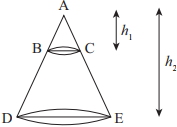
$A$ plane divides a right circular cone into two parts of equal volume. If the plane is parallel to the base,then the ratio,in which the height of the cone is divided,is
A
$1: \sqrt[3]{2}-1$
B
$1: \sqrt{2}$
C
$1: \sqrt[3]{2}$
D
$1: \sqrt[3]{2}+1$
Solution
(A) Let the volume of the smaller cone (top part) be $V_1$ and the volume of the larger cone be $V_2$.
Since the plane divides the cone into two parts of equal volume,the volume of the smaller cone is half the volume of the larger cone.
Thus,$\frac{V_1}{V_2} = \frac{1}{2}$.
For a cone cut by a plane parallel to its base,the ratio of the volumes of the smaller cone and the larger cone is equal to the cube of the ratio of their corresponding heights:
$\frac{V_1}{V_2} = \left(\frac{h_1}{h_2}\right)^3 = \frac{1}{2}$.
Taking the cube root on both sides,we get $\frac{h_1}{h_2} = \frac{1}{\sqrt[3]{2}}$.
Here,$h_1$ is the height of the smaller cone and $h_2$ is the height of the larger cone.
The height of the frustum (the bottom part) is $h_2 - h_1$.
The ratio in which the height is divided is $h_1 : (h_2 - h_1)$.
Substituting the values,we get $1 : (\sqrt[3]{2} - 1)$.
Since the plane divides the cone into two parts of equal volume,the volume of the smaller cone is half the volume of the larger cone.
Thus,$\frac{V_1}{V_2} = \frac{1}{2}$.
For a cone cut by a plane parallel to its base,the ratio of the volumes of the smaller cone and the larger cone is equal to the cube of the ratio of their corresponding heights:
$\frac{V_1}{V_2} = \left(\frac{h_1}{h_2}\right)^3 = \frac{1}{2}$.
Taking the cube root on both sides,we get $\frac{h_1}{h_2} = \frac{1}{\sqrt[3]{2}}$.
Here,$h_1$ is the height of the smaller cone and $h_2$ is the height of the larger cone.
The height of the frustum (the bottom part) is $h_2 - h_1$.
The ratio in which the height is divided is $h_1 : (h_2 - h_1)$.
Substituting the values,we get $1 : (\sqrt[3]{2} - 1)$.
0 likes
View Solution189
MediumMCQ
$A$ right prism has a triangular base whose sides are $13\, cm, 20\, cm$ and $21\, cm$. If the altitude of the prism is $9\, cm$,then its volume is......$cm^3$
A
$1413$
B
$1314$
C
$1143$
D
$1134$
Solution
(D) First,calculate the semi-perimeter $(s)$ of the triangular base:
$s = \frac{a + b + c}{2} = \frac{13 + 20 + 21}{2} = \frac{54}{2} = 27\, cm$
Next,calculate the area of the triangular base using Heron's formula:
$\text{Area} = \sqrt{s(s - a)(s - b)(s - c)}$
$= \sqrt{27(27 - 13)(27 - 20)(27 - 21)}$
$= \sqrt{27 \times 14 \times 7 \times 6}$
$= \sqrt{15876} = 126\, cm^2$
The volume of a right prism is given by the product of the base area and the altitude (height):
$\text{Volume} = \text{Base Area} \times \text{Height}$
$= 126\, cm^2 \times 9\, cm = 1134\, cm^3$
$s = \frac{a + b + c}{2} = \frac{13 + 20 + 21}{2} = \frac{54}{2} = 27\, cm$
Next,calculate the area of the triangular base using Heron's formula:
$\text{Area} = \sqrt{s(s - a)(s - b)(s - c)}$
$= \sqrt{27(27 - 13)(27 - 20)(27 - 21)}$
$= \sqrt{27 \times 14 \times 7 \times 6}$
$= \sqrt{15876} = 126\, cm^2$
The volume of a right prism is given by the product of the base area and the altitude (height):
$\text{Volume} = \text{Base Area} \times \text{Height}$
$= 126\, cm^2 \times 9\, cm = 1134\, cm^3$
0 likes
View Solution190
EasyMCQ
$A$ cylinder with base radius $8\, cm$ and height $2\, cm$ is melted to form a cone of height $6\, cm$. The radius of the cone will be (in $cm$):
A
$5$
B
$4$
C
$8$
D
$6$
Solution
(C) When a solid is melted and recast into another shape,the volume remains constant.
Volume of cylinder = $\pi r_1^2 h_1 = \pi \times (8)^2 \times 2 = 128\pi\, cm^3$.
Volume of cone = $\frac{1}{3} \pi r_2^2 h_2 = \frac{1}{3} \times \pi \times r_2^2 \times 6 = 2\pi r_2^2$.
Since the volumes are equal: $128\pi = 2\pi r_2^2$.
Dividing both sides by $2\pi$,we get $r_2^2 = 64$.
Therefore,$r_2 = \sqrt{64} = 8\, cm$.
Volume of cylinder = $\pi r_1^2 h_1 = \pi \times (8)^2 \times 2 = 128\pi\, cm^3$.
Volume of cone = $\frac{1}{3} \pi r_2^2 h_2 = \frac{1}{3} \times \pi \times r_2^2 \times 6 = 2\pi r_2^2$.
Since the volumes are equal: $128\pi = 2\pi r_2^2$.
Dividing both sides by $2\pi$,we get $r_2^2 = 64$.
Therefore,$r_2 = \sqrt{64} = 8\, cm$.
0 likes
View Solution191
MediumMCQ
The portion of a ditch $48 \ m$ long, $16.5 \ m$ wide, and $4 \ m$ deep that can be filled with stones and earth available during the excavation of a tunnel, cylindrical in shape, of diameter $4 \ m$ and length $56 \ m$ is (Take $\pi = \frac{22}{7}$)
A
$1/2$ Part
B
$1/4$ Part
C
$2/9$ Part
D
$1/9$ Part
Solution
(C) Volume of the ditch $= \text{length} \times \text{width} \times \text{depth} = 48 \ m \times 16.5 \ m \times 4 \ m = 3168 \ m^3$.
The tunnel is cylindrical with diameter $d = 4 \ m$, so radius $r = 2 \ m$, and length $h = 56 \ m$.
Volume of earth and stones from the tunnel $= \pi r^2 h = \frac{22}{7} \times (2)^2 \times 56 = 22 \times 4 \times 8 = 704 \ m^3$.
The portion of the ditch filled $= \frac{\text{Volume of earth}}{\text{Volume of ditch}} = \frac{704}{3168}$.
Dividing both by $352$, we get $\frac{704 \div 352}{3168 \div 352} = \frac{2}{9}$.
The tunnel is cylindrical with diameter $d = 4 \ m$, so radius $r = 2 \ m$, and length $h = 56 \ m$.
Volume of earth and stones from the tunnel $= \pi r^2 h = \frac{22}{7} \times (2)^2 \times 56 = 22 \times 4 \times 8 = 704 \ m^3$.
The portion of the ditch filled $= \frac{\text{Volume of earth}}{\text{Volume of ditch}} = \frac{704}{3168}$.
Dividing both by $352$, we get $\frac{704 \div 352}{3168 \div 352} = \frac{2}{9}$.
0 likes
View Solution192
DifficultMCQ
The numerical values of the volume and the area of the lateral surface of a right circular cone are equal. If the height of the cone is $h$ and the radius is $r,$ the value of $\frac{1}{h^{2}}+\frac{1}{r^{2}}$ is
A
$\frac{9}{1}$
B
$\frac{1}{9}$
C
$\frac{3}{1}$
D
$\frac{1}{3}$
Solution
(B) The volume of a right circular cone is given by $V = \frac{1}{3} \pi r^{2} h$.
The lateral surface area $(LSA)$ of a right circular cone is given by $LSA = \pi r l$,where $l = \sqrt{r^{2} + h^{2}}$ is the slant height.
According to the problem,the numerical values of the volume and the lateral surface area are equal:
$\frac{1}{3} \pi r^{2} h = \pi r \sqrt{r^{2} + h^{2}}$
Dividing both sides by $\pi r$ (assuming $r \neq 0$):
$\frac{1}{3} r h = \sqrt{r^{2} + h^{2}}$
Squaring both sides:
$\frac{r^{2} h^{2}}{9} = r^{2} + h^{2}$
Dividing both sides by $r^{2} h^{2}$:
$\frac{1}{9} = \frac{r^{2} + h^{2}}{r^{2} h^{2}}$
$\frac{1}{9} = \frac{r^{2}}{r^{2} h^{2}} + \frac{h^{2}}{r^{2} h^{2}}$
$\frac{1}{9} = \frac{1}{h^{2}} + \frac{1}{r^{2}}$
Therefore,the value of $\frac{1}{h^{2}} + \frac{1}{r^{2}}$ is $\frac{1}{9}$.
The lateral surface area $(LSA)$ of a right circular cone is given by $LSA = \pi r l$,where $l = \sqrt{r^{2} + h^{2}}$ is the slant height.
According to the problem,the numerical values of the volume and the lateral surface area are equal:
$\frac{1}{3} \pi r^{2} h = \pi r \sqrt{r^{2} + h^{2}}$
Dividing both sides by $\pi r$ (assuming $r \neq 0$):
$\frac{1}{3} r h = \sqrt{r^{2} + h^{2}}$
Squaring both sides:
$\frac{r^{2} h^{2}}{9} = r^{2} + h^{2}$
Dividing both sides by $r^{2} h^{2}$:
$\frac{1}{9} = \frac{r^{2} + h^{2}}{r^{2} h^{2}}$
$\frac{1}{9} = \frac{r^{2}}{r^{2} h^{2}} + \frac{h^{2}}{r^{2} h^{2}}$
$\frac{1}{9} = \frac{1}{h^{2}} + \frac{1}{r^{2}}$
Therefore,the value of $\frac{1}{h^{2}} + \frac{1}{r^{2}}$ is $\frac{1}{9}$.
0 likes
View Solution193
MediumMCQ
The radii of two solid iron spheres are $1 \, cm$ and $6 \, cm$ respectively. $A$ hollow sphere is made by melting the two spheres. If the external radius of the hollow sphere is $9 \, cm$,then its thickness (in $cm$) is
A
$1.5$
B
$2$
C
$0.5$
D
$1$
Solution
(D) The volume of a sphere is given by $V = \frac{4}{3} \pi r^3$.
Total volume of the two solid spheres $= \frac{4}{3} \pi (1^3 + 6^3) = \frac{4}{3} \pi (1 + 216) = \frac{4}{3} \pi (217) \, cm^3$.
Let the internal radius of the hollow sphere be $r \, cm$. The volume of the material of the hollow sphere is given by $V = \frac{4}{3} \pi (R^3 - r^3)$,where $R = 9 \, cm$ is the external radius.
Equating the volumes: $\frac{4}{3} \pi (217) = \frac{4}{3} \pi (9^3 - r^3)$.
$217 = 729 - r^3$.
$r^3 = 729 - 217 = 512$.
$r = \sqrt[3]{512} = 8 \, cm$.
Thickness of the hollow sphere $=$ External radius $-$ Internal radius $= 9 \, cm - 8 \, cm = 1 \, cm$.
Total volume of the two solid spheres $= \frac{4}{3} \pi (1^3 + 6^3) = \frac{4}{3} \pi (1 + 216) = \frac{4}{3} \pi (217) \, cm^3$.
Let the internal radius of the hollow sphere be $r \, cm$. The volume of the material of the hollow sphere is given by $V = \frac{4}{3} \pi (R^3 - r^3)$,where $R = 9 \, cm$ is the external radius.
Equating the volumes: $\frac{4}{3} \pi (217) = \frac{4}{3} \pi (9^3 - r^3)$.
$217 = 729 - r^3$.
$r^3 = 729 - 217 = 512$.
$r = \sqrt[3]{512} = 8 \, cm$.
Thickness of the hollow sphere $=$ External radius $-$ Internal radius $= 9 \, cm - 8 \, cm = 1 \, cm$.
0 likes
View Solution194
EasyMCQ
If a hemisphere is melted and four spheres of equal volume are made,the radius of each sphere will be equal to
A
$1/2$ of the radius of the hemisphere
B
$1/6^{\text{th}}$ of the radius of the hemisphere
C
radius of the hemisphere
D
$1/4^{\text{th}}$ of the radius of the hemisphere
Solution
(A) Let $R$ be the radius of the hemisphere and $r$ be the radius of each small sphere.
The volume of the hemisphere is given by $V_h = \frac{2}{3} \pi R^3$.
The volume of one sphere is given by $V_s = \frac{4}{3} \pi r^3$.
According to the problem,the hemisphere is melted to form four spheres of equal volume:
$V_h = 4 \times V_s$
Substituting the formulas:
$\frac{2}{3} \pi R^3 = 4 \times (\frac{4}{3} \pi r^3)$
Simplifying the equation:
$\frac{2}{3} R^3 = \frac{16}{3} r^3$
$R^3 = 8 r^3$
Taking the cube root on both sides:
$R = 2r$
Therefore,$r = \frac{R}{2}$,which means the radius of each sphere is $1/2$ of the radius of the hemisphere.
The volume of the hemisphere is given by $V_h = \frac{2}{3} \pi R^3$.
The volume of one sphere is given by $V_s = \frac{4}{3} \pi r^3$.
According to the problem,the hemisphere is melted to form four spheres of equal volume:
$V_h = 4 \times V_s$
Substituting the formulas:
$\frac{2}{3} \pi R^3 = 4 \times (\frac{4}{3} \pi r^3)$
Simplifying the equation:
$\frac{2}{3} R^3 = \frac{16}{3} r^3$
$R^3 = 8 r^3$
Taking the cube root on both sides:
$R = 2r$
Therefore,$r = \frac{R}{2}$,which means the radius of each sphere is $1/2$ of the radius of the hemisphere.
0 likes
View Solution195
MediumMCQ
There is a wooden sphere of radius $6 \sqrt{3} \text{ cm}$. The surface area of the largest possible cube cut out from the sphere will be:
A
$464 \sqrt{3} \text{ cm}^2$
B
$864 \text{ cm}^2$
C
$462 \text{ cm}^2$
D
$646 \sqrt{3} \text{ cm}^2$
Solution
(B) For the largest possible cube cut out from a sphere,the diagonal of the cube is equal to the diameter of the sphere.
Let the radius of the sphere be $r = 6 \sqrt{3} \text{ cm}$.
Diameter of the sphere $D = 2r = 2 \times 6 \sqrt{3} = 12 \sqrt{3} \text{ cm}$.
Let the side length of the cube be $a$. The diagonal of a cube is given by $\sqrt{3}a$.
Equating the diagonal of the cube to the diameter of the sphere:
$\sqrt{3}a = 12 \sqrt{3}$
$a = 12 \text{ cm}$.
The surface area of a cube is given by $6a^2$.
Surface area $= 6 \times (12)^2 = 6 \times 144 = 864 \text{ cm}^2$.
Let the radius of the sphere be $r = 6 \sqrt{3} \text{ cm}$.
Diameter of the sphere $D = 2r = 2 \times 6 \sqrt{3} = 12 \sqrt{3} \text{ cm}$.
Let the side length of the cube be $a$. The diagonal of a cube is given by $\sqrt{3}a$.
Equating the diagonal of the cube to the diameter of the sphere:
$\sqrt{3}a = 12 \sqrt{3}$
$a = 12 \text{ cm}$.
The surface area of a cube is given by $6a^2$.
Surface area $= 6 \times (12)^2 = 6 \times 144 = 864 \text{ cm}^2$.
0 likes
View Solution196
MediumMCQ
If $64$ buckets of water are removed from a cubical-shaped water tank completely filled with water, $1/3$ of the tank remains filled with water. The length of each side of the tank is $1.2\, m$. Assuming that all buckets are of the same measure, then the volume (in $litres$) of water contained by each bucket is:
A
$15$
B
$18$
C
$16$
D
$12$
Solution
(B) The tank is initially full, and after removing water, $1/3$ of the tank remains filled. Therefore, the volume of water removed is $1 - 1/3 = 2/3$ of the total volume of the tank.
The volume of the cubical tank is $V = (\text{side})^3 = (1.2\, m)^3 = 1.728\, m^3$.
Since $1\, m^3 = 1000\, litres$, the total volume of the tank is $1.728 \times 1000 = 1728\, litres$.
The volume of water removed by $64$ buckets is $2/3$ of the total volume: $V_{\text{removed}} = 1728 \times (2/3) = 1152\, litres$.
The volume of each bucket is the total removed volume divided by the number of buckets: $V_{\text{bucket}} = 1152 / 64 = 18\, litres$.
The volume of the cubical tank is $V = (\text{side})^3 = (1.2\, m)^3 = 1.728\, m^3$.
Since $1\, m^3 = 1000\, litres$, the total volume of the tank is $1.728 \times 1000 = 1728\, litres$.
The volume of water removed by $64$ buckets is $2/3$ of the total volume: $V_{\text{removed}} = 1728 \times (2/3) = 1152\, litres$.
The volume of each bucket is the total removed volume divided by the number of buckets: $V_{\text{bucket}} = 1152 / 64 = 18\, litres$.
0 likes
View Solution197
DifficultMCQ
The base of a right pyramid is a square of side $10 \text{ cm}$. If the height of the pyramid is $12 \text{ cm}$,then its total surface area is ....... $\text{cm}^2$.
A
$460$
B
$260$
C
$360$
D
$400$
Solution
(C) Area of base $= 10 \times 10 = 100 \text{ cm}^2$.
Perimeter of base $= 4 \times 10 = 40 \text{ cm}$.
The slant height $(l)$ of the pyramid is calculated using the height $(h = 12 \text{ cm})$ and half the side of the base $(a/2 = 5 \text{ cm})$:
$l = \sqrt{(a/2)^2 + h^2} = \sqrt{5^2 + 12^2} = \sqrt{25 + 144} = \sqrt{169} = 13 \text{ cm}$.
Curved Surface Area $(C.S.A.)$ of the pyramid $= \frac{1}{2} \times \text{Perimeter of base} \times \text{slant height}$
$C.S.A. = \frac{1}{2} \times 40 \times 13 = 20 \times 13 = 260 \text{ cm}^2$.
Total Surface Area $(T.S.A.)$ $= C.S.A. + \text{Area of base}$
$T.S.A. = 260 \text{ cm}^2 + 100 \text{ cm}^2 = 360 \text{ cm}^2$.
Perimeter of base $= 4 \times 10 = 40 \text{ cm}$.
The slant height $(l)$ of the pyramid is calculated using the height $(h = 12 \text{ cm})$ and half the side of the base $(a/2 = 5 \text{ cm})$:
$l = \sqrt{(a/2)^2 + h^2} = \sqrt{5^2 + 12^2} = \sqrt{25 + 144} = \sqrt{169} = 13 \text{ cm}$.
Curved Surface Area $(C.S.A.)$ of the pyramid $= \frac{1}{2} \times \text{Perimeter of base} \times \text{slant height}$
$C.S.A. = \frac{1}{2} \times 40 \times 13 = 20 \times 13 = 260 \text{ cm}^2$.
Total Surface Area $(T.S.A.)$ $= C.S.A. + \text{Area of base}$
$T.S.A. = 260 \text{ cm}^2 + 100 \text{ cm}^2 = 360 \text{ cm}^2$.
0 likes
View Solution198
DifficultMCQ
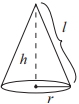
The length of canvas $75 \, cm$ wide required to build a conical tent of height $14 \, m$ and the floor area $346.5 \, m^{2}$ is.........$m$
A
$770$
B
$490$
C
$860$
D
$665$
Solution
(A) Given: Height of the cone $h = 14 \, m$,Floor area $= \pi r^{2} = 346.5 \, m^{2}$.
First,find the radius $r$:
$\frac{22}{7} \times r^{2} = 346.5$
$r^{2} = \frac{346.5 \times 7}{22} = 110.25$
$r = \sqrt{110.25} = 10.5 \, m$.
Now,find the slant height $l$:
$l = \sqrt{r^{2} + h^{2}} = \sqrt{10.5^{2} + 14^{2}} = \sqrt{110.25 + 196} = \sqrt{306.25} = 17.5 \, m$.
Curved surface area of the tent $= \pi r l = \frac{22}{7} \times 10.5 \times 17.5 = 22 \times 1.5 \times 17.5 = 577.5 \, m^{2}$.
Width of canvas $= 75 \, cm = 0.75 \, m$.
Length of canvas $= \frac{\text{Curved surface area}}{\text{Width}} = \frac{577.5}{0.75} = 770 \, m$.
First,find the radius $r$:
$\frac{22}{7} \times r^{2} = 346.5$
$r^{2} = \frac{346.5 \times 7}{22} = 110.25$
$r = \sqrt{110.25} = 10.5 \, m$.
Now,find the slant height $l$:
$l = \sqrt{r^{2} + h^{2}} = \sqrt{10.5^{2} + 14^{2}} = \sqrt{110.25 + 196} = \sqrt{306.25} = 17.5 \, m$.
Curved surface area of the tent $= \pi r l = \frac{22}{7} \times 10.5 \times 17.5 = 22 \times 1.5 \times 17.5 = 577.5 \, m^{2}$.
Width of canvas $= 75 \, cm = 0.75 \, m$.
Length of canvas $= \frac{\text{Curved surface area}}{\text{Width}} = \frac{577.5}{0.75} = 770 \, m$.
0 likes
View Solution199
MediumMCQ
If the area of the base,height,and volume of a right prism are $(3 \sqrt{3} / 2) P^{2} \, \text{cm}^{2}$,$100 \sqrt{3} \, \text{cm}$,and $7200 \, \text{cm}^{3}$ respectively,then the value of $P$ is?
A
$2 / \sqrt{3}$
B
$3 / 2$
C
$\sqrt{3}$
D
$4$
Solution
(D) The volume of a prism is given by the formula: $\text{Volume} = \text{Area of base} \times \text{Height}$.
Given:
$\text{Area of base} = \frac{3 \sqrt{3}}{2} P^{2} \, \text{cm}^{2}$
$\text{Height} = 100 \sqrt{3} \, \text{cm}$
$\text{Volume} = 7200 \, \text{cm}^{3}$
Substituting these values into the formula:
$7200 = \left( \frac{3 \sqrt{3}}{2} P^{2} \right) \times (100 \sqrt{3})$
$7200 = \frac{3 \times 100 \times (\sqrt{3} \times \sqrt{3})}{2} \times P^{2}$
$7200 = \frac{300 \times 3}{2} \times P^{2}$
$7200 = 450 \times P^{2}$
$P^{2} = \frac{7200}{450}$
$P^{2} = 16$
$P = 4$.
Given:
$\text{Area of base} = \frac{3 \sqrt{3}}{2} P^{2} \, \text{cm}^{2}$
$\text{Height} = 100 \sqrt{3} \, \text{cm}$
$\text{Volume} = 7200 \, \text{cm}^{3}$
Substituting these values into the formula:
$7200 = \left( \frac{3 \sqrt{3}}{2} P^{2} \right) \times (100 \sqrt{3})$
$7200 = \frac{3 \times 100 \times (\sqrt{3} \times \sqrt{3})}{2} \times P^{2}$
$7200 = \frac{300 \times 3}{2} \times P^{2}$
$7200 = 450 \times P^{2}$
$P^{2} = \frac{7200}{450}$
$P^{2} = 16$
$P = 4$.
0 likes
View Solution200
EasyMCQ
If the volume of a sphere is numerically equal to its surface area,then its diameter is ......... $cm$.
A
$4$
B
$2$
C
$3$
D
$6$
Solution
(D) Let the radius of the sphere be $r \, cm$.
The volume of a sphere is given by $V = \frac{4}{3} \pi r^3$.
The surface area of a sphere is given by $A = 4 \pi r^2$.
According to the problem,the volume is numerically equal to the surface area:
$\frac{4}{3} \pi r^3 = 4 \pi r^2$
Dividing both sides by $4 \pi r^2$ (assuming $r \neq 0$):
$\frac{r}{3} = 1$
$r = 3 \, cm$.
The diameter of the sphere is $d = 2r = 2 \times 3 = 6 \, cm$.
The volume of a sphere is given by $V = \frac{4}{3} \pi r^3$.
The surface area of a sphere is given by $A = 4 \pi r^2$.
According to the problem,the volume is numerically equal to the surface area:
$\frac{4}{3} \pi r^3 = 4 \pi r^2$
Dividing both sides by $4 \pi r^2$ (assuming $r \neq 0$):
$\frac{r}{3} = 1$
$r = 3 \, cm$.
The diameter of the sphere is $d = 2r = 2 \times 3 = 6 \, cm$.
0 likes
View SolutionMensuration — Measurement of Volume and Surface Area · Frequently Asked Questions
1Are these Mensuration questions useful for JEE and NEET?
Yes. All questions in this section are mapped to JEE Main and NEET exam patterns. Previous year questions from JEE Main, NEET, GUJCET and state-level exams are included with full solutions.
2Can I switch to Hindi or Gujarati for these questions?
Yes. Use the language tabs in the hero section or the sidebar to view the same questions and solutions in English, Hindi or Gujarati.
3How do I generate a question paper from this subtopic?
Use the Vedclass Exam Paper Generator — select the chapter and subtopic, set difficulty, and generate Sets A, B, C, D automatically. First 3 chapters of every subject are free.
Vedclass Products
For Students
Vedclass Test Series
Mock tests in real JEE/NEET style with performance analysis. 5-day free trial.
Start Free TrialFor Teachers
Exam Paper Generator
Generate Set A/B/C/D papers from this chapter in 2 minutes. 3 chapters free.
Try FreeFor Institutes
Online Exam Module
Live online exams with unlimited students, 360° analytics & white-label branding.
See DemoFor Teachers & Institutes
Generate a Mensuration Exam Paper in 2 Minutes
Select subtopic & difficulty — Sets A, B, C, D auto-generated with No Repeat logic.
First 3 chapters of every subject are free — no payment required.