
A English
Measurement of Volume and Surface Area Questions in English
Competitive Exam Quantitative Aptitude · Mensuration · Measurement of Volume and Surface Area
265+
Questions
English
Language
100%
With Solutions
Showing 50 of 265 questions in English
201
MediumMCQ
$5$ persons will live in a tent. If each person requires $16\, m^2$ of floor area and $100\, m^3$ space for air,then the height of the cone of smallest size to accommodate these persons would be? (in $m$)
A
$18.75$
B
$16$
C
$10.25$
D
$20$
Solution
(A) Total floor area required for $5$ persons $= 16 \times 5 = 80\, m^2$.
Total volume of air required for $5$ persons $= 100 \times 5 = 500\, m^3$.
The volume of a cone is given by the formula $V = \frac{1}{3} \times A \times h$,where $A$ is the base area and $h$ is the height.
For the smallest tent,we set the base area $A = 80\, m^2$ and the volume $V = 500\, m^3$.
Substituting these values into the formula: $500 = \frac{1}{3} \times 80 \times h$.
Solving for $h$: $h = \frac{500 \times 3}{80} = \frac{1500}{80} = \frac{150}{8} = 18.75\, m$.
Total volume of air required for $5$ persons $= 100 \times 5 = 500\, m^3$.
The volume of a cone is given by the formula $V = \frac{1}{3} \times A \times h$,where $A$ is the base area and $h$ is the height.
For the smallest tent,we set the base area $A = 80\, m^2$ and the volume $V = 500\, m^3$.
Substituting these values into the formula: $500 = \frac{1}{3} \times 80 \times h$.
Solving for $h$: $h = \frac{500 \times 3}{80} = \frac{1500}{80} = \frac{150}{8} = 18.75\, m$.
0 likes
View Solution202
DifficultMCQ
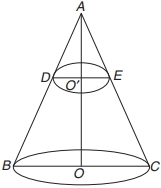
The height of a cone is $30 \, cm$. $A$ small cone is cut off at the top by a plane parallel to the base. If its volume is $\frac{1}{27}$ of the volume of the given cone,at what height above the base is the section made? (in $cm$)
A
$19$
B
$20$
C
$12$
D
$15$
Solution
(B) Let $H = 30 \, cm$ be the height of the larger cone and $h$ be the height of the smaller cone.
Let $V$ be the volume of the larger cone and $v$ be the volume of the smaller cone.
Since the smaller cone is cut by a plane parallel to the base,the smaller cone and the larger cone are similar.
Therefore,the ratio of their volumes is equal to the cube of the ratio of their heights:
$\frac{v}{V} = \left( \frac{h}{H} \right)^3$
Given $\frac{v}{V} = \frac{1}{27}$,we have:
$\frac{1}{27} = \left( \frac{h}{30} \right)^3$
Taking the cube root on both sides:
$\frac{1}{3} = \frac{h}{30}$
$h = \frac{30}{3} = 10 \, cm$
The section is made at a height above the base equal to the difference between the height of the larger cone and the height of the smaller cone:
Height above base $= H - h = 30 - 10 = 20 \, cm$.
Let $V$ be the volume of the larger cone and $v$ be the volume of the smaller cone.
Since the smaller cone is cut by a plane parallel to the base,the smaller cone and the larger cone are similar.
Therefore,the ratio of their volumes is equal to the cube of the ratio of their heights:
$\frac{v}{V} = \left( \frac{h}{H} \right)^3$
Given $\frac{v}{V} = \frac{1}{27}$,we have:
$\frac{1}{27} = \left( \frac{h}{30} \right)^3$
Taking the cube root on both sides:
$\frac{1}{3} = \frac{h}{30}$
$h = \frac{30}{3} = 10 \, cm$
The section is made at a height above the base equal to the difference between the height of the larger cone and the height of the smaller cone:
Height above base $= H - h = 30 - 10 = 20 \, cm$.
0 likes
View Solution203
MediumMCQ
If the surface area of a sphere is $346.5 \, cm^{2},$ then its radius is.......$cm$
$\left[\text{taking } \pi = \frac{22}{7}\right]$
$\left[\text{taking } \pi = \frac{22}{7}\right]$
A
$7$
B
$3.25$
C
$5.25$
D
$9$
Solution
(C) The surface area of a sphere is given by the formula: $A = 4 \pi r^{2}$.
Given that $A = 346.5 \, cm^{2}$ and $\pi = \frac{22}{7}$.
Substituting the values into the formula:
$4 \times \frac{22}{7} \times r^{2} = 346.5$
$\Rightarrow r^{2} = \frac{346.5 \times 7}{4 \times 22}$
$\Rightarrow r^{2} = \frac{2425.5}{88}$
$\Rightarrow r^{2} = 27.5625$
Taking the square root on both sides:
$r = \sqrt{27.5625} = 5.25 \, cm$.
Thus,the radius of the sphere is $5.25 \, cm$.
Given that $A = 346.5 \, cm^{2}$ and $\pi = \frac{22}{7}$.
Substituting the values into the formula:
$4 \times \frac{22}{7} \times r^{2} = 346.5$
$\Rightarrow r^{2} = \frac{346.5 \times 7}{4 \times 22}$
$\Rightarrow r^{2} = \frac{2425.5}{88}$
$\Rightarrow r^{2} = 27.5625$
Taking the square root on both sides:
$r = \sqrt{27.5625} = 5.25 \, cm$.
Thus,the radius of the sphere is $5.25 \, cm$.
0 likes
View Solution204
EasyMCQ
The height of the right pyramid whose area of the base is $30\, m^{2}$ and volume is $500\, m^{3}$ is ...... $m$.
A
$50$
B
$60$
C
$40$
D
$20$
Solution
(A) The volume of a pyramid is given by the formula: $V = \frac{1}{3} \times A \times h$,where $V$ is the volume,$A$ is the area of the base,and $h$ is the height.
Given: $V = 500\, m^{3}$ and $A = 30\, m^{2}$.
Substituting the values into the formula:
$500 = \frac{1}{3} \times 30 \times h$
$500 = 10 \times h$
$h = \frac{500}{10} = 50\, m$.
Therefore,the height of the pyramid is $50\, m$.
Given: $V = 500\, m^{3}$ and $A = 30\, m^{2}$.
Substituting the values into the formula:
$500 = \frac{1}{3} \times 30 \times h$
$500 = 10 \times h$
$h = \frac{500}{10} = 50\, m$.
Therefore,the height of the pyramid is $50\, m$.
0 likes
View Solution205
MediumMCQ
The base of a prism is a right-angled triangle with $2$ sides $5 \, cm$ and $12 \, cm$. The height of the prism is $10 \, cm$. The total surface area of the prism is......$cm^2$
A
$360$
B
$300$
C
$330$
D
$325$
Solution
(A) The base is a right-angled triangle with sides $a = 5 \, cm$ and $b = 12 \, cm$.
The hypotenuse $c = \sqrt{5^2 + 12^2} = \sqrt{25 + 144} = \sqrt{169} = 13 \, cm$.
The perimeter of the base $P = 5 + 12 + 13 = 30 \, cm$.
The lateral surface area of the prism $= P \times \text{height} = 30 \times 10 = 300 \, cm^2$.
The area of the triangular base $A_{base} = \frac{1}{2} \times 5 \times 12 = 30 \, cm^2$.
The total surface area of the prism $= \text{Lateral surface area} + 2 \times A_{base} = 300 + 2(30) = 300 + 60 = 360 \, cm^2$.
The hypotenuse $c = \sqrt{5^2 + 12^2} = \sqrt{25 + 144} = \sqrt{169} = 13 \, cm$.
The perimeter of the base $P = 5 + 12 + 13 = 30 \, cm$.
The lateral surface area of the prism $= P \times \text{height} = 30 \times 10 = 300 \, cm^2$.
The area of the triangular base $A_{base} = \frac{1}{2} \times 5 \times 12 = 30 \, cm^2$.
The total surface area of the prism $= \text{Lateral surface area} + 2 \times A_{base} = 300 + 2(30) = 300 + 60 = 360 \, cm^2$.
0 likes
View Solution206
DifficultMCQ
The base of a right prism is an equilateral triangle. If the lateral surface area and volume are $120 \, cm^2$ and $40 \sqrt{3} \, cm^3$,respectively,then the side of the base of the prism is ...... $cm$.
A
$4$
B
$5$
C
$7$
D
$40$
Solution
(A) Let the side of the equilateral triangle base be $a$ and the height of the prism be $h$.
Lateral surface area of the prism $= 3 \times a \times h = 120 \, cm^2$.
$\therefore a \times h = \frac{120}{3} = 40 \, cm^2 \dots (1)$
Volume of the prism $=$ Area of base $\times$ height $= \frac{\sqrt{3}}{4} a^2 \times h = 40 \sqrt{3} \, cm^3$.
$\Rightarrow a^2 \times h = \frac{40 \sqrt{3} \times 4}{\sqrt{3}} = 160 \, cm^3 \dots (2)$
Dividing equation $(2)$ by $(1)$:
$\frac{a^2 \times h}{a \times h} = \frac{160}{40}$
$a = 4 \, cm$.
Thus,the side of the base is $4 \, cm$.
Lateral surface area of the prism $= 3 \times a \times h = 120 \, cm^2$.
$\therefore a \times h = \frac{120}{3} = 40 \, cm^2 \dots (1)$
Volume of the prism $=$ Area of base $\times$ height $= \frac{\sqrt{3}}{4} a^2 \times h = 40 \sqrt{3} \, cm^3$.
$\Rightarrow a^2 \times h = \frac{40 \sqrt{3} \times 4}{\sqrt{3}} = 160 \, cm^3 \dots (2)$
Dividing equation $(2)$ by $(1)$:
$\frac{a^2 \times h}{a \times h} = \frac{160}{40}$
$a = 4 \, cm$.
Thus,the side of the base is $4 \, cm$.
0 likes
View Solution207
DifficultMCQ
$A$ ball of lead,$4\, cm$ in diameter,is covered with gold. If the volume of the gold and lead are equal,then the thickness of gold is approximately (in $cm$).
$[$ Given $\sqrt[3]{2} = 1.259 ]$
$[$ Given $\sqrt[3]{2} = 1.259 ]$
A
$5.038$
B
$5.190$
C
$1.038$
D
$0.518$
Solution
(D) The diameter of the lead ball is $4\, cm$,so its radius $r = 2\, cm$.
Volume of lead $= \frac{4}{3} \pi r^3 = \frac{4}{3} \pi (2)^3 = \frac{4}{3} \pi (8) = \frac{32}{3} \pi\, cm^3$.
Let the thickness of the gold layer be $x\, cm$.
The total radius of the ball (lead + gold) becomes $(2 + x)\, cm$.
The volume of the gold layer is the difference between the total volume and the volume of the lead ball:
Volume of gold $= \frac{4}{3} \pi (2 + x)^3 - \frac{4}{3} \pi (2)^3$.
According to the problem,the volume of gold equals the volume of lead:
$\frac{4}{3} \pi ((2 + x)^3 - 2^3) = \frac{4}{3} \pi (2^3)$.
$(2 + x)^3 - 8 = 8$.
$(2 + x)^3 = 16$.
Taking the cube root on both sides:
$2 + x = \sqrt[3]{16} = \sqrt[3]{8 \times 2} = 2 \times \sqrt[3]{2}$.
Given $\sqrt[3]{2} = 1.259$,we have:
$2 + x = 2 \times 1.259 = 2.518$.
$x = 2.518 - 2 = 0.518\, cm$.
Volume of lead $= \frac{4}{3} \pi r^3 = \frac{4}{3} \pi (2)^3 = \frac{4}{3} \pi (8) = \frac{32}{3} \pi\, cm^3$.
Let the thickness of the gold layer be $x\, cm$.
The total radius of the ball (lead + gold) becomes $(2 + x)\, cm$.
The volume of the gold layer is the difference between the total volume and the volume of the lead ball:
Volume of gold $= \frac{4}{3} \pi (2 + x)^3 - \frac{4}{3} \pi (2)^3$.
According to the problem,the volume of gold equals the volume of lead:
$\frac{4}{3} \pi ((2 + x)^3 - 2^3) = \frac{4}{3} \pi (2^3)$.
$(2 + x)^3 - 8 = 8$.
$(2 + x)^3 = 16$.
Taking the cube root on both sides:
$2 + x = \sqrt[3]{16} = \sqrt[3]{8 \times 2} = 2 \times \sqrt[3]{2}$.
Given $\sqrt[3]{2} = 1.259$,we have:
$2 + x = 2 \times 1.259 = 2.518$.
$x = 2.518 - 2 = 0.518\, cm$.
0 likes
View Solution208
DifficultMCQ
$A$ large solid sphere is melted and moulded to form identical right circular cones with base radius and height same as the radius of the sphere. One of these cones is melted and moulded to form a smaller solid sphere. Then the ratio of the surface area of the smaller to the surface area of the larger sphere is
A
$1: 3^{\frac{4}{3}}$
B
$1: 2^{\frac{3}{2}}$
C
$1: 3^{\frac{2}{3}}$
D
$1: 2^{\frac{4}{3}}$
Solution
(D) Let the radius of the larger sphere be $R$.
Volume of the larger sphere $= \frac{4}{3} \pi R^3$.
Volume of one cone with base radius $R$ and height $R$ is $V_{cone} = \frac{1}{3} \pi R^2 h = \frac{1}{3} \pi R^3$.
Let the radius of the smaller sphere formed by melting one cone be $r$.
Volume of the smaller sphere $= \frac{4}{3} \pi r^3$.
Equating the volumes: $\frac{4}{3} \pi r^3 = \frac{1}{3} \pi R^3$.
$4r^3 = R^3 \Rightarrow r^3 = \frac{R^3}{4} \Rightarrow r = \frac{R}{4^{1/3}} = \frac{R}{2^{2/3}}$.
The ratio of the surface area of the smaller sphere to the larger sphere is $\frac{4 \pi r^2}{4 \pi R^2} = \frac{r^2}{R^2}$.
Substituting $r$: $\frac{(R / 2^{2/3})^2}{R^2} = \frac{R^2 / 2^{4/3}}{R^2} = \frac{1}{2^{4/3}}$.
Thus,the ratio is $1 : 2^{4/3}$.
Volume of the larger sphere $= \frac{4}{3} \pi R^3$.
Volume of one cone with base radius $R$ and height $R$ is $V_{cone} = \frac{1}{3} \pi R^2 h = \frac{1}{3} \pi R^3$.
Let the radius of the smaller sphere formed by melting one cone be $r$.
Volume of the smaller sphere $= \frac{4}{3} \pi r^3$.
Equating the volumes: $\frac{4}{3} \pi r^3 = \frac{1}{3} \pi R^3$.
$4r^3 = R^3 \Rightarrow r^3 = \frac{R^3}{4} \Rightarrow r = \frac{R}{4^{1/3}} = \frac{R}{2^{2/3}}$.
The ratio of the surface area of the smaller sphere to the larger sphere is $\frac{4 \pi r^2}{4 \pi R^2} = \frac{r^2}{R^2}$.
Substituting $r$: $\frac{(R / 2^{2/3})^2}{R^2} = \frac{R^2 / 2^{4/3}}{R^2} = \frac{1}{2^{4/3}}$.
Thus,the ratio is $1 : 2^{4/3}$.
0 likes
View Solution209
DifficultMCQ
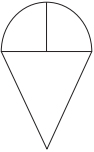
$A$ conical cup is filled with ice cream. The ice cream forms a hemispherical shape on its open top. The radius of the hemispherical part is $7 \, cm$. The radius of the hemispherical part equals the height of the cone. Then the volume of the ice cream is $...... cm^3$. $\left[\pi=\frac{22}{7}\right]$
A
$1078$
B
$1708$
C
$7108$
D
$7180$
Solution
(A) The total volume of the ice cream is the sum of the volume of the hemisphere and the volume of the cone.
Given,radius of the hemisphere $r = 7 \, cm$.
Since the radius of the hemispherical part equals the height of the cone,the height of the cone $h = 7 \, cm$.
Volume of hemisphere $= \frac{2}{3} \pi r^3 = \frac{2}{3} \times \frac{22}{7} \times 7^3 = \frac{2}{3} \times 22 \times 49 = \frac{2156}{3} \, cm^3$.
Volume of cone $= \frac{1}{3} \pi r^2 h = \frac{1}{3} \times \frac{22}{7} \times 7^2 \times 7 = \frac{1}{3} \times 22 \times 49 = \frac{1078}{3} \, cm^3$.
Total volume $= \frac{2156}{3} + \frac{1078}{3} = \frac{3234}{3} = 1078 \, cm^3$.
Given,radius of the hemisphere $r = 7 \, cm$.
Since the radius of the hemispherical part equals the height of the cone,the height of the cone $h = 7 \, cm$.
Volume of hemisphere $= \frac{2}{3} \pi r^3 = \frac{2}{3} \times \frac{22}{7} \times 7^3 = \frac{2}{3} \times 22 \times 49 = \frac{2156}{3} \, cm^3$.
Volume of cone $= \frac{1}{3} \pi r^2 h = \frac{1}{3} \times \frac{22}{7} \times 7^2 \times 7 = \frac{1}{3} \times 22 \times 49 = \frac{1078}{3} \, cm^3$.
Total volume $= \frac{2156}{3} + \frac{1078}{3} = \frac{3234}{3} = 1078 \, cm^3$.
0 likes
View Solution210
MediumMCQ
If each side of a cube is increased by $10 \%$,the volume of the cube will increase by (in $\%$).
A
$30$
B
$10$
C
$33.1$
D
$25$
Solution
(C) Let the original side of the cube be $s$. The original volume is $V_1 = s^3$.
If the side is increased by $10 \%$,the new side $s' = s + 0.1s = 1.1s$.
The new volume is $V_2 = (1.1s)^3 = 1.331s^3$.
The increase in volume is $V_2 - V_1 = 1.331s^3 - s^3 = 0.331s^3$.
The percentage increase in volume is $\frac{0.331s^3}{s^3} \times 100 \% = 33.1 \%$.
If the side is increased by $10 \%$,the new side $s' = s + 0.1s = 1.1s$.
The new volume is $V_2 = (1.1s)^3 = 1.331s^3$.
The increase in volume is $V_2 - V_1 = 1.331s^3 - s^3 = 0.331s^3$.
The percentage increase in volume is $\frac{0.331s^3}{s^3} \times 100 \% = 33.1 \%$.
0 likes
View Solution211
MediumMCQ
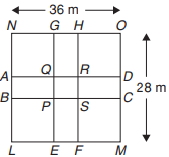
$A$ rectangular plot,$36 \, m$ long and $28 \, m$ broad,has two concrete roads $5 \, m$ wide running in the middle of the park,one parallel to the length and the other parallel to the breadth. What would be the total cost of gravelling the plot,excluding the area covered by the roads,at ₹ $3.60$ per $m^{2}$? (in $Rs.$)
A
$2772.20$
B
$2466.60$
C
$2654.40$
D
$2566.80$
Solution
(D) Area of the rectangular plot $LMNO = 36 \times 28 = 1008 \, m^{2}$.
Area of the paths = Area of road parallel to length + Area of road parallel to breadth - Area of the common intersection square $PQRS$.
Area of paths = $(36 \times 5) + (28 \times 5) - (5 \times 5) = 180 + 140 - 25 = 295 \, m^{2}$.
Area of the rectangular plot excluding the area covered by the roads = $1008 - 295 = 713 \, m^{2}$.
Total cost of gravelling the plot = $713 \times 3.60 = ₹ 2566.80$.
Area of the paths = Area of road parallel to length + Area of road parallel to breadth - Area of the common intersection square $PQRS$.
Area of paths = $(36 \times 5) + (28 \times 5) - (5 \times 5) = 180 + 140 - 25 = 295 \, m^{2}$.
Area of the rectangular plot excluding the area covered by the roads = $1008 - 295 = 713 \, m^{2}$.
Total cost of gravelling the plot = $713 \times 3.60 = ₹ 2566.80$.
0 likes
View Solution212
MediumMCQ
$A$ sphere is cut into two hemispheres. One of them is used as a bowl. It takes $8$ bowlfuls of this to fill a conical vessel of height $12\, cm$ and radius $6\, cm$. The radius of the sphere (in centimeter) will be
A
$3$
B
$2$
C
$4$
D
$6$
Solution
(A) Given: Height of the cone $h = 12\, cm$ and radius of the cone $R = 6\, cm$.
Let the radius of the hemisphere (which is the same as the radius of the sphere) be $r\, cm$.
The volume of a hemisphere is given by $V_h = \frac{2}{3} \pi r^3$.
The volume of a cone is given by $V_c = \frac{1}{3} \pi R^2 h$.
According to the problem,$8$ bowlfuls of the hemisphere fill the conical vessel:
$8 \times V_h = V_c$
$8 \times \left( \frac{2}{3} \pi r^3 \right) = \frac{1}{3} \pi R^2 h$
Substitute the values:
$8 \times \frac{2}{3} \pi r^3 = \frac{1}{3} \pi (6)^2 (12)$
Divide both sides by $\frac{1}{3} \pi$:
$16 r^3 = 36 \times 12$
$16 r^3 = 432$
$r^3 = \frac{432}{16} = 27$
$r = \sqrt[3]{27} = 3\, cm$.
Thus,the radius of the sphere is $3\, cm$.
Let the radius of the hemisphere (which is the same as the radius of the sphere) be $r\, cm$.
The volume of a hemisphere is given by $V_h = \frac{2}{3} \pi r^3$.
The volume of a cone is given by $V_c = \frac{1}{3} \pi R^2 h$.
According to the problem,$8$ bowlfuls of the hemisphere fill the conical vessel:
$8 \times V_h = V_c$
$8 \times \left( \frac{2}{3} \pi r^3 \right) = \frac{1}{3} \pi R^2 h$
Substitute the values:
$8 \times \frac{2}{3} \pi r^3 = \frac{1}{3} \pi (6)^2 (12)$
Divide both sides by $\frac{1}{3} \pi$:
$16 r^3 = 36 \times 12$
$16 r^3 = 432$
$r^3 = \frac{432}{16} = 27$
$r = \sqrt[3]{27} = 3\, cm$.
Thus,the radius of the sphere is $3\, cm$.
0 likes
View Solution213
DifficultMCQ
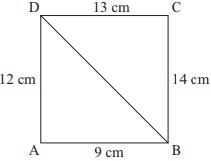
The base of a right prism is a quadrilateral $ABCD$. Given that $AB = 9\, cm$,$BC = 14\, cm$,$CD = 13\, cm$,$DA = 12\, cm$ and $\angle DAB = 90^{\circ}$. If the volume of the prism is $2070\, cm^3$,then the area of the lateral surface is........$cm^2$.
A
$720$
B
$810$
C
$1260$
D
$2070$
Solution
(A) In right $\Delta DAB$,by the Pythagorean theorem,$BD = \sqrt{AD^2 + AB^2} = \sqrt{12^2 + 9^2} = \sqrt{144 + 81} = \sqrt{225} = 15\, cm$.
Area of $\Delta DAB = \frac{1}{2} \times AB \times AD = \frac{1}{2} \times 9 \times 12 = 54\, cm^2$.
For $\Delta BCD$,the sides are $BC = 14\, cm$,$CD = 13\, cm$,and $BD = 15\, cm$. The semi-perimeter $S = \frac{14 + 13 + 15}{2} = \frac{42}{2} = 21\, cm$.
Using Heron's formula,Area of $\Delta BCD = \sqrt{S(S-a)(S-b)(S-c)} = \sqrt{21(21-14)(21-13)(21-15)} = \sqrt{21 \times 7 \times 8 \times 6} = \sqrt{7056} = 84\, cm^2$.
Area of quadrilateral $ABCD = \text{Area of } \Delta DAB + \text{Area of } \Delta BCD = 54 + 84 = 138\, cm^2$.
Volume of the prism = Base Area $\times$ Height.
$2070 = 138 \times h \implies h = \frac{2070}{138} = 15\, cm$.
Lateral Surface Area $(LSA)$ = Perimeter of base $\times$ Height.
Perimeter = $AB + BC + CD + DA = 9 + 14 + 13 + 12 = 48\, cm$.
$LSA$ = $48 \times 15 = 720\, cm^2$.
Area of $\Delta DAB = \frac{1}{2} \times AB \times AD = \frac{1}{2} \times 9 \times 12 = 54\, cm^2$.
For $\Delta BCD$,the sides are $BC = 14\, cm$,$CD = 13\, cm$,and $BD = 15\, cm$. The semi-perimeter $S = \frac{14 + 13 + 15}{2} = \frac{42}{2} = 21\, cm$.
Using Heron's formula,Area of $\Delta BCD = \sqrt{S(S-a)(S-b)(S-c)} = \sqrt{21(21-14)(21-13)(21-15)} = \sqrt{21 \times 7 \times 8 \times 6} = \sqrt{7056} = 84\, cm^2$.
Area of quadrilateral $ABCD = \text{Area of } \Delta DAB + \text{Area of } \Delta BCD = 54 + 84 = 138\, cm^2$.
Volume of the prism = Base Area $\times$ Height.
$2070 = 138 \times h \implies h = \frac{2070}{138} = 15\, cm$.
Lateral Surface Area $(LSA)$ = Perimeter of base $\times$ Height.
Perimeter = $AB + BC + CD + DA = 9 + 14 + 13 + 12 = 48\, cm$.
$LSA$ = $48 \times 15 = 720\, cm^2$.
0 likes
View Solution214
MediumMCQ
The volumes of a right circular cylinder and a sphere are equal. The radius of the cylinder and the diameter of the sphere are equal. The ratio of the height to the radius of the cylinder is:
A
$3:1$
B
$1:3$
C
$6:1$
D
$1:6$
Solution
(D) Let the radius of the cylinder be $r$ and its height be $h$.
Let the radius of the sphere be $R$.
Given that the radius of the cylinder is equal to the diameter of the sphere,we have $r = 2R$,which implies $R = r/2$.
The volume of the cylinder is $V_c = \pi r^2 h$.
The volume of the sphere is $V_s = \frac{4}{3} \pi R^3$.
Since the volumes are equal,$\pi r^2 h = \frac{4}{3} \pi R^3$.
Substituting $R = r/2$ into the equation:
$\pi r^2 h = \frac{4}{3} \pi (r/2)^3$
$\pi r^2 h = \frac{4}{3} \pi (r^3 / 8)$
$r^2 h = \frac{4}{24} r^3$
$r^2 h = \frac{1}{6} r^3$
Dividing both sides by $r^2$ (assuming $r \neq 0$):
$h = \frac{1}{6} r$
Therefore,the ratio of the height to the radius of the cylinder is $h/r = 1/6$.
Let the radius of the sphere be $R$.
Given that the radius of the cylinder is equal to the diameter of the sphere,we have $r = 2R$,which implies $R = r/2$.
The volume of the cylinder is $V_c = \pi r^2 h$.
The volume of the sphere is $V_s = \frac{4}{3} \pi R^3$.
Since the volumes are equal,$\pi r^2 h = \frac{4}{3} \pi R^3$.
Substituting $R = r/2$ into the equation:
$\pi r^2 h = \frac{4}{3} \pi (r/2)^3$
$\pi r^2 h = \frac{4}{3} \pi (r^3 / 8)$
$r^2 h = \frac{4}{24} r^3$
$r^2 h = \frac{1}{6} r^3$
Dividing both sides by $r^2$ (assuming $r \neq 0$):
$h = \frac{1}{6} r$
Therefore,the ratio of the height to the radius of the cylinder is $h/r = 1/6$.
0 likes
View Solution215
MediumMCQ
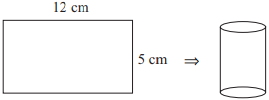
$A$ rectangular tin sheet is $12 \, cm$ long and $5 \, cm$ broad. It is rolled along its length to form a cylinder by making the opposite edges just touch each other. Then the volume of the cylinder is
A
$\frac{100}{\pi} \, cm^3$
B
$\frac{60}{\pi} \, cm^3$
C
$\frac{180}{\pi} \, cm^3$
D
$\frac{120}{\pi} \, cm^3$
Solution
(C) When a rectangular sheet is rolled along its length to form a cylinder,the length of the sheet becomes the circumference of the base of the cylinder,and the breadth of the sheet becomes the height of the cylinder.
Given: Length of sheet $= 12 \, cm$,Breadth of sheet $= 5 \, cm$.
Circumference of the cylinder base $= 2 \pi R = 12 \, cm$.
$R = \frac{12}{2 \pi} = \frac{6}{\pi} \, cm$.
Height of the cylinder $(h) = 5 \, cm$.
Volume of the cylinder $= \pi R^2 h = \pi \left( \frac{6}{\pi} \right)^2 \times 5$.
Volume $= \pi \times \frac{36}{\pi^2} \times 5 = \frac{180}{\pi} \, cm^3$.
Given: Length of sheet $= 12 \, cm$,Breadth of sheet $= 5 \, cm$.
Circumference of the cylinder base $= 2 \pi R = 12 \, cm$.
$R = \frac{12}{2 \pi} = \frac{6}{\pi} \, cm$.
Height of the cylinder $(h) = 5 \, cm$.
Volume of the cylinder $= \pi R^2 h = \pi \left( \frac{6}{\pi} \right)^2 \times 5$.
Volume $= \pi \times \frac{36}{\pi^2} \times 5 = \frac{180}{\pi} \, cm^3$.
0 likes
View Solution216
MediumMCQ
The area of the iron sheet required to prepare a cone $24 \text{ cm}$ high with base radius $7 \text{ cm}$ is .......... $\text{cm}^2$ (Take $\pi = \frac{22}{7}$)
A
$704$
B
$408$
C
$708$
D
$804$
Solution
(A) The total surface area of a cone is given by the formula: $\text{Total Surface Area} = \pi r(r + l)$,where $r$ is the base radius and $l$ is the slant height.
Given: height $h = 24 \text{ cm}$,radius $r = 7 \text{ cm}$.
First,calculate the slant height $l$ using the Pythagorean theorem: $l = \sqrt{r^2 + h^2} = \sqrt{7^2 + 24^2} = \sqrt{49 + 576} = \sqrt{625} = 25 \text{ cm}$.
Now,substitute the values into the formula: $\text{Total Surface Area} = \frac{22}{7} \times 7 \times (7 + 25)$.
$= 22 \times 32 = 704 \text{ cm}^2$.
Given: height $h = 24 \text{ cm}$,radius $r = 7 \text{ cm}$.
First,calculate the slant height $l$ using the Pythagorean theorem: $l = \sqrt{r^2 + h^2} = \sqrt{7^2 + 24^2} = \sqrt{49 + 576} = \sqrt{625} = 25 \text{ cm}$.
Now,substitute the values into the formula: $\text{Total Surface Area} = \frac{22}{7} \times 7 \times (7 + 25)$.
$= 22 \times 32 = 704 \text{ cm}^2$.
0 likes
View Solution217
MediumMCQ
Some bricks are arranged in an area measuring $20 \, m^3$. If the length, breadth, and height of each brick are $25 \, cm$, $12.5 \, cm$, and $8 \, cm$ respectively, then the number of bricks in that pile is (assume there is no gap between two bricks):
A
$4000$
B
$10000$
C
$6000$
D
$8000$
Solution
(D) Let the number of bricks be $n$.
Volume of the pile $= 20 \, m^3 = 20 \times 100 \times 100 \times 100 \, cm^3 = 20,000,000 \, cm^3$.
Volume of one brick $= \text{length} \times \text{breadth} \times \text{height} = 25 \, cm \times 12.5 \, cm \times 8 \, cm$.
$25 \times 12.5 = 312.5$.
$312.5 \times 8 = 2500 \, cm^3$.
Since there is no gap between the bricks, the total volume of the pile is equal to the total volume of $n$ bricks:
$n \times (\text{Volume of one brick}) = \text{Volume of the pile}$.
$n \times 2500 = 20,000,000$.
$n = \frac{20,000,000}{2500} = \frac{200,000}{25} = 8000$.
Therefore, the number of bricks is $8000$.
Volume of the pile $= 20 \, m^3 = 20 \times 100 \times 100 \times 100 \, cm^3 = 20,000,000 \, cm^3$.
Volume of one brick $= \text{length} \times \text{breadth} \times \text{height} = 25 \, cm \times 12.5 \, cm \times 8 \, cm$.
$25 \times 12.5 = 312.5$.
$312.5 \times 8 = 2500 \, cm^3$.
Since there is no gap between the bricks, the total volume of the pile is equal to the total volume of $n$ bricks:
$n \times (\text{Volume of one brick}) = \text{Volume of the pile}$.
$n \times 2500 = 20,000,000$.
$n = \frac{20,000,000}{2500} = \frac{200,000}{25} = 8000$.
Therefore, the number of bricks is $8000$.
0 likes
View Solution218
MediumMCQ
$A$ right circular cone is $3.6 \ cm$ high and the radius of its base is $1.6 \ cm$. It is melted and recast into a right circular cone with a base radius of $1.2 \ cm$. The height of the new cone (in $cm$) is:
A
$3.6$
B
$4.8$
C
$6.4$
D
$7.2$
Solution
(C) The volume of a right circular cone is given by the formula $V = \frac{1}{3} \pi r^2 h$.
For the first cone:
Radius $r_1 = 1.6 \ cm$,Height $h_1 = 3.6 \ cm$.
Volume $V_1 = \frac{1}{3} \pi (1.6)^2 (3.6) = \pi \times 1.6 \times 1.6 \times 1.2 \ cm^3$.
When the cone is melted and recast,the volume remains constant. Let the height of the new cone be $H$.
For the second cone:
Radius $r_2 = 1.2 \ cm$,Height $H$.
Volume $V_2 = \frac{1}{3} \pi (1.2)^2 H$.
Equating the volumes $(V_1 = V_2)$:
$\frac{1}{3} \pi (1.2)^2 H = \pi (1.6)^2 (1.2)$
$H = \frac{1.6 \times 1.6 \times 1.2 \times 3}{1.2 \times 1.2}$
$H = \frac{2.56 \times 3}{1.2} = \frac{7.68}{1.2} = 6.4 \ cm$.
For the first cone:
Radius $r_1 = 1.6 \ cm$,Height $h_1 = 3.6 \ cm$.
Volume $V_1 = \frac{1}{3} \pi (1.6)^2 (3.6) = \pi \times 1.6 \times 1.6 \times 1.2 \ cm^3$.
When the cone is melted and recast,the volume remains constant. Let the height of the new cone be $H$.
For the second cone:
Radius $r_2 = 1.2 \ cm$,Height $H$.
Volume $V_2 = \frac{1}{3} \pi (1.2)^2 H$.
Equating the volumes $(V_1 = V_2)$:
$\frac{1}{3} \pi (1.2)^2 H = \pi (1.6)^2 (1.2)$
$H = \frac{1.6 \times 1.6 \times 1.2 \times 3}{1.2 \times 1.2}$
$H = \frac{2.56 \times 3}{1.2} = \frac{7.68}{1.2} = 6.4 \ cm$.
0 likes
View Solution219
MediumMCQ
If $h, c, v$ are respectively the height,curved surface area,and volume of a right circular cone,then the value of $3 \pi v h^{3} - c^{2} h^{2} + 9 v^{2}$ is
A
$2$
B
$-1$
C
$1$
D
$0$
Solution
(D) Let the radius of the base of the cone be $r$ units.
The volume $v$ is given by $v = \frac{1}{3} \pi r^{2} h$.
The curved surface area $c$ is given by $c = \pi r \sqrt{h^{2} + r^{2}}$.
Now,substitute these into the expression $3 \pi v h^{3} - c^{2} h^{2} + 9 v^{2}$:
$3 \pi v h^{3} = 3 \pi (\frac{1}{3} \pi r^{2} h) h^{3} = \pi^{2} r^{2} h^{4}$.
$c^{2} h^{2} = (\pi r \sqrt{h^{2} + r^{2}})^{2} h^{2} = \pi^{2} r^{2} (h^{2} + r^{2}) h^{2} = \pi^{2} r^{2} h^{4} + \pi^{2} r^{4} h^{2}$.
$9 v^{2} = 9 (\frac{1}{3} \pi r^{2} h)^{2} = 9 (\frac{1}{9} \pi^{2} r^{4} h^{2}) = \pi^{2} r^{4} h^{2}$.
Substituting these back into the expression:
$(\pi^{2} r^{2} h^{4}) - (\pi^{2} r^{2} h^{4} + \pi^{2} r^{4} h^{2}) + (\pi^{2} r^{4} h^{2}) = \pi^{2} r^{2} h^{4} - \pi^{2} r^{2} h^{4} - \pi^{2} r^{4} h^{2} + \pi^{2} r^{4} h^{2} = 0$.
The volume $v$ is given by $v = \frac{1}{3} \pi r^{2} h$.
The curved surface area $c$ is given by $c = \pi r \sqrt{h^{2} + r^{2}}$.
Now,substitute these into the expression $3 \pi v h^{3} - c^{2} h^{2} + 9 v^{2}$:
$3 \pi v h^{3} = 3 \pi (\frac{1}{3} \pi r^{2} h) h^{3} = \pi^{2} r^{2} h^{4}$.
$c^{2} h^{2} = (\pi r \sqrt{h^{2} + r^{2}})^{2} h^{2} = \pi^{2} r^{2} (h^{2} + r^{2}) h^{2} = \pi^{2} r^{2} h^{4} + \pi^{2} r^{4} h^{2}$.
$9 v^{2} = 9 (\frac{1}{3} \pi r^{2} h)^{2} = 9 (\frac{1}{9} \pi^{2} r^{4} h^{2}) = \pi^{2} r^{4} h^{2}$.
Substituting these back into the expression:
$(\pi^{2} r^{2} h^{4}) - (\pi^{2} r^{2} h^{4} + \pi^{2} r^{4} h^{2}) + (\pi^{2} r^{4} h^{2}) = \pi^{2} r^{2} h^{4} - \pi^{2} r^{2} h^{4} - \pi^{2} r^{4} h^{2} + \pi^{2} r^{4} h^{2} = 0$.
0 likes
View Solution220
DifficultMCQ
The volume of a conical tent is $1232 \, m^3$ and the area of its base is $154 \, m^2$. Find the length of the canvas required to build the tent,if the canvas is $2 \, m$ in width. (in $m$) (Take $\pi = \frac{22}{7}$)
A
$270$
B
$272$
C
$276$
D
$275$
Solution
(D) Given: Volume of cone $V = 1232 \, m^3$,Base area $A = 154 \, m^2$,Width of canvas $w = 2 \, m$.
Step $1$: Find the radius $r$.
$A = \pi r^2 = 154$
$\frac{22}{7} \times r^2 = 154 \Rightarrow r^2 = \frac{154 \times 7}{22} = 49 \Rightarrow r = 7 \, m$.
Step $2$: Find the height $h$.
$V = \frac{1}{3} \pi r^2 h = 1232$
$\frac{1}{3} \times 154 \times h = 1232 \Rightarrow h = \frac{1232 \times 3}{154} = 8 \times 3 = 24 \, m$.
Step $3$: Find the slant height $l$.
$l = \sqrt{h^2 + r^2} = \sqrt{24^2 + 7^2} = \sqrt{576 + 49} = \sqrt{625} = 25 \, m$.
Step $4$: Find the area of the canvas (Curved Surface Area).
$CSA = \pi r l = \frac{22}{7} \times 7 \times 25 = 550 \, m^2$.
Step $5$: Find the length of the canvas.
$Length = \frac{Area}{Width} = \frac{550}{2} = 275 \, m$.
Step $1$: Find the radius $r$.
$A = \pi r^2 = 154$
$\frac{22}{7} \times r^2 = 154 \Rightarrow r^2 = \frac{154 \times 7}{22} = 49 \Rightarrow r = 7 \, m$.
Step $2$: Find the height $h$.
$V = \frac{1}{3} \pi r^2 h = 1232$
$\frac{1}{3} \times 154 \times h = 1232 \Rightarrow h = \frac{1232 \times 3}{154} = 8 \times 3 = 24 \, m$.
Step $3$: Find the slant height $l$.
$l = \sqrt{h^2 + r^2} = \sqrt{24^2 + 7^2} = \sqrt{576 + 49} = \sqrt{625} = 25 \, m$.
Step $4$: Find the area of the canvas (Curved Surface Area).
$CSA = \pi r l = \frac{22}{7} \times 7 \times 25 = 550 \, m^2$.
Step $5$: Find the length of the canvas.
$Length = \frac{Area}{Width} = \frac{550}{2} = 275 \, m$.
0 likes
View Solution221
MediumMCQ
Assume that a drop of water is spherical and its diameter is $\frac{1}{10} \text{ cm}$. $A$ conical glass has a height equal to the diameter of its rim. If $32,000$ drops of water fill the glass completely,then the height of the glass (in $\text{cm}$) is:
A
$1$
B
$2$
C
$3$
D
$4$
Solution
(D) Let the height of the conical glass be $h \text{ cm}$.
Since the height is equal to the diameter of the rim,the radius of the rim $r = \frac{h}{2} \text{ cm}$.
The volume of the conical glass is given by $V_{\text{glass}} = \frac{1}{3} \pi r^2 h = \frac{1}{3} \pi (\frac{h}{2})^2 h = \frac{\pi h^3}{12}$.
The diameter of a spherical water drop is $\frac{1}{10} \text{ cm}$,so its radius $r_d = \frac{1}{20} \text{ cm}$.
The volume of one drop is $V_{\text{drop}} = \frac{4}{3} \pi r_d^3 = \frac{4}{3} \pi (\frac{1}{20})^3 = \frac{4 \pi}{3 \times 8000} = \frac{\pi}{6000} \text{ cm}^3$.
Given that $32,000$ drops fill the glass,$V_{\text{glass}} = 32000 \times V_{\text{drop}}$.
$\frac{\pi h^3}{12} = 32000 \times \frac{\pi}{6000}$.
$\frac{h^3}{12} = \frac{32}{6} = \frac{16}{3}$.
$h^3 = \frac{16}{3} \times 12 = 16 \times 4 = 64$.
$h = \sqrt[3]{64} = 4 \text{ cm}$.
Since the height is equal to the diameter of the rim,the radius of the rim $r = \frac{h}{2} \text{ cm}$.
The volume of the conical glass is given by $V_{\text{glass}} = \frac{1}{3} \pi r^2 h = \frac{1}{3} \pi (\frac{h}{2})^2 h = \frac{\pi h^3}{12}$.
The diameter of a spherical water drop is $\frac{1}{10} \text{ cm}$,so its radius $r_d = \frac{1}{20} \text{ cm}$.
The volume of one drop is $V_{\text{drop}} = \frac{4}{3} \pi r_d^3 = \frac{4}{3} \pi (\frac{1}{20})^3 = \frac{4 \pi}{3 \times 8000} = \frac{\pi}{6000} \text{ cm}^3$.
Given that $32,000$ drops fill the glass,$V_{\text{glass}} = 32000 \times V_{\text{drop}}$.
$\frac{\pi h^3}{12} = 32000 \times \frac{\pi}{6000}$.
$\frac{h^3}{12} = \frac{32}{6} = \frac{16}{3}$.
$h^3 = \frac{16}{3} \times 12 = 16 \times 4 = 64$.
$h = \sqrt[3]{64} = 4 \text{ cm}$.
0 likes
View Solution222
EasyMCQ
The total number of spherical bullets,each of diameter $5$ decimetre,that can be made by utilizing the maximum of a rectangular block of lead with $11$ $m$ length,$10$ $m$ breadth and $5$ $m$ width is (assume that $\pi > 3$)
A
Equal to $8800$
B
Less than $8800$
C
Equal to $8400$
D
Greater than $9000$
Solution
(B) Volume of the rectangular block $= 11 \times 10 \times 5 = 550 \text{ m}^3$.
Since $1 \text{ m} = 10 \text{ dm}$,$1 \text{ m}^3 = 1000 \text{ dm}^3$.
Volume of the block $= 550 \times 1000 = 550,000 \text{ dm}^3$.
Diameter of each spherical bullet $= 5 \text{ dm}$,so radius $r = 2.5 \text{ dm} = \frac{5}{2} \text{ dm}$.
Volume of one spherical bullet $= \frac{4}{3} \pi r^3 = \frac{4}{3} \times \pi \times (\frac{5}{2})^3 = \frac{4}{3} \times \pi \times \frac{125}{8} = \frac{125\pi}{6} \text{ dm}^3$.
Given $\pi > 3$,the volume of one bullet is $V_b = \frac{125\pi}{6} > \frac{125 \times 3}{6} = 62.5 \text{ dm}^3$.
The number of bullets $n = \frac{\text{Total Volume}}{\text{Volume of one bullet}} = \frac{550,000}{V_b} < \frac{550,000}{62.5} = 8800$.
Since the volume of each bullet is strictly greater than $62.5 \text{ dm}^3$,the total number of bullets must be less than $8800$.
Since $1 \text{ m} = 10 \text{ dm}$,$1 \text{ m}^3 = 1000 \text{ dm}^3$.
Volume of the block $= 550 \times 1000 = 550,000 \text{ dm}^3$.
Diameter of each spherical bullet $= 5 \text{ dm}$,so radius $r = 2.5 \text{ dm} = \frac{5}{2} \text{ dm}$.
Volume of one spherical bullet $= \frac{4}{3} \pi r^3 = \frac{4}{3} \times \pi \times (\frac{5}{2})^3 = \frac{4}{3} \times \pi \times \frac{125}{8} = \frac{125\pi}{6} \text{ dm}^3$.
Given $\pi > 3$,the volume of one bullet is $V_b = \frac{125\pi}{6} > \frac{125 \times 3}{6} = 62.5 \text{ dm}^3$.
The number of bullets $n = \frac{\text{Total Volume}}{\text{Volume of one bullet}} = \frac{550,000}{V_b} < \frac{550,000}{62.5} = 8800$.
Since the volume of each bullet is strictly greater than $62.5 \text{ dm}^3$,the total number of bullets must be less than $8800$.
0 likes
View Solution223
MediumMCQ
$A$ rectangular block of metal has dimensions $21\, cm$, $77\, cm$, and $24\, cm$. The block is melted into a sphere. The radius of the sphere is .......... $cm$. (Take $\pi = \frac{22}{7}$)
A
$21$
B
$7$
C
$14$
D
$28$
Solution
(A) The volume of the rectangular block is given by $V = \text{length} \times \text{breadth} \times \text{height} = 21 \times 77 \times 24 \, cm^3$.
Let the radius of the sphere be $r \, cm$.
Since the block is melted into a sphere, the volume of the sphere must be equal to the volume of the rectangular block.
Volume of sphere $= \frac{4}{3} \pi r^3$.
Equating the volumes: $\frac{4}{3} \times \frac{22}{7} \times r^3 = 21 \times 77 \times 24$.
Solving for $r^3$: $r^3 = \frac{21 \times 77 \times 24 \times 3 \times 7}{4 \times 22}$.
Simplifying the expression: $r^3 = \frac{21 \times 77 \times 24 \times 21}{88} = \frac{21 \times 77 \times 6 \times 21}{22} = 21 \times 7 \times 3 \times 21 = 21 \times 21 \times 21 = 21^3$.
Therefore, $r = 21 \, cm$.
Let the radius of the sphere be $r \, cm$.
Since the block is melted into a sphere, the volume of the sphere must be equal to the volume of the rectangular block.
Volume of sphere $= \frac{4}{3} \pi r^3$.
Equating the volumes: $\frac{4}{3} \times \frac{22}{7} \times r^3 = 21 \times 77 \times 24$.
Solving for $r^3$: $r^3 = \frac{21 \times 77 \times 24 \times 3 \times 7}{4 \times 22}$.
Simplifying the expression: $r^3 = \frac{21 \times 77 \times 24 \times 21}{88} = \frac{21 \times 77 \times 6 \times 21}{22} = 21 \times 7 \times 3 \times 21 = 21 \times 21 \times 21 = 21^3$.
Therefore, $r = 21 \, cm$.
0 likes
View Solution224
MediumMCQ
If a right circular cone of height $24\, cm$ has a volume of $1232\, cm^{3},$ then the area (in $cm^{2}$) of its curved surface is:
A
$550$
B
$704$
C
$924$
D
$1254$
Solution
(A) Let the radius of the cone be $r\, cm$.
Given height $h = 24\, cm$ and volume $V = 1232\, cm^{3}$.
The formula for the volume of a cone is $V = \frac{1}{3} \pi r^{2} h$.
Substituting the values: $\frac{1}{3} \times \frac{22}{7} \times r^{2} \times 24 = 1232$.
$r^{2} = \frac{1232 \times 3 \times 7}{22 \times 24} = 49$.
Therefore,$r = \sqrt{49} = 7\, cm$.
The slant height $l$ is given by $l = \sqrt{h^{2} + r^{2}} = \sqrt{24^{2} + 7^{2}} = \sqrt{576 + 49} = \sqrt{625} = 25\, cm$.
The curved surface area of the cone is $\pi r l = \frac{22}{7} \times 7 \times 25 = 22 \times 25 = 550\, cm^{2}$.
Given height $h = 24\, cm$ and volume $V = 1232\, cm^{3}$.
The formula for the volume of a cone is $V = \frac{1}{3} \pi r^{2} h$.
Substituting the values: $\frac{1}{3} \times \frac{22}{7} \times r^{2} \times 24 = 1232$.
$r^{2} = \frac{1232 \times 3 \times 7}{22 \times 24} = 49$.
Therefore,$r = \sqrt{49} = 7\, cm$.
The slant height $l$ is given by $l = \sqrt{h^{2} + r^{2}} = \sqrt{24^{2} + 7^{2}} = \sqrt{576 + 49} = \sqrt{625} = 25\, cm$.
The curved surface area of the cone is $\pi r l = \frac{22}{7} \times 7 \times 25 = 22 \times 25 = 550\, cm^{2}$.
0 likes
View Solution225
EasyMCQ
If each edge of a cube is increased by $50 \%$,the percentage increase in surface area is (in $\%$)
A
$125$
B
$50$
C
$100$
D
$75$
Solution
(A) Let the original edge of the cube be $a$.
Original surface area $S_1 = 6a^2$.
New edge length $a' = a + 0.50a = 1.5a$.
New surface area $S_2 = 6(1.5a)^2 = 6(2.25a^2) = 13.5a^2$.
Increase in surface area $= S_2 - S_1 = 13.5a^2 - 6a^2 = 7.5a^2$.
Percentage increase $= \left(\frac{7.5a^2}{6a^2}\right) \times 100 = 1.25 \times 100 = 125 \%$.
Alternatively,using the successive percentage formula for area change: $\text{Percentage change} = (x + y + \frac{xy}{100}) \%$,where $x = y = 50$.
Percentage increase $= (50 + 50 + \frac{50 \times 50}{100}) \% = (100 + 25) \% = 125 \%$.
Original surface area $S_1 = 6a^2$.
New edge length $a' = a + 0.50a = 1.5a$.
New surface area $S_2 = 6(1.5a)^2 = 6(2.25a^2) = 13.5a^2$.
Increase in surface area $= S_2 - S_1 = 13.5a^2 - 6a^2 = 7.5a^2$.
Percentage increase $= \left(\frac{7.5a^2}{6a^2}\right) \times 100 = 1.25 \times 100 = 125 \%$.
Alternatively,using the successive percentage formula for area change: $\text{Percentage change} = (x + y + \frac{xy}{100}) \%$,where $x = y = 50$.
Percentage increase $= (50 + 50 + \frac{50 \times 50}{100}) \% = (100 + 25) \% = 125 \%$.
0 likes
View Solution226
MediumMCQ
If the surface areas of two spheres are in the ratio $4:9,$ then the ratio of their volumes will be
A
$4:9$
B
$16:27$
C
$8:27$
D
$16:9$
Solution
(C) Let the radii of the two spheres be $r_1$ and $r_2$ respectively.
The surface area of a sphere is given by $S = 4 \pi r^2$.
Given the ratio of surface areas: $\frac{4 \pi r_1^2}{4 \pi r_2^2} = \frac{4}{9}$.
This simplifies to $\frac{r_1^2}{r_2^2} = \frac{4}{9}$,which implies $\frac{r_1}{r_2} = \sqrt{\frac{4}{9}} = \frac{2}{3}$.
The volume of a sphere is given by $V = \frac{4}{3} \pi r^3$.
The ratio of their volumes is $\frac{V_1}{V_2} = \frac{\frac{4}{3} \pi r_1^3}{\frac{4}{3} \pi r_2^3} = \left(\frac{r_1}{r_2}\right)^3$.
Substituting the ratio of radii: $\left(\frac{2}{3}\right)^3 = \frac{8}{27}$.
Thus,the ratio of their volumes is $8:27$.
The surface area of a sphere is given by $S = 4 \pi r^2$.
Given the ratio of surface areas: $\frac{4 \pi r_1^2}{4 \pi r_2^2} = \frac{4}{9}$.
This simplifies to $\frac{r_1^2}{r_2^2} = \frac{4}{9}$,which implies $\frac{r_1}{r_2} = \sqrt{\frac{4}{9}} = \frac{2}{3}$.
The volume of a sphere is given by $V = \frac{4}{3} \pi r^3$.
The ratio of their volumes is $\frac{V_1}{V_2} = \frac{\frac{4}{3} \pi r_1^3}{\frac{4}{3} \pi r_2^3} = \left(\frac{r_1}{r_2}\right)^3$.
Substituting the ratio of radii: $\left(\frac{2}{3}\right)^3 = \frac{8}{27}$.
Thus,the ratio of their volumes is $8:27$.
0 likes
View Solution227
EasyMCQ
If each edge of a cube is increased by $50 \%$,the percentage increase in its surface area is (in $\%$)
A
$150$
B
$75$
C
$100$
D
$125$
Solution
(D) Let the original edge of the cube be $a$. The original surface area is $S_1 = 6a^2$.
If the edge is increased by $50 \%$,the new edge $a' = a + 0.5a = 1.5a$.
The new surface area is $S_2 = 6(1.5a)^2 = 6(2.25a^2) = 13.5a^2$.
The increase in surface area is $S_2 - S_1 = 13.5a^2 - 6a^2 = 7.5a^2$.
The percentage increase is $\frac{7.5a^2}{6a^2} \times 100 = 1.25 \times 100 = 125 \%$.
Alternatively,using the successive percentage change formula for area (two dimensions): $x + y + \frac{xy}{100} = 50 + 50 + \frac{50 \times 50}{100} = 100 + 25 = 125 \%$.
If the edge is increased by $50 \%$,the new edge $a' = a + 0.5a = 1.5a$.
The new surface area is $S_2 = 6(1.5a)^2 = 6(2.25a^2) = 13.5a^2$.
The increase in surface area is $S_2 - S_1 = 13.5a^2 - 6a^2 = 7.5a^2$.
The percentage increase is $\frac{7.5a^2}{6a^2} \times 100 = 1.25 \times 100 = 125 \%$.
Alternatively,using the successive percentage change formula for area (two dimensions): $x + y + \frac{xy}{100} = 50 + 50 + \frac{50 \times 50}{100} = 100 + 25 = 125 \%$.
0 likes
View Solution228
MediumMCQ
The diameter of a copper sphere is $18 \, cm$. The sphere is melted and drawn into a long wire of uniform circular cross-section. If the length of the wire is $108 \, m$,the diameter of the wire is ....... $cm$.
A
$1$
B
$0.9$
C
$0.3$
D
$0.6$
Solution
(D) The volume of the sphere is given by $V = \frac{4}{3} \pi r^3$,where $r$ is the radius of the sphere.
Given diameter $= 18 \, cm$,so radius $r = 9 \, cm$.
Volume $= \frac{4}{3} \times \pi \times (9)^3 = \frac{4}{3} \times \pi \times 729 = 972 \pi \, cm^3$.
The wire is a cylinder with length $h = 108 \, m = 10800 \, cm$.
Let the radius of the wire be $R \, cm$.
The volume of the wire is $\pi R^2 h = \pi R^2 \times 10800$.
Since the volume remains constant,$\pi R^2 \times 10800 = 972 \pi$.
$R^2 = \frac{972}{10800} = 0.09$.
$R = \sqrt{0.09} = 0.3 \, cm$.
The diameter of the wire is $2R = 2 \times 0.3 = 0.6 \, cm$.
Given diameter $= 18 \, cm$,so radius $r = 9 \, cm$.
Volume $= \frac{4}{3} \times \pi \times (9)^3 = \frac{4}{3} \times \pi \times 729 = 972 \pi \, cm^3$.
The wire is a cylinder with length $h = 108 \, m = 10800 \, cm$.
Let the radius of the wire be $R \, cm$.
The volume of the wire is $\pi R^2 h = \pi R^2 \times 10800$.
Since the volume remains constant,$\pi R^2 \times 10800 = 972 \pi$.
$R^2 = \frac{972}{10800} = 0.09$.
$R = \sqrt{0.09} = 0.3 \, cm$.
The diameter of the wire is $2R = 2 \times 0.3 = 0.6 \, cm$.
0 likes
View Solution229
MediumMCQ
$A$ semicircular sheet of metal of diameter $28 \, cm$ is bent into an open conical cup. The capacity of the cup (taking $\pi = \frac{22}{7}$) is (in $cm^3$):
A
$624.26$
B
$622.36$
C
$622.56$
D
$623.20$
Solution
(B) The diameter of the semicircular sheet is $28 \, cm$,so its radius $R = 14 \, cm$.
When this sheet is bent into a cone,the radius of the semicircle becomes the slant height $l$ of the cone,so $l = 14 \, cm$.
The circumference of the base of the cone is equal to the arc length of the semicircle.
Circumference of base $= \pi R = \frac{22}{7} \times 14 = 44 \, cm$.
Let $r$ be the radius of the base of the cone. Then $2 \pi r = 44$.
$2 \times \frac{22}{7} \times r = 44 \implies r = 7 \, cm$.
The height $h$ of the cone is given by $h = \sqrt{l^2 - r^2} = \sqrt{14^2 - 7^2} = \sqrt{196 - 49} = \sqrt{147} = 7\sqrt{3} \, cm$.
Using $\sqrt{3} \approx 1.732$,$h \approx 7 \times 1.732 = 12.124 \, cm$.
The capacity (volume) of the cup is $V = \frac{1}{3} \pi r^2 h$.
$V = \frac{1}{3} \times \frac{22}{7} \times 7 \times 7 \times 7\sqrt{3} = \frac{1078\sqrt{3}}{3} \approx 622.36 \, cm^3$.
When this sheet is bent into a cone,the radius of the semicircle becomes the slant height $l$ of the cone,so $l = 14 \, cm$.
The circumference of the base of the cone is equal to the arc length of the semicircle.
Circumference of base $= \pi R = \frac{22}{7} \times 14 = 44 \, cm$.
Let $r$ be the radius of the base of the cone. Then $2 \pi r = 44$.
$2 \times \frac{22}{7} \times r = 44 \implies r = 7 \, cm$.
The height $h$ of the cone is given by $h = \sqrt{l^2 - r^2} = \sqrt{14^2 - 7^2} = \sqrt{196 - 49} = \sqrt{147} = 7\sqrt{3} \, cm$.
Using $\sqrt{3} \approx 1.732$,$h \approx 7 \times 1.732 = 12.124 \, cm$.
The capacity (volume) of the cup is $V = \frac{1}{3} \pi r^2 h$.
$V = \frac{1}{3} \times \frac{22}{7} \times 7 \times 7 \times 7\sqrt{3} = \frac{1078\sqrt{3}}{3} \approx 622.36 \, cm^3$.
0 likes
View Solution230
MediumMCQ
If surface area and volume of a sphere are $S$ and $V$,respectively,then the value of $\frac{S^{3}}{V^{2}}$ is......$\pi$.
A
$36$
B
$9$
C
$18$
D
$27$
Solution
(A) The surface area $S$ of a sphere with radius $r$ is given by $S = 4 \pi r^{2}$.
The volume $V$ of a sphere with radius $r$ is given by $V = \frac{4}{3} \pi r^{3}$.
We need to calculate the value of $\frac{S^{3}}{V^{2}}$.
First,calculate $S^{3} = (4 \pi r^{2})^{3} = 64 \pi^{3} r^{6}$.
Next,calculate $V^{2} = (\frac{4}{3} \pi r^{3})^{2} = \frac{16}{9} \pi^{2} r^{6}$.
Now,divide $S^{3}$ by $V^{2}$:
$\frac{S^{3}}{V^{2}} = \frac{64 \pi^{3} r^{6}}{\frac{16}{9} \pi^{2} r^{6}} = \frac{64 \pi^{3} r^{6} \times 9}{16 \pi^{2} r^{6}} = \frac{64 \times 9}{16} \times \frac{\pi^{3}}{\pi^{2}} = 4 \times 9 \times \pi = 36 \pi$.
Thus,the value is $36 \pi$.
The volume $V$ of a sphere with radius $r$ is given by $V = \frac{4}{3} \pi r^{3}$.
We need to calculate the value of $\frac{S^{3}}{V^{2}}$.
First,calculate $S^{3} = (4 \pi r^{2})^{3} = 64 \pi^{3} r^{6}$.
Next,calculate $V^{2} = (\frac{4}{3} \pi r^{3})^{2} = \frac{16}{9} \pi^{2} r^{6}$.
Now,divide $S^{3}$ by $V^{2}$:
$\frac{S^{3}}{V^{2}} = \frac{64 \pi^{3} r^{6}}{\frac{16}{9} \pi^{2} r^{6}} = \frac{64 \pi^{3} r^{6} \times 9}{16 \pi^{2} r^{6}} = \frac{64 \times 9}{16} \times \frac{\pi^{3}}{\pi^{2}} = 4 \times 9 \times \pi = 36 \pi$.
Thus,the value is $36 \pi$.
0 likes
View Solution231
MediumMCQ
The edge of an ice cube is $14 \, cm$. The volume of the largest cylindrical ice cube that can be formed out of it is.......$cm^3$
A
$2200$
B
$2000$
C
$2156$
D
$2400$
Solution
(C) The edge of the ice cube is $a = 14 \, cm$.
To form the largest cylinder from this cube,the diameter of the cylinder must be equal to the edge of the cube,and the height of the cylinder must also be equal to the edge of the cube.
Therefore,the radius $r = \frac{a}{2} = \frac{14}{2} = 7 \, cm$.
The height $h = a = 14 \, cm$.
The volume of the cylinder $V = \pi r^2 h$.
Substituting the values: $V = \frac{22}{7} \times 7 \times 7 \times 14$.
$V = 22 \times 7 \times 14 = 154 \times 14 = 2156 \, cm^3$.
To form the largest cylinder from this cube,the diameter of the cylinder must be equal to the edge of the cube,and the height of the cylinder must also be equal to the edge of the cube.
Therefore,the radius $r = \frac{a}{2} = \frac{14}{2} = 7 \, cm$.
The height $h = a = 14 \, cm$.
The volume of the cylinder $V = \pi r^2 h$.
Substituting the values: $V = \frac{22}{7} \times 7 \times 7 \times 14$.
$V = 22 \times 7 \times 14 = 154 \times 14 = 2156 \, cm^3$.
0 likes
View Solution232
EasyMCQ
If the side of a cube is increased by $100 \%$,its volume is increased by (in $\%$)
A
$400$
B
$800$
C
$200$
D
$700$
Solution
(D) Let the initial side of the cube be $x$. The initial volume $V_1 = x^3$.
If the side is increased by $100 \%$,the new side becomes $x + 1.00x = 2x$.
The new volume $V_2 = (2x)^3 = 8x^3$.
The increase in volume is $V_2 - V_1 = 8x^3 - x^3 = 7x^3$.
The percentage increase in volume is $\frac{V_2 - V_1}{V_1} \times 100 = \frac{7x^3}{x^3} \times 100 = 700 \%$.
If the side is increased by $100 \%$,the new side becomes $x + 1.00x = 2x$.
The new volume $V_2 = (2x)^3 = 8x^3$.
The increase in volume is $V_2 - V_1 = 8x^3 - x^3 = 7x^3$.
The percentage increase in volume is $\frac{V_2 - V_1}{V_1} \times 100 = \frac{7x^3}{x^3} \times 100 = 700 \%$.
0 likes
View Solution233
MediumMCQ
$A$ solid sphere of radius $1 \, cm$ is melted to convert into a wire of length $100 \, cm$. The radius of the wire (using $\sqrt{3} = 1.732$) is ......... $cm$.
A
$0.08$
B
$0.09$
C
$0.16$
D
$0.11$
Solution
(D) The volume of the solid sphere is given by $V = \frac{4}{3} \pi r^3$. Given $r = 1 \, cm$,the volume is $V = \frac{4}{3} \pi (1)^3 = \frac{4}{3} \pi \, cm^3$.
The wire is in the shape of a cylinder. The volume of a cylinder is $V = \pi r_w^2 h$,where $r_w$ is the radius of the wire and $h$ is the length of the wire.
Given $h = 100 \, cm$,the volume of the wire is $V = \pi r_w^2 (100) = 100 \pi r_w^2 \, cm^3$.
Since the sphere is melted to form the wire,their volumes must be equal:
$100 \pi r_w^2 = \frac{4}{3} \pi$
Dividing both sides by $\pi$:
$100 r_w^2 = \frac{4}{3}$
$r_w^2 = \frac{4}{300} = \frac{1}{75}$
$r_w = \sqrt{\frac{1}{75}} = \frac{1}{\sqrt{25 \times 3}} = \frac{1}{5 \sqrt{3}}$
Using $\sqrt{3} = 1.732$:
$r_w = \frac{1}{5 \times 1.732} = \frac{1}{8.66} \approx 0.115 \, cm$.
Rounding to two decimal places,the radius is approximately $0.11 \, cm$.
The wire is in the shape of a cylinder. The volume of a cylinder is $V = \pi r_w^2 h$,where $r_w$ is the radius of the wire and $h$ is the length of the wire.
Given $h = 100 \, cm$,the volume of the wire is $V = \pi r_w^2 (100) = 100 \pi r_w^2 \, cm^3$.
Since the sphere is melted to form the wire,their volumes must be equal:
$100 \pi r_w^2 = \frac{4}{3} \pi$
Dividing both sides by $\pi$:
$100 r_w^2 = \frac{4}{3}$
$r_w^2 = \frac{4}{300} = \frac{1}{75}$
$r_w = \sqrt{\frac{1}{75}} = \frac{1}{\sqrt{25 \times 3}} = \frac{1}{5 \sqrt{3}}$
Using $\sqrt{3} = 1.732$:
$r_w = \frac{1}{5 \times 1.732} = \frac{1}{8.66} \approx 0.115 \, cm$.
Rounding to two decimal places,the radius is approximately $0.11 \, cm$.
0 likes
View Solution234
DifficultMCQ
$A$ field is in the form of a rectangle of length $18\, m$ and width $15\, m$. $A$ pit,$7.5\, m$ long,$6\, m$ broad and $0.8\, m$ deep,is dug in a corner of the field and the earth taken out is evenly spread over the remaining area of the field. The level of the field raised is......$cm$
A
$12$
B
$14$
C
$16$
D
$18$
Solution
(C) Volume of the earth taken out $= (7.5 \times 6 \times 0.8) \, m^3 = 36 \, m^3$.
Area of the remaining field $= (18 \times 15) - (7.5 \times 6) \, m^2 = 270 - 45 = 225 \, m^2$.
Let the rise in the level of the field be $h$ meters.
Since the volume of the earth taken out is spread over the remaining area,we have:
$225 \times h = 36$.
$h = \frac{36}{225} \, m = 0.16 \, m$.
Converting to centimeters: $0.16 \times 100 = 16 \, cm$.
Area of the remaining field $= (18 \times 15) - (7.5 \times 6) \, m^2 = 270 - 45 = 225 \, m^2$.
Let the rise in the level of the field be $h$ meters.
Since the volume of the earth taken out is spread over the remaining area,we have:
$225 \times h = 36$.
$h = \frac{36}{225} \, m = 0.16 \, m$.
Converting to centimeters: $0.16 \times 100 = 16 \, cm$.
0 likes
View Solution235
DifficultMCQ
The base of a right pyramid is an equilateral triangle of side $4 \text{ cm}$. The height of the pyramid is half of its slant height. Its volume is ........ $\text{cm}^3$.
A
$\frac{8}{9} \sqrt{2}$
B
$\frac{7}{9} \sqrt{3}$
C
$\frac{8}{9} \sqrt{3}$
D
$\frac{7}{9} \sqrt{2}$
Solution
(C) Area of the base $= \frac{\sqrt{3}}{4} \times 4^2 = 4 \sqrt{3} \text{ cm}^2$.
The distance from the centroid of the equilateral triangle to the midpoint of any side is $r = \frac{1}{3} \times \text{median} = \frac{1}{3} \times \frac{\sqrt{3}}{2} \times 4 = \frac{2 \sqrt{3}}{3} \text{ cm}$.
Let the height of the pyramid be $h$ and the slant height be $l$. Given $h = \frac{l}{2}$,so $l = 2h$.
In the right-angled triangle formed by the height,the distance $r$,and the slant height $l$,we have $l^2 = h^2 + r^2$.
Substituting $l = 2h$,we get $(2h)^2 = h^2 + (\frac{2 \sqrt{3}}{3})^2$.
$4h^2 - h^2 = \frac{4 \times 3}{9} \Rightarrow 3h^2 = \frac{4}{3} \Rightarrow h^2 = \frac{4}{9} \Rightarrow h = \frac{2}{3} \text{ cm}$.
Volume $= \frac{1}{3} \times \text{Area of base} \times h = \frac{1}{3} \times 4 \sqrt{3} \times \frac{2}{3} = \frac{8 \sqrt{3}}{9} \text{ cm}^3$.
The distance from the centroid of the equilateral triangle to the midpoint of any side is $r = \frac{1}{3} \times \text{median} = \frac{1}{3} \times \frac{\sqrt{3}}{2} \times 4 = \frac{2 \sqrt{3}}{3} \text{ cm}$.
Let the height of the pyramid be $h$ and the slant height be $l$. Given $h = \frac{l}{2}$,so $l = 2h$.
In the right-angled triangle formed by the height,the distance $r$,and the slant height $l$,we have $l^2 = h^2 + r^2$.
Substituting $l = 2h$,we get $(2h)^2 = h^2 + (\frac{2 \sqrt{3}}{3})^2$.
$4h^2 - h^2 = \frac{4 \times 3}{9} \Rightarrow 3h^2 = \frac{4}{3} \Rightarrow h^2 = \frac{4}{9} \Rightarrow h = \frac{2}{3} \text{ cm}$.
Volume $= \frac{1}{3} \times \text{Area of base} \times h = \frac{1}{3} \times 4 \sqrt{3} \times \frac{2}{3} = \frac{8 \sqrt{3}}{9} \text{ cm}^3$.
0 likes
View Solution236
MediumMCQ
Water flows into a tank with a base of $150\, m \times 100\, m$ through a pipe with a cross-section of $2\, dm \times 1.5\, dm$ at a speed of $15\, km/h$. In what time will the water reach a depth of $3\, m$? (in $hours$)
A
$100$
B
$120$
C
$140$
D
$150$
Solution
(A) First,convert the speed of water from $km/h$ to $m/h$: $15\, km/h = 15000\, m/h$.
Next,convert the pipe cross-section dimensions from $dm$ to $m$: $2\, dm = 0.2\, m$ and $1.5\, dm = 0.15\, m$.
The volume of water flowing through the pipe in one hour is: $V_{pipe} = 0.2\, m \times 0.15\, m \times 15000\, m/h = 450\, m^3/h$.
The required volume of water in the tank is: $V_{tank} = 150\, m \times 100\, m \times 3\, m = 45000\, m^3$.
The time required to fill the tank to a depth of $3\, m$ is: $\text{Time} = \frac{V_{tank}}{V_{pipe}} = \frac{45000\, m^3}{450\, m^3/h} = 100\, hours$.
Next,convert the pipe cross-section dimensions from $dm$ to $m$: $2\, dm = 0.2\, m$ and $1.5\, dm = 0.15\, m$.
The volume of water flowing through the pipe in one hour is: $V_{pipe} = 0.2\, m \times 0.15\, m \times 15000\, m/h = 450\, m^3/h$.
The required volume of water in the tank is: $V_{tank} = 150\, m \times 100\, m \times 3\, m = 45000\, m^3$.
The time required to fill the tank to a depth of $3\, m$ is: $\text{Time} = \frac{V_{tank}}{V_{pipe}} = \frac{45000\, m^3}{450\, m^3/h} = 100\, hours$.
0 likes
View Solution237
DifficultMCQ
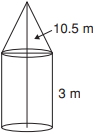
$A$ tent is in the shape of a right circular cylinder up to a height of $3\, m$ and then becomes a right circular cone with a maximum height of $13.5\, m$ above the ground. If the radius of the base is $14\, m$,find the cost of painting the inner side of the tent at the rate of ₹ $2$ per $m^2$ (in ₹).
A
$2050$
B
$2060$
C
$2068$
D
$2080$
Solution
(C) The height of the cylindrical part is $h_1 = 3\, m$.
The total height of the tent is $H = 13.5\, m$.
The height of the conical part is $h_2 = H - h_1 = 13.5 - 3 = 10.5\, m$.
The radius of the base is $r = 14\, m$.
Slant height of the cone $(l) = \sqrt{r^2 + h_2^2} = \sqrt{14^2 + 10.5^2} = \sqrt{196 + 110.25} = \sqrt{306.25} = 17.5\, m$.
Curved surface area of the cone $= \pi r l = \frac{22}{7} \times 14 \times 17.5 = 22 \times 2 \times 17.5 = 770\, m^2$.
Curved surface area of the cylinder $= 2 \pi r h_1 = 2 \times \frac{22}{7} \times 14 \times 3 = 2 \times 22 \times 2 \times 3 = 264\, m^2$.
Total surface area to be painted $= 770 + 264 = 1034\, m^2$.
Total cost of painting $= 1034 \times 2 = ₹ 2068$.
The total height of the tent is $H = 13.5\, m$.
The height of the conical part is $h_2 = H - h_1 = 13.5 - 3 = 10.5\, m$.
The radius of the base is $r = 14\, m$.
Slant height of the cone $(l) = \sqrt{r^2 + h_2^2} = \sqrt{14^2 + 10.5^2} = \sqrt{196 + 110.25} = \sqrt{306.25} = 17.5\, m$.
Curved surface area of the cone $= \pi r l = \frac{22}{7} \times 14 \times 17.5 = 22 \times 2 \times 17.5 = 770\, m^2$.
Curved surface area of the cylinder $= 2 \pi r h_1 = 2 \times \frac{22}{7} \times 14 \times 3 = 2 \times 22 \times 2 \times 3 = 264\, m^2$.
Total surface area to be painted $= 770 + 264 = 1034\, m^2$.
Total cost of painting $= 1034 \times 2 = ₹ 2068$.
0 likes
View Solution238
MediumMCQ
If the diameter of a sphere is decreased by $25 \%$,its curved surface area will be decreased by (in $\%$).
A
$43.25$
B
$43.50$
C
$43.75$
D
$44.25$
Solution
(C) Let the original diameter be $D$. The radius is $r = D/2$.
The surface area of a sphere is $A = 4 \pi r^2 = 4 \pi (D/2)^2 = \pi D^2$.
If the diameter is decreased by $25 \%$,the new diameter $D' = D - 0.25D = 0.75D$.
The new surface area $A' = \pi (D')^2 = \pi (0.75D)^2 = 0.5625 \pi D^2$.
The decrease in surface area is $A - A' = \pi D^2 - 0.5625 \pi D^2 = 0.4375 \pi D^2$.
The percentage decrease is $\frac{0.4375 \pi D^2}{\pi D^2} \times 100 \% = 43.75 \%$.
The surface area of a sphere is $A = 4 \pi r^2 = 4 \pi (D/2)^2 = \pi D^2$.
If the diameter is decreased by $25 \%$,the new diameter $D' = D - 0.25D = 0.75D$.
The new surface area $A' = \pi (D')^2 = \pi (0.75D)^2 = 0.5625 \pi D^2$.
The decrease in surface area is $A - A' = \pi D^2 - 0.5625 \pi D^2 = 0.4375 \pi D^2$.
The percentage decrease is $\frac{0.4375 \pi D^2}{\pi D^2} \times 100 \% = 43.75 \%$.
0 likes
View Solution239
DifficultMCQ
The radius of a cylinder is $10\, cm$ and its height is $4\, cm$. The value of $x$ (in $cm$) that may be added either to the radius or to the height to get the same increase in the volume of the cylinder is:
A
$5$
B
$4$
C
$25$
D
$16$
Solution
(A) Let the radius be $r = 10\, cm$ and the height be $h = 4\, cm$.
Let the value added to either the radius or the height be $x\, cm$.
Case $1$: When $x$ is added to the radius,the new radius is $(10+x)\, cm$ and the height remains $4\, cm$.
The new volume $V_1 = \pi(10+x)^2 \times 4$.
Case $2$: When $x$ is added to the height,the radius remains $10\, cm$ and the new height is $(4+x)\, cm$.
The new volume $V_2 = \pi(10)^2 \times (4+x)$.
According to the problem,the increase in volume is the same,which implies $V_1 = V_2$ (since the original volume is subtracted from both sides,the net increase is equal if the final volumes are equal).
$\pi(10+x)^2 \times 4 = \pi(10)^2(4+x)$
$(10+x)^2 \times 4 = 100(4+x)$
$4(100 + 20x + x^2) = 400 + 100x$
$400 + 80x + 4x^2 = 400 + 100x$
$4x^2 - 20x = 0$
$4x(x - 5) = 0$
Since $x$ cannot be $0$,we have $x = 5\, cm$.
Let the value added to either the radius or the height be $x\, cm$.
Case $1$: When $x$ is added to the radius,the new radius is $(10+x)\, cm$ and the height remains $4\, cm$.
The new volume $V_1 = \pi(10+x)^2 \times 4$.
Case $2$: When $x$ is added to the height,the radius remains $10\, cm$ and the new height is $(4+x)\, cm$.
The new volume $V_2 = \pi(10)^2 \times (4+x)$.
According to the problem,the increase in volume is the same,which implies $V_1 = V_2$ (since the original volume is subtracted from both sides,the net increase is equal if the final volumes are equal).
$\pi(10+x)^2 \times 4 = \pi(10)^2(4+x)$
$(10+x)^2 \times 4 = 100(4+x)$
$4(100 + 20x + x^2) = 400 + 100x$
$400 + 80x + 4x^2 = 400 + 100x$
$4x^2 - 20x = 0$
$4x(x - 5) = 0$
Since $x$ cannot be $0$,we have $x = 5\, cm$.
0 likes
View Solution240
MediumMCQ
If a solid cone of volume $27\, \pi\, cm^3$ is kept inside a hollow cylinder whose radius and height are the same as that of the cone,then the volume of water needed to fill the empty space is...........$\pi\, cm^3$.
A
$3$
B
$18$
C
$54$
D
$81$
Solution
(C) Let the radius and height of the cone be $r$ and $h$ respectively.
The volume of the cone is given by $V_{cone} = \frac{1}{3} \pi r^2 h = 27\, \pi\, cm^3$.
The volume of the cylinder with the same radius $r$ and height $h$ is $V_{cylinder} = \pi r^2 h$.
The empty space inside the cylinder after placing the cone is the difference between the volume of the cylinder and the volume of the cone.
Volume of empty space $= V_{cylinder} - V_{cone} = \pi r^2 h - \frac{1}{3} \pi r^2 h = \frac{2}{3} \pi r^2 h$.
Since $\frac{1}{3} \pi r^2 h = 27\, \pi$,we have $\pi r^2 h = 3 \times 27\, \pi = 81\, \pi$.
Therefore,the volume of water needed $= 81\, \pi - 27\, \pi = 54\, \pi\, cm^3$.
The volume of the cone is given by $V_{cone} = \frac{1}{3} \pi r^2 h = 27\, \pi\, cm^3$.
The volume of the cylinder with the same radius $r$ and height $h$ is $V_{cylinder} = \pi r^2 h$.
The empty space inside the cylinder after placing the cone is the difference between the volume of the cylinder and the volume of the cone.
Volume of empty space $= V_{cylinder} - V_{cone} = \pi r^2 h - \frac{1}{3} \pi r^2 h = \frac{2}{3} \pi r^2 h$.
Since $\frac{1}{3} \pi r^2 h = 27\, \pi$,we have $\pi r^2 h = 3 \times 27\, \pi = 81\, \pi$.
Therefore,the volume of water needed $= 81\, \pi - 27\, \pi = 54\, \pi\, cm^3$.
0 likes
View Solution241
MediumMCQ
Two $cm$ of rain has fallen on a square $Km$ of land. Assuming that $50 \%$ of the raindrops could have been collected and contained in a pool having a $100 \, m \times 10 \, m$ base,by what level would the water level in the pool have increased?
A
$1 \, Km$
B
$10 \, m$
C
$10 \, cm$
D
$1 \, m$
Solution
(B) Area of land $= 1 \, Km^2 = (1000 \, m) \times (1000 \, m) = 1,000,000 \, m^2$.
Height of rainfall $= 2 \, cm = 0.02 \, m$.
Total volume of rain $= \text{Area} \times \text{Height} = 1,000,000 \, m^2 \times 0.02 \, m = 20,000 \, m^3$.
Volume of water collected in the pool $= 50 \% \text{ of } 20,000 \, m^3 = 0.5 \times 20,000 = 10,000 \, m^3$.
Base area of the pool $= 100 \, m \times 10 \, m = 1,000 \, m^2$.
Increase in water level $= \frac{\text{Volume collected}}{\text{Base area}} = \frac{10,000 \, m^3}{1,000 \, m^2} = 10 \, m$.
Height of rainfall $= 2 \, cm = 0.02 \, m$.
Total volume of rain $= \text{Area} \times \text{Height} = 1,000,000 \, m^2 \times 0.02 \, m = 20,000 \, m^3$.
Volume of water collected in the pool $= 50 \% \text{ of } 20,000 \, m^3 = 0.5 \times 20,000 = 10,000 \, m^3$.
Base area of the pool $= 100 \, m \times 10 \, m = 1,000 \, m^2$.
Increase in water level $= \frac{\text{Volume collected}}{\text{Base area}} = \frac{10,000 \, m^3}{1,000 \, m^2} = 10 \, m$.
0 likes
View Solution242
DifficultMCQ
$A$ cylindrical can with a horizontal base and an internal radius of $3.5 \, cm$ contains sufficient water so that when a solid sphere is placed inside,the water just covers the sphere. The sphere fits exactly into the can. The depth of the water in the can before the sphere was added is:
A
$\frac{35}{3} \, cm$
B
$\frac{17}{3} \, cm$
C
$\frac{7}{3} \, cm$
D
$\frac{14}{3} \, cm$
Solution
(C) Let the radius of the base of the cylinder be $r = 3.5 \, cm$.
Since the sphere fits exactly into the can,the radius of the sphere is also $r = 3.5 \, cm$,and the height of the water level after placing the sphere is $H = 2r = 7 \, cm$.
The volume of the water in the can is equal to the total volume of the cylinder up to height $H$ minus the volume of the sphere.
Volume of water $= \pi r^2 (2r) - \frac{4}{3} \pi r^3 = 2 \pi r^3 - \frac{4}{3} \pi r^3 = \frac{2}{3} \pi r^3$.
Let the initial depth of the water be $h$. The volume of this water is $\pi r^2 h$.
Equating the volumes: $\pi r^2 h = \frac{2}{3} \pi r^3$.
Solving for $h$: $h = \frac{2}{3} r = \frac{2}{3} \times 3.5 = \frac{7}{3} \, cm$.
Since the sphere fits exactly into the can,the radius of the sphere is also $r = 3.5 \, cm$,and the height of the water level after placing the sphere is $H = 2r = 7 \, cm$.
The volume of the water in the can is equal to the total volume of the cylinder up to height $H$ minus the volume of the sphere.
Volume of water $= \pi r^2 (2r) - \frac{4}{3} \pi r^3 = 2 \pi r^3 - \frac{4}{3} \pi r^3 = \frac{2}{3} \pi r^3$.
Let the initial depth of the water be $h$. The volume of this water is $\pi r^2 h$.
Equating the volumes: $\pi r^2 h = \frac{2}{3} \pi r^3$.
Solving for $h$: $h = \frac{2}{3} r = \frac{2}{3} \times 3.5 = \frac{7}{3} \, cm$.
0 likes
View Solution243
MediumMCQ
The height of a circular cylinder is increased $6$ times and the base area is decreased to $\frac{1}{9}$ of its value. The factor by which the lateral surface area of the cylinder increases is
A
$2$
B
$\frac{1}{2}$
C
$\frac{2}{3}$
D
$\frac{3}{2}$
Solution
(A) Let the initial radius be $r$ and height be $h$. The initial lateral surface area is $A_1 = 2 \pi r h$.
The new height $h' = 6h$. The base area is $\pi r^2$. The new base area is $\frac{1}{9} \pi r^2 = \pi (r')^2$,which implies $(r')^2 = \frac{1}{9} r^2$,so $r' = \frac{1}{3} r$.
The new lateral surface area is $A_2 = 2 \pi r' h' = 2 \pi (\frac{1}{3} r) (6h) = 2 \pi r h \times (\frac{1}{3} \times 6) = 2 \pi r h \times 2$.
Thus,the lateral surface area increases by a factor of $2$.
The new height $h' = 6h$. The base area is $\pi r^2$. The new base area is $\frac{1}{9} \pi r^2 = \pi (r')^2$,which implies $(r')^2 = \frac{1}{9} r^2$,so $r' = \frac{1}{3} r$.
The new lateral surface area is $A_2 = 2 \pi r' h' = 2 \pi (\frac{1}{3} r) (6h) = 2 \pi r h \times (\frac{1}{3} \times 6) = 2 \pi r h \times 2$.
Thus,the lateral surface area increases by a factor of $2$.
0 likes
View Solution244
MediumMCQ
The volume of a right circular cone is $1232\, cm^3$ and its vertical height is $24\, cm$. Its curved surface area is.......$cm^2$.
A
$154$
B
$550$
C
$604$
D
$704$
Solution
(B) Let the radius of the cone be $r\, cm$.
Given,volume $V = \frac{1}{3} \pi r^2 h = 1232\, cm^3$ and height $h = 24\, cm$.
Substituting the values: $\frac{1}{3} \times \frac{22}{7} \times r^2 \times 24 = 1232$.
$r^2 = \frac{1232 \times 3 \times 7}{22 \times 24} = 49$.
Therefore,$r = \sqrt{49} = 7\, cm$.
Now,find the slant height $l = \sqrt{h^2 + r^2} = \sqrt{24^2 + 7^2} = \sqrt{576 + 49} = \sqrt{625} = 25\, cm$.
The curved surface area of the cone is given by $A = \pi rl$.
$A = \frac{22}{7} \times 7 \times 25 = 550\, cm^2$.
Given,volume $V = \frac{1}{3} \pi r^2 h = 1232\, cm^3$ and height $h = 24\, cm$.
Substituting the values: $\frac{1}{3} \times \frac{22}{7} \times r^2 \times 24 = 1232$.
$r^2 = \frac{1232 \times 3 \times 7}{22 \times 24} = 49$.
Therefore,$r = \sqrt{49} = 7\, cm$.
Now,find the slant height $l = \sqrt{h^2 + r^2} = \sqrt{24^2 + 7^2} = \sqrt{576 + 49} = \sqrt{625} = 25\, cm$.
The curved surface area of the cone is given by $A = \pi rl$.
$A = \frac{22}{7} \times 7 \times 25 = 550\, cm^2$.
0 likes
View Solution245
MediumMCQ
The height of a right prism with a square base is $15\, cm.$ If the total surface area of the prism is $608\, cm^2,$ its volume is......$cm^3$.
A
$910$
B
$920$
C
$960$
D
$980$
Solution
(C) Let the side of the square base be $x\, cm.$
The height of the prism is $h = 15\, cm.$
The total surface area of a prism is given by the formula: $\text{Total Surface Area} = \text{Lateral Surface Area} + 2 \times \text{Base Area}.$
Lateral Surface Area $= \text{Perimeter of base} \times h = (4x) \times 15 = 60x.$
Base Area $= x^2.$
Given,$\text{Total Surface Area} = 608\, cm^2.$
So,$60x + 2x^2 = 608.$
Dividing by $2,$ we get $x^2 + 30x - 304 = 0.$
Factoring the quadratic equation: $x^2 + 38x - 8x - 304 = 0 \Rightarrow x(x + 38) - 8(x + 38) = 0.$
$(x - 8)(x + 38) = 0.$
Since the side length cannot be negative,$x = 8\, cm.$
Volume of the prism $= \text{Base Area} \times h = x^2 \times h = 8^2 \times 15 = 64 \times 15 = 960\, cm^3.$
The height of the prism is $h = 15\, cm.$
The total surface area of a prism is given by the formula: $\text{Total Surface Area} = \text{Lateral Surface Area} + 2 \times \text{Base Area}.$
Lateral Surface Area $= \text{Perimeter of base} \times h = (4x) \times 15 = 60x.$
Base Area $= x^2.$
Given,$\text{Total Surface Area} = 608\, cm^2.$
So,$60x + 2x^2 = 608.$
Dividing by $2,$ we get $x^2 + 30x - 304 = 0.$
Factoring the quadratic equation: $x^2 + 38x - 8x - 304 = 0 \Rightarrow x(x + 38) - 8(x + 38) = 0.$
$(x - 8)(x + 38) = 0.$
Since the side length cannot be negative,$x = 8\, cm.$
Volume of the prism $= \text{Base Area} \times h = x^2 \times h = 8^2 \times 15 = 64 \times 15 = 960\, cm^3.$
0 likes
View Solution246
MediumMCQ
The volume of a solid hemisphere is $19404 \, cm^3$. Its total surface area is ....... $cm^2$.
A
$4158$
B
$2858$
C
$1738$
D
$2038$
Solution
(A) The volume of a solid hemisphere is given by the formula $V = \frac{2}{3} \pi r^3$.
Given $V = 19404 \, cm^3$,we have $\frac{2}{3} \times \frac{22}{7} \times r^3 = 19404$.
Solving for $r^3$: $r^3 = \frac{19404 \times 3 \times 7}{2 \times 22} = 9261$.
Taking the cube root: $r = \sqrt[3]{9261} = 21 \, cm$.
The total surface area of a solid hemisphere is given by $TSA = 3 \pi r^2$.
$TSA = 3 \times \frac{22}{7} \times 21 \times 21 = 3 \times 22 \times 3 \times 21 = 4158 \, cm^2$.
Given $V = 19404 \, cm^3$,we have $\frac{2}{3} \times \frac{22}{7} \times r^3 = 19404$.
Solving for $r^3$: $r^3 = \frac{19404 \times 3 \times 7}{2 \times 22} = 9261$.
Taking the cube root: $r = \sqrt[3]{9261} = 21 \, cm$.
The total surface area of a solid hemisphere is given by $TSA = 3 \pi r^2$.
$TSA = 3 \times \frac{22}{7} \times 21 \times 21 = 3 \times 22 \times 3 \times 21 = 4158 \, cm^2$.
0 likes
View Solution247
MediumMCQ
Water is flowing at the rate of $5 \text{ km/h}$ through a pipe of diameter $14 \text{ cm}$ into a rectangular tank which is $50 \text{ m}$ long and $44 \text{ m}$ wide. The time taken,in hours,for the rise in the level of water in the tank to be $7 \text{ cm}$ is:
A
$2$
B
$1 \frac{1}{2}$
C
$3$
D
$2 \frac{1}{2}$
Solution
(A) $1$. Radius of the pipe $(r)$ = $14/2 = 7 \text{ cm} = 0.07 \text{ m}$.
$2$. Speed of water = $5 \text{ km/h} = 5000 \text{ m/h}$.
$3$. Volume of water flowing through the pipe in $1 \text{ hour} = \pi r^2 h = (22/7) \times (0.07)^2 \times 5000 = (22/7) \times 0.0049 \times 5000 = 22 \times 0.0007 \times 5000 = 77 \text{ m}^3$.
$4$. Volume of water required in the tank = $\text{Length} \times \text{Width} \times \text{Height} = 50 \text{ m} \times 44 \text{ m} \times (7/100) \text{ m} = 50 \times 44 \times 0.07 = 154 \text{ m}^3$.
$5$. Time taken = $\text{Total volume required} / \text{Volume per hour} = 154 / 77 = 2 \text{ hours}$.
$2$. Speed of water = $5 \text{ km/h} = 5000 \text{ m/h}$.
$3$. Volume of water flowing through the pipe in $1 \text{ hour} = \pi r^2 h = (22/7) \times (0.07)^2 \times 5000 = (22/7) \times 0.0049 \times 5000 = 22 \times 0.0007 \times 5000 = 77 \text{ m}^3$.
$4$. Volume of water required in the tank = $\text{Length} \times \text{Width} \times \text{Height} = 50 \text{ m} \times 44 \text{ m} \times (7/100) \text{ m} = 50 \times 44 \times 0.07 = 154 \text{ m}^3$.
$5$. Time taken = $\text{Total volume required} / \text{Volume per hour} = 154 / 77 = 2 \text{ hours}$.
0 likes
View Solution248
DifficultMCQ
The areas of three consecutive faces of a cuboid are $12 \, cm^2$,$20 \, cm^2$,and $15 \, cm^2$. Then the volume (in $cm^3$) of the cuboid is:
A
$3600$
B
$100$
C
$80$
D
$60$
Solution
(D) Let the length,breadth,and height of the cuboid be $x, y,$ and $z$ cm,respectively.
Given the areas of three consecutive faces:
$xy = 12 \, cm^2$
$yz = 20 \, cm^2$
$zx = 15 \, cm^2$
Multiplying these three equations together:
$(xy) \cdot (yz) \cdot (zx) = 12 \cdot 20 \cdot 15$
$x^2 y^2 z^2 = 3600$
Taking the square root of both sides:
$xyz = \sqrt{3600}$
$xyz = 60$
Since the volume $V$ of a cuboid is given by $V = xyz$,the volume is $60 \, cm^3$.
Given the areas of three consecutive faces:
$xy = 12 \, cm^2$
$yz = 20 \, cm^2$
$zx = 15 \, cm^2$
Multiplying these three equations together:
$(xy) \cdot (yz) \cdot (zx) = 12 \cdot 20 \cdot 15$
$x^2 y^2 z^2 = 3600$
Taking the square root of both sides:
$xyz = \sqrt{3600}$
$xyz = 60$
Since the volume $V$ of a cuboid is given by $V = xyz$,the volume is $60 \, cm^3$.
0 likes
View Solution249
MediumMCQ
Water is flowing at the rate of $3 \, km/h$ through a circular pipe of $20 \, cm$ internal diameter into a circular cistern of diameter $10 \, m$ and depth $2 \, m$. In how much time will the cistern be filled?
A
$1 \, hour$
B
$1 \, hour \, 40 \, minutes$
C
$1 \, hour \, 20 \, minutes$
D
$2 \, hours \, 40 \, minutes$
Solution
(B) $1$. Calculate the volume of the cistern: The cistern is cylindrical with radius $r = 5 \, m$ and height $h = 2 \, m$. Volume $V = \pi r^2 h = \pi \times (5)^2 \times 2 = 50\pi \, m^3$.
$2$. Calculate the volume of water flowing through the pipe per hour: The pipe has radius $r_p = 10 \, cm = 0.1 \, m$. The speed of water is $3 \, km/h = 3000 \, m/h$. The volume of water flowing per hour is $V_p = \pi r_p^2 \times \text{speed} = \pi \times (0.1)^2 \times 3000 = \pi \times 0.01 \times 3000 = 30\pi \, m^3/h$.
$3$. Calculate the time required: Time = $\frac{\text{Volume of cistern}}{\text{Volume of water per hour}} = \frac{50\pi}{30\pi} = \frac{5}{3} \, hours$.
$4$. Convert to hours and minutes: $\frac{5}{3} \, hours = 1 \, hour + \frac{2}{3} \times 60 \, minutes = 1 \, hour \, 40 \, minutes$.
$2$. Calculate the volume of water flowing through the pipe per hour: The pipe has radius $r_p = 10 \, cm = 0.1 \, m$. The speed of water is $3 \, km/h = 3000 \, m/h$. The volume of water flowing per hour is $V_p = \pi r_p^2 \times \text{speed} = \pi \times (0.1)^2 \times 3000 = \pi \times 0.01 \times 3000 = 30\pi \, m^3/h$.
$3$. Calculate the time required: Time = $\frac{\text{Volume of cistern}}{\text{Volume of water per hour}} = \frac{50\pi}{30\pi} = \frac{5}{3} \, hours$.
$4$. Convert to hours and minutes: $\frac{5}{3} \, hours = 1 \, hour + \frac{2}{3} \times 60 \, minutes = 1 \, hour \, 40 \, minutes$.
0 likes
View Solution250
MediumMCQ
Marbles of diameter $1.4\, cm$ are dropped into a cylindrical beaker containing some water and are fully submerged. The diameter of the beaker is $7\, cm.$ Find how many marbles have been dropped in it if the water rises by $5.6\, cm.$
A
$50$
B
$150$
C
$250$
D
$350$
Solution
(B) The volume of the water displaced in the cylindrical beaker is equal to the total volume of the submerged marbles.
Radius of the beaker $R = \frac{7}{2} = 3.5\, cm$.
Height of the water rise $h = 5.6\, cm$.
Volume of raised water $= \pi R^2 h = \frac{22}{7} \times 3.5 \times 3.5 \times 5.6 = 215.6\, cm^3$.
Radius of a marble $r = \frac{1.4}{2} = 0.7\, cm$.
Volume of one marble $= \frac{4}{3} \pi r^3 = \frac{4}{3} \times \frac{22}{7} \times 0.7 \times 0.7 \times 0.7 = \frac{4}{3} \times 22 \times 0.1 \times 0.49 = \frac{4.312}{3}\, cm^3$.
Let the number of marbles be $n$.
$n \times (\text{Volume of one marble}) = \text{Volume of raised water}$
$n \times \frac{4.312}{3} = 215.6$
$n = \frac{215.6 \times 3}{4.312} = 50 \times 3 = 150$.
Therefore,$150$ marbles were dropped into the beaker.
Radius of the beaker $R = \frac{7}{2} = 3.5\, cm$.
Height of the water rise $h = 5.6\, cm$.
Volume of raised water $= \pi R^2 h = \frac{22}{7} \times 3.5 \times 3.5 \times 5.6 = 215.6\, cm^3$.
Radius of a marble $r = \frac{1.4}{2} = 0.7\, cm$.
Volume of one marble $= \frac{4}{3} \pi r^3 = \frac{4}{3} \times \frac{22}{7} \times 0.7 \times 0.7 \times 0.7 = \frac{4}{3} \times 22 \times 0.1 \times 0.49 = \frac{4.312}{3}\, cm^3$.
Let the number of marbles be $n$.
$n \times (\text{Volume of one marble}) = \text{Volume of raised water}$
$n \times \frac{4.312}{3} = 215.6$
$n = \frac{215.6 \times 3}{4.312} = 50 \times 3 = 150$.
Therefore,$150$ marbles were dropped into the beaker.
0 likes
View SolutionMensuration — Measurement of Volume and Surface Area · Frequently Asked Questions
1Are these Mensuration questions useful for JEE and NEET?
Yes. All questions in this section are mapped to JEE Main and NEET exam patterns. Previous year questions from JEE Main, NEET, GUJCET and state-level exams are included with full solutions.
2Can I switch to Hindi or Gujarati for these questions?
Yes. Use the language tabs in the hero section or the sidebar to view the same questions and solutions in English, Hindi or Gujarati.
3How do I generate a question paper from this subtopic?
Use the Vedclass Exam Paper Generator — select the chapter and subtopic, set difficulty, and generate Sets A, B, C, D automatically. First 3 chapters of every subject are free.
Vedclass Products
For Students
Vedclass Test Series
Mock tests in real JEE/NEET style with performance analysis. 5-day free trial.
Start Free TrialFor Teachers
Exam Paper Generator
Generate Set A/B/C/D papers from this chapter in 2 minutes. 3 chapters free.
Try FreeFor Institutes
Online Exam Module
Live online exams with unlimited students, 360° analytics & white-label branding.
See DemoFor Teachers & Institutes
Generate a Mensuration Exam Paper in 2 Minutes
Select subtopic & difficulty — Sets A, B, C, D auto-generated with No Repeat logic.
First 3 chapters of every subject are free — no payment required.