
A English
Measurement of Volume and Surface Area Questions in English
Competitive Exam Quantitative Aptitude · Mensuration · Measurement of Volume and Surface Area
265+
Questions
English
Language
100%
With Solutions
Showing 15 of 265 questions in English
251
MediumMCQ
$A$ hemisphere and a cone have equal bases. If their heights are also equal,the ratio of their curved surfaces will be
A
$1: \sqrt{2}$
B
$2: \sqrt{2}$
C
$1: 2$
D
$2: 1$
Solution
(B) Let the radius of the base of the hemisphere be $r$ units. Since the bases are equal,the radius of the cone is also $r$ units.
Given that the heights are equal,the height of the cone $h = r$ (as the height of a hemisphere is equal to its radius).
The slant height $l$ of the cone is given by $l = \sqrt{r^2 + h^2} = \sqrt{r^2 + r^2} = \sqrt{2r^2} = r\sqrt{2}$.
The curved surface area of the hemisphere is $2\pi r^2$.
The curved surface area of the cone is $\pi rl = \pi r(r\sqrt{2}) = \pi r^2\sqrt{2}$.
The ratio of the curved surface area of the hemisphere to the curved surface area of the cone is $2\pi r^2 : \pi r^2\sqrt{2} = 2 : \sqrt{2}$.
Given that the heights are equal,the height of the cone $h = r$ (as the height of a hemisphere is equal to its radius).
The slant height $l$ of the cone is given by $l = \sqrt{r^2 + h^2} = \sqrt{r^2 + r^2} = \sqrt{2r^2} = r\sqrt{2}$.
The curved surface area of the hemisphere is $2\pi r^2$.
The curved surface area of the cone is $\pi rl = \pi r(r\sqrt{2}) = \pi r^2\sqrt{2}$.
The ratio of the curved surface area of the hemisphere to the curved surface area of the cone is $2\pi r^2 : \pi r^2\sqrt{2} = 2 : \sqrt{2}$.
0 likes
View Solution252
DifficultMCQ
The heights of a cone,cylinder,and hemisphere are equal. If their radii are in the ratio $2: 3: 1$,then the ratio of their volumes is
A
$2: 9: 2$
B
$4: 9: 1$
C
$4: 27: 2$
D
$2: 3: 1$
Solution
(C) Let the common height be $h$. For a hemisphere,the height is equal to its radius,so $h = r_3$. Given that the heights of the cone,cylinder,and hemisphere are equal,we have $h = h_{cone} = h_{cylinder} = r_{hemisphere}$.
Let the radii be $r_1 = 2x$,$r_2 = 3x$,and $r_3 = 1x = x$. Since the height of the hemisphere is its radius,$h = x$.
Volume of cone $V_1 = \frac{1}{3} \pi r_1^2 h = \frac{1}{3} \pi (2x)^2 (x) = \frac{4}{3} \pi x^3$.
Volume of cylinder $V_2 = \pi r_2^2 h = \pi (3x)^2 (x) = 9 \pi x^3$.
Volume of hemisphere $V_3 = \frac{2}{3} \pi r_3^3 = \frac{2}{3} \pi (x)^3 = \frac{2}{3} \pi x^3$.
The ratio $V_1 : V_2 : V_3 = \frac{4}{3} \pi x^3 : 9 \pi x^3 : \frac{2}{3} \pi x^3$.
Multiplying by $\frac{3}{\pi x^3}$,we get $4 : 27 : 2$.
Let the radii be $r_1 = 2x$,$r_2 = 3x$,and $r_3 = 1x = x$. Since the height of the hemisphere is its radius,$h = x$.
Volume of cone $V_1 = \frac{1}{3} \pi r_1^2 h = \frac{1}{3} \pi (2x)^2 (x) = \frac{4}{3} \pi x^3$.
Volume of cylinder $V_2 = \pi r_2^2 h = \pi (3x)^2 (x) = 9 \pi x^3$.
Volume of hemisphere $V_3 = \frac{2}{3} \pi r_3^3 = \frac{2}{3} \pi (x)^3 = \frac{2}{3} \pi x^3$.
The ratio $V_1 : V_2 : V_3 = \frac{4}{3} \pi x^3 : 9 \pi x^3 : \frac{2}{3} \pi x^3$.
Multiplying by $\frac{3}{\pi x^3}$,we get $4 : 27 : 2$.
0 likes
View Solution253
MediumMCQ
The base of a right pyramid is a square,and the length of the diagonal of the base is $24 \sqrt{2} \text{ m}$. If the volume of the pyramid is $1728 \text{ m}^3$,its height is ......... $\text{m}$.
A
$7$
B
$8$
C
$9$
D
$10$
Solution
(C) The area of a square base can be calculated using its diagonal $d$ as: $\text{Area} = \frac{1}{2} \times d^2$.
Given $d = 24 \sqrt{2} \text{ m}$,the area is $\frac{1}{2} \times (24 \sqrt{2})^2 = \frac{1}{2} \times 576 \times 2 = 576 \text{ m}^2$.
The volume $V$ of a pyramid is given by the formula: $V = \frac{1}{3} \times \text{Base Area} \times \text{height} (h)$.
Substituting the given values: $1728 = \frac{1}{3} \times 576 \times h$.
$1728 = 192 \times h$.
$h = \frac{1728}{192} = 9 \text{ m}$.
Given $d = 24 \sqrt{2} \text{ m}$,the area is $\frac{1}{2} \times (24 \sqrt{2})^2 = \frac{1}{2} \times 576 \times 2 = 576 \text{ m}^2$.
The volume $V$ of a pyramid is given by the formula: $V = \frac{1}{3} \times \text{Base Area} \times \text{height} (h)$.
Substituting the given values: $1728 = \frac{1}{3} \times 576 \times h$.
$1728 = 192 \times h$.
$h = \frac{1728}{192} = 9 \text{ m}$.
0 likes
View Solution254
DifficultMCQ
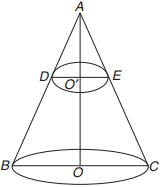
The height of a right circular cone and the radius of its circular base are $9 \, cm$ and $3 \, cm$ respectively. The cone is cut by a plane parallel to its base so as to divide it into two parts. The volume of the frustum (i.e.,the lower part) of the cone is $44 \, cm^3$. The radius of the upper circular surface of the frustum $\left(\text{taking } \pi = \frac{22}{7}\right)$ is
A
$\sqrt[3]{12} \, cm$
B
$\sqrt[3]{13} \, cm$
C
$\sqrt[3]{6} \, cm$
D
$\sqrt[3]{20} \, cm$
Solution
(B) Let the height of the original cone be $H = 9 \, cm$ and the radius of its base be $R = 3 \, cm$.
Let the radius of the upper circular surface of the frustum be $r$ and the height of the small cone cut from the top be $h'$.
By similar triangles,the ratio of the radius to the height is constant: $\frac{r}{h'} = \frac{R}{H} = \frac{3}{9} = \frac{1}{3}$,so $h' = 3r$.
The volume of the original cone is $V_{total} = \frac{1}{3} \pi R^2 H = \frac{1}{3} \times \frac{22}{7} \times 3^2 \times 9 = \frac{22 \times 27}{7} = \frac{594}{7} \, cm^3$.
The volume of the small cone at the top is $V_{small} = \frac{1}{3} \pi r^2 h' = \frac{1}{3} \pi r^2 (3r) = \pi r^3$.
The volume of the frustum is $V_{frustum} = V_{total} - V_{small} = 44 \, cm^3$.
Substituting the values: $\frac{594}{7} - \frac{22}{7} r^3 = 44$.
Multiply by $7$: $594 - 22r^3 = 308$.
$22r^3 = 594 - 308 = 286$.
$r^3 = \frac{286}{22} = 13$.
Therefore,$r = \sqrt[3]{13} \, cm$.
Let the radius of the upper circular surface of the frustum be $r$ and the height of the small cone cut from the top be $h'$.
By similar triangles,the ratio of the radius to the height is constant: $\frac{r}{h'} = \frac{R}{H} = \frac{3}{9} = \frac{1}{3}$,so $h' = 3r$.
The volume of the original cone is $V_{total} = \frac{1}{3} \pi R^2 H = \frac{1}{3} \times \frac{22}{7} \times 3^2 \times 9 = \frac{22 \times 27}{7} = \frac{594}{7} \, cm^3$.
The volume of the small cone at the top is $V_{small} = \frac{1}{3} \pi r^2 h' = \frac{1}{3} \pi r^2 (3r) = \pi r^3$.
The volume of the frustum is $V_{frustum} = V_{total} - V_{small} = 44 \, cm^3$.
Substituting the values: $\frac{594}{7} - \frac{22}{7} r^3 = 44$.
Multiply by $7$: $594 - 22r^3 = 308$.
$22r^3 = 594 - 308 = 286$.
$r^3 = \frac{286}{22} = 13$.
Therefore,$r = \sqrt[3]{13} \, cm$.
0 likes
View Solution255
MediumMCQ
The ratio of radii of $2$ right circular cylinders is $2:3$ and their heights are in the ratio $5:4$. The ratio of their curved surface area is
A
$5:6$
B
$3:4$
C
$4:5$
D
$2:3$
Solution
(A) Let the radii of the two cylinders be $r_1$ and $r_2$,and their heights be $h_1$ and $h_2$ respectively.
Given,the ratio of radii $r_1 : r_2 = 2 : 3$ and the ratio of heights $h_1 : h_2 = 5 : 4$.
The curved surface area $(CSA)$ of a cylinder is given by the formula $CSA = 2 \pi r h$.
The ratio of the curved surface areas of the two cylinders is $\frac{CSA_1}{CSA_2} = \frac{2 \pi r_1 h_1}{2 \pi r_2 h_2}$.
Simplifying this,we get $\frac{CSA_1}{CSA_2} = \frac{r_1}{r_2} \times \frac{h_1}{h_2}$.
Substituting the given ratios: $\frac{CSA_1}{CSA_2} = \frac{2}{3} \times \frac{5}{4} = \frac{10}{12} = \frac{5}{6}$.
Thus,the ratio of their curved surface areas is $5:6$.
Given,the ratio of radii $r_1 : r_2 = 2 : 3$ and the ratio of heights $h_1 : h_2 = 5 : 4$.
The curved surface area $(CSA)$ of a cylinder is given by the formula $CSA = 2 \pi r h$.
The ratio of the curved surface areas of the two cylinders is $\frac{CSA_1}{CSA_2} = \frac{2 \pi r_1 h_1}{2 \pi r_2 h_2}$.
Simplifying this,we get $\frac{CSA_1}{CSA_2} = \frac{r_1}{r_2} \times \frac{h_1}{h_2}$.
Substituting the given ratios: $\frac{CSA_1}{CSA_2} = \frac{2}{3} \times \frac{5}{4} = \frac{10}{12} = \frac{5}{6}$.
Thus,the ratio of their curved surface areas is $5:6$.
0 likes
View Solution256
DifficultMCQ
$A$ solid cylinder has a total surface area of $462 \, cm^2$. Its curved surface area is $\frac{1}{3}$ of its total surface area. The volume of the cylinder is.......$cm^3$.
A
$530$
B
$536$
C
$539$
D
$545$
Solution
(C) Let the height of the cylinder be $h \, cm$ and the radius of the base be $r \, cm$.
According to the question,the total surface area is $2 \pi r^2 + 2 \pi r h = 462 \, cm^2 \dots (1)$.
The curved surface area is given as $\frac{1}{3}$ of the total surface area:
Curved surface area $= 2 \pi r h = \frac{1}{3} \times 462 = 154 \, cm^2$.
Substituting this into equation $(1)$:
$2 \pi r^2 + 154 = 462$
$2 \pi r^2 = 462 - 154 = 308$
$2 \times \frac{22}{7} \times r^2 = 308$
$r^2 = \frac{308 \times 7}{44} = 7 \times 7 = 49$
$r = 7 \, cm$.
Now,using $2 \pi r h = 154$:
$2 \times \frac{22}{7} \times 7 \times h = 154$
$44 \times h = 154$
$h = \frac{154}{44} = 3.5 \, cm$ (or $\frac{7}{2} \, cm$).
The volume of the cylinder is $V = \pi r^2 h = \frac{22}{7} \times 7 \times 7 \times 3.5 = 22 \times 7 \times 3.5 = 539 \, cm^3$.
According to the question,the total surface area is $2 \pi r^2 + 2 \pi r h = 462 \, cm^2 \dots (1)$.
The curved surface area is given as $\frac{1}{3}$ of the total surface area:
Curved surface area $= 2 \pi r h = \frac{1}{3} \times 462 = 154 \, cm^2$.
Substituting this into equation $(1)$:
$2 \pi r^2 + 154 = 462$
$2 \pi r^2 = 462 - 154 = 308$
$2 \times \frac{22}{7} \times r^2 = 308$
$r^2 = \frac{308 \times 7}{44} = 7 \times 7 = 49$
$r = 7 \, cm$.
Now,using $2 \pi r h = 154$:
$2 \times \frac{22}{7} \times 7 \times h = 154$
$44 \times h = 154$
$h = \frac{154}{44} = 3.5 \, cm$ (or $\frac{7}{2} \, cm$).
The volume of the cylinder is $V = \pi r^2 h = \frac{22}{7} \times 7 \times 7 \times 3.5 = 22 \times 7 \times 3.5 = 539 \, cm^3$.
0 likes
View Solution257
MediumMCQ
$A$ cylinder and a cone have equal radii of their bases and equal heights. If their curved surface areas are in the ratio $8:5$,the ratio of their radius and height is
A
$1:2$
B
$1:3$
C
$2:3$
D
$3:4$
Solution
(D) Let the radius and the height be $r$ and $h$ respectively.
The curved surface area of a cylinder is $2 \pi rh$.
The curved surface area of a cone is $\pi rl$,where $l = \sqrt{h^2 + r^2}$.
Given the ratio of their curved surface areas is $8:5$:
$\frac{2 \pi rh}{\pi r \sqrt{h^2 + r^2}} = \frac{8}{5}$
$\frac{2h}{\sqrt{h^2 + r^2}} = \frac{8}{5}$
$\frac{h}{\sqrt{h^2 + r^2}} = \frac{4}{5}$
Squaring both sides:
$\frac{h^2}{h^2 + r^2} = \frac{16}{25}$
$25h^2 = 16h^2 + 16r^2$
$9h^2 = 16r^2$
$\frac{r^2}{h^2} = \frac{9}{16}$
$\frac{r}{h} = \frac{3}{4}$
Thus,the ratio of their radius and height is $3:4$.
The curved surface area of a cylinder is $2 \pi rh$.
The curved surface area of a cone is $\pi rl$,where $l = \sqrt{h^2 + r^2}$.
Given the ratio of their curved surface areas is $8:5$:
$\frac{2 \pi rh}{\pi r \sqrt{h^2 + r^2}} = \frac{8}{5}$
$\frac{2h}{\sqrt{h^2 + r^2}} = \frac{8}{5}$
$\frac{h}{\sqrt{h^2 + r^2}} = \frac{4}{5}$
Squaring both sides:
$\frac{h^2}{h^2 + r^2} = \frac{16}{25}$
$25h^2 = 16h^2 + 16r^2$
$9h^2 = 16r^2$
$\frac{r^2}{h^2} = \frac{9}{16}$
$\frac{r}{h} = \frac{3}{4}$
Thus,the ratio of their radius and height is $3:4$.
0 likes
View Solution258
MediumMCQ
$A$ solid is hemispherical at the bottom and conical above. If the surface areas of the two parts are equal,then the ratio of the radius and height of its conical part is
A
$1:3$
B
$1:1$
C
$3:1$
D
$1: \sqrt{3}$
Solution
(D) Let the radius of the base be $r$ units and the height of the cone be $h$ units.
The surface area of the hemispherical part is $2 \pi r^2$.
The curved surface area of the conical part is $\pi r l$,where $l = \sqrt{r^2 + h^2}$ is the slant height.
According to the problem,the surface areas of the two parts are equal:
$2 \pi r^2 = \pi r \sqrt{r^2 + h^2}$
Dividing both sides by $\pi r$ (assuming $r \neq 0$):
$2r = \sqrt{r^2 + h^2}$
Squaring both sides:
$4r^2 = r^2 + h^2$
$3r^2 = h^2$
Taking the square root of both sides:
$\sqrt{3}r = h$
Therefore,the ratio of the radius to the height is:
$\frac{r}{h} = \frac{1}{\sqrt{3}}$,which is $1: \sqrt{3}$.
The surface area of the hemispherical part is $2 \pi r^2$.
The curved surface area of the conical part is $\pi r l$,where $l = \sqrt{r^2 + h^2}$ is the slant height.
According to the problem,the surface areas of the two parts are equal:
$2 \pi r^2 = \pi r \sqrt{r^2 + h^2}$
Dividing both sides by $\pi r$ (assuming $r \neq 0$):
$2r = \sqrt{r^2 + h^2}$
Squaring both sides:
$4r^2 = r^2 + h^2$
$3r^2 = h^2$
Taking the square root of both sides:
$\sqrt{3}r = h$
Therefore,the ratio of the radius to the height is:
$\frac{r}{h} = \frac{1}{\sqrt{3}}$,which is $1: \sqrt{3}$.
0 likes
View Solution259
MediumMCQ
The base of a right prism is an equilateral triangle with a side of $6 \, cm$. If the volume of the prism is $108 \sqrt{3} \, cm^3$,its height is ...... $cm$.
A
$9$
B
$10$
C
$11$
D
$12$
Solution
(D) The area of the base of an equilateral triangle is given by the formula: $\text{Area} = \frac{\sqrt{3}}{4} \times \text{side}^2$.
Substituting the given side length of $6 \, cm$:
$\text{Area} = \frac{\sqrt{3}}{4} \times 6^2 = \frac{\sqrt{3}}{4} \times 36 = 9 \sqrt{3} \, cm^2$.
The volume of a right prism is calculated as: $\text{Volume} = \text{Area of base} \times \text{height}$.
Given the volume is $108 \sqrt{3} \, cm^3$,we have:
$108 \sqrt{3} = 9 \sqrt{3} \times h$.
Dividing both sides by $9 \sqrt{3}$:
$h = \frac{108 \sqrt{3}}{9 \sqrt{3}} = 12 \, cm$.
Substituting the given side length of $6 \, cm$:
$\text{Area} = \frac{\sqrt{3}}{4} \times 6^2 = \frac{\sqrt{3}}{4} \times 36 = 9 \sqrt{3} \, cm^2$.
The volume of a right prism is calculated as: $\text{Volume} = \text{Area of base} \times \text{height}$.
Given the volume is $108 \sqrt{3} \, cm^3$,we have:
$108 \sqrt{3} = 9 \sqrt{3} \times h$.
Dividing both sides by $9 \sqrt{3}$:
$h = \frac{108 \sqrt{3}}{9 \sqrt{3}} = 12 \, cm$.
0 likes
View Solution260
DifficultMCQ
The number of coins,each of radius $0.75\, cm$ and thickness $0.2\, cm$,to be melted to make a right circular cylinder of height $8\, cm$ and radius $3\, cm$ is:
A
$640$
B
$600$
C
$500$
D
$480$
Solution
(A) Let the number of required coins be $x$.
The volume of a single coin (which is a cylinder) is given by $V = \pi r^2 h$.
For each coin,$r = 0.75\, cm$ and $h = 0.2\, cm$.
Total volume of $x$ coins $= x \times \pi \times (0.75)^2 \times 0.2$.
The volume of the target right circular cylinder is $V = \pi R^2 H$.
Here,$R = 3\, cm$ and $H = 8\, cm$.
Volume of cylinder $= \pi \times (3)^2 \times 8 = \pi \times 9 \times 8 = 72\pi\, cm^3$.
Equating the volumes:
$x \times \pi \times (0.75)^2 \times 0.2 = 72\pi$
$x \times (0.5625) \times 0.2 = 72$
$x \times 0.1125 = 72$
$x = \frac{72}{0.1125}$
$x = \frac{720000}{1125} = 640$.
Thus,the number of coins required is $640$.
The volume of a single coin (which is a cylinder) is given by $V = \pi r^2 h$.
For each coin,$r = 0.75\, cm$ and $h = 0.2\, cm$.
Total volume of $x$ coins $= x \times \pi \times (0.75)^2 \times 0.2$.
The volume of the target right circular cylinder is $V = \pi R^2 H$.
Here,$R = 3\, cm$ and $H = 8\, cm$.
Volume of cylinder $= \pi \times (3)^2 \times 8 = \pi \times 9 \times 8 = 72\pi\, cm^3$.
Equating the volumes:
$x \times \pi \times (0.75)^2 \times 0.2 = 72\pi$
$x \times (0.5625) \times 0.2 = 72$
$x \times 0.1125 = 72$
$x = \frac{72}{0.1125}$
$x = \frac{720000}{1125} = 640$.
Thus,the number of coins required is $640$.
0 likes
View Solution261
MediumMCQ
If the radius of a sphere is increased by $2 \, m$,its surface area is increased by $704 \, m^2$. What is the radius of the original sphere? (in $m$)
(use $\pi = \frac{22}{7}$)
(use $\pi = \frac{22}{7}$)
A
$16$
B
$15$
C
$14$
D
$13$
Solution
(D) Let the radius of the original sphere be $r \, m$.
The new radius is $(r + 2) \, m$.
The surface area of a sphere is given by $A = 4 \pi r^2$.
According to the problem,the increase in surface area is $704 \, m^2$:
$4 \pi (r + 2)^2 - 4 \pi r^2 = 704$
Divide by $4 \pi$:
$(r + 2)^2 - r^2 = \frac{704}{4 \pi}$
$(r^2 + 4r + 4) - r^2 = \frac{176}{\pi}$
$4r + 4 = \frac{176}{22/7}$
$4(r + 1) = \frac{176 \times 7}{22}$
$4(r + 1) = 8 \times 7$
$4(r + 1) = 56$
$r + 1 = 14$
$r = 13 \, m$.
The new radius is $(r + 2) \, m$.
The surface area of a sphere is given by $A = 4 \pi r^2$.
According to the problem,the increase in surface area is $704 \, m^2$:
$4 \pi (r + 2)^2 - 4 \pi r^2 = 704$
Divide by $4 \pi$:
$(r + 2)^2 - r^2 = \frac{704}{4 \pi}$
$(r^2 + 4r + 4) - r^2 = \frac{176}{\pi}$
$4r + 4 = \frac{176}{22/7}$
$4(r + 1) = \frac{176 \times 7}{22}$
$4(r + 1) = 8 \times 7$
$4(r + 1) = 56$
$r + 1 = 14$
$r = 13 \, m$.
0 likes
View Solution262
MediumMCQ
$A$ right circular cylinder is circumscribing a hemisphere such that their bases are common. The ratio of their volumes is
A
$1:3$
B
$1:2$
C
$2:3$
D
$3:4$
Solution
(C) right circular cylinder circumscribes a hemisphere such that their bases are common.
Let the radius of the hemisphere be $r$.
Since the cylinder circumscribes the hemisphere,the radius of the cylinder is also $r$,and the height of the cylinder is equal to the radius of the hemisphere,which is $r$.
Volume of the hemisphere $= \frac{2}{3} \pi r^3$.
Volume of the cylinder $= \pi r^2 h = \pi r^2 (r) = \pi r^3$.
The ratio of the volume of the hemisphere to the volume of the cylinder is $\frac{\frac{2}{3} \pi r^3}{\pi r^3} = \frac{2}{3}$.
Thus,the ratio is $2:3$.
Let the radius of the hemisphere be $r$.
Since the cylinder circumscribes the hemisphere,the radius of the cylinder is also $r$,and the height of the cylinder is equal to the radius of the hemisphere,which is $r$.
Volume of the hemisphere $= \frac{2}{3} \pi r^3$.
Volume of the cylinder $= \pi r^2 h = \pi r^2 (r) = \pi r^3$.
The ratio of the volume of the hemisphere to the volume of the cylinder is $\frac{\frac{2}{3} \pi r^3}{\pi r^3} = \frac{2}{3}$.
Thus,the ratio is $2:3$.
0 likes
View Solution263
DifficultMCQ
$3$ spherical balls of radii $1\, cm$,$2\, cm$,and $3\, cm$ are melted to form a single spherical ball. In the process,the loss of material is $25\%$. The radius of the new ball is.........$cm$.
A
$6$
B
$5$
C
$3$
D
$2$
Solution
(C) The volume of a sphere is given by $V = \frac{4}{3} \pi r^3$.
Total volume of the three spherical balls $= \frac{4}{3} \pi (1^3 + 2^3 + 3^3) = \frac{4}{3} \pi (1 + 8 + 27) = \frac{4}{3} \pi (36) \, cm^3$.
Given that $25\%$ of the material is lost during the melting process.
Remaining volume $= \frac{4}{3} \pi (36) \times (1 - 0.25) = \frac{4}{3} \pi (36) \times 0.75 = \frac{4}{3} \pi (36) \times \frac{3}{4} = \frac{4}{3} \pi (27) \, cm^3$.
Let the radius of the new spherical ball be $R$.
Then,$\frac{4}{3} \pi R^3 = \frac{4}{3} \pi (27)$.
$R^3 = 27$.
$R = 3 \, cm$.
Total volume of the three spherical balls $= \frac{4}{3} \pi (1^3 + 2^3 + 3^3) = \frac{4}{3} \pi (1 + 8 + 27) = \frac{4}{3} \pi (36) \, cm^3$.
Given that $25\%$ of the material is lost during the melting process.
Remaining volume $= \frac{4}{3} \pi (36) \times (1 - 0.25) = \frac{4}{3} \pi (36) \times 0.75 = \frac{4}{3} \pi (36) \times \frac{3}{4} = \frac{4}{3} \pi (27) \, cm^3$.
Let the radius of the new spherical ball be $R$.
Then,$\frac{4}{3} \pi R^3 = \frac{4}{3} \pi (27)$.
$R^3 = 27$.
$R = 3 \, cm$.
0 likes
View Solution264
MediumMCQ
The length of the diagonal of a cube is $6 \text{ cm}$. The volume of the cube (in $\text{cm}^3$) is (in $\sqrt{3}$)
A
$18$
B
$24$
C
$28$
D
$30$
Solution
(B) The length of the diagonal of a cube is given by the formula $d = a\sqrt{3}$, where $a$ is the side length of the cube.
Given that the diagonal $d = 6 \text{ cm}$.
Therefore, $a\sqrt{3} = 6 \text{ cm}$.
Solving for $a$, we get $a = \frac{6}{\sqrt{3}} = \frac{6 \times \sqrt{3}}{\sqrt{3} \times \sqrt{3}} = \frac{6\sqrt{3}}{3} = 2\sqrt{3} \text{ cm}$.
The volume $V$ of a cube is given by $V = a^3$.
Substituting the value of $a$, we get $V = (2\sqrt{3})^3 = 2^3 \times (\sqrt{3})^3 = 8 \times 3\sqrt{3} = 24\sqrt{3} \text{ cm}^3$.
Given that the diagonal $d = 6 \text{ cm}$.
Therefore, $a\sqrt{3} = 6 \text{ cm}$.
Solving for $a$, we get $a = \frac{6}{\sqrt{3}} = \frac{6 \times \sqrt{3}}{\sqrt{3} \times \sqrt{3}} = \frac{6\sqrt{3}}{3} = 2\sqrt{3} \text{ cm}$.
The volume $V$ of a cube is given by $V = a^3$.
Substituting the value of $a$, we get $V = (2\sqrt{3})^3 = 2^3 \times (\sqrt{3})^3 = 8 \times 3\sqrt{3} = 24\sqrt{3} \text{ cm}^3$.
0 likes
View Solution265
MediumMCQ
If a sphere of radius $r$ is divided into $4$ identical parts,then the total surface area of the $4$ parts is
A
$4 \pi r^{2}$ square units
B
$2 \pi r^{2}$ square units
C
$8 \pi r^{2}$ square units
D
$3 \pi r^{2}$ square units
Solution
(C) When a sphere of radius $r$ is divided into $4$ identical parts (by cutting it along two perpendicular planes passing through the center),each part is a spherical wedge (specifically,a spherical quadrant).
$1$. The curved surface area of the original sphere is $4 \pi r^{2}$. Since the sphere is divided into $4$ equal parts,the curved surface area of each part is $\frac{1}{4} \times 4 \pi r^{2} = \pi r^{2}$.
$2$. The total curved surface area of all $4$ parts is $4 \times \pi r^{2} = 4 \pi r^{2}$.
$3$. Each of the $4$ parts has two flat semi-circular faces created by the cuts. Since there are $4$ parts,there are $4 \times 2 = 8$ semi-circular faces in total.
$4$. The area of one semi-circular face is $\frac{1}{2} \pi r^{2}$.
$5$. The total area of these $8$ flat faces is $8 \times \frac{1}{2} \pi r^{2} = 4 \pi r^{2}$.
$6$. The total surface area of the $4$ parts is the sum of the total curved surface area and the total flat surface area:
Total Surface Area $= 4 \pi r^{2} + 4 \pi r^{2} = 8 \pi r^{2}$ square units.
$1$. The curved surface area of the original sphere is $4 \pi r^{2}$. Since the sphere is divided into $4$ equal parts,the curved surface area of each part is $\frac{1}{4} \times 4 \pi r^{2} = \pi r^{2}$.
$2$. The total curved surface area of all $4$ parts is $4 \times \pi r^{2} = 4 \pi r^{2}$.
$3$. Each of the $4$ parts has two flat semi-circular faces created by the cuts. Since there are $4$ parts,there are $4 \times 2 = 8$ semi-circular faces in total.
$4$. The area of one semi-circular face is $\frac{1}{2} \pi r^{2}$.
$5$. The total area of these $8$ flat faces is $8 \times \frac{1}{2} \pi r^{2} = 4 \pi r^{2}$.
$6$. The total surface area of the $4$ parts is the sum of the total curved surface area and the total flat surface area:
Total Surface Area $= 4 \pi r^{2} + 4 \pi r^{2} = 8 \pi r^{2}$ square units.
0 likes
View SolutionMensuration — Measurement of Volume and Surface Area · Frequently Asked Questions
1Are these Mensuration questions useful for JEE and NEET?
Yes. All questions in this section are mapped to JEE Main and NEET exam patterns. Previous year questions from JEE Main, NEET, GUJCET and state-level exams are included with full solutions.
2Can I switch to Hindi or Gujarati for these questions?
Yes. Use the language tabs in the hero section or the sidebar to view the same questions and solutions in English, Hindi or Gujarati.
3How do I generate a question paper from this subtopic?
Use the Vedclass Exam Paper Generator — select the chapter and subtopic, set difficulty, and generate Sets A, B, C, D automatically. First 3 chapters of every subject are free.
Vedclass Products
For Students
Vedclass Test Series
Mock tests in real JEE/NEET style with performance analysis. 5-day free trial.
Start Free TrialFor Teachers
Exam Paper Generator
Generate Set A/B/C/D papers from this chapter in 2 minutes. 3 chapters free.
Try FreeFor Institutes
Online Exam Module
Live online exams with unlimited students, 360° analytics & white-label branding.
See DemoFor Teachers & Institutes
Generate a Mensuration Exam Paper in 2 Minutes
Select subtopic & difficulty — Sets A, B, C, D auto-generated with No Repeat logic.
First 3 chapters of every subject are free — no payment required.