
A English
Mix Example - WORK AND ENERGY Questions in English
Class 9 Science · WORK AND ENERGY · Mix Example - WORK AND ENERGY
200+
Questions
English
Language
100%
With Solutions
Showing 50 of 200 questions in English
51
EasyMCQ
What is a watt?
A
Unit of force
B
Unit of power
C
Unit of energy
D
Unit of work
Solution
(B) watt is the $SI$ unit of power.
It is defined as the rate of doing work or the rate of energy consumption.
One watt is equal to $1 \, J \, s^{-1}$,which means one joule of work done per second.
It is defined as the rate of doing work or the rate of energy consumption.
One watt is equal to $1 \, J \, s^{-1}$,which means one joule of work done per second.
0 likes
View Solution52
EasyMCQ
Seema tried to push a heavy rock of $100 \, kg$ for $200 \, s$ but could not move it. Find the work done by Seema at the end of $200 \, s$. (in $, J$)
A
$0$
B
$100$
C
$200$
D
$20000$
Solution
(A) In physics,work is defined as the product of the force applied and the displacement caused in the direction of the force. The formula for work is $W = F \times s \times \cos(\theta)$,where $W$ is work,$F$ is force,$s$ is displacement,and $\theta$ is the angle between force and displacement.
Since the rock did not move,the displacement $(s)$ is $0 \, m$.
Therefore,$W = F \times 0 = 0 \, J$.
Thus,the work done by Seema is $0 \, J$.
Since the rock did not move,the displacement $(s)$ is $0 \, m$.
Therefore,$W = F \times 0 = 0 \, J$.
Thus,the work done by Seema is $0 \, J$.
0 likes
View Solution53
EasyMCQ
At what speed will a body of mass $1\, kg$ have a kinetic energy of $1\, J$ (in $, m/s$)?
A
$1$
B
$1.414$
C
$2$
D
$0.5$
Solution
(B) The formula for kinetic energy $(KE)$ is given by $KE = \frac{1}{2}mv^2$.
Given: Mass $(m)$ = $1\, kg$,Kinetic Energy $(KE)$ = $1\, J$.
Substituting the values into the formula: $1 = \frac{1}{2} \times 1 \times v^2$.
$v^2 = 2$.
$v = \sqrt{2} \approx 1.414\, m/s$.
Therefore,the body will have a kinetic energy of $1\, J$ at a speed of approximately $1.414\, m/s$.
Given: Mass $(m)$ = $1\, kg$,Kinetic Energy $(KE)$ = $1\, J$.
Substituting the values into the formula: $1 = \frac{1}{2} \times 1 \times v^2$.
$v^2 = 2$.
$v = \sqrt{2} \approx 1.414\, m/s$.
Therefore,the body will have a kinetic energy of $1\, J$ at a speed of approximately $1.414\, m/s$.
0 likes
View Solution54
EasyMCQ
Identify the energy possessed by a rolling stone.
A
Potential energy
B
Kinetic energy
C
Chemical energy
D
Thermal energy
Solution
(B) rolling stone is in motion. The energy possessed by an object due to its motion is known as kinetic energy. Therefore,a rolling stone possesses kinetic energy.
0 likes
View Solution55
EasyMCQ
Identify the kind of energy possessed by a running athlete.
A
Potential energy
B
Kinetic energy
C
Chemical energy
D
Thermal energy
Solution
(B) running athlete is in motion. The energy possessed by an object due to its motion is known as kinetic energy. Therefore,a running athlete possesses kinetic energy.
0 likes
View Solution56
EasyMCQ
What would be the amount of work done on an object by a force,if the displacement of the object is zero?
A
Positive
B
Negative
C
Zero
D
Infinite
Solution
(C) The formula for work done is $W = F \cdot s \cdot \cos(\theta)$,where $W$ is work,$F$ is force,$s$ is displacement,and $\theta$ is the angle between force and displacement.
If the displacement $(s)$ of the object is $0$,then $W = F \cdot 0 \cdot \cos(\theta) = 0$.
Therefore,the work done on the object is $0$.
If the displacement $(s)$ of the object is $0$,then $W = F \cdot 0 \cdot \cos(\theta) = 0$.
Therefore,the work done on the object is $0$.
0 likes
View Solution57
EasyMCQ
How much work is done by a weight lifter when he holds a weight of $80 \,kg$ on his shoulders for two minutes?
A
Zero
B
$160 \,J$
C
$800 \,J$
D
$1600 \,J$
Solution
(A) Work done is defined as the product of force and displacement in the direction of force,given by the formula $W = F \times S \times \cos(\theta)$.
In this scenario,the weight lifter is holding the weight stationary on his shoulders.
Since there is no change in the position of the weight,the displacement $(S)$ is $0$.
Therefore,$W = F \times 0 = 0$.
Thus,the work done by the weight lifter is $0 \,J$.
In this scenario,the weight lifter is holding the weight stationary on his shoulders.
Since there is no change in the position of the weight,the displacement $(S)$ is $0$.
Therefore,$W = F \times 0 = 0$.
Thus,the work done by the weight lifter is $0 \,J$.
0 likes
View Solution58
EasyMCQ
$A$ car and a truck are moving with the same velocity of $60\, km h^{-1}$. Which one has more kinetic energy? (Mass of truck $ > $ Mass of car).
A
The car
B
The truck
C
Both have equal kinetic energy
D
Cannot be determined
Solution
(B) The kinetic energy $(KE)$ of an object is given by the formula $KE = \frac{1}{2}mv^2$,where $m$ is the mass and $v$ is the velocity.
Since both the car and the truck are moving with the same velocity $(v)$,the kinetic energy is directly proportional to the mass $(m)$ of the object $(KE \propto m)$.
Given that the mass of the truck is greater than the mass of the car,the truck will have more kinetic energy.
Since both the car and the truck are moving with the same velocity $(v)$,the kinetic energy is directly proportional to the mass $(m)$ of the object $(KE \propto m)$.
Given that the mass of the truck is greater than the mass of the car,the truck will have more kinetic energy.
0 likes
View Solution59
Easy
Give the formula for calculating work done. What is the $SI$ unit of work?
Solution
(N/A) The formula for calculating work done is $W = F \times S \times \cos(\theta)$,where $W$ is work,$F$ is the magnitude of the force applied,$S$ is the displacement,and $\theta$ is the angle between the force and displacement vectors. In the simplest case where force is applied in the direction of displacement,the formula is $W = F \times S$.
The $SI$ unit of work is the joule $(J)$,where $1 \ J = 1 \ N \cdot m$.
The $SI$ unit of work is the joule $(J)$,where $1 \ J = 1 \ N \cdot m$.
0 likes
View Solution60
Easy
$A$ body is thrown vertically upwards. Its velocity goes on decreasing. What is the change in kinetic energy when its velocity becomes zero?
Solution
(N/A) The kinetic energy $(KE)$ of a body is given by the formula $KE = \frac{1}{2}mv^2$.
As the body is thrown vertically upwards,its velocity $(v)$ decreases due to the gravitational force acting downwards.
At the highest point,the velocity of the body becomes zero $(v = 0)$.
Consequently,the kinetic energy at the highest point becomes $KE = \frac{1}{2}m(0)^2 = 0$.
Therefore,the change in kinetic energy is equal to the initial kinetic energy $(KE_{initial} - 0 = KE_{initial})$,which is entirely converted into potential energy at that point.
As the body is thrown vertically upwards,its velocity $(v)$ decreases due to the gravitational force acting downwards.
At the highest point,the velocity of the body becomes zero $(v = 0)$.
Consequently,the kinetic energy at the highest point becomes $KE = \frac{1}{2}m(0)^2 = 0$.
Therefore,the change in kinetic energy is equal to the initial kinetic energy $(KE_{initial} - 0 = KE_{initial})$,which is entirely converted into potential energy at that point.
0 likes
View Solution61
Easy
$A$ force of $10\, N$ moves a body with a constant speed of $2\, m s^{-1}$. Calculate the power of the body.
Solution
(20 W) The power $P$ is defined as the product of force $F$ and velocity $v$ when the force is applied in the direction of motion.
Given:
Force $F = 10\, N$
Velocity $v = 2\, m s^{-1}$
Formula:
$P = F \times v$
Calculation:
$P = 10\, N \times 2\, m s^{-1} = 20\, W$
Therefore,the power of the body is $20\, W$.
Given:
Force $F = 10\, N$
Velocity $v = 2\, m s^{-1}$
Formula:
$P = F \times v$
Calculation:
$P = 10\, N \times 2\, m s^{-1} = 20\, W$
Therefore,the power of the body is $20\, W$.
0 likes
View Solution62
Easy
Write the relation between the commercial unit of electricity and the $SI$ unit of energy.
Solution
(N/A) The commercial unit of electrical energy is kilowatt-hour $(kWh)$.
The $SI$ unit of energy is Joule $(J)$.
Since $1 \text{ kW} = 1000 \text{ W}$ and $1 \text{ hour} = 3600 \text{ seconds}$,
$1 \text{ kWh} = 1000 \text{ J/s} \times 3600 \text{ s} = 3.6 \times 10^{6} \text{ J}$.
Therefore,the relation is $1 \text{ kWh} = 3.6 \times 10^{6} \text{ J}$.
The $SI$ unit of energy is Joule $(J)$.
Since $1 \text{ kW} = 1000 \text{ W}$ and $1 \text{ hour} = 3600 \text{ seconds}$,
$1 \text{ kWh} = 1000 \text{ J/s} \times 3600 \text{ s} = 3.6 \times 10^{6} \text{ J}$.
Therefore,the relation is $1 \text{ kWh} = 3.6 \times 10^{6} \text{ J}$.
0 likes
View Solution63
Easy
State the energy conversions in a dry cell.
Solution
(N/A) In a dry cell,the chemical energy stored in the electrolytes and electrodes is converted into electrical energy through redox reactions.
0 likes
View Solution64
EasyMCQ
What is the work done by the earth in moving around the sun?
A
Positive
B
Negative
C
Zero
D
Infinite
Solution
(C) The work done $(W)$ is defined by the formula $W = F \cdot s \cdot \cos(\theta)$,where $F$ is the force,$s$ is the displacement,and $\theta$ is the angle between the force and the displacement.
In the case of the earth moving around the sun,the gravitational force acts towards the center of the sun (centripetal force),while the displacement of the earth is along the tangent to its circular orbit.
Since the force and the displacement are perpendicular to each other,the angle $\theta = 90^\circ$.
Therefore,$W = F \cdot s \cdot \cos(90^\circ) = F \cdot s \cdot 0 = 0$.
Thus,the work done by the earth in moving around the sun is zero.
In the case of the earth moving around the sun,the gravitational force acts towards the center of the sun (centripetal force),while the displacement of the earth is along the tangent to its circular orbit.
Since the force and the displacement are perpendicular to each other,the angle $\theta = 90^\circ$.
Therefore,$W = F \cdot s \cdot \cos(90^\circ) = F \cdot s \cdot 0 = 0$.
Thus,the work done by the earth in moving around the sun is zero.
0 likes
View Solution65
EasyMCQ
When a ball is thrown vertically upwards,its velocity goes on decreasing. What happens to its potential energy as its velocity becomes zero?
A
It becomes zero.
B
It becomes maximum.
C
It remains constant.
D
It starts decreasing.
Solution
(B) As the ball moves vertically upwards,its kinetic energy is converted into potential energy due to the work done against gravity.
At the highest point,the velocity of the ball becomes zero,meaning the kinetic energy is zero.
According to the law of conservation of energy,the total mechanical energy remains constant.
Therefore,at the point where velocity is zero,the potential energy reaches its maximum value.
At the highest point,the velocity of the ball becomes zero,meaning the kinetic energy is zero.
According to the law of conservation of energy,the total mechanical energy remains constant.
Therefore,at the point where velocity is zero,the potential energy reaches its maximum value.
0 likes
View Solution66
EasyMCQ
$A$ $2 \, m$ high person is holding a $25 \, kg$ trunk on his head and is standing at a roadways bus-terminus. How much work is done by the person (in $, J$)?
A
$0$
B
$500$
C
$250$
D
$50$
Solution
(A) Work is defined as the product of the force applied and the displacement in the direction of the force.
Mathematically,$W = F \times s \times \cos(\theta)$,where $W$ is work,$F$ is force,$s$ is displacement,and $\theta$ is the angle between force and displacement.
In this scenario,the person is standing still,which means the displacement $s = 0 \, m$.
Since the displacement is zero,the work done $W = F \times 0 = 0 \, J$.
Therefore,no work is done by the person.
Mathematically,$W = F \times s \times \cos(\theta)$,where $W$ is work,$F$ is force,$s$ is displacement,and $\theta$ is the angle between force and displacement.
In this scenario,the person is standing still,which means the displacement $s = 0 \, m$.
Since the displacement is zero,the work done $W = F \times 0 = 0 \, J$.
Therefore,no work is done by the person.
0 likes
View Solution67
Easy
$A$ horse of mass $210\, kg$ and a dog of mass $25\, kg$ are running at the same speed. Which of the two possesses more kinetic energy? How?
Solution
(A) The expression for kinetic energy is $KE = \frac{1}{2} mv^{2}$.
Since the kinetic energy is directly proportional to the mass $(KE \propto m)$ when the speed $(v)$ is constant,the object with the greater mass will have more kinetic energy.
Given that the mass of the horse $(210\, kg)$ is greater than the mass of the dog $(25\, kg)$,the horse possesses more kinetic energy.
Since the kinetic energy is directly proportional to the mass $(KE \propto m)$ when the speed $(v)$ is constant,the object with the greater mass will have more kinetic energy.
Given that the mass of the horse $(210\, kg)$ is greater than the mass of the dog $(25\, kg)$,the horse possesses more kinetic energy.
0 likes
View Solution68
Easy
Define potential energy. Write an expression for potential energy. Write the $SI$ unit of potential energy.
Solution
(N/A) Potential energy is the energy possessed by an object by virtue of its position or configuration.
The expression for gravitational potential energy is $PE = mgh$,where $m$ is the mass of the object,$g$ is the acceleration due to gravity,and $h$ is the height above the reference level.
The $SI$ unit of potential energy is the joule $(J)$.
The expression for gravitational potential energy is $PE = mgh$,where $m$ is the mass of the object,$g$ is the acceleration due to gravity,and $h$ is the height above the reference level.
The $SI$ unit of potential energy is the joule $(J)$.
0 likes
View Solution69
Easy
Define work. Write an expression for work in terms of force and displacement. State the $SI$ unit of work done.
Solution
(N/A) Work is defined as the product of the magnitude of the force applied on an object and the displacement of the object in the direction of the force.
The expression for work done $(W)$ is given by:
$W = F \times s$
Where $F$ is the force applied and $s$ is the displacement.
The $SI$ unit of work done is the joule $(J)$,where $1 \ J = 1 \ N \cdot m$.
The expression for work done $(W)$ is given by:
$W = F \times s$
Where $F$ is the force applied and $s$ is the displacement.
The $SI$ unit of work done is the joule $(J)$,where $1 \ J = 1 \ N \cdot m$.
0 likes
View Solution70
EasyMCQ
An object of mass $40 \text{ kg}$ is pulled up to a height of $0.5 \text{ m}$. Calculate the work done. (Given $g = 9.8 \text{ m s}^{-2}$) (in $J$)
A
$196$
B
$19.6$
C
$98$
D
$9.8$
Solution
(A) The work done in lifting an object against gravity is given by the formula: $W = mgh$.
Here,mass $m = 40 \text{ kg}$,height $h = 0.5 \text{ m}$,and acceleration due to gravity $g = 9.8 \text{ m s}^{-2}$.
Substituting these values into the formula:
$W = 40 \times 9.8 \times 0.5$
$W = 40 \times 4.9$
$W = 196 \text{ Joules}$.
Therefore,the total work done is $196 \text{ J}$.
Here,mass $m = 40 \text{ kg}$,height $h = 0.5 \text{ m}$,and acceleration due to gravity $g = 9.8 \text{ m s}^{-2}$.
Substituting these values into the formula:
$W = 40 \times 9.8 \times 0.5$
$W = 40 \times 4.9$
$W = 196 \text{ Joules}$.
Therefore,the total work done is $196 \text{ J}$.
0 likes
View Solution71
Easy
What are the factors on which the work done depends?
Solution
(N/A) The work done $(W)$ by a force is defined by the formula $W = F \cdot s \cdot \cos(\theta)$,where $F$ is the force,$s$ is the displacement,and $\theta$ is the angle between the force and displacement vectors.
Therefore,the work done depends on the following three factors:
$(i)$ The magnitude of the force $(F)$ applied to the object.
$(ii)$ The magnitude of the displacement $(s)$ produced in the object.
$(iii)$ The angle $(\theta)$ between the direction of the applied force and the direction of the displacement.
Therefore,the work done depends on the following three factors:
$(i)$ The magnitude of the force $(F)$ applied to the object.
$(ii)$ The magnitude of the displacement $(s)$ produced in the object.
$(iii)$ The angle $(\theta)$ between the direction of the applied force and the direction of the displacement.
0 likes
View Solution72
MediumMCQ
How are kinetic energy and momentum related?
A
$K = p^2 / 2m$
B
$K = p / 2m$
C
$K = p^2 / m$
D
$K = 2p^2 / m$
Solution
(A) Kinetic energy $(K)$ is defined by the relation $K = \frac{1}{2} m v^{2}$.
To relate this to momentum $(p = mv)$,we multiply and divide the right-hand side by $m$:
$K = \frac{1}{2} \frac{m^2 v^2}{m}$
Since $p = mv$,we can substitute $p^2$ for $m^2 v^2$:
$K = \frac{p^2}{2m}$
Rearranging this to solve for momentum,we get $p = \sqrt{2mK}$.
To relate this to momentum $(p = mv)$,we multiply and divide the right-hand side by $m$:
$K = \frac{1}{2} \frac{m^2 v^2}{m}$
Since $p = mv$,we can substitute $p^2$ for $m^2 v^2$:
$K = \frac{p^2}{2m}$
Rearranging this to solve for momentum,we get $p = \sqrt{2mK}$.
0 likes
View Solution73
EasyMCQ
What is the work done by a coolie walking on a horizontal platform with a load on his head?
A
Positive
B
Negative
C
Zero
D
Infinite
Solution
(C) In order to balance the load on his head,the coolie applies a force on it in the upward direction,equal to its weight.
His displacement is along the horizontal direction.
Thus,the angle between the force $F$ and the displacement $S$ is $90^{\circ}$.
Therefore,the work done $W = F S \cos \theta = F S \cos 90^{\circ} = 0$.
His displacement is along the horizontal direction.
Thus,the angle between the force $F$ and the displacement $S$ is $90^{\circ}$.
Therefore,the work done $W = F S \cos \theta = F S \cos 90^{\circ} = 0$.
0 likes
View Solution74
Medium
We wind our watch once a day,what happens to the energy?
Solution
(N/A) When we wind our watch,we perform work on the spring inside the watch. As a result,this energy is stored in the spring in the form of elastic potential energy. This stored elastic potential energy is gradually released to power the mechanism of the watch throughout the day.
0 likes
View Solution75
MediumMCQ
What is the amount of work done by a force when a body moves in a circular path?
A
Positive
B
Negative
C
Zero
D
Maximum
Solution
(C) Work done is defined by the formula $W = F S \cos \theta$,where $F$ is the force,$S$ is the displacement,and $\theta$ is the angle between the force and displacement vectors.
When a body completes one full revolution in a circular path,the final position coincides with the initial position,making the net displacement $S = 0$.
Since the centripetal force acts perpendicular to the direction of motion (tangential velocity) at every point,the work done by the centripetal force is zero.
Therefore,the total work done by the force when a body moves in a circular path is $W = F \times 0 = 0$.
When a body completes one full revolution in a circular path,the final position coincides with the initial position,making the net displacement $S = 0$.
Since the centripetal force acts perpendicular to the direction of motion (tangential velocity) at every point,the work done by the centripetal force is zero.
Therefore,the total work done by the force when a body moves in a circular path is $W = F \times 0 = 0$.
0 likes
View Solution76
Easy
The work done in lifting a box onto a platform does not depend upon how fast it is lifted up. Explain your answer giving proper reasoning.
Solution
(N/A) The work done $(W)$ in lifting a box of mass $(m)$ through a vertical height $(h)$ against the gravitational force $(F = mg)$ is given by the formula $W = F \times h = mgh$.
In this expression,the work done depends only on the mass of the object $(m)$,the acceleration due to gravity $(g)$,and the vertical displacement $(h)$.
Since the time taken or the speed at which the box is lifted does not appear in this formula,the work done is independent of the rate at which the box is lifted.
In this expression,the work done depends only on the mass of the object $(m)$,the acceleration due to gravity $(g)$,and the vertical displacement $(h)$.
Since the time taken or the speed at which the box is lifted does not appear in this formula,the work done is independent of the rate at which the box is lifted.
0 likes
View Solution77
Easy
Is it possible that a body be in accelerated motion under a force acting on the body,yet no work is being done by the force? Explain your answer giving a suitable example.
Solution
(N/A) Yes,it is possible when the force acting on the body is perpendicular to the direction of its motion.
Work done $(W)$ is defined as $W = Fs \cos \theta$,where $\theta$ is the angle between the force $(F)$ and the displacement $(s)$.
If $\theta = 90^{\circ}$,then $\cos 90^{\circ} = 0$,resulting in $W = 0$.
An example of this is the moon revolving around the earth in a circular orbit. The earth exerts a gravitational centripetal force on the moon,which acts towards the center of the orbit,while the moon's velocity is tangential to the orbit. Since the force is always perpendicular to the displacement,the work done by the earth on the moon is zero,even though the moon is in accelerated motion due to the change in the direction of its velocity.
Work done $(W)$ is defined as $W = Fs \cos \theta$,where $\theta$ is the angle between the force $(F)$ and the displacement $(s)$.
If $\theta = 90^{\circ}$,then $\cos 90^{\circ} = 0$,resulting in $W = 0$.
An example of this is the moon revolving around the earth in a circular orbit. The earth exerts a gravitational centripetal force on the moon,which acts towards the center of the orbit,while the moon's velocity is tangential to the orbit. Since the force is always perpendicular to the displacement,the work done by the earth on the moon is zero,even though the moon is in accelerated motion due to the change in the direction of its velocity.
0 likes
View Solution78
Medium
$A$ body moves along a circular path. How much work is done in doing so? Explain.
Solution
(0) When a body moves along a circular path,the centripetal force acting on it is always directed towards the center of the circle (along the radius).
The displacement of the body at any instant is along the tangent to the circular path at that point.
Since the radius and the tangent at any point on a circle are perpendicular to each other,the angle $\theta$ between the force $(F)$ and the displacement $(S)$ is $90^{\circ}$.
The formula for work done is $W = F S \cos \theta$.
Substituting $\theta = 90^{\circ}$,we get $W = F S \cos 90^{\circ}$.
Since $\cos 90^{\circ} = 0$,the work done $W = 0$.
The displacement of the body at any instant is along the tangent to the circular path at that point.
Since the radius and the tangent at any point on a circle are perpendicular to each other,the angle $\theta$ between the force $(F)$ and the displacement $(S)$ is $90^{\circ}$.
The formula for work done is $W = F S \cos \theta$.
Substituting $\theta = 90^{\circ}$,we get $W = F S \cos 90^{\circ}$.
Since $\cos 90^{\circ} = 0$,the work done $W = 0$.
0 likes
View Solution79
Easy
$A$ man rowing a boat upstream is at rest with respect to the shore. Is he doing work?
Solution
(NO) Work is defined as the product of force and displacement in the direction of the force $(W = F \cdot d \cdot \cos \theta)$.
In this scenario,the man is applying force to the oars to move the boat relative to the water,so he is doing work against the stream.
However,with respect to the shore,the boat's displacement $(d)$ is $0$ because the man is at rest relative to the shore.
Since $W = F \cdot 0 = 0$,the man does no work with respect to the shore.
In this scenario,the man is applying force to the oars to move the boat relative to the water,so he is doing work against the stream.
However,with respect to the shore,the boat's displacement $(d)$ is $0$ because the man is at rest relative to the shore.
Since $W = F \cdot 0 = 0$,the man does no work with respect to the shore.
0 likes
View Solution80
MediumMCQ
Mountain roads rarely go straight up but wind up gradually. Why?
A
To increase the distance traveled.
B
To reduce the slope angle and decrease the force required.
C
To provide better views for the passengers.
D
To avoid the construction of bridges.
Solution
(B) If the roads go straight up,the angle of slope (i.e.,$\theta$) would be very large.
According to the laws of physics,the force required to move a vehicle up an incline is proportional to $\sin(\theta)$.
By winding the road gradually,the angle of inclination $\theta$ is significantly reduced.
This reduction in $\theta$ decreases the force required to climb the mountain,making it easier for the engine to pull the vehicle up without overheating or slipping.
According to the laws of physics,the force required to move a vehicle up an incline is proportional to $\sin(\theta)$.
By winding the road gradually,the angle of inclination $\theta$ is significantly reduced.
This reduction in $\theta$ decreases the force required to climb the mountain,making it easier for the engine to pull the vehicle up without overheating or slipping.
0 likes
View Solution81
EasyMCQ
$A$ spring which has been kept compressed by tying its ends together is allowed to be dissolved in an acid. What happens to the potential energy of the spring?
A
It increases.
B
It decreases.
C
It remains the same.
D
It gets converted into the kinetic energy of the acid molecules,leading to a rise in temperature.
Solution
(D) When a compressed spring is dissolved in an acid,the stored elastic potential energy $(PE)$ is released.
As the chemical bonds of the spring material break and react with the acid,this potential energy is transferred to the surrounding acid molecules.
This energy increases the kinetic energy $(KE)$ of the acid molecules,which is observed as an increase in the temperature of the solution.
As the chemical bonds of the spring material break and react with the acid,this potential energy is transferred to the surrounding acid molecules.
This energy increases the kinetic energy $(KE)$ of the acid molecules,which is observed as an increase in the temperature of the solution.
0 likes
View Solution82
MediumMCQ
$A$ light body and a heavy body have the same kinetic energy. Which one will have the greater momentum?
A
The light body
B
The heavy body
C
Both have the same momentum
D
Cannot be determined
Solution
(B) The relationship between momentum $(p)$,mass $(m)$,and kinetic energy $(K)$ is given by the formula $p = \sqrt{2mK}$.
Since the kinetic energy $(K)$ is the same for both bodies,the momentum is directly proportional to the square root of the mass $(p \propto \sqrt{m})$.
Therefore,the body with the larger mass will have a greater momentum.
Thus,the heavy body will have more momentum than the light body.
Since the kinetic energy $(K)$ is the same for both bodies,the momentum is directly proportional to the square root of the mass $(p \propto \sqrt{m})$.
Therefore,the body with the larger mass will have a greater momentum.
Thus,the heavy body will have more momentum than the light body.
0 likes
View Solution83
MediumMCQ
$A$ light and a heavy body have the same momentum. Which one will have greater kinetic energy?
A
The light body
B
The heavy body
C
Both have equal kinetic energy
D
Cannot be determined
Solution
(A) The relationship between kinetic energy $(K)$,momentum $(p)$,and mass $(m)$ is given by the formula $K = \frac{p^2}{2m}$.
Since the momentum $(p)$ is the same for both bodies,the kinetic energy is inversely proportional to the mass $(K \propto \frac{1}{m})$.
Therefore,the body with the smaller mass (the lighter body) will have a larger denominator,resulting in a greater value for kinetic energy.
Thus,the lighter body has more kinetic energy than the heavier body.
Since the momentum $(p)$ is the same for both bodies,the kinetic energy is inversely proportional to the mass $(K \propto \frac{1}{m})$.
Therefore,the body with the smaller mass (the lighter body) will have a larger denominator,resulting in a greater value for kinetic energy.
Thus,the lighter body has more kinetic energy than the heavier body.
0 likes
View Solution84
Medium
The velocity of a body moving in a straight line is increased by applying a constant force $F$ for some distance in the direction of the motion. Prove that the increase in the kinetic energy of the body is equal to the work done by the force on the body.
Solution
(N/A) Let the initial velocity of the body be $u$ and the final velocity be $v$ after traveling a distance $S$ under the influence of a constant force $F$.
According to the third equation of motion, $v^{2} - u^{2} = 2aS$, where $a$ is the acceleration.
From this, the distance $S$ can be expressed as $S = \frac{v^{2} - u^{2}}{2a}$.
According to Newton's second law of motion, the force applied is $F = ma$.
The work done $W$ by the force is defined as $W = F \times S$.
Substituting the values of $F$ and $S$ into the work equation:
$W = (ma) \times \left( \frac{v^{2} - u^{2}}{2a} \right)$.
Simplifying the expression by canceling $a$:
$W = \frac{1}{2}m(v^{2} - u^{2}) = \frac{1}{2}mv^{2} - \frac{1}{2}mu^{2}$.
Since kinetic energy $K = \frac{1}{2}mv^{2}$, the expression becomes $W = K_{final} - K_{initial} = \Delta K$.
Thus, the work done by the force is equal to the change in the kinetic energy of the body.
According to the third equation of motion, $v^{2} - u^{2} = 2aS$, where $a$ is the acceleration.
From this, the distance $S$ can be expressed as $S = \frac{v^{2} - u^{2}}{2a}$.
According to Newton's second law of motion, the force applied is $F = ma$.
The work done $W$ by the force is defined as $W = F \times S$.
Substituting the values of $F$ and $S$ into the work equation:
$W = (ma) \times \left( \frac{v^{2} - u^{2}}{2a} \right)$.
Simplifying the expression by canceling $a$:
$W = \frac{1}{2}m(v^{2} - u^{2}) = \frac{1}{2}mv^{2} - \frac{1}{2}mu^{2}$.
Since kinetic energy $K = \frac{1}{2}mv^{2}$, the expression becomes $W = K_{final} - K_{initial} = \Delta K$.
Thus, the work done by the force is equal to the change in the kinetic energy of the body.
0 likes
View Solution85
Medium
In each of the following cases,a force $F$ is acting on an object of mass $m$. The direction of displacement is from west to east,shown by the longer arrow. Observe the diagrams carefully and state whether the work done by the force is negative $(-ve)$,positive $(+ve)$,or zero $(0)$.
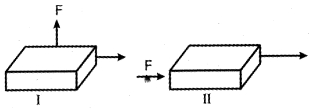
Solution
(N/A) Case $I$: The force $F$ is acting in the vertically upward direction,while the displacement of the object is in the horizontal direction (from west to east). Since the force and displacement are perpendicular to each other (angle $\theta = 90^\circ$),the work done is $W = F \cdot s \cdot \cos(90^\circ) = 0$.
Case $II$: Here,the force $F$ is applied in the same direction as the displacement. Since the angle between force and displacement is $0^\circ$,the work done is positive $(+ve)$,as $W = F \cdot s \cdot \cos(0^\circ) = F \cdot s$.
Case $II$: Here,the force $F$ is applied in the same direction as the displacement. Since the angle between force and displacement is $0^\circ$,the work done is positive $(+ve)$,as $W = F \cdot s \cdot \cos(0^\circ) = F \cdot s$.
0 likes
View Solution86
Medium
$(a)$ Define power. Give its $SI$ unit.
$(b)$ Taking the example of a simple pendulum, explain the variations in the forms of energy and the interconversions involved.
$(b)$ Taking the example of a simple pendulum, explain the variations in the forms of energy and the interconversions involved.
Solution
(N/A) Power is defined as the rate of doing work. Its $SI$ unit is watt $(W)$.
$(b)$ For a simple pendulum, the interconversion of energy is as shown in the table below:
As the pendulum swings, the total mechanical energy $(PE + KE)$ remains constant, demonstrating the law of conservation of energy.
$(b)$ For a simple pendulum, the interconversion of energy is as shown in the table below:
| Position | Potential Energy $(PE)$ | Kinetic Energy $(KE)$ |
| Extreme position $1$ | Maximum | Zero |
| Between extreme $1$ and mean | Decreasing | Increasing |
| Mean position | Zero | Maximum |
| Between mean and extreme $2$ | Increasing | Decreasing |
| Extreme position $2$ | Maximum | Zero |
As the pendulum swings, the total mechanical energy $(PE + KE)$ remains constant, demonstrating the law of conservation of energy.
0 likes
View Solution87
Medium
$(a)$ How much work is done when a force of $1\, N$ moves a body through a distance of $1\, m$ in its direction?
$(b)$ Is it possible that a force is acting on a body but still the work done is zero? Explain giving one example.
$(b)$ Is it possible that a force is acting on a body but still the work done is zero? Explain giving one example.
Solution
(N/A) Work done is calculated by the formula $W = F \times s$. Given $F = 1\, N$ and $s = 1\, m$,the work done is $1\, N \times 1\, m = 1\, J$.
$(b)$ Yes,it is possible for the work done to be zero even if a force is acting on a body. This occurs when the force is applied at an angle of $90^{\circ}$ to the direction of displacement. Since $W = Fs \cos(\theta)$,if $\theta = 90^{\circ}$,then $\cos(90^{\circ}) = 0$,making the work done zero.
Example: When a satellite moves in a circular orbit around the Earth,the gravitational force acts towards the center of the Earth (perpendicular to the motion),while the displacement is along the tangent to the orbit. Thus,the work done by gravity on the satellite is zero.
$(b)$ Yes,it is possible for the work done to be zero even if a force is acting on a body. This occurs when the force is applied at an angle of $90^{\circ}$ to the direction of displacement. Since $W = Fs \cos(\theta)$,if $\theta = 90^{\circ}$,then $\cos(90^{\circ}) = 0$,making the work done zero.
Example: When a satellite moves in a circular orbit around the Earth,the gravitational force acts towards the center of the Earth (perpendicular to the motion),while the displacement is along the tangent to the orbit. Thus,the work done by gravity on the satellite is zero.
0 likes
View Solution88
Medium
$(a)$ What is meant by potential energy? Is potential energy a vector or scalar quantity?
$(b)$ Give one example of a body having potential energy.
$(b)$ Give one example of a body having potential energy.
Solution
(N/A) Potential energy is the energy possessed by a body by virtue of its position or configuration. It is a scalar quantity because it has only magnitude and no direction.
$(b)$ $A$ stretched string of a bow is an example of a body having potential energy due to its change in configuration.
$(b)$ $A$ stretched string of a bow is an example of a body having potential energy due to its change in configuration.
0 likes
View Solution89
Medium
When is the work done by a force said to be negative? Give one situation in which one of the forces acting on the object is doing positive work and the other is doing negative work.
Solution
(N/A) Work done is given by the formula $W = F S \cos \theta$,where $\theta$ is the angle between the force vector $F$ and the displacement vector $S$.
Work done is said to be negative when the angle $\theta$ between the force and the displacement is obtuse,i.e.,$90^{\circ} < \theta \leq 180^{\circ}$,because $\cos \theta$ is negative in this range.
$A$ common situation is a body falling vertically downwards through the air. In this case,the force of gravity acts in the direction of motion (downwards),so the work done by gravity is positive. Simultaneously,the air resistance (frictional force) acts in the opposite direction of motion (upwards),so the work done by air resistance is negative.
Work done is said to be negative when the angle $\theta$ between the force and the displacement is obtuse,i.e.,$90^{\circ} < \theta \leq 180^{\circ}$,because $\cos \theta$ is negative in this range.
$A$ common situation is a body falling vertically downwards through the air. In this case,the force of gravity acts in the direction of motion (downwards),so the work done by gravity is positive. Simultaneously,the air resistance (frictional force) acts in the opposite direction of motion (upwards),so the work done by air resistance is negative.
0 likes
View Solution90
Easy
List two conditions which need to be satisfied for the work to be done on an object.
Solution
(N/A) For work to be done on an object,the following two conditions must be satisfied:
$(i)$ $A$ force must be applied to the object.
$(ii)$ The object must undergo a displacement in the direction of the force (or have a component of displacement in the direction of the force,i.e.,the angle $\theta$ between force and displacement must be such that $\cos \theta \neq 0$).
$(i)$ $A$ force must be applied to the object.
$(ii)$ The object must undergo a displacement in the direction of the force (or have a component of displacement in the direction of the force,i.e.,the angle $\theta$ between force and displacement must be such that $\cos \theta \neq 0$).
0 likes
View Solution91
EasyMCQ
$A$ box of mass $10 \, kg$ is placed at point $A$ on a horizontal surface. It is moved to point $B$,which is at a distance of $2 \, m$ from $A$. If the line joining $A$ and $B$ is horizontal,find the work done by the gravitational force on the box. Justify your answer. $(g = 10 \, m s^{-2})$ (in $, J$)
A
$0$
B
$200$
C
$20$
D
$100$
Solution
(A) The mass of the box is $m = 10 \, kg$.
The gravitational force (weight) acting on the box is $F = mg = 10 \, kg \times 10 \, m s^{-2} = 100 \, N$,which acts vertically downwards.
The displacement $S = 2 \, m$ is along the horizontal surface.
The angle $\theta$ between the gravitational force (downward) and the displacement (horizontal) is $90^{\circ}$.
The work done $W$ is given by the formula $W = FS \cos \theta$.
Substituting the values: $W = 100 \times 2 \times \cos 90^{\circ}$.
Since $\cos 90^{\circ} = 0$,the work done $W = 100 \times 2 \times 0 = 0 \, J$.
Therefore,the work done by the gravitational force is $0 \, J$ because the force of gravity is perpendicular to the direction of displacement.
The gravitational force (weight) acting on the box is $F = mg = 10 \, kg \times 10 \, m s^{-2} = 100 \, N$,which acts vertically downwards.
The displacement $S = 2 \, m$ is along the horizontal surface.
The angle $\theta$ between the gravitational force (downward) and the displacement (horizontal) is $90^{\circ}$.
The work done $W$ is given by the formula $W = FS \cos \theta$.
Substituting the values: $W = 100 \times 2 \times \cos 90^{\circ}$.
Since $\cos 90^{\circ} = 0$,the work done $W = 100 \times 2 \times 0 = 0 \, J$.
Therefore,the work done by the gravitational force is $0 \, J$ because the force of gravity is perpendicular to the direction of displacement.
0 likes
View Solution92
Easy
State the type of energy transformation in the following cases: $(a)$ in a loudspeaker $(b)$ solar battery.
Solution
(N/A) In a loudspeaker,electrical energy is transformed into sound energy.
$(b)$ In a solar battery,light energy is transformed into electrical energy.
$(b)$ In a solar battery,light energy is transformed into electrical energy.
0 likes
View Solution93
Easy
Given below are a few situations. Study them and state in which of the given cases work is said to be done. Give a reason for your answer:
$(i)$ $A$ person pushing hard a huge rock,but the rock does not move.
$(ii)$ $A$ bullock pulling a cart up to $1 \, km$ on the road.
$(iii)$ $A$ girl pulling a trolley for about $2 \, m$ distance.
$(iv)$ $A$ person standing with a heavy bag on his head.
$(i)$ $A$ person pushing hard a huge rock,but the rock does not move.
$(ii)$ $A$ bullock pulling a cart up to $1 \, km$ on the road.
$(iii)$ $A$ girl pulling a trolley for about $2 \, m$ distance.
$(iv)$ $A$ person standing with a heavy bag on his head.
Solution
(II, III) In physics,work is said to be done when a force applied on an object causes a displacement in the direction of the force. The formula is $W = F \times s \times \cos(\theta)$.
$(i)$ No work is done because the displacement $(s)$ is $0$,even though a force is applied.
$(ii)$ Work is done because the bullock applies force to the cart,resulting in a displacement of $1 \, km$.
$(iii)$ Work is done because the girl applies force to the trolley,resulting in a displacement of $2 \, m$.
$(iv)$ No work is done because the person is stationary,meaning the displacement $(s)$ is $0$.
$(i)$ No work is done because the displacement $(s)$ is $0$,even though a force is applied.
$(ii)$ Work is done because the bullock applies force to the cart,resulting in a displacement of $1 \, km$.
$(iii)$ Work is done because the girl applies force to the trolley,resulting in a displacement of $2 \, m$.
$(iv)$ No work is done because the person is stationary,meaning the displacement $(s)$ is $0$.
0 likes
View Solution94
MediumMCQ
How is work done by a force measured? $A$ porter lifts a luggage of $20 \, kg$ from the ground and puts it on his head $1.7 \, m$ above the ground. Find the work done by the porter on the luggage. $(g = 10 \, m s^{-2})$
A
Work is the product of force and displacement. The work done is $340 \, J$.
B
Work is the product of force and displacement. The work done is $34 \, J$.
C
Work is the product of force and displacement. The work done is $3.4 \, J$.
D
Work is the product of force and displacement. The work done is $3400 \, J$.
Solution
(A) Work done by a force is measured as the product of the magnitude of the force applied and the displacement in the direction of the force $(W = F \times S)$.
Given:
Mass of the luggage $(m)$ = $20 \, kg$
Displacement $(h)$ = $1.7 \, m$
Acceleration due to gravity $(g)$ = $10 \, m s^{-2}$
The force applied by the porter to lift the luggage is equal to the weight of the luggage,which is $F = m \times g$.
Therefore,the work done $(W)$ = $m \times g \times h$.
$W = 20 \, kg \times 10 \, m s^{-2} \times 1.7 \, m$.
$W = 340 \, J$.
Thus,the work done by the porter on the luggage is $340 \, J$.
Given:
Mass of the luggage $(m)$ = $20 \, kg$
Displacement $(h)$ = $1.7 \, m$
Acceleration due to gravity $(g)$ = $10 \, m s^{-2}$
The force applied by the porter to lift the luggage is equal to the weight of the luggage,which is $F = m \times g$.
Therefore,the work done $(W)$ = $m \times g \times h$.
$W = 20 \, kg \times 10 \, m s^{-2} \times 1.7 \, m$.
$W = 340 \, J$.
Thus,the work done by the porter on the luggage is $340 \, J$.
0 likes
View Solution95
Medium
Define work. How is work measured? When is work done by a force negative?
Solution
(N/A) Work is defined as the product of the force applied to an object and the displacement produced in the direction of the force. Mathematically,$W = F \times s \times \cos(\theta)$,where $W$ is work,$F$ is force,$s$ is displacement,and $\theta$ is the angle between force and displacement.
Work is measured as the product of the magnitude of force and the displacement in the direction of the force.
Work done by a force is negative when the force acts in the direction opposite to the direction of displacement,i.e.,the angle between force and displacement is $180^{\circ}$ (since $\cos(180^{\circ}) = -1$).
Work is measured as the product of the magnitude of force and the displacement in the direction of the force.
Work done by a force is negative when the force acts in the direction opposite to the direction of displacement,i.e.,the angle between force and displacement is $180^{\circ}$ (since $\cos(180^{\circ}) = -1$).
0 likes
View Solution96
Medium
What is the work done by the force of gravity in the following cases?
$(a)$ $A$ satellite moving around the Earth in a circular orbit of radius $35000 \, km$.
$(b)$ $A$ stone of mass $250 \, g$ is thrown up to a height of $2.5 \, m$.
$(a)$ $A$ satellite moving around the Earth in a circular orbit of radius $35000 \, km$.
$(b)$ $A$ stone of mass $250 \, g$ is thrown up to a height of $2.5 \, m$.
Solution
(N/A) The work done is $0 \, J$. In a circular orbit,the force of gravity acts perpendicular to the direction of motion (displacement). Since the angle between force and displacement is $90^{\circ}$,the work done $W = F \cdot s \cdot \cos(90^{\circ}) = 0$.
$(b)$ Given: mass $m = 250 \, g = 0.25 \, kg$,height $h = 2.5 \, m$,acceleration due to gravity $g = 9.8 \, m/s^2$ (or $10 \, m/s^2$).
Since the stone is thrown upwards,the force of gravity acts downwards (opposite to displacement).
Work done $W = -mgh = -(0.25 \, kg) \times (9.8 \, m/s^2) \times (2.5 \, m) = -6.125 \, J$ (or $-6.25 \, J$ if $g = 10 \, m/s^2$ is used).
$(b)$ Given: mass $m = 250 \, g = 0.25 \, kg$,height $h = 2.5 \, m$,acceleration due to gravity $g = 9.8 \, m/s^2$ (or $10 \, m/s^2$).
Since the stone is thrown upwards,the force of gravity acts downwards (opposite to displacement).
Work done $W = -mgh = -(0.25 \, kg) \times (9.8 \, m/s^2) \times (2.5 \, m) = -6.125 \, J$ (or $-6.25 \, J$ if $g = 10 \, m/s^2$ is used).
0 likes
View Solution97
Easy
State the relation between $kWh$ and joule. Define $1$ watt.
Solution
(N/A) $1 \text{ kWh} = 1000 \text{ W} \times 1 \text{ h} = 1000 \text{ J/s} \times 3600 \text{ s} = 3.6 \times 10^6 \text{ J}$.
$1$ watt is defined as the power of an agent that performs work at the rate of $1$ joule per second.
$1$ watt is defined as the power of an agent that performs work at the rate of $1$ joule per second.
0 likes
View Solution98
Medium
$(a)$ Can a body have energy without having momentum? Explain.
$(b)$ Can a body have momentum without having energy? Explain.
$(b)$ Can a body have momentum without having energy? Explain.
Solution
(N/A) Yes,a body at rest has no momentum,i.e.,$p = 0$. However,it can possess potential energy $(U)$ due to its position or configuration. Therefore,its total energy $E = K + U = U$ is not zero. For example,a stone lying on a roof or a wound-up spring of a clock.
$(b)$ No,a body cannot have momentum without having energy. Momentum $(p = mv)$ implies that the body is in motion $(v \neq 0)$. If a body is in motion,it must possess kinetic energy $(K = \frac{1}{2}mv^2)$. Since kinetic energy is a component of total energy,a body with momentum must possess energy.
$(b)$ No,a body cannot have momentum without having energy. Momentum $(p = mv)$ implies that the body is in motion $(v \neq 0)$. If a body is in motion,it must possess kinetic energy $(K = \frac{1}{2}mv^2)$. Since kinetic energy is a component of total energy,a body with momentum must possess energy.
0 likes
View Solution99
Medium
$(i)$ Define the term potential energy. Write the $SI$ unit of potential energy.
$(ii)$ $A$ body of mass $50 \, kg$ is situated at a height of $10 \, m$. What is its potential energy? (Given $g = 10 \, m s^{-2}$)
$(ii)$ $A$ body of mass $50 \, kg$ is situated at a height of $10 \, m$. What is its potential energy? (Given $g = 10 \, m s^{-2}$)
Solution
(D) $(i)$ The energy possessed by an object due to its position or configuration is called potential energy. The $SI$ unit of potential energy is joule $(J)$.
$(ii)$ Given: mass of the body $(m) = 50 \, kg$,height $(h) = 10 \, m$,and acceleration due to gravity $(g) = 10 \, m s^{-2}$.
The formula for potential energy $(PE)$ is $PE = m \times g \times h$.
Substituting the values: $PE = 50 \, kg \times 10 \, m s^{-2} \times 10 \, m = 5000 \, J$.
Therefore,the potential energy of the body is $5000 \, J$.
$(ii)$ Given: mass of the body $(m) = 50 \, kg$,height $(h) = 10 \, m$,and acceleration due to gravity $(g) = 10 \, m s^{-2}$.
The formula for potential energy $(PE)$ is $PE = m \times g \times h$.
Substituting the values: $PE = 50 \, kg \times 10 \, m s^{-2} \times 10 \, m = 5000 \, J$.
Therefore,the potential energy of the body is $5000 \, J$.
0 likes
View Solution100
MediumMCQ
$(i)$ Define power. Mention its $SI$ unit.
$(ii)$ $A$ boy of mass $50 \, kg$ runs up a staircase of $40$ steps in $8 \, s$. If the height of each step is $15 \, cm$,find his power. (Given,$g = 10 \, m \, s^{-2}$)
$(ii)$ $A$ boy of mass $50 \, kg$ runs up a staircase of $40$ steps in $8 \, s$. If the height of each step is $15 \, cm$,find his power. (Given,$g = 10 \, m \, s^{-2}$)
A
$N$/$A$
B
$N$/$A$
C
$N$/$A$
D
$N$/$A$
Solution
(N/A) $(i)$ Power is defined as the rate of doing work or the rate of energy transfer. Its $SI$ unit is the watt $(W)$.
$(ii)$ Given: Mass $(m)$ = $50 \, kg$,Number of steps = $40$,Height of each step = $15 \, cm = 0.15 \, m$,Time $(t)$ = $8 \, s$,Acceleration due to gravity $(g)$ = $10 \, m \, s^{-2}$.
Total height $(h)$ = $40 \times 0.15 \, m = 6 \, m$.
Work done $(W)$ = $mgh = 50 \times 10 \times 6 = 3000 \, J$.
Power $(P)$ = $\frac{W}{t} = \frac{3000}{8} = 375 \, W$.
$(ii)$ Given: Mass $(m)$ = $50 \, kg$,Number of steps = $40$,Height of each step = $15 \, cm = 0.15 \, m$,Time $(t)$ = $8 \, s$,Acceleration due to gravity $(g)$ = $10 \, m \, s^{-2}$.
Total height $(h)$ = $40 \times 0.15 \, m = 6 \, m$.
Work done $(W)$ = $mgh = 50 \times 10 \times 6 = 3000 \, J$.
Power $(P)$ = $\frac{W}{t} = \frac{3000}{8} = 375 \, W$.
0 likes
View SolutionWORK AND ENERGY — Mix Example - WORK AND ENERGY · Frequently Asked Questions
1Are these WORK AND ENERGY questions useful for JEE and NEET?
Yes. All questions in this section are mapped to JEE Main and NEET exam patterns. Previous year questions from JEE Main, NEET, GUJCET and state-level exams are included with full solutions.
2Can I switch to Hindi or Gujarati for these questions?
Yes. Use the language tabs in the hero section or the sidebar to view the same questions and solutions in English, Hindi or Gujarati.
3How do I generate a question paper from this subtopic?
Use the Vedclass Exam Paper Generator — select the chapter and subtopic, set difficulty, and generate Sets A, B, C, D automatically. First 3 chapters of every subject are free.
Vedclass Products
For Students
Vedclass Test Series
Mock tests in real JEE/NEET style with performance analysis. 5-day free trial.
Start Free TrialFor Teachers
Exam Paper Generator
Generate Set A/B/C/D papers from this chapter in 2 minutes. 3 chapters free.
Try FreeFor Institutes
Online Exam Module
Live online exams with unlimited students, 360° analytics & white-label branding.
See DemoFor Teachers & Institutes
Generate a WORK AND ENERGY Exam Paper in 2 Minutes
Select subtopic & difficulty — Sets A, B, C, D auto-generated with No Repeat logic.
First 3 chapters of every subject are free — no payment required.