
A English
Textbook - WORK AND ENERGY Questions in English
Class 9 Science · WORK AND ENERGY · Textbook - WORK AND ENERGY
33+
Questions
English
Language
100%
With Solutions
Showing 33 of 33 questions in English
1
EasyMCQ
$A$ force of $7\, N$ acts on an object. The displacement is $8\, m$ in the direction of the force. What is the work done in this case (in $, J$)?

A
$56$
B
$25$
C
$35$
D
$40$
Solution
(A) When a force $F$ acts on an object to displace it through a distance $S$ in its direction,the work done $W$ on the body by the force is given by:
Work done = Force $\times$ Displacement
$W = F \times S$
Given:
Force $(F)$ = $7\, N$
Displacement $(S)$ = $8\, m$
Therefore,work done $(W)$ = $7\, N \times 8\, m$
$W = 56\, N\cdot m$
Since $1\, N\cdot m = 1\, J$,the work done is $56\, J$.
Work done = Force $\times$ Displacement
$W = F \times S$
Given:
Force $(F)$ = $7\, N$
Displacement $(S)$ = $8\, m$
Therefore,work done $(W)$ = $7\, N \times 8\, m$
$W = 56\, N\cdot m$
Since $1\, N\cdot m = 1\, J$,the work done is $56\, J$.
0 likes
View Solution2
EasyMCQ
When do we say that work is done?
A
When a force is applied to an object.
B
When an object moves without any force.
C
When a force is applied and the object undergoes displacement in the direction of the force.
D
When an object is at rest.
Solution
(C) Work is said to be done when the following two conditions are satisfied:
$(i)$ $A$ force acts on the body.
$(ii)$ The body undergoes displacement due to the applied force,and the displacement occurs in the direction of the force.
$(i)$ $A$ force acts on the body.
$(ii)$ The body undergoes displacement due to the applied force,and the displacement occurs in the direction of the force.
0 likes
View Solution3
Easy
Write an expression for the work done when a force is acting on an object in the direction of its displacement.
Solution
(N/A) When a force $F$ displaces a body through a distance $s$ in the direction of the applied force,the work done $W$ on the body is defined as the product of the force and the displacement.
Work done = Force $\times$ Displacement
$W = F \times s$
Work done = Force $\times$ Displacement
$W = F \times s$
0 likes
View Solution4
Easy
Define $1\, J$ of work.
Solution
(N/A) $1\, J$ is defined as the amount of work done when a force of $1\, N$ displaces an object through a distance of $1\, m$ in the direction of the applied force.
Mathematically,$W = F \times s$,where $W = 1\, J$,$F = 1\, N$,and $s = 1\, m$.
Mathematically,$W = F \times s$,where $W = 1\, J$,$F = 1\, N$,and $s = 1\, m$.
0 likes
View Solution5
EasyMCQ
$A$ pair of bullocks exerts a force of $140 \, N$ on a plough. The field being ploughed is $15 \, m$ long. How much work is done in ploughing the length of the field (in $, J$)?
A
$2100$
B
$2300$
C
$2500$
D
$2700$
Solution
(A) Work done by the bullocks is calculated using the formula:
Work done = Force $\times$ Displacement
$W = F \times d$
Given:
Applied force,$F = 140 \, N$
Displacement,$d = 15 \, m$
Substituting the values into the formula:
$W = 140 \, N \times 15 \, m = 2100 \, J$
Therefore,the total work done in ploughing the length of the field is $2100 \, J$.
Work done = Force $\times$ Displacement
$W = F \times d$
Given:
Applied force,$F = 140 \, N$
Displacement,$d = 15 \, m$
Substituting the values into the formula:
$W = 140 \, N \times 15 \, m = 2100 \, J$
Therefore,the total work done in ploughing the length of the field is $2100 \, J$.
0 likes
View Solution6
EasyMCQ
What is the kinetic energy of an object?
A
The energy stored in an object due to its position.
B
The energy possessed by an object due to its motion.
C
The total energy of an object including potential and thermal energy.
D
The energy released during a chemical reaction.
Solution
(B) Kinetic energy is the energy possessed by a body by virtue of its motion.
Every moving object possesses kinetic energy.
$A$ body uses kinetic energy to perform work.
For example,the kinetic energy of a hammer is used to drive a nail into a log of wood,and the kinetic energy of air is used to run windmills.
Every moving object possesses kinetic energy.
$A$ body uses kinetic energy to perform work.
For example,the kinetic energy of a hammer is used to drive a nail into a log of wood,and the kinetic energy of air is used to run windmills.
0 likes
View Solution7
Easy
Write an expression for the kinetic energy of an object.
Solution
(N/A) If a body of mass $m$ is moving with a velocity $v$,then its kinetic energy $E_k$ is given by the expression:
$E_k = \frac{1}{2}mv^2$
Its $SI$ unit is Joule $(J)$.
$E_k = \frac{1}{2}mv^2$
Its $SI$ unit is Joule $(J)$.
0 likes
View Solution8
MediumMCQ
The kinetic energy of an object of mass,$m$ moving with a velocity of $5 \,m \,s^{-1}$ is $25\, J$. What will be its kinetic energy when its velocity is doubled? What will be its kinetic energy when its velocity is increased three times?
A
$400\, J, 900\, J$
B
$300\, J, 600\, J$
C
$200\, J, 500\, J$
D
$100\, J, 225\, J$
Solution
(D) The expression for kinetic energy is $E_k = 1/2 mv^2$.
Given that the initial kinetic energy $E_k = 25\, J$ at a velocity $v = 5\, m\, s^{-1}$.
$(i)$ When the velocity is doubled,the new velocity becomes $v' = 2v = 10\, m\, s^{-1}$.
Since $E_k \propto v^2$,the new kinetic energy $E_k' = 1/2 m(2v)^2 = 4 \times (1/2 mv^2) = 4 \times 25\, J = 100\, J$.
$(ii)$ When the velocity is increased three times,the new velocity becomes $v'' = 3v = 15\, m\, s^{-1}$.
Similarly,the new kinetic energy $E_k'' = 1/2 m(3v)^2 = 9 \times (1/2 mv^2) = 9 \times 25\, J = 225\, J$.
Given that the initial kinetic energy $E_k = 25\, J$ at a velocity $v = 5\, m\, s^{-1}$.
$(i)$ When the velocity is doubled,the new velocity becomes $v' = 2v = 10\, m\, s^{-1}$.
Since $E_k \propto v^2$,the new kinetic energy $E_k' = 1/2 m(2v)^2 = 4 \times (1/2 mv^2) = 4 \times 25\, J = 100\, J$.
$(ii)$ When the velocity is increased three times,the new velocity becomes $v'' = 3v = 15\, m\, s^{-1}$.
Similarly,the new kinetic energy $E_k'' = 1/2 m(3v)^2 = 9 \times (1/2 mv^2) = 9 \times 25\, J = 225\, J$.
0 likes
View Solution9
EasyMCQ
What is power?
A
The capacity to do work.
B
The rate of doing work or the rate of transfer of energy.
C
The total energy consumed in a system.
D
The force applied per unit area.
Solution
(B) Power is defined as the rate of doing work or the rate of transfer of energy.
If $W$ is the amount of work done in time $t$,then power $P$ is given by the expression:
$P = \frac{W}{t} = \frac{\text{Energy}}{\text{Time}}$
The $SI$ unit of power is the watt $(W)$,which is defined as $1 \text{ joule per second } (J/s)$.
If $W$ is the amount of work done in time $t$,then power $P$ is given by the expression:
$P = \frac{W}{t} = \frac{\text{Energy}}{\text{Time}}$
The $SI$ unit of power is the watt $(W)$,which is defined as $1 \text{ joule per second } (J/s)$.
0 likes
View Solution10
Easy
Define $1$ watt of power.
Solution
(N/A) body is said to have a power of $1$ watt if it does work at the rate of $1$ joule per second.
Mathematically,it is expressed as:
$1\,W = 1\,J/1\,s$
This means that $1$ watt is the power consumed when $1$ joule of work is done in $1$ second.
Mathematically,it is expressed as:
$1\,W = 1\,J/1\,s$
This means that $1$ watt is the power consumed when $1$ joule of work is done in $1$ second.
0 likes
View Solution11
EasyMCQ
$A$ lamp consumes $1000\, J$ of electrical energy in $10\, s$. What is its power (in $, W$)?
A
$50$
B
$300$
C
$100$
D
$200$
Solution
(C) Power is defined as the rate of doing work or the rate of energy consumption.
The formula for power $(P)$ is given by:
$P = \frac{W}{t}$
Where:
$W$ (Work done or Energy consumed) $= 1000\, J$
$t$ (Time taken) $= 10\, s$
Substituting the values into the formula:
$P = \frac{1000\, J}{10\, s} = 100\, J/s$
Since $1\, J/s = 1\, W$ (Watt):
$P = 100\, W$
Therefore,the power of the lamp is $100\, W$.
The formula for power $(P)$ is given by:
$P = \frac{W}{t}$
Where:
$W$ (Work done or Energy consumed) $= 1000\, J$
$t$ (Time taken) $= 10\, s$
Substituting the values into the formula:
$P = \frac{1000\, J}{10\, s} = 100\, J/s$
Since $1\, J/s = 1\, W$ (Watt):
$P = 100\, W$
Therefore,the power of the lamp is $100\, W$.
0 likes
View Solution12
Easy
Define average power.
Solution
(N/A) Average power is defined as the total work done by an object divided by the total time taken to perform that work.
Since a body may perform different amounts of work in different time intervals,calculating the average power provides a better representation of the rate of work done over a specific duration.
Mathematically,it is expressed as:
$\text{Average Power} = \frac{\text{Total work done}}{\text{Total time taken}}$
Since a body may perform different amounts of work in different time intervals,calculating the average power provides a better representation of the rate of work done over a specific duration.
Mathematically,it is expressed as:
$\text{Average Power} = \frac{\text{Total work done}}{\text{Total time taken}}$
0 likes
View Solution13
Medium
Look at the activities listed below. Reason out whether or not work is done in the light of your understanding of the term 'work'.
$1$. Suma is swimming in a pond.
$2$. $A$ donkey is carrying a load on its back.
$3$. $A$ windmill is lifting water from a well.
$4$. $A$ green plant is carrying out photosynthesis.
$5$. An engine is pulling a train.
$6$. Food grains are getting dried in the sun.
$7$. $A$ sailboat is moving due to wind energy.
$1$. Suma is swimming in a pond.
$2$. $A$ donkey is carrying a load on its back.
$3$. $A$ windmill is lifting water from a well.
$4$. $A$ green plant is carrying out photosynthesis.
$5$. An engine is pulling a train.
$6$. Food grains are getting dried in the sun.
$7$. $A$ sailboat is moving due to wind energy.
Solution
(N/A) $1$. Suma is swimming in a pond: Suma is doing work as she is able to move herself by applying force with the movement of her arms and legs in the water.
$2$. $A$ donkey is carrying a load on its back: The donkey is not doing any work (in the sense of physics) as the weight he is carrying (the direction of force) and the displacement are perpendicular to each other $(W = Fs \cos 90^{\circ} = 0)$.
$3$. $A$ windmill is lifting water from a well: The windmill is lifting water from a well and doing work against gravity.
$4$. $A$ green plant is carrying out photosynthesis: No force and displacement are present here,so the work done is zero.
$5$. An engine is pulling a train: During the pulling of a train,the engine does work against the friction present between the railway track and the wheels.
$6$. Food grains are getting dried in the sun: During the drying of grains,there is no force applied,nor is there any displacement. So,no work is done.
$7$. $A$ sailboat is moving due to wind energy: Work is done by the wind as it moves the sailboat in the direction of the force (force of blowing air).
$2$. $A$ donkey is carrying a load on its back: The donkey is not doing any work (in the sense of physics) as the weight he is carrying (the direction of force) and the displacement are perpendicular to each other $(W = Fs \cos 90^{\circ} = 0)$.
$3$. $A$ windmill is lifting water from a well: The windmill is lifting water from a well and doing work against gravity.
$4$. $A$ green plant is carrying out photosynthesis: No force and displacement are present here,so the work done is zero.
$5$. An engine is pulling a train: During the pulling of a train,the engine does work against the friction present between the railway track and the wheels.
$6$. Food grains are getting dried in the sun: During the drying of grains,there is no force applied,nor is there any displacement. So,no work is done.
$7$. $A$ sailboat is moving due to wind energy: Work is done by the wind as it moves the sailboat in the direction of the force (force of blowing air).
0 likes
View Solution14
MediumMCQ
An object thrown at a certain angle to the ground moves in a curved path and falls back to the ground. The initial and the final points of the path of the object lie on the same horizontal line. What is the work done by the force of gravity on the object?
A
$0 \ J$
B
$mgh$
C
$mg \times \text{distance traveled}$
D
Negative
Solution
(A) The work done by a force is given by the formula $W = F \cdot s \cdot \cos(\theta)$, where $F$ is the force, $s$ is the displacement, and $\theta$ is the angle between the force and displacement vectors.
In this case, the force of gravity acts vertically downwards $(F = mg)$.
The displacement $s$ is the straight-line distance between the initial and final points.
Since the initial and final points lie on the same horizontal line, the vertical displacement is $0$.
Because the gravitational force acts only in the vertical direction, the work done by gravity is $W = F \times (\text{vertical displacement}) = mg \times 0 = 0 \ J$.
In this case, the force of gravity acts vertically downwards $(F = mg)$.
The displacement $s$ is the straight-line distance between the initial and final points.
Since the initial and final points lie on the same horizontal line, the vertical displacement is $0$.
Because the gravitational force acts only in the vertical direction, the work done by gravity is $W = F \times (\text{vertical displacement}) = mg \times 0 = 0 \ J$.
0 likes
View Solution15
Easy
$A$ battery lights a bulb. Describe the energy changes involved in the process.
Solution
(N/A) The process involves the following energy transformations:
$1$. Inside the battery,chemical energy is converted into electrical energy.
$2$. As the current flows through the bulb,this electrical energy is converted into light energy (which illuminates the bulb) and heat energy (which warms the bulb).
$1$. Inside the battery,chemical energy is converted into electrical energy.
$2$. As the current flows through the bulb,this electrical energy is converted into light energy (which illuminates the bulb) and heat energy (which warms the bulb).
0 likes
View Solution16
MediumMCQ
$A$ certain force acting on a $20 \, kg$ mass changes its velocity from $5 \, m \, s^{-1}$ to $2 \, m \, s^{-1}$. Calculate the work done by the force. (in $J$)
A
$260$
B
$230$
C
$250$
D
$210$
Solution
(D) Given:
Mass $(m)$ $= 20 \, kg$
Initial velocity $(u)$ $= 5 \, m \, s^{-1}$
Final velocity $(v)$ $= 2 \, m \, s^{-1}$
According to the Work-Energy Theorem, the work done by a force is equal to the change in kinetic energy of the object.
Work done $(W)$ $= \Delta KE = KE_{final} - KE_{initial}$
$W = \frac{1}{2} m v^2 - \frac{1}{2} m u^2$
$W = \frac{1}{2} m (v^2 - u^2)$
Substituting the values:
$W = \frac{1}{2} \times 20 \times (2^2 - 5^2)$
$W = 10 \times (4 - 25)$
$W = 10 \times (-21)$
$W = -210 \, J$
Since the question asks for the magnitude of work done by the force (which is a retarding force), the absolute value is $210 \, J$.
Mass $(m)$ $= 20 \, kg$
Initial velocity $(u)$ $= 5 \, m \, s^{-1}$
Final velocity $(v)$ $= 2 \, m \, s^{-1}$
According to the Work-Energy Theorem, the work done by a force is equal to the change in kinetic energy of the object.
Work done $(W)$ $= \Delta KE = KE_{final} - KE_{initial}$
$W = \frac{1}{2} m v^2 - \frac{1}{2} m u^2$
$W = \frac{1}{2} m (v^2 - u^2)$
Substituting the values:
$W = \frac{1}{2} \times 20 \times (2^2 - 5^2)$
$W = 10 \times (4 - 25)$
$W = 10 \times (-21)$
$W = -210 \, J$
Since the question asks for the magnitude of work done by the force (which is a retarding force), the absolute value is $210 \, J$.
0 likes
View Solution17
Medium
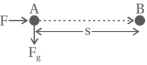
$A$ mass of $10\, kg$ is at a point $A$ on a table. It is moved to a point $B$. If the line joining $A$ and $B$ is horizontal,what is the work done on the object by the gravitational force? Explain your answer.
Solution
(N/A) The work done by the gravitational force acting on the body is zero.
This is because the gravitational force acts vertically downward,while the displacement of the object is horizontal.
Since the angle $\theta$ between the force and the displacement is $90^\circ$,the work done $W$ is calculated as:
$W = F \cdot s \cdot \cos(90^\circ)$
Since $\cos(90^\circ) = 0$,the work done $W = 0$.
This is because the gravitational force acts vertically downward,while the displacement of the object is horizontal.
Since the angle $\theta$ between the force and the displacement is $90^\circ$,the work done $W$ is calculated as:
$W = F \cdot s \cdot \cos(90^\circ)$
Since $\cos(90^\circ) = 0$,the work done $W = 0$.
0 likes
View Solution18
Easy
The potential energy of a freely falling object decreases progressively. Does this violate the law of conservation of energy? Why?
Solution
(N/A) The potential energy of a freely falling object decreases as it falls,while its kinetic energy increases progressively due to the increase in its velocity.
According to the law of conservation of energy,the total mechanical energy of an object,which is the sum of its kinetic energy and potential energy,remains constant at all points during its fall.
Therefore,the decrease in potential energy is exactly compensated by an equal increase in kinetic energy,meaning the law of conservation of energy is not violated.
According to the law of conservation of energy,the total mechanical energy of an object,which is the sum of its kinetic energy and potential energy,remains constant at all points during its fall.
Therefore,the decrease in potential energy is exactly compensated by an equal increase in kinetic energy,meaning the law of conservation of energy is not violated.
0 likes
View Solution19
Easy
What are the various energy transformations that occur when you are riding a bicycle?
Solution
(N/A) When riding a bicycle, the chemical energy stored in the body of the cyclist (muscular energy) is converted into the kinetic energy of the bicycle's pedals and wheels.
As the bicycle moves, this kinetic energy is used to overcome friction between the tires and the road, as well as air resistance, which eventually dissipates as heat energy.
Thus, the transformation chain is: $\text{Chemical Energy} \rightarrow \text{Muscular Energy} \rightarrow \text{Kinetic Energy} \rightarrow \text{Heat Energy (due to friction)}.$
As the bicycle moves, this kinetic energy is used to overcome friction between the tires and the road, as well as air resistance, which eventually dissipates as heat energy.
Thus, the transformation chain is: $\text{Chemical Energy} \rightarrow \text{Muscular Energy} \rightarrow \text{Kinetic Energy} \rightarrow \text{Heat Energy (due to friction)}.$
0 likes
View Solution20
Easy
Does the transfer of energy take place when you push a huge rock with all your might and fail to move it? Where is the energy you spend going?
Solution
(N/A) In physics,work is defined as the product of force and displacement $(W = F \times s)$. Since the rock does not move,the displacement $(s)$ is $0$,meaning no mechanical work is done on the rock.
However,energy is still being expended by your body. When you push the rock,your muscles contract and perform internal work. This energy is primarily dissipated as heat into the environment and the contact surface between your hands and the rock. $A$ negligible amount may be stored as elastic potential energy due to the slight deformation of the rock's surface.
However,energy is still being expended by your body. When you push the rock,your muscles contract and perform internal work. This energy is primarily dissipated as heat into the environment and the contact surface between your hands and the rock. $A$ negligible amount may be stored as elastic potential energy due to the slight deformation of the rock's surface.
0 likes
View Solution21
EasyMCQ
$A$ certain household has consumed $250$ units of energy during a month. How much energy is this in joules?
A
$9 \times 10^8 \, J$
B
$8 \times 10^8 \, J$
C
$7 \times 10^8 \, J$
D
$6 \times 10^8 \, J$
Solution
(A) We know that $1$ unit of electrical energy is equal to $1 \text{ kilowatt-hour (kWh)}$.
$1 \text{ kWh} = 1 \text{ kW} \times 1 \text{ h} = 1000 \text{ W} \times 3600 \text{ s} = 3.6 \times 10^6 \text{ J}$.
Given that the household consumed $250$ units.
Therefore,total energy in joules $= 250 \times 3.6 \times 10^6 \text{ J}$.
$= 900 \times 10^6 \text{ J}$.
$= 9 \times 10^8 \text{ J}$.
Hence,the energy consumed is $9 \times 10^8 \text{ J}$.
$1 \text{ kWh} = 1 \text{ kW} \times 1 \text{ h} = 1000 \text{ W} \times 3600 \text{ s} = 3.6 \times 10^6 \text{ J}$.
Given that the household consumed $250$ units.
Therefore,total energy in joules $= 250 \times 3.6 \times 10^6 \text{ J}$.
$= 900 \times 10^6 \text{ J}$.
$= 9 \times 10^8 \text{ J}$.
Hence,the energy consumed is $9 \times 10^8 \text{ J}$.
0 likes
View Solution22
DifficultMCQ
An object of mass $40\, kg$ is raised to a height of $5\, m$ above the ground. What is its potential energy? If the object is allowed to fall,find its kinetic energy when it is half-way down.
A
$1440\, J, 440\, J$
B
$1960\, J, 980\, J$
C
$1250\, J, 580\, J$
D
$1860\, J, 650\, J$
Solution
(B) We know that,potential energy $(PE) = mgh$.
Given:
Mass $(m) = 40\, kg$
Acceleration due to gravity $(g) = 9.8\, m/s^2$
Height $(h) = 5\, m$
Potential energy $= 40 \times 9.8 \times 5 = 1960\, J$.
According to the law of conservation of energy,the total mechanical energy remains constant.
When the object is half-way down,it has fallen a distance of $2.5\, m$. At this point,half of the initial potential energy is converted into kinetic energy.
Therefore,kinetic energy $= 1/2 \times 1960\, J = 980\, J$.
Given:
Mass $(m) = 40\, kg$
Acceleration due to gravity $(g) = 9.8\, m/s^2$
Height $(h) = 5\, m$
Potential energy $= 40 \times 9.8 \times 5 = 1960\, J$.
According to the law of conservation of energy,the total mechanical energy remains constant.
When the object is half-way down,it has fallen a distance of $2.5\, m$. At this point,half of the initial potential energy is converted into kinetic energy.
Therefore,kinetic energy $= 1/2 \times 1960\, J = 980\, J$.
0 likes
View Solution23
MediumMCQ
What is the work done by the force of gravity on a satellite moving around the Earth? Justify your answer.
A
Positive
B
Negative
C
Zero
D
Infinite
Solution
(C) When a satellite moves around the Earth in a circular orbit,the gravitational force acts towards the center of the Earth (centripetal force).
The displacement of the satellite at any instant is along the tangent to the circular path.
Since the radius (direction of force) is always perpendicular to the tangent (direction of displacement),the angle $\theta$ between the force and displacement is $90^{\circ}$.
The formula for work done is $W = F \cdot s \cdot \cos(\theta)$.
Substituting $\theta = 90^{\circ}$,we get $W = F \cdot s \cdot \cos(90^{\circ}) = F \cdot s \cdot 0 = 0$.
Therefore,the work done by the force of gravity on a satellite moving around the Earth is zero.
The displacement of the satellite at any instant is along the tangent to the circular path.
Since the radius (direction of force) is always perpendicular to the tangent (direction of displacement),the angle $\theta$ between the force and displacement is $90^{\circ}$.
The formula for work done is $W = F \cdot s \cdot \cos(\theta)$.
Substituting $\theta = 90^{\circ}$,we get $W = F \cdot s \cdot \cos(90^{\circ}) = F \cdot s \cdot 0 = 0$.
Therefore,the work done by the force of gravity on a satellite moving around the Earth is zero.
0 likes
View Solution24
MediumMCQ
Can there be displacement of an object in the absence of any force acting on it?
A
Yes
B
No
C
Only if the object is at rest
D
Only if the object is moving in a circle
Solution
(A) Yes,it is true. There may be displacement in the absence of force.
We know that,$F = ma$.
In the absence of force,$F = 0$,then $ma = 0$.
Since $m \neq 0$,it follows that $a = 0$.
If $a = 0$,the object is either at rest or in a state of uniform motion in a straight line.
In the case where the object is already moving in a straight line,it will continue to move with a constant velocity,which results in displacement over time.
Therefore,in the absence of force,there may be displacement of an object.
We know that,$F = ma$.
In the absence of force,$F = 0$,then $ma = 0$.
Since $m \neq 0$,it follows that $a = 0$.
If $a = 0$,the object is either at rest or in a state of uniform motion in a straight line.
In the case where the object is already moving in a straight line,it will continue to move with a constant velocity,which results in displacement over time.
Therefore,in the absence of force,there may be displacement of an object.
0 likes
View Solution25
Easy
$A$ person holds a bundle of hay over his head for $30$ minutes and gets tired. Has he done some work or not? Justify your answer.
Solution
(N/A) In scientific terms,the person has done no work.
Work is defined as the product of the force applied and the displacement in the direction of the force $(W = F \times s)$.
Since the bundle of hay is held stationary over the head,the displacement $(s)$ is $0$.
Therefore,$W = F \times 0 = 0$.
The person feels tired because his muscular energy is being consumed and converted into thermal energy to maintain the posture,but this does not constitute mechanical work.
Work is defined as the product of the force applied and the displacement in the direction of the force $(W = F \times s)$.
Since the bundle of hay is held stationary over the head,the displacement $(s)$ is $0$.
Therefore,$W = F \times 0 = 0$.
The person feels tired because his muscular energy is being consumed and converted into thermal energy to maintain the posture,but this does not constitute mechanical work.
0 likes
View Solution26
EasyMCQ
An electric heater is rated $1500 \, W$. How much energy does it use in $10$ hours?
A
$4.5 \times 10^7 \, J$
B
$5.4 \times 10^7 \, J$
C
$3.8 \times 10^7 \, J$
D
$9.8 \times 10^7 \, J$
Solution
(B) We know that,$\text{Energy} = \text{Power} \times \text{time}$.
Given:
$\text{Power} = 1500 \, W$
$\text{Time} = 10 \, \text{hours} = 10 \times 60 \times 60 \, \text{seconds} = 36000 \, \text{seconds}$.
Therefore,
$\text{Energy} = 1500 \, W \times 36000 \, \text{s} = 54,000,000 \, J$.
In scientific notation,this is $5.4 \times 10^7 \, J$.
Given:
$\text{Power} = 1500 \, W$
$\text{Time} = 10 \, \text{hours} = 10 \times 60 \times 60 \, \text{seconds} = 36000 \, \text{seconds}$.
Therefore,
$\text{Energy} = 1500 \, W \times 36000 \, \text{s} = 54,000,000 \, J$.
In scientific notation,this is $5.4 \times 10^7 \, J$.
0 likes
View Solution27
Difficult
Illustrate the law of conservation of energy by discussing the energy changes which occur when we draw a pendulum bob to one side and allow it to oscillate. Why does the bob eventually come to rest? What happens to its energy eventually? Is it a violation of the law of conservation of energy?
Solution
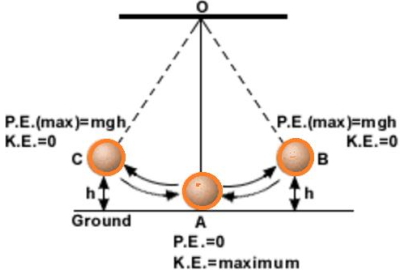
(N/A) When a pendulum bob is displaced to one side (point $B$ or $C$) and released,it oscillates about its mean position $(A)$.
At the extreme positions ($B$ and $C$),the bob is at its maximum height,so its potential energy $(P.E.)$ is maximum and kinetic energy $(K.E.)$ is zero. As it moves towards the mean position $(A)$,$P.E.$ decreases and $K.E.$ increases. At the mean position $(A)$,the bob is at its lowest point,so $P.E.$ is zero and $K.E.$ is maximum. Throughout the motion,the total mechanical energy $(P.E. + K.E.)$ remains constant,illustrating the law of conservation of energy.
The bob eventually comes to rest because of air resistance,which opposes its motion and does work against it.
Its energy is eventually dissipated into the surroundings as heat energy due to friction with air molecules.
No,this is not a violation of the law of conservation of energy. The energy is not lost; it is merely transformed into other forms (heat and sound) in the surroundings,keeping the total energy of the system and its surroundings constant.
At the extreme positions ($B$ and $C$),the bob is at its maximum height,so its potential energy $(P.E.)$ is maximum and kinetic energy $(K.E.)$ is zero. As it moves towards the mean position $(A)$,$P.E.$ decreases and $K.E.$ increases. At the mean position $(A)$,the bob is at its lowest point,so $P.E.$ is zero and $K.E.$ is maximum. Throughout the motion,the total mechanical energy $(P.E. + K.E.)$ remains constant,illustrating the law of conservation of energy.
The bob eventually comes to rest because of air resistance,which opposes its motion and does work against it.
Its energy is eventually dissipated into the surroundings as heat energy due to friction with air molecules.
No,this is not a violation of the law of conservation of energy. The energy is not lost; it is merely transformed into other forms (heat and sound) in the surroundings,keeping the total energy of the system and its surroundings constant.
0 likes
View Solution28
MediumMCQ
An object of mass $m$ is moving with a constant velocity $v$. How much work should be done on the object in order to bring the object to rest?
A
$1/2 mv^2$
B
$mv^2$
C
$-1/2 mv^2$
D
$mv$
Solution
(C) The object is in motion,so its initial kinetic energy is $K_i = 1/2 mv^2$.
When the object comes to rest,its final velocity becomes $0$,so its final kinetic energy is $K_f = 0$.
According to the work-energy theorem,the work done on an object is equal to the change in its kinetic energy.
Work done $W = K_f - K_i$.
$W = 0 - 1/2 mv^2 = -1/2 mv^2$.
The negative sign indicates that the work is done against the direction of motion to bring the object to rest. The magnitude of the work required is $1/2 mv^2$.
When the object comes to rest,its final velocity becomes $0$,so its final kinetic energy is $K_f = 0$.
According to the work-energy theorem,the work done on an object is equal to the change in its kinetic energy.
Work done $W = K_f - K_i$.
$W = 0 - 1/2 mv^2 = -1/2 mv^2$.
The negative sign indicates that the work is done against the direction of motion to bring the object to rest. The magnitude of the work required is $1/2 mv^2$.
0 likes
View Solution29
MediumMCQ
Calculate the work required to be done to stop a car of $1500 \, kg$ moving at a velocity of $60 \, km/h$. (in $J$)
A
$208333.3$
B
$205333.8$
C
$408333.6$
D
$328333.2$
Solution
(A) Mass of the car $m = 1500 \, kg$.
Velocity of the car $v = 60 \, km/h$.
Convert velocity to $m/s$: $v = \frac{60 \times 1000}{3600} = \frac{50}{3} \, m/s$.
The kinetic energy $(KE)$ of the car is given by the formula $KE = \frac{1}{2} mv^2$.
$KE = \frac{1}{2} \times 1500 \times (\frac{50}{3})^2 \, J$.
$KE = 750 \times \frac{2500}{9} \, J$.
$KE = 750 \times 277.777... \, J = 208333.3 \, J$.
According to the work-energy theorem, the work required to stop the car is equal to the change in its kinetic energy.
Work done $= KE_{initial} - KE_{final} = 208333.3 \, J - 0 \, J = 208333.3 \, J$.
Thus, the work required to stop the car is $208333.3 \, J$.
Velocity of the car $v = 60 \, km/h$.
Convert velocity to $m/s$: $v = \frac{60 \times 1000}{3600} = \frac{50}{3} \, m/s$.
The kinetic energy $(KE)$ of the car is given by the formula $KE = \frac{1}{2} mv^2$.
$KE = \frac{1}{2} \times 1500 \times (\frac{50}{3})^2 \, J$.
$KE = 750 \times \frac{2500}{9} \, J$.
$KE = 750 \times 277.777... \, J = 208333.3 \, J$.
According to the work-energy theorem, the work required to stop the car is equal to the change in its kinetic energy.
Work done $= KE_{initial} - KE_{final} = 208333.3 \, J - 0 \, J = 208333.3 \, J$.
Thus, the work required to stop the car is $208333.3 \, J$.
0 likes
View Solution30
Medium
In each of the following cases,a force,$F$ is acting on an object of mass,$m$. The direction of displacement is from west to east,shown by the longer arrow. Observe the diagrams carefully and state whether the work done by the force is negative,positive,or zero.

Solution
(N/A) The work done by a force is given by the formula $W = F \cdot s \cdot \cos(\theta)$,where $\theta$ is the angle between the force and the displacement.
$1$. In the first case,the force $F$ is acting vertically upwards while the displacement is horizontal (west to east). The angle between them is $90^{\circ}$. Since $\cos(90^{\circ}) = 0$,the work done is zero.
$2$. In the second case,the force $F$ is acting in the same direction as the displacement (west to east). The angle between them is $0^{\circ}$. Since $\cos(0^{\circ}) = 1$,the work done is positive.
$3$. In the third case,the force $F$ is acting in the opposite direction to the displacement (east to west). The angle between them is $180^{\circ}$. Since $\cos(180^{\circ}) = -1$,the work done is negative.
$1$. In the first case,the force $F$ is acting vertically upwards while the displacement is horizontal (west to east). The angle between them is $90^{\circ}$. Since $\cos(90^{\circ}) = 0$,the work done is zero.
$2$. In the second case,the force $F$ is acting in the same direction as the displacement (west to east). The angle between them is $0^{\circ}$. Since $\cos(0^{\circ}) = 1$,the work done is positive.
$3$. In the third case,the force $F$ is acting in the opposite direction to the displacement (east to west). The angle between them is $180^{\circ}$. Since $\cos(180^{\circ}) = -1$,the work done is negative.
0 likes
View Solution31
Medium
Soni says that the acceleration in an object could be zero even when several forces are acting on it. Do you agree with her? Why?
Solution
(A) Yes,$I$ agree with Soni.
According to Newton's second law of motion,the acceleration $(a)$ of an object is directly proportional to the net force $(F_{net})$ acting on it,given by the formula $F_{net} = ma$,where $m$ is the mass of the object.
If several forces act on an object such that their vector sum (resultant force) is zero,then the net force $F_{net} = 0$.
Since $F_{net} = ma$,if $F_{net} = 0$ and $m \neq 0$,then $a = 0$.
Therefore,an object can have zero acceleration even when multiple forces are acting on it,provided they balance each other out.
According to Newton's second law of motion,the acceleration $(a)$ of an object is directly proportional to the net force $(F_{net})$ acting on it,given by the formula $F_{net} = ma$,where $m$ is the mass of the object.
If several forces act on an object such that their vector sum (resultant force) is zero,then the net force $F_{net} = 0$.
Since $F_{net} = ma$,if $F_{net} = 0$ and $m \neq 0$,then $a = 0$.
Therefore,an object can have zero acceleration even when multiple forces are acting on it,provided they balance each other out.
0 likes
View Solution32
MediumMCQ
Find the energy in $kWh$ consumed in $10$ hours by four devices of power $500\, W$ each. (in $kWh$)
A
$20$
B
$30$
C
$40$
D
$50$
Solution
(A) The power of four devices $= 4 \times 500\, W = 2000\, W$.
Time $= 10$ hours.
Energy consumed $= \text{Power} \times \text{Time}$.
Energy $= 2000\, W \times 10\, h = 20000\, Wh$.
Since $1\, kWh = 1000\, Wh$, we divide by $1000$.
Energy $= 20000 / 1000 = 20\, kWh$.
Time $= 10$ hours.
Energy consumed $= \text{Power} \times \text{Time}$.
Energy $= 2000\, W \times 10\, h = 20000\, Wh$.
Since $1\, kWh = 1000\, Wh$, we divide by $1000$.
Energy $= 20000 / 1000 = 20\, kWh$.
0 likes
View Solution33
MediumMCQ
$A$ freely falling object eventually stops on reaching the ground. What happens to its kinetic energy?
A
It is destroyed.
B
It is converted into other forms of energy.
C
It remains constant.
D
It increases.
Solution
(B) When a freely falling body eventually stops on reaching the ground,its kinetic energy is transformed into other forms of energy.
$1$. Heat energy: The collision between the object and the ground generates heat,warming both surfaces.
$2$. Sound energy: The impact produces a sound.
$3$. Potential energy: Some energy may be used in the deformation or change of shape of the object upon impact.
$1$. Heat energy: The collision between the object and the ground generates heat,warming both surfaces.
$2$. Sound energy: The impact produces a sound.
$3$. Potential energy: Some energy may be used in the deformation or change of shape of the object upon impact.
0 likes
View SolutionWORK AND ENERGY — Textbook - WORK AND ENERGY · Frequently Asked Questions
1Are these WORK AND ENERGY questions useful for JEE and NEET?
Yes. All questions in this section are mapped to JEE Main and NEET exam patterns. Previous year questions from JEE Main, NEET, GUJCET and state-level exams are included with full solutions.
2Can I switch to Hindi or Gujarati for these questions?
Yes. Use the language tabs in the hero section or the sidebar to view the same questions and solutions in English, Hindi or Gujarati.
3How do I generate a question paper from this subtopic?
Use the Vedclass Exam Paper Generator — select the chapter and subtopic, set difficulty, and generate Sets A, B, C, D automatically. First 3 chapters of every subject are free.
Vedclass Products
For Students
Vedclass Test Series
Mock tests in real JEE/NEET style with performance analysis. 5-day free trial.
Start Free TrialFor Teachers
Exam Paper Generator
Generate Set A/B/C/D papers from this chapter in 2 minutes. 3 chapters free.
Try FreeFor Institutes
Online Exam Module
Live online exams with unlimited students, 360° analytics & white-label branding.
See DemoFor Teachers & Institutes
Generate a WORK AND ENERGY Exam Paper in 2 Minutes
Select subtopic & difficulty — Sets A, B, C, D auto-generated with No Repeat logic.
First 3 chapters of every subject are free — no payment required.