
A English
Mix Example - WORK AND ENERGY Questions in English
Class 9 Science · WORK AND ENERGY · Mix Example - WORK AND ENERGY
200+
Questions
English
Language
100%
With Solutions
Showing 50 of 200 questions in English
101
Difficult
$A$ light and a heavy object have the same momentum. Find the ratio of their kinetic energies. Which one has a larger kinetic energy?
Solution
(A) Let the two objects have masses $m_1$ and $m_2$ such that $m_2 > m_1$. Let their common momentum be $p$.
The kinetic energy $K$ is related to momentum $p$ and mass $m$ by the formula $K = \frac{p^2}{2m}$.
For the first object (lighter),$K_1 = \frac{p^2}{2m_1}$.
For the second object (heavier),$K_2 = \frac{p^2}{2m_2}$.
The ratio of their kinetic energies is $\frac{K_1}{K_2} = \frac{p^2 / 2m_1}{p^2 / 2m_2} = \frac{m_2}{m_1}$.
Since $m_2 > m_1$,it follows that $\frac{m_2}{m_1} > 1$,which implies $K_1 > K_2$.
Therefore,the lighter object has a larger kinetic energy.
The kinetic energy $K$ is related to momentum $p$ and mass $m$ by the formula $K = \frac{p^2}{2m}$.
For the first object (lighter),$K_1 = \frac{p^2}{2m_1}$.
For the second object (heavier),$K_2 = \frac{p^2}{2m_2}$.
The ratio of their kinetic energies is $\frac{K_1}{K_2} = \frac{p^2 / 2m_1}{p^2 / 2m_2} = \frac{m_2}{m_1}$.
Since $m_2 > m_1$,it follows that $\frac{m_2}{m_1} > 1$,which implies $K_1 > K_2$.
Therefore,the lighter object has a larger kinetic energy.
0 likes
View Solution102
Medium
$(a)$ Define potential energy. Write an expression for potential energy of an object of mass $m$ raised through a height $h$.
$(b)$ Find the energy possessed by an object of mass $10 \, kg$ when it is raised to a height of $6 \, m$ above the ground. (Given $g = 9.8 \, m s^{-2}$)
$(b)$ Find the energy possessed by an object of mass $10 \, kg$ when it is raised to a height of $6 \, m$ above the ground. (Given $g = 9.8 \, m s^{-2}$)
Solution
(N/A) Potential energy is the energy stored in an object due to its position or configuration. Gravitational potential energy of an object at a height $h$ above the ground is defined as the work done in raising it from the ground to that point against gravity.
For an object of mass $m$ raised through a height $h$, the work done $W$ is given by:
$W = \text{force} \times \text{displacement} = (m \times g) \times h = mgh$
Thus, the potential energy $PE = mgh$.
$(b)$ Given:
Mass $m = 10 \, kg$
Height $h = 6 \, m$
Acceleration due to gravity $g = 9.8 \, m s^{-2}$
Potential energy $PE = mgh = 10 \times 9.8 \times 6 = 588 \, J$.
For an object of mass $m$ raised through a height $h$, the work done $W$ is given by:
$W = \text{force} \times \text{displacement} = (m \times g) \times h = mgh$
Thus, the potential energy $PE = mgh$.
$(b)$ Given:
Mass $m = 10 \, kg$
Height $h = 6 \, m$
Acceleration due to gravity $g = 9.8 \, m s^{-2}$
Potential energy $PE = mgh = 10 \times 9.8 \times 6 = 588 \, J$.
0 likes
View Solution103
Medium
Define power. $A$ boy of mass $45 \, kg$ climbs up $20$ steps in $20 \, s$. If each step is $25 \, cm$ high,calculate the power of the boy used in climbing. (Take $g = 10 \, m s^{-2}$)
Solution
(112.5 W) Power is defined as the rate of doing work.
Given:
Mass of the boy $(m)$ = $45 \, kg$
Number of steps $(n)$ = $20$
Height of each step = $25 \, cm = 0.25 \, m$
Total height $(h)$ = $20 \times 0.25 \, m = 5 \, m$
Time taken $(t)$ = $20 \, s$
Acceleration due to gravity $(g)$ = $10 \, m s^{-2}$
Work done $(W)$ = Potential energy gained = $mgh$
$W = 45 \times 10 \times 5 = 2250 \, J$
Power $(P)$ = $\frac{\text{Work}}{\text{Time}} = \frac{W}{t}$
$P = \frac{2250}{20} = 112.5 \, W$
Thus,the power of the boy is $112.5 \, W$.
Given:
Mass of the boy $(m)$ = $45 \, kg$
Number of steps $(n)$ = $20$
Height of each step = $25 \, cm = 0.25 \, m$
Total height $(h)$ = $20 \times 0.25 \, m = 5 \, m$
Time taken $(t)$ = $20 \, s$
Acceleration due to gravity $(g)$ = $10 \, m s^{-2}$
Work done $(W)$ = Potential energy gained = $mgh$
$W = 45 \times 10 \times 5 = 2250 \, J$
Power $(P)$ = $\frac{\text{Work}}{\text{Time}} = \frac{W}{t}$
$P = \frac{2250}{20} = 112.5 \, W$
Thus,the power of the boy is $112.5 \, W$.
0 likes
View Solution104
Easy
$(a)$ Define one watt.
$(b)$ $A$ lamp consumes $1000 \ J$ of electrical energy in $10 \ s$. What is its power?
$(b)$ $A$ lamp consumes $1000 \ J$ of electrical energy in $10 \ s$. What is its power?
Solution
(N/A) The power of a device is said to be $1 \ W$ if it consumes energy at the rate of $1 \ J$ per second.
$(b)$ Given:
Energy $(E) = 1000 \ J$
Time $(t) = 10 \ s$
Power $(P) = E / t$
$P = 1000 \ J / 10 \ s = 100 \ W$
Thus,the power of the lamp is $100 \ W$.
$(b)$ Given:
Energy $(E) = 1000 \ J$
Time $(t) = 10 \ s$
Power $(P) = E / t$
$P = 1000 \ J / 10 \ s = 100 \ W$
Thus,the power of the lamp is $100 \ W$.
0 likes
View Solution105
Medium
$(a)$ The potential energy of a freely falling object decreases progressively. Does this violate the law of conservation of energy? Why?
$(b)$ An object is dropped from a height $h$. When is its
$(i)$ potential energy maximum?
$(ii)$ kinetic energy maximum?
$(b)$ An object is dropped from a height $h$. When is its
$(i)$ potential energy maximum?
$(ii)$ kinetic energy maximum?
Solution
(N/A) No,the total energy of the body is conserved. As a body falls down,its height from the ground decreases,and hence its potential energy decreases. Simultaneously,its velocity and kinetic energy increase. The decrease in potential energy is exactly equal to the gain in kinetic energy. Thus,the sum of potential energy and kinetic energy (mechanical energy) remains constant at any instant of time.
$(b)$
$(i)$ Potential energy is maximum at the initial height $h$,where the object is at rest.
$(ii)$ Kinetic energy is maximum at the ground level,just before the object hits the surface,as the velocity is highest at this point.
$(b)$
$(i)$ Potential energy is maximum at the initial height $h$,where the object is at rest.
$(ii)$ Kinetic energy is maximum at the ground level,just before the object hits the surface,as the velocity is highest at this point.
0 likes
View Solution106
Easy
$A$ boy throws a rubber ball vertically upwards. What type of work is done: $(a)$ by the force applied by the boy,and $(b)$ by the gravitational force? Support your answer with reasons.
Solution
(N/A) The work done by the force applied by the boy is positive because the displacement of the ball is in the same direction as the applied force.
$(b)$ The work done by the gravitational force is negative because the gravitational force acts downwards while the displacement of the ball is upwards,meaning the force and displacement are in opposite directions.
$(b)$ The work done by the gravitational force is negative because the gravitational force acts downwards while the displacement of the ball is upwards,meaning the force and displacement are in opposite directions.
0 likes
View Solution107
Medium
Four persons jointly lift a $250 \,kg$ box to a height of $1 \,m$ and hold it.
$(a)$ Calculate the work done by the persons in lifting the box.
$(b)$ How much work do they do just holding it?
$(c)$ Why do they get tired while holding it? $(g = 10 \,m/s^2)$
$(a)$ Calculate the work done by the persons in lifting the box.
$(b)$ How much work do they do just holding it?
$(c)$ Why do they get tired while holding it? $(g = 10 \,m/s^2)$
Solution
(N/A) The force applied to lift the box is equal to its weight,$F = mg = 250 \,kg \times 10 \,m/s^2 = 2500 \,N$. The displacement is $S = 1 \,m$. The work done is $W = F \times S = 2500 \,N \times 1 \,m = 2500 \,J$.
$(b)$ When holding the box,there is no displacement $(S = 0)$. Therefore,the work done is $W = F \times 0 = 0 \,J$.
$(c)$ They get tired because of the continuous muscular effort required to counteract the gravitational force acting on the box,even though no mechanical work is performed.
$(b)$ When holding the box,there is no displacement $(S = 0)$. Therefore,the work done is $W = F \times 0 = 0 \,J$.
$(c)$ They get tired because of the continuous muscular effort required to counteract the gravitational force acting on the box,even though no mechanical work is performed.
0 likes
View Solution108
Medium
$(a)$ Is it possible that a body is in accelerated motion under the action of a force,yet no work is being done by the force? Explain with an example.
$(b)$ Two bodies of masses $m_{1}$ and $m_{2}$ have equal kinetic energies. What is the ratio of their linear momenta?
$(b)$ Two bodies of masses $m_{1}$ and $m_{2}$ have equal kinetic energies. What is the ratio of their linear momenta?
Solution
(N/A) Yes,it is possible in the case of a body moving in a circular path with a constant speed $v$. The body experiences a centripetal acceleration directed towards the center of the circular path. The displacement is always tangential to the circular path,meaning the angle between the force and the displacement is $\theta = 90^{\circ}$. Thus,the work done is:
$W = F S \cos 90^{\circ} = 0$.
$(b)$ We know that the relation between kinetic energy $K$ and linear momentum $p$ is given by $p = \sqrt{2 m K}$.
For two bodies with equal kinetic energies $K$:
$p_{1} = \sqrt{2 m_{1} K}$
$p_{2} = \sqrt{2 m_{2} K}$
Therefore,the ratio of their linear momenta is:
$\frac{p_{1}}{p_{2}} = \sqrt{\frac{2 m_{1} K}{2 m_{2} K}} = \sqrt{\frac{m_{1}}{m_{2}}}$.
$W = F S \cos 90^{\circ} = 0$.
$(b)$ We know that the relation between kinetic energy $K$ and linear momentum $p$ is given by $p = \sqrt{2 m K}$.
For two bodies with equal kinetic energies $K$:
$p_{1} = \sqrt{2 m_{1} K}$
$p_{2} = \sqrt{2 m_{2} K}$
Therefore,the ratio of their linear momenta is:
$\frac{p_{1}}{p_{2}} = \sqrt{\frac{2 m_{1} K}{2 m_{2} K}} = \sqrt{\frac{m_{1}}{m_{2}}}$.
0 likes
View Solution109
Easy
Define $1\, W$ of power. $A$ lamp consumes $1000\, J$ of electrical energy in $10\, s$. Calculate its power.
Solution
(N/A) Power is defined as the rate of doing work or the rate of energy consumption. One watt is the power of an agent that does $1\, J$ of work in $1\, s$.
Given:
Energy consumed $(W)$ = $1000\, J$
Time taken $(t)$ = $10\, s$
Formula:
$P = \frac{W}{t}$
Calculation:
$P = \frac{1000\, J}{10\, s} = 100\, W$
Therefore,the power of the lamp is $100\, W$.
Given:
Energy consumed $(W)$ = $1000\, J$
Time taken $(t)$ = $10\, s$
Formula:
$P = \frac{W}{t}$
Calculation:
$P = \frac{1000\, J}{10\, s} = 100\, W$
Therefore,the power of the lamp is $100\, W$.
0 likes
View Solution110
Easy
Explain that a flying bird possesses both potential and kinetic energy and provide their expressions.
Solution
(N/A) flying bird possesses potential energy because of its height above the ground level,which is defined with respect to the Earth's surface.
It also possesses kinetic energy due to the velocity with which it is flying through the air.
The expression for potential energy $(PE)$ is: $PE = mgh$,where $m$ is the mass of the bird,$g$ is the acceleration due to gravity,and $h$ is the height above the ground.
The expression for kinetic energy $(KE)$ is: $KE = \frac{1}{2}mv^2$,where $m$ is the mass of the bird and $v$ is its velocity.
It also possesses kinetic energy due to the velocity with which it is flying through the air.
The expression for potential energy $(PE)$ is: $PE = mgh$,where $m$ is the mass of the bird,$g$ is the acceleration due to gravity,and $h$ is the height above the ground.
The expression for kinetic energy $(KE)$ is: $KE = \frac{1}{2}mv^2$,where $m$ is the mass of the bird and $v$ is its velocity.
0 likes
View Solution111
Medium
$(a)$ An arrow moves forward when released from a stretched bow. Explain the transformation of energy in the process.
$(b)$ $A$ boy of mass $50 \, kg$ climbs up a vertical height of $100 \, m$. Calculate the amount of potential energy he gains.
$(b)$ $A$ boy of mass $50 \, kg$ climbs up a vertical height of $100 \, m$. Calculate the amount of potential energy he gains.
Solution
(N/A) When the bow is stretched,it stores elastic potential energy. When the arrow is released,this stored potential energy is transformed into the kinetic energy of the arrow,causing it to move forward.
$(b)$ Given:
Mass $(m) = 50 \, kg$
Height $(h) = 100 \, m$
Acceleration due to gravity $(g) = 10 \, m/s^2$
Potential Energy $(PE) = m \times g \times h$
$PE = 50 \times 10 \times 100$
$PE = 50,000 \, J$ or $50 \, kJ$.
$(b)$ Given:
Mass $(m) = 50 \, kg$
Height $(h) = 100 \, m$
Acceleration due to gravity $(g) = 10 \, m/s^2$
Potential Energy $(PE) = m \times g \times h$
$PE = 50 \times 10 \times 100$
$PE = 50,000 \, J$ or $50 \, kJ$.
0 likes
View Solution112
Medium
$(a)$ What is the commercial unit of energy? Give its relationship with the $SI$ unit of energy.
$(b)$ An electric bulb of $60 \,W$ is used for $10$ hours every day. How many units of electrical energy are consumed by this bulb in one day?
$(b)$ An electric bulb of $60 \,W$ is used for $10$ hours every day. How many units of electrical energy are consumed by this bulb in one day?
Solution
(N/A) The commercial unit of energy is kilowatt-hour $(kWh)$.
$1 \,kWh = 1 \,kW \times 1 \,h = 1000 \,W \times 3600 \,s = 3.6 \times 10^6 \,J$.
$(b)$ Given: Power $(P) = 60 \,W = 0.06 \,kW$,Time $(t) = 10 \,h$.
Energy consumed $(E) = P \times t = 0.06 \,kW \times 10 \,h = 0.6 \,kWh$.
Since $1 \,kWh = 1 \text{ unit}$,the bulb consumes $0.6 \text{ units}$ of electrical energy in one day.
$1 \,kWh = 1 \,kW \times 1 \,h = 1000 \,W \times 3600 \,s = 3.6 \times 10^6 \,J$.
$(b)$ Given: Power $(P) = 60 \,W = 0.06 \,kW$,Time $(t) = 10 \,h$.
Energy consumed $(E) = P \times t = 0.06 \,kW \times 10 \,h = 0.6 \,kWh$.
Since $1 \,kWh = 1 \text{ unit}$,the bulb consumes $0.6 \text{ units}$ of electrical energy in one day.
0 likes
View Solution113
Medium
Define: $(a)$ power $(b)$ work done $(c)$ kinetic energy. Give the $SI$ unit of each.
Solution
(N/A) Power is defined as the rate of doing work or the rate of transfer of energy. Its $SI$ unit is watt $(W)$.
$(b)$ Work done is defined as the product of the force applied on an object and the displacement produced in the direction of the force. Its $SI$ unit is joule $(J)$.
$(c)$ Kinetic energy is the energy possessed by an object due to its motion. Its $SI$ unit is joule $(J)$.
$(b)$ Work done is defined as the product of the force applied on an object and the displacement produced in the direction of the force. Its $SI$ unit is joule $(J)$.
$(c)$ Kinetic energy is the energy possessed by an object due to its motion. Its $SI$ unit is joule $(J)$.
0 likes
View Solution114
Easy
Define power. Write the commercial unit and $SI$ unit of electrical energy. An electrical geyser of $1.5 \, kW$ works for $2$ hours. Find the electrical energy units consumed in a day.
Solution
(N/A) Power is defined as the rate of doing work or the rate of energy consumption.
The commercial unit of electrical energy is $kWh$ (kilowatt-hour), and the $SI$ unit is Joule $(J)$.
Given:
Power $(P)$ = $1.5 \, kW$
Time $(t)$ = $2 \, \text{hours}$
Electrical energy consumed $(E)$ = $P \times t$
$E = 1.5 \, kW \times 2 \, \text{h} = 3 \, kWh$.
Therefore, the electrical energy consumed in a day is $3 \, \text{units}$ (since $1 \, kWh = 1 \, \text{unit}$).
The commercial unit of electrical energy is $kWh$ (kilowatt-hour), and the $SI$ unit is Joule $(J)$.
Given:
Power $(P)$ = $1.5 \, kW$
Time $(t)$ = $2 \, \text{hours}$
Electrical energy consumed $(E)$ = $P \times t$
$E = 1.5 \, kW \times 2 \, \text{h} = 3 \, kWh$.
Therefore, the electrical energy consumed in a day is $3 \, \text{units}$ (since $1 \, kWh = 1 \, \text{unit}$).
0 likes
View Solution115
Medium
$(a)$ Define kinetic energy.
$(b)$ The masses of a scooter and a bike are in the ratio of $2:3$,but they are moving with the same speed of $108 \, km/h$. Compute the ratio of their kinetic energy.
$(b)$ The masses of a scooter and a bike are in the ratio of $2:3$,but they are moving with the same speed of $108 \, km/h$. Compute the ratio of their kinetic energy.
Solution
(2:3) Kinetic energy is the energy possessed by an object due to its motion.
$(b)$ Given the ratio of masses $\frac{m_1}{m_2} = \frac{2}{3}$ and the velocity $v_1 = v_2 = 108 \, km/h$.
The formula for kinetic energy is $KE = \frac{1}{2}mv^2$.
Since the velocity is the same for both,the ratio of kinetic energies is $\frac{KE_1}{KE_2} = \frac{\frac{1}{2}m_1v^2}{\frac{1}{2}m_2v^2} = \frac{m_1}{m_2}$.
Therefore,the ratio of their kinetic energy is $2:3$.
$(b)$ Given the ratio of masses $\frac{m_1}{m_2} = \frac{2}{3}$ and the velocity $v_1 = v_2 = 108 \, km/h$.
The formula for kinetic energy is $KE = \frac{1}{2}mv^2$.
Since the velocity is the same for both,the ratio of kinetic energies is $\frac{KE_1}{KE_2} = \frac{\frac{1}{2}m_1v^2}{\frac{1}{2}m_2v^2} = \frac{m_1}{m_2}$.
Therefore,the ratio of their kinetic energy is $2:3$.
0 likes
View Solution116
Medium
Define work,energy,and power. Give the $SI$ units for each of these quantities. $A$ man whose mass is $80 \, kg$ climbs up $30$ steps of the stairs in $30 \, s$. If each step is $12.5 \, cm$ in height,calculate the power used in climbing the stairs. $(g = 10 \, m \, s^{-2})$
Solution
(100 W) Work: The work done by a constant force is defined as the product of the force in the direction of the displacement and the magnitude of the displacement. Its $SI$ unit is joule $(J)$.
Energy: The capacity of a body to do work is termed as energy. Its $SI$ unit is joule $(J)$.
Power: Power is defined as the rate of doing work. Its $SI$ unit is watt $(W)$.
Given: Mass $m = 80 \, kg$,number of steps $= 30$,height of each step $= 12.5 \, cm = 0.125 \, m$,time $t = 30 \, s$,acceleration due to gravity $g = 10 \, m \, s^{-2}$.
Total height $h = 30 \times 0.125 \, m = 3.75 \, m$.
Work done $W = mgh = 80 \times 10 \times 3.75 = 3000 \, J$.
Power $P = W / t = 3000 / 30 = 100 \, W$.
Energy: The capacity of a body to do work is termed as energy. Its $SI$ unit is joule $(J)$.
Power: Power is defined as the rate of doing work. Its $SI$ unit is watt $(W)$.
Given: Mass $m = 80 \, kg$,number of steps $= 30$,height of each step $= 12.5 \, cm = 0.125 \, m$,time $t = 30 \, s$,acceleration due to gravity $g = 10 \, m \, s^{-2}$.
Total height $h = 30 \times 0.125 \, m = 3.75 \, m$.
Work done $W = mgh = 80 \times 10 \times 3.75 = 3000 \, J$.
Power $P = W / t = 3000 / 30 = 100 \, W$.
0 likes
View Solution117
Medium
Define kinetic energy and potential energy. Write an expression for $KE$ of a body of mass $m$ moving with speed $v$. Find the kinetic energy of a stone of $10 \, kg$ moving with a velocity of $10 \, m s^{-1}$.
Solution
(N/A) Kinetic energy: The energy possessed by a body by virtue of its motion is called kinetic energy.
Potential energy: The energy possessed by a body by virtue of its position or configuration is called potential energy.
The expression for kinetic energy is $KE = \frac{1}{2} mv^2$.
Given:
Mass $(m)$ = $10 \, kg$
Velocity $(v)$ = $10 \, m s^{-1}$
Calculation:
$KE = \frac{1}{2} \times 10 \times (10)^2$
$KE = 5 \times 100$
$KE = 500 \, J$
The kinetic energy of the stone is $500 \, J$.
Potential energy: The energy possessed by a body by virtue of its position or configuration is called potential energy.
The expression for kinetic energy is $KE = \frac{1}{2} mv^2$.
Given:
Mass $(m)$ = $10 \, kg$
Velocity $(v)$ = $10 \, m s^{-1}$
Calculation:
$KE = \frac{1}{2} \times 10 \times (10)^2$
$KE = 5 \times 100$
$KE = 500 \, J$
The kinetic energy of the stone is $500 \, J$.
0 likes
View Solution118
Medium
$(i)$ Derive an expression for the kinetic energy of an object. Write the $SI$ unit of kinetic energy.
$(ii)$ An object of mass $10 \, kg$ is moving with a uniform velocity of $5 \, m s^{-1}$. Calculate the kinetic energy possessed by the object.
$(ii)$ An object of mass $10 \, kg$ is moving with a uniform velocity of $5 \, m s^{-1}$. Calculate the kinetic energy possessed by the object.
Solution
(D) $(i)$ Consider a body of mass $m$ initially at rest,i.e.,$u = 0$,on a frictionless surface. Let a constant force $F$ act on the body,producing an acceleration $a$. After a displacement $S$,the body attains a velocity $v$. Using the equation of motion $v^2 - u^2 = 2aS$,we get $a = v^2 / (2S)$.
The work done $W$ by the force is $W = F \times S$. Since $F = ma$,we have $W = (ma) \times S = m \times (v^2 / 2S) \times S = 1/2 mv^2$.
This work done is stored as kinetic energy $(KE)$. Thus,$KE = 1/2 mv^2$. The $SI$ unit of kinetic energy is Joule $(J)$.
$(ii)$ Given: Mass $m = 10 \, kg$,velocity $v = 5 \, m s^{-1}$.
$KE = 1/2 mv^2 = 1/2 \times 10 \times (5)^2 = 5 \times 25 = 125 \, J$.
The work done $W$ by the force is $W = F \times S$. Since $F = ma$,we have $W = (ma) \times S = m \times (v^2 / 2S) \times S = 1/2 mv^2$.
This work done is stored as kinetic energy $(KE)$. Thus,$KE = 1/2 mv^2$. The $SI$ unit of kinetic energy is Joule $(J)$.
$(ii)$ Given: Mass $m = 10 \, kg$,velocity $v = 5 \, m s^{-1}$.
$KE = 1/2 mv^2 = 1/2 \times 10 \times (5)^2 = 5 \times 25 = 125 \, J$.
0 likes
View Solution119
Medium
$(a)$ Name two forms of energy involved while a pendulum oscillates.
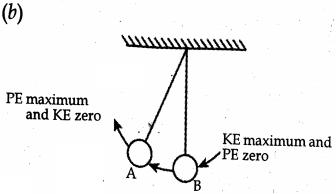
$(b)$ Show with the help of a diagram that when does each type of energy attain its maximum value.
$(c)$ How do these energies vary while the pendulum oscillates?
$(d)$ Name and state the law involved.
$(b)$ Show with the help of a diagram that when does each type of energy attain its maximum value.
$(c)$ How do these energies vary while the pendulum oscillates?
$(d)$ Name and state the law involved.
Solution
(N/A) The two forms of energy involved are Kinetic Energy $(KE)$ and Potential Energy $(PE)$.
$(b)$ In the diagram,point $A$ represents the extreme position where $PE$ is maximum and $KE$ is zero. Point $B$ represents the mean position where $KE$ is maximum and $PE$ is zero.
$(c)$ As the pendulum moves from the mean position $(B)$ to the extreme position $(A)$,$KE$ is converted into $PE$,so $KE$ decreases and $PE$ increases. Conversely,as it moves from the extreme position $(A)$ to the mean position $(B)$,$PE$ is converted into $KE$,so $PE$ decreases and $KE$ increases.
$(d)$ The law involved is the Law of Conservation of Energy. It states that energy can neither be created nor destroyed,only transformed from one form to another. In an isolated system,the total energy remains constant.
$(b)$ In the diagram,point $A$ represents the extreme position where $PE$ is maximum and $KE$ is zero. Point $B$ represents the mean position where $KE$ is maximum and $PE$ is zero.
$(c)$ As the pendulum moves from the mean position $(B)$ to the extreme position $(A)$,$KE$ is converted into $PE$,so $KE$ decreases and $PE$ increases. Conversely,as it moves from the extreme position $(A)$ to the mean position $(B)$,$PE$ is converted into $KE$,so $PE$ decreases and $KE$ increases.
$(d)$ The law involved is the Law of Conservation of Energy. It states that energy can neither be created nor destroyed,only transformed from one form to another. In an isolated system,the total energy remains constant.
0 likes
View Solution120
Medium
$(a)$ State the law of conservation of energy. Explain it with one example.
$(b)$ Two girls,each of weight $400 \, N$,climb up a rope to a height of $8 \, m$. Girl $A$ takes $20 \, s$ while Girl $B$ takes $50 \, s$ to accomplish the task. What is the power expended by each girl?
$(c)$ An electric heater is rated $1500 \, W$. How much energy does it use in $10 \, h$?
$(b)$ Two girls,each of weight $400 \, N$,climb up a rope to a height of $8 \, m$. Girl $A$ takes $20 \, s$ while Girl $B$ takes $50 \, s$ to accomplish the task. What is the power expended by each girl?
$(c)$ An electric heater is rated $1500 \, W$. How much energy does it use in $10 \, h$?
Solution
(A) Law of conservation of energy: It states that energy can neither be created nor destroyed; it can only be converted from one form to another. The total energy in an isolated system remains constant.
Example: During the free fall of an object,the potential energy is gradually converted into kinetic energy,but the total mechanical energy remains constant.
$(b)$ $(i)$ Power expended by Girl $A$:
Weight $(mg) = 400 \, N$,Height $(h) = 8 \, m$,Time $(t) = 20 \, s$.
Power $(P) = \frac{\text{Work done}}{\text{Time}} = \frac{mgh}{t} = \frac{400 \times 8}{20} = 160 \, W$.
$(ii)$ Power expended by Girl $B$:
Weight $(mg) = 400 \, N$,Height $(h) = 8 \, m$,Time $(t) = 50 \, s$.
Power $(P) = \frac{mgh}{t} = \frac{400 \times 8}{50} = 64 \, W$.
$(c)$ Power $(P) = 1500 \, W = 1.5 \, kW$,Time $(t) = 10 \, h$.
Energy consumed $= P \times t = 1.5 \, kW \times 10 \, h = 15 \, kWh$.
Example: During the free fall of an object,the potential energy is gradually converted into kinetic energy,but the total mechanical energy remains constant.
$(b)$ $(i)$ Power expended by Girl $A$:
Weight $(mg) = 400 \, N$,Height $(h) = 8 \, m$,Time $(t) = 20 \, s$.
Power $(P) = \frac{\text{Work done}}{\text{Time}} = \frac{mgh}{t} = \frac{400 \times 8}{20} = 160 \, W$.
$(ii)$ Power expended by Girl $B$:
Weight $(mg) = 400 \, N$,Height $(h) = 8 \, m$,Time $(t) = 50 \, s$.
Power $(P) = \frac{mgh}{t} = \frac{400 \times 8}{50} = 64 \, W$.
$(c)$ Power $(P) = 1500 \, W = 1.5 \, kW$,Time $(t) = 10 \, h$.
Energy consumed $= P \times t = 1.5 \, kW \times 10 \, h = 15 \, kWh$.
0 likes
View Solution121
Medium
$(a)$ Define work done by a constant force on an object. Write an expression for the work done.
$(b)$ How much work will be done on an object by a force if the displacement of the object is zero?
$(c)$ What is the kinetic energy of an object? Write an expression for the kinetic energy of an object of mass $m$ moving with a speed $v$.
$(b)$ How much work will be done on an object by a force if the displacement of the object is zero?
$(c)$ What is the kinetic energy of an object? Write an expression for the kinetic energy of an object of mass $m$ moving with a speed $v$.
Solution
(A) Work done by a force acting on an object is defined as the product of the magnitude of the force and the displacement of the object in the direction of the force.
The expression for work done is: $W = F \times s$,where $W$ is work,$F$ is force,and $s$ is displacement.
$(b)$ If the displacement of the object is zero,the work done is zero. This is because $W = F \times 0 = 0$.
$(c)$ Kinetic energy is the energy possessed by an object by virtue of its motion. The expression for the kinetic energy $(K)$ of an object of mass $m$ moving with a speed $v$ is $K = \frac{1}{2}mv^2$.
The expression for work done is: $W = F \times s$,where $W$ is work,$F$ is force,and $s$ is displacement.
$(b)$ If the displacement of the object is zero,the work done is zero. This is because $W = F \times 0 = 0$.
$(c)$ Kinetic energy is the energy possessed by an object by virtue of its motion. The expression for the kinetic energy $(K)$ of an object of mass $m$ moving with a speed $v$ is $K = \frac{1}{2}mv^2$.
0 likes
View Solution122
Medium
An object of mass $10 \ kg$ is made to fall freely from a height of $10 \ m$. Complete the table:
Hence,state the law of conservation of energy.
| Height of object $(m)$ | $PE$ $(J)$ | $KE$ $(J)$ | Mechanical Energy $(J)$ |
| $10$ | ... | ... | ... |
| $8$ | ... | ... | ... |
| $5$ | ... | ... | ... |
| Just above ground | ... | ... | ... |
Hence,state the law of conservation of energy.
Solution
(N/A) Given: Mass $(m) = 10 \ kg$,Height $(h) = 10 \ m$,Acceleration due to gravity $(g) = 10 \ m/s^2$.
Potential Energy $(PE) = mgh$,Kinetic Energy $(KE) = \frac{1}{2}mv^2$,Mechanical Energy $(ME) = PE + KE$.
Law of Conservation of Energy: Energy can neither be created nor destroyed; it can only be transformed from one form to another. The total energy in an isolated system remains constant.
Potential Energy $(PE) = mgh$,Kinetic Energy $(KE) = \frac{1}{2}mv^2$,Mechanical Energy $(ME) = PE + KE$.
| Height $(m)$ | $PE$ $(J)$ | $KE$ $(J)$ | $ME$ $(J)$ |
| $10$ | $1000$ | $0$ | $1000$ |
| $8$ | $800$ | $200$ | $1000$ |
| $5$ | $500$ | $500$ | $1000$ |
| $0$ | $0$ | $1000$ | $1000$ |
Law of Conservation of Energy: Energy can neither be created nor destroyed; it can only be transformed from one form to another. The total energy in an isolated system remains constant.
0 likes
View Solution123
Medium
$(a)$ The Earth,moving around the Sun in a circular orbit,is acted upon by a force,and hence work must be done on the Earth by the force. State whether the statement is correct or not. Give reasons for your answer.
$(b)$ $A$ coolie holding a heavy box is waiting at the bus stand for $15$ minutes. How much work is done by him?
$(c)$ $A$ man weighing $70 \, kg$ carries a weight of $10 \, kg$ to the top of a tower $100 \, m$ high. Calculate the work done by the man. $(g = 10 \, m s^{-2})$
$(b)$ $A$ coolie holding a heavy box is waiting at the bus stand for $15$ minutes. How much work is done by him?
$(c)$ $A$ man weighing $70 \, kg$ carries a weight of $10 \, kg$ to the top of a tower $100 \, m$ high. Calculate the work done by the man. $(g = 10 \, m s^{-2})$
Solution
(N/A) No,the statement is incorrect. Work is not done because the gravitational force acting on the Earth (directed towards the Sun) and the displacement (along the tangent to the circular path) are perpendicular to each other,i.e.,$\theta = 90^{\circ}$. Since $W = F S \cos \theta$ and $\cos 90^{\circ} = 0$,the work done $W = 0$.
$(b)$ Since the coolie is applying force to hold the box but there is no displacement of the box $(S = 0)$,the work done by him is zero.
$(c)$ Total mass $m = 70 \, kg + 10 \, kg = 80 \, kg$. Force $F = m \times g = 80 \, kg \times 10 \, m s^{-2} = 800 \, N$. Displacement $S = 100 \, m$. Work done $W = F \times S = 800 \, N \times 100 \, m = 80,000 \, J$.
$(b)$ Since the coolie is applying force to hold the box but there is no displacement of the box $(S = 0)$,the work done by him is zero.
$(c)$ Total mass $m = 70 \, kg + 10 \, kg = 80 \, kg$. Force $F = m \times g = 80 \, kg \times 10 \, m s^{-2} = 800 \, N$. Displacement $S = 100 \, m$. Work done $W = F \times S = 800 \, N \times 100 \, m = 80,000 \, J$.
0 likes
View Solution124
Medium
$(a)$ Define the term 'average power'.
$(b)$ When a player hits a football,it moves along a curved path and then falls to the ground. Calculate the work done by the force of gravity on the football.
$(c)$ Two friends,Ram and Shyam,each having a mass of $40 \, kg$,go for rock climbing. Ram climbs to a height of $3 \, m$ in $10 \, s$ and Shyam covers the same height in $12 \, s$. Is the work done by Ram and Shyam equal or not? Compare the power of Ram and Shyam.
$(b)$ When a player hits a football,it moves along a curved path and then falls to the ground. Calculate the work done by the force of gravity on the football.
$(c)$ Two friends,Ram and Shyam,each having a mass of $40 \, kg$,go for rock climbing. Ram climbs to a height of $3 \, m$ in $10 \, s$ and Shyam covers the same height in $12 \, s$. Is the work done by Ram and Shyam equal or not? Compare the power of Ram and Shyam.
Solution
(C) Average power is defined as the ratio of total work done to the total time taken.
$(b)$ When a football is kicked,it follows a curved path and returns to the ground. The work done by gravity depends only on the vertical displacement. Since the initial and final vertical positions are the same (ground level),the net vertical displacement $h = 0$. Therefore,the work done by gravity $W = mgh = 0$.
$(c)$ Work done by Ram and Shyam is equal because both have the same mass $(40 \, kg)$ and climb the same vertical height $(3 \, m)$.
Power of Ram $= \frac{mgh}{t} = \frac{40 \times 9.8 \times 3}{10} = 117.6 \, W$.
Power of Shyam $= \frac{mgh}{t} = \frac{40 \times 9.8 \times 3}{12} = 98 \, W$.
Since $117.6 \, W > 98 \, W$,the power of Ram is greater than the power of Shyam.
$(b)$ When a football is kicked,it follows a curved path and returns to the ground. The work done by gravity depends only on the vertical displacement. Since the initial and final vertical positions are the same (ground level),the net vertical displacement $h = 0$. Therefore,the work done by gravity $W = mgh = 0$.
$(c)$ Work done by Ram and Shyam is equal because both have the same mass $(40 \, kg)$ and climb the same vertical height $(3 \, m)$.
Power of Ram $= \frac{mgh}{t} = \frac{40 \times 9.8 \times 3}{10} = 117.6 \, W$.
Power of Shyam $= \frac{mgh}{t} = \frac{40 \times 9.8 \times 3}{12} = 98 \, W$.
Since $117.6 \, W > 98 \, W$,the power of Ram is greater than the power of Shyam.
0 likes
View Solution125
Medium
$(a)$ Define work. State two factors on which the magnitude of work depends.
$(b)$ $A$ car and a truck have the same speed of $30 \, m/s$. If their masses are in the ratio $1:3$,find the ratio of their kinetic energy.
$(b)$ $A$ car and a truck have the same speed of $30 \, m/s$. If their masses are in the ratio $1:3$,find the ratio of their kinetic energy.
Solution
(1:3) Work is defined as the product of the force applied on an object and the displacement of the object in the direction of the force. The magnitude of work depends on two factors: $(1)$ The magnitude of the force applied $(F)$ and $(2)$ The displacement of the object $(s)$ in the direction of the force.
$(b)$ Given: Speed of car $(v_1) = 30 \, m/s$,Speed of truck $(v_2) = 30 \, m/s$. Ratio of masses $(m_1 : m_2) = 1 : 3$.
Since kinetic energy $(E_k) = \frac{1}{2}mv^2$,the ratio of kinetic energies is:
$\frac{E_1}{E_2} = \frac{\frac{1}{2}m_1v_1^2}{\frac{1}{2}m_2v_2^2} = \frac{m_1}{m_2} \times \left(\frac{v_1}{v_2}\right)^2$
Since $v_1 = v_2$,the ratio becomes $\frac{m_1}{m_2} = \frac{1}{3}$.
Therefore,the ratio of kinetic energy is $1:3$.
$(b)$ Given: Speed of car $(v_1) = 30 \, m/s$,Speed of truck $(v_2) = 30 \, m/s$. Ratio of masses $(m_1 : m_2) = 1 : 3$.
Since kinetic energy $(E_k) = \frac{1}{2}mv^2$,the ratio of kinetic energies is:
$\frac{E_1}{E_2} = \frac{\frac{1}{2}m_1v_1^2}{\frac{1}{2}m_2v_2^2} = \frac{m_1}{m_2} \times \left(\frac{v_1}{v_2}\right)^2$
Since $v_1 = v_2$,the ratio becomes $\frac{m_1}{m_2} = \frac{1}{3}$.
Therefore,the ratio of kinetic energy is $1:3$.
0 likes
View Solution126
Medium
$(a)$ State the law of conservation of energy.
$(b)$ Establish the relation between the $SI$ unit of energy and the commercial unit of energy.
$(c)$ $A$ toy car is displaced through $5 \, m$ on the application of a force of $7 \, N$. Assuming the force acts on the object throughout the displacement,what is the work done in this case?
$(b)$ Establish the relation between the $SI$ unit of energy and the commercial unit of energy.
$(c)$ $A$ toy car is displaced through $5 \, m$ on the application of a force of $7 \, N$. Assuming the force acts on the object throughout the displacement,what is the work done in this case?
Solution
(N/A) The law of conservation of energy states that energy can neither be created nor destroyed; it can only be transformed from one form to another. Thus,the total energy of an isolated system remains constant.
$(b)$ The $SI$ unit of energy is the joule $(J)$,and the commercial unit of energy is the kilowatt-hour $(kWh)$.
$1 \, kWh = 1 \, kW \times 1 \, h$
$1 \, kWh = 1000 \, W \times 3600 \, s$
$1 \, kWh = 3,600,000 \, J = 3.6 \times 10^6 \, J$.
$(c)$ Given: Force $(F)$ = $7 \, N$,Displacement $(S)$ = $5 \, m$.
Work done $(W)$ = $F \times S$
$W = 7 \, N \times 5 \, m = 35 \, J$.
$(b)$ The $SI$ unit of energy is the joule $(J)$,and the commercial unit of energy is the kilowatt-hour $(kWh)$.
$1 \, kWh = 1 \, kW \times 1 \, h$
$1 \, kWh = 1000 \, W \times 3600 \, s$
$1 \, kWh = 3,600,000 \, J = 3.6 \times 10^6 \, J$.
$(c)$ Given: Force $(F)$ = $7 \, N$,Displacement $(S)$ = $5 \, m$.
Work done $(W)$ = $F \times S$
$W = 7 \, N \times 5 \, m = 35 \, J$.
0 likes
View Solution127
Medium
$(i)$ An object thrown at a certain angle to the ground moves in a curved path and falls back to the ground. The initial and the final points of the path of the object lie on the same horizontal line. What is the total work done against the force of gravity and by the force of gravity on the object? Explain with proper mathematical expression.
$(ii)$ $A$ certain force acting on a $20 \, kg$ mass changes its velocity from $5 \, m s^{-1}$ to $2 \, m s^{-1}$. Calculate the work done by the force.
$(ii)$ $A$ certain force acting on a $20 \, kg$ mass changes its velocity from $5 \, m s^{-1}$ to $2 \, m s^{-1}$. Calculate the work done by the force.
Solution
(D) $(i)$ When an object is thrown at a certain angle, it rises to a maximum height $h$ and then returns to the ground following a parabolic path. The work done against gravity while rising is $W_{against} = mgh$. The work done by gravity while falling is $W_{by} = mgh$. Since the initial and final points are on the same horizontal line, the net displacement in the vertical direction is $0$. Therefore, the total work done by the force of gravity is $W_{net} = W_{against} + W_{by} = -mgh + mgh = 0 \, J$.
$(ii)$ Given: mass $m = 20 \, kg$, initial velocity $u = 5 \, m s^{-1}$, final velocity $v = 2 \, m s^{-1}$.
According to the work-energy theorem, the work done by a force is equal to the change in kinetic energy:
$W = \Delta KE = \frac{1}{2} m v^2 - \frac{1}{2} m u^2$
$W = \frac{1}{2} \times 20 \times (2)^2 - \frac{1}{2} \times 20 \times (5)^2$
$W = 10 \times 4 - 10 \times 25$
$W = 40 - 250 = -210 \, J$.
The work done by the force is $-210 \, J$.
$(ii)$ Given: mass $m = 20 \, kg$, initial velocity $u = 5 \, m s^{-1}$, final velocity $v = 2 \, m s^{-1}$.
According to the work-energy theorem, the work done by a force is equal to the change in kinetic energy:
$W = \Delta KE = \frac{1}{2} m v^2 - \frac{1}{2} m u^2$
$W = \frac{1}{2} \times 20 \times (2)^2 - \frac{1}{2} \times 20 \times (5)^2$
$W = 10 \times 4 - 10 \times 25$
$W = 40 - 250 = -210 \, J$.
The work done by the force is $-210 \, J$.
0 likes
View Solution128
Difficult
$(a)$ $A$ person is holding a bucket of water by applying a vertical force of $100 \, N$. He first moves a horizontal distance of $5 \, m$ and then climbs up through stairs a vertical distance of $10 \, m$. Calculate the total work done by the person on the bucket.
$(b)$ Establish the relationship between kinetic energy and momentum of a body.
$(b)$ Establish the relationship between kinetic energy and momentum of a body.
Solution
(A) Given: Force $F = 100 \, N$,horizontal displacement $S_H = 5 \, m$,vertical displacement $S_V = 10 \, m$.
Let $W_1$ be the work done during horizontal movement and $W_2$ be the work done during vertical movement.
For horizontal movement,the force is vertical and displacement is horizontal,so the angle $\theta = 90^{\circ}$.
$W_1 = F \cdot S_H \cdot \cos(90^{\circ}) = 100 \times 5 \times 0 = 0 \, J$.
For vertical movement,the force is vertical and displacement is vertical,so the angle $\theta = 0^{\circ}$.
$W_2 = F \cdot S_V \cdot \cos(0^{\circ}) = 100 \times 10 \times 1 = 1000 \, J$.
Total work done $W = W_1 + W_2 = 0 + 1000 = 1000 \, J$.
$(b)$ Kinetic energy $K$ is given by $K = \frac{1}{2}mv^2$ and momentum $p$ is given by $p = mv$.
From $p = mv$,we get $v = \frac{p}{m}$.
Substituting $v$ in the kinetic energy formula:
$K = \frac{1}{2}m \left(\frac{p}{m}\right)^2 = \frac{1}{2}m \left(\frac{p^2}{m^2}\right) = \frac{p^2}{2m}$.
Thus,the relationship is $K = \frac{p^2}{2m}$.
Let $W_1$ be the work done during horizontal movement and $W_2$ be the work done during vertical movement.
For horizontal movement,the force is vertical and displacement is horizontal,so the angle $\theta = 90^{\circ}$.
$W_1 = F \cdot S_H \cdot \cos(90^{\circ}) = 100 \times 5 \times 0 = 0 \, J$.
For vertical movement,the force is vertical and displacement is vertical,so the angle $\theta = 0^{\circ}$.
$W_2 = F \cdot S_V \cdot \cos(0^{\circ}) = 100 \times 10 \times 1 = 1000 \, J$.
Total work done $W = W_1 + W_2 = 0 + 1000 = 1000 \, J$.
$(b)$ Kinetic energy $K$ is given by $K = \frac{1}{2}mv^2$ and momentum $p$ is given by $p = mv$.
From $p = mv$,we get $v = \frac{p}{m}$.
Substituting $v$ in the kinetic energy formula:
$K = \frac{1}{2}m \left(\frac{p}{m}\right)^2 = \frac{1}{2}m \left(\frac{p^2}{m^2}\right) = \frac{p^2}{2m}$.
Thus,the relationship is $K = \frac{p^2}{2m}$.
0 likes
View Solution129
Medium
$(a)$ Define average power. Calculate the total energy consumed in the month of November in a household in which four devices of power $500\, W$ each are used daily for $10\, hours.$
$(b)$ $A$ freely falling object eventually stops on reaching the ground. What happens to its energy?
$(b)$ $A$ freely falling object eventually stops on reaching the ground. What happens to its energy?
Solution
(N/A) Average power is defined as the average rate of doing work. If a total work $W$ is done in a time $t,$ then average power $P_{av}$ is given by:
$P_{av} = \frac{W}{t}$
Total power consumed by $4$ devices $= 4 \times 500 = 2000\, W = 2\, kW$
Time for which devices run $= 10\, hours$
Energy consumed per day $= 2\, kW \times 10\, h = 20\, kWh$
Energy consumed in the month of November ($30$ days) $= 20\, kWh \times 30 = 600\, kWh$
$(b)$ When a body falls freely under gravity,it possesses kinetic energy due to its motion. When it strikes the ground,its kinetic energy is dissipated into other forms of energy,primarily sound energy and heat energy,due to the impact with the surface.
$P_{av} = \frac{W}{t}$
Total power consumed by $4$ devices $= 4 \times 500 = 2000\, W = 2\, kW$
Time for which devices run $= 10\, hours$
Energy consumed per day $= 2\, kW \times 10\, h = 20\, kWh$
Energy consumed in the month of November ($30$ days) $= 20\, kWh \times 30 = 600\, kWh$
$(b)$ When a body falls freely under gravity,it possesses kinetic energy due to its motion. When it strikes the ground,its kinetic energy is dissipated into other forms of energy,primarily sound energy and heat energy,due to the impact with the surface.
0 likes
View Solution130
Difficult
$(i)$ $A$ light and a heavy object have the same momentum. What is the ratio of their kinetic energies? Which one has a larger kinetic energy?
$(ii)$ $A$ ball is dropped from a height of $10\, m$. If the energy of the ball reduces by $40\%$ after striking the ground,how high can the ball bounce back? $(g = 10\, m s^{-2})$
$(ii)$ $A$ ball is dropped from a height of $10\, m$. If the energy of the ball reduces by $40\%$ after striking the ground,how high can the ball bounce back? $(g = 10\, m s^{-2})$
Solution
(A) $(i)$ The kinetic energy $(E)$ of a body is related to its momentum $(p)$ as $E = p^2 / 2m$. Since the momentum is the same for both objects,$E \propto 1/m$.
Therefore,the ratio of the kinetic energy of the light object to the heavy object is $\frac{E_{\text{light}}}{E_{\text{heavy}}} = \frac{m_{\text{heavy}}}{m_{\text{light}}}$.
Since $m_{\text{heavy}} > m_{\text{light}}$,the ratio is greater than $1$. Thus,the lighter object has a larger kinetic energy.
$(ii)$ Given: Initial height $h_1 = 10\, m$. The energy reduces by $40\%$,so the remaining energy is $60\%$ of the initial energy $(E_2 = 0.6 E_1)$.
Using the potential energy formula $E = mgh$,we have $mgh_2 = 0.6 mgh_1$.
$h_2 = 0.6 \times h_1 = 0.6 \times 10\, m = 6\, m$.
The ball will bounce back to a height of $6\, m$.
Therefore,the ratio of the kinetic energy of the light object to the heavy object is $\frac{E_{\text{light}}}{E_{\text{heavy}}} = \frac{m_{\text{heavy}}}{m_{\text{light}}}$.
Since $m_{\text{heavy}} > m_{\text{light}}$,the ratio is greater than $1$. Thus,the lighter object has a larger kinetic energy.
$(ii)$ Given: Initial height $h_1 = 10\, m$. The energy reduces by $40\%$,so the remaining energy is $60\%$ of the initial energy $(E_2 = 0.6 E_1)$.
Using the potential energy formula $E = mgh$,we have $mgh_2 = 0.6 mgh_1$.
$h_2 = 0.6 \times h_1 = 0.6 \times 10\, m = 6\, m$.
The ball will bounce back to a height of $6\, m$.
0 likes
View Solution131
Difficult
$(i)$ State the law of conservation of energy.
$(ii)$ Show that the total mechanical energy of a freely falling body is conserved.
$(ii)$ Show that the total mechanical energy of a freely falling body is conserved.
Solution
(N/A) $(i)$ The law of conservation of energy states that energy can neither be created nor destroyed,it can only be transformed from one form to another. For a system,the total energy remains constant if no external non-conservative forces act on it.
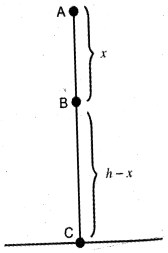
$(ii)$ Consider a body of mass $m$ falling freely under gravity from a height $h$ above the ground. Let the body be at point $A$ at height $h$,point $B$ at height $(h-x)$ after falling a distance $x$,and point $C$ just before hitting the ground.
At point $A$ (Height $h$): The body is at rest,so velocity $v = 0$.
Kinetic Energy $(T) = 1/2 mv^2 = 0$.
Potential Energy $(U) = mgh$.
Total Energy $(E) = T + U = 0 + mgh = mgh$ $....(i)$
At point $B$ (Height $h-x$): The body has fallen distance $x$. Using $v^2 - u^2 = 2as$,where $u=0, a=g, s=x$,we get $v^2 = 2gx$.
Kinetic Energy $(T) = 1/2 m(2gx) = mgx$.
Potential Energy $(U) = mg(h-x) = mgh - mgx$.
Total Energy $(E) = T + U = mgx + mgh - mgx = mgh$ $....(ii)$
At point $C$ (Height $0$): The body has fallen distance $h$. Using $v^2 - u^2 = 2as$,where $u=0, a=g, s=h$,we get $V^2 = 2gh$.
Kinetic Energy $(T) = 1/2 mV^2 = 1/2 m(2gh) = mgh$.
Potential Energy $(U) = mg(0) = 0$.
Total Energy $(E) = T + U = mgh + 0 = mgh$ $....(iii)$
From equations $(i), (ii),$ and $(iii)$,it is clear that the total mechanical energy of a freely falling body remains constant at all points.
$(ii)$ Consider a body of mass $m$ falling freely under gravity from a height $h$ above the ground. Let the body be at point $A$ at height $h$,point $B$ at height $(h-x)$ after falling a distance $x$,and point $C$ just before hitting the ground.
At point $A$ (Height $h$): The body is at rest,so velocity $v = 0$.
Kinetic Energy $(T) = 1/2 mv^2 = 0$.
Potential Energy $(U) = mgh$.
Total Energy $(E) = T + U = 0 + mgh = mgh$ $....(i)$
At point $B$ (Height $h-x$): The body has fallen distance $x$. Using $v^2 - u^2 = 2as$,where $u=0, a=g, s=x$,we get $v^2 = 2gx$.
Kinetic Energy $(T) = 1/2 m(2gx) = mgx$.
Potential Energy $(U) = mg(h-x) = mgh - mgx$.
Total Energy $(E) = T + U = mgx + mgh - mgx = mgh$ $....(ii)$
At point $C$ (Height $0$): The body has fallen distance $h$. Using $v^2 - u^2 = 2as$,where $u=0, a=g, s=h$,we get $V^2 = 2gh$.
Kinetic Energy $(T) = 1/2 mV^2 = 1/2 m(2gh) = mgh$.
Potential Energy $(U) = mg(0) = 0$.
Total Energy $(E) = T + U = mgh + 0 = mgh$ $....(iii)$
From equations $(i), (ii),$ and $(iii)$,it is clear that the total mechanical energy of a freely falling body remains constant at all points.
0 likes
View Solution132
Medium
$(a)$ What is meant by mechanical energy? State its two forms. State the law of conservation of energy. Give an example in which we observe a continuous change of one form of energy into another and vice-versa.
$(b)$ Calculate the amount of work required to stop a car of $1000 \, kg$ moving with a speed of $72 \, km \, h^{-1}$.
$(b)$ Calculate the amount of work required to stop a car of $1000 \, kg$ moving with a speed of $72 \, km \, h^{-1}$.
Solution
(B) Mechanical energy is the sum of kinetic energy $(KE)$ and potential energy $(PE)$ of an object. Its two forms are kinetic energy and potential energy. The law of conservation of energy states that energy can neither be created nor destroyed; it can only be transformed from one form to another. An example is a simple pendulum: at the mean position,the energy is entirely kinetic,while at the extreme positions,it is entirely potential. As the pendulum oscillates,energy continuously converts between kinetic and potential forms.
$(b)$ Given: Mass $m = 1000 \, kg$,initial velocity $u = 72 \, km \, h^{-1} = 72 \times (5/18) \, m \, s^{-1} = 20 \, m \, s^{-1}$,final velocity $v = 0 \, m \, s^{-1}$.
Work done = Change in kinetic energy = $\frac{1}{2} m (v^2 - u^2)$.
Work done = $\frac{1}{2} \times 1000 \times (0^2 - 20^2) = 500 \times (-400) = -200,000 \, J = -2 \times 10^5 \, J$.
The negative sign indicates that work is done against the motion of the car.
$(b)$ Given: Mass $m = 1000 \, kg$,initial velocity $u = 72 \, km \, h^{-1} = 72 \times (5/18) \, m \, s^{-1} = 20 \, m \, s^{-1}$,final velocity $v = 0 \, m \, s^{-1}$.
Work done = Change in kinetic energy = $\frac{1}{2} m (v^2 - u^2)$.
Work done = $\frac{1}{2} \times 1000 \times (0^2 - 20^2) = 500 \times (-400) = -200,000 \, J = -2 \times 10^5 \, J$.
The negative sign indicates that work is done against the motion of the car.
0 likes
View Solution133
Medium
$(a)$ Two bodies have equal masses and are moving with uniform velocities of $2\,v$ and $3\,v$. What is the ratio of their kinetic energies?
$(b)$ $A$ mass is dropped from height $h$. At halfway to the ground,what is the total energy?
$(b)$ $A$ mass is dropped from height $h$. At halfway to the ground,what is the total energy?
Solution
(A) Given: $m_1 = m, m_2 = m, v_1 = 2v, v_2 = 3v$. We need to find the ratio $E_1 / E_2$.
We know that kinetic energy $E = \frac{1}{2}mv^2$. Therefore:
$\frac{E_1}{E_2} = \frac{\frac{1}{2}m_1v_1^2}{\frac{1}{2}m_2v_2^2} = \frac{v_1^2}{v_2^2} = \frac{(2v)^2}{(3v)^2} = \frac{4v^2}{9v^2} = \frac{4}{9}$.
$(b)$ Total energy = Kinetic Energy $(KE)$ + Potential Energy $(PE)$.
At height $h$,the total energy is $mgh$ (since $KE = 0$ and $PE = mgh$).
According to the law of conservation of energy,the total energy remains constant at every point during the fall.
At halfway to the ground (height $h/2$),the velocity $v$ is given by $v^2 - u^2 = 2g(h/2)$. Since $u = 0$,$v^2 = gh$.
$KE = \frac{1}{2}mv^2 = \frac{1}{2}mgh$.
$PE = mg(h/2) = \frac{1}{2}mgh$.
Total energy = $KE + PE = \frac{1}{2}mgh + \frac{1}{2}mgh = mgh$.
We know that kinetic energy $E = \frac{1}{2}mv^2$. Therefore:
$\frac{E_1}{E_2} = \frac{\frac{1}{2}m_1v_1^2}{\frac{1}{2}m_2v_2^2} = \frac{v_1^2}{v_2^2} = \frac{(2v)^2}{(3v)^2} = \frac{4v^2}{9v^2} = \frac{4}{9}$.
$(b)$ Total energy = Kinetic Energy $(KE)$ + Potential Energy $(PE)$.
At height $h$,the total energy is $mgh$ (since $KE = 0$ and $PE = mgh$).
According to the law of conservation of energy,the total energy remains constant at every point during the fall.
At halfway to the ground (height $h/2$),the velocity $v$ is given by $v^2 - u^2 = 2g(h/2)$. Since $u = 0$,$v^2 = gh$.
$KE = \frac{1}{2}mv^2 = \frac{1}{2}mgh$.
$PE = mg(h/2) = \frac{1}{2}mgh$.
Total energy = $KE + PE = \frac{1}{2}mgh + \frac{1}{2}mgh = mgh$.
0 likes
View Solution134
Medium
$(a)$ Give two conditions for work to be done.
$(b)$ What is the work done by frictional force on an object when dragged along a rough surface?
$(c)$ Relate power and work.
$(d)$ $A$ machine does $1960 \, J$ of work in $4 \, \text{minutes}$. What is the power?
$(b)$ What is the work done by frictional force on an object when dragged along a rough surface?
$(c)$ Relate power and work.
$(d)$ $A$ machine does $1960 \, J$ of work in $4 \, \text{minutes}$. What is the power?
Solution
$(D)$ The two conditions for work to be done are: $(i)$ $A$ force must act on the object, and $(ii)$ The object must undergo displacement in the direction of the force.
$(b)$ The work done by frictional force is negative because the force of friction acts in the direction opposite to the displacement of the object.
$(c)$ Power is defined as the rate of doing work. The relationship is given by $P = W / t$, where $P$ is power, $W$ is work done, and $t$ is time taken.
$(d)$ Given: Work $(W) = 1960 \, J$, Time $(t) = 4 \, \text{minutes} = 4 \times 60 = 240 \, s$.
Using the formula $P = W / t = 1960 / 240 = 8.166... \approx 8.17 \, W$.
$(b)$ The work done by frictional force is negative because the force of friction acts in the direction opposite to the displacement of the object.
$(c)$ Power is defined as the rate of doing work. The relationship is given by $P = W / t$, where $P$ is power, $W$ is work done, and $t$ is time taken.
$(d)$ Given: Work $(W) = 1960 \, J$, Time $(t) = 4 \, \text{minutes} = 4 \times 60 = 240 \, s$.
Using the formula $P = W / t = 1960 / 240 = 8.166... \approx 8.17 \, W$.
0 likes
View Solution135
Medium
$(a)$ Derive an expression for the kinetic energy of a body having mass $m$ and moving with a velocity $v$.
$(b)$ When the velocity of a body is increased $5$ times,what is the change in its kinetic energy?
$(c)$ Two masses $m$ and $2m$ are dropped from heights $h$ and $2h$. On reaching the ground,which will have greater kinetic energy and why?
$(b)$ When the velocity of a body is increased $5$ times,what is the change in its kinetic energy?
$(c)$ Two masses $m$ and $2m$ are dropped from heights $h$ and $2h$. On reaching the ground,which will have greater kinetic energy and why?
Solution
(N/A) Kinetic energy $(KE)$ is the work done by a force $F$ to accelerate a body of mass $m$ from rest $(u=0)$ to velocity $v$ over a distance $s$. Using $v^2 - u^2 = 2as$,we get $s = v^2 / (2a)$. Since $F = ma$,the work done $W = F \times s = ma \times (v^2 / 2a) = 1/2 mv^2$. Thus,$KE = 1/2 mv^2$.
$(b)$ Since $KE \propto v^2$,if the velocity becomes $5v$,the new kinetic energy $KE' = 1/2 m(5v)^2 = 25 \times (1/2 mv^2) = 25 \times KE$. The kinetic energy increases by a factor of $25$.
$(c)$ The kinetic energy of a falling body at the ground is equal to its initial potential energy $(PE = mgh)$. For mass $m$ at height $h$,$PE_1 = mgh$. For mass $2m$ at height $2h$,$PE_2 = (2m)g(2h) = 4mgh$. Since $PE_2 > PE_1$,the body with mass $2m$ will have greater kinetic energy.
$(b)$ Since $KE \propto v^2$,if the velocity becomes $5v$,the new kinetic energy $KE' = 1/2 m(5v)^2 = 25 \times (1/2 mv^2) = 25 \times KE$. The kinetic energy increases by a factor of $25$.
$(c)$ The kinetic energy of a falling body at the ground is equal to its initial potential energy $(PE = mgh)$. For mass $m$ at height $h$,$PE_1 = mgh$. For mass $2m$ at height $2h$,$PE_2 = (2m)g(2h) = 4mgh$. Since $PE_2 > PE_1$,the body with mass $2m$ will have greater kinetic energy.
0 likes
View Solution136
Medium
$(a)$ State the law of conservation of energy.
$(b)$ What is the work done to increase the velocity of a car from $36 \, km/h$ to $72 \, km/h$ if the mass of the car is $1500 \, kg$? Does the work done by the force have a negative or a positive magnitude?
$(c)$ Where does an oscillating pendulum have maximum potential energy $(PE)$ and kinetic energy $(KE)$?
$(b)$ What is the work done to increase the velocity of a car from $36 \, km/h$ to $72 \, km/h$ if the mass of the car is $1500 \, kg$? Does the work done by the force have a negative or a positive magnitude?
$(c)$ Where does an oscillating pendulum have maximum potential energy $(PE)$ and kinetic energy $(KE)$?
Solution
(N/A) The law of conservation of energy states that energy can neither be created nor destroyed,it can only be transformed from one form to another.
$(b)$ Given: Mass $m = 1500 \, kg$,Initial velocity $u = 36 \, km/h = 36 \times (5/18) = 10 \, m/s$,Final velocity $v = 72 \, km/h = 72 \times (5/18) = 20 \, m/s$.
Work done $(W)$ = Change in kinetic energy = $\frac{1}{2} m (v^2 - u^2)$.
$W = \frac{1}{2} \times 1500 \times (20^2 - 10^2) = 750 \times (400 - 100) = 750 \times 300 = 225,000 \, J$ or $2.25 \times 10^5 \, J$.
Since the velocity increases,the work done is positive.
$(c)$ An oscillating pendulum has maximum potential energy $(PE)$ at its extreme positions and maximum kinetic energy $(KE)$ at its mean position.
$(b)$ Given: Mass $m = 1500 \, kg$,Initial velocity $u = 36 \, km/h = 36 \times (5/18) = 10 \, m/s$,Final velocity $v = 72 \, km/h = 72 \times (5/18) = 20 \, m/s$.
Work done $(W)$ = Change in kinetic energy = $\frac{1}{2} m (v^2 - u^2)$.
$W = \frac{1}{2} \times 1500 \times (20^2 - 10^2) = 750 \times (400 - 100) = 750 \times 300 = 225,000 \, J$ or $2.25 \times 10^5 \, J$.
Since the velocity increases,the work done is positive.
$(c)$ An oscillating pendulum has maximum potential energy $(PE)$ at its extreme positions and maximum kinetic energy $(KE)$ at its mean position.
0 likes
View Solution137
EasyMCQ
Calculate the power of an electric motor that can lift $800 \, kg$ of water to store in a tank at a height of $1500 \, cm$ in $20 \, s$. $(g = 10 \, m s^{-2})$ (in $, kW$)
A
$6$
B
$8$
C
$4$
D
$10$
Solution
(A) Given: Mass $m = 800 \, kg$,height $h = 1500 \, cm = 15 \, m$,time $t = 20 \, s$,and acceleration due to gravity $g = 10 \, m s^{-2}$.
The work done $W$ to lift the water is equal to the potential energy gained: $W = mgh$.
Power $P$ is defined as the rate of doing work: $P = \frac{W}{t} = \frac{mgh}{t}$.
Substituting the values: $P = \frac{800 \times 10 \times 15}{20}$.
$P = \frac{120000}{20} = 6000 \, W$.
Since $1 \, kW = 1000 \, W$,we have $P = 6 \, kW$.
The work done $W$ to lift the water is equal to the potential energy gained: $W = mgh$.
Power $P$ is defined as the rate of doing work: $P = \frac{W}{t} = \frac{mgh}{t}$.
Substituting the values: $P = \frac{800 \times 10 \times 15}{20}$.
$P = \frac{120000}{20} = 6000 \, W$.
Since $1 \, kW = 1000 \, W$,we have $P = 6 \, kW$.
0 likes
View Solution138
Medium
Calculate the kinetic energy of a car of mass $750 \,kg$ moving with a velocity of $54 \,km \cdot h^{-1}$. Find the new kinetic energy of the car if a passenger of mass $50 \,kg$ sits in the car.
Solution
(N/A) Given: Mass of car $m_1 = 750 \,kg$,Velocity $v = 54 \,km \cdot h^{-1} = 54 \times \frac{5}{18} \,m \cdot s^{-1} = 15 \,m \cdot s^{-1}$.
Initial Kinetic Energy $(KE_1)$:
$KE_1 = \frac{1}{2} m_1 v^2 = \frac{1}{2} \times 750 \times (15)^2 = 375 \times 225 = 84375 \,J$.
When a passenger of mass $50 \,kg$ sits in the car,the new total mass $m_2 = 750 \,kg + 50 \,kg = 800 \,kg$.
New Kinetic Energy $(KE_2)$:
$KE_2 = \frac{1}{2} m_2 v^2 = \frac{1}{2} \times 800 \times (15)^2 = 400 \times 225 = 90000 \,J$.
Initial Kinetic Energy $(KE_1)$:
$KE_1 = \frac{1}{2} m_1 v^2 = \frac{1}{2} \times 750 \times (15)^2 = 375 \times 225 = 84375 \,J$.
When a passenger of mass $50 \,kg$ sits in the car,the new total mass $m_2 = 750 \,kg + 50 \,kg = 800 \,kg$.
New Kinetic Energy $(KE_2)$:
$KE_2 = \frac{1}{2} m_2 v^2 = \frac{1}{2} \times 800 \times (15)^2 = 400 \times 225 = 90000 \,J$.
0 likes
View Solution139
MediumMCQ
$A$ man of mass $60 \, kg$ runs up a flight of $30$ steps in $40 \, s$. If each step is $20 \, cm$ high,calculate the power of the man.
A
$A$) $90 \, W$
B
$B$) $80 \, W$
C
$C$) $100 \, W$
D
$D$) $120 \, W$
Solution
(A) Given: Mass of the man $m = 60 \, kg$,time taken $t = 40 \, s$,number of steps $= 30$,height of each step $= 20 \, cm = 0.2 \, m$.
Total height $h = 30 \times 0.2 \, m = 6 \, m$.
Acceleration due to gravity $g = 10 \, m/s^2$ (taking $g = 10 \, m/s^2$ for simplicity).
Work done $W = mgh = 60 \times 10 \times 6 = 3600 \, J$.
Power $P = \frac{W}{t} = \frac{3600 \, J}{40 \, s} = 90 \, W$.
Thus,the power of the man is $90 \, W$.
Total height $h = 30 \times 0.2 \, m = 6 \, m$.
Acceleration due to gravity $g = 10 \, m/s^2$ (taking $g = 10 \, m/s^2$ for simplicity).
Work done $W = mgh = 60 \times 10 \times 6 = 3600 \, J$.
Power $P = \frac{W}{t} = \frac{3600 \, J}{40 \, s} = 90 \, W$.
Thus,the power of the man is $90 \, W$.
0 likes
View Solution140
Easy
$A$ man weighing $70 \,kg$ carries a weight of $10 \,kg$ to the top of a tower $100 \,m$ high. Calculate the work done.
Solution
(N/A) The work done by the man is equal to the change in the potential energy of the system (man + weight).
The total mass $m$ is the sum of the man's mass and the weight he carries:
$m = 70 \,kg + 10 \,kg = 80 \,kg$
The height $h$ is $100 \,m$.
Taking the acceleration due to gravity $g = 9.8 \,m/s^2$,the work done $W$ is calculated as:
$W = m \times g \times h$
$W = 80 \,kg \times 9.8 \,m/s^2 \times 100 \,m$
$W = 78400 \,J$ (or $7.84 \times 10^4 \,J$).
The total mass $m$ is the sum of the man's mass and the weight he carries:
$m = 70 \,kg + 10 \,kg = 80 \,kg$
The height $h$ is $100 \,m$.
Taking the acceleration due to gravity $g = 9.8 \,m/s^2$,the work done $W$ is calculated as:
$W = m \times g \times h$
$W = 80 \,kg \times 9.8 \,m/s^2 \times 100 \,m$
$W = 78400 \,J$ (or $7.84 \times 10^4 \,J$).
0 likes
View Solution141
EasyMCQ
Calculate the amount of work done in moving a $50 \, kg$ mass through a distance of $10 \, m$ by applying a force of $100 \, N$. (in $, J$)
A
$500$
B
$1000$
C
$5000$
D
$10000$
Solution
(B) The work done in moving a body through a certain distance is given by the formula:
$W = F \times S \times \cos \theta$
Assuming the force is applied in the direction of displacement,$\theta = 0^\circ$,so $\cos 0^\circ = 1$.
Given:
Force $(F)$ = $100 \, N$
Displacement $(S)$ = $10 \, m$
Mass $(m)$ = $50 \, kg$ (Note: Mass is not required for this calculation as force is already provided).
Calculation:
$W = F \times S = 100 \, N \times 10 \, m = 1000 \, J$.
$W = F \times S \times \cos \theta$
Assuming the force is applied in the direction of displacement,$\theta = 0^\circ$,so $\cos 0^\circ = 1$.
Given:
Force $(F)$ = $100 \, N$
Displacement $(S)$ = $10 \, m$
Mass $(m)$ = $50 \, kg$ (Note: Mass is not required for this calculation as force is already provided).
Calculation:
$W = F \times S = 100 \, N \times 10 \, m = 1000 \, J$.
0 likes
View Solution142
MediumMCQ
$A$ block of mass $5 \,kg$ is lying on a frictionless table. $A$ force of $20 \,N$ is applied on it for $10 \,s$. Calculate its kinetic energy. (in $J$)
A
$2000$
B
$4000$
C
$8000$
D
$1000$
Solution
(B) Given: Force $F = 20 \,N$,time $t = 10 \,s$,mass $m = 5 \,kg$,and initial velocity $u = 0 \,m/s$.
First,calculate the acceleration $a$ using Newton's second law: $a = F/m = 20/5 = 4 \,m/s^2$.
Next,calculate the final velocity $v$ after $10 \,s$ using the equation $v = u + at$: $v = 0 + (4 \times 10) = 40 \,m/s$.
Finally,calculate the kinetic energy $KE$ using the formula $KE = 1/2 \times m \times v^2$: $KE = 1/2 \times 5 \times (40)^2 = 1/2 \times 5 \times 1600 = 4000 \,J$.
First,calculate the acceleration $a$ using Newton's second law: $a = F/m = 20/5 = 4 \,m/s^2$.
Next,calculate the final velocity $v$ after $10 \,s$ using the equation $v = u + at$: $v = 0 + (4 \times 10) = 40 \,m/s$.
Finally,calculate the kinetic energy $KE$ using the formula $KE = 1/2 \times m \times v^2$: $KE = 1/2 \times 5 \times (40)^2 = 1/2 \times 5 \times 1600 = 4000 \,J$.
0 likes
View Solution143
EasyMCQ
$A$ girl of mass $40\, kg$ climbs a rope $6\, m$ long at a constant speed in $15$ seconds. What power does she expend during the climb (in $W$)?
A
$156.8$
B
$160$
C
$150$
D
$140$
Solution
(A) The power $P$ expended is defined as the rate of doing work,given by the formula $P = W / t$.
Since the girl climbs at a constant speed,the work done $W$ is equal to the change in potential energy,which is $W = mgh$.
Given values are: mass $m = 40\, kg$,height $h = 6\, m$,and time $t = 15\, s$. Taking acceleration due to gravity $g = 9.8\, m/s^2$.
Substituting these values into the formula:
$P = \frac{mgh}{t} = \frac{40 \times 9.8 \times 6}{15} = \frac{2352}{15} = 156.8\, W$.
Thus,the power expended by the girl is $156.8\, W$.
Since the girl climbs at a constant speed,the work done $W$ is equal to the change in potential energy,which is $W = mgh$.
Given values are: mass $m = 40\, kg$,height $h = 6\, m$,and time $t = 15\, s$. Taking acceleration due to gravity $g = 9.8\, m/s^2$.
Substituting these values into the formula:
$P = \frac{mgh}{t} = \frac{40 \times 9.8 \times 6}{15} = \frac{2352}{15} = 156.8\, W$.
Thus,the power expended by the girl is $156.8\, W$.
0 likes
View Solution144
MediumMCQ
Two bodies of equal masses move with the uniform velocities $v$ and $3v$ respectively. Find the ratio of their kinetic energies.
A
$1:3$
B
$3:1$
C
$1:9$
D
$9:1$
Solution
(D) Let the mass of each body be $m$.
The kinetic energy $(KE)$ of the first body is given by $K_{1} = \frac{1}{2}mv^{2} \quad \dots(i)$.
The kinetic energy $(KE)$ of the second body is given by $K_{2} = \frac{1}{2}m(3v)^{2} = \frac{1}{2}m(9v^{2}) = \frac{9}{2}mv^{2} \quad \dots(ii)$.
To find the ratio of their kinetic energies,we divide equation $(ii)$ by equation $(i)$:
$\frac{K_{2}}{K_{1}} = \frac{\frac{9}{2}mv^{2}}{\frac{1}{2}mv^{2}} = \frac{9}{1}$.
Thus,the ratio of their kinetic energies is $9:1$.
The kinetic energy $(KE)$ of the first body is given by $K_{1} = \frac{1}{2}mv^{2} \quad \dots(i)$.
The kinetic energy $(KE)$ of the second body is given by $K_{2} = \frac{1}{2}m(3v)^{2} = \frac{1}{2}m(9v^{2}) = \frac{9}{2}mv^{2} \quad \dots(ii)$.
To find the ratio of their kinetic energies,we divide equation $(ii)$ by equation $(i)$:
$\frac{K_{2}}{K_{1}} = \frac{\frac{9}{2}mv^{2}}{\frac{1}{2}mv^{2}} = \frac{9}{1}$.
Thus,the ratio of their kinetic energies is $9:1$.
0 likes
View Solution145
EasyMCQ
Calculate the kinetic energy of a body of mass $2 \, kg$ moving with a velocity of $0.1 \, m s^{-1}$. (in $, J$)
A
$0.01$
B
$0.1$
C
$0.02$
D
$0.2$
Solution
(A) Given: Mass,$m = 2 \, kg$,Velocity,$v = 0.1 \, m s^{-1}$.
The formula for kinetic energy $(KE)$ is given by $KE = \frac{1}{2} m v^2$.
Substituting the given values into the formula:
$KE = \frac{1}{2} \times 2 \times (0.1)^2$
$KE = 1 \times 0.01$
$KE = 0.01 \, J$.
Therefore,the kinetic energy of the body is $0.01 \, J$.
The formula for kinetic energy $(KE)$ is given by $KE = \frac{1}{2} m v^2$.
Substituting the given values into the formula:
$KE = \frac{1}{2} \times 2 \times (0.1)^2$
$KE = 1 \times 0.01$
$KE = 0.01 \, J$.
Therefore,the kinetic energy of the body is $0.01 \, J$.
0 likes
View Solution146
EasyMCQ
Find the velocity of a body of mass $100 \, g$ having a kinetic energy of $20 \, J$. (in $, m s^{-1}$)
A
$10$
B
$20$
C
$30$
D
$40$
Solution
(B) Given: Mass of the body,$m = 100 \, g = 0.1 \, kg$.
Kinetic energy,$KE = 20 \, J$.
We know that the formula for kinetic energy is $KE = \frac{1}{2} m v^2$.
Rearranging the formula to solve for velocity $v$:
$v^2 = \frac{2 \times KE}{m}$.
Substituting the values:
$v^2 = \frac{2 \times 20}{0.1} = \frac{40}{0.1} = 400$.
Taking the square root on both sides:
$v = \sqrt{400} = 20 \, m s^{-1}$.
Kinetic energy,$KE = 20 \, J$.
We know that the formula for kinetic energy is $KE = \frac{1}{2} m v^2$.
Rearranging the formula to solve for velocity $v$:
$v^2 = \frac{2 \times KE}{m}$.
Substituting the values:
$v^2 = \frac{2 \times 20}{0.1} = \frac{40}{0.1} = 400$.
Taking the square root on both sides:
$v = \sqrt{400} = 20 \, m s^{-1}$.
0 likes
View Solution147
Medium
$A$ man drops a $10\, kg$ rock from the top of a $5\, m$ ladder. What is its kinetic energy when it reaches the ground? What is its speed just before it hits the ground?
Solution
(N/A) Given: Mass,$m = 10\, kg$,Height,$h = 5\, m$,Acceleration due to gravity,$g = 9.8\, m/s^2$.
$1$. Potential Energy $(PE)$ at the top:
$PE = mgh = 10 \times 9.8 \times 5 = 490\, J$.
$2$. Kinetic Energy $(KE)$ at the ground:
According to the law of conservation of energy,the potential energy at the top is converted into kinetic energy at the ground.
$KE = PE = 490\, J$.
$3$. Speed just before hitting the ground:
Using the equation of motion $v^2 - u^2 = 2gh$,where initial velocity $u = 0\, m/s$:
$v^2 - 0 = 2 \times 9.8 \times 5$
$v^2 = 98$
$v = \sqrt{98} \approx 9.9\, m/s$.
$1$. Potential Energy $(PE)$ at the top:
$PE = mgh = 10 \times 9.8 \times 5 = 490\, J$.
$2$. Kinetic Energy $(KE)$ at the ground:
According to the law of conservation of energy,the potential energy at the top is converted into kinetic energy at the ground.
$KE = PE = 490\, J$.
$3$. Speed just before hitting the ground:
Using the equation of motion $v^2 - u^2 = 2gh$,where initial velocity $u = 0\, m/s$:
$v^2 - 0 = 2 \times 9.8 \times 5$
$v^2 = 98$
$v = \sqrt{98} \approx 9.9\, m/s$.
0 likes
View Solution148
EasyMCQ
Which would have a greater effect on the kinetic energy of an object - doubling the mass,or doubling the velocity?
A
Doubling the mass
B
Doubling the velocity
C
Both have the same effect
D
None of the above
Solution
(B) The formula for kinetic energy $(KE)$ is given by $KE = \frac{1}{2}mv^2$,where $m$ is the mass and $v$ is the velocity of the object.
$1$. If we double the mass $(m' = 2m)$,the new kinetic energy becomes $KE' = \frac{1}{2}(2m)v^2 = 2 \times KE$. Thus,the kinetic energy doubles.
$2$. If we double the velocity $(v' = 2v)$,the new kinetic energy becomes $KE'' = \frac{1}{2}m(2v)^2 = \frac{1}{2}m(4v^2) = 4 \times KE$. Thus,the kinetic energy increases four times.
Comparing the two,doubling the velocity has a greater effect on the kinetic energy than doubling the mass.
$1$. If we double the mass $(m' = 2m)$,the new kinetic energy becomes $KE' = \frac{1}{2}(2m)v^2 = 2 \times KE$. Thus,the kinetic energy doubles.
$2$. If we double the velocity $(v' = 2v)$,the new kinetic energy becomes $KE'' = \frac{1}{2}m(2v)^2 = \frac{1}{2}m(4v^2) = 4 \times KE$. Thus,the kinetic energy increases four times.
Comparing the two,doubling the velocity has a greater effect on the kinetic energy than doubling the mass.
0 likes
View Solution149
MediumMCQ
$A$ body of mass $4 \, kg$ initially at rest is subjected to a force of $16 \, N$. What is the kinetic energy acquired by the body at the end of $10 \, s$ (in $, J$)?
A
$1600$
B
$3200$
C
$800$
D
$6400$
Solution
(B) Given: Mass $m = 4 \, kg$,Force $F = 16 \, N$,Initial velocity $u = 0$,Time $t = 10 \, s$.
Step $1$: Calculate acceleration $a$ using Newton's second law,$F = ma$.
$a = \frac{F}{m} = \frac{16 \, N}{4 \, kg} = 4 \, m/s^2$.
Step $2$: Calculate final velocity $v$ using the equation of motion $v = u + at$.
$v = 0 + (4 \, m/s^2 \times 10 \, s) = 40 \, m/s$.
Step $3$: Calculate kinetic energy $KE$ using the formula $KE = \frac{1}{2}mv^2$.
$KE = \frac{1}{2} \times 4 \, kg \times (40 \, m/s)^2 = 2 \times 1600 = 3200 \, J$.
Step $1$: Calculate acceleration $a$ using Newton's second law,$F = ma$.
$a = \frac{F}{m} = \frac{16 \, N}{4 \, kg} = 4 \, m/s^2$.
Step $2$: Calculate final velocity $v$ using the equation of motion $v = u + at$.
$v = 0 + (4 \, m/s^2 \times 10 \, s) = 40 \, m/s$.
Step $3$: Calculate kinetic energy $KE$ using the formula $KE = \frac{1}{2}mv^2$.
$KE = \frac{1}{2} \times 4 \, kg \times (40 \, m/s)^2 = 2 \times 1600 = 3200 \, J$.
0 likes
View Solution150
MediumMCQ
$A$ person is holding a bucket by applying a vertical force of $10 \,N$. He moves a horizontal distance of $5 \,m$ and then climbs up a vertical distance of $10 \,m$. Calculate the total work done by him. (in $J$)
A
$0$
B
$50$
C
$100$
D
$150$
Solution
(C) Work done is defined as $W = F S \cos \theta$,where $F$ is the force,$S$ is the displacement,and $\theta$ is the angle between the force and displacement vectors.
$1$. For the horizontal motion: The force applied is vertical ($10 \,N$ upwards) and the displacement is horizontal $(5 \,m)$. The angle $\theta = 90^{\circ}$.
$W_{1} = F S \cos 90^{\circ} = 10 \times 5 \times 0 = 0 \,J$.
$2$. For the vertical motion: The force applied is vertical ($10 \,N$ upwards) and the displacement is vertical ($10 \,m$ upwards). The angle $\theta = 0^{\circ}$.
$W_{2} = F S \cos 0^{\circ} = 10 \times 10 \times 1 = 100 \,J$.
Total work done = $W_{1} + W_{2} = 0 + 100 = 100 \,J$.
$1$. For the horizontal motion: The force applied is vertical ($10 \,N$ upwards) and the displacement is horizontal $(5 \,m)$. The angle $\theta = 90^{\circ}$.
$W_{1} = F S \cos 90^{\circ} = 10 \times 5 \times 0 = 0 \,J$.
$2$. For the vertical motion: The force applied is vertical ($10 \,N$ upwards) and the displacement is vertical ($10 \,m$ upwards). The angle $\theta = 0^{\circ}$.
$W_{2} = F S \cos 0^{\circ} = 10 \times 10 \times 1 = 100 \,J$.
Total work done = $W_{1} + W_{2} = 0 + 100 = 100 \,J$.
0 likes
View SolutionWORK AND ENERGY — Mix Example - WORK AND ENERGY · Frequently Asked Questions
1Are these WORK AND ENERGY questions useful for JEE and NEET?
Yes. All questions in this section are mapped to JEE Main and NEET exam patterns. Previous year questions from JEE Main, NEET, GUJCET and state-level exams are included with full solutions.
2Can I switch to Hindi or Gujarati for these questions?
Yes. Use the language tabs in the hero section or the sidebar to view the same questions and solutions in English, Hindi or Gujarati.
3How do I generate a question paper from this subtopic?
Use the Vedclass Exam Paper Generator — select the chapter and subtopic, set difficulty, and generate Sets A, B, C, D automatically. First 3 chapters of every subject are free.
Vedclass Products
For Students
Vedclass Test Series
Mock tests in real JEE/NEET style with performance analysis. 5-day free trial.
Start Free TrialFor Teachers
Exam Paper Generator
Generate Set A/B/C/D papers from this chapter in 2 minutes. 3 chapters free.
Try FreeFor Institutes
Online Exam Module
Live online exams with unlimited students, 360° analytics & white-label branding.
See DemoFor Teachers & Institutes
Generate a WORK AND ENERGY Exam Paper in 2 Minutes
Select subtopic & difficulty — Sets A, B, C, D auto-generated with No Repeat logic.
First 3 chapters of every subject are free — no payment required.