
A English
Mix Example - WORK AND ENERGY Questions in English
Class 9 Science · WORK AND ENERGY · Mix Example - WORK AND ENERGY
200+
Questions
English
Language
100%
With Solutions
Showing 50 of 200 questions in English
1
EasyMCQ
When a body falls freely towards the earth,then its total energy
A
remains constant
B
decreases
C
increases
D
first increases and then decreases
Solution
(A) When a body falls freely towards the earth,it obeys the law of conservation of energy.
As the body falls,its potential energy decreases and its kinetic energy increases by the same amount.
Therefore,the sum of potential energy and kinetic energy,which is the total mechanical energy,remains constant throughout the motion.
As the body falls,its potential energy decreases and its kinetic energy increases by the same amount.
Therefore,the sum of potential energy and kinetic energy,which is the total mechanical energy,remains constant throughout the motion.
0 likes
View Solution2
EasyMCQ
$A$ car is accelerated on a levelled road and attains a velocity $4$ times of its initial velocity. In this process,the potential energy of the car
A
becomes twice that of initial
B
does not change
C
becomes $4$ times that of initial
D
becomes $16$ times that of initial
Solution
(B) Potential energy $(PE)$ is defined by the formula $PE = mgh$,where $m$ is the mass,$g$ is the acceleration due to gravity,and $h$ is the height of the object from the reference level.
Since the car is moving on a levelled road,the height $(h)$ remains constant throughout the motion.
Because $m$,$g$,and $h$ do not change,the potential energy of the car remains constant.
Therefore,the potential energy does not change.
Since the car is moving on a levelled road,the height $(h)$ remains constant throughout the motion.
Because $m$,$g$,and $h$ do not change,the potential energy of the car remains constant.
Therefore,the potential energy does not change.
0 likes
View Solution3
EasyMCQ
In case of negative work,the angle between the force and displacement is: (in $^o$)
A
$0$
B
$45$
C
$180$
D
$90$
Solution
(C) Work done is defined by the formula $W = F \cdot s \cdot \cos(\theta)$,where $F$ is the force,$s$ is the displacement,and $\theta$ is the angle between them.
When force and displacement are in mutually opposite directions,the angle $\theta$ is $180^o$.
Since $\cos(180^o) = -1$,the work done becomes $W = -F \cdot s$,which is negative work.
When force and displacement are in mutually opposite directions,the angle $\theta$ is $180^o$.
Since $\cos(180^o) = -1$,the work done becomes $W = -F \cdot s$,which is negative work.
0 likes
View Solution4
MediumMCQ
An iron sphere of mass $10 \, kg$ has the same diameter as an aluminium sphere of mass $3.5 \, kg$. Both spheres are dropped simultaneously from a tower. When they are $10 \, m$ above the ground,they have the same
A
kinetic energy
B
momenta
C
potential energy
D
acceleration
Solution
(D) When objects are dropped from a height,they undergo free fall under the influence of gravity.
According to the laws of motion,the acceleration of an object in free fall is equal to the acceleration due to gravity $(g)$,which is approximately $9.8 \, m/s^2$.
This acceleration due to gravity is independent of the mass,size,or shape of the falling object.
Since both spheres are dropped from the same height at the same time,at any given point (such as $10 \, m$ above the ground),they will have the same velocity and consequently the same acceleration.
Kinetic energy $(1/2 mv^2)$,momentum $(mv)$,and potential energy $(mgh)$ all depend on the mass $(m)$ of the object,which is different for the two spheres. Therefore,these quantities will not be the same.
According to the laws of motion,the acceleration of an object in free fall is equal to the acceleration due to gravity $(g)$,which is approximately $9.8 \, m/s^2$.
This acceleration due to gravity is independent of the mass,size,or shape of the falling object.
Since both spheres are dropped from the same height at the same time,at any given point (such as $10 \, m$ above the ground),they will have the same velocity and consequently the same acceleration.
Kinetic energy $(1/2 mv^2)$,momentum $(mv)$,and potential energy $(mgh)$ all depend on the mass $(m)$ of the object,which is different for the two spheres. Therefore,these quantities will not be the same.
0 likes
View Solution5
MediumMCQ
$A$ girl is carrying a school bag of $3 \, kg$ mass on her back and moves $200 \, m$ on a levelled road. The work done against the gravitational force will be $(g = 10 \, m \, s^{-2})$.
A
zero
B
$6 \, J$
C
$0.6 \, J$
D
$6 \times 10^3 \, J$
Solution
(A) Work done is defined as the product of force and displacement in the direction of the force,given by $W = F \cdot s \cdot \cos(\theta)$.
Here,the gravitational force acts vertically downwards on the bag.
The displacement of the girl is along the horizontal levelled road.
Since the angle between the gravitational force (downward) and the displacement (horizontal) is $90^{\circ}$,the work done against gravity is $W = F \cdot s \cdot \cos(90^{\circ})$.
Since $\cos(90^{\circ}) = 0$,the work done against the gravitational force is $0 \, J$.
Here,the gravitational force acts vertically downwards on the bag.
The displacement of the girl is along the horizontal levelled road.
Since the angle between the gravitational force (downward) and the displacement (horizontal) is $90^{\circ}$,the work done against gravity is $W = F \cdot s \cdot \cos(90^{\circ})$.
Since $\cos(90^{\circ}) = 0$,the work done against the gravitational force is $0 \, J$.
0 likes
View Solution6
EasyMCQ
Which one of the following is not the unit of energy?
A
joule
B
kilowatt
C
newton metre
D
kilowatt hour
Solution
(B) Energy is defined as the capacity to do work. The $SI$ unit of energy is the $Joule$ $(J)$.
$1$ $Joule$ is equal to $1$ $Newton$ $metre$ $(N \cdot m)$.
$Kilowatt$ $hour$ $(kWh)$ is a commercial unit of electrical energy,where $1$ $kWh = 3.6 \times 10^6$ $J$.
$Kilowatt$ $(kW)$ is a unit of power,not energy. Power is defined as the rate of doing work $(Power = Work / Time)$.
Therefore,$kilowatt$ is not a unit of energy.
$1$ $Joule$ is equal to $1$ $Newton$ $metre$ $(N \cdot m)$.
$Kilowatt$ $hour$ $(kWh)$ is a commercial unit of electrical energy,where $1$ $kWh = 3.6 \times 10^6$ $J$.
$Kilowatt$ $(kW)$ is a unit of power,not energy. Power is defined as the rate of doing work $(Power = Work / Time)$.
Therefore,$kilowatt$ is not a unit of energy.
0 likes
View Solution7
EasyMCQ
The work done on an object does not depend upon the
A
displacement
B
force applied
C
initial velocity of the object
D
angle between force and displacement
Solution
(C) The formula for work done is $W = F \cdot s \cdot \cos(\theta)$,where $W$ is work,$F$ is the force applied,$s$ is the displacement,and $\theta$ is the angle between the force and the displacement vector.
From this formula,it is clear that work done depends on the magnitude of the force,the magnitude of the displacement,and the angle between them.
Work done does not depend on the initial velocity of the object.
From this formula,it is clear that work done depends on the magnitude of the force,the magnitude of the displacement,and the angle between them.
Work done does not depend on the initial velocity of the object.
0 likes
View Solution8
EasyMCQ
Water stored in a dam possesses
A
no energy
B
electrical energy
C
kinetic energy
D
potential energy
Solution
(D) The energy stored in an object due to its position or configuration is known as potential energy.
Since the water in a dam is stored at a certain height,it possesses gravitational potential energy due to its position relative to the ground.
Since the water in a dam is stored at a certain height,it possesses gravitational potential energy due to its position relative to the ground.
0 likes
View Solution9
MediumMCQ
$A$ body is falling from a height $h$. After it has fallen a height $\frac{h}{2}$,it will possess
A
half potential and half kinetic energy
B
only kinetic energy
C
only potential energy
D
more kinetic and less potential energy
Solution
(A) According to the Law of Conservation of Energy,the total mechanical energy of a freely falling body remains constant.
At height $h$,the potential energy $(PE)$ is $mgh$ and kinetic energy $(KE)$ is $0$.
After falling a distance of $\frac{h}{2}$,the remaining height is $\frac{h}{2}$.
The potential energy at this point is $PE = mg(\frac{h}{2}) = \frac{1}{2}mgh$.
Since the total energy is $mgh$,the kinetic energy must be $KE = mgh - \frac{1}{2}mgh = \frac{1}{2}mgh$.
Therefore,at half the height,the body possesses half potential energy and half kinetic energy.
At height $h$,the potential energy $(PE)$ is $mgh$ and kinetic energy $(KE)$ is $0$.
After falling a distance of $\frac{h}{2}$,the remaining height is $\frac{h}{2}$.
The potential energy at this point is $PE = mg(\frac{h}{2}) = \frac{1}{2}mgh$.
Since the total energy is $mgh$,the kinetic energy must be $KE = mgh - \frac{1}{2}mgh = \frac{1}{2}mgh$.
Therefore,at half the height,the body possesses half potential energy and half kinetic energy.
0 likes
View Solution10
MediumMCQ
$A$ rocket is moving up with a velocity $v$. If the velocity of this rocket is suddenly tripled,what will be the ratio of the initial kinetic energy to the final kinetic energy?
A
$1:8$
B
$1:9$
C
$1:7$
D
$1:4$
Solution
(B) The formula for kinetic energy $(K.E)$ is given by $K.E = \frac{1}{2}mv^2$,where $m$ is the mass and $v$ is the velocity.
Let the initial velocity be $v_1 = v$. The initial kinetic energy is $K_1 = \frac{1}{2}mv^2$.
When the velocity is tripled,the new velocity becomes $v_2 = 3v$.
The final kinetic energy is $K_2 = \frac{1}{2}m(3v)^2 = \frac{1}{2}m(9v^2) = 9 \times (\frac{1}{2}mv^2)$.
Therefore,the ratio of the initial kinetic energy to the final kinetic energy is $K_1 : K_2 = \frac{1}{2}mv^2 : 9(\frac{1}{2}mv^2) = 1:9$.
Let the initial velocity be $v_1 = v$. The initial kinetic energy is $K_1 = \frac{1}{2}mv^2$.
When the velocity is tripled,the new velocity becomes $v_2 = 3v$.
The final kinetic energy is $K_2 = \frac{1}{2}m(3v)^2 = \frac{1}{2}m(9v^2) = 9 \times (\frac{1}{2}mv^2)$.
Therefore,the ratio of the initial kinetic energy to the final kinetic energy is $K_1 : K_2 = \frac{1}{2}mv^2 : 9(\frac{1}{2}mv^2) = 1:9$.
0 likes
View Solution11
MediumMCQ
Avinash can run with a speed of $8 \, m \, s^{-1}$ against a frictional force of $10 \, N$,and Kapil can move with a speed of $3 \, m \, s^{-1}$ against a frictional force of $25 \, N$. Who is more powerful and why?
A
Avinash,because his power is $80 \, W$.
B
Kapil,because his power is $75 \, W$.
C
Both are equally powerful.
D
None of the above.
Solution
(A) Power is defined as the rate of doing work,calculated as $P = F \times v$,where $F$ is the force and $v$ is the velocity.
For Avinash:
$P_{A} = F_{A} \times v_{A} = 10 \, N \times 8 \, m \, s^{-1} = 80 \, W$.
For Kapil:
$P_{K} = F_{K} \times v_{K} = 25 \, N \times 3 \, m \, s^{-1} = 75 \, W$.
Comparing the two,$80 \, W > 75 \, W$. Therefore,Avinash is more powerful than Kapil.
For Avinash:
$P_{A} = F_{A} \times v_{A} = 10 \, N \times 8 \, m \, s^{-1} = 80 \, W$.
For Kapil:
$P_{K} = F_{K} \times v_{K} = 25 \, N \times 3 \, m \, s^{-1} = 75 \, W$.
Comparing the two,$80 \, W > 75 \, W$. Therefore,Avinash is more powerful than Kapil.
0 likes
View Solution12
Medium
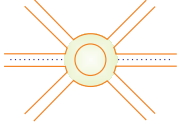
$A$ boy is moving on a straight road against a frictional force of $5\, N$. After travelling a distance of $1.5\, km$ he reaches a roundabout (Fig.) of radius $100\, m$. He moves on the circular path for one and a half cycles and then moves forward up to $2.0\, km$. Calculate the total work done by him against the frictional force.
Solution
(N/A) The work done by a force is given by the product of the force and the displacement in the direction of the force.
Work done $W = F \times d$
Here,the boy is moving against a constant frictional force $F = 5\, N$ throughout the entire path.
Total distance travelled by the boy is the sum of the straight path,the circular path,and the final straight path.
$1$. Initial straight path distance $= 1.5\, km = 1500\, m$.
$2$. Circular path distance: The boy completes $1.5$ cycles on a circular path of radius $r = 100\, m$. Distance $= 1.5 \times (2 \pi r) = 1.5 \times 2 \times 3.14 \times 100 = 942\, m$.
$3$. Final straight path distance $= 2.0\, km = 2000\, m$.
Total distance $d = 1500\, m + 942\, m + 2000\, m = 4442\, m$.
Since the frictional force acts along the entire path length,the work done against friction is calculated using the total distance covered.
Work done $W = 5\, N \times 4442\, m = 22210\, J$.
Work done $W = F \times d$
Here,the boy is moving against a constant frictional force $F = 5\, N$ throughout the entire path.
Total distance travelled by the boy is the sum of the straight path,the circular path,and the final straight path.
$1$. Initial straight path distance $= 1.5\, km = 1500\, m$.
$2$. Circular path distance: The boy completes $1.5$ cycles on a circular path of radius $r = 100\, m$. Distance $= 1.5 \times (2 \pi r) = 1.5 \times 2 \times 3.14 \times 100 = 942\, m$.
$3$. Final straight path distance $= 2.0\, km = 2000\, m$.
Total distance $d = 1500\, m + 942\, m + 2000\, m = 4442\, m$.
Since the frictional force acts along the entire path length,the work done against friction is calculated using the total distance covered.
Work done $W = 5\, N \times 4442\, m = 22210\, J$.
0 likes
View Solution13
Medium
Can any object have mechanical energy even if its momentum is zero? Explain.
Solution
(A) Yes,an object can have mechanical energy even if its momentum is zero.
Mechanical energy is the sum of kinetic energy $(KE)$ and potential energy $(PE)$.
Momentum $(p)$ is defined as the product of mass $(m)$ and velocity $(v)$,i.e.,$p = mv$.
If momentum is zero $(p = 0)$,then the velocity of the object must be zero $(v = 0)$.
Since kinetic energy is given by $KE = \frac{1}{2}mv^2$,if $v = 0$,then $KE = 0$.
However,the object can still possess potential energy due to its position or configuration (e.g.,a ball held at a height above the ground).
Therefore,the total mechanical energy $(ME = KE + PE)$ can be non-zero because $PE$ is non-zero.
Mechanical energy is the sum of kinetic energy $(KE)$ and potential energy $(PE)$.
Momentum $(p)$ is defined as the product of mass $(m)$ and velocity $(v)$,i.e.,$p = mv$.
If momentum is zero $(p = 0)$,then the velocity of the object must be zero $(v = 0)$.
Since kinetic energy is given by $KE = \frac{1}{2}mv^2$,if $v = 0$,then $KE = 0$.
However,the object can still possess potential energy due to its position or configuration (e.g.,a ball held at a height above the ground).
Therefore,the total mechanical energy $(ME = KE + PE)$ can be non-zero because $PE$ is non-zero.
0 likes
View Solution14
Medium
Can any object have momentum even if its mechanical energy is zero? Explain.
Solution
(NO) No,an object cannot have momentum if its mechanical energy is zero.
Mechanical energy is the sum of kinetic energy $(KE)$ and potential energy $(PE)$.
If the mechanical energy is zero,then $KE + PE = 0$.
Since kinetic energy $(KE = \frac{1}{2}mv^2)$ cannot be negative,and potential energy is typically defined relative to a reference point,for the total sum to be zero,both $KE$ and $PE$ must be zero.
If $KE = 0$,then $\frac{1}{2}mv^2 = 0$,which implies that the velocity $(v)$ of the object is $0$.
Since momentum $(p)$ is defined as the product of mass and velocity $(p = mv)$,if $v = 0$,then the momentum $(p)$ must also be $0$.
Mechanical energy is the sum of kinetic energy $(KE)$ and potential energy $(PE)$.
If the mechanical energy is zero,then $KE + PE = 0$.
Since kinetic energy $(KE = \frac{1}{2}mv^2)$ cannot be negative,and potential energy is typically defined relative to a reference point,for the total sum to be zero,both $KE$ and $PE$ must be zero.
If $KE = 0$,then $\frac{1}{2}mv^2 = 0$,which implies that the velocity $(v)$ of the object is $0$.
Since momentum $(p)$ is defined as the product of mass and velocity $(p = mv)$,if $v = 0$,then the momentum $(p)$ must also be $0$.
0 likes
View Solution15
MediumMCQ
The power of a motor pump is $2 \, kW$. How much water per minute can the pump raise to a height of $10 \, m$ (in $kg$)? (Given $g = 10 \, m \, s^{-2}$)
A
$2400$
B
$2100$
C
$1200$
D
$1800$
Solution
(C) Power $(P)$ is defined as the rate of doing work, $P = \frac{W}{\Delta t}$.
Since work done to lift water is $W = mgh$, the formula becomes $P = \frac{mgh}{\Delta t}$.
Given: $P = 2 \, kW = 2000 \, W$, $h = 10 \, m$, $g = 10 \, m \, s^{-2}$, and $\Delta t = 1 \, \text{minute} = 60 \, s$.
Substituting the values: $2000 = \frac{m \times 10 \times 10}{60}$.
$2000 = \frac{100m}{60} \Rightarrow 2000 = \frac{5m}{3}$.
$m = \frac{2000 \times 3}{5} = 400 \times 3 = 1200 \, kg$.
Therefore, the pump can raise $1200 \, kg$ of water per minute.
Since work done to lift water is $W = mgh$, the formula becomes $P = \frac{mgh}{\Delta t}$.
Given: $P = 2 \, kW = 2000 \, W$, $h = 10 \, m$, $g = 10 \, m \, s^{-2}$, and $\Delta t = 1 \, \text{minute} = 60 \, s$.
Substituting the values: $2000 = \frac{m \times 10 \times 10}{60}$.
$2000 = \frac{100m}{60} \Rightarrow 2000 = \frac{5m}{3}$.
$m = \frac{2000 \times 3}{5} = 400 \times 3 = 1200 \, kg$.
Therefore, the pump can raise $1200 \, kg$ of water per minute.
0 likes
View Solution16
DifficultMCQ
The weight of a person on a planet $A$ is about half that on the earth. He can jump up to $0.4 \, m$ height on the surface of the earth. How high can he jump on the planet $A$ (in $, m$)?
A
$0.4$
B
$0.6$
C
$0.5$
D
$0.8$
Solution
(D) The weight of a person is given by $W = mg$,where $m$ is the mass and $g$ is the acceleration due to gravity.
Since the weight on planet $A$ is half that on Earth,the acceleration due to gravity on planet $A$ $(g_A)$ is half of that on Earth $(g_E)$,i.e.,$g_A = \frac{1}{2} g_E$.
When a person jumps,the work done by their muscles is converted into potential energy $(PE = mgh)$. Assuming the muscular force and work done remain constant,the potential energy at the maximum height is constant.
Therefore,$m g_E h_E = m g_A h_A$.
Substituting the values: $g_E \times 0.4 = (\frac{1}{2} g_E) \times h_A$.
$0.4 = \frac{1}{2} h_A$.
$h_A = 0.4 \times 2 = 0.8 \, m$.
Thus,the person can jump to a height of $0.8 \, m$ on planet $A$.
Since the weight on planet $A$ is half that on Earth,the acceleration due to gravity on planet $A$ $(g_A)$ is half of that on Earth $(g_E)$,i.e.,$g_A = \frac{1}{2} g_E$.
When a person jumps,the work done by their muscles is converted into potential energy $(PE = mgh)$. Assuming the muscular force and work done remain constant,the potential energy at the maximum height is constant.
Therefore,$m g_E h_E = m g_A h_A$.
Substituting the values: $g_E \times 0.4 = (\frac{1}{2} g_E) \times h_A$.
$0.4 = \frac{1}{2} h_A$.
$h_A = 0.4 \times 2 = 0.8 \, m$.
Thus,the person can jump to a height of $0.8 \, m$ on planet $A$.
0 likes
View Solution17
Medium
The velocity of a body moving in a straight line is increased by applying a constant force $F$, for some distance in the direction of the motion. Prove that the increase in the kinetic energy of the body is equal to the work done by the force on the body.
Solution
(N/A) According to the third equation of motion: $v^{2} - u^{2} = 2as$
From this, the displacement $s$ can be expressed as: $s = \frac{v^{2} - u^{2}}{2a}$
According to Newton's second law of motion, the force applied is: $F = ma$
Work done $(W)$ by the force $F$ over a distance $s$ is defined as: $W = F \times s$
Substituting the expressions for $F$ and $s$: $W = (ma) \times \left( \frac{v^{2} - u^{2}}{2a} \right)$
Simplifying the expression: $W = \frac{1}{2}m(v^{2} - u^{2}) = \frac{1}{2}mv^{2} - \frac{1}{2}mu^{2}$
Since kinetic energy $(K.E.)$ is given by $\frac{1}{2}mv^{2}$, we get: $W = (K.E.)_{f} - (K.E.)_{i}$
Thus, the work done is equal to the change in kinetic energy.
From this, the displacement $s$ can be expressed as: $s = \frac{v^{2} - u^{2}}{2a}$
According to Newton's second law of motion, the force applied is: $F = ma$
Work done $(W)$ by the force $F$ over a distance $s$ is defined as: $W = F \times s$
Substituting the expressions for $F$ and $s$: $W = (ma) \times \left( \frac{v^{2} - u^{2}}{2a} \right)$
Simplifying the expression: $W = \frac{1}{2}m(v^{2} - u^{2}) = \frac{1}{2}mv^{2} - \frac{1}{2}mu^{2}$
Since kinetic energy $(K.E.)$ is given by $\frac{1}{2}mv^{2}$, we get: $W = (K.E.)_{f} - (K.E.)_{i}$
Thus, the work done is equal to the change in kinetic energy.
0 likes
View Solution18
MediumMCQ
Is it possible that an object is in a state of accelerated motion due to an external force acting on it,but no work is being done by the force? Explain with an example.
A
Yes,it is possible.
B
No,it is not possible.
C
Only if the force is zero.
D
Only if the velocity is constant.
Solution
(A) Yes,it is possible for an object to be in a state of accelerated motion while the work done by the force is zero.
Work done $(W)$ is defined as $W = F \cdot s \cdot \cos(\theta)$,where $F$ is the force,$s$ is the displacement,and $\theta$ is the angle between the force and the displacement.
In uniform circular motion,a centripetal force acts on the object directed towards the center of the circle,which causes centripetal acceleration.
Since the displacement of the object at any instant is along the tangent to the circular path and the centripetal force is directed towards the center,the angle $\theta$ between the force and the displacement is $90^{\circ}$.
Since $\cos(90^{\circ}) = 0$,the work done $W = F \cdot s \cdot 0 = 0$. Thus,despite the presence of an external force causing acceleration,the work done is zero.
Work done $(W)$ is defined as $W = F \cdot s \cdot \cos(\theta)$,where $F$ is the force,$s$ is the displacement,and $\theta$ is the angle between the force and the displacement.
In uniform circular motion,a centripetal force acts on the object directed towards the center of the circle,which causes centripetal acceleration.
Since the displacement of the object at any instant is along the tangent to the circular path and the centripetal force is directed towards the center,the angle $\theta$ between the force and the displacement is $90^{\circ}$.
Since $\cos(90^{\circ}) = 0$,the work done $W = F \cdot s \cdot 0 = 0$. Thus,despite the presence of an external force causing acceleration,the work done is zero.
0 likes
View Solution19
MediumMCQ
$A$ ball is dropped from a height of $10\, m$. If the energy of the ball reduces by $40\%$ after striking the ground,how much high can the ball bounce back (in $,m$)? $(g = 10\, m \,s^{-2})$
A
$4$
B
$2$
C
$6$
D
$8$
Solution
(C) The initial potential energy of the ball at height $h = 10\, m$ is given by $PE = mgh$.
Substituting the values,$PE = m \times 10\, m/s^2 \times 10\, m = 100m\, J$.
After striking the ground,the energy reduces by $40\%$,which means the remaining energy is $100\% - 40\% = 60\%$ of the initial energy.
Remaining energy = $0.60 \times 100m = 60m\, J$.
Let the new height reached by the ball be $h'$. The potential energy at this height is $PE' = mgh'$.
Equating the remaining energy to the new potential energy: $mgh' = 60m$.
$m \times 10 \times h' = 60m$.
$h' = 60 / 10 = 6\, m$.
Thus,the ball can bounce back to a height of $6\, m$.
Substituting the values,$PE = m \times 10\, m/s^2 \times 10\, m = 100m\, J$.
After striking the ground,the energy reduces by $40\%$,which means the remaining energy is $100\% - 40\% = 60\%$ of the initial energy.
Remaining energy = $0.60 \times 100m = 60m\, J$.
Let the new height reached by the ball be $h'$. The potential energy at this height is $PE' = mgh'$.
Equating the remaining energy to the new potential energy: $mgh' = 60m$.
$m \times 10 \times h' = 60m$.
$h' = 60 / 10 = 6\, m$.
Thus,the ball can bounce back to a height of $6\, m$.
1 likes
View Solution20
MediumMCQ
If an electric iron of $1200 \, W$ is used for $30$ minutes everyday, find the electric energy consumed in the month of April. (in $kWh$)
A
$19$
B
$16$
C
$15$
D
$18$
Solution
(D) Power $(P)$ = $1200 \, W = 1.2 \, kW$.
Time $(t)$ per day = $30 \, \text{minutes} = 0.5 \, \text{hours}$.
The month of April has $30$ days.
Total energy consumed $(E)$ = Power $\times$ time per day $\times$ number of days.
$E = 1.2 \, kW \times 0.5 \, h \times 30 \, \text{days}$.
$E = 0.6 \times 30 = 18 \, kWh$.
Time $(t)$ per day = $30 \, \text{minutes} = 0.5 \, \text{hours}$.
The month of April has $30$ days.
Total energy consumed $(E)$ = Power $\times$ time per day $\times$ number of days.
$E = 1.2 \, kW \times 0.5 \, h \times 30 \, \text{days}$.
$E = 0.6 \times 30 = 18 \, kWh$.
0 likes
View Solution21
Difficult
$A$ light and a heavy object have the same momentum. Find out the ratio of their kinetic energies. Which one has a larger kinetic energy?
Solution
(N/A) The relationship between kinetic energy $(K.E.)$ and momentum $(p)$ is given by $K.E. = \frac{p^2}{2m}$.
Given that both objects have the same momentum $(p_1 = p_2 = p)$,
Let $m_1$ be the mass of the light object and $m_2$ be the mass of the heavy object,where $m_1 < m_2$.
The kinetic energy of the light object is $(K.E.)_1 = \frac{p^2}{2m_1}$.
The kinetic energy of the heavy object is $(K.E.)_2 = \frac{p^2}{2m_2}$.
The ratio of their kinetic energies is $\frac{(K.E.)_1}{(K.E.)_2} = \frac{\frac{p^2}{2m_1}}{\frac{p^2}{2m_2}} = \frac{m_2}{m_1}$.
Since $m_1 < m_2$,it follows that $\frac{m_2}{m_1} > 1$,which implies $(K.E.)_1 > (K.E.)_2$.
Therefore,the light object has a larger kinetic energy.
Given that both objects have the same momentum $(p_1 = p_2 = p)$,
Let $m_1$ be the mass of the light object and $m_2$ be the mass of the heavy object,where $m_1 < m_2$.
The kinetic energy of the light object is $(K.E.)_1 = \frac{p^2}{2m_1}$.
The kinetic energy of the heavy object is $(K.E.)_2 = \frac{p^2}{2m_2}$.
The ratio of their kinetic energies is $\frac{(K.E.)_1}{(K.E.)_2} = \frac{\frac{p^2}{2m_1}}{\frac{p^2}{2m_2}} = \frac{m_2}{m_1}$.
Since $m_1 < m_2$,it follows that $\frac{m_2}{m_1} > 1$,which implies $(K.E.)_1 > (K.E.)_2$.
Therefore,the light object has a larger kinetic energy.
0 likes
View Solution22
Difficult
An automobile engine propels a $1000 \,kg$ car $(A)$ along a levelled road at a speed of $36 \,km \,h^{-1}$. Find the power if the opposing frictional force is $100 \,N$. Now,suppose after travelling a distance of $200 \,m$,this car collides with another stationary car $(B)$ of the same mass and comes to rest. Let its engine also stop at the same time. Now car $(B)$ starts moving on the same level road without its engine started. Find the speed of the car $(B)$ just after the collision.
Solution
(10 M/S) $m(A) = m(B) = 1000 \,kg$. Initial velocity of car $(A)$,$v = 36 \,km/h = 36 \times (5/18) \,m/s = 10 \,m/s$.
Frictional force $F = 100 \,N$.
Since the car $(A)$ moves with a uniform speed,the engine must apply a force equal to the opposing frictional force.
Power $P = F \times v = 100 \,N \times 10 \,m/s = 1000 \,W$.
For the collision,we use the law of conservation of linear momentum:
$m_A u_A + m_B u_B = m_A v_A + m_B v_B$
Here,$m_A = 1000 \,kg$,$u_A = 10 \,m/s$,$m_B = 1000 \,kg$,$u_B = 0 \,m/s$,and $v_A = 0 \,m/s$ (as car $(A)$ comes to rest).
$1000 \times 10 + 1000 \times 0 = 1000 \times 0 + 1000 \times v_B$
$10000 = 1000 \times v_B$
$v_B = 10 \,m/s$.
Frictional force $F = 100 \,N$.
Since the car $(A)$ moves with a uniform speed,the engine must apply a force equal to the opposing frictional force.
Power $P = F \times v = 100 \,N \times 10 \,m/s = 1000 \,W$.
For the collision,we use the law of conservation of linear momentum:
$m_A u_A + m_B u_B = m_A v_A + m_B v_B$
Here,$m_A = 1000 \,kg$,$u_A = 10 \,m/s$,$m_B = 1000 \,kg$,$u_B = 0 \,m/s$,and $v_A = 0 \,m/s$ (as car $(A)$ comes to rest).
$1000 \times 10 + 1000 \times 0 = 1000 \times 0 + 1000 \times v_B$
$10000 = 1000 \times v_B$
$v_B = 10 \,m/s$.
0 likes
View Solution23
DifficultMCQ
$A$ girl of mass $35 \, kg$ sits on a trolley of mass $5 \, kg$. The trolley is given an initial velocity of $4 \, m \, s^{-1}$ by applying a force. The trolley comes to rest after covering a distance of $16 \, m$. $(a)$ What is the work done on the trolley? $(b)$ What is the work done by the girl?
A
Work done on the trolley is $-320 \, J$
B
Work done by the girl is $0 \, J$
C
Work done on the trolley is $160 \, J$
D
Work done by the girl is $320 \, J$
Solution
(A) To find the work done on the trolley,we use the Work-Energy Theorem: $W = \Delta KE = KE_f - KE_i$.
Given: Total mass $m = 35 \, kg + 5 \, kg = 40 \, kg$,initial velocity $u = 4 \, m/s$,final velocity $v = 0 \, m/s$.
$W = \frac{1}{2} m v^2 - \frac{1}{2} m u^2 = 0 - \frac{1}{2} \times 40 \times (4)^2 = -20 \times 16 = -320 \, J$.
The work done on the trolley is $-320 \, J$.
$(b)$ Since the girl is sitting on the trolley and not applying any additional force to change the motion relative to the trolley,the work done by the girl is $0 \, J$.
Given: Total mass $m = 35 \, kg + 5 \, kg = 40 \, kg$,initial velocity $u = 4 \, m/s$,final velocity $v = 0 \, m/s$.
$W = \frac{1}{2} m v^2 - \frac{1}{2} m u^2 = 0 - \frac{1}{2} \times 40 \times (4)^2 = -20 \times 16 = -320 \, J$.
The work done on the trolley is $-320 \, J$.
$(b)$ Since the girl is sitting on the trolley and not applying any additional force to change the motion relative to the trolley,the work done by the girl is $0 \, J$.
0 likes
View Solution24
Medium
Four men lift a $250 \,kg$ box to a height of $1 \,m$ and hold it without raising or lowering it. $(a)$ How much work is done by the men in lifting the box? $(b)$ How much work do they do in just holding it? $(c)$ Why do they get tired while holding it? $(g = 10 \,m \,s^{-2})$
Solution
(N/A) The force applied to lift the box is equal to its weight: $F = m \times g = 250 \,kg \times 10 \,m \,s^{-2} = 2500 \,N$.
Work done in lifting the box is $W = F \times s = 2500 \,N \times 1 \,m = 2500 \,J$.
$(b)$ Work done in holding the box is zero because the displacement $s = 0$.
$(c)$ They get tired because,to hold the box,their muscles must continuously exert a force to counteract the gravitational force,which involves internal muscular effort and energy expenditure.
Work done in lifting the box is $W = F \times s = 2500 \,N \times 1 \,m = 2500 \,J$.
$(b)$ Work done in holding the box is zero because the displacement $s = 0$.
$(c)$ They get tired because,to hold the box,their muscles must continuously exert a force to counteract the gravitational force,which involves internal muscular effort and energy expenditure.
0 likes
View Solution25
Medium
What is power? How do you differentiate kilowatt from kilowatt hour? The Jog Falls in Karnataka state are nearly $20 \, m$ high. $2000$ tonnes of water falls from it in a minute. Calculate the equivalent power if all this energy can be utilized? $(g = 10 \, m \, s^{-2})$
Solution
(N/A) Power is defined as the rate of doing work or the rate of energy transfer.
Kilowatt $(kW)$ is a unit of power, representing $1000 \, J/s$. Kilowatt hour $(kWh)$ is a unit of energy, representing the energy consumed by a device of $1 \, kW$ power in $1 \, hour$.
Given: Height $(h) = 20 \, m$, Mass $(m) = 2000 \, \text{tonnes} = 2000 \times 1000 \, kg = 2 \times 10^6 \, kg$, Time $(t) = 1 \, \text{minute} = 60 \, s$, Acceleration due to gravity $(g) = 10 \, m \, s^{-2}$.
Potential Energy $(PE) = mgh = 2 \times 10^6 \times 10 \times 20 = 4 \times 10^8 \, J$.
Power = $\frac{\text{Energy}}{\text{Time}} = \frac{4 \times 10^8 \, J}{60 \, s} = \frac{40}{6} \times 10^7 \, W = 6.67 \times 10^6 \, W$ or $6.67 \, MW$.
Kilowatt $(kW)$ is a unit of power, representing $1000 \, J/s$. Kilowatt hour $(kWh)$ is a unit of energy, representing the energy consumed by a device of $1 \, kW$ power in $1 \, hour$.
Given: Height $(h) = 20 \, m$, Mass $(m) = 2000 \, \text{tonnes} = 2000 \times 1000 \, kg = 2 \times 10^6 \, kg$, Time $(t) = 1 \, \text{minute} = 60 \, s$, Acceleration due to gravity $(g) = 10 \, m \, s^{-2}$.
Potential Energy $(PE) = mgh = 2 \times 10^6 \times 10 \times 20 = 4 \times 10^8 \, J$.
Power = $\frac{\text{Energy}}{\text{Time}} = \frac{4 \times 10^8 \, J}{60 \, s} = \frac{40}{6} \times 10^7 \, W = 6.67 \times 10^6 \, W$ or $6.67 \, MW$.
0 likes
View Solution26
MediumMCQ
How is the power related to the speed at which a body can be lifted? How many kilograms will a man working at the power of $100\, W$ be able to lift at a constant speed of $1\, m\, s^{-1}$ vertically (in $, kg$)? $(g = 10\, m\, s^{-2})$
A
$40$
B
$10$
C
$20$
D
$30$
Solution
(B) Power is defined as the rate of doing work. When lifting an object,the work done is equal to the change in potential energy,which is $mgh$.
Power $P = \frac{W}{t} = \frac{mgh}{t} = mg \left(\frac{h}{t}\right)$.
Since speed $v = \frac{h}{t}$,the relationship is $P = mgv$.
Given: Power $P = 100\, W$,speed $v = 1\, m\, s^{-1}$,and acceleration due to gravity $g = 10\, m\, s^{-2}$.
Rearranging the formula to find mass $m$: $m = \frac{P}{g \times v}$.
Substituting the values: $m = \frac{100}{10 \times 1} = 10\, kg$.
Power $P = \frac{W}{t} = \frac{mgh}{t} = mg \left(\frac{h}{t}\right)$.
Since speed $v = \frac{h}{t}$,the relationship is $P = mgv$.
Given: Power $P = 100\, W$,speed $v = 1\, m\, s^{-1}$,and acceleration due to gravity $g = 10\, m\, s^{-2}$.
Rearranging the formula to find mass $m$: $m = \frac{P}{g \times v}$.
Substituting the values: $m = \frac{100}{10 \times 1} = 10\, kg$.
0 likes
View Solution27
MediumMCQ
Define watt. Express kilowatt in terms of joule per second. $A$ $150 \, kg$ car engine develops $500 \, W$ for each $kg$. What force does it exert in moving the car at a speed of $20 \, m \, s^{-1}$ (in $N$)?
A
$2850$
B
$5150$
C
$3750$
D
$4150$
Solution
(C) One watt is defined as the power of an agent that performs work at the rate of $1 \, J \, s^{-1}$.
$1 \, \text{kilowatt} = 1000 \, J \, s^{-1}$.
Total power developed by the engine $= 150 \, kg \times 500 \, W \, kg^{-1} = 75,000 \, W = 7.5 \times 10^4 \, W$.
We know that $\text{Power} = \text{Force} \times \text{Velocity}$.
Therefore, $\text{Force} = \frac{\text{Power}}{\text{Velocity}} = \frac{7.5 \times 10^4 \, W}{20 \, m \, s^{-1}} = 3750 \, N$.
$1 \, \text{kilowatt} = 1000 \, J \, s^{-1}$.
Total power developed by the engine $= 150 \, kg \times 500 \, W \, kg^{-1} = 75,000 \, W = 7.5 \times 10^4 \, W$.
We know that $\text{Power} = \text{Force} \times \text{Velocity}$.
Therefore, $\text{Force} = \frac{\text{Power}}{\text{Velocity}} = \frac{7.5 \times 10^4 \, W}{20 \, m \, s^{-1}} = 3750 \, N$.
0 likes
View Solution28
MediumMCQ
Compare the power at which each of the following is moving upwards against the force of gravity? (given $g = 10 \, m \, s^{-2}$)
$(i)$ $A$ butterfly of mass $1.0 \, g$ that flies upward at a rate of $0.5 \, m \, s^{-1}$.
$(ii)$ $A$ $250 \, g$ squirrel climbing up on a tree at a rate of $0.5 \, m \, s^{-1}$.
$(i)$ $A$ butterfly of mass $1.0 \, g$ that flies upward at a rate of $0.5 \, m \, s^{-1}$.
$(ii)$ $A$ $250 \, g$ squirrel climbing up on a tree at a rate of $0.5 \, m \, s^{-1}$.
A
$(i) - 5 \times 10^{-3} \, W; (ii) - 1.50 \, W$
B
$(i) - 4 \times 10^{-3} \, W; (ii) - 1.30 \, W$
C
$(i) - 7 \times 10^{-3} \, W; (ii) - 1.28 \, W$
D
$(i) - 5 \times 10^{-3} \, W; (ii) - 1.25 \, W$
Solution
(D) Power $(P)$ is defined as the rate of doing work,which is $P = F \times v$. Since the objects are moving against gravity,the force required is $F = mg$.
$(i)$ For the butterfly:
Mass $m = 1.0 \, g = 1.0 \times 10^{-3} \, kg$,velocity $v = 0.5 \, m \, s^{-1}$,$g = 10 \, m \, s^{-2}$.
$P = (1.0 \times 10^{-3} \, kg) \times (10 \, m \, s^{-2}) \times (0.5 \, m \, s^{-1}) = 5 \times 10^{-3} \, W$.
$(ii)$ For the squirrel:
Mass $m = 250 \, g = 0.25 \, kg$,velocity $v = 0.5 \, m \, s^{-1}$,$g = 10 \, m \, s^{-2}$.
$P = (0.25 \, kg) \times (10 \, m \, s^{-2}) \times (0.5 \, m \, s^{-1}) = 1.25 \, W$.
Thus,the power for the butterfly is $5 \times 10^{-3} \, W$ and for the squirrel is $1.25 \, W$.
$(i)$ For the butterfly:
Mass $m = 1.0 \, g = 1.0 \times 10^{-3} \, kg$,velocity $v = 0.5 \, m \, s^{-1}$,$g = 10 \, m \, s^{-2}$.
$P = (1.0 \times 10^{-3} \, kg) \times (10 \, m \, s^{-2}) \times (0.5 \, m \, s^{-1}) = 5 \times 10^{-3} \, W$.
$(ii)$ For the squirrel:
Mass $m = 250 \, g = 0.25 \, kg$,velocity $v = 0.5 \, m \, s^{-1}$,$g = 10 \, m \, s^{-2}$.
$P = (0.25 \, kg) \times (10 \, m \, s^{-2}) \times (0.5 \, m \, s^{-1}) = 1.25 \, W$.
Thus,the power for the butterfly is $5 \times 10^{-3} \, W$ and for the squirrel is $1.25 \, W$.
0 likes
View Solution29
Easy
Justify giving proper reasoning whether the work done in the following case is positive or negative: Work done by a man in lifting a bucket out of a well by means of a rope tied to the bucket.
Solution
(POSITIVE) The work done is positive. This is because the man applies a force in the upward direction to lift the bucket,and the displacement of the bucket also occurs in the same upward direction. Since the angle between the force vector and the displacement vector is $0^{\circ}$,the work done $(W = F \cdot s \cdot \cos(0^{\circ}))$ is positive.
0 likes
View Solution30
MediumMCQ
Justify,giving proper reasoning,whether the work done in the following case is positive or negative: Work done by gravitational force when a bucket is pulled upwards.
A
Positive
B
Negative
C
Zero
D
Cannot be determined
Solution
(B) The work done by the gravitational force is negative.
This is because the displacement of the bucket is in the upward direction,while the gravitational force acts in the downward direction.
Since the angle between the force and the displacement is $180^{\circ}$,the work done $W = F \cdot s \cdot \cos(180^{\circ}) = -F \cdot s$,which is negative.
This is because the displacement of the bucket is in the upward direction,while the gravitational force acts in the downward direction.
Since the angle between the force and the displacement is $180^{\circ}$,the work done $W = F \cdot s \cdot \cos(180^{\circ}) = -F \cdot s$,which is negative.
0 likes
View Solution31
Easy
Justify,giving proper reasoning,whether the work done in the following case is positive or negative: Work done by friction on a body sliding down an inclined plane.
Solution
(NEGATIVE) The work done by friction is negative.
Reasoning: Work done $(W)$ is defined by the formula $W = F \cdot s \cdot \cos(\theta)$,where $F$ is the force,$s$ is the displacement,and $\theta$ is the angle between the force and displacement vectors.
When a body slides down an inclined plane,the direction of motion (displacement) is downwards along the plane.
Frictional force always acts in the direction opposite to the motion of the body.
Therefore,the angle $\theta$ between the frictional force and the displacement is $180^{\circ}$.
Since $\cos(180^{\circ}) = -1$,the work done $W = F \cdot s \cdot (-1) = -F \cdot s$,which is negative.
Reasoning: Work done $(W)$ is defined by the formula $W = F \cdot s \cdot \cos(\theta)$,where $F$ is the force,$s$ is the displacement,and $\theta$ is the angle between the force and displacement vectors.
When a body slides down an inclined plane,the direction of motion (displacement) is downwards along the plane.
Frictional force always acts in the direction opposite to the motion of the body.
Therefore,the angle $\theta$ between the frictional force and the displacement is $180^{\circ}$.
Since $\cos(180^{\circ}) = -1$,the work done $W = F \cdot s \cdot (-1) = -F \cdot s$,which is negative.
0 likes
View Solution32
EasyMCQ
Justify,giving proper reasoning,whether the work done in the following case is positive or negative: Work done by an applied force on a body moving on a rough horizontal plane with uniform velocity.
A
Positive
B
Negative
C
Zero
D
Cannot be determined
Solution
(A) When a body moves on a rough horizontal plane with uniform velocity,the net force acting on it is zero.
This implies that the applied force is equal in magnitude and opposite in direction to the frictional force.
The work done by the applied force is positive because the applied force acts in the direction of the displacement of the body.
Conversely,the work done by the frictional force is negative because it acts opposite to the direction of displacement.
This implies that the applied force is equal in magnitude and opposite in direction to the frictional force.
The work done by the applied force is positive because the applied force acts in the direction of the displacement of the body.
Conversely,the work done by the frictional force is negative because it acts opposite to the direction of displacement.
0 likes
View Solution33
Easy
Justify,giving proper reasoning,whether the work done in the following case is positive or negative: Work done by the resistive force of air on a vibrating pendulum in bringing it to rest.
Solution
(NEGATIVE) The work done by the resistive force of air on a vibrating pendulum is negative.
This is because the resistive force of air (air resistance) always acts in a direction opposite to the direction of the motion of the pendulum.
Since the angle between the force and the displacement is $180^{\circ}$,the work done $(W = F \cdot s \cdot \cos(180^{\circ}))$ results in a negative value.
This is because the resistive force of air (air resistance) always acts in a direction opposite to the direction of the motion of the pendulum.
Since the angle between the force and the displacement is $180^{\circ}$,the work done $(W = F \cdot s \cdot \cos(180^{\circ}))$ results in a negative value.
0 likes
View Solution34
EasyMCQ
When an arrow is shot from its bow,it has kinetic energy. From where does it get the kinetic energy?
A
From the muscular energy of the archer.
B
From the potential energy stored in the stretched bow.
C
From the chemical energy of the arrow.
D
From the gravitational potential energy of the bow.
Solution
(B) stretched bow possesses potential energy due to a change in its shape (elastic potential energy).
When the string is released,this stored potential energy is transferred to the arrow.
As the bow returns to its original shape,the potential energy is converted into the kinetic energy of the arrow,causing it to move.
When the string is released,this stored potential energy is transferred to the arrow.
As the bow returns to its original shape,the potential energy is converted into the kinetic energy of the arrow,causing it to move.
0 likes
View Solution35
Easy
Name at least three commonly used units of energy.
Solution
(N/A) $(i)$ Joule $(J)$
$(ii)$ Erg
$(iii)$ Kilowatt-hour $(kWh)$
$(ii)$ Erg
$(iii)$ Kilowatt-hour $(kWh)$
0 likes
View Solution36
EasyMCQ
Name the practical unit of power in engineering.
A
Watt
B
Horsepower
C
Joule
D
Kilowatt
Solution
(B) The practical unit of power used in engineering is the $Horsepower$ $(hp)$.
$1$ $hp$ is approximately equal to $746$ $W$ (Watts).
$1$ $hp$ is approximately equal to $746$ $W$ (Watts).
0 likes
View Solution37
Medium
Name at least six forms of energy.
Solution
(N/A) $(i)$ Chemical energy
$(ii)$ Heat energy
$(iii)$ Light energy
$(iv)$ Electrical energy
$(v)$ Sound energy
$(vi)$ Solar energy
$(ii)$ Heat energy
$(iii)$ Light energy
$(iv)$ Electrical energy
$(v)$ Sound energy
$(vi)$ Solar energy
0 likes
View Solution38
EasyMCQ
How many watts are there in $1$ horsepower (in $watts$)?
A
$740$
B
$746$
C
$750$
D
$736$
Solution
(B) The unit of power is the watt $(W)$.
$1$ horsepower $(hp)$ is a unit of power defined as the power exerted by a horse to pull a load.
By standard definition, $1$ horsepower is equal to $746$ watts.
$1$ horsepower $(hp)$ is a unit of power defined as the power exerted by a horse to pull a load.
By standard definition, $1$ horsepower is equal to $746$ watts.
0 likes
View Solution39
EasyMCQ
What is horsepower?
A
$A$ unit of force
B
$A$ unit of power
C
$A$ unit of energy
D
$A$ unit of work
Solution
(B) Horsepower $(hp)$ is a unit of measurement for power.
It is commonly used to express the rate at which a machine,such as an engine or motor,can perform work.
One mechanical horsepower is approximately equal to $746 \ W$ (watts).
It is commonly used to express the rate at which a machine,such as an engine or motor,can perform work.
One mechanical horsepower is approximately equal to $746 \ W$ (watts).
0 likes
View Solution40
EasyMCQ
$A$ light and a heavy body have equal kinetic energy. Which one is moving fast?
A
The light body
B
The heavy body
C
Both move at the same speed
D
Cannot be determined
Solution
(A) The kinetic energy $(KE)$ of a body is given by the formula $KE = \frac{1}{2}mv^2$,where $m$ is the mass and $v$ is the velocity.
Given that the kinetic energy of both bodies is equal,we have $\frac{1}{2}m_1v_1^2 = \frac{1}{2}m_2v_2^2$.
This implies $m_1v_1^2 = m_2v_2^2$,or $\frac{v_1^2}{v_2^2} = \frac{m_2}{m_1}$.
If $m_1 < m_2$ (light body has less mass than the heavy body),then $\frac{m_2}{m_1} > 1$.
Therefore,$\frac{v_1^2}{v_2^2} > 1$,which means $v_1^2 > v_2^2$,or $v_1 > v_2$.
Thus,the lighter body must be moving faster to possess the same kinetic energy as the heavier body.
Given that the kinetic energy of both bodies is equal,we have $\frac{1}{2}m_1v_1^2 = \frac{1}{2}m_2v_2^2$.
This implies $m_1v_1^2 = m_2v_2^2$,or $\frac{v_1^2}{v_2^2} = \frac{m_2}{m_1}$.
If $m_1 < m_2$ (light body has less mass than the heavy body),then $\frac{m_2}{m_1} > 1$.
Therefore,$\frac{v_1^2}{v_2^2} > 1$,which means $v_1^2 > v_2^2$,or $v_1 > v_2$.
Thus,the lighter body must be moving faster to possess the same kinetic energy as the heavier body.
0 likes
View Solution41
Easy
Give an example of negative work.
Solution
(N/A) Negative work occurs when the force applied is in the opposite direction to the displacement of the object. An example is the work done by the force of friction on a moving object. As the object moves in one direction,the frictional force acts in the opposite direction,resulting in an angle of $180^{\circ}$ between the force and displacement,which makes the work done negative $(W = F \cdot s \cdot \cos(180^{\circ}) = -Fs)$.
0 likes
View Solution42
EasyMCQ
What type of energy is stored in the spring of a watch?
A
Kinetic energy
B
Elastic potential energy
C
Gravitational potential energy
D
Chemical energy
Solution
(B) When a watch spring is wound,work is done on it,which causes a change in its shape. This work is stored in the spring in the form of elastic potential energy. As the spring gradually unwinds,this stored energy is converted into kinetic energy to move the gears of the watch.
0 likes
View Solution43
EasyMCQ
Does work done depend upon the velocity of the body?
A
Yes
B
No
C
Sometimes
D
Depends on the type of force
Solution
(B) The work done on a body is defined by the formula $W = F \cdot s \cdot \cos(\theta)$,where $F$ is the force applied,$s$ is the displacement,and $\theta$ is the angle between the force and displacement vectors.
Work done depends on the force applied and the displacement caused by that force.
It does not depend on the velocity of the body,as velocity is the rate of change of displacement,not a factor in the definition of mechanical work.
Work done depends on the force applied and the displacement caused by that force.
It does not depend on the velocity of the body,as velocity is the rate of change of displacement,not a factor in the definition of mechanical work.
0 likes
View Solution44
EasyMCQ
$A$ body is moving with constant speed over a frictionless surface. What is the work done by the weight of the body?
A
Positive
B
Negative
C
Zero
D
Infinite
Solution
(C) The work done by a force is given by the formula $W = F \cdot s \cdot \cos(\theta)$,where $\theta$ is the angle between the force and the displacement.
In this case,the weight of the body acts vertically downwards,while the displacement of the body is horizontal (along the surface).
Since the angle between the vertical weight and the horizontal displacement is $90^\circ$,we have $\cos(90^\circ) = 0$.
Therefore,the work done by the weight is $W = F \cdot s \cdot 0 = 0$.
In this case,the weight of the body acts vertically downwards,while the displacement of the body is horizontal (along the surface).
Since the angle between the vertical weight and the horizontal displacement is $90^\circ$,we have $\cos(90^\circ) = 0$.
Therefore,the work done by the weight is $W = F \cdot s \cdot 0 = 0$.
0 likes
View Solution45
EasyMCQ
$A$ person continues to push a heavy mass for some time but fails to move it. What is the work done by him?
A
Positive work
B
Negative work
C
Zero work
D
Maximum work
Solution
(C) Work done $(W)$ is defined as the product of force $(F)$ and displacement $(s)$ in the direction of the force,given by the formula $W = F \times s \times \cos(\theta)$.
Since the person fails to move the heavy mass,the displacement $(s)$ is $0$.
Therefore,the work done is $W = F \times 0 = 0 \text{ Joules}$.
Thus,the work done by the person is zero.
Since the person fails to move the heavy mass,the displacement $(s)$ is $0$.
Therefore,the work done is $W = F \times 0 = 0 \text{ Joules}$.
Thus,the work done by the person is zero.
0 likes
View Solution46
EasyMCQ
Does the work done in raising an object vertically depend upon how fast it is raised?
A
Yes,it depends on speed.
B
No,it is independent of time.
C
Yes,it depends on acceleration.
D
No,it depends on the mass only.
Solution
(B) The work done $(W)$ in raising an object vertically is given by the formula $W = mgh$,where $m$ is the mass of the object,$g$ is the acceleration due to gravity,and $h$ is the height to which the object is raised.
Since the work done depends only on the force applied (which is equal to the weight of the object,$mg$) and the displacement $(h)$,it is independent of the time taken or the speed at which the object is raised.
Therefore,the work done does not depend on how fast the object is raised.
Since the work done depends only on the force applied (which is equal to the weight of the object,$mg$) and the displacement $(h)$,it is independent of the time taken or the speed at which the object is raised.
Therefore,the work done does not depend on how fast the object is raised.
0 likes
View Solution47
Easy
$A$ porter moving vertically upstairs with a load on his head does work. Why?
Solution
(N/A) Work is defined as the product of force and displacement in the direction of the force. When a porter moves vertically upstairs,he applies an upward force to balance the weight of the load (acting downwards). Since the displacement of the porter is also in the upward direction,the angle between the force applied by the porter and the displacement is $0^{\circ}$. Therefore,the work done by the porter is positive and non-zero $(W = F \cdot s \cdot \cos(0^{\circ}) = F \cdot s)$.
0 likes
View Solution48
EasyMCQ
What is the work done by the tension in the string of a simple pendulum?
A
Positive
B
Negative
C
Zero
D
Infinite
Solution
(C) In a simple pendulum,the tension force $T$ in the string always acts towards the point of suspension.
As the pendulum bob moves along its circular arc,the displacement vector $ds$ is always tangent to the path.
The tension force $T$ is always directed towards the center of the circle,which is perpendicular to the displacement vector $ds$ at every point.
Since the work done $W$ is defined by the dot product $W = \int T \cdot ds = \int T \cos(90^{\circ}) ds$,and $\cos(90^{\circ}) = 0$,the work done by the tension is $0$.
As the pendulum bob moves along its circular arc,the displacement vector $ds$ is always tangent to the path.
The tension force $T$ is always directed towards the center of the circle,which is perpendicular to the displacement vector $ds$ at every point.
Since the work done $W$ is defined by the dot product $W = \int T \cdot ds = \int T \cos(90^{\circ}) ds$,and $\cos(90^{\circ}) = 0$,the work done by the tension is $0$.
0 likes
View Solution49
Medium
In a tug-of-war,one team gives way to the other. What work is being done and by whom?
Solution
(N/A) In a tug-of-war,the winning team exerts a force on the losing team,causing them to move in the direction of the force.
Since the force applied by the winning team and the displacement of the losing team are in the same direction,the winning team performs positive work.
The magnitude of the work done is equal to the product of the resultant force applied by the winning team and the displacement undergone by the losing team.
Since the force applied by the winning team and the displacement of the losing team are in the same direction,the winning team performs positive work.
The magnitude of the work done is equal to the product of the resultant force applied by the winning team and the displacement undergone by the losing team.
0 likes
View Solution50
Easy
State the law of conservation of energy.
Solution
(N/A) The law of conservation of energy states that energy can neither be created nor destroyed. It can only be transformed from one form to another. The total energy of an isolated system remains constant.
0 likes
View SolutionWORK AND ENERGY — Mix Example - WORK AND ENERGY · Frequently Asked Questions
1Are these WORK AND ENERGY questions useful for JEE and NEET?
Yes. All questions in this section are mapped to JEE Main and NEET exam patterns. Previous year questions from JEE Main, NEET, GUJCET and state-level exams are included with full solutions.
2Can I switch to Hindi or Gujarati for these questions?
Yes. Use the language tabs in the hero section or the sidebar to view the same questions and solutions in English, Hindi or Gujarati.
3How do I generate a question paper from this subtopic?
Use the Vedclass Exam Paper Generator — select the chapter and subtopic, set difficulty, and generate Sets A, B, C, D automatically. First 3 chapters of every subject are free.
Vedclass Products
For Students
Vedclass Test Series
Mock tests in real JEE/NEET style with performance analysis. 5-day free trial.
Start Free TrialFor Teachers
Exam Paper Generator
Generate Set A/B/C/D papers from this chapter in 2 minutes. 3 chapters free.
Try FreeFor Institutes
Online Exam Module
Live online exams with unlimited students, 360° analytics & white-label branding.
See DemoFor Teachers & Institutes
Generate a WORK AND ENERGY Exam Paper in 2 Minutes
Select subtopic & difficulty — Sets A, B, C, D auto-generated with No Repeat logic.
First 3 chapters of every subject are free — no payment required.