
A English
Mix Example - STRUCTURE OF THE ATOM Questions in English
Class 9 Science · STRUCTURE OF THE ATOM · Mix Example - STRUCTURE OF THE ATOM
166+
Questions
English
Language
100%
With Solutions
Showing 50 of 166 questions in English
1
MediumMCQ
Which of the following correctly represents the electronic distribution in the $Mg$ atom?
A
$2, 8, 2$
B
$3, 8, 1$
C
$1, 8, 3$
D
$8, 2, 2$
Solution
(A) The atomic number of Magnesium $(Mg)$ is $12$.
According to the Bohr-Bury scheme,the maximum number of electrons that can be accommodated in a shell is given by the formula $2n^2$,where $n$ is the orbit number.
The first shell ($K$-shell,$n=1$) can hold a maximum of $2(1)^2 = 2$ electrons.
The second shell ($L$-shell,$n=2$) can hold a maximum of $2(2)^2 = 8$ electrons.
The remaining electrons go into the third shell ($M$-shell,$n=3$).
For $Mg$ $(Z=12)$,the distribution is $2$ in the $K$-shell,$8$ in the $L$-shell,and $2$ in the $M$-shell.
Thus,the electronic configuration is $2, 8, 2$.
According to the Bohr-Bury scheme,the maximum number of electrons that can be accommodated in a shell is given by the formula $2n^2$,where $n$ is the orbit number.
The first shell ($K$-shell,$n=1$) can hold a maximum of $2(1)^2 = 2$ electrons.
The second shell ($L$-shell,$n=2$) can hold a maximum of $2(2)^2 = 8$ electrons.
The remaining electrons go into the third shell ($M$-shell,$n=3$).
For $Mg$ $(Z=12)$,the distribution is $2$ in the $K$-shell,$8$ in the $L$-shell,and $2$ in the $M$-shell.
Thus,the electronic configuration is $2, 8, 2$.
0 likes
View Solution2
EasyMCQ
Rutherford's alpha $(\alpha)$ particles scattering experiment resulted in the discovery of:
A
Electron
B
Nucleus in the atom
C
Proton
D
Atomic mass
Solution
(B) Rutherford's alpha particle scattering experiment showed that most of the alpha particles passed straight through the gold foil,but a very small fraction was deflected by large angles,and some even bounced back. This observation led to the conclusion that the positive charge and most of the mass of the atom are concentrated in a very small,dense region at the center,which was named the nucleus.
0 likes
View Solution3
EasyMCQ
The number of electrons in an element $X$ is $15$ and the number of neutrons is $16$. Which of the following is the correct representation of the element?
A
$_{15}^{16}X$
B
$_{16}^{31}X$
C
$_{15}^{31}X$
D
$_{16}^{15}X$
Solution
(C) The atomic number $(Z)$ of an element is equal to the number of protons, which is equal to the number of electrons in a neutral atom. Here, the number of electrons is $15$, so $Z = 15$.
The mass number $(A)$ is the sum of the number of protons and neutrons. $A = Z + \text{number of neutrons} = 15 + 16 = 31$.
The standard representation of an element is written as $_{Z}^{A}X$, where $Z$ is the atomic number (subscript) and $A$ is the mass number (superscript).
Therefore, the correct representation is $_{15}^{31}X$.
The mass number $(A)$ is the sum of the number of protons and neutrons. $A = Z + \text{number of neutrons} = 15 + 16 = 31$.
The standard representation of an element is written as $_{Z}^{A}X$, where $Z$ is the atomic number (subscript) and $A$ is the mass number (superscript).
Therefore, the correct representation is $_{15}^{31}X$.
0 likes
View Solution4
MediumMCQ
Dalton's atomic theory successfully explained:
$(i)$ Law of conservation of mass
$(ii)$ Law of constant composition
$(iii)$ Law of radioactivity
$(iv)$ Law of multiple proportions
$(i)$ Law of conservation of mass
$(ii)$ Law of constant composition
$(iii)$ Law of radioactivity
$(iv)$ Law of multiple proportions
A
$(i), (ii)$ and $(iii)$
B
$(i), (iii)$ and $(iv)$
C
$(ii), (iii)$ and $(iv)$
D
$(i), (ii)$ and $(iv)$
Solution
(D) Dalton's atomic theory was based on the laws of chemical combination.
It successfully explained the $Law$ $of$ $conservation$ $of$ $mass$,the $Law$ $of$ $constant$ $composition$ (or definite proportions),and the $Law$ $of$ $multiple$ $proportions$.
However,Dalton's theory did not explain the $Law$ $of$ $radioactivity$,as radioactivity involves the decay of atomic nuclei,which was not known at the time of Dalton.
Therefore,the correct statements are $(i), (ii),$ and $(iv)$.
It successfully explained the $Law$ $of$ $conservation$ $of$ $mass$,the $Law$ $of$ $constant$ $composition$ (or definite proportions),and the $Law$ $of$ $multiple$ $proportions$.
However,Dalton's theory did not explain the $Law$ $of$ $radioactivity$,as radioactivity involves the decay of atomic nuclei,which was not known at the time of Dalton.
Therefore,the correct statements are $(i), (ii),$ and $(iv)$.
0 likes
View Solution5
MediumMCQ
Which of the following statements about Rutherford's model of the atom are correct?
$(i)$ Considered the nucleus as positively charged.
$(ii)$ Established that the $\alpha$-particles are four times as heavy as a hydrogen atom.
$(iii)$ Can be compared to the solar system.
$(iv)$ Was in agreement with Thomson's model.
$(i)$ Considered the nucleus as positively charged.
$(ii)$ Established that the $\alpha$-particles are four times as heavy as a hydrogen atom.
$(iii)$ Can be compared to the solar system.
$(iv)$ Was in agreement with Thomson's model.
A
$(i)$ and $(iii)$
B
$(ii)$ and $(iii)$
C
$(i)$ and $(iv)$
D
Only $(i)$
Solution
(A) Rutherford's model of the atom proposed that the positive charge and most of the mass of the atom were densely concentrated in a very small region called the nucleus,which is positively charged $(i)$.
He compared the model to the solar system,where the nucleus acts like the Sun and electrons act like planets revolving around it $(iii)$.
While $\alpha$-particles are indeed four times as heavy as a hydrogen atom,this was a property of the particles used in the experiment,not a specific postulate of the model itself $(ii)$.
Rutherford's model contradicted Thomson's model because Thomson's model suggested a uniform distribution of positive charge,whereas Rutherford's model proved it was concentrated in the center $(iv)$.
He compared the model to the solar system,where the nucleus acts like the Sun and electrons act like planets revolving around it $(iii)$.
While $\alpha$-particles are indeed four times as heavy as a hydrogen atom,this was a property of the particles used in the experiment,not a specific postulate of the model itself $(ii)$.
Rutherford's model contradicted Thomson's model because Thomson's model suggested a uniform distribution of positive charge,whereas Rutherford's model proved it was concentrated in the center $(iv)$.
0 likes
View Solution6
MediumMCQ
Which of the following statements are true for an element?
$(i)$ Atomic number $=$ number of protons $+$ number of electrons
$(ii)$ Mass number $=$ number of protons $+$ number of neutrons
$(iii)$ Atomic mass $=$ number of protons $=$ number of neutrons
$(iv)$ Atomic number $=$ number of protons $=$ number of electrons
$(i)$ Atomic number $=$ number of protons $+$ number of electrons
$(ii)$ Mass number $=$ number of protons $+$ number of neutrons
$(iii)$ Atomic mass $=$ number of protons $=$ number of neutrons
$(iv)$ Atomic number $=$ number of protons $=$ number of electrons
A
$(i)$ and $(ii)$
B
$(ii)$ and $(iv)$
C
$(ii)$ and $(iii)$
D
$(i)$ and $(iii)$
Solution
(B) For a neutral atom,the atomic number is defined as the number of protons present in the nucleus,which is also equal to the number of electrons orbiting the nucleus. Thus,statement $(iv)$ is correct.
The mass number of an element is defined as the sum of the number of protons and the number of neutrons present in the nucleus of an atom. Thus,statement $(ii)$ is correct.
Statement $(i)$ is incorrect because the atomic number is not the sum of protons and electrons.
Statement $(iii)$ is incorrect because atomic mass is not equal to the number of protons or neutrons.
Therefore,statements $(ii)$ and $(iv)$ are true.
The mass number of an element is defined as the sum of the number of protons and the number of neutrons present in the nucleus of an atom. Thus,statement $(ii)$ is correct.
Statement $(i)$ is incorrect because the atomic number is not the sum of protons and electrons.
Statement $(iii)$ is incorrect because atomic mass is not equal to the number of protons or neutrons.
Therefore,statements $(ii)$ and $(iv)$ are true.
0 likes
View Solution7
MediumMCQ
In the Thomson's model of atom,which of the following statements are correct?
$(i)$ The mass of the atom is assumed to be uniformly distributed over the atom.
$(ii)$ The positive charge is assumed to be uniformly distributed over the atom.
$(iii)$ The electrons are uniformly distributed in the positively charged sphere.
$(iv)$ The electrons attract each other to stabilize the atom.
$(i)$ The mass of the atom is assumed to be uniformly distributed over the atom.
$(ii)$ The positive charge is assumed to be uniformly distributed over the atom.
$(iii)$ The electrons are uniformly distributed in the positively charged sphere.
$(iv)$ The electrons attract each other to stabilize the atom.
A
$(i)$ and $(iv)$
B
$(i)$ and $(iii)$
C
$(i)$,$(ii)$ and $(iii)$
D
$(i)$,$(iii)$ and $(iv)$
Solution
(C) Thomson's model of the atom,often called the 'plum pudding' model,proposes that:
$1$. The atom consists of a positively charged sphere with electrons embedded in it.
$2$. The mass of the atom is considered to be uniformly distributed throughout the atom.
$3$. The positive charge is also considered to be uniformly distributed throughout the atom.
$4$. The electrons are embedded in this positive sphere like seeds in a watermelon or plums in a pudding,meaning they are uniformly distributed.
$5$. Statement $(iv)$ is incorrect because the model suggests that the positive charge balances the negative charge of the electrons to stabilize the atom,not that electrons attract each other.
Therefore,statements $(i)$,$(ii)$,and $(iii)$ are correct.
$1$. The atom consists of a positively charged sphere with electrons embedded in it.
$2$. The mass of the atom is considered to be uniformly distributed throughout the atom.
$3$. The positive charge is also considered to be uniformly distributed throughout the atom.
$4$. The electrons are embedded in this positive sphere like seeds in a watermelon or plums in a pudding,meaning they are uniformly distributed.
$5$. Statement $(iv)$ is incorrect because the model suggests that the positive charge balances the negative charge of the electrons to stabilize the atom,not that electrons attract each other.
Therefore,statements $(i)$,$(ii)$,and $(iii)$ are correct.
0 likes
View Solution8
EasyMCQ
Rutherford's $\alpha$-particle scattering experiment showed that:
$(i)$ electrons have negative charge
$(ii)$ the mass and positive charge of the atom is concentrated in the nucleus
$(iii)$ neutron exists in the nucleus
$(iv)$ most of the space in the atom is empty
Which of the above statements are correct?
$(i)$ electrons have negative charge
$(ii)$ the mass and positive charge of the atom is concentrated in the nucleus
$(iii)$ neutron exists in the nucleus
$(iv)$ most of the space in the atom is empty
Which of the above statements are correct?
A
$(i)$ and $(iii)$
B
$(iii)$ and $(iv)$
C
$(i)$ and $(iv)$
D
$(ii)$ and $(iv)$
Solution
(D) Rutherford's $\alpha$-particle scattering experiment led to the following conclusions:
$1$. Most of the $\alpha$-particles passed straight through the gold foil,which indicated that most of the space inside the atom is empty (Statement $iv$ is correct).
$2$. $A$ small fraction of $\alpha$-particles were deflected by small angles,indicating the presence of a positively charged center called the nucleus.
$3$. $A$ very few $\alpha$-particles rebounded,which showed that the entire mass and positive charge of the atom are concentrated in a very small volume called the nucleus (Statement $ii$ is correct).
$4$. The experiment did not provide information about the negative charge of electrons or the existence of neutrons.
Therefore,statements $(ii)$ and $(iv)$ are correct.
$1$. Most of the $\alpha$-particles passed straight through the gold foil,which indicated that most of the space inside the atom is empty (Statement $iv$ is correct).
$2$. $A$ small fraction of $\alpha$-particles were deflected by small angles,indicating the presence of a positively charged center called the nucleus.
$3$. $A$ very few $\alpha$-particles rebounded,which showed that the entire mass and positive charge of the atom are concentrated in a very small volume called the nucleus (Statement $ii$ is correct).
$4$. The experiment did not provide information about the negative charge of electrons or the existence of neutrons.
Therefore,statements $(ii)$ and $(iv)$ are correct.
0 likes
View Solution9
MediumMCQ
The ion of an element has $3$ positive charges. The mass number of the atom is $27$ and the number of neutrons is $14$. What is the number of electrons in the ion?
A
$10$
B
$13$
C
$14$
D
$16$
Solution
(A) The mass number $(A)$ is the sum of protons $(p)$ and neutrons $(n)$. Given $A = 27$ and $n = 14$.
Therefore,the number of protons (atomic number) is $p = A - n = 27 - 14 = 13$.
In a neutral atom,the number of electrons equals the number of protons,so the neutral atom has $13$ electrons.
The ion has $3$ positive charges,which means it has lost $3$ electrons.
Thus,the number of electrons in the ion $= 13 - 3 = 10$.
Therefore,the number of protons (atomic number) is $p = A - n = 27 - 14 = 13$.
In a neutral atom,the number of electrons equals the number of protons,so the neutral atom has $13$ electrons.
The ion has $3$ positive charges,which means it has lost $3$ electrons.
Thus,the number of electrons in the ion $= 13 - 3 = 10$.
0 likes
View Solution10
MediumMCQ
Identify the $Mg^{2+}$ ion from the figures,where $n$ and $p$ represent the number of neutrons and protons,respectively.
A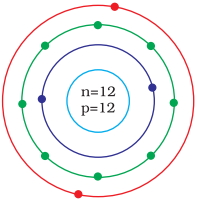
B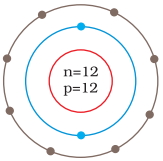
C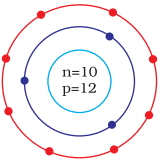
D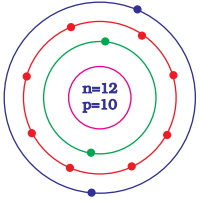
Solution
(C) The atomic number of Magnesium $(Mg)$ is $12$,which means it has $12$ protons $(p=12)$.
The electronic configuration of a neutral $Mg$ atom is $2, 8, 2$.
When $Mg$ forms a $Mg^{2+}$ ion,it loses $2$ electrons from its outermost shell,resulting in an electronic configuration of $2, 8$ (a total of $10$ electrons).
Therefore,the $Mg^{2+}$ ion must have $p=12$ and $10$ electrons in its shells.
Looking at the provided figures:
- Figure $C$ shows $p=12$ and $10$ electrons (arranged as $2$ in the inner shell and $8$ in the outer shell).
Thus,figure $C$ represents the $Mg^{2+}$ ion.
The electronic configuration of a neutral $Mg$ atom is $2, 8, 2$.
When $Mg$ forms a $Mg^{2+}$ ion,it loses $2$ electrons from its outermost shell,resulting in an electronic configuration of $2, 8$ (a total of $10$ electrons).
Therefore,the $Mg^{2+}$ ion must have $p=12$ and $10$ electrons in its shells.
Looking at the provided figures:
- Figure $C$ shows $p=12$ and $10$ electrons (arranged as $2$ in the inner shell and $8$ in the outer shell).
Thus,figure $C$ represents the $Mg^{2+}$ ion.
0 likes
View Solution11
EasyMCQ
In a sample of ethyl ethanoate $(CH_3COOC_2H_5)$,the two oxygen atoms have the same number of electrons but different number of neutrons. Which of the following is the correct reason for it?
A
One of the oxygen atoms has gained electrons
B
One of the oxygen atoms has gained two neutrons
C
The two oxygen atoms are isotopes
D
The two oxygen atoms are isobars
Solution
(C) Isotopes are atoms of the same element that have the same atomic number (number of protons and electrons) but different mass numbers.
The difference in mass number arises because isotopes have a different number of neutrons in their nuclei.
Since oxygen atoms in a sample can exist as different isotopes (e.g.,$^{16}O$,$^{17}O$,or $^{18}O$),they will have the same number of electrons but a different number of neutrons.
The difference in mass number arises because isotopes have a different number of neutrons in their nuclei.
Since oxygen atoms in a sample can exist as different isotopes (e.g.,$^{16}O$,$^{17}O$,or $^{18}O$),they will have the same number of electrons but a different number of neutrons.
0 likes
View Solution12
EasyMCQ
Elements with valency $1$ are
A
always metals
B
always metalloids
C
always non-metals
D
either metals or non-metals
Solution
(D) Elements with a valency of $1$ can be metals or non-metals.
For example,Sodium $(Na)$ is a metal with a valency of $1$,while Chlorine $(Cl)$ is a non-metal with a valency of $1$.
Therefore,elements with valency $1$ can be either metals or non-metals.
For example,Sodium $(Na)$ is a metal with a valency of $1$,while Chlorine $(Cl)$ is a non-metal with a valency of $1$.
Therefore,elements with valency $1$ can be either metals or non-metals.
0 likes
View Solution13
EasyMCQ
The first model of an atom was given by
A
$J$.$J$. Thomson
B
$E$. Goldstein
C
Rutherford
D
$N$. Bohr
Solution
(A) The first model of an atom was proposed by $J.J. Thomson$ in $1904$. This model is known as the $Plum$ $Pudding$ model or $Watermelon$ model. According to this model,an atom consists of a positively charged sphere with electrons embedded in it,similar to seeds in a watermelon.
0 likes
View Solution14
EasyMCQ
An atom with $3$ protons and $4$ neutrons will have a valency of
A
$3$
B
$1$
C
$7$
D
$4$
Solution
(B) The number of protons in an atom is equal to its atomic number. Here,the atomic number is $3$,which corresponds to the element Lithium $(Li)$.
Since the atom is neutral,the number of electrons is equal to the number of protons,which is $3$.
The electronic configuration of this atom is $2, 1$.
Since the number of electrons in the outermost shell (valence shell) is $1$,the atom will lose $1$ electron to achieve a stable octet configuration.
Therefore,the valency of the atom is $1$.
Since the atom is neutral,the number of electrons is equal to the number of protons,which is $3$.
The electronic configuration of this atom is $2, 1$.
Since the number of electrons in the outermost shell (valence shell) is $1$,the atom will lose $1$ electron to achieve a stable octet configuration.
Therefore,the valency of the atom is $1$.
0 likes
View Solution15
EasyMCQ
The electron distribution in an aluminium atom is
A
$8, 2, 3$
B
$2, 8, 2$
C
$2, 8, 3$
D
$2, 3, 8$
Solution
(C) The atomic number of aluminium $(Al)$ is $13$.
According to the Bohr-Bury scheme,the maximum number of electrons that can be accommodated in a shell is given by the formula $2n^2$,where $n$ is the orbit number.
For the first shell $(n=1)$,the capacity is $2(1)^2 = 2$ electrons.
For the second shell $(n=2)$,the capacity is $2(2)^2 = 8$ electrons.
For the third shell $(n=3)$,the remaining electrons are placed. Since $13 - 2 - 8 = 3$,the third shell contains $3$ electrons.
Thus,the electron distribution is $2, 8, 3$. Therefore,option $(C)$ is correct.
According to the Bohr-Bury scheme,the maximum number of electrons that can be accommodated in a shell is given by the formula $2n^2$,where $n$ is the orbit number.
For the first shell $(n=1)$,the capacity is $2(1)^2 = 2$ electrons.
For the second shell $(n=2)$,the capacity is $2(2)^2 = 8$ electrons.
For the third shell $(n=3)$,the remaining electrons are placed. Since $13 - 2 - 8 = 3$,the third shell contains $3$ electrons.
Thus,the electron distribution is $2, 8, 3$. Therefore,option $(C)$ is correct.
0 likes
View Solution16
EasyMCQ
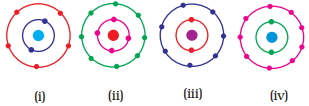
Which of the following figures do not represent Bohr's model of an atom correctly?
A
$(i)$ and $(ii)$
B
$(ii)$ and $(iii)$
C
$(i)$ and $(iv)$
D
$(ii)$ and $(iv)$
Solution
(D) According to Bohr's model,the maximum capacity of the $K$ shell (first shell) is $2$ electrons.
The maximum capacity of the $L$ shell (second shell) is $8$ electrons.
Figure $(ii)$ shows $4$ electrons in the $K$ shell,which violates the rule as the $K$ shell can hold only $2$ electrons.
Figure $(iv)$ shows $9$ electrons in the $L$ shell,which violates the rule as the $L$ shell can hold a maximum of $8$ electrons.
Therefore,figures $(ii)$ and $(iv)$ do not represent Bohr's model correctly.
The maximum capacity of the $L$ shell (second shell) is $8$ electrons.
Figure $(ii)$ shows $4$ electrons in the $K$ shell,which violates the rule as the $K$ shell can hold only $2$ electrons.
Figure $(iv)$ shows $9$ electrons in the $L$ shell,which violates the rule as the $L$ shell can hold a maximum of $8$ electrons.
Therefore,figures $(ii)$ and $(iv)$ do not represent Bohr's model correctly.
0 likes
View Solution17
EasyMCQ
Which of the following statements is always correct?
A
An atom has an equal number of electrons and protons.
B
An atom has an equal number of electrons and neutrons.
C
An atom has an equal number of protons and neutrons.
D
An atom has an equal number of electrons,protons,and neutrons.
Solution
(A) An atom is electrically neutral because it contains an equal number of positively charged protons and negatively charged electrons. While the number of neutrons can vary (leading to isotopes),the number of protons and electrons must be equal for the atom to remain neutral.
0 likes
View Solution18
MediumMCQ
Atomic models have been improved over the years. Arrange the following atomic models in their chronological order:
$(i)$ Rutherford's atomic model
$(ii)$ Thomson's atomic model
$(iii)$ Bohr's atomic model
$(i)$ Rutherford's atomic model
$(ii)$ Thomson's atomic model
$(iii)$ Bohr's atomic model
A
$(i), (ii)$ and $(iii)$
B
$(ii), (i)$ and $(iii)$
C
$(ii), (iii)$ and $(i)$
D
$(iii), (ii)$ and $(i)$
Solution
(B) The chronological order of the development of atomic models is as follows:
$1$. Thomson's atomic model (also known as the Plum Pudding model) was proposed in $1904$.
$2$. Rutherford's atomic model (based on the alpha-particle scattering experiment) was proposed in $1911$.
$3$. Bohr's atomic model (which introduced quantized orbits) was proposed in $1913$.
Therefore,the correct chronological order is $(ii), (i), (iii)$.
$1$. Thomson's atomic model (also known as the Plum Pudding model) was proposed in $1904$.
$2$. Rutherford's atomic model (based on the alpha-particle scattering experiment) was proposed in $1911$.
$3$. Bohr's atomic model (which introduced quantized orbits) was proposed in $1913$.
Therefore,the correct chronological order is $(ii), (i), (iii)$.
0 likes
View Solution19
Easy
Is it possible for the atom of an element to have one electron,one proton,and no neutron? If so,name the element.
Solution
(N/A) Yes,it is possible. The atom of the element hydrogen $(H)$ consists of one proton and one electron,but it contains no neutrons. It is represented as $_1^1H$.
0 likes
View Solution20
EasyMCQ
Write any two observations which support the fact that atoms are divisible.
A
Discovery of subatomic particles like electrons and protons.
B
Existence of isotopes and isobars.
C
Radioactive decay of elements.
D
Emission of alpha,beta,and gamma rays.
Solution
(A) The fact that atoms are divisible is supported by the following observations:
$1$. Discovery of subatomic particles: The discovery of electrons by $J$.$J$. Thomson and protons by $E$. Goldstein proved that atoms are composed of even smaller particles.
$2$. Existence of isotopes and isobars: The existence of different forms of the same element (isotopes) and different elements with the same mass number (isobars) suggests that the internal structure of the atom is complex and divisible.
$1$. Discovery of subatomic particles: The discovery of electrons by $J$.$J$. Thomson and protons by $E$. Goldstein proved that atoms are composed of even smaller particles.
$2$. Existence of isotopes and isobars: The existence of different forms of the same element (isotopes) and different elements with the same mass number (isobars) suggests that the internal structure of the atom is complex and divisible.
0 likes
View Solution21
EasyMCQ
Will $^{35}Cl$ and $^{37}Cl$ have different valencies? Justify your answer.
A
Yes,because their atomic masses are different.
B
No,because they have the same number of electrons.
C
Yes,because the number of neutrons is different.
D
No,because their atomic numbers are different.
Solution
(B) The atoms $^{35}Cl$ and $^{37}Cl$ are isotopes of chlorine.
Isotopes are atoms of the same element that have the same atomic number but different mass numbers.
Since they have the same atomic number $(Z = 17)$,they possess the same number of electrons ($17$ electrons) and the same electronic configuration $(2, 8, 7)$.
Valency is determined by the number of valence electrons in the outermost shell.
Since both isotopes have the same number of valence electrons,their valencies are identical.
Isotopes are atoms of the same element that have the same atomic number but different mass numbers.
Since they have the same atomic number $(Z = 17)$,they possess the same number of electrons ($17$ electrons) and the same electronic configuration $(2, 8, 7)$.
Valency is determined by the number of valence electrons in the outermost shell.
Since both isotopes have the same number of valence electrons,their valencies are identical.
0 likes
View Solution22
EasyMCQ
Why did Rutherford select a gold foil in his $\alpha$-ray scattering experiment?
A
Gold is a noble metal.
B
Gold is highly malleable,allowing for an extremely thin sheet.
C
Gold is a good conductor of electricity.
D
Gold is easily available.
Solution
(B) Gold is highly malleable,which means it can be beaten into very thin sheets.
In his $\alpha$-ray scattering experiment,Rutherford required a target material that was as thin as possible to ensure that the $\alpha$-particles would pass through with minimal interference from multiple atomic layers.
Therefore,gold was the ideal choice because it could be hammered into a foil of approximately $1000$ atoms in thickness.
In his $\alpha$-ray scattering experiment,Rutherford required a target material that was as thin as possible to ensure that the $\alpha$-particles would pass through with minimal interference from multiple atomic layers.
Therefore,gold was the ideal choice because it could be hammered into a foil of approximately $1000$ atoms in thickness.
0 likes
View Solution23
Easy
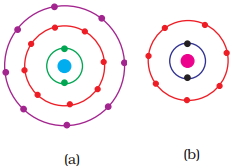
Find out the valency of the atoms represented by the Fig. $(a)$ and $(b)$.
Solution
(N/A) In Fig. $(a)$,the atom has $2$ electrons in the first shell,$8$ in the second,and $8$ in the third shell. Since the outermost shell is completely filled (octet rule),the valency is $0$.
In Fig. $(b)$,the atom has $2$ electrons in the first shell and $7$ in the second shell. To complete its octet,it needs $1$ electron,therefore its valency is $1$.
In Fig. $(b)$,the atom has $2$ electrons in the first shell and $7$ in the second shell. To complete its octet,it needs $1$ electron,therefore its valency is $1$.
0 likes
View Solution24
EasyMCQ
One electron is present in the outermost shell of the atom of an element $X$. What would be the nature and value of charge on the ion formed if this electron is removed from the outermost shell?
A
Negative charge $(-1)$
B
Positive charge $(+1)$
C
Positive charge $(+2)$
D
Neutral $(0)$
Solution
(B) When an atom loses an electron,it loses a negative charge,resulting in an excess of protons relative to electrons.
Since the element $X$ has one electron in its outermost shell,it will lose this single electron to achieve a stable octet configuration.
By losing one electron,the atom gains a net positive charge of $+1$.
Therefore,the nature of the charge is positive and the value is $+1$.
Since the element $X$ has one electron in its outermost shell,it will lose this single electron to achieve a stable octet configuration.
By losing one electron,the atom gains a net positive charge of $+1$.
Therefore,the nature of the charge is positive and the value is $+1$.
0 likes
View Solution25
EasyMCQ
Write down the electron distribution of chlorine atom. How many electrons are there in the $L$ shell? (Atomic number of chlorine is $17$).
A
$8$
B
$7$
C
$2$
D
$5$
Solution
(A) The atomic number of chlorine is $17$.
According to the Bohr-Bury scheme,the electrons are distributed in shells as follows:
$K$ shell $(n=1)$: $2$ electrons
$L$ shell $(n=2)$: $8$ electrons
$M$ shell $(n=3)$: $7$ electrons
Thus,the electron distribution is $2, 8, 7$.
The $L$ shell contains $8$ electrons.
According to the Bohr-Bury scheme,the electrons are distributed in shells as follows:
$K$ shell $(n=1)$: $2$ electrons
$L$ shell $(n=2)$: $8$ electrons
$M$ shell $(n=3)$: $7$ electrons
Thus,the electron distribution is $2, 8, 7$.
The $L$ shell contains $8$ electrons.
0 likes
View Solution26
MediumMCQ
In the atom of an element $X$,$6$ electrons are present in the outermost shell. If it acquires noble gas configuration by accepting the requisite number of electrons,what would be the charge on the ion so formed?
A
$-1$
B
$-2$
C
$2$
D
$1$
Solution
(B) The outermost shell of an atom requires $8$ electrons to achieve a stable noble gas configuration (octet rule).
Since the element $X$ has $6$ electrons in its outermost shell,it needs to gain $8 - 6 = 2$ electrons to complete its octet.
When an atom gains electrons,it becomes a negatively charged ion (anion).
Since it gains $2$ electrons,the charge on the resulting ion will be $-2$.
Since the element $X$ has $6$ electrons in its outermost shell,it needs to gain $8 - 6 = 2$ electrons to complete its octet.
When an atom gains electrons,it becomes a negatively charged ion (anion).
Since it gains $2$ electrons,the charge on the resulting ion will be $-2$.
0 likes
View Solution27
Medium
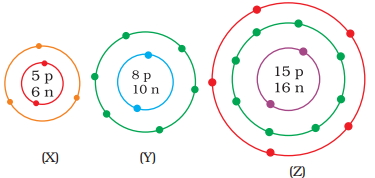
What information do you get from the figure about the atomic number,mass number,and valency of atoms $X$,$Y$,and $Z$? Give your answer in a tabular form.
Solution
(N/A) The atomic number is equal to the number of protons. The mass number is the sum of protons and neutrons. The valency is determined by the number of electrons in the outermost shell (valence shell).
| Atom | Atomic No. | Mass No. | Valency |
|---|---|---|---|
| $X$ | $5$ | $11$ | $3$ |
| $Y$ | $8$ | $18$ | $2$ |
| $Z$ | $15$ | $31$ | $3$ |
0 likes
View Solution28
Medium
In response to a question,a student stated that in an atom,the number of protons is greater than the number of neutrons,which in turn is greater than the number of electrons. Do you agree with the statement? Justify your answer.
Solution
(N/A) The student's statement is incorrect.
$1$. In a neutral atom,the number of protons is always equal to the number of electrons.
$2$. The number of protons is not necessarily greater than the number of neutrons. In many stable isotopes,the number of neutrons is equal to or greater than the number of protons.
$3$. Therefore,the proposed relationship (protons > neutrons > electrons) is scientifically invalid.
$1$. In a neutral atom,the number of protons is always equal to the number of electrons.
$2$. The number of protons is not necessarily greater than the number of neutrons. In many stable isotopes,the number of neutrons is equal to or greater than the number of protons.
$3$. Therefore,the proposed relationship (protons > neutrons > electrons) is scientifically invalid.
0 likes
View Solution29
EasyMCQ
Calculate the number of neutrons present in the nucleus of an element $X$ which is represented as $^{31}_{15}X$.
A
$16$
B
$26$
C
$20$
D
$25$
Solution
(A) The mass number $(A)$ of an element is the sum of the number of protons and neutrons in its nucleus.
Given the representation $^{31}_{15}X$,the mass number $A = 31$ and the atomic number $Z$ (number of protons) $= 15$.
The formula for the number of neutrons $(n)$ is: $n = A - Z$.
Substituting the values: $n = 31 - 15 = 16$.
Therefore,the number of neutrons present in the nucleus is $16$.
Given the representation $^{31}_{15}X$,the mass number $A = 31$ and the atomic number $Z$ (number of protons) $= 15$.
The formula for the number of neutrons $(n)$ is: $n = A - Z$.
Substituting the values: $n = 31 - 15 = 16$.
Therefore,the number of neutrons present in the nucleus is $16$.
0 likes
View Solution30
Medium
Match the names of the scientists given in column $A$ with their contributions towards the understanding of the atomic structure as given in column $B$.
| Column $A$ | Column $B$ |
| $(a)$ Ernest Rutherford | $(i)$ Indivisibility of atoms |
| $(b)$ $J$.$J$. Thomson | $(ii)$ Stationary orbits |
| $(c)$ Dalton | $(iii)$ Concept of nucleus |
| $(d)$ Neils Bohr | $(iv)$ Discovery of electrons |
| $(e)$ James Chadwick | $(v)$ Atomic number |
| $(f)$ $E$. Goldstein | $(vi)$ Neutron |
| $(g)$ Mosley | $(vii)$ Canal rays |
Solution
(A) $(a)-(iii)$: Ernest Rutherford proposed the nuclear model of the atom, introducing the concept of the nucleus.
$(b)-(iv)$: $J$.$J$. Thomson discovered the electron through his cathode ray experiments.
$(c)-(i)$: John Dalton proposed the atomic theory, which stated that atoms are indivisible.
$(d)-(ii)$: Neils Bohr proposed that electrons revolve in discrete stationary orbits around the nucleus.
$(e)-(vi)$: James Chadwick discovered the neutron.
$(f)-(vii)$: $E$. Goldstein discovered canal rays (protons) in a discharge tube.
$(g)-(v)$: Henry Moseley discovered the concept of atomic number.
$(b)-(iv)$: $J$.$J$. Thomson discovered the electron through his cathode ray experiments.
$(c)-(i)$: John Dalton proposed the atomic theory, which stated that atoms are indivisible.
$(d)-(ii)$: Neils Bohr proposed that electrons revolve in discrete stationary orbits around the nucleus.
$(e)-(vi)$: James Chadwick discovered the neutron.
$(f)-(vii)$: $E$. Goldstein discovered canal rays (protons) in a discharge tube.
$(g)-(v)$: Henry Moseley discovered the concept of atomic number.
0 likes
View Solution31
MediumMCQ
The atomic numbers of calcium and argon are $20$ and $18$ respectively,but the mass number of both these elements is $40$. What is the name given to such a pair of elements?
A
Isotopes
B
Isobars
C
Isotones
D
Isomers
Solution
(B) Elements that have the same mass number but different atomic numbers are known as isobars.
In this case,both calcium $(Ca)$ and argon $(Ar)$ have a mass number of $40$,but their atomic numbers are $20$ and $18$ respectively.
Therefore,they are classified as isobars.
In this case,both calcium $(Ca)$ and argon $(Ar)$ have a mass number of $40$,but their atomic numbers are $20$ and $18$ respectively.
Therefore,they are classified as isobars.
0 likes
View Solution32
Medium
Complete the table on the basis of information available in the symbols given below:
$(a)$ ${ }_{17}^{35} Cl$
$(b)$ ${ }_{6}^{12} C$
$(c)$ ${ }_{35}^{81} Br$
$(a)$ ${ }_{17}^{35} Cl$
$(b)$ ${ }_{6}^{12} C$
$(c)$ ${ }_{35}^{81} Br$
| Element | $n_{(p)}$ | $n_{(n)}$ |
Solution
(N/A) To find the number of protons $(n_{(p)})$ and neutrons $(n_{(n)})$, we use the notation ${ }_{Z}^{A} X$, where $Z$ is the atomic number (number of protons) and $A$ is the mass number (protons + neutrons).
$1$. For ${ }_{17}^{35} Cl$: $n_{(p)} = Z = 17$. $n_{(n)} = A - Z = 35 - 17 = 18$.
$2$. For ${ }_{6}^{12} C$: $n_{(p)} = Z = 6$. $n_{(n)} = A - Z = 12 - 6 = 6$.
$3$. For ${ }_{35}^{81} Br$: $n_{(p)} = Z = 35$. $n_{(n)} = A - Z = 81 - 35 = 46$.
$1$. For ${ }_{17}^{35} Cl$: $n_{(p)} = Z = 17$. $n_{(n)} = A - Z = 35 - 17 = 18$.
$2$. For ${ }_{6}^{12} C$: $n_{(p)} = Z = 6$. $n_{(n)} = A - Z = 12 - 6 = 6$.
$3$. For ${ }_{35}^{81} Br$: $n_{(p)} = Z = 35$. $n_{(n)} = A - Z = 81 - 35 = 46$.
| Element | $n_{(p)}$ | $n_{(n)}$ |
| $Cl$ | $17$ | $18$ |
| $C$ | $6$ | $6$ |
| $Br$ | $35$ | $46$ |
0 likes
View Solution33
Easy
$A$ helium atom has $2$ electrons in its valence shell,but its valency is not $2$. Explain.
Solution
(N/A) The helium atom has $2$ electrons in its outermost shell,which represents a complete duplet. Since its outermost shell is already full and stable,it does not need to lose,gain,or share electrons to achieve stability. Therefore,its valency is $0$.
0 likes
View Solution34
Medium
Fill in the blanks in the following statements:
$(a)$ Rutherford's $\alpha$-particle scattering experiment led to the discovery of the ............
$(b)$ Isotopes have same ............ but different .............
$(c)$ Neon and chlorine have atomic numbers $10$ and $17$ respectively. Their valencies will be ............ and ............. respectively.
$(d)$ The electronic configuration of silicon is .......... and that of sulphur is ...........
$(a)$ Rutherford's $\alpha$-particle scattering experiment led to the discovery of the ............
$(b)$ Isotopes have same ............ but different .............
$(c)$ Neon and chlorine have atomic numbers $10$ and $17$ respectively. Their valencies will be ............ and ............. respectively.
$(d)$ The electronic configuration of silicon is .......... and that of sulphur is ...........
Solution
(N/A) The experiment led to the discovery of the atomic nucleus.
$(b)$ Isotopes are atoms of the same element having the same atomic number but different mass numbers.
$(c)$ Neon $(Z=10)$ has an electronic configuration of $2, 8$,so its valency is $0$. Chlorine $(Z=17)$ has an electronic configuration of $2, 8, 7$,so it needs $1$ electron to complete its octet,making its valency $1$.
$(d)$ Silicon $(Z=14)$ has an electronic configuration of $2, 8, 4$. Sulphur $(Z=16)$ has an electronic configuration of $2, 8, 6$.
$(b)$ Isotopes are atoms of the same element having the same atomic number but different mass numbers.
$(c)$ Neon $(Z=10)$ has an electronic configuration of $2, 8$,so its valency is $0$. Chlorine $(Z=17)$ has an electronic configuration of $2, 8, 7$,so it needs $1$ electron to complete its octet,making its valency $1$.
$(d)$ Silicon $(Z=14)$ has an electronic configuration of $2, 8, 4$. Sulphur $(Z=16)$ has an electronic configuration of $2, 8, 6$.
0 likes
View Solution35
Easy
An element $X$ has a mass number $4$ and atomic number $2$. What is the valency of this element?
Solution
(0) The atomic number of element $X$ is $2$.
This means it has $2$ electrons in its $K$ shell.
Since the $K$ shell can hold a maximum of $2$ electrons,it is completely filled.
Therefore,the element is stable and does not need to gain,lose,or share electrons.
Hence,the valency of this element is $0$.
This means it has $2$ electrons in its $K$ shell.
Since the $K$ shell can hold a maximum of $2$ electrons,it is completely filled.
Therefore,the element is stable and does not need to gain,lose,or share electrons.
Hence,the valency of this element is $0$.
0 likes
View Solution36
EasyMCQ
Why do Helium,Neon and Argon have a zero valency?
A
They are highly reactive.
B
They have a stable electronic configuration with a completely filled valence shell.
C
They have an incomplete valence shell.
D
They readily lose electrons.
Solution
(B) Helium has $2$ electrons in its only energy shell (duplet),while Neon and Argon have $8$ electrons in their valence shells (octet).
Since these elements have the maximum number of electrons in their outermost shells,their valence shells are completely filled.
This stable electronic configuration means they have no tendency to gain,lose,or share electrons with other elements.
Therefore,their combining capacity,or valency,is equal to $0$.
Since these elements have the maximum number of electrons in their outermost shells,their valence shells are completely filled.
This stable electronic configuration means they have no tendency to gain,lose,or share electrons with other elements.
Therefore,their combining capacity,or valency,is equal to $0$.
0 likes
View Solution37
DifficultMCQ
The ratio of the radii of a hydrogen atom and its nucleus is $\sim 10^5$. Assuming the atom and the nucleus to be spherical,
$(i)$ What will be the ratio of their sizes (volumes)?
$(ii)$ If the atom is represented by the planet Earth $(R_e = 6.4 \times 10^6 \, m)$,estimate the size of the nucleus.
$(i)$ What will be the ratio of their sizes (volumes)?
$(ii)$ If the atom is represented by the planet Earth $(R_e = 6.4 \times 10^6 \, m)$,estimate the size of the nucleus.
A
$10^{13}, 34 \, m$
B
$10^{15}, 64 \, m$
C
$10^{16}, 34 \, m$
D
$10^{19}, 24 \, m$
Solution
(B) $(i)$ The volume of a sphere is given by $V = \frac{4}{3} \pi r^3$.
Let $R$ be the radius of the atom and $r$ be the radius of the nucleus.
Given the ratio $\frac{R}{r} = 10^5$,we have $R = 10^5 r$.
The ratio of their volumes is $\frac{V_{atom}}{V_{nucleus}} = \frac{\frac{4}{3} \pi R^3}{\frac{4}{3} \pi r^3} = \left( \frac{R}{r} \right)^3$.
Substituting the value,we get $(10^5)^3 = 10^{15}$.
$(ii)$ If the atom is represented by the Earth,then $R_{atom} = R_e = 6.4 \times 10^6 \, m$.
Since $r_{nucleus} = \frac{R_{atom}}{10^5}$,we have $r_{nucleus} = \frac{6.4 \times 10^6 \, m}{10^5} = 6.4 \times 10^1 \, m = 64 \, m$.
Let $R$ be the radius of the atom and $r$ be the radius of the nucleus.
Given the ratio $\frac{R}{r} = 10^5$,we have $R = 10^5 r$.
The ratio of their volumes is $\frac{V_{atom}}{V_{nucleus}} = \frac{\frac{4}{3} \pi R^3}{\frac{4}{3} \pi r^3} = \left( \frac{R}{r} \right)^3$.
Substituting the value,we get $(10^5)^3 = 10^{15}$.
$(ii)$ If the atom is represented by the Earth,then $R_{atom} = R_e = 6.4 \times 10^6 \, m$.
Since $r_{nucleus} = \frac{R_{atom}}{10^5}$,we have $r_{nucleus} = \frac{6.4 \times 10^6 \, m}{10^5} = 6.4 \times 10^1 \, m = 64 \, m$.
0 likes
View Solution38
Medium
Enlist the conclusions drawn by Rutherford from his $\alpha -$ ray scattering experiment.
Solution
(N/A) Rutherford concluded from the $\alpha -$ particle scattering experiment that:
$(i)$ Most of the space inside the atom is empty because most of the $\alpha -$ particles passed through the gold foil without getting deflected.
$(ii)$ Very few particles were deflected from their path,indicating that the positive charge of the atom occupies very little space.
$(iii)$ $A$ very small fraction of $\alpha -$ particles were deflected by $180^o$,indicating that all the positive charge and mass of the gold atom were concentrated in a very small volume within the atom.
From the data,he also calculated that the radius of the nucleus is about $10^5$ times smaller than the radius of the atom.
$(i)$ Most of the space inside the atom is empty because most of the $\alpha -$ particles passed through the gold foil without getting deflected.
$(ii)$ Very few particles were deflected from their path,indicating that the positive charge of the atom occupies very little space.
$(iii)$ $A$ very small fraction of $\alpha -$ particles were deflected by $180^o$,indicating that all the positive charge and mass of the gold atom were concentrated in a very small volume within the atom.
From the data,he also calculated that the radius of the nucleus is about $10^5$ times smaller than the radius of the atom.
0 likes
View Solution39
Medium
In what way is the Rutherford's atomic model different from that of Thomson's atomic model?
Solution
(N/A) Rutherford proposed a model in which electrons revolve around the nucleus in well-defined orbits. There is a positively charged centre in an atom called the nucleus. He also proposed that the size of the nucleus is very small as compared to the size of the atom and nearly all the mass of an atom is centred in the nucleus.
Whereas,Thomson proposed the model of an atom to be similar to a Christmas pudding. The electrons are studded like currants in a positively charged sphere like Christmas pudding and the mass of the atom was supposed to be uniformly distributed.
Whereas,Thomson proposed the model of an atom to be similar to a Christmas pudding. The electrons are studded like currants in a positively charged sphere like Christmas pudding and the mass of the atom was supposed to be uniformly distributed.
0 likes
View Solution40
EasyMCQ
What were the drawbacks of Rutherford's model of an atom?
A
It could not explain the stability of the atom.
B
It suggested that electrons revolve in fixed orbits.
C
It failed to explain the existence of the nucleus.
D
It proposed that atoms are neutral.
Solution
(A) According to classical electromagnetic theory,any charged particle moving in a circular orbit would undergo acceleration and radiate energy.
As the electron revolves,it would continuously lose energy.
Due to this loss of energy,the electron would spiral inward and eventually fall into the nucleus.
If this were true,the atom would be highly unstable,and matter as we know it would not exist.
As the electron revolves,it would continuously lose energy.
Due to this loss of energy,the electron would spiral inward and eventually fall into the nucleus.
If this were true,the atom would be highly unstable,and matter as we know it would not exist.
0 likes
View Solution41
Easy
What are the postulates of Bohr's model of an atom?
Solution
(N/A) The postulates put forth by Neils Bohr regarding the model of an atom are as follows:
$(i)$ Only certain special orbits,known as discrete orbits of electrons,are allowed inside the atom.
$(ii)$ While revolving in these discrete orbits,the electrons do not radiate energy. These orbits are called energy levels or shells. Energy levels in an atom are represented by circles. These orbits are denoted by the letters $K, L, M, N, \dots$ or by the numbers $n = 1, 2, 3, 4, \dots$.
$(i)$ Only certain special orbits,known as discrete orbits of electrons,are allowed inside the atom.
$(ii)$ While revolving in these discrete orbits,the electrons do not radiate energy. These orbits are called energy levels or shells. Energy levels in an atom are represented by circles. These orbits are denoted by the letters $K, L, M, N, \dots$ or by the numbers $n = 1, 2, 3, 4, \dots$.
0 likes
View Solution42
Medium
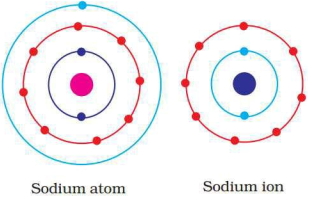
Show diagrammatically the electron distributions in a sodium atom and a sodium ion and also give their atomic number.
Solution
(N/A) Since the atomic number of a sodium atom is $11$,it has $11$ electrons.
$A$ positively charged sodium ion $(Na^+)$ is formed by the removal of one electron from a sodium atom.
So,a sodium ion has $11 - 1 = 10$ electrons in it.
Thus,the electronic distribution of a sodium ion will be $2, 8$.
The atomic number of an element is equal to the number of protons in its atom.
Since a sodium atom and a sodium ion contain the same number of protons,the atomic number of both is $11$.
$A$ positively charged sodium ion $(Na^+)$ is formed by the removal of one electron from a sodium atom.
So,a sodium ion has $11 - 1 = 10$ electrons in it.
Thus,the electronic distribution of a sodium ion will be $2, 8$.
The atomic number of an element is equal to the number of protons in its atom.
Since a sodium atom and a sodium ion contain the same number of protons,the atomic number of both is $11$.
0 likes
View Solution43
DifficultMCQ
In the Gold foil experiment of Geiger and Marsden,which paved the way for Rutherford's model of an atom,$\sim 1.00\%$ of the $\alpha$-particles were found to deflect at angles $> 50^o$. If one mole of $\alpha$-particles were bombarded on the gold foil,compute the number of $\alpha$-particles that would deflect at angles less than $50^o$.
A
$7.73 \times 10^{23}$
B
$5.51 \times 10^{23}$
C
$5.96 \times 10^{23}$
D
$4.95 \times 10^{23}$
Solution
(C) The percentage of $\alpha$-particles deflected at angles greater than $50^o$ is $1\%$.
Therefore,the percentage of $\alpha$-particles deflected at angles less than $50^o$ is $100\% - 1\% = 99\%$.
One mole of $\alpha$-particles contains $6.022 \times 10^{23}$ particles (Avogadro's number).
The number of $\alpha$-particles that deflect at angles less than $50^o$ is calculated as:
$\text{Number} = \frac{99}{100} \times 6.022 \times 10^{23}$
$\text{Number} = 0.99 \times 6.022 \times 10^{23}$
$\text{Number} = 5.96178 \times 10^{23} \approx 5.96 \times 10^{23}$ particles.
Therefore,the percentage of $\alpha$-particles deflected at angles less than $50^o$ is $100\% - 1\% = 99\%$.
One mole of $\alpha$-particles contains $6.022 \times 10^{23}$ particles (Avogadro's number).
The number of $\alpha$-particles that deflect at angles less than $50^o$ is calculated as:
$\text{Number} = \frac{99}{100} \times 6.022 \times 10^{23}$
$\text{Number} = 0.99 \times 6.022 \times 10^{23}$
$\text{Number} = 5.96178 \times 10^{23} \approx 5.96 \times 10^{23}$ particles.
0 likes
View Solution44
EasyMCQ
Name the particles which determine the mass of an atom.
A
Proton and electron
B
Proton and neutron
C
Neutron and electron
D
Proton,neutron,and electron
Solution
(B) The mass of an atom is primarily determined by the sum of the number of protons and neutrons present in the nucleus.
These particles are collectively known as nucleons.
Electrons have negligible mass compared to protons and neutrons,so they do not contribute significantly to the atomic mass.
These particles are collectively known as nucleons.
Electrons have negligible mass compared to protons and neutrons,so they do not contribute significantly to the atomic mass.
0 likes
View Solution45
EasyMCQ
Electrons possess a negative charge,and protons possess a positive charge. An atom contains both,but why does it have no net charge?
A
The number of protons is zero.
B
The number of electrons is zero.
C
The negative and positive charges are equal in magnitude and cancel each other out.
D
The atom does not contain any subatomic particles.
Solution
(C) An atom consists of protons,neutrons,and electrons.
Protons carry a positive charge,while electrons carry a negative charge.
In a neutral atom,the number of protons is equal to the number of electrons.
Since the magnitude of the positive charge of a proton is exactly equal to the magnitude of the negative charge of an electron,they cancel each other out.
Therefore,the atom as a whole is electrically neutral.
Protons carry a positive charge,while electrons carry a negative charge.
In a neutral atom,the number of protons is equal to the number of electrons.
Since the magnitude of the positive charge of a proton is exactly equal to the magnitude of the negative charge of an electron,they cancel each other out.
Therefore,the atom as a whole is electrically neutral.
0 likes
View Solution46
Easy
$J. Chadwick$ discovered a subatomic particle which has no charge and has a mass nearly equal to that of a proton. Name the particle and give its location in the atom.
Solution
(N/A) The particle discovered by $J. Chadwick$ is the neutron.
It is located in the nucleus of the atom along with protons.
It is located in the nucleus of the atom along with protons.
0 likes
View Solution47
EasyMCQ
What was Bohr's postulate on the revolution of electrons in the orbits of an atom?
A
Electrons emit energy continuously while revolving.
B
Electrons do not radiate energy while revolving in discrete orbits.
C
Electrons revolve in orbits with varying energy levels.
D
Electrons spiral into the nucleus due to energy loss.
Solution
(B) According to Bohr's postulate,electrons revolve around the nucleus in specific,discrete orbits known as stationary orbits. While revolving in these discrete orbits,electrons do not radiate energy. This explains the stability of the atom,as the electrons do not lose energy and fall into the nucleus.
0 likes
View Solution48
Easy
$A$ helium atom has two electrons in its valence shell,but its valency is not two. Explain.
Solution
(N/A) The valence shell of a helium atom is the $K$-shell,which can hold a maximum of $2$ electrons. Since the $K$-shell is completely filled with $2$ electrons,the atom is stable and does not need to gain,lose,or share electrons to achieve a stable configuration. Therefore,its combining capacity or valency is $0$.
0 likes
View Solution49
Easy
What do you understand by an octet of electrons in the valence shell?
Solution
(N/A) An octet of electrons in the valence shell refers to the presence of $8$ electrons in the outermost shell of an atom. Atoms with $8$ electrons in their valence shell (except for Helium,which has $2$) are considered to have a stable electronic configuration,similar to noble gases. This state is known as the octet rule,which explains why atoms tend to gain,lose,or share electrons to achieve stability.
0 likes
View Solution50
Easy
Why do we need to calculate the average atomic mass of isotopes of an element for computation?
Solution
(N/A) Elements exist in nature as a mixture of different isotopes,each with a specific relative abundance. Because these isotopes have different atomic masses,a single atomic mass value cannot represent the element accurately. Therefore,the average atomic mass is calculated by taking the weighted average of the masses of all naturally occurring isotopes based on their percentage abundance.
0 likes
View SolutionSTRUCTURE OF THE ATOM — Mix Example - STRUCTURE OF THE ATOM · Frequently Asked Questions
1Are these STRUCTURE OF THE ATOM questions useful for JEE and NEET?
Yes. All questions in this section are mapped to JEE Main and NEET exam patterns. Previous year questions from JEE Main, NEET, GUJCET and state-level exams are included with full solutions.
2Can I switch to Hindi or Gujarati for these questions?
Yes. Use the language tabs in the hero section or the sidebar to view the same questions and solutions in English, Hindi or Gujarati.
3How do I generate a question paper from this subtopic?
Use the Vedclass Exam Paper Generator — select the chapter and subtopic, set difficulty, and generate Sets A, B, C, D automatically. First 3 chapters of every subject are free.
Vedclass Products
For Students
Vedclass Test Series
Mock tests in real JEE/NEET style with performance analysis. 5-day free trial.
Start Free TrialFor Teachers
Exam Paper Generator
Generate Set A/B/C/D papers from this chapter in 2 minutes. 3 chapters free.
Try FreeFor Institutes
Online Exam Module
Live online exams with unlimited students, 360° analytics & white-label branding.
See DemoFor Teachers & Institutes
Generate a STRUCTURE OF THE ATOM Exam Paper in 2 Minutes
Select subtopic & difficulty — Sets A, B, C, D auto-generated with No Repeat logic.
First 3 chapters of every subject are free — no payment required.