
A English
Textbook - STRUCTURE OF THE ATOM Questions in English
Class 9 Science · STRUCTURE OF THE ATOM · Textbook - STRUCTURE OF THE ATOM
35+
Questions
English
Language
100%
With Solutions
Showing 35 of 35 questions in English
1
EasyMCQ
What are canal rays?
A
Negatively charged rays
B
Positively charged radiations
C
Neutral particles
D
Electromagnetic waves
Solution
(B) Canal rays are positively charged radiations that can pass through a perforated cathode plate.
These rays consist of positively charged particles known as protons.
They were discovered by Eugen Goldstein in $1886$.
These rays consist of positively charged particles known as protons.
They were discovered by Eugen Goldstein in $1886$.
0 likes
View Solution2
MediumMCQ
If an atom contains one electron and one proton,will it carry any charge or not?
A
Yes,it will carry a positive charge.
B
Yes,it will carry a negative charge.
C
No,it will be neutral.
D
It depends on the element.
Solution
(C) An electron is a negatively charged particle,whereas a proton is a positively charged particle.
The magnitude of their charges is equal $(1.602 \times 10^{-19} \ C)$.
Since the atom contains one electron ($-1$ charge) and one proton ($+1$ charge),the net charge is $(-1) + (+1) = 0$.
Therefore,an atom containing one electron and one proton will not carry any charge and will be a neutral atom.
The magnitude of their charges is equal $(1.602 \times 10^{-19} \ C)$.
Since the atom contains one electron ($-1$ charge) and one proton ($+1$ charge),the net charge is $(-1) + (+1) = 0$.
Therefore,an atom containing one electron and one proton will not carry any charge and will be a neutral atom.
0 likes
View Solution3
Easy
On the basis of Thomson's model of an atom,explain how the atom is neutral as a whole.
Solution
(N/A) According to Thomson's model of the atom,an atom consists of both negative and positive charges that are equal in number and magnitude.
Since the total positive charge is exactly balanced by the total negative charge,the atom as a whole is electrically neutral.
Since the total positive charge is exactly balanced by the total negative charge,the atom as a whole is electrically neutral.
0 likes
View Solution4
EasyMCQ
On the basis of Rutherford's model of an atom,which subatomic particle is present in the nucleus of an atom?
A
Electron
B
Proton
C
Neutron
D
Positron
Solution
(B) According to Rutherford's alpha-particle scattering experiment,the entire positive charge and most of the mass of the atom are concentrated in a very small region called the nucleus.
Since the positive charge in the nucleus is due to protons,it is concluded that protons are present in the nucleus of an atom.
Since the positive charge in the nucleus is due to protons,it is concluded that protons are present in the nucleus of an atom.
0 likes
View Solution5
Easy
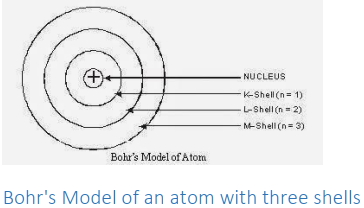
Draw a sketch of Bohr's model of an atom with three shells.
Solution
(N/A) Bohr's model of an atom describes the atom as a small,positively charged nucleus surrounded by electrons that travel in circular orbits.
These orbits are called energy levels or shells,represented by the principal quantum number $n$.
For an atom with three shells,the shells are designated as follows:
$1$. The first shell $(n = 1)$ is the $K$-shell.
$2$. The second shell $(n = 2)$ is the $L$-shell.
$3$. The third shell $(n = 3)$ is the $M$-shell.
The nucleus is at the center of these concentric circles.
These orbits are called energy levels or shells,represented by the principal quantum number $n$.
For an atom with three shells,the shells are designated as follows:
$1$. The first shell $(n = 1)$ is the $K$-shell.
$2$. The second shell $(n = 2)$ is the $L$-shell.
$3$. The third shell $(n = 3)$ is the $M$-shell.
The nucleus is at the center of these concentric circles.
0 likes
View Solution6
MediumMCQ
What do you think would be the observation if the $\alpha$-particle scattering experiment is carried out using a foil of a metal other than gold?
A
The results would be completely different.
B
There would be no change in the observations if the foil is as thin as the gold foil.
C
The $\alpha$-particles would pass through without any deflection.
D
The $\alpha$-particles would be absorbed by the metal.
Solution
(B) If the $\alpha$-particle scattering experiment is carried out using a foil of any metal that is as thin as the gold foil used by Rutherford,there would be no significant change in the observations.
This is because the fundamental structure of the atom (a small,positively charged nucleus at the center) is common to all elements.
However,most other metals are not as malleable as gold,making it extremely difficult to obtain a foil of comparable thickness.
If a thicker foil is used,more $\alpha$-particles would be scattered or bounce back due to multiple collisions,making it difficult to determine the precise location and nature of the positive mass within the atom with the same level of certainty as in Rutherford's original experiment.
This is because the fundamental structure of the atom (a small,positively charged nucleus at the center) is common to all elements.
However,most other metals are not as malleable as gold,making it extremely difficult to obtain a foil of comparable thickness.
If a thicker foil is used,more $\alpha$-particles would be scattered or bounce back due to multiple collisions,making it difficult to determine the precise location and nature of the positive mass within the atom with the same level of certainty as in Rutherford's original experiment.
0 likes
View Solution7
MediumMCQ
Name the three sub-atomic particles of an atom.
A
Proton,Neutron,Positron
B
Proton,Electron,Neutron
C
Electron,Neutron,Photon
D
Proton,Electron,Meson
Solution
(B) The three sub-atomic particles of an atom are:
$(i)$ Protons: Positively charged particles found in the nucleus.
$(ii)$ Electrons: Negatively charged particles revolving around the nucleus.
$(iii)$ Neutrons: Neutral particles found in the nucleus.
$(i)$ Protons: Positively charged particles found in the nucleus.
$(ii)$ Electrons: Negatively charged particles revolving around the nucleus.
$(iii)$ Neutrons: Neutral particles found in the nucleus.
0 likes
View Solution8
EasyMCQ
Helium atom has an atomic mass of $4 \, u$ and two protons in its nucleus. How many neutrons does it have?
A
$1$
B
$2$
C
$3$
D
$4$
Solution
(B) The number of neutrons in an atom is calculated by subtracting the number of protons from the atomic mass.
Number of neutrons $=$ Atomic mass $-$ Number of protons
Given that the atomic mass is $4 \, u$ and the number of protons is $2$.
Therefore,the number of neutrons $= 4 - 2 = 2$.
Number of neutrons $=$ Atomic mass $-$ Number of protons
Given that the atomic mass is $4 \, u$ and the number of protons is $2$.
Therefore,the number of neutrons $= 4 - 2 = 2$.
0 likes
View Solution9
Difficult
Write the distribution of electrons in carbon and sodium atoms.
Solution
The total number of electrons in a carbon atom is $6$. The distribution of electrons in a carbon atom is given by:
First orbit or $K$-shell $= 2$ electrons
Second orbit or $L$-shell $= 4$ electrons
Thus,the electron distribution in a carbon atom is $2, 4$.
The total number of electrons in a sodium atom is $11$. The distribution of electrons in a sodium atom is given by:
First orbit or $K$-shell $= 2$ electrons
Second orbit or $L$-shell $= 8$ electrons
Third orbit or $M$-shell $= 1$ electron
Thus,the electron distribution in a sodium atom is $2, 8, 1$.
First orbit or $K$-shell $= 2$ electrons
Second orbit or $L$-shell $= 4$ electrons
Thus,the electron distribution in a carbon atom is $2, 4$.
The total number of electrons in a sodium atom is $11$. The distribution of electrons in a sodium atom is given by:
First orbit or $K$-shell $= 2$ electrons
Second orbit or $L$-shell $= 8$ electrons
Third orbit or $M$-shell $= 1$ electron
Thus,the electron distribution in a sodium atom is $2, 8, 1$.
0 likes
View Solution10
EasyMCQ
If $K$ and $L$ shells of an atom are full,then what would be the total number of electrons in the atom?
A
$8$
B
$10$
C
$6$
D
$2$
Solution
(B) The maximum capacity of the $K$ shell is $2$ electrons.
The maximum capacity of the $L$ shell is $8$ electrons.
If both shells are full,the total number of electrons is the sum of the electrons in both shells.
Total electrons $= 2 + 8 = 10$ electrons.
The maximum capacity of the $L$ shell is $8$ electrons.
If both shells are full,the total number of electrons is the sum of the electrons in both shells.
Total electrons $= 2 + 8 = 10$ electrons.
0 likes
View Solution11
Difficult
Find the valency of chlorine,sulphur,and magnesium.
Solution
(N/A) If the number of electrons in the outermost shell of an atom is less than or equal to $4$,the valency is equal to the number of valence electrons.
If the number of electrons in the outermost shell is greater than $4$,the valency is determined by subtracting the number of valence electrons from $8$.
The electronic configurations are:
Chlorine $(Z=17)$: $2, 8, 7$
Sulphur $(Z=16)$: $2, 8, 6$
Magnesium $(Z=12)$: $2, 8, 2$
For Chlorine: The outermost shell has $7$ electrons. Since $7 > 4$,valency $= 8 - 7 = 1$.
For Sulphur: The outermost shell has $6$ electrons. Since $6 > 4$,valency $= 8 - 6 = 2$.
For Magnesium: The outermost shell has $2$ electrons. Since $2 \leq 4$,valency $= 2$.
If the number of electrons in the outermost shell is greater than $4$,the valency is determined by subtracting the number of valence electrons from $8$.
The electronic configurations are:
Chlorine $(Z=17)$: $2, 8, 7$
Sulphur $(Z=16)$: $2, 8, 6$
Magnesium $(Z=12)$: $2, 8, 2$
For Chlorine: The outermost shell has $7$ electrons. Since $7 > 4$,valency $= 8 - 7 = 1$.
For Sulphur: The outermost shell has $6$ electrons. Since $6 > 4$,valency $= 8 - 6 = 2$.
For Magnesium: The outermost shell has $2$ electrons. Since $2 \leq 4$,valency $= 2$.
0 likes
View Solution12
MediumMCQ
If the number of electrons in an atom is $8$ and the number of protons is also $8$,then $(i)$ what is the atomic number of the atom? and $(ii)$ what is the charge on the atom?
A
Atomic number $8$,charge $0$
B
Atomic number $8$,charge $+1$
C
Atomic number $16$,charge $0$
D
Atomic number $16$,charge $-1$
Solution
(A) $(i)$ The atomic number of an element is defined as the total number of protons present in the nucleus of its atom. Since the number of protons is $8$,the atomic number is $8$.
$(ii)$ The charge on an atom is determined by the net difference between the number of protons (positive charge) and electrons (negative charge). Since the number of protons $(8)$ equals the number of electrons $(8)$,the net charge is $8 - 8 = 0$. Thus,the atom is electrically neutral.
$(ii)$ The charge on an atom is determined by the net difference between the number of protons (positive charge) and electrons (negative charge). Since the number of protons $(8)$ equals the number of electrons $(8)$,the net charge is $8 - 8 = 0$. Thus,the atom is electrically neutral.
0 likes
View Solution13
MediumMCQ
Find out the mass number of oxygen and sulphur atoms.
A
$16$ and $32$
B
$18$ and $36$
C
$20$ and $38$
D
$32$ and $64$
Solution
(A) The mass number of an atom is defined as the sum of the number of protons and the number of neutrons in its nucleus.
For Oxygen $(O)$:
Atomic number $= 8$ (protons $= 8$)
Number of neutrons $= 8$
Mass number $= 8 + 8 = 16$
For Sulphur $(S)$:
Atomic number $= 16$ (protons $= 16$)
Number of neutrons $= 16$
Mass number $= 16 + 16 = 32$
Therefore,the mass numbers are $16$ and $32$ respectively.
For Oxygen $(O)$:
Atomic number $= 8$ (protons $= 8$)
Number of neutrons $= 8$
Mass number $= 8 + 8 = 16$
For Sulphur $(S)$:
Atomic number $= 16$ (protons $= 16$)
Number of neutrons $= 16$
Mass number $= 16 + 16 = 32$
Therefore,the mass numbers are $16$ and $32$ respectively.
0 likes
View Solution14
Medium
For the symbols $H$,$D$,and $T$,tabulate the number of three sub-atomic particles found in each of them.
Solution
(N/A) The isotopes of hydrogen are Protium $(H)$,Deuterium $(D)$,and Tritium $(T)$. All isotopes of an element have the same number of protons and electrons,but differ in the number of neutrons. The sub-atomic particles for each are as follows:
| Symbol | Protons,Neutrons,Electrons |
|---|---|
| $H$ (Protium) | $1$ Proton,$0$ Neutron,$1$ Electron |
| $D$ (Deuterium) | $1$ Proton,$1$ Neutron,$1$ Electron |
| $T$ (Tritium) | $1$ Proton,$2$ Neutrons,$1$ Electron |
0 likes
View Solution15
Medium
Write the electronic configuration of any one pair of isotopes and isobars.
Solution
(N/A) Isotopes are atoms of the same element having the same atomic number but different mass numbers. For example,Carbon isotopes: ${}^{12}C_{6}$ and ${}^{14}C_{6}$. Both have an atomic number of $6$,so their electronic configuration is $(2, 4)$.
Isobars are atoms of different elements having the same mass number but different atomic numbers. For example,${}^{22}Ne_{10}$ and ${}^{22}Na_{11}$.
Electronic configuration of ${}^{22}Ne_{10}$ $(Z=10)$: $(2, 8)$.
Electronic configuration of ${}^{22}Na_{11}$ $(Z=11)$: $(2, 8, 1)$.
Isobars are atoms of different elements having the same mass number but different atomic numbers. For example,${}^{22}Ne_{10}$ and ${}^{22}Na_{11}$.
Electronic configuration of ${}^{22}Ne_{10}$ $(Z=10)$: $(2, 8)$.
Electronic configuration of ${}^{22}Na_{11}$ $(Z=11)$: $(2, 8, 1)$.
0 likes
View Solution16
Medium
Compare the properties of electrons,protons,and neutrons.
Solution
(N/A) The subatomic particles,namely electrons,protons,and neutrons,differ in their charge,mass,and location within the atom as summarized below:
$1$. Electrons are the lightest particles,carrying a negative charge,and revolve around the nucleus in specific shells.
$2$. Protons are positively charged particles located inside the nucleus,contributing significantly to the atomic mass.
$3$. Neutrons are electrically neutral particles also found within the nucleus,having a mass nearly equal to that of a proton.
| Particle | Nature of Charge | Mass | Location |
|---|---|---|---|
| Electron | Negatively charged | $9.11 \times 10^{-31} \text{ kg}$ | Extra-nuclear region (orbits/shells) |
| Proton | Positively charged | $1.672 \times 10^{-27} \text{ kg}$ (approx. $1 \text{ amu}$) | Nucleus |
| Neutron | Neutral (no charge) | $1.675 \times 10^{-27} \text{ kg}$ (approx. $1 \text{ amu}$) | Nucleus |
$1$. Electrons are the lightest particles,carrying a negative charge,and revolve around the nucleus in specific shells.
$2$. Protons are positively charged particles located inside the nucleus,contributing significantly to the atomic mass.
$3$. Neutrons are electrically neutral particles also found within the nucleus,having a mass nearly equal to that of a proton.
0 likes
View Solution17
Medium
What are the limitations of $J$.$J$. Thomson's model of the atom?
Solution
(N/A) The limitations of $J$.$J$. Thomson's model of the atom are:
$\rightarrow$ It could not explain the results of the alpha-particle scattering experiment performed by Rutherford.
$\rightarrow$ It did not have any experimental support or evidence to prove the arrangement of subatomic particles.
$\rightarrow$ It could not explain the results of the alpha-particle scattering experiment performed by Rutherford.
$\rightarrow$ It did not have any experimental support or evidence to prove the arrangement of subatomic particles.
0 likes
View Solution18
MediumMCQ
What are the limitations of Rutherford's model of the atom?
A
It could not explain the stability of the atom.
B
It could not explain the electronic structure of atoms.
C
It could not explain the line spectrum of atoms.
D
All of the above.
Solution
(D) The limitations of Rutherford's model of the atom are as follows:
$1$. Stability of the atom: According to classical electromagnetic theory,an accelerating charged particle (like an electron) should continuously lose energy in the form of radiation. As the electron loses energy,its orbit should shrink,and it should eventually spiral into the nucleus,making the atom unstable. However,atoms are stable.
$2$. Electronic structure: Rutherford's model did not specify the arrangement of electrons in orbits or their energy levels.
$3$. Line spectrum: It failed to explain the origin of the discrete line spectra observed for hydrogen and other atoms.
$1$. Stability of the atom: According to classical electromagnetic theory,an accelerating charged particle (like an electron) should continuously lose energy in the form of radiation. As the electron loses energy,its orbit should shrink,and it should eventually spiral into the nucleus,making the atom unstable. However,atoms are stable.
$2$. Electronic structure: Rutherford's model did not specify the arrangement of electrons in orbits or their energy levels.
$3$. Line spectrum: It failed to explain the origin of the discrete line spectra observed for hydrogen and other atoms.
0 likes
View Solution19
Medium
Describe Bohr's model of the atom.
Solution
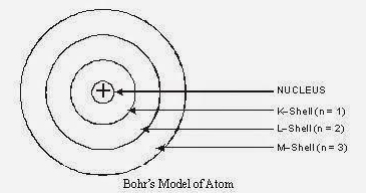
(N/A) $\rightarrow$ The atom consists of a small positively charged nucleus at its center.
$\rightarrow$ The whole mass of the atom is concentrated at the nucleus,and the volume of the nucleus is much smaller than the volume of the atom.
$\rightarrow$ All the protons and neutrons of the atom are contained in the nucleus.
$\rightarrow$ Only certain orbits known as discrete orbits of electrons are allowed inside the atom.
$\rightarrow$ While revolving in these discrete orbits,electrons do not radiate energy. These orbits or shells are represented by the letters $K, L, M, N$ etc.,or the numbers $n=1, 2, 3, 4, \dots$ as shown in the figure.
$\rightarrow$ The whole mass of the atom is concentrated at the nucleus,and the volume of the nucleus is much smaller than the volume of the atom.
$\rightarrow$ All the protons and neutrons of the atom are contained in the nucleus.
$\rightarrow$ Only certain orbits known as discrete orbits of electrons are allowed inside the atom.
$\rightarrow$ While revolving in these discrete orbits,electrons do not radiate energy. These orbits or shells are represented by the letters $K, L, M, N$ etc.,or the numbers $n=1, 2, 3, 4, \dots$ as shown in the figure.
0 likes
View Solution20
Medium
Compare all the proposed models of an atom given in this chapter.
Solution
(N/A)
| Thomson's model | Rutherford's model | Bohr's model |
|---|---|---|
| An atom consists of a positively charged sphere and the electrons are embedded in it. | An atom consists of a positively charged center called the nucleus. The mass of the atom is contributed mainly by the nucleus. | Bohr agreed with almost all points as said by Rutherford except regarding the revolution of electrons,for which he added that there are only certain orbits known as discrete orbits inside the atom in which electrons revolve around the nucleus. |
| The negative and positive charges are equal in magnitude. As a result,the atom is electrically neutral. | The size of the nucleus is very small as compared to the size of the atom. | While revolving in its discrete orbits,the electrons do not radiate energy. |
.jpg)
0 likes
View Solution21
Medium
Summarize the rules for writing the distribution of electrons in various shells for the first eighteen elements.
Solution
(N/A) The rules for writing the distribution of electrons in various shells for the first eighteen elements are as follows:
$\rightarrow$ If $n$ represents the number of the orbit or energy level,then $2n^2$ gives the maximum number of electrons that can be accommodated in a given orbit or energy level.
Thus:
- The first orbit or $K$-shell can have a maximum of $2(1)^2 = 2$ electrons.
- The second orbit or $L$-shell can have a maximum of $2(2)^2 = 8$ electrons.
- The third orbit or $M$-shell can have a maximum of $2(3)^2 = 18$ electrons.
$\rightarrow$ The outermost orbit of an atom can accommodate a maximum of $8$ electrons.
$\rightarrow$ Electrons are filled in a step-wise manner in different orbits,starting from the innermost shell. Electrons do not occupy a higher energy shell until the inner shells are completely filled.
$\rightarrow$ If $n$ represents the number of the orbit or energy level,then $2n^2$ gives the maximum number of electrons that can be accommodated in a given orbit or energy level.
Thus:
- The first orbit or $K$-shell can have a maximum of $2(1)^2 = 2$ electrons.
- The second orbit or $L$-shell can have a maximum of $2(2)^2 = 8$ electrons.
- The third orbit or $M$-shell can have a maximum of $2(3)^2 = 18$ electrons.
$\rightarrow$ The outermost orbit of an atom can accommodate a maximum of $8$ electrons.
$\rightarrow$ Electrons are filled in a step-wise manner in different orbits,starting from the innermost shell. Electrons do not occupy a higher energy shell until the inner shells are completely filled.
0 likes
View Solution22
Medium
Define valency by taking examples of silicon and oxygen.
Solution
(N/A) The valency of an element is defined as the combining capacity of that element.
The valency of an element is determined by the number of valence electrons present in the outermost shell of its atom.
$1$. Valency of Silicon: The atomic number of silicon is $14$. Its electronic configuration is $2, 8, 4$. Since it has $4$ valence electrons,it shares these electrons to complete its octet. Therefore,the valency of silicon is $4$.
$2$. Valency of Oxygen: The atomic number of oxygen is $8$. Its electronic configuration is $2, 6$. To complete its octet,it needs $2$ more electrons. Therefore,the valency of oxygen is $2$.
The valency of an element is determined by the number of valence electrons present in the outermost shell of its atom.
$1$. Valency of Silicon: The atomic number of silicon is $14$. Its electronic configuration is $2, 8, 4$. Since it has $4$ valence electrons,it shares these electrons to complete its octet. Therefore,the valency of silicon is $4$.
$2$. Valency of Oxygen: The atomic number of oxygen is $8$. Its electronic configuration is $2, 6$. To complete its octet,it needs $2$ more electrons. Therefore,the valency of oxygen is $2$.
0 likes
View Solution23
MediumMCQ
Explain with examples $(i)$ Atomic number,$(ii)$ Mass number. Give any two uses of isotopes.
A
Atomic number definition with example.
B
Mass number definition with example.
C
Two uses of isotopes.
D
None of the above.
Solution
(A) $(i)$ Atomic number: The atomic number of an element is defined as the total number of protons present in the nucleus of an atom of that element. It is denoted by $Z$. For example,a nitrogen atom contains $7$ protons,so its atomic number is $7$.
$(ii)$ Mass number: The mass number of an element is the sum of the total number of protons and neutrons present in the nucleus of an atom of that element. It is denoted by $A$. For example,a boron atom has $5$ protons and $6$ neutrons,so its mass number is $5 + 6 = 11$.
Uses of isotopes:
$1$. An isotope of uranium is used as a fuel in nuclear reactors.
$2$. An isotope of iodine is used in the treatment of goitre.
$(ii)$ Mass number: The mass number of an element is the sum of the total number of protons and neutrons present in the nucleus of an atom of that element. It is denoted by $A$. For example,a boron atom has $5$ protons and $6$ neutrons,so its mass number is $5 + 6 = 11$.
Uses of isotopes:
$1$. An isotope of uranium is used as a fuel in nuclear reactors.
$2$. An isotope of iodine is used in the treatment of goitre.
0 likes
View Solution24
Medium
Explain with examples $(i)$ Isotopes and $(ii)$ Isobars. Give any two uses of isotopes.
Solution
(N/A) $(i)$ Isotopes: These are atoms of the same element having the same atomic number,but different mass numbers. For example,chlorine has two isotopes with atomic number $17$ but mass numbers $35$ and $37$ represented by $_{17}^{35}Cl$ and $_{17}^{37}Cl$.
$(ii)$ Isobars: These are atoms of different elements having the same mass number,but different atomic numbers. For example,Neon $(Ne)$ has atomic number $10$ and Sodium $(Na)$ has atomic number $11$,but both have a mass number of $22$,represented by $_{10}^{22}Ne$ and $_{11}^{22}Na$.
Two uses of isotopes:
$\to$ One isotope of Uranium is used as a fuel in nuclear reactors.
$\to$ One isotope of Cobalt is used in the treatment of cancer.
$(ii)$ Isobars: These are atoms of different elements having the same mass number,but different atomic numbers. For example,Neon $(Ne)$ has atomic number $10$ and Sodium $(Na)$ has atomic number $11$,but both have a mass number of $22$,represented by $_{10}^{22}Ne$ and $_{11}^{22}Na$.
Two uses of isotopes:
$\to$ One isotope of Uranium is used as a fuel in nuclear reactors.
$\to$ One isotope of Cobalt is used in the treatment of cancer.
0 likes
View Solution25
Easy
$Na^{+}$ has completely filled $K$ and $L$ shells. Explain.
Solution
(N/A) The atomic number of sodium $(Na)$ is $11$.
In a neutral sodium atom,there are $11$ electrons,and its electronic configuration is $2, 8, 1$.
When a sodium atom loses one electron to form a sodium ion $(Na^{+})$,it is left with $10$ electrons.
The distribution of these $10$ electrons in the shells is as follows:
- $K$-shell: $2$ electrons
- $L$-shell: $8$ electrons
Since the maximum capacity of the $K$-shell is $2$ and the $L$-shell is $8$,both shells are completely filled in $Na^{+}$.
In a neutral sodium atom,there are $11$ electrons,and its electronic configuration is $2, 8, 1$.
When a sodium atom loses one electron to form a sodium ion $(Na^{+})$,it is left with $10$ electrons.
The distribution of these $10$ electrons in the shells is as follows:
- $K$-shell: $2$ electrons
- $L$-shell: $8$ electrons
Since the maximum capacity of the $K$-shell is $2$ and the $L$-shell is $8$,both shells are completely filled in $Na^{+}$.
0 likes
View Solution26
MediumMCQ
If bromine atom is available in the form of,say,two isotopes $_{35}^{79}Br$ $(49.7 \%)$ and $_{35}^{81}Br$ $(50.3 \%),$ calculate the average atomic mass of bromine atom. (in $,u$)
A
$0.80$
B
$80.006$
C
$89.006$
D
$88.006$
Solution
(B) The average atomic mass is calculated by taking the weighted average of the isotopic masses based on their percentage abundance.
Given isotopes are $_{35}^{79}Br$ with $49.7\%$ abundance and $_{35}^{81}Br$ with $50.3\%$ abundance.
Average atomic mass $= (79 \times 0.497) + (81 \times 0.503)$
$= 39.263 + 40.743$
$= 80.006\,u$
Given isotopes are $_{35}^{79}Br$ with $49.7\%$ abundance and $_{35}^{81}Br$ with $50.3\%$ abundance.
Average atomic mass $= (79 \times 0.497) + (81 \times 0.503)$
$= 39.263 + 40.743$
$= 80.006\,u$
0 likes
View Solution27
DifficultMCQ
The average atomic mass of a sample of an element $X$ is $16.2 \, u$. What are the percentages of isotopes $_8^{16}X$ and $_8^{18}X$ in the sample (in $\%$)?
A
$89$
B
$80$
C
$90$
D
$60$
Solution
(C) Let the percentage of isotope $_8^{18}X$ be $y \%$. Then,the percentage of isotope $_8^{16}X$ is $(100 - y) \%$.
The average atomic mass is given by the formula:
$\text{Average atomic mass} = \frac{(16 \times (100 - y)) + (18 \times y)}{100} = 16.2$
Multiplying by $100$ on both sides:
$1600 - 16y + 18y = 1620$
Simplifying the equation:
$2y = 1620 - 1600$
$2y = 20$
$y = 10$
Thus,the percentage of isotope $_8^{18}X$ is $10 \%$ and the percentage of isotope $_8^{16}X$ is $(100 - 10) \% = 90 \%$.
The average atomic mass is given by the formula:
$\text{Average atomic mass} = \frac{(16 \times (100 - y)) + (18 \times y)}{100} = 16.2$
Multiplying by $100$ on both sides:
$1600 - 16y + 18y = 1620$
Simplifying the equation:
$2y = 1620 - 1600$
$2y = 20$
$y = 10$
Thus,the percentage of isotope $_8^{18}X$ is $10 \%$ and the percentage of isotope $_8^{16}X$ is $(100 - 10) \% = 90 \%$.
0 likes
View Solution28
MediumMCQ
If $Z = 3$,what would be the valency of the element? Also,name the element.
A
hydrogen
B
beryllium
C
helium
D
lithium
Solution
(D) By $Z = 3$,we mean that the atomic number of the element is $3$.
Its electronic configuration is $2, 1$.
Since the outermost shell has only $1$ electron,the element needs to lose $1$ electron to achieve a stable configuration.
Therefore,the valency of the element is $1$.
The element with atomic number $Z = 3$ is lithium.
Its electronic configuration is $2, 1$.
Since the outermost shell has only $1$ electron,the element needs to lose $1$ electron to achieve a stable configuration.
Therefore,the valency of the element is $1$.
The element with atomic number $Z = 3$ is lithium.
0 likes
View Solution29
Medium
Composition of the nuclei of two atomic species $X$ and $Y$ are given as under:
Give the mass numbers of $X$ and $Y$. What is the relation between the two species?
| $X$ | $Y$ | |
| Protons $=$ | $6$ | $6$ |
| Neutrons $=$ | $6$ | $8$ |
Give the mass numbers of $X$ and $Y$. What is the relation between the two species?
Solution
(D) Mass number of $X = \text{Number of protons} + \text{Number of neutrons} = 6 + 6 = 12$.
Mass number of $Y = \text{Number of protons} + \text{Number of neutrons} = 6 + 8 = 14$.
These two atomic species $X$ and $Y$ have the same atomic number (number of protons $= 6$),but different mass numbers ($12$ and $14$). Hence,they are isotopes.
Mass number of $Y = \text{Number of protons} + \text{Number of neutrons} = 6 + 8 = 14$.
These two atomic species $X$ and $Y$ have the same atomic number (number of protons $= 6$),but different mass numbers ($12$ and $14$). Hence,they are isotopes.
0 likes
View Solution30
MediumMCQ
For the following statements,write $T$ for True and $F$ for False.
$(a)$ $J$.$J$. Thomson proposed that the nucleus of an atom contains only nucleons.
$(b)$ $A$ neutron is formed by an electron and a proton combining together. Therefore,it is neutral.
$(c)$ The mass of an electron is about $\frac{1}{2000}$ times that of a proton.
$(d)$ An isotope of iodine is used for making tincture iodine,which is used as a medicine.
$(a)$ $J$.$J$. Thomson proposed that the nucleus of an atom contains only nucleons.
$(b)$ $A$ neutron is formed by an electron and a proton combining together. Therefore,it is neutral.
$(c)$ The mass of an electron is about $\frac{1}{2000}$ times that of a proton.
$(d)$ An isotope of iodine is used for making tincture iodine,which is used as a medicine.
A
$(a)-(T); (b)-(F); (c)-(T); (d)-(F)$
B
$(a)-(F); (b)-(T); (c)-(T); (d)-(F)$
C
$(a)-(F); (b)-(F); (c)-(T); (d)-(F)$
D
$(a)-(T); (b)-(F); (c)-(F); (d)-(T)$
Solution
(C) False: $J$.$J$. Thomson proposed the plum pudding model,not the existence of a nucleus containing nucleons; the nucleus was discovered by Ernest Rutherford.
$(b)$ False: $A$ neutron is a fundamental subatomic particle and is not formed by the combination of an electron and a proton.
$(c)$ True: The mass of an electron is approximately $\frac{1}{1837}$ to $\frac{1}{2000}$ times the mass of a proton.
$(d)$ False: Tincture of iodine is a solution of iodine in alcohol,not specifically an isotope of iodine.
$(b)$ False: $A$ neutron is a fundamental subatomic particle and is not formed by the combination of an electron and a proton.
$(c)$ True: The mass of an electron is approximately $\frac{1}{1837}$ to $\frac{1}{2000}$ times the mass of a proton.
$(d)$ False: Tincture of iodine is a solution of iodine in alcohol,not specifically an isotope of iodine.
0 likes
View Solution31
EasyMCQ
Rutherford's alpha-particle scattering experiment was responsible for the discovery of
A
Proton
B
Electron
C
Atomic nucleus
D
Neutron
Solution
(C) Rutherford's alpha-particle scattering experiment involved bombarding a thin gold foil with alpha particles.
He observed that most of the alpha particles passed straight through the foil,but a small fraction were deflected at large angles,and some even bounced back.
This led to the conclusion that the positive charge and most of the mass of the atom are concentrated in a very small,dense region at the center,which he named the atomic nucleus.
He observed that most of the alpha particles passed straight through the foil,but a small fraction were deflected at large angles,and some even bounced back.
This led to the conclusion that the positive charge and most of the mass of the atom are concentrated in a very small,dense region at the center,which he named the atomic nucleus.
0 likes
View Solution32
EasyMCQ
Isotopes of an element have
A
the same physical properties
B
different chemical properties
C
different atomic numbers
D
different number of neutrons
Solution
(D) Isotopes are defined as atoms of the same element that have the same atomic number but different mass numbers. Since the atomic number is the same (number of protons),the number of protons is identical. However,because the mass number is the sum of protons and neutrons,a difference in mass number implies a different number of neutrons in the nucleus. Therefore,isotopes of an element have a different number of neutrons.
0 likes
View Solution33
MediumMCQ
Number of valence electrons in $Cl^-$ ion are :
A
$8$
B
$16$
C
$17$
D
$18$
Solution
(A) The atomic number of Chlorine $(Cl)$ is $17$.
Electronic configuration of $Cl$ atom: $1s^2 2s^2 2p^6 3s^2 3p^5$.
The number of valence electrons in a neutral $Cl$ atom is $7$ (electrons in the $3rd$ shell).
The $Cl^-$ ion is formed by gaining one electron into its valence shell.
Therefore,the number of valence electrons in $Cl^-$ ion = $7 + 1 = 8$.
Electronic configuration of $Cl$ atom: $1s^2 2s^2 2p^6 3s^2 3p^5$.
The number of valence electrons in a neutral $Cl$ atom is $7$ (electrons in the $3rd$ shell).
The $Cl^-$ ion is formed by gaining one electron into its valence shell.
Therefore,the number of valence electrons in $Cl^-$ ion = $7 + 1 = 8$.
0 likes
View Solution34
MediumMCQ
Which one of the following is the correct electronic configuration of sodium?
A
$2, 8$
B
$2, 8, 1$
C
$2, 1, 8$
D
$8, 2, 1$
Solution
(B) The atomic number of sodium $(Na)$ is $11$.
According to the Bohr-Bury scheme,electrons are filled in shells $(K, L, M, N, ...)$ with a maximum capacity of $2n^2$ electrons per shell.
For sodium $(Z = 11)$:
$K$-shell: $2$ electrons
$L$-shell: $8$ electrons
$M$-shell: $1$ electron
Therefore,the electronic configuration is $2, 8, 1$.
According to the Bohr-Bury scheme,electrons are filled in shells $(K, L, M, N, ...)$ with a maximum capacity of $2n^2$ electrons per shell.
For sodium $(Z = 11)$:
$K$-shell: $2$ electrons
$L$-shell: $8$ electrons
$M$-shell: $1$ electron
Therefore,the electronic configuration is $2, 8, 1$.
0 likes
View Solution35
Difficult
Complete the following table.
| Atomic Number | Mass Number | Number of Neutrons | Number of Protons | Number of Electrons | Name of the Atomic Species |
| $9$ | - | $10$ | - | - | - |
| $16$ | $32$ | - | - | - | sulphur |
| - | $24$ | - | $12$ | - | - |
| - | $2$ | - | $1$ | - | - |
| - | $1$ | $0$ | $1$ | $0$ | - |
Solution
(N/A) To complete the table,we use the following relationships:
$1$. $\text{Atomic Number} (Z) = \text{Number of Protons} = \text{Number of Electrons (in a neutral atom)}$.
$2$. $\text{Mass Number} (A) = \text{Number of Protons} + \text{Number of Neutrons}$.
$1$. $\text{Atomic Number} (Z) = \text{Number of Protons} = \text{Number of Electrons (in a neutral atom)}$.
$2$. $\text{Mass Number} (A) = \text{Number of Protons} + \text{Number of Neutrons}$.
| Atomic Number | Mass Number | Number of Neutrons | Number of Protons | Number of Electrons | Name of the Atomic Species |
| $9$ | $19$ | $10$ | $9$ | $9$ | Fluorine |
| $16$ | $32$ | $16$ | $16$ | $16$ | Sulphur |
| $12$ | $24$ | $12$ | $12$ | $12$ | Magnesium |
| $1$ | $2$ | $1$ | $1$ | $1$ | Deuterium |
| $1$ | $1$ | $0$ | $1$ | $0$ | Hydrogen ion |
0 likes
View SolutionSTRUCTURE OF THE ATOM — Textbook - STRUCTURE OF THE ATOM · Frequently Asked Questions
1Are these STRUCTURE OF THE ATOM questions useful for JEE and NEET?
Yes. All questions in this section are mapped to JEE Main and NEET exam patterns. Previous year questions from JEE Main, NEET, GUJCET and state-level exams are included with full solutions.
2Can I switch to Hindi or Gujarati for these questions?
Yes. Use the language tabs in the hero section or the sidebar to view the same questions and solutions in English, Hindi or Gujarati.
3How do I generate a question paper from this subtopic?
Use the Vedclass Exam Paper Generator — select the chapter and subtopic, set difficulty, and generate Sets A, B, C, D automatically. First 3 chapters of every subject are free.
Vedclass Products
For Students
Vedclass Test Series
Mock tests in real JEE/NEET style with performance analysis. 5-day free trial.
Start Free TrialFor Teachers
Exam Paper Generator
Generate Set A/B/C/D papers from this chapter in 2 minutes. 3 chapters free.
Try FreeFor Institutes
Online Exam Module
Live online exams with unlimited students, 360° analytics & white-label branding.
See DemoFor Teachers & Institutes
Generate a STRUCTURE OF THE ATOM Exam Paper in 2 Minutes
Select subtopic & difficulty — Sets A, B, C, D auto-generated with No Repeat logic.
First 3 chapters of every subject are free — no payment required.