
A English
Mix Example - STRUCTURE OF THE ATOM Questions in English
Class 9 Science · STRUCTURE OF THE ATOM · Mix Example - STRUCTURE OF THE ATOM
166+
Questions
English
Language
100%
With Solutions
Showing 50 of 166 questions in English
51
Medium
Write the names of three elementary particles which constitute an atom. Which of these particles determine the mass of an atom? Justify your answer with an example.
Solution
(N/A) The three elementary particles that constitute an atom are $Electrons$,$Protons$,and $Neutrons$.
The mass of an atom is determined by the $Protons$ and $Neutrons$ present in the nucleus.
Justification:
Consider a Sodium $(Na)$ atom.
Number of $Protons = 11$
Number of $Neutrons = 12$
Number of $Electrons = 11$
Mass Number = (Number of $Protons$) + (Number of $Neutrons$)
Mass Number = $11 + 12 = 23$
Since the mass of $Electrons$ is negligible compared to $Protons$ and $Neutrons$,the atomic mass is primarily determined by the sum of $Protons$ and $Neutrons$.
The mass of an atom is determined by the $Protons$ and $Neutrons$ present in the nucleus.
Justification:
Consider a Sodium $(Na)$ atom.
Number of $Protons = 11$
Number of $Neutrons = 12$
Number of $Electrons = 11$
Mass Number = (Number of $Protons$) + (Number of $Neutrons$)
Mass Number = $11 + 12 = 23$
Since the mass of $Electrons$ is negligible compared to $Protons$ and $Neutrons$,the atomic mass is primarily determined by the sum of $Protons$ and $Neutrons$.
0 likes
View Solution52
EasyMCQ
Who discovered the neutron?
A
Rutherford
B
Thomson
C
Bohr
D
Chadwick
Solution
(D) The neutron was discovered by James Chadwick in $1932$. He bombarded beryllium atoms with alpha particles,which resulted in the emission of neutral particles that he identified as neutrons.
0 likes
View Solution53
MediumMCQ
An atom of an element has full $K$ and $L$ shells and has $5$ electrons in its $M$ shell. What is its atomic number?
A
$13$
B
$15$
C
$17$
D
$10$
Solution
(B) The electronic configuration of the atom is determined by the number of electrons in each shell.
According to the Bohr-Bury scheme,the maximum capacity of the $K$ shell is $2$ electrons and the $L$ shell is $8$ electrons.
Given that the $K$ and $L$ shells are full,they contain $2$ and $8$ electrons respectively.
The $M$ shell contains $5$ electrons.
Therefore,the total number of electrons = $2 + 8 + 5 = 15$.
Since the atomic number is equal to the number of electrons in a neutral atom,the atomic number is $15$.
According to the Bohr-Bury scheme,the maximum capacity of the $K$ shell is $2$ electrons and the $L$ shell is $8$ electrons.
Given that the $K$ and $L$ shells are full,they contain $2$ and $8$ electrons respectively.
The $M$ shell contains $5$ electrons.
Therefore,the total number of electrons = $2 + 8 + 5 = 15$.
Since the atomic number is equal to the number of electrons in a neutral atom,the atomic number is $15$.
0 likes
View Solution54
Medium
Give one point of similarity and one point of difference between isotopes of ${ }_{6}^{14} C$ and ${ }_{6}^{12} C$.
Solution
(N/A) $(i)$ Similarity: Both ${ }_{6}^{14} C$ and ${ }_{6}^{12} C$ have the same atomic number,which is $6$.
$(ii)$ Difference: Both ${ }_{6}^{14} C$ and ${ }_{6}^{12} C$ have different atomic masses; ${ }_{6}^{14} C$ has a mass number of $14$,while ${ }_{6}^{12} C$ has a mass number of $12$.
$(ii)$ Difference: Both ${ }_{6}^{14} C$ and ${ }_{6}^{12} C$ have different atomic masses; ${ }_{6}^{14} C$ has a mass number of $14$,while ${ }_{6}^{12} C$ has a mass number of $12$.
0 likes
View Solution55
EasyMCQ
Which property of an element can be used for its identification?
A
Atomic mass
B
Atomic number
C
Number of neutrons
D
Valency
Solution
(B) The atomic number is the fundamental property of an element that uniquely identifies it.
It is defined as the total number of protons present in the nucleus of an atom.
Since the number of protons is constant for all atoms of a specific element,it serves as the definitive characteristic for identification.
It is defined as the total number of protons present in the nucleus of an atom.
Since the number of protons is constant for all atoms of a specific element,it serves as the definitive characteristic for identification.
0 likes
View Solution56
Medium
Write the atomic number of an element which has mass number $23$ and number of neutrons $12$ in the nucleus.
Solution
(11) The atomic number $(Z)$ is equal to the number of protons in the nucleus of an atom.
The mass number $(A)$ is the sum of the number of protons and the number of neutrons in the nucleus.
$A = \text{Number of Protons} + \text{Number of Neutrons}$
Given:
Mass number $(A)$ = $23$
Number of neutrons = $12$
Substituting the values:
$23 = \text{Number of Protons} + 12$
Number of Protons = $23 - 12 = 11$
Since the number of protons is equal to the atomic number $(Z)$, the atomic number is $11$.
The mass number $(A)$ is the sum of the number of protons and the number of neutrons in the nucleus.
$A = \text{Number of Protons} + \text{Number of Neutrons}$
Given:
Mass number $(A)$ = $23$
Number of neutrons = $12$
Substituting the values:
$23 = \text{Number of Protons} + 12$
Number of Protons = $23 - 12 = 11$
Since the number of protons is equal to the atomic number $(Z)$, the atomic number is $11$.
0 likes
View Solution57
MediumMCQ
Identify the isotopes out of $A, B, C$ and $D$ given the following representations:
${ }_{17}^{35} A, { }_{20}^{40} B, { }_{17}^{37} C, { }_{19}^{38} D$
${ }_{17}^{35} A, { }_{20}^{40} B, { }_{17}^{37} C, { }_{19}^{38} D$
A
$A$ and $B$
B
$A$ and $C$
C
$B$ and $D$
D
$C$ and $D$
Solution
(B) Isotopes are atoms of the same element that have the same atomic number but different mass numbers.
In the given representations:
$A = { }_{17}^{35} A$ (Atomic number $Z = 17$,Mass number $A = 35$)
$B = { }_{20}^{40} B$ (Atomic number $Z = 20$,Mass number $A = 40$)
$C = { }_{17}^{37} C$ (Atomic number $Z = 17$,Mass number $A = 37$)
$D = { }_{19}^{38} D$ (Atomic number $Z = 19$,Mass number $A = 38$)
Since $A$ and $C$ both have the same atomic number $(Z = 17)$ but different mass numbers ($35$ and $37$),they are isotopes.
In the given representations:
$A = { }_{17}^{35} A$ (Atomic number $Z = 17$,Mass number $A = 35$)
$B = { }_{20}^{40} B$ (Atomic number $Z = 20$,Mass number $A = 40$)
$C = { }_{17}^{37} C$ (Atomic number $Z = 17$,Mass number $A = 37$)
$D = { }_{19}^{38} D$ (Atomic number $Z = 19$,Mass number $A = 38$)
Since $A$ and $C$ both have the same atomic number $(Z = 17)$ but different mass numbers ($35$ and $37$),they are isotopes.
0 likes
View Solution58
Medium
An atom of an element $X$ may be written as ${ }_{4}^{9} X$.
$(a)$ What does the figure $9$ indicate?
$(b)$ How many neutrons does this element $X$ contain?
$(a)$ What does the figure $9$ indicate?
$(b)$ How many neutrons does this element $X$ contain?
Solution
(N/A) The figure $9$ indicates the mass number of the element $X$,which is the sum of the number of protons and neutrons in the nucleus.
$(b)$ The number of neutrons is calculated as: $\text{Number of neutrons} = \text{Mass number} - \text{Atomic number}$.
Given: $\text{Mass number} = 9$,$\text{Atomic number} = 4$.
Therefore,$\text{Number of neutrons} = 9 - 4 = 5$.
$(b)$ The number of neutrons is calculated as: $\text{Number of neutrons} = \text{Mass number} - \text{Atomic number}$.
Given: $\text{Mass number} = 9$,$\text{Atomic number} = 4$.
Therefore,$\text{Number of neutrons} = 9 - 4 = 5$.
0 likes
View Solution59
Easy
What are isobars? Give one example.
Solution
(N/A) Isobars are atoms of different elements that have the same mass number but different atomic numbers.
For example,${ }_{18}^{40} Ar$ and ${ }_{19}^{40} K$ are isobars because both have a mass number of $40$ but different atomic numbers ($18$ and $19$ respectively).
For example,${ }_{18}^{40} Ar$ and ${ }_{19}^{40} K$ are isobars because both have a mass number of $40$ but different atomic numbers ($18$ and $19$ respectively).
0 likes
View Solution60
EasyMCQ
Name any two noble gases.
A
Helium and Neon
B
Argon and Krypton
C
Helium and Argon
D
Neon and Xenon
Solution
(C) Noble gases are the elements belonging to Group $18$ of the periodic table. They are characterized by having a stable electronic configuration with a complete valence shell.
Two examples of noble gases are Helium $(He)$ and Argon $(Ar)$.
Two examples of noble gases are Helium $(He)$ and Argon $(Ar)$.
0 likes
View Solution61
Medium
$(i)$ Name the scientist who discovered neutrons.
$(ii)$ State the charge and mass of a neutron.
$(iii)$ Where is a neutron located in an atom?
$(ii)$ State the charge and mass of a neutron.
$(iii)$ Where is a neutron located in an atom?
Solution
(N/A) $(i)$ The scientist who discovered neutrons is $J. Chadwick$.
$(ii)$ $A$ neutron has no electric charge (it is neutral) and its mass is approximately $1.67 \times 10^{-27} \text{ kg}$, which is nearly equal to the mass of a proton.
$(iii)$ Neutrons are located inside the nucleus of an atom along with protons.
$(ii)$ $A$ neutron has no electric charge (it is neutral) and its mass is approximately $1.67 \times 10^{-27} \text{ kg}$, which is nearly equal to the mass of a proton.
$(iii)$ Neutrons are located inside the nucleus of an atom along with protons.
0 likes
View Solution62
Medium
Which of the two elements given below would be chemically more reactive: $X$ of atomic number $18$ or element $Z$ of atomic number $16$? And why?
Solution
(B) Element $Z$,having atomic number $16$,is chemically more reactive than element $X$ of atomic number $18$.
$1$. The electronic configuration of element $X$ (atomic number $18$) is $2, 8, 8$. Its outermost shell is completely filled,meaning it has a stable octet configuration. Therefore,it is chemically inert (a noble gas).
$2$. The electronic configuration of element $Z$ (atomic number $16$) is $2, 8, 6$. Its outermost shell contains $6$ electrons. To achieve a stable octet,it needs to gain $2$ electrons. Because its valence shell is incomplete,it is chemically reactive.
$1$. The electronic configuration of element $X$ (atomic number $18$) is $2, 8, 8$. Its outermost shell is completely filled,meaning it has a stable octet configuration. Therefore,it is chemically inert (a noble gas).
$2$. The electronic configuration of element $Z$ (atomic number $16$) is $2, 8, 6$. Its outermost shell contains $6$ electrons. To achieve a stable octet,it needs to gain $2$ electrons. Because its valence shell is incomplete,it is chemically reactive.
0 likes
View Solution63
MediumMCQ
Find the number of electrons,protons,and neutrons possessed by the alpha particles $\left({ }_{2}^{4} He ^{2+}\right)$ used in the gold leaf experiment.
A
Electrons: $0$,Protons: $2$,Neutrons: $2$
B
Electrons: $2$,Protons: $2$,Neutrons: $2$
C
Electrons: $0$,Protons: $2$,Neutrons: $4$
D
Electrons: $2$,Protons: $2$,Neutrons: $4$
Solution
(A) An alpha particle is a helium nucleus,represented as ${ }_{2}^{4} He ^{2+}$.
$1$. The atomic number $(Z)$ of helium is $2$,which indicates the number of protons is $2$.
$2$. The mass number $(A)$ is $4$. The number of neutrons is calculated as $A - Z = 4 - 2 = 2$.
$3$. $A$ neutral helium atom has $2$ electrons. Since the alpha particle has a charge of $+2$,it has lost $2$ electrons. Therefore,the number of electrons is $2 - 2 = 0$.
$1$. The atomic number $(Z)$ of helium is $2$,which indicates the number of protons is $2$.
$2$. The mass number $(A)$ is $4$. The number of neutrons is calculated as $A - Z = 4 - 2 = 2$.
$3$. $A$ neutral helium atom has $2$ electrons. Since the alpha particle has a charge of $+2$,it has lost $2$ electrons. Therefore,the number of electrons is $2 - 2 = 0$.
0 likes
View Solution64
Medium
Give reasons for the following:
$(a)$ Ions are more stable than atoms.
$(b)$ Noble gases show low reactivity.
$(a)$ Ions are more stable than atoms.
$(b)$ Noble gases show low reactivity.
Solution
(N/A) Ions are more stable than atoms because,except for the atoms of inert gases,the outermost shell of most atoms is incomplete. To achieve a stable electronic configuration (octet),atoms lose,gain,or share electrons to form ions.
$(b)$ The outermost shell of the atoms of noble gases is already complete (stable octet or duplet). Therefore,they have no tendency to lose,gain,or share electrons,resulting in low chemical reactivity.
$(b)$ The outermost shell of the atoms of noble gases is already complete (stable octet or duplet). Therefore,they have no tendency to lose,gain,or share electrons,resulting in low chemical reactivity.
0 likes
View Solution65
MediumMCQ
$A, B$ and $C$ are three metals with atomic numbers $4, 11$ and $13$ respectively. Arrange the metals in the increasing order of their valency.
A
$A < B < C$
B
$B < A < C$
C
$C < A < B$
D
$A < C < B$
Solution
(B) The electronic configuration of metal $A$ (atomic number $4$) is $2, 2$. Its valency is $2$.
The electronic configuration of metal $B$ (atomic number $11$) is $2, 8, 1$. Its valency is $1$.
The electronic configuration of metal $C$ (atomic number $13$) is $2, 8, 3$. Its valency is $3$.
Comparing the valencies: $B (1) < A (2) < C (3)$.
Therefore,the increasing order of their valency is $B < A < C$.
The electronic configuration of metal $B$ (atomic number $11$) is $2, 8, 1$. Its valency is $1$.
The electronic configuration of metal $C$ (atomic number $13$) is $2, 8, 3$. Its valency is $3$.
Comparing the valencies: $B (1) < A (2) < C (3)$.
Therefore,the increasing order of their valency is $B < A < C$.
0 likes
View Solution66
Easy
$(a)$ How many neutrons are present in $C-14$ isotope of carbon?
$(b)$ How many protons does $He^{2+}$ ion possess?
$(c)$ How many maximum electrons can be filled in the $3^{rd}$ orbit of an atom?
$(d)$ How many electrons does $He^{2+}$ ion possess?
$(b)$ How many protons does $He^{2+}$ ion possess?
$(c)$ How many maximum electrons can be filled in the $3^{rd}$ orbit of an atom?
$(d)$ How many electrons does $He^{2+}$ ion possess?
Solution
(N/A) The mass number of $C-14$ is $14$ and the atomic number is $6$. The number of neutrons is calculated as $\text{Mass number} - \text{Atomic number} = 14 - 6 = 8$ neutrons.
$(b)$ The atomic number of Helium $(He)$ is $2$,which represents the number of protons. The $He^{2+}$ ion is formed by the loss of electrons,but the number of protons remains unchanged. Thus,it has $2$ protons.
$(c)$ The maximum number of electrons in an orbit is given by the formula $2n^2$,where $n$ is the orbit number. For the $3^{rd}$ orbit,$n = 3$. Therefore,$2(3)^2 = 2 \times 9 = 18$ electrons.
$(d)$ $A$ neutral Helium atom has $2$ electrons. The $He^{2+}$ ion is formed by losing $2$ electrons. Therefore,$2 - 2 = 0$ electrons.
$(b)$ The atomic number of Helium $(He)$ is $2$,which represents the number of protons. The $He^{2+}$ ion is formed by the loss of electrons,but the number of protons remains unchanged. Thus,it has $2$ protons.
$(c)$ The maximum number of electrons in an orbit is given by the formula $2n^2$,where $n$ is the orbit number. For the $3^{rd}$ orbit,$n = 3$. Therefore,$2(3)^2 = 2 \times 9 = 18$ electrons.
$(d)$ $A$ neutral Helium atom has $2$ electrons. The $He^{2+}$ ion is formed by losing $2$ electrons. Therefore,$2 - 2 = 0$ electrons.
0 likes
View Solution67
Medium
Two elements are denoted as follows:
$_{20}^{40}A$ and $_{18}^{40}B$
$(a)$ Find the number of electrons present in $A$ and $B$.
$(b)$ Find the number of nucleons present in $A$ and $B$.
$(c)$ Explain the special 'term' used to represent $A$ and $B$ and define the same.
$_{20}^{40}A$ and $_{18}^{40}B$
$(a)$ Find the number of electrons present in $A$ and $B$.
$(b)$ Find the number of nucleons present in $A$ and $B$.
$(c)$ Explain the special 'term' used to represent $A$ and $B$ and define the same.
Solution
(C) The number of electrons in a neutral atom is equal to its atomic number $(Z)$. For element $A$,$Z = 20$,so it has $20$ electrons. For element $B$,$Z = 18$,so it has $18$ electrons.
$(b)$ The number of nucleons is equal to the mass number $(A)$. Both elements have a mass number of $40$,so both have $40$ nucleons.
$(c)$ The special term used to represent $A$ and $B$ is 'Isobars'.
Definition: Isobars are atoms of different chemical elements that have the same mass number but different atomic numbers.
Example: $_{18}^{40}Ar$ and $_{20}^{40}Ca$.
$(b)$ The number of nucleons is equal to the mass number $(A)$. Both elements have a mass number of $40$,so both have $40$ nucleons.
$(c)$ The special term used to represent $A$ and $B$ is 'Isobars'.
Definition: Isobars are atoms of different chemical elements that have the same mass number but different atomic numbers.
Example: $_{18}^{40}Ar$ and $_{20}^{40}Ca$.
0 likes
View Solution68
Easy
State two main postulates of Thomson's model of an atom.
Solution
(N/A) Thomson's model of an atom is based on the following two postulates:
$(i)$ An atom consists of a positively charged sphere in which the electrons are embedded,similar to seeds in a watermelon or plums in a pudding.
$(ii)$ The negative and positive charges are equal in magnitude. Therefore,the atom as a whole is electrically neutral.
$(i)$ An atom consists of a positively charged sphere in which the electrons are embedded,similar to seeds in a watermelon or plums in a pudding.
$(ii)$ The negative and positive charges are equal in magnitude. Therefore,the atom as a whole is electrically neutral.
0 likes
View Solution69
Easy
Explain the following with one example of each:
$(i)$ Atomic number
$(ii)$ Mass number
$(i)$ Atomic number
$(ii)$ Mass number
Solution
(N/A) $(i)$ Atomic number: It is defined as the total number of protons present in the nucleus of an atom and is denoted by the symbol $Z$. For example,the atomic number of Carbon $(C)$ is $6$,which means it has $6$ protons in its nucleus.
$(ii)$ Mass number: It is defined as the sum of the total number of protons and neutrons present in the nucleus of an atom. It is denoted by the symbol $A$. For example,a Nitrogen $(N)$ atom has $7$ protons and $7$ neutrons,so its mass number is $7 + 7 = 14$.
$(ii)$ Mass number: It is defined as the sum of the total number of protons and neutrons present in the nucleus of an atom. It is denoted by the symbol $A$. For example,a Nitrogen $(N)$ atom has $7$ protons and $7$ neutrons,so its mass number is $7 + 7 = 14$.
0 likes
View Solution70
Easy
The number of electrons in the outermost '$L$' shell of an atom is $5$.
$(a)$ Write its electronic configuration.
$(b)$ What is its valency and why?
$(a)$ Write its electronic configuration.
$(b)$ What is its valency and why?
Solution
(N/A) The electronic configuration is $2, 5$.
$(b)$ Its valency is $3$. This is because the atom has $5$ electrons in its outermost shell and requires $3$ more electrons to complete its octet (achieve a stable configuration of $8$ electrons).
$(b)$ Its valency is $3$. This is because the atom has $5$ electrons in its outermost shell and requires $3$ more electrons to complete its octet (achieve a stable configuration of $8$ electrons).
0 likes
View Solution71
Easy
Write two differences between isobars and isotopes.
Solution
(N/A)
| Isobars | Isotopes |
| $1.$ Same mass number but different atomic number. | $1.$ Same atomic number but different mass number. |
| $2.$ Different chemical properties. | $2.$ Same chemical properties. |
0 likes
View Solution72
Easy
The electronic configuration of an element $X$ is $2, 8, 2$.
$(a)$ Find the number of electrons present in the atom of element $X$.
$(b)$ Write the atomic number.
$(c)$ Is this element $X$ a metal or a non-metal?
$(d)$ Find out the valency of the element $X$.
$(a)$ Find the number of electrons present in the atom of element $X$.
$(b)$ Write the atomic number.
$(c)$ Is this element $X$ a metal or a non-metal?
$(d)$ Find out the valency of the element $X$.
Solution
(A) The total number of electrons is the sum of electrons in each shell: $2 + 8 + 2 = 12$ electrons.
$(b)$ The atomic number of a neutral atom is equal to the total number of electrons. Therefore,the atomic number is $12$.
$(c)$ Since the element has $2$ electrons in its outermost shell,it tends to lose these electrons to achieve a stable octet configuration. Elements that lose electrons to form positive ions are classified as metals. Thus,$X$ is a metal.
$(d)$ The valency is determined by the number of electrons in the outermost shell. Since $X$ has $2$ valence electrons,it loses $2$ electrons to complete its octet. Therefore,the valency of $X$ is $+2$.
$(b)$ The atomic number of a neutral atom is equal to the total number of electrons. Therefore,the atomic number is $12$.
$(c)$ Since the element has $2$ electrons in its outermost shell,it tends to lose these electrons to achieve a stable octet configuration. Elements that lose electrons to form positive ions are classified as metals. Thus,$X$ is a metal.
$(d)$ The valency is determined by the number of electrons in the outermost shell. Since $X$ has $2$ valence electrons,it loses $2$ electrons to complete its octet. Therefore,the valency of $X$ is $+2$.
0 likes
View Solution73
EasyMCQ
An ion $X^{2-}$ contains $10$ electrons and $8$ neutrons. What are the atomic number and mass number of element $X$?
A
Atomic number $= 8$, Mass number $= 16$
B
Atomic number $= 10$, Mass number $= 18$
C
Atomic number $= 8$, Mass number $= 18$
D
Atomic number $= 10$, Mass number $= 16$
Solution
$(A)$ The ion $X^{2-}$ has $10$ electrons, which means it has gained $2$ electrons to form the ion.
Therefore, the number of protons in the neutral atom $X$ is $10 - 2 = 8$.
Atomic number is equal to the number of protons, so the atomic number of $X$ is $8$.
Mass number is the sum of protons and neutrons.
Mass number $= \text{Number of protons} + \text{Number of neutrons} = 8 + 8 = 16$.
Therefore, the number of protons in the neutral atom $X$ is $10 - 2 = 8$.
Atomic number is equal to the number of protons, so the atomic number of $X$ is $8$.
Mass number is the sum of protons and neutrons.
Mass number $= \text{Number of protons} + \text{Number of neutrons} = 8 + 8 = 16$.
0 likes
View Solution74
MediumMCQ
If an ion $M^{3+}$ contains $10$ electrons and $14$ neutrons, what are the atomic number and mass number of the element $M$?
A
Atomic number = $13$, Mass number = $27$
B
Atomic number = $10$, Mass number = $24$
C
Atomic number = $13$, Mass number = $14$
D
Atomic number = $14$, Mass number = $27$
Solution
(A) The ion $M^{3+}$ is formed by the loss of $3$ electrons from a neutral atom $M$.
Since the ion contains $10$ electrons, the number of electrons in the neutral atom $M$ is $10 + 3 = 13$.
In a neutral atom, the number of electrons is equal to the number of protons, which defines the atomic number.
Therefore, the atomic number of element $M$ is $13$.
The mass number is the sum of the number of protons and neutrons.
Mass number = $\text{Atomic number} + \text{Number of neutrons} = 13 + 14 = 27$.
Since the ion contains $10$ electrons, the number of electrons in the neutral atom $M$ is $10 + 3 = 13$.
In a neutral atom, the number of electrons is equal to the number of protons, which defines the atomic number.
Therefore, the atomic number of element $M$ is $13$.
The mass number is the sum of the number of protons and neutrons.
Mass number = $\text{Atomic number} + \text{Number of neutrons} = 13 + 14 = 27$.
0 likes
View Solution75
Easy
Which of the $Na^+$ and $He$ has completely filled $K$ and $L$ shells? Give a reason to support your answer.
Solution
(A) $Na^+$ has completely filled $K$ and $L$ shells.
$Na$ atom has an atomic number of $11$,with an electronic configuration of $(2, 8, 1)$.
When $Na$ loses one electron from its outermost $M$ shell to form $Na^+$,its electronic configuration becomes $(2, 8)$.
Here,the $K$ shell contains $2$ electrons and the $L$ shell contains $8$ electrons,both of which are completely filled.
In contrast,$He$ (atomic number $2$) has only the $K$ shell,which contains $2$ electrons,and it does not possess an $L$ shell.
$Na$ atom has an atomic number of $11$,with an electronic configuration of $(2, 8, 1)$.
When $Na$ loses one electron from its outermost $M$ shell to form $Na^+$,its electronic configuration becomes $(2, 8)$.
Here,the $K$ shell contains $2$ electrons and the $L$ shell contains $8$ electrons,both of which are completely filled.
In contrast,$He$ (atomic number $2$) has only the $K$ shell,which contains $2$ electrons,and it does not possess an $L$ shell.
0 likes
View Solution76
Medium
The following data represents the distribution of electrons,protons,and neutrons in atoms of four elements $A, B, C, D.$
Answer the following questions:
$(a)$ Give the electronic distribution of element $B.$
$(b)$ The valency of element $A$.
$(c)$ The atomic number of element $B.$
$(d)$ The mass number of element $D$.
| Element | Protons,Neutrons,Electrons |
| $A$ | $9, 10, 9$ |
| $B$ | $16, 16, 16$ |
| $C$ | $12, 12, 12$ |
| $D$ | $17, 22, 17$ |
Answer the following questions:
$(a)$ Give the electronic distribution of element $B.$
$(b)$ The valency of element $A$.
$(c)$ The atomic number of element $B.$
$(d)$ The mass number of element $D$.
Solution
(N/A) The atomic number of element $B$ is $16$. Its electronic configuration is $2, 8, 6$.
$(b)$ The atomic number of element $A$ is $9$. Its electronic configuration is $2, 7$. To complete its octet,it gains $1$ electron. Therefore,its valency is $1$.
$(c)$ The atomic number of an element is equal to the number of protons in its nucleus. For element $B$,the number of protons is $16$,so its atomic number is $16$.
$(d)$ The mass number of an element is the sum of the number of protons and neutrons. For element $D$,mass number $= 17 + 22 = 39$.
$(b)$ The atomic number of element $A$ is $9$. Its electronic configuration is $2, 7$. To complete its octet,it gains $1$ electron. Therefore,its valency is $1$.
$(c)$ The atomic number of an element is equal to the number of protons in its nucleus. For element $B$,the number of protons is $16$,so its atomic number is $16$.
$(d)$ The mass number of an element is the sum of the number of protons and neutrons. For element $D$,mass number $= 17 + 22 = 39$.
0 likes
View Solution77
Medium
Mention the postulates of Niels Bohr put forth to overcome the objections raised against Rutherford's atomic model.
Solution
(N/A) Niels Bohr proposed the following postulates to address the limitations of Rutherford's atomic model:
$(a)$ Only certain special orbits,known as discrete orbits of electrons,are allowed inside the atom.
$(b)$ While revolving in these discrete orbits,the electrons do not radiate energy. These orbits or shells are referred to as energy levels.
$(a)$ Only certain special orbits,known as discrete orbits of electrons,are allowed inside the atom.
$(b)$ While revolving in these discrete orbits,the electrons do not radiate energy. These orbits or shells are referred to as energy levels.
0 likes
View Solution78
MediumMCQ
How did Rutherford prove that positively charged particles are present in the nucleus of an atom?
A
By observing the deflection of alpha particles.
B
By observing the scattering of alpha particles.
C
By observing that some alpha particles bounced back.
D
By observing the emission of electrons.
Solution
(C) Rutherford performed the $\alpha$-particle scattering experiment by bombarding a thin gold foil with high-energy $\alpha$-particles.
He observed that while most $\alpha$-particles passed straight through the foil,a very small fraction was deflected at large angles,and some were even bounced back by $180^{\circ}$.
Since $\alpha$-particles are positively charged,their repulsion and deflection by the central part of the atom (the nucleus) indicated that the nucleus contains a concentrated positive charge.
He observed that while most $\alpha$-particles passed straight through the foil,a very small fraction was deflected at large angles,and some were even bounced back by $180^{\circ}$.
Since $\alpha$-particles are positively charged,their repulsion and deflection by the central part of the atom (the nucleus) indicated that the nucleus contains a concentrated positive charge.
0 likes
View Solution79
MediumMCQ
Given that a natural sample of iron $(Fe)$ has isotopes $_{26}^{54}Fe$,$_{26}^{56}Fe$,and $_{26}^{57}Fe$ in the ratios of $5\%$,$90\%$,and $5\%$ respectively. What will be the average atomic mass of iron $(Fe)$ (in $u$)?
A
$55.95$
B
$56.00$
C
$55.50$
D
$54.95$
Solution
(A) The average atomic mass is calculated by taking the weighted average of the masses of the isotopes based on their relative abundance.
Formula: $\text{Average Atomic Mass} = \frac{(M_1 \times P_1) + (M_2 \times P_2) + (M_3 \times P_3)}{100}$
Given:
Isotope $1$: Mass $= 54$,Abundance $= 5\%$
Isotope $2$: Mass $= 56$,Abundance $= 90\%$
Isotope $3$: Mass $= 57$,Abundance $= 5\%$
Calculation:
$\text{Average Atomic Mass} = \frac{(54 \times 5) + (56 \times 90) + (57 \times 5)}{100}$
$= \frac{270 + 5040 + 285}{100}$
$= \frac{5595}{100} = 55.95 \ u$
Formula: $\text{Average Atomic Mass} = \frac{(M_1 \times P_1) + (M_2 \times P_2) + (M_3 \times P_3)}{100}$
Given:
Isotope $1$: Mass $= 54$,Abundance $= 5\%$
Isotope $2$: Mass $= 56$,Abundance $= 90\%$
Isotope $3$: Mass $= 57$,Abundance $= 5\%$
Calculation:
$\text{Average Atomic Mass} = \frac{(54 \times 5) + (56 \times 90) + (57 \times 5)}{100}$
$= \frac{270 + 5040 + 285}{100}$
$= \frac{5595}{100} = 55.95 \ u$
0 likes
View Solution80
Medium
$(a)$ $_{12}^{24} Mg$ and $_{12}^{26} Mg$ are symbols of two isotopes of magnesium. Compare atoms of these isotopes with respect to:
$(i)$ composition of their nuclei.
$(ii)$ electronic configuration and valency.
$(b)$ Give the reason why two isotopes of magnesium have different mass number.
$(i)$ composition of their nuclei.
$(ii)$ electronic configuration and valency.
$(b)$ Give the reason why two isotopes of magnesium have different mass number.
Solution
(N/A) $(a) (i)$ For $_{12}^{24} Mg$: Protons $(P) = 12$,Neutrons $(N) = 24 - 12 = 12$.
For $_{12}^{26} Mg$: Protons $(P) = 12$,Neutrons $(N) = 26 - 12 = 14$.
$(ii)$ Both isotopes have the same atomic number $(12)$,so their electronic configuration is $2, 8, 2$ and their valency is $2$.
$(b)$ Isotopes have different mass numbers because they possess a different number of neutrons in their nuclei,even though the number of protons remains the same.
For $_{12}^{26} Mg$: Protons $(P) = 12$,Neutrons $(N) = 26 - 12 = 14$.
$(ii)$ Both isotopes have the same atomic number $(12)$,so their electronic configuration is $2, 8, 2$ and their valency is $2$.
$(b)$ Isotopes have different mass numbers because they possess a different number of neutrons in their nuclei,even though the number of protons remains the same.
0 likes
View Solution81
Medium
$(a)$ What are canal rays? Who discovered them? What is the charge and mass of canal rays?
$(b)$ How are the canal rays different from electrons in terms of charge and mass?
$(b)$ How are the canal rays different from electrons in terms of charge and mass?
Solution
(N/A) Canal rays are positively charged radiations produced in a gas discharge tube. They were discovered by $E. \text{ Goldstein}$. The charge of canal rays is positive,and their mass is approximately equal to the mass of a proton $(1 \text{ atomic mass unit})$.
$(b)$ Canal rays are positively charged,whereas electrons are negatively charged. The mass of an electron is extremely small,approximately $1/1837$ (or often approximated as $1/2000$) of the mass of a proton (canal ray).
$(b)$ Canal rays are positively charged,whereas electrons are negatively charged. The mass of an electron is extremely small,approximately $1/1837$ (or often approximated as $1/2000$) of the mass of a proton (canal ray).
0 likes
View Solution82
Medium
List three differences between electron, proton, and neutron.
Solution
(N/A)
| Feature | Electron, Proton, and Neutron Differences |
|---|---|
| $1.$ Charge | Electron has a negative charge, Proton has a positive charge, and Neutron has no charge. |
| $2.$ Location | Electron is present in orbits around the nucleus, whereas both Proton and Neutron are present inside the nucleus. |
| $3.$ Mass | The mass of an electron is negligible ($\frac{1}{2000}$ times that of a proton), while the mass of both proton and neutron is approximately $1$ atomic mass unit $(amu)$. |
0 likes
View Solution83
Medium
Write three observations of Rutherford's alpha particles scattering experiment.
Solution
(N/A) In the alpha particles scattering experiment,Rutherford bombarded a thin gold foil with fast moving alpha particles and observed that:
$(i)$ Most of the $\alpha$-particles passed straight through the gold foil.
$(ii)$ Some of the $\alpha$-particles were deflected by the foil through small angles.
$(iii)$ One out of every $12,000$ particles appeared to rebound.
$(i)$ Most of the $\alpha$-particles passed straight through the gold foil.
$(ii)$ Some of the $\alpha$-particles were deflected by the foil through small angles.
$(iii)$ One out of every $12,000$ particles appeared to rebound.
0 likes
View Solution84
Medium
State three rules suggested by Bohr and Bury for the distribution of electrons into different orbits (shells) of an atom.
Solution
(N/A) $(i)$ The maximum number of electrons present in a shell is given by the formula $2n^2$,where $n$ is the orbit number or energy level index $(1, 2, 3, ...)$.
$(ii)$ The outermost shell of an atom can accommodate a maximum of $8$ electrons.
$(iii)$ Electrons are not accommodated in a given shell unless the inner shells are completely filled; that is,the shells are filled in a stepwise manner.
$(ii)$ The outermost shell of an atom can accommodate a maximum of $8$ electrons.
$(iii)$ Electrons are not accommodated in a given shell unless the inner shells are completely filled; that is,the shells are filled in a stepwise manner.
0 likes
View Solution85
Easy
State reasons for the following statements:
$(i)$ Some elements possess fractional atomic mass.
$(ii)$ Isotopes of an element have similar chemical properties.
$(iii)$ Noble gases are inert.
$(i)$ Some elements possess fractional atomic mass.
$(ii)$ Isotopes of an element have similar chemical properties.
$(iii)$ Noble gases are inert.
Solution
(N/A) $(i)$ Some elements possess fractional atomic mass because they occur in nature in different isotopic forms. The atomic mass of an element is calculated as the weighted average of the masses of its naturally occurring isotopes.
$(ii)$ Isotopes of an element have similar chemical properties because they possess the same atomic number and the same number of valence electrons,which determine the chemical behavior of an atom.
$(iii)$ Noble gases are inert because the outermost shell of their atoms is completely filled with electrons (stable octet/duplet configuration). Consequently,they do not show affinity towards chemical reactions.
$(ii)$ Isotopes of an element have similar chemical properties because they possess the same atomic number and the same number of valence electrons,which determine the chemical behavior of an atom.
$(iii)$ Noble gases are inert because the outermost shell of their atoms is completely filled with electrons (stable octet/duplet configuration). Consequently,they do not show affinity towards chemical reactions.
0 likes
View Solution86
Medium
$(a)$ Explain Bohr$-$Bury rules for the distribution of electrons into different shells.
$(b)$ Write the electronic configuration of an atom of sulphur. Also,draw a schematic diagram of its atom showing the distribution of electrons in its shells.
$(b)$ Write the electronic configuration of an atom of sulphur. Also,draw a schematic diagram of its atom showing the distribution of electrons in its shells.
Solution
(N/A) Bohr$-$Bury Rules:
$(i)$ The maximum number of electrons present in a shell is given by the formula $2n^2$,where $n$ is the orbit number or shell number.
$(ii)$ The maximum number of electrons that can be accommodated in the outermost orbit is $8$.
$(iii)$ Electrons are not accommodated in a given shell unless the inner shells are filled. The shells are filled in a step-wise manner.
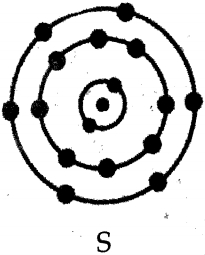
$(b)$ The atomic number of sulphur $(S)$ is $16$. Its electronic configuration is $2, 8, 6$.
Schematic diagram of the sulphur atom:
The atom has a nucleus at the center,with $2$ electrons in the $K$-shell,$8$ electrons in the $L$-shell,and $6$ electrons in the $M$-shell.
$(i)$ The maximum number of electrons present in a shell is given by the formula $2n^2$,where $n$ is the orbit number or shell number.
$(ii)$ The maximum number of electrons that can be accommodated in the outermost orbit is $8$.
$(iii)$ Electrons are not accommodated in a given shell unless the inner shells are filled. The shells are filled in a step-wise manner.
$(b)$ The atomic number of sulphur $(S)$ is $16$. Its electronic configuration is $2, 8, 6$.
Schematic diagram of the sulphur atom:
The atom has a nucleus at the center,with $2$ electrons in the $K$-shell,$8$ electrons in the $L$-shell,and $6$ electrons in the $M$-shell.
0 likes
View Solution87
Easy
List applications of any three isotopes in various fields.
Solution
(N/A) Applications of any three isotopes are:
$(a)$ An isotope of Uranium $(U-235)$ is used as a fuel in nuclear reactors for generating electricity.
$(b)$ An isotope of Cobalt $(Co-60)$ is used in the treatment of cancer through radiotherapy.
$(c)$ An isotope of Iodine $(I-131)$ is used in the treatment of goiter,a disease related to the thyroid gland.
$(a)$ An isotope of Uranium $(U-235)$ is used as a fuel in nuclear reactors for generating electricity.
$(b)$ An isotope of Cobalt $(Co-60)$ is used in the treatment of cancer through radiotherapy.
$(c)$ An isotope of Iodine $(I-131)$ is used in the treatment of goiter,a disease related to the thyroid gland.
0 likes
View Solution88
Difficult
$(a)$ Describe the main features of Bohr's model of an atom. Draw a neat and labelled diagram of energy levels.
$(b)$ Which of the following pairs are isotopes and which are isobars?
$(i)$ $_{26}^{58} A, _{28}^{58} B$
$(ii)$ $_{35}^{79} X, _{35}^{80} Y$
$(c)$ Elements $A$ and $B$ have atomic numbers $18$ and $16$ respectively. Which of these two would be more reactive and why?
$(b)$ Which of the following pairs are isotopes and which are isobars?
$(i)$ $_{26}^{58} A, _{28}^{58} B$
$(ii)$ $_{35}^{79} X, _{35}^{80} Y$
$(c)$ Elements $A$ and $B$ have atomic numbers $18$ and $16$ respectively. Which of these two would be more reactive and why?
Solution
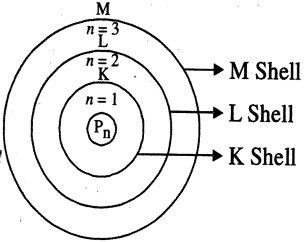
(N/A) Features of Bohr's Model of an Atom:
$(i)$ Electrons revolve in discrete orbits,which are associated with a fixed amount of energy. These are called energy levels or shells,designated as $K, L, M, N, ...$
$(ii)$ While revolving in these discrete orbits,electrons do not radiate energy.
$(iii)$ The energy of an orbit increases as its distance from the nucleus increases. The orbit closest to the nucleus has the lowest energy.
$(iv)$ When energy is supplied to an electron,it jumps to a higher energy level. When it returns to a lower energy level,it emits energy in the form of radiation.
$(b)$ $(i)$ $_{26}^{58} A$ and $_{28}^{58} B$ are isobars because they have the same mass number $(58)$ but different atomic numbers ($26$ and $28$).
$(ii)$ $_{35}^{79} X$ and $_{35}^{80} Y$ are isotopes because they have the same atomic number $(35)$ but different mass numbers ($79$ and $80$).
$(c)$ Element $B$ (atomic number $16$) is more reactive than element $A$ (atomic number $18$). The electronic configuration of $A$ is $2, 8, 8$,which is a stable octet (noble gas configuration). The electronic configuration of $B$ is $2, 8, 6$,which requires two more electrons to complete its octet,making it chemically reactive.
$(i)$ Electrons revolve in discrete orbits,which are associated with a fixed amount of energy. These are called energy levels or shells,designated as $K, L, M, N, ...$
$(ii)$ While revolving in these discrete orbits,electrons do not radiate energy.
$(iii)$ The energy of an orbit increases as its distance from the nucleus increases. The orbit closest to the nucleus has the lowest energy.
$(iv)$ When energy is supplied to an electron,it jumps to a higher energy level. When it returns to a lower energy level,it emits energy in the form of radiation.
$(b)$ $(i)$ $_{26}^{58} A$ and $_{28}^{58} B$ are isobars because they have the same mass number $(58)$ but different atomic numbers ($26$ and $28$).
$(ii)$ $_{35}^{79} X$ and $_{35}^{80} Y$ are isotopes because they have the same atomic number $(35)$ but different mass numbers ($79$ and $80$).
$(c)$ Element $B$ (atomic number $16$) is more reactive than element $A$ (atomic number $18$). The electronic configuration of $A$ is $2, 8, 8$,which is a stable octet (noble gas configuration). The electronic configuration of $B$ is $2, 8, 6$,which requires two more electrons to complete its octet,making it chemically reactive.
0 likes
View Solution89
Medium
With the help of a labelled diagram,describe in brief the Rutherford's alpha particle scattering experiment. Write any three important conclusions drawn from the experiment.
Solution
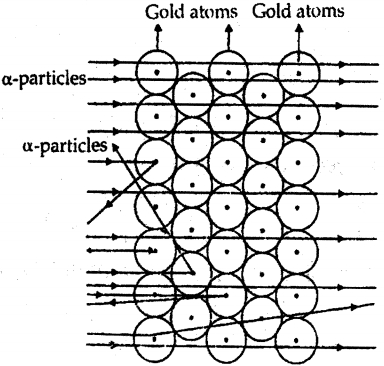
(N/A) Rutherford performed an experiment by bombarding a very thin gold foil with high-energy $\alpha$-particles. The observations were as follows:
$(i)$ Most of the fast-moving $\alpha$-particles passed straight through the gold foil without any deflection.
$(ii)$ Some of the $\alpha$-particles were deflected by the foil by small angles.
$(iii)$ Out of every $12000$ particles,one appeared to rebound (deflected by $180^{\circ}$).
Based on these observations,the following conclusions were drawn:
$(i)$ There is a positively charged center in an atom called the nucleus. Nearly all the mass of an atom resides in the nucleus.
$(ii)$ The electrons revolve around the nucleus in well-defined circular orbits.
$(iii)$ The size of the nucleus is very small compared to the total size of the atom.
$(i)$ Most of the fast-moving $\alpha$-particles passed straight through the gold foil without any deflection.
$(ii)$ Some of the $\alpha$-particles were deflected by the foil by small angles.
$(iii)$ Out of every $12000$ particles,one appeared to rebound (deflected by $180^{\circ}$).
Based on these observations,the following conclusions were drawn:
$(i)$ There is a positively charged center in an atom called the nucleus. Nearly all the mass of an atom resides in the nucleus.
$(ii)$ The electrons revolve around the nucleus in well-defined circular orbits.
$(iii)$ The size of the nucleus is very small compared to the total size of the atom.
0 likes
View Solution90
Medium
State three features of the nuclear model of an atom put forward by Rutherford.
Solution
(N/A) $(i)$ There is a positively charged center in an atom called the nucleus. Nearly all the mass of an atom resides in the nucleus.
$(ii)$ The electrons revolve around the nucleus in well-defined orbits.
$(iii)$ The size of the nucleus is very small as compared to the size of the atom.
$(ii)$ The electrons revolve around the nucleus in well-defined orbits.
$(iii)$ The size of the nucleus is very small as compared to the size of the atom.
0 likes
View Solution91
Easy
$(a)$ Write the names of three isotopes of hydrogen.
$(b)$ State one use of an isotope of uranium.
$(c)$ Isotopes of an element have similar chemical properties. Why?
$(b)$ State one use of an isotope of uranium.
$(c)$ Isotopes of an element have similar chemical properties. Why?
Solution
(N/A) The three isotopes of hydrogen are:
$1.$ ${ }_{1}^{1} H$ - Protium
$2.$ ${ }_{1}^{2} H$ - Deuterium
$3.$ ${ }_{1}^{3} H$ - Tritium
$(b)$ An isotope of uranium,${ }_{92}^{235} U$,is used as a fuel in nuclear reactors to generate electricity.
$(c)$ Isotopes of an element have similar chemical properties because they have the same atomic number and the same number of valence electrons,which determines their chemical behavior.
$1.$ ${ }_{1}^{1} H$ - Protium
$2.$ ${ }_{1}^{2} H$ - Deuterium
$3.$ ${ }_{1}^{3} H$ - Tritium
$(b)$ An isotope of uranium,${ }_{92}^{235} U$,is used as a fuel in nuclear reactors to generate electricity.
$(c)$ Isotopes of an element have similar chemical properties because they have the same atomic number and the same number of valence electrons,which determines their chemical behavior.
0 likes
View Solution92
DifficultMCQ
The average atomic mass of a sample of an element $y$ is $35.5 \,u$. What are the percentages of isotopes $_{17}^{37}y$ and $_{17}^{35}y$ in the sample?
A
$25\%, 75\%$
B
$75\%, 25\%$
C
$50\%, 50\%$
D
$40\%, 60\%$
Solution
(A) Let the percentage composition of $_{17}^{37}y$ be $x$.
Then the percentage composition of $_{17}^{35}y$ will be $100-x$.
Now,the average atomic mass is calculated as:
$\frac{x}{100} \times 37 + \frac{100-x}{100} \times 35 = 35.5$
$\frac{37x + 3500 - 35x}{100} = 35.5$
$2x + 3500 = 3550$
$2x = 50$
$x = 25\%$
Therefore,the percentage of $_{17}^{37}y$ is $25\%$ and the percentage of $_{17}^{35}y$ is $100 - 25 = 75\%$.
Then the percentage composition of $_{17}^{35}y$ will be $100-x$.
Now,the average atomic mass is calculated as:
$\frac{x}{100} \times 37 + \frac{100-x}{100} \times 35 = 35.5$
$\frac{37x + 3500 - 35x}{100} = 35.5$
$2x + 3500 = 3550$
$2x = 50$
$x = 25\%$
Therefore,the percentage of $_{17}^{37}y$ is $25\%$ and the percentage of $_{17}^{35}y$ is $100 - 25 = 75\%$.
0 likes
View Solution93
Easy
$(i)$ Write the postulates of the Bohr model of an atom.
$(ii)$ Draw a sketch of the Bohr model of an atom with atomic number $15$.
$(ii)$ Draw a sketch of the Bohr model of an atom with atomic number $15$.
Solution
(N/A) $(i)$ The postulates of the Bohr model of an atom are as follows:
- Only certain special orbits,known as discrete orbits of electrons,are allowed inside the atom.
- While revolving in these discrete orbits,the electrons do not radiate energy.
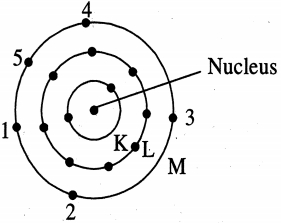
$(ii)$ For an atom with atomic number $15$ (Phosphorus),the electronic configuration is $2, 8, 5$. The sketch shows the nucleus at the center,surrounded by three shells $(K, L, M)$: the $K$-shell contains $2$ electrons,the $L$-shell contains $8$ electrons,and the $M$-shell contains $5$ electrons.
- Only certain special orbits,known as discrete orbits of electrons,are allowed inside the atom.
- While revolving in these discrete orbits,the electrons do not radiate energy.
$(ii)$ For an atom with atomic number $15$ (Phosphorus),the electronic configuration is $2, 8, 5$. The sketch shows the nucleus at the center,surrounded by three shells $(K, L, M)$: the $K$-shell contains $2$ electrons,the $L$-shell contains $8$ electrons,and the $M$-shell contains $5$ electrons.
0 likes
View Solution94
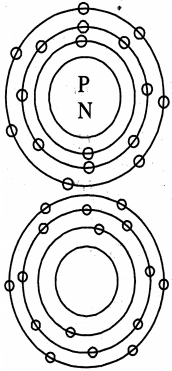
Medium
$(a)$ Explain the Bohr$-$Bury rules for the distribution of electrons into different shells.
$(b)$ Draw the electronic structure of element $X$ with atomic number $17$ and element $Y$ with atomic number $16$.
$(b)$ Draw the electronic structure of element $X$ with atomic number $17$ and element $Y$ with atomic number $16$.
Solution
(N/A) Bohr$-$Bury Rules:
$(i)$ The maximum number of electrons present in a shell is given by the formula $2n^2$,where $n$ is the shell number.
$(ii)$ The maximum number of electrons that can be accommodated in the outermost orbit is $8$.
$(iii)$ Electrons are not accommodated in a given shell unless the inner shells are filled.
$(b)$ Electronic structure:
$(i)$ For element $X$ (Atomic number $17$): Electronic configuration is $2, 8, 7$. It has $2$ electrons in the $K$ shell,$8$ in the $L$ shell,and $7$ in the $M$ shell.
$(ii)$ For element $Y$ (Atomic number $16$): Electronic configuration is $2, 8, 6$. It has $2$ electrons in the $K$ shell,$8$ in the $L$ shell,and $6$ in the $M$ shell.
$(i)$ The maximum number of electrons present in a shell is given by the formula $2n^2$,where $n$ is the shell number.
$(ii)$ The maximum number of electrons that can be accommodated in the outermost orbit is $8$.
$(iii)$ Electrons are not accommodated in a given shell unless the inner shells are filled.
$(b)$ Electronic structure:
$(i)$ For element $X$ (Atomic number $17$): Electronic configuration is $2, 8, 7$. It has $2$ electrons in the $K$ shell,$8$ in the $L$ shell,and $7$ in the $M$ shell.
$(ii)$ For element $Y$ (Atomic number $16$): Electronic configuration is $2, 8, 6$. It has $2$ electrons in the $K$ shell,$8$ in the $L$ shell,and $6$ in the $M$ shell.
0 likes
View Solution95
Medium
Rutherford designed an experiment to determine the structure of an atom. Answer the following in relation to this experiment:
$(a)$ Name the element he selected for this purpose.
$(b)$ Which subatomic particle was used by him?
$(c)$ What was the drawback of Rutherford's model of the atom?
$(a)$ Name the element he selected for this purpose.
$(b)$ Which subatomic particle was used by him?
$(c)$ What was the drawback of Rutherford's model of the atom?
Solution
(N/A) Rutherford selected gold for his experiment because it is highly malleable and can be beaten into a very thin foil.
$(b)$ He used $\alpha$-particles,which are doubly charged helium ions $(He^{2+})$.
$(c)$ The major drawback of Rutherford's model was that it could not explain the stability of the atom. According to classical electromagnetic theory,an accelerating charged particle should emit energy; thus,electrons revolving around the nucleus should lose energy and eventually fall into the nucleus,making the atom unstable.
$(b)$ He used $\alpha$-particles,which are doubly charged helium ions $(He^{2+})$.
$(c)$ The major drawback of Rutherford's model was that it could not explain the stability of the atom. According to classical electromagnetic theory,an accelerating charged particle should emit energy; thus,electrons revolving around the nucleus should lose energy and eventually fall into the nucleus,making the atom unstable.
0 likes
View Solution96
Medium
Sulphur dioxide $(SO_{2})$ is a colourless,pungent-smelling gas and is a major air pollutant.
$(a)$ Write the electronic configuration of its constituent elements,sulphur and oxygen.
(Given: $_{16}^{32}S, _{8}^{16}O)$
$(b)$ Write the valency of sulphur and oxygen.
$(c)$ Are sulphur and oxygen isotopes of the same element? Explain your answer.
$(a)$ Write the electronic configuration of its constituent elements,sulphur and oxygen.
(Given: $_{16}^{32}S, _{8}^{16}O)$
$(b)$ Write the valency of sulphur and oxygen.
$(c)$ Are sulphur and oxygen isotopes of the same element? Explain your answer.
Solution
(N/A) The electronic configuration is determined by the atomic number $(Z)$:
Sulphur $(S)$: Atomic number $Z = 16$. Electronic configuration: $2, 8, 6$.
Oxygen $(O)$: Atomic number $Z = 8$. Electronic configuration: $2, 6$.
$(b)$ Valency is the combining capacity of an element.
For Oxygen $(O)$: It needs $2$ electrons to complete its octet,so its valency is $2$.
For Sulphur $(S)$: It needs $2$ electrons to complete its octet,so its valency is $2$.
$(c)$ No,they are not isotopes. Isotopes are atoms of the same element having the same atomic number but different mass numbers. Since sulphur and oxygen have different atomic numbers ($16$ and $8$ respectively),they are different elements.
Sulphur $(S)$: Atomic number $Z = 16$. Electronic configuration: $2, 8, 6$.
Oxygen $(O)$: Atomic number $Z = 8$. Electronic configuration: $2, 6$.
$(b)$ Valency is the combining capacity of an element.
For Oxygen $(O)$: It needs $2$ electrons to complete its octet,so its valency is $2$.
For Sulphur $(S)$: It needs $2$ electrons to complete its octet,so its valency is $2$.
$(c)$ No,they are not isotopes. Isotopes are atoms of the same element having the same atomic number but different mass numbers. Since sulphur and oxygen have different atomic numbers ($16$ and $8$ respectively),they are different elements.
0 likes
View Solution97
Medium
$(a)$ Name the three subatomic particles of an atom.
$(b)$ An atom of an element has $5$ electrons in the $L$ shell.
$(i)$ What is the atomic number of the element?
$(ii)$ State its valency.
$(iii)$ Identify the element and write its name.
$(b)$ An atom of an element has $5$ electrons in the $L$ shell.
$(i)$ What is the atomic number of the element?
$(ii)$ State its valency.
$(iii)$ Identify the element and write its name.
Solution
(D) The three subatomic particles of an atom are electrons,protons,and neutrons.
$(b) (i)$ The $K$ shell is the first shell and can hold $2$ electrons. The $L$ shell is the second shell and has $5$ electrons. Therefore,the total number of electrons is $2 + 5 = 7$. Since the atom is neutral,the atomic number is equal to the number of electrons,which is $7$.
$(ii)$ The valency is determined by the number of electrons required to complete the octet. Since there are $5$ electrons in the outermost shell ($L$ shell),it needs $3$ more electrons to complete the octet. Thus,its valency is $3$ (or $-3$ as it gains $3$ electrons).
$(iii)$ The element with atomic number $7$ is Nitrogen $(N)$.
$(b) (i)$ The $K$ shell is the first shell and can hold $2$ electrons. The $L$ shell is the second shell and has $5$ electrons. Therefore,the total number of electrons is $2 + 5 = 7$. Since the atom is neutral,the atomic number is equal to the number of electrons,which is $7$.
$(ii)$ The valency is determined by the number of electrons required to complete the octet. Since there are $5$ electrons in the outermost shell ($L$ shell),it needs $3$ more electrons to complete the octet. Thus,its valency is $3$ (or $-3$ as it gains $3$ electrons).
$(iii)$ The element with atomic number $7$ is Nitrogen $(N)$.
0 likes
View Solution98
Medium
$(a)$ Define the following terms with one example each:
$(i)$ Isotope
$(ii)$ Isobar
$(b)$ Name the elements whose isotopes are used in:
$(i)$ Nuclear Reactor
$(ii)$ Treatment of cancer
$(i)$ Isotope
$(ii)$ Isobar
$(b)$ Name the elements whose isotopes are used in:
$(i)$ Nuclear Reactor
$(ii)$ Treatment of cancer
Solution
(N/A) $(i)$ Isotopes are atoms of the same element having the same atomic number but different mass numbers. Example: Hydrogen has three isotopes: Protium $(_{1}^{1}H)$,Deuterium $(_{1}^{2}H)$,and Tritium $(_{1}^{3}H)$.
$(ii)$ Isobars are atoms of different elements having the same mass number but different atomic numbers. Example: Argon $(_{18}^{40}Ar)$ and Calcium $(_{20}^{40}Ca)$ are isobars as both have a mass number of $40$.
$(b)$ $(i)$ The isotope of Uranium $(U-235)$ is used as a fuel in nuclear reactors.
$(ii)$ The isotope of Cobalt $(Co-60)$ is used in the treatment of cancer.
$(ii)$ Isobars are atoms of different elements having the same mass number but different atomic numbers. Example: Argon $(_{18}^{40}Ar)$ and Calcium $(_{20}^{40}Ca)$ are isobars as both have a mass number of $40$.
$(b)$ $(i)$ The isotope of Uranium $(U-235)$ is used as a fuel in nuclear reactors.
$(ii)$ The isotope of Cobalt $(Co-60)$ is used in the treatment of cancer.
0 likes
View Solution99
Medium
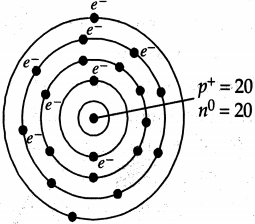
$(a)$ Calculate the number of electrons,protons,and neutrons in an atom of an element with atomic number $20$ and mass number $40$. Write the electronic configuration and draw the structure of the atom.
$(b)$ An atom has complete $K$ and $L$ shells. Is this an atom of a metal,non-metal,or noble gas? Justify.
$(b)$ An atom has complete $K$ and $L$ shells. Is this an atom of a metal,non-metal,or noble gas? Justify.
Solution
(N/A) For an element with atomic number $Z = 20$ and mass number $A = 40$:
Number of protons $= Z = 20$
Number of electrons $= Z = 20$
Number of neutrons $= A - Z = 40 - 20 = 20$
Electronic configuration: $K=2, L=8, M=8, N=2$.
The structure of the atom consists of a nucleus containing $20$ protons and $20$ neutrons,surrounded by four shells $(K, L, M, N)$ containing $2, 8, 8,$ and $2$ electrons respectively.
$(b)$ An atom with complete $K$ and $L$ shells has an electronic configuration of $2, 8$. The total number of electrons is $10$,which corresponds to the element Neon $(Ne)$. Since its outermost shell ($L$-shell) is completely filled (octet is complete),it is chemically inert and is classified as a noble gas.
Number of protons $= Z = 20$
Number of electrons $= Z = 20$
Number of neutrons $= A - Z = 40 - 20 = 20$
Electronic configuration: $K=2, L=8, M=8, N=2$.
The structure of the atom consists of a nucleus containing $20$ protons and $20$ neutrons,surrounded by four shells $(K, L, M, N)$ containing $2, 8, 8,$ and $2$ electrons respectively.
$(b)$ An atom with complete $K$ and $L$ shells has an electronic configuration of $2, 8$. The total number of electrons is $10$,which corresponds to the element Neon $(Ne)$. Since its outermost shell ($L$-shell) is completely filled (octet is complete),it is chemically inert and is classified as a noble gas.
0 likes
View Solution100
Medium
$(a)$ Which of the following electronic configurations are not possible? Give reasons.
$(i)$ $X: 2, 8, 4$
$(ii)$ $Y: 3, 8, 2$
$(iii)$ $Z: 2, 8, 9$
$(b)$ Write electronic configurations of the following elements and predict their valencies:
Fluorine: $9$,Aluminium: $13$,Argon: $18$
$(i)$ $X: 2, 8, 4$
$(ii)$ $Y: 3, 8, 2$
$(iii)$ $Z: 2, 8, 9$
$(b)$ Write electronic configurations of the following elements and predict their valencies:
Fluorine: $9$,Aluminium: $13$,Argon: $18$
Solution
(A) Electronic configurations $Y: 3, 8, 2$ and $Z: 2, 8, 9$ are not possible. According to the Bohr-Bury scheme,the first shell ($K$-shell) can hold a maximum of $2$ electrons,and the outermost shell of an atom can hold a maximum of $8$ electrons.
$(b)$ The electronic configurations and valencies are as follows:
$(b)$ The electronic configurations and valencies are as follows:
| Element | Electronic Configuration $(K, L, M)$ | Valency |
|---|---|---|
| Fluorine $(9)$ | $2, 7$ | $1$ |
| Aluminium $(13)$ | $2, 8, 3$ | $3$ |
| Argon $(18)$ | $2, 8, 8$ | $0$ |
0 likes
View SolutionSTRUCTURE OF THE ATOM — Mix Example - STRUCTURE OF THE ATOM · Frequently Asked Questions
1Are these STRUCTURE OF THE ATOM questions useful for JEE and NEET?
Yes. All questions in this section are mapped to JEE Main and NEET exam patterns. Previous year questions from JEE Main, NEET, GUJCET and state-level exams are included with full solutions.
2Can I switch to Hindi or Gujarati for these questions?
Yes. Use the language tabs in the hero section or the sidebar to view the same questions and solutions in English, Hindi or Gujarati.
3How do I generate a question paper from this subtopic?
Use the Vedclass Exam Paper Generator — select the chapter and subtopic, set difficulty, and generate Sets A, B, C, D automatically. First 3 chapters of every subject are free.
Vedclass Products
For Students
Vedclass Test Series
Mock tests in real JEE/NEET style with performance analysis. 5-day free trial.
Start Free TrialFor Teachers
Exam Paper Generator
Generate Set A/B/C/D papers from this chapter in 2 minutes. 3 chapters free.
Try FreeFor Institutes
Online Exam Module
Live online exams with unlimited students, 360° analytics & white-label branding.
See DemoFor Teachers & Institutes
Generate a STRUCTURE OF THE ATOM Exam Paper in 2 Minutes
Select subtopic & difficulty — Sets A, B, C, D auto-generated with No Repeat logic.
First 3 chapters of every subject are free — no payment required.