
A English
Mix Example - IS MATTER AROUND US PURE? Questions in English
Class 9 Science · IS MATTER AROUND US PURE? · Mix Example - IS MATTER AROUND US PURE?
167+
Questions
English
Language
100%
With Solutions
Showing 50 of 167 questions in English
51
EasyMCQ
Identify which of the following are elements,mixtures,or compounds:
$(i)$ Brass $(ii)$ Diamond $(iii)$ Sand.
$(i)$ Brass $(ii)$ Diamond $(iii)$ Sand.
A
Brass: Mixture,Diamond: Element,Sand: Compound
B
Brass: Compound,Diamond: Element,Sand: Mixture
C
Brass: Element,Diamond: Mixture,Sand: Compound
D
Brass: Mixture,Diamond: Compound,Sand: Element
Solution
(A) $(i)$ Brass is a mixture (it is an alloy of copper and zinc).
$(ii)$ Diamond is an element (it is an allotrope of carbon,consisting only of carbon atoms).
$(iii)$ Sand is a compound (it is primarily silicon dioxide,$SiO_2$).
$(ii)$ Diamond is an element (it is an allotrope of carbon,consisting only of carbon atoms).
$(iii)$ Sand is a compound (it is primarily silicon dioxide,$SiO_2$).
0 likes
View Solution52
Easy
Classify each of the following as an element,compound,or mixture:
Gold,Air,Marble,Milk,Sugar.
Gold,Air,Marble,Milk,Sugar.
Solution
(N/A) $1$. Element: Gold $(Au)$ is a pure substance consisting of only one type of atom.
$2$. Compound: Marble $(CaCO_3)$ and Sugar $(C_{12}H_{22}O_{11})$ are compounds because they consist of two or more elements chemically combined in a fixed ratio.
$3$. Mixture: Air and Milk are mixtures. Air is a homogeneous mixture of various gases,while milk is a heterogeneous mixture (colloid) of water,fats,proteins,and minerals.
$2$. Compound: Marble $(CaCO_3)$ and Sugar $(C_{12}H_{22}O_{11})$ are compounds because they consist of two or more elements chemically combined in a fixed ratio.
$3$. Mixture: Air and Milk are mixtures. Air is a homogeneous mixture of various gases,while milk is a heterogeneous mixture (colloid) of water,fats,proteins,and minerals.
0 likes
View Solution53
Easy
How can we obtain a coloured component (dye) from blue/black ink?
Solution
(N/A) The coloured component (dye) can be obtained from blue or black ink using the process of evaporation.
$1$. Take a small amount of ink in a watch glass.
$2$. Place the watch glass on a beaker containing water and heat the beaker.
$3$. As the water boils,the steam heats the ink.
$4$. The solvent (water) evaporates,leaving behind the solid coloured component (dye) in the watch glass.
Note: Chromatography is used to separate different pigments present within the dye itself,but evaporation is the primary method to separate the dye from the solvent.
$1$. Take a small amount of ink in a watch glass.
$2$. Place the watch glass on a beaker containing water and heat the beaker.
$3$. As the water boils,the steam heats the ink.
$4$. The solvent (water) evaporates,leaving behind the solid coloured component (dye) in the watch glass.
Note: Chromatography is used to separate different pigments present within the dye itself,but evaporation is the primary method to separate the dye from the solvent.
0 likes
View Solution54
Easy
How can we separate a mixture of two immiscible liquids?
Solution
(N/A) mixture of two immiscible liquids can be separated by using a separating funnel.
In this process,the mixture is poured into the separating funnel and left undisturbed for some time.
The two liquids form separate layers based on their densities.
The heavier liquid settles at the bottom,while the lighter liquid floats on top.
By opening the stopcock of the separating funnel,the heavier liquid is collected in a beaker,and the stopcock is closed before the lighter liquid enters the outlet.
In this process,the mixture is poured into the separating funnel and left undisturbed for some time.
The two liquids form separate layers based on their densities.
The heavier liquid settles at the bottom,while the lighter liquid floats on top.
By opening the stopcock of the separating funnel,the heavier liquid is collected in a beaker,and the stopcock is closed before the lighter liquid enters the outlet.
0 likes
View Solution55
Easy
How can we obtain different gases from air?
Solution
(N/A) Air is a homogeneous mixture of various gases. To separate these gases,the air is first compressed by increasing pressure and then cooled by decreasing temperature to get liquid air. This liquid air is then allowed to warm up slowly in a fractional distillation column. Since different gases have different boiling points,they get separated at different heights in the column.
0 likes
View Solution56
EasyMCQ
How can we obtain pure copper sulphate from an impure sample?
A
Evaporation
B
Crystallisation
C
Sublimation
D
Distillation
Solution
(B) Crystallisation is the process used to purify solids. It is a separation technique that separates a pure solid in the form of its crystals from a solution.
To obtain pure copper sulphate from an impure sample,the sample is dissolved in a minimum amount of water.
The solution is filtered to remove insoluble impurities.
The solution is then heated to evaporate the solvent until a saturated solution is obtained.
Finally,the solution is allowed to cool slowly without disturbance,which results in the formation of pure copper sulphate crystals.
To obtain pure copper sulphate from an impure sample,the sample is dissolved in a minimum amount of water.
The solution is filtered to remove insoluble impurities.
The solution is then heated to evaporate the solvent until a saturated solution is obtained.
Finally,the solution is allowed to cool slowly without disturbance,which results in the formation of pure copper sulphate crystals.
0 likes
View Solution57
Easy
Define distillation.
Solution
(N/A) Distillation is a process used to separate components of a mixture based on differences in their boiling points. It involves heating a liquid to form vapours and then cooling these vapours to condense them back into a liquid state.
0 likes
View Solution58
Easy
Define chromatography.
Solution
(N/A) Chromatography is a laboratory technique used for the separation of a mixture into its individual components. It works on the principle that different components of a mixture move at different rates through a stationary phase when carried by a mobile phase,allowing them to be separated based on their differential affinities.
0 likes
View Solution59
EasyMCQ
What happens when a saturated solution is heated?
A
It becomes unsaturated.
B
It becomes supersaturated.
C
The solute precipitates out.
D
The concentration remains the same.
Solution
(A) saturated solution is one in which no more solute can be dissolved at a given temperature.
When a saturated solution is heated,the solubility of the solute generally increases.
As a result,the solution can now dissolve more solute,making it unsaturated at the higher temperature.
When a saturated solution is heated,the solubility of the solute generally increases.
As a result,the solution can now dissolve more solute,making it unsaturated at the higher temperature.
0 likes
View Solution60
EasyMCQ
What happens when a hot saturated solution is cooled?
A
The solution becomes unsaturated.
B
Crystals are formed.
C
The solvent evaporates.
D
The solute dissolves further.
Solution
(B) saturated solution contains the maximum amount of solute that can be dissolved at a given temperature.
When this hot saturated solution is cooled,its solubility decreases.
As a result,the excess solute can no longer remain dissolved in the solvent and separates out in the form of solid crystals.
When this hot saturated solution is cooled,its solubility decreases.
As a result,the excess solute can no longer remain dissolved in the solvent and separates out in the form of solid crystals.
0 likes
View Solution61
EasyMCQ
Which of the two will scatter light: soap solution or salt solution?
A
Soap solution
B
Salt solution
C
Both
D
None
Solution
(A) soap solution is a colloidal solution,whereas a salt solution is a true solution.
Colloidal particles are large enough to scatter a beam of light passing through them,a phenomenon known as the Tyndall effect.
True solutions have particles that are too small to scatter light.
Therefore,the soap solution will scatter light.
Colloidal particles are large enough to scatter a beam of light passing through them,a phenomenon known as the Tyndall effect.
True solutions have particles that are too small to scatter light.
Therefore,the soap solution will scatter light.
0 likes
View Solution62
EasyMCQ
What is the effect of temperature on the solubility of solids in liquids?
A
Solubility increases with an increase in temperature.
B
Solubility decreases with an increase in temperature.
C
Solubility remains constant with an increase in temperature.
D
Solubility first increases then decreases.
Solution
(A) For most solid solutes,solubility in a liquid solvent increases as the temperature increases.
This happens because the dissolution process is generally endothermic,meaning it absorbs heat from the surroundings.
According to Le Chatelier's principle,increasing the temperature shifts the equilibrium in the direction that absorbs heat,thereby increasing the amount of solid that can be dissolved.
This happens because the dissolution process is generally endothermic,meaning it absorbs heat from the surroundings.
According to Le Chatelier's principle,increasing the temperature shifts the equilibrium in the direction that absorbs heat,thereby increasing the amount of solid that can be dissolved.
0 likes
View Solution63
Easy
Salt can be recovered from its solution by evaporation. Can you suggest any other technique also?
Solution
(CRYSTALLISATION) Crystallisation is another effective technique used to recover salt from its solution. Crystallisation is a process that separates a pure solid in the form of its crystals from a solution. It is often preferred over evaporation because it avoids the decomposition of substances that might occur at high temperatures and removes impurities more effectively.
0 likes
View Solution64
Easy
Can we separate alcohol dissolved in water by using a separating funnel? If yes,then describe the procedure. If not,explain.
Solution
(N/A) No,we cannot separate alcohol dissolved in water using a separating funnel. $A$ separating funnel is used to separate two immiscible liquids (liquids that do not mix,like oil and water) based on their density differences. Alcohol and water are miscible liquids,meaning they form a homogeneous mixture and dissolve completely in each other. Therefore,they cannot be separated by a separating funnel; instead,they are typically separated by fractional distillation based on their different boiling points.
0 likes
View Solution65
Easy
Crystallisation is a better technique than simple evaporation. Give one reason to justify the statement.
Solution
(N/A) Crystallisation is preferred because:
$1$. Some solids decompose or get charred (e.g.,sugar) upon heating to dryness during evaporation.
$2$. Some impurities may remain dissolved in the solution even after evaporation,which contaminates the solid product. Crystallisation helps in obtaining a purer form of the solid.
$1$. Some solids decompose or get charred (e.g.,sugar) upon heating to dryness during evaporation.
$2$. Some impurities may remain dissolved in the solution even after evaporation,which contaminates the solid product. Crystallisation helps in obtaining a purer form of the solid.
0 likes
View Solution66
EasyMCQ
Why does a copper sulphate solution in water not show the Tyndall effect,while a mixture of water and milk does?
A
Copper sulphate is a true solution.
B
Milk is a colloidal solution.
C
Particles in copper sulphate are too small to scatter light.
D
All of the above.
Solution
(D) copper sulphate solution is a true solution where the solute particles are extremely small,typically of the order of $10^{-9} \ m$ or less. These particles are too small to scatter a beam of light,hence they do not exhibit the Tyndall effect.
In contrast,milk is a colloidal solution containing suspended particles of fats and proteins. Although these particles are not visible to the naked eye,they are large enough to scatter a beam of light passing through the mixture,thereby demonstrating the Tyndall effect.
In contrast,milk is a colloidal solution containing suspended particles of fats and proteins. Although these particles are not visible to the naked eye,they are large enough to scatter a beam of light passing through the mixture,thereby demonstrating the Tyndall effect.
0 likes
View Solution67
Easy
Classify the following as sol,solution,or suspension:
$(i)$ Milk of magnesia
$(ii)$ Coloured gemstones
$(iii)$ Aerated drinks
$(iv)$ Emulsion paint
$(i)$ Milk of magnesia
$(ii)$ Coloured gemstones
$(iii)$ Aerated drinks
$(iv)$ Emulsion paint
Solution
(N/A) $(i)$ Milk of magnesia: Suspension (often categorized as a sol in specific colloidal contexts,but primarily a suspension of $Mg(OH)_2$ in water).
$(ii)$ Coloured gemstones: Solid sol (a type of colloid where solid particles are dispersed in a solid medium).
$(iii)$ Aerated drinks: Solution (a homogeneous mixture of gas in liquid).
$(iv)$ Emulsion paint: Emulsion (a type of colloid where liquid is dispersed in another liquid).
$(ii)$ Coloured gemstones: Solid sol (a type of colloid where solid particles are dispersed in a solid medium).
$(iii)$ Aerated drinks: Solution (a homogeneous mixture of gas in liquid).
$(iv)$ Emulsion paint: Emulsion (a type of colloid where liquid is dispersed in another liquid).
0 likes
View Solution68
MediumMCQ
Name the appropriate methods to separate the following:
$(i)$ Nitrogen from air
$(ii)$ Dye from blue ink
$(iii)$ Butter cream from milk
$(iv)$ Ammonium chloride from common salt
$(i)$ Nitrogen from air
$(ii)$ Dye from blue ink
$(iii)$ Butter cream from milk
$(iv)$ Ammonium chloride from common salt
A
Fractional distillation,Chromatography,Centrifugation,Sublimation
B
Distillation,Evaporation,Filtration,Sublimation
C
Fractional distillation,Evaporation,Centrifugation,Crystallization
D
Distillation,Chromatography,Filtration,Sublimation
Solution
(A) $(i)$ Nitrogen from air is separated by Fractional distillation because it involves separating components based on their different boiling points.
$(ii)$ Dye from blue ink is separated by Chromatography,which is used to separate solutes that dissolve in the same solvent.
$(iii)$ Butter cream from milk is separated by Centrifugation,where denser particles are forced to the bottom and lighter particles stay at the top.
$(iv)$ Ammonium chloride from common salt is separated by Sublimation,as ammonium chloride sublimes upon heating while common salt does not.
$(ii)$ Dye from blue ink is separated by Chromatography,which is used to separate solutes that dissolve in the same solvent.
$(iii)$ Butter cream from milk is separated by Centrifugation,where denser particles are forced to the bottom and lighter particles stay at the top.
$(iv)$ Ammonium chloride from common salt is separated by Sublimation,as ammonium chloride sublimes upon heating while common salt does not.
0 likes
View Solution69
EasyMCQ
How can you convert a saturated solution into an unsaturated solution?
A
By adding more solvent.
B
By adding more solute.
C
By cooling the solution.
D
By increasing the pressure.
Solution
(A) saturated solution is one in which no more solute can be dissolved at a given temperature.
To convert a saturated solution into an unsaturated solution,you can:
$1$. Add more solvent: Increasing the amount of solvent allows more solute to be dissolved in the solution.
$2$. Increase the temperature: Heating the solution increases the solubility of the solute,allowing more solute to be dissolved,thereby making the solution unsaturated at the higher temperature.
To convert a saturated solution into an unsaturated solution,you can:
$1$. Add more solvent: Increasing the amount of solvent allows more solute to be dissolved in the solution.
$2$. Increase the temperature: Heating the solution increases the solubility of the solute,allowing more solute to be dissolved,thereby making the solution unsaturated at the higher temperature.
0 likes
View Solution70
Easy
When is a solution said to be saturated? How can you change an unsaturated solution to a saturated solution without adding any more solute to it?
Solution
(N/A) $(i)$ $A$ solution is said to be saturated when it cannot dissolve any more solute at a given temperature.
$(ii)$ An unsaturated solution can be converted into a saturated solution by heating it. Heating increases the solvent's ability to hold solute,but if we then allow the solvent to evaporate or cool it down,the concentration of the solute increases relative to the solvent,effectively reaching a saturation point.
$(ii)$ An unsaturated solution can be converted into a saturated solution by heating it. Heating increases the solvent's ability to hold solute,but if we then allow the solvent to evaporate or cool it down,the concentration of the solute increases relative to the solvent,effectively reaching a saturation point.
0 likes
View Solution71
Easy
What is distillation? List the two conditions essential for using this as a method of separation of components of a mixture.
Solution
(N/A) Distillation is the process of heating a liquid to form vapour and then cooling the vapour to get back the liquid.
Conditions:
$(i)$ The components of the mixture should boil without decomposition.
$(ii)$ There should be a sufficient difference in the boiling points of the components.
Conditions:
$(i)$ The components of the mixture should boil without decomposition.
$(ii)$ There should be a sufficient difference in the boiling points of the components.
0 likes
View Solution72
Medium
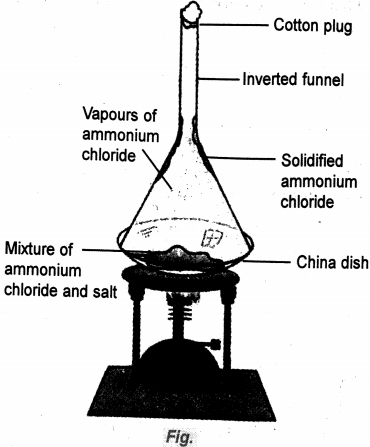
How will you separate a mixture of naphthalene powder and common salt? Draw a neat and labelled diagram to show the process.
Solution
(N/A) To separate a mixture of naphthalene powder and common salt,we use the process of sublimation.
$1$. Place the mixture in a china dish.
$2$. Invert a glass funnel over the china dish.
$3$. Plug the stem of the funnel with a cotton plug to prevent the vapours from escaping.
$4$. Place the china dish on a tripod stand and heat it using a burner.
$5$. Naphthalene,being a sublimable substance,directly converts into vapours upon heating,while common salt remains in the china dish.
$6$. The naphthalene vapours condense on the cooler inner walls of the funnel and can be scraped off,leaving pure common salt in the china dish.
$1$. Place the mixture in a china dish.
$2$. Invert a glass funnel over the china dish.
$3$. Plug the stem of the funnel with a cotton plug to prevent the vapours from escaping.
$4$. Place the china dish on a tripod stand and heat it using a burner.
$5$. Naphthalene,being a sublimable substance,directly converts into vapours upon heating,while common salt remains in the china dish.
$6$. The naphthalene vapours condense on the cooler inner walls of the funnel and can be scraped off,leaving pure common salt in the china dish.
0 likes
View Solution73
Medium
$(a)$ Both smoke and fog are aerosols. In what way are they different?
$(b)$ How do sol and gel differ from each other? Give one example for each.
$(b)$ How do sol and gel differ from each other? Give one example for each.
Solution
(N/A) Smoke and fog differ in their dispersed phase. In smoke,the dispersed phase is solid,and in fog,the dispersed phase is liquid,while the dispersion medium is gas in both cases.
$(b)$ Sol: The dispersed phase is solid and the dispersion medium is liquid. Example: Mud.
Gel: The dispersed phase is liquid and the dispersion medium is solid. Example: Butter or cheese.
$(b)$ Sol: The dispersed phase is solid and the dispersion medium is liquid. Example: Mud.
Gel: The dispersed phase is liquid and the dispersion medium is solid. Example: Butter or cheese.
0 likes
View Solution74
Difficult
You are provided with a solution of substance $'X'$. How will you test whether it is saturated or unsaturated with respect to $'X'$ at a given temperature? What happens when a hot saturated solution is allowed to cool?
Solution
(N/A) To test if a solution is saturated or unsaturated,add more of the solute $'X'$ to the solution at the same temperature while stirring.
$1$. If the added solute $'X'$ dissolves completely,the solution is unsaturated.
$2$. If the added solute $'X'$ remains undissolved and settles at the bottom,the solution is saturated.
When a hot saturated solution is allowed to cool,the solubility of the solute decreases,causing the excess solute to crystallize and separate out from the solution.
$1$. If the added solute $'X'$ dissolves completely,the solution is unsaturated.
$2$. If the added solute $'X'$ remains undissolved and settles at the bottom,the solution is saturated.
When a hot saturated solution is allowed to cool,the solubility of the solute decreases,causing the excess solute to crystallize and separate out from the solution.
0 likes
View Solution75
Medium
Distinguish between miscible and immiscible liquids. Name the techniques used to separate these liquids.
Solution
(N/A) Miscible liquids: These liquids mix with each other completely to form a single phase.
Immiscible liquids: These liquids do not mix with each other and form separate layers.
Techniques for separation:
$1$. For miscible liquids: Distillation or fractional distillation is used based on the difference in their boiling points.
$2$. For immiscible liquids: $A$ separating funnel is used to separate them based on the difference in their densities.
Immiscible liquids: These liquids do not mix with each other and form separate layers.
Techniques for separation:
$1$. For miscible liquids: Distillation or fractional distillation is used based on the difference in their boiling points.
$2$. For immiscible liquids: $A$ separating funnel is used to separate them based on the difference in their densities.
0 likes
View Solution76
MediumMCQ
What volume of ethyl alcohol and water must be mixed together to prepare $250 \, mL$ of $60 \%$ by volume of alcohol in water?
A
$150 \, mL$ of ethyl alcohol and $100 \, mL$ of water
B
$100 \, mL$ of ethyl alcohol and $150 \, mL$ of water
C
$125 \, mL$ of ethyl alcohol and $125 \, mL$ of water
D
$140 \, mL$ of ethyl alcohol and $110 \, mL$ of water
Solution
(A) Let the volume of ethyl alcohol be $x \, mL$.
The formula for volume percentage is:
$\text{Concentration} = \frac{\text{Volume of solute (ethyl alcohol)}}{\text{Total volume of solution}} \times 100$
Given:
Total volume of solution = $250 \, mL$
Concentration = $60 \%$
Substituting the values:
$60 = \frac{x}{250} \times 100$
$x = \frac{60 \times 250}{100} = 150 \, mL$
Therefore,the volume of ethyl alcohol required is $150 \, mL$.
The volume of water required = Total volume - Volume of ethyl alcohol
$= 250 \, mL - 150 \, mL = 100 \, mL$.
Thus,$150 \, mL$ of ethyl alcohol and $100 \, mL$ of water must be mixed.
The formula for volume percentage is:
$\text{Concentration} = \frac{\text{Volume of solute (ethyl alcohol)}}{\text{Total volume of solution}} \times 100$
Given:
Total volume of solution = $250 \, mL$
Concentration = $60 \%$
Substituting the values:
$60 = \frac{x}{250} \times 100$
$x = \frac{60 \times 250}{100} = 150 \, mL$
Therefore,the volume of ethyl alcohol required is $150 \, mL$.
The volume of water required = Total volume - Volume of ethyl alcohol
$= 250 \, mL - 150 \, mL = 100 \, mL$.
Thus,$150 \, mL$ of ethyl alcohol and $100 \, mL$ of water must be mixed.
0 likes
View Solution77
Medium
Compare physical and chemical changes.
Solution
(N/A)
| Physical Change | Chemical Change |
|---|---|
| $1$. No new substances are formed during a physical change. | $1$. New substances having different properties are formed. |
| $2$. The substance can easily be brought back to its original state,i.e.,it is a reversible process. | $2$. It is mostly an irreversible process. |
0 likes
View Solution78
MediumMCQ
The concentration of a salt solution in terms of mass by mass percentage is $20 \%$ and the mass of the solution is $550 \text{ g}$. Determine the mass of solute present in the solution. (in $\text{ g}$)
A
$100$
B
$110$
C
$120$
D
$130$
Solution
(B) The formula for mass by mass percentage of a solution is given by:
$\text{Mass by mass percentage} = \frac{\text{Mass of solute}}{\text{Mass of solution}} \times 100$
Given:
$\text{Mass by mass percentage} = 20 \%$
$\text{Mass of solution} = 550 \text{ g}$
Substituting the values into the formula:
$20 = \frac{\text{Mass of solute}}{550 \text{ g}} \times 100$
Rearranging to solve for the mass of solute:
$\text{Mass of solute} = \frac{20 \times 550}{100} \text{ g}$
$\text{Mass of solute} = 20 \times 5.5 \text{ g} = 110 \text{ g}$
Therefore,the mass of solute present in the solution is $110 \text{ g}$.
$\text{Mass by mass percentage} = \frac{\text{Mass of solute}}{\text{Mass of solution}} \times 100$
Given:
$\text{Mass by mass percentage} = 20 \%$
$\text{Mass of solution} = 550 \text{ g}$
Substituting the values into the formula:
$20 = \frac{\text{Mass of solute}}{550 \text{ g}} \times 100$
Rearranging to solve for the mass of solute:
$\text{Mass of solute} = \frac{20 \times 550}{100} \text{ g}$
$\text{Mass of solute} = 20 \times 5.5 \text{ g} = 110 \text{ g}$
Therefore,the mass of solute present in the solution is $110 \text{ g}$.
0 likes
View Solution79
Medium
$(a)$ Define an element.
$(b)$ Identify non-metals from the following elements: Carbon,Potassium,Silicon,Chlorine,Mercury.
$(b)$ Identify non-metals from the following elements: Carbon,Potassium,Silicon,Chlorine,Mercury.
Solution
(B) An element is a basic form of matter that cannot be broken down into simpler substances by chemical reactions.
$(b)$ Carbon,Silicon,and Chlorine are non-metals.
$(b)$ Carbon,Silicon,and Chlorine are non-metals.
0 likes
View Solution80
Medium
What would you observe when:
$(a)$ a saturated solution of potassium chloride prepared at $60^{\circ} C$ is allowed to cool at room temperature?
$(b)$ an aqueous sugar solution is heated to dryness?
$(c)$ a mixture of iron filings and sulphur powder is heated strongly?
$(a)$ a saturated solution of potassium chloride prepared at $60^{\circ} C$ is allowed to cool at room temperature?
$(b)$ an aqueous sugar solution is heated to dryness?
$(c)$ a mixture of iron filings and sulphur powder is heated strongly?
Solution
(N/A) Solid potassium chloride will separate out as crystals because the solubility of the salt decreases with a decrease in temperature.
$(b)$ Initially,the water will evaporate,leaving behind sugar crystals. Upon further heating,the sugar will get charred (decomposed into carbon).
$(c)$ $A$ chemical reaction occurs,and iron sulphide $(FeS)$ will be formed,which is a new substance with different properties.
$(b)$ Initially,the water will evaporate,leaving behind sugar crystals. Upon further heating,the sugar will get charred (decomposed into carbon).
$(c)$ $A$ chemical reaction occurs,and iron sulphide $(FeS)$ will be formed,which is a new substance with different properties.
0 likes
View Solution81
EasyMCQ
Smoke and fog both are aerosols. In what way are they different?
A
Fog has a solid dispersed phase,while smoke has a liquid dispersed phase.
B
Fog has a liquid dispersed phase,while smoke has a solid dispersed phase.
C
Fog has a gas dispersed phase,while smoke has a liquid dispersed phase.
D
Fog has a solid dispersed phase,while smoke has a gas dispersed phase.
Solution
(B) Both fog and smoke are types of aerosols,which means they have gas as the dispersion medium.
In fog,the dispersed phase is liquid (tiny water droplets suspended in air).
In smoke,the dispersed phase is solid (fine carbon particles suspended in air).
In fog,the dispersed phase is liquid (tiny water droplets suspended in air).
In smoke,the dispersed phase is solid (fine carbon particles suspended in air).
0 likes
View Solution82
Medium
What is distillation? List two conditions essential for using this as a method of separation of components of a mixture.
Solution
(N/A) Distillation: This is a process of separating components of a mixture by heating a liquid to form vapours and then cooling the vapours to get back the liquid.
$(b)$ Two essential conditions for distillation are:
$(i)$ The components of the mixture must be miscible liquids.
$(ii)$ There should be a significant difference in the boiling points of the components (usually greater than $25 \ K$ for simple distillation,though the question implies general conditions for separation).
$(b)$ Two essential conditions for distillation are:
$(i)$ The components of the mixture must be miscible liquids.
$(ii)$ There should be a significant difference in the boiling points of the components (usually greater than $25 \ K$ for simple distillation,though the question implies general conditions for separation).
0 likes
View Solution83
Medium
What is chromatography? Mention its applications.
Solution
(N/A) Chromatography is a laboratory technique used for the separation of a mixture into its individual components. It works on the principle that different components of a mixture move at different rates through a stationary phase when carried by a mobile phase.
Applications:
$(a)$ Separation of colours in a dye.
$(b)$ Separation of pigments from natural colours (e.g.,chlorophyll from plant extracts).
$(c)$ Separation of drugs from blood.
Applications:
$(a)$ Separation of colours in a dye.
$(b)$ Separation of pigments from natural colours (e.g.,chlorophyll from plant extracts).
$(c)$ Separation of drugs from blood.
0 likes
View Solution84
Medium
Why is blood a mixture and graphite an element? Mention any one reason for each.
Solution
(N/A) Blood is considered a mixture because its components (such as plasma,red blood cells,white blood cells,and platelets) can be separated by physical methods like centrifugation,and their composition varies from person to person.
Graphite is considered an element because it is composed of only one kind of atom (carbon atoms) and it cannot be broken down into simpler substances by chemical or physical means.
Graphite is considered an element because it is composed of only one kind of atom (carbon atoms) and it cannot be broken down into simpler substances by chemical or physical means.
0 likes
View Solution85
Easy
What is a solution? On which factors is a solution said to be diluted,concentrated,or saturated?
Solution
(N/A) solution is a homogeneous mixture of two or more substances.
$A$ solution is classified as diluted,concentrated,or saturated based on the amount of solute dissolved in a given amount of solvent at a specific temperature.
$1$. Diluted solution: $A$ solution containing a relatively small amount of solute in a given volume of solvent.
$2$. Concentrated solution: $A$ solution containing a relatively large amount of solute in a given volume of solvent.
$3$. Saturated solution: $A$ solution in which no more solute can be dissolved at a given temperature.
$A$ solution is classified as diluted,concentrated,or saturated based on the amount of solute dissolved in a given amount of solvent at a specific temperature.
$1$. Diluted solution: $A$ solution containing a relatively small amount of solute in a given volume of solvent.
$2$. Concentrated solution: $A$ solution containing a relatively large amount of solute in a given volume of solvent.
$3$. Saturated solution: $A$ solution in which no more solute can be dissolved at a given temperature.
0 likes
View Solution86
MediumMCQ
What is tincture of iodine? Identify the solute and solvent in 'tincture of iodine.' Why is the Tyndall effect not seen in a true solution?
A
Tincture of iodine is a solution of iodine in water.
B
Solute is alcohol and solvent is iodine.
C
Tyndall effect is not seen because particles are large.
D
Tincture of iodine is a solution of iodine in alcohol; solute is iodine,solvent is alcohol; Tyndall effect is not seen because particle size is extremely small.
Solution
(D) solution of iodine in alcohol is known as 'tincture of iodine'.
Solute $-$ Iodine $(I_2)$
Solvent $-$ Alcohol (usually ethanol)
The Tyndall effect is not seen in a true solution because the particle size of the solute is extremely small (less than $1 \ nm$ in diameter). Due to this small size,the particles are unable to scatter the beam of light passing through the solution.
Solute $-$ Iodine $(I_2)$
Solvent $-$ Alcohol (usually ethanol)
The Tyndall effect is not seen in a true solution because the particle size of the solute is extremely small (less than $1 \ nm$ in diameter). Due to this small size,the particles are unable to scatter the beam of light passing through the solution.
0 likes
View Solution87
Medium
$(a)$ What is the effect of temperature on the solubility of a solid in a liquid?
$(b)$ Why is it possible to distinguish the particles of solute from those of solvent in a suspension?
$(b)$ Why is it possible to distinguish the particles of solute from those of solvent in a suspension?
Solution
(N/A) For most solid solutes,solubility increases as the temperature increases,and solubility decreases as the temperature decreases.
$(b)$ It is possible to distinguish the particles of solute from those of solvent in a suspension because the particle size in a suspension is relatively large (greater than $100 \ nm$),making them visible to the naked eye.
$(b)$ It is possible to distinguish the particles of solute from those of solvent in a suspension because the particle size in a suspension is relatively large (greater than $100 \ nm$),making them visible to the naked eye.
0 likes
View Solution88
MediumMCQ
How much water should be added to $15 \, g$ of salt to obtain a $15 \%$ salt solution (in $, g$)?
A
$85$
B
$100$
C
$15$
D
$75$
Solution
(A) The concentration of a solution is defined as the mass of the solute divided by the total mass of the solution,multiplied by $100$.
Given: Mass of solute (salt) $= 15 \, g$.
Let the mass of water (solvent) to be added be $X \, g$.
Total mass of the solution $= \text{Mass of solute} + \text{Mass of solvent} = 15 + X$.
Concentration of the solution $= 15 \%$.
Using the formula: $\text{Concentration} = (\text{Mass of solute} / \text{Total mass of solution}) \times 100$.
$15 = (15 / (15 + X)) \times 100$.
Dividing both sides by $15$: $1 = (1 / (15 + X)) \times 100$.
$15 + X = 100$.
$X = 100 - 15 = 85 \, g$.
Therefore,$85 \, g$ of water must be added.
Given: Mass of solute (salt) $= 15 \, g$.
Let the mass of water (solvent) to be added be $X \, g$.
Total mass of the solution $= \text{Mass of solute} + \text{Mass of solvent} = 15 + X$.
Concentration of the solution $= 15 \%$.
Using the formula: $\text{Concentration} = (\text{Mass of solute} / \text{Total mass of solution}) \times 100$.
$15 = (15 / (15 + X)) \times 100$.
Dividing both sides by $15$: $1 = (1 / (15 + X)) \times 100$.
$15 + X = 100$.
$X = 100 - 15 = 85 \, g$.
Therefore,$85 \, g$ of water must be added.
0 likes
View Solution89
Medium
Define a solution. Give an example of $(i)$ gas in liquid solution $(ii)$ gas in gas solution.
Solution
(N/A) solution is a homogeneous mixture of two or more substances.
$(i)$ Gas in liquid solution: Aerated cold drinks (carbon dioxide gas dissolved in water).
$(ii)$ Gas in gas solution: Air (a mixture of various gases like nitrogen,oxygen,argon,etc.).
$(i)$ Gas in liquid solution: Aerated cold drinks (carbon dioxide gas dissolved in water).
$(ii)$ Gas in gas solution: Air (a mixture of various gases like nitrogen,oxygen,argon,etc.).
0 likes
View Solution90
Medium
Compare in tabular form the properties of true solution and colloids with respect to Tyndall effect and stability.
Solution
(N/A)
$1$. $\text{Tyndall effect}$: In a true solution,the particles are too small to scatter light,so it does not show the Tyndall effect. In colloids,the particles are large enough to scatter a beam of light passing through them,thus exhibiting the Tyndall effect.
$2$. $\text{Stability}$: True solutions are highly stable as the solute particles do not settle down. Colloids are also stable,but the dispersed phase particles can be separated from the dispersion medium using the process of centrifugation.
| Property | True Solution | Colloid |
|---|---|---|
| Tyndall effect | Does not show Tyndall effect | Shows Tyndall effect |
| Stability | Stable | Stable (can be separated by centrifugation) |
$1$. $\text{Tyndall effect}$: In a true solution,the particles are too small to scatter light,so it does not show the Tyndall effect. In colloids,the particles are large enough to scatter a beam of light passing through them,thus exhibiting the Tyndall effect.
$2$. $\text{Stability}$: True solutions are highly stable as the solute particles do not settle down. Colloids are also stable,but the dispersed phase particles can be separated from the dispersion medium using the process of centrifugation.
0 likes
View Solution91
Medium
Sidak took $50\, mL$ of water in two beakers at room temperature and added sodium chloride to one beaker while sugar to the other,until no more solute could be dissolved. Then she heated the contents of the beakers and added more solutes in them.
$(a)$ Will the amount of salt and sugar that can be dissolved in water at a given temperature be the same?
$(b)$ What would you expect to happen if she cools the contents of the beakers? Justify your answer.
$(a)$ Will the amount of salt and sugar that can be dissolved in water at a given temperature be the same?
$(b)$ What would you expect to happen if she cools the contents of the beakers? Justify your answer.
Solution
(N/A) No,the amount of salt and sugar that can be dissolved in water at a given temperature is not the same. Solubility is a characteristic property of a substance and varies depending on the nature of the solute.
$(b)$ If she cools the contents of the beakers,crystals of salt and sugar will appear. This happens because the solubility of a solid in a liquid generally decreases as the temperature decreases. As the solution cools,it becomes supersaturated,causing the excess solute to precipitate out in the form of crystals.
$(b)$ If she cools the contents of the beakers,crystals of salt and sugar will appear. This happens because the solubility of a solid in a liquid generally decreases as the temperature decreases. As the solution cools,it becomes supersaturated,causing the excess solute to precipitate out in the form of crystals.
0 likes
View Solution92
Medium
When a bar magnet is brought closer to a mixture of iron filings and sulphur powder,iron particles stick to the magnet,whereas in the case of iron sulphide,no change is observed. When a mixture of iron and sulphur is added to carbon disulphide,sulphur dissolves,whereas in the case of iron sulphide,no change is observed. Justify the statement that the properties of a compound are different from its constituents,while a mixture shows the properties of its constituent elements using the example of iron and sulphur.
Solution
(N/A) $1$. $A$ mixture of iron filings and sulphur powder retains the individual properties of its constituents. Iron particles are attracted by a magnet,and sulphur is soluble in carbon disulphide $(CS_2)$. This demonstrates that the components in a mixture do not lose their identity.
$2$. Iron sulphide $(FeS)$ is a compound formed by the chemical reaction between iron and sulphur. In a compound,the constituent elements lose their original properties. Therefore,iron sulphide is not attracted by a magnet,and sulphur does not dissolve in carbon disulphide.
$3$. Thus,it is justified that a mixture exhibits the properties of its constituents,whereas a compound possesses entirely new properties different from its constituent elements.
$2$. Iron sulphide $(FeS)$ is a compound formed by the chemical reaction between iron and sulphur. In a compound,the constituent elements lose their original properties. Therefore,iron sulphide is not attracted by a magnet,and sulphur does not dissolve in carbon disulphide.
$3$. Thus,it is justified that a mixture exhibits the properties of its constituents,whereas a compound possesses entirely new properties different from its constituent elements.
0 likes
View Solution93
EasyMCQ
$A$ solution contains $50 \, g$ of sugar in $350 \, g$ of water. Calculate the concentration of the solution in terms of mass by mass percentage of the solution. (in $\%$)
A
$12.5$
B
$14.28$
C
$15.0$
D
$10.0$
Solution
(A) The concentration of a solution is calculated using the formula:
$\text{Concentration} = \frac{\text{Mass of solute}}{\text{Mass of solution}} \times 100$
Here,the mass of the solute (sugar) = $50 \, g$.
The mass of the solvent (water) = $350 \, g$.
The total mass of the solution = $\text{Mass of solute} + \text{Mass of solvent} = 50 \, g + 350 \, g = 400 \, g$.
Now,substituting the values into the formula:
$\text{Concentration} = \frac{50}{400} \times 100 = \frac{1}{8} \times 100 = 12.5 \%$.
Thus,the concentration of the solution is $12.5 \%$.
$\text{Concentration} = \frac{\text{Mass of solute}}{\text{Mass of solution}} \times 100$
Here,the mass of the solute (sugar) = $50 \, g$.
The mass of the solvent (water) = $350 \, g$.
The total mass of the solution = $\text{Mass of solute} + \text{Mass of solvent} = 50 \, g + 350 \, g = 400 \, g$.
Now,substituting the values into the formula:
$\text{Concentration} = \frac{50}{400} \times 100 = \frac{1}{8} \times 100 = 12.5 \%$.
Thus,the concentration of the solution is $12.5 \%$.
0 likes
View Solution94
Medium
Enumerate any two differences between simple distillation and fractional distillation.
Solution
(N/A)
| Simple distillation | Fractional distillation |
| $(i)$ Used to separate a mixture of two or more miscible liquids for which the difference in boiling point $(b.p.)$ is more than $25^{\circ} C$. | $(i)$ Used to separate two or more miscible liquids for which the difference in boiling point $(b.p.)$ is less than $25^{\circ} C$. |
| $(ii)$ $A$ fractionating column is not used. | $(ii)$ $A$ fractionating column is used to provide more surface area for cooling and condensation. |
0 likes
View Solution95
Medium
How are mixtures different from compounds?
Solution
(N/A)
| Parameters | Compounds vs Mixtures |
|---|---|
| Composition | Compounds have a fixed composition,whereas mixtures have a variable composition. |
| Melting and Boiling point | Compounds have sharp melting and boiling points,while mixtures do not. |
| Properties of constituents | In compounds,constituents lose their individual properties. In mixtures,constituents retain their original properties. |
| Separation | Compounds can only be separated by chemical methods,while mixtures can be separated by physical methods. |
0 likes
View Solution96
Medium
$(a)$ State the difference between a pure substance and a mixture. Give one example of each.
$(b)$ Identify homogeneous mixtures from the following:
$(i)$ Smoke
$(ii)$ Brass
$(iii)$ Tincture of iodine
$(iv)$ Milk
$(b)$ Identify homogeneous mixtures from the following:
$(i)$ Smoke
$(ii)$ Brass
$(iii)$ Tincture of iodine
$(iv)$ Milk
Solution
$(II, III)$ Pure substance consists of particles of only one kind of matter. These can be elements or compounds; for example, $Gold$ or $Water$. $A$ mixture is obtained by mixing two or more different elements or compounds which do not react chemically; for example, $Salt$ solution in water.
$(b)$ The homogeneous mixtures are:
$(ii)$ $Brass$ (an alloy of copper and zinc).
$(iii)$ $Tincture$ of iodine (a solution of iodine in alcohol).
$(b)$ The homogeneous mixtures are:
$(ii)$ $Brass$ (an alloy of copper and zinc).
$(iii)$ $Tincture$ of iodine (a solution of iodine in alcohol).
0 likes
View Solution97
Medium
Which of the following will show Tyndall effect? Why?
$(a)$ Salt solution
$(b)$ Milk
$(c)$ Copper sulphate solution
$(d)$ Starch solution.
$(a)$ Salt solution
$(b)$ Milk
$(c)$ Copper sulphate solution
$(d)$ Starch solution.
Solution
(B, D) Milk and starch solution will show the Tyndall effect.
This is because both milk and starch solution are colloidal solutions.
Colloidal particles are large enough to scatter a beam of light passing through them,which makes the path of light visible.
This phenomenon of scattering of light by colloidal particles is known as the Tyndall effect.
Salt solution and copper sulphate solution are true solutions,where particles are too small to scatter light.
This is because both milk and starch solution are colloidal solutions.
Colloidal particles are large enough to scatter a beam of light passing through them,which makes the path of light visible.
This phenomenon of scattering of light by colloidal particles is known as the Tyndall effect.
Salt solution and copper sulphate solution are true solutions,where particles are too small to scatter light.
0 likes
View Solution98
MediumMCQ
What volume of ethyl alcohol and water must be mixed together to prepare $250 \, mL$ of $50 \%$ by volume of alcohol in water?
A
$125 \, mL$ of ethyl alcohol and $125 \, mL$ of water
B
$100 \, mL$ of ethyl alcohol and $150 \, mL$ of water
C
$150 \, mL$ of ethyl alcohol and $100 \, mL$ of water
D
$50 \, mL$ of ethyl alcohol and $200 \, mL$ of water
Solution
(A) The concentration of a solution by volume is given by the formula:
Concentration $(\% v/v) = \frac{\text{Volume of solute}}{\text{Total volume of solution}} \times 100$
Given,total volume of solution = $250 \, mL$ and concentration = $50 \%$.
Let the volume of ethyl alcohol (solute) be $x \, mL$.
$50 = \frac{x}{250} \times 100$
$x = \frac{50 \times 250}{100} = 125 \, mL$.
Therefore,the volume of ethyl alcohol required is $125 \, mL$.
The volume of water (solvent) required = Total volume - Volume of ethyl alcohol = $250 \, mL - 125 \, mL = 125 \, mL$.
Thus,$125 \, mL$ of ethyl alcohol and $125 \, mL$ of water must be mixed.
Concentration $(\% v/v) = \frac{\text{Volume of solute}}{\text{Total volume of solution}} \times 100$
Given,total volume of solution = $250 \, mL$ and concentration = $50 \%$.
Let the volume of ethyl alcohol (solute) be $x \, mL$.
$50 = \frac{x}{250} \times 100$
$x = \frac{50 \times 250}{100} = 125 \, mL$.
Therefore,the volume of ethyl alcohol required is $125 \, mL$.
The volume of water (solvent) required = Total volume - Volume of ethyl alcohol = $250 \, mL - 125 \, mL = 125 \, mL$.
Thus,$125 \, mL$ of ethyl alcohol and $125 \, mL$ of water must be mixed.
0 likes
View Solution99
Medium
Compare solution,suspension,and colloids in terms of:
$(a)$ stability
$(b)$ filterability
$(c)$ Tyndall effect
$(a)$ stability
$(b)$ filterability
$(c)$ Tyndall effect
Solution
(N/A)
Detailed Explanation:
$1$. Stability: Solutions and colloids are stable as their particles do not settle down over time. Suspensions are unstable because the solute particles settle down when left undisturbed.
$2$. Filterability: Particles in solutions and colloids are too small to be separated by filtration. In suspensions,particles are large enough to be separated by filter paper.
$3$. Tyndall effect: Colloids exhibit the Tyndall effect due to the scattering of light by dispersed particles. Solutions do not show this effect because particles are too small. Suspensions generally do not show the Tyndall effect as particles are too large and may settle,though they can scatter light if particles are suspended.
| Property | Solution | Suspension | Colloid |
|---|---|---|---|
| $(a)$ Stability | Stable | Unstable | Stable |
| $(b)$ Filterability | Cannot be filtered | Can be filtered | Cannot be filtered |
| $(c)$ Tyndall effect | Does not show | Does not show | Shows |
Detailed Explanation:
$1$. Stability: Solutions and colloids are stable as their particles do not settle down over time. Suspensions are unstable because the solute particles settle down when left undisturbed.
$2$. Filterability: Particles in solutions and colloids are too small to be separated by filtration. In suspensions,particles are large enough to be separated by filter paper.
$3$. Tyndall effect: Colloids exhibit the Tyndall effect due to the scattering of light by dispersed particles. Solutions do not show this effect because particles are too small. Suspensions generally do not show the Tyndall effect as particles are too large and may settle,though they can scatter light if particles are suspended.
0 likes
View Solution100
Medium
Differentiate between an element and a compound (any two points). Give one example each.
Solution
(N/A)
Example of an element: $Copper (Cu)$.
Example of a compound: $Water (H_{2}O)$.
| Element | Compound |
| $(1)$ It is the simplest form of matter that cannot be broken down into simpler substances by chemical reactions. | $(1)$ It is a substance composed of two or more elements chemically combined in a fixed proportion. |
| $(2)$ It consists of only one type of atom. | $(2)$ It can be separated into its constituent elements by chemical reactions. |
Example of an element: $Copper (Cu)$.
Example of a compound: $Water (H_{2}O)$.
0 likes
View SolutionIS MATTER AROUND US PURE? — Mix Example - IS MATTER AROUND US PURE? · Frequently Asked Questions
1Are these IS MATTER AROUND US PURE? questions useful for JEE and NEET?
Yes. All questions in this section are mapped to JEE Main and NEET exam patterns. Previous year questions from JEE Main, NEET, GUJCET and state-level exams are included with full solutions.
2Can I switch to Hindi or Gujarati for these questions?
Yes. Use the language tabs in the hero section or the sidebar to view the same questions and solutions in English, Hindi or Gujarati.
3How do I generate a question paper from this subtopic?
Use the Vedclass Exam Paper Generator — select the chapter and subtopic, set difficulty, and generate Sets A, B, C, D automatically. First 3 chapters of every subject are free.
Vedclass Products
For Students
Vedclass Test Series
Mock tests in real JEE/NEET style with performance analysis. 5-day free trial.
Start Free TrialFor Teachers
Exam Paper Generator
Generate Set A/B/C/D papers from this chapter in 2 minutes. 3 chapters free.
Try FreeFor Institutes
Online Exam Module
Live online exams with unlimited students, 360° analytics & white-label branding.
See DemoFor Teachers & Institutes
Generate a IS MATTER AROUND US PURE? Exam Paper in 2 Minutes
Select subtopic & difficulty — Sets A, B, C, D auto-generated with No Repeat logic.
First 3 chapters of every subject are free — no payment required.