
A English
Mix Example - IS MATTER AROUND US PURE? Questions in English
Class 9 Science · IS MATTER AROUND US PURE? · Mix Example - IS MATTER AROUND US PURE?
167+
Questions
English
Language
100%
With Solutions
Showing 50 of 167 questions in English
1
MediumMCQ
Which of the following statements are true for pure substances?
$(i)$ Pure substances contain only one kind of particles.
$(ii)$ Pure substances may be compounds or mixtures.
$(iii)$ Pure substances have the same composition throughout.
$(iv)$ Pure substances can be exemplified by all elements other than nickel.
$(i)$ Pure substances contain only one kind of particles.
$(ii)$ Pure substances may be compounds or mixtures.
$(iii)$ Pure substances have the same composition throughout.
$(iv)$ Pure substances can be exemplified by all elements other than nickel.
A
$(i)$ and $(iii)$
B
$(i)$ and $(ii)$
C
$(iii)$ and $(iv)$
D
$(ii)$ and $(iii)$
Solution
(A) pure substance consists of particles of only one kind,which have the same chemical nature. Therefore,statement $(i)$ is true.
Pure substances are either elements or compounds,not mixtures. Therefore,statement $(ii)$ is false.
Pure substances have a fixed composition and properties throughout,meaning they are homogeneous. Therefore,statement $(iii)$ is true.
Elements like nickel are pure substances. Statement $(iv)$ claims that all elements except nickel are pure substances,which is incorrect because nickel is also a pure substance. Therefore,statement $(iv)$ is false.
Thus,statements $(i)$ and $(iii)$ are correct.
Pure substances are either elements or compounds,not mixtures. Therefore,statement $(ii)$ is false.
Pure substances have a fixed composition and properties throughout,meaning they are homogeneous. Therefore,statement $(iii)$ is true.
Elements like nickel are pure substances. Statement $(iv)$ claims that all elements except nickel are pure substances,which is incorrect because nickel is also a pure substance. Therefore,statement $(iv)$ is false.
Thus,statements $(i)$ and $(iii)$ are correct.
0 likes
View Solution2
EasyMCQ
Rusting of an article made up of iron is called
A
corrosion and it is a physical as well as chemical change
B
corrosion and it is a chemical change
C
dissolution and it is a physical change
D
dissolution and it is a chemical change
Solution
(B) Rusting of iron is a process where iron reacts with oxygen and moisture to form hydrated iron$(III)$ oxide.
This process is known as corrosion.
Since a new substance is formed and the process is irreversible,it is classified as a chemical change.
This process is known as corrosion.
Since a new substance is formed and the process is irreversible,it is classified as a chemical change.
0 likes
View Solution3
MediumMCQ
$A$ mixture of sulphur and carbon disulphide is
A
heterogeneous and shows Tyndall effect
B
homogeneous and shows Tyndall effect
C
homogeneous and does not show Tyndall effect
D
heterogeneous and does not show Tyndall effect
Solution
(C) solution is a homogeneous mixture and does not show the Tyndall effect.
Colloids and suspensions are heterogeneous mixtures and exhibit the Tyndall effect.
The mixture of sulphur and carbon disulphide forms a true solution,as sulphur dissolves completely in carbon disulphide.
Colloids and suspensions are heterogeneous mixtures and exhibit the Tyndall effect.
The mixture of sulphur and carbon disulphide forms a true solution,as sulphur dissolves completely in carbon disulphide.
0 likes
View Solution4
MediumMCQ
Tincture of iodine has antiseptic properties. This solution is made by dissolving
A
iodine in potassium iodide
B
iodine in vaseline
C
iodine in water
D
iodine in alcohol
Solution
(D) Tincture of iodine is a well-known antiseptic solution.
It is prepared by dissolving a small amount of iodine $(I_2)$ in a mixture of alcohol and water.
Therefore,the correct composition is iodine dissolved in alcohol.
It is prepared by dissolving a small amount of iodine $(I_2)$ in a mixture of alcohol and water.
Therefore,the correct composition is iodine dissolved in alcohol.
0 likes
View Solution5
MediumMCQ
Which of the following are homogeneous in nature?
$(i)$ ice $(ii)$ wood $(iii)$ soil $(iv)$ air
$(i)$ ice $(ii)$ wood $(iii)$ soil $(iv)$ air
A
$(i)$ and $(iv)$
B
$(ii)$ and $(iv)$
C
$(i)$ and $(iii)$
D
$(iii)$ and $(iv)$
Solution
(A) homogeneous mixture is one that has a uniform composition throughout its mass.
$(i)$ Ice is a pure substance ($H_2O$ in solid state),which is homogeneous.
$(ii)$ Wood is a complex,heterogeneous mixture of cellulose,lignin,and other organic compounds.
$(iii)$ Soil is a heterogeneous mixture containing various particles,minerals,and organic matter.
$(iv)$ Air is a homogeneous mixture of various gases like nitrogen,oxygen,argon,and carbon dioxide.
Therefore,$(i)$ and $(iv)$ are homogeneous in nature.
$(i)$ Ice is a pure substance ($H_2O$ in solid state),which is homogeneous.
$(ii)$ Wood is a complex,heterogeneous mixture of cellulose,lignin,and other organic compounds.
$(iii)$ Soil is a heterogeneous mixture containing various particles,minerals,and organic matter.
$(iv)$ Air is a homogeneous mixture of various gases like nitrogen,oxygen,argon,and carbon dioxide.
Therefore,$(i)$ and $(iv)$ are homogeneous in nature.
0 likes
View Solution6
MediumMCQ
Which of the following are physical changes?
$(i)$ Melting of iron metal
$(ii)$ Rusting of iron
$(iii)$ Bending of an iron rod
$(iv)$ Drawing a wire of iron metal
$(i)$ Melting of iron metal
$(ii)$ Rusting of iron
$(iii)$ Bending of an iron rod
$(iv)$ Drawing a wire of iron metal
A
$(i), (ii)$ and $(iii)$
B
$(i), (iii)$ and $(iv)$
C
$(i), (ii)$ and $(iv)$
D
$(ii), (iii)$ and $(iv)$
Solution
(B) physical change is a change in which no new substance is formed and the chemical composition of the substance remains the same.
$(i)$ Melting of iron metal is a physical change because it only involves a change in the state of matter.
$(ii)$ Rusting of iron is a chemical change because iron reacts with oxygen and moisture to form iron oxide,which is a new substance.
$(iii)$ Bending of an iron rod is a physical change because it only involves a change in the shape of the metal.
$(iv)$ Drawing a wire of iron metal is a physical change because it involves a change in the shape/form of the metal without changing its chemical identity.
Therefore,$(i), (iii),$ and $(iv)$ are physical changes.
$(i)$ Melting of iron metal is a physical change because it only involves a change in the state of matter.
$(ii)$ Rusting of iron is a chemical change because iron reacts with oxygen and moisture to form iron oxide,which is a new substance.
$(iii)$ Bending of an iron rod is a physical change because it only involves a change in the shape of the metal.
$(iv)$ Drawing a wire of iron metal is a physical change because it involves a change in the shape/form of the metal without changing its chemical identity.
Therefore,$(i), (iii),$ and $(iv)$ are physical changes.
0 likes
View Solution7
MediumMCQ
Which of the following are chemical changes?
$(i)$ Decaying of wood
$(ii)$ Burning of wood
$(iii)$ Sawing of wood
$(iv)$ Hammering of a nail into a piece of wood
$(i)$ Decaying of wood
$(ii)$ Burning of wood
$(iii)$ Sawing of wood
$(iv)$ Hammering of a nail into a piece of wood
A
$(iii)$ and $(iv)$
B
$(ii)$ and $(iii)$
C
$(i)$ and $(ii)$
D
$(i)$ and $(iv)$
Solution
(C) chemical change is a process where one or more substances are altered into one or more new and different substances.
$(i)$ Decaying of wood: This is a chemical change because microorganisms break down the wood into new substances.
$(ii)$ Burning of wood: This is a chemical change because wood reacts with oxygen to form carbon dioxide,water vapor,and ash,which are new substances.
$(iii)$ Sawing of wood: This is a physical change because only the shape and size of the wood change,not its chemical composition.
$(iv)$ Hammering of a nail into a piece of wood: This is a physical change as it involves a mechanical action without altering the chemical identity of the wood or the nail.
Therefore,$(i)$ and $(ii)$ are chemical changes.
$(i)$ Decaying of wood: This is a chemical change because microorganisms break down the wood into new substances.
$(ii)$ Burning of wood: This is a chemical change because wood reacts with oxygen to form carbon dioxide,water vapor,and ash,which are new substances.
$(iii)$ Sawing of wood: This is a physical change because only the shape and size of the wood change,not its chemical composition.
$(iv)$ Hammering of a nail into a piece of wood: This is a physical change as it involves a mechanical action without altering the chemical identity of the wood or the nail.
Therefore,$(i)$ and $(ii)$ are chemical changes.
0 likes
View Solution8
MediumMCQ
Two substances,$A$ and $B$,were made to react to form a third substance,$A_2B$,according to the following reaction: $2A + B \to A_2B$. Which of the following statements concerning this reaction are incorrect?
$(i)$ The product $A_2B$ shows the properties of substances $A$ and $B$.
$(ii)$ The product will always have a fixed composition.
$(iii)$ The product so formed cannot be classified as a compound.
$(iv)$ The product so formed is an element.
$(i)$ The product $A_2B$ shows the properties of substances $A$ and $B$.
$(ii)$ The product will always have a fixed composition.
$(iii)$ The product so formed cannot be classified as a compound.
$(iv)$ The product so formed is an element.
A
$(i), (ii)$ and $(iii)$
B
$(i), (iii)$ and $(iv)$
C
$(ii), (iii)$ and $(iv)$
D
$(ii), (iv)$ and $(i)$
Solution
(B) The reaction $2A + B \to A_2B$ represents the formation of a chemical compound.
$(i)$ Incorrect: $A$ chemical compound $(A_2B)$ has properties entirely different from the constituent elements ($A$ and $B$).
$(ii)$ Correct: $A$ compound always has a fixed composition by mass.
$(iii)$ Incorrect: Since $A_2B$ is formed by the chemical combination of two substances in a fixed ratio,it is classified as a compound.
$(iv)$ Incorrect: $A_2B$ is a compound,not an element,as it consists of two different types of atoms chemically bonded together.
Therefore,statements $(i), (iii),$ and $(iv)$ are incorrect.
$(i)$ Incorrect: $A$ chemical compound $(A_2B)$ has properties entirely different from the constituent elements ($A$ and $B$).
$(ii)$ Correct: $A$ compound always has a fixed composition by mass.
$(iii)$ Incorrect: Since $A_2B$ is formed by the chemical combination of two substances in a fixed ratio,it is classified as a compound.
$(iv)$ Incorrect: $A_2B$ is a compound,not an element,as it consists of two different types of atoms chemically bonded together.
Therefore,statements $(i), (iii),$ and $(iv)$ are incorrect.
0 likes
View Solution9
MediumMCQ
Two chemical species $X$ and $Y$ combine together to form a product $P$ which contains both $X$ and $Y$.
$X + Y \to P$
$X$ and $Y$ cannot be broken down into simpler substances by simple chemical reactions. Which of the following concerning the species $X$,$Y$ and $P$ are correct?
$(i)$ $P$ is a compound
$(ii)$ $X$ and $Y$ are compounds
$(iii)$ $X$ and $Y$ are elements
$(iv)$ $P$ has a fixed composition
$X + Y \to P$
$X$ and $Y$ cannot be broken down into simpler substances by simple chemical reactions. Which of the following concerning the species $X$,$Y$ and $P$ are correct?
$(i)$ $P$ is a compound
$(ii)$ $X$ and $Y$ are compounds
$(iii)$ $X$ and $Y$ are elements
$(iv)$ $P$ has a fixed composition
A
$(i), (iii)$ and $(iv)$
B
$(i), (ii)$ and $(iv)$
C
$(ii), (iii)$ and $(iv)$
D
$(i), (iii)$ and $(iii)$
Solution
(A) $1$. According to the definition of elements,they are substances that cannot be broken down into simpler substances by simple chemical reactions. Since $X$ and $Y$ cannot be broken down,they are elements.
$2$. When two or more elements combine chemically in a fixed proportion,they form a compound. Here,$X$ and $Y$ combine to form $P$,so $P$ is a compound.
$3$. Compounds always have a fixed composition by mass.
$4$. Therefore,statements $(i)$,$(iii)$,and $(iv)$ are correct.
$2$. When two or more elements combine chemically in a fixed proportion,they form a compound. Here,$X$ and $Y$ combine to form $P$,so $P$ is a compound.
$3$. Compounds always have a fixed composition by mass.
$4$. Therefore,statements $(i)$,$(iii)$,and $(iv)$ are correct.
0 likes
View Solution10
Medium
Suggest separation technique$(s)$ one would need to employ to separate the following mixtures:
$(a)$ Mercury and water
$(b)$ Potassium chloride and ammonium chloride
$(c)$ Common salt,water and sand
$(d)$ Kerosene oil,water and salt
$(a)$ Mercury and water
$(b)$ Potassium chloride and ammonium chloride
$(c)$ Common salt,water and sand
$(d)$ Kerosene oil,water and salt
Solution
(N/A) Separation by using a separating funnel,as they are immiscible liquids with different densities.
$(b)$ Sublimation,as ammonium chloride sublimes upon heating while potassium chloride does not.
$(c)$ Filtration to remove sand,followed by evaporation to separate common salt from water.
$(d)$ Separation by using a separating funnel to remove kerosene oil,followed by evaporation or distillation to separate salt from water.
$(b)$ Sublimation,as ammonium chloride sublimes upon heating while potassium chloride does not.
$(c)$ Filtration to remove sand,followed by evaporation to separate common salt from water.
$(d)$ Separation by using a separating funnel to remove kerosene oil,followed by evaporation or distillation to separate salt from water.
0 likes
View Solution11
Easy
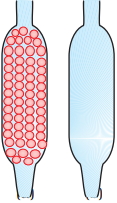
Which of the tubes in Fig. $(a)$ and $(b)$ will be more effective as a condenser in the distillation apparatus?
Solution
(A) The tube $(a)$ will be more effective as a condenser.
The presence of marbles increases the surface area available for cooling.
This allows more time for the vapours to condense,and hence it would be more effective than the column without marbles.
The presence of marbles increases the surface area available for cooling.
This allows more time for the vapours to condense,and hence it would be more effective than the column without marbles.
0 likes
View Solution12
EasyMCQ
Salt can be recovered from its solution by evaporation. Suggest some other technique for the same?
A
Distillation
B
Crystallization
C
Sublimation
D
Centrifugation
Solution
(B) Crystallization is a process that separates a pure solid in the form of its crystals from a saturated solution. It is a better technique than evaporation because evaporation can cause decomposition of some solids or contamination due to impurities,whereas crystallization provides a purer form of the substance.
0 likes
View Solution13
Medium
The 'sea-water' can be classified as a homogeneous as well as heterogeneous mixture. Comment.
Solution
(N/A) Homogeneous mixture: When we consider sea-water as a solution of various salts dissolved in water,it appears uniform throughout,making it a homogeneous mixture.
Heterogeneous mixture: In its natural state,sea-water contains not only dissolved salts but also suspended particles like mud,sand,decayed plant matter,and microorganisms. Because these components are not uniformly distributed and can be physically separated,it is classified as a heterogeneous mixture.
Heterogeneous mixture: In its natural state,sea-water contains not only dissolved salts but also suspended particles like mud,sand,decayed plant matter,and microorganisms. Because these components are not uniformly distributed and can be physically separated,it is classified as a heterogeneous mixture.
0 likes
View Solution14
Easy
While diluting a solution of salt in water,a student by mistake added acetone (boiling point $56\,^oC$). What technique can be employed to get back the acetone? Justify your choice.
Solution
(DISTILLATION) Acetone can be separated from the mixture using the technique of distillation.
Distillation is used for the separation of components of a mixture containing two miscible liquids that boil without decomposition and have sufficient difference in their boiling points.
Since the boiling point of acetone $(56\,^oC)$ is significantly lower than that of water $(100\,^oC)$,acetone will vaporize first upon heating.
The vapors can then be passed through a condenser to be collected as a liquid,effectively separating it from the salt-water solution.
Distillation is used for the separation of components of a mixture containing two miscible liquids that boil without decomposition and have sufficient difference in their boiling points.
Since the boiling point of acetone $(56\,^oC)$ is significantly lower than that of water $(100\,^oC)$,acetone will vaporize first upon heating.
The vapors can then be passed through a condenser to be collected as a liquid,effectively separating it from the salt-water solution.
0 likes
View Solution15
Medium
What would you observe when
$(a)$ a saturated solution of potassium chloride prepared at $60\,^{\circ}\text{C}$ is allowed to cool to room temperature.
$(b)$ an aqueous sugar solution is heated to dryness.
$(c)$ a mixture of iron filings and sulphur powder is heated strongly.
$(a)$ a saturated solution of potassium chloride prepared at $60\,^{\circ}\text{C}$ is allowed to cool to room temperature.
$(b)$ an aqueous sugar solution is heated to dryness.
$(c)$ a mixture of iron filings and sulphur powder is heated strongly.
Solution
(N/A) As the solubility of potassium chloride decreases with a decrease in temperature,solid potassium chloride crystals will separate out from the solution.
$(b)$ Initially,the water will evaporate,leaving behind sugar. Upon further heating,the sugar will undergo thermal decomposition and get charred (turn black).
$(c)$ Iron and sulphur react chemically to form a new compound,iron$(II)$ sulphide $(FeS)$,which is a black solid.
$(b)$ Initially,the water will evaporate,leaving behind sugar. Upon further heating,the sugar will undergo thermal decomposition and get charred (turn black).
$(c)$ Iron and sulphur react chemically to form a new compound,iron$(II)$ sulphide $(FeS)$,which is a black solid.
0 likes
View Solution16
Easy
Explain why particles of a colloidal solution do not settle down when left undisturbed,while in the case of a suspension they do.
Solution
(N/A) The particles in a colloidal solution are very small (ranging from $1 \ nm$ to $1000 \ nm$) and remain in a state of continuous random motion known as Brownian motion. This motion,along with the electrostatic repulsion between charged colloidal particles,prevents them from settling down due to gravity. In contrast,particles in a suspension are much larger (greater than $1000 \ nm$). Because of their larger size,gravity acts more effectively on them,and the intermolecular forces are not sufficient to keep them suspended,causing them to settle down when left undisturbed.
0 likes
View Solution17
EasyMCQ
Smoke and fog both are aerosols. In what way are they different?
A
Fog has a solid dispersed phase,while smoke has a liquid dispersed phase.
B
Fog has a liquid dispersed phase,while smoke has a solid dispersed phase.
C
Fog has a gas dispersed phase,while smoke has a liquid dispersed phase.
D
Fog has a solid dispersed phase,while smoke has a gas dispersed phase.
Solution
(B) Both fog and smoke are types of aerosols where the dispersion medium is a gas.
In fog,the dispersed phase is liquid (tiny water droplets suspended in air).
In smoke,the dispersed phase is solid (fine carbon or soot particles suspended in air).
In fog,the dispersed phase is liquid (tiny water droplets suspended in air).
In smoke,the dispersed phase is solid (fine carbon or soot particles suspended in air).
0 likes
View Solution18
Medium
Classify the following as physical or chemical properties:
$(a)$ The composition of a sample of steel is: $98\%$ iron,$1.5\%$ carbon,and $0.5\%$ other elements.
$(b)$ Zinc dissolves in hydrochloric acid with the evolution of hydrogen gas.
$(c)$ Metallic sodium is soft enough to be cut with a knife.
$(d)$ Most metal oxides form alkalis on interacting with water.
$(a)$ The composition of a sample of steel is: $98\%$ iron,$1.5\%$ carbon,and $0.5\%$ other elements.
$(b)$ Zinc dissolves in hydrochloric acid with the evolution of hydrogen gas.
$(c)$ Metallic sodium is soft enough to be cut with a knife.
$(d)$ Most metal oxides form alkalis on interacting with water.
Solution
(N/A) Physical properties: $(a)$ and $(c)$. These describe the inherent characteristics or composition of the substance without changing its chemical identity.
Chemical properties: $(b)$ and $(d)$. These describe the ability of a substance to undergo a specific chemical change or reaction,resulting in the formation of new substances.
Chemical properties: $(b)$ and $(d)$. These describe the ability of a substance to undergo a specific chemical change or reaction,resulting in the formation of new substances.
0 likes
View Solution19
Medium
The teacher instructed three students $A$,$B$ and $C$ respectively to prepare a $50\%$ (mass by volume) solution of sodium hydroxide $(NaOH)$. $A$ dissolved $50\,g$ of $NaOH$ in $100\,mL$ of water,$B$ dissolved $50\,g$ of $NaOH$ in $100\,g$ of water while $C$ dissolved $50\,g$ of $NaOH$ in water to make $100\,mL$ of solution. Which one of them has made the desired solution and why?
Solution
(C) Student $C$ has made the desired solution.
The formula for mass by volume percentage is:
$\text{Mass by volume } \% = \frac{\text{Mass of solute (g)}}{\text{Volume of solution (mL)}} \times 100$
For student $C$:
$\text{Mass by volume } \% = \frac{50\,g}{100\,mL} \times 100 = 50\%$
Students $A$ and $B$ did not make the correct solution because they added $50\,g$ of $NaOH$ to $100\,mL$ or $100\,g$ of solvent,which results in a total solution volume greater than $100\,mL$.
The formula for mass by volume percentage is:
$\text{Mass by volume } \% = \frac{\text{Mass of solute (g)}}{\text{Volume of solution (mL)}} \times 100$
For student $C$:
$\text{Mass by volume } \% = \frac{50\,g}{100\,mL} \times 100 = 50\%$
Students $A$ and $B$ did not make the correct solution because they added $50\,g$ of $NaOH$ to $100\,mL$ or $100\,g$ of solvent,which results in a total solution volume greater than $100\,mL$.
0 likes
View Solution20
Medium
Name the process associated with the following:
$(a)$ Dry ice is kept at room temperature and at one atmospheric pressure.
$(b)$ $A$ drop of ink placed on the surface of water contained in a glass spreads throughout the water.
$(c)$ $A$ potassium permanganate crystal is in a beaker and water is poured into the beaker with stirring.
$(d)$ An acetone bottle is left open and the bottle becomes empty.
$(e)$ Milk is churned to separate cream from it.
$(f)$ Settling of sand when a mixture of sand and water is left undisturbed for some time.
$(g)$ $A$ fine beam of light entering through a small hole in a dark room illuminates the particles in its path.
$(a)$ Dry ice is kept at room temperature and at one atmospheric pressure.
$(b)$ $A$ drop of ink placed on the surface of water contained in a glass spreads throughout the water.
$(c)$ $A$ potassium permanganate crystal is in a beaker and water is poured into the beaker with stirring.
$(d)$ An acetone bottle is left open and the bottle becomes empty.
$(e)$ Milk is churned to separate cream from it.
$(f)$ Settling of sand when a mixture of sand and water is left undisturbed for some time.
$(g)$ $A$ fine beam of light entering through a small hole in a dark room illuminates the particles in its path.
Solution
(N/A) Sublimation: Dry ice ($CO_2$ in solid state) directly converts into gas at room temperature.
$(b)$ Diffusion: The intermixing of particles of ink with water particles.
$(c)$ Dissolution/Diffusion: The solute (potassium permanganate) dissolves and spreads throughout the solvent.
$(d)$ Evaporation: Acetone has a low boiling point and turns into vapor at room temperature.
$(e)$ Centrifugation: The process of separating denser particles from lighter particles by spinning.
$(f)$ Sedimentation: The process where heavier insoluble particles settle down at the bottom due to gravity.
$(g)$ Scattering of light (Tyndall effect): The phenomenon where light is scattered by colloidal particles.
$(b)$ Diffusion: The intermixing of particles of ink with water particles.
$(c)$ Dissolution/Diffusion: The solute (potassium permanganate) dissolves and spreads throughout the solvent.
$(d)$ Evaporation: Acetone has a low boiling point and turns into vapor at room temperature.
$(e)$ Centrifugation: The process of separating denser particles from lighter particles by spinning.
$(f)$ Sedimentation: The process where heavier insoluble particles settle down at the bottom due to gravity.
$(g)$ Scattering of light (Tyndall effect): The phenomenon where light is scattered by colloidal particles.
0 likes
View Solution21
Medium
You are given two samples of water labelled as $A$ and $B$. Sample $A$ boils at $100\,^{\circ}C$ and sample $B$ boils at $102\,^{\circ}C$. Which sample of water will not freeze at $0\,^{\circ}C$? Comment.
Solution
(B) Sample $B$ will not freeze at $0\,^{\circ}C$ because it is not pure water.
At $1 \text{ atm}$ pressure,the boiling point of pure water is $100\,^{\circ}C$ and its freezing point is $0\,^{\circ}C$.
Since sample $B$ boils at $102\,^{\circ}C$,it indicates the presence of impurities (solutes) dissolved in the water.
The presence of impurities leads to the phenomenon of freezing point depression,meaning the freezing point of the solution will be lower than $0\,^{\circ}C$.
At $1 \text{ atm}$ pressure,the boiling point of pure water is $100\,^{\circ}C$ and its freezing point is $0\,^{\circ}C$.
Since sample $B$ boils at $102\,^{\circ}C$,it indicates the presence of impurities (solutes) dissolved in the water.
The presence of impurities leads to the phenomenon of freezing point depression,meaning the freezing point of the solution will be lower than $0\,^{\circ}C$.
0 likes
View Solution22
MediumMCQ
What are the favourable qualities given to gold when it is alloyed with copper or silver for the purpose of making ornaments?
A
It increases the melting point of gold.
B
It provides hardness and strength to the gold.
C
It changes the chemical composition of gold.
D
It makes gold more malleable.
Solution
(B) Pure gold ($24$ carat) is extremely soft and ductile,making it unsuitable for making jewelry as it would easily deform. By alloying gold with small amounts of copper or silver,the metal gains significant hardness and structural strength. This allows the ornaments to maintain their shape and durability over time.
0 likes
View Solution23
Easy
An element is sonorous and highly ductile. Under which category would you classify this element? What other characteristics do you expect the element to possess?
Solution
(N/A) The element is classified as a $Metal$.
Metals are elements that typically exhibit properties such as being sonorous (producing a ringing sound when struck) and ductile (can be drawn into thin wires).
Other characteristics expected to be possessed by this element include:
$1$. Lustre: They have a shiny appearance.
$2$. Malleability: They can be beaten into thin sheets.
$3$. Conductivity: They are good conductors of heat and electricity.
$4$. High melting and boiling points.
Metals are elements that typically exhibit properties such as being sonorous (producing a ringing sound when struck) and ductile (can be drawn into thin wires).
Other characteristics expected to be possessed by this element include:
$1$. Lustre: They have a shiny appearance.
$2$. Malleability: They can be beaten into thin sheets.
$3$. Conductivity: They are good conductors of heat and electricity.
$4$. High melting and boiling points.
0 likes
View Solution24
Medium
Give an example each for the mixture having the following characteristics. Suggest a suitable method to separate the components of these mixtures:
$(a)$ $A$ volatile and a non-volatile component.
$(b)$ Two volatile components with appreciable difference in boiling points.
$(c)$ Two immiscible liquids.
$(d)$ One of the components changes directly from solid to gaseous state.
$(e)$ Two or more coloured constituents soluble in some solvent.
$(a)$ $A$ volatile and a non-volatile component.
$(b)$ Two volatile components with appreciable difference in boiling points.
$(c)$ Two immiscible liquids.
$(d)$ One of the components changes directly from solid to gaseous state.
$(e)$ Two or more coloured constituents soluble in some solvent.
Solution
(A-D) Example: Salt and water. Method: Evaporation or distillation.
$(b)$ Example: Acetone and water. Method: Distillation.
$(c)$ Example: Oil and water. Method: Separation by using a separating funnel.
$(d)$ Example: Ammonium chloride and salt. Method: Sublimation.
$(e)$ Example: Components of ink. Method: Chromatography.
$(b)$ Example: Acetone and water. Method: Distillation.
$(c)$ Example: Oil and water. Method: Separation by using a separating funnel.
$(d)$ Example: Ammonium chloride and salt. Method: Sublimation.
$(e)$ Example: Components of ink. Method: Chromatography.
0 likes
View Solution25
Medium
Fill in the blanks:
$(a)$ $A$ colloid is a .......... mixture and its components can be separated by the technique known as .........
$(b)$ Ice,water,and water vapour look different and display different ......... properties but they are ......... the same.
$(c)$ $A$ mixture of chloroform and water taken in a separating funnel is mixed and left undisturbed for some time. The upper layer in the separating funnel will be of ......... and the lower layer will be that of .........
$(d)$ $A$ mixture of two or more miscible liquids,for which the difference in the boiling points is less than $25 \, K$,can be separated by the process called .........
$(e)$ When light is passed through water containing a few drops of milk,it shows a bluish tinge. This is due to the ......... of light by milk and the phenomenon is called ......... . This indicates that milk is a ......... solution.
$(a)$ $A$ colloid is a .......... mixture and its components can be separated by the technique known as .........
$(b)$ Ice,water,and water vapour look different and display different ......... properties but they are ......... the same.
$(c)$ $A$ mixture of chloroform and water taken in a separating funnel is mixed and left undisturbed for some time. The upper layer in the separating funnel will be of ......... and the lower layer will be that of .........
$(d)$ $A$ mixture of two or more miscible liquids,for which the difference in the boiling points is less than $25 \, K$,can be separated by the process called .........
$(e)$ When light is passed through water containing a few drops of milk,it shows a bluish tinge. This is due to the ......... of light by milk and the phenomenon is called ......... . This indicates that milk is a ......... solution.
Solution
(N/A) colloid is a heterogeneous mixture and its components can be separated by the technique known as centrifugation.
$(b)$ Ice,water,and water vapour look different and display different physical properties but they are chemically the same.
$(c)$ The upper layer in the separating funnel will be of water and the lower layer will be that of chloroform (hint: density of water is less than that of chloroform).
$(d)$ $A$ mixture of two or more miscible liquids,for which the difference in the boiling points is less than $25 \, K$,can be separated by the process called fractional distillation.
$(e)$ When light is passed through water containing a few drops of milk,it shows a bluish tinge. This is due to the scattering of light by milk and the phenomenon is called Tyndall effect. This indicates that milk is a colloidal solution.
$(b)$ Ice,water,and water vapour look different and display different physical properties but they are chemically the same.
$(c)$ The upper layer in the separating funnel will be of water and the lower layer will be that of chloroform (hint: density of water is less than that of chloroform).
$(d)$ $A$ mixture of two or more miscible liquids,for which the difference in the boiling points is less than $25 \, K$,can be separated by the process called fractional distillation.
$(e)$ When light is passed through water containing a few drops of milk,it shows a bluish tinge. This is due to the scattering of light by milk and the phenomenon is called Tyndall effect. This indicates that milk is a colloidal solution.
0 likes
View Solution26
Easy
Sucrose (sugar) crystals obtained from sugarcane and beetroot are mixed together. Will it be a pure substance or a mixture? Give reasons for the same.
Solution
(A) It is a pure substance.
Even though the sucrose crystals are obtained from different sources (sugarcane and beetroot),their chemical composition is identical.
$A$ pure substance consists of particles of only one type of substance.
Since the chemical formula for sucrose is $C_{12}H_{22}O_{11}$ regardless of its origin,the mixture of these crystals remains a pure substance.
Even though the sucrose crystals are obtained from different sources (sugarcane and beetroot),their chemical composition is identical.
$A$ pure substance consists of particles of only one type of substance.
Since the chemical formula for sucrose is $C_{12}H_{22}O_{11}$ regardless of its origin,the mixture of these crystals remains a pure substance.
0 likes
View Solution27
MediumMCQ
Give some examples of the Tyndall effect observed in your surroundings.
A
Light passing through a small hole in a dark room.
B
Light passing through the canopy of a dense forest.
C
Light passing through fog or mist.
D
All of the above.
Solution
(D) The Tyndall effect is the scattering of light by particles in a colloid or a very fine suspension.
$(a)$ When a beam of light enters a dark room through a small hole,the dust particles present in the air scatter the light,making the path of the beam visible.
$(b)$ In a dense forest,the canopy of trees allows small beams of sunlight to pass through,which get scattered by tiny water droplets or mist particles in the air,creating a visible light path.
$(c)$ Similarly,light passing through fog or mist is scattered by water droplets,demonstrating the Tyndall effect.
$(a)$ When a beam of light enters a dark room through a small hole,the dust particles present in the air scatter the light,making the path of the beam visible.
$(b)$ In a dense forest,the canopy of trees allows small beams of sunlight to pass through,which get scattered by tiny water droplets or mist particles in the air,creating a visible light path.
$(c)$ Similarly,light passing through fog or mist is scattered by water droplets,demonstrating the Tyndall effect.
0 likes
View Solution28
Easy
Can we separate alcohol dissolved in water by using a separating funnel? If yes,then describe the procedure. If not,explain.
Solution
(N/A) No,we cannot separate alcohol dissolved in water using a separating funnel.
This is because alcohol and water are miscible liquids,meaning they mix completely to form a single homogeneous phase.
$A$ separating funnel is only used to separate immiscible liquids (liquids that do not mix and form distinct layers,such as oil and water).
Since alcohol and water form a homogeneous mixture,they must be separated using other methods like fractional distillation,which relies on the difference in their boiling points.
This is because alcohol and water are miscible liquids,meaning they mix completely to form a single homogeneous phase.
$A$ separating funnel is only used to separate immiscible liquids (liquids that do not mix and form distinct layers,such as oil and water).
Since alcohol and water form a homogeneous mixture,they must be separated using other methods like fractional distillation,which relies on the difference in their boiling points.
0 likes
View Solution29
Medium
On heating,calcium carbonate gets converted into calcium oxide and carbon dioxide.
$(a)$ Is this a physical or a chemical change?
$(b)$ Can you prepare one acidic and one basic solution by using the products formed in the above process? If so,write the chemical equations involved.
$(a)$ Is this a physical or a chemical change?
$(b)$ Can you prepare one acidic and one basic solution by using the products formed in the above process? If so,write the chemical equations involved.
Solution
(N/A) This is a chemical change because a new substance is formed and the process is irreversible under normal conditions.
$(b)$ Yes,acidic and basic solutions can be prepared by dissolving the products in water:
$1.$ Basic solution: Calcium oxide $(CaO)$ reacts with water to form calcium hydroxide $(Ca(OH)_2)$,which is basic in nature.
$CaO + H_2O \rightarrow Ca(OH)_2$
$2.$ Acidic solution: Carbon dioxide $(CO_2)$ reacts with water to form carbonic acid $(H_2CO_3)$,which is acidic in nature.
$CO_2 + H_2O \rightarrow H_2CO_3$
$(b)$ Yes,acidic and basic solutions can be prepared by dissolving the products in water:
$1.$ Basic solution: Calcium oxide $(CaO)$ reacts with water to form calcium hydroxide $(Ca(OH)_2)$,which is basic in nature.
$CaO + H_2O \rightarrow Ca(OH)_2$
$2.$ Acidic solution: Carbon dioxide $(CO_2)$ reacts with water to form carbonic acid $(H_2CO_3)$,which is acidic in nature.
$CO_2 + H_2O \rightarrow H_2CO_3$
0 likes
View Solution30
Medium
Non-metals are usually poor conductors of heat and electricity. They are non-lustrous,non-sonorous,non-malleable,and are coloured.
$(a)$ Name a lustrous non-metal.
$(b)$ Name a non-metal which exists as a liquid at room temperature.
$(c)$ The allotropic form of a non-metal is a good conductor of electricity. Name the allotrope.
$(d)$ Name a non-metal which is known to form the largest number of compounds.
$(e)$ Name a non-metal other than carbon which shows allotropy.
$(f)$ Name a non-metal which is required for combustion.
$(a)$ Name a lustrous non-metal.
$(b)$ Name a non-metal which exists as a liquid at room temperature.
$(c)$ The allotropic form of a non-metal is a good conductor of electricity. Name the allotrope.
$(d)$ Name a non-metal which is known to form the largest number of compounds.
$(e)$ Name a non-metal other than carbon which shows allotropy.
$(f)$ Name a non-metal which is required for combustion.
Solution
(N/A) Iodine is a lustrous non-metal.
$(b)$ Bromine is the only non-metal that exists as a liquid at room temperature.
$(c)$ Graphite is an allotrope of carbon and is a good conductor of electricity due to the presence of free electrons.
$(d)$ Carbon is known to form the largest number of compounds due to its unique property of catenation.
$(e)$ Sulphur and phosphorus are non-metals other than carbon that exhibit allotropy.
$(f)$ Oxygen is a non-metal essential for the process of combustion.
$(b)$ Bromine is the only non-metal that exists as a liquid at room temperature.
$(c)$ Graphite is an allotrope of carbon and is a good conductor of electricity due to the presence of free electrons.
$(d)$ Carbon is known to form the largest number of compounds due to its unique property of catenation.
$(e)$ Sulphur and phosphorus are non-metals other than carbon that exhibit allotropy.
$(f)$ Oxygen is a non-metal essential for the process of combustion.
0 likes
View Solution31
Easy
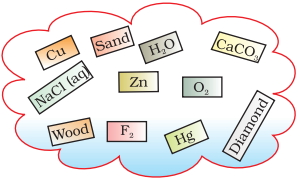
Classify the substances given in the figure into elements and compounds.
Solution
(N/A) Based on the chemical composition,the substances are classified as follows:
Elements: These are pure substances consisting of only one type of atom. From the figure,the elements are: $Cu$ (Copper),$Zn$ (Zinc),$O_2$ (Oxygen),$F_2$ (Fluorine),$Hg$ (Mercury),and Diamond (an allotrope of Carbon).
Compounds: These are substances formed by the chemical combination of two or more elements in a fixed proportion. From the figure,the compounds are: $H_2O$ (Water) and $CaCO_3$ (Calcium carbonate).
Note: Substances like Sand,$NaCl(aq)$,and Wood are mixtures,not pure elements or compounds.
Elements: These are pure substances consisting of only one type of atom. From the figure,the elements are: $Cu$ (Copper),$Zn$ (Zinc),$O_2$ (Oxygen),$F_2$ (Fluorine),$Hg$ (Mercury),and Diamond (an allotrope of Carbon).
Compounds: These are substances formed by the chemical combination of two or more elements in a fixed proportion. From the figure,the compounds are: $H_2O$ (Water) and $CaCO_3$ (Calcium carbonate).
Note: Substances like Sand,$NaCl(aq)$,and Wood are mixtures,not pure elements or compounds.
0 likes
View Solution32
Medium
Which of the following are not compounds?
$(a)$ Chlorine gas
$(b)$ Potassium chloride
$(c)$ Iron
$(d)$ Iron sulphide
$(e)$ Aluminium
$(f)$ Iodine
$(g)$ Carbon
$(h)$ Carbon monoxide
$(i)$ Sulphur powder
$(a)$ Chlorine gas
$(b)$ Potassium chloride
$(c)$ Iron
$(d)$ Iron sulphide
$(e)$ Aluminium
$(f)$ Iodine
$(g)$ Carbon
$(h)$ Carbon monoxide
$(i)$ Sulphur powder
Solution
(A, C, E, F, G, I) compound is a substance formed when two or more chemical elements are chemically bonded together. Elements are pure substances consisting of only one type of atom.
$1$. Chlorine gas $(Cl_2)$ is an element.
$2$. Potassium chloride $(KCl)$ is a compound.
$3$. Iron $(Fe)$ is an element.
$4$. Iron sulphide $(FeS)$ is a compound.
$5$. Aluminium $(Al)$ is an element.
$6$. Iodine $(I_2)$ is an element.
$7$. Carbon $(C)$ is an element.
$8$. Carbon monoxide $(CO)$ is a compound.
$9$. Sulphur powder $(S)$ is an element.
Therefore,the substances that are not compounds are: Chlorine gas,Iron,Aluminium,Iodine,Carbon,and Sulphur powder.
$1$. Chlorine gas $(Cl_2)$ is an element.
$2$. Potassium chloride $(KCl)$ is a compound.
$3$. Iron $(Fe)$ is an element.
$4$. Iron sulphide $(FeS)$ is a compound.
$5$. Aluminium $(Al)$ is an element.
$6$. Iodine $(I_2)$ is an element.
$7$. Carbon $(C)$ is an element.
$8$. Carbon monoxide $(CO)$ is a compound.
$9$. Sulphur powder $(S)$ is an element.
Therefore,the substances that are not compounds are: Chlorine gas,Iron,Aluminium,Iodine,Carbon,and Sulphur powder.
0 likes
View Solution33
Medium
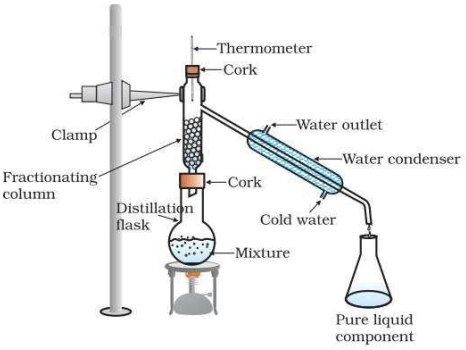
Fractional distillation is suitable for the separation of miscible liquids with a boiling point difference of about $25\, K$ or less. What part of the fractional distillation apparatus makes it efficient and provides an advantage over a simple distillation process? Explain using a diagram.
Solution
(N/A) The key component that makes fractional distillation efficient is the fractionating column. This column is typically packed with glass beads or other inert materials.
$1$. The glass beads provide a large surface area for the vapours to collide,lose energy,and undergo repeated condensation and evaporation cycles as they rise through the column.
$2$. This process ensures that the component with the higher boiling point condenses more easily and returns to the flask,while the component with the lower boiling point reaches the top of the column as a vapour.
$3$. The length of the column further increases the efficiency of this separation process,allowing for the effective separation of liquids with small boiling point differences.
(Refer to the provided diagram for the setup of the fractional distillation apparatus.)
$1$. The glass beads provide a large surface area for the vapours to collide,lose energy,and undergo repeated condensation and evaporation cycles as they rise through the column.
$2$. This process ensures that the component with the higher boiling point condenses more easily and returns to the flask,while the component with the lower boiling point reaches the top of the column as a vapour.
$3$. The length of the column further increases the efficiency of this separation process,allowing for the effective separation of liquids with small boiling point differences.
(Refer to the provided diagram for the setup of the fractional distillation apparatus.)
0 likes
View Solution34
Medium
Answer the following:
$(a)$ Under which category of mixtures will you classify alloys and why?
$(b)$ $A$ solution is always a liquid. Comment.
$(c)$ Can a solution be heterogeneous?
$(a)$ Under which category of mixtures will you classify alloys and why?
$(b)$ $A$ solution is always a liquid. Comment.
$(c)$ Can a solution be heterogeneous?
Solution
(N/A) Alloys are classified as homogeneous mixtures because they have a uniform composition throughout their entire mass.
$(b)$ No,this statement is incorrect. Solutions can exist in different states of matter,including solid solutions (e.g.,brass,which is an alloy of copper and zinc) and gaseous solutions (e.g.,air,which is a mixture of various gases).
$(c)$ No,by definition,a solution is a homogeneous mixture of two or more substances. If a mixture is heterogeneous,it is not classified as a solution.
$(b)$ No,this statement is incorrect. Solutions can exist in different states of matter,including solid solutions (e.g.,brass,which is an alloy of copper and zinc) and gaseous solutions (e.g.,air,which is a mixture of various gases).
$(c)$ No,by definition,a solution is a homogeneous mixture of two or more substances. If a mixture is heterogeneous,it is not classified as a solution.
0 likes
View Solution35
Medium
Iron filings and sulphur were mixed together and divided into two parts,$A$ and $B$. Part $A$ was heated strongly while Part $B$ was not heated. Dilute hydrochloric acid was added to both the parts and evolution of gas was seen in both the cases. How will you identify the gases evolved?
Solution
(N/A) When part $A$ is heated,iron and sulphur react to form iron sulphide $(FeS)$:
$Fe + S \rightarrow FeS$
When dilute hydrochloric acid $(HCl)$ is added to the iron sulphide $(FeS)$,hydrogen sulphide $(H_2S)$ gas is evolved:
$FeS + 2HCl \rightarrow FeCl_2 + H_2S$
Hydrogen sulphide gas has a characteristic foul smell,similar to that of rotten eggs.
When dilute hydrochloric acid is added to the unheated mixture of iron and sulphur (part $B$),iron reacts with the acid to release hydrogen $(H_2)$ gas,while sulphur remains unreacted:
$Fe + S + 2HCl \rightarrow FeCl_2 + H_2 + S$
Hydrogen gas is identified by bringing a burning matchstick near it,which causes the gas to burn with a characteristic 'pop' sound.
$Fe + S \rightarrow FeS$
When dilute hydrochloric acid $(HCl)$ is added to the iron sulphide $(FeS)$,hydrogen sulphide $(H_2S)$ gas is evolved:
$FeS + 2HCl \rightarrow FeCl_2 + H_2S$
Hydrogen sulphide gas has a characteristic foul smell,similar to that of rotten eggs.
When dilute hydrochloric acid is added to the unheated mixture of iron and sulphur (part $B$),iron reacts with the acid to release hydrogen $(H_2)$ gas,while sulphur remains unreacted:
$Fe + S + 2HCl \rightarrow FeCl_2 + H_2 + S$
Hydrogen gas is identified by bringing a burning matchstick near it,which causes the gas to burn with a characteristic 'pop' sound.
0 likes
View Solution36
Medium
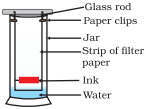
$A$ child wanted to separate the mixture of dyes constituting a sample of ink. He marked a line by the ink on the filter paper and placed the filter paper in a glass containing water as shown in the figure. The filter paper was removed when the water moved near the top of the filter paper.
$(i)$ What would you expect to see,if the ink contains three different coloured components?
$(ii)$ Name the technique used by the child.
$(iii)$ Suggest one more application of this technique.
$(i)$ What would you expect to see,if the ink contains three different coloured components?
$(ii)$ Name the technique used by the child.
$(iii)$ Suggest one more application of this technique.
Solution
(N/A) $(i)$ If the ink contains three different coloured components,we would expect to see three different coloured bands on the filter paper at different heights,as each component travels at a different speed depending on its solubility in the solvent.
$(ii)$ The technique used is Chromatography.
$(iii)$ One more application of this technique is to separate pigments present in natural colours (e.g.,chlorophyll) or to separate drugs from blood.
$(ii)$ The technique used is Chromatography.
$(iii)$ One more application of this technique is to separate pigments present in natural colours (e.g.,chlorophyll) or to separate drugs from blood.
0 likes
View Solution37
Difficult
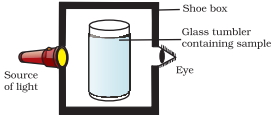
$A$ group of students took an old shoe box and covered it with black paper from all sides. They fixed a source of light (a torch) at one end of the box by making a hole in it and made another hole on the other side to view the light. They placed a milk sample contained in a beaker/tumbler in the box as shown in the figure. They were amazed to see that the milk taken in the tumbler was illuminated. They tried the same activity by taking a salt solution but found that light simply passed through it.
$(a)$ Explain why the milk sample was illuminated. Name the phenomenon involved.
$(b)$ Same results were not observed with a salt solution. Explain.
$(c)$ Can you suggest two more solutions which would show the same effect as shown by the milk solution?
$(a)$ Explain why the milk sample was illuminated. Name the phenomenon involved.
$(b)$ Same results were not observed with a salt solution. Explain.
$(c)$ Can you suggest two more solutions which would show the same effect as shown by the milk solution?
Solution
(N/A) Milk is a colloid. Colloidal particles are large enough to scatter a beam of light passing through them,which makes the path of light visible. This phenomenon is known as the Tyndall effect.
$(b)$ $A$ salt solution is a true solution. The particles in a true solution are extremely small (less than $1 \ nm$ in diameter) and are unable to scatter the beam of light passing through them. Therefore,the path of light is not visible in a salt solution.
$(c)$ Two other examples of colloidal solutions that show the Tyndall effect are starch solution and soap solution.
$(b)$ $A$ salt solution is a true solution. The particles in a true solution are extremely small (less than $1 \ nm$ in diameter) and are unable to scatter the beam of light passing through them. Therefore,the path of light is not visible in a salt solution.
$(c)$ Two other examples of colloidal solutions that show the Tyndall effect are starch solution and soap solution.
0 likes
View Solution38
Medium
Classify each of the following as a physical or a chemical change. Give reasons.
$(a)$ Drying of a shirt in the sun.
$(b)$ Rising of hot air over a radiator.
$(c)$ Burning of kerosene in a lantern.
$(d)$ Change in the colour of black tea on adding lemon juice to it.
$(e)$ Churning of milk cream to get butter.
$(a)$ Drying of a shirt in the sun.
$(b)$ Rising of hot air over a radiator.
$(c)$ Burning of kerosene in a lantern.
$(d)$ Change in the colour of black tea on adding lemon juice to it.
$(e)$ Churning of milk cream to get butter.
Solution
(A) Physical changes: $(a), (b), (e)$. These are physical changes because no new substance is formed,and the chemical composition remains the same.
Chemical changes: $(c), (d)$. These are chemical changes because new substances are formed with different chemical properties. Burning of kerosene involves a combustion reaction,and adding lemon juice to tea causes a chemical reaction between the acid in the lemon and the pigments in the tea.
Chemical changes: $(c), (d)$. These are chemical changes because new substances are formed with different chemical properties. Burning of kerosene involves a combustion reaction,and adding lemon juice to tea causes a chemical reaction between the acid in the lemon and the pigments in the tea.
0 likes
View Solution39
Medium
During an experiment, students were asked to prepare a $10\%$ (mass/mass) solution of sugar in water. Ramesh dissolved $10\,g$ of sugar in $100\,g$ of water, while Sarika prepared it by dissolving $10\,g$ of sugar in water to make $100\,g$ of the solution.
$(a)$ Are the two solutions of the same concentration?
$(b)$ Compare the mass percentage of the two solutions.
$(a)$ Are the two solutions of the same concentration?
$(b)$ Compare the mass percentage of the two solutions.
Solution
$(a)$ No, the two solutions do not have the same concentration.
$(b)$ The formula for mass percentage is:
$\text{Mass } \% = \frac{\text{Mass of solute}}{\text{Mass of solute} + \text{Mass of solvent}} \times 100$
For Ramesh's solution:
$\text{Mass of solute} = 10\,g$, $\text{Mass of solvent} = 100\,g$
$\text{Mass } \% = \left( \frac{10}{10 + 100} \right) \times 100 = \frac{10}{110} \times 100 \approx 9.09\%$
For Sarika's solution:
$\text{Mass of solute} = 10\,g$, $\text{Total mass of solution} = 100\,g$
$\text{Mass } \% = \left( \frac{10}{100} \right) \times 100 = 10\%$
Conclusion: The solution prepared by Sarika $(10\%)$ has a higher mass percentage than the solution prepared by Ramesh $(\approx 9.09\%)$.
$(b)$ The formula for mass percentage is:
$\text{Mass } \% = \frac{\text{Mass of solute}}{\text{Mass of solute} + \text{Mass of solvent}} \times 100$
For Ramesh's solution:
$\text{Mass of solute} = 10\,g$, $\text{Mass of solvent} = 100\,g$
$\text{Mass } \% = \left( \frac{10}{10 + 100} \right) \times 100 = \frac{10}{110} \times 100 \approx 9.09\%$
For Sarika's solution:
$\text{Mass of solute} = 10\,g$, $\text{Total mass of solution} = 100\,g$
$\text{Mass } \% = \left( \frac{10}{100} \right) \times 100 = 10\%$
Conclusion: The solution prepared by Sarika $(10\%)$ has a higher mass percentage than the solution prepared by Ramesh $(\approx 9.09\%)$.
0 likes
View Solution40
Medium
You are provided with a mixture containing sand, iron filings, ammonium chloride, and sodium chloride. Describe the procedures you would use to separate these constituents from the mixture.
Solution
(N/A) The components of the given mixture can be separated by the following methods:
$(i)$ $Using$ $a$ $magnet$: Hovering a magnet over the mixture will result in iron filings getting stuck to the magnet. Thus, iron will be separated.
$(ii)$ $Sublimation$: The remaining mixture is heated in a china dish. Ammonium chloride is a sublime substance and hence it will evaporate without undergoing the liquid phase. The crust of ammonium chloride can be collected by placing an inverted funnel on top of the china dish.
$(iii)$ $Sedimentation,$ $decantation,$ $and$ $filtration$: The remaining mixture is dissolved in water. The mixture is allowed to settle for some time. Sand, being insoluble in water, settles at the bottom. The liquid is decanted into another beaker. Then, the liquid is filtered to remove any trace of sand in it.
$(iv)$ $Evaporation$: The liquid is now a solution of sodium chloride in water. This is heated in a beaker so that the water evaporates. Once all the water evaporates, we get sodium chloride in the beaker.
$(i)$ $Using$ $a$ $magnet$: Hovering a magnet over the mixture will result in iron filings getting stuck to the magnet. Thus, iron will be separated.
$(ii)$ $Sublimation$: The remaining mixture is heated in a china dish. Ammonium chloride is a sublime substance and hence it will evaporate without undergoing the liquid phase. The crust of ammonium chloride can be collected by placing an inverted funnel on top of the china dish.
$(iii)$ $Sedimentation,$ $decantation,$ $and$ $filtration$: The remaining mixture is dissolved in water. The mixture is allowed to settle for some time. Sand, being insoluble in water, settles at the bottom. The liquid is decanted into another beaker. Then, the liquid is filtered to remove any trace of sand in it.
$(iv)$ $Evaporation$: The liquid is now a solution of sodium chloride in water. This is heated in a beaker so that the water evaporates. Once all the water evaporates, we get sodium chloride in the beaker.
0 likes
View Solution41
DifficultMCQ
Arun has prepared a $0.01\%$ (by mass) solution of sodium chloride in water. Which of the following correctly represents the composition of the solution?
A
$0.01 \, g$ of $NaCl + 99.99 \, g$ of water
B
$0.11 \, g$ of $NaCl + 100 \, g$ of water
C
$1.00 \, g$ of $NaCl + 100 \, g$ of water
D
$0.10 \, g$ of $NaCl + 99.90 \, g$ of water
Solution
(A) The mass percentage of a solution is calculated using the formula:
$\text{Mass } \% = \frac{\text{mass of solute}}{\text{mass of solute} + \text{mass of solvent}} \times 100$
Given that the concentration is $0.01\%$ by mass,we test option $(a)$:
$\text{Mass } \% = \frac{0.01 \, g}{0.01 \, g + 99.99 \, g} \times 100$
$= \frac{0.01}{100} \times 100 = 0.01\%$
Thus,option $(a)$ correctly represents the composition of the solution.
$\text{Mass } \% = \frac{\text{mass of solute}}{\text{mass of solute} + \text{mass of solvent}} \times 100$
Given that the concentration is $0.01\%$ by mass,we test option $(a)$:
$\text{Mass } \% = \frac{0.01 \, g}{0.01 \, g + 99.99 \, g} \times 100$
$= \frac{0.01}{100} \times 100 = 0.01\%$
Thus,option $(a)$ correctly represents the composition of the solution.
0 likes
View Solution42
DifficultMCQ
Calculate the mass of sodium sulphate required to prepare its $20\%$ (mass percent) solution in $100\,g$ of water. (in $,g$)
A
$15$
B
$25$
C
$30$
D
$35$
Solution
(B) Let the mass of sodium sulphate required be $x\,g$.
The mass of the solution is the sum of the mass of the solute and the mass of the solvent (water).
Mass of solution $= (x + 100)\,g$.
The formula for mass percentage is: $\text{Mass percentage} = \frac{\text{Mass of solute}}{\text{Mass of solution}} \times 100$.
Given that the mass percentage is $20\%$,we have:
$20 = \frac{x}{x + 100} \times 100$.
Dividing both sides by $20$:
$1 = \frac{x}{x + 100} \times 5$.
$x + 100 = 5x$.
$4x = 100$.
$x = 25\,g$.
Therefore,the mass of sodium sulphate required is $25\,g$.
The mass of the solution is the sum of the mass of the solute and the mass of the solvent (water).
Mass of solution $= (x + 100)\,g$.
The formula for mass percentage is: $\text{Mass percentage} = \frac{\text{Mass of solute}}{\text{Mass of solution}} \times 100$.
Given that the mass percentage is $20\%$,we have:
$20 = \frac{x}{x + 100} \times 100$.
Dividing both sides by $20$:
$1 = \frac{x}{x + 100} \times 5$.
$x + 100 = 5x$.
$4x = 100$.
$x = 25\,g$.
Therefore,the mass of sodium sulphate required is $25\,g$.
0 likes
View Solution43
EasyMCQ
Why is the path of light not visible in a solution when a beam of light is passed through it?
A
The solute particles are too large.
B
The solute particles are very small and do not scatter light.
C
The solution is opaque.
D
The light is absorbed by the solvent.
Solution
(B) In a true solution,the size of the solute particles is extremely small (less than $1 \ nm$ in diameter).
Because of their tiny size,these particles are unable to scatter the beam of light passing through the solution.
Therefore,the path of the light beam remains invisible,and the Tyndall effect is not observed.
Because of their tiny size,these particles are unable to scatter the beam of light passing through the solution.
Therefore,the path of the light beam remains invisible,and the Tyndall effect is not observed.
0 likes
View Solution44
Easy
State the principle involved in separating a mixture containing kerosene and water.
Solution
(N/A) The principle involved in separating a mixture of kerosene and water is based on the difference in the densities of the two liquids. Kerosene and water are immiscible liquids,meaning they do not mix with each other. When left undisturbed,they form separate layers. Since water is denser than kerosene,it settles at the bottom,while kerosene,being lighter,forms the upper layer. This mixture can be separated using a separating funnel.
0 likes
View Solution45
Easy
Colloids are quite stable. Name the process by which you can separate the components of a colloidal solution.
Solution
(CENTRIFUGATION) The components of a colloidal solution cannot be separated by ordinary filtration. However,they can be separated by a process known as $Centrifugation$. In this process,the colloidal solution is spun at a very high speed,causing the dispersed phase particles to settle down at the bottom due to their density,allowing the separation of the components.
0 likes
View Solution46
Easy
What are the two components of a solution?
Solution
(N/A) solution is a homogeneous mixture of two or more substances. The two main components of a solution are:
$(i)$ Solute: The component that is present in a smaller quantity and is dissolved in the solvent.
$(ii)$ Solvent: The component that is present in a larger quantity and in which the solute is dissolved.
$(i)$ Solute: The component that is present in a smaller quantity and is dissolved in the solvent.
$(ii)$ Solvent: The component that is present in a larger quantity and in which the solute is dissolved.
0 likes
View Solution47
Easy
What is meant by concentration of a solution?
Solution
(N/A) The concentration of a solution is defined as the amount of solute present in a given amount (mass or volume) of the solution or solvent.
It represents the relative proportion of solute and solvent in the mixture.
Mathematically, it can be expressed as: $\text{Concentration} = \frac{\text{Amount of solute}}{\text{Amount of solution}}$.
It represents the relative proportion of solute and solvent in the mixture.
Mathematically, it can be expressed as: $\text{Concentration} = \frac{\text{Amount of solute}}{\text{Amount of solution}}$.
0 likes
View Solution48
EasyMCQ
Based on which factor is a solution said to be dilute,concentrated,or saturated?
A
Temperature of the solution
B
Amount of solute present in the solution
C
Volume of the solvent
D
Pressure applied on the solution
Solution
(B) solution is classified as dilute,concentrated,or saturated based on the amount of solute dissolved in a given amount of solvent or solution.
$1$. $A$ dilute solution contains a relatively small amount of solute.
$2$. $A$ concentrated solution contains a relatively large amount of solute.
$3$. $A$ saturated solution is one in which no more solute can be dissolved at a given temperature.
$1$. $A$ dilute solution contains a relatively small amount of solute.
$2$. $A$ concentrated solution contains a relatively large amount of solute.
$3$. $A$ saturated solution is one in which no more solute can be dissolved at a given temperature.
0 likes
View Solution49
Easy
State any one difference between pure and impure substances.
Solution
(N/A) pure substance consists of only one type of particles (atoms or molecules) with uniform chemical properties. In contrast,an impure substance,also known as a mixture,consists of two or more different types of particles or molecules mixed together in any proportion.
0 likes
View Solution50
Easy
"Tyndall Effect can be observed when sunlight passes through the canopy of dense forest." Explain how this occurs.
Solution
(N/A) The Tyndall effect is the scattering of light by particles in a colloid or a very fine suspension. In a dense forest, the air contains mist, which consists of tiny water droplets suspended in the air. These water droplets act as colloidal particles. When sunlight enters the forest through the canopy, these tiny droplets scatter the light, making the path of the light beam visible. This phenomenon is known as the Tyndall effect.
0 likes
View SolutionIS MATTER AROUND US PURE? — Mix Example - IS MATTER AROUND US PURE? · Frequently Asked Questions
1Are these IS MATTER AROUND US PURE? questions useful for JEE and NEET?
Yes. All questions in this section are mapped to JEE Main and NEET exam patterns. Previous year questions from JEE Main, NEET, GUJCET and state-level exams are included with full solutions.
2Can I switch to Hindi or Gujarati for these questions?
Yes. Use the language tabs in the hero section or the sidebar to view the same questions and solutions in English, Hindi or Gujarati.
3How do I generate a question paper from this subtopic?
Use the Vedclass Exam Paper Generator — select the chapter and subtopic, set difficulty, and generate Sets A, B, C, D automatically. First 3 chapters of every subject are free.
Vedclass Products
For Students
Vedclass Test Series
Mock tests in real JEE/NEET style with performance analysis. 5-day free trial.
Start Free TrialFor Teachers
Exam Paper Generator
Generate Set A/B/C/D papers from this chapter in 2 minutes. 3 chapters free.
Try FreeFor Institutes
Online Exam Module
Live online exams with unlimited students, 360° analytics & white-label branding.
See DemoFor Teachers & Institutes
Generate a IS MATTER AROUND US PURE? Exam Paper in 2 Minutes
Select subtopic & difficulty — Sets A, B, C, D auto-generated with No Repeat logic.
First 3 chapters of every subject are free — no payment required.