
A English
Mix Example - IS MATTER AROUND US PURE? Questions in English
Class 9 Science · IS MATTER AROUND US PURE? · Mix Example - IS MATTER AROUND US PURE?
167+
Questions
English
Language
100%
With Solutions
Showing 50 of 167 questions in English
101
DifficultMCQ
Calculate the mass of water and mass of glucose required to make $250 \, g$ of $40 \%$ solution of glucose.
A
$100 \, g$ glucose,$150 \, g$ water
B
$150 \, g$ glucose,$100 \, g$ water
C
$40 \, g$ glucose,$210 \, g$ water
D
$250 \, g$ glucose,$40 \, g$ water
Solution
(A) Mass by percentage formula is given by: $\text{Mass percentage} = \frac{\text{Mass of solute}}{\text{Mass of solution}} \times 100$
Given:
Mass of solution $= 250 \, g$
Mass percentage of glucose $= 40 \%$
Substituting the values:
$40 = \frac{\text{Mass of glucose}}{250} \times 100$
Mass of glucose $= \frac{40 \times 250}{100} = 100 \, g$
Now,calculate the mass of water:
Mass of water $= \text{Mass of solution} - \text{Mass of glucose}$
Mass of water $= 250 \, g - 100 \, g = 150 \, g$
Therefore,the mass of glucose is $100 \, g$ and the mass of water is $150 \, g$.
Given:
Mass of solution $= 250 \, g$
Mass percentage of glucose $= 40 \%$
Substituting the values:
$40 = \frac{\text{Mass of glucose}}{250} \times 100$
Mass of glucose $= \frac{40 \times 250}{100} = 100 \, g$
Now,calculate the mass of water:
Mass of water $= \text{Mass of solution} - \text{Mass of glucose}$
Mass of water $= 250 \, g - 100 \, g = 150 \, g$
Therefore,the mass of glucose is $100 \, g$ and the mass of water is $150 \, g$.
0 likes
View Solution102
Medium
Write the role of the following in a water purification system:
$(a)$ Sedimentation tank
$(b)$ Loading tank
$(c)$ Chlorination tank
$(a)$ Sedimentation tank
$(b)$ Loading tank
$(c)$ Chlorination tank
Solution
(N/A) Sedimentation tank: This tank allows heavy,insoluble solid particles to settle down at the bottom due to gravity.
$(b)$ Loading tank: This tank is used to add coagulants like alum to the water,which helps in settling down fine suspended impurities that do not settle easily by sedimentation.
$(c)$ Chlorination tank: This tank is used to add chlorine to the water to kill harmful bacteria and microorganisms,making the water safe for consumption.
$(b)$ Loading tank: This tank is used to add coagulants like alum to the water,which helps in settling down fine suspended impurities that do not settle easily by sedimentation.
$(c)$ Chlorination tank: This tank is used to add chlorine to the water to kill harmful bacteria and microorganisms,making the water safe for consumption.
0 likes
View Solution103
Medium
$(a)$ Illustrate with an example that physical and chemical changes can take place together.
$(b)$ Which of the following are chemical changes?
$(i)$ Mixing of iron filings and sand
$(ii)$ Growth of plant
$(iii)$ Rusting of iron
$(iv)$ Freezing of water
$(b)$ Which of the following are chemical changes?
$(i)$ Mixing of iron filings and sand
$(ii)$ Growth of plant
$(iii)$ Rusting of iron
$(iv)$ Freezing of water
Solution
(II, III) Burning of a candle: When a candle burns,the wax melts,which is a physical change. Simultaneously,the wax reacts with oxygen to produce $CO_2$ and $H_2O$ vapor,which is a chemical change. Thus,both changes occur together.
$(b)$ The chemical changes are:
$(ii)$ Growth of plant: This involves complex metabolic processes and permanent changes in the organism's structure.
$(iii)$ Rusting of iron: This is a chemical reaction where iron reacts with oxygen and moisture to form hydrated iron$(III)$ oxide.
$(b)$ The chemical changes are:
$(ii)$ Growth of plant: This involves complex metabolic processes and permanent changes in the organism's structure.
$(iii)$ Rusting of iron: This is a chemical reaction where iron reacts with oxygen and moisture to form hydrated iron$(III)$ oxide.
0 likes
View Solution104
Medium
$A$ mixture containing two liquids visibly separated,is placed in a separating funnel. Answer the following:
$(i)$ What type of liquids form the mixture?
$(ii)$ Which of the liquids will form the lower layer?
$(iii)$ What is the principle behind this method of separation?
$(i)$ What type of liquids form the mixture?
$(ii)$ Which of the liquids will form the lower layer?
$(iii)$ What is the principle behind this method of separation?
Solution
(N/A) $(i)$ Immiscible liquids.
$(ii)$ The liquid with higher density will form the lower layer.
$(iii)$ The principle behind this method is that immiscible liquids separate out into distinct layers based on their differences in densities.
$(ii)$ The liquid with higher density will form the lower layer.
$(iii)$ The principle behind this method is that immiscible liquids separate out into distinct layers based on their differences in densities.
0 likes
View Solution105
Medium
$(i)$ Name a technique to separate a mixture of two or more miscible liquids for which the difference in boiling points is less than $25\, K$.
$(ii)$ Describe the structure of the column used in the above technique. Why is it used?
$(ii)$ Describe the structure of the column used in the above technique. Why is it used?
Solution
(N/A) $(i)$ The technique used is fractional distillation.
$(ii)$ The fractionating column is a glass tube packed with glass beads or other materials that provide a large surface area. It is fitted between the distillation flask and the condenser.
It is used because it provides a large surface area for the vapours to cool and condense repeatedly,allowing for better separation of liquids with boiling points close to each other.
$(ii)$ The fractionating column is a glass tube packed with glass beads or other materials that provide a large surface area. It is fitted between the distillation flask and the condenser.
It is used because it provides a large surface area for the vapours to cool and condense repeatedly,allowing for better separation of liquids with boiling points close to each other.
0 likes
View Solution106
Medium
$(a)$ What separation technique will you apply for the separation of the following?
$(i)$ Ammonium chloride from sodium chloride.
$(ii)$ Different pigments from the extract of flower petals.
$(b)$ What is crystallisation? List two ways in which the crystallisation technique is better than the simple evaporation technique.
$(i)$ Ammonium chloride from sodium chloride.
$(ii)$ Different pigments from the extract of flower petals.
$(b)$ What is crystallisation? List two ways in which the crystallisation technique is better than the simple evaporation technique.
Solution
(A-D) $(i)$ Sublimation.
$(ii)$ Paper chromatography.
$(b)$ Crystallisation is a process that separates a pure solid in the form of its crystals from a solution.
The crystallisation technique is better than the simple evaporation technique because:
$1$. Some solids decompose or may get charred (e.g.,sugar) upon heating to dryness.
$2$. Some impurities may remain dissolved in the solution even after filtration; evaporation would cause these impurities to contaminate the solid,whereas crystallisation leaves them in the mother liquor.
$(ii)$ Paper chromatography.
$(b)$ Crystallisation is a process that separates a pure solid in the form of its crystals from a solution.
The crystallisation technique is better than the simple evaporation technique because:
$1$. Some solids decompose or may get charred (e.g.,sugar) upon heating to dryness.
$2$. Some impurities may remain dissolved in the solution even after filtration; evaporation would cause these impurities to contaminate the solid,whereas crystallisation leaves them in the mother liquor.
0 likes
View Solution107
Medium
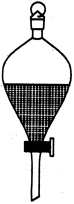
Observe the apparatus shown and answer the following questions:
$(a)$ Name the apparatus.
$(b)$ State one use of the apparatus.
$(c)$ State the principle involved in this process.
$(a)$ Name the apparatus.
$(b)$ State one use of the apparatus.
$(c)$ State the principle involved in this process.
Solution
(N/A) Separating funnel.
$(b)$ It is used to separate a mixture of two immiscible liquids.
$(c)$ The principle involved is that immiscible liquids separate out into distinct layers based on their densities.
$(b)$ It is used to separate a mixture of two immiscible liquids.
$(c)$ The principle involved is that immiscible liquids separate out into distinct layers based on their densities.
0 likes
View Solution108
Medium
The teacher instructed three students '$A$','$B$',and '$C$' respectively to prepare a $50\%$ (mass by volume) solution of sodium hydroxide $(NaOH)$. '$A$' dissolved $50\, g$ of $NaOH$ in $100\, mL$ of water,'$B$' dissolved $50\, g$ of $NaOH$ in $100\, g$ of water,while '$C$' dissolved $50\, g$ of $NaOH$ in water to make $100\, mL$ of solution. Which one of them has made the desired solution and why?
Solution
(C) '$C$' has made the desired solution.
The formula for mass by volume percentage is:
$\text{Mass by volume } \% = \frac{\text{Mass of solute (g)}}{\text{Volume of solution (mL)}} \times 100$
For student '$C$':
$\text{Mass by volume } \% = \frac{50\, g}{100\, mL} \times 100 = 50\%$
Student '$A$' prepared a solution where the total volume is likely greater than $100\, mL$ (as $50\, g$ of $NaOH$ occupies volume),and student '$B$' prepared a mass by mass solution,not mass by volume.
The formula for mass by volume percentage is:
$\text{Mass by volume } \% = \frac{\text{Mass of solute (g)}}{\text{Volume of solution (mL)}} \times 100$
For student '$C$':
$\text{Mass by volume } \% = \frac{50\, g}{100\, mL} \times 100 = 50\%$
Student '$A$' prepared a solution where the total volume is likely greater than $100\, mL$ (as $50\, g$ of $NaOH$ occupies volume),and student '$B$' prepared a mass by mass solution,not mass by volume.
0 likes
View Solution109
Medium
$(i)$ Name the process or the separation technique you would follow to separate:
$(a)$ Dyes in black ink
$(b)$ Butter from cream
$(c)$ Ammonium chloride and common salt
$(d)$ Iron filings and sand
$(ii)$ State the principle used in separation by centrifugation.
$(a)$ Dyes in black ink
$(b)$ Butter from cream
$(c)$ Ammonium chloride and common salt
$(d)$ Iron filings and sand
$(ii)$ State the principle used in separation by centrifugation.
Solution
(A-D) $(i)$ $(a)$ Chromatography: This technique is used to separate solutes that dissolve in the same solvent.
$(b)$ Centrifugation: This method is used to separate suspended particles from a liquid based on density.
$(c)$ Sublimation: This process is used to separate a sublimable volatile component from a non-sublimable impurity.
$(d)$ Magnetic separation: This method is used to separate magnetic substances from non-magnetic substances.
$(ii)$ The principle of centrifugation is that when a mixture is rotated at high speed,the denser particles are forced to the bottom and the lighter particles stay at the top.
$(b)$ Centrifugation: This method is used to separate suspended particles from a liquid based on density.
$(c)$ Sublimation: This process is used to separate a sublimable volatile component from a non-sublimable impurity.
$(d)$ Magnetic separation: This method is used to separate magnetic substances from non-magnetic substances.
$(ii)$ The principle of centrifugation is that when a mixture is rotated at high speed,the denser particles are forced to the bottom and the lighter particles stay at the top.
0 likes
View Solution110
Medium
Identify the dispersed phase and dispersing medium in the following colloids:
$(a)$ Fog
$(b)$ Cheese
$(c)$ Coloured gemstone
$(a)$ Fog
$(b)$ Cheese
$(c)$ Coloured gemstone
Solution
(N/A) Fog: Dispersed phase is liquid and dispersing medium is gas.
$(b)$ Cheese: Dispersed phase is liquid and dispersing medium is solid.
$(c)$ Coloured gemstone: Dispersed phase is solid and dispersing medium is solid.
$(b)$ Cheese: Dispersed phase is liquid and dispersing medium is solid.
$(c)$ Coloured gemstone: Dispersed phase is solid and dispersing medium is solid.
0 likes
View Solution111
Medium
State the separation technique you would apply for the separation of the following:
$(a)$ Sodium chloride from its solution in water
$(b)$ Tea leaves from tea
$(c)$ Iron pins from sand
$(d)$ Different pigments from an extract of leaves
$(e)$ Butter from curd
$(f)$ Fine mud particles suspended in water.
$(a)$ Sodium chloride from its solution in water
$(b)$ Tea leaves from tea
$(c)$ Iron pins from sand
$(d)$ Different pigments from an extract of leaves
$(e)$ Butter from curd
$(f)$ Fine mud particles suspended in water.
Solution
(N/A) Evaporation: Sodium chloride is a non-volatile solute,so it can be recovered from its aqueous solution by evaporating the water.
$(b)$ Filtration: Tea leaves are insoluble solids that can be separated from the liquid tea using a filter or sieve.
$(c)$ Magnetic separation: Iron pins are magnetic,while sand is not; therefore,a magnet can be used to attract and separate the pins.
$(d)$ Chromatography: This technique is used to separate different pigments based on their differential solubility in a solvent.
$(e)$ Centrifugation: Butter particles are lighter than the liquid in curd; spinning the mixture at high speed forces the denser components outward,separating the butter.
$(f)$ Decantation and filtration: Fine mud particles can be allowed to settle (sedimentation) followed by decantation,or removed directly using filtration.
$(b)$ Filtration: Tea leaves are insoluble solids that can be separated from the liquid tea using a filter or sieve.
$(c)$ Magnetic separation: Iron pins are magnetic,while sand is not; therefore,a magnet can be used to attract and separate the pins.
$(d)$ Chromatography: This technique is used to separate different pigments based on their differential solubility in a solvent.
$(e)$ Centrifugation: Butter particles are lighter than the liquid in curd; spinning the mixture at high speed forces the denser components outward,separating the butter.
$(f)$ Decantation and filtration: Fine mud particles can be allowed to settle (sedimentation) followed by decantation,or removed directly using filtration.
0 likes
View Solution112
Medium
Elements are classified as metals,non-metals,and metalloids. Give any one property of each. Also,give one example of each.
Solution
(N/A) $1$. Metals: Property: They are lustrous (shiny). Example: Iron $(Fe)$.
$2$. Non-metals: Property: They are poor conductors of heat and electricity. Example: Oxygen $(O_2)$.
$3$. Metalloids: Property: They exhibit properties intermediate between those of metals and non-metals. Example: Germanium $(Ge)$.
$2$. Non-metals: Property: They are poor conductors of heat and electricity. Example: Oxygen $(O_2)$.
$3$. Metalloids: Property: They exhibit properties intermediate between those of metals and non-metals. Example: Germanium $(Ge)$.
0 likes
View Solution113
Difficult
$(a)$ $7\, g$ of iron filings and $4\, g$ of sulphur powder is treated with dilute sulphuric acid at room temperature. Name the gas produced.
$(b)$ The same mixture is heated strongly,cooled and then treated with dilute sulphuric acid. Which gas would be produced?
$(c)$ What is the cause of this difference in results of chemical reaction in different conditions?
$(b)$ The same mixture is heated strongly,cooled and then treated with dilute sulphuric acid. Which gas would be produced?
$(c)$ What is the cause of this difference in results of chemical reaction in different conditions?
Solution
(A) At room temperature,the iron filings and sulphur powder exist as a mixture. When treated with dilute sulphuric acid,the iron reacts to produce hydrogen gas $(H_2)$.
$(b)$ When the mixture is heated strongly,iron and sulphur react to form a chemical compound,iron sulphide $(FeS)$. When this compound is treated with dilute sulphuric acid,it produces hydrogen sulphide gas $(H_2S)$,which has a characteristic rotten egg smell.
$(c)$ The difference in results occurs because in the first case,the substances exist as a mixture,retaining their individual properties. In the second case,heating causes a chemical reaction that forms a new compound with entirely different chemical properties compared to its constituent elements.
$(b)$ When the mixture is heated strongly,iron and sulphur react to form a chemical compound,iron sulphide $(FeS)$. When this compound is treated with dilute sulphuric acid,it produces hydrogen sulphide gas $(H_2S)$,which has a characteristic rotten egg smell.
$(c)$ The difference in results occurs because in the first case,the substances exist as a mixture,retaining their individual properties. In the second case,heating causes a chemical reaction that forms a new compound with entirely different chemical properties compared to its constituent elements.
0 likes
View Solution114
Difficult
$(a)$ Give any one point of difference between true solution,colloidal solution,and suspension.
$(b)$ $20 \, g$ of sodium chloride is dissolved in $100 \, mL$ of water. How will you test whether the given solution is saturated or unsaturated at the given temperature?
$(c)$ Suggest any one method by which we can increase the solubility of saturated solutions.
$(b)$ $20 \, g$ of sodium chloride is dissolved in $100 \, mL$ of water. How will you test whether the given solution is saturated or unsaturated at the given temperature?
$(c)$ Suggest any one method by which we can increase the solubility of saturated solutions.
Solution
(N/A) The difference based on particle size is as follows:
$(b)$ To test if the solution is saturated or unsaturated,add a small amount of additional sodium chloride to the solution at the same temperature. If the added salt dissolves,the original solution was unsaturated. If the added salt does not dissolve and settles at the bottom,the original solution was saturated.
$(c)$ The solubility of most solid solutes in a liquid solvent increases with an increase in temperature. Therefore,by heating the solution,we can increase the solubility and dissolve more solute.
| Type of Mixture | Particle Size |
| True Solution | $< 1 \, nm$ |
| Colloidal Solution | $1 - 100 \, nm$ |
| Suspension | $> 100 \, nm$ |
$(b)$ To test if the solution is saturated or unsaturated,add a small amount of additional sodium chloride to the solution at the same temperature. If the added salt dissolves,the original solution was unsaturated. If the added salt does not dissolve and settles at the bottom,the original solution was saturated.
$(c)$ The solubility of most solid solutes in a liquid solvent increases with an increase in temperature. Therefore,by heating the solution,we can increase the solubility and dissolve more solute.
0 likes
View Solution115
Medium
$(a)$ $A$ sugar syrup of mass $214.2\, g$ contains $34.2\, g$ of sugar. Calculate the concentration of sugar in the syrup.
$(b)$ What is a solution?
$(b)$ What is a solution?
Solution
(N/A) Mass of solute $(w) = 34.2\, g$
Mass of solution $(W) = 214.2\, g$
Concentration of sugar in the syrup $= \frac{\text{Mass of solute}}{\text{Mass of solution}} \times 100$
$= \frac{34.2}{214.2} \times 100 = 15.96\%$
$(b)$ $A$ solution is a homogeneous mixture of two or more substances.
Mass of solution $(W) = 214.2\, g$
Concentration of sugar in the syrup $= \frac{\text{Mass of solute}}{\text{Mass of solution}} \times 100$
$= \frac{34.2}{214.2} \times 100 = 15.96\%$
$(b)$ $A$ solution is a homogeneous mixture of two or more substances.
0 likes
View Solution116
Easy
What is meant by crystallisation? How is impure copper sulphate purified by the process?
Solution
(N/A) Crystallisation is a process that separates a pure solid in the form of its crystals from a solution.
$AIM$: To obtain crystals of pure copper sulphate from an impure sample.
Procedure:
$(i)$ Take some impure sample of copper sulphate in a china dish (approximately $5 \ g$).
$(ii)$ Dissolve the contents in a minimum amount of water and filter the impurities out.
$(iii)$ Evaporate water from the solution to get a saturated solution of copper sulphate.
$(iv)$ Cover the solution with a filter paper and leave it undisturbed at room temperature to cool slowly for a day.
Observation: The crystals of copper sulphate can be seen in the china dish.
Conclusion: The process of formation of crystals of a pure solid from a solution is called crystallisation.
$AIM$: To obtain crystals of pure copper sulphate from an impure sample.
Procedure:
$(i)$ Take some impure sample of copper sulphate in a china dish (approximately $5 \ g$).
$(ii)$ Dissolve the contents in a minimum amount of water and filter the impurities out.
$(iii)$ Evaporate water from the solution to get a saturated solution of copper sulphate.
$(iv)$ Cover the solution with a filter paper and leave it undisturbed at room temperature to cool slowly for a day.
Observation: The crystals of copper sulphate can be seen in the china dish.
Conclusion: The process of formation of crystals of a pure solid from a solution is called crystallisation.
0 likes
View Solution117
Difficult
How will you separate a mixture of common salt,camphor,and iron filings? Describe the process.
Solution
(N/A) $(i)$ Magnetic separation: Pass a magnet over the mixture. The iron filings will be attracted to the magnet and can be separated from the mixture.
$(ii)$ Sublimation: Heat the remaining mixture. Camphor,being a sublimable substance,will change directly from a solid to a gas and can be collected by cooling it on a cold surface (like an inverted funnel),leaving behind the common salt.
$(iii)$ Dissolution and Filtration/Evaporation: Add water to the remaining residue (common salt). The salt will dissolve in the water. Filter the solution to remove any impurities if necessary,then evaporate the water to obtain the common salt.
$(ii)$ Sublimation: Heat the remaining mixture. Camphor,being a sublimable substance,will change directly from a solid to a gas and can be collected by cooling it on a cold surface (like an inverted funnel),leaving behind the common salt.
$(iii)$ Dissolution and Filtration/Evaporation: Add water to the remaining residue (common salt). The salt will dissolve in the water. Filter the solution to remove any impurities if necessary,then evaporate the water to obtain the common salt.
0 likes
View Solution118
Medium
$(a)$ Compare metals and non-metals based on their physical properties. (any four points)
$(b)$ What are metalloids? Give two examples.
$(c)$ Identify metals from the following: Boron,sodium,mercury,carbon.
$(b)$ What are metalloids? Give two examples.
$(c)$ Identify metals from the following: Boron,sodium,mercury,carbon.
Solution
(C) Comparison between metals and non-metals:
$(b)$ Elements that exhibit properties intermediate between those of metals and non-metals are called metalloids. Examples: Boron $(B)$ and Silicon $(Si)$.
$(c)$ Among the given elements,sodium $(Na)$ and mercury $(Hg)$ are metals.
| Metals | Non-metals |
|---|---|
| $(1)$ Metals are malleable and ductile. | $(1)$ Non-metals are brittle. |
| $(2)$ Metals are sonorous,i.e.,they produce a ringing sound when struck. | $(2)$ Non-metals are not sonorous. |
| $(3)$ Metals are good conductors of heat and electricity. | $(3)$ Non-metals are poor conductors of heat and electricity (except diamond and graphite). |
| $(4)$ Metals are generally solids at room temperature (except mercury). | $(4)$ Non-metals can be solids,liquids,or gases at room temperature. |
$(b)$ Elements that exhibit properties intermediate between those of metals and non-metals are called metalloids. Examples: Boron $(B)$ and Silicon $(Si)$.
$(c)$ Among the given elements,sodium $(Na)$ and mercury $(Hg)$ are metals.
0 likes
View Solution119
Medium
$(a)$ Calculate the mass of potassium chloride required to prepare its $40 \%$ solution in $100 \, g$ of water.
$(b)$ Explain the term solubility and the effect of temperature on it.
$(b)$ Explain the term solubility and the effect of temperature on it.
Solution
(N/A) Let the mass of potassium chloride required be $x \, g$.
The mass of the solution is $(x + 100) \, g$.
Given that the concentration is $40 \%$,we use the formula:
$\text{Concentration} = \frac{\text{Mass of solute}}{\text{Mass of solution}} \times 100$
$40 = \frac{x}{x + 100} \times 100$
$40(x + 100) = 100x$
$40x + 4000 = 100x$
$60x = 4000$
$x = \frac{4000}{60} = 66.67 \, g$
$(b)$ Solubility is defined as the maximum amount of solute that can be dissolved in a given amount of solvent at a specific temperature to form a saturated solution.
Effect of temperature:
$1$. For most solid solutes,solubility increases with an increase in temperature.
$2$. For gaseous solutes,solubility generally decreases with an increase in temperature.
The mass of the solution is $(x + 100) \, g$.
Given that the concentration is $40 \%$,we use the formula:
$\text{Concentration} = \frac{\text{Mass of solute}}{\text{Mass of solution}} \times 100$
$40 = \frac{x}{x + 100} \times 100$
$40(x + 100) = 100x$
$40x + 4000 = 100x$
$60x = 4000$
$x = \frac{4000}{60} = 66.67 \, g$
$(b)$ Solubility is defined as the maximum amount of solute that can be dissolved in a given amount of solvent at a specific temperature to form a saturated solution.
Effect of temperature:
$1$. For most solid solutes,solubility increases with an increase in temperature.
$2$. For gaseous solutes,solubility generally decreases with an increase in temperature.
0 likes
View Solution120
Medium
Describe any three properties of colloids. Categorise the following examples of colloids into different categories of colloids: Jelly,fog,milk,shaving cream.
Solution
(N/A) Properties of colloids:
$(a)$ $A$ colloid is a heterogeneous mixture. The size of particles of a colloid is too small to be individually seen by the naked eye.
$(b)$ Colloidal particles are big enough to scatter a beam of light passing through them and make the path of light visible (Tyndall effect).
$(c)$ They do not settle down when left undisturbed,i.e.,a colloid is quite stable. However,centrifugation techniques can be used to separate the colloidal particles.
Categorization of examples:
- Jelly: Gel
- Fog: Aerosol
- Milk: Emulsion
- Shaving cream: Foam
$(a)$ $A$ colloid is a heterogeneous mixture. The size of particles of a colloid is too small to be individually seen by the naked eye.
$(b)$ Colloidal particles are big enough to scatter a beam of light passing through them and make the path of light visible (Tyndall effect).
$(c)$ They do not settle down when left undisturbed,i.e.,a colloid is quite stable. However,centrifugation techniques can be used to separate the colloidal particles.
Categorization of examples:
- Jelly: Gel
- Fog: Aerosol
- Milk: Emulsion
- Shaving cream: Foam
0 likes
View Solution121
Difficult
$(a)$ Differentiate between a mixture and a compound.
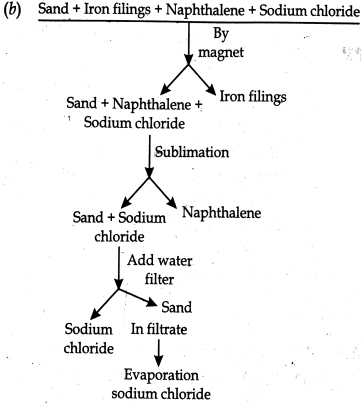
$(b)$ You are provided with a mixture containing sand,iron filings,naphthalene,and sodium chloride. Describe the procedures you would use to separate these constituents from the mixture.
$(b)$ You are provided with a mixture containing sand,iron filings,naphthalene,and sodium chloride. Describe the procedures you would use to separate these constituents from the mixture.
Solution
(N/A) Differences between a mixture and a compound:
$(b)$ Procedure to separate the mixture of sand,iron filings,naphthalene,and sodium chloride:
$(1)$ Use a magnet to move it over the mixture. The iron filings will be attracted to the magnet and can be separated.
$(2)$ The remaining mixture (sand,naphthalene,and sodium chloride) is heated. Naphthalene undergoes sublimation (changes directly from solid to gas) and can be collected separately.
$(3)$ Add water to the remaining mixture of sand and sodium chloride. Sodium chloride dissolves in water,while sand does not.
$(4)$ Filter the mixture. Sand remains as the residue on the filter paper,while sodium chloride solution passes through as the filtrate.
$(5)$ Finally,evaporate the filtrate (sodium chloride solution) to obtain solid sodium chloride.
| Mixtures | Compounds |
|---|---|
| $(1)$ Elements or compounds just mix together to form a mixture. | $(1)$ Elements react to form a new substance called a compound. |
| $(2)$ Variable composition. | $(2)$ Composition is fixed. |
| $(3)$ Show the properties of its constituents. | $(3)$ Show the properties of the compound and not the constituent elements. |
| $(4)$ Constituents can be separated easily by physical methods. | $(4)$ Cannot be separated by physical methods. |
$(b)$ Procedure to separate the mixture of sand,iron filings,naphthalene,and sodium chloride:
$(1)$ Use a magnet to move it over the mixture. The iron filings will be attracted to the magnet and can be separated.
$(2)$ The remaining mixture (sand,naphthalene,and sodium chloride) is heated. Naphthalene undergoes sublimation (changes directly from solid to gas) and can be collected separately.
$(3)$ Add water to the remaining mixture of sand and sodium chloride. Sodium chloride dissolves in water,while sand does not.
$(4)$ Filter the mixture. Sand remains as the residue on the filter paper,while sodium chloride solution passes through as the filtrate.
$(5)$ Finally,evaporate the filtrate (sodium chloride solution) to obtain solid sodium chloride.
0 likes
View Solution122
Medium
Write your observations when the following processes take place:
$(a)$ An aqueous solution of sugar is heated to dryness.
$(b)$ $A$ saturated solution of potassium chloride prepared at $60^\circ C$ is allowed to cool at room temperature.
$(c)$ $A$ mixture of iron filings and sulphur powder is heated strongly.
$(d)$ $A$ beam of light is passed through a colloidal solution.
$(e)$ $Dil. HCl$ is added to the mixture of iron and sulphur.
$(a)$ An aqueous solution of sugar is heated to dryness.
$(b)$ $A$ saturated solution of potassium chloride prepared at $60^\circ C$ is allowed to cool at room temperature.
$(c)$ $A$ mixture of iron filings and sulphur powder is heated strongly.
$(d)$ $A$ beam of light is passed through a colloidal solution.
$(e)$ $Dil. HCl$ is added to the mixture of iron and sulphur.
Solution
$(a)$ The water evaporates, and sugar remains as a solid residue.
$(b)$ The solubility of potassium chloride decreases with temperature, causing crystals of potassium chloride to form.
$(c)$ Iron reacts with sulphur to form a new compound, iron$(II)$ sulphide $(FeS)$, which is a black-coloured solid.
$(d)$ The path of the light becomes visible due to the scattering of light by colloidal particles, known as the Tyndall effect.
$(e)$ $A$ colourless gas, hydrogen sulphide $(H_2S)$, is evolved, which has a characteristic smell of rotten eggs.
$(b)$ The solubility of potassium chloride decreases with temperature, causing crystals of potassium chloride to form.
$(c)$ Iron reacts with sulphur to form a new compound, iron$(II)$ sulphide $(FeS)$, which is a black-coloured solid.
$(d)$ The path of the light becomes visible due to the scattering of light by colloidal particles, known as the Tyndall effect.
$(e)$ $A$ colourless gas, hydrogen sulphide $(H_2S)$, is evolved, which has a characteristic smell of rotten eggs.
0 likes
View Solution123
Medium
$(a)$ Write any three points of differences between homogeneous and heterogeneous mixtures.
$(b)$ Give two reasons for supporting that water is a compound and not a mixture.
$(b)$ Give two reasons for supporting that water is a compound and not a mixture.
Solution
(N/A) Differences between homogeneous and heterogeneous mixtures:
$(b)$ Reasons to support that water is a compound and not a mixture:
$(i)$ Water has a fixed chemical composition $(H_2O)$ and its components can be separated only by chemical methods like electrolysis,not by physical means.
$(ii)$ The properties of water are entirely different from the properties of its constituent elements,hydrogen (a combustible gas) and oxygen (a supporter of combustion).
| Homogeneous mixture | Heterogeneous mixture |
|---|---|
| $(i)$ Composition is uniform throughout. | $(i)$ Composition is not uniform throughout. |
| $(ii)$ No visible boundaries of separation. | $(ii)$ Distinct boundaries of separation are visible. |
| $(iii)$ Components are not easily separated (e.g.,sugar in water). | $(iii)$ Components can be easily separated (e.g.,oil and water). |
$(b)$ Reasons to support that water is a compound and not a mixture:
$(i)$ Water has a fixed chemical composition $(H_2O)$ and its components can be separated only by chemical methods like electrolysis,not by physical means.
$(ii)$ The properties of water are entirely different from the properties of its constituent elements,hydrogen (a combustible gas) and oxygen (a supporter of combustion).
0 likes
View Solution124
Medium
$(a)$ Name the separation techniques which you will apply for the separation of the following mixtures:
$(i)$ Small pieces of metal in the engine oil of a car.
$(ii)$ Fine mud particles suspended in water.
$(iii)$ Oil from water.
$(iv)$ Sodium chloride from its solution in water.
$(v)$ Camphor from salt.
$(vi)$ Wheat grains from husk.
$(b)$ Classify the following as a chemical or physical change:
$(i)$ Water boils to form steam.
$(ii)$ Burning of paper.
$(iii)$ An almirah gets rusted.
$(iv)$ Making a fruit salad with raw fruits.
$(i)$ Small pieces of metal in the engine oil of a car.
$(ii)$ Fine mud particles suspended in water.
$(iii)$ Oil from water.
$(iv)$ Sodium chloride from its solution in water.
$(v)$ Camphor from salt.
$(vi)$ Wheat grains from husk.
$(b)$ Classify the following as a chemical or physical change:
$(i)$ Water boils to form steam.
$(ii)$ Burning of paper.
$(iii)$ An almirah gets rusted.
$(iv)$ Making a fruit salad with raw fruits.
Solution
(N/A) The separation techniques are:
$(i)$ Filtration: Used to separate solid particles from a liquid.
$(ii)$ Centrifugation: Used to separate fine suspended particles.
$(iii)$ Separating funnel: Used to separate immiscible liquids like oil and water.
$(iv)$ Evaporation: Used to separate a dissolved solid from its solvent.
$(v)$ Sublimation: Used to separate a sublimable solid (camphor) from a non-sublimable one (salt).
$(vi)$ Winnowing: Used to separate lighter husk from heavier grains.
$(b)$ Classification of changes:
Chemical change: $(ii)$ Burning of paper and $(iii)$ Rusting of an almirah (new substances are formed).
Physical change: $(i)$ Boiling of water and $(iv)$ Making a fruit salad (no new substances are formed,only physical state or appearance changes).
$(i)$ Filtration: Used to separate solid particles from a liquid.
$(ii)$ Centrifugation: Used to separate fine suspended particles.
$(iii)$ Separating funnel: Used to separate immiscible liquids like oil and water.
$(iv)$ Evaporation: Used to separate a dissolved solid from its solvent.
$(v)$ Sublimation: Used to separate a sublimable solid (camphor) from a non-sublimable one (salt).
$(vi)$ Winnowing: Used to separate lighter husk from heavier grains.
$(b)$ Classification of changes:
Chemical change: $(ii)$ Burning of paper and $(iii)$ Rusting of an almirah (new substances are formed).
Physical change: $(i)$ Boiling of water and $(iv)$ Making a fruit salad (no new substances are formed,only physical state or appearance changes).
0 likes
View Solution125
Medium
$(a)$ List any three differences between true solution and suspension.
$(b)$ Identify colloids from the following:
Copper sulphate solution,milk,smoke,muddy water,butter,sugar solution,face cream,lemonade
$(b)$ Identify colloids from the following:
Copper sulphate solution,milk,smoke,muddy water,butter,sugar solution,face cream,lemonade
Solution
(N/A) Differences between suspension and true solution:
$(b)$ Colloids from the given list are: Milk,smoke,butter,and face cream.
| Suspension | True solution |
| $(i)$ Opaque in nature. | $(i)$ Transparent in nature. |
| $(ii)$ Particles can be separated by filtration. | $(ii)$ Particles cannot be separated by filtration. |
| $(iii)$ Unstable; particles settle down on keeping. | $(iii)$ Stable; particles do not settle down. |
$(b)$ Colloids from the given list are: Milk,smoke,butter,and face cream.
0 likes
View Solution126
Medium
$(a)$ Tabulate the differences between a suspension and a true solution with respect to $(i)$ filtration,$(ii)$ transparency,and $(iii)$ stability.
$(b)$ Give two examples from daily life where the Tyndall effect is observed.
$(b)$ Give two examples from daily life where the Tyndall effect is observed.
Solution
(N/A) The differences are tabulated below:
$(b)$ Two examples of the Tyndall effect in daily life are:
$(i)$ $A$ beam of light entering a dark room through a small hole,making dust particles visible.
$(ii)$ Sunlight passing through the canopy of a dense forest,where tiny water droplets in the mist scatter the light.
| Property | Suspension | True Solution |
|---|---|---|
| $(i)$ Filtration | Particles can be separated by filtration. | Particles cannot be separated by filtration. |
| $(ii)$ Transparency | Opaque. | Transparent. |
| $(iii)$ Stability | Unstable (particles settle down). | Stable (particles do not settle). |
$(b)$ Two examples of the Tyndall effect in daily life are:
$(i)$ $A$ beam of light entering a dark room through a small hole,making dust particles visible.
$(ii)$ Sunlight passing through the canopy of a dense forest,where tiny water droplets in the mist scatter the light.
0 likes
View Solution127
Medium
$(a)$ List any three characteristics of a colloid.
$(b)$ Name the two components of a colloid.
$(c)$ Identify colloids from the following mixtures:
Muddy water,sugar in water,ink,blood,soda water,foam.
$(b)$ Name the two components of a colloid.
$(c)$ Identify colloids from the following mixtures:
Muddy water,sugar in water,ink,blood,soda water,foam.
Solution
(C) The three characteristics of a colloid are:
$(i)$ It is a heterogeneous mixture.
$(ii)$ The particles of a colloid scatter a beam of light passing through it (Tyndall effect).
$(iii)$ It is a stable mixture,meaning the particles do not settle down when left undisturbed.
$(b)$ The two components of a colloid are:
$(i)$ Dispersed phase
$(ii)$ Dispersing medium
$(c)$ Among the given mixtures,the colloids are: Ink,blood,and foam.
$(i)$ It is a heterogeneous mixture.
$(ii)$ The particles of a colloid scatter a beam of light passing through it (Tyndall effect).
$(iii)$ It is a stable mixture,meaning the particles do not settle down when left undisturbed.
$(b)$ The two components of a colloid are:
$(i)$ Dispersed phase
$(ii)$ Dispersing medium
$(c)$ Among the given mixtures,the colloids are: Ink,blood,and foam.
0 likes
View Solution128
MediumMCQ
How are colloids different from suspensions? Identify the colloids from the following: Soda water,milk,sponge,clouds,mixture of alcohol and water,jelly.
A
Soda water,milk,sponge
B
Milk,clouds,jelly
C
Milk,sponge,clouds,jelly
D
Soda water,mixture of alcohol and water
Solution
(C) Colloids are heterogeneous mixtures where the particle size is intermediate between true solutions and suspensions $(1-1000 \ nm)$. They appear homogeneous but are actually heterogeneous. Suspensions are heterogeneous mixtures where the solute particles do not dissolve but remain suspended throughout the bulk of the medium and are large enough to be seen by the naked eye $(> 1000 \ nm)$.
From the given list:
$1$. Soda water: Solution.
$2$. Milk: Colloid.
$3$. Sponge: Colloid (solid foam).
$4$. Clouds: Colloid (aerosol).
$5$. Mixture of alcohol and water: Solution.
$6$. Jelly: Colloid (gel).
Therefore,the colloids are: Milk,sponge,clouds,and jelly.
From the given list:
$1$. Soda water: Solution.
$2$. Milk: Colloid.
$3$. Sponge: Colloid (solid foam).
$4$. Clouds: Colloid (aerosol).
$5$. Mixture of alcohol and water: Solution.
$6$. Jelly: Colloid (gel).
Therefore,the colloids are: Milk,sponge,clouds,and jelly.
0 likes
View Solution129
Medium
Write one point of difference between concentration and solubility.
Solution
(N/A) Concentration of a solution is the amount of solute present in a given amount of solvent or solution at a specific temperature.
Solubility is the maximum amount of solute that can be dissolved in a given amount of solvent at a specific temperature to form a saturated solution.
Solubility is the maximum amount of solute that can be dissolved in a given amount of solvent at a specific temperature to form a saturated solution.
0 likes
View Solution130
Medium
What happens when
$(i)$ a saturated solution is heated?
$(ii)$ a saturated solution is cooled slowly?
$(i)$ a saturated solution is heated?
$(ii)$ a saturated solution is cooled slowly?
Solution
(N/A) $(i)$ When a saturated solution is heated,its solubility increases,making it capable of dissolving more solute. Consequently,the solution becomes unsaturated.
$(ii)$ When a saturated solution is cooled slowly,the solubility of the solute decreases. As a result,the excess solute precipitates out of the solution,often forming crystals of the pure compound.
$(ii)$ When a saturated solution is cooled slowly,the solubility of the solute decreases. As a result,the excess solute precipitates out of the solution,often forming crystals of the pure compound.
0 likes
View Solution131
Easy
How is heating of sugar and heating of ammonium chloride different from each other? Explain your answer.
Solution
(N/A) Heating of $NH_4Cl$ (ammonium chloride) and sugar are different processes because they involve different physical and chemical changes.
$1$. $NH_4Cl$ is a sublime substance. When heated,it undergoes sublimation,meaning it changes directly from a solid state to a gaseous state without passing through the liquid phase.
$2$. Sugar $(C_{12}H_{22}O_{11})$ is not a sublime substance. When heated,it undergoes a chemical change called dehydration and thermal decomposition,which results in charring (turning into black carbon residue) rather than sublimation.
$1$. $NH_4Cl$ is a sublime substance. When heated,it undergoes sublimation,meaning it changes directly from a solid state to a gaseous state without passing through the liquid phase.
$2$. Sugar $(C_{12}H_{22}O_{11})$ is not a sublime substance. When heated,it undergoes a chemical change called dehydration and thermal decomposition,which results in charring (turning into black carbon residue) rather than sublimation.
0 likes
View Solution132
Medium
Suggest a suitable separation technique for the following:
$(i)$ Mercury and water.
$(ii)$ Coloured components from blue ink.
$(iii)$ Ammonium chloride and potassium chloride.
$(iv)$ Mixture of alcohol and water.
$(i)$ Mercury and water.
$(ii)$ Coloured components from blue ink.
$(iii)$ Ammonium chloride and potassium chloride.
$(iv)$ Mixture of alcohol and water.
Solution
(N/A) $(i)$ Mercury and water: Since they are immiscible liquids with different densities,a separating funnel is used.
$(ii)$ Coloured components from blue ink: Chromatography is used as it separates components based on their different solubilities in a solvent.
$(iii)$ Ammonium chloride and potassium chloride: Sublimation is used because ammonium chloride sublimes upon heating,while potassium chloride does not.
$(iv)$ Mixture of alcohol and water: Fractional distillation is used because they are miscible liquids with different boiling points.
$(ii)$ Coloured components from blue ink: Chromatography is used as it separates components based on their different solubilities in a solvent.
$(iii)$ Ammonium chloride and potassium chloride: Sublimation is used because ammonium chloride sublimes upon heating,while potassium chloride does not.
$(iv)$ Mixture of alcohol and water: Fractional distillation is used because they are miscible liquids with different boiling points.
0 likes
View Solution133
Difficult
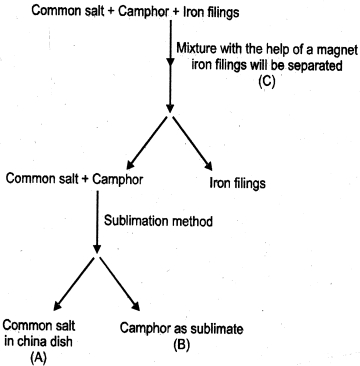
How will you separate a mixture of common salt $(A)$,camphor $(B)$ and iron filings $(C)$? Describe the process.
Solution
(N/A) To separate the mixture of common salt,camphor,and iron filings,follow these steps:
$1$. Magnetic Separation: Move a magnet over the mixture. Since iron filings $(C)$ are magnetic,they will be attracted to the magnet and can be separated from the mixture.
$2$. Sublimation: The remaining mixture contains common salt and camphor. Heat the mixture in a china dish. Camphor $(B)$ is a sublimable substance,meaning it changes directly from a solid to a gas upon heating. Place an inverted funnel over the dish to collect the camphor vapors,which will solidify on the cool inner walls of the funnel.
$3$. Residue: The common salt $(A)$ does not sublime and will remain as a residue in the china dish.
$1$. Magnetic Separation: Move a magnet over the mixture. Since iron filings $(C)$ are magnetic,they will be attracted to the magnet and can be separated from the mixture.
$2$. Sublimation: The remaining mixture contains common salt and camphor. Heat the mixture in a china dish. Camphor $(B)$ is a sublimable substance,meaning it changes directly from a solid to a gas upon heating. Place an inverted funnel over the dish to collect the camphor vapors,which will solidify on the cool inner walls of the funnel.
$3$. Residue: The common salt $(A)$ does not sublime and will remain as a residue in the china dish.
0 likes
View Solution134
Medium
Why is the interconversion of states of matter considered a physical change? Give three reasons to justify your answer.
Solution
(N/A) $(i)$ The chemical composition of the substance remains unchanged during the process.
$(ii)$ No new chemical substance is formed; the identity of the matter remains the same.
$(iii)$ The change is often reversible,and the substance exhibits different physical properties (like shape or state) while maintaining its original chemical identity.
$(ii)$ No new chemical substance is formed; the identity of the matter remains the same.
$(iii)$ The change is often reversible,and the substance exhibits different physical properties (like shape or state) while maintaining its original chemical identity.
0 likes
View Solution135
Medium
Colloidal solution appears to be homogeneous but actually it is heterogeneous. Give justification for this statement.
Solution
(N/A) The particles of a colloidal solution are very small,so they cannot be seen with the naked eye. Therefore,the colloidal solution appears to be homogeneous.
However,these particles are large enough to scatter a beam of visible light,i.e.,they exhibit the $Tyndall$ effect. Because they exhibit this property,which is characteristic of mixtures with distinct phases,the colloidal solution is actually heterogeneous.
However,these particles are large enough to scatter a beam of visible light,i.e.,they exhibit the $Tyndall$ effect. Because they exhibit this property,which is characteristic of mixtures with distinct phases,the colloidal solution is actually heterogeneous.
0 likes
View Solution136
Easy
Give an example each of a mixture that shows the following characteristics:
$(i)$ $A$ mixture of two coloured components.
$(ii)$ $A$ mixture of two volatile components with a boiling point difference of less than $25\ K$.
$(iii)$ $A$ mixture of a volatile and a non-volatile solid component.
$(i)$ $A$ mixture of two coloured components.
$(ii)$ $A$ mixture of two volatile components with a boiling point difference of less than $25\ K$.
$(iii)$ $A$ mixture of a volatile and a non-volatile solid component.
Solution
(N/A) $(i)$ $A$ mixture of two coloured components: Ink (which contains various dyes).
$(ii)$ $A$ mixture of two volatile components with a boiling point difference of less than $25\ K$: Air (which is a mixture of gases like nitrogen,oxygen,and argon).
$(iii)$ $A$ mixture of a volatile and a non-volatile solid component: Salt and water (or camphor and sand).
$(ii)$ $A$ mixture of two volatile components with a boiling point difference of less than $25\ K$: Air (which is a mixture of gases like nitrogen,oxygen,and argon).
$(iii)$ $A$ mixture of a volatile and a non-volatile solid component: Salt and water (or camphor and sand).
0 likes
View Solution137
MediumMCQ
How is a pure substance different from a mixture?
A
Pure substances have variable composition,while mixtures have fixed composition.
B
Pure substances consist of only one type of particles,while mixtures consist of two or more substances mixed in any proportion.
C
Mixtures have fixed melting and boiling points,while pure substances do not.
D
Pure substances are always heterogeneous,while mixtures are always homogeneous.
Solution
(B)
| Pure substance | Mixture |
|---|---|
| $(i)$ It is made up of only one kind of particles (atoms or molecules). | $(i)$ It consists of two or more pure substances mixed together in any proportion. |
| $(ii)$ It has a fixed composition with fixed melting and boiling points. e.g.,Gold,water,carbon dioxide. | $(ii)$ It does not have a fixed composition or fixed melting and boiling points. e.g.,Air,soil,sea-water. |
0 likes
View Solution138
Medium
$(i)$ Name the compound formed on heating a mixture of iron filings and sulphur.
$(ii)$ If dilute $HCl$ is added to the above compound,name the gas evolved and write down its two properties.
$(ii)$ If dilute $HCl$ is added to the above compound,name the gas evolved and write down its two properties.
Solution
(N/A) $(i)$ When iron filings and sulphur are heated together,they undergo a chemical reaction to form iron$(II)$ sulphide,represented by the formula $FeS$.
$(ii)$ When dilute hydrochloric acid $(HCl)$ is added to iron$(II)$ sulphide $(FeS)$,a chemical reaction occurs to produce hydrogen sulphide gas $(H_2S)$.
The chemical equation is: $FeS(s) + 2HCl(aq) \rightarrow FeCl_2(aq) + H_2S(g)$.
Two properties of hydrogen sulphide $(H_2S)$ gas are:
$(a)$ It is a colourless gas.
$(b)$ It has a characteristic smell of rotten eggs.
$(ii)$ When dilute hydrochloric acid $(HCl)$ is added to iron$(II)$ sulphide $(FeS)$,a chemical reaction occurs to produce hydrogen sulphide gas $(H_2S)$.
The chemical equation is: $FeS(s) + 2HCl(aq) \rightarrow FeCl_2(aq) + H_2S(g)$.
Two properties of hydrogen sulphide $(H_2S)$ gas are:
$(a)$ It is a colourless gas.
$(b)$ It has a characteristic smell of rotten eggs.
0 likes
View Solution139
Medium
Give an example for each of the following:
$(a)$ Solid-liquid homogeneous mixture
$(b)$ Gas-gas homogeneous mixture
$(c)$ Solid-solid homogeneous mixture
$(d)$ Solid-liquid heterogeneous mixture
$(e)$ Liquid-liquid heterogeneous mixture
$(a)$ Solid-liquid homogeneous mixture
$(b)$ Gas-gas homogeneous mixture
$(c)$ Solid-solid homogeneous mixture
$(d)$ Solid-liquid heterogeneous mixture
$(e)$ Liquid-liquid heterogeneous mixture
Solution
(N/A) Salt solution ($NaCl$ in water) is a solid-liquid homogeneous mixture where salt dissolves completely in water.
$(b)$ Air is a gas-gas homogeneous mixture consisting of nitrogen,oxygen,argon,and other gases.
$(c)$ Alloys like brass (copper and zinc) or bronze (copper and tin) are solid-solid homogeneous mixtures.
$(d)$ Muddy water or chalk powder in water are examples of solid-liquid heterogeneous mixtures.
$(e)$ $A$ mixture of oil and water is a liquid-liquid heterogeneous mixture as they form separate layers.
$(b)$ Air is a gas-gas homogeneous mixture consisting of nitrogen,oxygen,argon,and other gases.
$(c)$ Alloys like brass (copper and zinc) or bronze (copper and tin) are solid-solid homogeneous mixtures.
$(d)$ Muddy water or chalk powder in water are examples of solid-liquid heterogeneous mixtures.
$(e)$ $A$ mixture of oil and water is a liquid-liquid heterogeneous mixture as they form separate layers.
0 likes
View Solution140
Medium
Identify the solute and the solvent for the following mixtures:
$(a)$ Tincture of iodine
$(b)$ Soda water
$(c)$ Sugar solution
$(d)$ Polluted air
$(e)$ Dilute hydrochloric acid
$(a)$ Tincture of iodine
$(b)$ Soda water
$(c)$ Sugar solution
$(d)$ Polluted air
$(e)$ Dilute hydrochloric acid
Solution
(N/A) Tincture of iodine: Solute $=$ Iodine,Solvent $=$ Alcohol.
$(b)$ Soda water: Solute $=$ Carbon dioxide $(CO_2)$,Solvent $=$ Water.
$(c)$ Sugar solution: Solute $=$ Sugar,Solvent $=$ Water.
$(d)$ Polluted air: Solute $=$ Pollutant gases (e.g.,$NO_2, SO_2, CO$),Solvent $=$ Air (mainly Nitrogen and Oxygen).
$(e)$ Dilute hydrochloric acid: Solute $=$ Hydrogen chloride gas $(HCl)$,Solvent $=$ Water.
$(b)$ Soda water: Solute $=$ Carbon dioxide $(CO_2)$,Solvent $=$ Water.
$(c)$ Sugar solution: Solute $=$ Sugar,Solvent $=$ Water.
$(d)$ Polluted air: Solute $=$ Pollutant gases (e.g.,$NO_2, SO_2, CO$),Solvent $=$ Air (mainly Nitrogen and Oxygen).
$(e)$ Dilute hydrochloric acid: Solute $=$ Hydrogen chloride gas $(HCl)$,Solvent $=$ Water.
0 likes
View Solution141
Medium
Three students $A, B$ and $C$ prepared mixtures using chalk powder,common salt and milk respectively in water. Whose mixture
$(i)$ would not leave residue on filter paper after filtration?
$(ii)$ would show Tyndall effect?
$(iii)$ would give transparent/clear solution?
$(iv)$ would settle down at the bottom when left undisturbed?
$(v)$ could be filtered by filter paper?
$(i)$ would not leave residue on filter paper after filtration?
$(ii)$ would show Tyndall effect?
$(iii)$ would give transparent/clear solution?
$(iv)$ would settle down at the bottom when left undisturbed?
$(v)$ could be filtered by filter paper?
Solution
(N/A) $(i)$ Mixture of common salt and water (True solution).
$(ii)$ Mixtures of chalk powder with water (Suspension) and milk with water (Colloid).
$(iii)$ Mixture of common salt and water (True solution).
$(iv)$ Mixture of chalk powder and water (Suspension).
$(v)$ Mixture of chalk powder and water (Suspension).
$(ii)$ Mixtures of chalk powder with water (Suspension) and milk with water (Colloid).
$(iii)$ Mixture of common salt and water (True solution).
$(iv)$ Mixture of chalk powder and water (Suspension).
$(v)$ Mixture of chalk powder and water (Suspension).
0 likes
View Solution142
Medium
Differentiate between an element and a compound. Categorize the following substances into elements and compounds: Sodium chloride,Iodine,Water,$24$ carat gold,Oxygen gas,Carbon.
Solution
(N/A)
Classification:
Elements: Iodine,$24$ carat gold,Oxygen gas,Carbon.
Compounds: Sodium chloride,Water.
| Elements | Compounds |
|---|---|
| $(i)$ Made up of only one type of atoms. | $(i)$ Made up of two or more types of atoms chemically combined in a fixed ratio. |
| $(ii)$ Cannot be broken down into simpler substances by chemical reactions. | $(ii)$ Can be broken down into simpler substances (elements) by chemical reactions. |
Classification:
Elements: Iodine,$24$ carat gold,Oxygen gas,Carbon.
Compounds: Sodium chloride,Water.
0 likes
View Solution143
Medium
Define the term $solution$. Identify the solute and solvent in the following solutions:
$(i)$ Tincture of iodine
$(ii)$ Polluted air
$(iii)$ Soda water
$(iv)$ Dilute hydrochloric acid
$(i)$ Tincture of iodine
$(ii)$ Polluted air
$(iii)$ Soda water
$(iv)$ Dilute hydrochloric acid
Solution
(N/A) $solution$ is a homogeneous mixture of two or more substances.
$(i)$ Tincture of iodine: Solute is $iodine$ and solvent is $alcohol$.
$(ii)$ Polluted air: Solute is $pollutants$ (like $SO_2$, $NO_2$, dust) and solvent is $air$ (mixture of gases).
$(iii)$ Soda water: Solute is $CO_2$ and solvent is $water$.
$(iv)$ Dilute hydrochloric acid: Solute is $HCl$ and solvent is $water$.
$(i)$ Tincture of iodine: Solute is $iodine$ and solvent is $alcohol$.
$(ii)$ Polluted air: Solute is $pollutants$ (like $SO_2$, $NO_2$, dust) and solvent is $air$ (mixture of gases).
$(iii)$ Soda water: Solute is $CO_2$ and solvent is $water$.
$(iv)$ Dilute hydrochloric acid: Solute is $HCl$ and solvent is $water$.
0 likes
View Solution144
EasyMCQ
What is meant by a pure substance?
A
$A$ substance containing only one type of atom or molecule.
B
$A$ substance containing a mixture of different elements.
C
$A$ substance that can be separated by physical methods.
D
$A$ substance that has variable composition.
Solution
(A) pure substance is defined as a substance that consists of only one type of particles. These particles can be atoms (in the case of an element) or molecules (in the case of a compound). All constituent particles in a pure substance have the same chemical properties.
0 likes
View Solution145
Easy
Why does a mixture not have a fixed melting or a fixed boiling point?
Solution
(N/A) mixture consists of two or more substances mixed in any proportion. Because the composition of a mixture is variable,the intermolecular forces and the energy required for phase transitions are not constant. Therefore,a mixture does not have a fixed melting or a fixed boiling point; instead,it melts or boils over a range of temperatures.
0 likes
View Solution146
Easy
What are metalloids? Give examples.
Solution
(N/A) The elements which exhibit properties intermediate between those of metals and non-metals are called metalloids or semimetals.
Examples include Silicon $(Si)$,Germanium $(Ge)$,Arsenic $(As)$,Antimony $(Sb)$,and Tellurium $(Te)$.
Examples include Silicon $(Si)$,Germanium $(Ge)$,Arsenic $(As)$,Antimony $(Sb)$,and Tellurium $(Te)$.
0 likes
View Solution147
EasyMCQ
When is a compound said to be pure?
A
When it has a fixed melting point.
B
When it has a fixed boiling point.
C
When it has a fixed melting and boiling point.
D
When it is found in nature.
Solution
(C) substance or compound is considered pure if it consists of only one type of particles and exhibits a fixed melting point and a fixed boiling point under standard atmospheric pressure.
If a substance is impure,it will typically show a range of temperatures for melting or boiling rather than a sharp,fixed value.
If a substance is impure,it will typically show a range of temperatures for melting or boiling rather than a sharp,fixed value.
0 likes
View Solution148
EasyMCQ
Which of the following will show the "Tyndall effect"?
A
Copper sulphate solution
B
Soap solution
C
Sugar solution
D
Salt solution
Solution
(B) The "Tyndall effect" is the phenomenon of scattering of a beam of light by particles in a colloid or a fine suspension.
$1$. Copper sulphate solution, sugar solution, and salt solution are all true solutions, where the solute particles are very small (less than $1 \, nm$ in diameter) and do not scatter light.
$2$. A soap solution is a colloidal solution. In a colloid, the particle size is between $1 \, nm$ and $1000 \, nm$, which is large enough to scatter a beam of light passing through it, thus exhibiting the "Tyndall effect".
Therefore, the correct option is $B$.
$1$. Copper sulphate solution, sugar solution, and salt solution are all true solutions, where the solute particles are very small (less than $1 \, nm$ in diameter) and do not scatter light.
$2$. A soap solution is a colloidal solution. In a colloid, the particle size is between $1 \, nm$ and $1000 \, nm$, which is large enough to scatter a beam of light passing through it, thus exhibiting the "Tyndall effect".
Therefore, the correct option is $B$.
0 likes
View Solution149
EasyMCQ
What happens when a saturated solution is cooled?
A
It becomes supersaturated
B
It becomes transparent
C
It becomes unsaturated
D
It remains unaffected
Solution
(A) saturated solution is one in which no more solute can be dissolved at a given temperature.
When a saturated solution is cooled,the solubility of the solute decreases.
As a result,the solution becomes supersaturated,and the excess solute typically crystallizes out of the solution.
When a saturated solution is cooled,the solubility of the solute decreases.
As a result,the solution becomes supersaturated,and the excess solute typically crystallizes out of the solution.
0 likes
View Solution150
EasyMCQ
Which of the following is a compound?
A
Air
B
Water
C
Soda water
D
Pond water
Solution
(B) compound is a substance formed when two or more chemical elements are chemically bonded together in a fixed proportion by mass.
Water $(H_2O)$ is a compound because it consists of hydrogen and oxygen atoms chemically combined in a fixed ratio of $2:1$ by volume or $1:8$ by mass.
Air is a mixture of various gases like nitrogen,oxygen,argon,and carbon dioxide.
Soda water is a mixture of carbon dioxide gas dissolved in water.
Pond water is a mixture containing water,dissolved minerals,organic matter,and microorganisms.
Therefore,water is the correct answer.
Water $(H_2O)$ is a compound because it consists of hydrogen and oxygen atoms chemically combined in a fixed ratio of $2:1$ by volume or $1:8$ by mass.
Air is a mixture of various gases like nitrogen,oxygen,argon,and carbon dioxide.
Soda water is a mixture of carbon dioxide gas dissolved in water.
Pond water is a mixture containing water,dissolved minerals,organic matter,and microorganisms.
Therefore,water is the correct answer.
0 likes
View SolutionIS MATTER AROUND US PURE? — Mix Example - IS MATTER AROUND US PURE? · Frequently Asked Questions
1Are these IS MATTER AROUND US PURE? questions useful for JEE and NEET?
Yes. All questions in this section are mapped to JEE Main and NEET exam patterns. Previous year questions from JEE Main, NEET, GUJCET and state-level exams are included with full solutions.
2Can I switch to Hindi or Gujarati for these questions?
Yes. Use the language tabs in the hero section or the sidebar to view the same questions and solutions in English, Hindi or Gujarati.
3How do I generate a question paper from this subtopic?
Use the Vedclass Exam Paper Generator — select the chapter and subtopic, set difficulty, and generate Sets A, B, C, D automatically. First 3 chapters of every subject are free.
Vedclass Products
For Students
Vedclass Test Series
Mock tests in real JEE/NEET style with performance analysis. 5-day free trial.
Start Free TrialFor Teachers
Exam Paper Generator
Generate Set A/B/C/D papers from this chapter in 2 minutes. 3 chapters free.
Try FreeFor Institutes
Online Exam Module
Live online exams with unlimited students, 360° analytics & white-label branding.
See DemoFor Teachers & Institutes
Generate a IS MATTER AROUND US PURE? Exam Paper in 2 Minutes
Select subtopic & difficulty — Sets A, B, C, D auto-generated with No Repeat logic.
First 3 chapters of every subject are free — no payment required.