
A English
Textbook - Linear Equations in Two Variables Questions in English
Class 9 Mathematics · Linear Equations in Two Variables · Textbook - Linear Equations in Two Variables
41+
Questions
English
Language
100%
With Solutions
Showing 41 of 41 questions in English
1
Easy
Write each of the following equations in the form $ax + by + c = 0$ and indicate the values of $a$,$b$ and $c$ in each case:
$(i)$ $2x + 3y = 4.37$
$(ii)$ $x - 4 = \sqrt{3}y$
$(iii)$ $4 = 5x - 3y$
$(iv)$ $2x = y$
$(i)$ $2x + 3y = 4.37$
$(ii)$ $x - 4 = \sqrt{3}y$
$(iii)$ $4 = 5x - 3y$
$(iv)$ $2x = y$
Solution
(N/A) $(i)$ The equation $2x + 3y = 4.37$ can be written as $2x + 3y - 4.37 = 0$.
Comparing this with $ax + by + c = 0$,we get $a = 2$,$b = 3$,and $c = -4.37$.
$(ii)$ The equation $x - 4 = \sqrt{3}y$ can be written as $x - \sqrt{3}y - 4 = 0$.
Comparing this with $ax + by + c = 0$,we get $a = 1$,$b = -\sqrt{3}$,and $c = -4$.
$(iii)$ The equation $4 = 5x - 3y$ can be written as $5x - 3y - 4 = 0$.
Comparing this with $ax + by + c = 0$,we get $a = 5$,$b = -3$,and $c = -4$.
$(iv)$ The equation $2x = y$ can be written as $2x - y + 0 = 0$.
Comparing this with $ax + by + c = 0$,we get $a = 2$,$b = -1$,and $c = 0$.
Comparing this with $ax + by + c = 0$,we get $a = 2$,$b = 3$,and $c = -4.37$.
$(ii)$ The equation $x - 4 = \sqrt{3}y$ can be written as $x - \sqrt{3}y - 4 = 0$.
Comparing this with $ax + by + c = 0$,we get $a = 1$,$b = -\sqrt{3}$,and $c = -4$.
$(iii)$ The equation $4 = 5x - 3y$ can be written as $5x - 3y - 4 = 0$.
Comparing this with $ax + by + c = 0$,we get $a = 5$,$b = -3$,and $c = -4$.
$(iv)$ The equation $2x = y$ can be written as $2x - y + 0 = 0$.
Comparing this with $ax + by + c = 0$,we get $a = 2$,$b = -1$,and $c = 0$.
1 likes
View Solution2
Easy
Write each of the following as an equation in two variables:
$(i)$ $x = -5$
$(ii)$ $y = 2$
$(iii)$ $2x = 3$
$(iv)$ $5y = 2$
$(i)$ $x = -5$
$(ii)$ $y = 2$
$(iii)$ $2x = 3$
$(iv)$ $5y = 2$
Solution
(N/A) linear equation in two variables is expressed in the form $ax + by + c = 0$,where $a$,$b$,and $c$ are real numbers and $a$ and $b$ are not both zero.
$(i)$ $x = -5$ can be written as $1x + 0y = -5$,which is $1x + 0y + 5 = 0$.
$(ii)$ $y = 2$ can be written as $0x + 1y = 2$,which is $0x + 1y - 2 = 0$.
$(iii)$ $2x = 3$ can be written as $2x + 0y = 3$,which is $2x + 0y - 3 = 0$.
$(iv)$ $5y = 2$ can be written as $0x + 5y = 2$,which is $0x + 5y - 2 = 0$.
$(i)$ $x = -5$ can be written as $1x + 0y = -5$,which is $1x + 0y + 5 = 0$.
$(ii)$ $y = 2$ can be written as $0x + 1y = 2$,which is $0x + 1y - 2 = 0$.
$(iii)$ $2x = 3$ can be written as $2x + 0y = 3$,which is $2x + 0y - 3 = 0$.
$(iv)$ $5y = 2$ can be written as $0x + 5y = 2$,which is $0x + 5y - 2 = 0$.
0 likes
View Solution3
Easy
The cost of a notebook is twice the cost of a pen. Write a linear equation in two variables to represent this statement. (Take the cost of a notebook to be Rs. $x$ and that of a pen to be Rs. $y$).
Solution
(A) Let the cost of a notebook be Rs. $x$.
Let the cost of a pen be Rs. $y$.
According to the given condition,the cost of a notebook is twice the cost of a pen.
Therefore,we can write the equation as:
$x = 2y$
Rearranging the terms to the standard form of a linear equation in two variables $(ax + by + c = 0)$:
$x - 2y = 0$
Thus,the required linear equation is $x - 2y = 0$.
Let the cost of a pen be Rs. $y$.
According to the given condition,the cost of a notebook is twice the cost of a pen.
Therefore,we can write the equation as:
$x = 2y$
Rearranging the terms to the standard form of a linear equation in two variables $(ax + by + c = 0)$:
$x - 2y = 0$
Thus,the required linear equation is $x - 2y = 0$.
0 likes
View Solution4
Easy
Express the following linear equation in the form $ax + by + c = 0$ and indicate the values of $a$,$b$,and $c$: $2x + 3y = 9.3\overline{5}$
Solution
(A) The given equation is $2x + 3y = 9.3\overline{5}$.
To express this in the standard form $ax + by + c = 0$,we subtract $9.3\overline{5}$ from both sides:
$2x + 3y - 9.3\overline{5} = 0$.
Comparing this with the general form $ax + by + c = 0$,we get:
$a = 2$
$b = 3$
$c = -9.3\overline{5}$
To express this in the standard form $ax + by + c = 0$,we subtract $9.3\overline{5}$ from both sides:
$2x + 3y - 9.3\overline{5} = 0$.
Comparing this with the general form $ax + by + c = 0$,we get:
$a = 2$
$b = 3$
$c = -9.3\overline{5}$
0 likes
View Solution5
Easy
Express the following linear equation in the form $ax + by + c = 0$ and indicate the values of $a$,$b$,and $c$: $x - \frac{y}{5} - 10 = 0$.
Solution
(A) The given equation is $x - \frac{y}{5} - 10 = 0$.
This can be rewritten in the standard form $ax + by + c = 0$ as:
$1x + (-\frac{1}{5})y + (-10) = 0$.
Comparing this with the general form $ax + by + c = 0$,we identify the coefficients as:
$a = 1$,$b = -\frac{1}{5}$,and $c = -10$.
This can be rewritten in the standard form $ax + by + c = 0$ as:
$1x + (-\frac{1}{5})y + (-10) = 0$.
Comparing this with the general form $ax + by + c = 0$,we identify the coefficients as:
$a = 1$,$b = -\frac{1}{5}$,and $c = -10$.
0 likes
View Solution6
EasyMCQ
Express the following linear equation in the form $ax + by + c = 0$ and indicate the values of $a$,$b$,and $c$: $-2x + 3y = 6$.
A
-2x + 3y - $6$ = $0$; a = -$2$,b = $3$,c = -$6$
B
-2x + 3y + $6$ = $0$; a = -$2$,b = $3$,c = $6$
C
2x - 3y + $6$ = $0$; a = $2$,b = -$3$,c = $6$
D
2x + 3y - $6$ = $0$; a = $2$,b = $3$,c = -$6$
Solution
(A) The given equation is $-2x + 3y = 6$.
To express this in the form $ax + by + c = 0$,we subtract $6$ from both sides:
$-2x + 3y - 6 = 0$.
Comparing this with the standard form $ax + by + c = 0$,we identify the coefficients:
$a = -2$,
$b = 3$,
$c = -6$.
To express this in the form $ax + by + c = 0$,we subtract $6$ from both sides:
$-2x + 3y - 6 = 0$.
Comparing this with the standard form $ax + by + c = 0$,we identify the coefficients:
$a = -2$,
$b = 3$,
$c = -6$.
0 likes
View Solution7
Easy
Express the following linear equation in the form $ax + by + c = 0$ and indicate the values of $a$,$b$,and $c$: $x = 3y$.
Solution
(A) The given equation is $x = 3y$.
To express this in the form $ax + by + c = 0$,we subtract $3y$ from both sides:
$x - 3y = 0$
This can be written as:
$(1)x + (-3)y + 0 = 0$
Comparing this with the standard form $ax + by + c = 0$,we get:
$a = 1$
$b = -3$
$c = 0$
To express this in the form $ax + by + c = 0$,we subtract $3y$ from both sides:
$x - 3y = 0$
This can be written as:
$(1)x + (-3)y + 0 = 0$
Comparing this with the standard form $ax + by + c = 0$,we get:
$a = 1$
$b = -3$
$c = 0$
2 likes
View Solution8
Easy
Express the following linear equation in the form $ax + by + c = 0$ and indicate the values of $a$,$b$,and $c$: $2x = -5y$.
Solution
(N/A) The given equation is $2x = -5y$.
To express this in the form $ax + by + c = 0$,we move all terms to the left side:
$2x + 5y = 0$.
This can be written as $(2)x + (5)y + (0) = 0$.
Comparing this with the standard form $ax + by + c = 0$,we identify the coefficients as:
$a = 2$,$b = 5$,and $c = 0$.
To express this in the form $ax + by + c = 0$,we move all terms to the left side:
$2x + 5y = 0$.
This can be written as $(2)x + (5)y + (0) = 0$.
Comparing this with the standard form $ax + by + c = 0$,we identify the coefficients as:
$a = 2$,$b = 5$,and $c = 0$.
0 likes
View Solution9
Easy
Express the linear equation $3x + 2 = 0$ in the form $ax + by + c = 0$ and indicate the values of $a$,$b$,and $c$.
Solution
(N/A) The given equation is $3x + 2 = 0$.
To express this in the form $ax + by + c = 0$,we can write it as:
$3x + 0y + 2 = 0$
Comparing this with the standard form $ax + by + c = 0$,we identify the coefficients as:
$a = 3$
$b = 0$
$c = 2$
To express this in the form $ax + by + c = 0$,we can write it as:
$3x + 0y + 2 = 0$
Comparing this with the standard form $ax + by + c = 0$,we identify the coefficients as:
$a = 3$
$b = 0$
$c = 2$
0 likes
View Solution10
Easy
Express the following linear equation in the form $ax + by + c = 0$ and indicate the values of $a$,$b$,and $c$: $y - 2 = 0$.
Solution
(N/A) The given equation is $y - 2 = 0$.
To express this in the form $ax + by + c = 0$,we can rewrite it as:
$(0)x + (1)y + (-2) = 0$.
Comparing this with the standard form $ax + by + c = 0$,we identify the coefficients as:
$a = 0$,$b = 1$,and $c = -2$.
To express this in the form $ax + by + c = 0$,we can rewrite it as:
$(0)x + (1)y + (-2) = 0$.
Comparing this with the standard form $ax + by + c = 0$,we identify the coefficients as:
$a = 0$,$b = 1$,and $c = -2$.
0 likes
View Solution11
Easy
Express the following linear equation in the form $ax + by + c = 0$ and indicate the values of $a$,$b$,and $c$: $5 = 2x$.
Solution
(A) The given equation is $5 = 2x$.
To express this in the form $ax + by + c = 0$,we rearrange the terms:
$2x - 5 = 0$
This can be written as:
$2x + 0y + (-5) = 0$
Comparing this with the standard form $ax + by + c = 0$,we identify the coefficients:
$a = 2$
$b = 0$
$c = -5$
To express this in the form $ax + by + c = 0$,we rearrange the terms:
$2x - 5 = 0$
This can be written as:
$2x + 0y + (-5) = 0$
Comparing this with the standard form $ax + by + c = 0$,we identify the coefficients:
$a = 2$
$b = 0$
$c = -5$
0 likes
View Solution12
Easy
Find four different solutions of the equation $x + 2y = 6.$
Solution
(N/A) To find solutions for the linear equation $x + 2y = 6$,we can assign arbitrary values to one variable and solve for the other.
$1$. Let $x = 0$. Then $0 + 2y = 6$,which gives $2y = 6$,so $y = 3$. Thus,$(0, 3)$ is a solution.
$2$. Let $y = 0$. Then $x + 2(0) = 6$,which gives $x = 6$. Thus,$(6, 0)$ is a solution.
$3$. Let $x = 2$. Then $2 + 2y = 6$,which gives $2y = 4$,so $y = 2$. Thus,$(2, 2)$ is a solution.
$4$. Let $y = 1$. Then $x + 2(1) = 6$,which gives $x + 2 = 6$,so $x = 4$. Thus,$(4, 1)$ is a solution.
Therefore,four different solutions of the equation are $(0, 3)$,$(6, 0)$,$(2, 2)$,and $(4, 1)$.
$1$. Let $x = 0$. Then $0 + 2y = 6$,which gives $2y = 6$,so $y = 3$. Thus,$(0, 3)$ is a solution.
$2$. Let $y = 0$. Then $x + 2(0) = 6$,which gives $x = 6$. Thus,$(6, 0)$ is a solution.
$3$. Let $x = 2$. Then $2 + 2y = 6$,which gives $2y = 4$,so $y = 2$. Thus,$(2, 2)$ is a solution.
$4$. Let $y = 1$. Then $x + 2(1) = 6$,which gives $x + 2 = 6$,so $x = 4$. Thus,$(4, 1)$ is a solution.
Therefore,four different solutions of the equation are $(0, 3)$,$(6, 0)$,$(2, 2)$,and $(4, 1)$.
0 likes
View Solution13
Medium
Find two solutions for each of the following equations:
$(i)$ $4x + 3y = 12$
$(ii)$ $2x + 5y = 0$
$(iii)$ $3y + 4 = 0$
$(i)$ $4x + 3y = 12$
$(ii)$ $2x + 5y = 0$
$(iii)$ $3y + 4 = 0$
Solution
(N/A) $(i)$ For $4x + 3y = 12$,if we take $x = 0$,then $3y = 12$,which gives $y = 4$. So,$(0, 4)$ is a solution. If we take $y = 0$,then $4x = 12$,which gives $x = 3$. So,$(3, 0)$ is another solution.
$(ii)$ For $2x + 5y = 0$,if we take $x = 0$,then $5y = 0$,which gives $y = 0$. So,$(0, 0)$ is a solution. If we take $x = 1$,then $2(1) + 5y = 0$,which gives $5y = -2$,so $y = -\frac{2}{5}$. Thus,$(1, -\frac{2}{5})$ is another solution.
$(iii)$ For $3y + 4 = 0$,we can write this as $0x + 3y = -4$. For any value of $x$,$y$ remains $-\frac{4}{3}$. If we take $x = 0$,$y = -\frac{4}{3}$. If we take $x = 1$,$y = -\frac{4}{3}$. Thus,two solutions are $(0, -\frac{4}{3})$ and $(1, -\frac{4}{3})$.
$(ii)$ For $2x + 5y = 0$,if we take $x = 0$,then $5y = 0$,which gives $y = 0$. So,$(0, 0)$ is a solution. If we take $x = 1$,then $2(1) + 5y = 0$,which gives $5y = -2$,so $y = -\frac{2}{5}$. Thus,$(1, -\frac{2}{5})$ is another solution.
$(iii)$ For $3y + 4 = 0$,we can write this as $0x + 3y = -4$. For any value of $x$,$y$ remains $-\frac{4}{3}$. If we take $x = 0$,$y = -\frac{4}{3}$. If we take $x = 1$,$y = -\frac{4}{3}$. Thus,two solutions are $(0, -\frac{4}{3})$ and $(1, -\frac{4}{3})$.
0 likes
View Solution14
EasyMCQ
Which one of the following options is true,and why?
$y = 3x + 5$ has
$(i)$ a unique solution,
$(ii)$ only two solutions,
$(iii)$ infinitely many solutions
$y = 3x + 5$ has
$(i)$ a unique solution,
$(ii)$ only two solutions,
$(iii)$ infinitely many solutions
A
$(i)$
B
$(ii)$
C
$(iii)$
Solution
(C) The equation $y = 3x + 5$ is a linear equation in two variables.
For any linear equation in two variables of the form $ax + by + c = 0$,there exist infinitely many pairs of $(x, y)$ that satisfy the equation.
This is because for every real value assigned to $x$,we can calculate a corresponding unique value for $y$ using the relation $y = 3x + 5$.
Since there are infinitely many real numbers for $x$,there are infinitely many corresponding values for $y$.
Therefore,the correct option is $(iii)$.
For any linear equation in two variables of the form $ax + by + c = 0$,there exist infinitely many pairs of $(x, y)$ that satisfy the equation.
This is because for every real value assigned to $x$,we can calculate a corresponding unique value for $y$ using the relation $y = 3x + 5$.
Since there are infinitely many real numbers for $x$,there are infinitely many corresponding values for $y$.
Therefore,the correct option is $(iii)$.
0 likes
View Solution15
Easy
Write four solutions for the equation: $2x + y = 7$
Solution
(N/A) To find solutions for the equation $2x + y = 7$,we can express $y$ in terms of $x$: $y = 7 - 2x$.
By substituting different values of $x$,we get corresponding values of $y$:
$1$. When $x = 0$,$y = 7 - 2(0) = 7$. Thus,the solution is $(0, 7)$.
$2$. When $x = 1$,$y = 7 - 2(1) = 5$. Thus,the solution is $(1, 5)$.
$3$. When $x = 2$,$y = 7 - 2(2) = 3$. Thus,the solution is $(2, 3)$.
$4$. When $x = 3$,$y = 7 - 2(3) = 1$. Thus,the solution is $(3, 1)$.
By substituting different values of $x$,we get corresponding values of $y$:
$1$. When $x = 0$,$y = 7 - 2(0) = 7$. Thus,the solution is $(0, 7)$.
$2$. When $x = 1$,$y = 7 - 2(1) = 5$. Thus,the solution is $(1, 5)$.
$3$. When $x = 2$,$y = 7 - 2(2) = 3$. Thus,the solution is $(2, 3)$.
$4$. When $x = 3$,$y = 7 - 2(3) = 1$. Thus,the solution is $(3, 1)$.
1 likes
View Solution16
Medium
Write four solutions for the equation: $\pi x + y = 9$
Solution
(N/A) To find the solutions for the linear equation $\pi x + y = 9$,we can substitute different values for $x$ and solve for $y$.
$1$. When $x = 0$:
$\pi(0) + y = 9 \Rightarrow 0 + y = 9 \Rightarrow y = 9$.
So,the solution is $(0, 9)$.
$2$. When $x = 1$:
$\pi(1) + y = 9 \Rightarrow \pi + y = 9 \Rightarrow y = 9 - \pi$.
So,the solution is $(1, 9 - \pi)$.
$3$. When $x = 2$:
$\pi(2) + y = 9 \Rightarrow 2\pi + y = 9 \Rightarrow y = 9 - 2\pi$.
So,the solution is $(2, 9 - 2\pi)$.
$4$. When $x = -1$:
$\pi(-1) + y = 9 \Rightarrow -\pi + y = 9 \Rightarrow y = 9 + \pi$.
So,the solution is $(-1, 9 + \pi)$.
$1$. When $x = 0$:
$\pi(0) + y = 9 \Rightarrow 0 + y = 9 \Rightarrow y = 9$.
So,the solution is $(0, 9)$.
$2$. When $x = 1$:
$\pi(1) + y = 9 \Rightarrow \pi + y = 9 \Rightarrow y = 9 - \pi$.
So,the solution is $(1, 9 - \pi)$.
$3$. When $x = 2$:
$\pi(2) + y = 9 \Rightarrow 2\pi + y = 9 \Rightarrow y = 9 - 2\pi$.
So,the solution is $(2, 9 - 2\pi)$.
$4$. When $x = -1$:
$\pi(-1) + y = 9 \Rightarrow -\pi + y = 9 \Rightarrow y = 9 + \pi$.
So,the solution is $(-1, 9 + \pi)$.
1 likes
View Solution17
Medium
Write four solutions for the equation: $x = 4y$
Solution
(N/A) To find the solutions for the equation $x = 4y$,we can substitute different values for $y$ and find the corresponding values of $x$.
$1$. If $y = 0$,then $x = 4(0) = 0$. So,the solution is $(0, 0)$.
$2$. If $y = 1$,then $x = 4(1) = 4$. So,the solution is $(4, 1)$.
$3$. If $y = -1$,then $x = 4(-1) = -4$. So,the solution is $(-4, -1)$.
$4$. If $y = 2$,then $x = 4(2) = 8$. So,the solution is $(8, 2)$.
$1$. If $y = 0$,then $x = 4(0) = 0$. So,the solution is $(0, 0)$.
$2$. If $y = 1$,then $x = 4(1) = 4$. So,the solution is $(4, 1)$.
$3$. If $y = -1$,then $x = 4(-1) = -4$. So,the solution is $(-4, -1)$.
$4$. If $y = 2$,then $x = 4(2) = 8$. So,the solution is $(8, 2)$.
0 likes
View Solution18
EasyMCQ
Check whether $(0, 2)$ is a solution of the equation $x - 2y = 4$.
A
Yes
B
No
C
Cannot be determined
D
None of these
Solution
(B) The given point is $(0, 2)$,which means $x = 0$ and $y = 2$.
Substitute $x = 0$ and $y = 2$ into the equation $x - 2y = 4$:
$L$.$H$.$S$. $= x - 2y = 0 - 2(2) = 0 - 4 = -4$.
The $R$.$H$.$S$. of the equation is $4$.
Since $L$.$H$.$S$. $= -4$ and $R$.$H$.$S$. $= 4$,we have $L$.$H$.$S$. $\neq$ $R$.$H$.$S$.
Therefore,$(0, 2)$ is not a solution of the equation $x - 2y = 4$.
Substitute $x = 0$ and $y = 2$ into the equation $x - 2y = 4$:
$L$.$H$.$S$. $= x - 2y = 0 - 2(2) = 0 - 4 = -4$.
The $R$.$H$.$S$. of the equation is $4$.
Since $L$.$H$.$S$. $= -4$ and $R$.$H$.$S$. $= 4$,we have $L$.$H$.$S$. $\neq$ $R$.$H$.$S$.
Therefore,$(0, 2)$ is not a solution of the equation $x - 2y = 4$.
0 likes
View Solution19
EasyMCQ
Check whether $(2, 0)$ is a solution of the equation $x - 2y = 4$.
A
Yes,it is a solution.
B
No,it is not a solution.
C
It is a solution only if $x=0$.
D
It is a solution only if $y=2$.
Solution
(B) The coordinate $(2, 0)$ implies $x=2$ and $y=0$.
Substituting $x=2$ and $y=0$ into the equation $x - 2y = 4$,we get:
$L$.$H$.$S$. $= 2 - 2(0) = 2 - 0 = 2$.
Since the $R$.$H$.$S$. $= 4$,we observe that $L$.$H$.$S$. $\neq$ $R$.$H$.$S$.
Therefore,$(2, 0)$ is not a solution of the given equation.
Substituting $x=2$ and $y=0$ into the equation $x - 2y = 4$,we get:
$L$.$H$.$S$. $= 2 - 2(0) = 2 - 0 = 2$.
Since the $R$.$H$.$S$. $= 4$,we observe that $L$.$H$.$S$. $\neq$ $R$.$H$.$S$.
Therefore,$(2, 0)$ is not a solution of the given equation.
0 likes
View Solution20
EasyMCQ
Check whether $(4, 0)$ is a solution of the equation $x - 2y = 4$.
A
Yes
B
No
C
Cannot be determined
D
None of these
Solution
(A) Given equation: $x - 2y = 4$.
For the point $(4, 0)$,we have $x = 4$ and $y = 0$.
Substitute these values into the left-hand side ($L$.$H$.$S$.) of the equation:
$L$.$H$.$S$. $= x - 2y = 4 - 2(0) = 4 - 0 = 4$.
The right-hand side ($R$.$H$.$S$.) of the equation is $4$.
Since $L$.$H$.$S$. $=$ $R$.$H$.$S$.,the point $(4, 0)$ is a solution of the given equation.
For the point $(4, 0)$,we have $x = 4$ and $y = 0$.
Substitute these values into the left-hand side ($L$.$H$.$S$.) of the equation:
$L$.$H$.$S$. $= x - 2y = 4 - 2(0) = 4 - 0 = 4$.
The right-hand side ($R$.$H$.$S$.) of the equation is $4$.
Since $L$.$H$.$S$. $=$ $R$.$H$.$S$.,the point $(4, 0)$ is a solution of the given equation.
0 likes
View Solution21
Medium
Check whether the point $(\sqrt{2}, 4\sqrt{2})$ is a solution of the equation $x - 2y = 4$.
Solution
(D) Given equation: $x - 2y = 4$.
The point is $(\sqrt{2}, 4\sqrt{2})$,which means $x = \sqrt{2}$ and $y = 4\sqrt{2}$.
Substitute these values into the left-hand side ($L$.$H$.$S$.) of the equation:
$L$.$H$.$S$. $= x - 2y = \sqrt{2} - 2(4\sqrt{2})$
$= \sqrt{2} - 8\sqrt{2}$
$= (1 - 8)\sqrt{2} = -7\sqrt{2}$.
Since the right-hand side ($R$.$H$.$S$.) is $4$,and $-7\sqrt{2} \neq 4$,the $L$.$H$.$S$. $\neq$ $R$.$H$.$S$.
Therefore,the point $(\sqrt{2}, 4\sqrt{2})$ is not a solution of the equation $x - 2y = 4$.
The point is $(\sqrt{2}, 4\sqrt{2})$,which means $x = \sqrt{2}$ and $y = 4\sqrt{2}$.
Substitute these values into the left-hand side ($L$.$H$.$S$.) of the equation:
$L$.$H$.$S$. $= x - 2y = \sqrt{2} - 2(4\sqrt{2})$
$= \sqrt{2} - 8\sqrt{2}$
$= (1 - 8)\sqrt{2} = -7\sqrt{2}$.
Since the right-hand side ($R$.$H$.$S$.) is $4$,and $-7\sqrt{2} \neq 4$,the $L$.$H$.$S$. $\neq$ $R$.$H$.$S$.
Therefore,the point $(\sqrt{2}, 4\sqrt{2})$ is not a solution of the equation $x - 2y = 4$.
1 likes
View Solution22
EasyMCQ
Check whether $(1, 1)$ is a solution of the equation $x - 2y = 4$.
A
Yes,it is a solution.
B
No,it is not a solution.
C
It is a solution only if $x=y$.
D
None of these.
Solution
(B) Given equation is $x - 2y = 4$.
For the point $(1, 1)$,we have $x = 1$ and $y = 1$.
Substitute these values into the left-hand side ($L$.$H$.$S$.) of the equation:
$L$.$H$.$S$. $= x - 2y = 1 - 2(1) = 1 - 2 = -1$.
The right-hand side ($R$.$H$.$S$.) of the equation is $4$.
Since $L$.$H$.$S$. $\neq$ $R$.$H$.$S$. $(-1 \neq 4)$,the point $(1, 1)$ is not a solution of the equation $x - 2y = 4$.
For the point $(1, 1)$,we have $x = 1$ and $y = 1$.
Substitute these values into the left-hand side ($L$.$H$.$S$.) of the equation:
$L$.$H$.$S$. $= x - 2y = 1 - 2(1) = 1 - 2 = -1$.
The right-hand side ($R$.$H$.$S$.) of the equation is $4$.
Since $L$.$H$.$S$. $\neq$ $R$.$H$.$S$. $(-1 \neq 4)$,the point $(1, 1)$ is not a solution of the equation $x - 2y = 4$.
0 likes
View Solution23
EasyMCQ
Find the value of $k$,if $x = 2$,$y = 1$ is a solution of the equation $2x + 3y = k$.
A
$1$
B
$3$
C
$7$
D
$0$
Solution
(C) Given the equation is $2x + 3y = k$.
Since $x = 2$ and $y = 1$ is a solution,we substitute these values into the equation:
$2(2) + 3(1) = k$
Calculating the values:
$4 + 3 = k$
Therefore:
$k = 7$
Thus,the required value of $k$ is $7$.
Since $x = 2$ and $y = 1$ is a solution,we substitute these values into the equation:
$2(2) + 3(1) = k$
Calculating the values:
$4 + 3 = k$
Therefore:
$k = 7$
Thus,the required value of $k$ is $7$.
1 likes
View Solution24
Easy
Given the point $(1, 2)$,find the equation of a line on which it lies. How many such equations are there?
Solution
(D) The point $(1, 2)$ must satisfy the linear equation $ax + by = c$. Substituting the coordinates $x = 1$ and $y = 2$,we get $a(1) + b(2) = c$,or $a + 2b = c$.
For example,if we choose $a = 1$ and $b = 1$,then $c = 1 + 2(1) = 3$. Thus,one such equation is $x + y = 3$.
Similarly,if we choose $a = -1$ and $b = 1$,then $c = -1 + 2(1) = 1$. Thus,another equation is $-x + y = 1$.
Since there are infinitely many pairs of $(a, b, c)$ that satisfy the relation $a + 2b = c$,there are infinitely many such linear equations that pass through the point $(1, 2)$.
For example,if we choose $a = 1$ and $b = 1$,then $c = 1 + 2(1) = 3$. Thus,one such equation is $x + y = 3$.
Similarly,if we choose $a = -1$ and $b = 1$,then $c = -1 + 2(1) = 1$. Thus,another equation is $-x + y = 1$.
Since there are infinitely many pairs of $(a, b, c)$ that satisfy the relation $a + 2b = c$,there are infinitely many such linear equations that pass through the point $(1, 2)$.
0 likes
View Solution25
Easy
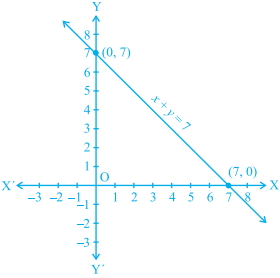
Draw the graph of $x + y = 7$.
Solution
(N/A) To draw the graph of the linear equation $x + y = 7$,we need at least two solutions of the equation.
$1$. If we put $x = 0$,then $0 + y = 7$,which gives $y = 7$. So,$(0, 7)$ is a solution.
$2$. If we put $x = 7$,then $7 + y = 7$,which gives $y = 0$. So,$(7, 0)$ is a solution.
We can represent these solutions in the following table:
Now,plot the points $(0, 7)$ and $(7, 0)$ on a Cartesian plane and join them with a straight line to obtain the graph of the equation $x + y = 7$.
$1$. If we put $x = 0$,then $0 + y = 7$,which gives $y = 7$. So,$(0, 7)$ is a solution.
$2$. If we put $x = 7$,then $7 + y = 7$,which gives $y = 0$. So,$(7, 0)$ is a solution.
We can represent these solutions in the following table:
| $x$ | $0$ | $7$ |
|---|---|---|
| $y$ | $7$ | $0$ |
Now,plot the points $(0, 7)$ and $(7, 0)$ on a Cartesian plane and join them with a straight line to obtain the graph of the equation $x + y = 7$.
1 likes
View Solution26
Medium
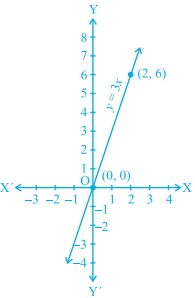
You know that the force applied on a body is directly proportional to the acceleration produced in the body. Write an equation to express this situation and plot the graph of the equation.
Solution
(N/A) Here,the variables involved are force and acceleration. Let the force applied be $y$ units and the acceleration produced be $x$ units. From the concept of direct proportion,we can express this relationship as $y = kx$,where $k$ is a constant of proportionality. (From your study of science,you know that $k$ is actually the mass of the body.)
Since we do not know the specific value of $k$,we cannot draw a unique graph for $y = kx$. However,if we assign a specific value to $k$,we can draw the graph. Let us take $k = 3$,i.e.,we draw the line representing $y = 3x$.
To plot this,we find two solutions,for example,$(0, 0)$ and $(2, 6)$.
From the graph,you can see that when the force applied is $3$ units,the acceleration produced is $1$ unit. Also,note that $(0, 0)$ lies on the graph,which means that when the force applied is $0$ units,the acceleration produced is $0$ units.
Since we do not know the specific value of $k$,we cannot draw a unique graph for $y = kx$. However,if we assign a specific value to $k$,we can draw the graph. Let us take $k = 3$,i.e.,we draw the line representing $y = 3x$.
To plot this,we find two solutions,for example,$(0, 0)$ and $(2, 6)$.
From the graph,you can see that when the force applied is $3$ units,the acceleration produced is $1$ unit. Also,note that $(0, 0)$ lies on the graph,which means that when the force applied is $0$ units,the acceleration produced is $0$ units.
0 likes
View Solution27
Easy
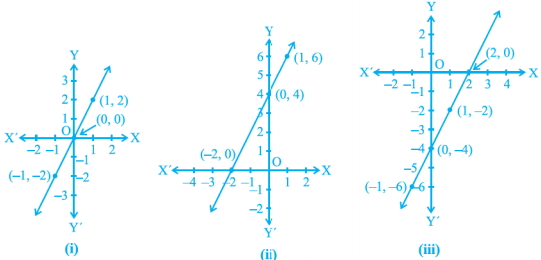
For each of the graphs given in the figure,select the equation whose graph it is from the choices given below:
$(a)$ For Fig. $(i)$,
$(i)$ $x+y=0$ (ii) $y=2x$ (iii) $y=x$ (iv) $y=2x+1$
$(b)$ For Fig. (ii),
$(i)$ $x+y=0$ (ii) $y=2x$ (iii) $y=2x+4$ (iv) $y=x-4$
$(c)$ For Fig. (iii),
$(i)$ $x+y=0$ (ii) $y=2x$ (iii) $y=2x+1$ (iv) $y=2x-4$
$(a)$ For Fig. $(i)$,
$(i)$ $x+y=0$ (ii) $y=2x$ (iii) $y=x$ (iv) $y=2x+1$
$(b)$ For Fig. (ii),
$(i)$ $x+y=0$ (ii) $y=2x$ (iii) $y=2x+4$ (iv) $y=x-4$
$(c)$ For Fig. (iii),
$(i)$ $x+y=0$ (ii) $y=2x$ (iii) $y=2x+1$ (iv) $y=2x-4$
Solution
(A-(II), B-(III), C-(IV)) In Fig. $(i)$,the points on the line are $(-1, -2)$,$(0, 0)$,$(1, 2)$. By inspection,$y = 2x$ is the equation corresponding to this graph. You can find that the $y$-coordinate in each case is double that of the $x$-coordinate.
$(b)$ In Fig. (ii),the points on the line are $(-2, 0)$,$(0, 4)$,$(1, 6)$. You know that the coordinates of the points of the graph (line) satisfy the equation $y = 2x + 4$. So,$y = 2x + 4$ is the equation corresponding to the graph in Fig. (ii).
$(c)$ In Fig. (iii),the points on the line are $(-1, -6)$,$(0, -4)$,$(1, -2)$,$(2, 0)$. By inspection,you can see that $y = 2x - 4$ is the equation corresponding to the given graph (line).
$(b)$ In Fig. (ii),the points on the line are $(-2, 0)$,$(0, 4)$,$(1, 6)$. You know that the coordinates of the points of the graph (line) satisfy the equation $y = 2x + 4$. So,$y = 2x + 4$ is the equation corresponding to the graph in Fig. (ii).
$(c)$ In Fig. (iii),the points on the line are $(-1, -6)$,$(0, -4)$,$(1, -2)$,$(2, 0)$. By inspection,you can see that $y = 2x - 4$ is the equation corresponding to the given graph (line).
0 likes
View Solution28
Medium
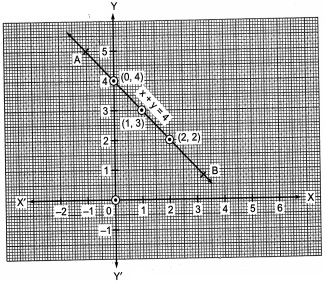
Draw the graph of the linear equation in two variables: $x + y = 4$.
Solution
(N/A) $x + y = 4$
$\Rightarrow y = 4 - x$
If we have $x = 0$,then $y = 4 - 0 = 4$.
If we have $x = 1$,then $y = 4 - 1 = 3$.
If we have $x = 2$,then $y = 4 - 2 = 2$.
$\therefore$ We get the following table:
Plot the ordered pairs $(0, 4)$,$(1, 3)$,and $(2, 2)$ on the graph paper. Joining these points,we get a line $AB$ as shown in the graph. Thus,the line $AB$ is the required graph of $x + y = 4$.
$\Rightarrow y = 4 - x$
If we have $x = 0$,then $y = 4 - 0 = 4$.
If we have $x = 1$,then $y = 4 - 1 = 3$.
If we have $x = 2$,then $y = 4 - 2 = 2$.
$\therefore$ We get the following table:
| $x$ | $0$ | $1$ | $2$ |
| $y$ | $4$ | $3$ | $2$ |
Plot the ordered pairs $(0, 4)$,$(1, 3)$,and $(2, 2)$ on the graph paper. Joining these points,we get a line $AB$ as shown in the graph. Thus,the line $AB$ is the required graph of $x + y = 4$.
0 likes
View Solution29
Medium
Draw the graph of the linear equation in two variables: $x - y = 2$.
Solution
(N/A) Given equation: $x - y = 2$
This can be rewritten as: $y = x - 2$
To draw the graph,we find at least three solutions for the equation:
If $x = 0$,then $y = 0 - 2 = -2$
If $x = 1$,then $y = 1 - 2 = -1$
If $x = 2$,then $y = 2 - 2 = 0$
We get the following table of values:
Plot the points $(0, -2)$,$(1, -1)$,and $(2, 0)$ on a Cartesian plane. By joining these points,we obtain a straight line $PQ$. This line $PQ$ represents the graph of the linear equation $x - y = 2$.
This can be rewritten as: $y = x - 2$
To draw the graph,we find at least three solutions for the equation:
If $x = 0$,then $y = 0 - 2 = -2$
If $x = 1$,then $y = 1 - 2 = -1$
If $x = 2$,then $y = 2 - 2 = 0$
We get the following table of values:
| $x$ | $0$ | $1$ | $2$ |
| $y$ | $-2$ | $-1$ | $0$ |
Plot the points $(0, -2)$,$(1, -1)$,and $(2, 0)$ on a Cartesian plane. By joining these points,we obtain a straight line $PQ$. This line $PQ$ represents the graph of the linear equation $x - y = 2$.
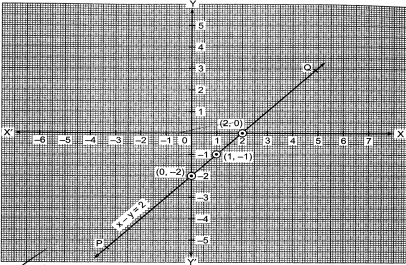
0 likes
View Solution30
Medium
Draw the graph of the linear equation in two variables: $y=3x$
Solution
(N/A) $y=3x$
If $x=0$,then $y=3(0) \Rightarrow y=0$
If $x=1$,then $y=3(1) \Rightarrow y=3$
If $x=-1$,then $y=3(-1) \Rightarrow y=-3$
$\therefore$ We get the following table:
Plot the ordered pairs $(0, 0)$,$(1, 3)$,and $(-1, -3)$ on the graph paper. Joining these points,we get the straight line $LM$.
Thus,the line $LM$ is the required graph of $y=3x$.
If $x=0$,then $y=3(0) \Rightarrow y=0$
If $x=1$,then $y=3(1) \Rightarrow y=3$
If $x=-1$,then $y=3(-1) \Rightarrow y=-3$
$\therefore$ We get the following table:
| $x$ | $0$ | $1$ | $-1$ |
| $y$ | $0$ | $3$ | $-3$ |
Plot the ordered pairs $(0, 0)$,$(1, 3)$,and $(-1, -3)$ on the graph paper. Joining these points,we get the straight line $LM$.
Thus,the line $LM$ is the required graph of $y=3x$.
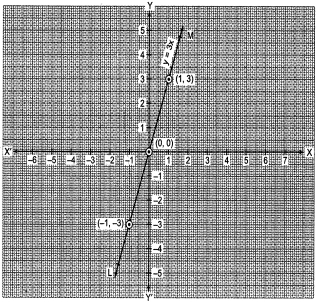
0 likes
View Solution31
Medium
Draw the graph of the linear equation in two variables: $3 = 2x + y$
Solution
(N/A) $y = 3 - 2x$
$\therefore$ If $x = 0$,then $y = 3 - 2(0) \Rightarrow y = 3$
If $x = 1$,then $y = 3 - 2(1) \Rightarrow y = 1$
If $x = 2$,then $y = 3 - 2(2) \Rightarrow y = -1$
$\therefore$ We get the following table:
Plot the ordered pairs $(0, 3)$,$(1, 1)$,and $(2, -1)$ on the graph paper. Joining these points,we get a line $CD$.
Thus,the line $CD$ is the required graph of $3 = 2x + y$.
$\therefore$ If $x = 0$,then $y = 3 - 2(0) \Rightarrow y = 3$
If $x = 1$,then $y = 3 - 2(1) \Rightarrow y = 1$
If $x = 2$,then $y = 3 - 2(2) \Rightarrow y = -1$
$\therefore$ We get the following table:
| $x$ | $0$ | $1$ | $2$ |
| $y$ | $3$ | $1$ | $-1$ |
Plot the ordered pairs $(0, 3)$,$(1, 1)$,and $(2, -1)$ on the graph paper. Joining these points,we get a line $CD$.
Thus,the line $CD$ is the required graph of $3 = 2x + y$.
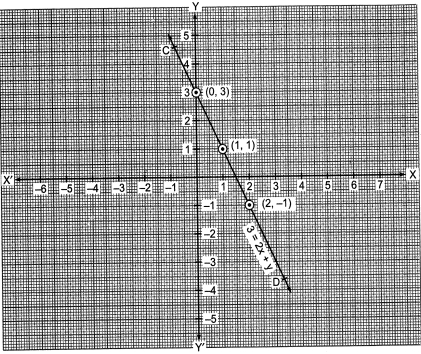
0 likes
View Solution32
MediumMCQ
Give the equations of two lines passing through $(2, 14)$. How many more such lines are there,and why?
A
x + y = $16$,7x - y = $0$; Infinitely many; Through a point,infinite lines can pass.
B
x + y = $10$,x - y = $0$; Two; Only two lines can pass through a point.
C
x + y = $16$,7x - y = $0$; One; Only one line can pass through a point.
D
x + y = $12$,x - y = $0$; None; No lines can pass through a point.
Solution
(A) The point $(2, 14)$ means $x = 2$ and $y = 14$.
To find equations of lines passing through this point,we can use the form $ax + by = c$ such that $a(2) + b(14) = c$.
$(i)$ If we take $a=1, b=1$,then $1(2) + 1(14) = 16$. So,$x + y = 16$ is one such equation.
$(ii)$ If we take $a=7, b=-1$,then $7(2) - 1(14) = 14 - 14 = 0$. So,$7x - y = 0$ is another such equation.
There are infinitely many such lines because an infinite number of lines can pass through a single point in a plane.
To find equations of lines passing through this point,we can use the form $ax + by = c$ such that $a(2) + b(14) = c$.
$(i)$ If we take $a=1, b=1$,then $1(2) + 1(14) = 16$. So,$x + y = 16$ is one such equation.
$(ii)$ If we take $a=7, b=-1$,then $7(2) - 1(14) = 14 - 14 = 0$. So,$7x - y = 0$ is another such equation.
There are infinitely many such lines because an infinite number of lines can pass through a single point in a plane.
0 likes
View Solution33
EasyMCQ
If the point $(3, 4)$ lies on the graph of the equation $3y = ax + 7$,find the value of $a$.
A
$5/3$
B
$3/5$
C
$7/3$
D
$3/7$
Solution
(A) The given equation of the line is $3y = ax + 7$.
Since the point $(3, 4)$ lies on the graph of this line,it must satisfy the equation.
Substituting $x = 3$ and $y = 4$ into the equation:
$3(4) = a(3) + 7$
$12 = 3a + 7$
Subtracting $7$ from both sides:
$12 - 7 = 3a$
$5 = 3a$
Dividing by $3$:
$a = 5/3$
Thus,the value of $a$ is $5/3$.
Since the point $(3, 4)$ lies on the graph of this line,it must satisfy the equation.
Substituting $x = 3$ and $y = 4$ into the equation:
$3(4) = a(3) + 7$
$12 = 3a + 7$
Subtracting $7$ from both sides:
$12 - 7 = 3a$
$5 = 3a$
Dividing by $3$:
$a = 5/3$
Thus,the value of $a$ is $5/3$.
0 likes
View Solution34
Medium
The taxi fare in a city is as follows:
For the first kilometre,the fare is Rs. $8$ and for the subsequent distance it is Rs. $5$ per $km$. Taking the distance covered as $x \, km$ and total fare as Rs. $y$,write a linear equation for this information,and draw its graph.
For the first kilometre,the fare is Rs. $8$ and for the subsequent distance it is Rs. $5$ per $km$. Taking the distance covered as $x \, km$ and total fare as Rs. $y$,write a linear equation for this information,and draw its graph.
Solution
(N/A) Here,total distance covered $= x \, km$
Total taxi fare $= y$
Fare for the $1^{st} \, km = Rs. \, 8$
Remaining distance $= (x - 1) \, km$
$\therefore$ Fare for $(x - 1) \, km = Rs. \, 5(x - 1)$
Total taxi fare $= Rs. \, 8 + 5(x - 1)$
$\therefore$ According to the condition,
$y = 8 + 5(x - 1)$
$y = 8 + 5x - 5$
$y = 5x + 3$
This is the required linear equation representing the given information.
Graph: We have $y = 5x + 3$
When $x = 0, y = 5(0) + 3 = 3$
When $x = -1, y = 5(-1) + 3 = -2$
When $x = -2, y = 5(-2) + 3 = -7$
We get the following table:
Now,plotting the ordered pairs $(0, 3), (-1, -2)$ and $(-2, -7)$ on a graph paper and joining them,we get a straight line $PQ$. Thus,$PQ$ is the required graph of the linear equation $y = 5x + 3$.
Total taxi fare $= y$
Fare for the $1^{st} \, km = Rs. \, 8$
Remaining distance $= (x - 1) \, km$
$\therefore$ Fare for $(x - 1) \, km = Rs. \, 5(x - 1)$
Total taxi fare $= Rs. \, 8 + 5(x - 1)$
$\therefore$ According to the condition,
$y = 8 + 5(x - 1)$
$y = 8 + 5x - 5$
$y = 5x + 3$
This is the required linear equation representing the given information.
Graph: We have $y = 5x + 3$
When $x = 0, y = 5(0) + 3 = 3$
When $x = -1, y = 5(-1) + 3 = -2$
When $x = -2, y = 5(-2) + 3 = -7$
We get the following table:
| $x$ | $0$ | $-1$ | $-2$ |
| $y$ | $3$ | $-2$ | $-7$ |
Now,plotting the ordered pairs $(0, 3), (-1, -2)$ and $(-2, -7)$ on a graph paper and joining them,we get a straight line $PQ$. Thus,$PQ$ is the required graph of the linear equation $y = 5x + 3$.
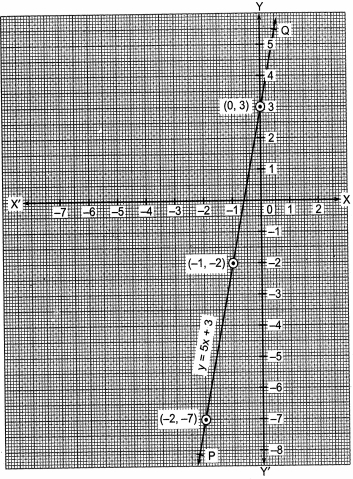
0 likes
View Solution35
Easy
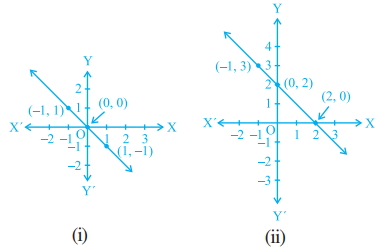
From the choices given below,choose the equation whose graphs are given in Fig. $(i)$ and Fig. $(ii)$.
For Fig. $(i)$:
$(a)$ $y=x$
$(b)$ $x+y=0$
$(c)$ $y=2x$
$(d)$ $2+3y=7x$
For Fig. $(ii)$:
$(a)$ $y=x+2$
$(b)$ $y=x-2$
$(c)$ $y=-x+2$
$(d)$ $x+2y=6$
For Fig. $(i)$:
$(a)$ $y=x$
$(b)$ $x+y=0$
$(c)$ $y=2x$
$(d)$ $2+3y=7x$
For Fig. $(ii)$:
$(a)$ $y=x+2$
$(b)$ $y=x-2$
$(c)$ $y=-x+2$
$(d)$ $x+2y=6$
Solution
(B, C) For Fig. $(i)$,the line passes through the points $(-1, 1)$,$(0, 0)$,and $(1, -1)$.
Checking the options:
For $(b)$ $x+y=0$,substituting $(-1, 1)$ gives $-1+1=0$,which is true.
Thus,the equation for Fig. $(i)$ is $x+y=0$.
For Fig. $(ii)$,the line passes through the points $(-1, 3)$,$(0, 2)$,and $(2, 0)$.
Checking the options:
For $(c)$ $y=-x+2$,substituting $(-1, 3)$ gives $3=-(-1)+2 \Rightarrow 3=1+2 \Rightarrow 3=3$,which is true.
Substituting $(0, 2)$ gives $2=-(0)+2 \Rightarrow 2=2$,which is true.
Thus,the equation for Fig. $(ii)$ is $y=-x+2$.
Checking the options:
For $(b)$ $x+y=0$,substituting $(-1, 1)$ gives $-1+1=0$,which is true.
Thus,the equation for Fig. $(i)$ is $x+y=0$.
For Fig. $(ii)$,the line passes through the points $(-1, 3)$,$(0, 2)$,and $(2, 0)$.
Checking the options:
For $(c)$ $y=-x+2$,substituting $(-1, 3)$ gives $3=-(-1)+2 \Rightarrow 3=1+2 \Rightarrow 3=3$,which is true.
Substituting $(0, 2)$ gives $2=-(0)+2 \Rightarrow 2=2$,which is true.
Thus,the equation for Fig. $(ii)$ is $y=-x+2$.
0 likes
View Solution36
Medium
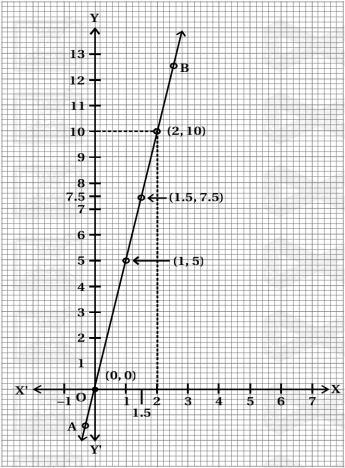
If the work done by a body on application of a constant force is directly proportional to the distance travelled by the body,express this in the form of an equation in two variables and draw the graph of the same by taking the constant force as $5$ units. Also,read from the graph the work done when the distance travelled by the body is:
$(i)$ $2$ units
$(ii)$ $0$ units
$(i)$ $2$ units
$(ii)$ $0$ units
Solution
(N/A) Constant force is $5$ units. Let the distance travelled $= x$ units and work done $= y$ units.
Since,$\text{Work done} = \text{Force} \times \text{Displacement}$
$\Rightarrow y = 5 \times x$
$\Rightarrow y = 5x$
Drawing the graph:
We have $y = 5x$.
When $x = 0$,then $y = 5(0) = 0$.
When $x = 1$,then $y = 5(1) = 5$.
When $x = 1.5$,then $y = 5(1.5) = 7.5$.
Therefore,we get the following table:
Plotting the ordered pairs $(0, 0)$,$(1, 5)$,and $(1.5, 7.5)$ on the graph paper and joining the points,we get a straight line.
From the graph:
$(i)$ When distance travelled $= 2$ units,then $x = 2$,which gives $y = 10$.
Therefore,$\text{Work done} = 10$ units.
$(ii)$ When distance travelled $= 0$ units,then $x = 0$,which gives $y = 5(0) = 0$.
Therefore,$\text{Work done} = 0$ units.
Since,$\text{Work done} = \text{Force} \times \text{Displacement}$
$\Rightarrow y = 5 \times x$
$\Rightarrow y = 5x$
Drawing the graph:
We have $y = 5x$.
When $x = 0$,then $y = 5(0) = 0$.
When $x = 1$,then $y = 5(1) = 5$.
When $x = 1.5$,then $y = 5(1.5) = 7.5$.
Therefore,we get the following table:
| $x$ | $0$ | $1$ | $1.5$ |
| $y$ | $0$ | $5$ | $7.5$ |
Plotting the ordered pairs $(0, 0)$,$(1, 5)$,and $(1.5, 7.5)$ on the graph paper and joining the points,we get a straight line.
From the graph:
$(i)$ When distance travelled $= 2$ units,then $x = 2$,which gives $y = 10$.
Therefore,$\text{Work done} = 10$ units.
$(ii)$ When distance travelled $= 0$ units,then $x = 0$,which gives $y = 5(0) = 0$.
Therefore,$\text{Work done} = 0$ units.
0 likes
View Solution37
Medium
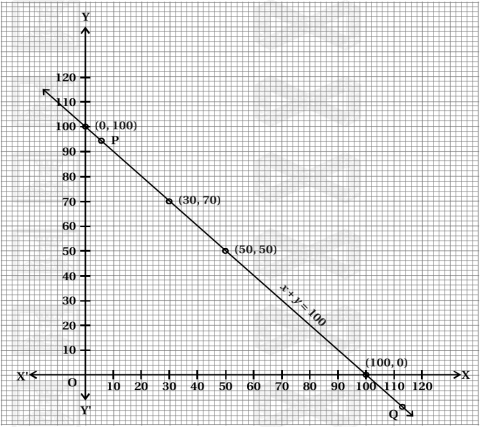
Yamini and Fatima,two students of Class $IX$ of a school,together contributed Rs. $100$ towards the Prime Minister's Relief Fund to help the earthquake victims. Write a linear equation which satisfies this data. (You may take their contributions as Rs. $x$ and Rs. $y$.) Draw the graph of the same.
Solution
(N/A) Let the contribution of Yamini $= ₹ x$ and the contribution of Fatima $= ₹ y$.
$\therefore$ We have $x + y = 100$
$\Rightarrow y = 100 - x$
Now,we find the coordinates of points to plot the graph:
When $x = 0, y = 100 - 0 = 100$
When $x = 50, y = 100 - 50 = 50$
When $x = 100, y = 100 - 100 = 0$
We get the following table:
For drawing the graph,plot the ordered pairs $(0, 100)$,$(50, 50)$,and $(100, 0)$ on a graph paper. Joining these points,we get a line.
Thus,the line represents the graph of $x + y = 100$.
$\therefore$ We have $x + y = 100$
$\Rightarrow y = 100 - x$
Now,we find the coordinates of points to plot the graph:
When $x = 0, y = 100 - 0 = 100$
When $x = 50, y = 100 - 50 = 50$
When $x = 100, y = 100 - 100 = 0$
We get the following table:
| $x$ | $0$ | $50$ | $100$ |
| $y$ | $100$ | $50$ | $0$ |
For drawing the graph,plot the ordered pairs $(0, 100)$,$(50, 50)$,and $(100, 0)$ on a graph paper. Joining these points,we get a line.
Thus,the line represents the graph of $x + y = 100$.
0 likes
View Solution38
Difficult
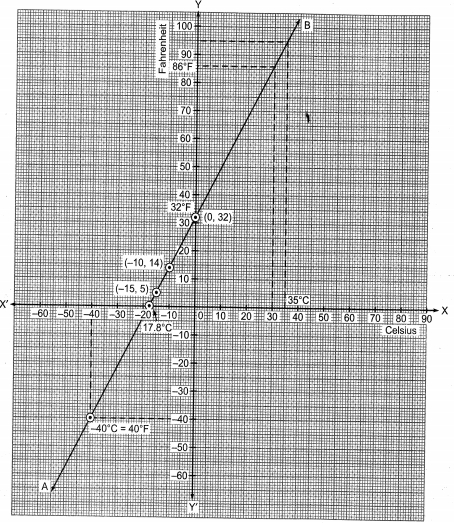
In countries like $USA$ and Canada,temperature is measured in Fahrenheit,whereas in countries like India,it is measured in Celsius. Here is a linear equation that converts Fahrenheit to Celsius:
$F = \left(\frac{9}{5}\right) C + 32$
$(i)$ Draw the graph of the linear equation above using Celsius for $x$-axis and Fahrenheit for $y$-axis.
$(ii)$ If the temperature is $30\,^oC$,what is the temperature in Fahrenheit?
$(iii)$ If the temperature is $95\,^oF$,what is the temperature in Celsius?
$(iv)$ If the temperature is $0\,^oC$,what is the temperature in Fahrenheit and if the temperature is $0\,^oF$,what is the temperature in Celsius?
$(v)$ Is there a temperature which is numerically the same in both Fahrenheit and Celsius? If yes,find it.
$F = \left(\frac{9}{5}\right) C + 32$
$(i)$ Draw the graph of the linear equation above using Celsius for $x$-axis and Fahrenheit for $y$-axis.
$(ii)$ If the temperature is $30\,^oC$,what is the temperature in Fahrenheit?
$(iii)$ If the temperature is $95\,^oF$,what is the temperature in Celsius?
$(iv)$ If the temperature is $0\,^oC$,what is the temperature in Fahrenheit and if the temperature is $0\,^oF$,what is the temperature in Celsius?
$(v)$ Is there a temperature which is numerically the same in both Fahrenheit and Celsius? If yes,find it.
Solution
(N/A) $(i)$ We have the equation $F = \left(\frac{9}{5}\right) C + 32$.
When $C = 0$,$F = \left(\frac{9}{5}\right) \times 0 + 32 = 32$.
When $C = -15$,$F = \frac{9}{5}(-15) + 32 = -27 + 32 = 5$.
When $C = -10$,$F = \frac{9}{5}(-10) + 32 = 9(-2) + 32 = 14$.
Table of values:
Plotting the points $(0, 32)$,$(-15, 5)$,and $(-10, 14)$ on a graph and joining them gives a straight line.
$(ii)$ For $C = 30$,$F = \frac{9}{5}(30) + 32 = 9(6) + 32 = 54 + 32 = 86\,^oF$.
$(iii)$ For $F = 95$,$95 = \frac{9}{5}C + 32 \implies 63 = \frac{9}{5}C \implies C = 63 \times \frac{5}{9} = 35\,^oC$.
$(iv)$ For $C = 0$,$F = 32\,^oF$. For $F = 0$,$0 = \frac{9}{5}C + 32 \implies -32 = \frac{9}{5}C \implies C = -\frac{160}{9} \approx -17.8\,^oC$.
$(v)$ Let $F = C = x$. Then $x = \frac{9}{5}x + 32 \implies x - \frac{9}{5}x = 32 \implies -\frac{4}{5}x = 32 \implies x = 32 \times (-\frac{5}{4}) = -40$. Thus,$-40\,^oC = -40\,^oF$.
When $C = 0$,$F = \left(\frac{9}{5}\right) \times 0 + 32 = 32$.
When $C = -15$,$F = \frac{9}{5}(-15) + 32 = -27 + 32 = 5$.
When $C = -10$,$F = \frac{9}{5}(-10) + 32 = 9(-2) + 32 = 14$.
Table of values:
| $C$ | $0$ | $-15$ | $-10$ |
| $F$ | $32$ | $5$ | $14$ |
Plotting the points $(0, 32)$,$(-15, 5)$,and $(-10, 14)$ on a graph and joining them gives a straight line.
$(ii)$ For $C = 30$,$F = \frac{9}{5}(30) + 32 = 9(6) + 32 = 54 + 32 = 86\,^oF$.
$(iii)$ For $F = 95$,$95 = \frac{9}{5}C + 32 \implies 63 = \frac{9}{5}C \implies C = 63 \times \frac{5}{9} = 35\,^oC$.
$(iv)$ For $C = 0$,$F = 32\,^oF$. For $F = 0$,$0 = \frac{9}{5}C + 32 \implies -32 = \frac{9}{5}C \implies C = -\frac{160}{9} \approx -17.8\,^oC$.
$(v)$ Let $F = C = x$. Then $x = \frac{9}{5}x + 32 \implies x - \frac{9}{5}x = 32 \implies -\frac{4}{5}x = 32 \implies x = 32 \times (-\frac{5}{4}) = -40$. Thus,$-40\,^oC = -40\,^oF$.
0 likes
View Solution39
Medium
Solve the equation $2x + 1 = x - 3$,and represent the solution$(s)$ on
$(i)$ the number line,
$(ii)$ the Cartesian plane.
$(i)$ the number line,
$(ii)$ the Cartesian plane.
Solution
(N/A) We solve $2x + 1 = x - 3$,to get
$2x - x = -3 - 1$
i.e.,$x = -4$
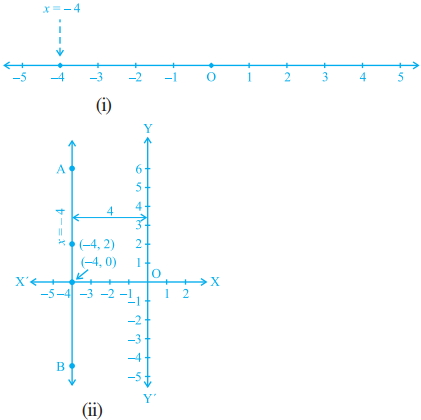
$(i)$ The representation of the solution on the number line is shown in Fig. $(i)$,where $x = -4$ is treated as an equation in one variable.
$(ii)$ We know that $x = -4$ can be written as
$x + 0y = -4$
which is a linear equation in the variables $x$ and $y$. This is represented by a line. Now all the values of $y$ are permissible because $0y$ is always $0$. However,$x$ must satisfy the equation $x = -4$. Hence,two solutions of the given equation are $(-4, 0)$ and $(-4, 2)$.
Note that the graph $AB$ is a line parallel to the $y$-axis and at a distance of $4$ units to the left of it (see Fig. $(ii)$).
$2x - x = -3 - 1$
i.e.,$x = -4$
$(i)$ The representation of the solution on the number line is shown in Fig. $(i)$,where $x = -4$ is treated as an equation in one variable.
$(ii)$ We know that $x = -4$ can be written as
$x + 0y = -4$
which is a linear equation in the variables $x$ and $y$. This is represented by a line. Now all the values of $y$ are permissible because $0y$ is always $0$. However,$x$ must satisfy the equation $x = -4$. Hence,two solutions of the given equation are $(-4, 0)$ and $(-4, 2)$.
Note that the graph $AB$ is a line parallel to the $y$-axis and at a distance of $4$ units to the left of it (see Fig. $(ii)$).
0 likes
View Solution40
Medium
Give the geometric representations of $y = 3$ as an equation:
$(i)$ in one variable
$(ii)$ in two variables
$(i)$ in one variable
$(ii)$ in two variables
Solution
(N/A) $(i)$ $y = 3$ [An equation in one variable]
Since $y = 3$ is an equation in one variable,it represents a unique point on the number line.
The unique solution is a point at $3$ on the number line.
$(ii)$ $y = 3$ [An equation in two variables]
We can write $y = 3$ as $0x + y = 3$.
Now,for different values of $x$,we get $y = 3$:
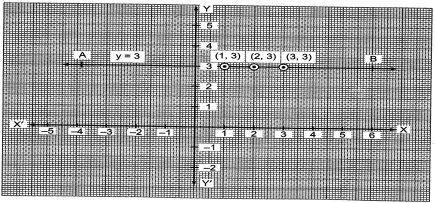
Plotting the ordered pairs $(1, 3)$,$(2, 3)$,and $(3, 3)$ on a Cartesian plane,we get a line $AB$ parallel to the $x$-axis,which represents the solution of $0x + y = 3$,i.e.,$y = 3$.
Since $y = 3$ is an equation in one variable,it represents a unique point on the number line.
The unique solution is a point at $3$ on the number line.
$(ii)$ $y = 3$ [An equation in two variables]
We can write $y = 3$ as $0x + y = 3$.
Now,for different values of $x$,we get $y = 3$:
| $X$ | $1$ | $2$ | $3$ |
| $Y$ | $3$ | $3$ | $3$ |
Plotting the ordered pairs $(1, 3)$,$(2, 3)$,and $(3, 3)$ on a Cartesian plane,we get a line $AB$ parallel to the $x$-axis,which represents the solution of $0x + y = 3$,i.e.,$y = 3$.
0 likes
View Solution41
Difficult
Give the geometric representations of $2x + 9 = 0$ as an equation
$(i)$ in one variable
$(ii)$ in two variables
$(i)$ in one variable
$(ii)$ in two variables
Solution
(N/A) $(i)$ $2x + 9 = 0$ [An equation in one variable]
We have: $2x + 9 = 0 \Rightarrow 2x = -9 \Rightarrow x = -4.5$ or $x = -\frac{9}{2}$.
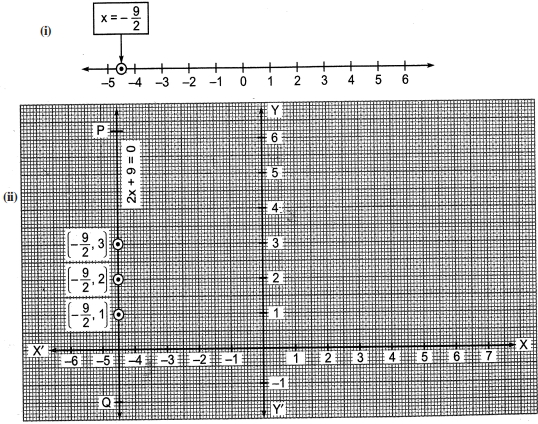
This is a linear equation in one variable '$x$' only. Its solution is the point $-\frac{9}{2}$ on the number line.
$(ii)$ $2x + 9 = 0$ [An equation in two variables]
We can write $2x + 9 = 0$ as $2x + 0y + 9 = 0$ or $2x = -9 + 0y$.
Thus,$x = \frac{-9 + 0y}{2}$.
For any value of $y$,$x$ will always be $-\frac{9}{2}$.
Plotting the points $\left(-\frac{9}{2}, 1\right)$,$\left(-\frac{9}{2}, 2\right)$,and $\left(-\frac{9}{2}, 3\right)$ on a Cartesian plane and joining them,we get a vertical line parallel to the $y$-axis.
We have: $2x + 9 = 0 \Rightarrow 2x = -9 \Rightarrow x = -4.5$ or $x = -\frac{9}{2}$.
This is a linear equation in one variable '$x$' only. Its solution is the point $-\frac{9}{2}$ on the number line.
$(ii)$ $2x + 9 = 0$ [An equation in two variables]
We can write $2x + 9 = 0$ as $2x + 0y + 9 = 0$ or $2x = -9 + 0y$.
Thus,$x = \frac{-9 + 0y}{2}$.
For any value of $y$,$x$ will always be $-\frac{9}{2}$.
| $x$ | $-\frac{9}{2}$ | $-\frac{9}{2}$ | $-\frac{9}{2}$ |
| $y$ | $1$ | $2$ | $3$ |
Plotting the points $\left(-\frac{9}{2}, 1\right)$,$\left(-\frac{9}{2}, 2\right)$,and $\left(-\frac{9}{2}, 3\right)$ on a Cartesian plane and joining them,we get a vertical line parallel to the $y$-axis.
0 likes
View SolutionLinear Equations in Two Variables — Textbook - Linear Equations in Two Variables · Frequently Asked Questions
1Are these Linear Equations in Two Variables questions useful for JEE and NEET?
Yes. All questions in this section are mapped to JEE Main and NEET exam patterns. Previous year questions from JEE Main, NEET, GUJCET and state-level exams are included with full solutions.
2Can I switch to Hindi or Gujarati for these questions?
Yes. Use the language tabs in the hero section or the sidebar to view the same questions and solutions in English, Hindi or Gujarati.
3How do I generate a question paper from this subtopic?
Use the Vedclass Exam Paper Generator — select the chapter and subtopic, set difficulty, and generate Sets A, B, C, D automatically. First 3 chapters of every subject are free.
Vedclass Products
For Students
Vedclass Test Series
Mock tests in real JEE/NEET style with performance analysis. 5-day free trial.
Start Free TrialFor Teachers
Exam Paper Generator
Generate Set A/B/C/D papers from this chapter in 2 minutes. 3 chapters free.
Try FreeFor Institutes
Online Exam Module
Live online exams with unlimited students, 360° analytics & white-label branding.
See DemoFor Teachers & Institutes
Generate a Linear Equations in Two Variables Exam Paper in 2 Minutes
Select subtopic & difficulty — Sets A, B, C, D auto-generated with No Repeat logic.
First 3 chapters of every subject are free — no payment required.