
A English
Mix Examples - Linear Equations in Two Variables Questions in English
Class 9 Mathematics · Linear Equations in Two Variables · Mix Examples - Linear Equations in Two Variables
156+
Questions
English
Language
100%
With Solutions
Showing 50 of 156 questions in English
1
EasyMCQ
The linear equation $3x - y = x - 1$ has:
A
Infinitely many solutions
B
$A$ unique solution
C
Two solutions
D
No solutions
Solution
(A) Given the linear equation $3x - y = x - 1$.
Rearranging the terms to bring variables to one side: $3x - x - y = -1$.
This simplifies to $2x - y = -1$,or $y = 2x + 1$.
This is a linear equation in two variables ($x$ and $y$).
$A$ linear equation in two variables of the form $ax + by + c = 0$ always has infinitely many solutions because for every value of $x$,there exists a corresponding value of $y$ that satisfies the equation.
Therefore,the equation has infinitely many solutions.
Rearranging the terms to bring variables to one side: $3x - x - y = -1$.
This simplifies to $2x - y = -1$,or $y = 2x + 1$.
This is a linear equation in two variables ($x$ and $y$).
$A$ linear equation in two variables of the form $ax + by + c = 0$ always has infinitely many solutions because for every value of $x$,there exists a corresponding value of $y$ that satisfies the equation.
Therefore,the equation has infinitely many solutions.
0 likes
View Solution2
EasyMCQ
$A$ linear equation in two variables is of the form $ax + by + c = 0$,where
A
$a \neq 0, b \neq 0$
B
$a = 0, b = 0$
C
$a \neq 0, b = 0$
D
$a = 0, b \neq 0$
Solution
(A) linear equation in two variables is defined as an equation that can be written in the form $ax + by + c = 0$,where $a$,$b$,and $c$ are real numbers and $a$ and $b$ are not both zero.
This means that at least one of the coefficients of the variables $x$ or $y$ must be non-zero.
If $a = 0$ and $b = 0$,the equation becomes $c = 0$,which is not a linear equation in two variables.
Therefore,the condition for a linear equation in two variables is $a^2 + b^2 \neq 0$,which implies that $a$ and $b$ cannot both be zero simultaneously.
This means that at least one of the coefficients of the variables $x$ or $y$ must be non-zero.
If $a = 0$ and $b = 0$,the equation becomes $c = 0$,which is not a linear equation in two variables.
Therefore,the condition for a linear equation in two variables is $a^2 + b^2 \neq 0$,which implies that $a$ and $b$ cannot both be zero simultaneously.
0 likes
View Solution3
EasyMCQ
Any point on the $y$-axis is of the form
A
$(x, 0)$
B
$(x, y)$
C
$(0, y)$
D
$(y, y)$
Solution
(C) In a Cartesian coordinate system,the position of any point is represented by an ordered pair $(x, y)$.
For any point lying on the $y$-axis,the horizontal distance from the origin (the $x$-coordinate) is always $0$.
Therefore,any point on the $y$-axis is of the form $(0, y)$,where $y$ represents the vertical distance from the origin.
For any point lying on the $y$-axis,the horizontal distance from the origin (the $x$-coordinate) is always $0$.
Therefore,any point on the $y$-axis is of the form $(0, y)$,where $y$ represents the vertical distance from the origin.
0 likes
View Solution4
EasyMCQ
The linear equation $2x - 5y = 7$ has:
A
$A$ unique solution
B
Two solutions
C
No solution
D
Infinitely many solutions
Solution
(D) The given equation $2x - 5y = 7$ is a linear equation in two variables ($x$ and $y$).
For any linear equation in two variables of the form $ax + by = c$,there exist infinitely many pairs of $(x, y)$ that satisfy the equation.
By assigning any arbitrary real value to $x$,we can find a corresponding value for $y$,and vice versa.
Therefore,the equation has infinitely many solutions.
For any linear equation in two variables of the form $ax + by = c$,there exist infinitely many pairs of $(x, y)$ that satisfy the equation.
By assigning any arbitrary real value to $x$,we can find a corresponding value for $y$,and vice versa.
Therefore,the equation has infinitely many solutions.
0 likes
View Solution5
EasyMCQ
The equation $2x + 5y = 7$ has a unique solution,if $x, y$ are:
A
Natural numbers
B
Positive real numbers
C
Real numbers
D
Rational numbers
Solution
(A) The linear equation $2x + 5y = 7$ represents a line in the Cartesian plane,which has infinitely many solutions in the set of real numbers.
However,if we restrict $x$ and $y$ to natural numbers (i.e.,$x, y \in \{1, 2, 3, ...\}$),we can test for solutions:
If $x = 1$,then $2(1) + 5y = 7 \implies 5y = 5 \implies y = 1$.
If $x = 2$,then $2(2) + 5y = 7 \implies 5y = 3 \implies y = 3/5$ (not a natural number).
If $x \ge 2$,$y$ will not be a natural number.
Thus,$(1, 1)$ is the only solution in natural numbers.
However,if we restrict $x$ and $y$ to natural numbers (i.e.,$x, y \in \{1, 2, 3, ...\}$),we can test for solutions:
If $x = 1$,then $2(1) + 5y = 7 \implies 5y = 5 \implies y = 1$.
If $x = 2$,then $2(2) + 5y = 7 \implies 5y = 3 \implies y = 3/5$ (not a natural number).
If $x \ge 2$,$y$ will not be a natural number.
Thus,$(1, 1)$ is the only solution in natural numbers.
0 likes
View Solution6
EasyMCQ
The equation $2x + 5y = 7$ has a unique solution,if $x, y$ are:
A
Positive real numbers
B
Natural numbers
C
Real numbers
D
Rational numbers
Solution
(B) For the linear equation $2x + 5y = 7$,we look for solutions where $x$ and $y$ are natural numbers (i.e.,$x, y \in \{1, 2, 3, ...\}$).
If $x = 1$,then $2(1) + 5y = 7$,which gives $5y = 5$,so $y = 1$.
If $x = 2$,then $2(2) + 5y = 7$,which gives $4 + 5y = 7$,so $5y = 3$,or $y = 3/5$,which is not a natural number.
If $x \ge 2$,$5y$ would be $7 - 2x \le 3$,meaning $y$ would not be a natural number.
Thus,the only pair of natural numbers that satisfies the equation is $(1, 1)$,making it a unique solution.
If $x = 1$,then $2(1) + 5y = 7$,which gives $5y = 5$,so $y = 1$.
If $x = 2$,then $2(2) + 5y = 7$,which gives $4 + 5y = 7$,so $5y = 3$,or $y = 3/5$,which is not a natural number.
If $x \ge 2$,$5y$ would be $7 - 2x \le 3$,meaning $y$ would not be a natural number.
Thus,the only pair of natural numbers that satisfies the equation is $(1, 1)$,making it a unique solution.
0 likes
View Solution7
EasyMCQ
If $(2,0)$ is a solution of the linear equation $2x + 3y = k,$ then the value of $k$ is
A
$5$
B
$6$
C
$4$
D
$2$
Solution
(C) To find the value of $k,$ we substitute the given solution $(x, y) = (2, 0)$ into the linear equation $2x + 3y = k.$
Substituting $x = 2$ and $y = 0$ in the equation:
$2(2) + 3(0) = k$
$4 + 0 = k$
$k = 4$
Therefore,the value of $k$ is $4.$
Substituting $x = 2$ and $y = 0$ in the equation:
$2(2) + 3(0) = k$
$4 + 0 = k$
$k = 4$
Therefore,the value of $k$ is $4.$
0 likes
View Solution8
EasyMCQ
Any solution of the linear equation $2x + 0y + 9 = 0$ in two variables is of the form:
A
$(-9, 0)$
B
$(0, -9/2)$
C
$(n, -9/2)$
D
$(-9/2, m)$
Solution
(D) The given linear equation is $2x + 0y + 9 = 0$.
This simplifies to $2x = -9$.
Dividing by $2$,we get $x = -9/2$.
Since the coefficient of $y$ is $0$,the value of $y$ can be any real number $m$.
Therefore,any solution of the equation is of the form $(-9/2, m)$,where $m$ is any real number.
This simplifies to $2x = -9$.
Dividing by $2$,we get $x = -9/2$.
Since the coefficient of $y$ is $0$,the value of $y$ can be any real number $m$.
Therefore,any solution of the equation is of the form $(-9/2, m)$,where $m$ is any real number.
0 likes
View Solution9
EasyMCQ
The graph of the linear equation $2x + 3y = 6$ cuts the $y$-axis at the point:
A
$(0, 2)$
B
$(0, 3)$
C
$(3, 0)$
D
$(2, 0)$
Solution
(A) The graph of the linear equation $2x + 3y = 6$ cuts the $y$-axis at the point where the $x$-coordinate is $0$.
By substituting $x = 0$ into the equation $2x + 3y = 6$,we get:
$2(0) + 3y = 6$
$0 + 3y = 6$
$3y = 6$
$y = 6 / 3 = 2$
Therefore,the point where the graph cuts the $y$-axis is $(0, 2)$.
By substituting $x = 0$ into the equation $2x + 3y = 6$,we get:
$2(0) + 3y = 6$
$0 + 3y = 6$
$3y = 6$
$y = 6 / 3 = 2$
Therefore,the point where the graph cuts the $y$-axis is $(0, 2)$.
0 likes
View Solution10
EasyMCQ
The equation $x=7$,in two variables,can be written as
A
$1 \cdot x + 1 \cdot y = 7$
B
$1 \cdot x + 0 \cdot y = 7$
C
$0 \cdot x + 1 \cdot y = 7$
D
$0 \cdot x + 0 \cdot y = 7$
Solution
(B) linear equation in two variables is of the form $ax + by + c = 0$,where $a, b,$ and $c$ are real numbers and $a$ and $b$ are not both zero.
Given the equation $x = 7$,we can rewrite it as $x - 7 = 0$.
To express this in two variables $x$ and $y$,we include the variable $y$ with a coefficient of $0$.
Thus,the equation becomes $1 \cdot x + 0 \cdot y = 7$.
Given the equation $x = 7$,we can rewrite it as $x - 7 = 0$.
To express this in two variables $x$ and $y$,we include the variable $y$ with a coefficient of $0$.
Thus,the equation becomes $1 \cdot x + 0 \cdot y = 7$.
0 likes
View Solution11
EasyMCQ
Any point on the $x$-axis is of the form
A
$(x, y)$
B
$(0, y)$
C
$(x, 0)$
D
$(x, x)$
Solution
(C) In the Cartesian coordinate system,the $x$-axis is the horizontal line where the vertical distance from the origin is zero.
Therefore,for any point lying on the $x$-axis,the $y$-coordinate (ordinate) must be $0$.
Thus,any point on the $x$-axis is represented in the form $(x, 0)$,where $x$ is any real number.
Therefore,for any point lying on the $x$-axis,the $y$-coordinate (ordinate) must be $0$.
Thus,any point on the $x$-axis is represented in the form $(x, 0)$,where $x$ is any real number.
0 likes
View Solution12
EasyMCQ
Any point on the line $y=x$ is of the form
A
$(a, -a)$
B
$(a, 0)$
C
$(0, a)$
D
$(a, a)$
Solution
(D) For any point on the line $y=x$,the $x$-coordinate and the $y$-coordinate must be equal.
If we let the $x$-coordinate be $a$,then the $y$-coordinate must also be $a$.
Therefore,any point on the line $y=x$ is of the form $(a, a)$.
If we let the $x$-coordinate be $a$,then the $y$-coordinate must also be $a$.
Therefore,any point on the line $y=x$ is of the form $(a, a)$.
0 likes
View Solution13
EasyMCQ
The equation of the $x$-axis is of the form:
A
$y = 0$
B
$x = 0$
C
$x + y = 0$
D
$x = y$
Solution
(A) In the Cartesian coordinate system,any point on the $x$-axis has a $y$-coordinate equal to $0$. Therefore,the equation representing all points on the $x$-axis is $y = 0$.
0 likes
View Solution14
EasyMCQ
The graph of $y=6$ is a line
A
parallel to $y$-axis at a distance $6$ units from the origin
B
parallel to $x$-axis at a distance $6$ units from the origin
C
making an intercept $6$ on the $x$-axis
D
making an intercept $6$ on both the axes
Solution
(B) The given equation $y=6$ does not contain the variable $x$.
This implies that for any value of $x$,the value of $y$ remains constant at $6$.
Therefore,the graph of $y=6$ is a horizontal line that is parallel to the $x$-axis.
Since the $y$-coordinate is always $6$,the line is at a constant distance of $6$ units from the origin along the $y$-axis.
This implies that for any value of $x$,the value of $y$ remains constant at $6$.
Therefore,the graph of $y=6$ is a horizontal line that is parallel to the $x$-axis.
Since the $y$-coordinate is always $6$,the line is at a constant distance of $6$ units from the origin along the $y$-axis.
0 likes
View Solution15
EasyMCQ
$x=5, y=2$ is a solution of which linear equation?
A
$x + 2y = 7$
B
$5x + 2y = 7$
C
$x + y = 7$
D
$5x + y = 7$
Solution
(C) To check if $(x=5, y=2)$ is a solution,substitute the values into each equation:
For option $A$: $x + 2y = 5 + 2(2) = 5 + 4 = 9 \neq 7$.
For option $B$: $5x + 2y = 5(5) + 2(2) = 25 + 4 = 29 \neq 7$.
For option $C$: $x + y = 5 + 2 = 7$. This matches the equation.
For option $D$: $5x + y = 5(5) + 2 = 25 + 2 = 27 \neq 7$.
Therefore,the correct equation is $x + y = 7$.
For option $A$: $x + 2y = 5 + 2(2) = 5 + 4 = 9 \neq 7$.
For option $B$: $5x + 2y = 5(5) + 2(2) = 25 + 4 = 29 \neq 7$.
For option $C$: $x + y = 5 + 2 = 7$. This matches the equation.
For option $D$: $5x + y = 5(5) + 2 = 25 + 2 = 27 \neq 7$.
Therefore,the correct equation is $x + y = 7$.
0 likes
View Solution16
EasyMCQ
The graph of the linear equation $2x + 3y = 6$ is a line which meets the $x$-axis at the point
A
$(0, 2)$
B
$(2, 0)$
C
$(0, 3)$
D
$(3, 0)$
Solution
(D) The graph of the linear equation $2x + 3y = 6$ is a line that meets the $x$-axis at the point where $y = 0$.
Substituting $y = 0$ into the equation $2x + 3y = 6$,we get:
$2x + 3(0) = 6$
$2x = 6$
$x = 6 / 2 = 3$
Therefore,the line meets the $x$-axis at the point $(3, 0)$.
Substituting $y = 0$ into the equation $2x + 3y = 6$,we get:
$2x + 3(0) = 6$
$2x = 6$
$x = 6 / 2 = 3$
Therefore,the line meets the $x$-axis at the point $(3, 0)$.
0 likes
View Solution17
EasyMCQ
The graph of the linear equation $y = x$ passes through the point.
A
$(1, 1)$
B
$(0, 3/2)$
C
$(3/2, -3/2)$
D
$(-1/2, 1/2)$
Solution
(A) The given linear equation is $y = x$.
For a point $(x, y)$ to lie on the graph of this equation,the $x$-coordinate must be equal to the $y$-coordinate.
Checking the options:
$A$: $(1, 1)$ where $x = 1$ and $y = 1$. Since $1 = 1$,the point $(1, 1)$ satisfies the equation $y = x$.
$B$: $(0, 3/2)$ where $x = 0$ and $y = 1.5$. Since $0 \neq 1.5$,it does not lie on the line.
$C$: $(3/2, -3/2)$ where $x = 1.5$ and $y = -1.5$. Since $1.5 \neq -1.5$,it does not lie on the line.
$D$: $(-1/2, 1/2)$ where $x = -0.5$ and $y = 0.5$. Since $-0.5 \neq 0.5$,it does not lie on the line.
Therefore,the graph passes through the point $(1, 1)$.
For a point $(x, y)$ to lie on the graph of this equation,the $x$-coordinate must be equal to the $y$-coordinate.
Checking the options:
$A$: $(1, 1)$ where $x = 1$ and $y = 1$. Since $1 = 1$,the point $(1, 1)$ satisfies the equation $y = x$.
$B$: $(0, 3/2)$ where $x = 0$ and $y = 1.5$. Since $0 \neq 1.5$,it does not lie on the line.
$C$: $(3/2, -3/2)$ where $x = 1.5$ and $y = -1.5$. Since $1.5 \neq -1.5$,it does not lie on the line.
$D$: $(-1/2, 1/2)$ where $x = -0.5$ and $y = 0.5$. Since $-0.5 \neq 0.5$,it does not lie on the line.
Therefore,the graph passes through the point $(1, 1)$.
0 likes
View Solution18
EasyMCQ
If we multiply or divide both sides of a linear equation with a non-zero number,then the solution of the linear equation:
A
Changes
B
Remains the same
C
Changes in case of multiplication only
D
Changes in case of division only
Solution
(B) If we multiply or divide both sides of a linear equation with a non-zero number,the equality holds true. Since the relationship between the variables remains balanced,the solution of the linear equation remains the same.
0 likes
View Solution19
EasyMCQ
How many linear equations in $x$ and $y$ can be satisfied by $x = 1$ and $y = 2$?
A
Only one
B
Two
C
Infinitely many
D
Three
Solution
(C) There are infinitely many linear equations that can be satisfied by the values $x = 1$ and $y = 2$.
$A$ linear equation in two variables is of the form $ax + by + c = 0$. Since we have a specific point $(1, 2)$,we can construct infinitely many lines passing through this point by varying the coefficients $a, b,$ and $c$.
For example:
$1$. $x + y = 3$ (since $1 + 2 = 3$)
$2$. $y = 2x$ (since $2 = 2(1)$)
$3$. $y - x = 1$ (since $2 - 1 = 1$)
$4$. $2y - x = 3$ (since $2(2) - 1 = 3$)
Since we can choose infinitely many combinations of $a, b,$ and $c$ such that $a(1) + b(2) + c = 0$,there are infinitely many such linear equations.
$A$ linear equation in two variables is of the form $ax + by + c = 0$. Since we have a specific point $(1, 2)$,we can construct infinitely many lines passing through this point by varying the coefficients $a, b,$ and $c$.
For example:
$1$. $x + y = 3$ (since $1 + 2 = 3$)
$2$. $y = 2x$ (since $2 = 2(1)$)
$3$. $y - x = 1$ (since $2 - 1 = 1$)
$4$. $2y - x = 3$ (since $2(2) - 1 = 3$)
Since we can choose infinitely many combinations of $a, b,$ and $c$ such that $a(1) + b(2) + c = 0$,there are infinitely many such linear equations.
0 likes
View Solution20
EasyMCQ
The point of the form $(a, a)$ always lies on:
A
$x$-axis
B
$y$-axis
C
On the line $x+y=0$
D
On the line $y=x$
Solution
(D) The points of the form $(a, a)$ have the same $x$ and $y$ coordinates.
Since the $x$-coordinate is equal to the $y$-coordinate,the point satisfies the equation $y=x$.
Therefore,the point of the form $(a, a)$ always lies on the line $y=x$.
Since the $x$-coordinate is equal to the $y$-coordinate,the point satisfies the equation $y=x$.
Therefore,the point of the form $(a, a)$ always lies on the line $y=x$.
0 likes
View Solution21
EasyMCQ
The point of the form $(a, -a)$ always lies on the line
A
$x + y = 0$
B
$y = -a$
C
$x = a$
D
$y = x$
Solution
(A) point of the form $(a, -a)$ has an $x$-coordinate equal to $a$ and a $y$-coordinate equal to $-a$.
To find the line on which this point lies,we can observe the relationship between the coordinates:
$x = a$
$y = -a$
Adding these two equations gives:
$x + y = a + (-a)$
$x + y = 0$
Therefore,the point $(a, -a)$ always satisfies the equation $x + y = 0$.
To find the line on which this point lies,we can observe the relationship between the coordinates:
$x = a$
$y = -a$
Adding these two equations gives:
$x + y = a + (-a)$
$x + y = 0$
Therefore,the point $(a, -a)$ always satisfies the equation $x + y = 0$.
0 likes
View Solution22
Easy
Write whether the following statements are True or False? Justify your answers.
$(i)$ $ax + by + c = 0$,where $a, b$ and $c$ are real numbers,is a linear equation in two variables.
$(ii)$ $A$ linear equation $2x + 3y = 5$ has a unique solution.
$(iii)$ All the points $(2, 0), (-3, 0), (4, 2)$ and $(0, 5)$ lie on the $x$-axis.
$(i)$ $ax + by + c = 0$,where $a, b$ and $c$ are real numbers,is a linear equation in two variables.
$(ii)$ $A$ linear equation $2x + 3y = 5$ has a unique solution.
$(iii)$ All the points $(2, 0), (-3, 0), (4, 2)$ and $(0, 5)$ lie on the $x$-axis.
Solution
(A) $(i)$ False,because $ax + by + c = 0$ is a linear equation in two variables only if both $a$ and $b$ are non-zero (i.e.,$a^2 + b^2 \neq 0$).
$(ii)$ False,because a linear equation in two variables has infinitely many solutions.
$(iii)$ False,the points $(2, 0)$ and $(-3, 0)$ lie on the $x$-axis because their $y$-coordinates are $0$. The point $(4, 2)$ lies in the first quadrant,and the point $(0, 5)$ lies on the $y$-axis.
$(ii)$ False,because a linear equation in two variables has infinitely many solutions.
$(iii)$ False,the points $(2, 0)$ and $(-3, 0)$ lie on the $x$-axis because their $y$-coordinates are $0$. The point $(4, 2)$ lies in the first quadrant,and the point $(0, 5)$ lies on the $y$-axis.
0 likes
View Solution23
Medium
Write whether the following statements are True or False? Justify your answers.
$(i)$ The line parallel to the $y$-axis at a distance of $4$ units to the left of the $y$-axis is given by the equation $x = -4$.
$(ii)$ The graph of the equation $y = mx + c$ passes through the origin.
$(i)$ The line parallel to the $y$-axis at a distance of $4$ units to the left of the $y$-axis is given by the equation $x = -4$.
$(ii)$ The graph of the equation $y = mx + c$ passes through the origin.
Solution
(A) $(i)$ True. $A$ line parallel to the $y$-axis at a distance $a$ units to the left of the $y$-axis is represented by the equation $x = -a$. Since the distance is $4$ units,the equation is $x = -4$.
$(ii)$ False. For a graph to pass through the origin $(0, 0)$,the coordinates must satisfy the equation. Substituting $x = 0$ and $y = 0$ into $y = mx + c$ gives $0 = m(0) + c$,which implies $c = 0$. Since $c$ is not necessarily $0$ for all lines of the form $y = mx + c$,the statement is false.
$(ii)$ False. For a graph to pass through the origin $(0, 0)$,the coordinates must satisfy the equation. Substituting $x = 0$ and $y = 0$ into $y = mx + c$ gives $0 = m(0) + c$,which implies $c = 0$. Since $c$ is not necessarily $0$ for all lines of the form $y = mx + c$,the statement is false.
0 likes
View Solution24
MediumMCQ
Write whether the following statement is True or False? Justify your answer.
The coordinates of points given in the table:
represent some of the solutions of the equation $2x + 2 = y$.
The coordinates of points given in the table:
| $x$ | $0$ | $1$ | $2$ | $3$ | $4$ |
| $y$ | $2$ | $4$ | $6$ | $8$ | $10$ |
represent some of the solutions of the equation $2x + 2 = y$.
A
True
B
False
Solution
(A) The statement is False.
To verify if the points $(x, y)$ satisfy the equation $2x + 2 = y$,we substitute the $x$-values from the table into the equation and check if the resulting $y$-value matches the table.
For $x = 0$: $2(0) + 2 = 2$. (Matches $y = 2$)
For $x = 1$: $2(1) + 2 = 4$. (Matches $y = 4$)
For $x = 2$: $2(2) + 2 = 6$. (Matches $y = 6$)
For $x = 3$: $2(3) + 2 = 8$. (Matches $y = 8$)
For $x = 4$: $2(4) + 2 = 10$. (Matches $y = 10$)
Wait,checking the equation $2x + 2 = y$ against the table values:
If $x=0, y=2(0)+2=2$.
If $x=1, y=2(1)+2=4$.
If $x=2, y=2(2)+2=6$.
If $x=3, y=2(3)+2=8$.
If $x=4, y=2(4)+2=10$.
All points satisfy the equation $2x + 2 = y$. Therefore,the statement is True.
To verify if the points $(x, y)$ satisfy the equation $2x + 2 = y$,we substitute the $x$-values from the table into the equation and check if the resulting $y$-value matches the table.
For $x = 0$: $2(0) + 2 = 2$. (Matches $y = 2$)
For $x = 1$: $2(1) + 2 = 4$. (Matches $y = 4$)
For $x = 2$: $2(2) + 2 = 6$. (Matches $y = 6$)
For $x = 3$: $2(3) + 2 = 8$. (Matches $y = 8$)
For $x = 4$: $2(4) + 2 = 10$. (Matches $y = 10$)
Wait,checking the equation $2x + 2 = y$ against the table values:
If $x=0, y=2(0)+2=2$.
If $x=1, y=2(1)+2=4$.
If $x=2, y=2(2)+2=6$.
If $x=3, y=2(3)+2=8$.
If $x=4, y=2(4)+2=10$.
All points satisfy the equation $2x + 2 = y$. Therefore,the statement is True.
0 likes
View Solution25
Easy
Write whether the following statement is True or False. Justify your answer:
The point $(0, 3)$ lies on the graph of the linear equation $3x + 4y = 12$.
The point $(0, 3)$ lies on the graph of the linear equation $3x + 4y = 12$.
Solution
(TRUE) To check if the point $(0, 3)$ lies on the graph of the linear equation $3x + 4y = 12$,we substitute $x = 0$ and $y = 3$ into the equation.
Substituting the values:
$3(0) + 4(3) = 0 + 12 = 12$.
Since the left-hand side equals the right-hand side $(12 = 12)$,the point $(0, 3)$ satisfies the equation.
Therefore,the given statement is True.
Substituting the values:
$3(0) + 4(3) = 0 + 12 = 12$.
Since the left-hand side equals the right-hand side $(12 = 12)$,the point $(0, 3)$ satisfies the equation.
Therefore,the given statement is True.
0 likes
View Solution26
Easy
Write whether the following statement is True or False. Justify your answer:
The graph of the linear equation $x + 2y = 7$ passes through the point $(0, 7).$
The graph of the linear equation $x + 2y = 7$ passes through the point $(0, 7).$
Solution
(FALSE) To check if the graph of the linear equation $x + 2y = 7$ passes through the point $(0, 7)$,we substitute $x = 0$ and $y = 7$ into the equation.
Substituting the values:
$0 + 2(7) = 7$
$0 + 14 = 7$
$14 = 7$
Since $14 \neq 7$,the point $(0, 7)$ does not satisfy the equation.
Therefore,the statement is False.
Substituting the values:
$0 + 2(7) = 7$
$0 + 14 = 7$
$14 = 7$
Since $14 \neq 7$,the point $(0, 7)$ does not satisfy the equation.
Therefore,the statement is False.
0 likes
View Solution27
EasyMCQ
Write whether the following statement is True or False. Justify your answer:
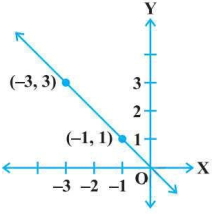
The graph given below represents the linear equation $x + y = 0$.
The graph given below represents the linear equation $x + y = 0$.
A
True
B
False
Solution
(A) The given equation is $x + y = 0$,which can be rewritten as $y = -x$.
Any point on the graph of $y = -x$ must have $x$ and $y$ coordinates that are additive inverses of each other (i.e.,they have opposite signs and the same absolute value).
Looking at the graph,we can identify two points: $(-1, 1)$ and $(-3, 3)$.
For the point $(-1, 1)$,$x = -1$ and $y = 1$. Substituting these into the equation $x + y = 0$,we get $-1 + 1 = 0$,which is true.
For the point $(-3, 3)$,$x = -3$ and $y = 3$. Substituting these into the equation $x + y = 0$,we get $-3 + 3 = 0$,which is true.
Since both points satisfy the equation and two points determine a unique line,the given statement is True.
Any point on the graph of $y = -x$ must have $x$ and $y$ coordinates that are additive inverses of each other (i.e.,they have opposite signs and the same absolute value).
Looking at the graph,we can identify two points: $(-1, 1)$ and $(-3, 3)$.
For the point $(-1, 1)$,$x = -1$ and $y = 1$. Substituting these into the equation $x + y = 0$,we get $-1 + 1 = 0$,which is true.
For the point $(-3, 3)$,$x = -3$ and $y = 3$. Substituting these into the equation $x + y = 0$,we get $-3 + 3 = 0$,which is true.
Since both points satisfy the equation and two points determine a unique line,the given statement is True.
0 likes
View Solution28
Easy
Write whether the following statement is True or False. Justify your answer:
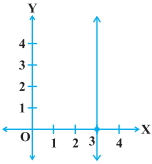
The graph given below represents the linear equation $x=3$.
The graph given below represents the linear equation $x=3$.
Solution
(TRUE) We know that the graph of the equation $x = a$ is a line parallel to the $y$-axis and at a distance of $|a|$ units from it.
If $a > 0$,the line lies to the right of the $y$-axis.
In the given graph,the line is parallel to the $y$-axis and passes through the point $(3, 0)$ on the $x$-axis,which is at a distance of $3$ units to the right of the $y$-axis.
Therefore,the given statement is True.
If $a > 0$,the line lies to the right of the $y$-axis.
In the given graph,the line is parallel to the $y$-axis and passes through the point $(3, 0)$ on the $x$-axis,which is at a distance of $3$ units to the right of the $y$-axis.
Therefore,the given statement is True.
0 likes
View Solution29
Easy
State whether the following statement is True or False. Justify your answer:
The coordinates of points in the table:
represent some of the solutions of the equation $x-y+2=0$.
The coordinates of points in the table:
| $x$ | $0$ | $1$ | $2$ | $3$ | $4$ |
| $y$ | $2$ | $3$ | $4$ | $-5$ | $6$ |
represent some of the solutions of the equation $x-y+2=0$.
Solution
(B) To determine if the points are solutions,we substitute the values of $x$ and $y$ into the equation $x-y+2=0$.
For $(0, 2)$: $0 - 2 + 2 = 0$. (True)
For $(1, 3)$: $1 - 3 + 2 = 0$. (True)
For $(2, 4)$: $2 - 4 + 2 = 0$. (True)
For $(3, -5)$: $3 - (-5) + 2 = 3 + 5 + 2 = 10 \neq 0$. (False)
For $(4, 6)$: $4 - 6 + 2 = 0$. (True)
Since the point $(3, -5)$ does not satisfy the equation,the statement is False.
For $(0, 2)$: $0 - 2 + 2 = 0$. (True)
For $(1, 3)$: $1 - 3 + 2 = 0$. (True)
For $(2, 4)$: $2 - 4 + 2 = 0$. (True)
For $(3, -5)$: $3 - (-5) + 2 = 3 + 5 + 2 = 10 \neq 0$. (False)
For $(4, 6)$: $4 - 6 + 2 = 0$. (True)
Since the point $(3, -5)$ does not satisfy the equation,the statement is False.
0 likes
View Solution30
EasyMCQ
State whether the following statement is True or False and justify your answer:
Every point on the graph of a linear equation in two variables does not represent a solution of the linear equation.
Every point on the graph of a linear equation in two variables does not represent a solution of the linear equation.
A
True
B
False
Solution
(B) The given statement is $False$.
By definition,the graph of a linear equation in two variables is the collection of all points $(x, y)$ that satisfy the equation.
Therefore,every point lying on the line represented by the linear equation is a solution to that equation.
By definition,the graph of a linear equation in two variables is the collection of all points $(x, y)$ that satisfy the equation.
Therefore,every point lying on the line represented by the linear equation is a solution to that equation.
0 likes
View Solution31
Easy
State whether the following statement is True or False. Justify your answer:
The graph of every linear equation in two variables need not be a line.
The graph of every linear equation in two variables need not be a line.
Solution
(FALSE) The statement is False.
By definition,a linear equation in two variables is of the form $ax + by + c = 0$,where $a, b,$ and $c$ are real numbers and $a$ and $b$ are not both zero. The geometric representation of such an equation in a Cartesian plane is always a straight line. Therefore,it is incorrect to say that the graph need not be a line.
By definition,a linear equation in two variables is of the form $ax + by + c = 0$,where $a, b,$ and $c$ are real numbers and $a$ and $b$ are not both zero. The geometric representation of such an equation in a Cartesian plane is always a straight line. Therefore,it is incorrect to say that the graph need not be a line.
0 likes
View Solution32
Easy
Find the points where the graph of the equation $3x + 4y = 12$ cuts the $x$-axis and the $y$-axis.
Solution
(N/A) The graph of the linear equation $3x + 4y = 12$ cuts the $x$-axis at the point where $y = 0$.
Putting $y = 0$ in the equation,we get $3x + 4(0) = 12$,which simplifies to $3x = 12$,so $x = 4$.
Thus,the point on the $x$-axis is $(4, 0)$.
The graph of the linear equation $3x + 4y = 12$ cuts the $y$-axis at the point where $x = 0$.
Putting $x = 0$ in the equation,we get $3(0) + 4y = 12$,which simplifies to $4y = 12$,so $y = 3$.
Thus,the point on the $y$-axis is $(0, 3)$.
Putting $y = 0$ in the equation,we get $3x + 4(0) = 12$,which simplifies to $3x = 12$,so $x = 4$.
Thus,the point on the $x$-axis is $(4, 0)$.
The graph of the linear equation $3x + 4y = 12$ cuts the $y$-axis at the point where $x = 0$.
Putting $x = 0$ in the equation,we get $3(0) + 4y = 12$,which simplifies to $4y = 12$,so $y = 3$.
Thus,the point on the $y$-axis is $(0, 3)$.
0 likes
View Solution33
EasyMCQ
At what point does the graph of the linear equation $x+y=5$ meet a line which is parallel to the $y$-axis,at a distance $2$ units from the origin and in the positive direction of the $x$-axis?
A
$(2, 3)$
B
$(3, 2)$
C
$(2, 2)$
D
$(3, 3)$
Solution
(A) The line parallel to the $y$-axis at a distance of $2$ units from the origin in the positive direction of the $x$-axis is given by the equation $x=2$.
To find the point of intersection,we substitute $x=2$ into the given linear equation $x+y=5$.
$2+y=5$
$y=5-2$
$y=3$
Therefore,the point of intersection is $(2, 3)$.
To find the point of intersection,we substitute $x=2$ into the given linear equation $x+y=5$.
$2+y=5$
$y=5-2$
$y=3$
Therefore,the point of intersection is $(2, 3)$.
0 likes
View Solution34
MediumMCQ
Determine the point on the graph of the equation $2x + 5y = 20$ whose $x$-coordinate is $\frac{5}{2}$ times its ordinate.
A
$(3, 2)$
B
$(3, 0)$
C
$(5, 2)$
D
$(0, 2)$
Solution
(C) Let the point be $(x, y)$.
According to the problem,the $x$-coordinate is $\frac{5}{2}$ times its ordinate $(y)$,so $x = \frac{5}{2}y$.
Substitute $x = \frac{5}{2}y$ into the equation $2x + 5y = 20$:
$2(\frac{5}{2}y) + 5y = 20$
$5y + 5y = 20$
$10y = 20$
$y = 2$
Now,find the $x$-coordinate using $x = \frac{5}{2}y$:
$x = \frac{5}{2}(2) = 5$
Thus,the required point is $(5, 2)$.
According to the problem,the $x$-coordinate is $\frac{5}{2}$ times its ordinate $(y)$,so $x = \frac{5}{2}y$.
Substitute $x = \frac{5}{2}y$ into the equation $2x + 5y = 20$:
$2(\frac{5}{2}y) + 5y = 20$
$5y + 5y = 20$
$10y = 20$
$y = 2$
Now,find the $x$-coordinate using $x = \frac{5}{2}y$:
$x = \frac{5}{2}(2) = 5$
Thus,the required point is $(5, 2)$.
0 likes
View Solution35
Easy
Draw the graph of the equation represented by the straight line which is parallel to the $x$-axis and is $4$ units above it.
Solution
(N/A) Any straight line parallel to the $x$-axis is given by the equation $y=k$,where $k$ is the distance of the line from the $x$-axis.
Here,the line is $4$ units above the $x$-axis,so $k=4$.
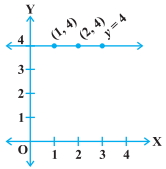
Therefore,the equation of the line is $y=4$.
To draw the graph of this equation,plot the points $(1,4)$,$(2,4)$,and $(3,4)$ on the Cartesian plane and join them with a straight line. This line represents all points where the $y$-coordinate is $4$.
Here,the line is $4$ units above the $x$-axis,so $k=4$.
Therefore,the equation of the line is $y=4$.
To draw the graph of this equation,plot the points $(1,4)$,$(2,4)$,and $(3,4)$ on the Cartesian plane and join them with a straight line. This line represents all points where the $y$-coordinate is $4$.
0 likes
View Solution36
Medium
Draw the graphs of linear equations $y=x$ and $y=-x$ on the same Cartesian plane.
What do you observe?
What do you observe?
Solution
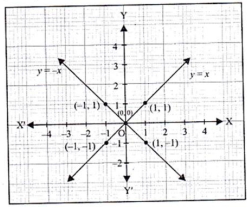
(N/A) Any point on the graph of $y = x$ will have $x$ and $y$ coordinates that are identical. The line passes through the points $(0,0), (1,1),$ and $(-1,-1).$
Similarly,any point on the graph of $y = -x$ will have $x$ and $y$ coordinates of opposite signs. The line passes through the points $(1,-1)$ and $(-1,1).$
Also,the point $(0,0)$ satisfies the equation $y = -x.$
The graphs of the linear equations $y = x$ and $y = -x$ on the same Cartesian plane are shown in the figure below.
We observe that the graphs of both these equations intersect at the origin $(0,0).$
Similarly,any point on the graph of $y = -x$ will have $x$ and $y$ coordinates of opposite signs. The line passes through the points $(1,-1)$ and $(-1,1).$
Also,the point $(0,0)$ satisfies the equation $y = -x.$
The graphs of the linear equations $y = x$ and $y = -x$ on the same Cartesian plane are shown in the figure below.
We observe that the graphs of both these equations intersect at the origin $(0,0).$
0 likes
View Solution37
MediumMCQ
Determine the point on the graph of the linear equation $2x + 5y = 19$,whose ordinate is $1 \frac{1}{2}$ times its abscissa.
A
($2$,$3$)
B
($3$,$2$)
C
($1$,$3$)
D
($3$,$1$)
Solution
(A) Let the abscissa of the point be $x$ and the ordinate be $y$.
According to the problem,the ordinate is $1 \frac{1}{2}$ times the abscissa,so $y = 1 \frac{1}{2} x = \frac{3}{2} x$.
Substitute $y = \frac{3}{2} x$ into the given linear equation $2x + 5y = 19$:
$2x + 5(\frac{3}{2} x) = 19$
$2x + \frac{15}{2} x = 19$
Multiply the entire equation by $2$ to clear the fraction:
$4x + 15x = 38$
$19x = 38$
$x = 2$
Now,find the ordinate $y$ using $y = \frac{3}{2} x$:
$y = \frac{3}{2} (2) = 3$
Thus,the point is $(2, 3)$.
According to the problem,the ordinate is $1 \frac{1}{2}$ times the abscissa,so $y = 1 \frac{1}{2} x = \frac{3}{2} x$.
Substitute $y = \frac{3}{2} x$ into the given linear equation $2x + 5y = 19$:
$2x + 5(\frac{3}{2} x) = 19$
$2x + \frac{15}{2} x = 19$
Multiply the entire equation by $2$ to clear the fraction:
$4x + 15x = 38$
$19x = 38$
$x = 2$
Now,find the ordinate $y$ using $y = \frac{3}{2} x$:
$y = \frac{3}{2} (2) = 3$
Thus,the point is $(2, 3)$.
0 likes
View Solution38
Easy
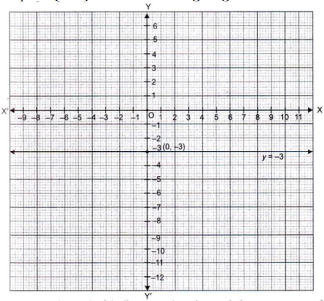
Draw the graph of the equation represented by a straight line which is parallel to the $x$-axis and at a distance $3$ units below it.
Solution
(N/A) The equation of a line parallel to the $x$-axis at a distance $a$ units below it is given by $y = -a$.
Here,the distance is $3$ units below the $x$-axis,so $a = 3$.
Therefore,the equation of the line is $y = -3$.
This line is parallel to the $x$-axis and passes through every point where the $y$-coordinate is $-3$,such as $(0, -3)$,$(1, -3)$,$(-1, -3)$,etc.
The graph of the equation $y = -3$ is a horizontal line passing through the point $(0, -3)$ on the $y$-axis,as shown in the figure.
Here,the distance is $3$ units below the $x$-axis,so $a = 3$.
Therefore,the equation of the line is $y = -3$.
This line is parallel to the $x$-axis and passes through every point where the $y$-coordinate is $-3$,such as $(0, -3)$,$(1, -3)$,$(-1, -3)$,etc.
The graph of the equation $y = -3$ is a horizontal line passing through the point $(0, -3)$ on the $y$-axis,as shown in the figure.
0 likes
View Solution39
Easy
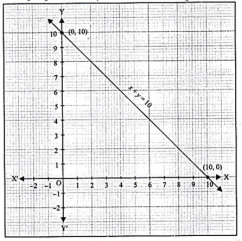
Draw the graph of the linear equation whose solutions are represented by the points having the sum of the coordinates as $10$ units.
Solution
(N/A) linear equation whose solutions are represented by the points having the sum of coordinates as $10$ units is $x+y=10$.
When $x=0$,$y=10$ and when $x=10$,$y=0$.
Now,plot these two points $(0, 10)$ and $(10, 0)$ on a graph paper and join them to obtain a straight line.
The graph of $x+y=10$ is a straight line as shown in the figure.
When $x=0$,$y=10$ and when $x=10$,$y=0$.
Now,plot these two points $(0, 10)$ and $(10, 0)$ on a graph paper and join them to obtain a straight line.
The graph of $x+y=10$ is a straight line as shown in the figure.
0 likes
View Solution40
EasyMCQ
Write the linear equation such that each point on its graph has an ordinate $3$ times its abscissa.
A
$4y = 3x$
B
$y = x$
C
$y = 3x$
D
$y = 2x$
Solution
(C) In a Cartesian coordinate system,any point is represented as $(x, y)$,where $x$ is the abscissa and $y$ is the ordinate.
According to the problem,the ordinate is $3$ times the abscissa.
Therefore,the relationship is $y = 3x$.
This is the required linear equation.
According to the problem,the ordinate is $3$ times the abscissa.
Therefore,the relationship is $y = 3x$.
This is the required linear equation.
0 likes
View Solution41
EasyMCQ
If the point $(3,4)$ lies on the graph of $3y = ax + 7$,then find the value of $a$.
A
$\frac{5}{3}$
B
$\frac{4}{3}$
C
$\frac{3}{5}$
D
$1$
Solution
(A) The point $(3,4)$ lies on the graph of $3y = ax + 7$.
Substituting $x = 3$ and $y = 4$ in the given equation $3y = ax + 7$,we get:
$3 \times 4 = a \times 3 + 7$
$12 = 3a + 7$
$3a = 12 - 7$
$3a = 5$
$a = \frac{5}{3}$
Substituting $x = 3$ and $y = 4$ in the given equation $3y = ax + 7$,we get:
$3 \times 4 = a \times 3 + 7$
$12 = 3a + 7$
$3a = 12 - 7$
$3a = 5$
$a = \frac{5}{3}$
0 likes
View Solution42
Easy
How many solution$(s)$ of the equation $2x + 1 = x - 3$ are there on the:
$(i)$ Number line
$(ii)$ Cartesian plane
$(i)$ Number line
$(ii)$ Cartesian plane
Solution
(N/A) $(i)$ The number of solution$(s)$ of the equation $2x + 1 = x - 3$ on the number line is $1$.
Solving the equation: $2x + 1 = x - 3 \Rightarrow 2x - x = -3 - 1 \Rightarrow x = -4$.
Thus,there is exactly one unique solution,$x = -4$,on the number line.
$(ii)$ The number of solution$(s)$ of the equation $2x + 1 = x - 3$ on the Cartesian plane is infinitely many.
In the Cartesian plane,the equation $2x + 1 = x - 3$ can be written as $x + 4 = 0$,which represents a vertical line parallel to the $y$-axis. Every point on this line $( -4, y )$ for any real value of $y$ satisfies the equation,hence there are infinitely many solutions.
Solving the equation: $2x + 1 = x - 3 \Rightarrow 2x - x = -3 - 1 \Rightarrow x = -4$.
Thus,there is exactly one unique solution,$x = -4$,on the number line.
$(ii)$ The number of solution$(s)$ of the equation $2x + 1 = x - 3$ on the Cartesian plane is infinitely many.
In the Cartesian plane,the equation $2x + 1 = x - 3$ can be written as $x + 4 = 0$,which represents a vertical line parallel to the $y$-axis. Every point on this line $( -4, y )$ for any real value of $y$ satisfies the equation,hence there are infinitely many solutions.
0 likes
View Solution43
Easy
Find the solution of the linear equation $x + 2y = 8$ which represents a point on:
$(i)$ $x$-axis
$(ii)$ $y$-axis
$(i)$ $x$-axis
$(ii)$ $y$-axis
Solution
(N/A) We know that any point lying on the $x$-axis has its ordinate (y-coordinate) equal to $0$.
Putting $y = 0$ in the equation $x + 2y = 8$,we get:
$x + 2(0) = 8 \Rightarrow x = 8$.
Thus,the point on the $x$-axis is $(8, 0)$.
We also know that any point lying on the $y$-axis has its abscissa (x-coordinate) equal to $0$.
Putting $x = 0$ in the equation $x + 2y = 8$,we get:
$0 + 2y = 8 \Rightarrow 2y = 8 \Rightarrow y = 4$.
Thus,the point on the $y$-axis is $(0, 4)$.
Putting $y = 0$ in the equation $x + 2y = 8$,we get:
$x + 2(0) = 8 \Rightarrow x = 8$.
Thus,the point on the $x$-axis is $(8, 0)$.
We also know that any point lying on the $y$-axis has its abscissa (x-coordinate) equal to $0$.
Putting $x = 0$ in the equation $x + 2y = 8$,we get:
$0 + 2y = 8 \Rightarrow 2y = 8 \Rightarrow y = 4$.
Thus,the point on the $y$-axis is $(0, 4)$.
0 likes
View Solution44
EasyMCQ
For what value of $c,$ the linear equation $2x + cy = 8$ has equal values of $x$ and $y$ for its solution?
A
$c = 1$
B
$c = 2$
C
$c = 3$
D
$c = 6$
Solution
(B) Given the linear equation: $2x + cy = 8$.
We are looking for the value of $c$ such that $x = y$.
Substitute $y = x$ into the given equation:
$2x + c(x) = 8$
$x(2 + c) = 8$
$x = \frac{8}{2 + c}$
Since the question implies a specific value for $c$ that satisfies the condition for any solution where $x=y$,we look at the structure of the equation. If we assume a specific point like $(2, 2)$ which satisfies $x=y$:
$2(2) + c(2) = 8$
$4 + 2c = 8$
$2c = 4$
$c = 2$
Thus,for $c = 2$,the equation becomes $2x + 2y = 8$,or $x + y = 4$,which clearly allows for the solution $x = y = 2$.
We are looking for the value of $c$ such that $x = y$.
Substitute $y = x$ into the given equation:
$2x + c(x) = 8$
$x(2 + c) = 8$
$x = \frac{8}{2 + c}$
Since the question implies a specific value for $c$ that satisfies the condition for any solution where $x=y$,we look at the structure of the equation. If we assume a specific point like $(2, 2)$ which satisfies $x=y$:
$2(2) + c(2) = 8$
$4 + 2c = 8$
$2c = 4$
$c = 2$
Thus,for $c = 2$,the equation becomes $2x + 2y = 8$,or $x + y = 4$,which clearly allows for the solution $x = y = 2$.
0 likes
View Solution45
MediumMCQ
Let $y$ vary directly as $x$. If $y=12$ when $x=4$,then write a linear equation. What is the value of $y$ when $x=5$?
A
$y=3x, y=15$
B
$y=4x, y=20$
C
$y=12x, y=60$
D
$y=x/3, y=5/3$
Solution
(A) $y$ varies directly as $x$.
$\Rightarrow y \propto x$
$\therefore y = kx$
Substituting $y = 12$ when $x = 4$,we get:
$12 = k \times 4 \Rightarrow k = 12 \div 4 = 3$
Hence,the required linear equation is $y = 3x$.
The value of $y$ when $x = 5$ is $y = 3 \times 5 = 15$.
$\Rightarrow y \propto x$
$\therefore y = kx$
Substituting $y = 12$ when $x = 4$,we get:
$12 = k \times 4 \Rightarrow k = 12 \div 4 = 3$
Hence,the required linear equation is $y = 3x$.
The value of $y$ when $x = 5$ is $y = 3 \times 5 = 15$.
0 likes
View Solution46
Medium
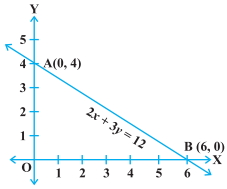
Draw the graph of the linear equation $2x + 3y = 12$. At what points does the graph of the equation cut the $x$-axis and the $y$-axis?
Solution
(N/A) The given equation is $2x + 3y = 12$. To draw the graph of this equation,we need at least two points lying on the graph.
From the equation,we have $y = \frac{12 - 2x}{3}$.
For $x = 0$,$y = \frac{12 - 0}{3} = 4$. Therefore,$(0, 4)$ lies on the graph.
For $y = 0$,$2x = 12$,so $x = 6$. Therefore,$(6, 0)$ lies on the graph.
Now,plot the points $A(0, 4)$ and $B(6, 0)$ and join them to get the line $AB$.
Line $AB$ is the required graph. The graph (line $AB$) cuts the $x$-axis at the point $(6, 0)$ and the $y$-axis at the point $(0, 4)$.
From the equation,we have $y = \frac{12 - 2x}{3}$.
For $x = 0$,$y = \frac{12 - 0}{3} = 4$. Therefore,$(0, 4)$ lies on the graph.
For $y = 0$,$2x = 12$,so $x = 6$. Therefore,$(6, 0)$ lies on the graph.
Now,plot the points $A(0, 4)$ and $B(6, 0)$ and join them to get the line $AB$.
Line $AB$ is the required graph. The graph (line $AB$) cuts the $x$-axis at the point $(6, 0)$ and the $y$-axis at the point $(0, 4)$.
0 likes
View Solution47
Medium
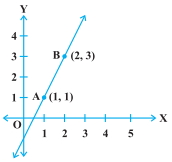
The following values of $x$ and $y$ are thought to satisfy a linear equation:
Draw the graph,using the values of $x, y$ as given in the above table.
At what point does the graph of the linear equation:
$(i)$ cut the $x$-axis?
$(ii)$ cut the $y$-axis?
| $x$ | $1$ | $2$ |
| $y$ | $1$ | $3$ |
Draw the graph,using the values of $x, y$ as given in the above table.
At what point does the graph of the linear equation:
$(i)$ cut the $x$-axis?
$(ii)$ cut the $y$-axis?
Solution
(N/A) From the table,we get two points $A(1, 1)$ and $B(2, 3)$ which lie on the graph of the linear equation. Obviously,the graph will be a straight line. So,we first plot the points $A$ and $B$ and join them as shown in the figure.
To find the equation of the line passing through $(1, 1)$ and $(2, 3)$:
Slope $m = \frac{y_2 - y_1}{x_2 - x_1} = \frac{3 - 1}{2 - 1} = 2$.
Using the point-slope form $y - y_1 = m(x - x_1)$:
$y - 1 = 2(x - 1) \implies y - 1 = 2x - 2 \implies y = 2x - 1$.
$(i)$ To find where it cuts the $x$-axis,set $y = 0$:
$0 = 2x - 1 \implies 2x = 1 \implies x = \frac{1}{2}$.
So,it cuts the $x$-axis at the point $\left(\frac{1}{2}, 0\right)$.
$(ii)$ To find where it cuts the $y$-axis,set $x = 0$:
$y = 2(0) - 1 \implies y = -1$.
So,it cuts the $y$-axis at the point $(0, -1)$.
To find the equation of the line passing through $(1, 1)$ and $(2, 3)$:
Slope $m = \frac{y_2 - y_1}{x_2 - x_1} = \frac{3 - 1}{2 - 1} = 2$.
Using the point-slope form $y - y_1 = m(x - x_1)$:
$y - 1 = 2(x - 1) \implies y - 1 = 2x - 2 \implies y = 2x - 1$.
$(i)$ To find where it cuts the $x$-axis,set $y = 0$:
$0 = 2x - 1 \implies 2x = 1 \implies x = \frac{1}{2}$.
So,it cuts the $x$-axis at the point $\left(\frac{1}{2}, 0\right)$.
$(ii)$ To find where it cuts the $y$-axis,set $x = 0$:
$y = 2(0) - 1 \implies y = -1$.
So,it cuts the $y$-axis at the point $(0, -1)$.
0 likes
View Solution48
Medium
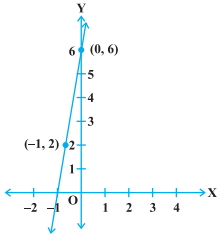
The autorickshaw fare in a city is charged $Rs. 10$ for the first kilometer and $Rs. 4$ per kilometer for the subsequent distance covered. Write the linear equation to express the above statement and draw the graph of the linear equation.
Solution
(N/A) Let the total distance covered be $x \text{ km}$ and the total fare charged be $Rs. y$.
For the first $1 \text{ km}$,the fare is $Rs. 10$.
For the remaining distance $(x - 1) \text{ km}$,the fare is $Rs. 4(x - 1)$.
Therefore,the total fare $y$ is given by:
$y = 10 + 4(x - 1)$
$y = 10 + 4x - 4$
$y = 4x + 6$
Thus,the required linear equation is $4x - y + 6 = 0$.
To draw the graph,we find two points on the line:
If $x = 0$,then $y = 4(0) + 6 = 6$. Point: $(0, 6)$.
If $x = -1$,then $y = 4(-1) + 6 = 2$. Point: $(-1, 2)$.
Plotting these points on a Cartesian plane and joining them gives the required straight line graph.
For the first $1 \text{ km}$,the fare is $Rs. 10$.
For the remaining distance $(x - 1) \text{ km}$,the fare is $Rs. 4(x - 1)$.
Therefore,the total fare $y$ is given by:
$y = 10 + 4(x - 1)$
$y = 10 + 4x - 4$
$y = 4x + 6$
Thus,the required linear equation is $4x - y + 6 = 0$.
To draw the graph,we find two points on the line:
If $x = 0$,then $y = 4(0) + 6 = 6$. Point: $(0, 6)$.
If $x = -1$,then $y = 4(-1) + 6 = 2$. Point: $(-1, 2)$.
Plotting these points on a Cartesian plane and joining them gives the required straight line graph.
1 likes
View Solution49
Medium
The work done by a body on application of a constant force is the product of the constant force and the distance travelled by the body in the direction of force. Express this in the form of a linear equation in two variables and draw its graph by taking the constant force as $3$ units. What is the work done when the distance travelled is $2$ units? Verify it by plotting the graph.
Solution
(N/A) Work done $= (\text{constant force}) \times (\text{distance})$
$= 3 \times (\text{distance})$
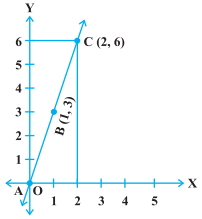
i.e., $y = 3x$, where $y$ (units) is the work done and $x$ (units) is the distance travelled.
Since $x = 2$ units (given), therefore, work done $= 3 \times 2 = 6$ units.
To plot the graph of the linear equation $y = 3x$, we need at least two solutions of the equation.
We see that $x = 0, y = 0$ satisfies the given equation, and $x = 1, y = 3$ also satisfies the equation.
Now we plot the points $A(0, 0)$ and $B(1, 3)$ and join them to form a line. The graph of the equation is a straight line. [We have not shown the whole line because work done cannot be negative].
To verify from the graph, draw a perpendicular to the $x$-axis at the point $(2, 0)$ meeting the graph at the point $C$. Clearly, the coordinates of $C$ are $(2, 6)$. It means that the work done is $6$ units.
$= 3 \times (\text{distance})$
i.e., $y = 3x$, where $y$ (units) is the work done and $x$ (units) is the distance travelled.
Since $x = 2$ units (given), therefore, work done $= 3 \times 2 = 6$ units.
To plot the graph of the linear equation $y = 3x$, we need at least two solutions of the equation.
We see that $x = 0, y = 0$ satisfies the given equation, and $x = 1, y = 3$ also satisfies the equation.
Now we plot the points $A(0, 0)$ and $B(1, 3)$ and join them to form a line. The graph of the equation is a straight line. [We have not shown the whole line because work done cannot be negative].
To verify from the graph, draw a perpendicular to the $x$-axis at the point $(2, 0)$ meeting the graph at the point $C$. Clearly, the coordinates of $C$ are $(2, 6)$. It means that the work done is $6$ units.
0 likes
View Solution50
Easy
Show that the points $A(1, 2)$,$B(-1, -16)$,and $C(0, -7)$ lie on the graph of the linear equation $y = 9x - 7$.
Solution
(N/A) To show that a point $(x, y)$ lies on the graph of the linear equation $y = 9x - 7$,we must substitute the coordinates of the point into the equation and verify if the left-hand side equals the right-hand side.
For point $A(1, 2)$:
Substitute $x = 1$ and $y = 2$ into the equation:
$2 = 9(1) - 7$
$2 = 9 - 7$
$2 = 2$
Since the left-hand side equals the right-hand side,point $A$ lies on the graph.
For point $B(-1, -16)$:
Substitute $x = -1$ and $y = -16$ into the equation:
$-16 = 9(-1) - 7$
$-16 = -9 - 7$
$-16 = -16$
Since the left-hand side equals the right-hand side,point $B$ lies on the graph.
For point $C(0, -7)$:
Substitute $x = 0$ and $y = -7$ into the equation:
$-7 = 9(0) - 7$
$-7 = 0 - 7$
$-7 = -7$
Since the left-hand side equals the right-hand side,point $C$ lies on the graph.
Thus,all three points $A$,$B$,and $C$ satisfy the equation $y = 9x - 7$ and therefore lie on its graph.
For point $A(1, 2)$:
Substitute $x = 1$ and $y = 2$ into the equation:
$2 = 9(1) - 7$
$2 = 9 - 7$
$2 = 2$
Since the left-hand side equals the right-hand side,point $A$ lies on the graph.
For point $B(-1, -16)$:
Substitute $x = -1$ and $y = -16$ into the equation:
$-16 = 9(-1) - 7$
$-16 = -9 - 7$
$-16 = -16$
Since the left-hand side equals the right-hand side,point $B$ lies on the graph.
For point $C(0, -7)$:
Substitute $x = 0$ and $y = -7$ into the equation:
$-7 = 9(0) - 7$
$-7 = 0 - 7$
$-7 = -7$
Since the left-hand side equals the right-hand side,point $C$ lies on the graph.
Thus,all three points $A$,$B$,and $C$ satisfy the equation $y = 9x - 7$ and therefore lie on its graph.
0 likes
View SolutionLinear Equations in Two Variables — Mix Examples - Linear Equations in Two Variables · Frequently Asked Questions
1Are these Linear Equations in Two Variables questions useful for JEE and NEET?
Yes. All questions in this section are mapped to JEE Main and NEET exam patterns. Previous year questions from JEE Main, NEET, GUJCET and state-level exams are included with full solutions.
2Can I switch to Hindi or Gujarati for these questions?
Yes. Use the language tabs in the hero section or the sidebar to view the same questions and solutions in English, Hindi or Gujarati.
3How do I generate a question paper from this subtopic?
Use the Vedclass Exam Paper Generator — select the chapter and subtopic, set difficulty, and generate Sets A, B, C, D automatically. First 3 chapters of every subject are free.
Vedclass Products
For Students
Vedclass Test Series
Mock tests in real JEE/NEET style with performance analysis. 5-day free trial.
Start Free TrialFor Teachers
Exam Paper Generator
Generate Set A/B/C/D papers from this chapter in 2 minutes. 3 chapters free.
Try FreeFor Institutes
Online Exam Module
Live online exams with unlimited students, 360° analytics & white-label branding.
See DemoFor Teachers & Institutes
Generate a Linear Equations in Two Variables Exam Paper in 2 Minutes
Select subtopic & difficulty — Sets A, B, C, D auto-generated with No Repeat logic.
First 3 chapters of every subject are free — no payment required.