
A English
Huygens’ Principle and Wave-fronts Questions in English
Class 12 Physics · Wave Optics · Huygens’ Principle and Wave-fronts
88+
Questions
English
Language
100%
With Solutions
Showing 50 of 88 questions in English
1
DifficultMCQ
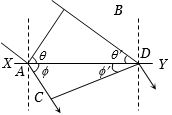
In the adjoining diagram, a wavefront $AB$ moving in air is incident on a plane glass surface $XY$. Its position $CD$ after refraction through a glass slab is shown along with the normals drawn at $A$ and $D$. The refractive index of glass with respect to air $(\mu = 1)$ will be equal to
A
$\frac{\sin \theta}{\sin \theta '}$
B
$\frac{\sin \theta}{\sin \phi '}$
C
$\frac{\sin \phi '}{\sin \theta}$
D
$\frac{AB}{CD}$
Solution
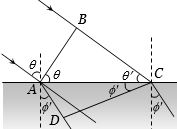
(B) In the case of refraction, if $CD$ is the refracted wavefront and $v_1$ and $v_2$ are the speeds of light in air and glass respectively, then in the time the wavelet from $B$ reaches $C$, the wavelet from $A$ reaches $D$.
Thus, the time taken is $t = \frac{BC}{v_a} = \frac{AD}{v_g}$, which implies $\frac{BC}{AD} = \frac{v_a}{v_g}$. .....$(i)$
From the geometry of the diagram, in $\Delta ACB$, $BC = AC \sin \theta$. .....$(ii)$
In $\Delta ACD$, $AD = AC \sin \phi '$. .....$(iii)$
Substituting $(ii)$ and $(iii)$ into $(i)$, we get $\frac{v_a}{v_g} = \frac{\sin \theta}{\sin \phi '}$.
Since the refractive index $\mu = \frac{v_a}{v_g}$, we have $\mu_g = \frac{\sin \theta}{\sin \phi '}$.
Thus, the time taken is $t = \frac{BC}{v_a} = \frac{AD}{v_g}$, which implies $\frac{BC}{AD} = \frac{v_a}{v_g}$. .....$(i)$
From the geometry of the diagram, in $\Delta ACB$, $BC = AC \sin \theta$. .....$(ii)$
In $\Delta ACD$, $AD = AC \sin \phi '$. .....$(iii)$
Substituting $(ii)$ and $(iii)$ into $(i)$, we get $\frac{v_a}{v_g} = \frac{\sin \theta}{\sin \phi '}$.
Since the refractive index $\mu = \frac{v_a}{v_g}$, we have $\mu_g = \frac{\sin \theta}{\sin \phi '}$.
0 likes
View Solution2
EasyMCQ
What is the significance of Huygens' conception of secondary waves?
A
Allows us to find the focal length of a thick lens
B
Is a geometrical method to find a wavefront
C
Is used to determine the velocity of light
D
Is used to explain polarisation
Solution
(B) Huygens' principle states that every point on a primary wavefront acts as a source of secondary spherical wavelets,which spread out in all directions with the speed of light in the medium. The new wavefront at a later time is the forward envelope of these secondary wavelets. Therefore,it is a geometrical method to find the shape and position of a wavefront at any subsequent time. Thus,option $B$ is correct.
0 likes
View Solution3
EasyMCQ
By Huygen's wave theory of light,we cannot explain the phenomenon of
A
Interference
B
Diffraction
C
Photoelectric effect
D
Polarisation
Solution
(C) Huygen's wave theory treats light as a wave propagating through a medium.
It successfully explains wave phenomena such as interference,diffraction,and polarization.
However,it fails to explain the particle nature of light,such as the photoelectric effect,which requires the quantum theory of light (photons).
It successfully explains wave phenomena such as interference,diffraction,and polarization.
However,it fails to explain the particle nature of light,such as the photoelectric effect,which requires the quantum theory of light (photons).
0 likes
View Solution4
EasyMCQ
The idea of secondary wavelets for the propagation of a wave was first given by
A
Newton
B
Huygens
C
Maxwell
D
Fresnel
Solution
(B) The concept of secondary wavelets for the propagation of a wave was proposed by Christiaan Huygens in his wave theory of light. According to Huygens' principle,every point on a primary wavefront acts as a source of secondary spherical wavelets,which spread out in all directions with the speed of light in the medium. The new wavefront at a later time is the forward envelope of these secondary wavelets. Therefore,the correct option is $B$.
0 likes
View Solution5
EasyMCQ
What is the definition of a wavefront?
A
All particles in it have the same phase.
B
All particles have opposite phases of vibration.
C
Few particles are in the same phase,while the rest are in the opposite phase.
D
None of these.
Solution
(A) wavefront is defined as the locus of all points (particles) in a medium that are vibrating in the same phase at a given instant of time. Therefore,all particles on a wavefront have the same phase of vibration. Hence,the correct option is $A$.
0 likes
View Solution6
EasyMCQ
The wavefront of a wave has what direction with respect to the wave motion?
A
Parallel
B
Perpendicular
C
Opposite
D
At an angle of $\theta$
Solution
(B) By definition,a wavefront is the locus of all points having the same phase of oscillation.
In any wave propagation,the direction of wave motion (the ray direction) is always perpendicular to the wavefront at every point.
Therefore,the correct relationship is that the wavefront is perpendicular to the direction of wave motion.
In any wave propagation,the direction of wave motion (the ray direction) is always perpendicular to the wavefront at every point.
Therefore,the correct relationship is that the wavefront is perpendicular to the direction of wave motion.
0 likes
View Solution7
EasyMCQ
Which one of the following phenomena is not explained by Huygen's construction of wavefront?
A
Refraction
B
Reflection
C
Diffraction
D
Origin of spectra
Solution
(D) Huygens' principle is a geometric method used to determine the shape of a wavefront at any time $t'$ if its shape at time $t$ is known.
Using this principle,one can successfully explain the laws of reflection,refraction,and the phenomenon of diffraction.
However,Huygens' wave theory does not provide an explanation for the origin of spectra,which is related to the quantum nature of light and atomic energy levels.
Therefore,the correct option is $D$.
Using this principle,one can successfully explain the laws of reflection,refraction,and the phenomenon of diffraction.
However,Huygens' wave theory does not provide an explanation for the origin of spectra,which is related to the quantum nature of light and atomic energy levels.
Therefore,the correct option is $D$.
0 likes
View Solution8
EasyMCQ
Rays diverging from a point source form a wave front that is:
A
Cylindrical
B
Spherical
C
Plane
D
Cubical
Solution
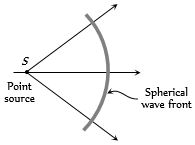
(B) wave front is defined as the locus of all points that are in the same phase of oscillation. For a point source of light,the light waves travel in all directions with the same speed in a homogeneous medium. Therefore,the distance of all points in the same phase from the source is equal,forming a sphere. Thus,the wave front originating from a point source is spherical.
0 likes
View Solution9
EasyMCQ
Newton postulated his corpuscular theory on the basis of
A
Newton's rings
B
Colours of thin films
C
Rectilinear propagation of light
D
Dispersion of white light
Solution
(C) Newton's corpuscular theory of light was primarily based on the observation that light travels in straight lines,which is known as the rectilinear propagation of light.
According to Newton,light consists of tiny,massless particles called corpuscles that travel at very high speeds.
Since these particles move in straight lines in a vacuum or a uniform medium,this theory successfully explained the rectilinear propagation of light.
Therefore,the correct option is $C$.
According to Newton,light consists of tiny,massless particles called corpuscles that travel at very high speeds.
Since these particles move in straight lines in a vacuum or a uniform medium,this theory successfully explained the rectilinear propagation of light.
Therefore,the correct option is $C$.
0 likes
View Solution10
EasyMCQ
Huygens' principle of secondary wavelets may be used to
A
Find the velocity of light in vacuum
B
Explain the particle behaviour of light
C
Find the new position of the wavefront
D
Explain photoelectric effect
Solution
(C) Huygens' principle states that every point on a wavefront acts as a source of secondary spherical wavelets,which spread out in the forward direction at the speed of light.
By drawing a common tangent surface to all these secondary wavelets at a later time $t$,we can determine the new position of the wavefront.
Therefore,the principle is primarily used to find the new position of the wavefront.
By drawing a common tangent surface to all these secondary wavelets at a later time $t$,we can determine the new position of the wavefront.
Therefore,the principle is primarily used to find the new position of the wavefront.
0 likes
View Solution11
EasyMCQ
Huygens' wave theory allows us to know
A
The wavelength of the wave
B
The velocity of the wave
C
The amplitude of the wave
D
The propagation of wave fronts
Solution
(D) Huygens' principle is a geometrical construction that allows us to determine the position of a wavefront at any later time. According to this principle,every point on a primary wavefront acts as a source of secondary wavelets,and the new wavefront is the forward envelope of these secondary wavelets. Therefore,it primarily explains the propagation of wave fronts.
0 likes
View Solution12
EasyMCQ
The wave theory of light was given by
A
Maxwell
B
Planck
C
Huygens
D
Young
Solution
(C) The wave theory of light was proposed by Christiaan Huygens in $1678$.
According to this theory,light travels in the form of waves,and every point on a wavefront acts as a source of secondary wavelets.
According to this theory,light travels in the form of waves,and every point on a wavefront acts as a source of secondary wavelets.
0 likes
View Solution13
EasyMCQ
Select the correct option regarding the history and nature of light.
A
Christian Huygens, a contemporary of Newton, established the wave theory of light by assuming that light waves were transverse.
B
Maxwell provided the compelling theoretical evidence that light is a transverse wave.
C
Thomas Young experimentally proved the wave behaviour of light and Huygens' assumption.
D
All the statements given above correctly answer the question "what is light".
Solution
(B) In Huygens' principle, the wave theory was established by assuming that light waves were longitudinal, not transverse. So, option $(A)$ is incorrect.
Maxwell's electromagnetic theory of light provided the compelling theoretical evidence that light is an electromagnetic wave, which is transverse in nature. So, option $(B)$ is correct.
Thomas Young conducted the double-slit experiment to demonstrate the interference of light, which confirmed the wave nature of light. However, he did not specifically prove Huygens' assumption regarding the nature of the wave (longitudinal vs transverse). So, option $(C)$ is incorrect.
These statements highlight specific aspects of the wave nature of light but do not provide a complete definition of light, such as its dual nature (particle-wave duality). Therefore, they do not collectively answer the question "what is light" in its entirety. So, option $(D)$ is incorrect.
Maxwell's electromagnetic theory of light provided the compelling theoretical evidence that light is an electromagnetic wave, which is transverse in nature. So, option $(B)$ is correct.
Thomas Young conducted the double-slit experiment to demonstrate the interference of light, which confirmed the wave nature of light. However, he did not specifically prove Huygens' assumption regarding the nature of the wave (longitudinal vs transverse). So, option $(C)$ is incorrect.
These statements highlight specific aspects of the wave nature of light but do not provide a complete definition of light, such as its dual nature (particle-wave duality). Therefore, they do not collectively answer the question "what is light" in its entirety. So, option $(D)$ is incorrect.
0 likes
View Solution14
EasyMCQ
$A$ parallel cylindrical beam of light propagates in a medium with a refractive index $\mu(I) = \mu_0 + \mu_2 I$,where $\mu_0$ and $\mu_2$ are positive constants and $I$ is the intensity. As the intensity of the light decreases,the radius increases. The initial shape of the wavefront is:
A
Plane
B
Concave
C
Convex
D
Convex near the axis and concave near the periphery
Solution
(A) parallel cylindrical beam of light consists of rays that are parallel to each other.
By definition,the wavefront is the locus of points having the same phase.
For a parallel beam of light,the wavefronts are planes perpendicular to the direction of propagation.
Therefore,the initial shape of the wavefront is plane.
By definition,the wavefront is the locus of points having the same phase.
For a parallel beam of light,the wavefronts are planes perpendicular to the direction of propagation.
Therefore,the initial shape of the wavefront is plane.

0 likes
View Solution15
MediumMCQ
Which of the following phenomena cannot be explained by Huygens' principle?
A
Refraction
B
Reflection
C
Diffraction
D
Emission of spectrum
Solution
(D) Huygens' wave theory successfully explains the laws of reflection,refraction,and diffraction by considering the propagation of wavefronts.
However,Huygens' original wave theory could not explain the origin of spectral lines or the emission of a spectrum,as it did not account for the quantum nature of light or the interaction of light with atomic energy levels.
However,Huygens' original wave theory could not explain the origin of spectral lines or the emission of a spectrum,as it did not account for the quantum nature of light or the interaction of light with atomic energy levels.
0 likes
View Solution16
EasyMCQ
The main drawback of Huygens' theory was:
A
Failure in explanation of rectilinear propagation of light
B
$A$ failure of experimental verification of ether medium
C
Failure to explain the formation of Newton's rings
D
Both $(a)$ and $(b)$
Solution
(B) Huygens' wave theory successfully explained reflection,refraction,and the rectilinear propagation of light by assuming the existence of a hypothetical medium called 'ether'.
However,the theory faced significant criticism because the existence of the 'ether' medium could not be experimentally verified (notably by the Michelson-Morley experiment).
While Huygens' theory could explain many phenomena,the primary historical drawback cited in textbooks regarding the fundamental premise of his theory was the requirement of the 'ether' medium,which was later proven non-existent.
Therefore,the failure of experimental verification of the ether medium is considered a major drawback.
However,the theory faced significant criticism because the existence of the 'ether' medium could not be experimentally verified (notably by the Michelson-Morley experiment).
While Huygens' theory could explain many phenomena,the primary historical drawback cited in textbooks regarding the fundamental premise of his theory was the requirement of the 'ether' medium,which was later proven non-existent.
Therefore,the failure of experimental verification of the ether medium is considered a major drawback.
0 likes
View Solution17
EasyMCQ
Huygens' principle is applicable to
A
only light waves
B
only sound waves
C
only mechanical waves
D
for all the above waves
Solution
(D) Huygens' principle is a geometric method used to determine the position of a new wavefront at a later time based on the knowledge of the wavefront at an earlier time.
It is based on the concept that every point on a wavefront acts as a source of secondary wavelets.
This principle is a general wave theory and is applicable to all types of waves,including light waves (electromagnetic waves),sound waves (mechanical waves),and water waves.
Therefore,it is applicable to all the waves mentioned above.
It is based on the concept that every point on a wavefront acts as a source of secondary wavelets.
This principle is a general wave theory and is applicable to all types of waves,including light waves (electromagnetic waves),sound waves (mechanical waves),and water waves.
Therefore,it is applicable to all the waves mentioned above.
0 likes
View Solution18
EasyMCQ
What does Huygens' principle explain regarding secondary wavelets?
A
Propagation of light in a medium
B
Reflection of light
C
Diffraction of light
D
All of the above
Solution
(D) Huygens' principle states that every point on a wavefront acts as a source of secondary wavelets,and the new wavefront is the envelope of these secondary wavelets at a later time.
This principle is a fundamental tool in wave optics that successfully explains the laws of reflection and refraction of light.
Furthermore,it provides a theoretical basis for understanding the phenomenon of diffraction,where light bends around corners or obstacles.
Since it explains propagation,reflection,and diffraction,the correct answer is $D$.
This principle is a fundamental tool in wave optics that successfully explains the laws of reflection and refraction of light.
Furthermore,it provides a theoretical basis for understanding the phenomenon of diffraction,where light bends around corners or obstacles.
Since it explains propagation,reflection,and diffraction,the correct answer is $D$.
0 likes
View Solution19
EasyMCQ
Huygens' theory of secondary waves can be used to find:
A
Velocity of light
B
The wavelength of light
C
Wave front geometrically
D
Magnifying power of microscope
Solution
(C) Huygens' principle states that every point on a wave front acts as a source of secondary wavelets.
These secondary wavelets spread out in all directions with the speed of the wave in the medium.
The new wave front at any later time is the forward envelope of these secondary wavelets.
Therefore,Huygens' principle is primarily used to determine the geometric propagation and position of a wave front at a subsequent time.
These secondary wavelets spread out in all directions with the speed of the wave in the medium.
The new wave front at any later time is the forward envelope of these secondary wavelets.
Therefore,Huygens' principle is primarily used to determine the geometric propagation and position of a wave front at a subsequent time.
0 likes
View Solution20
DifficultMCQ
Initially,parallel cylindrical wavefronts travel in a medium with a refractive index $\mu(I) = \mu_0 + \mu_2 I$,where $\mu_0$ and $\mu_2$ are positive constants and $I$ is the intensity. The intensity decreases as the radius increases. What happens when it enters the second medium?
A
It travels as a cylindrical wavefront.
B
It diverges.
C
It converges.
D
It diverges towards the axis and moves from the outside to the inside.
Solution
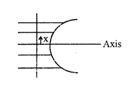
(C) The refractive index is given by $\mu(I) = \mu_0 + \mu_2 I$. Since the intensity $I$ is maximum at the axis and decreases as we move away from the axis (as shown by $x$ in the figure),the refractive index $\mu$ is also maximum at the axis and decreases as we move away from it.
Since the speed of light $v = c/\mu$,the speed is minimum at the axis and increases as we move away from the axis.
Consequently,the part of the wavefront near the axis travels slower than the parts further away from the axis.
This causes the wavefront to bend and converge towards the axis,resulting in a convex shape as shown in the figure.
Since the speed of light $v = c/\mu$,the speed is minimum at the axis and increases as we move away from the axis.
Consequently,the part of the wavefront near the axis travels slower than the parts further away from the axis.
This causes the wavefront to bend and converge towards the axis,resulting in a convex shape as shown in the figure.
0 likes
View Solution21
EasyMCQ
Which of the following phenomena cannot be explained by Huygens' principle?
A
Refraction
B
Reflection
C
Diffraction
D
Spectral patterns
Solution
(D) Huygens' principle is a geometric construction used to determine the position of a new wavefront at a later time based on the current wavefront.
It successfully explains the laws of reflection and refraction.
It also explains the phenomenon of diffraction by considering each point on the wavefront as a source of secondary wavelets.
However,Huygens' principle (in its original form) does not explain the origin of spectral patterns (like the photoelectric effect or the discrete nature of atomic spectra),as these are quantum mechanical phenomena that require the concept of photons and energy quantization,which are beyond the scope of classical wave theory.
It successfully explains the laws of reflection and refraction.
It also explains the phenomenon of diffraction by considering each point on the wavefront as a source of secondary wavelets.
However,Huygens' principle (in its original form) does not explain the origin of spectral patterns (like the photoelectric effect or the discrete nature of atomic spectra),as these are quantum mechanical phenomena that require the concept of photons and energy quantization,which are beyond the scope of classical wave theory.
0 likes
View Solution22
DifficultMCQ
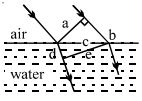
The figure shows plane waves refracted from air to water using Huygens's principle. $a, b, c, d, e$ are lengths on the diagram. The refractive index of water with respect to air is the ratio:
A
$a/e$
B
$b/e$
C
$b/d$
D
$d/b$
Solution
(C) According to Huygens's principle,the time taken by the wavefront to travel the distance $b$ in air is equal to the time taken to travel the distance $d$ in water.
Let $v_a$ be the speed of light in air and $v_w$ be the speed of light in water.
Then,the time $t = \frac{b}{v_a} = \frac{d}{v_w}$.
Rearranging the terms,we get $\frac{v_a}{v_w} = \frac{b}{d}$.
By definition,the refractive index of water with respect to air is $\mu = \frac{v_a}{v_w}$.
Therefore,$\mu = \frac{b}{d}$.
Let $v_a$ be the speed of light in air and $v_w$ be the speed of light in water.
Then,the time $t = \frac{b}{v_a} = \frac{d}{v_w}$.
Rearranging the terms,we get $\frac{v_a}{v_w} = \frac{b}{d}$.
By definition,the refractive index of water with respect to air is $\mu = \frac{v_a}{v_w}$.
Therefore,$\mu = \frac{b}{d}$.
0 likes
View Solution23
MediumMCQ
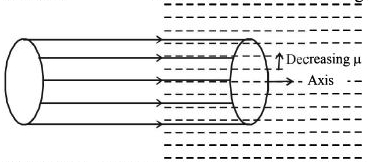
An initially parallel cylindrical beam travels in a medium of refractive index $\mu(I) = \mu_0 + \mu_2I$,where $\mu_0$ and $\mu_2$ are positive constants and $I$ is the intensity of the light beam. The intensity of the beam is decreasing with increasing radius. The initial shape of the wavefront of the beam is
A
planar
B
Convex
C
Concave
D
convex near the axis and concave near the periphery
Solution
(A) The refractive index of the medium is given by $\mu(I) = \mu_0 + \mu_2I$. Since the intensity $I$ of the beam decreases as the radius increases,the refractive index $\mu$ also decreases from the axis towards the periphery.
Because the beam is initially parallel and cylindrical,the rays of light are parallel to each other. By definition,the wavefront of a parallel beam of light is a plane perpendicular to the direction of propagation.
Therefore,the initial shape of the wavefront is planar.
Because the beam is initially parallel and cylindrical,the rays of light are parallel to each other. By definition,the wavefront of a parallel beam of light is a plane perpendicular to the direction of propagation.
Therefore,the initial shape of the wavefront is planar.
0 likes
View Solution24
EasyMCQ
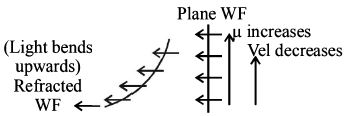
On a hot summer night,the refractive index of air is smallest near the ground and increases with height from the ground. When a light beam is directed horizontally,the Huygens' principle leads us to conclude that as it travels,the light beam
A
goes horizontally without any deflection
B
bends downwards
C
bends upwards
D
becomes narrower
Solution
(C) According to the problem,the refractive index $\mu$ of air increases with height from the ground.
Since the speed of light $v$ in a medium is given by $v = c/\mu$,where $c$ is the speed of light in vacuum,the speed of light $v$ decreases as the height from the ground increases.
Consider a plane wavefront moving horizontally. The part of the wavefront at a greater height travels slower than the part of the wavefront closer to the ground.
According to Huygens' principle,each point on the wavefront acts as a source of secondary wavelets.
Because the lower part of the wavefront travels faster,the wavefront tilts,causing the direction of propagation (which is perpendicular to the wavefront) to bend upwards.
Therefore,the light beam bends upwards.
Since the speed of light $v$ in a medium is given by $v = c/\mu$,where $c$ is the speed of light in vacuum,the speed of light $v$ decreases as the height from the ground increases.
Consider a plane wavefront moving horizontally. The part of the wavefront at a greater height travels slower than the part of the wavefront closer to the ground.
According to Huygens' principle,each point on the wavefront acts as a source of secondary wavelets.
Because the lower part of the wavefront travels faster,the wavefront tilts,causing the direction of propagation (which is perpendicular to the wavefront) to bend upwards.
Therefore,the light beam bends upwards.
0 likes
View Solution25
DifficultMCQ
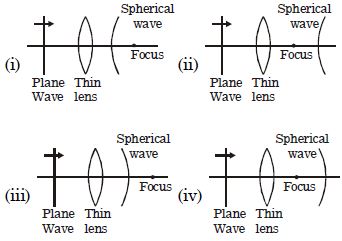
Carefully analyze the given diagrams and choose the correct option regarding the refraction of a plane wavefront by a thin convex lens:
A
$i$ and $ii$ are true
B
$i$ and $iii$ are true
C
$i$ and $iv$ are true
D
$ii$ and $iv$ are true
Solution
(C) When a plane wavefront is incident on a thin convex lens,the lens causes the light rays to converge towards the focus.
In diagram $(i)$,the wavefront after passing through the lens becomes spherical and converges towards the focus,which is the correct behavior for a convex lens.
In diagram $(iv)$,the wavefront after passing through the lens also becomes spherical and converges towards the focus,representing the same correct physical phenomenon.
Diagrams $(ii)$ and $(iii)$ show incorrect wavefront curvatures after refraction.
Therefore,$(i)$ and $(iv)$ are the correct representations.
In diagram $(i)$,the wavefront after passing through the lens becomes spherical and converges towards the focus,which is the correct behavior for a convex lens.
In diagram $(iv)$,the wavefront after passing through the lens also becomes spherical and converges towards the focus,representing the same correct physical phenomenon.
Diagrams $(ii)$ and $(iii)$ show incorrect wavefront curvatures after refraction.
Therefore,$(i)$ and $(iv)$ are the correct representations.
0 likes
View Solution26
DifficultMCQ
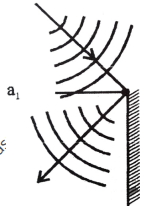
Spherical wavefronts,as shown in the figure,strike a plane mirror. The reflected wavefront will be as shown in:
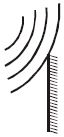
A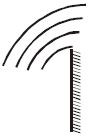
B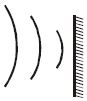
C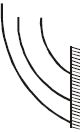
D
Solution
(A) When spherical wavefronts strike a plane mirror,each point on the wavefront acts as a source of secondary wavelets according to Huygens' principle.
The reflected wavefronts will appear to originate from a virtual source located behind the mirror,which is the mirror image of the original point source.
Since the incident wavefronts are spherical and converging towards the mirror,the reflected wavefronts will also be spherical,appearing to diverge from the virtual image of the source point.
Based on the geometry of reflection,the reflected wavefronts will maintain their spherical shape and curvature,consistent with the virtual image formed by the mirror. This corresponds to the pattern shown in option $A$.
The reflected wavefronts will appear to originate from a virtual source located behind the mirror,which is the mirror image of the original point source.
Since the incident wavefronts are spherical and converging towards the mirror,the reflected wavefronts will also be spherical,appearing to diverge from the virtual image of the source point.
Based on the geometry of reflection,the reflected wavefronts will maintain their spherical shape and curvature,consistent with the virtual image formed by the mirror. This corresponds to the pattern shown in option $A$.
0 likes
View Solution27
DifficultMCQ
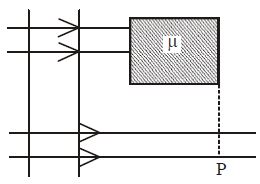
$A$ plane wavefront travelling in a straight line in vacuum encounters a medium of refractive index $\mu$. At point $P,$ the shape of the wavefront is:
A
B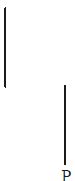
C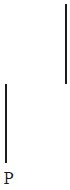
D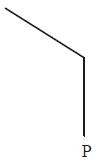
Solution
(B) When a plane wavefront enters a medium of refractive index $\mu,$ the speed of light decreases from $c$ to $\frac{c}{\mu}.$
Because the speed is lower in the medium,the part of the wavefront passing through the medium travels a shorter distance in the same time interval compared to the part traveling in vacuum.
This causes the wavefront to lag behind in the region where the medium is present.
As a result,the wavefront becomes discontinuous,with the portion inside the medium lagging behind the portion in the vacuum,forming a broken line shape at point $P$ as shown in option $(B).$
Because the speed is lower in the medium,the part of the wavefront passing through the medium travels a shorter distance in the same time interval compared to the part traveling in vacuum.
This causes the wavefront to lag behind in the region where the medium is present.
As a result,the wavefront becomes discontinuous,with the portion inside the medium lagging behind the portion in the vacuum,forming a broken line shape at point $P$ as shown in option $(B).$
0 likes
View Solution28
MediumMCQ
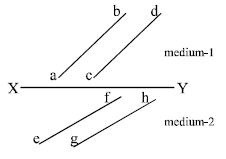
The figure shows a surface $XY$ separating two transparent media,medium-$1$ and medium-$2$. The lines $ab$ and $cd$ represent wavefronts of a light wave traveling in medium-$1$ and incident on $XY$. The lines $ef$ and $gh$ represent wavefronts of the light wave in medium-$2$ after refraction. The phases of the light wave at $c, d, e$ and $f$ are $\phi_c, \phi_d, \phi_e$ and $\phi_f$ respectively. It is given that $\phi_c \neq \phi_f$.
A
$\phi_c$ cannot be equal to $\phi_d$
B
$\phi_d$ can be equal to $\phi_e$
C
$(\phi_d - \phi_f) = (\phi_c - \phi_e)$
D
$(\phi_d - \phi_c) \neq (\phi_f - \phi_e)$
Solution
(C) wavefront is defined as the locus of all points having the same phase of oscillation.
Since $cd$ is a wavefront in medium-$1$,all points on the line $cd$ have the same phase. Therefore,$\phi_c = \phi_d$.
Similarly,$ef$ is a wavefront in medium-$2$,so all points on the line $ef$ have the same phase. Therefore,$\phi_e = \phi_f$.
Now,consider the expression $(\phi_d - \phi_f) = (\phi_c - \phi_e)$.
Since $\phi_c = \phi_d$ and $\phi_e = \phi_f$,we can substitute these into the expression:
$(\phi_d - \phi_f) = (\phi_c - \phi_e)$
$\phi_d - \phi_f = \phi_c - \phi_e$
This is a consistent identity based on the properties of wavefronts.
Since $cd$ is a wavefront in medium-$1$,all points on the line $cd$ have the same phase. Therefore,$\phi_c = \phi_d$.
Similarly,$ef$ is a wavefront in medium-$2$,so all points on the line $ef$ have the same phase. Therefore,$\phi_e = \phi_f$.
Now,consider the expression $(\phi_d - \phi_f) = (\phi_c - \phi_e)$.
Since $\phi_c = \phi_d$ and $\phi_e = \phi_f$,we can substitute these into the expression:
$(\phi_d - \phi_f) = (\phi_c - \phi_e)$
$\phi_d - \phi_f = \phi_c - \phi_e$
This is a consistent identity based on the properties of wavefronts.
0 likes
View Solution29
MediumMCQ
Mark the wrong statement.
A
Wavefront is the locus of points having the same phase.
B
Wavefront can have only spherical or plane shapes.
C
$A$ line drawn perpendicular to the wavefront is called a ray of light.
D
There is no experimental evidence for the existence of ether medium assumed by Huygens.
Solution
(B) wavefront is defined as the locus of all points that are in the same phase of oscillation. Thus,statement $A$ is correct.
Light rays are defined as lines perpendicular to the wavefront,indicating the direction of wave propagation. Thus,statement $C$ is correct.
Huygens proposed the existence of an 'ether' medium to explain the propagation of light waves,but the Michelson-Morley experiment later proved that no such medium exists. Thus,statement $D$ is correct.
Wavefronts can take various shapes depending on the source and the medium,such as cylindrical,spherical,or plane. Since wavefronts are not restricted to only spherical or plane shapes (e.g.,a line source produces a cylindrical wavefront),statement $B$ is incorrect.
Light rays are defined as lines perpendicular to the wavefront,indicating the direction of wave propagation. Thus,statement $C$ is correct.
Huygens proposed the existence of an 'ether' medium to explain the propagation of light waves,but the Michelson-Morley experiment later proved that no such medium exists. Thus,statement $D$ is correct.
Wavefronts can take various shapes depending on the source and the medium,such as cylindrical,spherical,or plane. Since wavefronts are not restricted to only spherical or plane shapes (e.g.,a line source produces a cylindrical wavefront),statement $B$ is incorrect.
0 likes
View Solution30
EasyMCQ
The wavefront of a distant source of unknown shape is approximately
A
Spherical
B
Cylindrical
C
Elliptical
D
Plane
Solution
(D) When a light source is at a very large distance from the observer,the radius of curvature of the wavefront becomes extremely large.
As the distance $r \to \infty$,the curvature $1/r \to 0$.
Consequently,a small portion of a spherical or cylindrical wavefront appears to be flat or planar.
Therefore,the wavefront of a distant source is approximately a plane wavefront.
As the distance $r \to \infty$,the curvature $1/r \to 0$.
Consequently,a small portion of a spherical or cylindrical wavefront appears to be flat or planar.
Therefore,the wavefront of a distant source is approximately a plane wavefront.
0 likes
View Solution31
MediumMCQ
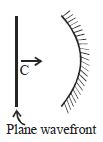
When a plane wave front is incident on a concave mirror as shown in the figure,what is the shape of the reflected wave front?
A
B
C
D
0 likes
View Solution32
EasyMCQ
$A$ wave front is the locus of all the points where the particles of the medium vibrate with the same:
A
phase
B
amplitude
C
frequency
D
period
Solution
(A) wave front is defined as the locus of all points in a medium that are in the same phase of vibration. This means that at any given instant,all points on the wave front have reached the same stage of their oscillatory cycle.
0 likes
View Solution33
MediumMCQ
Which of the following is correct for light diverging from a point source?
A
Intensity increases in proportion to the distance squared.
B
The wave front is parabolic.
C
Intensity of light does not depend on the distance.
D
Intensity decreases in proportion to the distance squared.
Solution
(D) For a point source of light, the light waves spread out in all directions, forming spherical wave fronts.
As the distance $r$ from the source increases, the surface area of the spherical wave front increases as $A = 4\pi r^2$.
Since the total power $P$ emitted by the source is constant, the intensity $I$ is given by $I = P / A = P / (4\pi r^2)$.
Therefore, the intensity $I$ is inversely proportional to the square of the distance $r$, i.e., $I \propto 1/r^2$.
This means the intensity decreases as the distance from the source increases.
As the distance $r$ from the source increases, the surface area of the spherical wave front increases as $A = 4\pi r^2$.
Since the total power $P$ emitted by the source is constant, the intensity $I$ is given by $I = P / A = P / (4\pi r^2)$.
Therefore, the intensity $I$ is inversely proportional to the square of the distance $r$, i.e., $I \propto 1/r^2$.
This means the intensity decreases as the distance from the source increases.
0 likes
View Solution34
EasyMCQ
Light waves propagate rectilinearly due to:
A
wave nature
B
wavelength
C
velocity
D
frequency
Solution
(A) Light propagates rectilinearly due to its wave nature. According to the Huygens-Fresnel principle,every point on a wavefront acts as a source of secondary wavelets. In a homogeneous medium,these wavelets interfere constructively along the direction of propagation,resulting in rectilinear propagation.
0 likes
View Solution35
Medium
What is the shape of the wavefront in each of the following cases:
$(a)$ Light diverging from a point source.
$(b)$ Light emerging out of a convex lens when a point source is placed at its focus.
$(c)$ The portion of the wavefront of light from a distant star intercepted by the Earth.
$(a)$ Light diverging from a point source.
$(b)$ Light emerging out of a convex lens when a point source is placed at its focus.
$(c)$ The portion of the wavefront of light from a distant star intercepted by the Earth.
Solution
(N/A) The shape of the wavefront for light diverging from a point source is spherical.
$(b)$ The shape of the wavefront for light emerging from a convex lens when a point source is placed at its focus is plane (planar).
$(c)$ The portion of the wavefront of light from a distant star intercepted by the Earth is plane (planar) because the source is at an effectively infinite distance.
$(b)$ The shape of the wavefront for light emerging from a convex lens when a point source is placed at its focus is plane (planar).
$(c)$ The portion of the wavefront of light from a distant star intercepted by the Earth is plane (planar) because the source is at an effectively infinite distance.
0 likes
View Solution36
Medium
Explain how the Corpuscular theory predicts the speed of light in a medium,such as water,to be greater than the speed of light in a vacuum. Is this prediction confirmed by the experimental determination of the speed of light in water? If not,which alternative picture of light is consistent with the experiment?
Solution
(N/A) No,the prediction is not confirmed. According to Newton's corpuscular theory,when light corpuscles travel from a rarer medium (air) to a denser medium (water),they experience an attractive force normal to the interface. This force increases the normal component of the velocity,while the tangential component remains constant. This leads to the relation $v = \mu c$,where $v$ is the speed in the medium and $c$ is the speed in vacuum. Since the refractive index $\mu > 1$,the theory predicts $v > c$.
This prediction contradicts experimental results,which show that the speed of light in a denser medium is less than in a vacuum $(v < c)$. The wave theory of light,proposed by Huygens,correctly predicts that $v = c / \mu$,which is consistent with experimental observations.
This prediction contradicts experimental results,which show that the speed of light in a denser medium is less than in a vacuum $(v < c)$. The wave theory of light,proposed by Huygens,correctly predicts that $v = c / \mu$,which is consistent with experimental observations.
0 likes
View Solution37
Medium
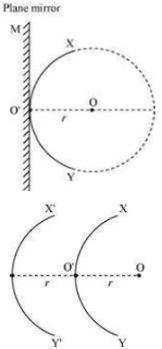
You have learnt in the text how Huygens' principle leads to the laws of reflection and refraction. Use the same principle to deduce directly that a point object placed in front of a plane mirror produces a virtual image whose distance from the mirror is equal to the object distance from the mirror.
Solution
(N/A) Let an object at $O$ be placed in front of a plane mirror at a distance $r$ (as shown in the figure).
$A$ spherical wavefront is emitted from the point object $O$. The part of the wavefront $XY$ reaches the plane mirror at point $O'$.
According to Huygens' Principle,each point on the wavefront acts as a source of secondary wavelets. When the wavefront $XY$ strikes the mirror,the mirror reflects these wavelets.
If the mirror were absent,the wavefront would continue to propagate and form a similar wavefront $X'Y'$ at a distance $r$ behind the mirror.
Since the mirror reflects the light,the secondary wavelets appear to originate from a point $I$ behind the mirror,which is the virtual image of $O$. By symmetry,the distance of this virtual image $I$ from the mirror is equal to the distance $r$ of the object $O$ from the mirror.
$A$ spherical wavefront is emitted from the point object $O$. The part of the wavefront $XY$ reaches the plane mirror at point $O'$.
According to Huygens' Principle,each point on the wavefront acts as a source of secondary wavelets. When the wavefront $XY$ strikes the mirror,the mirror reflects these wavelets.
If the mirror were absent,the wavefront would continue to propagate and form a similar wavefront $X'Y'$ at a distance $r$ behind the mirror.
Since the mirror reflects the light,the secondary wavelets appear to originate from a point $I$ behind the mirror,which is the virtual image of $O$. By symmetry,the distance of this virtual image $I$ from the mirror is equal to the distance $r$ of the object $O$ from the mirror.
0 likes
View Solution38
Easy
What is visible light? Write various views on it.
Solution
(N/A) The portion of the electromagnetic spectrum with wavelengths ranging from $4000 \ \mathring{A}$ to $8000 \ \mathring{A}$ is known as visible light. Light itself is invisible,but it allows us to see objects.
Various views on the nature of light are as follows:
$(1)$ Corpuscular model of light (Newton's particle theory of light):
- The corpuscular theory was proposed by Descartes in $1637$. It derived Snell's law and explained the laws of reflection and refraction at the interface of two media.
- The model predicted that if a light ray bends towards the normal during refraction,its speed must be greater in the second medium. Thus,it suggested that the speed of light is lower in a rarer medium and higher in a denser medium.
- This theory is famously associated with Isaac Newton,who considered light to be composed of tiny particles called corpuscles.
$(2)$ Huygens' wave theory:
- In $1678$,Christiaan Huygens proposed the wave theory of light.
- This theory successfully explained reflection and refraction. It predicted that if a wave bends towards the normal during refraction,its speed would be less in the second medium. This contradicted the prediction of the corpuscular model.
- In $1850$,Foucault experimentally proved that the speed of light in water is less than in air,which supported the wave theory over the corpuscular model.
Various views on the nature of light are as follows:
$(1)$ Corpuscular model of light (Newton's particle theory of light):
- The corpuscular theory was proposed by Descartes in $1637$. It derived Snell's law and explained the laws of reflection and refraction at the interface of two media.
- The model predicted that if a light ray bends towards the normal during refraction,its speed must be greater in the second medium. Thus,it suggested that the speed of light is lower in a rarer medium and higher in a denser medium.
- This theory is famously associated with Isaac Newton,who considered light to be composed of tiny particles called corpuscles.
$(2)$ Huygens' wave theory:
- In $1678$,Christiaan Huygens proposed the wave theory of light.
- This theory successfully explained reflection and refraction. It predicted that if a wave bends towards the normal during refraction,its speed would be less in the second medium. This contradicted the prediction of the corpuscular model.
- In $1850$,Foucault experimentally proved that the speed of light in water is less than in air,which supported the wave theory over the corpuscular model.
0 likes
View Solution39
Medium
Describe the short history of light.
Solution
(N/A) The wave theory was initially not accepted due to Newton's authority and the belief that light,unlike sound,could travel through a vacuum,whereas waves were thought to require a medium to propagate.
In $1801$,Thomas Young performed the interference experiment,which firmly established that light is a wave phenomenon.
Since the wavelength of visible light is much smaller than the dimensions of typical mirrors and lenses,light can be assumed to travel approximately in straight lines.
The branch of optics in which the finiteness of the wavelength is completely neglected is called geometrical optics.
$A$ ray is defined as the path of energy propagation in the limit where the wavelength tends to zero.
Numerous experiments involving the interference and diffraction of light waves were carried out and satisfactorily explained. Thus,by the middle of the $19^{th}$ century,the wave theory of light was well established.
In $1801$,Thomas Young performed the interference experiment,which firmly established that light is a wave phenomenon.
Since the wavelength of visible light is much smaller than the dimensions of typical mirrors and lenses,light can be assumed to travel approximately in straight lines.
The branch of optics in which the finiteness of the wavelength is completely neglected is called geometrical optics.
$A$ ray is defined as the path of energy propagation in the limit where the wavelength tends to zero.
Numerous experiments involving the interference and diffraction of light waves were carried out and satisfactorily explained. Thus,by the middle of the $19^{th}$ century,the wave theory of light was well established.
0 likes
View Solution40
Difficult
Name the theories for the propagation of light.
Solution
(N/A) The primary theories explaining the propagation of light are:
$1$. $Corpuscular$ $Theory$: Proposed by $Isaac$ $Newton$,it suggests that light consists of tiny particles called corpuscles.
$2$. $Wave$ $Theory$: Proposed by $Christiaan$ $Huygens$,it suggests that light travels in the form of waves through a hypothetical medium called $luminiferous$ $ether$.
$3$. $Electromagnetic$ $Wave$ $Theory$: Proposed by $James$ $Clerk$ $Maxwell$,it states that light consists of oscillating electric and magnetic fields propagating through space.
$4$. $Quantum$ $Theory$ ($Photon$ $Theory$): Proposed by $Max$ $Planck$ and $Albert$ $Einstein$,it explains that light consists of discrete packets of energy called $photons$.
$1$. $Corpuscular$ $Theory$: Proposed by $Isaac$ $Newton$,it suggests that light consists of tiny particles called corpuscles.
$2$. $Wave$ $Theory$: Proposed by $Christiaan$ $Huygens$,it suggests that light travels in the form of waves through a hypothetical medium called $luminiferous$ $ether$.
$3$. $Electromagnetic$ $Wave$ $Theory$: Proposed by $James$ $Clerk$ $Maxwell$,it states that light consists of oscillating electric and magnetic fields propagating through space.
$4$. $Quantum$ $Theory$ ($Photon$ $Theory$): Proposed by $Max$ $Planck$ and $Albert$ $Einstein$,it explains that light consists of discrete packets of energy called $photons$.
0 likes
View Solution41
MediumMCQ
The speed of light in water is less than the speed of light in air,confirms the assumption of which theory of light?
A
Corpuscular theory
B
Wave theory
C
Quantum theory
D
Electromagnetic theory
Solution
(B) According to Newton's Corpuscular theory,light travels faster in a denser medium (like water) than in a rarer medium (like air).
However,experimental measurements by Foucault and Fizeau showed that the speed of light is lower in water than in air.
This experimental result contradicted the Corpuscular theory and provided strong evidence in favor of the Wave theory of light,which correctly predicts that light slows down when entering a denser medium.
However,experimental measurements by Foucault and Fizeau showed that the speed of light is lower in water than in air.
This experimental result contradicted the Corpuscular theory and provided strong evidence in favor of the Wave theory of light,which correctly predicts that light slows down when entering a denser medium.
0 likes
View Solution42
Medium
Mention the main difficulty in establishing the wave theory of light.
Solution
(N/A) The main difficulty in establishing the wave theory of light was the assumption that light waves are mechanical in nature.
According to the classical physics of that time,mechanical waves require a material medium for propagation.
Since light travels through the vacuum of space (e.g.,from the Sun to the Earth),it was difficult to explain how light could propagate without a medium.
This led to the hypothetical concept of the 'luminiferous ether',a pervasive,massless,and transparent medium,which was later disproven by the Michelson-Morley experiment.
According to the classical physics of that time,mechanical waves require a material medium for propagation.
Since light travels through the vacuum of space (e.g.,from the Sun to the Earth),it was difficult to explain how light could propagate without a medium.
This led to the hypothetical concept of the 'luminiferous ether',a pervasive,massless,and transparent medium,which was later disproven by the Michelson-Morley experiment.
0 likes
View Solution43
Medium
Explain the wavefront and its types.
Solution
(N/A) When we drop a small stone into a calm pool of water,waves spread out from the point of impact. Every point on the surface starts oscillating with time; hence,at any instant,the surface shows circular rings where the disturbance is maximum.
All points on such a circle are oscillating in phase because they are at the same distance from the source. Such a locus of points,which oscillate in phase,is called a wavefront. Thus,a wavefront is defined as a surface of constant phase.
The speed with which the wavefront moves outwards from the source is called the speed of the wave.
The energy of the wave travels in a direction perpendicular to the wavefront.
$A$ line perpendicular to the wavefront,indicating the direction of propagation of the wave,is called a ray. Hence,the wavefront and the ray are perpendicular.
Types of wavefronts:
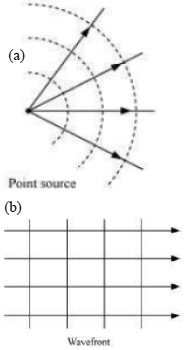
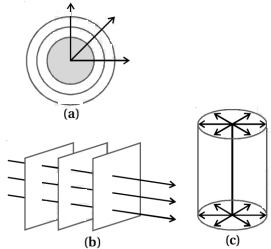
$1$. Spherical Wavefront: If a point source emits waves uniformly in all directions,the locus of points having the same amplitude and vibrating in the same phase are spheres (in three dimensions). This is known as a spherical wavefront,as shown in figure $(a)$. Such waves are diverging.
$2$. Plane Wavefront: At a large distance from the source,a small portion of the sphere can be considered as a plane. It is known as a plane wavefront,as shown in figure $(b)$.
$3$. Cylindrical Wavefront: Wavefronts originating from a linear source and propagating in a three-dimensional homogeneous and isotropic medium are cylindrical wavefronts. For example,waves emanating from a tubelight,as shown in figure $(c)$.
All points on such a circle are oscillating in phase because they are at the same distance from the source. Such a locus of points,which oscillate in phase,is called a wavefront. Thus,a wavefront is defined as a surface of constant phase.
The speed with which the wavefront moves outwards from the source is called the speed of the wave.
The energy of the wave travels in a direction perpendicular to the wavefront.
$A$ line perpendicular to the wavefront,indicating the direction of propagation of the wave,is called a ray. Hence,the wavefront and the ray are perpendicular.
Types of wavefronts:
$1$. Spherical Wavefront: If a point source emits waves uniformly in all directions,the locus of points having the same amplitude and vibrating in the same phase are spheres (in three dimensions). This is known as a spherical wavefront,as shown in figure $(a)$. Such waves are diverging.
$2$. Plane Wavefront: At a large distance from the source,a small portion of the sphere can be considered as a plane. It is known as a plane wavefront,as shown in figure $(b)$.
$3$. Cylindrical Wavefront: Wavefronts originating from a linear source and propagating in a three-dimensional homogeneous and isotropic medium are cylindrical wavefronts. For example,waves emanating from a tubelight,as shown in figure $(c)$.
0 likes
View Solution44
Easy
Explain the use of wavefront to understand wave propagation.
Solution
Principle: Every point or particle of a wavefront behaves as an independent secondary source and emits secondary spherical waves by itself. After a very small time interval,the surface tangential to all such secondary spherical wavelets gives the position and shape of the new wavefront.
Basically,the Huygens' principle is a geometric construction.
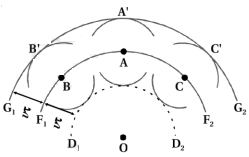
Suppose that $F_{1} F_{2}$ represents a part of a spherical wavefront at $t=0$,which is a wave propagating outwards.
According to Huygens' principle,all points of this wavefront $(F_{1} F_{2})$ (e.g.,$A, B, C, \ldots$) behave as secondary sources. If the velocity of the wave is $v$,then the distance covered in time $\tau$ is $v \tau$.
To determine the shape of the wavefront at $t=\tau$,draw spheres of radius $v \tau$ from each point on the spherical wavefront and draw a common tangent to all these spheres. The surface tangent to these spheres at time $\tau$ gives the position and shape of the new wavefront,which is $G_{1} G_{2}$ in the forward direction. This is a spherical wavefront with center $O$. $A$ backward spherical wavefront $D_{1} D_{2}$ is also formed. The points $A^{\prime}, B^{\prime}, C^{\prime}$ on $G_{1} G_{2}$ act as new secondary sources.
Basically,the Huygens' principle is a geometric construction.
Suppose that $F_{1} F_{2}$ represents a part of a spherical wavefront at $t=0$,which is a wave propagating outwards.
According to Huygens' principle,all points of this wavefront $(F_{1} F_{2})$ (e.g.,$A, B, C, \ldots$) behave as secondary sources. If the velocity of the wave is $v$,then the distance covered in time $\tau$ is $v \tau$.
To determine the shape of the wavefront at $t=\tau$,draw spheres of radius $v \tau$ from each point on the spherical wavefront and draw a common tangent to all these spheres. The surface tangent to these spheres at time $\tau$ gives the position and shape of the new wavefront,which is $G_{1} G_{2}$ in the forward direction. This is a spherical wavefront with center $O$. $A$ backward spherical wavefront $D_{1} D_{2}$ is also formed. The points $A^{\prime}, B^{\prime}, C^{\prime}$ on $G_{1} G_{2}$ act as new secondary sources.
0 likes
View Solution45
Medium
State and explain Huygens' principle.
Solution
(N/A) Principle: Every point on a wavefront acts as an independent source of secondary spherical wavelets,which spread out in all directions with the speed of light in that medium. The new wavefront at any later time is the forward envelope (tangential surface) of these secondary wavelets.
Explanation:
$1$. Huygens' principle is a geometric method to determine the shape of a wavefront at a future time if its current shape is known.
$2$. Consider a spherical wavefront $F_1 F_2$ at time $t=0$ originating from a point source $O$.
$3$. According to the principle,every point on $F_1 F_2$ (such as $A, B, C, \dots$) acts as a secondary source. If the wave speed is $v$,then in a time interval $\tau$,each secondary wavelet travels a distance $v\tau$.
$4$. To find the new wavefront at time $t = \tau$,draw spheres of radius $v\tau$ centered at each point on the original wavefront. The forward common tangent surface $G_1 G_2$ to these spheres represents the new wavefront.
$5$. The backward tangent surface $D_1 D_2$ is also formed,but it is generally ignored as the wave propagates in the forward direction. The points $A', B', C'$ on $G_1 G_2$ then act as new secondary sources for further propagation.
Explanation:
$1$. Huygens' principle is a geometric method to determine the shape of a wavefront at a future time if its current shape is known.
$2$. Consider a spherical wavefront $F_1 F_2$ at time $t=0$ originating from a point source $O$.
$3$. According to the principle,every point on $F_1 F_2$ (such as $A, B, C, \dots$) acts as a secondary source. If the wave speed is $v$,then in a time interval $\tau$,each secondary wavelet travels a distance $v\tau$.
$4$. To find the new wavefront at time $t = \tau$,draw spheres of radius $v\tau$ centered at each point on the original wavefront. The forward common tangent surface $G_1 G_2$ to these spheres represents the new wavefront.
$5$. The backward tangent surface $D_1 D_2$ is also formed,but it is generally ignored as the wave propagates in the forward direction. The points $A', B', C'$ on $G_1 G_2$ then act as new secondary sources for further propagation.
0 likes
View Solution46
Medium
Explain how to obtain a new wavefront at time $\tau$ using Huygens' principle for a plane wavefront.
Solution
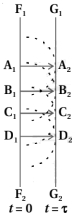
(N/A) The geometric representation of a plane wavefront propagating to the right at time $t=0$ is shown in the figure,and after time $t=\tau$,the new wavefront $G_{1} G_{2}$ is shown in the forward direction.
Here,if the wave velocity is $v$,then the distance covered by the wave in time $\tau$ is $v \tau$.
According to Huygens' principle,all particles like $A_{1}, B_{1}, C_{1}, D_{1}, \ldots$ on the wavefront $F_{1} F_{2}$ act as independent secondary sources and emit secondary spherical waves having a radius of $v \tau$.
After the time interval $\tau$,the surface tangential to all such secondary wavelets gives the position and shape of the new wavefront,shown as $G_{1} G_{2}$.
Thus,a new wavefront is formed at time $\tau$,and the wave propagates forward in the medium.
Lines $A_{1} A_{2}, B_{1} B_{2}, C_{1} C_{2}, D_{1} D_{2}, \ldots$ are perpendicular to both wavefronts $F_{1} F_{2}$ and $G_{1} G_{2}$,which are known as light rays.
$A$ line perpendicular to the wavefront that indicates the direction of propagation of the wave is called a ray.
The most important point of Huygens' wave theory is that it can be applied to all types of spherical or plane waves.
Here,if the wave velocity is $v$,then the distance covered by the wave in time $\tau$ is $v \tau$.
According to Huygens' principle,all particles like $A_{1}, B_{1}, C_{1}, D_{1}, \ldots$ on the wavefront $F_{1} F_{2}$ act as independent secondary sources and emit secondary spherical waves having a radius of $v \tau$.
After the time interval $\tau$,the surface tangential to all such secondary wavelets gives the position and shape of the new wavefront,shown as $G_{1} G_{2}$.
Thus,a new wavefront is formed at time $\tau$,and the wave propagates forward in the medium.
Lines $A_{1} A_{2}, B_{1} B_{2}, C_{1} C_{2}, D_{1} D_{2}, \ldots$ are perpendicular to both wavefronts $F_{1} F_{2}$ and $G_{1} G_{2}$,which are known as light rays.
$A$ line perpendicular to the wavefront that indicates the direction of propagation of the wave is called a ray.
The most important point of Huygens' wave theory is that it can be applied to all types of spherical or plane waves.
0 likes
View Solution47
EasyMCQ
State Huygens' principle. What is the fundamental principle on which it is based?
A
Huygens' principle states that every point on a wavefront is a source of secondary wavelets.
B
It is based on the principle of superposition of waves.
C
It is based on the conservation of energy.
D
It is based on the principle of rectilinear propagation of light.
Solution
(B) Huygens' principle states that every point on a primary wavefront acts as a source of secondary wavelets,which spread out in all directions with the speed of light in the medium. The new wavefront at any later time is the forward envelope of these secondary wavelets.
The fundamental principle on which Huygens' principle is based is the principle of superposition of waves. This principle states that when two or more waves overlap in space,the resultant displacement at any point is the algebraic sum of the displacements of the individual waves.
The fundamental principle on which Huygens' principle is based is the principle of superposition of waves. This principle states that when two or more waves overlap in space,the resultant displacement at any point is the algebraic sum of the displacements of the individual waves.
0 likes
View Solution48
Medium
Write the limitation of Huygen's principle.
Solution
(N/A) According to Huygen's principle,every point on a wavefront acts as an independent secondary source and emits small secondary wavelets.
Huygen's principle assumes that the amplitude of these secondary wavelets is maximum in the forward direction and zero in the backward direction.
However,Huygen's could not provide a theoretical justification for why the wave does not propagate backwards; this was an ad-hoc assumption.
Later,scientists such as Voigt and Kirchhoff provided a mathematical explanation,stating that the intensity of the secondary wave is proportional to the factor $(1 + \cos \theta)^2$,where $\theta$ is the angle made by the wavefront with the direction of propagation.
In the forward direction,$\theta = 0^{\circ}$,so the intensity factor is $(1 + \cos 0^{\circ})^2 = (1 + 1)^2 = 4$ (maximum).
In the backward direction,$\theta = 180^{\circ}$ (or $\pi$ radians),so the intensity factor is $(1 + \cos 180^{\circ})^2 = (1 - 1)^2 = 0$. Thus,there is no propagation of waves in the backward direction.
Huygen's principle assumes that the amplitude of these secondary wavelets is maximum in the forward direction and zero in the backward direction.
However,Huygen's could not provide a theoretical justification for why the wave does not propagate backwards; this was an ad-hoc assumption.
Later,scientists such as Voigt and Kirchhoff provided a mathematical explanation,stating that the intensity of the secondary wave is proportional to the factor $(1 + \cos \theta)^2$,where $\theta$ is the angle made by the wavefront with the direction of propagation.
In the forward direction,$\theta = 0^{\circ}$,so the intensity factor is $(1 + \cos 0^{\circ})^2 = (1 + 1)^2 = 4$ (maximum).
In the backward direction,$\theta = 180^{\circ}$ (or $\pi$ radians),so the intensity factor is $(1 + \cos 180^{\circ})^2 = (1 - 1)^2 = 0$. Thus,there is no propagation of waves in the backward direction.
0 likes
View Solution49
MediumMCQ
What is the most important point of Huygens' wave theory?
A
Every point on a wavefront acts as a source of secondary wavelets.
B
Light travels in a straight line.
C
Light is a particle.
D
Light requires a medium to travel.
Solution
(A) The most fundamental and important point of Huygens' wave theory is the principle of secondary wavelets.
According to this,every point on a given wavefront acts as a fresh source of new disturbance,which sends out secondary wavelets in all directions.
The new wavefront at any later time is the forward envelope of these secondary wavelets.
According to this,every point on a given wavefront acts as a fresh source of new disturbance,which sends out secondary wavelets in all directions.
The new wavefront at any later time is the forward envelope of these secondary wavelets.
0 likes
View Solution50
Medium
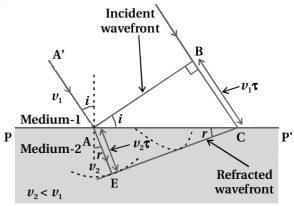
Derive the laws of refraction using the concept of Huygens' principle of wavefronts.
Solution
(N/A) Let $PP'$ represent the surface separating medium-$1$ and medium-$2$. Let $v_1$ and $v_2$ be the speeds of light in medium-$1$ and medium-$2$ respectively.
$A$ plane wavefront $AB$ propagating in the direction $AA'$ is incident on the interface at an angle $i$. Let $\tau$ be the time taken by the wavefront to travel the distance $BC$. Thus,$BC = v_1 \tau$.
To determine the shape of the refracted wavefront,draw a sphere of radius $v_2 \tau$ from point $A$ in the second medium. Let $CE$ be the tangent plane drawn from point $C$ to this sphere. Then $AE = v_2 \tau$,and $CE$ represents the refracted wavefront.
In $\triangle ABC$,$\sin i = \frac{BC}{AC} = \frac{v_1 \tau}{AC}$.
In $\triangle AEC$,$\sin r = \frac{AE}{AC} = \frac{v_2 \tau}{AC}$.
Dividing the two equations:
$\frac{\sin i}{\sin r} = \frac{v_1 \tau / AC}{v_2 \tau / AC} = \frac{v_1}{v_2} = n_{21}$.
This is Snell's law of refraction. Since the incident ray,the refracted ray,and the normal all lie in the same plane,the laws of refraction are derived.
$A$ plane wavefront $AB$ propagating in the direction $AA'$ is incident on the interface at an angle $i$. Let $\tau$ be the time taken by the wavefront to travel the distance $BC$. Thus,$BC = v_1 \tau$.
To determine the shape of the refracted wavefront,draw a sphere of radius $v_2 \tau$ from point $A$ in the second medium. Let $CE$ be the tangent plane drawn from point $C$ to this sphere. Then $AE = v_2 \tau$,and $CE$ represents the refracted wavefront.
In $\triangle ABC$,$\sin i = \frac{BC}{AC} = \frac{v_1 \tau}{AC}$.
In $\triangle AEC$,$\sin r = \frac{AE}{AC} = \frac{v_2 \tau}{AC}$.
Dividing the two equations:
$\frac{\sin i}{\sin r} = \frac{v_1 \tau / AC}{v_2 \tau / AC} = \frac{v_1}{v_2} = n_{21}$.
This is Snell's law of refraction. Since the incident ray,the refracted ray,and the normal all lie in the same plane,the laws of refraction are derived.
0 likes
View SolutionWave Optics — Huygens’ Principle and Wave-fronts · Frequently Asked Questions
1Are these Wave Optics questions useful for JEE and NEET?
Yes. All questions in this section are mapped to JEE Main and NEET exam patterns. Previous year questions from JEE Main, NEET, GUJCET and state-level exams are included with full solutions.
2Can I switch to Hindi or Gujarati for these questions?
Yes. Use the language tabs in the hero section or the sidebar to view the same questions and solutions in English, Hindi or Gujarati.
3How do I generate a question paper from this subtopic?
Use the Vedclass Exam Paper Generator — select the chapter and subtopic, set difficulty, and generate Sets A, B, C, D automatically. First 3 chapters of every subject are free.
Vedclass Products
For Students
Vedclass Test Series
Mock tests in real JEE/NEET style with performance analysis. 5-day free trial.
Start Free TrialFor Teachers
Exam Paper Generator
Generate Set A/B/C/D papers from this chapter in 2 minutes. 3 chapters free.
Try FreeFor Institutes
Online Exam Module
Live online exams with unlimited students, 360° analytics & white-label branding.
See DemoFor Teachers & Institutes
Generate a Wave Optics Exam Paper in 2 Minutes
Select subtopic & difficulty — Sets A, B, C, D auto-generated with No Repeat logic.
First 3 chapters of every subject are free — no payment required.