
A English
Huygens’ Principle and Wave-fronts Questions in English
Class 12 Physics · Wave Optics · Huygens’ Principle and Wave-fronts
88+
Questions
English
Language
100%
With Solutions
Showing 38 of 88 questions in English
51
Difficult
Explain the refraction of a plane wave from a denser to a rarer medium using Huygens' principle.
Solution
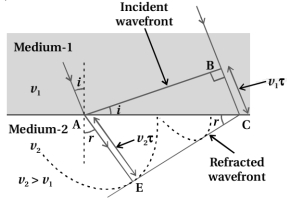
(N/A) Consider a plane wavefront $AB$ incident at an angle $i$ on the interface separating two media. Let $v_{1}$ and $v_{2}$ be the speeds of light in the first (denser) and second (rarer) media,respectively,such that $v_{2} > v_{1}$.
According to Huygens' principle,each point on the wavefront $AB$ acts as a source of secondary wavelets. In time $\tau$,the point $B$ travels to $C$ with speed $v_{1}$,covering a distance $BC = v_{1}\tau$. Simultaneously,the secondary wavelets starting from $A$ travel a distance $AE = v_{2}\tau$ in the second medium.
Drawing a tangent from $C$ to the spherical wavelet of radius $v_{2}\tau$ centered at $A$,we get the refracted wavefront $CE$. From the geometry of the triangles $\triangle ABC$ and $\triangle AEC$:
$\sin i = \frac{BC}{AC} = \frac{v_{1}\tau}{AC}$
$\sin r = \frac{AE}{AC} = \frac{v_{2}\tau}{AC}$
Dividing the two equations:
$\frac{\sin i}{\sin r} = \frac{v_{1}}{v_{2}}$
Since $v_{2} > v_{1}$,it follows that $\sin r > \sin i$,which implies $r > i$. Thus,the refracted ray bends away from the normal when moving from a denser to a rarer medium. This is illustrated in the provided figure.
According to Huygens' principle,each point on the wavefront $AB$ acts as a source of secondary wavelets. In time $\tau$,the point $B$ travels to $C$ with speed $v_{1}$,covering a distance $BC = v_{1}\tau$. Simultaneously,the secondary wavelets starting from $A$ travel a distance $AE = v_{2}\tau$ in the second medium.
Drawing a tangent from $C$ to the spherical wavelet of radius $v_{2}\tau$ centered at $A$,we get the refracted wavefront $CE$. From the geometry of the triangles $\triangle ABC$ and $\triangle AEC$:
$\sin i = \frac{BC}{AC} = \frac{v_{1}\tau}{AC}$
$\sin r = \frac{AE}{AC} = \frac{v_{2}\tau}{AC}$
Dividing the two equations:
$\frac{\sin i}{\sin r} = \frac{v_{1}}{v_{2}}$
Since $v_{2} > v_{1}$,it follows that $\sin r > \sin i$,which implies $r > i$. Thus,the refracted ray bends away from the normal when moving from a denser to a rarer medium. This is illustrated in the provided figure.
0 likes
View Solution52
Medium
Explain the reflection of a plane wave using Huygens' principle.
Solution
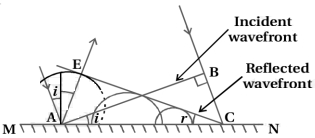
(N/A) Consider a plane wave $AB$ incident at an angle $i$ on a reflecting surface $MN$.
The velocity of the wave in the medium is $v$ and $\tau$ is the time taken for the wavefront to move from point $B$ to $C$. Therefore,$BC = v \tau$.
As shown in the figure,the plane wave $AB$ is incident on the reflective surface $MN$ and its reflected wavefront is $CE$.
In the figure,$\triangle EAC$ and $\triangle BAC$ are congruent triangles.
Here,$AE = BC = v \tau$ (since the distance traveled by the wave in the same medium is the same).
$\angle AEC = \angle ABC = 90^{\circ}$.
And $AC = AC$ (common side).
Therefore,$\triangle EAC \cong \triangle BAC$ by the $RHS$ congruence criterion.
This implies $\angle BAC = \angle ECA$.
Since $\angle BAC = i$ and $\angle ECA = r$,we have $i = r$,which is the law of reflection.
The velocity of the wave in the medium is $v$ and $\tau$ is the time taken for the wavefront to move from point $B$ to $C$. Therefore,$BC = v \tau$.
As shown in the figure,the plane wave $AB$ is incident on the reflective surface $MN$ and its reflected wavefront is $CE$.
In the figure,$\triangle EAC$ and $\triangle BAC$ are congruent triangles.
Here,$AE = BC = v \tau$ (since the distance traveled by the wave in the same medium is the same).
$\angle AEC = \angle ABC = 90^{\circ}$.
And $AC = AC$ (common side).
Therefore,$\triangle EAC \cong \triangle BAC$ by the $RHS$ congruence criterion.
This implies $\angle BAC = \angle ECA$.
Since $\angle BAC = i$ and $\angle ECA = r$,we have $i = r$,which is the law of reflection.
0 likes
View Solution53
Medium
Explain the refraction of a plane wave by a thin prism.
Solution
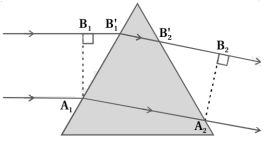
(N/A) The figure shows a parallel beam incident on a prism at an instant. Its corresponding incident plane wavefront $A_{1}B_{1}$ is normal to the rays. The emergent beam is represented by $A_{2}B_{2}$.
The path length of the ray passing through the base of the prism (from $A_{1}$ to $A_{2}$) is greater than the path length of the ray passing through the apex of the prism (from $B_{1}'$ to $B_{2}'$).
Since the velocity of light in the prism is less than the velocity of light in air,the light takes a longer time to travel the path $A_{1}A_{2}$ compared to the path $B_{1}'B_{2}'$.
As a result,the wavefront at $A_{2}$ lags behind the wavefront at $B_{2}$. Consequently,the emergent wavefront is tilted relative to the incident wavefront,which explains the deviation of light by the prism.
The path length of the ray passing through the base of the prism (from $A_{1}$ to $A_{2}$) is greater than the path length of the ray passing through the apex of the prism (from $B_{1}'$ to $B_{2}'$).
Since the velocity of light in the prism is less than the velocity of light in air,the light takes a longer time to travel the path $A_{1}A_{2}$ compared to the path $B_{1}'B_{2}'$.
As a result,the wavefront at $A_{2}$ lags behind the wavefront at $B_{2}$. Consequently,the emergent wavefront is tilted relative to the incident wavefront,which explains the deviation of light by the prism.
0 likes
View Solution54
Easy
How can it be said that light possesses wave nature?
Solution
(N/A) The wave nature of light is established by the following evidence:
$1$. Maxwell's equations for electromagnetism predicted that light is an electromagnetic wave consisting of oscillating electric and magnetic fields.
$2$. The experimental verification by Heinrich Hertz,who successfully produced and detected electromagnetic waves in the laboratory,confirmed that light behaves as an electromagnetic wave.
$3$. Phenomena such as interference,diffraction,and polarization,which are characteristic of wave motion,can only be explained by considering light as a wave.
$1$. Maxwell's equations for electromagnetism predicted that light is an electromagnetic wave consisting of oscillating electric and magnetic fields.
$2$. The experimental verification by Heinrich Hertz,who successfully produced and detected electromagnetic waves in the laboratory,confirmed that light behaves as an electromagnetic wave.
$3$. Phenomena such as interference,diffraction,and polarization,which are characteristic of wave motion,can only be explained by considering light as a wave.
0 likes
View Solution55
Medium
Explain the refraction of a plane wavefront by a thin convex lens.
Solution
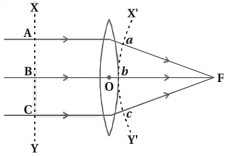
(N/A) The figure shows a plane wavefront $XY$ of a parallel beam of light incident on a thin convex lens. The rays emerging from the lens are concentrated at the second focus point $F$.
To draw the refracted wavefront corresponding to these rays,we draw an arc of a circle centered at the focus $F$. The arc $X^{\prime}Y^{\prime}$ shown in the figure represents this wavefront at a specific instant.
In this process,the path length traveled by the light ray passing through the center of the lens (point $B$ to $b$) is greater than the path length traveled by the rays passing through the edges (points $A$ to $a$ and $C$ to $c$). Since the speed of light in the lens material is less than in air,the central part of the wavefront is delayed more than the edges. Consequently,the point $b$ on the wavefront lags behind points $a$ and $c$,resulting in a spherical converging wavefront.
To draw the refracted wavefront corresponding to these rays,we draw an arc of a circle centered at the focus $F$. The arc $X^{\prime}Y^{\prime}$ shown in the figure represents this wavefront at a specific instant.
In this process,the path length traveled by the light ray passing through the center of the lens (point $B$ to $b$) is greater than the path length traveled by the rays passing through the edges (points $A$ to $a$ and $C$ to $c$). Since the speed of light in the lens material is less than in air,the central part of the wavefront is delayed more than the edges. Consequently,the point $b$ on the wavefront lags behind points $a$ and $c$,resulting in a spherical converging wavefront.
0 likes
View Solution56
Difficult
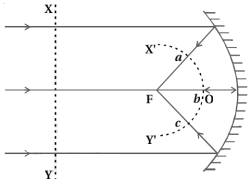
Explain the reflection of a plane wavefront from a concave mirror.
Solution
(N/A) When a plane wavefront is incident on a concave mirror,the rays parallel to the principal axis reflect and converge towards the focal point $F$.
The incident plane wavefront $XY$ and the reflected spherical wavefront $X'Y'$ are shown in the figure.
As the rays travel towards the mirror,the central ray hits the pole $O$ of the mirror,while the marginal rays hit the edges. Since the central ray travels a longer distance to reach the mirror and then reflects back,it covers a different path length compared to the marginal rays.
Specifically,the point $b$ on the reflected wavefront,which corresponds to the central ray,is delayed relative to points $a$ and $c$ on the reflected wavefront. This is because the central ray has to travel to the pole $O$ and back,whereas the marginal rays reflect from the edges. Consequently,the reflected wavefront becomes spherical,converging towards the focus $F$.
The incident plane wavefront $XY$ and the reflected spherical wavefront $X'Y'$ are shown in the figure.
As the rays travel towards the mirror,the central ray hits the pole $O$ of the mirror,while the marginal rays hit the edges. Since the central ray travels a longer distance to reach the mirror and then reflects back,it covers a different path length compared to the marginal rays.
Specifically,the point $b$ on the reflected wavefront,which corresponds to the central ray,is delayed relative to points $a$ and $c$ on the reflected wavefront. This is because the central ray has to travel to the pole $O$ and back,whereas the marginal rays reflect from the edges. Consequently,the reflected wavefront becomes spherical,converging towards the focus $F$.
0 likes
View Solution57
MediumMCQ
Is Huygens' principle valid for longitudinal sound waves?
A
Yes
B
No
C
Only for transverse waves
D
Only for electromagnetic waves
Solution
(A) Yes,Huygens' principle is valid for all types of waves,including both mechanical waves (like longitudinal sound waves) and electromagnetic waves.
According to Huygens' principle,every point on a wavefront acts as a source of secondary wavelets,and the new wavefront is the envelope of these secondary wavelets at a later time. This geometric construction applies to any wave propagation mechanism.
According to Huygens' principle,every point on a wavefront acts as a source of secondary wavelets,and the new wavefront is the envelope of these secondary wavelets at a later time. This geometric construction applies to any wave propagation mechanism.
0 likes
View Solution58
Medium
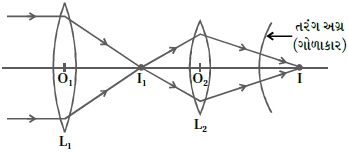
Consider a point at the focal point of a convergent lens. Another convergent lens of short focal length is placed on the other side. What is the nature of the wavefronts emerging from the final image?
Solution
(SPHERICAL) The final image is a point-like source formed at position $I$ on the common principal axis of both lenses.
Since this point acts as a secondary source,it emits spherical waves in all directions.
According to Huygens' principle,the wavefront at any instant is the envelope of these secondary spherical wavelets.
As the light rays converge towards the point $I$,the wavefronts emerging from the final image are spherical in nature,converging towards the point $I$.
Since this point acts as a secondary source,it emits spherical waves in all directions.
According to Huygens' principle,the wavefront at any instant is the envelope of these secondary spherical wavelets.
As the light rays converge towards the point $I$,the wavefronts emerging from the final image are spherical in nature,converging towards the point $I$.
0 likes
View Solution59
Medium
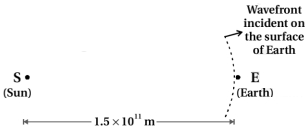
What is the shape of the wavefront on Earth for sunlight?
Solution
(N/A) As shown in the figure,the Sun acts as a point source of light. The wavefronts emitted from the Sun are spherical in nature. However,because the distance between the Sun and the Earth is extremely large $(1.5 \times 10^{11} \ m)$,the radius of the spherical wavefront becomes very large. When observed locally in a finite region on Earth,a small portion of this large spherical wavefront appears to be almost flat. Therefore,for all practical purposes,the wavefront of sunlight reaching the Earth is considered to be a plane wavefront.
0 likes
View Solution60
AdvancedMCQ
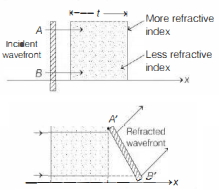
$A$ light beam travelling along the $X$-axis with a planar wavefront is incident on a medium of thickness $t$. In the region where light is falling,the refractive index varies such that $(dn/dy) > 0$. The light beam on the other side of the medium will emerge:
A
parallel to the $X$-axis
B
bending downward
C
bending upward
D
split into two or more beams
Solution
(C) Given,$(dn/dy) > 0$. This means the refractive index $n$ increases as we move in the positive $y$-direction.
Let $AB$ be the incident wavefront,where $A$ is at a higher $y$-coordinate than $B$.
Since the refractive index $n$ is higher at $A$ than at $B$,the speed of light $v = c/n$ is lower at $A$ than at $B$.
As the wavefront passes through the medium of thickness $t$,the part of the wavefront at $B$ travels faster than the part at $A$.
Consequently,the wavefront rotates such that the end at $B$ advances further than the end at $A$,causing the emerging light beam to bend upward.
Let $AB$ be the incident wavefront,where $A$ is at a higher $y$-coordinate than $B$.
Since the refractive index $n$ is higher at $A$ than at $B$,the speed of light $v = c/n$ is lower at $A$ than at $B$.
As the wavefront passes through the medium of thickness $t$,the part of the wavefront at $B$ travels faster than the part at $A$.
Consequently,the wavefront rotates such that the end at $B$ advances further than the end at $A$,causing the emerging light beam to bend upward.
0 likes
View Solution61
EasyMCQ
Huygens' concepts of secondary wavelets:
A
Allow us to find the focal length of a thin lens
B
Give the magnifying power of a microscope
C
Are a geometrical method to find a wavefront
D
Are used to determine the velocity of light
Solution
(C) Huygens' principle states that every point on a primary wavefront acts as a source of secondary wavelets,which spread out in all directions with the speed of light in the medium.
The new wavefront at any later time is the forward envelope of these secondary wavelets.
Therefore,Huygens' concepts of secondary wavelets provide a geometrical method to determine the shape and position of a wavefront at a subsequent time.
The new wavefront at any later time is the forward envelope of these secondary wavelets.
Therefore,Huygens' concepts of secondary wavelets provide a geometrical method to determine the shape and position of a wavefront at a subsequent time.
0 likes
View Solution62
EasyMCQ
$A$ light wave travels in a vacuum along the $x$-axis. Which of the following may represent the wave front?
A
$x = a$
B
$y = a$
C
$z = a$
D
$x + y + z = a$
Solution
(A) The wave front is defined as the locus of all points having the same phase of oscillation.
For a light wave traveling along the $x$-axis, the direction of propagation is parallel to the $x$-axis.
The wave front must be a plane perpendicular to the direction of propagation.
Since the wave travels along the $x$-axis, the wave front must be a plane parallel to the $yz$-plane.
The equation of a plane parallel to the $yz$-plane is given by $x = \text{constant}$ (e.g., $x = a$).
Therefore, the correct option is $A$.
For a light wave traveling along the $x$-axis, the direction of propagation is parallel to the $x$-axis.
The wave front must be a plane perpendicular to the direction of propagation.
Since the wave travels along the $x$-axis, the wave front must be a plane parallel to the $yz$-plane.
The equation of a plane parallel to the $yz$-plane is given by $x = \text{constant}$ (e.g., $x = a$).
Therefore, the correct option is $A$.
0 likes
View Solution63
DifficultMCQ
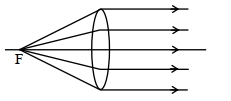
When a point source of light is placed at the focus of a convex lens,light emerges from the lens. What is the shape of the wavefront of the emerging light?
A
Both spherical and cylindrical
B
Cylindrical
C
Spherical
D
Plane
Solution
(D) When a point source of light is placed at the focus of a convex lens,the light rays originating from the source become parallel to the principal axis after refraction through the lens.
Since the emerging light rays are parallel,they represent a beam of light traveling in a specific direction.
$A$ wavefront is defined as the locus of all points that are in the same phase of oscillation.
For a parallel beam of light,the wavefronts are planes perpendicular to the direction of propagation of light.
Therefore,the shape of the wavefront of the emerging light is plane.
Since the emerging light rays are parallel,they represent a beam of light traveling in a specific direction.
$A$ wavefront is defined as the locus of all points that are in the same phase of oscillation.
For a parallel beam of light,the wavefronts are planes perpendicular to the direction of propagation of light.
Therefore,the shape of the wavefront of the emerging light is plane.
0 likes
View Solution64
Advanced
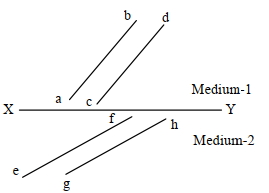
The figure shows a surface $XY$ separating two transparent media,medium-$1$ and medium-$2$. The lines $ab$ and $cd$ represent wavefronts of a light wave travelling in medium-$1$ and incident on $XY$. The lines $ef$ and $gh$ represent wavefronts of the light wave in medium-$2$ after refraction.
$1.$ Light travels as a
$(A)$ parallel beam in each medium
$(B)$ convergent beam in each medium
$(C)$ divergent beam in each medium
$(D)$ divergent beam in one medium and convergent beam in the other medium.
$2.$ The phases of the light wave at $c, d, e$ and $f$ are $\phi_{c}, \phi_{d}, \phi_{e}$ and $\phi_{f}$ respectively. It is given that $\phi_{c} \neq \phi_{f}$.
$(A)$ $\phi_{c}$ cannot be equal to $\phi_{d}$
$(B)$ $\phi_{a}$ can be equal to $\phi_{e}$
$(C)$ $(\phi_{d}-\phi_{c})$ is equal to $(\phi_{f}-\phi_{e})$
$(D)$ $(\phi_{d}-\phi_{c})$ is not equal to $(\phi_{f}-\phi_{e})$
$3.$ Speed of the light is
$(A)$ the same in medium-$1$ and medium-$2$
$(B)$ larger in medium-$1$ than in medium-$2$
$(C)$ larger in medium-$2$ than in medium-$1$
$(D)$ different at $b$ and $d$
Give the answer for questions $1, 2$ and $3$.
$1.$ Light travels as a
$(A)$ parallel beam in each medium
$(B)$ convergent beam in each medium
$(C)$ divergent beam in each medium
$(D)$ divergent beam in one medium and convergent beam in the other medium.
$2.$ The phases of the light wave at $c, d, e$ and $f$ are $\phi_{c}, \phi_{d}, \phi_{e}$ and $\phi_{f}$ respectively. It is given that $\phi_{c} \neq \phi_{f}$.
$(A)$ $\phi_{c}$ cannot be equal to $\phi_{d}$
$(B)$ $\phi_{a}$ can be equal to $\phi_{e}$
$(C)$ $(\phi_{d}-\phi_{c})$ is equal to $(\phi_{f}-\phi_{e})$
$(D)$ $(\phi_{d}-\phi_{c})$ is not equal to $(\phi_{f}-\phi_{e})$
$3.$ Speed of the light is
$(A)$ the same in medium-$1$ and medium-$2$
$(B)$ larger in medium-$1$ than in medium-$2$
$(C)$ larger in medium-$2$ than in medium-$1$
$(D)$ different at $b$ and $d$
Give the answer for questions $1, 2$ and $3$.
Solution
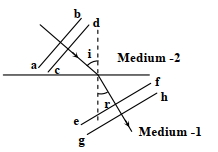
(A,C,C) $1.$ Since the wavefronts are parallel straight lines,the light rays (which are perpendicular to the wavefronts) are parallel. Thus,light travels as a parallel beam in each medium. Correct option is $(A)$.
$2.$ For a plane wavefront,the phase difference between two points depends on the path difference. Since the wavefronts are parallel,the distance between any two points on the same wavefront is constant. The phase difference between two points on the same wavefront is zero. Thus,$(\phi_{d}-\phi_{c}) = 0$ and $(\phi_{f}-\phi_{e}) = 0$. Therefore,$(\phi_{d}-\phi_{c}) = (\phi_{f}-\phi_{e})$. However,the question asks for the correct statement. Given $\phi_{c} \neq \phi_{f}$,the phase difference between points on different wavefronts is non-zero. The correct relation is that the phase difference between points on the same wavefront is zero. Looking at the options,$(C)$ is the only one that holds true as both sides are zero. Correct option is $(C)$.
$3.$ The distance between successive wavefronts represents the wavelength $\lambda$. From the figure,the distance between $ab$ and $cd$ (wavelength in medium-$1$,$\lambda_1$) is smaller than the distance between $ef$ and $gh$ (wavelength in medium-$2$,$\lambda_2$). Since $v = f\lambda$ and frequency $f$ remains constant during refraction,$v \propto \lambda$. Thus,$v_2 > v_1$. The speed is larger in medium-$2$ than in medium-$1$. Correct option is $(C)$.
$2.$ For a plane wavefront,the phase difference between two points depends on the path difference. Since the wavefronts are parallel,the distance between any two points on the same wavefront is constant. The phase difference between two points on the same wavefront is zero. Thus,$(\phi_{d}-\phi_{c}) = 0$ and $(\phi_{f}-\phi_{e}) = 0$. Therefore,$(\phi_{d}-\phi_{c}) = (\phi_{f}-\phi_{e})$. However,the question asks for the correct statement. Given $\phi_{c} \neq \phi_{f}$,the phase difference between points on different wavefronts is non-zero. The correct relation is that the phase difference between points on the same wavefront is zero. Looking at the options,$(C)$ is the only one that holds true as both sides are zero. Correct option is $(C)$.
$3.$ The distance between successive wavefronts represents the wavelength $\lambda$. From the figure,the distance between $ab$ and $cd$ (wavelength in medium-$1$,$\lambda_1$) is smaller than the distance between $ef$ and $gh$ (wavelength in medium-$2$,$\lambda_2$). Since $v = f\lambda$ and frequency $f$ remains constant during refraction,$v \propto \lambda$. Thus,$v_2 > v_1$. The speed is larger in medium-$2$ than in medium-$1$. Correct option is $(C)$.
0 likes
View Solution65
AdvancedMCQ
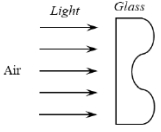
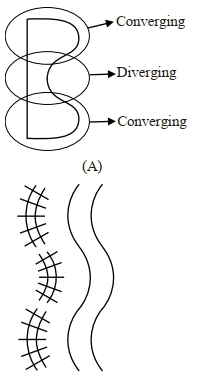
$A$ parallel beam of light strikes a piece of transparent glass having a cross-section as shown in the figure below. The correct shape of the emergent wavefront will be (figures are schematic and not drawn to scale)-
A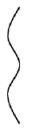
B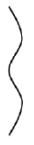
C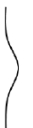
D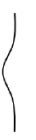
Solution
(A) The speed of light in glass is less than the speed of light in air.
When a plane wavefront passes through a medium,the part of the wavefront that travels through a greater thickness of the medium is delayed more.
In the given glass piece,the top and bottom parts are thicker,so the light passing through these regions travels a longer distance in glass,resulting in a greater time delay.
The middle part is thinner,so the light passing through it travels a shorter distance in glass,resulting in less time delay.
Consequently,the wavefront emerges with the top and bottom parts lagging behind the middle part.
This results in a shape where the middle part is pushed forward (convex) and the top and bottom parts are pushed backward (concave),which corresponds to the shape shown in option $A$.
When a plane wavefront passes through a medium,the part of the wavefront that travels through a greater thickness of the medium is delayed more.
In the given glass piece,the top and bottom parts are thicker,so the light passing through these regions travels a longer distance in glass,resulting in a greater time delay.
The middle part is thinner,so the light passing through it travels a shorter distance in glass,resulting in less time delay.
Consequently,the wavefront emerges with the top and bottom parts lagging behind the middle part.
This results in a shape where the middle part is pushed forward (convex) and the top and bottom parts are pushed backward (concave),which corresponds to the shape shown in option $A$.
0 likes
View Solution66
DifficultMCQ
$A$ light wave is propagating with plane wave fronts of the type $x+y+z=$ constant. The angle made by the direction of wave propagation with the $x$-axis is
A
$\cos ^{-1}\left(\frac{1}{\sqrt{3}}\right)$
B
$\cos ^{-1}\left(\frac{2}{3}\right)$
C
$\cos ^{-1}\left(\frac{1}{3}\right)$
D
$\cos ^{-1}\left(\sqrt{\frac{2}{3}}\right)$
Solution
(A) The equation of the plane wave front is given by $x+y+z = C$.
The normal vector to this plane is $\vec{n} = 1\hat{i} + 1\hat{j} + 1\hat{k}$.
The direction of wave propagation is along the normal to the wave front,so the direction vector is $\vec{v} = \hat{i} + \hat{j} + \hat{k}$.
The angle $\alpha$ made by the propagation vector with the $x$-axis is given by the formula for the direction cosine: $\cos \alpha = \frac{\vec{v} \cdot \hat{i}}{|\vec{v}| |\hat{i}|}$.
Calculating the dot product: $\vec{v} \cdot \hat{i} = (1)(1) + (1)(0) + (1)(0) = 1$.
Calculating the magnitude: $|\vec{v}| = \sqrt{1^2 + 1^2 + 1^2} = \sqrt{3}$.
Therefore,$\cos \alpha = \frac{1}{\sqrt{3} \cdot 1} = \frac{1}{\sqrt{3}}$.
Thus,$\alpha = \cos^{-1}\left(\frac{1}{\sqrt{3}}\right)$.
The normal vector to this plane is $\vec{n} = 1\hat{i} + 1\hat{j} + 1\hat{k}$.
The direction of wave propagation is along the normal to the wave front,so the direction vector is $\vec{v} = \hat{i} + \hat{j} + \hat{k}$.
The angle $\alpha$ made by the propagation vector with the $x$-axis is given by the formula for the direction cosine: $\cos \alpha = \frac{\vec{v} \cdot \hat{i}}{|\vec{v}| |\hat{i}|}$.
Calculating the dot product: $\vec{v} \cdot \hat{i} = (1)(1) + (1)(0) + (1)(0) = 1$.
Calculating the magnitude: $|\vec{v}| = \sqrt{1^2 + 1^2 + 1^2} = \sqrt{3}$.
Therefore,$\cos \alpha = \frac{1}{\sqrt{3} \cdot 1} = \frac{1}{\sqrt{3}}$.
Thus,$\alpha = \cos^{-1}\left(\frac{1}{\sqrt{3}}\right)$.
0 likes
View Solution67
MediumMCQ
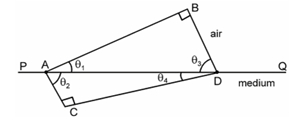
The following figure represents a wave front $AB$ which passes from air to another transparent medium and produces a new wave front $CD$ after refraction. The refractive index of the medium is $:$ ($PQ$ is the boundary between air and the medium)
A
$\frac{\cos \theta_1}{\cos \theta_4}$
B
$\frac{\cos \theta_4}{\cos \theta_1}$
C
$\frac{\sin \theta_1}{\sin \theta_4}$
D
$\frac{\sin \theta_2}{\sin \theta_3}$
Solution
(A) In the given figure,$AB$ is the incident wave front and $CD$ is the refracted wave front.
Let $i$ be the angle of incidence and $r$ be the angle of refraction.
The angle between the incident wave front $AB$ and the boundary $PQ$ is $\theta_1$. Since the ray is perpendicular to the wave front,the angle of incidence $i = 90^\circ - \theta_1$.
Similarly,the angle between the refracted wave front $CD$ and the boundary $PQ$ is $\theta_4$. The angle of refraction $r = 90^\circ - \theta_4$.
According to Snell's law,the refractive index of the medium $\mu$ with respect to air is given by $\mu = \frac{\sin i}{\sin r}$.
Substituting the values of $i$ and $r$:
$\mu = \frac{\sin(90^\circ - \theta_1)}{\sin(90^\circ - \theta_4)}$
$\mu = \frac{\cos \theta_1}{\cos \theta_4}$
Let $i$ be the angle of incidence and $r$ be the angle of refraction.
The angle between the incident wave front $AB$ and the boundary $PQ$ is $\theta_1$. Since the ray is perpendicular to the wave front,the angle of incidence $i = 90^\circ - \theta_1$.
Similarly,the angle between the refracted wave front $CD$ and the boundary $PQ$ is $\theta_4$. The angle of refraction $r = 90^\circ - \theta_4$.
According to Snell's law,the refractive index of the medium $\mu$ with respect to air is given by $\mu = \frac{\sin i}{\sin r}$.
Substituting the values of $i$ and $r$:
$\mu = \frac{\sin(90^\circ - \theta_1)}{\sin(90^\circ - \theta_4)}$
$\mu = \frac{\cos \theta_1}{\cos \theta_4}$
0 likes
View Solution68
EasyMCQ
According to Huygen's wave theory of light,which one of the following statements is < u>not correct?
A
Different colours of light are due to different wavelengths of waves.
B
Different colours of light are due to different sizes of the corpuscles.
C
Speed of light in denser medium is less than that in rarer medium.
D
It can explain laws of reflection and refraction.
Solution
(B) Huygens' wave theory of light proposes that light travels as waves in a hypothetical medium called the luminiferous ether.
According to this theory,different colours of light correspond to different wavelengths (or frequencies) of these waves.
Option $A$ is correct as it aligns with the wave nature of light.
Option $B$ refers to Newton's Corpuscular theory,which suggests light consists of particles (corpuscles) of different sizes for different colours. This is $NOT$ part of Huygens' wave theory.
Option $C$ is a prediction of Huygens' theory,which correctly states that light travels slower in a denser medium compared to a rarer medium.
Option $D$ is correct because Huygens' principle successfully explains the laws of reflection and refraction using wave-fronts.
Therefore,the statement that is not correct according to Huygens' wave theory is $B$.
According to this theory,different colours of light correspond to different wavelengths (or frequencies) of these waves.
Option $A$ is correct as it aligns with the wave nature of light.
Option $B$ refers to Newton's Corpuscular theory,which suggests light consists of particles (corpuscles) of different sizes for different colours. This is $NOT$ part of Huygens' wave theory.
Option $C$ is a prediction of Huygens' theory,which correctly states that light travels slower in a denser medium compared to a rarer medium.
Option $D$ is correct because Huygens' principle successfully explains the laws of reflection and refraction using wave-fronts.
Therefore,the statement that is not correct according to Huygens' wave theory is $B$.
0 likes
View Solution69
EasyMCQ
When wavefronts pass from a denser medium to a rarer medium, the width of the wavefront
A
increases.
B
may increase or decrease.
C
decreases.
D
remains unchanged.
Solution
(A) When light travels from a denser medium to a rarer medium, its speed increases $(v_2 > v_1)$.
Since the frequency $(f)$ of the wave remains constant, the wavelength $(\lambda = v/f)$ also increases.
The distance between successive wavefronts is equal to the wavelength.
Therefore, as the wavefronts move from a denser medium to a rarer medium, the width (or spacing) between successive wavefronts increases.
Thus, the correct option is $A$.
Since the frequency $(f)$ of the wave remains constant, the wavelength $(\lambda = v/f)$ also increases.
The distance between successive wavefronts is equal to the wavelength.
Therefore, as the wavefronts move from a denser medium to a rarer medium, the width (or spacing) between successive wavefronts increases.
Thus, the correct option is $A$.
0 likes
View Solution70
EasyMCQ
$A$ wavefront is a surface
A
perpendicular to the direction of propagation of light.
B
parallel to the direction of propagation of light.
C
without any specific orientation with direction of propagation of light.
D
which has nothing to do with intensity of light.
Solution
(A) Wavefront: The locus of all particles in a medium,vibrating in the same phase or constant phase,is called a wavefront.
The direction of propagation of light (ray of light) is always perpendicular to the wavefront.
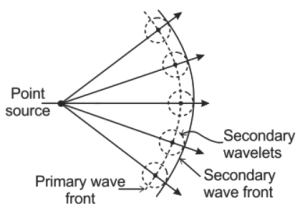
Every point on the given wavefront acts as a source of a new disturbance called secondary wavelets,which travel in all directions with the velocity of light in the medium.
$A$ surface touching these secondary wavelets tangentially in the forward direction at any instant gives the new wavefront at that instant. This is called a secondary wavefront.
The direction of propagation of light (ray of light) is always perpendicular to the wavefront.
Every point on the given wavefront acts as a source of a new disturbance called secondary wavelets,which travel in all directions with the velocity of light in the medium.
$A$ surface touching these secondary wavelets tangentially in the forward direction at any instant gives the new wavefront at that instant. This is called a secondary wavefront.
0 likes
View Solution71
MediumMCQ
$A$ plane wavefront is incident on a water surface at an angle of incidence $60^{\circ}$. It then gets refracted at an angle of $45^{\circ}$. The ratio of the width of the incident wavefront to that of the refracted wavefront is $\left[\sin \frac{\pi}{4}=\cos \frac{\pi}{4}=\frac{1}{\sqrt{2}}, \sin 60^{\circ}=\frac{\sqrt{3}}{2}, \cos 60^{\circ}=\frac{1}{2}\right]$
A
$\frac{\sqrt{3}}{2}$
B
$\frac{\sqrt{6}}{2}$
C
$\frac{1}{\sqrt{2}}$
D
$\sqrt{2}$
Solution
(C) Let the width of the incident wavefront be $w_i$ and the width of the refracted wavefront be $w_r$.
From the geometry of wavefronts,the width of a wavefront is related to the beam width by $w = L \cos \theta$,where $L$ is the length of the wavefront segment on the interface.
For the incident wavefront,$w_i = L \cos i$,where $i = 60^{\circ}$.
For the refracted wavefront,$w_r = L \cos r$,where $r = 45^{\circ}$.
The ratio of the width of the incident wavefront to the refracted wavefront is $\frac{w_i}{w_r} = \frac{\cos i}{\cos r}$.
Substituting the values: $\frac{w_i}{w_r} = \frac{\cos 60^{\circ}}{\cos 45^{\circ}} = \frac{1/2}{1/\sqrt{2}} = \frac{\sqrt{2}}{2} = \frac{1}{\sqrt{2}}$.
From the geometry of wavefronts,the width of a wavefront is related to the beam width by $w = L \cos \theta$,where $L$ is the length of the wavefront segment on the interface.
For the incident wavefront,$w_i = L \cos i$,where $i = 60^{\circ}$.
For the refracted wavefront,$w_r = L \cos r$,where $r = 45^{\circ}$.
The ratio of the width of the incident wavefront to the refracted wavefront is $\frac{w_i}{w_r} = \frac{\cos i}{\cos r}$.
Substituting the values: $\frac{w_i}{w_r} = \frac{\cos 60^{\circ}}{\cos 45^{\circ}} = \frac{1/2}{1/\sqrt{2}} = \frac{\sqrt{2}}{2} = \frac{1}{\sqrt{2}}$.
0 likes
View Solution72
EasyMCQ
The phase difference between any two particles in a given wavefront is . . . . . . rad.
A
$0$
B
$\pi$
C
$\frac{\pi}{2}$
D
$\frac{\pi}{4}$
Solution
(A) wavefront is defined as the locus of all points that are in the same phase of vibration. Since all particles on a given wavefront oscillate in phase,the phase difference between any two particles on the same wavefront is $0 \ rad$.
0 likes
View Solution73
EasyMCQ
According to Huygen's argument,the amplitude of the secondary wavelet is . . . . . . in the forward direction and . . . . . . in the backward direction.
A
Zero,maximum
B
Maximum,zero
C
Zero,zero
D
Maximum,maximum
Solution
(B) According to Huygen's principle,every point on a wavefront acts as a source of secondary wavelets. The amplitude of these secondary wavelets is given by the factor $(1 + \cos \theta) / 2$,where $\theta$ is the angle between the normal to the wavefront and the direction of the secondary wavelet.
$1$. In the forward direction,$\theta = 0^\circ$,so the amplitude factor is $(1 + \cos 0^\circ) / 2 = (1 + 1) / 2 = 1$ (Maximum).
$2$. In the backward direction,$\theta = 180^\circ$,so the amplitude factor is $(1 + \cos 180^\circ) / 2 = (1 - 1) / 2 = 0$ (Zero).
Therefore,the amplitude is maximum in the forward direction and zero in the backward direction.
$1$. In the forward direction,$\theta = 0^\circ$,so the amplitude factor is $(1 + \cos 0^\circ) / 2 = (1 + 1) / 2 = 1$ (Maximum).
$2$. In the backward direction,$\theta = 180^\circ$,so the amplitude factor is $(1 + \cos 180^\circ) / 2 = (1 - 1) / 2 = 0$ (Zero).
Therefore,the amplitude is maximum in the forward direction and zero in the backward direction.
0 likes
View Solution74
EasyMCQ
Which of the following figures is correct on the basis of Huygens' principle for the refraction of a plane wave by a thin prism?
A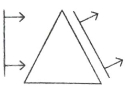
B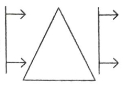
C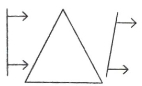
D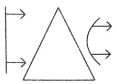
Solution
(C) According to Huygens' principle,the speed of light in a denser medium (glass) is less than in a rarer medium (air).
When a plane wavefront passes through a prism,the portion of the wavefront passing through the base of the prism travels through a greater thickness of glass compared to the portion passing through the apex.
Since the speed of light is lower in glass,the part of the wavefront traveling through the thicker part of the prism is delayed more than the part traveling through the thinner part.
This results in a tilt in the emerging wavefront,as correctly depicted in Figure $C$.
When a plane wavefront passes through a prism,the portion of the wavefront passing through the base of the prism travels through a greater thickness of glass compared to the portion passing through the apex.
Since the speed of light is lower in glass,the part of the wavefront traveling through the thicker part of the prism is delayed more than the part traveling through the thinner part.
This results in a tilt in the emerging wavefront,as correctly depicted in Figure $C$.
0 likes
View Solution75
EasyMCQ
According to Huygens' principle,during the refraction of light from air to a denser medium,
A
Wavelength and speed decrease
B
Wavelength and speed increase
C
Wavelength increases but speed decreases
D
Wavelength decreases but speed increases
Solution
(A) According to Huygens' principle,when light travels from a rarer medium (air) to a denser medium,the frequency of light remains constant.
Since the refractive index $\mu$ of a denser medium is greater than that of air,the speed of light $v$ decreases because $v = \frac{c}{\mu}$,where $c$ is the speed of light in a vacuum.
Furthermore,the relationship between wavelength $\lambda$,speed $v$,and frequency $f$ is given by $v = f \lambda$.
Since $f$ is constant and $v$ decreases,the wavelength $\lambda$ must also decrease in the denser medium.
Thus,both the wavelength and the speed of light decrease.
Since the refractive index $\mu$ of a denser medium is greater than that of air,the speed of light $v$ decreases because $v = \frac{c}{\mu}$,where $c$ is the speed of light in a vacuum.
Furthermore,the relationship between wavelength $\lambda$,speed $v$,and frequency $f$ is given by $v = f \lambda$.
Since $f$ is constant and $v$ decreases,the wavelength $\lambda$ must also decrease in the denser medium.
Thus,both the wavelength and the speed of light decrease.
0 likes
View Solution76
EasyMCQ
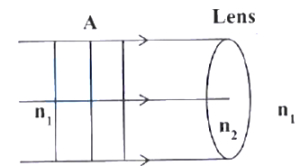
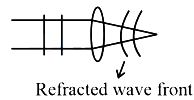
If $AB$ is an incident plane wave front,then what will be the refracted wave front for a lens with refractive index $n_2 > n_1$?
A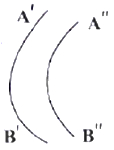
B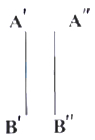
C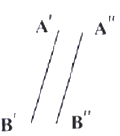
D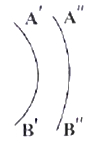
Solution
(A) When a plane wave front is incident on a convex lens,the central part of the wave front travels through the thickest part of the lens,while the edges travel through thinner parts.
Since the refractive index of the lens $n_2$ is greater than the surrounding medium $n_1$,the speed of light inside the lens is lower than outside.
Consequently,the central part of the wave front is delayed more than the edges.
This causes the initially plane wave front to become spherical and converge towards the focal point of the lens.
Therefore,the refracted wave front is a spherical wave front that is concave towards the direction of propagation (or concave towards the lens as it converges).
Looking at the options,the shape that represents a converging spherical wave front is a concave curve.
Since the refractive index of the lens $n_2$ is greater than the surrounding medium $n_1$,the speed of light inside the lens is lower than outside.
Consequently,the central part of the wave front is delayed more than the edges.
This causes the initially plane wave front to become spherical and converge towards the focal point of the lens.
Therefore,the refracted wave front is a spherical wave front that is concave towards the direction of propagation (or concave towards the lens as it converges).
Looking at the options,the shape that represents a converging spherical wave front is a concave curve.
0 likes
View Solution77
EasyMCQ
When light propagates through a given homogeneous medium,the velocities of
A
primary wavefront are larger than those of secondary wavelets.
B
primary wavefronts are lesser than those of secondary wavelets.
C
primary wavefronts are greater than or equal to those of secondary wavelets.
D
primary wavefront and wavelets are equal.
Solution
(D) According to Huygens' principle,every point on a wavefront acts as a source of secondary wavelets.
In a homogeneous and isotropic medium,these secondary wavelets travel in all directions with the same speed as the speed of light in that medium.
Since the primary wavefront itself is formed by the propagation of light at the speed of the medium,the velocity of the primary wavefront is equal to the velocity of the secondary wavelets.
In a homogeneous and isotropic medium,these secondary wavelets travel in all directions with the same speed as the speed of light in that medium.
Since the primary wavefront itself is formed by the propagation of light at the speed of the medium,the velocity of the primary wavefront is equal to the velocity of the secondary wavelets.
0 likes
View Solution78
EasyMCQ
For light diverging from a finite point source,
A
the intensity decreases in proportion to the distance squared
B
the wavefront is parabolic
C
the intensity at the wave front does not depend on the distance
D
the wave front is cylindrical
Solution
(A) light diverging from a finite point source produces a spherical wavefront that moves in all directions from the point source.
As the wavefront expands, the energy is distributed over a larger surface area $A = 4\pi r^2$.
Since intensity $I$ is defined as power per unit area $(I = P/A)$, the intensity is inversely proportional to the square of the distance from the source $(I \propto 1/r^2)$.
Therefore, the intensity decreases in proportion to the distance squared as the light propagates.
As the wavefront expands, the energy is distributed over a larger surface area $A = 4\pi r^2$.
Since intensity $I$ is defined as power per unit area $(I = P/A)$, the intensity is inversely proportional to the square of the distance from the source $(I \propto 1/r^2)$.
Therefore, the intensity decreases in proportion to the distance squared as the light propagates.
0 likes
View Solution79
EasyMCQ
$A$ wavefront is the locus of all points where the particles of the medium vibrate with the same:
A
phase
B
amplitude
C
frequency
D
period
Solution
(A) By definition,a wavefront is the locus of all points in a medium that are in the same state of vibration,which means they have the same phase.
As the wave propagates,all points on a wavefront reach their maximum displacement at the same time,maintaining a constant phase difference of zero between them.
Therefore,the correct option is $A$.
As the wave propagates,all points on a wavefront reach their maximum displacement at the same time,maintaining a constant phase difference of zero between them.
Therefore,the correct option is $A$.
0 likes
View Solution80
EasyMCQ
The property of light which cannot be explained by Huygens' construction of wavefront is
A
Refraction
B
Reflection
C
Diffraction
D
Origin of spectra
Solution
(D) Huygens' principle is based on the wave theory of light. It successfully explains the phenomena of reflection,refraction,interference,and diffraction of light. However,it fails to explain the origin of spectra,which is related to the quantum nature of light and the energy levels of atoms,as described by quantum mechanics.
0 likes
View Solution81
DifficultMCQ
Assertion $A$: For light diverging from a point source,the intensity at the wavefront does not depend on the distance.
Reason $R$: In a diverging beam of light from a point source,a spherical wavefront is observed.
Reason $R$: In a diverging beam of light from a point source,a spherical wavefront is observed.
A
$A$ and $R$ are true and $R$ is the correct explanation of $A$.
B
Both $A$ and $R$ are true,but $R$ is not the correct explanation of $A$.
C
$A$ is true but $R$ is false.
D
$A$ is false but $R$ is true.
Solution
(D) The intensity $I$ of light from a point source is given by $I = \frac{P}{A} = \frac{P}{4 \pi r^2}$,where $P$ is the power of the source and $r$ is the distance from the source.
Since $I \propto \frac{1}{r^2}$,the intensity depends on the distance $r$. Therefore,Assertion $A$ is false.
For a point source,the wavefronts are spherical because the light travels at the same speed in all directions,forming a sphere of radius $r$ at time $t$. Therefore,Reason $R$ is true.
Since $I \propto \frac{1}{r^2}$,the intensity depends on the distance $r$. Therefore,Assertion $A$ is false.
For a point source,the wavefronts are spherical because the light travels at the same speed in all directions,forming a sphere of radius $r$ at time $t$. Therefore,Reason $R$ is true.
0 likes
View Solution82
EasyMCQ
The wave front is a surface in which
A
all points are in the same phase
B
there are pairs of points in opposite phase
C
there are pairs of points with phase difference $(\pi / 2)$
D
there is no relation between the phases
Solution
(A) wave front is defined as the locus of all points in a medium that are vibrating in the same phase at a given instant of time.
Since all points on the wave front are in the same state of vibration,the phase difference between any two points on the wave front is zero.
Therefore,all points on a wave front are in the same phase.
Since all points on the wave front are in the same state of vibration,the phase difference between any two points on the wave front is zero.
Therefore,all points on a wave front are in the same phase.
0 likes
View Solution83
EasyMCQ
Which of the following generates a plane wavefront?
A
Point source
B
Extended source
C
Monochromatic source
D
All light sources
Solution
(B) point source at a finite distance produces a spherical wavefront. As the distance from the source increases,the radius of the sphere becomes very large,and a small portion of this wavefront appears as a plane wavefront. An extended source or a point source at an infinite distance (like the Sun) generates a plane wavefront.
0 likes
View Solution84
EasyMCQ
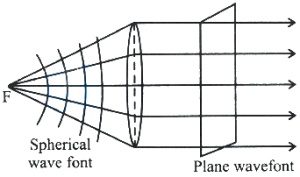
$A$ point source of light is placed at the focus of a concave mirror. Consider only paraxial rays. The shapes of the wavefronts of incident and reflected lights respectively are
A
spherical,spherical
B
spherical,planar
C
spherical,cylindrical
D
planar,spherical
Solution
(B) $1$. $A$ point source of light emits light in all directions,forming spherical wavefronts as the light propagates outward.
$2$. When these spherical wavefronts strike a concave mirror,the rays are reflected parallel to the principal axis (for paraxial rays).
$3$. $A$ set of parallel rays corresponds to a plane wavefront.
$4$. Therefore,the incident wavefront is spherical,and the reflected wavefront is planar.
$2$. When these spherical wavefronts strike a concave mirror,the rays are reflected parallel to the principal axis (for paraxial rays).
$3$. $A$ set of parallel rays corresponds to a plane wavefront.
$4$. Therefore,the incident wavefront is spherical,and the reflected wavefront is planar.
0 likes
View Solution85
EasyMCQ
What is the shape of the wavefront of light diverging from a point source?
A
spherical
B
planar
C
cylindrical
D
circular
Solution
(A) point source emits light waves in all possible directions in a three-dimensional space. Since the speed of light is constant in a homogeneous medium,the locus of all points vibrating in the same phase at a given time forms a sphere centered at the source. Therefore,the wavefront originating from a point source is spherical.
0 likes
View Solution86
DifficultMCQ
Given below are two statements:
Statement-$I$: $A$ plane wave after passing through a prism remains a plane wave,but passing through a small pinhole may become a spherical wave.
Statement-$II$: The curvature of a spherical wave emerging from a slit will increase for increasing slit width.
In the light of the above statements,choose the correct answer from the options given below.
Statement-$I$: $A$ plane wave after passing through a prism remains a plane wave,but passing through a small pinhole may become a spherical wave.
Statement-$II$: The curvature of a spherical wave emerging from a slit will increase for increasing slit width.
In the light of the above statements,choose the correct answer from the options given below.
A
Both Statement-$I$ and Statement-$II$ are false.
B
Both Statement-$I$ and Statement-$II$ are true.
C
Statement-$I$ is true but Statement-$II$ is false.
D
Statement-$I$ is false but Statement-$II$ is true.
Solution
(C) Statement-$I$ is true. $A$ prism changes the direction of a plane wave but preserves its planar wavefront. $A$ small pinhole acts as a point source,causing the wavefront to diverge spherically.
Statement-$II$ is false. The diffraction angle is given by $\theta = \lambda / a$,where $a$ is the slit width. As the slit width $a$ increases,the diffraction angle $\theta$ decreases,meaning the wave spreads less and becomes flatter (less curvature). Therefore,increasing the slit width decreases the curvature of the emerging wave.
Statement-$II$ is false. The diffraction angle is given by $\theta = \lambda / a$,where $a$ is the slit width. As the slit width $a$ increases,the diffraction angle $\theta$ decreases,meaning the wave spreads less and becomes flatter (less curvature). Therefore,increasing the slit width decreases the curvature of the emerging wave.
0 likes
View Solution87
MediumMCQ
For light diverging from a point source,
A
the intensity at the wavefront does not depend on the distance
B
the intensity increases in proportion to the distance squared
C
the wavefront is parabolic
D
the wavefront is spherical
Solution
(D) When light diverges from a point source in a homogeneous isotropic medium,the energy spreads out uniformly in all directions. The locus of points having the same phase forms a sphere centered at the source. Hence,the wavefront is spherical.
0 likes
View Solution88
EasyMCQ
According to Huygens principle,the phase difference between oscillations of any two particles on the same wave front is . . . . . . rad.
A
$\frac{\pi}{2}$
B
$\pi$
C
$0$
D
$2\pi$
Solution
(C) wave front is defined as the locus of all points that oscillate in phase.
Since every point on the same wave front vibrates in phase,the phase difference between any two particles on the same wave front is $0$.
Since every point on the same wave front vibrates in phase,the phase difference between any two particles on the same wave front is $0$.
0 likes
View SolutionWave Optics — Huygens’ Principle and Wave-fronts · Frequently Asked Questions
1Are these Wave Optics questions useful for JEE and NEET?
Yes. All questions in this section are mapped to JEE Main and NEET exam patterns. Previous year questions from JEE Main, NEET, GUJCET and state-level exams are included with full solutions.
2Can I switch to Hindi or Gujarati for these questions?
Yes. Use the language tabs in the hero section or the sidebar to view the same questions and solutions in English, Hindi or Gujarati.
3How do I generate a question paper from this subtopic?
Use the Vedclass Exam Paper Generator — select the chapter and subtopic, set difficulty, and generate Sets A, B, C, D automatically. First 3 chapters of every subject are free.
Vedclass Products
For Students
Vedclass Test Series
Mock tests in real JEE/NEET style with performance analysis. 5-day free trial.
Start Free TrialFor Teachers
Exam Paper Generator
Generate Set A/B/C/D papers from this chapter in 2 minutes. 3 chapters free.
Try FreeFor Institutes
Online Exam Module
Live online exams with unlimited students, 360° analytics & white-label branding.
See DemoFor Teachers & Institutes
Generate a Wave Optics Exam Paper in 2 Minutes
Select subtopic & difficulty — Sets A, B, C, D auto-generated with No Repeat logic.
First 3 chapters of every subject are free — no payment required.