
A English
PN Junction and Diode Questions in English
Class 12 Physics · Semiconductor Electronics · PN Junction and Diode
404+
Questions
English
Language
100%
With Solutions
Showing 4 of 404 questions in English
401
MediumMCQ
In a semiconductor $p-n$ diode,the doping concentrations on $p$-side and $n$-side are $10^{15} \text{ atoms/cm}^3$ and $10^{18} \text{ atoms/cm}^3$,respectively. Which one of the following statements is true?
A
Widths of depletion region on either side of the interface are equal
B
The depletion region width is more on $p$-side compared to that in $n$-side
C
The depletion region width is more on $n$-side compared to that in $p$-side
D
No depletion region forms because of unequal doping concentrations on $p$ and $n$-sides
Solution
(B) The width of the depletion region $(w)$ in a $p-n$ junction is inversely proportional to the doping concentration $(N)$ on that side,expressed as $w \propto 1/N$.
Given that the $p$-side has a lower doping concentration $(10^{15} \text{ atoms/cm}^3)$ compared to the $n$-side $(10^{18} \text{ atoms/cm}^3)$,the depletion region will extend further into the $p$-side.
Therefore,the depletion region width is greater on the $p$-side than on the $n$-side.
Given that the $p$-side has a lower doping concentration $(10^{15} \text{ atoms/cm}^3)$ compared to the $n$-side $(10^{18} \text{ atoms/cm}^3)$,the depletion region will extend further into the $p$-side.
Therefore,the depletion region width is greater on the $p$-side than on the $n$-side.
0 likes
View Solution402
DifficultMCQ
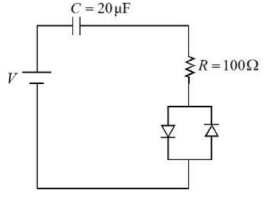
Consider a circuit consisting of a capacitor $(20 \mu\text{F})$,a resistor $(100 \Omega)$,and two identical diodes as shown in the figure. The resistance of each diode under forward biasing condition is $10 \Omega$. The time constant of the circuit is $\alpha \times 10^{-3} \text{ s}$. The value of $\alpha$ is . . . . . . .
A
$2.2$
B
$2$
C
$2.1$
D
$2.4$
Solution
(C) The time constant of an $RC$ circuit is given by $\tau = R_{eq}C$.
In the given circuit,there is a resistor $R = 100 \Omega$ in series with a parallel combination of two identical diodes.
Each diode has a resistance of $10 \Omega$ in the forward bias condition.
The equivalent resistance of the two diodes in parallel is $R_d = \frac{10 \times 10}{10 + 10} = 5 \Omega$.
The total resistance of the circuit is $R_{total} = R + R_d = 100 \Omega + 5 \Omega = 105 \Omega$.
The capacitance is $C = 20 \mu\text{F} = 20 \times 10^{-6} \text{ F}$.
Thus,the time constant $\tau = R_{total} \times C = 105 \Omega \times 20 \times 10^{-6} \text{ F} = 2100 \times 10^{-6} \text{ s} = 2.1 \times 10^{-3} \text{ s}$.
Comparing this with $\alpha \times 10^{-3} \text{ s}$,we get $\alpha = 2.1$.
In the given circuit,there is a resistor $R = 100 \Omega$ in series with a parallel combination of two identical diodes.
Each diode has a resistance of $10 \Omega$ in the forward bias condition.
The equivalent resistance of the two diodes in parallel is $R_d = \frac{10 \times 10}{10 + 10} = 5 \Omega$.
The total resistance of the circuit is $R_{total} = R + R_d = 100 \Omega + 5 \Omega = 105 \Omega$.
The capacitance is $C = 20 \mu\text{F} = 20 \times 10^{-6} \text{ F}$.
Thus,the time constant $\tau = R_{total} \times C = 105 \Omega \times 20 \times 10^{-6} \text{ F} = 2100 \times 10^{-6} \text{ s} = 2.1 \times 10^{-3} \text{ s}$.
Comparing this with $\alpha \times 10^{-3} \text{ s}$,we get $\alpha = 2.1$.
0 likes
View Solution403
MediumMCQ
Two statements are given below:
$A$. When the forward bias voltage across a $p-n$ junction diode increases above a certain threshold voltage,the diode current increases significantly.
$B$. This current is called reverse saturation current.
Choose the correct answer from the options given below:
$A$. When the forward bias voltage across a $p-n$ junction diode increases above a certain threshold voltage,the diode current increases significantly.
$B$. This current is called reverse saturation current.
Choose the correct answer from the options given below:
A
Both Statements $A$ and $B$ are true
B
Both Statements $A$ and $B$ are false
C
Statement $A$ is true,but Statement $B$ is false
D
Statement $A$ is false,but Statement $B$ is true
Solution
(C) Statement $A$ is correct: In a $p-n$ junction,forward bias reduces the potential barrier,allowing current to rise sharply after the threshold voltage.
Statement $B$ is incorrect: The current in forward bias is called forward current. The term 'reverse saturation current' refers to the very small,nearly constant current that flows in a $p-n$ junction diode when it is in reverse bias.
Therefore,Statement $A$ is true and Statement $B$ is false.
Statement $B$ is incorrect: The current in forward bias is called forward current. The term 'reverse saturation current' refers to the very small,nearly constant current that flows in a $p-n$ junction diode when it is in reverse bias.
Therefore,Statement $A$ is true and Statement $B$ is false.
0 likes
View Solution404
MediumMCQ
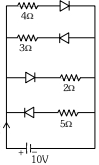
The current $I$ in the circuit shown below is: (All diodes are ideal and identical)
A
$\frac{1}{3} \text{A}$
B
$\frac{15}{2} \text{A}$
C
$\frac{5}{3} \text{A}$
D
$\frac{5}{9} \text{A}$
Solution
(B) The circuit consists of four parallel branches connected to a $10 \text{V}$ $DC$ source.
Each branch contains a resistor and a diode.
Analyzing the polarity of the diodes with respect to the $10 \text{V}$ battery:
$1$. The top branch ($4 \Omega$ resistor) has the diode in forward-biased condition.
$2$. The second branch ($3 \Omega$ resistor) has the diode in reverse-biased condition (it acts as an open circuit).
$3$. The third branch ($2 \Omega$ resistor) has the diode in forward-biased condition.
$4$. The bottom branch ($5 \Omega$ resistor) has the diode in reverse-biased condition (it acts as an open circuit).
Only the branches with $4 \Omega$ and $2 \Omega$ resistors are active.
These two resistors are in parallel,so the equivalent resistance $R_{\text{eq}}$ is:
$R_{\text{eq}} = \frac{4 \times 2}{4 + 2} = \frac{8}{6} = \frac{4}{3} \Omega$.
The total current $I$ drawn from the battery is:
$I = \frac{V}{R_{\text{eq}}} = \frac{10}{4/3} = \frac{30}{4} = 7.5 \text{A} = \frac{15}{2} \text{A}$.
Thus,the correct option is $B$.
Each branch contains a resistor and a diode.
Analyzing the polarity of the diodes with respect to the $10 \text{V}$ battery:
$1$. The top branch ($4 \Omega$ resistor) has the diode in forward-biased condition.
$2$. The second branch ($3 \Omega$ resistor) has the diode in reverse-biased condition (it acts as an open circuit).
$3$. The third branch ($2 \Omega$ resistor) has the diode in forward-biased condition.
$4$. The bottom branch ($5 \Omega$ resistor) has the diode in reverse-biased condition (it acts as an open circuit).
Only the branches with $4 \Omega$ and $2 \Omega$ resistors are active.
These two resistors are in parallel,so the equivalent resistance $R_{\text{eq}}$ is:
$R_{\text{eq}} = \frac{4 \times 2}{4 + 2} = \frac{8}{6} = \frac{4}{3} \Omega$.
The total current $I$ drawn from the battery is:
$I = \frac{V}{R_{\text{eq}}} = \frac{10}{4/3} = \frac{30}{4} = 7.5 \text{A} = \frac{15}{2} \text{A}$.
Thus,the correct option is $B$.
0 likes
View SolutionSemiconductor Electronics — PN Junction and Diode · Frequently Asked Questions
1Are these Semiconductor Electronics questions useful for JEE and NEET?
Yes. All questions in this section are mapped to JEE Main and NEET exam patterns. Previous year questions from JEE Main, NEET, GUJCET and state-level exams are included with full solutions.
2Can I switch to Hindi or Gujarati for these questions?
Yes. Use the language tabs in the hero section or the sidebar to view the same questions and solutions in English, Hindi or Gujarati.
3How do I generate a question paper from this subtopic?
Use the Vedclass Exam Paper Generator — select the chapter and subtopic, set difficulty, and generate Sets A, B, C, D automatically. First 3 chapters of every subject are free.
Vedclass Products
For Students
Vedclass Test Series
Mock tests in real JEE/NEET style with performance analysis. 5-day free trial.
Start Free TrialFor Teachers
Exam Paper Generator
Generate Set A/B/C/D papers from this chapter in 2 minutes. 3 chapters free.
Try FreeFor Institutes
Online Exam Module
Live online exams with unlimited students, 360° analytics & white-label branding.
See DemoFor Teachers & Institutes
Generate a Semiconductor Electronics Exam Paper in 2 Minutes
Select subtopic & difficulty — Sets A, B, C, D auto-generated with No Repeat logic.
First 3 chapters of every subject are free — no payment required.