
A English
Combination of Lenses Questions in English
Class 12 Physics · Ray Optics and Optical Instruments · Combination of Lenses
190+
Questions
English
Language
100%
With Solutions
Showing 35 of 190 questions in English
151
MediumMCQ
$A$ convex and a concave lens separated by a distance are then put in contact. How does the focal length of the combination change?
A
decreases
B
increases
C
becomes $0$
D
remains the same
Solution
(B) The equivalent focal length $F$ of two thin lenses separated by a distance $d$ is given by the formula:
$\frac{1}{F} = \frac{1}{f_1} + \frac{1}{f_2} - \frac{d}{f_1 f_2}$
Here,$f_1$ is the focal length of the convex lens (positive) and $f_2$ is the focal length of the concave lens (negative).
When the lenses are put in contact,the separation distance $d = 0$.
Substituting $d = 0$ into the formula,we get:
$\frac{1}{F} = \frac{1}{f_1} + \frac{1}{f_2}$
Since $f_1 > 0$ and $f_2 < 0$,let $f_1 = f$ and $f_2 = -f'$ (where $f, f' > 0$).
$\frac{1}{F} = \frac{1}{f} - \frac{1}{f'}$
As the lenses are brought from a separated state to contact,the term $-\frac{d}{f_1 f_2}$ (which was negative since $f_1 f_2 < 0$) is removed. Effectively,the power of the combination changes such that the focal length increases compared to the separated state.
$\frac{1}{F} = \frac{1}{f_1} + \frac{1}{f_2} - \frac{d}{f_1 f_2}$
Here,$f_1$ is the focal length of the convex lens (positive) and $f_2$ is the focal length of the concave lens (negative).
When the lenses are put in contact,the separation distance $d = 0$.
Substituting $d = 0$ into the formula,we get:
$\frac{1}{F} = \frac{1}{f_1} + \frac{1}{f_2}$
Since $f_1 > 0$ and $f_2 < 0$,let $f_1 = f$ and $f_2 = -f'$ (where $f, f' > 0$).
$\frac{1}{F} = \frac{1}{f} - \frac{1}{f'}$
As the lenses are brought from a separated state to contact,the term $-\frac{d}{f_1 f_2}$ (which was negative since $f_1 f_2 < 0$) is removed. Effectively,the power of the combination changes such that the focal length increases compared to the separated state.
0 likes
View Solution152
MediumMCQ
Two thin equiconvex lenses each of focal length $0.2 \,m$ are placed coaxially with their optic centres $0.5 \,m$ apart. Then the focal length of the combination is (in $\,m$)
A
$-0.4$
B
$0.4$
C
$-0.1$
D
$0.1$
Solution
(A) The equivalent focal length $(F)$ of two thin lenses separated by a distance $d$ is given by the formula:
$\frac{1}{F} = \frac{1}{f_1} + \frac{1}{f_2} - \frac{d}{f_1 f_2}$
Given $f_1 = 0.2 \,m$,$f_2 = 0.2 \,m$,and $d = 0.5 \,m$.
Substituting these values into the formula:
$\frac{1}{F} = \frac{1}{0.2} + \frac{1}{0.2} - \frac{0.5}{(0.2)(0.2)}$
$\frac{1}{F} = 5 + 5 - \frac{0.5}{0.04}$
$\frac{1}{F} = 10 - 12.5$
$\frac{1}{F} = -2.5$
Therefore,$F = -\frac{1}{2.5} = -0.4 \,m$.
$\frac{1}{F} = \frac{1}{f_1} + \frac{1}{f_2} - \frac{d}{f_1 f_2}$
Given $f_1 = 0.2 \,m$,$f_2 = 0.2 \,m$,and $d = 0.5 \,m$.
Substituting these values into the formula:
$\frac{1}{F} = \frac{1}{0.2} + \frac{1}{0.2} - \frac{0.5}{(0.2)(0.2)}$
$\frac{1}{F} = 5 + 5 - \frac{0.5}{0.04}$
$\frac{1}{F} = 10 - 12.5$
$\frac{1}{F} = -2.5$
Therefore,$F = -\frac{1}{2.5} = -0.4 \,m$.
0 likes
View Solution153
MediumMCQ
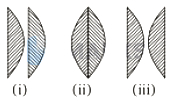
Two thin plano-convex lenses each of focal length $f$ are placed as shown in the figure. The ratio of their effective focal lengths in the three cases is
A
$3: 2: 1$
B
$1: 2: 3$
C
$1: 2: 1$
D
$1: 1: 1$
Solution
(D) When two thin lenses are placed in contact,the effective focal length $F$ is given by the formula $\frac{1}{F} = \frac{1}{f_1} + \frac{1}{f_2}$.
In all three cases shown,we have two plano-convex lenses,each with focal length $f$. When they are placed in contact,the combination acts as a single lens system.
Case $(i)$: The two lenses are in contact with their curved surfaces facing the same direction. The effective focal length is $\frac{1}{F_1} = \frac{1}{f} + \frac{1}{f} = \frac{2}{f}$,so $F_1 = \frac{f}{2}$.
Case $(ii)$: The two lenses are in contact forming a biconvex lens. The effective focal length is $\frac{1}{F_2} = \frac{1}{f} + \frac{1}{f} = \frac{2}{f}$,so $F_2 = \frac{f}{2}$.
Case $(iii)$: The two lenses are in contact with their curved surfaces facing each other. The effective focal length is $\frac{1}{F_3} = \frac{1}{f} + \frac{1}{f} = \frac{2}{f}$,so $F_3 = \frac{f}{2}$.
Thus,the ratio of their effective focal lengths is $F_1 : F_2 : F_3 = \frac{f}{2} : \frac{f}{2} : \frac{f}{2} = 1 : 1 : 1$.
In all three cases shown,we have two plano-convex lenses,each with focal length $f$. When they are placed in contact,the combination acts as a single lens system.
Case $(i)$: The two lenses are in contact with their curved surfaces facing the same direction. The effective focal length is $\frac{1}{F_1} = \frac{1}{f} + \frac{1}{f} = \frac{2}{f}$,so $F_1 = \frac{f}{2}$.
Case $(ii)$: The two lenses are in contact forming a biconvex lens. The effective focal length is $\frac{1}{F_2} = \frac{1}{f} + \frac{1}{f} = \frac{2}{f}$,so $F_2 = \frac{f}{2}$.
Case $(iii)$: The two lenses are in contact with their curved surfaces facing each other. The effective focal length is $\frac{1}{F_3} = \frac{1}{f} + \frac{1}{f} = \frac{2}{f}$,so $F_3 = \frac{f}{2}$.
Thus,the ratio of their effective focal lengths is $F_1 : F_2 : F_3 = \frac{f}{2} : \frac{f}{2} : \frac{f}{2} = 1 : 1 : 1$.
0 likes
View Solution154
MediumMCQ
Two thin lenses have a combined power of $+9 \text{ D}$. When they are separated by a distance of $20 \text{ cm}$,their equivalent power becomes $+\frac{27}{5} \text{ D}$. Their individual powers (in dioptre) are
A
$1, 8$
B
$2, 7$
C
$3, 6$
D
$4, 5$
Solution
(C) Given,the sum of powers of two thin lenses is $P_1 + P_2 = 9 \text{ D}$.
When separated by a distance $d = 20 \text{ cm} = 0.2 \text{ m}$,the equivalent power $P$ is given by the formula:
$P = P_1 + P_2 - d P_1 P_2$
Substituting the given values:
$\frac{27}{5} = 9 - 0.2 \times P_1 P_2$
$5.4 = 9 - 0.2 \times P_1 P_2$
$0.2 \times P_1 P_2 = 9 - 5.4 = 3.6$
$P_1 P_2 = \frac{3.6}{0.2} = 18$
We have $P_1 + P_2 = 9$ and $P_1 P_2 = 18$. The quadratic equation $x^2 - (P_1+P_2)x + P_1 P_2 = 0$ becomes $x^2 - 9x + 18 = 0$.
Solving this,$(x-3)(x-6) = 0$,so $x = 3$ or $x = 6$.
Thus,the individual powers are $3 \text{ D}$ and $6 \text{ D}$.
When separated by a distance $d = 20 \text{ cm} = 0.2 \text{ m}$,the equivalent power $P$ is given by the formula:
$P = P_1 + P_2 - d P_1 P_2$
Substituting the given values:
$\frac{27}{5} = 9 - 0.2 \times P_1 P_2$
$5.4 = 9 - 0.2 \times P_1 P_2$
$0.2 \times P_1 P_2 = 9 - 5.4 = 3.6$
$P_1 P_2 = \frac{3.6}{0.2} = 18$
We have $P_1 + P_2 = 9$ and $P_1 P_2 = 18$. The quadratic equation $x^2 - (P_1+P_2)x + P_1 P_2 = 0$ becomes $x^2 - 9x + 18 = 0$.
Solving this,$(x-3)(x-6) = 0$,so $x = 3$ or $x = 6$.
Thus,the individual powers are $3 \text{ D}$ and $6 \text{ D}$.
0 likes
View Solution155
EasyMCQ
The size of the image of an object at infinity, formed by a convex lens of focal length $30 \,cm$, is $2 \,cm$. If a concave lens of focal length $20 \,cm$ is placed between the convex lens and the image at a distance of $26 \,cm$ from the convex lens, what is the new size of the image (in $\,cm$)?
A
$1.25$
B
$2.5$
C
$1.05$
D
$2$
Solution
(B) Given: Focal length of convex lens $f_{1} = 30 \,cm$, focal length of concave lens $f_{2} = -20 \,cm$, and initial image size $h_{o} = 2 \,cm$.
Since the object is at infinity, the image formed by the convex lens is at its focus, $v_{1} = 30 \,cm$.
The concave lens is placed at a distance of $26 \,cm$ from the convex lens. Thus, the image formed by the convex lens acts as a virtual object for the concave lens.
The distance of this virtual object from the concave lens is $u_{2} = v_{1} - 26 = 30 - 26 = 4 \,cm$.
Using the lens formula for the concave lens: $\frac{1}{v_{2}} - \frac{1}{u_{2}} = \frac{1}{f_{2}}$.
Substituting the values: $\frac{1}{v_{2}} - \frac{1}{4} = \frac{1}{-20}$.
$\frac{1}{v_{2}} = \frac{1}{4} - \frac{1}{20} = \frac{5-1}{20} = \frac{4}{20} = \frac{1}{5}$.
So, $v_{2} = 5 \,cm$.
The magnification $m$ produced by the concave lens is $m = \frac{v_{2}}{u_{2}} = \frac{5}{4} = 1.25$.
The new size of the image $h_{i} = m \times h_{o} = 1.25 \times 2 \,cm = 2.5 \,cm$.
Since the object is at infinity, the image formed by the convex lens is at its focus, $v_{1} = 30 \,cm$.
The concave lens is placed at a distance of $26 \,cm$ from the convex lens. Thus, the image formed by the convex lens acts as a virtual object for the concave lens.
The distance of this virtual object from the concave lens is $u_{2} = v_{1} - 26 = 30 - 26 = 4 \,cm$.
Using the lens formula for the concave lens: $\frac{1}{v_{2}} - \frac{1}{u_{2}} = \frac{1}{f_{2}}$.
Substituting the values: $\frac{1}{v_{2}} - \frac{1}{4} = \frac{1}{-20}$.
$\frac{1}{v_{2}} = \frac{1}{4} - \frac{1}{20} = \frac{5-1}{20} = \frac{4}{20} = \frac{1}{5}$.
So, $v_{2} = 5 \,cm$.
The magnification $m$ produced by the concave lens is $m = \frac{v_{2}}{u_{2}} = \frac{5}{4} = 1.25$.
The new size of the image $h_{i} = m \times h_{o} = 1.25 \times 2 \,cm = 2.5 \,cm$.
0 likes
View Solution156
MediumMCQ
Two lenses of powers $-1.75 D$ and $+2.25 D$ are placed in contact. The focal length of the combination is (in $\,cm$)
A
$100$
B
$50$
C
$200$
D
$150$
Solution
(C) The power of the combination of lenses in contact is given by $P = P_1 + P_2$.
Given $P_1 = -1.75 D$ and $P_2 = +2.25 D$.
Therefore,$P = -1.75 + 2.25 = 0.5 D$.
The focal length $f$ is related to power $P$ by the formula $f = \frac{1}{P}$ (in meters).
$f = \frac{1}{0.5} = 2 \,m$.
Since $1 \,m = 100 \,cm$,$f = 2 \times 100 = 200 \,cm$.
Given $P_1 = -1.75 D$ and $P_2 = +2.25 D$.
Therefore,$P = -1.75 + 2.25 = 0.5 D$.
The focal length $f$ is related to power $P$ by the formula $f = \frac{1}{P}$ (in meters).
$f = \frac{1}{0.5} = 2 \,m$.
Since $1 \,m = 100 \,cm$,$f = 2 \times 100 = 200 \,cm$.
0 likes
View Solution157
MediumMCQ
Two thin convex lenses are kept in contact coaxially. If the focal length of the combination of the lenses is $4 \ cm$ and the sum of the focal lengths of the two lenses is $18 \ cm$,then the focal length of the lens of lower power is (in $cm$)
A
$8$
B
$10$
C
$6$
D
$12$
Solution
(D) Let the focal lengths of the two lenses be $f_1$ and $f_2$.
Given that the lenses are in contact,the equivalent focal length $F$ is given by $\frac{1}{F} = \frac{1}{f_1} + \frac{1}{f_2}$.
Given $F = 4 \ cm$,so $\frac{1}{f_1} + \frac{1}{f_2} = \frac{1}{4}$.
This simplifies to $\frac{f_1 + f_2}{f_1 f_2} = \frac{1}{4}$.
We are given $f_1 + f_2 = 18 \ cm$.
Substituting this into the equation: $\frac{18}{f_1 f_2} = \frac{1}{4}$,which gives $f_1 f_2 = 72 \ cm^2$.
We have the sum $f_1 + f_2 = 18$ and the product $f_1 f_2 = 72$.
These are the roots of the quadratic equation $x^2 - 18x + 72 = 0$.
Factoring the equation: $(x - 6)(x - 12) = 0$.
Thus,the focal lengths are $6 \ cm$ and $12 \ cm$.
Power $P$ is inversely proportional to focal length $(P = \frac{1}{f})$.
The lens with the lower power will have the larger focal length.
Therefore,the focal length of the lens with lower power is $12 \ cm$.
Given that the lenses are in contact,the equivalent focal length $F$ is given by $\frac{1}{F} = \frac{1}{f_1} + \frac{1}{f_2}$.
Given $F = 4 \ cm$,so $\frac{1}{f_1} + \frac{1}{f_2} = \frac{1}{4}$.
This simplifies to $\frac{f_1 + f_2}{f_1 f_2} = \frac{1}{4}$.
We are given $f_1 + f_2 = 18 \ cm$.
Substituting this into the equation: $\frac{18}{f_1 f_2} = \frac{1}{4}$,which gives $f_1 f_2 = 72 \ cm^2$.
We have the sum $f_1 + f_2 = 18$ and the product $f_1 f_2 = 72$.
These are the roots of the quadratic equation $x^2 - 18x + 72 = 0$.
Factoring the equation: $(x - 6)(x - 12) = 0$.
Thus,the focal lengths are $6 \ cm$ and $12 \ cm$.
Power $P$ is inversely proportional to focal length $(P = \frac{1}{f})$.
The lens with the lower power will have the larger focal length.
Therefore,the focal length of the lens with lower power is $12 \ cm$.
0 likes
View Solution158
EasyMCQ
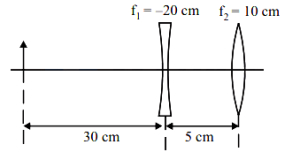
$A$ concave lens and a convex lens are arranged as shown in the figure. Find the position of the final image.
A
$17 \ cm$ to the left of convex lens
B
$24.2 \ cm$ to the right of concave lens
C
$29.2 \ cm$ to the right of concave lens
D
$24.2 \ cm$ to the left of convex lens
Solution
(C) For the concave lens:
$u = -30 \ cm$,$f = -20 \ cm$
Using the lens formula $\frac{1}{v} - \frac{1}{u} = \frac{1}{f}$:
$\frac{1}{v} - \frac{1}{-30} = \frac{1}{-20}$
$\frac{1}{v} = -\frac{1}{20} - \frac{1}{30} = \frac{-3-2}{60} = -\frac{5}{60} = -\frac{1}{12}$
$v = -12 \ cm$ (The image is formed $12 \ cm$ to the left of the concave lens).
For the convex lens:
The image formed by the concave lens acts as an object for the convex lens.
The distance between the lenses is $5 \ cm$.
$u = -(12 + 5) = -17 \ cm$,$f = +10 \ cm$
Using the lens formula $\frac{1}{v} - \frac{1}{u} = \frac{1}{f}$:
$\frac{1}{v} - \frac{1}{-17} = \frac{1}{10}$
$\frac{1}{v} = \frac{1}{10} - \frac{1}{17} = \frac{17 - 10}{170} = \frac{7}{170}$
$v = \frac{170}{7} \approx 24.29 \ cm$ to the right of the convex lens.
Since the convex lens is $5 \ cm$ to the right of the concave lens,the final image position relative to the concave lens is $24.29 + 5 = 29.29 \ cm$ to the right of the concave lens.
$u = -30 \ cm$,$f = -20 \ cm$
Using the lens formula $\frac{1}{v} - \frac{1}{u} = \frac{1}{f}$:
$\frac{1}{v} - \frac{1}{-30} = \frac{1}{-20}$
$\frac{1}{v} = -\frac{1}{20} - \frac{1}{30} = \frac{-3-2}{60} = -\frac{5}{60} = -\frac{1}{12}$
$v = -12 \ cm$ (The image is formed $12 \ cm$ to the left of the concave lens).
For the convex lens:
The image formed by the concave lens acts as an object for the convex lens.
The distance between the lenses is $5 \ cm$.
$u = -(12 + 5) = -17 \ cm$,$f = +10 \ cm$
Using the lens formula $\frac{1}{v} - \frac{1}{u} = \frac{1}{f}$:
$\frac{1}{v} - \frac{1}{-17} = \frac{1}{10}$
$\frac{1}{v} = \frac{1}{10} - \frac{1}{17} = \frac{17 - 10}{170} = \frac{7}{170}$
$v = \frac{170}{7} \approx 24.29 \ cm$ to the right of the convex lens.
Since the convex lens is $5 \ cm$ to the right of the concave lens,the final image position relative to the concave lens is $24.29 + 5 = 29.29 \ cm$ to the right of the concave lens.
0 likes
View Solution159
EasyMCQ
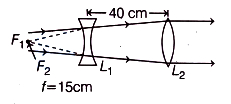
$A$ convergent lens is placed $40 \,cm$ to the right of a diverging lens of focal length $15 \,cm$. $A$ parallel beam of light enters the diverging lens from the left, and the beam is again parallel when it emerges from the convergent lens. The focal length of the convergent lens is (in $\,cm$)
A
$40$
B
$25$
C
$55$
D
$27.5$
Solution
(C) For a parallel beam of light to emerge parallel from a system of two lenses, the second focal point of the first lens must coincide with the first focal point of the second lens.
Let $L_1$ be the diverging lens with focal length $f_1 = -15 \,cm$ and $L_2$ be the convergent lens with focal length $f_2$.
The parallel beam incident on $L_1$ appears to diverge from its focal point $F_1$, which is $15 \,cm$ to the left of $L_1$.
For the beam to emerge parallel from $L_2$, the light rays incident on $L_2$ must appear to come from its focal point $F_2$, which is located to the left of $L_2$ at a distance equal to its focal length $f_2$.
From the geometry of the system, the distance between the two lenses is $d = 40 \,cm$.
The focal point $F_1$ is $15 \,cm$ to the left of $L_1$. Thus, the distance of $F_1$ from $L_2$ is $15 \,cm + 40 \,cm = 55 \,cm$.
Since $F_1$ and $F_2$ must coincide for the rays to emerge parallel, the focal length of the convergent lens $f_2$ must be $55 \,cm$.
Let $L_1$ be the diverging lens with focal length $f_1 = -15 \,cm$ and $L_2$ be the convergent lens with focal length $f_2$.
The parallel beam incident on $L_1$ appears to diverge from its focal point $F_1$, which is $15 \,cm$ to the left of $L_1$.
For the beam to emerge parallel from $L_2$, the light rays incident on $L_2$ must appear to come from its focal point $F_2$, which is located to the left of $L_2$ at a distance equal to its focal length $f_2$.
From the geometry of the system, the distance between the two lenses is $d = 40 \,cm$.
The focal point $F_1$ is $15 \,cm$ to the left of $L_1$. Thus, the distance of $F_1$ from $L_2$ is $15 \,cm + 40 \,cm = 55 \,cm$.
Since $F_1$ and $F_2$ must coincide for the rays to emerge parallel, the focal length of the convergent lens $f_2$ must be $55 \,cm$.
0 likes
View Solution160
MediumMCQ
$A$ plano-convex lens of material of refractive index $\mu_1$ exactly fits into a plano-concave lens of material of refractive index $\mu_2$. If $R$ is the radius of curvature of the curved surfaces of the lenses and the plane surfaces of the lenses are parallel,the focal length of the combination is:
A
$R/(\mu_1 - \mu_2)$
B
$R/(\mu_2 - \mu_1)$
C
$R/(\mu_1 + \mu_2)$
D
$\infty$
Solution
(A) For a plano-convex lens with refractive index $\mu_1$ and radius of curvature $R$,the focal length $f_1$ is given by the lens maker's formula: $1/f_1 = (\mu_1 - 1)(1/R - 1/\infty) = (\mu_1 - 1)/R$.
For a plano-concave lens with refractive index $\mu_2$ and radius of curvature $R$,the focal length $f_2$ is given by: $1/f_2 = (\mu_2 - 1)(-1/\infty - 1/R) = -(\mu_2 - 1)/R$.
When the two lenses are combined,the effective focal length $F$ is given by $1/F = 1/f_1 + 1/f_2$.
Substituting the values: $1/F = (\mu_1 - 1)/R - (\mu_2 - 1)/R = (\mu_1 - 1 - \mu_2 + 1)/R = (\mu_1 - \mu_2)/R$.
Therefore,the focal length of the combination is $F = R/(\mu_1 - \mu_2)$.
For a plano-concave lens with refractive index $\mu_2$ and radius of curvature $R$,the focal length $f_2$ is given by: $1/f_2 = (\mu_2 - 1)(-1/\infty - 1/R) = -(\mu_2 - 1)/R$.
When the two lenses are combined,the effective focal length $F$ is given by $1/F = 1/f_1 + 1/f_2$.
Substituting the values: $1/F = (\mu_1 - 1)/R - (\mu_2 - 1)/R = (\mu_1 - 1 - \mu_2 + 1)/R = (\mu_1 - \mu_2)/R$.
Therefore,the focal length of the combination is $F = R/(\mu_1 - \mu_2)$.
0 likes
View Solution161
DifficultMCQ
The focal length of a lens of dispersive power $0.45$ which should be placed in contact with a convex lens of focal length $84 \,cm$ and dispersive power $0.21$ to make the achromatic combination from the two lenses,in $cm$ is
A
$45$
B
$90$
C
$180$
D
$-180$
Solution
(D) Given:
Dispersive power of the first lens,$\omega_1 = 0.45$.
Dispersive power of the second lens,$\omega_2 = 0.21$.
Focal length of the second lens (convex),$f_2 = 84 \,cm$.
For an achromatic combination of two thin lenses in contact,the condition is given by:
$\frac{\omega_1}{f_1} + \frac{\omega_2}{f_2} = 0$
$\Rightarrow \frac{\omega_1}{f_1} = -\frac{\omega_2}{f_2}$
$\Rightarrow \frac{f_1}{f_2} = -\frac{\omega_1}{\omega_2}$
Substituting the given values:
$\frac{f_1}{84} = -\frac{0.45}{0.21}$
$f_1 = -\frac{45}{21} \times 84$
$f_1 = -\frac{45}{1} \times 4$
$f_1 = -180 \,cm$
Thus,the focal length of the required lens is $-180 \,cm$.
Dispersive power of the first lens,$\omega_1 = 0.45$.
Dispersive power of the second lens,$\omega_2 = 0.21$.
Focal length of the second lens (convex),$f_2 = 84 \,cm$.
For an achromatic combination of two thin lenses in contact,the condition is given by:
$\frac{\omega_1}{f_1} + \frac{\omega_2}{f_2} = 0$
$\Rightarrow \frac{\omega_1}{f_1} = -\frac{\omega_2}{f_2}$
$\Rightarrow \frac{f_1}{f_2} = -\frac{\omega_1}{\omega_2}$
Substituting the given values:
$\frac{f_1}{84} = -\frac{0.45}{0.21}$
$f_1 = -\frac{45}{21} \times 84$
$f_1 = -\frac{45}{1} \times 4$
$f_1 = -180 \,cm$
Thus,the focal length of the required lens is $-180 \,cm$.
0 likes
View Solution162
DifficultMCQ
Two lenses of power $-1.6 D$ and $+2.1 D$ respectively are placed in contact. The focal length of the combination is (in $cm$)
A
$100$
B
$200$
C
$160$
D
$210$
Solution
(B) Given,the power of the lenses are $P_1 = -1.6 D$ and $P_2 = +2.1 D$.
When two thin lenses are placed in contact,the total power $P$ of the combination is given by the sum of individual powers:
$P = P_1 + P_2 = -1.6 D + 2.1 D = 0.5 D$.
The relationship between the focal length $f$ (in meters) and the power $P$ (in Diopters) is $P = \frac{1}{f(m)}$.
To find the focal length in centimeters,we use $f(cm) = \frac{100}{P(D)}$.
Substituting the value of $P$:
$f = \frac{100}{0.5} = 200 cm$.
Therefore,the focal length of the combination is $200 cm$.
When two thin lenses are placed in contact,the total power $P$ of the combination is given by the sum of individual powers:
$P = P_1 + P_2 = -1.6 D + 2.1 D = 0.5 D$.
The relationship between the focal length $f$ (in meters) and the power $P$ (in Diopters) is $P = \frac{1}{f(m)}$.
To find the focal length in centimeters,we use $f(cm) = \frac{100}{P(D)}$.
Substituting the value of $P$:
$f = \frac{100}{0.5} = 200 cm$.
Therefore,the focal length of the combination is $200 cm$.
0 likes
View Solution163
MediumMCQ
For a combination of two convex lenses of focal lengths $f_1$ and $f_2$ to act as a glass slab,the distance of separation between them is
A
$f_1+f_2$
B
$f_1 \sim f_2$
C
$\frac{f_1+f_2}{2}$
D
$\frac{f_1 \sim f_2}{2}$
Solution
(A) For a glass slab,the equivalent focal length $F$ is $\infty$.
For two thin lenses of focal lengths $f_1$ and $f_2$ separated by a distance $d$,the equivalent focal length $F$ is given by the formula:
$\frac{1}{F} = \frac{1}{f_1} + \frac{1}{f_2} - \frac{d}{f_1 f_2}$
Since the combination acts as a glass slab,we set $F = \infty$,which implies $\frac{1}{F} = 0$.
Substituting this into the formula:
$0 = \frac{1}{f_1} + \frac{1}{f_2} - \frac{d}{f_1 f_2}$
$0 = \frac{f_2 + f_1}{f_1 f_2} - \frac{d}{f_1 f_2}$
$\frac{d}{f_1 f_2} = \frac{f_1 + f_2}{f_1 f_2}$
$d = f_1 + f_2$
Thus,the distance of separation between the lenses must be $f_1 + f_2$.
For two thin lenses of focal lengths $f_1$ and $f_2$ separated by a distance $d$,the equivalent focal length $F$ is given by the formula:
$\frac{1}{F} = \frac{1}{f_1} + \frac{1}{f_2} - \frac{d}{f_1 f_2}$
Since the combination acts as a glass slab,we set $F = \infty$,which implies $\frac{1}{F} = 0$.
Substituting this into the formula:
$0 = \frac{1}{f_1} + \frac{1}{f_2} - \frac{d}{f_1 f_2}$
$0 = \frac{f_2 + f_1}{f_1 f_2} - \frac{d}{f_1 f_2}$
$\frac{d}{f_1 f_2} = \frac{f_1 + f_2}{f_1 f_2}$
$d = f_1 + f_2$
Thus,the distance of separation between the lenses must be $f_1 + f_2$.
0 likes
View Solution164
EasyMCQ
Two convex lenses of focal lengths $20 \,cm$ and $30 \,cm$ are placed in contact with each other co-axially. The focal length of the combination is (in $\,cm$)
A
$60$
B
$10$
C
$12$
D
$43$
Solution
(C) Given: Focal lengths of the two convex lenses are $f_1 = 20 \,cm$ and $f_2 = 30 \,cm$.
When two thin lenses are placed in contact,the equivalent focal length $F$ is given by the formula:
$\frac{1}{F} = \frac{1}{f_1} + \frac{1}{f_2}$
Substituting the given values:
$\frac{1}{F} = \frac{1}{20} + \frac{1}{30}$
$\frac{1}{F} = \frac{3 + 2}{60} = \frac{5}{60}$
$\frac{1}{F} = \frac{1}{12}$
Therefore,$F = 12 \,cm$.
When two thin lenses are placed in contact,the equivalent focal length $F$ is given by the formula:
$\frac{1}{F} = \frac{1}{f_1} + \frac{1}{f_2}$
Substituting the given values:
$\frac{1}{F} = \frac{1}{20} + \frac{1}{30}$
$\frac{1}{F} = \frac{3 + 2}{60} = \frac{5}{60}$
$\frac{1}{F} = \frac{1}{12}$
Therefore,$F = 12 \,cm$.
0 likes
View Solution165
EasyMCQ
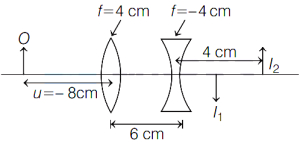
$A$ convex lens and a concave lens, each with a focal length of $4 \,cm$, are separated by a distance of $6 \,cm$ along their axis. An object is placed $8 \,cm$ before the convex lens. The distance between the object and its final image is (in $\,cm$)
A
$10$
B
$15$
C
$18$
D
$24$
Solution
(C) For the convex lens: Object distance $u_1 = -8 \,cm$, focal length $f_1 = +4 \,cm$. Using the lens formula $\frac{1}{v_1} - \frac{1}{u_1} = \frac{1}{f_1}$, we get $\frac{1}{v_1} = \frac{1}{4} + \frac{1}{-8} = \frac{1}{8}$, so $v_1 = +8 \,cm$. This image acts as a virtual object for the concave lens.
For the concave lens: The distance between the lenses is $d = 6 \,cm$. The image formed by the convex lens is $8 \,cm$ behind it, which is $8 - 6 = 2 \,cm$ behind the concave lens. Thus, for the concave lens, $u_2 = +2 \,cm$ and $f_2 = -4 \,cm$. Using the lens formula $\frac{1}{v_2} - \frac{1}{u_2} = \frac{1}{f_2}$, we get $\frac{1}{v_2} = \frac{1}{-4} + \frac{1}{2} = \frac{1}{4}$, so $v_2 = +4 \,cm$. This means the final image is formed $4 \,cm$ to the right of the concave lens.
The object is $8 \,cm$ to the left of the convex lens. The distance between the object and the convex lens is $8 \,cm$, the distance between the lenses is $6 \,cm$, and the distance between the concave lens and the final image is $4 \,cm$. The total distance between the object and the final image is $8 + 6 + 4 = 18 \,cm$.
For the concave lens: The distance between the lenses is $d = 6 \,cm$. The image formed by the convex lens is $8 \,cm$ behind it, which is $8 - 6 = 2 \,cm$ behind the concave lens. Thus, for the concave lens, $u_2 = +2 \,cm$ and $f_2 = -4 \,cm$. Using the lens formula $\frac{1}{v_2} - \frac{1}{u_2} = \frac{1}{f_2}$, we get $\frac{1}{v_2} = \frac{1}{-4} + \frac{1}{2} = \frac{1}{4}$, so $v_2 = +4 \,cm$. This means the final image is formed $4 \,cm$ to the right of the concave lens.
The object is $8 \,cm$ to the left of the convex lens. The distance between the object and the convex lens is $8 \,cm$, the distance between the lenses is $6 \,cm$, and the distance between the concave lens and the final image is $4 \,cm$. The total distance between the object and the final image is $8 + 6 + 4 = 18 \,cm$.
0 likes
View Solution166
MediumMCQ
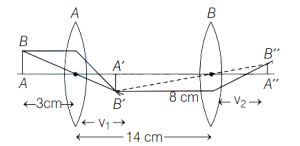
Two lenses $A$ and $B$ having focal lengths $2.0 \,cm$ and $5.0 \,cm$, respectively, are placed $14 \,cm$ apart. Lens $A$ is placed to the left of lens $B$. An object is placed $3 \,cm$ to the left of lens $A$. The distance of the final image from lens $A$ will be:
A
$\frac{40}{3} \,cm$
B
$\frac{82}{3} \,cm$
C
$\frac{112}{5} \,cm$
D
$\frac{92}{5} \,cm$
Solution
(B) Given: Focal length of lens $A$, $f_1 = 2 \,cm$. Focal length of lens $B$, $f_2 = 5 \,cm$. Distance between lenses $d = 14 \,cm$. Object distance for lens $A$, $u_1 = -3 \,cm$.
For lens $A$, using the lens formula $\frac{1}{v_1} - \frac{1}{u_1} = \frac{1}{f_1}$:
$\frac{1}{v_1} - \frac{1}{-3} = \frac{1}{2}$
$\frac{1}{v_1} = \frac{1}{2} - \frac{1}{3} = \frac{1}{6}$
$v_1 = 6 \,cm$.
The image formed by lens $A$ acts as an object for lens $B$. The distance of this image from lens $B$ is $u_2 = -(d - v_1) = -(14 - 6) = -8 \,cm$.
For lens $B$, using the lens formula $\frac{1}{v_2} - \frac{1}{u_2} = \frac{1}{f_2}$:
$\frac{1}{v_2} - \frac{1}{-8} = \frac{1}{5}$
$\frac{1}{v_2} = \frac{1}{5} - \frac{1}{8} = \frac{8 - 5}{40} = \frac{3}{40}$
$v_2 = \frac{40}{3} \,cm$.
The distance of the final image from lens $A$ is the distance between the lenses plus the distance of the image from lens $B$:
Distance $= d + v_2 = 14 + \frac{40}{3} = \frac{42 + 40}{3} = \frac{82}{3} \,cm$.
For lens $A$, using the lens formula $\frac{1}{v_1} - \frac{1}{u_1} = \frac{1}{f_1}$:
$\frac{1}{v_1} - \frac{1}{-3} = \frac{1}{2}$
$\frac{1}{v_1} = \frac{1}{2} - \frac{1}{3} = \frac{1}{6}$
$v_1 = 6 \,cm$.
The image formed by lens $A$ acts as an object for lens $B$. The distance of this image from lens $B$ is $u_2 = -(d - v_1) = -(14 - 6) = -8 \,cm$.
For lens $B$, using the lens formula $\frac{1}{v_2} - \frac{1}{u_2} = \frac{1}{f_2}$:
$\frac{1}{v_2} - \frac{1}{-8} = \frac{1}{5}$
$\frac{1}{v_2} = \frac{1}{5} - \frac{1}{8} = \frac{8 - 5}{40} = \frac{3}{40}$
$v_2 = \frac{40}{3} \,cm$.
The distance of the final image from lens $A$ is the distance between the lenses plus the distance of the image from lens $B$:
Distance $= d + v_2 = 14 + \frac{40}{3} = \frac{42 + 40}{3} = \frac{82}{3} \,cm$.
0 likes
View Solution167
DifficultMCQ
Three thin lenses are combined by placing them in contact with each other to get more magnification in an optical instrument. Each lens has a focal length of $3 \,cm$. If the least distance of distinct vision is taken as $25 \,cm$,the total magnification of the lens combination in normal adjustment is
A
$9$
B
$26$
C
$300$
D
$3$
Solution
(B) The combined focal length $F$ of three thin lenses in contact is given by the formula: $\frac{1}{F} = \frac{1}{F_1} + \frac{1}{F_2} + \frac{1}{F_3}$.
Given $F_1 = F_2 = F_3 = 3 \,cm$,we have $\frac{1}{F} = \frac{1}{3} + \frac{1}{3} + \frac{1}{3} = \frac{3}{3} = 1 \,cm^{-1}$.
Thus,the effective focal length is $F = 1 \,cm$.
The magnification $M$ of a simple magnifier (or a lens combination acting as one) in normal adjustment is given by $M = 1 + \frac{D}{F}$,where $D$ is the least distance of distinct vision.
Given $D = 25 \,cm$ and $F = 1 \,cm$,we get $M = 1 + \frac{25}{1} = 26$.
Given $F_1 = F_2 = F_3 = 3 \,cm$,we have $\frac{1}{F} = \frac{1}{3} + \frac{1}{3} + \frac{1}{3} = \frac{3}{3} = 1 \,cm^{-1}$.
Thus,the effective focal length is $F = 1 \,cm$.
The magnification $M$ of a simple magnifier (or a lens combination acting as one) in normal adjustment is given by $M = 1 + \frac{D}{F}$,where $D$ is the least distance of distinct vision.
Given $D = 25 \,cm$ and $F = 1 \,cm$,we get $M = 1 + \frac{25}{1} = 26$.
0 likes
View Solution168
DifficultMCQ
The dispersive powers of the materials of two lenses forming an achromatic combination are in the ratio of $4:3$. If the effective focal length of the combination is $+60 \ cm$,then the focal lengths of the lenses should be:
A
$-20 \ cm, 25 \ cm$
B
$20 \ cm, -25 \ cm$
C
$-15 \ cm, 20 \ cm$
D
$15 \ cm, -20 \ cm$
Solution
(A) For an achromatic combination of two thin lenses,the condition is $\frac{\omega_1}{f_1} + \frac{\omega_2}{f_2} = 0$,which implies $\frac{f_1}{f_2} = -\frac{\omega_1}{\omega_2}$.
Given the ratio of dispersive powers $\frac{\omega_1}{\omega_2} = \frac{4}{3}$,we have $\frac{f_1}{f_2} = -\frac{4}{3}$,so $f_1 = -\frac{4}{3}f_2$.
The effective focal length $F$ of the combination is given by $\frac{1}{F} = \frac{1}{f_1} + \frac{1}{f_2}$.
Substituting $F = 60 \ cm$ and $f_1 = -\frac{4}{3}f_2$:
$\frac{1}{60} = \frac{1}{-(4/3)f_2} + \frac{1}{f_2} = \frac{1}{f_2} (1 - \frac{3}{4}) = \frac{1}{f_2} (\frac{1}{4})$.
Thus,$f_2 = 60 \times \frac{1}{4} = 15 \ cm$.
Then,$f_1 = -\frac{4}{3} \times 15 = -20 \ cm$.
Therefore,the focal lengths are $-20 \ cm$ and $15 \ cm$.
Given the ratio of dispersive powers $\frac{\omega_1}{\omega_2} = \frac{4}{3}$,we have $\frac{f_1}{f_2} = -\frac{4}{3}$,so $f_1 = -\frac{4}{3}f_2$.
The effective focal length $F$ of the combination is given by $\frac{1}{F} = \frac{1}{f_1} + \frac{1}{f_2}$.
Substituting $F = 60 \ cm$ and $f_1 = -\frac{4}{3}f_2$:
$\frac{1}{60} = \frac{1}{-(4/3)f_2} + \frac{1}{f_2} = \frac{1}{f_2} (1 - \frac{3}{4}) = \frac{1}{f_2} (\frac{1}{4})$.
Thus,$f_2 = 60 \times \frac{1}{4} = 15 \ cm$.
Then,$f_1 = -\frac{4}{3} \times 15 = -20 \ cm$.
Therefore,the focal lengths are $-20 \ cm$ and $15 \ cm$.
0 likes
View Solution169
MediumMCQ
The focal length (in $cm$) of a lens with dispersive power $0.45$ that should be placed in contact with a convex lens of focal length $84 \,cm$ and dispersive power $0.21$ to form an achromatic combination is:
A
$45$
B
$90$
C
$180$
D
-$180$
Solution
(D) Given:
Dispersive power of the first lens, $\omega_1 = 0.45$.
Dispersive power of the second lens, $\omega_2 = 0.21$.
Focal length of the second lens, $f_2 = 84 \,cm$.
For an achromatic combination of two thin lenses in contact, the condition is given by:
$\frac{\omega_1}{f_1} + \frac{\omega_2}{f_2} = 0$
$\frac{\omega_1}{f_1} = -\frac{\omega_2}{f_2}$
$\frac{f_1}{f_2} = -\frac{\omega_1}{\omega_2}$
Substituting the values:
$f_1 = -f_2 \times \left( \frac{\omega_1}{\omega_2} \right)$
$f_1 = -84 \times \left( \frac{0.45}{0.21} \right)$
$f_1 = -84 \times \left( \frac{45}{21} \right)$
$f_1 = -84 \times \frac{15}{7}$
$f_1 = -12 \times 15 = -180 \,cm$.
Thus, the focal length of the lens is $-180 \,cm$.
Dispersive power of the first lens, $\omega_1 = 0.45$.
Dispersive power of the second lens, $\omega_2 = 0.21$.
Focal length of the second lens, $f_2 = 84 \,cm$.
For an achromatic combination of two thin lenses in contact, the condition is given by:
$\frac{\omega_1}{f_1} + \frac{\omega_2}{f_2} = 0$
$\frac{\omega_1}{f_1} = -\frac{\omega_2}{f_2}$
$\frac{f_1}{f_2} = -\frac{\omega_1}{\omega_2}$
Substituting the values:
$f_1 = -f_2 \times \left( \frac{\omega_1}{\omega_2} \right)$
$f_1 = -84 \times \left( \frac{0.45}{0.21} \right)$
$f_1 = -84 \times \left( \frac{45}{21} \right)$
$f_1 = -84 \times \frac{15}{7}$
$f_1 = -12 \times 15 = -180 \,cm$.
Thus, the focal length of the lens is $-180 \,cm$.
0 likes
View Solution170
EasyMCQ
The two lenses of an achromatic doublet should have:
A
equal powers
B
equal dispersive powers
C
equal ratio of their power and dispersive power
D
sum of the product of their powers and dispersive power equal to zero
Solution
(D) An achromatic doublet is a combination of two lenses made of different materials designed to minimize chromatic aberration.
For an achromatic doublet,the condition for the combination to be achromatic is given by the equation:
$\omega_1 P_1 + \omega_2 P_2 = 0$
where $P_1$ and $P_2$ are the powers of the two lenses and $\omega_1$ and $\omega_2$ are their respective dispersive powers.
This equation implies that the sum of the product of their powers and dispersive powers must be equal to zero.
For an achromatic doublet,the condition for the combination to be achromatic is given by the equation:
$\omega_1 P_1 + \omega_2 P_2 = 0$
where $P_1$ and $P_2$ are the powers of the two lenses and $\omega_1$ and $\omega_2$ are their respective dispersive powers.
This equation implies that the sum of the product of their powers and dispersive powers must be equal to zero.
0 likes
View Solution171
MediumMCQ
An achromatic combination of lenses produces
A
images in black and white
B
coloured images
C
images unaffected by variation of refractive index with wavelength
D
highly enlarged images are formed
Solution
(C) The image of an object in white light formed by a single lens is usually coloured and blurred because the focal length of the lens varies with the wavelength of light. This defect is known as chromatic aberration.
An achromatic combination of lenses is designed to minimize or eliminate this chromatic aberration.
By combining two lenses of different materials (typically a convex lens of crown glass and a concave lens of flint glass),the dispersion caused by one lens is cancelled by the other.
Therefore,the resulting image is free from chromatic aberration,meaning the image quality is not affected by the variation of the refractive index with the wavelength of light.
An achromatic combination of lenses is designed to minimize or eliminate this chromatic aberration.
By combining two lenses of different materials (typically a convex lens of crown glass and a concave lens of flint glass),the dispersion caused by one lens is cancelled by the other.
Therefore,the resulting image is free from chromatic aberration,meaning the image quality is not affected by the variation of the refractive index with the wavelength of light.
0 likes
View Solution172
EasyMCQ
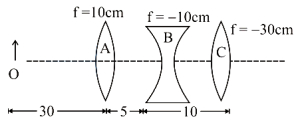
Three lenses of focal lengths $+10 \ cm, -10 \ cm$ and $+30 \ cm$ are placed at distances of $30 \ cm, 35 \ cm$ and $45 \ cm$ respectively from an object. The distance between the object and the final image formed is: (in $cm$)
A
$100$
B
$75$
C
$30$
D
$45$
Solution
(B) From the diagram,the object $O$ is at $30 \ cm$ from lens $A$. Lens $B$ is at $5 \ cm$ from lens $A$,and lens $C$ is at $10 \ cm$ from lens $B$.
For lens $A$: $u_A = -30 \ cm$,$f_A = +10 \ cm$.
Using the lens formula $\frac{1}{v_A} - \frac{1}{u_A} = \frac{1}{f_A}$:
$\frac{1}{v_A} - \frac{1}{-30} = \frac{1}{10} \Rightarrow \frac{1}{v_A} = \frac{1}{10} - \frac{1}{30} = \frac{2}{30} = \frac{1}{15} \Rightarrow v_A = 15 \ cm$.
The image formed by lens $A$ acts as an object for lens $B$. The distance of this image from lens $B$ is $u_B = +(v_A - 5) = +(15 - 5) = +10 \ cm$.
For lens $B$: $u_B = +10 \ cm$,$f_B = -10 \ cm$.
Using the lens formula: $\frac{1}{v_B} - \frac{1}{10} = \frac{1}{-10} \Rightarrow \frac{1}{v_B} = 0 \Rightarrow v_B = \infty$.
The rays emerging from lens $B$ are parallel,so they act as an object at infinity for lens $C$.
For lens $C$: $u_C = \infty$,$f_C = +30 \ cm$.
Using the lens formula: $\frac{1}{v_C} - \frac{1}{\infty} = \frac{1}{30} \Rightarrow v_C = 30 \ cm$.
The final image is formed at $30 \ cm$ from lens $C$. The total distance of lens $C$ from the object is $30 + 5 + 10 = 45 \ cm$. The final image is at $30 \ cm$ from lens $C$,so the distance from the object is $45 + 30 = 75 \ cm$.
For lens $A$: $u_A = -30 \ cm$,$f_A = +10 \ cm$.
Using the lens formula $\frac{1}{v_A} - \frac{1}{u_A} = \frac{1}{f_A}$:
$\frac{1}{v_A} - \frac{1}{-30} = \frac{1}{10} \Rightarrow \frac{1}{v_A} = \frac{1}{10} - \frac{1}{30} = \frac{2}{30} = \frac{1}{15} \Rightarrow v_A = 15 \ cm$.
The image formed by lens $A$ acts as an object for lens $B$. The distance of this image from lens $B$ is $u_B = +(v_A - 5) = +(15 - 5) = +10 \ cm$.
For lens $B$: $u_B = +10 \ cm$,$f_B = -10 \ cm$.
Using the lens formula: $\frac{1}{v_B} - \frac{1}{10} = \frac{1}{-10} \Rightarrow \frac{1}{v_B} = 0 \Rightarrow v_B = \infty$.
The rays emerging from lens $B$ are parallel,so they act as an object at infinity for lens $C$.
For lens $C$: $u_C = \infty$,$f_C = +30 \ cm$.
Using the lens formula: $\frac{1}{v_C} - \frac{1}{\infty} = \frac{1}{30} \Rightarrow v_C = 30 \ cm$.
The final image is formed at $30 \ cm$ from lens $C$. The total distance of lens $C$ from the object is $30 + 5 + 10 = 45 \ cm$. The final image is at $30 \ cm$ from lens $C$,so the distance from the object is $45 + 30 = 75 \ cm$.
0 likes
View Solution173
DifficultMCQ
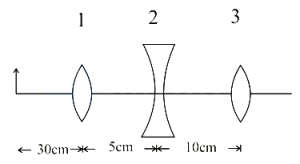
The position of the final image formed by the given lens combination from the third lens will be at a distance of $(f_1 = +10 \ cm, f_2 = -10 \ cm, f_3 = +30 \ cm)$.
A
$15 \ cm$
B
Infinity
C
$45 \ cm$
D
$30 \ cm$
Solution
(D) For the first lens:
$f_1 = +10 \ cm, u_1 = -30 \ cm$.
Applying the lens formula $\frac{1}{f} = \frac{1}{v} - \frac{1}{u}$:
$\frac{1}{v_1} = \frac{1}{f_1} + \frac{1}{u_1} = \frac{1}{10} - \frac{1}{30} = \frac{3-1}{30} = \frac{2}{30} = \frac{1}{15}$.
So,$v_1 = +15 \ cm$.
This image acts as an object for the second lens. The distance between the first and second lens is $5 \ cm$,so the object distance for the second lens is $u_2 = +(15 - 5) = +10 \ cm$.
For the second lens $(f_2 = -10 \ cm)$:
$\frac{1}{v_2} = \frac{1}{f_2} + \frac{1}{u_2} = \frac{1}{-10} + \frac{1}{10} = 0$.
So,$v_2 = \infty$.
The rays emerging from the second lens are parallel to the principal axis.
These parallel rays fall on the third lens $(f_3 = +30 \ cm)$. Parallel rays incident on a convex lens converge at its focus.
Therefore,the final image is formed at a distance of $30 \ cm$ from the third lens.
$f_1 = +10 \ cm, u_1 = -30 \ cm$.
Applying the lens formula $\frac{1}{f} = \frac{1}{v} - \frac{1}{u}$:
$\frac{1}{v_1} = \frac{1}{f_1} + \frac{1}{u_1} = \frac{1}{10} - \frac{1}{30} = \frac{3-1}{30} = \frac{2}{30} = \frac{1}{15}$.
So,$v_1 = +15 \ cm$.
This image acts as an object for the second lens. The distance between the first and second lens is $5 \ cm$,so the object distance for the second lens is $u_2 = +(15 - 5) = +10 \ cm$.
For the second lens $(f_2 = -10 \ cm)$:
$\frac{1}{v_2} = \frac{1}{f_2} + \frac{1}{u_2} = \frac{1}{-10} + \frac{1}{10} = 0$.
So,$v_2 = \infty$.
The rays emerging from the second lens are parallel to the principal axis.
These parallel rays fall on the third lens $(f_3 = +30 \ cm)$. Parallel rays incident on a convex lens converge at its focus.
Therefore,the final image is formed at a distance of $30 \ cm$ from the third lens.
0 likes
View Solution174
DifficultMCQ
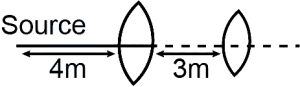
An object is located $4 \ m$ from the first of two thin converging lenses of focal lengths $2 \ m$ and $1 \ m,$ respectively. The lenses are separated by $3 \ m$. The final image formed by the second lens is located from the source at a distance of (in $m$):
A
$8.0$
B
$7.5$
C
$6.0$
D
$6.5$
Solution
(B) For the first lens:
Using the lens formula $\frac{1}{f_1} = \frac{1}{v_1} - \frac{1}{u_1}$,where $f_1 = 2 \ m$ and $u_1 = -4 \ m$:
$\frac{1}{2} = \frac{1}{v_1} - \frac{1}{-4} \Rightarrow \frac{1}{v_1} = \frac{1}{2} - \frac{1}{4} = \frac{1}{4} \Rightarrow v_1 = 4 \ m$.
This image is formed $4 \ m$ to the right of the first lens.
For the second lens:
The distance between the lenses is $3 \ m$. The image formed by the first lens acts as an object for the second lens.
Since the image is $4 \ m$ to the right of the first lens and the second lens is $3 \ m$ to the right of the first,the image is $1 \ m$ to the right of the second lens.
Thus,the object distance for the second lens is $u_2 = +1 \ m$ (virtual object).
Using the lens formula $\frac{1}{f_2} = \frac{1}{v_2} - \frac{1}{u_2}$,where $f_2 = 1 \ m$ and $u_2 = +1 \ m$:
$\frac{1}{1} = \frac{1}{v_2} - \frac{1}{1} \Rightarrow \frac{1}{v_2} = 1 + 1 = 2 \Rightarrow v_2 = 0.5 \ m$.
The final image is $0.5 \ m$ to the right of the second lens.
The total distance from the source is $4 \ m$ (to first lens) $+ 3 \ m$ (between lenses) $+ 0.5 \ m$ (from second lens) $= 7.5 \ m$.
Using the lens formula $\frac{1}{f_1} = \frac{1}{v_1} - \frac{1}{u_1}$,where $f_1 = 2 \ m$ and $u_1 = -4 \ m$:
$\frac{1}{2} = \frac{1}{v_1} - \frac{1}{-4} \Rightarrow \frac{1}{v_1} = \frac{1}{2} - \frac{1}{4} = \frac{1}{4} \Rightarrow v_1 = 4 \ m$.
This image is formed $4 \ m$ to the right of the first lens.
For the second lens:
The distance between the lenses is $3 \ m$. The image formed by the first lens acts as an object for the second lens.
Since the image is $4 \ m$ to the right of the first lens and the second lens is $3 \ m$ to the right of the first,the image is $1 \ m$ to the right of the second lens.
Thus,the object distance for the second lens is $u_2 = +1 \ m$ (virtual object).
Using the lens formula $\frac{1}{f_2} = \frac{1}{v_2} - \frac{1}{u_2}$,where $f_2 = 1 \ m$ and $u_2 = +1 \ m$:
$\frac{1}{1} = \frac{1}{v_2} - \frac{1}{1} \Rightarrow \frac{1}{v_2} = 1 + 1 = 2 \Rightarrow v_2 = 0.5 \ m$.
The final image is $0.5 \ m$ to the right of the second lens.
The total distance from the source is $4 \ m$ (to first lens) $+ 3 \ m$ (between lenses) $+ 0.5 \ m$ (from second lens) $= 7.5 \ m$.
0 likes
View Solution175
MediumMCQ
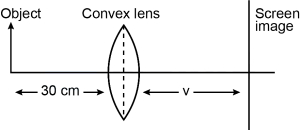
An object is placed $30 \ cm$ away from a convex lens of focal length $10 \ cm$ and a sharp image is formed on a screen. Now,a concave lens is placed in contact with the convex lens. The screen now has to be moved by $45 \ cm$ to get a sharp image again. The magnitude of the focal length of the concave lens is (in $cm$):
A
$72$
B
$60$
C
$36$
D
$20$
Solution
(D) For the first condition,using the lens formula $\frac{1}{f} = \frac{1}{v} - \frac{1}{u}$:
Given $f_1 = 10 \ cm$ and $u = -30 \ cm$.
$\frac{1}{10} = \frac{1}{v} - \frac{1}{-30} \Rightarrow \frac{1}{v} = \frac{1}{10} - \frac{1}{30} = \frac{3-1}{30} = \frac{2}{30} = \frac{1}{15}$.
So,$v = 15 \ cm$.
For the second condition,when the concave lens is placed in contact,the new image distance $v' = v + 45 \ cm = 15 + 45 = 60 \ cm$.
The object distance $u$ remains $-30 \ cm$.
Let $F$ be the focal length of the combination: $\frac{1}{F} = \frac{1}{v'} - \frac{1}{u} = \frac{1}{60} - \frac{1}{-30} = \frac{1}{60} + \frac{2}{60} = \frac{3}{60} = \frac{1}{20}$.
So,$F = 20 \ cm$.
Using the combination formula $\frac{1}{F} = \frac{1}{f_1} + \frac{1}{f_2}$:
$\frac{1}{20} = \frac{1}{10} + \frac{1}{f_2} \Rightarrow \frac{1}{f_2} = \frac{1}{20} - \frac{1}{10} = \frac{1-2}{20} = -\frac{1}{20}$.
Thus,$f_2 = -20 \ cm$.
The magnitude of the focal length of the concave lens is $20 \ cm$.
Given $f_1 = 10 \ cm$ and $u = -30 \ cm$.
$\frac{1}{10} = \frac{1}{v} - \frac{1}{-30} \Rightarrow \frac{1}{v} = \frac{1}{10} - \frac{1}{30} = \frac{3-1}{30} = \frac{2}{30} = \frac{1}{15}$.
So,$v = 15 \ cm$.
For the second condition,when the concave lens is placed in contact,the new image distance $v' = v + 45 \ cm = 15 + 45 = 60 \ cm$.
The object distance $u$ remains $-30 \ cm$.
Let $F$ be the focal length of the combination: $\frac{1}{F} = \frac{1}{v'} - \frac{1}{u} = \frac{1}{60} - \frac{1}{-30} = \frac{1}{60} + \frac{2}{60} = \frac{3}{60} = \frac{1}{20}$.
So,$F = 20 \ cm$.
Using the combination formula $\frac{1}{F} = \frac{1}{f_1} + \frac{1}{f_2}$:
$\frac{1}{20} = \frac{1}{10} + \frac{1}{f_2} \Rightarrow \frac{1}{f_2} = \frac{1}{20} - \frac{1}{10} = \frac{1-2}{20} = -\frac{1}{20}$.
Thus,$f_2 = -20 \ cm$.
The magnitude of the focal length of the concave lens is $20 \ cm$.
0 likes
View Solution176
MediumMCQ
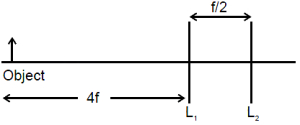
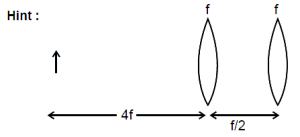
Two convex lenses ($L_1$ and $L_2$) of equal focal length $f$ are placed at a distance $\frac{f}{2}$ apart. An object is placed at a distance $4f$ to the left of $L_1$ as shown in the figure. The final image is at:
A
$\frac{5f}{11}$ to the right of $L_2$
B
$\frac{5f}{11}$ to the left of $L_2$
C
$5f$ to the right of $L_2$
D
$5f$ to the left of $L_2$
Solution
(D) For the first lens $L_1$,the object distance $u_1 = -4f$ and focal length $f_1 = f$. Using the lens formula $\frac{1}{v_1} - \frac{1}{u_1} = \frac{1}{f_1}$:
$\frac{1}{v_1} - \frac{1}{-4f} = \frac{1}{f} \Rightarrow \frac{1}{v_1} = \frac{1}{f} - \frac{1}{4f} = \frac{3}{4f} \Rightarrow v_1 = \frac{4f}{3}$.
This image acts as an object for the second lens $L_2$. The distance between the lenses is $d = \frac{f}{2}$.
The object distance for the second lens is $u_2 = v_1 - d = \frac{4f}{3} - \frac{f}{2} = \frac{8f - 3f}{6} = \frac{5f}{6}$.
Since the object is to the left of $L_2$,$u_2 = -\frac{5f}{6}$.
Using the lens formula for $L_2$ with $f_2 = f$:
$\frac{1}{v_2} - \frac{1}{u_2} = \frac{1}{f_2} \Rightarrow \frac{1}{v_2} - \frac{1}{-5f/6} = \frac{1}{f} \Rightarrow \frac{1}{v_2} + \frac{6}{5f} = \frac{1}{f}$.
$\frac{1}{v_2} = \frac{1}{f} - \frac{6}{5f} = \frac{5 - 6}{5f} = -\frac{1}{5f} \Rightarrow v_2 = -5f$.
The negative sign indicates that the final image is formed at a distance $5f$ to the left of $L_2$.
$\frac{1}{v_1} - \frac{1}{-4f} = \frac{1}{f} \Rightarrow \frac{1}{v_1} = \frac{1}{f} - \frac{1}{4f} = \frac{3}{4f} \Rightarrow v_1 = \frac{4f}{3}$.
This image acts as an object for the second lens $L_2$. The distance between the lenses is $d = \frac{f}{2}$.
The object distance for the second lens is $u_2 = v_1 - d = \frac{4f}{3} - \frac{f}{2} = \frac{8f - 3f}{6} = \frac{5f}{6}$.
Since the object is to the left of $L_2$,$u_2 = -\frac{5f}{6}$.
Using the lens formula for $L_2$ with $f_2 = f$:
$\frac{1}{v_2} - \frac{1}{u_2} = \frac{1}{f_2} \Rightarrow \frac{1}{v_2} - \frac{1}{-5f/6} = \frac{1}{f} \Rightarrow \frac{1}{v_2} + \frac{6}{5f} = \frac{1}{f}$.
$\frac{1}{v_2} = \frac{1}{f} - \frac{6}{5f} = \frac{5 - 6}{5f} = -\frac{1}{5f} \Rightarrow v_2 = -5f$.
The negative sign indicates that the final image is formed at a distance $5f$ to the left of $L_2$.
0 likes
View Solution177
MediumMCQ
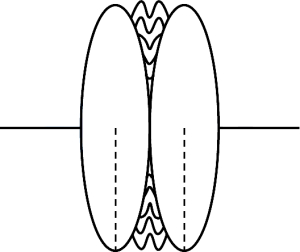
Two identical equiconvex lenses,each of focal length $f$,are placed side by side in contact with each other with a layer of water in between them as shown in the figure. If the refractive index of the material of the lenses is greater than that of water,how is the combined focal length $F$ related to $f$?
A
$F > f$
B
$\frac{f}{2} < F < f$
C
$F < \frac{f}{2}$
D
$F = f$
Solution
(B) The given combination consists of three lenses in contact: two identical equiconvex glass lenses ($L_1$ and $L_3$) and one water lens $(L_2)$ formed in the space between them.
Let $f_1$ be the focal length of each glass lens and $f_2$ be the focal length of the water lens.
The combination of lenses is in contact,so the equivalent focal length $F$ is given by:
$\frac{1}{F} = \frac{1}{f_1} + \frac{1}{f_2} + \frac{1}{f_3}$
Since $L_1$ and $L_3$ are identical,$f_1 = f_3 = f$. The water lens $L_2$ is a biconcave lens,so its focal length $f_2$ is negative.
Thus,$\frac{1}{F} = \frac{1}{f} + \frac{1}{f_2} + \frac{1}{f} = \frac{2}{f} + \frac{1}{f_2}$.
Let $R$ be the radius of curvature. For the glass lenses,$\frac{1}{f} = (\mu_g - 1)(\frac{2}{R})$. For the water lens,$\frac{1}{f_2} = -(\mu_w - 1)(\frac{2}{R})$.
Since $\mu_g > \mu_w$,the magnitude of the power of the glass lens is greater than that of the water lens,meaning $|\frac{1}{f}| > |\frac{1}{f_2}|$.
Therefore,$\frac{1}{F} = \frac{2}{f} - |\frac{1}{f_2}|$. Since $|\frac{1}{f_2}| > 0$,$\frac{1}{F} < \frac{2}{f}$,which implies $F > \frac{f}{2}$.
Also,since $\frac{1}{F} = \frac{2}{f} - |\frac{1}{f_2}|$,it is clear that $\frac{1}{F} > \frac{1}{f}$ (because we are subtracting a positive value from $\frac{2}{f}$ but the net power is still positive and less than $\frac{2}{f}$),thus $F < f$.
Combining these,we get $\frac{f}{2} < F < f$.
Let $f_1$ be the focal length of each glass lens and $f_2$ be the focal length of the water lens.
The combination of lenses is in contact,so the equivalent focal length $F$ is given by:
$\frac{1}{F} = \frac{1}{f_1} + \frac{1}{f_2} + \frac{1}{f_3}$
Since $L_1$ and $L_3$ are identical,$f_1 = f_3 = f$. The water lens $L_2$ is a biconcave lens,so its focal length $f_2$ is negative.
Thus,$\frac{1}{F} = \frac{1}{f} + \frac{1}{f_2} + \frac{1}{f} = \frac{2}{f} + \frac{1}{f_2}$.
Let $R$ be the radius of curvature. For the glass lenses,$\frac{1}{f} = (\mu_g - 1)(\frac{2}{R})$. For the water lens,$\frac{1}{f_2} = -(\mu_w - 1)(\frac{2}{R})$.
Since $\mu_g > \mu_w$,the magnitude of the power of the glass lens is greater than that of the water lens,meaning $|\frac{1}{f}| > |\frac{1}{f_2}|$.
Therefore,$\frac{1}{F} = \frac{2}{f} - |\frac{1}{f_2}|$. Since $|\frac{1}{f_2}| > 0$,$\frac{1}{F} < \frac{2}{f}$,which implies $F > \frac{f}{2}$.
Also,since $\frac{1}{F} = \frac{2}{f} - |\frac{1}{f_2}|$,it is clear that $\frac{1}{F} > \frac{1}{f}$ (because we are subtracting a positive value from $\frac{2}{f}$ but the net power is still positive and less than $\frac{2}{f}$),thus $F < f$.
Combining these,we get $\frac{f}{2} < F < f$.
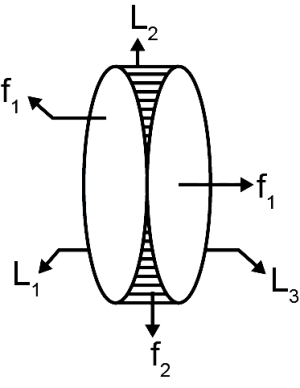
0 likes
View Solution178
EasyMCQ
Two thin lenses of focal lengths $20 \ cm$ and $25 \ cm$ are placed in contact. The effective power of the combination is (in $D$)
A
$9$
B
$2$
C
$3$
D
$1$
Solution
(A) The power $P$ of a lens is given by $P = \frac{100}{f}$ where $f$ is the focal length in $cm$.
For the first lens,$P_1 = \frac{100}{20} = 5 \ D$.
For the second lens,$P_2 = \frac{100}{25} = 4 \ D$.
When two thin lenses are placed in contact,the effective power $P_{eff}$ of the combination is the sum of their individual powers: $P_{eff} = P_1 + P_2$.
Therefore,$P_{eff} = 5 \ D + 4 \ D = 9 \ D$.
For the first lens,$P_1 = \frac{100}{20} = 5 \ D$.
For the second lens,$P_2 = \frac{100}{25} = 4 \ D$.
When two thin lenses are placed in contact,the effective power $P_{eff}$ of the combination is the sum of their individual powers: $P_{eff} = P_1 + P_2$.
Therefore,$P_{eff} = 5 \ D + 4 \ D = 9 \ D$.
0 likes
View Solution179
DifficultMCQ
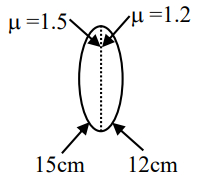
$A$ biconvex lens is formed by using two thin planoconvex lenses,as shown in the figure. The refractive index and radius of curved surfaces are also mentioned in the figure. When an object is placed on the left side of the lens at a distance of $30 \ cm$ from the biconvex lens,the magnification of the image will be:
A
$-2$
B
$+2$
C
$+2.5$
D
$-2.5$
Solution
(A) The focal length of a lens is given by the lens maker's formula: $\frac{1}{f} = (\mu - 1)(\frac{1}{R_1} - \frac{1}{R_2})$.
For the first planoconvex lens: $\frac{1}{f_1} = (1.5 - 1)(\frac{1}{15} - \frac{1}{\infty}) = 0.5 \times \frac{1}{15} = \frac{1}{30} \ cm^{-1}$.
For the second planoconvex lens: $\frac{1}{f_2} = (1.2 - 1)(\frac{1}{\infty} - (-\frac{1}{12})) = 0.2 \times \frac{1}{12} = \frac{1}{60} \ cm^{-1}$.
The net focal length of the combination is $\frac{1}{f_{net}} = \frac{1}{f_1} + \frac{1}{f_2} = \frac{1}{30} + \frac{1}{60} = \frac{2+1}{60} = \frac{3}{60} = \frac{1}{20} \ cm^{-1}$,so $f_{net} = 20 \ cm$.
Using the lens formula $\frac{1}{v} - \frac{1}{u} = \frac{1}{f}$,with $u = -30 \ cm$ and $f = 20 \ cm$:
$\frac{1}{v} - \frac{1}{-30} = \frac{1}{20} \implies \frac{1}{v} = \frac{1}{20} - \frac{1}{30} = \frac{3-2}{60} = \frac{1}{60}$.
Thus,$v = 60 \ cm$.
The magnification is $m = \frac{v}{u} = \frac{60}{-30} = -2$.
For the first planoconvex lens: $\frac{1}{f_1} = (1.5 - 1)(\frac{1}{15} - \frac{1}{\infty}) = 0.5 \times \frac{1}{15} = \frac{1}{30} \ cm^{-1}$.
For the second planoconvex lens: $\frac{1}{f_2} = (1.2 - 1)(\frac{1}{\infty} - (-\frac{1}{12})) = 0.2 \times \frac{1}{12} = \frac{1}{60} \ cm^{-1}$.
The net focal length of the combination is $\frac{1}{f_{net}} = \frac{1}{f_1} + \frac{1}{f_2} = \frac{1}{30} + \frac{1}{60} = \frac{2+1}{60} = \frac{3}{60} = \frac{1}{20} \ cm^{-1}$,so $f_{net} = 20 \ cm$.
Using the lens formula $\frac{1}{v} - \frac{1}{u} = \frac{1}{f}$,with $u = -30 \ cm$ and $f = 20 \ cm$:
$\frac{1}{v} - \frac{1}{-30} = \frac{1}{20} \implies \frac{1}{v} = \frac{1}{20} - \frac{1}{30} = \frac{3-2}{60} = \frac{1}{60}$.
Thus,$v = 60 \ cm$.
The magnification is $m = \frac{v}{u} = \frac{60}{-30} = -2$.
0 likes
View Solution180
DifficultMCQ
$A$ thin convex lens of focal length $5 \ cm$ and a thin concave lens of focal length $4 \ cm$ are combined together (without any gap) and this combination has magnification $m_1$,when an object is placed $10 \ cm$ before the convex lens. Keeping the positions of the convex lens and object undisturbed,a gap of $1 \ cm$ is introduced between the lenses by moving the concave lens away,which leads to a change in the magnification of the total lens system to $m_2$. The value of $\left|\frac{m_1}{m_2}\right|$ is . . . . . . .
A
$5/6$
B
$5/27$
C
$3/2$
D
$25/27$
Solution
(A) For the combined lenses without a gap: The equivalent focal length $F$ is given by $\frac{1}{F} = \frac{1}{f_1} + \frac{1}{f_2} = \frac{1}{5} - \frac{1}{4} = -\frac{1}{20} \ cm$. So,$F = -20 \ cm$. Using the lens formula $\frac{1}{v} - \frac{1}{u} = \frac{1}{F}$,with $u = -10 \ cm$,we get $\frac{1}{v} = \frac{1}{-20} + \frac{1}{-10} = -\frac{3}{20}$,so $v_1 = -\frac{20}{3} \ cm$. Magnification $m_1 = \frac{v_1}{u} = \frac{-20/3}{-10} = \frac{2}{3}$.
For the lenses separated by $d = 1 \ cm$: First lens (convex) forms an image at $v'$ where $\frac{1}{v'} - \frac{1}{-10} = \frac{1}{5} \implies \frac{1}{v'} = \frac{1}{10} \implies v' = 10 \ cm$. Magnification $m_{1}' = \frac{v'}{u} = \frac{10}{-10} = -1$. This image acts as an object for the concave lens. The distance of this image from the concave lens is $u' = v' - d = 10 - 1 = 9 \ cm$. Since it is behind the lens,$u' = +9 \ cm$. Using the lens formula for the concave lens: $\frac{1}{v''} - \frac{1}{9} = \frac{1}{-4} \implies \frac{1}{v''} = \frac{1}{9} - \frac{1}{4} = -\frac{5}{36} \implies v'' = -\frac{36}{5} \ cm$. Magnification $m_{2}' = \frac{v''}{u'} = \frac{-36/5}{9} = -\frac{4}{5}$. Total magnification $m_2 = m_{1}' \times m_{2}' = (-1) \times (-4/5) = 4/5$. Finally,$\left|\frac{m_1}{m_2}\right| = \left|\frac{2/3}{4/5}\right| = \frac{2}{3} \times \frac{5}{4} = \frac{5}{6}$.
For the lenses separated by $d = 1 \ cm$: First lens (convex) forms an image at $v'$ where $\frac{1}{v'} - \frac{1}{-10} = \frac{1}{5} \implies \frac{1}{v'} = \frac{1}{10} \implies v' = 10 \ cm$. Magnification $m_{1}' = \frac{v'}{u} = \frac{10}{-10} = -1$. This image acts as an object for the concave lens. The distance of this image from the concave lens is $u' = v' - d = 10 - 1 = 9 \ cm$. Since it is behind the lens,$u' = +9 \ cm$. Using the lens formula for the concave lens: $\frac{1}{v''} - \frac{1}{9} = \frac{1}{-4} \implies \frac{1}{v''} = \frac{1}{9} - \frac{1}{4} = -\frac{5}{36} \implies v'' = -\frac{36}{5} \ cm$. Magnification $m_{2}' = \frac{v''}{u'} = \frac{-36/5}{9} = -\frac{4}{5}$. Total magnification $m_2 = m_{1}' \times m_{2}' = (-1) \times (-4/5) = 4/5$. Finally,$\left|\frac{m_1}{m_2}\right| = \left|\frac{2/3}{4/5}\right| = \frac{2}{3} \times \frac{5}{4} = \frac{5}{6}$.
0 likes
View Solution181
MediumMCQ
$A$ collimated beam of light of diameter $2 \ mm$ is propagating along the $x$-axis. The beam is required to be expanded into a collimated beam of diameter $14 \ mm$ using a system of two convex lenses. If the first lens has a focal length of $40 \ mm$, then the focal length of the second lens is . . . . . . $mm$.
A
$140$
B
$280$
C
$80$
D
$200$
Solution
(B) For a beam expander consisting of two convex lenses, the magnification $M$ is given by the ratio of the diameters of the output beam and the input beam, which is also equal to the ratio of the focal lengths of the two lenses:
$M = \frac{D_{out}}{D_{in}} = \frac{f_2}{f_1}$
Given:
Input diameter $D_{in} = 2 \ mm$
Output diameter $D_{out} = 14 \ mm$
Focal length of the first lens $f_1 = 40 \ mm$
Substituting the values into the formula:
$\frac{14}{2} = \frac{f_2}{40}$
$7 = \frac{f_2}{40}$
$f_2 = 7 \times 40 = 280 \ mm$
Thus, the focal length of the second lens is $280 \ mm$.
$M = \frac{D_{out}}{D_{in}} = \frac{f_2}{f_1}$
Given:
Input diameter $D_{in} = 2 \ mm$
Output diameter $D_{out} = 14 \ mm$
Focal length of the first lens $f_1 = 40 \ mm$
Substituting the values into the formula:
$\frac{14}{2} = \frac{f_2}{40}$
$7 = \frac{f_2}{40}$
$f_2 = 7 \times 40 = 280 \ mm$
Thus, the focal length of the second lens is $280 \ mm$.
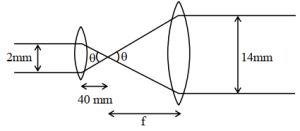
0 likes
View Solution182
MediumMCQ
What is the power of the combination of a convex lens and a concave lens of equal focal length $25 \text{ cm}$?
A
Zero
B
$25 \text{ D}$
C
Infinite
D
$8 \text{ D}$
Solution
(A) The power of a lens is given by the formula $P = \frac{1}{f(m)}$,where $f$ is the focal length in meters.
For a convex lens,the focal length is positive,so $f_1 = +0.25 \text{ m}$. Thus,$P_1 = \frac{1}{0.25} = +4 \text{ D}$.
For a concave lens,the focal length is negative,so $f_2 = -0.25 \text{ m}$. Thus,$P_2 = \frac{1}{-0.25} = -4 \text{ D}$.
The power of the combination of lenses in contact is the algebraic sum of their individual powers: $P = P_1 + P_2$.
Substituting the values,$P = 4 \text{ D} + (-4 \text{ D}) = 0 \text{ D}$.
For a convex lens,the focal length is positive,so $f_1 = +0.25 \text{ m}$. Thus,$P_1 = \frac{1}{0.25} = +4 \text{ D}$.
For a concave lens,the focal length is negative,so $f_2 = -0.25 \text{ m}$. Thus,$P_2 = \frac{1}{-0.25} = -4 \text{ D}$.
The power of the combination of lenses in contact is the algebraic sum of their individual powers: $P = P_1 + P_2$.
Substituting the values,$P = 4 \text{ D} + (-4 \text{ D}) = 0 \text{ D}$.
0 likes
View Solution183
MediumMCQ
Two thin convex lenses of focal length $f_1$ and $f_2$ are placed in contact with each other. The equivalent power of the lens combination is . . . . . . .
A
$f_1 \times f_2$
B
$\frac{f_1+f_2}{f_1 \times f_2}$
C
$f_1 + f_2$
D
$\frac{f_1 \times f_2}{f_1 + f_2}$
Solution
(B) When two thin lenses are placed in contact,the equivalent focal length $F$ is given by the formula $\frac{1}{F} = \frac{1}{f_1} + \frac{1}{f_2}$.
By simplifying this,we get $\frac{1}{F} = \frac{f_1 + f_2}{f_1 f_2}$.
The power $P$ of a lens is defined as the reciprocal of its focal length in meters,i.e.,$P = \frac{1}{F}$.
Therefore,the equivalent power $P$ of the combination is $P = P_1 + P_2 = \frac{1}{f_1} + \frac{1}{f_2} = \frac{f_1 + f_2}{f_1 f_2}$.
By simplifying this,we get $\frac{1}{F} = \frac{f_1 + f_2}{f_1 f_2}$.
The power $P$ of a lens is defined as the reciprocal of its focal length in meters,i.e.,$P = \frac{1}{F}$.
Therefore,the equivalent power $P$ of the combination is $P = P_1 + P_2 = \frac{1}{f_1} + \frac{1}{f_2} = \frac{f_1 + f_2}{f_1 f_2}$.
0 likes
View Solution184
DifficultMCQ
An object $AB$ is placed $15 \text{ cm}$ on the left of a convex lens $P$ of focal length $10 \text{ cm}$. Another convex lens $Q$ is now placed $15 \text{ cm}$ to the right of lens $P$. If the focal length of lens $Q$ is $15 \text{ cm}$,the final image is . . . . . . .
A
virtual,formed at $7.5 \text{ cm}$ right of lens $Q$,with a size bigger than that of $AB$
B
real,formed at $7.5 \text{ cm}$ right of lens $Q$,with a size same as that of $AB$
C
formed at infinity.
D
real,formed at $7 \text{ cm}$ right of lens $Q$,with a size smaller than that of $AB$
Solution
(B) For lens $P$: $u_1 = -15 \text{ cm}$,$f_1 = 10 \text{ cm}$. Using the lens formula $\frac{1}{v_1} - \frac{1}{u_1} = \frac{1}{f_1}$,we get $\frac{1}{v_1} - \frac{1}{-15} = \frac{1}{10} \implies \frac{1}{v_1} = \frac{1}{10} - \frac{1}{15} = \frac{1}{30} \implies v_1 = 30 \text{ cm}$.
This image acts as a virtual object for lens $Q$. The distance between the lenses is $15 \text{ cm}$. Since the image is formed $30 \text{ cm}$ to the right of lens $P$,it is located $30 - 15 = 15 \text{ cm}$ to the right of lens $Q$. Thus,$u_2 = +15 \text{ cm}$.
For lens $Q$: $u_2 = +15 \text{ cm}$,$f_2 = 15 \text{ cm}$. Using the lens formula $\frac{1}{v_2} - \frac{1}{u_2} = \frac{1}{f_2}$,we get $\frac{1}{v_2} - \frac{1}{15} = \frac{1}{15} \implies \frac{1}{v_2} = \frac{2}{15} \implies v_2 = 7.5 \text{ cm}$.
Since $v_2 > 0$,the image is real and formed $7.5 \text{ cm}$ to the right of lens $Q$.
Total magnification $M = m_1 \times m_2 = (v_1/u_1) \times (v_2/u_2) = (30/-15) \times (7.5/15) = -2 \times 0.5 = -1$. The magnitude of magnification is $1$,so the size is the same as that of $AB$.
This image acts as a virtual object for lens $Q$. The distance between the lenses is $15 \text{ cm}$. Since the image is formed $30 \text{ cm}$ to the right of lens $P$,it is located $30 - 15 = 15 \text{ cm}$ to the right of lens $Q$. Thus,$u_2 = +15 \text{ cm}$.
For lens $Q$: $u_2 = +15 \text{ cm}$,$f_2 = 15 \text{ cm}$. Using the lens formula $\frac{1}{v_2} - \frac{1}{u_2} = \frac{1}{f_2}$,we get $\frac{1}{v_2} - \frac{1}{15} = \frac{1}{15} \implies \frac{1}{v_2} = \frac{2}{15} \implies v_2 = 7.5 \text{ cm}$.
Since $v_2 > 0$,the image is real and formed $7.5 \text{ cm}$ to the right of lens $Q$.
Total magnification $M = m_1 \times m_2 = (v_1/u_1) \times (v_2/u_2) = (30/-15) \times (7.5/15) = -2 \times 0.5 = -1$. The magnitude of magnification is $1$,so the size is the same as that of $AB$.
0 likes
View Solution185
MediumMCQ
$A$ thin convex lens and a thin concave lens are kept in contact and are co-axial. Which of the following statements is correct for this combination of two lenses?
A
behaves as a concave lens if $|f_{\text{convex}}| > |f_{\text{concave}}|$
B
behaves as a concave lens if $|f_{\text{convex}}| < |f_{\text{concave}}|$
C
behaves as a convex lens if $|f_{\text{convex}}| > |f_{\text{concave}}|$
D
Focal length of the lens system will change if the positions of two lenses are interchanged
Solution
(A) The effective focal length $F$ of two thin lenses in contact is given by the formula $\frac{1}{F} = \frac{1}{f_1} + \frac{1}{f_2}$.
For a convex lens,$f_1 > 0$,and for a concave lens,$f_2 < 0$. Let $f_1 = f_{\text{convex}}$ and $f_2 = -|f_{\text{concave}}|$.
Substituting these values,we get $\frac{1}{F} = \frac{1}{f_{\text{convex}}} - \frac{1}{|f_{\text{concave}}|} = \frac{|f_{\text{concave}}| - f_{\text{convex}}}{f_{\text{convex}} |f_{\text{concave}}|}$.
If $|f_{\text{concave}}| < f_{\text{convex}}$,then $\frac{1}{F} < 0$,which implies $F < 0$,meaning the combination behaves as a concave lens.
If $|f_{\text{concave}}| > f_{\text{convex}}$,then $\frac{1}{F} > 0$,which implies $F > 0$,meaning the combination behaves as a convex lens.
Therefore,the combination behaves as a concave lens if $|f_{\text{convex}}| > |f_{\text{concave}}|$.
For a convex lens,$f_1 > 0$,and for a concave lens,$f_2 < 0$. Let $f_1 = f_{\text{convex}}$ and $f_2 = -|f_{\text{concave}}|$.
Substituting these values,we get $\frac{1}{F} = \frac{1}{f_{\text{convex}}} - \frac{1}{|f_{\text{concave}}|} = \frac{|f_{\text{concave}}| - f_{\text{convex}}}{f_{\text{convex}} |f_{\text{concave}}|}$.
If $|f_{\text{concave}}| < f_{\text{convex}}$,then $\frac{1}{F} < 0$,which implies $F < 0$,meaning the combination behaves as a concave lens.
If $|f_{\text{concave}}| > f_{\text{convex}}$,then $\frac{1}{F} > 0$,which implies $F > 0$,meaning the combination behaves as a convex lens.
Therefore,the combination behaves as a concave lens if $|f_{\text{convex}}| > |f_{\text{concave}}|$.
0 likes
View SolutionRay Optics and Optical Instruments — Combination of Lenses · Frequently Asked Questions
1Are these Ray Optics and Optical Instruments questions useful for JEE and NEET?
Yes. All questions in this section are mapped to JEE Main and NEET exam patterns. Previous year questions from JEE Main, NEET, GUJCET and state-level exams are included with full solutions.
2Can I switch to Hindi or Gujarati for these questions?
Yes. Use the language tabs in the hero section or the sidebar to view the same questions and solutions in English, Hindi or Gujarati.
3How do I generate a question paper from this subtopic?
Use the Vedclass Exam Paper Generator — select the chapter and subtopic, set difficulty, and generate Sets A, B, C, D automatically. First 3 chapters of every subject are free.
Vedclass Products
For Students
Vedclass Test Series
Mock tests in real JEE/NEET style with performance analysis. 5-day free trial.
Start Free TrialFor Teachers
Exam Paper Generator
Generate Set A/B/C/D papers from this chapter in 2 minutes. 3 chapters free.
Try FreeFor Institutes
Online Exam Module
Live online exams with unlimited students, 360° analytics & white-label branding.
See DemoFor Teachers & Institutes
Generate a Ray Optics and Optical Instruments Exam Paper in 2 Minutes
Select subtopic & difficulty — Sets A, B, C, D auto-generated with No Repeat logic.
First 3 chapters of every subject are free — no payment required.