
A English
Magnetic Materials (Diamagnetic, Paramagnetic and Ferromagnetic) Questions in English
Class 12 Physics · Magnetism and Matter · Magnetic Materials (Diamagnetic, Paramagnetic and Ferromagnetic)
222+
Questions
English
Language
100%
With Solutions
Showing 50 of 222 questions in English
101
Medium
Why is the magnetic susceptibility of diamagnetic materials negative? Explain.
Solution
(N/A) Diamagnetic materials are characterized by the property of being weakly repelled by an external magnetic field.
When a diamagnetic material is placed in an external magnetic field $B_0$,the induced magnetic moment in the atoms is in a direction opposite to the applied field.
This results in a net magnetic field $B$ inside the material that is slightly less than the external field $B_0$,such that $B < B_0$.
The magnetization $M$ is defined as the magnetic moment per unit volume,and for diamagnetic materials,$M$ is directed opposite to the external field $H$.
Since magnetic susceptibility $\chi$ is defined by the relation $M = \chi H$,and because $M$ and $H$ are in opposite directions,$\chi$ must be negative.
Thus,for diamagnetic materials,the susceptibility $\chi$ is a small negative value,typically in the range of $-1 \le \chi < 0$.
When a diamagnetic material is placed in an external magnetic field $B_0$,the induced magnetic moment in the atoms is in a direction opposite to the applied field.
This results in a net magnetic field $B$ inside the material that is slightly less than the external field $B_0$,such that $B < B_0$.
The magnetization $M$ is defined as the magnetic moment per unit volume,and for diamagnetic materials,$M$ is directed opposite to the external field $H$.
Since magnetic susceptibility $\chi$ is defined by the relation $M = \chi H$,and because $M$ and $H$ are in opposite directions,$\chi$ must be negative.
Thus,for diamagnetic materials,the susceptibility $\chi$ is a small negative value,typically in the range of $-1 \le \chi < 0$.
0 likes
View Solution102
Medium
What is a magnetic substance? Write its types.
Solution
(N/A) substance is called a magnetic substance if,when placed in an external magnetic field,an induced magnetic field is produced within it.
There are three main types of magnetic substances:
$(i)$ Diamagnetic substances: These are weakly repelled by an external magnetic field.
$(ii)$ Paramagnetic substances: These are weakly attracted by an external magnetic field.
$(iii)$ Ferromagnetic substances: These are strongly attracted by an external magnetic field.
There are three main types of magnetic substances:
$(i)$ Diamagnetic substances: These are weakly repelled by an external magnetic field.
$(ii)$ Paramagnetic substances: These are weakly attracted by an external magnetic field.
$(iii)$ Ferromagnetic substances: These are strongly attracted by an external magnetic field.
0 likes
View Solution103
Easy
Explain diamagnetism and diamagnetic substances.
Solution
(N/A) Diamagnetic substances are those which have a tendency to move from the stronger to the weaker part of an external magnetic field. These substances are repelled by a magnet.
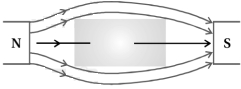
The figure shows a bar of diamagnetic material placed in an external magnetic field.
The magnetic field lines are repelled or expelled,and the field inside the material is reduced.
When placed in a non-uniform magnetic field,the bar will tend to move from a high-field region to a low-field region.
The simplest explanation for diamagnetism is as follows: Electrons in an atom orbiting around the nucleus possess orbital angular momentum. These orbiting electrons are equivalent to a current-carrying loop and thus possess an orbital magnetic moment.
Diamagnetic substances are those in which the resultant magnetic moment in an atom is zero.
When a magnetic field is applied,those electrons having an orbital magnetic moment in the same direction slow down,and those in the opposite direction speed up. Thus,the substance develops a net magnetic moment in a direction opposite to that of the applied field,resulting in repulsion.
Some diamagnetic materials are bismuth,copper,lead,silicon,nitrogen (at $STP$),water,and sodium chloride.
Diamagnetism is present in all substances,but the effect is very weak.
The magnetic susceptibility of diamagnetic substances is small and negative.
The figure shows a bar of diamagnetic material placed in an external magnetic field.
The magnetic field lines are repelled or expelled,and the field inside the material is reduced.
When placed in a non-uniform magnetic field,the bar will tend to move from a high-field region to a low-field region.
The simplest explanation for diamagnetism is as follows: Electrons in an atom orbiting around the nucleus possess orbital angular momentum. These orbiting electrons are equivalent to a current-carrying loop and thus possess an orbital magnetic moment.
Diamagnetic substances are those in which the resultant magnetic moment in an atom is zero.
When a magnetic field is applied,those electrons having an orbital magnetic moment in the same direction slow down,and those in the opposite direction speed up. Thus,the substance develops a net magnetic moment in a direction opposite to that of the applied field,resulting in repulsion.
Some diamagnetic materials are bismuth,copper,lead,silicon,nitrogen (at $STP$),water,and sodium chloride.
Diamagnetism is present in all substances,but the effect is very weak.
The magnetic susceptibility of diamagnetic substances is small and negative.
0 likes
View Solution104
Difficult
Explain the behavior of a superconductor as a diamagnetic material.
Solution
(N/A) Superconductors are a special class of materials that exhibit perfect diamagnetism. When a material is cooled below its critical temperature $(T_c)$, it transitions into a superconducting state.
In this state, the superconductor expels all magnetic field lines from its interior, a phenomenon known as the $Meissner$ effect. Because the magnetic field inside the superconductor is zero $(B = 0)$, it behaves as a perfect diamagnet.
For a perfect diamagnet, the magnetic susceptibility $(\chi)$ is $-1$. Since the relative permeability is given by $\mu_r = 1 + \chi$, we get $\mu_r = 1 + (-1) = 0$.
Due to this property, superconductors are strongly repelled by external magnetic fields. This effect is utilized in advanced technologies, such as magnetic levitation in high-speed maglev trains.
In this state, the superconductor expels all magnetic field lines from its interior, a phenomenon known as the $Meissner$ effect. Because the magnetic field inside the superconductor is zero $(B = 0)$, it behaves as a perfect diamagnet.
For a perfect diamagnet, the magnetic susceptibility $(\chi)$ is $-1$. Since the relative permeability is given by $\mu_r = 1 + \chi$, we get $\mu_r = 1 + (-1) = 0$.
Due to this property, superconductors are strongly repelled by external magnetic fields. This effect is utilized in advanced technologies, such as magnetic levitation in high-speed maglev trains.
0 likes
View Solution105
Medium
Explain paramagnetism and paramagnetic substances.
Solution
(N/A) Paramagnetic substances are those which get weakly magnetized when placed in an external magnetic field. They have a tendency to move from a region of weak magnetic field to a strong magnetic field,meaning they get weakly attracted to a magnet.
The individual atoms (or ions or molecules) of a paramagnetic material possess a permanent magnetic dipole moment of their own.
On account of the ceaseless random thermal motion of the atoms,no net magnetization is seen in the absence of an external field.
In the presence of an external field,the dipole moments of a paramagnetic substance can be made to align in the same direction as the field.
The value of magnetic susceptibility $\chi$ for these substances is positive.
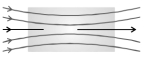
If a paramagnetic material is placed in an external field,the field lines get concentrated inside the material and the field inside is enhanced.
This enhancement is slight,being one part in $10^{5}$.
When a bar of the substance is placed in a non-uniform magnetic field,the bar will tend to move from a weak field to a strong field.
Some examples of paramagnetic materials are aluminum,sodium,calcium,oxygen (at $STP$),and copper chloride.
The individual atoms (or ions or molecules) of a paramagnetic material possess a permanent magnetic dipole moment of their own.
On account of the ceaseless random thermal motion of the atoms,no net magnetization is seen in the absence of an external field.
In the presence of an external field,the dipole moments of a paramagnetic substance can be made to align in the same direction as the field.
The value of magnetic susceptibility $\chi$ for these substances is positive.
If a paramagnetic material is placed in an external field,the field lines get concentrated inside the material and the field inside is enhanced.
This enhancement is slight,being one part in $10^{5}$.
When a bar of the substance is placed in a non-uniform magnetic field,the bar will tend to move from a weak field to a strong field.
Some examples of paramagnetic materials are aluminum,sodium,calcium,oxygen (at $STP$),and copper chloride.
0 likes
View Solution106
Medium
Explain Curie's law.
Solution
(N/A) Experimentally,it was found that the magnetisation $M$ of a paramagnetic material is inversely proportional to the absolute temperature $T$.
$\therefore M = C \frac{B_{0}}{T} \quad \dots (1)$ and $M = \chi H \quad \dots (2)$
Given that $B_{0} = \mu_{0} H$,substituting this into equation $(1)$ gives:
$M = \frac{C \mu_{0} H}{T}$
$\therefore \frac{M}{H} = \frac{C \mu_{0}}{T}$
Since $\chi = \frac{M}{H}$,we get $\chi = \frac{C \mu_{0}}{T} \quad \dots (3)$
This is known as Curie's law. The constant $C$ is called Curie's constant.
For a paramagnetic material,both the magnetic susceptibility $\chi$ and relative permeability $\mu_{r}$ depend not only on the material but also on the absolute temperature.
As the external magnetic field $B_{0}$ is increased or the temperature $T$ is lowered,the magnetisation increases until it reaches the saturation value $M_{s}$,at which point all the atomic dipoles are perfectly aligned with the field. Beyond this point,Curie's law is no longer valid.
$\therefore M = C \frac{B_{0}}{T} \quad \dots (1)$ and $M = \chi H \quad \dots (2)$
Given that $B_{0} = \mu_{0} H$,substituting this into equation $(1)$ gives:
$M = \frac{C \mu_{0} H}{T}$
$\therefore \frac{M}{H} = \frac{C \mu_{0}}{T}$
Since $\chi = \frac{M}{H}$,we get $\chi = \frac{C \mu_{0}}{T} \quad \dots (3)$
This is known as Curie's law. The constant $C$ is called Curie's constant.
For a paramagnetic material,both the magnetic susceptibility $\chi$ and relative permeability $\mu_{r}$ depend not only on the material but also on the absolute temperature.
As the external magnetic field $B_{0}$ is increased or the temperature $T$ is lowered,the magnetisation increases until it reaches the saturation value $M_{s}$,at which point all the atomic dipoles are perfectly aligned with the field. Beyond this point,Curie's law is no longer valid.
0 likes
View Solution107
Easy
What is a paramagnetic substance? If a small bar of a paramagnetic substance is placed in a non-uniform magnetic field,in which direction does it move?
Solution
(N/A) paramagnetic substance is a material that is weakly attracted by an external magnetic field and tends to align itself in the direction of the applied field.
When a small bar of a paramagnetic substance is placed in a non-uniform magnetic field,it experiences a force that pulls it from the region of a weak magnetic field toward the region of a strong magnetic field.
When a small bar of a paramagnetic substance is placed in a non-uniform magnetic field,it experiences a force that pulls it from the region of a weak magnetic field toward the region of a strong magnetic field.
0 likes
View Solution108
Difficult
Explain ferromagnetism and ferromagnetic substances.
Solution
(N/A) Ferromagnetic substances are those which get strongly magnetized when placed in an external magnetic field.
They have a strong tendency to move from a region of weak magnetic field to a region of strong magnetic field. They get strongly attracted to a magnet.
The individual atoms (or ions or molecules) in a ferromagnetic material possess a dipole moment,similar to those in a paramagnetic material.
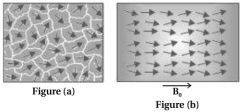
$A$ key feature of ferromagnetic substances is the existence of domains. In each domain,atoms are arranged such that their dipole moments are aligned in the same direction. Hence,each domain has a net magnetization. However,if the entire substance is considered,the different domains have randomly oriented dipole moments,and thus the net magnetization of the bulk substance is zero. This is shown in Figure $(a)$.
The typical domain size is $1 \ mm$ and each domain contains about $10^{11}$ atoms.
When an external magnetic field $\vec{B}_{0}$ is applied,the domains orient themselves in the direction of $\vec{B}_{0}$,and the domains grow in size,causing the whole substance to become strongly magnetized. This is shown in Figure $(b)$.
In a ferromagnetic material,the magnetic field lines are highly concentrated.
In a non-uniform magnetic field,the sample tends to move towards the region of high field intensity.
Examples of ferromagnetic substances include Iron $(Fe)$,Cobalt $(Co)$,Nickel $(Ni)$,Gadolinium ($Gd$,$Z = 64$),and Dysprosium ($Dy$,$Z = 66$).
They have a strong tendency to move from a region of weak magnetic field to a region of strong magnetic field. They get strongly attracted to a magnet.
The individual atoms (or ions or molecules) in a ferromagnetic material possess a dipole moment,similar to those in a paramagnetic material.
$A$ key feature of ferromagnetic substances is the existence of domains. In each domain,atoms are arranged such that their dipole moments are aligned in the same direction. Hence,each domain has a net magnetization. However,if the entire substance is considered,the different domains have randomly oriented dipole moments,and thus the net magnetization of the bulk substance is zero. This is shown in Figure $(a)$.
The typical domain size is $1 \ mm$ and each domain contains about $10^{11}$ atoms.
When an external magnetic field $\vec{B}_{0}$ is applied,the domains orient themselves in the direction of $\vec{B}_{0}$,and the domains grow in size,causing the whole substance to become strongly magnetized. This is shown in Figure $(b)$.
In a ferromagnetic material,the magnetic field lines are highly concentrated.
In a non-uniform magnetic field,the sample tends to move towards the region of high field intensity.
Examples of ferromagnetic substances include Iron $(Fe)$,Cobalt $(Co)$,Nickel $(Ni)$,Gadolinium ($Gd$,$Z = 64$),and Dysprosium ($Dy$,$Z = 66$).
0 likes
View Solution109
Medium
Explain hard ferromagnetic and soft ferromagnetic materials.
Solution
(N/A) Hard ferromagnetic materials: In some ferromagnetic materials,the magnetization persists even after the removal of the external magnetic field. Such materials are called hard magnetic materials.
Alnico,an alloy of iron,aluminum,nickel,cobalt,and copper,is one such material. Naturally occurring lodestone is also a hard ferromagnetic material. Its relative permeability is $> 1000$.
Such materials are used to form permanent magnets,for example,in compass needles.
Soft ferromagnetic materials: There are some ferromagnetic materials in which the magnetization disappears upon the removal of the external magnetic field. These materials are called soft magnetic materials.
These materials are used in electric bells,cranes,transformers,etc.
Alnico,an alloy of iron,aluminum,nickel,cobalt,and copper,is one such material. Naturally occurring lodestone is also a hard ferromagnetic material. Its relative permeability is $> 1000$.
Such materials are used to form permanent magnets,for example,in compass needles.
Soft ferromagnetic materials: There are some ferromagnetic materials in which the magnetization disappears upon the removal of the external magnetic field. These materials are called soft magnetic materials.
These materials are used in electric bells,cranes,transformers,etc.
0 likes
View Solution110
Medium
Explain Curie temperature.
Solution
The ferromagnetic property of a material depends on its temperature.
As the temperature of a ferromagnetic substance increases, the thermal agitation causes the magnetic dipole moments of its molecules to become random, thereby destroying the spontaneous magnetization.
At a sufficiently high temperature, a ferromagnetic substance loses its ferromagnetic properties and becomes paramagnetic.
The specific temperature at which this transition from ferromagnetic to paramagnetic behavior occurs is known as the Curie temperature $(T_{c})$.
For temperatures above the Curie temperature $(T > T_{c})$, the magnetic susceptibility $(\chi)$ in the paramagnetic phase is described by the Curie-Weiss law:
$\chi = \frac{C}{T - T_{c}}$
where $C$ is the Curie constant.
The Curie temperature $(T_{c})$ for some common ferromagnetic materials is given below:
As the temperature of a ferromagnetic substance increases, the thermal agitation causes the magnetic dipole moments of its molecules to become random, thereby destroying the spontaneous magnetization.
At a sufficiently high temperature, a ferromagnetic substance loses its ferromagnetic properties and becomes paramagnetic.
The specific temperature at which this transition from ferromagnetic to paramagnetic behavior occurs is known as the Curie temperature $(T_{c})$.
For temperatures above the Curie temperature $(T > T_{c})$, the magnetic susceptibility $(\chi)$ in the paramagnetic phase is described by the Curie-Weiss law:
$\chi = \frac{C}{T - T_{c}}$
where $C$ is the Curie constant.
The Curie temperature $(T_{c})$ for some common ferromagnetic materials is given below:
| Material | $T_{c} \text{ (K)}$ |
| Cobalt | $1394$ |
| Iron | $1043$ |
| $Fe_{2}O_{3}$ | $893$ |
| Nickel | $631$ |
| Gadolinium | $317$ |
0 likes
View Solution111
Easy
What is a diamagnetic substance?
Solution
(N/A) diamagnetic substance is a material that develops a weak magnetization in the direction opposite to the applied external magnetic field.
These substances are feebly repelled by magnets.
Key characteristics include:
$1$. They have a small negative magnetic susceptibility $(\chi < 0)$.
$2$. Their relative magnetic permeability is slightly less than unity $(\mu_r < 1)$.
$3$. They do not have permanent magnetic dipoles.
Examples include copper, gold, water, and bismuth.
These substances are feebly repelled by magnets.
Key characteristics include:
$1$. They have a small negative magnetic susceptibility $(\chi < 0)$.
$2$. Their relative magnetic permeability is slightly less than unity $(\mu_r < 1)$.
$3$. They do not have permanent magnetic dipoles.
Examples include copper, gold, water, and bismuth.
0 likes
View Solution112
MediumMCQ
$A$ small bar of diamagnetic substance is placed in a non-uniform magnetic field. In which direction does it move? Explain.
A
From stronger to weaker magnetic field.
B
From weaker to stronger magnetic field.
C
It remains stationary.
D
It aligns perpendicular to the field.
Solution
(A) When a diamagnetic substance is placed in a non-uniform magnetic field,it experiences a force that pushes it from the region of stronger magnetic field to the region of weaker magnetic field.
This happens because diamagnetic materials develop a weak induced magnetic moment in a direction opposite to the applied magnetic field.
Consequently,the substance is feebly repelled by the magnetic field,causing it to move towards the region where the magnetic field intensity is lower.
This happens because diamagnetic materials develop a weak induced magnetic moment in a direction opposite to the applied magnetic field.
Consequently,the substance is feebly repelled by the magnetic field,causing it to move towards the region where the magnetic field intensity is lower.
0 likes
View Solution113
Medium
Give examples of diamagnetic substances.
Solution
(N/A) Diamagnetic substances are materials that are weakly repelled by a magnetic field. When placed in a non-uniform magnetic field,they tend to move from the stronger part of the field to the weaker part.
Examples of diamagnetic substances include:
$1$. Bismuth $(Bi)$
$2$. Copper $(Cu)$
$3$. Water $(H_2O)$
$4$. Gold $(Au)$
$5$. Silicon $(Si)$
$6$. Nitrogen $(N_2)$ at $STP$
Examples of diamagnetic substances include:
$1$. Bismuth $(Bi)$
$2$. Copper $(Cu)$
$3$. Water $(H_2O)$
$4$. Gold $(Au)$
$5$. Silicon $(Si)$
$6$. Nitrogen $(N_2)$ at $STP$
0 likes
View Solution114
EasyMCQ
What is the nature of the magnetic susceptibility of a diamagnetic substance?
A
Small and positive
B
Small and negative
C
Large and positive
D
Large and negative
Solution
(B) The magnetic susceptibility $(\chi)$ of a diamagnetic substance is small and negative. This indicates that diamagnetic materials are weakly repelled by an external magnetic field.
0 likes
View Solution115
Medium
What is the Meissner effect? Explain.
Solution
(N/A) The Meissner effect is the phenomenon where a superconductor, when cooled below its critical temperature $(T_c)$ in the presence of an external magnetic field, expels all magnetic flux from its interior.
As the material transitions into the superconducting state, it develops surface currents that create an internal magnetic field exactly equal and opposite to the applied external magnetic field.
Consequently, the net magnetic field inside the superconductor becomes zero $(B = 0)$.
This property makes superconductors perfect diamagnets, as they exhibit a magnetic susceptibility $(\chi)$ of $-1$.
As the material transitions into the superconducting state, it develops surface currents that create an internal magnetic field exactly equal and opposite to the applied external magnetic field.
Consequently, the net magnetic field inside the superconductor becomes zero $(B = 0)$.
This property makes superconductors perfect diamagnets, as they exhibit a magnetic susceptibility $(\chi)$ of $-1$.
0 likes
View Solution116
MediumMCQ
Which type of magnets are used in extremely fast trains that run on magnetic levitation?
A
Permanent magnets
B
Electromagnets
C
Superconducting magnets
D
Bar magnets
Solution
(C) Magnetic levitation (Maglev) trains operate by using the principle of magnetic repulsion to lift the train above the tracks,eliminating friction. To achieve the powerful magnetic fields required for this,superconducting magnets are used. These magnets are cooled to extremely low temperatures,allowing them to carry large currents with zero electrical resistance,which generates the intense magnetic field necessary for levitation and propulsion.
0 likes
View Solution117
Medium
What is a ferromagnetic substance? What is a magnetic domain?
Solution
(N/A) ferromagnetic substance is a material that exhibits strong magnetism in the presence of an external magnetic field and retains its magnetic properties even after the field is removed. Examples include iron,nickel,and cobalt.
$A$ magnetic domain is a small region within a ferromagnetic material where the magnetic moments of all atoms are aligned in the same direction due to strong internal exchange coupling. These domains act as tiny magnets within the material.
$A$ magnetic domain is a small region within a ferromagnetic material where the magnetic moments of all atoms are aligned in the same direction due to strong internal exchange coupling. These domains act as tiny magnets within the material.
0 likes
View Solution118
Medium
Fill in the blank :
$(i)$ The domain size is ...... .
$(ii)$ The domain contains about ...... atoms.
$(i)$ The domain size is ...... .
$(ii)$ The domain contains about ...... atoms.
Solution
(N/A) $(i)$ The typical size of a magnetic domain is $1 \; mm$.
$(ii)$ $A$ magnetic domain typically contains about $10^{11}$ atoms.
$(ii)$ $A$ magnetic domain typically contains about $10^{11}$ atoms.
0 likes
View Solution119
MediumMCQ
$A$ small bar of ferromagnetic substance is placed in a non-uniform magnetic field. In which direction does it move?
A
From strong to weak magnetic field
B
From weak to strong magnetic field
C
It does not move
D
It moves perpendicular to the magnetic field
Solution
(B) Ferromagnetic substances are strongly attracted by magnetic fields.
When a small bar of a ferromagnetic substance is placed in a non-uniform magnetic field,it experiences a force that pulls it towards the region of higher magnetic field intensity.
Therefore,it moves from the region of a weak magnetic field to the region of a strong magnetic field.
When a small bar of a ferromagnetic substance is placed in a non-uniform magnetic field,it experiences a force that pulls it towards the region of higher magnetic field intensity.
Therefore,it moves from the region of a weak magnetic field to the region of a strong magnetic field.
0 likes
View Solution120
Medium
Give some examples:
$(i)$ Ferromagnetic substances.
$(ii)$ Paramagnetic substances.
$(i)$ Ferromagnetic substances.
$(ii)$ Paramagnetic substances.
Solution
(N/A) $(i)$ Ferromagnetic substances: Iron $(Fe)$,Cobalt $(Co)$,Nickel $(Ni)$,and Gadolinium $(Gd)$.
$(ii)$ Paramagnetic substances: Aluminium $(Al)$,Sodium $(Na)$,Calcium $(Ca)$,Oxygen $(O_2)$ at $STP$,and Copper chloride $(CuCl_2)$.
$(ii)$ Paramagnetic substances: Aluminium $(Al)$,Sodium $(Na)$,Calcium $(Ca)$,Oxygen $(O_2)$ at $STP$,and Copper chloride $(CuCl_2)$.
0 likes
View Solution121
EasyMCQ
What is a hard ferromagnetic substance?
A
$A$ substance that is easily magnetized and demagnetized.
B
$A$ substance that retains its magnetism even after the external magnetic field is removed.
C
$A$ substance that has high magnetic permeability and low retentivity.
D
$A$ substance that is used to make temporary magnets.
Solution
(B) hard ferromagnetic substance is a material that has high retentivity and high coercivity.
Because of these properties,it does not lose its magnetization easily once it is magnetized.
Therefore,it is used to make permanent magnets.
Examples include steel and Alnico.
Because of these properties,it does not lose its magnetization easily once it is magnetized.
Therefore,it is used to make permanent magnets.
Examples include steel and Alnico.
0 likes
View Solution122
MediumMCQ
Alnico is an alloy of which metals? Explain.
A
Iron,Aluminium,Nickel,Cobalt,Copper
B
Iron,Aluminium,Nickel,Chromium,Copper
C
Iron,Aluminium,Nickel,Cobalt,Carbon
D
Iron,Aluminium,Nickel,Manganese,Copper
Solution
(A) Alnico is a family of iron alloys which are primarily composed of $Al$ (Aluminium),$Ni$ (Nickel),and $Co$ (Cobalt),along with $Fe$ (Iron) and $Cu$ (Copper).
These alloys are known for their strong ferromagnetic properties and are widely used in the manufacturing of permanent magnets.
They are characterized by high coercivity and high magnetic remanence,making them ideal for applications like electric motors,sensors,and loudspeakers.
These alloys are known for their strong ferromagnetic properties and are widely used in the manufacturing of permanent magnets.
They are characterized by high coercivity and high magnetic remanence,making them ideal for applications like electric motors,sensors,and loudspeakers.
0 likes
View Solution123
Medium
What are soft ferromagnetic materials? Write the uses of soft ferromagnetic materials.
Solution
(N/A) Soft ferromagnetic materials are magnetic materials that can be easily magnetized and demagnetized.
They possess low retentivity,low coercivity,and low hysteresis loss.
Due to these properties,they are ideal for applications where rapid changes in magnetic fields occur.
Uses of soft ferromagnetic materials:
$1$. They are used in the cores of transformers and electromagnets.
$2$. They are used in the cores of inductors and chokes.
$3$. They are used in telephone diaphragms and magnetic shielding.
They possess low retentivity,low coercivity,and low hysteresis loss.
Due to these properties,they are ideal for applications where rapid changes in magnetic fields occur.
Uses of soft ferromagnetic materials:
$1$. They are used in the cores of transformers and electromagnets.
$2$. They are used in the cores of inductors and chokes.
$3$. They are used in telephone diaphragms and magnetic shielding.
0 likes
View Solution124
Easy
What are permanent magnets? Give the ways for preparing them.
Solution
(N/A) Substances which at room temperature retain their ferromagnetic property for a long period of time are called permanent magnets.
Methods for preparing permanent magnets:
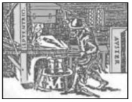
$1$. Hammering: One can hold an iron rod in the north-south direction and hammer it repeatedly.
$2$. Stroking: One can hold an iron rod and stroke it with one end of a bar magnet a large number of times,always in the same sense.
$3$. Solenoid Method: An efficient way to make a permanent magnet is to place a ferromagnetic rod in a solenoid and pass a current through it. The magnetic field of the solenoid magnetises the rod.
Methods for preparing permanent magnets:
$1$. Hammering: One can hold an iron rod in the north-south direction and hammer it repeatedly.
$2$. Stroking: One can hold an iron rod and stroke it with one end of a bar magnet a large number of times,always in the same sense.
$3$. Solenoid Method: An efficient way to make a permanent magnet is to place a ferromagnetic rod in a solenoid and pass a current through it. The magnetic field of the solenoid magnetises the rod.
0 likes
View Solution125
MediumMCQ
What materials should be used to make permanent magnets?
A
Materials with high retentivity and low coercivity
B
Materials with low retentivity and high coercivity
C
Materials with high retentivity and high coercivity
D
Materials with low retentivity and low coercivity
Solution
(C) Permanent magnets are made from ferromagnetic materials that retain their magnetic properties even after the external magnetic field is removed.
To achieve this,the material must have high retentivity so that it remains strongly magnetized.
Additionally,it must have high coercivity so that it is not easily demagnetized by external magnetic fields,temperature fluctuations,or mechanical impacts.
Therefore,materials with high retentivity and high coercivity are ideal for making permanent magnets.
To achieve this,the material must have high retentivity so that it remains strongly magnetized.
Additionally,it must have high coercivity so that it is not easily demagnetized by external magnetic fields,temperature fluctuations,or mechanical impacts.
Therefore,materials with high retentivity and high coercivity are ideal for making permanent magnets.
0 likes
View Solution126
Medium
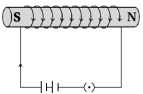
Provide information about electromagnets.
Solution
(N/A) An electromagnet is a type of magnet in which the magnetic field is produced by an electric current. It only exhibits magnetic properties while an electric current flows through the coil wound around a ferromagnetic core.
The core of an electromagnet is typically made of ferromagnetic materials.
These materials must have high magnetic permeability and low retentivity. Therefore,soft iron is an ideal material for electromagnets.
When a soft iron rod is placed inside a solenoid and an electric current is passed through it,the magnetic field of the solenoid increases by a factor of thousands.
When the current in the solenoid is switched off,the magnetism effectively disappears because the soft iron core has low retentivity.
In applications like transformer cores and telephone diaphragms,the material undergoes an $AC$ cycle of magnetization repeatedly. For such applications,the hysteresis curve of the material must be narrow to minimize energy dissipation and heating.
Additionally,the material must have high electrical resistivity to reduce energy losses due to eddy currents.
The core of an electromagnet is typically made of ferromagnetic materials.
These materials must have high magnetic permeability and low retentivity. Therefore,soft iron is an ideal material for electromagnets.
When a soft iron rod is placed inside a solenoid and an electric current is passed through it,the magnetic field of the solenoid increases by a factor of thousands.
When the current in the solenoid is switched off,the magnetism effectively disappears because the soft iron core has low retentivity.
In applications like transformer cores and telephone diaphragms,the material undergoes an $AC$ cycle of magnetization repeatedly. For such applications,the hysteresis curve of the material must be narrow to minimize energy dissipation and heating.
Additionally,the material must have high electrical resistivity to reduce energy losses due to eddy currents.
0 likes
View Solution127
DifficultMCQ
Why is steel suitable for making permanent magnets?
A
High retentivity and high coercivity
B
Low retentivity and low coercivity
C
High retentivity and low coercivity
D
Low retentivity and high coercivity
Solution
(A) material used for making a permanent magnet must have high retentivity so that it retains a strong magnetic field after the magnetizing field is removed.
It must also have high coercivity so that the magnetic field is not easily destroyed by external magnetic fields,temperature fluctuations,or mechanical vibrations.
Steel possesses both high retentivity and high coercivity,making it an ideal material for permanent magnets.
It must also have high coercivity so that the magnetic field is not easily destroyed by external magnetic fields,temperature fluctuations,or mechanical vibrations.
Steel possesses both high retentivity and high coercivity,making it an ideal material for permanent magnets.
0 likes
View Solution128
Easy
Write the names of the materials used to make permanent magnets.
Solution
(N/A) Permanent magnets are typically made from materials that have high retentivity and high coercivity,allowing them to retain their magnetic properties even after the external magnetizing field is removed. Common materials include:
$1$. Steel
$2$. Alnico (an alloy of iron,aluminum,nickel,and cobalt)
$3$. Cobalt steel
$4$. Ticonal (an alloy of iron,nickel,cobalt,titanium,and aluminum)
$1$. Steel
$2$. Alnico (an alloy of iron,aluminum,nickel,and cobalt)
$3$. Cobalt steel
$4$. Ticonal (an alloy of iron,nickel,cobalt,titanium,and aluminum)
0 likes
View Solution129
MediumMCQ
What type of materials can be used to make an electromagnet?
A
Soft iron
B
Steel
C
Copper
D
Aluminum
Solution
(A) To make an electromagnet,the material must have high magnetic permeability and low retentivity.
Soft iron is the ideal material for this purpose because it can be easily magnetized and demagnetized due to its high permeability and low retentivity.
Soft iron is the ideal material for this purpose because it can be easily magnetized and demagnetized due to its high permeability and low retentivity.
0 likes
View Solution130
EasyMCQ
Name the suitable material for an electromagnet.
A
Steel
B
Soft iron
C
Copper
D
Aluminum
Solution
(B) An electromagnet requires a material that can be easily magnetized and demagnetized. Soft iron has high magnetic permeability and low retentivity,which makes it the ideal material for the core of an electromagnet. Therefore,the correct material is soft iron.
0 likes
View Solution131
Medium
$A$ proton has spin and magnetic moment just like an electron. Why then is its effect neglected in the magnetism of materials?
Solution
(N/A) The magnetic dipole moment of a particle is inversely proportional to its mass,given by the relation $M = \frac{eh}{4\pi m}$.
For a proton,the magnetic dipole moment is $M_{p} = \frac{eh}{4\pi m_{p}}$.
For an electron,the magnetic dipole moment is $M_{e} = \frac{eh}{4\pi m_{e}}$.
Taking the ratio,we get $\frac{M_{p}}{M_{e}} = \frac{m_{e}}{m_{p}}$.
Since the mass of a proton $m_{p}$ is approximately $1837$ times the mass of an electron $m_{e}$ $(m_{p} \approx 1837 m_{e})$,we have $\frac{M_{p}}{M_{e}} = \frac{m_{e}}{1837 m_{e}} = \frac{1}{1837}$.
Thus,$M_{p} = \frac{M_{e}}{1837}$.
This shows that the magnetic moment of a proton is about $1837$ times smaller than that of an electron. Therefore,the magnetic effect of a proton is negligible compared to that of an electron in the magnetism of materials.
For a proton,the magnetic dipole moment is $M_{p} = \frac{eh}{4\pi m_{p}}$.
For an electron,the magnetic dipole moment is $M_{e} = \frac{eh}{4\pi m_{e}}$.
Taking the ratio,we get $\frac{M_{p}}{M_{e}} = \frac{m_{e}}{m_{p}}$.
Since the mass of a proton $m_{p}$ is approximately $1837$ times the mass of an electron $m_{e}$ $(m_{p} \approx 1837 m_{e})$,we have $\frac{M_{p}}{M_{e}} = \frac{m_{e}}{1837 m_{e}} = \frac{1}{1837}$.
Thus,$M_{p} = \frac{M_{e}}{1837}$.
This shows that the magnetic moment of a proton is about $1837$ times smaller than that of an electron. Therefore,the magnetic effect of a proton is negligible compared to that of an electron in the magnetism of materials.
0 likes
View Solution132
Medium
Explain quantitatively the order of magnitude difference between the diamagnetic susceptibility of ${N_2} \left( { \sim 5 \times {{10}^{ - 9}}} \right)$ (at $STP$) and ${Cu} \left( { \sim {{10}^{ - 5}}} \right)$.
Solution
(A) Magnetic susceptibility $\chi$ is proportional to the number of atoms per unit volume,which is directly related to the density $\rho$ of the substance.
Density of $N_2$ at $STP$:
$\rho_{N_2} = \frac{28 \text{ g}}{22.4 \text{ L}} = \frac{28 \text{ g}}{22400 \text{ cm}^3} \approx 1.25 \times 10^{-3} \text{ g/cm}^3$.
Density of Copper $(Cu)$:
$\rho_{Cu} \approx 8.9 \text{ g/cm}^3$.
Ratio of densities:
$\frac{\rho_{N_2}}{\rho_{Cu}} = \frac{1.25 \times 10^{-3}}{8.9} \approx 1.4 \times 10^{-4}$.
Since susceptibility $\chi$ is proportional to the number density of atoms,the ratio of susceptibilities should be of the same order as the ratio of densities:
$\frac{\chi_{N_2}}{\chi_{Cu}} \approx \frac{5 \times 10^{-9}}{10^{-5}} = 5 \times 10^{-4}$.
The difference in order of magnitude arises because $N_2$ is a gas at $STP$ with a very low atomic density compared to the solid metal $Cu$.
Density of $N_2$ at $STP$:
$\rho_{N_2} = \frac{28 \text{ g}}{22.4 \text{ L}} = \frac{28 \text{ g}}{22400 \text{ cm}^3} \approx 1.25 \times 10^{-3} \text{ g/cm}^3$.
Density of Copper $(Cu)$:
$\rho_{Cu} \approx 8.9 \text{ g/cm}^3$.
Ratio of densities:
$\frac{\rho_{N_2}}{\rho_{Cu}} = \frac{1.25 \times 10^{-3}}{8.9} \approx 1.4 \times 10^{-4}$.
Since susceptibility $\chi$ is proportional to the number density of atoms,the ratio of susceptibilities should be of the same order as the ratio of densities:
$\frac{\chi_{N_2}}{\chi_{Cu}} \approx \frac{5 \times 10^{-9}}{10^{-5}} = 5 \times 10^{-4}$.
The difference in order of magnitude arises because $N_2$ is a gas at $STP$ with a very low atomic density compared to the solid metal $Cu$.
0 likes
View Solution133
Medium
From a molecular viewpoint,discuss the temperature dependence of susceptibility for diamagnetism,paramagnetism,and ferromagnetism.
Solution
(N/A) Magnetic susceptibility is defined as $\chi = \frac{I}{H}$,where $I$ is the magnetization intensity and $H$ is the magnetizing force.
$1$. Diamagnetism: It arises due to the orbital motion of electrons in an atom,which develops a magnetic moment opposite to the applied magnetic field. Since this effect is inherent to the electronic structure,the susceptibility of diamagnetic materials is essentially independent of temperature.
$2$. Paramagnetism: It arises due to the alignment of permanent atomic magnetic moments in the direction of the applied field. As temperature increases,thermal agitation disrupts this alignment,leading to a decrease in susceptibility. According to Curie's Law,$\chi \propto \frac{1}{T}$.
$3$. Ferromagnetism: It arises due to the strong alignment of atomic magnetic moments within domains. Similar to paramagnetism,increasing temperature disrupts this alignment. Above a specific temperature called the Curie temperature $(T_c)$,a ferromagnetic material transforms into a paramagnetic material,and its susceptibility follows the Curie-Weiss Law: $\chi = \frac{C}{T - T_c}$.
$1$. Diamagnetism: It arises due to the orbital motion of electrons in an atom,which develops a magnetic moment opposite to the applied magnetic field. Since this effect is inherent to the electronic structure,the susceptibility of diamagnetic materials is essentially independent of temperature.
$2$. Paramagnetism: It arises due to the alignment of permanent atomic magnetic moments in the direction of the applied field. As temperature increases,thermal agitation disrupts this alignment,leading to a decrease in susceptibility. According to Curie's Law,$\chi \propto \frac{1}{T}$.
$3$. Ferromagnetism: It arises due to the strong alignment of atomic magnetic moments within domains. Similar to paramagnetism,increasing temperature disrupts this alignment. Above a specific temperature called the Curie temperature $(T_c)$,a ferromagnetic material transforms into a paramagnetic material,and its susceptibility follows the Curie-Weiss Law: $\chi = \frac{C}{T - T_c}$.
0 likes
View Solution134
Medium
$A$ ball of superconducting material is dipped in liquid nitrogen and placed near a bar magnet.
$(i)$ In which direction will it move?
$(ii)$ What will be the direction of its magnetic moment?
$(i)$ In which direction will it move?
$(ii)$ What will be the direction of its magnetic moment?
Solution
(N/A) Superconducting materials exhibit the Meissner effect,which makes them perfect diamagnets. When a superconducting material is placed in a magnetic field,it expels the magnetic field lines from its interior.
$(i)$ Due to the perfect diamagnetic property,the superconducting ball experiences a repulsive force from the bar magnet. Therefore,it will move away from the magnet.
$(ii)$ The induced magnetic moment in a diamagnetic material is always directed opposite to the external magnetic field. Thus,the direction of its magnetic moment will be opposite to the direction of the magnetic field produced by the bar magnet.
$(i)$ Due to the perfect diamagnetic property,the superconducting ball experiences a repulsive force from the bar magnet. Therefore,it will move away from the magnet.
$(ii)$ The induced magnetic moment in a diamagnetic material is always directed opposite to the external magnetic field. Thus,the direction of its magnetic moment will be opposite to the direction of the magnetic field produced by the bar magnet.
0 likes
View Solution135
MediumMCQ
$A$ perfectly diamagnetic sphere has a small spherical cavity at its centre, which is filled with a paramagnetic substance. The whole system is placed in a uniform magnetic field $\overrightarrow{B}$. Then the field inside the paramagnetic substance is:

A
$Zero$
B
$\overrightarrow{B}$
C
much larger than $|\overrightarrow{B}|$ but opposite to $\overrightarrow{B}$
D
much larger than $|\overrightarrow{B}|$ and parallel to $\overrightarrow{B}$
Solution
(A) perfectly diamagnetic substance (superconductor) exhibits the Meissner effect, which means it completely expels the magnetic field from its interior.
Therefore, the magnetic field inside the material of the sphere is zero.
Since the cavity is located at the centre of this perfectly diamagnetic sphere, the magnetic field lines are excluded from the entire volume of the sphere, including the cavity.
Consequently, the magnetic field inside the paramagnetic substance placed in the cavity will also be zero.
Therefore, the magnetic field inside the material of the sphere is zero.
Since the cavity is located at the centre of this perfectly diamagnetic sphere, the magnetic field lines are excluded from the entire volume of the sphere, including the cavity.
Consequently, the magnetic field inside the paramagnetic substance placed in the cavity will also be zero.
0 likes
View Solution136
MediumMCQ
$A$ paramagnetic sample shows a net magnetisation of $6 \, A/m$ when it is placed in an external magnetic field of $0.4 \, T$ at a temperature of $4 \, K$. When the sample is placed in an external magnetic field of $0.3 \, T$ at a temperature of $24 \, K$,then the magnetisation will be $...... \, A/m$.
A
$4$
B
$0.75$
C
$2.25$
D
$1$
Solution
(B) According to Curie's Law for paramagnetic materials,the magnetic susceptibility $\chi$ is inversely proportional to the absolute temperature $T$,i.e.,$\chi \propto \frac{1}{T}$.
The magnetization $M$ is related to the external magnetic field $B$ and susceptibility $\chi$ by the relation $M = \chi H$,where $H = \frac{B}{\mu_0}$. Since $\mu_0$ is constant,we can write $M \propto \frac{B}{T}$.
Given:
$M_1 = 6 \, A/m$,$B_1 = 0.4 \, T$,$T_1 = 4 \, K$
$M_2 = ?$,$B_2 = 0.3 \, T$,$T_2 = 24 \, K$
Using the ratio $\frac{M_1}{M_2} = \frac{B_1 / T_1}{B_2 / T_2} = \frac{B_1 T_2}{B_2 T_1}$:
$\frac{6}{M_2} = \frac{0.4 \times 24}{0.3 \times 4}$
$\frac{6}{M_2} = \frac{9.6}{1.2} = 8$
$M_2 = \frac{6}{8} = 0.75 \, A/m$.
The magnetization $M$ is related to the external magnetic field $B$ and susceptibility $\chi$ by the relation $M = \chi H$,where $H = \frac{B}{\mu_0}$. Since $\mu_0$ is constant,we can write $M \propto \frac{B}{T}$.
Given:
$M_1 = 6 \, A/m$,$B_1 = 0.4 \, T$,$T_1 = 4 \, K$
$M_2 = ?$,$B_2 = 0.3 \, T$,$T_2 = 24 \, K$
Using the ratio $\frac{M_1}{M_2} = \frac{B_1 / T_1}{B_2 / T_2} = \frac{B_1 T_2}{B_2 T_1}$:
$\frac{6}{M_2} = \frac{0.4 \times 24}{0.3 \times 4}$
$\frac{6}{M_2} = \frac{9.6}{1.2} = 8$
$M_2 = \frac{6}{8} = 0.75 \, A/m$.
0 likes
View Solution137
MediumMCQ
Which of the following statements are correct?
$(A)$ Electric monopoles do not exist whereas magnetic monopoles exist.
$(B)$ Magnetic field lines due to a solenoid at its ends and outside cannot be completely straight and confined.
$(C)$ Magnetic field lines are completely confined within a toroid.
$(D)$ Magnetic field lines inside a bar magnet are not parallel.
$(E)$ $\chi = -1$ is the condition for a perfect diamagnetic material,where $\chi$ is its magnetic susceptibility.
Choose the correct answer from the options given below:
$(A)$ Electric monopoles do not exist whereas magnetic monopoles exist.
$(B)$ Magnetic field lines due to a solenoid at its ends and outside cannot be completely straight and confined.
$(C)$ Magnetic field lines are completely confined within a toroid.
$(D)$ Magnetic field lines inside a bar magnet are not parallel.
$(E)$ $\chi = -1$ is the condition for a perfect diamagnetic material,where $\chi$ is its magnetic susceptibility.
Choose the correct answer from the options given below:
A
$(C)$ and $(E)$ only
B
$(B)$ and $(D)$ only
C
$(A)$ and $(B)$ only
D
$(B)$ and $(C)$ only
Solution
(D) Statement $(A)$ is incorrect because electric monopoles (charges) exist,but magnetic monopoles do not exist.
Statement $(B)$ is correct because magnetic field lines of a solenoid must form closed loops,so they cannot be perfectly straight and confined outside the solenoid.
Statement $(C)$ is correct because,in an ideal toroid,the magnetic field is zero outside and completely confined within the core.
Statement $(D)$ is incorrect because the magnetic field lines inside a bar magnet are parallel and uniform.
Statement $(E)$ is correct because for a perfect diamagnetic material,the relative permeability $\mu_r = 0$,and since $\mu_r = 1 + \chi$,we get $\chi = -1$.
Therefore,statements $(B)$,$(C)$,and $(E)$ are correct. However,based on the provided options,the most appropriate choice is $(D)$ $(B)$ and $(C)$ only,though $(E)$ is also scientifically correct.
Statement $(B)$ is correct because magnetic field lines of a solenoid must form closed loops,so they cannot be perfectly straight and confined outside the solenoid.
Statement $(C)$ is correct because,in an ideal toroid,the magnetic field is zero outside and completely confined within the core.
Statement $(D)$ is incorrect because the magnetic field lines inside a bar magnet are parallel and uniform.
Statement $(E)$ is correct because for a perfect diamagnetic material,the relative permeability $\mu_r = 0$,and since $\mu_r = 1 + \chi$,we get $\chi = -1$.
Therefore,statements $(B)$,$(C)$,and $(E)$ are correct. However,based on the provided options,the most appropriate choice is $(D)$ $(B)$ and $(C)$ only,though $(E)$ is also scientifically correct.
0 likes
View Solution138
MediumMCQ
$A$ soft ferromagnetic material is placed in an external magnetic field. The magnetic domains:
A
increase in size but no change in orientation.
B
have no relation with external magnetic field.
C
decrease in size and changes orientation.
D
may increase or decrease in size and change its orientation.
Solution
(D) Soft ferromagnetic materials are materials that can be easily magnetized and demagnetized by an external magnetic field.
When an external magnetic field is applied,the magnetic domains that are aligned with the field grow in size at the expense of those that are not aligned.
Additionally,the domains experience a net torque,which causes them to change their orientation to align more closely with the external field.
Therefore,the domains may increase or decrease in size and change their orientation.
When an external magnetic field is applied,the magnetic domains that are aligned with the field grow in size at the expense of those that are not aligned.
Additionally,the domains experience a net torque,which causes them to change their orientation to align more closely with the external field.
Therefore,the domains may increase or decrease in size and change their orientation.
0 likes
View Solution139
MediumMCQ
In a ferromagnetic material,below the Curie temperature,a domain is defined as:
A
a macroscopic region with zero magnetization.
B
a macroscopic region with consecutive magnetic dipoles oriented in opposite direction.
C
a macroscopic region with randomly oriented magnetic dipoles.
D
a macroscopic region with saturation magnetization.
Solution
(D) In a ferromagnetic material,below the Curie temperature,the atoms spontaneously align themselves in a common direction over a macroscopic volume. This region is called a magnetic domain. Within each domain,the magnetic dipoles are aligned in the same direction,resulting in saturation magnetization for that specific region. Therefore,a domain is a macroscopic region with saturation magnetization.
0 likes
View Solution140
MediumMCQ
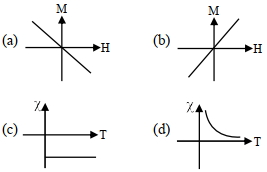
The following plots show Magnetization $(M)$ vs Magnetising field $(H)$ and Magnetic susceptibility $(\chi)$ vs temperature $(T)$ graphs:
Which of the following combinations will be represented by a diamagnetic material?
Which of the following combinations will be represented by a diamagnetic material?
A
$(a), (c)$
B
$(a), (d)$
C
$(b), (d)$
D
$(b), (c)$
Solution
(A) For a diamagnetic material:
$1$. The magnetization $(M)$ is in the opposite direction to the magnetizing field $(H)$,so the slope of the $M-H$ graph is negative. This corresponds to graph $(a)$.
$2$. The magnetic susceptibility $(\chi)$ is small,negative,and independent of temperature $(T)$. This corresponds to graph $(c)$.
Therefore,the correct combination for a diamagnetic material is $(a)$ and $(c)$.
$1$. The magnetization $(M)$ is in the opposite direction to the magnetizing field $(H)$,so the slope of the $M-H$ graph is negative. This corresponds to graph $(a)$.
$2$. The magnetic susceptibility $(\chi)$ is small,negative,and independent of temperature $(T)$. This corresponds to graph $(c)$.
Therefore,the correct combination for a diamagnetic material is $(a)$ and $(c)$.
0 likes
View Solution141
MediumMCQ
Statement $I :$ The ferromagnetic property depends on temperature. At high temperature,a ferromagnet becomes a paramagnet.
Statement $II :$ At high temperature,the domain wall area of a ferromagnetic substance increases.
In the light of the above statements,choose the most appropriate answer from the options given below :
Statement $II :$ At high temperature,the domain wall area of a ferromagnetic substance increases.
In the light of the above statements,choose the most appropriate answer from the options given below :
A
Statement $I$ is true but Statement $II$ is false
B
Both Statement $I$ and Statement $II$ are true
C
Both Statement $I$ and Statement $II$ are false
D
Statement $I$ is false but Statement $II$ is true
Solution
(A) Statement $I$ is true: Ferromagnetism is temperature-dependent. As the temperature increases,thermal agitation disrupts the alignment of magnetic moments within the domains. Above the Curie temperature $(T_C)$,the ferromagnetic material loses its spontaneous magnetization and behaves as a paramagnet.
Statement $II$ is false: As the temperature increases,the thermal energy causes the magnetic domains to shrink and eventually disappear. The domain structure becomes unstable,and the domain walls do not increase in area; rather,the domain boundaries vanish as the material transitions to a paramagnetic state.
Statement $II$ is false: As the temperature increases,the thermal energy causes the magnetic domains to shrink and eventually disappear. The domain structure becomes unstable,and the domain walls do not increase in area; rather,the domain boundaries vanish as the material transitions to a paramagnetic state.
0 likes
View Solution142
MediumMCQ
The soft-iron is a suitable material for making an electromagnet. This is because soft-iron has
A
low coercivity and high retentivity
B
low coercivity and low permeability
C
high permeability and low retentivity
D
high permeability and high retentivity
Solution
(C) Magnetic retentivity determines the magnetism left in the material after the magnetizing field has been switched off.
Electromagnets are operated in conditions requiring fast reversal of polarity,so high retentivity is undesirable.
Permeability is directly related to susceptibility; high permeability means the material is easily magnetized.
Therefore,electromagnets must be made of materials having high permeability and low retentivity.
Soft iron is such a material,making it ideal for electromagnets.
Electromagnets are operated in conditions requiring fast reversal of polarity,so high retentivity is undesirable.
Permeability is directly related to susceptibility; high permeability means the material is easily magnetized.
Therefore,electromagnets must be made of materials having high permeability and low retentivity.
Soft iron is such a material,making it ideal for electromagnets.
0 likes
View Solution143
MediumMCQ
Given below are two statements:
Statement-$I$: Susceptibilities of paramagnetic and ferromagnetic substances increase with decrease in temperature.
Statement-$II$: Diamagnetism is a result of orbital motions of electrons developing magnetic moments opposite to the applied magnetic field.
Choose the $CORRECT$ answer from the options given below:
Statement-$I$: Susceptibilities of paramagnetic and ferromagnetic substances increase with decrease in temperature.
Statement-$II$: Diamagnetism is a result of orbital motions of electrons developing magnetic moments opposite to the applied magnetic field.
Choose the $CORRECT$ answer from the options given below:
A
Both statement-$I$ and statement-$II$ are true.
B
Both statement-$I$ and statement-$II$ are false.
C
Statement-$I$ is true but statement-$II$ is false.
D
Statement-$I$ is false but statement-$II$ is true.
Solution
$(A)$ According to Curie's law, the magnetic susceptibility $\chi$ of paramagnetic substances is inversely proportional to the absolute temperature $T$, given by $\chi = \frac{C}{T}$.
For ferromagnetic substances, the susceptibility follows the Curie-Weiss law: $\chi = \frac{C}{T - T_C}$, where $T_C$ is the Curie temperature. As $T$ decreases towards $T_C$, the susceptibility increases. Thus, Statement-$I$ is true.
Diamagnetism arises due to the orbital motion of electrons. When an external magnetic field is applied, it induces a change in the orbital motion, creating a magnetic moment that opposes the applied field (Lenz's law at the atomic level). Thus, Statement-$II$ is true.
Therefore, both statements are true. The correct option is $(A)$.
For ferromagnetic substances, the susceptibility follows the Curie-Weiss law: $\chi = \frac{C}{T - T_C}$, where $T_C$ is the Curie temperature. As $T$ decreases towards $T_C$, the susceptibility increases. Thus, Statement-$I$ is true.
Diamagnetism arises due to the orbital motion of electrons. When an external magnetic field is applied, it induces a change in the orbital motion, creating a magnetic moment that opposes the applied field (Lenz's law at the atomic level). Thus, Statement-$II$ is true.
Therefore, both statements are true. The correct option is $(A)$.
0 likes
View Solution144
DifficultMCQ
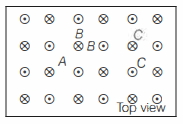
Consider the regular array of vertical identical current-carrying wires (with the direction of current flow as indicated in the figure alongside) protruding through a horizontal table. If we scatter some diamagnetic particles on the table,then they are likely to accumulate:
A
around regions such as $A$
B
around regions such as $B$
C
in circular regions around individual wires such as $C$
D
uniformly everywhere
Solution
(A) diamagnetic material is weakly repelled by a magnetic field. It tends to move from regions of stronger magnetic field to regions of weaker magnetic field.
In the given array of wires,the magnetic field produced by adjacent wires with opposite current directions cancels out at the midpoint between them (region $A$).
Since the magnetic field is minimum (zero) at region $A$ and maximum near the wires (region $B$),the diamagnetic particles will experience a force pushing them away from the high-field regions towards the low-field region $A$.
Therefore,the diamagnetic particles will accumulate in the regions where the magnetic field is weakest,which is region $A$.
In the given array of wires,the magnetic field produced by adjacent wires with opposite current directions cancels out at the midpoint between them (region $A$).
Since the magnetic field is minimum (zero) at region $A$ and maximum near the wires (region $B$),the diamagnetic particles will experience a force pushing them away from the high-field regions towards the low-field region $A$.
Therefore,the diamagnetic particles will accumulate in the regions where the magnetic field is weakest,which is region $A$.
0 likes
View Solution145
MediumMCQ
The variation of magnetic susceptibility with the temperature of a ferromagnetic material can be plotted as
A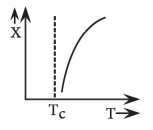
B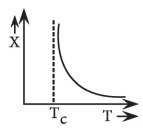
C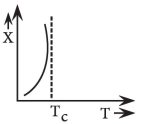
D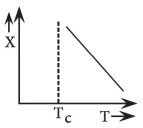
Solution
(B) The Curie-Weiss law describes the behaviour of magnetic susceptibility $\chi$ of a ferromagnetic material with respect to temperature $T$ above the Curie temperature $T_c$:
$\chi = \frac{C}{T - T_c}$
where $C$ is the Curie constant.
As $T$ increases above $T_c$,the denominator $(T - T_c)$ increases,causing the magnetic susceptibility $\chi$ to decrease. The relationship $\chi \propto \frac{1}{T - T_c}$ represents a hyperbolic curve that decreases as temperature increases. Among the given options,the graph in option $(B)$ correctly represents this inverse relationship where $\chi$ decreases as $T$ increases for $T > T_c$.
$\chi = \frac{C}{T - T_c}$
where $C$ is the Curie constant.
As $T$ increases above $T_c$,the denominator $(T - T_c)$ increases,causing the magnetic susceptibility $\chi$ to decrease. The relationship $\chi \propto \frac{1}{T - T_c}$ represents a hyperbolic curve that decreases as temperature increases. Among the given options,the graph in option $(B)$ correctly represents this inverse relationship where $\chi$ decreases as $T$ increases for $T > T_c$.
0 likes
View Solution146
MediumMCQ
Given below are two statements; one is labelled as Assertion $A$ and the other is labelled as Reason $R$.
Assertion $A:$ Electromagnets are made of soft iron.
Reason $R:$ Soft iron has high permeability and low retentivity.
In the light of the above statements,choose the most appropriate answer from the options given below.
Assertion $A:$ Electromagnets are made of soft iron.
Reason $R:$ Soft iron has high permeability and low retentivity.
In the light of the above statements,choose the most appropriate answer from the options given below.
A
$A$ is not correct but $R$ is correct.
B
Both $A$ and $R$ are correct and $R$ is the correct explanation of $A$.
C
Both $A$ and $R$ are correct but $R$ is $NOT$ the correct explanation of $A$.
D
$A$ is correct but $R$ is not correct.
Solution
(B) Electromagnets require materials that can be easily magnetized and demagnetized.
Soft iron is an ideal material for electromagnets because it possesses high magnetic permeability,which allows it to be easily magnetized,and low retentivity,which allows it to be easily demagnetized when the current is switched off.
Since Assertion $A$ states that electromagnets are made of soft iron and Reason $R$ correctly explains that this is due to its high permeability and low retentivity,both statements are correct and $R$ is the correct explanation of $A$.
Soft iron is an ideal material for electromagnets because it possesses high magnetic permeability,which allows it to be easily magnetized,and low retentivity,which allows it to be easily demagnetized when the current is switched off.
Since Assertion $A$ states that electromagnets are made of soft iron and Reason $R$ correctly explains that this is due to its high permeability and low retentivity,both statements are correct and $R$ is the correct explanation of $A$.
0 likes
View Solution147
MediumMCQ
Given below are two statements:
Statement $I:$ For a diamagnetic substance $-1 \leq \chi < 0$,where $\chi$ is the magnetic susceptibility.
Statement $II:$ Diamagnetic substances,when placed in an external non-uniform magnetic field,tend to move from the stronger to the weaker part of the field.
In the light of the above statements,choose the correct answer from the options given below.
Statement $I:$ For a diamagnetic substance $-1 \leq \chi < 0$,where $\chi$ is the magnetic susceptibility.
Statement $II:$ Diamagnetic substances,when placed in an external non-uniform magnetic field,tend to move from the stronger to the weaker part of the field.
In the light of the above statements,choose the correct answer from the options given below.
A
Both Statement $I$ and Statement $II$ are false.
B
Both Statement $I$ and Statement $II$ are true.
C
Statement $I$ is incorrect but Statement $II$ is true.
D
Statement $I$ is correct but Statement $II$ is false.
Solution
(B) Statement $I$ is true: For diamagnetic materials,the magnetic susceptibility $\chi$ is negative and lies in the range $-1 \leq \chi < 0$. This indicates that the material develops a weak magnetization in the direction opposite to the applied magnetic field.
Statement $II$ is true: Due to the negative susceptibility,diamagnetic materials are weakly repelled by magnets. When placed in a non-uniform magnetic field,they experience a force that pushes them from regions of stronger magnetic field intensity to regions of weaker magnetic field intensity.
Statement $II$ is true: Due to the negative susceptibility,diamagnetic materials are weakly repelled by magnets. When placed in a non-uniform magnetic field,they experience a force that pushes them from regions of stronger magnetic field intensity to regions of weaker magnetic field intensity.
0 likes
View Solution148
MediumMCQ
Given below are two statements:
Statement $I$: The diamagnetic property depends on temperature.
Statement $II$: The induced magnetic dipole moment in a diamagnetic sample is always opposite to the magnetizing field.
In the light of the given statements,choose the correct answer from the options given below:
Statement $I$: The diamagnetic property depends on temperature.
Statement $II$: The induced magnetic dipole moment in a diamagnetic sample is always opposite to the magnetizing field.
In the light of the given statements,choose the correct answer from the options given below:
A
Statement $I$ is incorrect but Statement $II$ is true.
B
Both Statement $I$ and Statement $II$ are true.
C
Both Statement $I$ and Statement $II$ are false.
D
Statement $I$ is correct but Statement $II$ is false.
Solution
(A) Statement $I$ is incorrect because diamagnetism is an inherent property of all matter and is independent of temperature. Unlike paramagnetism and ferromagnetism,which follow Curie's Law or Curie-Weiss Law,diamagnetic susceptibility is independent of temperature.
Statement $II$ is true because,according to Lenz's Law,when a diamagnetic material is placed in an external magnetic field,it develops an induced magnetic dipole moment in a direction opposite to the applied magnetizing field,which results in the material being weakly repelled by the field.
Statement $II$ is true because,according to Lenz's Law,when a diamagnetic material is placed in an external magnetic field,it develops an induced magnetic dipole moment in a direction opposite to the applied magnetizing field,which results in the material being weakly repelled by the field.
0 likes
View Solution149
DifficultMCQ
Paramagnetic substances:
A
$A, C$ Only
B
$B, D$ Only
C
$A, B, C$ Only
D
$A, B, C, D$
Solution
(A) Paramagnetic substances are weakly attracted by an external magnetic field.
$1$. They align themselves along the direction of the external magnetic field ($A$ is correct).
$2$. They are weakly attracted by the magnetic field, not strongly (so $B$ is incorrect).
$3$. Their magnetic susceptibility ($\chi$) is small and positive, meaning it is slightly greater than zero ($C$ is correct).
$4$. When placed in a non-uniform magnetic field, they move from a region of weak magnetic field to a region of strong magnetic field ($D$ is incorrect).
Therefore, only statements $A$ and $C$ are correct.
$1$. They align themselves along the direction of the external magnetic field ($A$ is correct).
$2$. They are weakly attracted by the magnetic field, not strongly (so $B$ is incorrect).
$3$. Their magnetic susceptibility ($\chi$) is small and positive, meaning it is slightly greater than zero ($C$ is correct).
$4$. When placed in a non-uniform magnetic field, they move from a region of weak magnetic field to a region of strong magnetic field ($D$ is incorrect).
Therefore, only statements $A$ and $C$ are correct.
0 likes
View Solution150
MediumMCQ
Match List-$I$ with List-$II$.
Choose the correct answer from the options given below:
| List-$I$ (Material) | List-$II$ (Susceptibility $(\chi)$) |
| $A$. Diamagnetic | $I$. $\chi=0$ |
| $B$. Ferromagnetic | $II$. $0 > \chi \geq -1$ |
| $C$. Paramagnetic | $III$. $\chi >> 1$ |
| $D$. Non-magnetic | $IV$. $0 < \chi < \varepsilon$ (a small positive number) |
Choose the correct answer from the options given below:
A
$A-II, B-I, C-III, D-IV$
B
$A-III, B-II, C-I, D-IV$
C
$A-IV, B-III, C-II, D-I$
D
$A-II, B-III, C-IV, D-I$
Solution
(D) The magnetic susceptibility $(\chi)$ characterizes the magnetic properties of materials:
$1$. Diamagnetic materials: These materials are weakly repelled by a magnetic field, and their susceptibility is small and negative, typically $0 > \chi \geq -1$. Thus, $A-II$.
$2$. Ferromagnetic materials: These materials are strongly attracted by a magnetic field, and their susceptibility is large and positive, $\chi >> 1$. Thus, $B-III$.
$3$. Paramagnetic materials: These materials are weakly attracted by a magnetic field, and their susceptibility is small and positive, $0 < \chi < \varepsilon$. Thus, $C-IV$.
$4$. Non-magnetic materials: These materials do not interact with magnetic fields, so their susceptibility is zero, $\chi = 0$. Thus, $D-I$.
Therefore, the correct matching is $A-II, B-III, C-IV, D-I$.
$1$. Diamagnetic materials: These materials are weakly repelled by a magnetic field, and their susceptibility is small and negative, typically $0 > \chi \geq -1$. Thus, $A-II$.
$2$. Ferromagnetic materials: These materials are strongly attracted by a magnetic field, and their susceptibility is large and positive, $\chi >> 1$. Thus, $B-III$.
$3$. Paramagnetic materials: These materials are weakly attracted by a magnetic field, and their susceptibility is small and positive, $0 < \chi < \varepsilon$. Thus, $C-IV$.
$4$. Non-magnetic materials: These materials do not interact with magnetic fields, so their susceptibility is zero, $\chi = 0$. Thus, $D-I$.
Therefore, the correct matching is $A-II, B-III, C-IV, D-I$.
0 likes
View SolutionMagnetism and Matter — Magnetic Materials (Diamagnetic, Paramagnetic and Ferromagnetic) · Frequently Asked Questions
1Are these Magnetism and Matter questions useful for JEE and NEET?
Yes. All questions in this section are mapped to JEE Main and NEET exam patterns. Previous year questions from JEE Main, NEET, GUJCET and state-level exams are included with full solutions.
2Can I switch to Hindi or Gujarati for these questions?
Yes. Use the language tabs in the hero section or the sidebar to view the same questions and solutions in English, Hindi or Gujarati.
3How do I generate a question paper from this subtopic?
Use the Vedclass Exam Paper Generator — select the chapter and subtopic, set difficulty, and generate Sets A, B, C, D automatically. First 3 chapters of every subject are free.
Vedclass Products
For Students
Vedclass Test Series
Mock tests in real JEE/NEET style with performance analysis. 5-day free trial.
Start Free TrialFor Teachers
Exam Paper Generator
Generate Set A/B/C/D papers from this chapter in 2 minutes. 3 chapters free.
Try FreeFor Institutes
Online Exam Module
Live online exams with unlimited students, 360° analytics & white-label branding.
See DemoFor Teachers & Institutes
Generate a Magnetism and Matter Exam Paper in 2 Minutes
Select subtopic & difficulty — Sets A, B, C, D auto-generated with No Repeat logic.
First 3 chapters of every subject are free — no payment required.