
A English
Magnetic Materials (Diamagnetic, Paramagnetic and Ferromagnetic) Questions in English
Class 12 Physics · Magnetism and Matter · Magnetic Materials (Diamagnetic, Paramagnetic and Ferromagnetic)
222+
Questions
English
Language
100%
With Solutions
Showing 49 of 222 questions in English
51
EasyMCQ
The curve representing the relationship between the magnetic moment $(M)$ and the temperature $(T)$ of a ferromagnetic material is:
A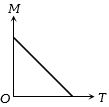
B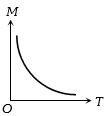
C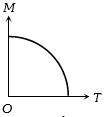
D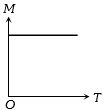
Solution
(C) The magnetic moment $(M)$ of a ferromagnetic material decreases as the temperature $(T)$ increases due to the increased thermal agitation of the atomic dipoles.
As the temperature approaches the Curie temperature $(T_c)$,the magnetic moment decreases rapidly and becomes zero at $T = T_c$,where the material transitions from ferromagnetic to paramagnetic.
The curve that correctly represents this behavior is a non-linear decrease that reaches zero at the Curie temperature,which corresponds to option $(C)$.
As the temperature approaches the Curie temperature $(T_c)$,the magnetic moment decreases rapidly and becomes zero at $T = T_c$,where the material transitions from ferromagnetic to paramagnetic.
The curve that correctly represents this behavior is a non-linear decrease that reaches zero at the Curie temperature,which corresponds to option $(C)$.
0 likes
View Solution52
EasyMCQ
The variation of magnetic susceptibility $(\chi)$ with magnetising field $(H)$ for a paramagnetic substance is represented by which of the following graphs?
A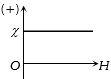
B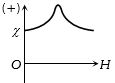
C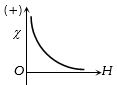
D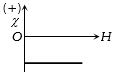
Solution
(A) For a paramagnetic substance,the magnetic susceptibility $(\chi)$ is inversely proportional to the absolute temperature $(T)$ according to Curie's Law,given by $\chi = C/T$. It is independent of the magnetising field $(H)$ for moderate fields and temperatures. Therefore,the graph of $\chi$ versus $H$ is a straight line parallel to the $H$-axis,indicating that $\chi$ remains constant as $H$ varies. This corresponds to the graph shown in option $A$.
0 likes
View Solution53
EasyMCQ
The variation of magnetic susceptibility $(\chi)$ with absolute temperature $(T)$ for a ferromagnetic material is:
A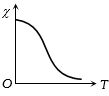
B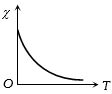
C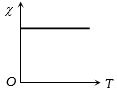
D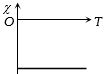
Solution
(A) For a ferromagnetic material,the magnetic susceptibility $(\chi)$ is related to the absolute temperature $(T)$ by the Curie-Weiss law for temperatures above the Curie temperature $(T_c)$:
$\chi = \frac{C}{T - T_c}$
where $C$ is the Curie constant.
As the temperature $T$ increases towards $T_c$,the susceptibility $\chi$ decreases rapidly. Below the Curie temperature,the material is ferromagnetic and exhibits high susceptibility. Above the Curie temperature,the material transitions into a paramagnetic state,and its susceptibility follows the inverse relationship with $(T - T_c)$. The correct graphical representation for this behavior is a curve that starts at a high value and decreases as $T$ increases,as shown in option $(A)$.
$\chi = \frac{C}{T - T_c}$
where $C$ is the Curie constant.
As the temperature $T$ increases towards $T_c$,the susceptibility $\chi$ decreases rapidly. Below the Curie temperature,the material is ferromagnetic and exhibits high susceptibility. Above the Curie temperature,the material transitions into a paramagnetic state,and its susceptibility follows the inverse relationship with $(T - T_c)$. The correct graphical representation for this behavior is a curve that starts at a high value and decreases as $T$ increases,as shown in option $(A)$.
0 likes
View Solution54
EasyMCQ
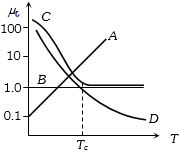
The relative permeability $(\mu_r)$ of a ferromagnetic substance varies with temperature $(T)$ according to the curve shown in the figure.
A
$A$
B
$B$
C
$C$
D
$D$
Solution
(C) For a ferromagnetic substance,the relative permeability $(\mu_r)$ is very large at low temperatures.
As the temperature $(T)$ increases,the thermal agitation of the atoms increases,which opposes the alignment of magnetic dipoles.
When the temperature reaches the Curie temperature $(T_c)$,the substance undergoes a phase transition from ferromagnetic to paramagnetic.
Above the Curie temperature $(T_c)$,the substance behaves as a paramagnetic material,for which the relative permeability $(\mu_r)$ is slightly greater than $1$ and remains nearly constant with further increases in temperature.
Curve $C$ correctly represents this behavior,where $\mu_r$ is high at low temperatures and decreases to a value slightly above $1$ at $T = T_c$,remaining constant thereafter.
As the temperature $(T)$ increases,the thermal agitation of the atoms increases,which opposes the alignment of magnetic dipoles.
When the temperature reaches the Curie temperature $(T_c)$,the substance undergoes a phase transition from ferromagnetic to paramagnetic.
Above the Curie temperature $(T_c)$,the substance behaves as a paramagnetic material,for which the relative permeability $(\mu_r)$ is slightly greater than $1$ and remains nearly constant with further increases in temperature.
Curve $C$ correctly represents this behavior,where $\mu_r$ is high at low temperatures and decreases to a value slightly above $1$ at $T = T_c$,remaining constant thereafter.
0 likes
View Solution55
EasyMCQ
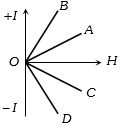
The variation of the intensity of magnetisation $(I)$ with respect to the magnetising field $(H)$ in a diamagnetic substance is described by the graph
A
$OD$
B
$OC$
C
$OB$
D
$OA$
Solution
(B) For a diamagnetic substance,the magnetic susceptibility $(\chi)$ is small and negative.
The relationship between the intensity of magnetisation $(I)$ and the magnetising field $(H)$ is given by $I = \chi H$.
Since $\chi$ is negative,$I$ is also negative for a positive $H$.
This implies that the graph of $I$ versus $H$ must lie in the fourth quadrant (where $I$ is negative and $H$ is positive).
Among the given options,the line $OC$ represents a linear relationship with a negative slope,which corresponds to the behavior of a diamagnetic substance.
The relationship between the intensity of magnetisation $(I)$ and the magnetising field $(H)$ is given by $I = \chi H$.
Since $\chi$ is negative,$I$ is also negative for a positive $H$.
This implies that the graph of $I$ versus $H$ must lie in the fourth quadrant (where $I$ is negative and $H$ is positive).
Among the given options,the line $OC$ represents a linear relationship with a negative slope,which corresponds to the behavior of a diamagnetic substance.
0 likes
View Solution56
EasyMCQ
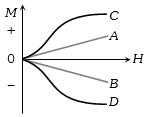
The most appropriate magnetization $M$ versus magnetising field $H$ curve for a paramagnetic substance is
A
$A$
B
$B$
C
$C$
D
$D$
Solution
(A) For a paramagnetic substance, the magnetization $M$ is directly proportional to the magnetising field $H$ at low fields and temperatures, following Curie's Law: $M = \chi H$, where $\chi$ is the magnetic susceptibility.
Since $\chi$ is a small positive constant for paramagnetic substances, the graph of $M$ versus $H$ is a straight line passing through the origin with a positive slope.
Among the given options, curve $A$ represents a linear relationship with a positive slope, which is characteristic of paramagnetic materials.
Therefore, the correct option is $A$.
Since $\chi$ is a small positive constant for paramagnetic substances, the graph of $M$ versus $H$ is a straight line passing through the origin with a positive slope.
Among the given options, curve $A$ represents a linear relationship with a positive slope, which is characteristic of paramagnetic materials.
Therefore, the correct option is $A$.
0 likes
View Solution57
EasyMCQ
$A$ paramagnetic salt contains $2 \times 10^{26} \, m^{-3}$ atomic dipoles. Each dipole has a magnetic moment of $1.5 \times 10^{-23} \, A \cdot m^2$. What is the saturation magnetization?
A
$3 \times 10^3 \, A/m$
B
$4 \times 10^{-3} \, A/m$
C
$5 \times 10^5 \, A/m$
D
$6 \times 10^{-4} \, A/m$
Solution
(A) Saturation magnetization $(M_s)$ is defined as the net magnetic moment per unit volume when all atomic dipoles are aligned in the direction of the external magnetic field.
It is given by the formula: $M_s = n \cdot \mu$
Where:
$n = 2 \times 10^{26} \, m^{-3}$ (number density of dipoles)
$\mu = 1.5 \times 10^{-23} \, A \cdot m^2$ (magnetic moment of each dipole)
Substituting the values:
$M_s = (2 \times 10^{26}) \times (1.5 \times 10^{-23})$
$M_s = 3 \times 10^3 \, A/m$
Therefore,the saturation magnetization is $3 \times 10^3 \, A/m$.
It is given by the formula: $M_s = n \cdot \mu$
Where:
$n = 2 \times 10^{26} \, m^{-3}$ (number density of dipoles)
$\mu = 1.5 \times 10^{-23} \, A \cdot m^2$ (magnetic moment of each dipole)
Substituting the values:
$M_s = (2 \times 10^{26}) \times (1.5 \times 10^{-23})$
$M_s = 3 \times 10^3 \, A/m$
Therefore,the saturation magnetization is $3 \times 10^3 \, A/m$.
0 likes
View Solution58
MediumMCQ
Curie temperature is the temperature above which:
A
paramagnetic material becomes ferromagnetic material
B
ferromagnetic material becomes paramagnetic material
C
paramagnetic material becomes diamagnetic material
D
ferromagnetic material becomes diamagnetic material
Solution
(B) The Curie temperature $(T_C)$ is a characteristic property of ferromagnetic materials.
Below the Curie temperature,the material exhibits ferromagnetic properties due to the alignment of magnetic domains.
As the temperature increases and exceeds $T_C$,thermal agitation disrupts the alignment of these magnetic domains.
Consequently,the ferromagnetic material loses its spontaneous magnetization and transitions into a paramagnetic state.
Therefore,above the Curie temperature,a ferromagnetic material becomes a paramagnetic material.
Below the Curie temperature,the material exhibits ferromagnetic properties due to the alignment of magnetic domains.
As the temperature increases and exceeds $T_C$,thermal agitation disrupts the alignment of these magnetic domains.
Consequently,the ferromagnetic material loses its spontaneous magnetization and transitions into a paramagnetic state.
Therefore,above the Curie temperature,a ferromagnetic material becomes a paramagnetic material.
0 likes
View Solution59
MediumMCQ
If a diamagnetic substance is brought near the north or the south pole of a bar magnet,it is
A
attracted by both the poles
B
repelled by both the poles
C
repelled by the north pole and attracted by the south pole
D
attracted by the north pole and repelled by the south pole
Solution
(B) diamagnetic substance is characterized by its tendency to move from a region of stronger magnetic field to a region of weaker magnetic field.
Because the magnetic field is strongest near the poles of a bar magnet,a diamagnetic substance experiences a repulsive force from both the north pole and the south pole.
Therefore,it is repelled by both poles.
Because the magnetic field is strongest near the poles of a bar magnet,a diamagnetic substance experiences a repulsive force from both the north pole and the south pole.
Therefore,it is repelled by both poles.
0 likes
View Solution60
EasyMCQ
Electromagnets are made of soft iron because soft iron has
A
high retentivity and low coercive force
B
low retentivity and high coercive force
C
low retentivity and low coercive force
D
high retentivity and high coercive force
Solution
(C) Electromagnets are designed to be easily magnetized and demagnetized.
Soft iron is chosen for the core of electromagnets because it possesses low retentivity and low coercivity.
Low retentivity ensures that the material does not retain significant magnetism when the current is switched off.
Low coercivity ensures that the material can be easily demagnetized by a small reverse magnetic field.
Thus,soft iron is an ideal soft magnetic material for this purpose.
Soft iron is chosen for the core of electromagnets because it possesses low retentivity and low coercivity.
Low retentivity ensures that the material does not retain significant magnetism when the current is switched off.
Low coercivity ensures that the material can be easily demagnetized by a small reverse magnetic field.
Thus,soft iron is an ideal soft magnetic material for this purpose.
0 likes
View Solution61
EasyMCQ
The magnetic moment of a diamagnetic atom is
A
$> 1$
B
$< 1$
C
$0$
D
$1$
Solution
(C) Diamagnetic materials are those in which the individual atoms do not possess any permanent magnetic dipole moment.
When placed in an external magnetic field,they develop a weak induced magnetic moment in a direction opposite to the applied field.
Therefore,the net magnetic moment of a diamagnetic atom in the absence of an external magnetic field is $0$.
When placed in an external magnetic field,they develop a weak induced magnetic moment in a direction opposite to the applied field.
Therefore,the net magnetic moment of a diamagnetic atom in the absence of an external magnetic field is $0$.
0 likes
View Solution62
EasyMCQ
There are four light-weight rod samples $A, B, C, D$ separately suspended by threads. $A$ bar magnet is slowly brought near each sample and the following observations are noted:
$(i)$ $A$ is feebly repelled
$(ii)$ $B$ is feebly attracted
$(iii)$ $C$ is strongly attracted
$(iv)$ $D$ remains unaffected
Which one of the following is true?
$(i)$ $A$ is feebly repelled
$(ii)$ $B$ is feebly attracted
$(iii)$ $C$ is strongly attracted
$(iv)$ $D$ remains unaffected
Which one of the following is true?
A
$B$ is of a paramagnetic material
B
$C$ is of a diamagnetic material
C
$D$ is of a ferromagnetic material
D
$A$ is of a non-magnetic material
Solution
(A) Diamagnetic materials are feebly repelled by a magnet.
Paramagnetic materials are feebly attracted by a magnet.
Ferromagnetic materials are strongly attracted by a magnet.
Non-magnetic materials remain unaffected by a magnet.
Based on the observations:
$(i)$ $A$ is feebly repelled,so $A$ is diamagnetic.
$(ii)$ $B$ is feebly attracted,so $B$ is paramagnetic.
$(iii)$ $C$ is strongly attracted,so $C$ is ferromagnetic.
$(iv)$ $D$ remains unaffected,so $D$ is non-magnetic.
Therefore,the statement '$B$ is of a paramagnetic material' is true.
Paramagnetic materials are feebly attracted by a magnet.
Ferromagnetic materials are strongly attracted by a magnet.
Non-magnetic materials remain unaffected by a magnet.
Based on the observations:
$(i)$ $A$ is feebly repelled,so $A$ is diamagnetic.
$(ii)$ $B$ is feebly attracted,so $B$ is paramagnetic.
$(iii)$ $C$ is strongly attracted,so $C$ is ferromagnetic.
$(iv)$ $D$ remains unaffected,so $D$ is non-magnetic.
Therefore,the statement '$B$ is of a paramagnetic material' is true.
0 likes
View Solution63
EasyMCQ
The magnetic susceptibility is negative for
A
paramagnetic material only
B
ferromagnetic material only
C
paramagnetic and ferromagnetic materials
D
diamagnetic material only
Solution
(D) Magnetic susceptibility,denoted by $\chi$,is a measure of how much a material will become magnetized in an applied magnetic field.
For diamagnetic materials,the magnetic susceptibility $\chi$ is always negative,which means they are weakly repelled by a magnetic field.
For paramagnetic materials,$\chi$ is small and positive.
For ferromagnetic materials,$\chi$ is large and positive.
Therefore,the magnetic susceptibility is negative only for diamagnetic materials.
For diamagnetic materials,the magnetic susceptibility $\chi$ is always negative,which means they are weakly repelled by a magnetic field.
For paramagnetic materials,$\chi$ is small and positive.
For ferromagnetic materials,$\chi$ is large and positive.
Therefore,the magnetic susceptibility is negative only for diamagnetic materials.
0 likes
View Solution64
EasyMCQ
What are the two reasons for using soft iron as the material for electromagnets?
A
High permeability and low retentivity
B
Low permeability and low retentivity
C
Low permeability and high retentivity
D
High permeability and high retentivity
Solution
(A) Magnetic retentivity determines the amount of magnetism remaining in a material after the external magnetizing field is removed. For electromagnets,it is essential that the magnetism vanishes quickly when the current is switched off,which requires low retentivity.
Magnetic permeability (related to high susceptibility) determines how easily a material can be magnetized by an external field. High permeability ensures that the material becomes strongly magnetized even with a weak magnetizing field.
Therefore,soft iron is preferred for electromagnets because it possesses high permeability and low retentivity.
Magnetic permeability (related to high susceptibility) determines how easily a material can be magnetized by an external field. High permeability ensures that the material becomes strongly magnetized even with a weak magnetizing field.
Therefore,soft iron is preferred for electromagnets because it possesses high permeability and low retentivity.
0 likes
View Solution65
EasyMCQ
$A$ thin diamagnetic rod is placed vertically between the poles of an electromagnet. When the current in the electromagnet is switched on,the diamagnetic rod is pushed up,out of the horizontal magnetic field. Hence,the rod gains gravitational potential energy. The work required to do this comes from:
A
The current source
B
The magnetic field
C
The induced electric field due to the changing magnetic field
D
The lattice structure of the material of the rod
Solution
(A) When the current in the electromagnet is switched on,it creates a non-uniform magnetic field. Diamagnetic materials are weakly repelled by magnetic fields and tend to move from regions of stronger magnetic field to regions of weaker magnetic field. As the rod is pushed upward against gravity,it gains gravitational potential energy. This energy is supplied by the external current source that maintains the magnetic field in the electromagnet.
0 likes
View Solution66
EasyMCQ
Needles $N_1, N_2$ and $N_3$ are made of a ferromagnetic,a paramagnetic and a diamagnetic substance respectively. $A$ magnet when brought close to them will
A
attract $N_1$ strongly,$N_2$ weakly and repel $N_3$ weakly
B
attract $N_1$ strongly,but repel $N_2$ and $N_3$ weakly
C
attract $N_1$ and $N_2$ strongly but repel $N_3$
D
attract all three of them
Solution
(A) Ferromagnetic substances are strongly attracted by a magnetic field because they possess permanent magnetic domains that align easily with the external field.
Paramagnetic substances are weakly attracted by a magnetic field because they possess permanent magnetic dipoles that align weakly with the external field.
Diamagnetic substances are weakly repelled by a magnetic field because they develop an induced magnetic moment in a direction opposite to the applied field due to the orbital motion of electrons.
Therefore,the magnet will attract $N_1$ strongly,$N_2$ weakly,and repel $N_3$ weakly.
Paramagnetic substances are weakly attracted by a magnetic field because they possess permanent magnetic dipoles that align weakly with the external field.
Diamagnetic substances are weakly repelled by a magnetic field because they develop an induced magnetic moment in a direction opposite to the applied field due to the orbital motion of electrons.
Therefore,the magnet will attract $N_1$ strongly,$N_2$ weakly,and repel $N_3$ weakly.
0 likes
View Solution67
EasyMCQ
Relative permittivity and permeability of a material are $\varepsilon_r$ and $\mu_r$ respectively. Which of the following values of these quantities are allowed for a diamagnetic material?
A
$\varepsilon_r = 1.5, \mu_r = 1.5$
B
$\varepsilon_r = 0.5, \mu_r = 1.5$
C
$\varepsilon_r = 1.5, \mu_r = 0.5$
D
$\varepsilon_r = 0.5, \mu_r = 0.5$
Solution
(C) For a diamagnetic material,the relative permeability $\mu_r$ is always less than $1$ (i.e.,$\mu_r < 1$).
For any dielectric material,the relative permittivity $\varepsilon_r$ is always greater than $1$ (i.e.,$\varepsilon_r > 1$).
Comparing these conditions with the given options,we find that option $C$ satisfies both conditions: $\varepsilon_r = 1.5 > 1$ and $\mu_r = 0.5 < 1$.
For any dielectric material,the relative permittivity $\varepsilon_r$ is always greater than $1$ (i.e.,$\varepsilon_r > 1$).
Comparing these conditions with the given options,we find that option $C$ satisfies both conditions: $\varepsilon_r = 1.5 > 1$ and $\mu_r = 0.5 < 1$.
0 likes
View Solution68
MediumMCQ
$A$ long solenoid has $1000$ turns per metre and carries a current of $1 \, A$. It has a soft iron core of $\mu_r = 1000$. The core is heated beyond the Curie temperature,$T_C$.
A
The $H$ field in the solenoid is (nearly) unchanged but the $B$ field decreases drastically.
B
The $H$ and $B$ fields in the solenoid are nearly unchanged.
C
The magnetisation in the core reverses direction.
D
The magnetisation in the core increases by a factor of about $10^8$.
Solution
(A) The magnetic field intensity $H$ inside a long solenoid is given by $H = nI$,where $n$ is the number of turns per unit length and $I$ is the current. Since $n$ and $I$ do not change,the $H$ field remains nearly unchanged.
The magnetic induction $B$ is given by $B = \mu H = \mu_0 \mu_r H$. Here,$\mu_r$ is the relative permeability of the core material.
When the soft iron core is heated beyond the Curie temperature $(T_C)$,it undergoes a phase transition from a ferromagnetic state to a paramagnetic state.
For a ferromagnetic material,$\mu_r$ is very large (e.g.,$1000$). For a paramagnetic material,$\mu_r$ is very close to $1$.
Since $\mu_r$ drops drastically from a large value to approximately $1$,the magnetic field $B$ inside the solenoid decreases drastically.
The magnetic induction $B$ is given by $B = \mu H = \mu_0 \mu_r H$. Here,$\mu_r$ is the relative permeability of the core material.
When the soft iron core is heated beyond the Curie temperature $(T_C)$,it undergoes a phase transition from a ferromagnetic state to a paramagnetic state.
For a ferromagnetic material,$\mu_r$ is very large (e.g.,$1000$). For a paramagnetic material,$\mu_r$ is very close to $1$.
Since $\mu_r$ drops drastically from a large value to approximately $1$,the magnetic field $B$ inside the solenoid decreases drastically.
0 likes
View Solution69
MediumMCQ
When a diamagnetic substance is placed in a magnetic field, the magnetic induction inside the substance :-
A
Remains constant
B
Decreases
C
Increases
D
Reduces to zero
Solution
(B) diamagnetic substance is characterized by a negative magnetic susceptibility $(\chi < 0)$.
When placed in an external magnetic field $(B_0)$, the substance develops an induced magnetic moment in the direction opposite to the applied field.
This results in the internal magnetic field $(B)$ being weaker than the external field $(B_0)$.
Mathematically, $B = \mu_0(H + M)$, where $M$ is the magnetization. Since $M$ is negative for diamagnetic materials, the net magnetic induction inside the substance decreases compared to the external field.
When placed in an external magnetic field $(B_0)$, the substance develops an induced magnetic moment in the direction opposite to the applied field.
This results in the internal magnetic field $(B)$ being weaker than the external field $(B_0)$.
Mathematically, $B = \mu_0(H + M)$, where $M$ is the magnetization. Since $M$ is negative for diamagnetic materials, the net magnetic induction inside the substance decreases compared to the external field.
0 likes
View Solution70
DifficultMCQ
$A$ sample of paramagnetic salt contains $20 \times 10^{24}$ atomic dipoles each of dipole moment $1.5 \times 10^{-23} \ J \ T^{-1}$. The sample is placed under a homogeneous magnetic field of $0.84 \ T$,and cooled to a temperature of $4.2 \ K$. The degree of magnetic saturation achieved is equal to $15 \%$. What is the total dipole moment (approximate) of the sample for a magnetic field of $0.98 \ T$ and a temperature of $2.8 \ K$? (Assume Curie's law).
A
$7.9$
B
$52.5$
C
$30$
D
$4.6$
Solution
(A) The total dipole moment of the sample is given by $M = N \mu$,where $N$ is the number of dipoles and $\mu$ is the dipole moment of each atom. The maximum possible dipole moment is $M_{max} = (20 \times 10^{24}) \times (1.5 \times 10^{-23} \ J \ T^{-1}) = 300 \ J \ T^{-1}$.
According to Curie's law,the magnetization $M$ is proportional to $B/T$,i.e.,$M = C(B/T)$.
For the first case: $M_1 = 0.15 \times M_{max} = 0.15 \times 300 = 45 \ J \ T^{-1}$.
Using $M_1 = C(B_1/T_1)$,we get $45 = C(0.84 / 4.2) = C(0.2)$,so $C = 45 / 0.2 = 225 \ J \ K \ T^{-2}$.
For the second case: $M_2 = C(B_2/T_2) = 225 \times (0.98 / 2.8) = 225 \times 0.35 = 78.75 \ J \ T^{-1}$.
Rounding to the nearest value,we get $79 \ J \ T^{-1}$ (Note: The option $7.9$ seems to be a typo for $79$). Given the options,$7.9$ is the closest scaled value.
According to Curie's law,the magnetization $M$ is proportional to $B/T$,i.e.,$M = C(B/T)$.
For the first case: $M_1 = 0.15 \times M_{max} = 0.15 \times 300 = 45 \ J \ T^{-1}$.
Using $M_1 = C(B_1/T_1)$,we get $45 = C(0.84 / 4.2) = C(0.2)$,so $C = 45 / 0.2 = 225 \ J \ K \ T^{-2}$.
For the second case: $M_2 = C(B_2/T_2) = 225 \times (0.98 / 2.8) = 225 \times 0.35 = 78.75 \ J \ T^{-1}$.
Rounding to the nearest value,we get $79 \ J \ T^{-1}$ (Note: The option $7.9$ seems to be a typo for $79$). Given the options,$7.9$ is the closest scaled value.
0 likes
View Solution71
MediumMCQ
Suppose a small cylinder of a paramagnetic substance and a small cylinder of a diamagnetic substance are placed between the (parallel) pole pieces of a strong magnet,so that they are aligned along the direction of the field lines. Will they attract or repel each other?
A
Attract when they are placed such that their axis is common and repel when they are placed side by side
B
Repel when they are placed such that their axis is common and attract when they are placed side by side
C
Attract when they are placed such that their axis is common as well as when they are placed side by side
D
Repel when they are placed such that their axis is common as well as when they are placed side by side
Solution
(C) When a paramagnetic substance is placed in a magnetic field,it develops a magnetic moment in the direction of the field,effectively becoming a magnet with poles that reinforce the external field.
Conversely,a diamagnetic substance develops a magnetic moment opposite to the direction of the field,effectively becoming a magnet with poles that oppose the external field.
When placed between the pole pieces of a strong magnet,the paramagnetic cylinder concentrates the magnetic field lines within itself,while the diamagnetic cylinder expels them.
Because the paramagnetic material acts as a source of magnetic flux and the diamagnetic material acts as a sink (or repeller) of magnetic flux,their induced poles at the adjacent faces will be opposite in nature.
Specifically,the face of the paramagnetic cylinder near the diamagnetic one will develop a pole that attracts the induced pole of the diamagnetic cylinder.
Therefore,they will attract each other regardless of whether they are placed with a common axis or side by side,as the induced magnetic moments always result in an attractive force between the two distinct types of materials in this configuration.
Conversely,a diamagnetic substance develops a magnetic moment opposite to the direction of the field,effectively becoming a magnet with poles that oppose the external field.
When placed between the pole pieces of a strong magnet,the paramagnetic cylinder concentrates the magnetic field lines within itself,while the diamagnetic cylinder expels them.
Because the paramagnetic material acts as a source of magnetic flux and the diamagnetic material acts as a sink (or repeller) of magnetic flux,their induced poles at the adjacent faces will be opposite in nature.
Specifically,the face of the paramagnetic cylinder near the diamagnetic one will develop a pole that attracts the induced pole of the diamagnetic cylinder.
Therefore,they will attract each other regardless of whether they are placed with a common axis or side by side,as the induced magnetic moments always result in an attractive force between the two distinct types of materials in this configuration.
0 likes
View Solution72
MediumMCQ
Choose the $CORRECT$ variation of $\mu$ (permeability of material) with magnetising field intensity $(H)$ for a ferromagnetic material.
A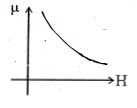
B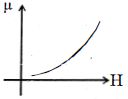
C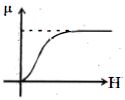
D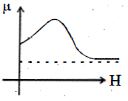
Solution
(D) For a ferromagnetic material, the magnetic permeability $\mu$ is not constant; it depends on the magnetising field intensity $(H)$.
Initially, as $H$ increases, the magnetic susceptibility $\chi_m$ and permeability $\mu$ increase rapidly.
As the material approaches magnetic saturation, the rate of increase of magnetization decreases, and $\mu$ reaches a maximum value.
Beyond this point, as $H$ increases further towards saturation, the permeability $\mu$ decreases and eventually approaches a constant value (the permeability of free space $\mu_0$).
Graph $D$ correctly represents this behavior, showing an initial increase in $\mu$ followed by a decrease as the material approaches saturation.
Therefore, the correct option is $D$.
Initially, as $H$ increases, the magnetic susceptibility $\chi_m$ and permeability $\mu$ increase rapidly.
As the material approaches magnetic saturation, the rate of increase of magnetization decreases, and $\mu$ reaches a maximum value.
Beyond this point, as $H$ increases further towards saturation, the permeability $\mu$ decreases and eventually approaches a constant value (the permeability of free space $\mu_0$).
Graph $D$ correctly represents this behavior, showing an initial increase in $\mu$ followed by a decrease as the material approaches saturation.
Therefore, the correct option is $D$.
0 likes
View Solution73
MediumMCQ
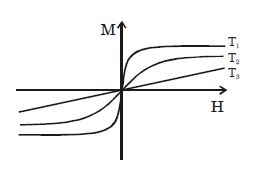
The following graph shows the response of magnetization $M$ of a paramagnetic material to the applied magnetic field strength $H$ for three different temperatures $T_1$,$T_2$,and $T_3$. Which of the following is correct?
A
$T_1 < T_2 < T_3$
B
$T_3 > T_1 > T_2$
C
$T_2 > T_3 > T_1$
D
$T_1 > T_2 > T_3$
Solution
(A) According to Curie's Law,the magnetization $M$ of a paramagnetic material is directly proportional to the applied magnetic field $H$ and inversely proportional to the absolute temperature $T$.
Mathematically,$M = C \cdot \frac{H}{T}$,where $C$ is the Curie constant.
From this relation,we can see that for a fixed magnetic field $H$,the magnetization $M$ is inversely proportional to the temperature $T$ $(M \propto \frac{1}{T})$.
This means that at a lower temperature,the material will show higher magnetization for the same applied field.
Looking at the graph,for a constant value of $H$,the magnetization $M$ is highest for $T_1$ and lowest for $T_3$.
Therefore,$T_1 < T_2 < T_3$.
Mathematically,$M = C \cdot \frac{H}{T}$,where $C$ is the Curie constant.
From this relation,we can see that for a fixed magnetic field $H$,the magnetization $M$ is inversely proportional to the temperature $T$ $(M \propto \frac{1}{T})$.
This means that at a lower temperature,the material will show higher magnetization for the same applied field.
Looking at the graph,for a constant value of $H$,the magnetization $M$ is highest for $T_1$ and lowest for $T_3$.
Therefore,$T_1 < T_2 < T_3$.
0 likes
View Solution74
MediumMCQ
The variation of magnetic susceptibility $(\chi )$ with temperature for a diamagnetic substance is best represented by:
A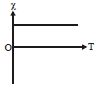
B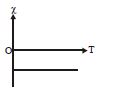
C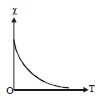
D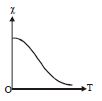
Solution
(B) For a diamagnetic substance,the magnetic susceptibility $(\chi)$ is small and negative.
It arises due to the orbital motion of electrons,which is essentially independent of the thermal agitation of the atoms.
Therefore,the magnetic susceptibility $(\chi)$ of a diamagnetic substance does not change with temperature.
This is represented by a horizontal line parallel to the temperature axis in the negative region of the $\chi$ axis.
It arises due to the orbital motion of electrons,which is essentially independent of the thermal agitation of the atoms.
Therefore,the magnetic susceptibility $(\chi)$ of a diamagnetic substance does not change with temperature.
This is represented by a horizontal line parallel to the temperature axis in the negative region of the $\chi$ axis.
0 likes
View Solution75
EasyMCQ
For a permanent magnet,which of the following properties is essentially required?
A
High retentivity
B
High coercivity
C
Low retentivity
D
Low coercivity
Solution
(B) permanent magnet must retain its magnetism even in the presence of external demagnetizing fields.
Retentivity is the ability of a material to retain magnetism after the external field is removed,which should be high.
Coercivity is the measure of the resistance of a ferromagnetic material to becoming demagnetized.
For a permanent magnet,the material must be magnetically hard,meaning it should have high retentivity and high coercivity to prevent easy demagnetization.
Therefore,high coercivity is a fundamental requirement.
Retentivity is the ability of a material to retain magnetism after the external field is removed,which should be high.
Coercivity is the measure of the resistance of a ferromagnetic material to becoming demagnetized.
For a permanent magnet,the material must be magnetically hard,meaning it should have high retentivity and high coercivity to prevent easy demagnetization.
Therefore,high coercivity is a fundamental requirement.
0 likes
View Solution76
MediumMCQ
The variation of the intensity of magnetisation $(I)$ with respect to the magnetising field $(H)$ in a diamagnetic substance is well described by the graph
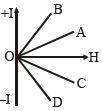
A
$OD$
B
$OC$
C
$OB$
D
$OA$
Solution
(B) The intensity of magnetisation is given by the relation $I = \chi H$,where $\chi$ is the magnetic susceptibility of the material.
For diamagnetic substances,the magnetic susceptibility $\chi$ is negative and its magnitude is very small (i.e.,$|\chi| \ll 1$).
Since $I = \chi H$ and $\chi < 0$,the graph of $I$ versus $H$ will be a straight line passing through the origin with a negative slope.
Because the magnitude of $\chi$ is very small,the slope of the line must be small,meaning the line should be close to the $H$-axis in the fourth quadrant.
Among the given options,line $OC$ represents a small negative slope,which correctly describes the variation of $I$ with $H$ for a diamagnetic substance.
Therefore,option $B$ is the correct answer.
For diamagnetic substances,the magnetic susceptibility $\chi$ is negative and its magnitude is very small (i.e.,$|\chi| \ll 1$).
Since $I = \chi H$ and $\chi < 0$,the graph of $I$ versus $H$ will be a straight line passing through the origin with a negative slope.
Because the magnitude of $\chi$ is very small,the slope of the line must be small,meaning the line should be close to the $H$-axis in the fourth quadrant.
Among the given options,line $OC$ represents a small negative slope,which correctly describes the variation of $I$ with $H$ for a diamagnetic substance.
Therefore,option $B$ is the correct answer.
0 likes
View Solution77
EasyMCQ
The relation $H \propto I$ and the susceptibility $\chi = \frac{I}{H}$ are not applicable for which of the following substances?
A
Diamagnetic
B
Paramagnetic
C
Ferromagnetic
D
Applicable for all substances
Solution
(C) The relation $H \propto I$ implies a linear relationship between the intensity of magnetization $(I)$ and the magnetic field intensity $(H)$.
For diamagnetic and paramagnetic substances,the relationship is linear,and the magnetic susceptibility $\chi = \frac{I}{H}$ is a constant.
However,for ferromagnetic substances,the relationship between $I$ and $H$ is non-linear and exhibits the phenomenon of hysteresis.
Therefore,the simple linear relation $\chi = \frac{I}{H}$ is not applicable to ferromagnetic substances.
For diamagnetic and paramagnetic substances,the relationship is linear,and the magnetic susceptibility $\chi = \frac{I}{H}$ is a constant.
However,for ferromagnetic substances,the relationship between $I$ and $H$ is non-linear and exhibits the phenomenon of hysteresis.
Therefore,the simple linear relation $\chi = \frac{I}{H}$ is not applicable to ferromagnetic substances.
0 likes
View Solution78
MediumMCQ
Three identical bars $A, B$ and $C$ are made of different magnetic materials. When kept in a uniform magnetic field,the field lines around them look as follows: Make the correspondence of these bars with their material being diamagnetic $(D)$,ferromagnetic $(F)$ and paramagnetic $(P)$.
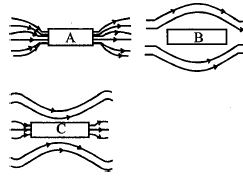
A
$A \leftrightarrow D, B \leftrightarrow P, C \leftrightarrow F$
B
$A \leftrightarrow F, B \leftrightarrow D, C \leftrightarrow P$
C
$A \leftrightarrow P, B \leftrightarrow F, C \leftrightarrow D$
D
$A \leftrightarrow F, B \leftrightarrow P, C \leftrightarrow D$
Solution
(B) $1$. Ferromagnetic materials $(F)$ strongly attract magnetic field lines,causing them to crowd inside the material. Bar $A$ shows this behavior.
$2$. Diamagnetic materials $(D)$ repel magnetic field lines,causing them to bend away from the material. Bar $B$ shows this behavior.
$3$. Paramagnetic materials $(P)$ weakly attract magnetic field lines,causing them to slightly crowd inside the material. Bar $C$ shows this behavior.
Therefore,the correct correspondence is $A \leftrightarrow F, B \leftrightarrow D, C \leftrightarrow P$.
$2$. Diamagnetic materials $(D)$ repel magnetic field lines,causing them to bend away from the material. Bar $B$ shows this behavior.
$3$. Paramagnetic materials $(P)$ weakly attract magnetic field lines,causing them to slightly crowd inside the material. Bar $C$ shows this behavior.
Therefore,the correct correspondence is $A \leftrightarrow F, B \leftrightarrow D, C \leftrightarrow P$.
0 likes
View Solution79
MediumMCQ
An example of a perfect diamagnet is a superconductor. This implies that when a superconductor is placed in an external magnetic field of intensity $B$,the magnetic field $B_s$ inside the superconductor will be such that
A
$B_s = -B$
B
$B_s = 0$
C
$B_s = B$
D
$B_s < B$ but $B_s \neq 0$
Solution
(B) superconductor exhibits the Meissner effect,which is the expulsion of magnetic field lines from its interior when it is cooled below its critical temperature in an external magnetic field.
This phenomenon makes a superconductor a perfect diamagnet.
For a perfect diamagnet,the magnetic susceptibility $\chi = -1$.
The magnetic field inside the material is given by $B_s = \mu_0(H + M)$. Since $M = \chi H = -H$,we get $B_s = \mu_0(H - H) = 0$.
Therefore,the magnetic field inside the superconductor is $B_s = 0$.
This phenomenon makes a superconductor a perfect diamagnet.
For a perfect diamagnet,the magnetic susceptibility $\chi = -1$.
The magnetic field inside the material is given by $B_s = \mu_0(H + M)$. Since $M = \chi H = -H$,we get $B_s = \mu_0(H - H) = 0$.
Therefore,the magnetic field inside the superconductor is $B_s = 0$.
0 likes
View Solution80
MediumMCQ
$A$ paramagnetic material has $10^{28} \text{ atoms/m}^3$. Its magnetic susceptibility at temperature $350 \text{ K}$ is $2.8 \times 10^{-4}$. Its susceptibility at $300 \text{ K}$ is
A
$3.267 \times 10^{-4}$
B
$3.672 \times 10^{-4}$
C
$3.726 \times 10^{-4}$
D
$2.672 \times 10^{-4}$
Solution
(A) According to Curie's Law,the magnetic susceptibility $\chi$ of a paramagnetic material is inversely proportional to its absolute temperature $T$,i.e.,$\chi \propto \frac{1}{T}$.
Therefore,we can write the relation as $\chi_1 T_1 = \chi_2 T_2$.
Given:
$\chi_1 = 2.8 \times 10^{-4}$
$T_1 = 350 \text{ K}$
$T_2 = 300 \text{ K}$
Substituting the values:
$\chi_2 = \frac{\chi_1 T_1}{T_2} = \frac{2.8 \times 10^{-4} \times 350}{300}$
$\chi_2 = \frac{2.8 \times 10^{-4} \times 7}{6}$
$\chi_2 = 3.2666... \times 10^{-4} \approx 3.267 \times 10^{-4}$.
Therefore,we can write the relation as $\chi_1 T_1 = \chi_2 T_2$.
Given:
$\chi_1 = 2.8 \times 10^{-4}$
$T_1 = 350 \text{ K}$
$T_2 = 300 \text{ K}$
Substituting the values:
$\chi_2 = \frac{\chi_1 T_1}{T_2} = \frac{2.8 \times 10^{-4} \times 350}{300}$
$\chi_2 = \frac{2.8 \times 10^{-4} \times 7}{6}$
$\chi_2 = 3.2666... \times 10^{-4} \approx 3.267 \times 10^{-4}$.
0 likes
View Solution81
MediumMCQ
Which of the following curves represents the variation of magnetic moment $(M)$ with temperature $(T)$ for a ferromagnetic material?
A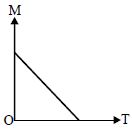
$A$ linear decrease of $M$ with $T$ reaching zero at the Curie temperature.
B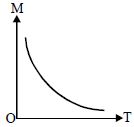
$A$ hyperbolic decrease of $M$ with $T$.
C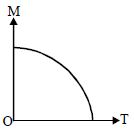
$A$ non-linear decrease of $M$ with $T$ reaching zero at the Curie temperature.
D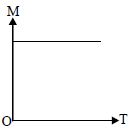
$A$ constant value of $M$ with $T$.
Solution
(C) The magnetic moment $(M)$ of a ferromagnetic material decreases as the temperature $(T)$ increases. This decrease is non-linear,and the magnetic moment drops to zero at the Curie temperature $(T_C)$,where the material transitions from ferromagnetic to paramagnetic. The curve shown in option $C$ correctly depicts this non-linear behavior where $M$ gradually decreases and reaches zero at the Curie temperature.
0 likes
View Solution82
MediumMCQ
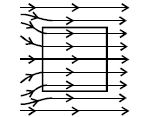
$A$ uniform magnetic field parallel to the plane of paper existed in space,initially directed from left to right. When a bar of soft iron is placed in the field parallel to it,the lines of force passing through it will be represented by which figure?
A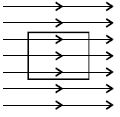
B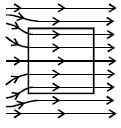
C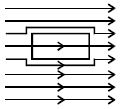
D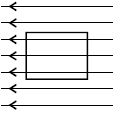
Solution
(B) When a bar of soft iron is placed in a uniform magnetic field such that it is parallel to the field lines,the magnetic lines of force tend to concentrate inside the soft iron bar. This happens because soft iron is a ferromagnetic material with high magnetic permeability. Consequently,the magnetic field lines prefer to pass through the material rather than the surrounding air. This results in an increased density of magnetic field lines within the bar,as shown in Figure $B$.
0 likes
View Solution83
MediumMCQ
The variation of magnetic susceptibility $\left( \chi \right)$ with absolute temperature $T$ for a ferromagnetic material is given in the figure by:
A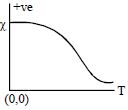
B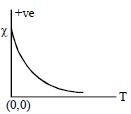
C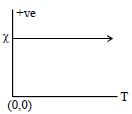
D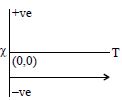
Solution
(A) For a ferromagnetic material,the magnetic susceptibility $\left( \chi \right)$ is very large and positive. As the temperature $T$ increases,the thermal agitation of the atoms increases,which opposes the alignment of magnetic dipoles. Below the Curie temperature,the material remains ferromagnetic,but as it approaches the Curie temperature,the susceptibility decreases significantly. The variation is such that it remains relatively high and then drops as the temperature increases towards the Curie point,as shown in the provided figure.
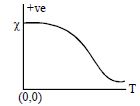
0 likes
View Solution84
EasyMCQ
What is the magnetic susceptibility of a superconductor?
A
$0$
B
$-1$
C
$+1$
D
$\infty$
Solution
(B) superconductor exhibits the Meissner effect,which means it expels magnetic fields from its interior.
For a perfect diamagnetic material,the internal magnetic field $B = 0$.
Since $B = \mu_0(H + M) = 0$,we have $M = -H$.
The magnetic susceptibility $\chi$ is defined as $M/H$.
Therefore,$\chi = -H/H = -1$.
For a perfect diamagnetic material,the internal magnetic field $B = 0$.
Since $B = \mu_0(H + M) = 0$,we have $M = -H$.
The magnetic susceptibility $\chi$ is defined as $M/H$.
Therefore,$\chi = -H/H = -1$.
0 likes
View Solution85
EasyMCQ
Steel is preferred over soft iron for permanent magnets because
A
Area under hysteresis curve is more
B
Retentivity is higher
C
Coercivity is higher
D
Magnetic saturation is higher
Solution
(C) material used for making a permanent magnet should have high retentivity so that it remains strongly magnetized even after the external magnetic field is removed.
It should also have high coercivity so that it is not easily demagnetized by stray magnetic fields,temperature fluctuations,or minor mechanical impacts.
Steel has higher coercivity compared to soft iron,which makes it more suitable for permanent magnets.
Soft iron,on the other hand,has low coercivity and is therefore preferred for electromagnets where rapid magnetization and demagnetization are required.
It should also have high coercivity so that it is not easily demagnetized by stray magnetic fields,temperature fluctuations,or minor mechanical impacts.
Steel has higher coercivity compared to soft iron,which makes it more suitable for permanent magnets.
Soft iron,on the other hand,has low coercivity and is therefore preferred for electromagnets where rapid magnetization and demagnetization are required.
0 likes
View Solution86
DifficultMCQ
At a temperature of $30\,^{\circ}\text{C}$,the susceptibility of a ferromagnetic material is found to be $\chi$. Its susceptibility at $333\,^{\circ}\text{C}$ is......$\chi$.
A
$1$
B
$0.5$
C
$2$
D
$11.1$
Solution
(B) According to the Curie-Weiss law for ferromagnetic materials above the Curie temperature,the magnetic susceptibility $\chi_m$ is inversely proportional to the temperature difference $(T - T_c)$. However,in the context of standard textbook problems where Curie's law $\chi_m \propto \frac{1}{T}$ is applied to magnetic materials:
Given:
$T_1 = 30\,^{\circ}\text{C} = 30 + 273 = 303\,\text{K}$
$T_2 = 333\,^{\circ}\text{C} = 333 + 273 = 606\,\text{K}$
Using the relation $\chi_m \propto \frac{1}{T}$:
$\frac{\chi_1}{\chi_2} = \frac{T_2}{T_1}$
Substituting the values:
$\frac{\chi}{\chi_2} = \frac{606}{303} = 2$
Therefore,$\chi_2 = \frac{\chi}{2} = 0.5\,\chi$.
Given:
$T_1 = 30\,^{\circ}\text{C} = 30 + 273 = 303\,\text{K}$
$T_2 = 333\,^{\circ}\text{C} = 333 + 273 = 606\,\text{K}$
Using the relation $\chi_m \propto \frac{1}{T}$:
$\frac{\chi_1}{\chi_2} = \frac{T_2}{T_1}$
Substituting the values:
$\frac{\chi}{\chi_2} = \frac{606}{303} = 2$
Therefore,$\chi_2 = \frac{\chi}{2} = 0.5\,\chi$.
0 likes
View Solution87
EasyMCQ
At Curie point,a ferromagnetic material becomes
A
Non-magnetic
B
Diamagnetic
C
Paramagnetic
D
Strongly ferromagnetic
Solution
(C) The Curie temperature $(T_C)$ is the temperature above which a ferromagnetic material loses its spontaneous magnetization and behaves as a paramagnetic material.
As the temperature increases beyond the Curie point,the thermal agitation disrupts the alignment of magnetic dipoles,causing the material to transition from a ferromagnetic state to a paramagnetic state.
As the temperature increases beyond the Curie point,the thermal agitation disrupts the alignment of magnetic dipoles,causing the material to transition from a ferromagnetic state to a paramagnetic state.
0 likes
View Solution88
EasyMCQ
Which one of the following characteristics is not associated with a ferromagnetic material?
A
It is strongly attracted by a magnet.
B
It tends to move from a region of strong magnetic field to a region of weak magnetic field.
C
Its origin is the spin of electrons.
D
Above the Curie temperature,it exhibits paramagnetic properties.
Solution
(B) Ferromagnetic materials are characterized by strong attraction to magnets,which means they tend to move from a region of weak magnetic field to a region of strong magnetic field.
Option $B$ states that they move from a strong to a weak magnetic field,which is a characteristic of diamagnetic materials,not ferromagnetic materials.
Therefore,option $B$ is the incorrect characteristic for ferromagnetic materials.
Option $B$ states that they move from a strong to a weak magnetic field,which is a characteristic of diamagnetic materials,not ferromagnetic materials.
Therefore,option $B$ is the incorrect characteristic for ferromagnetic materials.
0 likes
View Solution89
EasyMCQ
The meniscus of a liquid contained in one of the limbs of a $U-$tube is placed between the poles of an electromagnet with the meniscus in line with the field. The liquid is seen to rise in the limb by a small amount. This indicates that the liquid is:
A
Ferromagnetic
B
Paramagnetic
C
Diamagnetic
D
Non-magnetic
Solution
(B) When a liquid is placed in a non-uniform magnetic field,it experiences a force depending on its magnetic susceptibility.
Paramagnetic liquids are attracted towards the stronger part of the magnetic field.
Since the meniscus of the liquid rises in the limb when placed between the poles of an electromagnet (where the field is stronger),it indicates that the liquid is attracted to the magnetic field.
Therefore,the liquid is paramagnetic.
Paramagnetic liquids are attracted towards the stronger part of the magnetic field.
Since the meniscus of the liquid rises in the limb when placed between the poles of an electromagnet (where the field is stronger),it indicates that the liquid is attracted to the magnetic field.
Therefore,the liquid is paramagnetic.
0 likes
View Solution90
MediumMCQ
Which of the following statements is correct for diamagnetic materials?
A
$\mu_r < 1$
B
$\chi$ is negative and low
C
$\chi$ does not depend on temperature
D
All of the above
Solution
(D) For diamagnetic materials:
$1$. The relative permeability $\mu_r$ is slightly less than $1$ $(\mu_r < 1)$.
$2$. The magnetic susceptibility $\chi$ is small and negative $(-1 \le \chi < 0)$.
$3$. The magnetic susceptibility $\chi$ is independent of temperature,meaning it does not change with variations in temperature.
Since all three statements are correct,the correct option is $D$.
$1$. The relative permeability $\mu_r$ is slightly less than $1$ $(\mu_r < 1)$.
$2$. The magnetic susceptibility $\chi$ is small and negative $(-1 \le \chi < 0)$.
$3$. The magnetic susceptibility $\chi$ is independent of temperature,meaning it does not change with variations in temperature.
Since all three statements are correct,the correct option is $D$.
0 likes
View Solution91
EasyMCQ
The magnetic susceptibility of an ideal diamagnetic substance is
A
$-1$
B
$0$
C
$+1$
D
$\infty$
Solution
(A) For a magnetic material,the relative permeability $\mu_r$ is related to the magnetic susceptibility $\chi_m$ by the equation $\mu_r = 1 + \chi_m$.
An ideal diamagnetic substance is a perfect diamagnet,which exhibits the Meissner effect.
In a perfect diamagnet,the magnetic field inside the material is zero,meaning $B = 0$.
Since $B = \mu_0 H(1 + \chi_m)$,for $B$ to be $0$,we must have $1 + \chi_m = 0$.
Therefore,the magnetic susceptibility of an ideal diamagnetic substance is $\chi_m = -1$.
An ideal diamagnetic substance is a perfect diamagnet,which exhibits the Meissner effect.
In a perfect diamagnet,the magnetic field inside the material is zero,meaning $B = 0$.
Since $B = \mu_0 H(1 + \chi_m)$,for $B$ to be $0$,we must have $1 + \chi_m = 0$.
Therefore,the magnetic susceptibility of an ideal diamagnetic substance is $\chi_m = -1$.
0 likes
View Solution92
EasyMCQ
Assertion: $A$ disc-shaped magnet is levitated above a superconducting material that has been cooled by liquid nitrogen.
Reason: Superconductors repel a magnet.
Reason: Superconductors repel a magnet.
A
If both Assertion and Reason are correct and the Reason is a correct explanation of the Assertion.
B
If both Assertion and Reason are correct but Reason is not a correct explanation of the Assertion.
C
If the Assertion is correct but Reason is incorrect.
D
If both the Assertion and Reason are incorrect.
Solution
(A) Superconductors exhibit the Meissner effect,which means they expel magnetic fields from their interior when cooled below their critical temperature $(T_c)$.
Because of this,they act as perfect diamagnets.
When a magnet is placed near a superconductor,the superconductor generates surface currents that create a magnetic field opposing the magnet's field.
This results in a repulsive force that allows the magnet to levitate above the superconductor.
Therefore,the Assertion is correct because the magnet levitates,and the Reason is correct because superconductors exhibit a repulsive force towards magnets due to the Meissner effect.
Because of this,they act as perfect diamagnets.
When a magnet is placed near a superconductor,the superconductor generates surface currents that create a magnetic field opposing the magnet's field.
This results in a repulsive force that allows the magnet to levitate above the superconductor.
Therefore,the Assertion is correct because the magnet levitates,and the Reason is correct because superconductors exhibit a repulsive force towards magnets due to the Meissner effect.
0 likes
View Solution93
EasyMCQ
Assertion : Diamagnetic materials can exhibit magnetism.
Reason : Diamagnetic materials have permanent magnetic dipole moment.
Reason : Diamagnetic materials have permanent magnetic dipole moment.
A
If both Assertion and Reason are correct and the Reason is a correct explanation of the Assertion.
B
If both Assertion and Reason are correct but Reason is not a correct explanation of the Assertion.
C
If the Assertion is correct but Reason is incorrect.
D
If both the Assertion and Reason are incorrect.
Solution
(C) Diamagnetic materials exhibit a weak magnetism in the direction opposite to the applied magnetic field.
Therefore,the Assertion is correct.
However,diamagnetic materials do not have a permanent magnetic dipole moment because all electrons are paired,resulting in a net magnetic moment of zero.
Therefore,the Reason is incorrect.
Thus,the correct option is $C$.
Therefore,the Assertion is correct.
However,diamagnetic materials do not have a permanent magnetic dipole moment because all electrons are paired,resulting in a net magnetic moment of zero.
Therefore,the Reason is incorrect.
Thus,the correct option is $C$.
0 likes
View Solution94
EasyMCQ
Assertion: Ferromagnetic substances become paramagnetic above the Curie temperature.
Reason: Domains are destroyed at high temperature.
Reason: Domains are destroyed at high temperature.
A
If both Assertion and Reason are correct and the Reason is a correct explanation of the Assertion.
B
If both Assertion and Reason are correct but Reason is not a correct explanation of the Assertion.
C
If the Assertion is correct but Reason is incorrect.
D
If both the Assertion and Reason are incorrect.
Solution
(A) The magnetic susceptibility of ferromagnetic materials decreases as temperature increases.
At a specific transition temperature known as the Curie temperature $(T_C)$,ferromagnetic materials transition into paramagnetic materials.
This happens because,at high temperatures,the thermal agitation (kinetic energy) of the atoms becomes strong enough to overcome the exchange coupling forces that align the magnetic moments within the domains.
As a result,the ordered structure of the magnetic domains is destroyed,leading to the loss of ferromagnetism.
Therefore,both the Assertion and the Reason are correct,and the Reason provides a valid explanation for the Assertion.
At a specific transition temperature known as the Curie temperature $(T_C)$,ferromagnetic materials transition into paramagnetic materials.
This happens because,at high temperatures,the thermal agitation (kinetic energy) of the atoms becomes strong enough to overcome the exchange coupling forces that align the magnetic moments within the domains.
As a result,the ordered structure of the magnetic domains is destroyed,leading to the loss of ferromagnetism.
Therefore,both the Assertion and the Reason are correct,and the Reason provides a valid explanation for the Assertion.
0 likes
View Solution95
EasyMCQ
Assertion: The ferromagnetic substance does not obey Curie's law.
Reason: At Curie point,a ferromagnetic substance starts behaving as a paramagnetic substance.
Reason: At Curie point,a ferromagnetic substance starts behaving as a paramagnetic substance.
A
If both Assertion and Reason are correct and the Reason is a correct explanation of the Assertion.
B
If both Assertion and Reason are correct but Reason is not a correct explanation of the Assertion.
C
If the Assertion is correct but Reason is incorrect.
D
If both the Assertion and Reason are incorrect.
Solution
(A) The magnetic susceptibility of a ferromagnetic substance does not follow a simple linear relationship with temperature like paramagnetic substances.
Instead,it decreases in a complex manner as temperature increases.
Curie's law states that susceptibility $\chi \propto 1/T$.
Ferromagnetic substances only begin to obey this law after they are heated above their Curie temperature $(T_C)$,where they transition into a paramagnetic state.
Therefore,the assertion that they do not obey Curie's law (in their ferromagnetic state) is correct,and the reason explains the transition at the Curie point.
Instead,it decreases in a complex manner as temperature increases.
Curie's law states that susceptibility $\chi \propto 1/T$.
Ferromagnetic substances only begin to obey this law after they are heated above their Curie temperature $(T_C)$,where they transition into a paramagnetic state.
Therefore,the assertion that they do not obey Curie's law (in their ferromagnetic state) is correct,and the reason explains the transition at the Curie point.
0 likes
View Solution96
EasyMCQ
Assertion: $A$ paramagnetic sample displays greater magnetisation (for the same magnetic field) when cooled.
Reason: The magnetisation does not depend on temperature.
Reason: The magnetisation does not depend on temperature.
A
If both Assertion and Reason are correct and the Reason is a correct explanation of the Assertion.
B
If both Assertion and Reason are correct but Reason is not a correct explanation of the Assertion.
C
If the Assertion is correct but Reason is incorrect.
D
If both the Assertion and Reason are incorrect.
Solution
(C) According to Curie's Law,the magnetic susceptibility of a paramagnetic material is inversely proportional to its absolute temperature,given by $\chi = C/T$.
As the temperature $T$ decreases,the susceptibility $\chi$ increases,leading to greater magnetisation for the same external magnetic field.
This occurs because at lower temperatures,the random thermal motion that disrupts the alignment of atomic dipoles is reduced,making it easier for the external magnetic field to align them.
Therefore,the Assertion is correct,but the Reason is incorrect because magnetisation in paramagnetic materials is strongly dependent on temperature.
As the temperature $T$ decreases,the susceptibility $\chi$ increases,leading to greater magnetisation for the same external magnetic field.
This occurs because at lower temperatures,the random thermal motion that disrupts the alignment of atomic dipoles is reduced,making it easier for the external magnetic field to align them.
Therefore,the Assertion is correct,but the Reason is incorrect because magnetisation in paramagnetic materials is strongly dependent on temperature.
0 likes
View Solution97
MediumMCQ
Assertion: Electromagnets are made of soft iron.
Reason: Coercivity of soft iron is small.
Reason: Coercivity of soft iron is small.
A
If both Assertion and Reason are correct and the Reason is a correct explanation of the Assertion.
B
If both Assertion and Reason are correct but Reason is not a correct explanation of the Assertion.
C
If the Assertion is correct but Reason is incorrect.
D
If both the Assertion and Reason are incorrect.
Solution
(A) Electromagnets are magnets that can be turned on and off by controlling the electric current.
For an electromagnet,the core material undergoes cyclic magnetization and demagnetization. To minimize energy loss during these cycles,the material should have a small hysteresis loop area,which implies low coercivity and low retentivity.
Soft iron is characterized by high magnetic permeability,high susceptibility,and low coercivity. Because of its low coercivity,it can be easily magnetized and demagnetized,making it the ideal material for electromagnets.
Therefore,both the Assertion and the Reason are correct,and the Reason is the correct explanation for the Assertion.
For an electromagnet,the core material undergoes cyclic magnetization and demagnetization. To minimize energy loss during these cycles,the material should have a small hysteresis loop area,which implies low coercivity and low retentivity.
Soft iron is characterized by high magnetic permeability,high susceptibility,and low coercivity. Because of its low coercivity,it can be easily magnetized and demagnetized,making it the ideal material for electromagnets.
Therefore,both the Assertion and the Reason are correct,and the Reason is the correct explanation for the Assertion.
0 likes
View Solution98
Medium
$A$ sample of paramagnetic salt contains $2.0 \times 10^{24}$ atomic dipoles each of dipole moment $1.5 \times 10^{-23} \; J \, T^{-1}$. The sample is placed under a homogeneous magnetic field of $0.64 \; T$ and cooled to a temperature of $4.2 \; K$. The degree of magnetic saturation achieved is $15 \%$. What is the total dipole moment of the sample for a magnetic field of $0.98 \; T$ and a temperature of $2.8 \; K$? (Assume Curie's law)
Solution
(D) Number of atomic dipoles,$n = 2.0 \times 10^{24}$.
Dipole moment of each atomic dipole,$M = 1.5 \times 10^{-23} \; J \, T^{-1}$.
Total dipole moment of the sample if fully saturated,$M_{\text{total}} = n \times M = 2.0 \times 10^{24} \times 1.5 \times 10^{-23} = 30 \; J \, T^{-1}$.
Given saturation at $B_1 = 0.64 \; T$ and $T_1 = 4.2 \; K$ is $15 \%$.
Effective dipole moment $M_1 = 0.15 \times 30 = 4.5 \; J \, T^{-1}$.
According to Curie's law,the magnetization $M \propto \frac{B}{T}$,so $\frac{M_2}{M_1} = \frac{B_2}{B_1} \times \frac{T_1}{T_2}$.
Substituting the values for $B_2 = 0.98 \; T$ and $T_2 = 2.8 \; K$:
$M_2 = M_1 \times \frac{B_2}{B_1} \times \frac{T_1}{T_2} = 4.5 \times \frac{0.98}{0.64} \times \frac{4.2}{2.8}$.
$M_2 = 4.5 \times 1.53125 \times 1.5 = 10.336 \; J \, T^{-1}$.
Dipole moment of each atomic dipole,$M = 1.5 \times 10^{-23} \; J \, T^{-1}$.
Total dipole moment of the sample if fully saturated,$M_{\text{total}} = n \times M = 2.0 \times 10^{24} \times 1.5 \times 10^{-23} = 30 \; J \, T^{-1}$.
Given saturation at $B_1 = 0.64 \; T$ and $T_1 = 4.2 \; K$ is $15 \%$.
Effective dipole moment $M_1 = 0.15 \times 30 = 4.5 \; J \, T^{-1}$.
According to Curie's law,the magnetization $M \propto \frac{B}{T}$,so $\frac{M_2}{M_1} = \frac{B_2}{B_1} \times \frac{T_1}{T_2}$.
Substituting the values for $B_2 = 0.98 \; T$ and $T_2 = 2.8 \; K$:
$M_2 = M_1 \times \frac{B_2}{B_1} \times \frac{T_1}{T_2} = 4.5 \times \frac{0.98}{0.64} \times \frac{4.2}{2.8}$.
$M_2 = 4.5 \times 1.53125 \times 1.5 = 10.336 \; J \, T^{-1}$.
0 likes
View Solution99
Medium
What is the value of magnetic susceptibility $\chi$ for:
$(i)$ Paramagnetic material
$(ii)$ Diamagnetic materials
$(i)$ Paramagnetic material
$(ii)$ Diamagnetic materials
Solution
(N/A) Magnetic susceptibility $\chi$ is defined as the ratio of the intensity of magnetization $M$ to the magnetic intensity $H$, i.e., $\chi = M/H$.
$(i)$ For paramagnetic materials, the atoms have a permanent magnetic dipole moment. When placed in an external magnetic field, they get weakly magnetized in the direction of the field. Thus, the magnetic susceptibility $\chi$ is small and positive ($0 < \chi < \epsilon$, where $\epsilon$ is a small positive number).
$(ii)$ For diamagnetic materials, the atoms develop an induced magnetic dipole moment in a direction opposite to the applied magnetic field. Thus, they are weakly repelled by the field. The magnetic susceptibility $\chi$ is small and negative ($-1 \le \chi < 0$).
$(i)$ For paramagnetic materials, the atoms have a permanent magnetic dipole moment. When placed in an external magnetic field, they get weakly magnetized in the direction of the field. Thus, the magnetic susceptibility $\chi$ is small and positive ($0 < \chi < \epsilon$, where $\epsilon$ is a small positive number).
$(ii)$ For diamagnetic materials, the atoms develop an induced magnetic dipole moment in a direction opposite to the applied magnetic field. Thus, they are weakly repelled by the field. The magnetic susceptibility $\chi$ is small and negative ($-1 \le \chi < 0$).
0 likes
View SolutionMagnetism and Matter — Magnetic Materials (Diamagnetic, Paramagnetic and Ferromagnetic) · Frequently Asked Questions
1Are these Magnetism and Matter questions useful for JEE and NEET?
Yes. All questions in this section are mapped to JEE Main and NEET exam patterns. Previous year questions from JEE Main, NEET, GUJCET and state-level exams are included with full solutions.
2Can I switch to Hindi or Gujarati for these questions?
Yes. Use the language tabs in the hero section or the sidebar to view the same questions and solutions in English, Hindi or Gujarati.
3How do I generate a question paper from this subtopic?
Use the Vedclass Exam Paper Generator — select the chapter and subtopic, set difficulty, and generate Sets A, B, C, D automatically. First 3 chapters of every subject are free.
Vedclass Products
For Students
Vedclass Test Series
Mock tests in real JEE/NEET style with performance analysis. 5-day free trial.
Start Free TrialFor Teachers
Exam Paper Generator
Generate Set A/B/C/D papers from this chapter in 2 minutes. 3 chapters free.
Try FreeFor Institutes
Online Exam Module
Live online exams with unlimited students, 360° analytics & white-label branding.
See DemoFor Teachers & Institutes
Generate a Magnetism and Matter Exam Paper in 2 Minutes
Select subtopic & difficulty — Sets A, B, C, D auto-generated with No Repeat logic.
First 3 chapters of every subject are free — no payment required.