
A English
Magnetic Materials (Diamagnetic, Paramagnetic and Ferromagnetic) Questions in English
Class 12 Physics · Magnetism and Matter · Magnetic Materials (Diamagnetic, Paramagnetic and Ferromagnetic)
222+
Questions
English
Language
100%
With Solutions
Showing 46 of 222 questions in English
151
AdvancedMCQ
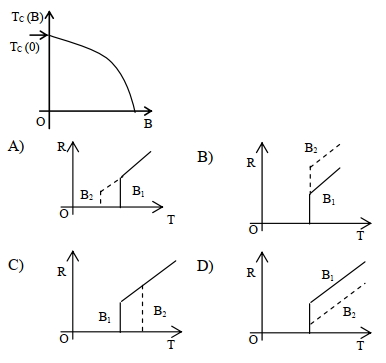
Electrical resistance of certain materials,known as superconductors,changes abruptly from a nonzero value to zero as their temperature is lowered below a critical temperature $T_c(0)$. An interesting property of superconductors is that their critical temperature becomes smaller than $T_c(0)$ if they are placed in a magnetic field,i.e.,the critical temperature $T_c(B)$ is a function of the magnetic field strength $B$. The dependence of $T_c(B)$ on $B$ is shown in the figure.
$1.$ In the graphs below,the resistance $R$ of a superconductor is shown as a function of its temperature $T$ for two different magnetic fields $B_1$ (solid line) and $B_2$ (dashed line). If $B_2 > B_1$,which of the following graphs shows the correct variation of $R$ with $T$ in these fields?
$2.$ $A$ superconductor has $T_c(0) = 100 \ K$. When a magnetic field of $7.5 \ T$ is applied,its $T_c$ decreases to $75 \ K$. For this material,one can definitely say that when:
$(A)$ $B = 5 \ T, T_c(B) = 80 \ K$
$(B)$ $B = 5 \ T, 75 \ K < T_c(B) < 100 \ K$
$(C)$ $B = 10 \ T, 75 \ K < T_c < 100 \ K$
$(D)$ $B = 10 \ T, T_c = 70 \ K$
Give the answer for questions $1$ and $2$.
$1.$ In the graphs below,the resistance $R$ of a superconductor is shown as a function of its temperature $T$ for two different magnetic fields $B_1$ (solid line) and $B_2$ (dashed line). If $B_2 > B_1$,which of the following graphs shows the correct variation of $R$ with $T$ in these fields?
$2.$ $A$ superconductor has $T_c(0) = 100 \ K$. When a magnetic field of $7.5 \ T$ is applied,its $T_c$ decreases to $75 \ K$. For this material,one can definitely say that when:
$(A)$ $B = 5 \ T, T_c(B) = 80 \ K$
$(B)$ $B = 5 \ T, 75 \ K < T_c(B) < 100 \ K$
$(C)$ $B = 10 \ T, 75 \ K < T_c < 100 \ K$
$(D)$ $B = 10 \ T, T_c = 70 \ K$
Give the answer for questions $1$ and $2$.
A
$(A, B)$
B
$(B, C)$
C
$(A, D)$
D
$(B, D)$
Solution
(A) $1.$ From the given graph of $T_c(B)$ versus $B$,it is clear that as the magnetic field $B$ increases,the critical temperature $T_c(B)$ decreases. Since $B_2 > B_1$,the critical temperature for $B_2$ must be lower than for $B_1$. Therefore,the transition to zero resistance occurs at a lower temperature for $B_2$ than for $B_1$. Graph $A$ correctly shows this behavior,where the dashed line $(B_2)$ transitions to zero resistance at a lower temperature than the solid line $(B_1)$.
$2.$ The graph of $T_c(B)$ versus $B$ is a decreasing function. We are given $T_c(0) = 100 \ K$ and $T_c(7.5 \ T) = 75 \ K$.
For $B = 5 \ T$ (where $0 < 5 < 7.5$),the critical temperature $T_c(5 \ T)$ must lie between $T_c(7.5 \ T)$ and $T_c(0)$,i.e.,$75 \ K < T_c(5 \ T) < 100 \ K$. This matches statement $(B)$.
For $B = 10 \ T$ (where $10 > 7.5$),the critical temperature $T_c(10 \ T)$ must be less than $T_c(7.5 \ T)$,i.e.,$T_c(10 \ T) < 75 \ K$. This makes statement $(C)$ incorrect and statement $(D)$ a possibility,but $(B)$ is definitely true based on the monotonic decrease.
$2.$ The graph of $T_c(B)$ versus $B$ is a decreasing function. We are given $T_c(0) = 100 \ K$ and $T_c(7.5 \ T) = 75 \ K$.
For $B = 5 \ T$ (where $0 < 5 < 7.5$),the critical temperature $T_c(5 \ T)$ must lie between $T_c(7.5 \ T)$ and $T_c(0)$,i.e.,$75 \ K < T_c(5 \ T) < 100 \ K$. This matches statement $(B)$.
For $B = 10 \ T$ (where $10 > 7.5$),the critical temperature $T_c(10 \ T)$ must be less than $T_c(7.5 \ T)$,i.e.,$T_c(10 \ T) < 75 \ K$. This makes statement $(C)$ incorrect and statement $(D)$ a possibility,but $(B)$ is definitely true based on the monotonic decrease.
0 likes
View Solution152
EasyMCQ
The magnetic susceptibility of a diamagnetic substance:
A
$a, c$
B
$b$
C
$b, d$
D
$a, c, d$
Solution
(C) For a diamagnetic substance,the magnetic susceptibility $\chi$ is small and negative. It is independent of the temperature $T$ because the orbital motion of electrons is not significantly affected by thermal agitation. Therefore,the correct statements are that it is independent of temperature and it is negative. Thus,the correct option is $(b, d)$.
0 likes
View Solution153
EasyMCQ
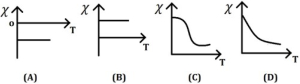
The variation of magnetic susceptibility $(\chi)$ with temperature $(T)$ for a diamagnetic substance is shown correctly by which graph?
A
Graph $(A)$
B
Graph $(B)$
C
Graph $(C)$
D
Graph $(D)$
Solution
(C) For a diamagnetic substance,the magnetic susceptibility $(\chi)$ is small and negative.
It is independent of the temperature $(T)$ of the substance.
Therefore,the graph of $(\chi)$ versus $(T)$ is a straight line parallel to the temperature axis,located in the negative region of the $(\chi)$ axis.
Looking at the provided options,graph $(A)$ correctly represents this behavior.
It is independent of the temperature $(T)$ of the substance.
Therefore,the graph of $(\chi)$ versus $(T)$ is a straight line parallel to the temperature axis,located in the negative region of the $(\chi)$ axis.
Looking at the provided options,graph $(A)$ correctly represents this behavior.
0 likes
View Solution154
EasyMCQ
To protect an instrument from an external magnetic field,it is completely surrounded by:
A
soft ferromagnetic substance.
B
diamagnetic substance only.
C
paramagnetic substance only.
D
both diamagnetic and paramagnetic substances.
Solution
(A) To protect an instrument from an external magnetic field,the phenomenon of magnetic shielding is used.
Magnetic shielding is achieved by surrounding the instrument with a material of high magnetic permeability,such as soft iron (a soft ferromagnetic substance).
When placed in an external magnetic field,the magnetic field lines prefer to pass through the high-permeability material rather than the air or the space inside the enclosure.
As a result,the interior region remains free from the external magnetic field,effectively shielding the instrument.
Magnetic shielding is achieved by surrounding the instrument with a material of high magnetic permeability,such as soft iron (a soft ferromagnetic substance).
When placed in an external magnetic field,the magnetic field lines prefer to pass through the high-permeability material rather than the air or the space inside the enclosure.
As a result,the interior region remains free from the external magnetic field,effectively shielding the instrument.
0 likes
View Solution155
EasyMCQ
$A$ ferromagnetic material is heated above its $Curie$ temperature. The correct statement from the following is that
A
ferromagnetic domains are perfectly arranged.
B
ferromagnetic domains become random.
C
ferromagnetic domains are not influenced.
D
ferromagnetic material changes itself into diamagnetic material.
Solution
(B) When a ferromagnetic material is heated above its $Curie$ temperature $(T_C)$,the thermal energy of the atoms becomes sufficient to overcome the exchange coupling forces that keep the magnetic moments aligned within the domains.
As a result,the ordered magnetic domains are destroyed,and the magnetic moments become randomly oriented due to thermal agitation.
Consequently,the material loses its ferromagnetic properties and transforms into a paramagnetic material.
Therefore,the correct statement is that the ferromagnetic domains become random.
As a result,the ordered magnetic domains are destroyed,and the magnetic moments become randomly oriented due to thermal agitation.
Consequently,the material loses its ferromagnetic properties and transforms into a paramagnetic material.
Therefore,the correct statement is that the ferromagnetic domains become random.
0 likes
View Solution156
MediumMCQ
According to Curie's law in magnetism,the correct relation is $(M=$ magnetization in paramagnetic sample,$B=$ applied magnetic field,$T=$ absolute temperature of the material,$C=$ Curie's constant $)$
A
$M=\frac{T}{CB}$
B
$M=\frac{CB}{T}$
C
$C=\frac{MB}{T}$
D
$C=\frac{T^2}{MB}$
Solution
(B) According to Curie's law,the magnetization $M$ of a paramagnetic material is directly proportional to the applied magnetic field $B$ and inversely proportional to the absolute temperature $T$.
Mathematically,this is expressed as $M \propto \frac{B}{T}$.
Introducing Curie's constant $C$,we get the relation $M = C \frac{B}{T}$,which can be rewritten as $M = \frac{CB}{T}$.
Therefore,the correct option is $B$.
Mathematically,this is expressed as $M \propto \frac{B}{T}$.
Introducing Curie's constant $C$,we get the relation $M = C \frac{B}{T}$,which can be rewritten as $M = \frac{CB}{T}$.
Therefore,the correct option is $B$.
0 likes
View Solution157
EasyMCQ
Above the Curie temperature,the susceptibility of a ferromagnetic substance varies
A
directly as the absolute temperature.
B
inversely as the absolute temperature.
C
inversely as the square root of absolute temperature.
D
directly as the square root of absolute temperature.
Solution
(B) According to the Curie-Weiss Law,for a ferromagnetic material,the magnetic susceptibility $\chi$ above the Curie temperature $T_C$ is given by the relation: $\chi = \frac{C}{T - T_C}$,where $C$ is the Curie constant and $T$ is the absolute temperature.
For $T > T_C$,the susceptibility is inversely proportional to the difference between the absolute temperature and the Curie temperature. In many simplified contexts,it is stated that the susceptibility varies inversely as the absolute temperature $(T)$ as the material behaves paramagnetically.
For $T > T_C$,the susceptibility is inversely proportional to the difference between the absolute temperature and the Curie temperature. In many simplified contexts,it is stated that the susceptibility varies inversely as the absolute temperature $(T)$ as the material behaves paramagnetically.
0 likes
View Solution158
EasyMCQ
The materials having negative magnetic susceptibility are
A
paramagnetic.
B
diamagnetic.
C
ferromagnetic.
D
both paramagnetic and ferromagnetic.
Solution
(B) Magnetic susceptibility $(\chi)$ is a measure of how much a material will become magnetized in an applied magnetic field.
For diamagnetic materials, the magnetic susceptibility $(\chi)$ is small and negative $(-1 \le \chi < 0)$.
For paramagnetic materials, the magnetic susceptibility $(\chi)$ is small and positive $(\chi > 0)$.
For ferromagnetic materials, the magnetic susceptibility $(\chi)$ is large and positive $(\chi \gg 0)$.
Therefore, materials with negative magnetic susceptibility are diamagnetic.
For diamagnetic materials, the magnetic susceptibility $(\chi)$ is small and negative $(-1 \le \chi < 0)$.
For paramagnetic materials, the magnetic susceptibility $(\chi)$ is small and positive $(\chi > 0)$.
For ferromagnetic materials, the magnetic susceptibility $(\chi)$ is large and positive $(\chi \gg 0)$.
Therefore, materials with negative magnetic susceptibility are diamagnetic.
0 likes
View Solution159
EasyMCQ
$A$ thin,lightweight rod of a diamagnetic substance,such as silver,is suspended in a uniform external magnetic field. It will align itself with its length:
A
perpendicular to the magnetic field.
B
inclined at an angle $120^{\circ}$ to the magnetic field.
C
inclined at an angle $45^{\circ}$ to the magnetic field.
D
parallel to the magnetic field.
Solution
(A) diamagnetic material is weakly repelled by a magnetic field.
When a thin rod of a diamagnetic substance is placed in a uniform external magnetic field,it experiences a torque that tends to align the rod in a position of minimum potential energy.
For a diamagnetic rod,the potential energy is minimum when the rod is oriented perpendicular to the direction of the external magnetic field.
Therefore,the rod will align itself perpendicular to the magnetic field to minimize its magnetic potential energy.
When a thin rod of a diamagnetic substance is placed in a uniform external magnetic field,it experiences a torque that tends to align the rod in a position of minimum potential energy.
For a diamagnetic rod,the potential energy is minimum when the rod is oriented perpendicular to the direction of the external magnetic field.
Therefore,the rod will align itself perpendicular to the magnetic field to minimize its magnetic potential energy.
0 likes
View Solution160
EasyMCQ
For a paramagnetic substance, the magnetic susceptibility is
A
small and negative
B
large and negative
C
small and positive
D
large and positive
Solution
(C) The magnetic susceptibility $(\chi)$ of a substance is a measure of how easily it can be magnetized when placed in an external magnetic field.
For paramagnetic substances, the atoms or molecules possess a permanent magnetic dipole moment.
When placed in an external magnetic field, these dipoles align weakly in the direction of the field.
Consequently, paramagnetic substances exhibit a small and positive magnetic susceptibility ($0 < \chi < \epsilon$, where $\epsilon$ is a small positive value).
Therefore, the correct option is $C$.
For paramagnetic substances, the atoms or molecules possess a permanent magnetic dipole moment.
When placed in an external magnetic field, these dipoles align weakly in the direction of the field.
Consequently, paramagnetic substances exhibit a small and positive magnetic susceptibility ($0 < \chi < \epsilon$, where $\epsilon$ is a small positive value).
Therefore, the correct option is $C$.
0 likes
View Solution161
EasyMCQ
The magnetic property of a magnetic substance is associated with
A
spin motion of the nucleus.
B
orbital and spin motion of electrons.
C
only orbital motion of electrons.
D
only spin motion of electrons.
Solution
(B) The magnetic properties of materials arise from the magnetic moments associated with the electrons in the atoms.
These magnetic moments are primarily due to two types of motions of the electrons:
$1$. The orbital motion of the electron around the nucleus,which creates an orbital magnetic moment.
$2$. The intrinsic spin motion of the electron about its own axis,which creates a spin magnetic moment.
Therefore,the net magnetic moment of an atom is the vector sum of the orbital and spin magnetic moments of all its electrons.
These magnetic moments are primarily due to two types of motions of the electrons:
$1$. The orbital motion of the electron around the nucleus,which creates an orbital magnetic moment.
$2$. The intrinsic spin motion of the electron about its own axis,which creates a spin magnetic moment.
Therefore,the net magnetic moment of an atom is the vector sum of the orbital and spin magnetic moments of all its electrons.
0 likes
View Solution162
EasyMCQ
If $M_z$ is the magnetization of a paramagnetic sample,$B$ is the external magnetic field,$T$ is the absolute temperature,and $C$ is the Curie constant,then according to Curie's law in magnetism,the correct relation is:
A
$M_Z = \frac{T}{C B}$
B
$M_Z = \frac{C B}{T}$
C
$C = \frac{M_Z B}{T}$
D
$C = \frac{T^2}{M_z B}$
Solution
(B) According to Curie's law for paramagnetic materials,the magnetization $M_z$ is directly proportional to the external magnetic field $B$ and inversely proportional to the absolute temperature $T$.
Mathematically,this is expressed as $M_z \propto \frac{B}{T}$.
Introducing the Curie constant $C$,we get the relation $M_z = C \frac{B}{T}$ or $M_z = \frac{C B}{T}$.
Therefore,the correct relation is $M_z = \frac{C B}{T}$.
Mathematically,this is expressed as $M_z \propto \frac{B}{T}$.
Introducing the Curie constant $C$,we get the relation $M_z = C \frac{B}{T}$ or $M_z = \frac{C B}{T}$.
Therefore,the correct relation is $M_z = \frac{C B}{T}$.
0 likes
View Solution163
EasyMCQ
On applying an external magnetic field to a ferromagnetic substance,the domains:
A
align in the direction of the magnetic field
B
align in the direction opposite to the magnetic field
C
remain unaffected
D
None of the above
Solution
(A) In a ferromagnetic substance,the atoms are grouped into small regions called domains,each acting as a tiny magnet.
When an external magnetic field is applied,these domains align themselves in the direction of the external magnetic field.
This alignment results in a strong net magnetization in the direction of the applied field.
When an external magnetic field is applied,these domains align themselves in the direction of the external magnetic field.
This alignment results in a strong net magnetization in the direction of the applied field.
0 likes
View Solution164
EasyMCQ
Nickel shows ferromagnetic property at room temperature. If the temperature is increased beyond Curie temperature,then it will show
A
paramagnetism
B
anti-ferromagnetism
C
no magnetic property
D
diamagnetism
Solution
(A) Nickel exhibits ferromagnetism due to a quantum physical effect known as exchange coupling,where the electron spins of one atom interact with those of neighboring atoms.
This interaction results in the alignment of the magnetic dipole moments of the atoms,overcoming the randomizing tendency of thermal collisions.
This persistent alignment is responsible for the permanent magnetism in ferromagnetic materials.
When the temperature of a ferromagnetic material is raised above a specific critical value,known as the Curie temperature $(T_C)$,the exchange coupling is no longer effective.
Consequently,the material transitions from being ferromagnetic to paramagnetic.
In the paramagnetic state,the dipoles still tend to align with an external magnetic field,but this alignment is much weaker,and thermal agitation can easily disrupt it.
This interaction results in the alignment of the magnetic dipole moments of the atoms,overcoming the randomizing tendency of thermal collisions.
This persistent alignment is responsible for the permanent magnetism in ferromagnetic materials.
When the temperature of a ferromagnetic material is raised above a specific critical value,known as the Curie temperature $(T_C)$,the exchange coupling is no longer effective.
Consequently,the material transitions from being ferromagnetic to paramagnetic.
In the paramagnetic state,the dipoles still tend to align with an external magnetic field,but this alignment is much weaker,and thermal agitation can easily disrupt it.
0 likes
View Solution165
EasyMCQ
The magnetic susceptibility of a paramagnetic substance is:
A
negative and large.
B
negative and small.
C
positive and large.
D
positive and small.
Solution
(D) Magnetic susceptibility $\chi$ is a measure of how easily a substance can be magnetized in a magnetic field.
For paramagnetic substances, the atoms possess a permanent magnetic dipole moment.
When placed in an external magnetic field, these dipoles align themselves in the direction of the field, resulting in a weak magnetization in the direction of the field.
Therefore, the magnetic susceptibility $\chi$ for paramagnetic substances is positive and small (typically in the range of $10^{-5}$ to $10^{-3}$).
Thus, the correct option is $D$.
For paramagnetic substances, the atoms possess a permanent magnetic dipole moment.
When placed in an external magnetic field, these dipoles align themselves in the direction of the field, resulting in a weak magnetization in the direction of the field.
Therefore, the magnetic susceptibility $\chi$ for paramagnetic substances is positive and small (typically in the range of $10^{-5}$ to $10^{-3}$).
Thus, the correct option is $D$.
0 likes
View Solution166
EasyMCQ
If $\chi_1$,$\chi_2$,and $\chi_3$ are the magnetic susceptibilities of a paramagnetic material at temperatures $T_1 \ K$,$T_2 \ K$,and $T_3 \ K$ respectively,then which of the following relations is correct?
A
$\chi_1 : \chi_2 = T_1 : T_2, \chi_2 : \chi_3 = T_3 : T_2$
B
$\chi_1 : \chi_2 = T_1 : T_2, \chi_2 : \chi_3 = T_2 : T_3$
C
$\chi_1 : \chi_2 = T_2 : T_1, \chi_2 : \chi_3 = T_3 : T_2$
D
$\chi_1 : \chi_2 = T_2 : T_1, \chi_2 : \chi_3 = T_2 : T_3$
Solution
(C) According to Curie's Law,the magnetic susceptibility $\chi$ of a paramagnetic material is inversely proportional to its absolute temperature $T$.
Mathematically,$\chi \propto \frac{1}{T}$ or $\chi T = \text{constant}$.
Therefore,for temperatures $T_1, T_2,$ and $T_3$,we have $\chi_1 T_1 = \chi_2 T_2 = \chi_3 T_3$.
From $\chi_1 T_1 = \chi_2 T_2$,we get $\frac{\chi_1}{\chi_2} = \frac{T_2}{T_1}$,which implies $\chi_1 : \chi_2 = T_2 : T_1$.
From $\chi_2 T_2 = \chi_3 T_3$,we get $\frac{\chi_2}{\chi_3} = \frac{T_3}{T_2}$,which implies $\chi_2 : \chi_3 = T_3 : T_2$.
Thus,the correct relation is $\chi_1 : \chi_2 = T_2 : T_1$ and $\chi_2 : \chi_3 = T_3 : T_2$.
Mathematically,$\chi \propto \frac{1}{T}$ or $\chi T = \text{constant}$.
Therefore,for temperatures $T_1, T_2,$ and $T_3$,we have $\chi_1 T_1 = \chi_2 T_2 = \chi_3 T_3$.
From $\chi_1 T_1 = \chi_2 T_2$,we get $\frac{\chi_1}{\chi_2} = \frac{T_2}{T_1}$,which implies $\chi_1 : \chi_2 = T_2 : T_1$.
From $\chi_2 T_2 = \chi_3 T_3$,we get $\frac{\chi_2}{\chi_3} = \frac{T_3}{T_2}$,which implies $\chi_2 : \chi_3 = T_3 : T_2$.
Thus,the correct relation is $\chi_1 : \chi_2 = T_2 : T_1$ and $\chi_2 : \chi_3 = T_3 : T_2$.
0 likes
View Solution167
EasyMCQ
For which of the following substances, the magnetic susceptibility is independent of temperature?
A
Diamagnetic only.
B
Paramagnetic only.
C
Ferromagnetic only.
D
Diamagnetic and paramagnetic both.
Solution
(A) The magnetic susceptibility $(\chi)$ of diamagnetic substances is small and negative. It arises due to the orbital motion of electrons and is essentially independent of temperature. In contrast, the magnetic susceptibility of paramagnetic and ferromagnetic substances depends on temperature according to Curie's Law and the Curie-Weiss Law, respectively.
0 likes
View Solution168
EasyMCQ
Magnetic shielding is done by surrounding the instrument to be protected from magnetic field by
A
soft ferromagnetic substance (soft iron).
B
diamagnetic substance (fine copper gauge).
C
paramagnetic substance (aluminum).
D
paramagnetic material (tantalum).
Solution
(A) Magnetic shielding is achieved by enclosing the sensitive instrument within a shell made of a material with high magnetic permeability,such as soft iron.
When an external magnetic field is applied,the magnetic field lines prefer to pass through the high-permeability material rather than the air or the interior space.
This effectively diverts the magnetic flux around the protected region,thereby shielding the instrument from the external magnetic field.
When an external magnetic field is applied,the magnetic field lines prefer to pass through the high-permeability material rather than the air or the interior space.
This effectively diverts the magnetic flux around the protected region,thereby shielding the instrument from the external magnetic field.
0 likes
View Solution169
EasyMCQ
The susceptibility of tungsten is $6.8 \times 10^{-5}$ at temperature $300 \ K$. The susceptibility at temperature $400 \ K$ is
A
$5.1 \times 10^{-5}$
B
$6.8 \times 10^{-5}$
C
$3.4 \times 10^{-5}$
D
$4.8 \times 10^{-5}$
Solution
(A) Tungsten is a paramagnetic material. According to Curie's Law,the magnetic susceptibility $\chi$ of a paramagnetic material is inversely proportional to its absolute temperature $T$,i.e.,$\chi \propto \frac{1}{T}$.
Therefore,$\chi_1 T_1 = \chi_2 T_2$.
Given: $\chi_1 = 6.8 \times 10^{-5}$,$T_1 = 300 \ K$,$T_2 = 400 \ K$.
Substituting the values: $(6.8 \times 10^{-5}) \times 300 = \chi_2 \times 400$.
$\chi_2 = \frac{6.8 \times 10^{-5} \times 300}{400} = 6.8 \times 10^{-5} \times 0.75 = 5.1 \times 10^{-5}$.
Therefore,$\chi_1 T_1 = \chi_2 T_2$.
Given: $\chi_1 = 6.8 \times 10^{-5}$,$T_1 = 300 \ K$,$T_2 = 400 \ K$.
Substituting the values: $(6.8 \times 10^{-5}) \times 300 = \chi_2 \times 400$.
$\chi_2 = \frac{6.8 \times 10^{-5} \times 300}{400} = 6.8 \times 10^{-5} \times 0.75 = 5.1 \times 10^{-5}$.
0 likes
View Solution170
EasyMCQ
The magnetic susceptibility of a paramagnetic material at $-73^{\circ} C$ is $0.0075$. Its value at $-173^{\circ} C$ will be
A
$0.0075$
B
$0.0045$
C
$0.0150$
D
$0.0030$
Solution
(C) According to Curie's Law,the magnetic susceptibility $\chi$ of a paramagnetic material is inversely proportional to its absolute temperature $T$,i.e.,$\chi \propto \frac{1}{T}$.
Therefore,$\frac{\chi_1}{\chi_2} = \frac{T_2}{T_1}$.
Given:
$T_1 = -73^{\circ} C = 273 - 73 = 200 \ K$
$T_2 = -173^{\circ} C = 273 - 173 = 100 \ K$
$\chi_1 = 0.0075$
Substituting the values:
$\chi_2 = \chi_1 \times \frac{T_1}{T_2} = 0.0075 \times \frac{200}{100} = 0.0075 \times 2 = 0.0150$.
Thus,the correct option is $C$.
Therefore,$\frac{\chi_1}{\chi_2} = \frac{T_2}{T_1}$.
Given:
$T_1 = -73^{\circ} C = 273 - 73 = 200 \ K$
$T_2 = -173^{\circ} C = 273 - 173 = 100 \ K$
$\chi_1 = 0.0075$
Substituting the values:
$\chi_2 = \chi_1 \times \frac{T_1}{T_2} = 0.0075 \times \frac{200}{100} = 0.0075 \times 2 = 0.0150$.
Thus,the correct option is $C$.
0 likes
View Solution171
EasyMCQ
$A$ sphere of gold when brought towards a powerful magnet experiences:
A
attractive force.
B
repulsive force.
C
zero force.
D
nuclear force.
Solution
(B) Gold is a diamagnetic substance.
Diamagnetic substances are weakly repelled by a magnetic field.
Therefore,when a sphere of gold is brought towards a powerful magnet,it experiences a weak repulsive force.
Thus,the correct option is $B$.
Diamagnetic substances are weakly repelled by a magnetic field.
Therefore,when a sphere of gold is brought towards a powerful magnet,it experiences a weak repulsive force.
Thus,the correct option is $B$.
0 likes
View Solution172
EasyMCQ
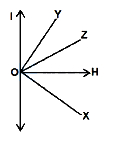
The variation of intensity of magnetisation $(I)$ and the applied magnetic field intensity $(H)$ for three magnetic materials $X$,$Y$ and $Z$ are shown in the graph as $OX$,$OY$ and $OZ$ respectively. The materials $X$,$Y$ and $Z$ respectively are:
A
paramagnetic,diamagnetic,ferromagnetic
B
diamagnetic,paramagnetic,ferromagnetic
C
ferromagnetic,diamagnetic,paramagnetic
D
diamagnetic,ferromagnetic,paramagnetic
Solution
(D) The intensity of magnetisation $(I)$ is related to the magnetic field intensity $(H)$ by the relation $I = \chi H$,where $\chi$ is the magnetic susceptibility.
For diamagnetic materials,$\chi$ is small and negative,so $I$ is negative for positive $H$. This corresponds to line $OX$.
For paramagnetic materials,$\chi$ is small and positive,so $I$ is positive and small for a given $H$. This corresponds to line $OZ$.
For ferromagnetic materials,$\chi$ is large and positive,so $I$ is positive and large for a given $H$. This corresponds to line $OY$.
Therefore,$X$ is diamagnetic,$Y$ is ferromagnetic,and $Z$ is paramagnetic.
For diamagnetic materials,$\chi$ is small and negative,so $I$ is negative for positive $H$. This corresponds to line $OX$.
For paramagnetic materials,$\chi$ is small and positive,so $I$ is positive and small for a given $H$. This corresponds to line $OZ$.
For ferromagnetic materials,$\chi$ is large and positive,so $I$ is positive and large for a given $H$. This corresponds to line $OY$.
Therefore,$X$ is diamagnetic,$Y$ is ferromagnetic,and $Z$ is paramagnetic.
0 likes
View Solution173
EasyMCQ
The susceptibility of a magnetic material is positive and small. The material is
A
diamagnetic and ferromagnetic.
B
paramagnetic.
C
ferromagnetic.
D
diamagnetic.
Solution
(B) The magnetic susceptibility $\chi$ of a material defines its magnetic behavior.
For diamagnetic materials, $\chi$ is negative and small $(-1 \le \chi < 0)$.
For paramagnetic materials, $\chi$ is positive and small $(\chi > 0)$.
For ferromagnetic materials, $\chi$ is positive and very large $(\chi \gg 1)$.
Since the given material has a positive and small susceptibility, it is classified as paramagnetic.
For diamagnetic materials, $\chi$ is negative and small $(-1 \le \chi < 0)$.
For paramagnetic materials, $\chi$ is positive and small $(\chi > 0)$.
For ferromagnetic materials, $\chi$ is positive and very large $(\chi \gg 1)$.
Since the given material has a positive and small susceptibility, it is classified as paramagnetic.
0 likes
View Solution174
EasyMCQ
Magnetic susceptibility of a paramagnetic substance is
A
Large and positive
B
Small and positive
C
Small and negative
D
Large and negative
Solution
(B) Key Idea: For a paramagnetic substance,the magnetic susceptibility is small and positive,because they get feebly magnetized when placed in an external magnetic field.
The magnetic susceptibility of a substance,denoted by $\chi_m$,indicates how easily a substance can be magnetized. It is defined as the ratio of the intensity of magnetization $(I)$ to the magnetic intensity $(H)$ of the applied field:
$\chi_m = \frac{I}{H}$
For paramagnetic substances,$I$ is small and in the same direction as $H$,resulting in a small and positive value for $\chi_m$.
The magnetic susceptibility of a substance,denoted by $\chi_m$,indicates how easily a substance can be magnetized. It is defined as the ratio of the intensity of magnetization $(I)$ to the magnetic intensity $(H)$ of the applied field:
$\chi_m = \frac{I}{H}$
For paramagnetic substances,$I$ is small and in the same direction as $H$,resulting in a small and positive value for $\chi_m$.
0 likes
View Solution175
MediumMCQ
Magnetic susceptibility for a paramagnetic and diamagnetic material is respectively
A
Small,positive and small,positive
B
Large,positive and small,negative
C
Small,positive and small,negative
D
Large,negative and large,positive
Solution
(C) The magnetic susceptibility $\chi$ is a measure of how easily a material can be magnetized in an external magnetic field.
For paramagnetic materials,the magnetic susceptibility $\chi$ is small and positive,meaning they are weakly attracted to an external magnetic field.
For diamagnetic materials,the magnetic susceptibility $\chi$ is small and negative,meaning they are weakly repelled by an external magnetic field.
Therefore,the correct sequence is small,positive for paramagnetic and small,negative for diamagnetic materials.
For paramagnetic materials,the magnetic susceptibility $\chi$ is small and positive,meaning they are weakly attracted to an external magnetic field.
For diamagnetic materials,the magnetic susceptibility $\chi$ is small and negative,meaning they are weakly repelled by an external magnetic field.
Therefore,the correct sequence is small,positive for paramagnetic and small,negative for diamagnetic materials.
0 likes
View Solution176
MediumMCQ
If a magnetic substance is kept in a magnetic field,then which of the following substances is thrown out?
A
Paramagnetic
B
Ferromagnetic
C
Diamagnetic
D
Antiferromagnetic
Solution
(C) When a magnetic substance is placed in a magnetic field,it is feebly repelled or 'thrown out' if the substance is diamagnetic.
This occurs because the substance becomes feebly magnetized in a direction opposite to the applied magnetic field.
The magnetic susceptibility of a diamagnetic substance is negative.
In contrast,paramagnetic substances are feebly attracted by a magnetic field,and ferromagnetic substances are strongly attracted by a magnet.
This occurs because the substance becomes feebly magnetized in a direction opposite to the applied magnetic field.
The magnetic susceptibility of a diamagnetic substance is negative.
In contrast,paramagnetic substances are feebly attracted by a magnetic field,and ferromagnetic substances are strongly attracted by a magnet.
0 likes
View Solution177
EasyMCQ
Alnico is an alloy of . . . . . . .
A
Al,Ni,As,$P$
B
$Al, Ni, Cu, P$
C
$Al, Ni, Cu, Co$
D
$Al, As, P, Pt$
Solution
(C) The correct option is $C$.
Alnico is a family of iron alloys which are primarily composed of Aluminum $(Al)$,Nickel $(Ni)$,Copper $(Cu)$,and Cobalt $(Co)$.
It is widely used for making permanent magnets due to its high coercivity and remanence.
Alnico is a family of iron alloys which are primarily composed of Aluminum $(Al)$,Nickel $(Ni)$,Copper $(Cu)$,and Cobalt $(Co)$.
It is widely used for making permanent magnets due to its high coercivity and remanence.
0 likes
View Solution178
EasyMCQ
$A$ substance is placed in a non-uniform magnetic field. It experiences a weak force towards the strong field. The substance is . . . . . . type.
A
Ferromagnetic
B
Diamagnetic
C
Paramagnetic
D
None of the above.
Solution
(C) substance that experiences a weak force towards the region of a stronger magnetic field when placed in a non-uniform magnetic field is classified as a $Paramagnetic$ substance.
$1$. $Diamagnetic$ substances are weakly repelled by a magnetic field and move towards the weaker field region.
$2$. $Paramagnetic$ substances are weakly attracted by a magnetic field and move towards the stronger field region.
$3$. $Ferromagnetic$ substances are strongly attracted by a magnetic field.
Therefore,the correct option is $C$.
$1$. $Diamagnetic$ substances are weakly repelled by a magnetic field and move towards the weaker field region.
$2$. $Paramagnetic$ substances are weakly attracted by a magnetic field and move towards the stronger field region.
$3$. $Ferromagnetic$ substances are strongly attracted by a magnetic field.
Therefore,the correct option is $C$.
0 likes
View Solution179
EasyMCQ
The magnetic susceptibility of a paramagnetic material is $1.0 \times 10^{-5}$ at $27^{\circ} C$ temperature. Then at what temperature its magnetic susceptibility would be $1.5 \times 10^{-5}$ (in $^{\circ} C$)?
A
$18$
B
$200$
C
$-73$
D
$-18$
Solution
(C) According to Curie's law for a paramagnetic substance,the magnetic susceptibility $\chi_m$ is inversely proportional to the absolute temperature $T$,i.e.,$\chi_m \propto \frac{1}{T}$.
Given:
$\chi_{m_1} = 1.0 \times 10^{-5}$
$T_1 = 27^{\circ} C = 27 + 273 = 300 \ K$
$\chi_{m_2} = 1.5 \times 10^{-5}$
Using the relation $\frac{\chi_{m_1}}{\chi_{m_2}} = \frac{T_2}{T_1}$:
$\frac{1.0 \times 10^{-5}}{1.5 \times 10^{-5}} = \frac{T_2}{300}$
$\frac{1}{1.5} = \frac{T_2}{300}$
$T_2 = \frac{300}{1.5} = 200 \ K$
Converting back to Celsius: $T_2(^{\circ} C) = 200 - 273 = -73^{\circ} C$.
Given:
$\chi_{m_1} = 1.0 \times 10^{-5}$
$T_1 = 27^{\circ} C = 27 + 273 = 300 \ K$
$\chi_{m_2} = 1.5 \times 10^{-5}$
Using the relation $\frac{\chi_{m_1}}{\chi_{m_2}} = \frac{T_2}{T_1}$:
$\frac{1.0 \times 10^{-5}}{1.5 \times 10^{-5}} = \frac{T_2}{300}$
$\frac{1}{1.5} = \frac{T_2}{300}$
$T_2 = \frac{300}{1.5} = 200 \ K$
Converting back to Celsius: $T_2(^{\circ} C) = 200 - 273 = -73^{\circ} C$.
0 likes
View Solution180
EasyMCQ
The resultant force acting on a diamagnetic material in a non-uniform magnetic field is in the direction . . . . . . .
A
from the stronger to the weaker part of the magnetic field.
B
from the weaker to the stronger part of the magnetic field.
C
perpendicular to the magnetic field.
D
in the direction making $60^{\circ}$ to the magnetic field.
Solution
(A) Diamagnetic materials are weakly repelled by magnetic fields. When placed in a non-uniform magnetic field,the induced magnetic moment is in the direction opposite to the applied field. Consequently,the material experiences a force that pushes it from the region of higher magnetic field intensity (stronger part) to the region of lower magnetic field intensity (weaker part). Therefore,the correct option is $A$.
0 likes
View Solution181
EasyMCQ
There are $2.0 \times 10^{24}$ molecular dipoles in a paramagnetic salt. Each has a dipole moment of $1.5 \times 10^{-23} \text{ A m}^2$. Find the maximum (saturation) magnetization in the specimen. (in $\text{ A m}^2$)
A
$20$
B
$30$
C
$200$
D
$50$
Solution
(B) The maximum magnetization $(M_{\max})$ occurs when all molecular dipoles are aligned in the direction of the external magnetic field.
It is calculated by the product of the total number of dipoles $(n)$ and the magnetic dipole moment of each molecule $(m)$.
Given:
$n = 2.0 \times 10^{24}$
$m = 1.5 \times 10^{-23} \text{ A m}^2$
Formula:
$M_{\max} = n \times m$
Calculation:
$M_{\max} = (2.0 \times 10^{24}) \times (1.5 \times 10^{-23})$
$M_{\max} = 3.0 \times 10^{1} = 30 \text{ A m}^2$
Therefore,the correct option is $B$.
It is calculated by the product of the total number of dipoles $(n)$ and the magnetic dipole moment of each molecule $(m)$.
Given:
$n = 2.0 \times 10^{24}$
$m = 1.5 \times 10^{-23} \text{ A m}^2$
Formula:
$M_{\max} = n \times m$
Calculation:
$M_{\max} = (2.0 \times 10^{24}) \times (1.5 \times 10^{-23})$
$M_{\max} = 3.0 \times 10^{1} = 30 \text{ A m}^2$
Therefore,the correct option is $B$.
0 likes
View Solution182
EasyMCQ
Domain formation is the necessary feature of
A
ferromagnetism
B
paramagnetism
C
diamagnetism
D
All of the above
Solution
(A) The correct answer is $A$.
In $ferromagnetic$ materials,the atoms are grouped into small regions called $domains$.
Within each domain,the magnetic moments of all atoms are aligned in the same direction due to strong exchange coupling.
This domain structure is a characteristic feature of $ferromagnetism$,which explains why these materials can be strongly magnetized.
In $ferromagnetic$ materials,the atoms are grouped into small regions called $domains$.
Within each domain,the magnetic moments of all atoms are aligned in the same direction due to strong exchange coupling.
This domain structure is a characteristic feature of $ferromagnetism$,which explains why these materials can be strongly magnetized.
0 likes
View Solution183
EasyMCQ
The phenomenon of perfect diamagnetism in superconductors is called the . . . . . . .
A
Curie's effect
B
Lorentz effect
C
Meissner effect
D
Crompton effect
Solution
(C) The correct answer is $C$.
When a material is cooled below its critical temperature $(T_c)$ to become a superconductor,it expels all magnetic flux from its interior.
This expulsion of magnetic field lines is known as the Meissner effect.
It is a characteristic property of superconductors,demonstrating perfect diamagnetism where the magnetic susceptibility $\chi = -1$.
When a material is cooled below its critical temperature $(T_c)$ to become a superconductor,it expels all magnetic flux from its interior.
This expulsion of magnetic field lines is known as the Meissner effect.
It is a characteristic property of superconductors,demonstrating perfect diamagnetism where the magnetic susceptibility $\chi = -1$.
0 likes
View Solution184
EasyMCQ
The magnetic needle of a magnetic compass is made up of $\qquad$ .
A
bismuth
B
lodestone
C
copper
D
aluminium
Solution
(B) The correct answer is $B$.
$A$ magnetic needle in a compass is typically made of a ferromagnetic material that can be permanently magnetized.
Lodestone is a naturally occurring magnetized piece of the mineral magnetite,which has been historically used to create magnetic needles for compasses.
$A$ magnetic needle in a compass is typically made of a ferromagnetic material that can be permanently magnetized.
Lodestone is a naturally occurring magnetized piece of the mineral magnetite,which has been historically used to create magnetic needles for compasses.
0 likes
View Solution185
EasyMCQ
Ferromagnetic materials have . . . . . . permeability and . . . . . . retentivity.
A
high,high
B
high,low
C
low,high
D
low,low
Solution
(A) Ferromagnetic materials are characterized by their ability to be strongly magnetized in an external magnetic field.
They possess a very high relative permeability $(\mu_r \gg 1)$, which allows them to concentrate magnetic field lines within themselves.
Additionally, they exhibit high retentivity, meaning they retain a significant amount of magnetization even after the external magnetic field is removed.
Therefore, the correct description is high permeability and high retentivity.
However, based on the provided options, the intended answer is $A$.
They possess a very high relative permeability $(\mu_r \gg 1)$, which allows them to concentrate magnetic field lines within themselves.
Additionally, they exhibit high retentivity, meaning they retain a significant amount of magnetization even after the external magnetic field is removed.
Therefore, the correct description is high permeability and high retentivity.
However, based on the provided options, the intended answer is $A$.
0 likes
View Solution186
MediumMCQ
$A$ susceptibility of a certain magnetic material is $ 400 $. What is the class of the magnetic material $ ? $
A
Diamagnetic
B
Paramagnetic
C
Ferromagnetic
D
Ferroelectric
Solution
(C) Magnetic susceptibility $\chi$ is a dimensionless quantity that indicates the degree of magnetization of a material in response to an applied magnetic field.
For diamagnetic materials, $\chi$ is small and negative.
For paramagnetic materials, $\chi$ is small and positive.
For ferromagnetic materials, $\chi$ is large and positive.
Given that the susceptibility is $ 400 $, which is a large positive value, the material belongs to the class of ferromagnetic materials.
For diamagnetic materials, $\chi$ is small and negative.
For paramagnetic materials, $\chi$ is small and positive.
For ferromagnetic materials, $\chi$ is large and positive.
Given that the susceptibility is $ 400 $, which is a large positive value, the material belongs to the class of ferromagnetic materials.
0 likes
View Solution187
MediumMCQ
Core of electromagnets are made of ferromagnetic material which has
A
high permeability and low retentivity
B
high permeability and high retentivity
C
low permeability and high retentivity
D
low permeability and low retentivity
Solution
(A) The core of an electromagnet is designed to concentrate the magnetic flux produced by the current-carrying coil.
To achieve this efficiently,the material must have high magnetic permeability,allowing it to be easily magnetized.
Additionally,it must have low retentivity so that the magnetism disappears quickly when the electric current is switched off.
Therefore,soft iron is commonly used for this purpose because it possesses high permeability and low retentivity.
To achieve this efficiently,the material must have high magnetic permeability,allowing it to be easily magnetized.
Additionally,it must have low retentivity so that the magnetism disappears quickly when the electric current is switched off.
Therefore,soft iron is commonly used for this purpose because it possesses high permeability and low retentivity.
0 likes
View Solution188
EasyMCQ
Which of the following statements is true in respect of diamagnetic substances?
A
They are feebly attracted by magnets
B
Permeability is greater than $1000$
C
Susceptibility decreases with temperature.
D
Susceptibility is small and negative
Solution
(D) Diamagnetic substances are materials that develop a weak magnetization in the direction opposite to the applied magnetic field.
Their magnetic susceptibility $(\chi)$ is small and negative, typically ranging from $-10^{-5}$ to $-10^{-9}$.
Unlike paramagnetic or ferromagnetic substances, the magnetic susceptibility of diamagnetic substances is independent of temperature.
Therefore, the statement that susceptibility is small and negative is correct.
Their magnetic susceptibility $(\chi)$ is small and negative, typically ranging from $-10^{-5}$ to $-10^{-9}$.
Unlike paramagnetic or ferromagnetic substances, the magnetic susceptibility of diamagnetic substances is independent of temperature.
Therefore, the statement that susceptibility is small and negative is correct.
0 likes
View Solution189
MediumMCQ
$A$ paramagnetic sample shows a net magnetisation of $8 \text{ Am}^{-1}$ when placed in an external magnetic field of $0.6 \text{ T}$ at a temperature of $4 \text{ K}$. When the same sample is placed in an external magnetic field of $0.2 \text{ T}$ at a temperature of $16 \text{ K}$,the magnetisation will be
A
$\frac{32}{3} \text{ Am}^{-1}$
B
$\frac{2}{3} \text{ Am}^{-1}$
C
$6 \text{ Am}^{-1}$
D
$2.4 \text{ Am}^{-1}$
Solution
(B) Given: $M_{1} = 8 \text{ Am}^{-1}$,$B_{1} = 0.6 \text{ T}$,$T_{1} = 4 \text{ K}$,$B_{2} = 0.2 \text{ T}$,and $T_{2} = 16 \text{ K}$.
According to Curie's law for paramagnetic materials,the magnetization $M$ is given by $M = \frac{C B}{T}$,where $C$ is the Curie constant.
Therefore,$M_{1} = \frac{C B_{1}}{T_{1}}$ and $M_{2} = \frac{C B_{2}}{T_{2}}$.
Taking the ratio: $\frac{M_{2}}{M_{1}} = \frac{B_{2}}{B_{1}} \times \frac{T_{1}}{T_{2}}$.
Substituting the values: $\frac{M_{2}}{8} = \frac{0.2}{0.6} \times \frac{4}{16}$.
$\frac{M_{2}}{8} = \frac{1}{3} \times \frac{1}{4} = \frac{1}{12}$.
$M_{2} = \frac{8}{12} = \frac{2}{3} \text{ Am}^{-1}$.
According to Curie's law for paramagnetic materials,the magnetization $M$ is given by $M = \frac{C B}{T}$,where $C$ is the Curie constant.
Therefore,$M_{1} = \frac{C B_{1}}{T_{1}}$ and $M_{2} = \frac{C B_{2}}{T_{2}}$.
Taking the ratio: $\frac{M_{2}}{M_{1}} = \frac{B_{2}}{B_{1}} \times \frac{T_{1}}{T_{2}}$.
Substituting the values: $\frac{M_{2}}{8} = \frac{0.2}{0.6} \times \frac{4}{16}$.
$\frac{M_{2}}{8} = \frac{1}{3} \times \frac{1}{4} = \frac{1}{12}$.
$M_{2} = \frac{8}{12} = \frac{2}{3} \text{ Am}^{-1}$.
0 likes
View Solution190
EasyMCQ
In a permanent magnet at room temperature,
A
magnetic moment of each molecule is zero
B
the individual molecules have non-zero magnetic moment which are all perfectly aligned
C
domains are partially aligned
D
domains are all perfectly aligned
Solution
(D) permanent magnet is made of ferromagnetic material. In a permanent magnet,the magnetic domains are aligned in a specific direction due to the manufacturing process (like cooling in an external magnetic field). Therefore,at room temperature,the domains are all perfectly aligned to produce a net magnetic moment.
0 likes
View Solution191
EasyMCQ
Needles $N_{1}$,$N_{2}$,and $N_{3}$ are made of a ferromagnetic,a paramagnetic,and a diamagnetic substance,respectively. $A$ magnet when brought close to them will
A
Attract all three of them
B
Attract $N_{1}$ strongly,$N_{2}$ weakly,and repel $N_{3}$ weakly
C
Attract $N_{1}$ strongly but repel $N_{2}$ and $N_{3}$ weakly
D
Attract $N_{1}$ and $N_{2}$ strongly but repel $N_{3}$
Solution
(B) The magnetic properties of materials determine their interaction with an external magnetic field:
$1$. Ferromagnetic substances $(N_{1})$ are strongly attracted by a magnet.
$2$. Paramagnetic substances $(N_{2})$ are weakly attracted by a magnet.
$3$. Diamagnetic substances $(N_{3})$ are weakly repelled by a magnet.
Therefore,when a magnet is brought close to these needles,it will attract $N_{1}$ strongly,attract $N_{2}$ weakly,and repel $N_{3}$ weakly.
$1$. Ferromagnetic substances $(N_{1})$ are strongly attracted by a magnet.
$2$. Paramagnetic substances $(N_{2})$ are weakly attracted by a magnet.
$3$. Diamagnetic substances $(N_{3})$ are weakly repelled by a magnet.
Therefore,when a magnet is brought close to these needles,it will attract $N_{1}$ strongly,attract $N_{2}$ weakly,and repel $N_{3}$ weakly.
0 likes
View Solution192
EasyMCQ
Ferromagnetic materials used in a transformer must have
A
low permeability and high hysteresis loss
B
high permeability and low hysteresis loss
C
high permeability and high hysteresis loss
D
low permeability and low hysteresis loss
Solution
(B) For a transformer core,the material must be easily magnetized and demagnetized to minimize energy dissipation during each cycle of the alternating current.
High permeability allows the material to concentrate magnetic flux lines effectively,which is essential for efficient induction.
Low hysteresis loss ensures that the energy lost as heat during the magnetization cycle is kept to a minimum.
Therefore,ferromagnetic materials used in a transformer must have high permeability and low hysteresis loss.
High permeability allows the material to concentrate magnetic flux lines effectively,which is essential for efficient induction.
Low hysteresis loss ensures that the energy lost as heat during the magnetization cycle is kept to a minimum.
Therefore,ferromagnetic materials used in a transformer must have high permeability and low hysteresis loss.
0 likes
View Solution193
EasyMCQ
Magnetic susceptibility of $Mg$ at $300 \ K$ is $1.2 \times 10^{-5}$. What is its susceptibility at $200 \ K$?
A
$18 \times 10^{-3}$
B
$180 \times 10^{-5}$
C
$1.8 \times 10^{-5}$
D
$0.18 \times 10^{-5}$
Solution
(C) For paramagnetic materials,the magnetic susceptibility $\chi$ is inversely proportional to the absolute temperature $T$,according to Curie's Law: $\chi \propto \frac{1}{T}$.
Given: $\chi_1 = 1.2 \times 10^{-5}$ at $T_1 = 300 \ K$.
We need to find $\chi_2$ at $T_2 = 200 \ K$.
Using the relation $\frac{\chi_2}{\chi_1} = \frac{T_1}{T_2}$,we get:
$\chi_2 = \chi_1 \times \frac{T_1}{T_2}$
$\chi_2 = 1.2 \times 10^{-5} \times \frac{300}{200}$
$\chi_2 = 1.2 \times 10^{-5} \times 1.5$
$\chi_2 = 1.8 \times 10^{-5}$.
Given: $\chi_1 = 1.2 \times 10^{-5}$ at $T_1 = 300 \ K$.
We need to find $\chi_2$ at $T_2 = 200 \ K$.
Using the relation $\frac{\chi_2}{\chi_1} = \frac{T_1}{T_2}$,we get:
$\chi_2 = \chi_1 \times \frac{T_1}{T_2}$
$\chi_2 = 1.2 \times 10^{-5} \times \frac{300}{200}$
$\chi_2 = 1.2 \times 10^{-5} \times 1.5$
$\chi_2 = 1.8 \times 10^{-5}$.
0 likes
View Solution194
EasyMCQ
The Curie temperatures of cobalt and iron are $1400 \,K$ and $1000 \,K$ respectively. At $T=1600 \,K$, the ratio of the magnetic susceptibility of cobalt to that of iron is
A
$1 / 3$
B
$3$
C
$7 / 5$
D
$5 / 7$
Solution
(B) According to the Curie-Weiss law, the magnetic susceptibility $\chi$ of a ferromagnetic material above its Curie temperature $T_C$ is given by $\chi = \frac{C}{T - T_C}$, where $C$ is the Curie constant and $T$ is the absolute temperature.
Since the Curie constant $C$ is approximately the same for these materials, we have $\chi \propto \frac{1}{T - T_C}$.
Therefore, the ratio of the magnetic susceptibility of cobalt to that of iron is given by:
$\frac{\chi_{\text{cobalt}}}{\chi_{\text{iron}}} = \frac{T - (T_C)_{\text{iron}}}{T - (T_C)_{\text{cobalt}}}$
Given $T = 1600 \,K$, $(T_C)_{\text{cobalt}} = 1400 \,K$, and $(T_C)_{\text{iron}} = 1000 \,K$.
Substituting these values:
$\frac{\chi_{\text{cobalt}}}{\chi_{\text{iron}}} = \frac{1600 - 1000}{1600 - 1400} = \frac{600}{200} = 3$.
Since the Curie constant $C$ is approximately the same for these materials, we have $\chi \propto \frac{1}{T - T_C}$.
Therefore, the ratio of the magnetic susceptibility of cobalt to that of iron is given by:
$\frac{\chi_{\text{cobalt}}}{\chi_{\text{iron}}} = \frac{T - (T_C)_{\text{iron}}}{T - (T_C)_{\text{cobalt}}}$
Given $T = 1600 \,K$, $(T_C)_{\text{cobalt}} = 1400 \,K$, and $(T_C)_{\text{iron}} = 1000 \,K$.
Substituting these values:
$\frac{\chi_{\text{cobalt}}}{\chi_{\text{iron}}} = \frac{1600 - 1000}{1600 - 1400} = \frac{600}{200} = 3$.
0 likes
View Solution195
MediumMCQ
The magnetic susceptibility of a ferromagnetic substance is
A
$>> 1$
B
$> 1$
C
$< 1$
D
Zero
Solution
(A) Magnetic susceptibility $(\chi)$ is a measure of how easily a substance can be magnetized in an external magnetic field.
For ferromagnetic substances,the atoms possess a permanent magnetic dipole moment,and they align strongly in the direction of the external magnetic field.
Due to this strong alignment,ferromagnetic materials exhibit a very large and positive magnetic susceptibility.
Therefore,for a ferromagnetic substance,$\chi >> 1$.
For ferromagnetic substances,the atoms possess a permanent magnetic dipole moment,and they align strongly in the direction of the external magnetic field.
Due to this strong alignment,ferromagnetic materials exhibit a very large and positive magnetic susceptibility.
Therefore,for a ferromagnetic substance,$\chi >> 1$.
0 likes
View Solution196
MediumMCQ
$A$ sample of a paramagnetic salt containing $3 \times 10^{24}$ atomic dipoles each of dipole moment $2 \times 10^{-23} \text{ A-m}^2$ is subjected to a uniform magnetic field of $880 \text{ mT}$ and cooled to a temperature of $3.5 \text{ K}$. The degree of magnetic saturation achieved is $10 \%$. If the sample is subjected to a magnetic field of $990 \text{ mT}$ and cooled to a temperature of $2.1 \text{ K}$, then the total dipole moment of the sample is (in $\text{ A-m}^2$)
A
$11.25$
B
$23.5$
C
$15$
D
$75$
Solution
$(A)$ The total magnetic moment $M$ of a paramagnetic sample is proportional to the ratio of the magnetic field $B$ to the temperature $T$, according to Curie's Law: $M \propto \frac{B}{T}$.
Initially, the total dipole moment $M_1$ is given by the product of the number of dipoles, the individual dipole moment, and the saturation percentage:
$M_1 = (3 \times 10^{24}) \times (2 \times 10^{-23} \text{ A-m}^2) \times 0.10 = 6 \text{ A-m}^2$.
Given the initial conditions: $B_1 = 880 \text{ mT}$ and $T_1 = 3.5 \text{ K}$.
Given the final conditions: $B_2 = 990 \text{ mT}$ and $T_2 = 2.1 \text{ K}$.
Using the proportionality $M \propto \frac{B}{T}$, we have:
$\frac{M_2}{M_1} = \frac{B_2}{B_1} \times \frac{T_1}{T_2}$
$M_2 = M_1 \times \left( \frac{B_2}{B_1} \right) \times \left( \frac{T_1}{T_2} \right)$
$M_2 = 6 \times \left( \frac{990}{880} \right) \times \left( \frac{3.5}{2.1} \right)$
$M_2 = 6 \times 1.125 \times 1.666... = 6 \times \frac{9}{8} \times \frac{35}{21} = 6 \times \frac{9}{8} \times \frac{5}{3} = 11.25 \text{ A-m}^2$.
Initially, the total dipole moment $M_1$ is given by the product of the number of dipoles, the individual dipole moment, and the saturation percentage:
$M_1 = (3 \times 10^{24}) \times (2 \times 10^{-23} \text{ A-m}^2) \times 0.10 = 6 \text{ A-m}^2$.
Given the initial conditions: $B_1 = 880 \text{ mT}$ and $T_1 = 3.5 \text{ K}$.
Given the final conditions: $B_2 = 990 \text{ mT}$ and $T_2 = 2.1 \text{ K}$.
Using the proportionality $M \propto \frac{B}{T}$, we have:
$\frac{M_2}{M_1} = \frac{B_2}{B_1} \times \frac{T_1}{T_2}$
$M_2 = M_1 \times \left( \frac{B_2}{B_1} \right) \times \left( \frac{T_1}{T_2} \right)$
$M_2 = 6 \times \left( \frac{990}{880} \right) \times \left( \frac{3.5}{2.1} \right)$
$M_2 = 6 \times 1.125 \times 1.666... = 6 \times \frac{9}{8} \times \frac{35}{21} = 6 \times \frac{9}{8} \times \frac{5}{3} = 11.25 \text{ A-m}^2$.
0 likes
View SolutionMagnetism and Matter — Magnetic Materials (Diamagnetic, Paramagnetic and Ferromagnetic) · Frequently Asked Questions
1Are these Magnetism and Matter questions useful for JEE and NEET?
Yes. All questions in this section are mapped to JEE Main and NEET exam patterns. Previous year questions from JEE Main, NEET, GUJCET and state-level exams are included with full solutions.
2Can I switch to Hindi or Gujarati for these questions?
Yes. Use the language tabs in the hero section or the sidebar to view the same questions and solutions in English, Hindi or Gujarati.
3How do I generate a question paper from this subtopic?
Use the Vedclass Exam Paper Generator — select the chapter and subtopic, set difficulty, and generate Sets A, B, C, D automatically. First 3 chapters of every subject are free.
Vedclass Products
For Students
Vedclass Test Series
Mock tests in real JEE/NEET style with performance analysis. 5-day free trial.
Start Free TrialFor Teachers
Exam Paper Generator
Generate Set A/B/C/D papers from this chapter in 2 minutes. 3 chapters free.
Try FreeFor Institutes
Online Exam Module
Live online exams with unlimited students, 360° analytics & white-label branding.
See DemoFor Teachers & Institutes
Generate a Magnetism and Matter Exam Paper in 2 Minutes
Select subtopic & difficulty — Sets A, B, C, D auto-generated with No Repeat logic.
First 3 chapters of every subject are free — no payment required.