
A English
Magnetic Materials (Diamagnetic, Paramagnetic and Ferromagnetic) Questions in English
Class 12 Physics · Magnetism and Matter · Magnetic Materials (Diamagnetic, Paramagnetic and Ferromagnetic)
222+
Questions
English
Language
100%
With Solutions
Showing 21 of 222 questions in English
201
EasyMCQ
Assertion $(A)$: Electromagnets are made of soft iron.
Reason $(R)$: Coercivity is small for soft iron.
Reason $(R)$: Coercivity is small for soft iron.
A
Both $(A)$ and $(R)$ are true and $(R)$ is the correct explanation of $(A)$
B
Both $(A)$ and $(R)$ are true and $(R)$ is not the correct explanation of $(A)$
C
$(A)$ is true,but $(R)$ is not true
D
$(A)$ is not true,but $(R)$ is true
Solution
(A) Electromagnets require materials that can be easily magnetized and demagnetized. Soft iron has high permeability and low retentivity,which makes it easy to magnetize. Additionally,soft iron has low coercivity,meaning it can be demagnetized easily by a small reverse magnetic field. Therefore,both the assertion and the reason are true,and the reason correctly explains why soft iron is preferred for electromagnets.
0 likes
View Solution202
MediumMCQ
One of the following substances having the tendency to move from a stronger region to a weaker region of the magnetic field is:
A
paramagnetic
B
ferromagnetic
C
diamagnetic
D
ferrimagnetic
Solution
(C) Diamagnetic substances are weakly repelled by magnetic fields.
When placed in a non-uniform magnetic field,they experience a force that pushes them from the stronger region of the field toward the weaker region.
This behavior is a characteristic property of diamagnetic materials.
When placed in a non-uniform magnetic field,they experience a force that pushes them from the stronger region of the field toward the weaker region.
This behavior is a characteristic property of diamagnetic materials.
0 likes
View Solution203
EasyMCQ
In some ferromagnetic materials,magnetization disappears on the removal of the external magnetic field. Such materials are called:
A
soft ferromagnetic materials
B
hard ferromagnetic materials
C
anti-ferromagnetic materials
D
semiconductors
Solution
(A) Ferromagnetic materials are classified based on their retentivity and coercivity.
Soft ferromagnetic materials have low retentivity and low coercivity,meaning they are easily magnetized and demagnetized.
Therefore,when the external magnetic field is removed,their magnetization disappears.
In contrast,hard ferromagnetic materials retain their magnetization even after the external field is removed.
Soft ferromagnetic materials have low retentivity and low coercivity,meaning they are easily magnetized and demagnetized.
Therefore,when the external magnetic field is removed,their magnetization disappears.
In contrast,hard ferromagnetic materials retain their magnetization even after the external field is removed.
0 likes
View Solution204
EasyMCQ
The Curie temperature $T_{C}$ represents:
A
temperature of transition from paramagnetic to ferromagnetic
B
temperature of transition from paramagnetic to diamagnetic
C
temperature of transition from ferromagnetic to paramagnetic
D
temperature of transition from diamagnetic to paramagnetic
Solution
(C) The Curie temperature $T_{C}$ is the critical temperature above which a ferromagnetic material loses its spontaneous magnetization and behaves as a paramagnetic material.
When a ferromagnetic substance is heated above its Curie temperature,the thermal agitation of the atoms overcomes the alignment of magnetic dipoles,resulting in a transition to a paramagnetic state.
Therefore,the Curie temperature represents the transition from ferromagnetic to paramagnetic.
When a ferromagnetic substance is heated above its Curie temperature,the thermal agitation of the atoms overcomes the alignment of magnetic dipoles,resulting in a transition to a paramagnetic state.
Therefore,the Curie temperature represents the transition from ferromagnetic to paramagnetic.
0 likes
View Solution205
MediumMCQ
$A$ paramagnetic sample shows a net magnetization of $0.8 \text{ A m}^{-1}$ when placed in an external magnetic field of strength $0.8 \text{ T}$ at a temperature of $5 \text{ K}$. If the temperature is raised to $20 \text{ K}$, then the magnetization becomes: (in $\text{ A m}^{-1}$)
A
$0.8$
B
$0.2$
C
$0.1$
D
$0.4$
Solution
(B) According to Curie's law, the magnetization $M$ of a paramagnetic material is given by $M = C \frac{B}{T}$, where $B$ is the external magnetic field, $T$ is the absolute temperature, and $C$ is Curie's constant.
Given $M_1 = 0.8 \text{ A m}^{-1}$, $B_1 = 0.8 \text{ T}$, and $T_1 = 5 \text{ K}$.
Substituting these values into the formula: $0.8 = C \frac{0.8}{5} \Rightarrow C = 5 \text{ K}$.
Now, for the new temperature $T_2 = 20 \text{ K}$ with the same magnetic field $B_2 = 0.8 \text{ T}$, the new magnetization $M_2$ is:
$M_2 = C \frac{B_2}{T_2} = 5 \times \frac{0.8}{20} = \frac{4}{20} = 0.2 \text{ A m}^{-1}$.
Given $M_1 = 0.8 \text{ A m}^{-1}$, $B_1 = 0.8 \text{ T}$, and $T_1 = 5 \text{ K}$.
Substituting these values into the formula: $0.8 = C \frac{0.8}{5} \Rightarrow C = 5 \text{ K}$.
Now, for the new temperature $T_2 = 20 \text{ K}$ with the same magnetic field $B_2 = 0.8 \text{ T}$, the new magnetization $M_2$ is:
$M_2 = C \frac{B_2}{T_2} = 5 \times \frac{0.8}{20} = \frac{4}{20} = 0.2 \text{ A m}^{-1}$.
0 likes
View Solution206
EasyMCQ
Materials suitable for permanent magnets should have
A
low retentivity and low coercivity
B
low retentivity and high coercivity
C
high retentivity and low coercivity
D
high retentivity and high coercivity
Solution
(D) For a material to be suitable for a permanent magnet,it must retain its magnetism even after the external magnetic field is removed.
$1$. High Retentivity: This ensures that the material remains strongly magnetized after the removal of the magnetizing field.
$2$. High Coercivity: This ensures that the magnetization is not easily destroyed by stray magnetic fields,temperature fluctuations,or minor mechanical impacts.
Therefore,materials for permanent magnets must have both high retentivity and high coercivity.
$1$. High Retentivity: This ensures that the material remains strongly magnetized after the removal of the magnetizing field.
$2$. High Coercivity: This ensures that the magnetization is not easily destroyed by stray magnetic fields,temperature fluctuations,or minor mechanical impacts.
Therefore,materials for permanent magnets must have both high retentivity and high coercivity.
0 likes
View Solution207
MediumMCQ
$A$ sample of paramagnetic salt contains $2 \times 10^{24}$ atomic dipoles each of dipole moment $1.5 \times 10^{-23} \text{ J T}^{-1}$. The sample is placed under a homogeneous magnetic field of $0.6 \text{ T}$ and cooled to a temperature of $4.2 \text{ K}$. The degree of magnetic saturation achieved is $20 \%$. What is the total dipole moment of the sample for a magnetic field of $0.9 \text{ T}$ and a temperature of $2.8 \text{ K}$ (in $\text{ J T}^{-1}$)?
A
$4.5$
B
$13.5$
C
$0.64$
D
$7$
Solution
(B) The total dipole moment of the sample at saturation is $M_{\text{sat}} = N \mu = (2 \times 10^{24}) \times (1.5 \times 10^{-23} \text{ J T}^{-1}) = 30 \text{ J T}^{-1}$.
According to Curie's law for paramagnetism, the magnetization $M$ is proportional to $B/T$, i.e., $M \propto B/T$.
In the first case, the degree of saturation is $20 \%$, so the magnetic moment is $M_1 = 0.20 \times M_{\text{sat}} = 0.20 \times 30 = 6 \text{ J T}^{-1}$.
The ratio of magnetic moments is given by $\frac{M_2}{M_1} = \frac{B_2 / T_2}{B_1 / T_1}$.
Substituting the values: $\frac{M_2}{6} = \frac{0.9 / 2.8}{0.6 / 4.2} = \frac{0.9}{2.8} \times \frac{4.2}{0.6} = \frac{0.9}{0.6} \times \frac{4.2}{2.8} = 1.5 \times 1.5 = 2.25$.
Therefore, $M_2 = 6 \times 2.25 = 13.5 \text{ J T}^{-1}$.
According to Curie's law for paramagnetism, the magnetization $M$ is proportional to $B/T$, i.e., $M \propto B/T$.
In the first case, the degree of saturation is $20 \%$, so the magnetic moment is $M_1 = 0.20 \times M_{\text{sat}} = 0.20 \times 30 = 6 \text{ J T}^{-1}$.
The ratio of magnetic moments is given by $\frac{M_2}{M_1} = \frac{B_2 / T_2}{B_1 / T_1}$.
Substituting the values: $\frac{M_2}{6} = \frac{0.9 / 2.8}{0.6 / 4.2} = \frac{0.9}{2.8} \times \frac{4.2}{0.6} = \frac{0.9}{0.6} \times \frac{4.2}{2.8} = 1.5 \times 1.5 = 2.25$.
Therefore, $M_2 = 6 \times 2.25 = 13.5 \text{ J T}^{-1}$.
0 likes
View Solution208
EasyMCQ
Any magnetic material loses its magnetic property when it is
A
Dipped in water
B
Dipped in sand
C
Attached to an iron piece
D
Heated to high temperature
Solution
(D) When any magnetic material is heated to a high temperature,it loses its magnetic property. This temperature is known as the Curie temperature. Above this temperature,the thermal agitation of the atoms overcomes the magnetic alignment,resulting in the loss of magnetism.
0 likes
View Solution209
EasyMCQ
The magnetic susceptibility of a paramagnetic substance at $-173^{\circ} C$ is $1.5 \times 10^{-2}$. To have the susceptibility $0.5 \times 10^{-2}$,the change in temperature in ${ }^{\circ} C$ is
A
$100$
B
$180$
C
$200$
D
$220$
Solution
(C) According to Curie's Law,the magnetic susceptibility $\chi_m$ of a paramagnetic substance is inversely proportional to its absolute temperature $T$,i.e.,$\chi_m \propto \frac{1}{T}$.
Given:
Initial temperature $T_1 = -173^{\circ} C = (-173 + 273) K = 100 K$.
Initial susceptibility $\chi_{m1} = 1.5 \times 10^{-2}$.
Final susceptibility $\chi_{m2} = 0.5 \times 10^{-2}$.
Using the relation $\chi_{m1} T_1 = \chi_{m2} T_2$:
$(1.5 \times 10^{-2}) \times 100 = (0.5 \times 10^{-2}) \times T_2$.
$T_2 = \frac{1.5 \times 100}{0.5} = 300 K$.
Converting $T_2$ to Celsius: $T_2 = 300 K - 273 = 27^{\circ} C$.
The change in temperature $\Delta T = T_2 - T_1 = 27^{\circ} C - (-173^{\circ} C) = 200^{\circ} C$.
Given:
Initial temperature $T_1 = -173^{\circ} C = (-173 + 273) K = 100 K$.
Initial susceptibility $\chi_{m1} = 1.5 \times 10^{-2}$.
Final susceptibility $\chi_{m2} = 0.5 \times 10^{-2}$.
Using the relation $\chi_{m1} T_1 = \chi_{m2} T_2$:
$(1.5 \times 10^{-2}) \times 100 = (0.5 \times 10^{-2}) \times T_2$.
$T_2 = \frac{1.5 \times 100}{0.5} = 300 K$.
Converting $T_2$ to Celsius: $T_2 = 300 K - 273 = 27^{\circ} C$.
The change in temperature $\Delta T = T_2 - T_1 = 27^{\circ} C - (-173^{\circ} C) = 200^{\circ} C$.
0 likes
View Solution210
EasyMCQ
The most exotic diamagnetic materials are
A
Superconductors
B
Semiconductors
C
Conductors
D
Resistors
Solution
(A) Superconductors are materials that exhibit perfect diamagnetism below a critical temperature,known as the Meissner effect. In this state,the magnetic field inside the material is zero,making them the most exotic diamagnetic materials.
0 likes
View Solution211
EasyMCQ
The magnetic susceptibility of ferromagnetic materials is
A
$< 0$
B
$> 1$
C
$1$
D
$0$
Solution
(B) The degree to which a material can be magnetised by applying an external magnetic field is called magnetic susceptibility,denoted by $\chi_m$.
For ferromagnetic materials,the magnetic susceptibility is very large and positive,which means $\chi_m > 1$.
This high value indicates that these materials are strongly attracted by an external magnetic field.
Therefore,the correct option is $B$.
For ferromagnetic materials,the magnetic susceptibility is very large and positive,which means $\chi_m > 1$.
This high value indicates that these materials are strongly attracted by an external magnetic field.
Therefore,the correct option is $B$.
0 likes
View Solution212
EasyMCQ
Materials suitable for permanent magnets must have which of the following properties?
A
High retentivity,low coercivity and high permeability.
B
Low retentivity,low coercivity and low permeability.
C
Low retentivity,high coercivity and low permeability.
D
High retentivity,high coercivity and high permeability.
Solution
(D) Materials suitable for permanent magnets must possess high retentivity so that they can retain the magnetic field strongly.
They must have high coercivity so that the magnetization is not easily destroyed by external magnetic fields,temperature fluctuations,or minor mechanical damage.
They should also have high permeability to allow for easy magnetization.
They must have high coercivity so that the magnetization is not easily destroyed by external magnetic fields,temperature fluctuations,or minor mechanical damage.
They should also have high permeability to allow for easy magnetization.
0 likes
View Solution213
MediumMCQ
If $\chi$ is the magnetic susceptibility and $\mu_{r}$ is the relative permeability of a ferromagnetic substance,then:
A
$\chi < < 1$
B
$\mu_r \ll 1$
C
$\mu_r = 0$
D
$\chi >> 1$
Solution
(D) The relationship between relative permeability $\mu_r$ and magnetic susceptibility $\chi$ is given by the formula: $\mu_r = 1 + \chi$.
For ferromagnetic substances,the magnetic susceptibility $\chi$ is a large positive value,typically $\chi >> 1$.
Consequently,the relative permeability $\mu_r$ is also much greater than $1$ (i.e.,$\mu_r >> 1$).
Therefore,the correct condition for a ferromagnetic substance is $\chi >> 1$.
For ferromagnetic substances,the magnetic susceptibility $\chi$ is a large positive value,typically $\chi >> 1$.
Consequently,the relative permeability $\mu_r$ is also much greater than $1$ (i.e.,$\mu_r >> 1$).
Therefore,the correct condition for a ferromagnetic substance is $\chi >> 1$.
0 likes
View Solution214
EasyMCQ
Which of the following is desirable for making permanent magnets?
A
Low coercive field and low retentivity
B
Low coercive field and high retentivity
C
High coercive field and high retentivity
D
High coercive field and low retentivity
Solution
(C) The material used for making permanent magnets must have high retentivity so that it produces a strong magnetic field.
Additionally,it must have high coercivity so that its magnetization is not easily destroyed by stray magnetic fields,temperature variations,or minor mechanical damage.
Therefore,a material with both high retentivity and high coercivity is desirable.
Additionally,it must have high coercivity so that its magnetization is not easily destroyed by stray magnetic fields,temperature variations,or minor mechanical damage.
Therefore,a material with both high retentivity and high coercivity is desirable.
0 likes
View Solution215
EasyMCQ
Identify the incorrect statement from the following.
A
The susceptibility of a diamagnetic material is a positive quantity.
B
Paramagnetic materials obey Curie's law.
C
Ferromagnetic materials have permanent magnetic domains.
D
In soft ferromagnetic material,the magnetisation disappears on removal of the external field.
Solution
(A) The magnetic susceptibility $(\chi)$ of a diamagnetic material is a negative quantity,$(\chi < 0)$,whereas paramagnetic and ferromagnetic materials have positive susceptibility $(\chi > 0)$. Therefore,statement $(A)$ is incorrect.
Paramagnetic materials obey Curie's law,which states that susceptibility is inversely proportional to absolute temperature.
Ferromagnetic materials consist of small regions called magnetic domains,each containing approximately $10^{17}$ atoms,which act as permanent magnetic dipoles.
Soft ferromagnetic materials have low retentivity,meaning their magnetisation disappears easily upon the removal of the external magnetic field.
Thus,statement $(A)$ is the incorrect statement.
Paramagnetic materials obey Curie's law,which states that susceptibility is inversely proportional to absolute temperature.
Ferromagnetic materials consist of small regions called magnetic domains,each containing approximately $10^{17}$ atoms,which act as permanent magnetic dipoles.
Soft ferromagnetic materials have low retentivity,meaning their magnetisation disappears easily upon the removal of the external magnetic field.
Thus,statement $(A)$ is the incorrect statement.
0 likes
View Solution216
MediumMCQ
Consider the following two statements $A$ and $B$ and identify the correct choice in the given answers.
$A$. Paramagnetism is explained by domain theory.
$B$. Susceptibility of a diamagnetic substance is independent of temperature.
$A$. Paramagnetism is explained by domain theory.
$B$. Susceptibility of a diamagnetic substance is independent of temperature.
A
Both $A$ and $B$ are correct
B
Both $A$ and $B$ are wrong
C
$A$ is correct and $B$ is wrong
D
$A$ is wrong and $B$ is correct
Solution
(D) Statement $(A)$ is wrong because domain theory is used to explain ferromagnetism,not paramagnetism.
Statement $(B)$ is correct because the magnetic susceptibility of diamagnetic materials is independent of temperature,as it arises from the orbital motion of electrons which is not significantly affected by thermal agitation.
Statement $(B)$ is correct because the magnetic susceptibility of diamagnetic materials is independent of temperature,as it arises from the orbital motion of electrons which is not significantly affected by thermal agitation.
0 likes
View Solution217
EasyMCQ
If $\chi$ stands for the magnetic susceptibility of a substance,$\mu$ for its magnetic permeability,and $\mu_0$ for the permeability of free space,then which of the following is correct?
A
For a paramagnetic substance: $\chi < 0, \mu > 0$
B
For a paramagnetic substance: $\chi > 0, \mu > \mu_0$
C
For a diamagnetic substance: $\chi > 0, \mu < 0$
D
For a ferromagnetic substance: $\chi \gg 1, \mu \gg \mu_0$
Solution
(B) The relationship between magnetic susceptibility $\chi$ and relative permeability $\mu_r$ is given by $\chi = \mu_r - 1$.
Also,the absolute permeability $\mu$ is related to relative permeability by $\mu = \mu_r \mu_0$.
For a paramagnetic substance,$\chi$ is small and positive $(\chi > 0)$,which implies $\mu_r > 1$,and therefore $\mu > \mu_0$.
For a diamagnetic substance,$\chi$ is small and negative $(\chi < 0)$,which implies $\mu_r < 1$,and therefore $\mu < \mu_0$.
For a ferromagnetic substance,$\chi$ is very large and positive $(\chi \gg 1)$,which implies $\mu_r \gg 1$,and therefore $\mu \gg \mu_0$.
Comparing these with the given options,both $(b)$ and $(d)$ are scientifically correct statements.
Also,the absolute permeability $\mu$ is related to relative permeability by $\mu = \mu_r \mu_0$.
For a paramagnetic substance,$\chi$ is small and positive $(\chi > 0)$,which implies $\mu_r > 1$,and therefore $\mu > \mu_0$.
For a diamagnetic substance,$\chi$ is small and negative $(\chi < 0)$,which implies $\mu_r < 1$,and therefore $\mu < \mu_0$.
For a ferromagnetic substance,$\chi$ is very large and positive $(\chi \gg 1)$,which implies $\mu_r \gg 1$,and therefore $\mu \gg \mu_0$.
Comparing these with the given options,both $(b)$ and $(d)$ are scientifically correct statements.
0 likes
View Solution218
EasyMCQ
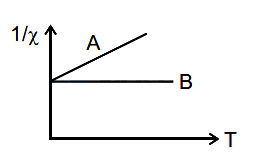
For two types of magnetic materials $A$ and $B$,the variation of $\frac{1}{\chi}$ ($\chi$: magnetic susceptibility) versus temperature $T$ is shown in the figure. Then:
A
$A$ is paramagnetic and $B$ is diamagnetic
B
$A$ is ferromagnetic and $B$ is diamagnetic
C
$A$ is paramagnetic and $B$ is ferromagnetic
D
$A$ is ferromagnetic and $B$ is paramagnetic
Solution
(A) $1$. For paramagnetic materials,according to Curie's Law,$\chi = \frac{C}{T}$,which implies $\frac{1}{\chi} = \frac{T}{C}$. This represents a straight line passing through the origin with a positive slope.
$2$. For ferromagnetic materials above the Curie temperature $(T_c)$,the susceptibility follows the Curie-Weiss Law: $\chi = \frac{C}{T - T_c}$,which implies $\frac{1}{\chi} = \frac{T - T_c}{C}$. This represents a straight line with a positive slope that does not pass through the origin.
$3$. For diamagnetic materials,the susceptibility $\chi$ is small,negative,and independent of temperature. Thus,$\frac{1}{\chi}$ is a constant negative value,resulting in a horizontal line (zero slope) in the $\frac{1}{\chi}$ vs $T$ graph.
$4$. In the given figure,line $A$ passes through the origin with a positive slope,indicating it is paramagnetic. Line $B$ is a horizontal line (zero slope),indicating it is diamagnetic.
$5$. Therefore,$A$ is paramagnetic and $B$ is diamagnetic.
$2$. For ferromagnetic materials above the Curie temperature $(T_c)$,the susceptibility follows the Curie-Weiss Law: $\chi = \frac{C}{T - T_c}$,which implies $\frac{1}{\chi} = \frac{T - T_c}{C}$. This represents a straight line with a positive slope that does not pass through the origin.
$3$. For diamagnetic materials,the susceptibility $\chi$ is small,negative,and independent of temperature. Thus,$\frac{1}{\chi}$ is a constant negative value,resulting in a horizontal line (zero slope) in the $\frac{1}{\chi}$ vs $T$ graph.
$4$. In the given figure,line $A$ passes through the origin with a positive slope,indicating it is paramagnetic. Line $B$ is a horizontal line (zero slope),indicating it is diamagnetic.
$5$. Therefore,$A$ is paramagnetic and $B$ is diamagnetic.
0 likes
View Solution219
DifficultMCQ
Given below are two statements: one is labelled as Assertion $(A)$ and the other is labelled as Reason $(R)$. Consider a ferromagnetic material:
Assertion $(A)$: The individual atoms in a ferromagnetic material possess a magnetic dipole moment and interact with one another in such a way that they spontaneously align themselves forming domains.
Reason $(R)$: At high enough temperature,the domain structure of a ferromagnetic material disintegrates. Thus,magnetization will disappear at a high enough temperature known as the Curie temperature.
In the light of the above statements,choose the correct answer from the options given below:
Assertion $(A)$: The individual atoms in a ferromagnetic material possess a magnetic dipole moment and interact with one another in such a way that they spontaneously align themselves forming domains.
Reason $(R)$: At high enough temperature,the domain structure of a ferromagnetic material disintegrates. Thus,magnetization will disappear at a high enough temperature known as the Curie temperature.
In the light of the above statements,choose the correct answer from the options given below:
A
$(A)$ is true but $(R)$ is false
B
Both true,but $(R)$ is $NOT$ the correct explanation
C
Both true,and $(R)$ is the correct explanation
D
$(A)$ is false but $(R)$ is true
Solution
(C) Assertion $(A)$ is true because ferromagnetic materials consist of small regions called domains where atomic magnetic dipoles are aligned due to strong exchange interactions.
Reason $(R)$ is also true because thermal agitation at high temperatures disrupts the alignment of these magnetic dipoles,causing the domain structure to break down.
When the temperature exceeds the Curie temperature $(T_c)$,the material transitions from ferromagnetic to paramagnetic behavior,meaning the spontaneous magnetization disappears.
Since the disintegration of the domain structure at high temperatures is the fundamental reason why the ferromagnetic property (and thus spontaneous magnetization) is lost,Reason $(R)$ correctly explains Assertion $(A)$.
Reason $(R)$ is also true because thermal agitation at high temperatures disrupts the alignment of these magnetic dipoles,causing the domain structure to break down.
When the temperature exceeds the Curie temperature $(T_c)$,the material transitions from ferromagnetic to paramagnetic behavior,meaning the spontaneous magnetization disappears.
Since the disintegration of the domain structure at high temperatures is the fundamental reason why the ferromagnetic property (and thus spontaneous magnetization) is lost,Reason $(R)$ correctly explains Assertion $(A)$.
0 likes
View Solution220
MediumMCQ
$A$ paramagnetic substance is placed in a non-uniform magnetic field,then
A
perform continuous rotation
B
to move from a region of weak magnetic field to strong magnetic field
C
remain stationary
D
to move from a region of strong magnetic field to weak magnetic field
Solution
(B) Paramagnetic substances possess a small positive magnetic susceptibility. When placed in a non-uniform magnetic field,they experience a net force directed towards the region of higher magnetic field intensity. Therefore,a paramagnetic substance tends to move from a region of weak magnetic field to a region of strong magnetic field.
0 likes
View Solution221
MediumMCQ
The magnetic susceptibility $\chi$ for superconductors is . . . . . . .
A
Zero
B
$1$
C
$0.1$
D
-$1$
Solution
(D) Superconductors exhibit the Meissner effect,which means they are perfect diamagnetic materials.
For a perfect diamagnetic material,the internal magnetic field $B$ is equal to $0$.
Since $B = \mu_0(H + M) = 0$,we have $M = -H$.
The magnetic susceptibility $\chi$ is defined as the ratio of magnetization $M$ to the magnetic field intensity $H$,i.e.,$\chi = M/H$.
Substituting $M = -H$,we get $\chi = -H/H = -1$.
For a perfect diamagnetic material,the internal magnetic field $B$ is equal to $0$.
Since $B = \mu_0(H + M) = 0$,we have $M = -H$.
The magnetic susceptibility $\chi$ is defined as the ratio of magnetization $M$ to the magnetic field intensity $H$,i.e.,$\chi = M/H$.
Substituting $M = -H$,we get $\chi = -H/H = -1$.
0 likes
View SolutionMagnetism and Matter — Magnetic Materials (Diamagnetic, Paramagnetic and Ferromagnetic) · Frequently Asked Questions
1Are these Magnetism and Matter questions useful for JEE and NEET?
Yes. All questions in this section are mapped to JEE Main and NEET exam patterns. Previous year questions from JEE Main, NEET, GUJCET and state-level exams are included with full solutions.
2Can I switch to Hindi or Gujarati for these questions?
Yes. Use the language tabs in the hero section or the sidebar to view the same questions and solutions in English, Hindi or Gujarati.
3How do I generate a question paper from this subtopic?
Use the Vedclass Exam Paper Generator — select the chapter and subtopic, set difficulty, and generate Sets A, B, C, D automatically. First 3 chapters of every subject are free.
Vedclass Products
For Students
Vedclass Test Series
Mock tests in real JEE/NEET style with performance analysis. 5-day free trial.
Start Free TrialFor Teachers
Exam Paper Generator
Generate Set A/B/C/D papers from this chapter in 2 minutes. 3 chapters free.
Try FreeFor Institutes
Online Exam Module
Live online exams with unlimited students, 360° analytics & white-label branding.
See DemoFor Teachers & Institutes
Generate a Magnetism and Matter Exam Paper in 2 Minutes
Select subtopic & difficulty — Sets A, B, C, D auto-generated with No Repeat logic.
First 3 chapters of every subject are free — no payment required.