
A English
Magnetic Materials (Diamagnetic, Paramagnetic and Ferromagnetic) Questions in English
Class 12 Physics · Magnetism and Matter · Magnetic Materials (Diamagnetic, Paramagnetic and Ferromagnetic)
222+
Questions
English
Language
100%
With Solutions
Showing 41 of 222 questions in English
1
EasyMCQ
Which of the following is the most suitable material for making a permanent magnet?
A
Steel
B
Soft iron
C
Copper
D
Nickel
Solution
(A) Steel is the most suitable material for making a permanent magnet because it possesses high retentivity and high coercivity.
High retentivity ensures that the material retains a strong magnetic field after the magnetizing field is removed.
High coercivity ensures that the material is not easily demagnetized by external magnetic fields,vibrations,or temperature changes.
In contrast,soft iron has high retentivity but low coercivity,making it ideal for electromagnets but not for permanent magnets.
High retentivity ensures that the material retains a strong magnetic field after the magnetizing field is removed.
High coercivity ensures that the material is not easily demagnetized by external magnetic fields,vibrations,or temperature changes.
In contrast,soft iron has high retentivity but low coercivity,making it ideal for electromagnets but not for permanent magnets.
0 likes
View Solution2
EasyMCQ
$A$ sensitive magnetic instrument can be shielded very effectively from outside magnetic fields by placing it inside a box of
A
Teak wood
B
Plastic material
C
Soft iron of high permeability
D
$A$ metal of high conductivity
Solution
(C) The measurements of sensitive magnetic instruments are influenced by external magnetic fields.
To protect these instruments from external magnetic interference,they are placed inside a box made of a material with high magnetic permeability,such as soft iron.
This process is known as magnetic shielding.
When the instrument is placed inside a soft iron box,the external magnetic field lines prefer to pass through the high-permeability material of the box rather than through the interior space where the instrument is located.
Consequently,the magnetic flux is diverted around the device,effectively shielding it from the external field.
To protect these instruments from external magnetic interference,they are placed inside a box made of a material with high magnetic permeability,such as soft iron.
This process is known as magnetic shielding.
When the instrument is placed inside a soft iron box,the external magnetic field lines prefer to pass through the high-permeability material of the box rather than through the interior space where the instrument is located.
Consequently,the magnetic flux is diverted around the device,effectively shielding it from the external field.
0 likes
View Solution3
EasyMCQ
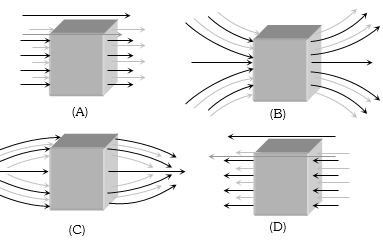
$A$ uniform magnetic field,parallel to the plane of the paper,exists in space and is initially directed from left to right. When a bar of soft iron is placed in the field parallel to it,the lines of force passing through it will be represented by:
A
Figure $(A)$
B
Figure $(B)$
C
Figure $(C)$
D
Figure $(D)$
Solution
(B) Soft iron is a ferromagnetic material with high magnetic permeability.
When a ferromagnetic material is placed in an external magnetic field,it becomes strongly magnetized.
Due to its high permeability,the magnetic field lines prefer to pass through the soft iron rather than the surrounding air.
This results in the concentration of magnetic field lines inside the soft iron bar,as shown in Figure $(B)$.
When a ferromagnetic material is placed in an external magnetic field,it becomes strongly magnetized.
Due to its high permeability,the magnetic field lines prefer to pass through the soft iron rather than the surrounding air.
This results in the concentration of magnetic field lines inside the soft iron bar,as shown in Figure $(B)$.
0 likes
View Solution4
EasyMCQ
For protecting a sensitive equipment from the external magnetic field,it should be
A
Placed inside an aluminium can
B
Placed inside an iron can
C
Wrapped with insulation around it when passing current through it
D
Surrounded with fine copper sheet
Solution
(B) Iron is a ferromagnetic substance,which has high magnetic permeability. When placed in an external magnetic field,the magnetic field lines prefer to pass through the iron rather than the interior space. This phenomenon is known as magnetic shielding. Therefore,to protect sensitive equipment from an external magnetic field,it should be placed inside an iron can.
0 likes
View Solution5
EasyMCQ
$A$ magnetic needle suspended by a silk thread is vibrating in the earth's magnetic field. If the temperature of the needle is increased by $500^{\circ}C$,then
A
The time period decreases
B
The time period remains unchanged
C
The time period increases
D
The needle stops vibrating
Solution
(C) The time period $T$ of a magnetic needle oscillating in a magnetic field is given by $T = 2\pi \sqrt{\frac{I}{MB}}$,where $I$ is the moment of inertia,$M$ is the magnetic moment,and $B$ is the magnetic field.
From this relation,we see that $T \propto \frac{1}{\sqrt{M}}$.
When the temperature of a magnetic material increases,its magnetic dipoles become disordered due to thermal agitation,which leads to a decrease in the magnetic moment $M$.
Since $M$ decreases as the temperature increases,the time period $T$ must increase.
From this relation,we see that $T \propto \frac{1}{\sqrt{M}}$.
When the temperature of a magnetic material increases,its magnetic dipoles become disordered due to thermal agitation,which leads to a decrease in the magnetic moment $M$.
Since $M$ decreases as the temperature increases,the time period $T$ must increase.
0 likes
View Solution6
EasyMCQ
Magnets cannot be made from which of the following substances?
A
Iron
B
Nickel
C
Copper
D
All of the above
Solution
(C) The substances that are not attracted by a magnet are called non-magnetic substances.
Ferromagnetic materials like $Iron$ and $Nickel$ can be easily magnetized to form permanent or temporary magnets.
$Copper$ is a diamagnetic substance and cannot be magnetized to form a magnet.
Therefore,the correct option is $C$.
Ferromagnetic materials like $Iron$ and $Nickel$ can be easily magnetized to form permanent or temporary magnets.
$Copper$ is a diamagnetic substance and cannot be magnetized to form a magnet.
Therefore,the correct option is $C$.
0 likes
View Solution7
EasyMCQ
Which of the following is most suitable for the core of electromagnets?
A
Soft iron
B
Steel
C
Copper-nickel alloy
D
Air
Solution
(A) Soft iron is highly ferromagnetic and has high magnetic permeability and low retentivity.
This means it can be easily magnetized and demagnetized,which is an essential property for the core of an electromagnet.
Therefore,soft iron is the most suitable material for the core of electromagnets.
This means it can be easily magnetized and demagnetized,which is an essential property for the core of an electromagnet.
Therefore,soft iron is the most suitable material for the core of electromagnets.
0 likes
View Solution8
EasyMCQ
$A$ ferromagnetic material is heated above its $Curie$ temperature. Which one is a correct statement?
A
Ferromagnetic domains are perfectly arranged.
B
Ferromagnetic domains become random.
C
Ferromagnetic domains are not influenced.
D
Ferromagnetic material changes itself into diamagnetic material.
Solution
(B) When a ferromagnetic material is heated above its $Curie$ temperature,the thermal energy becomes sufficient to overcome the exchange interaction that keeps the magnetic moments of atoms aligned within the domains.
As a result,the ordered alignment of the magnetic domains is destroyed,and the domains become randomly oriented.
Consequently,the material loses its ferromagnetic properties and behaves as a paramagnetic material.
Therefore,the correct statement is that the ferromagnetic domains become random.
As a result,the ordered alignment of the magnetic domains is destroyed,and the domains become randomly oriented.
Consequently,the material loses its ferromagnetic properties and behaves as a paramagnetic material.
Therefore,the correct statement is that the ferromagnetic domains become random.
0 likes
View Solution9
EasyMCQ
If a diamagnetic substance is brought near the north or south pole of a bar magnet,it is:
A
Attracted by the poles
B
Repelled by the poles
C
Repelled by the north pole and attracted by the south pole
D
Attracted by the north pole and repelled by the south pole
Solution
(B) Diamagnetic substances are materials that develop a weak magnetization in the direction opposite to the applied magnetic field. When a diamagnetic substance is placed in a non-uniform magnetic field (such as near the poles of a bar magnet),it experiences a force that pushes it from the stronger part of the field to the weaker part. Since the magnetic field is strongest at the poles of a bar magnet,the diamagnetic substance is repelled by both the north and south poles.
0 likes
View Solution10
EasyMCQ
The material of a permanent magnet has:
A
High retentivity,low coercivity
B
Low retentivity,high coercivity
C
Low retentivity,low coercivity
D
High retentivity,high coercivity
Solution
(D) permanent magnet is a material that retains its magnetism even after the external magnetic field is removed.
To achieve this,the material must have high retentivity so that it can retain a large amount of magnetic flux density $(B)$ at zero external field $(H=0)$.
Additionally,it must have high coercivity so that it is not easily demagnetized by external magnetic fields or temperature fluctuations.
Therefore,the material of a permanent magnet should have high retentivity and high coercivity.
To achieve this,the material must have high retentivity so that it can retain a large amount of magnetic flux density $(B)$ at zero external field $(H=0)$.
Additionally,it must have high coercivity so that it is not easily demagnetized by external magnetic fields or temperature fluctuations.
Therefore,the material of a permanent magnet should have high retentivity and high coercivity.
0 likes
View Solution11
EasyMCQ
The permanent magnet is made from which one of the following substances?
A
Diamagnetic
B
Paramagnetic
C
Ferromagnetic
D
Electromagnetic
Solution
(C) Permanent magnets are made from ferromagnetic materials because they possess high retentivity and high coercivity. These properties allow the material to retain its magnetization even after the external magnetic field is removed. Therefore,ferromagnetic substances are the ideal choice for creating permanent magnets.
0 likes
View Solution12
EasyMCQ
When a magnetic substance is heated,then it
A
Becomes a strong magnet
B
Loses its magnetism
C
Does not affect the magnetism
D
Either $(A)$ or $(C)$
Solution
(B) When a magnetic substance is heated,it loses its magnetic property.
This happens because the thermal energy causes the atomic magnets (magnetic dipoles) to become randomly oriented,thereby destroying the net alignment that creates the magnetic field.
This happens because the thermal energy causes the atomic magnets (magnetic dipoles) to become randomly oriented,thereby destroying the net alignment that creates the magnetic field.
0 likes
View Solution13
EasyMCQ
Substances in which the magnetic moment of a single atom is not zero are known as:
A
Diamagnetism
B
Ferromagnetism
C
Paramagnetism
D
Ferrimagnetism
Solution
(C) The correct answer is $C$.
Paramagnetism is a property exhibited by substances whose individual atoms possess a permanent,non-zero magnetic moment.
This occurs because these atoms have an excess of electrons spinning in the same direction,resulting in a net magnetic moment for each atom.
In the absence of an external magnetic field,these individual magnetic moments are randomly oriented due to thermal agitation,resulting in zero net magnetization for the bulk material.
Paramagnetism is a property exhibited by substances whose individual atoms possess a permanent,non-zero magnetic moment.
This occurs because these atoms have an excess of electrons spinning in the same direction,resulting in a net magnetic moment for each atom.
In the absence of an external magnetic field,these individual magnetic moments are randomly oriented due to thermal agitation,resulting in zero net magnetization for the bulk material.
0 likes
View Solution14
EasyMCQ
Diamagnetic substances are
A
Feebly attracted by magnets
B
Strongly attracted by magnets
C
Feebly repelled by magnets
D
Strongly repelled by magnets
Solution
(C) Diamagnetic substances are feebly repelled by magnets.
This occurs because when placed in an external magnetic field,they develop an induced magnetic moment in the direction opposite to the applied field,resulting in a weak repulsive force.
Diamagnetic materials consist of atoms with no net magnetic moment,meaning all electron shells are completely filled and there are no unpaired electrons.
Examples include water,copper,and bismuth.
This occurs because when placed in an external magnetic field,they develop an induced magnetic moment in the direction opposite to the applied field,resulting in a weak repulsive force.
Diamagnetic materials consist of atoms with no net magnetic moment,meaning all electron shells are completely filled and there are no unpaired electrons.
Examples include water,copper,and bismuth.
0 likes
View Solution15
EasyMCQ
Which of the following statements are true about the magnetic susceptibility ${\chi _m}$ of a paramagnetic substance?
A
Value of ${\chi _m}$ is inversely proportional to the absolute temperature of the sample.
B
${\chi _m}$ is positive at all temperatures.
C
Both $(a)$ and $(b)$.
D
${\chi _m}$ does not depend on the temperature of the sample.
Solution
(C) According to Curie's Law,the magnetic susceptibility ${\chi _m}$ of a paramagnetic substance is inversely proportional to its absolute temperature $T$,given by ${\chi _m} = C/T$,where $C$ is the Curie constant.
Since $C$ and $T$ are positive for paramagnetic materials,${\chi _m}$ is always positive.
Therefore,both statements $(a)$ and $(b)$ are true.
Since $C$ and $T$ are positive for paramagnetic materials,${\chi _m}$ is always positive.
Therefore,both statements $(a)$ and $(b)$ are true.
0 likes
View Solution16
EasyMCQ
An example of a diamagnetic substance is
A
Aluminium
B
Copper
C
Iron
D
Nickel
Solution
(B) Diamagnetic substances are materials that are weakly repelled by a magnetic field.
Among the given options,$Aluminium$ is paramagnetic,while $Iron$ and $Nickel$ are ferromagnetic.
$Copper$ is a well-known example of a diamagnetic substance.
Among the given options,$Aluminium$ is paramagnetic,while $Iron$ and $Nickel$ are ferromagnetic.
$Copper$ is a well-known example of a diamagnetic substance.
0 likes
View Solution17
EasyMCQ
Magnetic permeability is maximum for
A
Diamagnetic substance
B
Paramagnetic substance
C
Ferromagnetic substance
D
All of these
Solution
(C) Magnetic permeability $(\mu)$ of a material is defined as its ability to support the formation of a magnetic field within itself when placed in an external magnetic field.
For diamagnetic substances, $\mu < \mu_0$.
For paramagnetic substances, $\mu > \mu_0$.
For ferromagnetic substances, $\mu \gg \mu_0$.
Therefore, magnetic permeability is maximum for ferromagnetic substances.
For diamagnetic substances, $\mu < \mu_0$.
For paramagnetic substances, $\mu > \mu_0$.
For ferromagnetic substances, $\mu \gg \mu_0$.
Therefore, magnetic permeability is maximum for ferromagnetic substances.
0 likes
View Solution18
EasyMCQ
If a diamagnetic solution is poured into a $U-$ tube and one arm of this $U-$ tube is placed between the poles of a strong magnet with the meniscus in line with the field,then the level of the solution will:
A
Rise
B
Fall
C
Oscillate slowly
D
Remain as such
Solution
(B) Diamagnetic substances are weakly repelled by magnetic fields.
When one arm of the $U-$ tube is placed in a strong magnetic field,the magnetic field is strongest between the poles.
Since diamagnetic materials tend to move from regions of stronger magnetic field to regions of weaker magnetic field,the solution in that arm will be pushed away from the magnetic field.
Consequently,the level of the solution in that arm will fall.
When one arm of the $U-$ tube is placed in a strong magnetic field,the magnetic field is strongest between the poles.
Since diamagnetic materials tend to move from regions of stronger magnetic field to regions of weaker magnetic field,the solution in that arm will be pushed away from the magnetic field.
Consequently,the level of the solution in that arm will fall.
0 likes
View Solution19
EasyMCQ
The relative permeability is represented by $\mu_r$ and the susceptibility is denoted by $\chi$ for a magnetic substance. Then for a paramagnetic substance:
A
$\mu_r < 1, \chi < 0$
B
$\mu_r < 1, \chi > 0$
C
$\mu_r > 1, \chi < 0$
D
$\mu_r > 1, \chi > 0$
Solution
(D) For a paramagnetic substance,the material is weakly attracted by an external magnetic field.
$1$. Magnetic susceptibility $\chi$ is defined by the relation $M = \chi H$. For paramagnetic materials,the magnetization $M$ is in the same direction as the applied field $H$,which implies $\chi > 0$.
$2$. The relative permeability $\mu_r$ is related to susceptibility by the formula $\mu_r = 1 + \chi$.
$3$. Since $\chi > 0$ for paramagnetic substances,it follows that $\mu_r = 1 + \chi > 1$.
Therefore,for a paramagnetic substance,$\mu_r > 1$ and $\chi > 0$.
$1$. Magnetic susceptibility $\chi$ is defined by the relation $M = \chi H$. For paramagnetic materials,the magnetization $M$ is in the same direction as the applied field $H$,which implies $\chi > 0$.
$2$. The relative permeability $\mu_r$ is related to susceptibility by the formula $\mu_r = 1 + \chi$.
$3$. Since $\chi > 0$ for paramagnetic substances,it follows that $\mu_r = 1 + \chi > 1$.
Therefore,for a paramagnetic substance,$\mu_r > 1$ and $\chi > 0$.
0 likes
View Solution20
EasyMCQ
Which of the following statements is true?
A
Diamagnetism is temperature dependent.
B
Paramagnetism is temperature dependent.
C
Paramagnetism is temperature independent.
D
None of these.
Solution
(B) According to Curie's Law,the magnetic susceptibility of paramagnetic materials is inversely proportional to the absolute temperature $(T)$.
Mathematically,$\chi_m \propto \frac{1}{T}$.
As the temperature increases,the thermal agitation of the atoms increases,which opposes the alignment of magnetic moments,thereby decreasing the magnetic susceptibility.
Therefore,paramagnetism is temperature dependent,while diamagnetism is generally considered to be independent of temperature.
Mathematically,$\chi_m \propto \frac{1}{T}$.
As the temperature increases,the thermal agitation of the atoms increases,which opposes the alignment of magnetic moments,thereby decreasing the magnetic susceptibility.
Therefore,paramagnetism is temperature dependent,while diamagnetism is generally considered to be independent of temperature.
0 likes
View Solution21
EasyMCQ
Among the following, for which substance does the magnetic susceptibility not depend on the temperature?
A
Ferrimagnetic substances
B
Ferromagnetic substances
C
Diamagnetic substances
D
Paramagnetic substances
Solution
(C) The magnetic susceptibility $(\chi)$ of diamagnetic substances is independent of temperature.
For paramagnetic substances, $\chi$ follows Curie's Law, $\chi \propto 1/T$.
For ferromagnetic and ferrimagnetic substances, $\chi$ depends on temperature according to the Curie-Weiss Law, $\chi \propto 1/(T - T_c)$, where $T_c$ is the Curie temperature.
Therefore, diamagnetic substances are the only ones among the options whose magnetic susceptibility does not depend on temperature.
For paramagnetic substances, $\chi$ follows Curie's Law, $\chi \propto 1/T$.
For ferromagnetic and ferrimagnetic substances, $\chi$ depends on temperature according to the Curie-Weiss Law, $\chi \propto 1/(T - T_c)$, where $T_c$ is the Curie temperature.
Therefore, diamagnetic substances are the only ones among the options whose magnetic susceptibility does not depend on temperature.
0 likes
View Solution22
EasyMCQ
Identify the paramagnetic substance.
A
Iron
B
Aluminium
C
Nickel
D
Hydrogen
Solution
(B) Paramagnetic substances are those that are weakly attracted by an external magnetic field.
Among the given options:
$1$. Iron $(Fe)$ is a ferromagnetic substance.
$2$. Aluminium $(Al)$ is a paramagnetic substance.
$3$. Nickel $(Ni)$ is a ferromagnetic substance.
$4$. Hydrogen $(H_2)$ is a diamagnetic substance.
Therefore,the correct option is $B$.
Among the given options:
$1$. Iron $(Fe)$ is a ferromagnetic substance.
$2$. Aluminium $(Al)$ is a paramagnetic substance.
$3$. Nickel $(Ni)$ is a ferromagnetic substance.
$4$. Hydrogen $(H_2)$ is a diamagnetic substance.
Therefore,the correct option is $B$.
0 likes
View Solution23
EasyMCQ
If a magnetic substance is kept in a magnetic field,then which of the following is thrown out?
A
Paramagnetic
B
Ferromagnetic
C
Diamagnetic
D
Antiferromagnetic
Solution
(C) Diamagnetic substances are characterized by a negative magnetic susceptibility. When placed in a non-uniform magnetic field,they experience a weak force of repulsion from the stronger part of the field toward the weaker part. Consequently,they tend to move from regions of stronger magnetic field to regions of weaker magnetic field,effectively being 'thrown out' or expelled from the magnetic field.
0 likes
View Solution24
EasyMCQ
The magnetic susceptibility is negative for
A
Paramagnetic materials
B
Diamagnetic materials
C
Ferromagnetic materials
D
Paramagnetic and ferromagnetic materials
Solution
(B) The magnetic susceptibility $(\chi)$ indicates how a material responds to an external magnetic field.
For diamagnetic materials, the magnetic susceptibility is negative, meaning they are weakly repelled by a magnetic field.
For paramagnetic materials, the magnetic susceptibility is small and positive.
For ferromagnetic materials, the magnetic susceptibility is large and positive.
Therefore, the correct option is $(B)$.
For diamagnetic materials, the magnetic susceptibility is negative, meaning they are weakly repelled by a magnetic field.
For paramagnetic materials, the magnetic susceptibility is small and positive.
For ferromagnetic materials, the magnetic susceptibility is large and positive.
Therefore, the correct option is $(B)$.
0 likes
View Solution25
EasyMCQ
The universal property of all substances is
A
Diamagnetism
B
Ferromagnetism
C
Paramagnetism
D
All of these
Solution
(A) Diamagnetism is a fundamental property of all matter. It arises due to the orbital motion of electrons in an atom,which creates a small magnetic moment opposing the applied external magnetic field. While other forms of magnetism like paramagnetism or ferromagnetism may be stronger and mask diamagnetism in certain materials,diamagnetism is present in all substances to some extent.
0 likes
View Solution26
EasyMCQ
Curie's law can be written as
A
$\chi \propto (T - T_c)$
B
$\chi \propto \frac{1}{T - T_c}$
C
$\chi \propto \frac{1}{T}$
D
$\chi \propto T$
Solution
(C) Curie's law states that the magnetic susceptibility $\chi$ of a paramagnetic material is inversely proportional to its absolute temperature $T$.
Mathematically,this is expressed as $\chi \propto \frac{1}{T}$ or $\chi = \frac{C}{T}$,where $C$ is the Curie constant.
Mathematically,this is expressed as $\chi \propto \frac{1}{T}$ or $\chi = \frac{C}{T}$,where $C$ is the Curie constant.
0 likes
View Solution27
EasyMCQ
$A$ superconductor exhibits perfect
A
Ferrimagnetism
B
Ferromagnetism
C
Paramagnetism
D
Diamagnetism
Solution
(D) superconductor is a material that exhibits zero electrical resistance and the expulsion of magnetic fields when cooled below a characteristic critical temperature. This phenomenon is known as the Meissner effect. Due to the Meissner effect,the magnetic field inside the superconductor becomes zero $(B = 0)$. This behavior is characteristic of a perfect diamagnet,where the material expels all magnetic flux lines from its interior. Therefore,a superconductor exhibits perfect diamagnetism.
0 likes
View Solution28
EasyMCQ
$A$ small rod of bismuth is suspended freely between the poles of a strong electromagnet. It is found to arrange itself at right angles to the magnetic field. This observation establishes that bismuth is
A
Diamagnetic
B
Paramagnetic
C
Ferri-magnetic
D
Antiferro-magnetic
Solution
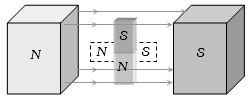
(A) diamagnetic material,when placed in a non-uniform magnetic field,tends to move from the stronger part of the field to the weaker part. When a small rod of a diamagnetic material like bismuth is suspended freely in a uniform magnetic field,it experiences a torque that causes it to align itself perpendicular (at right angles) to the direction of the magnetic field. This happens because the material is weakly repelled by the magnetic field,and the perpendicular orientation minimizes the magnetic potential energy of the system. Therefore,the observation establishes that bismuth is diamagnetic.
0 likes
View Solution29
EasyMCQ
$A$ diamagnetic material in a magnetic field moves:
A
From weaker to the stronger parts of the field
B
Perpendicular to the field
C
From stronger to the weaker parts of the field
D
In none of the above directions
Solution
(C) Diamagnetic materials are weakly repelled by magnetic fields. When placed in a non-uniform magnetic field,they experience a force that pushes them towards the region of lower magnetic field intensity. Therefore,a diamagnetic material moves from the stronger to the weaker parts of the field.
0 likes
View Solution30
EasyMCQ
Curie temperature is the temperature above which
A
$A$ paramagnetic material becomes ferromagnetic
B
$A$ ferromagnetic material becomes paramagnetic
C
$A$ paramagnetic material becomes diamagnetic
D
$A$ ferromagnetic material becomes diamagnetic
Solution
(B) The Curie temperature $(T_C)$ is a characteristic property of ferromagnetic materials.
At temperatures below $T_C$,the material exhibits ferromagnetic properties due to the alignment of magnetic domains.
As the temperature increases and reaches $T_C$,the thermal agitation becomes strong enough to overcome the exchange coupling that maintains the alignment of these domains.
Consequently,above the Curie temperature,the material loses its spontaneous magnetization and transitions into a paramagnetic state.
Therefore,the correct option is $(B)$.
At temperatures below $T_C$,the material exhibits ferromagnetic properties due to the alignment of magnetic domains.
As the temperature increases and reaches $T_C$,the thermal agitation becomes strong enough to overcome the exchange coupling that maintains the alignment of these domains.
Consequently,above the Curie temperature,the material loses its spontaneous magnetization and transitions into a paramagnetic state.
Therefore,the correct option is $(B)$.
0 likes
View Solution31
EasyMCQ
$A$ frog can be levitated in a magnetic field produced by a current in a vertical solenoid placed below the frog. This is possible because the body of the frog behaves as
A
Paramagnetic
B
Diamagnetic
C
Ferromagnetic
D
Antiferromagnetic
Solution
(B) The phenomenon of levitation of a frog in a strong magnetic field is a classic demonstration of diamagnetism.
Biological tissues,including the body of a frog,consist largely of water and organic molecules,which exhibit diamagnetic properties.
Diamagnetic substances are weakly repelled by magnetic fields.
When a strong magnetic field is applied,the diamagnetic repulsion force acting on the frog's body can balance the gravitational force,allowing the frog to levitate.
Therefore,the correct option is $B$.
Biological tissues,including the body of a frog,consist largely of water and organic molecules,which exhibit diamagnetic properties.
Diamagnetic substances are weakly repelled by magnetic fields.
When a strong magnetic field is applied,the diamagnetic repulsion force acting on the frog's body can balance the gravitational force,allowing the frog to levitate.
Therefore,the correct option is $B$.
0 likes
View Solution32
EasyMCQ
Which one of the following is a non-magnetic substance?
A
Iron
B
Nickel
C
Cobalt
D
Brass
Solution
(D) Magnetic substances are materials that are attracted by magnets. Examples of magnetic substances include $Iron$,$Steel$,$Cobalt$,and $Nickel$.
Non-magnetic substances are materials that are not attracted by a magnet. Examples of non-magnetic materials include wood,plastic,copper,rubber,and $Brass$.
Therefore,$Brass$ is a non-magnetic substance.
Non-magnetic substances are materials that are not attracted by a magnet. Examples of non-magnetic materials include wood,plastic,copper,rubber,and $Brass$.
Therefore,$Brass$ is a non-magnetic substance.
0 likes
View Solution33
EasyMCQ
Liquid oxygen remains suspended between two pole faces of a magnet because it is
A
Diamagnetic
B
Paramagnetic
C
Ferromagnetic
D
Antiferromagnetic
Solution
(B) Liquid oxygen is $Paramagnetic$ in nature.
Paramagnetic substances are weakly attracted by magnetic fields.
When liquid oxygen is placed between the two pole faces of a magnet,it experiences an attractive force towards both poles.
If the liquid is placed exactly in the center,the magnetic forces exerted by the two poles are equal in magnitude and opposite in direction.
As a result,the net magnetic force on the liquid oxygen becomes zero,causing it to remain suspended between the pole faces.
Paramagnetic substances are weakly attracted by magnetic fields.
When liquid oxygen is placed between the two pole faces of a magnet,it experiences an attractive force towards both poles.
If the liquid is placed exactly in the center,the magnetic forces exerted by the two poles are equal in magnitude and opposite in direction.
As a result,the net magnetic force on the liquid oxygen becomes zero,causing it to remain suspended between the pole faces.
0 likes
View Solution34
EasyMCQ
The Curie-Weiss law is obeyed by iron at a temperature ......
A
Below Curie temperature
B
Above Curie temperature
C
At Curie temperature only
D
At all temperatures
Solution
(B) The Curie-Weiss law describes the magnetic susceptibility $\chi$ of a ferromagnetic material in the paramagnetic region.
For a ferromagnetic material like iron,the transition from ferromagnetic to paramagnetic state occurs at the Curie temperature $(T_C)$.
Below $T_C$,the material exhibits spontaneous magnetization.
Above $T_C$,the material behaves as a paramagnet and follows the Curie-Weiss law,which is given by $\chi = \frac{C}{T - T_C}$,where $C$ is the Curie constant and $T$ is the absolute temperature.
Therefore,iron obeys the Curie-Weiss law at temperatures above the Curie temperature.
For a ferromagnetic material like iron,the transition from ferromagnetic to paramagnetic state occurs at the Curie temperature $(T_C)$.
Below $T_C$,the material exhibits spontaneous magnetization.
Above $T_C$,the material behaves as a paramagnet and follows the Curie-Weiss law,which is given by $\chi = \frac{C}{T - T_C}$,where $C$ is the Curie constant and $T$ is the absolute temperature.
Therefore,iron obeys the Curie-Weiss law at temperatures above the Curie temperature.
0 likes
View Solution35
EasyMCQ
The materials suitable for making electromagnets should have
A
High retentivity and high coercivity
B
High retentivity and low coercivity
C
Low retentivity and low coercivity
D
Low retentivity and high coercivity
Solution
(C) An electromagnet requires a material that can be easily magnetized and demagnetized.
To achieve this,the material must have low retentivity so that it does not retain magnetism when the current is switched off.
Additionally,it must have low coercivity so that it can be easily demagnetized by a small reverse magnetic field.
Therefore,the correct choice is low retentivity and low coercivity.
To achieve this,the material must have low retentivity so that it does not retain magnetism when the current is switched off.
Additionally,it must have low coercivity so that it can be easily demagnetized by a small reverse magnetic field.
Therefore,the correct choice is low retentivity and low coercivity.
0 likes
View Solution36
EasyMCQ
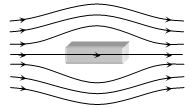
The given figure represents a material which is
A
Paramagnetic
B
Diamagnetic
C
Ferromagnetic
D
None of these
Solution
(B) In the given figure,the magnetic field lines are expelled or pushed away from the interior of the substance.
This behavior is characteristic of a diamagnetic material,which weakly repels magnetic fields.
This behavior is characteristic of a diamagnetic material,which weakly repels magnetic fields.
0 likes
View Solution37
EasyMCQ
Which of the following materials exhibits diamagnetism?
A
Aluminium
B
Quartz
C
Nickel
D
Bismuth
Solution
(D) Diamagnetic materials are substances that are weakly repelled by a magnetic field.
Among the given options,$Bismuth$ is a well-known diamagnetic material.
$Aluminium$ is paramagnetic,$Nickel$ is ferromagnetic,and $Quartz$ is generally considered non-magnetic or weakly diamagnetic,but $Bismuth$ is the standard example of a strong diamagnetic material in physics textbooks.
Therefore,the correct option is $D$.
Among the given options,$Bismuth$ is a well-known diamagnetic material.
$Aluminium$ is paramagnetic,$Nickel$ is ferromagnetic,and $Quartz$ is generally considered non-magnetic or weakly diamagnetic,but $Bismuth$ is the standard example of a strong diamagnetic material in physics textbooks.
Therefore,the correct option is $D$.
0 likes
View Solution38
EasyMCQ
If a ferromagnetic material is inserted in a current-carrying solenoid,the magnetic field of the solenoid
A
Largely increases
B
Slightly increases
C
Largely decreases
D
Slightly decreases
Solution
(A) The magnetic field inside a current-carrying solenoid is given by $B_0 = \mu_0 n I$.
When a ferromagnetic material is inserted into the solenoid,it gets strongly magnetized in the direction of the applied magnetic field.
The total magnetic field $B$ becomes $B = B_0 + B_m$,where $B_m$ is the magnetic field due to the magnetization of the material.
Since the relative permeability $\mu_r$ of a ferromagnetic material is very large (much greater than $1$),the magnetic field inside the solenoid increases significantly (largely).
When a ferromagnetic material is inserted into the solenoid,it gets strongly magnetized in the direction of the applied magnetic field.
The total magnetic field $B$ becomes $B = B_0 + B_m$,where $B_m$ is the magnetic field due to the magnetization of the material.
Since the relative permeability $\mu_r$ of a ferromagnetic material is very large (much greater than $1$),the magnetic field inside the solenoid increases significantly (largely).
0 likes
View Solution39
EasyMCQ
If the magnetic dipole moment of an atom of diamagnetic material,paramagnetic material,and ferromagnetic material are denoted by $\mu_d, \mu_p, \mu_f$ respectively,then:
A
$\mu_d \neq 0$ and $\mu_f \neq 0$
B
$\mu_p = 0$ and $\mu_f \neq 0$
C
$\mu_d = 0$ and $\mu_p \neq 0$
D
$\mu_d \neq 0$ and $\mu_p = 0$
Solution
(C) In diamagnetic materials,the orbital and spin magnetic moments of electrons in an atom cancel each other out,resulting in a net magnetic dipole moment of $\mu_d = 0$ for each atom.
In paramagnetic materials,each atom possesses a permanent magnetic dipole moment due to unpaired electrons,so $\mu_p \neq 0$.
In ferromagnetic materials,each atom also possesses a permanent magnetic dipole moment,so $\mu_f \neq 0$.
Comparing the options,the statement $\mu_d = 0$ and $\mu_p \neq 0$ is correct.
In paramagnetic materials,each atom possesses a permanent magnetic dipole moment due to unpaired electrons,so $\mu_p \neq 0$.
In ferromagnetic materials,each atom also possesses a permanent magnetic dipole moment,so $\mu_f \neq 0$.
Comparing the options,the statement $\mu_d = 0$ and $\mu_p \neq 0$ is correct.
0 likes
View Solution40
EasyMCQ
Among the following properties describing diamagnetism, identify the property that is wrongly stated.
A
Diamagnetic materials do not have a permanent magnetic moment.
B
Diamagnetism is explained in terms of electromagnetic induction.
C
Diamagnetic materials have a small positive susceptibility.
D
The magnetic moment of individual electrons neutralize each other.
Solution
(C) The correct answer is $C$. Diamagnetic materials exhibit a small negative magnetic susceptibility $( \chi < 0)$, not a positive one. Diamagnetism arises from the orbital motion of electrons, which creates a magnetic moment that opposes the applied external magnetic field, consistent with Lenz's law (electromagnetic induction). Furthermore, in diamagnetic atoms, the magnetic moments of individual electrons cancel each other out, resulting in no permanent magnetic moment.
0 likes
View Solution41
EasyMCQ
When a ferromagnetic material is heated to a temperature above its Curie temperature,the material
A
Is permanently magnetized
B
Remains ferromagnetic
C
Behaves like a diamagnetic material
D
Behaves like a paramagnetic material
Solution
(D) The Curie temperature $(T_c)$ is the temperature above which a ferromagnetic material loses its spontaneous magnetization and undergoes a phase transition to a paramagnetic state.
When a ferromagnetic material is heated above its Curie temperature,the thermal agitation of the atoms becomes strong enough to overcome the exchange coupling that aligns the magnetic moments.
Consequently,the material loses its ferromagnetic properties and begins to behave like a paramagnetic material.
When a ferromagnetic material is heated above its Curie temperature,the thermal agitation of the atoms becomes strong enough to overcome the exchange coupling that aligns the magnetic moments.
Consequently,the material loses its ferromagnetic properties and begins to behave like a paramagnetic material.
0 likes
View SolutionMagnetism and Matter — Magnetic Materials (Diamagnetic, Paramagnetic and Ferromagnetic) · Frequently Asked Questions
1Are these Magnetism and Matter questions useful for JEE and NEET?
Yes. All questions in this section are mapped to JEE Main and NEET exam patterns. Previous year questions from JEE Main, NEET, GUJCET and state-level exams are included with full solutions.
2Can I switch to Hindi or Gujarati for these questions?
Yes. Use the language tabs in the hero section or the sidebar to view the same questions and solutions in English, Hindi or Gujarati.
3How do I generate a question paper from this subtopic?
Use the Vedclass Exam Paper Generator — select the chapter and subtopic, set difficulty, and generate Sets A, B, C, D automatically. First 3 chapters of every subject are free.
Vedclass Products
For Students
Vedclass Test Series
Mock tests in real JEE/NEET style with performance analysis. 5-day free trial.
Start Free TrialFor Teachers
Exam Paper Generator
Generate Set A/B/C/D papers from this chapter in 2 minutes. 3 chapters free.
Try FreeFor Institutes
Online Exam Module
Live online exams with unlimited students, 360° analytics & white-label branding.
See DemoFor Teachers & Institutes
Generate a Magnetism and Matter Exam Paper in 2 Minutes
Select subtopic & difficulty — Sets A, B, C, D auto-generated with No Repeat logic.
First 3 chapters of every subject are free — no payment required.