
A English
Mutual Induction Questions in English
Class 12 Physics · Electromagnetic Induction · Mutual Induction
151+
Questions
English
Language
100%
With Solutions
Showing 46 of 151 questions in English
101
MediumMCQ
The planar concentric rings of metal wire having radii $r_1$ and $r_2$ (with $r_1 > r_2$) are placed in air. The current $I$ is flowing through the coil of larger radius. The mutual inductance between the coils is given by $(\mu_0 = \text{permeability of free space})$
A
$\frac{\mu_0 \pi (r_1 + r_2)^2}{2 r_2}$
B
$\frac{\mu_0 \pi (r_1 - r_2)^2}{2 r_1}$
C
$\frac{\mu_0 \pi r_1^2}{2 r_2}$
D
$\frac{\mu_0 \pi r_2^2}{2 r_1}$
Solution
(D) The magnetic field at the center of a circular loop of radius $r_1$ carrying current $I$ is given by $B = \frac{\mu_0 I}{2 r_1}$.
Since the rings are concentric and coplanar,the magnetic field $B$ is uniform over the area of the smaller ring (radius $r_2$).
The magnetic flux $\phi$ linked with the smaller ring is $\phi = B \times A_2$,where $A_2 = \pi r_2^2$ is the area of the smaller ring.
$\phi = \left( \frac{\mu_0 I}{2 r_1} \right) \times \pi r_2^2 = \frac{\mu_0 \pi r_2^2}{2 r_1} I$.
The mutual inductance $M$ is defined as $M = \frac{\phi}{I}$.
Therefore,$M = \frac{\mu_0 \pi r_2^2}{2 r_1}$.
Since the rings are concentric and coplanar,the magnetic field $B$ is uniform over the area of the smaller ring (radius $r_2$).
The magnetic flux $\phi$ linked with the smaller ring is $\phi = B \times A_2$,where $A_2 = \pi r_2^2$ is the area of the smaller ring.
$\phi = \left( \frac{\mu_0 I}{2 r_1} \right) \times \pi r_2^2 = \frac{\mu_0 \pi r_2^2}{2 r_1} I$.
The mutual inductance $M$ is defined as $M = \frac{\phi}{I}$.
Therefore,$M = \frac{\mu_0 \pi r_2^2}{2 r_1}$.
0 likes
View Solution102
EasyMCQ
Two coils of self-inductance $25 \ mH$ and $9 \ mH$ are placed close together such that the effective flux in one coil is completely linked with the other. The mutual inductance between these coils is (in $mH$)
A
$34$
B
$16$
C
$15$
D
$6$
Solution
(C) The mutual inductance $M$ between two coils with self-inductances $L_1$ and $L_2$ is given by the formula $M = k \sqrt{L_1 L_2}$,where $k$ is the coefficient of coupling.
Since the flux in one coil is completely linked with the other,the coupling is perfect,meaning $k = 1$.
Given $L_1 = 25 \ mH$ and $L_2 = 9 \ mH$.
Substituting these values into the formula:
$M = \sqrt{25 \ mH \times 9 \ mH} = \sqrt{225 \ mH^2} = 15 \ mH$.
Since the flux in one coil is completely linked with the other,the coupling is perfect,meaning $k = 1$.
Given $L_1 = 25 \ mH$ and $L_2 = 9 \ mH$.
Substituting these values into the formula:
$M = \sqrt{25 \ mH \times 9 \ mH} = \sqrt{225 \ mH^2} = 15 \ mH$.
0 likes
View Solution103
MediumMCQ
Two coils have a mutual inductance $0.003 \ H$. The current changes in the first coil according to the equation $I = I_0 \sin \omega t$, where $I_0 = 8 \ A$ and $\omega = 100 \pi \ rad \ s^{-1}$. The maximum value of e.m.f. in the second coil is (in $\pi \ V$)
A
$2$
B
$2.4$
C
$5$
D
$7.2$
Solution
(B) The induced e.m.f. in the second coil is given by the formula: $|e_s| = M \left| \frac{dI_p}{dt} \right|$.
Given $I_p = I_0 \sin \omega t$, we differentiate with respect to time $t$:
$\frac{dI_p}{dt} = I_0 \omega \cos \omega t$.
Substituting this into the e.m.f. equation:
$|e_s| = M I_0 \omega \cos \omega t$.
The maximum value of e.m.f. occurs when $\cos \omega t = 1$:
$|e_s|_{\max} = M I_0 \omega$.
Substituting the given values $M = 0.003 \ H$, $I_0 = 8 \ A$, and $\omega = 100 \pi \ rad \ s^{-1}$:
$|e_s|_{\max} = 0.003 \times 8 \times 100 \pi = 2.4 \pi \ V$.
Given $I_p = I_0 \sin \omega t$, we differentiate with respect to time $t$:
$\frac{dI_p}{dt} = I_0 \omega \cos \omega t$.
Substituting this into the e.m.f. equation:
$|e_s| = M I_0 \omega \cos \omega t$.
The maximum value of e.m.f. occurs when $\cos \omega t = 1$:
$|e_s|_{\max} = M I_0 \omega$.
Substituting the given values $M = 0.003 \ H$, $I_0 = 8 \ A$, and $\omega = 100 \pi \ rad \ s^{-1}$:
$|e_s|_{\max} = 0.003 \times 8 \times 100 \pi = 2.4 \pi \ V$.
0 likes
View Solution104
MediumMCQ
Two concentric circular coils having radii $r_1$ and $r_2$ $(r_2 \ll r_1)$ are placed co-axially with centres coinciding. The mutual inductance of the arrangement is ($\mu_0 =$ permeability of free space) (Both coils have single turn).
A
$\frac{\mu_0 \pi r_2}{2 r_1}$
B
$\frac{\mu_0 \pi}{2 r_1 r_2}$
C
$\frac{\mu_0 \pi r_1}{2 r_2}$
D
$\frac{\mu_0 \pi r_2^2}{2 r_1}$
Solution
(D) The magnetic field at the center of a circular loop of radius $r_1$ carrying current $I$ is given by $B = \frac{\mu_0 I}{2 r_1}$.
Since $r_2 \ll r_1$,the magnetic field $B$ is approximately uniform over the area of the smaller loop.
The magnetic flux $\phi$ linked with the smaller loop of radius $r_2$ is $\phi = B \times A_2$,where $A_2 = \pi r_2^2$ is the area of the smaller loop.
Substituting the values,we get $\phi = \left( \frac{\mu_0 I}{2 r_1} \right) \times (\pi r_2^2) = \frac{\mu_0 \pi r_2^2}{2 r_1} I$.
The mutual inductance $M$ is defined by the relation $\phi = M I$.
Therefore,$M = \frac{\phi}{I} = \frac{\mu_0 \pi r_2^2}{2 r_1}$.
Since $r_2 \ll r_1$,the magnetic field $B$ is approximately uniform over the area of the smaller loop.
The magnetic flux $\phi$ linked with the smaller loop of radius $r_2$ is $\phi = B \times A_2$,where $A_2 = \pi r_2^2$ is the area of the smaller loop.
Substituting the values,we get $\phi = \left( \frac{\mu_0 I}{2 r_1} \right) \times (\pi r_2^2) = \frac{\mu_0 \pi r_2^2}{2 r_1} I$.
The mutual inductance $M$ is defined by the relation $\phi = M I$.
Therefore,$M = \frac{\phi}{I} = \frac{\mu_0 \pi r_2^2}{2 r_1}$.
0 likes
View Solution105
EasyMCQ
The coefficient of mutual induction is $2 \ H$ and the induced e.m.f. across the secondary coil is $2 \ kV$. The current in the primary coil is reduced from $6 \ A$ to $3 \ A$. The time required for the change of current is:
A
$3 \times 10^{-3} \ s$
B
$3 \times 10^{-2} \ s$
C
$6 \times 10^{-3} \ s$
D
$1 \times 10^{-3} \ s$
Solution
(A) The formula for induced e.m.f. in the secondary coil due to mutual induction is given by:
$e_s = M \cdot \frac{dI_p}{dt}$
Where:
$M = 2 \ H$ (coefficient of mutual induction)
$e_s = 2 \ kV = 2 \times 10^3 \ V$
$dI_p = 6 \ A - 3 \ A = 3 \ A$
Rearranging the formula to solve for time $(dt)$:
$dt = M \cdot \frac{dI_p}{e_s}$
Substituting the values:
$dt = 2 \times \frac{3}{2 \times 10^3} \ s$
$dt = 3 \times 10^{-3} \ s$
$e_s = M \cdot \frac{dI_p}{dt}$
Where:
$M = 2 \ H$ (coefficient of mutual induction)
$e_s = 2 \ kV = 2 \times 10^3 \ V$
$dI_p = 6 \ A - 3 \ A = 3 \ A$
Rearranging the formula to solve for time $(dt)$:
$dt = M \cdot \frac{dI_p}{e_s}$
Substituting the values:
$dt = 2 \times \frac{3}{2 \times 10^3} \ s$
$dt = 3 \times 10^{-3} \ s$
0 likes
View Solution106
EasyMCQ
The mutual inductance of two coils is $45 \ mH$. The self-inductance of the coils are $L_1 = 75 \ mH$ and $L_2 = 48 \ mH$. The coefficient of coupling between the two coils is
A
$0.3$
B
$0.4$
C
$0.75$
D
$1$
Solution
(C) The formula for mutual inductance $M$ between two coils is given by $M = K \sqrt{L_1 L_2}$,where $K$ is the coefficient of coupling.
Given values are $M = 45 \ mH$,$L_1 = 75 \ mH$,and $L_2 = 48 \ mH$.
Rearranging the formula to solve for $K$:
$K = \frac{M}{\sqrt{L_1 L_2}}$
Substituting the values:
$K = \frac{45}{\sqrt{75 \times 48}}$
$K = \frac{45}{\sqrt{3600}}$
$K = \frac{45}{60}$
$K = 0.75$
Given values are $M = 45 \ mH$,$L_1 = 75 \ mH$,and $L_2 = 48 \ mH$.
Rearranging the formula to solve for $K$:
$K = \frac{M}{\sqrt{L_1 L_2}}$
Substituting the values:
$K = \frac{45}{\sqrt{75 \times 48}}$
$K = \frac{45}{\sqrt{3600}}$
$K = \frac{45}{60}$
$K = 0.75$
0 likes
View Solution107
MediumMCQ
The mutual inductance $(M)$ of two coils is $3 \ H$. The self-inductances of the coils are $4 \ H$ and $9 \ H$ respectively. The coefficient of coupling between the coils is
A
$0.3$
B
$0.4$
C
$0.5$
D
$0.6$
Solution
(C) The coefficient of coupling $(K)$ is defined by the formula:
$K = \frac{M}{\sqrt{L_1 L_2}}$
Given:
$M = 3 \ H$
$L_1 = 4 \ H$
$L_2 = 9 \ H$
Substituting the values into the formula:
$K = \frac{3}{\sqrt{4 \times 9}}$
$K = \frac{3}{\sqrt{36}}$
$K = \frac{3}{6}$
$K = 0.5$
$K = \frac{M}{\sqrt{L_1 L_2}}$
Given:
$M = 3 \ H$
$L_1 = 4 \ H$
$L_2 = 9 \ H$
Substituting the values into the formula:
$K = \frac{3}{\sqrt{4 \times 9}}$
$K = \frac{3}{\sqrt{36}}$
$K = \frac{3}{6}$
$K = 0.5$
0 likes
View Solution108
MediumMCQ
Two coils $A$ and $B$ have mutual inductance $0.008 \ H$. The current changes in the coil $A$, according to the equation $I = I_{m} \sin \omega t$, where $I_{m} = 5 \ A$ and $\omega = 200 \pi \ rad \ s^{-1}$. The maximum value of the e.m.f. induced in the coil $B$ in volt is (in $\pi$)
A
$4$
B
$8$
C
$10$
D
$16$
Solution
(B) The induced e.m.f. in coil $B$ is given by the formula $e = M \frac{dI}{dt}$.
Given: $M = 0.008 \ H$, $I = I_{m} \sin \omega t$, $I_{m} = 5 \ A$, and $\omega = 200 \pi \ rad \ s^{-1}$.
Differentiating the current with respect to time: $\frac{dI}{dt} = I_{m} \omega \cos \omega t$.
Substituting this into the e.m.f. equation: $e = M I_{m} \omega \cos \omega t$.
The maximum value of e.m.f. $(e_{\max})$ occurs when $\cos \omega t = 1$.
Therefore, $e_{\max} = M I_{m} \omega$.
Substituting the values: $e_{\max} = 0.008 \times 5 \times 200 \pi$.
$e_{\max} = 0.04 \times 200 \pi = 8 \pi \ V$.
Given: $M = 0.008 \ H$, $I = I_{m} \sin \omega t$, $I_{m} = 5 \ A$, and $\omega = 200 \pi \ rad \ s^{-1}$.
Differentiating the current with respect to time: $\frac{dI}{dt} = I_{m} \omega \cos \omega t$.
Substituting this into the e.m.f. equation: $e = M I_{m} \omega \cos \omega t$.
The maximum value of e.m.f. $(e_{\max})$ occurs when $\cos \omega t = 1$.
Therefore, $e_{\max} = M I_{m} \omega$.
Substituting the values: $e_{\max} = 0.008 \times 5 \times 200 \pi$.
$e_{\max} = 0.04 \times 200 \pi = 8 \pi \ V$.
0 likes
View Solution109
MediumMCQ
Two concentric circular coils having radii $r_1$ and $r_2$ $(r_2 \ll r_1)$ are placed co-axially with centres coinciding. The mutual induction of the arrangement is (Both coils have single turn,$\mu_0 =$ permeability of free space).
A
$\frac{\mu_0 \pi r_2^2}{2 r_1}$
B
$\frac{\mu_0 \pi r_2}{2 r_1}$
C
$\frac{\mu_0 \pi r_2^2}{r_1^2}$
D
$\frac{\mu_0 \pi r_2}{r_1}$
Solution
(A) Let $I_1$ be the current flowing through the coil of radius $r_1$.
The magnetic field produced at the center of this coil is given by $B_1 = \frac{\mu_0 I_1}{2 r_1}$.
Since $r_2 \ll r_1$,the magnetic field $B_1$ is approximately uniform over the area of the smaller coil.
The magnetic flux $\phi_2$ passing through the coil of radius $r_2$ is $\phi_2 = B_1 \cdot A_2 = B_1 \cdot \pi r_2^2$.
Substituting the value of $B_1$,we get $\phi_2 = \left( \frac{\mu_0 I_1}{2 r_1} \right) \pi r_2^2$.
The mutual inductance $M$ is defined as $M = \frac{\phi_2}{I_1}$.
Thus,$M = \frac{\mu_0 \pi r_2^2}{2 r_1}$.
The magnetic field produced at the center of this coil is given by $B_1 = \frac{\mu_0 I_1}{2 r_1}$.
Since $r_2 \ll r_1$,the magnetic field $B_1$ is approximately uniform over the area of the smaller coil.
The magnetic flux $\phi_2$ passing through the coil of radius $r_2$ is $\phi_2 = B_1 \cdot A_2 = B_1 \cdot \pi r_2^2$.
Substituting the value of $B_1$,we get $\phi_2 = \left( \frac{\mu_0 I_1}{2 r_1} \right) \pi r_2^2$.
The mutual inductance $M$ is defined as $M = \frac{\phi_2}{I_1}$.
Thus,$M = \frac{\mu_0 \pi r_2^2}{2 r_1}$.
0 likes
View Solution110
DifficultMCQ
The mutual inductance of a pair of coils,each of $N$ turns,is $M$ henry. If a current of $I$ ampere in one of the coils is brought to zero in $t$ seconds,the e.m.f. induced per turn in the other coil in volt is:
A
$\frac{MI}{t}$
B
$\frac{NMI}{t}$
C
$\frac{NM}{It}$
D
$\frac{MI}{Nt}$
Solution
(D) The total induced e.m.f. in the secondary coil due to mutual inductance is given by the formula: $e_{total} = M \frac{dI}{dt}$.
Given that the current changes from $I$ to $0$ in time $t$,the magnitude of the induced e.m.f. is $e_{total} = M \frac{I}{t}$.
Since the coil has $N$ turns,the total e.m.f. is distributed across these $N$ turns.
Therefore,the e.m.f. induced per turn is given by: $e_{per\ turn} = \frac{e_{total}}{N} = \frac{MI}{Nt}$.
Thus,the correct option is $D$.
Given that the current changes from $I$ to $0$ in time $t$,the magnitude of the induced e.m.f. is $e_{total} = M \frac{I}{t}$.
Since the coil has $N$ turns,the total e.m.f. is distributed across these $N$ turns.
Therefore,the e.m.f. induced per turn is given by: $e_{per\ turn} = \frac{e_{total}}{N} = \frac{MI}{Nt}$.
Thus,the correct option is $D$.
0 likes
View Solution111
MediumMCQ
$A$ coil of radius '$r$' is placed on another coil (whose radius is '$R$' and current flowing through it is changing) so that their centres coincide $(R \gg r)$. If both the coils are coplanar,then the mutual inductance between them is $(\mu_0 = \text{permeability of free space})$
A
$\frac{\mu_0 \pi R^2}{2 r}$
B
$\frac{\mu_0 \pi r^2}{2 R}$
C
$\frac{\mu_0 \pi r^2}{R}$
D
$\frac{\mu_0 \pi R^2}{r}$
Solution
(B) The magnetic field at the center of a large coil of radius $R$ carrying current $I$ is given by $B = \frac{\mu_0 I}{2 R}$.
Since $R \gg r$,the magnetic field $B$ is approximately uniform over the area of the smaller coil of radius $r$.
The magnetic flux $\phi$ passing through the smaller coil is $\phi = B \times A$,where $A = \pi r^2$ is the area of the smaller coil.
Substituting the values,we get $\phi = \left( \frac{\mu_0 I}{2 R} \right) \times \pi r^2$.
The mutual inductance $M$ is defined as $M = \frac{\phi}{I}$.
Therefore,$M = \frac{\frac{\mu_0 I}{2 R} \times \pi r^2}{I} = \frac{\mu_0 \pi r^2}{2 R}$.
Since $R \gg r$,the magnetic field $B$ is approximately uniform over the area of the smaller coil of radius $r$.
The magnetic flux $\phi$ passing through the smaller coil is $\phi = B \times A$,where $A = \pi r^2$ is the area of the smaller coil.
Substituting the values,we get $\phi = \left( \frac{\mu_0 I}{2 R} \right) \times \pi r^2$.
The mutual inductance $M$ is defined as $M = \frac{\phi}{I}$.
Therefore,$M = \frac{\frac{\mu_0 I}{2 R} \times \pi r^2}{I} = \frac{\mu_0 \pi r^2}{2 R}$.
0 likes
View Solution112
MediumMCQ
Two coils have a mutual inductance of $0.004 \ H$. The current changes in the first coil according to the equation $I = I_0 \sin \omega t$,where $I_0 = 10 \ A$ and $\omega = 50 \pi \ rad \ s^{-1}$. The maximum value of e.m.f. in the second coil in volt is (in $\pi$)
A
$5$
B
$4$
C
$2.5$
D
$2$
Solution
(D) The induced e.m.f. in the second coil is given by the formula $|e_s| = M \frac{dI}{dt}$.
Given $I = I_0 \sin \omega t$,we differentiate with respect to time $t$:
$\frac{dI}{dt} = I_0 \omega \cos \omega t$.
Substituting this into the e.m.f. equation:
$|e_s| = M I_0 \omega \cos \omega t$.
The maximum value of the induced e.m.f. occurs when $\cos \omega t = 1$,so $|e_s|_{\max} = M I_0 \omega$.
Substituting the given values: $M = 0.004 \ H$,$I_0 = 10 \ A$,and $\omega = 50 \pi \ rad \ s^{-1}$:
$|e_s|_{\max} = 0.004 \times 10 \times 50 \pi = 2 \pi \ V$.
Given $I = I_0 \sin \omega t$,we differentiate with respect to time $t$:
$\frac{dI}{dt} = I_0 \omega \cos \omega t$.
Substituting this into the e.m.f. equation:
$|e_s| = M I_0 \omega \cos \omega t$.
The maximum value of the induced e.m.f. occurs when $\cos \omega t = 1$,so $|e_s|_{\max} = M I_0 \omega$.
Substituting the given values: $M = 0.004 \ H$,$I_0 = 10 \ A$,and $\omega = 50 \pi \ rad \ s^{-1}$:
$|e_s|_{\max} = 0.004 \times 10 \times 50 \pi = 2 \pi \ V$.
0 likes
View Solution113
EasyMCQ
Two coils $A$ and $B$ are placed in a circuit. When current in the coil $A$ changes by $0.8 \,A$, the magnetic flux in coil $B$ changes by $0.16 \,Wb$. The mutual inductance between the coils is (in $\,H$)
A
$2$
B
$20$
C
$0.5$
D
$0.2$
Solution
(D) The magnetic flux $\Phi$ linked with coil $B$ due to current $i_1$ in coil $A$ is given by the relation: $\Phi = M i_1$.
Here, $M$ is the coefficient of mutual inductance.
Given that the change in current $\Delta i_1 = 0.8 \,A$ results in a change in magnetic flux $\Delta \Phi = 0.16 \,Wb$.
The mutual inductance $M$ is calculated as:
$M = \frac{\Delta \Phi}{\Delta i_1} = \frac{0.16 \,Wb}{0.8 \,A} = 0.2 \,H$.
Here, $M$ is the coefficient of mutual inductance.
Given that the change in current $\Delta i_1 = 0.8 \,A$ results in a change in magnetic flux $\Delta \Phi = 0.16 \,Wb$.
The mutual inductance $M$ is calculated as:
$M = \frac{\Delta \Phi}{\Delta i_1} = \frac{0.16 \,Wb}{0.8 \,A} = 0.2 \,H$.
0 likes
View Solution114
EasyMCQ
When a current of $4 \,A$ changes to $8 \,A$ in $0.6 \,s$ in a primary coil, it induces an e.m.f. of $50 \,mV$ in the secondary coil. The mutual inductance between the two coils is: (in $\,mH$)
A
$1.2$
B
$3.33$
C
$7.5$
D
$10.5$
Solution
(C) The change in current in the primary coil is given by $di_1 = (8 - 4) \,A = 4 \,A$.
The time interval is $dt = 0.6 \,s$.
The induced e.m.f. in the secondary coil is $E_2 = 50 \,mV = 50 \times 10^{-3} \,V$.
The formula for mutual inductance $M$ is given by $E_2 = M \cdot \frac{di_1}{dt}$.
Rearranging for $M$, we get $M = \frac{E_2 \cdot dt}{di_1}$.
Substituting the values: $M = \frac{50 \times 10^{-3} \,V \times 0.6 \,s}{4 \,A}$.
$M = \frac{30 \times 10^{-3}}{4} \,H = 7.5 \times 10^{-3} \,H = 7.5 \,mH$.
The time interval is $dt = 0.6 \,s$.
The induced e.m.f. in the secondary coil is $E_2 = 50 \,mV = 50 \times 10^{-3} \,V$.
The formula for mutual inductance $M$ is given by $E_2 = M \cdot \frac{di_1}{dt}$.
Rearranging for $M$, we get $M = \frac{E_2 \cdot dt}{di_1}$.
Substituting the values: $M = \frac{50 \times 10^{-3} \,V \times 0.6 \,s}{4 \,A}$.
$M = \frac{30 \times 10^{-3}}{4} \,H = 7.5 \times 10^{-3} \,H = 7.5 \,mH$.
0 likes
View Solution115
EasyMCQ
$A$ current $I = 10 \sin(100 \pi t) \text{ A}$ is passed in a coil, which induces a maximum emf of $5 \pi \text{ V}$ in a neighboring coil. The mutual inductance of the two coils is: (in $\text{ mH}$)
A
$5$
B
$10$
C
$15$
D
$25$
Solution
(A) The induced emf $e$ in the neighboring coil is given by $e = M \frac{dI}{dt}$.
Given $I = 10 \sin(100 \pi t)$, we find the rate of change of current:
$\frac{dI}{dt} = 10 \times 100 \pi \cos(100 \pi t) = 1000 \pi \cos(100 \pi t)$.
Substituting this into the emf equation:
$e = M \times 1000 \pi \cos(100 \pi t)$.
The maximum value of the induced emf $e_0$ occurs when $\cos(100 \pi t) = 1$, so $e_0 = 1000 \pi M$.
Given $e_0 = 5 \pi \text{ V}$, we have $1000 \pi M = 5 \pi$.
Solving for $M$: $M = \frac{5 \pi}{1000 \pi} = 0.005 \text{ H} = 5 \text{ mH}$.
Given $I = 10 \sin(100 \pi t)$, we find the rate of change of current:
$\frac{dI}{dt} = 10 \times 100 \pi \cos(100 \pi t) = 1000 \pi \cos(100 \pi t)$.
Substituting this into the emf equation:
$e = M \times 1000 \pi \cos(100 \pi t)$.
The maximum value of the induced emf $e_0$ occurs when $\cos(100 \pi t) = 1$, so $e_0 = 1000 \pi M$.
Given $e_0 = 5 \pi \text{ V}$, we have $1000 \pi M = 5 \pi$.
Solving for $M$: $M = \frac{5 \pi}{1000 \pi} = 0.005 \text{ H} = 5 \text{ mH}$.
0 likes
View Solution116
MediumMCQ
Two coaxial coils $A$ and $B$ of radii $R_{1}$ and $R_{2}$ are placed in the same plane $(R_{2} > R_{1})$. If a current is passed through coil $B$,the coefficient of mutual inductance between the coils is proportional to:
A
$\frac{1}{R_{1} R_{2}}$
B
$\frac{R_{2}^{2}}{R_{1}}$
C
$R_{1} R_{2}$
D
$\frac{R_{1}^{2}}{R_{2}}$
Solution
(D) The magnetic field $B$ at the center of the smaller coil $A$ due to the current $i$ in the larger coil $B$ is approximately uniform over the area of coil $A$.
The magnetic field produced by coil $B$ at its center is $B = \frac{\mu_{0} i}{2 R_{2}}$.
The magnetic flux $\phi$ linked with the smaller coil $A$ is $\phi = B \times A_{1} = \left( \frac{\mu_{0} i}{2 R_{2}} \right) (\pi R_{1}^{2})$.
By definition,the mutual inductance $M$ is given by $M = \frac{\phi}{i} = \frac{\mu_{0} \pi R_{1}^{2}}{2 R_{2}}$.
Therefore,$M \propto \frac{R_{1}^{2}}{R_{2}}$.
The magnetic field produced by coil $B$ at its center is $B = \frac{\mu_{0} i}{2 R_{2}}$.
The magnetic flux $\phi$ linked with the smaller coil $A$ is $\phi = B \times A_{1} = \left( \frac{\mu_{0} i}{2 R_{2}} \right) (\pi R_{1}^{2})$.
By definition,the mutual inductance $M$ is given by $M = \frac{\phi}{i} = \frac{\mu_{0} \pi R_{1}^{2}}{2 R_{2}}$.
Therefore,$M \propto \frac{R_{1}^{2}}{R_{2}}$.
0 likes
View Solution117
MediumMCQ
Two concentric circular coils having radii $r_{1}$ and $r_{2}$ $(r_{2} \ll r_{1})$ are placed coaxially with centers coinciding. The mutual inductance of the arrangement is (Both coils have a single turn) ($\mu_{0} =$ permeability of free space).
A
$\frac{\mu_{0} \pi r_{2}^{2}}{r_{1}}$
B
$\frac{\mu_{0} \pi r_{1}^{2}}{r_{2}}$
C
$\frac{\mu_{0} \pi r_{1}^{2}}{2 r_{2}}$
D
$\frac{\mu_{0} \pi r_{2}^{2}}{2 r_{1}}$
Solution
(D) If a current $I_{1}$ flows in the outer coil of radius $r_{1}$,the magnetic field at the center is given by $B_{1} = \frac{\mu_{0} I_{1}}{2 r_{1}}$.
Since $r_{2} \ll r_{1}$,we assume the magnetic field $B_{1}$ is uniform over the area of the smaller coil.
The magnetic flux $\phi_{2}$ passing through the inner coil of radius $r_{2}$ is $\phi_{2} = B_{1} \times A_{2} = B_{1} \times \pi r_{2}^{2}$.
Substituting the value of $B_{1}$,we get $\phi_{2} = \left( \frac{\mu_{0} I_{1}}{2 r_{1}} \right) \times \pi r_{2}^{2}$.
The mutual inductance $M$ is defined as $M = \frac{\phi_{2}}{I_{1}}$.
Therefore,$M = \frac{\mu_{0} \pi r_{2}^{2}}{2 r_{1}}$.
Since $r_{2} \ll r_{1}$,we assume the magnetic field $B_{1}$ is uniform over the area of the smaller coil.
The magnetic flux $\phi_{2}$ passing through the inner coil of radius $r_{2}$ is $\phi_{2} = B_{1} \times A_{2} = B_{1} \times \pi r_{2}^{2}$.
Substituting the value of $B_{1}$,we get $\phi_{2} = \left( \frac{\mu_{0} I_{1}}{2 r_{1}} \right) \times \pi r_{2}^{2}$.
The mutual inductance $M$ is defined as $M = \frac{\phi_{2}}{I_{1}}$.
Therefore,$M = \frac{\mu_{0} \pi r_{2}^{2}}{2 r_{1}}$.
0 likes
View Solution118
MediumMCQ
$A$ coil of radius $r$ is placed on another coil (whose radius is $R$ and current flowing through it is changing) so that their centres coincide. $(R \gg r)$ If both the coils are coplanar,then the mutual inductance between them is proportional to
A
$\frac{r}{R}$
B
$\frac{R}{r}$
C
$\frac{R}{r^{2}}$
D
$\frac{r^{2}}{R}$
Solution
(D) The magnetic field $B$ at the center of a large coil of radius $R$ carrying current $I$ is given by $B = \frac{\mu_{0} I}{2R}$.
Since $R \gg r$,we can assume the magnetic field is uniform over the area of the smaller coil.
The magnetic flux $\phi$ passing through the smaller coil of radius $r$ is $\phi = B \cdot A = B \cdot (\pi r^{2})$.
Substituting the value of $B$,we get $\phi = \left( \frac{\mu_{0} I}{2R} \right) \cdot (\pi r^{2})$.
The mutual inductance $M$ is defined as $M = \frac{\phi}{I}$.
Therefore,$M = \frac{\mu_{0} \pi r^{2}}{2R}$.
Since $\mu_{0}$,$\pi$,and $2$ are constants,we have $M \propto \frac{r^{2}}{R}$.
Since $R \gg r$,we can assume the magnetic field is uniform over the area of the smaller coil.
The magnetic flux $\phi$ passing through the smaller coil of radius $r$ is $\phi = B \cdot A = B \cdot (\pi r^{2})$.
Substituting the value of $B$,we get $\phi = \left( \frac{\mu_{0} I}{2R} \right) \cdot (\pi r^{2})$.
The mutual inductance $M$ is defined as $M = \frac{\phi}{I}$.
Therefore,$M = \frac{\mu_{0} \pi r^{2}}{2R}$.
Since $\mu_{0}$,$\pi$,and $2$ are constants,we have $M \propto \frac{r^{2}}{R}$.
0 likes
View Solution119
DifficultMCQ
Two different coils of self-inductance $L_{1}$ and $L_{2}$ are placed close to each other so that the effective flux in one coil is completely linked with the other. If $M$ is the mutual inductance between them,then:
A
$M=L_{1} / L_{2}$
B
$M=L_{1} L_{2}$
C
$M=\sqrt{L_{1} L_{2}}$
D
$M=\left(L_{1} L_{2}\right)^{2}$
Solution
(C) The mutual inductance $M$ between two coils is related to their self-inductances $L_{1}$ and $L_{2}$ by the formula $M = k\sqrt{L_{1} L_{2}}$,where $k$ is the coefficient of coupling.
Given that the flux in one coil is completely linked with the other,the coupling is perfect,meaning $k = 1$.
Therefore,the expression simplifies to $M = \sqrt{L_{1} L_{2}}$.
Given that the flux in one coil is completely linked with the other,the coupling is perfect,meaning $k = 1$.
Therefore,the expression simplifies to $M = \sqrt{L_{1} L_{2}}$.
0 likes
View Solution120
EasyMCQ
$A$ pair of adjacent coils has a mutual inductance of $1.5 \ H$. If the current in one coil changes from $0 \ A$ to $10 \ A$ in $0.5 \ s$,what is the change of flux linkage with the other coil (in $Wb$)?
A
$15$
B
$30$
C
$1.5$
D
$0.15$
Solution
(A) The magnetic flux linkage $\phi$ in the second coil is related to the current $I$ in the first coil by the relation $\phi = M I$,where $M$ is the mutual inductance.
For a change in current $\Delta I$,the change in flux linkage $\Delta \phi$ is given by:
$\Delta \phi = M \Delta I$
Given:
$M = 1.5 \ H$
$\Delta I = I_f - I_i = 10 \ A - 0 \ A = 10 \ A$
Substituting the values:
$\Delta \phi = 1.5 \ H \times 10 \ A$
$\Delta \phi = 15 \ Wb$
Therefore,the change in flux linkage is $15 \ Wb$.
For a change in current $\Delta I$,the change in flux linkage $\Delta \phi$ is given by:
$\Delta \phi = M \Delta I$
Given:
$M = 1.5 \ H$
$\Delta I = I_f - I_i = 10 \ A - 0 \ A = 10 \ A$
Substituting the values:
$\Delta \phi = 1.5 \ H \times 10 \ A$
$\Delta \phi = 15 \ Wb$
Therefore,the change in flux linkage is $15 \ Wb$.
0 likes
View Solution121
EasyMCQ
$A$ pair of adjacent coils has a mutual inductance of $1.5 \ H$. If the current in one coil changes from $0$ to $20 \ A$ in $0.5 \ s$,what is the change of flux linkage with the other coil (in $Wb$)?
A
$45$
B
$30$
C
$15$
D
$60$
Solution
(B) The flux linkage $\phi$ in a coil due to current $I$ in an adjacent coil is given by $\phi = M I$,where $M$ is the mutual inductance.
The change in flux linkage $\Delta \phi$ is given by:
$\Delta \phi = M \Delta I$
Given:
Mutual inductance $M = 1.5 \ H$
Change in current $\Delta I = I_{final} - I_{initial} = 20 \ A - 0 \ A = 20 \ A$
Substituting the values:
$\Delta \phi = 1.5 \times 20$
$\Delta \phi = 30 \ Wb$
Therefore,the change in flux linkage is $30 \ Wb$.
The change in flux linkage $\Delta \phi$ is given by:
$\Delta \phi = M \Delta I$
Given:
Mutual inductance $M = 1.5 \ H$
Change in current $\Delta I = I_{final} - I_{initial} = 20 \ A - 0 \ A = 20 \ A$
Substituting the values:
$\Delta \phi = 1.5 \times 20$
$\Delta \phi = 30 \ Wb$
Therefore,the change in flux linkage is $30 \ Wb$.
0 likes
View Solution122
EasyMCQ
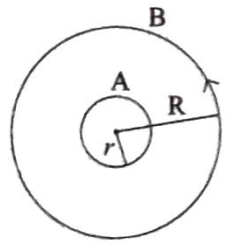
$O$ is the centre of two coplanar concentric circular conductors,$A$ and $B$,of radii $r$ and $R$ respectively as shown in the figure. Here $r \ll R$. The mutual inductance of the system of the conductors can be given by . . . . . . .
A
$\frac{\mu_0 \pi r}{2 R}$
B
$\frac{\mu_0 R^2}{\pi r}$
C
$\frac{\mu_0 \pi R^2}{2 r}$
D
$\frac{\mu_0 \pi r^2}{2 R}$
Solution
(D) When we pass a current $I$ through the outer loop of radius $R$,the magnetic field at the centre is given by:
$B_{\text{center}} = \frac{\mu_0 I}{2 R}$
Since $r \ll R$,the magnetic field $B$ is approximately uniform over the area of the smaller loop $A$.
The magnetic flux $\phi$ associated with the smaller loop is:
$\phi = B \cdot A = \left( \frac{\mu_0 I}{2 R} \right) \times (\pi r^2)$
$\phi = \frac{\mu_0 I \pi r^2}{2 R}$
The mutual inductance $M$ is defined as the ratio of the magnetic flux $\phi$ through the secondary coil to the current $I$ in the primary coil:
$M = \frac{\phi}{I} = \frac{\mu_0 \pi r^2}{2 R}$
$B_{\text{center}} = \frac{\mu_0 I}{2 R}$
Since $r \ll R$,the magnetic field $B$ is approximately uniform over the area of the smaller loop $A$.
The magnetic flux $\phi$ associated with the smaller loop is:
$\phi = B \cdot A = \left( \frac{\mu_0 I}{2 R} \right) \times (\pi r^2)$
$\phi = \frac{\mu_0 I \pi r^2}{2 R}$
The mutual inductance $M$ is defined as the ratio of the magnetic flux $\phi$ through the secondary coil to the current $I$ in the primary coil:
$M = \frac{\phi}{I} = \frac{\mu_0 \pi r^2}{2 R}$
0 likes
View Solution123
EasyMCQ
$X$ and $Y$ are two metallic coils arranged in such a way that when the steady change in current flowing in coil $X$ is $4 \ A$,the change in magnetic flux associated with coil $Y$ is $0.4 \ Wb$. The mutual inductance of the system of these coils is . . . . . . $H$.
A
$0.8$
B
$0.1$
C
$0.2$
D
$5$
Solution
(B) The mutual inductance $M$ between two coils is defined by the relationship between the change in magnetic flux $\Delta \phi$ linked with one coil and the change in current $\Delta I$ in the other coil.
The formula is given by:
$M = \frac{\Delta \phi}{\Delta I}$
Given values:
Change in current in coil $X$,$\Delta I = 4 \ A$
Change in magnetic flux in coil $Y$,$\Delta \phi = 0.4 \ Wb$
Substituting these values into the formula:
$M = \frac{0.4 \ Wb}{4 \ A}$
$M = 0.1 \ H$
Therefore,the mutual inductance of the system is $0.1 \ H$.
The formula is given by:
$M = \frac{\Delta \phi}{\Delta I}$
Given values:
Change in current in coil $X$,$\Delta I = 4 \ A$
Change in magnetic flux in coil $Y$,$\Delta \phi = 0.4 \ Wb$
Substituting these values into the formula:
$M = \frac{0.4 \ Wb}{4 \ A}$
$M = 0.1 \ H$
Therefore,the mutual inductance of the system is $0.1 \ H$.
0 likes
View Solution124
EasyMCQ
The mutual inductance of a system of two coils does not depend on . . . . . . .
A
Number of turns of the coils.
B
The relative permeability of the medium within the coils.
C
Distance between the two coils.
D
Current passing through the coils.
Solution
(D) The correct answer is $D$.
Mutual inductance $(M)$ of a system of two coils depends on the geometric factors such as the number of turns $(N_1, N_2)$, the area of cross-section $(A)$, the distance between the coils, and the magnetic permeability $(\mu)$ of the medium between them.
It is defined by the relation $\phi_2 = M I_1$, where $\phi_2$ is the magnetic flux linked with the second coil and $I_1$ is the current in the first coil.
Since $M = \frac{\phi_2}{I_1}$, the value of $M$ is independent of the magnitude of the current $I_1$ flowing through the coils.
Mutual inductance $(M)$ of a system of two coils depends on the geometric factors such as the number of turns $(N_1, N_2)$, the area of cross-section $(A)$, the distance between the coils, and the magnetic permeability $(\mu)$ of the medium between them.
It is defined by the relation $\phi_2 = M I_1$, where $\phi_2$ is the magnetic flux linked with the second coil and $I_1$ is the current in the first coil.
Since $M = \frac{\phi_2}{I_1}$, the value of $M$ is independent of the magnitude of the current $I_1$ flowing through the coils.
0 likes
View Solution125
MediumMCQ
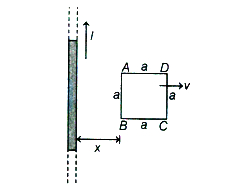
$A$ square loop of side length $a$ is moving away from an infinitely long current-carrying conductor at a constant speed $v$ as shown. Let $x$ be the instantaneous distance between the long conductor and side $AB$. The mutual inductance $M$ of the square loop-long conductor pair changes with time $t$ according to which of the following graphs?
A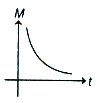
B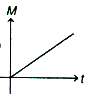
C
D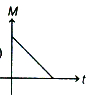
Solution
(A) The magnetic field $B$ produced by an infinitely long wire at a distance $r$ is given by $B = \frac{\mu_0 I}{2\pi r}$.
The magnetic flux $\phi$ through the square loop is $\phi = \int B \cdot dA = \int_{x}^{x+a} \frac{\mu_0 I}{2\pi r} (a \, dr) = \frac{\mu_0 I a}{2\pi} \ln\left(\frac{x+a}{x}\right)$.
The mutual inductance $M$ is defined as $M = \frac{\phi}{I} = \frac{\mu_0 a}{2\pi} \ln\left(1 + \frac{a}{x}\right)$.
Since the loop is moving at a constant speed $v$,the distance $x$ increases with time $t$ as $x = x_0 + vt$.
Substituting this into the expression for $M$,we get $M(t) = \frac{\mu_0 a}{2\pi} \ln\left(1 + \frac{a}{x_0 + vt}\right)$.
As $t$ increases,the term $\frac{a}{x_0 + vt}$ decreases,and therefore $\ln(1 + \frac{a}{x_0 + vt})$ decreases.
This corresponds to a curve that starts at a maximum value and decreases asymptotically towards zero as $t \to \infty$,which matches the graph shown in option $A$.
The magnetic flux $\phi$ through the square loop is $\phi = \int B \cdot dA = \int_{x}^{x+a} \frac{\mu_0 I}{2\pi r} (a \, dr) = \frac{\mu_0 I a}{2\pi} \ln\left(\frac{x+a}{x}\right)$.
The mutual inductance $M$ is defined as $M = \frac{\phi}{I} = \frac{\mu_0 a}{2\pi} \ln\left(1 + \frac{a}{x}\right)$.
Since the loop is moving at a constant speed $v$,the distance $x$ increases with time $t$ as $x = x_0 + vt$.
Substituting this into the expression for $M$,we get $M(t) = \frac{\mu_0 a}{2\pi} \ln\left(1 + \frac{a}{x_0 + vt}\right)$.
As $t$ increases,the term $\frac{a}{x_0 + vt}$ decreases,and therefore $\ln(1 + \frac{a}{x_0 + vt})$ decreases.
This corresponds to a curve that starts at a maximum value and decreases asymptotically towards zero as $t \to \infty$,which matches the graph shown in option $A$.
0 likes
View Solution126
EasyMCQ
Two coils have a mutual inductance of $ 0.005 \ H $. The current changes in the first coil according to the equation $ i = i_{m} \sin \omega t $,where $ i_{m} = 10 \ A $ and $ \omega = 100 \pi \ rad \ s^{-1} $. The maximum value of the emf induced in the second coil is:
A
$ 2 \pi $
B
$ 5 \pi $
C
$ \pi $
D
$ 4 \pi $
Solution
(B) Given: Mutual inductance $ M = 0.005 \ H $,current $ i = i_{m} \sin \omega t $,peak current $ i_{m} = 10 \ A $,and angular frequency $ \omega = 100 \pi \ rad \ s^{-1} $.
The induced emf $ \varepsilon $ in the second coil is given by $ \varepsilon = M \frac{di}{dt} $.
Substituting the expression for current: $ \varepsilon = M \frac{d}{dt} (i_{m} \sin \omega t) = M i_{m} \omega \cos \omega t $.
The maximum value of the induced emf $ \varepsilon_{\max} $ occurs when $ \cos \omega t = 1 $.
Therefore,$ \varepsilon_{\max} = M \omega i_{m} $.
Substituting the values: $ \varepsilon_{\max} = 0.005 \times 100 \pi \times 10 = 5 \pi \ V $.
Thus,the maximum value of the emf induced in the second coil is $ 5 \pi \ V $.
The induced emf $ \varepsilon $ in the second coil is given by $ \varepsilon = M \frac{di}{dt} $.
Substituting the expression for current: $ \varepsilon = M \frac{d}{dt} (i_{m} \sin \omega t) = M i_{m} \omega \cos \omega t $.
The maximum value of the induced emf $ \varepsilon_{\max} $ occurs when $ \cos \omega t = 1 $.
Therefore,$ \varepsilon_{\max} = M \omega i_{m} $.
Substituting the values: $ \varepsilon_{\max} = 0.005 \times 100 \pi \times 10 = 5 \pi \ V $.
Thus,the maximum value of the emf induced in the second coil is $ 5 \pi \ V $.
0 likes
View Solution127
DifficultMCQ
$X$ and $Y$ are two circuits having a coefficient of mutual inductance $3 \text{ mH}$ and resistances $10 \text{ } \Omega$ and $4 \text{ } \Omega$ respectively. To have an induced current of $60 \times 10^{-4} \text{ A}$ in circuit $Y$,the amount of current to be changed in circuit $X$ in $0.02 \text{ s}$ is: (in $A$)
A
$1.6$
B
$0.16$
C
$0.32$
D
$3.2$
Solution
(B) Given: Mutual inductance $M = 3 \text{ mH} = 3 \times 10^{-3} \text{ H}$,Resistance of circuit $Y$ $R_2 = 4 \text{ } \Omega$,Induced current in $Y$ $I_2 = 60 \times 10^{-4} \text{ A}$,Time interval $\Delta t = 0.02 \text{ s}$.
The induced electromotive force $(e_2)$ in circuit $Y$ due to change in current in circuit $X$ is given by $e_2 = M \frac{\Delta I_1}{\Delta t}$.
The induced current in circuit $Y$ is $I_2 = \frac{e_2}{R_2}$.
Substituting the expression for $e_2$,we get $I_2 = \frac{M \cdot \Delta I_1}{R_2 \cdot \Delta t}$.
Rearranging to solve for the change in current $\Delta I_1$ in circuit $X$:
$\Delta I_1 = \frac{I_2 \cdot R_2 \cdot \Delta t}{M}$.
Substituting the values:
$\Delta I_1 = \frac{60 \times 10^{-4} \times 4 \times 0.02}{3 \times 10^{-3}}$.
$\Delta I_1 = \frac{60 \times 10^{-4} \times 0.08}{3 \times 10^{-3}} = \frac{4.8 \times 10^{-4}}{3 \times 10^{-3}} = 1.6 \times 10^{-1} = 0.16 \text{ A}$.
The induced electromotive force $(e_2)$ in circuit $Y$ due to change in current in circuit $X$ is given by $e_2 = M \frac{\Delta I_1}{\Delta t}$.
The induced current in circuit $Y$ is $I_2 = \frac{e_2}{R_2}$.
Substituting the expression for $e_2$,we get $I_2 = \frac{M \cdot \Delta I_1}{R_2 \cdot \Delta t}$.
Rearranging to solve for the change in current $\Delta I_1$ in circuit $X$:
$\Delta I_1 = \frac{I_2 \cdot R_2 \cdot \Delta t}{M}$.
Substituting the values:
$\Delta I_1 = \frac{60 \times 10^{-4} \times 4 \times 0.02}{3 \times 10^{-3}}$.
$\Delta I_1 = \frac{60 \times 10^{-4} \times 0.08}{3 \times 10^{-3}} = \frac{4.8 \times 10^{-4}}{3 \times 10^{-3}} = 1.6 \times 10^{-1} = 0.16 \text{ A}$.
0 likes
View Solution128
EasyMCQ
$A$ pair of adjacent coils have a mutual inductance, $M$. The current in one coil changes from $0 \,A$ to $16 \,A$ in $0.3 \,s$, and the change of flux linkage with the other coil is $40 \,Wb$. The value of $M$ is: (in $\,H$)
A
$0.4$
B
$0.12$
C
$2.5$
D
$8.3$
Solution
(C) The coefficient of mutual induction $M$ between two coils is defined by the relation between the change in magnetic flux linkage in the secondary coil and the change in current in the primary coil.
$M = \frac{\Delta \phi_2}{\Delta I_1}$
Given:
Change in flux linkage in the second coil, $\Delta \phi_2 = 40 \,Wb$
Change in current in the first coil, $\Delta I_1 = 16 \,A - 0 \,A = 16 \,A$
Substituting these values into the formula:
$M = \frac{40}{16} \,H$
$M = 2.5 \,H$
Therefore, the value of $M$ is $2.5 \,H$.
$M = \frac{\Delta \phi_2}{\Delta I_1}$
Given:
Change in flux linkage in the second coil, $\Delta \phi_2 = 40 \,Wb$
Change in current in the first coil, $\Delta I_1 = 16 \,A - 0 \,A = 16 \,A$
Substituting these values into the formula:
$M = \frac{40}{16} \,H$
$M = 2.5 \,H$
Therefore, the value of $M$ is $2.5 \,H$.
0 likes
View Solution129
MediumMCQ
$A$ solenoid of length $60 \ cm$ with $15$ turns per $cm$ and area of cross-section $4 \times 10^{-3} \ m^2$ completely surrounds another co-axial solenoid of the same length and area of cross-section $2 \times 10^{-3} \ m^2$ with $40$ turns per $cm$. The mutual inductance of the system is: (in $mH$)
A
$9$
B
$6$
C
$3$
D
$10$
Solution
(A) The mutual inductance $M$ of two co-axial solenoids is given by the formula: $M = \mu_0 n_1 n_2 A l$,where $n_1$ and $n_2$ are the number of turns per unit length,$A$ is the cross-sectional area of the inner solenoid,and $l$ is the length of the solenoids.
Given:
Length $l = 60 \ cm = 0.6 \ m$
Turns per unit length of outer solenoid $n_1 = 15 \ \text{turns/cm} = 1500 \ \text{turns/m}$
Turns per unit length of inner solenoid $n_2 = 40 \ \text{turns/cm} = 4000 \ \text{turns/m}$
Area of inner solenoid $A = 2 \times 10^{-3} \ m^2$
Permeability of free space $\mu_0 = 4\pi \times 10^{-7} \ T \cdot m/A$
Substituting the values:
$M = (4\pi \times 10^{-7}) \times 1500 \times 4000 \times (2 \times 10^{-3}) \times 0.6$
$M = (4 \times 3.14 \times 10^{-7}) \times (6 \times 10^6) \times (1.2 \times 10^{-3})$
$M = 12.56 \times 10^{-7} \times 7.2 \times 10^3$
$M \approx 9.04 \times 10^{-3} \ H = 9 \ mH$.
Given:
Length $l = 60 \ cm = 0.6 \ m$
Turns per unit length of outer solenoid $n_1 = 15 \ \text{turns/cm} = 1500 \ \text{turns/m}$
Turns per unit length of inner solenoid $n_2 = 40 \ \text{turns/cm} = 4000 \ \text{turns/m}$
Area of inner solenoid $A = 2 \times 10^{-3} \ m^2$
Permeability of free space $\mu_0 = 4\pi \times 10^{-7} \ T \cdot m/A$
Substituting the values:
$M = (4\pi \times 10^{-7}) \times 1500 \times 4000 \times (2 \times 10^{-3}) \times 0.6$
$M = (4 \times 3.14 \times 10^{-7}) \times (6 \times 10^6) \times (1.2 \times 10^{-3})$
$M = 12.56 \times 10^{-7} \times 7.2 \times 10^3$
$M \approx 9.04 \times 10^{-3} \ H = 9 \ mH$.
0 likes
View Solution130
DifficultMCQ
$A$ solenoid has $2000$ turns wound over a length of $0.30 \ m$. The area of its cross-section is $1.2 \times 10^{-3} \ m^2$. Around its central section,a coil of $300$ turns is wound. If an initial current of $2 \ A$ in the solenoid is reversed in $0.25 \ s$,the emf induced in the coil is equal to
A
$6 \times 10^{-4} \ V$
B
$4.8 \times 10^{-2} \ V$
C
$6 \times 10^{-2} \ V$
D
$48 \times 10^3 \ V$
Solution
(B) Given:
$N_1 = 2000$,$L = 0.30 \ m$,$N_2 = 300$,$A = 1.2 \times 10^{-3} \ m^2$.
The rate of change of current is $\frac{di}{dt} = \frac{I_f - I_i}{\Delta t} = \frac{-2 - 2}{0.25} = -16 \ A/s$. The magnitude is $16 \ A/s$.
The mutual inductance $M$ of the solenoid-coil system is given by $M = \frac{\mu_0 N_1 N_2 A}{L}$.
Substituting the values:
$M = \frac{4\pi \times 10^{-7} \times 2000 \times 300 \times 1.2 \times 10^{-3}}{0.30} = 3.016 \times 10^{-3} \ H$.
The induced emf $e$ is given by $e = M \left| \frac{di}{dt} \right|$.
$e = (3.016 \times 10^{-3}) \times 16 = 4.825 \times 10^{-2} \ V \approx 4.8 \times 10^{-2} \ V$.
$N_1 = 2000$,$L = 0.30 \ m$,$N_2 = 300$,$A = 1.2 \times 10^{-3} \ m^2$.
The rate of change of current is $\frac{di}{dt} = \frac{I_f - I_i}{\Delta t} = \frac{-2 - 2}{0.25} = -16 \ A/s$. The magnitude is $16 \ A/s$.
The mutual inductance $M$ of the solenoid-coil system is given by $M = \frac{\mu_0 N_1 N_2 A}{L}$.
Substituting the values:
$M = \frac{4\pi \times 10^{-7} \times 2000 \times 300 \times 1.2 \times 10^{-3}}{0.30} = 3.016 \times 10^{-3} \ H$.
The induced emf $e$ is given by $e = M \left| \frac{di}{dt} \right|$.
$e = (3.016 \times 10^{-3}) \times 16 = 4.825 \times 10^{-2} \ V \approx 4.8 \times 10^{-2} \ V$.
0 likes
View Solution131
DifficultMCQ
The coefficient of mutual inductance between the primary and the secondary coil of a transformer is $0.2 H$. When the current in the primary coil changes at a rate of $5 A s^{-1}$,the induced emf in the secondary coil will be: (in $V$)
A
$5$
B
$1$
C
$25$
D
$10$
Solution
(B) Given: The coefficient of mutual inductance $M = 0.2 H$.
The rate of change of current in the primary coil is $\frac{dI}{dt} = 5 A s^{-1}$.
The induced emf $(e)$ in the secondary coil is given by the formula:
$e = M \frac{dI}{dt}$
Substituting the given values:
$e = 0.2 H \times 5 A s^{-1}$
$e = 1 V$
Therefore,the induced emf in the secondary coil is $1 V$.
The rate of change of current in the primary coil is $\frac{dI}{dt} = 5 A s^{-1}$.
The induced emf $(e)$ in the secondary coil is given by the formula:
$e = M \frac{dI}{dt}$
Substituting the given values:
$e = 0.2 H \times 5 A s^{-1}$
$e = 1 V$
Therefore,the induced emf in the secondary coil is $1 V$.
0 likes
View Solution132
EasyMCQ
The emf induced in the secondary coil due to unit rate of change of current in the primary is called
A
Impedance of two coils
B
Reactance of two coils
C
Mutual induction of two coils
D
Self induction of a coil
Solution
(C) The induced emf $(e_s)$ in the secondary coil is given by the relation $e_s = -M \frac{di_p}{dt}$,where $M$ is the coefficient of mutual induction and $\frac{di_p}{dt}$ is the rate of change of current in the primary coil.
If the rate of change of current in the primary coil is unit,i.e.,$\frac{di_p}{dt} = 1 \ A/s$,then the magnitude of induced emf is equal to the coefficient of mutual induction $(|e_s| = M)$.
Therefore,the emf induced in the secondary coil due to a unit rate of change of current in the primary coil is defined as the mutual induction (or mutual inductance) of the two coils.
If the rate of change of current in the primary coil is unit,i.e.,$\frac{di_p}{dt} = 1 \ A/s$,then the magnitude of induced emf is equal to the coefficient of mutual induction $(|e_s| = M)$.
Therefore,the emf induced in the secondary coil due to a unit rate of change of current in the primary coil is defined as the mutual induction (or mutual inductance) of the two coils.
0 likes
View Solution133
EasyMCQ
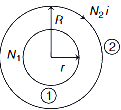
Two concentric coplanar circular conducting loops have radii $R$ and $r$ $(R \gg r)$. Their mutual inductance is proportional to
A
$\frac{r}{R}$
B
$\frac{R}{r}$
C
$\frac{r^2}{R}$
D
$\frac{R^2}{r}$
Solution
(C) Consider two concentric coplanar circular loops. Let the outer loop have radius $R$ and the inner loop have radius $r$.
When a current $I$ flows through the outer loop,the magnetic field $B$ at its center is given by $B = \frac{\mu_0 I}{2R}$.
Since $R \gg r$,we can assume the magnetic field is uniform over the area of the smaller loop.
The magnetic flux $\phi$ linked with the smaller loop is $\phi = B \cdot A$,where $A = \pi r^2$ is the area of the smaller loop.
Thus,$\phi = \left( \frac{\mu_0 I}{2R} \right) (\pi r^2) = \left( \frac{\mu_0 \pi r^2}{2R} \right) I$.
By definition,the mutual inductance $M$ is given by $\phi = MI$.
Comparing the two expressions,we get $M = \frac{\mu_0 \pi r^2}{2R}$.
Therefore,the mutual inductance $M$ is proportional to $\frac{r^2}{R}$.
When a current $I$ flows through the outer loop,the magnetic field $B$ at its center is given by $B = \frac{\mu_0 I}{2R}$.
Since $R \gg r$,we can assume the magnetic field is uniform over the area of the smaller loop.
The magnetic flux $\phi$ linked with the smaller loop is $\phi = B \cdot A$,where $A = \pi r^2$ is the area of the smaller loop.
Thus,$\phi = \left( \frac{\mu_0 I}{2R} \right) (\pi r^2) = \left( \frac{\mu_0 \pi r^2}{2R} \right) I$.
By definition,the mutual inductance $M$ is given by $\phi = MI$.
Comparing the two expressions,we get $M = \frac{\mu_0 \pi r^2}{2R}$.
Therefore,the mutual inductance $M$ is proportional to $\frac{r^2}{R}$.
0 likes
View Solution134
DifficultMCQ
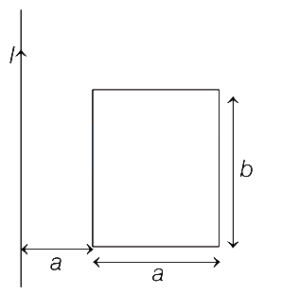
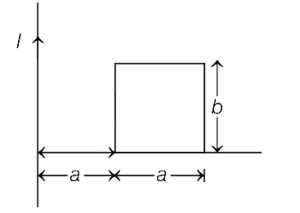
$A$ long straight wire carrying current $I$ and a rectangular frame with side lengths $a$ and $b$ lie in the same plane as shown in the figure. The mutual inductance of the wire and frame is
A
$\frac{\mu_0}{2 \pi} a b$
B
$\frac{\mu_0}{4 \pi} \frac{b}{a}$
C
$\frac{\mu_0 b}{2 \pi} \ln 2$
D
$\frac{\mu_0 a}{2 \pi} \ln 2$
Solution
(C) The magnetic field $B$ at a distance $r$ from a long straight wire carrying current $I$ is given by $B = \frac{\mu_0 I}{2 \pi r}$.
Consider a small rectangular strip of width $dr$ at a distance $r$ from the wire within the frame. The area of this strip is $dA = b \cdot dr$.
The magnetic flux $d\phi$ through this strip is $d\phi = B \cdot dA = \left( \frac{\mu_0 I}{2 \pi r} \right) (b \cdot dr) = \frac{\mu_0 I b}{2 \pi} \frac{dr}{r}$.
To find the total magnetic flux $\phi$ through the frame,we integrate from $r = a$ to $r = 2a$:
$\phi = \int_a^{2a} \frac{\mu_0 I b}{2 \pi} \frac{dr}{r} = \frac{\mu_0 I b}{2 \pi} [\ln r]_a^{2a} = \frac{\mu_0 I b}{2 \pi} \ln \left( \frac{2a}{a} \right) = \frac{\mu_0 I b}{2 \pi} \ln 2$.
The mutual inductance $M$ is defined as $M = \frac{\phi}{I}$.
Therefore,$M = \frac{\mu_0 b}{2 \pi} \ln 2$.
Consider a small rectangular strip of width $dr$ at a distance $r$ from the wire within the frame. The area of this strip is $dA = b \cdot dr$.
The magnetic flux $d\phi$ through this strip is $d\phi = B \cdot dA = \left( \frac{\mu_0 I}{2 \pi r} \right) (b \cdot dr) = \frac{\mu_0 I b}{2 \pi} \frac{dr}{r}$.
To find the total magnetic flux $\phi$ through the frame,we integrate from $r = a$ to $r = 2a$:
$\phi = \int_a^{2a} \frac{\mu_0 I b}{2 \pi} \frac{dr}{r} = \frac{\mu_0 I b}{2 \pi} [\ln r]_a^{2a} = \frac{\mu_0 I b}{2 \pi} \ln \left( \frac{2a}{a} \right) = \frac{\mu_0 I b}{2 \pi} \ln 2$.
The mutual inductance $M$ is defined as $M = \frac{\phi}{I}$.
Therefore,$M = \frac{\mu_0 b}{2 \pi} \ln 2$.
0 likes
View Solution135
MediumMCQ
Two circular coils of radii $r_1$ and $r_2$ $(r_1 \ll r_2)$ are placed coaxially with their centers coinciding. The mutual inductance of the arrangement is
A
$\frac{\mu_0 \pi r_2^2}{2 r_1}$
B
$\frac{\mu_0 \pi r_1 r_2}{2(r_1+r_2)}$
C
$\frac{\mu_0 \pi r_1^2}{2 r_2}$
D
$\frac{\mu_0 \pi(r_1+r_2)}{2 r_1 r_2}$
Solution
(C) The magnetic field at the center of a large circular coil of radius $r_2$ carrying current $I$ is given by $B = \frac{\mu_0 I}{2 r_2}$.
Since $r_1 \ll r_2$,we assume the magnetic field $B$ is uniform over the area of the smaller coil of radius $r_1$.
The magnetic flux $\phi$ linked with the smaller coil is $\phi = B \cdot A = \left(\frac{\mu_0 I}{2 r_2}\right) \cdot (\pi r_1^2)$.
The mutual inductance $M$ is defined as $M = \frac{\phi}{I}$.
Substituting the expression for $\phi$,we get $M = \frac{\mu_0 \pi r_1^2}{2 r_2}$.
Since $r_1 \ll r_2$,we assume the magnetic field $B$ is uniform over the area of the smaller coil of radius $r_1$.
The magnetic flux $\phi$ linked with the smaller coil is $\phi = B \cdot A = \left(\frac{\mu_0 I}{2 r_2}\right) \cdot (\pi r_1^2)$.
The mutual inductance $M$ is defined as $M = \frac{\phi}{I}$.
Substituting the expression for $\phi$,we get $M = \frac{\mu_0 \pi r_1^2}{2 r_2}$.
0 likes
View Solution136
EasyMCQ
The mutual inductance of two coils is $8 \ mH$. The current in one coil changes according to the equation $I = 12 \sin 100t$,where $I$ is in ampere and $t$ is time in second. The maximum value of emf induced in the second coil is (in $V$)
A
$9.6$
B
$4.8$
C
$3.2$
D
$12.8$
Solution
(A) Given: Mutual inductance $M = 8 \ mH = 8 \times 10^{-3} \ H$. Current $I = 12 \sin 100t$.
The induced emf in the second coil is given by the formula $\varepsilon = M \frac{dI}{dt}$.
Substituting the expression for $I$:
$\varepsilon = M \frac{d}{dt} (12 \sin 100t)$
$\varepsilon = M \times 12 \times 100 \cos 100t$
$\varepsilon = 1200 M \cos 100t$.
The maximum value of induced emf occurs when $\cos 100t = 1$:
$\varepsilon_{\max} = 1200 \times M$
$\varepsilon_{\max} = 1200 \times 8 \times 10^{-3} \ V$
$\varepsilon_{\max} = 9.6 \ V$.
The induced emf in the second coil is given by the formula $\varepsilon = M \frac{dI}{dt}$.
Substituting the expression for $I$:
$\varepsilon = M \frac{d}{dt} (12 \sin 100t)$
$\varepsilon = M \times 12 \times 100 \cos 100t$
$\varepsilon = 1200 M \cos 100t$.
The maximum value of induced emf occurs when $\cos 100t = 1$:
$\varepsilon_{\max} = 1200 \times M$
$\varepsilon_{\max} = 1200 \times 8 \times 10^{-3} \ V$
$\varepsilon_{\max} = 9.6 \ V$.
0 likes
View Solution137
MediumMCQ
In a pair of adjacent coils,if the current in one coil changes from $10 \,A$ to $2 \,A$ in a time $0.2 \,s$,an emf of $120 \,V$ is induced in the other coil. The mutual inductance of the pair of coils is: (in $\,H$)
A
$2$
B
$3$
C
$6$
D
$9$
Solution
(B) The induced emf $\varepsilon$ in a coil due to the change in current in an adjacent coil is given by the formula:
$\varepsilon = M \left| \frac{dI}{dt} \right|$
Given:
Change in current,$dI = 10 \,A - 2 \,A = 8 \,A$
Time interval,$dt = 0.2 \,s$
Induced emf,$\varepsilon = 120 \,V$
Substituting the values into the formula:
$120 = M \times \frac{8}{0.2}$
$120 = M \times 40$
$M = \frac{120}{40} = 3 \,H$
Therefore,the mutual inductance of the pair of coils is $3 \,H$.
$\varepsilon = M \left| \frac{dI}{dt} \right|$
Given:
Change in current,$dI = 10 \,A - 2 \,A = 8 \,A$
Time interval,$dt = 0.2 \,s$
Induced emf,$\varepsilon = 120 \,V$
Substituting the values into the formula:
$120 = M \times \frac{8}{0.2}$
$120 = M \times 40$
$M = \frac{120}{40} = 3 \,H$
Therefore,the mutual inductance of the pair of coils is $3 \,H$.
0 likes
View Solution138
MediumMCQ
Two concentric circular coils,one of small radius $r$ and the other of large radius $R$,are placed coaxially with their centers coinciding. If the radius $r$ is changed by $2 \%$,then the change in mutual inductance of the arrangement is (assume $r \ll R$). (in $\%$)
A
$2$
B
$1.5$
C
$4$
D
$0$
Solution
(C) The mutual inductance $M$ of two concentric coils where $r \ll R$ is given by the formula: $M = \frac{\mu_0 \pi N_1 N_2 r^2}{2 R}$.
Here,$N_1$ and $N_2$ are the number of turns in the inner and outer coils respectively,$r$ is the radius of the inner coil,and $R$ is the radius of the outer coil.
From the formula,we observe that $M \propto r^2$.
Using the concept of relative error,we have $\frac{\Delta M}{M} = 2 \frac{\Delta r}{r}$.
Given that the percentage change in radius is $\frac{\Delta r}{r} \times 100 \% = 2 \%$.
Therefore,the percentage change in mutual inductance is $\frac{\Delta M}{M} \times 100 \% = 2 \times (2 \%) = 4 \%$.
Here,$N_1$ and $N_2$ are the number of turns in the inner and outer coils respectively,$r$ is the radius of the inner coil,and $R$ is the radius of the outer coil.
From the formula,we observe that $M \propto r^2$.
Using the concept of relative error,we have $\frac{\Delta M}{M} = 2 \frac{\Delta r}{r}$.
Given that the percentage change in radius is $\frac{\Delta r}{r} \times 100 \% = 2 \%$.
Therefore,the percentage change in mutual inductance is $\frac{\Delta M}{M} \times 100 \% = 2 \times (2 \%) = 4 \%$.
0 likes
View Solution139
MediumMCQ
Two coils have a mutual inductance of $0.005 \ H$. The current changes in the first coil according to the equation $I = I_0 \sin \omega t$,where $I_0 = 10 \ A$ and $\omega = 100 \pi \ rad/s$. The maximum value of the induced emf in the second coil is:
A
$5 \ V$
B
$5 \pi \ V$
C
$0.5 \pi \ V$
D
$\pi \ V$
Solution
(B) Given: Mutual inductance $M = 0.005 \ H$,current $I = I_0 \sin \omega t$,$I_0 = 10 \ A$,and $\omega = 100 \pi \ rad/s$.
The induced emf $(e)$ in the second coil is given by the formula:
$e = M \frac{dI}{dt}$
Substituting the expression for current:
$e = M \frac{d}{dt} (I_0 \sin \omega t) = M I_0 \omega \cos \omega t$
The maximum value of the induced emf $(e_{\max})$ occurs when $\cos \omega t = 1$:
$e_{\max} = M I_0 \omega$
Substituting the given values:
$e_{\max} = 0.005 \times 10 \times 100 \pi$
$e_{\max} = 0.05 \times 100 \pi = 5 \pi \ V$
Therefore,the maximum induced emf is $5 \pi \ V$.
The induced emf $(e)$ in the second coil is given by the formula:
$e = M \frac{dI}{dt}$
Substituting the expression for current:
$e = M \frac{d}{dt} (I_0 \sin \omega t) = M I_0 \omega \cos \omega t$
The maximum value of the induced emf $(e_{\max})$ occurs when $\cos \omega t = 1$:
$e_{\max} = M I_0 \omega$
Substituting the given values:
$e_{\max} = 0.005 \times 10 \times 100 \pi$
$e_{\max} = 0.05 \times 100 \pi = 5 \pi \ V$
Therefore,the maximum induced emf is $5 \pi \ V$.
0 likes
View Solution140
MediumMCQ
$A$ small square loop of wire of side $l$ is placed inside a large square loop of side $L$ $(L > l)$. If the loops are coplanar and their centers coincide,the mutual inductance of the system is directly proportional to
A
$l^2 / L$
B
$l^2 / L^2$
C
$l / L$
D
$l / L^2$
Solution
(A) The magnetic field $B$ produced by a large square loop of side $L$ at its center is given by $B = \frac{2\sqrt{2}\mu_0 I}{\pi L}$.
Since the small loop of side $l$ is placed at the center,the magnetic flux $\phi$ linked with the small loop is $\phi = B \times A$,where $A = l^2$ is the area of the small loop.
Thus,$\phi = \left( \frac{2\sqrt{2}\mu_0 I}{\pi L} \right) l^2$.
The mutual inductance $M$ is defined as $M = \frac{\phi}{I}$.
Substituting the expression for $\phi$,we get $M = \frac{2\sqrt{2}\mu_0 l^2}{\pi L}$.
Therefore,$M \propto \frac{l^2}{L}$.
Since the small loop of side $l$ is placed at the center,the magnetic flux $\phi$ linked with the small loop is $\phi = B \times A$,where $A = l^2$ is the area of the small loop.
Thus,$\phi = \left( \frac{2\sqrt{2}\mu_0 I}{\pi L} \right) l^2$.
The mutual inductance $M$ is defined as $M = \frac{\phi}{I}$.
Substituting the expression for $\phi$,we get $M = \frac{2\sqrt{2}\mu_0 l^2}{\pi L}$.
Therefore,$M \propto \frac{l^2}{L}$.
0 likes
View Solution141
EasyMCQ
$A$ primary coil and a secondary coil are placed close to each other. $A$ current, which changes at the rate of $25 \, A$ in a millisecond, is present in the primary coil. If the mutual inductance is $92 \times 10^{-6} \, H$, then the value of the induced emf in the secondary coil is:
A
$4.6 \, V$
B
$2.3 \, V$
C
$0.368 \, mV$
D
$0.23 \, mV$
Solution
(B) The induced emf $(e)$ in the secondary coil is given by the formula: $e = M \frac{di}{dt}$.
Given:
Mutual inductance $(M) = 92 \times 10^{-6} \, H$.
Rate of change of current $(\frac{di}{dt}) = \frac{25 \, A}{1 \, ms} = \frac{25 \, A}{1 \times 10^{-3} \, s} = 25,000 \, A/s$.
Substituting these values into the formula:
$e = 92 \times 10^{-6} \times 25,000$
$e = 92 \times 10^{-6} \times 25 \times 10^3$
$e = 92 \times 25 \times 10^{-3}$
$e = 2300 \times 10^{-3} = 2.3 \, V$.
Therefore, the induced emf in the secondary coil is $2.3 \, V$.
Given:
Mutual inductance $(M) = 92 \times 10^{-6} \, H$.
Rate of change of current $(\frac{di}{dt}) = \frac{25 \, A}{1 \, ms} = \frac{25 \, A}{1 \times 10^{-3} \, s} = 25,000 \, A/s$.
Substituting these values into the formula:
$e = 92 \times 10^{-6} \times 25,000$
$e = 92 \times 10^{-6} \times 25 \times 10^3$
$e = 92 \times 25 \times 10^{-3}$
$e = 2300 \times 10^{-3} = 2.3 \, V$.
Therefore, the induced emf in the secondary coil is $2.3 \, V$.
0 likes
View Solution142
DifficultMCQ
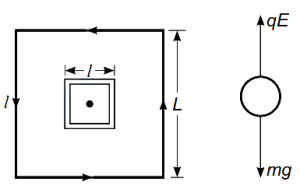
$A$ small square loop of wire of side $l$ is placed inside a large square loop of side $L$ $(L \gg l)$. If the loops are coplanar and their centres coincide,the mutual inductance of the system is directly proportional to :
A
$\frac{L}{l}$
B
$\frac{l}{L}$
C
$\frac{L^2}{l}$
D
$\frac{l^2}{L}$
Solution
(D) Let a current $I$ flow through the large square loop of side $L$. The magnetic field $B$ produced by one side of the large loop at its centre is given by the formula for a finite wire: $B_{side} = \frac{\mu_0 I}{4 \pi d} (\sin \alpha + \sin \beta)$,where $d = L/2$ and $\alpha = \beta = 45^\circ$.
Since there are four such sides,the total magnetic field at the centre is $B = 4 \times \frac{\mu_0 I}{4 \pi (L/2)} (\sin 45^\circ + \sin 45^\circ) = \frac{\mu_0 I}{\pi L} \times 2 \times \frac{2}{\sqrt{2}} = \frac{2 \sqrt{2} \mu_0 I}{\pi L}$.
Since $L \gg l$,we can assume the magnetic field $B$ is uniform over the area of the smaller loop $S_2 = l^2$.
The magnetic flux linked with the smaller loop is $\phi_2 = B \times S_2 = \left( \frac{2 \sqrt{2} \mu_0 I}{\pi L} \right) l^2$.
The mutual inductance $M$ is defined as $M = \frac{\phi_2}{I} = \frac{2 \sqrt{2} \mu_0 l^2}{\pi L}$.
Therefore,$M \propto \frac{l^2}{L}$.
Since there are four such sides,the total magnetic field at the centre is $B = 4 \times \frac{\mu_0 I}{4 \pi (L/2)} (\sin 45^\circ + \sin 45^\circ) = \frac{\mu_0 I}{\pi L} \times 2 \times \frac{2}{\sqrt{2}} = \frac{2 \sqrt{2} \mu_0 I}{\pi L}$.
Since $L \gg l$,we can assume the magnetic field $B$ is uniform over the area of the smaller loop $S_2 = l^2$.
The magnetic flux linked with the smaller loop is $\phi_2 = B \times S_2 = \left( \frac{2 \sqrt{2} \mu_0 I}{\pi L} \right) l^2$.
The mutual inductance $M$ is defined as $M = \frac{\phi_2}{I} = \frac{2 \sqrt{2} \mu_0 l^2}{\pi L}$.
Therefore,$M \propto \frac{l^2}{L}$.
0 likes
View Solution143
MediumMCQ
If a change in current of $0.01 \,A$ in one coil produces a change in magnetic flux of $2 \times 10^{-2} \,Wb$ in the other coil,then the mutual inductance of the two coils in henry is (in $\,H$)
A
$0$
B
$1$
C
$2$
D
$200$
Solution
(C) The mutual inductance $M$ is defined by the relation $\Delta \phi = M \Delta i$,where $\Delta \phi$ is the change in magnetic flux and $\Delta i$ is the change in current.
Given:
$\Delta i = 0.01 \,A = 10^{-2} \,A$
$\Delta \phi = 2 \times 10^{-2} \,Wb$
Using the formula $M = \frac{\Delta \phi}{\Delta i}$:
$M = \frac{2 \times 10^{-2} \,Wb}{10^{-2} \,A} = 2 \,H$.
Therefore,the mutual inductance of the two coils is $2 \,H$.
Given:
$\Delta i = 0.01 \,A = 10^{-2} \,A$
$\Delta \phi = 2 \times 10^{-2} \,Wb$
Using the formula $M = \frac{\Delta \phi}{\Delta i}$:
$M = \frac{2 \times 10^{-2} \,Wb}{10^{-2} \,A} = 2 \,H$.
Therefore,the mutual inductance of the two coils is $2 \,H$.
0 likes
View Solution144
DifficultMCQ
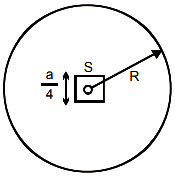
Consider a conducting wire of length $L$ bent in the form of a circle of radius $R$ and another conductor of length $a$ $(a \ll R)$ is bent in the form of a square. The two loops are then placed in the same plane such that the square loop is exactly at the centre of the circular loop. What will be the mutual inductance between the two loops?
A
$\mu_{0} \frac{\pi a^{2}}{L}$
B
$\mu_{0} \frac{\pi a^{2}}{16 L}$
C
$\mu_{0} \frac{\pi a^{2}}{4 L}$
D
$\mu_{0} \frac{a^{2}}{4 \pi L}$
Solution
(B) $1$. For the circular loop: The circumference is $2 \pi R = L$, so $R = \frac{L}{2 \pi}$.
$2$. For the square loop: The perimeter is $4s = a$, where $s$ is the side length of the square. Thus, $s = \frac{a}{4}$.
$3$. The magnetic field $B$ at the centre of the circular loop due to a current $I$ flowing through it is $B = \frac{\mu_{0} I}{2R}$.
$4$. Since $a \ll R$, the magnetic field $B$ is approximately uniform over the area of the square loop. The magnetic flux $\phi$ linked with the square loop is $\phi = B \times \text{Area of square} = B \times s^2$.
$5$. Substituting the values: $\phi = \left( \frac{\mu_{0} I}{2R} \right) \times s^2 = \left( \frac{\mu_{0} I}{2(L / 2 \pi)} \right) \times \left( \frac{a}{4} \right)^2 = \left( \frac{\mu_{0} I \pi}{L} \right) \times \frac{a^2}{16} = \frac{\mu_{0} \pi a^2}{16 L} I$.
$6$. The mutual inductance $M$ is given by $M = \frac{\phi}{I} = \frac{\mu_{0} \pi a^2}{16 L}$.
$2$. For the square loop: The perimeter is $4s = a$, where $s$ is the side length of the square. Thus, $s = \frac{a}{4}$.
$3$. The magnetic field $B$ at the centre of the circular loop due to a current $I$ flowing through it is $B = \frac{\mu_{0} I}{2R}$.
$4$. Since $a \ll R$, the magnetic field $B$ is approximately uniform over the area of the square loop. The magnetic flux $\phi$ linked with the square loop is $\phi = B \times \text{Area of square} = B \times s^2$.
$5$. Substituting the values: $\phi = \left( \frac{\mu_{0} I}{2R} \right) \times s^2 = \left( \frac{\mu_{0} I}{2(L / 2 \pi)} \right) \times \left( \frac{a}{4} \right)^2 = \left( \frac{\mu_{0} I \pi}{L} \right) \times \frac{a^2}{16} = \frac{\mu_{0} \pi a^2}{16 L} I$.
$6$. The mutual inductance $M$ is given by $M = \frac{\phi}{I} = \frac{\mu_{0} \pi a^2}{16 L}$.
0 likes
View Solution145
MediumMCQ
$A$ pair of adjacent coils has a mutual inductance of $2 \text{H}$. If the current in one coil changes from $0 \text{A}$ to $30 \text{A}$ in $0.15 \text{s}$,what is the change of flux linkage with the other coil (in $\text{ Wb}$)?
A
$300$
B
$6$
C
$60$
D
$15$
Solution
(C) The magnetic flux linkage $\phi$ in the secondary coil is related to the current $I$ in the primary coil by the formula $\phi = M I$,where $M$ is the mutual inductance.
To find the change in flux linkage $\Delta \phi$,we use the formula $\Delta \phi = M \Delta I$.
Given:
Mutual inductance $M = 2 \text{H}$.
Change in current $\Delta I = I_f - I_i = 30 \text{A} - 0 \text{A} = 30 \text{A}$.
Substituting these values into the formula:
$\Delta \phi = 2 \text{H} \times 30 \text{A} = 60 \text{ Wb}$.
Thus,the change in flux linkage with the other coil is $60 \text{ Wb}$.
To find the change in flux linkage $\Delta \phi$,we use the formula $\Delta \phi = M \Delta I$.
Given:
Mutual inductance $M = 2 \text{H}$.
Change in current $\Delta I = I_f - I_i = 30 \text{A} - 0 \text{A} = 30 \text{A}$.
Substituting these values into the formula:
$\Delta \phi = 2 \text{H} \times 30 \text{A} = 60 \text{ Wb}$.
Thus,the change in flux linkage with the other coil is $60 \text{ Wb}$.
0 likes
View Solution146
MediumMCQ
Two concentric circular coils,one of small radius $r_1$ and the other of large radius $r_2$,such that $r_1 \ll r_2$,are placed co-axially with their centres coinciding. The mutual inductance $M$ of the arrangement is proportional to . . . . . . .
A
$\frac{r_1}{r_2}$
B
$\frac{r_2}{r_1}$
C
$\frac{r_1^2}{r_2}$
D
$\frac{r_2^2}{r_1}$
Solution
(C) The magnetic field $B$ at the center of a large circular coil of radius $r_2$ carrying current $I$ is given by $B = \frac{\mu_0 I}{2r_2}$.
Since $r_1 \ll r_2$,the magnetic field produced by the larger coil is approximately uniform over the area of the smaller coil.
The magnetic flux $\phi$ linked with the smaller coil of radius $r_1$ is $\phi = B \times A = \frac{\mu_0 I}{2r_2} \times (\pi r_1^2)$.
By definition,the mutual inductance $M$ is given by $M = \frac{\phi}{I}$.
Substituting the expression for $\phi$,we get $M = \frac{\mu_0 \pi r_1^2}{2r_2}$.
Therefore,the mutual inductance $M$ is proportional to $\frac{r_1^2}{r_2}$.
Since $r_1 \ll r_2$,the magnetic field produced by the larger coil is approximately uniform over the area of the smaller coil.
The magnetic flux $\phi$ linked with the smaller coil of radius $r_1$ is $\phi = B \times A = \frac{\mu_0 I}{2r_2} \times (\pi r_1^2)$.
By definition,the mutual inductance $M$ is given by $M = \frac{\phi}{I}$.
Substituting the expression for $\phi$,we get $M = \frac{\mu_0 \pi r_1^2}{2r_2}$.
Therefore,the mutual inductance $M$ is proportional to $\frac{r_1^2}{r_2}$.
0 likes
View SolutionElectromagnetic Induction — Mutual Induction · Frequently Asked Questions
1Are these Electromagnetic Induction questions useful for JEE and NEET?
Yes. All questions in this section are mapped to JEE Main and NEET exam patterns. Previous year questions from JEE Main, NEET, GUJCET and state-level exams are included with full solutions.
2Can I switch to Hindi or Gujarati for these questions?
Yes. Use the language tabs in the hero section or the sidebar to view the same questions and solutions in English, Hindi or Gujarati.
3How do I generate a question paper from this subtopic?
Use the Vedclass Exam Paper Generator — select the chapter and subtopic, set difficulty, and generate Sets A, B, C, D automatically. First 3 chapters of every subject are free.
Vedclass Products
For Students
Vedclass Test Series
Mock tests in real JEE/NEET style with performance analysis. 5-day free trial.
Start Free TrialFor Teachers
Exam Paper Generator
Generate Set A/B/C/D papers from this chapter in 2 minutes. 3 chapters free.
Try FreeFor Institutes
Online Exam Module
Live online exams with unlimited students, 360° analytics & white-label branding.
See DemoFor Teachers & Institutes
Generate a Electromagnetic Induction Exam Paper in 2 Minutes
Select subtopic & difficulty — Sets A, B, C, D auto-generated with No Repeat logic.
First 3 chapters of every subject are free — no payment required.