
A English
Motion of Charge particle in Electric filed Questions in English
Class 12 Physics · Electric Charges and Fields · Motion of Charge particle in Electric filed
208+
Questions
English
Language
100%
With Solutions
Showing 8 of 208 questions in English
201
MediumMCQ
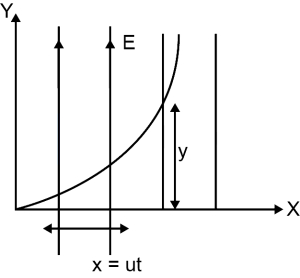
$A$ particle with charge $e$ and mass $m$, moving along the $X$-axis with a uniform speed $u$, enters a region where a uniform electric field $E$ is acting along the $Y$-axis. The particle starts to move in a parabola. Its focal length (neglecting any effect of gravity) is
A
$\frac{2 m u^{2}}{e E}$
B
$\frac{e E}{2 m u^{2}}$
C
$\frac{m u}{2 e E}$
D
$\frac{m u^{2}}{2 e E}$
Solution
(D) The particle moves with constant velocity $u$ along the $X$-axis, so $x = ut$, which implies $t = x/u$.
Along the $Y$-axis, the force on the particle is $F = eE$, so the acceleration is $a_y = \frac{eE}{m}$.
The displacement along the $Y$-axis is $y = \frac{1}{2} a_y t^2 = \frac{1}{2} \left( \frac{eE}{m} \right) \left( \frac{x}{u} \right)^2 = \left( \frac{eE}{2mu^2} \right) x^2$.
This is the equation of a parabola of the form $x^2 = 4ay$.
Rearranging the equation: $x^2 = \left( \frac{2mu^2}{eE} \right) y$.
Comparing this with the standard form $x^2 = 4ay$, we get $4a = \frac{2mu^2}{eE}$.
Therefore, the focal length $a = \frac{2mu^2}{4eE} = \frac{mu^2}{2eE}$.
Along the $Y$-axis, the force on the particle is $F = eE$, so the acceleration is $a_y = \frac{eE}{m}$.
The displacement along the $Y$-axis is $y = \frac{1}{2} a_y t^2 = \frac{1}{2} \left( \frac{eE}{m} \right) \left( \frac{x}{u} \right)^2 = \left( \frac{eE}{2mu^2} \right) x^2$.
This is the equation of a parabola of the form $x^2 = 4ay$.
Rearranging the equation: $x^2 = \left( \frac{2mu^2}{eE} \right) y$.
Comparing this with the standard form $x^2 = 4ay$, we get $4a = \frac{2mu^2}{eE}$.
Therefore, the focal length $a = \frac{2mu^2}{4eE} = \frac{mu^2}{2eE}$.
0 likes
View Solution202
MediumMCQ
$A$ particle of mass $M$ and charge $q$ is released from rest in a region of uniform electric field of magnitude $E$. After a time $t$,the distance travelled by the charge is $S$ and the kinetic energy attained by the particle is $T$. Then,the ratio $T/S$:
A
remains constant with time $t$
B
varies linearly with the mass $M$ of the particle
C
is independent of the charge $q$
D
is independent of the magnitude of the electric field $E$
Solution
(A) Given: Mass of the particle $= M$,Charge $= q$,Electric field $= E$,Initial velocity $u = 0$.
Acceleration $a = F/M = qE/M$.
Distance travelled $S = ut + (1/2)at^2 = (1/2)(qE/M)t^2$.
Final velocity $v = u + at = (qE/M)t$.
Kinetic energy $T = (1/2)Mv^2 = (1/2)M(qEt/M)^2 = (1/2)(q^2E^2t^2/M)$.
Now,the ratio $T/S = [(1/2)(q^2E^2t^2/M)] / [(1/2)(qE/M)t^2] = qE$.
Since $q$ and $E$ are constants,the ratio $T/S = qE$ is independent of time $t$ and remains constant.
Acceleration $a = F/M = qE/M$.
Distance travelled $S = ut + (1/2)at^2 = (1/2)(qE/M)t^2$.
Final velocity $v = u + at = (qE/M)t$.
Kinetic energy $T = (1/2)Mv^2 = (1/2)M(qEt/M)^2 = (1/2)(q^2E^2t^2/M)$.
Now,the ratio $T/S = [(1/2)(q^2E^2t^2/M)] / [(1/2)(qE/M)t^2] = qE$.
Since $q$ and $E$ are constants,the ratio $T/S = qE$ is independent of time $t$ and remains constant.
0 likes
View Solution203
MediumMCQ
$A$ particle of mass $M$ and charge $q$,initially at rest,is accelerated by a uniform electric field $E$ through a distance $D$ and is then allowed to approach a fixed static charge $Q$ of the same sign. The distance of the closest approach of the charge $q$ will then be
A
$\frac{q Q}{4 \pi \varepsilon_{0} D}$
B
$\frac{Q}{4 \pi \varepsilon_{0} E D}$
C
$\frac{q Q}{2 \pi \varepsilon_{0} D^{2}}$
D
$\frac{Q}{4 \pi \varepsilon_{0} E}$
Solution
(B) The particle is accelerated by a uniform electric field $E$ over a distance $D$. The work done by the electric field is equal to the kinetic energy $(KE)$ gained by the particle.
$KE = W = q E D$
At the point of closest approach $(r_0)$,the entire kinetic energy of the particle is converted into electrostatic potential energy $(PE)$ due to the interaction with the fixed charge $Q$.
$PE = \frac{1}{4 \pi \varepsilon_0} \frac{q Q}{r_0}$
Equating $KE$ and $PE$ at the point of closest approach:
$q E D = \frac{1}{4 \pi \varepsilon_0} \frac{q Q}{r_0}$
Solving for $r_0$:
$r_0 = \frac{Q}{4 \pi \varepsilon_0 E D}$
$KE = W = q E D$
At the point of closest approach $(r_0)$,the entire kinetic energy of the particle is converted into electrostatic potential energy $(PE)$ due to the interaction with the fixed charge $Q$.
$PE = \frac{1}{4 \pi \varepsilon_0} \frac{q Q}{r_0}$
Equating $KE$ and $PE$ at the point of closest approach:
$q E D = \frac{1}{4 \pi \varepsilon_0} \frac{q Q}{r_0}$
Solving for $r_0$:
$r_0 = \frac{Q}{4 \pi \varepsilon_0 E D}$
0 likes
View Solution204
MediumMCQ
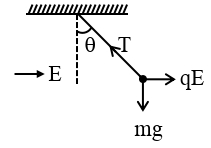
$A$ simple pendulum has a bob with mass $m$ and charge $q$. The pendulum string has negligible mass. When a uniform and horizontal electric field $\vec{E}$ is applied,the final tension in the string changes. The final tension in the string,when the pendulum attains an equilibrium position,is . . . . . . . ($g$: acceleration due to gravity)
A
$mg-qE$
B
$mg+qE$
C
$\sqrt{m^{2}g^{2}+q^{2}E^{2}}$
D
$\sqrt{m^{2}g^{2}-q^{2}E^{2}}$
Solution
(C) When the pendulum is in equilibrium under the influence of gravity ($mg$ acting downwards) and an electric force ($qE$ acting horizontally),the net force acting on the bob is the vector sum of these two forces.
Since the forces are perpendicular to each other,the magnitude of the net force $F_{net}$ is given by $F_{net} = \sqrt{(mg)^{2} + (qE)^{2}}$.
At equilibrium,the tension $T$ in the string must balance this net force to keep the bob stationary relative to the point of suspension.
Therefore,the tension $T = \sqrt{(mg)^{2} + (qE)^{2}}$.
Since the forces are perpendicular to each other,the magnitude of the net force $F_{net}$ is given by $F_{net} = \sqrt{(mg)^{2} + (qE)^{2}}$.
At equilibrium,the tension $T$ in the string must balance this net force to keep the bob stationary relative to the point of suspension.
Therefore,the tension $T = \sqrt{(mg)^{2} + (qE)^{2}}$.
0 likes
View Solution205
DifficultMCQ
In the absence of gravity,a charge $q$ and mass $2m$ is placed stationary in a uniform electric field of intensity $E$. When the charge is released,its speed after $n$ seconds is . . . . . . .
A
$2mqE$
B
$\frac{qEn}{m}$
C
$\frac{qEn}{2m}$
D
$\frac{2qEn}{m}$
Solution
(C) The force on the charge is $F = qE$.
Using Newton's second law,the acceleration $a$ is given by $a = \frac{F}{M} = \frac{qE}{2m}$.
Starting from rest $(u = 0)$,the speed $v$ after $n$ seconds is calculated using the equation of motion $v = u + at$.
Substituting the values,we get $v = 0 + (\frac{qE}{2m}) \times n = \frac{qEn}{2m}$.
Therefore,the correct option is $C$.
Using Newton's second law,the acceleration $a$ is given by $a = \frac{F}{M} = \frac{qE}{2m}$.
Starting from rest $(u = 0)$,the speed $v$ after $n$ seconds is calculated using the equation of motion $v = u + at$.
Substituting the values,we get $v = 0 + (\frac{qE}{2m}) \times n = \frac{qEn}{2m}$.
Therefore,the correct option is $C$.
0 likes
View Solution206
MediumMCQ
$A$ proton and an $\alpha$-particle are placed in a uniform electric field. The accelerations produced in them are $a_p$ and $a_\alpha$ respectively. Then $a_p : a_\alpha$ will be . . . . . . .
A
$1$ : $2$
B
$4$ : $1$
C
$2$ : $1$
D
$1$ : $4$
Solution
(C) The force on a charged particle in an electric field is given by $F = qE$.
According to Newton's second law of motion,$F = ma$,therefore $a = \frac{qE}{m}$.
For a proton,the charge is $q_p = e$ and the mass is $m_p$. Thus,$a_p = \frac{eE}{m_p}$.
For an $\alpha$-particle,the charge is $q_\alpha = 2e$ and the mass is $m_\alpha = 4m_p$.
Substituting these values,$a_\alpha = \frac{2eE}{4m_p} = \frac{1}{2} \frac{eE}{m_p} = \frac{a_p}{2}$.
Therefore,the ratio $\frac{a_p}{a_\alpha} = 2$,which means $a_p : a_\alpha = 2 : 1$.
According to Newton's second law of motion,$F = ma$,therefore $a = \frac{qE}{m}$.
For a proton,the charge is $q_p = e$ and the mass is $m_p$. Thus,$a_p = \frac{eE}{m_p}$.
For an $\alpha$-particle,the charge is $q_\alpha = 2e$ and the mass is $m_\alpha = 4m_p$.
Substituting these values,$a_\alpha = \frac{2eE}{4m_p} = \frac{1}{2} \frac{eE}{m_p} = \frac{a_p}{2}$.
Therefore,the ratio $\frac{a_p}{a_\alpha} = 2$,which means $a_p : a_\alpha = 2 : 1$.
0 likes
View Solution207
DifficultMCQ
$A$ particle of charge $q$ and mass $m$ is projected from origin with an initial velocity $\vec{v} = (\frac{v_0}{\sqrt{2}}\hat{i} + \frac{v_0}{\sqrt{2}}\hat{j})$. There exists a uniform magnetic field $\vec{B} = B_0\hat{z}$ and a space varying electric field $\vec{E} = E_0 e^{-\lambda x}\hat{x}$ within the region $0 \leq x \leq L$. After travelling a distance such that $x$-coordinate has changed from $x = 0$ to $x = L$,the change in the kinetic energy is . . . . . . .
A
$\frac{qE_0}{\lambda}[1 - e^{-\lambda L}]$
B
$(\frac{v_0 q B_0}{2\lambda}) [2 - e^{-2\lambda L}]$
C
$\frac{qE_0}{\lambda}[1 + e^{-\lambda L}]$
D
$q(\frac{E_0 + v_0 B_0}{\lambda})[1 - e^{-\lambda L/2}]$
Solution
(A) The change in kinetic energy $(\Delta K)$ is equal to the total work done by all forces acting on the particle.
Since the magnetic force $\vec{F}_m = q(\vec{v} \times \vec{B})$ is always perpendicular to the velocity $\vec{v}$,it does no work on the particle.
Therefore,the work is done only by the electric force $\vec{F}_e = q\vec{E} = qE_0 e^{-\lambda x}\hat{i}$.
The work done $W$ as the particle moves from $x = 0$ to $x = L$ is given by:
$W = \int_{0}^{L} F_x dx = \int_{0}^{L} q E_0 e^{-\lambda x} dx$
$W = q E_0 \left[ \frac{e^{-\lambda x}}{-\lambda} \right]_{0}^{L}$
$W = \frac{q E_0}{-\lambda} (e^{-\lambda L} - e^0) = \frac{q E_0}{\lambda} (1 - e^{-\lambda L})$.
Thus,the change in kinetic energy is $\frac{q E_0}{\lambda} (1 - e^{-\lambda L})$.
Since the magnetic force $\vec{F}_m = q(\vec{v} \times \vec{B})$ is always perpendicular to the velocity $\vec{v}$,it does no work on the particle.
Therefore,the work is done only by the electric force $\vec{F}_e = q\vec{E} = qE_0 e^{-\lambda x}\hat{i}$.
The work done $W$ as the particle moves from $x = 0$ to $x = L$ is given by:
$W = \int_{0}^{L} F_x dx = \int_{0}^{L} q E_0 e^{-\lambda x} dx$
$W = q E_0 \left[ \frac{e^{-\lambda x}}{-\lambda} \right]_{0}^{L}$
$W = \frac{q E_0}{-\lambda} (e^{-\lambda L} - e^0) = \frac{q E_0}{\lambda} (1 - e^{-\lambda L})$.
Thus,the change in kinetic energy is $\frac{q E_0}{\lambda} (1 - e^{-\lambda L})$.
0 likes
View Solution208
DifficultMCQ
$A$ $3 \text{ C}$ charge moves from the point $(0, -2, -5)$ to the point $(5, 1, 2)$ in an electric field expressed as $\vec{E} = 2\hat{i} + 3\hat{j} + 4\hat{k} \text{ N/C}$. The work done in moving the charge is . . . . . . $J$.
A
$100$
B
$120$
C
$135$
D
$141$
Solution
(D) The work done $W$ in moving a charge $q$ in a uniform electric field $\vec{E}$ is given by $W = q \vec{E} \cdot \vec{d}$,where $\vec{d}$ is the displacement vector.
Given $q = 3 \text{ C}$.
The displacement vector $\vec{d} = (x_2 - x_1)\hat{i} + (y_2 - y_1)\hat{j} + (z_2 - z_1)\hat{k}$.
$\vec{d} = (5 - 0)\hat{i} + (1 - (-2))\hat{j} + (2 - (-5))\hat{k} = 5\hat{i} + 3\hat{j} + 7\hat{k}$.
Given $\vec{E} = 2\hat{i} + 3\hat{j} + 4\hat{k} \text{ N/C}$.
$W = 3 \times (2\hat{i} + 3\hat{j} + 4\hat{k}) \cdot (5\hat{i} + 3\hat{j} + 7\hat{k})$.
$W = 3 \times [(2 \times 5) + (3 \times 3) + (4 \times 7)]$.
$W = 3 \times [10 + 9 + 28] = 3 \times 47 = 141 \text{ J}$.
Given $q = 3 \text{ C}$.
The displacement vector $\vec{d} = (x_2 - x_1)\hat{i} + (y_2 - y_1)\hat{j} + (z_2 - z_1)\hat{k}$.
$\vec{d} = (5 - 0)\hat{i} + (1 - (-2))\hat{j} + (2 - (-5))\hat{k} = 5\hat{i} + 3\hat{j} + 7\hat{k}$.
Given $\vec{E} = 2\hat{i} + 3\hat{j} + 4\hat{k} \text{ N/C}$.
$W = 3 \times (2\hat{i} + 3\hat{j} + 4\hat{k}) \cdot (5\hat{i} + 3\hat{j} + 7\hat{k})$.
$W = 3 \times [(2 \times 5) + (3 \times 3) + (4 \times 7)]$.
$W = 3 \times [10 + 9 + 28] = 3 \times 47 = 141 \text{ J}$.
0 likes
View SolutionElectric Charges and Fields — Motion of Charge particle in Electric filed · Frequently Asked Questions
1Are these Electric Charges and Fields questions useful for JEE and NEET?
Yes. All questions in this section are mapped to JEE Main and NEET exam patterns. Previous year questions from JEE Main, NEET, GUJCET and state-level exams are included with full solutions.
2Can I switch to Hindi or Gujarati for these questions?
Yes. Use the language tabs in the hero section or the sidebar to view the same questions and solutions in English, Hindi or Gujarati.
3How do I generate a question paper from this subtopic?
Use the Vedclass Exam Paper Generator — select the chapter and subtopic, set difficulty, and generate Sets A, B, C, D automatically. First 3 chapters of every subject are free.
Vedclass Products
For Students
Vedclass Test Series
Mock tests in real JEE/NEET style with performance analysis. 5-day free trial.
Start Free TrialFor Teachers
Exam Paper Generator
Generate Set A/B/C/D papers from this chapter in 2 minutes. 3 chapters free.
Try FreeFor Institutes
Online Exam Module
Live online exams with unlimited students, 360° analytics & white-label branding.
See DemoFor Teachers & Institutes
Generate a Electric Charges and Fields Exam Paper in 2 Minutes
Select subtopic & difficulty — Sets A, B, C, D auto-generated with No Repeat logic.
First 3 chapters of every subject are free — no payment required.