
A English
Motion of Charge particle in Electric filed Questions in English
Class 12 Physics · Electric Charges and Fields · Motion of Charge particle in Electric filed
208+
Questions
English
Language
100%
With Solutions
Showing 47 of 208 questions in English
151
MediumMCQ
An electron of mass '$m$' and charge '$q$' is accelerated from rest in a uniform electric field of strength '$E$'. The velocity acquired by the electron,when it travels a distance '$L$',is
A
$\sqrt{\frac{2 q E}{m L}}$
B
$\sqrt{\frac{2 qEL}{m}}$
C
$\sqrt{\frac{2 Em}{qL}}$
D
$\sqrt{\frac{qE}{mL}}$
Solution
(B) We know that the force on the electron is $F = qE$ and from Newton's second law,$F = ma$.
Equating these,we get $ma = qE$,which implies the acceleration $a = \frac{qE}{m}$.
Using the third equation of motion,$v^2 - u^2 = 2aS$,where $u = 0$ (starts from rest) and $S = L$:
$v^2 - 0^2 = 2 \left( \frac{qE}{m} \right) L$
$v^2 = \frac{2qEL}{m}$
$v = \sqrt{\frac{2qEL}{m}}$
Equating these,we get $ma = qE$,which implies the acceleration $a = \frac{qE}{m}$.
Using the third equation of motion,$v^2 - u^2 = 2aS$,where $u = 0$ (starts from rest) and $S = L$:
$v^2 - 0^2 = 2 \left( \frac{qE}{m} \right) L$
$v^2 = \frac{2qEL}{m}$
$v = \sqrt{\frac{2qEL}{m}}$
0 likes
View Solution152
MediumMCQ
$A$ charged particle of mass $m$ and charge $q$ is at rest. It is accelerated in a uniform electric field of intensity $E$ for time $t$. The kinetic energy of the particle after time $t$ is
A
$\frac{Eqm}{2t}$
B
$\frac{E^2q^2t^2}{2m}$
C
$\frac{2E^2t^2}{mq^2}$
D
$\frac{Eqt}{m}$
Solution
(B) The force acting on the charged particle in a uniform electric field $E$ is given by $F = qE$.
According to Newton's second law,the acceleration $a$ of the particle is $a = \frac{F}{m} = \frac{qE}{m}$.
Since the particle starts from rest,its initial velocity $u = 0$. After time $t$,the velocity $v$ of the particle is given by $v = u + at = 0 + (\frac{qE}{m})t = \frac{qEt}{m}$.
The kinetic energy $K$ of the particle is given by $K = \frac{1}{2}mv^2$.
Substituting the value of $v$,we get $K = \frac{1}{2}m(\frac{qEt}{m})^2 = \frac{1}{2}m(\frac{q^2E^2t^2}{m^2}) = \frac{q^2E^2t^2}{2m}$.
According to Newton's second law,the acceleration $a$ of the particle is $a = \frac{F}{m} = \frac{qE}{m}$.
Since the particle starts from rest,its initial velocity $u = 0$. After time $t$,the velocity $v$ of the particle is given by $v = u + at = 0 + (\frac{qE}{m})t = \frac{qEt}{m}$.
The kinetic energy $K$ of the particle is given by $K = \frac{1}{2}mv^2$.
Substituting the value of $v$,we get $K = \frac{1}{2}m(\frac{qEt}{m})^2 = \frac{1}{2}m(\frac{q^2E^2t^2}{m^2}) = \frac{q^2E^2t^2}{2m}$.
0 likes
View Solution153
EasyMCQ
An electron of mass $m_e$ and a proton of mass $m_p$ are kept in a uniform electric field. The ratio of the acceleration of electron $(a_e)$ to the acceleration of proton $(a_p)$ is
A
$\frac{m_e}{m_p}$
B
$\frac{m_p}{m_e}$
C
one
D
infinity
Solution
(B) The electrostatic force acting on a charged particle in a uniform electric field $E$ is given by $F = qE$.
For an electron,the magnitude of charge is $e$,so the force is $F_e = eE$. The acceleration is $a_e = \frac{F_e}{m_e} = \frac{eE}{m_e}$.
For a proton,the magnitude of charge is also $e$,so the force is $F_p = eE$. The acceleration is $a_p = \frac{F_p}{m_p} = \frac{eE}{m_p}$.
Taking the ratio of the acceleration of the electron to the acceleration of the proton:
$\frac{a_e}{a_p} = \frac{eE / m_e}{eE / m_p} = \frac{m_p}{m_e}$.
For an electron,the magnitude of charge is $e$,so the force is $F_e = eE$. The acceleration is $a_e = \frac{F_e}{m_e} = \frac{eE}{m_e}$.
For a proton,the magnitude of charge is also $e$,so the force is $F_p = eE$. The acceleration is $a_p = \frac{F_p}{m_p} = \frac{eE}{m_p}$.
Taking the ratio of the acceleration of the electron to the acceleration of the proton:
$\frac{a_e}{a_p} = \frac{eE / m_e}{eE / m_p} = \frac{m_p}{m_e}$.
0 likes
View Solution154
EasyMCQ
An electron of mass $m$ and charge $q$ is accelerated from rest in a uniform electric field of strength $E$. The velocity acquired by the electron when it travels a distance $L$ is
A
$\sqrt{\frac{2 q E}{m L}}$
B
$\sqrt{\frac{2 E m}{q L}}$
C
$\sqrt{\frac{2 qEL}{m}}$
D
$\sqrt{\frac{qE}{mL}}$
Solution
(C) The force acting on the electron in a uniform electric field is given by $F = qE$.
Since the electron is moving in the direction of the force,the work done by the electric field over a distance $L$ is $W = F \times L = qEL$.
According to the work-energy theorem,the work done is equal to the change in kinetic energy of the electron.
Since the electron starts from rest,the initial kinetic energy is $0$.
Therefore,$\frac{1}{2} mv^2 = qEL$.
Solving for the velocity $v$,we get $v^2 = \frac{2qEL}{m}$,which implies $v = \sqrt{\frac{2qEL}{m}}$.
Since the electron is moving in the direction of the force,the work done by the electric field over a distance $L$ is $W = F \times L = qEL$.
According to the work-energy theorem,the work done is equal to the change in kinetic energy of the electron.
Since the electron starts from rest,the initial kinetic energy is $0$.
Therefore,$\frac{1}{2} mv^2 = qEL$.
Solving for the velocity $v$,we get $v^2 = \frac{2qEL}{m}$,which implies $v = \sqrt{\frac{2qEL}{m}}$.
0 likes
View Solution155
DifficultMCQ
An electron of mass '$m$' and charge '$q$' is accelerated from rest in a uniform electric field of intensity '$E$'. The velocity acquired by it as it travels a distance '$l$' is '$v$'. The ratio $\frac{q}{m}$ in terms of $E, l$ and $v$ is
A
$\frac{v^2}{2 E l}$
B
$\frac{v^2 l}{2 E}$
C
$\frac{2 E}{v^2 l}$
D
$\frac{v^2 l}{E}$
Solution
(A) We know that the force acting on the electron is $F = ma$ and $F = qE$.
Equating these,we get $qE = ma$,which implies $a = \frac{qE}{m} \quad ...(i)$.
Using the equation of motion $v^2 - u^2 = 2as$,where $u = 0$,$s = l$,and $v$ is the final velocity:
$v^2 - 0^2 = 2al$
$v^2 = 2al$
$a = \frac{v^2}{2l} \quad ...(ii)$.
Equating $(i)$ and $(ii)$:
$\frac{qE}{m} = \frac{v^2}{2l}$.
Rearranging for the ratio $\frac{q}{m}$:
$\frac{q}{m} = \frac{v^2}{2El}$.
Equating these,we get $qE = ma$,which implies $a = \frac{qE}{m} \quad ...(i)$.
Using the equation of motion $v^2 - u^2 = 2as$,where $u = 0$,$s = l$,and $v$ is the final velocity:
$v^2 - 0^2 = 2al$
$v^2 = 2al$
$a = \frac{v^2}{2l} \quad ...(ii)$.
Equating $(i)$ and $(ii)$:
$\frac{qE}{m} = \frac{v^2}{2l}$.
Rearranging for the ratio $\frac{q}{m}$:
$\frac{q}{m} = \frac{v^2}{2El}$.
0 likes
View Solution156
EasyMCQ
$A$ charge of magnitude $2e$ and mass $4m$ is moving in an electric field $E$. The acceleration imparted to the above charge is
A
$\frac{2m}{3Ee}$
B
$\frac{Ee}{2m}$
C
$\frac{2Ee}{3m}$
D
$\frac{3m}{2Ee}$
Solution
(B) The force $F$ acting on a charge $q$ in an electric field $E$ is given by $F = qE$.
Given charge $q = 2e$ and electric field $E$,the force is $F = 2eE$.
The acceleration $a$ is given by Newton's second law,$a = \frac{F}{m_{total}}$.
Given mass $m_{total} = 4m$,the acceleration is $a = \frac{2eE}{4m}$.
Simplifying the expression,we get $a = \frac{eE}{2m}$.
Given charge $q = 2e$ and electric field $E$,the force is $F = 2eE$.
The acceleration $a$ is given by Newton's second law,$a = \frac{F}{m_{total}}$.
Given mass $m_{total} = 4m$,the acceleration is $a = \frac{2eE}{4m}$.
Simplifying the expression,we get $a = \frac{eE}{2m}$.
0 likes
View Solution157
EasyMCQ
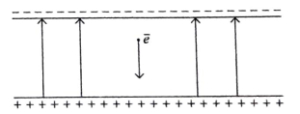
As shown in the following figure,an electron falls through a distance of $1.5 \ cm$ in a uniform electric field of magnitude $2.0 \times 10^4 \ NC^{-1}$. Find the acceleration of the electron due to the electric field.
A
$1.67 \times 10^{27} \ ms^{-2}$
B
$3.52 \times 10^{15} \ ms^{-2}$
C
$2.90 \times 10^{19} \ ms^{-2}$
D
$6.62 \times 10^{34} \ ms^{-2}$
Solution
(B) The force $F$ experienced by an electron of charge $e$ in an electric field $E$ is given by $F = eE$.
According to Newton's second law of motion,$F = ma$,where $m_e$ is the mass of the electron and $a$ is its acceleration.
Equating the two expressions for force: $ma = eE$.
Therefore,the acceleration $a$ is given by $a = \frac{eE}{m_e}$.
Given:
Charge of electron $e = 1.6 \times 10^{-19} \ C$
Electric field $E = 2.0 \times 10^4 \ NC^{-1}$
Mass of electron $m_e = 9.1 \times 10^{-31} \ kg$
Substituting the values:
$a = \frac{(1.6 \times 10^{-19} \ C) \times (2.0 \times 10^4 \ NC^{-1})}{9.1 \times 10^{-31} \ kg}$
$a = \frac{3.2 \times 10^{-15}}{9.1 \times 10^{-31}} \ ms^{-2}$
$a \approx 0.3516 \times 10^{16} \ ms^{-2}$
$a \approx 3.52 \times 10^{15} \ ms^{-2}$.
According to Newton's second law of motion,$F = ma$,where $m_e$ is the mass of the electron and $a$ is its acceleration.
Equating the two expressions for force: $ma = eE$.
Therefore,the acceleration $a$ is given by $a = \frac{eE}{m_e}$.
Given:
Charge of electron $e = 1.6 \times 10^{-19} \ C$
Electric field $E = 2.0 \times 10^4 \ NC^{-1}$
Mass of electron $m_e = 9.1 \times 10^{-31} \ kg$
Substituting the values:
$a = \frac{(1.6 \times 10^{-19} \ C) \times (2.0 \times 10^4 \ NC^{-1})}{9.1 \times 10^{-31} \ kg}$
$a = \frac{3.2 \times 10^{-15}}{9.1 \times 10^{-31}} \ ms^{-2}$
$a \approx 0.3516 \times 10^{16} \ ms^{-2}$
$a \approx 3.52 \times 10^{15} \ ms^{-2}$.
0 likes
View Solution158
EasyMCQ
$A$ particle having mass $m$ and charge $q$ is at rest. On applying a uniform electric field $E$ on it,it starts moving. When this particle travels a distance $x$ in the direction of the force,its kinetic energy will be . . . . . . .
A
$q E^2 x$
B
$q^2 E x$
C
$q E x^2$
D
$q E x$
Solution
(D) The force acting on the particle due to the electric field is given by $F = qE$.
Since the particle starts from rest and moves in the direction of the force,the work done by the electric field on the particle over a distance $x$ is $W = F \cdot x = (qE) \cdot x = qEx$.
According to the work-energy theorem,the work done on a particle is equal to the change in its kinetic energy.
Since the initial kinetic energy is $0$,the final kinetic energy is equal to the work done,which is $qEx$.
Since the particle starts from rest and moves in the direction of the force,the work done by the electric field on the particle over a distance $x$ is $W = F \cdot x = (qE) \cdot x = qEx$.
According to the work-energy theorem,the work done on a particle is equal to the change in its kinetic energy.
Since the initial kinetic energy is $0$,the final kinetic energy is equal to the work done,which is $qEx$.
0 likes
View Solution159
EasyMCQ
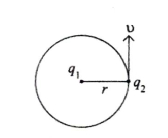
$A$ charge $q_2$ of mass $m$ revolves around a stationary charge $q_1$ in a circular orbit of radius $r$. The orbital periodic time of $q_2$ would be . . . . . . .
A
$\left|\frac{4 \pi^2 m r^3}{k q_1 q_2}\right|^{\frac{1}{2}}$
B
$\left[\frac{k q_1 q_2}{4 \pi^2 m r^3}\right]^{\frac{1}{2}}$
C
$\left[\frac{4 \pi^2 m r^4}{k q_1 q_2}\right]^{\frac{1}{2}}$
D
$\left[\frac{4 \pi^2 m r^2}{k q_1 q_2}\right]^{\frac{1}{2}}$
Solution
(A) For a charge $q_2$ to revolve in a circular orbit,the electrostatic force between $q_1$ and $q_2$ provides the necessary centripetal force.
The centripetal force is given by $F_c = \frac{m v^2}{r}$,where $v$ is the orbital velocity.
The electrostatic force is given by Coulomb's law as $F_e = \frac{k q_1 q_2}{r^2}$.
Equating the two forces: $\frac{m v^2}{r} = \frac{k q_1 q_2}{r^2}$.
Since $v = r \omega$,where $\omega$ is the angular velocity,we have $\frac{m (r \omega)^2}{r} = \frac{k q_1 q_2}{r^2}$.
Simplifying,$m r \omega^2 = \frac{k q_1 q_2}{r^2}$,which gives $\omega^2 = \frac{k q_1 q_2}{m r^3}$.
Since $\omega = \frac{2 \pi}{T}$,where $T$ is the periodic time,we have $\left(\frac{2 \pi}{T}\right)^2 = \frac{k q_1 q_2}{m r^3}$.
$\frac{4 \pi^2}{T^2} = \frac{k q_1 q_2}{m r^3}$.
Therefore,$T^2 = \frac{4 \pi^2 m r^3}{k q_1 q_2}$.
Taking the square root,$T = \left[\frac{4 \pi^2 m r^3}{k q_1 q_2}\right]^{\frac{1}{2}}$.
The centripetal force is given by $F_c = \frac{m v^2}{r}$,where $v$ is the orbital velocity.
The electrostatic force is given by Coulomb's law as $F_e = \frac{k q_1 q_2}{r^2}$.
Equating the two forces: $\frac{m v^2}{r} = \frac{k q_1 q_2}{r^2}$.
Since $v = r \omega$,where $\omega$ is the angular velocity,we have $\frac{m (r \omega)^2}{r} = \frac{k q_1 q_2}{r^2}$.
Simplifying,$m r \omega^2 = \frac{k q_1 q_2}{r^2}$,which gives $\omega^2 = \frac{k q_1 q_2}{m r^3}$.
Since $\omega = \frac{2 \pi}{T}$,where $T$ is the periodic time,we have $\left(\frac{2 \pi}{T}\right)^2 = \frac{k q_1 q_2}{m r^3}$.
$\frac{4 \pi^2}{T^2} = \frac{k q_1 q_2}{m r^3}$.
Therefore,$T^2 = \frac{4 \pi^2 m r^3}{k q_1 q_2}$.
Taking the square root,$T = \left[\frac{4 \pi^2 m r^3}{k q_1 q_2}\right]^{\frac{1}{2}}$.
0 likes
View Solution160
EasyMCQ
$A$ hot filament liberates an electron with zero initial velocity. The anode potential is $1200 \,V$. The speed of the electron when it strikes the anode is
A
$1.5 \times 10^{5} \,ms^{-1}$
B
$2.5 \times 10^{6} \,ms^{-1}$
C
$2.1 \times 10^{7} \,ms^{-1}$
D
$2.5 \times 10^{8} \,ms^{-1}$
Solution
(C) The kinetic energy gained by an electron accelerated through a potential difference $V$ is given by $K.E. = eV$.
Since the electron starts from rest, its kinetic energy is $\frac{1}{2}mv^2$.
Equating the two, we get $\frac{1}{2}mv^2 = eV$.
Solving for velocity $v$, we have $v = \sqrt{\frac{2eV}{m}}$.
Substituting the values: $e = 1.6 \times 10^{-19} \,C$, $m = 9.1 \times 10^{-31} \,kg$, and $V = 1200 \,V$.
$v = \sqrt{\frac{2 \times 1.6 \times 10^{-19} \times 1200}{9.1 \times 10^{-31}}} = \sqrt{\frac{3.84 \times 10^{-16}}{9.1 \times 10^{-31}}} = \sqrt{0.42198 \times 10^{15}} = \sqrt{42.198 \times 10^{13}} \approx 2.05 \times 10^{7} \,ms^{-1}$.
Rounding this value, we get $v \approx 2.1 \times 10^{7} \,ms^{-1}$.
Since the electron starts from rest, its kinetic energy is $\frac{1}{2}mv^2$.
Equating the two, we get $\frac{1}{2}mv^2 = eV$.
Solving for velocity $v$, we have $v = \sqrt{\frac{2eV}{m}}$.
Substituting the values: $e = 1.6 \times 10^{-19} \,C$, $m = 9.1 \times 10^{-31} \,kg$, and $V = 1200 \,V$.
$v = \sqrt{\frac{2 \times 1.6 \times 10^{-19} \times 1200}{9.1 \times 10^{-31}}} = \sqrt{\frac{3.84 \times 10^{-16}}{9.1 \times 10^{-31}}} = \sqrt{0.42198 \times 10^{15}} = \sqrt{42.198 \times 10^{13}} \approx 2.05 \times 10^{7} \,ms^{-1}$.
Rounding this value, we get $v \approx 2.1 \times 10^{7} \,ms^{-1}$.
0 likes
View Solution161
MediumMCQ
An electron of mass $m$,charge $e$ falls through a distance $h$ meters in a uniform electric field $E$. Then the time of fall is:
A
$t=\sqrt{\frac{2hm}{eE}}$
B
$t=\frac{2hm}{eE}$
C
$t=\sqrt{\frac{2eE}{hm}}$
D
$t=\frac{2eE}{hm}$
Solution
(A) Given: mass of electron $= m$,charge $= e$,distance $= h$,electric field $= E$.
The force on the electron in the electric field is $F = eE$.
Using Newton's second law,the acceleration $a$ is given by $a = \frac{F}{m} = \frac{eE}{m}$.
Using the equation of motion $S = ut + \frac{1}{2}at^2$,where initial velocity $u = 0$ and $S = h$:
$h = 0 + \frac{1}{2} \left( \frac{eE}{m} \right) t^2$.
Rearranging for $t^2$:
$t^2 = \frac{2hm}{eE}$.
Taking the square root on both sides:
$t = \sqrt{\frac{2hm}{eE}}$.
The force on the electron in the electric field is $F = eE$.
Using Newton's second law,the acceleration $a$ is given by $a = \frac{F}{m} = \frac{eE}{m}$.
Using the equation of motion $S = ut + \frac{1}{2}at^2$,where initial velocity $u = 0$ and $S = h$:
$h = 0 + \frac{1}{2} \left( \frac{eE}{m} \right) t^2$.
Rearranging for $t^2$:
$t^2 = \frac{2hm}{eE}$.
Taking the square root on both sides:
$t = \sqrt{\frac{2hm}{eE}}$.
0 likes
View Solution162
MediumMCQ
$A$ charged particle of mass $m$ and charge $q$ is released from rest in a uniform electric field $E$. Neglecting the effect of gravity,the kinetic energy of the charged particle after $t$ seconds is
A
$\frac{E q^2 m}{2 t^2}$
B
$\frac{E q m}{t}$
C
$\frac{E^2 q^2 t^2}{2 m}$
D
$\frac{2 E^2 t^2}{m q}$
Solution
(C) The force acting on a charged particle in a uniform electric field is given by $F = qE$.
According to Newton's second law,the acceleration $a$ of the particle is $a = \frac{F}{m} = \frac{qE}{m}$.
Since the particle is released from rest,its initial velocity $u = 0$. The velocity $v$ after time $t$ is given by the equation $v = u + at = 0 + \frac{qE}{m}t = \frac{qEt}{m}$.
The kinetic energy $K$ of the particle is given by $K = \frac{1}{2}mv^2$.
Substituting the value of $v$,we get $K = \frac{1}{2}m\left(\frac{qEt}{m}\right)^2 = \frac{1}{2}m \cdot \frac{q^2 E^2 t^2}{m^2} = \frac{E^2 q^2 t^2}{2m}$.
According to Newton's second law,the acceleration $a$ of the particle is $a = \frac{F}{m} = \frac{qE}{m}$.
Since the particle is released from rest,its initial velocity $u = 0$. The velocity $v$ after time $t$ is given by the equation $v = u + at = 0 + \frac{qE}{m}t = \frac{qEt}{m}$.
The kinetic energy $K$ of the particle is given by $K = \frac{1}{2}mv^2$.
Substituting the value of $v$,we get $K = \frac{1}{2}m\left(\frac{qEt}{m}\right)^2 = \frac{1}{2}m \cdot \frac{q^2 E^2 t^2}{m^2} = \frac{E^2 q^2 t^2}{2m}$.
0 likes
View Solution163
MediumMCQ
$A$ $2 \ g$ object,located in a region of uniform electric field $E = (300 \ NC^{-1}) \hat{i}$,carries a charge $Q$. The object is released from rest at $x = 0$ and has a kinetic energy of $0.12 \ J$ at $x = 0.5 \ m$. Then,$Q$ is: (in $\mu C$)
A
$400$
B
$-400$
C
$800$
D
$-800$
Solution
(C) Given: Mass $m = 2 \ g = 2 \times 10^{-3} \ kg$.
Electric field $E = 300 \ NC^{-1}$.
Initial kinetic energy $(KE)_1 = 0$ at $x = 0$.
Final kinetic energy $(KE)_2 = 0.12 \ J$ at $x = 0.5 \ m$.
According to the work-energy theorem,the work done by the electric force is equal to the change in kinetic energy.
Work done $W = F \cdot d = (QE) \cdot d$.
Change in kinetic energy $\Delta KE = KE_2 - KE_1 = 0.12 \ J - 0 \ J = 0.12 \ J$.
Equating the two: $Q \times 300 \times 0.5 = 0.12$.
$Q \times 150 = 0.12$.
$Q = \frac{0.12}{150} = 0.0008 \ C$.
$Q = 800 \times 10^{-6} \ C = 800 \ \mu C$.
Since the object gains kinetic energy moving in the direction of the electric field,the charge $Q$ must be positive.
Electric field $E = 300 \ NC^{-1}$.
Initial kinetic energy $(KE)_1 = 0$ at $x = 0$.
Final kinetic energy $(KE)_2 = 0.12 \ J$ at $x = 0.5 \ m$.
According to the work-energy theorem,the work done by the electric force is equal to the change in kinetic energy.
Work done $W = F \cdot d = (QE) \cdot d$.
Change in kinetic energy $\Delta KE = KE_2 - KE_1 = 0.12 \ J - 0 \ J = 0.12 \ J$.
Equating the two: $Q \times 300 \times 0.5 = 0.12$.
$Q \times 150 = 0.12$.
$Q = \frac{0.12}{150} = 0.0008 \ C$.
$Q = 800 \times 10^{-6} \ C = 800 \ \mu C$.
Since the object gains kinetic energy moving in the direction of the electric field,the charge $Q$ must be positive.
0 likes
View Solution164
MediumMCQ
Two equal and opposite charges of masses $m_{1}$ and $m_{2}$ are accelerated in a uniform electric field through the same distance. What is the ratio of their accelerations if the ratio of their masses is $\frac{m_{1}}{m_{2}}=0.5$?
A
$\frac{a_{1}}{a_{2}}=0.5$
B
$\frac{a_{1}}{a_{2}}=1$
C
$\frac{a_{1}}{a_{2}}=2$
D
$\frac{a_{1}}{a_{2}}=3$
Solution
(C) Since the charges are equal in magnitude and placed in a uniform electric field $E$,the magnitude of the force acting on each charge is $F = qE$.
Since the magnitude of the force $F$ is the same for both charges,we have $F_{1} = F_{2}$.
Using Newton's second law,$F = ma$,we can write $m_{1}a_{1} = m_{2}a_{2}$.
Rearranging this gives the ratio of accelerations as $\frac{a_{1}}{a_{2}} = \frac{m_{2}}{m_{1}}$.
Given that $\frac{m_{1}}{m_{2}} = 0.5$,we have $\frac{m_{2}}{m_{1}} = \frac{1}{0.5} = 2$.
Therefore,the ratio of their accelerations is $\frac{a_{1}}{a_{2}} = 2$.
Since the magnitude of the force $F$ is the same for both charges,we have $F_{1} = F_{2}$.
Using Newton's second law,$F = ma$,we can write $m_{1}a_{1} = m_{2}a_{2}$.
Rearranging this gives the ratio of accelerations as $\frac{a_{1}}{a_{2}} = \frac{m_{2}}{m_{1}}$.
Given that $\frac{m_{1}}{m_{2}} = 0.5$,we have $\frac{m_{2}}{m_{1}} = \frac{1}{0.5} = 2$.
Therefore,the ratio of their accelerations is $\frac{a_{1}}{a_{2}} = 2$.
0 likes
View Solution165
DifficultMCQ
In a uniform electric field of $E = 1 \times 10^{4} \text{ N C}^{-1}$,an electron is accelerated from rest. The velocity of the electron when it has travelled a distance of $2 \times 10^{-2} \text{ m}$ is nearly (given $\frac{e}{m} \text{ of electron } \approx 1.8 \times 10^{11} \text{ C kg}^{-1}$):
A
$8.5 \times 10^{6} \text{ m s}^{-1}$
B
$1.6 \times 10^{6} \text{ m s}^{-1}$
C
$0.85 \times 10^{6} \text{ m s}^{-1}$
D
$0.425 \times 10^{6} \text{ m s}^{-1}$
Solution
(A) According to the work-energy theorem,the work done by the electric field is equal to the change in the kinetic energy of the electron.
Work done $W = qEx = \frac{1}{2}mv^2$.
Rearranging for velocity $v$,we get $v = \sqrt{\frac{2qEx}{m}} = \sqrt{2 \left(\frac{e}{m}\right) Ex}$.
Given values: $\frac{e}{m} = 1.8 \times 10^{11} \text{ C kg}^{-1}$,$E = 1 \times 10^{4} \text{ N C}^{-1}$,and $x = 2 \times 10^{-2} \text{ m}$.
Substituting these values:
$v = \sqrt{2 \times (1.8 \times 10^{11}) \times (1 \times 10^{4}) \times (2 \times 10^{-2})}$
$v = \sqrt{7.2 \times 10^{13}} = \sqrt{72 \times 10^{12}}$
$v \approx 8.485 \times 10^{6} \text{ m s}^{-1} \approx 8.5 \times 10^{6} \text{ m s}^{-1}$.
Work done $W = qEx = \frac{1}{2}mv^2$.
Rearranging for velocity $v$,we get $v = \sqrt{\frac{2qEx}{m}} = \sqrt{2 \left(\frac{e}{m}\right) Ex}$.
Given values: $\frac{e}{m} = 1.8 \times 10^{11} \text{ C kg}^{-1}$,$E = 1 \times 10^{4} \text{ N C}^{-1}$,and $x = 2 \times 10^{-2} \text{ m}$.
Substituting these values:
$v = \sqrt{2 \times (1.8 \times 10^{11}) \times (1 \times 10^{4}) \times (2 \times 10^{-2})}$
$v = \sqrt{7.2 \times 10^{13}} = \sqrt{72 \times 10^{12}}$
$v \approx 8.485 \times 10^{6} \text{ m s}^{-1} \approx 8.5 \times 10^{6} \text{ m s}^{-1}$.
0 likes
View Solution166
EasyMCQ
Acceleration of a charged particle of charge $q$ and mass $m$ moving in a uniform electric field of strength $E$ is
A
$\frac{q}{m E}$
B
$\frac{q E}{m}$
C
$\frac{m}{qE}$
D
$m q E$
Solution
(B) The force $F$ experienced by a charged particle with charge $q$ in a uniform electric field $E$ is given by $F = qE$.
According to Newton's second law of motion,the force is also given by $F = ma$,where $m$ is the mass and $a$ is the acceleration.
Equating the two expressions for force: $ma = qE$.
Therefore,the acceleration $a$ is given by $a = \frac{qE}{m}$.
According to Newton's second law of motion,the force is also given by $F = ma$,where $m$ is the mass and $a$ is the acceleration.
Equating the two expressions for force: $ma = qE$.
Therefore,the acceleration $a$ is given by $a = \frac{qE}{m}$.
0 likes
View Solution167
DifficultMCQ
An $\alpha$-particle of mass $6.4 \times 10^{-27} \ kg$ and charge $3.2 \times 10^{-19} \ C$ is situated in a uniform electric field of $1.6 \times 10^{5} \ Vm^{-1}$. The velocity of the particle at the end of $2 \times 10^{-2} \ m$ path when it starts from rest is
A
$2 \sqrt{3} \times 10^{5} \ ms^{-1}$
B
$8 \times 10^{5} \ ms^{-1}$
C
$16 \times 10^{5} \ ms^{-1}$
D
$4 \sqrt{2} \times 10^{5} \ ms^{-1}$
Solution
(D) Given: Mass of $\alpha$-particle $m = 6.4 \times 10^{-27} \ kg$,charge $q = 3.2 \times 10^{-19} \ C$,electric field $E = 1.6 \times 10^{5} \ Vm^{-1}$,and distance $s = 2 \times 10^{-2} \ m$.
The force acting on the $\alpha$-particle is $F = qE = (3.2 \times 10^{-19}) \times (1.6 \times 10^{5}) = 5.12 \times 10^{-14} \ N$.
The acceleration $a$ of the particle is $a = \frac{F}{m} = \frac{5.12 \times 10^{-14}}{6.4 \times 10^{-27}} = 0.8 \times 10^{13} \ ms^{-2} = 8 \times 10^{12} \ ms^{-2}$.
Using the equation of motion $v^2 = u^2 + 2as$,where initial velocity $u = 0$:
$v^2 = 0 + 2 \times (8 \times 10^{12}) \times (2 \times 10^{-2}) = 32 \times 10^{10}$.
Taking the square root,$v = \sqrt{32 \times 10^{10}} = \sqrt{16 \times 2} \times 10^{5} = 4 \sqrt{2} \times 10^{5} \ ms^{-1}$.
The force acting on the $\alpha$-particle is $F = qE = (3.2 \times 10^{-19}) \times (1.6 \times 10^{5}) = 5.12 \times 10^{-14} \ N$.
The acceleration $a$ of the particle is $a = \frac{F}{m} = \frac{5.12 \times 10^{-14}}{6.4 \times 10^{-27}} = 0.8 \times 10^{13} \ ms^{-2} = 8 \times 10^{12} \ ms^{-2}$.
Using the equation of motion $v^2 = u^2 + 2as$,where initial velocity $u = 0$:
$v^2 = 0 + 2 \times (8 \times 10^{12}) \times (2 \times 10^{-2}) = 32 \times 10^{10}$.
Taking the square root,$v = \sqrt{32 \times 10^{10}} = \sqrt{16 \times 2} \times 10^{5} = 4 \sqrt{2} \times 10^{5} \ ms^{-1}$.
0 likes
View Solution168
DifficultMCQ
$A$ small oil drop of mass $10^{-6} \,kg$ is hanging at rest between two plates separated by $1 \,mm$ having a potential difference of $500 \,V$. The charge on the drop is $(g = 10 \,ms^{-2})$
A
$2 \times 10^{-9} \,C$
B
$2 \times 10^{-11} \,C$
C
$2 \times 10^{-6} \,C$
D
$2 \times 10^{-8} \,C$
Solution
(B) Given that the oil drop is at rest,the gravitational force acting downwards must be balanced by the electric force acting upwards.
$qE = mg$
Since the electric field $E$ between two plates is given by $E = \frac{V}{d}$,where $V$ is the potential difference and $d$ is the distance between the plates:
$q \left(\frac{V}{d}\right) = mg$
Rearranging to solve for the charge $q$:
$q = \frac{mgd}{V}$
Given values:
$m = 10^{-6} \,kg$
$g = 10 \,ms^{-2}$
$d = 1 \,mm = 10^{-3} \,m$
$V = 500 \,V$
Substituting these values into the equation:
$q = \frac{10^{-6} \times 10 \times 10^{-3}}{500}$
$q = \frac{10^{-8}}{500} = \frac{10^{-8}}{5 \times 10^2} = 0.2 \times 10^{-10} \,C = 2 \times 10^{-11} \,C$
$qE = mg$
Since the electric field $E$ between two plates is given by $E = \frac{V}{d}$,where $V$ is the potential difference and $d$ is the distance between the plates:
$q \left(\frac{V}{d}\right) = mg$
Rearranging to solve for the charge $q$:
$q = \frac{mgd}{V}$
Given values:
$m = 10^{-6} \,kg$
$g = 10 \,ms^{-2}$
$d = 1 \,mm = 10^{-3} \,m$
$V = 500 \,V$
Substituting these values into the equation:
$q = \frac{10^{-6} \times 10 \times 10^{-3}}{500}$
$q = \frac{10^{-8}}{500} = \frac{10^{-8}}{5 \times 10^2} = 0.2 \times 10^{-10} \,C = 2 \times 10^{-11} \,C$
0 likes
View Solution169
MediumMCQ
$A$ particle of mass $0.2 \ g$ and charge $2 \ C$ is released from rest in a uniform electric field of $20 \ N \ C^{-1}$. The kinetic energy of the particle after moving a distance of $20 \ cm$ is (in $J$)
A
$10$
B
$8$
C
$18$
D
$12$
Solution
(B) Given: Mass $m = 0.2 \ g = 0.2 \times 10^{-3} \ kg$,Charge $q = 2 \ C$,Electric field $E = 20 \ N \ C^{-1}$,Distance $d = 20 \ cm = 0.2 \ m$,Initial velocity $u = 0$.
The force acting on the particle is $F = qE = 2 \times 20 = 40 \ N$.
According to the work-energy theorem,the work done by the electric force is equal to the change in kinetic energy.
Work done $W = F \times d = 40 \ N \times 0.2 \ m = 8 \ J$.
Since the particle starts from rest,the initial kinetic energy is $0$.
Therefore,the final kinetic energy is $K.E. = W = 8 \ J$.
The force acting on the particle is $F = qE = 2 \times 20 = 40 \ N$.
According to the work-energy theorem,the work done by the electric force is equal to the change in kinetic energy.
Work done $W = F \times d = 40 \ N \times 0.2 \ m = 8 \ J$.
Since the particle starts from rest,the initial kinetic energy is $0$.
Therefore,the final kinetic energy is $K.E. = W = 8 \ J$.
0 likes
View Solution170
EasyMCQ
The magnitude of an electric field which can just suspend a deuteron of mass $3.2 \times 10^{-27} \ kg$ freely in air is
A
$19.6 \times 10^{-8} \ NC^{-1}$
B
$196 \ NC^{-1}$
C
$1.96 \times 10^{-10} \ NC^{-1}$
D
$0.196 \ NC^{-1}$
Solution
(A) Given: Mass of deuteron $m = 3.2 \times 10^{-27} \ kg$,Charge of deuteron $q = e = 1.6 \times 10^{-19} \ C$,Acceleration due to gravity $g = 9.8 \ m/s^2$.
For the deuteron to be suspended freely in air,the upward electric force must balance the downward gravitational force.
Equating the forces: $qE = mg$.
Rearranging for the electric field: $E = \frac{mg}{q}$.
Substituting the values: $E = \frac{3.2 \times 10^{-27} \times 9.8}{1.6 \times 10^{-19}}$.
$E = 2 \times 9.8 \times 10^{-27+19} \ NC^{-1}$.
$E = 19.6 \times 10^{-8} \ NC^{-1}$.
For the deuteron to be suspended freely in air,the upward electric force must balance the downward gravitational force.
Equating the forces: $qE = mg$.
Rearranging for the electric field: $E = \frac{mg}{q}$.
Substituting the values: $E = \frac{3.2 \times 10^{-27} \times 9.8}{1.6 \times 10^{-19}}$.
$E = 2 \times 9.8 \times 10^{-27+19} \ NC^{-1}$.
$E = 19.6 \times 10^{-8} \ NC^{-1}$.
0 likes
View Solution171
EasyMCQ
$A$ particle of mass $0.5 \ g$ and charge $10 \ \mu C$ is subjected to a uniform electric field of $8 \ NC^{-1}$. If the particle is initially at rest,the velocity of the particle after a time of $5 \ s$ is: (in $ms^{-1}$)
A
$5$
B
$0.5$
C
$8$
D
$0.8$
Solution
(D) Given:
Mass $m = 0.5 \ g = 0.5 \times 10^{-3} \ kg$
Charge $q = 10 \ \mu C = 10 \times 10^{-6} \ C$
Electric field $E = 8 \ NC^{-1}$
Initial velocity $u = 0 \ ms^{-1}$
Time $t = 5 \ s$
The force acting on the particle is $F = qE$.
According to Newton's second law,$F = ma$,so the acceleration $a = \frac{qE}{m}$.
Substituting the values:
$a = \frac{10 \times 10^{-6} \times 8}{0.5 \times 10^{-3}} = \frac{80 \times 10^{-6}}{0.5 \times 10^{-3}} = 160 \times 10^{-3} = 0.16 \ ms^{-2}$.
Using the first equation of motion $v = u + at$:
$v = 0 + (0.16 \times 5) = 0.8 \ ms^{-1}$.
Mass $m = 0.5 \ g = 0.5 \times 10^{-3} \ kg$
Charge $q = 10 \ \mu C = 10 \times 10^{-6} \ C$
Electric field $E = 8 \ NC^{-1}$
Initial velocity $u = 0 \ ms^{-1}$
Time $t = 5 \ s$
The force acting on the particle is $F = qE$.
According to Newton's second law,$F = ma$,so the acceleration $a = \frac{qE}{m}$.
Substituting the values:
$a = \frac{10 \times 10^{-6} \times 8}{0.5 \times 10^{-3}} = \frac{80 \times 10^{-6}}{0.5 \times 10^{-3}} = 160 \times 10^{-3} = 0.16 \ ms^{-2}$.
Using the first equation of motion $v = u + at$:
$v = 0 + (0.16 \times 5) = 0.8 \ ms^{-1}$.
0 likes
View Solution172
DifficultMCQ
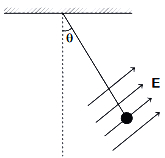
$A$ charged cork ball having mass $1 \text{ g}$ and charge $q$ is suspended on a light string in a uniform electric field as shown in the figure. The ball is in equilibrium at $\theta=37^{\circ}$,when the value of the electric field is $E=(3 \hat{i}+5 \hat{j}) \times 10^5 \text{ NC}^{-1}$. (Assume $T$ as tension in the string.) Which of the following options are correct? (Given,$\sin 37^{\circ}=0.60$ and $g=10 \text{ ms}^{-2}$)
A
$q=11 \times 10^{-8} \text{ C}$
B
$T=5.55 \times 10^{-3} \text{ N}$
C
$q=12 \times 10^{-9} \text{ C}$
D
$T=4.55 \times 10^{-3} \text{ N}$
Solution
(A, B) Mass of the cork ball,$m=1 \text{ g}=10^{-3} \text{ kg}$.
Electric field,$E=(3 \hat{i}+5 \hat{j}) \times 10^5 \text{ NC}^{-1}$.
Angle,$\theta=37^{\circ}$.
Force on the cork ball due to the electric field $E$ is $F=qE$.
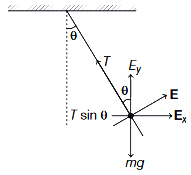
According to the given diagram,resolving all forces in the horizontal and vertical directions:
$T \sin \theta = q E_x \quad \dots (i)$
$T \cos \theta + q E_y = mg \implies T \cos \theta = mg - q E_y \quad \dots (ii)$
Dividing Eq. $(i)$ by Eq. $(ii)$:
$\tan \theta = \frac{q E_x}{mg - q E_y}$
Substituting the values $(\tan 37^{\circ} = 3/4)$:
$\frac{3}{4} = \frac{q \times 3 \times 10^5}{10^{-3} \times 10 - q \times 5 \times 10^5}$
$\frac{3}{4} = \frac{3q \times 10^5}{10^{-2} - 5q \times 10^5}$
$3(10^{-2} - 5q \times 10^5) = 12q \times 10^5$
$0.03 - 15q \times 10^5 = 12q \times 10^5$
$0.03 = 27q \times 10^5 \implies q = \frac{0.03}{27 \times 10^5} = \frac{1}{9} \times 10^{-7} \approx 1.11 \times 10^{-8} \text{ C}$.
Thus,$q \approx 11 \times 10^{-9} \text{ C}$ or $1.1 \times 10^{-8} \text{ C}$.
From Eq. $(i)$:
$T \sin 37^{\circ} = q E_x$
$T \times 0.6 = (1.11 \times 10^{-8}) \times (3 \times 10^5)$
$T \times 0.6 = 3.33 \times 10^{-3}$
$T = \frac{3.33 \times 10^{-3}}{0.6} = 5.55 \times 10^{-3} \text{ N}$.
Therefore,options $A$ and $B$ are correct.
Electric field,$E=(3 \hat{i}+5 \hat{j}) \times 10^5 \text{ NC}^{-1}$.
Angle,$\theta=37^{\circ}$.
Force on the cork ball due to the electric field $E$ is $F=qE$.
According to the given diagram,resolving all forces in the horizontal and vertical directions:
$T \sin \theta = q E_x \quad \dots (i)$
$T \cos \theta + q E_y = mg \implies T \cos \theta = mg - q E_y \quad \dots (ii)$
Dividing Eq. $(i)$ by Eq. $(ii)$:
$\tan \theta = \frac{q E_x}{mg - q E_y}$
Substituting the values $(\tan 37^{\circ} = 3/4)$:
$\frac{3}{4} = \frac{q \times 3 \times 10^5}{10^{-3} \times 10 - q \times 5 \times 10^5}$
$\frac{3}{4} = \frac{3q \times 10^5}{10^{-2} - 5q \times 10^5}$
$3(10^{-2} - 5q \times 10^5) = 12q \times 10^5$
$0.03 - 15q \times 10^5 = 12q \times 10^5$
$0.03 = 27q \times 10^5 \implies q = \frac{0.03}{27 \times 10^5} = \frac{1}{9} \times 10^{-7} \approx 1.11 \times 10^{-8} \text{ C}$.
Thus,$q \approx 11 \times 10^{-9} \text{ C}$ or $1.1 \times 10^{-8} \text{ C}$.
From Eq. $(i)$:
$T \sin 37^{\circ} = q E_x$
$T \times 0.6 = (1.11 \times 10^{-8}) \times (3 \times 10^5)$
$T \times 0.6 = 3.33 \times 10^{-3}$
$T = \frac{3.33 \times 10^{-3}}{0.6} = 5.55 \times 10^{-3} \text{ N}$.
Therefore,options $A$ and $B$ are correct.
0 likes
View Solution173
DifficultMCQ
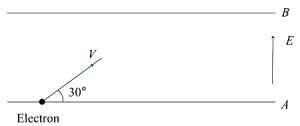
Two long parallel plates $A$ and $B$ are separated by a distance of $4 \ cm$ with an electric field of $45.5 \ Vm^{-1}$ between the plates directed normally from plate $A$ to plate $B$,as shown in the figure. An electron is projected from plate $A$ with velocity $v$ at an angle of $30^{\circ}$ with the surface of plate $A$. The maximum value of $v$ so that the electron does not hit plate $B$ is (Assume gravity-free space,charge of electron $= 1.6 \times 10^{-19} \ C$ and mass of electron $= 9.1 \times 10^{-31} \ kg$): (in $km \ s^{-1}$)
A
$400$
B
$3200$
C
$800$
D
$1600$
Solution
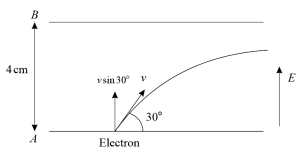
(D) The electron is projected in a uniform electric field directed from $A$ to $B$. Since the electron is negatively charged,it experiences a force $F = q_e E$ in the direction opposite to the electric field,i.e.,towards plate $A$. However,the problem states the electron is projected from $A$ and we want to ensure it does not hit $B$. This implies the electric field must be directed from $B$ to $A$ or the electron is positively charged. Given the context of the trajectory shown,the electron experiences a downward acceleration $a = \frac{q_e E}{m_e}$.
For the electron not to hit plate $B$,its maximum vertical displacement $h_{\max}$ must be less than or equal to the separation distance $d = 4 \ cm = 0.04 \ m$.
The vertical component of initial velocity is $u_y = v \sin 30^{\circ} = \frac{v}{2}$.
The acceleration is $a = \frac{q_e E}{m_e} = \frac{1.6 \times 10^{-19} \times 45.5}{9.1 \times 10^{-31}} = \frac{72.8 \times 10^{-19}}{9.1 \times 10^{-31}} = 8 \times 10^{12} \ m \ s^{-2}$.
Using the kinematic equation $v_y^2 = u_y^2 - 2ah$,at maximum height $v_y = 0$:
$0 = (\frac{v}{2})^2 - 2ah_{\max} \implies h_{\max} = \frac{v^2}{8a}$.
Setting $h_{\max} = 0.04 \ m$:
$0.04 = \frac{v^2}{8 \times 8 \times 10^{12}}$
$v^2 = 0.04 \times 64 \times 10^{12} = 2.56 \times 10^{12}$
$v = \sqrt{2.56 \times 10^{12}} = 1.6 \times 10^6 \ m \ s^{-1} = 1600 \ km \ s^{-1}$.
For the electron not to hit plate $B$,its maximum vertical displacement $h_{\max}$ must be less than or equal to the separation distance $d = 4 \ cm = 0.04 \ m$.
The vertical component of initial velocity is $u_y = v \sin 30^{\circ} = \frac{v}{2}$.
The acceleration is $a = \frac{q_e E}{m_e} = \frac{1.6 \times 10^{-19} \times 45.5}{9.1 \times 10^{-31}} = \frac{72.8 \times 10^{-19}}{9.1 \times 10^{-31}} = 8 \times 10^{12} \ m \ s^{-2}$.
Using the kinematic equation $v_y^2 = u_y^2 - 2ah$,at maximum height $v_y = 0$:
$0 = (\frac{v}{2})^2 - 2ah_{\max} \implies h_{\max} = \frac{v^2}{8a}$.
Setting $h_{\max} = 0.04 \ m$:
$0.04 = \frac{v^2}{8 \times 8 \times 10^{12}}$
$v^2 = 0.04 \times 64 \times 10^{12} = 2.56 \times 10^{12}$
$v = \sqrt{2.56 \times 10^{12}} = 1.6 \times 10^6 \ m \ s^{-1} = 1600 \ km \ s^{-1}$.
0 likes
View Solution174
DifficultMCQ
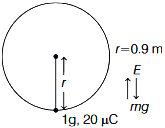
$A$ ball of mass $1 \text{ g}$ having a charge of $20 \mu\text{C}$ is tied to one end of a string of length $0.9 \text{ m}$ and can rotate in a vertical plane in a uniform electric field of $100 \text{ NC}^{-1}$ directed upwards. The minimum horizontal velocity that must be given to the ball at the lowest position so that it completes the vertical circle is (Let $g = 10 \text{ ms}^{-2}$): (in $\text{ ms}^{-1}$)
A
$9$
B
$18$
C
$36$
D
$6$
Solution
(D) Given: mass $m = 1 \text{ g} = 10^{-3} \text{ kg}$, charge $q = 20 \mu\text{C} = 20 \times 10^{-6} \text{ C}$, length $r = 0.9 \text{ m}$, electric field $E = 100 \text{ NC}^{-1}$, and $g = 10 \text{ ms}^{-2}$.
The force exerted by the electric field on the charge is $F_e = qE = 20 \times 10^{-6} \times 100 = 2 \times 10^{-3} \text{ N}$ (upwards).
The gravitational force on the ball is $F_g = mg = 10^{-3} \times 10 = 10 \times 10^{-3} \text{ N}$ (downwards).
The net effective force acting downwards is $F_{\text{eff}} = F_g - F_e = 10 \times 10^{-3} - 2 \times 10^{-3} = 8 \times 10^{-3} \text{ N}$.
The effective acceleration due to gravity is $g_{\text{eff}} = \frac{F_{\text{eff}}}{m} = \frac{8 \times 10^{-3}}{10^{-3}} = 8 \text{ ms}^{-2}$.
For a particle to complete a vertical circle, the minimum velocity at the lowest point is $v = \sqrt{5g_{\text{eff}}r}$.
Substituting the values: $v = \sqrt{5 \times 8 \times 0.9} = \sqrt{40 \times 0.9} = \sqrt{36} = 6 \text{ ms}^{-1}$.
The force exerted by the electric field on the charge is $F_e = qE = 20 \times 10^{-6} \times 100 = 2 \times 10^{-3} \text{ N}$ (upwards).
The gravitational force on the ball is $F_g = mg = 10^{-3} \times 10 = 10 \times 10^{-3} \text{ N}$ (downwards).
The net effective force acting downwards is $F_{\text{eff}} = F_g - F_e = 10 \times 10^{-3} - 2 \times 10^{-3} = 8 \times 10^{-3} \text{ N}$.
The effective acceleration due to gravity is $g_{\text{eff}} = \frac{F_{\text{eff}}}{m} = \frac{8 \times 10^{-3}}{10^{-3}} = 8 \text{ ms}^{-2}$.
For a particle to complete a vertical circle, the minimum velocity at the lowest point is $v = \sqrt{5g_{\text{eff}}r}$.
Substituting the values: $v = \sqrt{5 \times 8 \times 0.9} = \sqrt{40 \times 0.9} = \sqrt{36} = 6 \text{ ms}^{-1}$.
0 likes
View Solution175
DifficultMCQ
Two balls of charge $q_1$ and $q_2$ initially have a velocity of the same magnitude and direction. After a uniform electric field is applied for a certain time,the direction of the velocity of the first ball changes by $60^{\circ}$,and the velocity magnitude is reduced by half. The direction of the velocity of the second ball changes by $90^{\circ}$. In what proportion will the velocity of the second ball change? Determine the magnitude of the charge-to-mass ratio for the second ball if it is equal to $k_1$ for the first ball. The electrostatic interaction between the balls should be neglected.
A
$\frac{k_1}{\sqrt{2}}$
B
$\frac{k_1}{\sqrt{3}}$
C
$\frac{k_1}{2}$
D
$\frac{4}{3} k_1$
Solution
(D) Let $v$ be the initial velocity. The change in momentum is $\Delta \vec{p} = q \vec{E} \Delta t$. Since $\vec{E}$ is uniform,$\Delta \vec{p}$ is the same for both balls if we assume the same $qE\Delta t$ or relate them via ratios. For the first ball,the final velocity $\vec{v}_1$ has magnitude $v/2$ and is at $60^{\circ}$ to $\vec{v}$. The change in momentum $\Delta \vec{p}_1 = m_1(\vec{v}_1 - \vec{v})$ must be perpendicular to $\vec{v}_1$ because the magnitude decreased. Using the law of cosines: $(v/2)^2 = v^2 + (\Delta p_1/m_1)^2 - 2v(\Delta p_1/m_1)\cos(120^{\circ})$. Solving this,$\Delta p_1 = m_1 v \sin(60^{\circ}) = m_1 v \frac{\sqrt{3}}{2}$. For the second ball,the velocity changes by $90^{\circ}$,so $\vec{v}_2 \perp \vec{v}$. Thus,$v_2 = v / \cos(90^{\circ})$ is not applicable; rather,$\Delta p_2 = m_2 v \tan(90^{\circ})$ implies the force is perpendicular to the initial velocity. The magnitude of the second ball's velocity is $v_2 = v / \cos(30^{\circ}) = 2v/\sqrt{3}$ is incorrect; the correct relation is $v_2 = v \tan(30^{\circ}) = v/\sqrt{3}$. The ratio $\frac{q_2/m_2}{q_1/m_1} = \frac{4}{3}$,so $k_2 = \frac{4}{3} k_1$.
0 likes
View Solution176
EasyMCQ
$A$ proton and an $\alpha$-particle start from rest in a uniform electric field. The ratio of times taken by them to travel the same distance in the field is
A
$\sqrt{5}: \sqrt{2}$
B
$\sqrt{3}: 1$
C
$2: 1$
D
$1: \sqrt{2}$
Solution
(D) The acceleration $a$ of a particle of mass $m$ and charge $q$ in a uniform electric field $E$ is given by $a = \frac{qE}{m}$.
For a proton $(p)$: $q_p = e$, $m_p = m$. Thus, $a_p = \frac{eE}{m}$.
For an $\alpha$-particle $(\alpha)$: $q_{\alpha} = 2e$, $m_{\alpha} = 4m$. Thus, $a_{\alpha} = \frac{2eE}{4m} = \frac{eE}{2m}$.
Since they start from rest, the distance $s$ traveled in time $t$ is $s = \frac{1}{2}at^2$. Given $s$ is the same for both, $\frac{1}{2}a_p t_p^2 = \frac{1}{2}a_{\alpha} t_{\alpha}^2$.
$\frac{t_p^2}{t_{\alpha}^2} = \frac{a_{\alpha}}{a_p} = \frac{eE/2m}{eE/m} = \frac{1}{2}$.
Therefore, the ratio of times taken by the proton to the $\alpha$-particle is $\frac{t_p}{t_{\alpha}} = \frac{1}{\sqrt{2}}$.
For a proton $(p)$: $q_p = e$, $m_p = m$. Thus, $a_p = \frac{eE}{m}$.
For an $\alpha$-particle $(\alpha)$: $q_{\alpha} = 2e$, $m_{\alpha} = 4m$. Thus, $a_{\alpha} = \frac{2eE}{4m} = \frac{eE}{2m}$.
Since they start from rest, the distance $s$ traveled in time $t$ is $s = \frac{1}{2}at^2$. Given $s$ is the same for both, $\frac{1}{2}a_p t_p^2 = \frac{1}{2}a_{\alpha} t_{\alpha}^2$.
$\frac{t_p^2}{t_{\alpha}^2} = \frac{a_{\alpha}}{a_p} = \frac{eE/2m}{eE/m} = \frac{1}{2}$.
Therefore, the ratio of times taken by the proton to the $\alpha$-particle is $\frac{t_p}{t_{\alpha}} = \frac{1}{\sqrt{2}}$.
0 likes
View Solution177
EasyMCQ
Two charged particles of masses in the ratio $1: 3$ have charges in reciprocal ratio as their masses. They are placed in a uniform electric field and allowed to move. The ratio of their kinetic energies is
A
$9: 1$
B
$4: 3$
C
$3: 1$
D
$27: 1$
Solution
(D) Let the masses be $m_1 = m$ and $m_2 = 3m$. The ratio of masses is $m_1 : m_2 = 1 : 3$.
The charges are in reciprocal ratio to their masses,so $q_1 : q_2 = 3 : 1$. Let $q_1 = 3q$ and $q_2 = q$.
When placed in a uniform electric field $E$,the force on each particle is $F = qE$.
The acceleration of each particle is $a = F/m = qE/m$.
Assuming they start from rest,after time $t$,the velocity is $v = at = (qE/m)t$.
The kinetic energy is $K = (1/2)mv^2 = (1/2)m(qEt/m)^2 = (q^2 E^2 t^2) / (2m)$.
The ratio of kinetic energies is $K_1 / K_2 = [(q_1^2) / (2m_1)] / [(q_2^2) / (2m_2)] = (q_1/q_2)^2 * (m_2/m_1)$.
Substituting the values: $K_1 / K_2 = (3/1)^2 * (3/1) = 9 * 3 = 27 / 1$.
Thus,the ratio is $27: 1$.
The charges are in reciprocal ratio to their masses,so $q_1 : q_2 = 3 : 1$. Let $q_1 = 3q$ and $q_2 = q$.
When placed in a uniform electric field $E$,the force on each particle is $F = qE$.
The acceleration of each particle is $a = F/m = qE/m$.
Assuming they start from rest,after time $t$,the velocity is $v = at = (qE/m)t$.
The kinetic energy is $K = (1/2)mv^2 = (1/2)m(qEt/m)^2 = (q^2 E^2 t^2) / (2m)$.
The ratio of kinetic energies is $K_1 / K_2 = [(q_1^2) / (2m_1)] / [(q_2^2) / (2m_2)] = (q_1/q_2)^2 * (m_2/m_1)$.
Substituting the values: $K_1 / K_2 = (3/1)^2 * (3/1) = 9 * 3 = 27 / 1$.
Thus,the ratio is $27: 1$.
0 likes
View Solution178
MediumMCQ
$A$ charged bead is sliding freely through a string held vertically under tension. An electric field is applied parallel to the string so that the bead stays at rest at the middle of the string. If the electric field is switched off momentarily and switched on again,then
A
the bead falls off momentarily and then stops
B
the bead moves downwards and then moves upwards
C
the bead moves downwards with constant acceleration
D
the bead moves downwards with constant velocity
Solution
(B) Initially,the bead is at rest,which implies that the upward electric force $F_e = qE$ balances the downward gravitational force $mg$. Thus,$qE = mg$.
When the electric field is switched off,the only force acting on the bead is gravity $(mg)$. The bead will start moving downwards with a constant acceleration $g$.
When the electric field is switched on again,the electric force $F_e = qE$ acts upwards again. Since the bead has gained some downward velocity during the time the field was off,it will continue to move downwards while decelerating until its velocity becomes zero.
After the velocity becomes zero,the electric force $F_e$ (which is equal to $mg$) will cause the bead to accelerate upwards until it returns to its original position.
Therefore,the bead moves downwards and then moves upwards.
When the electric field is switched off,the only force acting on the bead is gravity $(mg)$. The bead will start moving downwards with a constant acceleration $g$.
When the electric field is switched on again,the electric force $F_e = qE$ acts upwards again. Since the bead has gained some downward velocity during the time the field was off,it will continue to move downwards while decelerating until its velocity becomes zero.
After the velocity becomes zero,the electric force $F_e$ (which is equal to $mg$) will cause the bead to accelerate upwards until it returns to its original position.
Therefore,the bead moves downwards and then moves upwards.
0 likes
View Solution179
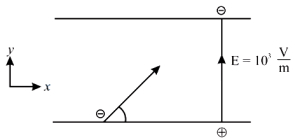
DifficultMCQ
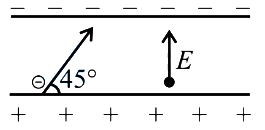
The uniform electric field intensity between the two plates of a parallel plate capacitor is $1 \times 10^3 \ Vm^{-1}$ acting vertically upwards as shown in the figure. The plates are sufficiently long and have a separation of $2 \ cm$. $A$ particle of negative charge $1 \ \mu C$ and mass $2 \ g$ is projected at an angle $45^{\circ}$ with the electric field from the lower plate with a velocity '$u$'. The maximum velocity acquired by the particle,if it does not hit the upper plate,is (in $ms^{-1}$)
A
$2$
B
$1$
C
$0.1$
D
$0.2$
Solution
(D) The electric field $E$ acts upwards. Since the charge $q$ is negative,the force $F = qE$ acts downwards. The acceleration of the particle is $a = \frac{|q|E}{m} = \frac{1 \times 10^{-6} \times 10^3}{2 \times 10^{-3}} = 0.5 \ ms^{-2}$ downwards.
For the particle not to hit the upper plate,its maximum vertical displacement $h_{\max}$ must be less than or equal to the plate separation $d = 2 \ cm = 0.02 \ m$.
The vertical component of velocity is $u_y = u \sin 45^{\circ} = \frac{u}{\sqrt{2}}$.
At maximum height,the vertical velocity becomes zero. Using $v_y^2 = u_y^2 - 2ah_{\max}$,we get $0 = (\frac{u}{\sqrt{2}})^2 - 2ah_{\max}$,so $h_{\max} = \frac{u^2}{4a}$.
Setting $h_{\max} = 0.02 \ m$ and $a = 0.5 \ ms^{-2}$:
$0.02 = \frac{u^2}{4 \times 0.5} = \frac{u^2}{2}$
$u^2 = 0.04 \implies u = 0.2 \ ms^{-1}$.
For the particle not to hit the upper plate,its maximum vertical displacement $h_{\max}$ must be less than or equal to the plate separation $d = 2 \ cm = 0.02 \ m$.
The vertical component of velocity is $u_y = u \sin 45^{\circ} = \frac{u}{\sqrt{2}}$.
At maximum height,the vertical velocity becomes zero. Using $v_y^2 = u_y^2 - 2ah_{\max}$,we get $0 = (\frac{u}{\sqrt{2}})^2 - 2ah_{\max}$,so $h_{\max} = \frac{u^2}{4a}$.
Setting $h_{\max} = 0.02 \ m$ and $a = 0.5 \ ms^{-2}$:
$0.02 = \frac{u^2}{4 \times 0.5} = \frac{u^2}{2}$
$u^2 = 0.04 \implies u = 0.2 \ ms^{-1}$.
0 likes
View Solution180
EasyMCQ
In a region of uniform electric field of intensity $E$,an electron of mass $m_e$ is released from rest. The distance travelled by the electron in a time $t$ is
A
$\frac{2 m_e t^2}{e}$
B
$\frac{e E t^2}{2 m_e}$
C
$\frac{m_e g t^2}{e E}$
D
$\frac{2 E t^2}{e m_e}$
Solution
(B) The force experienced by an electron of charge $e$ in an electric field $E$ is given by $F = eE$.
According to Newton's second law,the acceleration $a$ of the electron is $a = \frac{F}{m_e} = \frac{eE}{m_e}$.
Since the electron is released from rest,its initial velocity $u = 0$.
Using the kinematic equation for distance $S$ travelled in time $t$:
$S = ut + \frac{1}{2}at^2$
$S = 0 \cdot t + \frac{1}{2} \left( \frac{eE}{m_e} \right) t^2$
$S = \frac{eEt^2}{2m_e}$.
According to Newton's second law,the acceleration $a$ of the electron is $a = \frac{F}{m_e} = \frac{eE}{m_e}$.
Since the electron is released from rest,its initial velocity $u = 0$.
Using the kinematic equation for distance $S$ travelled in time $t$:
$S = ut + \frac{1}{2}at^2$
$S = 0 \cdot t + \frac{1}{2} \left( \frac{eE}{m_e} \right) t^2$
$S = \frac{eEt^2}{2m_e}$.
0 likes
View Solution181
MediumMCQ
The velocity acquired by an electron at rest when subjected to a uniform electric field of potential difference $180 \ V$ is (Mass of electron $= 9 \times 10^{-31} \ kg$ and charge of electron $= 1.6 \times 10^{-19} \ C$) (in $km \ s^{-1}$)
A
$400$
B
$4000$
C
$800$
D
$8000$
Solution
(D) The kinetic energy gained by an electron accelerated through a potential difference $V$ is given by $K.E. = eV$.
Since the electron starts from rest,the kinetic energy is equal to $\frac{1}{2}mv^2$.
Equating the two: $\frac{1}{2}mv^2 = eV$.
Solving for velocity $v$: $v = \sqrt{\frac{2eV}{m}}$.
Given: $e = 1.6 \times 10^{-19} \ C$,$V = 180 \ V$,$m = 9 \times 10^{-31} \ kg$.
Substituting the values: $v = \sqrt{\frac{2 \times 1.6 \times 10^{-19} \times 180}{9 \times 10^{-31}}}$.
$v = \sqrt{\frac{576 \times 10^{-19}}{9 \times 10^{-31}}} = \sqrt{64 \times 10^{12}} = 8 \times 10^6 \ m/s$.
Converting to $km/s$: $v = 8000 \ km/s$.
Since the electron starts from rest,the kinetic energy is equal to $\frac{1}{2}mv^2$.
Equating the two: $\frac{1}{2}mv^2 = eV$.
Solving for velocity $v$: $v = \sqrt{\frac{2eV}{m}}$.
Given: $e = 1.6 \times 10^{-19} \ C$,$V = 180 \ V$,$m = 9 \times 10^{-31} \ kg$.
Substituting the values: $v = \sqrt{\frac{2 \times 1.6 \times 10^{-19} \times 180}{9 \times 10^{-31}}}$.
$v = \sqrt{\frac{576 \times 10^{-19}}{9 \times 10^{-31}}} = \sqrt{64 \times 10^{12}} = 8 \times 10^6 \ m/s$.
Converting to $km/s$: $v = 8000 \ km/s$.
0 likes
View Solution182
MediumMCQ
$A$ particle of mass $2 \ g$ and charge $6 \ \mu C$ is accelerated from rest through a potential difference of $60 \ V$. The speed acquired by the particle is (in $ms^{-1}$)
A
$0.6$
B
$1.2$
C
$1.8$
D
$0.3$
Solution
(A) Given: Mass $m = 2 \ g = 2 \times 10^{-3} \ kg$,Charge $q = 6 \ \mu C = 6 \times 10^{-6} \ C$,Potential difference $V = 60 \ V$.
According to the work-energy theorem,the kinetic energy gained by the particle is equal to the work done by the electric field:
$K.E. = qV$
$\frac{1}{2}mv^2 = qV$
$v^2 = \frac{2qV}{m}$
$v = \sqrt{\frac{2qV}{m}}$
Substituting the values:
$v = \sqrt{\frac{2 \times (6 \times 10^{-6} \ C) \times (60 \ V)}{2 \times 10^{-3} \ kg}}$
$v = \sqrt{\frac{720 \times 10^{-6}}{2 \times 10^{-3}}}$
$v = \sqrt{360 \times 10^{-3}} = \sqrt{0.36} = 0.6 \ ms^{-1}$.
According to the work-energy theorem,the kinetic energy gained by the particle is equal to the work done by the electric field:
$K.E. = qV$
$\frac{1}{2}mv^2 = qV$
$v^2 = \frac{2qV}{m}$
$v = \sqrt{\frac{2qV}{m}}$
Substituting the values:
$v = \sqrt{\frac{2 \times (6 \times 10^{-6} \ C) \times (60 \ V)}{2 \times 10^{-3} \ kg}}$
$v = \sqrt{\frac{720 \times 10^{-6}}{2 \times 10^{-3}}}$
$v = \sqrt{360 \times 10^{-3}} = \sqrt{0.36} = 0.6 \ ms^{-1}$.
0 likes
View Solution183
DifficultMCQ
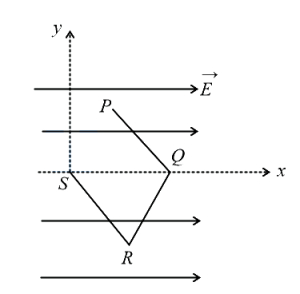
As shown in the figure below,a point charge $q$ moves from point $P$ to a point $S$ traversing a path $PQRS$ in a uniform electric field $\vec{E}$. The electric field is directed along a direction parallel to the $x$-axis. The coordinates of $P$,$Q$,$R$,and $S$ are $(a, b, 0)$,$(2a, 0, 0)$,$(a, -b, 0)$,and $(0, 0, 0)$ respectively. What is the work done by the field in the process?
A
$q E a$
B
$-q E a$
C
$0$
D
$q E b$
Solution
(B) The electric field is uniform and directed along the positive $x$-axis,so $\vec{E} = E \hat{i}$.
The electric force on the charge $q$ is $\vec{F} = q \vec{E} = q E \hat{i}$.
Since the electric force is a conservative force,the work done depends only on the initial and final positions,not on the path taken.
The initial position is $P(a, b, 0)$ and the final position is $S(0, 0, 0)$.
The displacement vector is $\vec{d} = \vec{S} - \vec{P} = (0 - a) \hat{i} + (0 - b) \hat{j} + (0 - 0) \hat{k} = -a \hat{i} - b \hat{j}$.
The work done by the electric field is $W = \vec{F} \cdot \vec{d}$.
$W = (q E \hat{i}) \cdot (-a \hat{i} - b \hat{j}) = -q E a (\hat{i} \cdot \hat{i}) - q E b (\hat{i} \cdot \hat{j})$.
Since $\hat{i} \cdot \hat{i} = 1$ and $\hat{i} \cdot \hat{j} = 0$,we get $W = -q E a$.
The electric force on the charge $q$ is $\vec{F} = q \vec{E} = q E \hat{i}$.
Since the electric force is a conservative force,the work done depends only on the initial and final positions,not on the path taken.
The initial position is $P(a, b, 0)$ and the final position is $S(0, 0, 0)$.
The displacement vector is $\vec{d} = \vec{S} - \vec{P} = (0 - a) \hat{i} + (0 - b) \hat{j} + (0 - 0) \hat{k} = -a \hat{i} - b \hat{j}$.
The work done by the electric field is $W = \vec{F} \cdot \vec{d}$.
$W = (q E \hat{i}) \cdot (-a \hat{i} - b \hat{j}) = -q E a (\hat{i} \cdot \hat{i}) - q E b (\hat{i} \cdot \hat{j})$.
Since $\hat{i} \cdot \hat{i} = 1$ and $\hat{i} \cdot \hat{j} = 0$,we get $W = -q E a$.
0 likes
View Solution184
DifficultMCQ
$A$ block of mass $m$ and charge $q$ is connected to a point $O$ with an inextensible string. This system is on a horizontal table. An electric field $E$ is applied perpendicular to the string and in the plane of the horizontal table. The tension in the string when it becomes parallel to the electric field is
A
$qE$
B
$2qE$
C
$\frac{3qE}{4}$
D
$3qE$
Solution
(D) Let the length of the string be $L$.
Using the work-energy theorem,the work done by the electric force is equal to the change in kinetic energy:
$W = \Delta K
\Rightarrow qEL = \frac{1}{2}mv^2 - 0
\Rightarrow v^2 = \frac{2qEL}{m}$.
When the string becomes parallel to the electric field,the forces acting on the block are the tension $T$ (inward) and the electric force $qE$ (outward).
The net centripetal force is given by:
$T - qE = \frac{mv^2}{L}$.
Substituting the value of $v^2$:
$T = qE + \frac{m}{L} \left( \frac{2qEL}{m} \right)
\Rightarrow T = qE + 2qE
\Rightarrow T = 3qE$.
Using the work-energy theorem,the work done by the electric force is equal to the change in kinetic energy:
$W = \Delta K
\Rightarrow qEL = \frac{1}{2}mv^2 - 0
\Rightarrow v^2 = \frac{2qEL}{m}$.
When the string becomes parallel to the electric field,the forces acting on the block are the tension $T$ (inward) and the electric force $qE$ (outward).
The net centripetal force is given by:
$T - qE = \frac{mv^2}{L}$.
Substituting the value of $v^2$:
$T = qE + \frac{m}{L} \left( \frac{2qEL}{m} \right)
\Rightarrow T = qE + 2qE
\Rightarrow T = 3qE$.
0 likes
View Solution185
DifficultMCQ
An oil drop having a mass $4.8 \times 10^{-13} \,kg$ and charge $2.4 \times 10^{-18} \,C$ stands still between two charged horizontal plates separated by a distance of $1 \,cm$. If now the polarity of the plates is changed,the instantaneous acceleration of the drop is: $(g = 10 \,m/s^2)$ (in $\,m/s^2$)
A
$5$
B
$10$
C
$15$
D
$20$
Solution
(D) Initially,the oil drop is in equilibrium,so the electric force balances the gravitational force: $qE = mg$.
Here,$m = 4.8 \times 10^{-10} \,g = 4.8 \times 10^{-13} \,kg$,$q = 2.4 \times 10^{-18} \,C$,and $g = 10 \,m/s^2$.
When the polarity of the plates is changed,the direction of the electric force $qE$ reverses and acts downwards along with the gravitational force $mg$.
The new net force on the drop is $F_{net} = qE + mg$.
Since $qE = mg$,we have $F_{net} = mg + mg = 2mg$.
The instantaneous acceleration $a$ is given by $a = \frac{F_{net}}{m} = \frac{2mg}{m} = 2g$.
Substituting $g = 10 \,m/s^2$,we get $a = 2 \times 10 = 20 \,m/s^2$.
Here,$m = 4.8 \times 10^{-10} \,g = 4.8 \times 10^{-13} \,kg$,$q = 2.4 \times 10^{-18} \,C$,and $g = 10 \,m/s^2$.
When the polarity of the plates is changed,the direction of the electric force $qE$ reverses and acts downwards along with the gravitational force $mg$.
The new net force on the drop is $F_{net} = qE + mg$.
Since $qE = mg$,we have $F_{net} = mg + mg = 2mg$.
The instantaneous acceleration $a$ is given by $a = \frac{F_{net}}{m} = \frac{2mg}{m} = 2g$.
Substituting $g = 10 \,m/s^2$,we get $a = 2 \times 10 = 20 \,m/s^2$.
0 likes
View Solution186
DifficultMCQ
$A$ particle of mass $m$ and charge $q$ is thrown perpendicular to an electric field of intensity $E$ with an initial velocity $v$. The particle moves a distance $x$ perpendicular to the field and a distance $y$ along the direction of the field. If $y = \alpha x^{2}$,then $\alpha$ is given by:
A
$\frac{qE}{m}$
B
$\frac{qEv^{2}}{m}$
C
$\frac{2qE}{mv^{2}}$
D
$\frac{qE}{2mv^{2}}$
Solution
(D) The force acting on the particle in the electric field is $F = qE$.
According to Newton's second law,the acceleration of the particle in the direction of the field is $a = \frac{F}{m} = \frac{qE}{m}$.
Since the particle is thrown perpendicular to the field,the initial velocity component in the direction of the field is $0$.
Along the $x$-direction (perpendicular to the field),there is no acceleration,so the velocity remains constant at $v$. Thus,the distance covered in time $t$ is $x = vt$,which gives $t = \frac{x}{v}$.
Along the $y$-direction (parallel to the field),using the second equation of motion $y = u_y t + \frac{1}{2} a_y t^2$,where $u_y = 0$ and $a_y = a = \frac{qE}{m}$,we get:
$y = 0 + \frac{1}{2} \left( \frac{qE}{m} \right) \left( \frac{x}{v} \right)^2$.
$y = \frac{qE}{2mv^2} x^2$.
Comparing this with the given equation $y = \alpha x^2$,we find $\alpha = \frac{qE}{2mv^2}$.
According to Newton's second law,the acceleration of the particle in the direction of the field is $a = \frac{F}{m} = \frac{qE}{m}$.
Since the particle is thrown perpendicular to the field,the initial velocity component in the direction of the field is $0$.
Along the $x$-direction (perpendicular to the field),there is no acceleration,so the velocity remains constant at $v$. Thus,the distance covered in time $t$ is $x = vt$,which gives $t = \frac{x}{v}$.
Along the $y$-direction (parallel to the field),using the second equation of motion $y = u_y t + \frac{1}{2} a_y t^2$,where $u_y = 0$ and $a_y = a = \frac{qE}{m}$,we get:
$y = 0 + \frac{1}{2} \left( \frac{qE}{m} \right) \left( \frac{x}{v} \right)^2$.
$y = \frac{qE}{2mv^2} x^2$.
Comparing this with the given equation $y = \alpha x^2$,we find $\alpha = \frac{qE}{2mv^2}$.
0 likes
View Solution187
DifficultMCQ
$A$ proton, a deuteron, and an $\alpha$-particle having the same momentum enter a region of uniform electric field between the parallel plates of a capacitor. The electric field is perpendicular to the initial path of the particles. Then the ratio of deflections suffered by them is
A
$1: 2: 8$
B
$1: 2: 4$
C
$1: 1: 2$
D
None of these
Solution
(A) The deflection $y$ of a charged particle moving with velocity $u$ in a uniform electric field $E$ over a distance $L$ is given by $y = \frac{1}{2} a t^2 = \frac{1}{2} (\frac{qE}{m}) (\frac{L}{u})^2 = \frac{qEL^2}{2mu^2}$.
Since momentum $p = mu$, we have $u = p/m$. Substituting this, $y = \frac{qEL^2}{2m(p/m)^2} = \frac{qEL^2m}{2p^2}$.
Given that $E, L,$ and $p$ are constant for all particles, the deflection $y \propto qm$.
For a proton $(p)$, deuteron $(d)$, and $\alpha$-particle $(\alpha)$:
Charge ratio: $q_p : q_d : q_\alpha = 1 : 1 : 2$.
Mass ratio: $m_p : m_d : m_\alpha = 1 : 2 : 4$.
Therefore, the ratio of deflections is $y_p : y_d : y_\alpha = (q_p m_p) : (q_d m_d) : (q_\alpha m_\alpha) = (1 \times 1) : (1 \times 2) : (2 \times 4) = 1 : 2 : 8$.
Since momentum $p = mu$, we have $u = p/m$. Substituting this, $y = \frac{qEL^2}{2m(p/m)^2} = \frac{qEL^2m}{2p^2}$.
Given that $E, L,$ and $p$ are constant for all particles, the deflection $y \propto qm$.
For a proton $(p)$, deuteron $(d)$, and $\alpha$-particle $(\alpha)$:
Charge ratio: $q_p : q_d : q_\alpha = 1 : 1 : 2$.
Mass ratio: $m_p : m_d : m_\alpha = 1 : 2 : 4$.
Therefore, the ratio of deflections is $y_p : y_d : y_\alpha = (q_p m_p) : (q_d m_d) : (q_\alpha m_\alpha) = (1 \times 1) : (1 \times 2) : (2 \times 4) = 1 : 2 : 8$.
0 likes
View Solution188
MediumMCQ
An electron and a positron enter a uniform electric field $E$ perpendicular to it with equal speeds at the same time. The distance of separation between them in the direction of the field after a time $t$ is (where $\frac{e}{m}$ is the specific charge of the electron).
A
$\frac{2 E e t^2}{m}$
B
$\frac{E e t^2}{m}$
C
$\frac{E e t^2}{2 m}$
D
Zero
Solution
(B) The force on a charge $q$ in an electric field $E$ is given by $F = qE$.
For an electron,$q = -e$,so the force is $F_e = -eE$. The acceleration is $a_e = \frac{-eE}{m}$.
For a positron,$q = +e$,so the force is $F_p = +eE$. The acceleration is $a_p = \frac{eE}{m}$.
Using the equation of motion $s = ut + \frac{1}{2}at^2$,and since the initial velocity in the direction of the field is zero $(u = 0)$:
Displacement of the electron in the field direction: $y_e = \frac{1}{2} a_e t^2 = -\frac{eE t^2}{2m}$.
Displacement of the positron in the field direction: $y_p = \frac{1}{2} a_p t^2 = \frac{eE t^2}{2m}$.
The separation distance between them in the direction of the field is $d = |y_p - y_e| = |\frac{eE t^2}{2m} - (-\frac{eE t^2}{2m})| = \frac{eE t^2}{m}$.
For an electron,$q = -e$,so the force is $F_e = -eE$. The acceleration is $a_e = \frac{-eE}{m}$.
For a positron,$q = +e$,so the force is $F_p = +eE$. The acceleration is $a_p = \frac{eE}{m}$.
Using the equation of motion $s = ut + \frac{1}{2}at^2$,and since the initial velocity in the direction of the field is zero $(u = 0)$:
Displacement of the electron in the field direction: $y_e = \frac{1}{2} a_e t^2 = -\frac{eE t^2}{2m}$.
Displacement of the positron in the field direction: $y_p = \frac{1}{2} a_p t^2 = \frac{eE t^2}{2m}$.
The separation distance between them in the direction of the field is $d = |y_p - y_e| = |\frac{eE t^2}{2m} - (-\frac{eE t^2}{2m})| = \frac{eE t^2}{m}$.
0 likes
View Solution189
MediumMCQ
If a particle of mass $10 \ mg$ and charge $2 \ \mu C$ at rest is subjected to a uniform electric field of potential difference $160 \ V$,then the velocity acquired by the particle is (in $ms^{-1}$)
A
$9$
B
$4$
C
$6$
D
$8$
Solution
(D) Given: Mass $m = 10 \ mg = 10 \times 10^{-6} \ kg = 10^{-5} \ kg$,Charge $q = 2 \ \mu C = 2 \times 10^{-6} \ C$,Potential difference $V = 160 \ V$.
According to the work-energy theorem,the work done by the electric field is equal to the change in kinetic energy of the particle.
$W = \Delta K$
$qV = \frac{1}{2}mv^2 - 0$
$v^2 = \frac{2qV}{m}$
$v^2 = \frac{2 \times (2 \times 10^{-6} \ C) \times 160 \ V}{10^{-5} \ kg}$
$v^2 = \frac{640 \times 10^{-6}}{10^{-5}} = 640 \times 10^{-1} = 64$
$v = \sqrt{64} = 8 \ ms^{-1}$.
According to the work-energy theorem,the work done by the electric field is equal to the change in kinetic energy of the particle.
$W = \Delta K$
$qV = \frac{1}{2}mv^2 - 0$
$v^2 = \frac{2qV}{m}$
$v^2 = \frac{2 \times (2 \times 10^{-6} \ C) \times 160 \ V}{10^{-5} \ kg}$
$v^2 = \frac{640 \times 10^{-6}}{10^{-5}} = 640 \times 10^{-1} = 64$
$v = \sqrt{64} = 8 \ ms^{-1}$.
0 likes
View Solution190
MediumMCQ
An alpha particle and a proton are accelerated from rest in a uniform electric field. The ratio of the times taken by proton and alpha particle to attain equal displacements is
A
$1: 2\sqrt{2}$
B
$1: 2$
C
$1: \sqrt{2}$
D
$1: 1$
Solution
(C) The acceleration $a$ of a particle of charge $q$ and mass $m$ in a uniform electric field $E$ is given by $a = \frac{qE}{m}$.
Using the equation of motion $s = ut + \frac{1}{2}at^2$,since the particles start from rest $(u = 0)$,we have $s = \frac{1}{2}at^2$.
Thus,$t = \sqrt{\frac{2s}{a}} = \sqrt{\frac{2sm}{qE}}$.
For equal displacements $s$,the time $t$ is proportional to $\sqrt{\frac{m}{q}}$.
Let $m_p$ and $q_p$ be the mass and charge of the proton,and $m_\alpha$ and $q_\alpha$ be the mass and charge of the alpha particle.
We know $m_\alpha = 4m_p$ and $q_\alpha = 2q_p$.
The ratio of times is $\frac{t_p}{t_\alpha} = \sqrt{\frac{m_p}{q_p} \cdot \frac{q_\alpha}{m_\alpha}} = \sqrt{\frac{m_p}{q_p} \cdot \frac{2q_p}{4m_p}} = \sqrt{\frac{2}{4}} = \sqrt{\frac{1}{2}} = \frac{1}{\sqrt{2}}$.
Using the equation of motion $s = ut + \frac{1}{2}at^2$,since the particles start from rest $(u = 0)$,we have $s = \frac{1}{2}at^2$.
Thus,$t = \sqrt{\frac{2s}{a}} = \sqrt{\frac{2sm}{qE}}$.
For equal displacements $s$,the time $t$ is proportional to $\sqrt{\frac{m}{q}}$.
Let $m_p$ and $q_p$ be the mass and charge of the proton,and $m_\alpha$ and $q_\alpha$ be the mass and charge of the alpha particle.
We know $m_\alpha = 4m_p$ and $q_\alpha = 2q_p$.
The ratio of times is $\frac{t_p}{t_\alpha} = \sqrt{\frac{m_p}{q_p} \cdot \frac{q_\alpha}{m_\alpha}} = \sqrt{\frac{m_p}{q_p} \cdot \frac{2q_p}{4m_p}} = \sqrt{\frac{2}{4}} = \sqrt{\frac{1}{2}} = \frac{1}{\sqrt{2}}$.
0 likes
View Solution191
EasyMCQ
$A$ small block of mass $5 \, g$ and charge $5 \, \mu C$ is placed on an insulated, frictionless, inclined plane of angle $60^{\circ}$. An electric field is applied parallel to the inclined plane. If the block remains at rest, then the magnitude of the electric field is (Take $g = 10 \, m/s^2$):
A
$\frac{10^5}{\sqrt{3}} \, N/C$
B
$\frac{5}{\sqrt{3}} \times 10^4 \, N/C$
C
$\frac{\sqrt{3}}{2} \times 10^4 \, N/C$
D
$2 \times 10^4 \, N/C$
Solution
(C) For the block to remain at rest on a frictionless inclined plane, the component of gravitational force acting down the plane must be balanced by the electric force acting up the plane.
$mg \sin \theta = qE$
$E = \frac{mg \sin \theta}{q}$
Given: $m = 5 \, g = 5 \times 10^{-3} \, kg$, $q = 5 \, \mu C = 5 \times 10^{-6} \, C$, $\theta = 60^{\circ}$, $g = 10 \, m/s^2$.
$E = \frac{5 \times 10^{-3} \times 10 \times \sin(60^{\circ})}{5 \times 10^{-6}}$
$E = \frac{5 \times 10^{-2} \times \frac{\sqrt{3}}{2}}{5 \times 10^{-6}}$
$E = 10^4 \times \frac{\sqrt{3}}{2} \, N/C$
Thus, the magnitude of the electric field is $\frac{\sqrt{3}}{2} \times 10^4 \, N/C$.
$mg \sin \theta = qE$
$E = \frac{mg \sin \theta}{q}$
Given: $m = 5 \, g = 5 \times 10^{-3} \, kg$, $q = 5 \, \mu C = 5 \times 10^{-6} \, C$, $\theta = 60^{\circ}$, $g = 10 \, m/s^2$.
$E = \frac{5 \times 10^{-3} \times 10 \times \sin(60^{\circ})}{5 \times 10^{-6}}$
$E = \frac{5 \times 10^{-2} \times \frac{\sqrt{3}}{2}}{5 \times 10^{-6}}$
$E = 10^4 \times \frac{\sqrt{3}}{2} \, N/C$
Thus, the magnitude of the electric field is $\frac{\sqrt{3}}{2} \times 10^4 \, N/C$.
0 likes
View Solution192
EasyMCQ
If a proton is moved against the Coulomb force of an electric field,then
A
work is done by the electric field
B
energy is used from some outside source
C
the strength of the field is decreased
D
the strength of the field is increased
Solution
(B) proton is a positively charged particle. When placed in an electric field $E$,it experiences an electrostatic force $F = qE$ in the direction of the electric field.
To move the proton against this Coulomb force,an external force must be applied to perform work on the proton.
Since the electric field naturally pushes the proton in its own direction,moving it in the opposite direction requires an external agency to supply energy to the system.
Therefore,energy is used from some outside source to perform this work.
To move the proton against this Coulomb force,an external force must be applied to perform work on the proton.
Since the electric field naturally pushes the proton in its own direction,moving it in the opposite direction requires an external agency to supply energy to the system.
Therefore,energy is used from some outside source to perform this work.

0 likes
View Solution193
DifficultMCQ
There is a uniform electric field of strength $10^3 \ Vm^{-1}$ along the $Y$-axis. $A$ body of mass $1 \ g$ and charge $10^{-6} \ C$ is projected into the field from the origin along the positive $X$-axis with a velocity of $10 \ ms^{-1}$. Its speed in $ms^{-1}$ after $10 \ s$ is (Neglect gravitation).
A
$10$
B
$5 \sqrt{2}$
C
$10 \sqrt{2}$
D
$20$
Solution
(C) Given: Electric field $E = 10^3 \ Vm^{-1}$ along $Y$-axis,mass $m = 1 \ g = 10^{-3} \ kg$,charge $q = 10^{-6} \ C$,initial velocity $u_x = 10 \ ms^{-1}$ along $X$-axis.
The force on the charge is $F = qE = 10^{-6} \times 10^3 = 10^{-3} \ N$ along the $Y$-axis.
The acceleration along the $Y$-axis is $a_y = F/m = 10^{-3} / 10^{-3} = 1 \ ms^{-2}$.
The velocity along the $X$-axis remains constant as there is no force in that direction: $v_x = u_x = 10 \ ms^{-1}$.
The velocity along the $Y$-axis after $t = 10 \ s$ is $v_y = u_y + a_y t = 0 + 1 \times 10 = 10 \ ms^{-1}$.
The final speed is $v = \sqrt{v_x^2 + v_y^2} = \sqrt{10^2 + 10^2} = \sqrt{200} = 10 \sqrt{2} \ ms^{-1}$.
The force on the charge is $F = qE = 10^{-6} \times 10^3 = 10^{-3} \ N$ along the $Y$-axis.
The acceleration along the $Y$-axis is $a_y = F/m = 10^{-3} / 10^{-3} = 1 \ ms^{-2}$.
The velocity along the $X$-axis remains constant as there is no force in that direction: $v_x = u_x = 10 \ ms^{-1}$.
The velocity along the $Y$-axis after $t = 10 \ s$ is $v_y = u_y + a_y t = 0 + 1 \times 10 = 10 \ ms^{-1}$.
The final speed is $v = \sqrt{v_x^2 + v_y^2} = \sqrt{10^2 + 10^2} = \sqrt{200} = 10 \sqrt{2} \ ms^{-1}$.

0 likes
View Solution194
MediumMCQ
$A$ particle of mass $m$ and charge $q$ travelling with a velocity $v$ along the $x$-axis enters a uniform electric field $\overrightarrow{E}$ directed along the $y$-axis. What will be the trajectory of the particle?
A
Circular
B
Elliptical
C
Parabolic
D
Helical
Solution
(C) The particle moves with constant velocity $v$ along the $x$-axis,so $x = vt$,which implies $t = x/v$.
Along the $y$-axis,the particle experiences a constant force $F = qE$,leading to an acceleration $a = qE/m$.
Using the kinematic equation $y = u_y t + \frac{1}{2} a_y t^2$,where $u_y = 0$:
$y = \frac{1}{2} (\frac{qE}{m}) (\frac{x}{v})^2 = (\frac{qE}{2mv^2}) x^2$.
This equation is of the form $y = kx^2$,which represents a parabola.
Therefore,the trajectory of the particle is parabolic.
Along the $y$-axis,the particle experiences a constant force $F = qE$,leading to an acceleration $a = qE/m$.
Using the kinematic equation $y = u_y t + \frac{1}{2} a_y t^2$,where $u_y = 0$:
$y = \frac{1}{2} (\frac{qE}{m}) (\frac{x}{v})^2 = (\frac{qE}{2mv^2}) x^2$.
This equation is of the form $y = kx^2$,which represents a parabola.
Therefore,the trajectory of the particle is parabolic.
0 likes
View Solution195
DifficultMCQ
$A$ proton and an $\alpha$-particle are both accelerated from rest in a uniform electric field. The ratio of work done by the electric field on the proton and the $\alpha$-particle in a given time is
A
$1: 1$
B
$1: 2$
C
$1: 4$
D
$4: 1$
Solution
(A) The acceleration of a charged particle in a uniform electric field $E$ is given by $a = \frac{qE}{m}$.
Since the particles start from rest $(u = 0)$,the velocity after time $t$ is $v = at = \left(\frac{qE}{m}\right)t$.
According to the work-energy theorem,the work done $W$ by the electric field is equal to the change in kinetic energy $\Delta K$:
$W = \Delta K = \frac{1}{2}mv^2$.
Substituting the expression for $v$:
$W = \frac{1}{2}m\left(\frac{qEt}{m}\right)^2 = \frac{q^2 E^2 t^2}{2m}$.
Since $E$ and $t$ are the same for both particles,$W \propto \frac{q^2}{m}$.
For a proton,$q_p = e$ and $m_p = m$. For an $\alpha$-particle,$q_\alpha = 2e$ and $m_\alpha = 4m$.
Therefore,the ratio is:
$\frac{W_p}{W_\alpha} = \left(\frac{q_p}{q_\alpha}\right)^2 \left(\frac{m_\alpha}{m_p}\right) = \left(\frac{e}{2e}\right)^2 \left(\frac{4m}{m}\right) = \left(\frac{1}{4}\right) \times 4 = 1: 1$.
Since the particles start from rest $(u = 0)$,the velocity after time $t$ is $v = at = \left(\frac{qE}{m}\right)t$.
According to the work-energy theorem,the work done $W$ by the electric field is equal to the change in kinetic energy $\Delta K$:
$W = \Delta K = \frac{1}{2}mv^2$.
Substituting the expression for $v$:
$W = \frac{1}{2}m\left(\frac{qEt}{m}\right)^2 = \frac{q^2 E^2 t^2}{2m}$.
Since $E$ and $t$ are the same for both particles,$W \propto \frac{q^2}{m}$.
For a proton,$q_p = e$ and $m_p = m$. For an $\alpha$-particle,$q_\alpha = 2e$ and $m_\alpha = 4m$.
Therefore,the ratio is:
$\frac{W_p}{W_\alpha} = \left(\frac{q_p}{q_\alpha}\right)^2 \left(\frac{m_\alpha}{m_p}\right) = \left(\frac{e}{2e}\right)^2 \left(\frac{4m}{m}\right) = \left(\frac{1}{4}\right) \times 4 = 1: 1$.
0 likes
View Solution196
MediumMCQ
Consider a particle of mass $1 \text{ g}$ and charge $1.0 \text{ C}$ is at rest. Now the particle is subjected to an electric field $E(t) = E_0 \sin(\omega t)$ in the $x$-direction,where $E_0 = 2 \text{ N/C}$ and $\omega = 1000 \text{ rad/s}$. The maximum speed attained by the particle is: (in $\text{ m/s}$)
A
$2$
B
$4$
C
$6$
D
$8$
Solution
(B) The force on the particle is $F = qE = qE_0 \sin(\omega t)$.
Using Newton's second law,$ma = qE_0 \sin(\omega t)$,so $a = \frac{qE_0}{m} \sin(\omega t)$.
The velocity $v(t)$ is the integral of acceleration: $v(t) = \int a \, dt = \int \frac{qE_0}{m} \sin(\omega t) \, dt = -\frac{qE_0}{m\omega} \cos(\omega t) + C$.
Since the particle starts from rest at $t = 0$,$v(0) = 0$,which gives $C = \frac{qE_0}{m\omega}$.
Thus,$v(t) = \frac{qE_0}{m\omega} (1 - \cos(\omega t))$.
The maximum speed occurs when $\cos(\omega t) = -1$,so $v_{\max} = \frac{2qE_0}{m\omega}$.
Substituting the values: $q = 1 \text{ C}$,$E_0 = 2 \text{ N/C}$,$m = 1 \text{ g} = 10^{-3} \text{ kg}$,and $\omega = 1000 \text{ rad/s}$.
$v_{\max} = \frac{2 \times 1 \times 2}{10^{-3} \times 1000} = \frac{4}{1} = 4 \text{ m/s}$.
Using Newton's second law,$ma = qE_0 \sin(\omega t)$,so $a = \frac{qE_0}{m} \sin(\omega t)$.
The velocity $v(t)$ is the integral of acceleration: $v(t) = \int a \, dt = \int \frac{qE_0}{m} \sin(\omega t) \, dt = -\frac{qE_0}{m\omega} \cos(\omega t) + C$.
Since the particle starts from rest at $t = 0$,$v(0) = 0$,which gives $C = \frac{qE_0}{m\omega}$.
Thus,$v(t) = \frac{qE_0}{m\omega} (1 - \cos(\omega t))$.
The maximum speed occurs when $\cos(\omega t) = -1$,so $v_{\max} = \frac{2qE_0}{m\omega}$.
Substituting the values: $q = 1 \text{ C}$,$E_0 = 2 \text{ N/C}$,$m = 1 \text{ g} = 10^{-3} \text{ kg}$,and $\omega = 1000 \text{ rad/s}$.
$v_{\max} = \frac{2 \times 1 \times 2}{10^{-3} \times 1000} = \frac{4}{1} = 4 \text{ m/s}$.
0 likes
View Solution197
DifficultMCQ
$A$ pair of parallel metal plates are kept with a separation $d$. One plate is at a potential $+V$ and the other is at ground potential. $A$ narrow beam of electrons enters the space between the plates with a velocity $v_{0}$ and in a direction parallel to the plates. What will be the angle of the beam with the plates after it travels an axial distance $L$?
A
$\tan ^{-1}\left(\frac{eVL}{mdv_{0}}\right)$
B
$\tan ^{-1}\left(\frac{eVL}{mdv_{0}^{2}}\right)$
C
$\sin ^{-1}\left(\frac{eVL}{mdv_{0}}\right)$
D
$\cos ^{-1}\left(\frac{eVL}{mdv_{0}^{2}}\right)$
Solution
(B) The electric field between the plates is $E = \frac{V}{d}$.
The force on an electron of charge $e$ is $F = eE = \frac{eV}{d}$.
The acceleration of the electron in the transverse direction ($y$-axis) is $a_y = \frac{F}{m} = \frac{eV}{md}$.
The time taken to travel an axial distance $L$ with constant horizontal velocity $v_0$ is $t = \frac{L}{v_0}$.
The transverse velocity $v_y$ acquired after time $t$ is $v_y = a_y t = \left(\frac{eV}{md}\right) \left(\frac{L}{v_0}\right) = \frac{eVL}{mdv_0}$.
The horizontal velocity remains constant at $v_x = v_0$.
The angle $\theta$ that the beam makes with the plates is given by $\tan \theta = \frac{v_y}{v_x}$.
Substituting the values,$\tan \theta = \frac{eVL / mdv_0}{v_0} = \frac{eVL}{mdv_0^2}$.
Therefore,$\theta = \tan ^{-1}\left(\frac{eVL}{mdv_0^2}\right)$.
The force on an electron of charge $e$ is $F = eE = \frac{eV}{d}$.
The acceleration of the electron in the transverse direction ($y$-axis) is $a_y = \frac{F}{m} = \frac{eV}{md}$.
The time taken to travel an axial distance $L$ with constant horizontal velocity $v_0$ is $t = \frac{L}{v_0}$.
The transverse velocity $v_y$ acquired after time $t$ is $v_y = a_y t = \left(\frac{eV}{md}\right) \left(\frac{L}{v_0}\right) = \frac{eVL}{mdv_0}$.
The horizontal velocity remains constant at $v_x = v_0$.
The angle $\theta$ that the beam makes with the plates is given by $\tan \theta = \frac{v_y}{v_x}$.
Substituting the values,$\tan \theta = \frac{eVL / mdv_0}{v_0} = \frac{eVL}{mdv_0^2}$.
Therefore,$\theta = \tan ^{-1}\left(\frac{eVL}{mdv_0^2}\right)$.
0 likes
View SolutionElectric Charges and Fields — Motion of Charge particle in Electric filed · Frequently Asked Questions
1Are these Electric Charges and Fields questions useful for JEE and NEET?
Yes. All questions in this section are mapped to JEE Main and NEET exam patterns. Previous year questions from JEE Main, NEET, GUJCET and state-level exams are included with full solutions.
2Can I switch to Hindi or Gujarati for these questions?
Yes. Use the language tabs in the hero section or the sidebar to view the same questions and solutions in English, Hindi or Gujarati.
3How do I generate a question paper from this subtopic?
Use the Vedclass Exam Paper Generator — select the chapter and subtopic, set difficulty, and generate Sets A, B, C, D automatically. First 3 chapters of every subject are free.
Vedclass Products
For Students
Vedclass Test Series
Mock tests in real JEE/NEET style with performance analysis. 5-day free trial.
Start Free TrialFor Teachers
Exam Paper Generator
Generate Set A/B/C/D papers from this chapter in 2 minutes. 3 chapters free.
Try FreeFor Institutes
Online Exam Module
Live online exams with unlimited students, 360° analytics & white-label branding.
See DemoFor Teachers & Institutes
Generate a Electric Charges and Fields Exam Paper in 2 Minutes
Select subtopic & difficulty — Sets A, B, C, D auto-generated with No Repeat logic.
First 3 chapters of every subject are free — no payment required.