
A English
Matter Waves and de Broglie Wavelength Questions in English
Class 12 Physics · Dual Nature of Radiation and matter · Matter Waves and de Broglie Wavelength
437+
Questions
English
Language
100%
With Solutions
Showing 50 of 437 questions in English
151
DifficultMCQ
The wavelength of a photon is equal to the wavelength of an electron moving with a kinetic energy of $1.5 \, eV$. What is the energy of the photon?
A
$1.5 \, eV$
B
$12.25 \, eV$
C
$1.24 \, keV$
D
$1.24 \, eV$
Solution
(C) The de Broglie wavelength of an electron with kinetic energy $K$ is given by $\lambda_e = \frac{h}{p} = \frac{h}{\sqrt{2mK}}$.
For an electron,$\lambda_e \approx \frac{12.27}{\sqrt{K}} \, \mathring{A}$,where $K$ is in $eV$.
Given $K = 1.5 \, eV$,we have $\lambda_e = \frac{12.27}{\sqrt{1.5}} \, \mathring{A}$.
The wavelength of a photon is given by $\lambda_p = \frac{hc}{E_p}$.
Since $\lambda_p = \lambda_e$,we have $\frac{hc}{E_p} = \frac{12.27}{\sqrt{1.5}} \, \mathring{A}$.
Using $hc \approx 12400 \, eV \cdot \mathring{A}$,we get $E_p = \frac{12400 \cdot \sqrt{1.5}}{12.27} \, eV$.
$E_p \approx \frac{12400 \cdot 1.2247}{12.27} \approx 1237.5 \, eV \approx 1.24 \, keV$.
For an electron,$\lambda_e \approx \frac{12.27}{\sqrt{K}} \, \mathring{A}$,where $K$ is in $eV$.
Given $K = 1.5 \, eV$,we have $\lambda_e = \frac{12.27}{\sqrt{1.5}} \, \mathring{A}$.
The wavelength of a photon is given by $\lambda_p = \frac{hc}{E_p}$.
Since $\lambda_p = \lambda_e$,we have $\frac{hc}{E_p} = \frac{12.27}{\sqrt{1.5}} \, \mathring{A}$.
Using $hc \approx 12400 \, eV \cdot \mathring{A}$,we get $E_p = \frac{12400 \cdot \sqrt{1.5}}{12.27} \, eV$.
$E_p \approx \frac{12400 \cdot 1.2247}{12.27} \approx 1237.5 \, eV \approx 1.24 \, keV$.
0 likes
View Solution152
DifficultMCQ
If the kinetic energy of the particle is increased by $16$ times,the percentage change in the de Broglie wavelength of the particle is ............$\%$
A
$25$
B
$75$
C
$60$
D
$50$
Solution
(B) The de Broglie wavelength $\lambda$ is given by the formula $\lambda = \frac{h}{\sqrt{2mK}}$,where $h$ is Planck's constant,$m$ is the mass of the particle,and $K$ is the kinetic energy.
From this relation,we see that $\lambda \propto \frac{1}{\sqrt{K}}$.
Let the initial kinetic energy be $K_1 = K$ and the final kinetic energy be $K_2 = 16K$.
Then,the ratio of the wavelengths is $\frac{\lambda_2}{\lambda_1} = \sqrt{\frac{K_1}{K_2}} = \sqrt{\frac{K}{16K}} = \sqrt{\frac{1}{16}} = \frac{1}{4} = 0.25$.
So,$\lambda_2 = 0.25 \lambda_1$.
The percentage change in wavelength is given by $\frac{\lambda_1 - \lambda_2}{\lambda_1} \times 100\%$.
Substituting the values,we get $\frac{\lambda_1 - 0.25 \lambda_1}{\lambda_1} \times 100\% = 0.75 \times 100\% = 75\%$.
From this relation,we see that $\lambda \propto \frac{1}{\sqrt{K}}$.
Let the initial kinetic energy be $K_1 = K$ and the final kinetic energy be $K_2 = 16K$.
Then,the ratio of the wavelengths is $\frac{\lambda_2}{\lambda_1} = \sqrt{\frac{K_1}{K_2}} = \sqrt{\frac{K}{16K}} = \sqrt{\frac{1}{16}} = \frac{1}{4} = 0.25$.
So,$\lambda_2 = 0.25 \lambda_1$.
The percentage change in wavelength is given by $\frac{\lambda_1 - \lambda_2}{\lambda_1} \times 100\%$.
Substituting the values,we get $\frac{\lambda_1 - 0.25 \lambda_1}{\lambda_1} \times 100\% = 0.75 \times 100\% = 75\%$.
0 likes
View Solution153
DifficultMCQ
If the kinetic energy of a particle is increased by $16$ times, the percentage change in the de Broglie wavelength of the particle is......... $\%$
A
$25$
B
$75$
C
$60$
D
$50$
Solution
(B) The de Broglie wavelength $\lambda$ is given by the formula $\lambda = \frac{h}{\sqrt{2mK}}$, where $h$ is Planck's constant, $m$ is the mass of the particle, and $K$ is the kinetic energy.
From this relation, we see that $\lambda \propto \frac{1}{\sqrt{K}}$.
Let the initial kinetic energy be $K_1 = K$ and the final kinetic energy be $K_2 = 16K$.
The ratio of the wavelengths is $\frac{\lambda_2}{\lambda_1} = \sqrt{\frac{K_1}{K_2}} = \sqrt{\frac{K}{16K}} = \sqrt{\frac{1}{16}} = \frac{1}{4} = 0.25$.
Thus, $\lambda_2 = 0.25\lambda_1$.
The percentage change in wavelength is given by $\frac{\lambda_1 - \lambda_2}{\lambda_1} \times 100\%$.
Substituting the values, we get $\frac{\lambda_1 - 0.25\lambda_1}{\lambda_1} \times 100\% = 0.75 \times 100\% = 75\%$.
From this relation, we see that $\lambda \propto \frac{1}{\sqrt{K}}$.
Let the initial kinetic energy be $K_1 = K$ and the final kinetic energy be $K_2 = 16K$.
The ratio of the wavelengths is $\frac{\lambda_2}{\lambda_1} = \sqrt{\frac{K_1}{K_2}} = \sqrt{\frac{K}{16K}} = \sqrt{\frac{1}{16}} = \frac{1}{4} = 0.25$.
Thus, $\lambda_2 = 0.25\lambda_1$.
The percentage change in wavelength is given by $\frac{\lambda_1 - \lambda_2}{\lambda_1} \times 100\%$.
Substituting the values, we get $\frac{\lambda_1 - 0.25\lambda_1}{\lambda_1} \times 100\% = 0.75 \times 100\% = 75\%$.
0 likes
View Solution154
DifficultMCQ
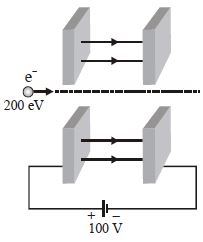
Two large parallel plates are connected to a $100 \, V$ power supply. These plates have a fine hole at the centre. An electron having energy $200 \, eV$ is directed such that it passes through the holes. When it emerges, its de-Broglie wavelength is ............. $\mathring{A}$
A
$1.22 \, \mathring{A}$
B
$1.75 \, \mathring{A}$
C
$2 \, \mathring{A}$
D
None of these
Solution
(A) The electron enters the region between the plates with an initial kinetic energy of $200 \, eV$.
Since the plates are connected to a $100 \, V$ power supply, there is an electric field between them. Based on the diagram, the electron moves against the electric field (from positive to negative plate), which acts as a retarding potential.
Therefore, the final kinetic energy of the electron when it emerges from the second plate is $K_f = 200 \, eV - 100 \, eV = 100 \, eV$.
The de-Broglie wavelength $\lambda$ is given by the formula $\lambda = \frac{12.27}{\sqrt{V}} \, \mathring{A}$, where $V$ is the kinetic energy in $eV$.
Substituting $V = 100 \, eV$:
$\lambda = \frac{12.27}{\sqrt{100}} = \frac{12.27}{10} = 1.227 \, \mathring{A} \approx 1.22 \, \mathring{A}$.
Since the plates are connected to a $100 \, V$ power supply, there is an electric field between them. Based on the diagram, the electron moves against the electric field (from positive to negative plate), which acts as a retarding potential.
Therefore, the final kinetic energy of the electron when it emerges from the second plate is $K_f = 200 \, eV - 100 \, eV = 100 \, eV$.
The de-Broglie wavelength $\lambda$ is given by the formula $\lambda = \frac{12.27}{\sqrt{V}} \, \mathring{A}$, where $V$ is the kinetic energy in $eV$.
Substituting $V = 100 \, eV$:
$\lambda = \frac{12.27}{\sqrt{100}} = \frac{12.27}{10} = 1.227 \, \mathring{A} \approx 1.22 \, \mathring{A}$.
0 likes
View Solution155
DifficultMCQ
The energy that should be added to an electron to reduce its de Broglie wavelength from $1 \, nm$ to $0.5 \, nm$ is
A
Four times the initial energy
B
Equal to the initial energy
C
Twice the initial energy
D
Thrice the initial energy
Solution
(D) The de Broglie wavelength $\lambda$ is related to the kinetic energy $E$ by the formula: $\lambda = \frac{h}{\sqrt{2mE}}$.
From this,we can see that $\lambda \propto \frac{1}{\sqrt{E}}$,which implies $\frac{\lambda'}{\lambda} = \sqrt{\frac{E}{E'}}$.
Given $\lambda = 1 \, nm$ and $\lambda' = 0.5 \, nm$,we have $\frac{0.5}{1} = \sqrt{\frac{E}{E'}}$.
Squaring both sides,we get $\frac{1}{4} = \frac{E}{E'}$,which means $E' = 4E$.
The energy that should be added is $\Delta E = E' - E = 4E - E = 3E$.
Therefore,the energy to be added is thrice the initial energy.
From this,we can see that $\lambda \propto \frac{1}{\sqrt{E}}$,which implies $\frac{\lambda'}{\lambda} = \sqrt{\frac{E}{E'}}$.
Given $\lambda = 1 \, nm$ and $\lambda' = 0.5 \, nm$,we have $\frac{0.5}{1} = \sqrt{\frac{E}{E'}}$.
Squaring both sides,we get $\frac{1}{4} = \frac{E}{E'}$,which means $E' = 4E$.
The energy that should be added is $\Delta E = E' - E = 4E - E = 3E$.
Therefore,the energy to be added is thrice the initial energy.
0 likes
View Solution156
DifficultMCQ
Two electrons are moving with non-relativistic speeds perpendicular to each other. If corresponding de Broglie wavelengths are $\lambda_1$ and $\lambda_2$,their de Broglie wavelength in the frame of reference attached to their centre of mass is
A
$\lambda_{CM} = \lambda_1 = \lambda_2$
B
$\frac{1}{\lambda_{CM}} = \frac{1}{\lambda_1} + \frac{1}{\lambda_2}$
C
$\lambda_{CM} = \frac{2\lambda_1\lambda_2}{\sqrt{\lambda_1^2 + \lambda_2^2}}$
D
$\lambda_{CM} = \frac{\lambda_1 + \lambda_2}{2}$
Solution
(C) Let the momenta of the two electrons be $\vec{p}_1 = \frac{h}{\lambda_1} \hat{i}$ and $\vec{p}_2 = \frac{h}{\lambda_2} \hat{j}$.
Since both are electrons,they have the same mass $m$.
The velocity of the centre of mass is $\vec{V}_{CM} = \frac{\vec{p}_1 + \vec{p}_2}{2m} = \frac{h}{2m\lambda_1} \hat{i} + \frac{h}{2m\lambda_2} \hat{j}$.
The velocity of the first electron relative to the centre of mass is $\vec{v}_{1,CM} = \vec{v}_1 - \vec{V}_{CM} = \frac{\vec{p}_1}{m} - \frac{\vec{p}_1 + \vec{p}_2}{2m} = \frac{\vec{p}_1 - \vec{p}_2}{2m} = \frac{h}{2m\lambda_1} \hat{i} - \frac{h}{2m\lambda_2} \hat{j}$.
The momentum of the electron in the $CM$ frame is $\vec{p}_{CM} = m \vec{v}_{1,CM} = \frac{h}{2\lambda_1} \hat{i} - \frac{h}{2\lambda_2} \hat{j}$.
The magnitude of this momentum is $p_{CM} = \sqrt{(\frac{h}{2\lambda_1})^2 + (-\frac{h}{2\lambda_2})^2} = \frac{h}{2} \sqrt{\frac{1}{\lambda_1^2} + \frac{1}{\lambda_2^2}} = \frac{h}{2} \frac{\sqrt{\lambda_1^2 + \lambda_2^2}}{\lambda_1 \lambda_2}$.
The de Broglie wavelength in the $CM$ frame is $\lambda_{CM} = \frac{h}{p_{CM}} = \frac{2\lambda_1\lambda_2}{\sqrt{\lambda_1^2 + \lambda_2^2}}$.
Since both are electrons,they have the same mass $m$.
The velocity of the centre of mass is $\vec{V}_{CM} = \frac{\vec{p}_1 + \vec{p}_2}{2m} = \frac{h}{2m\lambda_1} \hat{i} + \frac{h}{2m\lambda_2} \hat{j}$.
The velocity of the first electron relative to the centre of mass is $\vec{v}_{1,CM} = \vec{v}_1 - \vec{V}_{CM} = \frac{\vec{p}_1}{m} - \frac{\vec{p}_1 + \vec{p}_2}{2m} = \frac{\vec{p}_1 - \vec{p}_2}{2m} = \frac{h}{2m\lambda_1} \hat{i} - \frac{h}{2m\lambda_2} \hat{j}$.
The momentum of the electron in the $CM$ frame is $\vec{p}_{CM} = m \vec{v}_{1,CM} = \frac{h}{2\lambda_1} \hat{i} - \frac{h}{2\lambda_2} \hat{j}$.
The magnitude of this momentum is $p_{CM} = \sqrt{(\frac{h}{2\lambda_1})^2 + (-\frac{h}{2\lambda_2})^2} = \frac{h}{2} \sqrt{\frac{1}{\lambda_1^2} + \frac{1}{\lambda_2^2}} = \frac{h}{2} \frac{\sqrt{\lambda_1^2 + \lambda_2^2}}{\lambda_1 \lambda_2}$.
The de Broglie wavelength in the $CM$ frame is $\lambda_{CM} = \frac{h}{p_{CM}} = \frac{2\lambda_1\lambda_2}{\sqrt{\lambda_1^2 + \lambda_2^2}}$.
0 likes
View Solution157
DifficultMCQ
If the de Broglie wavelengths associated with a proton and an $\alpha$-particle are equal,then the ratio of velocities of the proton and the $\alpha$-particle will be
A
$1 : 4$
B
$1 : 2$
C
$4 : 1$
D
$2 : 1$
Solution
(C) According to the de Broglie hypothesis,the wavelength $\lambda$ is given by $\lambda = \frac{h}{mv}$,where $h$ is Planck's constant,$m$ is the mass,and $v$ is the velocity.
Given that the de Broglie wavelengths are equal,$\lambda_p = \lambda_{\alpha}$.
Therefore,$\frac{h}{m_p v_p} = \frac{h}{m_{\alpha} v_{\alpha}}$.
This simplifies to $m_p v_p = m_{\alpha} v_{\alpha}$,or $\frac{v_p}{v_{\alpha}} = \frac{m_{\alpha}}{m_p}$.
Since the mass of an $\alpha$-particle is approximately $4$ times the mass of a proton $(m_{\alpha} = 4m_p)$,we substitute this into the ratio:
$\frac{v_p}{v_{\alpha}} = \frac{4m_p}{m_p} = \frac{4}{1}$.
Thus,the ratio of the velocities of the proton and the $\alpha$-particle is $4:1$.
Given that the de Broglie wavelengths are equal,$\lambda_p = \lambda_{\alpha}$.
Therefore,$\frac{h}{m_p v_p} = \frac{h}{m_{\alpha} v_{\alpha}}$.
This simplifies to $m_p v_p = m_{\alpha} v_{\alpha}$,or $\frac{v_p}{v_{\alpha}} = \frac{m_{\alpha}}{m_p}$.
Since the mass of an $\alpha$-particle is approximately $4$ times the mass of a proton $(m_{\alpha} = 4m_p)$,we substitute this into the ratio:
$\frac{v_p}{v_{\alpha}} = \frac{4m_p}{m_p} = \frac{4}{1}$.
Thus,the ratio of the velocities of the proton and the $\alpha$-particle is $4:1$.
0 likes
View Solution158
MediumMCQ
The de-Broglie wavelength of an electron accelerated by a potential of $50\,V$ is approximately ............. $\mathring{A}$. $(|e| = 1.6 \times 10^{-19}\,C, m_e = 9.1 \times 10^{-31}\,kg, h = 6.6 \times 10^{-34}\,Js)$
A
$2.4$
B
$0.5$
C
$1.7$
D
$1.2$
Solution
(C) The de-Broglie wavelength $\lambda$ for an electron accelerated through a potential difference $V$ is given by the formula: $\lambda = \frac{12.27}{\sqrt{V}}\,\mathring{A}$.
Given $V = 50\,V$.
Substituting the value of $V$ in the formula:
$\lambda = \frac{12.27}{\sqrt{50}}\,\mathring{A}$.
Since $\sqrt{50} \approx 7.071$.
$\lambda = \frac{12.27}{7.071} \approx 1.735\,\mathring{A}$.
Rounding to one decimal place,we get $\lambda \approx 1.7\,\mathring{A}$.
Therefore,the correct option is $C$.
Given $V = 50\,V$.
Substituting the value of $V$ in the formula:
$\lambda = \frac{12.27}{\sqrt{50}}\,\mathring{A}$.
Since $\sqrt{50} \approx 7.071$.
$\lambda = \frac{12.27}{7.071} \approx 1.735\,\mathring{A}$.
Rounding to one decimal place,we get $\lambda \approx 1.7\,\mathring{A}$.
Therefore,the correct option is $C$.
0 likes
View Solution159
EasyMCQ
For which of the following particles will it be most difficult to experimentally verify the de Broglie relationship?
A
an electron
B
a proton
C
an $\alpha$-particle
D
a dust particle
Solution
(D) The de Broglie wavelength is given by $\lambda = \frac{h}{mv}$.
For a particle to exhibit wave-like properties,its wavelength $\lambda$ must be large enough to be detected experimentally.
Since $\lambda$ is inversely proportional to the mass $m$ of the particle,particles with very large masses have extremely small wavelengths that are impossible to measure with current technology.
Among the given options,a dust particle has the largest mass ($m$ is very high).
Therefore,the de Broglie wavelength for a dust particle is extremely small,making it the most difficult to experimentally verify.
For a particle to exhibit wave-like properties,its wavelength $\lambda$ must be large enough to be detected experimentally.
Since $\lambda$ is inversely proportional to the mass $m$ of the particle,particles with very large masses have extremely small wavelengths that are impossible to measure with current technology.
Among the given options,a dust particle has the largest mass ($m$ is very high).
Therefore,the de Broglie wavelength for a dust particle is extremely small,making it the most difficult to experimentally verify.
0 likes
View Solution160
DifficultMCQ
Orbits of a particle moving in a circle are such that the perimeter of the orbit equals an integer number of de-Broglie wavelengths of the particle. For a charged particle moving in a plane perpendicular to a magnetic field,the radius of the $n^{th}$ orbital will therefore be proportional to
A
$n^2$
B
$n$
C
$n^{1/2}$
D
$n^{1/4}$
Solution
(C) According to the condition given,the circumference of the orbit is an integer multiple of the de-Broglie wavelength:
$2 \pi r = n \lambda$
Since $\lambda = \frac{h}{p} = \frac{h}{mv}$,we have:
$2 \pi r = \frac{nh}{mv} \implies mvr = \frac{nh}{2 \pi}$
For a charged particle moving in a magnetic field $B$,the magnetic Lorentz force provides the centripetal force:
$qvB = \frac{mv^2}{r} \implies mv = qBr$
Substituting $mv = qBr$ into the quantization condition:
$(qBr)r = \frac{nh}{2 \pi} \implies qBr^2 = \frac{nh}{2 \pi}$
Solving for $r^2$:
$r^2 = \frac{nh}{2 \pi qB}$
Thus,$r = \sqrt{\frac{nh}{2 \pi qB}}$,which implies $r \propto n^{1/2}$.
$2 \pi r = n \lambda$
Since $\lambda = \frac{h}{p} = \frac{h}{mv}$,we have:
$2 \pi r = \frac{nh}{mv} \implies mvr = \frac{nh}{2 \pi}$
For a charged particle moving in a magnetic field $B$,the magnetic Lorentz force provides the centripetal force:
$qvB = \frac{mv^2}{r} \implies mv = qBr$
Substituting $mv = qBr$ into the quantization condition:
$(qBr)r = \frac{nh}{2 \pi} \implies qBr^2 = \frac{nh}{2 \pi}$
Solving for $r^2$:
$r^2 = \frac{nh}{2 \pi qB}$
Thus,$r = \sqrt{\frac{nh}{2 \pi qB}}$,which implies $r \propto n^{1/2}$.
0 likes
View Solution161
DifficultMCQ
Electrons are accelerated through a potential difference $V$ and protons are accelerated through a potential difference $4V$. The de-Broglie wavelengths are $\lambda_e$ and $\lambda_p$ for electrons and protons respectively. The ratio of $\frac{\lambda_e}{\lambda_p}$ is given by: (given $m_e$ is the mass of the electron and $m_p$ is the mass of the proton).
A
$\frac{\lambda_e}{\lambda_p} = \sqrt{\frac{m_p}{m_e}}$
B
$\frac{\lambda_e}{\lambda_p} = \sqrt{\frac{m_e}{m_p}}$
C
$\frac{\lambda_e}{\lambda_p} = \frac{1}{2}\sqrt{\frac{m_e}{m_p}}$
D
$\frac{\lambda_e}{\lambda_p} = 2\sqrt{\frac{m_p}{m_e}}$
Solution
(D) The kinetic energy $E$ acquired by a charged particle accelerated through a potential difference $V$ is given by $E = qV$.
For an electron,$E_e = eV$.
For a proton,$E_p = e(4V) = 4eV$.
The de-Broglie wavelength is given by $\lambda = \frac{h}{p} = \frac{h}{\sqrt{2mE}}$.
Thus,$\lambda_e = \frac{h}{\sqrt{2m_e eV}}$ and $\lambda_p = \frac{h}{\sqrt{2m_p (4eV)}} = \frac{h}{2\sqrt{2m_p eV}}$.
Taking the ratio $\frac{\lambda_e}{\lambda_p}$:
$\frac{\lambda_e}{\lambda_p} = \frac{h}{\sqrt{2m_e eV}} \times \frac{2\sqrt{2m_p eV}}{h} = 2\sqrt{\frac{m_p}{m_e}}$.
For an electron,$E_e = eV$.
For a proton,$E_p = e(4V) = 4eV$.
The de-Broglie wavelength is given by $\lambda = \frac{h}{p} = \frac{h}{\sqrt{2mE}}$.
Thus,$\lambda_e = \frac{h}{\sqrt{2m_e eV}}$ and $\lambda_p = \frac{h}{\sqrt{2m_p (4eV)}} = \frac{h}{2\sqrt{2m_p eV}}$.
Taking the ratio $\frac{\lambda_e}{\lambda_p}$:
$\frac{\lambda_e}{\lambda_p} = \frac{h}{\sqrt{2m_e eV}} \times \frac{2\sqrt{2m_p eV}}{h} = 2\sqrt{\frac{m_p}{m_e}}$.
0 likes
View Solution162
MediumMCQ
In an electron microscope, the resolution that can be achieved is of the order of the wavelength of electrons used. To resolve a width of $7.5 \times 10^{-12} \ m$, the minimum electron energy required is close to .............. $keV$.
A
$500$
B
$100$
C
$1$
D
$25$
Solution
(D) The de Broglie wavelength $\lambda$ is given by $\lambda = \frac{h}{p}$.
For relativistic electrons, the energy $E$ is related to momentum $p$ by $E^2 = p^2c^2 + m_0^2c^4$. However, for high energy, $E \approx pc = \frac{hc}{\lambda}$.
Given $\lambda = 7.5 \times 10^{-12} \ m$.
$E = \frac{hc}{\lambda} = \frac{6.63 \times 10^{-34} \times 3 \times 10^8}{7.5 \times 10^{-12}} \ J$.
$E = \frac{19.89 \times 10^{-26}}{7.5 \times 10^{-12}} \ J = 2.652 \times 10^{-14} \ J$.
Converting to $eV$: $E = \frac{2.652 \times 10^{-14}}{1.6 \times 10^{-19}} \ eV \approx 1.65 \times 10^5 \ eV = 165 \ keV$.
Considering the non-relativistic approximation provided in the prompt's logic $(V \approx 25 \ kV)$, the question implies the use of the de Broglie relation $\lambda = \frac{h}{\sqrt{2mE}}$.
$E = \frac{h^2}{2m\lambda^2} = \frac{(6.63 \times 10^{-34})^2}{2 \times 9.11 \times 10^{-31} \times (7.5 \times 10^{-12})^2} \ J$.
$E \approx 4.3 \times 10^{-15} \ J \approx 26.8 \ keV$.
Thus, the closest option is $25 \ keV$.
For relativistic electrons, the energy $E$ is related to momentum $p$ by $E^2 = p^2c^2 + m_0^2c^4$. However, for high energy, $E \approx pc = \frac{hc}{\lambda}$.
Given $\lambda = 7.5 \times 10^{-12} \ m$.
$E = \frac{hc}{\lambda} = \frac{6.63 \times 10^{-34} \times 3 \times 10^8}{7.5 \times 10^{-12}} \ J$.
$E = \frac{19.89 \times 10^{-26}}{7.5 \times 10^{-12}} \ J = 2.652 \times 10^{-14} \ J$.
Converting to $eV$: $E = \frac{2.652 \times 10^{-14}}{1.6 \times 10^{-19}} \ eV \approx 1.65 \times 10^5 \ eV = 165 \ keV$.
Considering the non-relativistic approximation provided in the prompt's logic $(V \approx 25 \ kV)$, the question implies the use of the de Broglie relation $\lambda = \frac{h}{\sqrt{2mE}}$.
$E = \frac{h^2}{2m\lambda^2} = \frac{(6.63 \times 10^{-34})^2}{2 \times 9.11 \times 10^{-31} \times (7.5 \times 10^{-12})^2} \ J$.
$E \approx 4.3 \times 10^{-15} \ J \approx 26.8 \ keV$.
Thus, the closest option is $25 \ keV$.
0 likes
View Solution163
MediumMCQ
If the de Broglie wavelength of an electron is equal to $10^{-3}$ times the wavelength of a photon of frequency $6 \times 10^{14} \, Hz,$ then the speed of the electron is equal to: (Speed of light $= 3 \times 10^8 \, m/s;$ Planck's constant $= 6.63 \times 10^{-34} \, J \cdot s;$ Mass of electron $= 9.1 \times 10^{-31} \, kg$)
A
$1.1 \times 10^6 \, m/s$
B
$1.7 \times 10^6 \, m/s$
C
$1.8 \times 10^6 \, m/s$
D
$1.45 \times 10^6 \, m/s$
Solution
(D) The de Broglie wavelength of an electron is given by $\lambda_e = \frac{h}{mv}$.
The wavelength of a photon is given by $\lambda_p = \frac{c}{\nu}$,where $\nu$ is the frequency.
According to the problem,$\lambda_e = 10^{-3} \times \lambda_p$.
Substituting the expressions: $\frac{h}{mv} = 10^{-3} \times \frac{c}{\nu}$.
Rearranging for the speed of the electron $(v)$: $v = \frac{h \nu}{m c \times 10^{-3}}$.
Substituting the given values: $v = \frac{6.63 \times 10^{-34} \times 6 \times 10^{14}}{9.1 \times 10^{-31} \times 3 \times 10^8 \times 10^{-3}}$.
$v = \frac{39.78 \times 10^{-20}}{27.3 \times 10^{-26}} = 1.457 \times 10^6 \, m/s \approx 1.45 \times 10^6 \, m/s$.
The wavelength of a photon is given by $\lambda_p = \frac{c}{\nu}$,where $\nu$ is the frequency.
According to the problem,$\lambda_e = 10^{-3} \times \lambda_p$.
Substituting the expressions: $\frac{h}{mv} = 10^{-3} \times \frac{c}{\nu}$.
Rearranging for the speed of the electron $(v)$: $v = \frac{h \nu}{m c \times 10^{-3}}$.
Substituting the given values: $v = \frac{6.63 \times 10^{-34} \times 6 \times 10^{14}}{9.1 \times 10^{-31} \times 3 \times 10^8 \times 10^{-3}}$.
$v = \frac{39.78 \times 10^{-20}}{27.3 \times 10^{-26}} = 1.457 \times 10^6 \, m/s \approx 1.45 \times 10^6 \, m/s$.
0 likes
View Solution164
MediumMCQ
$A$ particle $A$ of mass $m$ and charge $q$ is accelerated by a potential difference of $50 \ V$. Another particle $B$ of mass $4m$ and charge $q$ is accelerated by a potential difference of $2500 \ V$. The ratio of de-Broglie wavelength $\frac{\lambda_A}{\lambda_B}$ is close to
A
$10.00$
B
$0.07$
C
$14.14$
D
$4.47$
Solution
(C) The de-Broglie wavelength $\lambda$ of a particle of mass $m$ and charge $q$ accelerated through a potential difference $V$ is given by $\lambda = \frac{h}{\sqrt{2mqV}}$.
For particle $A$: $\lambda_A = \frac{h}{\sqrt{2mq(50)}}$.
For particle $B$: $\lambda_B = \frac{h}{\sqrt{2(4m)q(2500)}} = \frac{h}{\sqrt{8mq(2500)}} = \frac{h}{\sqrt{20000mq}}$.
The ratio $\frac{\lambda_A}{\lambda_B} = \frac{\sqrt{2(4m)q(2500)}}{\sqrt{2mq(50)}} = \sqrt{\frac{8m \cdot q \cdot 2500}{2m \cdot q \cdot 50}} = \sqrt{\frac{20000}{100}} = \sqrt{200} = 10\sqrt{2}$.
Since $\sqrt{2} \approx 1.414$,the ratio is $10 \times 1.414 = 14.14$.
For particle $A$: $\lambda_A = \frac{h}{\sqrt{2mq(50)}}$.
For particle $B$: $\lambda_B = \frac{h}{\sqrt{2(4m)q(2500)}} = \frac{h}{\sqrt{8mq(2500)}} = \frac{h}{\sqrt{20000mq}}$.
The ratio $\frac{\lambda_A}{\lambda_B} = \frac{\sqrt{2(4m)q(2500)}}{\sqrt{2mq(50)}} = \sqrt{\frac{8m \cdot q \cdot 2500}{2m \cdot q \cdot 50}} = \sqrt{\frac{20000}{100}} = \sqrt{200} = 10\sqrt{2}$.
Since $\sqrt{2} \approx 1.414$,the ratio is $10 \times 1.414 = 14.14$.
0 likes
View Solution165
DifficultMCQ
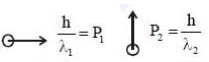
Two particles move at right angles to each other. Their de Broglie wavelengths are $\lambda_1$ and $\lambda_2$ respectively. The particles undergo a perfectly inelastic collision. The de Broglie wavelength $\lambda$ of the final particle is given by
A
$\lambda = \sqrt{\lambda_1 \lambda_2}$
B
$\lambda = \frac{\lambda_1 + \lambda_2}{2}$
C
$\frac{2}{\lambda} = \frac{1}{\lambda_1} + \frac{1}{\lambda_2}$
D
$\frac{1}{\lambda^2} = \frac{1}{\lambda_1^2} + \frac{1}{\lambda_2^2}$
Solution
(D) Let the momenta of the two particles be $\vec{P}_1$ and $\vec{P}_2$. Given they move at right angles,we can represent them as $\vec{P}_1 = \frac{h}{\lambda_1} \hat{i}$ and $\vec{P}_2 = \frac{h}{\lambda_2} \hat{j}$.
Using the law of conservation of linear momentum,the momentum of the final particle $\vec{P}$ is the vector sum of the initial momenta:
$\vec{P} = \vec{P}_1 + \vec{P}_2 = \frac{h}{\lambda_1} \hat{i} + \frac{h}{\lambda_2} \hat{j}$.
The magnitude of the final momentum is:
$|\vec{P}| = \sqrt{\left(\frac{h}{\lambda_1}\right)^2 + \left(\frac{h}{\lambda_2}\right)^2}$.
Since the de Broglie wavelength of the final particle is $\lambda = \frac{h}{|\vec{P}|}$,we have:
$\frac{h}{\lambda} = \sqrt{\left(\frac{h}{\lambda_1}\right)^2 + \left(\frac{h}{\lambda_2}\right)^2}$.
Squaring both sides and dividing by $h^2$ gives:
$\frac{1}{\lambda^2} = \frac{1}{\lambda_1^2} + \frac{1}{\lambda_2^2}$.
Using the law of conservation of linear momentum,the momentum of the final particle $\vec{P}$ is the vector sum of the initial momenta:
$\vec{P} = \vec{P}_1 + \vec{P}_2 = \frac{h}{\lambda_1} \hat{i} + \frac{h}{\lambda_2} \hat{j}$.
The magnitude of the final momentum is:
$|\vec{P}| = \sqrt{\left(\frac{h}{\lambda_1}\right)^2 + \left(\frac{h}{\lambda_2}\right)^2}$.
Since the de Broglie wavelength of the final particle is $\lambda = \frac{h}{|\vec{P}|}$,we have:
$\frac{h}{\lambda} = \sqrt{\left(\frac{h}{\lambda_1}\right)^2 + \left(\frac{h}{\lambda_2}\right)^2}$.
Squaring both sides and dividing by $h^2$ gives:
$\frac{1}{\lambda^2} = \frac{1}{\lambda_1^2} + \frac{1}{\lambda_2^2}$.
0 likes
View Solution166
DifficultMCQ
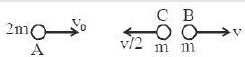
$A$ nucleus $A$,with a finite de Broglie wavelength $\lambda_A$,undergoes spontaneous fission into two nuclei $B$ and $C$ of equal mass. $B$ flies in the same direction as that of $A$,while $C$ flies in the opposite direction with a velocity equal to half of that of $B$. The de Broglie wavelengths $\lambda_B$ and $\lambda_C$ of $B$ and $C$ are respectively
A
$\lambda_A, 2\lambda_A$
B
$2\lambda_A, \lambda_A$
C
$\lambda_A, \frac{\lambda_A}{2}$
D
$\frac{\lambda_A}{2}, \lambda_A$
Solution
(D) Let the mass of nucleus $A$ be $2m$,so the mass of each nucleus $B$ and $C$ is $m$. Let the initial velocity of $A$ be $v_0$. The initial momentum is $P_A = (2m)v_0$.
According to the law of conservation of linear momentum,the final momentum must equal the initial momentum. Let $v$ be the velocity of $B$. Then the velocity of $C$ is $v/2$ in the opposite direction.
$P_f = m v - m(v/2) = m v / 2$.
Equating initial and final momentum: $2m v_0 = m v / 2$,which gives $v = 4v_0$.
Now,calculate the momenta of $B$ and $C$:
$P_B = m v = m(4v_0) = 4m v_0$.
$P_C = m(v/2) = m(2v_0) = 2m v_0$.
The de Broglie wavelength is given by $\lambda = h/P$.
Given $\lambda_A = h / (2m v_0)$.
$\lambda_B = h / P_B = h / (4m v_0) = \frac{1}{2} \times \frac{h}{2m v_0} = \frac{\lambda_A}{2}$.
$\lambda_C = h / P_C = h / (2m v_0) = \lambda_A$.
Thus,the wavelengths are $\lambda_B = \frac{\lambda_A}{2}$ and $\lambda_C = \lambda_A$.
According to the law of conservation of linear momentum,the final momentum must equal the initial momentum. Let $v$ be the velocity of $B$. Then the velocity of $C$ is $v/2$ in the opposite direction.
$P_f = m v - m(v/2) = m v / 2$.
Equating initial and final momentum: $2m v_0 = m v / 2$,which gives $v = 4v_0$.
Now,calculate the momenta of $B$ and $C$:
$P_B = m v = m(4v_0) = 4m v_0$.
$P_C = m(v/2) = m(2v_0) = 2m v_0$.
The de Broglie wavelength is given by $\lambda = h/P$.
Given $\lambda_A = h / (2m v_0)$.
$\lambda_B = h / P_B = h / (4m v_0) = \frac{1}{2} \times \frac{h}{2m v_0} = \frac{\lambda_A}{2}$.
$\lambda_C = h / P_C = h / (2m v_0) = \lambda_A$.
Thus,the wavelengths are $\lambda_B = \frac{\lambda_A}{2}$ and $\lambda_C = \lambda_A$.
0 likes
View Solution167
MediumMCQ
$A$ particle $P$ is formed due to a completely inelastic collision of particles $x$ and $y$ having de-Broglie wavelengths $\lambda_x$ and $\lambda_y$ respectively. If $x$ and $y$ were moving in opposite directions,then the de-Broglie wavelength of $P$ is
A
$\lambda_x + \lambda_y$
B
$\frac{\lambda_x \lambda_y}{\lambda_x + \lambda_y}$
C
$\frac{\lambda_x \lambda_y}{|\lambda_x - \lambda_y|}$
D
$\lambda_x - \lambda_y$
Solution
(C) According to the principle of conservation of linear momentum,the total momentum before the collision equals the total momentum after the collision.
Let the momenta of particles $x$ and $y$ be $\vec{p}_x$ and $\vec{p}_y$ respectively.
Since they move in opposite directions,we take one direction as positive and the other as negative.
The magnitude of momentum is related to the de-Broglie wavelength by $p = \frac{h}{\lambda}$.
Let $p_x = \frac{h}{\lambda_x}$ and $p_y = \frac{h}{\lambda_y}$.
The final momentum of particle $P$ is $p_f = |p_x - p_y|$.
Substituting the values,$p_f = |\frac{h}{\lambda_x} - \frac{h}{\lambda_y}| = h |\frac{1}{\lambda_x} - \frac{1}{\lambda_y}|$.
Since $p_f = \frac{h}{\lambda}$,we have $\frac{h}{\lambda} = h |\frac{\lambda_y - \lambda_x}{\lambda_x \lambda_y}|$.
Therefore,$\lambda = \frac{\lambda_x \lambda_y}{|\lambda_x - \lambda_y|}$.
Let the momenta of particles $x$ and $y$ be $\vec{p}_x$ and $\vec{p}_y$ respectively.
Since they move in opposite directions,we take one direction as positive and the other as negative.
The magnitude of momentum is related to the de-Broglie wavelength by $p = \frac{h}{\lambda}$.
Let $p_x = \frac{h}{\lambda_x}$ and $p_y = \frac{h}{\lambda_y}$.
The final momentum of particle $P$ is $p_f = |p_x - p_y|$.
Substituting the values,$p_f = |\frac{h}{\lambda_x} - \frac{h}{\lambda_y}| = h |\frac{1}{\lambda_x} - \frac{1}{\lambda_y}|$.
Since $p_f = \frac{h}{\lambda}$,we have $\frac{h}{\lambda} = h |\frac{\lambda_y - \lambda_x}{\lambda_x \lambda_y}|$.
Therefore,$\lambda = \frac{\lambda_x \lambda_y}{|\lambda_x - \lambda_y|}$.
0 likes
View Solution168
MediumMCQ
The de Broglie wavelength of an electron moving with a velocity $1.5 \times 10^8 \, m/s$ is equal to that of a photon. The ratio of the kinetic energy of the electron to the energy of the photon is
A
$1/4$
B
$1/2$
C
$2$
D
$4$
Solution
(A) Given that the de Broglie wavelength of the electron $\lambda_e$ is equal to the wavelength of the photon $\lambda_p$,so $\lambda_e = \lambda_p = \lambda$.
The kinetic energy of the electron is $K_e = \frac{1}{2} m_e v_e^2$.
The energy of the photon is $E_p = \frac{hc}{\lambda_p}$.
From the de Broglie relation,$\lambda_e = \frac{h}{m_e v_e}$,which implies $m_e = \frac{h}{\lambda_e v_e}$.
Substituting $m_e$ into the kinetic energy expression: $K_e = \frac{1}{2} \left( \frac{h}{\lambda_e v_e} \right) v_e^2 = \frac{h v_e}{2 \lambda_e}$.
Now,the ratio of the kinetic energy of the electron to the energy of the photon is:
$\frac{K_e}{E_p} = \frac{h v_e / 2 \lambda_e}{hc / \lambda_p} = \frac{v_e}{2c}$.
Given $v_e = 1.5 \times 10^8 \, m/s$ and $c = 3 \times 10^8 \, m/s$:
$\frac{K_e}{E_p} = \frac{1.5 \times 10^8}{2 \times 3 \times 10^8} = \frac{1.5}{6} = \frac{1}{4}$.
The kinetic energy of the electron is $K_e = \frac{1}{2} m_e v_e^2$.
The energy of the photon is $E_p = \frac{hc}{\lambda_p}$.
From the de Broglie relation,$\lambda_e = \frac{h}{m_e v_e}$,which implies $m_e = \frac{h}{\lambda_e v_e}$.
Substituting $m_e$ into the kinetic energy expression: $K_e = \frac{1}{2} \left( \frac{h}{\lambda_e v_e} \right) v_e^2 = \frac{h v_e}{2 \lambda_e}$.
Now,the ratio of the kinetic energy of the electron to the energy of the photon is:
$\frac{K_e}{E_p} = \frac{h v_e / 2 \lambda_e}{hc / \lambda_p} = \frac{v_e}{2c}$.
Given $v_e = 1.5 \times 10^8 \, m/s$ and $c = 3 \times 10^8 \, m/s$:
$\frac{K_e}{E_p} = \frac{1.5 \times 10^8}{2 \times 3 \times 10^8} = \frac{1.5}{6} = \frac{1}{4}$.
0 likes
View Solution169
MediumMCQ
After absorbing a slowly moving neutron of mass $m_{N}$ (momentum $0$),a nucleus of mass $M$ breaks into two nuclei of masses $m_{1}$ and $5m_{1}$ $(6m_{1} = M + m_{N})$ respectively. If the de-Broglie wavelength of the nucleus with mass $m_{1}$ is $\lambda$,then the de-Broglie wavelength of the other nucleus will be:
A
$25 \lambda$
B
$5 \lambda$
C
$\frac{\lambda}{5}$
D
$\lambda$
Solution
(D) The initial momentum of the system is $P_{i} = 0$ because the neutron is slowly moving (momentum $\approx 0$) and the nucleus of mass $M$ is at rest.
According to the law of conservation of linear momentum,the final momentum $P_{f}$ must also be zero.
Let $P_{1}$ be the momentum of the nucleus with mass $m_{1}$ and $P_{2}$ be the momentum of the nucleus with mass $5m_{1}$.
Thus,$P_{1} + P_{2} = 0$,which implies $P_{1} = -P_{2}$.
Taking the magnitude,$|P_{1}| = |P_{2}| = P$.
The de-Broglie wavelength is given by $\lambda = \frac{h}{P}$.
For the first nucleus,$\lambda_{1} = \frac{h}{P_{1}} = \lambda$.
For the second nucleus,$\lambda_{2} = \frac{h}{P_{2}} = \frac{h}{P_{1}} = \lambda$.
Therefore,the de-Broglie wavelength of the other nucleus is also $\lambda$.
According to the law of conservation of linear momentum,the final momentum $P_{f}$ must also be zero.
Let $P_{1}$ be the momentum of the nucleus with mass $m_{1}$ and $P_{2}$ be the momentum of the nucleus with mass $5m_{1}$.
Thus,$P_{1} + P_{2} = 0$,which implies $P_{1} = -P_{2}$.
Taking the magnitude,$|P_{1}| = |P_{2}| = P$.
The de-Broglie wavelength is given by $\lambda = \frac{h}{P}$.
For the first nucleus,$\lambda_{1} = \frac{h}{P_{1}} = \lambda$.
For the second nucleus,$\lambda_{2} = \frac{h}{P_{2}} = \frac{h}{P_{1}} = \lambda$.
Therefore,the de-Broglie wavelength of the other nucleus is also $\lambda$.
0 likes
View Solution170
DifficultMCQ
The energy that should be added to an electron,to reduce its de-Broglie wavelength from $10^{-10} \ m$ to $0.5 \times 10^{-10} \ m$,will be
A
Four times the initial energy
B
Thrice the initial energy
C
Equal to the initial energy
D
Twice the initial energy
Solution
(B) The de-Broglie wavelength $\lambda$ is related to the kinetic energy $E$ by the formula $\lambda = \frac{h}{\sqrt{2mE}}$.
From this,we see that $\lambda \propto \frac{1}{\sqrt{E}}$,which implies $\frac{\lambda_1}{\lambda_2} = \sqrt{\frac{E_2}{E_1}}$.
Given $\lambda_1 = 10^{-10} \ m$ and $\lambda_2 = 0.5 \times 10^{-10} \ m$,we have $\frac{10^{-10}}{0.5 \times 10^{-10}} = \sqrt{\frac{E_2}{E_1}}$.
This simplifies to $2 = \sqrt{\frac{E_2}{E_1}}$,so $\frac{E_2}{E_1} = 4$,or $E_2 = 4E_1$.
The energy that must be added is $\Delta E = E_2 - E_1 = 4E_1 - E_1 = 3E_1$.
Thus,the added energy is thrice the initial energy.
From this,we see that $\lambda \propto \frac{1}{\sqrt{E}}$,which implies $\frac{\lambda_1}{\lambda_2} = \sqrt{\frac{E_2}{E_1}}$.
Given $\lambda_1 = 10^{-10} \ m$ and $\lambda_2 = 0.5 \times 10^{-10} \ m$,we have $\frac{10^{-10}}{0.5 \times 10^{-10}} = \sqrt{\frac{E_2}{E_1}}$.
This simplifies to $2 = \sqrt{\frac{E_2}{E_1}}$,so $\frac{E_2}{E_1} = 4$,or $E_2 = 4E_1$.
The energy that must be added is $\Delta E = E_2 - E_1 = 4E_1 - E_1 = 3E_1$.
Thus,the added energy is thrice the initial energy.
0 likes
View Solution171
DifficultMCQ
When the momentum of a proton is changed by an amount $p_0$,the corresponding change in the de-Broglie wavelength is found to be $0.25\%$. Then,the original momentum of the proton was
A
$p_0$
B
$100\,p_0$
C
$400\,p_0$
D
$4\,p_0$
Solution
(C) The de-Broglie wavelength is given by $\lambda = \frac{h}{p}$,where $h$ is Planck's constant and $p$ is the momentum.
Taking the derivative,we get $d\lambda = -\frac{h}{p^2} dp$.
Dividing by $\lambda$,we have $\frac{d\lambda}{\lambda} = -\frac{dp}{p}$.
Taking the magnitude,$\left| \frac{\Delta \lambda}{\lambda} \right| = \left| \frac{\Delta p}{p} \right|$.
Given that the change in wavelength is $0.25\%$,we have $\frac{\Delta \lambda}{\lambda} = \frac{0.25}{100} = \frac{1}{400}$.
Substituting the given change in momentum $\Delta p = p_0$,we get $\frac{p_0}{p} = \frac{1}{400}$.
Therefore,the original momentum $p = 400\,p_0$.
Taking the derivative,we get $d\lambda = -\frac{h}{p^2} dp$.
Dividing by $\lambda$,we have $\frac{d\lambda}{\lambda} = -\frac{dp}{p}$.
Taking the magnitude,$\left| \frac{\Delta \lambda}{\lambda} \right| = \left| \frac{\Delta p}{p} \right|$.
Given that the change in wavelength is $0.25\%$,we have $\frac{\Delta \lambda}{\lambda} = \frac{0.25}{100} = \frac{1}{400}$.
Substituting the given change in momentum $\Delta p = p_0$,we get $\frac{p_0}{p} = \frac{1}{400}$.
Therefore,the original momentum $p = 400\,p_0$.
0 likes
View Solution172
MediumMCQ
The kinetic energy of an electron and a proton is $10^{-32} \ J$. Then the relation between their de-Broglie wavelengths is
A
$\lambda_p < \lambda_e$
B
$\lambda_p > \lambda_e$
C
$\lambda_p = \lambda_e$
D
$\lambda_p = 2\lambda_e$
Solution
(A) The de-Broglie wavelength $\lambda$ is given by the formula $\lambda = \frac{h}{\sqrt{2mE}}$.
Since the kinetic energy $E = 10^{-32} \ J$ is the same for both the electron and the proton,we have $\lambda \propto \frac{1}{\sqrt{m}}$.
We know that the mass of a proton $(m_p)$ is much greater than the mass of an electron $(m_e)$,i.e.,$m_p > m_e$.
Therefore,$\sqrt{m_p} > \sqrt{m_e}$,which implies $\frac{1}{\sqrt{m_p}} < \frac{1}{\sqrt{m_e}}$.
Thus,the de-Broglie wavelength of the proton is less than that of the electron,i.e.,$\lambda_p < \lambda_e$.
Since the kinetic energy $E = 10^{-32} \ J$ is the same for both the electron and the proton,we have $\lambda \propto \frac{1}{\sqrt{m}}$.
We know that the mass of a proton $(m_p)$ is much greater than the mass of an electron $(m_e)$,i.e.,$m_p > m_e$.
Therefore,$\sqrt{m_p} > \sqrt{m_e}$,which implies $\frac{1}{\sqrt{m_p}} < \frac{1}{\sqrt{m_e}}$.
Thus,the de-Broglie wavelength of the proton is less than that of the electron,i.e.,$\lambda_p < \lambda_e$.
0 likes
View Solution173
DifficultMCQ
The ratio of the de-Broglie wavelength of an $\alpha$-particle to that of a proton,when both are subjected to the same magnetic field such that the radii of their paths are equal,assuming the magnetic field induction vector $\vec{B}$ is perpendicular to the velocity vectors of the $\alpha$-particle and the proton,is:
A
$1$
B
$\frac{1}{4}$
C
$\frac{1}{2}$
D
$2$
Solution
(C) When a charged particle (charge $q$,mass $m$) enters a magnetic field $B$ perpendicularly,the radius $r$ of its circular path is given by:
$r = \frac{mv}{qB} \Rightarrow mv = qBr$
The de-Broglie wavelength $\lambda$ is given by:
$\lambda = \frac{h}{mv}$
Substituting $mv = qBr$ into the wavelength formula:
$\lambda = \frac{h}{qBr}$
Given that the radii $r$ and the magnetic field $B$ are the same for both particles:
$\frac{\lambda_{\alpha}}{\lambda_{p}} = \frac{q_{p}}{q_{\alpha}}$
For an $\alpha$-particle,$q_{\alpha} = 2e$,and for a proton,$q_{p} = e$:
$\frac{\lambda_{\alpha}}{\lambda_{p}} = \frac{e}{2e} = \frac{1}{2}$
$r = \frac{mv}{qB} \Rightarrow mv = qBr$
The de-Broglie wavelength $\lambda$ is given by:
$\lambda = \frac{h}{mv}$
Substituting $mv = qBr$ into the wavelength formula:
$\lambda = \frac{h}{qBr}$
Given that the radii $r$ and the magnetic field $B$ are the same for both particles:
$\frac{\lambda_{\alpha}}{\lambda_{p}} = \frac{q_{p}}{q_{\alpha}}$
For an $\alpha$-particle,$q_{\alpha} = 2e$,and for a proton,$q_{p} = e$:
$\frac{\lambda_{\alpha}}{\lambda_{p}} = \frac{e}{2e} = \frac{1}{2}$
0 likes
View Solution174
MediumMCQ
$A$ proton and an electron are accelerated by the same potential difference. Let $\lambda_e$ and $\lambda_p$ denote the de-Broglie wavelengths of the electron and the proton,respectively.
A
$\lambda_e = \lambda_p$
B
$\lambda_e < \lambda_p$
C
$\lambda_e > \lambda_p$
D
None
Solution
(C) The de Broglie wavelength $\lambda$ of a particle of mass $m$ accelerated through a potential difference $V$ is given by the formula:
$\lambda = \frac{h}{\sqrt{2meV}}$
where $h$ is Planck's constant and $e$ is the charge of the particle.
Since both the proton and the electron are accelerated by the same potential difference $V$ and have the same magnitude of charge $e$,the wavelength is inversely proportional to the square root of the mass of the particle:
$\lambda \propto \frac{1}{\sqrt{m}}$
We know that the mass of an electron $(m_e)$ is significantly less than the mass of a proton $(m_p)$,i.e.,$m_e < m_p$.
Therefore,$\frac{1}{\sqrt{m_e}} > \frac{1}{\sqrt{m_p}}$,which implies $\lambda_e > \lambda_p$.
$\lambda = \frac{h}{\sqrt{2meV}}$
where $h$ is Planck's constant and $e$ is the charge of the particle.
Since both the proton and the electron are accelerated by the same potential difference $V$ and have the same magnitude of charge $e$,the wavelength is inversely proportional to the square root of the mass of the particle:
$\lambda \propto \frac{1}{\sqrt{m}}$
We know that the mass of an electron $(m_e)$ is significantly less than the mass of a proton $(m_p)$,i.e.,$m_e < m_p$.
Therefore,$\frac{1}{\sqrt{m_e}} > \frac{1}{\sqrt{m_p}}$,which implies $\lambda_e > \lambda_p$.
0 likes
View Solution175
MediumMCQ
$A$ particle of mass $1\, mg$ has the same wavelength as an electron moving with a velocity of $3 \times 10^6\, m\,s^{-1}$. The velocity of the particle is (Mass of electron $= 9.1 \times 10^{-31}\, kg$)
A
$3 \times 10^{-31}\, m\,s^{-1}$
B
$2.7 \times 10^{-21}\, m\,s^{-1}$
C
$2.7 \times 10^{-18}\, m\,s^{-1}$
D
$9 \times 10^{-2}\, m\,s^{-1}$
Solution
(C) The de Broglie wavelength is given by $\lambda = \frac{h}{mv}$.
Since the particle and the electron have the same wavelength,their momenta must be equal.
$m_p v_p = m_e v_e$
Here,$m_p = 1\, mg = 10^{-6}\, kg$,$m_e = 9.1 \times 10^{-31}\, kg$,and $v_e = 3 \times 10^6\, m\,s^{-1}$.
Substituting the values:
$v_p = \frac{m_e v_e}{m_p} = \frac{9.1 \times 10^{-31} \times 3 \times 10^6}{10^{-6}}$
$v_p = 27.3 \times 10^{-25} \times 10^6 = 27.3 \times 10^{-19} = 2.73 \times 10^{-18}\, m\,s^{-1}$.
Rounding to the given options,the velocity is $2.7 \times 10^{-18}\, m\,s^{-1}$.
Since the particle and the electron have the same wavelength,their momenta must be equal.
$m_p v_p = m_e v_e$
Here,$m_p = 1\, mg = 10^{-6}\, kg$,$m_e = 9.1 \times 10^{-31}\, kg$,and $v_e = 3 \times 10^6\, m\,s^{-1}$.
Substituting the values:
$v_p = \frac{m_e v_e}{m_p} = \frac{9.1 \times 10^{-31} \times 3 \times 10^6}{10^{-6}}$
$v_p = 27.3 \times 10^{-25} \times 10^6 = 27.3 \times 10^{-19} = 2.73 \times 10^{-18}\, m\,s^{-1}$.
Rounding to the given options,the velocity is $2.7 \times 10^{-18}\, m\,s^{-1}$.
0 likes
View Solution176
DifficultMCQ
What will be the ratio of de-Broglie wavelengths of a proton and an $\alpha$-particle of the same energy?
A
$2:1$
B
$1:2$
C
$4:1$
D
$1:4$
Solution
(A) The de-Broglie wavelength $\lambda$ is given by the formula $\lambda = \frac{h}{\sqrt{2mE}}$,where $h$ is Planck's constant,$m$ is the mass of the particle,and $E$ is the kinetic energy.
Since the energy $E$ is the same for both particles,we have $\lambda \propto \frac{1}{\sqrt{m}}$.
Therefore,the ratio of the wavelengths is $\frac{\lambda_p}{\lambda_\alpha} = \sqrt{\frac{m_\alpha}{m_p}}$.
We know that the mass of an $\alpha$-particle is approximately $4$ times the mass of a proton $(m_\alpha \approx 4m_p)$.
Substituting this into the ratio: $\frac{\lambda_p}{\lambda_\alpha} = \sqrt{\frac{4m_p}{m_p}} = \sqrt{4} = \frac{2}{1}$.
Thus,the ratio is $2:1$.
Since the energy $E$ is the same for both particles,we have $\lambda \propto \frac{1}{\sqrt{m}}$.
Therefore,the ratio of the wavelengths is $\frac{\lambda_p}{\lambda_\alpha} = \sqrt{\frac{m_\alpha}{m_p}}$.
We know that the mass of an $\alpha$-particle is approximately $4$ times the mass of a proton $(m_\alpha \approx 4m_p)$.
Substituting this into the ratio: $\frac{\lambda_p}{\lambda_\alpha} = \sqrt{\frac{4m_p}{m_p}} = \sqrt{4} = \frac{2}{1}$.
Thus,the ratio is $2:1$.
0 likes
View Solution177
MediumMCQ
If the kinetic energy of a moving particle is $E$,then the De Broglie wavelength is
A
$h\sqrt{2mE}$
B
$\sqrt{\frac{2mE}{h}}$
C
$\frac{h}{\sqrt{2mE}}$
D
$\frac{hE}{\sqrt{2mE}}$
Solution
(C) The kinetic energy $E$ of a particle of mass $m$ moving with velocity $v$ is given by $E = \frac{1}{2}mv^2$.
Multiplying both sides by $2m$,we get $2mE = m^2v^2$.
Taking the square root of both sides,we find the momentum $p = mv = \sqrt{2mE}$.
According to the De Broglie hypothesis,the wavelength $\lambda$ is given by $\lambda = \frac{h}{p}$.
Substituting the value of $p$,we get $\lambda = \frac{h}{\sqrt{2mE}}$.
Multiplying both sides by $2m$,we get $2mE = m^2v^2$.
Taking the square root of both sides,we find the momentum $p = mv = \sqrt{2mE}$.
According to the De Broglie hypothesis,the wavelength $\lambda$ is given by $\lambda = \frac{h}{p}$.
Substituting the value of $p$,we get $\lambda = \frac{h}{\sqrt{2mE}}$.
0 likes
View Solution178
DifficultMCQ
The ratio of momentum of an electron and an alpha particle which are accelerated from rest by a potential difference of $100\,V$ is
A
$1$
B
$\sqrt{2m_e/m_\alpha}$
C
$\sqrt{m_e/m_\alpha}$
D
$\sqrt{m_e/4m_\alpha}$
Solution
(D) The kinetic energy $K$ acquired by a particle of charge $q$ accelerated through a potential difference $V$ is given by $K = qV$.
Since $K = p^2 / 2m$,where $p$ is the momentum and $m$ is the mass,we have $p = \sqrt{2mqV}$.
For an electron,$q_e = e$ and mass is $m_e$. Thus,$p_e = \sqrt{2m_e eV}$.
For an alpha particle,$q_\alpha = 2e$ and mass is $m_\alpha$. Thus,$p_\alpha = \sqrt{2m_\alpha (2e) V} = \sqrt{4m_\alpha eV}$.
The ratio of momenta is $\frac{p_e}{p_\alpha} = \frac{\sqrt{2m_e eV}}{\sqrt{4m_\alpha eV}} = \sqrt{\frac{2m_e}{4m_\alpha}} = \sqrt{\frac{m_e}{2m_\alpha}}$.
Since $K = p^2 / 2m$,where $p$ is the momentum and $m$ is the mass,we have $p = \sqrt{2mqV}$.
For an electron,$q_e = e$ and mass is $m_e$. Thus,$p_e = \sqrt{2m_e eV}$.
For an alpha particle,$q_\alpha = 2e$ and mass is $m_\alpha$. Thus,$p_\alpha = \sqrt{2m_\alpha (2e) V} = \sqrt{4m_\alpha eV}$.
The ratio of momenta is $\frac{p_e}{p_\alpha} = \frac{\sqrt{2m_e eV}}{\sqrt{4m_\alpha eV}} = \sqrt{\frac{2m_e}{4m_\alpha}} = \sqrt{\frac{m_e}{2m_\alpha}}$.
0 likes
View Solution179
DifficultMCQ
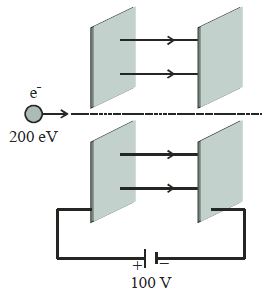
Two large parallel plates are connected to the terminals of a $100 \, V$ power supply. These plates have a fine hole at the centre. An electron having energy $200 \, eV$ is directed such that it passes through the holes. When it comes out,its de-Broglie wavelength will be ............... $\mathring{A}$
A
$1.22$
B
$1.75$
C
$2$
D
None of these
Solution
(D) The electron enters the region between the plates with an initial kinetic energy of $200 \, eV$.
The electric field between the plates is directed from the positive plate to the negative plate. Since the electron is negatively charged,it experiences a force opposite to the direction of the electric field,i.e.,it is decelerated.
The potential difference between the plates is $V = 100 \, V$,so the work done against the electric field as the electron moves from the first plate to the second plate is $W = qV = 100 \, eV$.
The final kinetic energy of the electron when it emerges from the second plate is $K_f = K_i - W = 200 \, eV - 100 \, eV = 100 \, eV$.
The de-Broglie wavelength $\lambda$ is given by the formula $\lambda = \frac{12.27}{\sqrt{V}} \, \mathring{A}$,where $V$ is the kinetic energy in electron-volts $(eV)$.
Substituting $V = 100 \, eV$,we get $\lambda = \frac{12.27}{\sqrt{100}} = \frac{12.27}{10} = 1.227 \, \mathring{A}$.
Rounding to two decimal places,we get $\lambda \approx 1.23 \, \mathring{A}$.
Since $1.23 \, \mathring{A}$ is not among the given options,the correct choice is 'None of these'.
The electric field between the plates is directed from the positive plate to the negative plate. Since the electron is negatively charged,it experiences a force opposite to the direction of the electric field,i.e.,it is decelerated.
The potential difference between the plates is $V = 100 \, V$,so the work done against the electric field as the electron moves from the first plate to the second plate is $W = qV = 100 \, eV$.
The final kinetic energy of the electron when it emerges from the second plate is $K_f = K_i - W = 200 \, eV - 100 \, eV = 100 \, eV$.
The de-Broglie wavelength $\lambda$ is given by the formula $\lambda = \frac{12.27}{\sqrt{V}} \, \mathring{A}$,where $V$ is the kinetic energy in electron-volts $(eV)$.
Substituting $V = 100 \, eV$,we get $\lambda = \frac{12.27}{\sqrt{100}} = \frac{12.27}{10} = 1.227 \, \mathring{A}$.
Rounding to two decimal places,we get $\lambda \approx 1.23 \, \mathring{A}$.
Since $1.23 \, \mathring{A}$ is not among the given options,the correct choice is 'None of these'.
0 likes
View Solution180
DifficultMCQ
An $\alpha$-particle and a deuteron are moving with velocities $v$ and $2v$ respectively. What will be the ratio of their de Broglie wavelengths?
A
$1:1$
B
$\sqrt{2}:1$
C
$1:\sqrt{2}$
D
$2:1$
Solution
(A) The de Broglie wavelength is given by the formula $\lambda = \frac{h}{mv}$.
For an $\alpha$-particle,the mass $m_{\alpha} = 4u$ and velocity $v_{\alpha} = v$. Thus,$\lambda_{\alpha} = \frac{h}{4v}$.
For a deuteron,the mass $m_{D} = 2u$ and velocity $v_{D} = 2v$. Thus,$\lambda_{D} = \frac{h}{2 \times 2v} = \frac{h}{4v}$.
Taking the ratio,$\frac{\lambda_{\alpha}}{\lambda_{D}} = \frac{h/4v}{h/4v} = 1:1$.
For an $\alpha$-particle,the mass $m_{\alpha} = 4u$ and velocity $v_{\alpha} = v$. Thus,$\lambda_{\alpha} = \frac{h}{4v}$.
For a deuteron,the mass $m_{D} = 2u$ and velocity $v_{D} = 2v$. Thus,$\lambda_{D} = \frac{h}{2 \times 2v} = \frac{h}{4v}$.
Taking the ratio,$\frac{\lambda_{\alpha}}{\lambda_{D}} = \frac{h/4v}{h/4v} = 1:1$.
0 likes
View Solution181
DifficultMCQ
The ratio of de Broglie wavelength of molecules of hydrogen and helium in two gas jars kept separately at temperatures of $27\,^oC$ and $127\,^oC$ respectively is
A
$2/\sqrt{3}$
B
$2/3$
C
$\sqrt{3}/4$
D
$\sqrt{8/3}$
Solution
(D) The de Broglie wavelength is given by $\lambda = \frac{h}{mv}$.
For a gas molecule at temperature $T$,the root mean square speed is $v = \sqrt{\frac{3kT}{m}}$,where $k$ is the Boltzmann constant and $m$ is the mass of the molecule.
Substituting $v$ into the wavelength formula: $\lambda = \frac{h}{m\sqrt{\frac{3kT}{m}}} = \frac{h}{\sqrt{3mkT}}$.
For hydrogen $(H_2)$ at $T_1 = 27\,^oC = 300\,K$ and helium $(He)$ at $T_2 = 127\,^oC = 400\,K$,the masses are $m_H = 2\,amu$ and $m_{He} = 4\,amu$.
The ratio is $\frac{\lambda_H}{\lambda_{He}} = \sqrt{\frac{m_{He} T_{He}}{m_H T_H}} = \sqrt{\frac{4 \times 400}{2 \times 300}} = \sqrt{\frac{1600}{600}} = \sqrt{\frac{8}{3}}$.
For a gas molecule at temperature $T$,the root mean square speed is $v = \sqrt{\frac{3kT}{m}}$,where $k$ is the Boltzmann constant and $m$ is the mass of the molecule.
Substituting $v$ into the wavelength formula: $\lambda = \frac{h}{m\sqrt{\frac{3kT}{m}}} = \frac{h}{\sqrt{3mkT}}$.
For hydrogen $(H_2)$ at $T_1 = 27\,^oC = 300\,K$ and helium $(He)$ at $T_2 = 127\,^oC = 400\,K$,the masses are $m_H = 2\,amu$ and $m_{He} = 4\,amu$.
The ratio is $\frac{\lambda_H}{\lambda_{He}} = \sqrt{\frac{m_{He} T_{He}}{m_H T_H}} = \sqrt{\frac{4 \times 400}{2 \times 300}} = \sqrt{\frac{1600}{600}} = \sqrt{\frac{8}{3}}$.
0 likes
View Solution182
MediumMCQ
$A$ proton and an electron are accelerated through the same potential difference. The ratio $\frac{\lambda_e}{\lambda_p}$ will be:
A
$1$
B
$\sqrt{\frac{m_e}{m_p}}$
C
$\sqrt{\frac{m_p}{m_e}}$
D
$\frac{m_p}{m_e}$
Solution
(C) The de Broglie wavelength $\lambda$ of a particle of mass $m$ and charge $q$ accelerated through a potential difference $V$ is given by:
$\lambda = \frac{h}{p} = \frac{h}{\sqrt{2mK}} = \frac{h}{\sqrt{2mqV}}$
Since both the proton and electron are accelerated through the same potential $V$ and have the same magnitude of charge $q = e$,we have:
$\lambda \propto \frac{1}{\sqrt{m}}$
Therefore,the ratio of the wavelengths is:
$\frac{\lambda_e}{\lambda_p} = \sqrt{\frac{m_p}{m_e}}$
$\lambda = \frac{h}{p} = \frac{h}{\sqrt{2mK}} = \frac{h}{\sqrt{2mqV}}$
Since both the proton and electron are accelerated through the same potential $V$ and have the same magnitude of charge $q = e$,we have:
$\lambda \propto \frac{1}{\sqrt{m}}$
Therefore,the ratio of the wavelengths is:
$\frac{\lambda_e}{\lambda_p} = \sqrt{\frac{m_p}{m_e}}$
0 likes
View Solution183
MediumMCQ
If ${\lambda _p}$ and ${\lambda _\alpha }$ are the de-Broglie wavelengths associated with protons and $\alpha$-particles of equal kinetic energies,then:
A
${\lambda _p} = \frac{{{\lambda _\alpha }}}{4}$
B
${\lambda _p} = \frac{{{\lambda _\alpha }}}{2}$
C
${\lambda _p} = {\lambda _\alpha }$
D
${\lambda _p} = 2{\lambda _\alpha }$
Solution
(D) The de-Broglie wavelength is given by $\lambda = \frac{h}{\sqrt{2mK}}$,where $h$ is Planck's constant,$m$ is the mass,and $K$ is the kinetic energy.
For a proton,$\lambda_p = \frac{h}{\sqrt{2m_p K}}$.
For an $\alpha$-particle,the mass is $m_{\alpha} = 4m_p$. Given the kinetic energies are equal $(K_p = K_{\alpha} = K)$,we have $\lambda_{\alpha} = \frac{h}{\sqrt{2(4m_p)K}} = \frac{h}{2\sqrt{2m_p K}}$.
Comparing the two,we get $\lambda_{\alpha} = \frac{\lambda_p}{2}$,which implies $\lambda_p = 2\lambda_{\alpha}$.
For a proton,$\lambda_p = \frac{h}{\sqrt{2m_p K}}$.
For an $\alpha$-particle,the mass is $m_{\alpha} = 4m_p$. Given the kinetic energies are equal $(K_p = K_{\alpha} = K)$,we have $\lambda_{\alpha} = \frac{h}{\sqrt{2(4m_p)K}} = \frac{h}{2\sqrt{2m_p K}}$.
Comparing the two,we get $\lambda_{\alpha} = \frac{\lambda_p}{2}$,which implies $\lambda_p = 2\lambda_{\alpha}$.
0 likes
View Solution184
MediumMCQ
The resolving power of an electron microscope is greater than the resolving power of an optical microscope because
A
Electrons have a negative charge
B
Electrons move slower than light
C
The wavelength of an electron is much smaller than the wavelength of visible light
D
All of these
Solution
(C) The resolving power of a microscope is inversely proportional to the wavelength of the radiation used,given by the relation $RP \propto \frac{1}{\lambda}$.
Visible light has a wavelength in the range of $4000 \, \mathring{A}$ to $7000 \, \mathring{A}$.
According to the de Broglie hypothesis,the wavelength of an electron is given by $\lambda = \frac{h}{p} = \frac{h}{\sqrt{2mE}}$.
For an electron accelerated through a potential difference $V$,the wavelength is approximately $\lambda \approx \frac{12.27}{\sqrt{V}} \, \mathring{A}$.
Even for a small accelerating voltage,the wavelength of an electron is significantly smaller than the wavelength of visible light.
Since $\lambda_{\text{electron}} < \lambda_{\text{light}}$,the resolving power of an electron microscope is much higher than that of an optical microscope.
Visible light has a wavelength in the range of $4000 \, \mathring{A}$ to $7000 \, \mathring{A}$.
According to the de Broglie hypothesis,the wavelength of an electron is given by $\lambda = \frac{h}{p} = \frac{h}{\sqrt{2mE}}$.
For an electron accelerated through a potential difference $V$,the wavelength is approximately $\lambda \approx \frac{12.27}{\sqrt{V}} \, \mathring{A}$.
Even for a small accelerating voltage,the wavelength of an electron is significantly smaller than the wavelength of visible light.
Since $\lambda_{\text{electron}} < \lambda_{\text{light}}$,the resolving power of an electron microscope is much higher than that of an optical microscope.
0 likes
View Solution185
DifficultMCQ
The ratio of de-Broglie wavelength of molecules of hydrogen and helium in two jars kept separately at temperatures of $27\,^{\circ}\text{C}$ and $127\,^{\circ}\text{C}$ respectively is
A
$\sqrt{\frac{1}{2}}$
B
$\sqrt{\frac{8}{3}}$
C
$\frac{4}{3}$
D
$\frac{3}{4}$
Solution
(B) The root mean square velocity of gas molecules is given by $v_{rms} = \sqrt{\frac{3kT}{m}}$.
The de-Broglie wavelength is $\lambda = \frac{h}{mv_{rms}} = \frac{h}{m} \sqrt{\frac{m}{3kT}} = \frac{h}{\sqrt{3mkT}}$.
For hydrogen $(H_2)$,$m_H = 2$ units and $T_H = 27 + 273 = 300\text{ K}$.
For helium $(He)$,$m_{He} = 4$ units and $T_{He} = 127 + 273 = 400\text{ K}$.
The ratio is $\frac{\lambda_H}{\lambda_{He}} = \sqrt{\frac{m_{He} T_{He}}{m_H T_H}}$.
Substituting the values: $\frac{\lambda_H}{\lambda_{He}} = \sqrt{\frac{4 \times 400}{2 \times 300}} = \sqrt{\frac{1600}{600}} = \sqrt{\frac{16}{6}} = \sqrt{\frac{8}{3}}$.
The de-Broglie wavelength is $\lambda = \frac{h}{mv_{rms}} = \frac{h}{m} \sqrt{\frac{m}{3kT}} = \frac{h}{\sqrt{3mkT}}$.
For hydrogen $(H_2)$,$m_H = 2$ units and $T_H = 27 + 273 = 300\text{ K}$.
For helium $(He)$,$m_{He} = 4$ units and $T_{He} = 127 + 273 = 400\text{ K}$.
The ratio is $\frac{\lambda_H}{\lambda_{He}} = \sqrt{\frac{m_{He} T_{He}}{m_H T_H}}$.
Substituting the values: $\frac{\lambda_H}{\lambda_{He}} = \sqrt{\frac{4 \times 400}{2 \times 300}} = \sqrt{\frac{1600}{600}} = \sqrt{\frac{16}{6}} = \sqrt{\frac{8}{3}}$.
0 likes
View Solution186
MediumMCQ
An electron is accelerated through a potential difference of $10,000 \; V$. Its de Broglie wavelength is,(nearly):
$(m_{e}=9 \times 10^{-31} \; kg)$
$(m_{e}=9 \times 10^{-31} \; kg)$
A
$12.2 \times 10^{-13} \; m$
B
$12.2 \times 10^{-12} \; m$
C
$12.2 \times 10^{-14} \; m$
D
$12.2 \; nm$
Solution
(B) The de Broglie wavelength $\lambda$ for an electron accelerated through a potential difference $V$ is given by the formula: $\lambda = \frac{12.27}{\sqrt{V}} \; \mathring{A}$.
Given $V = 10,000 \; V = 10^4 \; V$.
Substituting the value of $V$ in the formula:
$\lambda = \frac{12.27}{\sqrt{10^4}} \; \mathring{A} = \frac{12.27}{100} \; \mathring{A} = 0.1227 \; \mathring{A}$.
Since $1 \; \mathring{A} = 10^{-10} \; m$,we have $\lambda = 0.1227 \times 10^{-10} \; m = 12.27 \times 10^{-12} \; m$.
Rounding to the nearest option,the value is approximately $12.2 \times 10^{-12} \; m$.
Given $V = 10,000 \; V = 10^4 \; V$.
Substituting the value of $V$ in the formula:
$\lambda = \frac{12.27}{\sqrt{10^4}} \; \mathring{A} = \frac{12.27}{100} \; \mathring{A} = 0.1227 \; \mathring{A}$.
Since $1 \; \mathring{A} = 10^{-10} \; m$,we have $\lambda = 0.1227 \times 10^{-10} \; m = 12.27 \times 10^{-12} \; m$.
Rounding to the nearest option,the value is approximately $12.2 \times 10^{-12} \; m$.
0 likes
View Solution187
MediumMCQ
$A$ proton and an $\alpha$-particle are accelerated from rest to the same kinetic energy. The ratio of their de Broglie wavelengths $\lambda_{p} : \lambda_{\alpha}$ is:
A
$2:1$
B
$1:1$
C
$\sqrt{2}: 1$
D
$4:1$
Solution
(A) The de Broglie wavelength $\lambda$ is given by the formula $\lambda = \frac{h}{\sqrt{2mE_k}}$,where $h$ is Planck's constant,$m$ is the mass of the particle,and $E_k$ is the kinetic energy.
Since both particles have the same kinetic energy $E_k$,we have $\lambda \propto \frac{1}{\sqrt{m}}$.
Therefore,$\frac{\lambda_p}{\lambda_{\alpha}} = \sqrt{\frac{m_{\alpha}}{m_p}}$.
We know that the mass of an $\alpha$-particle is approximately $4$ times the mass of a proton,i.e.,$m_{\alpha} = 4m_p$.
Substituting this value,we get $\frac{\lambda_p}{\lambda_{\alpha}} = \sqrt{\frac{4m_p}{m_p}} = \sqrt{4} = 2$.
Thus,the ratio $\lambda_p : \lambda_{\alpha}$ is $2:1$.
Since both particles have the same kinetic energy $E_k$,we have $\lambda \propto \frac{1}{\sqrt{m}}$.
Therefore,$\frac{\lambda_p}{\lambda_{\alpha}} = \sqrt{\frac{m_{\alpha}}{m_p}}$.
We know that the mass of an $\alpha$-particle is approximately $4$ times the mass of a proton,i.e.,$m_{\alpha} = 4m_p$.
Substituting this value,we get $\frac{\lambda_p}{\lambda_{\alpha}} = \sqrt{\frac{4m_p}{m_p}} = \sqrt{4} = 2$.
Thus,the ratio $\lambda_p : \lambda_{\alpha}$ is $2:1$.
0 likes
View Solution188
DifficultMCQ
An electron (of mass $m$) and a photon have the same energy $E$ in the range of a few $eV$. The ratio of the de-Broglie wavelength associated with the electron and the wavelength of the photon is ($c =$ speed of light in vacuum).
A
$\left(\frac{E}{2 m}\right)^{1 / 2}$
B
$\frac{1}{c}\left(\frac{E}{2 m}\right)^{1 / 2}$
C
$c(2 m E)^{1 / 2}$
D
$\frac{1}{c}\left(\frac{2 E}{m}\right)^{1 / 2}$
Solution
(B) The energy of a photon is given by $E = \frac{hc}{\lambda_{\text{photon}}}$,which implies $\lambda_{\text{photon}} = \frac{hc}{E}$.
The de-Broglie wavelength of an electron with energy $E$ is given by $\lambda_{\text{electron}} = \frac{h}{p} = \frac{h}{\sqrt{2mE}}$.
Taking the ratio of the two wavelengths:
$\frac{\lambda_{\text{electron}}}{\lambda_{\text{photon}}} = \frac{h / \sqrt{2mE}}{hc / E} = \frac{h}{\sqrt{2mE}} \times \frac{E}{hc}$.
Simplifying the expression:
$\frac{\lambda_{\text{electron}}}{\lambda_{\text{photon}}} = \frac{1}{c} \times \frac{E}{\sqrt{2mE}} = \frac{1}{c} \times \sqrt{\frac{E^2}{2mE}} = \frac{1}{c} \left(\frac{E}{2m}\right)^{1/2}$.
The de-Broglie wavelength of an electron with energy $E$ is given by $\lambda_{\text{electron}} = \frac{h}{p} = \frac{h}{\sqrt{2mE}}$.
Taking the ratio of the two wavelengths:
$\frac{\lambda_{\text{electron}}}{\lambda_{\text{photon}}} = \frac{h / \sqrt{2mE}}{hc / E} = \frac{h}{\sqrt{2mE}} \times \frac{E}{hc}$.
Simplifying the expression:
$\frac{\lambda_{\text{electron}}}{\lambda_{\text{photon}}} = \frac{1}{c} \times \frac{E}{\sqrt{2mE}} = \frac{1}{c} \times \sqrt{\frac{E^2}{2mE}} = \frac{1}{c} \left(\frac{E}{2m}\right)^{1/2}$.
0 likes
View Solution189
DifficultMCQ
An electron (mass $m$) with initial velocity $\overrightarrow{v} = v_{0} \hat{i} + v_{0} \hat{j}$ is in an electric field $\overrightarrow{E} = -E_{0} \hat{k}$. If $\lambda_{0}$ is the initial de-Broglie wavelength of the electron,its de-Broglie wavelength at time $t$ is given by:
A
$\frac{\lambda_{0} \sqrt{2}}{\sqrt{1 + \frac{e^{2} E_{0}^{2} t^{2}}{m^{2} v_{0}^{2}}}}$
B
$\frac{\lambda_{0}}{\sqrt{2 + \frac{e^{2} E_{0}^{2} t^{2}}{m^{2} v_{0}^{2}}}}$
C
$\frac{\lambda_{0}}{\sqrt{1 + \frac{e^{2} E_{0}^{2} t^{2}}{2 m^{2} v_{0}^{2}}}}$
D
$\frac{\lambda_{0}}{\sqrt{1 + \frac{e^{2} E_{0}^{2} t^{2}}{m^{2} v_{0}^{2}}}}$
Solution
(C) The initial velocity is $\overrightarrow{v} = v_{0} \hat{i} + v_{0} \hat{j}$. The initial speed is $v = \sqrt{v_{0}^{2} + v_{0}^{2}} = v_{0} \sqrt{2}$.
The initial de-Broglie wavelength is $\lambda_{0} = \frac{h}{m v_{0} \sqrt{2}} \implies h = \lambda_{0} m v_{0} \sqrt{2}$.
The electric field is $\overrightarrow{E} = -E_{0} \hat{k}$. The force on the electron is $\overrightarrow{F} = -e \overrightarrow{E} = e E_{0} \hat{k}$.
The acceleration is $\overrightarrow{a} = \frac{e E_{0}}{m} \hat{k}$.
At time $t$,the velocity is $\overrightarrow{v}(t) = v_{0} \hat{i} + v_{0} \hat{j} + \frac{e E_{0} t}{m} \hat{k}$.
The speed at time $t$ is $v(t) = \sqrt{v_{0}^{2} + v_{0}^{2} + \left(\frac{e E_{0} t}{m}\right)^{2}} = \sqrt{2 v_{0}^{2} + \frac{e^{2} E_{0}^{2} t^{2}}{m^{2}}}$.
The de-Broglie wavelength at time $t$ is $\lambda = \frac{h}{m v(t)} = \frac{\lambda_{0} m v_{0} \sqrt{2}}{m \sqrt{2 v_{0}^{2} + \frac{e^{2} E_{0}^{2} t^{2}}{m^{2}}}} = \frac{\lambda_{0} v_{0} \sqrt{2}}{\sqrt{2 v_{0}^{2} + \frac{e^{2} E_{0}^{2} t^{2}}{m^{2}}}} = \frac{\lambda_{0}}{\sqrt{1 + \frac{e^{2} E_{0}^{2} t^{2}}{2 m^{2} v_{0}^{2}}}}$.
The initial de-Broglie wavelength is $\lambda_{0} = \frac{h}{m v_{0} \sqrt{2}} \implies h = \lambda_{0} m v_{0} \sqrt{2}$.
The electric field is $\overrightarrow{E} = -E_{0} \hat{k}$. The force on the electron is $\overrightarrow{F} = -e \overrightarrow{E} = e E_{0} \hat{k}$.
The acceleration is $\overrightarrow{a} = \frac{e E_{0}}{m} \hat{k}$.
At time $t$,the velocity is $\overrightarrow{v}(t) = v_{0} \hat{i} + v_{0} \hat{j} + \frac{e E_{0} t}{m} \hat{k}$.
The speed at time $t$ is $v(t) = \sqrt{v_{0}^{2} + v_{0}^{2} + \left(\frac{e E_{0} t}{m}\right)^{2}} = \sqrt{2 v_{0}^{2} + \frac{e^{2} E_{0}^{2} t^{2}}{m^{2}}}$.
The de-Broglie wavelength at time $t$ is $\lambda = \frac{h}{m v(t)} = \frac{\lambda_{0} m v_{0} \sqrt{2}}{m \sqrt{2 v_{0}^{2} + \frac{e^{2} E_{0}^{2} t^{2}}{m^{2}}}} = \frac{\lambda_{0} v_{0} \sqrt{2}}{\sqrt{2 v_{0}^{2} + \frac{e^{2} E_{0}^{2} t^{2}}{m^{2}}}} = \frac{\lambda_{0}}{\sqrt{1 + \frac{e^{2} E_{0}^{2} t^{2}}{2 m^{2} v_{0}^{2}}}}$.
0 likes
View Solution190
DifficultMCQ
An electron of mass $m$ and magnitude of charge $|e|$ initially at rest gets accelerated by a constant electric field $E$. The rate of change of de-Broglie wavelength of this electron at time $t$ ignoring relativistic effects is:
A
$\frac{-h}{|e| Et^{2}}$
B
$\frac{|e| Et}{h}$
C
$-\frac{h}{|e| E \sqrt{t}}$
D
$-\frac{h}{|e| Et}$
Solution
(A) The acceleration of the electron is $a = \frac{|e|E}{m}$.
Since the electron starts from rest $(u = 0)$,its velocity at time $t$ is $v = at = \frac{|e|E}{m}t$.
The de-Broglie wavelength is given by $\lambda = \frac{h}{mv} = \frac{h}{m(\frac{|e|E}{m}t)} = \frac{h}{|e|Et}$.
To find the rate of change of wavelength,we differentiate $\lambda$ with respect to $t$:
$\frac{d\lambda}{dt} = \frac{d}{dt} (\frac{h}{|e|Et}) = \frac{h}{|e|E} \cdot \frac{d}{dt}(t^{-1}) = \frac{h}{|e|E} (-t^{-2}) = -\frac{h}{|e|Et^2}$.
Since the electron starts from rest $(u = 0)$,its velocity at time $t$ is $v = at = \frac{|e|E}{m}t$.
The de-Broglie wavelength is given by $\lambda = \frac{h}{mv} = \frac{h}{m(\frac{|e|E}{m}t)} = \frac{h}{|e|Et}$.
To find the rate of change of wavelength,we differentiate $\lambda$ with respect to $t$:
$\frac{d\lambda}{dt} = \frac{d}{dt} (\frac{h}{|e|Et}) = \frac{h}{|e|E} \cdot \frac{d}{dt}(t^{-1}) = \frac{h}{|e|E} (-t^{-2}) = -\frac{h}{|e|Et^2}$.
0 likes
View Solution191
MediumMCQ
$A$ particle moving with kinetic energy $E$ has de Broglie wavelength $\lambda$. If energy $\Delta E$ is added to its energy,the wavelength becomes $\frac{\lambda}{2}$. The value of $\Delta E$ is:
A
$2E$
B
$E$
C
$3E$
D
$4E$
Solution
(C) The de Broglie wavelength $\lambda$ of a particle with kinetic energy $E$ is given by $\lambda = \frac{h}{\sqrt{2mE}}$.
When the energy is increased by $\Delta E$,the new kinetic energy becomes $E' = E + \Delta E$,and the new wavelength is $\lambda' = \frac{\lambda}{2}$.
Using the formula for the new wavelength: $\lambda' = \frac{h}{\sqrt{2m(E + \Delta E)}}$.
Since $\lambda' = \frac{\lambda}{2}$,we have $\frac{h}{\sqrt{2m(E + \Delta E)}} = \frac{1}{2} \cdot \frac{h}{\sqrt{2mE}}$.
Squaring both sides: $\frac{1}{2m(E + \Delta E)} = \frac{1}{4} \cdot \frac{1}{2mE}$.
Simplifying the equation: $\frac{1}{E + \Delta E} = \frac{1}{4E}$.
Therefore,$4E = E + \Delta E$,which gives $\Delta E = 3E$.
When the energy is increased by $\Delta E$,the new kinetic energy becomes $E' = E + \Delta E$,and the new wavelength is $\lambda' = \frac{\lambda}{2}$.
Using the formula for the new wavelength: $\lambda' = \frac{h}{\sqrt{2m(E + \Delta E)}}$.
Since $\lambda' = \frac{\lambda}{2}$,we have $\frac{h}{\sqrt{2m(E + \Delta E)}} = \frac{1}{2} \cdot \frac{h}{\sqrt{2mE}}$.
Squaring both sides: $\frac{1}{2m(E + \Delta E)} = \frac{1}{4} \cdot \frac{1}{2mE}$.
Simplifying the equation: $\frac{1}{E + \Delta E} = \frac{1}{4E}$.
Therefore,$4E = E + \Delta E$,which gives $\Delta E = 3E$.
1 likes
View Solution192
Medium
What are called matter waves? Name the devices which employ the use of these matter waves.
Solution
(N/A) Matter waves,also known as de Broglie waves,are the waves associated with moving particles of matter (such as electrons,protons,or neutrons). According to the de Broglie hypothesis,any moving particle with momentum $p$ has an associated wavelength $\lambda$ given by $\lambda = h/p$,where $h$ is Planck's constant.
Devices that employ the use of matter waves include:
$1$. Electron Microscope: It uses the wave nature of electrons to achieve much higher resolution than optical microscopes.
$2$. Electron Diffraction Apparatus: Used to study the crystal structure of materials by observing the diffraction patterns of electrons.
Devices that employ the use of matter waves include:
$1$. Electron Microscope: It uses the wave nature of electrons to achieve much higher resolution than optical microscopes.
$2$. Electron Diffraction Apparatus: Used to study the crystal structure of materials by observing the diffraction patterns of electrons.
0 likes
View Solution193
Medium
What is the de Broglie wavelength associated with
$(a)$ an electron moving with a speed of $5.4 \times 10^{6} \; m/s$,and
$(b)$ a ball of mass $150 \; g$ travelling at $30.0 \; m/s$?
$(a)$ an electron moving with a speed of $5.4 \times 10^{6} \; m/s$,and
$(b)$ a ball of mass $150 \; g$ travelling at $30.0 \; m/s$?
Solution
(N/A) For the electron:
Mass $m = 9.11 \times 10^{-31} \; kg$,speed $v = 5.4 \times 10^{6} \; m/s$.
Momentum $p = mv = (9.11 \times 10^{-31} \; kg) \times (5.4 \times 10^{6} \; m/s) = 4.92 \times 10^{-24} \; kg \cdot m/s$.
de Broglie wavelength $\lambda = \frac{h}{p} = \frac{6.63 \times 10^{-34} \; J \cdot s}{4.92 \times 10^{-24} \; kg \cdot m/s} \approx 1.35 \times 10^{-10} \; m = 0.135 \; nm$.
$(b)$ For the ball:
Mass $m' = 0.150 \; kg$,speed $v' = 30.0 \; m/s$.
Momentum $p' = m'v' = (0.150 \; kg) \times (30.0 \; m/s) = 4.50 \; kg \cdot m/s$.
de Broglie wavelength $\lambda' = \frac{h}{p'} = \frac{6.63 \times 10^{-34} \; J \cdot s}{4.50 \; kg \cdot m/s} \approx 1.47 \times 10^{-34} \; m$.
The de Broglie wavelength of the electron is comparable to $X$-ray wavelengths,whereas for the ball,it is extremely small (about $10^{-19}$ times the size of a proton),making it beyond experimental measurement.
Mass $m = 9.11 \times 10^{-31} \; kg$,speed $v = 5.4 \times 10^{6} \; m/s$.
Momentum $p = mv = (9.11 \times 10^{-31} \; kg) \times (5.4 \times 10^{6} \; m/s) = 4.92 \times 10^{-24} \; kg \cdot m/s$.
de Broglie wavelength $\lambda = \frac{h}{p} = \frac{6.63 \times 10^{-34} \; J \cdot s}{4.92 \times 10^{-24} \; kg \cdot m/s} \approx 1.35 \times 10^{-10} \; m = 0.135 \; nm$.
$(b)$ For the ball:
Mass $m' = 0.150 \; kg$,speed $v' = 30.0 \; m/s$.
Momentum $p' = m'v' = (0.150 \; kg) \times (30.0 \; m/s) = 4.50 \; kg \cdot m/s$.
de Broglie wavelength $\lambda' = \frac{h}{p'} = \frac{6.63 \times 10^{-34} \; J \cdot s}{4.50 \; kg \cdot m/s} \approx 1.47 \times 10^{-34} \; m$.
The de Broglie wavelength of the electron is comparable to $X$-ray wavelengths,whereas for the ball,it is extremely small (about $10^{-19}$ times the size of a proton),making it beyond experimental measurement.
0 likes
View Solution194
EasyMCQ
An electron,an $\alpha$-particle,and a proton have the same kinetic energy. Which of these particles has the shortest de Broglie wavelength?
A
Electron
B
Proton
C
$\alpha$-particle
D
All have the same wavelength
Solution
(C) The de Broglie wavelength $\lambda$ of a particle is given by $\lambda = h / p$.
Since kinetic energy $K = p^2 / (2m)$,we can write momentum $p = \sqrt{2mK}$.
Substituting this into the wavelength formula,we get $\lambda = h / \sqrt{2mK}$.
For a constant kinetic energy $K$,the wavelength is inversely proportional to the square root of the mass: $\lambda \propto 1 / \sqrt{m}$.
Comparing the masses: $m_{\alpha} > m_p > m_e$.
Since the $\alpha$-particle has the largest mass among the three,it will have the smallest de Broglie wavelength.
Since kinetic energy $K = p^2 / (2m)$,we can write momentum $p = \sqrt{2mK}$.
Substituting this into the wavelength formula,we get $\lambda = h / \sqrt{2mK}$.
For a constant kinetic energy $K$,the wavelength is inversely proportional to the square root of the mass: $\lambda \propto 1 / \sqrt{m}$.
Comparing the masses: $m_{\alpha} > m_p > m_e$.
Since the $\alpha$-particle has the largest mass among the three,it will have the smallest de Broglie wavelength.
0 likes
View Solution195
Medium
$A$ particle is moving three times as fast as an electron. The ratio of the de Broglie wavelength of the particle to that of the electron is $1.813 \times 10^{-4}$. Calculate the particle's mass and identify the particle.
Solution
(N/A) The de Broglie wavelength of a particle with mass $m$ and velocity $v$ is given by $\lambda = \frac{h}{mv}$.
For an electron,the wavelength is $\lambda_e = \frac{h}{m_e v_e}$.
Given that the particle's velocity $v = 3v_e$ and the ratio of wavelengths $\frac{\lambda}{\lambda_e} = 1.813 \times 10^{-4}$.
Using the ratio: $\frac{\lambda}{\lambda_e} = \frac{h/mv}{h/m_e v_e} = \frac{m_e v_e}{mv} = 1.813 \times 10^{-4}$.
Rearranging for the mass of the particle $m$: $m = m_e \left( \frac{v_e}{v} \right) \left( \frac{\lambda_e}{\lambda} \right)$.
Substituting the values $m_e = 9.11 \times 10^{-31} \ kg$,$\frac{v_e}{v} = \frac{1}{3}$,and $\frac{\lambda_e}{\lambda} = \frac{1}{1.813 \times 10^{-4}}$:
$m = (9.11 \times 10^{-31} \ kg) \times \left( \frac{1}{3} \right) \times \left( \frac{1}{1.813 \times 10^{-4}} \right) \approx 1.675 \times 10^{-27} \ kg$.
This mass corresponds to the mass of a proton or a neutron.
For an electron,the wavelength is $\lambda_e = \frac{h}{m_e v_e}$.
Given that the particle's velocity $v = 3v_e$ and the ratio of wavelengths $\frac{\lambda}{\lambda_e} = 1.813 \times 10^{-4}$.
Using the ratio: $\frac{\lambda}{\lambda_e} = \frac{h/mv}{h/m_e v_e} = \frac{m_e v_e}{mv} = 1.813 \times 10^{-4}$.
Rearranging for the mass of the particle $m$: $m = m_e \left( \frac{v_e}{v} \right) \left( \frac{\lambda_e}{\lambda} \right)$.
Substituting the values $m_e = 9.11 \times 10^{-31} \ kg$,$\frac{v_e}{v} = \frac{1}{3}$,and $\frac{\lambda_e}{\lambda} = \frac{1}{1.813 \times 10^{-4}}$:
$m = (9.11 \times 10^{-31} \ kg) \times \left( \frac{1}{3} \right) \times \left( \frac{1}{1.813 \times 10^{-4}} \right) \approx 1.675 \times 10^{-27} \ kg$.
This mass corresponds to the mass of a proton or a neutron.
0 likes
View Solution196
EasyMCQ
An electron beam has a kinetic energy equal to $100\; eV$. Find its wavelength (in $\mathring{A}$) associated with the beam,given the mass of an electron $= 9.1 \times 10^{-31}\; kg$,$1\; eV = 1.6 \times 10^{-19}\; J$,and Planck's constant $= 6.6 \times 10^{-34}\; Js$.
A
$24.6$
B
$0.12$
C
$1.2$
D
$6.3$
Solution
(C) The de Broglie wavelength $\lambda$ is given by the formula: $\lambda = \frac{h}{p} = \frac{h}{\sqrt{2mE}}$.
Given:
$h = 6.6 \times 10^{-34}\; Js$
$m = 9.1 \times 10^{-31}\; kg$
$E = 100\; eV = 100 \times 1.6 \times 10^{-19}\; J = 1.6 \times 10^{-17}\; J$.
Substituting these values into the formula:
$\lambda = \frac{6.6 \times 10^{-34}}{\sqrt{2 \times 9.1 \times 10^{-31} \times 1.6 \times 10^{-17}}}$
$\lambda = \frac{6.6 \times 10^{-34}}{\sqrt{29.12 \times 10^{-48}}}$
$\lambda = \frac{6.6 \times 10^{-34}}{5.396 \times 10^{-24}}$
$\lambda \approx 1.22 \times 10^{-10}\; m$.
Since $1\; \mathring{A} = 10^{-10}\; m$,the wavelength is approximately $1.2\; \mathring{A}$.
Given:
$h = 6.6 \times 10^{-34}\; Js$
$m = 9.1 \times 10^{-31}\; kg$
$E = 100\; eV = 100 \times 1.6 \times 10^{-19}\; J = 1.6 \times 10^{-17}\; J$.
Substituting these values into the formula:
$\lambda = \frac{6.6 \times 10^{-34}}{\sqrt{2 \times 9.1 \times 10^{-31} \times 1.6 \times 10^{-17}}}$
$\lambda = \frac{6.6 \times 10^{-34}}{\sqrt{29.12 \times 10^{-48}}}$
$\lambda = \frac{6.6 \times 10^{-34}}{5.396 \times 10^{-24}}$
$\lambda \approx 1.22 \times 10^{-10}\; m$.
Since $1\; \mathring{A} = 10^{-10}\; m$,the wavelength is approximately $1.2\; \mathring{A}$.
0 likes
View Solution197
Medium
Calculate the $(a)$ momentum,and $(b)$ de Broglie wavelength of the electrons accelerated through a potential difference of $56 \; V$.
Solution
(N/A) The momentum $p$ of an electron accelerated through a potential difference $V$ is given by the formula $p = \sqrt{2meV}$.
Substituting the values: $m = 9.11 \times 10^{-31} \; kg$,$e = 1.602 \times 10^{-19} \; C$,and $V = 56 \; V$.
$p = \sqrt{2 \times 9.11 \times 10^{-31} \times 1.602 \times 10^{-19} \times 56} \approx 4.04 \times 10^{-24} \; kg \cdot m/s$.
$(b)$ The de Broglie wavelength $\lambda$ is given by $\lambda = h/p$.
Using $h = 6.626 \times 10^{-34} \; J \cdot s$ and $p = 4.04 \times 10^{-24} \; kg \cdot m/s$:
$\lambda = (6.626 \times 10^{-34}) / (4.04 \times 10^{-24}) \approx 1.64 \times 10^{-10} \; m = 0.164 \; nm$.
Substituting the values: $m = 9.11 \times 10^{-31} \; kg$,$e = 1.602 \times 10^{-19} \; C$,and $V = 56 \; V$.
$p = \sqrt{2 \times 9.11 \times 10^{-31} \times 1.602 \times 10^{-19} \times 56} \approx 4.04 \times 10^{-24} \; kg \cdot m/s$.
$(b)$ The de Broglie wavelength $\lambda$ is given by $\lambda = h/p$.
Using $h = 6.626 \times 10^{-34} \; J \cdot s$ and $p = 4.04 \times 10^{-24} \; kg \cdot m/s$:
$\lambda = (6.626 \times 10^{-34}) / (4.04 \times 10^{-24}) \approx 1.64 \times 10^{-10} \; m = 0.164 \; nm$.
0 likes
View Solution198
Medium
What is the $(a)$ momentum,$(b)$ speed,and $(c)$ de Broglie wavelength of an electron with kinetic energy of $120 \ eV$?
Solution
$(a)$ The momentum $p$ is given by $p = \sqrt{2mK}$. Given $K = 120 \ eV = 120 \times 1.6 \times 10^{-19} \ J = 1.92 \times 10^{-17} \ J$ and $m = 9.11 \times 10^{-31} \ kg$. Thus,$p = \sqrt{2 \times 9.11 \times 10^{-31} \times 1.92 \times 10^{-17}} \approx 5.91 \times 10^{-24} \ kg \ m/s$.
$(b)$ The speed $v$ is given by $K = \frac{1}{2}mv^2$,so $v = \sqrt{\frac{2K}{m}} = \sqrt{\frac{2 \times 1.92 \times 10^{-17}}{9.11 \times 10^{-31}}} \approx 6.5 \times 10^6 \ m/s$.
$(c)$ The de Broglie wavelength $\lambda$ is given by $\lambda = \frac{h}{p} = \frac{6.626 \times 10^{-34}}{5.91 \times 10^{-24}} \approx 1.12 \times 10^{-10} \ m = 0.112 \ nm$.
$(b)$ The speed $v$ is given by $K = \frac{1}{2}mv^2$,so $v = \sqrt{\frac{2K}{m}} = \sqrt{\frac{2 \times 1.92 \times 10^{-17}}{9.11 \times 10^{-31}}} \approx 6.5 \times 10^6 \ m/s$.
$(c)$ The de Broglie wavelength $\lambda$ is given by $\lambda = \frac{h}{p} = \frac{6.626 \times 10^{-34}}{5.91 \times 10^{-24}} \approx 1.12 \times 10^{-10} \ m = 0.112 \ nm$.
0 likes
View Solution199
Medium
The wavelength of light from the spectral emission line of sodium is $589 \; nm$. Find the kinetic energy at which
$(a)$ an electron,and
$(b)$ a neutron,would have the same de Broglie wavelength.
$(a)$ an electron,and
$(b)$ a neutron,would have the same de Broglie wavelength.
Solution
(N/A) Given,wavelength $\lambda = 589 \; nm = 589 \times 10^{-9} \; m$.
The momentum $p$ associated with this wavelength is given by $p = \frac{h}{\lambda}$,where $h = 6.626 \times 10^{-34} \; J \cdot s$.
$p = \frac{6.626 \times 10^{-34}}{589 \times 10^{-9}} \approx 1.125 \times 10^{-27} \; kg \cdot m/s$.
$(a)$ For an electron,mass $m_e = 9.11 \times 10^{-31} \; kg$. The kinetic energy $K_e = \frac{p^2}{2m_e}$.
$K_e = \frac{(1.125 \times 10^{-27})^2}{2 \times 9.11 \times 10^{-31}} \approx 6.95 \times 10^{-25} \; J$.
$(b)$ For a neutron,mass $m_n = 1.675 \times 10^{-27} \; kg$. The kinetic energy $K_n = \frac{p^2}{2m_n}$.
$K_n = \frac{(1.125 \times 10^{-27})^2}{2 \times 1.675 \times 10^{-27}} \approx 3.78 \times 10^{-28} \; J$.
The momentum $p$ associated with this wavelength is given by $p = \frac{h}{\lambda}$,where $h = 6.626 \times 10^{-34} \; J \cdot s$.
$p = \frac{6.626 \times 10^{-34}}{589 \times 10^{-9}} \approx 1.125 \times 10^{-27} \; kg \cdot m/s$.
$(a)$ For an electron,mass $m_e = 9.11 \times 10^{-31} \; kg$. The kinetic energy $K_e = \frac{p^2}{2m_e}$.
$K_e = \frac{(1.125 \times 10^{-27})^2}{2 \times 9.11 \times 10^{-31}} \approx 6.95 \times 10^{-25} \; J$.
$(b)$ For a neutron,mass $m_n = 1.675 \times 10^{-27} \; kg$. The kinetic energy $K_n = \frac{p^2}{2m_n}$.
$K_n = \frac{(1.125 \times 10^{-27})^2}{2 \times 1.675 \times 10^{-27}} \approx 3.78 \times 10^{-28} \; J$.
0 likes
View Solution200
Medium
What is the de Broglie wavelength of
$(a)$ a bullet of mass $0.040 \; kg$ travelling at the speed of $1.0 \; km/s$
$(b)$ a ball of mass $0.060 \; kg$ moving at a speed of $1.0 \; m/s$,and
$(c)$ a dust particle of mass $1.0 \times 10^{-9} \; kg$ drifting with a speed of $2.2 \; m/s$?
$(a)$ a bullet of mass $0.040 \; kg$ travelling at the speed of $1.0 \; km/s$
$(b)$ a ball of mass $0.060 \; kg$ moving at a speed of $1.0 \; m/s$,and
$(c)$ a dust particle of mass $1.0 \times 10^{-9} \; kg$ drifting with a speed of $2.2 \; m/s$?
Solution
(N/A) The de Broglie wavelength is given by $\lambda = \frac{h}{mv}$,where $h = 6.626 \times 10^{-34} \; J \cdot s$.
$(a)$ Given $m = 0.040 \; kg$,$v = 1.0 \; km/s = 1000 \; m/s$.
$\lambda = \frac{6.626 \times 10^{-34}}{0.040 \times 1000} = \frac{6.626 \times 10^{-34}}{40} \approx 1.66 \times 10^{-35} \; m$.
$(b)$ Given $m = 0.060 \; kg$,$v = 1.0 \; m/s$.
$\lambda = \frac{6.626 \times 10^{-34}}{0.060 \times 1.0} \approx 1.10 \times 10^{-32} \; m$.
$(c)$ Given $m = 1.0 \times 10^{-9} \; kg$,$v = 2.2 \; m/s$.
$\lambda = \frac{6.626 \times 10^{-34}}{1.0 \times 10^{-9} \times 2.2} \approx 3.01 \times 10^{-25} \; m$.
$(a)$ Given $m = 0.040 \; kg$,$v = 1.0 \; km/s = 1000 \; m/s$.
$\lambda = \frac{6.626 \times 10^{-34}}{0.040 \times 1000} = \frac{6.626 \times 10^{-34}}{40} \approx 1.66 \times 10^{-35} \; m$.
$(b)$ Given $m = 0.060 \; kg$,$v = 1.0 \; m/s$.
$\lambda = \frac{6.626 \times 10^{-34}}{0.060 \times 1.0} \approx 1.10 \times 10^{-32} \; m$.
$(c)$ Given $m = 1.0 \times 10^{-9} \; kg$,$v = 2.2 \; m/s$.
$\lambda = \frac{6.626 \times 10^{-34}}{1.0 \times 10^{-9} \times 2.2} \approx 3.01 \times 10^{-25} \; m$.
0 likes
View SolutionDual Nature of Radiation and matter — Matter Waves and de Broglie Wavelength · Frequently Asked Questions
1Are these Dual Nature of Radiation and matter questions useful for JEE and NEET?
Yes. All questions in this section are mapped to JEE Main and NEET exam patterns. Previous year questions from JEE Main, NEET, GUJCET and state-level exams are included with full solutions.
2Can I switch to Hindi or Gujarati for these questions?
Yes. Use the language tabs in the hero section or the sidebar to view the same questions and solutions in English, Hindi or Gujarati.
3How do I generate a question paper from this subtopic?
Use the Vedclass Exam Paper Generator — select the chapter and subtopic, set difficulty, and generate Sets A, B, C, D automatically. First 3 chapters of every subject are free.
Vedclass Products
For Students
Vedclass Test Series
Mock tests in real JEE/NEET style with performance analysis. 5-day free trial.
Start Free TrialFor Teachers
Exam Paper Generator
Generate Set A/B/C/D papers from this chapter in 2 minutes. 3 chapters free.
Try FreeFor Institutes
Online Exam Module
Live online exams with unlimited students, 360° analytics & white-label branding.
See DemoFor Teachers & Institutes
Generate a Dual Nature of Radiation and matter Exam Paper in 2 Minutes
Select subtopic & difficulty — Sets A, B, C, D auto-generated with No Repeat logic.
First 3 chapters of every subject are free — no payment required.