
A English
Matter Waves and de Broglie Wavelength Questions in English
Class 12 Physics · Dual Nature of Radiation and matter · Matter Waves and de Broglie Wavelength
437+
Questions
English
Language
100%
With Solutions
Showing 45 of 437 questions in English
101
MediumMCQ
What can be said about the de Broglie wavelengths of an electron and a proton having the same kinetic energy?
A
$\lambda_p < \lambda_e$
B
$\lambda_p > \lambda_e$
C
$\lambda_p = \lambda_e$
D
$\lambda_p = 2\lambda_e$
Solution
(A) The de Broglie wavelength $\lambda$ is given by the formula $\lambda = \frac{h}{\sqrt{2mE}}$,where $h$ is Planck's constant,$m$ is the mass of the particle,and $E$ is the kinetic energy.
Since the kinetic energy $E$ is the same for both the electron and the proton,we have $\lambda \propto \frac{1}{\sqrt{m}}$.
We know that the mass of a proton $(m_p)$ is much greater than the mass of an electron $(m_e)$,i.e.,$m_p > m_e$.
Therefore,$\sqrt{m_p} > \sqrt{m_e}$,which implies $\frac{1}{\sqrt{m_p}} < \frac{1}{\sqrt{m_e}}$.
Thus,the de Broglie wavelength of the proton is less than that of the electron,i.e.,$\lambda_p < \lambda_e$.
Since the kinetic energy $E$ is the same for both the electron and the proton,we have $\lambda \propto \frac{1}{\sqrt{m}}$.
We know that the mass of a proton $(m_p)$ is much greater than the mass of an electron $(m_e)$,i.e.,$m_p > m_e$.
Therefore,$\sqrt{m_p} > \sqrt{m_e}$,which implies $\frac{1}{\sqrt{m_p}} < \frac{1}{\sqrt{m_e}}$.
Thus,the de Broglie wavelength of the proton is less than that of the electron,i.e.,$\lambda_p < \lambda_e$.
0 likes
View Solution102
DifficultMCQ
If a proton and an $\alpha$-particle have the same kinetic energy,what is the ratio of their de-Broglie wavelengths?
A
$1:2$
B
$2:1$
C
$1:4$
D
$4:1$
Solution
(B) The de-Broglie wavelength $\lambda$ is given by the formula $\lambda = \frac{h}{\sqrt{2mE}}$,where $h$ is Planck's constant,$m$ is the mass of the particle,and $E$ is the kinetic energy.
Since the kinetic energy $E$ is the same for both particles,we have $\lambda \propto \frac{1}{\sqrt{m}}$.
Therefore,the ratio of the wavelengths is $\frac{\lambda_p}{\lambda_\alpha} = \sqrt{\frac{m_\alpha}{m_p}}$.
We know that the mass of an $\alpha$-particle $(m_\alpha)$ is approximately $4$ times the mass of a proton $(m_p)$,i.e.,$m_\alpha = 4m_p$.
Substituting this into the ratio: $\frac{\lambda_p}{\lambda_\alpha} = \sqrt{\frac{4m_p}{m_p}} = \sqrt{4} = 2$.
Thus,the ratio is $2:1$.
Since the kinetic energy $E$ is the same for both particles,we have $\lambda \propto \frac{1}{\sqrt{m}}$.
Therefore,the ratio of the wavelengths is $\frac{\lambda_p}{\lambda_\alpha} = \sqrt{\frac{m_\alpha}{m_p}}$.
We know that the mass of an $\alpha$-particle $(m_\alpha)$ is approximately $4$ times the mass of a proton $(m_p)$,i.e.,$m_\alpha = 4m_p$.
Substituting this into the ratio: $\frac{\lambda_p}{\lambda_\alpha} = \sqrt{\frac{4m_p}{m_p}} = \sqrt{4} = 2$.
Thus,the ratio is $2:1$.
0 likes
View Solution103
DifficultMCQ
If the de-Broglie wavelength of an electron accelerated by $150 \ V$ is $10^{-10} \ m$,then the de-Broglie wavelength when accelerated by $600 \ V$ will be .......... $\mathring{A}$.
A
$0.25$
B
$0.5$
C
$1.5$
D
$2$
Solution
(B) The de-Broglie wavelength $\lambda$ for an electron accelerated through a potential difference $V$ is given by $\lambda = \frac{h}{\sqrt{2meV}}$.
This implies $\lambda \propto \frac{1}{\sqrt{V}}$.
Therefore,the ratio of the wavelengths is $\frac{\lambda_1}{\lambda_2} = \sqrt{\frac{V_2}{V_1}}$.
Given $\lambda_1 = 10^{-10} \ m = 1 \ \mathring{A}$,$V_1 = 150 \ V$,and $V_2 = 600 \ V$.
Substituting the values: $\frac{1 \ \mathring{A}}{\lambda_2} = \sqrt{\frac{600}{150}} = \sqrt{4} = 2$.
Thus,$\lambda_2 = \frac{1}{2} \ \mathring{A} = 0.5 \ \mathring{A}$.
This implies $\lambda \propto \frac{1}{\sqrt{V}}$.
Therefore,the ratio of the wavelengths is $\frac{\lambda_1}{\lambda_2} = \sqrt{\frac{V_2}{V_1}}$.
Given $\lambda_1 = 10^{-10} \ m = 1 \ \mathring{A}$,$V_1 = 150 \ V$,and $V_2 = 600 \ V$.
Substituting the values: $\frac{1 \ \mathring{A}}{\lambda_2} = \sqrt{\frac{600}{150}} = \sqrt{4} = 2$.
Thus,$\lambda_2 = \frac{1}{2} \ \mathring{A} = 0.5 \ \mathring{A}$.
0 likes
View Solution104
EasyMCQ
If a ball of mass $1 \ kg$ has a velocity of $1 \ m/s$,what is its de Broglie wavelength?
A
$h$
B
$h / 2$
C
Zero
D
$1 / h$
Solution
(A) The de Broglie wavelength $\lambda$ is given by the formula $\lambda = \frac{h}{p}$,where $p = mv$ is the momentum of the particle.
Given: mass $m = 1 \ kg$,velocity $v = 1 \ m/s$.
Substituting these values into the formula:
$\lambda = \frac{h}{1 \times 1} = h$.
Therefore,the de Broglie wavelength of the ball is $h$.
Given: mass $m = 1 \ kg$,velocity $v = 1 \ m/s$.
Substituting these values into the formula:
$\lambda = \frac{h}{1 \times 1} = h$.
Therefore,the de Broglie wavelength of the ball is $h$.
0 likes
View Solution105
DifficultMCQ
If a change in the momentum of an electron by $P_o$ results in a change of $0.25\%$ in its de-Broglie wavelength,then the initial momentum is:
A
$P_o$
B
$100\ P_o$
C
$400\ P_o$
D
$4\ P_o$
Solution
(C) The de-Broglie wavelength $\lambda$ is given by $\lambda = \frac{h}{p}$,where $h$ is Planck's constant and $p$ is the momentum.
Taking the derivative,we have $\frac{d\lambda}{dp} = -\frac{h}{p^2} = -\frac{\lambda}{p}$.
For small changes,we can write $\frac{\Delta \lambda}{\lambda} = -\frac{\Delta p}{p}$.
Taking the magnitude,we have $\left| \frac{\Delta \lambda}{\lambda} \right| = \left| \frac{\Delta p}{p} \right|$.
Given that the change in momentum $\Delta p = P_o$ and the percentage change in wavelength $\frac{\Delta \lambda}{\lambda} = 0.25\% = \frac{0.25}{100} = \frac{1}{400}$.
Substituting these values into the equation: $\frac{P_o}{p} = \frac{1}{400}$.
Therefore,the initial momentum $p = 400\ P_o$.
Taking the derivative,we have $\frac{d\lambda}{dp} = -\frac{h}{p^2} = -\frac{\lambda}{p}$.
For small changes,we can write $\frac{\Delta \lambda}{\lambda} = -\frac{\Delta p}{p}$.
Taking the magnitude,we have $\left| \frac{\Delta \lambda}{\lambda} \right| = \left| \frac{\Delta p}{p} \right|$.
Given that the change in momentum $\Delta p = P_o$ and the percentage change in wavelength $\frac{\Delta \lambda}{\lambda} = 0.25\% = \frac{0.25}{100} = \frac{1}{400}$.
Substituting these values into the equation: $\frac{P_o}{p} = \frac{1}{400}$.
Therefore,the initial momentum $p = 400\ P_o$.
0 likes
View Solution106
EasyMCQ
If the de Broglie wavelength of an electron is $5200 \ \mathring{A}$,what is its velocity?
A
$10^3 \ m/s$
B
$1.4 \times 10^3 \ m/s$
C
$7 \times 10^{-5} \ m/s$
D
$7.2 \times 10^6 \ m/s$
Solution
(B) The de Broglie wavelength is given by the formula $\lambda = \frac{h}{mv}$,where $h$ is Planck's constant $(6.6 \times 10^{-34} \ J \cdot s)$,$m$ is the mass of the electron $(9.1 \times 10^{-31} \ kg)$,and $v$ is the velocity.
Rearranging for velocity: $v = \frac{h}{m\lambda}$.
Substituting the given values: $v = \frac{6.6 \times 10^{-34}}{9.1 \times 10^{-31} \times 5200 \times 10^{-10}}$.
Calculating the denominator: $9.1 \times 5200 \times 10^{-41} \approx 4.732 \times 10^{-37}$.
Thus,$v = \frac{6.6 \times 10^{-34}}{4.732 \times 10^{-37}} \approx 1.394 \times 10^3 \ m/s$.
Rounding to the nearest option,$v \approx 1.4 \times 10^3 \ m/s$.
Rearranging for velocity: $v = \frac{h}{m\lambda}$.
Substituting the given values: $v = \frac{6.6 \times 10^{-34}}{9.1 \times 10^{-31} \times 5200 \times 10^{-10}}$.
Calculating the denominator: $9.1 \times 5200 \times 10^{-41} \approx 4.732 \times 10^{-37}$.
Thus,$v = \frac{6.6 \times 10^{-34}}{4.732 \times 10^{-37}} \approx 1.394 \times 10^3 \ m/s$.
Rounding to the nearest option,$v \approx 1.4 \times 10^3 \ m/s$.
0 likes
View Solution107
DifficultMCQ
If the de-Broglie wavelength at a temperature of $27^oC$ is $\lambda$,what will be the de-Broglie wavelength at $927^oC$?
A
$\lambda / 2$
B
$\lambda / 3$
C
$\lambda / 4$
D
$\lambda / 9$
Solution
(A) The de-Broglie wavelength $\lambda$ of a gas molecule at temperature $T$ is given by $\lambda = \frac{h}{\sqrt{3mkT}}$.
This implies that $\lambda \propto \frac{1}{\sqrt{T}}$.
Given $T_1 = 27^oC = (27 + 273) K = 300 K$ and $T_2 = 927^oC = (927 + 273) K = 1200 K$.
Using the ratio: $\frac{\lambda_1}{\lambda_2} = \sqrt{\frac{T_2}{T_1}}$.
Substituting the values: $\frac{\lambda}{\lambda_2} = \sqrt{\frac{1200}{300}} = \sqrt{4} = 2$.
Therefore,$\lambda_2 = \frac{\lambda}{2}$.
This implies that $\lambda \propto \frac{1}{\sqrt{T}}$.
Given $T_1 = 27^oC = (27 + 273) K = 300 K$ and $T_2 = 927^oC = (927 + 273) K = 1200 K$.
Using the ratio: $\frac{\lambda_1}{\lambda_2} = \sqrt{\frac{T_2}{T_1}}$.
Substituting the values: $\frac{\lambda}{\lambda_2} = \sqrt{\frac{1200}{300}} = \sqrt{4} = 2$.
Therefore,$\lambda_2 = \frac{\lambda}{2}$.
0 likes
View Solution108
EasyMCQ
$A$ particle has a de Broglie wavelength $\lambda$. If its velocity and energy are both doubled,what will be the new de Broglie wavelength?
A
$\lambda$
B
$\frac{\lambda}{2}$
C
$\frac{\lambda}{4}$
D
$2\lambda$
Solution
(B) The de Broglie wavelength is given by $\lambda = \frac{h}{mv}$.
Given that the velocity $v$ becomes $2v$ and the kinetic energy $E = \frac{1}{2}mv^2$ becomes $2E$.
Let the new wavelength be $\lambda'$.
Using the relation $\lambda = \frac{h}{p} = \frac{h}{\sqrt{2mE}}$,we have $\lambda \propto \frac{1}{\sqrt{E}}$.
If the energy $E$ is doubled to $2E$,the new wavelength $\lambda' = \frac{\lambda}{\sqrt{2}}$.
However,the question specifies that both velocity and energy are doubled. Since $E = \frac{1}{2}mv^2$,if $v$ is doubled,$E$ must become $4E$. If the problem states $E$ is doubled independently,it implies a change in mass or a specific constraint. Assuming the standard de Broglie relation $\lambda = \frac{h}{mv}$:
If $v' = 2v$ and $m$ is constant,then $\lambda' = \frac{h}{m(2v)} = \frac{\lambda}{2}$.
Given the options provided,the correct physical interpretation for a particle with constant mass is $\lambda' = \frac{\lambda}{2}$.
Given that the velocity $v$ becomes $2v$ and the kinetic energy $E = \frac{1}{2}mv^2$ becomes $2E$.
Let the new wavelength be $\lambda'$.
Using the relation $\lambda = \frac{h}{p} = \frac{h}{\sqrt{2mE}}$,we have $\lambda \propto \frac{1}{\sqrt{E}}$.
If the energy $E$ is doubled to $2E$,the new wavelength $\lambda' = \frac{\lambda}{\sqrt{2}}$.
However,the question specifies that both velocity and energy are doubled. Since $E = \frac{1}{2}mv^2$,if $v$ is doubled,$E$ must become $4E$. If the problem states $E$ is doubled independently,it implies a change in mass or a specific constraint. Assuming the standard de Broglie relation $\lambda = \frac{h}{mv}$:
If $v' = 2v$ and $m$ is constant,then $\lambda' = \frac{h}{m(2v)} = \frac{\lambda}{2}$.
Given the options provided,the correct physical interpretation for a particle with constant mass is $\lambda' = \frac{\lambda}{2}$.
0 likes
View Solution109
MediumMCQ
$A$ stationary mass $M$ splits into two fragments of masses $m_1$ and $m_2$. What is the ratio of their de Broglie wavelengths,${\lambda _1}/{\lambda _2}$?
A
$m_1/m_2$
B
$m_2/m_1$
C
$1$
D
$\sqrt{m_1}/\sqrt{m_2}$
Solution
(C) According to the law of conservation of linear momentum,since the initial mass $M$ is stationary,the total initial momentum is $0$.
Therefore,the two fragments must move in opposite directions with equal magnitudes of momentum: $p_1 = p_2 = p$.
The de Broglie wavelength is given by the formula $\lambda = \frac{h}{p}$.
Since both fragments have the same magnitude of momentum $p$,their de Broglie wavelengths will be $\lambda_1 = \frac{h}{p}$ and $\lambda_2 = \frac{h}{p}$.
Thus,the ratio of their de Broglie wavelengths is $\frac{\lambda_1}{\lambda_2} = \frac{h/p}{h/p} = 1$.
Therefore,the two fragments must move in opposite directions with equal magnitudes of momentum: $p_1 = p_2 = p$.
The de Broglie wavelength is given by the formula $\lambda = \frac{h}{p}$.
Since both fragments have the same magnitude of momentum $p$,their de Broglie wavelengths will be $\lambda_1 = \frac{h}{p}$ and $\lambda_2 = \frac{h}{p}$.
Thus,the ratio of their de Broglie wavelengths is $\frac{\lambda_1}{\lambda_2} = \frac{h/p}{h/p} = 1$.
0 likes
View Solution110
MediumMCQ
$A$ particle of mass $1 \, mg$ has the same wavelength as an electron moving with a velocity of $3 \times 10^6 \, m/s$. The velocity of the particle is (mass of electron $= 9.1 \times 10^{-31} \, kg$).
A
$3 \times 10^{-31} \, m/s$
B
$2.7 \times 10^{-21} \, m/s$
C
$2.7 \times 10^{-18} \, m/s$
D
$9 \times 10^{-2} \, m/s$
Solution
(C) The de Broglie wavelength is given by $\lambda = \frac{h}{mv}$.
Since the wavelengths are equal,we have $\frac{h}{m_p v_p} = \frac{h}{m_e v_e}$.
This simplifies to $m_p v_p = m_e v_e$.
Given: mass of particle $m_p = 1 \, mg = 10^{-6} \, kg$,mass of electron $m_e = 9.1 \times 10^{-31} \, kg$,and velocity of electron $v_e = 3 \times 10^6 \, m/s$.
Substituting the values: $10^{-6} \, kg \times v_p = 9.1 \times 10^{-31} \, kg \times 3 \times 10^6 \, m/s$.
$v_p = \frac{27.3 \times 10^{-25}}{10^{-6}} \, m/s = 27.3 \times 10^{-19} \, m/s = 2.73 \times 10^{-18} \, m/s$.
Rounding to the nearest option,the velocity of the particle is $2.7 \times 10^{-18} \, m/s$.
Since the wavelengths are equal,we have $\frac{h}{m_p v_p} = \frac{h}{m_e v_e}$.
This simplifies to $m_p v_p = m_e v_e$.
Given: mass of particle $m_p = 1 \, mg = 10^{-6} \, kg$,mass of electron $m_e = 9.1 \times 10^{-31} \, kg$,and velocity of electron $v_e = 3 \times 10^6 \, m/s$.
Substituting the values: $10^{-6} \, kg \times v_p = 9.1 \times 10^{-31} \, kg \times 3 \times 10^6 \, m/s$.
$v_p = \frac{27.3 \times 10^{-25}}{10^{-6}} \, m/s = 27.3 \times 10^{-19} \, m/s = 2.73 \times 10^{-18} \, m/s$.
Rounding to the nearest option,the velocity of the particle is $2.7 \times 10^{-18} \, m/s$.
0 likes
View Solution111
MediumMCQ
Electrons used in an electron microscope are accelerated by a voltage of $25 \; kV$. If the voltage is increased to $100 \; kV$,then the de-Broglie wavelength associated with the electrons would
A
increase by $4$ times
B
decrease by $2$ times
C
decrease by $4$ times
D
increase by $2$ times
Solution
(B) The de-Broglie wavelength $\lambda$ associated with an electron accelerated by a potential $V$ is given by the relation $\lambda = \frac{1.227}{\sqrt{V}} \; nm$.
From this relation,we can see that $\lambda \propto \frac{1}{\sqrt{V}}$.
Let $\lambda_1$ be the initial wavelength at $V_1 = 25 \; kV$ and $\lambda_2$ be the final wavelength at $V_2 = 100 \; kV$.
Taking the ratio,we get $\frac{\lambda_1}{\lambda_2} = \sqrt{\frac{V_2}{V_1}} = \sqrt{\frac{100 \; kV}{25 \; kV}} = \sqrt{4} = 2$.
Therefore,$\lambda_2 = \frac{\lambda_1}{2}$.
This means the de-Broglie wavelength decreases by $2$ times.
From this relation,we can see that $\lambda \propto \frac{1}{\sqrt{V}}$.
Let $\lambda_1$ be the initial wavelength at $V_1 = 25 \; kV$ and $\lambda_2$ be the final wavelength at $V_2 = 100 \; kV$.
Taking the ratio,we get $\frac{\lambda_1}{\lambda_2} = \sqrt{\frac{V_2}{V_1}} = \sqrt{\frac{100 \; kV}{25 \; kV}} = \sqrt{4} = 2$.
Therefore,$\lambda_2 = \frac{\lambda_1}{2}$.
This means the de-Broglie wavelength decreases by $2$ times.
0 likes
View Solution112
DifficultMCQ
An $\alpha$-particle moves in a circular path of radius $0.83\, cm$ in the presence of a magnetic field of $0.25\, Wb/m^2$. The de Broglie wavelength associated with the particle will be .............. $\mathring{A}$.
A
$1$
B
$0.1$
C
$10$
D
$0.01$
Solution
(D) The radius $R$ of the circular path of a charged particle in a magnetic field is given by $R = \frac{mv}{Bq}$,which implies $mv = RBq$.
Given values:
$R = 0.83\, cm = 0.83 \times 10^{-2}\, m$
$B = 0.25\, Wb/m^2$
$q = 2e = 2 \times 1.6 \times 10^{-19}\, C$
Calculating the momentum $p = mv$:
$mv = (0.83 \times 10^{-2}) \times (0.25) \times (2 \times 1.6 \times 10^{-19})$
$mv = 0.83 \times 10^{-2} \times 0.25 \times 3.2 \times 10^{-19}$
$mv = 0.664 \times 10^{-21}\, kg\cdot m/s$
The de Broglie wavelength $\lambda$ is given by $\lambda = \frac{h}{mv}$,where $h = 6.63 \times 10^{-34}\, J\cdot s$ (using $6.6$ for approximation as per the provided solution context):
$\lambda = \frac{6.6 \times 10^{-34}}{0.664 \times 10^{-21}} \approx 9.94 \times 10^{-13}\, m \approx 10^{-12}\, m$.
Converting to $\mathring{A}$ $(1\, \mathring{A} = 10^{-10}\, m)$:
$\lambda = 0.01 \times 10^{-10}\, m = 0.01\, \mathring{A}$.
Given values:
$R = 0.83\, cm = 0.83 \times 10^{-2}\, m$
$B = 0.25\, Wb/m^2$
$q = 2e = 2 \times 1.6 \times 10^{-19}\, C$
Calculating the momentum $p = mv$:
$mv = (0.83 \times 10^{-2}) \times (0.25) \times (2 \times 1.6 \times 10^{-19})$
$mv = 0.83 \times 10^{-2} \times 0.25 \times 3.2 \times 10^{-19}$
$mv = 0.664 \times 10^{-21}\, kg\cdot m/s$
The de Broglie wavelength $\lambda$ is given by $\lambda = \frac{h}{mv}$,where $h = 6.63 \times 10^{-34}\, J\cdot s$ (using $6.6$ for approximation as per the provided solution context):
$\lambda = \frac{6.6 \times 10^{-34}}{0.664 \times 10^{-21}} \approx 9.94 \times 10^{-13}\, m \approx 10^{-12}\, m$.
Converting to $\mathring{A}$ $(1\, \mathring{A} = 10^{-10}\, m)$:
$\lambda = 0.01 \times 10^{-10}\, m = 0.01\, \mathring{A}$.
0 likes
View Solution113
MediumMCQ
If the momentum of an electron is changed by $\Delta P,$ then the de Broglie wavelength associated with it changes by $0.5\%.$ The initial momentum of the electron will be
A
$\frac{\Delta P}{200}$
B
$400\,\Delta P$
C
$100\,\Delta P$
D
$200\,\Delta P$
Solution
(D) The de Broglie wavelength $\lambda$ is related to momentum $P$ by the equation $\lambda = \frac{h}{P}$.
Taking the logarithmic derivative,we get $\frac{d\lambda}{\lambda} = -\frac{dP}{P}$.
For small changes,we can write $\frac{|\Delta \lambda|}{\lambda} = \frac{\Delta P}{P}$.
Given that the wavelength changes by $0.5\%$,we have $\frac{\Delta \lambda}{\lambda} = 0.5\% = \frac{0.5}{100} = \frac{1}{200}$.
Substituting this into the relation,we get $\frac{\Delta P}{P} = \frac{1}{200}$.
Therefore,the initial momentum $P = 200\,\Delta P$.
Taking the logarithmic derivative,we get $\frac{d\lambda}{\lambda} = -\frac{dP}{P}$.
For small changes,we can write $\frac{|\Delta \lambda|}{\lambda} = \frac{\Delta P}{P}$.
Given that the wavelength changes by $0.5\%$,we have $\frac{\Delta \lambda}{\lambda} = 0.5\% = \frac{0.5}{100} = \frac{1}{200}$.
Substituting this into the relation,we get $\frac{\Delta P}{P} = \frac{1}{200}$.
Therefore,the initial momentum $P = 200\,\Delta P$.
0 likes
View Solution114
DifficultMCQ
The wavelength $\lambda_e$ of an electron and $\lambda_p$ of a photon of same energy $E$ are related by
A
$\lambda_p \propto \lambda_e^2$
B
$\lambda_p \propto \lambda_e$
C
$\lambda_p \propto \sqrt{\lambda_e}$
D
$\lambda_p \propto \frac{1}{\sqrt{\lambda_e}}$
Solution
(A) The de Broglie wavelength of an electron with kinetic energy $E$ is given by:
$\lambda_e = \frac{h}{\sqrt{2 m_e E}}$ .... $(i)$
The wavelength of a photon with energy $E$ is given by:
$\lambda_p = \frac{hc}{E}$ or $E = \frac{hc}{\lambda_p}$ .... $(ii)$
From equation $(i)$,squaring both sides:
$\lambda_e^2 = \frac{h^2}{2 m_e E}$ or $E = \frac{h^2}{2 m_e \lambda_e^2}$ .... $(iii)$
Equating the expressions for $E$ from $(ii)$ and $(iii)$:
$\frac{hc}{\lambda_p} = \frac{h^2}{2 m_e \lambda_e^2}$
Rearranging for $\lambda_p$:
$\lambda_p = \left( \frac{2 m_e c}{h} \right) \lambda_e^2$
Since $\frac{2 m_e c}{h}$ is a constant,we have:
$\lambda_p \propto \lambda_e^2$
$\lambda_e = \frac{h}{\sqrt{2 m_e E}}$ .... $(i)$
The wavelength of a photon with energy $E$ is given by:
$\lambda_p = \frac{hc}{E}$ or $E = \frac{hc}{\lambda_p}$ .... $(ii)$
From equation $(i)$,squaring both sides:
$\lambda_e^2 = \frac{h^2}{2 m_e E}$ or $E = \frac{h^2}{2 m_e \lambda_e^2}$ .... $(iii)$
Equating the expressions for $E$ from $(ii)$ and $(iii)$:
$\frac{hc}{\lambda_p} = \frac{h^2}{2 m_e \lambda_e^2}$
Rearranging for $\lambda_p$:
$\lambda_p = \left( \frac{2 m_e c}{h} \right) \lambda_e^2$
Since $\frac{2 m_e c}{h}$ is a constant,we have:
$\lambda_p \propto \lambda_e^2$
0 likes
View Solution115
DifficultMCQ
If the kinetic energy of the particle is increased to $16$ times its previous value,the percentage change in the de Broglie wavelength of the particle is
A
$25$
B
$50$
C
$60$
D
$75$
Solution
(D) The de Broglie wavelength is given by the formula:
$\lambda = \frac{h}{\sqrt{2mK}}$ ...... $(i)$
where $m$ is the mass and $K$ is the kinetic energy of the particle.
When the kinetic energy of the particle is increased to $16$ times its initial value,the new kinetic energy $K' = 16K$.
The new de Broglie wavelength $\lambda'$ becomes:
$\lambda' = \frac{h}{\sqrt{2m(16K)}} = \frac{h}{4\sqrt{2mK}} = \frac{\lambda}{4}$ (Using equation $(i)$).
The percentage change in the de Broglie wavelength is calculated as:
$\text{Percentage change} = \frac{\lambda - \lambda'}{\lambda} \times 100$
$= \left(1 - \frac{\lambda'}{\lambda}\right) \times 100$
$= \left(1 - \frac{1}{4}\right) \times 100 = \frac{3}{4} \times 100 = 75\%$.
$\lambda = \frac{h}{\sqrt{2mK}}$ ...... $(i)$
where $m$ is the mass and $K$ is the kinetic energy of the particle.
When the kinetic energy of the particle is increased to $16$ times its initial value,the new kinetic energy $K' = 16K$.
The new de Broglie wavelength $\lambda'$ becomes:
$\lambda' = \frac{h}{\sqrt{2m(16K)}} = \frac{h}{4\sqrt{2mK}} = \frac{\lambda}{4}$ (Using equation $(i)$).
The percentage change in the de Broglie wavelength is calculated as:
$\text{Percentage change} = \frac{\lambda - \lambda'}{\lambda} \times 100$
$= \left(1 - \frac{\lambda'}{\lambda}\right) \times 100$
$= \left(1 - \frac{1}{4}\right) \times 100 = \frac{3}{4} \times 100 = 75\%$.
0 likes
View Solution116
MediumMCQ
Light of wavelength $500\, nm$ is incident on a metal with work function $2.28\, eV$. The de Broglie wavelength of the emitted electron is:
A
$\le 2.8 \times 10^{-12}\, m$
B
$< 2.8 \times 10^{-10}\, m$
C
$< 2.8 \times 10^{-9}\, m$
D
$\ge 2.8 \times 10^{-9}\, m$
Solution
(D) According to Einstein's photoelectric equation,the maximum kinetic energy of the emitted electron is $K_{\max} = \frac{hc}{\lambda} - \phi_0$,where $\lambda$ is the wavelength of incident light and $\phi_0$ is the work function.
Given: $\lambda = 500\, nm$,$hc = 1240\, eV\, nm$,and $\phi_0 = 2.28\, eV$.
$K_{\max} = \frac{1240\, eV\, nm}{500\, nm} - 2.28\, eV = 2.48\, eV - 2.28\, eV = 0.2\, eV$.
The de Broglie wavelength $\lambda_e$ is related to kinetic energy $K$ by $\lambda_e = \frac{h}{\sqrt{2mK}}$. Since $K \le K_{\max}$,the minimum wavelength corresponds to the maximum kinetic energy: $\lambda_{\min} = \frac{h}{\sqrt{2mK_{\max}}}$.
Using $h = 6.6 \times 10^{-34}\, J\, s$,$m = 9.1 \times 10^{-31}\, kg$,and $K_{\max} = 0.2 \times 1.6 \times 10^{-19}\, J$:
$\lambda_{\min} = \frac{6.6 \times 10^{-34}}{\sqrt{2 \times 9.1 \times 10^{-31} \times 0.32 \times 10^{-19}}} \approx 2.8 \times 10^{-9}\, m$.
Since $K \le K_{\max}$,it follows that $\lambda_e \ge \lambda_{\min}$. Thus,$\lambda_e \ge 2.8 \times 10^{-9}\, m$.
Given: $\lambda = 500\, nm$,$hc = 1240\, eV\, nm$,and $\phi_0 = 2.28\, eV$.
$K_{\max} = \frac{1240\, eV\, nm}{500\, nm} - 2.28\, eV = 2.48\, eV - 2.28\, eV = 0.2\, eV$.
The de Broglie wavelength $\lambda_e$ is related to kinetic energy $K$ by $\lambda_e = \frac{h}{\sqrt{2mK}}$. Since $K \le K_{\max}$,the minimum wavelength corresponds to the maximum kinetic energy: $\lambda_{\min} = \frac{h}{\sqrt{2mK_{\max}}}$.
Using $h = 6.6 \times 10^{-34}\, J\, s$,$m = 9.1 \times 10^{-31}\, kg$,and $K_{\max} = 0.2 \times 1.6 \times 10^{-19}\, J$:
$\lambda_{\min} = \frac{6.6 \times 10^{-34}}{\sqrt{2 \times 9.1 \times 10^{-31} \times 0.32 \times 10^{-19}}} \approx 2.8 \times 10^{-9}\, m$.
Since $K \le K_{\max}$,it follows that $\lambda_e \ge \lambda_{\min}$. Thus,$\lambda_e \ge 2.8 \times 10^{-9}\, m$.
0 likes
View Solution117
EasyMCQ
Which of the following figures represents the variation of particle momentum $p$ and the associated de-Broglie wavelength $\lambda$?
A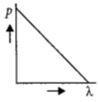
B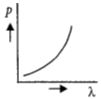
C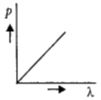
D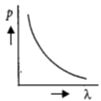
Solution
(D) The de-Broglie wavelength $\lambda$ is related to the momentum $p$ of a particle by the equation $\lambda = \frac{h}{p}$, where $h$ is Planck's constant.
This equation can be rewritten as $p \lambda = h$.
Since $h$ is a constant, the product of $p$ and $\lambda$ is constant $(p \lambda = \text{constant})$.
This relationship represents a rectangular hyperbola in the $p-\lambda$ plane, where $p$ decreases as $\lambda$ increases.
Therefore, the graph shown in Figure $D$ correctly represents this inverse relationship.
This equation can be rewritten as $p \lambda = h$.
Since $h$ is a constant, the product of $p$ and $\lambda$ is constant $(p \lambda = \text{constant})$.
This relationship represents a rectangular hyperbola in the $p-\lambda$ plane, where $p$ decreases as $\lambda$ increases.
Therefore, the graph shown in Figure $D$ correctly represents this inverse relationship.
0 likes
View Solution118
MediumMCQ
An electron of mass $m$ and a photon have the same energy $E$. The ratio of the de-Broglie wavelengths associated with them is:
A
$(\frac{E}{2m})^{1/2}$
B
$C(2mE)^{1/2}$
C
$\frac{1}{C}(\frac{2m}{E})^{1/2}$
D
$\frac{1}{C}(\frac{E}{2m})^{1/2}$
Solution
(D) For an electron of energy $E$,the de-Broglie wavelength is given by $\lambda_{e} = \frac{h}{p} = \frac{h}{\sqrt{2mE}}$.
For a photon of energy $E$,the relation is $E = \frac{hc}{\lambda_{p}}$,which implies $\lambda_{p} = \frac{hc}{E}$.
Taking the ratio of the wavelengths:
$\frac{\lambda_{e}}{\lambda_{p}} = \frac{h}{\sqrt{2mE}} \times \frac{E}{hc} = \frac{1}{c} \times \frac{E^{1}}{\sqrt{E}} \times \frac{1}{\sqrt{2m}} = \frac{1}{c} \sqrt{\frac{E}{2m}} = \frac{1}{C}(\frac{E}{2m})^{1/2}$.
For a photon of energy $E$,the relation is $E = \frac{hc}{\lambda_{p}}$,which implies $\lambda_{p} = \frac{hc}{E}$.
Taking the ratio of the wavelengths:
$\frac{\lambda_{e}}{\lambda_{p}} = \frac{h}{\sqrt{2mE}} \times \frac{E}{hc} = \frac{1}{c} \times \frac{E^{1}}{\sqrt{E}} \times \frac{1}{\sqrt{2m}} = \frac{1}{c} \sqrt{\frac{E}{2m}} = \frac{1}{C}(\frac{E}{2m})^{1/2}$.
0 likes
View Solution119
EasyMCQ
If the mass of a neutron is $1.7 \times 10^{-27} \; kg$,then the de-Broglie wavelength of a neutron with energy $3 \; eV$ is (given $h = 6.6 \times 10^{-34} \; J \cdot s$):
A
$1.6 \times 10^{-10} \; m$
B
$1.65 \times 10^{-11} \; m$
C
$1.4 \times 10^{-10} \; m$
D
$1.4 \times 10^{-11} \; m$
Solution
(B) The de-Broglie wavelength $\lambda$ is given by the formula $\lambda = \frac{h}{p}$,where $p$ is the momentum.
Since kinetic energy $E = \frac{p^2}{2m}$,we have $p = \sqrt{2mE}$.
Thus,$\lambda = \frac{h}{\sqrt{2mE}}$.
Given: $m = 1.7 \times 10^{-27} \; kg$,$E = 3 \; eV = 3 \times 1.6 \times 10^{-19} \; J$,and $h = 6.6 \times 10^{-34} \; J \cdot s$.
Substituting the values:
$\lambda = \frac{6.6 \times 10^{-34}}{\sqrt{2 \times 1.7 \times 10^{-27} \times 3 \times 1.6 \times 10^{-19}}}$
$\lambda = \frac{6.6 \times 10^{-34}}{\sqrt{16.32 \times 10^{-46}}}$
$\lambda = \frac{6.6 \times 10^{-34}}{4.04 \times 10^{-23}}$
$\lambda \approx 1.633 \times 10^{-11} \; m$.
Rounding to the nearest option,we get $\lambda = 1.65 \times 10^{-11} \; m$.
Since kinetic energy $E = \frac{p^2}{2m}$,we have $p = \sqrt{2mE}$.
Thus,$\lambda = \frac{h}{\sqrt{2mE}}$.
Given: $m = 1.7 \times 10^{-27} \; kg$,$E = 3 \; eV = 3 \times 1.6 \times 10^{-19} \; J$,and $h = 6.6 \times 10^{-34} \; J \cdot s$.
Substituting the values:
$\lambda = \frac{6.6 \times 10^{-34}}{\sqrt{2 \times 1.7 \times 10^{-27} \times 3 \times 1.6 \times 10^{-19}}}$
$\lambda = \frac{6.6 \times 10^{-34}}{\sqrt{16.32 \times 10^{-46}}}$
$\lambda = \frac{6.6 \times 10^{-34}}{4.04 \times 10^{-23}}$
$\lambda \approx 1.633 \times 10^{-11} \; m$.
Rounding to the nearest option,we get $\lambda = 1.65 \times 10^{-11} \; m$.
0 likes
View Solution120
MediumMCQ
The de-Broglie wavelength of a neutron in thermal equilibrium with heavy water at a temperature $T$ (kelvin) and mass $m$ is:
A
$\frac{h}{\sqrt{mkBT}}$
B
$\frac{h}{\sqrt{2mkBT}}$
C
$\frac{h}{\sqrt{3mkBT}}$
D
$\frac{h}{2\sqrt{mkBT}}$
Solution
(C) The kinetic energy $K$ of a neutron in thermal equilibrium at temperature $T$ is given by the equipartition theorem as:
$K = \frac{3}{2} k_B T$ ..... $(i)$
The relation between momentum $p$ and kinetic energy $K$ is $p = \sqrt{2mK}$.
Substituting the value of $K$ from equation $(i)$:
$p = \sqrt{2m \cdot \frac{3}{2} k_B T} = \sqrt{3mk_B T}$
The de-Broglie wavelength $\lambda$ is given by:
$\lambda = \frac{h}{p} = \frac{h}{\sqrt{3mk_B T}}$
$K = \frac{3}{2} k_B T$ ..... $(i)$
The relation between momentum $p$ and kinetic energy $K$ is $p = \sqrt{2mK}$.
Substituting the value of $K$ from equation $(i)$:
$p = \sqrt{2m \cdot \frac{3}{2} k_B T} = \sqrt{3mk_B T}$
The de-Broglie wavelength $\lambda$ is given by:
$\lambda = \frac{h}{p} = \frac{h}{\sqrt{3mk_B T}}$
0 likes
View Solution121
DifficultMCQ
An electron of mass $m$ with an initial velocity $\vec{V} = V_0 \hat{i} \,(V_0 > 0)$ enters an electric field $\vec{E} = -E_0 \hat{i} \,(E_0 = \text{constant} > 0)$ at $t = 0$. If $\lambda_0$ is its de-Broglie wavelength initially,then its de-Broglie wavelength at time $t$ is:
A
$\frac{\lambda_0}{\left(1 + \frac{eE_0}{mV_0}t\right)}$
B
$\lambda_0 \left(1 + \frac{eE_0}{mV_0}t\right)$
C
$\lambda_0$
D
$\lambda_0 t$
Solution
(A) The force acting on the electron due to the electric field is $\vec{F} = q\vec{E} = (-e)(-E_0 \hat{i}) = eE_0 \hat{i}$.
The acceleration produced in the electron is $\vec{a} = \frac{\vec{F}}{m} = \frac{eE_0}{m} \hat{i}$.
The velocity of the electron at time $t$ is given by $\vec{v}_t = \vec{v} + \vec{a}t = \left(V_0 + \frac{eE_0}{m}t\right) \hat{i}$.
The magnitude of the velocity is $v_t = V_0 + \frac{eE_0}{m}t = V_0 \left(1 + \frac{eE_0}{mV_0}t\right)$.
The de-Broglie wavelength at time $t$ is $\lambda_t = \frac{h}{mv_t}$.
Substituting $v_t$,we get $\lambda_t = \frac{h}{m V_0 \left(1 + \frac{eE_0}{mV_0}t\right)}$.
Since the initial de-Broglie wavelength is $\lambda_0 = \frac{h}{mV_0}$,we have $\lambda_t = \frac{\lambda_0}{\left(1 + \frac{eE_0}{mV_0}t\right)}$.
The acceleration produced in the electron is $\vec{a} = \frac{\vec{F}}{m} = \frac{eE_0}{m} \hat{i}$.
The velocity of the electron at time $t$ is given by $\vec{v}_t = \vec{v} + \vec{a}t = \left(V_0 + \frac{eE_0}{m}t\right) \hat{i}$.
The magnitude of the velocity is $v_t = V_0 + \frac{eE_0}{m}t = V_0 \left(1 + \frac{eE_0}{mV_0}t\right)$.
The de-Broglie wavelength at time $t$ is $\lambda_t = \frac{h}{mv_t}$.
Substituting $v_t$,we get $\lambda_t = \frac{h}{m V_0 \left(1 + \frac{eE_0}{mV_0}t\right)}$.
Since the initial de-Broglie wavelength is $\lambda_0 = \frac{h}{mV_0}$,we have $\lambda_t = \frac{\lambda_0}{\left(1 + \frac{eE_0}{mV_0}t\right)}$.
0 likes
View Solution122
MediumMCQ
$A$ proton and an electron are accelerated by the same potential difference. If their de-Broglie wavelengths are $\lambda_p$ and $\lambda_e$ respectively,then:
A
$\lambda_e = \lambda_p$
B
$\lambda_e < \lambda_p$
C
$\lambda_e > \lambda_p$
D
None of these.
Solution
(C) The de-Broglie wavelength $\lambda$ of a particle of mass $m$ accelerated through a potential difference $V$ is given by the formula:
$\lambda = \frac{h}{\sqrt{2meV}}$
where $h$ is Planck's constant and $e$ is the elementary charge.
Since $h$,$e$,and $V$ are constant for both particles,we have $\lambda \propto \frac{1}{\sqrt{m}}$.
We know that the mass of an electron $(m_e)$ is much smaller than the mass of a proton $(m_p)$,i.e.,$m_e < m_p$.
Therefore,$\frac{1}{\sqrt{m_e}} > \frac{1}{\sqrt{m_p}}$,which implies $\lambda_e > \lambda_p$.
Thus,the correct option is $(C)$.
$\lambda = \frac{h}{\sqrt{2meV}}$
where $h$ is Planck's constant and $e$ is the elementary charge.
Since $h$,$e$,and $V$ are constant for both particles,we have $\lambda \propto \frac{1}{\sqrt{m}}$.
We know that the mass of an electron $(m_e)$ is much smaller than the mass of a proton $(m_p)$,i.e.,$m_e < m_p$.
Therefore,$\frac{1}{\sqrt{m_e}} > \frac{1}{\sqrt{m_p}}$,which implies $\lambda_e > \lambda_p$.
Thus,the correct option is $(C)$.
0 likes
View Solution123
MediumMCQ
Two electrons are moving with the same speed $v$. One electron enters a region of uniform electric field while the other enters a region of uniform magnetic field. After some time,if the de-Broglie wavelengths of the two are $\lambda_1$ and $\lambda_2$,then:
A
$\lambda_1 = \lambda_2$
B
$\lambda_1 > \lambda_2$
C
$\lambda_1 < \lambda_2$
D
$\lambda_1 > \lambda_2$ or $\lambda_1 < \lambda_2$
Solution
(D) The de-Broglie wavelength is given by $\lambda = \frac{h}{mv}$,where $h$ is Planck's constant,$m$ is the mass of the electron,and $v$ is its speed.
When an electron enters a uniform electric field,the electric force $F = qE$ acts on it,which can either accelerate or decelerate the electron depending on the direction of the field. Thus,the speed $v_1$ changes,causing $\lambda_1$ to change.
When an electron enters a uniform magnetic field,the magnetic force $F = q(v \times B)$ acts perpendicular to the velocity. This force changes the direction of motion but does not change the magnitude of the speed. Thus,the speed $v_2$ remains constant,and $\lambda_2$ remains constant.
Since the speed $v_1$ in the electric field can either increase or decrease relative to the initial speed,$\lambda_1$ can be either smaller or larger than $\lambda_2$.
When an electron enters a uniform electric field,the electric force $F = qE$ acts on it,which can either accelerate or decelerate the electron depending on the direction of the field. Thus,the speed $v_1$ changes,causing $\lambda_1$ to change.
When an electron enters a uniform magnetic field,the magnetic force $F = q(v \times B)$ acts perpendicular to the velocity. This force changes the direction of motion but does not change the magnitude of the speed. Thus,the speed $v_2$ remains constant,and $\lambda_2$ remains constant.
Since the speed $v_1$ in the electric field can either increase or decrease relative to the initial speed,$\lambda_1$ can be either smaller or larger than $\lambda_2$.
0 likes
View Solution124
MediumMCQ
An electron with an initial kinetic energy of $100 \, eV$ is accelerated through a potential difference of $50 \, V$. The final de-Broglie wavelength of the electron becomes .................... $\mathring{A}$
A
$1$
B
$\sqrt{1.5}$
C
$\sqrt{3}$
D
$12.27$
Solution
(A) The initial kinetic energy of the electron is $K_i = 100 \, eV$.
When accelerated through a potential difference of $V = 50 \, V$,the electron gains additional kinetic energy equal to $K' = eV = 50 \, eV$.
The total kinetic energy of the electron becomes $K_f = K_i + K' = 100 \, eV + 50 \, eV = 150 \, eV$.
The de-Broglie wavelength $\lambda$ is given by the formula $\lambda = \frac{h}{\sqrt{2mK}}$.
Using the shortcut formula $\lambda (\text{in } \mathring{A}) = \sqrt{\frac{150}{K (\text{in } eV)}}$,we get:
$\lambda = \sqrt{\frac{150}{150}} = \sqrt{1} = 1 \, \mathring{A}$.
When accelerated through a potential difference of $V = 50 \, V$,the electron gains additional kinetic energy equal to $K' = eV = 50 \, eV$.
The total kinetic energy of the electron becomes $K_f = K_i + K' = 100 \, eV + 50 \, eV = 150 \, eV$.
The de-Broglie wavelength $\lambda$ is given by the formula $\lambda = \frac{h}{\sqrt{2mK}}$.
Using the shortcut formula $\lambda (\text{in } \mathring{A}) = \sqrt{\frac{150}{K (\text{in } eV)}}$,we get:
$\lambda = \sqrt{\frac{150}{150}} = \sqrt{1} = 1 \, \mathring{A}$.
0 likes
View Solution125
DifficultMCQ
$A$ particle $A$ of mass $m$ and initial velocity $v$ collides with a particle $B$ of mass $\frac{m}{2}$ which is at rest. The collision is head-on and elastic. The ratio of the de-Broglie wavelengths $\lambda_A$ and $\lambda_B$ after the collision is
A
$\frac{\lambda_A}{\lambda_B} = \frac{1}{3}$
B
$\frac{\lambda_A}{\lambda_B} = 2$
C
$\frac{\lambda_A}{\lambda_B} = \frac{2}{3}$
D
$\frac{\lambda_A}{\lambda_B} = \frac{1}{2}$
Solution
(B) Given: Mass of $A = m$,Mass of $B = \frac{m}{2}$. Initial velocity of $A = v$,Initial velocity of $B = 0$.
Let the final velocities be $v_1$ and $v_2$ for $A$ and $B$ respectively.
By conservation of momentum: $mv = mv_1 + (\frac{m}{2})v_2 \implies v = v_1 + \frac{v_2}{2} \implies 2v = 2v_1 + v_2$ ... $(i)$.
For an elastic collision,the coefficient of restitution $e = 1$,so $v_2 - v_1 = v - 0 \implies v_2 = v + v_1$ ... $(ii)$.
Substituting $(ii)$ into $(i)$: $2v = 2v_1 + (v + v_1) \implies v = 3v_1 \implies v_1 = \frac{v}{3}$.
Then $v_2 = v + \frac{v}{3} = \frac{4v}{3}$.
The de-Broglie wavelength is $\lambda = \frac{h}{p} = \frac{h}{mv}$.
Ratio $\frac{\lambda_A}{\lambda_B} = \frac{p_B}{p_A} = \frac{m_B v_2}{m_A v_1} = \frac{(\frac{m}{2}) \times (\frac{4v}{3})}{m \times (\frac{v}{3})} = \frac{\frac{2mv}{3}}{\frac{mv}{3}} = 2$.
Let the final velocities be $v_1$ and $v_2$ for $A$ and $B$ respectively.
By conservation of momentum: $mv = mv_1 + (\frac{m}{2})v_2 \implies v = v_1 + \frac{v_2}{2} \implies 2v = 2v_1 + v_2$ ... $(i)$.
For an elastic collision,the coefficient of restitution $e = 1$,so $v_2 - v_1 = v - 0 \implies v_2 = v + v_1$ ... $(ii)$.
Substituting $(ii)$ into $(i)$: $2v = 2v_1 + (v + v_1) \implies v = 3v_1 \implies v_1 = \frac{v}{3}$.
Then $v_2 = v + \frac{v}{3} = \frac{4v}{3}$.
The de-Broglie wavelength is $\lambda = \frac{h}{p} = \frac{h}{mv}$.
Ratio $\frac{\lambda_A}{\lambda_B} = \frac{p_B}{p_A} = \frac{m_B v_2}{m_A v_1} = \frac{(\frac{m}{2}) \times (\frac{4v}{3})}{m \times (\frac{v}{3})} = \frac{\frac{2mv}{3}}{\frac{mv}{3}} = 2$.
0 likes
View Solution126
DifficultMCQ
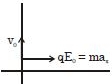
$A$ charged particle $q_0$ of mass $m_0$ is projected along the $y-$axis at $t = 0$ from the origin with a velocity $v_0$. If a uniform electric field $E_0$ also exists along the $x-$axis,then the time at which the de Broglie wavelength of the particle becomes half of its initial value is:
A
$\frac{m_0v_0}{q_0E_0}$
B
$2\frac{m_0v_0}{q_0E_0}$
C
$\sqrt{3} \frac{m_0v_0}{q_0E_0}$
D
$3\frac{m_0v_0}{q_0E_0}$
Solution
(C) The initial de Broglie wavelength is $\lambda_0 = \frac{h}{m_0v_0}$.
When the wavelength becomes half,$\lambda = \frac{\lambda_0}{2} = \frac{h}{2m_0v_0}$.
Since $\lambda = \frac{h}{p}$,the final momentum $p$ must be $2m_0v_0$.
Let the velocity at time $t$ be $v$. Then $mv = 2m_0v_0$,so $v = 2v_0$.
The velocity components are $v_y = v_0$ (constant) and $v_x = a_x t = \frac{q_0E_0}{m_0}t$.
The magnitude of velocity is $v = \sqrt{v_x^2 + v_y^2}$.
Squaring both sides,$v^2 = v_x^2 + v_y^2 \Rightarrow (2v_0)^2 = v_x^2 + v_0^2$.
$4v_0^2 = v_x^2 + v_0^2 \Rightarrow v_x^2 = 3v_0^2 \Rightarrow v_x = \sqrt{3}v_0$.
Substituting $v_x = \frac{q_0E_0}{m_0}t$,we get $\frac{q_0E_0}{m_0}t = \sqrt{3}v_0$.
Therefore,$t = \sqrt{3} \frac{m_0v_0}{q_0E_0}$.
When the wavelength becomes half,$\lambda = \frac{\lambda_0}{2} = \frac{h}{2m_0v_0}$.
Since $\lambda = \frac{h}{p}$,the final momentum $p$ must be $2m_0v_0$.
Let the velocity at time $t$ be $v$. Then $mv = 2m_0v_0$,so $v = 2v_0$.
The velocity components are $v_y = v_0$ (constant) and $v_x = a_x t = \frac{q_0E_0}{m_0}t$.
The magnitude of velocity is $v = \sqrt{v_x^2 + v_y^2}$.
Squaring both sides,$v^2 = v_x^2 + v_y^2 \Rightarrow (2v_0)^2 = v_x^2 + v_0^2$.
$4v_0^2 = v_x^2 + v_0^2 \Rightarrow v_x^2 = 3v_0^2 \Rightarrow v_x = \sqrt{3}v_0$.
Substituting $v_x = \frac{q_0E_0}{m_0}t$,we get $\frac{q_0E_0}{m_0}t = \sqrt{3}v_0$.
Therefore,$t = \sqrt{3} \frac{m_0v_0}{q_0E_0}$.
0 likes
View Solution127
DifficultMCQ
With what potential an electron should be accelerated so that its de Broglie wavelength becomes equal to the wavelength of the first line of the Lyman series for the $He^+$ ion?
A
$\frac{R^2 h^2}{2me}$
B
$\frac{9R^2 h^2}{2me}$
C
$\frac{9R^2 h^2}{32me}$
D
$\frac{R^2 h^2}{32me}$
Solution
(B) The de Broglie wavelength of an electron accelerated through a potential $V$ is given by $\lambda = \frac{h}{\sqrt{2meV}}$.
The wavelength of the first line of the Lyman series for a hydrogen-like ion with atomic number $Z$ is given by $\frac{1}{\lambda} = R Z^2 \left( \frac{1}{n_1^2} - \frac{1}{n_2^2} \right)$.
For $He^+$,$Z = 2$. For the first line of the Lyman series,$n_1 = 1$ and $n_2 = 2$.
$\frac{1}{\lambda} = R (2)^2 \left( \frac{1}{1^2} - \frac{1}{2^2} \right) = 4R \left( 1 - \frac{1}{4} \right) = 4R \left( \frac{3}{4} \right) = 3R$.
Equating the two wavelengths: $\frac{h}{\sqrt{2meV}} = \frac{1}{3R}$.
Squaring both sides: $\frac{h^2}{2meV} = \frac{1}{9R^2}$.
Solving for $V$: $V = \frac{9R^2 h^2}{2me}$.
The wavelength of the first line of the Lyman series for a hydrogen-like ion with atomic number $Z$ is given by $\frac{1}{\lambda} = R Z^2 \left( \frac{1}{n_1^2} - \frac{1}{n_2^2} \right)$.
For $He^+$,$Z = 2$. For the first line of the Lyman series,$n_1 = 1$ and $n_2 = 2$.
$\frac{1}{\lambda} = R (2)^2 \left( \frac{1}{1^2} - \frac{1}{2^2} \right) = 4R \left( 1 - \frac{1}{4} \right) = 4R \left( \frac{3}{4} \right) = 3R$.
Equating the two wavelengths: $\frac{h}{\sqrt{2meV}} = \frac{1}{3R}$.
Squaring both sides: $\frac{h^2}{2meV} = \frac{1}{9R^2}$.
Solving for $V$: $V = \frac{9R^2 h^2}{2me}$.
0 likes
View Solution128
MediumMCQ
An electron,accelerated by a potential difference $V$,has de Broglie wavelength $\lambda$. If the electron is accelerated by a potential difference $4V$,its de Broglie wavelength will become $\frac{\lambda}{n}$ where $n=$
A
$2$
B
$4$
C
$1/2$
D
$1/4$
Solution
(A) The de Broglie wavelength $\lambda$ of an electron accelerated through a potential difference $V$ is given by the formula $\lambda = \frac{h}{\sqrt{2meV}}$.
From this relation,we can see that $\lambda \propto \frac{1}{\sqrt{V}}$.
Let the initial wavelength be $\lambda = \frac{k}{\sqrt{V}}$ and the new wavelength be $\lambda^{\prime} = \frac{k}{\sqrt{4V}}$,where $k$ is a constant.
Dividing the two expressions,we get $\frac{\lambda^{\prime}}{\lambda} = \frac{\sqrt{V}}{\sqrt{4V}} = \frac{1}{2}$.
Therefore,$\lambda^{\prime} = \frac{\lambda}{2}$.
Comparing this with the given expression $\lambda^{\prime} = \frac{\lambda}{n}$,we find that $n = 2$.
From this relation,we can see that $\lambda \propto \frac{1}{\sqrt{V}}$.
Let the initial wavelength be $\lambda = \frac{k}{\sqrt{V}}$ and the new wavelength be $\lambda^{\prime} = \frac{k}{\sqrt{4V}}$,where $k$ is a constant.
Dividing the two expressions,we get $\frac{\lambda^{\prime}}{\lambda} = \frac{\sqrt{V}}{\sqrt{4V}} = \frac{1}{2}$.
Therefore,$\lambda^{\prime} = \frac{\lambda}{2}$.
Comparing this with the given expression $\lambda^{\prime} = \frac{\lambda}{n}$,we find that $n = 2$.
0 likes
View Solution129
MediumMCQ
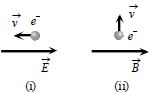
An electron is moving through a field. It is moving $(i)$ opposite to an electric field and $(ii)$ perpendicular to a magnetic field as shown. For each situation, determine the de-Broglie wavelength of the electron:
A
Decreasing, remain same
B
Increasing, decreasing
C
Increasing, increasing
D
Remain same, remain same
Solution
(A) The de-Broglie wavelength is given by $\lambda = \frac{h}{mv}$.
Case $(i)$: The electron is moving opposite to the electric field. Since the electron is negatively charged, it experiences a force in the direction of the electric field, which accelerates it. As the velocity $v$ increases, the de-Broglie wavelength $\lambda$ decreases.
Case $(ii)$: The electron is moving perpendicular to a magnetic field. The magnetic force acts perpendicular to the velocity, changing the direction of motion but not the magnitude of the velocity $v$. Since the speed $v$ remains constant, the de-Broglie wavelength $\lambda$ remains the same.
Case $(i)$: The electron is moving opposite to the electric field. Since the electron is negatively charged, it experiences a force in the direction of the electric field, which accelerates it. As the velocity $v$ increases, the de-Broglie wavelength $\lambda$ decreases.
Case $(ii)$: The electron is moving perpendicular to a magnetic field. The magnetic force acts perpendicular to the velocity, changing the direction of motion but not the magnitude of the velocity $v$. Since the speed $v$ remains constant, the de-Broglie wavelength $\lambda$ remains the same.
0 likes
View Solution130
DifficultMCQ
If the momentum of an electron is changed by $\Delta p,$ then the de-Broglie wavelength associated with it changes by $0.50\%.$ The initial momentum of the electron will be:
A
$\frac{\Delta p}{200}$
B
$\frac{\Delta p}{199}$
C
$199 \Delta p$
D
None of these
Solution
(C) The de-Broglie wavelength is given by $\lambda = \frac{h}{p}.$
Given that the wavelength changes by $0.50\%,$ the new wavelength $\lambda'$ is $\lambda' = \lambda - \frac{0.5}{100} \lambda = 0.995 \lambda = \frac{199}{200} \lambda.$
Since $\lambda = \frac{h}{p},$ the new momentum $p'$ is $p' = p + \Delta p.$
Thus,$\lambda' = \frac{h}{p + \Delta p}.$
Equating the two expressions for $\lambda':$
$\frac{h}{p + \Delta p} = \frac{199}{200} \left( \frac{h}{p} \right).$
$\Rightarrow \frac{1}{p + \Delta p} = \frac{199}{200p}.$
$\Rightarrow 200p = 199(p + \Delta p).$
$\Rightarrow 200p = 199p + 199 \Delta p.$
$\Rightarrow p = 199 \Delta p.$
Given that the wavelength changes by $0.50\%,$ the new wavelength $\lambda'$ is $\lambda' = \lambda - \frac{0.5}{100} \lambda = 0.995 \lambda = \frac{199}{200} \lambda.$
Since $\lambda = \frac{h}{p},$ the new momentum $p'$ is $p' = p + \Delta p.$
Thus,$\lambda' = \frac{h}{p + \Delta p}.$
Equating the two expressions for $\lambda':$
$\frac{h}{p + \Delta p} = \frac{199}{200} \left( \frac{h}{p} \right).$
$\Rightarrow \frac{1}{p + \Delta p} = \frac{199}{200p}.$
$\Rightarrow 200p = 199(p + \Delta p).$
$\Rightarrow 200p = 199p + 199 \Delta p.$
$\Rightarrow p = 199 \Delta p.$
0 likes
View Solution131
MediumMCQ
Two particles of equal masses are moving with equal speeds at an angle $60^o$. The de-Broglie wavelength of these particles is $\lambda$. Find the de-Broglie wavelength of the particles in the frame of the centre of mass of the particles.
A
$\lambda$
B
$2\ \lambda$
C
$\sqrt{3}\ \lambda$
D
$\frac{2}{\sqrt{3}}\ \lambda$
Solution
(B) Let the masses of the two particles be $m$ and their speeds be $v$. The de-Broglie wavelength is given by $\lambda = \frac{h}{mv}$,so $mv = \frac{h}{\lambda}$.
In the centre of mass $(CM)$ frame,the velocity of particle $1$ is $\vec{v}_{1cm} = \vec{v}_1 - \vec{v}_{cm}$.
The velocity of the centre of mass is $\vec{v}_{cm} = \frac{m\vec{v}_1 + m\vec{v}_2}{2m} = \frac{\vec{v}_1 + \vec{v}_2}{2}$.
Thus,$\vec{v}_{1cm} = \vec{v}_1 - \frac{\vec{v}_1 + \vec{v}_2}{2} = \frac{\vec{v}_1 - \vec{v}_2}{2}$.
The magnitude of the relative velocity is $|\vec{v}_{1cm}| = \frac{1}{2} |\vec{v}_1 - \vec{v}_2|$.
Using the law of cosines for the vector subtraction of two vectors of equal magnitude $v$ at an angle $\theta = 60^o$:
$|\vec{v}_1 - \vec{v}_2| = \sqrt{v^2 + v^2 - 2v^2 \cos(60^o)} = \sqrt{2v^2 - 2v^2(0.5)} = \sqrt{v^2} = v$.
Therefore,$|\vec{v}_{1cm}| = \frac{v}{2}$.
The new de-Broglie wavelength is $\lambda' = \frac{h}{m|\vec{v}_{1cm}|} = \frac{h}{m(v/2)} = 2 \frac{h}{mv} = 2\lambda$.
In the centre of mass $(CM)$ frame,the velocity of particle $1$ is $\vec{v}_{1cm} = \vec{v}_1 - \vec{v}_{cm}$.
The velocity of the centre of mass is $\vec{v}_{cm} = \frac{m\vec{v}_1 + m\vec{v}_2}{2m} = \frac{\vec{v}_1 + \vec{v}_2}{2}$.
Thus,$\vec{v}_{1cm} = \vec{v}_1 - \frac{\vec{v}_1 + \vec{v}_2}{2} = \frac{\vec{v}_1 - \vec{v}_2}{2}$.
The magnitude of the relative velocity is $|\vec{v}_{1cm}| = \frac{1}{2} |\vec{v}_1 - \vec{v}_2|$.
Using the law of cosines for the vector subtraction of two vectors of equal magnitude $v$ at an angle $\theta = 60^o$:
$|\vec{v}_1 - \vec{v}_2| = \sqrt{v^2 + v^2 - 2v^2 \cos(60^o)} = \sqrt{2v^2 - 2v^2(0.5)} = \sqrt{v^2} = v$.
Therefore,$|\vec{v}_{1cm}| = \frac{v}{2}$.
The new de-Broglie wavelength is $\lambda' = \frac{h}{m|\vec{v}_{1cm}|} = \frac{h}{m(v/2)} = 2 \frac{h}{mv} = 2\lambda$.
0 likes
View Solution132
MediumMCQ
After absorbing a slowly moving neutron of mass $m_N$ (momentum $\approx 0$),a nucleus of mass $M$ breaks into two nuclei of masses $m_1$ and $3m_1$ $(4m_1 = M + m_N)$,respectively. If the de Broglie wavelength of the nucleus with mass $m_1$ is $\lambda$,then the de Broglie wavelength of the other nucleus will be:
A
$9 \lambda$
B
$3 \lambda$
C
$\frac{\lambda}{3}$
D
$\lambda$
Solution
(D) The initial momentum of the system is $P_i \approx 0$ because the neutron is moving slowly.
According to the law of conservation of linear momentum,the final momentum of the system must also be zero $(P_f = 0)$.
Let the momenta of the two product nuclei be $P_1$ and $P_2$. Since the total momentum is zero,we have $P_1 + P_2 = 0$,which implies $P_1 = -P_2$.
In terms of magnitude,$|P_1| = |P_2| = P$.
The de Broglie wavelength is given by the formula $\lambda = \frac{h}{p}$,where $h$ is Planck's constant and $p$ is the momentum.
Since both nuclei have the same magnitude of momentum $P$,their de Broglie wavelengths will be $\lambda_1 = \frac{h}{P}$ and $\lambda_2 = \frac{h}{P}$.
Therefore,$\lambda_1 = \lambda_2 = \lambda$.
According to the law of conservation of linear momentum,the final momentum of the system must also be zero $(P_f = 0)$.
Let the momenta of the two product nuclei be $P_1$ and $P_2$. Since the total momentum is zero,we have $P_1 + P_2 = 0$,which implies $P_1 = -P_2$.
In terms of magnitude,$|P_1| = |P_2| = P$.
The de Broglie wavelength is given by the formula $\lambda = \frac{h}{p}$,where $h$ is Planck's constant and $p$ is the momentum.
Since both nuclei have the same magnitude of momentum $P$,their de Broglie wavelengths will be $\lambda_1 = \frac{h}{P}$ and $\lambda_2 = \frac{h}{P}$.
Therefore,$\lambda_1 = \lambda_2 = \lambda$.
0 likes
View Solution133
DifficultMCQ
An electron (mass $m$) with an initial velocity $v = v_0 \hat{i}$ is in an electric field $E = E_0 \hat{j}$. If $\lambda_0 = h/mv_0$,its de Broglie wavelength at time $t$ is given by
A
$\lambda_0$
B
$\lambda_0 \sqrt{1 + \frac{e^2 E_0^2 t^2}{m^2 v_0^2}}$
C
$\frac{\lambda_0}{\sqrt{1 + \frac{e^2 E_0^2 t^2}{m^2 v_0^2}}}$
D
$\frac{\lambda_0}{1 + \frac{e^2 E_0^2 t^2}{m^2 v_0^2}}$
Solution
(C) Initial de Broglie wavelength of the electron is $\lambda_0 = \frac{h}{mv_0}$.
Force on the electron in the electric field is $\vec{F} = -e\vec{E} = -eE_0 \hat{j}$.
Acceleration of the electron is $\vec{a} = \frac{\vec{F}}{m} = -\frac{eE_0}{m} \hat{j}$.
The initial velocity is $\vec{v}_0 = v_0 \hat{i}$.
Velocity at time $t$ is $\vec{v} = \vec{v}_0 + \vec{a}t = v_0 \hat{i} - \frac{eE_0 t}{m} \hat{j}$.
The magnitude of velocity at time $t$ is $v = \sqrt{v_0^2 + (\frac{eE_0 t}{m})^2} = v_0 \sqrt{1 + \frac{e^2 E_0^2 t^2}{m^2 v_0^2}}$.
The de Broglie wavelength at time $t$ is $\lambda = \frac{h}{mv} = \frac{h}{m v_0 \sqrt{1 + \frac{e^2 E_0^2 t^2}{m^2 v_0^2}}}$.
Substituting $\lambda_0 = \frac{h}{mv_0}$,we get $\lambda = \frac{\lambda_0}{\sqrt{1 + \frac{e^2 E_0^2 t^2}{m^2 v_0^2}}}$.
Force on the electron in the electric field is $\vec{F} = -e\vec{E} = -eE_0 \hat{j}$.
Acceleration of the electron is $\vec{a} = \frac{\vec{F}}{m} = -\frac{eE_0}{m} \hat{j}$.
The initial velocity is $\vec{v}_0 = v_0 \hat{i}$.
Velocity at time $t$ is $\vec{v} = \vec{v}_0 + \vec{a}t = v_0 \hat{i} - \frac{eE_0 t}{m} \hat{j}$.
The magnitude of velocity at time $t$ is $v = \sqrt{v_0^2 + (\frac{eE_0 t}{m})^2} = v_0 \sqrt{1 + \frac{e^2 E_0^2 t^2}{m^2 v_0^2}}$.
The de Broglie wavelength at time $t$ is $\lambda = \frac{h}{mv} = \frac{h}{m v_0 \sqrt{1 + \frac{e^2 E_0^2 t^2}{m^2 v_0^2}}}$.
Substituting $\lambda_0 = \frac{h}{mv_0}$,we get $\lambda = \frac{\lambda_0}{\sqrt{1 + \frac{e^2 E_0^2 t^2}{m^2 v_0^2}}}$.
0 likes
View Solution134
DifficultMCQ
$A$ free particle with initial kinetic energy $E$ and de-Broglie wavelength $\lambda$ enters a region in which it has potential energy $V$. What is the particle's new de-Broglie wavelength?
A
$\lambda \left( 1 - \frac{E}{V} \right)^{-\frac{1}{2}}$
B
$\lambda \left( 1 - \frac{E}{V} \right)$
C
$\lambda \left( 1 - \frac{E}{V} \right)^{-1}$
D
$\lambda \left( 1 - \frac{V}{E} \right)^{-\frac{1}{2}}$
Solution
(D) The initial kinetic energy of the particle is $K_i = E$.
The initial de-Broglie wavelength is given by $\lambda = \frac{h}{p} = \frac{h}{\sqrt{2mK_i}} = \frac{h}{\sqrt{2mE}}$.
When the particle enters a region with potential energy $V$,its total energy remains conserved. The new kinetic energy $K_f$ is given by $K_f = E - V$.
The new de-Broglie wavelength $\lambda'$ is $\lambda' = \frac{h}{\sqrt{2mK_f}} = \frac{h}{\sqrt{2m(E - V)}}$.
We can rewrite this as $\lambda' = \frac{h}{\sqrt{2mE(1 - \frac{V}{E})}} = \frac{h}{\sqrt{2mE}} \cdot \frac{1}{\sqrt{1 - \frac{V}{E}}}$.
Substituting $\lambda = \frac{h}{\sqrt{2mE}}$,we get $\lambda' = \lambda \left( 1 - \frac{V}{E} \right)^{-\frac{1}{2}}$.
The initial de-Broglie wavelength is given by $\lambda = \frac{h}{p} = \frac{h}{\sqrt{2mK_i}} = \frac{h}{\sqrt{2mE}}$.
When the particle enters a region with potential energy $V$,its total energy remains conserved. The new kinetic energy $K_f$ is given by $K_f = E - V$.
The new de-Broglie wavelength $\lambda'$ is $\lambda' = \frac{h}{\sqrt{2mK_f}} = \frac{h}{\sqrt{2m(E - V)}}$.
We can rewrite this as $\lambda' = \frac{h}{\sqrt{2mE(1 - \frac{V}{E})}} = \frac{h}{\sqrt{2mE}} \cdot \frac{1}{\sqrt{1 - \frac{V}{E}}}$.
Substituting $\lambda = \frac{h}{\sqrt{2mE}}$,we get $\lambda' = \lambda \left( 1 - \frac{V}{E} \right)^{-\frac{1}{2}}$.
0 likes
View Solution135
MediumMCQ
$A$ particle is moving along the $x-$axis back and forth in a box of length $L$. Assuming the de-Broglie hypothesis is applicable for the particle,and it is moving with a constant speed in the box making perfectly elastic collisions with the walls. The possible value of the momentum of the particle is (Note: $h$ is Planck's constant,$n$ is the principal quantum number).
A
$\frac{nh}{2L}$
B
$\frac{nh}{L}$
C
$\frac{nh}{4L}$
D
$\frac{2nh}{3L}$
Solution
(A) According to the de-Broglie hypothesis,the wavelength $\lambda$ is related to momentum $p$ by $\lambda = \frac{h}{p}$.
For a particle in a box of length $L$ with perfectly elastic collisions,the standing wave condition requires that the length $L$ must be an integer multiple of half-wavelengths: $L = \frac{n\lambda}{2}$,where $n = 1, 2, 3, \dots$.
Rearranging for $\lambda$,we get $\lambda = \frac{2L}{n}$.
Substituting this into the de-Broglie relation: $p = \frac{h}{\lambda} = \frac{h}{(2L/n)} = \frac{nh}{2L}$.
For a particle in a box of length $L$ with perfectly elastic collisions,the standing wave condition requires that the length $L$ must be an integer multiple of half-wavelengths: $L = \frac{n\lambda}{2}$,where $n = 1, 2, 3, \dots$.
Rearranging for $\lambda$,we get $\lambda = \frac{2L}{n}$.
Substituting this into the de-Broglie relation: $p = \frac{h}{\lambda} = \frac{h}{(2L/n)} = \frac{nh}{2L}$.
0 likes
View Solution136
DifficultMCQ
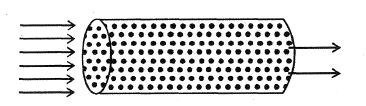
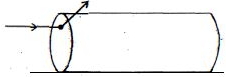
$A$ long pipe is filled with small granules of nickel. The interatomic spacing for nickel is $d$. $A$ beam of electrons having different energies is incident on the left flat face of the pipe. Mass of electron is $m$. The beam of electrons coming out of the right flat face has energy:
A
greater than $\frac{h^2}{8md^2}$
B
less than $\frac{h^2}{8md^2}$
C
greater than $\frac{h^2}{4md^2}$
D
less than $\frac{h^2}{4md^2}$
Solution
(B) For diffraction to occur in the nickel granules,the condition is $2d \sin \theta = n \lambda$.
Since $\sin \theta \le 1$,the maximum wavelength that can be diffracted is $\lambda_{\max} = 2d$ (for $n=1$).
Electrons with wavelengths $\lambda > 2d$ cannot be diffracted by the nickel granules and will pass through the pipe.
Using the de Broglie relation $\lambda = \frac{h}{p}$,the condition $\lambda > 2d$ implies $\frac{h}{p} > 2d$,or $p < \frac{h}{2d}$.
The kinetic energy $E$ of these electrons is $E = \frac{p^2}{2m}$.
Substituting the inequality for $p$,we get $E < \frac{(\frac{h}{2d})^2}{2m} = \frac{h^2}{8md^2}$.
Thus,the electrons that pass through the pipe have energy less than $\frac{h^2}{8md^2}$.
Since $\sin \theta \le 1$,the maximum wavelength that can be diffracted is $\lambda_{\max} = 2d$ (for $n=1$).
Electrons with wavelengths $\lambda > 2d$ cannot be diffracted by the nickel granules and will pass through the pipe.
Using the de Broglie relation $\lambda = \frac{h}{p}$,the condition $\lambda > 2d$ implies $\frac{h}{p} > 2d$,or $p < \frac{h}{2d}$.
The kinetic energy $E$ of these electrons is $E = \frac{p^2}{2m}$.
Substituting the inequality for $p$,we get $E < \frac{(\frac{h}{2d})^2}{2m} = \frac{h^2}{8md^2}$.
Thus,the electrons that pass through the pipe have energy less than $\frac{h^2}{8md^2}$.
0 likes
View Solution137
DifficultMCQ
The de-Broglie wavelength of a particle moving with a velocity $2.25 \times 10^8\, m/s$ is equal to the wavelength of a photon. The ratio of the kinetic energy of the particle to the energy of the photon is (velocity of light is $3 \times 10^8\, m/s$). (in $/8$)
A
$1$
B
$3$
C
$5$
D
$7$
Solution
(B) Given that the de-Broglie wavelength of the particle is equal to the wavelength of the photon: $\lambda_p = \lambda_{ph} = \lambda$.
For a photon,the energy is $E_{ph} = \frac{hc}{\lambda}$.
For a particle,the de-Broglie wavelength is $\lambda = \frac{h}{mv}$,which implies $h = \lambda mv$.
The kinetic energy of the particle is $K_p = \frac{1}{2}mv^2$.
Substituting $h$ into the photon energy equation: $E_{ph} = \frac{(\lambda mv)c}{\lambda} = mvc$.
The ratio of the kinetic energy of the particle to the energy of the photon is:
$\frac{K_p}{E_{ph}} = \frac{\frac{1}{2}mv^2}{mvc} = \frac{v}{2c}$.
Given $v = 2.25 \times 10^8\, m/s$ and $c = 3 \times 10^8\, m/s$:
Ratio $= \frac{2.25 \times 10^8}{2 \times 3 \times 10^8} = \frac{2.25}{6} = \frac{225}{600} = \frac{3}{8}$.
For a photon,the energy is $E_{ph} = \frac{hc}{\lambda}$.
For a particle,the de-Broglie wavelength is $\lambda = \frac{h}{mv}$,which implies $h = \lambda mv$.
The kinetic energy of the particle is $K_p = \frac{1}{2}mv^2$.
Substituting $h$ into the photon energy equation: $E_{ph} = \frac{(\lambda mv)c}{\lambda} = mvc$.
The ratio of the kinetic energy of the particle to the energy of the photon is:
$\frac{K_p}{E_{ph}} = \frac{\frac{1}{2}mv^2}{mvc} = \frac{v}{2c}$.
Given $v = 2.25 \times 10^8\, m/s$ and $c = 3 \times 10^8\, m/s$:
Ratio $= \frac{2.25 \times 10^8}{2 \times 3 \times 10^8} = \frac{2.25}{6} = \frac{225}{600} = \frac{3}{8}$.
0 likes
View Solution138
DifficultMCQ
The de-Broglie wavelength of a particle accelerated with $150 \ V$ potential is $10^{-10} \ m$. If it is accelerated by $600 \ V$ potential difference,its wavelength will be: ............... $\mathring{A}$
A
$0.25$
B
$0.5$
C
$1.5$
D
$2$
Solution
(B) The de-Broglie wavelength $\lambda$ of a charged particle accelerated through a potential difference $V$ is given by the relation $\lambda = \frac{h}{\sqrt{2mqV}}$.
This implies that $\lambda \propto \frac{1}{\sqrt{V}}$.
Given $\lambda_1 = 10^{-10} \ m = 1 \ \mathring{A}$ at $V_1 = 150 \ V$.
We need to find $\lambda_2$ at $V_2 = 600 \ V$.
Using the ratio: $\frac{\lambda_1}{\lambda_2} = \sqrt{\frac{V_2}{V_1}}$.
Substituting the values: $\frac{1}{\lambda_2} = \sqrt{\frac{600}{150}} = \sqrt{4} = 2$.
Therefore,$\lambda_2 = \frac{1}{2} = 0.5 \ \mathring{A}$.
This implies that $\lambda \propto \frac{1}{\sqrt{V}}$.
Given $\lambda_1 = 10^{-10} \ m = 1 \ \mathring{A}$ at $V_1 = 150 \ V$.
We need to find $\lambda_2$ at $V_2 = 600 \ V$.
Using the ratio: $\frac{\lambda_1}{\lambda_2} = \sqrt{\frac{V_2}{V_1}}$.
Substituting the values: $\frac{1}{\lambda_2} = \sqrt{\frac{600}{150}} = \sqrt{4} = 2$.
Therefore,$\lambda_2 = \frac{1}{2} = 0.5 \ \mathring{A}$.
0 likes
View Solution139
DifficultMCQ
$A$ proton and an $\alpha$-particle are accelerated through a potential difference of $100\, V$. The ratio of the wavelength associated with the proton to that associated with an $\alpha$-particle is
A
$\sqrt{2} : 1$
B
$2 : 1$
C
$2\sqrt{2} : 1$
D
$\frac{1}{2\sqrt{2}} : 1$
Solution
(C) The de Broglie wavelength $\lambda$ of a charged particle accelerated through a potential difference $V_0$ is given by $\lambda = \frac{h}{\sqrt{2mqV_0}}$.
Since $h$ and $V_0$ are constant for both particles,the wavelength is inversely proportional to the square root of the product of mass and charge: $\lambda \propto \frac{1}{\sqrt{mq}}$.
For a proton,$m_p = m$ and $q_p = e$. For an $\alpha$-particle,$m_{\alpha} = 4m$ and $q_{\alpha} = 2e$.
The ratio of the wavelengths is $\frac{\lambda_p}{\lambda_{\alpha}} = \sqrt{\frac{m_{\alpha}q_{\alpha}}{m_pq_p}} = \sqrt{\frac{4m \times 2e}{m \times e}} = \sqrt{8} = 2\sqrt{2}$.
Thus,the ratio is $2\sqrt{2} : 1$.
Since $h$ and $V_0$ are constant for both particles,the wavelength is inversely proportional to the square root of the product of mass and charge: $\lambda \propto \frac{1}{\sqrt{mq}}$.
For a proton,$m_p = m$ and $q_p = e$. For an $\alpha$-particle,$m_{\alpha} = 4m$ and $q_{\alpha} = 2e$.
The ratio of the wavelengths is $\frac{\lambda_p}{\lambda_{\alpha}} = \sqrt{\frac{m_{\alpha}q_{\alpha}}{m_pq_p}} = \sqrt{\frac{4m \times 2e}{m \times e}} = \sqrt{8} = 2\sqrt{2}$.
Thus,the ratio is $2\sqrt{2} : 1$.
0 likes
View Solution140
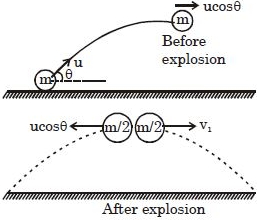
DifficultMCQ
$A$ bomb projected from the ground at an angle $\theta$ $\left( \theta \neq 90^\circ \right)$ explodes into two fragments of equal mass at the topmost point of its trajectory. If one of the fragments returns to the point of projection,then the ratio of the de Broglie wavelength of the second fragment just after the explosion to that of the bomb just before the explosion is:
A
$1$
B
$2$
C
$\frac{2}{3}$
D
$\frac{3}{2}$
Solution
(C) At the topmost point,the velocity of the bomb of mass $M$ is $v = u \cos \theta$ in the horizontal direction. The momentum is $P = M u \cos \theta$.
After the explosion,the bomb splits into two fragments of mass $m = M/2$. Let the velocity of the first fragment (which returns to the point of projection) be $v_1$ and the second fragment be $v_2$.
Since the first fragment returns to the point of projection,it must have a horizontal velocity of $-u \cos \theta$ (as it travels the same horizontal distance back in the same time).
By conservation of linear momentum in the horizontal direction:
$M u \cos \theta = (M/2)(-u \cos \theta) + (M/2) v_2$
$u \cos \theta = -0.5 u \cos \theta + 0.5 v_2$
$1.5 u \cos \theta = 0.5 v_2 \implies v_2 = 3 u \cos \theta$.
The de Broglie wavelength is given by $\lambda = \frac{h}{p} = \frac{h}{mv}$.
For the bomb just before explosion: $\lambda_{bomb} = \frac{h}{M u \cos \theta}$.
For the second fragment just after explosion: $\lambda_2 = \frac{h}{(M/2) v_2} = \frac{h}{(M/2) (3 u \cos \theta)} = \frac{2h}{3 M u \cos \theta}$.
The ratio of the de Broglie wavelength of the second fragment to that of the bomb is:
$\frac{\lambda_2}{\lambda_{bomb}} = \frac{\frac{2h}{3 M u \cos \theta}}{\frac{h}{M u \cos \theta}} = \frac{2}{3}$.
After the explosion,the bomb splits into two fragments of mass $m = M/2$. Let the velocity of the first fragment (which returns to the point of projection) be $v_1$ and the second fragment be $v_2$.
Since the first fragment returns to the point of projection,it must have a horizontal velocity of $-u \cos \theta$ (as it travels the same horizontal distance back in the same time).
By conservation of linear momentum in the horizontal direction:
$M u \cos \theta = (M/2)(-u \cos \theta) + (M/2) v_2$
$u \cos \theta = -0.5 u \cos \theta + 0.5 v_2$
$1.5 u \cos \theta = 0.5 v_2 \implies v_2 = 3 u \cos \theta$.
The de Broglie wavelength is given by $\lambda = \frac{h}{p} = \frac{h}{mv}$.
For the bomb just before explosion: $\lambda_{bomb} = \frac{h}{M u \cos \theta}$.
For the second fragment just after explosion: $\lambda_2 = \frac{h}{(M/2) v_2} = \frac{h}{(M/2) (3 u \cos \theta)} = \frac{2h}{3 M u \cos \theta}$.
The ratio of the de Broglie wavelength of the second fragment to that of the bomb is:
$\frac{\lambda_2}{\lambda_{bomb}} = \frac{\frac{2h}{3 M u \cos \theta}}{\frac{h}{M u \cos \theta}} = \frac{2}{3}$.
0 likes
View Solution141
MediumMCQ
An electron is accelerated from rest through a potential difference such that its kinetic energy is $1.5 \ eV$. The de-Broglie wavelength associated with this electron is:
A
$\lambda = 10^{-10} \ m$
B
$\lambda = 10^{-8} \ m$
C
$\lambda = 10^{-9} \ m$
D
$\lambda = 10^{-7} \ m$
Solution
(C) The de-Broglie wavelength $\lambda$ of an electron with kinetic energy $K$ is given by $\lambda = \frac{h}{\sqrt{2mK}}$.
Given $K = 1.5 \ eV = 1.5 \times 1.6 \times 10^{-19} \ J$.
Using the formula $\lambda = \frac{12.27}{\sqrt{V}} \ \mathring{A}$,where $V$ is the accelerating potential in volts. Since $K = eV$,$V = 1.5 \ V$.
$\lambda = \frac{12.27}{\sqrt{1.5}} \ \mathring{A} \approx \frac{12.27}{1.225} \ \mathring{A} \approx 10 \ \mathring{A}$.
Converting to meters: $\lambda = 10 \times 10^{-10} \ m = 10^{-9} \ m$.
Given $K = 1.5 \ eV = 1.5 \times 1.6 \times 10^{-19} \ J$.
Using the formula $\lambda = \frac{12.27}{\sqrt{V}} \ \mathring{A}$,where $V$ is the accelerating potential in volts. Since $K = eV$,$V = 1.5 \ V$.
$\lambda = \frac{12.27}{\sqrt{1.5}} \ \mathring{A} \approx \frac{12.27}{1.225} \ \mathring{A} \approx 10 \ \mathring{A}$.
Converting to meters: $\lambda = 10 \times 10^{-10} \ m = 10^{-9} \ m$.
0 likes
View Solution142
DifficultMCQ
An electron beam of energy $10 \, KeV$ is incident on a metallic foil. If the interatomic distance is $0.2454 \, \mathring{A}$,then find the angle of diffraction in degrees. $(\sqrt{150} = 12.27)$
A
$30$
B
$20$
C
$45$
D
$60$
Solution
(A) The de Broglie wavelength $\lambda$ of an electron with energy $V$ (in volts) is given by $\lambda = \sqrt{\frac{150}{V}} \, \mathring{A}$.
Given energy $E = 10 \, KeV = 10^4 \, eV$,so $V = 10^4 \, V$.
$\lambda = \frac{12.27}{\sqrt{10^4}} \, \mathring{A} = \frac{12.27}{100} \, \mathring{A} = 0.1227 \, \mathring{A}$.
According to Bragg's law for diffraction,$n \lambda = d \sin \phi$,where $d = 0.2454 \, \mathring{A}$ and assuming $n = 1$ for the first order.
$0.1227 = 0.2454 \sin \phi$.
$\sin \phi = \frac{0.1227}{0.2454} = 0.5$.
$\phi = \arcsin(0.5) = 30^{\circ}$.
Given energy $E = 10 \, KeV = 10^4 \, eV$,so $V = 10^4 \, V$.
$\lambda = \frac{12.27}{\sqrt{10^4}} \, \mathring{A} = \frac{12.27}{100} \, \mathring{A} = 0.1227 \, \mathring{A}$.
According to Bragg's law for diffraction,$n \lambda = d \sin \phi$,where $d = 0.2454 \, \mathring{A}$ and assuming $n = 1$ for the first order.
$0.1227 = 0.2454 \sin \phi$.
$\sin \phi = \frac{0.1227}{0.2454} = 0.5$.
$\phi = \arcsin(0.5) = 30^{\circ}$.
0 likes
View Solution143
DifficultMCQ
$A$ proton and a photon both have the same energy of $E = 100 \,keV$. If the de Broglie wavelength of the proton is $\lambda_1$ and that of the photon is $\lambda_2$,then $\lambda_1/\lambda_2$ is proportional to:
A
$E^{-1/2}$
B
$E^{1/2}$
C
$E^{-1}$
D
$E$
Solution
(B) For a proton,the de Broglie wavelength is given by $\lambda_1 = \frac{h}{p} = \frac{h}{\sqrt{2mE}}$.
For a photon,the energy is given by $E = pc$,so the momentum is $p = \frac{E}{c}$. The de Broglie wavelength is $\lambda_2 = \frac{h}{p} = \frac{hc}{E}$.
Taking the ratio of the two wavelengths:
$\frac{\lambda_1}{\lambda_2} = \frac{h / \sqrt{2mE}}{hc / E} = \frac{h}{\sqrt{2mE}} \times \frac{E}{hc} = \frac{1}{c\sqrt{2m}} \times \frac{E}{E^{1/2}} = \frac{1}{c\sqrt{2m}} \times E^{1/2}$.
Thus,$\frac{\lambda_1}{\lambda_2} \propto E^{1/2}$.
Therefore,the correct option is $B$.
For a photon,the energy is given by $E = pc$,so the momentum is $p = \frac{E}{c}$. The de Broglie wavelength is $\lambda_2 = \frac{h}{p} = \frac{hc}{E}$.
Taking the ratio of the two wavelengths:
$\frac{\lambda_1}{\lambda_2} = \frac{h / \sqrt{2mE}}{hc / E} = \frac{h}{\sqrt{2mE}} \times \frac{E}{hc} = \frac{1}{c\sqrt{2m}} \times \frac{E}{E^{1/2}} = \frac{1}{c\sqrt{2m}} \times E^{1/2}$.
Thus,$\frac{\lambda_1}{\lambda_2} \propto E^{1/2}$.
Therefore,the correct option is $B$.
0 likes
View Solution144
MediumMCQ
If the kinetic energy of a free electron doubles,its de-Broglie wavelength changes by the factor
A
$\frac{1}{2}$
B
$2$
C
$\frac{1}{\sqrt{2}}$
D
$\sqrt{2}$
Solution
(C) The de-Broglie wavelength $\lambda$ is related to the kinetic energy $K$ of an electron by the formula $\lambda = \frac{h}{p} = \frac{h}{\sqrt{2mK}}$,where $h$ is Planck's constant and $m$ is the mass of the electron.
Let the initial kinetic energy be $K_1 = K$ and the initial wavelength be $\lambda_1 = \frac{h}{\sqrt{2mK}}$.
If the kinetic energy doubles,the new kinetic energy is $K_2 = 2K$.
The new wavelength is $\lambda_2 = \frac{h}{\sqrt{2m(2K)}} = \frac{h}{\sqrt{2} \cdot \sqrt{2mK}} = \frac{1}{\sqrt{2}} \lambda_1$.
Therefore,the de-Broglie wavelength changes by a factor of $\frac{1}{\sqrt{2}}$.
Let the initial kinetic energy be $K_1 = K$ and the initial wavelength be $\lambda_1 = \frac{h}{\sqrt{2mK}}$.
If the kinetic energy doubles,the new kinetic energy is $K_2 = 2K$.
The new wavelength is $\lambda_2 = \frac{h}{\sqrt{2m(2K)}} = \frac{h}{\sqrt{2} \cdot \sqrt{2mK}} = \frac{1}{\sqrt{2}} \lambda_1$.
Therefore,the de-Broglie wavelength changes by a factor of $\frac{1}{\sqrt{2}}$.
0 likes
View Solution145
DifficultMCQ
The potential energy of a particle of mass $m$ is given by $U(x) = \begin{cases} E_0, & 0 \le x \le 1 \\ 0, & x > 1 \end{cases}$. Let $\lambda_1$ and $\lambda_2$ be the de-Broglie wavelengths of the particle when $0 \le x \le 1$ and $x > 1$ respectively. If the total energy of the particle is $2E_0$,find $(\lambda_1/\lambda_2)^2$.
A
$1$
B
$2$
C
$3$
D
$\frac{1}{2}$
Solution
(B) The total energy $E$ of the particle is given as $2E_0$.
For the region $0 \le x \le 1$,the potential energy is $U(x) = E_0$. The kinetic energy $K_1$ is $E - U = 2E_0 - E_0 = E_0$.
The de-Broglie wavelength is $\lambda_1 = \frac{h}{\sqrt{2mK_1}} = \frac{h}{\sqrt{2mE_0}}$.
For the region $x > 1$,the potential energy is $U(x) = 0$. The kinetic energy $K_2$ is $E - U = 2E_0 - 0 = 2E_0$.
The de-Broglie wavelength is $\lambda_2 = \frac{h}{\sqrt{2mK_2}} = \frac{h}{\sqrt{2m(2E_0)}} = \frac{h}{\sqrt{4mE_0}}$.
Taking the ratio: $\frac{\lambda_1}{\lambda_2} = \frac{\frac{h}{\sqrt{2mE_0}}}{\frac{h}{\sqrt{4mE_0}}} = \sqrt{\frac{4mE_0}{2mE_0}} = \sqrt{2}$.
Therefore,$(\lambda_1/\lambda_2)^2 = (\sqrt{2})^2 = 2$.
For the region $0 \le x \le 1$,the potential energy is $U(x) = E_0$. The kinetic energy $K_1$ is $E - U = 2E_0 - E_0 = E_0$.
The de-Broglie wavelength is $\lambda_1 = \frac{h}{\sqrt{2mK_1}} = \frac{h}{\sqrt{2mE_0}}$.
For the region $x > 1$,the potential energy is $U(x) = 0$. The kinetic energy $K_2$ is $E - U = 2E_0 - 0 = 2E_0$.
The de-Broglie wavelength is $\lambda_2 = \frac{h}{\sqrt{2mK_2}} = \frac{h}{\sqrt{2m(2E_0)}} = \frac{h}{\sqrt{4mE_0}}$.
Taking the ratio: $\frac{\lambda_1}{\lambda_2} = \frac{\frac{h}{\sqrt{2mE_0}}}{\frac{h}{\sqrt{4mE_0}}} = \sqrt{\frac{4mE_0}{2mE_0}} = \sqrt{2}$.
Therefore,$(\lambda_1/\lambda_2)^2 = (\sqrt{2})^2 = 2$.
0 likes
View SolutionDual Nature of Radiation and matter — Matter Waves and de Broglie Wavelength · Frequently Asked Questions
1Are these Dual Nature of Radiation and matter questions useful for JEE and NEET?
Yes. All questions in this section are mapped to JEE Main and NEET exam patterns. Previous year questions from JEE Main, NEET, GUJCET and state-level exams are included with full solutions.
2Can I switch to Hindi or Gujarati for these questions?
Yes. Use the language tabs in the hero section or the sidebar to view the same questions and solutions in English, Hindi or Gujarati.
3How do I generate a question paper from this subtopic?
Use the Vedclass Exam Paper Generator — select the chapter and subtopic, set difficulty, and generate Sets A, B, C, D automatically. First 3 chapters of every subject are free.
Vedclass Products
For Students
Vedclass Test Series
Mock tests in real JEE/NEET style with performance analysis. 5-day free trial.
Start Free TrialFor Teachers
Exam Paper Generator
Generate Set A/B/C/D papers from this chapter in 2 minutes. 3 chapters free.
Try FreeFor Institutes
Online Exam Module
Live online exams with unlimited students, 360° analytics & white-label branding.
See DemoFor Teachers & Institutes
Generate a Dual Nature of Radiation and matter Exam Paper in 2 Minutes
Select subtopic & difficulty — Sets A, B, C, D auto-generated with No Repeat logic.
First 3 chapters of every subject are free — no payment required.