
A English
Mix Examples-Current Electricity Questions in English
Class 12 Physics · Current Electricity · Mix Examples-Current Electricity
255+
Questions
English
Language
100%
With Solutions
Showing 4 of 255 questions in English
251
MediumMCQ
Temperature of cold junction in a thermocouple is $10^{\circ} C$ and neutral temperature is $270^{\circ} C$,then the temperature of inversion is (in $^{\circ} C$)
A
$540$
B
$530$
C
$280$
D
$260$
Solution
(B) The relationship between the temperature of inversion $(T_i)$,neutral temperature $(T_n)$,and the temperature of the cold junction $(T_0)$ is given by the formula:
$T_n = \frac{T_i + T_0}{2}$
Rearranging the formula to solve for $T_i$:
$T_i = 2T_n - T_0$
Given values are $T_0 = 10^{\circ} C$ and $T_n = 270^{\circ} C$.
Substituting these values into the equation:
$T_i = 2 \times 270^{\circ} C - 10^{\circ} C$
$T_i = 540^{\circ} C - 10^{\circ} C$
$T_i = 530^{\circ} C$
Therefore,the temperature of inversion is $530^{\circ} C$.
$T_n = \frac{T_i + T_0}{2}$
Rearranging the formula to solve for $T_i$:
$T_i = 2T_n - T_0$
Given values are $T_0 = 10^{\circ} C$ and $T_n = 270^{\circ} C$.
Substituting these values into the equation:
$T_i = 2 \times 270^{\circ} C - 10^{\circ} C$
$T_i = 540^{\circ} C - 10^{\circ} C$
$T_i = 530^{\circ} C$
Therefore,the temperature of inversion is $530^{\circ} C$.
0 likes
View Solution252
MediumMCQ
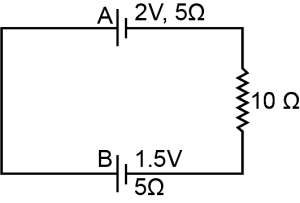
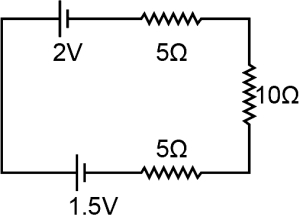
Two cells $A$ and $B$ of emf $2 \text{ V}$ and $1.5 \text{ V}$ respectively,are connected as shown in the figure through an external resistance $10 \text{ } \Omega$. The internal resistance of each cell is $5 \text{ } \Omega$. The potential difference $V_{A}$ and $V_{B}$ across the terminals of the cells $A$ and $B$ respectively are:
A
$V_{A}=2.0 \text{ V}, V_{B}=1.5 \text{ V}$
B
$V_{A}=2.125 \text{ V}, V_{B}=1.375 \text{ V}$
C
$V_{A}=1.875 \text{ V}, V_{B}=1.625 \text{ V}$
D
$V_{A}=1.875 \text{ V}, V_{B}=1.375 \text{ V}$
Solution
(C) The current $i$ flowing through the circuit is given by the net emf divided by the total resistance of the circuit.
Since the cells are connected in opposition,the net emf is $\varepsilon_{net} = 2 \text{ V} - 1.5 \text{ V} = 0.5 \text{ V}$.
The total resistance of the circuit is $R_{total} = 5 \text{ } \Omega + 5 \text{ } \Omega + 10 \text{ } \Omega = 20 \text{ } \Omega$.
Therefore,the current $i = \frac{0.5 \text{ V}}{20 \text{ } \Omega} = 0.025 \text{ A}$.
For cell $A$,which is discharging,the terminal potential difference is $V_{A} = \varepsilon_{A} - i r_{A} = 2 \text{ V} - (0.025 \text{ A} \times 5 \text{ } \Omega) = 2 - 0.125 = 1.875 \text{ V}$.
For cell $B$,which is charging,the terminal potential difference is $V_{B} = \varepsilon_{B} + i r_{B} = 1.5 \text{ V} + (0.025 \text{ A} \times 5 \text{ } \Omega) = 1.5 + 0.125 = 1.625 \text{ V}$.
Since the cells are connected in opposition,the net emf is $\varepsilon_{net} = 2 \text{ V} - 1.5 \text{ V} = 0.5 \text{ V}$.
The total resistance of the circuit is $R_{total} = 5 \text{ } \Omega + 5 \text{ } \Omega + 10 \text{ } \Omega = 20 \text{ } \Omega$.
Therefore,the current $i = \frac{0.5 \text{ V}}{20 \text{ } \Omega} = 0.025 \text{ A}$.
For cell $A$,which is discharging,the terminal potential difference is $V_{A} = \varepsilon_{A} - i r_{A} = 2 \text{ V} - (0.025 \text{ A} \times 5 \text{ } \Omega) = 2 - 0.125 = 1.875 \text{ V}$.
For cell $B$,which is charging,the terminal potential difference is $V_{B} = \varepsilon_{B} + i r_{B} = 1.5 \text{ V} + (0.025 \text{ A} \times 5 \text{ } \Omega) = 1.5 + 0.125 = 1.625 \text{ V}$.
0 likes
View Solution253
DifficultMCQ
$A$ cell of emf $E$ is connected to a resistance $R_{1}$ for time $t$ and the amount of heat generated in it is $H$. If the resistance $R_{1}$ is replaced by another resistance $R_{2}$ and is connected to the cell for the same time $t$,the amount of heat generated in $R_{2}$ is $4H$. Then the internal resistance $r$ of the cell is:
A
$\frac{2 R_{1}+R_{2}}{2}$
B
$\sqrt{R_{1} R_{2}} \frac{2 \sqrt{R_{2}}-\sqrt{R_{1}}}{\sqrt{R_{2}}-2 \sqrt{R_{1}}}$
C
$\sqrt{R_{1} R_{2}} \frac{\sqrt{R_{2}}-2 \sqrt{R_{1}}}{2 \sqrt{R_{2}}-\sqrt{R_{1}}}$
D
$\sqrt{R_{1} R_{2}} \frac{\sqrt{R_{2}}-\sqrt{R_{1}}}{\sqrt{R_{2}}+\sqrt{R_{1}}}$
Solution
(B) The heat generated in a resistance $R$ connected to a cell of emf $E$ and internal resistance $r$ is given by $H = I^2 R t = \left( \frac{E}{R+r} \right)^2 R t$.
Given $H_1 = H$ for $R_1$ and $H_2 = 4H$ for $R_2$ in the same time $t$,we have:
$H = \frac{E^2 R_1}{(R_1+r)^2} t$ and $4H = \frac{E^2 R_2}{(R_2+r)^2} t$.
Dividing the two equations: $\frac{4H}{H} = \frac{R_2 (R_1+r)^2}{R_1 (R_2+r)^2} \Rightarrow 4 = \frac{R_2 (R_1+r)^2}{R_1 (R_2+r)^2}$.
Taking the square root on both sides: $2 = \frac{\sqrt{R_2} (R_1+r)}{\sqrt{R_1} (R_2+r)}$.
$2 \sqrt{R_1} (R_2+r) = \sqrt{R_2} (R_1+r) \Rightarrow 2 \sqrt{R_1} R_2 + 2 \sqrt{R_1} r = \sqrt{R_2} R_1 + \sqrt{R_2} r$.
Rearranging for $r$: $r (2 \sqrt{R_1} - \sqrt{R_2}) = \sqrt{R_2} R_1 - 2 \sqrt{R_1} R_2$.
$r = \frac{\sqrt{R_1 R_2} (\sqrt{R_1} - 2 \sqrt{R_2})}{2 \sqrt{R_1} - \sqrt{R_2}}$.
Multiplying numerator and denominator by $-1$: $r = \sqrt{R_1 R_2} \frac{2 \sqrt{R_2} - \sqrt{R_1}}{\sqrt{R_2} - 2 \sqrt{R_1}}$.
Given $H_1 = H$ for $R_1$ and $H_2 = 4H$ for $R_2$ in the same time $t$,we have:
$H = \frac{E^2 R_1}{(R_1+r)^2} t$ and $4H = \frac{E^2 R_2}{(R_2+r)^2} t$.
Dividing the two equations: $\frac{4H}{H} = \frac{R_2 (R_1+r)^2}{R_1 (R_2+r)^2} \Rightarrow 4 = \frac{R_2 (R_1+r)^2}{R_1 (R_2+r)^2}$.
Taking the square root on both sides: $2 = \frac{\sqrt{R_2} (R_1+r)}{\sqrt{R_1} (R_2+r)}$.
$2 \sqrt{R_1} (R_2+r) = \sqrt{R_2} (R_1+r) \Rightarrow 2 \sqrt{R_1} R_2 + 2 \sqrt{R_1} r = \sqrt{R_2} R_1 + \sqrt{R_2} r$.
Rearranging for $r$: $r (2 \sqrt{R_1} - \sqrt{R_2}) = \sqrt{R_2} R_1 - 2 \sqrt{R_1} R_2$.
$r = \frac{\sqrt{R_1 R_2} (\sqrt{R_1} - 2 \sqrt{R_2})}{2 \sqrt{R_1} - \sqrt{R_2}}$.
Multiplying numerator and denominator by $-1$: $r = \sqrt{R_1 R_2} \frac{2 \sqrt{R_2} - \sqrt{R_1}}{\sqrt{R_2} - 2 \sqrt{R_1}}$.
0 likes
View Solution254
DifficultMCQ
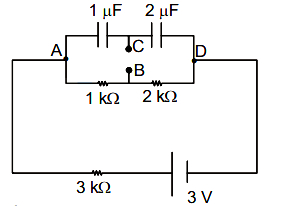
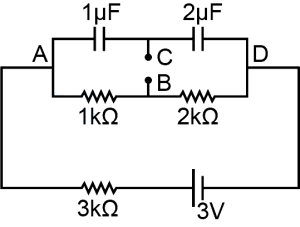
Consider the circuit given here. The potential difference $V_{BC}$ between the points $B$ and $C$ is (in $V$)
A
$1$
B
$0.5$
C
$0$
D
$-1$
Solution
(B) $1$. First,calculate the total resistance of the circuit. The resistors $1 \text{ k}\Omega$ and $2 \text{ k}\Omega$ are in series with the $3 \text{ k}\Omega$ resistor. Total resistance $R_{eq} = 1 \text{ k}\Omega + 2 \text{ k}\Omega + 3 \text{ k}\Omega = 6 \text{ k}\Omega = 6000 \ \Omega$.
$2$. The current $I$ flowing through the circuit is $I = \frac{E}{R_{eq}} = \frac{3 \text{ V}}{6000 \ \Omega} = 0.5 \times 10^{-3} \text{ A} = 0.5 \text{ mA}$.
$3$. The potential at point $B$ relative to $A$ is $V_{AB} = I \times R_{1k} = 0.5 \text{ mA} \times 1 \text{ k}\Omega = 0.5 \text{ V}$. Thus,$V_A - V_B = 0.5 \text{ V}$.
$4$. The potential at point $C$ relative to $A$ is determined by the voltage divider rule for the capacitors. Since the capacitors are in series and no $DC$ current flows through them,the potential $V_C$ is determined by the ratio of their capacitances. $V_A - V_C = V_{AD} \times \frac{C_2}{C_1 + C_2}$,where $V_{AD} = I \times (1 \text{ k}\Omega + 2 \text{ k}\Omega) = 0.5 \text{ mA} \times 3 \text{ k}\Omega = 1.5 \text{ V}$.
$5$. $V_A - V_C = 1.5 \text{ V} \times \frac{2 \mu\text{F}}{1 \mu\text{F} + 2 \mu\text{F}} = 1.5 \times \frac{2}{3} = 1.0 \text{ V}$.
$6$. Now,$V_{BC} = V_B - V_C = (V_A - V_C) - (V_A - V_B) = 1.0 \text{ V} - 0.5 \text{ V} = 0.5 \text{ V}$.
$2$. The current $I$ flowing through the circuit is $I = \frac{E}{R_{eq}} = \frac{3 \text{ V}}{6000 \ \Omega} = 0.5 \times 10^{-3} \text{ A} = 0.5 \text{ mA}$.
$3$. The potential at point $B$ relative to $A$ is $V_{AB} = I \times R_{1k} = 0.5 \text{ mA} \times 1 \text{ k}\Omega = 0.5 \text{ V}$. Thus,$V_A - V_B = 0.5 \text{ V}$.
$4$. The potential at point $C$ relative to $A$ is determined by the voltage divider rule for the capacitors. Since the capacitors are in series and no $DC$ current flows through them,the potential $V_C$ is determined by the ratio of their capacitances. $V_A - V_C = V_{AD} \times \frac{C_2}{C_1 + C_2}$,where $V_{AD} = I \times (1 \text{ k}\Omega + 2 \text{ k}\Omega) = 0.5 \text{ mA} \times 3 \text{ k}\Omega = 1.5 \text{ V}$.
$5$. $V_A - V_C = 1.5 \text{ V} \times \frac{2 \mu\text{F}}{1 \mu\text{F} + 2 \mu\text{F}} = 1.5 \times \frac{2}{3} = 1.0 \text{ V}$.
$6$. Now,$V_{BC} = V_B - V_C = (V_A - V_C) - (V_A - V_B) = 1.0 \text{ V} - 0.5 \text{ V} = 0.5 \text{ V}$.
0 likes
View SolutionCurrent Electricity — Mix Examples-Current Electricity · Frequently Asked Questions
1Are these Current Electricity questions useful for JEE and NEET?
Yes. All questions in this section are mapped to JEE Main and NEET exam patterns. Previous year questions from JEE Main, NEET, GUJCET and state-level exams are included with full solutions.
2Can I switch to Hindi or Gujarati for these questions?
Yes. Use the language tabs in the hero section or the sidebar to view the same questions and solutions in English, Hindi or Gujarati.
3How do I generate a question paper from this subtopic?
Use the Vedclass Exam Paper Generator — select the chapter and subtopic, set difficulty, and generate Sets A, B, C, D automatically. First 3 chapters of every subject are free.
Vedclass Products
For Students
Vedclass Test Series
Mock tests in real JEE/NEET style with performance analysis. 5-day free trial.
Start Free TrialFor Teachers
Exam Paper Generator
Generate Set A/B/C/D papers from this chapter in 2 minutes. 3 chapters free.
Try FreeFor Institutes
Online Exam Module
Live online exams with unlimited students, 360° analytics & white-label branding.
See DemoFor Teachers & Institutes
Generate a Current Electricity Exam Paper in 2 Minutes
Select subtopic & difficulty — Sets A, B, C, D auto-generated with No Repeat logic.
First 3 chapters of every subject are free — no payment required.