
A English
Electric Current Questions in English
Class 12 Physics · Current Electricity · Electric Current
78+
Questions
English
Language
100%
With Solutions
Showing 28 of 78 questions in English
51
Medium
How is current formed in conductors?
Solution
(N/A) When conductors are subjected to an electric field,the electric charges within them experience a force.
If these charges are free to move,they will constitute an electric current.
In atoms and molecules,electrons are bound to the nucleus by Coulombic forces. However,in bulk matter,molecules are packed so closely that the outer electrons are no longer strictly attached to a single nucleus.
In metals,some electrons are practically free to move randomly throughout the bulk material. When an external electric field is applied,these free electrons experience a net force and drift,resulting in an electric current.
In solid conductors,current is formed due to the motion of electrons.
In liquids (electrolytes),current is produced due to the motion of positive and negative ions in mutually opposite directions.
In gases,current is produced due to the motion of ions formed by ionization.
If these charges are free to move,they will constitute an electric current.
In atoms and molecules,electrons are bound to the nucleus by Coulombic forces. However,in bulk matter,molecules are packed so closely that the outer electrons are no longer strictly attached to a single nucleus.
In metals,some electrons are practically free to move randomly throughout the bulk material. When an external electric field is applied,these free electrons experience a net force and drift,resulting in an electric current.
In solid conductors,current is formed due to the motion of electrons.
In liquids (electrolytes),current is produced due to the motion of positive and negative ions in mutually opposite directions.
In gases,current is produced due to the motion of ions formed by ionization.
0 likes
View Solution52
Medium
Explain the current formed in solid conductors in the presence of an external electric field.
Solution
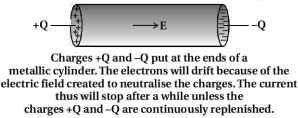
(N/A) Consider a metallic cylinder of radius $R$ as shown in the figure.
We consider two thin circular discs which have $+Q$ and $-Q$ charges distributed over them. If we attach these two discs to the two flat surfaces of the cylinder,an electric field $E$ is established,and a current is produced which is directed from the positive to the negative charge.
Due to this electric field in the cylinder,electrons will be accelerated toward the $+Q$ charge.
These electrons,as long as they are moving,will constitute an electric current. In this condition,the current will be formed for a very short time and will then stop as the charges are neutralized.
If we consider a mechanism like a cell or a battery,in which the amount of charge $+Q$ that is neutralized is continuously replenished by an equal amount of $-Q$ charge at the other end,then a steady electric current can be maintained.
We consider two thin circular discs which have $+Q$ and $-Q$ charges distributed over them. If we attach these two discs to the two flat surfaces of the cylinder,an electric field $E$ is established,and a current is produced which is directed from the positive to the negative charge.
Due to this electric field in the cylinder,electrons will be accelerated toward the $+Q$ charge.
These electrons,as long as they are moving,will constitute an electric current. In this condition,the current will be formed for a very short time and will then stop as the charges are neutralized.
If we consider a mechanism like a cell or a battery,in which the amount of charge $+Q$ that is neutralized is continuously replenished by an equal amount of $-Q$ charge at the other end,then a steady electric current can be maintained.
0 likes
View Solution53
MediumMCQ
Due to what is current formed in conductors?
A
Due to the flow of protons
B
Due to the flow of electrons
C
Due to the flow of neutrons
D
Due to the flow of atoms
Solution
(B) In conductors,the atoms have loosely bound electrons in their outermost shells,which are known as free electrons.
When an external electric field is applied across the conductor,these free electrons experience a force and start moving in a specific direction.
The flow of these free electrons constitutes an electric current.
Therefore,current in conductors is formed due to the flow of electrons.
When an external electric field is applied across the conductor,these free electrons experience a force and start moving in a specific direction.
The flow of these free electrons constitutes an electric current.
Therefore,current in conductors is formed due to the flow of electrons.
0 likes
View Solution54
EasyMCQ
Due to what is current formed in an electrolyte?
A
Only positive ions
B
Only negative ions
C
Both positive and negative ions
D
Free electrons
Solution
(C) In an electrolyte,the current is formed due to the movement of both positive ions (cations) and negative ions (anions) in opposite directions under the influence of an external electric field. Unlike metallic conductors where current is carried solely by free electrons,electrolytes conduct electricity through the migration of charged ions.
0 likes
View Solution55
Easy
In conductors,in the absence of an electric field,although electrons are in motion,why is no current formed?
Solution
(N/A) In a conductor,free electrons are in a state of continuous random thermal motion due to thermal energy at room temperature.
At any given instant,the number of electrons moving in any direction is equal to the number of electrons moving in the opposite direction.
Mathematically,the average velocity of all free electrons in a conductor in the absence of an external electric field is zero,i.e.,$\vec{v}_{avg} = \frac{1}{N} \sum_{i=1}^{N} \vec{v}_i = 0$.
Since the net flow of charge across any cross-section of the conductor is zero,no net electric current is produced.
At any given instant,the number of electrons moving in any direction is equal to the number of electrons moving in the opposite direction.
Mathematically,the average velocity of all free electrons in a conductor in the absence of an external electric field is zero,i.e.,$\vec{v}_{avg} = \frac{1}{N} \sum_{i=1}^{N} \vec{v}_i = 0$.
Since the net flow of charge across any cross-section of the conductor is zero,no net electric current is produced.
0 likes
View Solution56
Medium
Write the direction of the electric current between the electrodes of an electric cell.
Solution
(N/A) Inside an electric cell,the electric current flows from the negative electrode (cathode) to the positive electrode (anode). This is due to the chemical energy within the cell that does work to move charges against the electrostatic force,maintaining the potential difference between the terminals.
0 likes
View Solution57
EasyMCQ
What is the direction of electric current inside an electrolyte?
A
From positive electrode to negative electrode
B
From negative electrode to positive electrode
C
From anode to cathode
D
It does not flow
Solution
(B) Inside an electrolyte,the electric current flows from the negative electrode (cathode) to the positive electrode (anode). This is because the positive ions (cations) move towards the cathode and negative ions (anions) move towards the anode,creating a net flow of charge that constitutes the current from the negative terminal to the positive terminal inside the cell.
0 likes
View Solution58
Easy
Define the $SI$ unit of electric charge in terms of the Ampere.
Solution
(N/A) The $SI$ unit of electric charge is the Coulomb $(C)$.
By definition,the current $I$ is the rate of flow of charge $Q$ through a cross-section of a conductor,given by $I = Q/t$.
Therefore,$Q = I \times t$.
When a steady current of $1 \; A$ flows through a conductor for a time interval of $1 \; s$,the quantity of charge that passes through its cross-section is defined as $1 \; C$.
Thus,$1 \; C = 1 \; A \times 1 \; s$.
By definition,the current $I$ is the rate of flow of charge $Q$ through a cross-section of a conductor,given by $I = Q/t$.
Therefore,$Q = I \times t$.
When a steady current of $1 \; A$ flows through a conductor for a time interval of $1 \; s$,the quantity of charge that passes through its cross-section is defined as $1 \; C$.
Thus,$1 \; C = 1 \; A \times 1 \; s$.
0 likes
View Solution59
Medium
Define $1 \ Coulomb$ in terms of $1 \ Ampere$.
Solution
(N/A) The relationship between electric current $(I)$,charge $(Q)$,and time $(t)$ is given by the formula: $I = \frac{Q}{t}$.
Rearranging this formula to solve for charge,we get: $Q = I \times t$.
By definition,$1 \ Ampere$ is the flow of $1 \ Coulomb$ of charge per second $(1 \ A = 1 \ C/s)$.
Therefore,$1 \ Coulomb$ is defined as the quantity of electric charge that flows through a cross-section of a conductor in $1 \ second$ when a steady current of $1 \ Ampere$ is maintained in the conductor.
Rearranging this formula to solve for charge,we get: $Q = I \times t$.
By definition,$1 \ Ampere$ is the flow of $1 \ Coulomb$ of charge per second $(1 \ A = 1 \ C/s)$.
Therefore,$1 \ Coulomb$ is defined as the quantity of electric charge that flows through a cross-section of a conductor in $1 \ second$ when a steady current of $1 \ Ampere$ is maintained in the conductor.
0 likes
View Solution60
MediumMCQ
$A$ current through a wire depends on time as $i = \alpha_{0} t + \beta t^{2}$ where $\alpha_{0} = 20 \, A/s$ and $\beta = 8 \, As^{-2}$. Find the charge crossed through a section of the wire in $15 \, s$ (in $C$).
A
$2250$
B
$11250$
C
$2100$
D
$260$
Solution
(B) The current is given by $i = \alpha_{0} t + \beta t^{2}$.
Substituting the given values,we have $i = 20t + 8t^{2}$.
We know that current $i = \frac{dq}{dt}$,so the charge $q$ is given by the integral $q = \int i \, dt$.
To find the total charge crossed in $15 \, s$,we integrate from $t = 0$ to $t = 15 \, s$:
$q = \int_{0}^{15} (20t + 8t^{2}) \, dt$
$q = \left[ \frac{20t^{2}}{2} + \frac{8t^{3}}{3} \right]_{0}^{15}$
$q = \left[ 10t^{2} + \frac{8}{3}t^{3} \right]_{0}^{15}$
$q = 10(15)^{2} + \frac{8}{3}(15)^{3}$
$q = 10(225) + \frac{8}{3}(3375)$
$q = 2250 + 8(1125)$
$q = 2250 + 9000$
$q = 11250 \, C$.
Substituting the given values,we have $i = 20t + 8t^{2}$.
We know that current $i = \frac{dq}{dt}$,so the charge $q$ is given by the integral $q = \int i \, dt$.
To find the total charge crossed in $15 \, s$,we integrate from $t = 0$ to $t = 15 \, s$:
$q = \int_{0}^{15} (20t + 8t^{2}) \, dt$
$q = \left[ \frac{20t^{2}}{2} + \frac{8t^{3}}{3} \right]_{0}^{15}$
$q = \left[ 10t^{2} + \frac{8}{3}t^{3} \right]_{0}^{15}$
$q = 10(15)^{2} + \frac{8}{3}(15)^{3}$
$q = 10(225) + \frac{8}{3}(3375)$
$q = 2250 + 8(1125)$
$q = 2250 + 9000$
$q = 11250 \, C$.
0 likes
View Solution61
MediumMCQ
Which of the following statements is true about the flow of electrons in an electric circuit?
A
Electrons always flow from lower to higher potential
B
Electrons always flow from higher to lower potential
C
Electrons flow from lower to higher potential,except through power sources
D
Electrons flow from higher to lower potential,except through power sources
Solution
(C) The correct answer is $(c)$.
In an external circuit,free electrons experience an electrostatic force in the direction opposite to the electric field because they carry a negative charge.
The electric field is always directed from higher potential to lower potential.
Therefore,electrons naturally flow from lower potential to higher potential in an external circuit to reach equilibrium.
However,inside a power source (like a battery),non-electrostatic forces (chemical or magnetic) do work to move electrons from higher potential to lower potential,maintaining the potential difference in the circuit.
Thus,electrons flow from lower to higher potential,except through power sources.
In an external circuit,free electrons experience an electrostatic force in the direction opposite to the electric field because they carry a negative charge.
The electric field is always directed from higher potential to lower potential.
Therefore,electrons naturally flow from lower potential to higher potential in an external circuit to reach equilibrium.
However,inside a power source (like a battery),non-electrostatic forces (chemical or magnetic) do work to move electrons from higher potential to lower potential,maintaining the potential difference in the circuit.
Thus,electrons flow from lower to higher potential,except through power sources.
0 likes
View Solution62
EasyMCQ
Electric current has both magnitude and direction. It is a
A
Vector quantity
B
Scalar quantity
C
Tensor quantity
D
None of these
Solution
(B) Electric current is defined as the rate of flow of charge through a cross-section.
Although it possesses both magnitude and direction,it does not follow the laws of vector addition (such as the parallelogram law of vector addition).
Instead,it follows the algebraic rules of addition.
Therefore,electric current is classified as a scalar quantity.
Although it possesses both magnitude and direction,it does not follow the laws of vector addition (such as the parallelogram law of vector addition).
Instead,it follows the algebraic rules of addition.
Therefore,electric current is classified as a scalar quantity.
0 likes
View Solution63
MediumMCQ
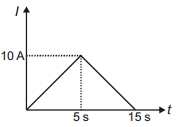
The current $I$ versus time $t$ graph for a conductor is shown in the figure. The average current through the conductor in the interval $0$ to $15 \, s$ is ............ $A$.
A
$1$
B
$10$
C
$7.5$
D
$5$
Solution
(D) The total charge $\Delta q$ flowing through the conductor is equal to the area under the $I-t$ graph.
The area of the triangle is given by:
$\Delta q = \text{Area} = \frac{1}{2} \times \text{base} \times \text{height}$
$\Delta q = \frac{1}{2} \times 15 \, s \times 10 \, A = 75 \, C$
The average current $I_{\text{avg}}$ is defined as the total charge divided by the total time interval:
$I_{\text{avg}} = \frac{\Delta q}{\Delta t} = \frac{75 \, C}{15 \, s} = 5 \, A$
Therefore,the correct option is $D$.
The area of the triangle is given by:
$\Delta q = \text{Area} = \frac{1}{2} \times \text{base} \times \text{height}$
$\Delta q = \frac{1}{2} \times 15 \, s \times 10 \, A = 75 \, C$
The average current $I_{\text{avg}}$ is defined as the total charge divided by the total time interval:
$I_{\text{avg}} = \frac{\Delta q}{\Delta t} = \frac{75 \, C}{15 \, s} = 5 \, A$
Therefore,the correct option is $D$.
0 likes
View Solution64
MediumMCQ
The charge flowing in a conductor changes with time as $Q(t) = \alpha t - \beta t^2 + \gamma t^3$. Where $\alpha, \beta$,and $\gamma$ are constants. The minimum value of current is:
A
$\alpha - \frac{3\beta^2}{\gamma}$
B
$\alpha - \frac{\gamma^2}{3\beta}$
C
$\beta - \frac{\alpha^2}{3\gamma}$
D
$\alpha - \frac{\beta^2}{3\gamma}$
Solution
(D) The charge is given by $Q(t) = \alpha t - \beta t^2 + \gamma t^3$.
The current $i$ is the rate of change of charge with respect to time: $i = \frac{dQ}{dt} = \alpha - 2\beta t + 3\gamma t^2$.
To find the minimum current,we find the derivative of current with respect to time and set it to zero: $\frac{di}{dt} = -2\beta + 6\gamma t = 0$.
Solving for $t$,we get $t = \frac{2\beta}{6\gamma} = \frac{\beta}{3\gamma}$.
Now,substitute $t = \frac{\beta}{3\gamma}$ back into the expression for current:
$i_{min} = \alpha - 2\beta \left(\frac{\beta}{3\gamma}\right) + 3\gamma \left(\frac{\beta}{3\gamma}\right)^2$
$i_{min} = \alpha - \frac{2\beta^2}{3\gamma} + 3\gamma \left(\frac{\beta^2}{9\gamma^2}\right)$
$i_{min} = \alpha - \frac{2\beta^2}{3\gamma} + \frac{\beta^2}{3\gamma}$
$i_{min} = \alpha - \frac{\beta^2}{3\gamma}$.
The current $i$ is the rate of change of charge with respect to time: $i = \frac{dQ}{dt} = \alpha - 2\beta t + 3\gamma t^2$.
To find the minimum current,we find the derivative of current with respect to time and set it to zero: $\frac{di}{dt} = -2\beta + 6\gamma t = 0$.
Solving for $t$,we get $t = \frac{2\beta}{6\gamma} = \frac{\beta}{3\gamma}$.
Now,substitute $t = \frac{\beta}{3\gamma}$ back into the expression for current:
$i_{min} = \alpha - 2\beta \left(\frac{\beta}{3\gamma}\right) + 3\gamma \left(\frac{\beta}{3\gamma}\right)^2$
$i_{min} = \alpha - \frac{2\beta^2}{3\gamma} + 3\gamma \left(\frac{\beta^2}{9\gamma^2}\right)$
$i_{min} = \alpha - \frac{2\beta^2}{3\gamma} + \frac{\beta^2}{3\gamma}$
$i_{min} = \alpha - \frac{\beta^2}{3\gamma}$.
0 likes
View Solution65
DifficultMCQ
The electric current through a wire varies with time as $I = I_0 + \beta t$,where $I_0 = 20 \ A$ and $\beta = 3 \ A/s$. The amount of electric charge that crosses through a section of the wire in $20 \ s$ is: (in $C$)
A
$80$
B
$1000$
C
$800$
D
$1600$
Solution
(B) Given that the current $I$ varies with time $t$ as $I = I_0 + \beta t$.
Here,$I_0 = 20 \ A$ and $\beta = 3 \ A/s$.
So,$I = 20 + 3t$.
We know that current $I = \frac{dq}{dt}$,which implies $dq = I \ dt$.
To find the total charge $q$ that crosses a section in time $t = 0$ to $t = 20 \ s$,we integrate the expression:
$q = \int_{0}^{20} I \ dt = \int_{0}^{20} (20 + 3t) \ dt$
$q = \left[ 20t + \frac{3t^2}{2} \right]_{0}^{20}$
$q = \left( 20(20) + \frac{3(20)^2}{2} \right) - 0$
$q = 400 + \frac{3 \times 400}{2} = 400 + 600 = 1000 \ C$.
Here,$I_0 = 20 \ A$ and $\beta = 3 \ A/s$.
So,$I = 20 + 3t$.
We know that current $I = \frac{dq}{dt}$,which implies $dq = I \ dt$.
To find the total charge $q$ that crosses a section in time $t = 0$ to $t = 20 \ s$,we integrate the expression:
$q = \int_{0}^{20} I \ dt = \int_{0}^{20} (20 + 3t) \ dt$
$q = \left[ 20t + \frac{3t^2}{2} \right]_{0}^{20}$
$q = \left( 20(20) + \frac{3(20)^2}{2} \right) - 0$
$q = 400 + \frac{3 \times 400}{2} = 400 + 600 = 1000 \ C$.
0 likes
View Solution66
DifficultMCQ
The current in a conductor is expressed as $I = 3t^2 + 4t^3$,where $I$ is in Ampere and $t$ is in second. The amount of electric charge that flows through a section of the conductor during $t = 1 \ s$ to $t = 2 \ s$ is . . . . . . $C$.
A
$22$
B
$30$
C
$35$
D
$40$
Solution
(A) The electric charge $q$ is related to current $I$ by the relation $q = \int I \ dt$.
Given $I = 3t^2 + 4t^3$,we integrate from $t = 1 \ s$ to $t = 2 \ s$:
$q = \int_{1}^{2} (3t^2 + 4t^3) \ dt$
$q = [t^3 + t^4]_{1}^{2}$
$q = (2^3 + 2^4) - (1^3 + 1^4)$
$q = (8 + 16) - (1 + 1)$
$q = 24 - 2 = 22 \ C$.
Given $I = 3t^2 + 4t^3$,we integrate from $t = 1 \ s$ to $t = 2 \ s$:
$q = \int_{1}^{2} (3t^2 + 4t^3) \ dt$
$q = [t^3 + t^4]_{1}^{2}$
$q = (2^3 + 2^4) - (1^3 + 1^4)$
$q = (8 + 16) - (1 + 1)$
$q = 24 - 2 = 22 \ C$.
0 likes
View Solution67
MediumMCQ
Current passing through a wire as a function of time is given as $I(t) = 0.02t + 0.01 \ A$. The charge that will flow through the wire from $t = 1 \ s$ to $t = 2 \ s$ is: (in $C$)
A
$0.06$
B
$0.02$
C
$0.07$
D
$0.04$
Solution
(D) The charge $q$ flowing through a wire is given by the integral of current $I$ with respect to time $t$: $q = \int_{t_1}^{t_2} I(t) \, dt$.
Given $I(t) = 0.02t + 0.01$,we integrate from $t = 1 \ s$ to $t = 2 \ s$:
$q = \int_{1}^{2} (0.02t + 0.01) \, dt$
$q = \left[ 0.02 \frac{t^2}{2} + 0.01t \right]_{1}^{2}$
$q = \left[ 0.01t^2 + 0.01t \right]_{1}^{2}$
Substituting the limits:
$q = (0.01(2)^2 + 0.01(2)) - (0.01(1)^2 + 0.01(1))$
$q = (0.04 + 0.02) - (0.01 + 0.01)$
$q = 0.06 - 0.02 = 0.04 \ C$.
Given $I(t) = 0.02t + 0.01$,we integrate from $t = 1 \ s$ to $t = 2 \ s$:
$q = \int_{1}^{2} (0.02t + 0.01) \, dt$
$q = \left[ 0.02 \frac{t^2}{2} + 0.01t \right]_{1}^{2}$
$q = \left[ 0.01t^2 + 0.01t \right]_{1}^{2}$
Substituting the limits:
$q = (0.01(2)^2 + 0.01(2)) - (0.01(1)^2 + 0.01(1))$
$q = (0.04 + 0.02) - (0.01 + 0.01)$
$q = 0.06 - 0.02 = 0.04 \ C$.
0 likes
View Solution68
EasyMCQ
$A$ steady current flows in a metallic conductor of non-uniform cross-section. Which of the following quantities is constant along the conductor?
A
Electric field
B
Current density
C
Current
D
Drift speed
Solution
(C) The correct option is $C$.
When a steady current flows through a metallic conductor of non-uniform cross-section,the current $I$ remains constant throughout the conductor due to the principle of conservation of charge.
From the relation for drift velocity,$v_d = \frac{I}{neA}$,since $n$,$e$,and $I$ are constant,$v_d$ depends on the cross-sectional area $A$.
From the relation for current density,$J = \frac{I}{A}$,since $I$ is constant,$J$ depends on $A$.
From the relation for electric field,$E = \rho J = \frac{\rho I}{A}$,since $\rho$ and $I$ are constant,$E$ depends on $A$.
Therefore,only the current $I$ remains constant along the conductor.
When a steady current flows through a metallic conductor of non-uniform cross-section,the current $I$ remains constant throughout the conductor due to the principle of conservation of charge.
From the relation for drift velocity,$v_d = \frac{I}{neA}$,since $n$,$e$,and $I$ are constant,$v_d$ depends on the cross-sectional area $A$.
From the relation for current density,$J = \frac{I}{A}$,since $I$ is constant,$J$ depends on $A$.
From the relation for electric field,$E = \rho J = \frac{\rho I}{A}$,since $\rho$ and $I$ are constant,$E$ depends on $A$.
Therefore,only the current $I$ remains constant along the conductor.
0 likes
View Solution69
EasyMCQ
Given a current-carrying wire of non-uniform cross-section,which of the following is constant throughout the length of the wire?
A
Drift speed
B
Current and drift speed
C
Current only
D
Current,electric field,and drift speed
Solution
(C) The correct answer is current only.
According to the principle of continuity for steady current,the current $I$ flowing through any cross-section of a conductor remains constant,regardless of the area of the cross-section.
Since $I = nAev_d$,where $n$ is the number density of electrons,$A$ is the area of cross-section,$e$ is the charge of an electron,and $v_d$ is the drift speed,if the area $A$ changes,the drift speed $v_d$ must change to keep the current $I$ constant.
Similarly,the electric field $E$ depends on the current density $J = I/A$,so it also varies with the cross-sectional area.
According to the principle of continuity for steady current,the current $I$ flowing through any cross-section of a conductor remains constant,regardless of the area of the cross-section.
Since $I = nAev_d$,where $n$ is the number density of electrons,$A$ is the area of cross-section,$e$ is the charge of an electron,and $v_d$ is the drift speed,if the area $A$ changes,the drift speed $v_d$ must change to keep the current $I$ constant.
Similarly,the electric field $E$ depends on the current density $J = I/A$,so it also varies with the cross-sectional area.
0 likes
View Solution70
EasyMCQ
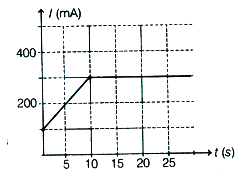
The electric current flowing through a given conductor varies with time as shown in the graph below. The number of free electrons which flow through a given cross-section of the conductor in the time interval $0 \leq t \leq 20 \ s$ is
A
$3.125 \times 10^{19}$
B
$1.6 \times 10^{19}$
C
$6.25 \times 10^{18}$
D
$1.625 \times 10^{18}$
Solution
(A) The total charge $Q$ flowing through the cross-section of the conductor is equal to the area under the $I-t$ graph.
From the graph,for $0 \leq t \leq 10 \ s$,the current increases linearly from $100 \ mA$ to $300 \ mA$. The area is a trapezoid: $A_1 = \frac{(100 + 300) \times 10^{-3} \ A}{2} \times 10 \ s = 2 \ C$.
For $10 \ s \leq t \leq 20 \ s$,the current is constant at $300 \ mA$. The area is a rectangle: $A_2 = 300 \times 10^{-3} \ A \times (20 - 10) \ s = 3 \ C$.
Total charge $Q = A_1 + A_2 = 2 \ C + 3 \ C = 5 \ C$.
Using the quantization of charge,$Q = ne$,where $e = 1.6 \times 10^{-19} \ C$ is the charge of an electron.
$n = \frac{Q}{e} = \frac{5}{1.6 \times 10^{-19}} = 3.125 \times 10^{19}$.
From the graph,for $0 \leq t \leq 10 \ s$,the current increases linearly from $100 \ mA$ to $300 \ mA$. The area is a trapezoid: $A_1 = \frac{(100 + 300) \times 10^{-3} \ A}{2} \times 10 \ s = 2 \ C$.
For $10 \ s \leq t \leq 20 \ s$,the current is constant at $300 \ mA$. The area is a rectangle: $A_2 = 300 \times 10^{-3} \ A \times (20 - 10) \ s = 3 \ C$.
Total charge $Q = A_1 + A_2 = 2 \ C + 3 \ C = 5 \ C$.
Using the quantization of charge,$Q = ne$,where $e = 1.6 \times 10^{-19} \ C$ is the charge of an electron.
$n = \frac{Q}{e} = \frac{5}{1.6 \times 10^{-19}} = 3.125 \times 10^{19}$.
0 likes
View Solution71
EasyMCQ
The quantity of charge that will be transferred by a current flow of $20 \text{ A}$ over a period of $1 \text{ hour } 30 \text{ minutes}$ is:
A
$10.8 \times 10^{3} \text{ C}$
B
$10.8 \times 10^{4} \text{ C}$
C
$5.4 \times 10^{3} \text{ C}$
D
$1.8 \times 10^{4} \text{ C}$
Solution
(B) Given: Current $I = 20 \text{ A}$.
Time $t = 1 \text{ hour } 30 \text{ minutes} = 90 \text{ minutes} = 90 \times 60 \text{ seconds} = 5400 \text{ seconds}$.
The formula for charge transferred is $Q = I \times t$.
Substituting the values: $Q = 20 \text{ A} \times 5400 \text{ s} = 108000 \text{ C}$.
In scientific notation,$Q = 1.08 \times 10^{5} \text{ C}$ or $10.8 \times 10^{4} \text{ C}$.
Time $t = 1 \text{ hour } 30 \text{ minutes} = 90 \text{ minutes} = 90 \times 60 \text{ seconds} = 5400 \text{ seconds}$.
The formula for charge transferred is $Q = I \times t$.
Substituting the values: $Q = 20 \text{ A} \times 5400 \text{ s} = 108000 \text{ C}$.
In scientific notation,$Q = 1.08 \times 10^{5} \text{ C}$ or $10.8 \times 10^{4} \text{ C}$.
0 likes
View Solution72
EasyMCQ
Charge '$Q$' (in coulomb) flowing through a conductor in terms of time '$t$' (in second) is given by the equation $Q = 3t^2 + t$. The current in the conductor at time $t = 3 \ s$ is (in $A$)
A
$19$
B
$7$
C
$21$
D
$3$
Solution
(A) The current '$I$' flowing through a conductor is defined as the rate of flow of charge with respect to time,given by the derivative of charge '$Q$' with respect to time '$t$':
$I = \frac{dQ}{dt}$
Given the equation for charge: $Q = 3t^2 + t$
Differentiating '$Q$' with respect to '$t$':
$I = \frac{d}{dt}(3t^2 + t) = 6t + 1$
To find the current at time $t = 3 \ s$,substitute '$t = 3$' into the expression for '$I$':
$I = 6(3) + 1 = 18 + 1 = 19 \ A$
Therefore,the current in the conductor at $t = 3 \ s$ is $19 \ A$.
$I = \frac{dQ}{dt}$
Given the equation for charge: $Q = 3t^2 + t$
Differentiating '$Q$' with respect to '$t$':
$I = \frac{d}{dt}(3t^2 + t) = 6t + 1$
To find the current at time $t = 3 \ s$,substitute '$t = 3$' into the expression for '$I$':
$I = 6(3) + 1 = 18 + 1 = 19 \ A$
Therefore,the current in the conductor at $t = 3 \ s$ is $19 \ A$.
0 likes
View Solution73
EasyMCQ
$A$ steady current is flowing in a metallic conductor of non-uniform cross-section. The physical quantity which remains constant is
A
Electric current density
B
Drift velocity
C
Electric current density and drift velocity
D
Electric current
Solution
(D) In a metallic conductor,the electric current $I$ is defined as the rate of flow of charge through a cross-section.
For a steady current flowing through a conductor of non-uniform cross-section,the current $I$ remains constant throughout the conductor because charge cannot accumulate at any point.
According to the equation of continuity,$I = nAev_d$,where $n$ is the number density of electrons,$A$ is the cross-sectional area,$e$ is the electronic charge,and $v_d$ is the drift velocity.
Since $I$ is constant,if the area $A$ changes,both the current density $J = I/A$ and the drift velocity $v_d = I/(nAe)$ must change to maintain the constant current.
Therefore,only the electric current $I$ remains constant.
For a steady current flowing through a conductor of non-uniform cross-section,the current $I$ remains constant throughout the conductor because charge cannot accumulate at any point.
According to the equation of continuity,$I = nAev_d$,where $n$ is the number density of electrons,$A$ is the cross-sectional area,$e$ is the electronic charge,and $v_d$ is the drift velocity.
Since $I$ is constant,if the area $A$ changes,both the current density $J = I/A$ and the drift velocity $v_d = I/(nAe)$ must change to maintain the constant current.
Therefore,only the electric current $I$ remains constant.
0 likes
View Solution74
EasyMCQ
Number of electrons flowing per second in a conductor carrying a current of $9 \,A$ is
A
$3 \times 10^{19}$
B
$5.6 \times 10^{19}$
C
$5.6 \times 10^{20}$
D
$3 \times 10^{20}$
Solution
(B) Given that,electric current,$I = 9 \,A$.
Let $n$ be the number of electrons passing through a conductor in time $t$.
We know that,$I = \frac{q}{t}$ and $q = ne$.
Therefore,$I = \frac{ne}{t}$.
Rearranging for the number of electrons per second,we get $\frac{n}{t} = \frac{I}{e}$.
Substituting the values,where $e = 1.6 \times 10^{-19} \,C$:
$\frac{n}{t} = \frac{9}{1.6 \times 10^{-19}} = 5.625 \times 10^{19} \approx 5.6 \times 10^{19}$ electrons per second.
Let $n$ be the number of electrons passing through a conductor in time $t$.
We know that,$I = \frac{q}{t}$ and $q = ne$.
Therefore,$I = \frac{ne}{t}$.
Rearranging for the number of electrons per second,we get $\frac{n}{t} = \frac{I}{e}$.
Substituting the values,where $e = 1.6 \times 10^{-19} \,C$:
$\frac{n}{t} = \frac{9}{1.6 \times 10^{-19}} = 5.625 \times 10^{19} \approx 5.6 \times 10^{19}$ electrons per second.
0 likes
View Solution75
EasyMCQ
The relation between the current $i$ (in ampere) in a conductor and the time $t$ (in second) is $i=12 t+9 t^2$. The charge passing through the conductor between the times $t=2 \,s$ and $t=10 \,s$ is (in $C$)
A
$3720$
B
$3648$
C
$3600$
D
$3552$
Solution
(D) The relationship between current $i$ and time $t$ is given by $i = 12t + 9t^2$.
We know that charge $q$ is the integral of current with respect to time: $q = \int_{t_1}^{t_2} i dt$.
Given $t_1 = 2 \,s$ and $t_2 = 10 \,s$,we have:
$q = \int_{2}^{10} (12t + 9t^2) dt$
$q = [12 \cdot \frac{t^2}{2} + 9 \cdot \frac{t^3}{3}]_{2}^{10}$
$q = [6t^2 + 3t^3]_{2}^{10}$
Now,substitute the limits:
$q = (6(10)^2 + 3(10)^3) - (6(2)^2 + 3(2)^3)$
$q = (600 + 3000) - (6 \cdot 4 + 3 \cdot 8)$
$q = 3600 - (24 + 24)$
$q = 3600 - 48 = 3552 \,C$.
We know that charge $q$ is the integral of current with respect to time: $q = \int_{t_1}^{t_2} i dt$.
Given $t_1 = 2 \,s$ and $t_2 = 10 \,s$,we have:
$q = \int_{2}^{10} (12t + 9t^2) dt$
$q = [12 \cdot \frac{t^2}{2} + 9 \cdot \frac{t^3}{3}]_{2}^{10}$
$q = [6t^2 + 3t^3]_{2}^{10}$
Now,substitute the limits:
$q = (6(10)^2 + 3(10)^3) - (6(2)^2 + 3(2)^3)$
$q = (600 + 3000) - (6 \cdot 4 + 3 \cdot 8)$
$q = 3600 - (24 + 24)$
$q = 3600 - 48 = 3552 \,C$.
0 likes
View Solution76
EasyMCQ
Estimate the magnitude of current that passes through a wire, if $0.1 \text{ mol}$ of electrons flow through it in $40 \text{ min}$. (Assume Avogadro number $= 6 \times 10^{23}$) (in $\text{ A}$)
A
$4$
B
$9$
C
$12$
D
$14$
Solution
(A) The current $I$ is defined as the rate of flow of charge, given by $I = \frac{Q}{t}$.
First, calculate the total charge $Q$ flowing through the wire.
The total number of electrons $N = n \times N_A$, where $n = 0.1 \text{ mol}$ and $N_A = 6 \times 10^{23} \text{ mol}^{-1}$.
$N = 0.1 \times 6 \times 10^{23} = 6 \times 10^{22} \text{ electrons}$.
The total charge $Q = N \times e$, where $e = 1.6 \times 10^{-19} \text{ C}$.
$Q = 6 \times 10^{22} \times 1.6 \times 10^{-19} = 9.6 \times 10^3 \text{ C} = 9600 \text{ C}$.
The time $t = 40 \text{ min} = 40 \times 60 \text{ s} = 2400 \text{ s}$.
Now, calculate the current $I = \frac{9600 \text{ C}}{2400 \text{ s}} = 4 \text{ A}$.
First, calculate the total charge $Q$ flowing through the wire.
The total number of electrons $N = n \times N_A$, where $n = 0.1 \text{ mol}$ and $N_A = 6 \times 10^{23} \text{ mol}^{-1}$.
$N = 0.1 \times 6 \times 10^{23} = 6 \times 10^{22} \text{ electrons}$.
The total charge $Q = N \times e$, where $e = 1.6 \times 10^{-19} \text{ C}$.
$Q = 6 \times 10^{22} \times 1.6 \times 10^{-19} = 9.6 \times 10^3 \text{ C} = 9600 \text{ C}$.
The time $t = 40 \text{ min} = 40 \times 60 \text{ s} = 2400 \text{ s}$.
Now, calculate the current $I = \frac{9600 \text{ C}}{2400 \text{ s}} = 4 \text{ A}$.
0 likes
View Solution77
DifficultMCQ
$A$ current $I = I_{0} e^{-\lambda t}$ is flowing in a circuit. The total charge that flows through the circuit over the entire pulse period (from $t = 0$ to $t = \infty$) is:
A
$\frac{I_{0}}{\lambda}$
B
$\frac{2 I_{0}}{\lambda}$
C
$I_{0} \lambda$
D
$e^{I_{0}\lambda}$
Solution
(A) The current is given by $I = I_{0} e^{-\lambda t}$.
We know that current $I$ is the rate of flow of charge,so $I = \frac{dQ}{dt}$.
Therefore,$dQ = I dt = I_{0} e^{-\lambda t} dt$.
To find the total charge $Q$ over the entire pulse period,we integrate from $t = 0$ to $t = \infty$:
$Q = \int_{0}^{\infty} I_{0} e^{-\lambda t} dt$
$Q = I_{0} \left[ \frac{e^{-\lambda t}}{-\lambda} \right]_{0}^{\infty}$
$Q = \frac{I_{0}}{-\lambda} [e^{-\infty} - e^{0}]$
Since $e^{-\infty} = 0$ and $e^{0} = 1$,we get:
$Q = \frac{I_{0}}{-\lambda} [0 - 1] = \frac{I_{0}}{\lambda}$.
We know that current $I$ is the rate of flow of charge,so $I = \frac{dQ}{dt}$.
Therefore,$dQ = I dt = I_{0} e^{-\lambda t} dt$.
To find the total charge $Q$ over the entire pulse period,we integrate from $t = 0$ to $t = \infty$:
$Q = \int_{0}^{\infty} I_{0} e^{-\lambda t} dt$
$Q = I_{0} \left[ \frac{e^{-\lambda t}}{-\lambda} \right]_{0}^{\infty}$
$Q = \frac{I_{0}}{-\lambda} [e^{-\infty} - e^{0}]$
Since $e^{-\infty} = 0$ and $e^{0} = 1$,we get:
$Q = \frac{I_{0}}{-\lambda} [0 - 1] = \frac{I_{0}}{\lambda}$.
0 likes
View Solution78
MediumMCQ
The current flowing through a wire depends on time as $I = 3t^2 + 2t + 5$. The charge flowing through the cross-section of the wire in the time interval from $t = 0$ to $t = 2 \ s$ is: (in $C$)
A
$22$
B
$20$
C
$18$
D
$5$
Solution
(A) The relationship between current $I$ and charge $Q$ is given by $I = \frac{dQ}{dt}$,which implies $Q = \int I \ dt$.
Given $I = 3t^2 + 2t + 5$,we integrate this expression with respect to time from $t = 0$ to $t = 2 \ s$:
$Q = \int_{0}^{2} (3t^2 + 2t + 5) \ dt$
$Q = [t^3 + t^2 + 5t]_{0}^{2}$
$Q = (2^3 + 2^2 + 5(2)) - (0^3 + 0^2 + 5(0))$
$Q = (8 + 4 + 10) - 0$
$Q = 22 \ C$.
Given $I = 3t^2 + 2t + 5$,we integrate this expression with respect to time from $t = 0$ to $t = 2 \ s$:
$Q = \int_{0}^{2} (3t^2 + 2t + 5) \ dt$
$Q = [t^3 + t^2 + 5t]_{0}^{2}$
$Q = (2^3 + 2^2 + 5(2)) - (0^3 + 0^2 + 5(0))$
$Q = (8 + 4 + 10) - 0$
$Q = 22 \ C$.
0 likes
View SolutionCurrent Electricity — Electric Current · Frequently Asked Questions
1Are these Current Electricity questions useful for JEE and NEET?
Yes. All questions in this section are mapped to JEE Main and NEET exam patterns. Previous year questions from JEE Main, NEET, GUJCET and state-level exams are included with full solutions.
2Can I switch to Hindi or Gujarati for these questions?
Yes. Use the language tabs in the hero section or the sidebar to view the same questions and solutions in English, Hindi or Gujarati.
3How do I generate a question paper from this subtopic?
Use the Vedclass Exam Paper Generator — select the chapter and subtopic, set difficulty, and generate Sets A, B, C, D automatically. First 3 chapters of every subject are free.
Vedclass Products
For Students
Vedclass Test Series
Mock tests in real JEE/NEET style with performance analysis. 5-day free trial.
Start Free TrialFor Teachers
Exam Paper Generator
Generate Set A/B/C/D papers from this chapter in 2 minutes. 3 chapters free.
Try FreeFor Institutes
Online Exam Module
Live online exams with unlimited students, 360° analytics & white-label branding.
See DemoFor Teachers & Institutes
Generate a Current Electricity Exam Paper in 2 Minutes
Select subtopic & difficulty — Sets A, B, C, D auto-generated with No Repeat logic.
First 3 chapters of every subject are free — no payment required.