
A English
Electron Energy and Electron Energy Levels in Hydrogen Atom Questions in English
Class 12 Physics · Atoms · Electron Energy and Electron Energy Levels in Hydrogen Atom
224+
Questions
English
Language
100%
With Solutions
Showing 24 of 224 questions in English
201
EasyMCQ
The minimum excitation energy of an electron revolving in the first orbit of hydrogen is (in $eV$)
A
$3.4$
B
$8.5$
C
$10.2$
D
$13.6$
Solution
(C) The energy of an electron in the $n^{\text{th}}$ orbit of a hydrogen atom is given by the formula: $E_n = \frac{-13.6 \text{ eV}}{n^2}$.
For the first orbit $(n=1)$,the energy is $E_1 = -13.6 \text{ eV}$.
For the second orbit $(n=2)$,the energy is $E_2 = \frac{-13.6 \text{ eV}}{2^2} = -3.4 \text{ eV}$.
The minimum excitation energy is the energy required to move the electron from the ground state $(n=1)$ to the first excited state $(n=2)$.
$\Delta E = E_2 - E_1 = -3.4 \text{ eV} - (-13.6 \text{ eV}) = 10.2 \text{ eV}$.
For the first orbit $(n=1)$,the energy is $E_1 = -13.6 \text{ eV}$.
For the second orbit $(n=2)$,the energy is $E_2 = \frac{-13.6 \text{ eV}}{2^2} = -3.4 \text{ eV}$.
The minimum excitation energy is the energy required to move the electron from the ground state $(n=1)$ to the first excited state $(n=2)$.
$\Delta E = E_2 - E_1 = -3.4 \text{ eV} - (-13.6 \text{ eV}) = 10.2 \text{ eV}$.
0 likes
View Solution202
MediumMCQ
Energy of a stationary electron in the hydrogen atom is $E = -\frac{13.6}{n^2} \text{ eV}$. Calculate the energies required to excite the electron in a hydrogen atom to $(a)$ its second excited state and $(b)$ its ionized state,respectively.
A
$(a) \sim 10 \text{ eV}, (b) 13.6 \text{ eV}$
B
$(a) \sim 12 \text{ eV}, (b) 13.6 \text{ eV}$
C
$(a) \sim 12 \text{ eV}, (b) 10.6 \text{ eV}$
D
$(a) \sim 8 \text{ eV}, (b) 13.6 \text{ eV}$
Solution
(B) For a hydrogen atom,the energy of the ground state $(n=1)$ is $E_1 = -\frac{13.6}{1^2} = -13.6 \text{ eV}$.
For the second excited state,$n=3$. The energy is $E_3 = -\frac{13.6}{3^2} = -\frac{13.6}{9} \approx -1.51 \text{ eV}$.
The energy required to excite the electron from the ground state to the second excited state is $\Delta E = E_3 - E_1 = -1.51 - (-13.6) = 12.09 \text{ eV} \approx 12 \text{ eV}$.
$(b)$ The ionization energy is the energy required to remove the electron from the ground state $(n=1)$ to infinity $(n=\infty)$.
$E_{\infty} = 0 \text{ eV}$.
Energy required = $E_{\infty} - E_1 = 0 - (-13.6) = 13.6 \text{ eV}$.
For the second excited state,$n=3$. The energy is $E_3 = -\frac{13.6}{3^2} = -\frac{13.6}{9} \approx -1.51 \text{ eV}$.
The energy required to excite the electron from the ground state to the second excited state is $\Delta E = E_3 - E_1 = -1.51 - (-13.6) = 12.09 \text{ eV} \approx 12 \text{ eV}$.
$(b)$ The ionization energy is the energy required to remove the electron from the ground state $(n=1)$ to infinity $(n=\infty)$.
$E_{\infty} = 0 \text{ eV}$.
Energy required = $E_{\infty} - E_1 = 0 - (-13.6) = 13.6 \text{ eV}$.
0 likes
View Solution203
EasyMCQ
$A$ hydrogen atom at the ground level absorbs a photon and is excited to $n=4$ level. The potential energy of the electron in the excited state is
A
$-0.85 eV$
B
$+0.85 eV$
C
$-1.7 eV$
D
$+1.7 eV$
Solution
(C) The total energy of an electron in the $n$-th orbit of a hydrogen atom is given by $E_n = -\frac{13.6}{n^2} eV$.
For the excited state $n=4$,the total energy is $E_4 = -\frac{13.6}{4^2} = -\frac{13.6}{16} = -0.85 eV$.
The potential energy $(PE)$ of an electron in a Bohr orbit is related to the total energy $(E)$ by the relation $PE = 2E$.
Therefore,$PE = 2 \times (-0.85 eV) = -1.7 eV$.
For the excited state $n=4$,the total energy is $E_4 = -\frac{13.6}{4^2} = -\frac{13.6}{16} = -0.85 eV$.
The potential energy $(PE)$ of an electron in a Bohr orbit is related to the total energy $(E)$ by the relation $PE = 2E$.
Therefore,$PE = 2 \times (-0.85 eV) = -1.7 eV$.
0 likes
View Solution204
EasyMCQ
As the quantum number $n$ increases,the difference in energy between consecutive energy levels
A
Remains the same
B
Increases
C
Decreases
D
Sometimes increases and sometimes decreases
Solution
(C) The energy of the $n^{th}$ level in a hydrogen atom is given by $E_n = -\frac{13.6}{n^2} \text{ eV}$.
The energy difference between consecutive levels is $\Delta E = E_{n+1} - E_n = 13.6 \left[ \frac{1}{n^2} - \frac{1}{(n+1)^2} \right]$.
Simplifying this expression,we get $\Delta E = 13.6 \left[ \frac{(n+1)^2 - n^2}{n^2(n+1)^2} \right] = 13.6 \left[ \frac{2n+1}{n^2(n+1)^2} \right]$.
For large values of $n$,$\Delta E \approx 13.6 \left[ \frac{2n}{n^4} \right] = \frac{27.2}{n^3}$.
Since $\Delta E \propto \frac{1}{n^3}$,as the quantum number $n$ increases,the energy difference $\Delta E$ decreases.
The energy difference between consecutive levels is $\Delta E = E_{n+1} - E_n = 13.6 \left[ \frac{1}{n^2} - \frac{1}{(n+1)^2} \right]$.
Simplifying this expression,we get $\Delta E = 13.6 \left[ \frac{(n+1)^2 - n^2}{n^2(n+1)^2} \right] = 13.6 \left[ \frac{2n+1}{n^2(n+1)^2} \right]$.
For large values of $n$,$\Delta E \approx 13.6 \left[ \frac{2n}{n^4} \right] = \frac{27.2}{n^3}$.
Since $\Delta E \propto \frac{1}{n^3}$,as the quantum number $n$ increases,the energy difference $\Delta E$ decreases.
0 likes
View Solution205
MediumMCQ
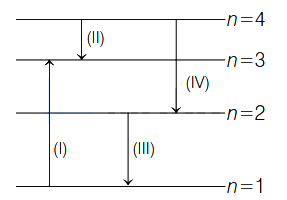
The diagram shows different transitions across the energy levels for an electron in a certain atom. Among these,which transition represents the emission of a photon with the most energy?
A
$(II)$
B
$(I)$
C
$(IV)$
D
$(III)$
Solution
(D) The energy of a photon emitted during an electronic transition is given by $\Delta E = E_{initial} - E_{final}$.
Since the energy levels are $E_n = -\frac{13.6 Z^2}{n^2} \text{ eV}$,the energy difference for a transition from $n_i$ to $n_f$ is $\Delta E = 13.6 Z^2 \left( \frac{1}{n_f^2} - \frac{1}{n_i^2} \right)$.
Emission occurs when an electron moves from a higher energy level to a lower energy level (downward arrows).
Looking at the diagram:
Transition $(II)$ is from $n=4$ to $n=3$.
Transition $(III)$ is from $n=2$ to $n=1$.
Transition $(IV)$ is from $n=3$ to $n=2$.
Transition $(I)$ is an absorption (upward arrow),so it does not represent emission.
Comparing the energy differences:
For $(II)$: $\Delta E \propto (\frac{1}{3^2} - \frac{1}{4^2}) = (\frac{1}{9} - \frac{1}{16}) = \frac{7}{144} \approx 0.0486$.
For $(III)$: $\Delta E \propto (\frac{1}{1^2} - \frac{1}{2^2}) = (1 - 0.25) = 0.75$.
For $(IV)$: $\Delta E \propto (\frac{1}{2^2} - \frac{1}{3^2}) = (\frac{1}{4} - \frac{1}{9}) = \frac{5}{36} \approx 0.1389$.
Comparing the values,the transition $(III)$ has the largest energy difference,corresponding to the emission of the most energetic photon.
Since the energy levels are $E_n = -\frac{13.6 Z^2}{n^2} \text{ eV}$,the energy difference for a transition from $n_i$ to $n_f$ is $\Delta E = 13.6 Z^2 \left( \frac{1}{n_f^2} - \frac{1}{n_i^2} \right)$.
Emission occurs when an electron moves from a higher energy level to a lower energy level (downward arrows).
Looking at the diagram:
Transition $(II)$ is from $n=4$ to $n=3$.
Transition $(III)$ is from $n=2$ to $n=1$.
Transition $(IV)$ is from $n=3$ to $n=2$.
Transition $(I)$ is an absorption (upward arrow),so it does not represent emission.
Comparing the energy differences:
For $(II)$: $\Delta E \propto (\frac{1}{3^2} - \frac{1}{4^2}) = (\frac{1}{9} - \frac{1}{16}) = \frac{7}{144} \approx 0.0486$.
For $(III)$: $\Delta E \propto (\frac{1}{1^2} - \frac{1}{2^2}) = (1 - 0.25) = 0.75$.
For $(IV)$: $\Delta E \propto (\frac{1}{2^2} - \frac{1}{3^2}) = (\frac{1}{4} - \frac{1}{9}) = \frac{5}{36} \approx 0.1389$.
Comparing the values,the transition $(III)$ has the largest energy difference,corresponding to the emission of the most energetic photon.
0 likes
View Solution206
EasyMCQ
Minimum excitation potential of Bohr's first orbit of Hydrogen atom is . . . . . . (in $V$)
A
$3.6$
B
$10.2$
C
$13.6$
D
$3.4$
Solution
(B) The minimum excitation energy corresponds to the transition from the ground state $(n=1)$ to the first excited state $(n=2)$.
Using the formula for energy levels of the Hydrogen atom: $E_n = -\frac{13.6}{n^2} \ eV$.
The energy of the ground state is $E_1 = -13.6 \ eV$.
The energy of the first excited state is $E_2 = -\frac{13.6}{2^2} = -3.4 \ eV$.
The excitation energy required is $\Delta E = E_2 - E_1 = -3.4 - (-13.6) = 10.2 \ eV$.
Therefore,the minimum excitation potential is $10.2 \ V$.
Using the formula for energy levels of the Hydrogen atom: $E_n = -\frac{13.6}{n^2} \ eV$.
The energy of the ground state is $E_1 = -13.6 \ eV$.
The energy of the first excited state is $E_2 = -\frac{13.6}{2^2} = -3.4 \ eV$.
The excitation energy required is $\Delta E = E_2 - E_1 = -3.4 - (-13.6) = 10.2 \ eV$.
Therefore,the minimum excitation potential is $10.2 \ V$.
0 likes
View Solution207
EasyMCQ
When a hydrogen atom emits a photon during a transition from $n=4$ to $n=2$,its recoil speed is about (in $m \ s^{-1}$)
A
$4.28$
B
$0.814$
C
$2.07$
D
$0.407$
Solution
(B) The energy of the emitted photon is given by $\Delta E = 13.6 \ eV \times \left( \frac{1}{n_1^2} - \frac{1}{n_2^2} \right)$.
For $n_2=4$ to $n_1=2$,$\Delta E = 13.6 \times \left( \frac{1}{4} - \frac{1}{16} \right) = 13.6 \times \frac{3}{16} = 2.55 \ eV$.
Converting to Joules: $\Delta E = 2.55 \times 1.6 \times 10^{-19} \ J = 4.08 \times 10^{-19} \ J$.
The momentum of the photon is $p = \frac{E}{c} = \frac{4.08 \times 10^{-19}}{3 \times 10^8} = 1.36 \times 10^{-27} \ kg \ m \ s^{-1}$.
By conservation of momentum,the recoil momentum of the hydrogen atom is equal to the momentum of the photon.
$m_{H} v = p$,where $m_{H} \approx 1.67 \times 10^{-27} \ kg$.
$v = \frac{1.36 \times 10^{-27}}{1.67 \times 10^{-27}} \approx 0.814 \ m \ s^{-1}$.
For $n_2=4$ to $n_1=2$,$\Delta E = 13.6 \times \left( \frac{1}{4} - \frac{1}{16} \right) = 13.6 \times \frac{3}{16} = 2.55 \ eV$.
Converting to Joules: $\Delta E = 2.55 \times 1.6 \times 10^{-19} \ J = 4.08 \times 10^{-19} \ J$.
The momentum of the photon is $p = \frac{E}{c} = \frac{4.08 \times 10^{-19}}{3 \times 10^8} = 1.36 \times 10^{-27} \ kg \ m \ s^{-1}$.
By conservation of momentum,the recoil momentum of the hydrogen atom is equal to the momentum of the photon.
$m_{H} v = p$,where $m_{H} \approx 1.67 \times 10^{-27} \ kg$.
$v = \frac{1.36 \times 10^{-27}}{1.67 \times 10^{-27}} \approx 0.814 \ m \ s^{-1}$.
0 likes
View Solution208
EasyMCQ
If the first excitation potential of a hypothetical hydrogen-like atom is $15 \ V$,then the third excitation potential of the atom is
A
$13.6 \ V$
B
$\frac{4}{75} \ V$
C
$\frac{15}{16} \ V$
D
$\frac{75}{4} \ V$
Solution
(D) Let the ground state energy of the hydrogen-like atom be $-E$.
For the first excitation,the electron transitions from the ground state $(n=1)$ to the first excited state $(n=2)$.
The energy required is $E_{2} - E_{1} = 15 \ eV$.
$\left(\frac{-E}{2^2}\right) - \left(\frac{-E}{1^2}\right) = 15 \ eV$.
$\frac{-E}{4} + E = 15 \ eV$.
$\frac{3E}{4} = 15 \ eV \implies E = 20 \ eV$.
For the third excitation,the electron transitions from the ground state $(n=1)$ to the fourth excited state $(n=4)$.
The energy required is $E_{4} - E_{1} = \left(\frac{-E}{4^2}\right) - \left(\frac{-E}{1^2}\right)$.
$= \frac{-E}{16} + E = \frac{15E}{16}$.
Substituting $E = 20 \ eV$,we get:
$E_{3rd\ excitation} = \frac{15 \times 20}{16} = \frac{300}{16} = \frac{75}{4} \ V$.
Thus,the correct option is $D$.
For the first excitation,the electron transitions from the ground state $(n=1)$ to the first excited state $(n=2)$.
The energy required is $E_{2} - E_{1} = 15 \ eV$.
$\left(\frac{-E}{2^2}\right) - \left(\frac{-E}{1^2}\right) = 15 \ eV$.
$\frac{-E}{4} + E = 15 \ eV$.
$\frac{3E}{4} = 15 \ eV \implies E = 20 \ eV$.
For the third excitation,the electron transitions from the ground state $(n=1)$ to the fourth excited state $(n=4)$.
The energy required is $E_{4} - E_{1} = \left(\frac{-E}{4^2}\right) - \left(\frac{-E}{1^2}\right)$.
$= \frac{-E}{16} + E = \frac{15E}{16}$.
Substituting $E = 20 \ eV$,we get:
$E_{3rd\ excitation} = \frac{15 \times 20}{16} = \frac{300}{16} = \frac{75}{4} \ V$.
Thus,the correct option is $D$.
0 likes
View Solution209
EasyMCQ
If an electron in the excited state falls to the ground state,a photon of energy $5 \ eV$ is emitted. The wavelength of the photon is nearly: (in $nm$)
A
$748$
B
$598$
C
$398$
D
$248$
Solution
(D) The energy of a photon is given by the formula $E = \frac{hc}{\lambda}$.
Here,$E = 5 \ eV$,$h = 6.626 \times 10^{-34} \ J \cdot s$,$c = 3 \times 10^8 \ m/s$,and $1 \ eV = 1.6 \times 10^{-19} \ J$.
Alternatively,using the shortcut formula $E \ (eV) = \frac{1240}{\lambda \ (nm)}$.
Substituting the values: $5 = \frac{1240}{\lambda}$.
Solving for $\lambda$: $\lambda = \frac{1240}{5} = 248 \ nm$.
Therefore,the wavelength of the emitted photon is $248 \ nm$.
Here,$E = 5 \ eV$,$h = 6.626 \times 10^{-34} \ J \cdot s$,$c = 3 \times 10^8 \ m/s$,and $1 \ eV = 1.6 \times 10^{-19} \ J$.
Alternatively,using the shortcut formula $E \ (eV) = \frac{1240}{\lambda \ (nm)}$.
Substituting the values: $5 = \frac{1240}{\lambda}$.
Solving for $\lambda$: $\lambda = \frac{1240}{5} = 248 \ nm$.
Therefore,the wavelength of the emitted photon is $248 \ nm$.
0 likes
View Solution210
EasyMCQ
In an atom, the difference between two energy levels is $3.31 \ eV$. The wavelength of the radiation emitted when the transition takes place between these levels is nearly: (in $Å$)
A
$3750$
B
$5620$
C
$7560$
D
$5890$
Solution
(A) The energy of a photon emitted during a transition is given by $E = \Delta E = 3.31 \ eV$.
The relationship between energy and wavelength is $E = \frac{hc}{\lambda}$.
Given $h = 6.62 \times 10^{-34} \ J \cdot s$, $c = 3 \times 10^8 \ m/s$, and $1 \ eV = 1.6 \times 10^{-19} \ J$.
Using the formula $\lambda = \frac{hc}{E}$, we have:
$\lambda = \frac{(6.62 \times 10^{-34} \ J \cdot s) \times (3 \times 10^8 \ m/s)}{3.31 \times 1.6 \times 10^{-19} \ J}$.
$\lambda = \frac{19.86 \times 10^{-26}}{5.296 \times 10^{-19}} \ m$.
$\lambda \approx 3.75 \times 10^{-7} \ m$.
Converting to $\text{\AA}$ $(1 \ Å = 10^{-10} \ m)$:
$\lambda \approx 3750 \ Å$.
The relationship between energy and wavelength is $E = \frac{hc}{\lambda}$.
Given $h = 6.62 \times 10^{-34} \ J \cdot s$, $c = 3 \times 10^8 \ m/s$, and $1 \ eV = 1.6 \times 10^{-19} \ J$.
Using the formula $\lambda = \frac{hc}{E}$, we have:
$\lambda = \frac{(6.62 \times 10^{-34} \ J \cdot s) \times (3 \times 10^8 \ m/s)}{3.31 \times 1.6 \times 10^{-19} \ J}$.
$\lambda = \frac{19.86 \times 10^{-26}}{5.296 \times 10^{-19}} \ m$.
$\lambda \approx 3.75 \times 10^{-7} \ m$.
Converting to $\text{\AA}$ $(1 \ Å = 10^{-10} \ m)$:
$\lambda \approx 3750 \ Å$.
0 likes
View Solution211
MediumMCQ
$A$ hydrogen sample is prepared in a particular excited state $A$ of quantum number $n_A=3$. The ground state energy of the hydrogen atom is $-|E|$. Photons of energy $\frac{|E|}{12}$ are absorbed by the sample,which results in the excitation of some electrons to an excited state $B$ of quantum number $n_B$. The value of $n_B$ is:
A
$6$
B
$4$
C
$5$
D
$7$
Solution
(A) The energy of an electron in the $n$-th state of a hydrogen atom is given by $E_n = -\frac{|E|}{n^2}$.
Given,the initial state is $n_A = 3$,so the initial energy is $E_{n_A} = -\frac{|E|}{3^2} = -\frac{|E|}{9}$.
When a photon of energy $\Delta E = \frac{|E|}{12}$ is absorbed,the electron transitions to state $n_B$ with energy $E_{n_B} = -\frac{|E|}{n_B^2}$.
The energy conservation equation is $E_{n_B} - E_{n_A} = \Delta E$.
Substituting the values: $-\frac{|E|}{n_B^2} - (-\frac{|E|}{9}) = \frac{|E|}{12}$.
Dividing by $|E|$: $-\frac{1}{n_B^2} + \frac{1}{9} = \frac{1}{12}$.
Rearranging the terms: $\frac{1}{n_B^2} = \frac{1}{9} - \frac{1}{12}$.
Finding a common denominator: $\frac{1}{n_B^2} = \frac{4 - 3}{36} = \frac{1}{36}$.
Therefore,$n_B^2 = 36$,which gives $n_B = 6$.
Given,the initial state is $n_A = 3$,so the initial energy is $E_{n_A} = -\frac{|E|}{3^2} = -\frac{|E|}{9}$.
When a photon of energy $\Delta E = \frac{|E|}{12}$ is absorbed,the electron transitions to state $n_B$ with energy $E_{n_B} = -\frac{|E|}{n_B^2}$.
The energy conservation equation is $E_{n_B} - E_{n_A} = \Delta E$.
Substituting the values: $-\frac{|E|}{n_B^2} - (-\frac{|E|}{9}) = \frac{|E|}{12}$.
Dividing by $|E|$: $-\frac{1}{n_B^2} + \frac{1}{9} = \frac{1}{12}$.
Rearranging the terms: $\frac{1}{n_B^2} = \frac{1}{9} - \frac{1}{12}$.
Finding a common denominator: $\frac{1}{n_B^2} = \frac{4 - 3}{36} = \frac{1}{36}$.
Therefore,$n_B^2 = 36$,which gives $n_B = 6$.
0 likes
View Solution212
MediumMCQ
The ratio of the kinetic energies of the electrons in the third and fourth excited states of the hydrogen atom is
A
$4: 3$
B
$16: 9$
C
$25: 16$
D
$5: 4$
Solution
(C) The kinetic energy $(K)$ of an electron in the $n^{th}$ orbit of a hydrogen atom is given by $K_n = \frac{13.6 \text{ eV}}{n^2}$.
For the third excited state,the principal quantum number is $n_1 = 3 + 1 = 4$.
For the fourth excited state,the principal quantum number is $n_2 = 4 + 1 = 5$.
The kinetic energy in the third excited state is $K_4 = \frac{13.6}{4^2} = \frac{13.6}{16}$.
The kinetic energy in the fourth excited state is $K_5 = \frac{13.6}{5^2} = \frac{13.6}{25}$.
The ratio of the kinetic energies is $\frac{K_4}{K_5} = \frac{13.6/16}{13.6/25} = \frac{25}{16}$.
Thus,the ratio is $25: 16$.
For the third excited state,the principal quantum number is $n_1 = 3 + 1 = 4$.
For the fourth excited state,the principal quantum number is $n_2 = 4 + 1 = 5$.
The kinetic energy in the third excited state is $K_4 = \frac{13.6}{4^2} = \frac{13.6}{16}$.
The kinetic energy in the fourth excited state is $K_5 = \frac{13.6}{5^2} = \frac{13.6}{25}$.
The ratio of the kinetic energies is $\frac{K_4}{K_5} = \frac{13.6/16}{13.6/25} = \frac{25}{16}$.
Thus,the ratio is $25: 16$.
0 likes
View Solution213
MediumMCQ
The maximum wavelength of incident radiation required to ionize a hydrogen atom in its ground state is nearly
A
$912$ nm
B
$1215 \, Å$
C
$912 \, Å$
D
$1215$ nm
Solution
(C) The energy required to ionize a hydrogen atom from its ground state $(n=1)$ is equal to the ionization energy, which is $E = 13.6 \, eV$.
To find the maximum wavelength $(\lambda_{max})$ of the incident radiation, we use the relation $E = \frac{hc}{\lambda}$.
Substituting the values: $13.6 \, eV = \frac{1240 \, eV \cdot nm}{\lambda}$.
$\lambda = \frac{1240}{13.6} \, nm \approx 91.17 \, nm$.
Converting this to $\mathring{A}$ $(Å)$: $91.17 \, nm = 911.7 \, Å \approx 912 \, Å$.
Thus, the maximum wavelength required is nearly $912 \, Å$.
To find the maximum wavelength $(\lambda_{max})$ of the incident radiation, we use the relation $E = \frac{hc}{\lambda}$.
Substituting the values: $13.6 \, eV = \frac{1240 \, eV \cdot nm}{\lambda}$.
$\lambda = \frac{1240}{13.6} \, nm \approx 91.17 \, nm$.
Converting this to $\mathring{A}$ $(Å)$: $91.17 \, nm = 911.7 \, Å \approx 912 \, Å$.
Thus, the maximum wavelength required is nearly $912 \, Å$.
0 likes
View Solution214
EasyMCQ
The ground state energy of a hydrogen atom is $-13.6 \ eV$. The potential energy of the electron in the first excited state of hydrogen is (in $eV$)
A
$-6.8$
B
$-3.4$
C
$-13.6$
D
$-27.2$
Solution
(A) For a hydrogen atom,the total energy in the $n^{th}$ orbit is given by $E_n = \frac{E_1}{n^2}$,where $E_1 = -13.6 \ eV$.
For the first excited state,$n = 2$.
Therefore,the total energy $E_2 = \frac{-13.6}{2^2} = \frac{-13.6}{4} = -3.4 \ eV$.
The relationship between total energy $(E)$ and potential energy $(U)$ is $U = 2E$.
Thus,the potential energy in the first excited state is $U_2 = 2 \times E_2 = 2 \times (-3.4 \ eV) = -6.8 \ eV$.
For the first excited state,$n = 2$.
Therefore,the total energy $E_2 = \frac{-13.6}{2^2} = \frac{-13.6}{4} = -3.4 \ eV$.
The relationship between total energy $(E)$ and potential energy $(U)$ is $U = 2E$.
Thus,the potential energy in the first excited state is $U_2 = 2 \times E_2 = 2 \times (-3.4 \ eV) = -6.8 \ eV$.
0 likes
View Solution215
MediumMCQ
The ratio of the energies of the electron in the hydrogen atom in the first and second excited states is
A
$9: 4$
B
$4: 1$
C
$8: 1$
D
$1: 8$
Solution
(A) The energy of an electron in the $n^{th}$ orbit of a hydrogen atom is given by the formula $E_n = -\frac{13.6 \text{ eV}}{n^2}$.
For the ground state,$n = 1$.
The first excited state corresponds to $n = 2$.
The second excited state corresponds to $n = 3$.
We need the ratio of energies in the first excited state $(E_2)$ and the second excited state $(E_3)$.
$E_2 = -\frac{13.6}{2^2} = -\frac{13.6}{4} \text{ eV}$.
$E_3 = -\frac{13.6}{3^2} = -\frac{13.6}{9} \text{ eV}$.
The ratio of the energy in the first excited state to the energy in the second excited state is $\frac{E_2}{E_3} = \frac{-13.6/4}{-13.6/9} = \frac{9}{4}$.
Thus,the ratio is $9: 4$.
For the ground state,$n = 1$.
The first excited state corresponds to $n = 2$.
The second excited state corresponds to $n = 3$.
We need the ratio of energies in the first excited state $(E_2)$ and the second excited state $(E_3)$.
$E_2 = -\frac{13.6}{2^2} = -\frac{13.6}{4} \text{ eV}$.
$E_3 = -\frac{13.6}{3^2} = -\frac{13.6}{9} \text{ eV}$.
The ratio of the energy in the first excited state to the energy in the second excited state is $\frac{E_2}{E_3} = \frac{-13.6/4}{-13.6/9} = \frac{9}{4}$.
Thus,the ratio is $9: 4$.
0 likes
View Solution216
EasyMCQ
The energy of an electron in the fourth excited state of the hydrogen atom is
A
$-0.85 eV$
B
$-1.70 eV$
C
$0$
D
$-0.544 eV$
Solution
(D) The energy of an electron in the $n^{th}$ orbit of a hydrogen atom is given by the formula $E_n = \frac{-13.6}{n^2} eV$.
For the ground state,$n = 1$.
The first excited state is $n = 2$,the second excited state is $n = 3$,the third excited state is $n = 4$,and the fourth excited state is $n = 5$.
Substituting $n = 5$ into the formula:
$E_5 = \frac{-13.6}{5^2} eV = \frac{-13.6}{25} eV = -0.544 eV$.
For the ground state,$n = 1$.
The first excited state is $n = 2$,the second excited state is $n = 3$,the third excited state is $n = 4$,and the fourth excited state is $n = 5$.
Substituting $n = 5$ into the formula:
$E_5 = \frac{-13.6}{5^2} eV = \frac{-13.6}{25} eV = -0.544 eV$.
0 likes
View Solution217
EasyMCQ
An electron collides with a hydrogen atom in its ground state and excites it to the $n=3$ state. The energy given to the hydrogen atom in this inelastic collision (neglecting the recoil of the hydrogen atom) is (in $\text{ eV}$)
A
$10.2$
B
$12.1$
C
$12.5$
D
$13.6$
Solution
(B) The energy of an electron in the $n$-th orbit of a hydrogen atom is given by $E_n = -\frac{13.6}{n^2} \text{ eV}$.
For the ground state $(n_1 = 1)$, the energy is $E_1 = -13.6 \text{ eV}$.
For the excited state $(n_2 = 3)$, the energy is $E_3 = -\frac{13.6}{3^2} = -\frac{13.6}{9} \approx -1.51 \text{ eV}$.
The energy required to excite the atom from $n=1$ to $n=3$ is $\Delta E = E_3 - E_1$.
$\Delta E = -1.51 - (-13.6) = 12.09 \text{ eV}$.
Rounding this value, we get $\Delta E \approx 12.1 \text{ eV}$.
For the ground state $(n_1 = 1)$, the energy is $E_1 = -13.6 \text{ eV}$.
For the excited state $(n_2 = 3)$, the energy is $E_3 = -\frac{13.6}{3^2} = -\frac{13.6}{9} \approx -1.51 \text{ eV}$.
The energy required to excite the atom from $n=1$ to $n=3$ is $\Delta E = E_3 - E_1$.
$\Delta E = -1.51 - (-13.6) = 12.09 \text{ eV}$.
Rounding this value, we get $\Delta E \approx 12.1 \text{ eV}$.
0 likes
View Solution218
EasyMCQ
To excite the spectral line of wavelength $4960 \mathring A$ of an atom,an excitation energy of $7.7 \text{ eV}$ is required. The ground state energy of the atom is $10.5 \text{ eV}$. The energies of the two levels involved in the emission of the $4960 \mathring A$ line are (Assume $hc = 1240 \text{ eV nm}$,where $h$ is Planck's constant and $c$ is the speed of light).
A
$14.2 \text{ eV}, 16.1 \text{ eV}$
B
$12.2 \text{ eV}, 18.2 \text{ eV}$
C
$15.7 \text{ eV}, 20.5 \text{ eV}$
D
$15.7 \text{ eV}, 18.2 \text{ eV}$
Solution
(D) The energy of the excited state is given by the sum of the ground state energy and the excitation energy.
$E_{\text{excited}} = E_{\text{ground}} + E_{\text{excitation}} = 10.5 \text{ eV} + 7.7 \text{ eV} = 18.2 \text{ eV}$.
This represents the higher energy level $(E_1)$ involved in the transition.
The energy of the emitted photon corresponding to the wavelength $\lambda = 4960 \mathring A = 496 \text{ nm}$ is calculated as:
$E_{\text{photon}} = \frac{hc}{\lambda} = \frac{1240 \text{ eV nm}}{496 \text{ nm}} = 2.5 \text{ eV}$.
Since the photon is emitted during a transition from a higher level $(E_1)$ to a lower level $(E_2)$,we have:
$E_{\text{photon}} = E_1 - E_2$
$2.5 \text{ eV} = 18.2 \text{ eV} - E_2$
$E_2 = 18.2 \text{ eV} - 2.5 \text{ eV} = 15.7 \text{ eV}$.
Thus,the energies of the two levels are $18.2 \text{ eV}$ and $15.7 \text{ eV}$.
$E_{\text{excited}} = E_{\text{ground}} + E_{\text{excitation}} = 10.5 \text{ eV} + 7.7 \text{ eV} = 18.2 \text{ eV}$.
This represents the higher energy level $(E_1)$ involved in the transition.
The energy of the emitted photon corresponding to the wavelength $\lambda = 4960 \mathring A = 496 \text{ nm}$ is calculated as:
$E_{\text{photon}} = \frac{hc}{\lambda} = \frac{1240 \text{ eV nm}}{496 \text{ nm}} = 2.5 \text{ eV}$.
Since the photon is emitted during a transition from a higher level $(E_1)$ to a lower level $(E_2)$,we have:
$E_{\text{photon}} = E_1 - E_2$
$2.5 \text{ eV} = 18.2 \text{ eV} - E_2$
$E_2 = 18.2 \text{ eV} - 2.5 \text{ eV} = 15.7 \text{ eV}$.
Thus,the energies of the two levels are $18.2 \text{ eV}$ and $15.7 \text{ eV}$.
0 likes
View Solution219
EasyMCQ
In the hydrogen atom spectrum,let $E_1$ and $E_2$ be the energies for the transitions $n=2 \rightarrow n=1$ and $n=3 \rightarrow n=2$ respectively. The ratio $E_2 / E_1$ is
A
$\frac{2}{3}$
B
$\frac{3}{2}$
C
$\frac{2}{9}$
D
$\frac{5}{27}$
Solution
(D) The energy of a photon emitted during a transition in a hydrogen atom is given by the Rydberg formula: $\Delta E = 13.6 \left( \frac{1}{n_f^2} - \frac{1}{n_i^2} \right) \text{ eV}$.
For the transition $n=2 \rightarrow n=1$,the energy $E_1$ is:
$E_1 = 13.6 \left( \frac{1}{1^2} - \frac{1}{2^2} \right) = 13.6 \left( 1 - \frac{1}{4} \right) = 13.6 \times \frac{3}{4} \text{ eV}$.
For the transition $n=3 \rightarrow n=2$,the energy $E_2$ is:
$E_2 = 13.6 \left( \frac{1}{2^2} - \frac{1}{3^2} \right) = 13.6 \left( \frac{1}{4} - \frac{1}{9} \right) = 13.6 \times \frac{5}{36} \text{ eV}$.
Now,calculating the ratio $E_2 / E_1$:
$\frac{E_2}{E_1} = \frac{13.6 \times (5/36)}{13.6 \times (3/4)} = \frac{5}{36} \times \frac{4}{3} = \frac{5}{9 \times 3} = \frac{5}{27}$.
For the transition $n=2 \rightarrow n=1$,the energy $E_1$ is:
$E_1 = 13.6 \left( \frac{1}{1^2} - \frac{1}{2^2} \right) = 13.6 \left( 1 - \frac{1}{4} \right) = 13.6 \times \frac{3}{4} \text{ eV}$.
For the transition $n=3 \rightarrow n=2$,the energy $E_2$ is:
$E_2 = 13.6 \left( \frac{1}{2^2} - \frac{1}{3^2} \right) = 13.6 \left( \frac{1}{4} - \frac{1}{9} \right) = 13.6 \times \frac{5}{36} \text{ eV}$.
Now,calculating the ratio $E_2 / E_1$:
$\frac{E_2}{E_1} = \frac{13.6 \times (5/36)}{13.6 \times (3/4)} = \frac{5}{36} \times \frac{4}{3} = \frac{5}{9 \times 3} = \frac{5}{27}$.
0 likes
View Solution220
EasyMCQ
The ionization energy of hydrogen is $13.6 \text{ eV}$. The energy of the photon released when an electron jumps from the first excited state $(n=2)$ to the ground state of a hydrogen atom is (in $\text{ eV}$)
A
$3.4$
B
$4.53$
C
$10.2$
D
$13.6$
Solution
(C) The energy of an electron in the $n$-th orbit of a hydrogen atom is given by $E_n = -\frac{13.6 \text{ eV}}{n^2}$.
For the ground state $(n_1 = 1)$,the energy is $E_1 = -13.6 \text{ eV}$.
For the first excited state $(n_2 = 2)$,the energy is $E_2 = -\frac{13.6 \text{ eV}}{2^2} = -\frac{13.6}{4} \text{ eV} = -3.4 \text{ eV}$.
The energy of the photon released during the transition from $n_2$ to $n_1$ is $\Delta E = E_2 - E_1$.
$\Delta E = -3.4 \text{ eV} - (-13.6 \text{ eV}) = 13.6 \text{ eV} - 3.4 \text{ eV} = 10.2 \text{ eV}$.
For the ground state $(n_1 = 1)$,the energy is $E_1 = -13.6 \text{ eV}$.
For the first excited state $(n_2 = 2)$,the energy is $E_2 = -\frac{13.6 \text{ eV}}{2^2} = -\frac{13.6}{4} \text{ eV} = -3.4 \text{ eV}$.
The energy of the photon released during the transition from $n_2$ to $n_1$ is $\Delta E = E_2 - E_1$.
$\Delta E = -3.4 \text{ eV} - (-13.6 \text{ eV}) = 13.6 \text{ eV} - 3.4 \text{ eV} = 10.2 \text{ eV}$.
0 likes
View Solution221
MediumMCQ
If the potential energy of a hydrogen atom in the first excited state is assumed to be zero,then the total energy of the $n = \infty$ state is,
A
$3.4 eV$
B
$6.8 eV$
C
$0$
D
$\infty$
Solution
(B) The potential energy $U$ of an electron in a hydrogen atom at a state $n$ is given by $U_n = -27.2 / n^2 \ eV$.
For the first excited state $(n = 2)$,the potential energy is $U_2 = -27.2 / 2^2 = -6.8 \ eV$.
According to the problem,we assume $U_2 = 0$. This implies we are adding a constant $C = 6.8 \ eV$ to the potential energy scale.
The total energy $E_n$ of a hydrogen atom is given by $E_n = -13.6 / n^2 \ eV$.
For $n = \infty$,the standard total energy is $E_{\infty} = 0 \ eV$.
Since we shifted the potential energy scale by adding $6.8 \ eV$,the new total energy $E'_{\infty}$ will be $E_{\infty} + 6.8 \ eV = 0 + 6.8 \ eV = 6.8 \ eV$.
For the first excited state $(n = 2)$,the potential energy is $U_2 = -27.2 / 2^2 = -6.8 \ eV$.
According to the problem,we assume $U_2 = 0$. This implies we are adding a constant $C = 6.8 \ eV$ to the potential energy scale.
The total energy $E_n$ of a hydrogen atom is given by $E_n = -13.6 / n^2 \ eV$.
For $n = \infty$,the standard total energy is $E_{\infty} = 0 \ eV$.
Since we shifted the potential energy scale by adding $6.8 \ eV$,the new total energy $E'_{\infty}$ will be $E_{\infty} + 6.8 \ eV = 0 + 6.8 \ eV = 6.8 \ eV$.
0 likes
View Solution222
EasyMCQ
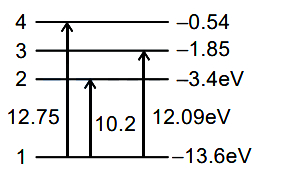
$A$ $12.5 \text{ eV}$ electron beam is used to bombard gaseous hydrogen at ground state. The energy level up to which the hydrogen atoms would be excited is:
A
$2$
B
$3$
C
$4$
D
$1$
Solution
(B) The energy of the ground state of a hydrogen atom is $E_1 = -13.6 \text{ eV}$.
The energy required to excite the atom to the $n$-th energy level is given by $\Delta E = E_n - E_1$,where $E_n = -13.6/n^2 \text{ eV}$.
For $n=2$,$\Delta E = -3.4 - (-13.6) = 10.2 \text{ eV}$.
For $n=3$,$\Delta E = -1.51 - (-13.6) = 12.09 \text{ eV}$.
For $n=4$,$\Delta E = -0.85 - (-13.6) = 12.75 \text{ eV}$.
Since the incident electron beam has an energy of $12.5 \text{ eV}$,it can provide enough energy to excite the hydrogen atoms to the $n=3$ level $(12.09 \text{ eV})$,but it does not have enough energy to reach the $n=4$ level $(12.75 \text{ eV})$.
Therefore,the hydrogen atoms will be excited up to the $n=3$ energy level.
The energy required to excite the atom to the $n$-th energy level is given by $\Delta E = E_n - E_1$,where $E_n = -13.6/n^2 \text{ eV}$.
For $n=2$,$\Delta E = -3.4 - (-13.6) = 10.2 \text{ eV}$.
For $n=3$,$\Delta E = -1.51 - (-13.6) = 12.09 \text{ eV}$.
For $n=4$,$\Delta E = -0.85 - (-13.6) = 12.75 \text{ eV}$.
Since the incident electron beam has an energy of $12.5 \text{ eV}$,it can provide enough energy to excite the hydrogen atoms to the $n=3$ level $(12.09 \text{ eV})$,but it does not have enough energy to reach the $n=4$ level $(12.75 \text{ eV})$.
Therefore,the hydrogen atoms will be excited up to the $n=3$ energy level.
0 likes
View Solution223
EasyMCQ
The ionization energy of the hydrogen atom is $13.6 \ eV$. The potential energy of the electron in $n=2$ state of the hydrogen atom is
A
$+3.4 \ eV$
B
$-3.4 \ eV$
C
$+6.8 \ eV$
D
$-6.8 \ eV$
Solution
(D) The total energy of an electron in the $n^{\text{th}}$ orbit of a hydrogen atom is given by $E_n = -\frac{13.6 \ eV}{n^2}$.
For the $n=2$ state,the total energy is $E_2 = -\frac{13.6}{2^2} = -\frac{13.6}{4} = -3.4 \ eV$.
The relationship between potential energy $(PE)$ and total energy $(E)$ is $PE = 2E$.
Therefore,the potential energy in the $n=2$ state is $PE = 2 \times (-3.4 \ eV) = -6.8 \ eV$.
For the $n=2$ state,the total energy is $E_2 = -\frac{13.6}{2^2} = -\frac{13.6}{4} = -3.4 \ eV$.
The relationship between potential energy $(PE)$ and total energy $(E)$ is $PE = 2E$.
Therefore,the potential energy in the $n=2$ state is $PE = 2 \times (-3.4 \ eV) = -6.8 \ eV$.
0 likes
View Solution224
DifficultMCQ
In an inelastic collision,an electron excites a hydrogen atom from its ground state to an $M$-shell state. $A$ second electron collides instantaneously with the excited hydrogen atom in the $M$-state and ionizes it. At least how much energy must the second electron transfer to the atom in the $M$-state?
A
$+3.4 \ eV$
B
$+1.51 \ eV$
C
$-3.4 \ eV$
D
$-1.51 \ eV$
Solution
(B) The energy of an electron in the $n$-th orbit of a hydrogen atom is given by $E_n = -\frac{13.6 \ eV}{n^2}$.
For the ground state $(n=1)$,$E_1 = -13.6 \ eV$.
For the $M$-shell $(n=3)$,the energy is $E_3 = -\frac{13.6 \ eV}{3^2} = -\frac{13.6}{9} \ eV \approx -1.51 \ eV$.
To ionize the hydrogen atom from the $M$-state,the atom must be provided with enough energy to reach the ionization limit $(E_{\infty} = 0 \ eV)$.
The energy required is $\Delta E = E_{\infty} - E_3 = 0 - (-1.51 \ eV) = +1.51 \ eV$.
Therefore,the second electron must transfer at least $+1.51 \ eV$ of energy to the atom.
For the ground state $(n=1)$,$E_1 = -13.6 \ eV$.
For the $M$-shell $(n=3)$,the energy is $E_3 = -\frac{13.6 \ eV}{3^2} = -\frac{13.6}{9} \ eV \approx -1.51 \ eV$.
To ionize the hydrogen atom from the $M$-state,the atom must be provided with enough energy to reach the ionization limit $(E_{\infty} = 0 \ eV)$.
The energy required is $\Delta E = E_{\infty} - E_3 = 0 - (-1.51 \ eV) = +1.51 \ eV$.
Therefore,the second electron must transfer at least $+1.51 \ eV$ of energy to the atom.
0 likes
View SolutionAtoms — Electron Energy and Electron Energy Levels in Hydrogen Atom · Frequently Asked Questions
1Are these Atoms questions useful for JEE and NEET?
Yes. All questions in this section are mapped to JEE Main and NEET exam patterns. Previous year questions from JEE Main, NEET, GUJCET and state-level exams are included with full solutions.
2Can I switch to Hindi or Gujarati for these questions?
Yes. Use the language tabs in the hero section or the sidebar to view the same questions and solutions in English, Hindi or Gujarati.
3How do I generate a question paper from this subtopic?
Use the Vedclass Exam Paper Generator — select the chapter and subtopic, set difficulty, and generate Sets A, B, C, D automatically. First 3 chapters of every subject are free.
Vedclass Products
For Students
Vedclass Test Series
Mock tests in real JEE/NEET style with performance analysis. 5-day free trial.
Start Free TrialFor Teachers
Exam Paper Generator
Generate Set A/B/C/D papers from this chapter in 2 minutes. 3 chapters free.
Try FreeFor Institutes
Online Exam Module
Live online exams with unlimited students, 360° analytics & white-label branding.
See DemoFor Teachers & Institutes
Generate a Atoms Exam Paper in 2 Minutes
Select subtopic & difficulty — Sets A, B, C, D auto-generated with No Repeat logic.
First 3 chapters of every subject are free — no payment required.