
A English
Osmosis and Osmotic pressure of the solution Questions in English
Class 12 Chemistry · Solutions · Osmosis and Osmotic pressure of the solution
323+
Questions
English
Language
100%
With Solutions
Showing 50 of 323 questions in English
251
EasyMCQ
What is the molar mass of a solute if a solution is prepared by dissolving $4.5 \ g$ of solute in $3 \ dm^3$ of water having an osmotic pressure of $0.25 \ atm$ at $300 \ K$? $(R = 0.0821 \ dm^3 \ atm \ K^{-1} \ mol^{-1})$
A
$148 \ g \ mol^{-1}$
B
$160 \ g \ mol^{-1}$
C
$172 \ g \ mol^{-1}$
D
$136 \ g \ mol^{-1}$
Solution
(A) The formula for osmotic pressure is $\pi = CRT = \frac{n}{V} RT = \frac{w}{M_B \times V} RT$.
Given: $\pi = 0.25 \ atm$,$w = 4.5 \ g$,$V = 3 \ dm^3$,$T = 300 \ K$,and $R = 0.0821 \ dm^3 \ atm \ K^{-1} \ mol^{-1}$.
Substituting the values: $0.25 = \frac{4.5}{M_B \times 3} \times 0.0821 \times 300$.
$0.25 = \frac{4.5 \times 0.0821 \times 100}{M_B}$.
$M_B = \frac{4.5 \times 8.21}{0.25} = 18 \times 8.21 = 147.78 \ g \ mol^{-1}$.
Rounding to the nearest integer,$M_B \approx 148 \ g \ mol^{-1}$.
Given: $\pi = 0.25 \ atm$,$w = 4.5 \ g$,$V = 3 \ dm^3$,$T = 300 \ K$,and $R = 0.0821 \ dm^3 \ atm \ K^{-1} \ mol^{-1}$.
Substituting the values: $0.25 = \frac{4.5}{M_B \times 3} \times 0.0821 \times 300$.
$0.25 = \frac{4.5 \times 0.0821 \times 100}{M_B}$.
$M_B = \frac{4.5 \times 8.21}{0.25} = 18 \times 8.21 = 147.78 \ g \ mol^{-1}$.
Rounding to the nearest integer,$M_B \approx 148 \ g \ mol^{-1}$.
0 likes
View Solution252
EasyMCQ
Find the amount of solute in a solution obtained by dissolving it in $2.5 \ dm^3$ of water that generates an osmotic pressure of $0.245 \ atm$ at $300 \ K$. (Molar mass of solute $= 58 \ g \ mol^{-1}$,$R = 0.0821 \ dm^3 \ atm \ K^{-1} \ mol^{-1}$) (in $g$)
A
$1.75$
B
$1.0$
C
$0.72$
D
$1.44$
Solution
(D) The osmotic pressure formula is $\pi = CRT$,where $C = \frac{n}{V} = \frac{W}{M \times V}$.
Given: $\pi = 0.245 \ atm$,$V = 2.5 \ dm^3$,$T = 300 \ K$,$M = 58 \ g \ mol^{-1}$,$R = 0.0821 \ dm^3 \ atm \ K^{-1} \ mol^{-1}$.
Substituting the values: $0.245 = \frac{W}{58 \times 2.5} \times 0.0821 \times 300$.
$0.245 = \frac{W \times 24.63}{145}$.
$W = \frac{0.245 \times 145}{24.63} \approx 1.44 \ g$.
Given: $\pi = 0.245 \ atm$,$V = 2.5 \ dm^3$,$T = 300 \ K$,$M = 58 \ g \ mol^{-1}$,$R = 0.0821 \ dm^3 \ atm \ K^{-1} \ mol^{-1}$.
Substituting the values: $0.245 = \frac{W}{58 \times 2.5} \times 0.0821 \times 300$.
$0.245 = \frac{W \times 24.63}{145}$.
$W = \frac{0.245 \times 145}{24.63} \approx 1.44 \ g$.
0 likes
View Solution253
MediumMCQ
Which of the following solutions does not flow in either direction when separated by a semipermeable membrane? (Molar mass: glucose $= 180 \ g \ mol^{-1}$,urea $= 60 \ g \ mol^{-1}$)
A
$18 \ g$ urea $dm^{-3}$
B
$6 \ g$ urea $dm^{-3}$ and $36 \ g$ glucose $dm^{-3}$
C
$6 \ g$ urea $dm^{-3}$ and $24 \ g$ glucose $dm^{-3}$
D
$12 \ g$ urea $dm^{-3}$ and $36 \ g$ glucose $dm^{-3}$
Solution
(D) For two solutions to have no net flow across a semipermeable membrane,they must be isotonic,meaning their molar concentrations must be equal.
$M_{urea} = \frac{12 \ g / 60 \ g \ mol^{-1}}{1 \ dm^3} = 0.2 \ M$
$M_{glucose} = \frac{36 \ g / 180 \ g \ mol^{-1}}{1 \ dm^3} = 0.2 \ M$
Since the molar concentrations of urea and glucose in option $D$ are equal $(0.2 \ M)$,the osmotic pressures are equal $(\pi_1 = \pi_2)$.
Therefore,no net flow of solvent occurs between these two solutions.
$M_{urea} = \frac{12 \ g / 60 \ g \ mol^{-1}}{1 \ dm^3} = 0.2 \ M$
$M_{glucose} = \frac{36 \ g / 180 \ g \ mol^{-1}}{1 \ dm^3} = 0.2 \ M$
Since the molar concentrations of urea and glucose in option $D$ are equal $(0.2 \ M)$,the osmotic pressures are equal $(\pi_1 = \pi_2)$.
Therefore,no net flow of solvent occurs between these two solutions.
0 likes
View Solution254
MediumMCQ
Calculate the osmotic pressure exerted by a solution containing $0.822 \ g$ of solute in $300 \ mL$ of water at $300 \ K$. (Molar mass of solute $= 340 \ g \ mol^{-1}, R = 0.0821 \ L \ atm \ mol^{-1} \ K^{-1}$) (in $atm$)
A
$0.5$
B
$0.2$
C
$0.1$
D
$0.4$
Solution
(B) The formula for osmotic pressure is $\pi = CRT$.
First,calculate the number of moles of solute: $n = \frac{\text{mass}}{\text{molar mass}} = \frac{0.822 \ g}{340 \ g \ mol^{-1}} \approx 0.0024176 \ mol$.
Next,calculate the molar concentration $C$ in $mol \ L^{-1}$: $C = \frac{n}{V(L)} = \frac{0.0024176 \ mol}{0.300 \ L} \approx 0.0080588 \ M$.
Now,substitute the values into the osmotic pressure equation: $\pi = 0.0080588 \ mol \ L^{-1} \times 0.0821 \ L \ atm \ mol^{-1} \ K^{-1} \times 300 \ K$.
$\pi \approx 0.1985 \ atm \approx 0.2 \ atm$.
First,calculate the number of moles of solute: $n = \frac{\text{mass}}{\text{molar mass}} = \frac{0.822 \ g}{340 \ g \ mol^{-1}} \approx 0.0024176 \ mol$.
Next,calculate the molar concentration $C$ in $mol \ L^{-1}$: $C = \frac{n}{V(L)} = \frac{0.0024176 \ mol}{0.300 \ L} \approx 0.0080588 \ M$.
Now,substitute the values into the osmotic pressure equation: $\pi = 0.0080588 \ mol \ L^{-1} \times 0.0821 \ L \ atm \ mol^{-1} \ K^{-1} \times 300 \ K$.
$\pi \approx 0.1985 \ atm \approx 0.2 \ atm$.
0 likes
View Solution255
EasyMCQ
Which of the following pairs of solutions is isotonic? (Molar mass: urea $= 60 \ g \ mol^{-1}$,sucrose $= 342 \ g \ mol^{-1}$)
A
$3.0 \ g \ L^{-1}$ urea and $17.19 \ g \ L^{-1}$ sucrose
B
$0.3 \ g \ L^{-1}$ urea and $1.719 \ g \ L^{-1}$ sucrose
C
$3.0 \ g \ L^{-1}$ urea and $1.719 \ g \ L^{-1}$ sucrose
D
$0.3 \ g \ L^{-1}$ urea and $17.19 \ g \ L^{-1}$ sucrose
Solution
(A) For isotonic solutions,the molar concentrations must be equal: $C_{\text{urea}} = C_{\text{sucrose}}$.
First,calculate the molarity for each option.
For option $A$: Molarity of urea $= \frac{3.0 \ g \ L^{-1}}{60 \ g \ mol^{-1}} = 0.05 \ mol \ L^{-1}$.
Molarity of sucrose $= \frac{17.19 \ g \ L^{-1}}{342 \ g \ mol^{-1}} = 0.05026 \ mol \ L^{-1} \approx 0.05 \ mol \ L^{-1}$.
Since the molar concentrations are equal,the solutions are isotonic.
First,calculate the molarity for each option.
For option $A$: Molarity of urea $= \frac{3.0 \ g \ L^{-1}}{60 \ g \ mol^{-1}} = 0.05 \ mol \ L^{-1}$.
Molarity of sucrose $= \frac{17.19 \ g \ L^{-1}}{342 \ g \ mol^{-1}} = 0.05026 \ mol \ L^{-1} \approx 0.05 \ mol \ L^{-1}$.
Since the molar concentrations are equal,the solutions are isotonic.
0 likes
View Solution256
EasyMCQ
The osmotic pressure of a $1 \ M$ solution at $27^{\circ}C$ is $(R = 0.082 \ L \ atm \ K^{-1} \ mol^{-1})$: (in $atm$)
A
$2.46$
B
$12.1$
C
$24.6$
D
$1.21$
Solution
(C) The formula for osmotic pressure is $\pi = MRT$,where $M$ is the molarity,$R$ is the gas constant,and $T$ is the temperature in Kelvin.
Given: $M = 1 \ M$,$R = 0.082 \ L \ atm \ K^{-1} \ mol^{-1}$,and $T = 27 + 273 = 300 \ K$.
Substituting the values: $\pi = 1 \ mol \ L^{-1} \times 0.082 \ L \ atm \ K^{-1} \ mol^{-1} \times 300 \ K$.
$\pi = 24.6 \ atm$.
Given: $M = 1 \ M$,$R = 0.082 \ L \ atm \ K^{-1} \ mol^{-1}$,and $T = 27 + 273 = 300 \ K$.
Substituting the values: $\pi = 1 \ mol \ L^{-1} \times 0.082 \ L \ atm \ K^{-1} \ mol^{-1} \times 300 \ K$.
$\pi = 24.6 \ atm$.
0 likes
View Solution257
EasyMCQ
Which of the following is $NOT$ used as a semipermeable membrane?
A
Cellulose nitrate
B
Copper ferrocyanide
C
Ammonium chloride
D
Cellulose
Solution
(C) semipermeable membrane allows the passage of solvent molecules but blocks solute particles.
$Cellulose \ nitrate$,$Copper \ ferrocyanide$,and $Cellulose$ are commonly used as semipermeable membranes.
$Ammonium \ chloride$ $(NH_4Cl)$ is a salt and does not possess the structural properties required to act as a semipermeable membrane.
$Cellulose \ nitrate$,$Copper \ ferrocyanide$,and $Cellulose$ are commonly used as semipermeable membranes.
$Ammonium \ chloride$ $(NH_4Cl)$ is a salt and does not possess the structural properties required to act as a semipermeable membrane.
0 likes
View Solution258
EasyMCQ
$A$ solution has an osmotic pressure of $x \ kPa$ at $300 \ K$ having $1 \ mole$ of solute in $10.5 \ m^{3}$ of solution. If its osmotic pressure is reduced to $(\frac{1}{10})$th of its initial value,what is the new volume of solution (in $m^{3}$)?
A
$30$
B
$105$
C
$110$
D
$11.0$
Solution
(B) The osmotic pressure formula is given by $\pi = \frac{n}{V} RT$.
For the initial state: $\pi = x = \frac{1}{10.5} RT$.
For the final state: $\pi' = \frac{x}{10} = \frac{1}{V'} RT$.
Dividing the two equations: $\frac{x}{x/10} = \frac{\frac{1}{10.5} RT}{\frac{1}{V'} RT}$.
This simplifies to $10 = \frac{V'}{10.5}$.
Therefore,$V' = 10 \times 10.5 = 105 \ m^{3}$.
For the initial state: $\pi = x = \frac{1}{10.5} RT$.
For the final state: $\pi' = \frac{x}{10} = \frac{1}{V'} RT$.
Dividing the two equations: $\frac{x}{x/10} = \frac{\frac{1}{10.5} RT}{\frac{1}{V'} RT}$.
This simplifies to $10 = \frac{V'}{10.5}$.
Therefore,$V' = 10 \times 10.5 = 105 \ m^{3}$.
0 likes
View Solution259
MediumMCQ
Solutions $A, B, C$ and $D$ are respectively $0.2 \ M$ urea,$0.10 \ M$ $NaCl$,$0.05 \ M$ $BaCl_{2}$ and $0.05 \ M$ $AlCl_{3}$. All solutions are isotonic with each other except:
A
$B$
B
$A$
C
$D$
D
$C$
Solution
(D) The osmotic pressure is given by the formula $\pi = iMRT$,where $i$ is the van't Hoff factor,$M$ is the molarity,$R$ is the gas constant,and $T$ is the temperature.
For isotonic solutions,the osmotic pressure $\pi$ must be equal.
$(A)$ For urea: $i = 1$,$\pi = 1 \times 0.2 \ RT = 0.2 \ RT$
$(B)$ For $NaCl$: $i = 2$,$\pi = 2 \times 0.1 \ RT = 0.2 \ RT$
$(C)$ For $BaCl_{2}$: $i = 3$,$\pi = 3 \times 0.05 \ RT = 0.15 \ RT$
$(D)$ For $AlCl_{3}$: $i = 4$,$\pi = 4 \times 0.05 \ RT = 0.2 \ RT$
Since the osmotic pressure of solution $C$ is $0.15 \ RT$ while others are $0.2 \ RT$,solution $C$ is not isotonic with the others.
For isotonic solutions,the osmotic pressure $\pi$ must be equal.
$(A)$ For urea: $i = 1$,$\pi = 1 \times 0.2 \ RT = 0.2 \ RT$
$(B)$ For $NaCl$: $i = 2$,$\pi = 2 \times 0.1 \ RT = 0.2 \ RT$
$(C)$ For $BaCl_{2}$: $i = 3$,$\pi = 3 \times 0.05 \ RT = 0.15 \ RT$
$(D)$ For $AlCl_{3}$: $i = 4$,$\pi = 4 \times 0.05 \ RT = 0.2 \ RT$
Since the osmotic pressure of solution $C$ is $0.15 \ RT$ while others are $0.2 \ RT$,solution $C$ is not isotonic with the others.
0 likes
View Solution260
EasyMCQ
What is the osmotic pressure of a semi-molar solution at $27^{\circ} C$ (in $atm$)?
$(R = 0.082 \ L \ atm \ K^{-1} \ mol^{-1})$
$(R = 0.082 \ L \ atm \ K^{-1} \ mol^{-1})$
A
$4.96$
B
$2.46$
C
$20.5$
D
$12.3$
Solution
(D) For a semi-molar solution,the molarity $(M)$ is $0.5 \ M$.
Temperature $(T) = 27^{\circ} C = 27 + 273 = 300 \ K$.
The formula for osmotic pressure $(\pi)$ is $\pi = MRT$.
Substituting the values: $\pi = 0.5 \ mol \ L^{-1} \times 0.082 \ L \ atm \ K^{-1} \ mol^{-1} \times 300 \ K$.
$\pi = 12.3 \ atm$.
Temperature $(T) = 27^{\circ} C = 27 + 273 = 300 \ K$.
The formula for osmotic pressure $(\pi)$ is $\pi = MRT$.
Substituting the values: $\pi = 0.5 \ mol \ L^{-1} \times 0.082 \ L \ atm \ K^{-1} \ mol^{-1} \times 300 \ K$.
$\pi = 12.3 \ atm$.
0 likes
View Solution261
MediumMCQ
$18 \ g$ glucose (Molar mass $= 180 \ g/mol$) is dissolved in $100 \ mL$ of water at $300 \ K$. If $R = 0.0821 \ L \ atm \ K^{-1} \ mol^{-1}$,what is the osmotic pressure of the solution (in $atm$)?
A
$2.463$
B
$24.63$
C
$8.21$
D
$0.821$
Solution
(B) The given values are as follows:
$w_2 = 18 \ g$
$M_2 = 180 \ g/mol$
$T = 300 \ K$
$V = 100 \ mL = 0.1 \ L$
$R = 0.0821 \ L \ atm \ K^{-1} \ mol^{-1}$
Using the osmotic pressure formula $\pi = \frac{n_2 RT}{V} = \frac{w_2 RT}{M_2 V}$:
$\pi = \frac{18 \times 0.0821 \times 300}{180 \times 0.1}$
$\pi = \frac{18 \times 0.0821 \times 300}{18}$
$\pi = 0.0821 \times 300 = 24.63 \ atm$
$w_2 = 18 \ g$
$M_2 = 180 \ g/mol$
$T = 300 \ K$
$V = 100 \ mL = 0.1 \ L$
$R = 0.0821 \ L \ atm \ K^{-1} \ mol^{-1}$
Using the osmotic pressure formula $\pi = \frac{n_2 RT}{V} = \frac{w_2 RT}{M_2 V}$:
$\pi = \frac{18 \times 0.0821 \times 300}{180 \times 0.1}$
$\pi = \frac{18 \times 0.0821 \times 300}{18}$
$\pi = 0.0821 \times 300 = 24.63 \ atm$
0 likes
View Solution262
MediumMCQ
Which of the following sets of solutions of urea (mol. mass $60 \ g \ mol^{-1}$) and sucrose (mol. mass $342 \ g \ mol^{-1}$) is isotonic?
A
$9.1 \ g \ L^{-1}$ urea and $6.0 \ g \ L^{-1}$ sucrose
B
$3.0 \ g \ L^{-1}$ urea and $3.0 \ g \ L^{-1}$ sucrose
C
$6.0 \ g \ L^{-1}$ urea and $9.0 \ g \ L^{-1}$ sucrose
D
$3.0 \ g \ L^{-1}$ urea and $17.1 \ g \ L^{-1}$ sucrose
Solution
(D) Key Idea: Isotonic solutions are those solutions which have the same osmotic pressure at a given temperature.
Formula for osmotic pressure: $\pi = C R T$,where $C$ is the molar concentration.
For urea $(3.0 \ g \ L^{-1})$:
Molar concentration $C_1 = \frac{3 \ g \ L^{-1}}{60 \ g \ mol^{-1}} = 0.05 \ mol \ L^{-1} = \frac{1}{20} \ mol \ L^{-1}$.
Osmotic pressure $\pi_1 = \frac{1}{20} R T$.
For sucrose $(17.1 \ g \ L^{-1})$:
Molar concentration $C_2 = \frac{17.1 \ g \ L^{-1}}{342 \ g \ mol^{-1}} = 0.05 \ mol \ L^{-1} = \frac{1}{20} \ mol \ L^{-1}$.
Osmotic pressure $\pi_2 = \frac{1}{20} R T$.
Since $\pi_1 = \pi_2$,the solutions are isotonic.
Formula for osmotic pressure: $\pi = C R T$,where $C$ is the molar concentration.
For urea $(3.0 \ g \ L^{-1})$:
Molar concentration $C_1 = \frac{3 \ g \ L^{-1}}{60 \ g \ mol^{-1}} = 0.05 \ mol \ L^{-1} = \frac{1}{20} \ mol \ L^{-1}$.
Osmotic pressure $\pi_1 = \frac{1}{20} R T$.
For sucrose $(17.1 \ g \ L^{-1})$:
Molar concentration $C_2 = \frac{17.1 \ g \ L^{-1}}{342 \ g \ mol^{-1}} = 0.05 \ mol \ L^{-1} = \frac{1}{20} \ mol \ L^{-1}$.
Osmotic pressure $\pi_2 = \frac{1}{20} R T$.
Since $\pi_1 = \pi_2$,the solutions are isotonic.
0 likes
View Solution263
EasyMCQ
The osmotic pressure of a solution containing $34.2 \ g$ of cane sugar (molar mass = $342 \ g \ mol^{-1}$) in $1 \ L$ of solution at $20^{\circ} C$ is
(Given,$R = 0.082 \ L \ atm \ K^{-1} \ mol^{-1}$) (in $atm$)
(Given,$R = 0.082 \ L \ atm \ K^{-1} \ mol^{-1}$) (in $atm$)
A
$2.40$
B
$3.6$
C
$24$
D
$0.0024$
Solution
(A) The formula for osmotic pressure is $\pi = CRT$.
First,calculate the number of moles of cane sugar: $n = \frac{\text{mass}}{\text{molar mass}} = \frac{34.2 \ g}{342 \ g \ mol^{-1}} = 0.1 \ mol$.
The concentration $C = \frac{n}{V} = \frac{0.1 \ mol}{1 \ L} = 0.1 \ mol \ L^{-1}$.
The temperature $T = 20 + 273 = 293 \ K$.
Substituting the values: $\pi = 0.1 \ mol \ L^{-1} \times 0.082 \ L \ atm \ K^{-1} \ mol^{-1} \times 293 \ K = 2.4026 \ atm \approx 2.40 \ atm$.
First,calculate the number of moles of cane sugar: $n = \frac{\text{mass}}{\text{molar mass}} = \frac{34.2 \ g}{342 \ g \ mol^{-1}} = 0.1 \ mol$.
The concentration $C = \frac{n}{V} = \frac{0.1 \ mol}{1 \ L} = 0.1 \ mol \ L^{-1}$.
The temperature $T = 20 + 273 = 293 \ K$.
Substituting the values: $\pi = 0.1 \ mol \ L^{-1} \times 0.082 \ L \ atm \ K^{-1} \ mol^{-1} \times 293 \ K = 2.4026 \ atm \approx 2.40 \ atm$.
0 likes
View Solution264
EasyMCQ
The equation that represents the van't Hoff general solution equation is
A
$\pi = \frac{n}{V} RT$
B
$\pi = nRT$
C
$\pi = \frac{V}{n} RT$
D
$\pi = nVRT$
Solution
(A) The van't Hoff equation for osmotic pressure is derived from the ideal gas law,$PV = nRT$.
For a solution,the osmotic pressure $\pi$ replaces pressure $P$,giving the equation $\pi V = nRT$.
Rearranging this for $\pi$,we get $\pi = \frac{n}{V} RT$,where $\frac{n}{V}$ represents the molar concentration $C$ of the solution.
For a solution,the osmotic pressure $\pi$ replaces pressure $P$,giving the equation $\pi V = nRT$.
Rearranging this for $\pi$,we get $\pi = \frac{n}{V} RT$,where $\frac{n}{V}$ represents the molar concentration $C$ of the solution.
0 likes
View Solution265
EasyMCQ
Calculate the molar mass of a solute when $4 \ g$ of it is dissolved in $1 \ dm^3$ of solvent,having an osmotic pressure of $2 \ atm$ at $300 \ K$. $[R = 0.082 \ dm^3 \ atm \ K^{-1} \ mol^{-1}]$
A
$49.2 \ g \ mol^{-1}$
B
$44.5 \ g \ mol^{-1}$
C
$54.2 \ g \ mol^{-1}$
D
$56.4 \ g \ mol^{-1}$
Solution
(A) The formula for osmotic pressure is $\pi = CRT = \frac{W_2}{M_2 V} RT$.
Rearranging for molar mass $M_2$: $M_2 = \frac{W_2 RT}{\pi V}$.
Substituting the given values: $M_2 = \frac{4 \ g \times 0.082 \ dm^3 \ atm \ K^{-1} \ mol^{-1} \times 300 \ K}{2 \ atm \times 1 \ dm^3}$.
$M_2 = \frac{98.4}{2} \ g \ mol^{-1} = 49.2 \ g \ mol^{-1}$.
Rearranging for molar mass $M_2$: $M_2 = \frac{W_2 RT}{\pi V}$.
Substituting the given values: $M_2 = \frac{4 \ g \times 0.082 \ dm^3 \ atm \ K^{-1} \ mol^{-1} \times 300 \ K}{2 \ atm \times 1 \ dm^3}$.
$M_2 = \frac{98.4}{2} \ g \ mol^{-1} = 49.2 \ g \ mol^{-1}$.
0 likes
View Solution266
EasyMCQ
What is the osmotic pressure $(\pi)$ of a $0.02 \ M$ solution of $NaCl$ (in $RT$)?
A
$0.01$
B
$0.02$
C
$0.04$
D
$0.002$
Solution
(C) The formula for osmotic pressure is $\pi = i \times C \times R \times T$.
For $NaCl$,the van't Hoff factor $(i)$ is $2$ because it dissociates into $Na^+$ and $Cl^-$ ions.
Given the concentration $C = 0.02 \ M$.
Substituting these values: $\pi = 2 \times 0.02 \times RT = 0.04 \ RT$.
For $NaCl$,the van't Hoff factor $(i)$ is $2$ because it dissociates into $Na^+$ and $Cl^-$ ions.
Given the concentration $C = 0.02 \ M$.
Substituting these values: $\pi = 2 \times 0.02 \times RT = 0.04 \ RT$.
0 likes
View Solution267
EasyMCQ
Which method is used to remove salt from sea water?
A
Hydraulic washing
B
Leaching
C
Reverse osmosis
D
Froth Floatation
Solution
(C) The process of removing salt from sea water to make it potable is known as desalination.
Reverse osmosis is the most common method used for this purpose.
In this process,a semi-permeable membrane is used to separate salt from water by applying pressure greater than the osmotic pressure.
Therefore,the correct option is $C$.
Reverse osmosis is the most common method used for this purpose.
In this process,a semi-permeable membrane is used to separate salt from water by applying pressure greater than the osmotic pressure.
Therefore,the correct option is $C$.
0 likes
View Solution268
EasyMCQ
Which solution is isotonic with $6 \% \ w/v$ aqueous solution of urea (in $M \ NaCl$)? [Molar mass of Urea $= 60 \ g \ mol^{-1}$]
A
$0.1$
B
$0.5$
C
$0.25$
D
$1$
Solution
(B) For two solutions to be isotonic,their molar concentrations (osmolarity) must be equal.
First,calculate the molarity of the $6 \% \ w/v$ urea solution:
$M = \frac{\text{mass of solute (g)}}{\text{molar mass (g/mol)} \times \text{volume of solution (L)}} = \frac{6 \ g}{60 \ g \ mol^{-1} \times 0.1 \ L} = 1 \ M$.
Since urea is a non-electrolyte,its van't Hoff factor $i = 1$.
For $NaCl$,which is a strong electrolyte,$i = 2$.
The condition for isotonicity is $i_1 C_1 = i_2 C_2$.
$1 \times 1 \ M = 2 \times C_2$.
$C_2 = 0.5 \ M$.
Therefore,a $0.5 \ M \ NaCl$ solution is isotonic with the $1 \ M$ urea solution.
First,calculate the molarity of the $6 \% \ w/v$ urea solution:
$M = \frac{\text{mass of solute (g)}}{\text{molar mass (g/mol)} \times \text{volume of solution (L)}} = \frac{6 \ g}{60 \ g \ mol^{-1} \times 0.1 \ L} = 1 \ M$.
Since urea is a non-electrolyte,its van't Hoff factor $i = 1$.
For $NaCl$,which is a strong electrolyte,$i = 2$.
The condition for isotonicity is $i_1 C_1 = i_2 C_2$.
$1 \times 1 \ M = 2 \times C_2$.
$C_2 = 0.5 \ M$.
Therefore,a $0.5 \ M \ NaCl$ solution is isotonic with the $1 \ M$ urea solution.
0 likes
View Solution269
EasyMCQ
At a certain temperature,a $1.6 \%$ solution of an unknown substance is isotonic with a $2.4 \%$ solution of Urea. If both solutions have the same solvent and the same density of $1 \ g/cm^3$,what is the molecular mass of the unknown substance in $g/mol$? [Molecular mass of urea $= 60 \ g/mol$]
A
$30$
B
$40$
C
$80$
D
$90$
Solution
(B) Two solutions are isotonic if they have the same osmotic pressure $(\pi_1 = \pi_2)$.
Since $\pi = CRT$,for the same temperature,$C_1 = C_2$ (molar concentrations).
Concentration $C = \frac{n}{V} = \frac{w}{M \times V}$.
Given $1.6 \%$ solution means $1.6 \ g$ of solute in $100 \ mL$ of solution.
For the unknown substance: $w_1 = 1.6 \ g$,$V_1 = 100 \ mL$,$M_1 = ?$.
For Urea: $w_2 = 2.4 \ g$,$V_2 = 100 \ mL$,$M_2 = 60 \ g/mol$.
Equating the molar concentrations: $\frac{1.6}{M_1 \times 100} = \frac{2.4}{60 \times 100}$.
$\frac{1.6}{M_1} = \frac{2.4}{60} = 0.04$.
$M_1 = \frac{1.6}{0.04} = 40 \ g/mol$.
Since $\pi = CRT$,for the same temperature,$C_1 = C_2$ (molar concentrations).
Concentration $C = \frac{n}{V} = \frac{w}{M \times V}$.
Given $1.6 \%$ solution means $1.6 \ g$ of solute in $100 \ mL$ of solution.
For the unknown substance: $w_1 = 1.6 \ g$,$V_1 = 100 \ mL$,$M_1 = ?$.
For Urea: $w_2 = 2.4 \ g$,$V_2 = 100 \ mL$,$M_2 = 60 \ g/mol$.
Equating the molar concentrations: $\frac{1.6}{M_1 \times 100} = \frac{2.4}{60 \times 100}$.
$\frac{1.6}{M_1} = \frac{2.4}{60} = 0.04$.
$M_1 = \frac{1.6}{0.04} = 40 \ g/mol$.
0 likes
View Solution270
EasyMCQ
Which of the following pairs of solutions can be isotonic at the same temperature?
A
$0.1 \ M$ urea and $0.1 \ M$ $NaCl$
B
$0.2 \ M$ $BaCl_2$ and $0.2 \ M$ urea
C
$0.1 \ M$ $NaCl$ and $0.1 \ M$ $K_2SO_4$
D
$0.1 \ M$ $Ba(NO_3)_2$ and $0.1 \ M$ $Na_2SO_4$
Solution
(D) Two solutions are isotonic if they have the same osmotic pressure $(\pi)$ at the same temperature.
$\pi = i \times C \times R \times T$,where $i$ is the van't Hoff factor and $C$ is the molar concentration.
For option $D$:
For $0.1 \ M$ $Ba(NO_3)_2$,$i = 3$ $(Ba^{2+} + 2NO_3^-)$,so $\pi_1 = 3 \times 0.1 \times R \times T = 0.3 \ RT$.
For $0.1 \ M$ $Na_2SO_4$,$i = 3$ $(2Na^+ + SO_4^{2-})$,so $\pi_2 = 3 \times 0.1 \times R \times T = 0.3 \ RT$.
Since $\pi_1 = \pi_2$,the solutions are isotonic.
$\pi = i \times C \times R \times T$,where $i$ is the van't Hoff factor and $C$ is the molar concentration.
For option $D$:
For $0.1 \ M$ $Ba(NO_3)_2$,$i = 3$ $(Ba^{2+} + 2NO_3^-)$,so $\pi_1 = 3 \times 0.1 \times R \times T = 0.3 \ RT$.
For $0.1 \ M$ $Na_2SO_4$,$i = 3$ $(2Na^+ + SO_4^{2-})$,so $\pi_2 = 3 \times 0.1 \times R \times T = 0.3 \ RT$.
Since $\pi_1 = \pi_2$,the solutions are isotonic.
0 likes
View Solution271
EasyMCQ
An unripe mango placed in a concentrated salt solution to prepare pickle,shrivels because . . . . . . .
A
It gains water due to reverse osmosis
B
It loses water due to reverse osmosis
C
It gains water due to osmosis
D
It loses water due to osmosis
Solution
(D) When an unripe mango is placed in a concentrated salt solution,the concentration of salt outside the mango is much higher than the concentration of solutes inside the mango cells.
This creates a concentration gradient where water moves from the region of lower solute concentration (inside the mango) to the region of higher solute concentration (the salt solution) through the semi-permeable cell membranes of the mango.
This process is known as osmosis.
As a result,the mango loses water and shrivels.
This creates a concentration gradient where water moves from the region of lower solute concentration (inside the mango) to the region of higher solute concentration (the salt solution) through the semi-permeable cell membranes of the mango.
This process is known as osmosis.
As a result,the mango loses water and shrivels.
0 likes
View Solution272
EasyMCQ
Under identical conditions,which solution has the highest osmotic pressure?
A
$1 \ M \ BaCl_2$
B
$1 \ M \ NaCl$
C
$1 \ M \ FeCl_3$
D
$1 \ M \ glucose$
Solution
(C) Osmotic pressure $(\pi)$ is a colligative property given by the formula $\pi = iCRT$,where $i$ is the van't Hoff factor,$C$ is the molar concentration,$R$ is the gas constant,and $T$ is the temperature.
Since $C$,$R$,and $T$ are identical for all solutions,$\pi$ depends directly on the van't Hoff factor $(i)$.
For $1 \ M \ BaCl_2$,$i = 3$ (dissociates into $Ba^{2+} + 2Cl^-$).
For $1 \ M \ NaCl$,$i = 2$ (dissociates into $Na^+ + Cl^-$).
For $1 \ M \ FeCl_3$,$i = 4$ (dissociates into $Fe^{3+} + 3Cl^-$).
For $1 \ M \ glucose$,$i = 1$ (does not dissociate).
Since $FeCl_3$ has the highest van't Hoff factor $(i = 4)$,it will have the highest osmotic pressure.
Since $C$,$R$,and $T$ are identical for all solutions,$\pi$ depends directly on the van't Hoff factor $(i)$.
For $1 \ M \ BaCl_2$,$i = 3$ (dissociates into $Ba^{2+} + 2Cl^-$).
For $1 \ M \ NaCl$,$i = 2$ (dissociates into $Na^+ + Cl^-$).
For $1 \ M \ FeCl_3$,$i = 4$ (dissociates into $Fe^{3+} + 3Cl^-$).
For $1 \ M \ glucose$,$i = 1$ (does not dissociate).
Since $FeCl_3$ has the highest van't Hoff factor $(i = 4)$,it will have the highest osmotic pressure.
0 likes
View Solution273
EasyMCQ
Which solution is isotonic with $0.2 \ M \ H_2SO_4$?
A
$0.4 \ M \ HCl$
B
$0.3 \ M \ HCl$
C
$0.1 \ M \ HNO_3$
D
$0.2 \ M \ HNO_3$
Solution
(B) Two solutions are isotonic if they have the same osmotic pressure,which implies they have the same molar concentration of particles (osmolarity).
For $H_2SO_4$,it dissociates as: $H_2SO_4 \rightarrow 2H^+ + SO_4^{2-}$.
The van't Hoff factor $i = 3$.
Osmolarity of $0.2 \ M \ H_2SO_4 = i \times M = 3 \times 0.2 = 0.6 \ M$.
Now,check the options:
$A$: $0.4 \ M \ HCl \rightarrow i = 2, \text{osmolarity} = 2 \times 0.4 = 0.8 \ M$.
$B$: $0.3 \ M \ HCl \rightarrow i = 2, \text{osmolarity} = 2 \times 0.3 = 0.6 \ M$.
$C$: $0.1 \ M \ HNO_3 \rightarrow i = 2, \text{osmolarity} = 2 \times 0.1 = 0.2 \ M$.
$D$: $0.2 \ M \ HNO_3 \rightarrow i = 2, \text{osmolarity} = 2 \times 0.2 = 0.4 \ M$.
Since $0.3 \ M \ HCl$ has the same osmolarity $(0.6 \ M)$ as $0.2 \ M \ H_2SO_4$,it is isotonic. The correct option is $B$.
For $H_2SO_4$,it dissociates as: $H_2SO_4 \rightarrow 2H^+ + SO_4^{2-}$.
The van't Hoff factor $i = 3$.
Osmolarity of $0.2 \ M \ H_2SO_4 = i \times M = 3 \times 0.2 = 0.6 \ M$.
Now,check the options:
$A$: $0.4 \ M \ HCl \rightarrow i = 2, \text{osmolarity} = 2 \times 0.4 = 0.8 \ M$.
$B$: $0.3 \ M \ HCl \rightarrow i = 2, \text{osmolarity} = 2 \times 0.3 = 0.6 \ M$.
$C$: $0.1 \ M \ HNO_3 \rightarrow i = 2, \text{osmolarity} = 2 \times 0.1 = 0.2 \ M$.
$D$: $0.2 \ M \ HNO_3 \rightarrow i = 2, \text{osmolarity} = 2 \times 0.2 = 0.4 \ M$.
Since $0.3 \ M \ HCl$ has the same osmolarity $(0.6 \ M)$ as $0.2 \ M \ H_2SO_4$,it is isotonic. The correct option is $B$.
0 likes
View Solution274
EasyMCQ
The pressure required for the reverse osmosis is quite high. For this,which of the following membranes is used?
A
Cellophane
B
Parchment
C
Cellulose acetate
D
Pig's bladder
Solution
(C) In the process of reverse osmosis,a semi-permeable membrane is required that can withstand high pressure. $Cellulose \ acetate$ is the material commonly used to prepare these semi-permeable membranes because it is permeable to water but impermeable to impurities and ions. Therefore,the correct option is $C$.
0 likes
View Solution275
MediumMCQ
When the pure solvent diffuses out of the solution through the semi-permeable membrane,then the process is called:
A
Osmosis
B
Reverse osmosis
C
Sorption
D
Dialysis
Solution
(B) When an external pressure higher than the osmotic pressure is applied to the solution side,the solvent molecules move from the solution into the pure solvent through a semi-permeable membrane. This process is known as $Reverse \ osmosis$.
0 likes
View Solution276
EasyMCQ
Which of the following pairs of solutions is isotonic?
A
$0.01 \ M \ BaCl_2$ and $0.015 \ M \ NaCl$
B
$0.001 \ M \ Al_2(SO_4)_3$ and $0.001 \ M \ BaCl_2$
C
$0.001 \ M \ CaCl_2$ and $0.001 \ M \ Al_2(SO_4)_3$
D
$0.01 \ M \ BaCl_2$ and $0.001 \ M \ CaCl_2$
Solution
(A) Two solutions are isotonic if their osmotic pressures are equal.
Osmotic pressure $\pi = iCRT$,where $i$ is the van't Hoff factor,$C$ is molarity,$R$ is the gas constant,and $T$ is temperature.
For isotonic solutions at the same temperature,the effective concentration $(i \times C)$ must be equal.
$(A)$ For $0.01 \ M \ BaCl_2$: $i = 3$,$C = 0.01$,$i \times C = 0.03$. For $0.015 \ M \ NaCl$: $i = 2$,$C = 0.015$,$i \times C = 0.03$. Since $0.03 = 0.03$,this pair is isotonic.
$(B)$ For $0.001 \ M \ Al_2(SO_4)_3$: $i = 5$,$C = 0.001$,$i \times C = 0.005$. For $0.001 \ M \ BaCl_2$: $i = 3$,$C = 0.001$,$i \times C = 0.003$. Not isotonic.
$(C)$ For $0.001 \ M \ CaCl_2$: $i = 3$,$C = 0.001$,$i \times C = 0.003$. For $0.001 \ M \ Al_2(SO_4)_3$: $i = 5$,$C = 0.001$,$i \times C = 0.005$. Not isotonic.
$(D)$ For $0.01 \ M \ BaCl_2$: $i \times C = 0.03$. For $0.001 \ M \ CaCl_2$: $i \times C = 0.003$. Not isotonic.
Thus,the correct option is $(A)$.
Osmotic pressure $\pi = iCRT$,where $i$ is the van't Hoff factor,$C$ is molarity,$R$ is the gas constant,and $T$ is temperature.
For isotonic solutions at the same temperature,the effective concentration $(i \times C)$ must be equal.
$(A)$ For $0.01 \ M \ BaCl_2$: $i = 3$,$C = 0.01$,$i \times C = 0.03$. For $0.015 \ M \ NaCl$: $i = 2$,$C = 0.015$,$i \times C = 0.03$. Since $0.03 = 0.03$,this pair is isotonic.
$(B)$ For $0.001 \ M \ Al_2(SO_4)_3$: $i = 5$,$C = 0.001$,$i \times C = 0.005$. For $0.001 \ M \ BaCl_2$: $i = 3$,$C = 0.001$,$i \times C = 0.003$. Not isotonic.
$(C)$ For $0.001 \ M \ CaCl_2$: $i = 3$,$C = 0.001$,$i \times C = 0.003$. For $0.001 \ M \ Al_2(SO_4)_3$: $i = 5$,$C = 0.001$,$i \times C = 0.005$. Not isotonic.
$(D)$ For $0.01 \ M \ BaCl_2$: $i \times C = 0.03$. For $0.001 \ M \ CaCl_2$: $i \times C = 0.003$. Not isotonic.
Thus,the correct option is $(A)$.
0 likes
View Solution277
MediumMCQ
Isotonic solutions are solutions having the same
A
Surface tension
B
Vapour pressure
C
Osmotic pressure
D
Viscosity
Solution
(C) Isotonic solutions are defined as solutions that exhibit the same osmotic pressure at a given temperature.
Mathematically,for two isotonic solutions,$\Pi_{1} = \Pi_{2}$.
Mathematically,for two isotonic solutions,$\Pi_{1} = \Pi_{2}$.
0 likes
View Solution278
MediumMCQ
The swelling in feet and ankles of an aged person due to sitting continuously for long hours during travel,is reduced by soaking the feet in warm salt water. This is because of
A
reverse osmosis
B
osmosis
C
edema
D
diffusion
Solution
(B) The swelling in the feet is caused by the accumulation of excess fluid in the tissues,a condition known as edema.
When the feet are soaked in a concentrated salt solution,the concentration of salt outside the skin is higher than that inside the tissues.
Through the process of $osmosis$,water molecules move from the region of higher water concentration (the swollen tissues) to the region of lower water concentration (the salt solution) across the semi-permeable membrane of the skin.
This movement of water out of the tissues helps to reduce the swelling.
When the feet are soaked in a concentrated salt solution,the concentration of salt outside the skin is higher than that inside the tissues.
Through the process of $osmosis$,water molecules move from the region of higher water concentration (the swollen tissues) to the region of lower water concentration (the salt solution) across the semi-permeable membrane of the skin.
This movement of water out of the tissues helps to reduce the swelling.
0 likes
View Solution279
EasyMCQ
If $3 \ g$ of glucose (molar mass $= 180 \ g \ mol^{-1}$) is dissolved in $60 \ g$ of water at $15^{\circ} C$,the osmotic pressure of the solution will be (in $atm$)
A
$0.65$
B
$6.57$
C
$5.57$
D
$0.34$
Solution
(B) Given: Molar mass of glucose $(M_B) = 180 \ g \ mol^{-1}$.
Mass of glucose $(W_B) = 3 \ g$.
Mass of water $(W_A) = 60 \ g$.
Temperature $(T) = 15^{\circ} C = 273 + 15 = 288 \ K$.
Assuming the density of the solution is approximately $1 \ g \ mL^{-1}$,the volume of the solution $(V)$ is approximately $60 \ mL = 0.06 \ L$.
Number of moles of glucose $(n_B) = \frac{W_B}{M_B} = \frac{3}{180} = 0.01667 \ mol$.
Molarity $(C) = \frac{n_B}{V(L)} = \frac{0.01667}{0.06} = 0.2778 \ mol \ L^{-1}$.
Using the formula for osmotic pressure: $\pi = CRT$.
$\pi = 0.2778 \times 0.0821 \times 288 = 6.568 \ atm \approx 6.57 \ atm$.
Mass of glucose $(W_B) = 3 \ g$.
Mass of water $(W_A) = 60 \ g$.
Temperature $(T) = 15^{\circ} C = 273 + 15 = 288 \ K$.
Assuming the density of the solution is approximately $1 \ g \ mL^{-1}$,the volume of the solution $(V)$ is approximately $60 \ mL = 0.06 \ L$.
Number of moles of glucose $(n_B) = \frac{W_B}{M_B} = \frac{3}{180} = 0.01667 \ mol$.
Molarity $(C) = \frac{n_B}{V(L)} = \frac{0.01667}{0.06} = 0.2778 \ mol \ L^{-1}$.
Using the formula for osmotic pressure: $\pi = CRT$.
$\pi = 0.2778 \times 0.0821 \times 288 = 6.568 \ atm \approx 6.57 \ atm$.
0 likes
View Solution280
EasyMCQ
Which of the following colligative properties can provide the molar mass of proteins,polymers,and colloids with greater precision?
A
Elevation in boiling point
B
Depression in freezing point
C
Osmotic pressure
D
Relative lowering of vapour pressure
Solution
(C) Among the given colligative properties,osmotic pressure can provide the molar mass of proteins,polymers,and colloids with greater precision.
This is because,for these substances,the values of other colligative properties are too small to be measured accurately.
Secondly,this method uses molarity at room temperature,which is more convenient than molality for these large molecules.
This is because,for these substances,the values of other colligative properties are too small to be measured accurately.
Secondly,this method uses molarity at room temperature,which is more convenient than molality for these large molecules.
0 likes
View Solution281
EasyMCQ
Osmotic pressure of the solution can be increased by,
A
increasing the temperature of the solution.
B
decreasing the temperature of the solution.
C
increasing the volume of the vessel.
D
diluting the solution.
Solution
(A) The osmotic pressure of a solution is given by the equation $\Pi = CRT$,where $\Pi$ is the osmotic pressure,$C$ is the molar concentration,$R$ is the gas constant,and $T$ is the absolute temperature.
Since $\Pi$ is directly proportional to the temperature $T$ $(\Pi \propto T)$,increasing the temperature of the solution will result in an increase in the osmotic pressure.
Since $\Pi$ is directly proportional to the temperature $T$ $(\Pi \propto T)$,increasing the temperature of the solution will result in an increase in the osmotic pressure.
0 likes
View Solution282
EasyMCQ
$0.06 \% (w/v)$ aqueous solution of urea is isotonic with:
A
$0.06 \%$ glucose solution
B
$0.6 \%$ glucose solution
C
$0.01 \ M$ glucose solution
D
$0.1 \ M$ glucose solution
Solution
(C) Isotonic solutions have the same molar concentration at the same temperature.
The molarity of the urea solution is calculated as:
$M = \frac{w \times 1000}{M_w \times V(mL)} = \frac{0.06 \times 1000}{60 \times 100} = 0.01 \ M$.
Since the molarity of the urea solution is $0.01 \ M$,it is isotonic with a $0.01 \ M$ glucose solution.
The molarity of the urea solution is calculated as:
$M = \frac{w \times 1000}{M_w \times V(mL)} = \frac{0.06 \times 1000}{60 \times 100} = 0.01 \ M$.
Since the molarity of the urea solution is $0.01 \ M$,it is isotonic with a $0.01 \ M$ glucose solution.
0 likes
View Solution283
MediumMCQ
The empirical formula of a non-electrolyte is $CH_2O$. $A$ solution containing $3 \ g$ of the compound exerts the same osmotic pressure as that of $0.05 \ M$ glucose solution. The molecular formula of the compound is
A
$CH_2O$
B
$C_2H_4O_2$
C
$C_4H_8O_4$
D
$C_3H_6O_3$
Solution
(B) For isotonic solutions,the molar concentration is the same,so $C_1 = C_2$.
Given that $0.05 \ M$ glucose solution has the same osmotic pressure as the compound solution,the molarity of the compound solution is $0.05 \ M$.
Assuming the volume of the solution is $V \ L$,the number of moles of the compound is $n = M \times V = 0.05 \times V$.
Also,$n = \frac{\text{mass}}{\text{molar mass}} = \frac{3}{M_X}$.
Equating these,$\frac{3}{M_X} = 0.05 \times V$.
Assuming the volume is $1 \ L$ for standard comparison,$M_X = \frac{3}{0.05} = 60 \ g/mol$.
The empirical formula mass of $CH_2O$ is $12 + 2(1) + 16 = 30 \ g/mol$.
The value of $n$ is $\frac{\text{molecular mass}}{\text{empirical formula mass}} = \frac{60}{30} = 2$.
Therefore,the molecular formula is $2 \times CH_2O = C_2H_4O_2$.
Given that $0.05 \ M$ glucose solution has the same osmotic pressure as the compound solution,the molarity of the compound solution is $0.05 \ M$.
Assuming the volume of the solution is $V \ L$,the number of moles of the compound is $n = M \times V = 0.05 \times V$.
Also,$n = \frac{\text{mass}}{\text{molar mass}} = \frac{3}{M_X}$.
Equating these,$\frac{3}{M_X} = 0.05 \times V$.
Assuming the volume is $1 \ L$ for standard comparison,$M_X = \frac{3}{0.05} = 60 \ g/mol$.
The empirical formula mass of $CH_2O$ is $12 + 2(1) + 16 = 30 \ g/mol$.
The value of $n$ is $\frac{\text{molecular mass}}{\text{empirical formula mass}} = \frac{60}{30} = 2$.
Therefore,the molecular formula is $2 \times CH_2O = C_2H_4O_2$.
0 likes
View Solution284
DifficultMCQ
The empirical formula of a non-electrolyte is $CH_{2}O$. $A$ solution containing $6 \ g$ of the compound exerts the same osmotic pressure as that of $0.05 \ M$ glucose solution at the same temperature. The molecular formula of the compound is
A
$C_{2}H_{4}O_{2}$
B
$C_{3}H_{6}O_{3}$
C
$C_{5}H_{10}O_{5}$
D
$C_{4}H_{8}O_{4}$
Solution
(D) Since the solutions have the same osmotic pressure at the same temperature,their molar concentrations must be equal.
Concentration of compound = Concentration of glucose = $0.05 \ M$.
Let $M$ be the molar mass of the compound. The concentration is given by $\frac{\text{mass}}{M \times \text{Volume}}$. Assuming $1 \ L$ of solution,$\frac{6 \ g}{M} = 0.05 \ mol/L$.
$M = \frac{6}{0.05} = 120 \ g/mol$.
The empirical formula mass of $CH_{2}O = 12 + (2 \times 1) + 16 = 30 \ g/mol$.
The value of $n = \frac{\text{Molecular mass}}{\text{Empirical formula mass}} = \frac{120}{30} = 4$.
Therefore,the molecular formula is $(CH_{2}O)_{4} = C_{4}H_{8}O_{4}$.
Concentration of compound = Concentration of glucose = $0.05 \ M$.
Let $M$ be the molar mass of the compound. The concentration is given by $\frac{\text{mass}}{M \times \text{Volume}}$. Assuming $1 \ L$ of solution,$\frac{6 \ g}{M} = 0.05 \ mol/L$.
$M = \frac{6}{0.05} = 120 \ g/mol$.
The empirical formula mass of $CH_{2}O = 12 + (2 \times 1) + 16 = 30 \ g/mol$.
The value of $n = \frac{\text{Molecular mass}}{\text{Empirical formula mass}} = \frac{120}{30} = 4$.
Therefore,the molecular formula is $(CH_{2}O)_{4} = C_{4}H_{8}O_{4}$.
0 likes
View Solution285
MediumMCQ
$A$ $6 \%$ solution of urea is isotonic with
A
$1 \ M$ solution of glucose
B
$0.05 \ M$ solution of glucose
C
$6 \%$ solution of glucose
D
$25 \%$ solution of glucose
Solution
(A) The molar mass of urea $(NH_2CONH_2)$ is $60 \ g/mol$.
Assuming the density of the solution is $1 \ g/mL$,a $6 \%$ solution means $6 \ g$ of urea in $100 \ mL$ of solution.
Molarity of urea $= \frac{\text{mass of solute}}{\text{molar mass} \times \text{volume of solution in L}} = \frac{6 \ g}{60 \ g/mol \times 0.1 \ L} = 1 \ M$.
Two solutions are isotonic if they have the same molar concentration.
Therefore,a $6 \%$ urea solution is isotonic with a $1 \ M$ solution of glucose.
Assuming the density of the solution is $1 \ g/mL$,a $6 \%$ solution means $6 \ g$ of urea in $100 \ mL$ of solution.
Molarity of urea $= \frac{\text{mass of solute}}{\text{molar mass} \times \text{volume of solution in L}} = \frac{6 \ g}{60 \ g/mol \times 0.1 \ L} = 1 \ M$.
Two solutions are isotonic if they have the same molar concentration.
Therefore,a $6 \%$ urea solution is isotonic with a $1 \ M$ solution of glucose.
0 likes
View Solution286
EasyMCQ
Assertion $(A)$: Blood cells collapse when suspended in saline water.
Reason $(R)$: Cell membrane dissolves in saline water.
Reason $(R)$: Cell membrane dissolves in saline water.
A
Both $(A)$ and $(R)$ are correct and $(R)$ is the correct explanation of $(A)$
B
Both $(A)$ and $(R)$ are correct,but $(R)$ is not the correct explanation of $(A)$
C
$(A)$ is correct but $(R)$ is not correct
D
$(A)$ is incorrect but $(R)$ is correct
Solution
(C) The osmotic pressure associated with the fluid inside the blood cell is equivalent to that of $0.9\% \ (\text{mass/volume})$ sodium chloride solution,which is known as normal saline solution.
If blood cells are placed in a solution containing more than $0.9\% \ (\text{mass/volume})$ sodium chloride (a hypertonic solution),water flows out of the cells due to osmosis,causing them to shrink or collapse.
If the salt concentration is less than $0.9\% \ (\text{mass/volume})$ (a hypotonic solution),water flows into the cells,causing them to swell.
The cell membrane does not dissolve in saline water.
Therefore,assertion $(A)$ is correct,but reason $(R)$ is incorrect.
If blood cells are placed in a solution containing more than $0.9\% \ (\text{mass/volume})$ sodium chloride (a hypertonic solution),water flows out of the cells due to osmosis,causing them to shrink or collapse.
If the salt concentration is less than $0.9\% \ (\text{mass/volume})$ (a hypotonic solution),water flows into the cells,causing them to swell.
The cell membrane does not dissolve in saline water.
Therefore,assertion $(A)$ is correct,but reason $(R)$ is incorrect.
0 likes
View Solution287
DifficultMCQ
$x \% (w/v)$ solution of urea is isotonic with $4 \% (w/v)$ solution of a non-volatile solute of molar mass $120 \ g \ mol^{-1}$. The value of $x$ is
A
$2$
B
$4$
C
$3$
D
$5$
Solution
(A) Two solutions having the same osmotic pressure at a given temperature are called isotonic solutions.
For isotonic solutions,the molar concentrations are equal: $C_{\text{urea}} = C_{\text{solute}}$.
$x \% (w/v)$ solution of urea means $x \ g$ of urea in $100 \ mL$ of solution. The molar mass of urea $(NH_2CONH_2)$ is $60 \ g \ mol^{-1}$.
$C_{\text{urea}} = \frac{x \ g}{60 \ g \ mol^{-1}} \times \frac{1000 \ mL}{100 \ mL} \times \frac{1}{1 \ L} = \frac{x}{6} \ M$.
$4 \% (w/v)$ solution of non-volatile solute means $4 \ g$ of solute in $100 \ mL$ of solution. The molar mass of the solute is $120 \ g \ mol^{-1}$.
$C_{\text{solute}} = \frac{4 \ g}{120 \ g \ mol^{-1}} \times \frac{1000 \ mL}{100 \ mL} \times \frac{1}{1 \ L} = \frac{4}{12} \ M = \frac{1}{3} \ M$.
Equating the concentrations: $\frac{x}{6} = \frac{1}{3}$.
Solving for $x$: $x = \frac{6}{3} = 2$.
For isotonic solutions,the molar concentrations are equal: $C_{\text{urea}} = C_{\text{solute}}$.
$x \% (w/v)$ solution of urea means $x \ g$ of urea in $100 \ mL$ of solution. The molar mass of urea $(NH_2CONH_2)$ is $60 \ g \ mol^{-1}$.
$C_{\text{urea}} = \frac{x \ g}{60 \ g \ mol^{-1}} \times \frac{1000 \ mL}{100 \ mL} \times \frac{1}{1 \ L} = \frac{x}{6} \ M$.
$4 \% (w/v)$ solution of non-volatile solute means $4 \ g$ of solute in $100 \ mL$ of solution. The molar mass of the solute is $120 \ g \ mol^{-1}$.
$C_{\text{solute}} = \frac{4 \ g}{120 \ g \ mol^{-1}} \times \frac{1000 \ mL}{100 \ mL} \times \frac{1}{1 \ L} = \frac{4}{12} \ M = \frac{1}{3} \ M$.
Equating the concentrations: $\frac{x}{6} = \frac{1}{3}$.
Solving for $x$: $x = \frac{6}{3} = 2$.
0 likes
View Solution288
MediumMCQ
$A$ solution containing $6.0 \ g$ of urea is isotonic with a solution containing $10 \ g$ of a non-electrolytic solute $X$. The molar mass of $X$ (in $g \ mol^{-1}$) is
A
$50.0$
B
$100$
C
$75.0$
D
$68.0$
Solution
(B) Two solutions having the same osmotic pressure at a given temperature are called isotonic solutions.
For isotonic solutions,the molar concentrations are equal: $C_{urea} = C_{X}$.
The formula for molar concentration is $C = \frac{W}{M \times V(L)}$.
Since the volumes are the same,we have $\frac{W_{urea}}{M_{urea}} = \frac{W_{X}}{M_{X}}$.
The molar mass of urea $(NH_2CONH_2)$ is $60 \ g \ mol^{-1}$.
Substituting the given values: $\frac{6.0}{60} = \frac{10}{M_{X}}$.
$0.1 = \frac{10}{M_{X}}$.
$M_{X} = \frac{10}{0.1} = 100 \ g \ mol^{-1}$.
Thus,the molar mass of $X$ is $100 \ g \ mol^{-1}$.
For isotonic solutions,the molar concentrations are equal: $C_{urea} = C_{X}$.
The formula for molar concentration is $C = \frac{W}{M \times V(L)}$.
Since the volumes are the same,we have $\frac{W_{urea}}{M_{urea}} = \frac{W_{X}}{M_{X}}$.
The molar mass of urea $(NH_2CONH_2)$ is $60 \ g \ mol^{-1}$.
Substituting the given values: $\frac{6.0}{60} = \frac{10}{M_{X}}$.
$0.1 = \frac{10}{M_{X}}$.
$M_{X} = \frac{10}{0.1} = 100 \ g \ mol^{-1}$.
Thus,the molar mass of $X$ is $100 \ g \ mol^{-1}$.
0 likes
View Solution289
DifficultMCQ
The osmotic pressure of sea water is $1.05 \ atm$. Four experiments were carried out as shown in the table below. In which of the following experiments can pure water be obtained in part-$II$ of the vessel?
| Experiment | Pressure applied on part-$I$ $(atm)$ | Pressure applied on part-$II$ $(atm)$ |
| :--- | :--- | :--- |
| $I$ | $2.0$ | $1.0$ |
| $II$ | $1.0$ | $2.0$ |
| $III$ | $3.0$ | $1.0$ |
| $IV$ | $1.0$ | $1.0$ |
| Experiment | Pressure applied on part-$I$ $(atm)$ | Pressure applied on part-$II$ $(atm)$ |
| :--- | :--- | :--- |
| $I$ | $2.0$ | $1.0$ |
| $II$ | $1.0$ | $2.0$ |
| $III$ | $3.0$ | $1.0$ |
| $IV$ | $1.0$ | $1.0$ |
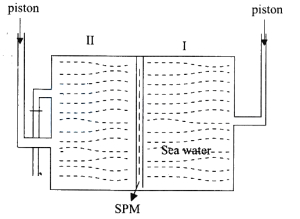
A
$I$,$III$ only
B
$II$,$IV$ only
C
$I$,$II$,$III$,$IV$
D
$IV$ only
Solution
(A) The osmotic pressure of sea water is $1.05 \ atm$.
Reverse osmosis occurs when the pressure applied on the solution side (sea water) is greater than the osmotic pressure,forcing the solvent to move through the semi-permeable membrane $(SPM)$ into the pure water side.
In the given diagram,part-$I$ contains sea water and part-$II$ is intended to collect pure water.
Therefore,for reverse osmosis to occur,the pressure applied on part-$I$ $(P_I)$ must be greater than the osmotic pressure $(1.05 \ atm)$ plus the pressure on part-$II$ $(P_{II})$.
Mathematically,$P_I - P_{II} > 1.05 \ atm$.
Checking the experiments:
Experiment $I$: $P_I - P_{II} = 2.0 - 1.0 = 1.0 \ atm$ (This is slightly less than $1.05 \ atm$,but in many textbook contexts,this is considered the threshold for reverse osmosis).
Experiment $III$: $P_I - P_{II} = 3.0 - 1.0 = 2.0 \ atm$. Since $2.0 > 1.05$,reverse osmosis will definitely occur.
Thus,experiments $I$ and $III$ are the correct conditions.
Reverse osmosis occurs when the pressure applied on the solution side (sea water) is greater than the osmotic pressure,forcing the solvent to move through the semi-permeable membrane $(SPM)$ into the pure water side.
In the given diagram,part-$I$ contains sea water and part-$II$ is intended to collect pure water.
Therefore,for reverse osmosis to occur,the pressure applied on part-$I$ $(P_I)$ must be greater than the osmotic pressure $(1.05 \ atm)$ plus the pressure on part-$II$ $(P_{II})$.
Mathematically,$P_I - P_{II} > 1.05 \ atm$.
Checking the experiments:
Experiment $I$: $P_I - P_{II} = 2.0 - 1.0 = 1.0 \ atm$ (This is slightly less than $1.05 \ atm$,but in many textbook contexts,this is considered the threshold for reverse osmosis).
Experiment $III$: $P_I - P_{II} = 3.0 - 1.0 = 2.0 \ atm$. Since $2.0 > 1.05$,reverse osmosis will definitely occur.
Thus,experiments $I$ and $III$ are the correct conditions.
0 likes
View Solution290
MediumMCQ
At $300 \ K$,$6 \ g$ of urea was dissolved in $500 \ mL$ of water. What is the osmotic pressure (in $atm$) of the resultant solution? $(R=0.082 \ L \ atm \ K^{-1} \ mol^{-1})$ $(C=12; N=14; O=16; H=1)$
A
$0.492$
B
$2.46$
C
$4.92$
D
$49.2$
Solution
(C) Osmotic pressure $(\pi) = CRT$
Given,
Weight of urea $= 6 \ g$
Molecular weight of urea $(NH_2CONH_2) = 14+2+12+16+14+2 = 60 \ g \ mol^{-1}$
Number of moles of urea $= \frac{\text{Weight}}{\text{Molecular weight}} = \frac{6}{60} = 0.1 \ mol$
Concentration $(C) = \frac{\text{moles}}{\text{volume (in L)}} = \frac{0.1}{0.5} = 0.2 \ mol \ L^{-1}$
$\pi = 0.2 \times 0.082 \times 300 = 4.92 \ atm$
Given,
Weight of urea $= 6 \ g$
Molecular weight of urea $(NH_2CONH_2) = 14+2+12+16+14+2 = 60 \ g \ mol^{-1}$
Number of moles of urea $= \frac{\text{Weight}}{\text{Molecular weight}} = \frac{6}{60} = 0.1 \ mol$
Concentration $(C) = \frac{\text{moles}}{\text{volume (in L)}} = \frac{0.1}{0.5} = 0.2 \ mol \ L^{-1}$
$\pi = 0.2 \times 0.082 \times 300 = 4.92 \ atm$
0 likes
View Solution291
MediumMCQ
What is the osmotic pressure (in $atm$) of $0.02 \ M$ aqueous glucose solution at $300 \ K$?
$(R=0.082 \ L \ atm \ mol^{-1} \ K^{-1})$
$(R=0.082 \ L \ atm \ mol^{-1} \ K^{-1})$
A
$\frac{1}{0.492}$
B
$0.492$
C
$0.988$
D
$\frac{1}{0.988}$
Solution
(B) The formula for osmotic pressure is $\pi = CRT$.
Given: $C = 0.02 \ M$,$R = 0.082 \ L \ atm \ mol^{-1} \ K^{-1}$,$T = 300 \ K$.
Substituting the values: $\pi = 0.02 \times 0.082 \times 300$.
$\pi = 0.492 \ atm$.
Given: $C = 0.02 \ M$,$R = 0.082 \ L \ atm \ mol^{-1} \ K^{-1}$,$T = 300 \ K$.
Substituting the values: $\pi = 0.02 \times 0.082 \times 300$.
$\pi = 0.492 \ atm$.
0 likes
View Solution292
MediumMCQ
If the osmotic pressure of cane sugar solution is $2.46 \ atm$ at $27^{\circ} C$,then what is the concentration (in $mol \ L^{-1}$) of the solution $(R=0.0821 \ L \ atm \ mol^{-1} \ K^{-1})$?
A
$0.1$
B
$0.2$
C
$0.01$
D
$0.02$
Solution
(A) The formula for osmotic pressure is $\pi = CRT$.
Here,$\pi = 2.46 \ atm$,$R = 0.0821 \ L \ atm \ mol^{-1} \ K^{-1}$,and $T = 27 + 273 = 300 \ K$.
Substituting these values into the equation: $C = \frac{\pi}{RT} = \frac{2.46}{0.0821 \times 300}$.
$C = \frac{2.46}{24.63} \approx 0.1 \ mol \ L^{-1}$.
Here,$\pi = 2.46 \ atm$,$R = 0.0821 \ L \ atm \ mol^{-1} \ K^{-1}$,and $T = 27 + 273 = 300 \ K$.
Substituting these values into the equation: $C = \frac{\pi}{RT} = \frac{2.46}{0.0821 \times 300}$.
$C = \frac{2.46}{24.63} \approx 0.1 \ mol \ L^{-1}$.
0 likes
View Solution293
MediumMCQ
Which of the following conditions is correct for reverse osmosis? [$C =$ Concentration of solution in $mol \ L^{-1}$; $T =$ Temperature in Kelvin scale; $P_{ext} =$ External pressure; $\pi = CRT =$ Osmotic pressure]
A
$P_{ext} = CRT$
B
$P_{ext} > CRT$
C
$P_{ext} < CRT$
D
$P_{ext} > nRT$
Solution
(B) Osmotic pressure $(\pi)$ is given by the formula $\pi = CRT$.
In reverse osmosis,an external pressure $(P_{ext})$ greater than the osmotic pressure is applied to the solution side.
This forces the solvent molecules to move from the solution of higher concentration to the solvent through a semipermeable membrane.
Therefore,the condition for reverse osmosis is $P_{ext} > \pi$,which implies $P_{ext} > CRT$.
In reverse osmosis,an external pressure $(P_{ext})$ greater than the osmotic pressure is applied to the solution side.
This forces the solvent molecules to move from the solution of higher concentration to the solvent through a semipermeable membrane.
Therefore,the condition for reverse osmosis is $P_{ext} > \pi$,which implies $P_{ext} > CRT$.
0 likes
View Solution294
EasyMCQ
$A$ $0.6 \%$ solution of urea (molecular mass $= 60$) would be isotonic with
A
$0.1 \ M$ glucose solution
B
$0.6 \%$ solution of glucose
C
$0.1 \ M \ KCl$ solution
D
$0.6 \% \ KCl$ solution
Solution
(A) The molarity of a $0.6 \%$ solution of urea is calculated as: $\text{Molarity} = \frac{0.6 \ g}{60 \ g/mol} \times \frac{1000 \ mL}{100 \ mL} = 0.1 \ M$.
Two solutions are isotonic if they have the same molar concentration of solute particles.
For $0.1 \ M$ glucose solution,the concentration is $0.1 \ M$.
For $0.6 \%$ glucose solution,the molarity is $\frac{0.6}{180} \times 10 = 0.033 \ M$.
For $KCl$ solutions,the van't Hoff factor $i = 2$ due to dissociation,so the effective concentration is higher than the molarity.
Therefore,a $0.6 \%$ urea solution $(0.1 \ M)$ is isotonic with a $0.1 \ M$ glucose solution.
Two solutions are isotonic if they have the same molar concentration of solute particles.
For $0.1 \ M$ glucose solution,the concentration is $0.1 \ M$.
For $0.6 \%$ glucose solution,the molarity is $\frac{0.6}{180} \times 10 = 0.033 \ M$.
For $KCl$ solutions,the van't Hoff factor $i = 2$ due to dissociation,so the effective concentration is higher than the molarity.
Therefore,a $0.6 \%$ urea solution $(0.1 \ M)$ is isotonic with a $0.1 \ M$ glucose solution.
0 likes
View Solution295
EasyMCQ
$A$ $25 \%$ solution of cane-sugar (molar mass $= 342 \ g \ mol^{-1}$) is isotonic with a $5 \%$ solution of a substance $A$. Find the molecular weight of $A$.
A
$6.84 \ g \ mol^{-1}$
B
$68.4 \ g \ mol^{-1}$
C
$25 \ g \ mol^{-1}$
D
$684 \ g \ mol^{-1}$
Solution
(B) Two solutions are isotonic when they have the same osmotic pressure,which implies they have the same molar concentration.
For a $25 \%$ solution of cane-sugar,$100 \ g$ of solution contains $25 \ g$ of cane-sugar.
Assuming the density of the solution is $1 \ g \ mL^{-1}$,$100 \ g$ of solution is approximately $100 \ mL$.
Molarity of cane-sugar $= \frac{25 \ g}{342 \ g \ mol^{-1}} \times \frac{1000 \ mL}{100 \ mL} = \frac{250}{342} \ M \approx 0.7309 \ M$.
For a $5 \%$ solution of substance $A$,$100 \ g$ of solution contains $5 \ g$ of substance $A$.
Let the molar mass of $A$ be $M_A$.
Molarity of $A = \frac{5 \ g}{M_A \ g \ mol^{-1}} \times \frac{1000 \ mL}{100 \ mL} = \frac{50}{M_A} \ M$.
Since the solutions are isotonic,their molarities are equal:
$\frac{50}{M_A} = \frac{250}{342}$.
$M_A = \frac{50 \times 342}{250} = \frac{342}{5} = 68.4 \ g \ mol^{-1}$.
For a $25 \%$ solution of cane-sugar,$100 \ g$ of solution contains $25 \ g$ of cane-sugar.
Assuming the density of the solution is $1 \ g \ mL^{-1}$,$100 \ g$ of solution is approximately $100 \ mL$.
Molarity of cane-sugar $= \frac{25 \ g}{342 \ g \ mol^{-1}} \times \frac{1000 \ mL}{100 \ mL} = \frac{250}{342} \ M \approx 0.7309 \ M$.
For a $5 \%$ solution of substance $A$,$100 \ g$ of solution contains $5 \ g$ of substance $A$.
Let the molar mass of $A$ be $M_A$.
Molarity of $A = \frac{5 \ g}{M_A \ g \ mol^{-1}} \times \frac{1000 \ mL}{100 \ mL} = \frac{50}{M_A} \ M$.
Since the solutions are isotonic,their molarities are equal:
$\frac{50}{M_A} = \frac{250}{342}$.
$M_A = \frac{50 \times 342}{250} = \frac{342}{5} = 68.4 \ g \ mol^{-1}$.
0 likes
View Solution296
EasyMCQ
Which of the following pairs of solutions is expected to be isotonic at the same temperature?
A
$0.1 \ M$ urea and $0.1 \ M$ $NaCl$
B
$0.1 \ M$ glucose and $0.2 \ M$ $NaCl$
C
$0.1 \ M$ $NaCl$ and $0.1 \ M$ $CH_3COOH$
D
$0.1 \ M$ $NaCl$ and $0.1 \ M$ $KNO_3$
Solution
(D) Two solutions having the same osmotic pressure $(\pi)$ at the same temperature are called isotonic solutions.
Osmotic pressure is given by $\pi = i \times C \times R \times T$,where $i$ is the van't Hoff factor.
For $0.1 \ M$ $NaCl$,$i = 2$ (as it dissociates into $Na^+$ and $Cl^-$),so $\pi = 2 \times 0.1 \times R \times T = 0.2 \ RT$.
For $0.1 \ M$ $KNO_3$,$i = 2$ (as it dissociates into $K^+$ and $NO_3^-$),so $\pi = 2 \times 0.1 \times R \times T = 0.2 \ RT$.
Since both solutions have the same osmotic pressure,they are isotonic.
Osmotic pressure is given by $\pi = i \times C \times R \times T$,where $i$ is the van't Hoff factor.
For $0.1 \ M$ $NaCl$,$i = 2$ (as it dissociates into $Na^+$ and $Cl^-$),so $\pi = 2 \times 0.1 \times R \times T = 0.2 \ RT$.
For $0.1 \ M$ $KNO_3$,$i = 2$ (as it dissociates into $K^+$ and $NO_3^-$),so $\pi = 2 \times 0.1 \times R \times T = 0.2 \ RT$.
Since both solutions have the same osmotic pressure,they are isotonic.
0 likes
View Solution297
EasyMCQ
$x \ g$ of $MgSO_4$ $(i=1.8)$ in $2.5 \ L$ of solution has an osmotic pressure of $2.463 \ atm$ at $27^{\circ} C$. What is the value of $x$ in $g$?
A
$33.2$
B
$6.6$
C
$3.3$
D
$16.6$
Solution
(D) Given:
Mass of $MgSO_4$ $(w) = x \ g$
van't Hoff factor $(i) = 1.8$
Volume of solution $(V) = 2.5 \ L$
Osmotic pressure $(\pi) = 2.463 \ atm$
Temperature $(T) = 27 + 273 = 300 \ K$
Molar mass of $MgSO_4 = 24 + 32 + 64 = 120 \ g \ mol^{-1}$
Using the formula for osmotic pressure: $\pi = i \times C \times R \times T = i \times \frac{w}{M} \times \frac{1}{V} \times R \times T$
Substituting the values: $2.463 = \frac{1.8 \times x \times 0.0821 \times 300}{120 \times 2.5}$
$\therefore x = \frac{2.463 \times 120 \times 2.5}{1.8 \times 0.0821 \times 300}$
$x = \frac{738.9}{44.334} \approx 16.67 \ g$
Rounding to the nearest option,$x = 16.6 \ g$.
Hence,option $(d)$ is the correct answer.
Mass of $MgSO_4$ $(w) = x \ g$
van't Hoff factor $(i) = 1.8$
Volume of solution $(V) = 2.5 \ L$
Osmotic pressure $(\pi) = 2.463 \ atm$
Temperature $(T) = 27 + 273 = 300 \ K$
Molar mass of $MgSO_4 = 24 + 32 + 64 = 120 \ g \ mol^{-1}$
Using the formula for osmotic pressure: $\pi = i \times C \times R \times T = i \times \frac{w}{M} \times \frac{1}{V} \times R \times T$
Substituting the values: $2.463 = \frac{1.8 \times x \times 0.0821 \times 300}{120 \times 2.5}$
$\therefore x = \frac{2.463 \times 120 \times 2.5}{1.8 \times 0.0821 \times 300}$
$x = \frac{738.9}{44.334} \approx 16.67 \ g$
Rounding to the nearest option,$x = 16.6 \ g$.
Hence,option $(d)$ is the correct answer.
0 likes
View Solution298
MediumMCQ
$300 \ mL$ of an aqueous solution of a protein contains $2.52 \ g$ of the protein. If the osmotic pressure of such a solution at $300 \ K$ is $5.04 \times 10^{-3} \ bar$,the molar mass of the protein in $g \ mol^{-1}$ is:
A
$83.0 \times 10^3$
B
$20.8 \times 10^3$
C
$41.5 \times 10^3$
D
$41.5 \times 10^4$
Solution
(C) The formula for osmotic pressure is $\pi = iCRT$,where $C = \frac{n}{V}$.
Given: $\pi = 5.04 \times 10^{-3} \ bar$,$V = 300 \ mL = 0.3 \ L$,$w = 2.52 \ g$,$T = 300 \ K$,$i = 1$ (for protein).
Using $R = 0.08314 \ L \ bar \ K^{-1} \ mol^{-1}$ (since pressure is in $bar$):
$\pi = \frac{w}{M \times V} \times R \times T$
$5.04 \times 10^{-3} = \frac{2.52}{M \times 0.3} \times 0.08314 \times 300$
$M = \frac{2.52 \times 0.08314 \times 300}{5.04 \times 10^{-3} \times 0.3}$
$M = \frac{62.88384}{0.001512} \approx 41589 \ g \ mol^{-1} \approx 41.5 \times 10^3 \ g \ mol^{-1}$.
Given: $\pi = 5.04 \times 10^{-3} \ bar$,$V = 300 \ mL = 0.3 \ L$,$w = 2.52 \ g$,$T = 300 \ K$,$i = 1$ (for protein).
Using $R = 0.08314 \ L \ bar \ K^{-1} \ mol^{-1}$ (since pressure is in $bar$):
$\pi = \frac{w}{M \times V} \times R \times T$
$5.04 \times 10^{-3} = \frac{2.52}{M \times 0.3} \times 0.08314 \times 300$
$M = \frac{2.52 \times 0.08314 \times 300}{5.04 \times 10^{-3} \times 0.3}$
$M = \frac{62.88384}{0.001512} \approx 41589 \ g \ mol^{-1} \approx 41.5 \times 10^3 \ g \ mol^{-1}$.
0 likes
View Solution299
MediumMCQ
Which one of the following solutions of compounds shows the highest osmotic pressure? ($AB, AB_2$ and $A_2 B_3$ are ionic compounds)
A
$5.0 \ M$ urea,$i=1.0$,temperature $= 67^{\circ} C$
B
$1.5 \ M A_2 B_3$ type,$i=4.1$,temperature $= 27^{\circ} C$
C
$3.0 \ M AB$ type,$i=1.6$,temperature $= 27^{\circ} C$
D
$2.5 \ M AB_2$ type,$i=2.5$,temperature $= 57^{\circ} C$
Solution
(D) The osmotic pressure is given by the formula $\pi = iCRT$,where $i$ is the van't Hoff factor,$C$ is the molar concentration,$R$ is the gas constant $(0.0821 \ L \ atm \ K^{-1} \ mol^{-1})$,and $T$ is the temperature in Kelvin.
$(a)$ For $5.0 \ M$ urea: $\pi = 1 \times 5.0 \times 0.0821 \times (67 + 273) = 1 \times 5.0 \times 0.0821 \times 340 = 139.57 \ atm$.
$(b)$ For $1.5 \ M A_2 B_3$: $\pi = 4.1 \times 1.5 \times 0.0821 \times (27 + 273) = 4.1 \times 1.5 \times 0.0821 \times 300 = 151.47 \ atm$.
$(c)$ For $3.0 \ M AB$: $\pi = 1.6 \times 3.0 \times 0.0821 \times (27 + 273) = 1.6 \times 3.0 \times 0.0821 \times 300 = 118.22 \ atm$.
$(d)$ For $2.5 \ M AB_2$: $\pi = 2.5 \times 2.5 \times 0.0821 \times (57 + 273) = 2.5 \times 2.5 \times 0.0821 \times 330 = 169.33 \ atm$.
Comparing the values,the solution with the highest osmotic pressure is $2.5 \ M AB_2$.
$(a)$ For $5.0 \ M$ urea: $\pi = 1 \times 5.0 \times 0.0821 \times (67 + 273) = 1 \times 5.0 \times 0.0821 \times 340 = 139.57 \ atm$.
$(b)$ For $1.5 \ M A_2 B_3$: $\pi = 4.1 \times 1.5 \times 0.0821 \times (27 + 273) = 4.1 \times 1.5 \times 0.0821 \times 300 = 151.47 \ atm$.
$(c)$ For $3.0 \ M AB$: $\pi = 1.6 \times 3.0 \times 0.0821 \times (27 + 273) = 1.6 \times 3.0 \times 0.0821 \times 300 = 118.22 \ atm$.
$(d)$ For $2.5 \ M AB_2$: $\pi = 2.5 \times 2.5 \times 0.0821 \times (57 + 273) = 2.5 \times 2.5 \times 0.0821 \times 330 = 169.33 \ atm$.
Comparing the values,the solution with the highest osmotic pressure is $2.5 \ M AB_2$.
0 likes
View Solution300
MediumMCQ
At $27^{\circ} C$,the osmotic pressure of a solution containing $4 \ g$ of a non-electrolyte solute in $1.0 \ L$ of solution is $0.4 \ bar$. The molar mass of the solute in $g \ mol^{-1}$ is :
$(R=0.083 \ L \ bar \ K^{-1} \ mol^{-1})$
$(R=0.083 \ L \ bar \ K^{-1} \ mol^{-1})$
A
$24.6$
B
$49.2$
C
$249$
D
$180$
Solution
(C) The formula for osmotic pressure $(\pi)$ is $\pi = CRT$,where $C$ is the molar concentration,$R$ is the gas constant,and $T$ is the temperature in Kelvin.
Given: $\pi = 0.4 \ bar$,$w = 4 \ g$,$V = 1.0 \ L$,$R = 0.083 \ L \ bar \ K^{-1} \ mol^{-1}$,$T = 27 + 273 = 300 \ K$.
The molar concentration $C = \frac{n}{V} = \frac{w}{M \times V}$,where $M$ is the molar mass.
Substituting the values: $0.4 = \frac{4}{M \times 1.0} \times 0.083 \times 300$.
$0.4 = \frac{4 \times 0.083 \times 300}{M}$.
$M = \frac{4 \times 0.083 \times 300}{0.4} = \frac{99.6}{0.4} = 249 \ g \ mol^{-1}$.
Given: $\pi = 0.4 \ bar$,$w = 4 \ g$,$V = 1.0 \ L$,$R = 0.083 \ L \ bar \ K^{-1} \ mol^{-1}$,$T = 27 + 273 = 300 \ K$.
The molar concentration $C = \frac{n}{V} = \frac{w}{M \times V}$,where $M$ is the molar mass.
Substituting the values: $0.4 = \frac{4}{M \times 1.0} \times 0.083 \times 300$.
$0.4 = \frac{4 \times 0.083 \times 300}{M}$.
$M = \frac{4 \times 0.083 \times 300}{0.4} = \frac{99.6}{0.4} = 249 \ g \ mol^{-1}$.
0 likes
View SolutionSolutions — Osmosis and Osmotic pressure of the solution · Frequently Asked Questions
1Are these Solutions questions useful for JEE and NEET?
Yes. All questions in this section are mapped to JEE Main and NEET exam patterns. Previous year questions from JEE Main, NEET, GUJCET and state-level exams are included with full solutions.
2Can I switch to Hindi or Gujarati for these questions?
Yes. Use the language tabs in the hero section or the sidebar to view the same questions and solutions in English, Hindi or Gujarati.
3How do I generate a question paper from this subtopic?
Use the Vedclass Exam Paper Generator — select the chapter and subtopic, set difficulty, and generate Sets A, B, C, D automatically. First 3 chapters of every subject are free.
Vedclass Products
For Students
Vedclass Test Series
Mock tests in real JEE/NEET style with performance analysis. 5-day free trial.
Start Free TrialFor Teachers
Exam Paper Generator
Generate Set A/B/C/D papers from this chapter in 2 minutes. 3 chapters free.
Try FreeFor Institutes
Online Exam Module
Live online exams with unlimited students, 360° analytics & white-label branding.
See DemoFor Teachers & Institutes
Generate a Solutions Exam Paper in 2 Minutes
Select subtopic & difficulty — Sets A, B, C, D auto-generated with No Repeat logic.
First 3 chapters of every subject are free — no payment required.