
A English
Osmosis and Osmotic pressure of the solution Questions in English
Class 12 Chemistry · Solutions · Osmosis and Osmotic pressure of the solution
323+
Questions
English
Language
100%
With Solutions
Showing 21 of 323 questions in English
301
MediumMCQ
The osmotic pressure (in $atm$) of an aqueous solution containing $0.01 \ mol$ of $NaCl$ (degree of dissociation $0.94$) and $0.03 \ mol$ of glucose in $500 \ mL$ at $27^{\circ} C$ is $\left(R=0.082 \ L \ atm \ K^{-1} \ mol^{-1}\right)$
A
$2.43$
B
$4.23$
C
$3.24$
D
$3.42$
Solution
(A) The osmotic pressure $\pi$ is given by the formula $\pi = iCRT$,where $i$ is the van't Hoff factor,$C$ is the total molarity,$R$ is the gas constant,and $T$ is the temperature in Kelvin.
First,calculate the van't Hoff factor for $NaCl$: $i = 1 + \alpha(n-1)$. Here $\alpha = 0.94$ and $n = 2$,so $i = 1 + 0.94(2-1) = 1.94$.
The effective moles of $NaCl$ particles = $i \times \text{moles} = 1.94 \times 0.01 = 0.0194 \ mol$.
Glucose is a non-electrolyte,so its moles remain $0.03 \ mol$.
Total moles of solute = $0.0194 + 0.03 = 0.0494 \ mol$.
Volume of solution = $500 \ mL = 0.5 \ L$.
Total molarity $C = \frac{0.0494 \ mol}{0.5 \ L} = 0.0988 \ M$.
Temperature $T = 27 + 273 = 300 \ K$.
Osmotic pressure $\pi = 0.0988 \times 0.082 \times 300 = 2.43048 \ atm \approx 2.43 \ atm$.
First,calculate the van't Hoff factor for $NaCl$: $i = 1 + \alpha(n-1)$. Here $\alpha = 0.94$ and $n = 2$,so $i = 1 + 0.94(2-1) = 1.94$.
The effective moles of $NaCl$ particles = $i \times \text{moles} = 1.94 \times 0.01 = 0.0194 \ mol$.
Glucose is a non-electrolyte,so its moles remain $0.03 \ mol$.
Total moles of solute = $0.0194 + 0.03 = 0.0494 \ mol$.
Volume of solution = $500 \ mL = 0.5 \ L$.
Total molarity $C = \frac{0.0494 \ mol}{0.5 \ L} = 0.0988 \ M$.
Temperature $T = 27 + 273 = 300 \ K$.
Osmotic pressure $\pi = 0.0988 \times 0.082 \times 300 = 2.43048 \ atm \approx 2.43 \ atm$.
0 likes
View Solution302
DifficultMCQ
At $0^{\circ} C$,a urea solution has an osmotic pressure of $400 \ mm$. On dilution by $x$ times,its osmotic pressure decreases to $100 \ mm$ at $20^{\circ} C$. The dilution factor $x$ is approximately
A
$4.3$
B
$2$
C
$5$
D
$6.8$
Solution
(A) The osmotic pressure formula is $\pi = CRT$,where $C$ is the molar concentration $(n/V)$.
For the initial state: $\pi_1 = C_1 RT_1$,where $\pi_1 = 400 \ mm$ and $T_1 = 273 \ K$.
For the final state: $\pi_2 = C_2 RT_2$,where $\pi_2 = 100 \ mm$ and $T_2 = 293 \ K$.
Taking the ratio: $\frac{\pi_1}{\pi_2} = \frac{C_1 T_1}{C_2 T_2}$.
Since $C_1/C_2 = V_2/V_1 = x$,we have $\frac{400}{100} = x \times \frac{273}{293}$.
Solving for $x$: $x = 4 \times \frac{293}{273} \approx 4 \times 1.073 = 4.292$.
Thus,the dilution factor $x$ is approximately $4.3$.
For the initial state: $\pi_1 = C_1 RT_1$,where $\pi_1 = 400 \ mm$ and $T_1 = 273 \ K$.
For the final state: $\pi_2 = C_2 RT_2$,where $\pi_2 = 100 \ mm$ and $T_2 = 293 \ K$.
Taking the ratio: $\frac{\pi_1}{\pi_2} = \frac{C_1 T_1}{C_2 T_2}$.
Since $C_1/C_2 = V_2/V_1 = x$,we have $\frac{400}{100} = x \times \frac{273}{293}$.
Solving for $x$: $x = 4 \times \frac{293}{273} \approx 4 \times 1.073 = 4.292$.
Thus,the dilution factor $x$ is approximately $4.3$.
0 likes
View Solution303
EasyMCQ
What is the effect of external pressure on the osmotic pressure $(OP)$ of a solution?
A
$OP$ decreases with increase of pressure
B
$OP$ decreases initially,then increases
C
$OP$ remains nearly the same with increase/decrease of external pressure
D
$OP$ increases with increase of pressure
Solution
(C) Osmotic pressure $(OP)$ is a colligative property defined by the equation $\pi = CRT$,where $C$ is the molar concentration,$R$ is the gas constant,and $T$ is the temperature.
Since $OP$ depends primarily on the concentration of the solute particles and temperature,it is an intrinsic property of the solution.
External pressure applied to the solution does not change the concentration $(C)$ or the temperature $(T)$ of the solution significantly.
Therefore,the osmotic pressure remains nearly the same regardless of changes in external pressure.
Since $OP$ depends primarily on the concentration of the solute particles and temperature,it is an intrinsic property of the solution.
External pressure applied to the solution does not change the concentration $(C)$ or the temperature $(T)$ of the solution significantly.
Therefore,the osmotic pressure remains nearly the same regardless of changes in external pressure.
0 likes
View Solution304
MediumMCQ
$3 \ mL$ of solution was made by dissolving $20 \ mg$ of protein at $0^{\circ} C$. The osmotic pressure of the resulting solution is $3.8 \ torr$. The molecular weight of the protein is approximately $(g/mol)$
A
$300$
B
$3 \times 10^5$
C
$3 \times 10^4$
D
$3 \times 10^3$
Solution
(C) The osmotic pressure formula is given by $\pi = \frac{W_B \times R \times T}{V \times M_B}$.
Given values: $W_B = 20 \ mg = 0.02 \ g$, $V = 3 \ mL = 0.003 \ L$, $T = 0^{\circ} C = 273 \ K$, $\pi = 3.8 \ torr = \frac{3.8}{760} \ atm = 0.005 \ atm$.
Using $R = 0.0821 \ L \ atm \ K^{-1} \ mol^{-1}$, we rearrange for $M_B$:
$M_B = \frac{W_B \times R \times T}{V \times \pi} = \frac{0.02 \times 0.0821 \times 273}{0.003 \times 0.005}$.
$M_B = \frac{0.448266}{0.000015} \approx 29884 \ g \ mol^{-1} \approx 3 \times 10^4 \ g \ mol^{-1}$.
Given values: $W_B = 20 \ mg = 0.02 \ g$, $V = 3 \ mL = 0.003 \ L$, $T = 0^{\circ} C = 273 \ K$, $\pi = 3.8 \ torr = \frac{3.8}{760} \ atm = 0.005 \ atm$.
Using $R = 0.0821 \ L \ atm \ K^{-1} \ mol^{-1}$, we rearrange for $M_B$:
$M_B = \frac{W_B \times R \times T}{V \times \pi} = \frac{0.02 \times 0.0821 \times 273}{0.003 \times 0.005}$.
$M_B = \frac{0.448266}{0.000015} \approx 29884 \ g \ mol^{-1} \approx 3 \times 10^4 \ g \ mol^{-1}$.
0 likes
View Solution305
MediumMCQ
Correct order of osmotic pressure of the following solutions is
$(i)$ $30 \ g \ L^{-1}$ of glucose
$(ii)$ $60 \ g \ L^{-1}$ of $NH_2CONH_2$
$(iii)$ $80 \ g \ L^{-1}$ of glucose
$(iv)$ $58.5 \ g \ L^{-1}$ of $NaCl$
$(i)$ $30 \ g \ L^{-1}$ of glucose
$(ii)$ $60 \ g \ L^{-1}$ of $NH_2CONH_2$
$(iii)$ $80 \ g \ L^{-1}$ of glucose
$(iv)$ $58.5 \ g \ L^{-1}$ of $NaCl$
A
$(ii)$ $< (i) < (iii) < (iv)$
B
$(i)$ $< (iii) < (ii) < (iv)$
C
$(i)$ $< (iv) < (ii) < (iii)$
D
$(iii)$ $< (i) < (iv) < (ii)$
Solution
(B) The osmotic pressure $\pi$ is given by $\pi = iCRT = i \frac{w}{MV} RT$.
Assuming $V, R, T$ are constant,$\pi \propto i \times \frac{w}{M}$.
$(i)$ $30 \ g \ L^{-1}$ glucose: $i=1, w=30, M=180 \implies \pi \propto 1 \times \frac{30}{180} \approx 0.166$.
$(ii)$ $60 \ g \ L^{-1}$ $NH_2CONH_2$: $i=1, w=60, M=60 \implies \pi \propto 1 \times \frac{60}{60} = 1.00$.
$(iii)$ $80 \ g \ L^{-1}$ glucose: $i=1, w=80, M=180 \implies \pi \propto 1 \times \frac{80}{180} \approx 0.44$.
$(iv)$ $58.5 \ g \ L^{-1}$ $NaCl$: $i=2, w=58.5, M=58.5 \implies \pi \propto 2 \times \frac{58.5}{58.5} = 2.00$.
Comparing the values: $0.166 < 0.44 < 1.00 < 2.00$.
Thus,the order is $(i) < (iii) < (ii) < (iv)$.
Assuming $V, R, T$ are constant,$\pi \propto i \times \frac{w}{M}$.
$(i)$ $30 \ g \ L^{-1}$ glucose: $i=1, w=30, M=180 \implies \pi \propto 1 \times \frac{30}{180} \approx 0.166$.
$(ii)$ $60 \ g \ L^{-1}$ $NH_2CONH_2$: $i=1, w=60, M=60 \implies \pi \propto 1 \times \frac{60}{60} = 1.00$.
$(iii)$ $80 \ g \ L^{-1}$ glucose: $i=1, w=80, M=180 \implies \pi \propto 1 \times \frac{80}{180} \approx 0.44$.
$(iv)$ $58.5 \ g \ L^{-1}$ $NaCl$: $i=2, w=58.5, M=58.5 \implies \pi \propto 2 \times \frac{58.5}{58.5} = 2.00$.
Comparing the values: $0.166 < 0.44 < 1.00 < 2.00$.
Thus,the order is $(i) < (iii) < (ii) < (iv)$.
0 likes
View Solution306
DifficultMCQ
$15 \%$ aqueous solution of glucose (molecular weight $= 180 \ g/mol$) is isotonic with $8 \%$ aqueous solution containing an unknown non-dissociable solute. What is the molecular weight of the unknown solute?
A
$108$
B
$96$
C
$84$
D
$9.6$
Solution
(B) For isotonic solutions,the molar concentrations are equal: $C_1 = C_2$.
Since the solutions are aqueous,we assume $100 \ mL$ of solution for both,meaning the volume $V$ is the same.
For glucose: $w_B = 15 \ g$,$m_B = 180 \ g/mol$.
For unknown solute: $w_B = 8 \ g$,$m_B = ?$.
The formula for molarity is $M = \frac{w_B \times 1000}{m_B \times V}$.
Equating the molarities: $\frac{15}{180} = \frac{8}{m_B}$.
Solving for $m_B$: $m_B = \frac{8 \times 180}{15}$.
$m_B = 8 \times 12 = 96 \ g/mol$.
Since the solutions are aqueous,we assume $100 \ mL$ of solution for both,meaning the volume $V$ is the same.
For glucose: $w_B = 15 \ g$,$m_B = 180 \ g/mol$.
For unknown solute: $w_B = 8 \ g$,$m_B = ?$.
The formula for molarity is $M = \frac{w_B \times 1000}{m_B \times V}$.
Equating the molarities: $\frac{15}{180} = \frac{8}{m_B}$.
Solving for $m_B$: $m_B = \frac{8 \times 180}{15}$.
$m_B = 8 \times 12 = 96 \ g/mol$.
0 likes
View Solution307
MediumMCQ
$A$ $1.17 \%$ solution of solute $A$ is isotonic with a $7.2 \%$ solution of glucose. If the molecular weight of solute $A$ is $58.5$,the value of the van't Hoff factor,'$i$',is:
A
$2$
B
$3$
C
$4$
D
$5$
Solution
(A) For isotonic solutions,the osmotic pressure $\pi$ is equal,so $\pi_1 = \pi_2$.
Since $\pi = i \cdot C \cdot R \cdot T$,and $C = \frac{w \% \times 10}{M}$,we have $i_1 \cdot \frac{w_1 \%}{M_1} = i_2 \cdot \frac{w_2 \%}{M_2}$.
For glucose,the van't Hoff factor $i_2 = 1$ and molar mass $M_2 = 180 \ g/mol$.
Given $w_1 \% = 1.17$,$M_1 = 58.5$,and $w_2 \% = 7.2$.
Substituting the values: $i_1 \times \frac{1.17}{58.5} = 1 \times \frac{7.2}{180}$.
$i_1 \times 0.02 = 0.04$.
$i_1 = \frac{0.04}{0.02} = 2$.
Since $\pi = i \cdot C \cdot R \cdot T$,and $C = \frac{w \% \times 10}{M}$,we have $i_1 \cdot \frac{w_1 \%}{M_1} = i_2 \cdot \frac{w_2 \%}{M_2}$.
For glucose,the van't Hoff factor $i_2 = 1$ and molar mass $M_2 = 180 \ g/mol$.
Given $w_1 \% = 1.17$,$M_1 = 58.5$,and $w_2 \% = 7.2$.
Substituting the values: $i_1 \times \frac{1.17}{58.5} = 1 \times \frac{7.2}{180}$.
$i_1 \times 0.02 = 0.04$.
$i_1 = \frac{0.04}{0.02} = 2$.
0 likes
View Solution308
MediumMCQ
At $300 \ K$,a one litre solution of sucrose (molecular weight: $342$) was prepared by dissolving $40 \ g$ of sucrose. What is the approximate osmotic pressure (in $kPa$) of the solution at the same temperature? $(R = 8.314 \times 10^6 \ cm^3 \ Pa \ K^{-1} \ mol^{-1})$
A
$292$
B
$500$
C
$292000$
D
$600$
Solution
(A) The formula for osmotic pressure is $\pi = CRT$,where $C$ is the molar concentration,$R$ is the gas constant,and $T$ is the temperature in Kelvin.
First,calculate the molar concentration $C$:
$C = \frac{\text{moles of solute}}{\text{volume of solution in litres}} = \frac{40 \ g / 342 \ g \ mol^{-1}}{1 \ L} = 0.11696 \ mol \ L^{-1}$.
Given $R = 8.314 \times 10^6 \ cm^3 \ Pa \ K^{-1} \ mol^{-1}$. Since $1 \ L = 1000 \ cm^3$,$R = 8.314 \times 10^3 \ L \ Pa \ K^{-1} \ mol^{-1}$.
Now,calculate $\pi$:
$\pi = 0.11696 \ mol \ L^{-1} \times 8.314 \times 10^3 \ L \ Pa \ K^{-1} \ mol^{-1} \times 300 \ K$.
$\pi = 291.71 \times 10^3 \ Pa = 291.71 \ kPa$.
Rounding to the nearest whole number,$\pi \approx 292 \ kPa$.
First,calculate the molar concentration $C$:
$C = \frac{\text{moles of solute}}{\text{volume of solution in litres}} = \frac{40 \ g / 342 \ g \ mol^{-1}}{1 \ L} = 0.11696 \ mol \ L^{-1}$.
Given $R = 8.314 \times 10^6 \ cm^3 \ Pa \ K^{-1} \ mol^{-1}$. Since $1 \ L = 1000 \ cm^3$,$R = 8.314 \times 10^3 \ L \ Pa \ K^{-1} \ mol^{-1}$.
Now,calculate $\pi$:
$\pi = 0.11696 \ mol \ L^{-1} \times 8.314 \times 10^3 \ L \ Pa \ K^{-1} \ mol^{-1} \times 300 \ K$.
$\pi = 291.71 \times 10^3 \ Pa = 291.71 \ kPa$.
Rounding to the nearest whole number,$\pi \approx 292 \ kPa$.
0 likes
View Solution309
EasyMCQ
How many grams of glucose must be added to $0.5 \ L$ of a solution so that its osmotic pressure is same as that of a solution of $9.2 \ g$ of glucose dissolved in a liter?
A
$1.15$
B
$9.22$
C
$2.31$
D
$4.6$
Solution
(D) The osmotic pressure $\pi$ is given by the formula $\pi = CRT = \frac{w}{MV}RT$.
For two solutions to have the same osmotic pressure at the same temperature,their molar concentrations must be equal: $C_1 = C_2$.
$\frac{w_1}{M_1 V_1} = \frac{w_2}{M_2 V_2}$.
Since the solute is glucose in both cases,$M_1 = M_2 = 180 \ g/mol$.
Given $V_1 = 0.5 \ L$,$w_2 = 9.2 \ g$,and $V_2 = 1.0 \ L$.
Substituting the values: $\frac{w_1}{0.5} = \frac{9.2}{1.0}$.
$w_1 = 9.2 \times 0.5 = 4.6 \ g$.
Thus,$4.6 \ g$ of glucose must be added.
For two solutions to have the same osmotic pressure at the same temperature,their molar concentrations must be equal: $C_1 = C_2$.
$\frac{w_1}{M_1 V_1} = \frac{w_2}{M_2 V_2}$.
Since the solute is glucose in both cases,$M_1 = M_2 = 180 \ g/mol$.
Given $V_1 = 0.5 \ L$,$w_2 = 9.2 \ g$,and $V_2 = 1.0 \ L$.
Substituting the values: $\frac{w_1}{0.5} = \frac{9.2}{1.0}$.
$w_1 = 9.2 \times 0.5 = 4.6 \ g$.
Thus,$4.6 \ g$ of glucose must be added.
0 likes
View Solution310
EasyMCQ
The molar mass of a solute $X$ in $g \ mol^{-1}$,if its $1 \%$ solution is isotonic with a $5 \%$ solution of cane sugar (molar mass $= 342 \ g \ mol^{-1}$),is
A
$68.4$
B
$34.2$
C
$136.2$
D
$171.2$
Solution
(A) For isotonic solutions,the osmotic pressure is equal,so the molar concentrations are equal: $\frac{W_1}{M_1 V_1} = \frac{W_2}{M_2 V_2}$.
Given that the solutions are $1 \%$ and $5 \%$ by mass,we can assume $1 \ g$ of solute $X$ in $100 \ mL$ solution and $5 \ g$ of cane sugar in $100 \ mL$ solution.
Here,$W_1 = 1 \ g$,$W_2 = 5 \ g$,$M_2 = 342 \ g \ mol^{-1}$,and $V_1 = V_2 = 100 \ mL$.
Substituting the values: $\frac{1}{M_1 \times 100} = \frac{5}{342 \times 100}$.
$M_1 = \frac{342}{5} = 68.4 \ g \ mol^{-1}$.
Given that the solutions are $1 \%$ and $5 \%$ by mass,we can assume $1 \ g$ of solute $X$ in $100 \ mL$ solution and $5 \ g$ of cane sugar in $100 \ mL$ solution.
Here,$W_1 = 1 \ g$,$W_2 = 5 \ g$,$M_2 = 342 \ g \ mol^{-1}$,and $V_1 = V_2 = 100 \ mL$.
Substituting the values: $\frac{1}{M_1 \times 100} = \frac{5}{342 \times 100}$.
$M_1 = \frac{342}{5} = 68.4 \ g \ mol^{-1}$.
0 likes
View Solution311
MediumMCQ
Which one of the following is an isotonic pair of solutions?
A
$0.15 \ M \ NaCl$ and $0.1 \ M \ Na_2SO_4$
B
$0.2 \ M$ Urea and $0.1 \ M$ Sugar
C
$0.1 \ M \ BaCl_2$ and $0.2 \ M$ Urea
D
$0.4 \ M \ MgSO_4$ and $0.1 \ M \ NH_4Cl$
Solution
(A) Two solutions are isotonic if they have the same molar concentration of particles (osmotic pressure).
For $0.15 \ M \ NaCl$: $NaCl$ dissociates into $2$ ions ($Na^+$ and $Cl^-$). The concentration of particles $= 0.15 \times 2 = 0.30 \ M$.
For $0.1 \ M \ Na_2SO_4$: $Na_2SO_4$ dissociates into $3$ ions ($2Na^+$ and $SO_4^{2-}$). The concentration of particles $= 0.1 \times 3 = 0.30 \ M$.
Since both solutions have the same concentration of particles $(0.30 \ M)$,they are isotonic.
For $0.15 \ M \ NaCl$: $NaCl$ dissociates into $2$ ions ($Na^+$ and $Cl^-$). The concentration of particles $= 0.15 \times 2 = 0.30 \ M$.
For $0.1 \ M \ Na_2SO_4$: $Na_2SO_4$ dissociates into $3$ ions ($2Na^+$ and $SO_4^{2-}$). The concentration of particles $= 0.1 \times 3 = 0.30 \ M$.
Since both solutions have the same concentration of particles $(0.30 \ M)$,they are isotonic.
0 likes
View Solution312
DifficultMCQ
$A$ solution containing $4 \ g$ of polymer in $4.0 \ L$ solution at $27^{\circ} C$ shows an osmotic pressure of $3.0 \times 10^{-4} \ atm$. The molar mass of the polymer in $g \ mol^{-1}$ is
A
$820000$
B
$82000$
C
$8200$
D
$820$
Solution
(B) The osmotic pressure formula is $\pi = CRT$,where $C$ is the molarity,$R$ is the gas constant $(0.0821 \ L \ atm \ K^{-1} \ mol^{-1})$,and $T$ is the temperature in Kelvin.
Given: $\pi = 3.0 \times 10^{-4} \ atm$,$T = 27 + 273 = 300 \ K$,$V = 4.0 \ L$,and mass of solute $w = 4 \ g$.
$C = \frac{\pi}{RT} = \frac{3.0 \times 10^{-4}}{0.0821 \times 300} = 1.218 \times 10^{-5} \ mol \ L^{-1}$.
Since $C = \frac{w}{M \times V}$,where $M$ is the molar mass:
$1.218 \times 10^{-5} = \frac{4}{M \times 4.0}$.
$M = \frac{4}{1.218 \times 10^{-5} \times 4.0} = \frac{1}{1.218 \times 10^{-5}} \approx 82101 \ g \ mol^{-1}$.
Rounding to the nearest given option,the molar mass is $82000 \ g \ mol^{-1}$.
Given: $\pi = 3.0 \times 10^{-4} \ atm$,$T = 27 + 273 = 300 \ K$,$V = 4.0 \ L$,and mass of solute $w = 4 \ g$.
$C = \frac{\pi}{RT} = \frac{3.0 \times 10^{-4}}{0.0821 \times 300} = 1.218 \times 10^{-5} \ mol \ L^{-1}$.
Since $C = \frac{w}{M \times V}$,where $M$ is the molar mass:
$1.218 \times 10^{-5} = \frac{4}{M \times 4.0}$.
$M = \frac{4}{1.218 \times 10^{-5} \times 4.0} = \frac{1}{1.218 \times 10^{-5}} \approx 82101 \ g \ mol^{-1}$.
Rounding to the nearest given option,the molar mass is $82000 \ g \ mol^{-1}$.
0 likes
View Solution313
MediumMCQ
Assuming the compounds to be completely dissociated in aqueous solution,identify the pair of the solutions that can be expected to be isotonic at the same temperature.
A
$0.01 \ M$ urea and $0.01 \ M \ NaCl$
B
$0.02 \ M \ NaCl$ and $0.01 \ M \ Na_2SO_4$
C
$0.03 \ M \ NaCl$ and $0.02 \ M \ MgCl_2$
D
$0.01 \ M$ sucrose and $0.02 \ M$ glucose
Solution
(C) For isotonic solutions,the effective concentration (osmolarity) must be the same: $i_1C_1 = i_2C_2$.
Assuming complete dissociation:
For $0.03 \ M \ NaCl$: $i = 2$,so $iC = 2 \times 0.03 = 0.06 \ M$.
For $0.02 \ M \ MgCl_2$: $i = 3$,so $iC = 3 \times 0.02 = 0.06 \ M$.
Since the $iC$ values are equal,the solutions are isotonic.
Assuming complete dissociation:
For $0.03 \ M \ NaCl$: $i = 2$,so $iC = 2 \times 0.03 = 0.06 \ M$.
For $0.02 \ M \ MgCl_2$: $i = 3$,so $iC = 3 \times 0.02 = 0.06 \ M$.
Since the $iC$ values are equal,the solutions are isotonic.
0 likes
View Solution314
MediumMCQ
At a certain temperature,the value of the slope of the plot of osmotic pressure $(\pi)$ against concentration $(C \text{ in } mol \ L^{-1})$ of a certain polymer solution is $291 \ R.$ The temperature at which osmotic pressure is measured is: $(R \text{ is the gas constant})$
A
$271^{\circ} C$
B
$18^{\circ} C$
C
$564 \ K$
D
$18 \ K$
Solution
(B) The osmotic pressure $(\pi)$ is given by the equation: $\pi = CRT.$
Comparing this with the equation of a straight line $y = mx,$ where $y = \pi,$ $x = C,$ and the slope $m = RT.$
Given that the slope is $291 \ R,$
$RT = 291 \ R$
$T = 291 \ K$
To convert the temperature to Celsius: $T(^{\circ} C) = 291 - 273 = 18^{\circ} C.$
Comparing this with the equation of a straight line $y = mx,$ where $y = \pi,$ $x = C,$ and the slope $m = RT.$
Given that the slope is $291 \ R,$
$RT = 291 \ R$
$T = 291 \ K$
To convert the temperature to Celsius: $T(^{\circ} C) = 291 - 273 = 18^{\circ} C.$
0 likes
View Solution315
DifficultMCQ
$A$ solution is prepared by dissolving $0.3 \ g$ of a non-volatile non-electrolyte solute '$A$' of molar mass $60 \ g \ mol^{-1}$ and $0.9 \ g$ of a non-volatile non-electrolyte solute '$B$' of molar mass $180 \ g \ mol^{-1}$ in $100 \ mL$ $H_2O$ at $27^{\circ}C$. Osmotic pressure of the solution will be
[Given: $R=0.082 \ L \ atm \ K^{-1} \ mol^{-1}$] (in $atm$)
[Given: $R=0.082 \ L \ atm \ K^{-1} \ mol^{-1}$] (in $atm$)
A
$1.23$
B
$2.46$
C
$0.82$
D
$1.47$
Solution
(B) Moles of solute '$A$' = $\frac{0.3 \ g}{60 \ g \ mol^{-1}} = 0.005 \ mol$.
Moles of solute '$B$' = $\frac{0.9 \ g}{180 \ g \ mol^{-1}} = 0.005 \ mol$.
Total moles of solute = $0.005 + 0.005 = 0.01 \ mol$.
Volume of solution = $100 \ mL = 0.1 \ L$.
Molarity $(C)$ = $\frac{\text{Total moles}}{\text{Volume in } L} = \frac{0.01 \ mol}{0.1 \ L} = 0.1 \ M$.
Temperature $(T)$ = $27 + 273 = 300 \ K$.
Using the formula for osmotic pressure: $\pi = CRT$.
$\pi = 0.1 \ mol \ L^{-1} \times 0.082 \ L \ atm \ K^{-1} \ mol^{-1} \times 300 \ K$.
$\pi = 2.46 \ atm$.
Moles of solute '$B$' = $\frac{0.9 \ g}{180 \ g \ mol^{-1}} = 0.005 \ mol$.
Total moles of solute = $0.005 + 0.005 = 0.01 \ mol$.
Volume of solution = $100 \ mL = 0.1 \ L$.
Molarity $(C)$ = $\frac{\text{Total moles}}{\text{Volume in } L} = \frac{0.01 \ mol}{0.1 \ L} = 0.1 \ M$.
Temperature $(T)$ = $27 + 273 = 300 \ K$.
Using the formula for osmotic pressure: $\pi = CRT$.
$\pi = 0.1 \ mol \ L^{-1} \times 0.082 \ L \ atm \ K^{-1} \ mol^{-1} \times 300 \ K$.
$\pi = 2.46 \ atm$.
0 likes
View Solution316
DifficultMCQ
The osmotic pressure of a living cell is $12 \ atm$ at $300 \ K$. The strength of sodium chloride solution that is isotonic with the living cell at this temperature is $...... \ g \ L^{-1}$. (Nearest integer)
Given : $R = 0.08 \ L \ atm \ K^{-1} \ mol^{-1}$
Assume complete dissociation of $NaCl$
(Given : Molar mass of $Na$ and $Cl$ are $23$ and $35.5 \ g \ mol^{-1}$ respectively.)
Given : $R = 0.08 \ L \ atm \ K^{-1} \ mol^{-1}$
Assume complete dissociation of $NaCl$
(Given : Molar mass of $Na$ and $Cl$ are $23$ and $35.5 \ g \ mol^{-1}$ respectively.)
A
$15$
B
$30$
C
$7.5$
D
$58.5$
Solution
(A) For an isotonic solution,the osmotic pressure $(\pi)$ of the $NaCl$ solution must be equal to the osmotic pressure of the living cell.
$\pi = iCRT$
Given $\pi = 12 \ atm$,$T = 300 \ K$,$R = 0.08 \ L \ atm \ K^{-1} \ mol^{-1}$,and $i = 2$ (for $NaCl \rightarrow Na^{+} + Cl^{-}$).
$12 = 2 \times C \times 0.08 \times 300$
$12 = 48 \times C$
$C = \frac{12}{48} = 0.25 \ mol \ L^{-1}$
The molar mass of $NaCl = 23 + 35.5 = 58.5 \ g \ mol^{-1}$.
Strength of $NaCl$ solution = $C \times \text{Molar mass}$
$= 0.25 \times 58.5 = 14.625 \ g \ L^{-1}$.
Rounding to the nearest integer,we get $15 \ g \ L^{-1}$.
$\pi = iCRT$
Given $\pi = 12 \ atm$,$T = 300 \ K$,$R = 0.08 \ L \ atm \ K^{-1} \ mol^{-1}$,and $i = 2$ (for $NaCl \rightarrow Na^{+} + Cl^{-}$).
$12 = 2 \times C \times 0.08 \times 300$
$12 = 48 \times C$
$C = \frac{12}{48} = 0.25 \ mol \ L^{-1}$
The molar mass of $NaCl = 23 + 35.5 = 58.5 \ g \ mol^{-1}$.
Strength of $NaCl$ solution = $C \times \text{Molar mass}$
$= 0.25 \times 58.5 = 14.625 \ g \ L^{-1}$.
Rounding to the nearest integer,we get $15 \ g \ L^{-1}$.
0 likes
View Solution317
MediumMCQ
. . . . . . solution is hypertonic with reference to fluid inside the blood cell.
A
$0.8\% \text{ W/V NaCl}$
B
$0.6\% \text{ W/V NaCl}$
C
$0.9\% \text{ W/V NaCl}$
D
$1.2\% \text{ W/V NaCl}$
Solution
(D) The isotonic concentration for human red blood cells is $0.9\% \text{ W/V NaCl}$.
Any solution with a concentration higher than $0.9\% \text{ W/V NaCl}$ is considered hypertonic with respect to the fluid inside the blood cell.
Among the given options,$1.2\% \text{ W/V NaCl}$ has a higher concentration than $0.9\% \text{ W/V NaCl}$.
Therefore,$1.2\% \text{ W/V NaCl}$ is hypertonic. Option $(D)$ is correct.
Any solution with a concentration higher than $0.9\% \text{ W/V NaCl}$ is considered hypertonic with respect to the fluid inside the blood cell.
Among the given options,$1.2\% \text{ W/V NaCl}$ has a higher concentration than $0.9\% \text{ W/V NaCl}$.
Therefore,$1.2\% \text{ W/V NaCl}$ is hypertonic. Option $(D)$ is correct.
0 likes
View Solution318
DifficultMCQ
Given below are two statements:
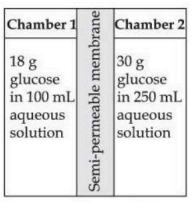
Statement $I$: $H_2O$ molecules move from the chamber $1$ to chamber $2$.
Statement $II$: The osmotic pressure of a solution prepared by dissolving $50 \text{ mg}$ of potassium sulphate (molar mass = $174 \text{ g/mol}$) in $2 \text{ L}$ of water (at $27^{\circ}C$) is $0.0107 \text{ bar}$. (Given: $R = 0.083 \text{ dm}^3 \text{ bar K}^{-1} \text{ mol}^{-1}$ and assume complete dissociation of electrolyte).
In the light of the above statements,choose the correct answer from the options given below:
Statement $I$: $H_2O$ molecules move from the chamber $1$ to chamber $2$.
Statement $II$: The osmotic pressure of a solution prepared by dissolving $50 \text{ mg}$ of potassium sulphate (molar mass = $174 \text{ g/mol}$) in $2 \text{ L}$ of water (at $27^{\circ}C$) is $0.0107 \text{ bar}$. (Given: $R = 0.083 \text{ dm}^3 \text{ bar K}^{-1} \text{ mol}^{-1}$ and assume complete dissociation of electrolyte).
In the light of the above statements,choose the correct answer from the options given below:
A
Both Statement $I$ and Statement $II$ are true
B
Both Statement $I$ and Statement $II$ are false
C
Statement $I$ is true but Statement $II$ is false
D
Statement $I$ is false but Statement $II$ is true
Solution
(D) For Statement $I$:
Chamber $1$ contains $18 \text{ g}$ of glucose in $100 \text{ mL}$ of solution. Molarity $(M_1)$ = $\frac{18/180}{0.1} = 1.0 \text{ M}$.
Chamber $2$ contains $30 \text{ g}$ of glucose in $250 \text{ mL}$ of solution. Molarity $(M_2)$ = $\frac{30/180}{0.25} = 0.667 \text{ M}$.
Since solvent moves from a region of lower solute concentration to higher solute concentration through a semi-permeable membrane,water moves from chamber $2$ to chamber $1$. Thus,Statement $I$ is false.
For Statement $II$:
Potassium sulphate $(K_2SO_4)$ dissociates as $K_2SO_4 \rightarrow 2K^+ + SO_4^{2-}$,so the van't Hoff factor $(i)$ = $3$.
Given: mass = $50 \text{ mg} = 0.05 \text{ g}$,molar mass = $174 \text{ g/mol}$,volume $(V)$ = $2 \text{ L}$,$T = 27 + 273 = 300 \text{ K}$,$R = 0.083 \text{ dm}^3 \text{ bar K}^{-1} \text{ mol}^{-1}$.
Osmotic pressure $(\pi)$ = $i \times C \times R \times T = i \times (n/V) \times R \times T = 3 \times (0.05 / 174) / 2 \times 0.083 \times 300 = 0.0107 \text{ bar}$.
Thus,Statement $II$ is true.
Chamber $1$ contains $18 \text{ g}$ of glucose in $100 \text{ mL}$ of solution. Molarity $(M_1)$ = $\frac{18/180}{0.1} = 1.0 \text{ M}$.
Chamber $2$ contains $30 \text{ g}$ of glucose in $250 \text{ mL}$ of solution. Molarity $(M_2)$ = $\frac{30/180}{0.25} = 0.667 \text{ M}$.
Since solvent moves from a region of lower solute concentration to higher solute concentration through a semi-permeable membrane,water moves from chamber $2$ to chamber $1$. Thus,Statement $I$ is false.
For Statement $II$:
Potassium sulphate $(K_2SO_4)$ dissociates as $K_2SO_4 \rightarrow 2K^+ + SO_4^{2-}$,so the van't Hoff factor $(i)$ = $3$.
Given: mass = $50 \text{ mg} = 0.05 \text{ g}$,molar mass = $174 \text{ g/mol}$,volume $(V)$ = $2 \text{ L}$,$T = 27 + 273 = 300 \text{ K}$,$R = 0.083 \text{ dm}^3 \text{ bar K}^{-1} \text{ mol}^{-1}$.
Osmotic pressure $(\pi)$ = $i \times C \times R \times T = i \times (n/V) \times R \times T = 3 \times (0.05 / 174) / 2 \times 0.083 \times 300 = 0.0107 \text{ bar}$.
Thus,Statement $II$ is true.
0 likes
View Solution319
MediumMCQ
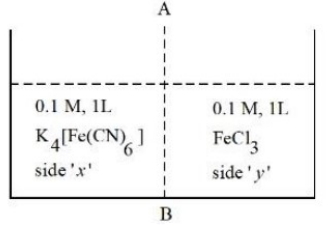
At $27^{\circ}C$,$0.1 \ M$,$1 \ L$ $K_4[Fe(CN)_6]$ aqueous solution and $0.1 \ M$,$1 \ L$ $FeCl_3$ aqueous solution are placed in a container separated by a semi-permeable membrane $AB$. Assume complete dissociation of both the solutes. Which of the following statements is correct?
A
Blue color is formed on both sides.
B
Ionic solutes in aqueous solution can pass through semi-permeable membrane.
C
Solution on side 'y' is hypotonic.
D
To cause the reverse flow of solvent during osmosis,external pressure (any value) should be applied to side 'x'.
Solution
(C) Side $x$: $K_4[Fe(CN)_6] \rightarrow 4K^+ + [Fe(CN)_6]^{4-}$. The van't Hoff factor $i = 5$. The effective concentration is $0.1 \ M \times 5 = 0.5 \ M$.
Side $y$: $FeCl_3 \rightarrow Fe^{3+} + 3Cl^-$. The van't Hoff factor $i = 4$. The effective concentration is $0.1 \ M \times 4 = 0.4 \ M$.
Osmotic pressure is given by $\pi = iCRT$. Since the temperature and concentration of the solute are the same,the osmotic pressure depends on the van't Hoff factor $i$.
Since $i_x > i_y$,the osmotic pressure of side $x$ is greater than that of side $y$ $(\pi_x > \pi_y)$.
Therefore,the solution on side $y$ has a lower osmotic pressure and is considered hypotonic relative to side $x$.
Side $y$: $FeCl_3 \rightarrow Fe^{3+} + 3Cl^-$. The van't Hoff factor $i = 4$. The effective concentration is $0.1 \ M \times 4 = 0.4 \ M$.
Osmotic pressure is given by $\pi = iCRT$. Since the temperature and concentration of the solute are the same,the osmotic pressure depends on the van't Hoff factor $i$.
Since $i_x > i_y$,the osmotic pressure of side $x$ is greater than that of side $y$ $(\pi_x > \pi_y)$.
Therefore,the solution on side $y$ has a lower osmotic pressure and is considered hypotonic relative to side $x$.
0 likes
View Solution320
DifficultMCQ
Solution $A$ is prepared by dissolving $1 \text{ g}$ of a protein (molar mass = $50000 \text{ g mol}^{-1}$) in $0.5 \text{ L}$ of water at $300 \text{ K}$. Its osmotic pressure is $x \text{ bar}$. Solution $B$ is made by dissolving $2 \text{ g}$ of the same protein in $1 \text{ L}$ of water at $300 \text{ K}$. The osmotic pressure of solution $B$ is $y \text{ bar}$. The entire solution of $A$ is mixed with the entire solution of $B$ at the same temperature. The osmotic pressure of the resultant solution is $z \text{ bar}$. $x, y$ and $z$ respectively are: $(R = 0.083 \text{ L bar mol}^{-1} \text{ K}^{-1})$
A
$9.96 \times 10^{-4}; 9.96 \times 10^{-4}; 9.96 \times 10^{-4}$
B
$9.96 \times 10^{-4}; 9.96 \times 10^{-4}; 19.92 \times 10^{-4}$
C
$4.98 \times 10^{-4}; 4.98 \times 10^{-4}; 9.96 \times 10^{-4}$
D
$4.98 \times 10^{-4}; 4.98 \times 10^{-4}; 4.98 \times 10^{-4}$
Solution
(A) The formula for osmotic pressure is $\Pi = (n/V)RT$.
For solution $A$: $n_A = 1 \text{ g} / 50000 \text{ g mol}^{-1} = 2 \times 10^{-5} \text{ mol}$. $V_A = 0.5 \text{ L}$.
$x = (2 \times 10^{-5} \text{ mol} / 0.5 \text{ L}) \times 0.083 \text{ L bar mol}^{-1} \text{ K}^{-1} \times 300 \text{ K} = 4 \times 10^{-5} \times 24.9 = 9.96 \times 10^{-4} \text{ bar}$.
For solution $B$: $n_B = 2 \text{ g} / 50000 \text{ g mol}^{-1} = 4 \times 10^{-5} \text{ mol}$. $V_B = 1 \text{ L}$.
$y = (4 \times 10^{-5} \text{ mol} / 1 \text{ L}) \times 0.083 \times 300 = 9.96 \times 10^{-4} \text{ bar}$.
For the mixed solution: $n_{tot} = n_A + n_B = (2 + 4) \times 10^{-5} = 6 \times 10^{-5} \text{ mol}$.
$V_{tot} = V_A + V_B = 0.5 \text{ L} + 1 \text{ L} = 1.5 \text{ L}$.
$z = (6 \times 10^{-5} \text{ mol} / 1.5 \text{ L}) \times 24.9 = 4 \times 10^{-5} \times 24.9 = 9.96 \times 10^{-4} \text{ bar}$.
Thus,$x = y = z = 9.96 \times 10^{-4}$.
For solution $A$: $n_A = 1 \text{ g} / 50000 \text{ g mol}^{-1} = 2 \times 10^{-5} \text{ mol}$. $V_A = 0.5 \text{ L}$.
$x = (2 \times 10^{-5} \text{ mol} / 0.5 \text{ L}) \times 0.083 \text{ L bar mol}^{-1} \text{ K}^{-1} \times 300 \text{ K} = 4 \times 10^{-5} \times 24.9 = 9.96 \times 10^{-4} \text{ bar}$.
For solution $B$: $n_B = 2 \text{ g} / 50000 \text{ g mol}^{-1} = 4 \times 10^{-5} \text{ mol}$. $V_B = 1 \text{ L}$.
$y = (4 \times 10^{-5} \text{ mol} / 1 \text{ L}) \times 0.083 \times 300 = 9.96 \times 10^{-4} \text{ bar}$.
For the mixed solution: $n_{tot} = n_A + n_B = (2 + 4) \times 10^{-5} = 6 \times 10^{-5} \text{ mol}$.
$V_{tot} = V_A + V_B = 0.5 \text{ L} + 1 \text{ L} = 1.5 \text{ L}$.
$z = (6 \times 10^{-5} \text{ mol} / 1.5 \text{ L}) \times 24.9 = 4 \times 10^{-5} \times 24.9 = 9.96 \times 10^{-4} \text{ bar}$.
Thus,$x = y = z = 9.96 \times 10^{-4}$.
0 likes
View Solution321
DifficultMCQ
$20 \text{ g}$ hemoglobin in a $1 \text{ L}$ aqueous solution $(A)$ at $300 \text{ K}$ is separated from pure water by a semi-permeable membrane. At equilibrium,the height of the solution in a tube dipped in solution $(A)$ is found to be $80.0 \text{ mm}$ higher than the tube dipped in water. The molar mass of hemoglobin is . . . . . . $\text{kg mol}^{-1}$. (Nearest integer) (Given: $g = 10 \text{ m s}^{-2}$,$R = 8.3 \text{ kPa dm}^3 \text{ K}^{-1} \text{mol}^{-1}$,density of solution = $1000 \text{ kg m}^{-3}$)
A
$60$
B
$62$
C
$65$
D
$68$
Solution
(B) $1$. The osmotic pressure $\pi$ is given by the hydrostatic pressure formula: $\pi = h \rho g$.
$2$. Convert height to meters: $h = 80.0 \text{ mm} = 0.08 \text{ m}$.
$3$. Calculate $\pi$: $\pi = 0.08 \text{ m} \times 1000 \text{ kg m}^{-3} \times 10 \text{ m s}^{-2} = 800 \text{ Pa} = 0.8 \text{ kPa}$.
$4$. Use the osmotic pressure formula: $\pi = CRT = (n/V)RT$,where $n = \text{mass}/M$.
$5$. Substitute the values: $0.8 = (20 / M) / 1 \times 8.3 \times 300$.
$6$. Solve for $M$: $M = (20 \times 8.3 \times 300) / 0.8 = 62250 \text{ g mol}^{-1} = 62.25 \text{ kg mol}^{-1}$.
$7$. The nearest integer is $62$.
$2$. Convert height to meters: $h = 80.0 \text{ mm} = 0.08 \text{ m}$.
$3$. Calculate $\pi$: $\pi = 0.08 \text{ m} \times 1000 \text{ kg m}^{-3} \times 10 \text{ m s}^{-2} = 800 \text{ Pa} = 0.8 \text{ kPa}$.
$4$. Use the osmotic pressure formula: $\pi = CRT = (n/V)RT$,where $n = \text{mass}/M$.
$5$. Substitute the values: $0.8 = (20 / M) / 1 \times 8.3 \times 300$.
$6$. Solve for $M$: $M = (20 \times 8.3 \times 300) / 0.8 = 62250 \text{ g mol}^{-1} = 62.25 \text{ kg mol}^{-1}$.
$7$. The nearest integer is $62$.
0 likes
View SolutionSolutions — Osmosis and Osmotic pressure of the solution · Frequently Asked Questions
1Are these Solutions questions useful for JEE and NEET?
Yes. All questions in this section are mapped to JEE Main and NEET exam patterns. Previous year questions from JEE Main, NEET, GUJCET and state-level exams are included with full solutions.
2Can I switch to Hindi or Gujarati for these questions?
Yes. Use the language tabs in the hero section or the sidebar to view the same questions and solutions in English, Hindi or Gujarati.
3How do I generate a question paper from this subtopic?
Use the Vedclass Exam Paper Generator — select the chapter and subtopic, set difficulty, and generate Sets A, B, C, D automatically. First 3 chapters of every subject are free.
Vedclass Products
For Students
Vedclass Test Series
Mock tests in real JEE/NEET style with performance analysis. 5-day free trial.
Start Free TrialFor Teachers
Exam Paper Generator
Generate Set A/B/C/D papers from this chapter in 2 minutes. 3 chapters free.
Try FreeFor Institutes
Online Exam Module
Live online exams with unlimited students, 360° analytics & white-label branding.
See DemoFor Teachers & Institutes
Generate a Solutions Exam Paper in 2 Minutes
Select subtopic & difficulty — Sets A, B, C, D auto-generated with No Repeat logic.
First 3 chapters of every subject are free — no payment required.