
A English
Lowering of vapour pressure Questions in English
Class 12 Chemistry · Solutions · Lowering of vapour pressure
341+
Questions
English
Language
100%
With Solutions
Showing 49 of 341 questions in English
151
EasyMCQ
According to Raoult's law for a non-volatile solute,which of the following is correct?
A
The decrease in vapor pressure is equal to the mole fraction of the solute.
B
The relative lowering of vapor pressure is equal to the mole fraction of the solute.
C
The vapor pressure of the solution is directly proportional to the mole fraction of the solvent.
D
The decrease in vapor pressure is directly proportional to the mole fraction of the solvent.
Solution
(B) According to Raoult's law for a solution containing a non-volatile solute,the relative lowering of vapor pressure is given by the equation: $\frac{P_1^0 - P_1}{P_1^0} = x_2$.
Here,$P_1^0$ is the vapor pressure of the pure solvent,$P_1$ is the vapor pressure of the solution,and $x_2$ is the mole fraction of the solute.
Thus,the relative lowering of vapor pressure is equal to the mole fraction of the solute.
Here,$P_1^0$ is the vapor pressure of the pure solvent,$P_1$ is the vapor pressure of the solution,and $x_2$ is the mole fraction of the solute.
Thus,the relative lowering of vapor pressure is equal to the mole fraction of the solute.
0 likes
View Solution152
MediumMCQ
At a certain temperature,the mole fraction of a solute is $0.15$ and the vapor pressure of the pure solvent is $120 \, torr$. If the solute is non-volatile,what will be the relative lowering in vapor pressure?
A
$0.15$
B
$18$
C
$112$
D
$1$
0 likes
View Solution153
MediumMCQ
When a non-volatile,non-electrolyte solute is dissolved in a solvent,the vapor pressure of the solution decreases by $8\%$. The mole fraction of the solute is .............
A
$0.08$
B
$0.8$
C
$0.92$
D
$0.2$
Solution
(A) According to Raoult's law for non-volatile solutes,the relative lowering of vapor pressure is equal to the mole fraction of the solute.
$\frac{P^o - P_s}{P^o} = X_{solute}$
Given that the vapor pressure decreases by $8\%$,the relative lowering of vapor pressure is $\frac{P^o - P_s}{P^o} = \frac{8}{100} = 0.08$.
Therefore,the mole fraction of the solute $X_{solute} = 0.08$.
$\frac{P^o - P_s}{P^o} = X_{solute}$
Given that the vapor pressure decreases by $8\%$,the relative lowering of vapor pressure is $\frac{P^o - P_s}{P^o} = \frac{8}{100} = 0.08$.
Therefore,the mole fraction of the solute $X_{solute} = 0.08$.
0 likes
View Solution154
MediumMCQ
The vapor pressure of an aqueous solution at $373 \, K$ is $0.925 \, atm$. What is the mole fraction of the solute?
A
$0.1$
B
$0.075$
C
$0.15$
D
$0.925$
Solution
(B) At $373 \, K$,the vapor pressure of pure water $(P^0)$ is $1 \, atm$.
Given,the vapor pressure of the solution $(P_s)$ is $0.925 \, atm$.
According to Raoult's law,the relative lowering of vapor pressure is equal to the mole fraction of the solute $(x_2)$:
$\frac{P^0 - P_s}{P^0} = x_2$
Substituting the values:
$x_2 = \frac{1 - 0.925}{1} = 0.075$
Therefore,the mole fraction of the solute is $0.075$.
Given,the vapor pressure of the solution $(P_s)$ is $0.925 \, atm$.
According to Raoult's law,the relative lowering of vapor pressure is equal to the mole fraction of the solute $(x_2)$:
$\frac{P^0 - P_s}{P^0} = x_2$
Substituting the values:
$x_2 = \frac{1 - 0.925}{1} = 0.075$
Therefore,the mole fraction of the solute is $0.075$.
0 likes
View Solution155
MediumMCQ
At the same temperature,which of the following will have the highest vapor pressure?
A
$0.1 \ M$ Urea
B
$0.2 \ M$ Sucrose
C
$0.1 \ M \ CaCl_2$
D
$0.2 \ M \ KCl$
Solution
(A) The vapor pressure of a solution decreases as the concentration of solute particles (van't Hoff factor $i \times$ molarity $M$) increases.
Lower concentration of solute particles results in higher vapor pressure.
Let us calculate the concentration of particles for each:
$A$: $0.1 \ M$ Urea $(i=1)$ $\rightarrow 0.1 \times 1 = 0.1 \ M$ particles.
$B$: $0.2 \ M$ Sucrose $(i=1)$ $\rightarrow 0.2 \times 1 = 0.2 \ M$ particles.
$C$: $0.1 \ M \ CaCl_2$ $(i=3)$ $\rightarrow 0.1 \times 3 = 0.3 \ M$ particles.
$D$: $0.2 \ M \ KCl$ $(i=2)$ $\rightarrow 0.2 \times 2 = 0.4 \ M$ particles.
Since $0.1 \ M$ has the lowest concentration of solute particles,it will have the highest vapor pressure.
Lower concentration of solute particles results in higher vapor pressure.
Let us calculate the concentration of particles for each:
$A$: $0.1 \ M$ Urea $(i=1)$ $\rightarrow 0.1 \times 1 = 0.1 \ M$ particles.
$B$: $0.2 \ M$ Sucrose $(i=1)$ $\rightarrow 0.2 \times 1 = 0.2 \ M$ particles.
$C$: $0.1 \ M \ CaCl_2$ $(i=3)$ $\rightarrow 0.1 \times 3 = 0.3 \ M$ particles.
$D$: $0.2 \ M \ KCl$ $(i=2)$ $\rightarrow 0.2 \times 2 = 0.4 \ M$ particles.
Since $0.1 \ M$ has the lowest concentration of solute particles,it will have the highest vapor pressure.
0 likes
View Solution156
EasyMCQ
$x \ g$ of a solute is dissolved in $y \ g$ of two different liquids $A$ and $B$. The relative lowering of vapor pressure of the solution in $A$ is twice that of the solution in $B$. If the moles of solute are negligible compared to the moles of solvent,which of the following statements regarding the molar masses $M_A$ and $M_B$ of the solvents is correct?
A
$x \ M_A = y \ M_B$
B
$y \ M_A = x \ M_B$
C
$M_A = 2 \ M_B$
D
$2 \ M_A = M_B$
Solution
(C) According to Raoult's law,the relative lowering of vapor pressure is given by $\frac{P^o - P}{P^o} = \chi_{solute} = \frac{n_{solute}}{n_{solute} + n_{solvent}}$.
Since $n_{solute} \ll n_{solvent}$,the expression simplifies to $\frac{P^o - P}{P^o} \approx \frac{n_{solute}}{n_{solvent}} = \frac{x/M_{solute}}{y/M_{solvent}} = \frac{x \cdot M_{solvent}}{y \cdot M_{solute}}$.
For liquid $A$: $(\frac{P^o - P}{P^o})_A = \frac{x \cdot M_A}{y \cdot M_{solute}}$.
For liquid $B$: $(\frac{P^o - P}{P^o})_B = \frac{x \cdot M_B}{y \cdot M_{solute}}$.
Given that $(\frac{P^o - P}{P^o})_A = 2 \times (\frac{P^o - P}{P^o})_B$,we have $\frac{x \cdot M_A}{y \cdot M_{solute}} = 2 \times \frac{x \cdot M_B}{y \cdot M_{solute}}$.
Simplifying this,we get $M_A = 2 \ M_B$.
Since $n_{solute} \ll n_{solvent}$,the expression simplifies to $\frac{P^o - P}{P^o} \approx \frac{n_{solute}}{n_{solvent}} = \frac{x/M_{solute}}{y/M_{solvent}} = \frac{x \cdot M_{solvent}}{y \cdot M_{solute}}$.
For liquid $A$: $(\frac{P^o - P}{P^o})_A = \frac{x \cdot M_A}{y \cdot M_{solute}}$.
For liquid $B$: $(\frac{P^o - P}{P^o})_B = \frac{x \cdot M_B}{y \cdot M_{solute}}$.
Given that $(\frac{P^o - P}{P^o})_A = 2 \times (\frac{P^o - P}{P^o})_B$,we have $\frac{x \cdot M_A}{y \cdot M_{solute}} = 2 \times \frac{x \cdot M_B}{y \cdot M_{solute}}$.
Simplifying this,we get $M_A = 2 \ M_B$.
0 likes
View Solution157
MediumMCQ
When a non-volatile solute is added to a pure solvent,the vapor pressure decreases by $11.5 \ torr$. If the mole fraction of the solute is $0.2$,what will be the vapor pressure of the pure solvent in $torr$?
A
$23$
B
$115$
C
$46$
D
$57.5$
Solution
(D) According to Raoult's law for non-volatile solutes,the relative lowering of vapor pressure is equal to the mole fraction of the solute: $\frac{P^o - P_s}{P^o} = X_{solute}$.
Given,the decrease in vapor pressure $\Delta P = P^o - P_s = 11.5 \ torr$.
The mole fraction of the solute $X_{solute} = 0.2$.
Substituting these values into the equation: $\frac{11.5}{P^o} = 0.2$.
Therefore,$P^o = \frac{11.5}{0.2} = 57.5 \ torr$.
Thus,the vapor pressure of the pure solvent is $57.5 \ torr$.
Given,the decrease in vapor pressure $\Delta P = P^o - P_s = 11.5 \ torr$.
The mole fraction of the solute $X_{solute} = 0.2$.
Substituting these values into the equation: $\frac{11.5}{P^o} = 0.2$.
Therefore,$P^o = \frac{11.5}{0.2} = 57.5 \ torr$.
Thus,the vapor pressure of the pure solvent is $57.5 \ torr$.
0 likes
View Solution158
EasyMCQ
When a solid solute is dissolved in a volatile solvent to form a solution,then .......
A
The vapour pressure increases.
B
The rate of evaporation decreases.
C
The vapour pressure of the pure solvent decreases.
D
There is no equilibrium between vapour and liquid particles.
Solution
(C) According to Raoult's Law,when a non-volatile solid solute is added to a volatile solvent,the solute particles occupy some surface area on the surface of the liquid.
This reduces the number of solvent molecules available at the surface to escape into the vapour phase.
Consequently,the rate of evaporation decreases,which leads to a decrease in the vapour pressure of the solution compared to the pure solvent.
This reduces the number of solvent molecules available at the surface to escape into the vapour phase.
Consequently,the rate of evaporation decreases,which leads to a decrease in the vapour pressure of the solution compared to the pure solvent.
0 likes
View Solution159
MediumMCQ
If the vapor pressure of a solution formed by dissolving $1 \ mol$ of a non-volatile solute in $4 \ mol$ of a solvent is $24.0 \ kPa$,what will be the vapor pressure of the pure solvent in $kPa$?
A
$20.2$
B
$30$
C
$32$
D
$48$
Solution
(B) According to Raoult's Law for non-volatile solutes,the relative lowering of vapor pressure is given by: $\frac{P^o - P_s}{P^o} = X_{solute} = \frac{n}{n + N}$.
Here,$n = 1 \ mol$ (solute) and $N = 4 \ mol$ (solvent).
The mole fraction of the solute is $X_{solute} = \frac{1}{1 + 4} = \frac{1}{5} = 0.2$.
Given the vapor pressure of the solution $P_s = 24.0 \ kPa$.
Using the formula $\frac{P^o - 24.0}{P^o} = 0.2$,we get:
$P^o - 24.0 = 0.2 P^o$.
$0.8 P^o = 24.0$.
$P^o = \frac{24.0}{0.8} = 30 \ kPa$.
Here,$n = 1 \ mol$ (solute) and $N = 4 \ mol$ (solvent).
The mole fraction of the solute is $X_{solute} = \frac{1}{1 + 4} = \frac{1}{5} = 0.2$.
Given the vapor pressure of the solution $P_s = 24.0 \ kPa$.
Using the formula $\frac{P^o - 24.0}{P^o} = 0.2$,we get:
$P^o - 24.0 = 0.2 P^o$.
$0.8 P^o = 24.0$.
$P^o = \frac{24.0}{0.8} = 30 \ kPa$.
0 likes
View Solution160
MediumMCQ
When $5 \ g$ of a non-electrolyte solute is dissolved in $100 \ g$ of water,the vapor pressure decreases from $3000 \ N \ m^{-2}$ to $2985 \ N \ m^{-2}$. The molar mass of the solute is ............... $g/mol$.
A
$180$
B
$60$
C
$120$
D
$342$
Solution
(A) According to Raoult's Law for a non-volatile solute,the relative lowering of vapor pressure is given by:
$\frac{P^o - P_s}{P^o} = \frac{w_2 \times M_1}{M_2 \times w_1}$
Given:
$P^o = 3000 \ N \ m^{-2}$
$P_s = 2985 \ N \ m^{-2}$
$w_2 = 5 \ g$ (mass of solute)
$w_1 = 100 \ g$ (mass of solvent,water)
$M_1 = 18 \ g/mol$ (molar mass of water)
Substituting the values:
$\frac{3000 - 2985}{3000} = \frac{5 \times 18}{M_2 \times 100}$
$\frac{15}{3000} = \frac{90}{M_2 \times 100}$
$0.005 = \frac{0.9}{M_2}$
$M_2 = \frac{0.9}{0.005} = 180 \ g/mol$
Therefore,the molar mass of the solute is $180 \ g/mol$.
$\frac{P^o - P_s}{P^o} = \frac{w_2 \times M_1}{M_2 \times w_1}$
Given:
$P^o = 3000 \ N \ m^{-2}$
$P_s = 2985 \ N \ m^{-2}$
$w_2 = 5 \ g$ (mass of solute)
$w_1 = 100 \ g$ (mass of solvent,water)
$M_1 = 18 \ g/mol$ (molar mass of water)
Substituting the values:
$\frac{3000 - 2985}{3000} = \frac{5 \times 18}{M_2 \times 100}$
$\frac{15}{3000} = \frac{90}{M_2 \times 100}$
$0.005 = \frac{0.9}{M_2}$
$M_2 = \frac{0.9}{0.005} = 180 \ g/mol$
Therefore,the molar mass of the solute is $180 \ g/mol$.
0 likes
View Solution161
MediumMCQ
The vapor pressure of water at a certain temperature is $3000 \ N \ m^{-2}$. When a non-electrolyte solute is added,it decreases by $300 \ N \ m^{-2}$. The molality of the solution is ............. $m$.
A
$0.1$
B
$1$
C
$5.55$
D
$6.17$
Solution
(C) Given: Vapor pressure of pure water $(P^0_A) = 3000 \ N \ m^{-2}$.
Decrease in vapor pressure $(\Delta P) = 300 \ N \ m^{-2}$.
Vapor pressure of solution $(P_s) = P^0_A - \Delta P = 3000 - 300 = 2700 \ N \ m^{-2}$.
According to Raoult's law: $\frac{P^0_A - P_s}{P^0_A} = \frac{n_B}{n_A + n_B} \approx \frac{n_B}{n_A}$ (for dilute solutions).
$\frac{300}{3000} = \frac{n_B}{n_A} = 0.1$.
Here,$n_B$ is moles of solute and $n_A$ is moles of solvent (water).
$n_A = \frac{\text{mass of water}}{18} = \frac{1000 \ g}{18 \ g \ mol^{-1}} = 55.55 \ mol$.
Since $\frac{n_B}{n_A} = 0.1$,then $n_B = 0.1 \times 55.55 = 5.555 \ mol$.
Molality $(m) = \frac{n_B \times 1000}{\text{mass of solvent in grams}} = \frac{5.555 \times 1000}{1000} = 5.555 \ m \approx 5.55 \ m$.
Decrease in vapor pressure $(\Delta P) = 300 \ N \ m^{-2}$.
Vapor pressure of solution $(P_s) = P^0_A - \Delta P = 3000 - 300 = 2700 \ N \ m^{-2}$.
According to Raoult's law: $\frac{P^0_A - P_s}{P^0_A} = \frac{n_B}{n_A + n_B} \approx \frac{n_B}{n_A}$ (for dilute solutions).
$\frac{300}{3000} = \frac{n_B}{n_A} = 0.1$.
Here,$n_B$ is moles of solute and $n_A$ is moles of solvent (water).
$n_A = \frac{\text{mass of water}}{18} = \frac{1000 \ g}{18 \ g \ mol^{-1}} = 55.55 \ mol$.
Since $\frac{n_B}{n_A} = 0.1$,then $n_B = 0.1 \times 55.55 = 5.555 \ mol$.
Molality $(m) = \frac{n_B \times 1000}{\text{mass of solvent in grams}} = \frac{5.555 \times 1000}{1000} = 5.555 \ m \approx 5.55 \ m$.
0 likes
View Solution162
MediumMCQ
Which of the following will have the lowest vapor pressure?
A
$0.1 \, M$ sugar solution
B
$0.1 \, M \, KCl$ solution
C
$0.1 \, M \, Cu(NO_3)_2$ solution
D
$0.1 \, M \, AgNO_3$ solution
Solution
(C) The vapor pressure of a solution decreases as the number of solute particles (van't Hoff factor,$i$) increases.
$1.$ Sugar is a non-electrolyte,so $i = 1$.
$2.$ $KCl$ dissociates as $K^+ + Cl^-$,so $i = 2$.
$3.$ $Cu(NO_3)_2$ dissociates as $Cu^{2+} + 2NO_3^-$,so $i = 3$.
$4.$ $AgNO_3$ dissociates as $Ag^+ + NO_3^-$,so $i = 2$.
Since $Cu(NO_3)_2$ produces the highest number of particles $(i = 3)$,it will cause the greatest lowering in vapor pressure.
Therefore,the solution with the lowest vapor pressure is $0.1 \, M \, Cu(NO_3)_2$.
$1.$ Sugar is a non-electrolyte,so $i = 1$.
$2.$ $KCl$ dissociates as $K^+ + Cl^-$,so $i = 2$.
$3.$ $Cu(NO_3)_2$ dissociates as $Cu^{2+} + 2NO_3^-$,so $i = 3$.
$4.$ $AgNO_3$ dissociates as $Ag^+ + NO_3^-$,so $i = 2$.
Since $Cu(NO_3)_2$ produces the highest number of particles $(i = 3)$,it will cause the greatest lowering in vapor pressure.
Therefore,the solution with the lowest vapor pressure is $0.1 \, M \, Cu(NO_3)_2$.
0 likes
View Solution163
MediumMCQ
The vapor pressure of water at $23\,^{\circ}C$ is $19.8\,mm\,Hg$. What will be the vapor pressure (in $mm\,Hg$) of the resulting solution when $0.1\,mol$ of glucose is dissolved in $178.2\,g$ of water?
A
$19.0$
B
$19.602$
C
$19.402$
D
$19.202$
Solution
(B) Given: Vapor pressure of pure water $(P^{\circ})$ = $19.8\,mm\,Hg$.
Mass of water $(w_A)$ = $178.2\,g$.
Molar mass of water $(M_A)$ = $18\,g/mol$.
Moles of water $(n_A)$ = $\frac{178.2}{18} = 9.9\,mol$.
Moles of glucose $(n_B)$ = $0.1\,mol$.
According to Raoult's Law,the relative lowering of vapor pressure is given by: $\frac{P^{\circ} - P_s}{P^{\circ}} = \frac{n_B}{n_A + n_B}$.
Substituting the values: $\frac{19.8 - P_s}{19.8} = \frac{0.1}{9.9 + 0.1} = \frac{0.1}{10} = 0.01$.
$19.8 - P_s = 19.8 \times 0.01 = 0.198$.
$P_s = 19.8 - 0.198 = 19.602\,mm\,Hg$.
Mass of water $(w_A)$ = $178.2\,g$.
Molar mass of water $(M_A)$ = $18\,g/mol$.
Moles of water $(n_A)$ = $\frac{178.2}{18} = 9.9\,mol$.
Moles of glucose $(n_B)$ = $0.1\,mol$.
According to Raoult's Law,the relative lowering of vapor pressure is given by: $\frac{P^{\circ} - P_s}{P^{\circ}} = \frac{n_B}{n_A + n_B}$.
Substituting the values: $\frac{19.8 - P_s}{19.8} = \frac{0.1}{9.9 + 0.1} = \frac{0.1}{10} = 0.01$.
$19.8 - P_s = 19.8 \times 0.01 = 0.198$.
$P_s = 19.8 - 0.198 = 19.602\,mm\,Hg$.
0 likes
View Solution164
EasyMCQ
When a solute is added to a solvent having a vapor pressure of $0.80 \ atm$,the vapor pressure decreases to $0.60 \ atm$. The mole fraction of the solute is .........
A
$0.25$
B
$0.75$
C
$0.50$
D
$0.33$
Solution
(A) According to Raoult's Law,the relative lowering of vapor pressure is equal to the mole fraction of the solute $(x_2)$.
Formula: $\frac{P_1^o - P_s}{P_1^o} = x_2$
Given: $P_1^o = 0.80 \ atm$,$P_s = 0.60 \ atm$.
Substituting the values: $x_2 = \frac{0.80 - 0.60}{0.80} = \frac{0.20}{0.80} = 0.25$.
Therefore,the mole fraction of the solute is $0.25$.
Formula: $\frac{P_1^o - P_s}{P_1^o} = x_2$
Given: $P_1^o = 0.80 \ atm$,$P_s = 0.60 \ atm$.
Substituting the values: $x_2 = \frac{0.80 - 0.60}{0.80} = \frac{0.20}{0.80} = 0.25$.
Therefore,the mole fraction of the solute is $0.25$.
0 likes
View Solution165
EasyMCQ
The vapor pressure of a dilute solution of glucose at $373 \ K$ is $750 \ mm \ of \ Hg$. The molality of the solution is:
A
$13.32$
B
$0.013$
C
$1.35$
D
$0.74$
0 likes
View Solution166
MediumMCQ
If a solution is prepared using the liquids mentioned in the previous question such that the mole fraction of $A$ is $0.8$,what will be the mole fraction of $A$ in the vapor phase?
A
$0.8$
B
$0.7$
C
$0.4$
D
$0.3$
Solution
(B) Assuming the previous context refers to Raoult's Law for a binary mixture of $A$ and $B$ where $P_A^0 = 450 \ mm \ Hg$ and $P_B^0 = 700 \ mm \ Hg$ (standard values for this specific problem type).
Given mole fraction of $A$ in liquid phase,$x_A = 0.8$.
Therefore,$x_B = 1 - 0.8 = 0.2$.
Partial pressure of $A$,$P_A = P_A^0 \times x_A = 450 \times 0.8 = 360 \ mm \ Hg$.
Partial pressure of $B$,$P_B = P_B^0 \times x_B = 700 \ \times 0.2 = 140 \ mm \ Hg$.
Total pressure,$P_{total} = P_A + P_B = 360 + 140 = 500 \ mm \ Hg$.
Mole fraction of $A$ in vapor phase,$y_A = \frac{P_A}{P_{total}} = \frac{360}{500} = 0.72$.
Since $0.72$ is closest to $0.7$,the correct option is $B$.
Given mole fraction of $A$ in liquid phase,$x_A = 0.8$.
Therefore,$x_B = 1 - 0.8 = 0.2$.
Partial pressure of $A$,$P_A = P_A^0 \times x_A = 450 \times 0.8 = 360 \ mm \ Hg$.
Partial pressure of $B$,$P_B = P_B^0 \times x_B = 700 \ \times 0.2 = 140 \ mm \ Hg$.
Total pressure,$P_{total} = P_A + P_B = 360 + 140 = 500 \ mm \ Hg$.
Mole fraction of $A$ in vapor phase,$y_A = \frac{P_A}{P_{total}} = \frac{360}{500} = 0.72$.
Since $0.72$ is closest to $0.7$,the correct option is $B$.
0 likes
View Solution167
EasyMCQ
$A$ solution of liquids $A$ and $B$ is given. The mole fraction of $A$ in the vapor phase is $x_1$ and in the liquid phase is $x_2$. If $P_A^o$ and $P_B^o$ are the vapor pressures of pure $A$ and $B$ respectively,then the total vapor pressure $P_{total}$ will be:
A
$\frac{x_1}{x_2} P_A^o$
B
$\frac{x_2}{x_1} P_A^o$
C
$\frac{x_1}{x_2} P_B^o$
D
$\frac{x_2}{x_1} P_B^o$
Solution
(B) According to Raoult's law,the partial pressure of $A$ is $P_A = x_2 P_A^o$.
In the vapor phase,the mole fraction $x_1$ is given by $x_1 = \frac{P_A}{P_{total}}$.
Substituting $P_A$,we get $x_1 = \frac{x_2 P_A^o}{P_{total}}$.
Rearranging for total pressure,$P_{total} = \frac{x_2}{x_1} P_A^o$.
In the vapor phase,the mole fraction $x_1$ is given by $x_1 = \frac{P_A}{P_{total}}$.
Substituting $P_A$,we get $x_1 = \frac{x_2 P_A^o}{P_{total}}$.
Rearranging for total pressure,$P_{total} = \frac{x_2}{x_1} P_A^o$.
0 likes
View Solution168
DifficultMCQ
Two liquids $A$ and $B$ form a solution at $306 \ K$ that follows the equation $P \ (\text{in } atm) = 0.172X_A + 0.215$,where $P$ is the total vapor pressure of the solution and $X_A$ is the mole fraction of $A$. The vapor pressure of pure $B$ is ............ . (in $atm$)
A
$0.172$
B
$0.215$
C
$0.043$
D
$0.387$
Solution
(B) According to Raoult's Law,the total pressure $P$ of a binary solution is given by $P = P_A^0 X_A + P_B^0 X_B$.
Since $X_A + X_B = 1$,we have $X_B = 1 - X_A$.
Substituting this into the equation: $P = P_A^0 X_A + P_B^0 (1 - X_A) = (P_A^0 - P_B^0) X_A + P_B^0$.
Comparing this with the given equation $P = 0.172 X_A + 0.215$,we can see that the constant term represents the vapor pressure of pure $B$ $(P_B^0)$.
Therefore,$P_B^0 = 0.215 \ atm$.
Since $X_A + X_B = 1$,we have $X_B = 1 - X_A$.
Substituting this into the equation: $P = P_A^0 X_A + P_B^0 (1 - X_A) = (P_A^0 - P_B^0) X_A + P_B^0$.
Comparing this with the given equation $P = 0.172 X_A + 0.215$,we can see that the constant term represents the vapor pressure of pure $B$ $(P_B^0)$.
Therefore,$P_B^0 = 0.215 \ atm$.
0 likes
View Solution169
MediumMCQ
At $25\, ^oC$,benzene and toluene form an ideal solution. What will be the vapor pressure (in $mm \, of \, Hg$) of a solution containing benzene and toluene in a weight ratio of $1:2$? The vapor pressures of pure benzene and pure toluene are $75\, mm \, of \, Hg$ and $30\, mm \, of \, Hg$,respectively.
A
$45$
B
$52.2$
C
$27.7$
D
$60$
0 likes
View Solution170
MediumMCQ
When approximately $100 \ mL$ of acetone is added to $1 \ L$ of water,the vapor pressure of water in the solution will be............
A
Lower than the vapor pressure of pure water.
B
Equal to the vapor pressure of the solution.
C
Equal to the vapor pressure of pure water.
D
Higher than the vapor pressure of pure water.
0 likes
View Solution171
MediumMCQ
In a binary solution of $A$ and $B$,the vapor pressure of pure $A$ is less than the vapor pressure of pure $B$. If $X_A$ is the mole fraction of $A$ in the liquid phase and $Y_A$ is the mole fraction of $A$ in the vapor phase,then ..........
A
$X_A = Y_A$
B
$X_A > Y_A$
C
$X_A < Y_A$
D
Insufficient information
Solution
(B) According to Raoult's law,the partial pressure of $A$ is $P_A = P_A^0 X_A$ and the total pressure is $P_{total} = P_A^0 X_A + P_B^0 X_B$.
In the vapor phase,the mole fraction $Y_A$ is given by $Y_A = \frac{P_A}{P_{total}} = \frac{P_A^0 X_A}{P_A^0 X_A + P_B^0 X_B}$.
Given that $P_A^0 < P_B^0$,the component with lower vapor pressure $(A)$ will be less volatile.
Therefore,the mole fraction of the less volatile component in the vapor phase is always less than its mole fraction in the liquid phase,i.e.,$Y_A < X_A$ or $X_A > Y_A$.
In the vapor phase,the mole fraction $Y_A$ is given by $Y_A = \frac{P_A}{P_{total}} = \frac{P_A^0 X_A}{P_A^0 X_A + P_B^0 X_B}$.
Given that $P_A^0 < P_B^0$,the component with lower vapor pressure $(A)$ will be less volatile.
Therefore,the mole fraction of the less volatile component in the vapor phase is always less than its mole fraction in the liquid phase,i.e.,$Y_A < X_A$ or $X_A > Y_A$.
0 likes
View Solution172
EasyMCQ
If the vapor pressure of liquid $A$ is ${P_A}^o$ and the vapor pressure of liquid $B$ is ${P_B}^o$,then the partial vapor pressure of $A$ in the solution will be .....
A
${P_A}^o - X_A {P_A}^o$
B
$X_B {P_A}^o$
C
${P_A}^o - X_B {P_A}^o$
D
$X_A {P_A}^o - X_B {P_B}^o$
Solution
(C) According to Raoult's Law,the partial vapor pressure of a component in an ideal solution is given by the product of its mole fraction and its pure vapor pressure.
For component $A$,the partial vapor pressure $P_A$ is given by $P_A = X_A {P_A}^o$.
Since the sum of mole fractions in a binary solution is $X_A + X_B = 1$,we have $X_A = 1 - X_B$.
Substituting this into the equation,we get $P_A = (1 - X_B) {P_A}^o = {P_A}^o - X_B {P_A}^o$.
For component $A$,the partial vapor pressure $P_A$ is given by $P_A = X_A {P_A}^o$.
Since the sum of mole fractions in a binary solution is $X_A + X_B = 1$,we have $X_A = 1 - X_B$.
Substituting this into the equation,we get $P_A = (1 - X_B) {P_A}^o = {P_A}^o - X_B {P_A}^o$.
0 likes
View Solution173
EasyMCQ
The vapor pressure of a liquid mixture of $X$ and $Y$ is given by the equation $P = 160X_x + 50$,where $X_x$ is the mole fraction of $X$. The ratio of the vapor pressures of pure liquids $X$ and $Y$ is:
A
$3.5 : 1$
B
$3 : 1$
C
$4 : 3$
D
$4.2 : 1$
Solution
(D) According to Raoult's Law,the total vapor pressure $P$ of a binary mixture is given by $P = P_Y^0 + (P_X^0 - P_Y^0)X_x$.
Comparing this with the given equation $P = 160X_x + 50$:
$P_Y^0 = 50 \text{ torr}$ (vapor pressure of pure $Y$)
$P_X^0 - P_Y^0 = 160$
$P_X^0 - 50 = 160 \implies P_X^0 = 210 \text{ torr}$ (vapor pressure of pure $X$)
The ratio of vapor pressures of pure $X$ and $Y$ is $\frac{P_X^0}{P_Y^0} = \frac{210}{50} = \frac{21}{5} = 4.2 : 1$.
Comparing this with the given equation $P = 160X_x + 50$:
$P_Y^0 = 50 \text{ torr}$ (vapor pressure of pure $Y$)
$P_X^0 - P_Y^0 = 160$
$P_X^0 - 50 = 160 \implies P_X^0 = 210 \text{ torr}$ (vapor pressure of pure $X$)
The ratio of vapor pressures of pure $X$ and $Y$ is $\frac{P_X^0}{P_Y^0} = \frac{210}{50} = \frac{21}{5} = 4.2 : 1$.
0 likes
View Solution174
DifficultMCQ
The vapour pressure of pure benzene at a certain temperature is $0.850 \ bar$. $A$ non-volatile,non-electrolyte solid weighing $0.5 \ g$ is added to $39.0 \ g$ of benzene (molar mass $78 \ g/mol$). The vapour pressure of the solution then is $0.845 \ bar$. What is the molecular mass of the solid substance?
A
$58$
B
$180$
C
$170$
D
$145$
Solution
(C) Given: $p_{benzene}^o = 0.850 \ bar$,$p_{solution} = 0.845 \ bar$,$W_{benzene} = 39.0 \ g$,$M_{benzene} = 78 \ g/mol$,$w_{solid} = 0.5 \ g$.
Using Raoult's law for non-volatile solutes: $\frac{p^o - p}{p^o} = \frac{n_{solid}}{n_{solid} + n_{benzene}} \approx \frac{n_{solid}}{n_{benzene}}$ (for dilute solutions).
$n_{benzene} = \frac{39.0 \ g}{78 \ g/mol} = 0.5 \ mol$.
$\frac{0.850 - 0.845}{0.850} = \frac{0.5 / M_{solid}}{0.5}$.
$\frac{0.005}{0.850} = \frac{0.5}{M_{solid} \times 0.5} = \frac{1}{M_{solid}}$.
$M_{solid} = \frac{0.850}{0.005} = 170 \ g/mol$.
Using Raoult's law for non-volatile solutes: $\frac{p^o - p}{p^o} = \frac{n_{solid}}{n_{solid} + n_{benzene}} \approx \frac{n_{solid}}{n_{benzene}}$ (for dilute solutions).
$n_{benzene} = \frac{39.0 \ g}{78 \ g/mol} = 0.5 \ mol$.
$\frac{0.850 - 0.845}{0.850} = \frac{0.5 / M_{solid}}{0.5}$.
$\frac{0.005}{0.850} = \frac{0.5}{M_{solid} \times 0.5} = \frac{1}{M_{solid}}$.
$M_{solid} = \frac{0.850}{0.005} = 170 \ g/mol$.
0 likes
View Solution175
DifficultMCQ
At $300 \ K$,the vapour pressure of an ideal solution containing $3 \ mol$ of $A$ and $2 \ mol$ of $B$ is $600 \ torr$. At the same temperature,if $1.5 \ mol$ of $A$ and $0.5 \ mol$ of $C$ (non-volatile) are added to this solution,the vapour pressure of the solution increases by $30 \ torr$. What is the value of $p_B^o$?
A
$940$
B
$405$
C
$90$
D
None of these
Solution
(C) For the initial solution: $n_A = 3, n_B = 2$. Total moles = $5$.
$P_1 = p_A^o \left( \frac{3}{5} \right) + p_B^o \left( \frac{2}{5} \right) = 600 \ torr$.
$3p_A^o + 2p_B^o = 3000$ (Equation $1$).
After adding $1.5 \ mol$ of $A$ and $0.5 \ mol$ of $C$: $n_A = 4.5, n_B = 2, n_C = 0.5$. Total moles = $7$.
Since $C$ is non-volatile,$p_C^o = 0$.
$P_2 = 600 + 30 = 630 \ torr$.
$P_2 = p_A^o \left( \frac{4.5}{7} \right) + p_B^o \left( \frac{2}{7} \right) = 630$.
$4.5p_A^o + 2p_B^o = 4410$ (Equation $2$).
Subtracting Equation $1$ from Equation $2$: $(4.5 - 3)p_A^o = 4410 - 3000 \implies 1.5p_A^o = 1410 \implies p_A^o = 940 \ torr$.
Substituting $p_A^o$ in Equation $1$: $3(940) + 2p_B^o = 3000 \implies 2820 + 2p_B^o = 3000 \implies 2p_B^o = 180 \implies p_B^o = 90 \ torr$.
$P_1 = p_A^o \left( \frac{3}{5} \right) + p_B^o \left( \frac{2}{5} \right) = 600 \ torr$.
$3p_A^o + 2p_B^o = 3000$ (Equation $1$).
After adding $1.5 \ mol$ of $A$ and $0.5 \ mol$ of $C$: $n_A = 4.5, n_B = 2, n_C = 0.5$. Total moles = $7$.
Since $C$ is non-volatile,$p_C^o = 0$.
$P_2 = 600 + 30 = 630 \ torr$.
$P_2 = p_A^o \left( \frac{4.5}{7} \right) + p_B^o \left( \frac{2}{7} \right) = 630$.
$4.5p_A^o + 2p_B^o = 4410$ (Equation $2$).
Subtracting Equation $1$ from Equation $2$: $(4.5 - 3)p_A^o = 4410 - 3000 \implies 1.5p_A^o = 1410 \implies p_A^o = 940 \ torr$.
Substituting $p_A^o$ in Equation $1$: $3(940) + 2p_B^o = 3000 \implies 2820 + 2p_B^o = 3000 \implies 2p_B^o = 180 \implies p_B^o = 90 \ torr$.
0 likes
View Solution176
MediumMCQ
$12 \ g$ of urea is dissolved in $1 \ L$ of water and $68.4 \ g$ of sucrose is dissolved in $1 \ L$ of water. The lowering of vapour pressure of the first case is
A
equal to the second
B
greater than the second
C
less than the second
D
double that of the second
Solution
(A) Moles of urea $= \frac{12 \ g}{60 \ g/mol} = 0.2 \ mol$.
Moles of sucrose $= \frac{68.4 \ g}{342 \ g/mol} = 0.2 \ mol$.
According to Raoult's law,the relative lowering of vapour pressure is equal to the mole fraction of the solute.
Since both solutions contain the same number of moles of solute in the same volume of solvent,their mole fractions are equal.
Therefore,the lowering of vapour pressure for both cases is equal.
Moles of sucrose $= \frac{68.4 \ g}{342 \ g/mol} = 0.2 \ mol$.
According to Raoult's law,the relative lowering of vapour pressure is equal to the mole fraction of the solute.
Since both solutions contain the same number of moles of solute in the same volume of solvent,their mole fractions are equal.
Therefore,the lowering of vapour pressure for both cases is equal.
0 likes
View Solution177
MediumMCQ
The vapour pressure of a solvent decreases by $10 \ mm$ of $Hg$ when a non-volatile solute is added to the solvent. The mole fraction of the solute in the solution is $0.2$. What should be the mole fraction of the solvent if the decrease in the vapour pressure is to be $20 \ mm$ of $Hg$?
A
$0.8$
B
$0.6$
C
$0.4$
D
$0.2$
Solution
(B) According to Raoult's law,the relative lowering of vapour pressure is equal to the mole fraction of the solute: $\frac{\Delta p}{p^o} = x_{solute}$.
Given $\Delta p = 10 \ mm \ Hg$ and $x_{solute} = 0.2$,we have $\frac{10}{p^o} = 0.2$,which gives $p^o = \frac{10}{0.2} = 50 \ mm \ Hg$.
For the second case,where $\Delta p = 20 \ mm \ Hg$,the new mole fraction of the solute $(x'_{solute})$ is $\frac{20}{p^o} = \frac{20}{50} = 0.4$.
Since the sum of mole fractions of solute and solvent is $1$,the mole fraction of the solvent is $x_{solvent} = 1 - x'_{solute} = 1 - 0.4 = 0.6$.
Given $\Delta p = 10 \ mm \ Hg$ and $x_{solute} = 0.2$,we have $\frac{10}{p^o} = 0.2$,which gives $p^o = \frac{10}{0.2} = 50 \ mm \ Hg$.
For the second case,where $\Delta p = 20 \ mm \ Hg$,the new mole fraction of the solute $(x'_{solute})$ is $\frac{20}{p^o} = \frac{20}{50} = 0.4$.
Since the sum of mole fractions of solute and solvent is $1$,the mole fraction of the solvent is $x_{solvent} = 1 - x'_{solute} = 1 - 0.4 = 0.6$.
0 likes
View Solution178
DifficultMCQ
Assertion : If a liquid solute more volatile than the solvent is added to the solvent,the vapour pressure of the solution may increase i.e.,$p_s > p^o$.
Reason : In the presence of a more volatile liquid solute,only the solute will form the vapours and solvent will not.
Reason : In the presence of a more volatile liquid solute,only the solute will form the vapours and solvent will not.
A
If both Assertion and Reason are correct and the Reason is a correct explanation of the Assertion.
B
If both Assertion and Reason are correct but Reason is not a correct explanation of the Assertion.
C
If the Assertion is correct but Reason is incorrect.
D
If both the Assertion and Reason are incorrect.
Solution
(C) According to Raoult's Law,the total vapour pressure of a solution containing two volatile components is given by $p_s = p_1 + p_2 = x_1 p_1^o + x_2 p_2^o$.
If the solute (component $2$) is more volatile than the solvent (component $1$),then $p_2^o > p_1^o$.
In this case,the total vapour pressure $p_s$ can be greater than the pure solvent vapour pressure $p_1^o$ depending on the mole fraction.
However,the Reason is incorrect because both components contribute to the total vapour pressure,and both form vapours,with the vapour phase being richer in the more volatile component.
If the solute (component $2$) is more volatile than the solvent (component $1$),then $p_2^o > p_1^o$.
In this case,the total vapour pressure $p_s$ can be greater than the pure solvent vapour pressure $p_1^o$ depending on the mole fraction.
However,the Reason is incorrect because both components contribute to the total vapour pressure,and both form vapours,with the vapour phase being richer in the more volatile component.
0 likes
View Solution179
AdvancedMCQ
Two open beakers,one containing a solvent and the other containing a mixture of that solvent with a non-volatile solute,are together sealed in a container. Over time:
A
The volume of the solution does not change and the volume of the solvent decreases.
B
The volume of the solution decreases and the volume of the solvent decreases.
C
The volume of the solution increases and the volume of the solvent decreases.
D
The volume of the solution and the solvent does not change.
Solution
(C) The pure solvent has a higher vapour pressure than the solution containing a non-volatile solute.
In the sealed container,the solvent molecules evaporate from the pure solvent beaker to establish equilibrium.
Since the solution has a lower vapour pressure,the solvent vapour condenses into the solution beaker to maintain the equilibrium vapour pressure.
Consequently,the volume of the pure solvent decreases while the volume of the solution increases.
In the sealed container,the solvent molecules evaporate from the pure solvent beaker to establish equilibrium.
Since the solution has a lower vapour pressure,the solvent vapour condenses into the solution beaker to maintain the equilibrium vapour pressure.
Consequently,the volume of the pure solvent decreases while the volume of the solution increases.
0 likes
View Solution180
MediumMCQ
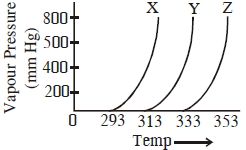
$A$ graph of vapour pressure and temperature for three different liquids $X$,$Y$ and $Z$ is shown below.
The following inferences are made:
$(A)$ $X$ has higher intermolecular interactions compared to $Y$.
$(B)$ $X$ has lower intermolecular interactions compared to $Y$.
$(C)$ $Z$ has lower intermolecular interactions compared to $Y$.
The correct inference$(s)$ is/are:
The following inferences are made:
$(A)$ $X$ has higher intermolecular interactions compared to $Y$.
$(B)$ $X$ has lower intermolecular interactions compared to $Y$.
$(C)$ $Z$ has lower intermolecular interactions compared to $Y$.
The correct inference$(s)$ is/are:
A
$(A)$
B
$(C)$
C
$(B)$
D
$(B)$ and $(C)$
Solution
(C) From the graph,at a constant vapour pressure,the temperature required for liquid $Z$ is the highest,followed by $Y$,and then $X$. This indicates that the boiling point order is $Z > Y > X$.
Liquids with higher boiling points have stronger intermolecular forces of attraction.
Therefore,the order of intermolecular interactions is $Z > Y > X$.
Evaluating the inferences:
$(A)$ $X$ has higher intermolecular interactions compared to $Y$: Incorrect,as $X$ has lower interactions than $Y$.
$(B)$ $X$ has lower intermolecular interactions compared to $Y$: Correct.
$(C)$ $Z$ has lower intermolecular interactions compared to $Y$: Incorrect,as $Z$ has higher interactions than $Y$.
Thus,only inference $(B)$ is correct.
Liquids with higher boiling points have stronger intermolecular forces of attraction.
Therefore,the order of intermolecular interactions is $Z > Y > X$.
Evaluating the inferences:
$(A)$ $X$ has higher intermolecular interactions compared to $Y$: Incorrect,as $X$ has lower interactions than $Y$.
$(B)$ $X$ has lower intermolecular interactions compared to $Y$: Correct.
$(C)$ $Z$ has lower intermolecular interactions compared to $Y$: Incorrect,as $Z$ has higher interactions than $Y$.
Thus,only inference $(B)$ is correct.
0 likes
View Solution181
Difficult
Vapour pressure of chloroform $(CHCl_{3})$ and dichloromethane $(CH_{2}Cl_{2})$ at $298\,K$ are $200\,mm\,Hg$ and $415\,mm\,Hg$ respectively. $(i)$ Calculate the vapour pressure of the solution prepared by mixing $25.5\,g$ of $CHCl_{3}$ and $40\,g$ of $CH_{2}Cl_{2}$ at $298\,K$ and,$(ii)$ mole fractions of each component in vapour phase.
Solution
$(i)$ Molar mass of $CH_{2}Cl_{2} = 12 \times 1 + 1 \times 2 + 35.5 \times 2 = 85\,g\,mol^{-1}$.
Molar mass of $CHCl_{3} = 12 \times 1 + 1 \times 1 + 35.5 \times 3 = 119.5\,g\,mol^{-1}$.
Moles of $CH_{2}Cl_{2} = \frac{40\,g}{85\,g\,mol^{-1}} = 0.47\,mol$.
Moles of $CHCl_{3} = \frac{25.5\,g}{119.5\,g\,mol^{-1}} = 0.213\,mol$.
Total number of moles $= 0.47 + 0.213 = 0.683\,mol$.
$x_{CH_{2}Cl_{2}} = \frac{0.47\,mol}{0.683\,mol} = 0.688$.
$x_{CHCl_{3}} = 1.00 - 0.688 = 0.312$.
$P_{\text{total}} = P_{CH_{2}Cl_{2}}^{0} \times x_{CH_{2}Cl_{2}} + P_{CHCl_{3}}^{0} \times x_{CHCl_{3}} = 415 \times 0.688 + 200 \times 0.312 = 285.52 + 62.4 = 347.92\,mm\,Hg$.
$(ii)$ Mole fraction in vapour phase $(y_i = P_i / P_{\text{total}})$.
$y_{CH_{2}Cl_{2}} = \frac{285.52}{347.92} = 0.82$.
$y_{CHCl_{3}} = \frac{62.4}{347.92} = 0.18$.
Molar mass of $CHCl_{3} = 12 \times 1 + 1 \times 1 + 35.5 \times 3 = 119.5\,g\,mol^{-1}$.
Moles of $CH_{2}Cl_{2} = \frac{40\,g}{85\,g\,mol^{-1}} = 0.47\,mol$.
Moles of $CHCl_{3} = \frac{25.5\,g}{119.5\,g\,mol^{-1}} = 0.213\,mol$.
Total number of moles $= 0.47 + 0.213 = 0.683\,mol$.
$x_{CH_{2}Cl_{2}} = \frac{0.47\,mol}{0.683\,mol} = 0.688$.
$x_{CHCl_{3}} = 1.00 - 0.688 = 0.312$.
$P_{\text{total}} = P_{CH_{2}Cl_{2}}^{0} \times x_{CH_{2}Cl_{2}} + P_{CHCl_{3}}^{0} \times x_{CHCl_{3}} = 415 \times 0.688 + 200 \times 0.312 = 285.52 + 62.4 = 347.92\,mm\,Hg$.
$(ii)$ Mole fraction in vapour phase $(y_i = P_i / P_{\text{total}})$.
$y_{CH_{2}Cl_{2}} = \frac{285.52}{347.92} = 0.82$.
$y_{CHCl_{3}} = \frac{62.4}{347.92} = 0.18$.
0 likes
View Solution182
Medium
The vapour pressure of pure benzene at a certain temperature is $0.850 \ bar$. $A$ non-volatile,non-electrolyte solid weighing $0.5 \ g$ when added to $39.0 \ g$ of benzene (molar mass $78 \ g \ mol^{-1}$),the vapour pressure of the solution becomes $0.845 \ bar$. What is the molar mass of the solid substance?
Solution
$(170 \ g \ mol^{-1}$ The given values are:
$p_{1}^{0} = 0.850 \ bar$; $p = 0.845 \ bar$; $M_{1} = 78 \ g \ mol^{-1}$; $w_{2} = 0.5 \ g$; $w_{1} = 39 \ g$
Using the relative lowering of vapour pressure formula:
$\frac{p_{1}^{0} - p}{p_{1}^{0}} = \frac{w_{2} \times M_{1}}{M_{2} \times w_{1}}$
Substituting the values:
$\frac{0.850 - 0.845}{0.850} = \frac{0.5 \times 78}{M_{2} \times 39}$
$\frac{0.005}{0.850} = \frac{39}{M_{2} \times 39}$
$\frac{1}{170} = \frac{1}{M_{2}}$
$M_{2} = 170 \ g \ mol^{-1}$
$p_{1}^{0} = 0.850 \ bar$; $p = 0.845 \ bar$; $M_{1} = 78 \ g \ mol^{-1}$; $w_{2} = 0.5 \ g$; $w_{1} = 39 \ g$
Using the relative lowering of vapour pressure formula:
$\frac{p_{1}^{0} - p}{p_{1}^{0}} = \frac{w_{2} \times M_{1}}{M_{2} \times w_{1}}$
Substituting the values:
$\frac{0.850 - 0.845}{0.850} = \frac{0.5 \times 78}{M_{2} \times 39}$
$\frac{0.005}{0.850} = \frac{39}{M_{2} \times 39}$
$\frac{1}{170} = \frac{1}{M_{2}}$
$M_{2} = 170 \ g \ mol^{-1}$
0 likes
View Solution183
Difficult
The vapour pressure of pure liquids $A$ and $B$ are $450$ $mm$ $Hg$ and $700$ $mm$ $Hg$ respectively,at $350$ $K$. Find out the composition of the liquid mixture if the total vapour pressure is $600$ $mm$ $Hg$. Also,find the composition of the vapour phase.
Solution
(A) Given:
$P_{A}^{0} = 450$ $mm$ $Hg$
$P_{B}^{0} = 700$ $mm$ $Hg$
$P_{total} = 600$ $mm$ $Hg$
According to Raoult's law:
$P_{total} = P_{A}^{0} x_{A} + P_{B}^{0} x_{B}$
Since $x_{B} = 1 - x_{A}$,we have:
$P_{total} = P_{A}^{0} x_{A} + P_{B}^{0} (1 - x_{A})$
$600 = 450 x_{A} + 700 (1 - x_{A})$
$600 = 450 x_{A} + 700 - 700 x_{A}$
$250 x_{A} = 100$
$x_{A} = \frac{100}{250} = 0.4$
$x_{B} = 1 - 0.4 = 0.6$
Composition of liquid mixture: $x_{A} = 0.4, x_{B} = 0.6$
Partial pressures:
$P_{A} = P_{A}^{0} x_{A} = 450 \times 0.4 = 180$ $mm$ $Hg$
$P_{B} = P_{B}^{0} x_{B} = 700 \times 0.6 = 420$ $mm$ $Hg$
Composition in vapour phase ($y_{A}$ and $y_{B}$):
$y_{A} = \frac{P_{A}}{P_{total}} = \frac{180}{600} = 0.3$
$y_{B} = \frac{P_{B}}{P_{total}} = \frac{420}{600} = 0.7$
$P_{A}^{0} = 450$ $mm$ $Hg$
$P_{B}^{0} = 700$ $mm$ $Hg$
$P_{total} = 600$ $mm$ $Hg$
According to Raoult's law:
$P_{total} = P_{A}^{0} x_{A} + P_{B}^{0} x_{B}$
Since $x_{B} = 1 - x_{A}$,we have:
$P_{total} = P_{A}^{0} x_{A} + P_{B}^{0} (1 - x_{A})$
$600 = 450 x_{A} + 700 (1 - x_{A})$
$600 = 450 x_{A} + 700 - 700 x_{A}$
$250 x_{A} = 100$
$x_{A} = \frac{100}{250} = 0.4$
$x_{B} = 1 - 0.4 = 0.6$
Composition of liquid mixture: $x_{A} = 0.4, x_{B} = 0.6$
Partial pressures:
$P_{A} = P_{A}^{0} x_{A} = 450 \times 0.4 = 180$ $mm$ $Hg$
$P_{B} = P_{B}^{0} x_{B} = 700 \times 0.6 = 420$ $mm$ $Hg$
Composition in vapour phase ($y_{A}$ and $y_{B}$):
$y_{A} = \frac{P_{A}}{P_{total}} = \frac{180}{600} = 0.3$
$y_{B} = \frac{P_{B}}{P_{total}} = \frac{420}{600} = 0.7$
0 likes
View Solution184
Difficult
Vapour pressure of pure water at $298 \, K$ is $23.8 \, mm \, Hg$. $50 \, g$ of urea $(NH_2CONH_2)$ is dissolved in $850 \, g$ of water. Calculate the vapour pressure of water for this solution and its relative lowering.
Solution
(N/A) Given: Vapour pressure of pure water,$p_1^0 = 23.8 \, mm \, Hg$.
Weight of water,$w_1 = 850 \, g$.
Weight of urea,$w_2 = 50 \, g$.
Molar mass of water,$M_1 = 18 \, g \, mol^{-1}$.
Molar mass of urea,$M_2 = 60 \, g \, mol^{-1}$.
Number of moles of water,$n_1 = \frac{850}{18} = 47.22 \, mol$.
Number of moles of urea,$n_2 = \frac{50}{60} = 0.833 \, mol$.
Relative lowering of vapour pressure is given by $\frac{p_1^0 - p_1}{p_1^0} = \frac{n_2}{n_1 + n_2}$.
$\frac{p_1^0 - p_1}{p_1^0} = \frac{0.833}{47.22 + 0.833} = \frac{0.833}{48.053} = 0.0173$.
Now,$23.8 - p_1 = 0.0173 \times 23.8 = 0.4117$.
$p_1 = 23.8 - 0.4117 = 23.388 \, mm \, Hg \approx 23.4 \, mm \, Hg$.
Thus,the vapour pressure of the solution is $23.4 \, mm \, Hg$ and the relative lowering is $0.0173$.
Weight of water,$w_1 = 850 \, g$.
Weight of urea,$w_2 = 50 \, g$.
Molar mass of water,$M_1 = 18 \, g \, mol^{-1}$.
Molar mass of urea,$M_2 = 60 \, g \, mol^{-1}$.
Number of moles of water,$n_1 = \frac{850}{18} = 47.22 \, mol$.
Number of moles of urea,$n_2 = \frac{50}{60} = 0.833 \, mol$.
Relative lowering of vapour pressure is given by $\frac{p_1^0 - p_1}{p_1^0} = \frac{n_2}{n_1 + n_2}$.
$\frac{p_1^0 - p_1}{p_1^0} = \frac{0.833}{47.22 + 0.833} = \frac{0.833}{48.053} = 0.0173$.
Now,$23.8 - p_1 = 0.0173 \times 23.8 = 0.4117$.
$p_1 = 23.8 - 0.4117 = 23.388 \, mm \, Hg \approx 23.4 \, mm \, Hg$.
Thus,the vapour pressure of the solution is $23.4 \, mm \, Hg$ and the relative lowering is $0.0173$.
0 likes
View Solution185
Easy
An aqueous solution of $2 \%$ non-volatile solute exerts a pressure of $1.004 \ bar$ at the normal boiling point of the solvent. What is the molar mass of the solute?
Solution
(N/A) Given:
Vapour pressure of the solution at normal boiling point $(p_{1}) = 1.004 \ bar$
Vapour pressure of pure water at normal boiling point $(p_{1}^{\circ}) = 1.013 \ bar$
Mass of solute $(w_{2}) = 2 \ g$
Mass of solvent (water) $(w_{1}) = 98 \ g$
Molar mass of solvent (water) $(M_{1}) = 18 \ g \ mol^{-1}$
According to Raoult's law for relative lowering of vapour pressure:
$\frac{p_{1}^{\circ} - p_{1}}{p_{1}^{\circ}} = \frac{w_{2} \times M_{1}}{M_{2} \times w_{1}}$
Substituting the values:
$\frac{1.013 - 1.004}{1.013} = \frac{2 \times 18}{M_{2} \times 98}$
$\frac{0.009}{1.013} = \frac{36}{M_{2} \times 98}$
$M_{2} = \frac{36 \times 1.013}{0.009 \times 98}$
$M_{2} = \frac{36.468}{0.882} \approx 41.35 \ g \ mol^{-1}$
Thus,the molar mass of the solute is $41.35 \ g \ mol^{-1}$.
Vapour pressure of the solution at normal boiling point $(p_{1}) = 1.004 \ bar$
Vapour pressure of pure water at normal boiling point $(p_{1}^{\circ}) = 1.013 \ bar$
Mass of solute $(w_{2}) = 2 \ g$
Mass of solvent (water) $(w_{1}) = 98 \ g$
Molar mass of solvent (water) $(M_{1}) = 18 \ g \ mol^{-1}$
According to Raoult's law for relative lowering of vapour pressure:
$\frac{p_{1}^{\circ} - p_{1}}{p_{1}^{\circ}} = \frac{w_{2} \times M_{1}}{M_{2} \times w_{1}}$
Substituting the values:
$\frac{1.013 - 1.004}{1.013} = \frac{2 \times 18}{M_{2} \times 98}$
$\frac{0.009}{1.013} = \frac{36}{M_{2} \times 98}$
$M_{2} = \frac{36 \times 1.013}{0.009 \times 98}$
$M_{2} = \frac{36.468}{0.882} \approx 41.35 \ g \ mol^{-1}$
Thus,the molar mass of the solute is $41.35 \ g \ mol^{-1}$.
0 likes
View Solution186
Easy
The vapour pressure of water is $12.3 \, kPa$ at $300 \, K$. Calculate the vapour pressure of a $1 \, molal$ solution of a non-volatile solute in it.
Solution
(N/A) $1 \, molal$ solution means $1 \, mol$ of the solute is present in $1000 \, g$ of the solvent (water).
Molar mass of water $= 18 \, g \, mol^{-1}$.
Number of moles of water $= \frac{1000 \, g}{18 \, g \, mol^{-1}} = 55.56 \, mol$.
Mole fraction of the solute $(x_2)$ $= \frac{n_2}{n_1 + n_2} = \frac{1}{55.56 + 1} = \frac{1}{56.56} \approx 0.0177$.
Given,vapour pressure of pure water,$p_1^o = 12.3 \, kPa$.
Using Raoult's Law for non-volatile solute: $\frac{p_1^o - p_1}{p_1^o} = x_2$.
$p_1 = p_1^o (1 - x_2) = 12.3 \times (1 - 0.0177) = 12.3 \times 0.9823$.
$p_1 \approx 12.08 \, kPa$.
Molar mass of water $= 18 \, g \, mol^{-1}$.
Number of moles of water $= \frac{1000 \, g}{18 \, g \, mol^{-1}} = 55.56 \, mol$.
Mole fraction of the solute $(x_2)$ $= \frac{n_2}{n_1 + n_2} = \frac{1}{55.56 + 1} = \frac{1}{56.56} \approx 0.0177$.
Given,vapour pressure of pure water,$p_1^o = 12.3 \, kPa$.
Using Raoult's Law for non-volatile solute: $\frac{p_1^o - p_1}{p_1^o} = x_2$.
$p_1 = p_1^o (1 - x_2) = 12.3 \times (1 - 0.0177) = 12.3 \times 0.9823$.
$p_1 \approx 12.08 \, kPa$.
0 likes
View Solution187
Easy
Calculate the mass of a non-volatile solute (molar mass $40 \, g \, mol^{-1}$) which should be dissolved in $114 \, g$ octane to reduce its vapour pressure to $80 \%$.
Solution
(8 G) Let the vapour pressure of pure octane be $p_{1}^{o}$.
The final vapour pressure is $p_{1} = 0.8 p_{1}^{o}$.
Molar mass of solute,$M_{2} = 40 \, g \, mol^{-1}$.
Mass of octane,$w_{1} = 114 \, g$.
Molar mass of octane $(C_{8}H_{18})$,$M_{1} = (8 \times 12) + (18 \times 1) = 114 \, g \, mol^{-1}$.
Applying Raoult's Law for relative lowering of vapour pressure:
$\frac{p_{1}^{o} - p_{1}}{p_{1}^{o}} = \frac{w_{2} \times M_{1}}{M_{2} \times w_{1}}$
Substituting the values:
$\frac{p_{1}^{o} - 0.8 p_{1}^{o}}{p_{1}^{o}} = \frac{w_{2} \times 114}{40 \times 114}$
$\frac{0.2 p_{1}^{o}}{p_{1}^{o}} = \frac{w_{2}}{40}$
$0.2 = \frac{w_{2}}{40}$
$w_{2} = 0.2 \times 40 = 8 \, g$.
Hence,the required mass of the solute is $8 \, g$.
The final vapour pressure is $p_{1} = 0.8 p_{1}^{o}$.
Molar mass of solute,$M_{2} = 40 \, g \, mol^{-1}$.
Mass of octane,$w_{1} = 114 \, g$.
Molar mass of octane $(C_{8}H_{18})$,$M_{1} = (8 \times 12) + (18 \times 1) = 114 \, g \, mol^{-1}$.
Applying Raoult's Law for relative lowering of vapour pressure:
$\frac{p_{1}^{o} - p_{1}}{p_{1}^{o}} = \frac{w_{2} \times M_{1}}{M_{2} \times w_{1}}$
Substituting the values:
$\frac{p_{1}^{o} - 0.8 p_{1}^{o}}{p_{1}^{o}} = \frac{w_{2} \times 114}{40 \times 114}$
$\frac{0.2 p_{1}^{o}}{p_{1}^{o}} = \frac{w_{2}}{40}$
$0.2 = \frac{w_{2}}{40}$
$w_{2} = 0.2 \times 40 = 8 \, g$.
Hence,the required mass of the solute is $8 \, g$.
0 likes
View Solution188
Easy
$A$ solution containing $30 \,g$ of non-volatile solute in $90 \,g$ of water has a vapour pressure of $2.8 \,kPa$ at $298 \,K$. Further,$18 \,g$ of water is added to the solution and the new vapour pressure becomes $2.9 \,kPa$ at $298 \,K$. Calculate:
$i$. Molar mass of the solute
$ii$. Vapour pressure of water at $298 \,K$
$i$. Molar mass of the solute
$ii$. Vapour pressure of water at $298 \,K$
Solution
$(i)$ Let the molar mass of the solute be $M \,g \,mol^{-1}$.
Initial state:
$n_{1} = \frac{90 \,g}{18 \,g \,mol^{-1}} = 5 \,mol$ (moles of water)
$n_{2} = \frac{30 \,g}{M \,g \,mol^{-1}} = \frac{30}{M} \,mol$ (moles of solute)
$p_{1} = 2.8 \,kPa$
Using Raoult's Law: $\frac{p_{1}^{o} - p_{1}}{p_{1}^{o}} = \frac{n_{2}}{n_{1} + n_{2}}$
$1 - \frac{2.8}{p_{1}^{o}} = \frac{30/M}{5 + 30/M} = \frac{30}{5M + 30}$
$\frac{2.8}{p_{1}^{o}} = 1 - \frac{30}{5M + 30} = \frac{5M}{5M + 30}$
$\frac{p_{1}^{o}}{2.8} = \frac{5M + 30}{5M} \quad \dots (i)$
After adding $18 \,g$ of water:
$n_{1}' = \frac{90 + 18}{18} = 6 \,mol$
$p_{1}' = 2.9 \,kPa$
$\frac{p_{1}^{o} - 2.9}{p_{1}^{o}} = \frac{30/M}{6 + 30/M} = \frac{30}{6M + 30}$
$\frac{p_{1}^{o}}{2.9} = \frac{6M + 30}{6M} \quad \dots (ii)$
Dividing $(i)$ by $(ii)$:
$\frac{2.9}{2.8} = \frac{(5M + 30)/5M}{(6M + 30)/6M} = \frac{5M + 30}{5} \times \frac{6}{6M + 30} = \frac{6(5M + 30)}{5(6M + 30)}$
$2.9 \times 5(6M + 30) = 2.8 \times 6(5M + 30)$
$14.5(6M + 30) = 16.8(5M + 30)$
$87M + 435 = 84M + 504$
$3M = 69 \Rightarrow M = 23 \,g \,mol^{-1}$.
$(ii)$ Substituting $M = 23$ in $(i)$:
$\frac{p_{1}^{o}}{2.8} = \frac{5(23) + 30}{5(23)} = \frac{115 + 30}{115} = \frac{145}{115} \approx 1.2608$
$p_{1}^{o} = 2.8 \times 1.2608 = 3.53 \,kPa$.
Initial state:
$n_{1} = \frac{90 \,g}{18 \,g \,mol^{-1}} = 5 \,mol$ (moles of water)
$n_{2} = \frac{30 \,g}{M \,g \,mol^{-1}} = \frac{30}{M} \,mol$ (moles of solute)
$p_{1} = 2.8 \,kPa$
Using Raoult's Law: $\frac{p_{1}^{o} - p_{1}}{p_{1}^{o}} = \frac{n_{2}}{n_{1} + n_{2}}$
$1 - \frac{2.8}{p_{1}^{o}} = \frac{30/M}{5 + 30/M} = \frac{30}{5M + 30}$
$\frac{2.8}{p_{1}^{o}} = 1 - \frac{30}{5M + 30} = \frac{5M}{5M + 30}$
$\frac{p_{1}^{o}}{2.8} = \frac{5M + 30}{5M} \quad \dots (i)$
After adding $18 \,g$ of water:
$n_{1}' = \frac{90 + 18}{18} = 6 \,mol$
$p_{1}' = 2.9 \,kPa$
$\frac{p_{1}^{o} - 2.9}{p_{1}^{o}} = \frac{30/M}{6 + 30/M} = \frac{30}{6M + 30}$
$\frac{p_{1}^{o}}{2.9} = \frac{6M + 30}{6M} \quad \dots (ii)$
Dividing $(i)$ by $(ii)$:
$\frac{2.9}{2.8} = \frac{(5M + 30)/5M}{(6M + 30)/6M} = \frac{5M + 30}{5} \times \frac{6}{6M + 30} = \frac{6(5M + 30)}{5(6M + 30)}$
$2.9 \times 5(6M + 30) = 2.8 \times 6(5M + 30)$
$14.5(6M + 30) = 16.8(5M + 30)$
$87M + 435 = 84M + 504$
$3M = 69 \Rightarrow M = 23 \,g \,mol^{-1}$.
$(ii)$ Substituting $M = 23$ in $(i)$:
$\frac{p_{1}^{o}}{2.8} = \frac{5(23) + 30}{5(23)} = \frac{115 + 30}{115} = \frac{145}{115} \approx 1.2608$
$p_{1}^{o} = 2.8 \times 1.2608 = 3.53 \,kPa$.
0 likes
View Solution189
Easy
Vapour pressure of water at $293 \, K$ is $17.535 \, mm \, Hg$. Calculate the vapour pressure of water at $293 \, K$ when $25 \, g$ of glucose is dissolved in $450 \, g$ of water.
Solution
(N/A) Vapour pressure of pure water,$P_{1}^{\circ} = 17.535 \, mm \, Hg$
Mass of glucose,$w_{2} = 25 \, g$
Mass of water,$w_{1} = 450 \, g$
Molar mass of glucose $(C_{6}H_{12}O_{6})$,$M_{2} = 6 \times 12 + 12 \times 1 + 6 \times 16 = 180 \, g \, mol^{-1}$
Molar mass of water,$M_{1} = 18 \, g \, mol^{-1}$
Number of moles of glucose,$n_{2} = \frac{25 \, g}{180 \, g \, mol^{-1}} = 0.139 \, mol$
Number of moles of water,$n_{1} = \frac{450 \, g}{18 \, g \, mol^{-1}} = 25 \, mol$
Using Raoult's law for relative lowering of vapour pressure:
$\frac{P_{1}^{\circ} - p_{1}}{P_{1}^{\circ}} = \frac{n_{2}}{n_{2} + n_{1}}$
$\frac{17.535 - p_{1}}{17.535} = \frac{0.139}{0.139 + 25} = \frac{0.139}{25.139} \approx 0.00553$
$17.535 - p_{1} = 0.00553 \times 17.535 \approx 0.097$
$p_{1} = 17.535 - 0.097 = 17.438 \, mm \, Hg \approx 17.44 \, mm \, Hg$
The vapour pressure of the solution is $17.44 \, mm \, Hg$.
Mass of glucose,$w_{2} = 25 \, g$
Mass of water,$w_{1} = 450 \, g$
Molar mass of glucose $(C_{6}H_{12}O_{6})$,$M_{2} = 6 \times 12 + 12 \times 1 + 6 \times 16 = 180 \, g \, mol^{-1}$
Molar mass of water,$M_{1} = 18 \, g \, mol^{-1}$
Number of moles of glucose,$n_{2} = \frac{25 \, g}{180 \, g \, mol^{-1}} = 0.139 \, mol$
Number of moles of water,$n_{1} = \frac{450 \, g}{18 \, g \, mol^{-1}} = 25 \, mol$
Using Raoult's law for relative lowering of vapour pressure:
$\frac{P_{1}^{\circ} - p_{1}}{P_{1}^{\circ}} = \frac{n_{2}}{n_{2} + n_{1}}$
$\frac{17.535 - p_{1}}{17.535} = \frac{0.139}{0.139 + 25} = \frac{0.139}{25.139} \approx 0.00553$
$17.535 - p_{1} = 0.00553 \times 17.535 \approx 0.097$
$p_{1} = 17.535 - 0.097 = 17.438 \, mm \, Hg \approx 17.44 \, mm \, Hg$
The vapour pressure of the solution is $17.44 \, mm \, Hg$.
0 likes
View Solution190
Easy
$100 \, g$ of liquid $A$ (molar mass $140 \, g \, mol^{-1}$) was dissolved in $1000 \, g$ of liquid $B$ (molar mass $180 \, g \, mol^{-1}$). The vapour pressure of pure liquid $B$ was found to be $500 \, torr$. Calculate the vapour pressure of pure liquid $A$ and its vapour pressure in the solution if the total vapour pressure of the solution is $475 \, torr$.
Solution
(N/A) Number of moles of liquid $A$,$n_{A} = \frac{100}{140} \, mol = 0.714 \, mol$.
Number of moles of liquid $B$,$n_{B} = \frac{1000}{180} \, mol = 5.556 \, mol$.
Mole fraction of $A$,$x_{A} = \frac{n_{A}}{n_{A} + n_{B}} = \frac{0.714}{0.714 + 5.556} = 0.114$.
Mole fraction of $B$,$x_{B} = 1 - 0.114 = 0.886$.
Vapour pressure of pure liquid $B$,$P_{B}^{o} = 500 \, torr$.
Vapour pressure of liquid $B$ in the solution,$p_{B} = P_{B}^{o} x_{B} = 500 \times 0.886 = 443 \, torr$.
Total vapour pressure of the solution,$p_{total} = 475 \, torr$.
Vapour pressure of liquid $A$ in the solution,$p_{A} = p_{total} - p_{B} = 475 - 443 = 32 \, torr$.
Using Raoult's law,$p_{A} = P_{A}^{o} x_{A}$.
$P_{A}^{o} = \frac{p_{A}}{x_{A}} = \frac{32}{0.114} = 280.7 \, torr$.
Thus,the vapour pressure of pure liquid $A$ is $280.7 \, torr$ and its vapour pressure in the solution is $32 \, torr$.
Number of moles of liquid $B$,$n_{B} = \frac{1000}{180} \, mol = 5.556 \, mol$.
Mole fraction of $A$,$x_{A} = \frac{n_{A}}{n_{A} + n_{B}} = \frac{0.714}{0.714 + 5.556} = 0.114$.
Mole fraction of $B$,$x_{B} = 1 - 0.114 = 0.886$.
Vapour pressure of pure liquid $B$,$P_{B}^{o} = 500 \, torr$.
Vapour pressure of liquid $B$ in the solution,$p_{B} = P_{B}^{o} x_{B} = 500 \times 0.886 = 443 \, torr$.
Total vapour pressure of the solution,$p_{total} = 475 \, torr$.
Vapour pressure of liquid $A$ in the solution,$p_{A} = p_{total} - p_{B} = 475 - 443 = 32 \, torr$.
Using Raoult's law,$p_{A} = P_{A}^{o} x_{A}$.
$P_{A}^{o} = \frac{p_{A}}{x_{A}} = \frac{32}{0.114} = 280.7 \, torr$.
Thus,the vapour pressure of pure liquid $A$ is $280.7 \, torr$ and its vapour pressure in the solution is $32 \, torr$.
1 likes
View Solution191
Advanced
Derive an equation for a solution that shows the relation between total pressure and the mole fraction of a volatile solute and a volatile solvent,and explain it by plotting a graph.
Solution
(N/A) Consider a binary solution containing volatile components $1$ and $2$. Let their mole fractions be $X_{1}$ and $X_{2}$,and their partial vapour pressures be $P_{1}$ and $P_{2}$,respectively.
According to Raoult's law,for a solution of volatile liquids,the partial vapour pressure of each component is directly proportional to its mole fraction in the solution.
For component $1$: $P_{1} = P_{1}^{0} X_{1}$,where $P_{1}^{0}$ is the vapour pressure of pure component $1$.
For component $2$: $P_{2} = P_{2}^{0} X_{2}$,where $P_{2}^{0}$ is the vapour pressure of pure component $2$.
According to Dalton's law of partial pressures,the total pressure $P_{\text{total}}$ is the sum of the partial pressures:
$P_{\text{total}} = P_{1} + P_{2} = P_{1}^{0} X_{1} + P_{2}^{0} X_{2}$.
Since $X_{1} + X_{2} = 1$,we have $X_{1} = 1 - X_{2}$.
Substituting this:
$P_{\text{total}} = P_{1}^{0} (1 - X_{2}) + P_{2}^{0} X_{2} = P_{1}^{0} + (P_{2}^{0} - P_{1}^{0}) X_{2}$.
Conclusions:
$(i)$ $P_{\text{total}}$ is linearly related to the mole fraction of any one component.
$(ii)$ The graph of $P_{\text{total}}$ versus $X_{2}$ is a straight line.
$(iii)$ $P_{\text{total}}$ varies linearly with $X_{2}$ between $P_{1}^{0}$ and $P_{2}^{0}$.
According to Raoult's law,for a solution of volatile liquids,the partial vapour pressure of each component is directly proportional to its mole fraction in the solution.
For component $1$: $P_{1} = P_{1}^{0} X_{1}$,where $P_{1}^{0}$ is the vapour pressure of pure component $1$.
For component $2$: $P_{2} = P_{2}^{0} X_{2}$,where $P_{2}^{0}$ is the vapour pressure of pure component $2$.
According to Dalton's law of partial pressures,the total pressure $P_{\text{total}}$ is the sum of the partial pressures:
$P_{\text{total}} = P_{1} + P_{2} = P_{1}^{0} X_{1} + P_{2}^{0} X_{2}$.
Since $X_{1} + X_{2} = 1$,we have $X_{1} = 1 - X_{2}$.
Substituting this:
$P_{\text{total}} = P_{1}^{0} (1 - X_{2}) + P_{2}^{0} X_{2} = P_{1}^{0} + (P_{2}^{0} - P_{1}^{0}) X_{2}$.
Conclusions:
$(i)$ $P_{\text{total}}$ is linearly related to the mole fraction of any one component.
$(ii)$ The graph of $P_{\text{total}}$ versus $X_{2}$ is a straight line.
$(iii)$ $P_{\text{total}}$ varies linearly with $X_{2}$ between $P_{1}^{0}$ and $P_{2}^{0}$.
0 likes
View Solution192
Difficult
Explain how the solubility of a gaseous solute and the vapour pressure of a liquid solution follow Henry's and Raoult's laws.
Solution
(N/A) According to Raoult's law,the vapour pressure of a volatile component in a solution is given by $p_{i} = x_{i} p_{i}^{0}$.
In the case of a gas dissolved in a liquid,the gas is a volatile component. Its solubility is governed by Henry's law,which states that $P = K_{H} \cdot x$.
Comparing the two equations,we see that the partial pressure of the volatile component (or gas) is directly proportional to its mole fraction $(x)$ in the solution.
The only difference is the proportionality constant: $K_{H}$ in Henry's law and $p_{i}^{0}$ in Raoult's law.
Therefore,Raoult's law can be considered a special case of Henry's law where the proportionality constant $K_{H}$ becomes equal to the pure vapour pressure $p_{i}^{0}$.
In the case of a gas dissolved in a liquid,the gas is a volatile component. Its solubility is governed by Henry's law,which states that $P = K_{H} \cdot x$.
Comparing the two equations,we see that the partial pressure of the volatile component (or gas) is directly proportional to its mole fraction $(x)$ in the solution.
The only difference is the proportionality constant: $K_{H}$ in Henry's law and $p_{i}^{0}$ in Raoult's law.
Therefore,Raoult's law can be considered a special case of Henry's law where the proportionality constant $K_{H}$ becomes equal to the pure vapour pressure $p_{i}^{0}$.
0 likes
View Solution193
Advanced
Explain the vapour pressure of solutions of solids in liquids.
Solution
(N/A) Liquids at a given temperature vaporize,and under equilibrium conditions,the pressure exerted by the vapours of the liquid over the liquid phase is called vapour pressure.
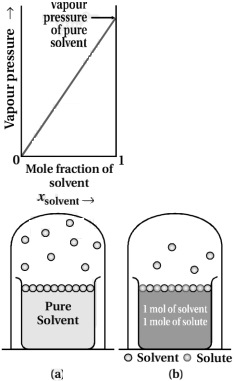
In a pure liquid,the entire surface is occupied by the molecules of the liquid. If a non-volatile solute is added to a solvent to form a solution,the vapour pressure of the solution is solely due to the solvent molecules.
This vapour pressure of the solution at a given temperature is found to be lower than the vapour pressure of the pure solvent at the same temperature. In the solution,the surface contains both solute and solvent molecules; thereby,the fraction of the surface covered by the solvent molecules is reduced. Consequently,the number of solvent molecules escaping from the surface is correspondingly reduced,thus,the vapour pressure is also reduced.
In a pure liquid,the entire surface is occupied by the molecules of the liquid. If a non-volatile solute is added to a solvent to form a solution,the vapour pressure of the solution is solely due to the solvent molecules.
This vapour pressure of the solution at a given temperature is found to be lower than the vapour pressure of the pure solvent at the same temperature. In the solution,the surface contains both solute and solvent molecules; thereby,the fraction of the surface covered by the solvent molecules is reduced. Consequently,the number of solvent molecules escaping from the surface is correspondingly reduced,thus,the vapour pressure is also reduced.
0 likes
View Solution194
Easy
Write the formula which expresses the relationship between the total pressure of a solution $(P_{total})$ and the mole fraction $(x_2)$ of the components,according to Raoult's law.
Solution
(N/A) According to Raoult's law,for a solution of two volatile components,the total pressure $(P_{total})$ is given by:
$P_{total} = P_1 + P_2$
Since $P_1 = x_1 P_1^0$ and $P_2 = x_2 P_2^0$,and $x_1 = 1 - x_2$:
$P_{total} = (1 - x_2) P_1^0 + x_2 P_2^0$
$P_{total} = P_1^0 - x_2 P_1^0 + x_2 P_2^0$
$P_{total} = P_1^0 + x_2(P_2^0 - P_1^0)$
$P_{total} = P_1 + P_2$
Since $P_1 = x_1 P_1^0$ and $P_2 = x_2 P_2^0$,and $x_1 = 1 - x_2$:
$P_{total} = (1 - x_2) P_1^0 + x_2 P_2^0$
$P_{total} = P_1^0 - x_2 P_1^0 + x_2 P_2^0$
$P_{total} = P_1^0 + x_2(P_2^0 - P_1^0)$
0 likes
View Solution195
EasyMCQ
The graph between vapour pressure and mole fraction of the solvent for an ideal solution is:
A
$A$ straight line passing through the origin
B
$A$ straight line with a positive intercept
C
$A$ parabolic curve
D
$A$ hyperbolic curve
Solution
(A) According to Raoult's Law,for an ideal solution,the partial vapour pressure of a component is directly proportional to its mole fraction in the solution.
Mathematically,$P_A = P_A^0 \times X_A$.
Here,$P_A$ is the partial vapour pressure of the solvent,$P_A^0$ is the vapour pressure of the pure solvent,and $X_A$ is the mole fraction of the solvent.
This equation follows the linear form $y = mx$,where $m = P_A^0$.
Therefore,the graph of $P_A$ versus $X_A$ is a straight line passing through the origin.
Mathematically,$P_A = P_A^0 \times X_A$.
Here,$P_A$ is the partial vapour pressure of the solvent,$P_A^0$ is the vapour pressure of the pure solvent,and $X_A$ is the mole fraction of the solvent.
This equation follows the linear form $y = mx$,where $m = P_A^0$.
Therefore,the graph of $P_A$ versus $X_A$ is a straight line passing through the origin.
0 likes
View Solution196
EasyMCQ
The vapour pressure of pure benzene and toluene are $0.9 \ Bar$ and $0.85 \ Bar$ respectively. Calculate the vapour pressure of the solution prepared by dissolving $7.8 \ g$ of benzene in $180 \ g$ of toluene. (in $Bar$)
A
$0.854$
B
$0.825$
C
$0.875$
D
$0.895$
Solution
(A) $1$. Molar mass of benzene $(C_6H_6)$ = $78 \ g/mol$. Molar mass of toluene $(C_7H_8)$ = $92 \ g/mol$.
$2$. Moles of benzene $(n_B)$ = $7.8 \ g / 78 \ g/mol = 0.1 \ mol$.
$3$. Moles of toluene $(n_T)$ = $180 \ g / 92 \ g/mol \approx 1.9565 \ mol$.
$4$. Mole fraction of benzene $(x_B)$ = $0.1 / (0.1 + 1.9565) = 0.1 / 2.0565 \approx 0.0486$.
$5$. Mole fraction of toluene $(x_T)$ = $1 - 0.0486 = 0.9514$.
$6$. Total vapour pressure $(P_{total})$ = $P_B^0 \times x_B + P_T^0 \times x_T$.
$7$. $P_{total} = (0.9 \times 0.0486) + (0.85 \times 0.9514) = 0.04374 + 0.80869 = 0.85243 \ Bar$.
$2$. Moles of benzene $(n_B)$ = $7.8 \ g / 78 \ g/mol = 0.1 \ mol$.
$3$. Moles of toluene $(n_T)$ = $180 \ g / 92 \ g/mol \approx 1.9565 \ mol$.
$4$. Mole fraction of benzene $(x_B)$ = $0.1 / (0.1 + 1.9565) = 0.1 / 2.0565 \approx 0.0486$.
$5$. Mole fraction of toluene $(x_T)$ = $1 - 0.0486 = 0.9514$.
$6$. Total vapour pressure $(P_{total})$ = $P_B^0 \times x_B + P_T^0 \times x_T$.
$7$. $P_{total} = (0.9 \times 0.0486) + (0.85 \times 0.9514) = 0.04374 + 0.80869 = 0.85243 \ Bar$.
0 likes
View Solution197
EasyMCQ
The vapour pressure of ethanol $(C_2H_5OH)$ and methanol $(CH_3OH)$ at $298 \ K$ is $44.5 \ mm \ Hg$ and $88.7 \ mm \ Hg$ respectively. At the same temperature,an ideal solution is prepared by mixing $60 \ g$ of ethanol and $40 \ g$ of methanol. Find the mole fraction of methanol in the vapour state.
A
$0.656$
B
$0.556$
C
$0.456$
D
$0.756$
Solution
(A) $1$. Calculate the moles of each component:
$n_{\text{ethanol}} = \frac{60 \ g}{46 \ g/mol} \approx 1.304 \ mol$
$n_{\text{methanol}} = \frac{40 \ g}{32 \ g/mol} = 1.25 \ mol$
$2$. Calculate the mole fractions in the liquid phase:
$x_{\text{ethanol}} = \frac{1.304}{1.304 + 1.25} \approx 0.510$
$x_{\text{methanol}} = \frac{1.25}{1.304 + 1.25} \approx 0.490$
$3$. Calculate the partial pressures using Raoult's Law:
$P_{\text{ethanol}} = x_{\text{ethanol}} \times P^0_{\text{ethanol}} = 0.510 \times 44.5 \ mm \ Hg \approx 22.695 \ mm \ Hg$
$P_{\text{methanol}} = x_{\text{methanol}} \times P^0_{\text{methanol}} = 0.490 \times 88.7 \ mm \ Hg \approx 43.463 \ mm \ Hg$
$4$. Calculate the total pressure:
$P_{\text{total}} = 22.695 + 43.463 = 66.158 \ mm \ Hg$
$5$. Calculate the mole fraction of methanol in the vapour state $(y_{\text{methanol}})$:
$y_{\text{methanol}} = \frac{P_{\text{methanol}}}{P_{\text{total}}} = \frac{43.463}{66.158} \approx 0.657$
The closest value is $0.656$.
$n_{\text{ethanol}} = \frac{60 \ g}{46 \ g/mol} \approx 1.304 \ mol$
$n_{\text{methanol}} = \frac{40 \ g}{32 \ g/mol} = 1.25 \ mol$
$2$. Calculate the mole fractions in the liquid phase:
$x_{\text{ethanol}} = \frac{1.304}{1.304 + 1.25} \approx 0.510$
$x_{\text{methanol}} = \frac{1.25}{1.304 + 1.25} \approx 0.490$
$3$. Calculate the partial pressures using Raoult's Law:
$P_{\text{ethanol}} = x_{\text{ethanol}} \times P^0_{\text{ethanol}} = 0.510 \times 44.5 \ mm \ Hg \approx 22.695 \ mm \ Hg$
$P_{\text{methanol}} = x_{\text{methanol}} \times P^0_{\text{methanol}} = 0.490 \times 88.7 \ mm \ Hg \approx 43.463 \ mm \ Hg$
$4$. Calculate the total pressure:
$P_{\text{total}} = 22.695 + 43.463 = 66.158 \ mm \ Hg$
$5$. Calculate the mole fraction of methanol in the vapour state $(y_{\text{methanol}})$:
$y_{\text{methanol}} = \frac{P_{\text{methanol}}}{P_{\text{total}}} = \frac{43.463}{66.158} \approx 0.657$
The closest value is $0.656$.
0 likes
View Solution198
EasyMCQ
For two volatile liquids $A$ and $B$,if the vapour pressure ratio of $P_{A}^{0} : P_{B}^{0} = 1 : 2$ and the mole fraction ratio in the liquid phase is $X_{A} : X_{B} = 1 : 2$,then find the mole fraction of component $A$ in the vapour state $(Y_{A})$?
A
$0.10$
B
$0.20$
C
$0.25$
D
$0.50$
Solution
(B) Given: $P_{A}^{0} : P_{B}^{0} = 1 : 2$,so $P_{B}^{0} = 2P_{A}^{0}$.
Given: $X_{A} : X_{B} = 1 : 2$,so $X_{B} = 2X_{A}$.
Since $X_{A} + X_{B} = 1$,we have $X_{A} + 2X_{A} = 1$,which gives $3X_{A} = 1$,so $X_{A} = 1/3$ and $X_{B} = 2/3$.
According to Raoult's Law,the partial pressures are:
$P_{A} = X_{A} P_{A}^{0} = (1/3) P_{A}^{0}$
$P_{B} = X_{B} P_{B}^{0} = (2/3) (2P_{A}^{0}) = (4/3) P_{A}^{0}$
Total pressure $P_{T} = P_{A} + P_{B} = (1/3) P_{A}^{0} + (4/3) P_{A}^{0} = (5/3) P_{A}^{0}$.
The mole fraction of $A$ in the vapour state $(Y_{A})$ is given by $Y_{A} = P_{A} / P_{T}$.
$Y_{A} = ((1/3) P_{A}^{0}) / ((5/3) P_{A}^{0}) = 1/5 = 0.20$.
Given: $X_{A} : X_{B} = 1 : 2$,so $X_{B} = 2X_{A}$.
Since $X_{A} + X_{B} = 1$,we have $X_{A} + 2X_{A} = 1$,which gives $3X_{A} = 1$,so $X_{A} = 1/3$ and $X_{B} = 2/3$.
According to Raoult's Law,the partial pressures are:
$P_{A} = X_{A} P_{A}^{0} = (1/3) P_{A}^{0}$
$P_{B} = X_{B} P_{B}^{0} = (2/3) (2P_{A}^{0}) = (4/3) P_{A}^{0}$
Total pressure $P_{T} = P_{A} + P_{B} = (1/3) P_{A}^{0} + (4/3) P_{A}^{0} = (5/3) P_{A}^{0}$.
The mole fraction of $A$ in the vapour state $(Y_{A})$ is given by $Y_{A} = P_{A} / P_{T}$.
$Y_{A} = ((1/3) P_{A}^{0}) / ((5/3) P_{A}^{0}) = 1/5 = 0.20$.
0 likes
View Solution199
Easy
The number of moles of chlorobenzene and bromobenzene are $0.1$ and $0.2$ respectively. The vapour pressure of pure chlorobenzene and pure bromobenzene are $0.350 \ bar$ and $0.500 \ bar$ respectively. Calculate the total vapour pressure of the solution prepared by mixing these two components.
Solution
(0.450 BAR) According to Raoult's law,the total vapour pressure $P_{total} = P_A + P_B = x_A P_A^0 + x_B P_B^0$.
Given:
Moles of chlorobenzene $(n_A)$ = $0.1$
Moles of bromobenzene $(n_B)$ = $0.2$
Total moles = $0.1 + 0.2 = 0.3$
Mole fraction of chlorobenzene $(x_A)$ = $0.1 / 0.3 = 1/3$
Mole fraction of bromobenzene $(x_B)$ = $0.2 / 0.3 = 2/3$
$P_A^0 = 0.350 \ bar$
$P_B^0 = 0.500 \ bar$
$P_{total} = (1/3 \times 0.350) + (2/3 \times 0.500)$
$P_{total} = 0.1167 + 0.3333 = 0.450 \ bar$.
Given:
Moles of chlorobenzene $(n_A)$ = $0.1$
Moles of bromobenzene $(n_B)$ = $0.2$
Total moles = $0.1 + 0.2 = 0.3$
Mole fraction of chlorobenzene $(x_A)$ = $0.1 / 0.3 = 1/3$
Mole fraction of bromobenzene $(x_B)$ = $0.2 / 0.3 = 2/3$
$P_A^0 = 0.350 \ bar$
$P_B^0 = 0.500 \ bar$
$P_{total} = (1/3 \times 0.350) + (2/3 \times 0.500)$
$P_{total} = 0.1167 + 0.3333 = 0.450 \ bar$.
0 likes
View SolutionSolutions — Lowering of vapour pressure · Frequently Asked Questions
1Are these Solutions questions useful for JEE and NEET?
Yes. All questions in this section are mapped to JEE Main and NEET exam patterns. Previous year questions from JEE Main, NEET, GUJCET and state-level exams are included with full solutions.
2Can I switch to Hindi or Gujarati for these questions?
Yes. Use the language tabs in the hero section or the sidebar to view the same questions and solutions in English, Hindi or Gujarati.
3How do I generate a question paper from this subtopic?
Use the Vedclass Exam Paper Generator — select the chapter and subtopic, set difficulty, and generate Sets A, B, C, D automatically. First 3 chapters of every subject are free.
Vedclass Products
For Students
Vedclass Test Series
Mock tests in real JEE/NEET style with performance analysis. 5-day free trial.
Start Free TrialFor Teachers
Exam Paper Generator
Generate Set A/B/C/D papers from this chapter in 2 minutes. 3 chapters free.
Try FreeFor Institutes
Online Exam Module
Live online exams with unlimited students, 360° analytics & white-label branding.
See DemoFor Teachers & Institutes
Generate a Solutions Exam Paper in 2 Minutes
Select subtopic & difficulty — Sets A, B, C, D auto-generated with No Repeat logic.
First 3 chapters of every subject are free — no payment required.