
A English
Lowering of vapour pressure Questions in English
Class 12 Chemistry · Solutions · Lowering of vapour pressure
341+
Questions
English
Language
100%
With Solutions
Showing 50 of 341 questions in English
51
DifficultMCQ
In a solution,the mole ratio of pentane $(A)$ and hexane $(B)$ is $1:4$. At $20^o C$,the vapor pressures of these pure hydrocarbons are $440 \ mm$ and $120 \ mm$ respectively. The mole fraction of pentane in the vapor phase is.....
A
$0.549$
B
$0.2$
C
$0.786$
D
$0.478$
Solution
(D) Given: Mole ratio $n_A : n_B = 1 : 4$. Therefore,mole fractions are $X_A = 1/5 = 0.2$ and $X_B = 4/5 = 0.8$.
Pure vapor pressures: $P_A^0 = 440 \ mm$,$P_B^0 = 120 \ mm$.
Total pressure $P_{total} = P_A^0 X_A + P_B^0 X_B = (440 \times 0.2) + (120 \times 0.8) = 88 + 96 = 184 \ mm$.
According to Dalton's Law,the mole fraction in the vapor phase $Y_A = P_A / P_{total}$.
$P_A = P_A^0 X_A = 440 \times 0.2 = 88 \ mm$.
$Y_A = 88 / 184 \approx 0.478$.
Pure vapor pressures: $P_A^0 = 440 \ mm$,$P_B^0 = 120 \ mm$.
Total pressure $P_{total} = P_A^0 X_A + P_B^0 X_B = (440 \times 0.2) + (120 \times 0.8) = 88 + 96 = 184 \ mm$.
According to Dalton's Law,the mole fraction in the vapor phase $Y_A = P_A / P_{total}$.
$P_A = P_A^0 X_A = 440 \times 0.2 = 88 \ mm$.
$Y_A = 88 / 184 \approx 0.478$.
0 likes
View Solution52
DifficultMCQ
The vapour pressure of pure benzene at a certain temperature is $640 \ mm \ Hg$. $A$ non-volatile non-electrolyte solid weighing $2.175 \ g$ is added to $39.0 \ g$ of benzene. The vapour pressure of the solution is $600 \ mm \ Hg$. What is the molar mass of the solid substance?
A
$6.96$
B
$65.25$
C
$63.8$
D
None of these
Solution
(B) According to Raoult's Law for relative lowering of vapour pressure:
$\frac{P^0 - P_s}{P_s} = \frac{n_2}{n_1} = \frac{w_2 \times M_1}{M_2 \times w_1}$
Given:
$P^0 = 640 \ mm \ Hg$,$P_s = 600 \ mm \ Hg$,$w_2 = 2.175 \ g$,$w_1 = 39.0 \ g$,$M_1 (\text{benzene, } C_6H_6) = 78 \ g/mol$
Substituting the values:
$\frac{640 - 600}{600} = \frac{2.175 \times 78}{M_2 \times 39.0}$
$\frac{40}{600} = \frac{2.175 \times 2}{M_2}$
$\frac{1}{15} = \frac{4.35}{M_2}$
$M_2 = 4.35 \times 15 = 65.25 \ g/mol$
$\frac{P^0 - P_s}{P_s} = \frac{n_2}{n_1} = \frac{w_2 \times M_1}{M_2 \times w_1}$
Given:
$P^0 = 640 \ mm \ Hg$,$P_s = 600 \ mm \ Hg$,$w_2 = 2.175 \ g$,$w_1 = 39.0 \ g$,$M_1 (\text{benzene, } C_6H_6) = 78 \ g/mol$
Substituting the values:
$\frac{640 - 600}{600} = \frac{2.175 \times 78}{M_2 \times 39.0}$
$\frac{40}{600} = \frac{2.175 \times 2}{M_2}$
$\frac{1}{15} = \frac{4.35}{M_2}$
$M_2 = 4.35 \times 15 = 65.25 \ g/mol$
0 likes
View Solution53
EasyMCQ
The relative lowering of vapor pressure is equal to the mole fraction of the non-volatile solute. This statement was given by whom?
A
Raoult
B
Henry
C
Joule
D
Dalton
Solution
(A) According to Raoult's Law for solutions containing non-volatile solutes,the relative lowering of vapor pressure is equal to the mole fraction of the solute. The mathematical expression is $\frac{P_1^o - P_1}{P_1^o} = x_2$,where $x_2$ is the mole fraction of the solute.
0 likes
View Solution54
MediumMCQ
The vapor pressures of two liquids $A$ and $B$ are $80 \ mm$ and $60 \ mm$ respectively. If $3 \ mol$ of $A$ and $2 \ mol$ of $B$ are mixed,the total vapor pressure of the resulting solution will be .......... $mm$.
A
$140$
B
$20$
C
$68$
D
$72$
Solution
(D) According to Raoult's Law,the total vapor pressure of the solution is given by:
$P_{\text{total}} = P_A^0 X_A + P_B^0 X_B$
Given:
$P_A^0 = 80 \ mm$,$P_B^0 = 60 \ mm$
$n_A = 3 \ mol$,$n_B = 2 \ mol$
Total moles $= 3 + 2 = 5 \ mol$
Mole fraction of $A$ $(X_A)$ $= \frac{3}{5} = 0.6$
Mole fraction of $B$ $(X_B)$ $= \frac{2}{5} = 0.4$
$P_{\text{total}} = (80 \times 0.6) + (60 \times 0.4)$
$P_{\text{total}} = 48 + 24 = 72 \ mm$
$P_{\text{total}} = P_A^0 X_A + P_B^0 X_B$
Given:
$P_A^0 = 80 \ mm$,$P_B^0 = 60 \ mm$
$n_A = 3 \ mol$,$n_B = 2 \ mol$
Total moles $= 3 + 2 = 5 \ mol$
Mole fraction of $A$ $(X_A)$ $= \frac{3}{5} = 0.6$
Mole fraction of $B$ $(X_B)$ $= \frac{2}{5} = 0.4$
$P_{\text{total}} = (80 \times 0.6) + (60 \times 0.4)$
$P_{\text{total}} = 48 + 24 = 72 \ mm$
0 likes
View Solution55
MediumMCQ
The vapor pressure of a pure liquid solvent $(X)$ decreases from $0.80 \ atm$ to $0.60 \ atm$ upon the addition of a non-volatile solute $(Y)$. What is the mole fraction of $(Y)$ in the solution?
A
$0.20$
B
$0.25$
C
$0.50$
D
$0.75$
Solution
(B) According to Raoult's Law for non-volatile solutes,the relative lowering of vapor pressure is equal to the mole fraction of the solute $(X_Y)$.
$P_{solvent}^0 = 0.80 \ atm$
$P_{solution} = 0.60 \ atm$
Relative lowering of vapor pressure = $\frac{P_{solvent}^0 - P_{solution}}{P_{solvent}^0} = X_Y$
$X_Y = \frac{0.80 - 0.60}{0.80} = \frac{0.20}{0.80} = \frac{1}{4} = 0.25$
$P_{solvent}^0 = 0.80 \ atm$
$P_{solution} = 0.60 \ atm$
Relative lowering of vapor pressure = $\frac{P_{solvent}^0 - P_{solution}}{P_{solvent}^0} = X_Y$
$X_Y = \frac{0.80 - 0.60}{0.80} = \frac{0.20}{0.80} = \frac{1}{4} = 0.25$
0 likes
View Solution56
MediumMCQ
The vapor pressures of two liquids $P$ and $Q$ are $80 \ torr$ and $60 \ torr$,respectively. The total vapor pressure of a solution formed by mixing $3 \ moles$ of $P$ and $2 \ moles$ of $Q$ is .......... $torr$.
A
$68$
B
$140$
C
$72$
D
$20$
Solution
(C) According to Raoult's Law,the total vapor pressure $P_{total}$ is given by:
$P_{total} = P_P^0 X_P + P_Q^0 X_Q$
Given:
$P_P^0 = 80 \ torr$,$P_Q^0 = 60 \ torr$
$n_P = 3 \ moles$,$n_Q = 2 \ moles$
Total moles $= 3 + 2 = 5 \ moles$
Mole fraction of $P$ $(X_P)$ $= \frac{3}{5} = 0.6$
Mole fraction of $Q$ $(X_Q)$ $= \frac{2}{5} = 0.4$
$P_{total} = (80 \times 0.6) + (60 \times 0.4)$
$P_{total} = 48 + 24 = 72 \ torr$
$P_{total} = P_P^0 X_P + P_Q^0 X_Q$
Given:
$P_P^0 = 80 \ torr$,$P_Q^0 = 60 \ torr$
$n_P = 3 \ moles$,$n_Q = 2 \ moles$
Total moles $= 3 + 2 = 5 \ moles$
Mole fraction of $P$ $(X_P)$ $= \frac{3}{5} = 0.6$
Mole fraction of $Q$ $(X_Q)$ $= \frac{2}{5} = 0.4$
$P_{total} = (80 \times 0.6) + (60 \times 0.4)$
$P_{total} = 48 + 24 = 72 \ torr$
0 likes
View Solution57
DifficultMCQ
$A$ solution contains a $1:4$ molar ratio of pentane and hexane. At $20^{\circ}C$,the vapor pressure of pure pentane is $440 \ mm \ Hg$ and that of hexane is $120 \ mm \ Hg$. What is the mole fraction of pentane in the vapor phase?
A
$0.200$
B
$0.478$
C
$0.549$
D
$0.786$
Solution
(B) Let the moles of pentane be $n_A = 1$ and moles of hexane be $n_B = 4$.
Total moles $= 1 + 4 = 5$.
Mole fraction of pentane in liquid phase,$X_A = \frac{1}{5} = 0.2$.
Mole fraction of hexane in liquid phase,$X_B = \frac{4}{5} = 0.8$.
Using Raoult's Law,partial pressure of pentane $P_A = P_A^0 \times X_A = 440 \times 0.2 = 88 \ mm \ Hg$.
Partial pressure of hexane $P_B = P_B^0 \times X_B = 120 \times 0.8 = 96 \ mm \ Hg$.
Total pressure $P_{total} = P_A + P_B = 88 + 96 = 184 \ mm \ Hg$.
Mole fraction of pentane in vapor phase $(Y_A)$ is given by $Y_A = \frac{P_A}{P_{total}} = \frac{88}{184} \approx 0.478$.
Total moles $= 1 + 4 = 5$.
Mole fraction of pentane in liquid phase,$X_A = \frac{1}{5} = 0.2$.
Mole fraction of hexane in liquid phase,$X_B = \frac{4}{5} = 0.8$.
Using Raoult's Law,partial pressure of pentane $P_A = P_A^0 \times X_A = 440 \times 0.2 = 88 \ mm \ Hg$.
Partial pressure of hexane $P_B = P_B^0 \times X_B = 120 \times 0.8 = 96 \ mm \ Hg$.
Total pressure $P_{total} = P_A + P_B = 88 + 96 = 184 \ mm \ Hg$.
Mole fraction of pentane in vapor phase $(Y_A)$ is given by $Y_A = \frac{P_A}{P_{total}} = \frac{88}{184} \approx 0.478$.
0 likes
View Solution58
MediumMCQ
Which solution has the lowest vapor pressure?
A
$0.1 \, M \, BaCl_2$
B
$0.1 \, M \, \text{Urea}$
C
$0.1 \, M \, Na_2SO_4$
D
$0.1 \, M \, Na_3PO_4$
Solution
(D) The lowering of vapor pressure is directly proportional to the van't Hoff factor $(i)$ multiplied by the molar concentration $(C)$.
For a given concentration,the solution with the highest van't Hoff factor $(i)$ will have the greatest lowering of vapor pressure,and thus the lowest vapor pressure.
$i$ values are as follows:
$BaCl_2 \rightarrow Ba^{2+} + 2Cl^-$,$i = 3$
$\text{Urea} \rightarrow \text{non-electrolyte}$,$i = 1$
$Na_2SO_4 \rightarrow 2Na^+ + SO_4^{2-}$,$i = 3$
$Na_3PO_4 \rightarrow 3Na^+ + PO_4^{3-}$,$i = 4$
Since $Na_3PO_4$ has the highest $i$ value $(i=4)$,it causes the maximum lowering of vapor pressure,resulting in the lowest vapor pressure.
For a given concentration,the solution with the highest van't Hoff factor $(i)$ will have the greatest lowering of vapor pressure,and thus the lowest vapor pressure.
$i$ values are as follows:
$BaCl_2 \rightarrow Ba^{2+} + 2Cl^-$,$i = 3$
$\text{Urea} \rightarrow \text{non-electrolyte}$,$i = 1$
$Na_2SO_4 \rightarrow 2Na^+ + SO_4^{2-}$,$i = 3$
$Na_3PO_4 \rightarrow 3Na^+ + PO_4^{3-}$,$i = 4$
Since $Na_3PO_4$ has the highest $i$ value $(i=4)$,it causes the maximum lowering of vapor pressure,resulting in the lowest vapor pressure.
0 likes
View Solution59
MediumMCQ
When the vapor pressures of equimolar aqueous solutions of glucose,sodium chloride,and barium nitrate are compared,which order is correct?
A
$Ba(NO_3)_2 < NaCl < \text{Glucose}$
B
$\text{Glucose} = NaCl = Ba(NO_3)_2$
C
$\text{Glucose} > NaCl > Ba(NO_3)_2$
D
$NaCl > Ba(NO_3)_2 > \text{Glucose}$
Solution
(C) The relative lowering of vapor pressure is a colligative property,which depends on the number of particles in the solution.
For equimolar solutions,the vapor pressure decreases as the van't Hoff factor $(i)$ increases.
$1$. $\text{Glucose}$ is a non-electrolyte,so $i = 1$.
$2$. $NaCl$ dissociates as $NaCl \rightarrow Na^+ + Cl^-$,so $i = 2$.
$3$. $Ba(NO_3)_2$ dissociates as $Ba(NO_3)_2 \rightarrow Ba^{2+} + 2NO_3^-$,so $i = 3$.
Since the number of particles is in the order $\text{Glucose} < NaCl < Ba(NO_3)_2$,the vapor pressure will be in the reverse order: $\text{Glucose} > NaCl > Ba(NO_3)_2$.
For equimolar solutions,the vapor pressure decreases as the van't Hoff factor $(i)$ increases.
$1$. $\text{Glucose}$ is a non-electrolyte,so $i = 1$.
$2$. $NaCl$ dissociates as $NaCl \rightarrow Na^+ + Cl^-$,so $i = 2$.
$3$. $Ba(NO_3)_2$ dissociates as $Ba(NO_3)_2 \rightarrow Ba^{2+} + 2NO_3^-$,so $i = 3$.
Since the number of particles is in the order $\text{Glucose} < NaCl < Ba(NO_3)_2$,the vapor pressure will be in the reverse order: $\text{Glucose} > NaCl > Ba(NO_3)_2$.
0 likes
View Solution60
MediumMCQ
At a certain temperature,$5 \ g$ of a non-electrolyte solute is dissolved in $100 \ g$ of water. The vapour pressure of the resulting solution is $2985 \ N/m^2$,and the vapour pressure of pure water is $3000 \ N/m^2$. Calculate the molar mass of the solute.
A
$60$
B
$120$
C
$180$
D
$380$
Solution
(C) Using the formula for relative lowering of vapour pressure: $\frac{P^0 - P_s}{P^0} = \frac{n_2}{n_1 + n_2} \approx \frac{n_2}{n_1} = \frac{W_2 / M_2}{W_1 / M_1}$
Given: $P^0 = 3000 \ N/m^2$,$P_s = 2985 \ N/m^2$,$W_2 = 5 \ g$,$W_1 = 100 \ g$,$M_1 = 18 \ g/mol$
$\frac{3000 - 2985}{3000} = \frac{5 / M_2}{100 / 18}$
$\frac{15}{3000} = \frac{5 \times 18}{100 \times M_2}$
$0.005 = \frac{90}{100 \times M_2}$
$M_2 = \frac{90}{100 \times 0.005} = \frac{90}{0.5} = 180 \ g/mol$
Given: $P^0 = 3000 \ N/m^2$,$P_s = 2985 \ N/m^2$,$W_2 = 5 \ g$,$W_1 = 100 \ g$,$M_1 = 18 \ g/mol$
$\frac{3000 - 2985}{3000} = \frac{5 / M_2}{100 / 18}$
$\frac{15}{3000} = \frac{5 \times 18}{100 \times M_2}$
$0.005 = \frac{90}{100 \times M_2}$
$M_2 = \frac{90}{100 \times 0.005} = \frac{90}{0.5} = 180 \ g/mol$
0 likes
View Solution61
MediumMCQ
At $25\,^oC$,the vapour pressure of $CCl_4$ is $143\,mm\,Hg$. If $0.5\,g$ of a non-volatile solute (molar mass $= 65\,g/mol$) is dissolved in $100\,mL$ of $CCl_4$,what will be the vapour pressure of the solution? (Density of $CCl_4 = 1.58\,g/cm^3$)
A
$141.93$
B
$94.39$
C
$199.34$
D
$143.99$
Solution
(A) Mass of $CCl_4 = \text{Volume} \times \text{Density} = 100\,mL \times 1.58\,g/mL = 158\,g$.
Molar mass of $CCl_4 (C=12, Cl=35.5) = 12 + 4 \times 35.5 = 154\,g/mol$.
Moles of solvent $(N_{solvent})$ $= 158 / 154 \approx 1.026\,mol$.
Moles of solute $(n_{solute})$ $= 0.5 / 65 \approx 0.00769\,mol$.
Using Raoult's Law: $(P^0 - P_s) / P_s = n_{solute} / N_{solvent}$.
$(143 - P_s) / P_s = (0.5 / 65) / (158 / 154)$.
$(143 - P_s) / P_s = (0.5 \times 154) / (65 \times 158) = 77 / 10270 \approx 0.0075$.
$143 - P_s = 0.0075 P_s \Rightarrow 143 = 1.0075 P_s$.
$P_s = 143 / 1.0075 \approx 141.93\,mm\,Hg$.
Molar mass of $CCl_4 (C=12, Cl=35.5) = 12 + 4 \times 35.5 = 154\,g/mol$.
Moles of solvent $(N_{solvent})$ $= 158 / 154 \approx 1.026\,mol$.
Moles of solute $(n_{solute})$ $= 0.5 / 65 \approx 0.00769\,mol$.
Using Raoult's Law: $(P^0 - P_s) / P_s = n_{solute} / N_{solvent}$.
$(143 - P_s) / P_s = (0.5 / 65) / (158 / 154)$.
$(143 - P_s) / P_s = (0.5 \times 154) / (65 \times 158) = 77 / 10270 \approx 0.0075$.
$143 - P_s = 0.0075 P_s \Rightarrow 143 = 1.0075 P_s$.
$P_s = 143 / 1.0075 \approx 141.93\,mm\,Hg$.
0 likes
View Solution62
EasyMCQ
One mole of a non-volatile solute is dissolved in two moles of water. What is the vapor pressure of this solution relative to that of pure water?
A
$2/3$
B
$1/3$
C
$1/2$
D
$3/2$
Solution
(A) According to Raoult's Law,the relative lowering of vapor pressure is equal to the mole fraction of the solute,but the ratio of the vapor pressure of the solution $(P_{solution})$ to the vapor pressure of the pure solvent $(P^0_{solvent})$ is equal to the mole fraction of the solvent $(X_{solvent})$.
$X_{solvent} = \frac{n_{solvent}}{n_{solvent} + n_{solute}}$
Given: $n_{solvent} = 2 \ mol$,$n_{solute} = 1 \ mol$
$\frac{P_{solution}}{P^0_{solvent}} = \frac{2}{2 + 1} = \frac{2}{3}$
$X_{solvent} = \frac{n_{solvent}}{n_{solvent} + n_{solute}}$
Given: $n_{solvent} = 2 \ mol$,$n_{solute} = 1 \ mol$
$\frac{P_{solution}}{P^0_{solvent}} = \frac{2}{2 + 1} = \frac{2}{3}$
0 likes
View Solution63
MediumMCQ
The vapor pressure of a mixture of $300 \ mL$ of ethyl alcohol and propyl alcohol is $290 \ mm$. The vapor pressure of propyl alcohol is $200 \ mm$. If the mole fraction of ethyl alcohol is $0.6$,what will be its vapor pressure (in $mm$) at the same temperature?
A
$350$
B
$300$
C
$700$
D
$360$
Solution
(A) According to Raoult's law for a mixture of two volatile liquids,the total vapor pressure $P_s$ is given by:
$P_s = P_A^0 X_A + P_B^0 X_B$
Where $P_A^0$ is the vapor pressure of pure ethyl alcohol,$X_A = 0.6$ is its mole fraction,$P_B^0 = 200 \ mm$ is the vapor pressure of pure propyl alcohol,and $X_B = (1 - 0.6) = 0.4$ is its mole fraction.
Substituting the values:
$290 = P_A^0(0.6) + 200(0.4)$
$290 = 0.6 P_A^0 + 80$
$210 = 0.6 P_A^0$
$P_A^0 = \frac{210}{0.6} = 350 \ mm$.
$P_s = P_A^0 X_A + P_B^0 X_B$
Where $P_A^0$ is the vapor pressure of pure ethyl alcohol,$X_A = 0.6$ is its mole fraction,$P_B^0 = 200 \ mm$ is the vapor pressure of pure propyl alcohol,and $X_B = (1 - 0.6) = 0.4$ is its mole fraction.
Substituting the values:
$290 = P_A^0(0.6) + 200(0.4)$
$290 = 0.6 P_A^0 + 80$
$210 = 0.6 P_A^0$
$P_A^0 = \frac{210}{0.6} = 350 \ mm$.
0 likes
View Solution64
MediumMCQ
At a given temperature,the vapour pressure of pure water is $25 \ mm$ and the vapour pressure of a dilute solution of urea is $24.5 \ mm$. The molality of the solution is:
A
$0.02$
B
$1.2$
C
$1.11$
D
$0.08$
Solution
(C) The relative lowering of vapour pressure is given by: $\frac{p^0 - p}{p^0} = \frac{n_2}{n_1 + n_2} \approx \frac{n_2}{n_1}$ (for dilute solutions).
Here,$p^0 = 25 \ mm$,$p = 24.5 \ mm$.
$\frac{25 - 24.5}{25} = \frac{0.5}{25} = 0.02$.
For a dilute aqueous solution,the relationship between relative lowering of vapour pressure and molality $(m)$ is: $\frac{p^0 - p}{p^0} = m \times \frac{M_{solvent}}{1000}$.
Given $M_{water} = 18 \ g/mol$,we have $0.02 = m \times \frac{18}{1000}$.
$m = \frac{0.02 \times 1000}{18} = \frac{20}{18} = 1.11 \ m$.
Here,$p^0 = 25 \ mm$,$p = 24.5 \ mm$.
$\frac{25 - 24.5}{25} = \frac{0.5}{25} = 0.02$.
For a dilute aqueous solution,the relationship between relative lowering of vapour pressure and molality $(m)$ is: $\frac{p^0 - p}{p^0} = m \times \frac{M_{solvent}}{1000}$.
Given $M_{water} = 18 \ g/mol$,we have $0.02 = m \times \frac{18}{1000}$.
$m = \frac{0.02 \times 1000}{18} = \frac{20}{18} = 1.11 \ m$.
1 likes
View Solution65
MediumMCQ
If the vapour pressure of a solution containing a non-volatile solute is $2\%$ less than the vapour pressure of pure water,find the molality of the solution.
A
$2.233$
B
$1.133$
C
$1.598$
D
$2.159$
Solution
(B) Given that the vapour pressure of the solution is $2\%$ less than that of pure water,let $P^o = 100 \text{ bar}$,then $P_s = 98 \text{ bar}$.
According to Raoult's Law for a non-volatile solute,the relative lowering of vapour pressure is given by:
$\frac{P^o - P_s}{P_s} = \frac{n}{N} = \frac{w \times M}{m \times W}$
Where $w/m$ is the number of moles of solute and $W$ is the mass of solvent in grams.
Molality $(m') = \frac{w \times 1000}{m \times W}$.
Substituting this into the equation:
$\frac{100 - 98}{98} = m' \times \frac{M_{solvent}}{1000}$
$\frac{2}{98} = m' \times \frac{18}{1000}$
$m' = \frac{2 \times 1000}{98 \times 18} = \frac{2000}{1764} \approx 1.133 \text{ mol/kg}$.
According to Raoult's Law for a non-volatile solute,the relative lowering of vapour pressure is given by:
$\frac{P^o - P_s}{P_s} = \frac{n}{N} = \frac{w \times M}{m \times W}$
Where $w/m$ is the number of moles of solute and $W$ is the mass of solvent in grams.
Molality $(m') = \frac{w \times 1000}{m \times W}$.
Substituting this into the equation:
$\frac{100 - 98}{98} = m' \times \frac{M_{solvent}}{1000}$
$\frac{2}{98} = m' \times \frac{18}{1000}$
$m' = \frac{2 \times 1000}{98 \times 18} = \frac{2000}{1764} \approx 1.133 \text{ mol/kg}$.
0 likes
View Solution66
EasyMCQ
The boiling points of $C_6H_6$,$CH_3OH$,$C_6H_5NH_2$,and $C_6H_5NO_2$ are $80 \, ^\circ C$,$65 \, ^\circ C$,$184 \, ^\circ C$,and $212 \, ^\circ C$ respectively. Which one exhibits the maximum vapor pressure at room temperature?
A
$C_6H_6$
B
$CH_3OH$
C
$C_6H_5NH_2$
D
$C_6H_5NO_2$
Solution
(B) The vapor pressure of a liquid is inversely proportional to its boiling point.
As the boiling point increases,the intermolecular forces of attraction increase,leading to a decrease in vapor pressure.
Given boiling points:
$C_6H_6 = 80 \, ^\circ C$
$CH_3OH = 65 \, ^\circ C$
$C_6H_5NH_2 = 184 \, ^\circ C$
$C_6H_5NO_2 = 212 \, ^\circ C$
Since $CH_3OH$ has the lowest boiling point $(65 \, ^\circ C)$,it will have the highest vapor pressure at room temperature.
As the boiling point increases,the intermolecular forces of attraction increase,leading to a decrease in vapor pressure.
Given boiling points:
$C_6H_6 = 80 \, ^\circ C$
$CH_3OH = 65 \, ^\circ C$
$C_6H_5NH_2 = 184 \, ^\circ C$
$C_6H_5NO_2 = 212 \, ^\circ C$
Since $CH_3OH$ has the lowest boiling point $(65 \, ^\circ C)$,it will have the highest vapor pressure at room temperature.
0 likes
View Solution67
MediumMCQ
How many grams of a non-volatile solute with a molar mass of $90$ must be dissolved in $97.5 \ g$ of water to cause a $2.5 \%$ decrease in vapour pressure?
A
$25$
B
$18$
C
$12.5$
D
$9$
Solution
(C) Let the initial vapour pressure of pure solvent be $P_0 = 100 \ mm \ Hg$.
Given that the decrease in vapour pressure is $2.5 \%$,the lowering of vapour pressure is $\Delta P = 2.5 \ mm \ Hg$.
Thus,the vapour pressure of the solution is $P_S = P_0 - \Delta P = 100 - 2.5 = 97.5 \ mm \ Hg$.
Using Raoult's Law for relative lowering of vapour pressure: $\frac{P_0 - P_S}{P_S} = \frac{n}{N}$,where $n$ is the moles of solute and $N$ is the moles of solvent.
$n = \frac{W}{90}$ and $N = \frac{97.5}{18}$.
Substituting the values: $\frac{2.5}{97.5} = \frac{W / 90}{97.5 / 18}$.
$\frac{2.5}{97.5} = \frac{W \times 18}{90 \times 97.5}$.
$2.5 = \frac{W \times 18}{90} = \frac{W}{5}$.
$W = 2.5 \times 5 = 12.5 \ g$.
Given that the decrease in vapour pressure is $2.5 \%$,the lowering of vapour pressure is $\Delta P = 2.5 \ mm \ Hg$.
Thus,the vapour pressure of the solution is $P_S = P_0 - \Delta P = 100 - 2.5 = 97.5 \ mm \ Hg$.
Using Raoult's Law for relative lowering of vapour pressure: $\frac{P_0 - P_S}{P_S} = \frac{n}{N}$,where $n$ is the moles of solute and $N$ is the moles of solvent.
$n = \frac{W}{90}$ and $N = \frac{97.5}{18}$.
Substituting the values: $\frac{2.5}{97.5} = \frac{W / 90}{97.5 / 18}$.
$\frac{2.5}{97.5} = \frac{W \times 18}{90 \times 97.5}$.
$2.5 = \frac{W \times 18}{90} = \frac{W}{5}$.
$W = 2.5 \times 5 = 12.5 \ g$.
0 likes
View Solution68
EasyMCQ
If $Raoult's$ law is obeyed,the vapor pressure of the solvent in a solution is proportional to which of the following?
A
Mole fraction of the solvent
B
Mole fraction of the solute or solvent
C
Volume of the solution
D
Mole fraction of the solute
Solution
(A) According to $Raoult's$ law,for a solution containing a volatile solvent,the partial vapor pressure of the solvent $(p_1)$ is directly proportional to its mole fraction $(x_1)$ in the solution.
Mathematically,$p_1 \propto x_1$ or $p_1 = p_1^0 \cdot x_1$,where $p_1^0$ is the vapor pressure of the pure solvent.
Therefore,the vapor pressure of the solvent is proportional to the mole fraction of the solvent.
Mathematically,$p_1 \propto x_1$ or $p_1 = p_1^0 \cdot x_1$,where $p_1^0$ is the vapor pressure of the pure solvent.
Therefore,the vapor pressure of the solvent is proportional to the mole fraction of the solvent.
0 likes
View Solution69
MediumMCQ
When $18 \ g$ of glucose $(C_6H_{12}O_6)$ is added to $178.2 \ g$ of water,the vapour pressure of the aqueous solution at $100 \ ^\circ C$ is .......... $torr$.
A
$7.60$
B
$76.00$
C
$752.40$
D
$759.00$
Solution
(C) The vapour pressure of pure water at $100 \ ^\circ C$ is $P^0 = 760 \ torr$.
The number of moles of glucose (solute) is $n = \frac{18 \ g}{180 \ g/mol} = 0.1 \ mol$.
The number of moles of water (solvent) is $N = \frac{178.2 \ g}{18 \ g/mol} = 9.9 \ mol$.
Using Raoult's law for relative lowering of vapour pressure: $\frac{P^0 - P_s}{P^0} = \frac{n}{n + N}$.
$\frac{760 - P_s}{760} = \frac{0.1}{0.1 + 9.9} = \frac{0.1}{10} = 0.01$.
$760 - P_s = 760 \times 0.01 = 7.6$.
$P_s = 760 - 7.6 = 752.4 \ torr$.
The number of moles of glucose (solute) is $n = \frac{18 \ g}{180 \ g/mol} = 0.1 \ mol$.
The number of moles of water (solvent) is $N = \frac{178.2 \ g}{18 \ g/mol} = 9.9 \ mol$.
Using Raoult's law for relative lowering of vapour pressure: $\frac{P^0 - P_s}{P^0} = \frac{n}{n + N}$.
$\frac{760 - P_s}{760} = \frac{0.1}{0.1 + 9.9} = \frac{0.1}{10} = 0.01$.
$760 - P_s = 760 \times 0.01 = 7.6$.
$P_s = 760 - 7.6 = 752.4 \ torr$.
0 likes
View Solution70
MediumMCQ
In a liquid mixture of $A$ and $B$,what is the mole fraction of $A$ in the vapor phase $(X_A = 0.4)$? Given: $P_A^o = 100 \, mm \, Hg$ and $P_B^o = 200 \, mm \, Hg$.
A
$0.4$
B
$0.8$
C
$0.25$
D
None of these
Solution
(C) According to Raoult's Law,the partial pressure of components are: $P_A = X_A \times P_A^o = 0.4 \times 100 = 40 \, mm \, Hg$.
$P_B = X_B \times P_B^o = (1 - 0.4) \times 200 = 0.6 \times 200 = 120 \, mm \, Hg$.
Total pressure $P_{total} = P_A + P_B = 40 + 120 = 160 \, mm \, Hg$.
The mole fraction of $A$ in the vapor phase $(Y_A)$ is given by: $Y_A = \frac{P_A}{P_{total}} = \frac{40}{160} = 0.25$.
$P_B = X_B \times P_B^o = (1 - 0.4) \times 200 = 0.6 \times 200 = 120 \, mm \, Hg$.
Total pressure $P_{total} = P_A + P_B = 40 + 120 = 160 \, mm \, Hg$.
The mole fraction of $A$ in the vapor phase $(Y_A)$ is given by: $Y_A = \frac{P_A}{P_{total}} = \frac{40}{160} = 0.25$.
0 likes
View Solution71
MediumMCQ
Select the correct option using $T$ (True) or $F$ (False) for the following statements: $(1)$ The decrease in vapour pressure is equal to the mole fraction of the solute. $(2)$ The relative lowering of vapour pressure is directly proportional to the amount of solute. $(3)$ The relative lowering of vapour pressure is equal to the mole fraction of the solute. $(4)$ The vapour pressure of the solution is equal to the mole fraction of the solvent.
A
$TTFT$
B
$FFTF$
C
$FTTF$
D
$TTFF$
Solution
(C) According to Raoult's law for non-volatile solutes:
$(1)$ The decrease in vapour pressure $(\Delta P = P_A^o - P_A)$ is equal to $P_A^o \times \chi_B$. This is not equal to the mole fraction of the solute $(\chi_B)$. So,statement $(1)$ is $F$.
$(2)$ The relative lowering of vapour pressure is $\frac{P_A^o - P_A}{P_A^o} = \chi_B$. Since $\chi_B = \frac{n_B}{n_A + n_B}$,for dilute solutions,it is proportional to the amount of solute $(n_B)$. So,statement $(2)$ is $T$.
$(3)$ The relative lowering of vapour pressure is equal to the mole fraction of the solute $(\chi_B)$. So,statement $(3)$ is $T$.
$(4)$ The vapour pressure of the solution is $P_A = P_A^o \times \chi_A$. It is not equal to the mole fraction of the solvent $(\chi_A)$ unless $P_A^o = 1$. So,statement $(4)$ is $F$.
Thus,the sequence is $FTTF$.
$(1)$ The decrease in vapour pressure $(\Delta P = P_A^o - P_A)$ is equal to $P_A^o \times \chi_B$. This is not equal to the mole fraction of the solute $(\chi_B)$. So,statement $(1)$ is $F$.
$(2)$ The relative lowering of vapour pressure is $\frac{P_A^o - P_A}{P_A^o} = \chi_B$. Since $\chi_B = \frac{n_B}{n_A + n_B}$,for dilute solutions,it is proportional to the amount of solute $(n_B)$. So,statement $(2)$ is $T$.
$(3)$ The relative lowering of vapour pressure is equal to the mole fraction of the solute $(\chi_B)$. So,statement $(3)$ is $T$.
$(4)$ The vapour pressure of the solution is $P_A = P_A^o \times \chi_A$. It is not equal to the mole fraction of the solvent $(\chi_A)$ unless $P_A^o = 1$. So,statement $(4)$ is $F$.
Thus,the sequence is $FTTF$.
0 likes
View Solution72
DifficultMCQ
At $25^\circ C$,the vapor pressure of $CCl_4$ is $143 \ mm \ Hg$. If $0.5 \ g$ of a non-volatile solute (molar mass $= 65 \ g/mol$) is dissolved in $100 \ mL$ of $CCl_4$,the vapor pressure of the resulting solution is $...... \ mm \ Hg$. (Density of $CCl_4 = 1.58 \ g/cm^3$)
A
$141.93$
B
$149.22$
C
$94.93$
D
$199.34$
Solution
(A) Given: Density of $CCl_4$ $(d)$ $= 1.58 \ g/cm^3$,Volume of $CCl_4$ $(V)$ $= 100 \ mL$.
Mass of $CCl_4$ $(W_0)$ $= d \times V = 1.58 \times 100 = 158 \ g$.
Molar mass of $CCl_4$ $(M_0)$ $= 12 + 4 \times 35.5 = 154 \ g/mol$.
Moles of $CCl_4$ $(N)$ $= W_0 / M_0 = 158 / 154 \approx 1.026 \ mol$.
Mass of solute $(W)$ $= 0.5 \ g$,Molar mass of solute $(M)$ $= 65 \ g/mol$.
Moles of solute $(n)$ $= W / M = 0.5 / 65 \approx 0.00769 \ mol$.
Using Raoult's Law for dilute solutions: $(p^0 - p) / p^0 = n / N$.
$(143 - p) / 143 = 0.00769 / 1.026$.
$(143 - p) / 143 \approx 0.007495$.
$143 - p = 143 \times 0.007495 \approx 1.0718$.
$p = 143 - 1.0718 = 141.9282 \approx 141.93 \ mm \ Hg$.
Mass of $CCl_4$ $(W_0)$ $= d \times V = 1.58 \times 100 = 158 \ g$.
Molar mass of $CCl_4$ $(M_0)$ $= 12 + 4 \times 35.5 = 154 \ g/mol$.
Moles of $CCl_4$ $(N)$ $= W_0 / M_0 = 158 / 154 \approx 1.026 \ mol$.
Mass of solute $(W)$ $= 0.5 \ g$,Molar mass of solute $(M)$ $= 65 \ g/mol$.
Moles of solute $(n)$ $= W / M = 0.5 / 65 \approx 0.00769 \ mol$.
Using Raoult's Law for dilute solutions: $(p^0 - p) / p^0 = n / N$.
$(143 - p) / 143 = 0.00769 / 1.026$.
$(143 - p) / 143 \approx 0.007495$.
$143 - p = 143 \times 0.007495 \approx 1.0718$.
$p = 143 - 1.0718 = 141.9282 \approx 141.93 \ mm \ Hg$.
0 likes
View Solution73
EasyMCQ
What is the vapor pressure of a solution containing a solid solute and a liquid solvent?
A
It is directly proportional to the mole fraction of the solvent.
B
It is inversely proportional to the mole fraction of the solvent.
C
It is directly proportional to the mole fraction of the solute.
D
It is inversely proportional to the mole fraction of the solute.
Solution
(A) According to Raoult's law for a solution containing a non-volatile solid solute and a volatile liquid solvent,the vapor pressure of the solution $(P_{sol})$ is given by the equation: $P_{sol} = P_A^0 \times x_A$,where $P_A^0$ is the vapor pressure of the pure solvent and $x_A$ is the mole fraction of the solvent.
Therefore,the vapor pressure of the solution is directly proportional to the mole fraction of the solvent.
Therefore,the vapor pressure of the solution is directly proportional to the mole fraction of the solvent.
0 likes
View Solution74
EasyMCQ
According to Raoult's law,the relative lowering of vapour pressure for a solution is equal to which of the following?
A
Moles of solute
B
Mole fraction of solvent
C
Moles of solvent
D
Mole fraction of solute
Solution
(D) According to Raoult's law for a solution containing a non-volatile solute,the relative lowering of vapour pressure is given by the expression: $\frac{P_1^o - P_1}{P_1^o} = x_2$.
Here,$\frac{P_1^o - P_1}{P_1^o}$ represents the relative lowering of vapour pressure,and $x_2$ represents the mole fraction of the solute.
Therefore,the relative lowering of vapour pressure is equal to the mole fraction of the solute.
Here,$\frac{P_1^o - P_1}{P_1^o}$ represents the relative lowering of vapour pressure,and $x_2$ represents the mole fraction of the solute.
Therefore,the relative lowering of vapour pressure is equal to the mole fraction of the solute.
0 likes
View Solution75
MediumMCQ
For two components $A$ and $B$,$P_A^0 : P_B^0 = 1:2$ and $X_A : X_B = 1:2$. The mole fraction of $A$ in the vapor phase is:
A
$0.33$
B
$0.25$
C
$0.52$
D
$0.2$
0 likes
View Solution76
MediumMCQ
The vapor pressure of water at $300 \, K$ is $12.3 \, kPa$. Calculate the vapor pressure of a $1 \, molal$ solution containing a non-volatile solute. (in $, kPa$)
A
$11.98$
B
$12.08$
C
$10.26$
D
$13.89$
Solution
(B) $1 \, molal$ solution means $1 \, mole$ of solute is dissolved in $1000 \, g$ of solvent (water).
Moles of solvent $(N)$ = $\frac{1000 \, g}{18 \, g/mol} = 55.56 \, mol$.
Moles of solute $(n)$ = $1 \, mol$.
According to Raoult's Law for a non-volatile solute:
$P_s = X_{solvent} \times P^o$
$P_s = \left( \frac{N}{n + N} \right) \times P^o$
Substituting the values:
$P_s = \left( \frac{55.56}{1 + 55.56} \right) \times 12.3 \, kPa$
$P_s = \left( \frac{55.56}{56.56} \right) \times 12.3 \, kPa$
$P_s = 0.9823 \times 12.3 \, kPa \approx 12.08 \, kPa$.
Moles of solvent $(N)$ = $\frac{1000 \, g}{18 \, g/mol} = 55.56 \, mol$.
Moles of solute $(n)$ = $1 \, mol$.
According to Raoult's Law for a non-volatile solute:
$P_s = X_{solvent} \times P^o$
$P_s = \left( \frac{N}{n + N} \right) \times P^o$
Substituting the values:
$P_s = \left( \frac{55.56}{1 + 55.56} \right) \times 12.3 \, kPa$
$P_s = \left( \frac{55.56}{56.56} \right) \times 12.3 \, kPa$
$P_s = 0.9823 \times 12.3 \, kPa \approx 12.08 \, kPa$.
0 likes
View Solution77
MediumMCQ
The vapour pressure of benzene at $90\,^oC$ is $1020 \, \text{torr}$. $5 \, g$ of a solute is dissolved in $58.5 \, g$ of benzene. The vapour pressure of the solution is $990 \, \text{torr}$. What is the molar mass of the solute?
A
$198$
B
$220$
C
$287$
D
$317$
Solution
(B) Using the relative lowering of vapour pressure formula:
$\frac{P^o - P_s}{P_s} = \frac{w \times M}{m \times W}$
Where:
$P^o = 1020 \, \text{torr}$ (Vapour pressure of pure benzene)
$P_s = 990 \, \text{torr}$ (Vapour pressure of solution)
$w = 5 \, g$ (Mass of solute)
$W = 58.5 \, g$ (Mass of solvent,benzene)
$M = 78 \, g/mol$ (Molar mass of benzene)
$m$ = Molar mass of solute
Substituting the values:
$\frac{1020 - 990}{990} = \frac{5 \times 78}{m \times 58.5}$
$\frac{30}{990} = \frac{390}{m \times 58.5}$
$\frac{1}{33} = \frac{390}{m \times 58.5}$
$m = \frac{390 \times 33}{58.5} = 220 \, g/mol$
$\frac{P^o - P_s}{P_s} = \frac{w \times M}{m \times W}$
Where:
$P^o = 1020 \, \text{torr}$ (Vapour pressure of pure benzene)
$P_s = 990 \, \text{torr}$ (Vapour pressure of solution)
$w = 5 \, g$ (Mass of solute)
$W = 58.5 \, g$ (Mass of solvent,benzene)
$M = 78 \, g/mol$ (Molar mass of benzene)
$m$ = Molar mass of solute
Substituting the values:
$\frac{1020 - 990}{990} = \frac{5 \times 78}{m \times 58.5}$
$\frac{30}{990} = \frac{390}{m \times 58.5}$
$\frac{1}{33} = \frac{390}{m \times 58.5}$
$m = \frac{390 \times 33}{58.5} = 220 \, g/mol$
0 likes
View Solution78
EasyMCQ
Which of the following substances,when dissolved in water,causes the maximum decrease in the vapor pressure of water?
A
$0.1 \ M \ KCl$
B
$0.1 \ M$ Urea
C
$0.1 \ M \ BaCl_2$
D
$0.1 \ M \ NaCl$
Solution
(C) The decrease in vapor pressure $(V.P.)$ is proportional to the van't Hoff factor $(i)$ multiplied by the molar concentration $(C)$.
For $0.1 \ M \ KCl$,$i = 2$,so $C \times i = 0.1 \times 2 = 0.2$.
For $0.1 \ M$ Urea,$i = 1$,so $C \times i = 0.1 \times 1 = 0.1$.
For $0.1 \ M \ BaCl_2$,$i = 3$,so $C \times i = 0.1 \times 3 = 0.3$.
For $0.1 \ M \ NaCl$,$i = 2$,so $C \times i = 0.1 \times 2 = 0.2$.
Since $0.1 \ M \ BaCl_2$ has the highest value of $C \times i$,it causes the maximum decrease in the vapor pressure of water.
For $0.1 \ M \ KCl$,$i = 2$,so $C \times i = 0.1 \times 2 = 0.2$.
For $0.1 \ M$ Urea,$i = 1$,so $C \times i = 0.1 \times 1 = 0.1$.
For $0.1 \ M \ BaCl_2$,$i = 3$,so $C \times i = 0.1 \times 3 = 0.3$.
For $0.1 \ M \ NaCl$,$i = 2$,so $C \times i = 0.1 \times 2 = 0.2$.
Since $0.1 \ M \ BaCl_2$ has the highest value of $C \times i$,it causes the maximum decrease in the vapor pressure of water.
0 likes
View Solution79
DifficultMCQ
Two liquids $X$ and $Y$ form an ideal solution. At a constant temperature of $300 \ K$,the vapor pressure of a solution containing $1 \ mol$ of $X$ and $3 \ mol$ of $Y$ is $550 \ mm \ Hg$. If $1 \ mol$ of $Y$ is added to this solution,the vapor pressure of the solution increases by $10 \ mm \ Hg$. What are the vapor pressures of $X$ and $Y$ in their pure states?
A
$400 \ mm \ Hg$ and $600 \ mm \ Hg$
B
$500 \ mm \ Hg$ and $600 \ mm \ Hg$
C
$200 \ mm \ Hg$ and $300 \ mm \ Hg$
D
$300 \ mm \ Hg$ and $400 \ mm \ Hg$
Solution
(A) According to Raoult's Law for an ideal solution,$P_s = P_X^o X_X + P_Y^o X_Y$.
Initially,$n_X = 1$ and $n_Y = 3$,so $X_X = 1/4$ and $X_Y = 3/4$.
$550 = P_X^o (1/4) + P_Y^o (3/4) \Rightarrow P_X^o + 3P_Y^o = 2200$ (Equation $1$).
After adding $1 \ mol$ of $Y$,$n_X = 1$ and $n_Y = 4$,so $X_X = 1/5$ and $X_Y = 4/5$.
The new vapor pressure is $550 + 10 = 560 \ mm \ Hg$.
$560 = P_X^o (1/5) + P_Y^o (4/5) \Rightarrow P_X^o + 4P_Y^o = 2800$ (Equation $2$).
Subtracting Equation $1$ from Equation $2$:
$(P_X^o + 4P_Y^o) - (P_X^o + 3P_Y^o) = 2800 - 2200 \Rightarrow P_Y^o = 600 \ mm \ Hg$.
Substituting $P_Y^o = 600$ into Equation $1$:
$P_X^o + 3(600) = 2200$ $\Rightarrow P_X^o + 1800 = 2200$ $\Rightarrow P_X^o = 400 \ mm \ Hg$.
Initially,$n_X = 1$ and $n_Y = 3$,so $X_X = 1/4$ and $X_Y = 3/4$.
$550 = P_X^o (1/4) + P_Y^o (3/4) \Rightarrow P_X^o + 3P_Y^o = 2200$ (Equation $1$).
After adding $1 \ mol$ of $Y$,$n_X = 1$ and $n_Y = 4$,so $X_X = 1/5$ and $X_Y = 4/5$.
The new vapor pressure is $550 + 10 = 560 \ mm \ Hg$.
$560 = P_X^o (1/5) + P_Y^o (4/5) \Rightarrow P_X^o + 4P_Y^o = 2800$ (Equation $2$).
Subtracting Equation $1$ from Equation $2$:
$(P_X^o + 4P_Y^o) - (P_X^o + 3P_Y^o) = 2800 - 2200 \Rightarrow P_Y^o = 600 \ mm \ Hg$.
Substituting $P_Y^o = 600$ into Equation $1$:
$P_X^o + 3(600) = 2200$ $\Rightarrow P_X^o + 1800 = 2200$ $\Rightarrow P_X^o = 400 \ mm \ Hg$.
0 likes
View Solution80
MediumMCQ
The vapour pressure of pure benzene at a certain temperature is $200 \ mm \ Hg$. At the same temperature,the vapour pressure of a solution containing $2 \ g$ of a non-volatile,non-electrolyte solid in $78 \ g$ of benzene is $195 \ mm \ Hg$. What is the molecular weight of the solid?
A
$50$
B
$70$
C
$85$
D
$80$
Solution
(D) Given:
$P^o = 200 \ mm \ Hg$
$P_s = 195 \ mm \ Hg$
$w = 2 \ g$ (mass of solute)
$W = 78 \ g$ (mass of solvent,benzene)
$M = 78 \ g/mol$ (molar mass of benzene,$C_6H_6$)
Using Raoult's law for non-volatile solute:
$\frac{P^o - P_s}{P^o} = \frac{w \times M}{m \times W}$
$\frac{200 - 195}{200} = \frac{2 \times 78}{m \times 78}$
$\frac{5}{200} = \frac{2}{m}$
$m = \frac{2 \times 200}{5} = 80 \ g/mol$
Therefore,the molecular weight of the solid is $80 \ g/mol$.
$P^o = 200 \ mm \ Hg$
$P_s = 195 \ mm \ Hg$
$w = 2 \ g$ (mass of solute)
$W = 78 \ g$ (mass of solvent,benzene)
$M = 78 \ g/mol$ (molar mass of benzene,$C_6H_6$)
Using Raoult's law for non-volatile solute:
$\frac{P^o - P_s}{P^o} = \frac{w \times M}{m \times W}$
$\frac{200 - 195}{200} = \frac{2 \times 78}{m \times 78}$
$\frac{5}{200} = \frac{2}{m}$
$m = \frac{2 \times 200}{5} = 80 \ g/mol$
Therefore,the molecular weight of the solid is $80 \ g/mol$.
0 likes
View Solution81
AdvancedMCQ
Vapour pressure of chloroform $(CHCl_3)$ and dichloromethane $(CH_2Cl_2)$ at $25^\circ C$ are $200 \ mm \ Hg$ and $41.5 \ mm \ Hg$ respectively. Vapour pressure of the solution obtained by mixing $25.5 \ g$ of $CHCl_3$ and $40 \ g$ of $CH_2Cl_2$ at the same temperature will be (Molecular mass of $CHCl_3 = 119.5 \ u$ and molecular mass of $CH_2Cl_2 = 85 \ u$)
A
$173.9 \ mm \ Hg$
B
$615.0 \ mm \ Hg$
C
$347.9 \ mm \ Hg$
D
None of the above
Solution
(D) $1$. Calculate the moles of each component:
$n_{CHCl_3} = \frac{25.5 \ g}{119.5 \ g/mol} \approx 0.213 \ mol$
$n_{CH_2Cl_2} = \frac{40 \ g}{85 \ g/mol} \approx 0.471 \ mol$
$2$. Calculate the mole fractions:
$n_{total} = 0.213 + 0.471 = 0.684 \ mol$
$x_{CHCl_3} = \frac{0.213}{0.684} \approx 0.311$
$x_{CH_2Cl_2} = \frac{0.471}{0.684} \approx 0.689$
$3$. Calculate the total vapour pressure using Raoult's Law:
$P_{total} = P^0_{CHCl_3} \cdot x_{CHCl_3} + P^0_{CH_2Cl_2} \cdot x_{CH_2Cl_2}$
$P_{total} = (200 \ mm \ Hg \times 0.311) + (41.5 \ mm \ Hg \times 0.689)$
$P_{total} = 62.2 + 28.5935 = 90.7935 \ mm \ Hg$
Since $90.7935 \ mm \ Hg$ is not among the options,the correct choice is $D$.
$n_{CHCl_3} = \frac{25.5 \ g}{119.5 \ g/mol} \approx 0.213 \ mol$
$n_{CH_2Cl_2} = \frac{40 \ g}{85 \ g/mol} \approx 0.471 \ mol$
$2$. Calculate the mole fractions:
$n_{total} = 0.213 + 0.471 = 0.684 \ mol$
$x_{CHCl_3} = \frac{0.213}{0.684} \approx 0.311$
$x_{CH_2Cl_2} = \frac{0.471}{0.684} \approx 0.689$
$3$. Calculate the total vapour pressure using Raoult's Law:
$P_{total} = P^0_{CHCl_3} \cdot x_{CHCl_3} + P^0_{CH_2Cl_2} \cdot x_{CH_2Cl_2}$
$P_{total} = (200 \ mm \ Hg \times 0.311) + (41.5 \ mm \ Hg \times 0.689)$
$P_{total} = 62.2 + 28.5935 = 90.7935 \ mm \ Hg$
Since $90.7935 \ mm \ Hg$ is not among the options,the correct choice is $D$.
0 likes
View Solution82
MediumMCQ
An aqueous solution is $1.00 \ molal$ in $KI$. Which change will cause the vapour pressure of the solution to increase?
A
Addition of $NaCl$
B
Addition of $Na_2SO_4$
C
Addition of $1.00 \ molal \ KI$
D
Addition of water
Solution
(D) The vapour pressure of a solution is inversely proportional to the concentration of the solute particles.
Adding water to an aqueous solution of $KI$ dilutes the solution,which decreases the concentration of solute particles.
According to Raoult's law,a decrease in solute concentration leads to an increase in the vapour pressure of the solvent.
In contrast,adding $NaCl$,$Na_2SO_4$,or more $KI$ increases the total number of solute particles,which further lowers the vapour pressure due to the colligative property of vapour pressure lowering.
Adding water to an aqueous solution of $KI$ dilutes the solution,which decreases the concentration of solute particles.
According to Raoult's law,a decrease in solute concentration leads to an increase in the vapour pressure of the solvent.
In contrast,adding $NaCl$,$Na_2SO_4$,or more $KI$ increases the total number of solute particles,which further lowers the vapour pressure due to the colligative property of vapour pressure lowering.
0 likes
View Solution83
MediumMCQ
$18 \ g$ of glucose $(C_6H_{12}O_6)$ is added to $178.2 \ g$ of water. The vapour pressure of water for this aqueous solution at $100^\circ C$ is ........ $Torr$.
A
$76.00$
B
$752.40$
C
$759.00$
D
$7.60$
Solution
(B) Moles of glucose $(n_{glucose}) = \frac{18 \ g}{180 \ g/mol} = 0.1 \ mol$.
Moles of water $(n_{water}) = \frac{178.2 \ g}{18 \ g/mol} = 9.9 \ mol$.
Mole fraction of water $(\chi_{water}) = \frac{n_{water}}{n_{water} + n_{glucose}} = \frac{9.9}{9.9 + 0.1} = \frac{9.9}{10} = 0.99$.
The vapour pressure of pure water at $100^\circ C$ is $760 \ Torr$.
According to Raoult's law,the vapour pressure of the solution $(P_{sol}) = \chi_{water} \times P^\circ_{water}$.
$P_{sol} = 0.99 \times 760 \ Torr = 752.4 \ Torr$.
Moles of water $(n_{water}) = \frac{178.2 \ g}{18 \ g/mol} = 9.9 \ mol$.
Mole fraction of water $(\chi_{water}) = \frac{n_{water}}{n_{water} + n_{glucose}} = \frac{9.9}{9.9 + 0.1} = \frac{9.9}{10} = 0.99$.
The vapour pressure of pure water at $100^\circ C$ is $760 \ Torr$.
According to Raoult's law,the vapour pressure of the solution $(P_{sol}) = \chi_{water} \times P^\circ_{water}$.
$P_{sol} = 0.99 \times 760 \ Torr = 752.4 \ Torr$.
0 likes
View Solution84
MediumMCQ
$A$ mixture of ethyl alcohol and propyl alcohol has a vapour pressure of $290 \, mm$ at $300 \, K$. The vapour pressure of propyl alcohol is $200 \, mm$. If the mole fraction of ethyl alcohol is $0.6$,its vapour pressure (in $mm$) at the same temperature will be:
A
$360$
B
$350$
C
$300$
D
$700$
Solution
(B) According to Raoult's law,the total vapour pressure of the solution is given by $P = P_A^\circ x_A + P_B^\circ x_B$.
Given:
$P = 290 \, mm$
$P_B^\circ = 200 \, mm$ (vapour pressure of propyl alcohol)
$x_A = 0.6$ (mole fraction of ethyl alcohol)
$x_B = 1 - x_A = 1 - 0.6 = 0.4$ (mole fraction of propyl alcohol)
Substituting the values in the equation:
$290 = P_A^\circ \times 0.6 + 200 \times 0.4$
$290 = P_A^\circ \times 0.6 + 80$
$290 - 80 = P_A^\circ \times 0.6$
$210 = P_A^\circ \times 0.6$
$P_A^\circ = \frac{210}{0.6} = 350 \, mm$.
Given:
$P = 290 \, mm$
$P_B^\circ = 200 \, mm$ (vapour pressure of propyl alcohol)
$x_A = 0.6$ (mole fraction of ethyl alcohol)
$x_B = 1 - x_A = 1 - 0.6 = 0.4$ (mole fraction of propyl alcohol)
Substituting the values in the equation:
$290 = P_A^\circ \times 0.6 + 200 \times 0.4$
$290 = P_A^\circ \times 0.6 + 80$
$290 - 80 = P_A^\circ \times 0.6$
$210 = P_A^\circ \times 0.6$
$P_A^\circ = \frac{210}{0.6} = 350 \, mm$.
0 likes
View Solution85
DifficultMCQ
At $80\,^oC,$ the vapour pressure of pure liquid $'A'$ is $520\, mm\,Hg$ and that of pure liquid $'B'$ is $1000\, mm\,Hg.$ If a mixture solution of $'A'$ and $'B'$ boils at $80\,^oC$ and $1\, atm$ pressure,the amount of $'A'$ in the mixture is ........... $mol$ percent $(1\, atm = 760\, mm\,Hg).$
A
$52$
B
$34$
C
$48$
D
$50$
Solution
(D) At $1\, atm$ atmospheric pressure,the boiling point of the mixture is $80\,^oC.$
At the boiling point,the total vapour pressure of the mixture,$P_{T} = 1\, atm = 760\, mm\,Hg.$
Using Raoult's law,$P_{T} = P_{A}^{\circ} X_{A} + P_{B}^{\circ} X_{B}.$
Given $P_{A}^{\circ} = 520\, mm\,Hg,$ $P_{B}^{\circ} = 1000\, mm\,Hg,$ and $X_{A} + X_{B} = 1,$
$760 = 520 X_{A} + 1000(1 - X_{A}).$
$760 = 520 X_{A} + 1000 - 1000 X_{A}.$
$480 X_{A} = 240.$
$X_{A} = \frac{240}{480} = 0.5.$
Therefore,the amount of $'A'$ in the mixture is $50\, mol\, percent.$
At the boiling point,the total vapour pressure of the mixture,$P_{T} = 1\, atm = 760\, mm\,Hg.$
Using Raoult's law,$P_{T} = P_{A}^{\circ} X_{A} + P_{B}^{\circ} X_{B}.$
Given $P_{A}^{\circ} = 520\, mm\,Hg,$ $P_{B}^{\circ} = 1000\, mm\,Hg,$ and $X_{A} + X_{B} = 1,$
$760 = 520 X_{A} + 1000(1 - X_{A}).$
$760 = 520 X_{A} + 1000 - 1000 X_{A}.$
$480 X_{A} = 240.$
$X_{A} = \frac{240}{480} = 0.5.$
Therefore,the amount of $'A'$ in the mixture is $50\, mol\, percent.$
0 likes
View Solution86
DifficultMCQ
The vapour pressure of water at $20\,^{\circ}C$ is $17.5\, mm\, Hg.$ If $18\, g$ of glucose $(C_6H_{12}O_6)$ is added to $178.2\, g$ of water at $20\,^{\circ}C,$ the vapour pressure of the resulting solution will be $.........\, mm$ of $Hg$.
A
$17.325$
B
$15.750$
C
$16.500$
D
$17.500$
Solution
(A) The relative lowering of vapour pressure is given by Raoult's Law: $\frac{P^o - P_S}{P^o} = \frac{n_2}{n_1 + n_2} \approx \frac{n_2}{n_1}$ for dilute solutions.
$1.$ Calculate moles of glucose $(n_2)$: $n_2 = \frac{18 \, g}{180 \, g/mol} = 0.1 \, mol$.
$2.$ Calculate moles of water $(n_1)$: $n_1 = \frac{178.2 \, g}{18 \, g/mol} = 9.9 \, mol$.
$3.$ Using the formula $\frac{P^o - P_S}{P^o} = \frac{n_2}{n_1 + n_2}$:
$\frac{17.5 - P_S}{17.5} = \frac{0.1}{9.9 + 0.1} = \frac{0.1}{10} = 0.01$.
$4.$ Solve for $P_S$:
$17.5 - P_S = 17.5 \times 0.01 = 0.175$.
$P_S = 17.5 - 0.175 = 17.325 \, mm \, Hg$.
$1.$ Calculate moles of glucose $(n_2)$: $n_2 = \frac{18 \, g}{180 \, g/mol} = 0.1 \, mol$.
$2.$ Calculate moles of water $(n_1)$: $n_1 = \frac{178.2 \, g}{18 \, g/mol} = 9.9 \, mol$.
$3.$ Using the formula $\frac{P^o - P_S}{P^o} = \frac{n_2}{n_1 + n_2}$:
$\frac{17.5 - P_S}{17.5} = \frac{0.1}{9.9 + 0.1} = \frac{0.1}{10} = 0.01$.
$4.$ Solve for $P_S$:
$17.5 - P_S = 17.5 \times 0.01 = 0.175$.
$P_S = 17.5 - 0.175 = 17.325 \, mm \, Hg$.
0 likes
View Solution87
DifficultMCQ
The vapour pressure of acetone at $20\,^{\circ}C$ is $185\,torr.$ When $1.2\,g$ of a non-volatile substance was dissolved in $100\,g$ of acetone at $20\,^{\circ}C,$ its vapour pressure was $183\,torr.$ The molar mass $(g\,mol^{-1})$ of the substance is:
A
$128$
B
$488$
C
$32$
D
$64$
Solution
(D) The relative lowering of vapour pressure is given by the formula: $\frac{P^o - P_s}{P_s} = \frac{w_2 \times M_1}{w_1 \times M_2}$
Here,$P^o = 185\,torr$ (vapour pressure of pure solvent),
$P_s = 183\,torr$ (vapour pressure of solution),
$w_1 = 100\,g$ (mass of solvent,acetone),
$M_1 = 58\,g\,mol^{-1}$ (molar mass of acetone,$CH_3COCH_3$),
$w_2 = 1.2\,g$ (mass of solute),
$M_2 = ?$ (molar mass of solute).
Substituting the values:
$\frac{185 - 183}{183} = \frac{1.2 \times 58}{100 \times M_2}$
$\frac{2}{183} = \frac{69.6}{100 \times M_2}$
$M_2 = \frac{69.6 \times 183}{2 \times 100} = \frac{12736.8}{200} = 63.684 \approx 64\,g\,mol^{-1}$.
Here,$P^o = 185\,torr$ (vapour pressure of pure solvent),
$P_s = 183\,torr$ (vapour pressure of solution),
$w_1 = 100\,g$ (mass of solvent,acetone),
$M_1 = 58\,g\,mol^{-1}$ (molar mass of acetone,$CH_3COCH_3$),
$w_2 = 1.2\,g$ (mass of solute),
$M_2 = ?$ (molar mass of solute).
Substituting the values:
$\frac{185 - 183}{183} = \frac{1.2 \times 58}{100 \times M_2}$
$\frac{2}{183} = \frac{69.6}{100 \times M_2}$
$M_2 = \frac{69.6 \times 183}{2 \times 100} = \frac{12736.8}{200} = 63.684 \approx 64\,g\,mol^{-1}$.
0 likes
View Solution88
DifficultMCQ
$18 \ g$ glucose $(C_6H_{12}O_6)$ is added to $178.2 \ g$ water. The vapour pressure of this aqueous solution at $100 \ ^{\circ}C$ (in $torr$) is:
A
$752.4$
B
$759.0$
C
$7.6$
D
$76.0$
Solution
(A) According to Raoult's Law for non-volatile solutes:
$\frac{P^{\circ} - P_s}{P^{\circ}} = \frac{n_B}{n_A + n_B}$
Given:
Mass of glucose $(W_B) = 18 \ g$,Molar mass $(M_B) = 180 \ g/mol$
Moles of glucose $(n_B) = \frac{18}{180} = 0.1 \ mol$
Mass of water $(W_A) = 178.2 \ g$,Molar mass $(M_A) = 18 \ g/mol$
Moles of water $(n_A) = \frac{178.2}{18} = 9.9 \ mol$
Vapour pressure of pure water at $100 \ ^{\circ}C$ $(P^{\circ}) = 760 \ torr$
Substituting the values:
$\frac{760 - P_s}{760} = \frac{0.1}{9.9 + 0.1} = \frac{0.1}{10} = 0.01$
$760 - P_s = 760 \times 0.01 = 7.6$
$P_s = 760 - 7.6 = 752.4 \ torr$
$\frac{P^{\circ} - P_s}{P^{\circ}} = \frac{n_B}{n_A + n_B}$
Given:
Mass of glucose $(W_B) = 18 \ g$,Molar mass $(M_B) = 180 \ g/mol$
Moles of glucose $(n_B) = \frac{18}{180} = 0.1 \ mol$
Mass of water $(W_A) = 178.2 \ g$,Molar mass $(M_A) = 18 \ g/mol$
Moles of water $(n_A) = \frac{178.2}{18} = 9.9 \ mol$
Vapour pressure of pure water at $100 \ ^{\circ}C$ $(P^{\circ}) = 760 \ torr$
Substituting the values:
$\frac{760 - P_s}{760} = \frac{0.1}{9.9 + 0.1} = \frac{0.1}{10} = 0.01$
$760 - P_s = 760 \times 0.01 = 7.6$
$P_s = 760 - 7.6 = 752.4 \ torr$
1 likes
View Solution89
MediumMCQ
At $25\,^{\circ}C$,the vapour pressure of pure liquid $A$ (mol. $wt. = 40$) is $100\, torr$,while that of pure liquid $B$ (mol. $wt. = 80$) is $40\, torr$. The vapour pressure at $25\,^{\circ}C$ of a solution containing $20\, g$ of each $A$ and $B$ is .......... $torr$.
A
$59.8$
B
$68$
C
$80$
D
None
Solution
(C) According to Raoult's Law,the total vapour pressure of the solution is given by $P_{T} = P^{\circ}_{A} X_{A} + P^{\circ}_{B} X_{B}$.
First,calculate the number of moles of $A$ and $B$:
$n_{A} = \frac{20\, g}{40\, g/mol} = 0.5\, mol$
$n_{B} = \frac{20\, g}{80\, g/mol} = 0.25\, mol$
Next,calculate the mole fractions:
$X_{A} = \frac{n_{A}}{n_{A} + n_{B}} = \frac{0.5}{0.5 + 0.25} = \frac{0.5}{0.75} = \frac{2}{3}$
$X_{B} = \frac{n_{B}}{n_{A} + n_{B}} = \frac{0.25}{0.75} = \frac{1}{3}$
Finally,calculate the total vapour pressure:
$P_{T} = (100\, torr \times \frac{2}{3}) + (40\, torr \times \frac{1}{3})$
$P_{T} = \frac{200}{3} + \frac{40}{3} = \frac{240}{3} = 80\, torr$.
First,calculate the number of moles of $A$ and $B$:
$n_{A} = \frac{20\, g}{40\, g/mol} = 0.5\, mol$
$n_{B} = \frac{20\, g}{80\, g/mol} = 0.25\, mol$
Next,calculate the mole fractions:
$X_{A} = \frac{n_{A}}{n_{A} + n_{B}} = \frac{0.5}{0.5 + 0.25} = \frac{0.5}{0.75} = \frac{2}{3}$
$X_{B} = \frac{n_{B}}{n_{A} + n_{B}} = \frac{0.25}{0.75} = \frac{1}{3}$
Finally,calculate the total vapour pressure:
$P_{T} = (100\, torr \times \frac{2}{3}) + (40\, torr \times \frac{1}{3})$
$P_{T} = \frac{200}{3} + \frac{40}{3} = \frac{240}{3} = 80\, torr$.
0 likes
View Solution90
MediumMCQ
The vapour pressure of pure water is $92.5 \ mm$ at $300 \ K$. The vapour pressure of $1 \ molal$ solution of $X$ in water is :-
A
$180$
B
$90.86$
C
$45.4$
D
Unpredictable because molar mass is not given
Solution
(B) The relative lowering of vapour pressure is given by the formula: $\frac{P^{\circ} - P_s}{P_s} = \frac{n_B}{n_A}$.
Here,$P^{\circ} = 92.5 \ mm$ is the vapour pressure of pure water.
For a $1 \ molal$ solution,$n_B = 1 \ mol$ of solute is dissolved in $1000 \ g$ of water.
The number of moles of water $(n_A)$ is $\frac{1000 \ g}{18 \ g/mol} = 55.55 \ mol$.
Substituting the values: $\frac{92.5 - P_s}{P_s} = \frac{1}{55.55}$.
$92.5 - P_s = \frac{P_s}{55.55}$.
$92.5 = P_s (1 + 0.018) = 1.018 \ P_s$.
$P_s = \frac{92.5}{1.018} \approx 90.86 \ mm$.
Here,$P^{\circ} = 92.5 \ mm$ is the vapour pressure of pure water.
For a $1 \ molal$ solution,$n_B = 1 \ mol$ of solute is dissolved in $1000 \ g$ of water.
The number of moles of water $(n_A)$ is $\frac{1000 \ g}{18 \ g/mol} = 55.55 \ mol$.
Substituting the values: $\frac{92.5 - P_s}{P_s} = \frac{1}{55.55}$.
$92.5 - P_s = \frac{P_s}{55.55}$.
$92.5 = P_s (1 + 0.018) = 1.018 \ P_s$.
$P_s = \frac{92.5}{1.018} \approx 90.86 \ mm$.
0 likes
View Solution91
MediumMCQ
An aqueous solution containing $28\%$ by mass of a liquid $A$ (molar mass $= 140 \ g/mol$) has a vapour pressure of $160 \ mm$ at $37 \ ^\circ C$. Find the vapour pressure of the pure liquid $A$ approximately .......... $mm$. (The vapour pressure of pure water at $37 \ ^\circ C$ is $150 \ mm$)
A
$150$
B
$360$
C
$160$
D
None
Solution
(B) Let the total mass of the solution be $100 \ g$.
Mass of liquid $A = 28 \ g$,Mass of water $= 72 \ g$.
Moles of $A$ $(n_A)$ $= \frac{28}{140} = 0.2 \ mol$.
Moles of water $(n_w)$ $= \frac{72}{18} = 4 \ mol$.
Total moles $= 0.2 + 4 = 4.2 \ mol$.
Mole fraction of water $(x_w)$ $= \frac{4}{4.2} = \frac{20}{21}$.
Mole fraction of $A$ $(x_A)$ $= \frac{0.2}{4.2} = \frac{1}{21}$.
According to Raoult's Law for a solution of two volatile liquids: $P_{total} = P_w^\circ x_w + P_A^\circ x_A$.
$160 = 150 \times (\frac{20}{21}) + P_A^\circ \times (\frac{1}{21})$.
$160 = \frac{3000}{21} + \frac{P_A^\circ}{21}$.
$3360 = 3000 + P_A^\circ$.
$P_A^\circ = 360 \ mm$.
Mass of liquid $A = 28 \ g$,Mass of water $= 72 \ g$.
Moles of $A$ $(n_A)$ $= \frac{28}{140} = 0.2 \ mol$.
Moles of water $(n_w)$ $= \frac{72}{18} = 4 \ mol$.
Total moles $= 0.2 + 4 = 4.2 \ mol$.
Mole fraction of water $(x_w)$ $= \frac{4}{4.2} = \frac{20}{21}$.
Mole fraction of $A$ $(x_A)$ $= \frac{0.2}{4.2} = \frac{1}{21}$.
According to Raoult's Law for a solution of two volatile liquids: $P_{total} = P_w^\circ x_w + P_A^\circ x_A$.
$160 = 150 \times (\frac{20}{21}) + P_A^\circ \times (\frac{1}{21})$.
$160 = \frac{3000}{21} + \frac{P_A^\circ}{21}$.
$3360 = 3000 + P_A^\circ$.
$P_A^\circ = 360 \ mm$.
0 likes
View Solution92
EasyMCQ
If $x \ g$ of a non-volatile,non-electrolytic solute is dissolved in $114 \ g$ of octane to reduce its vapour pressure to $80 \%$ of that of pure octane,then $x$ is ........... $g$. (Molar mass of solute $= 40 \ g/mol$)
A
$10$
B
$5$
C
$20$
D
$40$
Solution
(A) According to Raoult's Law for non-volatile solutes: $\frac{P^{\theta} - P}{P^{\theta}} = \frac{n_2}{n_1 + n_2}$.
Given that the vapour pressure is reduced to $80 \%$ of the pure octane,$P = 0.8 P^{\theta}$,so $\frac{P^{\theta} - 0.8 P^{\theta}}{P^{\theta}} = 0.2$.
For octane $(C_8H_{18})$,molar mass $M_1 = (8 \times 12) + (18 \times 1) = 114 \ g/mol$.
Number of moles of octane $n_1 = \frac{114 \ g}{114 \ g/mol} = 1 \ mol$.
Number of moles of solute $n_2 = \frac{x}{40}$.
Substituting into the equation: $0.2 = \frac{n_2}{n_1 + n_2} = \frac{x/40}{1 + x/40}$.
$0.2(1 + x/40) = x/40 \Rightarrow 0.2 + 0.2(x/40) = x/40$.
$0.2 = 0.8(x/40) \Rightarrow 0.2 = x/50$.
$x = 0.2 \times 50 = 10 \ g$.
Given that the vapour pressure is reduced to $80 \%$ of the pure octane,$P = 0.8 P^{\theta}$,so $\frac{P^{\theta} - 0.8 P^{\theta}}{P^{\theta}} = 0.2$.
For octane $(C_8H_{18})$,molar mass $M_1 = (8 \times 12) + (18 \times 1) = 114 \ g/mol$.
Number of moles of octane $n_1 = \frac{114 \ g}{114 \ g/mol} = 1 \ mol$.
Number of moles of solute $n_2 = \frac{x}{40}$.
Substituting into the equation: $0.2 = \frac{n_2}{n_1 + n_2} = \frac{x/40}{1 + x/40}$.
$0.2(1 + x/40) = x/40 \Rightarrow 0.2 + 0.2(x/40) = x/40$.
$0.2 = 0.8(x/40) \Rightarrow 0.2 = x/50$.
$x = 0.2 \times 50 = 10 \ g$.
0 likes
View Solution93
MediumMCQ
Assume that acetone and water form an ideal solution. If $174 \ g$ of acetone $(CH_3COCH_3)$ is mixed with $126 \ g$ of $H_2O$,what is the vapour pressure of the solution at $298 \ K$? Given that ${P^0}_{acetone} = 360 \ torr$ and ${P^0}_{H_2O} = 24 \ torr$ at $298 \ K$.
A
$124.8$
B
$340$
C
$90$
D
$180$
Solution
(A) $1$. Calculate the moles of acetone $(CH_3COCH_3)$: Molar mass = $58 \ g/mol$. Moles = $174 \ g / 58 \ g/mol = 3 \ mol$.
$2$. Calculate the moles of water $(H_2O)$: Molar mass = $18 \ g/mol$. Moles = $126 \ g / 18 \ g/mol = 7 \ mol$.
$3$. Calculate the mole fractions: Total moles = $3 + 7 = 10 \ mol$. $X_{acetone} = 3/10 = 0.3$. $X_{H_2O} = 7/10 = 0.7$.
$4$. Apply Raoult's Law: $P_{total} = P^0_{acetone} \times X_{acetone} + P^0_{H_2O} \times X_{H_2O}$.
$5$. $P_{total} = (360 \ torr \times 0.3) + (24 \ torr \times 0.7) = 108 + 16.8 = 124.8 \ torr$.
$2$. Calculate the moles of water $(H_2O)$: Molar mass = $18 \ g/mol$. Moles = $126 \ g / 18 \ g/mol = 7 \ mol$.
$3$. Calculate the mole fractions: Total moles = $3 + 7 = 10 \ mol$. $X_{acetone} = 3/10 = 0.3$. $X_{H_2O} = 7/10 = 0.7$.
$4$. Apply Raoult's Law: $P_{total} = P^0_{acetone} \times X_{acetone} + P^0_{H_2O} \times X_{H_2O}$.
$5$. $P_{total} = (360 \ torr \times 0.3) + (24 \ torr \times 0.7) = 108 + 16.8 = 124.8 \ torr$.
0 likes
View Solution94
EasyMCQ
Dry air was drawn through bulbs containing pure water,then through bulbs containing a solution of $600 \ g$ of a non-electrolyte in $360 \ g$ of water at the same temperature,and finally through a tube in which dried $CaCl_2$ was placed. The solution bulb gained $1.5 \ g$ and the dried $CaCl_2$ gained $2 \ g$. The molecular mass of the solute is:
A
$40$
B
$9$
C
$90$
D
$50$
Solution
(A) The loss in weight of pure water is proportional to the vapour pressure of pure water $(P^0)$,and the loss in weight of the solution is proportional to the vapour pressure of the solution $(P_s)$.
Let the loss in weight of pure water be $w_1 = 1.5 + 2 = 3.5 \ g$.
Let the loss in weight of the solution be $w_2 = 2 \ g$.
According to the relative lowering of vapour pressure formula: $\frac{P^0 - P_s}{P^0} = \frac{w_1 - w_2}{w_1} = \frac{n}{n + N}$.
Here,$n$ is the number of moles of solute and $N$ is the number of moles of solvent (water).
$N = \frac{360 \ g}{18 \ g/mol} = 20 \ mol$.
Substituting the values: $\frac{3.5 - 2}{3.5} = \frac{1.5}{3.5} = \frac{3}{7} = \frac{n}{n + 20}$.
$3(n + 20) = 7n$ $\Rightarrow 3n + 60 = 7n$ $\Rightarrow 4n = 60$ $\Rightarrow n = 15 \ mol$.
Since $n = \frac{\text{mass of solute}}{\text{molar mass of solute}} = \frac{600}{M} = 15$.
$M = \frac{600}{15} = 40 \ g/mol$.
Let the loss in weight of pure water be $w_1 = 1.5 + 2 = 3.5 \ g$.
Let the loss in weight of the solution be $w_2 = 2 \ g$.
According to the relative lowering of vapour pressure formula: $\frac{P^0 - P_s}{P^0} = \frac{w_1 - w_2}{w_1} = \frac{n}{n + N}$.
Here,$n$ is the number of moles of solute and $N$ is the number of moles of solvent (water).
$N = \frac{360 \ g}{18 \ g/mol} = 20 \ mol$.
Substituting the values: $\frac{3.5 - 2}{3.5} = \frac{1.5}{3.5} = \frac{3}{7} = \frac{n}{n + 20}$.
$3(n + 20) = 7n$ $\Rightarrow 3n + 60 = 7n$ $\Rightarrow 4n = 60$ $\Rightarrow n = 15 \ mol$.
Since $n = \frac{\text{mass of solute}}{\text{molar mass of solute}} = \frac{600}{M} = 15$.
$M = \frac{600}{15} = 40 \ g/mol$.
0 likes
View Solution95
EasyMCQ
At a given temperature,the vapour pressure of a solution of two volatile liquids $A$ and $B$ is given by the equation $P_S = 120 - 80 \, X_B$ (where $X_B$ is the mole fraction of $B$). The vapour pressures of pure $A$ and $B$ at the same temperature are respectively:
A
$120, \, 80$
B
$120, \, 200$
C
$120, \, 40$
D
$80, \, 40$
Solution
(C) The given equation for the vapour pressure of the solution is $P_S = 120 - 80 \, X_B$.
For pure liquid $A$,the mole fraction of $B$ is $X_B = 0$. Substituting this into the equation: $P_S = P_A^o = 120 - 80(0) = 120$.
For pure liquid $B$,the mole fraction of $B$ is $X_B = 1$. Substituting this into the equation: $P_S = P_B^o = 120 - 80(1) = 40$.
Thus,the vapour pressures of pure $A$ and $B$ are $120$ and $40$ respectively.
For pure liquid $A$,the mole fraction of $B$ is $X_B = 0$. Substituting this into the equation: $P_S = P_A^o = 120 - 80(0) = 120$.
For pure liquid $B$,the mole fraction of $B$ is $X_B = 1$. Substituting this into the equation: $P_S = P_B^o = 120 - 80(1) = 40$.
Thus,the vapour pressures of pure $A$ and $B$ are $120$ and $40$ respectively.
0 likes
View Solution96
MediumMCQ
The mass of glucose that should be dissolved in $100 \ g$ of water in order to produce the same relative lowering of vapour pressure as is produced by dissolving $1 \ g$ of urea (molar mass $= 60 \ g/mol$) in $50 \ g$ of water is ........... $g$. (Assume dilute solution in both cases):-
A
$1$
B
$2$
C
$6$
D
$12$
Solution
(C) For dilute solutions,the relative lowering of vapour pressure is equal to the mole fraction of the solute,which is approximately equal to the ratio of the number of moles of solute to the number of moles of solvent.
$\frac{P_0 - P_s}{P_0} \approx \frac{n_{\text{solute}}}{n_{\text{solvent}}}$
For the urea solution: $n_{\text{urea}} = \frac{1 \ g}{60 \ g/mol} = \frac{1}{60} \ mol$,$n_{\text{water}} = \frac{50 \ g}{18 \ g/mol} = \frac{50}{18} \ mol$.
Relative lowering for urea $= \frac{1/60}{50/18} = \frac{1}{60} \times \frac{18}{50} = \frac{18}{3000} = \frac{3}{500}$.
For the glucose solution: $n_{\text{glucose}} = \frac{w}{180} \ mol$,$n_{\text{water}} = \frac{100}{18} \ mol$.
Relative lowering for glucose $= \frac{w/180}{100/18} = \frac{w}{180} \times \frac{18}{100} = \frac{w}{1000}$.
Equating the two: $\frac{w}{1000} = \frac{3}{500} \implies w = \frac{3 \times 1000}{500} = 6 \ g$.
$\frac{P_0 - P_s}{P_0} \approx \frac{n_{\text{solute}}}{n_{\text{solvent}}}$
For the urea solution: $n_{\text{urea}} = \frac{1 \ g}{60 \ g/mol} = \frac{1}{60} \ mol$,$n_{\text{water}} = \frac{50 \ g}{18 \ g/mol} = \frac{50}{18} \ mol$.
Relative lowering for urea $= \frac{1/60}{50/18} = \frac{1}{60} \times \frac{18}{50} = \frac{18}{3000} = \frac{3}{500}$.
For the glucose solution: $n_{\text{glucose}} = \frac{w}{180} \ mol$,$n_{\text{water}} = \frac{100}{18} \ mol$.
Relative lowering for glucose $= \frac{w/180}{100/18} = \frac{w}{180} \times \frac{18}{100} = \frac{w}{1000}$.
Equating the two: $\frac{w}{1000} = \frac{3}{500} \implies w = \frac{3 \times 1000}{500} = 6 \ g$.
0 likes
View Solution97
MediumMCQ
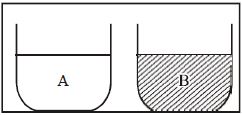
Two beakers $A$ and $B$ containing pure water and an aqueous solution,respectively,are placed in a closed container. What will be observed gradually with the passage of time?
A
Level of water in beaker $A$ becomes lower than the level of solution in beaker $B$.
B
Level of water in beaker $A$ and level of solution in beaker $B$ remain constant.
C
Level of water in beaker $A$ increases and that of solution in beaker $B$ decreases.
D
Level of both the beakers increases.
Solution
(A) The vapor pressure of pure solvent (water) is higher than the vapor pressure of the aqueous solution $(P_O > P_S)$.
Due to this difference in vapor pressure,water molecules evaporate from beaker $A$ and condense into beaker $B$ to reach equilibrium.
As a result,the volume of water in beaker $A$ decreases,and the volume of the solution in beaker $B$ increases.
Therefore,the level of water in beaker $A$ becomes lower than the level of the solution in beaker $B$.
Due to this difference in vapor pressure,water molecules evaporate from beaker $A$ and condense into beaker $B$ to reach equilibrium.
As a result,the volume of water in beaker $A$ decreases,and the volume of the solution in beaker $B$ increases.
Therefore,the level of water in beaker $A$ becomes lower than the level of the solution in beaker $B$.
0 likes
View Solution98
EasyMCQ
At a given temperature,the vapour pressure of a solution of two volatile liquids $A$ and $B$ is given by the equation $P_S = 150 - 60 X_B$ (where $X_B$ is the mole fraction of $B$). The vapour pressures of pure $A$ and pure $B$ at the same temperature are respectively:
A
$120, 80$
B
$90, 150$
C
$150, 90$
D
$80, 40$
Solution
(C) The total vapour pressure of a solution of two volatile liquids is given by $P_S = P_A^o X_A + P_B^o X_B$.
Since $X_A + X_B = 1$,we have $X_A = 1 - X_B$.
Substituting this into the equation: $P_S = P_A^o (1 - X_B) + P_B^o X_B = P_A^o + (P_B^o - P_A^o) X_B$.
Comparing this with the given equation $P_S = 150 - 60 X_B$:
For pure $A$ $(X_B = 0)$,$P_S = P_A^o = 150$.
For pure $B$ $(X_B = 1)$,$P_S = P_B^o = 150 - 60(1) = 90$.
Thus,the vapour pressures of pure $A$ and pure $B$ are $150$ and $90$ respectively.
Since $X_A + X_B = 1$,we have $X_A = 1 - X_B$.
Substituting this into the equation: $P_S = P_A^o (1 - X_B) + P_B^o X_B = P_A^o + (P_B^o - P_A^o) X_B$.
Comparing this with the given equation $P_S = 150 - 60 X_B$:
For pure $A$ $(X_B = 0)$,$P_S = P_A^o = 150$.
For pure $B$ $(X_B = 1)$,$P_S = P_B^o = 150 - 60(1) = 90$.
Thus,the vapour pressures of pure $A$ and pure $B$ are $150$ and $90$ respectively.
0 likes
View Solution99
EasyMCQ
$A$ solution contains $KCl$ in water. It is heated continuously and the vapour formed is removed continuously. The vapour pressure of the solution will be:
A
Greater than earlier
B
Same as earlier
C
Lower than earlier
D
None
Solution
(C) When a solution of $KCl$ in water is heated and the vapour (which is pure water) is removed,the amount of solvent decreases while the amount of solute $(KCl)$ remains constant.
This leads to an increase in the concentration of the solution (molality increases).
According to Raoult's Law,the vapour pressure of a solution is given by $P_{sol} = X_{solvent} \times P^0_{solvent}$.
As the concentration of the solute increases,the mole fraction of the solvent $(X_{solvent})$ decreases.
Consequently,the vapour pressure of the solution decreases as the solution becomes more concentrated.
This leads to an increase in the concentration of the solution (molality increases).
According to Raoult's Law,the vapour pressure of a solution is given by $P_{sol} = X_{solvent} \times P^0_{solvent}$.
As the concentration of the solute increases,the mole fraction of the solvent $(X_{solvent})$ decreases.
Consequently,the vapour pressure of the solution decreases as the solution becomes more concentrated.
0 likes
View Solution100
MediumMCQ
$A$ mixture of volatile components $A$ and $B$ has a total vapour pressure (in $torr$) $P = 254 - 119 X_A$,where $X_A$ is the mole fraction of $A$ in the mixture. What are the values of $P_A^o$ and $P_B^o$ (in $torr$)?
A
$254, 119$
B
$119, 254$
C
$135, 254$
D
$154, 119$
Solution
(C) According to Raoult's Law,the total pressure $P$ of a binary mixture is given by $P = P_A^o X_A + P_B^o X_B$.
Since $X_A + X_B = 1$,we can write $X_B = 1 - X_A$.
Substituting this into the equation: $P = P_A^o X_A + P_B^o (1 - X_A) = P_B^o + (P_A^o - P_B^o) X_A$.
Comparing this with the given equation $P = 254 - 119 X_A$:
$P_B^o = 254 \ torr$.
$P_A^o - P_B^o = -119$.
$P_A^o - 254 = -119$.
$P_A^o = 254 - 119 = 135 \ torr$.
Thus,$P_A^o = 135 \ torr$ and $P_B^o = 254 \ torr$.
Since $X_A + X_B = 1$,we can write $X_B = 1 - X_A$.
Substituting this into the equation: $P = P_A^o X_A + P_B^o (1 - X_A) = P_B^o + (P_A^o - P_B^o) X_A$.
Comparing this with the given equation $P = 254 - 119 X_A$:
$P_B^o = 254 \ torr$.
$P_A^o - P_B^o = -119$.
$P_A^o - 254 = -119$.
$P_A^o = 254 - 119 = 135 \ torr$.
Thus,$P_A^o = 135 \ torr$ and $P_B^o = 254 \ torr$.
0 likes
View SolutionSolutions — Lowering of vapour pressure · Frequently Asked Questions
1Are these Solutions questions useful for JEE and NEET?
Yes. All questions in this section are mapped to JEE Main and NEET exam patterns. Previous year questions from JEE Main, NEET, GUJCET and state-level exams are included with full solutions.
2Can I switch to Hindi or Gujarati for these questions?
Yes. Use the language tabs in the hero section or the sidebar to view the same questions and solutions in English, Hindi or Gujarati.
3How do I generate a question paper from this subtopic?
Use the Vedclass Exam Paper Generator — select the chapter and subtopic, set difficulty, and generate Sets A, B, C, D automatically. First 3 chapters of every subject are free.
Vedclass Products
For Students
Vedclass Test Series
Mock tests in real JEE/NEET style with performance analysis. 5-day free trial.
Start Free TrialFor Teachers
Exam Paper Generator
Generate Set A/B/C/D papers from this chapter in 2 minutes. 3 chapters free.
Try FreeFor Institutes
Online Exam Module
Live online exams with unlimited students, 360° analytics & white-label branding.
See DemoFor Teachers & Institutes
Generate a Solutions Exam Paper in 2 Minutes
Select subtopic & difficulty — Sets A, B, C, D auto-generated with No Repeat logic.
First 3 chapters of every subject are free — no payment required.